State Supplement sponsored by:
ARIZONA STATE EDITION
A Supplement to:
THOUSANDS of units in service Shipment in 1-3 days
®
SAME DAY shipping on parts & tools FULLY SUPPORTED by a 75 YEAR FAMILY BUSINESS
December 9 2018
10% off 10,000 ft. lb. hammers
Vol. II • No. 25
“The Nation’s Best Read Construction Newspaper… Founded in 1957.” Your Arizona Connection – Debbie Hansen – 1-702-239-0348 – dhansen@cegltd.com
ADOT Responds to Population Boom With $40M I-10 Expansion By Chuck Harvey CEG CORRESPONDENT
Arizona population is booming and local highway builders are responding. They are moving at a good pace despite summer heat and frequent dust storms. The Arizona Department of Transportation (ADOT) and the Federal Highway Administration are busy with a $40M project to widen Interstate 10 between Casa Grande and Tucson, from just south of Earley Road to Interstate 8 (mileposts 196-200) in Casa Grande. Work began in March 2018 and is scheduled for completion in summer of 2019. That means the project is one month ahead of schedule based on earlier predictions. But work schedules had to be adjusted at times because of extreme heat and frequency of dust storms in the area. By adjusting work schedules, delays have been
avoided. The project will add one lane in each direction adjacent to the median, with a concrete barrier separating directions of travel. That means three lanes in each direction from Tucson all the way to Casa Grande. The project includes replacement of the existing bridge over Jimmie Kerr Boulevard and the Union Pacific Railroad. It also features installation of a fiber optic trunk line between milepost 186 and milepost 209. Project Benefits The primary benefits to this project are traffic flow and driver safety, said Tom Herrmann, public information officer in Phoenix. “We are widening I-10 by adding an additional lane in each direction. The length of the project is about four miles.” Herrmann pointed out that I-10 is both a vital commercial corridor
Why pay more?
CALL 800-367-4937 *On approved credit • Financing Available
Arizona Department of Transportation photo
and a busy freeway for personal travel between Arizona’s two largest cities, Phoenix and Tucson. He said widening the freeway is necessary to improve traffic flow, remove congestion and give drivers additional space as the state’s population continues to increase. Herrmann added that Maricopa County, which includes Phoenix, was the nation’s fastest-growing county in 2017 and now has 4.2 million residents; Arizona is the fifth-fastest-growing state in the nation for the 12 months that ended July 1, 2017. New Bridges The new lane in each direction is being built adjacent to the median. And the median will include a concrete barrier. In addition, new bridges will be built at Jimmie Kerr Boulevard and the Union Pacific Railroad. They see BOOM page 6
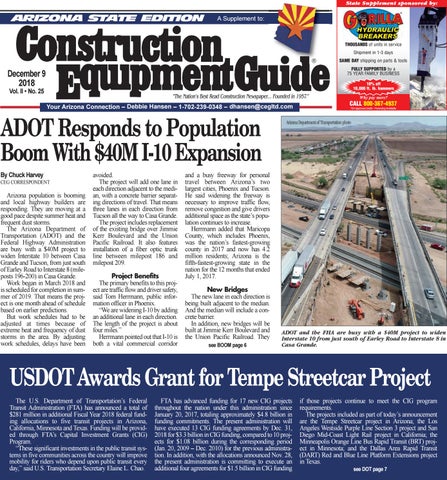
ADOT and the FHA are busy with a $40M project to widen Interstate 10 from just south of Earley Road to Interstate 8 in Casa Grande.
USDOT Awards Grant for Tempe Streetcar Project The U.S. Department of Transportation’s Federal Transit Administration (FTA) has announced a total of $281 million in additional Fiscal Year 2018 federal funding allocations to five transit projects in Arizona, California, Minnesota and Texas. Funding will be provided through FTA’s Capital Investment Grants (CIG) Program. “These significant investments in the public transit systems in five communities across the country will improve mobility for riders who depend upon public transit every day,” said U.S. Transportation Secretary Elaine L. Chao.
FTA has advanced funding for 17 new CIG projects throughout the nation under this administration since January 20, 2017, totaling approximately $4.8 billion in funding commitments. The present administration will have executed 13 CIG funding agreements by Dec. 31, 2018 for $3.3 billion in CIG funding, compared to 10 projects for $1.08 billion during the corresponding period (Jan. 20, 2009 – Dec. 2010) for the previous administration. In addition, with the allocations announced Nov. 28, the present administration is committing to execute an additional four agreements for $1.5 billion in CIG funding
if those projects continue to meet the CIG program requirements. The projects included as part of today’s announcement are the Tempe Streetcar project in Arizona; the Los Angeles Westside Purple Line Section 3 project and San Diego Mid-Coast Light Rail project in California; the Minneapolis Orange Line Bus Rapid Transit (BRT) project in Minnesota; and the Dallas Area Rapid Transit (DART) Red and Blue Line Platform Extensions project in Texas. see DOT page 7
Page 2 • December 9, 2018 • www.constructionequipmentguide.com • Arizona State Supplement • Construction Equipment Guide
ADOT Sells Parcel Near Sky Harbor Airport for $28.7M The Arizona Department of Transportation has sold a parcel of land it owned along Interstate 10 in Phoenix for $28.7 million, the largest sale of excess property in the agency’s history. The 21-acre parcel, which includes several buildings, is located along the north side of I-10 near Phoenix Sky Harbor International Airport. As has been done with 21-acre parcel, which includes seversome previous excess prop- The al buildings, is located along the north erty sales, proceeds from the side of I-10 near Phoenix Sky Harbor sale will be used for an International Airport. upcoming project to widen I10 between the Loop 202 (Santan ing project’s budget.” Under an agreement, the new Freeway) and the I-17 “Split” interchange near Sky Harbor. That project owner will remove sections of three is scheduled to start construction in buildings on the property that currently extend into the area ADOT 2021. The property has been sold to will need for the I-10 improvements. Exeter 4425-4535 East Elwood Several businesses, including cabiLLC, a Philadelphia-based develop- netry and shipping firms, have been er. ADOT purchased the property, leasing space on the property. ADOT advertised the parcel earliwest of State Route 143 (Hohokam er this year and conducted several Expressway), in 2011. “Our engineers determined how tours for potential buyers. Eight bidmuch of the property would be need- ders took part in an auction of the ed for I-10 widening,” said Michael property. (This story also can be found on Craig, manager of ADOT’s office of property management. “The timing Construction Equipment Guide’s at www.construcwas right to sell the excess portion website and put those dollars into the upcom- tionequipmentguide.com.)
Proceeds from the sale will be used for an upcoming project to widen I-10 between the Loop 202 (Santan Freeway) and the I-17 “Split” interchange near Sky Harbor. That project is scheduled to start construction in 2021.
CBP, ACE Award Contract to ADOT’s $62M SR 260 Project Replace Border Wall in Yuma Heads Into Winter Hiatus U.S. Customs and Border Protection, in partnership with the U.S. Army Corps of Engineers, has awarded a contract to construct up to 32 miles of Primary Pedestrian Replacement Wall in Arizona, within the U.S. Border Patrol’s Yuma and Tucson sectors. The project was funded with CBP’s Fiscal Year 2018 appropriations. The contract for this project was awarded on Nov. 13, 2018, to Barnard Construction Company Inc. for the base contract of $172 million for approximately 14 mi. in Yuma Sector. Total contract value, including options, is approximately $324 million. Construction is scheduled to begin in April 2019. The Arizona projects include the construction and installation of upgraded tactical infrastructure including approximately 5 mi. in Lukeville, Ariz., and approximately
27 mi. in Yuma, Ariz. This project is within the Yuma and Tucson Border Patrol sectors’ areas of responsibility. The primary pedestrian replacement wall in Arizona will improve each sector’s ability to impede and deny illegal border crossings and the drug and human smuggling activities of transnational criminal organizations. CBP continues to implement President Trump’s Executive Order 13767 — also known as Border Security and Immigration Enforcement Improvements — and continues to take steps to expeditiously plan, design and construct a physical wall using appropriate materials and technology to most effectively achieve operational control of the southern border. (This story also can be found on Construction Equipment Guide’s website at www.constructionequipmentguide.com.)
Due to a colder, wetter October than anticipated, final work on the State Route 260 widening project between Camp Verde and Cottonwood will take place next spring, including putting down the final pavement layer known as a friction course. However, the Arizona Department of Transportation was able to complete all major work on the $62 million project this year. In the 9-mi. stretch, crews constructed two lanes in each direction separated by a median, opened seven roundabouts at major intersections and completed a new bridge over Cherry Creek near Cherry Creek Road. All lanes and roundabouts between Interstate 17 and Thousand Trails Road will be open to traffic before the project shuts down for the winter. There will be no construction-related restrictions in place. Original plans called for the final layer of
pavement to go in before winter hiatus, followed by permanent lane striping in the spring. After unusually wet weather from remnants of Hurricane Rosa combined with a drop in temperatures, both of these final steps will be completed in the spring. The road surface needs to be around 85 degrees in order for new pavement to cure properly. ADOT’s contractor had begun preparing the roadway for the final pavement layer when weather conditions forced the decision to finish next year. As a result, the road surface, while smooth and safe to drive on, will be a bit noisier than it otherwise would with the final pavement layer. For more information, visit azdot.gov/SR260widening. (This story also can be found on Construction Equipment Guide’s website at www.constructionequipmentguide.com.)
Construction Equipment Guide • Arizona State Supplement • www.constructionequipmentguide.com • December 9, 2018 • Page 3
Page 4 • December 9, 2018 • www.constructionequipmentguide.com • Arizona State Supplement • Construction Equipment Guide
ADOT’s Snowplows, Drivers Ready for Winter Weather When a couple of October storms dropped early snow on Arizona’s high country, the Arizona Department of Transportation and its plows were ready because the agency prepares year-round for winter weather. ADOT’s preparations for winter weather include ensuring a wellmaintained snowplow fleet. With that in mind, the agency has replaced 25 older plows with new models that are more cost-efficient, require less maintenance and feature technology that helps operators do their jobs more efficiently during 12-hour shifts. These new plows include auxiliary cab heaters to keep drivers warm while not idling and wasting fuel; heated windshields to prevent wipers from freezing and getting stuck; backup cameras and a camera and laser guidance system to help guide operators; modern lighting packages; and front flex plows that can bend in different configurations to remove snow. ADOT’s fleet also includes two tow plows that operate along Interstate 40 between Flagstaff and Williams. Tow plows are separate steerable plows on trailers pulled by snowplows, allowing one driver to clear two lanes in a single run along a highway. Standing ready to operate ADOT snowplows are 400 certified operators who train through-
Standing ready to operate ADOT snowplows are 400 certified operators who train throughout the year to help keep people and commerce moving when winter weather strikes.
out the year to help keep people and commerce moving when winter weather strikes. While ADOT’s snowplow operators are ready to help you, you should help them in return. Always respect the plow. Avoid passing a snowplow that’s clearing a high-
way until the driver pulls over to let traffic pass, and never assume a snowplow operator knows your vehicle is nearby. If you can’t see the plow driver, there’s a good chance the driver can’t see you. Remember: The safest place on a highway when it’s snowing is trailing
a safe distance behind a snowplow. Another way to help is making an informed decision about traveling when snow is forecast or already falling. The safest choice always is waiting until snow is no longer falling and until ADOT’s plows have cleared highways. It’s
also the most efficient decision, as a highway takes much longer to plow when it’s jammed with vehicles that shouldn’t be traveling on a roadway that’s slick with snow and ice. ADOT offers Know Snow safety tips at azdot.gov/KnowSnow such as slowing down, leaving extra room behind the vehicle ahead, having a fully-charged cellphone, taking along warm clothing, blankets, food and water, and packing an emergency kit. Check your vehicle before heading out in winter weather, making sure — at a minimum — that the tires, heater and windshield wipers are in good shape. Before traveling, research weather conditions to determine whether it would be smarter to sit out a storm so ADOT’s nearly 200 snowplows can clear highways. Check road conditions by calling 511 or visiting az511.gov. ADOT’s Twitter account (@ArizonaDOT) and Facebook page (facebook.com/AZDOT) provide real-time information and interaction. And the free ADOT Alerts app available at ADOTAlerts.com will send critical information, including alternate routes, should snow and ice close a major highway. (This story also can be found on Construction Equipment Guide’s website at www.constructionequipmentguide.com.)
Reducing Inactive Projects Moves Improvements Forward When a project isn’t using some or all of the funding committed to it because it’s become inactive, freeing that money as quickly as possible means the Arizona Department of Transportation can move forward sooner with other work that’s ready to go. That’s the goal behind a comprehensive effort to reduce what is known formally as ADOT’s inactive projects balance. This balance is comprised of ADOT projects and local projects that haven’t used any of the funding committed to them in more than 180 days. At its peak, ADOT’s inactive projects balance stood at $160 million, representing money committed to about 3,000 individual project phases including design, right-ofway acquisition and construction. ADOT employees responsible for project
funding have reduced that balance to $50.4 million and are continuing to develop ways to reduce it even further. “To some, it may sound like an achievement that only an accountant could love, but reducing our inactive projects balance is a win for all Arizonans,” said John Halikowski, ADOT director. “This allows us to be more nimble in getting limited transportation funding to other projects that will improve the quality of life in this state.” The most common reasons for projects becoming inactive include requesting funding too far in advance of needing to spend it, a local agency not invoicing ADOT in a timely manner and representatives failing to notify ADOT that a project or project phase is complete. “Working across ADOT divisions and with local partners, our employees have
identified problems that contribute to the inactive projects balance and developed sustainable improvements,” said Kristine Ward, ADOT’s chief financial officer. “We have a clear path and process for continuing to reduce this balance and get even more projects going sooner.” This effort is aligned with the agency’s use of the Arizona Management System championed by Gov. Doug Ducey. It calls for all employees to identify ways to improve continuously improve processes and their value to customers. The improvements include ADOT tracking inactive projects weekly and examining each project phase rather than the whole project when determining what has become inactive. Each month, a website lists inactive projects and projects that will be considered inactive in 30 days.
Employees developed a new policy on inactive projects spelling out that funding authorization should be requested only when a project phase is ready to proceed and providing a consistent process for closing out projects. ADOT representatives have made presentations about the policy and procedures at meetings of local government leaders in addition to conducting webinars for ADOT staff and those with local agencies. Looking to reduce the inactive projects balance even further, ADOT now is focusing on ways to streamline the process for closing out project phases so the remaining committed funds can be released sooner. For more information, visit azdot.gov/AMS. (This story also can be found on Construction Equipment Guide’s website at www.constructionequipmentguide.com.)
Construction Equipment Guide • Arizona State Supplement • www.constructionequipmentguide.com • December 9, 2018 • Page 5
NEXT ISSUE CLOSES DECEMBER 27, 2018
3 3 3 3 3 3 3
empirecat.com/eloy / l | 520-582-2900 520 582 2900
Page 6 • December 9, 2018 • www.constructionequipmentguide.com • Arizona State Supplement • Construction Equipment Guide
State’s Population, Economic Boom Demands Better Roads BOOM from page 1
are part of the widening effort. “The current I-10 bridges over Jimmie Kerr and the railroad cannot accommodate the additional lanes of traffic that are being created as part of this project,” Herrmann said. “The new bridges — one in each direction — are being built to accommodate the wider freeway and increasing traffic. The concrete barriers are being added to increase driver safety because adding travel lanes in the median will decrease the width of the median.” The new bridges will require new ramps at the location. The project also will include auxiliary lanes in both directions between I-8 and Jimmie Kerr Boulevard, providing a safer alternative to the existing ramps. An auxiliary lane is an extra lane on the entire length of highway between interchanges, giving drivers more time to merge in or out. The lane is created when an entrance ramp meets the highway and drops out with an “exit only” sign to become the ramp at the next exit. The completed project will increase freeway capacity, improve auxiliary lanes and enhance aesthetics of the new roadway. The project started just south of Earley Road. Periodic lane closures will be in effect, but only at night. Another widening project is under way on I-10 near Eloy, where crews are adding lanes, a new traffic interchange at Arizona 87 and creating a new dust-detection zone. That project, which started in December 2017 is to be completed in fall of 2019. Joint Venture A joint venture of Ames and Combs construction companies head up the construction. Ames is based in Burnsville, Minn., and has an office in Scottsdale, Ariz. Combs Construction’s head office is in Phoenix. Ames is a family-owned enterprise specializing in energy, mining, transportation, water and wastewater and commercial construction projects. Combs construction reports that since 1993, it has positioned itself as one of Arizona’s top general contractors
Arizona Department of Transportation photo
Arizona population is booming and local highway builders are responding.
in the asphalt paving and heavy highway construction sector. The I-10 widening project has between 25 and 30 subcontractors. Major names include PAVCO of Arvada, Colo.; Sturgeon Electric of Henderson, Colo.; RGG United of Glendale, Ariz.; Case Foundation of Roselle, Ill.; Paradise Rebar of Phoenix; and Howe Precast of Mesa, Ariz. Most of the current work on the project is taking place at the site of the new bridges over Jimmie Kerr Boulevard. “We are building piers and other supporting infrastructure for the bridges,” Herrmann said. “We’ve already made improvements to the outside shoulder to carry I-10 traffic during the work and we’re currently making improvements to the median to prepare for building the new travel lanes.” Heavy equipment at the construction site includes cranes, a motor grader, scrapers, loaders, haul trucks, milling machines and asphalt paving equipment. Concrete and asphalt use will be significant over the course of the project. Crews will lay about 116,700 tons of concrete. They will apply 9,256 cu. yds. of concrete at the bridges. Even more concrete, about 13,211 cu. yds., will be used for retaining walls.
Maintaining Traffic Flow Although crews will be working near travel lanes, the project at Casa Grande isn’t expected to increase congestion in the area. Lane restrictions are expected to take place at night, leaving two lanes open to traffic in both directions during heavy travel times. “Despite working along the edge of freeway travel lanes we are committed to maintaining two lanes of traffic in each direction as much as possible during the project to maintain traffic flow,” Herrmann said. “Lane restrictions are limited to nights whenever possible to minimize travel restrictions in the area.” Supporting Growth The widening project will support growth, both in terms of population and economics. I-10 between Phoenix and Tucson is a key commerce corridor, and the improvements will support the continuous growth in the region, including Casa Grande and surrounding Pinal County. (This story also can be found on Construction Equipment Guide’s website at www.constructionequipmentguide.com.) CEG
Arizona Department of Transportation photo
The widening project will support growth, both in terms of population and economics.
Construction Equipment Guide • Arizona State Supplement • www.constructionequipmentguide.com • December 9, 2018 • Page 7
Pros Kno Pros Kno ow! w!
®
T Those in the know w,, know Takeuchi Take euchi
Takeuchi of o ffers a wide range of compact excavatorss to help you get your tougheest tasks comppleted. PUT A TAKEUCH A HI TO WORK ON O YOUR JOBSITE AN ND EXPERIIENCE THE DIFFEREN NCE!
www.ditchwitchaz.com
4028 S 36th Street Phoenix, AZ 85040 (602) 437-0351 6975 N Camino Martin Tucson, AZ 85741 (520) 579-0261
takeuch hi us.com hi-us.com
ADOT Completes Major Improvements DOT Announces on I-40, I-17 Projects Near Flagstaff $281M Funding for Transit Projects
With Arizona Department of Transportation projects improving Interstate 17 and Interstate 40 around Flagstaff approaching a winter hiatus, the area now has upgraded bridge decks, two new bridges and 20 total miles of rebuilt roadway. There also are many more miles of fresh pavement, with additional paving to come when warmer temperatures return. “These much-needed projects keep the key northern Arizona corridors of I-40 and I-17 in top shape for commercial traffic and passenger vehicles,” said Audra Merrick, district engineer for ADOT’s North Central District. “It’s even better that the major work was completed in time for the holidays.” ADOT has replaced the I-40 bridge decks in each direction over Beulah Boulevard, immediately west of I-17, as well as the westbound bridge deck over I-17. The eastbound I-40 bridge over I-17 received a new concrete surface. The I-17 northbound to I-40 westbound ramp is reopened to traffic and temporary concrete barrier has been removed. Intermediate lane closures will be required over the next few weeks as crews wrap up minor project items. Crews will return next year to lay down the top layer of asphalt, known as friction course. As part of a 17-mi. I-40 paving project between Cataract Lake and Parks west of Flagstaff, crews have rebuilt 5 mi. of I-40 in each direction between Garland Prairie and Pittman Valley roads as well as a 1-mi. section in each direction near
the Parks interchange. Paving will continue elsewhere in the project area for the next few weeks until weather no longer permits it. Crews will return next summer to finish. For a project upgrading northbound I-17 from the Coconino County line at milepost 311 to milepost 339 near Flagstaff, crews have rebuilt both lanes between mileposts 312 and 315 and built new bridges at Willard Springs Road. In the final weeks before the weather turns too cold for paving, crews will focus on completing paving of both lanes between mileposts 312 and 316 and the right lane up to milepost 331 at Kelly Canyon Road. Work will resume with warmer weather. In all, ADOT projects over the past year have been improving a total of 62 mi. of I-40 and I-17 west and south of Flagstaff, an area where the many freeze-thaw cycles seen annually, combined with heavy snow, snowplowing and use by a large number of commercial vehicles, lead to stressed pavement. Other pavement-improvement projects completed include the rebuilding of 5 mi. of I-40 in each direction west of Williams near Devil Dog Road and repaving 12 mi. of I40 in each direction between Parks and Riordan. For more information, visit azdot.gov/projects. (This story also can be found on Construction Equipment Guide’s website at www.constructionequipmentguide.com.)
DOT from page 1
FTA indicated its intent to fund the projects through an updated allocation notice for Fiscal Year (FY) 2018 CIG funding appropriated by Congress. FTA is allocating approximately $281 million in appropriated FY 2018 CIG funding among the five projects, which either have a construction grant agreement or are nearing completion of all statutory and readiness requirements. All five projects have either completed or are in process of completing the rigorous CIG program steps as outlined in law. “FTA continues to evaluate and advance projects in the CIG program, considering each project on its individual merits while demonstrating good governance consistent with discretion afforded in federal law,” said FTA Acting Administrator K. Jane Williams. The CIG Program provides funding for major transit infrastructure capital investments nationwide. Projects accepted into the program must go through a multi-year, multi-step process according to requirements in law to be eligible for consideration to receive program funds.
(This story also can be found on Construction Equipment Guide’s website at www.constructionequipmentguide.com.)
Page 8 • December 9, 2018 • www.constructionequipmentguide.com • Arizona State Supplement • Construction Equipment Guide
Public Auction held the 2nd Saturday of every month. Preview Every Monday - Friday 7am - 4pm Consignments Welcome Western Sales Management, Inc 1616 S 67th Ave. Phoenix, AZ 85043
623-936-3300 wsmauctioneers.com wsmauctionbiz@yahoo.com
Next Auction January 12, 2019
File Photo