State Supplement sponsored by:
ARIZONA STATE EDITION
A Supplement to:
FALL SPECIAL
2% financing* on ®
Gorilla Hydraulic Breakers • Priced up to 50% below the competition. • Fully supported by a 75 year family business. • Shipment in 2-3 days for most carriers.
October 15 2017
Programs available for ALL buyers!*
Start
Vol. II • No. 21
“The Nation’s Best Read Construction Newspaper… Founded in 1957.” Your Arizona Connection – Debbie Hansen – 1-702-239-0348 – dhansen@cegltd.com
stuff today!
CALL 888-81-GORILLA(46745) *On approved credit
Demolition Under Way on Iconic Phoenix Trotting Park By Lori Tobias
stands in those moon suits in 106-degree heat.” The park was built in 1964 with the first race being run in January 1965. In 1966, after just two and a-half seasons, the grandstand was closed. Trevor Freeman, who grew up fascinated by the grandstand, had hoped to see it preserved, and set out to learn its history. In a comprehensive website (phoenixtrottingpark.com), he shares what he learned from newspapers, magazines and other resources about the massive concrete structure. “It’s very unique,” said Freeman, noting the park was originally budgeted at $2 mil-
Trevor Freeman photo
CEG CORRESPONDENT
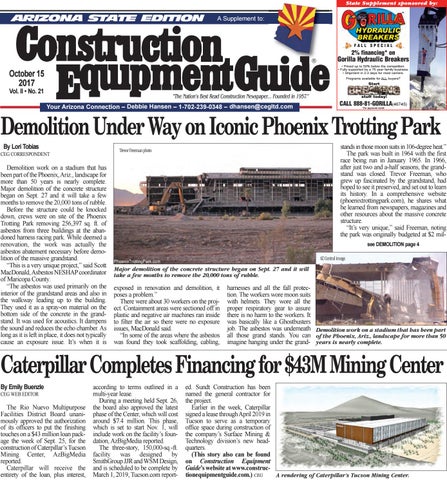
Demolition work on a stadium that has been part of the Phoenix, Ariz., landscape for more than 50 years is nearly complete. Major demolition of the concrete structure began on Sept. 27 and it will take a few months to remove the 20,000 tons of rubble. Before the structure could be knocked down, crews were on site of the Phoenix Trotting Park removing 256,397 sq. ft. of asbestos from three buildings at the abandoned harness racing park. While deemed a renovation, the work was actually the asbestos abatement necessary before demolition of the massive grandstand. “This is a very unique project,” said Scott MacDonald, Asbestos NESHAP coordinator of Maricopa County. “The asbestos was used primarily on the interior of the grandstand areas and also in the walkway leading up to the building. They used it as a spray-on material on the bottom side of the concrete in the grandstand. It was used for acoustics. It dampens the sound and reduces the echo chamber. As long as it is left in place, it does not typically cause an exposure issue. It’s when it is
see DEMOLITION page 4 AZ Central image
Major demolition of the concrete structure began on Sept. 27 and it will take a few months to remove the 20,000 tons of rubble.
exposed in renovation and demolition, it poses a problem.” There were about 30 workers on the project. Containment areas were sectioned off in plastic and negative air machines ran inside to filter the air so there were no exposure issues, MacDonald said. “In some of the areas where the asbestos was found they took scaffolding, cabling,
harnesses and all the fall protection. The workers wore moon suits with helmets. They wore all the proper respiratory gear to assure there is no harm to the workers. It was basically like a Ghostbusters job. The asbestos was underneath Demolition work on a stadium that has been part all those grand stands. You can of the Phoenix, Ariz., landscape for more than 50 imagine hanging under the grand- years is nearly complete.
Caterpillar Completes Financing for $43M Mining Center By Emily Buenzle CEG WEB EDITOR
The Rio Nuevo Multipurpose Facilities District Board unanimously approved the authorization of its officers to put the finishing touches on a $43 million loan package the week of Sept. 25, for the construction of Caterpillar’s Tucson Mining Center, AzBigMedia reported. Caterpillar will receive the entirety of the loan, plus interest,
according to terms outlined in a multi-year lease. During a meeting held Sept. 26, the board also approved the latest phase of the Center, which will cost around $7.4 million. This phase, which is set to start Nov. 1, will include work on the facility’s foundation, AzBigMedia reported. The three-story, 150,000-sq.-ft. facility was designed by SmithGroup JJR and WSM Design, and is scheduled to be complete by March 1, 2019, Tucson.com report-
ed. Sundt Construction has been named the general contractor for the project. Earlier in the week, Caterpillar signed a lease through April 2019 in Tucson to serve as a temporary office space during construction of the company’s Surface Mining & Technology division’s new headquarters. (This story also can be found on Construction Equipment Guide’s website at www.constructionequipmentguide.com.) CEG A rendering of Caterpillar's Tucson Mining Center.
Page 2 • October 15, 2017 • www.constructionequipmentguide.com • Arizona State Supplement • Construction Equipment Guide
Project Offers Rare Look at What Lies Beneath Hwy. Surface By Peter Corbett
ADOT photo
SPECIAL TO CEG
A project under way on Interstate 40 just west of Williams offers a rare opportunity to see what lies beneath at least some of the seemingly endless miles of roadway in the state highway system. Rather than milling off the top layer of pavement and installing a new surface, work occurring in eastbound lanes between mileposts 156 and 161 is rebuilding the roadway from the ground up. This stretch, at an elevation of about 6,700 ft., has taken a beating from truck traffic and frequent freezing and thawing in winter. That led to cracking, potholes and, now, a $33.9 million improvement project. So what lies under that road surface other than the ground? In this case, it begins with bits of what’s being replaced. A rock crusher breaks concrete that was part of the old roadway into small pieces that serve as a base layer of aggregate 8 in. deep. Next up is a 4-in. base of asphalt the full width of the roadway, topped by 14 in. of grooved concrete for the travel lanes. Asphalt 18 in. deep goes down for the shoulders. To accommodate construction in the eastbound lanes, both directions of travel are using the westbound lanes, separated by a concrete barrier. With the eastbound work scheduled to end by winter, crews will return in the spring to rebuild westbound lanes. While a portion of the westbound stretch will be rebuilt from the ground up, the majority will be topped with 14 in. of concrete in the travel lanes and
A 4-in. base of asphalt the full width of the roadway, is topped by 14 in. of grooved concrete for the travel lanes. Asphalt 18 in. deep goes down for the shoulders.
14 in. of asphalt on the shoulders. “ADOT is making a huge investment to improve the roadways to make sure travel is safe and efficient, to maintain the commerce corridors and get people where they need to be,” said Brenden Foley, ADOT’s senior resident engineer in charge of the project. What makes up a particular stretch of highway depends on local conditions. In this case, the clay soil and remote location have a lot to do with the aggregate base topped by asphalt topped in turn by concrete. (This story also can be found on Construction Equipment Guide’s website at www.constructionequipmentguide.com.)
ADOT photo
ADOT photo
Rather than milling off the top layer of pavement and installing a new surface, work occurring in eastbound lanes between mileposts 156 and 161 is rebuilding the roadway from the ground up.
A rock crusher breaks concrete that was part of the old roadway into small pieces that serve as a base layer of aggregate 8 in. deep.
New Construction Technology Programs Begin in October By Angela Askey SPECIAL TO CEG
Central Arizona College (CAC) began offering new Industrial Construction and Concrete Construction Certificate courses on Oct. 6, 2017. The classes for industrial construction, concrete construction, heavy equipment operator, structural welding and pipefitting are being offered on Fridays and Saturdays through the completion of the fall semester. Each certificate will require the completion of approximately 30 credits. The course offerings meet National Center for Construction Education and Research (NCCER) standards and Occupational Safety and Health Administration (OSHA) 30-hour requirements. Students who complete the Associate of Applied Science can go on to pursue a Bachelor of Applied Science degree in Industrial Technology
Management at Northern Arizona University or a related degree at universities throughout the state. The workforce development partnership between Tempe-based general contractor Sundt Construction Inc. and CAC is providing opportunities for students to complete training in these two programs as well as heavy equipment operator, structural welding and pipefitting. Sandra Zires, CAC career navigator said, “CAC and Sundt are working hand-in-hand to train students to fill in-demand skilled trade jobs. Through CAC, students have a link to employment with Sundt and a viable career path.” For more information, call Sandra Zires at 520/494-5308 or email: Sandra.lascherzires@centralaz.edu. (This story also can be found on Construction Central Arizona College (CAC) began offering new Industrial Equipment Guide’s website at www.construc- Construction and Concrete Construction Certificate courses on Oct. 6, tionequipmentguide.com.) 2017.
Construction Equipment Guide • Arizona State Supplement • www.constructionequipmentguide.com • October 15, 2017 • Page 3
NEXT ISSUE CLOSES NOVEMBER 2, 2017
3 3 3 3 3 3 3
empirecat.com/eloy / l | 520-582-2900 520 582 2900
Page 4 • October 15, 2017 • www.constructionequipmentguide.com • Arizona State Supplement • Construction Equipment Guide
Crews Begin Major Demolition Following Asbestos Removal Trevor Freeman photo
When the trotting park was completed, it was the largest single installation ever undertaken in the country. DEMOLITION from page 1
lion but came in at nearly five times that much at $9.5 million. “There’s nothing else like it in Phoenix. “The size and scale really stood out compared to everything else. The Trotting Park’s wall panels,
roof slabs, columns, beams and girders were all constructed of precast concrete, which was poured on-site. While commonly used today, this method of construction was considered cutting-edge in the 1960s.” Because of the high summer
Trevor Freeman photo
According to Trotting Park historian Trevor Freeman, “The roof of the grandstand was supported by a series of main roof girders. These hollow, V-shaped girders measured 8 by 8 by 105 feet, and were considered ‘lightweight’ at 120 tons.”
temperatures, special precautions were taken in the preparation and curing of the concrete. Aggregates used in the concrete mix were cooled before mixing by introducing ice into the mixing process to dissipate the heat. The trucks used to transport the mix to the site were equipped with water spray devices to cool the drums containing the concrete while they were being hauled to the point of use. After pouring, the fresh concrete was covered with black polyethylene plastic sheets to conserve moisture as well as to simulate steam curing methods, according to Freeman. “All of the concrete structural members [except the floor and roof slabs] were post-tensioned using a system called Prescon. The precast pieces have a compressive strength of 6000-psi, approximately three times the normal strength of concrete used in more conventional buildings. “The roof of the grandstand was supported by a series of main roof girders. These hollow, V-shaped girders measured 8 by 8 by 105 feet, and were considered ‘lightweight’ at 120 tons. They allowed the building to achieve unusually long cantilevers of 39 feet for the seat girders and 32 feet for the roof girders. However, the cantilever at the roof level reaches a remarkable 44 feet with the attachment of the front fascia units.” The hollow roof girders also were part of the track’s innovative heating system, which kept the spectators warm during the winter months. The trotting park was not built with air conditioning, as it see DEMOLITION page 6
Trevor Freeman photo
Before the structure could be knocked down, crews were on site of the Phoenix Trotting Park removing 256,397 sq. ft. of asbestos from three buildings at the abandoned harness racing park.
Trevor Freeman photo
The grandstand was originally enclosed in glass facing the track, with the thinnest support pillars possible, to ensure fans had the very the best view of the track.
Construction Equipment Guide • Arizona State Supplement • www.constructionequipmentguide.com • October 15, 2017 • Page 5
Want to run strong equipment m ? Run Doosan. Viisit uss today a to learn more.
Authorized Doosan Dealer
Ditch Witch of o Arizona 4028 South 36th Street | Phoenix, AZ 602.437.0351 www ditchwitchaaz com www.ditchwitchaz.com Doosan® and the Doosan logo are registered trademarks of Doosan Corp. in the United States and various other countries around the world.
Page 6 • October 15, 2017 • www.constructionequipmentguide.com • Arizona State Supplement • Construction Equipment Guide
Moving Chuckwallas Part of South Mountain Freeway Plans On several hot summer mornings, biologists dressed in hiking gear searched crannies along ridges in the southwest corner of the South Mountain Park/Preserve. Their mission: finding and then relocating the elusive chuckwalla. These large lizards, which are common in the Southwest United States and northern Mexico, include the orange-tailed males that are unique to the South Mountain Park/Preserve. While most animals flee when threatened, chuckwallas wedge themselves deep in cracks between rocks. That’s why the Arizona Department of Transportation, in partnership with the Arizona Game and Fish Department, the Gila River Indian Community’s Department of Environmental Quality and South Mountain Park/Preserve, is working to relocate chuckwallas in the small portion of the preserve where the Loop 202 South Mountain Freeway will pass. Construction in this segment of the 22-mi. freeway corridor is scheduled to begin in mid-2018. “With the work that we are doing in collaboration with our partners, we believe the chuckwalla population will continue to thrive in the area surrounding the South Mountain Freeway,” said ADOT biologist Kris Gade. Capturing these lizards, which can measure up to 15 in. long, was no easy task. Groups of four to eight biologists made multiple passes, looking deep into crevices in the rocks with flashlights. If a lizard was spotted, the biologists would first attempt to grab it with their gloved hands before the chuckwalla could dive deeper into a crack. If the chuckwalla wiggled too deeply into a narrow crack, it sometimes required multiple biologists to move the rock with a pry bar while another made the capture.
ADOT photo
Approximately 120 chuckwallas were captured and released several hundred feet away.
Approximately 120 chuckwallas were captured and released several hundred feet away. Before they were released, the chuckwallas were weighed and measured, and their feet were tagged with white paint. In addition, 15 chuckwallas were fitted with radio telemetry harnesses so biologists can track their movements. And all got a tiny transponder tag inserted beneath their skin to help biologists identify them during future surveys. “The Arizona Game and Fish Department routinely works with ADOT to minimize wildlife impacts by highway construction projects,” said Daniel Leavitt, the Arizona Game
and Fish Department herpetologist who led the department’s chuckwalla efforts. “That is why it is key to learn what we can about chuckwallas that may impacted by this project and safely relocate them to a new area nearby. Data collected during this partnership will be used to assist in decisions to help conserve and protect chuckwallas and other wildlife near the Loop 202 extension in the future.” Relocating chuckwallas is just one example of ADOT’s environmental stewardship during construction of the South Mountain Freeway. As with any ADOT project, this began with a biological evaluation to determine what impacts the work will have on plants and animals. Project biologists also are tracking movements of desert tortoises in the segment where the freeway will pass through the preserve, and working with wildlife rehabilitators as needed to relocate burrowing owls and other wildlife that may be disturbed by construction. The completed freeway also will have several multiuse crossings in the center segment, identified in consultation with the Arizona Game and Fish Department, to allow wildlife to pass along with hikers and those riding on horseback. The 22-mi. freeway, expected to open by late 2019, will provide a long-planned direct link between the East Valley and West Valley, and a much-needed alternative to Interstate 10 through downtown Phoenix. For more information, visit azdot.com. (This story also can be found on Construction Equipment Guide’s website at www.constructionequipmentguide.com.)
Trotting Park Demolition Requires Massive Earthmoving Equipment DEMOLITION from page 4
was never intended to be a yearround facility. The track did house a fully air-conditioned restaurant, which operated year-round.” The grandstand was originally enclosed in glass facing the track, with the thinnest support pillars possible, to ensure fans had the very the best view of the track, Freeman said. At the time, it was completed it was the largest single installation ever undertaken in the country. Freeman suspects the park failed because at the time it was built, it was far removed from the Phoenix population. Today there is an interchange of two major freeways and the site is neighbored by homes, car dealerships and a prison. The demolition calls for massive earth moving equipment, particularly a track hoe to begin the demolition itself so they can reach the top of the building to tear it
Trevor Freeman photo
While deemed a renovation, the work was actually the asbestos abatement necessary before demolition of the massive grandstand.
down, MacDonald said. “It is an incredible structure,” he said. Freeman agrees, and is saddened it will not be preserved. “It is so overdone,” Freeman said. “This thing was like three times stronger than it needed to be. I don’t know why they did that, but it is cool. They dug holes into the earth and lined them and put rebar
in there and pour the concrete. They would pick them up and assemble in place. They might be surprised when they show up with wrecking ball, but it’s not going down easy.” (This story also can be found on Construction Equipment Guide’s website at www.constructionequipmentguide.com.) CEG
Trevor Freeman photo
“All of the concrete structural members [except the floor and roof slabs] were post-tensioned using a system called Prescon. The pre-cast pieces have a compressive strength of 6000-psi, approximately three times the normal strength of concrete used in more conventional buildings,” said Trotting Park historian Trevor Freeman.
Construction Equipment Guide • Arizona State Supplement • www.constructionequipmentguide.com • October 15, 2017 • Page 7
Pros Kno Pros Kno ow! w!
®
T Those in the know w,, know Takeuchi Take euchi
Takeuchi of o ffers a wide range of compact excavatorss to help you get your tougheest tasks comppleted. PUT A TAKEUCH A HI TO WORK ON O YOUR JOBSITE AN ND EXPERIIENCE THE DIFFEREN NCE!
www.ditchwitchaz.com
4028 S 36th Street Phoenix, AZ 85040 (602) 437-0351 6975 N Camino Martin Tucson, AZ 85741 (520) 579-0261
takeuch hi us.com hi-us.com
EMCOR Launches Breast Cancer Awareness Month On Sept. 29, EMCOR/University Mechanical & Engineering Contractors Inc. announced more than 525 employees, along with those of its client Sundt/DPR, Banner Health, the entire project work force and others donned EMCOR pink hard hats and assembled to form EMCOR’s signature giant human Pink Hard Hat Ribbon in a visible call to action for Breast Cancer Awareness Month and EMCOR’s ninth annual “Protect Yourself. Get Screened Today.” campaign”. The event was held at Banner Health’s new plant construction site in Tucson, Ariz. Brad Thornton, president/CEO of University Mechanical & Engineering Contractors, presented a Pink Hard Hat event plaque to Tom Dickson, CEO, University Medical Center, Tucson, Banner. Ian McDowell, vice president of Sundt Construction; and Brian Brown, project executive of DPR Construction, also were presented with event plaques, and all spoke passionately in support of breast cancer awareness. “This is EMCOR’s ninth consecutive year of spearheading the national Pink Hard Hat initiative. Over the years people have come forward to say they believe this unique way
of raising awareness of the importance of breast cancer awareness and screening has had a positive impact on their own lives or that of a loved one,” stated Thornton. “Many of our employees wear hard hats on a daily basis for personal protection, and we’re proud of their commitment to wear an EMCOR/University Mechanical Pink Hard Hats in October to raise awareness for breast cancer, reminding women and men they can help protect themselves by getting screened.” Throughout October thousands of employees at more than 60 EMCOR subsidiaries across the United States are wearing EMCOR Pink Hard Hats at hundreds of work sites such as hospitals, infrastructure projects, shopping malls, manufacturing facilities and oil refineries. Millions more will be reached nationally in October as EMCOR’s U.S. fleet of more than 6,000 service vehicles display Pink Hard Hat posters with the “Protect Yourself. Get Screened Today.” campaign message. For more information, visit emcorgroup.com/pink-hard-hat/home. (This story also can be found on Construction Equipment Guide’s website at www.constructionequipmentguide.com.)
Page 8 • October 15, 2017 • www.constructionequipmentguide.com • Arizona State Supplement • Construction Equipment Guide
Public Auction held the 2nd Saturday of every month. Preview Every Monday - Friday 8am - 4pm Consignments Welcome 623-936-3300 wsmauctioneers.com wsmauctionbiz@yahoo.com
Western Sales Management, Inc 1616 S 67th Ave. Phoenix, AZ 85043
Next Auction November 11, 2017
File Photo
File Photo File Photo
File Photo
File Photo
File Photo
File Photo
File Photo
File Photo
File Photo