State Supplement sponsored by:
ARIZONA STATE EDITION
A Supplement to:
THOUSANDS of units in service Shipment in 1-3 days
®
FULLY SUPPORTED by a 75 YEAR FAMILY BUSINESS
September 16 2018 Vol. III • No. 19
SAME DAY shipping on parts & tools
10% off 10,000 ft. lb. hammers
“The Nation’s Best Read Construction Newspaper… Founded in 1957.” Your Arizona Connection – Debbie Hansen – 1-702-239-0348 – dhansen@cegltd.com
Why pay more?
CALL 800-367-4937 *On approved credit • Financing Available
Cat Hosts Autonomous Haul Truck Demo in Tinaja Hills Aaron Witt photo
By Aaron Witt CEG CORRESPONDENT
The future is here. In the most remote places on earth, trucks hauling an upwards of 400 tons — about the weight of 200 cars — roam from pit to crusher with no humans in sight. These trucks are part of Caterpillar’s Cat Command for Hauling system, commonly referred to as autonomous trucking. Cat recently hosted a demonstration and learning event on the latest autonomous and Minestar technology at the Tinaja Hills facility in Southern Arizona. The technology and products were explained to a group of mining professionals from around the world in the morning and then a live autonomous demonstration was held in the afternoon. Autonomy is a misunderstood and a disliked topic within the mining and construcEvery truck has an tion industries. Operators view the technolarray of sensors on the front and back to ogy as a threat to their life’s work. detect objects and Understandable, which is why Cat is constop within a single tinuously educating industry professionals truck length fully about the technology instead of allowing loaded at top speed the rumor mill to churn. if necessary. Autonomy is best suited for remote areas like the Pilbara region of Australia where operators are hard to come by due to a regular commute by aircraft, known as fly in fly out or FIFO. It’s a hard sell to the younger genersee TRUCKS page 4
Tempe’s $199M Streetcar Project on Right Track By Chuck Harvey CEG CORRESPONDENT
Work is rolling forward on the $199 million Tempe Streetcar. Much of the project funding comes from federal, regional and local funds. About $13 million will be from a public-private partnership between the city, Arizona State University and property owners. After years of planning, construction of Tempe’s streetcar project began in June. Initial work involves utility relocations to make way for the future track placement.
Valley Metro photo
The streetcar project, slated for completion in fall of 2020, will include three miles of track that loops around downtown Tempe, connecting riders to neighborhoods, business centers and regional destinations. Tempe was an early adopter of the Valley’s light-rail system and lead agency Valley Metro reports high ridership. Tempe Streetcar will operate on Rio Salado Parkway from the Marina Heights development west to Mill Avenue. It will make a downtown Tempe loop on Mill and Much of the Tempe Streetcar Project funding comes from federal, regional and local Ash avenues and then stretch south to funds. About $13 million will be from a public-private partnership between the city, see TRACK page 6
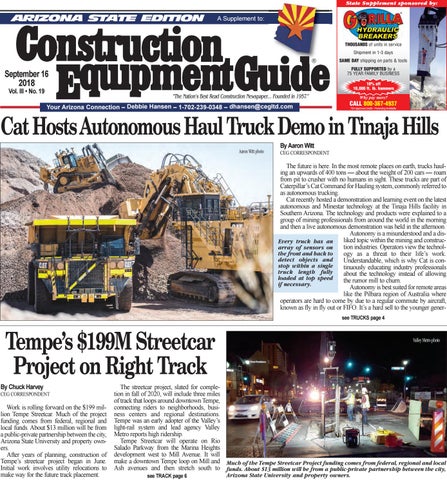
Arizona State University and property owners.
Page 2 • September 16, 2018 • www.constructionequipmentguide.com • Arizona State Supplement • Construction Equipment Guide
Mayo Clinic Announces $648M Expansion of Phoenix Campus By Jim McVeigh MAYO CLINIC PUBLIC AFFAIRS
To meet the increasing demand to treat patients with complex health conditions in the growing Southwest, Mayo Clinic announces a $648 million expansion that will nearly double the size of its Phoenix campus over five years. The Arizona Forward Project will add 1.4 million sq. ft. of building space (to the existing 1.7 million sq. ft.) with expanded clinical capacity, support services and infrastructure at the campus located near Loop 101 and 56th Street in North Phoenix. The expansion plan increases the number of inpatient beds from 280 to 374 by 2023 and creates close to 2,000 new jobs, including nearly 200 physicians by 2029. “Patients recognize that Mayo Clinic provides some of the best and safest care in the United States. Growing our facilities in Arizona to accommodate increased demand is essential,” said Wyatt W. Decker, M.D., vice president, Mayo Clinic, and CEO of Mayo Clinic in Arizona. The facility was recently again ranked No. 1 in the state by U.S. News & World Report’s Best Hospitals, and is the only Arizona medical center on the prestigious U.S. News Honor Roll. “Mayo’s commitment to the health and vitality of Arizona began when we saw our first patient in Arizona more than 30 years ago,” said Decker. “Arizona Forward represents our commitment for the next several
Mayo Clinic announces a $648 million expansion of Phoenix campus.
decades and beyond — innovating to improve the physical health of patients and the economic health of the state we call home.” The highlights of the expansion include a new six-story patient tower; a three-floor addition to the existing four-story Mayo Clinic Building; a new three-story building to house an expanded Emergency and other departments; expanded patient and infrastructure space; and additional parking. Arizona Forward is a five-year project with new patient areas projected to open as early as June 2020, culminating with the final phase opening in April 2023. News of Mayo Clinic’s expansion was welcomed by Arizona Gov. Doug Ducey, who said it will support the state in a variety of ways. “Mayo Clinic’s presence in Arizona has propelled our state’s health care and bio-
science industry, and their enhanced investment is another sign that this industry is thriving,” said Ducey. “Not only will those of us in Arizona be served by expanded services at Mayo Clinic, but it will further secure Arizona as a global destination for excellence in health care.” Expansion Details Overview New Structures: • Six-story patient tower featuring new patient rooms, clinical and rehab space and an outpatient surgical center; • three-story building to house expanded Emergency Department, Laboratory Medicine, Radiology and Pharmacy; • central plant building to support additional building square footage; • 1,000-space underground patient parking garage; • 1,600-space multilevel staff parking
garage; and • A tunnel connecting existing hospital basement with west expansion basement for equipment, material and staff flow. Current Structure Expansion: • Mayo Clinic Building will grow from three to seven stories for current and future clinical services. Capacity Impact: • Inpatient capacity will increase by 94 beds, allowing growth in critical care, intermediate, medical/surgical and rehabilitation beds. • Surgical capacity will increase by five operating rooms, in the hospital and in the outpatient surgical center, as well as expansion of pre-op/post-anesthesia care unit, surgical pathology and central sterile spaces. • The emergency department will increase from 26 to 57 beds, with an adjoining 24-bed observation unit. • An incremental 130,000 sq. ft. of ambulatory clinical space will be added. • Expansion of important clinical programs such as radiology, apheresis, dialysis, ambulatory infusion center, pulmonary rehab, pain rehab and pain clinic. • Doubling the capacity of laboratory medicine. • Increasing endoscopy capacity. • Increased support space for pharmacy, food services, supply chain management, environmental services and the cafeteria. (This story also can be found on Construction Equipment Guide’s website at www.constructionequipmentguide.com.)
Ahwatukee Waterline Relocation Progressing for SMF Crews are restoring two-way traffic to Liberty Lane in Ahwatukee after several months of work to relocate a 4ft.-diameter waterline in the path of the Loop 202 South Mountain Freeway. Liberty Lane has been restricted to eastbound traffic on a stretch of about 1.3 mi. between Desert Foothills Parkway and west of 20th Way, to provide a safe work zone for the excavation that began in March. Starting the week of Sept. 10, twoway traffic was being restored in stages using a temporary configuration. This work will begin between 12th Street and 18th Way, about three-quarters of the stretch that currently is limited to eastbound traffic. Once two-way traffic is restored in this section, Liberty Lane between 18th Way and 20th Way will close for approximately three weeks to complete a connection with a city of Phoenix
water main. The remainder of Liberty Lane, from 12th Street west to Desert Foothills Parkway, is scheduled to return to twoway traffic by the end of the year. Once the waterline is installed, water and pressure testing will be conducted from mid-November to the end of December. Final resurfacing and lane striping are scheduled to be completed early next year, along with replacement of sidewalks, curbs and gutters. While this work was initially scheduled to end in June, Connect 202 Partners, the developer of the South Mountain Freeway, experienced a delay when pipe delivery took several weeks longer than anticipated and installation couldn’t begin until May. Due to higher water demand in the summer, there was a June cutoff for relocating the waterline, and Connect 202 Partners is now scheduled to com-
plete the work in the fall. Approximately 5,500 ft. of the 6,700-ft. pipe has been placed along Liberty Lane between Desert Foothills Parkway and 20th Way at approximately 15 to 25 ft. deep, depending on the overall grade and the need to avoid underground utilities. Dealing with the hardness of rock and a large concentration of underground utilities near Desert Foothills Parkway has slowed work recently. Special drilling equipment has been used to help break up the rock so workers can excavate a trench for the waterline. For more information, visit SouthMountainFreeway.com. (This story also can be found on Construction Equipment Guide’s website at www.constructionequipmentguide.com.)
Arizona Department of Transportation photo
The Loop 202 (South Mountain Freeway) will add 22 mi. of freeway to the existing Phoenix metropolitan transportation system. The freeway will connect the east and west valley while providing much needed relief to existing freeway corridors and local streets.
Construction Equipment Guide • Arizona State Supplement • www.constructionequipmentguide.com • September 16, 2018 • Page 3
Page 4 • September 16, 2018 • www.constructionequipmentguide.com • Arizona State Supplement • Construction Equipment Guide
Caterpillar’s Autonomous Trucks Keep FMG Mine Operating TRUCKS from page 1 up more than 30 percent with light vehicle in the middle of the ation and mine operators are strug- much more still on the table. The haul road, it stops and proceeds gling to fill seats. Retirements are trucks adjust their routes, back again once the vehicle is clear. No only accelerating. themselves up to the shovels per- accidents have occurred. This is why Fortescue Metals fectly every time, burn less fuel With mines operating more effiGroup (FMG), whose mine man- and experience less wear and tear ciently, they’re able to mine ore ager presented to the group in per- compared to human operated that was previously too low grade son, ordered an autonomous fleet trucks. to be economical. They also can provided by Caterpillar. Its existing Safety is an obvious concern continue operating without layoffs 793 trucks were retrofitted to with no humans at the wheel. at lower commodity prices. accommodate autonomous tech- Every truck has an array of sensors Despite the replacement of operanology. FMG currently maintains on the front and back to detect tors, the new systems also require a 60 autonomous trucks whole new group of talentAaron Witt photo with that number extended people to refine and ing to over 100 by 2019, maintain the technology. making it the largest Creative destruction at autonomous Caterpillar work. fleet in the world. While autonomy is not a The autonomous proone size fits all technology gram was slowly phased for every mine in the in and mine operators world, it’s certainly set to were extremely upfront be more prevalent over the with current operators next decade and beyond. who were scheduled to be Autonomy is another tool displaced. They offered in the chase to keep the every operator the chance The trucks adjust their routes, back themselves world supplied with the to retrain and work other up to the shovels perfectly every time, burn less metals society needs. With roles at the company. fuel and experience less wear and tear com- the latest results pointing to Many took the opportuni- pared to human operated trucks. mines operating safer and ty. A few left. A natural more efficiently, the techprogression with any technological objects and stop within a single nology will likely become more advancement. truck length fully loaded at top prevalent across the world. After months spent dialing in speed if necessary. Beyond the (This story also can be found the fleet, the results are spectacular. sensors, every human and light on Construction Equipment Because the trucks only stop for vehicle on site is fitted with a bea- Guide’s website at www.confuel and work around the clock con telling trucks exactly where structionequipmentguide.com.) seven days a week, production is they’re at. If the truck approaches a CEG Aaron Witt photo
Aaron Witt photo
Cat recently hosted a demonstration and learning event on the latest autonomous and Minestar technology at the Tinaja Hills facility in southern Arizona.
Aaron Witt photo
Caterpillar representatives explained the technology and products to a group of mining professionals from around the world and then held a live autonomous demonstration.
Aaron Witt photo
In the most remote places on earth, trucks hauling an upwards of 400 tons — about the weight of 200 cars — roam from pit to crusher with no humans in sight. These trucks are part of Caterpillar’s Cat Command for Hauling system, commonly referred to as autonomous trucking.
Because the trucks only stop for fuel and work around the clock seven days a week, production is up more than 30 percent with much more still on the table.
Construction Equipment Guide • Arizona State Supplement • www.constructionequipmentguide.com • September 16, 2018 • Page 5
NEXT ISSUE CLOSES OCTOBER 4, 2018
3 3 3 3 3 3 3
empirecat.com/eloy / l | 520-582-2900 520 582 2900
Page 6 • September 16, 2018 • www.constructionequipmentguide.com • Arizona State Supplement • Construction Equipment Guide
Crews Prepare to Lay Track Later This Month in Tempe TRACK from page 1
Apache Boulevard, before running along Dorsey Lane. The line will serve several neighborhoods, an eclectic business community, thousands of Arizona State University students and hundreds of special events. It is expected to boost opportunities for growth, development and redevelopment in a regional urban center. Streetcars differ from light rail as they are smaller, move slower and often share lanes with traffic. The plan was to do the work during the summer months when tourism is lighter and fewer college students are in town. Valley Metro also unveiled three streetcar paint options that the public can weigh in on. Mill and Ash avenues are the focus of this year’s construction with a majority of the work on Mill taking place at night to minimize impact on drivers in the area. North and southbound lanes will remain open to traffic with occasional left and right-turn restrictions. After construction concludes in the morning, workers will cover the trenches with street plates to allow vehicles to continue to drive on the roadway. The streetcars will run three miles on a route with 14 stops. Crews will connect Tempe Streetcar to Valley Metro Rail at two locations, Valley Metro Rail Stations at streetcar stops. Stacy & Witbeck of Alameda, Calif., is contractor for the project. Construction includes utility relocation through the alignment in preparation for track installation, which is anticipated to start in early 2019. Construction is projected to finish in late 2020 with vehicle testing and service starting in 2021. Current equipment on site includes bulldozers, various sizes of excavators, backhoes and skid steers. Crews will utilize 17,000 cu. yds. of concrete over the course of the project. It will be used for track slab, sidewalks, PACC roadway and OCS foundations. About 16,000 tons of asphalt will be placed. Streetcars Will Be Roomy Six streetcars are currently on
Valley Metro photo
This September, crews are expected to finish relocating water services along University Drive, so track can be installed. Valley Metro photo
The streetcar project, slated for completion in fall of 2020, will include three miles of track that loops around downtown Tempe.
order and each will hold about 125 passengers. The cars will be powered by overhead electrical catenary wires and in certain areas, will run off-wire, powered by a lithiumion battery. Streetcar Budget About 42 percent of the project’s budget, $75 million, is expected to come from Federal Transit Administration grants. The remainder of funding is slated to come from a Maricopa County transportation sales tax, a local
transit sales tax in Tempe and a Maricopa Association of Governments fund for projects that ease traffic congestion and improve air quality. The local funding is allowing construction to begin until Valley Metro receives federal funds from the FTA. Valley Metro spokeswoman Susan Tierney said crews have begun utility work to stay on track for a late 2020 opening. “We want to stay on schedule,” Tierney said.
Streetcar Color Valley Metro officials unveiled three paint options for the streetcar project. They say the designs are based on safety and visibility, uniqueness and current transit system color schemes. The three options include: • An all green streetcar. • A streetcar with green along the top and silver along the bottom. • A streetcar with green “bookmarks” followed by a small purple stripe and silver in the middle. Ridership Is Expected to Be Strong Tempe Streetcar will serve one of the highest transit ridership centers in the region. It will connect riders to neighborhoods, major business centers, and regional events and destinations. As the Valley’s first modern streetcar line, it will add to the comprehensive transit network in Tempe, which includes buses, circulators, light rail, bicycle and pedestrian amenities. Streetcar vehicles are smaller than light rail vehicles and operate individually, not linked together like trains. Streetcar stops are similar to bus stops and occur more frequently
than light rail stations. The design includes: off-wire operation through downtown on Mill Avenue and at gateway intersections, a primarily shared roadway with vehicle traffic and the ability to detour when needed. Traffic Slowdown Construction could slow traffic in the immediate area of streetcar project construction. However, the contractor, Valley Metro and the city of Tempe are working together to develop a detailed construction plan including schedules, access and signage. The goal is to maintain access to businesses at all times during construction. However, some closures may be unavoidable. In the event of a closure or service disruption, Valley Metro and the city of Tempe will coordinate directly with the impacted business or property owners in advance. Nighttime construction will occur only when necessary and notification will be provided in advance of any nighttime construction activities. Fall Construction Plan This September, crews are expected to finish relocating water services along University Drive, so track can be installed. This work will take place between Ash and Mill avenues and is due to complete on Sept. 21. The work is scheduled to take place between 8 p.m. and 6 a.m. Automobile traffic will be maintained in both directions, but pedestrian traffic will involve intermittent crosswalk detours. Although access to business is to be maintained during the day, bus stops near University and Mill avenues may be affected. Crews also will be relocating sewer service and manhole covers along Rio Salado Parkway. This work is scheduled to occur between 7 p.m. and 6:30 a.m. and is due to complete in early October. Crews will make an effort to mitigate noise and lighting impacts to residents and will notify the public of any planned service disruptions. (This story also can be found on Construction Equipment Guide’s website at www.constructionequipmentguide.com.) CEG
Construction Equipment Guide • Arizona State Supplement • www.constructionequipmentguide.com • September 16, 2018 • Page 7
Pros Kno Pros Kno ow! w!
®
T Those in the know w,, know Takeuchi Take euchi
Takeuchi of o ffers a wide range of compact excavatorss to help you get your tougheest tasks comppleted. PUT A TAKEUCH A HI TO WORK ON O YOUR JOBSITE AN ND EXPERIIENCE THE DIFFEREN NCE!
www.ditchwitchaz.com
4028 S 36th Street Phoenix, AZ 85040 (602) 437-0351 6975 N Camino Martin Tucson, AZ 85741 (520) 579-0261
takeuch hi us.com hi-us.com
State Invests in Future Interstate 11 Linking Phoenix, Vegas After investing more than half a billion dollars over the past 20 years to turn the primary route between Phoenix and Las Vegas into a modern four-lane divided highway, the Arizona Department of Transportation has committed another $155 million for improvements to U.S. 93 over the next five years. All of this is with an eye toward an Interstate 11 between the two largest cities in the country not directly connected by an interstate freeway and spanning the state from the border with Mexico to Hoover Dam. Since 2014, signs have marked U.S. 93 in Arizona as the “Future I-11 Corridor.” “ADOT has spent years investing in the future Interstate 11 and laying the foundation for this border-to-border highway,” ADOT Director John Halikowski said. “We’re putting the pieces together today for what I-11 will be in the future. These substantial and continuing investments show our commitment to a corridor that is essential for commercial and recre-
ational travel and also to making Arizona a better place to live and work.” In addition to the completed and planned improvements to U.S. 93, a $134 million ADOT project beginning next year will upgrade State Route 189, the 3.75-mi. Nogales Highway connecting Interstate 19 with the Mariposa Port of Entry. This route is essential to trade between Arizona and Mexico, the state’s largest international trading partner. In 2015, the Fixing America’s Surface Transportation Act, or FAST Act, formally designated I11 throughout Arizona. It stated that the I-11 corridor will generally follow State Route 189 and Interstate 19 from Nogales to Tucson, Interstate 10 from Tucson to Phoenix, and U.S. 93 from Wickenburg to the Nevada state line. The designation doesn’t include funding but identifies I-11 as a high-priority corridor eligible for federal funding. ADOT continues to work with its federal, state and
local partners to identify funding upgraded to a four-lane divided state line north of Kingman, the for I-11, which is expected to highway to improve traffic flow, designated route of I-11. This include a combination of new and support the movement of freight includes three projects that will existing roadways. and enhance safety through this widen an additional 11 mi. of U.S. ADOT is currently funding and heavily traveled area. The entire 93 to four-lane divided highway conducting an environand the start of right-ofmental study to identify a way acquisition for a new potential 2,000-ft. wide U.S. 93 interchange with corridor for I-11 between ADOT is currently funding and I-40 in Kingman. Nogales and Wickenburg. “Interstate freeways are The Tier 1 Environmental conducting an environmental study Arizona’s Key Commerce Impact Statement, required to identify a potential 2,000-ft. wide Corridors, the foundation by the National moving commerce and Environmental Policy Act, corridor for I-11 between Nogales connecting friends and is expected to be complete and Wickenburg. families,” Halikowski in late 2019 or early 2020. said. “To remain competiTier 2 environmental studtive in the ever-evolving ies would be required to global marketplace, our narrow a corridor into a specific northern segment of U.S. 93 from transportation infrastructure must freeway alignment if the build Kingman to the Nevada state line advance with our state’s needs. option is selected as part of the Tier (mileposts 1 to 68) is now a four- That’s what’s behind ADOT’s 1 study. lane divided highway following ongoing commitment to advancing As I-11 comes closer to reality the completion of a $71 million U.S. 93 and the concept of in Arizona, U.S. 93 would be project in 2010. Interstate 11.” upgraded to interstate highway ADOT’s 2019-2023 Five-Year For more information, visit standards, including creating traf- Transportation Facilities i11study.com/Arizona. fic interchanges. Construction Program includes (This story also can be found Currently all but 39 mi. of the more than $155 million dedicated on Construction Equipment 200-mi. drive from Wickenburg to to projects to improve U.S. 93 Guide’s website at www.conthe Nevada state line has been from Wickenburg to the Nevada structionequipmentguide.com.)
Page 8 • September 16, 2018 • www.constructionequipmentguide.com • Arizona State Supplement • Construction Equipment Guide
Public Auction held the 2nd Saturday of every month. Preview Every Monday - Friday 8am - 4pm Consignments Welcome Western Sales Management, Inc 1616 S 67th Ave. Phoenix, AZ 85043
623-936-3300 wsmauctioneers.com wsmauctionbiz@yahoo.com
Next Auction October 13, 2018
File Photo