State Supplement sponsored by:
ARIZONA STATE EDITION
A Supplement to:
THOUSANDS of units in service
March 4 2018
Vol. II • No. 5
®
Shipment in 1-3 days SAME DAY shipping on parts & tools FULLY SUPPORTED by a 75 YEAR FAMILY BUSINESS 10% off 10,000 ft. lb. hammers Why pay more?
“The Nation’s Best Read Construction Newspaper… Founded in 1957.”
Your Arizona Connection – Debbie Hansen – 1-702-239-0348 – dhansen@cegltd.com
CALL 800-367-4937 *On approved credit • Financing Available
Work Continues on ADOT’s $62M SR 260 Widening Project By Chuck Harvey
CEG CORRESPONDENT
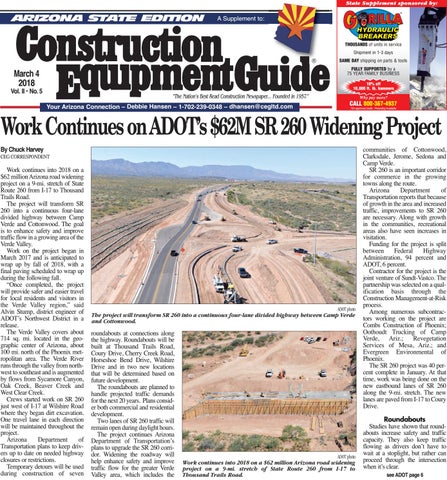
Work continues into 2018 on a $62 million Arizona road widening project on a 9-mi. stretch of State Route 260 from I-17 to Thousand Trails Road. The project will transform SR 260 into a continuous four-lane divided highway between Camp Verde and Cottonwood. The goal is to enhance safety and improve traffic flow in a growing area of the Verde Valley. Work on the project began in March 2017 and is anticipated to wrap up by fall of 2018, with a final paving scheduled to wrap up during the following fall. “Once completed, the project will provide safer and easier travel for local residents and visitors in the Verde Valley region,” said Alvin Stump, district engineer of ADOT’s Northwest District in a release. The Verde Valley covers about 714 sq. mi. located in the geographic center of Arizona, about 100 mi. north of the Phoenix metropolitan area. The Verde River runs through the valley from northwest to southeast and is augmented by flows from Sycamore Canyon, Oak Creek, Beaver Creek and West Clear Creek. Crews started work on SR 260 just west of I-17 at Wilshire Road where they began dirt excavation. One travel lane in each direction will be maintained throughout the project. Arizona Department of Transportation plans to keep drivers up to date on needed highway closures or restrictions. Temporary detours will be used during construction of seven
ADOT photo
The project will transform SR 260 into a continuous four-lane divided highway between Camp Verde and Cottonwood.
roundabouts at connections along the highway. Roundabouts will be built at Thousand Trails Road, Coury Drive, Cherry Creek Road, Horseshoe Bend Drive, Wilshire Drive and in two new locations that will be determined based on future development. The roundabouts are planned to handle projected traffic demands for the next 20 years. Plans consider both commercial and residential development. Two lanes of SR 260 traffic will remain open during daylight hours. The project continues Arizona Department of Transportation’s plans to upgrade the SR 260 corridor. Widening the roadway will help enhance safety and improve traffic flow for the greater Verde Valley area, which includes the
ADOT photo
Work continues into 2018 on a $62 million Arizona road widening project on a 9-mi. stretch of State Route 260 from I-17 to Thousand Trails Road.
communities of Cottonwood, Clarksdale, Jerome, Sedona and Camp Verde. SR 260 is an important corridor for commerce in the growing towns along the route. Arizona Department of Transportation reports that because of growth in the area and increased traffic, improvements to SR 260 are necessary. Along with growth in the communities, recreational areas also have seen increases in visitation. Funding for the project is split between Federal Highway Administration, 94 percent and ADOT, 6 percent. Contractor for the project is the joint venture of Sundt-Vastco. The partnership was selected on a qualification basis through the Construction Management-at-Risk process. Among numerous subcontractors working on the project are Combs Construction of Phoenix; Oothoudt Trucking of Camp Verde, Ariz.; Revegetation Services of Mesa, Ariz.; and Evergreen Environmental of Phoenix. The SR 260 project was 40 percent complete in January. At that time, work was being done on the new eastbound lanes of SR 260 along the 9-mi. stretch. The new lanes are paved from I-17 to Coury Drive.
Roundabouts Studies have shown that roundabouts increase safety and traffic capacity. They also keep traffic flowing as drivers don’t have to wait at a stoplight, but rather can proceed through the intersection when it’s clear. see ADOT page 6
Page 2 • March 4, 2018 • www.constructionequipmentguide.com • Arizona State Supplement • Construction Equipment Guide
Nikola to Spend $1B on New Arizona Manufacturing Facility
Arizona Gov. Doug Ducey and Nikola Motor Company announced the company has selected Buckeye, Ariz., for its Nikola Motor Company hydrogenelectric semi-truck manufacturing headquarters facility. The new 500acre, 1 million sq. ft. facility will be located on the west side of Phoenix and will bring more than $1 billion in capital investment to the region by 2024. “After 12 months, nine states and 30 site locations, Arizona, Governor Ducey, Sandra Watson and Chris Camacho were the clear front runners. Arizona has the workforce to support our growth and a governor that was an entrepreneur himself. They understood what 2,000 jobs would mean to their cities and state,” said Trevor Milton, CEO and founder, Nikola Motor Company. “We will begin transferring our R&D and headquarters to Arizona immediately and hope to have the transition completed by October 2018. “We have already begun planning the construction for our new zero emission manufacturing facility in Buckeye, which we expect to have under way by the end of 2019.” Nikola Motor Company designs and manufactures hydrogen-electric vehicles, electric vehicle drivetrains, vehicle components, energy storage systems and hydrogen stations. The company is bringing the nation’s most advanced semitrucks to market with more than 8,000 trucks on preorder. Nikola Motor Company selected Buckeye, Ariz., due to numerous factors, including the state’s pro-business environment, engineering schools, educated workforce and geographic location that provides direct access to major markets. “Nikola Motor Company’s selection of Arizona demonstrates that we are leading the charge when it comes to attracting innovative, industry-disrupting companies,” said Ducey. “This incredible new technology will revolutionize transportation, and we’re very proud it will be engineered right here in Arizona. I thank Nikola’s CEO Trevor Milton and his entire team for this significant investment in our state.”
Sandra Watson, Arizona Commerce Authority president and CEO. “The Nikola Motor Company project will be transformative for the West Valley and further advances Arizona’s leadership position in the innovation economy. I thank the Nikola team for their commitment to our state, as well Governor Ducey for his leadership and our many partners who helped make this project a reality.” “The Greater Phoenix region is elevating its brand as a hub for innovation, and companies such as Nikola have taken notice,” said Chris Camacho, president and CEO of the Greater Phoenix Economic Council. “There were a number of factors that made the region stand out, including a large, skilled talent pipeline that will fulfill the manufacturing and R&D jobs Nikola is adding to the market. I want to thank Buckeye Mayor Meck and his team, as well as our partners at
Nikola Motor Company has selected Buckeye, Ariz., for its Nikola Motor Company hydrogen-electric semi-truck manufacturing headquarters facility.
Development of the 1-million sq. ft. manufacturing plant on a 500-acre parcel at Sun Valley Parkway and the future Wintersburg Parkway is projected to begin by the end of 2019. The site is at one of the entrances to Douglas Ranch/Trillium, a new master planned community being developed by El Dorado Holdings and JDM Partners; this community is projected to ultimately be home to more than 300,000 residents. “I’ve worked on many economic development issues in my career, but being part of this team that brings Nikola Motors to Arizona is very satisfying,” said Mike Ingram, founder & chairman of El Dorado Partners. “We look forward to announcing additional partners who will join Nikola at Douglas Ranch in the near future as we start to build momentum and unlock its full economic power.” “Conceived as the prototype ‘Smart City,’ Trillium at Douglas Ranch aligns well with Nikola Motors groundbreaking technology,” said Jerry Colangelo, cofounder and partner of David Eaton and Mel Shultz of JDM Partners. “We look forward to working with everyone here to
bring Nikola’s innovative products and their 2,000 professionals into this city of the future, creating a tremendous economic opportunity for Arizona.” “This is a great day not only for Arizona, but for Buckeye residents,” said Buckeye Mayor Jackie Meck, a Buckeye native and one of its elected officials for more than 20 years. “As the seventh fastest growing city in the country, Nikola Motor Company is a huge asset which will help us achieve our goal of providing a place where Buckeye residents can live, work and play. Additionally, I wish to thank our partners, El Dorado Holdings Inc. and JDM Partners from Douglas Ranch/Trillium, who were instrumental in putting this deal together. I look forward to continued success together.” “It was an absolute honor to help bring together a great company and a great state,” said Tom Stringer, BDO’s managing director and practice leader of site selection and incentives. “Nikola is poised to implement revolutionary solutions to energy independence and environmental sustainability across the transporta-
Nikola Motor Company selected Buckeye, Ariz., due to numerous factors, including the state’s pro-business environment, engineering schools, educated workforce and geographic location that provides direct access to major markets.
tion spectrums, while Arizona is the perfect partner-location focused on building the energy and tech industries of the future.” “Arizona continues to prove that our talent, operating environment and quality of life are exactly what business leaders are seeking,” said
the state, and the Maricopa County Board of Supervisors. I look forward to seeing Nikola’s growth in Greater Phoenix.” (This story also can be found on Construction Equipment Guide’s website at www.constructionequipmentguide.com.)
Construction Equipment Guide • Arizona State Supplement • www.constructionequipmentguide.com • March 4, 2018 • Page 3
Pros Kno Pros Kno ow! w!
®
T Those in the know w,, know Takeuchi Take euchi
Takeuchi of o ffers a wide range of compact excavatorss to help you get your tougheest tasks comppleted. PUT A TAKEUCH A HI TO WORK ON O YOUR JOBSITE AN ND EXPERIIENCE THE DIFFEREN NCE!
www.ditchwitchaz.com
4028 S 36th Street Phoenix, AZ 85040 (602) 437-0351
6975 N Camino Martin Tucson, AZ 85741 (520) 579-0261
takeuch hi us.com hi-us.com
ADOT Brings Back Program Gov. Ducey Appoints Elters to Aid Transportation Projects to Transportation Board
The Arizona Department of Transportation has brought back a program made possible under state law allowing local governments to build transportation projects faster and at a lower cost by reducing red tape associated with federal funding. The HURF Exchange Program, taking its name from the Highway User Revenue Fund, allows ADOT to exchange State Highway Fund revenues for federal Surface Transportation Block Grant Program funds with eligible local governments. ADOT is required to administer most federally funded projects, but local governments taking part in the program can now administer projects themselves, facing fewer regulatory restrictions and requirements. “This is a win-win for the state and local communities that would otherwise have to depend on ADOT to manage their federally funded projects,” said John Halikowski, ADOT director. “Enabling local governments to administer their own projects through the HURF Exchange Program helps reduce project costs and time to completion, and allows ADOT to focus its efforts on highway projects.” Cities, towns and unincorporated portions of counties within a regional planning area with 200,000 or fewer residents are eligible to partic-
ipate in the HURF Exchange Program. Projects must be programmed as part of the HURF Exchange Program by a region’s council of governments or metropolitan planning organization, be on the federal aid system and improve the efficiency, reliability and safety of travel. ADOT will provide State Highway Fund dollars at the rate of 90 percent of the amount of federal aid programmed for eligible projects. ADOT will review projects qualifying for the HURF Exchange Program and consult with the Federal Highway Administration to determine which federal requirements may apply. These requirements will be the responsibility of the project sponsor to fulfill and are documented in an intergovernmental agreement. The state Legislature authorized the program in 1997, but ADOT suspended it in 2009 due to a lack of State Highway Fund revenues. Before that, the HURF Exchange Program facilitated 145 projects with a total value exceeding $90 million. For more information, visit azdot.gov/HURFExchange. (This story also can be found on Construction Equipment Guide’s website at www.constructionequipmentguide.com.)
Gov. Doug Ducey has appointed Sam Elters, a transportation engineer with more than 30 years of experience in planning, design, construction and operations, to serve on the Arizona State Transportation Board. Elters, who is senior vice president and national director of transportation of Matrix Design Group Inc. of Phoenix, will serve on the seven-member panel upon confirmation by the state Senate. He will succeed Joseph E. LaRue, who served as the board’s chairman in the final year of his term. State Transportation Board members prioritize transportation needs, projects and funding on behalf of communities throughout Arizona. Each serves a six-year term. Elters’ transportation experience spans the public and private sectors and includes serving as the Arizona Department of Transportation’s state engineer from 2005 to 2008. He also has served as a chief engineer for the Transportation Corridor Agencies providing toll roads in Orange County, Calif. Elters has been in Arizona since 1981 and has been a resident of Maricopa County since 2005. “It is an honor and a privilege to serve on the State Transportation Board,” Elters said. “I look forward to collaborating and working with the other board members and the Arizona Department of Transportation to promote and advance transportation solutions that will energize Arizona’s economy and enhance our quality of life.” Meanwhile, William F. Cuthbertson, a Freeport McMoran civil engineer who is from Greenlee County’s York Valley near Duncan, has been named chairman of the State Transportation Board. For more information, visit aztransportationboard.gov. (This story also can be found on Construction Equipment Guide’s website at www.constructionequipmentguide.com.)
Page 4 • March 4, 2018 • www.constructionequipmentguide.com • Arizona State Supplement • Construction Equipment Guide
South Mountain Freeway Construction to Ramp Up in 2018
One year after major construction began on the Loop 202 South Mountain Freeway, bridges have been built from the ground up, a massive amount of earth has been moved and compacted, and an emerging I-10 interchange has changed the West Valley skyline. The South Mountain Freeway is more than 35 percent complete from design to utilities to right-of-way acquisition to construction. Work is currently under way in all but one section of the 22-mi. corridor. To date, crews have installed 8 mi. of drainage pipe, moved 3.6 million cu. yds. of dirt and used 2,900 tons of rebar manufactured from recycled steel. In 2018, construction will expand as the Arizona Department of Transportation moves toward opening the freeway by late 2019. Work is scheduled to begin this spring in the Center segment, a 3-mi. stretch between 51st Avenue southeast and 32nd Lane. ADOT and Connect 202 Partners, the developer responsible for the design and construction of the South Mountain Freeway, recently detailed construction for the first half of 2018 with the corridor’s third semiannual construction notice, which is available at SouthMountainFreeway.com (click Construction Info). Some of the 2018 highlights include: I-10 segment (I-10 Papago to Lower Buckeye Road and improvements to I-10 between 43rd and 75th Avenues) • Constructing new access roads parallel to I-10 between 51st and 67th Avenues that will replace direct freeway access at 59th Avenue; • continuing construction of an I-10 interchange with six ramps, including two direct HOV lane connections; and • completing the bridge over Roosevelt Street.
ADOT photo
One year after major construction began on the Loop 202 South Mountain Freeway, bridges have been built from the ground up, a massive amount of earth has been moved and compacted, and an emerging I-10 interchange has changed the West Valley skyline.
Salt River segment (Lower Buckeye Road to 51st Avenue) • Opening an Elliot Road bridge over the freeway alignment; • starting Estrella Drive interchange construction, which will require a 150-day closure of Estrella Drive between 51st and 59th Avenues; • completing two half-mile-long bridges, the longest of project, over the Salt River (by end of 2018); and
investigations (starting in early 2018) and • starting controlled rock blasting along two ridges on southwestern edge of the South Mountain Park to break large rock into smaller, more manageable pieces. Pecos segment (32nd Lane to I-10 Maricopa/Loop 202 Santan Freeway) • Detouring traffic on Desert Foothills Parkway for bridge construction; • completing bridges at 17th Avenue and 40th Street and continuing construction of bridges at 24th and 32nd streets, work that will require some weekend and night closures of cross streets; • beginning work on freeway paving (by late 2018); and • completing controlled rock blasting along Pecos Road between Desert Foothills Parkway and 24th Street to break large rock into smaller, more manageable pieces (through mid-2018). The South Mountain Freeway will provide a long-planned direct link between the East Valley and West Valley and a much-needed alternative to I-10 through downtown Phoenix. Approved by Maricopa County voters in 1985 and again in 2004 as part of a comprehensive regional transportation plan, the South ADOT photo Mountain Freeway will Work is currently under way in all but one section of the complete the Loop 202 22-mi. corridor. and Loop 101 freeway system in the Valley. • constructing a bridge at Baseline Road For more information, visit and 51st Avenue. Center segment (51st Avenue to 32nd SouthMountainFreeway.com. (This story also can be found on Lane) Construction Equipment Guide’s website at • Conducting pre-construction work, including plant salvage and geotechnical www.constructionequipmentguide.com.)
Turning Corner on Pima County Projects This Year
Removing the bridge that once carried westbound Interstate 10 traffic over Ina Road was the first step in what will be a busy 2018 in the Tucson area for the Arizona Department of Transportation. Tucson will see the completion of the first phase of renovations at Ajo Way and Interstate 19, the near completion of a new interchange at I-10 and Ina Road and a project to ease congestion at I-10 interchanges serving fast-growing areas east of downtown Tucson. At Ajo Way (State Route 86), ADOT has created a single-point
urban interchange, the third in the Tucson area with a single set of traffic signals controlling all traffic movements. After the first phase of the project is complete this spring, ADOT will prepare for the 18month second phase of work, which will widen Ajo Way and I19; create a new Ajo Way bridge over the Santa Cruz River; and construct a new Michigan Avenue pedestrian bridge over I-19. The first phase of the Ajo Way project cost about $40 million, and the second phase is estimated to cost $27 million.
On the last weekend in January, westbound I-10 traffic at Ina Road in Marana began sharing the new pavement that now carries eastbound traffic, with a concrete barrier separating the directions of travel. The move will allow construction crews to build the eastern half of the Ina Road bridge and complete the remaining work to widen both I-10 and Ina Road. The project, which also includes a second new bridge carrying Ina Road over the Santa Cruz River, is on schedule for completion in early 2019.
ADOT is overseeing the $128 million Ina Road project, which is funded by the Federal Highway Administration, the Pima Association of Governments and the Regional Transportation Authority. The town of Marana is contributing $7.9 million toward the cost of the new bridges over the Santa Cruz River west of I-10. East of downtown Tucson, ADOT will continue making improvements to several interchanges to improve traffic flow. In 2017, ADOT added a traffic signal and a right turn bay at the end of
the Houghton Road eastbound exit ramp. Beginning this spring, crews will start adding traffic signals at the eastbound 10 exits for Wilmot, Rita and Kolb roads, with the work scheduled for completion before the end of the year. At Rita Road, crews will add a right turn lane on the eastbound exit and a second merging lane for the westbound on-ramp. (This story also can be found on Construction Equipment Guide’s website at www.constructionequipmentguide.com.)
Construction Equipment Guide • Arizona State Supplement • www.constructionequipmentguide.com • March 4, 2018 • Page 5
Want to run strong equipment m ? Run Doosan. Viisit uss today a to learn more.
Authorized Doosan Dealer
Ditch Witch of o Arizona 4028 South 36th Street | Phoenix, AZ 602.437.0351 www ditchwitchaaz com www.ditchwitchaz.com Doosan® and the Doosan logo are registered trademarks of Doosan Corp. in the United States and various other countries around the world.
Page 6 • March 4, 2018 • www.constructionequipmentguide.com • Arizona State Supplement • Construction Equipment Guide
ADOT Adds Round Abouts to Keep Traffic Flowing on SR 260 ADOT from page 1
They reduce the risk of serious crashes by 75 percent. In addition to roundabout work, crews finished a bridge at Cherry Creek Road in early February. Construction equipment included several earthmoving scrapers, excavators, loaders, rollers and cranes. About 130,000 tons of asphalt will be used on the project, along with nearly 5,000 cu. yds. of structural concrete (not including catch basins, headwalls and other minor structures). Approximately 200,000 cu. yds. of imported borrow is required as well. On average there are nearly 100 workers and office staff on the project daily with occasional night and weekend work.
information officer of Arizona Department of Public Transportation. He explained that SR 260 is a vital corridor of commerce for the Verde Valley communities. Verde Valley has experienced significant growth in population and commerce in the last decade. “Because of this growth, as well as regional traffic demands, and an increase in recreational activities in Verde Valley, improvements to SR 260 are necessary,” Harding said.
ADOT photo
The project is currently on schedule and at budget.
Impact to Local Community As work on the project continues, officials caution that trucks will be entering and exiting the roadway. Occasional flagging operations will be used during
ADOT photo
Work on the project began in March 2017 and is anticipated to wrap up by fall of 2018, with a final paving scheduled to wrap up during the following fall.
The project is currently on schedule and at budget.
Safety, Traffic Flow “This expansion project is going to transform State Route 260 into a continuous four-lane divided highway between Camp Verde and Cottonwood and continues ADOT’s commitment to upgrade the SR 260 corridor and will enhance safety and improve traffic flow for the greater Verde Valley area,” said Ryan Harding, public
nighttime hours. Vehicles will be detoured at Cherry Creek Road where traffic is directed to a temporary signal while crews complete the roundabout construction at that intersection. Otherwise, one lane in each direction is maintained as before and access to local businesses is maintained as well. Economic Boost SR 260 is a vital corridor of commerce for the Verde Valley
communities that have experienced significant growth in population and commerce in the last decade. Because of this growth, as well as regional traffic demands, and an increase in recreational activities in Verde Valley, improvements to SR 260 are necessary, Harding said. (This story also can be found on Construction Equipment Guide’s website at www.constructionequipmentguide.com.) CEG
ADOT photo
The goal is to enhance safety and improve traffic flow in a growing area of the Verde Valley.
Construction Equipment Guide • Arizona State Supplement • www.constructionequipmentguide.com • March 4, 2018 • Page 7
NEXT ISSUE CLOSES MARCH 22, 2018
3 3 3 3 3 3 3
empirecat.com/eloy / l | 520-582-2900 520 582 2900
Page 8 • March 4, 2018 • www.constructionequipmentguide.com • Arizona State Supplement • Construction Equipment Guide
Public Auction held the 2nd Saturday of every month. Preview Every Monday - Friday 8am - 4pm Consignments Welcome 623-936-3300 wsmauctioneers.com wsmauctionbiz@yahoo.com
Western Sales Management, Inc 1616 S 67th Ave. Phoenix, AZ 85043
Next Auction April 14, 2018
File Photo
File Photo
File Photo
File Photo
File Photo
File Photo
File Photo
File Photo
File Photo