State Supplement sponsored by:
ARIZONA STATE EDITION
A Supplement to:
SHIP WITHIN 48 HOURS SAME DAY PARTS AVAILABILITY
®
February 3 2019
24 HOUR TECHNICAL SUPPORT BACKED BY A 75 YEAR BUSINESS Thousands in Service!
Vol. III • No. 3
“The Nation’s Best Read Construction Newspaper… Founded in 1957.”
Affordable Price. Premium Service.
CALL 800-367-4937
Your Arizona Connection – Debbie Hansen – 1-702-239-0348 – dhansen@cegltd.com
*On approved credit • Financing Available
$148M ITR Facility Replaces Old Maricopa County Jail By Chuck Harvey
Arrington Watkins Architects photo
CEG CORRESPONDENT
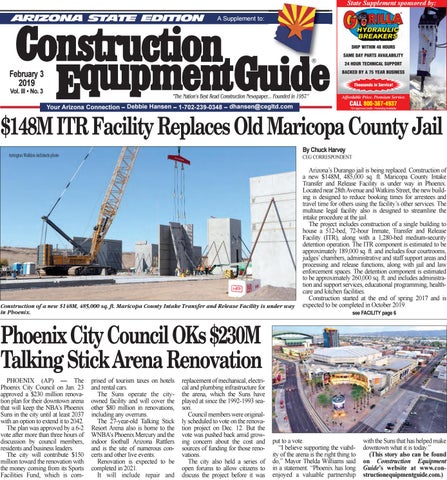
Construction of a new $148M, 485,000 sq. ft. Maricopa County Intake Transfer and Release Facility is under way in Phoenix.
Arizona’s Durango jail is being replaced. Construction of a new $148M, 485,000 sq. ft. Maricopa County Intake Transfer and Release Facility is under way in Phoenix. Located near 28th Avenue and Watkins Street, the new building is designed to reduce booking times for arrestees and travel time for others using the facility’s other services. The multiuse legal facility also is designed to streamline the intake procedure at the jail. The project includes construction of a single building to house a 512-bed, 72-hour Inmate, Transfer and Release Facility (ITR), along with a 1,280-bed medium-security detention operation. The ITR component is estimated to be approximately 189,000 sq. ft. and includes four courtrooms, judges’ chambers, administrative and staff support areas and processing and release functions, along with jail and law enforcement spaces. The detention component is estimated to be approximately 260,000 sq. ft. and includes administration and support services, educational programming, healthcare and kitchen facilities. Construction started at the end of spring 2017 and is expected to be completed in October 2019. see FACILITY page 6
Phoenix City Council OKs $230M Talking Stick Arena Renovation PHOENIX (AP) — The Phoenix City Council on Jan. 23 approved a $230 million renovation plan for their downtown arena that will keep the NBA’s Phoenix Suns in the city until at least 2037 with an option to extend it to 2042. The plan was approved by a 6-2 vote after more than three hours of discussion by council members, residents and business leaders. The city will contribute $150 million toward the renovation with the money coming from its Sports Facilities Fund, which is com-
prised of tourism taxes on hotels and rental cars. The Suns operate the cityowned facility and will cover the other $80 million in renovations, including any overruns. The 27-year-old Talking Stick Resort Arena also is home to the WNBA’s Phoenix Mercury and the indoor football Arizona Rattlers and is the site of numerous concerts and other live events. Renovation is expected to be completed in 2021. It will include repair and
replacement of mechanical, electrical and plumbing infrastructure for the arena, which the Suns have played at since the 1992-1993 season. Council members were originally scheduled to vote on the renovation project on Dec. 12. But the vote was pushed back amid growing concern about the cost and sources of funding for those renovations. The city also held a series of open forums to allow citizens to discuss the project before it was
put to a vote. “I believe supporting the viability of the arena is the right thing to do,” Mayor Thelda Williams said in a statement. “Phoenix has long enjoyed a valuable partnership
with the Suns that has helped make downtown what it is today.” (This story also can be found on Construction Equipment Guide’s website at www.constructionequipmentguide.com.)
Page 2 • February 3, 2019 • www.constructionequipmentguide.com • Arizona State Supplement • Construction Equipment Guide
Crews Move Historic Rail Car for Maricopa Overpass Project Maricopa Historical Society Facebook photo
Maricopa Historical Society Facebook photo
The Silver Horizon domed observation car was moved Jan. 10 from the Amtrak station next to State Route 347 to a nearby site next to the Maricopa Unified School’s District headquarters.
MARICOPA, Ariz. (AP) An historic rail car has been relocated a short distance from its former location in Maricopa as part of construction of an overpass to carry a busy state highway over Union Pacific train tracks. The Silver Horizon domed observation car was moved Jan. 10 from the Amtrak station next to State Route 347 to a nearby site next to the Maricopa Unified School’s District headquarters. The Silver Horizon was part of the equip-
Maricopa Historical Society Facebook photo
Officials said moving the car required closing the Maricopa-Casa Grande Highway for approximately 15 minutes between the car’s current and new sites.
An historic rail car has been relocated a short distance from its former location in Maricopa as part of construction of an overpass to carry a busy state highway over Union Pacific train tracks.
ment of the California Zephyr, a pre-Amtrak train route operated between Chicago and Oakland, Calif., by the Chicago, Burlington & Quincy, Denver & Rio Grande and Western Pacific railroads. Officials said moving the car required closing the Maricopa-Casa Grande Highway for approximately 15 minutes between the car’s current and new sites. (This story also can be found on Construction Equipment Guide’s website at www.constructionequipmentguide.com.)
For I-10 Widening Project, ADOT Is Recycling Old Roadway Almost as soon as traffic on eastbound Interstate 10 started using new lanes through 4 mi. of Pinal County between Eloy and Picacho, Arizona Department of Transportation crews began demolishing travel lanes that had been in use for more than 40 years. The same occurred in December when westbound traffic moved to new lanes. But instead of finding a place to discard the old asphalt, concrete and dirt, ADOT engineers are using it to create the foundation for the new eastbound lanes that are now under construction. “We need to build up the ground under the new eastbound lanes of I-10,” said Dave Locher, ADOT’s regional engineer and project manager. “Usually we have to haul material in from some offsite loca-
Arizona Department of Transportation photo
ADOT engineers are using old asphalt to create the foundation for the new I-10 eastbound lanes that are now under construction.
tion, which can be expensive. But in this case the better answer was literally right in front of us.” About 1 million sq. ft. of asphalt, tons of earth from below the roadway surface and 30,000 ft.
of guardrail will be removed from the old lanes of I-10. Guardrail in good condition will be sent to maintenance yards around Arizona for use in other projects. The rest of the material will be moved 100 to
150 yds. east to the new eastbound alignment. In many large projects, crews create a “borrow pit” when they need additional dirt. The pit usually is located near the project, in a site
where removing earth doesn’t create additional environmental or economic concerns. Hauling that extra dirt adds time and money to the project. ADOT is expanding I-10 to six lanes between mileposts 209 and 213, as well as building a new interchange with State Route 87 and creating a first-of-its-kind dust detection zone in the area north of Picacho Peak. The new alignment is just east of the current freeway. Along with a second widening project in Casa Grande, the work will make I-10 a six-lane freeway from Casa Grande to Tucson. Both projects are expected to be complete by fall 2019. (This story also can be found on Construction Equipment Guide’s website at www.constructionequipmentguide.com.)
Construction Equipment Guide • Arizona State Supplement • www.constructionequipmentguide.com • February 3, 2019 • Page 3
Page 4 • February 3, 2019 • www.constructionequipmentguide.com • Arizona State Supplement • Construction Equipment Guide
Driving Surfaces Complete on Longest SMF Bridges The largest structures on the Arizona Department of Transportation’s Loop 202 South Mountain Freeway project are nearly complete, with crews finishing the concrete decks of two half-mile-long bridges that will carry traffic over the Salt River in the growing southwest Valley. Since the first deck pour in November 2017, crews have put down approximately 11,500 cu. yds. of concrete to create the driving surfaces for both bridges. That’s enough concrete to build a sidewalk between downtown Phoenix and the town of Queen Creek. After pouring the concrete, mostly during overnight hours, crews used a self-propelled concrete leveling machine called a Bid-Well to create smooth, uniform decks for the bridges, which are located midway between Broadway Road and Southern Avenue along the 59th Avenue alignment. Now that the concrete has cured, construction equipment is able to use the bridges for the first time as Connect 202 Partners, the developer of the South Mountain Freeway, moves ever closer to completing work in the 22-mi.-long corridor. In addition to aiding construction, using the bridges helps keep trucks off local streets as they carry asphalt and concrete to other areas of the project. Deck construction is one of the final steps in building a bridge. Construction of the Salt River bridges began in early 2017 with substructure work creating piers and abutments to support the bridge. Crews installed 292 girders that are the largest of their kind ever used for an ADOT project. The Salt River bridges will provide a much-needed crossing to and from Laveen, especially when the river flows, while also
Arizona Department of Transportation photo
Since the first deck pour in November 2017, crews have put down approximately 11,500 cu. yds. of concrete to create the driving surfaces for both bridges.
reducing congestion at current crossings. The city of Phoenix’s 51st Avenue bridge is currently the lone all-weather Salt River crossing between 35th Avenue and Avondale Boulevard. Final bridge construction will include completing lighting and painting, and installing barrier walls.
Scheduled to open as early as late 2019, the South Mountain Freeway will provide a long-planned direct link between the East Valley and West Valley and alternative to Interstate 10 through downtown Phoenix. Approved by Maricopa County voters in 1985 and again in 2004 as part of a comprehensive regional transportation plan, the
South Mountain Freeway will complete the Loop 202 and Loop 101 freeway system in the Valley. For information, visit SouthMountainFreeway.com. (This story also can be found on Construction Equipment Guide’s website at www.constructionequipmentguide.com.)
Arizona Department of Transportation photo Arizona Department of Transportation photo
After pouring the concrete, mostly during overnight hours, crews used a self-propelled concrete leveling machine called a Bid-Well to create smooth, uniform decks for the bridges.
The largest structures on the Arizona Department of Transportation’s Loop 202 South Mountain Freeway project are nearly complete, with crews finishing the concrete decks of two half-mile-long bridges that will carry traffic over the Salt River in the growing southwest Valley.
Construction Equipment Guide • Arizona State Supplement • www.constructionequipmentguide.com • February 3, 2019 • Page 5
NEXT ISSUE CLOSES FEBRUARY 21, 2019
3 3 3 3 3 3 3
empirecat.com/eloy / l | 520-582-2900 520 582 2900
Page 6 • February 3, 2019 • www.constructionequipmentguide.com • Arizona State Supplement • Construction Equipment Guide
New Multi-Use ITR Facility Due to Complete Fall 2019 FACILITY from page 1 Arrington Watkins Architects photo
Vacant Lot The facility is being built on a mostly vacant lot in proximity of the LBJ Central Plant. “The majority of the site was undeveloped at the start of the project,” said Mike Quinn, chief architect for Arrington Watkins Architects in Phoenix. Quinn is architect for the project. “Site demolition was limited to some fencing, pre-engineered vehicle canopy and abandoned utility boxes. Remaining underutilized parking facilities are to be maintained.” A portion of the site is in a flood plain, requiring substantial water detention structures to be built. The
The ITR component is estimated to be approximately 189,000 gross sq. ft. and includes four courtrooms, judges’ chambers, administrative and staff support areas and processing and release functions, along with jail and law enforcement spaces.
Maricopa County will take ownership of the facility in January 2020.
Most of the new facility will be built with concrete and steel.
pad for the new buildings was built up with soils from a neighboring construction project that had an extra supply of soil. Most of the new facility will be built with concrete and steel. However, a significant portion of the project uses conventional framing with high-impact gypsum wall boards. That will create a more residential feel and allow for future modifications to the building as needs and procedures evolve. The new facility will be one of the largest jail systems in the country. “The fact that it is an intake, transfer and release facility with
courts and short-term housing all in one facility for one of the top 10 largest jail systems in the country is unique,” Quinn said. “This all-inone type of facility only has a handful of similar projects across the country and will change the way arrestee processes, processing times and overall staff efficiencies impact both Sheriff’s Department and local courts.” Each living area of the facility is equipped with game tables, plastic chairs, carpeted areas and natural light. The color palate of the building will be the county’s standard “warm palate” that utilizes earth tones and warm accent colors.
Contractor Hensel Phelps, based in Greeley, Colo., is contractor for the project. Workers are busy with heavy equipment at the construction site. Equipment includes cement trucks, delivery trucks and forklifts.
Outside, the facility will have a parking lot for all staff and a significant number of visitors. Total capacity of the facility is 500 people. Most of the asphalt for the new parking lot comes from a lot already in use on Watkins Street.
Past Half-Way Point The project is now more than 50 percent complete. Concrete wall panels and finished and interior framing is well under way. Only a few areas remain that still need concrete slabs put in place. Because the facility is not a tower building it is being built all at the same time. It is a single-story building with a small amount of mezzanine. Also, the living portions of the building have a second tier sleeping component.
Efficiency Efficiency will be a big part of combining services at the facility. Officials said the facility will help streamline the intake procedure at the jail. They pointed out that in some cases, it would take four to five hours to book an arrestee at the existing facility. Maricopa County is the fourth largest county by population in the United States and intakes more than 300 people per day. The inflexible design of the existing
intake center is considered ill equipped to handle the numbers, resulting in more than four-hour processing times. The new intake, transfer, release facility — with open seating for more than 230 people and optional space for an additional 100 in holding cells — is expected to drastically improve efficiency, leading to reduced wait times and allowing the arresting officer back on the street within 30 minutes. Maricopa currently also experiences high transportation costs transferring inmates from multiple sites throughout the county to various court systems and outside agencies for court appearances. The new, centrally located ITR facility will house four fully functional courtrooms, allowing for fewer transfers and increased savings for the county. By having multiple services in one location, officials expect the average length of stay for an inmate to be reduced by two days. “The Maricopa County Intake, Transfer, and Release Facility is not just another jail. It applies science and best practices to the facility design,” said Supervisor Steve Gallardo, District 5 at a wall-signing event earlier in the year. “It will help us achieve our goal of giving people in custody a better chance of success when they’re out.” The new facility will better accommodate treatment and educational programs. Physical and mental health care services will be on site. Maricopa County staff will be able to provide evidence-based treatment quickly and connect people with community resources, so that they can continue treatment when they are released. The facility will be environmentally friendly with natural lighting during the daylight hours. LED lighting fixtures will be in place to reduce power consumption. A highly-reflective roofing system will reduce the heat island effect. Maricopa County will take ownership of the facility in January 2020. Opening date is dependent on county agencies and departments, Quinn said. (This story also can be found on Construction Equipment Guide’s website at www.constructionequipmentguide.com.) CEG
Construction Equipment Guide • Arizona State Supplement • www.constructionequipmentguide.com • February 3, 2019 • Page 7
Pros Kno Pros Kno ow! w!
®
T Those in the know w,, know Takeuchi Take euchi
Takeuchi of o ffers a wide range of compact excavatorss to help you get your tougheest tasks comppleted. PUT A TAKEUCH A HI TO WORK ON O YOUR JOBSITE AN ND EXPERIIENCE THE DIFFEREN NCE!
www.ditchwitchaz.com
4028 S 36th Street Phoenix, AZ 85040 (602) 437-0351 6975 N Camino Martin Tucson, AZ 85741 (520) 579-0261
takeuch hi us.com hi-us.com
ADOT Deploys 25 New ‘High-Tech’ Snow Plow Trucks The Arizona Department of Transportation is adding 25 new “high-tech” snow plow trucks to its fleet of 200 units; trucks equipped with lighter, more flexible 12-ft. plow blades that can be adjusted from inside the cab. The agency added that those new trucks are being used almost exclusively on wider interstate highways, including I-17 and I-40 in the Flagstaff area.
The Arizona DOT noted in a statement on Dec. 20 that the new snow plow trucks cost $280,000 each and weigh 65,000 lbs. when fully loaded with equipment and deicing materials. However, the new trucks aren’t winter seasononly vehicles, the agency stressed, as when their snow plow-related equipment is removed, the vehicles serve as dump trucks for highway maintenance work. Arizona Department of Transportation photo
ADOTs new snow plow trucks cost $280,000 each and weigh 65,000 lbs. when fully loaded with equipment and deicing materials.
What makes these snow plow trucks “high-tech” revolves around several design features: • Inside the cab, joysticks allow the driver to more precisely control the blade’s movements; • a computerized monitor screen provides weather data and pavement temperatures as well as information about deicing agents that are distributed from the plow’s dump truck bed; • a separate screen displays images from rear- and side-mounted cameras; and • a laser light system helps guide drivers as they operate a separate blade called a “wing plow,” which can extend from right side of the vehicle and increase the amount of snow cleared. The laser’s beam, which shines ahead to match where the outside edge of the wing plow will travel, lets drivers know if they need to merge away from objects such as guardrails. The Arizona DOT also noted that the “bit” or bottom-edge section of the flexible snowplow blades on its 25 new trucks
Arizona Department of Transportation photo
A computerized monitor screen provides weather data and pavement temperatures as well as information about deicing agents that are distributed from the plow’s dump truck bed.
includes a shock-absorbing rubber insulator that improves contact with the highway’s surface. That helps the plow blade act much more like a squeegee along the pavement, the agency said; increasing the removal of snow
and ice from lower, worn spots on the roadway created by heavy traffic volumes. (This story also can be found on Construction Equipment Guide’s website at www.constructionequipmentguide.com.)
Page 8 • February 3, 2019 • www.constructionequipmentguide.com • Arizona State Supplement • Construction Equipment Guide
Public Auction held the 2nd Saturday of every month. Preview Every Monday - Friday 7am - 4pm Consignments Welcome Western Sales Management, Inc 1616 S 67th Ave. Phoenix, AZ 85043
623-936-3300 wsmauctioneers.com wsmauctionbiz@yahoo.com
Next Auction February 9, 2019
File Photo