Beginning January 1, 2027, Section 71119 of the One Big Beautiful Bill Act introduces a new national requirement tying Medicaid eligibility not only to income but also to verified participation in at least 80 hours per month of work or qualifying community engagement activities. The number of Arkansas adults enrolled in Medicaid increased from 71,446,354 in 2020 to 94,349,705 in 2023, then decreased to 77,748,161 in 2025.
In 2024, connectivity was lowest among the five states at 90.89%, leaving about 90,298 households unconnected. Arkansas also has the highest rural population share (38.62%) and a poverty rate of 21.80%, underscoring the compounded effects of rurality and economic hardship on digital access.
Why It Matters
$11.00/hr State minimum wage.
$880/mo $10,560/yr
Expected earnings for individuals working 80 hours per month.
67.4% Income level of individuals working 80 hours per month relative to the Federal Poverty Level.
33% Amount by which individuals working 80 hours per month remain below the poverty threshold.
$64,840 State median household income. Below the U.S. median household income of $83,730.
3.4% State unemployment rate. Lower than the national average of 4%.
Policy Recommendations
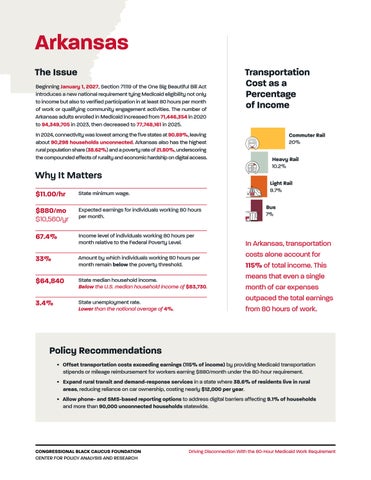
In Arkansas, transportation costs alone account for 115% of total income. This means that even a single month of car expenses outpaced the total earnings from 80 hours of work.
• Offset transportation costs exceeding earnings (115% of income) by providing Medicaid transportation stipends or mileage reimbursement for workers earning $880/month under the 80-hour requirement.
• Expand rural transit and demand-response services in a state where 38.6% of residents live in rural areas, reducing reliance on car ownership, costing nearly $12,000 per year.
• Allow phone- and SMS-based reporting options to address digital barriers affecting 9.1% of households and more than 90,000 unconnected households statewide.
Georgia
The Issue
Beginning January 1, 2027, Section 71119 of the One Big Beautiful Bill Act introduces a new national requirement tying Medicaid eligibility not only to income but also to verified participation in at least 80 hours per month of work or qualifying community engagement activities. The number of Georgia adults enrolled in Medicaid increased from 1,833,759 in 2020 to 2,511,599 in 2023, then decreased to 1,895,148 in 2025.
In 2024, 93.51% of households were connected, with roughly 184,110 households unconnected. Georgia has a moderate rural population share (16.59%) and a poverty rate of 19.90%, suggesting that both geographic and economic factors contribute to digital access challenges.
Why It Matters
$7.25/hr State minimum wage.
$580/mo
$6,960/yr
Expected earnings for individuals working 80 hours per month.
44.5% Income level of individuals working 80 hours per month relative to the Federal Poverty Level.
55% Amount by which individuals working 80 hours per month remain below the poverty threshold.
$81,210 State median household income.
Below the U.S. median household income of $83,730.
3.4% State unemployment rate. Lower than the national average of 4%.
Policy Recommendations
Transportation Cost as a Percentage of Income
In Georgia, transportation costs alone account for 174% of total income. This means that even a single month of car expenses outpaced the total earnings from 80 hours of work.
• Expand Medicaid to address poverty-level earnings where the 80-hour requirement yields $580/ month (44.5% of FPL) and the state poverty rate is 19.9%.
• Subsidize transit and first/last-mile access in a state where transportation costs exceed 170% of monthly earnings, making compliance financially unrealistic.
• Allow hardship exemptions or non-digital reporting options to address digital access gaps affecting more than 184,000 unconnected households, despite high overall connectivity.
Nebraska
The Issue
Beginning January 1, 2027, Section 71119 of the One Big Beautiful Bill Act introduces a new national requirement tying Medicaid eligibility not only to income but also to verified participation in at least 80 hours per month of work or qualifying community engagement activities. The number of Nebraska adults enrolled in Medicaid increased from 248,633 in 2020 to 397,291 in 2023, then decreased to 336,301 in 2025.
In 2024, 92.05% of households were connected, while 44,228 households lacked internet access. Nebraska has a high rural population share (34.11%) but a comparatively low poverty rate at 11.80%, highlighting the role of geographic dispersion in limiting digital access.
Why It Matters
$13.50/hr State minimum wage.
$1,080/mo $12,960/yr
Expected earnings for individuals working 80 hours per month.
82.8% Income level of individuals working 80 hours per month relative to the Federal Poverty Level.
17% Amount by which individuals working 80 hours per month remain below the poverty threshold.
$86,140 State median household income. Below the U.S. median household income of $83,730.
2.6% State unemployment rate. Lower than the national average of 4%.
Policy Recommendations
Transportation Cost as a Percentage of Income
In Nebraska, transportation costs alone account for 94% of total income. This means that even a single month of car expenses outpaced the total earnings from 80 hours of work.
• Adjust eligibility thresholds for near-poverty wages, as the 80-hour requirement yields $1,080/month (82.8% of FPL), leaving compliant workers below the poverty line.
• Expand broadband and in-person reporting assistance in a state where 34.1% of residents are rural and more than 44,000 households lack internet access.
• Invest in regional transit to reduce car dependence, even where transportation costs approach parity (94% of income), given annual vehicle costs nearing $12,000.
Pennsylvania
The Issue
Beginning January 1, 2027, Section 71119 of the One Big Beautiful Bill Act introduces a new national requirement tying Medicaid eligibility not only to income but also to verified participation in at least 80 hours per month of work or qualifying community engagement activities. The number of Pennsylvania adults enrolled in Medicaid increased from 2,989,204 in 2020 to 3,730,393 in 2023, then decreased to 3,041,674 in 2025.
In 2024, 92.28% of households were connected to the internet, leaving an estimated 303,410 households without internet access. Pennsylvania has a relatively moderate rural population share (13.54%), and a poverty rate of 16.80%, indicating that access barriers are shaped by both infrastructure and income constraints.
Why It Matters
$7.25/hr State minimum wage.
$580/mo
$6,960/yr
Expected earnings for individuals working 80 hours per month.
44.5% Income level of individuals working 80 hours per month relative to the Federal Poverty Level.
55% Amount by which individuals working 80 hours per month remain below the poverty threshold.
$80,060
State median household income.
Below the U.S. median household income of $83,730.
3.4% State unemployment rate. Lower than the national average of 4%.
Policy Recommendations
Transportation Cost as a Percentage of Income
In Pennsylvania, transportation costs alone account for 187% of total income. This means that even a single month of car expenses outpaced the total earnings from 80 hours of work.
• Expand low-income transit fare assistance where transportation costs exceed 170% of monthly earnings and wages remain at $580/month under the 80-hour requirement.
• Integrate Medicaid and workforce reporting systems to reduce coverage loss from reporting errors amid job instability and persistent racial unemployment gaps.
• Prioritize transit investments in high-burden communities where long commutes and limited service force reliance on ride-hailing, costing roughly $1,000 per month.
Texas
The Issue
Beginning January 1, 2027, Section 71119 of the One Big Beautiful Bill Act introduces a new national requirement tying Medicaid eligibility not only to income but also to verified participation in at least 80 hours per month of work or qualifying community engagement activities. The number of Texas adults enrolled in Medicaid increased from 4,198,897 in 2020 to 5,922,450 in 2023, then decreased to 4,162,177 in 2025.
In 2024, 93.76% of households were connected to the internet, leaving approximately 482,150 households without access. Texas has a relatively small rural population share (9.68%), yet a high poverty rate of 19.60%, indicating that digital access gaps persist even in largely urbanized contexts.
Why It Matters
$7.25/hr State minimum wage.
$580/mo $6,960/yr
Expected earnings for individuals working 80 hours per month.
44.5% Income level of individuals working 80 hours per month relative to the Federal Poverty Level.
55% Amount by which individuals working 80 hours per month remain below the poverty threshold.
$81,490 State median household income. Below the U.S. median household income of $83,730.
4.0% State unemployment rate. Matched the national average of 4%.
Policy Recommendations
In Texas, transportation costs alone account for 174% of total income. This means that even a single month of car expenses outpaced the total earnings from 80 hours of work.
• Expand Medicaid to address the income–cost mismatch, as the 80-hour requirement yields $580/ month, poverty stands at 19.6%, and transportation costs exceed 170% of income
• Fund transit and mobility assistance programs where car ownership costs rival or exceed total monthly earnings and transit access remains limited.
• Implement phone- and text-based reporting options to address digital access gaps affecting more than 482,000 unconnected households statewide.