92692_P006_031:Layout 1
2
13/6/14
17:28
Page 12
You and your body growing and changing
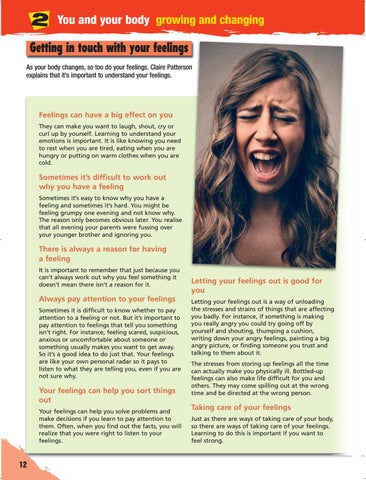
Getting in touch with your feelings As your body changes, so too do your feelings. Claire Patterson explains that it’s important to understand your feelings.
Feelings can have a big effect on you They can make you want to laugh, shout, cry or curl up by yourself. Learning to understand your emotions is important. It is like knowing you need to rest when you are tired, eating when you are hungry or putting on warm clothes when you are cold.
Sometimes it’s difficult to work out why you have a feeling Sometimes it’s easy to know why you have a feeling and sometimes it’s hard. You might be feeling grumpy one evening and not know why. The reason only becomes obvious later. You realise that all evening your parents were fussing over your younger brother and ignoring you.
There is always a reason for having a feeling It is important to remember that just because you can’t always work out why you feel something it doesn’t mean there isn’t a reason for it.
Always pay attention to your feelings Sometimes it is difficult to know whether to pay attention to a feeling or not. But it’s important to pay attention to feelings that tell you something isn’t right. For instance, feeling scared, suspicious, anxious or uncomfortable about someone or something usually makes you want to get away. So it’s a good idea to do just that. Your feelings are like your own personal radar so it pays to listen to what they are telling you, even if you are not sure why.
Your feelings can help you sort things out Your feelings can help you solve problems and make decisions if you learn to pay attention to them. Often, when you find out the facts, you will realize that you were right to listen to your feelings.
12
Letting your feelings out is good for you Letting your feelings out is a way of unloading the stresses and strains of things that are affecting you badly. For instance, if something is making you really angry you could try going off by yourself and shouting, thumping a cushion, writing down your angry feelings, painting a big angry picture, or finding someone you trust and talking to them about it. The stresses from storing up feelings all the time can actually make you physically ill. Bottled-up feelings can also make life difficult for you and others. They may come spilling out at the wrong time and be directed at the wrong person.
Taking care of your feelings Just as there are ways of taking care of your body, so there are ways of taking care of your feelings. Learning to do this is important if you want to feel strong.
92692_P006_031:Layout 1
13/6/14
17:29
Page 13
Your Life Student Book 1 It’s important to act on your feelings There are all sorts of times when people ask you to do things you don’t want to do that are perfectly fair – like being asked to dry the dishes or to tidy up your room. There are other times when you have the right to say no if you don’t want to do something. Saying no isn’t always easy, especially if you are worried that the other person won’t like you if you say no, and you are being pressured into saying yes.
Practice makes it easier If you practise saying no about little things you will find it easier to say no when it is really important.
Study what Claire Patterson says about your feelings and make a list of the most important points she makes. Then show your list to another pair and discuss what you learn from the article about how to manage your feelings.
Discuss these statements about feelings and give the reasons why you agree or disagree with them:
How you say no is important too. It helps to say it clearly and firmly. Sometimes it also helps to say how you feel – this makes it clear why you don’t want to do something.
❝Boys who show their feelings and cry are weak. They should learn to be tough and always try to be cool.❞
If you say yes when you really didn’t want to do something, then you are likely to end up feeling anxious, grumpy or resentful.
❝If people really want you to do something with them, the right thing to do is to join in, even if you feel strongly you don’t want to.❞
It takes time and practice to stand up for how you feel
❝There are times when it’s best to bottle up your feelings.❞
Here are some basic rules:
❝It’s often very difficult to explain to someone why you feel the way you do.❞
1 Feelings are real, not imaginary. 2 There is always a reason for how you feel. 3 Following your feelings when you make decisions is always best for you in the end.
Changing feelings and thoughts During puberty, boys and girls think about lots of new things and feel lots of new feelings: ■
You may feel more emotional – up and down.
■
You may feel like being on your own more often.
■
You may feel awkward and clumsy.
■
You may become more attracted to other boys and girls in a different way from before.
■
You may start to have heroes and heroines – older people you really admire and try to copy.
■
You may feel like dressing like older kids do.
■
You may want to spend time with older kids.
■
You may feel like being more independent.
■
You may find it harder to get on with your parents.
In pairs, role play scenes in which someone says no because they don’t feel like doing something. Take it in turns to be the person saying no. Here are some possible scenes:
1 2
A friend wants you to go to a club.
3
A friend asks you to lend them your new DVD.
A friend wants you to skip school.
All these things are a usual part of growing up.
13