2.3 Unhealthy relationships and feelings of rejection 16–17
3. Sexual relationships – your responsibilities
3.1 Giving your consent 18–19
3.2 Am I ready to have sex? 20–21
3.3 Having sex – teenagers’ experiences 22–23
4. You and safer sex
4.1 STIs 24–25
4.2 Symptoms of STIs 26–27
4.3 Sexual health clinics 28–29
5. Staying safe from abuse
5.1 Child abuse 30–31
5.2 Grooming 32–33
5.3 Sexting – it’s no laughing matter 34–35
6. Stereotyping and prejudice
6.1 What is stereotyping?
6.2 What is prejudice?
7. Drugs and addictions
7.1 Recreational drugs
7.2 New psychoactive substances42–43
7.3 How can I tell if a drug is safe?44–45
7.4 Are you addicted to your mobile phone? 46–47
8. You and alcohol
8.1 Alcohol:
8.2
8.3 Alcoholism
9. You and your health
9.1 Immunisations and health checks
9.2 Allergies
10. Caring for your body
10.1 Looking after your skin 58–59
10.2 Caring for your teeth, ears and eyes 60–61
10.3 Caring for your feet and your back 62–63
10.4 Tattoos and piercings 64–65
11. Managing your emotions
11.1 Dealing with anger 66–67
11.2 Jealousy 68–69
11.3 Dealing with fear 70–71
12. Managing stress
12.1 Signs of stress 72–73
12.2 What stresses you? 74–75
12.3 Coping with stress 76–77
13. You and your money
13.1 You and the bank 78–79
13.2 Saving and borrowing 80–81
14. The police and the law
14.1 Laws and the rights of children82–83
14.2 You and the police 84–85
15. You as a citizen
15.1 Democracy and voting 86–87
15.2 You and human rights 88–89
15.3 Pressure groups 90–91
15.4 Blood, organ and stem cell donation 92–93
16. You and other people
16.1 Disabilities and learning differences 94–95
16.2 Dealing with ageism 96–97
17. You and your future
17.1 GCSE choices 98–99
12.1 Signs of stress
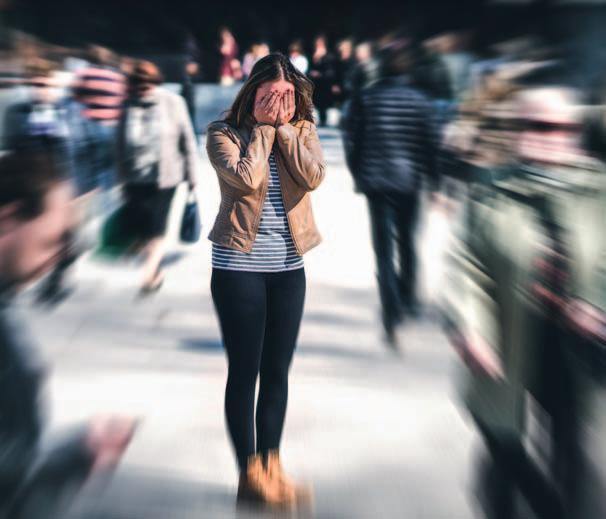
Stress is the body’s way of reacting to a situation. This could be a challenge, a threat or some sort of barrier that exists.
There are many different signs of stress. These can be mental, physical or emotional.
Sometimes the type of language people use reveals that they are under stress, using phrases like, ‘I feel tense’ or, ‘I just can’t relax’.
The mental signs of stress
Mental signs of stress include:
• being unable to concentrate
• avoiding big crowds and loud noises
• making silly mistakes with work
• constantly remembering a stressful situation
• doing things unconsciously
• having gaps in memories of what has happened
• having a very critical or negative attitude towards yourself or in general
• confusion about what is happening.
1. What do people look like when they are stressed? Draw a picture of a stressed person. There can be no words – only pictures, and you must complete this activity on your own, in silence.
Then compare your pictures as a group, with other people trying to guess what different parts of your picture represent.
2. What sort of words do people use when they are stressed?
3. How do people act when they are stressed?
4. Do you recognise signs of stress in anyone you know?
Physical signs of stress
There are many different physical signs of stress. Stress uses up the body’s energy more quickly.
For some people this can lead to feeling tired all the time. Other people may have too much energy, and be unable to sit still when they are stressed, only feeling tired much later.
Stress can affect particular parts of the body differently, for example causing stiff or aching muscles, particularly in the neck and back, and headaches. Stress can also affect the digestive system, including causing changes in appetite, such as wanting to binge eat, or not wanting to eat at all, or only to eat certain types of food, such as junk food to get a quick sugar rush.
Stress can affect us in other ways, including shaking hands, sweaty palms or a dry mouth. It can also lead to an increased heart rate – where our heart feels like its beating faster or harder. Stress can also affect our breathing, making it faster and shallower, as our body tries to move into a fight or flight response, as discussed in Unit 11.3. Finally, stress can affect our sleep. This can include being unable to get to sleep, oversleeping the next morning or waking up in the middle of the night.
Johnny’s story
‘What gets me stressed is exams and tests. I’m fine normally in class, but put me in a test and it’s like I can’t concentrate. I make silly spelling mistakes, get confused and misread the question. Afterwards I put myself down and tell myself I’m useless at exams, because I always get low scores. It becomes the one thing I focus on.
‘For my older sister Karen, it’s not exams that stress her, but dogs. She was bitten by one when she was young. She says she’s forgotten most of the details, but it happened in the centre of town when it was very busy, and she doesn’t like large crowds now. I’ve noticed that when we get to the centre of town she always crosses the street to avoid where it happened.’
Look at the list of physical stress symptoms. Match them to the solutions given.
Symptoms
1. Having a dry mouth
2. Wanting to binge eat
3. Not wanting to eat at all
4. Not being able to get to sleep
5. Waking up in the middle of the night
6. Oversleeping next morning
7. Tense muscles in your neck and back
8. Having too much energy
9. Feeling tired all the time
10. Breathing too hard and too fast
11. Feeling like your heart is pounding and thumping in your chest
Solutions
A. Having a healthy snack to hand, like a banana
B. Taking a long hot bath to relax your muscles
C. Setting an alarm
D. Taking a break in an activity, for example by going the toilet
E. Keeping a food diary, including one or two small snacks each day
F. Breathing out more than breathing in, to slow down your heart rate
G. Making sure you have regular drinks of water
H. Having an early night with a book
I. Exercising so you are tired and will sleep through the night
J. Making sure you have plenty of vitamin C and food that will give you energy
K. Doing slow balanced breathing – in and out for a count of six
Is there anything else you can think of doing to deal with these symptoms?
The emotional signs of stress
1. Think about Johnny and Karen’s stories.
• Which one is suffering from symptoms of stress?
• What do you think can be done to help each of them?
2. Karen’s symptoms are a reaction to a past situation. In extreme cases this is called posttraumatic stress disorder, or PTSD. Research PTSD and what can be done to help those who suffer from it.
There are many different emotional signs of stress. Below is a list of the most common.
• Having a short temper
• Being impatient with people
• Crying for no real reason at all
• Irritability with the world
• Being unable to deal with other people
• Feeling negative for no reason
• Constantly worrying about things
• Being oversensitive to things that don’t usually bother you
• Finding it difficult to manage strong emotions like anger
• Feeling like you never get a break
• Feeling emotionally drained
1. Rank the emotional signs of stress in order of the most serious to the least, in your opinion.
2. Then discuss what someone who has each of these signs of stress could do to help manage their feelings. Give reasons for your views.
12.2 What stresses you?
Stress is part of how human beings have evolved. It helps us in an emergency, causing the fight or flight response discussed earlier. The right amount of stress is actually a good thing.
Pros and cons of stress
Without any stress, we would be very relaxed towards our exams, for example, and wouldn’t do much revision. In the exam, we wouldn’t perform at our best because the adrenaline that helps our brains to concentrate and perform well wouldn’t be released. Afterwards, we wouldn’t be concerned about the consequences of passing or failing.
While stress can be useful in some situations, like in a running race or an emergency, too much stress, or stress in the wrong situation, can be harmful. The diagram shows how the right amount of stress can be helpful, but too much can cause problems.
The Yerkes–Dodson Law
Because of this, it is important to recognise what causes stress. This can be a situation you find yourself in or a person you find it stressful to deal/ be with.
Top ten stressful situations
• Being late
• Public speaking
• Exams
• Homework
• Sports team trials
• Being on your own
• Being in a large crowd
• Being with people you don’t know
• Being with animals
• Peer pressure
1. Look at the list of top ten stressful situations. Rank them in order of the most stressful to the least stressful. Then compare your answers with a partner. Give reasons for your views.
2. Now discuss with your partner what other situations you think would stress you. Give reasons for your views.
Sometimes a person will stress you.
3. Look at the list of people below. Rank them in order from who causes you the most stress to who causes you the least stress.
4. Compare your answers with a friend. Give reasons for your views.
Top ten people that can cause you stress
• Teachers
• Best friend
• Peer group
• Siblings
• Strangers
• Parents
• People who criticise you on social media
• Members of the same sex
• Members of the opposite sex
• Yourself
Our stress reservoir
Our bodies are like a reservoir – they can store up stress over time in the same way that they can store up anger. It’s important to make sure that your stress isn’t building up too much. You need to give stress an outlet, to make sure that you get rid of it. Otherwise, if you already have a lot of stress in you, a small amount more can make you snap.
Top ten ways to avoid stress
• Get half an hour’s light exercise every day, such as walking or running. It is important to get any excess adrenaline out of your body.
• Meditate for a short amount of time each day – first thing in the morning and last thing at night.
• Eat healthily.
• Plan your day so that it has regular breaks in it, so you have time to yourself.
• Have at least one close person, such as a friend, parent, grandparent, sibling or cousin to whom you can talk about anything.
• Have at least one day off work or school work every week.
• Go out at least one evening a week.
• Have at least one hobby that you enjoy that you do each week.
• Read a good book for half an hour each day to relax.
FOMO: the fear of missing out – Becca’s story
‘I signed onto Instagram when I was 13. At first it was OK: I would use it to post photos of myself and see photos of my friends. But gradually I spent more and more time on the app. I became obsessed with looking good, and with what my friends thought of my latest photos. It got to the point that I was checking Instagram all the time – so much so that my school work was suffering. My friends noticed that I wasn’t paying attention to them – I was always looking at my phone.
‘Eventually, my dad became concerned, and we talked the whole thing out. I knew in my gut what I was doing wasn’t healthy. My heart just wanted to be liked, but my head kept telling me that I was going to miss out. Eventually I realised that my friends like me for just being myself. Now I spend more time with them in real life and have agreed to limit myself to using social media for only an hour a day. That might sound extreme to some people, but I’m a lot happier now.’
Look at the top ten ways of avoiding stress.
1. Rank them in order of your personal preference from best to worst.
2. Then discuss your list with a partner. Which ways work best for you and why?
In groups, discuss Becca’s story.
1. What do you think ‘fear of missing out’ means?
2. Do you ever experience fear of missing out because of social media? How does this make you feel?
3. What could you do to avoid this?
Create a short social media post, aimed at people the same age as you, on how to avoid stress in the first place.
1. Create a draft of your post in pairs.
• What social media app will you use?
• What is the main aim of your post?
• What will you include?
2. Share your post in groups, and then with the class.
• Which post do you think is the best? Why?
12.3 Coping with stress
Coping with stress is very important, as stress can lead to real problems with our health.
The long-term effects of stress
Apart from the issues that we’ve already looked at, stress can lead to a range of problems. Physically, stress can limit children’s growth, cause heart disease and lower the immune system. Mentally and emotionally, stress can lead to depression, delusions or anxiety. There is a strong link between stress and illness. Chronic stress is classed as a long-term medical condition.
Because stress affects different people in different ways, every person has a different way of dealing with their stress.
• Listening to music
• Overeating until you are too full
• Drinking alcohol or taking drugs
• Avoiding going to school
• Doing the thing that makes you smile the most
• Talking the problem through with a responsible adult
• Getting annoyed with other people
• Talking the problem through with a friend your age
• Consulting with an expert, such as a teacher for education, a doctor for health, or the police for a crime
Developing your emotional resilience can help you to reduce the impact of stress on your life. Do some research on the internet to find out more about emotional resilience and how you can develop yours.
Look at the list below of ways people deal with their stress.
1. Which do you think would work for you? Which wouldn’t be so good for you?
2. Rank them in order from most helpful to least helpful.
3. Then compare your answer in groups. Give reasons for your views.
4. What other ways can you think of for reducing stress?
Ways people deal with their stress
• Having a good cry
• Eating some ice cream
• Going to the gym
• Having a warm shower or bath
• Going for a long walk
Caitlin’s coping strategies
‘I use different strategies to avoid, recognise and deal with stress, depending on what type of stress it is. My biggest one is emotional stress, when I am arguing with people.
‘The first thing I do is to avoid argumentative situations. So I don’t hassle my parents when I can see they are stressed, or if I’m already feeling stressed. I don’t talk about tricky things just before school, when everyone is rushing out, or last thing at night when everyone is tired. I pick my moments.
‘Next, I remind myself that sometimes I will disagree with other people. So, if I’m arguing with my brother or my parents and things are going round in circles I will stop and take a break if I feel myself getting stressed or can see that the other person is. It’s better to take a break and work things out later rather than winding each other up.
‘Finally, I don’t hold on to things. If I’ve had an argument, I will go out for a run to get the stress out of my body physically. I’ll clear my mind by
watching a film, reading a book or listening to some music in my bedroom, to get rid of the mental stress. If it’s a bad argument I will talk to another member of my family or my friend Jazz. She’s great as she’s a calm person to chat to and always gives me good advice.’
Study skills
Personal wellbeing and mental health
One area which students need to develop is that of study skills. This is the ability to study, research, learn and remember information – and avoid stress while doing it. Fortunately, there are a number of very simple things you can do in order to study effectively.
Different ways of studying effectively
Think about and discuss Caitlin’s ways of coping with stress. Which part of her advice do you think is best? Give reasons for your views.
1. Write down the answers to these scenarios, to help understand how to deal with stress:
• When a person I know is stressed about another person, what can I do?
• When a person I know is in the middle of a stressful situation, what can I do?
• When a person I know is in the middle of a stressful conversation, what can I do?
• When a person I know is stressed after an event, what can I do?
• What a person I know is stressed after a stressful conversation, what can I do?
2. Does the answer to any of these questions change depending on whether it is physical, emotional or mental stress that a person is experiencing?
1. In pairs or groups, imagine you had to build a mobile app that would help you deal with stress.
• What features would it have?
• What would it be able to do?
2. List as much information about your app as possible.
3. Then compare your apps with the rest of the class.
‘I always find it easier to study in the morning.’ Alice, Birmingham
‘I study best in the evening.’ Dalton, Leeds
‘I like studying after school each day.’ Tandi, Newcastle.
‘I like to break things up into bite-sized chunks.’ Natalie, Lincoln
‘I like looking at the big picture first.’ Simon, Redruth
‘I like reading to learn new things – either books or on the internet.’ Tom, Huddersfield
‘I like watching videos or YouTube clips for new information.’ Sasha, Taunton
‘I like talking to other people to find out new information.’ Ben, Coventry
‘I like working on my own to figure things out myself.’ Krishnan, Carlisle
1. In groups, discuss the following statements. Which do you agree with and why?
2. Draw up a list of things that make it easier for you to study.
3. In groups, discuss:
• what time of day you find best for studying
• how you like to get new information
• how you like to digest and think about information.
4. Are there any differences within your group?
5. What have you learned about yourself by thinking about how you study and learn best?