12. Fake news, radicalisation and online literacy 12.1 Fake news
13. You and your mental health and wellbeing 13.1 Attending to your wellbeing
14. Gambling
How to manage gambling
15. You and your money 15.1 Consumer rights
15.2 Financial choices
16. Global issues 16.1 Climate change
16.2 Dealing with climate change
13.1 Attending to your wellbeing
The term wellbeing refers to a whole group of positive feelings about yourself and the world.
These feelings include happiness, contentment, enjoyment, self-confidence and connection with the world. Good mental wellbeing also gives you the resilience to cope when times are harder than usual. So it is an important ingredient of good mental health.
Wellbeing is not something we have – like pocket money or nice clothes. It may be more helpful to think of it as something we do – ‘being well’. So the more we do to build it up, the stronger a resource it is in our lives.
Children less happy with their lives,
report finds
If you try to gauge the happiness of children by the smiley faces they post on social media pages, a major survey of children’s wellbeing published today should make you think again. It identifies a significant decrease in their happiness with life as a whole and with friends between 2010 and 2016.
The Good Childhood Report 2018 brings together the findings of a major study carried out by the Children’s Society in partnership with the University of Leeds. The survey asked thousands of children questions about their lives and what made them happy and unhappy.
The report shows that girls are unhappier with their lives than boys. Also, children attracted to the same or both genders have significantly lower wellbeing than other children, with almost half of them self-harming.
Key factors for wellbeing seemed to be the connections that children had with those around them, such as family and friends. They needed to feel supported and at ease with their identity in these groups. If they were bullied or felt they had to conform with expectations that were at odds with their own identity, then their wellbeing suffered.
Read the newspaper article. Why do you think the wellbeing of children has declined in recent years?
Consider these factors: social media, appearance, pressure to fit in with society’s expectations, friendships, school, gender stereotyping, family relationships.
Answer the quiz questions opposite to see how good you are at maintaining your mental wellbeing. Keep a record of your answers. Then check your score and discuss with a friend what you have learned about yourself, and what you could do to help yourself.
What are you doing to improve your wellbeing?
1Having fun. Doing things that cheer you up is an obvious way of feeling better. How often do you let yourself feel happy, for example by being with friends who make you laugh, or treating yourself with something you like?
a) often, b) sometimes, c) hardly ever/never
2Self-esteem. Accepting yourself as a person builds your resilience. How good are you at feeling OK about yourself even when you don’t achieve your aims, or when you get criticised?
a) pretty good, b) sometimes good, sometimes not, c) not very good
3Eating well. Your diet is more important for mental health than you may think. Do you:
a) have a balanced diet, b) have slightly too much unhealthy food/drink, c) have a lot of junk food and sugary drinks?
4Sleep. Not enough sleep, or poor-quality sleep, affects our energy and mood. How is your sleep?
a) good (9+ hours per night), b) average (7–8 hours), c) poor (6 or fewer hours)
5Getting active. Physical exercise is a moodbooster. Regular walking is just as good as aerobic exercise. How often each week do you exercise for 30 minutes?
a) most days, b) some days, c) rarely/never
What’s your score?
Mostly as: You are doing lots of valuable things to help your mental wellbeing.
Mostly bs: You are doing some things to help your mental wellbeing, but there is more you could do if you wanted to.
Mostly cs: There are plenty of things you could do to improve your wellbeing. Visit the Mind and Young Minds websites to find out more.
6Sharing your feelings. Talking to someone you trust about how you are makes problems more manageable and builds emotional intelligence. How good are you at sharing your feelings?
a) I often do this, b) I sometimes talk about how I feel, c) I always keep my feelings to myself
7Connecting with others. We are social beings, so developing good relationships with family, friends and community is vital to our wellbeing. How much effort do you put into your relationships?
a) a lot of time and effort, b) a fair amount of time and effort, c) not much effort at all
8Hobbies and interests. Learning new skills keeps us mentally alert and interested, and connects us with others. What time do you give to learning new skills or to your existing hobbies?
a) a lot, b) some, c) hardly any/none
9Giving to others. Kindness and helping others gives us a sense of purpose and strengthens our relationships. Volunteering, helping someone or even just a kind word – every little helps. How much do you give to others?
a) a lot, b) some, c) hardly anything/nothing
10Being aware of yourself and the world. Practising mindfulness (see Unit 13.2) can help us enjoy the world and manage stress. For example, how much do you really notice what’s going on in the present moment – in yourself and in the world around you?
a) I regularly take time to notice things, b) sometimes I stop and notice how I am feeling, c) I always race from one activity to another
1. Discuss what Sarah Stewart-Brown says about wellbeing. Do you agree?
‘No one can give wellbeing to you. It’s you who has to take action.’ Sarah Stewart-Brown, professor of public health at the University of Warwick
2. What can you do to build or maintain your wellbeing?
• List or draw five key things you are already doing that contribute to your wellbeing.
• Then list or draw five things you could do to improve it.
13.2 Mindfulness
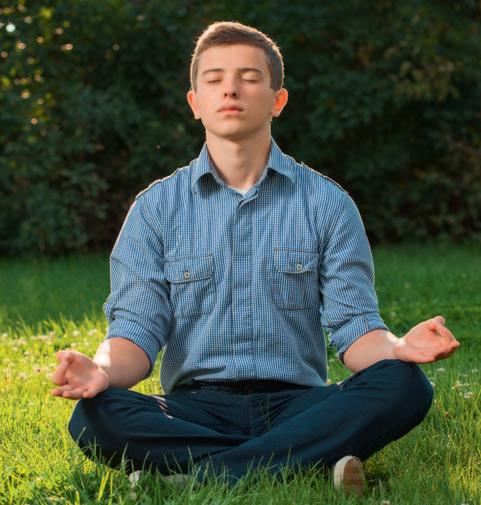
Mindfulness means allowing ourselves to see the present moment clearly.
If we notice what is going on in our bodies and our minds, as well as in the world around us, it can change the way we see ourselves and improve our mental health and wellbeing. There are many ways in which we can practise mindfulness.
Why practise mindfulness?
It brings a more helpful and flexible attitude towards painful thoughts and feelings. ‘When I get anxious, instead of panicking about my racing heart, I sort of just notice what’s going on. That tiny space allows me to calm down.’ Zoe
It helps us relax. ‘Focusing on my breathing a few times a day has really helped me de-stress.’ Beau
It allows us to be more present. ‘Mindfulness helps me get out of my head. I’m much more aware of the world around me.’ Joel
It allows us to change our thought patterns. ‘I’m looking at my thoughts and feelings differently. I don’t get so caught up in thoughts like “I’m rubbish”. It’s just another thought, after all.’ Ellie
It encourages kindness. ‘I’m much more patient with myself and others now. I don’t beat myself up any more for feeling sad.’ Darcey
It allows us to be more focused. ‘I’m not as distracted as I used to be, so I can stick at things for longer.’ Noah
It’s a powerful self-management strategy. ‘I don’t lose it so often now when people say hurtful things about my appearance. I can take a breath and react in a more effective way.’ Mikey
1. Read the young people’s experience of practising mindfulness. Which area or areas of your own wellbeing do you think could be improved if you followed a mindfulness practice?
2. Try out the mindfulness exercises on these pages. Research others, such as mindful breathing, mindful eating and the body scan, on the internet or via a mindfulness app.
Then choose one of these to commit to over a period of at least a week. Write down how you feel at the beginning of the week and at the end, as a way of evaluating your experience.
Watching the thought train
When there’s a lot going on in our lives, we can get very caught up in our thoughts. These are often about the past, going over previous events. Or they may be about the future, such as planning what we’re going to do next. Either way, we aren’t really present in the here and now, and we are likely to be distracted or stressed. So, beginning to ‘just notice’ our thoughts can be a helpful way of bringing us back to the here and now, and feeling more settled or grounded.
‘Watching the thought train’ is a way of distancing yourself from all the thoughts that may be carrying you away. Follow these steps:
1. Feel the real contact of your feet on the ground.
2. Begin to notice your breathing, where it feels the strongest, for example in your belly or nostrils. Bring your attention to your breath in this way as you settle yourself down. When your thoughts leap away, gently bring them back to focusing on your breath.
3. After a minute or two, switch your focus of attention to the thoughts themselves. Imagine you are standing on a station platform watching a train go past. Each thought you have is a carriage of the train. Notice it coming to your mind and notice it leaving.
4. The train may go fast or slowly, it doesn’t matter. It may even stop – but probably not for long. Try to hold on to the sense of yourself on the platform just watching the thoughts go past.
1. Practise ‘Watching the thought train’ by being silent for three minutes, preferably with your eyes closed.
2. Next, read what Sofia and Alex experienced (below).
3. Then discuss what your own experience was when you watched your thought train.
4. ‘You can’t stop the waves but you can learn to surf.’ Jon Kabat-Zinn. Discuss what Jon Kabat-Zinn means, and why learning ‘to surf’ is important.
‘It was hard at first to not get on each carriage and be carried away by the thoughts. After a few practices I noticed I was getting back on the platform sooner and sooner. It was weird seeing all those thoughts race past me.’ Sofia
‘I tried to put my thoughts on the train and send them away, but more and more kept coming. It was stressful. Eventually I remembered that mindfulness isn’t about making the thoughts go away, and I relaxed a bit. Then I was calmer and even enjoyed stepping back from it all.’ Alex
1. Take a ten-minute mindful walk. It could be your walk home from school, or the walk to the bus stop. Walk a bit more slowly than usual and really engage your senses of sight, hearing, smell and touch. Try to notice ten things that you wouldn’t normally notice. When you get back, write down (a) what you noticed, (b) how you felt.
2. Pay attention to your feelings through the day. On your phone or a piece of paper, record how you are feeling in the morning, at midday, in the afternoon and the evening. Write down where you notice the emotion in your body, for example in your chest or in your stomach, and how you express it (if you do). Keep this going for a week.
Research some mindfulness apps, such as Headspace. Try them out, then draw up a personal pros and cons chart for two different apps.
13.3 Mental illness
Everyone has mental health. It affects how we think, feel and behave. It also helps us make decisions and relate to others. Mental ill-health, or mental illness, is one aspect of mental health.
A spectrum of mental health
It is helpful to imagine a spectrum of mental health, with healthy at one end and unwell at the other. Just like with our physical health, at any one time, we are somewhere on this spectrum. Lots of factors can affect how we move along the spectrum, such as our home or school environment, difficult life events, and physical factors such as the quality of our sleep and diet.
Mental health spectrum
Reproduced by permission of the Centre for Mental Health.
We all have bad days – perhaps we feel like crying for no reason, or we can’t cope with the simplest of tasks. But sometimes our low mood seems to last for a long time and it’s hard to shift it. If so, you may have a mental health problem and need some help to feel better (see Unit 13.4).
Different names for different problems
Mental health problems are usually defined carefully so that professionals can give people the appropriate care and treatment. These are some of the common mental health problems that can affect children, teenagers and adults:
• Depression is when your mood is very low, so that it is hard to enjoy life. People with bipolar disorder, a type of depression, swing between high and low moods (see Unit 13.6).
• Anxiety can take many forms, such as anxiety in social situations or extreme concern about your physical appearance (see Unit 13.5).
• Obsessive compulsive disorder (OCD) is an anxiety disorder in which someone has obsessive thoughts and compulsive behaviours (see Unit 13.5).
• Attention deficit hyperactivity disorder (ADHD) is a behavioural disorder where someone has difficulty paying attention and can be hyperactive and impulsive.
• Eating disorders include disorders such as anorexia, bulimia, over-eating and binge eating (see Unit 10).
• Self-harm is when someone harms themselves, for example they cut or burn themselves. It is usually a way of coping with or expressing intense emotional pain (see Unit 13.6).
Some people experience ‘psychotic’ symptoms, which may include hallucinations, such as seeing, hearing, smelling or feeling things that no one else can.
Myths about mental illness
MYTH 1: Mental health problems happen to other people.
FACT: According to the World Health Organization, one in four people will experience a mental health problem every year. Official statistics suggest that mental health problems affect about 1 in 10 children and young people, and are more common in adolescence. NHS research published in 2018 shows that nearly 400 000 under-18s in England are being treated every year for some sort of mental health condition.
MYTH 2: People with mental health issues should just get over it.
FACT: Mental health problems are real, accompanied by real changes in the chemicals in the brain. They are not trivial or a sign of
weakness, even if there isn’t an obvious physical symptom to show for it. They need to be treated seriously, not dismissed.
MYTH 3: It’s an embarrassment to have a mental health problem.
FACT: Many people feel embarrassed about mental illness. They think they will be treated differently and lose friends. But why should it be more embarrassing than having any other illness? It is not a failing on the part of the sufferer.
MYTH 4: People with a mental illness are dangerous.
FACT: Some high-profile violent crimes involving people with a mental illness give the wrong impression. The vast majority of people with a mental health issue do not harm others.
What’s your mood?
Think about your mood over the past two weeks. How much do you agree with the following statements about your mood? Give a rating between 1 and 10 for each one, where 1 = completely disagree and 10 = completely agree.
1 Over the last two weeks you’ve had little interest in doing the stuff you usually enjoy doing.
2 Over the last two weeks you’d describe your mood as down, low or hopeless.
3 Over the last two weeks you’ve had trouble falling asleep or have trouble getting out of bed (even on a non-school day!).
4 Over the last two weeks you’ve lacked energy and feel tired all the time.
5 Over the last two weeks you’ve had little appetite or found yourself comfort-eating.
1. What have you learned about mental health from what you have read here?
2. ‘As a society we must no longer adopt a “stiff upper lip” attitude ... we need to talk openly about mental health, something that affects us all directly.’ Paul Farmer, Chief Executive of the charity Mind
Why does Paul Farmer say this? Do you agree with him? If so, what can we do as individuals to change society’s attitude to mental health?
Research what Prince Harry and Prince William have said about their own mental health problems. What effect do you think their speaking out has had on helping other people with mental illness?
Opposite is a questionnaire in a self-help book aimed at teenagers. Read it and then answer these questions.
1. Why are you asked to think about your mood over a period of two weeks?
2. Are there any questions that surprise you, or that you think are missed out?
6 Over the last two weeks you’ve felt like a bit of a failure at work, home or school.
7 Over the last two weeks you’ve found it hard to concentrate on work or even things like watching TV.
8 Over the last two weeks you’ve noticed a change in your mannerisms – you feel either slow and sluggish or buzzing and hyper.
9 Over the last two weeks you’ve thought about harming yourself or thought about your own death.
10 Over the last two weeks your mood has made it difficult for you to do your normal day-today activities.
Add up your score. If your score is higher than 50, can you say why? Are you having a bad time of it at the moment? (For example, if you’re having a break-up you may well score over 50.) If you CAN’T identify a life event or a reason why you might be feeling so blue, perhaps it’s time to think about your mental wellbeing.
Do the questionnaire in another two weeks – has anything changed? It could be that a couple of days off, or being kind to yourself, is all you need right now, but MAYBE it’s time to seek some support. There’s plenty of it out there (see Unit 13.4).
Adapted from Juno Dawson, Mind Your Head
13.4 Getting help and giving help
We all need help and support at some point in our lives. Sometimes we are in a position to help and support others.
Getting help
If your mood has made it difficult for you to do your normal day-to-day activities, then you need to seek help.
Talk to someone
Talking to someone is an essential first step on your road to recovery. Talking may even be all you need to do to turn the corner. Try to talk to someone you like and trust, such as one of the following:
• a friend
• a brother or sister
• a parent or carer
• another relative, such as an aunt or grandparent
• a friend’s parent
• a teacher or school nurse.
Professional organisations
Talking will give you a different perspective, a shoulder to lean on, and perhaps some advice about what to do next. But you cannot expect your friends or family to be experts in mental health issues. You could speak to the school counsellor or contact any of these organisations for more advice or support if necessary:
• Childline: call free on 0800 1111, speak to a counsellor online or visit the ‘explore’ section on their website.
• The Mix: offers free and confidential support to the under-25s. Their free helpline (0808 808 4994) is available 11 a.m. to 11 p.m. every day. Email and webchat support are available on their website.
• Samaritans: offers free and confidential help in the UK 24/7. Call free on 116 123 or email jo@samaritans.org.
Be careful how you use the internet. Trustworthy advice and forums can be found on the websites above, as well as at the Young Minds, Kooth or NHS Moodzone websites.
More formal support
When advice isn’t enough, or when the advice suggests that you need to go down a more formal route, it is usually best to start by contacting your GP. You may want to go with a trusted adult or someone else for moral support and to listen to the advice with you, but you don’t need your parents’ consent. The meeting will be confidential unless the GP feels that you or someone else may be harmed.
The GP will ask you lots of questions and suggest what to do next. This could be making some simple self-help changes in your lifestyle and keeping an eye on the situation before coming back for another chat. Or you could be offered medication to help with depression and anxiety, or tablets to help with your sleep. Medication will be a short-term solution to take the edge off the difficulty while you find better ways of coping and other sources of support.
You may also be referred to the Child and Adolescent Mental Health Services (CAMHS). These are local, specialist mental health support teams run by the NHS. The services are free and help young people under 18 who have emotional, behavioural or mental health problems.
In an emergency
If you feel that you, or someone you know, needs urgent help and may be at risk of harming themselves or others, you should contact your GP, or visit your local NHS walk-in centre or closest A&E department straight away. If necessary, phone the emergency services on 999.
Giving help
Personal wellbeing and mental health
Supporting a friend – Dos and Don’ts
Colin Letts gives you some tips on how you can help a friend struggling with their mental health
Do listen. Really be present for your friend. They will feel supported and valued by you if you simply acknowledge what they are feeling and thinking.
Explore the two websites Kooth and The Mix. If you were suffering with a mental health problem, which site would you turn to first, and why?
‘When I had an eating problem I spent hours each night on chatrooms and forums. Talking to other people who felt the same as me seemed like a lifesaver at the time. It was only later, when I saw my GP and started treatment, that I looked back and wondered how helpful it was. There’s something unhealthy about being locked in a “room” with people who all think and feel the same.’ Faisal
‘Finally discovering people who felt the same as me was such a relief. I wasn’t “weird” after all! It also felt good being able to help others by sharing my story. I wasn’t just a victim of my panic attacks, I was something bigger than that. It was an online buddy who suggested I try CBT [cognitive behavioural therapy], which was the best thing I did.’ Maya
1. Discuss Faisal’s and Maya’s experiences of using social media to help them with their mental health issues.
2. List three advantages and three disadvantages of using forums and social media in this way.
Don’t judge. It’s not your friend’s fault that they may have mental health issues. Being criticised or dismissed will not help their mood and will mean they lose you as a source of support.
Do spend time doing fun and healthy things with them. Go shopping or to the cinema, play sport or exercise together – there are lots of non-talking activities that may boost your friend’s mental health.
Don’t try to solve their problems. There may be some advice you can give, such as ‘you need to talk to the school counsellor’, but your role is mainly to give emotional support and to listen.
Do keep in touch. Even if you are shocked by what your friend is saying, keep supporting them. They need your support, and one day you may need theirs! Check in with them regularly to see how they are.
Don’t take it on all by yourself. You can only help your friend if you are strong enough yourself. If you feel out of your depth, or that they are at risk of serious harm, you need to ask for help from a trusted adult. In some cases, a professional’s opinion is essential
What are the three best tips in ‘Supporting a friend’? Compare your ideas with those of others.
In pairs, role play a conversation between friends where one of you has been feeling very low for the last fortnight. Then swap roles. Finally, feed back how the conversation felt for both of you.
13.5 Managing anxiety
Anxiety is an emotion closely related to fear. You could say that fear is what we feel when there is a danger right now and anxiety is what we feel when we are concerned about something happening in the future.
The fear/anxiety emotion is extremely important, as for tens of thousands of years it has helped us to respond to any situation that we think may be dangerous.
Anxiety is an automatic reaction, controlled by the central nervous system. When we are anxious, our bodies go into ‘fight, flight or freeze’
Physical sensations, for example:
raised heart beat sweating butterflies in the stomach tension in neck, legs, shoulders tight chest/shallow breathing light-headedness.
Anxiety conditions
Anxiety is not a disease. At a normal level, it is not a bad thing. On the contrary, the anxiety reaction is one of the most important ways we regulate our emotions to keep ourselves alive and effective in the world. Too much fear or anxiety, however, can prevent us acting effectively. Unfortunately, our attempts to get rid of the feeling (for example, by worrying or by avoiding situations) can make the problem worse in the long run.
For example, if you suffer from social anxiety, you will worry about social situations and being judged by others. Thoughts about ‘not coping’ will make you feel distressed. So, typically, you will try to avoid or escape from social situations as
mode. The idea is that if we fight, or run away, or freeze, we are more likely to survive an attack (or whatever the threat is).
There are three kinds of ‘symptoms’ (signs) that we may notice when this anxiety/fear reaction is set off – physical sensations, thoughts and urges (an urge is a desire to take action):
Urges, for example:
to avoid something or someone to seek reassurance to check/be on the alert to hide to get irritable or aggressive.
Thoughts, for example:
‘What if …?’
‘I won’t be able to cope with …’ ‘It’ll be terrible …’
much as you can, or keep yourself ‘safe’ by various means (avoiding conversation, looking for escape routes and so on). But these actions make social anxiety worse.
Likewise, if you suffer from obsessive compulsive disorder (OCD), you will have obsessive thoughts. You will try to combat or ‘neutralise’ the thoughts by certain repeated behaviours (compulsions), such as repeatedly checking that you locked the door behind you. But these behaviours only make you feel better for a little while, and introduce another set of problems.
ANXIETY
Personal wellbeing and mental health
Managing anxiety
It is our attempts to controlandavoid anxiety that can turn ordinary anxiety into an anxiety disorder. Instead, it helps to bring mindfulness, acceptance and non-avoidance into our experience by:
• being in the present and focusing on the world as a whole, not just our anxious symptoms
• seeing thoughts as just thoughts, and sensations as just feelings
• moving towards things that we want rather than running away from things we fear
• finding ways of coping with the anxious feelings until they peak and subside.
Of course, this is hard to do on your own. If you feel in the grip of an anxiety condition you may need professional help from a therapist. Getting in touch with your GP should be your first step.
1. In pairs, discuss what you have learned about anxiety from these pages.
2. a) What symptoms of anxiety did Noah show?
b) How did he react to these symptoms?
c) How exactly did he bring mindfulness, acceptanceand non-avoidance into his experience of social anxiety?
3. How can you help yourself if you are suffering from high levels of anxiety?
Noah’s story
My anxiety began when I was 11 and started secondary school. The classes were so big and I found it hard to make friends. One day I got laughed at by a group of classmates for saying the wrong thing and it was terrible. I got more and more anxious about being in groups. I kept my head down in school, and stopped going out. I kept thinking I was going to be picked on or judged. Schooldays were a nightmare of tension and sweating in fear of being noticed. But when I was alone at home I just felt rubbish about myself. I started missing school, so the school suggested that I start seeing a counsellor, and that’s when things started to turn around.
The school counsellor was great. She helped me understand what was going on, something she called ‘social anxiety’. I was avoiding situations because I was feeling so anxious, and that sort of kept me safe but made it all worse as well. We did a lot of mindfulness activities and I began to notice my anxious thoughts and feelings rather than just being overrun by them. We worked on what I really wanted to do, which was to go to school, make friends and join the drama group as a stage hand. We took it all step-by-step. I used the phrase ‘Here’s anxiety, but it’s just thoughts and feelings’, when I got anxious, and learned to focus on what was going on around me. I still have setbacks but I’m making a few friends and school is OK.
1. Research the different anxiety conditions, for example by checking out the websites of Anxiety UK and Epic Friends.
a) Choose one anxiety condition and describe its symptoms, using a diagram of physical sensations, thoughts and urges, like the one on the previous page, to organise your ideas.
b) What can the person do to help themselves manage this anxiety? What treatments are best if self-management is too difficult?
13.6 Managing depression
Depression is one of the most common types of mental illness. Nearly 80000 children and young people in the UK suffer from the illness. One in four people will probably suffer from depression at some point in their life.
Symptoms
The key feature of depression is low mood, which lasts over a prolonged period. Our emotional ‘weather’ changes all the time – we have good days and bad days, good hours and bad hours. But when we seem to be stuck in a low mood, that’s more than just the weather – it’s the climate.
When you are in this mood, you don’t want to do the things you enjoyed before. Your sleep, energy and concentration can be affected. You feel miserable and hopeless and are very often self-critical. You may want to self-harm or have suicidal thoughts.
Causes
Depression can happen as a reaction to something, like bullying or difficulties at home. It is a natural response to big losses, such as a breakup or a death. Or it can result from the build-up of lots of little things. Sometimes hormonal changes can make us feel depressed.
Anyone can get depressed – it’s a perfectly normal part of being a human for many people.
Treatment
There’s a lot you can do yourself if you can catch depressive feelings before they become too fixed. Exercise is a great mood-buster, especially if it’s outdoors. Make sure you share your feelings with someone you trust, or at least express your feelings in writing or art. Mindfulness practice can help you get a distance from the thoughts and feelings (see Unit 13.2).
If you are not managing to cope on your own, and especially if you are wanting to harm yourself, you must get help. Going to your GP is a good
place to start. If they think you are suffering from depression, they may suggest talking regularly with a counsellor or therapist. Or they may prescribe medication, such as anti-depressants; these are pills which artificially lift your mood until you feel well enough to cope on your own.
Draw a diagram of the symptoms of depression, listing thoughts, feelings and urges, like the one for anxiety (see Unit 13.5).
Managing negative thoughts
When you are low it is very common to blame yourself for things, or focus on aspects of yourself that you don’t like. It’s so important that you break this cycle! Colin Letts suggests some tips.
1. You need to be kinder to yourself in these difficult times, not harder on yourself. Do something kind and healthy for yourself and say, ‘I deserve this’.
2. Be aware of the labels you are using for yourself. If you wouldn’t say it to or about your best friend, then don’t say it about yourself.
3. Give your negative internal voice a name. The sillier the better, like ‘Bubbles’. Then, when you hear it pipe up again, have a little conversation with it:
‘I’m such a rubbish person.’
‘Oh, there you are again, Bubbles. I wondered when you’d turn up. I’m busy right now. You keep talking nonsense if you like and I’ll get on with other stuff!’
4. You don’t have to believe your negative thoughts. Practising mindfulness will help you to see the thoughts for what they are –just mental events.
5. Get a perspective. If your best friend heard you making that criticism, what would they say instead?
Ask Erica
Dear Erica
I’ve been cutting myself for two years now, usually when I feel really bad about myself. My parents always seem to be criticising me and I can’t bear it. When I cut, I’m distracted from the pain of not being good enough, but that doesn’t last long. I can’t seem to break the cycle.
Adam
Personal
Self-harm
A tragically high proportion of young people selfharm. It needs to be talked about and faced head on.
What is self-harm? It’s a physical response to emotional distress. It might be cutting, but it could be anything that harms the person in order to cope with emotional pain. Perhaps the harm makes us feel in control of a situation. Or it’s a sign of desperation and a cry for help. Or it is a way of expressing angry feelings about oneself or the world.
So it’s an attempt to feel better, and often it does feel better – but only temporarily. The brain produces endorphins, chemicals that help us manage pain and make us feel good. Once the self-harmer has come down from the high caused by the endorphins, they can feel worse again, and full of shame or confusion. But the body ‘remembers’ the endorphins and so there is an urge to repeat the experience and get the good feelings again.
Self-harm may also be a way for someone to communicate that they are very distressed. So allowing the sufferer a non-judgemental space to talk is essential. If a friend of yours reveals that they are self-harming, let them talk about their feelings. Help them to think about their self-harm as a problem to be sorted out rather than a shameful secret. Tell them that professionals understand more about self-harming these days and will treat them with respect and care, if they ask for help.
1. Write Erica’s reply to Adam.
2. What are the warning signs of depression? Design a display for a student notice board in school, including advice on what to do. Look at the Young Minds website for guidance.
Discuss things you can do to help yourself if you are suffering from depression. Design a self-help card and keep a copy of it on your phone. Include a list of the people you can talk to. Put the best person to talk to at the top of the list.