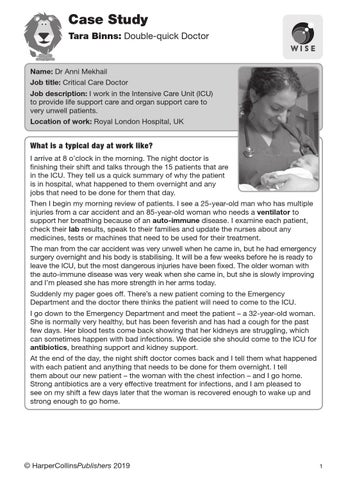
Case Study Tara Binns: Double-quick Doctor WISE Name: Dr Anni Mekhail Job title: Critical Care Doctor Job description: I work in the Intensive Care Unit (ICU) to provide life support care and organ support care to very unwell patients. Location of work: Royal London Hospital, UK
What is a typical day at work like? I arrive at 8 o’clock in the morning. The night doctor is finishing their shift and talks through the 15 patients that are in the ICU. They tell us a quick summary of why the patient is in hospital, what happened to them overnight and any jobs that need to be done for them that day. Then I begin my morning review of patients. I see a 25-year-old man who has multiple injuries from a car accident and an 85-year-old woman who needs a ventilator to support her breathing because of an auto-immune disease. I examine each patient, check their lab results, speak to their families and update the nurses about any medicines, tests or machines that need to be used for their treatment. The man from the car accident was very unwell when he came in, but he had emergency surgery overnight and his body is stabilising. It will be a few weeks before he is ready to leave the ICU, but the most dangerous injuries have been fixed. The older woman with the auto-immune disease was very weak when she came in, but she is slowly improving and I’m pleased she has more strength in her arms today. Suddenly my pager goes off. There’s a new patient coming to the Emergency Department and the doctor there thinks the patient will need to come to the ICU. I go down to the Emergency Department and meet the patient – a 32-year-old woman. She is normally very healthy, but has been feverish and has had a cough for the past few days. Her blood tests come back showing that her kidneys are struggling, which can sometimes happen with bad infections. We decide she should come to the ICU for antibiotics, breathing support and kidney support. At the end of the day, the night shift doctor comes back and I tell them what happened with each patient and anything that needs to be done for them overnight. I tell them about our new patient – the woman with the chest infection – and I go home. Strong antibiotics are a very effective treatment for infections, and I am pleased to see on my shift a few days later that the woman is recovered enough to wake up and strong enough to go home.
© HarperCollinsPublishers 2019
1
Case Studies Tara Binns: Double-quick Doctor – Dr Anni Mekhail
Have you ever had to treat a patient who has collapsed in the hospital waiting room? One of our diabetic colleagues once collapsed just outside the hospital café. A nurse, a pharmacist and I were all nearby. I held her mouth open to make sure she could breathe and the nurse checked her pulse and blood pressure while the pharmacist ran to pull the emergency bell. By the time help arrived, she was waking up, luckily. She was treated for low blood sugar and left hospital the next morning perfectly fine.
What are allergies and how are they treated? An allergy is when the body has an abnormal response to something, for example, peanuts. This is called an allergen. The body thinks that the allergen is dangerous when it isn’t. As a result, the body’s immune system starts overacting in response to something that would otherwise be harmless. Some allergies can be very mild and just give an itchy rash; other allergies can be very severe and cause swelling, low blood pressure and difficulty with breathing. For mild allergies, it is enough to avoid the allergen and ask an adult for some antihistamines if there is a reaction. If someone has difficulty breathing or swelling in their face, it’s important to call an ambulance immediately and get to the hospital as fast as possible. Some people who have very severe allergies will need to carry an injector pen with medicine inside called adrenaline.
How do you feel after you have successfully treated a patient? The best feeling as a doctor is when you can take a patient’s distress or pain away. Even if sometimes you can’t fix the disease, being able to explain it and manage it with the patient makes them feel a lot better.
What advice would you give children who want to be doctors when they grow up? I didn’t realise I wanted to be a doctor until I’d finished secondary school. I think being a doctor is very rewarding, but it is also a demanding job with many years of study and hard work. Anyone who wants to be a doctor could consider spending time on a hospital ward to understand what it is like, but only when they are old enough to do work experience. You have to be prepared to work long hours and have difficult conversations with patients. If it looks like a job you will love then I would definitely recommend it, though!
Can you offer advice on how children can be first aiders? There are six things to know about first aid, which we call ‘DRS ABC’: D – Danger If you see someone who is unwell or hurt, make sure that it is safe for you to go and help them – it’s worse to have two people hurt than just one. R – Response If it is safe to help the person, check if they are responding to you. You can shout their name loudly or squeeze their shoulder.
2
© HarperCollinsPublishers 2019
Case Studies Tara Binns: Double-quick Doctor – Dr Anni Mekhail
S – Send for help If someone is not responding or looks very unwell, send for help. You can shout, call the emergency services on the phone or run to an adult nearby. A – Airway Once you have made sure that help is on the way, open the person’s mouth. This helps to make sure the patient can breathe and get enough oxygen. B – Breathing When you have opened the person’s mouth to make sure their airway is open, check for breathing. You can do this by looking if the chest is rising and falling, listening if you can hear breaths, and feeling if there is air going in and out of their mouth and nose. C – Circulation If the person is unconscious and you have sent for help and opened their airway, you can help their heart and their breathing by doing 30 chest compressions and two breaths into their mouth and repeating. It can be quite hard to press on the chest of a big person, so it is a good idea to get an adult to help you with this. You can help the adult by reminding them that they need to do 30 compressions and two breaths and repeat – if they need you to count for them you can do that.
Glossary antibiotics: medicines for treating bacterial infections antihistamines: medicines for treating allergies auto-immune: the immune system is a group of cells in the body that gets rid of something unexpected, like infections. Sometimes the immune system attacks the wrong cells and incorrectly attacks the body’s own cells, which can make the person unwell. This is called auto-immune. chest compressions: applying pressure to someone’s chest in order to help blood flow through the heart in an emergency situation diabetic: a person who is diabetic isn’t able to keep the levels of sugar in their blood at the right level automatically. They need to keep a close eye on their blood sugar levels at all times and take medicine to avoid becoming ill.
© HarperCollinsPublishers 2019
immune system: the cells in the body that get rid of anything unexpected, such as infections from bacteria or viruses lab: short for ‘laboratory’, which is where tests are done, such as blood tests severe: very bad, serious unconscious: not awake or reacting to what is happening around you ventilator: a machine that helps very sick people to breathe. Sometimes if people get sick, their lungs can become weak. A ventilator works by blowing air through a tube in a patient’s mouth and into their lungs to make sure they breathe in enough oxygen and breathe out enough carbon dioxide, even if their lungs are weak.
3
Case Study Tara Binns: Double-quick Doctor WISE Name: Dr Luiza Saunders Job title: Senior House Officer in Emergency Medicine Job description: Seeing patients, both adults and children, in all areas of the Emergency Department Location of work: London, UK
What is a typical day at work like? In Accident and Emergency (A&E) every day is different and holds exciting challenges. For me, a day of work is called a shift, and it can start in the morning, afternoon or at night! A typical day starts by going to the locker room to change, as everyone who works in A&E has to wear clothes called scrubs and shoes that are designed specifically for the hospital. This prevents the spread of infection and protects our clothes. After changing, we meet the person in charge to see where in the Emergency Department we are needed for the day. Then we start seeing patients. We enquire about why the patient is in hospital: what has happened, what symptoms they have and what other medical problems they suffer with. We then start examining them: listening to their heart and lungs, feeling their tummy or any other necessary examinations. After we have collected some ‘clues’ from talking to the patient and examining them, we decide what we want to do (such as blood tests or X-rays) in order to make a diagnosis. We then give the patient suitable treatment and decide whether to discharge them or admit them. We type up a detailed account of what we have done for each patient, so that other doctors and nurses looking after the patient may see it. We repeat this for every patient we see. There are usually between six and 20 patients in a single shift depending on how complicated their problems are to deal with. When it’s time to go home we go back to the locker room, change, and leave the hospital.
Have you ever had to treat a patient who collapsed in the hospital waiting room? One day at work, I heard a nurse cry for help. I left my patient, who was not particularly unwell, in the examination room and rushed out to see what the matter was. I found that a patient had collapsed in the waiting room. I dashed to the patient and checked that she had a pulse and was breathing. The patient’s sister told me that her sister was suffering with a certain type of heart arrhythmia, which means she had an irregular heartbeat. I instructed the nurse to call a porter with a trolley, to get the patient on to it and wheel it into resus, which is where the very unwell patients go. The patient had fainted because her heart was not pumping enough, while her heartbeat was irregular, to get oxygen to her brain, but we were able to help her recover.
© HarperCollinsPublishers 2019
1
Case Studies Tara Binns: Double-quick Doctor – Dr Luiza Saunders
What are allergies and how are they treated? Allergies are reactions that the body has when it confuses certain harmless substances with dangerous ones. For example, you might eat a strawberry and your immune system thinks it is a deadly poison, so it reacts strongly. The best way the body knows how to react is to cause redness, itching, swelling and rashes. The way to find out you are allergic to something is to be exposed to it and observe how your body reacts. This is done by your doctor to identify which substances you are allergic to, to avoid them in future. Don’t try to test an allergy yourself at home. If you are having an allergic reaction to something, the first thing to do is keep calm and ask for help from an adult as soon as possible, in case your allergic reaction gets worse and they need to take you to hospital. Most allergic reactions are mild and do not need urgent medical attention, but there are some cases when they can be deadly. Swelling of your lips, feeling that your throat is closing up and struggling to breathe are all signs of a potentially life-threatening reaction and need to be assessed by an emergency doctor as soon as possible.
How do you feel after you have successfully treated a patient? Treating a patient successfully is always the most rewarding part of my day. People come to A&E because they are concerned, scared and usually quite unwell, so being able to take those feelings away is a great relief for them and they are normally very grateful. Successfully treating someone is the entire goal of medicine and the ultimate reward for the person practising it; it offers a feeling of contentment, light-heartedness and purpose.
What advice would you give children who want to be doctors when they grow up? I have wanted to be a doctor since I was about 12 years old. I always enjoyed studying Biology and knew then that I would have a profession related to that. I also enjoyed challenging myself to learn new things. My advice to children who want to become doctors is to explore their passion for living things and try to understand how and why things happen in the real world. Also, take an interest in other things too: play, draw, sing, do sports or art. Who knows, maybe you will find something you’d like to do even more than being a doctor. That’s OK. You will be doing your job for many years and you must make sure that you love it!
Can you offer advice on how children can be first aiders? The most important thing about being a first aider is knowing to call for help as soon as possible. Recognising when something is not right – if you see someone collapse to the floor, fall asleep suddenly and unexpectedly, if they are choking, if they clutch their chest in pain – these are all signs that something potentially dangerous is happening to them and you should get help straight away. The best thing to do is to call the emergency services on the phone and provide details about what has happened, even if you can’t do much more to help the person. There are also first aid courses for children available and attending one would be very useful in letting you know what to expect and be prepared for.
2
© HarperCollinsPublishers 2019
Case Studies Tara Binns: Double-quick Doctor – Dr Luiza Saunders
Glossary admit: to keep a patient in hospital overnight under professional care and supervision diagnosis: the identification of an illness after a patient has been examined discharge: to allow a patient to leave hospital
© HarperCollinsPublishers 2019
porter: a member of staff responsible for moving people from one part of the hospital or department to another resus: the area in the hospital where the most unwell patients go substances: solids, liquids or gases X-rays: images of the inside of a patient’s body
3
Case Study Tara Binns: Double-quick Doctor WISE Name: Dr Rebecca Wockenforth Job title: Paediatric Doctor specialist in Emergency Medicine Job description: I look after the medical well-being of children (my patients are mostly younger than 16 years old). Location of work: Liverpool, Merseyside, UK
What is a typical day at work like? The best thing about my job is that there is no typical day. I could start at any time of the day or night and be thrown into resuscitating a baby who has just been born or an older child with a life-threatening condition. Likewise I could take over the care of a patient on the ward. I would make sure the child is safe and looked after so they can get better and go home to their normal life quickly. I get to play A LOT! I also get to work with lots of other people too, including the nurses, physiotherapists, radiographers, midwives and specialist nursing teams, not to mention interacting with everyone else in the hospital, such as people who work in the car park, reception and shops, and the porters, cleaners and ward clerks. My speciality is in Paediatric Accident and Emergency (A&E). I have looked after children who have been bitten by dogs, hit by cars or even fallen out of bedroom windows. An important part of my job is updating parents and families on the progress of their child’s care. Sometimes this leads me to deliver very bad news, but this is rarely the case. The job is so diverse and that makes it very special to me personally – and it’s always good to do something you’re good at!
Have you ever had to treat a patient who collapsed in the hospital waiting room? Yes, of course! I had a six-year-old girl who arrived with shortness of breath and turned out to have asthma. She was a pale colour and could hardly breathe. Her mother had her sitting on her knee in the waiting room getting worse and worse, but she had only just arrived. A father of another patient came running in to let me know, so I jumped up and ran into the waiting room, scooped her up and ran into resus with her, shouting to the nurse for help. I can shout really loudly, so everyone jumped to attention! Two nurses came in and set up the nebulisers and intensive monitoring, while I put a cannula into the child and got some intravenous medications going. It took some time, but I held my nerve and she slowly got better.
© HarperCollinsPublishers 2019
1
Case Studies Tara Binns: Double-quick Doctor – Dr Rebecca Wockenforth
What are allergies and how are they treated? Patients with allergies react strongly to either foods – like milk, eggs, nuts – or an event, such as an insect sting. They’ll get a really itchy rash the first time they encounter the allergen. Their tongue may then swell and they could have difficulty breathing if they come across the allergen again. I would advise anyone who thinks they are allergic to something to see their doctor. They may then be tested by the specialist team and given advice on the correct medicine to use to manage their allergy. As with any illness, if you believe that you need urgent medical attention then always go to hospital.
How do you feel after you have successfully treated a patient? Extremely satisfied. This job is very hard work; it’s very demanding, both emotionally and physically, but I get up every day and love it! I go home feeling like I’ve made a difference to people’s lives and get good feedback from the families. For the most part, they don’t even know that I was the doctor who helped them, but I know and am immensely proud of myself for whatever small part I play in their recovery.
What advice would you give children who want to be doctors when they grow up? I knew I wanted to be a doctor when I was six years old. I have a niece who is six years old and I tell her to dream big and work hard and she can be anything she wants to be. All anyone needs is a goal and a good work ethic. I watched both my parents get up and go to work to earn the nice things we had. I come from a poor area in Liverpool, UK, and my parents worked as a team to demonstrate to us that we didn’t need fancy things to be happy. I would tell anyone wanting to do medicine that if they enjoy it in their heart there is no better way to live their lives. It’s hard but rewarding, and there is a type of job in medicine for everyone.
Can you offer advice on how children can be a first aider? My friend has analphylactoid reactions to almost anything and her daughter recently won a prize for calling an ambulance. I think she was only three or four years old at the time! I think knowing when to call for help is crucial. When I fell over in my house, my niece was five years old and she went to the freezer to get me some ice to reduce the swelling. You’re never too young to help.
2
© HarperCollinsPublishers 2019
Case Studies Tara Binns: Double-quick Doctor – Dr Rebecca Wockenforth
Glossary allergen: something that makes people allergic, such as pollen or a bee sting analphylactoid: a bit like an allergen but more serious – this is something that can give you a very serious allergic reaction called anaphylaxis asthma: a disease in the airways that makes people short of breath or wheezy. Sufferers take inhalers and other medicines to help them to breathe more easily. cannula: a little drinking straw that doctors put into a vein to give medicines or fluid when the patient can’t drink or take medicine through their mouth intravenous: into a vein rather than through the mouth (see cannula) midwives: people who are trained to help women give birth to their babies safely and look after them
© HarperCollinsPublishers 2019
nebulisers: medicine that patients need to breathe in to help open their airways in the treatment of asthma. paediatric: medicine relating to children physiotherapists: people who help patients to recover from muscle and joint injuries radiographers: people who take special pictures and scans, such as X-rays, of patients’ insides to help doctors to diagnose medical conditions resus: the area in the hospital where the most unwell patients go resuscitating: taking any action to try to keep people alive or bring them back from serious illness or death work ethic: the view that working hard is rewarding
3
Case Study Discussion Questions Tara Binns: Double-quick Doctor
WISE
This book has been endorsed by The WISE Campaign.
Skills focus • 2a Explain the meaning of words in context • 2b Retrieve and record information/ identify key details from non-fiction
• 2c Summarise main ideas from more than one paragraph • 2d Explain and justify inferences with evidence from the text • 2h Make comparisons within the text
Note: Sensitivity may be needed when reviewing these case studies with your pupils and discussing the illnesses or accidents mentioned. Dr Anni Mekhail • What does DRS ABC stand for? • Some of the patients in the Intensive Care Unit were there because of an accident and some because of illness. What is the difference? Dr Luiza Saunders • What are the signs that someone has had a serious allergic reaction? • What are ‘scrubs’ and why do doctors wear them? Dr Rebecca Wockenforth • What might be different for an emergency doctor looking after children instead of adults? • Why do you think A&E doctors work at night as well as during the day? Making comparisons • Compare the three case studies. What are the similarities and differences between the jobs?
© HarperCollinsPublishers 2019
• Why do you need to go to hospital if you have a severe allergic reaction? • Do you think Dr Mekhail enjoys her job? Explain your reasons.
• How is being an emergency doctor like being a detective? • Do you think Dr Saunders enjoys her job? Explain your reasons.
• Can children help adults who are ill or have an accident? • Do you think Dr Wockenforth enjoys her job? Explain your reasons
• What skills do you need to be a doctor? • Would you like to be a doctor? Explain your answer.
1