Numbers and the number system
Number sequences
Solving mathematical problems
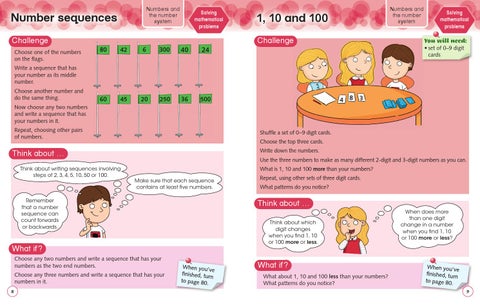
Challenge Choose one of the numbers on the flags.
Numbers and the number system
1, 10 and 100 Challenge e
80
42
6
300
40
24
60
45
20
250
36
500
Solving mathematical problems
You will need: • set of 0–9 digit cards
Write a sequence that has your number as its middle number. Choose another number and do the same thing.
4 8 3
Now choose any two numbers and write a sequence that has your numbers in it. Repeat, choosing other pairs of numbers.
Shuffle a set of 0−9 digit cards. Choose the top three cards.
Think about …
Write down the numbers. Use the three numbers to make as many different 2-digit and 3-digit numbers as you can.
Think about writing sequences involving steps of 2, 3, 4, 5, 10, 50 or 100.
What is 1, 10 and 100 more than your numbers? Make sure that each sequence contains at least five numbers.
Think about which digit changes when you find 1, 10 or 100 more or less.
What if ? Choose any three numbers and write a sequence that has your numbers in it. 8
What patterns do you notice?
Think about …
Remember that a number sequence can count forwards or backwards.
Choose any two numbers and write a sequence that has your numbers as the two end numbers.
Repeat, using other sets of three digit cards.
When you’v e finished, tur n to page 80.
What if ? What about 1, 10 and 100 less than your numbers? What patterns do you notice?
When does more than one digit change in a number when you find 1, 10 or 100 more or less?
When you’v e finished, tur n to page 80. 9
Numbers and the number system
Numbers between
Solving mathematical problems
Challenge
4
70
700 1000
Order the numbers, from smallest to greatest. What other numbers can you make using the digits 7, 4 and 8?
My number is a multiple of 50. The sum of its digits is 9. The hundreds digit is 1 less than the tens digit.
Each digit in my number is a different multiple of 3. The hundreds digit is half of the units digit.
What number is each child thinking of?
Think about …
Work systematically so that you can spot any patterns.
All the digits in my number are even. The hundreds digit is double the tens digit. The sum of its digits is 18.
My number is 1 less than a multiple of 100. Its tens digit is 4 more than its hundreds digit.
8
Using the digits 7, 4 and 8, how many different 2-digit and 3-digit numbers can you make that lie between 70 and 700?
Think about … Look at the numbers that lie within the number range, and then look at the numbers that are greater or smaller than the number range.
For the number 149, the sum of its digits is 14 (1 + 4 + 9). Remember, there are ten digits: 0, 1, 2, 3, … 9.
What if ? What numbers can you make between 50 and 500 using the digits 9, 1 and 5? What other 2-digit and 3-digit numbers can you make? What do you notice that is similar about the numbers you made using the digits 7, 4 and 8 and those you made using the digits 9, 1 and 5? Can you choose three other digits and a number range where the same thing happens? 10
Solving mathematical problems
Challenge
7 0
What are our numbers?
Numbers and N the number system
When you’v e finished, tur n to page 80.
You say the multiples of 3 as you count on from zero in steps of 3: 3, 6, 9, ...
What if ? Think of four different 2-digit or 3-digit numbers. Write a set of clues for each number. Try to write as few clues as possible for each number. Your clues must lead to just one number. Show your clues to a friend and ask them to work out what numbers you chose.
When you’v e finished, tur n to page 80. 11
Numbers and the number system
Fractions that total 1
Solving mathematical problems
Challenge
Solving mathematical problems
Challenge
8 10
3 10
5 10
7 10
1 10
1 2
9 10
2 10
6 10
4 10
Which two of the fractions above make a whole?
Which three of the fractions above make a whole?
How many different ways can you find?
How many different ways can you find?
Think about … Think carefully about how you’re going to show which two or three fractions total 1.
Being systematic will help you identify all the different ways possible.
Can you think of other pairs of fractions that make a whole? What about a half?
Investigate what fraction of the eight candies each child could have bought.
Being systematic will help you find all the different ways of sharing the candies.
Think about how you can express fractions in different ways, for 5 and 1. example 10 2
What if ?
Which two of the fractions above make a half? How many different ways can you find?
Emily and Alexander have bought eight candies between them.
Think about …
What if ?
12
Buying candies
Numbers and the number system
When you’v e finished, tur n to page 80.
What if Osaru, Emily and Alexander have bought 12 candies between them? What fraction could each child have bought? What if Kate, Osaru, Emily and Alexander have bought 10 candies between them? What fraction could each child have bought?
When you’v e finished, tur n to page 80. 13