8
8
EQUILIBRIUM OF A RIGID BODY
Mathematics in life and work In this chapter you will study the concept of moments and centre of mass. It is important that you are able to calculate moments around given points of an object and use this to help you analyse situations involving systems in equilibrium. This skill is required in many different careers, especially those related to engineering – for example:
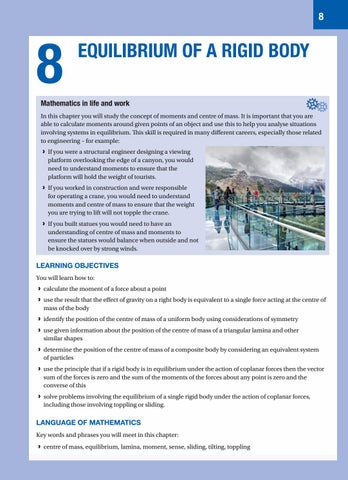
›› If you were a structural engineer designing a viewing platform overlooking the edge of a canyon, you would need to understand moments to ensure that the platform will hold the weight of tourists.
›› If you worked in construction and were responsible for operating a crane, you would need to understand moments and centre of mass to ensure that the weight you are trying to lift will not topple the crane.
›› If you built statues you would need to have an understanding of centre of mass and moments to ensure the statues would balance when outside and not be knocked over by strong winds.
LEARNING OBJECTIVES You will learn how to:
›› calculate the moment of a force about a point ›› use the result that the effect of gravity on a right body is equivalent to a single force acting at the centre of mass of the body
›› identify the position of the centre of mass of a uniform body using considerations of symmetry ›› use given information about the position of the centre of mass of a triangular lamina and other similar shapes
›› determine the position of the centre of mass of a composite body by considering an equivalent system of particles
›› use the principle that if a rigid body is in equilibrium under the action of coplanar forces then the vector sum of the forces is zero and the sum of the moments of the forces about any point is zero and the converse of this
›› solve problems involving the equilibrium of a single rigid body under the action of coplanar forces, including those involving toppling or sliding.
LANGUAGE OF MATHEMATICS Key words and phrases you will meet in this chapter:
›› centre of mass, equilibrium, lamina, moment, sense, sliding, tilting, toppling M
Modelling
PS
Problem solving
Proof
CM
Communicating mathematically
8 Equilibrium of a rigid body
PRIOR KNOWLEDGE You should already know how to:
›› use Pythagoras’ theorem and trigonometry to find the magnitude and direction of a vector ›› resolve a force into parallel and perpendicular components ›› use the formula W = mg to convert between the mass and weight of an object ›› apply the relationship F ≤ µR to problems involving friction and reaction (and F = µR in the case of limiting equilibrium).
9N
You should be able to complete the following questions correctly: 1 Find the weight, in N, of an apple with a mass of 125g. 2 Find the horizontal and vertical components of a 9N force at 52° to the horizontal.
52°
3 Given a particle in limiting equilibrium with a friction force of 7.2gN and a reaction force of 18gN, find the coefficient of friction. 4 An object of mass 5kg is pulled along a rough horizontal surface by a light piece of string which is 30° above the horizontal. The coefficient of friction between the surface and the object is 0.25. If the tension is the string is 20N, find a the normal reaction force b the friction force c the acceleration of the object.
8.1 The moment of a force around a point You will have already seen that forces can be used to accelerate objects along straight lines. However, as you will have seen when opening a door, sometimes forces will turn (rotate) objects instead. In the case of the door, this is due to hinges attaching the door to its frame.
×
3m
When a force is applied to an object which is fixed or supported at a point along an axis which does not pass through the point, then that force will generate a turning moment.
8N
The formula for turning moment is given by Turning moment = force × perpendicular distance
KEY INFORMATION
Using SI units, the force is measured in newtons (N) and the distance in metres (m), giving units for the turning moment of N m. 1 N m is the same as 1 J (joule), the SI unit for energy.
Turning moment = force × p erpendicular distance
For example, a force of 8 N at a perpendicular distance of 3 N would produce a turning moment of 24 N m.
Units are N m.
Note that the formula confirms what you observe when you push a door. Pushing a door requires less effort the further you push from the 2
The moment of a force around a point
8.1
hinge because for the same turning moment, the force and distance are inversely proportional – as one increases, the other decreases. When the distance is not perpendicular to the force, you need to resolve the force into parallel and perpendicular components. In the diagram below, the horizontal component is 12 cos 50°, which acts through the origin and so has a perpendicular distance of zero. The vertical component is 12 sin 50° and is the component perpendicular to the distance. In general, if the angle between the force and the distance is θ, then the turning moment is given by Fd sin θ, where F is the force and d is the distance. Note that the Fd cos θ component acts through the turning point, so has no effect because d = 0. For the diagram, the moment is 12 × 5 sin 50° = 46.0 N m.
0
×
Depending upon the direction of the force, the moment may be clockwise or anticlockwise. This is known as the sense of the moment; anticlockwise moments are positive and clockwise moments are negative.
KEY INFORMATION For a force F acting at a distance d m at angle of θ, turning moment is given by Fd sin θ
5m 50°
12 N
The overall moment about a point can be found by adding the individual moments. For example, two clockwise moments of 8 N at a perpendicular distance of 3 m and 2 N at a perpendicular distance of 5 m have a combined moment of 24 + 10 = 34 N m clockwise. However, if the first moment was clockwise but the second anticlockwise, then you would find the difference. The moment would be 24 − 10 = 14 N m clockwise.
KEY INFORMATION The sense of a turning moment is whether it is turning clockwise or anticlockwise. Anticlockwise moments are positive and clockwise are negative.
Example 1 The diagram shows three forces acting about the origin. Find the overall turning moment.
9N
6N
4m
25˚
0 ×
8m 3m 4N
Solution First, appreciate that the moment of the 4 N force is acting in a clockwise sense whereas the moments of the 9 N and 6 N forces are acting in an anticlockwise sense.
3
8 Equilibrium of a rigid body
The perpendicular distance from the origin to the 9 N force is 4 m. The moment is 9 × 4 = 36 N m anticlockwise. If the 4 N force is extended along its line of action, then it is easier to see that the perpendicular distance from the origin to the force is 3 m. The moment is 4 × 3 = 12 N m clockwise.
9N
6N
4m
0 ×
Make sure the force and distance are perpendicular.
6sin25˚
25˚ 8m 3m 4N
The 6 N force is acting at an angle of 25° to the horizontal, so the 8 m is not perpendicular to the force. If, however, the force is resolved into its horizontal and vertical components, then the vertical component (6 sin 25°) is now perpendicular to the distance. The moment is 6 sin 25° × 8 = 20.3 N m anticlockwise. The overall moment is 36 + 20.3 − 12 = 44.3 N m. Since the answer is positive, the moment is 44.3 N m anticlockwise. If the overall moment about a point is zero, then the individual clockwise and anticlockwise moments will balance. This means that all the clockwise moments will sum to the same as the anticlockwise moments. When an object is in equilibrium, the sum of the forces (and hence the resultant force) in any direction will be zero. The sum of the moments about any point will also be zero.
Example 2 Nilesh, who weighs 54kg, and Samvir, who weighs 42 kg, are playing on a seesaw. When Nilesh is 1.5m from the centre the seesaw is balanced. How far away from the centre is Samvir?
Solution Since the seesaw is balanced, the clockwise moments must equal the anticlockwise moments. It is always useful in this type of question to draw a diagram, marking on clearly all of the forces.
4
KEY INFORMATION If the overall moment about a point is zero, then the clockwise moments will be equal and opposite to the anticlockwise moments.
The moment of a force around a point
1.5 m
8.1
dm
Nilesh
Samvir
54g N
42g N
Nilesh’s weight is acting in an anticlockwise directions and Samvir’s in acting in a clockwise direction. Moment cause by Nilesh = 1.5 × 54 g Moment created by Samvir = – 42 g × d Since the seesaw is balanced the sum of the moments is zero.
This moment is negative because it is acting in a clockwise direction.
1.5 × 54g – 42g × d = 0 81 – 42d = 0 d = 1.93 m (to 3 s.f.) This means that Samvir is 1.93m from the centre of the seesaw.
Mathematics in life and work: Group discussion You are working for a company that creates models of characters from children’s TV programmes. You have been asked to create a hanging decoration with models hanging suspended from a light rod attached to the hook on the ceiling via a light string. The model needs to balance correctly so that it remains horizontal. 1. Four characters of mass 30g, 45g, 60g and 72g must be attached to a light rod that is 1m long. The string is attached to the centre of the rod. You attach the 72g and 60g objects 5cm from each end of the rod. The 45g object is 40cm from the 72g weight. Where should you position the 30g object so the rod balances? 2. The second decoration has five characters of mass 21g, 34g, 42g, 56g and 70g attached to a similar light rod. Find a way of placing the characters on the light rod so that it is balanced. 3. For the final decoration the five characters of mass 20g, 40g, 60g, 80g and 100g are to be positioned on the 1m light rod so they are all 25cm apart in ascending order (that is, the lightest one on the left and the heaviest one on the right). Where should the string be attached for the rod to be balanced? 4. Despite carefully calculating the locations for each character to be attached, the rod is not balanced. Why do you think this may be?
5
8 Equilibrium of a rigid body
Exercise 8.1A 1 a Find the turning moment, in N m, of: i a force of 6 N acting at a perpendicular distance of 5 m ii a force of 3.5 N acting at a perpendicular distance of 12 m. b Find the force acting at a perpendicular distance of 4 m, in N, which produces a turning moment of:
i 28 N m.
ii 15 N m.
2 Forces P and Q act around a point O. Force P is 12 N and acts at a perpendicular distance of 4 m from O. The moment of P about O is clockwise. Force Q is 17 N and acts at a perpendicular distance of 3 m from O. The moment of P about O is anticlockwise. Find the overall moment about O, stating its sense.
3 Points A, B, C and D lie on a straight line such that AB = 4 m, BC = 5 m and CD = 6 m. There is a 5 N force acting vertically upwards at A and a 3 N force acting vertically downwards at C.
5N
C A
B ×
4m
D
3N ×
5m
6m
Find the turning moment about
a A
b B
c C
dD
4 Find the moment about the origin O for each diagram: a b 7N 7N 3m
3m
×0
×0
4m
4m 7N 7N
c
7N
3m × O
6
d 7 N
7N
C
3m O×
4m
Communication
45˚
MM
7N
Mathematical modelling
PS
Problem solving
The moment of a force around a point
PS
8.1
5 Sophie and Subash are trying to find the turning moment of a 9 N force about the origin O. The force acts through the point A at 30° to the horizontal as shown in the diagram. The line OA is horizontal and 5 m in length.
9N 30˚
× O
5m
A
Sophie resolves the force into horizontal and vertical components of 9 cos 30° N and 9 sin 30° N. She then multiplies 9 sin 30° N by 5 m since 9 sin 30° N is the perpendicular component of the force. Her answer is 22.5 N m.
9sin30˚ × O
5m
9cos30˚
Subash sketches the force as a longer arrow and then marks the perpendicular distance between the origin and the force, which he labels as d. He then uses trigonometry to calculate that d = 5 sin 30° m and multiplies this by 9 N. His answer is 22.5 N m.
9N d 30˚
× O
5m
Are both methods valid? Whose method is more efficient? PS
6 An 8 N and a 10 N force act through the same point, 3 m from the origin O. The 8 N force acts at 30° and the 10 N force acts at 60° as shown in the diagram.
8N 30˚ 60˚
3m ×O
10 N
a Find the turning moment about O. b If the 10 N force acted at 50° instead, how would that affect the turning moment? 7
8 Equilibrium of a rigid body
PS
7 Three forces act about a point X. Force A has a magnitude of 13 N and acts at a perpendicular distance of 4 m in a clockwise sense. Forces B and C both act in an anticlockwise sense. Force B has a magnitude of 6 N and acts at a perpendicular distance of 5 m whilst force C has a magnitude of 11 N and acts at a perpendicular distance of d m.
a If the overall moment is zero, find the value of d. b Find the overall moment is zero if force C is increased to 15 N. MM
8 A man and a boy sit on a seesaw which is 4 m long. The pivot of the seesaw is at the centre. The centre of mass of the seesaw is also at the centre, as shown in the diagram.
R
W
B
M
The boy sits at the end and weighs 36 kg. The man sits on the other side and weighs 60 kg. How far must the man sit from the centre of the seesaw to keep the seesaw balanced? MM
9 A 10 m rod is supported by a pivot at point A. There is a 7 N force acting vertically downwards at one end and a 9 N force acting vertically upwards at the other end, as shown in the diagram. The rod is considered to be so light that it has no weight.
9N
R
A
B
7N 4m
Ă—
6m
a Find the overall moment about the point A. Point B is 2 m from A. A vertical force is applied to the rod at B such that the overall moment is now zero.
b i Find the magnitude and direction of the force applied at B. ii By considering all the vertical forces, what is the magnitude of the reaction force at A such that the system is in equilibrium?
8
The moment of a force around a point
C
8.1
10 Samra was given the following problem. ‘The three forces T, U and V shown in the diagram are in equilibrium.
α T
The magnitude of force t is q N and it acts at angle of α to the vertical through a point 8 m from the origin.
8m U
Force U acts at an angle of (α +90)° to the horizontal through a point 3 m from the origin. Force V acts through the origin.
a Find the magnitude of U in terms of q. b Find the value of α. c Find the magnitude of V in terms of q.
(α + 90)˚ V O
×
3m
Samra’s solution is shown below.
Resolving vertically:
T cos α = U cos (90° + α). T cos α = U cos 90° + U cos α. q cos α = 0 + U cos α q cos α = U cos α Hence U = q N.
Taking moments about O:
U × 3 sin (α + 90°) − t × 8 sin α = 0 q × 3 sin (α + 90°) − q × 8 sin α = 0
3 sin (α + 90°) = 8 sin α
3 sin α + sin 90° = 8 sin α
1 = 5 sin α
sin α = 0.2
α = sin−1 (0.2) = 11.5°
Resolving horizontally:
V = T sin α + U sin (90° + α). V = q sin α + q sin (90° + α). V = q sin α + q sin 90° + q sin α. V = q sin α + q sin 90° + q sin α. V = 2q sin 11.5° + q V = 2q × 0.2 + q V = 1.4q N
Assess Samra’s solution.
Where there are mistakes, provide the correct solution.
9
8 Equilibrium of a rigid body
8.2 The centre of mass of a uniform body The mass of a body is its quantity of matter. Every part of an object forms part of its overall mass. However, when you try to balance an object on a point there will only be one place where it will balance. This point is known as the centre of mass. You can think of the mass of an object being concentrated at this point. In this section you will learn how to calculate the centre of mass for a uniform body. Suppose you have a system of particles as follows:
x1
x3
x2
x4
A m1g
m2g
m3 g
m4g
The total moments around A = m1gx1 + m2gx2 + m3gx3 + m4gx4 + . . . . . This whole system can be replaced by one particle of the same mass as all the others combined acting at the centre of mass. We use the notation M to represent the total mass and to represent the distance between A and the centre of mass.
x A
KEY INFORMATION
Mg The total moments around A = Mgx– Since these two systems are equal, the moments must be equal. So Mgx– = m gx + m gx + m gx + m gx + . . . 1
1
2
2
3
3
4
4
Mx– = m1x1 + m2x2 + m3x3 + m4x4 + . . . n Mx– = Σ i = 1 mi xi
This method allows you to calculate the centre of mass of uniform objects.
Example 3 For the following system of particles, find the distance from A of the centre of mass.
2m
2.5m
2.1m
2.5m
A 3g 10
5g
6g
2g
The centre of mass of a system of particles in a straight line can be found using n mx Mx– =
Σi = 1
i i
where M = the total mass of all particles and is the distance of the centre of mass around the end point.
8.2
The centre of mass of a uniform body
Solution n To find the centre of mass you need to use Mx– = Σ i = 1 mi xi
You use the mass rather than the weight, so do not include g.
In this case M = 3 + 5 + 6 + 2 = 16 So 16 x– = 3 × 2 + 5 × 4.5 + 6 × 6.6 + 2 × 9.1
Remember to use the distance from A rather than the distance between each particle.
16 x– = 86.3 x– = 5.39m (to 3 s.f.). This means the centre of mass of this system of particles is 5.39m from A.
Exercise 8.2A 1 Find the position of the centre of mass for each of the following system of particles. a b 90cm 1.2m 0.2m 0.5m 0.1m 0.4m A
A 2g
c
10cm
0.3m
g
0.5g
0.7m
0.2m
2g
0.2g
d
0.1m
0.2cm
3g
0.5cm
4g
0.1cm
0.4cm
A
A m
m
m
2m
m
6m
2m
0.5m
2 A light rod AB of length 2m has particles, each of mass 2kg, attached as shown below. Find the distance of the centre of mass from A if the particles are equally distances apart.
A MM
B
3 A system of particles attached to a light rod has centre of mass 1.2m away from A. The first particle is 20cm from A with a weight of m kg, the second particle is 1.3m away from A with a mass of 2m kg and the third particle is 2.5m away from A with a mass of 3m. Find m.
MM
4 A hanging decoration has shapes attached to a light plastic rod which is hung by a piece of string positioned at C which is 40cm from A. The square has mass 200g and is 10cm from A, the triangle has mass 100g and is 30cm from A and the rectangle has a mass of 150g. Where would you position the rectangle to make point C the centre of mass?
A
C
C
B
5 Three particles of mass m, 2m and 3m are positioned at points (1,0), (7,0) and (9,0). The centre of mass of these particles is at (6,0). Find m showing all of the key steps in your solution.
11
8 Equilibrium of a rigid body
If you have a system of particles positioned in a plane instead of a straight line you can extend the results to calculate the centre of mass. If each particle has position (xi, yi) with mass mi you can say: n mx Mx– =
Σ i = 1 i i n My– = Σ i = 1 mi yi
which gives the position of the centre of mass at (x–, y–).
Example 4 A light triangular framework has particles attached to each corner as shown in the diagram below. Find the distance on the centre of mass from vertex A, assuming it has coordinates (0,0).
4kg 2m 3kg
4m
5kg
Solution The bottom-left corner is the origin, which gives: A weight of 3kg at (0,0) A weight of 5kg at (4,0) A weight of 4kg at (0,2) M = 12kg You can then find and separately. n Using Mx– = Σ i = 1 mi xi you get 12x– = 3 × 0 + 5 × 4 + 4 × 0 12x– = 20 5 x– = . 3 n Using My– = Σ i = 1 mi yi you get 12y– = 3 × 0 + 5 × 0 + 4 × 2 12y– = 8 2 y– = 3 5 2 So the coordinates of the centre of mass are , . 3 3
( )
12
KEY INFORMATION The position of the centre of mass ( of a system of particles in a plane is calculated by using n mx Mx– =
Σi = 1
and My– =
i i
Σ ni= 1 mi yi
The centre of mass of a uniform body
8.2
Exercise 8.2B 1 Find the coordinates of the centre of mass of each system of particles. Round answers to 3 significant figures where necessary.
a
b y
y
6
6
5
5kg
5
4
4
2
3kg
2
1
1 0
c
1
2
3
4
5
6
0
x
3kg 1
2
3
4
5
6
x
d y
y
6
6
4.3kg
5
5 4
4
230g
3
3 2
1.9kg
1 0
2kg 5kg
3
3
1
2
3
1.4kg 4
5
108g
2
342g
1
6
0
x
1
2
3
4
5
6
7
8
9
x
2 A light rectangular framework has ABCD has particles attached at each vertex. Give the position of the centre of mass in relation to vertex A.
D (3kg)
4m
C (2kg)
2.5m A (5kg) MM
B (2.5kg)
3 A light rectangular framework with vertices at (2,5), (6,5), (2, 8) and (6,8) has stones of equal mass attached at each vertex. Find the coordinates of the centre of mass.
PS
4 Masses are attached to each vertex of a light quadrilateral framework as follows: 2kg at (1,1), 3kg at (8,1), 5kg at (4,5) and m kg at (2,3). If the centre of mass is at (4,), find m and .
C
5 The centre of mass of the following framework is at (1.6, 2) with vertices at A (0,5), B (4,5), C (4,0) and D (0,0). Find m and n. Show your workings clearly.
A (m kg)
B (2 kg)
C (3 kg)
D (n kg) 13
8 Equilibrium of a rigid body
8.3 Finding the centre of mass of a uniform lamina In this section you will look at techniques for finding the centre of mass of a uniform lamina. A lamina is a flat object that has negligible thickness. If its mass is spread evenly throughout its area then it is called a uniform lamina. If a uniform lamina has an axis of symmetry then its centre of mass lies on this axis of symmetry. If it has more than two axes of symmetry then its centre of mass lies where the axes intersect. For example, in the uniform rectangular lamina shown here, the centre of mass will be where the two lines of symmetry intersect.
(x, y)
Using the same technique, you can see that the centre of mass of a circle of uniform mass is at its centre. Triangular lamina A median is a line from the mid-point of the side to the opposite vertex. This can be seen in the diagram below.
The centres of mass of common shapes are given in the formula booklet.
C
(x, y) A
M
B
Let M be the mid-point of AB. The median is the line CM. The centre of 2 mass, (x–, y–), is of the distance along the median from C. 3 You would get the same point if you used either of the other two medians. Circular sector of radius r and angle 2α For a sector of a circle with radius r, the centre of mass lies on the line that divides the sector into two equal smaller sectors. This means that if the angle at the centre of the sector is 2α then we have an angle of α either side of the line on which the centre of mass lies. The centre of mass (x–, y–) of a circular sector of radius r and angle 2α is 2r sinα from the centre along this line, where α is measured in radians. 3α
(x, y) 2α r
14
O
KEY INFORMATION The centre of mass of a 2 triangular lamina is along 3 the median from the vertex.
Finding the centre of mass of a uniform lamina
π For a semicircle, 2α = π so α = . This means the centre of mass 2 2r 4r is 3π = above the centre. 3π
8.3
KEY INFORMATION
2
Example 5 The base of a semicircle passes through the points (2,4) and (6,4). Find the coordinates, to 3 significant figures, of its centre of mass.
The centre of mass of a circular sector of radius r 2r sinα and angle 2α is from 3α centre where α is measured it radians.
Solution It is always useful to start with a diagram.
(2, 4)
(6, 4)
O
From the diagram you can see that the centre of the circle is the point (4,4) and the radius is 2. By considering the lines of symmetry you know that the centre of mass will lie somewhere on the line × = 4. To find how far up this line it is, you need to find the value of 2r sinα , where 2α is that angle of the sector in radians. 3α π 2r sinα 2 × 2 sin 2 In this case 2α = π so α = . So = = 0.849 π 3α 3×2 This means the centre of mass of this lamina is at the point (4, 4.85). A lamina may a combination of shapes you have already seen in this chapter. The next two examples will explain how to deal with these types of lamina.
Example 6 Find the centre of mass of the lamina shown here.
16cm
10cm
4cm 20cm
Solution To find the centre of mass of this lamina you need to split it into two rectangle, A and B.
4cm A 4cm
4cm B 20cm 15
8 Equilibrium of a rigid body
If you take the bottom left corner as the origin, you can make use of the lines of symmetry of each rectangle to work out that the centre of mass of A is a the point (2,7) and the centre of mass of B is at the point (10, 2). Since this is a uniform lamina, the mass of each rectangle will be proportional to its area. This table can help work out the centre of mass of the lamina:
Shape
Area
A B Lamina
80 24 104
x-coordinate of centre of mass 2 10 x–
y-coordinate of centre of mass 7 2 y–
Since area is proportional to the mass: 104x– = 80 × 2 + 24 × 10 104x– =400 x– = 3.85 (to 3 s.f.) 104y– = 80 × 7 + 24 × 2 104y– = 608 y– = 5.85 (to 3 s.f.) So the centre of mass of this uniform lamina is (3.85, 5.85).
Example 7 Find the centre of mass of the shaded uniform lamina below. The circle has centre (5, 4) and a radius of 1.5.
(3, 8)
(10, 8)
(3, 2)
(10, 2)
Solution Using the lines of symmetry of the rectangle and circle, complete a table.
Shape
Area
Rectangle Circle
42
Lamina
16
9 π 4 9 42 – π 4
x-coordinate of centre of mass 6.5
y-coordinate of centre of mass 3
5
4
x–
y–
8.3
Finding the centre of mass of a uniform lamina
Since the area if proportional to mass: 9 9 (42 – π) x– = 42 × 6.5 – π × 5 4 4 x– = 6.80 9 9 (42 – π) y– = 42 × 3 – π × 4 4 4 y– = 2.80
9 Subtract π × 5 because the 4 shape has been removed.
So the centre of mass of this lamina is at (6.80, 2.80) to 3 s.f.
Exercise 8.3A 1 Find the centre of mass of the following shapes. a y
y
18
18
16
16
14
14
12
12
10
10
8
8
6
6
4
4
2
2
0
c
b
2
4
6
8
10 12 14 16 18
x
0
d
y
18
16
16
14
14
12
12
10
10
8
8
6
6
4
4
2
2 2
4
6
8
10 12 14 16 18
x
4
6
8
10 12 14 16 18
x
2
4
6
8
10 12 14 16 18
x
y
18
0
2
0
17
8 Equilibrium of a rigid body
e
f
y
y
18
18
16
16
14
14
12
12
10
10
8
8
6
6
4
4
2
2
0
2
4
6
8
10 12 14 16 18
x
0
2
4
6
8
10 12 14 16 18
x
2 Find the coordinates of the centre of mass of the semicircle.
(4, 2)
(8, 2)
3 A quarter of a circle with a radius of 4 is shown. Find the coordinates of its centre of mass.
(4, 2) C
4 A sector has a radius of 10cm and an angle of 30° at the centre, O. Find the distance between O and the centre of mass, showing all the key steps of your solution.
5 An equilateral triangle ABC has a side of 3cm. Find the distance between each vertex and its centre of mass.
8.4 The centre of mass of uniform solids The rules for uniform laminas can be extended to solids of uniform mass. If the solid has a plane of symmetry then the centre of mass will be somewhere on this line. If it has more than one plane of symmetry then the centre of mass will be where these planes intersect. This technique can be used on shapes such as cubes, cuboids, cylinders and sphere.
KEY INFORMATION
Solid hemisphere The centre of mass of a solid hemisphere 3 with radius r is r from its centre on the 8 line connecting the centre of the base and the highest part of the hemisphere.
18
The formulae for these shapes are given in the formula booklet but you need to know how to apply them.
(x, y) r
The centre of mass of a solid hemisphere with radius r 3 is r from its centre on the line 8 connecting the centre of the base and the highest part of the hemisphere.
Some pages not displayed in this sample
Key points and Exam-style questions
8
SUMMARY OF KEY POINTS
›› Turning moment = force × perpendicular distance. ›› The units for turning moment are N m. ›› The sense of a turning moment is whether it is turning clockwise or anticlockwise – anticlockwise is positive and clockwise is negative.
›› For a force F acting at a distance d m at angle of θ, the turning moment is given by Fd sin θ. ›› When you try to balance an object on a point there will only be only one place where it will balance. This point is known its centre of mass. ›› The position of the centre of mass (x–, y–) of a system of particles in a plane are calculated by n n using Mx– = Σ i = 1 mi xi and My– = Σ i = 1 mi yi
›› If a uniform lamina has a line of symmetry then the centre of mass will lie on this line. If it has more than one line of symmetry, the centre of mass will lie where these lines intersect.
›› To find the centre of mass of a uniform lamina made of compound shapes, you replace each individual shape by a particle of the same mass at its centre of mass then find the overall centre of mass for the lamina using these individual points.
›› The centre of mass of a triangular lamina is along the median from the vertex. α ›› The centre of mass of a circular sector of radius r and angle 2α is 2r sin from centre where α is measured 3α it radians.
›› The centre of mass of a solid hemisphere with radius r is 38 r, from its centre on the line connecting the centre of the base and the highest part of the hemisphere.
›› The centre of mass of a solid cone or pyramid with height h is 34 h from the vertex. ›› If the overall moment about a point is zero, then the clockwise moments will be equal and opposite to the anticlockwise moments. For a system to be in equilibrium, not only do the forces sum to zero in any direction, but the moments must also balance (i.e. all the clockwise forces must balance all the anticlockwise forces).
›› To solve problems involving uniform rods, you assume that the weight force of a rod acts through its centre of mass.
›› Ladder problems can be solved using simultaneous equations generated using resolving, moments and F ≤ µR.
›› If an object is on the point of sliding then F = µR ›› If an object is on the point of toppling then its centre of mass is directly above the lowest point of contact between the object and the plane.
›› To decide whether an object will slide or topple, you need to consider both cases and work out which one will happen first.
45
8 Equilibrium of a rigid body
EXAM-STYLE QUESTIONS 7 MM
1 The diagram shows a non-uniform rod AB of length 10 m and mass 90 kg with its centre of mass Ă— m from A. There are loads of 60 kg and 40 kg at A and B. C is 1 m from A and D is 3 m from B. The reaction force at D is 95g N.
RC
RD
C
D
A
B
60g N
90g N
40g N
a Find the magnitude of the reaction force at C. b Find the value of x. MM
mass 1.1 kg attached at one end. The broom rests horizontally on a support.
a State suitable models for the broomstick and broom head. b Find the distance of the support from the broom head.
[2 marks] [3 marks]
3 A non-uniform plank AB has length 5d m and mass 8m kg. It is in equilibrium in a horizontal position resting on supports at the points U and V where AU = 2d m and AV = 4d m. A parcel of mass 6m kg is placed on the plank at B. The plank is on the point of tilting about V.
C
a Calculate the distance of the centre of mass of the plank from A. b Comment upon any assumptions you have made. MM
[3 marks]
2 A broom consists of a wooden broomstick of length 90 cm and mass 700 g with a broom head of
C
MM
[2 marks]
[3 marks] [2 marks]
4 A uniform rod WZ of length 14 m and mass 5 kg rests horizontally on two supports at Ă— and Y. WX: XZ = 1: 6. There is a particle of mass 7 kg attached at W and a particle of mass 9 kg attached at Z. The reaction at Ă— is half the magnitude of the reaction at Y.
Given that the rod is in equilibrium, find the distance WY. MM
[5 marks]
5 A uniform solid shape it made from the frustum of a cone. The shape has circular ends of radius 5cm and 10cm with the large circle forming the base. The solid shape is 8cm height.
PS
a Find the distance between the base and the centre of mass
[4 marks]
A hemisphere made from the same material of radius is 5cm is attached to the top of the frustrum.
b How much higher is the centre of mass of the new solid compared to the original one? C
[4 marks]
6 A uniform log AB has a length of 12 m and a weight of W newtons, as shown in the diagram. It is held in equilibrium in a horizontal position by two vertical ropes attached at C and D where AC is 4 m and DB is 1 m. A backpack of weight 28 N is suspended from the rod at A.
PS
46
Key points and Exam-style questions
A
TC
TD
C
D
8
B
12 m 5 7 The tension in the rope at C is thirteen times the tension in the rope at D.
MM
a Show that the tension in the rope at C is given by ( W + 44) N.
[4 marks]
b Hence, or otherwise, find the value of W.
[6 marks]
7 Anais is a pole vaulter. Her 4.8 metre pole is a 2300 g uniform rod which she holds with one hand at the end and the other hand 0.5 m from the same end. Calculate each of the reactions exerted by Anais’ hands to keep the pole horizontal. [5 marks]
MM
8 A large beam AD is 10 m long and rests horizontally on supports at B and C which are 2 m from each end of the beam, as shown in the diagram. When a 1800 N force is applied vertically upwards at A, the beam is on the point of tilting about D. When a 1575 N force is applied vertically upwards at D instead, the beam is on the point of tilting about C.
A
D B
C
2m
2m 10 m
The beam is modelled as a non-uniform rod with its centre of mass × m from A. Find
a the weight of the beam b the value of x. MM
[6 marks] [2 marks]
9 Harry’s uniform ladder of mass 50 kg and length 3.5 m is perched against a smooth wall at an angle of arctan 2 to the floor. Harry weighs 70 kg. The coefficient of friction between the ladder and the floor is one-third. Find the farthest up the ladder that Harry can climb before the ladder slips. [8 marks]
MM C
10 A wooden beam AB has a length of 7.2 m and a mass of 2.5 kg. A is at rest on a rough horizontal
platform with B attached to a cable. The cable makes an angle β with the horizontal and the tension in the cable is t N. The beam is inclined at an angle α to the horizontal as shown in the diagram, such that sin α = 0.6. The beam is in limiting equilibrium and the coefficient of friction between the ground and the beam is 1. The beam is uniform. 2
β
α
7.2 m
47
8 Equilibrium of a rigid body
a Find the magnitude of the vertical reaction force on the beam at A. b State any modelling assumptions you have made. c Given that sin β = 0.28, show that t is 17.5. PS
[5 marks] [2 marks] [2 marks]
11 The non-uniform 6 m rod AB is supported by two rests at C and D as shown in the diagram. 1.2 m 0.8 m B
A C
D
Particles are attached to the rod at A and B. When the particle at A is 100 kg and the particle at B is 20 kg, the rod is on the point of tilting about C. When the particle at A is 20 kg and the particle at B is 250 kg, the rod is on the point of tilting about D. [10 marks]
Find the mass of the rod and the position of its centre of mass. MM
12 A ladder of mass M kg and length 8a m stands against a rough wall with its foot on rough ground.
The ladder is inclined at an angle of θ to the horizontal. The reaction force exerted by the ground on the ladder is given by RG. The coefficient of friction at the wall is given by µW and coefficient of friction at the ground is given by µG. The centre of mass of the ladder is 6a m from the foot of the ladder.
C
a By resolving, find RG in terms of M, µW and µG. [4 marks] b By taking moments about the point of contact of the ladder with the wall, find RG in terms of M, µG and θ.
[4 marks]
3 – 4µG tan θ c Hence show that µW = . µG MM
[1 mark]
13 A symmetrical arrow is made from a thin sheet of metal of uniform mass. Its dimensions are shown in the diagram. a Assuming the thickness of this shape is negligible, find the position of its centre of mass in relation to the apex of the triangle. [5 marks]
PS
The arrow is made into a 3D solid of thickness 4cm and is placed on a ramp with the shape shown above facing down the slope. Its mass is 8kg. The coefficient of friction between the slope and the solid is 0.25. The angle is initially inclined at an angle of 0° and is gradually increase.
5cm
2cm
b Will the solid slide or topple down the slope first? At what angle will this first occur? MM
6cm 4cm [8 marks]
14 A uniform solid of mass 5kg is made by attaching a hemisphere onto one of the circular ends of a cylinder of the same radius, 4cm. The cylinder has a height of 10cm.
PS
a How far above the flat base of this solid is its centre of mass?
[4 marks]
A light rope is attached to the top of the hemisphere and a force is applied which is gradually increased. The coefficient of fraction between the slope and the solid is 0.32.
b Will the solid slide or topple first? You must show all of your workings.
48
[8 marks]
Key points and Exam-style questions
8
Mathematics in life and work You have been asked to design the following model. It is a frustum of a pyramid (the portion of a pyramid that remains after the upper part has been removed) of uniform volume. The base of the pyramid is 1m Ă— 1m, the top is 50cm Ă— 50cm and it is 1.15m high.
a What is the height of the pyramid that has been removed from the top?
[2 marks]
b How far above the base is the centre of mass of this pyramid?
[3 marks]
c The weight of the frustum is 125kg. A rope is attached to the centre of the top and a horizontal force is applied which is gradually increased. The coefficient of friction between the solid and the ground is 0.4. Will the solid topple or slide first? [5 marks]
49