Combined Science
AQA GCSE Revision
Combined
Science Trilogy
Higher
AQA GCSE Revision Guide 60869_P001.indd 1
Ian Honeysett, Emma Poole and Nathan Goodman
05/07/2016 15:20
Contents Revise
Practise
Review
Recap of KS3 Biology Key Concepts
p. 10
Recap of KS3 Chemistry Key Concepts
p. 12
Recap of KS3 Physics Key Concepts
p. 14
Biology Biology Paper 1
Cell Biology
Cell Structure
p. 16
p. 34
p. 56
p. 18
p. 34
p. 56
p. 20
p. 35
p. 57
p. 22
p. 35
p. 57
Levels of Organisation Specialised Cells Tissues, Organs and Systems
p. 24
p. 37
p. 58
Digestion Enzymes Enzymes in Digestion Bile and Digestion
p. 26
p. 37
p. 58
Blood and the Circulation Blood Blood Vessels The Heart Gaseous Exchange
p. 28
p. 38
p. 58
Non-Communicable Diseases Health and Disease Risk Factors Diseases of the Heart Cancer
p. 30
p. 38
p. 59
A Typical Animal Cell Plant Cells Prokaryotic and Eukaryotic Cells A Typical Bacterial Cell Investigating Cells The Size of Cells Using Microscopes to Look at Cells Calculating Magnification Cell Division Chromosomes Mitosis and the Cell Cycle Stem Cells Uses of Stem Cells Transport In and Out of Cells Diffusion Factors Affecting Diffusion Osmosis Active Transport Comparing Processes Biology Paper 1
2
Organisation
GCSE Combined Science Revision Guide
227841 AQA Higher Tier Combined Science All-in-One_P002_009.indd 2
HT
Higher Tier Content
6/29/16 10:43 AM
Contents Revise Transport in Plants
Practise
Review
p. 32
p. 39
p. 59
p. 40
p. 60
p. 80
p. 42
p. 60
p. 80
p. 44
p. 60
p. 81
p. 46
p. 61
p. 82
p. 48
p. 61
p. 82
p. 50
p. 62
p. 83
p. 52
p. 63
p. 83
p. 54
p. 63
p. 83
Plant Tissues Water Transport Translocation Biology Paper 1
Infection and Response
Pathogens and Disease Pathogens and Disease Viral Diseases Bacterial Diseases Protists and Disease Fungal Diseases Human Defences Against Disease Preventing Entry of Pathogens The Immune System Boosting Immunity Treating Diseases Antibiotics Developing New Drugs Biology Paper 1
Bioenergetics
Photosynthesis Photosynthesis Factors Affecting Photosynthesis Converting Glucose Respiration and Exercise The Importance of Respiration Aerobic Respiration Anaerobic Respiration Exercise and Respiration Metabolism Biology Paper 2
Homeostasis and Response
Homeostasis and the Nervous System The Importance of Homeostasis Control Systems The Nervous System Hormones and Homeostasis The Endocrine System Control of Blood Glucose Hormones and Reproduction The Sex Hormones Control of the Menstrual Cycle Reducing Fertility HT Increasing Fertility
HT
Higher Tier Content
227841 AQA Higher Tier Combined Science All-in-One_P002_009.indd 3
Contents
3
6/29/16 10:43 AM
Contents Revise Biology Paper 2
Practise
Review
Inheritance, Variation and Evolution
Sexual and Asexual Reproduction Asexual Reproduction Sexual Reproduction and Meiosis The Genome
p. 64
p. 84
p. 106
Patterns of Inheritance Genetic Inheritance Genetic Crosses Inherited Disorders Sex Determination
p. 66
p. 84
p. 106
Variation and Evolution Variation Evolution Evidence for Evolution
p. 68
p. 85
p. 106
Manipulating Genes Selective Breeding Genetic Engineering
p. 70
p. 86
p. 107
Classification Principles of Classification Extinction Evolutionary Trees
p. 72
p. 86
p. 107
Ecosystems Relationships Between Organisms Adaptations Studying Ecosystems
p. 74
p. 86
p. 108
Cycles and Feeding Relationships Recycling Materials Feeding Relationships
p. 76
p. 87
p. 109
Disrupting Ecosystems Biodiversity Pollution Overexploitation Conserving Biodiversity
p. 78
p. 87
p. 109
Biology Paper 2
Ecology
Chemistry Chemistry Paper 1
4
Atomic Structure and the Periodic Table
Atoms, Elements, Compounds and Mixtures Atoms, Elements and Compounds Equations Separating Mixtures
p. 88
p. 110
p. 128
Atoms and the Periodic Table Scientific Models of the Atom Subatomic Particles Isotopes and Ions Electron Configuration
p. 90
p. 110
p. 128
GCSE Combined Science Revision Guide
227841 AQA Higher Tier Combined Science All-in-One_P002_009.indd 4
HT
Higher Tier Content
6/29/16 10:43 AM
Contents Revise The Periodic Table
p. 92
Practise
Review
p. 110
p. 129
p. 94
p. 111
p. 129
p. 96
p. 111
p. 129
p. 98
p. 112
p. 130
p. 100
p. 112
p. 130
p. 102
p. 112
p. 131
p. 104
p. 113
p. 131
p. 114
p. 132
p. 150
The Development of the Periodic Table Group 0 Group 1 Group 7 Chemistry Paper 1
Bonding, Structure and Properties of Matter
States of Matter Three States of Matter Changing States Identifying the State of a Substance State Symbols Ionic Compounds Chemical Bonds Ionic Bonding Properties of Ionic Compounds Covalent Compounds Covalent Bonding Small Molecules Giant Covalent Structures Metals and Special Materials Graphene Fullerenes Polymers Metallic Bonding Properties of Metals Alloys Chemistry Paper 1
Quantitative Chemistry
Conservation of Mass The Conservation of Mass Relative Formula Mass Apparent Changes in Mass Amount of Substance HT
Amount of Substance
HT
Calculating the Amount of Substance
HT
Balanced Equations
Limiting Reactants Concentration of Solutions HT
Chemistry Paper 1
Chemical Changes
Reactivity of Metals Oxidation and Reduction The Reactivity Series Displacement Reactions Extraction of Metals HT Losing or Gaining Electrons HT
Higher Tier Content
227841 AQA Higher Tier Combined Science All-in-One_P002_009.indd 5
Contents
5
6/29/16 10:43 AM
Contents Revise
Practise
Review
The pH Scale and Salts The pH Scale Neutralisation of Acids Soluble Salts from Insoluble Bases HT Strong and Weak Acids
p. 116
p. 132
p. 150
Electrolysis
p. 118
p. 133
p. 151
p. 120
p. 134
p. 152
p. 122
p. 134
p. 152
Electrolysis HT Oxidation and Reduction Extraction of Metals Electrolysis of Aqueous Solutions Chemistry Paper 1
Energy Changes
Exothermic and Endothermic Reactions Energy Transfers Energy Level Diagrams Measuring Energy Changes Measuring Energy Changes HT Energy Change of Reactions HT
Energy Calculations
Chemistry Paper 2
The Rate and Extent of Chemical Change
Rate of Reaction Calculating the Rate of Reaction Collision Theory Plotting Reaction Rates
p. 124
p. 135
p. 153
Reversible Reactions
p. 126
p. 135
p. 153
Alkanes Crude Oil and Hydrocarbons Fractional Distillation Alkanes Burning Fuels
p. 136
p. 154
p. 174
Cracking Hydrocarbons Cracking Hydrocarbons Bromine Water
p. 138
p. 154
p. 174
p. 140
p. 155
p. 175
Catalysts Reversible Reactions Closed Systems HT Changing Reaction Conditions Chemistry Paper 2
Chemistry Paper 2
Organic Chemistry
Chemical Analysis
Chemical Analysis Pure and Impure Substances Formulations Chromatography Gas Tests
6
GCSE Combined Science Revision Guide
227841 AQA Higher Tier Combined Science All-in-One_P002_009.indd 6
HT
Higher Tier Content
6/29/16 10:43 AM
Contents Revise Chemistry Paper 2
Practise
Review
Chemistry of the Atmosphere
The Earth’s Atmosphere
p. 142
p. 155
p. 175
p. 144
p. 156
p. 176
p. 146
p. 157
p. 177
p. 148
p. 157
p. 177
p. 158
p. 178
p. 198
p. 160
p. 178
p. 198
p. 162
p. 179
p. 199
p. 164
p. 179
p. 199
The Earth’s Atmosphere The Atmosphere Today Increase of Oxygen Levels Decrease of Carbon Dioxide Levels Greenhouse Gases Greenhouse Gases The Impact of Human Activities Global Climate Change Carbon Footprints Chemistry Paper 2
Using Resources
Earth’s Resources Sustainable Development Drinking Water Waste Water Treatment HT Alternative Methods of Extracting Metals Using Resources Life Cycle Assessment (LCA) Reducing the Use of Resources
Physics Physics Paper 2
Forces
Forces – An Introduction Scalar and Vector Quantities Contact and Non-Contact Forces Gravity Resultant Forces HT Vector Diagrams Forces in Action Work Done and Energy Transfer Forces and Elasticity Forces and Motion Distance and Displacement Speed Velocity Newton’s First Law Distance–Time Graphs Forces and Acceleration Acceleration Velocity–Time Graphs Newton’s Second Law
HT
Higher Tier Content
227841 AQA Higher Tier Combined Science All-in-One_P002_009.indd 7
Contents
7
6/29/16 10:43 AM
Contents Revise Terminal Velocity and Momentum
Practise
Review
p. 166
p. 180
p. 200
p. 168
p. 180
p. 200
p. 170
p. 181
p. 201
p. 172
p. 181
p. 201
p. 182
p. 202
p. 218
p. 184
p. 202
p. 218
p. 186
p. 203
p. 219
p. 188
p. 204
p. 219
p. 190
p. 204
p. 220
p. 192
p. 205
p. 220
Terminal Velocity Newton’s Third Law HT Momentum HT
Conservation of Momentum
Stopping and Braking Stopping Distance Reaction Time Factors Affecting Braking Distance Physics Paper 1
Energy
Energy Stores and Transfers Energy Stores and Systems Calculating Energy Changes Specific Heat Capacity and Internal Energy Energy Transfers and Resources Energy Transfers National and Global Energy Resources Physics Paper 2
Waves
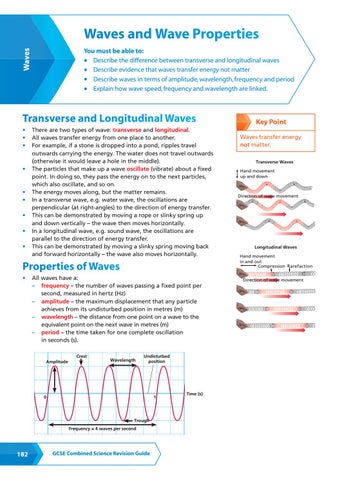
Waves and Wave Properties Transverse and Longitudinal Waves Properties of Waves Wave Speed Electromagnetic Waves Electromagnetic Waves Refraction Ray Diagrams The Electromagnetic Spectrum Uses and Applications of EM Waves HT Radio Signals Hazards of EM Waves Physics Paper 1
Electricity
An Introduction to Electricity Standard Circuit Symbols Electric Charge and Current Resistance and Potential Difference Circuits and Resistance Resistors and Other Components Circuits and Power Series and Parallel Circuits Power in Circuits
8
GCSE Combined Science Revision Guide
227841 AQA Higher Tier Combined Science All-in-One_P002_009.indd 8
HT
Higher Tier Content
6/29/16 10:43 AM
Contents Revise
Review
Domestic Uses of Electricity Direct and Alternating Potential Difference Mains Electricity Dangers of Mains Electricity Power and Efficiency
p. 194
p. 205
p. 221
Electrical Energy in Devices Energy Transfers in Appliances The National Grid
p. 196
p. 205
p. 221
p. 206
p. 222
p. 226
p. 208
p. 222
p. 226
p. 210
p. 223
p. 227
Atoms and Isotopes The Structure of the Atom Isotopes The Plum Pudding Model Rutherford, Geiger and Marsden Further Developments
p. 212
p. 224
p. 228
Nuclear Radiation Nuclear Decay and Radiation Alpha, Beta and Gamma Decay Radioactive Contamination
p. 214
p. 224
p. 229
Half-Life Half-Life Nuclear Equations
p. 216
p. 225
p. 229
Physics Paper 2
Magnetism and Electromagnetism
Magnetism and Electromagnetism Magnetic Poles and Fields Plotting Fields Electromagnetism and Solenoids Electromagnetic Devices HT
The Motor Effect Fleming’s Left Hand Rule Electric Motors
Physics Paper 1
Particle Model of Matter
Particle Model of Matter States of Matter Density Change of State and Specific Latent Heat Particle Motion and Pressure in Gases Physics Paper 1
Atomic Structure
Mixed Exam-Style Biology Questions
p. 230
Mixed Exam-Style Chemistry Questions
p. 238
Mixed Exam-Style Physics Questions
p. 246
Answers
p. 254
Periodic Table
p. 271
Physics Equations
p. 272
Glossary and Index
p. 274
HT
Practise
Higher Tier Content
227841 AQA Higher Tier Combined Science All-in-One_P002_009.indd 9
Contents
9
6/29/16 10:43 AM
Review Questions Recap of KS3 Biology Key Concepts 1
What is the basic unit that all living things are made of?
2
The diagrams show an animal cell and a plant cell. Animal Cell
[1]
Plant Cell
a) Some structures are found in both types of cell. Label two of these structures, shown by the arrows, on the diagrams. b) Name two structures that are present in plant cells but not in animal cells. 3
[2] [2]
Human ova (eggs) and human sperm have important roles in reproduction. a) What are eggs and sperm? Tick one box. tissues
cells
organs
[1]
b) What does a sperm use to swim towards an egg?
[1]
c) Name the male reproductive organ where sperm are made.
[1]
d) In reproduction, a sperm fuses with an egg. What is this process called? 4
[1]
Carbon monoxide, nicotine and tar all get into the lungs when a person smokes. Write down one harmful effect on the body of each of these substances.
[3]
5
What is the process called by which plants produce glucose and oxygen?
[1]
6
What is the process called by which the human body releases energy from glucose and oxygen?
[1]
7
Give two functions of the human skeleton.
[2]
10
GCSE Combined Science Revision Guide
227841 AQA Higher Tier Combined Science All-in-One_P010_015.indd 10
6/29/16 10:46 AM
Review 8
The chart shows a way to group living organisms. Living Organisms
Plants
Animals
Group A
Group B
Group C
Group D
Flowering Plants
Non-Flowering Plants
Invertebrate Animals
Vertebrate Animals
a) To which group, A, B, C or D, do the following living organisms belong? i)
Flatworm
ii)
Mouse
iii)
Daffodil
iv)
Human
[4]
b) Some flatworms are parasites. What is a parasite? 9
[1]
Rachel cut her knee playing netball. A medic put a plaster over the cut. a) A plaster helps to stop a cut getting infected. Give the name of one type of microorganism that can infect a cut.
[1]
b) While she was cleaning Rachel’s knee, the medic wore rubber gloves. Why is wearing rubber gloves important for the medic’s health? 10
[1]
The human lungs contain millions of alveoli. a) i) Which gas passes into the blood from the air in the lungs?
[1]
ii) Which gas passes out of the blood into the air in the lungs?
[1]
b) The walls of the capillaries and the alveoli are very thin. Why do they need to be thin?
[1]
c) There are millions of alveoli in the lungs. They provide a very large surface area. Why is a large surface area important?
[1] Total Marks
/ 27
Review
227841 AQA Higher Tier Combined Science All-in-One_P010_015.indd 11
11
6/29/16 10:46 AM
Review Questions Recap of KS3 Chemistry Key Concepts 1
A match is used to light a candle. The wax melts and then moves up the candle wick where it burns. a) What is the change of state when the wax melts? Name the state i) before the change and ii) after the change.
[2]
b) The match contains carbon. Write a word equation to sum up the reaction that takes place when carbon burns completely in oxygen. carbon +
[2]
c) Candle wax, wood and coal are all types of fuel. Which of these statements is true for all fuels? Tick one box. Fuels are substances that can be burned to release energy. Fuels are always solid at room temperature. Fuels are always black. When fuels are burned, they react with carbon dioxide in the air.
[1]
d) Name the poisonous gas that can be produced when fuels that contain carbon are burned in a limited supply of oxygen.
[1]
e) Coal contains a small amount of the element sulfur.
2
3
What is the chemical symbol for sulfur?
[1]
f) Name the gas produced when sulfur burns.
[1]
Potassium nitrate has the formula KNO3. a) How many different elements are shown in this formula?
[1]
b) Which element is represented by the symbol K?
[1]
c) What is the total number of atoms shown in the formula for potassium nitrate?
[1]
A student uses a pH meter to measure the pH of four solutions. a) Tick the correct box to show whether each of the solutions tested is acidic, neutral or alkaline.
12
GCSE Combined Science Revision Guide
227841 AQA Higher Tier Combined Science All-in-One_P010_015.indd 12
6/29/16 10:46 AM
Review Sample
pH
A
12
B
10
C
7
D
2
Acidic
Neutral
Alkaline
[4]
b) The student placed the pH meter in a beaker of distilled water after testing each of the solutions. Why did they do this?
[1]
c) The student tested a sample of soil from their garden. The soil was slightly acidic. What could the student put onto the soil to neutralise it? 4
[1]
Edward and his family visit the seaside. Edward has a bucket that contains a mixture of sand and sea water. a) How could Edward get a sample of salt from the sea water?
[1]
b) How could Edward get a sample of sand from the mixture?
[1]
c) Mixtures, compounds and elements are different types of substance. Sea water is a mixture, sand is a compound and oxygen is an element. Draw one line from each type of substance to its definition. Type of Substance Mixture
Compound
Element 5
Definition Contains atoms of two or more elements, which are chemically joined. Contains two or more elements or compounds, which are not chemically joined. Contains only one type of atom.
[2]
Rose placed some blue copper sulfate solution into a test tube. She added a spatula of silver-coloured iron filings and stirred the mixture. After 10 minutes the solution was green and the solid was orange-brown. a) Why did Rose stir the mixture?
[1]
b) Suggest a safety precaution that Rose should take during this experiment.
[1]
c) How did Rose know that a chemical reaction had taken place?
[1]
d) Name the element produced during this reaction.
[1]
e) Write a word equation to sum up this reaction.
[2] Total Marks
/ 27
Review
227841 AQA Higher Tier Combined Science All-in-One_P010_015.indd 13
13
6/29/16 10:46 AM
Review Questions Recap of KS3 Physics Key Concepts 1
Wall Magnet fixed to truck
The wooden truck in the diagram is held
Magnet fixed to wall
so it does not move. Wooden truck
a) Describe the motion of the truck when it is released.
S
N
N
S
Table
b) What effect will friction have on the motion of the truck? 2
[1] [1]
During the summer, people use small hand-held fans to keep themselves cool. a) Draw a series circuit containing a battery, switch and motor to show how one of these fans could be wired. b) Which component provides energy for the circuit?
[3] [1]
c) A bulb is added in series to the circuit. How will this affect the motor? 3
[1]
A series circuit contains three bulbs. What will happen to the other bulbs if the bulb in the middle breaks? Tick one box. Both bulbs will go out. Both bulbs will get brighter. The one after the broken bulb will go out. Both bulbs will stay the same.
4
[1]
A parallel circuit contains three bulbs. What will happen to the other bulbs if the bulb in middle breaks? Tick one box. Both bulbs will go out. Both bulbs will get brighter. The one after the broken bulb will go out. Both bulbs will stay the same.
14
[1]
GCSE Combined Science Revision Guide
227841 AQA Higher Tier Combined Science All-in-One_P010_015.indd 14
6/29/16 10:46 AM
Review 5
6
Oil is described as a non-renewable energy resource. a) Explain what is meant by ‘non-renewable’.
[2]
b) Give two other non-renewable energy resources.
[2]
Choose words from the list to complete the paragraph. chemical
electrical
gravitational
kinetic
light
sound
thermal
A bicycle light uses a generator powered by the turning of the wheels. As a cyclist pedals, energy in her muscles is changed to kinetic energy. When the generator turns, kinetic energy is changed to useful This energy in the wires is changed to useful
energy in the wires. energy by the bulb.
When the light is on, some of the energy in the bulb is wasted as 7
energy.
[4]
When a bird flies at a constant height, there is a downward force of 30N on the bird. How large is the upwards force on the bird?
8
[1] Direction of flight
The diagram shows four forces acting on an
A
aeroplane in flight. a) Which arrow represents air resistance?
B
D
[1]
b) When the aeroplane is descending, what can be said about forces A and C? [1]
C c) When the plane is flying at a constant speed in the direction shown, which two forces must be balanced?
[1]
d) Just before takeoff, the aeroplane is speeding up along the ground. What must this mean about the size of forces B and D? 9
[1]
Two cyclists are riding along a dark road at night. One is wearing black clothes and the other is wearing light-coloured clothes. A car approaches the cyclists with its headlights on. a) What happens to the light when it reaches the light-coloured clothes?
[1]
b) Explain why it is more difficult for the driver to see the cyclist in the black clothes.
[3]
Total Marks
/ 26
Review
227841 AQA Higher Tier Combined Science All-in-One_P010_015.indd 15
15
6/29/16 10:46 AM
Cell Biology
Cell Structure You must be able to: • Describe the structure of a typical animal cell • Describe how a plant cell differs from an animal cell • Recall the main differences between prokaryotic and eukaryotic cells • Describe the structure of a typical bacterial cell.
A Typical Animal Cell • •
All cells have structures inside them – these are called sub-cellular structures. In an animal cell, the sub-cellular structures include: – a nucleus, which controls the activities of the cell and contains the genetic material – cytoplasm, in which most of the chemical reactions take place – a cell membrane, which controls the passage of substances into and out of the cell – mitochondria, where aerobic respiration takes place – ribosomes, where proteins are synthesised (made).
Human Cheek Cell Cell membrane Ribosomes Cytoplasm
Mitochondrion Nucleus
Plant Cells • •
• •
Plant cells and algal cells contain all the sub-cellular structures found in animal cells. They also have: – a cell wall made of cellulose, which strengthens the cell – a permanent vacuole filled with cell sap, which supports the plant. Plants need to make their own food, so some of their cells contain chloroplasts. Chloroplasts absorb light to make food (glucose) by photosynthesis (see pages 46–47). Plant Cell from a Leaf Cell wall
Cell membrane
Permanent vacuole
Chloroplasts Mitochondrion
Cytoplasm
Nucleus Ribosomes
16
Key Point Not all plant cells have chloroplasts. For example, they are not present in root cells because those cells do not receive any light.
GCSE Combined Science Revision Guide
227841 AQA Higher Tier Combined Science All-in-One_P016_031.indd 16
6/29/16 10:51 AM
Prokaryotic and Eukaryotic Cells •
• • • •
There are two main types of cell: – prokaryotic – eukaryotic. Plant, animal and fungal cells are all eukaryotic. Bacterial cells are prokaryotic. There are a number of differences between the two types of cell. Prokaryotic cells are much smaller in size and: – the genetic material is not enclosed in a nucleus – the genetic material is a single DNA loop and there may be one or more small rings of DNA, called plasmids – they do not contain mitochondria or chloroplasts.
A Typical Bacterial Cell •
Spiral
Rod
• • • •
Key Point Prokaryotic cells are much simpler in structure than eukaryotic cells. That is why scientists think that they developed before eukaryotic cells.
Key Point
Bacterial cells have many different shapes – some are round, some are rod-shaped and some are spiral – but they are all prokaryotic cells. Spherical
Revise
Curved Rod
Plasmids have become very useful to scientists. They allow genes to be inserted into bacteria in genetic engineering (see pages 70–71).
In bacterial cells, the roles of mitochondria and chloroplasts are taken over by the cytoplasm. There may be one or more flagella, which are tail-like structures that move the bacterium. Plasmids are present, which are loops of DNA that can be transferred from one cell to another. Plasmids allow bacterial cells to move genes from one cell to another. A Typical Bacterial Cell
Cytoplasm
Plasmid DNA: a small, commonly circular, section of DNA that can replicate independently of chromosomal DNA Chromosomal DNA: the DNA of bacteria is not found within a nucleus and is usually found as one long, looped chromosome
Cell wall: provides structural support to the bacteria (is not made of cellulose)
Flagella: tail-like structures that rotate to help some bacteria move
Quick Test 1. Which sub-cellular structure controls the activities inside the cell? 2. Where are proteins made in a cell? 3. Write down three structures that are found in plant cells but not in animal cells. 4. What is the function of cell sap? 5. Where is DNA found in a bacterium?
Key Words sub-cellular structures nucleus cytoplasm cell membrane mitochondria ribosome cell wall cellulose vacuole chloroplast prokaryotic eukaryotic plasmid flagella
Cell Biology: Revise
227841 AQA Higher Tier Combined Science All-in-One_P016_031.indd 17
17
6/29/16 10:51 AM
Cell Biology
Investigating Cells You must be able to: • Use different units of measurement to describe the size of cells • Describe the advantages of using an electron microscope to view cells • Analyse images of cells and perform calculations involving magnification, actual size and image size.
The Size of Cells • • •
A typical plant cell may be about 0.1mm in diameter and an animal cell 0.02mm in diameter. Prokaryotic cells are smaller – often about 0.002mm long. To describe the size of cells and sub-cellular structures, scientists use units that have different prefixes. Unit
Number of Units in One Metre (1m)
centimetre (cm)
100
1 × 10 2
millimetre (mm)
1 000
1 × 10 3
micrometre (μm)
1 000 000
1 × 10 6
nanometre (nm)
1 000 000 000
1 × 10 9
Key Point The size of cells is often given in micrometres, e.g. a plant cell may be 100µm, an animal cell 20µm and a bacterium 2µm in size.
Using Microscopes to Look at Cells • • • • • • • •
18
It is not possible to see cells as separate objects using the naked eye. The ability to see two or more objects as separate objects is called resolution. The light microscope was developed in the late 16th century and gave a greater resolution than the human eye. It allowed scientists to see plant, animal and bacterial cells. Some sub-cellular structures are even smaller than the resolution achieved by a light microscope and cannot be seen using this method. In 1933, scientists first used an electron microscope. An electron microscope passes electrons, rather than light, through the specimen and can give much better resolution. Cells can be seen in much finer detail, e.g. – the structures inside mitochondria and chloroplasts can be studied and this has helped scientists to find out how they work – ribosomes can be seen and their role in making proteins can be studied.
A Light Microscope
An Electron Microscope
GCSE Combined Science Revision Guide
227841 AQA Higher Tier Combined Science All-in-One_P016_031.indd 18
6/29/16 10:51 AM
REQUIRED PRACTICAL
Revise
Use a light microscope to observe, draw and label a selection of plant and animal cells. Sample Method 1. Place a tissue sample on a microscope slide. 2. Add a few drops of a suitable stain. 3. Lower a coverslip onto the tissue. 4. Place the slide on the microscope stage and focus on the cells using low power. 5. Change to high power and refocus. 6. Draw any types of cells that can be seen. 7. Add a scale line to the diagram.
Considerations, Mistakes and Errors • The scale line can be added by focusing on the millimetre divisions of a ruler.
An Electron Microscope Image of a Bark Beetle
Calculating Magnification •
LEARN
• •
When a microscope is used to look at cells, scientists will often take photographs or produce drawings. These images are many times larger than the real cell or structure. The magnification is how many times larger the image is than the real object. size of image magnification = size of real object
Key Point Magnification is not the same as resolution. Light microscopes can be built to magnify more and more, but after a certain point the images do not get any clearer.
A student looks at a plant cell under a microscope using a magnification of ×120. The image of the cell is 1.5cm in height. Calculate the height of the actual cell. 1.5 × 10 = 15mm 15 120 = actual height 15 actual height = 120 = 0.125mm
Convert the measurement from cm to mm. Substitute your values into the equation. Rearrange the equation to find the actual height.
Quick Test 1. Arrange these structures in order of size with the largest first: bacterium liver cell nucleus ribosome 2. A nucleus is measured as 0.005mm in diameter. How many micrometres is this? 3. A student draws a cheek cell. The cell in their drawing is 50mm wide. In real life the cell is 0.025mm. What is the magnification of their drawing?
Key Words resolution electron microscope magnification
Cell Biology: Revise
227841 AQA Higher Tier Combined Science All-in-One_P016_031.indd 19
19
6/29/16 10:51 AM
Cell Biology
Cell Division You must be able to: • Describe the arrangement of chromosomes in a cell • Explain the importance of mitosis in the cell cycle • Describe the properties and functions of stem cells • Explain the use of stem cells.
Chromosomes • • • • •
The nucleus of a cell contains chromosomes made of DNA. Each chromosome carries hundreds to thousands of genes. Different genes contain the code to make different proteins and so control the development of different characteristics. In body cells, the chromosomes are found in pairs, with one chromosome coming from each parent. Different species have different numbers of pairs of chromosomes, e.g. humans have 23 pairs and dogs have 39 pairs. A Section of One Chromosome Gene for eye colour
Genes for hair colour
Genes for height
Mitosis and the Cell Cycle • • • • •
Cells go through a series of changes involving growth and division, called the cell cycle. One of the stages is mitosis, when the cell divides into two identical cells. Before a cell can divide, it needs to grow and increase the number of sub-cellular structures, such as ribosomes and mitochondria. The DNA then replicates to form two copies of each chromosome. During mitosis: 1 One set of chromosomes is pulled to each end of the cell. 2 The nucleus divides. 3 The cytoplasm and cell membranes divide to form two identical cells.
DNA is copied and new chromosomes are made The Cell Cycle
Mitosis
Each cell grows and makes new sub-cellular structures
Mitosis
Parent cell with two pairs of chromosomes.
20
Each chromosome replicates (copies) itself.
Chromosomes line up along the centre of the cell, divide and the copies move to opposite poles.
Each ‘daughter’ cell has the same number of chromosomes, and contains the same genes, as the parent cell.
GCSE Combined Science Revision Guide
227841 AQA Higher Tier Combined Science All-in-One_P016_031.indd 20
6/29/16 10:51 AM
•
Revise
Cell division by mitosis is important because it makes new cells for: – growth and development of multicellular organisms – repairing damaged tissues – asexual reproduction.
Key Point
Stem Cells • • • • •
Some cells are undifferentiated – they have not yet become specialised. This means that they can divide to make different types of cells. They are called stem cells. Stem cells are found in human embryos, in the umbilical cord of a new born baby, and in some organs and tissues. Stem cells from human embryos are called embryonic stem cells and can make all types of cells. Adult stem cells are found in some organs and tissues, e.g. bone marrow. They can only make certain types of cells and their capacity to divide is limited.
Uses of Stem Cells •
• •
•
•
• • • •
Although there are adult stem cells all over the body, they are very difficult to find and isolate. Potential Uses for Stem Cells
Stem cells
Pancreatic islet cells
Stem cells may be very useful in treating conditions where cells are damaged or not working properly, such as in diabetes and paralysis. They could be used to replace the damaged cells. A cloned embryo of the patient may be made Heart muscle and used as a source of stem cells. This is called therapeutic cloning. Stem cells from the cloned embryo will not be rejected by the patient’s body, so they could be very useful in treating the patient. Some people are concerned about using stem cells from cloned embryos: – there may be risks, such as the transfer of viral infection – they may have ethical or religious objections. In plants, stem cells are found in special areas called meristems. These meristems allow plants to make new cells for growth. The stem cells can be used to produce clones of plants quickly. This could be useful for a number of reasons: – rare species can be cloned to protect them from extinction – large numbers of identical crop plants with special features, such as disease resistance, can be made.
Quick Test 1. How many chromosomes are there in each human body cell? 2. Why is it important that the chromosomes are copied before mitosis occurs? 3. What is a stem cell? 4. Why does a plant have a meristem at the tip of the shoot and the tip of each root?
Bone marrow
Neurones Blood
Key Point Stem cell use (and the different views for and against it) is a good example of an ethical argument concerning a new technology.
Key Words chromosome DNA gene cell cycle mitosis undifferentiated stem cell embryonic stem cell adult stem cell therapeutic cloning meristems
Cell Biology: Revise
227841 AQA Higher Tier Combined Science All-in-One_P016_031.indd 21
21
6/29/16 10:51 AM
Cell Biology
Transport In and Out of Cells You must be able to: • Describe the process of diffusion • Explain the factors involved in moving molecules in and out of cells • Describe how water can move by osmosis • Explain why some substances are moved by active transport • Compare diffusion, osmosis and active transport.
Diffusion • •
• •
Many substances move into and out of cells, across the cell membranes, by diffusion. Diffusion is the net movement of particles from an area of higher concentration to an area of lower concentration until they are evenly spread out. This happens because the particles move randomly and spread out. There are many examples of diffusion in living organisms: – oxygen and carbon dioxide diffuse during gas exchange in lungs, gills and plant leaves – urea diffuses from cells into the blood plasma for excretion by the kidney – digested food molecules from the small intestine diffuse into the blood.
Diffusion Some particles
High concentration
• • •
•
The factors that affect the rate of diffusion are: – the difference in concentrations, known as the concentration gradient – the temperature – the surface area of the membrane. A single-celled organism has a large surface area to volume ratio. This allows enough molecules to diffuse into and out of the cell to meet the needs of the organism. In multicellular organisms, there is a smaller surface area to volume ratio. However, surfaces and organ systems are specialised for exchanging materials. The small intestine and lungs in mammals, gills in fish, and the roots and leaves in plants, are all adapted for exchanging materials: – they have a large surface area – the surface is thin so that molecules only have to diffuse a short distance – surfaces are usually kept moist so that substances can dissolve and diffuse across cell membranes faster – in animals, a rich blood supply maintains the concentration gradient – in animals, ventilation occurs to speed up gaseous exchange.
Low concentration
Net movement of particles
The Effect of the Size of an Organism on its Surface Area to Volume Ratio Organism A 1
Factors Affecting Diffusion •
Many particles
1
surface area = 6 volume = 1 surface area to volume ratio = 6
1 Organism B 2 2
surface area = 24 volume = 8 surface area to volume ratio = 3
2
Key Point A dilute solution contains lots of water. A concentrated solution contains less water. Osmosis Dilute solution (high concentration of water)
Concentrated solution (low concentration of water)
Partially permeable membrane
Osmosis • •
22
Water may move across cell membranes by osmosis. Osmosis is the diffusion of water from a dilute solution to a concentrated solution through a partially permeable membrane. GCSE Combined Science Revision Guide
227841 AQA Higher Tier Combined Science All-in-One_P016_031.indd 22
Net movement of water molecules These molecules are too large to pass through the membrane
6/29/16 10:51 AM
Revise
REQUIRED PRACTICAL Investigate the effect of a range of concentrations of salt or sugar solutions on the mass of plant tissue. Sample Method Potatoes can be used to measure the effect of sugar solutions on plant tissue: 1. Cut some cylinders of potato tissue and measure their mass. 2. Place the cylinders in different concentrations of sugar solution. 3. After about 30 minutes remove the cylinders and measure their mass again.
Considerations, Mistakes and Errors • The cylinders need to be left in the solution long enough for a significant change in mass to occur. • Before the mass of the cylinders is measured again, they should be rolled on tissue paper to remove any excess solution. • If the cylinders change in mass, they have gained or lost water by osmosis.
Variables • The independent variable is the one deliberately changed – in this case, the concentration of sugar solution. • The dependent variable is the one that is measured – in this case, the change in mass of the potato. • The control variables are kept the same – in this case, the temperature, the length of time the cylinders were left in the solution and the volume of the solution.
Hazards and Risks • Care must be taken when cutting the cylinders of potato.
• • •
If the potato cylinders do not lose or gain water, then the sugar solution must be the same concentration as the potato tissue.
A Cell Absorbing Ions by Active Transport
Active Transport •
Key Point
Active transport moves substances against a concentration gradient, from an area of low concentration to high concentration. This requires energy from respiration. Active transport allows mineral ions to be absorbed into plant root hairs from very dilute solutions in the soil. Active transport also allows sugar molecules to be absorbed from lower concentrations in the gut into the blood, which has a higher concentration.
Comparing Processes Diffusion Osmosis Allows molecules to move
✓
✓
Active Transport
Root hair cell with high concentration Soil with low of nitrate ions concentration of nitrate ions
Cell uses energy to ‘pull’ ions against the concentration gradient
Key Point
✓
Movement is down a concentration gradient
✓
✓
✗
Always involves the movement of water
✗
✓
✗
Needs energy from respiration
✗
✗
✓
Quick Test 1. A person opens a bottle of perfume. Why do people in the room smell it faster on a warm day? 2. What is required for substances to be absorbed against a concentration gradient? 3. In addition to a large surface area, name one other feature that makes an exchange surface more efficient.
Anything that stops respiration occurring, such as lack of oxygen or metabolic poisons, will stop active transport.
Key Words diffusion concentration gradient surface area to volume ratio osmosis active transport
Cell Biology: Revise
227841 AQA Higher Tier Combined Science All-in-One_P016_031.indd 23
23
6/29/16 10:51 AM
Organisation
Levels of Organisation You must be able to: • Explain how cells become specialised for particular roles • Describe examples of specialised cells • Explain how cells can form tissues, organs and systems.
Specialised Cells • • • •
•
Cells are the basic building blocks of all living organisms. As an organism develops, cells differentiate to form different types of cells. They become specialised. Most types of animal cell differentiate at an early stage, but many types of plant cell can differentiate throughout their life. As a cell differentiates: – it may change shape – different sub-cellular structures develop to let it to carry out a specific function. Specialised animal cells include sperm, nerve and muscle cells.
Axon
Mitochondria: sperm have many of these cell components, which are the major site of respiration, to provide energy for their journey Dendrites
Nucleus: contains only one set of the genetic material
Cell body
Sheath
Acrosome: contains enzymes to allow the sperm to penetrate the outer layer of the egg A Muscle Cell
Nucleus
Mitochondria
Protein fibres that can contract
•
If cells are specialised, they become more efficient at their job but may lose the ability to do other jobs.
A Motor Neurone (Type of Nerve Cell)
A Sperm Cell Tail: to propel the sperm to fertilise the egg
Key Point
Many mitochondria for energy
In plants, root hair, xylem and phloem cells are all specialised cells. Xylem Xylem cells are arranged end to end but the end walls break down to form hollow tubes The cell wall of the cells is strengthened by a substance called lignin
Phloem The end walls of the cells allow sugars through but support the tubes Phloem cells are arranged end to end into tubes
A Root Hair Cell
Lots of mitochondria for active transport of minerals
Long projection to increase the surface area to absorb water and minerals
Companion cell
24
GCSE Combined Science Revision Guide
227841 AQA Higher Tier Combined Science All-in-One_P016_031.indd 24
6/29/16 10:51 AM
Revise
Tissues, Organs and Systems • •
• • •
• •
•
In most organisms, cells are arranged into tissues. A tissue is a group of cells with a similar structure and function, which all work together to do a job, e.g. – muscle tissue contracts to produce movement – glandular tissue produces substances such as enzymes and hormones – epithelial tissue covers organs. Organs are groups of different tissues, which all work together to perform a specific job. Each organ may contain several tissues. For example, the stomach is an organ that contains: – muscle tissue that contracts to churn the contents – glandular tissue to produce digestive juices – epithelial tissue to cover the outside and inside of the stomach. Organs are organised into organ systems, which are groups of organs working together to do a particular job. The digestive system is an example of an organ system, in which several organs work together to digest and absorb food. Lots of organ systems work together to make an organism.
Muscle tissue Can contract to bring about movement
Glandular tissue Can produce substances such as enzymes and hormones
Epithelial tissue Covers all parts of the body
The Stomach
Epithelial tissue Glandular tissue
The Digestive System Muscle tissue Mouth Oesophagus – pushes food down to stomach
Key Point Single-celled organisms do not have tissues. Liver Stomach Pancreas Gall bladder
Large intestine
Some simple animals do not have organs, only tissues.
Small intestine Rectum Anus
Quick Test 1. Why do cells differentiate? 2. Why do sperm cells contain lots of mitochondria? 3. What is a group of cells with a similar structure and function called? 4. What is the function of epithelia? 5. Is the heart a tissue, an organ or an organ system?
Key Words specialised tissue organ organ system
Organisation: Revise
227841 AQA Higher Tier Combined Science All-in-One_P016_031.indd 25
25
6/29/16 10:51 AM
Organisation
Digestion You must be able to: • Explain how enzymes work • Describe the role of enzymes in digestion • Explain how bile can speed up the digestion of lipids.
Enzymes •
Enzymes are biological catalysts – they speed up chemical reactions in living organisms. Enzymes have a number of properties: – They are all large proteins. – There is a space within the protein molecule called the active site. – Each enzyme catalyses a specific reaction. – They work best at a specific temperature and pH called the optimum. The ‘lock and key theory’ is a model used to explain how enzymes work: the chemical that reacts is called the substrate (key) and it fits into the enzyme’s active site (lock). High temperature and extremes of pH make enzymes change shape. This is called denaturing. The enzyme cannot work once it has been denatured, because the substrate cannot fit into the active site – the lock and key no longer fit together.
•
•
• •
Substrate Enzyme
Combined substrate and enzyme. Reaction can take place.
Products
Enzymes in Digestion •
Digestive enzymes are produced by specialised cells in glands and in the lining of the gut: 1 The enzymes pass out of the cells into the digestive system. 2 They come into contact with food molecules. 3 They catalyse the breakdown of large insoluble food molecules into smaller soluble molecules. The digestive enzymes, protease, lipase and carbohydrase, digest proteins, lipids (fats and oils) and carbohydrates to produce smaller molecules that can be easily absorbed into the bloodstream.
•
REQUIRED PRACTICAL Use qualitative reagents to test for a range of carbohydrates, lipids and proteins. Sample Method 1. To test for sugars, e.g. glucose, add Benedict’s reagent and heat in a water bath for two minutes. If sugar is present, it will turn red. 2. To test for starch add iodine solution. If starch is present, it will turn blue-black. 3. To test for protein add biuret reagent. If protein is present, it will turn purple.
26
Considerations, Mistakes and Errors • Do not boil the mixture for a long time, because any starch present might break down into sugar and test positive. • Refer to ’iodine solution’ not ‘iodine’. • Sometimes the purple colour is difficult to see. Try holding the test tube in front of a sheet of white paper.
Substrate is broken down and enzyme can be reused.
Key Point The ‘Lock and Key Theory’ is an example of how models are used in science to try and explain observations.
Heat
Enzyme
Enzyme denatured by heat
GCSE Combined Science Revision Guide
227841 AQA Higher Tier Combined Science All-in-One_P016_031.indd 26
6/29/16 10:51 AM
•
Amylase: – is produced in the salivary glands and the pancreas – is a carbohydrase that breaks down starch into sugar (maltose). Protease: – is produced in the stomach, pancreas and small intestine – breaks down proteins into amino acids. Liver Lipase: – is produced in the pancreas and small intestine – breaks down lipids (fats) into fatty acids and glycerol.
•
•
Revise
Stomach
Bile and Digestion •
Bile is a liquid made in the liver and stored in the gall bladder. It is alkaline to neutralise hydrochloric acid from the stomach. It also emulsifies fat to form small Gall bladder droplets, increasing the surface area for enzymes to act on. The alkaline conditions and large surface area increase the rate at which fat is broken down by lipase.
• •
•
REQUIRED PRACTICAL Investigate the effect of pH on the rate of reaction of amylase enzyme. Sample Method 1. Put a test tube containing starch solution and a test tube containing amylase into a water bath at 37°C. 2. After 5 minutes add the amylase solution to the starch. 3. Every 30 seconds take a drop from the mixture and test it for starch using iodine solution. 4. Record how long it takes for the starch to be completely digested. 5. Repeat the experiment at different pH values using different buffer solutions.
Considerations, Mistakes and Errors • The solutions need to be left in the water bath for a while to reach the correct temperature before they are mixed. • After mixing, the tube must be kept in the water bath. • A buffer solution must be used to keep the reaction mixture at a certain fixed pH.
Variables • The independent variable is the one deliberately changed – in this case, the pH. • The dependent variable is the one that is measured – in this case, the time taken for the starch to be digested. • The control variables are kept the same – in this case, temperature, concentration and volume of starch and amylase.
Hazards and Risks • Care must be taken if a Bunsen burner is used to heat the water bath. • Take care not to spill iodine solution on the skin.
Quick Test 1. 2. 3. 4. 5.
What type of molecule is an enzyme? Give two factors that affect the rate at which enzymes work. Where are protease enzymes produced in the body? What type of enzyme breaks down lipids? Where is bile produced?
Pancreas Small intestine Bile duct
Key Point Bile does not contain any enzymes, so it does not digest fat molecules. It just breaks up fat droplets into smaller ones.
Key Words catalyst active site optimum lock and key theory denature protease lipase carbohydrase amylase bile
Organisation: Revise
227841 AQA Higher Tier Combined Science All-in-One_P016_031.indd 27
27
6/29/16 10:51 AM
Organisation
Blood and the Circulation You must be able to: • Explain how the components of blood are adapted for their roles • Explain how the different types of blood vessels are adapted for their functions • Describe the structure and function of the heart • Explain the adaptations that allow gaseous exchange to take place between the lungs and the blood.
Blood • •
•
•
•
•
Key Point
Blood is a tissue. It is made of a liquid called plasma, which has three different components suspended in it: – red blood cells – white blood cells – platelets. Plasma transports various chemical substances around the body, such as the products of digestion, hormones, antibodies, urea and carbon dioxide. Red blood cells: – contain haemoglobin, which binds to oxygen to transport it from the lungs to the tissues and cells, which need it for respiration – do not contain a nucleus, so there is more room for haemoglobin – are very small, so they can fit through the tiny capillaries – are shaped like biconcave discs, giving them a large surface area that oxygen can quickly diffuse across. White blood cells: – help to protect the body against infection – can change shape, so they can squeeze out of the blood vessels into the tissues or surround and engulf microorganisms. Platelets are fragments of cells, which collect at wounds and trigger blood clotting.
Blood Vessels • •
haemoglobin + oxygen oxyhaemoglobin In the tissues: oxyhaemoglobin haemoglobin + oxygen
Red Blood Cell Red Blood Cell
No nucleus, so packed full of haemoglobin to absorb oxygen. No nucleus, so packed full of haemoglobin to absorb oxygen. White Blood Cell White Blood Cell
Can change shape in order to engulf and destroy invading microorganisms. Can change shape in order to engulf and destroy invading microorganisms.
The blood passes around the body in blood vessels. The body contains three different types of blood vessel: • •
28
In the lungs:
Arteries • Take blood from your heart to your organs. • Thick walls made from muscle and elastic fibres.
Veins Take blood from your organs • to your heart. • Thinner walls and valves to prevent backflow. •
Capillaries Allow substances needed by the cells to pass out of the blood. Allow substances produced by the cells to pass into the blood. Narrow, thin-walled blood vessels.
GCSE Combined Science Revision Guide
227841 AQA Higher Tier Combined Science All-in-One_P016_031.indd 28
6/29/16 10:51 AM
Revise
The Heart •
The heart pumps blood around the body in a double circulatory system. Blood passes through the heart twice on each circuit. There are four chambers in the heart: – the left and right atria, which receive blood from veins – the left and right ventricles, which pump the blood out into arteries.
• •
Pulmonary artery to lungs
Aorta to body
Vena cava from body Right atrium
• • • • •
Artery Vein
Left atrium
Blood low in oxygen (deoxygenated)
•
Quick Test 1. 2. 3. 4. 5.
Artery
L
Blood rich in oxygen (oxygenated)
Body
Left ventricle
The heart sends blood to the lungs via the pulmonary artery. Air obtained by breathing reaches the lungs through the trachea (windpipe), which has rings of cartilage to prevent it collapsing. The trachea divides into two tubes – the bronchi. The bronchi divide to form bronchioles. The bronchioles divide until they end in tiny air sacs called alveoli. There are millions of alveoli and they are adapted to be very efficient at exchanging oxygen and carbon dioxide: – They have a large, moist surface area. – They have a very rich blood supply. – They are very close to the blood capillaries, so the distance for gases to diffuse is small. The blood is taken back to the lungs through the pulmonary vein.
• • • •
Vein
Pulmonary vein from lungs
Gaseous Exchange • •
L Heart
Blood enters the heart through the atria. The atria contract and force blood into the ventricles. The ventricles then contract and force blood out of the heart. Valves make sure the blood flows in the correct direction. The natural resting heart rate is controlled by a group of cells located in the right atrium, which act as a pacemaker. Artificial pacemakers are electrical devices used to correct irregularities in the heart rate.
•
R
R
Valve Right ventricle
Lungs
Which component of blood makes it clot? How are red blood cells adapted to carry oxygen? Which type of blood vessel carries blood away from the heart? In which chamber does deoxygenated blood enter the heart? What do the heart and veins contain to prevent backflow of blood?
Key Point The pulmonary artery is unusual because, unlike other arteries, it carries deoxygenated blood. The pulmonary vein carries oxygenated blood.
Key Words plasma haemoglobin double circulatory system atria ventricle pacemaker pulmonary artery trachea cartilage bronchi bronchioles alveoli pulmonary vein
Organisation: Revise
227841 AQA Higher Tier Combined Science All-in-One_P016_031.indd 29
29
6/29/16 10:51 AM
Organisation
Non-Communicable Diseases You must be able to: • Explain the difference between non-communicable and communicable diseases • Explain, with examples, what is meant by ‘risk factors’ • Describe the causes and treatments for certain heart diseases • Describe the main causes and types of cancer.
Health and Disease • • • • •
• •
Good health is a state of physical and mental wellbeing. A disease is caused by part of the body not working properly. This can affect physical and / or mental health. Diseases can be divided into two main types: communicable diseases and non-communicable diseases. Non-communicable diseases cannot be spread between organisms, but communicable diseases can. There are many examples of how different diseases can interact with each other: – Viruses infecting cells can be the trigger for cancers, such as cervical cancer. – Diseases of the immune system mean that an individual is more likely to catch infectious diseases, e.g. people with HIV are more likely to get tuberculosis. – Immune reactions triggered by a pathogen can cause allergies, such as skin rashes and asthma. – If a person is physically ill, this can lead to depression and mental illness. – Poor diet, stress and difficult life situations can increase the likelihood of developing certain diseases. Non-communicable diseases, such as diabetes, can change a person’s life and cost countries large sums of money. About 10% of the health budget in Britain is spent on diabetes.
Key Point A causal mechanism is the process by which a cause brings about an effect. A causal mechanism has been found that links smoking to lung cancer. It is the action of the chemicals in the tar.
Risk Factors • •
• • • •
30
Non-communicable diseases are often caused by the interaction of a number of factors. These factors are called risk factors, because they make it more likely that a person will develop the disease. 45 Risk factors can be: 40 – aspects of a person’s lifestyle, e.g. lack of exercise 35 – substances in the person’s body or environment, e.g. 30 chemicals from smoking. 25 Sometimes there is a clear link between a risk factor and the 20 chance of getting a disease, e.g. obesity and Type 2 diabetes. 15 This does not necessarily mean that the risk factor causes 10 the disease. 5 Scientists need to look for a causal mechanism to prove that a 0 risk factor is involved. Some causal mechanisms have been found, linking some diseases and risk factors. Relative Risk
•
Relative Risk of Lung Cancer in Men According to Duration and Intensity of Smoking <10 cigarettes per day 20+ 10–19
<20
20–29
30–59
40–49
50+
Years of Smoking
GCSE Combined Science Revision Guide
227841 AQA Higher Tier Combined Science All-in-One_P016_031.indd 30
6/29/16 10:51 AM
Disease
Proven Risk Factors
Type 2 diabetes
Lack of exercise / smoking / high intake of saturated fat Obesity
Liver and brain damage
Excessive alcohol intake
Cardiovascular disease
Revise
Lung diseases, including lung cancer Smoking Skin cancer
Ionising radiation, e.g. UV light
Low birth weight in babies
Smoking during pregnancy
Brain damage in babies
Excessive alcohol intake during pregnancy
Diseases of the Heart • •
• • •
In coronary heart disease, layers of fatty material build up inside the coronary arteries and narrow them. Treatments for coronary heart disease include: – stents to keep the coronary arteries open – statins to reduce blood cholesterol levels and slow down the rate at which fatty materials build up. In some people, heart valves may become faulty, developing a leak or preventing the valve from opening fully. Faulty valves can be replaced using biological or mechanical valves. For cases of heart failure: – a donor heart, or heart and lungs, can be transplanted – artificial hearts can be used to keep patients alive while waiting for a heart transplant or to allow the heart to recover.
Cancer • • •
• •
Cancer is a non-communicable disease. Scientists have identified lifestyle risk factors for some types of cancer, e.g. smoking, obesity, common viruses and UV exposure. There are also genetic risk factors for some cancers, which may run in families, e.g. some genes make the carrier more susceptible to certain types of breast cancer. Cancer is caused by uncontrolled cell division. This can form masses of cells called tumours. There are two main types of tumours: – Benign tumours do not spread around the body. – Malignant tumours spread, in the blood, to different parts of the body where they form secondary tumours.
Quick Test 1. State whether each of these diseases are non-communicable or communicable: a) Flu b) Scurvy (lack of vitamin C) c) Lung cancer 2. Why can spending too long in the sun result in skin cancer? 3. Give one risk factor for Type 2 diabetes. 4. Describe how coronary heart disease can cause heart muscle cells to stop contracting.
Coronary Heart Disease
Key Point The narrowing of coronary arteries reduces the flow of blood, so not enough oxygen can reach the heart muscle.
Key Words health disease communicable disease non-communicable disease risk factor causal mechanism coronary heart disease stent statin tumour benign malignant
Organisation: Revise
227841 AQA Higher Tier Combined Science All-in-One_P016_031.indd 31
31
6/29/16 10:51 AM
Organisation
Transport in Plants You must be able to: Explain how various plant tissues are adapted for their functions Describe how water is transported through a plant Describe how dissolved food substances are transported in a plant.
• • •
Plant Tissues Tissue
Function
Epidermis
Covers the outer surfaces of the plant for protection.
Palisade mesophyll
The main site of photosynthesis in the leaf.
Spongy mesophyll
Air spaces between the cells allow gases to diffuse through the leaf.
Xylem vessels
Transports water and minerals through the plant, from roots to leaves. Also supports the plant.
Phloem vessels
Transports dissolved food materials through the plant.
Meristem tissue
Found mainly at the tips of the roots and shoots, where it can produce new cells for growth.
• • •
Plant tissues are gathered together to form organs. The leaf is a plant organ. The structures of tissues in the leaf are related to their functions: Upper epidermis
Wax cuticle
Palisade mesophyll
Mesophyll
Air space Spongy mesophyll
Stoma Lower epidermis
Wax cuticle
Many chloroplasts close to the top of the leaf to trap maximum sunlight.
Lots of air spaces to allow gases to diffuse.
Stomata allow the diffusion of gases in and out of the leaf and can be opened and closed by guard cells.
Guard cell with chloroplasts
Water Transport • •
32
Water enters the plant from the soil, through the root hair cells, by osmosis (see pages 22–23). Root hair, xylem and phloem cells are specialised to transport water, minerals and sugars around the plant (see page 24).
GCSE Combined Science Revision Guide
227841 AQA Higher Tier Combined Science All-in-One_P032_055.indd 32
6/29/16 10:54 AM
• •
This water contains dissolved minerals. The water and minerals are transported up the xylem vessels, from the roots to the stems and leaves. At the leaves, most of the water will evaporate and diffuse out of the stomata (small pores). The loss of water from the leaves is called transpiration. It helps to draw water up the xylem vessels from the roots. There are many factors that can affect the rate of transpiration: – An increase in temperature will increase the rate, as more energy is transferred to the water to allow it to evaporate. – Faster air flow will increase the rate, as it will blow away water vapour allowing more to evaporate. – Increased light intensity will increase the rate, as it will cause stomata to open. – An increase in humidity will decrease the rate as the air contains more water vapour, so the concentration gradient for diffusion is lower. In the leaf, the role of guard cells is to open and close stomata. At night the stomata are closed. This is because carbon dioxide is not needed for photosynthesis, so closing the stomata reduces water loss. When water is plentiful, guard cells take up water and bend. This causes the stomata to open, so gases for photosynthesis are free to move in and out of the stomata along with water from transpiration. Rubber When water is scarce, losing water makes the stomata tubing change shape and close. This stops the plant from losing more water through transpiration.
• • • •
• •
•
•
Guard Cells
•
Stomata open
Stomata closed
Guard cells swollen with water
Guard cells limp
Measuring Water Uptake by a Leafy Shoot Using a Potometer
Water meniscus
Phloem tissue transports dissolved sugars from the leaves to the rest of the plant. This movement of food through phloem tissue is called translocation. Phloem cells are adapted for this function (see page 24).
• •
In most plants, the stomata are mainly found on the bottom surface of the leaf. This means that the sun does not shine directly on them, reducing water loss.
Leafy shoot
Reservoir
Tap
0 1 2 3 4 5 6 7 8 9 10
Translocation •
Key Point
Centimetre scale
The rate of transpiration from a cut shoot can be estimated by measuring the rate at which the shoot takes up water. This is only an estimate because not all of the water taken up by a shoot is lost – a very small percentage is used in the leaf.
•
Revise
Capillary tube
Key Point Plants cannot stop transpiration completely. This is because carbon dioxide is needed for photosynthesis, so water will always escape.
Quick Test 1. 2. 3. 4.
In plant leaves, which tissue is the main site of photosynthesis? What substances are transported by xylem tissue? Give two environmental factors that slow down transpiration. Why do stomata close at night?
Key Words stomata transpiration translocation
Organisation: Revise
227841 AQA Higher Tier Combined Science All-in-One_P032_055.indd 33
33
6/29/16 10:54 AM
Practice Questions Cell Structure 1
Complete Table 1 with a tick (✓) or cross (✗) to show if the structures are present or absent in the cells listed. Table 1 Type of Cell Plant cell
Nucleus
Cytoplasm
Cell Membrane
Cell Wall
✓
Bacterial cell Animal cell
[3] Total Marks
/3
Investigating Cells Figure 1 1
Figure 1 shows an image of a palisade cell.
A
a) The actual height of the cell is 0.1mm.
B
Use a ruler to measure the height of the cell in the diagram and calculate the magnification of the image in Figure 1. size of image magnification = size of real object
C D [2]
E
b) Which structure, A, B, C, D or E, in the cell in Figure 1 matches each of the following descriptions? You may use the same letter more than once. i)
Where most chemical reactions take place.
[1]
ii)
Made of cellulose.
[1]
iii)
Contains chlorophyll.
[1]
iv)
Controls the cell’s functions.
[1]
v)
Gives the cell rigidity and strength.
[1]
vi)
Filled with cell sap.
[1]
vii)
Where photosynthesis occurs.
[1]
viii) Contains chromosomes.
[1] Total Marks
34
/ 10
GCSE Combined Science Revision Guide
227841 AQA Higher Tier Combined Science All-in-One_P032_055.indd 34
6/29/16 10:54 AM
Practise Cell Division 1
A magazine published this article about stem cells: In 2006, scientists at Kyoto University managed to turn body cells from rats into stem cells by inserting some genes. The inserted genes seemed to reprogramme the cells so that they could use all their genes again. This made the cells act like embryonic stem cells. Doctors are very interested in this discovery. This is because they hope that the technique could be used to produce stem cells in a way that fewer people will object to. a) What are embryonic stem cells?
[2]
b) Explain why stem cells may be useful to doctors and why this discovery might make fewer people object to their use.
[5] Total Marks
/7
Transport In and Out of Cells 1
a) Complete the sentences about diffusion. Diffusion is the spreading of concentration to an area of
from an area of concentration.
The greater the difference in concentration, the
the rate of diffusion.
[4]
b) Glucose is reabsorbed into the blood in the kidneys by active transport. Give two ways in which active transport is different from diffusion. 2
[2]
Katie decides to investigate osmosis. This is the method she uses: 1. Prepare five boiling tubes containing different sugar solutions. 2. Cut five potato chips of equal size. 3. Weigh each potato chip and place one in each tube. 4. Leave for 24 hours. 5. Reweigh the potato chips.
Practise
227841 AQA Higher Tier Combined Science All-in-One_P032_055.indd 35
35
6/29/16 10:54 AM
Practice Questions Table 1 shows Katie’s results. Table 1
3
Concentration of Sugar Solution (mol/dm3)
Mass of Potato Chip Before (g)
Mass of Potato Chip After (g)
Difference in Mass (g)
0.00
1.62
1.74
0.12
0.25
1.72
1.62
–0.10
0.50
1.69
1.62
–0.07
0.75
1.76
1.60
–0.16
1.00
1.74
1.59
–0.15
a) What is the independent variable in Katie’s investigation?
[1]
b) Name a variable that should be kept constant during Katie’s investigation.
[1]
c) In which concentration did the potato gain mass?
[1]
d) Explain why this potato chip gained mass.
[3]
e) How could Katie increase the reliability of her results?
[1]
Complete Table 2 by putting a tick (✓) or a cross (✗) in each of the blank boxes. Table 2 Osmosis Can cause a substance to enter a cell
Diffusion
Active Transport
✓
Needs energy from respiration
✗
Can move a substance against a concentration gradient
✗
Is responsible for oxygen moving into the red blood cells in the lungs
✗ [4] Total Marks
36
/ 17
GCSE Combined Science Revision Guide
227841 AQA Higher Tier Combined Science All-in-One_P032_055.indd 36
6/29/16 10:54 AM
Practise Levels of Organisation 1
Some cells are specialised to carry out a specific function. Draw one line from each description to the correct function of that type of cell. Description
Function
A cell that is hollow and forms tubes
to contract
A cell that has a flagellum
to transport water
A cell that is full of protein fibres
to carry nerve impulses
A cell that has a long projection with branched endings
to swim
[3]
Total Marks
/3
Digestion 1
a) Name the organ in the body that produces bile.
[1]
b) Where is bile stored in the human body?
[1]
c) Into which part of the digestive system is bile released?
[1]
d) Bile is needed to neutralise the acid that was added to food in the stomach. Why is this important? 2
[1]
Enzymes are used in industry and in the home. For example, enzymes can be used in the manufacture of baby food to help predigest certain foods. a) What type of enzyme is used in industry to predigest proteins?
[1]
b) What are produced through the digestion of proteins by enzymes?
[1]
Total Marks
/6
Practise
227841 AQA Higher Tier Combined Science All-in-One_P032_055.indd 37
37
6/29/16 10:54 AM
Practice Questions Blood and the Circulation 1
Figure 1 shows some of the structures in the thorax.
Figure 1
a) Name the structures A, B and C.
[3] A
b) Alveoli are adapted to help gas exchange in the lungs. i) Which gas diffuses from the blood into the alveoli?
B
[1]
C
Ribs
ii) Which gas diffuses from the alveoli into the blood? 2
[1]
The human body has a double circulatory system.
Diaphragm
Complete the sentences. Oxygenated blood from the pulmonary
. From here, it enters the left ventricle and leaves the heart via
the aorta to go to the the
returns to the left atrium of the heart in the
. From the body,
blood returns via
to the right atrium and then leaves the heart in the pulmonary
artery to go to the lungs.
[5] Total Marks
/ 10
Non-Communicable Diseases 1
Some non-communicable diseases have proven risk factors linked to them. Draw one line from each disease to the risk factor linked to it.
38
Disease
Proven Risk Factors
Type 2 diabetes
smoking
liver damage
excess alcohol intake
lung cancer
obesity
skin cancer
UV light
[3]
GCSE Combined Science Revision Guide
227841 AQA Higher Tier Combined Science All-in-One_P032_055.indd 38
6/29/16 10:54 AM
Practise 2
Emphysema is a lung disease that irreversibly damages the alveoli in the lungs. Two men do the same amount of daily exercise. One man is in good health. The other man has emphysema. Measurements are taken to show: • The amount of air that enters their lungs when they inhale. • The amount of oxygen that enters their blood. Table 1 shows the results. Table 1 Healthy Man
Man with Emphysema
Total Air Flowing Into Lungs (dm3 per minute)
89.5
38.9
Oxygen Entering Blood (dm3 per minute)
2.5
1.2
a) Calculate the percentage difference between the total air flowing into the two men’s lungs per minute.
[2]
b) Explain how the changes to the lungs caused by emphysema can account for the difference in the oxygen figures.
[3]
c) Explain why the man with emphysema will struggle to carry out exercise.
[2]
Total Marks
/ 10
Transport in Plants 1
Circle three phrases that could be used to correctly complete the sentence. absorbing oxygen
giving off water vapour
absorbing carbon dioxide
giving off carbon dioxide
giving off oxygen
absorbing water
During the day, when the stomata are open, the leaf is 2
.
[3]
Plants have two separate transport tissues. a) Give the name of the tissue responsible for transporting water and mineral ions.
[1]
b) Give the name of the tissue responsible for transporting dissolved sugars.
[1]
Total Marks
/5
Practise
227841 AQA Higher Tier Combined Science All-in-One_P032_055.indd 39
39
6/29/16 10:54 AM
Infection and Response
Pathogens and Disease You must be able to: Describe the main types of disease-causing pathogen Describe the symptoms and method of spread of measles, HIV, salmonella and gonorrhoea Explain the role of the mosquito in the spread of malaria Describe the symptoms and method of spread of rose black spot in plants.
• • • •
Pathogens and Disease • • •
•
Pathogens are microorganisms that cause infectious (communicable) diseases. Pathogens may infect plants or animals. They can be spread by: – direct contact – water or air – vectors (organisms that carry and pass on the pathogen without getting the disease). The spread of infectious diseases can be reduced by: – simple hygiene measures, e.g. washing hands and sneezing into a handkerchief – destroying vectors – isolating infected individuals, so they cannot pass the pathogen on – giving people at risk a vaccination (see page 43).
Viruses
Bacteria Disease
Protists
Fungi
Viral Diseases • •
•
•
40
Viruses reproduce rapidly in body cells, causing damage to the cells. Measles is a disease caused by a virus: – The symptoms are fever and a red skin rash. – The measles virus is spread by breathing in droplets from sneezes and coughs. – Although most people recover well from measles, it can be fatal if there are complications, so most young children are vaccinated against measles. HIV (human immunodeficiency virus) causes AIDS: – It is spread by sexual contact or exchange of body fluids, e.g. it can be transmitted in blood when drug users share needles. – At first, HIV causes a flu-like illness. – If untreated, the virus enters the lymph nodes and attacks the body’s immune cells. – Taking antiviral drugs can delay this happening. – Late stage HIV, or AIDS, is when the body’s immune system is damaged and cannot fight off other infections or cancers. Tobacco mosaic virus (TMV) occurs in tobacco plants and many other species, including tomatoes: – The distinctive ‘mosaic’ pattern of discolouration reduces the chlorophyll content of leaves. – It therefore affects photosynthesis and plant growth.
The Virus that Causes Measles
Key Point It is not the HIV virus that directly kills people with AIDS. It is other infections, such as pneumonia, that a healthy body would usually be able to survive.
GCSE Combined Science Revision Guide
227841 AQA Higher Tier Combined Science All-in-One_P032_055.indd 40
6/29/16 10:54 AM
Revise
Bacterial Diseases • •
•
Bacteria may damage cells directly or produce toxins (poisons) that damage tissues. Salmonella is a type of food poisoning caused by bacteria: – The bacteria are ingested in food, which may not have been cooked properly or may not have been prepared in hygienic conditions. – The bacteria secrete toxins, which cause fever, abdominal cramps, vomiting and diarrhoea. – Chicken and eggs can contain the bacteria, so chickens in the UK are vaccinated against salmonella to control the spread. Gonorrhoea is a sexually transmitted disease (STD) caused by bacteria: – It is spread by sexual contact. – The symptoms are a thick, yellow or green discharge from the vagina or penis and pain when urinating. – It used to be easily treated with penicillin, but many resistant strains have now appeared. – The use of a barrier method of contraception, e.g. a condom can stop the bacteria being passed on.
The Bacteria that Cause Salmonella
Protists and Disease • • •
Protists are single-celled organisms. However, unlike bacteria, they are eukaryotic. Malaria is caused by a protist: – The protist uses a particular type of mosquito as a vector. – It is passed on to a person when they are bitten by the mosquito. – Malaria causes severe fever, which reoccurs and can be fatal. – One of the main ways to stop the spread is to stop people being bitten, e.g. by killing the mosquitoes or using mosquito nets.
Mosquitoes Transmit Transmit Malaria Malaria Mosquitoes
Fungal Diseases •
Rose black spot is a fungal disease: – It is spread when spores are carried from plant to plant by water or wind. – Purple or black spots develop on leaves, which often turn yellow and drop early. – The loss of leaves will stunt the growth of the plant because photosynthesis is reduced. – It can be treated by using fungicides and removing and destroying the affected leaves.
Quick Test 1. State one simple precaution that can stop pathogens being spread by droplets in the air. 2. Why is it important to keep uncooked meat separate from cooked meat? 3. Why does the contraceptive pill not prevent the spread of gonorrhoea? 4. Why should leaves infected with rose black spot be removed and burned?
Key Point In malaria, the protist is the pathogen for the disease. The mosquito is acting as a parasite when it feeds on a person.
Key Words pathogen vector toxin
Infection and Response: Revise
227841 AQA Higher Tier Combined Science All-in-One_P032_055.indd 41
41
6/29/16 10:54 AM
Infection and Response
Human Defences Against Disease You must be able to: Describe how the body tries to prevent pathogens from entering Describe how the immune system reacts if pathogens do enter the body Explain the process of immunity and how vaccinations work.
• • •
Preventing Entry of Pathogens • •
The body has a number of non-specific defences against disease. These are defences that work against all pathogens, to try and stop them entering the body. The Body’s Defences
Sheet of mucus traps particles and bacteria
Cilia create a wave motion, which sweeps mucus along
Mucus emerging
Enzymes in tears destroy microorganisms The nose traps particles that may contain pathogens
Goblet cell Hair Skin
Glands produce hydrochloric acid, which kills bacteria in food
Glands in stomach wall
Sebaceous gland produces sebum, which kills bacteria and fungi
The Immune System • •
If a pathogen enters the body, the immune system tries to destroy it. White blood cells help to defend against pathogens through: – phagocytosis, which involves the pathogen being surrounded, engulfed and digested
Key Point Antibodies are specific to a particular pathogen, e.g. antibodies against gonorrhoea bacteria will not attach to salmonella bacteria.
White blood cell Microorganisms invade the body.
42
The white blood cell finds the microorganisms and engulfs them.
The white blood cell ingests the microorganisms.
The microorganisms have been digested and destroyed.
GCSE Combined Science Revision Guide
227841 AQA Higher Tier Combined Science All-in-One_P032_055.indd 42
6/29/16 10:55 AM
–
Revise
the production of special protein molecules called antibodies, which attach to antigen molecules on the pathogen
Antigens
Microorganism
Antibodies Antibodies
Antigens are markers on the surface of the microorganism.
–
The white blood cells become sensitised to the antigens and produce antibodies.
The antibodies then lock onto the antigens.
This causes the microorganisms to clump together, so that other white blood cells can digest them.
the production of antitoxins, which are chemicals that neutralise the poisonous effects of the toxins.
Key Point
Boosting Immunity • • • •
If the same pathogen re-enters the body, the white blood cells respond more quickly to produce the correct antibodies. This quick response prevents the person from getting ill and is called immunity. When a person has a vaccination, small quantities of dead or inactive forms of a pathogen are injected into the body. Vaccination stimulates the white blood cells to produce antibodies and to develop immunity. 1
A weakened / dead strain of the microorganism is injected. Antigens on the modified microorganism’s surface cause the white blood cells to produce specific antibodies.
Key Point Some vaccinations do carry a very small risk of side effects, but it is important to compare this with the risk of getting the disease.
Antigen
Antibodies
2
The disease smallpox does not exist anymore. This is because vaccination managed to prevent the pathogen spreading to new hosts. Scientists are hoping to repeat this with polio.
The white blood cells that are capable of quickly producing the specific antibody remain in the bloodstream.
Antibodies
•
If a large proportion of the population can be made immune to a pathogen, then the pathogen cannot spread very easily.
Quick Test 1. How does the stomach help to kill pathogens? 2. What is phagocytosis? 3. What is the name of the protein molecules made by white blood cells when they detect a pathogen? 4. Why does vaccination use a dead or weakened pathogen?
Key Words non-specific defences immune system phagocytosis antibody antigen antitoxin immunity vaccination
Infection and Response: Revise
227841 AQA Higher Tier Combined Science All-in-One_P032_055.indd 43
43
6/29/16 10:55 AM
Infection and Response
Treating Diseases You must be able to: Explain how antibiotics have saved lives and why their use is now under threat Describe how new drugs are developed.
• •
Antibiotics • • • • • •
Antibiotics, e.g. penicillin, are medicines that kill bacteria inside the body. However, they cannot destroy viruses. Doctors will prescribe certain antibiotics for certain diseases. The use of antibiotics has greatly reduced deaths from infections. However, bacterial strains resistant to antibiotics are increasing (see page 69). MRSA is a strain of bacteria that is resistant to antibiotics. To reduce the rate at which resistant strains of bacteria develop: – doctors should not prescribe antibiotics: o unless they are really needed o for non-serious infections o for viral infections. – patients must complete their course of antibiotics so that all bacteria are killed and none survive to form resistant strains.
Key Point Antibiotics only kill bacteria. They do not kill viruses.
Developing New Drugs •
•
44
There is a constant demand to produce new drugs: – New painkillers are developed to treat the symptoms of disease but they do not kill the pathogens. – Antiviral drugs are needed that will kill viruses without also damaging the body’s tissues. – New antibiotics are needed as resistant strains of bacteria develop. Traditionally drugs were extracted from plants and microorganisms: – Digitalis is a heart drug that originates from foxgloves. – Aspirin is a pain killer that originates from willow. – Penicillin was discovered by Alexander Fleming from the Penicillium mould.
GCSE Combined Science Revision Guide
227841 AQA Higher Tier Combined Science All-in-One_P032_055.indd 44
6/29/16 10:56 AM
Revise
Foxgloves
•
• •
•
• •
Now most new drugs are synthesised (made) by chemists in the pharmaceutical industry. However, the starting point may still be a chemical extracted from a plant. New medical drugs have to be tested and trialled before being used to make sure they are safe (not toxic). If a drug is found to be safe, it is then tested on patients to: – see if it works – find out the optimum dose. These tests on patients are usually double-blind trials: – some patients are given a placebo, which does not contain the drug, and some patients are given the drug – patients are allocated randomly to the two groups – neither the doctors nor the patients know who has received a placebo and who has received the drug. New painkillers are developed to treat the symptoms of disease – they do not kill pathogens. New antiviral drugs are needed that will kill viruses without damaging the body’s tissues. This is not easy to achieve.
Key Point The purpose of a doubleblind trial is to ensure that it is completely fair. If the patients or doctors knew whether it was the drug or a placebo being used, it might influence the outcome of the test.
Key Words Quick Test 1. Why can antibiotics not be used to destroy HIV? 2. What term describes bacterial pathogens that are not affected by antibiotics? 3. Why did people once chew willow bark if they had a headache? 4. Why does the title ‘double-blind trial’ include the word ‘double’?
antibiotics MRSA digitalis aspirin penicillin double-blind trial placebo
Infection and Response: Revise
227841 AQA Higher Tier Combined Science All-in-One_P032_055.indd 45
45
6/29/16 10:56 AM
Bioenergetics
Photosynthesis You must be able to: Recall the word equation for photosynthesis Understand that photosynthesis is an endothermic reaction Explain how various factors can change the rate of photosynthesis Describe how the products of photosynthesis are used by plants.
• • • •
Photosynthesis The equation for photosynthesis is: glucose + oxygen C6H12O6
O2
To produce glucose molecules by photosynthesis, energy is required. This is because the reactions are endothermic (take heat in). The energy needed is supplied by sunlight. It is trapped by the green chemical chlorophyll, which is found in chloroplasts.
Factors Affecting Photosynthesis •
There are several factors that may affect the rate of photosynthesis.
HT
At any moment, the factor that stops the reaction going any faster is called the limiting factor. –
–
Temperature o As the temperature increases, so does the rate of photosynthesis. o This is because more energy is provided for the reaction. o As the temperature approaches 45°C, the rate of photosynthesis drops to zero because the enzymes controlling photosynthesis have been destroyed. Carbon dioxide concentration o As the concentration of CO2 increases, so does the rate of photosynthesis. o This is because CO2 is needed in the reaction. HT
–
Light intensity o As light intensity increases, so does the rate of photosynthesis. o This is because more energy is provided for the reaction. HT
–
46
After reaching a certain point, an increase in CO2 has no further effect. CO2 is no longer the limiting factor.
After reaching a certain point, any increase in light has no further effect. It is no longer the limiting factor.
Chlorophyll concentration o This does not vary in the short term but may change if plants are grown in soil without enough minerals to make chlorophyll.
Key Point During photosynthesis, the energy from sunlight is converted to chemical energy in the form of glucose molecules.
Rate of Photosynthesis
H2 O
light
Rate of Photosynthesis
• • • •
CO2
water
Rate of Photosynthesis
carbon dioxide +
LEARN
•
45ºC Temperature
Concentration of Carbon Dioxide
Light Intensity
GCSE Combined Science Revision Guide
227841 AQA Higher Tier Combined Science All-in-One_P032_055.indd 46
6/29/16 10:56 AM
HT
By looking at a graph, it is possible to say what the limiting factor is at any point. Greenhouses can be used to increase the rate of photosynthesis. By controlling lighting, temperature and carbon dioxide, farmers can increase the growth rate of their crops.
Rate of Photosynthesis
HT
20°C Here light intensity
At this point is not limiting but on the graph temperature has become the light intensity limiting factor is limiting Light Intensity
REQUIRED PRACTICAL Investigate the effect of light intensity on the rate of photosynthesis using an aquatic organism such as pondweed. Sample Method 1. Place a piece of pondweed in a beaker and shine a light at it using a lamp a specific distance away. 2. Record the number of bubbles of gas coming out of the pondweed in one minute. 3. Repeat this with the lamp at different distances from the pond weed.
Considerations, Mistakes and Errors • It is best to take at least two readings at each distance and calculate the mean of the number of bubbles. • Carbon dioxide is provided by adding a small amount of sodium hydrogen carbonate to the water.
Variables • The independent variable is the light intensity (distance from the light). • The dependent variable is the number of bubbles in one minute. • The control variables are the piece of pondweed, the temperature, and the concentration of carbon dioxide.
Hazards and risks • Care must be taken to avoid any water being dropped onto the hot light bulb.
HT
Revise
30°C
HT
Key Point
Farmers have to carefully work out if the extra cost of lighting and heating will be paid for by the extra growth that their crops achieve.
When light intensity is studied, doubling the distance between the lamp and the pondweed will reduce the light intensity by a quarter. This is called the inverse square law.
Converting Glucose • •
•
The glucose produced in photosynthesis may be used by the plant during respiration to provide energy. Glucose may also be changed into other products such as: – insoluble starch, which is stored in the stem, leaves or roots – fat or oil, which is also stored, e.g. in seeds – cellulose, to strengthen cell walls – proteins, which are used for growth and for enzymes. To produce proteins from glucose, plants also use nitrate ions, which are absorbed from the soil.
Quick Test 1. Name the green pigment essential for photosynthesis. 2. Where do plants obtain the carbon dioxide used in photosynthesis? 3. List three factors that may limit the rate of photosynthesis. 4. What do plants need, in addition to glucose, to make proteins?
Key Point Nitrate ions are needed to make proteins because amino acids contain nitrogen, but glucose does not.
Key Words endothermic reaction chlorophyll HT limiting factor HT inverse square law
Bioenergetics: Revise
227841 AQA Higher Tier Combined Science All-in-One_P032_055.indd 47
47
6/29/16 10:56 AM
Bioenergetics
Respiration and Exercise You must be able to: Explain why respiration is important in living organisms Compare the processes of aerobic and anaerobic respiration Explain the changes that occur in respiration during exercise Describe respiration as a part of the metabolism of the body.
• • • •
The Importance of Respiration • • •
•
Respiration is an example of an exothermic reaction. It releases energy from glucose molecules for use by the body. Organisms need this energy: – for chemical reactions to build larger molecules – for movement – to keep warm. Respiration in cells can be aerobic (with oxygen) or anaerobic (without oxygen).
Aerobic Respiration The equation for aerobic respiration is the same in all organisms: LEARN
•
glucose + oxygen C6H12O6
carbon dioxide + water
O2
CO2
H2 O
Anaerobic Respiration • • •
LEARN
•
In anaerobic respiration, the glucose is not completely broken down. This means that it transfers much less energy than aerobic respiration. The process of anaerobic respiration is different in animals to the process found in plants and yeast. In animals, lactic acid is produced:
• •
lactic acid
In plants and yeast, alcohol (ethanol) and carbon dioxide are produced: LEARN
•
glucose
glucose
ethanol + carbon dioxide
Anaerobic respiration in yeast cells is called fermentation. It is important in the manufacture of bread and alcoholic drinks.
Exercise and Respiration •
48
During exercise, the body demands more energy, so the rate of respiration needs to increase.
Key Point Ethanol is the type of alcohol made by fermentation and is found in alcoholic drinks. The carbon dioxide produced can also be trapped to make the drink fizzy.
GCSE Combined Science Revision Guide
227841 AQA Higher Tier Combined Science All-in-One_P032_055.indd 48
6/29/16 10:56 AM
•
Revise
The heart rate, breathing rate and breath volume all increase to supply the muscles with more oxygen and glucose for the increase in aerobic respiration. Diffusion Between a Capillary and a Working Muscle Cell Plasma
Energy
e
o rb Ca
n
e at W
r
Glu co s
xi
Ox yg en
Capillary
de
Red blood cells
di o
Glucose
Nucleus Working muscle cell
•
During periods of vigorous activity, the muscles may not get supplied with enough oxygen, so anaerobic respiration starts to take place in the muscle cells. This causes a build-up of lactic acid and creates an oxygen debt. The lactic acid causes the muscles to hurt and stops them contracting efficiently. Lactic acid is a poison, so needs to be got rid of quickly. Once exercise is finished, the oxygen debt must be ‘repaid’.
• •
• HT
HT
After exercise, blood flowing through the muscles transports the lactic acid to the liver where it is broken down. The oxygen debt is the amount of extra oxygen the body needs after exercise to react with the lactic acid and remove it from the cells.
Key Point Deep breathing for some time after exercise is used to ‘pay back’ the oxygen debt.
Metabolism •
Metabolism is the sum of all the chemical reactions in a cell or in the body. These reactions are controlled by enzymes and many need a transfer of energy. This energy is transferred by respiration and used to make new molecules. This includes: – the conversion of glucose to starch, glycogen and cellulose – the formation of lipid molecules from a molecule of glycerol and three molecules of fatty acids – the use of glucose and nitrate ions to form amino acids, which are used to synthesise proteins – the breakdown of excess proteins into urea for excretion.
• • •
Key Words Quick Test 1. 2. 3. 4. 5.
Which type of respiration requires oxygen? Why do we need to eat more in cold weather? Name the waste product of anaerobic respiration in animals HT Where in the body is lactic acid broken down after exercise? Why might your muscles hurt if you run a long race?
exothermic reaction aerobic respiration anaerobic respiration fermentation lactic acid oxygen debt metabolism
Bioenergetics: Revise
227841 AQA Higher Tier Combined Science All-in-One_P032_055.indd 49
49
6/29/16 10:56 AM
Homeostasis and Response
Homeostasis and the Nervous System You must be able to: Explain why homeostasis is so important HT Describe the process of negative feedback Explain the role of the different parts of the nervous system in responding to a stimulus.
• •
The Importance of Homeostasis • • •
•
Homeostasis is the regulation of the internal conditions of a cell or organism in response to internal and external changes. Homeostasis is important because it keeps conditions constant for enzyme action and cell functions. Homeostasis includes the control of: – blood glucose concentration – body temperature – water and ion levels. The control systems may involve: – responses using nerves – chemical responses using hormones.
Key Point Homeostasis is the maintenance of a constant internal environment by compensating for changes.
Control Systems •
All control systems include: – cells called receptors, which detect stimuli (changes in the environment) – coordination centres (such as the brain, spinal cord and pancreas), which receive and process information from receptors – effectors (muscles or glands), which bring about responses that restore optimum levels.
HT
This type of control mechanism is called negative feedback:
A receptor detects a change in a stimulus
The coordinating centre compares the stimulus to a set point
An effector then produces a response to correct any difference from the set point
50
GCSE Combined Science Revision Guide
227841 AQA Higher Tier Combined Science All-in-One_P032_055.indd 50
6/29/16 10:56 AM
Revise
The Nervous System • • • •
• • • •
The nervous system enables humans to react to their surroundings Spinal cord and coordinate their behaviour. Information from receptors passes to the central nervous system (CNS) (the brain and spinal cord). The CNS coordinates the response of effectors, i.e. muscles contracting or glands secreting hormones. 2 Sensory neurone Reflex actions are automatic and rapid so they can protect the body. They do not involve the conscious 3 Relay part of the brain: neurone 1 The pain stimulus is detected by receptors. Motor 4 Spinal neurone 2 Impulses from the receptor pass along a sensory nerve neurone to the CNS. 3 An impulse then passes through a relay neurone. 4 A motor neurone carries an impulse to the effector. 5 The effector (usually a muscle) responds, e.g. to 5 Effector cells, in this case a muscle withdraw a limb away from the source of pain. Neurones are not directly connected to each other. 1 Receptor They communicate with each other via synapses (gaps Hot plate between neurones). (stimulus) When an electrical impulse reaches a synapse, a chemical is released that diffuses across the gap between the two neurones. A Synapse This causes an electrical impulse to be generated in the second neurone. Neurone A
REQUIRED PRACTICAL
Neurone B
Investigating the effect of a factor on human reaction time. Sample Method Reaction time can be investigated by seeing how quickly a dropped ruler can be caught between finger and thumb: 1. The experimenter holds a metre ruler vertically from the end. 2. The subject has their finger and thumb a small distance apart, either side of the ruler, on the 50cm line. 3. The experimenter lets go of the ruler and the subject has to trap it. 4. The distance the ruler travels from the 50cm line is noted. 5. The experiment is repeated on subjects that have just drunk coffee or cola and subjects that have not.
Considerations, Mistakes and Errors • It is very difficult to control the variables in this experiment. • To obtain reliable results, large numbers of subjects need to be tested and averages taken.
Variables • The independent variable is whether the subject has taken in caffeine or not. • The dependent variable is the distance that the ruler travels. • The control variables are the age, sex and mass of the subjects.
Hazards and risks • There are limited risks with this experiment.
Key Words
Quick Test 1. Which type of neurone is responsible for sending impulses from the receptors to the CNS? 2. What is the gap between two neurones called? 3. Which two structures make up the CNS?
homeostasis receptors effectors HT negative feedback central nervous system (CNS) synapse
Homeostasis and Response: Revise
227841 AQA Higher Tier Combined Science All-in-One_P032_055.indd 51
51
6/29/16 10:56 AM
Homeostasis Homeostasisand and Response Response
Hormones and Homeostasis You must be able to: Describe the principles of hormonal coordination and control Describe the location of the main hormone-producing glands Explain how hormones are used to control blood glucose levels.
• • •
The Endocrine System • • • • • •
The endocrine system is made up of glands that secrete hormones directly into the bloodstream. Hormones are chemical messengers that are carried in the blood to a target organ where they produce an effect. Compared with effects of the nervous system, the effects of hormones are slower and act for longer. The pituitary gland in the brain is a ‘master gland’. It secretes several hormones in response to body conditions. Some of these hormones act on other glands to stimulate other hormones to be released and bring about effects. Main Glands that Produce Hormones in the Human Body Pituitary gland
Thyroid gland
Pancreas
Adrenal gland
Testis (male) Ovary (female) HT
HT
52
Adrenaline: – is produced by the adrenal glands in times of fear or stress – increases the heart rate, boosting the delivery of oxygen and glucose to the brain and muscles – prepares the body for ‘flight or fight’. Thyroxine: – is produced by the thyroid gland – increases the metabolic rate – controls growth and development in young animals – is controlled by negative feedback.
Key Point Enzymes from glands like the salivary gland pass into tubes called ducts. Endocrine glands are sometimes called ductless glands, because the hormones pass into the blood.
GCSE Combined Science Revision Guide
227841 AQA Higher Tier Combined Science All-in-One_P032_055.indd 52
6/29/16 10:56 AM
Revise
Control of Blood Glucose •
Blood glucose concentration is monitored and controlled by the pancreas. If the blood glucose concentration is too high: – the pancreas releases more of the hormone insulin – insulin causes glucose to move from the blood into the cells – in liver and muscle cells, excess glucose is converted to glycogen for storage.
•
HT
HT
If the blood glucose concentration is too low: – the pancreas releases glucagon – glucagon stimulates glycogen to be converted into glucose and released into the blood. This is an example of negative feedback (see page 50).
•
Type 1 diabetes is a disorder that: – is caused by the pancreas failing to produce sufficient insulin – results in uncontrolled high blood glucose levels – is normally treated with insulin injections. Type 2 diabetes is a disorder that: – is caused by the body cells no longer responding to insulin – has obesity as a risk factor – is treated with a carbohydrate-controlled diet and regular exercise. The graph shows the effect of injecting insulin on blood glucose levels in people with Type 1 and Type 2 diabetes: – In people with Type 1 diabetes, the insulin lowers the blood glucose level by stimulating the liver to covert it into glycogen. – In people with Type 2 diabetes, there is little effect because the cells do not respond to insulin.
•
•
Key Point Type 2 diabetes cannot be treated with insulin. Type 1 diabetes cannot be treated by controlling the diet.
Person with Type 2 diabetes Plasma Glucose (mmol)
6
Person with Type 1 diabetes
5 4 3 2 1 0
0
20 40 60 80 100 120 Time After Insulin Addition (minutes)
Key Words Quick Test 1. 2. 3. 4.
Where is the thyroid gland? Where is insulin made? What effect does insulin have on liver cells? How is Type 1 diabetes treated?
endocrine system hormone pituitary gland HT adrenaline HT thyroxine Type 1 diabetes Type 2 diabetes
Homeostasis and Response: Revise
227841 AQA Higher Tier Combined Science All-in-One_P032_055.indd 53
53
6/29/16 10:56 AM
Homeostasis and Response
Hormones and Reproduction You must be able to: Describe the roles of the main sex hormones in the body Explain how hormones control the menstrual cycle Describe the different methods of contraception HT Explain how hormones can be used to treat infertility.
• • •
The Sex Hormones • • • • • • •
Hormones play many roles in controlling human reproduction. During puberty, the sex hormones cause secondary sexual characteristics to develop. Oestrogen, from the ovaries, is the main female sex hormone. In females, at puberty, eggs begin to mature and be released. This is called ovulation. Testosterone is the main male sex hormone. It is produced by the testes and stimulates sperm production. After puberty, men produce sperm continuously, but women have a monthly cycle of events called the menstrual cycle. Several other hormones are involved in a woman’s menstrual cycle.
Control of the Menstrual Cycle •
There are four hormones involved in control of the menstrual cycle: Hormone
Secreted by
Function in the Menstrual Cycle
Follicle stimulating hormone (FSH)
Pituitary gland
•
Oestrogen
Ovaries
HT
Causes eggs to mature in the ovaries in the first part of the cycle. Stimulates the ovaries to produce oestrogen.
HT
Inhibits FSH release.
HT
Stimulates LH release. Makes the lining of the uterus grow again after menstruation.
• Luteinising hormone (LH)
Pituitary gland
•
Stimulates the release of the egg from the ovary (ovulation).
Progesterone
Empty follicle in the ovaries
•
Maintains the lining of the uterus during the second half of the cycle. Inhibits both FSH and LH release.
HT
Hormone Levels
Key Point
Uterus wall, rich in blood vessels 0
5 FSH
54
14
28
Day of Cycle Oestrogen Progesterone
5 LH
An egg is released by ovulation approximately every 28 days, but this timescale can vary considerably between different women.
GCSE Combined Science Revision Guide
227841 AQA Higher Tier Combined Science All-in-One_P032_055.indd 54
6/29/16 10:56 AM
Revise
Reducing Fertility • •
Fertility can be reduced by a variety of methods of contraception. Hormonal methods include: – oral contraceptives (the combined pill) that contain oestrogen and progesterone, which inhibit FSH production so that no eggs are released – an injection, implant or skin patch of slow release progesterone to stop the release of eggs for a number of months or years. Non-hormonal methods include: – barrier methods, such as condoms and diaphragms, that prevent the sperm from reaching an egg – intrauterine devices, which prevent embryos from implanting in the uterus – spermicidal creams, which kill or disable sperm – not having intercourse when an egg may be in the oviduct – surgical methods of male and female sterilisation, such as cutting the sperm ducts or tying the fallopian tubes.
•
Increasing Fertility
HT • •
•
Doctors may give FSH and LH in a fertility drug to a woman if her own level of FSH is too low to stimulate eggs to mature. In vitro fertilisation (IVF) treatment involves: – giving a woman FSH and LH IVF Under a Microscope to stimulate the growth of Injected with father’s sperm many eggs – collecting the eggs from the woman – fertilising the eggs with sperm from the father in the laboratory Holds the egg – inserting one or two Unfertilised in place human egg cell embryos into the woman’s uterus (womb). Fertility treatment gives a woman the chance to have a baby. However: – – –
it is emotionally and physically stressful the success rates are not high it can lead to multiple births, which are a risk to both the babies and the mother.
Key Point Both contraception and fertility treatment are technological applications of science that raise ethical issues. People have many different views on these treatments.
Key Words
Quick Test 1. What is the name of the male sex hormone? 2. What organ secretes FSH and LH? 3. Which hormone causes the release of an egg from the ovaries? 4. HT Where does fertilisation take place in IVF?
oestrogen ovulation testosterone menstrual cycle follicle stimulating hormone (FSH) luteinising hormone (LH) progesterone contraception HT fertility drug HT in vitro fertilisation
Homeostasis and Response: Revise
227841 AQA Higher Tier Combined Science All-in-One_P032_055.indd 55
55
6/29/16 10:56 AM
Review Questions Cell Structure 1
Use words from the box to complete the sentences. cell wall
cytoplasm
free within the cell
in a nucleus guard cell
plasmids
flagella
cytotoxin
A bacterial cell consists of
surrounded by a cell membrane.
Outside the cell membrane is a
.
The main chromosome in bacteria is found
.
There are also small loops of DNA called
.
[4]
Total Marks
/4
Investigating Cells 1
Figure 1
Fiona and Isaac are studying the diagram of a single-celled organism, called Euglena, shown in Figure 1. a) Fiona finds out that Euglena is 0.02mm wide. How wide is this in micrometres (Âľm)?
Eye spot Contractile
[1]
vacuole Nucleus
b) Fiona thinks Euglena is a plant cell. Why might she think this?
Cell membrane
Chloroplast
[1]
c) Isaac says that Euglena cannot be a plant cell. Suggest one reason why he might say this.
[1]
d) Euglena reproduces by splitting into two in a process similar to mitosis. What must happen in the nucleus of Euglena before it divides?
[1] Total Marks
56
/4
GCSE Combined Science Revision Guide
227841 AQA Higher Tier Combined Science All-in-One_P056_071.indd 56
6/29/16 11:00 AM
Review Figure 1
Cell Division 1
Karen wants to study cells dividing by mitosis.
C
She uses cells from the tip of a plant root. She stains the cells with a dye and looks at them under a light microscope.
B
Figure 1 shows the photograph that she takes.
A
a) Cell C is actually 0.03mm wide. Use a ruler to measure the width of the cell in Karen’s photograph and calculate the magnification of his photograph. magnification =
size of image size of real object
[2]
b) Which cell, A, B or C is about to divide? You must explain your answer.
[2]
Total Marks
/4
Transport In and Out of Cells 1
A student carries out an investigation into the effect of different concentrations of sugar solution on the mass of potato chips. He weighs five chips separately and places each one into a different concentration of sugar solution. After one hour he removes the chips and then reweighs them. Table 1 shows the results. Table 1 Concentration of Sugar
Mass of Chip at
Mass of Chip
Solution (mol/dm )
Start (g)
After 1 hour (g)
0.0
2.6
2.8
0.2
7.7
0.2
2.5
2.5
0.0
0.0
0.4
2.6
2.2
–0.4
–15.4
0.6
2.7
2.1
–0.6
3
Change in Mass (g)
Percentage Change in Mass
a) Work out the percentage change in mass for the potato chip in 0.6mol/dm3 sugar solution. [2] b) Explain the result of the potato chip in 0.2mol/dm3 sugar solution.
[3]
c) Before the student reweighs each chip he rolls it on some tissue paper. Explain why he does this.
[2] Total Marks
/7
Review
227841 AQA Higher Tier Combined Science All-in-One_P056_071.indd 57
57
6/29/16 11:00 AM
Review Questions Levels of Organisation 1
Organs are made up of a number of tissues. Draw one line to join each type of tissue to its function. Tissue
Function
glandular
can carry electrical impulses
nervous
can produce enzymes and hormones
muscular
a lining / covering tissue
epithelial
can contract to bring about movement
[3]
Total Marks
/3
Digestion 1
Different enzymes act on specific nutrients. Draw one line to match each enzyme to the nutrient that it works on and draw one line to match each nutrient with its smaller subunit. Enzyme
Nutrient
Subunit
protease
fats
glycerol and fatty acids
amylase
proteins
amino acids
lipase
starch
maltose
Total Marks
[3] /3
Blood and the Circulation 1
58
Figure 1 shows a specialised cell.
Figure 1
a) What is the name of this cell?
[1]
b) Why does this cell not have a nucleus?
[1]
GCSE Combined Science Revision Guide
227841 AQA Higher Tier Combined Science All-in-One_P056_071.indd 58
6/29/16 11:00 AM
Review 2
a) Circle the correct options to complete the following sentences. i) The human circulation system is a single / double / triple system.
[1]
ii) Blood passes through the heart once / twice / three times / four times on each circuit.
[1]
iii) The blood vessels that carry blood away from the heart are called arteries / veins / capillaries.
[1]
b) Complete the following sentences. to the
Plasma transports carbon dioxide from the and it transports
from the
small intestine to the organs.
[3] Total Marks
/8
Non-Communicable Diseases 1
Statins are drugs prescribed to lower cholesterol levels in the blood. a) What effect may high cholesterol levels have on blood vessels?
[2]
b) Describe why these changes to blood vessels can be dangerous.
[4] Total Marks
/6
Transport in Plants 1
Use words from the box to complete the sentences. gaps
epidermis
chloroplasts
phloem
water
mesophyll
gases
Like animals, plants have different tissues. .
The tissue found covering the outer layers of the leaf is called the The The cells of this tissue have
tissue carries out photosynthesis. between them to allow easy passage
of gases.
[3] Total Marks
/3
Review
227841 AQA Higher Tier Combined Science All-in-One_P056_071.indd 59
59
6/29/16 11:00 AM
Practice Questions Pathogens and Disease 1
Draw one line from each type of pathogen to the disease that it causes. bacterium
rose black spot
virus
malaria
protist
salmonella
fungus
measles
[3]
Total Marks
/3
Human Defences Against Disease 1
Complete the sentences about the vaccination of children against various diseases. Vaccines contain
or
pathogens.
These stimulate the white blood cells to produce This results in the children becoming
. to the disease. Total Marks
[4] /4
Treating Diseases 1
Staphylococcus aureus is a bacterium found on human skin. It can sometimes cause skin infections. Most strains of this bacterium are sensitive to antibiotics and so these infections are easily cured. a) i) What is an antibiotic? ii) Name one type of pathogen that antibiotics do not affect.
[2] [1]
b) A local newspaper reported that: Some strains of the bacterium Staphylococcus aureus are resistant to an antibiotic called methicillin. They may also be resistant to many other commonly prescribed antibiotics. This is called multiple resistance. It is difficult to get rid of these ‘superbugs’ when patients are infected with them. To try and reduce the risk of ‘superbugs’ appearing, we have to take care when using antibiotics.
60
GCSE Combined Science Revision Guide
227841 AQA Higher Tier Combined Science All-in-One_P056_071.indd 60
6/29/16 11:00 AM
Practise i) What is the abbreviation used for multiple resistant strains of Staphylococcus aureus that are resistant to many antibiotics including methicillin?
[1]
ii) List the precautions that are being taken with antibiotics to try and stop resistant strains developing.
[3] Total Marks
/7
Photosynthesis 1
a) Complete the word equation for photosynthesis. glucose +
carbon dioxide +
[2]
b) Apart from the chemicals given in the equation above, what two other resources are required for photosynthesis?
[2]
c) Plants need nitrates to produce proteins. Where do plants obtain nitrates from? Tick one box. Soil
Oxygen
Leaves
Photosynthesis Total Marks
[1] /5
Respiration and Exercise 1
Two students want to find out who is the fittest. They carry out a simple investigation by performing star jumps for three minutes. They record their pulse rate before the activity and every minute afterwards. Table 1 shows the results. Table 1 Pulse Rate (bpm)
Time (mins)
Student A
Student B
Before activity
68
72
1 minute after
116
160
2 minutes after
120
175
3 minutes after
116
168
4 minutes after
72
148
5 minutes after
66
92
6 minutes after
68
76
Practise
227841 AQA Higher Tier Combined Science All-in-One_P056_071.indd 61
61
6/29/16 11:00 AM
Practice Questions The results for Student A are plotted on Figure 1
the graph in Figure 1 below. a) Add the data for Student B to
200
the graph. Pulse Rate (bpm)
b) Suggest which student is fitter. You must give a reason for your answer. c) Both students experienced fatigue in their muscles.
[2]
150
[2]
100 Student A’s Result
50
Before Activity
Explain why this happens.
[3]
0 0
1
2
3
4
5
6
Time (mins)
Total Marks
/7
Homeostasis and the Nervous System 1
The nervous system allows organisms to react to their surroundings. a) Put the following words in the correct order to show the pathway for receiving and responding to information. relay neurone
[3]
response
stimulus
effector
receptor
sensory neurone
motor neurone
b) Where in the pathway would you find a synapse? 2
Figure 1 shows a neurone.
[2] Figure 1
a) Which letter on Figure 1
B
A
shows each of these structures? i) Cell membrane
[1]
ii) Nucleus
[1]
iii) Effector
C
[1]
b) What type of neurone is shown in Figure 1?
[1] Total Marks
62
/9
GCSE Combined Science Revision Guide
227841 AQA Higher Tier Combined Science All-in-One_P056_071.indd 62
6/29/16 11:00 AM
Practise Hormones and Homeostasis 1
A doctor gave a patient some glucose to eat.
Figure 1
He then measured the glucose
190
and insulin levels in the patient’s
180
the doctor’s results. a) What was the level of glucose
280 Insulin
170
blood over a one-hour period. The graph in Figure 1 shows
300 260 240
160 150 Blood Glucose 140 Concentration (mg Glucose 130 per 100cm3 120 of Blood) 100
in the patient’s blood before they ate the glucose? b) What was the maximum
220 Blood Insulin 200 Concentration (μg Insulin 180 per 100cm3 160 of Blood)
Glucose
140
100
120
90
100
80
80
70
insulin level in the patient’s
0
10 20 30 40 50 Time After Glucose Eaten (minutes)
[1]
60
blood during the one-hour period?
[1]
c) When did the maximum level of insulin occur?
[1]
d) Explain how the insulin in the patient’s blood allows the glucose level to return to normal. [3] e) The doctor performed this investigation to show that the patient did not have Type 1 diabetes. Describe how the graph would differ if the patient did have Type 1 diabetes. Total Marks
[2] /8
Hormones and Reproduction 1
The first contraceptive pills contained large amounts of oestrogen. a) Where in the body is oestrogen produced?
[1]
b) Nowadays, contraceptive pills contain a much lower dose of oestrogen, which is combined with progesterone. Some birth control pills contain progesterone only. Suggest one reason for the reduction of oestrogen levels in birth control pills. Total Marks
/2
Practise
227841 AQA Higher Tier Combined Science All-in-One_P056_071.indd 63
[1]
63
6/29/16 11:00 AM
Inheritance, Variation and Evolution
Sexual and Asexual Reproduction You must be able to: Describe some examples of asexual reproduction in different organisms Explain why sexual reproduction involves meiosis Describe how the genetic material is arranged in a cell.
• • •
Asexual Reproduction •
•
Asexual reproduction involves: – only one parent – no fusion of gametes, so no mixing of genetic information – the production of genetically identical offspring (clones) – mitosis (see pages 20–21). Many plants reproduce asexually and in different ways, e.g. – strawberry plants send out long shoots called runners, which touch the ground and grow a new plant – daffodils produce lots of smaller bulbs, which can grow into new plants.
Key Point Gardeners use asexual reproduction to produce large numbers of identical plants.
Strawberry Plant
Daffodils
Runner
Bulb
• •
Many fungi reproduce asexually by spores. Malarial protists reproduce asexually when they are in the human host.
Sexual Reproduction and Meiosis •
• •
Sexual reproduction involves the fusion (joining) of male and female gametes: – sperm and egg cells in animals – pollen and egg cells in flowering plants. This leads to a mix of genetic information, which produces variation in the offspring. The formation of gametes involves meiosis. Meiosis
Cell with two pairs of chromosomes (diploid cell).
64
Each chromosome replicates itself.
Chromosomes part company and move to opposite poles.
Cell divides for the first time.
Copies now separate and the second cell division takes place.
Four haploid cells (gametes), each with half the number of chromosomes of the parent cell.
GCSE Combined Science Revision Guide
227841 AQA Higher Tier Combined Science All-in-One_P056_071.indd 64
6/29/16 11:00 AM
•
When a cell divides by meiosis: – copies of the genetic information are made – the cell divides twice to form four gametes, each with a single set of chromosomes – all gametes are genetically different from each other. Meiosis is important because it halves the number of chromosomes in gametes. This means that fertilisation can restore the full number of chromosomes.
• •
sperm
egg
+ 23 chromosomes
+
fertilised egg cell
= 23 chromosomes
=
46 chromosomes (23 pairs) – half from mother (egg) and half from father (sperm)
The Genome •
The genetic material in the nucleus of a cell is made of a chemical called DNA. The DNA is contained in structures called chromosomes. A gene is a small section of DNA on a chromosome. Each gene codes for a particular sequence of amino acids, to make a specific protein. The genome of an organism is the entire genetic material of that organism. The whole human genome has now been studied and this may have some important uses in the future, e.g. – doctors can search for genes linked to different types of disorder – it can help scientists to understand the cause of inherited disorders and how to treat them – scientists can investigate how humans may have changed over time.
• • • • •
Revise
Key Point A person now has the choice to have their genome tested to see how likely it is that they may get certain disorders. This may be a difficult decision to take.
Section of DNA Cell
Chromosomes
Section of Chromosome
Key Words Quick Test 1. What are strawberry runners? 2. How many gametes are made when one cell divides by meiosis? 3. The body cells of chickens have 78 chromosomes. How many chromosomes are in each gamete? 4. What are chromosomes made from?
asexual reproduction gamete runners meiosis chromosomes DNA gene genome
Inheritance, Variation and Evolution: Revise
227841 AQA Higher Tier Combined Science All-in-One_P056_071.indd 65
65
6/29/16 11:00 AM
Inheritance, Variation and Evolution
Patterns of Inheritance You must be able to: Explain the different terms used to describe genetic inheritance Predict the outcome of genetic crosses using genetic diagrams Describe examples of human genetic disorders Explain how sex is determined in humans.
• • • •
Genetic Inheritance •
Some characteristics are controlled by a single gene, e.g. fur colour in mice and red-green colour blindness in humans. Each gene may have different forms called alleles, e.g. the gene for the attachment of earlobes has two alleles – attached or free. An individual always has two alleles for each gene: – One allele comes from the mother. – One allele comes from the father. The combination of alleles present in a gene is called the genotype, e.g. bb. How the alleles are expressed (what characteristic appears) is called the phenotype, e.g. blue eyes. Alleles can either be dominant or recessive. If the two alleles present are the same, the person is homozygous for that gene, e.g. BB or bb. If the alleles are different, they are heterozygous, e.g. Bb.
• •
• • • • •
Key Point A dominant allele is always expressed, even if only one copy is present. A recessive allele is only expressed if two copies are present, i.e. no dominant allele is present.
Genetic Crosses •
Most characteristics are controlled by several genes working together. If only one gene is involved, it is called monohybrid inheritance. Genetic diagrams or Punnett squares can be used to predict the outcome of a monohybrid cross. These diagrams use: capital letters for dominant alleles and lower case letters for recessive alleles. For example, for earlobes: – the allele for a free lobe is dominant, so E can be used – the allele for an unattached lobe is recessive, so e can be used. These Punnett squares show the possible outcomes of three crosses:
• • • •
•
Parents Gametes (sex cells)
Free lobes × Attached lobes Ee × ee E e e × e e
e
E
Ee
Ee
e
ee
ee Offspring
Each offspring will have a 1 in 2 chance of having attached lobes (because the dominant allele is present in half the crosses).
66
Parents Gametes (sex cells)
Free lobes × Attached lobes EE × ee E e E × e e
e
E
Ee
Ee
E
Ee
Ee Offspring
Each offspring will have free lobes (because the dominant allele is present in each cross).
Parents Gametes (sex cells)
Free lobes × Ee × E e ×
Free lobes Ee e E
E
e
E
EE
Ee
e
Ee
ee Offspring
Each offspring has a 3 in 4 chance of having free lobes (because the dominant allele is present in three out of four crosses).
GCSE Combined Science Revision Guide
227841 AQA Higher Tier Combined Science All-in-One_P056_071.indd 66
6/29/16 11:00 AM
Revise
Inherited Disorders •
Some human disorders are inherited and are caused by the inheritance of certain alleles: – Polydactyly (having extra fingers or toes) is caused by a dominant allele. – Cystic fibrosis (a disorder of cell membranes) is caused by a recessive allele.
Sex Determination • • • • •
Only one pair out of the 23 pairs of chromosomes in the human body carries the genes that determine sex. These are called the sex chromosomes. In females, the two sex chromosomes are identical and are called X chromosomes (XX). Males inherit an X chromosome and a much shorter chromosome, called a Y chromosome (XY). As with all chromosomes, offspring inherit: – one sex chromosome from the mother (X) – one sex chromosome from the father (X or Y).
Half the sperm carry X chromosomes and half carry Y chromosomes
If an X sperm fertilises the egg, a girl is produced
X
Male
Female
X Y
X X
Y
X
Key Point It is now possible to test unborn foetuses for a range of genetic disorders. However, this means that the parents may have to make difficult decisions about the future of their baby. There is also a small risk to the pregnancy when removing foetal cells to test.
All the eggs carry X chromosomes
If a Y sperm fertilises the egg, a boy is produced
Key Words X X
X Y
Quick Test 1. What are the different forms of a gene called? 2. What do we call a combination of one dominant and one recessive allele? 3. Is cystic fibrosis caused by a recessive or dominant allele? 4. What sex chromosomes are present in a male liver cell?
allele genotype phenotype dominant recessive homozygous heterozygous monohybrid inheritance Punnett square polydactyly cystic fibrosis sex chromosomes
Inheritance, Variation and Evolution: Revise
227841 AQA Higher Tier Combined Science All-in-One_P056_071.indd 67
67
6/29/16 11:00 AM
Inheritance, Variation and Evolution
Variation and Evolution You must be able to: Describe the main sources of variation between individuals Explain Darwin’s theory of natural selection Describe some of the evidence for evolution.
• • •
Variation
• •
Evolution • • • • • •
Evolution is the gradual change in the inherited characteristics of a population over time. This may lead to to the formation of a new species. Many people have put forward theories to explain how evolution may occur. The theory that most scientists support is called natural selection, which was put forward by Charles Darwin. It states that all species have evolved from simple life forms that first developed more than three billion years ago. Natural selection occurs because: –
• • •
68
Within a particular species, more individuals are born than can survive. – Due to the differences in their genes, the individuals may show variation in their phenotypes. – Individuals with the characteristics best suited to the environment are more likely to survive. – These individuals breed and the genes that enabled them to survive are passed on to their offspring. Different populations of the same species can evolve differently. Differences in their environments may mean that different characteristics are favoured by natural selection. New species are formed when two populations of one species become so different that they can no longer interbreed to produce fertile offspring.
Key Point ABO blood groups are controlled by a single gene, but height is the result of a combination of genes and environment. That is why there is a wide spread of possible heights. The Number of Students in My Year with Different Heights 50 40 30 20 10 0 130 140 150 160 170 180 190 Height (cm)
Number of Students
•
In a population, differences in the characteristics of individuals are called variation. This variation may be due to differences in: – the genes that individuals have inherited (genetics) – the conditions in which individuals have developed (environment) – a combination of both genetic and environmental causes. Sexual reproduction produces different combinations of alleles and, therefore, variation. Only mutations create new alleles.
Percentage of Population (%)
•
50
The Percentage of UK Population with Different Blood Groups
40 30 20 10 0
Type O Type A Type B Type AB Blood Group
GCSE Combined Science Revision Guide
227841 AQA Higher Tier Combined Science All-in-One_P056_071.indd 68
6/29/16 11:00 AM
Revise
Evidence for Evolution •
• • • •
• • •
•
•
When Darwin’s theory of evolution by natural selection was first published, the mechanism of inheritance and variation was not known. It has now been shown that characteristics are passed on from one generation to the next by genes. There is also some evidence for evolution provided by fossils. Fossils are the remains of organisms from hundreds of thousands of years ago that are found in rocks. Fossils may be formed in various ways: – from the hard parts of animals that do not decay easily – from parts of organisms that have not decayed, because one or more of the conditions needed for decay was absent – when parts of the organisms are replaced by other materials as they decay – as preserved traces of organisms, e.g. footprints, burrows and root pathways. Scientists have used fossils to look at how organisms have gradually changed over long periods of time. Although fossils have been useful to scientists there are problems. There are gaps in the fossil record, because: – Many early forms of life were soft-bodied, which means that they have left very few traces behind. – What traces there were may have been destroyed by geological activity.
Key Point When scientists describe natural selection now, they can talk about alleles being passed on, which will cause changes to the phenotypes in a population.
The development of antibiotic-resistant strains of bacteria can be explained using the theory of natural selection: – Bacteria can evolve rapidly because they reproduce at a fast rate. – When they reproduce, mutations occur. – Some mutated bacteria might be resistant to antibiotics and are not killed. – These bacteria survive and reproduce, so a resistant strain develops (see page 44). There is still much debate today among scientists over the theory of evolution and the origins of life.
Quick Test 1. Who developed the theory of evolution by natural selection? 2. Use the theory of evolution by natural selection to explain how some parasites found in livestock may have become resistant to the drugs traditionally used to kill them. 3. Give one reason why there are gaps in the fossil record.
Key Words variation evolution natural selection fossils
Inheritance, Variation and Evolution: Revise
227841 AQA Higher Tier Combined Science All-in-One_P056_071.indd 69
69
6/29/16 11:00 AM
Inheritance, Variation and Evolution
Manipulating Genes You must be able to: Describe the process of selective breeding Explain how genetic engineering can be used to change organisms’ characteristics.
• •
Selective Breeding •
• •
•
•
Humans have been using selective breeding, or artificial selection, for thousands of years to produce: – food crops from wild plants – domesticated animals from wild animals. It is the process by which humans breed plants and animals with particular, desirable genetic characteristics. Selective breeding involves several steps: 1 Choose parents that best show the desired characteristic. 2 Breed them together. 3 From the offspring, again choose those with the desired characteristic and breed. 4 Continue over many generations. The type of characteristic that could be selected includes: – disease resistance in food crops – animals that produce more meat orExample milk of Selective Breeding – domestic dogs with a gentle nature – large or unusual flowers. However, selective breeding can lead to ‘inbreeding’, where some breeds are particularly prone to disease or inherited defects.
Example of Selective Breeding
Choose the spottiest two to breed…
Choose the spottiest two to breed…
… and then the spottiest of their offspring…
Genetic Engineering Genetic engineering is a more recent way of bringing about changes in organisms. • It involves changing the characteristics…oftoan organism by eventually get Dalmatians. … and then the spottiest of their offspring… introducing a gene from another organism.
Key Point Owners have to be very careful when mating pedigree dogs to make sure that they are not too closely related. Example of Selective Breeding
Choose the spottiest two to breed…
… and then the spottiest of their offspring…
… to eventually get Dalmatians.
Key Point
•
70
Genetic engineering is a good example of a new technology that could be very useful. However, there are ethical issues to consider.
… to eventually get Dalmatians. GCSE Combined Science Revision Guide
227841 AQA Higher Tier Combined Science All-in-One_P056_071.indd 70
6/29/16 11:00 AM
Revise
Part of a human DNA strand
Desired gene Desired gene isolated
Desired gene inserted into target DNA
Target bacterium replicates itself Bacterium
HT
HT
•
• •
• •
In genetic engineering: 1 Enzymes are used to isolate the required gene. 2 This gene is inserted into a vector, e.g. a bacterial plasmid or virus. 3 The vector is used to insert the gene into the required cells. If the genes are put into the cells of animals or plants at the egg or embryo stage, then all cells in the organism will get the new gene. Plant crops have been genetically engineered to: – be resistant to diseases, insects or herbicide attack – produce bigger, better fruits. Crops that have had their genes modified in this way are called genetically modified (GM) crops. Some people are concerned about GM crops and the possible long-term effects on populations of wild flowers and insects and on human health (if consumed). Fungi or bacterial cells have been genetically engineered to produce useful substances, e.g. human insulin to treat Type 1 diabetes. In the future, it may be possible to use genetic modification to cure or prevent some inherited diseases in humans.
Quick Test 1. State one characteristic that farmers might selectively breed cows for? 2. HT What is used to cut genes from chromosomes in genetic engineering? 3. Describe one concern about GM crops.
Key Words selective breeding genetic engineering genetically modified (GM)
Inheritance, Variation and Evolution: Revise
227841 AQA Higher Tier Combined Science All-in-One_P056_071.indd 71
71
6/29/16 11:00 AM
Inheritance, Variation and Evolution
Classification You must be able to: Explain why classification systems have changed over time Describe why organisms may become extinct Describe how evolutionary trees are constructed.
• • •
Principles of Classification • • • •
•
• •
Traditionally, living things have been classified into groups based on their structure and characteristics. One of the main systems used was developed by Carl Linnaeus. Linnaeus classified living things into: kingdom → phylum → class → order → family → genus → species Organisms are named by the binomial system, i.e. they have two parts to their Latin name: – The first part is their genus. – The second part is their species. New models of classification were proposed because: – microscopes improved, so scientists learnt more about cells – biochemical processes became better understood. Due to evidence, e.g. from genetic studies, there is now a three-domain system developed by Carl Woese. In this system organisms are divided into: – archaea (primitive bacteria, usually living in extreme environments) – bacteria (true bacteria) – eukaryota (including protists, fungi, plants and animals).
Key Point The scientific name for lion is Panthera leo and for tiger it is Panthera tigris. This shows that they are in the same genus but different species. The cheetah is called Acinonyx jubatus – it is in a different genus and species.
Extinction •
•
•
72
Throughout the history of life on Earth, different organisms have been formed by evolution and some organisms have become extinct. Extinction may be caused by: – changes to the environment over geological (long periods of) time – new predators – new diseases – new, more successful competitors – a single catastrophic event, e.g. massive volcanic eruptions or collisions with asteroids. For example, the great auk is now extinct due to over-hunting.
Great Auk
GCSE Combined Science Revision Guide
227841 AQA Higher Tier Combined Science All-in-One_P072_087.indd 72
6/29/16 11:03 AM
Revise
Evolutionary Trees
Holocene Pleistocene
Key Point You need to be able to interpret the information in different evolutionary trees.
Old-world monkeys
Gibbons
Millions of Years
•
Orangutans
•
Gorillas
•
Chimps/ bonobos
•
Evolutionary trees are a method used by scientists to show how they think organisms are related. They use current classification data for living organisms and fossil data for extinct organisms. Below is an evolutionary tree to show how scientists think that primates are related. It shows, for example, that modern humans (Homo sapiens) are most closely related to chimps and bonobos. They shared a common ancestor just over 5 million years ago. It is based on fossil records and also new techniques, such as studies of the animals’ DNA.
Homo sapiens
•
0
Pliocene 5
10
Miocene
15 Uncertainty 20
25 Oligocene
30
Eocene
Quick Test 1. What classification group comes between ‘class’ and ‘family’ in Linnaeus’ system? 2. How many domains are there in the current classification system? 3. The binomial name for domestic cats is Felis catus. What does this tell you about how they are classified? 4. Give two reasons why a species may become extinct.
Key Words binomial system genus species three-domain system extinct
Inheritance, Variation and Evolution: Revise
227841 AQA Higher Tier Combined Science All-in-One_P072_087.indd 73
73
6/29/16 11:03 AM
Ecology
Ecosystems You must be able to: Describe different levels of organisation in an ecosystem Explain why different organisms in an ecosystem show interdependence Describe the factors that determine where organisms can live Describe some of the techniques used by scientists to study ecosystems.
• • • •
Relationships Between Organisms • •
• • • • •
• • •
An ecosystem is all the organisms living in a habitat and the non-living parts of the habitat. There are different levels of organisation in an ecosystem: – individual organisms – populations – groups of individuals of the same species – communities – made up of many populations living together. To survive and reproduce, organisms require certain resources from their habitat and the other living organisms there. Trying to get enough of these resources results in competition. Plants in a community or habitat often compete with each other for light, water, space and mineral ions from the soil. Animals often compete with each other for food, mates and territory. As well as competing with each other, species also rely on each other for food, shelter, pollination, seed dispersal, etc. This is called interdependence. Because of interdependence, removing one species from a habitat can affect the whole community. In a stable community, all the species and environmental factors are in balance so that population sizes stay fairly constant. Tropical rainforests and ancient oak woodlands are examples of stable communities.
Key Point All ecosystems should be self-supporting, but they do need energy. Energy is usually transferred into the ecosystem as light energy for photosynthesis in green plants, which are the start of the food chain.
Adaptations • •
•
74
Factors that can affect communities can be abiotic (non-living) or biotic (living). Abiotic factors include: – light intensity – temperature – moisture levels – soil pH and mineral content – wind intensity and direction – carbon dioxide levels for plants – oxygen levels for aquatic animals. Biotic factors include: – availability of food – new predators arriving – new pathogens / diseases – one species outcompeting another.
GCSE Combined Science Revision Guide
227841 AQA Higher Tier Combined Science All-in-One_P072_087.indd 74
6/29/16 11:03 AM
•
Organisms have adaptations (features) that enable them to survive in the conditions in which they normally live. These adaptations may be structural, behavioural or functional. Some organisms live in environments that are very extreme, e.g. with high temperature, pressure or salt concentration. These organisms are called extremophiles. Bacteria living in deep-sea vents are extremophiles.
• •
•
Revise Cactus Needles instead of Thick stem leaves reduce water loss stores water
Studying Ecosystems •
A group of organisms of one species living in a habitat is called a population. Scientists often want to estimate the size of a population. This might involve sampling using a square frame called a quadrat.
• •
REQUIRED PRACTICAL Measure the population size of a common species in a habitat. Sample Method 1. Place a quadrat on the ground at random. 2. Count the number of individual plants of one species in the quadrat. 3. Repeat this process a number of times and work out the mean number of plants. 4. Work out the mean number of plants in 1m2. 5. Measure the area of the whole habitat and multiply the number of plants in 1m2 by the whole area.
Considerations, Mistakes and Errors • The main consideration in the experiment is making sure that the quadrats are placed at random. Using random numbers to act as coordinates can help with this. • The more samples that are taken, then the more accurate the estimate should be.
Variables • The dependent variable is the number of plants in the quadrat.
Hazards and Risks • Care should be taken to wash hands after ecology work in a habitat. • Care should be taken throwing quadrats – throw low to the ground, not up in the air.
•
Extensive root system to take in water
Key Point Bacteria that live at high temperatures have enzymes that are very resistant to denaturing.
To see how plants are spread or distributed in a habitat: 1 Stretch a long tape, called a transect line, across the area. 2 Place a quadrat down at regular intervals along the line. 3 Count the plants in the quadrat each time. A Quadrat
A Transect Line
Key Words
Quick Test 1. 2. 3. 4. 5.
Name one stable community. What resources do plants compete for? What are extremophiles? What is a quadrat? How can an estimate of a population be made more accurate?
ecosystem competition interdependence abiotic biotic adaptation extremophile population quadrat transect line
Ecology: Revise
227841 AQA Higher Tier Combined Science All-in-One_P072_087.indd 75
75
6/29/16 11:04 AM
Ecology
Cycles and Feeding Relationships You must be able to: Explain how carbon and water are recycled in nature Explain how feeding relationships can be shown by food chains and predator–prey graphs.
• •
Recycling Materials • • • • •
All materials in the living world need to be recycled so that they can be used again in future organisms. The carbon cycle describes how carbon is recycled in nature. It relies on decomposers to return carbon to the atmosphere as carbon dioxide through respiration. The main process in the carbon cycle that removes carbon dioxide from the air is photosynthesis. Any action that reduces photosynthesis could lead to an increase in carbon dioxide levels in the air.
Key Point The carbon cycle returns carbon from organisms to the atmosphere as carbon dioxide to be used by plants in photosynthesis.
The Carbon Cycle Combustion
Re sp
Respiration
Dec ay an d
Ph o
n tio ira
re s
n tio ra i p
sis he nt sy to
Plants contain carbon compounds
D e at
ho
Animals contain carbon compounds
fa
s
an
d
t
in
al
g
m
of
ni
pla nts
Fossil fuels contain carbon compounds
CO2 in the air (0.04% and gradually rising)
ex
cre
Ea
tio n D e a t h of p la n ts
• • •
76
The water cycle describes how fresh water circulates between living organisms, rivers and the sea. Transpiration from plants is responsible for returning much of the water to the air. Cutting down large areas of forest can disturb the water cycle.
Key Point The water cycle provides fresh water for plants and animals on land before draining into the seas. Water is continuously evaporated and precipitated.
GCSE Combined Science Revision Guide
227841 AQA Higher Tier Combined Science All-in-One_P072_087.indd 76
6/29/16 11:04 AM
The Water Cycle
Revise
Feeding Relationships • • • •
• • •
Feeding relationships in a community can be shown in food chains. All food chains begin with a producer, which synthesises (makes) molecules. The producer is usually a green plant, which makes glucose molecules by photosynthesis. Producers are eaten by primary consumers, which may be eaten by secondary consumers, which in turn may be eaten by tertiary consumers. Consumers that eat other animals are predators and those that are eaten are prey. Top consumers are apex predators. They are carnivores with no predators. In a stable community, the numbers of predators and prey rise and fall in cycles. This can be shown in a predator–prey graph.
Key Point In the predator–prey graph, both lines follow the same pattern but the changes in predator numbers happen just after the changes in prey.
Population Size
Predator–Prey Graph
Prey
Predator Time
Quick Test 1. How can carbon from carbon dioxide in the air get back into compounds in living organisms? 2. In the water cycle, what is the process called that is the reverse of precipitation? 3. Why do predator numbers fall soon after a drop in prey numbers?
Key Words carbon cycle water cycle food chain producer predator prey apex predator
Ecology: Revise
227841 AQA Higher Tier Combined Science All-in-One_P072_087.indd 77
77
6/29/16 11:04 AM
Disrupting Ecosystems Ecology
You must be able to: Explain why biodiversity is so important and why it is at risk Describe the main causes of pollution Explain how pollution and over-exploitation are contributing to global warming Describe some of the steps that are being taken to maintain biodiversity.
• • • •
Biodiversity • • • •
•
•
Biodiversity is the variety of all the different species of organisms on Earth. A high biodiversity helps ecosystems to be stable because species depend on each other for food and shelter. The future of humans, as a species, relies on us maintaining a good level of biodiversity. Many human activities (see below) are responsible for reducing biodiversity, so action is now being taken to try to stop this reduction. Factors that put biodiversity at risk, and affect the distribution of species in an ecosystem, include changes in: – availability of water – temperature – atmospheric gases. These changes may be due to: – changes in the seasons – geographic activity, e.g. volcanoes or storms – human interaction.
Pollution • • • • •
Pollution kills plants and animals, which can reduce biodiversity. The human population is increasing rapidly and, in many areas, there is also an increase in the standard of living. This means that more resources are used and more waste is produced. Unless waste and chemical materials are properly handled, more pollution will be caused. Pollution can occur: – in water, from sewage, fertilisers or toxic chemicals – in air, from gases, e.g. sulfur dioxide, which dissolves in moisture in the atmosphere to produce acid rain – on land, from landfill and toxic chemicals, e.g. pesticides and herbicides, which may be washed from land into water.
Overexploitation • • •
78
Humans can also put biodiversity at risk by taking too many resources out of the environment. Building, quarrying, farming and dumping waste can all reduce the amount of land available for other animals and plants. Producing garden compost destroys peat bogs, reducing the area of this habitat and the variety of different organisms that live there.
Key Point Many garden centres now sell ‘peat-free’ compost to try and reduce the destruction of peat bogs.
GCSE Combined Science Revision Guide
227841 AQA Higher Tier Combined Science All-in-One_P072_087.indd 78
6/29/16 11:04 AM
• • •
• • • •
The decay or burning of the peat releases carbon dioxide (a greenhouse gas) into the atmosphere. Cutting down trees and the destruction of forests is called deforestation. In tropical areas deforestation has occurred to: – provide land for cattle and rice fields to provide more food – grow crops from which biofuels can be produced. Global warming is a gradual increase in the temperature of the Earth. Many scientists think that it is being caused by changes in various gases, caused by pollution and deforestation. These gases include carbon dioxide and methane. There are a number of biological consequences of global warming: – loss of habitat, when low-lying areas are flooded by rising sea levels – changes in the distribution of species in areas where temperature or rainfall has changed – changes to the migration patterns of animals.
Revise CO2 and CH4 in the atmosphere absorb some of the energy and radiate it back to Earth
Rays from the Sun reach Earth and are reflected back towards the atmosphere
Conserving Biodiversity •
Scientists and governments have taken steps to reduce pollution and over-exploitation to help maintain biodiversity. These include: – setting up breeding programmes for endangered species – protecting rare habitats, e.g. coral reefs, mangroves and heathland – encouraging farmers to keep margins and hedgerows in fields – reducing deforestation and carbon dioxide emissions – recycling resources rather than dumping waste in landfill.
GLASS
PLASTIC
Key Point Any increase in carbon dioxide levels will cause photosynthesis rates to increase. However, there is a limit to how well plants will be able to reduce the effect of global warming, especially if huge areas of rainforests are cut down.
PAPER
Quick Test 1. Give one reason why the human population is producing more waste. 2. What can acidic pollutant gases cause? 3. Give one reason why deforestation is occurring. 4. What effect does deforestation have on the amount of carbon dioxide in the atmosphere and why?
Key Words biodiversity pollution acid rain deforestation global warming
Ecology: Revise
227841 AQA Higher Tier Combined Science All-in-One_P072_087.indd 79
79
6/29/16 11:05 AM
Review Questions Pathogens and Disease 1
a) Define the term ‘vector’.
[1]
b) What organism acts as a vector for the protist that causes malaria?
[1]
c) Suggest two ways in which people can protect themselves from this vector.
[2]
Total Marks
/4
Human Defences Against Disease 1
a) Use words from the box to complete the sentences about vaccination. Each word may be used once, more than once or not at all. antibodies
antibiotics
antiseptics
During vaccination, This causes Later, when
dead
live
red
toxins
white
or weakened pathogens are injected into the body. blood cells to make
.
pathogens enter the body, they are destroyed quickly.
[4]
b) Vaccinations can provide immunity. Give one other way by which a person can become immune to a pathogen. Figure 1
In March 2009, a nine-year-old girl was found to be infected with a new
5000
strain of the H1N1 swine flu virus.
4500
Over the next year many more people
4000
were found to have the swine
3500
flu virus. The graph in Figure 1 shows the number of reported cases of swine flu in the first 10 days of May 2010.
Number of Cases
2
[1]
3000 2500 2000 1500 1000 500
a) How many cases of swine flu had been reported by 5th May?
80
0 1
2
3
4
5
6
Date (May)
7
8
9
10
[1]
GCSE Combined Science Revision Guide
227841 AQA Higher Tier Combined Science All-in-One_P072_087.indd 80
6/29/16 11:05 AM
Review b) Which period showed the largest increase in the number of reported cases?
[1]
c) Suggest why the spread of disease was so rapid.
[2]
d) Why is it difficult to kill viruses inside the body?
[2] Total Marks
/ 11
Treating Diseases 1
Many people in the world have a disease called arthritis. Their joints become very painful. Here is an article about a new arthritis drug.
To Use or Not to Use? Arthritis is a very painful condition. The problem with many drugs used to treat arthritis is that they have side effects. One new drug was recently developed and tested on animals like mice and rats with no side effects. However, after a long-term study on human patients, side effects were noticed. In this study, the drug was compared with a placebo. After 18 months of taking the drug, the risk of a patient having a heart attack was 15 out of 1000 compared with 7.5 out of 1000 for patients taking the placebo. A decision has to be made about whether to use the drug even though it increases the risk of heart disease. a) It is important that all drugs are tested on humans, and not just animals, before they are widely used. Why is this?
[1]
b) The long-term study used a placebo. What is a placebo and why is it used?
[3]
c) Some new drugs for arthritis are still allowed to be used even though they carry a slight risk. Why do you think that this is?
[2] Total Marks
/6
Review
227841 AQA Higher Tier Combined Science All-in-One_P072_087.indd 81
81
6/29/16 11:05 AM
Review Questions Photosynthesis 1
Rebecca investigates how quickly pondweed produces oxygen by photosynthesis. Figure 1 shows the apparatus that she uses. Rebecca adds different masses of sodium hydrogen carbonate to the water. This gives the pondweed different concentrations of carbon dioxide to use for photosynthesis. She counts the number of bubbles given off each minute. Table 1 shows the results. Table 1
Figure 1 Water containing sodium hydrogen carbonate
Beaker Pondweed
Lamp
Mass of Sodium Hydrogen Carbonate Added in Grams
0.00
0.10
0.30
0.50
0.65
0.80
Number of Bubbles Given Off in 1 Minute
5
20
36
45
47
47
100cm
a) Describe the pattern shown by Rebecca’s results.
[2]
b) Write down two ways in which Rebecca made sure that her results were valid.
[2]
c) The pondweed produces five bubbles of oxygen per minute without any sodium hydrogen carbonate being added to the beaker. Why is the pondweed still able to produce some oxygen with no extra carbon dioxide? [1] Total Marks
/5
Respiration and Exercise 1
Figure 1 shows one method of making wine.
Figure 1
a) Name the gas that bubbles up through the mixture. b) i) What type of respiration occurs during
[1] Water
winemaking? ii) What substance gradually builds up in the wine as a result of this kind of respiration?
[1] Bubbles of gas
Mixture of sugar, yeast and fruit juice
[1]
c) Explain why sugar is used during winemaking.
[2] Total Marks
82
/5
GCSE Combined Science Revision Guide
227841 AQA Higher Tier Combined Science All-in-One_P072_087.indd 82
6/29/16 11:05 AM
Review Homeostasis and the Nervous System 1
Reflex actions are designed to prevent the body from being harmed. a) What type of neurone carries a signal to the spinal cord in a reflex action?
[1]
b) What is the junction between two neurones called?
[1] Total Marks
/2
Hormones and Homeostasis 1
a) What does insulin cause glucose to be converted into?
[1]
b) In which organ is this product mainly stored?
[1]
c)
HT
What hormone does the body produce that converts this product back [1]
into glucose, and where is it produced? d) Which statement describes one of the causes of Type 1 diabetes? Tick one box. The pancreas does not
The kidneys do not remove
produce insulin.
glucose from the blood.
The liver does not respond
The liver does not
to insulin.
produce insulin.
[1]
Total Marks
/4
Hormones and Reproduction 1
The female menstrual cycle is controlled by hormones. a) Which hormone is secreted from the pituitary gland and causes eggs to mature in the ovaries? [1] b) Which hormone is released from the ovaries and causes the uterus lining to thicken?
[1]
c) Explain how hormones given to women can: i)
HT
Increase fertility
ii) Reduce fertility
[4] Total Marks
/6
Review
227841 AQA Higher Tier Combined Science All-in-One_P072_087.indd 83
83
6/29/16 11:05 AM
Practice Questions Sexual and Asexual Reproduction 1
a) Use the words in the box to label the cell in Figure 1. chromosomes
nucleus
cytoplasm
cell membrane
Figure 1
A
C
B
D
[4]
b) Choose the correct word to complete each sentence. Sexual reproduction is the division / separation / fusion of the male and female gametes. The resulting offspring will contain DNA / cells / enzymes from both parents. This gives rise to fertilisation / differentiation / variation.
[3] Total Marks
/7
Patterns of Inheritance 1
a) Circle the correct pair of human sex chromosomes. XY and YY
XX and XY
XX and YY
XF and XM
[1] Figure 1
b) Figure 1 shows two sets of sex chromosomes. Label:
84
•
The female sex chromosomes.
•
The male sex chromosomes.
[1]
GCSE Combined Science Revision Guide
227841 AQA Higher Tier Combined Science All-in-One_P072_087.indd 84
6/29/16 11:05 AM
Practise 2
3
Draw one line from each definition to the correct genetic term. Definition
Term
both alleles are the same
phenotype
two different alleles
heterozygous
what the organism looks like
homozygous
an allele that is always expressed if present
dominant
[3]
Fruit flies are often used in genetic crosses. There are two types of wings on fruit flies: short or normal. Answer the following questions. Use the letter N to represent normal wings and n to represent short wings. a) What is the phenotype for a fly that has the homozygous dominant genotype? Figure 2
b) A heterozygous male fly mates with a homozygous recessive female. Complete the diagram in Figure 2 for this genetic cross.
[1]
Heterozygous Male Parents
Homozygous Recessive Female
Nn
Gametes
[3]
c) What is the percentage chance of the parents having an offspring with short wings?
Offspring
[2] Total Marks
/ 11
Variation and Evolution 1
It is thought that many years ago members of the giraffe family had short necks. Giraffes now have longer necks, which allow them to reach food higher in the trees. Use the theory of evolution by natural selection to explain how modern giraffes with longer necks may have evolved.
[3] Total Marks
/3
Practise
227841 AQA Higher Tier Combined Science All-in-One_P072_087.indd 85
85
6/29/16 11:05 AM
Practice Questions Manipulating Genes 1
HT
Figure 1 shows the first stage in the process of
Figure 1
insulin production using genetic engineering. a) What do scientists use to ‘cut out’ the insulin gene from the chromosome?
[1]
b) The ‘cut’ gene is then inserted into a bacterium. Why are bacteria good host cells for the ‘cut’ insulin gene? Total Marks
[2] /3
Classification 1
a) Describe one way in which fossils are formed.
[1]
b) Explain why fossils can be quite hard to find.
[1]
c) Many fossils are of animals that are extinct. Give three factors that could contribute to the extinction of a species.
[3]
d) Give an example of a species that is now extinct.
[1] Total Marks
/6
Ecosystems 1
A number of animals live in the Sahara desert. a) Suggest two major problems that animals living in the desert have to deal with.
[2]
b) The cactus is a plant that is adapted to survive in desert environments. Suggest how the following adaptations help the cactus to survive: i) The cactus has a thick stem.
[1]
ii) The cactus has spines instead of leaves.
[1] Total Marks
86
/4
GCSE Combined Science Revision Guide
227841 AQA Higher Tier Combined Science All-in-One_P072_087.indd 86
6/29/16 11:05 AM
Practise Cycles and Feeding Relationships 1
Figure 1 shows some parts of the carbon cycle. Figure 1
B C A
D
a) Choose the letter from Figure 1 that corresponds with each process. i) Egestion
iii) Photosynthesis
[2]
ii) Feeding
iv) Respiration
[2]
b) Name one other process, not shown on the diagram, which releases carbon dioxide into the air.
[1] Total Marks
/5
Disrupting Ecosystems 1
Circle the correct options to complete the sentences. When deforestation occurs in tropical / arctic / desert regions, it has a devastating impact on the environment. The loss of trees / animals / insects means that less photosynthesis takes place, so less oxygen / nitrogen / carbon dioxide is removed from the atmosphere. It also leads to a reduction in variation / biodiversity / mutation, because some species may become devolved / damaged / extinct as habitats / land / farms are destroyed.
[6]
Total Marks
/6
Practise
227841 AQA Higher Tier Combined Science All-in-One_P072_087.indd 87
87
6/29/16 11:05 AM
Atomic Structure and the Periodic Table
Atoms, Elements, Compounds and Mixtures You must be able to: Define the terms: atom, element, mixture and compound Write word equations for reactions Describe and explain how mixtures can be separated by physical processes.
• • •
Atoms, Elements and Compounds • • • • • • • • • •
•
•
All substances are made of atoms. An atom is the smallest part of an element that can exist. An element is a substance that contains only one sort of atom. There are about 100 different elements. Elements are displayed in the periodic table. The atoms of each element are represented by a different chemical symbol, e.g. sodium = Na, carbon = C and iron = Fe. Most substances are compounds. A compound contains atoms of two or more elements, which are chemically combined in fixed proportions. Compounds are represented by a combination of numbers and chemical symbols called a ‘chemical formula’. Scientists use chemical formulae to show: – the different elements in a compound – how many atoms of each element one molecule of the compound contains. For example: – water, H2O, contains 2 hydrogen (H) atoms and 1 oxygen (O) atom – sulfuric acid, H2SO4, contains 2 hydrogen (H) atoms, 1 sulfur (S) atom and 4 oxygen (O) atoms. Compounds can only be separated into their component elements by chemical reactions or electrolysis.
Key Point Elements are made of only one type of atom. They are displayed in the periodic table and can be represented by one or two letters called symbols.
Equations • • • •
• •
You can sum up what has happened during a chemical reaction by writing a word equation or balanced symbol equation. The reactants (the substances that react) are on the left-hand side of the equation. The products (the new substances that are formed) are on the right-hand side of the equation. The total mass of the products of a chemical reaction is always equal to the total mass of the reactants. This is because no atoms are lost or made. The products of a chemical reaction are made from exactly the same atoms as the reactants. For example, when magnesium is burned in oxygen, magnesium oxide is produced. This can be written in a word equation: magnesium + oxygen
88
magnesium oxide
GCSE Combined Science Revision Guide
227841 AQA Higher Tier Combined Science All-in-One_P088_105.indd 88
6/29/16 11:13 AM
Revise
Separating Mixtures • •
• •
•
•
Mixtures consist of two or more elements or compounds, which are not chemically combined. The components of a mixture retain their own properties, e.g. in a mixture of iron and sulfur, the iron is still magnetic and the sulfur is still yellow. Mixtures can be separated by physical processes – these processes do not involve chemical reactions. Filtration is used to separate soluble solids from insoluble solids, e.g. a mixture of salt (soluble) and sand (insoluble) can be separated by dissolving the salt in water and then filtering the mixture. Crystallisation is used to obtain a soluble solid from a solution, e.g. salt crystals can be obtained from a solution of salty water: 1 The mixture is gently warmed. 2 The water evaporates leaving crystals of pure salt. Simple distillation is used to obtain a solvent from a solution. Thermometer
REQUIRED PRACTICAL
Water out
Analysis and purification of water samples from different sources. Sample Method 1. Use a pH probe or suitable indicator to analyse the pH of the sample. 2. Set up the equipment as shown. 3. Heat a set volume to 100°C so that the water changes from liquid to gas. 4. The water collects in the condenser and changes state from gas to liquid. Collect this pure water in a beaker. 5. When all the water from the sample has evaporated, measure the mass of solid that remains to find the amount of dissolved solids present in the sample.
•
•
Hazards and Risks • There is a risk of the experimenter burning themselves on hot equipment, so care must be taken during and after the heating process.
Condenser
Water sample
Water in
Distillate (pure water)
Fractional distillation is used to separate mixtures in which the components have different boiling points, e.g. oxygen and nitrogen can be obtained from Level reached Stationary phase (paper) liquid air by fractional by solvent distillation because they have Three Original substances different boiling points. spot have been Chromatography is used to separated from the separate the different soluble, original coloured components of a Pencil mixture line mixture, e.g. the different colours added to a fizzy Mobile drink can be separated by phase chromatography. (solvent)
Quick Test 1. Define the term ‘atom’. 2. How is an element different to a compound? 3. What does the formula CaCO3 tell you about the compound calcium carbonate? 4. What process can be used to extract pure water from salt water?
Key Words atom element compound equation reactants products mixture filtration crystallisation simple distillation fractional distillation chromatography
Atomic Structure and the Periodic Table: Revise
227841 AQA Higher Tier Combined Science All-in-One_P088_105.indd 89
89
6/29/16 11:13 AM
Atomic Structure and the Periodic Table
Atoms and the Periodic Table You must be able to: Explain how the scientific model of the atom has changed over time Recall the relative electrical charge and mass of subatomic particles Use the atomic number and mass number to work out the number of protons, neutrons and electrons in an atom or ion Describe what an isotope is Work out the electron configuration of the first 20 elements.
• • • • •
Scientific Models of the Atom • • • •
• •
• • • •
Key Point
In early models, atoms were thought to be tiny spheres that could not be divided into simpler particles. In 1898, Thomson discovered electrons and the representation of the atom had to be changed. Overall, an atom is neutral, i.e. it has no charge. Thomson thought atoms contained tiny, negative electrons surrounded by a sea of positive charge. This was the ‘plum-pudding’ model. Later, Geiger and Marsden carried out an experiment in which they bombarded a thin sheet of gold with alpha particles. Although most of the positively charged alpha particles passed straight through the atoms, a tiny number were deflected back towards the source. Rutherford looked at these results and concluded that the positive charge in an atom must be concentrated in a very small area. This area was named the ‘nucleus’ and the resulting model became known as the ‘nuclear’ model of the atom. Bohr deduced that electrons must orbit the nucleus at specific distances, otherwise they would spiral inwards. Later experiments showed that the nucleus is made of smaller particles: – some of which have a positive charge and are called protons – some of which have no charge and are called neutrons.
•
• • • •
90
The Geiger and Marsden Experiment Most particles passed straight through
Alpha particle
Some particles were deflected back
Some particles were deflected slightly
Gold atom
Subatomic Particles •
Scientists look at the evidence available and use it to put together a model of what appears to be happening. As new evidence emerges, they re-evaluate the model. If the model no longer works, they change it.
Atoms are very, very small and typically have an atomic radius of about 0.1nm or 1 × 10 –10m. Atoms contain three types of subatomic particle: Subatomic Particle
Relative Mass
Relative Charge
proton
1
+1
neutron
1
0
electron
very small
–1
Almost all of the mass of an atom is in the nucleus. 1 of the However, the radius of the nucleus is less than 10 000 atomic radius of the atom, so most of an atom is empty space. Atoms have no overall charge because they contain an equal number of protons and electrons. All atoms of a particular element have the same number of protons.
The Nuclear Model
Proton (positive)
Electron (negative)
Neutron (neutral)
Key Point A nanometer (nm) is one billionth of a metre, i.e. 1 or 1 × 10 –9. 10 00 000 000
GCSE Combined Science Revision Guide
227841 AQA Higher Tier Combined Science All-in-One_P088_105.indd 90
6/29/16 11:13 AM
Revise
Atoms of different elements have different numbers of protons. The number of protons in an atom is called its atomic number. The sum of the protons and neutrons in an atom is its mass number. In the modern periodic table, elements are arranged in order of increasing atomic number. LEARN
• • • •
number of neutrons = mass number – atomic number
How many protons, electrons and neutrons are there in 11 protons 11 electrons 12 neutrons (23 – 11)
Na?
23 11
23 is the mass number and 11 is the atomic number.
Isotopes and Ions •
•
Isotopes of an element have the same number of protons but a different number of neutrons, i.e. they have the same atomic number but a different mass number. For example, chlorine has two isotopes: 35 17 Cl
•
17 protons 17 electrons 18 neutrons (35 – 17)
37 17 Cl
17 protons 17 electrons 20 neutrons (37 – 17)
Atoms can gain or lose electrons to become ions: – Metal atoms lose electrons to form positive ions. – Non-metal atoms gain electrons to form negative ions. 23 + 11 Na
Sodium is a metal. It forms positive ions when it loses an electron.
11 protons 10 electrons (11 – 1) 12 neutrons
19 − 9F
9 protons 10 electrons (9 + 1) 10 neutrons
Fluorine is a non-metal. It forms negative ions when it gains an electron.
Sodium 2,8,1
Electron Configuration • •
•
The electrons in an atom occupy the lowest available shell or energy level. For the first 20 elements: – the first shell can only hold a maximum of two electrons – the next two shells can each hold a maximum of eight electrons. The electron configuration of an atom shows how the electrons are arranged around the nucleus in shells.
Quick Test 1. Describe the plum-pudding model of the atom. 2. An atom of potassium has an atomic number of 19 and a mass number of 39. State the number of protons, neutrons and electrons in this atom. 3. An ion of potassium-39 has a +1 charge. State the number of protons, neutrons and electrons in this ion.
Na
Key Words electron proton neutron atomic number mass number isotope ion electron configuration
Atomic Structure and the Periodic Table: Revise
227841 AQA Higher Tier Combined Science All-in-One_P088_105.indd 91
Sodium has one electron in its outer shell, so it belongs to Group 1 of the periodic table.
91
6/29/16 11:13 AM
Atomic Structure and the Periodic Table
The Periodic Table You must be able to: Describe the key stages in the development of the periodic table Describe and explain the properties of Group 0, Group 1 and Group 7 elements.
• •
The Development of the Periodic Table • • • • •
• • •
When John Newlands tried to put together a periodic table in 1864, only 63 elements were known. Many were still undiscovered. Newlands arranged the known elements in order of atomic weight. He noticed periodicity (repeated patterns), although the missing elements caused problems. However, strictly following the order of atomic weight created issues – it meant some of the elements were in the wrong place. Dimitri Mendeleev realised that some elements had yet to be discovered. When he created his table, in 1869, he left gaps to allow for their discovery. He also reordered some elements. Each element was placed in a vertical column or ‘group’ with elements that had similar properties. Mendeleev used his periodic table to predict the existence and properties of new elements. When the subatomic particles were later discovered, it revealed that Mendeleev had organised the elements in order of increasing atomic number (number of protons).
Group 0 • • •
The elements in Group 0 are known as the noble gases. Noble gas atoms have a full outer shell of electrons. This means they have a very stable electron configuration, making them very unreactive non-metals.
Group 1 •
• • •
The elements in Group 1 are known as the alkali metals. They: – have one electron in their outermost shell – have low melting and boiling points that decrease down the group – become more reactive down the group. This is because the outer electron gets further away from the influence of the nucleus, so it can be lost more easily. Alkali metals are stored under oil because they react very vigorously with oxygen and water, including moisture in the air. When alkali metals react with water, a metal hydroxide is formed and hydrogen gas is given off. potassium + water 2K(s) + 2H2O(l)
92
potassium hydroxide + hydrogen 2KOH(aq) + H2(g)
Key Point Elements that have the same number of electrons in their outer shell have similar properties.
Key Point In the periodic table, elements with the same number of electrons in their outer shell are in the same group, e.g. Group 1 elements all have one electron in their outer shell.
Key Point Group 1 metals react with oxygen to form metal oxides. For example, sodium reacts with oxygen to form sodium oxide.
Key Point The reactivity of Group 1 metals increases down the group as the outer electron is lost more easily.
GCSE Combined Science Revision Guide
227841 AQA Higher Tier Combined Science All-in-One_P088_105.indd 92
6/29/16 11:13 AM
•
Revise
Group 1 metals have a low density – lithium, sodium and potassium are less dense than water, so float on top of it. Alkali Metals Reacting with Water
Li
• • •
Na
K
When a metal hydroxide (e.g. potassium hydroxide) is dissolved in water, an alkaline solution is produced. Alkali metals react with non-metals to form ionic compounds. When this happens, the metal atom loses one electron to form a metal ion with a positive charge (+1). sodium + chlorine 2Na(s) + Cl2(g)
sodium chloride 2NaCl(s)
Sodium chloride is a white solid that dissolves in water to form a colourless solution.
Group 7 • • • •
The Group 7 elements are non-metals and are known as the halogens. They have seven electrons in their outermost shell. Reactivity decreases down the group because the outer shell gets further away from the nucleus, so it is less easy to gain an electron. Halogens react with metals to produce ionic salts. When this happens, the halogen atom gains one electron to form a halide ion with a negative charge (–1). chlorine + potassium Cl2(g) + 2K(s)
•
Key Point The reactivity of the Group 7 non-metals decreases down the group as it becomes less easy to gain an electron.
potassium chloride 2KCl(s)
A more reactive halogen will displace a less reactive halogen from an aqueous solution of its salt. For example: – chlorine will displace bromine from potassium bromide and iodine from potassium iodide – bromine will displace iodine from potassium iodide. chlorine + potassium bromide Cl2(g) + 2KBr(aq)
potassium chloride + bromine 2KCl(aq) + Br2(l)
Key Words Quick Test 1. Name the Russian chemist who designed the periodic table. 2. Why are Group 0 elements unreactive? 3. Why are the alkali metals stored in oil?
Mendeleev noble gases alkali metals halogens displace
Atomic Structure and the Periodic Table: Revise
227841 AQA Higher Tier Combined Science All-in-One_P088_105.indd 93
93
6/29/16 11:13 AM
Bonding, Structure and Properties of Matter
States of Matter You must be able to: Recall the meaning of the state symbols in equations Describe how the particles move in solids, liquids and gases Use the particle model to explain how the particles are arranged in the three states of matter HT Describe the limitations of the particle model.
• • •
Three States of Matter • • • • • •
•
•
Everything is made of matter. There are three states of matter: solid, liquid and gas. These three states of matter are described by a simple model called the ‘particle model’. In this model, the particles are represented by small solid spheres. The model can be used to explain how the particles are arranged and how they move in solids, liquids and gases. Solid In solids, the particles: – have a regular arrangement – are very close together – vibrate about fixed positions. In liquids, the particles: Solid Liquid – have a random arrangement – are close together – flow around each other. In gases, the particles: – have a random arrangement Solid Liquid Gas – are much further apart – move very quickly in all directions.
Key Point
HT
This particle model does have some limitations. It does not take into account: Liquid
Gas
•
Gas forces between the the particles
•
the volume (although small) of the particles
•
the space between particles.
Changing States •
•
•
•
•
94
When a substance changes state, e.g. from solid to liquid: – the particles themselves stay the same – the way the particles are arranged changes – the way the particles move changes. A pure substance will: – melt and freeze at one specific temperature – the melting point – boil and condense at one specific temperature – the boiling point. The amount of energy required for a substance to change state depends on the amount of energy required to overcome the forces of attraction between the particles. The stronger the forces of attraction: – the greater the amount of energy needed to overcome them – the higher the melting point and boiling point will be. Substances that have high melting points due to strong bonds include ionic compounds, metals and giant covalent structures.
Melting Solid
Boiling Liquid
Freezing / solidifying
Gas
Condensing
GCSE Combined Science Revision Guide
227841 AQA Higher Tier Combined Science All-in-One_P088_105.indd 94
6/29/16 11:13 AM
•
In substances that contain small molecules: – the bonds within the molecules are strong covalent bonds – the forces of attraction between the molecules are much weaker – only a little energy is needed to overcome the forces between the molecules, so the melting and boiling points are relatively low.
Identifying the State of a Substance •
The melting point and boiling point of a substance can be used to identify its state at a given temperature.
Revise Key Point The stronger the forces between particles, the higher the melting point of the substance.
The table below shows the melting points and boiling points of some Group 7 elements. What is the state of each element at 25°C (room temperature)? Element Melting Point (°C) Boiling Point (°C) fluorine
–220
–188
chlorine
–102
–34
bromine
–7
59
114
184
iodine
Fluorine and chlorine are gases, bromine is a liquid and iodine is a solid.
25°C is above the boiling points of fluorine and chlorine, so they will be gases. 25°C is above the melting point but below the boiling point of bromine, so it will be a liquid. 25°C is below the melting point of iodine, so it will be a solid.
State Symbols • •
Chemical equations are used to sum up what happens in reactions. State symbols show the state of each substance involved.
•
State Symbol
State of Substance
(s)
solid
(l)
liquid
(g)
gas
(aq)
aqueous (dissolved in water)
For example, when solid magnesium ribbon is added to an aqueous solution of hydrochloric acid: – a chemical reaction takes place – a solution of magnesium chloride is produced – hydrogen gas is produced. This can be summed up in a symbol equation:
•
Mg(s) + 2HCl(aq)
MgCl2(aq) + H2(g)
Quick Test 1. 2. 3. 4. 5.
Key Words
What does the state symbol (l) indicate? What does the state symbol (aq) indicate? How do the particles in a gas move? Why do ionic compounds have high melting points? HT State three limitations of the particle model.
matter particle melting point boiling point aqueous
Bonding, Structure and Properties of Matter: Revise
227841 AQA Higher Tier Combined Science All-in-One_P088_105.indd 95
95
6/29/16 11:13 AM
Bonding, Structure and Properties of Matter
Ionic Compounds You must be able to: Describe what an ionic bond is Explain how ionic bonding involves the transfer of electrons from metal atoms to non-metal atoms to form ions Relate the properties of ionic compounds to their structures.
• • •
Chemical Bonds •
• •
There are three types of strong chemical bonds: – ionic bonds – covalent bonds – metallic bonds. Atoms that have gained or lost electrons are called ions. Ionic bonds occur between positive and negative ions.
Ionic Bonding • • • • • •
Ions are formed when atoms gain or lose electrons, giving them an overall charge. Ions have a complete outer shell of electrons (the same electron configuration as a noble gas). Ionic bonding involves a transfer of electrons from metal atoms to non-metal atoms. The metal atoms lose electrons to become positively charged ions. The non-metal atoms gain electrons to become negatively charged ions. The ionic bond is a strong electrostatic force of attraction between the positive metal ion and the negative non-metal ion. Sodium forms an ionic compound with chlorine. Describe what happens when two atoms of sodium react with one molecule of chlorine.
Positively charged ion
Negatively charged ion
Key Point The arrangement of electrons in an atom can be described in terms of shells or energy levels. Electron configuration diagrams are a good example of using diagrams to represent information.
Give your answer in terms of electron transfer. • • • • • • •
Sodium belongs to Group 1 of the periodic table. It has one electron in its outer shell. Chlorine belongs to Group 7 of the periodic table. It has seven electrons in its outer shell. One chlorine molecule contains two chlorine atoms. Each sodium atom transfers one electron to one of the chlorine atoms. All four atoms now have eight electrons in their outer shell. The atoms become ions, Na+ and Cl –. The compound formed is sodium chloride, NaCl. 2Na + Cl2
96
2NaCl
Electron
Na atom 2,8,1
Cl atom 2,8,7
–
+
Na+ ion [2,8]+
Cl– ion [2,8,8]–
GCSE Combined Science Revision Guide
227841 AQA Higher Tier Combined Science All-in-One_P088_105.indd 96
6/29/16 11:13 AM
Revise
When magnesium is burned, it forms an ionic compound with oxygen. Describe what happens when two atoms of magnesium react with one molecule of oxygen. Give your answer in terms of electron transfer.
Electron
•
Electron
• • • • • •
Magnesium is in Group 2 of the periodic table. It has two electrons in its outer shell. Oxygen is in Group 6 of the periodic table. It has six electrons in its outer shell. One oxygen molecule contains two oxygen atoms. Each magnesium atom loses two electrons to an oxygen atom. All four atoms now have eight electrons in their outer shell. The atoms become ions, Mg2+ and O2–. The compound formed is magnesium oxide, MgO. 2Mg + O2
Mg atom 2,8,2 2+
•
2MgO
Ionic compounds are giant structures of ions. They are held together by strong forces of attraction (electrostatic forces) that act in all directions between oppositely charged ions, i.e. ionic compounds are held together by strong ionic bonds. Ionic compounds: – have high melting and boiling points – do not conduct electricity when solid, because the ions cannot move – do conduct electricity when molten or in solution, because the charged ions are free to move about and carry their charge.
+ +
–
+
– +
–
– +
– +
+
– +
–
– – –
+ +
–
+
+
– +
+
O2– ion [2,8]2–
Key Point An ionic bond is the attraction between oppositely charged ions.
Key Point Ionic compounds have high melting and boiling points because ionic bonds are very strong and it requires lots of energy to overcome them.
–
–
–
2–
Mg2+ ion [2,8]2+
Properties of Ionic Compounds • •
O atom 2,6
+ –
– +
+ –
–
Negatively charged chloride ions
+
Positively charged sodium ions
+ –
Quick Test 1. What is an ion? 2. Why do metals form positively charged ions? 3. The ionic compound potassium chloride contains potassium ions (K+) and chloride ions (Cl –). What is the formula of potassium chloride? 4. Why do ionic compounds conduct electricity when molten?
Key Words ionic bond ion electrostatic molten
Bonding, Structure and Properties of Matter: Revise
227841 AQA Higher Tier Combined Science All-in-One_P088_105.indd 97
97
6/29/16 11:13 AM
Bonding, Structure and Properties of Matter
Covalent Compounds You must be able to: Describe a covalent bond Describe the structure of small molecules Explain the properties of small molecules Describe the giant covalent structures: diamond, graphite and silicon dioxide Explain the properties of giant covalent structures.
• • • • •
Covalent Bonding • •
•
• • •
A Chlorine Molecule (One Covalent Bond)
A covalent bond is a shared pair of electrons between atoms. Covalent bonds occur in: – non-metallic elements, e.g. oxygen, O2 – compounds of non-metals, e.g. sulfur dioxide, SO2. For example, a chlorine atom has seven electrons in its outer shell. In order to bond with another chlorine atom: – an electron from each atom is shared – this gives each chlorine atom eight electrons in the outer shell – each atom now has a complete outer shell. Covalent bonds in molecules can be shown using dot and cross diagrams. Covalent bonds are very strong. Some covalently bonded substances consist of small molecules:
Water H2 O
Molecule
Chlorine Cl2
Two chlorine atoms A chlorine molecule (made up of two chlorine atoms)
Outer shells overlap
A Molecule of Ammonia (Three Covalent Bonds) H N H H
Hydrogen Hydrogen chloride, HCl H2
Methane CH4
Oxygen O2
H
Method 1
H
O
H
Cl
Cl
H
H
H
Cl
H
C
H
O
O
H
H Method 2
H O H
Cl Cl
H H
H Cl
H C H H
•
O O
(a double bond)
Others have giant covalent structures, e.g. diamond and silicon dioxide.
Small Molecules • • • • •
98
Small molecules contain a relatively small number of non-metal atoms joined together by covalent bonds. The molecules have no overall electrical charge, so they cannot conduct electricity. Substances that consist of small molecules usually have low melting and boiling points. This is because they have weak intermolecular forces (forces of attraction between the molecules). These intermolecular forces are very weak compared to the strength of the covalent bonds in the molecules themselves.
Strong covalent bond within the molecule
Weak forces of attraction between molecules
GCSE Combined Science Revision Guide
227841 AQA Higher Tier Combined Science All-in-One_P088_105.indd 98
6/29/16 11:14 AM
• • • •
The larger the molecules are, the stronger the intermolecular forces between the molecules become. This means that larger molecules have higher melting and boiling points. Going down Group 7 of the periodic table, the molecules get larger and their melting and boiling points increase. This is demonstrated by their states at room temperature: – Fluorine and chlorine are gases. – Bromine is a liquid. – Iodine is a solid.
Giant Covalent Structures • • • •
•
•
All the atoms in giant covalent structures are linked by strong covalent bonds. These bonds must be broken for the substance to melt or boil. This means that giant covalent structures have very high melting and boiling points. Diamond is a form of carbon: – It has a giant, rigid covalent structure (lattice). – Each carbon atom forms four strong covalent bonds with other carbon atoms. – All the strong covalent bonds mean that it is a very hard substance with a very high melting point. – There are no charged particles, so it does not conduct electricity. Graphite is another form of carbon: – It also has a giant covalent structure and a very high melting point. – Each carbon atom forms three covalent bonds with other carbon atoms. – This results in a layered, hexagonal structure. – The layers are held together by weak intermolecular forces. – This means that the layers can slide past each other, making graphite soft and slippery. – One electron from each carbon atom in graphite is delocalised. – These delocalised electrons allow graphite to conduct heat and electricity. Silicon dioxide (or silica, SiO2) has a lattice structure similar to diamond: – Each oxygen atom is joined to two silicon atoms. – Each silicon atom is joined to four oxygen atoms.
Quick Test
Revise Key Point Substances made from small molecules, such as water, have low melting and boiling points. This is because there are only weak forces of attraction between the molecules, which are easily overcome. Diamond Covalent bond between carbon atoms
Carbon atom Graphite Covalent bond between carbon atoms
Carbon atom
Weak bond between layers
Key Words
1. What is a covalent bond? 2. Why does hydrogen chloride (HCl) have a low boiling point? 3. How does the size of a small molecule affect the strength of the intermolecular forces between molecules? 4. Describe the structure of diamond. 5. Explain how graphite can conduct electricity.
covalent bond intermolecular diamond graphite delocalised silicon dioxide (silica)
Bonding, Structure and Properties of Matter: Revise
227841 AQA Higher Tier Combined Science All-in-One_P088_105.indd 99
99
6/29/16 11:15 AM
Bonding, Structure and Properties of Matter
Metals and Special Materials You must be able to: Recall the structure and uses of graphene and fullerenes Understand the bonding within and between polymer molecules Describe when and why metallic bonding occurs Explain the properties of pure metals and alloys.
• • • •
Graphene • • • •
Graphene is a form of carbon. It is a single layer of graphite (see page 99). The atoms are arranged in a hexagonal structure, just one atom thick. Graphene has some special properties. It is very strong, a good thermal and electrical conductor and nearly transparent.
Fullerenes • • •
• •
Carbon can also form molecules known as fullerenes, which contain different numbers of carbon atoms. Fullerene molecules have hollow shapes, including tubes, balls and cages. The first fullerene to be discovered was buckminsterfullerene, C60: – It consists of 60 carbon atoms. – The atoms are joined together in a series of hexagons and pentagons. – It is the most symmetrical and, therefore, most stable fullerene. Carbon nanotubes are cylindrical fullerenes with some very useful properties. Fullerenes can be used: – to deliver drugs in the body – in lubricants – as catalysts – for reinforcing materials, e.g. the frames of tennis rackets, so that they are strong but still lightweight.
Structure of Buckminsterfullerene
Carbon atom
Strong covalent bond
Structure of a Nanotube
Strong covalent bond
Carbon atom
Polymers • • • • • •
•
100
Polymers consist of very large molecules. Plastics are synthetic (man-made) polymers. The atoms within the polymer molecules are held together by strong covalent bonds. The intermolecular forces between the large polymer molecules are also quite strong. This means that polymers are solid at room temperature. Poly(ethene), commonly known as polythene, is produced when lots of ethene molecules are joined together in an addition polymerisation reaction. It is cheap and strong and is used to make plastic bottles and bags.
Addition Polymerisation
H n
H C
H
C H
H
H
C
C
H
H
n
GCSE Combined Science Revision Guide
227841 AQA Higher Tier Combined Science All-in-One_P088_105.indd 100
6/29/16 11:17 AM
Revise
Metallic Bonding •
Metallic bonding occurs in: – metallic elements, such as iron and copper – alloys, such as stainless steel. Metals have a giant structure in which electrons in the outer shell are delocalised (not bound to one atom). This produces a regular arrangement (lattice) of positive ions held together by electrostatic attraction to the delocalised electrons. A metallic bond is the attraction between the positive ions and the delocalised negatively charged electrons.
• •
•
+ + +
Properties of Metals • •
The properties of metals make them very useful. Metallic bonds are very strong and most metals have high melting and boiling points. This means that they are useful structural materials. The delocalised electrons can move around freely and transfer energy. This makes metals good thermal and electrical conductors. The particles in pure metals have a regular arrangement. The layers are able to slide over each other quite easily, which means that metals can be bent and shaped. Traditionally, copper is used to make water pipes because: – it is an unreactive metal, so it does not react with water – it can be easily shaped.
• • • •
Metal Aluminium
Copper Gold
Uses High-voltage power cables, furniture, drinks cans, foil food wrap Electrical wiring, water pipes, saucepans Jewellery, electrical junctions
+
+
+ +
+ +
+
+
+
+ +
+
+
Sea of delocalised electrons
Key Point A metallic bond is the attraction between positive ions and delocalised electrons.
Property Corrosion resistant, ductile, malleable, good conductivity, low density Ductile, malleable, good conductivity Ductile, shiny, good conductivity
Alloys •
Most metal objects are made from alloys – mixtures that contain a metal and at least one other element. Pure metals are too soft for many uses. In alloys, the added element disturbs the regular arrangement of the metal atoms so the layers do not slide over each other so easily. This means alloys are usually stronger and harder than pure metals.
• •
•
Quick Test 1. 2. 3. 4.
What is special about the structure of graphene? Which is the most stable fullerene? Describe a metallic bond. Why is copper a good material for water pipes?
Key Words graphene transparent fullerene delocalised electrostatic metallic bond pure ductile malleable alloy
Bonding, Structure and Properties of Matter: Revise
227841 AQA Higher Tier Combined Science All-in-One_P088_105.indd 101
101
6/29/16 11:17 AM
Quantitative Chemistry
Conservation of Mass You must be able to: Understand the law of conservation of mass Work out the relative formula mass of substances Understand why reactions that involve gases may appear to show a change in mass HT Write balanced half equations and ionic equations.
• • •
The Conservation of Mass • • • •
•
In a chemical reaction, the total mass of the products is equal to the total mass of the reactants. This idea is called the conservation of mass. Mass is conserved (kept the same) because no atoms are lost or made. Chemical symbol equations must always be balanced to show this, i.e. there must be the same number of atoms of each element on both sides of the equation. For example, when solid iron reacts with copper(II) sulfate solution, a reaction takes place, producing solid copper and iron(II) sulfate solution: Fe(s) + CuSO4(aq)
HT
HT
Cu(s) + FeSO4(aq)
–
Fe2+(aq) + 2e –
The Cu2+ ions gain two electrons to form copper atoms. Cu2+(aq) + 2e –
HT HT
HT
102
AgCl(s) + NaNO3(aq)
In this reaction, the nitrate ions and the sodium ions are spectator ions, so the ionic equation is: Ag+(aq) + Cl – (aq)
HT
Cu(s)
Ionic equations can be used to simplify complicated equations. They just show the species that are involved in the reaction. The spectator ions (ions not involved in the reaction) are not included. For example, when silver nitrate solution is added to sodium chloride solution, a white precipitate of silver chloride is produced: AgNO3(aq) + NaCl(aq)
HT
The total mass of the products of a chemical reaction is always equal to the total mass of the reactants. This is because no atoms are lost or made. The products are made from exactly the same atoms as the reactants.
A half equation can be used to show what happens to one reactant in a chemical reaction, with electrons written as e –. The balanced symbol equation for the reaction between iron and copper(II) sulfate can be split into two half equations: – The iron atoms lose two electrons to form Fe2+ ions. Fe(s)
HT
Key Point
AgCl(s)
In chemistry, the term ‘species’ refers to the different atoms, molecules or ions that are involved in a reaction.
GCSE Combined Science Revision Guide
227841 AQA Higher Tier Combined Science All-in-One_P088_105.indd 102
6/29/16 11:17 AM
Revise
Relative Formula Mass •
The relative formula mass (Mr) of a compound is the sum of the relative atomic masses (Ar) of all the atoms in the numbers shown in the formula. It does not have a unit. The relative atomic masses of the atoms are shown in the periodic table.
•
What is the relative formula mass of carbon dioxide, CO2?
CO2 contains 1 carbon atom with a relative atomic mass of 12 and 2 oxygen atoms with a relative atomic mass of 16.
Relative formula mass = (12 × 1) + (16 × 2) = 44
Remember that everything inside a set of brackets is multiplied by the number outside the brackets, so Ca(NO3)2 contains 1 calcium, 2 nitrogen and 6 oxygen atoms.
Calculate the relative formula mass of calcium nitrate, Ca(NO3)2. Relative formula mass = 40 + (14 × 2) + (16 × 6) = 164 •
Due to conservation of mass, the sum of the relative formula masses of all the reactants is always equal to the sum of the relative formula masses of all the products.
Key Point The relative atomic mass is an average value that takes account of the abundance of the isotopes of an element. 25% of chlorine atoms have a mass of 37. 75% of chlorine atoms have a mass of 35. The relative atomic
Apparent Changes in Mass • •
Some reactions appear to involve a change in mass. This happens when reactions are carried out in a non-closed system and include a gas that can enter or leave. For example, when magnesium is burned in air to produce magnesium oxide, the mass of the solid increases. This is because when the magnesium is burned, it combines with oxygen from the air and the oxygen has mass:
• •
2Mg(s) + O2(g) •
2MgO(s)
If the mass of oxygen is included, the total mass of all the reactants is equal to the total mass of all the products. When calcium carbonate is heated, it decomposes to form calcium oxide and carbon dioxide:
•
CaCO3(s) •
CaO(s) + CO2(g)
The mass of the solid decreases because one of the products is a gas, which escapes into the air. If the mass of carbon dioxide is included, the total mass of all the reactants is equal to the total mass of all the products.
•
Quick Test 1. 2. 3. 4. 5.
State the law of conservation of mass. Why must a symbol equation balance? Calculate the relative formula mass of water, H2O. Calculate the relative formula mass of calcium carbonate, CaCO3. When iron is burned, iron oxide is produced and the mass of the solid increases. Why does the mass of the solid increase during this reaction?
mass of chlorine = ( 25 × 37) + ( 75 × 35) 100 100 = 35.5
Key Point Some reactions appear to involve a change in mass. This happens when reactions are carried out in a non-closed system, so gases can enter or leave.
Key Words conservation of mass HT half equation HT ionic equation HT species relative formula mass (Mr) relative atomic mass (Ar)
Quantitative Chemistry: Revise
227841 AQA Higher Tier Combined Science All-in-One_P088_105.indd 103
103
6/29/16 11:17 AM
Amount of Substance Quantitative Chemistry
You must be able to: HT Recall the number of particles in one mole of any substance HT Calculate the amount of a substance in moles HT Calculate the mass of reactants or products from balanced equations HT Calculate the balancing numbers in equations from the masses of the reactants and the products by using moles Calculate the mass of solute in a given volume of solution of known concentration.
•
HT • •
• •
Amount of Substance A mole (mol) is a measure of the number of particles (atoms, ions or molecules) contained in a substance. One mole of any substance (element or compound) contains the same number of particles – six hundred thousand billion billion or 6.02 × 10²³. This value is known as the Avogadro constant. The mass of one mole of a substance is its relative atomic mass or relative formula mass in grams. One mole of sodium atoms contains 6.02 × 10²³ atoms. The relative atomic mass of sodium is 23.0. One mole of sodium atoms has a mass of 23.0g.
amount (mol) =
mass of substance (g) atomic (or formula) mass (g/mol)
Calculate the number of moles of carbon dioxide in 33g of the compound. mass of substance amount = formula mass 33 = 44 = 0.75mol
HT •
•
104
One mole of any substance (element or compound) will always contain the same number of particles – six hundred thousand billion billion or 6.02 × 10²³. This value is known as the Avogadro constant.
You can calculate the amount of substance (number of moles) in a given mass of a substance using the formula: LEARN LEARN
•
Key Point
Calculating the Amount of Substance
HT
HT
HT
Formula mass of CO2 = 12 + (16 × 2) = 44
Balanced Equations Balanced equations: – show the number of moles of each product and reactant – can be used to calculate the mass of the reactants and products. The numbers needed to balance an equation can be calculated from the masses of the reactants and the products using moles. GCSE Combined Science Revision Guide
227841 AQA Higher Tier Combined Science All-in-One_P088_105.indd 104
6/29/16 11:17 AM
Revise
Aluminium oxide can be reduced to produce aluminium: Al2O3
1
2Al + 1 2 O2
The equation shows that one mole of aluminium oxide produces two moles of aluminium.
Calculate the mass of aluminium oxide needed to produce 540g of aluminium. 540 = 20mol amount of aluminium = 27 20 = 10mol amount of aluminium oxide required = 2 formula mass of aluminium oxide = (27 × 2) + (16 × 3) = 102
amount of aluminium = mass atomic mass Relative atomic masses (Ar): Al = 27 and O = 16. The equation shows that one mole of aluminium oxide is needed to produce two moles of aluminium, so divide by two.
mass of aluminium oxide needed = 10 × 102 = 1020g •
The numbers needed to balance an equation can be calculated from the masses of the reactants and the products using moles.
mass of aluminium oxide needed = amount (mol) × formula mass
In a chemical reaction, 72g of magnesium was reacted with exactly 48g of oxygen molecules to produce 120g of magnesium oxide. Use the number of moles of reactants and products to write a balanced equation for the reaction. 72 amount of Mg = = 3mol 24 48 amount of O2 = = 1.5mol 32 120 amount of MgO = = 3mol 40
HT •
3Mg + 1.5O2
3MgO
2Mg + O2
2MgO
Use the masses of the reactants to calculate the number of moles present.
Divide the number of moles of each substance by the smallest number (1.5) to give the simplest whole number ratio. This shows that 2 moles of magnesium react with 1 mole of oxygen molecules to produce 2 moles of magnesium oxide.
Limiting Reactants Sometimes when two chemicals react together, one chemical is completely used up during the reaction. When one chemical is used up, it stops the reaction going any further. It is called the limiting reactant. The other chemical, which is not used up, is said to be in excess.
• •
Concentration of Solutions • •
Many chemical reactions involve solutions. The concentration of a solution may be given by the mass of solute per given volume of solution. For example, if 2.00g of solute was dissolved to form 1.00dm3 of solution, the concentration of the solution would be 2.00g/dm3.
•
Quick Test 1.
69g of sodium reacts with chlorine to produce sodium chloride: 2Na + Cl2 2NaCl a) Calculate the number of moles of sodium present. b) Calculate the number of moles of chlorine (Cl2) that would be required to react exactly with the sodium. c) Calculate the mass of chlorine that would be required to react exactly with the sodium. HT
Key Words mole (mol) HT Avogadro constant HT limiting reactant concentration HT
Quantitative Chemistry: Revise
227841 AQA Higher Tier Combined Science All-in-One_P088_105.indd 105
105
6/29/16 11:17 AM
Review Questions Sexual and Asexual Reproduction 1
Mitosis is the division of body cells to make new cells. a) When is mitosis not used for cell division? Tick one box. Asexual reproduction
Repair
Gamete production
Growth
[1]
b) Complete the sentences about mitosis. A copy of each
is made before a cell divides.
The new cell has the same
information as the
cell.
Meiosis takes place in the testes, and produces sperm containing 23
.
Total Marks
[4] /5
Patterns of Inheritance 1
Rita grows a species of plant that can either have red flowers or white flowers. She decides to cross a red flowered plant (Rr) with a white flowered plant (rr). a) Draw a diagram to show this genetic cross. Use R to represent the dominant allele and r to represent the recessive allele.
[4]
b) Rita grows 24 plants using the seeds from this cross. Predict the number of red flowered and white flowered plants that are produced.
[2]
c) Why is it unlikely that the actual numbers of each type of plant will exactly match this prediction?
[2] Total Marks
/8
Variation and Evolution 1
Variation can be due to inherited factors, environmental factors or a combination of both. Cathy and Drew are sister and brother. Table 1 shows how they are different.
106
GCSE Combined Science Revision Guide
227841 AQA Higher Tier Combined Science All-in-One_P106_109.indd 106
6/29/16 11:20 AM
Review Table 1 Cathy
Drew
tongue roller
non roller
not colour blind
colour blind
1.5m tall
1.6m tall
speaks French
does not speak French
Inherited (I), Environmental (E) or Both (B)
Complete Table 1 to show if each difference is caused by inherited factors (I), environmental factors (E) or a combination of both (B).
[4] Total Marks
/4
Manipulating Genes 1
Farmers have been using selective breeding for thousands of years to produce crops and animals with desirable characteristics. a) Suggest two characteristics that might be desirable in food crops.
[2]
b) Suggest two characteristics that might be desirable in dairy cows.
[2]
c) Describe the main stages in the process of selective breeding.
[4]
d) Developments in biotechnology mean that genes can now be inserted into crop plants to give them desirable characteristics. What is the term used to describe crops that have had their genes altered in this way? Total Marks
[1] /9
Classification 1
Scientists frequently study the distribution of the snail, Cepaea nemoralis. The snail has a shell that can be brown or yellow. a) i) What genus does the snail belong to?
[1]
ii) How could scientists prove that the different coloured snails were all the same species? [2]
Review
227841 AQA Higher Tier Combined Science All-in-One_P106_109.indd 107
107
6/29/16 11:20 AM
Review Questions b) Scientists believe that shell colour affects the body temperature of the snails. Snails with dark shells warm up faster than those with light shells. In cold areas, this would be advantageous to the dark-coloured snail. The average annual temperature in Scotland is 2°C lower than in England. Use the theory of natural selection to explain why populations of the snail in Scotland contain a higher percentage of dark-coloured snails.
[3] Total Marks
/6
Ecosystems 1
A class of students was asked to estimate the number of daisies on the school football pitch. The pitch is 60m by 90m. They decided to use quadrats that were 1m2. a) Which is the best way of using quadrats in this investigation? Tick one box. Place all the quadrats where there are lots of plants. Place all the quadrats randomly in the field. Place all the quadrats where daisies do not grow.
[1]
b) Each student collected data by using 10 quadrats. Table 1 shows the results of one student, Shaun. Table 1 Quadrat
1
2
3
4
5
6
7
8
9
10
Number of Daisies
5
2
1
0
4
5
2
0
6
3
Calculate the mean number of daisies per quadrat counted by Shaun. You must show your working.
108
[2]
GCSE Combined Science Revision Guide
227841 AQA Higher Tier Combined Science All-in-One_P106_109.indd 108
6/29/16 11:20 AM
Review c) Another student, Mandeep, calculated a mean of 2.3 daisies per quadrat from her results. i) Use Mandeep’s results to estimate the total number of daisies in the whole pitch. You must show your working.
[2]
ii) The centre circle has a diameter of 10 metres. How many daisies are likely to be in the centre circle? (Use p = 3.14)
[3]
Total Marks
/8
Cycles and Feeding Relationships 1
Underline the correct words to complete the sentences about the carbon cycle. Plants and animals / algae remove carbon dioxide from the air. When plants die, they are broken down by consumers / decomposers / producers. Bacteria and fungi are examples of consumers / decomposers / producers.
[3]
Total Marks
/3
Disrupting Ecosystems 1
a) Complete the sentences. Some gases in the atmosphere prevent This is called the
from escaping into space.
effect.
Two gases that contribute to this are
and
.
[4]
b) Which of the following are possible negative effects of global warming? Tick two boxes. Climate change
A rise in sea level
Erosion of buildings
Increase in available land
Deforestation
[2] Total Marks
/6
Review
227841 AQA Higher Tier Combined Science All-in-One_P106_109.indd 109
109
6/29/16 11:20 AM
Practice Questions Atoms, Elements, Compounds and Mixtures 1
What are the substances that react together in a chemical reaction called? Tick one box. Products
2
Mixtures
Reactants
Ions
[1]
Why is the total mass of the reactants in a chemical reaction always equal to the total mass of the products?
[1]
3
Define the term ‘mixture’.
[1]
4
Suggest a technique that could be used to separate the components of a food colouring used in cupcake icing.
[1] Total Marks
/4
Atoms and the Periodic Table 1
Table 1
Complete Table 1 to show the relative mass of
Subatomic Particle
the different subatomic particles.
Relative Mass
proton 1 electron 2
An ion of potassium is represented as
[3]
39 + 19 K .
Give the number of protons, electrons and neutrons in this ion of potassium. 3
[3]
What is the radius of a typical atom? Tick one box. 1 × 10–12m
1 × 10⁻¹⁰m
1 × 10⁻⁸m
1 × 10⁻³m Total Marks
[1] /7
The Periodic Table 1
110
a) Which group in the periodic table do the alkali metals belong to?
[1]
b) How many electrons do the alkali metals have in their outermost shell?
[1]
GCSE Combined Science Revision Guide
227841 AQA Higher Tier Combined Science All-in-One_P110_119.indd 110
6/29/16 11:25 AM
Practise c) Explain, in terms of electrons, why the alkali metals get more reactive as you go down the group.
[2]
d) Why do the alkali metals have to be stored under oil?
[2] Total Marks
/6
States of Matter 1
What do the state symbols (g) and (aq) mean?
[2]
2
HT
3
Calcium reacts with hydrochloric acid to produce calcium chloride and hydrogen:
Give three limitations of the particle model.
Ca(s) + 2HCl(aq)
[3]
CaCl2(aq) + H2(g)
What is the state of the: a) Calcium?
b) Hydrochloric acid?
c) Hydrogen? Total Marks
[3] /8
Ionic Compounds 1
Table 1 shows the charge on some metal ions and non-metal ions. Table 1
a) What is an ion? b) In terms of electron transfer, explain why chloride ions have a 1– charge. c) In terms of electron transfer, explain why magnesium ions have a 2+ charge.
Metal Ions
Non-Metal Ions
Sodium, Na+
Chloride, Cl –
Magnesium, Mg2+
Oxide, O2–
Potassium, K+
Fluoride, F –
Calcium, Ca2+
Sulfide, S2–
[1]
[2]
[2]
d) Use the information in the table to determine the formula of: i) Potassium chloride
ii) Magnesium sulfide
iii) Calcium oxide.
[3]
e) Magnesium oxide has a very high melting point and can be used to line furnaces. Explain why the compound magnesium oxide has a high melting point.
[2]
Total Marks
/ 10
Practise
227841 AQA Higher Tier Combined Science All-in-One_P110_119.indd 111
111
6/29/16 11:25 AM
Practice Questions Covalent Compounds 1
Ammonia, NH3, and water, H2O, are both small molecules that contain covalent bonds. a) Define the term ‘covalent bond’.
[1]
b) Figure 1 shows the outer electrons in a nitrogen atom and in a hydrogen atom. Complete Figure 2 below to show the electron arrangement in an ammonia molecule. Figure 1 N
[1]
Figure 2 H
H
N
H
H
c) Explain why ammonia and water do not conduct electricity.
[1] Total Marks
/3
Metals and Special Materials 1
a) What is the chemical symbol for gold?
[1]
b) Name the type of bonding that occurs in gold.
[1]
c) Pure gold is too soft for many uses. Why is pure gold soft?
[2]
d) Gold is often made into an alloy. What is an ‘alloy’?
[1]
e) Gold is used to make components for computers because it is a very good electrical conductor. Why is this?
[2] Total Marks
/7
Conservation of Mass 1
A student adds a piece of magnesium ribbon to a flask of dilute hydrochloric acid: Mg(s) + 2HCl(aq)
MgCl2(aq) + H2(g)
Why does the mass of the reaction flask go down?
112
[2]
GCSE Combined Science Revision Guide
227841 AQA Higher Tier Combined Science All-in-One_P110_119.indd 112
6/29/16 11:25 AM
Practise 2
What is the relative formula mass of Ca(NO3)2? Relative atomic masses (Ar): Ca = 40, N = 14, O = 16 Tick one box. 164
3
164g
150
[1]
150g
Magnesium is more reactive than copper.
HT
Magnesium displaces copper from a solution of copper sulfate: Mg + CuSO4
MgSO4 + Cu
Complete the two half equations for this reaction. a) Mg
Mg2+ +
b) Cu2+ + Total Marks
Amount of Substance 1
HT
[3] /6
What unit do chemists use to measure the amount of substance? Tick one box. Grams
2
3
4
HT
HT
HT
Moles
Kilograms
Tonnes
[1]
The Avogadro constant has a value of 6.02 Ă— 1023. a) How many atoms are present in 7g of lithium?
[1]
b) How many atoms are present in 24g of carbon?
[1]
Calculate the number of moles in each of these substances: a) 19g of fluorine, F2
[2]
b) 22g of carbon dioxide, CO2
[2]
c) 17g of hydroxide, OH– ions
[2]
Complete combustion of carbon produces carbon dioxide, CO2: C + O2
CO2
1.8g of carbon was completely burned in oxygen. Relative atomic masses (Ar): C = 12, O = 16 a) How many moles of carbon were burned?
[2]
b) Calculate the mass of carbon dioxide, CO2, produced in this reaction.
[2]
Total Marks
/ 13
Practise
227841 AQA Higher Tier Combined Science All-in-One_P110_119.indd 113
113
6/29/16 11:25 AM
Chemical Changes
Reactivity of Metals You must be able to: Recall that when metals form metal oxides, the metals are oxidised Recall that metals can be placed into a reactivity series Recall that a more reactive metal can displace a less reactive metal from a solution of its salt Explain how metals less reactive than carbon can be extracted from their oxides HT Explain oxidation and reduction in terms of electron transfer.
• • • •
Oxidation and Reduction • • • • • •
In oxidation reactions, a substance often gains oxygen. In reduction reactions, a substance often loses oxygen. Oxidation and reduction always occur together. Metals react with oxygen to form metal oxides. For example, when magnesium is burned in air it reacts with oxygen to form magnesium oxide. The magnesium gains oxygen in the reaction, so it is oxidised: magnesium + oxygen 2Mg + O2
• •
PbO2 + C
Oxidation and reduction always occur together.
magnesium oxide 2MgO
Metal oxides can be reduced by removing oxygen. For example, when lead(IV) oxide is heated with carbon: – the lead(IV) oxide loses oxygen so it is reduced – the carbon gains oxygen so it is oxidised. lead(IV) oxide + carbon
Key Point
lead + carbon dioxide Pb + CO2
Potassium, K Sodium, Na Calcium, Ca Magnesium, Mg Aluminium, Al Carbon, C
The Reactivity Series
Zinc, Zn
•
Iron, Fe
• • • • •
• • • • •
114
When metals react, their atoms lose electrons to form positive metal ions. Some metals lose electrons more easily than others. The more easily a metal atom loses electrons, the more reactive it is. The reaction of metals with acid and water can be used to place them in order of reactivity. This is called the reactivity series. Metals react with acids to produce metal salts and hydrogen. Lithium, sodium and potassium are very reactive metals – they react vigorously with water to produce a metal hydroxide solution and hydrogen. These metals are placed at the top of the reactivity series. Lithium, sodium and potassium would react so vigorously with dilute acids that it would not be safe to carry out the reactions. Calcium, magnesium, zinc and iron are fairly reactive metals – they react quickly with acids and slowly with water. Very unreactive metals, like copper and gold, do not react with acids or water and are placed at the bottom of the periodic table. Reactivity series often include carbon and hydrogen for comparison.
Most reactive
Tin, Sn Lead, Pb Hydrogen, H Copper, Cu Silver, Ag Gold, Au Platinum, Pt
Key Point Some metals lose electrons more easily than others. The more easily a metal atom loses electrons, the more reactive it is.
GCSE Combined Science Revision Guide
227841 AQA Higher Tier Combined Science All-in-One_P110_119.indd 114
6/29/16 11:25 AM
Displacement Reactions •
Revise
In a displacement reaction a more reactive metal will displace a less reactive metal from a solution of its salt. Magnesium is more reactive than copper, so magnesium will displace copper from a solution of copper sulfate:
•
magnesium + copper sulfate Mg(s) + CuSO4(aq)
copper + magnesium sulfate Cu(s) + MgSO4(aq)
Extraction of Metals • • •
The method of extraction of a metal depends on how reactive it is. Unreactive metals (e.g. gold) exist as elements at the Earth’s surface. However, most metals are found as metal oxides, or as compounds that can be easily changed into metal oxides. Metals that are less reactive than carbon (e.g. iron and lead) can be extracted from their oxides by heating with carbon:
•
iron oxide + carbon • •
•
Metals that are more reactive than carbon (e.g. aluminium) are extracted from molten compounds by electrolysis.
The iron oxide loses oxygen, so it is reduced. The carbon gains oxygen, so it is oxidised.
HT • •
iron + carbon dioxide
Key Point
Losing or Gaining Electrons Not all reduction and oxidation reactions involve oxygen. Because of this, scientists use the following rules: – Oxidation is the loss of electrons. – Reduction is the gain of electrons. The balanced symbol equation for the reaction between magnesium and oxygen can be split into two ionic equations: 2Mg O2 + 4e –
2Mg2+ + 4e – 2O2–
The magnesium atoms lose electrons to become magnesium ions – the magnesium is oxidised. The oxygen atoms gain electrons to become oxide ions – the oxygen is reduced.
Quick Test 1. calcium + oxygen calcium oxide Which substance is oxidised in this reaction? 2. Complete the word equation: iron + copper sulfate + 3. By what method should lead be extracted from lead oxide? 4. HT Calcium reacts with hydrochloric acid to form calcium chloride and hydrogen. The equation for this reaction can be split into two ionic equations: Ca Ca2+ + 2e – + – 2H + 2e H2 a) Which species is oxidised? Explain your answer. b) Which species is reduced? Explain your answer.
Key Words oxidation reduction reactivity series displacement reaction extraction
Chemical Changes: Revise
227841 AQA Higher Tier Combined Science All-in-One_P110_119.indd 115
115
6/29/16 11:25 AM
Chemical Changes
The pH Scale and Salts You must be able to: Use the pH scale to show the acidity or alkalinity of a solution Explain that in neutralisation reactions H+ ions react with OH– ions to produce water, H2O Recall how soluble salts can be made from soluble and insoluble bases HT Describe the difference between a weak acid and a strong acid.
• •
•
The pH Scale •
•
• •
When substances dissolve in water, they dissociate into their individual ions: – Hydroxide ions, OH – (aq), make solutions alkaline. – Hydrogen ions, H+(aq), make solutions acidic. The pH scale is a measure of the acidity or alkalinity of an aqueous solution: – A solution with a pH of 7 is neutral. – Aqueous solutions with a pH less than 7 are acidic. – The closer to a pH of zero, the stronger the acid. – Aqueous solutions with a pH of more than 7 are alkaline. – The closer to a pH of 14, the stronger the alkali. The pH of a solution can be measured using a pH probe or universal indicator. Indicators are dyes that change colour depending on whether they are in acidic or alkaline solutions: – Litmus changes colour from red to blue or vice versa. – Universal indicator is a mixture of dyes that shows a range of colours to indicate how acidic or alkaline a substance is.
Neutralisation of Acids
• • •
acid + metal hydroxide
116
3
Vinegar
4 5 6 Neutral 7
Water Blood
8 9 10 11 12
Limewater
13 Alkaline 14
Sodium hydroxide
salt + water
H2O(l)
This type of reaction is called neutralisation because: – acid is neutralised by an alkali – the solution that remains has a pH of 7, showing it is neutral. Acids can also be neutralised by metal oxides and metal carbonates: LEARN
•
2
Acids contain hydrogen ions, H+(aq). Alkalis contain hydroxide ions, OH – (aq). When an acid reacts with an alkali, the H+ and OH – ions react together to produce water, H2O, which has a pH of 7. H+(aq) + OH – (aq)
•
Hydrochloric acid
Soluble bases are called alkalis. Acids are neutralised by bases. LEARN
• •
Acidic 1
acid + metal oxide acid + metal carbonate
salt + water salt + water + carbon dioxide
GCSE Combined Science Revision Guide
227841 AQA Higher Tier Combined Science All-in-One_P110_119.indd 116
6/29/16 11:25 AM
•
A salt is produced when the hydrogen in the acid is replaced by a metal ion. The name of the salt produced depends on the acid used: – Hydrochloric acid produces chloride salts. – Nitric acid produces nitrate salts. – Sulfuric acid produces sulfate salts.
•
Revise Copper oxide
Soluble Salts from Insoluble Bases •
Soluble salts can be made by reacting acids with insoluble bases, such as metal oxides, metal hydroxides and metal carbonates. REQUIRED PRACTICAL Preparation of a pure, dry sample of a soluble salt from an insoluble oxide or carbonate. Sample Method 1. Add the metal oxide or carbonate to a warm solution of acid until no more will react. 2. Filter the excess metal oxide or carbonate to leave a solution of the salt. 3. Gently warm the salt solution so that the water evaporates and crystals of salt are formed.
HT • •
Strong acids are completely ionised (split up into ions) in water. Hydrochloric acid is a strong acid:
• • • • •
H+(aq) + Cl – (aq)
Ethanoic acid is a weak acid: CH3COOH(l) + aq
Add copper oxide to sulfuric acid
HT
Strong and Weak Acids HCl(g) + aq
•
Hazards and Risks • Corrosive acid can cause damage to eyes, so eye protection must be used. • Hot equipment can cause burns, so care must be taken when the salt solution is warmed.
Sulfuric acid
CH3COO – (aq) + H+(aq)
The pH of a solution is a measure of the concentration of H+ ions. A pH decrease of one unit indicates that the concentration of hydrogen ions has increased by a factor of 10. For a given concentration of acid, a strong acid will have a higher concentration of hydrogen ions and, therefore, a lower pH. The terms ‘dilute’ and ‘concentrated’ are also applied to acids sometimes. An acid that has a concentration of 2mol/dm3 is more concentrated than an acid that has a concentration of 0.5mol/dm3.
Quick Test 1. What is the pH of a neutral solution? 2. Complete the general equation below: acid + alkali + 3. HT What is a strong acid? 4. HT The pH of a solution changes from 6 to 4. What happens to the concentration of hydrogen ions?
Filter to Evaporate remove using a water any bath or electric unreacted heater to leave copper oxide behind blue crystals of the ‘salt’ copper sulfate
Key Point
Strong acids such as hydrochloric acid, nitric acid and sulfuric acid are completely ionised in water. Weak acids such as ethanoic acid, citric acid and carbonic acid are only partially ionised in water.
The ‘aq’ in the equation indicates water.
Notice how the sign for a reversible reaction is used in the equation.
Key Words dissociate aqueous indicator neutralisation HT strong acid HT ionised HT weak acid
Chemical Changes: Revise
227841 AQA Higher Tier Combined Science All-in-One_P110_119.indd 117
117
6/29/16 11:25 AM
Chemical Changes
Electrolysis You must be able to: Explain why ionic compounds conduct electricity when molten or in aqueous solution Predict the products of the electrolysis of simple ionic compounds and explain how electrolysis can be used to extract reactive metals HT Write half equations for the reactions that take place at the electrodes during electrolysis.
• •
Electrolysis • • • •
• •
Electrolysis is the use of an electrical current to break down compounds containing ions into their constituent elements. The substance being broken down is called the electrolyte. The electrodes are made from solids that conduct electricity. During electrolysis: – negatively charged ions move to the anode (positive electrode) – positively charged ions move to the cathode (negative electrode). Electrolysis can be used to separate ionic compounds into elements. For example, lead bromide can be split into lead and bromine: – The lead bromide is heated until it melts. – The positively charged lead ions move to the negative electrode (cathode). – Here they gain electrons to form lead atoms – pure lead is produced at this electrode. – The negatively charged bromide ions move to the positive electrode (anode). – Here they lose electrons to form bromine atoms, which join together to form bromine molecules – bromine is released at this electrode. HT
•
HT • • • • •
At the cathode: Pb2+ + 2e – At the anode: 2Br –
Ionic substances can only conduct electricity when they are molten or dissolved in water.
Oxidation and Reduction Reduction occurs when positively charged ions gain electrons at the negative electrode. Oxidation occurs when negatively charged ions lose electrons at the positive electrode. In a redox reaction both reduction and oxidation occur. Reactions that take place at the electrodes during electrolysis can be represented by half-equations. For example, in the electrolysis of molten copper chloride: – Copper is deposited at the negative electrode. Cu2+ + 2e –
118
Pb Br2 + 2e –
Cu
Power supply Leads
Inert (unreactive) electrodes Beaker
Aqueous solution, e.g. sodium chloride solution
Key Point For the electrolysis of molten ionic compounds, the electrodes used must be inert so that they do not react with the electrolyte or the products.
HT
Key Point
You can remember this by thinking of the word OILRIG: •
Oxidation Is Loss of electrons (OIL)
•
Reduction Is Gain of electrons (RIG).
The copper ions gain electrons so they are reduced.
GCSE Combined Science Revision Guide
227841 AQA Higher Tier Combined Science All-in-One_P110_119.indd 118
6/29/16 11:25 AM
•
2Cl –
Cl2 + 2e – The chloride ions lose electrons so they are oxidised.
Extraction of Metals • • • • • • •
Revise
Chlorine gas is given off at the positive electrode.
Metals that are more reactive than carbon can be extracted from their ores using electrolysis. Electrolysis requires lots of heat and electrical energy, making it an expensive process. Aluminium is obtained by the electrolysis of aluminium oxide that has been mixed with cryolite (a compound of aluminium). Cryolite lowers the melting point of the aluminium oxide, meaning less energy is needed (cheaper energy costs). Aluminium forms at the negative electrode. Oxygen gas forms at the positive carbon electrode and reacts with the carbon, forming carbon dioxide. This wears away the positive electrode, which is replaced regularly. At the cathode: Al3+ + 3e – At the anode: 2O2–
HT
Remember that chlorine exists as molecules.
Key Point In the exam you could be asked to suggest a hypothesis to explain given data.
Al O2 + 4e –
Electrolysis of Aqueous Solutions • • •
•
•
When ionic compounds are dissolved in water to form aqueous solutions, it is slightly harder to predict the products of electrolysis. The water molecules break down to form hydroxide ions, OH –, and hydrogen ions, H+. At the negative electrode: – Hydrogen is produced if the metal is more reactive than hydrogen. – The metal is produced if the metal is less reactive than hydrogen. At the positive electrode: – Oxygen is produced unless the solution contains halide ions. – If halide ions are present, then the halogen is produced. In the electrolysis of sodium chloride solution: – Hydrogen is released at the negative electrode. – Chlorine gas is released at the positive electrode.
Key Point When electrolysis is used to extract metal, the positive electrode is made of carbon.
REQUIRED PRACTICAL Investigate what happens when aqueous solutions are electrolysed using inert electrodes. Sample Method 1. Set up the equipment as shown in the diagram on page 118. 2. Pass an electric current through the aqueous solution. 3. Observe the products formed at each inert electrode.
Hazards and Risks • A low voltage must be used to prevent an electric shock. • The room must be well ventilated, and the experiment must only be carried out for a short period of time, to prevent exposure to dangerous levels of chlorine gas.
Quick Test 1. Predict the products of the electrolysis of aqueous sodium bromide. 2. HT Write down the half equations for the reactions that take place at each electrode in the electrolysis of aqueous sodium bromide.
Key Words electrolysis electrolyte electrode anode cathode cryolite
Chemical Changes: Revise
227841 AQA Higher Tier Combined Science All-in-One_P110_119.indd 119
119
6/29/16 11:25 AM
Energy Changes
Exothermic and Endothermic Reactions You must be able to: Recall that exothermic reactions transfer energy to the surroundings and result in an increase in temperature Recall that endothermic reactions take in energy from the surroundings and result in a decrease in temperature Give some examples of exothermic and endothermic reactions.
• • •
Energy Transfers •
Key Point
When chemical reactions occur, energy is transferred from the chemicals to or from the surroundings. Therefore, many reactions are accompanied by a temperature change. Exothermic reactions are accompanied by a temperature rise. They transfer heat energy from the chemicals to the surroundings, i.e. they give out heat energy. Exothermic reactions are used in products like self-heating cans (for coffee) and hand warmers. Endothermic reactions are accompanied by a fall in temperature. Heat energy is transferred from the surroundings to the chemicals, i.e. they take in heat energy. Some sports injury packs use endothermic reactions. If a reversible reaction is exothermic in one direction, then it is endothermic in the opposite direction. The same amount of energy is transferred in each case.
• • • • • • • •
REQUIRED PRACTICAL Investigate the variables that affect temperature changes in reacting solutions. Sample Method 1. Set up the equipment as shown. 2. Take the temperature of the acid. 3. Add the metal powder and stir. 4. Record the highest temperature the reaction mixture reaches. 5. Calculate the temperature change for the reaction. 6. Repeat the experiment using a different metal.
Considerations, Mistakes and Errors • There should be a correlation between the reactivity of the metal and the temperature change, i.e. the more reactive the metal, the greater the temperature change. • When a measurement is made there is always some uncertainty about the results obtained. For example, if the experiment is repeated three times and temperature changes of 3°C, 4°C and 5°C are recorded: - the range of results is from 3°C to 5°C - the mean (average) = (3 + 4 + 5) = 4°C 3
Variables • The independent variable is the metal used. • The dependent variable is the temperature change. • The control variables are the type, concentration and volume of acid.
Hazards and Risks • There is a low risk of a corrosive acid damaging the experimenter’s eye, so eye protection must be used.
Energy Level Diagrams •
120
In chemical reactions, atoms are rearranged as old bonds are broken and new bonds are formed.
Exothermic reactions are accompanied by a temperature rise. Endothermic reactions are accompanied by a fall in temperature. Add the metal powder Thermometer Polystyrene cup
Pyrex beaker
Hydrochloric acid
Key Point An accurate measurement is one that is close to the true value. If the experiment was repeated the results could be analysed to see if they are precise. The results are precise if they are all close together. Measurements are repeatable if the experimenter repeats the experiment and gets similar results. Results are reproducible if similar results are obtained by different experimenters using different equipment.
GCSE Combined Science Revision Guide
227841 AQA Higher Tier Combined Science All-in-One_P120_157.indd 120
6/29/16 12:50 PM
• • • •
•
Exothermic Reaction
Endothermic Reaction Activation energy
Reactants
Products Energy given out during the reaction
Energy
Energy
Activation energy
Products
Reactants
Progress of the Reaction
•
Revise
For bonds to be broken, reacting particles must collide with sufficient energy. The minimum amount of energy that the particles must have for a reaction to take place is called the activation energy. The energy changes in a chemical reaction can be shown using an energy level diagram or reaction profile. In an exothermic reaction: – energy is given out to the surroundings – the products have less energy than the reactants. In an endothermic reaction: – energy is being taken in from the surroundings – the products have more energy than the reactants.
Energy taken in during the reaction
Progress of the Reaction
Catalysts reduce the activation energy needed for a reaction. This makes the reaction go faster.
Key Point A catalyst makes a reaction go faster by lowering the activation energy.
Bond breaking
Energy
Reactants
Activation energy is reduced
Uncatalysed reaction
Catalysed reaction Products Progress of the Reaction
Quick Test 1. What is an endothermic reaction? 2. A white powder dissolves in a solution. The temperature falls by 2°C. State and explain the type of reaction that has taken place. 3. Sketch the energy level diagram for an: a) exothermic reaction b) endothermic reaction.
Key Words exothermic reaction endothermic reaction reversible reaction activation energy energy level diagram reaction profile catalyst
Energy Changes: Revise
227841 AQA Higher Tier Combined Science All-in-One_P120_157.indd 121
121
6/29/16 12:50 PM
Energy Changes
Measuring Energy Changes You must be able to: Recall that energy is transferred in chemical reactions HT Recall that energy is released when new bonds are made HT Calculate the energy transferred in reactions and use it to deduce whether a reaction is exothermic or endothermic.
•
Measuring Energy Changes • • • • • •
• •
Energy is transferred in chemical reactions. In exothermic reactions heat energy is transferred to the surroundings, so the temperature of the surroundings increases. Exothermic reactions include combustion, many oxidation reactions and neutralisation. In endothermic reactions heat energy is taken in from the surroundings, so the temperature of the surroundings decreases. Endothermic reactions include the thermal decomposition of metal carbonates. The amount of energy produced in a chemical reaction in solution can be measured by mixing the reactants in an insulated container (see page 120). This enables the temperature change to be measured before heat is lost to the surroundings. This method would be suitable for neutralisation reactions and reactions involving solids, e.g. metal and acid reactions. Self-Heating Can
Product Insert
Self-heating cans use exothermic reactions, e.g. CaO + H2O → Ca(OH)2, to heat the product.
Calcium oxide, CO (quicklime) Foil separator Water Plastic button
HT •
• • • •
122
Energy Change of Reactions In a chemical reaction, new substances are produced: – The bonds in the reactants are broken. – New bonds are made to form the products. Breaking a chemical bond requires energy – it is an endothermic process. When a new chemical bond is formed, energy is given out – it is an exothermic process. If more energy is required to break bonds than is released when bonds are formed, the reaction must be endothermic. If more energy is released when bonds are formed than is needed to break bonds, the reaction must be exothermic.
HT
Key Point
Endothermic: energy required to break old bonds > energy released when new bonds are formed Exothermic: energy required to break old bonds < energy released when new bonds are formed
GCSE Combined Science Revision Guide
227841 AQA Higher Tier Combined Science All-in-One_P120_157.indd 122
6/29/16 12:50 PM
HT
Revise
Energy Calculations
Calculate the energy transferred in the following reaction: methane + oxygen CH4(g) + 2O2(g)
carbon dioxide + water CO2(g) + 2H2O(g)
The bond energies needed for this are: C–H is 412kJ/mol, O=O is 496kJ/mol C=O is 805kJ/mol, H–O is 463kJ/mol
+
methane H H
C
oxygen
+
H
O
O
O
O
H Break old bonds (energy in)
C
H H H H
O
O
O
O
HT
Key Point
You will always be given any bond energies that you need for questions like this. You are not expected to be able to recall them.
Make new bonds (energy out)
carbon dioxide O
C
+ +
O
water O H H
Energy used to break bonds is: 4 C–H = 4 × 412 = 1648kJ 2 O=O = 2 × 496 = 992kJ Total = 1648kJ + 992kJ = 2640kJ
O
H H
Energy given out by making bonds: 2 C=O = 2 × 805 = 1610kJ 4 H–O = 4 × 463 = 1852kJ Total = 1610kJ + 1852kJ = 3462kJ
energy change = energy used to break bonds – energy given out by making bonds = 2640kJ – 3462kJ = –822kJ
Quick Test 1.
Describe how energy is transferred when a) bonds are broken and b) bonds are made. 2. Why must the temperature be recorded both before and after the reaction or change takes place? 3. HT A chemical reaction gives out more energy when bonds are made than it takes in to break bonds. What sort of reaction is it? HT
Key Words endothermic reaction exothermic reaction
Energy Changes: Revise
227841 AQA Higher Tier Combined Science All-in-One_P120_157.indd 123
123
6/29/16 12:50 PM
The Rate and Extent of Chemical Change
Rate of Reaction You must be able to: Describe how the rate of a chemical reaction can be found Use collision theory to explain how factors affect the rate of reactions HT Calculate the rate of a reaction from graphs.
• •
LEARN
Calculating the Rate of Reaction
• •
mean rate of reaction =
The rate of reaction can be found in different ways. Measuring the amount of reactants used: – If one of the products is a gas, measure the mass in grams (g) of the reaction mixture before and after the reaction takes place and the time it takes for the reaction to happen. – The mass of the mixture will decrease. – The units for the rate of reaction may then be given as g/s. HT HT
HT
•
•
amount of reactant used OR product formed time taken Measuring the Amount of Reactants Used
The amount of a reactant can also be measured in moles (mol). As the reaction takes place the reactant is used up, so the amount of reactant remaining decreases. The concentration of the reactant is calculated as the amount (mol) divided by the volume of the reaction mixture (dm3). It is measured in units of mol/dm3.
Measuring the amount of products formed: – If one of the products is a gas, measure the total volume of gas produced in cubic centimetres (cm3) with a gas syringe and the time it takes for the reaction to happen. – The units for the rate of reaction may then be given as cm3/s. Measuring the time it takes for a reaction mixture to become opaque or change colour: – Time how long it takes for the mixture to change colour. 1 – Rate of reaction ≈ . time taken for solution to change colour
Measuring the Amount of Products Formed (With a Catalyst)
Manganese(IV) oxide (catalyst)
Collision Theory • • • •
124
Chemical reactions only occur when reacting particles collide with each other with sufficient energy. The minimum amount of energy required to cause a reaction is called the activation energy. There are four important factors that affect the rate of reaction: temperature, concentration, surface area and catalysts (see page 126). Temperature: – In a hot reaction mixture the particles move more quickly – they collide more often and with greater energy, so more collisions are successful. GCSE Combined Science Revision Guide
227841 AQA Higher Tier Combined Science All-in-One_P120_157.indd 124
6/29/16 12:50 PM
•
Revise
Concentration: – At higher concentrations, the particles are crowded closer together – they collide more often, so there are more successful collisions. – Increasing the pressure of reacting gases also increases the frequency of collisions. REQUIRED PRACTICAL
Timer
Investigate how changes in concentration affect the rates of reactions by methods involving the production of gas or a colour change. This investigation uses the reaction between sodium thiosulfate and hydrochloric acid. Sample Method 1. Set up the equipment as shown. 2. Add the hydrochloric acid to the flask and swirl to mix the reactants. 3. Start the timer. 4. Watch the cross through the flask. 5. When the cross is no longer visible stop the timer. 6. Repeat the experiment using hydrochloric acid of a different concentration.
Considerations, Mistakes and Errors • There should be a correlation between the concentration of the acid and the time taken for the cross to ‘disappear’. • The higher the concentration of the acid, the faster the rate of reaction, and the shorter the time for the cross to ‘disappear’.
Variables • The independent variable is the concentration of the acid. • The dependent variable is the time it takes for the cross to ‘disappear’. • The control variables are the volume of acid and the concentration and volume of sodium thiosulfate.
Hazards and Risks • Corrosive acid can damage eyes, so eye protection must be used. • Sulfur dioxide gas can trigger an asthma attack, so the temperature must always be kept below 50°C.
Plotting Reaction Rates Graphs can be plotted to show the progress of a chemical reaction. There are three key things to remember: – The steeper the line, the faster the reaction. – When one of the reactants is used up, the reaction stops (the line becomes horizontal). – The same amount of product is formed from the same amount of reactants, regardless of rate.
HT
Paper with cross drawn on it
Key Point
Surface area: – Small pieces of a solid reactant have a large surface area in relation to their volume. – More particles are exposed and available for collisions, so there are more collisions and a faster reaction.
• •
Flask
Sodium thiosulfate
The rate of reaction at a particular time is given by graphs: – Draw a tangent to the curve at that time. – Find the gradient of the tangent. – The gradient is equal to the rate of reaction at that time.
Smaller pieces have a higher surface area to volume ratio than larger pieces.
gradient =
Amount of Product Formed or Amount of Reactant Used Up
•
Add dilute hydrochloric acid
difference in the amount o off product formed / reactant used time
A B
Time The graph shows that reaction A is faster than reaction B.
Key Words Quick Test 1. Why does increasing temperature increase the rate of reaction? 2. What is the name given to the minimum amount of energy that reacting particles must have to react? 3. How does surface area affect the rate of reaction?
rate of reaction HT concentration activation energy HT tangent HT gradient
The Rate and Extent of Chemical Change: Revise
227841 AQA Higher Tier Combined Science All-in-One_P120_157.indd 125
125
6/29/16 12:50 PM
The Rate and Extent of Chemical Change
Reversible Reactions You must be able to: Explain how and why catalysts can affect the rate of reaction Explain what a reversible reaction is Define the term ‘equilibrium’ HT Predict the effect of changing the conditions on a system at equilibrium.
• • •
Catalysts • • •
• •
•
A catalyst is a substance that increases the rate of a chemical reaction without being used up in the process. Catalysts are not included in the chemical equation for the reaction. A catalyst: – reduces the amount of energy needed for a successful collision – makes more collisions successful – speeds up the reaction – provides a surface for the molecules to attach to, which increases their chances of bumping into each other. Enzymes act as catalysts in biological systems. Iron Different reactions need different catalysts, e.g. – the cracking of hydrocarbons uses broken pottery – the manufacture of ammonia uses iron. Increasing the rates of chemical reactions is important in industry, because it helps to reduce costs.
Catalysts Used in Industrial Reactions
Broken pottery
Reversible Reactions • • •
Some chemical reactions are reversible, they can go forwards or backwards. In a reversible reaction, the products can react to produce the original reactants. These reactions are represented as: A(g) + B(g)
•
•
C(g) + D(g)
This means that: – A and B can react to produce C and D. – C and D can react to produce A and B. For example: – Solid ammonium chloride decomposes when heated to produce ammonia and hydrogen chloride gas (both colourless). – Ammonia reacts with hydrogen chloride gas to produce clouds of white ammonium chloride. ammonium chloride
Some chemical reactions are reversible, they can go forwards or backwards.
ammonia + hydrogen chloride
NH4Cl(s)
126
Key Point
NH3(g) +
HCl(g)
GCSE Combined Science Revision Guide
227841 AQA Higher Tier Combined Science All-in-One_P120_157.indd 126
6/29/16 12:50 PM
•
The direction of reversible reactions can be changed by changing the conditions.
Revise
Closed Systems •
In a closed system, no reactants are added and no products are removed. When a reversible reaction occurs in a closed system, an equilibrium is achieved when the rate of the forward reaction is equal to the rate of the backward reaction. The relative amounts of all the reacting substances at equilibrium depend on the conditions of the reaction.
•
•
HT •
•
•
•
•
•
•
•
Changing Reaction Conditions Le Chatelier’s Principle states that if a system in equilibrium is subjected to a change in conditions, then the system shifts to resist the change. In an exothermic reaction: – If the temperature is raised, the yield decreases. – If the temperature is lowered, the yield increases. In an endothermic reaction: – If the temperature is raised, the yield increases. – If the temperature is lowered, the yield decreases. In reactions involving gases: – An increase in pressure favours the reaction that produces the least number of gas molecules. – A decrease in pressure favours the reaction that produces the greater number of gas molecules. If the concentration of one of the reactants or products is changed: – the system is no longer in equilibrium – the system adjusts until it can reach equilibrium once more. If the concentration of one of the reactants is increased, the position of equilibrium shifts so that more products are formed until equilibrium is reached again. In contrast, if the concentration of one of the reactants is decreased, the position of equilibrium shifts so that more reactants are formed until equilibrium is reached again. These factors, together with reaction rates, determine the optimum conditions in industrial processes.
Key Point When a reversible reaction occurs in a closed system, an equilibrium is achieved when the rate of the forward reaction is exactly the same rate as the backward reaction.
Key Words
Quick Test 1. What is a reversible reaction? 2. When is a system in equilibrium? 3. HT How can the effect of changing the conditions in a system that is in equilibrium be predicted?
catalyst reversible reaction closed system equilibrium HT Le Chatelier’s Principle
The Rate and Extent of Chemical Change: Revise
227841 AQA Higher Tier Combined Science All-in-One_P120_157.indd 127
127
6/29/16 12:50 PM
Review Questions Atoms, Elements, Compounds and Mixtures 1
When magnesium metal is heated, it reacts with oxygen to form magnesium oxide. Write a word equation for this reaction.
2
[1]
When magnesium is added to hydrochloric acid a chemical reaction takes place. The products are magnesium chloride and hydrogen. Why is the total mass of the reactants equal to the total mass of the products in this reaction? [1]
3
Complete the following symbol equations: a) H2 + Br2 b)
SO2 + O2
HBr
c) CH4 + d) N2 +
SO3
O2 H2
CO2 +
H2O
[3]
NH3 Total Marks
[4]
/9
Atoms and the Periodic Table 1
An atom of aluminium can be represented by:
27 13
Al
How many a) protons, b) neutrons and c) electrons does this atom of aluminium have? 2
[3]
What is the typical radius of an atom? Tick one box.
3
0.1nm
10nm
1mm
0.01mm
An oxide ion can be represented by:
[1]
16 2– 8O
How many a) protons, b) neutrons and c) electrons does this oxide ion have?
Total Marks
128
[3]
/7
GCSE Combined Science Revision Guide
227841 AQA Higher Tier Combined Science All-in-One_P120_157.indd 128
6/29/16 12:50 PM
Review The Periodic Table 1
Chlorine is a reactive non-metal with two common isotopes: chlorine-37 and chlorine-35. a) Which group of the periodic table does chlorine belong to?
[1]
b) What is the atomic number of chlorine?
[1]
c) Define the word ‘isotope’ in terms of atomic number and mass number.
[1]
d) In terms of the subatomic particles, explain the similarities and differences between an atom of chlorine-35 and an atom of chlorine-37.
[3] Total Marks
/6
States of Matter 1
What do the state symbols (s) and (l) mean?
[2]
2
Explain why water cannot be easily compressed.
[2] Total Marks
/4
Ionic Compounds 1
Table 1 shows the charge of some metal ions and non-metal ions. a) Define the term ‘ion’.
Table 1 Metal Ions
Non-Metal Ions
Lithium, Li+
Oxide, O2–
Strontium, Sr2+
Chloride, Cl –
Potassium, K+
Bromide, Br–
[2]
b) In terms of electron transfer, explain why lithium ions have a 1+ charge.
[2]
c) In terms of electron transfer, explain why oxide ions have a 2– charge.
Magnesium, Mg2+ Sulfide, S2–
[2]
d) Use the table above to suggest the formula of: i) Strontium chloride.
ii)
Potassium bromide.
iii) Magnesium sulfide. Total Marks
/9
Review
227841 AQA Higher Tier Combined Science All-in-One_P120_157.indd 129
[3]
129
6/29/16 12:50 PM
Review Questions Covalent Compounds 1
Figure 1 shows the structure of graphite. Figure 1
a) Graphite is a form of the element carbon. Name one other form of carbon that is solid at room temperature.
[1]
b) Within each layer of graphite, each carbon atom is bonded to other carbon atoms by strong bonds. Weak forces between layers
Covalent bond between two carbon atoms within a layer
How many carbon atoms is each carbon atom joined to by strong bonds?
[1]
c) Carbon in the form of graphite is the only non-metal that conducts electricity. Explain why graphite can conduct electricity.
[2]
d) Explain why graphite has a very high melting point.
[2] Total Marks
/6
Metals and Special Materials 1
Lithium reacts with chlorine to produce lithium chloride: 2Li(s) + Cl2(g)
2LiCl(s)
a) What type of bonding is present in lithium?
[1]
b) Why is lithium a good electrical conductor?
[2]
c) What sort of bonding is present in chlorine molecules?
[1]
d) Why is chlorine a gas at room temperature?
[1]
e) The reaction produces lithium chloride. What type of bonding is present in lithium chloride?
[1]
f) Lithium chloride does not conduct electricity when it is solid, but it does conduct electricity when it is molten. Explain why.
[2] Total Marks
130
/8
GCSE Combined Science Revision Guide
227841 AQA Higher Tier Combined Science All-in-One_P120_157.indd 130
6/29/16 12:51 PM
Review Conservation of Mass 1
When calcium carbonate is heated fiercely, it decomposes to form calcium oxide and carbon dioxide: CaCO3(s)
CaO(s) + CO2(g)
a) Why is the total mass of the reactants before the reaction equal to the total mass of reactants after the reaction?
[1]
b) 10.0g of calcium carbonate was heated until it had all reacted. 5.6g of calcium oxide was produced. Why has the mass of the solid gone down?
[2]
c) Predict the mass of carbon dioxide produced in this reaction. 2
[1]
Magnesium nitrate is an ionic compound. Relative atomic masses (Ar): Mg = 24, N = 14, O = 16 a) Calculate the relative formula mass of magnesium nitrate, Mg(NO3)2.
[2]
Calculate the mass of 1.00 mole of magnesium nitrate, Mg(NO3)2.
[1]
b)
HT
Total Marks
/7
Amount of Substance 1
HT
Many fuels contain small amounts of sulfur. When sulfur is burned, sulfur dioxide, SO2, is produced S + O2
SO2
1.6g of sulfur was completely burned in oxygen to produce sulfur dioxide. Relative atomic masses (Ar): S = 32, O = 16 a) How many moles of sulfur were burned?
[2]
b) Calculate the mass of sulfur dioxide, SO2, produced in this reaction.
[2]
Total Marks
/4
Review
227841 AQA Higher Tier Combined Science All-in-One_P120_157.indd 131
131
6/29/16 12:51 PM
Practice Questions Reactivity of Metals 1
Calcium can be burned to produce calcium oxide: 2Ca + O2
2CaO
a) Write a word equation for this reaction. b)
HT
[1]
The balanced symbol equation can be broken into two ionic equations: 2Ca O2 + 4e–
2Ca2+ + 4e– 2O2–
In terms of oxidation and reduction, explain what happens to the calcium and the oxygen in the reaction.
[4] Total Marks
/5
The pH Scale and Salts 1
Which of these values shows the pH of a strong alkali? Tick one box. 7
2
14
8
1
[1]
OH–
[1]
Which of these ions is found in excess in acidic solutions? Tick one box. H+
3
H–
OH+
Sulfuric acid is a strong acid. a) A solution of sulfuric acid has a pH of 1. What does the pH scale measure?
[2]
b) Complete the equation to show the neutralisation reaction between sulfuric acid and potassium hydroxide. sulfuric acid + potassium hydroxide
+
[2] Total Marks
132
/6
GCSE Combined Science Revision Guide
227841 AQA Higher Tier Combined Science All-in-One_P120_157.indd 132
6/29/16 12:51 PM
Practise Electrolysis 1
Copper chloride is an ionic compound that can be separated by electrolysis. a) Name the element formed during the electrolysis of molten copper chloride:
b)
2
i) At the positive electrode.
[1]
ii) At the negative electrode.
[1]
HT
Complete the half equations to show the reactions that take place at each electrode. i)
At the anode: 2Cl–
ii)
At the cathode: Cu2+ +
+ 2e–
[1]
Cu
[1]
A student carries out an experiment to find out what happens when an aqueous solution of sodium chloride is electrolysed. a) Identify the two positive ions present in an aqueous solution of sodium chloride.
[2]
b) Name the substance produced at the negative electrode.
[2]
You must give a reason for your answer. c) Name the substance produced at the positive electrode.
[2]
You must give a reason for your answer. 3
During the electrolysis of molten lead chloride, lead and chlorine are produced. At the anode:
2Cl–
Cl2 + 2e–
At the cathode: Pb2+ + 2e– a)
HT
Pb
During the electrolysis of lead chloride, oxidation and reduction reactions take place. i)
In terms of oxidation and reduction, describe what happens to the lead ions.
ii)
In terms of oxidation and reduction, describe what happens to the
[2]
chloride ions.
[2]
b) Why does the lead chloride have to be molten?
[1] Total Marks
/ 15
Practise
227841 AQA Higher Tier Combined Science All-in-One_P120_157.indd 133
133
6/29/16 12:51 PM
Practice Questions Exothermic and Endothermic Reactions 1
Which of the following types of reaction is an endothermic reaction? Tick one box.
2
Combustion
Oxidation
Neutralisation
Thermal decomposition
[1]
Sketch an energy profile diagram to show an exothermic reaction. Include the:
3
•
Reactants
•
Products
•
Activation energy
•
Energy change of the reaction.
[4]
A student carries out an experiment to find out whether changing the metal powder added to dilute hydrochloric acid affects the temperature change for the reaction. a) Why must the student take the temperature at the start and the end of each reaction?
[1]
b) Why must the student stir the mixture of metal powder and acid?
[1]
c) Name a control variable in this experiment.
[1]
d) Name a hazard in this experiment and describe a control measure the student must take to reduce the risk of an accident happening.
Measuring Energy Changes 1
[2]
Total Marks
/ 10
Which of these chemical reactions is an example of an endothermic reaction? Tick one box. The combustion of methane The neutralisation of hydrochloric acid by sodium hydroxide The oxidation of iron sulfide The thermal decomposition of strontium carbonate
[1] Total Marks
134
/1
GCSE Combined Science Revision Guide
227841 AQA Higher Tier Combined Science All-in-One_P120_157.indd 134
6/29/16 12:51 PM
Practise Rate of Reaction 1
Which of the following changes would increase the rate of a chemical change? Tick one box.
2
Adding a catalyst
Increasing the size of particles
Reducing the temperature by 10°C
Decreasing the concentration
[1]
Collision theory can be used to explain the rate of a chemical reaction. a) What two things must happen for a chemical reaction to take place?
[2]
b) Explain, in terms of collision theory, why increasing the temperature increases the rate of a chemical change. 3
[2]
In the ‘disappearing cross’ experiment, hydrochloric acid reacts with sodium thiosulfate. One of the products of the reaction is sulfur, which is insoluble. A student carries out the experiment using 1.00mol/dm3 acid. She adds the acid to the sodium thiosulfate and times how long it takes for the cross to ‘disappear’.
Timer Add dilute hydrochloric acid Flask
Sodium thiosulfate
She then repeats the experiment using 0.500mol/dm3 and then
Paper with cross drawn on it
0.250mol/dm3 hydrochloric acid. a) Name the independent variable in this investigation.
[1]
b) Temperature could affect the rate of reaction, so the same temperature must be used for each part of the investigation. Predict and explain how increasing the temperature would affect the time taken for the cross to disappear.
[2] Total Marks
/8
Reversible Reactions 1
If a reversible reaction is carried out in a closed system, equilibrium can be reached. a) What is a closed system?
[1]
b) Explain how you can tell that a system is in equilibrium.
[1] Total Marks
/2 Practise
227841 AQA Higher Tier Combined Science All-in-One_P120_157.indd 135
135
6/29/16 12:51 PM
Organic Side Header Chemistry
Alkanes You must be able to: Describe how crude oil is formed Recall the general formula for alkanes Understand how the fractional distillation of crude oil works Recall how the properties of hydrocarbons are linked to their size.
• • • •
Crude Oil and Hydrocarbons •
• • •
Crude oil is: – formed over millions of years from the fossilised remains of plankton – found in porous rocks in the Earth’s crust – a finite (non-renewable) resource that is used to produce fuels and other chemicals. Most of the compounds in crude oil are hydrocarbons (molecules made of only carbon and hydrogen atoms). Hydrocarbon molecules vary in size, which affects their properties and how they can be used as fuels. The larger the hydrocarbon: – the more viscous it is (i.e. the less easily it flows) – the higher its boiling point – the less volatile it is – the less easily it ignites.
Fractional Distillation • • • • • • • •
Crude oil can be separated into different fractions (parts) by Short-chain fractional distillation. hydrocarbons Each fraction contains hydrocarbon molecules with a similar number of carbon atoms. Most of the hydrocarbons obtained are alkanes (see below). First, the crude oil is heated until it evaporates. The vapour moves up the fractionating column. The top of the column is much colder than the bottom. Shorter hydrocarbon molecules can reach the top of the fractionating column before they condense and are collected. Longer hydrocarbon molecules condense at higher temperatures Long-chain and are collected lower down the column. hydrocarbons
Alkanes • •
LEARN
• •
Carbon atoms are linked to four other atoms by single bonds. Alkanes only contain single bonds and are described as saturated hydrocarbons (because they contain the maximum number of bonds possible). Alkanes are fairly unreactive, but they burn well. The general formula for alkanes is:
136
C nH2n+2
Key Point Fuels are substances that can be burned to release energy.
Fractional Distillation 25oC
Cool The fractions with low boiling points rise to the top of the column.
70oC
Fractions with different boiling points condense 260oC at different levels of the column and can be collected. 300oC
Refinery gases – e.g. liquefied petroleum gas (LPG), propane and butane for bottled gases.
Gasoline (petrol) – fuel for cars.
Kerosene (paraffin) – fuel for jet aircraft. Diesel oil (gas oil) – fuel for cars and large vehicles.
Crude oil vapour The fractions with high boiling points condense and are collected at the 360oC bottom of the column.
Fuel oil – for generating electricity and for marine diesel engines.
Hot
over 400oC
Bitumen – to make roads.
GCSE Combined Science Revision Guide
227841 AQA Higher Tier Combined Science All-in-One_P120_157.indd 136
6/29/16 12:55 PM
•
Revise
Alkanes can be drawn with a single line between atoms, which represents a single covalent bond:
H H Hydrogen atoms can make 1 bond each.
•
C Carbon atoms can make 4 bonds each.
H C
H H H
H H H
H C
C
H
H
H H
The simplest alkane, methane, CH4, is made up of 4 hydrogen atoms and 1 carbon atom.
Ethane, C2H6 A molecule made up of 2 carbon atoms and 6 hydrogen atoms.
H C
C
C H
H H H Propane, C3H8 A molecule made up of 3 carbon atoms and 8 hydrogen atoms.
The shorter-chain alkanes release energy more quickly by burning, so there is greater demand for them as fuels.
Burning Fuels •
burn with plenty of oxygen Most fuels are compounds of carbon and hydrogen. carbon carbon dioxide Many also contain sulfur. C + O2 CO2 During the combustion (burning) of hydrocarbon fuels: – both carbon and hydrogen are oxidised – energy is released burn with limited oxygen – waste products are produced, which are released carbon carbon monoxide into the atmosphere. 2C + O2 2CO If combustion is not complete, then carbon monoxide, unburnt fuels and solid particles containing soot burn with oxygen (carbon) may be released. hydrogen water vapour Carbon monoxide is a colourless, odourless and 2H2 + O2 2H2O toxic gas. Solid particles in the air, called particulates, can cause burn with oxygen global dimming by reducing the amount of sunlight sulfur sulfur dioxide reaching the Earth’s surface and cause damage to S + O SO2 2 people’s lungs. Due to the high temperature reached when fuels burn, nitrogen in the air can react with oxygen to form nitrogen oxides. These gases can cause respiratory problems in people and react with rain water (in the same way as sulfur dioxide) to form acid rain, which can damage plants and buildings. Sulfur can be removed from fuels before burning (in motor vehicles) and removed from the waste gases after combustion (in power stations).
•
•
• •
• •
•
Quick Test 1. 2. 3. 4. 5.
What is a hydrocarbon? How many bonds does a carbon atom form? What is the chemical formula for propane? What is the general formula of an alkane? What is the balanced symbol equation for the complete combustion of methane?
Key Words crude oil hydrocarbon viscous fractional distillation alkanes saturated combustion
Organic Chemistry: Revise
227841 AQA Higher Tier Combined Science All-in-One_P120_157.indd 137
137
6/29/16 12:55 PM
Organic Side Header Chemistry
Cracking Hydrocarbons You must be able to: Describe the cracking of alkanes Describe how bromine water can be used to differentiate between an alkane and an alkene.
• •
Cracking Hydrocarbons • • • •
•
•
Longer-chain hydrocarbons can be broken down into shorter, more useful hydrocarbons. This process is called cracking. Cracking is a useful industrial process. The two main methods of cracking are steam cracking and catalytic cracking. During steam cracking: – the hydrocarbons are mixed with steam – they are heated to 850°C. During catalytic cracking: – the hydrocarbons are heated until they vaporise – the vapour is passed over a hot aluminium oxide catalyst – a thermal decomposition reaction then takes place. The products of cracking include alkanes and another type of hydrocarbon called alkenes.
Key Point Cracking breaks down long-chain hydrocarbons into useful short-chain alkanes and reactive alkene molecules.
Aluminium oxide or broken pot (catalyst) Gaseous short-chain hydrocarbon molecules (alkene)
Heat Long-chain hydrocarbon – liquid paraffin (alkane) soaked into ceramic wool
Liquid short-chain hydrocarbon molecules (alkane)
•
Cold water
No atoms are made or destroyed during the cracking reaction, so the chemical equation must always balance. heat + catalyst
long-chain alkane decane C10H22
138
short-chain alkane + alkene octane + ethene C8H18 + C 2 H4
The total number of carbon atoms and the total number of hydrogen atoms must be the same on both sides of the equation.
GCSE Combined Science Revision Guide
227841 AQA Higher Tier Combined Science All-in-One_P120_157.indd 138
6/29/16 12:56 PM
• • •
Bromine Water • • •
Revise
The alkanes produced are valuable as fuels. There is a high demand for fuels with small chains of carbon atoms because they are easy to ignite and have low boiling points. The alkenes produced can be used to make a range of new compounds, including polymers and industrial alcohol.
Key Point
Alkenes are more reactive than alkanes. They react when shaken with bromine water, turning it from orange to colourless. This can be used to differentiate between alkanes and alkenes.
Other halogens react with alkenes in a similar way to bromine.
ethene (colourless) + bromine water (orange brown) colourless solution ethane (colourless) + bromine water (orange brown) orange brown solution •
Ethene reacts with bromine to form dibromoethane in an addition reaction: C2H4 + Br2
Unsaturated Alkene (C=C)
CH2BrCH2Br
Saturated Alkane (C–C)
Quick Test 1. Complete the equation for the cracking of octane: C8H18 C6H14 + 2. Explain how a sample of butene can be told apart from a sample of butane.
Key Words cracking alkenes
Organic Chemistry: Revise
227841 AQA Higher Tier Combined Science All-in-One_P120_157.indd 139
139
6/29/16 12:56 PM
Chemical Side Header Analysis
Chemical Analysis You must be able to: Explain what the term ‘pure’ means in chemistry Explain what a formulation is Explain how chromatography can be used to separate mixtures Identify a range of gases.
• • • •
Pure and Impure Substances •
In chemistry, the word pure has a special meaning – a pure substance contains only one type of element or one type of compound. This means that pure substances: – melt and solidify at one temperature called the melting point – boil and condense at one temperature called the boiling point. Impure substances are mixtures. They do not melt and boil at one temperature – they change state over a range of temperatures.
•
•
Key Point A pure substance contains only one type of element or one type of compound.
Formulations •
Formulations are mixtures that have been carefully designed to have specific properties. The components in a formulation are carefully controlled. Examples of formulations include fuels, cleaning agents, paints, medicines, alloys, fertilisers and foods.
• •
Chromatography •
Chromatography involves: – a stationary phase, which does not move – a mobile phase, which does move. In paper chromatography: – the stationary phase is the absorbent paper – the mobile phase is the solvent, which is often water. During chromatography, mixtures are separated into their constituent components. The solvent dissolves the samples and carries them up the paper. Each component moves a different distance up the paper depending on its attraction for the paper and for the solvent. Chromatography can be used to identify artificial colours (e.g. in food) by comparing them to the results obtained from known substances.
•
• • • •
REQUIRED PRACTICAL Investigate how paper chromatography can be used to separate and tell the difference between coloured substances. Sample Method 1. Draw a ‘start line’, in pencil, on a piece of absorbent paper. 2. Put samples of five known food colourings (A, B, C, D and E), and the unknown substance (X), on the ‘start line’. 3. Dip the paper into a solvent. 4. Wait for the solvent to travel to the top of the paper. 5. Identify substance X by comparing the horizontal spots with the results of A, B, C, D and E.
140
Considerations, Mistakes and Errors • Pure substances produce a single spot in all solvents. • Only ever use pencil to draw the start line, as ink will dissolve and affect your results.
Paper
X A B C D E
Spot origin line (‘start line’) Shallow solvent
GCSE Combined Science Revision Guide
227841 AQA Higher Tier Combined Science All-in-One_P120_157.indd 140
6/29/16 12:56 PM
• •
Revise
Rf values can be used to identify the components in a mixture. LEARN
•
Rf = distance moved by substance distance moved by solvent
Different components have different Rf values. Providing the same temperature and solvent are used, the Rf value for a particular component is constant and can be used to identify the component. A student produces a chromatogram of the ink in a red pen. The solvent front moves 12.0cm. One component moves 6.0cm. Calculate the Rf value of the component. Rf = 6.0 12.0 = 0.5
Gas Tests Gas
Properties
Test for Gas
Hydrogen, H2
A colourless gas. It combines violently with oxygen when ignited.
When mixed with air, burns with a squeaky pop.
Chlorine, Cl2
A green poisonous gas that bleaches dyes.
Turns damp indicator paper white.
Oxygen, O2
A colourless gas that helps fuels burn more readily than in air.
Relights a glowing splint.
Carbon dioxide, CO2
A colourless gas.
When bubbled through limewater (a solution of calcium hydroxide), turns the limewater cloudy.
Quick Test 1. In chemistry what does the term ‘pure’ mean? 2. In paper chromatography what is the: a) Stationary phase? b) Mobile phase? 3. Describe the gas test for hydrogen and the results of a positive test.
Key Words pure formulation chromatography stationary phase mobile phase
Chemical Analysis: Revise
227841 AQA Higher Tier Combined Science All-in-One_P120_157.indd 141
141
6/29/16 12:56 PM
Chemistry Side Header of the Atmosphere
The Earth’s Atmosphere You must be able to: Recall the present day composition of the Earth’s atmosphere Describe how and why the Earth’s atmosphere has changed over time Explain why the levels of oxygen have increased over time Explain why the levels of carbon dioxide have decreased over time.
• • • •
The Earth’s Atmosphere •
The atmosphere has changed a lot since the formation of the Earth 4.6 billion years ago. Timescale
Key Factors and Events that Shaped the Atmosphere
Condition of the Atmosphere
• Intense volcanic activity releases: Other gases Formation of the Earth CO2
4 billion years ago Decrease in carbon dioxide and other gases
–
mainly carbon dioxide (like the atmospheres of Mars and Venus today)
–
water vapour (which condenses to form the oceans)
–
small proportions of methane and ammonia.
Increase in oxygen and nitrogen
3 billion years ago
• Green plants and algae evolve and: –
carbon dioxide is reduced as the plants take it in and give out oxygen
–
microorganisms that can’t tolerate oxygen are killed off
–
carbon from carbon dioxide becomes locked up in sedimentary rocks formed from the shells and skeletons of marine organisms
–
other gases react with oxygen to release nitrogen
–
nitrogen is also produced by bacteria removing nitrates from decaying plant material.
Other gases
CO2 2 billion years ago
Decrease in carbon dioxide 1 billion years ago
O2 N2
Increase in nitrogen and oxygen
Other gases
CO2 • There is now about 20% oxygen and about 80% nitrogen in the atmosphere.
N2
O2
• The amount of carbon dioxide has decreased significantly.
Now
142
GCSE Combined Science Revision Guide
227841 AQA Higher Tier Combined Science All-in-One_P120_157.indd 142
6/29/16 1:06 PM
Revise
The Atmosphere Today • •
The proportions of gases in the atmosphere have been more or less the same for about 200 million years. Water vapour may also be present in varying quantities (0–3%).
Mainly argon, plus other noble gases (1%) Carbon dioxide, CO2 (0.04%)
Increase of Oxygen Levels • •
Algae and plants photosynthesise. During photosynthesis, carbon dioxide and water react to produce glucose and oxygen: carbon dioxide + water 6CO2 + 6H2O
• • •
Oxygen, O2 (21%) Nitrogen, N2 (78%)
glucose + oxygen C6H12O6 + 6O2
Algae first started producing oxygen about 2.7 billion years ago. Over the next billion years, plants evolved and the amount of oxygen in the atmosphere increased. Eventually the level of oxygen in the atmosphere increased enough to allow animals to evolve.
Decrease of Carbon Dioxide Levels •
•
• • •
•
As plants and algae have evolved, the level of carbon dioxide in the atmosphere has decreased. This is because plants use carbon dioxide during photosynthesis. Carbon dioxide has also decreased as carbon becomes locked up in sedimentary rocks (e.g. limestone) and fossil fuels (e.g. coal, crude oil and natural gas). Limestone contains calcium carbonate and can be formed from the shells and skeletons of sea creatures. Coal is a sedimentary rock formed from plant deposits that were buried and compressed over millions of years. The level of carbon dioxide in the atmosphere has also been reduced by the reaction between carbon dioxide and sea water. This reaction produces: – insoluble carbonates that are deposited as sediment – soluble hydrogen carbonates. However, too much carbon dioxide dissolving in the oceans can harm marine life, such as coral reefs.
Key Point The Earth’s early atmosphere was mainly carbon dioxide. Over time the levels of oxygen have increased and the levels of carbon dioxide have decreased.
Quick Test 1. What is the main gas in the Earth’s atmosphere today? 2. Name the main gas in the Earth’s early atmosphere. 3. The atmospheres of which planets are thought to be like the Earth’s early atmosphere? 4. What is the main compound in limestone rocks? 5. Write the balanced symbol equation for photosynthesis.
Key Words billion algae photosynthesis
Chemistry of the Atmosphere: Revise
227841 AQA Higher Tier Combined Science All-in-One_P120_157.indd 143
143
6/29/16 1:06 PM
Chemistry Side Header of the Atmosphere
Greenhouse Gases You must be able to: Recall the names of some greenhouse gases Explain how greenhouse gases increase the Earth’s temperature Describe how human activities can increase the levels of greenhouse gases in the atmosphere Describe the effects of global climate change Understand the factors that contribute to and affect a carbon footprint.
• • • • •
Greenhouse Gases • • • • • •
High energy, short wavelength infrared radiation from the Sun passes through the atmosphere and reaches the Earth’s surface. Some of this radiation is absorbed by the Earth. However, lower energy, longer wavelength infrared radiation is reflected by the Earth’s surface. Greenhouse gases in the Earth’s atmosphere absorb this outgoing infrared radiation, which increases the Earth’s temperature. Without some greenhouse gases, the Earth would be too cold for water to be a liquid and would not be able to support life. Greenhouse gases include carbon dioxide, water vapour and methane.
The Impact of Human Activities • •
• • •
•
•
• • • •
144
Human activities can increase the levels of greenhouse gases in the atmosphere. The amount of carbon dioxide in the atmosphere has increased over the last 100 years. This increase correlates with an increase in the amount of fossil fuels being burned. Fossil fuels contain carbon that has been locked up for millions of years. Burning them releases carbon dioxide into the atmosphere. Deforestation also leads to an increase in carbon dioxide in the atmosphere as there are fewer trees taking up the gas for photosynthesis. Activities that increase the levels of methane in the atmosphere include: – the decomposition of rubbish in landfill sites – the increase in animal farming – it is produced by animals during digestion and by the decomposition of their waste materials. Many scientists believe that the increase in the levels of greenhouse gases in the atmosphere will increase the temperature of the Earth’s surface and could result in global climate change. However, with so many different factors involved, it is difficult to produce an accurate model for such a complicated system. As a result, people may use simplified models. This can lead to speculation and opinions being expressed to the media that may be based on only part of the evidence. In addition, some people may have views that are biased, e.g. people being paid by companies that produce greenhouse gases and who have a vested interest in these issues.
Key Point Climate change is a good example of the popular media reporting on scientific ideas in a way that may be oversimplified, inaccurate or biased. It is also a good example of an area where scientists can work to tackle problems caused by human impacts on the environment.
GCSE Combined Science Revision Guide
227841 AQA Higher Tier Combined Science All-in-One_P120_157.indd 144
6/29/16 1:06 PM
Revise
Global Climate Change •
If the average global temperature increases, this could cause global climate change. The impact of this could include: – a rise in sea level, which could cause devastating floods and more coastal erosion – more frequent and severe storm events – changes in the amount and timing of rainfall, with some areas receiving more rain and other areas receiving much less – an increased number of heatwave events, which can be harmful to people and wildlife – more droughts – changes to the distribution of plants and animals, as some areas become too hot for species to survive and other areas warm up enough to become habitable – food shortages in some areas, due to changes in the amount of food that countries can produce.
Carbon Footprints •
• •
• •
The carbon footprint of a product, service or event is the total amount of carbon dioxide and other greenhouse gases, such as methane, that are emitted over its full life cycle. For a product, this includes the production, use and disposal of the item. The carbon footprint can be reduced through: – using more alternative energy supplies, e.g. solar power – wasting less energy – carbon capture and storage (CCS), to prevent carbon dioxide being released into the atmosphere – carbon taxes and licences, to deter companies and individuals from choosing options that release lots of greenhouse gas – carbon off-setting, through activities such as tree planting – encouraging people to choose carbon-neutral products. However, reducing the carbon footprint is not straightforward. Problems include: – disagreement between scientists over the causes and consequences of global climate change – lack of information and knowledge in the general population – the reluctance of people to make lifestyle changes – economic considerations, such as the high cost of producing electricity from alternative energy resources rather than using cheaper fossil fuels – disagreement between countries as to what should be done.
Quick Test 1. Name three greenhouse gases. 2. Explain why, without greenhouse gases, the Earth could not support life. 3. What human activities are increasing the levels of carbon dioxide in the atmosphere? 4. What human activities are increasing the levels of methane in the atmosphere? 5. What does CCS stand for?
Key Point Climate change is an area where governments and individuals need to make decisions about the best course of action by evaluating evidence and considering all arguments.
Key Point Trees use carbon dioxide for photosynthesis and, therefore, reduce the net amount of carbon dioxide reaching the atmosphere. The idea of carbon off-setting is to plant enough trees to balance out the carbon dioxide being produced by manufacturing processes / product use.
Key Point Carbon-neutral products lead to no overall increase in the amount of carbon dioxide in the atmosphere.
Key Words infrared greenhouse gases biased carbon footprint
Chemistry of the Atmosphere: Revise
227841 AQA Higher Tier Combined Science All-in-One_P120_157.indd 145
145
6/29/16 1:06 PM
Using SideResources Header
Earth’s Resources You must be able to: Recall the resources that humans need to survive Understand how chemists can contribute towards sustainable development Describe how drinking water is produced Describe how waste water is treated HT Understand how and why copper is extracted from low-grade ores.
• • • •
Sustainable Development • • • • • • • •
Humans rely on the Earth’s resources to provide them with warmth, shelter, food and transport. All our resources come from the Earth’s crust, oceans or atmosphere. These resources can be renewable, such as timber, or finite (non-renewable), such as metal ores. Finite resources must be used with great care. Care must also be taken to ensure that the planet does not become too polluted. In the past, natural resources were sufficient to provide the human population with food, timber, clothing and fuels. However, as the population has increased, humans have come to rely on agriculture to supplement or even replace such resources. Chemistry plays an important role in improving agricultural and industrial processes – allowing new products to be developed and contributing towards sustainable development.
Drinking Water • • • • • •
• •
• • •
146
Water of the correct quality is essential for life. Water naturally contains microorganisms and dissolved salts. These need to be at low levels for the water to be safe for humans to drink. Fresh water contains low levels of dissolved salts. Water that is good quality and safe to drink is called potable. In the UK potable water is produced in the following way: 1 Fresh water from a suitable source, e.g. a lake or river away from polluted areas, is collected. 2 It is passed through a filter bed to remove solid particles. 3 Chlorine gas is added to kill any harmful microorganisms. 4 Fluoride is added to drinking water to reduce tooth decay (although too much fluoride can cause discolouration of teeth). Ozone and ultraviolet can also be used sterilise water. To improve the taste and quality of tap water, more dissolved substances can be removed by passing the water through a filter containing carbon, silver and ion exchange resins. If fresh water supplies are limited, seawater can be desalinated to produce pure water. This can be done by distillation or reverse osmosis. Both of these processes use a lot of energy, making them very expensive. During distillation: – the water is boiled to produce steam – the steam is condensed to produce pure liquid water.
Key Point Sustainable development meets the needs of the current generation without compromising the ability of future generations to meet their own needs.
GCSE Combined Science Revision Guide
227841 AQA Higher Tier Combined Science All-in-One_P120_157.indd 146
6/29/16 1:06 PM
Waste Water Treatment •
Large amounts of waste water are produced by homes, agricultural processes and industrial processes. This waste water must be treated before it can be safely released back into the environment. Organic matter, harmful microorganisms and toxic chemicals have to be removed from sewage and agricultural and industrial waste water. Sewage treatment includes: – screening and grit removal – sedimentation to produce sewage sludge and effluent – anaerobic digestion of sewage sludge – aerobic biological treatment of effluent.
• • •
HT
•
• • •
• • • •
•
•
Revise Key Point Pure water contains no dissolved substances.
Alternative Methods of Extracting Metals Copper is a useful metal because: – it is a good conductor of electricity and heat – it is easily bent, yet hard enough to make water pipes and tanks – it does not react with water, so lasts for a long time. Copper can be extracted from copper-rich ores by heating the ores with carbon in a furnace. This process is known as smelting. The copper can then be purified by electrolysis. Copper can also be obtained: – from solutions of copper salts by electrolysis – by displacement using scrap iron. During electrolysis the positive copper ions move towards the negative electrode and form pure copper. The extensive mining of copper in the past means that we are running out of copper-rich ores. As a result, new methods have been developed to extract it from ores that contain less copper. Copper can be extracted from: – low-grade ores (ores that contain small amounts of copper) – contaminated land by biological methods. Phytomining is a method that uses plants to absorb copper: – As the plants grow they absorb (and store) copper. – The plants are then burned and the ash produced contains copper in relatively high quantities. Bioleaching uses bacteria to extract metals from low-grade ores: – A solution containing bacteria is mixed with a low-grade ore. – The bacteria convert the copper into a solution (known as a leachate solution), from which copper can be easily extracted.
Quick Test 1. Why is chlorine added to drinking water? 2. HT What is phytomining? 3. HT What is bioleaching?
Key Point Phytomining and bioleaching are more environmentally friendly than traditional mining methods, which involve digging up and moving large quantities of rock and having to dispose of large amounts of waste materials.
Key Words agriculture sustainable development fresh water potable desalinated HT phytomining HT bioleaching
Using Resources: Revise
227841 AQA Higher Tier Combined Science All-in-One_P120_157.indd 147
147
6/29/16 1:06 PM
Using SideResources Header
Using Resources You must be able to: Explain what the life cycle assessment, LCA, of a product is Explain how an LCA can be used to help people make good decisions about which product to buy.
• •
Life Cycle Assessment (LCA) • • •
•
• •
A life cycle assessment (LCA) is used to assess the environmental impact a product has over its whole lifetime. They provide a way of comparing several alternative products to see which one causes the least damage to the environment. For example, comparing the LCA of aluminium cans and plastic bottles will allow a drinks manufacturer to make an informed choice about what packaging to use.
Key Point Unscrupulous advertisers may use shortened or abbreviated LCAs, which could lead to misleading claims being made about a particular product.
To carry out an LCA, scientists measure the impact of: – extracting the raw materials – processing the raw materials – manufacturing the product – how the product is used – how the product is transported – how the product is disposed of at the end of its life. Some aspects of the LCA are quite easy to quantify, e.g. the amounts of energy, water and raw materials used. However, some aspects of the LCA are difficult to quantify and involve value judgements, e.g. the impact of a pollutant on the environment, meaning a LCA is not completely objective. The Nuclear Model
148
Extraction of Raw Materials
Design and Production
Packaging and Distribution
Disposal
Reuse and Recycling Disposal
Use and Maintenance
GCSE Combined Science Revision Guide
227841 AQA Higher Tier Combined Science All-in-One_P120_157.indd 148
6/29/16 1:06 PM
Reducing the Use of Resources •
• • • •
• • •
Revise
Materials such as glass, metals and plastics are important to our standard of living. However, they must be used wisely and reused and recycled wherever possible to: – save money and energy – make sure natural resources are not used up unnecessarily – reduce the amount of waste produced – reduce damage to the environment caused by extraction. Metal, glass, building materials and plastics made from crude oil are produced from limited resources. Our supplies of these raw materials, and the fossil fuels often used to obtain them, are finite. The mining and quarrying processes used to extract these raw materials can have devastating environmental impacts. Some objects such as plastic bags and glass bottles can be reused: – Waste glass can be crushed, melted and reused. – Some waste plastic can be recycled to make fleece material. – Metals can be recycled by melting them down and then making them into new objects. Recycling generally uses far less energy than the initial extraction and production processes. As a result, less fossil fuel is burned and less greenhouse gases are released into the atmosphere. It also preserves our reserves of raw materials for the future.
Quick Test 1. How can LCAs help people make good decisions about which products to buy? 2. Suggest how a LCA might be misused. 3. How does recycling benefit: a) the current population? b) future generations? c) the environment?
Key Words life cycle assessment (LCA)
Using Resources: Revise
227841 AQA Higher Tier Combined Science All-in-One_P120_157.indd 149
149
6/29/16 1:06 PM
Review Questions Reactivity of Metals 1
Metals are usually extracted from their ores. a) What is an ore?
[1]
b) Explain how lead is extracted from lead oxide.
[2] Total Marks
/3
The pH Scale and Salts 1
Which of these ions is found in excess in alkaline solutions? Tick one box. H+
2
HT
H–
OH+
OH–
[1]
Strong acids are completely ionised in water. a)
Name a strong acid.
[1] [1]
b) What does ‘ionised’ mean? 3
Which of these pH values shows the pH of a strong acid? Tick one box. 7
4
14
8
1
[1]
The pH scale is used to measure the acidity or alkalinity of aqueous solutions. The pH of a solution can be found by using an indicator. a) How does an indicator work?
[1]
b) Suggest one other way that the pH of a solution could be found.
[1]
c) Hydrochloric acid is a strong acid. Complete the word equation to show the neutralisation reaction between hydrochloric acid and potassium hydroxide. hydrochloric acid + potassium hydroxide
+
[2]
d) What is the pH of a neutral solution?
[1] Total Marks
150
/9
GCSE Combined Science Revision Guide
227841 AQA Higher Tier Combined Science All-in-One_P120_157.indd 150
6/29/16 1:06 PM
Review Electrolysis 1
Lead bromide is an ionic compound that can be separated into lead and bromine. a) Name the process used to separate the lead bromide.
[1]
b) Lead bromide contains Pb2+ and Br – ions. Name the elements formed: [1]
ii) At the negative electrode.
[1]
c) Explain why the lead bromide must be molten for this process.
[1]
d) Explain why the electrodes used in the experiment must be inert.
[1]
e)
2
i) At the positive electrode.
HT
Complete the half equations to show the reactions that take place at each electrode: i)
At the anode: 2Br –
Br2 +
[1]
ii)
At the cathode: Pb2+ + 2e–
[1]
Aluminium is extracted from its ore, aluminium oxide, by electrolysis. Electrolysis is a very expensive process. a) Why is electrolysis expensive?
[1]
b) During the extraction of aluminium, the main ore, bauxite (which contains aluminium oxide), is mixed with cryolite (another ore of aluminium). Why is the bauxite mixed with cryolite?
[1]
c) Name the substance formed at the negative electrode during the extraction of aluminium. d)
HT
[1]
Complete the half equation for the reaction that takes place at the anode during the electrolysis of aluminium oxide. 2O2–
[1]
O2 + Total Marks
/ 11
Review
227841 AQA Higher Tier Combined Science All-in-One_P120_157.indd 151
151
6/29/16 1:06 PM
Review Questions Exothermic and Endothermic Reactions 1
Figure 1
Complete the energy profile diagram in Figure 1 to show an endothermic reaction. Include the: Reactants
•
Products
•
Activation energy
•
Energy change of the reaction.
Energy
•
[4]
Progress of the Reaction
2
Which of the following types of reaction is an example of an exothermic reaction? Tick one box. The reaction between citric acid and sodium hydrogen carbonate The neutralisation of hydrochloric acid by sodium hydroxide solution Dissolving ammonium nitrate crystals in water The thermal decomposition of calcium carbonate
[1] Total Marks
/5
Measuring Energy Changes 1
A student carries out an experiment to find out whether changing the metal powder added to a solution of nitric acid affects the temperature change for the reaction. a) Name the independent variable in this experiment.
[1]
b) Why does the student use powdered metals in this experiment?
[1]
c) Complete the results in Table 1 below. Table 1 Metal
Temperature at the Start (°C)
magnesium
21.0
zinc
22.0
iron
Temperature at the End (°C)
Temperature Change (°C)
35.5 11.0 29.5
[3]
8.5 Total Marks
152
/5
GCSE Combined Science Revision Guide
227841 AQA Higher Tier Combined Science All-in-One_P120_157.indd 152
6/29/16 1:06 PM
Review Rate of Reaction 1
Which of the following changes would decrease the rate of a chemical change? Tick one box.
2
Increasing the concentration
Increasing the temperature by 20°C
Adding a catalyst
Increasing the size of particles
[1]
Explain, in terms of collision theory, why increasing the concentration of the reactants increases the rate of a chemical change.
3
[2]
Catalysts are very important in industry. a) Name the catalyst used in the manufacture of ammonia.
[1]
b) Catalysts increase the rate of chemical reactions. Why do manufacturers want to increase the rate of chemical reactions?
[1]
c) Explain how catalysts work. 4
[2]
The rate of a chemical reaction can be calculated directly from graphs. Figure 1
b) The graph in Figure 1 shows the rate of reaction is fastest at the start of the experiment. Explain why the rate of reaction is faster at the start of the reaction. c)
HT
[1]
Mass of Product Made (g)
a) Write the equation for the mean rate of reaction.
Explain how the rate of reaction can be calculated from
[2] Time (s)
the graph in Figure 1.
[2] Total Marks
/ 12
Reversible Reactions 1
a) What does the symbol
mean?
[1]
b) What is happening when equilibrium is achieved in a reaction?
[1] Total Marks
/2 Review
227841 AQA Higher Tier Combined Science All-in-One_P120_157.indd 153
153
6/29/16 1:06 PM
Practice Questions Alkanes 1
a) Complete the equation for the complete combustion of the fuel, ethane. 2C2H6 +
O2
CO2 +
H2O
[3]
b) Carbon monoxide and water vapour are produced in the incomplete combustion of ethane. Name one other product of the incomplete combustion of ethane. 2
3
[1]
Methane, CH4, is an alkane (a saturated hydrocarbon). a) What is a saturated hydrocarbon?
[2]
b) Give the general formula for alkanes.
[1]
c) Give the formula for the fourth member of the alkane homologous series.
[1]
Name the type of bonds found in alkane molecules. Tick one box. Metallic
Ionic
Single covalent
Double covalent Total Marks
[1] /9
Cracking Hydrocarbons 1
Bromine water can be used to identify alkenes, such as propene. a) What is the formula of propene?
[1]
b) The bromine water is added to a sample and the mixture is shaken. Which of these observations would show that propene was present? Tick one box. White precipitate
No colour change
Cream precipitate
Orange / brown to colourless Total Marks
154
[1] /2
GCSE Combined Science Revision Guide
227841 AQA Higher Tier Combined Science All-in-One_P120_157.indd 154
6/29/16 1:06 PM
Practise Chemical Analysis 1
a) Define the term ‘pure’.
[1]
b) A substance melts at 34°C. Is this substance a mixture? You must explain your answer. 2
[2]
A student analysed the colourings added to three fizzy drinks. Figure 1
Figure 1 shows the results. a) Name the technique that the student used to analyse the
Solvent front
[1]
the components in the colouring added to fizzy drinks.
Fizzy drink 1
[2]
4.0cm
c) The Rf value can be used to identify
A
6.0cm
6.0cm
Give a reason for your answer.
12.0cm
a pure colouring?
2.0cm
b) Which fizzy drink contains
3.0cm 3.0cm
colourings.
Fizzy drink 2
Fizzy drink 3
What is the Rf value of component A?
[2]
d) Which other fizzy drink also contains component A? Explain your answer.
[2] Total Marks
/ 10
The Earth’s Atmosphere 1
How many years ago was the Earth formed? Tick one box. 4.6 billion
4.6 million
2.7 billion
200 million
Practise
227841 AQA Higher Tier Combined Science All-in-One_P120_157.indd 155
[1]
155
6/29/16 1:07 PM
Practice Questions 2
The atmosphere of the Earth has changed over time. a) What was the main gas in the Earth’s early atmosphere?
[1]
b) Which planets have an atmosphere similar to Earth’s early atmosphere?
[2]
c) How has the evolution of algae and plants affected the level of oxygen in the Earth’s atmosphere? 3
[2]
During photosynthesis, carbon dioxide and water react to produce glucose and oxygen. a) Write a word equation for this reaction.
[1]
b) Explain how photosynthesis has changed the level of carbon dioxide in the Earth’s atmosphere.
[2] Total Marks
/9
Greenhouse Gases 1
Methane is a greenhouse gas. Name one other greenhouse gas.
2
Global climate change could cause sea levels to rise.
3
[1]
a) Suggest how a rise in sea levels could cause damage.
[1]
b) How could global climate change affect the distribution of wildlife?
[2]
c) What does ‘CCS’ stand for?
[1]
d) How could CCS help prevent global climate change?
[1]
A cotton bag has a label, which says the bag is carbon-neutral. a) What is the ‘carbon footprint’ of a product?
[2]
b) What does the term 'carbon-neutral' mean?
[1]
c) Suggest why it is a good idea that the bag has the carbon-neutral label.
[1]
d) How might carbon taxes reduce the likelihood of global climate change?
[2]
Total Marks
156
/ 12
GCSE Combined Science Revision Guide
227841 AQA Higher Tier Combined Science All-in-One_P120_157.indd 156
6/29/16 1:07 PM
Practise Earth’s Resources 1
Water is essential for life. a) What is ‘fresh water’?
[1]
b) What is good quality water that is safe to drink called?
[1]
c) Water is collected from sources away from polluted areas and treated to make it safe to drink. In one of the steps, it is passed through filter beds. Why is it passed through filter beds?
[1]
d) Why is chlorine added to water? 2
[1]
Copper is a very useful metal. It is extracted from its ores. a) What is an ‘ore’?
[1]
b) Copper can be extracted by smelting. Describe what happens in the smelting process. c)
HT
[2]
Copper can also be extracted by bioleaching. Describe how copper is extracted by bioleaching.
[2] Total Marks
/9
Using Resources 1
2
a) Why are LCAs useful?
[1]
b) Why are LCAs not completely objective?
[1]
What are the benefits of recycling aluminium cans?
[3] Total Marks
/5
Practise
227841 AQA Higher Tier Combined Science All-in-One_P120_157.indd 157
157
6/29/16 1:07 PM
Forces – An Introduction You must be able to: Describe the difference between a vector and a scalar quantity Use vectors to describe the forces involved when objects interact Calculate the resultant of two forces that act in a straight line Explain the difference between mass and weight Recognise and use the symbol for proportionality HT Use vector diagrams to show resolution and addition of forces.
Forces
• • • • •
Scalar and Vector Quantities • •
•
• •
A scalar quantity has magnitude (size) only, e.g. number of apples. A vector quantity has magnitude and direction, e.g. velocity, which shows the speed and the direction of travel. Arrows can be used to represent vector quantities : – the length of the arrow shows the magnitude – the arrow points in the direction that the vector quantity is acting. Forces are vector quantities. The diagram shows the forces acting on a boat. The arrows indicate the direction they are acting.
Water pushes boat up (buoyancy)
Driving force
Resistive force
Gravity pulls boat down (weight)
Contact and Non-Contact Forces • •
A force occurs when two or more objects interact. Forces are either: – contact forces – the objects are actually touching, e.g. the tension as two people pull against one another – non-contact forces – the objects are not touching, e.g. the force of gravity acts even when the objects are not touching. Contact Forces
Non-Contact Forces
Friction Air-resistance / drag Tension Normal contact force Upthrust
Gravitational force Electrostatic force Magnetic force
Key Point A force is a vector quantity. It occurs when objects interact.
Gravity • • • • •
158
Gravity is a force of attraction between all masses. The force of gravity close to Earth is due to the gravitational field around the planet. The mass of an object is related to the amount of matter it contains and is constant. Weight is the force acting on an object due to gravity. The weight of an object depends on the gravitational field strength where the object is and is directly proportional to its mass. GCSE Combined Science Revision Guide
227841 AQA Higher Tier Combined Science All-in-One_P158_187.indd 158
6/29/16 11:57 AM
LEARN
weight = mass × gravitational field strength W = mg
Resultant Forces •
When more than one force acts on an object, these forces can be seen as a single force that has the same effect as all the forces acting together. This is called the resultant force.
• HT • •
•
Revise
This symbol is used to indicate two things are proportional: ∝.
•
Vector Diagrams A free body diagram can be used to show different forces acting on an object (see the diagram of the boat on page 158). Scale vector diagrams are used to illustrate the overall effect when more than one force acts on an object: – The forces are added together to find a single resultant force, including both = magnitude and direction. F2 FR – The vectors are added F1 head to tail and a resultant force arrow FR = F1 + F2 is drawn. Scale vector diagrams can also be used when a force is acting in a diagonal direction: – Expressing the diagonal force as two forces at right-angles to each other can help to work out what effect the force will have. – The force FR can be broken down into F1 and F2. F2 – F1 is the same length as the FR length of FR in the horizontal direction. – F2 is the same length as the length of FR in the vertical direction. F1 – FR is also the vector found by adding F1 and F2 head to tail.
Weight (W) is measured in newtons (N). Mass (m) is measured in kilograms (kg). Gravitational field strength (g) is measured in newtons per kilogram (N/kg).
Key Point The gravitational field strength (g) on Earth is 10N/kg, so a student with a mass of 50kg has a weight of (50 × 10 =) 500N.
10N Frictional forces Resultant force
15N Pushing force 5N
Key Point Weight is a force that can be measured using a newtonmeter (a calibrated spring-balance). The unit of measurement is newtons (N). weight ∝ mass
Key Words Quick Test 1. How is a scalar quantity different from a vector quantity? 2. Use an example to explain what is meant by ‘non-contact force’. 3. An astronaut with a mass of 80kg stands on the Moon. What is his weight? (g = 1.6N/kg) 4. A car travels in a straight line to the east with a driving force of 500N. If total frictional forces are 400N, what is the resultant force and in which direction does it act?
scalar vector force contact force non-contact force gravity mass weight resultant HT free body diagram
Forces: Revise
227841 AQA Higher Tier Combined Science All-in-One_P158_187.indd 159
159
6/29/16 11:57 AM
Forces in Action You must be able to: Describe the energy transfers involved when work is done Explain why changing the shape of an object can only happen when more than one force is applied to the object Interpret data showing the relationship between force and extension Perform force calculations for balanced objects.
Forces
• • • •
Work Done and Energy Transfer When a force causes an object to move, work is done on the object. This is because it requires energy to move the object. One joule of work is done when a force of one newton causes a displacement of one metre: 1 joule = 1 newton metre. LEARN
• • •
•
work done = force × distance (moved along the line of action of the force) W = Fs
When work is done, energy transfers take place within the system, e.g. – –
Work done to overcome friction causes an increase in heat energy. An electric lift uses electrical energy to do work against gravity, which leads to an increase in gravitational potential energy.
Work done (W) is measured in joules (J). Force (F) is measured in newtons (N). Distance (s) is measured in metres (m).
Key Point Overcoming forces requires energy. When a force is used to move an object, work is done on the object. The movement of the object is called displacement.
Forces and Elasticity • • • •
•
To change the shape of an object, more than one force must be applied, e.g. a spring must be pulled from both ends to stretch it. If the object returns to its original shape after the forces are removed, it was elastically deformed. If the object does not return to its original shape, it has been inelastically deformed. The extension of an elastic object is directly proportional to the applied force, i.e. they have a linear relationship and produce a straight line on a force–extension graph. However, once the limit of proportionality has been exceeded: – doubling the force will no longer exactly double the extension – the relationship becomes non-linear – a force–extension graph will stop being a straight line. F The gradient of the linear section of the graph = the spring constant (k)
The area below the graph = work done to stretch or compress the spring 0
160
e
GCSE Combined Science Revision Guide
227841 AQA Higher Tier Combined Science All-in-One_P158_187.indd 160
6/29/16 11:57 AM
This equation applies to the linear section of a force–extension graph:
• • • •
Revise
force = spring constant × extension
LEARN
•
F = ke
This also applies to the compression of an elastic object. The spring constant indicates how easy it is to stretch or compress a spring – the higher the spring constant, the stiffer the spring. A force that stretches or compresses a spring stores elastic potential energy in the spring. The amount of work done and the energy stored are equal, provided the spring does not go past the limit of proportionality. In a school experiment, a force of 2N causes a spring to stretch from 20mm to 36mm. Calculate the spring constant. extension = 36 – 20 = 16mm 16 extension = 1000 = 0.016m 2 = k × 0.016 2 k= 0.016
Force (F) is measured in newtons (N). Spring constant (k) is measured in newtons per metre (N/m). Extension (e) is measured in metres (m).
Sometimes mass will be given instead of weight. In this type of question, the mass needs converting to the force from gravity using the equation W = mg (g = 10N/kg). Calculate the extension.
Convert the extension to metres.
Substitute your values into the equation F = ke Spring
= 125N/m
Investigate the relationship between force and extension for a spring. Sample Method 1. Set up the equipment as shown. 2. Add 100g (1N) to the mass holder. 3. Measure the extension of the spring and record the result. 4. Repeat steps 2 to 3 for a range of masses from 1N to 10N.
Considerations, Mistakes and Errors • The extension is the total increase in length from the original unloaded length. It is not the total length or the increase each time. • Adding too many masses can stretch the spring too far, which means repeat measurements cannot be made.
Variables • The independent variable is the one deliberately changed – in this case, the force on the spring. • The dependent variable is the one that is measured – the extension.
Hazards and Risks • The biggest hazard in this experiment is masses falling onto the experimenter’s feet. To minimise this risk, keep masses to the minimum needed for a good range of results.
Masses
1 2 3 4 5 6 7 8 9 10 11 12 13 14 15
REQUIRED PRACTICAL
Ruler
Key Point The range in an experiment needs to be large enough to show a pattern.
Quick Test 1. How much heat energy is produced when an object is pushed 2m against a 150N frictional force? 2. A 50kg person climbing a flight of stairs ascends a vertical height of 4m. a) Calculate the work done (g = 10N/kg). b) Suggest what energy transfers have taken place. 3. The springs on car shock absorbers have a high spring constant so that they behave elastically when the car is driven over bumps. Explain why this is important.
Key Words work elastically deformed inelastically deformed extension limit of proportionality compression spring constant Forces: Revise
227841 AQA Higher Tier Combined Science All-in-One_P158_187.indd 161
161
6/29/16 11:57 AM
Forces and Motion You must be able to: Describe displacement in terms of both magnitude and direction Recall typical values for common speeds Calculate speed from measurements of distance and time HT Give examples of objects with constant speed but changing velocity Explain the motion of objects using Newton’s first law Draw and interpret distance–time graphs.
Forces
• • • • •
Distance and Displacement •
•
Distance is a scalar quantity: – It is how far an object moves. – It does not take into account the direction an object is travelling in or even if it ends up back where it started. Displacement is a vector quantity: – It has a magnitude, which describes how far the object has travelled from the origin, measured in a straight line. – It has a direction, which is the direction of the straight line.
Speed • • • •
The speed of an object is a measure of how fast it is travelling. It is a scalar quantity measured in metres per second (m/s). The speed that a person can walk, run or cycle depends on factors like age, fitness, terrain and distance. Some typical speeds can be seen below: Method of Speed (m/s) Method of Travel Travel 1.5
Motorway driving
30
Running
3
High speed trains
75
Cycling
6
Commercial aircraft
250
Speed of sound in air
330
Key Point Distance and speed are scalar quantities, so they only have magnitude. Displacement is a vector quantity, so it has direction as well as magnitude.
Most things (including sound) do not travel at a constant speed, so it is often the average speed over a period of time that is used. distance travelled = speed × time
LEARN
•
12
Displacement
Speed (m/s)
Walking
City driving
Path of travel
s = vt
Distance (s) is measured in metres (m). Speed (v) is measured in metres per second (m/s). Time (t) is measured in seconds (s).
Velocity • •
Velocity is a vector quantity. It is the speed of an object in a given direction.
HT
When travelling in a straight line, an object with constant speed also has constant velocity.
162
Key Point Velocity is a vector quantity.
GCSE Combined Science Revision Guide
227841 AQA Higher Tier Combined Science All-in-One_P158_187.indd 162
6/29/16 11:57 AM
HT
HT
HT
Revise
If the object is not travelling in a straight line, e.g. it is turning a corner: – the speed can still be constant – the velocity will change, because the direction has changed. An object moving in a circle: – is constantly changing direction, so it is constantly changing velocity – is accelerating even if it is travelling at constant speed. Orbiting planets are an example of this – it is the force of gravity that causes the acceleration.
An object travelling in a circle can have constant speed, but its velocity is still changing. Constant Speed
Newton’s First Law
Resistive force
Driving force
Newton’s first law is often stated as: an object will remain in the same state of motion unless acted on by an external force. When the resultant force acting on an object is zero: – if the object is stationary, it remains stationary – if the object is moving, it continues to move at the same speed and in the same direction, i.e. at 15 constant velocity.
•
HT
•
This tendency for objects to continue in the same state of motion is called inertia.
The velocity (speed or direction) of an object will only change if there is a resultant force acting on it. For a car travelling at a steady speed, the driving force is balanced by the resistive forces.
•
15 – 0 5
1
= 0m/s
10
Distance–Time Graphs •
A distance–time graph can be used to represent the motion of an object travelling in a straight line. The speed of the object is found from the gradient (slope) of the line. The graph on the right shows: 1 A stationary object. 2 An object moving at a constant speed of 2m/s. 3 An object moving at a greater constant speed of 3m/s.
• •
HT
HT
10 – 0 5
2 5
= 2m/s
0
If an object is accelerating, the distance–time graph will be a curve. For an accelerating object, its speed at a particular time is found by: – drawing a tangent to the curve at the point in time – working out the gradient of the tangent.
Quick Test 1. Describe the difference between distance and displacement. 2. Work out the speed of a car that travels 1km in 50 seconds. 3. What does the gradient of a distance–time graph show?
0
1
2
3 Time (s)
4
5
Key Point A distance–time graph can be used to calculate speed.
Key Words distance displacement speed velocity HT accelerating HT inertia
Forces: Revise
227841 AQA Higher Tier Combined Science All-in-One_P158_187.indd 163
3
= 3m/s 10 – 10 5
Distance (m)
•
Key Point
HT
163
6/29/16 11:57 AM
Forces
Forces and Acceleration You must be able to: Apply Newton’s second law to situations where objects are accelerating Estimate the magnitude of everyday accelerations Draw and interpret velocity–time graphs.
• • •
Acceleration
• •
Key Point
The acceleration of an object is a measure of how quickly it speeds up, slows down or changes direction. change in velocity time taken ∆v a= t
LEARN
•
acceleration =
When an object slows down, the change in velocity is negative, so it has a negative acceleration. Acceleration can also be can be calculated using the equation: (final velocity)2 – (initial velocity)2 = 2 × acceleration × distance v2 – u2 = 2as
Velocity–Time Graphs •
The gradient of a velocity–time graph can be used to find the acceleration of an object.
•
HT
Acceleration (a) is measured in metres per second squared (m/s2). Change in velocity (∆v) is found by subtracting initial velocity from final velocity (v – u) and is measured in metres per second (m/s). Time (t) is measured in seconds (s). Final velocity (v) is measured in metres per second (m/s). Initial velocity (u) is measured in metres per second (m/s). Acceleration (a) is measured in metres per second squared (m/s2). Distance (s) is measured in metres (m).
The total distance travelled is equal to the area under the graph.
A
Velocity (m/s)
15
The change in velocity is 15m/s over a 3 second period, so the acceleration is 15 = 5m/s2 3
B
10
The velocity is constant, so the acceleration is zero.
5 X
0 0
1
2
3
Y 4
5
6 7 Time (s)
8
Distance travelled: First section:
1 2
× 3 × 15 = 22.5m
Middle section: 15 × 5 = 75m Final section:
1 2
9
10
11
12
The change in velocity is –15m/s over a 4 second period, so the −15 acceleration is = –3.75m/s2. 4 The negative value shows that the object is slowing down. Break down the area under the graph into smaller shapes.
× 4 × 15 = 30m
Total distance = 22.5 + 75 + 30 = 127.5m
164
Acceleration is a measure of rate of change of velocity.
Add together all of the areas to find the total distance.
GCSE Combined Science Revision Guide
227841 AQA Higher Tier Combined Science All-in-One_P158_187.indd 164
6/29/16 11:57 AM
Revise
Newton’s Second Law •
Newton’s second law is often stated as: the acceleration of an object is proportional to the resultant force acting on the object and inversely proportional to the mass of the object, i.e. – if the resultant force is doubled, the acceleration will be doubled – if the mass is doubled, the acceleration will be halved. This law can be summarised with the equation: force = mass × acceleration
LEARN
•
HT HT HT
HT
F = ma
Force (F) is measured in newtons (N). Mass (m) is measured in kilograms (kg). Acceleration (a) is measured in metres per second squared (m/s2).
Mass is a measure of inertia. It describes how difficult it is to change the velocity of an object. This inertial mass is given by the ratio of force over acceleration, i.e. m = F . a The larger the mass, the bigger the force needed to change the velocity. REQUIRED PRACTICAL
Trolley
Light gate
Investigate the effect of varying the force and / or the mass on the acceleration of an object. Sample Method 1. Set up the equipment as shown. 2. Release the trolley and use light gates or a stopwatch to take the measurements needed to calculate acceleration. 3. Move 100g (1N) from the trolley onto the mass holder. 4. Repeat steps 2 and 3 until all the masses have been moved from the trolley onto the mass holder. If investigating the mass, keep the force constant by removing a mass from the trolley but not adding it to the holder.
Considerations, Mistakes and Errors • When changing the force it is important to keep the mass of the system constant. Masses are taken from the trolley to the holder. No extra masses are added. • Fast events often result in timing errors. Repeating results and finding a mean can help reduce the effect of these errors. • If the accelerating force is too low or the mass too high, then frictional effects will cause the results to be inaccurate.
Variables • The independent variable is the force or the mass. • The control variable is kept the same. In this case, the force if the mass is changed or the mass if the force is changed.
Hazards and Risks • The biggest hazard in this experiment is masses falling onto the experimenter’s feet. To minimise this risk, masses should be kept to the minimum needed for a good range of results.
Pulley Hanging masses
Key Point Calculating a mean helps to reduce the effect of random errors. A result that is accurate is close to the true value.
Quick Test 1. An object accelerates from 2m/s to 6m/s over a distance of 8m. Use the equation v2 – u2 = 2as to find the acceleration of the object. 2. Comparing two velocity–time graphs, it can be seen that graph A is twice as steep as graph B. What does this indicate? 3. Why is it important to carry out repeat readings during an experiment?
Key Words acceleration gradient proportional inversely proportional HT inertia
Forces: Revise
227841 AQA Higher Tier Combined Science All-in-One_P158_187.indd 165
165
6/29/16 11:57 AM
Forces
Terminal Velocity and Momentum You must be able to: Explain terminal velocity Give examples of Newton’s third law in action HT Describe examples of conservation of momentum in collisions.
• •
Terminal Velocity •
•
When an object falls through a fluid: – At first, the object accelerates due to the force of gravity. – As it speeds up, the resistive forces increase. – The resultant force reaches zero when the resistive forces balance the force of gravity. At this point the object will fall at a steady speed, called its terminal velocity. Near the Earth’s surface, the acceleration due to gravity is 10m/s2.
Newton’s Third Law • • •
Newton’s third law is often stated as: for every action there is an equal and opposite reaction. This means that whenever one object exerts a force on another, the other object exerts an force back. This reaction force is of the same type and is equal in size but opposite in direction.
A rocket pushes fuel backwards, which in turn pushes the rocket forwards.
• • • • •
All moving objects have momentum. The momentum of a moving object depends on its mass and its velocity. The greater the momentum of an object, the greater the force needed to stop the object. At the same speed, a large mass will have more momentum than a small mass. With the same mass, a faster object will have more momentum than a slower object. Momentum can be calculated with the equation: LEARN
•
Momentum
166
HT
HT
momentum = mass × velocity p = mv
HT
Key Point
Momentum is the product of mass and velocity.
Momentum (p) is measured in kilograms metres per second (kg m/s). Mass (m) is measured in kilograms (kg). Velocity (v) is measured in metres per second (m/s).
GCSE Combined Science Revision Guide
227841 AQA Higher Tier Combined Science All-in-One_P158_187.indd 166
6/29/16 11:57 AM
HT • • •
•
Revise
Conservation of Momentum In a closed system, the total momentum before an event is equal to the total momentum after the event. This conservation of momentum is most often referred to during collisions, but also applies to rockets and projectiles. With rockets, the momentum gained by the exhaust being expelled backwards is equal to the momentum gained by the rocket moving forwards. With projectiles, the recoil momentum of the gun is equal to the momentum of the bullet.
Conservation of Momentum Recoil
Explosion
Two cars are travelling in the same direction along a road. Car A collides with the back of car B and they stick together. Rocket propulsion
Before 9m/s
20m/s Car A mass 1200kg
Car B mass 1000kg
After
Collision m1
m2
u1
u2
v m/s Car A + Car B mass 2200kg
Calculate the velocity of the cars after the collision. Momentum before collision = momentum A + momentum B = (mass A × velocity of A) + (mass B × velocity of B) = (1200 × 20) + (1000 × 9) = 24000 + 9000 = 33 000kg m/s Momentum after collision = 33 000kg m/s Momentum after collision = (mass A + mass B) × (new combined velocity) 33 000 = (1200 + 1000)v 33 000 = 2200v 33 000 v = = 15m/s 2200
Start by calculating the momentum before the collision.
Remember, momentum is conserved so: momentum before collision = momentum after collision. Substitute in the values for momentum and mass. Rearrange the equation to find the velocity.
HT
Quick Test 1. Calculate the momentum of a 2000kg car travelling at 20m/s. 2. Use Newton’s third law and the idea of equal and opposite forces to explain how a fish propels itself through water. 3. HT a) Calculate the momentum of a horse and rider with a total mass of 600kg travelling at 8m/s. b) A motorcycle and rider travelling at 12m/s has the same momentum as the horse and rider in part a). Work out the combined mass of the motorcycle and rider.
Key Point
In a closed system, momentum is conserved.
Key Words terminal velocity HT momentum HT collision
Forces: Revise
227841 AQA Higher Tier Combined Science All-in-One_P158_187.indd 167
167
6/29/16 11:57 AM
Forces
Stopping and Braking You must be able to: Interpret graphs that relate speed to stopping distance Describe factors affecting reaction time and braking distance Explain the dangers of large decelerations.
• • •
Stopping Distance •
The stopping distance of a vehicle depends on: – the thinking distance (the distance travelled during the driver’s reaction time) – the braking distance (the distance travelled under the braking force). Thinking distance
Braking distance Stopping distance
Key:
12m
6m 6m
24m
Thinking distance Braking distance
•
9m
14m
15m
For a given braking force: the greater the speed of the vehicle, the longer the stopping distance.
Reaction Time • • • • •
•
• •
168
Reaction times vary from person to person, but the typical human reaction time is in the range of 0.4–0.9 seconds. This means that a car travelling at 30m/s (≈70mph) will travel between 12 and 27 metres before the person even begins to brake. This reaction time can be affected by tiredness, drugs and alcohol. Distractions, e.g. mobile phone use, also affect a person’s ability to react. Factors that cause a driver to react more slowly will increase the reaction time and, therefore, increase the overall stopping distance. To measure reaction time, use lights or sounds as a ‘start’ signal and an electronic timer to measure how long someone takes to react. In the classroom, reaction times can be measured by dropping a ruler vertically and catching it as it falls. The distance the ruler falls through a person’s fingers can be used to calculate the time it took them to react.
38m
Key Point Stopping distance is the sum of the thinking distance and the braking distance.
Key Point Reaction time can be affected by alcohol, drugs, fatigue and distractions.
GCSE Combined Science Revision Guide
227841 AQA Higher Tier Combined Science All-in-One_P158_187.indd 168
6/29/16 11:57 AM
Factors Affecting Braking Distance •
Revise
The braking distance of a vehicle can be affected by the condition of the road, the vehicle and the weather. Adverse weather conditions include wet or icy / snowy roads. Vehicle condition includes factors such as worn brakes or tyres and over-inflated or under-inflated tyres. To stop a vehicle, the brakes need to apply a force to the wheels. The greater the braking force, the greater the deceleration of the vehicle. Work done by this frictional force transfers the kinetic energy of the vehicle into heat energy, increasing the temperature of the brakes. If the braking force is too large, the brakes may overheat or the tyres may lose traction on the road resulting in the vehicle skidding. As well as the risk of skidding, large decelerations cause large forces to act on the people in the vehicle, which can result in injury. Overheating and loss of traction are more likely to occur if the brakes or tyres are in poor condition. When a vehicle is travelling faster, it needs a larger braking force to be able to stop it in a certain distance. For a given braking distance: – doubling the mass doubles the force required – doubling the speed quadruples the force required.
• • • • • • • • • •
HT
To find the size of the braking force required, the equation for work done can be used: work done (kinetic energy) = force × distance (braking distance)
HT
The table below shows the size of the braking force involved in two different braking situations: Vehicle
Mass
Speed
Kinetic Energy
Braking Distance
Car
1500kg
City ≈ 15m/s
168 750J
50m
3 375N
Lorry
7500kg
Motorway ≈ 30m/s
3 375 000J
50m
67 500N
Force The symbol ≈ means approximately equal to. Sometimes a single ~ is used to mean the same thing.
Quick Test 1. Explain what effect talking on a mobile phone might have on the stopping distance of a car. 2. HT Estimate the braking force needed to stop a 750kg motor cycle travelling at city speeds over a distance of 25m. 3. Describe a simple experiment to measure the reaction time of a person.
Key Words braking distance deceleration
Forces: Revise
227841 AQA Higher Tier Combined Science All-in-One_P158_187.indd 169
169
6/29/16 11:57 AM
Energy Stores and Transfers Energy
You must be able to: Describe changes in the way energy is stored when a system changes Calculate the energy changes involved when a system changes Describe what is meant by internal energy Use specific heat capacity in calculations Describe how to investigate the specific heat capacity of materials.
• • • • •
Energy Stores and Systems • •
• •
A system is an object or group of objects. When a system changes, there are changes in the way energy is stored, e.g. a roller coaster transfers energy between gravitational and kinetic energy. Diagrams are a useful way to illustrate how the energy is redistributed when a system is changed. The Sankey diagram below shows that the light bulb redistributes the electrical energy as heat and light.
As the cars drop, the gravitational potential energy is gradually transferred into kinetic energy.
On most rollercoasters, the cars start high up with a lot of gravitational potential energy.
Calculating Energy Changes •
LEARN
•
•
kinetic energy = 0.5 × mass × (speed)2 1 Ek = mv2 2
Light energy 10J
Electrical energy 100J
The gravitational potential energy (GPE) gained by raising an object above ground level can be calculated with the equation: LEARN
•
Sankey Diagram of an Incandescent Light Bulb
You need to be able to calculate the amount of energy associated with a moving object, an object raised above ground level and a stretched spring. The kinetic energy of a moving object can be calculated with the equation:
gravitational potential energy = mass × gravitational field strength × height Ep = mgh
The amount of elastic energy stored in a stretched or compressed spring can be found with the equation: elastic potential energy = 0.5 × spring constant × (extension)2 1 Ee = ke 2 2
Specific Heat Capacity and Internal Energy • •
170
Internal energy is the total kinetic and potential energy of all the particles that make up a system. Doing work on a system increases the energy stored in a system.
Heat energy 90J Kinetic energy (E k) is measured in joules (J). Mass (m) is measured in kilograms (kg). Speed (v) is measured in metres per second (m/s).
Gravitational potential energy (E p) is measured in joules (J). Mass (m) is measured in kilograms (kg). Gravitational field strength (g) is measured in newtons per kilogram (N/kg). Height (h) is measured in metres (m).
Elastic potential energy (Ee) is measured in joules (J). Spring constant (k) is measured in newtons per metre (N/m). Extension (e) in metres (m).
GCSE Combined Science Revision Guide
227841 AQA Higher Tier Combined Science All-in-One_P158_187.indd 170
6/29/16 11:57 AM
• • •
•
Revise
Heating changes the energy stored in a system by increasing the energy of the particles within it. As the energy increases, this will either increase the temperature or produce a change of state (see pages 210–211). If the temperature increases, the increase depends on: – the mass of the substance heated – what the substance is – the energy input. The specific heat capacity of a substance is the amount of energy required to raise the temperature of one kilogram of the substance by one degree Celsius.
Key Point The amount of energy stored can also be found by the amount of work done, so you need to look at the information you are given. If you have not been given the information needed to use the elastic potential energy equation, but have been given force and distance, then use work done = force × distance
change in thermal energy = mass × specific heat capacity × temperature change ∆E = mc∆q
Calculate the increase in temperature when 2100J of energy is provided to 100g of water. The specific heat capacity of water is 4200 J/kg °C.
Change in thermal energy (∆E) is measured in joules (J). Mass (m) is measured in kilograms (kg). Specific heat capacity (c) is measured in joules per kilogram per degree Celsius (J/kg °C). Temperature change (∆q) is measured in degrees Celsius (°C).
2100 = 0.1 × 4200 × ∆q 2100 = 5°C ∆q = ( 4200 × 0.1) REQUIRED PRACTICAL
Substitute in the given values into the equation ∆E = mc∆q. Make sure they are in the correct units, i.e. 100g = 0.1kg.
Investigate the specific heat capacity of materials, linking the decrease of one energy store (or work done) to the increase in temperature and subsequent increase in thermal energy stored. Sample Method 1. Set up the apparatus as shown. 2. Measure the start temperature. 3. Switch on the electric heater for 5min. 4. Measure the end temperature. 5. Measure the voltage and current to find the power. 6. Repeat for different liquids. 7. Calculate the specific heat capacity. 8. Compare your results to another group’s. If they get similar answers the experiment is reproducible.
Considerations, Mistakes and Errors • The energy provided by the heater is calculated as power × time. However, it could also be found using a joulemeter. • The specific heat capacity is calculated from the energy provided, the mass of the liquid and the temperature change. • If the temperature rise is too high, energy loss to the surroundings will affect the results.
Variables • The independent variable is the type of liquid. • The dependent variable is the temperature. • Control variables are the amount of liquid used and energy provided.
Hazards and Risks • The electric heater could be very hot so you must not touch it directly. • If the liquids become hot they could boil and spit, so safety goggles must be worn and the heater should not be left on for longer than is necessary.
Quick Test 1. Use a Sankey diagram to illustrate the energy changes involved when a diesel powered crane is used to lift an object. 2. Work out the energy required to heat 1.5kg of water from 20°C to 100°C. (c = 4200J/kg °C) 3. Explain what is meant by ‘reproducible’ and why it is important.
Rearrange the equation to find the temperature change (∆q). A
Connected to 24v supply
V Stirrer
Insulation Heating coil (about 12Ω resistance)
Key Words system energy kinetic energy gravitational potential energy (GPE) elastic energy internal energy specific heat capacity reproducible
Energy: Revise
227841 AQA Higher Tier Combined Science All-in-One_P158_187.indd 171
171
6/29/16 11:57 AM
Energy
Energy Transfers and Resources You must be able to: Describe examples of energy transfers in a closed system Describe how thermal conductivity affects rate of cooling Distinguish between renewable and non-renewable energy resources.
• • •
Energy Transfers •
When looking at energy transfer, there are two key points: – Energy can be transferred usefully, stored or dissipated (spread out to the surroundings). – Energy cannot be created or destroyed. In a closed system the total energy never changes, but it can be transferred from one store to another. For example, when an electricity-powered lift raises the lift carriage: – it transfers electrical energy into gravitational potential energy – some energy is dissipated into the surroundings as heat and sound – this wasted energy is no longer available for useful transfers. Wasted energy is caused by unwanted energy transfers. These unwanted transfers can be reduced in several ways: – lubrication – reduces the friction that produces heat – tightening any loose parts – prevents unwanted vibration that wastes energy as sound – thermal insulation – reduces heat loss. A system isn’t always a single device; it could be an entire building. A building wastes energy when it loses heat to the surroundings, causing it to cool down. The rate of cooling depends on the thickness and thermal conductivity of the walls. Thin walls with high thermal conductivity will conduct heat the quickest and the building will cool down rapidly. The table gives examples of energy transfers in different situations:
• •
• •
• • • • •
Situation
An anomalous result is one that doesn’t fit the pattern. These: • should be looked at to try and determine the cause • should be ignored when plotting graphs • should not be included when calculating averages.
Energy Transfers
An object projected upwards
Kinetic energy (from the initial movement of the object) to gravitational potential energy (from its increase in height)
An object hitting an obstacle
Kinetic energy (from the moving object) to thermal energy and sound (when the object hits the obstacle)
A car accelerating
Chemical energy (in the fuel) to kinetic energy (the movement of the car)
A car braking
Kinetic energy (from the movement of the car) to thermal energy (from friction in the brakes)
Water boiling in a kettle
Electrical energy to thermal energy
172
Key Point
GCSE Combined Science Revision Guide
227841 AQA Higher Tier Combined Science All-in-One_P158_187.indd 172
6/29/16 11:57 AM
Revise
National and Global Energy Resources • •
The main uses for energy resources are transport, electricity generation and heating. All energy resources fall into one or two categories: – renewable energy resources, which can be replenished – non-renewable energy resources, which will eventually run out. Category
Energy Resource
Main Uses
Environmental Impacts, Ethics, Reliability and Other Information
Renewable Biofuel
Transport and electricity generation
Large areas of land are needed for growing fuel crops. This can be at the expense of food crops in poorer countries.
Renewable Wind
Electricity generation
Does not provide a constant source of energy. Turbines can be noisy / dangerous to birds. Some people think they think they ruin the appearance of the countryside.
Renewable Water (hydro- Electricity generation electricity)
Requires large areas of land to be flooded, altering ecosystems and displacing the people that live there.
Renewable Geothermal
Electricity generation and heating
Only available in a limited number of places where hot rocks can be found close to the surface, e.g. Iceland.
Renewable Tidal
Electricity generation
Variations in tides affect output. Have a high initial set-up cost. Can alter habitats / cause problems for shipping.
Renewable Solar
Electricity generation and some heating
Depends on light intensity, so no power produced at night. High cost in relation to power output
Renewable Water waves
Electricity generation
Output depends on waves, so can be unreliable. Can alter habitats.
Nonrenewable
Nuclear fuel
Electricity generation and some military transport
Produces radioactive waste but no other emissions. Costly to build and decommission. Reliable output.
Nonrenewable
Coal
Electricity generation, Burning produces greenhouse gases (CO2) and heating and some transport contributes to acid rain (SO2). Reliable output.
Nonrenewable
Oil
Transport and heating
Nonrenewable
Gas
Electricity generation, Reliable output. Burning produces CO2 but heating and some transport not SO2.
Reliable output. Provides a compact source of energy for transport. Burning produces CO2, NO2 and SO2. Serious environmental damage if spilt.
Quick Test 1. A 20W light bulb transfers 15W usefully as light energy. What happens to the energy that is not transferred as light? 2. Describe one ethical consideration of hydroelectric power.
Key Words transferred dissipated conductivity renewable
Energy: Revise
227841 AQA Higher Tier Combined Science All-in-One_P158_187.indd 173
173
6/29/16 11:57 AM
Review Questions Alkanes 1
Which of the substances below is a saturated hydrocarbon? Tick one box. CH4
2
3
C2H4
C3H6
C5H10
[1]
Crude oil can be separated into different parts by fractional distillation. a) Explain how crude oil is separated by fractional distillation.
[3]
b) Give one use for the diesel fraction of crude oil.
[1]
Propane, C3H8, is used as a fuel in camping stoves. a) Complete the equation below for the complete combustion of propane. C3H8 +
O2
CO2 +
H2O
[3]
b) Incomplete combustion of propane can produce carbon monoxide. Why is the production of carbon monoxide undesirable?
[1] Total Marks
/9
Cracking Hydrocarbons 1
A student has samples of propene and propane. Describe the test that the student should carry out to identify the two samples.
2
[4]
Name the type of bonds found in alkene molecules. Tick one box. Metallic and single covalent
Single covalent and double covalent
Ionic and double covalent
Double covalent and metallic Total Marks
174
[1] /5
GCSE Combined Science Revision Guide
227841 AQA Higher Tier Combined Science All-in-One_P158_187.indd 174
6/29/16 11:57 AM
Review Chemical Analysis 1
Chromatography can be used to separate mixtures of coloured substances. The mixtures are separated because each component in the mixture distributes itself between the stationary phase and the mobile phase differently. Figure 1
a) i) What is the stationary phase in paper chromatography?
[1]
ii) What is the mobile phase in paper
Solvent front
chromatography?
[1]
Figure 1 shows the chromatogram for a sample of food colouring. b) Why is the line at the bottom of the
Absorbent paper
• Component 1 4.5cm
components in a soluble food colouring.
8.0cm
The Rf value can be used to identify the
10cm
• Component 2
Pencil line
absorbent paper drawn in pencil?
[1]
c) What is the Rf value for Component 1?
[2]
d) How does this chromatogram show that the food colouring tested is a mixture and not a pure substance?
[1] Total Marks
/6
The Earth’s Atmosphere 1
a) How many years ago did algae evolve and start producing oxygen by photosynthesis? Tick one box. 4.6 billion
2.7 billion
4.6 million
200 billion
[1]
b) Complete the word equation to sum up what happens during photosynthesis. + water
glucose +
[2]
Review
227841 AQA Higher Tier Combined Science All-in-One_P158_187.indd 175
175
6/29/16 11:57 AM
Review Questions 2
The Earth’s atmosphere has changed over time. a) How was the Earth’s early atmosphere formed?
[1]
b) What was the main gas in the Earth’s early atmosphere?
[1]
c) The level of nitrogen has increased over time. Some nitrogen was produced when the gases in the early atmosphere reacted with oxygen. By what other means was nitrogen produced?
[1]
d) How has the formation of sedimentary rocks, like limestone, affected the Earth’s atmosphere? 3
[2]
Some of the carbon dioxide released into the atmosphere reacts with sea water. As a result, there is a smaller increase in carbon dioxide levels than might be expected. a) Give two types of products that can be formed when carbon dioxide reacts with sea water. [2] b) How can algae in sea water reduce the levels of carbon dioxide in the atmosphere? Total Marks
[1] / 11
Greenhouse Gases 1
2
Carbon dioxide is a greenhouse gas. a) Write down the chemical formula of carbon dioxide.
[1]
b) Explain how greenhouse gases increase the Earth’s temperature.
[2]
Why has the level of carbon dioxide in the atmosphere been increasing in recent times? Tick one box. Deforestation More animal farming Decomposition of rubbish in landfill sites Photosynthesis
3
Carbon offsetting schemes allow companies and individuals to invest in environmental schemes. a) Which gas are these schemes designed to compensate for?
176
[1]
[1]
GCSE Combined Science Revision Guide
227841 AQA Higher Tier Combined Science All-in-One_P158_187.indd 176
6/29/16 11:57 AM
Review b) Some carbon offsetting schemes involve the planting of trees. How would this activity offset carbon?
[2] Total Marks
/7
Earth’s Resources 1
What can be used to sterilise water? Tick one box.
2
Infrared radiation
Carbon dioxide
Ultraviolet radiation
Salt
[1]
Copper is a useful metal. a) Why is copper a good metal for making wires?
[2]
b) Why is copper a good metal for making saucepans?
[1]
c) Copper can be extracted from its ore by heating with carbon. What property of copper means that it can be extracted using this method? d)
HT
[1]
Copper can also be extracted by phytomining. Describe how copper is extracted by phytomining.
3
[3]
Copper can be extracted by phytomining or bioleaching. These two methods of extraction are more environmentally friendly than traditional mining methods. Explain why traditional methods of mining can cause environmental problems.
[3]
Total Marks
/ 11
Using Resources 1
a) What does the term LCA stand for?
[1]
b) A drinks manufacturer compares the LCA for an aluminium can with the LCA for a plastic bottle. Suggest three aspects they might look at before deciding which one to use.
[3]
Total Marks
/4
Review
227841 AQA Higher Tier Combined Science All-in-One_P158_187.indd 177
177
6/29/16 11:57 AM
Practice Questions Forces – An Introduction 1
The mass of an object is a scalar quantity, but the weight of an object is a vector quantity. Explain what is meant by this statement and the link between mass and weight.
2
Figure 1 represents the forces acting on an object. a) Compare the forces F1 and F2.
[4]
Figure 1 F1
F2
[2]
b) The force F2 increases until it is of equal magnitude to F1. What will be the magnitude of the resultant force? 3
HT
[1]
Figure 2 represents the resultant force acting on an object.
Figure 2
Draw the horizontal and vertical components of the arrow onto Figure 2. [1] Total Marks
/8
Forces in Action 1
A car travelling along a straight, level road at 30mph has 150kJ of kinetic energy. The driver applies the brakes and comes to a complete stop in 50m.
2
a) What happens to the temperature of the brakes during braking?
[1]
b) How much work is done by the brakes to stop the car?
[1]
c) Calculate the braking force applied by the brakes.
[2]
A small boat floating on a lake has a weight of 2597N (g = 10N/kg). a) Calculate the mass of the boat to the nearest kilogram.
[2]
The boat is loaded with an additional 100kg. It sits lower on the water but still floats. b) What is the new weight of the boat?
[2]
c) How will the upwards force from the water compare to the downwards force from gravity?
178
GCSE Combined Science Revision Guide
227841 AQA Higher Tier Combined Science All-in-One_P158_187.indd 178
[1] Total Marks
/9
6/29/16 11:57 AM
Practise Forces and Motion 1
2
A hiker travels north for 2 miles, east for 1 mile and then south again for 2 miles. a) What is the total distance travelled?
[1]
b) What is the final displacement?
[2]
The length of the race track at Silverstone is 3.65 miles. A Formula One race is 52 laps of the race track. The winner of the 2015 race completed the race in approximately 1 hour and 30 minutes. a) Calculate the following: i) The total distance travelled by one car during the race.
[1]
ii) The displacement of the car at the end of the race, after completing 52 laps.
[1]
iii) The average speed (in mph) of the winning car over the entire race.
[2]
b) At some points in the race, the cars will be travelling at constant speed but their velocity will be changing. Explain how this can be true and where on the track this might occur. Figure 1
Figure 1 is a distance–time graph. a) How long is the object stationary for in total? b) During which part of the journey is the object travelling at the greatest speed? c) What is the speed between points A and B?
Distance (m)
3
[3]
14 12 10 8 6 4 2 0
D
B A
[1]
[1] C
[2]
0 2 4 6 8 10 12 14 Time (seconds)
d) If the graph contained curved lines, what would the curved sections indicate?
[1] Total Marks
/ 15
Forces and Acceleration 1
A car travelling at 10m/s accelerates at a constant rate of 4m/s2 over a distance of 100m. Use the formula v2 – u2 = 2as to work out the final velocity reached by the car.
[4]
Practise
227841 AQA Higher Tier Combined Science All-in-One_P158_187.indd 179
179
6/29/16 11:57 AM
Practice Questions 2
Table 1 shows the velocity of a remote-controlled car every two seconds for a 10 second period. Table 1 Time (s)
Velocity (m/s)
0
0
2
4
4
8
6
8
8
8
10
0
a) Plot a velocity–time graph for the 10 second period.
[3]
b) Using your graph, describe the motion of the car between 5 seconds and 7 seconds.
[1]
c) Calculate the acceleration of the car during the first 4 seconds.
[2]
d) From your graph, calculate the total distance travelled. Total Marks
[3]
/ 13
Terminal Velocity and Momentum 1
A falling object takes 0.4 seconds to accelerate from rest to a speed of 4m/s. a) Assuming that no other forces act on the object, show that the acceleration due to gravity is 10m/s2.
[3]
b) After 0.4 seconds the acceleration begins to reduce and eventually reaches zero. Explain why. 2
[3]
A helicopter weighs 25 000N. a) What is the size of the upwards force that must act on the helicopter for it to remain hovering in a stationary position?
[1]
b) Use Newton’s third law to explain how the helicopter produces the force required in part a). [3] Total Marks
/ 10
Stopping and Braking 1
Give three factors that would have a negative effect on the reaction time of a driver.
2
In terms of energy, explain why the braking distance of a car travelling at 20mph
[3]
will be greater than the braking distance of a car travelling at 15mph and why the faster car's brakes will get hotter.
[3] Total Marks
180
/6
GCSE Combined Science Revision Guide
227841 AQA Higher Tier Combined Science All-in-One_P158_187.indd 180
6/29/16 11:57 AM
Practise Energy Stores and Transfers 1
The useful energy output from a
Figure 1
petrol engine is kinetic energy. However, the engine wastes
ii)
more energy as heat than it
i)
produces as kinetic energy. This and other transfers involved
iii)
are shown on the Sankey diagram in Figure 1.
iv)
a) Label the Sankey diagram in Figure 1 using words from the box. Chemical energy
Kinetic energy
Heat energy
[4] Sound energy
b) If the total input energy is 1000kJ, how much energy is converted to kinetic energy? 2
[2]
A skateboarder of mass 60kg is practising on a half-pipe. She starts at the top, skates down one side and back up the other side. a) Describe the energy transfers involved.
[6]
b) The maximum speed the skateboarder reaches is 4m/s. Calculate her kinetic energy at this point.
[3]
c) The skater starts at a height of 2m. Calculate how much gravitational energy she has at this point (g = 10N/kg).
[3]
Total Marks
/ 18
Energy Transfers and Resources 1
2
Coal is a non-renewable energy resource. What is meant by ‘non-renewable’?
[1]
Explain the different factors that determine the amount of heat lost from a building.
[3]
Total Marks
/4
Practise
227841 AQA Higher Tier Combined Science All-in-One_P158_187.indd 181
181
6/29/16 11:57 AM
Waves and Wave Properties Waves
You must be able to: Describe the difference between transverse and longitudinal waves Describe evidence that waves transfer energy not matter Describe waves in terms of amplitude, wavelength, frequency and period Explain how wave speed, frequency and wavelength are linked.
• • • •
Transverse and Longitudinal Waves • • •
•
• • • • •
There are two types of wave: transverse and longitudinal. All waves transfer energy from one place to another. For example, if a stone is dropped into a pond, ripples travel outwards carrying the energy. The water does not travel outwards (otherwise it would leave a hole in the middle). The particles that make up a wave oscillate (vibrate) about a fixed point. In doing so, they pass the energy on to the next particles, which also oscillate, and so on. The energy moves along, but the matter remains. In a transverse wave, e.g. water wave, the oscillations are perpendicular (at right-angles) to the direction of energy transfer. This can be demonstrated by moving a rope or slinky spring up and down vertically – the wave then moves horizontally. In a longitudinal wave, e.g. sound wave, the oscillations are parallel to the direction of energy transfer. This can be demonstrated by moving a slinky spring moving back and forward horizontally – the wave also moves horizontally.
Properties of Waves •
All waves have a: – frequency – the number of waves passing a fixed point per second, measured in hertz (Hz) – amplitude – the maximum displacement that any particle achieves from its undisturbed position in metres (m) – wavelength – the distance from one point on a wave to the equivalent point on the next wave in metres (m) – period – the time taken for one complete oscillation in seconds (s). Crest Amplitude
Wavelength
Key Point Waves transfer energy not matter. Transverse Waves Hand movement up and down
Direction of wave movement
Longitudinal Waves Hand movement in and out Compression Rarefaction Direction of wave movement
Undisturbed position
0
1
Time (s)
Trough Frequency = 4 waves per second
182
GCSE Combined Science Revision Guide
227841 AQA Higher Tier Combined Science All-in-One_P158_187.indd 182
6/29/16 11:57 AM
•
period =
1 frequency
T = •
Revise
When observing waves (e.g. water waves): – amplitude is seen as the wave height – the period is the time taken for one complete wave to pass a fixed point.
1 f
Period (T) is measured in seconds (s). Frequency (f) is measured in hertz (Hz).
Amplitude indicates the amount of energy a wave is carrying – the more energy, the higher the amplitude.
Wave Speed •
wave speed = frequency × wavelength
LEARN
•
The speed of a wave is the speed at which the energy is transferred (or the wave moves). It is a measure of how far the wave moves in one second and can be found with ‘the wave equation’:
•
v = fλ
Ripples on the surface of water are slow enough that their speed can be measured by direct observation and timing with a stopwatch.
Wave speed (v) is measured in metres per second (m/s). Frequency (f) is measured in hertz (Hz). Wavelength (λ) is measured in metres (m).
REQUIRED PRACTICAL Identify the suitability of apparatus to measure the frequency, wavelength and speed of waves in a ripple tank. Sample Method 1. Time how long it takes one wave to travel the length of the tank. Use this to calculate wave speed using distance . speed = time 2. To find the frequency, count the number of waves passing a fixed point in a second. 3. Estimate the wavelength by using a ruler to measure the peak-to-peak distance as the waves travel. 4. Use a stroboscope to make the same measurements and compare the results.
Considerations, Mistakes and Errors • Using a stroboscope can significantly improve the accuracy of measurements. • By projecting a shadow of the waves onto a screen below the stroboscope, flash speed can be adjusted to make the waves appear stationary. This makes wavelength measurements much more accurate. • For high frequencies that are difficult to count, this can be used with the wave speed measurement to calculate v the frequency using f = . λ
Variables • The key control variable is water depth. It important to ensure that the depth of the water is kept constant across the tank as, for a given frequency, the depth will affect the speed and wavelength.
Hazards and Risks • When using a stroboscope there is a risk to people with photo-sensitive epilepsy. It is important to check that there are no at risk people involved in the experiment or in the area.
Quick Test 1. In what direction are the oscillations in a transverse wave? 2. Work out the period of a wave with a frequency of 20Hz. 3. Describe a method for measuring wave speed.
Key Words transverse longitudinal oscillate frequency amplitude wavelength period
Waves: Revise
227841 AQA Higher Tier Combined Science All-in-One_P158_187.indd 183
183
6/29/16 11:57 AM
Waves
Electromagnetic Waves You must be able to: Recall the order of waves in the electromagnetic spectrum Construct ray diagrams to illustrate refraction of a wave at a boundary HT Use wave front diagrams to explain refraction.
• •
Electromagnetic Waves • • • • HT
Electromagnetic (EM) waves are transverse waves. All types of electromagnetic wave travel at the same velocity (the speed of light) in air or a vacuum. The electromagnetic spectrum extends from low frequency, low energy waves to high frequency, high energy waves. Human eyes are only capable of detecting visible light, i.e. a very limited range of electromagnetic waves.
Key Point All electromagnetic waves have the same velocity speed in air or a vacuum.
The wavelength of an electromagnetic wave affects how it is absorbed, transmitted, reflected or refracted by different substances. This affects its uses.
Low frequency, long wavelength Microwaves
Radio waves
Whi
Infrared rays
Visible light
t e li
gh t
Glass prism
X-rays High frequency, short wavelength Gamma rays
Ultraviolet rays
Refraction • •
• •
184
When a wave passes from one medium into another it can be refracted and change direction. The direction of refraction depends on: – the angle at which the wave hits the boundary – the materials involved. For light rays, the way in which a material affects refraction is called its refractive index. When light travels: – from a material with a low refractive index to one with a higher refractive index, it bends towards the normal – from a material with a high refractive index to one with a lower refractive index, it bends away from the normal.
Key Point When slowing down, the wave is refracted towards the normal. When speeding up, it is refracted away.
GCSE Combined Science Revision Guide
227841 AQA Higher Tier Combined Science All-in-One_P158_187.indd 184
6/29/16 11:57 AM
Revise
Refraction is due to the difference in the wave speed in the different media. • When a light wave enters, at an angle, a medium in which it travels slower: – the first part of the light wave to enter the medium slows down – the rest of the wave continues at the higher speed – this causes the wave to change direction, towards the normal. • You need to be able to show this using a wave front diagram like the one below, which is for water waves. HT
Refraction
Shallow water
Refracted wave
Boundary
Key Point
Deep water Incident wave
Change in direction and wavelength due to change in wave speed
• • •
•
When waves reach a boundary between one medium (material) and another, they can be refracted. Ray diagrams can be used to show what happens. When constructing a ray diagram: – Rays must be drawn with a ruler. – Each straight section of ray should have a single arrow drawn on it to indicate the direction of movement. – Where the ray meets the boundary, a ‘normal’ should be drawn at right-angles to the boundary. – All relevant angles should be labelled. Ray diagrams are used whenever a diagram is needed to represent how light moves from one place to another, e.g. reflection.
Ray speeds up and is refracted away from the normal
i
Glass to air
Glass block
Quick Test 1. List the types of wave in the electromagnetic spectrum in order, from long wavelength to short wavelength. 2. On a ray diagram what is the ‘normal’? 3. HT A light wave travels from one medium to another. As it crosses the boundary, it speeds up. In which direction does the light ray turn?
r Air to glass
i
Normal
Ray Diagrams
Normal
A common error is to draw the ray refracting onto or even past the normal. This never happens and will lose marks in the exam.
Ray slows down and is refracted towards the normal
Key Words electromagnetic (EM) waves absorbed transmitted reflected refracted refractive index medium normal
Waves: Revise
227841 AQA Higher Tier Combined Science All-in-One_P158_187.indd 185
185
6/29/16 11:57 AM
The Electromagnetic Spectrum You must be able to: Give examples of electromagnetic waves transferring energy Explain why different electromagnetic waves are suitable for particular applications Describe how electromagnetic waves can be produced Explain the risks and consequences of radiation exposure.
Waves
• • • •
Uses and Applications of EM Waves EM Wave
Uses
Explanations
Radio waves
Television, radio, Bluetooth
•
Radio waves are low energy waves and, therefore, not harmful, making them ideal for radio transmission.
Microwaves
Satellite communications, cooking food
• •
Microwaves travel in straight lines through the atmosphere. This makes them ideal for transmitting signals to satellites in orbit and transmitting them back down to receivers.
Infrared waves
Electrical heaters, cooking food, infrared cameras
•
Electrical heaters, grills, toasters, etc. glow red hot as the electricity flows through them. This transmits infrared energy that is absorbed by the food and converted back into heat.
Fibre optic communications
•
Visible light travels down optical fibres from one end to the other without being lost through the sides.
•
In energy efficient light bulbs, UV waves are produced by the gas in the bulb when it is excited by the electric current. These UV waves are absorbed by the coating on the bulb, which fluoresces giving off visible light.
Visible light
Ultraviolet waves Energy efficient light bulbs, security marking, sunbeds
•
•
X-rays
Medical imaging and • treatments •
X-rays are able to penetrate soft tissue but not bone. A photographic plate behind a person will show shadows where bones are.
Gamma rays
Sterilising food, • treatment of tumours
Gamma rays are the most energetic of all electromagnetic waves and can be used to destroy bacteria and tumours. REQUIRED PRACTICAL
Investigate how the amount of infrared radiation absorbed or radiated by a surface depends on the nature of that surface. Sample Method 1. Take four boiling tubes each painted a different colour: matt black, gloss black, white and silvered. 2. Pour hot water into each boiling tube. 3. Measure and record the start temperature of each tube. 4. Measure the temperature of each tube every minute for 10 min. 5. The tube that cools fastest, emits infrared energy quickest.
Considerations, Mistakes and Errors • A common error in this experiment is not having the boiling tubes at the same temperature at the start – a hotter tube will cool quicker initially, which can affect results. • Evaporation from the surface of the water can cause cooling too, which will affect the results. To minimise this, block the top of each tube with a bung or a plug of cotton wool.
Variables • The independent variable is the colour of the boiling tube. • The dependent variable is the temperature. • Control variables include volume of water, start temperature and environmental conditions.
Hazards and Risks • The main hazard is being burned when pouring the hot water and when handling the hot tubes. Using a test tube rack to hold the tubes minimises the need to touch the tubes and means hands can be kept clear when pouring the water into them.
186
GCSE Combined Science Revision Guide
227841 AQA Higher Tier Combined Science All-in-One_P158_187.indd 186
6/29/16 11:57 AM
HT • • •
•
Revise
Radio Signals Radio waves can be caused by oscillations in electrical circuits, i.e. an alternating current (see pages 194–195). The frequency of the radio wave produced matches the frequency of the electrical oscillation. This is how a radio signal is produced. When radio waves are absorbed by a conductor they may create an alternating current with the same frequency as the radio wave, this is how the signal is received. When this oscillation is induced in an electrical circuit it creates an electrical signal that matches the wave.
Hazards of EM Waves •
•
Changes in atoms and the nuclei of atoms can result in EM waves being generated or absorbed over a wide frequency range: – Electrons moving between energy levels as a result of heat or electrical excitation can generate waves, e.g. infrared waves, visible light, ultraviolet waves and X-rays. – Changes in the nucleus of an atom can generate waves, i.e. an unstable nucleus can give out excess energy as gamma rays. Ultraviolet waves, X-rays and gamma rays carry enough energy to have hazardous effects on the human body: – Ultraviolet waves can cause the skin to age prematurely and increase the risk of skin cancer. – X-rays and gamma rays are ionising radiation – they can damage cells by ionising atoms and, if absorbed by the nucleus of the cell, can cause gene mutations and cancer.
Key Point The risk of damage from EM waves depends on the type of radiation and the amount of exposure. Radiation dose is a measure of harm based on these two factors. It is measured in Sieverts (Sv).
Radiation Damage Ionising radiation source
The irradiated cell may…
…suffer no …mutate, …die, leading which can to burns, damage. lead to sickness and cancer. even death.
Quick Test 1. Give one example of how electromagnetic waves transfer energy. 2. What property of microwaves makes them suitable for cooking? 3. Explain why UV, X-rays and gamma rays are the most hazardous electromagnetic radiations.
Key Words microwaves infrared ultraviolet X-rays gamma rays ionising
Waves: Revise
227841 AQA Higher Tier Combined Science All-in-One_P158_187.indd 187
187
6/29/16 11:57 AM
Electricity
An Introduction to Electricity You must be able to: Draw and interpret circuit diagrams Calculate the charge that flows in a circuit Relate current, resistance and potential difference Explain how to investigate factors that affect the resistance of an electrical component.
• • • •
Standard Circuit Symbols •
•
In diagrams of electrical circuits: – standard circuit symbols are used to represent the components – wires should be drawn as straight lines using a ruler. You need to know all of the circuit symbols in the table below: Component
Symbol
Component
Switch (open)
LED (light emitting diode)
Switch (closed)
Bulb / lamp +
Cell +
Battery
Fuse Voltmeter
V
Diode
Ammeter
A
Resistor
Thermistor
Variable resistor
LDR (light dependent resistor)
Electric Charge and Current • •
LEARN
•
•
188
Symbol
Electric current is the flow of electrical charge – the greater the rate of flow, the higher the current. Current is measured in amperes (A), which is often abbreviated to amps, using an ammeter. Electric charge is measured in coulombs (C) and can be calculated with the equation: charge flow = current × time Q = It
Key Point An ammeter is connected in series. A voltmeter is connected in parallel to the component.
Charge flow (Q) is measured in coulombs (C). Current (I) is measured in amps (A). Time (t) is measured in seconds (s).
As the current in a single, closed loop of a circuit has nowhere else to go (i.e. no branches to travel down), the current is the same at all points in the loop.
GCSE Combined Science Revision Guide
227841 AQA Higher Tier Combined Science All-in-One_P188_229.indd 188
6/29/16 12:06 PM
Revise
Resistance and Potential Difference •
The resistance of a component is the measure of how it resists the flow of charge. The higher the resistance: – the more difficult it is for charge to flow – the lower the current. Resistance is measure in ohms (Ω). Potential difference (or voltage) tells us the difference in electrical potential from one point in a circuit to another. Potential difference can be thought of as electrical push. The bigger the potential difference across a component: – the greater the flow of charge through the component – the bigger the current. Potential difference is measured in volts (V) using a voltmeter. Potential difference, current and resistance are linked by the equation:
•
• • • •
LEARN
• •
potential difference = current × resistance V = IR
Key Point Increasing the resistance reduces the current. Increasing the voltage increases the current.
Potential difference (V) is measured in volts (V). Current (I) is measured in amps (A). Resistance (R) is measured in ohms (Ω).
REQUIRED PRACTICAL Investigate the factors that affect the resistance of electrical circuits. Sample Method Considerations, Mistakes and Errors This example looks at how length affects • Adjusting the supply voltage to ensure the resistance of a wire: as wide a range of results as possible 1. Set up the standard test circuit as shown. is important, as measurements could 2. Pre-test the circuit and adjust the be limited by the precision of the supply voltage to ensure that there is a measuring equipment. measurable difference in readings taken • The range of measurements to be at the shortest and longest lengths. tested should always include at least 3. Record the voltage and current at a five measurements at reasonable range of lengths, using crocodile clips intervals. This allows for patterns to grip the wire at different points. to be seen without missing what 4. Use the variable resistor to keep the happens in between, but also without current through the wire the same at taking large numbers of unnecessary each length. measurements. 5. Use the voltage and current measurements to calculate the resistance. Variables • The independent variable is the length of the wire. • The dependent variable is the voltage. • The control variable is the current (which is kept the same, because if it was too high it would cause the wire to get hot and change its resistance).
Cell + − Variable resistor
Ammeter
Component V Voltmeter
Hazards and Risks • Current flowing through the wire can cause it to get very hot. • To avoid being burned by the wire: – a low supply voltage should be used, such as the cell in the diagram – adjust the variable resistor to keep the current low.
Quick Test 1. A 600C charge flows in a circuit in 1 minute. What current is flowing? 2. Draw a standard test circuit for an investigation to measure the resistance of a diode. 3. A bulb has a 10V potential difference across it. A 2A current flows. What is the resistance of the bulb?
Key Words current charge resistance potential difference precision
Electricity: Revise
227841 AQA Higher Tier Combined Science All-in-One_P188_229.indd 189
A
189
6/29/16 12:06 PM
Electricity
Circuits and Resistance You must be able to: Interpret potential difference–current graphs Describe the shape of potential difference–current graphs for various components Use circuit diagrams to construct circuits.
• • •
Resistors and Other Components •
Potential difference–current graphs (V–I graphs) are used to show the relationship between the potential difference (voltage) and current for any component. A straight line through the origin indicates that the voltage and current are directly proportional, i.e. the resistance is constant. A steep gradient indicates low resistance, as a large current will flow for a small potential difference. A shallow gradient indicates a high resistance, as a large potential difference is needed to produce a small current. For some resistors the value of R is not constant but changes as the current changes, this results in a non linear graph
• • • •
Key Point A V–I graph shows the relationship between voltage and current. It, therefore, can be used to determine the resistance.
REQUIRED PRACTICAL Investigate the V–I characteristics of a filament lamp, a diode and a resistor at constant temperature. Sample Method 1. Set up the standard test circuit as shown. 2. Use the variable resistor to adjust the potential difference across the test component. 3. Measure the voltage and current for a range of voltage values. 4. Repeat the experiment at least three times to be able to calculate a mean. 5. Repeat for the other components to be tested.
Considerations, Mistakes and Errors • Before taking measurements, check the voltage and current with the supply turned off. This will allow zero errors to be identified. • A common error is simply reading the supply voltage as the voltage across the component. At low component resistances, the wires will take a sizeable share of the this voltage, resulting in a lower voltage across the component. This is why a voltmeter is used to measure the voltage across the component.
Variables • The independent variable is the potential difference across the component (set by the variable resistor). • The dependent variable is the current through the component, measured by the ammeter.
Hazards and Risks • The main risk is that the filament lamp will get hotter as the current increases and could cause burns. If it overheats, the bulb will ‘blow’ and must be allowed to cool down before attempting to unscrew and replace it.
Cell + − Variable resistor
Ammeter
A
Component V Voltmeter
Fixed resistor
2.0
190
V
Variable resistor
GCSE Combined Science Revision Guide
227841 AQA Higher Tier Combined Science All-in-One_P188_229.indd 190
6/29/16 12:07 PM
Revise Current (A)
Resistors • An ohmic conductor is a resistor in which the current is directly proportional to the potential difference at a constant temperature. • This means that the resistance remains constant as the current changes. • It is indicated by a linear (straight line) graph.
Voltage (V)
Voltage (V)
Current (A)
Diodes • The current through a diode will only flow in one direction. • The diode has a very high resistance in the reverse direction. • This is indicated by a horizontal line along the x-axis, which shows that no current flows.
Current (A)
Filament Lamps • As the current through a filament lamp increases, its temperature increases. • This causes the resistance to increase as the current increases. • It is indicated by a curved graph.
Current flows Voltage (V)
No current flows
Thermistors • The resistance of a thermistor decreases as the temperature increases. • This makes them useful in circuits where temperature control or response is required. • For example, a thermistor could be used in a circuit for a thermostat that turns a heater off at a particular temperature or an indicator light that turns on when a system is overheating. Light Dependent Resistors (LDRs) • The resistance of an LDR decreases as light intensity increases. • This makes them useful where automatic light control or detection is needed, e.g. in dusk till dawn garden lights / street lights and in cameras / phones to determine if a flash is needed.
Quick Test 1. A V–I graph is plotted for a component. When the potential difference is negative, no current flows. What component has been tested? 2. A V–I graph is steep for high temperatures and shallow for low temperatures. What component does it represent?
Key Words ohmic conductor diode
Electricity: Revise
227841 AQA Higher Tier Combined Science All-in-One_P188_229.indd 191
191
6/29/16 12:07 PM
Circuits and Power Electricity
You must be able to: Explain the difference between series and parallel circuits Explain the effect of adding resistors in series and parallel. Explain what is meant by ‘power’ using examples Explain how the power transfer in any circuit device is related to the potential difference across it and the current through it, and to the energy changes over time.
• • • •
Series and Parallel Circuits • •
Electrical components can be connected in series or parallel. Some electrical circuits contain series and parallel parts. Series Circuits
Parallel Circuits V1
V1
3V
0.1A A 2
A1 0.1A A3
P
Q
0.3A A4
A1 0.3A Splits up
0.1A
V2
P
A2
0.1A
1.5V
3V
V2 1.5V
0.2A V3
Joins up 3V
Q
A3 3V
• • •
•
•
There is the same current through each component. The total potential difference of the power supply is shared between the components. The total resistance of two components is the sum of the resistance of each component. This is because the current has to travel through each component in turn. Adding resistors in series increases the total resistance (R) in ohms (Ω): Rtotal = R1 + R2
• •
•
•
V3
The potential difference across each component is the same. The total current drawn from the power supply is the sum of the currents through the separate components. The total resistance of two resistors is less than the resistance of the smallest individual resistor. This is because, in parallel, there are more paths for the current to take – it can take one or the other, allowing it to flow more easily. Adding resistors in parallel reduces the total resistance.
You need to be able to calculate the currents, potential differences and resistances in d.c. parallel circuits. A circuit containing two resistors in series has a 12V supply. R1 is a 4Ω resistor and has a voltage of 8V across it. a) Work out the voltage across R2. Vtotal = V1 + V2 12 = 8 + V2 V2 = 12 – 8 = 4V
192
Remember, in a series circuit, the power supply voltage is shared. Substitute in the given values. Rearrange to find the voltage across the second resistor.
GCSE Combined Science Revision Guide
227841 AQA Higher Tier Combined Science All-in-One_P188_229.indd 192
6/29/16 12:07 PM
Revise
b) Calculate the current that flows in the circuit. V = IR 8 V = 2A = I = 4 R
The current flow is the same through every component, so it can be calculated using the known voltage and resistance of R1.
c) Work out resistance of R2. V = IR V = 4 R= =2Ω 2 I
Use the values for voltage and current calculated in parts a) and b).
Power in Circuits • •
The power of a device depends on the potential difference across it and the current flowing through it. A device with a higher potential difference or current will use more energy per second that one with a lower potential difference or current, i.e. it will be more powerful.
LEARN
power 5 potential difference 3 current P 5 VI power 5 (current)2 3 resistance
Key Point You could also use equivalent resistance to answer part c): From the 12V supply, R1 took 8V and R2 took 4V. R1 must be twice as difficult for current to flow through, i.e. it must have twice the resistance. Therefore, R2 = 2Ω
Power (P) is measured in watts (W). Potential difference (V) is measured in volts (V). Current (I) is measured in amps (A). Resistance (R) is measured in ohms (Ω).
P 5 I2 R
The heating element in a kettle produces an output power of 2300W when a potential difference of 230V is applied across it. a) Calculate the current flowing across the element. P = VI P I= V 2300 I= = 10A 230 b) Work out the resistance of the element. P = I2 R P R= 2 I 2300 2300 R= = 23Ω = 100 102
You could also use V = IR here: V 2300 = 23Ω R= = I 10 This is a useful way to double check your answers.
Quick Test 1. A series circuit with two resistors has a 6V supply. R1 has a 5V potential difference across it. What can be said about the resistance of R2 and what voltage will it have across it? 2. A torch bulb has a resistance of 6Ω. A current of 2A flows through it. Calculate the total power used by the bulb. 3. An oven has a 230V supply and a 30A current. Work out the power of the oven.
Key Words series parallel power
Electricity: Revise
227841 AQA Higher Tier Combined Science All-in-One_P188_229.indd 193
193
6/29/16 12:07 PM
Electricity
Domestic Uses of Electricity You must be able to: Explain the difference between direct and alternating potential difference Describe a three-core cable Explain why a live wire may be dangerous even when a switch in the circuit is open Calculate the power of a device HT Understand how efficiency can be increased.
• • • •
Direct and Alternating Potential Difference •
•
A direct current (d.c.) supply: – has a direct potential difference, i.e. one that is always positive or always negative – this makes the current direction constant – is the type of current that is supplied by cells and batteries. An alternating current (a.c.) supply: – has an alternating potential difference, i.e. one that alternates from positive to negative – this makes the current direction alternate – is the type of current used in mains electricity.
+
Direct Current
–
Alternating Current
Mains Electricity •
• •
•
The Three-Pin Plug Fuse Casing Earth wire (green and yellow) Neutral wire (blue) – carries current away from appliance Cable grip – secures cable in the plug
Dangers of Mains Electricity •
194
5A
•
Mains electricity in the UK is 230V and changes direction 50 times a second, i.e. it has a frequency of 50Hz. The mains supply uses three-core cable, i.e. the cable contains three wires. Each wire carries a different electrical potential and is colour-coded: – live wire (brown) – 230V potential – neutral wire (blue) – at or close to the 0V earth potential – earth wire (green and yellow stripes) – 0V potential. During operation: – the potential difference causes current to flow through the live and the neutral wires – the live wire carries the alternating potential from the supply – the neutral wire completes the circuit – current will only flow in the earth wire if there is a fault connecting it to a non-zero potential. The earth wire is a safety wire, which stops the exterior of an appliance becoming live.
Live wire (brown) – carries current to the appliance Cable
Mains electricity can be very dangerous – an electric shock from a mains supply can easily be fatal.
GCSE Combined Science Revision Guide
227841 AQA Higher Tier Combined Science All-in-One_P188_229.indd 194
6/29/16 12:07 PM
•
Touching the live wire can create a large potential difference across the body and result in a large current flowing through the body. The live wire can be dangerous even if a switch in the circuit is open. For example, a television might be switched off (so no current flows), but still plugged in and switched on at the wall: – The live wire between the wall and the switch on the television is still at an alternating potential. – All it needs is a path for the electricity to flow through. – This path could be provided by a damaged cable exposing the live wire. – If someone then touches the live wire, creating a potential difference from the live to the earth and causing current to flow, they will get an electric shock.
• •
Power and Efficiency
Key Point Any connection between live and earth can be dangerous, because it creates a potential difference, causing a current to flow.
Power is the rate at which energy is transferred or work is done: LEARN
•
Revise
• •
energy transferred work done or power = time time E W P = P = t t
power =
An energy transfer of 1J per second is equal to 1W of power. You must be able to demonstrate the meaning of power by comparing two things that use the same amount of energy but over different times. For example, if two kettles are used to bring the same amount of water to the boil and one takes less time, it is because it has a higher power.
•
In an energy transfer, efficiency is the ratio of useful energy out to total energy in: – An efficiency of 0.5 or 50% means that half the energy is useful, but half is wasted. – An efficiency of 0.75 or 75% means that three-quarters of the energy is useful, but a quarter is wasted.
LEARN
•
HT
efficiency =
useful energy transfer total energy transfer
efficiency =
useful power output total power input
Power (P) is measured in watts (W). Energy transferred (E) is measured in joules (J). Work done (W) is measured in joules (J). Time (t) is measured in seconds (s).
Key Point Power is the rate at which energy is transferred.
To increase the efficiency of an energy transfer, the amount of wasted energy needs to be reduced.
Quick Test 1. Describe the difference between alternating current and direct current. 2. What is the voltage of the UK mains electricity supply? 3. A 2.5V bulb has a current of 1.2A flowing through it. What is the power of the bulb and how much energy would it use in 10s? 4. How much energy is transferred by a 2kW kettle in 50s?
Key Words direct current (d.c.) alternating current (a.c.) electrical potential power efficiency
Electricity: Revise
227841 AQA Higher Tier Combined Science All-in-One_P188_229.indd 195
195
6/29/16 12:07 PM
Electricity
Electrical Energy in Devices You must be able to: Describe how different domestic appliances transfer energy Calculate the energy transferred by a device Describe the structure of the national grid Explain why the national grid is efficient.
• • • •
Energy Transfers in Appliances •
Whenever a charge flows, it has to overcome the resistance of the circuit. This requires energy, therefore: – work is done when charge flows – the amount of work done depends on the amount of charge that flows and the potential difference. The amount of energy transferred can also be found from the power of the appliance and how long it is used for, e.g. a 20W bulb uses 20J of energy in every second.
•
LEARN
energy transferred = power × time E = Pt energy transferred = charge flow × potential difference E = QV
Energy transferred (E) is measured in joules (J). Power (P) is measured in watts (W). Time (t) is measured in seconds (s). Charge flow (Q) is measured in coulombs (C). Potential difference (V) is measured in volts (V).
A 2kW heater is on for one hour. How much energy does it use? 1 hour = 60 minutes × 60 seconds = 3600 seconds 2kW = 2 × 1000W = 2000W
The given values are for power and time, so use the first equation.
E = Pt = 2000 × 3600 = 7 200 000J • •
Start by converting the values into watts and seconds.
Substitute in the values.
Electrical appliances are designed to cause energy transfers. The type and amount of energy transferred between stores depends on the appliance. Heat energy (for element) 160J/s (wasted) Electrical energy 2000J/s
Heat energy (to water) 1800J/s (useful)
Sound energy 40J/s (wasted)
196
Key Point The energy transferred by an appliance depends on the power and the time it is on for.
GCSE Combined Science Revision Guide
227841 AQA Higher Tier Combined Science All-in-One_P188_229.indd 196
6/29/16 12:07 PM
Revise
The National Grid •
The National Grid is a system of cables and transformers linking power stations to homes and businesses.
Transmission cables
Power station
Step-up transformer
Power Station 25 000V
• •
•
• •
Step-up Transformer
Houses, shops, etc.
Step-down transformer
Transmission cables 400 000V
Step-down Transformer
Each component of the grid has a particular function. Power station: – The power station transfers the energy supply into electrical energy. – Using a smaller number of large power stations is more efficient than building many small, local power stations, because large stations can be made more efficient. – This is because most power plants use steam turbines, which are more efficient at higher steam temperatures, and the bigger the plant, the bigger the boiler, so the higher the steam temperature. Step up transformers: – The transformers increase the potential difference from the power station to the transmission cables. – This reduces the current and, therefore, reduces the heating effect caused by current flowing in the transmission cables. – Reducing the heating effect, reduces energy loss so makes the transmission more efficient. Transmission cables: – Transmission cables transfer the electricity. Step down transformers: – The transformers reduce the potential difference from the transmission cables to a much lower value for domestic use.
Houses, shops, etc. 230V
Key Point Electrical power is produced and transferred efficiently to consumers using the National Grid.
Quick Test 1. A bulb transfers 30J of energy in 10 seconds. During this time a charge of 12C is transferred. What is the voltage of the bulb? 2. Use a Sankey diagram to represent the energy transfers that take place in a washing machine that is 50% efficient. 3. A washing machine intensive cycle takes two hours. If the power is 500W, how much energy is transferred? 4. Give two ways in which the National Grid is designed to be an efficient way to transfer energy.
Key Words National Grid transformer
Electricity: Revise
227841 AQA Higher Tier Combined Science All-in-One_P188_229.indd 197
197
6/29/16 12:07 PM
Review Questions Forces – An Introduction 1
Explain the difference between a contact force and a non-contact force.
[2]
2
The gravitational field strength on the Moon is 1.6N/kg and the gravitational field strength of Earth is 10N/kg.
3
a) Calculate the weight of a 70kg astronaut on i) the Moon and ii) on Earth.
[2]
b) Explain why an astronaut can jump higher on the Moon than on Earth.
[2]
HT
Use a vector diagram to show an object travelling with a driving force of 20N and a frictional force of 5N. Your diagram should show: • The driving force • The frictional force • The resultant force • The size of the resultant force.
[4] Total Marks
/ 10
Forces in Action 1
In a tall building, the height between floors is 3.5m.
Figure 1
The lift car that carries people between floors weighs 1200N. Calculate the work done by the engines when the lift car is raised up five floors.
[3] 5m
2
Calculate the work done by a 40kg child climbing the stairs (g = 10N/kg). 3
3m
Figure 1 shows a flight of stairs.
Explain why at least two forces are needed to stretch a spring.
[3]
4m
[2]
Force−Extension 20
5
Using springs as an example, explain what is meant by the ‘limit of proportionality’. A student carries out an experiment to investigate the extension of a rubber band.
15 Force (N)
4
[2]
10 5
The results are plotted in a graph of force over extension. The line produced is curved and gets steeper as the force increases.
198
0 0
0.1
0.2 0.3 Extension (m)
0.4
0.5
GCSE Combined Science Revision Guide
227841 AQA Higher Tier Combined Science All-in-One_P188_229.indd 198
6/29/16 12:07 PM
Review What conclusions can be drawn from the graph?
[3] Total Marks
/ 13
Forces and Motion 1
Describe the difference between speed and velocity.
[2]
2
A hiker travels south for three miles, west for two miles and then north for one mile. a) What is the total distance travelled by the hiker? b)
3
HT
[1]
Use a scale vector diagram to show the final displacement of the hiker?
[2]
A sound wave travelling in the ocean takes 3 seconds to travel 4.5km. Calculate the speed of sound in water in metres per second (m/s).
4
5
[2]
On a distance–time graph, what do the following features represent? a) A straight line with a very steep gradient.
[1]
b) A horizontal line.
[1]
c) A curved line.
[1]
HT
Using an example, explain how an object can travel at constant speed but with a [3]
changing velocity. 6
HT
What name is given to the tendency of objects at rest to remain at rest and for moving objects to keep moving?
[1] Total Marks
/ 14
Forces and Acceleration 1
Write down whether each of the following statements is true or false. a) If the resultant force on an object is doubled, its acceleration will double.
[1]
b) If the force on an object is constant and the mass of the object increases, the acceleration will also increase.
[1]
c) Newton’s second law states that for every force there is an equal and opposite reaction force.
Review
227841 AQA Higher Tier Combined Science All-in-One_P188_229.indd 199
[1]
199
6/29/16 12:07 PM
Review Questions 2
A car travelling at 20m/s decelerates at a constant rate of 2m/s2. Use the formula v2 – u2 = 2as to calculate how far the car travels before coming to rest.
3
[3]
State what the following features would represent on a velocity–time graph. a) A straight line with a positive gradient.
c) A horizontal line above the x-axis.
[2]
b) A straight line with a negative gradient.
d) A horizontal line below the x-axis.
[2]
e)
HT
The area under the graph. Total Marks
[1] / 11
Terminal Velocity and Momentum 1
Use Newton’s third law and the idea of equal and opposite forces to explain why a hovercraft moves forward when the propeller spins.
[3]
2
HT
Write down the formula that links momentum, mass and velocity.
3
HT
A 240kg cannon fires a 1kg cannonball with a velocity of 120m/s.
[1]
[4]
Work out the velocity at which the cannon recoils backwards when it is fired. Total Marks
/8
Stopping and Braking 1
Give three factors that would have a negative effect on the braking distance of a vehicle.
2
HT
[3]
Two students, Lisa and Jack, are discussing the braking of vehicles. Jack thinks that if the braking force is the same but a car is going twice as fast, it will take twice the distance to stop. Is he correct? You must explain your answer.
3
[3]
Explain what is meant by ‘reaction time’ and how this applies to thinking and stopping distances.
4
[3]
A car travelling at 12m/s has a braking distance of 14m. If the driver’s reaction time is 0.5 seconds, what is the total stopping distance?
200
GCSE Combined Science Revision Guide
227841 AQA Higher Tier Combined Science All-in-One_P188_229.indd 200
Total Marks
[3] / 12
6/29/16 12:07 PM
Review Energy Stores and Transfers 1
On a rollercoaster, the carts are winched to the top of the ride, 16.2m above the start point. Use 10N/kg for gravitational field strength. a) The carts and riders on the rollercoaster have a combined mass of 2200kg. Calculate the work done by the motor in winching the carts to the top of the ride (assume the winching process is 100% efficient).
[3]
b) The bottom of the first drop of the rollercoaster is at the same height as the start point. Assuming no energy is lost as the carts move down the track, state how much kinetic energy the carts will have when they reach the bottom.
[1]
c) Use your answer to part b) to work out the velocity of the carts at the bottom of the first drop. [2] 2
For this question you will need to refer to the Physics Equations on page 273. A catapult has a spring constant of 100N/m and is stretched 60cm before being fired. a) Calculate how much energy has been stored in the catapult.
[3]
b) Uses your answer to part a) to work out the velocity of a 57.6g ball bearing fired from the catapult. Assume all of the energy from the catapult goes into the ball bearing.
[3]
c) When actually measured, it is found that the velocity of the ball bearing is much slower than the calculated value. Suggest why this might be.
[2] Total Marks
/ 14
Energy Transfers and Resources 1
Complete Table 1 to show the main energy transfers that occur in the situations given. Table 1 Input Energy
Situation
Useful Output Energy
Walking uphill Sliding down a slide Firing a catapult Fireworks / sparklers
[4] Total Marks
/4 Review
227841 AQA Higher Tier Combined Science All-in-One_P188_229.indd 201
201
6/29/16 12:07 PM
Practice Questions Waves and Wave Properties 1
Give one example to show that waves do not transfer matter.
[2]
2
Complete the sentences to describe the process by which energy is transferred by a wave. Use answers from the box. oscillate
The
fixed
particles
that make up a wave
When doing this, they pass 3
energy
about a
point.
onto adjacent particles and start them oscillating. [4] Figure 1
Figure 1 shows a wave. a) Add labels to Figure 1 to show the wavelength and amplitude.
[2]
b) How many complete waves are shown in Figure 1?
[1]
c) The waves shown have a period of 2 seconds. How long would the waves pictured take to pass a fixed point? 4
5
[1]
A low frequency sound wave has a time period of 0.05s and travels at a speed 330m/s. 1 period = frequency a) Calculate the frequency of the wave.
[2]
b) Use the wave equation to calculate the wavelength of the wave.
[2]
Describe a method that can be used to measure the speed of sound in air.
[4]
Total Marks
/ 18
Electromagnetic Waves 1
Figure 1 shows a ray of light entering a glass block.
Figure 1
Complete Figure 1 to show:
202
•
The path of the light ray as it passes through the block.
•
The normal where the ray enters and exits the block.
[4]
GCSE Combined Science Revision Guide
227841 AQA Higher Tier Combined Science All-in-One_P188_229.indd 202
6/29/16 12:07 PM
Practise 2
HT
What happens to a wave as it passes from one medium to another? Circle one answer. Its frequency changes
3
Nothing happens
Its speed changes
[1]
How does the speed of light in a vacuum differ from the speed of light in glass? Total Marks
[1] /6
The Electromagnetic Spectrum 1
a) Mobile phones send signals using electromagnetic waves. Which type of electromagnetic wave is used?
[1]
b) A scientist being interviewed for television says: I think that using mobile phones too much increases the risk of developing a brain tumour. Is this a conclusion, a fact or an opinion?
[1]
c) A study on the link between mobile phones and brain tumours observed 420 000 adults over a 10-year period. The study found no correlation between the amount of mobile phone use and brain tumours. i) Which of the following conclusions is most accurate? Tick one box. Short to medium-term use by adults does not cause brain tumours. Mobile phones are completely safe to use. Children should not use mobile phones. It is not safe for adults to use mobile phones.
[1]
ii) Would you expect mobile phone use to result in cancer? Use your knowledge of electromagnetic waves and their hazards to explain your answer. Total Marks
/6
Practise
227841 AQA Higher Tier Combined Science All-in-One_P188_229.indd 203
[3]
203
6/29/16 12:07 PM
Practice Questions An Introduction to Electricity 1
Some students investigate the factors that affect the resistance of a light dependent resistor. One student uses a circuit containing a variable resistor connected to a 12V supply and adjusts the resistor to set the output voltages. Another student uses a lab pack with outputs 2V, 4V, 6V, 8V, 10V and 12V to set their voltages. a) What advantage could using a variable resistor have over using a lab pack with a range of fixed outputs?
[2]
b) During this experiment, the voltage and current across the resistor are measured. Why is it important to keep the current low?
[2]
c) Table 1 shows the results of the experiment. Table 1 Light Level
Voltage
Current
Total darkness
10V
0.2A
Low light
6V
0.3A
0.4V
0.4A
Maximum brightness
Use the results to calculate the maximum change in resistance of a light dependent resistor. Total Marks
[2] /6
Circuits and Resistance Figure 1 shows the V–I graph for an ohmic conductor.
Figure 1 Current (A)
1
a) What can be deduced from Figure 1 about the resistance of an ohmic conductor? b) Add a second line to Figure 1 to represent a
[1] Voltage (V)
different ohmic conductor with a higher resistance than the original. 2
[2]
A circuit is constructed with a battery and LED. The current through the LED is found to be 1.2A. What would the current through the LED be if the battery was reversed? Total Marks
204
[1] /4
GCSE Combined Science Revision Guide
227841 AQA Higher Tier Combined Science All-in-One_P188_229.indd 204
6/29/16 12:07 PM
Practise Circuits and Power 1
a) Draw a series circuit with a 6V battery and three bulbs.
[2]
b) Each bulb in your series circuit is identical. Work out the potential difference across each bulb?
[1]
c) The current through the battery is 2A. Work out the current through each bulb.
[1]
d) Use your answers to parts a) and b) to calculate the resistance of each bulb.
[3]
e) What is the total resistance of the circuit?
[1] Total Marks
/8
Domestic Uses of Electricity 1
Name the three wires in a UK mains cable and, for each one, give its colour.
[3]
2
Explain why touching a live wire will cause a large current to flow through the person touching it. You must refer to electrical potential and potential difference in your answer.
[4]
3
What is the function of a neutral wire in a circuit?
[1]
4
In a plug, at what potential is the earth wire?
[1] Total Marks
/9
Electrical Energy in Devices 1
Table 1 gives the power rating and daily usage for a number of different appliances. Table 1 Appliance
Power Rating Total Hours Used Per Day
Kettle
2000W
1
Tumble Dryer
1800W
3
500W
6
5000W
1
Television Oven
a) Which appliance uses the least energy per hour?
[1]
b) Work out which appliance uses the most energy during one day.
[2]
c) Calculate how many joules of energy are used by the oven per day?
[4]
Total Marks
/7
Practise
227841 AQA Higher Tier Combined Science All-in-One_P188_229.indd 205
205
6/29/16 12:07 PM
Magnetism and Electromagnetism
Magnetism and Electromagnetism You must be able to: Describe the difference between permanent and induced magnets Describe what happens when magnets interact Explain magnetic fields and magnetic field patterns Describe how the magnetic effect of a current can be demonstrated Explain why a solenoid can increase the magnetic effect of the current.
• • • • •
Magnetic Poles and Fields • • • • •
• • • • •
•
•
There are two types of magnetic pole: a north (seeking) pole and a south (seeking) pole. The poles of a magnet are the places where the magnetic forces are strongest. Unlike (opposite) poles attract – the north pole of a magnet will attract the south pole of another magnet. Like poles repel – a north pole will repel a north pole and a south pole will repel a south pole. The region around a magnet, where a force acts on another magnet or magnetic material (e.g. iron, steel or nickel cobalt), is called the magnetic field. The strength of the field depends on the distance from the magnet – it is strongest at the poles Permanent magnets produce their own magnetic field. Induced magnets become a magnet when placed in a magnetic field. When removed from the field, they lose their magnetism quickly. The force between a permanent magnet and a magnetic material or an induced magnet is always one of attraction. The arrows on field lines always run from north to south and show the direction of the force that would act on a north pole placed at that point. The density of the field lines is called the flux density and indicates the strength of the field at that point – the closer together the lines, the higher the flux density. The higher the flux density, the stronger the field and the greater the force that would be felt by another magnet.
Key Point Like poles repel. Unlike poles attract.
N
S
Plotting Fields • • • •
206
A magnetic compass contains a small bar magnet. The compass needle aligns with the Earth’s magnetic field and always points to the magnetic north. This provides evidence that the Earth’s core must be magnetic. A magnetic compass can be used to plot the field around a bar magnet: 1 Place the bar magnet on a piece of paper. 2 Place the compass at one end of the magnet. 3 On the paper, mark where the point of the compass needle is. 4 Move the compass so the tail of the needle is at the point that has just been marked.
S
N
GCSE Combined Science Revision Guide
227841 AQA Higher Tier Combined Science All-in-One_P188_229.indd 206
6/29/16 12:07 PM
5 6
Revise
On the paper, mark a new point where the needle is. Repeat and connect the marks until the full field is plotted.
Electromagnetism and Solenoids • •
• • • • • •
• •
Whenever a current flows in a conducting wire, a magnetic field is produced around the wire. The direction of the field lines depends on the direction of the current and can be found with the right hand grip method: – Grip the wire in your right hand, with the thumb pointing in the direction of the current. – The fingers curled around the wire will point in the direction that the field lines should be drawn The strength of the field depends on the size of the current and the distance from the wire. This effect can be seen by placing a magnetic compass at different points along the wire and turning the power supply on an off. A solenoid is formed when a wire is looped into a cylindrical coil. Shaping the wire into a solenoid increases the strength of the magnetic field, creating a strong uniform field inside the solenoid. To increase the field strength further, an iron core can be added. This creates an electromagnet. The solenoid increases the magnetic field strength because: – it concentrates a longer piece of wire into a smaller area – the looped shape means that the magnetic field lines around the wire are all in the same direction. The magnetic field around a solenoid has a similar shape to that around a bar magnet. The north pole of a solenoid can be found with the right hand grip method: – Hold the solenoid in your right hand with your fingers following the direction the current flows. – Your thumb will point to the north pole of the solenoid.
Right Hand Grip Method Thumb (current) Fingers (magnetic field)
A Solenoid
I I
Right Hand Grip Method Field (North) N
S Current
Electric Bell Switch
Battery Spring
Electromagnetic Devices
S
• •
N
Many devices use electromagnets. You need to be able to interpret diagrams to determine how they work. For example, here is an electric bell: 1 When the switch is pushed, the electromagnet is magnetised. 2 The electromagnet attracts the armature. 3 The hammer strikes the gong and breaks the circuit. 4 The armature springs back, completing the circuit again and remagnetising the electromagnet. 5 The cycle repeats for as long as the button remains pushed.
Quick Test 1. The field lines around a magnet are drawn and the lines are very close together. What does this tell you about the strength of the magnet? 2. Sketch the field lines around a current carrying straight wire. 3. How could the strength of an electromagnet be increased?
Soft iron armature Electromagnet
Gong
Key Words pole permanent magnet induced magnet flux density solenoid uniform electromagnet
Magnetism and Electromagnetism: Revise
227841 AQA Higher Tier Combined Science All-in-One_P188_229.indd 207
Hammer
207
6/29/16 12:07 PM
Magnetism and Electromagnetism
The Motor Effect You must be able to: HT Recall and use Fleming’s left hand rule HT Calculate the force felt by a current carrying conductor in a magnetic field HT Explain how rotation is caused in an electric motor.
Fleming’s Left Hand Rule • • •
When a current carrying conductor is placed in a magnetic field it experiences a force. This is called the motor effect. The motor effect is caused by the field created by the current interacting with the magnetic field. The force can be increased by increasing either: – the size of the current – the length of conductor in the magnetic field – the flux density (see page 206). force = magnetic flux density × current × length (of wire within the field) F = BIl A 10cm length of wire with a 4A current flowing passes through a magnetic field. What magnetic flux density is needed to create a 2N force on the wire? F = BIl F B = Il B=
Creating a Force
Force (F) is measured in newtons (N). Magnetic flux density (B) is measured in tesla (T). Current (I) is measured in amps (A). Length (l) is measured in metres (m).
Rearrange the equation to make B the subject.
2 2 = 5T = 4 × 0.1 0.4 Convert the length from cm to m.
•
Reversing the direction of either the current or the magnetic field will cause the direction of the force to reverse. Several cells (bigger voltage) produce a big current and, therefore, a large force.
A large force can also be produced with stronger magnets, giving a higher flux density.
Reversing the cell reverses the current and so reverses the forces.
Reversing the magnets reverses the field and so reverses the direction.
208
GCSE Physics Revision Guide
227841 AQA Higher Tier Combined Science All-in-One_P188_229.indd 208
6/29/16 12:07 PM
•
Fleming‘s Left Hand Rule Direction of force
Current
N
S
N
•
Revise
S
The direction of the force on the conductor can be found using Fleming’s left hand rule: 1 Hold the left hand so that the thumb, first finger and second finger are all at right-angles to one another. 2 Align the first finger, so that it points in the direction of the magnetic field, from north to south. 3 Rotate the wrist so that the second finger points along the wire in the direction the current is flowing. 4 The thumb will be pointing in the direction of the force, i.e. the direction the conductor would move. The left hand rule can be used to find the direction of either the field, current or movement as long as the other two are known.
Magnetic field
Electric Motors • •
A current carrying coil in a magnetic field will rotate. This is because the current going up one side of the coil is in the opposite direction to the current coming back down the other side, so one side moves up and the other moves down. This is the basis of an electric motor, which is designed so that the coil rotates continuously.
•
Field
Current in Split-ring commutator
•
S
Force
• • •
HT
Key Point
The left hand rule can be remembered by: First finger = Field Second = Current Thumb = Movement
You must remember that for the motor effect, it is the left hand rule.
Current out Carbon brush
The brush contacts at the commutator ensure that the current direction in the coil is always in the same direction. This ensures that the motor continues rotating and does not simply stop in the upright position. Fleming’s left hand rule can be used on one side of the coil to work out which direction the motor will rotate. Increasing the current or the magnetic field will make the motor rotate faster. Reversing the current or the magnetic field will make the motor rotate in the opposite direction.
•
HT
• • •
Force N
Direction of current
HT
Key Point
The motor effect is used in motors to convert electrical energy into kinetic energy.
Quick Test
1. How can the speed of a motor be increased? 2. Why will a motor not work without a commutator? 3. A high power electric motor has a magnetic flux density of 2T and a current of 10A. If the total length of wire in the coil is 8m, calculate the force on the motor.
HT
Key Words
motor effect flux density commutator
Magnetism and Electromagnetism: Revise
227841 AQA Higher Tier Combined Science All-in-One_P188_229.indd 209
209
6/29/16 12:07 PM
Particle Model of Matter
Particle Model of Matter You must be able to: Draw simple diagrams to model the different states Describe how to investigate the density of objects Explain what is meant by ‘internal energy’ and how this links to temperature and changes of state Use the particle model to explain pressure in gases.
• • • •
States of Matter • • • • •
Gas
Liquid
Density •
Temperature decreases
There are three states of matter: solids, liquids and gases. Solids and liquids are incompressible (cannot be squashed) because there are no gaps between the particles in them. Solids contain particles in a fixed pattern and have a fixed size and shape. Liquids have a fixed size but contain particles that are free to move, allowing them to change shape to fit their container. Gases have large gaps between the particles, making them compressible and enabling them to change size and shape.
The density of a material is its mass per unit volume.
LEARN
Solid
mass volume m ρ = V
density =
REQUIRED PRACTICAL Investigate the density of regular and irregular solids and liquids. Sample Method 1. Set the equipment up as shown. 2. Record the height of the water in the measuring cylinder and the mass of the solid / liquid being tested. 3. Add the solid / liquid being tested to the measuring cylinder. 4. Record the new height in the measuring cylinder. 5. Subtracting the original height from the new height gives the volume of the solid / liquid being tested. 6. Now the density can be calculated.
Considerations, Mistakes and Errors • If a solid that is less dense than water is tested, the volume measurement will be incorrect because the solid will not be fully submerged. • When reading from the measuring cylinder, the reading should be taken from the bottom of the meniscus. • The temperature of the water must be exactly the same throughout all tests, as an increase in temperature could cause the material or water to change volume slightly through expansion.
Variables • The independent variable is the material being tested. • The dependent variables are the volume and mass. • The control variable is the temperature.
Hazards and risks • There are very few hazards, unless the materials being tested are hazardous or react with water. • The main hazard could be a slip hazard if water is spilt.
210
Density (ρ) is measured in kilograms per metre cubed (kg/m3). Mass (m) is measured in kilograms (kg). Volume (V) is measured in metres cubed (m3).
GCSE Combined Science Revision Guide
227841 AQA Higher Tier Combined Science All-in-One_P188_229.indd 210
6/29/16 12:07 PM
Change of State and Specific Latent Heat • •
As energy is added to a system, its temperature will increase. At the melting or boiling point, the energy being added causes the substance to change state not temperature. A change of state is reversible. It is a physical change that alters the internal energy but not the temperature or mass. It is not a chemical change.
• •
energy for a change of state = mass × specific latent heat
Revise Key Point The energy needed to cause 1kg of a substance to change state is called its specific latent heat.
E = mL •
The latent heat of fusion is the energy needed for a substance to change from solid to liquid (melt). The latent heat of vaporisation is the energy needed for a substance to change from liquid to gas (evaporate). The horizontal parts of heating and cooling graphs indicate where energy is being used to change state.
• •
Energy (E) is measured in joules (J). Mass (m) is measured in kilograms (kg). Specific latent heat (L) is measured in joules per kilogram (J/kg).
Temperature (°C)
Melting and Boiling Steam 100 Water 0
Evaporating / condensing Melting / freezing
Ice
Boiling point Melting / freezing point
Time (s)
• • • •
At certain pressures, some substances have a boiling point that is the same or lower than their melting point. These substances change from a solid to a gas without having a liquid phase in the middle. This is called sublimation. The reverse process, changing from a gas to a solid, is called desublimation.
Particle Motion and Pressure in Gases • • •
The particles of a gas are in constant random motion and its temperature is related to the average kinetic energy of the particles. When the particles of a gas collide with the walls of their container they exert a force on the wall, which is felt as pressure. If the volume is kept constant, increasing the temperature increases the speed of the particles. This increases the frequency and force with which the particles hit the walls and increases the pressure.
Quick Test 1. Why are solids and liquids incompressible? 2. How could you find the density of an irregular solid? 3. Why would an increase in temperature affect the pressure of a gas?
Key Words state of matter incompressible particles density meniscus latent heat of fusion latent heat of vaporisation sublimation
Particle Model of Matter: Revise
227841 AQA Higher Tier Combined Science All-in-One_P188_229.indd 211
211
6/29/16 12:07 PM
Atomic Structure
Atoms and Isotopes You must be able to: Recall the approximate size of an atom Describe the structure of an atom Explain what an isotope is Describe how isotopes of the same element are different Describe the plum pudding model of the atom Describe evidence that has led to the nuclear model of the atom.
• • • • • •
The Structure of the Atom • •
• • • • •
• •
Atoms are very small with a radius of around 1 × 10 -10 metres. Atoms contain a positively charged nucleus made up of protons and neutrons, which is surrounded by negatively charged electrons. Protons have an electrical charge of +1 and electrons have a charge of –1. Atoms have equal numbers of electrons and protons, so they have no overall electrical charge. The nucleus of the atom contains most of the mass, but its radius 1 is less than of the radius of the atom. 10 000 The electrons are arranged at different distances from the nucleus (in different energy levels). The energy level of an electron may change when the atom emits or absorbs electromagnetic radiation: – Absorbing electromagnetic radiation moves electrons to a higher energy level, further from the nucleus. – Electromagnetic radiation is emitted when an electron drops to a lower energy level. An atom that loses one of its outer electrons becomes a positive ion. If it gains an extra electron it becomes a negative ion.
Helium Atom
Proton
Neutron
Electron
Isotopes • • • • • • •
•
All atoms of a particular element have the same number of protons. The number of protons in an atom of an element is called its atomic number. The total number of protons and neutrons in an atom is called its mass number. Atoms are represented in the following way: Atoms of the same element can have different numbers of neutrons. These atoms are called isotopes. For example, carbon has two common isotopes: – carbon-12, which contains 6 protons and 6 neutrons – carbon-14, which contains 6 protons and 8 neutrons. These isotopes are represented with the following symbols: 14 6
•
212
C
12 6
C
Note that in both examples, the atomic number is 6 but the mass number is different.
Mass number
4
Atomic number
2
He
Element symbol
Key Point All isotopes of an element contain the same number of protons , otherwise they would be different elements. It is the number of neutrons that is different.
GCSE Combined Science Revision Guide
227841 AQA Higher Tier Combined Science All-in-One_P188_229.indd 212
6/29/16 12:07 PM
Revise
The Plum Pudding Model • •
The model of the atom has changed over the years. Atoms were once thought to be tiny spheres that could not be divided. The discovery of the electron by J. J. Thompson, in 1897, led to the plum pudding model of the atom, which depicts the atom as a ball of positive charge with electrons embedded in it, like plums in a pudding.
•
Plum Pudding Model
Rutherford, Geiger and Marsden •
In 1905, Geiger and Marsden carried out Rutherford’s experiment: bombarding thin gold foil with alpha particles. If the plum pudding model was correct, the heavy, positively charged alpha particles would have passed straight through. Most particles did pass through, but not all. Some of the alpha particles were deflected, so they must have come close to a concentration of charge, unlike the spread out charge described by the plum pudding model. Some alpha particles were reflected back, so: – they must have been repelled by the same charge that the alpha particles carried – the repelling charge must have been much heavier than the alpha particle, or the alpha particle would have passed through. The conclusion was that: – the mass of the atom was concentrated in a central nucleus, which was positively charged – the electrons surround this nucleus.
• • •
•
•
Rutherford, Geiger and Marsden Experiment
Alpha particle
Most particles passed straight through
Some particles were deflected back Some particles were deflected slightly Gold atom
Further Developments •
Niels Bohr adapted this nuclear model by suggesting that electrons orbit the nucleus at specific distances. Later experiments led to the idea that the positive charge of the nucleus can be divided into a whole number of smaller particles, each with the same amount of positive charge. These particles were given the name ‘proton’. In 1932, 20 years after the nuclear model was accepted, James Chadwick carried out a number of experiments. These provided evidence that within the nucleus there was another particle, which was called the ‘neutron’, leading to further refinement of the nuclear model for the structure of the atom. The structure of the atom is an example of a theory which, through experiment and peer review, has changed and developed over time.
•
• • •
•
Quick Test 1. 2. 3. 4.
What charge does a proton carry? How is an isotope different from an element? What does the mass number tell us about an element? a) What was the most surprising result from the Rutherford and Marsden experiment? b) What did this result mean?
Key Point New experimental evidence can lead to a scientific model being changed or replaced over time.
Key Words atom nucleus proton neutron electron ion element atomic number isotopes
Atomic Structure: Revise
227841 AQA Higher Tier Combined Science All-in-One_P188_229.indd 213
213
6/29/16 12:07 PM
Atomic Structure
Nuclear Radiation You must be able to: Explain what is meant by count-rate Describe what alpha, beta and gamma radiation are Describe the properties of alpha, beta and gamma radiation Explain the difference between irradiation and contamination.
• • • •
Nuclear Decay and Radiation • •
• • • •
Some atomic nuclei are unstable and give out radiation in order to become more stable. The type of radiation emitted depends on why the nucleus is unstable and is a random process (it is not possible to predict exactly when an atom will decay). The activity of a radioactive source is the rate at which it decays. It is measured in becquerels (Bq). One becquerel is equivalent to one decay per second, i.e. 1Bq = 1 decay per second. The count-rate is the number of decays recorded each second by a detector (e.g. a Geiger-Muller tube). One becquerel is equivalent to one count per second, i.e. 1Bq = 1 count per second.
Alpha, Beta and Gamma Decay •
There are three main types of nuclear radiation: alpha (α), beta (β) and gamma (γ). Paper
Strong ionising power
α
Reasonable ionising power
β
Poor ionising power
γ Alpha is absorbed by a few centimetres of air or a thin sheet of paper.
• • •
214
3–5mm Aluminium
Beta passes through air and paper but is absorbed by a few millimetres of aluminium.
Sheet of Lead
Gamma is very penetrating and needs many centimetres of lead or many metres of concrete to absorb most of it.
Each type of radiation consists of different particles or electromagnetic radiation. All three types of nuclear radiation are ionising – they are capable of knocking electrons from atoms. Alpha is the most ionising and gamma is the least ionising.
GCSE Combined Science Revision Guide
227841 AQA Higher Tier Combined Science All-in-One_P188_229.indd 214
6/29/16 12:07 PM
Revise Radiation Type
Components
Hazards
•
Two neutrons and two protons (the same as a helium nucleus). Ejected from the nucleus.
•
Highly likely to be absorbed and cause damage if passing through living cells.
A high-speed electron. Ejected from the nucleus as a neutron turns into a proton.
•
Likely to cause damage if absorbed by living cells. Can penetrate the body to inner organs.
Electromagnetic radiation. Emitted from the nucleus.
•
alpha (α) • beta (β)
gamma (γ) •
• • • •
•
Likely to pass through living cells without being absorbed and causing ionisation.
A neutron (n) is the fourth type of nuclear radiation, which can be emitted during radioactive decay.
Radioactive Contamination • • • •
•
•
Radioactive contamination is the unwanted presence of materials containing radioactive atoms on other materials. The hazard from the contamination is due to the decay of the contaminating atoms. The type of radiation emitted affects the hazard. Irradiation: – is the process of exposing an object to nuclear radiation – can be deliberate or accidental – does not cause the object to become radioactive. When using radioactive sources, it is important to protect against unwanted irradiation by: – using sources of the lowest activity possible for the shortest amount of time possible – wearing appropriate protective clothing such as a lead apron – not handling sources with bare hands. You need to be able to compare the hazards associated with contamination and irradiation, e.g. – Food contaminated with an alpha source would be more hazardous than food contaminated with a gamma source, because alpha radiation is more strongly ionising. – An area contaminated with an alpha source would not be dangerous, unless it was entered, due to the low penetration of alpha radiation. However, if it was contaminated with a source that emitted gamma radiation, this would irradiate people nearby.
Quick Test 1. Which type of radiation is the most penetrative? 2. Alpha radiation is more ionising than beta radiation. However, it could be argued that beta radiation is more dangerous. Explain why. 3. How is radioactive contamination different from irradiation?
Key Point A contaminated object continues to give out radiation until decontaminated. An irradiated object does not become radioactive.
Key Words unstable activity radioactive alpha beta gamma contamination irradiation
Atomic Structure: Revise
227841 AQA Higher Tier Combined Science All-in-One_P188_229.indd 215
215
6/29/16 12:07 PM
Atomic Structure
Half-Life You must be able to: Work out the half-life of a radioactive isotope from given information Use balanced nuclear equations to illustrate radioactive decay.
• •
Half-Life • • •
•
The random nature of radioactive decay makes it impossible to predict which nucleus will decay next. However, with a large enough number of nuclei, it is possible to predict how many will decay in a certain time period. The half-life of a radioactive isotope is: – the average time it takes for half of the nuclei to decay – the time it takes for the count rate, or activity, of a sample containing the isotope to fall to 50% of its original value. The graph below shows how the count rate of a sample of Iodine-128 changes over time. Iodine-128
Counts per Second
80
Key Point
60 40 20 0
0
25 Half-life
50 Half-life Half-life
75
100 Time (min)
Half-life is a measure of how long it takes for half of the radioactive atoms to decay.
Half-life
•
The count rate takes 25 minutes to fall from 80 to 40, so its half-life is 25 minutes
HT
If the half-life is known, then the activity of a source after a certain amount of time can be calculated.
The half-life of a radioactive isotope is 2 years and the initial activity is 800Bq. What will be the activity after 6 years? 2 years =
1 count rate 2
4 years =
1 count rate 4
6 years =
1 count rate 8
If the half-life is 2 years, then in 6 years’ time, 3 half-lives will have passed.
final count rate = 1 × initial activity 8
=
216
1 × 800 = 100Bq 8
This is the count rate, or activity, after 6 years.
GCSE Combined Science Revision Guide
227841 AQA Higher Tier Combined Science All-in-One_P188_229.indd 216
6/29/16 12:07 PM
Revise
Nuclear Equations •
•
•
Nuclear equations are used to represent radioactive decay: – An alpha particle is represented by the symbol 24He . – A beta particle by the symbol −10e . When an alpha particle is emitted: – the mass number of the element is reduced by 4 – the atomic is number reduced by 2. This is because 2 protons and 2 neutrons are emitted from the nucleus, e.g. 219 86
•
•
Radon →
•
Polonium + 24 He
With beta decay: – the mass number does not change – the atomic number is increased by 1. This is because a neutron turns into a proton and an electron, and the electron is emitted as the beta particle, e.g. 14 6
•
215 84
Carbon →
14 7
Nitrogen + Nitrogen
0 −1
Key Point An alpha particle is represented by the symbol 42He . A beta particle by the symbol –10 e .
e
The emission of a gamma ray does not cause a change in the mass or the charge of the nucleus. You need to be able to be able to write balanced decay equations for alpha and beta decay: – The mass numbers on the right-hand side must add up to the same number as those on the left. – The atomic numbers on the right must have the same total as those on the left. 219 86
Radon →
14 6
215 84
Carbon →
Polonium + 24 He
14 7
Nitrogen + Nitrogen
0 −1
e
219 = 215 + 4 and 86 = 84 + 2
14 = 14 + 0 and 6 = 7 – 1
Quick Test 1. Radioactive decay is a random event. Explain what this means. 2. The count rate of a radioactive source takes 4 months to fall from 1000Bq to 250Bq. What is the half-life? 3. HT A radioactive source has a half-life of 3 years. What fraction of the original isotope would remain after 15 years?
Key Words half-life
Atomic Structure: Revise
227841 AQA Higher Tier Combined Science All-in-One_P188_229.indd 217
217
6/29/16 12:07 PM
Review Questions Waves and Wave Properties 1
Figure 1
a) Waves can be made on a spring by holding one end and moving it up and down, as shown in Figure 1. i) What type of wave is shown in Figure 1?
[1]
ii) How could the person producing the wave increase the frequency of the wave?
[1]
iii) How could the person producing the wave increase the amplitude of the wave?
[1]
b) Waves can also be made by moving a spring backwards and forwards, as shown in Figure 2. Figure 2 Source moves left and right
Rarefactions
Coils move left and right
Energy transport Compressions
i) What type of wave is shown in this diagram?
[1]
ii) Give an example of a wave that travels in this way.
[1] Total Marks
/5
Electromagnetic Waves 1
Use the wave model to explain why light is refracted as it travels from one medium to another.
2
[4]
A student carries out an investigation into how the angle of incidence affects refraction by a glass block. Give one variable that should be controlled and explain why it is important. Total Marks
218
[3] /7
GCSE Combined Science Revision Guide
227841 AQA Higher Tier Combined Science All-in-One_P188_229.indd 218
6/29/16 12:07 PM
Review The Electromagnetic Spectrum 1
When electromagnetic waves are absorbed, they transfer energy to the object absorbing them. Describe how this enables the following processes to occur. You must name the type of electromagnetic wave that is carrying the energy in each case.
2
a) Plants are able to grow.
[2]
b) Bread is toasted when put into a grill.
[2]
c) Television signals are received by an aerial.
[2]
Complete the sentences using words from the box. bacteria
high
most
Gamma rays have a very
low
least
viruses
frequency and are the
energetic
of all electromagnetic waves. They can be used to destroy 3
.
[3]
X-rays are an ionising radiation. They can be used to treat cancer. However, exposure to X-rays can also cause cancer.
4
Explain what is meant by ‘ionising radiation’ and how it can cause cancer.
[4]
What type of current is produced when an electromagnetic wave is absorbed by a conductor?
[1]
Total Marks
/ 14
An Introduction to Electricity 1
A bulb has a current of 0.1A flowing through it. a) Calculate the amount of charge that is transferred if the bulb is turned on for 1 hour.
[3]
b) The bulb is changed for a different type of bulb with twice the resistance. How would the voltage have to change for the same current to flow?
[1]
Review
227841 AQA Higher Tier Combined Science All-in-One_P188_229.indd 219
219
6/29/16 12:07 PM
Review Questions 2
A light emitting diode has a voltage of 2V across it and transfers 6C of charge per minute. a) Calculate the current that flows through the LED.
[1]
b) Use your answer to part a) to calculate the resistance of the LED.
[1]
Total Marks
/6
Circuits and Resistance 1
The current–potential difference graphs for three electrical devices are shown in Figure 1. Figure 1 Graph 1
Graph 2
Current
Current
Potential difference
Graph 3 Current
Potential difference
Potential difference
a) Which graph corresponds to each of the components listed below? i)
A diode
ii)
A resistor at constant temperature
iii)
A filament lamp
[3]
b) Which graph shows a constant resistance?
[1]
c) Which graph shows the resistance increasing as the current increases?
[1]
Total Marks
/5
Circuits and Power 1
a) Draw a parallel circuit with a 2V battery and two bulbs.
[3]
b) Each bulb in the circuit is identical. Work out the potential difference across each bulb.
[1]
c) The current through the battery is 2A. Work out the current through each bulb.
[1]
d) Use your answers to parts a) and b) to calculate the resistance of each bulb.
[2]
Total Marks
220
/7
GCSE Combined Science Revision Guide
227841 AQA Higher Tier Combined Science All-in-One_P188_229.indd 220
6/29/16 12:07 PM
Review Domestic Uses of Electricity 1
Give the voltage and frequency of the UK mains electricity supply.
2
Figure 1 shows a three-pin plug.
[2]
Figure 1
Add the following labels to Figure 1. 5A
a) Earth Wire
[1]
b) Live Wire
[1]
c) Neutral Wire
[1]
d) Fuse
[1]
e) Cable Grip
[1] Total Marks
/7
Electrical Energy in Devices 1
Write down the formula that links power, potential difference and current.
[1]
2
Figure 1 shows the national grid, which is used to distribute electricity from power stations to customers. Figure 1 Power station
Power lines Houses, shops, etc.
A 25 000V
B 400 000V
400 000V
230V
a) What name is given to i) part A and ii) part B?
[2]
b) Part A increases the voltage. What effect does this have on the current and why is this important?
[2]
c) Describe what part B does.
[2] Total Marks
/7
Review
227841 AQA Higher Tier Combined Science All-in-One_P188_229.indd 221
221
6/29/16 12:07 PM
Practice Questions Magnetism and Electromagnetism 1
Draw the magnetic field lines around a bar magnet.
[3]
2
Explain what is meant by ‘induced magnetism’.
[1]
3
Some students are carrying out an experiment with plotting compasses and electric circuits. They notice that the compass needle moves when the circuit is switched on, indicating that the current produces a magnetic field. a) Give two ways in which the size of this magnetic field could Figure 1
be increased.
[2]
Wire
b) How could the direction of the magnetic field be reversed?
[1]
c) Figure 1 shows the magnetic field lines around the wire. Draw an arrow on the wire in Figure 1 to show the direction of the current through the wire.
Magnetic field
Total Marks
[1]
/8
The Motor Effect 1
Figure 1 shows a conducting wire carrying a current
Figure 1 Field lines
placed in a permanent external magnetic field. The field from the wire interacts with the field from the magnet causing the wire to move. a) What is the name of the rule that can be used to determine the direction of this
Current directed into paper
Magnet
movement?
[1]
b) Use this rule to determine the direction in which the wire in Figure 1 moves.
[1]
c) Give one way in which the size of the force can be increased.
[1]
d) Give one way in which the direction of the force can be reversed.
[1]
Total Marks
222
/4
GCSE Combined Science Revision Guide
227841 AQA Higher Tier Combined Science All-in-One_P188_229.indd 222
6/29/16 12:07 PM
Practise Particle Model of Matter 1
Solids and liquids are described as incompressible. What does this mean?
2
[1]
An experiment is carried out to measure the density of an irregular-shaped object. The object is submerged in water to calculate its volume. Explain why this method will not work if the object is less dense than water.
3
[2]
A pan of boiling water is left on the hob. The hob remains on and continually transfers energy to the water. However, the temperature of the water does not increase. Explain why this happens in terms of particle motion and energy.
4
[2]
A burn from steam at 100°C causes worse injuries than a burn from hot water that is also at 100°C. Explain why this is using the idea of specific latent heat.
5
[2]
A sealed container of fixed volume is filled with air. The container is heated and after a period of time the lid of the container pops off. Use the ideas of pressure and particle motion to explain why this happens.
6
[3]
Table 1 contains information about the mass and volume of different objects. The density of water is 1g/cm3. Table 1 Mass
Volume
Object A
60g
40cm3
Object B
60g
80cm3
Object C
30g
80cm3
Will it Float? Y/N
Calculate the density of each object and determine whether it will float or sink in water. Total Marks
/ 13
Practise
227841 AQA Higher Tier Combined Science All-in-One_P188_229.indd 223
[3]
223
6/29/16 12:07 PM
Practice Questions Atoms and Isotopes 1
2
Figure 1 shows the structure of a helium atom. a) Add labels to Figure 1 to identify the protons, neutrons and electrons. Figure 1 b) What charge does a proton carry?
[3] [1]
c) Write down the typical radius of an atom.
[1]
d) What would have to happen for the atom become a negative ion?
[1]
e) Use Figure 1 to determine the mass number and the atomic number of Helium.
[2]
Chlorine has two common isotopes: Chlorine-35 and Chlorine-37. These are represented by the following symbols: 35 17
Cl
37 17
Cl
a) How many protons does a chlorine atom contain?
[1]
b) How many electrons does a neutral atom of chlorine contain?
[1]
c) Compare the two isotopes of chlorine in terms of the numbers of neutrons in the nucleus. [2] Total Marks
/ 12
Nuclear Radiation 1
Draw one line from each type of radiation to the correct description. Alpha
Beta
Gamma
224
Weakly ionising – likely to pass straight through living cells without being absorbed.
Moderately ionising – can pass through the skin and damage organs inside the body.
Highest likelihood of being absorbed and causing damage when passing through living cells.
[2]
GCSE Combined Science Revision Guide
227841 AQA Higher Tier Combined Science All-in-One_P188_229.indd 224
6/29/16 12:07 PM
Practise 2
Figure 1 shows three different materials. Figure 1 ι β γ Paper
Aluminium
Lead
On Figure 1, draw a line from each type of radiation to show which of the materials it can penetrate.
[3] Total Marks
/5
Half-Life 1
A small sample of a radioactive material is collected and tested in a laboratory. When first tested the count-rate of the sample is 1000 counts per second. After 4 minutes, the count-rate falls to 250 counts per second. a) Work out the half-life of the sample tested.
[2]
b) After a few hours, the count-rate remains constant at 8 counts per minute. What is causing the count-rate to remain constant?
[1]
c) A second source was found to have an activity of 150Bq. After several months, this activity was still measured to be 150Bq. What conclusion can be drawn about the half-life of this source?
[1]
Total Marks
/4
Practise
227841 AQA Higher Tier Combined Science All-in-One_P188_229.indd 225
225
6/29/16 12:07 PM
Review Questions Magnetism and Electromagnetism 1
2
Figure 1
On Figure 1: •
Mark which end of the solenoid is the north pole.
•
Draw the field lines around the electromagnet.
[3]
A student looks at the field lines drawn around two different magnets. They notice that the field lines around magnet A are much closer together than those around magnet B. What does this indicate?
[1] Total Marks
/4
The Motor Effect 1
Figure 1 shows a conducting wire in a magnetic field. Figure 1
a) Use Fleming’s left hand rule to work out the direction the wire will move when the current flows. Mark this on Figure 1 with an arrow.
[1]
b) The poles of the magnets are reversed. How will this affect the direction the wire moves? 2
[1]
The force experienced by a current carrying wire in a magnetic field depends on the magnetic flux density.
3
a) What is meant by flux density?
[2]
b) What unit is magnetic flux density measured in?
[1]
HT
A 4cm length of wire passes through a magnetic field. It experiences a force of 0.2N when a current of 4A flows through it. Calculate the strength of the magnetic field. Refer to the Physics Equations on page 273.
226
GCSE Combined Science Revision Guide
227841 AQA Higher Tier Combined Science All-in-One_P188_229.indd 226
[3]
Total Marks
/8
6/29/16 12:07 PM
Review Particle Model of Matter 1
All matter is made of particles. Sketch the particle arrangement for the different states of matter: solid, liquid and gas. You do not need to draw more than nine particles in each diagram.
2
[3]
a) Explain what happens as a solid is heated to become a liquid in terms of particle movement and energy.
[3]
b) Explain what happens as a liquid is heated to become a gas in terms of particle movement and energy.
[3]
3
Describe a method that can be used to find the density of an irregular-shaped object.
4
Energy is provided to a sealed system containing ice.
[4]
Figure 1 shows how the temperature of the system changes with time. Figure 1 Melting and Boiling
Temperature (°C)
Steam Boiling point
100 Water 2
0
Melting / freezing point
Ice Time (s)
a) Explain the shape of the graph.
[6]
b) The water becomes a gas and the temperature of the system continues to rise. What effect will this have on pressure of the gas?
[1]
c) The specific latent heat of fusion of water is 334 000J/kg. If there was 500g of ice in the system at the start, calculate how much energy is needed to completely melt the ice once it has reached 0ÂşC.
[2] Total Marks
/ 22
Review
227841 AQA Higher Tier Combined Science All-in-One_P188_229.indd 227
227
6/29/16 12:07 PM
Review Questions Atoms and Isotopes 1
In 1905, Rutherford and Marsden carried out an experiment
Figure 1
to test the plum pudding model of the atom. During the experiment a thin gold foil was bombarded with
Alpha particle
alpha particles and the path of the alpha particles recorded. a) On Figure 1, draw three possible paths taken by the alpha particles as they strike the gold foil.
[3]
b) What conclusion did Rutherford make from the path of the alpha particles?
[2]
c) What adaptation did Niels Bohr make to the nuclear model proposed by Rutherford. 2
[2]
Uranium is a very heavy atom. It has a number of different isotopes: •
uranium-233
•
uranium-235
•
uranium-238
233 92
U
238 92
U
235 92
U
a) How many protons does an atom of uranium contain?
[1]
b) Which of the isotopes of uranium is the lightest?
[1]
c) Compare the nuclei of uranium-235 and uranium-238.
[2]
d) When uranium forms ions, it can form U3+ and U4+ ions. How many electrons does a U3+ ion have?
[2]
Total Marks
228
/ 13
GCSE Combined Science Revision Guide
227841 AQA Higher Tier Combined Science All-in-One_P188_229.indd 228
6/29/16 12:07 PM
Review Nuclear Radiation 1
2
Draw one line from each type of radiation to the correct description. Alpha
An electron emitted from the nucleus
Beta
High-frequency electromagnetic radiation
Gamma
A helium nucleus (2 protons and 2 neutrons)
[2]
Explain why it is not possible to predict exactly when a particular radioactive nucleus will decay. Total Marks
[2]
/4
Half-Life 1
HT
Carbon dating is used to determine the age of dead organic materials. The process uses radioactive carbon-14, which has a half-life of around 6000 years. a) Scientists are studying a mammoth found frozen in ice. They find that a sample of carbon from the remains has a count-rate of 200 counts per minute. The scientists work out that when the mammoth died, the count-rate would have been 800 counts per minute. Use this information to calculate how long ago the mammoth died.
[3]
b) A second set of remains is found that are 18 000 years older than the first set of remains. If the same size sample is tested, calculate the count-rate of the second sample.
[3]
c) Carbon dating can only be used to calculate the age of carbon samples up to 60 000 years old. Explain why.
[2]
Total Marks
/8
Review
227841 AQA Higher Tier Combined Science All-in-One_P188_229.indd 229
229
6/29/16 12:07 PM
Mixed Exam-Style Biology Questions 1
Figure 1 shows a cheek cell. Figure 1
a) Put a ring around the most likely width of this cell. 0.002mm
0.02 mm
2mm
20mm
[1]
b) Write down three structures that are found in plant cells but not in animal cells.
[3]
c) Use words from the box to complete Table 1. chloroplast
cell membrane
nucleus
vacuole
Table 1 Sub-Cellular Structure
Function
stores cell sap allows gases and water to enter and leave the cell controls what the cell does
2
[3]
Figure 2 shows the villi that line the small intestines in a healthy person. Figure 2
230
GCSE Combined Science Revision Guide
227841 AQA Higher Tier Combined Science All-in-One_P230_253.indd 230
6/29/16 12:09 PM
Mix it Up a) Describe two features of the villi shown in Figure 2 that help the small intestine to function efficiently.
[2]
b) The villi that line the small intestine are also covered in microvilli. Each cell that has microvilli is packed with lots of mitochondria. i) Explain the advantage of microvilli in the absorption of digested food molecules.
[2]
ii) Explain why it is necessary for these cells to be packed with lots of mitochondria.
[2]
c) The villi of a person with coeliac disease are damaged and have a much smaller surface area compared with the villi of a healthy person. What effect will this damage have on the function of the small intestine? 3
[1]
A sports scientist investigated the amount of lactic acid in the leg muscle of a runner. The runner ran for 30 minutes and then rested. Table 2 shows the results. Table 2 Time After Start of Exercise (Minutes)
0
10
20
30
40
50
60
70
80
90
Lactic Acid (Arbitrary Units)
0
1
6
13
8
6
4
3
1
0
a) What was the percentage increase in lactic acid between 20 and 30 minutes?
[2]
b) How long after the exercise finished did it take for the lactic acid to be completely removed from the muscle? c)
HT
[1]
Explain what happens to the lactic acid build-up after exercise.
[2]
d) The lactic acid of a second athlete is investigated in the same way. Why is it important to keep variables the same in the investigation?
[1]
e) It takes 20 minutes for the lactic acid levels in the second athlete’s muscle to return normal. Which athlete is the fittest?
[1]
Mix it Up
227841 AQA Higher Tier Combined Science All-in-One_P230_253.indd 231
231
6/29/16 12:09 PM
Mixed Exam-Style Biology Questions 4
This article about squirrels was published in a natural history magazine.
Red Versus Grey?
There are two main species of squirrel living in Britain: the native red squirrel (Sciurus vulgaris) and the grey squirrel (Sciurus carolinensis), which was introduced from America. The number of reds has declined in Britain over the last sixty years and they are now rare. There have been a number of studies to try to find out why the number of reds has declined. The main reason is probably due to competition. The reds are lighter animals and so spend more time up in the trees. They prefer coniferous woodland, feeding on the seeds from pine cones, high up in the trees. The larger greys spend more time on the ground and are better adapted to eating acorns and other seeds that are found in the more common, deciduous woodlands. The reds lack the enzymes to digest acorns. Therefore, they are soon out-competed in deciduous woodlands. a) What information in the article shows that the red and grey squirrels are closely related?
[1]
b) The reason for the decline of the red squirrels is thought to be competition. What are the squirrels competing for? c) Why are the two types of squirrel not competing for mates?
[1] [1]
d) Some conservationists want to put up boxes that will give out poisoned bait to any squirrels that are heavier than a certain mass. Suggest one advantage and one disadvantage of this conservation method.
[2]
e) Conservationists hope that a new strain of the red squirrel will evolve, which can digest acorns. Explain how natural selection could bring this about.
232
[4]
GCSE Combined Science Revision Guide
227841 AQA Higher Tier Combined Science All-in-One_P230_253.indd 232
6/29/16 12:09 PM
Mix it Up 5
HT
A plant is receiving plenty of light but the rate of photosynthesis stops increasing. What other environmental factors might be responsible? Tick one box. Concentration of carbon dioxide or the amount of oxygen Concentration of carbon dioxide or the temperature Concentration of chlorophyll or the temperature Concentration of glucose or the amount of oxygen
6
[1]
Figure 3 shows the inheritance of cystic fibrosis in a family. Figure 3 P Unaffected male Unaffected female S
R
Male carrier Female carrier
Q
Male sufferer Female sufferer
a) Using C for the non-cystic fibrosis allele and c for cystic fibrosis allele, write down the genotype of: i) Person P.
[1]
ii) Person Q.
[1]
b) What is the phenotype of person Q?
[1]
c) Draw a genetic diagram and work out the percentage probability of a carrier and a sufferer having a baby that has cystic fibrosis.
[4]
Mix it Up
227841 AQA Higher Tier Combined Science All-in-One_P230_253.indd 233
233
6/29/16 12:09 PM
Mixed Exam-Style Biology Questions 7
Figure 4 shows an evolutionary tree for some present-day vertebrates. Figure 4 Geological Time Period
Million Years Ago Turtle Terrapin Tortoise 50
Snake Lizard Birds
Crocodile
Tuarta (giant lizard)
Tertiary
Cretaceous 100 Crocodile Dinosaurs
Jurassic
150 Triassic 200
Testudina
Permian Archosaurs
250 Carboniferous 300 Sauropods
a) How many millions of years ago did the Testudina appear?
[1]
b) In what geological time period did the dinosaurs become extinct?
[1]
c) How do scientists know that dinosaurs once lived on Earth?
[1]
d) What group of animals alive today is most closely related to the snake?
[1]
e) Which ancestor is shared by dinosaurs, crocodiles and the giant lizard, but is not an ancestor of tortoises?
234
[1]
GCSE Combined Science Revision Guide
227841 AQA Higher Tier Combined Science All-in-One_P230_253.indd 234
6/29/16 12:09 PM
Mix it Up 8
The MMR vaccination is usually given to children when they are 13 months old. It protects them from three diseases: measles, mumps and rubella. a) Explain how a vaccination like MMR can protect a person from getting a disease.
[4]
b) MMR contains three different vaccinations in one injection. About 10 days after the injection, the child might develop a fever and a measles-like rash. After three weeks, the child might get a very mild form of mumps. After six weeks, a rash of small spots like rubella may develop. However, most children suffer no symptoms after vaccinations. i) People may feel ill after having a vaccination. Explain why this is.
[2]
ii) Some parents do not want their children to have the MMR vaccine. They would like their children to visit the doctor three different times for three separate vaccinations. Suggest why they might feel this way.
[2]
iii) Suggest why the government might want children to have one vaccination rather than three separate injections.
[1]
c) Doctors are worried that the number of children being vaccinated might fall. Explain why it is important that the percentage of children vaccinated stays above a certain level. 9
Figure 5 shows a red-eyed tree frog.
[2] Figure 5
These frogs are bright green with red eyes, blue stripes and orange feet. They live in trees in the rainforest and feed on small insects. Explain how each of the following adaptations helps the frog to survive: a) It has sticky pads on its ‘fingers’ and toes.
[1]
b) When sleeping, it hides its bright colours by closing its eyes and tucking its feet beneath its body. [1] c) It has a long, sticky tongue.
[1]
Mix it Up
227841 AQA Higher Tier Combined Science All-in-One_P230_253.indd 235
235
6/29/16 12:09 PM
Mixed Exam-Style Biology Questions 10
Duckweed is a small floating plant found in ponds. It reproduces quite quickly to produce large populations. Helen decides to investigate duckweed by growing some in a beaker of water. She counts the number of duckweed plants at regular intervals. Table 3 shows her results. Table 3 Day
1
4
8
10
15
19
20
23
26
30
Number of Plants
1
2
3
4
15
28
28
28
29
29
a) Plot a graph of the results to show how the population changed over time. 30
25
Number of Plants
20
15
10
5
0 0
5
10
15
20
25
30
Day
b) Describe what is happening to the population between day one and day ten.
[3] [1]
c) Suggest two factors that could have prevented the population from continuing to increase.
236
[2]
GCSE Combined Science Revision Guide
227841 AQA Higher Tier Combined Science All-in-One_P230_253.indd 236
6/29/16 12:09 PM
Mix it Up 11
There are a number of ways in which we can help the environment. a) Draw one line from each method of helping the environment to the corresponding result. Method
Result
Increasing the amount of metal recycled
Less acid rain is produced
Reducing acid emissions
Fewer quarries are dug to provide raw materials
Using fewer pesticides and fertilisers
Fewer forests are cut down
Increasing the amount of paper recycled
Less pollution of rivers flowing through farmland
[3]
b) In the past, bags of compost from garden centres contained lots of peat. Explain how this can damage the environment.
[2]
c) Sustainable food production is another way of helping the environment.
12
Explain what is meant by ‘sustainable food production’.
[2]
a) How many chromosomes does a human body cell contain?
[1]
b) How may chromosomes do human sex cells contain? Tick one box. Half the number of chromosomes in a normal body cell. The same number of chromosomes in a normal body cell. Half the number of chromosomes in a sperm cell. Twice the number of chromosomes in a normal body cell.
[1]
c) Explain what determines the sex of an individual.
[2]
d) The probability of having a baby boy is 50%. Draw a genetic diagram to show why this is.
[3] Total Marks
/ 77
Mix it Up
227841 AQA Higher Tier Combined Science All-in-One_P230_253.indd 237
237
6/29/16 12:09 PM
Mixed Exam-Style Chemistry Questions 1
Figure 1 shows a potassium atom. Figure 1
a) Write down the electron configuration of this potassium atom.
[1]
b) Explain why potassium belongs to Group 1 of the periodic table.
[2]
c) Sodium has an atomic number of 11. Draw a diagram to show how the electrons are arranged in a sodium atom.
[1]
d) Explain why the chemical reactions of potassium and sodium are similar.
[1]
2
What is an ‘ion’?
[2]
3
An ion of lithium has the symbol 73 Li+ . Give the number of protons, electrons and neutrons in this ion of lithium.
4
[3]
Tin is extracted from its ore, tin oxide, by heating the tin oxide with carbon. a) Complete the word equation for the extraction of tin. tin oxide + carbon
+
[2]
b) In terms of oxidation and reduction, explain what happens to tin oxide and carbon in this reaction. 5
[2]
Which salt is produced when sulfuric acid is neutralised by sodium hydroxide? Tick one box.
6
Sulfur sulfate
Sodium sulfate
Sodium chloride
Sulfur chloride
[1]
Graphene has some special properties, which could make it very useful in the future. Tick each of the properties of graphene.
238
GCSE Combined Science Revision Guide
227841 AQA Higher Tier Combined Science All-in-One_P230_253.indd 238
6/29/16 12:09 PM
Mix it Up Property
Does graphene have this property?
Very strong Low melting point Good electrical conductor Good thermal conductor Opaque Nearly transparent Excellent electrical insulator Fragile
7
[4]
Potassium fluoride is an ionic compound. a) Suggest why potassium fluoride has a high melting point.
[2]
b) Does potassium fluoride conduct electricity when solid? You must give a reason for your answer.
[1]
c) Does potassium fluoride conduct electricity when it is molten? You must give a reason for your answer.
[1]
d) Does potassium fluoride conduct electricity when dissolved in water to form an aqueous solution? You must give a reason for your answer. 8
9
A calcium atom can be represented by:
[1]
Ca
41 20
a) How many protons does this atom of calcium have?
[1]
b) How many neutrons does this atom of calcium have?
[1]
c) How many electrons does this atom of calcium have?
[1]
Ammonia, NH3, is produced from nitrogen and hydrogen. Relative atomic masses (Ar): N = 14, H = 1 a) Calculate the relative molecular mass of ammonia, NH3.
[2]
b)
HT
Calculate the mass of 1.00 mole of ammonia, NH3.
[1]
c)
HT
Calculate the mass of 0.5 moles of ammonia, NH3.
[1]
Mix it Up
227841 AQA Higher Tier Combined Science All-in-One_P230_253.indd 239
239
6/29/16 12:09 PM
Mixed Exam-Style Chemistry Questions 10
Balance the following symbol equations. a)
Ca + O2
b)
Na + Br2
c) H2 + Br2
11
d)
H2 + N2
e)
K + I2
CaO
[2]
NaBr
[2]
HBr
[1] NH3
[2]
KI
[2]
What technique could be used to extract a sample of pure water from a solution of salt and water? Tick one box.
12
Crystallisation
Filtering
Distillation
Chromatography
[1]
Figure 2 shows a lithium atom. Figure 2
13
a) Write down the electron configuration of this lithium atom.
[1]
b) Explain why lithium belongs to Group 1 of the periodic table.
[1]
Everything is made of matter. There are three states of matter. a) Complete Figure 3 to show how the particles are arranged in solids, liquids and gases. Use the symbol ‘o’ to represent a particle. Figure 3
Solid
240
Liquid
Gas
[3]
GCSE Combined Science Revision Guide
227841 AQA Higher Tier Combined Science All-in-One_P230_253.indd 240
6/29/16 12:09 PM
Mix it Up b) Explain how the particles are moving in a gas.
[2]
c) Complete the sentence below. When substances boil, they change from the
to the
state. [2]
d) Why does water have a much lower boiling point than iron? Your answer should include:
14
15
•
The type of bonding and the structure of each substance.
•
The strength of these forces of attraction.
[6]
a)
HT
In terms of electron transfer, explain why bromide ions have a 1– charge.
[2]
b)
HT
In terms of electron transfer, explain why calcium ions have a 2+ charge.
[2]
a) What is the chemical symbol for silver?
[1]
b) Name the type of bonding in silver.
[1]
c) Pure silver is too soft for many uses. Why is pure silver soft?
[2]
d) Silver is sometimes made into an alloy. What is an alloy? 16
[1]
Balanced symbol equations can be used to sum up what happens in chemical reactions. Balance these symbol equations: a) Mg + b)
17
HCl HgO
MgCl2 + H2
[1]
Hg + O2
[2]
Name the type of bond found in alkane molecules. Tick one box. Double covalent
Single covalent
Giant ionic
Giant metallic
[1]
Mix it Up
227841 AQA Higher Tier Combined Science All-in-One_P230_253.indd 241
241
6/29/16 12:09 PM
Mixed Exam-Style Chemistry Questions 18
Figure 4 shows the outer electrons of a magnesium atom and an oxygen atom. Figure 4 O
Mg
a) i) ii)
Which group of the periodic table does magnesium belong to?
[1]
Which group of the periodic table does oxygen belong to?
[1]
iii) Draw a diagram to show the electronic structure of a magnesium ion and an oxide ion. Show the outer shell of electrons only.
[2]
b) The compound magnesium oxide is a solid at room temperature. What type of structure does magnesium oxide have? Tick one box. Metallic
Giant covalent
Simple molecular
Giant ionic
[1]
c) Explain why magnesium oxide does not conduct electricity when solid but does when molten. [2] 19
Ethane, C2H6, is a simple molecule. a) What sort of bonding is found in ethane molecules?
[1]
b) Figure 5 shows the outer electrons of a carbon atom and a hydrogen atom. Figure 5 C
H
Complete Figure 6 to show the electron arrangement in an ethane molecule. Figure 6
H
242
H
H
C
C
H
H
H
[1]
GCSE Combined Science Revision Guide
227841 AQA Higher Tier Combined Science All-in-One_P230_253.indd 242
6/29/16 12:09 PM
Mix it Up 20
Ethane, C2H6, is a fuel. a) By what process is ethane obtained from crude oil?
[1]
b) Complete the equation below for the complete combustion of ethane. 2C2H6 +
O2
CO2 +
H2O
[3]
c) Incomplete combustion of ethane can produce carbon monoxide. Why is the production of carbon monoxide a concern? 21
22
HT
[1]
The Avogadro constant has a value of 6.02 × 10²³. a) How many atoms are present in 39g of potassium?
[1]
b) How many atoms are present in 16g of sulfur?
[1]
Which of the substances below is a saturated hydrocarbon? Tick one box. C3H6
23
C2H4
C3H8
C4H8
[1]
Lead bromide is an ionic compound. It can be separated by electrolysis. a) i)
Name the element formed at the positive electrode during the electrolysis of molten lead bromide.
[1]
ii) Name the element formed at the negative electrode during the electrolysis of molten lead bromide. b)
24
HT
[1]
Complete the half equations to show the reactions that take place at each electrode. i)
At the anode:
2Br –
ii)
At the cathode:
Pb2+ +
+ 2e–
[1]
Pb
[1]
Collision theory can be used to explain the rate of a chemical reaction. a) What two things must happen for a chemical reaction to take place?
[2]
b) Explain, in terms of collision theory, why increasing the pressure of a reaction that involves gases increases the rate of a chemical reaction.
[2]
Mix it Up
227841 AQA Higher Tier Combined Science All-in-One_P230_253.indd 243
243
6/29/16 12:09 PM
Mixed Exam-Style Chemistry Questions 25
During the electrolysis of molten lead iodide, lead and iodine are produced. At the anode:
2I–
At the cathode:
Pb2+ + 2e–
I2 + 2e– Pb
a) Describe what happens to the lead ions during the electrolysis of lead iodide.
[2]
b) During the electrolysis of lead iodide, oxidation and reduction take place. In terms of oxidation and reduction, explain what happens to the iodide ions. c) Why does the lead iodide have to be molten? 26
[2] [1]
Metals such as lead and copper are extracted from their ores. a) What is an ore?
[1]
b) Lead can be extracted by smelting. Describe what happens during smelting.
[2]
c) Why can lead be extracted by smelting?
[1]
d)
HT
Copper can be extracted from its ore by phytomining. What is phytomining?
[1]
e) Aluminium is more reactive than iron, but it is used to make drinks cans and saucepans. Why can aluminium be used in these ways? 27
[2]
Which of the following changes would increase the rate of a chemical change? Tick one box. Carrying out the reaction in the dark Reducing the temperature by 10°C Increasing the surface area of solids Decreasing the concentration
244
[1]
GCSE Combined Science Revision Guide
227841 AQA Higher Tier Combined Science All-in-One_P230_253.indd 244
6/29/16 12:09 PM
Mix it Up 28
Chromatography can be used to separate mixtures of coloured substances. The Rf value can be used to identify the components. Figure 7 shows a chromatogram of a colouring ingredient used in fruit-flavoured drinks. Figure 7
a) Why is the line at the bottom of the absorbent paper drawn in pencil? Solvent front
[2]
colouring ingredient is a mixture.
Absorbent paper
[1]
• Component 1 4.5cm
8.0cm
10cm
b) What is the Rf value for Component 2? c) Explain how this chromatogram shows that the
• Component 2
29
[1]
Pencil line
A solution of sodium sulfate contains sodium, Na+, and sulfate, SO42–, ions. a) What is the formula of sodium sulfate?
[1]
b) Which group of the periodic table does sulfur belong to? You must explain your answer. 30
[2]
When magnesium carbonate is added to a beaker of hydrochloric acid, a chemical reaction takes place. MgCO3(s) + 2HCl(aq) a)
HT
MgCl2(aq) + H2O(l) + CO2(g)
Hydrochloric acid is a strong acid. [2]
What is a strong acid? b) During the reaction, the mass of the reaction mixture and beaker goes down. Why does the mass go down?
[2] Total Marks
/ 118
Mix it Up
227841 AQA Higher Tier Combined Science All-in-One_P230_253.indd 245
245
6/29/16 12:09 PM
Mixed Exam-Style Physics Questions 1
A skydiver steps out of an aeroplane. After 10 seconds, she is falling at a steady speed of 50m/s. a) What name is given to this steady speed?
[1]
The skydiver opens her parachute. After another 5 seconds, she is once again falling at a steady speed. This speed is now only 10m/s. b) Calculate the skydiver’s average acceleration during the time from when she opens her parachute until she reaches 10m/s.
[3]
c) Explain as fully as you can: i) Why the skydiver eventually reaches a steady speed (with or without her parachute).
[3]
ii) Why the skydiver’s steady speed is lower when her parachute is open.
[2]
d) The skydiver and her equipment have a total mass of 75kg. Calculate the weight of the skydiver. 2
[2]
The graph in Figure 1 shows changes in the velocity of a racing car. Figure 1 60
Y
Velocity in m/s
50 40
Z X
30 20 10 0
246
W 0
1
2
3
4
5
6 7 8 Time in seconds
9
10
11
12
13
a) Describe the motion of the car in the section marked Z.
[1]
b) Calculate the acceleration of the racing car during the period labelled X.
[4]
c) Calculate the distance traveled by the car during the period marked Y.
[3]
GCSE Combined Science Revision Guide
227841 AQA Higher Tier Combined Science All-in-One_P230_253.indd 246
6/29/16 12:09 PM
Mix it Up 3
When a car driver has to react and apply the brakes quickly, the car travels some distance before stopping. Part of this distance is called the ‘thinking distance’. This is the distance travelled by a car while the driver reacts to a dangerous situation. Table 1 shows the thinking distance (m) for various speeds (km/h). Table 1 Thinking Distance (m)
0
3
6
9
12
15
Speed (km/h)
0
16
32
48
64
80
a) Describe how thinking distance changes with speed.
[2]
b) A driver drank two pints of lager. Some time later, the thinking time of the driver was measured as 1.0s. i) Calculate the thinking distance for this driver if the driver was travelling at 9m/s.
[1]
ii) A speed of 9m/s is the same as 32km/h. Use the table to find the thinking distance for a driver who has not had a drink travelling at 32km/h.
[1]
iii) What has been the effect of the drink on the thinking distance of the driver? 4
[1]
To get a bobsleigh moving quickly, the crew need to do work to overcome friction. They push the sleigh hard for a few metres and then jump in. a) Write down the formula used to calculate work done.
[1]
b) If the crew exert a force of 400N over 5m, calculate how much work have they done on the sled.
[2]
c) As the crew do work on the sled they transfer energy to it. What type of energy does the sled gain?
[1]
d) The energy the crew use to get the sled moving comes from their food. What type of energy store is this?
[1]
Mix it Up
227841 AQA Higher Tier Combined Science All-in-One_P230_253.indd 247
247
6/29/16 12:09 PM
Mixed Exam-Style Physics Questions 5
The Sankey diagrams in Figure 2 show what happens to each 100 joules of energy stored in coal when it is burned on an open fire and in a stove. Figure 2 Open fire
Stove Heats room 25J
Unburnt fuel in smoke
i)
6
Heats room 75J
100J from coal
100J from coal
Escapes up chimney
Escapes up chimney
J ii)
J
iii)
J
a) Add the three missing numbers to the diagrams in Figure 2.
[3]
b) Work out the efficiency of the open fire.
[1]
c) Work out the efficiency of the stove.
[1]
A cyclist accelerates from a standstill at a set of traffic lights. The driving force of the back tyre on the ground is 250N.
7
a) How much work is done by this force when the cyclist travels five metres?
[2]
b) Describe what happens to the energy transferred by this force.
[1]
A man’s car will not start, so two friends help by pushing it. The car has a mass of 800kg. By pushing as hard as they can for 12 seconds, the two friends make the car reach a speed of three metres per second. a) Calculate the acceleration given to the car.
[2]
b) Whilst pushing the car, the two friends together do a total of 2400 joules of work. Calculate their total power.
[2]
c) Another motorist has the same problem. The two friends push his car along the same stretch of road with the same force as before. It takes them 18 seconds to get the second car up to a speed of three metres per second. Calculate the mass of the second car.
248
[4]
GCSE Combined Science Revision Guide
227841 AQA Higher Tier Combined Science All-in-One_P230_253.indd 248
6/29/16 12:09 PM
Mix it Up 8
Table 2 shows the main sources of energy used for electricity generation in Britain in 2015. Table 2 Coal
28.2%
Oil and other
2.6%
Gas
30.2%
Nuclear
22.2%
Renewables
16.7%
a) How does the amount of electricity obtained from nuclear sources compare with the amount obtained from renewables?
[1]
b) Hydroelectricity is a renewable source. Name two other renewable energy sources.
[2]
c) Give one advantage and one disadvantage of nuclear power.
[2]
d) A hydroelectric dam stores water at a high level. When the water is released, it flows down pipes to the power station where it turns turbines. Complete the diagram to show the useful energy transfers that occur as the water flows down the pipes to the power station. energy
energy
[2]
e) The electricity generated in a power station is transmitted over long distances. Before this happens, its voltage is increased by using a step-up transformer. Describe one advantage and one disadvantage of transmitting electricity at high voltage. [2] 9
A forklift truck was used to stack boxes onto a trailer. It lifted a box weighing 1900N through 4.5m in a time of 9 seconds. a) Calculate the work done on the box.
[2]
b) Calculate the useful power output of the motor.
[2]
c) The engine and motor combined are 50% efficient. Calculate the energy used by the forklift truck in lifting the box.
[2]
Mix it Up
227841 AQA Higher Tier Combined Science All-in-One_P230_253.indd 249
249
6/29/16 12:09 PM
Mixed Exam-Style Physics Questions 10
An inventor develops a solar-powered bike. A battery is connected to solar cells, which charge it up. There is a switch on the handlebars. When the switch is closed, the battery drives a motor attached to the front wheel. a) Complete the sentences using words from the box. Words may be used once, more than once, or not at all. chemical
electrical
gravitational potential
heat (thermal) sound
kinetic
light
elastic potential
i) The solar cells transfer
energy to
energy.
ii) When the battery is being charged up
[2]
energy is transferred to
energy.
[2]
iii) The motor is designed to transfer
energy to
energy.
[2]
b) The cyclist stops pedaling for 10 seconds. During this time the motor transfers 1500 joules of energy.
11
i) Calculate the power of the motor.
[2]
ii) Name one form of wasted energy that is produced when the motor is running.
[1]
Figure 3 shows part of the National Grid.
Figure 3
At X, the transformer increases the voltage to a very high value. At Y, the voltage is reduced to 230V for use by consumers. a) What happens to the current as the voltage
Power station
is increased at X?
250
Transformer
Transformer
X
Y
[1]
b) Why is electrical energy transmitted at very high voltages?
[1]
c) What name is given to the type of transformer at Y?
[1]
GCSE Combined Science Revision Guide
227841 AQA Higher Tier Combined Science All-in-One_P230_253.indd 250
6/29/16 12:09 PM
Mix it Up 12
Figure 4 shows a circuit. Figure 4 X
V
+ Low voltage power supply −
Lamp
A
a) Add the missing labels to Figure 4.
[3]
b) The circuit in Figure 4 is tested with a range of different voltages. The graph in Figure 5 shows the results. Figure 5 Current
+
–
Voltage
Describe what happens to the current through component X as the voltage changes. You must refer to the resistance of the component. 13
[4]
a) Draw a circuit diagram to show how a battery, ammeter and voltmeter can be used to find the resistance of a wire. You must use the correct circuit symbols.
[3]
b) When correctly connected to a 9V battery, the wire in the circuit has a current of 0.30A flowing through it. i) Write down the equation that links current, resistance and voltage.
[1]
ii) Calculate the resistance of the wire.
[2]
iii) When the wire is heated, the current drops to 0.26A. How has the resistance of the wire changed?
[1]
Mix it Up
227841 AQA Higher Tier Combined Science All-in-One_P230_253.indd 251
251
6/29/16 12:09 PM
Mixed Exam-Style Physics Questions 14
The circuit diagram in Figure 6 includes a component labelled X.
Figure 6 9V
a) Calculate the potential difference across the 8Ω resistor.
[2] 0.5A A
b) What is the potential difference across component X?
8Ω
c) What is the current through component X?
[1] X
[1]
V
15
The circuit in Figure 7 has four identical ammeters. Figure 7
A4
A1 A2
A3
20Ω V
Table 3 gives the current through two of the ammeters. Table 3 Ammeter
Current in amps
A1 A2
0.2
A3
0.3
A4 a) Complete the table to show the current through A1 and A4.
[2]
b) Calculate the reading on the voltmeter. You must show your working. c) Give the potential difference of the power supply. 16
[2] [1]
Microwave ovens can be used to heat many types of food. a) Describe in detail how microwave ovens heat food.
[3]
b) Microwaves used in ovens have a frequency of 2450 million Hz. Their wavelength is 0.122m. Calculate the speed of microwaves. Show clearly how you work out your answer.
252
[3]
GCSE Combined Science Revision Guide
227841 AQA Higher Tier Combined Science All-in-One_P230_253.indd 252
6/29/16 12:09 PM
Mix it Up 17
Figure 8 shows a beam of light striking a Perspex block. Figure 8 C
Wavefronts
A D B
18
a) Continue the paths of the rays AB and CD inside the Perspex block on Figure 8.
[2]
b) Draw the wavefronts of the beam of light in the Perspex.
[2]
c) Explain why the beam behaves in the way you have shown.
[2] Figure 9
The arrows in Figure 9 represent the size and direction of the forces on a space shuttle, fuel tank and booster rockets one second after launch. a) Name the force illustrated by the arrow pointing downwards.
[1]
b) Describe the upward motion of the space shuttle one second after launch.
[1]
c) By the time it moves out of the Earth’s atmosphere, the total weight of the space shuttle, fuel tank and booster rockets has decreased and so has the air resistance. How does this change the motion of the space shuttle?
[2]
Assume the thrust force does not change. d) The space shuttle takes nine minutes to reach its orbital velocity of 8100m/s. i)
Write down the equation that links acceleration, change in velocity and time taken.
[1]
ii) Calculate the average acceleration of the space shuttle during the first nine minutes of its flight in m/s2. To gain full marks you must show how you worked out your answer.
[3]
iii) How is the velocity of an object different from the speed of an object?
[2]
Total Marks
/ 117
Mix it Up
227841 AQA Higher Tier Combined Science All-in-One_P230_253.indd 253
253
6/29/16 12:10 PM
Answers
254
3. 4. 5.
6. 7. 8.
9.
b) The battery [1] c) It will be slower [1] Both bulbs will go out [1] Both bulbs will stay the same [1] a) There is a limited amount [1]; so it will run out [1] b) Any two of: coal [1]; gas [1]; nuclear [1] chemical [1]; electrical [1]; light [1]; thermal [1] 30N [1] a) B [1] b) C is bigger than A [1] c) B and D [1] d) D is bigger than B [1] a) It is reflected [1] b) Black absorbs light / the cyclist does not reflect any light [1]; so no light from the cyclist enters the driver’s eyes [1]; and they appear black against a black background [1] Pages 16–33 Revise Questions
Page 17 Quick Test 1. Nucleus 2. On the ribosomes 3. Cell wall; chloroplasts; permanent vacuole 4. To support the cell 5. In loops / plasmids in the cytoplasm, floating free Page 19 Quick Test 1. Liver cell, nucleus, bacterium, ribosome 2. 5µm 3.
150 000 = 2000 times 50
Page 21 Quick Test 1. 46 (23 pairs) 2. So that each new cell gets the full amount of chromosomes 3. A cell that is not specialised and can divide to form various types of cells 4. To produce new cells so the root and shoot can grow
Page 29 Quick Test 1. Platelets 2. No nucleus; biconcave disc; contain haemoglobin 3. Artery 4. Right atrium 5. Valves Page 31 Quick Test 1. a) Communicable b) Non-communicable c) Non-communicable 2. The UV light can trigger cancer 3. Being overweight 4. Layers of fatty material build-up in the arteries, reducing the blood flow so that not enough oxygen and glucose (needed for respiration) can reach the heart muscle Page 33 Quick Test 1. Palisade mesophyll 2. Water and minerals 3. Any two of: low light; high humidity; low temperature; still air 4. To stop the plant losing water when carbon dioxide is not needed Pages 34–39 Practice Questions Page 34 Cell Structure 1. 1 mark for each correct row
[3] Cell Wall
M
Page 27 Quick Test 1. A protein 2. Any two of: temperature; pH; concentration of enzyme; concentration of substrate 3. In the stomach, pancreas and small intestine 4. Lipase 5. In the liver
Cell Membrane
1. a) i) Solid [1] ii) Liquid [1] b) oxygen [1]; carbon dioxide [1] c) Fuels are substances that can be burned to release energy. [1] d) Carbon monoxide [1] e) S [1] f) Sulfur dioxide [1] 2. a) 3 [1] b) Potassium [1] c) 5 [1] 3. a) A = alkaline [1]; B = alkaline [1]; C = neutral [1]; D = acidic [1] b) To clean it / stop contamination [1] c) Lime / alkali [1] (Accept a named alkali) 4. a) Crystallisation / by evaporating the water [1] b) Filtration [1] c) Three correctly drawn lines [2] (1 mark for one correct line) Mixture – Contains two or more elements or compounds, which are not chemically joined. Compound – Contains atoms of two or more elements, which are chemically joined. Element – Contains only one type of atom.
1. a) It moves backwards / to the left / away from the wall [1] b) It will slow it down [1] 2. a) A simple series circuit drawn with the correct with symbol for battery [1]; motor [1]; and switch [1]
Page 25 Quick Test 1. To become specialised and more efficient 2. To provide energy for the sperm to swim 3. A tissue 4. To cover the body 5. An organ
Cytoplasm
Pages 12–13 Chemistry Review Questions
Pages 14–15 Physics Review Questions
Page 23 Quick Test 1. The perfume diffuses faster 2. Energy from respiration 3. Thin walls / rich blood supply
Nucleus
1. Cells [1] 2. a) Cell membrane [1]; cytoplasm [1] b) Any two of: cell wall [1]; chloroplast [1]; vacuole [1] 3. a) cells [1] b) Tail [1] c) Testis [1] d) Fertilisation [1] 4. Carbon monoxide: binds with haemoglobin / less oxygen carried in blood [1]; Nicotine: addictive / raises blood pressure [1]; Tar: causes lung cancer / bronchitis [1] 5. Photosynthesis [1] 6. (Aerobic) respiration [1] 7. Any two of: supports the body [1]; acts as a framework that enables muscles to move the body [1]; protects the organs [1]; makes red blood cells [1] 8. a) i) C [1] ii) D [1] iii) A [1] iv) D [1] b) An organism that feeds on / in another living organism [1] 9. a) Bacteria / fungi / virus / protista [1] b) To prevent harmful microorganisms from entering the medic’s body [1] 10. a) i) Oxygen [1] ii) Carbon dioxide [1] b) To allow gases to pass across [1] c) To increase the rate at which gases can leave or enter the blood [1]
5. a) To mix it / make it react faster [1] b) Wear goggles / do not touch the copper sulfate solution [1] c) Colour change / temperature change [1] d) Copper [1] e) iron + copper sulfate iron sulfate [1]; + copper [1]
Plant Cell
✓
✓
✓
✓
Bacterial Cell
✘
✓
✓
✓
Animal Cell
✓
✓
✓
✘
Type of Cell
Pages 10–11 Biology Review Questions
GCSE Combined Science Revision Guide
227841 AQA Higher Tier Combined Science All-in-One_P254_273.indd 254
6/29/16 12:12 PM
Answers Page 34 Investigating Cells 50 1. a) [1]; = 500 times [1] 0.1 b) i) E ii) A iii) C iv) B v) A vi) D vii) C viii) B
[1] [1] [1] [1] [1] [1] [1] [1]
Page 35 Cell Division 1. a) Cells that are unspecialised / undifferentiated [1]; and can form any type of cell [1] b) Stem cells could be used to replace damaged cells [1]; and treat diseases, such as Parkinson’s disease / diabetes. [1]; Embryonic stem cells are usually extracted from embryos [1]; which results in the destruction of the embryos [1]; some people have ethical / religious objections to this [1] Page 35 Transport In and Out of Cells 1. a) particles / molecules [1]; high [1]; low [1]; greater / faster [1] b) Active transport moves molecules from low to high concentration [1]; it requires a transfer of energy from respiration [1] 2. a) Concentration of sugar solution [1] The independent variable is the one that is deliberately changed.
Diffusion
Active Transport
Can cause a substance to enter a cell Needs energy from respiration
Osmosis
b) Any one of: all the chips from the same potato [1]; same size chip [1]; length of time in the solution [1]; volume of solution [1] c) 0.0mol/dm3 [1] d) The potato chip took in water [1]; by osmosis [1]; because the concentration inside the cell was greater than the solution outside [1] e) Repeat the experiment for each concentration several times and calculate the mean (average) [1] 3. 1 mark for each correct row [4]
✓
✓
✓
✘
✘
✓
Page 37 Levels of Organisation 1. Four correctly drawn lines [3] (2 marks for two correct lines and 1 mark for one correct line) A cell that is hollow and forms tubes – to transport water A cell that has a flagellum – to swim A cell that is full of protein fibres – to contract A cell that has a long projection with branched endings – to carry nerve impulses Page 37 Digestion 1. a) Liver [1] b) Gall bladder [1] c) Small intestine / duodenum [1] d) To give the best pH for enzymes in the small intestine to work [1] 2. a) Protease [1] b) Amino acids [1] Page 38 Blood and the Circulation 1. a) A = trachea [1]; B = bronchus [1]; C = bronchiole [1] b) i) Carbon dioxide [1] ii) Oxygen [1] 2. lungs [1]; vein [1]; body [1]; deoxygenated [1]; vena cava [1] Remember: arteries always take blood away from the heart (‘A’ for away and ‘A’ for artery). Page 38 Non-Communicable Diseases 1. Four correctly drawn lines [3] (2 marks for two correct lines and 1 mark for one correct line) Type 2 diabetes – obesity liver damage – excess alcohol intake lung cancer – smoking skin cancer – UV light 50.6 × 100 [1]; 2. a) 89.5 – 38.9 = 50.6, 89.5 = 56.5% [1] b) There are fewer alveoli [1]; so less surface area [1]; therefore, slower / less diffusion [1] c) There is less oxygen for respiration [1]; therefore, less energy available [1] Page 39 Transport in Plants 1. absorbing carbon dioxide [1]; giving off water vapour [1]; giving off oxygen [1] 2. a) Xylem [1] b) Phloem [1] Pages 40–55 Revise Questions
Can move a substance against a concentration gradient
✘
✘
✓
Is responsible for oxygen moving into the red blood cells in the lungs
✘
✓
✘
Page 41 Quick Test 1. Use of a handkerchief / tissue 2. So that microorganisms from the uncooked meat do not contaminate the cooked meat 3. It is not a barrier method of contraception 4. To prevent the fungal spores spreading to healthy leaves
Page 43 Quick Test 1. With acid 2. The process that a white blood cell uses to engulf pathogens 3. Antibodies 4. To stimulate antibody production without making the person too ill Page 45 Quick Test 1. Antibiotics only kill bacteria (HIV is caused by a virus) 2. Resistant 3. Because willow bark contains aspirin 4. Neither the patient nor the doctor know which medication the patient is taking Page 47 Quick Test 1. Chlorophyll 2. From the air 3. Any three of: temperature; carbon dioxide concentration; light availability; chlorophyll concentration 4. Nitrate ions (nitrogen) Page 49 Quick Test 1. Aerobic 2. Respiration rate increases to generate more heat 3. Lactic acid 4. The liver 5. Lactic acid builds up and causes cramp Page 51 Quick Test 1. Sensory neurone 2. A synapse 3. The brain and spinal cord Page 53 Quick Test 1. In the neck 2. In the pancreas 3. It stimulates them to store glucose as glycogen 4. By injecting insulin Page 55 Quick Test 1. Testosterone 2. Pituitary gland 3. LH 4. Outside the body / in a Petri dish
Pages 56–59 Review Questions Page 56 Cell Structure 1. cytoplasm [1]; cell wall [1]; free within the cell [1]; plasmids [1] Page 56 Investigating Cells 1. a) 20µm [1] b) There are chloroplasts present [1] c) Any one of: no cell wall [1]; moves around due to flagellum [1] d) The chromosomes must divide / DNA must be replicated [1]
Answers
227841 AQA Higher Tier Combined Science All-in-One_P254_273.indd 255
255
6/29/16 12:12 PM
Answers
Page 58 Levels of Organisation 1. Four correctly drawn lines [3] (2 marks for two correct lines and 1 mark for one correct line) glandular – can produce enzymes and hormones nervous – can carry electrical impulses muscular – can contract to bring about movement epithelial – a lining / covering tissue Page 58 Digestion 1. protease – proteins – amino acids [1]; amylase – starch – maltose [1]; lipase – fats – glycerol and fatty acids [1] Page 58 Blood and the Circulation 1. a) Red blood cell / erythrocyte [1] b) So that it can fit in more haemoglobin [1] 2. a) i) double [1] ii) twice [1] iii) arteries [1] b) tissues [1]; lungs [1]; glucose / food [1] Page 59 Non-Communicable Diseases 1. a) Build-up of fatty deposits / blockages [1]; in the arteries [1]
Page 60 Human Defences Against Disease 1. dead [1]; weakened [1]; antibodies [1]; immune [1] (first two marks can be given in any order) Do not use the term ‘resistant’ here. Resistance is when an organism is born with the ability not to get a disease.
Page 60 Treating Diseases 1. a) i) A chemical made by microorganisms [1]; that kills bacteria / stops bacteria reproducing [1] ii) Viruses [1] b) i) MRSA [1] ii) Antibiotics are only available by prescription [1]; only prescribed when necessary [1]; patients are told that they must finish the dose [1] Pages 61 Photosynthesis 1. a) water [1]; oxygen [1] b) Light [1]; chlorophyll [1] c) Soil
200
Pages 60–63 Practice Questions
256
100 50
Student A’s Result 1
2
3
4
5
6
Time (mins) b) Student A [1]; Any one of: their pulse rate did not rise so high [1]; their pulse rate returned to normal quicker [1] c) Fatigue is caused by a lactic acid build-up [1]; produced by anaerobic respiration [1]; because insufficient oxygen is available [1]
b) Less blood reaches heart muscle [1]; less oxygen / glucose available [1]; muscle cells cannot contract / beat [1]; possible heart attack [1]
Page 60 Pathogens and Disease 1. Four correctly drawn lines [3] (2 marks for two correct lines and 1 mark for one correct line)
Student B
150
Before 0 Activity 0
Remember to say that that cholesterol build-up happens in the arteries, not veins or just blood vessels.
Page 59 Transport in Plants 1. epidermis [1]; mesophyll [1]; gaps [1]
[1]
Page 61 Respiration and Exercise 1. a) Accurately plotted points [1]; joined by a smooth line [1] Pulse Rate (bpm)
Page 57 Transport In and Out of Cells −0.6 × 100 [1]; = –22.2% [1] 1. a) 2.7 b) No change in mass [1]; which means, no net water uptake or loss / no net osmosis [1]; so, the concentration of the sugar solution is the same as the cell contents [1] c) To remove any liquid [1]; so that the mass of the chip is not affected [1]
2. a) i) C ii) A iii) B b) A motor neurone
bacterium – salmonella virus – measles protist – malaria fungus – rose black spot
Page 57 Cell Division 15 [1]; = 500 times [1] 1. a) 0.03 b) Cell A [1]; sets of chromosomes have moved apart [1]
Page 62 Homeostasis and the Nervous System 1. a) stimulus, receptor, sensory neurone, relay neurone, motor neurone, effector, response [3] (2 marks for three or four stages in the correct place; 1 mark for two stages in the correct place) b) Between the sensory and relay neurone [1]; and between the relay and motor neurone [1]
[1] [1] [1] [1]
Page 63 Hormones and Homeostasis 1. a) 93mg / 100cm3 of blood [1] b) 280µg / 100cm3 of blood [1] c) 26 minutes after eating the glucose [1] d) Increased glucose levels cause release of more insulin [1]; causing greater uptake of glucose into cells [1]; so more glucose is converted to glycogen [1] e) The patient’s glucose levels would have been higher [1]; and would have stayed higher for longer [1] Page 63 Hormones and Reproduction 1. a) Ovaries b) Possible side effects [1] (Accept named side effects)
[1]
Pages 64–79 Revise Questions Page 65 Quick Test 1. Long shoots that are produced in asexual reproduction 2. Four 3. 39 4. DNA Page 67 Quick Test 1. Alleles 2. Heterozygous 3. Recessive 4. X and Y Page 69 Quick Test 1. Darwin 2. When the parasites reproduce, mutations occur; some mutated parasites might be resistant to the drugs traditionally used; these parasites survive and reproduce, so a resistant population develops. 3. Any one of: soft-bodied organisms did not fossilise; fossils have been destroyed Page 71 Quick Test 1. Any one of: high milk yield; fat content of milk; high-quality beef (any other sensible answer) 2. An enzyme 3. Worries about the effects on wild plant populations / human health Page 73 Quick Test 1. Order 2. Three 3. Its genus is Felis and species is (Felis) catus 4. Any two of: changes to the environment over long periods of time; new predators; new diseases; more successful competitors; a single catastrophic event
GCSE Combined Science Revision Guide
227841 AQA Higher Tier Combined Science All-in-One_P254_273.indd 256
6/29/16 12:12 PM
Answers Page 75 Quick Test 1. Tropical forest / oak woodland (Accept any other sensible answer) 2. Light; minerals; water; space 3. Organisms that can survive in extreme conditions 4. A square frame used for estimating populations 5. Take more samples and calculate a mean (average) Page 77 Quick Test 1. Through photosynthesis in green plants 2. Evaporation 3. The predators run short of food and so some die Page 79 Quick Test 1. Any one of: increasing population; rise in standard of living 2. Acid rain 3. Any one of: increased demand for wood; land for crops or farming animals; minerals 4. It increases it because there are fewer trees to take up carbon dioxide by photosynthesis Pages 80–83 Review Questions Page 80 Pathogens and Disease 1. a) An organism that carries a disease from one host to another without being infected itself [1] b) Mosquito [1] c) Insect repellent / killing the mosquitoes [1]; mosquito nets [1] Page 80 Human Defences Against Disease 1. a) dead [1]; white [1]; antibodies [1]; live [1] b) By becoming infected with the disease [1] 2. a) 1250 [1] b) 8th to 10th May [1] c) People were not immune [1]; they had not been vaccinated / no vaccine was available [1] d) Viruses are inside cells for much of the time [1]; so drugs / antibodies find it more difficult to reach them [1] Page 81 Treating Diseases 1. a) Because the drug may work differently on humans compared with other animals. [1] b) A placebo is a tablet / liquid containing no drug [1]; used for comparison (control) [1]; to make sure any positive responses are not just a psychological response to taking a pill / medicine [1] c) Need to balance the risk with the benefit gained [1]; a slight risk of side effects may be acceptable if the benefit is that it relieves great pain [1] Page 82 Photosynthesis 1. a) Number of bubbles increase as carbon dioxide levels increase [1];
then the number of bubbles per minute levels off [1] Be careful not to say that photosynthesis stops. It is still taking place – it is just not increasing in rate. b) Any two of: she kept the lamp the same distance away [1]; used the same pondweed [1]; kept the temperature the same [1] c) There is some carbon dioxide dissolved in the water [1] Page 82 Respiration and Exercise 1. a) Carbon dioxide [1] b) i) Anaerobic / fermentation [1] ii) Alcohol / ethanol [1] c) To provide food [1]; for the yeast [1] Page 83 Homeostasis and the Nervous System 1. a) Sensory neurone b) A synapse
[1] [1]
Page 83 Hormones and Homeostasis 1. a) Glycogen b) Liver c) Glucagon
[1] [1] [1]
Be very careful with the words glucagon, glycogen and glucose. Any spelling mistakes may mean that your answer is unclear and marks may be lost. d) The pancreas does not produce insulin.
[1]
Page 83 Hormones and Reproduction 1. a) FSH / follicle stimulating hormone [1] b) Oestrogen [1] c) i) FSH can be given [1]; to increase production of eggs [1] ii) Combined pill containing oestrogen and progesterone [1]; inhibits FSH, so ovulation stops [1]
Pages 84–87 Practice Questions Page 84 Sexual and Asexual Reproduction 1. a) A = nucleus [1]; B = cytoplasm [1]; C = chromosomes [1]; D = cell membrane [1] b) fusion [1]; DNA [1]; variation [1] Page 84 Patterns of Inheritance 1. a) XX and XY [1] b) Correctly labelled diagram: female on left (XX) and male on right (XY) [1] 2. Four correctly drawn lines [3] (2 marks for two correct lines and 1 mark for one correct line) both alleles are the same – homozygous two different alleles – heterozygous
what the organism looks like – phenotype an allele that is always expressed if present – dominant 3. a) NN b) Correct parent: nn [1];correct gametes: N, n, n, n [1]; correct offspring: Nn, nn, Nn, nn [1] c) 2 × 100 [1]; = 50% [1] 4 Page 85 Variation and Evolution 1. The giraffes showed variation [1]; longer-necked individuals were more likely to survive as they could get more food [1]; they breed and pass on the gene / characteristic to their offspring [1]
Page 86 Manipulating Genes 1. a) Enzymes [1] b) Any two of: they easily take up genes in plasmids [1]; they use them to make proteins [1]; they replicate rapidly [1] Page 86 Classification 1. a) Any one of: dead organisms are covered in mud and compressed [1]; from hard parts of animals that do not decay [1]; from parts of organisms that have not decayed because the conditions prevented it [1]; when parts of an organism are replaced by other materials as they decay [1]; preserved traces of organisms, e.g. footprints [1] b) May be deep in rock / not many to find as they have been destroyed [1] c) Any three of: geographical changes [1]; new predators [1]; new diseases [1]; more competitors [1]; catastrophic events [1]; human actions [1] d) Great auk / dodo [1] (Accept any other sensible answer) Page 86 Ecosystems 1. a) Any two of: extreme temperatures [1]; lack of food [1]; lack of water [1] b) i) The thick stem enables it to store water / makes it tough for animals to bite and eat [1] ii) Any one of: a smaller surface area so less water loss [1]; stops animals eating it [1] Page 87 Cycles and Feeding Relationships 1. a) i) A [1] ii) D [1] iii) B [1] iv) C [1] b) Combustion [1] Page 87 Disrupting Ecosystems 1. tropical [1]; trees [1]; carbon dioxide [1]; biodiversity [1]; extinct [1]; habitats [1]
Answers
227841 AQA Higher Tier Combined Science All-in-One_P254_273.indd 257
[1]
257
6/29/16 12:12 PM
Answers
Page 91 Quick Test 1. An atom consisting of tiny negative electrons (the ‘plums’) surrounded by a sea of positive charge (the ‘pudding’) 2. 19 protons, 19 electrons and 20 neutrons 3. 19 protons, 18 electrons and 20 neutrons Page 93 Quick Test 1. Mendeleev 2. They have a full outer shell of electrons, which is a very stable arrangement 3. To stop them reacting with oxygen or water / moisture in the air Page 95 Quick Test 1. Liquid 2. Aqueous / dissolved in water 3. Quickly and randomly in all directions 4. To melt, the strong bonds between the ions must be broken. This requires lots of energy, so it only happens at high temperatures. 5. The particle model does not take into account: the forces between the particles; the volume of the particles; or the space between particles. Page 97 Quick Test 1. Atoms that have gained or lost electrons and now have an overall charge 2. They lose electrons 3. KCl 4. The ions in molten ionic compounds can move about, carrying their charge Page 99 Quick Test 1. A shared pair of electrons between atoms 2. It is a simple molecule – although there is a strong covalent bond within the molecule, there are only weak intermolecular forces between molecules 3. The larger the molecule, the stronger the intermolecular forces between molecules 4. Each carbon atom forms four strong covalent bonds with other carbon atoms
258
Page 101 Quick Test 1. It is a single layer of graphite, just one atom thick 2. Buckminsterfullerene 3. An attraction between the positive metal ions and the delocalised electrons 4. It is an unreactive metal, so it does not react with water; it can be easily shaped Page 103 Quick Test 1. The total mass of the products of a chemical reaction is always equal to the total mass of the reactants. 2. Because no atoms are lost or made, the products of a chemical reaction are made from exactly the same atoms as the reactants. 3. (1 × 2) + 16 = 18 4. 40 + 12 + (16 × 3) = 100 5. Because the iron combines with oxygen in the air and the oxygen has mass Page 105 Quick Test 69 = 3 moles 1. a) 23 3 b) = 1.5 moles 2 c) 1.5 × (35.5 × 2) = 106.5g
Page 106 Sexual and Asexual Reproduction 1. a) Gamete production [1] b) chromosome [1]; genetic [1]; parent / old / original [1]; chromosomes [1] Page 106 Patterns of Inheritance 1. a) White Flower (rr) Genotype of Ovum (r)
b) A high milk yield [1]; fat content of milk [1] (Accept any other sensible answer) c) Choose parents that show the desired characteristic [1]; breed them together [1]; select offspring with the desired characteristic and breed [1]; continue over many generations [1] d) Genetically modified / GM [1] Page 107 Classification 1. a) i) Cepaea [1] ii) Mate them together [1]; see if they produced fertile offspring [1] b) Dark-shelled snails are better adapted to cold conditions [1]; so they are more likely to survive and breed [1]; and pass on the dark characteristic to the offspring [1] Pages 108 Ecosystems 2. a) Place all the quadrats randomly in the field. [1] b) (5 + 2 + 1 + 0 + 4 + 5 + 2 + 0 + 6 + 3) [1]; 10 = 2.8 [1] c) i) (60 × 90) × 2.3 [1]; = 12 420 [1] ii) Area = 3.14 × 52 = 78.5m2 [1]; 78.5 × 2.3 [1]; = 180.55 = 181 (to nearest whole number) [1]
Pages 106–109 Review Questions
(Rr)
Page 89 Quick Test 1. The smallest part of an element that can exist 2. Elements contain just one type of atom; compounds contain atoms of at least two different elements, which have been chemically combined 3. It contains 1 calcium atom to 1 carbon atom to 3 oxygen atoms 4. Simple distillation
5. The delocalised electrons can move and carry their charge
Red Flower
Pages 88–105 Revise Questions
Genotype of Ovum (r)
Area of a circle = πr 2 You are given the diameter in the question, so must divide by two to work out the radius. Page 109 Cycles and Feeding Relationships 1. algae [1]; decomposers [1]; decomposers [1] Page 109 Disrupting Ecosystems 1. a) radiation / heat [1]; greenhouse [1]; Any two of: carbon dioxide [1]; nitrous oxide [1]; methane [1] b) Climate change [1]; A rise in sea level [1] Pages 110–113 Practice Questions
Genotype of Pollen (R)
Rr [1]
Genotype of Pollen (r)
rr [1]
Rr [1]
rr [1]
b) 12 red [1]; 12 white [1] c) This is only a probability [1]; fusion of gametes is random / only gets close to 1 : 1 with large numbers [1] Page 106 Variation and Evolution 1. Top to bottom: I [1]; I [1]; B [1]; E [1] Page 107 Manipulating Genes 1. a) A high yield [1]; resistance to disease [1] (Accept any other sensible answer)
Page 110 Atoms, Elements, Compounds and Mixtures 1. Reactants 2. Atoms are not made or destroyed during reactions 3. Mixtures consist of two or more elements or compounds that are not chemically joined 4. Chromatography
[1] [1]
[1] [1]
Page 110 Atoms and the Periodic Table 1. Subatomic Particle
Relative Mass
proton
1 [1]
neutron [1]
1
electron
very small [1]
GCSE Combined Science Revision Guide
227841 AQA Higher Tier Combined Science All-in-One_P254_273.indd 258
6/29/16 12:12 PM
Answers
Page 110 The Periodic Table 1. a) Group 1 [1] b) 1 [1] c) The outer electron gets further away from the influence of the nucleus [1]; so it can be lost more easily [1] d) Because they react vigorously with oxygen [1]; and water [1] Page 111 States of Matter 1. Gas [1]; aqueous / dissolved in water [1] 2. It does not take into account the: forces between the particles [1]; that particles, although small, do have some volume [1]; the space between particles [1] 3. a) Solid [1] b) Aqueous / dissolved in water [1] c) Gas [1] Page 111 Ionic Compounds 1. a) An atom that has gained or lost electrons b) It has gained [1]; 1 electron [1] c) It has lost [1]; 2 electrons [1] d) i) KCl ii) MgS iii) CaO
[1]
[1] [1] [1]
Remember that compounds have no overall charge. e) It has lots of strong ionic bonds [1]; so lots of energy is required to overcome these bonds [1] Page 112 Covalent Compounds 1. a) A shared pair of electrons b) Correctly drawn diagram H
N
[1] [1]
H c) They contain no charged particles [1] Page 112 Metals and Special Materials 1. a) Au
[1]
Use your periodic table if you need to. b) Metallic [1] c) Atoms form layers [1]; that can slip over each other [1] d) A mixture that contains at least one metal [1] e) It has delocalised / free electrons [1]; that can move [1] Page 112 Conservation of Mass 1. Hydrogen / a gas is made [1]; and it escapes from the flask [1] 2. 164 3. a) 2e– b) 2e– [1]; Cu [1]
Activation energy
Remember, one mole of any substance contains 6.02 × 10²³ atoms. 19 [1]; = 0.5mol [1] 38 b) 22 [1]; = 0.5mol [1] 44 c) 17 [1]; = 1.0mol [1] 17 1.8 4. a) [1]; = 0.15mol [1] 12 b) CO2 = 12 + (16 × 2) = 44 [1]; 0.15 × 44 = 6.6g [1]
3. a)
Pages 114–127 Revise Questions Page 115 Quick Test 1. Calcium 2. iron + copper sulfate iron sulfate + copper (the products can be in any order) 3. Lead is extracted from lead oxide by heating it with carbon 4. a) Calcium, Ca, is oxidised – it loses electrons b) Hydrogen, H, is reduced – it gains electrons Page 117 Quick Test 1. pH 7 2. acid + alkali salt + water (the products can be given in any order) 3. A strong acid is an acid that is fully ionised in water 4. The concentration increases by a factor of 10 × 10, i.e. 102 = 100 Page 119 Quick Test 1. Hydrogen and bromine 2. At the cathode: 2H+ + 2e– H2 At the anode: 2Br – Br2 + 2e–
H
Endothermic Reaction
[1] [1] [1]
Page 121 Quick Test 1. A reaction that takes in energy from the surroundings 2. Endothermic – the temperature falls because energy is taken in from the surroundings 3. a) Activation energy
Reactants Energy given out during the reaction
Products Energy
[1]
b)
Page 113 Amount of Substance 1. Moles 2. a) 6.02 × 10²³ b) 1.204 × 1024
Energy
2. 19 protons [1]; 18 electrons [1]; 20 neutrons [1] 3. 1 × 10⁻¹⁰m
Energy taken in during the reaction
Reactants
Progress of the Reaction
Page 123 Quick Test 1. a) Energy is taken in b) Energy is given out / released 2. So that the change in temperature can be calculated 3. Exothermic Page 125 Quick Test 1. The particles move more quickly. They collide more often, with greater energy, so more collisions are successful. 2. Activation energy 3. The greater the surface area, the faster the rate of reaction Page 127 Quick Test 1. A reaction that can go forwards or backwards 2. When the rate of the forward reaction is equal to the rate of the backward reaction 3. Using Le Chatelier’s Principle Pages 128–131 Review Questions Page 128 Atoms, Elements, Compounds and Mixtures 1. magnesium + oxygen magnesium oxide [1] 2. Atoms are not made or destroyed in chemical reactions / mass is conserved [1] 3. a) H2 + Br2 2HBr [1] b) 2SO2 + O2 [1]; 2SO3 [1] c) CH4 + 2O2 [1]; CO2 + 2H2O [1] d) N2 + 3H2 [1]; 2NH3 [1] Page 128 Atoms and the Periodic Table 1. a) 13 b) 14 c) 13 2. 0.1nm 3. a) 8 b) 8 c) 10
[1] [1] [1] [1] [1] [1] [1]
An oxide ion has gained two electrons.
Products
Page 129 The Periodic Table 1. a) Group 7 / halogens b) 17
[1] [1]
[1] [1] Progress of the Reaction
Answers
227841 AQA Higher Tier Combined Science All-in-One_P254_273.indd 259
259
6/29/16 12:12 PM
Answers c) Isotopes have the same atomic number but a different mass number [1] d) Same number of protons / 17 protons [1]; same number of electrons / 17 electrons [1]; different number of neutrons / 18 and 20 neutrons [1]
Pages 132–135 Practice Questions Page 132 Reactivity of Metals 1. a) calcium + oxygen calcium oxide [1] b) Calcium is oxidised [1]; it loses electrons [1]; oxygen is reduced [1]; it gains electrons [1] Page 132 The pH Scale and Salts 1. 14 2. H+ 3. a) Concentration [1]; of H+ ions [1] b) potassium sulfate [1]; water [1]
Page 129 Ionic Compounds 1. a) An atom that has gained [1]; or lost electrons [1] b) It has lost [1]; one electron [1] c) It has gained [1]; two electrons [1] d) i) SrCl2 [1] ii) KBr [1] iii) MgS [1] Page 130 Covalent Compounds 1. a) Diamond / graphene / nanotubes [1] b) 3 [1] c) It has delocalised / free electrons [1]; that can move [1] d) It has lots of strong covalent bonds [1]; and lots of energy is required to overcome these forces of attraction [1] Page 130 Metals and Special Materials 1. a) Metallic [1] b) It has delocalised / free electrons [1]; that can move [1] c) Covalent [1] d) There are only weak forces of attraction between the chlorine molecules / it has a low boiling point [1] e) Ionic [1] f) When solid, the ions cannot move [1]; when molten, the ions can move [1]
Page 133 Electrolysis 1. a) i) Chlorine ii) Copper b) i) Cl2 ii) 2e–
2. a) 24 + (14 + 48) × 2 [1]; = 148 [1] b) 148g Page 131 Amount of Substance 1.6 [1]; = 0.05mol [1] 1. a) 32 b) 64g [1]; 0.05 × 64 = 3.2g [1]
260
[1]
[1] [1] [1] [1]
2. a) Na+ [1]; H+ [1] b) Hydrogen [1]; sodium is more reactive than hydrogen [1] c) Chlorine [1]; a halide ion is present so a halogen is made [1] 3. a) i) They are reduced [1]; they gain electrons [1] ii) They are oxidised [1]; they lose electrons [1] b) So that the ions can move [1] Page 134 Exothermic and Endothermic Reactions 1. Thermal decomposition [1] 2. Correctly drawn energy profile diagram, showing: reactants [1]; products [1]; activation energy [1]; energy change of reaction [1] Activation energy
Page 131 Conservation of Mass 1. a) Mass is conserved / no atoms are gained or lost [1] b) Carbon dioxide / a gas is made [1]; and escapes [1] c) 10.0 – 5.6 = 4.4g [1] Remember, total mass before = total mass after.
[1] [1]
Make sure the equation balances for the species and for the charges.
Energy
Page 129 States of Matter 1. Solid [1]; liquid [1] 2. Water is a liquid, so the particles are already touching [1]; the particles cannot be pushed any closer together [1]
Page 134 Measuring Energy Changes 1. The thermal decomposition of strontium carbonate
[1]
Page 135 Rate of Reaction 1. Adding a catalyst [1] 2. a) The particles have to collide [1]; the particles have to have enough energy to react / meet the activation energy [1] b) The particles collide more often [1]; the particles have more energy / more have the activation energy [1] 3. a) Concentration (of acid) [1] The independent variable is the one that is intentionally changed during the experiment. b) Decrease the time [1]; because the rate of reaction is faster [1] Page 135 Reversible Reactions 1. a) A system where nothing can enter or leave [1] b) The rate of the forward reaction is equal to the rate of the backward reaction / the relative amounts of all the reacting substances are constant [1] Pages 136–149 Revise Questions Page 137 Quick Test 1. A substance with molecules that contain only carbon and hydrogen atoms 2. Four 3. C3H8 4. CnH2n+2 5. CH4 + 2O2 CO2 + 2H2O Page 139 Quick Test 1. C2H4 2. Add bromine water and shake. Butene is an alkene and decolorises the bromine water. Butane does not react.
Reactants Energy given out during the reaction
d) Acid could damage the student’s eyes [1]; so eye protection must be worn [1]
Products
Progress of the Reaction 3. a) To work out the temperature change [1] b) To make sure the reactants are completely mixed [1] c) Any one of: same concentration of acid [1]; same volume of acid [1] Control variables must be kept the same.
Page 141 Quick Test 1. Contains only one type of element or compound 2. a) The absorbent paper b) The solvent 3. Collect the gas in a test tube. Hold a lit splint to the end of the test tube. If hydrogen is present it will burn with a squeaky pop. Page 143 Quick Test 1. Nitrogen 2. Carbon dioxide 3. Mars and Venus 4. Calcium carbonate 5. 6CO2 + 6H2O C6H12O6 + 6O2
GCSE Combined Science Revision Guide
227841 AQA Higher Tier Combined Science All-in-One_P254_273.indd 260
6/29/16 12:12 PM
Answers Page 145 Quick Test 1. Water vapour; carbon dioxide; methane 2. The Earth would be too cold for water to exist as a liquid, which is needed to support life 3. Combustion of fossil fuels; deforestation 4. Decomposition of rubbish in landfill sites; increase in animal and rice farming 5. Carbon capture and storage / sequestration
c) So that the ions can move d) So they do not react with the substances made / electrolyte e) i) 2e– ii) Pb 2. a) It uses lots of electricity / lots of heat b) It lowers the melting point of aluminium oxide c) Aluminium d) 4e–
Page 147 Quick Test 1. To kill microorganisms 2. As plants grow they absorb (and store) metals such as copper; the plants are then burned and the ash produced contains the metal in relatively high quantities 3. A solution containing bacteria is mixed with a low-grade ore; the bacteria convert the copper into solution (known as a leachate solution) where it can be easily extracted
Page 152 Exothermic and Endothermic Reactions 1. Correctly drawn energy profile diagram, showing: reactants [1]; products [1]; activation energy [1]; energy change of reaction [1]
Pages 150–153 Review Questions Page 150 Reactivity of Metals 1. a) A naturally occurring rock that contains metal, or metal compounds, in sufficient amounts to make it economically worthwhile extracting them [1] b) Heat it with carbon [1]; lead is less reactive than carbon [1] Page 150 The pH Scale and Salts 1. OH– [1] 2. a) Sulfuric acid / hydrochloric acid / nitric acid [1] b) Split into ions [1] 3. 1 [1] 4. a) It is one colour in acids and another in alkalis [1] b) pH probe / pH meter [1] c) Potassium chloride [1]; water [1] d) 7 [1] Page 151 Electrolysis 1. a) Electrolysis b) i) Bromine
[1] [1]
Negative ions go to the positive electrode. ii) Lead
[1] [1] [1] [1] [1] [1] [1]
Endothermic Reaction Activation energy
Products Energy
Page 149 Quick Test 1. To assess the environmental impact a product has over its whole lifetime; this allows people to compare several possible alternative products; to see which one causes the least damage to the environment 2. A shortened or abbreviated LCA could be misleading (Accept any other sensible answer) 3. a) It is usually cheaper than using raw materials b) It saves raw materials for future use c) It reduces damage to habitats (caused by the extraction of raw materials)
[1]
Reactants
Energy taken in during the reaction
Progress of the Reaction
2. The neutralisation of hydrochloric acid by sodium hydroxide solution [1] Page 152 Measuring Energy Changes 1. a) The metal used [1] b) To make it react faster / increase the surface area [1] c) From top to bottom: 14.5 [1]; 33.0 [1]; 21.0 [1] Page 153 Rate of Reaction 1. Increasing the size of particles [1] 2. The particles are closer together [1]; so they collide more often [1] 3. a) Iron [1] b) To reduce energy costs [1] c) They provide a surface for molecules to attach to [1]; this increases their chance of colliding [1] 4. a) mean rate of reaction = change in concentration of the reactant (or product) [1] time taken b) The concentration of the reactants is greater at the start [1]; so particles are colliding more often [1] c) Draw a tangent to the curve [1]; calculate the gradient of the tangent [1] Page 153 Reversible Reactions 1. a) Reversible reaction / equilibrium [1] b) The rate of the forward reaction is equal to the rate of backward reaction [1]
Pages 154–157 Practice Questions Page 154 Alkanes 1. a) 2C2H6 + 7O2 4CO2 + 6H2O (1 mark for each correct number shown in bold) b) Soot / particulates / carbon dioxide 2. a) A molecule that only contains carbon and hydrogen atoms [1]; with no double bonds [1] b) CnH2n+2 c) C4H10 3. Single covalent
[1] [1] [1]
Page 154 Cracking Hydrocarbons 1. a) C3H6 b) Orange / brown to colourless
[1] [1]
[3]
[1]
Page 155 Chemical Analysis 1. a) Contains only one element or one compound [1] b) No / it is pure [1]; it only has one melting point / it does not have a melting range [1] 2. a) Chromatography [1] b) Fizzy drink 1 [1]; it only has one dot / component [1] 6.0 [1]; = 0.5 [1] c) 12.0 d) Fizzy drink 1 [1]; it also contains a component with a Rf value of 0.5 / the dot travels the same distance [1] Page 155 The Earth’s Atmosphere 1. 4.6 billion [1] 2. a) Carbon dioxide [1] b) Mars [1]; Venus [1] c) They photosynthesise / give out oxygen [1]; so the levels of oxygen have risen [1] 3. a) carbon dioxide + water glucose + oxygen [1] b) Plants take in carbon dioxide for photosynthesis [1]; reducing the levels in the atmosphere [1] Page 156 Greenhouse Gases 1. Water vapour / carbon dioxide [1] 2. a) Flooding / coastal erosion [1] b) Some areas become too hot or too cold [1]; for the organisms that currently live there [1] c) Carbon capture and storage / sequestration [1] d) It stops carbon dioxide going into the atmosphere [1] 3. a) The total amount of carbon dioxide (and other greenhouse gases) [1]; given out in the production, use and disposal of the product / over the product’s lifetime [1] b) Leads to no overall increase in the amount of carbon dioxide in the atmosphere [1] c) People may be encouraged to buy it [1] (Accept any other sensible answer)
[1]
Answers
227841 AQA Higher Tier Combined Science All-in-One_P254_273.indd 261
261
6/29/16 12:12 PM
Answers d) They might encourage companies and individuals to choose other options [1]; leading to less carbon dioxide being produced [1] Page 157 Earth’s Resources 1. a) Water with low levels of salts and microorganisms [1] b) Potable [1] c) To remove solids [1] d) To kill microorganisms [1] 2. a) A naturally occurring rock that contains metal, or metal compounds, in sufficient amounts to make it economically worthwhile extracting them [1] b) The ore is heated [1]; with carbon (which is more reactive than copper) [1] c) Bacteria [1]; are used to remove copper from a leachate solution [1] Page 157 Using Resources 1. a) They allow people to make informed decisions [1] b) Some aspects of an LCA are hard to quantify (e.g. the impact of pollution) [1] (Accept any other sensible answer) 2. Any three of: it saves energy [1]; it saves money [1]; it ensures that resources are not wasted [1]; it reduces damage to the environment [1] (Accept any other sensible answer) Pages 158–173 Revise Questions Page 159 Quick Test 1. A scalar quantity just has size, but a vector has size and direction. 2. Magnetism / gravity / electrostatic attraction is a non-contact force; a magnet will attract or repel another magnet without needing to touch it / one mass will gravitationally attract another / one charge will attract or repel another charge without physical contact. 3. 128N 4. 100N to the east Page 161 Quick Test 1. 150 × 2 = 300J 2. a) weight = mass × gravitational field strength (g) / W = mg; W = 50 × 10 = 500N; work done = force × distance / W = Fs; W = 500 × 4 W = 2000Nm or 2000J b) Chemical energy to gravitational potential energy 3. The springs must compress as they go over a bump and then return to their original shape. If they did not, they would be bent out of shape by bumps on the road and no longer work. Page 163 Quick Test 1. Distance is the total distance travelled in any direction; displacement is the total distance in a straight line from the start point and includes the direction from the start point.
262
1000 = 20m/s 50 3. Speed 2.
Page 165 Quick Test 1. 62 – 22 = 2 × a × 8, 36 – 4 = 16a, 32
32 = 16a, a = 16 = 2m/s2 2. The object represented by graph A is accelerating at twice the rate of the object represented by graph B. 3. To identify anomalous results, which can then be removed and allow a mean to be taken. Page 167 Quick Test 1. 2000 × 20 = 40 000kg m/s 2. As the fish swims it exerts a force backwards on the water. This creates an equal and opposite force from the water on the fish, that pushes the fish forwards. 3. a) 600 × 8 = 4800Nm 4800 = 400kg b) 12 Page 169 Quick Test 1. It might increase the stopping distance, as it increases the thinking distance by causing a distraction. 2. Answer should be between 2160N and 3375N using city speeds as 12–15m/s. 3. One person holds a ruler with the bottom of the ruler level with the other person’s hand. They let go of the ruler and the other person catches it when they see it move. The reaction time is calculated from the distance the ruler falls before being caught. OR One person presses a switch that turns on a light and starts a timer. The other person presses a switch that stops the timer when they see the light. Page 171 Quick Test 1. Diagram should show chemical to gravitational (+ wasted heat) 2. E = 1.5 × 4200 × (100 – 20) = 6300 × 80 = 504 000J 3. Reproducible means that another person could follow your method and get the same answer. It is important because it helps to show that the results are valid. Page 173 Quick Test 1. It is released as heat and lost to the surroundings. 2. To build it you need to flood valleys and displace inhabitants / destroy habitats. Pages 174–177 Review Questions Page 174 Alkanes 1. CH4 Saturated hydrocarbons only contain single covalent bonds, so each carbon atom is bonded to four other atoms.
[1]
2. a) Crude oil is heated [1]; the vapour passes up the fractionating column [1]; each fraction cools and condenses at a different temperature and is collected [1] b) Fuel for some cars / lorries / trains [1] 3. a) C3H8 + 5O2 3CO2 + 4H2O [3] (1 mark for each correct number shown in bold) b) It is poisonous / toxic [1] Page 174 Cracking Hydrocarbons 1. Add bromine water [1]; shake [1]; propene / alkenes decolorise the bromine water [1]; propane / alkanes do not react [1] 2. Single covalent and double covalent [1] Page 175 Chemical Analysis 1. a) i) Absorbent paper [1] ii) Solvent / water [1] b) It does not run / ink would dissolve and affect the results [1] 4.5 [1]; = 0.45 [1] c) 10.0 d) It produces two spots / it has two components [1] Page 175 The Earth’s Atmosphere 1. a) 2.7 billion [1] b) carbon dioxide [1]; oxygen [1] 2. a) By volcanic activity [1] b) Carbon dioxide [1] c) By bacteria [1] d) Carbon dioxide levels went down [1]; as carbon was locked-up in rocks [1] 3. a) Insoluble carbonates [1]; soluble hydrogen carbonates [1] b) Algae take carbon dioxide out of the atmosphere for photosynthesis [1] Page 176 Greenhouse Gases [1] 1. a) CO2 b) They absorb / trap [1]; infrared radiation [1] 2. Deforestation [1] 3. a) Carbon dioxide [1] b) Trees photosynthesise [1]; taking in carbon dioxide from the atmosphere, which reduces the level of carbon dioxide [1] Page 177 Earth’s Resources 1. Ultraviolet radiation [1] 2. a) It is a good electrical conductor [1]; it bends easily [1] b) It is a good thermal conductor [1] c) Copper is less reactive than carbon [1] d) Plants [1]; grow and take up the metal [1]; which is collected by burning the plants [1] 3. Digging up large amounts of rock [1]; moving large amounts of rock [1]; and disposing of large amounts of waste material all have a negative impact on the environment [1]
GCSE Combined Science Revision Guide
227841 AQA Higher Tier Combined Science All-in-One_P254_273.indd 262
6/29/16 12:12 PM
Answers
Pages 178–181 Practice Questions Page 178 Forces – An Introduction 1. A scalar quantity has size only [1]; a vector quantity has size and direction [1]; mass is the measure of how much matter is in an object [1]; weight is the force of gravity and, as a force, it acts in a particular direction [1] 2. a) F1 is twice the size of F 2 [1]; and acts in the opposite direction [1] b) Zero [1] 3. Correctly drawn vertical and horizontal arrows [1]
10
gravitational energy [1]; as she travels up the other side, kinetic energy is converted back to gravitational energy [1]; during this some energy is converted to sound [1]; and heat, which are lost to the surroundings [1]
8
b) kinetic energy = 0.5 × mass × (speed)2 /
2. a) Correct axes and labels [1]; accurately plotted points [1]; straight lines joining points [1]
Velocity (m/s)
Page 177 Using Resources 1. a) Life cycle assessment [1] b) Any three of: cost of raw materials [1]; cost of production [1]; availability of materials [1]; durability [1]; potential to recycle / reuse [1] (Accept any other sensible answer)
Ek =
6
= 480J [1] c) gravitational potential energy = mass × gravitational field strength × height / E p = mgh [1]; = 60 × 10 × 2 [1]; = 1200J [1]
4 2 0 0
2
4
6
8
10
Time (seconds) b) A constant speed of 8m/s c) 8 [1]; = 2m/s2 [1] 4 d) Area under graph divided into three sections [1]; (8 × 2) [1]; = (8 × 4) + (8 × 4) + 2 2 = 56m [1]
[1]
Page 180 Terminal Velocity and Momentum change in velocity 1. a) acceleration = / time ∆v [1]; a = ( 4 − 0) [1]; = 10m/s2 [1] a= t 0.4 Page 178 Forces in Action 1. a) It increases [1] b) 150 000J [1] 150 000 c) [1]; = 3000N [1] 50 2597 2. a) = 259.7kg [1]; = 260kg (to the 10 nearest kg) [1] b) mass = 259.7 + 100 = 359.7kg [1]; weight = 359.7 × 10 = 3597N [1] c) They will be the same / equal [1] Page 179 Forces and Motion 1. a) 5 miles [1] b) 1 mile [1]; east [1] 2. a) i) 52 × 3.65 = 189.8 miles [1] ii) 0 miles [1] 189.8 [1]; = 126.5mph (to 1 decimal iii) 1.5 place) [1] b) This occurs when direction is changing [1]; but speed is constant [1]; so, could occur on bends / corners [1] 3. a) 3 seconds [1] b) C to D [1] 3 [1]; = 0.6m/s [1] c) 5 d) Change in speed / acceleration and deceleration [1] Page 179 Forces and Acceleration 1. v2 = 2as + u 2 [1]; v2 = (2 × 4 × 100) + 102 [1]; v2 = 900 [1]; v = 900 = 30m/s [1]
1 mv2 [1]; = 0.5 × 60 × 42 [1]; 2
b) As the object gets faster, the resistive forces increase [1]; eventually they balance the weight [1]; and the object reaches terminal velocity [1] 2. a) 25 000N [1] b) The helicopter pushes the air downwards [1]; which creates an equal and opposite force from the air on the helicopter, which pushes the helicopter upwards [1]; when the force exerted on the air downwards is equal to the weight of the helicopter, the helicopter hovers at a constant height [1] Page 180 Stopping and Braking 1. Any three of: alcohol [1]; fatigue [1]; drugs [1]; distractions [1] (Accept specific distractions, e.g. mobile phone use) 2. The car travelling at a higher speed has more energy [1]; the brakes have to take this energy from the car to stop it [1]; and they convert it to heat [1] Page 181 Energy Stores and Transfers 1. a) i) Chemical Energy [1] ii) Kinetic Energy [1] iii) Sound Energy [1] iv) Heat Energy [1] b) Each square represents 100kJ [1]; so, kinetic energy = 300kJ [1] 2. a) She begins with gravitational energy [1]; as she descends this is converted into kinetic energy [1]; once she reaches the bottom, she has the maximum amount of kinetic energy and the minimum amount of
Page 181 Energy Transfers and Resources 1. It will eventually run out and cannot be replaced [1] 2. It depends on the thermal conductivity of the materials [1]; the thickness of the materials [1]; and the difference in temperature between the inside and outside [1] Pages 182–197 Revise Questions Page 183 Quick Test 1. At right-angles to the direction of energy transfer. 1 2. = 0.05s 20 3. If the waves are visible, count the number of waves passing a fixed point in a second. Measure the wavelength. Multiply these two measurements together. Page 185 Quick Test 1. Radio waves, microwaves, infrared, visible light, ultraviolet (UV), X-rays, gamma rays 2. A line drawn at right-angles to the surface at the point of origin. 3. Away from the normal. Page 187 Quick Test 1. Microwaves are absorbed by food and heat it up. (Accept any other sensible answer) 2. They are easily absorbed by water. 3. They have more energy and are ionising, so they can cause mutations in cells resulting in cancer Page 189 Quick Test 1. 10A Cell + −
2. Variable resistor
Ammeter
Diode V Voltmeter 10 3. = 5Ω 2
Answers
227841 AQA Higher Tier Combined Science All-in-One_P254_273.indd 263
A
263
6/29/16 12:12 PM
Answers Page 191 Quick Test 1. Diode 2. Thermistor Page 193 Quick Test 1. The resistance of R 2 is one-fifth that of R1; it has a 1V potential difference across it 2. P = I2R = 22 × 6 = 24W 3. P = IV, P = 30 × 230 = 6900W Page 195 Quick Test 1. An alternating current changes direction rapidly and goes backwards and forwards; a direct current travels in one direction only. 2. 230V 3. P = IV = 2.5 × 1.2 = 3W; E = pt = 3 × 10 = 30J 4. E = pt = 2000 × 50 = 100 000J Page 197 Quick Test 1. 2.5V 2. A Sankey diagram with an electrical input showing a 50/50 split between useful energy (heat and kinetic) and waste energy (heat and sound). Heat and kinetic
Electrical
Heat and sound 3. 2hrs = 2 × 60 × 60 = 7200s, E = Pt = 500 × 7200 = 3 600 000J 4. The power is generated in large stations; the electricity is transferred at high voltage / low current. Pages 198–201 Review Questions Page 198 Forces – An Introduction 1. A contact force only occurs where objects are touching [1]; a non-contact force can be felt at a distance [1] 2. a) i) 70 × 1.6 = 112N [1] ii) 70 × 10 = 700N [1] b) The force from the astronaut’s legs, and the speed they would leave the ground at, is unchanged [1]; but the force acting downwards is much less, so the astronaut travels higher before coming back down [1] 3. Correctly drawn driving force [1]; frictional force [1]; and resultant force [1]; resultant force of 15N stated [1] Frictional 5N Driving 20N Resultant 15N Page 198 Forces in Action 1. Five floors = 5 × 3.5 = 17.5m [1]; work done = 1200 × 17.5 [1]; = 21 000J [1] 2. Weight = 40 × 10 = 400N [1]; work done = 400 × 3 [1]; = 1200J [1] 3. There needs to be two forces pulling in opposite directions [1]; or the spring would just move [1]
264
4. The limit of proportionality is the point that once exceeded [1]; the extension is no longer directly proportional to the applied force [1] 5. The rubber band obeys Hooke’s law up to a force of 5N [1]; after this it has passed the limit of proportionality [1]; and the amount of force required to keep increasing the length increases [1] Page 199 Forces and Motion 1. Velocity is a vector so has direction and magnitude [1]; speed has only magnitude [1] 2. a) 3 + 2 + 1 = 6 miles [1] b) Correctly drawn vector diagram with three arrows showing the stages of the journey [1]; and one arrow showing the displacement [1]
Page 200 Stopping and Braking 1. Any three of: rain / snow [1]; old / worn tyres [1]; old / worn brakes [1]; poor road condition [1] 2. He is incorrect [1]; doubling the speed quadruples the kinetic energy [1]; so the brakes need to do four times the work and it takes four times the distance to stop [1] 3. The reaction time is the time it takes a person to react to something [1]; the thinking distance is the distance a vehicle travels during this reaction time before the driver applies the brakes [1]; the stopping distance is the sum of thinking and braking distance [1] 4. Thinking distance = 12 × 0.5 = 6m [1]; braking distance = 6 + 14 [1]; = 20m [1] Page 201 Energy Stores and Transfers 1. a) Work done by motor = the gravitational potential energy [1]; 2200 × 10 × 16.2 [1]; = 356 400J [1] b) 356 400J [1]
3. 4.
5.
6.
4500 [1]; = 1500m/s [1] 3 a) High speed / velocity [1] b) Stationary / at rest [1] c) Changing speed / acceleration or deceleration [1] A planet in orbit / a roundabout / a car on a bend (any other sensible example) [1]; it is changing direction so the velocity changes [1]; but the magnitude of velocity i.e. the speed is constant [1] Inertia [1]
Page 199 Forces and Acceleration 1. a) True b) False c) False –400 [1]; 2. 0 – 202 = (2 × –2 × s) [1]; s = –4 s = 100m [1] 3. a) Speeding up b) Slowing down c) Constant forwards / positive velocity d) Constant backwards / negative velocity e) Distance travelled
[1] [1] [1]
[1] [1]
c) v2 =
v = 324 = 18m/s [1] 2. a) Extension = 0.6m [1]; energy stored = 0.5 × 100 × 0.62 [1]; =18J [1] b) Ek = 18J = 0.5 × 0.0576 × v2 [1]; 18 v2 = = 625 [1]; (0.5 × 0.0576) v = 625 = 25m/s [1] c) Energy is transferred to the surroundings [1]; as heat and sound [1] Page 201 Energy Transfers and Resources 1. 1 mark for each correctly completed row [4] Input Energy
Situation
Useful Output Energy
Chemical / Kinetic
Walking uphill
Gravitational
Gravitational
Sliding down a slide
Kinetic
Elastic
Firing a catapult
Kinetic
Chemical
Fireworks / sparklers
Light and sound
[1] [1] [1]
Page 200 Terminal Velocity and Momentum 1. The blades on the propeller push the air backwards [1]; this creates an equal and opposite force of the air pushing on the hovercraft [1]; which moves it forwards [1] 2. momentum = mass × velocity / p = mv [1] 3. Momentum of the cannon ball = 1 × 120 = 120kgm/s [1]; since momentum is conserved, the momentum of the cannon is 120kgm/s in the opposite direction [1]; p 120 = [1]; = 0.5m/s [1] v= = m 240
2 × 356 400 = 324 [1]; 2200
Pages 202–205 Practice Questions Page 202 Waves and Wave Properties 1. When a stone is dropped in water the resulting waves move outwards [1]; but no hole is left in the middle [1] (Accept any other sensible example) 2. particles [1]; oscillate [1]; fixed [1]; energy [1] 3. a) Correct labels showing amplitude [1]; and wavelength [1] (Accept an arrow for amplitude from the midpoint to the maximum negative displacement
GCSE Combined Science Revision Guide
227841 AQA Higher Tier Combined Science All-in-One_P254_273.indd 264
6/29/16 12:12 PM
Answers
Amplitude
b) 2 [1] c) 2 × 2 = 4 seconds [1] 1 1 = [1]; = 4. a) frequency = 0.05 period = 20Hz [1] wave speed v b) wavelength = / λ = [1]; f frequency = 330 = 16.5m [1] 20 5. Stand a known distance from a large wall or cliff face and bang two pieces of wood together [1]; measure the time between banging the wood and hearing the echo [1]; divide this time by two [1]; and then divide into the distance to the wall to give the speed of sound [1]
Page 204 Circuits and Resistance 1. a) It is constant [1] b) A line drawn that passes through zero [1]; but is less steep than the first line [1] Current (A)
and any arrow for wavelength beginning and ending at an equivalent position of the repeating wave) Wavelength
Voltage (V)
2. Zero
[1]
Page 205 Circuits and Power 1. a) Diagram showing a correctly connected 6V battery [1]; and three bulbs in series [1] 6v
Page 202 Electromagnetic Waves 1. Correct drawing showing normal where light enters the block [1]; ray line bending towards normal [1]; normal where light exits the block [1]; ray line bending away from normal [1]
3. Increase current / more turns of wire in the coil. Page 209 Quick Test 1. Increase current / use larger magnets 2. The coil would not be free to spin and the current would not stay in the same direction, so the coil would move to one position and stay there. 3. force = magnetic flux density × current × length of wire / F = BIl; F = 2 × 10 × 8 = 160N Page 211 Quick Test 1. Because there are no gaps between the particles. 2. By putting the object in a liquid. The amount of displaced liquid is equal to the volume. Then find the object’s mass mass and use the equation density = volume to calculate the density. 3. The particles would move faster and hit surfaces with a bigger force and more frequently; the pressure would increase F because P = . A
Page 213 Quick Test 1. Positive / +1 2. An element is defined by the number of [1] protons it has. Isotopes of an element potential difference have the same number of protons but V d) resistance = / R = current I different numbers of neutrons. 3. The mass number tells us the total number potential difference V 2 [1]; = [1]; = 1Ω [1] / R = of protons plus neutrons in the nucleus. current I 2 4. a) That some alpha particles were e) 1 + 1 + 1 = 3Ω [1] reflected. b) This showed that most of the mass Page 205 Domestic Uses of Electricity of an atom is in one place and has a 1. Live – brown [1]; neutral – blue [1]; positive charge. earth – yellow and green [1] 2. The live wire is at a high potential [1]; Page 215 Quick Test and a person is at zero [1]; touching the 1. Gamma rays wire creates a large potential difference 2. Because beta has a longer range in air [1]; so a large current flows to earth and can penetrate the skin to damage through the person [1] 2. Its speed changes [1] internal organs; alpha has a very short 3. To complete the circuit [1] 3. It is faster in a vacuum [1] range in air and is unlikely to damage 4. 0V [1] internal organs unless the radioactive Page 203 The Electromagnetic Spectrum source is inside the body. Page 205 Electrical Energy in Devices 1. a) Microwaves [1] 3. Contamination leaves the substance 1. a) TV [1] b) An opinion [1] radioactive but irradiation does not. b) Comparing power × time for each c) i) Short to medium term use by appliance [1]; the tumble dryer has Page 217 Quick Test adults does not cause brain the greatest value [1] 1. It is not possible to predict exactly when tumours. [1] c) Time (t) = 1 × 60 × 60 = 3600s [1]; it will occur. ii) Microwaves are not ionising energy transferred = power × time / 2. 2 months radiation [1]; they are low frequency E = Pt [1]; E = 5000 × 3600 [1]; 1 [1]; and do not carry enough energy 3. = 18 000 000J [1] 32 to cause the DNA of a cell to mutate b) 6 = 2V 3 c) 2A
when they are absorbed [1] Page 204 An Introduction to Electricity 1. a) The variable resistor allows a larger number of measurements [1]; with smaller intervals, more precise results can be recorded [1] b) This prevents the circuit from becoming hot [1]; which could affect resistance [1] c) Resistance (R) = 50Ω in darkness and 1Ω in maximum brightness [1]; maximum difference = 50 – 1 = 49Ω [1]
Pages 206–217 Revise Questions Page 207 Quick Test 1. The magnet is very strong. 2.
[1]
Pages 218–221 Review Questions Page 218 Waves and Wave Properties 1. a) i) Transverse ii) Move their hand up and down faster iii) Move the end of the spring up and down through a greater distance b) i) Longitudinal ii) Sound [1] (Accept any other sensible answer)
Answers
227841 AQA Higher Tier Combined Science All-in-One_P254_273.indd 265
[1] [1] [1] [1]
265
6/29/16 12:12 PM
Answers Page 218 Electromagnetic Waves 1. As waves move from one medium to another, they change speed [1]; if entering at an angle, the part that crosses the boundary first changes speed first [1]; if it slows down, the wave will turn towards the normal [1]; if it speeds up, the wave will turn away from the normal [1] 2. The refractive index of the block should be controlled [1]; by using the same block [1]; if the block is changed, the amount of refraction could change, even when the angle is the same [1]
Page 221 Domestic Uses of Electricity 1. 230V [1]; 50Hz [1] 2. a) Correctly labelled earth wire b) Correctly labelled live wire c) Correctly labelled neutral wire d) Correctly labelled fuse e) Correctly labelled cable grip
Page 219 The Electromagnetic Spectrum 1. a) Visible light is absorbed by the plant [1]; providing it with the energy it needs to grow [1] b) Infrared waves are absorbed by the bread [1]; heating it up and toasting it [1] c) Radio waves are absorbed by an aerial [1]; creating an electrical signal in the aerial [1] 2. high [1]; most [1]; bacteria [1] 3. Ionising radiations [1]; can knock electrons from atoms ionising them [1]; when ionising radiation is absorbed by the nucleus of a cell [1]; the ionisation can cause DNA to mutate and cells to become cancerous [1] 4. Alternating current [1]
Neutral wire
Page 220 Circuits and Resistance 1. a) i) Graph 3 ii) Graph 1 iii) Graph 2 b) Graph 1 c) Graph 2
[1] [1] [1] [1] [1]
Page 220 Circuits and Power 1. a) Diagram showing correctly connected 2V battery [1]; and two bulbs in parallel [2] (1 mark for each correctly drawn pathway and bulb)
b) 2V c) 1A
[1] [1]
d) resistance = potential difference / current R = V [1]; = 2 = 2Ω [1] I 1
266
Fuse
Earth wire 5A
Page 219 An Introduction to Electricity 1. a) 1 hour = 3600s [1]; Q = 0.1 × 3600 [1]; = 360C [1] b) Twice the voltage would be needed [1] 2. a) 0.1A [1] b) 20 ohms [1]
[1] [1] [1] [1] [1]
Cable grip
Live wire
Page 221 Electrical Energy in Devices 1. power = potential difference × current / P = VI [1] 2. a) i) Step-up transformer [1] ii) Step-down transformer [1] b) It reduces the current [1]; to reduce energy loss on transmission [1] c) It reduces the voltage [1]; to safe levels for consumers to use [1]
Page 223 Particle Model of Matter 1. Cannot be squashed [1] 2. An object less dense will float on the water and will not be submerged [1]; so the volume measured would be too low [1] 3. The input energy is being used to give the particles enough energy to escape from the liquid [1]; as the water becomes a gas, the particles move much faster [1] 4. When the steam condenses into water, it releases the energy it needed to be a gas [1]; so steam contains more energy than the same mass of water at the same temperature [1] 5. As the temperature increases, the particles move faster and hit the wall of the container more often/with more energy [1]; this increases the pressure [1]; and the force that the particles exert on the lid [1] 6. Object A – No [1]; Object B – Yes [1]; Object C – Yes [1] Remember, density =
Page 224 Atoms and Isotopes 1. a) Diagram correctly labelled with protons [1]; neutrons [1]; and electrons [1] Helium Atom
Pages 222–225 Practice Questions Page 222 Magnetism and Electromagnetism 1. Correctly drawn diagram showing lines from north to south pole [1]; coming out of the north pole into the south pole [1]; more widely spaced the further they are from the magnet [1]
N
S
2. When a material becomes a magnet due to the presence of a permanent magnet or an electric current [1] 3. a) A bigger current [1]; putting the compass closer to the wire [1] b) By reversing the current [1] c) A downward pointing arrow drawn on the diagram [1] Page 222 The Motor Effect 1. a) Fleming’s left hand rule [1] b) Upwards [1] c) Bigger current / stronger magnets [1] d) Reverse the current / reverse the magnets [1]
mass volume
Proton
Neutron
Electron
b) c) d) e)
Positive / +1 [1] 1 × 10⁻¹⁰m [1] It would gain electrons [1] Mass number 4 [1]; atomic number 2 [1] 2. a) 17 [1] b) 17 [1] c) Chlorine-37 has 20 neutrons [1]; chlorine-35 has 18 neutrons [1] Page 224 Nuclear Radiation 1. Three correctly drawn lines [2] (1 mark for one correct line) Alpha – Highest likelihood of being absorbed and causing damage when passing through living cells. Beta – Moderately ionising – can pass through the skin and damage organs inside the body. Gamma – Weakly ionising – likely to pass straight through living cells without being absorbed. 2. Arrows drawn showing alpha being stopped by paper [1]; beta being stopped by aluminium [1]; and gamma being stopped / partially stopped by lead [1]
GCSE Combined Science Revision Guide
227841 AQA Higher Tier Combined Science All-in-One_P254_273.indd 266
6/29/16 12:12 PM
Answers touching other particles, for a liquid [1]; and particles in a random pattern with big spaces between them for a gas [1]
α β
SOLID
γ Paper
Aluminium
b) Background radiation c) It has a very long half-life of hundreds of years or longer
[1] [1]
Pages 226–229 Review Questions Page 226 Magnetism and Electromagnetism 1. Diagram labelled with north pole [1]; with field lines with arrows running from north to south [1]; lines further apart as they get further away from centre [1]
S
2. Magnet A is stronger than Magnet B
[1]
Page 226 The Motor Effect 1. a) An upward pointing arrow
[1]
b) It will reverse it [1] 2. a) How strong the magnetic field is [1]; shown by how close together the field lines are [1] b) Teslas [1] 3. magnetic flux density = force on conductor F / B = [1]; lI current × length of wire magnetic flux density = = 1.25T [1]
GAS
Lead
Page 225 Half-Life 1. a) The count has fallen to a quarter of the original, representing 4 2 half-lives [1]; one half-life = = 2 2 minutes [1]
N
LIQUID
2. a) As a solid is heated, the particles gain energy and begin to vibrate more and more [1]; until they are able to move around in a random pattern [1]; but not move away from one another [1] b) As a liquid is heated, the particles move faster and faster [1]; and eventually have enough energy to move away from each other [1]; and escape as a gas [1] 3. Measure the mass of the object [1]; fill a measuring cylinder to a known mark [1]; drop the object into the cylinder and measure the increase in volume [1]; divide mass by volume to find density [1] 4. a) Initially, the temperature increases [1]; then the temperature stays at 0 degrees as energy is being used to melt the ice [1]; once all the ice has melted, the temperature increases once more [1]; at 100 degrees, the temperature levels off again [1]; energy is now being used to turn the water into steam [1]; once all of the water has turned into steam, the temperature begins to rise again as more energy is given to the system [1] b) The pressure will increase [1] c) 334 000 × 0.5 [1]; = 167 000J [1] Page 228 Atoms and Isotopes 1. a) Diagram marked with lines showing paths of alpha particles, with some passing straight through [1]; some changing direction as they strike the nucleus [1]; and some bouncing back [1]
Alpha particle
0.2 [1]; 4 × 0.04
Don’t forget to convert length from centimetres to metres before performing the calculation. Page 227 Particle Model of Matter 1. Diagrams showing particles in a rigid pattern with no spaces for a solid [1]; particles in a random pattern with small spaces, but with particles
Most particles passed straight through
Some particles were deflected back Some particles were deflected slightly Gold atom
b) Most of the mass of the atoms is concentrated in one place [1]; and has a positive charge [1] c) Electrons orbit the nucleus [1]; in energy levels / shells [1] 2. a) 92 [1] b) U-233 [1] c) They both have the same number (92) of protons [1]; but U-238 has three more neutrons than U-235 (146 versus 143) [1] d) An uncharged atom has 92 electrons [1]; 92 – 3 = 89 electrons [1] An ion with a charge of +3 has lost three electrons. Page 229 Nuclear Radiation 1. Three correctly drawn lines [2] (1 mark for one correct line) Alpha – A helium nucleus (2 protons and 2 neutrons). Beta – An electron emitted from the nucleus. Gamma – High-frequency electromagnetic radiation. 2. Because radioactive decay is a random process [1]; there is only a probability that a particular nucleus will decay in a certain time [1] Page 229 Half-Life 1. a) The count rate has fallen by a factor of 4 [1]; representing 2 half-lives [1]; therefore, age = 2 × 6 000 = 12 000 years [1] b) 18 000 years is equivalent to 3 half-lives [1]; so the count will be 8 200 = 25 counts per times lower [1]; 8 minute [1] c) 60 000 years is ten half-lives [1]; and after that time the carbon-14 has almost completely decayed / its count-rate is no more than background radiation [1]
Pages 230–237 Mixed Exam-Style Biology Questions 1. a) 0.02mm [1] b) Vacuoles [1]; chloroplasts [1]; cell walls [1] c) Top to bottom: vacuole [1]; cell membrane [1]; nucleus [1] 2. a) Large surface area [1]; rich blood supply [1] b) i) Further increases the surface area [1]; so diffusion is more rapid [1] ii) Some substances are taken up by active transport [1]; which requires energy [1] c) Less / slower absorption of digested food [1] ( 13 6 ) − 3. a) × 100 [1]; = 116.7% [1] 6 b) 90 – 30 = 60 minutes [1]
Answers
227841 AQA Higher Tier Combined Science All-in-One_P254_273.indd 267
267
6/29/16 12:12 PM
Answers
c) Parents:
Cc
Gametes: C or c Offspring:
7. a) b) c) d) e) 8. a)
b)
c)
9. a) b) c) 10. a)
268
×
cc
[1];
×
c
[1];
Cc and cc
[1];
Probability of a baby with cystic fibrosis is 50% [1] 210 [1] Cretaceous [1] From their fossils [1] Lizard [1] Archosaurs [1] Contains a weakened or dead pathogen [1]; stimulates the production of antibodies [1]; by white blood cells [1]; if the normal pathogen infects then antibodies are produced [1] i) May contain a weakened pathogen [1]; so they get a mild form of the disease [1] ii) They might be worried about the side effects [1]; they do not want the children to have three sets of side effects close together [1] iii) Cheaper / less time-consuming for medical staff / worried that they may not come back after first or second vaccination [1] To achieve herd immunity / so that the pathogen cannot be passed on [1]; to prevent an outbreak [1] Help the frog to climb / cling onto trees [1] Hides it from predators [1] To catch insects [1] Accurately plotted points [2]; best curve / straight lines drawn connecting points [1]
40 Number of Plants
c) It is sent to the liver [1]; where it is broken down using oxygen [1] d) To make it a valid experiment / fair test [1] e) The second athlete [1] 4. a) They are both in the same genus (Sciurus) [1] b) Food [1] c) They are not the same species [1] d) Advantage: it should only kill the grey squirrels [1]; Disadvantage: it could kill other animals [1] (Accept any other sensible answers) e) Some red squirrels might have the enzymes to digest acorns [1]; they are more likely to compete successfully and survive [1]; they will pass on the gene for making the enzymes [1]; and over generations the population would become able to digest the acorns [1] 5. Concentration of carbon dioxide or the temperature. [1] 6. a) i) Cc [1] ii) cc [1] b) Female sufferer [1]
30 20 10 0
0
10
20 Day
30
40
b) Increasing at a steady rate [1] c) Any two of: lack of minerals [1]; lack of space [1]; competition for light [1] 11. a) Four correctly drawn lines [3] (2 marks for two correct lines and 1 mark for one correct line) Increasing the amount of metal recycled – Fewer quarries are dug to provide raw materials Reducing sulfur dioxide emissions – Less acid rain is produced Using fewer pesticides and fertilisers – Less pollution of rivers flowing through farmland Increasing the amount of paper recycled – Fewer forests are cut down b) Peat decomposes in the gardens [1]; and carbon dioxide is given off [1] OR Peat bogs are destroyed to obtain the peat [1]; which is a threat to plants and animals that live in that habitat [1] c) Producing food without damaging the environment [1]; or putting at risk future food supplies [1] 12. a) 46 [1] b) Half the number of chromosomes in a human body cell. [1] c) Which sex chromosomes they have [1]; XY is male and XX is female [1] d) Parents: [1]; XX × XY Gametes: X Offspring:
× X or Y XX or XY
[1]; [1]
Pages 238–245 Mixed Exam-Style Chemistry Questions 1. a) 2,8,8,1 [1] b) It has one electron [1]; in its outer shell [1] c) A correctly drawn diagram [1]
d) Both have one electron in their outer shell [1] 2. An atom that has gained electrons [1]; or lost electrons [1]
3. 3 protons [1]; 2 electrons [1]; 4 neutrons [1] 4. a) tin [1]; carbon dioxide [1] b) Tin oxide is reduced [1]; carbon is oxidised [1] 5. Sodium sulfate [1] 6. Properties ticked should be: very strong [1]; good electrical conductor [1]; good thermal conductor [1]; and nearly transparent [1] 7. a) It contains lots of strong bonds [1]; that require lots of energy to overcome them [1] b) No, because the ions cannot move [1] c) Yes, because the ions can move [1] d) Yes, because the ions can move [1] 8. a) 20 [1] b) 21 [1] c) 20 [1] 9. a) 14 + (3 × 1) [1]; = 17 [1] b) 17g [1] c) 0.5 × 17 = 8.5g [1] 10. a) 2Ca + O2 2CaO [2] (1 mark for each correct number shown in bold) b) 2Na + Br2 2NaBr [2] (1 mark for each correct number shown in bold) c) H2 + Br2 2HBr [1] (1 mark for each correct number shown in bold) d) 3H2 + N2 2NH3 [2] (1 mark for each correct number shown in bold) e) 2K + I2 2KI [2] (1 mark for each correct number shown in bold) 11. Distillation [1] 12. a) 2,1 [1] b) It has one electron in its outer shell [1] 13. a) Correctly drawn diagrams showing particles in a solid [1]; liquid [1]; and gas [1] Solid Liquid Gas o o o o o o o o o ooo oooooooo oooooooo ooo o o o o oooooooooo oooooooooo o o o o o oo o o oooooooooo o ooo o oo oo o oooooooooo ooooooooooooo o o oooooooooo o o oooooooooo o o oooooo o o b) Quickly [1]; in all directions [1] c) liquid [1]; gaseous [1] d) Water has covalent bonds [1]; and a simple molecular structure [1]; little energy is required to overcome the forces of attraction between molecules [1]; iron has metallic bonds [1]; and a metallic structure [1]; lots of energy is required to overcome the strong metallic bonds / bonds between the metal ions and the delocalised electrons [1] 14. a) Gained [1]; 1 electron [1] Remember that electrons have a negative charge. b) Lost [1]; 2 electrons [1] 15. a) Ag
[1]
GCSE Combined Science Revision Guide
227841 AQA Higher Tier Combined Science All-in-One_P254_273.indd 268
6/29/16 12:12 PM
Answers b) Metallic [1] c) It has a regular structure [1]; so layers can slide over each other [1] d) A mixture that contains at least one metal [1] 16. a) Mg + 2HCl MgCl2 + H2 [1] b) 2HgO 2Hg + O2 [2] (1 mark for each correct number shown in bold) 17. Single covalent [1] 18. a) i) Group 2 [1] ii) Group 6 [1] iii) A diagram showing the correctly drawn outer electrons for a magnesium ion [1]; and oxide ion [1] 2+ 2− O
Mg
b) Giant ionic [1] c) Ions cannot move in a solid [1]; but they can move when the substance is molten [1] 19. a) Covalent [1] b) A correctly drawn diagram [1]
H
H
H
C
C
H
H
H
20. a) Fractional distillation [1] b) 2C2H6 + 7O2 4CO2 + 6H2O [3] (1 mark for each correct number shown in bold) c) It is a poisonous gas [1] 39 23 21. a) = 1 mole = 6.02 × 10 atoms [1] 39 16 b) = 0.5 mole = 3.01 × 10²³ atoms [1] 32 [1] 22. C3H8 23. a) i) Bromine [1] ii) Lead [1] b) i) Br2 [1] ii) 2e– [1] 24. a) Particles must collide [1]; and have enough energy to react [1] b) Particles are closer together [1]; so they collide more often [1] 25. a) Each lead ion gains two electrons [1]; to form lead atoms [1] b) Each iodide ion loses electrons [1]; so it is oxidised [1] Remember: OIL RIG c) So the ions can move [1] 26. a) A naturally occurring rock that contains metal or metal compounds in sufficient amounts to make it economically worthwhile extracting them [1] b) The ore is heated [1]; with carbon [1] c) Lead is less reactive than carbon [1] d) When plants are used to take in metals as they grow [1]
27. 28.
29.
30.
e) Aluminium reacts with oxygen / forms a layer of aluminium oxide [1]; which stops any further reactions [1] Increasing the surface area of solids [1] a) So it does not run / because ink would dissolve and affect the results [1] 8 [1]; = 0.8 [1] b) 10 c) There are two dots / two components [1] [1] a) Na2SO4 b) Group 6 [1]; it has 6 electrons in its outer shell [1] a) A strong acid produces H+ ions [1]; and is fully ionised [1] b) The gas carbon dioxide is made [1]; and escapes [1] Pages 246–253 Mixed Exam-Style Physics Questions
1. a) Terminal velocity [1] change in velocity / b) acceleration = time taken ∆v [1]; a = (10 – 50 ) [1]; = –8m/s2 / a a = 5 t deceleration of 8m/s2 [1] c) i) As they freefall, they accelerate and the drag force increases [1]; eventually the resistive force equals the skydiver’s weight [1]; so the resultant force is zero and they no longer accelerate [1] ii) It is harder to move through air when the parachute is open / less streamlined [1]; so drag balances / equals weight at a lower speed [1] d) weight = mass × gravitational field strength / w = mg [1]; 75 × 10 = 750N [1] 2. a) Decelerating
[1]
change in velocity / time taken ∆v [1]; a = (50 – 10 ) [1]; a = (6 – 2) t 40 [1]; = 10m/s2 [1] = 4 c) Distance = area under graph for this region [1]; = 50 × 3 [1]; = 150m [1] 3. a) The faster the car, the greater the thinking distance [1]; they are directly proportional [1] b) i) distance = speed × time = 9 × 1 = 9m [1] ii) 6m [1] iii) It has increased [1] 4. a) work done = force × distance (along the line of action of the force) / W = Fs [1] b) 400 × 5 [1]; = 2000J [1] c) Kinetic [1] d) Chemical [1] 5. a) i) 15J [1] ii) 60J [1] iii) 25J [1] b) 25% [1] c) 75% [1] b) acceleration =
6. a) work done = force × distance / W = Fs [1]; W = 250 × 5 = 1250J [1] b) It is transferred into the kinetic energy of the bicycle [1] 3 7. a) [1]; = 0.25m/s2 [1] 12 energy transferred b) power = / time W P = [1]; P = 2400 = 200W [1] t 12 c) resultant force = mass × acceleration / F = ma [1]; force used on first car = 800 × 0.25 = 200N [1]; acceleration of 3 = 0.17m/s2 [1]; mass second car = 18 200 = 1200kg [1] of second car = 0.17 8. a) Nuclear provided more energy than renewables (5.5% more of the national share) [1] b) Any two of: wind turbines [1]; solar panels [1]; waves [1]; tides [1]; geothermal [1] c) Advantage: reliable / high output / no greenhouse gases produced / large available fuel supply [1]; Disadvantage: radioactive waste / expensive to build and decommission / risk of nuclear accident [1] d) gravitational energy [1]; → kinetic energy [1] e) It reduces energy loss on transmission [1]; but higher voltages are more dangerous and must be transformed back to safer voltages at the other end [1] 9. a) 1900 × 4.5 [1]; = 8550J [1] b) 8500 [1]; = 950W [1] 9 c) 950 × 2 [1]; = 1900J [1] 10. a) i) light [1]; electrical [1] ii) electrical [1]; chemical [1] iii) electrical [1]; kinetic [1] b) i) 1500 [1]; = 150W [1] 10 ii) Heat / sound [1] 11. a) It is reduced [1] b) To reduce energy loss on transmission [1] c) Step-down transformer [1] 12. a) Correctly labelled voltmeter [1]; diode [1]; and ammeter [1] Diode
X
V Voltmeter
+ Low voltage power supply − A
Ammeter
b) When the voltage is negative, the resistance is extremely high [1]; and no current flows [1]; with a positive voltage, the resistance is extremely high at first, so no current flows [1]; but after a certain point, the resistance falls and current flows [1]
Answers
227841 AQA Higher Tier Combined Science All-in-One_P254_273.indd 269
Lamp
269
6/29/16 12:12 PM
Answers 13. a) Circuit with correctly connected battery [1]; ammeter [1]; and voltmeter [1]
A Wire under test
V b) i) potential difference = current × resistance / V = IR [1] potential difference / current 90 V [1]; R = = 30Ω [1] R= 0.30 I iii) The resistance has increased [1] 14. a) potential difference = current × resistance / V = IR [1]; 0.5 × 8 = 4V [1] b) 9 – 4 = 5V [1] c) 0.5A [1] ii) resistance =
270
15. a) b) c) 16. a)
A1 = 0.5A [1]; A4 = 0.5A [1] 20 × 0.3 [1]; = 6V [1] 6V [1] Microwaves are absorbed by food [1]; when this happens energy is transferred from the microwaves to the food [1]; causing its temperature to increase [1] b) wave speed = frequency × wavelength / v = f λ [1]; v = 2450 000 000 × 0.122 [1]; = 298 900 000m/s or 2.989 × 10⁸ m/s [1] 17. a) Correctly drawn continuation of ray AB after entering the block [1]; and CD after entering the block [1] b) Correctly drawn lines indicating wave fronts [1]; that are closer together than those outside the block [1] C wavefronts A D
c) The wave slows down when it enters the block, reducing the wavelength [1]; the part of the wave that enters first, slows down first, causing the wave to bend towards the normal [1] 18. a) Weight [1] b) It accelerates [1] c) Its acceleration [1]; increases [1] change in velocity d) i) acceleration = / time taken ∆v [1] a= t ii) Time taken to reach 8100m/s from stationary = 9 × 60 = 540s [1]; change in velocity / time taken ∆v [1]; a = 8100 = 15m/s2 [1] a = t 540
acceleration =
iii) The velocity is the speed in a specific direction [1]; with speed, direction does not matter [1]
B
GCSE Combined Science Revision Guide
227841 AQA Higher Tier Combined Science All-in-One_P254_273.indd 270
6/29/16 12:12 PM
227841 AQA Higher Tier Combined Science All-in-One_P254_273.indd 271
calcium
20 88
potassium
19 85
57 [227]
Ac*
56 [226]
Ra
Fr
87
francium
88
radium
89
actinium
lanthanum
La*
55 [223]
Ba
barium
Cs
caesium
39 139
38 137
37 133
Y
yttrium
21 89
strontium
Sr
Sc
scandium
45
rubidium
Rb
Ca
12 40
11 39
K
magnesium
sodium
Mg
4 24
3 23
Na
beryllium
lithium
Be
9
7
Li
2
1
Ti
Zr
Hf
104
Rf
rutherfordium
72 [261]
hafnium
40 178
zirconium
22 91
titanium
48
V
Nb
Ta
105
Db
dubnium
73 [262]
tantalum
41 181
niobium
23 93
vanadium
51
Cr
Mo
Mn
Tc
25 [98]
manganese
55
W
106
Sg
seaborgium
74 [266]
tungsten
42 184
Re
107
Bh
bohrium
75 [264]
rhenium
43 186
molybdenum technetium
24 96
chromium
52
atomic (proton) number
name
atomic symbol
relative atomic mass
Key
H
Ru
Os
108
Hs
hassium
76 [277]
osmium
44 190
ruthenium
26 101
iron
Fe
56
1
hydrogen
1
Co
Rh
Ir
109
Mt
Ni
Pd
Pt
110
Ds
78 [271]
platinum
46 195
palladium
28 106
nickel
59
Cu
111
Rg
79 [272]
gold
Au
47 197
silver
Ag
29 108
copper
63.5
Cd
Hg
112
Cn
80 [285]
mercury
48 201
cadmium
30 112
zinc
Zn
65
meitnerium darmstadtium roentgenium copernicium
77 [268]
iridium
45 192
rhodium
27 103
cobalt
59
B
27
Ga
In
Tl
113
Uut
ununtrium
81 [286]
thallium
49 204
indium
31 115
gallium
13 70
aluminium
Al
5
boron
11
3
* The Lanthanides (atomic numbers 58 – 71) and the Actinides (atomic numbers 90 – 103) have been omitted. Relative atomic masses for Cu and Cl have not been rounded to the nearest whole number.
271
6/29/16 12:12 PM
C
Ge
114
Fl
flerovium
82 [289]
lead
Pb
50 207
tin
Sn
32 119
germanium
14 73
silicon
Si
28
6
carbon
12
4
N
As
Sb
Bi
115
Uup
O
Se
Te
F
Br
I
At
116
Lv
84 [293]
40
Kr
Xe
86 [294]
radon
Rn
54 [222]
xenon
36 131
krypton
18 84
argon
Ar
10
neon
Ne
2 20
helium
He
4
0
117
118
Uus Uuo
85 [294]
astatine
Po
polonium
53 [210]
iodine
35 127
bromine
17 80
chlorine
Cl
35.5
9
fluorine
19
7
52 [209]
tellurium
34 128
selenium
16 79
sulfur
S
32
8
oxygen
16
6
ununpentium livermorium ununseptium ununoctium
83 [289]
bismuth
51 209
antimony
33 122
arsenic
15 75
phosphorus
P
31
7
nitrogen
14
5
Physics Equations You must be able to recall and apply the following equations using standard units: Word Equation
Symbol Equation
weight = mass × gravitational field strength
W = mg
work done = force × distance (along the line of action of the force)
W = Fs
force applied to a spring = spring constant × extension
F = ke
distance travelled = speed × time
s = vt
acceleration =
change in velocity time taken
a =
∆v t
resultant force = mass × acceleration
F = ma
momentum = mass × velocity
p = mv
HT
kinetic energy = 0.5 × mass × (speed)2 gravitational potential energy = mass × gravitational field strength × height power =
energy transferred time
power = work done time efficiency = efficiency =
Ek = 21 mv2 Ep = mgh P = P =
E t
W t
useful output energy transfer energy transfer useful input e
useful power output total power output
wave speed = frequency × wavelength
v = fλ
charge flow = current × time
Q = It
potential difference = current × resistance
V = IR
power = potential difference × current
P = VI
power = (current)2 × resistance
P = I 2R
energy transferred = power × time
E = Pt
energy transferred = charge flow × potential difference
E = QV
mass density = volume
ρ=
272
m V
GCSE Combined Science Revision Guide
227841 AQA Higher Tier Combined Science All-in-One_P254_273.indd 272
6/29/16 12:12 PM
The following equations will appear on the equations sheet that you are given in the exam. You must be able to select and apply the appropriate equation to answer a question correctly. Word Equation
Symbol Equation
(final velocity)2 – (initial velocity)2 = 2 × acceleration × distance
v2 – u2 = 2as
elastic potential energy = 0.5 × spring constant × (extension)2
Ee = 21 ke2
change in thermal energy = mass × specific heat capacity × temperature change
∆E = mc∆θ
period = HT
1 frequency
force on a conductor (at right-angles to a magnetic field) = magnetic flux density × current × length
E = mL
thermal energy for a change of state = mass × specific latent heat HT
F = BIl
potential difference across primary coil × current in primary coil = potential difference across secondary coil × current in secondary coil
VsIs = VpIp
Physics Equations
227841 AQA Higher Tier Combined Science All-in-One_P254_273.indd 273
273
6/29/16 12:12 PM
Glossary and Index A Abiotic non-living 74 Absorb / absorbed to take in and retain (all or some) incident radiated energy 184 Acceleration / accelerating the rate of change of velocity, measured in metres per second squared (m/s2) 163, 164 Acid rain rain with a low pH (acidic) due to the gases released by burning fossil fuels 78 Activation energy the minimum amount of energy required for a reaction to take place 121, 124–125 Active site area on an enzyme (lock) that a substrate molecule (key) can fit into 26 Active transport the movement of substances against a concentration gradient; requires energy 23 Activity the rate at which a radioactive source emits radiation, measured in becquerels 214–217 Adaptation the gradual change in a particular organism, over many generations, to become better suited to its environment 75 HT Adrenaline hormone released from the adrenal gland, which prepares the body for ‘fight or flight’ 52 Adult stem cells cells that can differentiate into limited types of cells 21 Aerobic respiration respiration that uses oxygen to release energy from glucose 48 Agriculture farming 146 Algae small green aquatic plants 143 Alkali metals elements in Group 1 of the periodic table 92–93 Alkanes saturated hydrocarbons with the general formula CnH2n+2 136–137 Alkenes unsaturated hydrocarbons 138–139 Allele an alternative form of a particular gene 66–67 Alloy a mixture that contains at least one metal, e.g. steel 100–101 Alpha radiation a type of radiation, which is strongly ionising, in the form of a particle consisting of two neutrons and two protons (a helium nucleus) 214–215 Alternating current (a.c.) a continuous electric current that periodically reverses direction, e.g. mains electricity in the UK 194 Alveoli air sacs in the lungs; oxygen diffuses out of them and carbon dioxide diffuses into them 29 Amplitude the maximum displacement that any particle in a wave achieves from its undisturbed position, measured in metres (m) 182 Amylase an enzyme that breaks down starch 27 Anaerobic respiration respiration that takes place without oxygen, producing energy and lactic acid 48 Anode a positively charged electrode 118–119 Antibiotics medication used to kill bacterial pathogens inside the body 44 Antibody a protein produced in the body by the immune system to kill specific pathogens 43 Antigen a marker molecule found on the surface of microorganisms 43 Antitoxin a chemical released from white blood cells that can neutralise harmful toxins 43 Apex predator the top consumer in a food chain; has no predators 77 Aqueous dissolved in water 95, 116–117 Asexual reproduction produces new individuals that are identical to their parents; does not involve the fusion of gametes 64–65 Aspirin a painkilling drug first extracted from the bark of willow trees 44
274
Atom the smallest quantity of an element that can take part in a chemical reaction, consisting of a positively charged nucleus made up of protons and neutrons, surrounded by negatively charged electrons 88–89, 212–213 Atomic number the number of protons in the nucleus of an atom 91, 212 Atria the upper chambers of the heart 29 HT Avogadro constant the number of particles in one mole of any substance, i.e. six hundred thousand billion billion or 6.02 ×10²³ 104–105
B Benign a tumour that will not spread to other parts of the body 31 Beta radiation a type of nuclear radiation that is moderately ionising, consisting of a high-speed electron, which is ejected from a nucleus as a neutron turns into a proton 214–215 Biased has a prejudice; is not a balanced view 144 Bile a fluid, produced by the liver and stored in the gall bladder that emulsifies fat 27 Billion 1000 000 000 or one thousand million 142 Binomial system the method of naming organisms by using their genus and species 72 Biodiversity the variety of living organisms and the ecosystems in which they live 78–79 HT Bioleaching the use of bacteria to extract metals from low-grade ores 147 Biotic living factors 74 Boiling point the specific temperature at which a pure substance changes state from liquid to gas and from gas to liquid 94–95 Braking distance the distance a vehicle travels under braking force (from the point when the brakes are first applied to the point when the vehicle comes to a complete stop) 168–169 Bronchi the two tubes formed when the trachea divides into two; one passes to each lung 29 Bronchioles the fine tubes in the lungs that end in alveoli 29
C Carbohydrase an enzyme that can break down a carbohydrate 26 Carbon cycle the constant recycling of carbon through the processes of life, death and decay 76 Carbon footprint the total amount of carbon dioxide and other greenhouse gases that are emitted over the full life cycle of a product, a service or an event 145 Cartilage a rubbery substance that is found in joints, and in rings in the trachea and bronchi to prevent them collapsing 29 Catalyst a substance that increases the rate of a chemical reaction without being changed or used itself 26, 121, 126 Cathode a negatively charged electrode 118–119 Causal mechanism a factor that makes a disease more likely to occur and the reason for this effect is known 30–31 Cell cycle the series of growth and division events that a cell goes through during its life 20 Cell membrane a layer that holds the cytoplasm in a cell and controls what enters and leaves the cell 16 Cellulose a carbohydrate that makes up the cell wall of plants 16 Cell wall a protective layer, found outside the cell membrane of plant, fungal and bacterial cells, that helps to support the cell 16 Central nervous system (CNS) the part of the nervous system made up of the brain and spinal cord 51
GCSE Combined Science Revision Guide
227841 AQA Higher Tier Combined Science All-in-One_P274_280.indd 274
6/29/16 12:14 PM
Charge a property of matter that causes it to experience a force when placed in an electric field; electric current is the flow of charge; charge can be positive or negative and is measured in coulombs (C) 188–189 Chlorophyll the green pigment found in most plants; responsible for photosynthesis 46 Chloroplast a sub-cellular structure containing chlorophyll, which is found in plants and algae that carry out photosynthesis 16 Chromatography a separation technique used to separate the coloured components of mixtures 89, 140–141 Chromosomes long molecules found in the nucleus of all cells; made from DNA 20, 64–65 Closed system where nothing can enter or leave 127 HT Collision an event in which two or more bodies, or particles, come together with a resulting change of direction and energy 167 Combustion burning 137 Communicable refers to a disease that can be passed on from one person to another 30–31 HT Commutator a device used to reverse the direction of flow of an electric current in motors and generators 209 Competition occurs when two organisms are trying to obtain the same factors from the environment 74 Compound a substance containing atoms of two or more elements, which are chemically combined in fixed proportions 88–89 Compression the act of squeezing / pressing (an elastic object) 161 Concentration the amount of substance in a given volume, 105, 124–125 normally measured in units of mol/dm3 Concentration gradient a change in the concentration of a substance from one region to another 22 Conductivity a measure of the ability of a substance to conduct electricity 172 Conservation of mass the total mass of the products of a chemical reaction is always equal to the total mass of the reactants 102–103 Contact force a force that occurs between two objects that are in contact (touching), e.g. friction and tension 158 Contamination the unwanted presence of materials containing radioactive atoms on other materials 215 Contraception mechanisms that are used to prevent pregnancy occurring as a result of sexual intercourse 55 Coronary heart disease a condition caused by a build-up of fatty deposits in the coronary arteries leading to a lack of blood and oxygen to the heart muscle 31 Covalent bond a shared pair of electrons between atoms in a molecule 98–99 Cracking the process by which longer-chain hydrocarbons can be broken down into shorter, more useful hydrocarbons 138 Crude oil a fossil fuel; a mixture consisting mainly of alkanes 136–137 Cryolite a compound of aluminium 119 Crystallisation technique used to obtain a soluble solid from a solution 89 Current the flow of electrical charge, measured in amperes (A) 188–189 Cystic fibrosis a genetic condition that causes a build-up of mucus in the lungs 67 Cytoplasm the substance found in living cells (outside the nucleus), where chemical reactions take place 16
D Deceleration describes negative acceleration, i.e. when an object is slowing down 169 Deforestation the destruction of forests by cutting down large areas of trees 79 Delocalised not bound to one atom 99, 101 Denature when the shape of an enzyme is changed (by excessive temperature or pH) so that it no longer functions 26
Density a measure of mass per unit of volume, measured in kilograms per metre cubed (kg/m3) 210 Desalinated describes salt water that has had all the dissolved salts removed to make pure water 146 Diamond a form of carbon, with a giant covalent structure, that is very hard 99 Diffusion the natural movement of particles from an area of high concentration to an area of low concentration 22–23 Digitalis a drug extracted from foxgloves, used to treat heart problems 44 Diode a component that only allows current to flow in one direction (has a very high resistance in the reverse direction) 191 Direct current (d.c.) a continuous electric current that flows in one direction only, without significant variation in magnitude, e.g. the current supplied by cells and batteries 194 Disease a malfunction / infection of the body 30–31 Displace to take the place of (another element, e.g. in a reaction) 93 Displacement a vector quantity that describes how far and in what direction an object has travelled from its origin in a straight line 162 Displacement reaction a reaction in which a more reactive metal displaces a less reactive metal from a solution of its salt 115 Dissipated wasted, scattered or spread out (to the surroundings) 172 Dissociate to split up into ions 116–117 Distance a scalar quantity that provides a measure of how far an object has moved (without taking into account direction) 162–163 DNA nucleic acid molecules that contain genetic information and make up chromosomes 20, 65 Dominant an allele that only needs to be present once in order to be expressed; represented by a capital letter 66–67 Double-blind trial a trial where neither the patient nor the doctor know if the patient is receiving the test drug or a placebo 45 Double circulatory system the type of blood system found in mammals, where the blood goes through the heart twice on each circuit of the body 29 Ductile can be drawn into a wire 101
E Ecosystem all the organisms that live in a habitat and the non-living parts of the habitat 74 Effector part of the body (e.g. a muscle or a gland) that produces a response to a stimulus 50–51 Efficiency the ratio or percentage of useful energy out compared to total energy in for a system or device 195 Elastic energy the energy stored in a stretched / compressed elastic object, like a spring 170 Elastically deformed describes an object that can return to its original shape when the forces causing it to change shape are removed 160 Electrical potential the potential difference between the point and some other reference point 194–195 Electrode an electrical conductor used in a cell 118–119 Electrolysis the process by which an ionic compound is broken down into its elements using an electrical current 118–119 Electrolyte the substance being broken down during electrolysis 118–119 Electromagnet a magnet consisting of an iron or steel core wound with a coil of wire, through which a current is passed 207 Electromagnetic (EM) waves a continuous spectrum of waves formed by electric and magnetic fields, ranging from high frequency gamma rays to low frequency radio waves 184–187 Electron a subatomic particle, with a relative mass that is very small and a charge of –1, which orbits the nucleus of an atom 90–91, 212–213 Electron configuration represents how the electrons are arranged in shells around the nucleus of an atom 91
Glossary and Index
227841 AQA Higher Tier Combined Science All-in-One_P274_280.indd 275
275
6/29/16 12:14 PM
Electron microscope a device that fires electrons at a specimen to obtain a high resolution image 18–19 Electrostatic a force of attraction between oppositely charged species 96–97, 101 Element a substance made of only one type of atom 88–89, 212–213 Embryonic stem cells cells found in an embryo that can differentiate into any type of cell 21 Endocrine system a system of glands that release hormones directly into the bloodstream 52 Endothermic reaction a reaction that takes in energy from the surroundings 46, 120–121, 122 Energy a measure of the capacity of a body or system to do work 170–171 Energy level diagram (reaction profile) a diagram showing the relative energies of the reactants and the products of a reaction, the activation energy and the overall energy change of the reaction 121 Equation a scientific statement that uses chemical names or symbols to sum up what happens in a chemical reaction 88 Equilibrium when the rate of forward reaction is equal to the rate of backwards reaction 127 Eukaryotic describes cells that have a nucleus and sub-cellular organelles such as mitochondria 17 Evolution a gradual change in a group of organisms over a long period of time 68–69 Exothermic reaction a reaction that gives out energy to the surroundings 48, 120–121, 123 Extension the distance over which an object (like a spring) has been extended / stretched 160–161 Extinct describes a species that has died out 72 Extraction the process of obtaining / taking out / removing, e.g. obtaining a metal from an ore or compound 115 Extremophile an organism that can live in very extreme environments 75
F Fermentation the conversion of sugar to alcohol and carbon dioxide in yeast
48
HT Fertility drug
a drug that makes it more likely for sexual intercourse to result in pregnancy 55 Filtration separation techniques used to separate insoluble solids from soluble solids 89 Flagella a long tail-like structure that is used by some cells for movement 17 Flux density a measure of the density of the field lines around a magnet 206, 208 Follicle stimulating hormone (FSH) a hormone released by the pituitary gland that causes an egg to develop in the ovaries 54 Food chain the feeding relationships between organisms 77 Force an influence that occurs when two objects interact 158–159 Formulation a mixture that has been carefully designed to have specific properties 140 Fossils the remains of animals / plants preserved in rock 69 Fractional distillation a separation technique used to separate mixtures which contain components with similar boiling points 89, 136 HT Free body diagram a diagram used to show the relative magnitude and direction of all the forces acting on an object in a given situation 159 Frequency the number of times that a wave / vibration repeats itself in a specified time period 182 Fresh water water that contains low levels of dissolved salts 146 Fullerene a form of carbon in which the carbon atoms are joined together to form hollow structures, e.g. tubes, balls and cages 100
276
G Gamete a specialised sex cell formed by meiosis 64 Gamma radiation / gamma ray high frequency, short wavelength electromagnetic waves; a type of nuclear radiation, emitted from a nucleus 186–187, 214–215 Gene part of a chromosome, made of DNA, which codes for a protein 20, 65 Genetic engineering the process of moving a gene from one organism to another 70–71 Genetically modified (GM) describes organisms that have had specific areas of their genetic material changed using genetic engineering techniques 70–71 Genome all the genetic material found in an organism or a species 65 Genotype the combination of alleles an individual has for a particular gene, e.g. BB, Bb or bb 66 Genus a group of closely relate species 72 Global warming the increase in the average temperature on Earth due to a rise in the levels of greenhouse gases in the atmosphere 79 Gradient a measure of the steepness of a sloping line; the ratio of the change in vertical distance over the change in horizontal difference in the y-axis value distance; gradient = 125, 164 difference in the x-axis value Graphene a form of carbon; a single layer of graphite, just one atom thick 100 Graphite a form of carbon, with a giant covalent structure, that conducts electricity 99 Gravitational potential energy (GPE) the energy gained by raising an object above ground level (due to the force of gravity) 170 Gravity the force of attraction exerted by all masses on other masses, only noticeable with a large body, e.g. the Earth or Moon 158 Greenhouse gases gases (e.g. carbon dioxide, water vapour or methane) that, when present in the atmosphere, absorb the outgoing infra-red radiation, increasing the Earth’s temperature 144–145
H Haemoglobin the red pigment in red blood cells, that carries oxygen to the organs
28
HT Half equation used to show what happens to one of the reactants in a chemical reaction 102 Half-life the average time it takes for half the nuclei in a sample of radioactive isotope to decay; the time it takes for the count rate / activity of a radioactive isotope to fall by 50% (halve) 216 Halogens elements in Group 7 of the periodic table 93
Health the absence of disease and a state of complete physical, mental and social well-being 30 Heterozygous when an individual carries two different alleles for a gene, e.g. Bb 66 Homeostasis the process of keeping the internal conditions of the body constant 50 Homozygous when an individual carries two copies of the same allele for a gene, e.g. BB or bb 66 Hormone a chemical messenger produced by a gland that travels in the blood to its target organ 52–55 Hydrocarbon a molecule that contains only carbon and hydrogen atoms 136–137
I Immune system the body’s defence system against infections and diseases (consists of white blood cells and antibodies) 42–43 Immunity the ability to attack a pathogen before it causes disease due to a previous encounter with the pathogen 43
GCSE Combined Science Revision Guide
227841 AQA Higher Tier Combined Science All-in-One_P274_280.indd 276
6/29/16 12:14 PM
Incompressible cannot be compressed / squeezed / compacted 210 Indicator a chemical that is one colour in an acid and another colour in an alkali 116–117 Induce to produce (a potential difference) or transmit (magnetism) 206–207 Induced magnet an object that becomes magnetic when placed in a magnetic field 206–207 Inelastically deformed describes an object that cannot return to its original shape when the forces that caused it to change shape are removed (because the limit of proportionality has been exceeded) 160 HT Inertia the tendency of a body to stay at rest or in uniform motion unless acted upon by an external force 163, 165 Infrared the part of the electromagnetic spectrum with a longer wavelength than light but a shorter wavelength than radio waves 144, 186–187 Interdependence when one organism relies on another for certain resources / factors 74 Intermolecular between molecules 98–99 Internal energy the sum of the energy of all the particles that make up a system, i.e. the total kinetic and potential energy of all the particles added together 170–171 Inversely proportional a relationship between two variables, where one variable increases and the other decreases 165 HT Inverse square law when a light source is moved to double the distance then the light intensity reduces by a quarter 47 HT In vitro fertilisation (IVF) a process in which an egg is fertilised by sperm outside of the body 55 Ion formed when an atom loses or gains one or more electrons to become charged 91, 96–97, 212–213 Ionic bond the force of attraction between positive and negative ions 96–97 HT Ionic equation a simplified version of a chemical equation, which just shows the species that are involved in the reaction 102 HT Ionised
split up into ions 117 Ionising refers to radiation that can cause atoms to lose or gain atoms, becoming ions 187 Irradiation to expose an object to nuclear radiation (the object does not become radioactive) 215 Isolated refers to an object that has no conducting path to earth 64–65 Isotope describes atoms of the same element that have the same atomic number but a different mass number 91, 212
K Kinetic energy the energy of motion of an object, equal to the work it would do if brought to rest 170
L Lactic acid a compound produced when cells respire without oxygen (i.e. anaerobically) 49 Latent heat of fusion the amount of heat energy needed for a substance to change from solid to liquid 211 Latent heat of vaporisation the amount of heat energy needed for a substance to change from liquid to gas 211 HT Le Chatelier’s Principle a rule that can predict the effect of changing conditions on a system that is in equilibrium 127 Life cycle assessment (LCA) used to assess the environmental impact a product has over its whole lifetime 148 HT Limiting factor
a factor that prevents a reaction going
any faster
46–47
HT Limiting reactant the reactant that is completely used up in a reaction; it stops the reaction from going any further and any further products from being produced 105 Limit of proportionality the point up to which the extension of an elastic object is directly proportional to the applied force (once exceeded, the relationship is no longer proportional) 160–161 Lipase an enzyme that breaks down fat into fatty acids and glycerol 26–27 Lock and key theory a model used to explain how enzymes work, where the active site is the lock and the substrate is the key 26 Longitudinal a wave in which the oscillations are parallel to the direction of energy transfer, e.g. sound waves 182 Luteinising hormone (LH) a hormone that stimulates the release of an egg in the menstrual cycle 54
M Magnification how many times larger an image is than the real object 19 Malignant describes a tumour that can spread to other areas of the body 31 Malleable can be hammered into shape 101 Mass a measure of how much matter an object contains, measured in kilograms (kg) 158 Mass number the total number of protons and neutrons in the nucleus of an atom 91 Matter describes the material that everything is made up of 94–95 Medium a material or substance 185 Meiosis cell division that forms daughter cells with half the number of chromosomes of the parent cell 64 Melting point the specific temperature at which a pure substance changes state, from solid to liquid and from liquid to solid 94–95 Mendeleev the Russian chemist who devised the periodic table 92 Meniscus the curved upper surface of a liquid standing in a tube, from which measurements of volume are taken 210 Menstrual cycle the monthly cycle of an egg being released in females; controlled by hormones 54–55 Meristems areas of cells in plants that can divide to form new cells 21 Metabolism the sum of all the chemical reactions occurring in the body 49 Metallic bond the strong attraction between metal ions and delocalised electrons 101 Microwaves electromagnetic radiation in the wavelength range 0.3 to 0.001 metres, used in satellite communication and cooking 186–187 Mitochondria the structures in the cytoplasm where energy is produced from chemical reactions 16 Mitosis cell division that forms two daughter cells, each with the same number of chromosomes as the parent cell 20–21 Mixture a combination of two or more elements or compounds, which are not chemically combined together 89 Mobile phase in chromatography, the phase that does move (e.g. the solvent) 140 HT Mole (mol) the unit for measuring the amount of substance; one mole of any substance contains the same number of particles; the mass of one mole of a substance is equal to the relative formula mass in grams 104–105 Molten liquefied by heat 97 HT Momentum
the product of an object’s mass and velocity 166–167
Monohybrid inheritance the pattern of inheritance shown when a characteristic is controlled by a single gene 66 HT Motor effect the force experienced by a current-carrying conductor when it is placed in a magnetic field, which is used to create movement in electrical motor 208–209 MRSA (Methicillin-Resistant Staphylococcus Aureus) – an antibiotic-resistant bacterium; a ‘superbug’ 44
Glossary and Index
227841 AQA Higher Tier Combined Science All-in-One_P274_280.indd 277
277
6/29/16 12:14 PM
N National Grid the network of high voltage power lines and transformers that connects major power stations, businesses and homes 197 Natural selection the survival of individual organisms that are best adapted to their environment 68–69 HT Negative feedback a set of events that detects a variable and then corrects any change in the variable away from a set value 50 Neutralisation occurs when an acid reacts with exactly the right amount of base 116–117 Neutron a subatomic particle with a relative mass of 1 and no charge; a type of nuclear radiation, which can be emitted during radioactive decay 90–91, 212–213 Noble gases unreactive non-metal elements that have a full outer shell of electrons and are found in Group 0 of the periodic table 92 Non-communicable refers to a disease that cannot be passed on from one individual to another 30–31 Non-contact force a force that occurs between two objects that are not in contact (not touching), e.g. gravitational and electrostatic forces 158 Non-specific defences the first line of defence against pathogens in general, includes skin, hair, mucus, etc. 42 Normal at right-angles to / perpendicular to 184–185 Nucleus (cell) the control centre of the cell 16 Nucleus (atom) the positively charged, dense region at the centre of an atom, made up of protons and neutrons, orbited by electrons 212–213
O Oestrogen a hormone secreted by the ovaries that inhibits the production of FSH and triggers the production of LH 54 Ohmic conductor a resistor in which the current is directly proportional to the potential difference at a constant temperature 191 Optimum describes the conditions at which an enzyme works best 26 Organ a group of tissues gathered together to perform a particular function 25 Organ system a group of organs that all perform related functions 25 Oscillate to vibrate / swing from side to side with a regular frequency 182–183 Osmosis the movement of water, through a partially permeable membrane, into a solution with a lower water concentration 22–23 Ovulation the release of an egg (ovum) from the ovary into the fallopian tube 54–55 Oxidation when a species loses electrons 114–115 Oxygen debt oxygen deficiency caused by anaerobic respiration during intense / vigorous exercise 49
P Pacemaker a natural or artificial device that controls heart rate 29 Parallel (circuit) a circuit in which the components are connected side by side on a separate branch / path, so that the current from the cell / battery splits with a portion going through each component 192 Particle an extremely small body with finite mass and negligible (insignificant) size, e.g. protons, neutrons and electrons 94–95, 210–211 Pathogen a disease-causing microorganism 40–41 Penicillin an antibiotic extracted from the Penicillium fungus 44 Period the time taken for a wave to complete one oscillation; the time it takes for a particle in the wave to move backwards and forwards once around its undisturbed position 182–183 Permanent magnet an object that produces its own magnetic field 206 Phagocytosis the process by which one cell, such as a white blood cell, surrounds and engulfs another cell 42
278
Phenotype the physical expression of the genotype, i.e. the characteristic shown 66 Photosynthesis a chemical reaction carried out by green plants in which carbon dioxide and water react to produce glucose and oxygen 143 HT Phytomining the use of plants to extract metals from low-grade ores 147 Pituitary gland a small gland at the base of the brain that produces hormones; known as the ‘master gland’ 52 Placebo a dummy drug given to patients during drug trials 45 Plasma the clear fluid part of blood that contains various dissolved substances, such as proteins and mineral ions 28 Plasmid a small circle of bacterial DNA that is independent of the main bacterial chromosome 17 Pole the two opposite regions in a magnet, where the magnetic field is concentrated; can be north or south 206–207 Pollution the contamination of an environment, e.g. by chemicals or water 78 Polydactyly a genetic disorder caused by a dominant allele, where affected people have extra fingers or toes 67 Population a group of organisms of the same species living together in a habitat 75 Potable water that is safe to drink 146–147 Potential difference the difference in electric potential between two points in an electric field; the work that has to be done in transferring a unit of positive charge from one point to another, measured in volts (V) 189 Power a measure of the rate at which energy is transferred or work is done 193, 195 Precision refers to the degree of accuracy (of a measuring instrument), i.e. the minimum possible change that can be measured 189 Predator an animal that hunts, kills and eats other animals (prey) 77 Prey an organism that is hunted and killed by a predator for food 77 Producer an organism that can make its own food 77 Products the substances produced in a chemical reaction 88 Progesterone a hormone that repairs the lining of the uterus after menstruation and prevents it breaking down 54 Prokaryotic organisms, such as bacteria, that do not have a nucleus or organelles such as mitochondria 17 Proportional describes two variables that are related by a constant ratio 164 Protease an enzyme used to break down proteins into amino acids 26–27 Proton a subatomic particle found in the nucleus of an atom, with an electrical charge of +1 and a relative mass of 1 90–91, 212–213 Pulmonary artery the blood vessel carrying deoxygenated blood from the heart to the lungs 29 Pulmonary vein the blood vessel carrying oxygenated blood from the lungs to the heart 29 Punnett square a type of diagram used to work out the outcome of genetic crosses 66 Pure a substance that contains only one type of element or compound 101, 140
Q Quadrat a square frame (usually between 0.25m2 and 1m2) used for sampling organisms in their natural environment 75
R Radioactive describes a substance that gives out radiation Rate of reaction a measure of how quickly a reactant is used up or a product is made Reactants the substances that react together in a chemical reaction
214–215 124–125 88
GCSE Combined Science Revision Guide
227841 AQA Higher Tier Combined Science All-in-One_P274_280.indd 278
6/29/16 12:14 PM
Reaction profile (energy level diagram) a diagram showing the relative energies of the reactants and the products of a reaction, the activation energy and the overall energy change of the reaction 121 Reactivity series a list in which elements are placed in order of how reactive they are 114–115 Receptors cells found in sense organs, e.g. eyes, ears, nose 50–51 Recessive describes an allele that will only be expressed if there are two present; represented by a lower case letter 66–67 Reduction reaction in which a chemical species gains electrons 114–115 Reflected when a wave meets a boundary between two different materials and is bounced back 184 Refracted when a wave meets a boundary between two different materials and changes direction 184–185 Refractive index a measure of the extent to which light is refracted by a material 184 Relative atomic mass (Ar ) the ratio of the average mass per atom of an element to one-twelfth the mass of an atom of carbon-12 103 Relative formula mass (Mr ) the sum of the relative atomic masses of all the atoms shown in a chemical formula 103 Renewable describes something that can be replaced 173 Reproducible results are reproducible if the investigation / experiment can be repeated by another person, or by using different equipment / techniques, and the same results are obtained, demonstrating that the results are reliable 171 Resistance a measure of how a component resists (opposes) the flow of electrical charge, measured in ohms (Ω) 189–191 Resolution the smallest distance apart two objects can be and still be seen as separate objects 18–19 Resultant a single force that represents the overall effect of all the forces acting on an object 159 Reversible reaction a reaction that can go forwards or backwards 120–121, 126–127 Ribosomes small structures found in the cytoplasm of living cells where protein synthesis takes place 16 Risk factor a factor that will increase the chance of developing a disease 30–31 Runners long shoots from plants, such as strawberries, that are used for asexual reproduction 64
S Saturated a hydrocarbon molecule that only contains single carbon–carbon (C–C) bonds 136–137 Scalar a quantity, such as time or temperature, that has magnitude but no direction 158 Selective breeding the breeding process used by scientists and farmers to produce organisms that show the characteristics that are considered useful 70 Series (circuit) describes a circuit in which the components are connected one after then other, so the same current flows through each component 192 Sex chromosomes the pair of chromosomes that determine the sex of organisms 67 Silicon dioxide (silica) (SiO2) a compound found in sand 99 Simple distillation technique used to separate a substance from a mixture due to a difference in the boiling points of the components in the mixture 89 Solenoid a coil of wire partially surrounding an iron core, which is made to move inside the coil by the magnetic field set up by a current; used to convert electrical to mechanical energy 207 Specialised adapted for a particular purpose 24 Species (biology) a group of organisms that can reproduce with each other to produce fertile offspring 72 HT Species (chemistry) the different atoms, molecules or ions that are involved in a reaction 102–103
Specific heat capacity the amount of energy required to raise the temperature of one kilogram of substance by one degree Celsius 171 Speed a scalar measure of the distance travelled by an object in a unit of time, measured in metres per second (m/s) 162–163 Spring constant a measure of how easy it is to stretch or compress force 161 a spring; calculated as: extension State of matter the structure and form of a substance, i.e. gas, liquid or solid 210–211 Statins a drug used to help lower cholesterol levels in the blood 31 Stationary phase in chromatography, the phase that does not move (e.g. the absorbent paper) 140 Stem cell a human embryo cell or adult bone marrow cell that has yet to differentiate 21 Stent a tube that is inserted into a blood vessel to keep it open 31 Stomata openings / pores in the leaves of plants 33 HT Strong acid an acid, such as hydrochloric acid, nitric acid or sulfuric acid, that is completely ionised in water 117 Sub-cellular structures structures found in cells that include the nucleus, mitochondria, chloroplasts and ribosomes 16 Sublimation the process of changing state directly from a solid to a gas without first melting 211 Surface area to volume ratio a way of comparing the surface area of an organism to its volume – the smaller this ratio, the harder it is to exchange substances with the environment at a fast enough rate 22 Sustainable development development that meets the needs of the current generation without compromising the ability of future generations to meet their own needs 146–147 Synapse the gap between two neurones 51 System an object or group of objects 170–171
T HT Tangent a straight line that touches a curve at one point 125 Terminal velocity the constant maximum velocity reached by a body falling under gravity 166 Testosterone a hormone produced by the testes that controls the male sexual characteristics 54 Therapeutic cloning process in which clones are produced to treat diseases, but will not be allowed to develop into new offspring 21 Three-domain system a new classification system that divides organisms into three domains rather than five kingdoms 72 HT Thyroxine a hormone released from the thyroid gland that controls the metabolic rate of the body 52 Tissue a group of cells that have a similar structure and function 26 Toxin a poisonous chemical, produced by certain pathogens 41 Trachea the main tube or windpipe taking air from the mouth down to the lungs 29 Transect line a fixed line along which sampling of populations, such as species abundance, is measured 75 Transferred refers to how energy is changed, e.g. chemical energy can be transferred to electric energy 172–173 Transformer a device that transfers an alternating current from one circuit to another, with an increase (step-up transformer) or decrease (step-down transformer) of voltage 197 Translocation the method by which dissolved food is transported through the phloem in plants 33 Transmitted when waves are sent out from a source or pass through a material 184 Transparent see-through 100 Transpiration the movement of water through a plant from root to leaf 33 Transverse a wave in which the oscillations are at right-angles to the direction of energy transfer, e.g. water waves 182
Glossary and Index
227841 AQA Higher Tier Combined Science All-in-One_P274_280.indd 279
279
6/29/16 12:14 PM
Tumour a group of cancerous cells Type 1 diabetes a condition where not enough insulin is produced by the pancreas Type 2 diabetes a condition where insulin is produced but the cells of the body do not respond to it
31 53
162–163 136 29
53
W
U Ultraviolet the part of the electromagnetic spectrum with wavelengths shorter than light but longer than X-rays 186–187 Undifferentiated a cell that has not yet become specialised 21 Uniform unchanging in form, quality or quantity; regular 207 Unstable lacking stability; having a very short lifetime; radioactive 214
V Vaccination a liquid preparation containing inactive or dead pathogens, used to make the body produce antibodies to provide protection against disease 43 Vacuole a fluid-filled cavity in a cell that is used for storage and support 16 Variation differences between individuals of the same species 68 Vector (biology) an organism that carries a pathogen but does not suffer from the disease 40–41 Vector (physics) a variable quantity that has magnitude and direction 158–159
280
Velocity a vector quantity that provides a measure for the speed of an object in a given direction Viscous sticky Ventricles the lower two chambers of the heart
Water cycle a series of processes that circulate water through the environment 76–77 Wavelength the distance from one point on a wave to the equivalent point on the next wave, measured in metres (m), represented by the symbol l 182–183 HT Weak acid an acid, such as ethanoic acid, citric acid or carbonic acid, that is only partially ionised in water 117 Weight the vertical downwards force acting an object due to gravity 158 Work the product of force and distance moved along the line of action of the force, when a force causes an object to move 161
X X-rays the part of the electromagnetic spectrum with wavelengths shorter than that of ultraviolet radiation but longer than gamma rays
186–187
GCSE Combined Science Revision Guide
227841 AQA Higher Tier Combined Science All-in-One_P274_280.indd 280
6/29/16 12:14 PM
Combined Science
AQA GCSE Revision
Combined
Science Trilogy
Higher
AQA GCSE Workbook 60869_P281.indd 145
Ian Honeysett, Emma Poole, Gemma Young and Nathan Goodman
05/07/2016 15:26
Revision Tips Rethink Revision Have you ever taken part in a quiz and thought ‘I know this!’ but, despite frantically racking your brain, you just couldn’t come up with the answer? It’s very frustrating when this happens but, in a fun situation, it doesn’t really matter. However, in your GCSE exams, it will be essential that you can recall the relevant information quickly when you need to. Most students think that revision is about making sure you know stuff. Of course, this is important, but it is also about becoming confident that you can retain that stuff over time and recall it quickly when needed.
Revision That Really Works Experts have discovered that there are two techniques that help with all of these things and consistently produce better results in exams compared to other revision techniques. Applying these techniques to your GCSE revision will ensure you get better results in your exams and will have all the relevant knowledge at your fingertips when you start studying for further qualifications, like AS and A Levels, or begin work. It really isn’t rocket science either – you simply need to: • test yourself on each topic as many times as possible • leave a gap between the test sessions.
Three Essential Revision Tips 1. Use Your Time Wisely • Allow yourself plenty of time. • Try to start revising at least six months before your exams – it’s more effective and less stressful. • Your revision time is precious so use it wisely – using the techniques described on this page will ensure you revise effectively and efficiently and get the best results. • Don’t waste time re-reading the same information over and over again – it’s time-consuming and not effective! 2. Make a Plan • • • •
Identify all the topics you need to revise (this All-in-One Revision & Practice book will help you). Plan at least five sessions for each topic. One hour should be ample time to test yourself on the key ideas for a topic. Spread out the practice sessions for each topic – the optimum time to leave between each session is about one month but, if this isn’t possible, just make the gaps as big as realistically possible.
3. Test Yourself • Methods for testing yourself include: quizzes, practice questions, flashcards, past papers, explaining a topic to someone else, etc. • This All-in-One Revision & Practice book provides seven practice opportunities per topic. • Don’t worry if you get an answer wrong – provided you check what the correct answer is, you are more likely to get the same or similar questions right in future! Visit our website to download your free flashcards, for more information about the benefits of these techniques, and for further guidance on how to plan ahead and make them work for you.
www.collins.co.uk/collinsGCSErevision
227841 AQA Higher Tier Combined Science All-in-One_P282.indd 282
6/29/16 12:16 PM
Contents Cell Biology Cell Structure Investigating Cells Cell Division Transport In and Out of Cells
286 287 288 289
Organisation Levels of Organisation Digestion Blood and the Circulation Non-Communicable Diseases Transport in Plants
290 291 292 293 294
Infection and Response Pathogens and Disease Human Defences Against Disease Treating Diseases
295 296 297
Bioenergetics Photosynthesis Respiration and Exercise
298 299
Homeostasis and Response Homeostasis and the Nervous System Hormones and Homeostasis Hormones and Reproduction
300 301 302
Inheritance, Variation and Evolution Sexual and Asexual Reproduction Patterns of Inheritance Variation and Evolution Manipulating Genes Classification
303 304 305 306 307
Ecology Ecosystems Cycles and Feeding Relationships Disrupting Ecosystems
308 309 310
Biology Paper 1
Biology Paper 1
Biology Paper 1
Biology Paper 1
Biology Paper 2
Biology Paper 2
Biology Paper 2
Chemistry Paper 1 Atomic Structure and the Periodic Table
Atoms, Elements, Compounds and Mixtures Atoms and the Periodic Table The Periodic Table
311 312 313
Chemistry Paper 1 Bonding, Structure and Properties of Matter
States of Matter Ionic Compounds Covalent Compounds Metals and Special Materials
314 315 316 317
Contents
227841 AQA Higher Tier Combined Science All-in-One_P283_285.indd 283
283
6/29/16 12:17 PM
Contents Chemistry Paper 1 Quantitative Chemistry
Conservation of Mass Amount of Substance
318 319
Chemistry Paper 1 Chemical Changes
Reactivity of Metals The pH Scale and Salts Electrolysis
320 321 322
Chemistry Paper 1 Energy Changes
Exothermic and Endothermic Reactions Measuring Energy Changes
323 324
Chemistry Paper 2 The Rate and Extent of Chemical Change
Rate of Reaction Reversible Reactions
325 326
Chemistry Paper 2 Organic Chemistry
Alkanes Cracking Hydrocarbons
327 328
Chemistry Paper 2 Chemical Analysis
Chemical Analysis
329
Chemistry Paper 2 Chemistry of the Atmosphere
The Earth’s Atmosphere Greenhouse Gases
330 331
Chemistry Paper 2 Using Resources
Earth’s Resources Using Resources
332 333
Forces Forces – An Introduction Forces in Action Forces and Motion Forces and Acceleration Terminal Velocity and Momentum Stopping and Braking
334 335 336 337 338 339
Energy Energy Stores and Transfers Energy Transfers and Resources
340 341
Waves Waves and Wave Properties Electromagnetic Waves The Electromagnetic Spectrum
342 343 344
Physics Paper 2
Physics Paper 1
Physics Paper 2
284
GCSE Combined Science Workbook
227841 AQA Higher Tier Combined Science All-in-One_P283_285.indd 284
6/29/16 12:17 PM
Contents Electricity An Introduction to Electricity Circuits and Resistance Circuits and Power Domestic Uses of Electricity Electrical Energy in Devices
345 346 347 348 349
Magnetism and Electromagnetism Magnetism and Electromagnetism The Motor Effect
350 351
Particle Model of Matter Particle Model of Matter
352
Atomic Structure Atoms and Isotopes Nuclear Radiation Half-Life
353 354 355
Physics Paper 1
Physics Paper 2
Physics Paper 1
Physics Paper 1
Biology Paper 1
GCSE Combined Science Practice Exam Paper
357
Biology Paper 2
GCSE Combined Science Practice Exam Paper
373
Chemistry Paper 1 GCSE Combined Science Practice Exam Paper
389
Chemistry Paper 2 GCSE Combined Science Practice Exam Paper
405
Physics Paper 1
GCSE Combined Science Practice Exam Paper
421
Physics Paper 2
GCSE Combined Science Practice Exam Paper
435
Physics Equation Sheet
449
Periodic Table
450
Answers
451
Contents
227841 AQA Higher Tier Combined Science All-in-One_P283_285.indd 285
285
6/29/16 12:17 PM
Cell Structure 1
Figure 1
Figure 1 shows an animal cell. Which part of an animal cell do the following descriptions refer to? Write the letter A, B or C from the diagram next to each statement. a) The part of the cell that contains DNA.
A B C [1]
b) The part of the cell that controls the movement of substances in and out.
[1]
c) The part of the cell where most of chemical reactions take place. 2
[1]
Figure 2 shows two different types of single-celled organism. Figure 2
A
B
a) Which of the cells is eukaryotic? Explain how you can tell.
[2] b) The two diagrams are not drawn to the same scale. How can you tell this? [1] c) The two cells move in a similar way. Describe how they can move.
[2] Total Marks
286
/8
GCSE Combined Science Workbook
227841 AQA Higher Tier Combined Science All-in-One_P286_310.indd 286
6/29/16 12:18 PM
Investigating Cells 1
Figure 1
Rajesh uses his light microscope to view and draw a cheek cell. He puts some cheek cells on to a slide and adds a few drops of a blue
Plasma membrane
solution.
Nucleus Cytoplasm
Figure 1 shows what Rajesh draws. a) Why does Rajesh add a few drops of blue solution to the cells?
[2] b) A cheek cell is actually 0.03mm in diameter. i) What is the diameter in micrometres? Answer:
[1]
Answer:
[2]
ii) Calculate the magnification of Rajesh’s drawing. magnification =
2
size of image size of real object
Figure 2
Roger is using a light microscope to look at some onion cells on a slide. On the slide there is also a scale. Each division on the scale represents 0.01mm. Figure 2 shows what Roger sees. a) Estimate the length of cell A in Figure 2 in
A
millimetres. Answer:
[1]
b) How wide is the nucleus of an onion cell? Tick one box next to the best estimate. 100 micrometres
1 micrometre
10 micrometres
0.1 micrometres Total Marks
Topic-Based Questions
227841 AQA Higher Tier Combined Science All-in-One_P286_310.indd 287
[1] /7
287
6/29/16 12:18 PM
Cell Division 1
A student investigates the growth of onions. He puts an onion bulb in a jar of water. The bulb starts to grow roots. a) Cells in the root tip are dividing. Which part of the cell cycle involves cells dividing? [1] b) The student makes a slide of the onion root and looks at it with a light microscope. He sees chromosomes inside some of the cells. P Q
S R
Cells P, Q, R and S are in different stages of cell division. Put the stages in order. One has been done for you.
S 2
[2]
Read the following quote and answer the questions below. “People are always against new ideas such as using stem cells, but within a few years they will be used all the time to cure diseases.� a) How can stem cells be used to cure diseases?
[2] b) Give one reason why people may be against using stem cells to cure diseases. [1] Total Marks
288
/6
GCSE Combined Science Workbook
227841 AQA Higher Tier Combined Science All-in-One_P286_310.indd 288
6/29/16 12:19 PM
Transport In and Out of Cells 1
The three blocks in Figure 1 were cut from a block of agar jelly that had been dyed green. Figure 1 10mm 2.5mm
10mm 20mm
10mm
20mm 10 mm 20mm
5mm
Block A
Block B
Block C
a) Calculate the surface area of block A. Put the results in Table 1. Table 1 Block
Surface Area (mm2)
A
Volume (mm3) 1000
B
700
1000
C
1000
1000
[1]
b) The green dye turns yellow when acid moves through into the agar jelly. What process would cause the acid to move through the agar jelly? Answer:
[1]
c) The three blocks are submerged in an acid solution. Which block would be the first to change colour completely? Explain your answer.
[3] 2
Give two differences between: a) Osmosis and diffusion.
[2] b) Diffusion and active transport.
[2] Total Marks Topic-Based Questions
227841 AQA Higher Tier Combined Science All-in-One_P286_310.indd 289
/9
289
6/29/16 12:19 PM
Levels of Organisation 1
Systems, cells, organs and tissues are all levels of organisation in living organisms. a) Write down these four levels in order of complexity, with the least complex first. [1] b) Give the level of organisation of each of these structures. The first one has been done for you. A lymphocyte
cell
The heart A neurone A leaf Epithelia on the skin
[4]
c) Table 1 shows the number of mitochondria in
Table 1
different types of cell.
Type of Cell
Number of Mitochondria
liver
1500
Which statement could best explain the data
heart muscle
5000
skin
100
in the table? Tick one box. Heart muscle cells are specialised to make protein. Skin cells need large amounts of energy. Liver cells do not require much energy. Muscle cells are specialised for contraction.
2
[1]
Figure 1 shows phloem and xylem cells.
Figure 1 Phloem
Describe how phloem and xylem cells are specialised for Xylem
their functions in plants.
[4]
Total Marks
290
/ 10
GCSE Combined Science Workbook
227841 AQA Higher Tier Combined Science All-in-One_P286_310.indd 290
6/29/16 12:19 PM
Digestion 1
Figure 1
The enzyme amylase breaks down starch. Rate of Reaction
The graph in Figure 1 shows the effect of temperature on the enzyme amylase.
0
a) Describe the pattern shown in the graph.
20 40 Temperature (°C)
60
[2] b) Give the optimum temperature of this enzyme. [1] 2
Lipids (fats) are digested in the body by the enzyme lipase. a) Give one place in the body where lipase is made. Answer:
[1]
b) Some people want to be able to eat foods containing fat without gaining weight. One way to do this is to replace fats in food with a substance called olestra. Figure 2 shows an olestra molecule.
Figure 2 O
O
O
O O
O
O O
Fatty acid units
O O
O sugar units
i) Write down one difference between an olestra molecule and a normal fat molecule. [1] ii) Suggest why lipase cannot digest olestra.
[2] Total Marks
Topic-Based Questions
227841 AQA Higher Tier Combined Science All-in-One_P286_310.indd 291
/7
291
6/29/16 12:19 PM
Blood and the Circulation 1
Match the numbers on Figure 1 with the blood vessels listed below. Write the appropriate numbers in the boxes provided. Figure 1
2
3
1
Heart R
L
4
Deoxygenated blood
Oxygenated blood
Aorta Vena cava Capillaries in the lungs Capillaries in the body 2
[3]
Haemoglobin is found in red blood cells. a) Explain how haemoglobin supplies the tissues of the body with oxygen.
[3] b) Some people have a condition called sickle-cell anaemia.
Figure 2
This affects their haemoglobin and can make their red blood cells change shape.
Explain why the red blood cells do not work so well after they change shape.
Normal red blood cell
Sickled red blood cell
[2] Total Marks
292
/8
GCSE Combined Science Workbook
227841 AQA Higher Tier Combined Science All-in-One_P286_310.indd 292
6/29/16 12:19 PM
Non-Communicable Diseases 1
A build-up of fatty material in the wall of the coronary arteries of the heart is called atheroma or atherosclerosis. It has been known for many years that atheromas can cause a heart attack. a) i) What is a heart attack? [1] ii) How can an atheroma cause a heart attack?
[2] b) People used to think that the only cause of heart attacks was too much saturated fat, causing atheromas. A scientist looked at groups of men who did different jobs involving different amounts of physical activity. He recorded how many of these men suffered from heart attacks and how many had large atheromas. His results are shown on the graphs in Figure 1. Figure 1 10
Percentage of Men who had Heart Attacks
Percentage of Men with Large Atheromas
12
8 6 4 2 0 Little
Average
Heavy
3.0 2.5 2.0 1.5 1.0 0.5 0
Little
Level of Physical Activity
Average
Heavy
Level of Physical Activity
What conclusions can you make from these results?
[3] Total Marks
Topic-Based Questions
227841 AQA Higher Tier Combined Science All-in-One_P286_310.indd 293
/6
293
6/29/16 12:19 PM
Transport in Plants 1
A student sets up an investigation into water transport in a plant as shown in Figure 1. She measures the mass of the test tube and contents at the start and
Figure 1
again the next day. She repeats the experiment with the plant under different conditions. The student’s results are shown in Table 1. Table 1
Oil
Mass of Tube and Contents (g) Conditions
At Start
After 1 Day
normal
29.7
26.5
windy
30.4
25.5
humid
29.2
27.2
Water
a) Complete the following sentences about the student’s results. The plant loses mass because it loses
by a process called
. conditions.
The greatest mass is lost from the plant in
[3]
b) Predict what the student’s results would be under the following conditions compared with the normal conditions. You must explain your answers. i) Some of the smaller roots have been removed from the plant.
[2] ii) Some of the leaves are painted with nail varnish.
[2] 2
Give two differences between the movement of water and the movement of sugars in a plant.
[2] Total Marks
294
/9
GCSE Combined Science Workbook
227841 AQA Higher Tier Combined Science All-in-One_P286_310.indd 294
6/29/16 12:19 PM
Pathogens and Disease 1
a) Draw one line from each disease to the type of microorganism that causes it. Disease
Type of Microorganism
rose black spot
protozoan
salmonella
fungus
measles
virus
malaria
bacterium
[3]
b) Complete the sentences using the words from the list. host
Anopheles
Plasmodium
protozoan
red
vectors
because they carry malaria.
Mosquitoes are
The mosquito’s blood carries the malaria pathogen, which is called
.
The mosquito is a parasite because it feeds on a living organism, called the 2
.
[3]
Human Immunodeficiency Virus (HIV) is a pathogen that can cause AIDS. a) Give two ways that HIV can be passed on from one person to another.
[2] b) AIDS stands for Acquired Immunodeficiency Syndrome. Why is it called ‘immunodeficiency’?
[2] 3
A gardener discovers that one of his rose bushes has black spot disease. A friend advises him to burn any infected leaves rather than put them in the compost heap. Why does she suggest this?
[2] Total Marks Topic-Based Questions
227841 AQA Higher Tier Combined Science All-in-One_P286_310.indd 295
/ 12
295
6/29/16 12:19 PM
Human Defences Against Disease 1
Figure 1 shows some of the main ways that pathogens can enter the body. Figure 1
Nose ∙∙∙∙∙∙∙∙∙∙∙∙∙∙∙∙∙∙∙∙∙∙∙∙∙∙∙∙∙∙∙∙∙∙∙∙∙∙∙∙∙ ∙∙∙∙∙∙∙∙∙∙∙∙∙∙∙∙∙∙∙∙∙∙∙∙∙∙∙∙∙∙∙∙∙∙∙∙∙∙∙∙∙∙∙∙∙∙∙∙∙∙
Eyes produce tears, which contain an enzyme that destroys bacteria.
∙∙∙∙∙∙∙∙∙∙∙∙∙∙∙∙∙∙∙∙∙∙∙∙∙∙∙∙∙∙∙∙∙∙∙∙∙∙∙∙∙∙∙∙∙∙∙∙∙∙
Skin ∙∙∙∙∙∙∙∙∙∙∙∙∙∙∙∙∙∙∙∙∙∙∙∙∙∙∙∙∙∙∙∙∙∙∙∙∙∙∙∙ ∙∙∙∙∙∙∙∙∙∙∙∙∙∙∙∙∙∙∙∙∙∙∙∙∙∙∙∙∙∙∙∙∙∙∙∙∙∙∙∙∙∙∙∙∙∙∙∙ ∙∙∙∙∙∙∙∙∙∙∙∙∙∙∙∙∙∙∙∙∙∙∙∙∙∙∙∙∙∙∙∙∙∙∙∙∙∙∙∙∙∙∙∙∙∙∙∙
Stomach ∙∙∙∙∙∙∙∙∙∙∙∙∙∙∙∙∙∙∙∙∙∙∙∙∙∙∙∙∙∙∙∙∙∙∙∙∙∙∙ ∙∙∙∙∙∙∙∙∙∙∙∙∙∙∙∙∙∙∙∙∙∙∙∙∙∙∙∙∙∙∙∙∙∙∙∙∙∙∙∙∙∙∙∙∙∙∙∙∙∙∙∙∙∙ ∙∙∙∙∙∙∙∙∙∙∙∙∙∙∙∙∙∙∙∙∙∙∙∙∙∙∙∙∙∙∙∙∙∙∙∙∙∙∙∙∙∙∙∙∙∙∙∙∙∙∙∙∙∙
The diagram shows how the eyes work to stop pathogens entering the body. Complete the diagram to show how the other three areas labelled prevent infection. 2
[3]
The four diagrams in Figure 2 show stages in the immune response to a pathogen. Figure 2
Pathogen Antibody
Use the diagrams in Figure 2 to explain how the immune system deals with a pathogen.
[4] Total Marks
296
/7
GCSE Combined Science Workbook
227841 AQA Higher Tier Combined Science All-in-One_P286_310.indd 296
6/29/16 12:19 PM
Treating Diseases 1
This article is about the treatment of tuberculosis.
Antibiotic Could Beat TB Scientists believe that they have found an antibiotic that could beat tuberculosis (TB). TB is a disease of the respiratory system and is caused by a bacterium. TB almost disappeared but is now killing more people. This is because the antibiotics that were used to treat TB are not effective now. The new antibiotic is called linezolid and is being tested in a double-blind trial. a) People who have TB can be treated with antibiotics, but HIV cannot be treated in this way. Give the reason why. [2] b) Explain why TB is now on the increase.
[2] c) Describe two precautions that can be taken when using antibiotics to help prevent problems like this occurring.
[2] d) The article says that the new drug is being tested in a double-blind trial. Explain what is meant by a double-blind trial.
[3] Total Marks
Topic-Based Questions
227841 AQA Higher Tier Combined Science All-in-One_P286_310.indd 297
/9
297
6/29/16 12:19 PM
Photosynthesis 1
Plants make glucose by photosynthesis. a) Write down the word equation for this process. [2] b) i) Glucose is transported from the leaves to other parts of a plant. Suggest two parts of a plant that the glucose might be taken to.
[2] ii) The glucose can also be built-up into different substances. These substances can then be used in many different ways. Name two of these substances and explain how they are used in a plant.
[4] 2
The passage is about early investigations into plant growth. In the seventeenth century, the biologist, Jan Baptiste van Helmont, grew a tree in a bucket of soil. He fed the tree with rainwater only. In five years, the tree had grown but the amount of soil in the bucket did not decrease. Baptiste concluded that extra material in the tree must have come from the rainwater. In the eighteenth century, Jean Senebier showed that plants that live in water photosynthesise faster when they are supplied with extra carbon dioxide dissolved in the water. a) To what extent was Van Helmont’s conclusion correct?
[2] b) How did the work of Senebier show that Van Helmont’s conclusion was not completely correct? [1] Total Marks
298
/ 11
GCSE Combined Science Workbook
227841 AQA Higher Tier Combined Science All-in-One_P286_310.indd 298
6/29/16 12:19 PM
Respiration and Exercise 1
When Joanne runs a race her muscles work hard. Her muscles use aerobic respiration to release energy from glucose. a) Complete the word equation for aerobic respiration. glucose +
[3]
+ Figure 1
b) Joanne is training to run a marathon.
12
When she runs, her muscles start
10
First Training Run During the Race
into her blood. The graph in Figure 1 shows the lactic acid concentration in Joanne’s blood during her first training run and during the first part of the race.
Blood Lactic Acid Concentration (mol per litre)
to make lactic acid and this passes 8
6
4
2
0
i) Use the graph to explain why Joanne can run more efficiently
0
10
20
30
40
50
60
Time (minutes)
when she has trained for a race.
[3] ii) Describe what happens to the lactic acid in the blood after Joanne stops running.
[3] Total Marks
Topic-Based Questions
227841 AQA Higher Tier Combined Science All-in-One_P286_310.indd 299
/9
299
6/29/16 12:19 PM
Homeostasis and the Nervous System 1
Figure 1 shows part of the nervous system. The enlarged section shows a synapse.
Figure 1 Myelin sheath
Synapse
Transmitter molecules carry signals across the synapse. Transmitter molecules
a) What are the functions of the myelin sheath (protective covering)?
[2] b) Describe the function of the transmitter molecules at a synapse.
[3] c) Many drugs or poisons work by affecting the action of synapses. For parts i) and ii), suggest how the different drugs or poisons described might work. i) Some drugs stimulate the nervous system. These drugs have a similar shape to neurotransmitter molecules.
[2] ii) Neurotransmitter molecules are usually broken down by enzymes after they have stimulated the next neurone. Some insect poisons block these enzymes.
[2] Total Marks
300
/9
GCSE Combined Science Workbook
227841 AQA Higher Tier Combined Science All-in-One_P286_310.indd 300
6/29/16 12:19 PM
Hormones and Homeostasis 1
This is an extract from an article published in a magazine. Ricky’s Story Ricky is 16 years old and found out that he had diabetes when he was 10. ‘At first it was a big change because I had to learn to do my injections and not to eat all the sweet things I used to eat. Even with my diabetes, I still play sport regularly and I’m hoping to become a PE teacher.’ a) What type of diabetes does Ricky have?
Answer:
[1]
b) What would Ricky be injecting into his body?
Answer:
[1]
c) Suggest what problems there would be if Ricky did not inject himself.
[2] d) Ricky’s uncle Gary also has diabetes. Gary is 50 years old and has only just developed diabetes. i) What type of diabetes does Gary have?
Answer:
[1]
ii) How would the treatment for Gary’s diabetes differ from Ricky’s treatment?
[2] 2
Alcohol causes the pituitary gland to release too little ADH. Explain what effects this might have on the body.
[3] Total Marks
Topic-Based Questions
227841 AQA Higher Tier Combined Science All-in-One_P286_310.indd 301
/ 10
301
6/29/16 12:19 PM
Hormones and Reproduction 1
The graph in Figure 1 shows the levels of two hormones in a woman’s body at different stages of the menstrual cycle. Figure 1 Hormone B Hormone A Level
Day of the Cycle
a) Both hormones are produced by the ovaries. Complete the following table. Name of Hormone
One Function of Hormone
Hormone A Hormone B
[4]
b) Mark on the graph the approximate time of the following events: i) Mark the time of ovulation with an X.
[1]
ii) Mark the time of menstruation with a Y.
[1]
c) Two other hormones are involved in the menstrual cycle. i) The levels of FSH are high in the first half of the cycle. Explain why.
[2] ii) The levels of LH are highest in the middle of the cycle. Explain why. [1] 2
Explain how the hormones in the contraceptive pill can prevent pregnancy occurring.
[3] Total Marks
302
/ 12
GCSE Combined Science Workbook
227841 AQA Higher Tier Combined Science All-in-One_P286_310.indd 302
6/29/16 12:19 PM
Sexual and Asexual Reproduction 1
Figure 1 shows a strawberry plant reproducing both sexually and asexually. Figure 1
Plantlet
a) Describe how the plant reproduces asexually.
[2] b) Describe how the plant reproduces sexually.
[2] 2
Table 1 shows the number of chromosomes in different cells in a cat. It also shows the type of cell division that produces these cells. Complete the table. Table 1 Cell Type
Number of Chromosomes
Egg cell
19
Type of Cell Division Used to Produce the Cell
Eye cell Sperm cell
meiosis
Leg cell
mitosis
[4] Total Marks
Topic-Based Questions
227841 AQA Higher Tier Combined Science All-in-One_P286_310.indd 303
/8
303
6/29/16 12:19 PM
Patterns of Inheritance 1
Gaucher disease (GD) is a genetic condition caused by a recessive allele. People with Gaucher disease cannot make a particular enzyme. The enzyme is needed to stop fat from building up in many organs, so the disease can be fatal. Figure 1 shows part of a family tree showing some individuals that have Gaucher disease. Figure 1 Sara
Sachin female with normal enzyme female with Gaucher disease male with normal enzyme male with Gaucher disease
Tia
Rose
Rohit
a) Write down the names of all the people who are: i) Definitely homozygous for this gene.
Answer:
[1]
ii) Definitely heterozygous for this gene.
Answer:
[1]
b) Table 1 gives information about the different family members. Complete the table. Table 1 Family Member
Possible Genotype
Phenotype
Sachin Tia
Gg
[3]
c) Sara and Sachin are expecting another child. Work out the probability that the child will have Gaucher disease. Use a table like Table 1 to explain your thinking.
Probability:
[4]
d) A pregnant woman can have her unborn baby tested for Gaucher disease. Suggest why she might decide not to have her baby tested even if it may have Gaucher disease.
[2] Total Marks
304
/ 11
GCSE Combined Science Workbook
227841 AQA Higher Tier Combined Science All-in-One_P286_310.indd 304
6/29/16 12:19 PM
Variation and Evolution 1
Bill and Ben are identical twins. Figure 1
This means that they have inherited the same genes from their parents. Write each of the characteristics from Figure 1 in the correct column of the table.
Controlled by Their Genes
Bill is 160cm tall Bill and Ben have brown eyes
Caused by the Environment
Ben has a scar Ben’s body mass is 60kg
Controlled by their Genes and the Environment
[4] 2
Figure 2 shows two forms of a moth that rests on trees. These moths are eaten by birds. Figure 2
a) When large amounts of coal were burned the air was heavily polluted with soot. Suggest what could happen to the colour of tree trunks in a heavily polluted area. [1] b) A survey of dark coloured and light coloured moths was carried out in a polluted area. An equal number of light and dark moths were collected, marked and released. Several days later, moths were recaptured. Suggest why more marked dark moths were recaptured than marked light moths.
[2] Total Marks
Topic-Based Questions
227841 AQA Higher Tier Combined Science All-in-One_P286_310.indd 305
/7
305
6/29/16 12:19 PM
Manipulating Genes 1
The following sentences are about processes that involve manipulating genes Complete the sentences with words from the list. cloning
genetic engineering
selective breeding
tissue culture
Farmers manipulate the genes of animals, by carefully selecting which animals mate. This is called
.
It is now possible to make bacteria produce human insulin by the process of 2
.
[2]
Figure 1 shows some of the stages in the production of human insulin by bacteria. The stages are not in the correct order. Figure 1 Insulin gene
A
Bacterium
B
Plasmid
Bacterial plasmid
C
D
Human DNA Insulin gene
a) Write down the order in which the steps should take place. The first one has been done for you. D
[2]
b) Which of the statements about this method of making insulin are incorrect? Put a cross next to two statements. The process uses hormones to cut DNA. Vectors take pieces of DNA and insert them into other cells. The insulin molecules produced are a mixture of human and bacterial insulin. The bacteria can be grown on cheap waste products.
[2]
Total Marks
306
/6
GCSE Combined Science Workbook
227841 AQA Higher Tier Combined Science All-in-One_P286_310.indd 306
6/29/16 12:19 PM
Classification 1
a) What is meant by the term ‘species’?
[2] b) Table 1 shows the Latin names of some different cats. i) Two of the cats are more closely related than the others. Write down the common names of these two cats.
Table 1
Common Name
Latin Name
bobcat
Felis rufus
cheetah
Acinonyx jubatus
lion
Panthera leo
ocelot
Felis pardalis
[2]
ii) Explain your answer to part i) above. [2] 2
a) Figure 1 shows an evolutionary tree, which includes an extinct animal called Archaeopteryx. When Archaeopteryx became extinct
Figure 1 200 190 180 170 160 150 140 130 120 110
Millions of years ago
Tyrannosaurolds
humans did not exist.
Ovlraptorosaurs
i) How many years ago did Archaeopteryx and birds share a common ancestor? Answer:
Dromeosaurids
Archaeopteryx
[1]
ii) Which organism shown on the tree existed for the shortest period of time? Living birds
[1]
Answer: b) Suggest two factors that may have led to its extinction.
[2] Total Marks
Topic-Based Questions
227841 AQA Higher Tier Combined Science All-in-One_P286_310.indd 307
/ 10
307
6/29/16 12:19 PM
Ecosystems 1
Camels live in desert areas of Africa. a) Explain how the following special adaptations help
Figure 1
the camel survive in the desert. i) Webs of skin between their toes. [1] ii) A store of fat in a hump on the top of their body. [1] b) About one hundred years ago, camels were introduced into Australia. Complete the sentences using words from the list. abiotic
biotic
community
population
habitat
competed
reproduced
The camels that were introduced formed a large interbreeding
.
The area that they were introduced into was a new
for them and they were
well adapted to live there. The
made up of other plants and animals living there started to suffer.
The camels
with cattle for
factors such as food.
[5]
c) Scientists want to estimate how many organisms there are in an area of Australia. i) Describe how they could estimate the number of cacti growing in that area.
[6] ii) Why is it harder to estimate the number of camels in the area?
[2] Total Marks
308
/ 15
GCSE Combined Science Workbook
227841 AQA Higher Tier Combined Science All-in-One_P286_310.indd 308
6/29/16 12:19 PM
Cycles and Feeding Relationships 1
Figure 1 shows part of the carbon cycle. Complete the diagram by writing the names of the correct processes in the empty boxes. Figure 1 Carbon dioxide in air
A
B
C
D Carbon in waste and dead remains
Carbon in sugars, cellulose and starches in green plants
E
Death
2
Carbon in fossil fuels
Carbon stored in animals bodies
Dead animals and plants
[5]
The graph in Figure 2 shows how the number of rabbits and foxes in one square kilometre of woodland varies over a 40-month period.
Population Size
Figure 2
Rabbits
Foxes Time
a) What name is given to this type of graph? Answer:
[1]
b) Explain why the fox numbers change throughout the 40 months.
[3] Total Marks
Topic-Based Questions
227841 AQA Higher Tier Combined Science All-in-One_P286_310.indd 309
/9
309
6/29/16 12:19 PM
Disrupting Ecosystems 1
Figure 1 shows the levels of carbon dioxide in the air above a small island in the Pacific Ocean. Scientists measured the carbon dioxide here to see if levels in the Earth’s atmosphere are increasing. Figure 1
a)
remote island.
390 CO2 Concentration (ppm)
Suggest why scientists measured the levels at this
380 370 360
[1]
350 340
b)
330
Levels of carbon dioxide go up slightly each winter and down each summer.
320 310 1960
1970
1980 1990 Year
2000
Suggest why this might be.
2010
[2] c) Explain how increasing carbon dioxide levels could lead to global warming.
[3] 2
When acid rain falls into a lake, the water becomes more acidic. This may change the types of animals and plants that can live there. Table 1 shows a number of aquatic animals and the range of pH in which they are found. Table 1 Name of Animal
pH 4.0
perch frog
✓
pH 4.5
pH 5.0
pH 5.5
pH 6.0
pH 6.5
✓
✓
✓
✓
✓
✓
✓
✓
✓
✓
✓
✓
✓
✓
clam crayfish
✓
a) Which animal can survive the most acidic conditions? [1]
Answer: b) Explain how acid rain is caused.
[3] Total Marks
310
/ 10
GCSE Combined Science Workbook
227841 AQA Higher Tier Combined Science All-in-One_P286_310.indd 310
6/29/16 12:19 PM
Atoms, Elements, Compounds and Mixtures 1
A student heated a piece of copper in air. The word equation for the reaction is: copper + oxygen ➔ copper(II) oxide a) Which equation correctly represents the reaction? Tick one box. Cu + O ➔ CuO
2Cu + O2 ➔ 2CuO
2Cu + 2O ➔ 2CuO
Cu2 + O2 ➔ 2CuO
[1]
b) The mass of the copper before heating was 15.6g. The mass of copper oxide produced was 18.9g. Calculate the mass of oxygen that was used in the reaction.
Answer:
g
[1]
g
[1]
c) What was the resolution of the balance the student used to measure the masses? Answer: 2
A student was asked to produce pure water from salt solution. a) Describe how they would do
Figure 1
this using the equipment in Figure 1. Condenser
Round bottomed flask
[3] b) State one hazard when carrying out
Bunsen burner
Beaker
this procedure. [1] Total Marks
Topic-Based Questions
227841 AQA Higher Tier Combined Science All-in-One_P311_333.indd 311
/7
311
6/29/16 12:21 PM
Atoms and the Periodic Table 1
Early models of atoms showed them as tiny spheres that could not be divided into simpler substances. In 1897, Thomson discovered that atoms contained small negatively charged particles. He proposed a new model shown in Figure 1.
Figure 1 + − + −+ − + − − − + + − + − + − + − + −
+ −
Sea of positive charge
X
a) Why did the model of the atom have to change?
[2] b) Name the particle labelled X. Answer: 2
[1]
In 1909, Geiger and Marsden bombarded a thin sheet of gold with positively charged alpha particles. They found that most passed through, but some were deflected back. a) Explain why this result was unexpected.
[1] b) Explain why they would have repeated their experiment several times.
[2] c) Describe the new model of the atom that resulted from this experiment.
[3] Total Marks
312
/9
GCSE Combined Science Workbook
227841 AQA Higher Tier Combined Science All-in-One_P311_333.indd 312
6/29/16 12:21 PM
The Periodic Table 1
An unknown element has the electronic configuration 2,8,8,7. Figure 1
Where would it be found in the periodic
2
table shown in Figure 1?
3
B
Tick one box.
C
2
A
B
C
D
D
A [1]
Table 1 shows some data on the physical properties of elements. Table 1 Physical Property
Element W
Melting Point (°C) Density (g/cm3) Conductor of Electricity?
Element X
Element Y
Element Z
–38.82
–189.34
180.5
1538
13.53
1.40
0.53
7.87
Yes
No
Yes
Yes
a) Which element, W, X, Y or Z, is a non-metal? Give a reason for your answer.
[2] b) Which element, W, X, Y or Z, is mercury? Give a reason for your answer.
[3] c) One of the elements is the Group 1 metal lithium. Complete the word equation to show the reaction of lithium with water. lithium + water
lithium
+
[2] Total Marks
Topic-Based Questions
227841 AQA Higher Tier Combined Science All-in-One_P311_333.indd 313
/8
313
6/29/16 12:21 PM
States of Matter 1
A student burns magnesium. It reacts with oxygen in the air to form a white powder called magnesium oxide. a) Add the missing state symbols to the equation for the reaction. 2Mg(s) + O2(
) ➔ 2MgO(
)
[2]
Table 1 contains some information about the melting and boiling points of the substances involved in the reaction. Table 1 Magnesium
Oxygen
Magnesium Oxide
Melting Point (°C)
650
–219
2830
Boiling Point (°C)
1091
–183
3600
b) State the temperature at which magnesium would change from a solid into a liquid. Answer:
°C
[1]
°C
[1]
c) State the temperature that oxygen gas would have to be cooled to in order for it to condense. Answer: d) Explain, in terms of bonding, the difference in boiling points between oxygen and magnesium oxide.
[6] Total Marks
314
/ 10
GCSE Combined Science Workbook
227841 AQA Higher Tier Combined Science All-in-One_P311_333.indd 314
6/29/16 12:21 PM
Ionic Compounds 1
A student investigated the properties of some different compounds. a) Which of the following compounds contain ionic bonds? Tick two boxes. water (H2O)
glucose (C6H12O6)
calcium chloride (CaCl2)
sodium carbonate (Na2CO3)
hydrogen chloride (HCl)
[2]
b) The student discovered that the ionic compounds would not conduct electricity when solid but they would when dissolved in water. Explain why.
[3] 2
Figure 1 shows the outer electrons in an atom of the Group 2 element magnesium and in an atom of the Group 7 element bromine. Magnesium forms an ionic compound with bromine. Describe what happens when one atom of magnesium reacts
Figure 1
with two atoms of bromine. Give your answer in terms of electron transfer.
Mg
Br
Give the formulae of the ions formed.
[5] Total Marks
Topic-Based Questions
227841 AQA Higher Tier Combined Science All-in-One_P311_333.indd 315
/ 10
315
6/29/16 12:21 PM
Covalent Compounds 1
Fluorine and bromine are elements found in Group 7 of the periodic table. At room temperature fluorine is a gas and bromine is a liquid. Why, at room temperature, is fluorine a gas and bromine a liquid? Tick one box. The covalent bonds between bromine are stronger. Bromine has a giant covalent structure and fluorine is a simple molecule. The forces between bromine molecules are stronger. Fluorine contains fewer molecules than bromine.
2
[1]
Bromine reacts with hydrogen to form hydrogen bromide.
Figure 1
a) Complete the dot and cross diagram in Figure 1 to show the covalent bonding in a molecule of hydrogen bromide.
H
Br
Show the outer shell electrons only.
[2]
b) State the formula for a molecule of hydrogen bromide. [1]
Answer: 3
Diamond has a giant covalent structure made up of carbon atoms. It has a high melting point and does not conduct electricity when molten. Draw one line from each property to the explanation of that property. Property
Explanation of Property Strong covalent bonds between many carbon atoms
High melting point Atoms are free to move Weak bonds between carbon atoms Does not conduct electricity when molten
There are no charged particles that are free to move Carbon atoms are in a regular arrangement Total Marks
316
[2] /6
GCSE Combined Science Workbook
227841 AQA Higher Tier Combined Science All-in-One_P311_333.indd 316
6/29/16 12:21 PM
Metals and Special Materials 1
Figure 1 shows the bonding in the metal copper. Figure 1
Free electrons (negative charge)
Metal ions (positive charge)
Copper is useful as a material for making saucepans. This is because it has the following properties: •
high melting point
•
good thermal conductor
•
malleable (can be easily shaped).
Explain, in terms of its metallic bonding, why copper has these properties.
[6] Total Marks
Topic-Based Questions
227841 AQA Higher Tier Combined Science All-in-One_P311_333.indd 317
/6
317
6/29/16 12:22 PM
Conservation of Mass 1
A student was asked to carry out the reaction shown in the word equation: zinc + hydrochloric acid ➔ zinc chloride + hydrogen a) What is the ionic equation for the reaction? Tick one box. Zn(s) + 2HCl(aq) ➔ ZnCl2(aq) + H2(g) Zn2+(aq) + 2Cl–(aq) ➔ ZnCl2(aq) Zn(s) + 2H+(aq) ➔ Zn2+(aq) + H2(g) Zn(s) + 2Cl–(aq) ➔ ZnCl2(aq)
[1] Figure 1
b) The student plans to use the equipment in Figure 1. The teacher tells the student not to use the bung.
Bung
Explain why. Conical flask
Reactants
[2] c) The student carries out the reaction on a balance, as shown in Figure 2. Figure 2
Explain what happens to the mass reading during the reaction.
[3] Total Marks
318
/6
GCSE Combined Science Workbook
227841 AQA Higher Tier Combined Science All-in-One_P311_333.indd 318
6/29/16 12:23 PM
Amount of Substance 1
Figure 1 shows a cube of pure silver with a side length of 2cm.
Figure 1
a) Calculate the volume of the cube. 2cm
Answer:
cm3
[1]
b) The density of silver is 10.49g/cm3. Use the formula density = mass to calculate the mass of the silver cube to 2 decimal places. volume
g
[2]
moles
[2]
Answer: c) Calculate how many moles of silver are in the cube to 2 decimal places. (Relative atomic mass, Ar , of silver = 108)
Answer: d) There are 6.02 × 10²³ atoms in one mole of silver. Which of the following also contains 6.02 × 10²³ atoms? (Relative atomic masses, Ar: C = 12, O = 16) Tick two boxes. 1 mole of oxygen (O2) 0.5 mole of oxygen (O2) 12g of carbon (C) 6g of carbon (C)
[2] Total Marks
Topic-Based Questions
227841 AQA Higher Tier Combined Science All-in-One_P311_333.indd 319
/7
319
6/29/16 12:23 PM
Reactivity of Metals 1
This question is about how metals are extracted from their ores.
Figure 1
Figure 1 shows the reactivity series of metals.
Most Reactive Sodium
a) Zinc can be found naturally as the compound zinc(II) oxide.
Calcium
Use the information in Figure 1 to decide which of these metals can be
Magnesium
used to displace zinc from zinc(II) oxide.
Aluminium
Tick two boxes.
Zinc Iron
magnesium
iron
copper
sodium
Lead Copper
[2]
Gold Platinum Least Reactive
b) In reality, carbon is used to extract zinc from zinc(II) oxide. The equation for the reaction is: zinc(II) oxide + carbon ➔ zinc + carbon monoxide i) State the substance that is oxidised during the reaction. Answer:
[1]
ii) State the substance that is reduced during the reaction. Answer: 2
[1]
A student reacted zinc with a solution of copper chloride: Zn + CuCl2 ➔ ZnCl2 + Cu Draw one line from each change that takes place in this reaction to the correct half equation. Change
Half Equation Cu ➔ Cu2+ + 2e–
Oxidation Zn ➔ Zn2+ + 2e– Zn2+ + 2e– ➔ Zn Reduction
Zn2– ➔ 2e– + Zn Cu2+ + 2e– ➔ Cu Total Marks
320
[2] /6
GCSE Combined Science Workbook
227841 AQA Higher Tier Combined Science All-in-One_P311_333.indd 320
6/29/16 12:23 PM
The pH Scale and Salts 1
Universal indicator was added to a sample of an unknown solution. The universal indicator turned orange. What is the pH value of the solution? Tick one box.
2
1
7
4
10
[1]
A student was asked to prepare pure, dry crystals of a soluble salt using insoluble copper(II) oxide and hydrochloric acid. First, the student measured out 25cm3 of acid into a conical flask. a) Describe how the student should complete the preparation of the salt.
[4] b) State one safety precaution that the student should take during the preparation.
[1] c) Name the salt produced. Answer:
[1] Total Marks
Topic-Based Questions
227841 AQA Higher Tier Combined Science All-in-One_P311_333.indd 321
/7
321
6/29/16 12:23 PM
Electrolysis 1
Aluminium is extracted from its ore, aluminium oxide, using electrolysis, as shown in Figure 1. Figure 1 + Carbon anodes
Pure aluminium oxide is added continuously
Carbon lining of the cell is the cathode
The electrolyte is molten cryolite and aluminium oxide
Molten aluminium tapped off
Molten aluminium
a) Explain why aluminium cannot be extracted from aluminium oxide using reduction with carbon.
[1] b) Balance the half equation for the reaction that occurs at the carbon anodes. O2– ➔
e– + O2
[2]
c) Explain why the extraction of aluminium from aluminium oxide is an expensive process and describe the methods used by manufacturers to reduce the cost.
[3] Total Marks
322
/6
GCSE Combined Science Workbook
227841 AQA Higher Tier Combined Science All-in-One_P311_333.indd 322
6/29/16 12:23 PM
Exothermic and Endothermic Reactions 1
A student carried out an investigation into how the reactivity of metals affects how exothermic or endothermic their reaction with dilute hydrochloric acid is. The student used the apparatus shown in Figure 1.
Figure 1 Thermometer
The student’s results are shown in Table 1.
Beaker
Polystyrene cup
Table 1 Metal
Metal and acid
Temperature at Start (°C)
Highest Temperature Reached (°C)
Zinc
21.0
30.1
Copper
21.2
21.3
Magnesium
21.4
82.6
Iron
21.4
26.0
a) Describe the function of the polystyrene cup.
[2] b) State two control variables the student should have used in this investigation.
[2] c) The order of reactivity of these metals from highest to lowest is: magnesium, zinc, iron, copper. Write a conclusion that answers the original question that the student was investigating.
[2] Total Marks
Topic-Based Questions
227841 AQA Higher Tier Combined Science All-in-One_P311_333.indd 323
/6
323
6/29/16 12:23 PM
Measuring Energy Changes 1
Figure 1 shows the displayed formulae for the decomposition of hydrogen bromide. Figure 1 H–Br H–Br
H–H + Br–Br
The bond enthalpies for the reaction are shown in Table 1. Table 1
Energy (kJ/mol)
H–Br
H–H
Br–Br
366
436
193
a) Calculate the energy needed to break the bonds in the reactants.
Answer:
kJ/mol
[2]
kJ/mol
[2]
b) Calculate the energy released when the bonds in the products are formed.
Answer: c) Is this reaction endothermic or exothermic? Explain your answer.
[2] Total Marks
324
/6
GCSE Combined Science Workbook
227841 AQA Higher Tier Combined Science All-in-One_P311_333.indd 324
6/29/16 12:23 PM
Rate of Reaction 1
When hydrochloric acid reacts with sodium thiosulfate one of the products is sulfur, which is insoluble. A student carried out an investigation into the following hypothesis: Figure 1
As the concentration of acid increases, the rate of the reaction will increase. The student added sodium thiosulfate to dilute hydrochloric acid of concentration 0.25mol/dm3 in a conical flask.
Hydrochloric acid and sodium thiosulfate
The conical flask was placed on a cross, as shown in Figure 1.
Visible cross
The student timed how long it took before they could no longer see the cross. a) Describe what the student should do next in order to investigate the hypothesis. You should include a suitable range for the independent variable in your answer.
[2] b) State one safety precaution the student should take. [1] c) Use collision theory to write a prediction for what will happen if the hypothesis is correct.
[4] Total Marks
Topic-Based Questions
227841 AQA Higher Tier Combined Science All-in-One_P311_333.indd 325
/7
325
6/29/16 12:23 PM
Reversible Reactions 1
Figure 1
This question is about the reaction between ammonia and hydrogen chloride.
Cold water in
The equation for the reaction is:
Cold water out
NH3(g) + HCl(g) ∆ NH4Cl(s) The reaction can be carried out using the apparatus shown in Figure 1. Solid ammonium chloride formed by gases recombining
Ammonia and hydrogen chloride gases
a) What is meant by the symbol ∆ in the equation? Warmth
Solid ammonium chloride being heated
Answer:
[1]
b) Which reaction, the forward reaction or the reverse reaction, is exothermic? Give a reason for your answer.
[3] c) The reaction taking place in Figure 1 is at equilibrium. What does this mean? Tick two boxes. Only ammonium chloride is being produced. The forward and reverse reactions are taking place at the same rate. The amounts of reactants and products are constant. The reaction has completed.
[2]
d) Predict what will happen if more ammonia is added to the mixture.
[2] Total Marks
326
/8
GCSE Combined Science Workbook
227841 AQA Higher Tier Combined Science All-in-One_P311_333.indd 326
6/29/16 12:23 PM
Alkanes 1
Figure 1
Fractional distillation is used to separate crude oil into useful mixtures called fractions. It takes place in a column, as shown in Figure 1.
25°C
Refinery gases
70°C
Gasoline (petrol)
260°C
Kerosene (paraffin)
300°C
Diesel oil (gas oil)
360°C
Fuel oil
Cool
a) The molecules found in crude oil are mostly hydrocarbons.
Short-chain hydrocarbons
What is a hydrocarbon?
Long-chain hydrocarbons
b) This is what takes place inside the column: 1. Crude oil is heated until it forms a vapour.
[2]
Crude oil vapour
2. The vapour rises up the tower. Describe what happens next in order for the Hot
fractions to form.
over 400°C
Bitumen
[2] 2
Methane (CH4) is the name of a hydrocarbon found in refinery gas. Complete the balanced symbol equation for the complete combustion of methane. CH4 + 2
➔ CO2 +
H2O
[2] Total Marks
Topic-Based Questions
227841 AQA Higher Tier Combined Science All-in-One_P311_333.indd 327
/6
327
6/29/16 12:26 PM
Cracking Hydrocarbons 1
Hydrocarbon molecules can be cracked to form molecules with shorter chains. The equation shows the cracking of C20H42. C20H42 âž” C8H18 +
C5H10 + C2H4
a) What number needs to go in the box to balance the equation? Tick one box. 1 2 3 4
[1]
b) Which products are alkanes? Tick one box. C8H18 and C2H4 C5H10 and C2H4 C8H18 only C8H18, C5H10 and C2H4 2
[1]
A student is given a test tube of colourless liquid hydrocarbon. Describe a test the student could carry out to find out if the liquid is an alkane or an alkene. You should state the chemical used for the test and the results of the test for both an alkane and an alkene.
[3] Total Marks
328
/5
GCSE Combined Science Workbook
227841 AQA Higher Tier Combined Science All-in-One_P311_333.indd 328
6/29/16 12:26 PM
Chemical Analysis 1
A student was asked to investigate five different inks using chromatography. Figure 1 shows the apparatus they needed to use. The student set up the apparatus correctly and left it for several minutes. Figure 2 shows their results. Figure 1
Figure 2 30 Paper
Solvent front
25 20
X Distance travelled by solvent
15 10 Spot origin line (‘start line’) A B
C
D
E
5 A
Shallow solvent
B
C
D
E
Spot origin line (‘start line’)
a) Which part of the apparatus is the stationary phase? Answer:
[1]
b) The student was not sure whether to use a pen or pencil to draw the origin line. State which they should choose. Give a reason for your answer.
[2] c) Which two inks are pure? Give a reason for your answer.
[2] d) Calculate the Rf value of X. Give your answer to 2 decimal places.
Answer:
[3] Total Marks
Topic-Based Questions
227841 AQA Higher Tier Combined Science All-in-One_P311_333.indd 329
/8
329
6/29/16 12:26 PM
The Earth’s Atmosphere 1
Table 1 shows some of the gases that are in the Earth’s atmosphere today. Table 1 Oxygen
Nitrogen
Which letter, A, B, C or D, represents the correct proportions?
Carbon Dioxide
Tick one box.
A
80%
20%
0.04%
B
0.04%
80%
20%
A
C
20%
80%
0.04%
B
D
20%
0.04%
80%
C D
2
[1]
The percentage of water vapour in the atmosphere can vary. 4.2dm3 of air contains 0.05dm3 of water vapour. Calculate the percentage of water vapour in the air. Give your answer to 2 significant figures.
Answer: 3
%
[2]
One theory for how the Earth’s early atmosphere was formed is that gases were released by volcanoes. Scientists have recently proposed a new theory: that the early atmosphere was formed by comets hitting the Earth. a) What would the scientists need for this new theory to be accepted?
[2] b) Explain why we cannot be sure if either theory is correct.
[3] Total Marks
330
/8
GCSE Combined Science Workbook
227841 AQA Higher Tier Combined Science All-in-One_P311_333.indd 330
6/29/16 12:26 PM
Greenhouse Gases 1
Many scientists believe that human activities are causing the mean global temperature of the Earth to increase. They think that this is because of an increase in the amounts of greenhouse gases in the atmosphere. Water vapour is an example of a greenhouse gas. a) Name one other greenhouse gas and state how human activity has increased its amount in the atmosphere.
[2] In 2000, computer models were used to predict how the mean global temperature might change in the future. Figure 1 shows the results. Each line shows the predictions made using a different model.
Global Surface Warming (°C)
Figure 1 6.0 5.0 4.0 3.0 2.0 1.0 0.0 −1.0 1900
2000 Year
2100
b) Calculate the range of global surface warming as predicted for 2100 by the different models. From:
To:
[2]
c) Explain why it is difficult to produce models to predict future climate change.
[2] Total Marks Topic-Based Questions
227841 AQA Higher Tier Combined Science All-in-One_P311_333.indd 331
/6
331
6/29/16 12:26 PM
Earth’s Resources 1
In the UK, potable water is produced from an unpolluted source of fresh water. Potable water contains low levels of dissolved substances. a) What is potable water? [1] b) Explain why potable water cannot be called pure in the chemical sense.
[2] The stages of producing potable water from fresh water are: 1. Pass the water through filter beds to remove any solids. 2. Sterilise the water to kill microorganisms. c) Give one way of sterilising the water. [1] In other parts of the world, sea water is used as a source of potable water. To produce potable water from sea water a process called distillation is used. d) Explain why distillation is used.
[1] e) Explain why producing potable water from sea water is more expensive than producing it from fresh water sources.
[2] Total Marks
332
/7
GCSE Combined Science Workbook
227841 AQA Higher Tier Combined Science All-in-One_P311_333.indd 332
6/29/16 12:26 PM
Using Resources 1
Shopping bags can be made out of paper or plastic. Table 1 is part of a LCA (life cycle assessment) comparing these two materials. Table 1 Paper Bag
Plastic Bag
Raw Materials
Wood pulp
Crude oil
Manufacture
• Wood pulp is added to water (up to 100 times the mass of the pulp) and mixed.
• Crude oil is heated to 360°C during fractional distillation.
• Clay, chalk or titanium oxide is added. • The mixture is squeezed and heated to remove the water.
• A fraction is cracked at 850°C to produce alkenes. • Polymerisation of alkenes at 150°C.
Transport
• Average mass = 55g • Seven trucks needed to transport two million bags.
• Average mass = 7g • One truck needed to transport two million bags.
Use During Lifetime
• Not normally reused.
• Can be reused many times.
Disposal at the End of Life
• Taken to landfill (biodegradable). • Can be incinerated (burned). • Can be recycled.
• Taken to landfill (not biodegradable). • Can be incinerated (burned). • Difficult to recycle.
Use the information in Table 1 to compare the advantages and disadvantages of both types of bag.
[6] Total Marks
Topic-Based Questions
227841 AQA Higher Tier Combined Science All-in-One_P311_333.indd 333
/6
333
6/29/16 12:26 PM
Forces – An Introduction 1
When a plane is in flight, the engines provide a thrust force that pushes the aircraft forwards. The wings provide a ‘lift’ force that acts upwards. a) Name two other forces that act on the plane. In each case state whether it is contact force or non-contact force.
[4] b) The plane has a mass of 120 000kg. Calculate the weight of the plane (g = 10N/kg). Weight =
N
[2]
c) The plane accelerates and ascends to a higher altitude. During this time, the resultant forwards force is twice the size of the resultant upwards force. Use this information to draw a scale vector diagram. Your diagram should show: • The resultant forwards force. • The resultant upwards force. • A final resultant force that shows the combined effect of all the forces acting on the plane. 2
[3]
A student carries out an investigation into forces. They use an air track, which suspends a glider vehicle on a cushion of air so that it can move smoothly without touching the ground. a) What force is the air track designed to reduce? Answer:
[1]
b) Use the idea of contact and non-contact forces to explain why the air track is effective at doing this.
[2] Total Marks
334
/ 12
GCSE Combined Science Workbook
227841 AQA Higher Tier Combined Science All-in-One_P334_356.indd 334
6/29/16 12:27 PM
Forces in Action 1
A student carries out an investigation involving springs. The student suspends a spring from a rod. A force is applied to the spring by hanging a mass from it. a) Describe how the student could test if the spring is behaving elastically.
[2] b) In a second investigation, the student takes a set of measurements for force and extension. The results are shown in Table 1 below. Table 1 Force (N)
0.0
1.0
Extension (cm)
0.0
4.0
2.0
3.0
4.0
5.0
6.0
12.0
16.0
22.0
31.0
i) Add the missing value to the table.
[1]
ii) Explain why you chose this value.
[2] c) Complete the following sentences about the experiment in part b). The independent variable investigated was the It had a range from
. to
.
[3]
d) The student repeats the experiment in part b). Give two reasons why repeating an experiment can improve the accuracy of the results.
[2] Total Marks
Topic-Based Questions
227841 AQA Higher Tier Combined Science All-in-One_P334_356.indd 335
/ 10
335
6/29/16 12:27 PM
Forces and Motion 1
A person takes their dog for a walk. The graph in Figure 1 shows how the distance from their home changes with time. Figure 1
a) Work out the final displacement at the end of their journey.
C
Answer:
B
Distance from Home
D
[1]
b) Which part of the graph, A, B, C or D,
A
shows them walking at the fastest rate? Time
c) Describe their motion during section C.
Answer:
[1]
Answer:
[1]
d) Describe how the velocity of section A compares to the velocity of section D.
[3] 2
Drivers on a racetrack enter a hairpin bend travelling east. The tight bend forces them to slow down. When they exit the bend, they are travelling west and speed back up again. The bend is 180m long. a) If it takes 6 seconds to travel around the bend, what is the average speed of the car around the bend? Speed =
m/s
[2]
Change in speed =
m/s
[1]
Change in velocity =
m/s
[1]
b) A driver enters the bend at 50m/s and exits the bend at 40m/s. i) Work out the change in speed.
ii) Work out the change in velocity.
Total Marks
336
/ 10
GCSE Combined Science Workbook
227841 AQA Higher Tier Combined Science All-in-One_P334_356.indd 336
6/29/16 12:27 PM
Forces and Acceleration 1
An experiment is carried out to investigate how changing the mass affects the acceleration of a system. A trolley is placed on a bench and is made to accelerate by applying a constant force using hanging masses. Figure 1
a) What is the independent variable? Answer:
[1]
b) What is the control variable? Answer:
[1]
c) What is the dependent variable? Answer: 2
[1]
A boat accelerates at a constant rate in a straight line. This causes the velocity to increase from 4.0m/s to 16.0m/s in 8.0s. a) Calculate the acceleration. Give the unit. Answer:
[3]
b) A water skier being pulled by the boat has a mass of 68kg. Use your answer to part a) to calculate the resultant force acting on the water skier whilst accelerating. Answer: 3
[2]
The manufacturer of a car gives the following information in a brochure: The mass of the car is 950kg. The car will accelerate from 0 to 33m/s in 11s. a) Calculate the acceleration of the car during the 11s. Answer:
[2]
b) Calculate the force needed to produce this acceleration. Answer:
[2] Total Marks Topic-Based Questions
227841 AQA Higher Tier Combined Science All-in-One_P334_356.indd 337
/ 12
337
6/29/16 12:28 PM
Terminal Velocity and Momentum 1
The terminal velocity is the maximum velocity a falling object can reach. Describe how a skydiver could increase their terminal velocity.
[2] 2
A Saturn 5 rocket, as used on the Apollo space missions, has F1 rocket engines. Each engine burns 5000kg of fuel every second. The exhaust gases leave the thrusters at 1340m/s. a) Calculate the momentum of the exhaust gases. Answer:
kg m/s
[3]
b) During the Apollo mission, five engines were used simultaneously. Use your answer to part a) to calculate the momentum gained by the rocket in the first 10Â seconds of travel (assuming there were no other resistive forces). Answer:
kg m/s
[3]
c) The entire launch vehicle has a mass of 3000 000kg. Use your answer to part b) to calculate the velocity after the first 10 seconds (assuming all other factors are unchanged). Answer:
m/s
[3]
d) The rocket engines provide constant thrust. However, after 100 seconds, the acceleration of the rocket is greater than the initial acceleration. Give two reasons why this might be. You must explain your answers.
[4] Total Marks
338
/ 15
GCSE Combined Science Workbook
227841 AQA Higher Tier Combined Science All-in-One_P334_356.indd 338
6/29/16 12:28 PM
Stopping and Braking 1
The graph in Figure 1 shows how the velocity of a car changes from the moment the driver sees an obstacle blocking the road. Figure 1 15
a) Work out the reaction time of the driver. Answer:
[1]
10
b) Use the graph and your answer to part a) to calculate
Velocity in m/s
the thinking distance. 5
Answer:
[2]
0 0
1
3 4 2 Time in seconds
5
c) Use the graph to work out the time it took for the car to stop from the moment the brakes were applied. Answer:
[1]
d) The car and driver have a combined mass of 1300kg. Work out the momentum of the car just before the brakes were applied. Answer:
[2]
e) How would the time it took to stop the car be different it the road was wet or icy? [1] f) The driver of the car was tired and had been drinking alcohol. On the graph in Figure 1, sketch a second line to show how the graph would be different if the driver had been wide awake and fully alert.
[3]
g) How would the graph look different if the vehicle had old / worn brakes and tyres?
[2]
Total Marks
Topic-Based Questions
227841 AQA Higher Tier Combined Science All-in-One_P334_356.indd 339
/ 12
339
6/29/16 12:28 PM
Energy Stores and Transfers 1
An electric kettle is used to heat 2kg of water from 20°C to 100°C. change in thermal energy = mass × specific heat capacity × temperature change Specific heat capacity of water = 4200J/kg°C a) All of the energy supplied to the kettle goes into the water. Calculate the amount of electrical energy supplied to the kettle.
[3]
Answer: b) On a different occasion, the kettle is filled with 2.5kg of water but is switched on for the same amount of time. Use your answer to part a) to calculate what temperature the kettle heats the water to in this period.
Answer: 2
[3]
Figure 1 shows a pendulum swinging backwards and forwards. The pendulum is made from a 100g mass suspended by a light string. Figure 1
a) At position C, the mass is 5cm higher than at position B. Calculate the difference in gravitational energy between positions B and C. The gravitational field strength is = 10N/kg.
A
B
C Answer:
[3]
b) The difference in potential energy is the same as the amount of kinetic energy gained by the mass as it swings down from C to B. Calculate the velocity of the mass at position B.
Answer:
[3] Total Marks
340
/ 12
GCSE Combined Science Workbook
227841 AQA Higher Tier Combined Science All-in-One_P334_356.indd 340
6/29/16 12:28 PM
Energy Transfers and Resources 1
Complete the sentences below to explain the energy transfers involved in a solar panel. In a solar panel,
energy is converted into
Some energy is converted into 2
energy.
energy and lost to the surroundings.
[3]
A student tested four different types of fleece, J, K, L and M, to find out which would make the warmest jacket. Each type of fleece was wrapped around a can. The can was then filled with hot water. The temperature of the water was recorded every 2 minutes for a 20-minute period. The graph in Figure 2 shows the student’s results. Figure 1
Figure 2 60
Lid Hot water Fleece Can
Temperature in ÂşC
Thermometer
50
M
40
L
30 20
J
10 0
0
2
4
6
K
8 10 12 14 Time in minutes
16
18
20
a) To be able to compare the results, it was important to use the same volume of water in each test. Give two other variables that should have been kept the same in each test. [2] b) Which type of fleece, J, K, L or M, should the student recommend for making a ski jacket? You must explain your answer by making reference to the thermal conductivity of the different fleeces.
[3] Total Marks
Topic-Based Questions
227841 AQA Higher Tier Combined Science All-in-One_P334_356.indd 341
/8
341
6/29/16 12:28 PM
Waves and Wave Properties 1
A wave machine in a swimming pool generates waves with a frequency of 0.5Hz. a) What does a frequency of 0.5Hz mean? [1] b) Give the equation that links the frequency, speed and wavelength of a wave. [1] c) The swimming pool is 50m long. It takes each wave 10 seconds to travel the length of the pool. Calculate the wave speed. Answer:
[2]
d) Use your answers to parts b) and c) to calculate the wavelength of the waves. [2]
Answer: e) One section of the swimming pool is designed for young children and has much shallower water. A parent notices that the waves get closer together when they enter this section. What effect will this have on the wave speed?
[1] 2
Waves may be longitudinal or transverse. Describe the differences between longitudinal and transverse waves.
[3] Total Marks
342
/ 10
GCSE Combined Science Workbook
227841 AQA Higher Tier Combined Science All-in-One_P334_356.indd 342
6/29/16 12:28 PM
Electromagnetic Waves 1
Figure 1 shows two beakers. Each beaker has a drawing pin inside. Figure 1
The first beaker is empty and the eye cannot see the drawing pin. The second beaker is full of water and the drawing pin can be seen. Explain how this is possible. You may add a ray line to the diagram to help with your answer.
[3] 2
Figure 2 shows the electromagnetic spectrum. Figure 2 Radio waves
Microwaves Infrared Visible light
Ultraviolet X-rays Gamma rays
Complete the sentence below using words from the box. amplitude
frequency
speed
wavelength
The arrow in the diagram points in the direction of increasing and decreasing
.
[2] Total Marks
Topic-Based Questions
227841 AQA Higher Tier Combined Science All-in-One_P334_356.indd 343
/5
343
6/29/16 12:28 PM
The Electromagnetic Spectrum 1
Radio waves and visible light are electromagnetic waves that are used for communication. a) Name another type of electromagnetic wave that is used for communication. Answer:
[1]
b) Name an electromagnetic wave that is not used for communication and give one of its uses.
[2] 2
After a person is injured, a doctor will sometimes request a photograph of the patient’s bones. a) Which type of electromagnetic radiation would be used to produce the photograph? Answer:
[1]
b) What properties of this radiation enable it to be used to photograph bones?
[2] c) Another type of electromagnetic wave is ultraviolet light, which is used in sunbeds. i) State one hazard of sunbed use. [1] ii) Explain why ultraviolet light is more hazardous than visible light.
[2] iii) Despite the risks many people still regularly use sunbeds. Suggest two reasons why.
[2] Total Marks
344
/ 11
GCSE Combined Science Workbook
227841 AQA Higher Tier Combined Science All-in-One_P334_356.indd 344
6/29/16 12:28 PM
An Introduction to Electricity 1
Circle the correct words to complete the sentences. Electric current / charge is the flow of electrical charge / potential. The greater / smaller the flow, the higher the current / voltage.
2
[4]
The element in a set of hair straighteners has a 5A current running through it and a 230V potential difference across it. a) Write down the equation that links potential difference, current and resistance. Answer:
[1]
Answer:
[2]
b) Calculate the resistance of the element.
c) Write down the equation that links charge, current and time. Answer:
[1]
Answer:
[2]
d) The straighteners are used for 2 minutes. Calculate the charge that flows in this time.
3
Circle the correct words to complete the sentences. Potential difference determines the amount of energy / power transferred by the charge as it passes through a component. The greater / smaller the potential difference, the higher the current / voltage that will flow.
4
[3]
Write the name of the component that each circuit symbol represents. a)
Answer:
[1]
b)
Answer:
[1]
c)
Answer:
[1]
d)
Answer:
[1] Total Marks
Topic-Based Questions
227841 AQA Higher Tier Combined Science All-in-One_P334_356.indd 345
/ 17
345
6/29/16 12:28 PM
Circuits and Resistance 1
The circuit in Figure 1 is used to measure the current and potential difference of various components. Figure 1
A V
a) What is the purpose of the variable resistor?
[2] b) Is the ammeter in Figure 1 connected in series or parallel with the variable resistor? Answer:
[1]
c) Is the voltmeter in Figure 1 connected in series or parallel with the resistor? Answer: 2
[1]
Draw one line from each component to the correct description.
Light dependent resistor (LDR)
Resistance decreases as temperature increases.
Thermistor
Resistance increases as the temperature increases.
Diode
Resistance decreases as light intensity increases.
Filament light
Has a very high resistance in one direction.
Total Marks
346
[3]
/7
GCSE Combined Science Workbook
227841 AQA Higher Tier Combined Science All-in-One_P334_356.indd 346
6/29/16 12:28 PM
Circuits and Power 1
This question is about a hairdryer that heats air and blows it out the front through a nozzle. a) The hairdryer has an input power of 1600W. If a person takes two minutes to dry their hair, how much energy has been transferred?
Answer:
[3]
b) The hairdryer is 90% efficient. The remaining energy is output as sound. How much sound energy is produced in two minutes of use?
Answer: 2
[2]
Figure 1 shows a series circuit with two resistors, X and Y. Figure 1 18V
2A 3â„Ś
X
Y
a) Calculate the potential difference across resistor X.
Answer:
[2]
b) Use your answer to part a) to work out the potential difference across component Y.
Answer:
[2]
Answer:
[2]
c) Calculate the total resistance of the circuit.
Total Marks
Topic-Based Questions
227841 AQA Higher Tier Combined Science All-in-One_P334_356.indd 347
/ 11
347
6/29/16 12:28 PM
Domestic Uses of Electricity 1
A battery is connected to an oscilloscope and the trace in Figure 1 is produced. Figure 1 6V 3V Trace 0V
0V
25ms
a) Use the trace to determine the potential difference of the battery and the type of current. [2] b) The battery is replaced by the mains supply and the trace in Figure 2 is recorded by the oscilloscope. Figure 2 400V 200V
Trace
0V
10ms
20ms
Use the trace to determine the potential difference and the type of current. [2] 2
An appliance is switched off but the power cable is connected to the mains. Explain how a live wire can still be dangerous.
[4] Total Marks
348
/8
GCSE Combined Science Workbook
227841 AQA Higher Tier Combined Science All-in-One_P334_356.indd 348
6/29/16 12:28 PM
Electrical Energy in Devices 1
An electric blender transfers electrical energy into kinetic, heat and sound energy. a) What is the useful energy output?
Answer:
[1]
b) What happens to the waste energy produced?
[2] 2
Table 1 gives some information about an electric drill. Table 1 Energy Input Useful Energy Output Wasted Energy
Heat and Sound
Power Rating
500W
a) Complete Table 1 by adding the missing types of energy.
[2]
b) Which of the following statements about the energy from the drill is incorrect? Tick one box. It spreads out and becomes more difficult to use. It disappears. It makes the surroundings warmer. c) How much energy does the drill use per second? 3
[1] Answer:
[1]
The National Grid distributes electricity from power stations to consumers. The voltage across the overhead cables of the National Grid is much higher than the output voltage from the power station generators. Explain how this achieved and why it is important.
[4] Total Marks Topic-Based Questions
227841 AQA Higher Tier Combined Science All-in-One_P334_356.indd 349
/ 11
349
6/29/16 12:28 PM
Magnetism and Electromagnetism 1
The full name for the north pole of a magnet is the ‘north-seeking pole’. Explain what is meant by this.
[2] 2
The north pole of a permanent magnet is moved close to the north pole of another permanent magnet. a) What would you expect to happen? [1] b) A piece of iron is moved close to the north pole of a permanent magnet. What would you expect to happen? [1]
3
Figure 1 shows an electric bell. Figure 1 Switch
Battery Spring S N soft iron armature
Electromagnet
Gong
Hammer
Describe what happens when the switch is pressed.
[5] Total Marks
350
/9
GCSE Combined Science Workbook
227841 AQA Higher Tier Combined Science All-in-One_P334_356.indd 350
6/29/16 12:28 PM
The Motor Effect 1
A current-carrying wire passes through a magnetic field at right-angles to the field and experiences a force. The length of wire in the field in 5cm, the current is 2A and the magnetic field is 0.3mT. a) Calculate the force on the wire. Use the correct equation from the Physics Equation Sheet on page 449.
Answer:
[2]
b) The magnets are rearranged so that the current flowing in the wire is parallel to the field lines. How will this affect the force on the wire? [1] 2
a) The left hand rule can be used to identify the direction of the force acting on a conductor carrying a current in a magnetic field. State what is indicated by each of the fingers in the left hand rule.
[3] b) State two ways of increasing the speed of rotation of an electric motor.
[2] c) State two ways of reversing the direction of an electric motor.
[2] Total Marks
Topic-Based Questions
227841 AQA Higher Tier Combined Science All-in-One_P334_356.indd 351
/ 10
351
6/29/16 12:28 PM
Particle Model of Matter 1
Heating a substance can cause it to change state from a solid to a liquid or from a liquid to a gas. a) What is meant by ‘specific latent heat of fusion’?
[2] b) While a kettle boils, 0.012kg of water changes to steam. Calculate the amount of energy required for this change. Use the correct equation from the Physics Equation Sheet on page 449. Specific latent heat of vaporisation of water = 2.3 × 10⁶J/kg
Answer: 2
[2]
The graph in Figure 1 shows how temperature varies with time as a substance cools. The graph is not drawn to scale. Figure 1 360
A B
Temperature in °C
0
–40
Time
C
a) Explain what is happening to the substance in section A of the graph.
[2] b) Explain what is happening to the substance in section B of the graph.
[2] Total Marks
352
/8
GCSE Combined Science Workbook
227841 AQA Higher Tier Combined Science All-in-One_P334_356.indd 352
6/29/16 12:28 PM
Atoms and Isotopes 1
Atoms contain three types of particle. a) Complete the table to show the relative charges of the subatomic particles. Particle
Relative Charge
Electron Neutron Proton
[3]
b) A neutral atom has no overall charge. Explain why in terms of its particles.
[2] c) Complete the sentences below. An atom that loses or gains an electron becomes an If it loses an electron, it has an overall 2
. charge.
[2] Figure 1
In the early part of the 20th century, Rutherford, Geiger and
A
Marsden investigated the paths taken by positively charged alpha particles into and out of a very thin piece of gold foil. Figure 1 shows the paths of three alpha particles. Explain the different paths, A, B and C, of the
B
alpha particles. C
Gold nucleus
[3] Total Marks
Topic-Based Questions
227841 AQA Higher Tier Combined Science All-in-One_P334_356.indd 353
/ 10
353
6/29/16 1:20 PM
Nuclear Radiation 1
Here is some information about potassium. Potassium is a metallic element in Group 1 of the Periodic Table. It has an atomic number of 19. K. Its most common isotope is potassium-39, 39 19 40 Another isotope, potassium-40, 19 K , is a radioactive isotope. a) What is meant by ‘radioactive isotope’? [1] b) During radioactive decay, atoms of potassium-40 change into atoms of calcium-40. Calcium-40 has an atomic number of 20 and a mass number of 40. What type of radioactive decay has taken place? Answer:
[1]
c) Potassium-39 does not undergo radioactive decay. What does this tell us about potassium-39? [1] d) Sodium-24 is another radioactive isotope. It decays by gamma emission. Give the name of the element formed when this decay takes place. Answer: 2
[1]
Give the unit that is used to measure the activity of a radioactive isotope. Answer:
3
[1]
List the decay mechanisms, alpha, beta and gamma, in order of penetrating power. Start with the most penetrative. [1] Total Marks
354
/6
GCSE Combined Science Workbook
227841 AQA Higher Tier Combined Science All-in-One_P334_356.indd 354
6/29/16 12:28 PM
Half-Life 1
Iodine is found naturally in the world and is essential to life. It is used by the thyroid gland for the production of essential hormones. Iodine-127 is not radioactive but iodine-131 is. Iodine-131 has as a half-life of 8 days. a) During the Chernobyl nuclear disaster in 1986, an explosion caused a large quantity of the isotope iodine-131 to be released into the atmosphere. Is iodine-131 from the disaster still a threat to us today? Explain your answer.
[3] b) A sample of iodine-131 has a count-rate of 256 counts per minute. Work out the count-rate of the sample after 24 days. [2]
Answer: c) The Isotope, Caesium-137, was also released during the disaster. Ceasium-137 has a half-life of 30 years. In what year will the activity of the caesium released in the disaster have fallen to 1 of the initial activity? 8
[2]
Answer: d) Potassium has an atomic number of 19. It decays into calcium-40 by emitting an electron from the nucleus. Produce a balanced decay equation for the decay of potassium-40 into caesium-40.
[3] Total Marks
Topic-Based Questions
227841 AQA Higher Tier Combined Science All-in-One_P334_356.indd 355
/ 10
355
6/29/16 12:28 PM
Notes
356
GCSE Combined Science Workbook
227841 AQA Higher Tier Combined Science All-in-One_P334_356.indd 356
6/29/16 12:28 PM
GCSE
COMBINED SCIENCE Biology: Paper 1 Higher Tier Materials
H
Time allowed: 1 hour 15 minutes
For this paper you must have: • •
a ruler a calculator.
Instructions • Answer all questions in the spaces provided. • Do all rough work on the page. Cross through any work you do not want to be marked. Information • • • • •
There are 70 marks available on this paper. The marks for each question are shown in brackets [ ]. You are expected to use a calculator where appropriate. You are reminded of the need for good English and clear presentation in your answers. When answering questions 03.2 and 05.3 you need to make sure that your answer: – is clear, logical, sensibly structured – fully meets the requirements of the question – shows that each separate point or step supports the overall answer.
Advice • In all calculations, show clearly how you work out your answer.
Biology Practice Exam Paper 1
227841 AQA Higher Tier Combined Science All-in-One_P357_388.indd 357
357
6/29/16 12:29 PM
Biology Practice Exam Paper 1 01
Gonorrhoea is a disease caused by a microorganism. Figure 1 shows the microorganism that causes gonorrhoea. Figure 1 X
Y
01.1 What type of microorganism is this? Tick one box. Bacterium Fungus Protist Virus
[1 mark]
01.2 The magnification of Figure 1 is Ă—14 000. The length of the microorganism is shown by line XY. magnification =
size of image size of real object
What is the real length of the microorganism in millimetres?
Real length =
358
mm [2 marks]
GCSE Combined Science Workbook
227841 AQA Higher Tier Combined Science All-in-One_P357_388.indd 358
6/29/16 12:29 PM
Workbook 01.3 The microorganism can reproduce once every 40 minutes in ideal conditions. Calculate how many microorganisms could be produced from one microorganism in 4 hours.
Answer =
microorganisms [2 marks]
Turn over for the next question Biology Practice Exam Paper 1
227841 AQA Higher Tier Combined Science All-in-One_P357_388.indd 359
359
6/29/16 12:29 PM
Biology Practice Exam Paper 1 02
Figure 2 shows the number of people who tested positive for salmonella food poisoning each month in one year. Figure 2 80 70 60 Number of people who 50 tested positive for 40 salmonella / 100 000 30 of the population 20 10 0 Jan
Feb Mar Apr May June July Aug Sept Oct Month
Nov Dec
02.1 Describe the symptoms that the people who tested positive for salmonella were likely to show.
[2 marks] 02.2 Using your knowledge of how salmonella is passed on, suggest reasons for the pattern shown in Figure 2.
[2 marks]
360
GCSE Combined Science Workbook
227841 AQA Higher Tier Combined Science All-in-One_P357_388.indd 360
6/29/16 12:29 PM
Workbook 03
Doctors are hoping that in the future they will be able to treat heart disease by injecting stem cells into a damaged heart. Figure 3 shows where the stem cells are injected. Figure 3
03.1 Which chamber of the heart are the cells being injected into? Tick one box. Left ventricle Right ventricle Left atrium Right atrium
[1 mark]
Question 3 continues on the next page
Biology Practice Exam Paper 1
227841 AQA Higher Tier Combined Science All-in-One_P357_388.indd 361
361
6/29/16 12:29 PM
Biology Practice Exam Paper 1 03.2 Describe the cause of heart disease. Include some of the risk factors associated with the disease.
[6 marks] The stem cells for this treatment can be taken from an embryo that has been produced by cloning the patient’s own cells. 03.3 Explain the benefit of using stem cells from an embryo cloned from the patient’s own cells.
[2 marks]
03.4 Suggest why some people may object to this treatment.
[2 marks]
362
GCSE Combined Science Workbook
227841 AQA Higher Tier Combined Science All-in-One_P357_388.indd 362
6/29/16 12:29 PM
Workbook 04
Penicillin is an antibiotic drug. 04.1 Draw one line to link the person who discovered penicillin to the organism that it comes from. person
organism
Mendel
fungus
Fleming
willow
Wallace
foxglove
[2 marks]
04.2 Some strains of bacteria have developed resistance to penicillin. As more bacteria develop resistance, there is more pressure on scientists to produce new drugs. Here are four steps carried out in the testing of new drugs. Double-blind trials on patients Varying doses given to healthy volunteers Testing on live animals Low doses given to healthy volunteers Write the numbers 1, 2, 3 or 4 in the boxes to show the order of these steps in drug testing.
[3 marks]
Turn over for the next question Biology Practice Exam Paper 1
227841 AQA Higher Tier Combined Science All-in-One_P357_388.indd 363
363
6/29/16 12:29 PM
Biology Practice Exam Paper 1 05
Sunflower plants, such as the ones shown in Figure 4, can grow well in the UK. They often grow up to three metres tall. Figure 4
05.1 Suggest why it is an advantage for sunflowers to be taller than the other plants growing around them.
[3 marks]
05.2 Growing tall means that sunflower plants have to transport water several metres up to the leaves from the roots. Describe how they do this.
[3 marks]
364
GCSE Combined Science Workbook
227841 AQA Higher Tier Combined Science All-in-One_P357_388.indd 364
6/29/16 12:29 PM
Workbook Figure 5 shows an aloe plant.
Figure 5
Aloe is a plant that grows in desert areas. In these areas there is little food for animals and very little water.
Table 1 gives some differences between the leaves of aloe plants and sunflowers. Table 1 Plant
Thickness of Waxy Cuticle (micrometres)
Number of Stomata (per mm2)
aloe
14.8
25
sunflower
6.1
150
05.3 Explain how aloe is adapted to living in desert conditions. Use Figure 5 and the data in Table 1.
[6 marks] Turn over for the next question Biology Practice Exam Paper 1
227841 AQA Higher Tier Combined Science All-in-One_P357_388.indd 365
365
6/29/16 12:29 PM
Biology Practice Exam Paper 1 06
Racehorses and athletes are both trained to run in races. Figure 6
Horses can be tested to see how fit they are. A horse’s heart rate is measured when it is running at different speeds. Some results for a horse are shown in Table 2. Table 2 Speed of the Horse (Kilometres per Hour)
Heart Rate (Beats per Minute)
30
162
35
170
39
180
45
192
06.1 Plot the data from Table 2 on the graph in Figure 7. Finish the graph by drawing the line of best fit. Figure 7 220 210 200 Heart Rate 190 (bpm) 180 170 160 20
25
30
35
40
45
Speed of the Horse (km/hour)
366
50
55
60
[4 marks]
GCSE Combined Science Workbook
227841 AQA Higher Tier Combined Science All-in-One_P357_388.indd 366
6/29/16 12:29 PM
Workbook 06.2 Describe the pattern shown in the graph.
[2 marks]
06.3 Above 200 heart beats per minute, a horse starts to use anaerobic respiration. Use the graph to estimate the maximum speed at which this horse can run without using anaerobic respiration. Show on the graph how you work out your answer. Maximum speed =
km/hour
[2 marks]
06.4 Write the word equation to show the reaction for anaerobic respiration in horses and athletes. [2 marks]
06.5 Explain why athletes and horses run better when they use aerobic rather than anaerobic respiration.
[3 marks]
Turn over for the next question Biology Practice Exam Paper 1
227841 AQA Higher Tier Combined Science All-in-One_P357_388.indd 367
367
6/29/16 12:29 PM
Biology Practice Exam Paper 1 07
A student investigates the digestion of fats (lipids) by the enzyme lipase. They find that when lipase digests fats, the pH of the solution changes from pH 8 to pH 6. 07.1 Why did the digestion of the fats change the pH of the solution? Tick one box. Amino acids are formed Fatty acids are formed Fats are alkaline Glucose is formed
[1 mark]
The student sets up three test tubes containing various liquids. Figure 8 shows the contents of the tubes. Figure 8 Tube A
Tube B
Tube C
fat
fat
fat
lipase
lipase
boiled lipase
pH indicator
pH indicator
pH indicator
distilled water
bile
bile
The student times how long it takes for the indicator to change colour after the lipase is added. The results are shown in Table 3. Table 3 Tube
368
Time Taken (minutes)
A
8
B
1
C
No change after 20 minutes
GCSE Combined Science Workbook
227841 AQA Higher Tier Combined Science All-in-One_P357_388.indd 368
6/29/16 12:29 PM
Workbook 07.2 The indicator in tube B changes colour much faster than the indicator in tube A. Explain why.
[3 marks] 07.3 Explain why the colour did not change in tube C.
[2 marks] 07.4 Explain why lipase can digest fats (lipids) but amylase or protease cannot.
[3 marks]
Turn over for the next question Biology Practice Exam Paper 1
227841 AQA Higher Tier Combined Science All-in-One_P357_388.indd 369
369
6/29/16 12:29 PM
Biology Practice Exam Paper 1 08
A student wants to find out the concentration of the cell contents of potato. They design an experiment involving osmosis. 08.1 What is meant by the term ‘osmosis’?
[3 marks] The student cuts cylinders from a potato and weighs each cylinder. They then place each cylinder in a test tube. Each test tube contains a different concentration of sugar solution. After several hours the student removes the cylinders from the solutions and reweighs them. They then calculate the percentage change in mass for each cylinder. Figure 9 shows the student’s results. Figure 9 20 15 10 5 0 Percentage −5 change in mass of potato cylinder −10
0.2
0.4
0.6
0.8
1.0
−15 −20 −25 −30 −35 Concentration of sugar solution (mol/dm3)
370
GCSE Combined Science Workbook
227841 AQA Higher Tier Combined Science All-in-One_P357_388.indd 370
6/29/16 12:29 PM
Workbook 08.2 The potato cylinders in 0.4 to 1.0 mol/dm3 sugar solution all lost mass. Explain why.
[3 marks]
08.3 Use Figure 9 to estimate the concentration of the cell contents of the student’s potato. Concentration =
mol/dm3 [1 mark]
08.4 Table 4 shows possible variables in the students’ experiment. Put the letter I, D or C in the table to show the type of variable. I = independent variable D = dependent variable C = any variables that should have been controlled Table 4 The concentration of the sugar solution The volume of the sugar solution The change in mass of the potato cylinder
[4 marks]
The time that each cylinder was left to soak END OF QUESTIONS
Biology Practice Exam Paper 1
227841 AQA Higher Tier Combined Science All-in-One_P357_388.indd 371
371
6/29/16 12:29 PM
Biology Practice Exam Paper 1
There are no questions printed on this page
372
GCSE Combined Science Workbook
227841 AQA Higher Tier Combined Science All-in-One_P357_388.indd 372
6/29/16 12:29 PM
GCSE
COMBINED SCIENCE Biology: Paper 2 Higher Tier Materials
H
Time allowed: 1 hour 15 minutes
For this paper you must have: • •
a ruler a calculator.
Instructions • Answer all questions in the spaces provided. • Do all rough work on the page. Cross through any work you do not want to be marked. Information • • • • •
There are 70 marks available on this paper. The marks for each question are shown in brackets [ ]. You are expected to use a calculator where appropriate. You are reminded of the need for good English and clear presentation in your answers. When answering questions 02.4 and 08.3 you need to make sure that your answer: – is clear, logical, sensibly structured – fully meets the requirements of the question – shows that each separate point or step supports the overall answer.
Advice • In all calculations, show clearly how you work out your answer.
Biology Practice Exam Paper 2
227841 AQA Higher Tier Combined Science All-in-One_P357_388.indd 373
373
6/29/16 12:29 PM
Biology Practice Exam Paper 2 01
This question is about skin sensitivity.
Figure 1
Tim presses Kate’s skin with two pin heads, as shown in Figure 1. Sometimes Tim presses both pin heads on to Kate’s skin and
Cork
sometimes just one. Every time he presses her skin, Kate says the number of points
Mounted pin
she feels. Tim writes down how many times she calls the correct number
Pin head
of points. He does this 20 times. Tim does this experiment with the pins different distances apart and on three parts of the body. The graph in Figure 2 shows his results. Figure 2 20
Number of correct guesses
18 16 14 12 10 8 6 4 2 0
1.0 0.5 0.2
1.0 0.5 0.2
1.0 0.5 0.2
Fingertip
Arm
Leg
Distance apart of the pins (cm)
01.1 Name the part of Kate’s body where her skin was most sensitive to the stimulus. [1 mark]
01.2 Explain why Tim touched Kate’s skin 20 times in each trial.
[2 marks]
374
GCSE Combined Science Workbook
227841 AQA Higher Tier Combined Science All-in-One_P357_388.indd 374
6/29/16 12:29 PM
Workbook 01.3 What do the results from Kate’s arm show?
[2 marks]
01.4 Kate’s response to the pins was not a reflex action. Explain how you can tell this.
[2 marks]
01.5 Figure 3 shows a reflex arc. Figure 3 A
E B
C D Drawing pin
Complete Table 1 by matching a letters on the diagram to each part of the reflex arc. The first one has been done for you. Table 1 Part of Reflex Arc
Letter
relay neurone
A
receptor sensory neurone spinal cord motor neurone
[3 marks] Turn over for the next question Biology Practice Exam Paper 2
227841 AQA Higher Tier Combined Science All-in-One_P357_388.indd 375
375
6/29/16 12:29 PM
Biology Practice Exam Paper 2 02
Polar bears (scientific name Ursus maritimus) live in the Arctic. They need to move about on the ice and they only eat seals. Figure 4
02.1 Describe how polar bears are adapted for hunting and eating seals on ice.
[2 marks] Alaskan bears (Ursus arctos) live in Alaska, south of the Arctic. They catch fish for food. Figure 5
02.2 What do their scientific names tell you about how closely related the Alaskan bear and the polar bear are?
[2 marks]
376
GCSE Combined Science Workbook
227841 AQA Higher Tier Combined Science All-in-One_P357_388.indd 376
6/29/16 12:29 PM
Workbook 02.3 The temperature in Alaska is getting warmer. Alaskan bears are now living in some of the same areas as polar bears. Which of these statements are true? Tick two boxes. Polar bears and Alaskan bears will compete for food. Polar bears will mate with Alaskan bears and the offspring will be a new species. Polar bears and Alaskan bears may mate and produce sterile hybrids. Polar bears and Alaskan bears cannot mate because they are in different kingdoms. The habitats of the polar bears and the Alaskan bears may overlap.
[2 marks]
02.4 The level of carbon dioxide in the air is increasing. Explain why scientists think this is happening and how it might be causing the temperature in the Arctic to increase.
[6 marks]
Turn over for the next question Biology Practice Exam Paper 2
227841 AQA Higher Tier Combined Science All-in-One_P357_388.indd 377
377
6/29/16 12:29 PM
Biology Practice Exam Paper 2 03
Copper is an important element in many organisms. However, in high concentrations it is poisonous. Figure 6 shows waste soil from a copper mine piled up next to a river. Figure 6 Pile of waste
A
B
D C
E
w of river Flo
A scientist investigated copper concentrations in the river. They took samples of water from locations A, B, C, D and E. They then measured the concentration of copper in each sample. The results are shown in Table 2. Table 2 Sample Location
Concentration of Copper (Micrograms per Litre)
A B C D E
1 16 10 7 3
03.1 Suggest an explanation for the results.
[2 marks] 03.2 The scientist noticed that there were fewer plants growing on the river bank at location B than at location A. Suggest an explanation for this difference.
[2 marks]
378
GCSE Combined Science Workbook
227841 AQA Higher Tier Combined Science All-in-One_P357_388.indd 378
6/29/16 12:29 PM
Workbook The scientist takes sample plants from each location and continues to grow them in the laboratory. The scientist waters the plants regularly with water containing copper. The survival rate of the plants is shown in Table 3. Table 3 Location That Plants Were Taken From
Survival (%)
A B C D E
1 100 90 55 20
03.3 Why is there such a large difference in the survival rate of plants from location A compared with those from location B?
[2 marks] 03.4 The scientist explained the results by using natural selection. Explain how natural selection could be used to explain why 100% of the plants from location B could survive the watering.
[4 marks]
Turn over for the next question Biology Practice Exam Paper 2
227841 AQA Higher Tier Combined Science All-in-One_P357_388.indd 379
379
6/29/16 12:29 PM
Biology Practice Exam Paper 2 04
In 1866, Gregor Mendel published a paper on genetics.
Figure 7
Mendel carried out breeding experiments with pea plants. He crossed tall pea plants with dwarf pea plants. He collected the seeds and planted them. He then self-pollinated the plants that grew and again planted the seeds that were made. His results are shown in Figure 8. Figure 8 Parents Gametes
TT Tall
tt Dwarf
T
t
First generation Gametes Second generation
Tt All Tall T or t TT Tall
Tt Tall
T or t Tt Tall
tt Dwarf
04.1 Complete the sentences about Mendel’s results. Use words from the box. dominant dwarf genotypes heterozygous homozygous phenotypes recessive tall The genotype of all the plants in the first generation is
. .
The phenotype of these plants is
over the dwarf allele.
This is because the tall allele is The second generation contains plants that have three different
380
.
[4 marks]
GCSE Combined Science Workbook
227841 AQA Higher Tier Combined Science All-in-One_P357_388.indd 380
6/29/16 12:29 PM
Workbook 04.2 To test his ideas, Mendel crossed a plant from the first generation with a dwarf plant. Draw a genetic diagram to show this cross. Write down the ratio of phenotypes that this cross would produce.
Ratio:
[4 marks]
Mendel then self-pollinated the plants that were Tt or TT. He looked at the first 10 offspring. If they were all tall, he said that the parent plant was TT. If any were dwarf, he said that the parent plant was Tt. 04.3 Explain why Mendel’s assumptions may have been wrong in a small number of cases.
[2 marks]
Turn over for the next question Biology Practice Exam Paper 2
227841 AQA Higher Tier Combined Science All-in-One_P357_388.indd 381
381
6/29/16 12:29 PM
Biology Practice Exam Paper 2 05
Here is an advert of a DNA testing kit. BABY TESTING KIT Do you want to know the sex of your baby before it is born? This testing kit can answer that question. When a woman is pregnant, a very small amount of the baby’s DNA is in the mother’s blood. This means a small drop of the mother’s blood can be tested to see if it has any DNA from a Y chromosome. This will tell you if you are going to have a boy or a girl.
05.1 The test involves finding out if any DNA in the mother’s blood is from a Y chromosome. Explain how this can be used to tell the sex of the baby.
[2 marks]
05.2 At present, scientists do this test on cells taken directly from the baby inside the mother’s uterus. They hope that in the future they will be able to carry out the same tests using samples of the mother’s blood. Suggest why scientists think that this would be a better method.
[2 marks]
382
GCSE Combined Science Workbook
227841 AQA Higher Tier Combined Science All-in-One_P357_388.indd 382
6/29/16 12:29 PM
Workbook 06
Acetabularia is a single-celled organism that lives in the sea. It has an unusual shape, as shown in Figure 9. Figure 9
Cut
Nucleus
06.1 When Acetabularia reproduces, the nucleus and then the cytoplasm divides into two. What is this type of reproduction called? [1 mark] 06.2 Acetabularia produced by this type of reproduction always have the same shaped cap as the parent. Why is this? [1 mark] 06.3 A scientist called Hammerling performed some experiments on Acetabularia. He cut the organism into two as shown on Figure 9. He found that the bottom part of the organism survived and grew a new top (cap). Explain these results.
[3 marks] Turn over for the next question
Biology Practice Exam Paper 2
227841 AQA Higher Tier Combined Science All-in-One_P357_388.indd 383
383
6/29/16 12:29 PM
Biology Practice Exam Paper 2 07
This question is about the causes of infertility in humans. Table 4 shows some of the problems that cause infertility. Table 4
Problem
Percentage of Infertile Couples with this Problem
Percentage Success Rate of Treatment
blocked fallopian tubes
13
20
irregular ovulation
16
75
no ovulation
7
95
low sperm production
15
10
no sperm production
21
10
unknown cause
28
-
Use the information in Table 4 and your biological knowledge to answer the following questions. 07.1 What is the total percentage of infertile couples where the problem is known to be in the male?
Percentage =
[1 mark]
07.2 Treatment of which problem produces the largest number of pregnant women among the affected infertile couples? Explain how you worked out your answer.
[2 marks]
384
GCSE Combined Science Workbook
227841 AQA Higher Tier Combined Science All-in-One_P357_388.indd 384
6/29/16 12:29 PM
Workbook Figure 10 shows some of the hormones released from the pituitary gland and some of the effects that they have on the ovary. Figure 10
Pituitary gland
Follicle stimulating hormone (FSH)
Luteinising hormone (LH)
Negative feedback on FSH release
Stimulates egg development
Ovary Stimulates progesterone release
07.3 Progesterone has a negative feedback effect on FSH. What does this mean? [1 mark]
07.4 Some women with fertility problems are injected with a drug that prevents the pituitary gland from making LH. Explain why this might help them to get pregnant.
[3 marks]
Biology Practice Exam Paper 2
227841 AQA Higher Tier Combined Science All-in-One_P357_388.indd 385
385
6/29/16 12:29 PM
Biology Practice Exam Paper 2 08
This question is about hormones and homeostasis. 08.1 What is a hormone?
[2 marks] 08.2 Table 5 contains information about three different hormones. Table 5 Hormone
Gland that Releases Hormone
Function of Hormone
controls how much water is reabsorbed in the kidney
thyroxine
adrenal gland
Complete the table by writing in the six blank boxes.
386
[6 marks]
GCSE Combined Science Workbook
227841 AQA Higher Tier Combined Science All-in-One_P357_388.indd 386
6/29/16 12:29 PM
Workbook The article in Figure 11 appeared in a recent newspaper. Figure 11
Patch to Test for Blood Glucose Levels
HOW IT WORKS
Transmitter
3 Transmitter patch beams readings back to hand-held monitor
Sensor
1 Sensor is placed under skin in arm
2 Glucose levels measured minute by minute by sensor
Monitor
A new skin patch is being developed for people with Type 1 diabetes. It measures the level of glucose in their blood. The monitor sounds an alarm if the blood glucose level gets too high.
08.3 It is very important for people with Type 1 diabetes to know if their blood glucose level gets too high. Explain why.
[4 marks] END OF QUESTIONS
Biology Practice Exam Paper 2
227841 AQA Higher Tier Combined Science All-in-One_P357_388.indd 387
387
6/29/16 12:29 PM
Biology Practice Exam Paper 2
There are no questions printed on this page
388
GCSE Combined Science Workbook
227841 AQA Higher Tier Combined Science All-in-One_P357_388.indd 388
6/29/16 12:29 PM
GCSE
COMBINED SCIENCE Chemistry: Paper 1 Higher Tier Materials
H
Time allowed: 1 hour 15 minutes
For this paper you must have: • • •
a ruler a calculator the periodic table (see page 450).
Instructions • Answer all questions in the spaces provided. • Do all rough work on the page. Cross through any work you do not want to be marked. Information • • • • •
There are 70 marks available on this paper. The marks for each question are shown in brackets. You are expected to use a calculator where appropriate. You are reminded of the need for good English and clear presentation in your answers. When answering question 05.2 you need to make sure that your answer: – is clear, logical, sensibly structured – fully meets the requirements of the question – shows that each separate point or step supports the overall answer.
Advice • In all calculations, show clearly how you work out your answer.
Chemistry Practice Exam Paper 1
227841 AQA Higher Tier Combined Science All-in-One_P389_420.indd 389
389
6/29/16 12:30 PM
Chemistry Practice Exam Paper 1 01
This question is about the atomic model. Figure 1 shows a model of a helium atom. Figure 1
Neutron Proton
Electron
01.1 What are the relative electric charges on the particles in an atom? Tick one box. Proton
Neutron
Electron
0
–1
+1
+1
0
–1
–1
0
0
+1
+1
–1
[1 mark]
01.2 A helium atom has an overall neutral charge. State why.
[1 mark]
390
GCSE Combined Science Workbook
227841 AQA Higher Tier Combined Science All-in-One_P389_420.indd 390
6/29/16 12:30 PM
Workbook 01.3 What is the mass number and atomic number of helium? Tick one box. Mass Number
Atomic Number
2
2
6
2
6
4
4
2
[1 mark]
01.4 Why is helium an unreactive element? Tick one box. It has an equal number of protons and neutrons. Elements with two electrons in their outer shell are unreactive. It is a gas at room temperature and pressure. [1 mark]
It has a full outer shell of electrons.
01.5 An isotope of helium has only one neutron in its atoms. Which statements about how an atom of this isotope compares to the atom in Figure 1 are true? Tick two boxes. It has the same atomic number. It has a higher mass. It has a different atomic number. It has a different mass number. It has the same mass number.
[2 marks]
Turn over for the next question Chemistry Practice Exam Paper 1
227841 AQA Higher Tier Combined Science All-in-One_P389_420.indd 391
391
6/29/16 12:30 PM
Chemistry Practice Exam Paper 1 02
Iron is found in the Earth as the compound iron oxide (Fe2O3). 02.1 How many atoms are in one molecule of Fe2O3?
[1 mark]
Answer: Iron is extracted from iron(III) oxide using carbon in the following reaction: 2Fe2O3 + 3C
4Fe + 3CO2
02.2 Calculate the relative formula mass (Mr) of carbon dioxide (CO2). Relative atomic masses (Ar): carbon = 12; oxygen = 16
Answer:
[1 mark]
02.3 Both oxidation and reduction take place when iron is extracted from iron(III) oxide. Draw one line from each type of change to the name of the substance that is changed in that way. Change
Substance iron
oxidation iron(III) oxide carbon reduction carbon dioxide
392
[2 marks]
GCSE Combined Science Workbook
227841 AQA Higher Tier Combined Science All-in-One_P389_420.indd 392
6/29/16 12:30 PM
Workbook 02.4 Gold does not have to undergo an extraction process. Explain why.
[2 marks]
Turn over for the next question Chemistry Practice Exam Paper 1
227841 AQA Higher Tier Combined Science All-in-One_P389_420.indd 393
393
6/29/16 12:30 PM
Chemistry Practice Exam Paper 1 03
Table 1 shows some of the properties of elements in Group 7 of the periodic table. Table 1 Element Fluorine Chlorine Bromine Iodine
Density (g/cm3) 0.0017 0.0032 3.1028 4.9330
Melting point (°C) Boiling point (°C) –219.6 –188.1 –101.5 –34.0 –7.3 58.8 113.7 184.3
03.1 State one trend in the properties of the Group 7 elements as shown in Table 1.
[1 mark] 03.2 Astatine is found in Group 7, below iodine. Use the information in Table 1 to estimate the melting point of astatine.
Answer:
394
°C
[1 mark]
GCSE Combined Science Workbook
227841 AQA Higher Tier Combined Science All-in-One_P389_420.indd 394
6/29/16 12:30 PM
Workbook Group 7 elements all exist as molecules containing two atoms. 03.3 Complete the dot and cross diagram in Figure 2 to show the covalent bonding in a molecule of chlorine. Show the outer shell electrons only. Figure 2
Cl
Cl [2 marks]
03.4 What is the formula for a molecule of bromine? Answer:
[1 mark]
03.5 Which statement correctly describes what happens when a Group 7 element boils? Tick one box. Covalent bonds form Intermolecular forces form Covalent bonds break [1 mark]
Intermolecular forces break
Question 3 continues on the next page
Chemistry Practice Exam Paper 1
227841 AQA Higher Tier Combined Science All-in-One_P389_420.indd 395
395
6/29/16 12:30 PM
Chemistry Practice Exam Paper 1 03.6 The Group 7 elements all react with Group 1 elements to form ionic compounds. Explain why all the Group 7 elements share this chemical property.
[1 mark] 03.7 The Group 1 element sodium reacts with chlorine to form sodium chloride. Figure 3 shows the outer electrons in an atom of sodium and in an atom of chlorine. Figure 3
Na
Cl
Na
Cl
Complete the diagram to show the arrangement of electrons in sodium chloride. You should give the formula of each ion formed.
[5 marks]
03.8 The Group 7 elements become less reactive as you go down the group. Explain why.
[4 marks]
396
GCSE Combined Science Workbook
227841 AQA Higher Tier Combined Science All-in-One_P389_420.indd 396
6/29/16 12:30 PM
Workbook 04
A student was asked to produce copper(II) sulfate crystals. They used the method shown in Figure 4. Figure 4
Copper(II) sulfate crystals (black) Copper(II) oxide Spatula
Residue of copper(II) oxide left behind Glass rod to stir
Filter paper
Conical flask Evaporating dish
Copper(II) oxide being stirred to react with sulfuric acid
Blue copper(II) sulfate solution
Step 1
Step 2
Step 3
04.1 Give the name of the separation process used in Step 2 and explain why it was used.
[2 marks] 04.2 Identify one hazard in Step 1 or Step 2 and suggest a method of reducing the risk. Hazard: Way of reducing the risk: [2 marks]
Question 4 continues on the next page
Chemistry Practice Exam Paper 1
227841 AQA Higher Tier Combined Science All-in-One_P389_420.indd 397
397
6/29/16 12:30 PM
Chemistry Practice Exam Paper 1 The equation for the reaction is: CuO(s) + H2SO4(aq)
CuSO4 .5H2O (aq) + H2O(l)
04.3 The student used 5.2 g of copper(II) oxide. Calculate the maximum mass of copper(II) sulfate crystals (CuSO4.5H2O) that can be produced. Relative atomic masses (Ar): H = 1; C = 12; O = 16; S = 32; Cu = 63.5
Answer:
398
g
[4 marks]
GCSE Combined Science Workbook
227841 AQA Higher Tier Combined Science All-in-One_P389_420.indd 398
6/29/16 12:30 PM
Workbook 05
Figure 5 shows the structure of graphite. Figure 5 Weak intermolecular force
Strong covalent bond
Carbon atom
05.1 Graphite and diamond are both giant covalent compounds. State one difference and one similarity between the structures of diamond and graphite. Similarity: Difference:
[2 marks]
05.2 Graphene is a single layer of graphite. Its properties include being an electrical conductor, strong and transparent. In the future, it could be used to make touch-screens for electronic devices like mobile phones. Explain why graphene has these properties in terms of its structure and why it is a good choice of material for a touch-screen.
[6 marks]
Turn over for the next question Chemistry Practice Exam Paper 1
227841 AQA Higher Tier Combined Science All-in-One_P389_420.indd 399
399
6/29/16 12:31 PM
Chemistry Practice Exam Paper 1 06
A student was asked to carry out the electrolysis of copper(II) sulfate solution using inert graphite electrodes. 06.1 Complete Figure 6 to show the apparatus they should use. Label the following on your completed diagram:
• Anode • Cathode. Figure 6
Beaker
Copper(II) sulfate solution
[3 marks]
06.2 Hydrogen (H+) ions and copper (Cu2+) ions are both attracted to the cathode but only one product is formed. Predict the name of the product formed at the cathode. Explain why only this product is formed.
[2 marks] 06.3 Complete the balanced half equation for the reaction at the anode. 4OH–(aq)
H2O(l) + O2(g) +
e–
[2 marks]
06.4 Is the reaction at the anode an example of reduction or oxidation? Give a reason for your answer.
[2 marks]
400
GCSE Combined Science Workbook
227841 AQA Higher Tier Combined Science All-in-One_P389_420.indd 400
6/29/16 12:31 PM
Workbook 07
A student investigated how the mass of magnesium changes when it reacts with dilute hydrochloric acid. Figure 7 shows the apparatus they used. Figure 7 Cotton wool Bubbles of hydrogen
40 cm3 hydrochloric acid 4 g magnesium Balance
07.1 Complete the balanced symbol equation for the reaction by adding state symbols. Mg
+ 2HCl
MgCl2(aq) + H2
[1 mark]
07.2 State one function of the cotton wool.
[1 mark] Table 2 shows the student’s results. Table 2 Time in s 0 10 20 30 40 50 60 70 80 90
Total loss of mass in g 0.00 1.25 2.30 3.00 3.45 3.70 3.87 4.00 4.00 4.00
Question 7 continues on the next page Chemistry Practice Exam Paper 1
227841 AQA Higher Tier Combined Science All-in-One_P389_420.indd 401
401
6/29/16 12:31 PM
Chemistry Practice Exam Paper 1 07.3 On Figure 8:
• Plot the results from Table 2. • Draw a line of best fit. Figure 8
Total loss of mass in g
Time in s
402
[4 marks]
GCSE Combined Science Workbook
227841 AQA Higher Tier Combined Science All-in-One_P389_420.indd 402
6/29/16 12:31 PM
Workbook 07.4 At what time did the mass loss stop changing? s
Answer:
[1 mark]
07.5 The student observed that there was still magnesium in the flask at this time. Explain why the mass loss stopped changing.
[1 mark] 07.6 Explain, in terms of particles, why the mass changes during the reaction.
[2 marks] 07.7 Zinc is less reactive than magnesium. Sketch a line on the graph in Figure 8 to show the results you would expect if the experiment was repeated using zinc of the same surface area. Label this line A.
[2 marks]
Turn over for the next question Chemistry Practice Exam Paper 1
227841 AQA Higher Tier Combined Science All-in-One_P389_420.indd 403
403
6/29/16 12:31 PM
Chemistry Practice Exam Paper 1 08
This question is about the reaction of hydrogen with oxygen. The equation for the reaction is: 2H2(g) +O2(g)
2H2O(g)
Figure 9 shows the displayed formulae for the reaction. Figure 9 H
H +
H
O
H
O
H
H
O
H
O
H
The bond enthalpies for the reaction are shown in Table 3. Table 3
Energy (kJ/mol)
H–H
O=O
O–H
432
495
467
08.1 Calculate the energy transferred in the reaction.
Answer:
kJ/mol
[3 marks]
08.2 Explain, in terms of bond energies, why the reaction is exothermic.
[2 marks] END OF QUESTIONS
404
GCSE Combined Science Workbook
227841 AQA Higher Tier Combined Science All-in-One_P389_420.indd 404
6/29/16 12:31 PM
GCSE
COMBINED SCIENCE Chemistry: Paper 2 Higher tier Materials
H
Time allowed: 1 hour 15 minutes
For this paper you must have: • • •
a ruler a calculator the periodic table (see page 450).
Instructions • Answer all questions in the spaces provided. • Do all rough work on the page. Cross through any work you do not want to be marked.
Information • • • • •
There are 70 marks available on this paper. The marks for each question are shown in brackets. You are expected to use a calculator where appropriate. You are reminded of the need for good English and clear presentation in your answers. When answering questions 03 and 05.2 you need to make sure that your answer: – is clear, logical, sensibly structured – fully meets the requirements of the question – shows that each separate point or step supports the overall answer.
Advice • In all calculations, show clearly how you work out your answer.
Chemistry Practice Exam Paper 2
227841 AQA Higher Tier Combined Science All-in-One_P389_420.indd 405
405
6/29/16 12:31 PM
Chemistry Practice Exam Paper 2 01
This question is about atmospheric pollutants from fuels. Methane (CH4) is a hydrocarbon which is used as a fuel. The equation shows the reaction for the complete combustion of methane: CH4 + 2O2
CO2 + XH2O
01.1 X represents what number? Tick one box. 1 2 3 4
[1 mark]
If there is a limited amount of oxygen then methane will undergo incomplete combustion. One product is carbon monoxide. 01.2 Which other product may be produced in this reaction? Tick one box. carbon particles sulfur dioxide nitrogen oxide hydrogen
[1 mark]
01.3 Give two reasons why it is difficult to detect the toxic gas carbon monoxide.
[2 marks]
406
GCSE Combined Science Workbook
227841 AQA Higher Tier Combined Science All-in-One_P389_420.indd 406
6/29/16 12:31 PM
Workbook 01.4 When methane is burned at high temperatures, oxides of nitrogen are produced by the reaction between nitrogen and oxygen from the air. Which equation correctly shows the production of nitrogen dioxide? Tick one box. N + O2
NO2
2N2 + O2 N+O
2N2O NO
N2 + 2O2
2NO2
[1 mark]
01.5 Increased amounts of pollutants in the air cause problems. Draw one line from each pollutant to the problem it causes. Problem
Pollutant
global warming sulfur dioxide global dimming acid rain carbon particles destruction of ozone layer
[2 marks]
Turn over for the next question Chemistry Practice Exam Paper 2
227841 AQA Higher Tier Combined Science All-in-One_P389_420.indd 407
407
6/29/16 12:31 PM
Chemistry Practice Exam Paper 2 02
Cracking can be carried out in the laboratory using the apparatus shown in Figure 1. Figure 1 Aluminium oxide or broken pot (catalyst) Gaseous short-chain hydrocarbon molecules (alkene) Heat Long-chain hydrocarbon – liquid paraffin (alkane) soaked into ceramic wool
Liquid short-chain hydrocarbon molecules (alkane)
Cold water
One example of a cracking reaction is: C10H22
C7H16 + M
02.1 State the formula and name of M. Formula: Name:
[2 marks]
02.2 Describe a test to show that the gas produced is an alkene. Give the expected result of the test.
[2 marks]
408
GCSE Combined Science Workbook
227841 AQA Higher Tier Combined Science All-in-One_P389_420.indd 408
6/29/16 12:32 PM
Workbook An alkene called ethene is used to make a polymer called poly(ethene). There are two types of poly(ethene): low density (LD) and high density (HD). Table 1 shows the properties of the two types of poly(ethene). Table 1 Property Density Flexibility Strength
LD Poly(ethene) 0.91–0.94 g/cm High Low
3
HD Poly(ethene) 0.95–0.97 g/cm3 Low High
02.3 A manufacturer wants to make plastic buckets. Suggest what type of poly(ethene) they should use. Give a reason for your choice.
[2 marks]
Turn over for the next question Chemistry Practice Exam Paper 2
227841 AQA Higher Tier Combined Science All-in-One_P389_420.indd 409
409
6/29/16 12:32 PM
Chemistry Practice Exam Paper 2 03
An increase in average global temperature is a cause of climate change. Explain the effects of global climate change on the environment, humans and wildlife.
[6 marks]
410
GCSE Combined Science Workbook
227841 AQA Higher Tier Combined Science All-in-One_P389_420.indd 410
6/29/16 12:32 PM
Workbook 04
Humans need clean drinking water. Water that is safe to drink is called potable water. 04.1 What is the name of the process that produces potable water from seawater? [1 mark] 04.2 Potable water cannot be described as pure. Explain why.
[2 marks] 04.3 A student is given the following equipment: A beaker of water, a Bunsen burner, a tripod and gauze, and a thermometer. Describe how the student can use the equipment to test if the water sample is pure. You should state what they will observe if the water is pure in your answer.
[2 marks] 04.4 Name one sterilising agent used to kill microorganisms in water. [1 mark]
Question 4 continues on the next page Chemistry Practice Exam Paper 2
227841 AQA Higher Tier Combined Science All-in-One_P389_420.indd 411
411
6/29/16 12:32 PM
Chemistry Practice Exam Paper 2 04.5 Fluoride is sometimes added to water. A sample of drinking water contains 1.35 mg of fluoride per dm3 of water. Calculate the mass of fluoride in 250 cm3 of water. Give your answer to 2 decimal places. 1000 cm3 = 1 dm3
Mass =
412
mg
[3 marks]
GCSE Combined Science Workbook
227841 AQA Higher Tier Combined Science All-in-One_P389_420.indd 412
6/29/16 12:32 PM
Workbook 05
Steel and aluminium are used to make drinks cans. They are both limited resources.
05.1 Explain what is meant by ‘limited resources’.
[1 mark]
05.2 The metal from drinks cans can be recycled. The following steps are used: 1. The cans are collected and sorted. 2. They are melted down and then cooled to form blocks of metal. 3. The blocks are rolled into thin sheets, which can be used to make new products. Evaluate the use of recycling metal cans as a method of reducing the use of limited resources.
[5 marks]
Chemistry Practice Exam Paper 2
227841 AQA Higher Tier Combined Science All-in-One_P389_420.indd 413
413
6/29/16 12:32 PM
Chemistry Practice Exam Paper 2 06
Magnesium reacts with dilute hydrochloric acid: Mg(s) + 2HCl(aq)
MgCl2(aq) + H2(g)
A student investigated how the volume of hydrogen produced over time changes when magnesium is reacted with two different concentrations of dilute hydrochloric acid. This is the method used: 1. Measure 20 cm3 of 0.5 mol/dm3 hydrochloric acid using a measuring cylinder. 2. Pour the acid into the conical flask. 3. Add 2 g of magnesium strip. 4. Place the bung into the flask. 5. Measure the volume of gas every 30 seconds until the reaction is complete. 6. Repeat using 1 mol/dm3 hydrochloric acid. The student reached the end of Step 2 and set up the apparatus as shown in Figure 2. Figure 2
06.1 Identify what the student should do before continuing with the method. Describe what could happen if the student continued without making any changes. Explain how this would affect the results.
[3 marks]
Question 6 continues on the next page
414
GCSE Combined Science Workbook
227841 AQA Higher Tier Combined Science All-in-One_P389_420.indd 414
6/29/16 12:32 PM
Workbook The student corrected the error. Table 2
Their results are shown in Table 2.
Time in s
Total volume of hydrogen in cm3 0.5 mol/dm3 1 mol/dm3 acid acid
0
0.0
0.0
30
8.2
14.1
60
14.4
25.5
90
20.0
33.6
120
25.1
36.8
150
29.3
37.6
180
33.7
38.0
210
36.2
38.0
240
37.8
38.0
270
38.0
38.0
06.2 On Figure 3:
• Plot both sets of results on the grid. • Draw two lines of best fit. Figure 3
Total volume of hydrogen in cm3
40
30
20
10
0 0
60
120
180
240
300
[4 marks]
Time in s
Chemistry Practice Exam Paper 2
227841 AQA Higher Tier Combined Science All-in-One_P389_420.indd 415
415
6/29/16 12:32 PM
Chemistry Practice Exam Paper 2 06.3 How does the concentration of acid affect the rate of the reaction?
[1 mark] 06.4 Explain why, in terms of particles, the concentration of acid affects the rate of the reaction.
[3 marks] The student decided to research how the temperature of the acid affected the rate of reaction. Figure 4 shows a graph the student found in a text book. Figure 4 1.2
Volume of hydrogen in cm3
1.0 0.8 0.6 0.4 0.2 0 0.0
50.0
100.0
150.0 200.0 Time in s
250.0
300.0
06.5 State the time at which the reaction finishes. Answer:
s
[1 mark]
Question 6 continues on the next page
416
GCSE Combined Science Workbook
227841 AQA Higher Tier Combined Science All-in-One_P389_420.indd 416
6/29/16 12:32 PM
Workbook 06.6 Use Figure 4 to calculate the rate of the reaction at 50 seconds. Give your answer to one significant figure. Give the unit.
Rate of reaction =
[6 marks]
Chemistry Practice Exam Paper 2
227841 AQA Higher Tier Combined Science All-in-One_P389_420.indd 417
417
6/29/16 12:32 PM
Chemistry Practice Exam Paper 2 07
This question is about how the amounts of the different gases in the atmosphere have changed. Figure 5 shows how the levels of oxygen in the atmosphere have changed since the Earth was formed.
Oxygen level
Figure 5
0
1
2 3 Time (billion years)
4
07.1 Use the graph to state when oxygen first started to be produced. Answer:
billion years
[1 mark]
cm3
[1 mark]
07.2 The air today is approximately one-fifth oxygen. Calculate the approximate volume of oxygen in 200 cm3 of air.
Answer:
07.3 Explain how the amount of oxygen in the air increased to the amount found today.
[3 marks] Question 7 continues on the next page
418
GCSE Combined Science Workbook
227841 AQA Higher Tier Combined Science All-in-One_P389_420.indd 418
6/29/16 12:32 PM
Workbook Another gas found in the air today is carbon dioxide. 07.4 Describe how carbon dioxide helps to maintain temperatures on Earth.
[3 marks] 07.5 In what way has the amount of carbon dioxide in the atmosphere changed over the last 100 years? [1 mark] 07.6 Describe one way in which human activity has brought about this change to the amount of carbon dioxide in the atmosphere today.
[2 marks]
Chemistry Practice Exam Paper 2
227841 AQA Higher Tier Combined Science All-in-One_P389_420.indd 419
419
6/29/16 12:32 PM
Chemistry Practice Exam Paper 2 08
Paper chromatography can also be used to identify substances. Figure 6 shows the results from chromatography carried out on a mixture. Figure 6 Stationary phase (paper) 25
Level reached by solvent
20
S
Original spot
15
10
5
Pencil line
Mobile phase (solvent)
08.1 How many substances are present in the mixture?
Answer:
[1 mark]
08.2 To identify a substance, its Rf value must be calculated. Calculate the Rf value of S. Give your answer to 2 decimal places.
Answer:
[3 marks]
08.3 Explain how paper chromatography separates the substances in a mixture.
[3 marks] END OF QUESTIONS
420
GCSE Combined Science Workbook
227841 AQA Higher Tier Combined Science All-in-One_P389_420.indd 420
6/29/16 12:32 PM
GCSE
COMBINED SCIENCE Physics: Paper 1 Higher Tier Materials
H
Time allowed: 1 hour 15 minutes
For this paper you must have: • • •
a ruler a calculator the Physics Equation Sheet (page 449).
Instructions • Answer all questions in the spaces provided. • Do all rough work on the page. Cross through any work you do not want to be marked. Information • • • • •
There are 70 marks available on this paper. The marks for each question are shown in brackets [ ]. You are expected to use a calculator where appropriate. You are reminded of the need for good English and clear presentation in your answers. When answering questions 01.2 and 04.5 you need to make sure that your answer: – is clear, logical, sensibly structured – fully meets the requirements of the question – shows that each separate point or step supports the overall answer.
Advice • In all calculations, show clearly how you work out your answer.
Physics Practice Exam Paper 1
227841 AQA Higher Tier Combined Science All-in-One_P421_450.indd 421
421
6/29/16 12:34 PM
Physics Practice Exam Paper 1 01
Figure 1 shows what happens to each 100 joules of energy from coal that is burned in a power station. Figure 1
100J of energy from coal
J transferred to the end user J wasted as heat in the power station
J wasted as heat in the power lines
01.1
Add the missing figures to the diagram.
01.2
For the same cost, the electricity company could: •
[3 marks]
install new power lines that only waste half as much energy as the old ones OR
•
use a quarter of the heat wasted at the power station to heat schools in a nearby town.
Which of these two things do you think they should do? Give a reason for your answer.
[4 marks] 01.3
Calculate the efficiency of the coal powered station in Figure 1.
Efficiency =
422
%
[1 mark]
GCSE Combined Science Workbook
227841 AQA Higher Tier Combined Science All-in-One_P421_450.indd 422
6/29/16 12:34 PM
Workbook 02
A gas burner is used to heat some water in a pan. By the time the water starts to boil: •
60% of the energy released has been transferred to the water
•
20% of the energy released has been transferred to the surrounding air
•
13% of the energy released has been transferred to the pan
•
7% of the energy released has been transferred to the gas burner itself.
02.1
Some of the energy released by the burning gas is wasted. What happens to this wasted energy?
[2 marks] 02.2
What percentage of the energy from the gas is wasted?
Percentage = 02.3
%
[1 mark]
%
[1 mark]
How efficient is the gas burner at heating water?
Efficiency =
Turn over for the next question Physics Practice Exam Paper 1
227841 AQA Higher Tier Combined Science All-in-One_P421_450.indd 423
423
6/29/16 12:34 PM
Physics Practice Exam Paper 1 03
A book weighs 6 newtons. A librarian picks up the book from the ground and puts it on a shelf that is 2 metres high. 03.1
Calculate the work done on the book.
Work done = 03.2
J
[2 marks]
J
[2 marks]
The next person to take the book from the shelf accidentally drops it. The book falls 2 m to the ground. Calculate how much gravitational energy it loses as it falls. The gravitational field strength is = 10 N/kg.
Answer = 03.3
All of the book’s gravitational energy is converted to kinetic energy when it falls. Calculate the velocity with which the book hits the floor.
Velocity =
424
m/s
[3 marks]
GCSE Combined Science Workbook
227841 AQA Higher Tier Combined Science All-in-One_P421_450.indd 424
6/29/16 12:34 PM
Workbook 04
Electricity can be produced from a number of different energy resources. 04.1
Complete Table 1 to show the energy transfers that occur for different resources. Table 1 Device
Energy resource
Useful energy transfer from resource
Coal-fired power station
Coal
chemical
Hydroelectric power station
Stored water
electrical
Solar panel
Sun
electrical
Wind turbine
Wind
electrical
Gas-fired power station
Gas
electrical
electrical
[4 marks] 04.2
State which of the five energy resources in Table 1 are not renewable. [1 mark]
04.3
Give another non-renewable energy resource. [1 mark]
04.4
Give a renewable energy source not listed in Table 1. [1 mark]
Question 4 continues on the next page
Physics Practice Exam Paper 1
227841 AQA Higher Tier Combined Science All-in-One_P421_450.indd 425
425
6/29/16 12:34 PM
Physics Practice Exam Paper 1 04.5
State and explain the advantages and disadvantages of using nuclear power stations to produce electricity.
[4 marks]
426
GCSE Combined Science Workbook
227841 AQA Higher Tier Combined Science All-in-One_P421_450.indd 426
6/29/16 12:34 PM
Workbook 05
A student carries out an experiment to investigate the current through component X. A circuit is set up as shown in Figure 2. The current is measured when different voltages are applied across component X. Figure 2 Y
Z
d.c. supply
X A
05.1
05.2
Name the components labeled Y and Z in the circuit. Y=
[1 mark]
Z=
[1 mark]
What is the role of component Y in the circuit? [1 mark]
Table 2 shows the measurements obtained in this experiment. Table 2 Voltage (V) Current (mA) 05.3
–0.6 0
–0.4 0
–0.2 0
0 0
0.2 0
0.4 50
0.6 100
0.8 150
Name the independent variable in this experiment. Independent variable =
05.4
[1 mark]
Name the dependent variable in this experiment. Dependent variable =
[1 mark]
Question 5 continues on the next page
Physics Practice Exam Paper 1
227841 AQA Higher Tier Combined Science All-in-One_P421_450.indd 427
427
6/29/16 12:35 PM
Physics Practice Exam Paper 1 05.5
Plot a graph on the axes in Figure 3 using the data from Table 2. Figure 3
Current (mA)
150
100
50
0 –0.6
–0.4
–0.2
0.2
0 Voltage (V)
05.6
0.4
0.6
0.8
[3 marks]
The student looks at their measurements and decides that there are no anomalous results. Are they correct? You must explain your answer.
[1 mark] 05.7
Use the shape of the graph to name component X. Component X =
428
[1 mark]
GCSE Combined Science Workbook
227841 AQA Higher Tier Combined Science All-in-One_P421_450.indd 428
6/29/16 12:35 PM
Workbook 06
There are many isotopes of the element strontium (Sr). 06.1
What do the nuclei of different strontium isotopes have in common? [1 mark]
06.2
When the nucleus of a strontium-90 atom decays, it emits radiation and changes into a nucleus of yttrium-90 90 38
Sr →
Y + Radiation
90 39
What type of decay is this? Answer 06.3
[1 mark]
Give a reason for your answer to 06.2. [1 mark]
Strontium-90 has a half-life of 30 years. 06.4
What is meant by the term ‘half-life’? [1 mark]
06.5
After formation in the nuclear reactor, strontium-90 is stored as radioactive waste. For how many years does strontium-90 have to be stored before its radioactivity has fallen to 81 of its original level?
Answer
[2 marks]
Turn over for the next question Physics Practice Exam Paper 1
227841 AQA Higher Tier Combined Science All-in-One_P421_450.indd 429
429
6/29/16 12:35 PM
Physics Practice Exam Paper 1 07
A car that is moving has kinetic energy. The faster a car goes, the more kinetic energy it has. 07.1
The kinetic energy of a car was 472 500 J when travelling at 30 m/s. Calculate the total mass of the car. Give the unit.
Mass =
[4 marks]
There is a government road safety campaign to reduce the speed at which people drive in residential areas. It uses the slogan ‘Kill your speed, not a child’. The scientific reason for this is that kinetic energy is transferred from the vehicle to the person it knocks down. 07.2 A bus and car are travelling at the same speed. The bus is likely to cause more harm to a person who is knocked down than the van would. Explain why.
[2 marks]
430
GCSE Combined Science Workbook
227841 AQA Higher Tier Combined Science All-in-One_P421_450.indd 430
6/29/16 12:35 PM
Workbook 07.3 A car and its passengers have a total mass of 1200 kg. The car is travelling at 8 m/s. Calculate the increase in kinetic energy when the car increases its speed to 14 m/s.
Increase
J
[3 marks]
07.4 Explain why the increase in kinetic energy is much greater than the increase in speed.
[1 mark]
Turn over for the next question Physics Practice Exam Paper 1
227841 AQA Higher Tier Combined Science All-in-One_P421_450.indd 431
431
6/29/16 12:35 PM
Physics Practice Exam Paper 1 08
In order to jump over the bar, a high jumper must raise his mass above the ground by 1.25 m. The high jumper has a mass of 65 kg. The gravitational field strength is 10 N/kg. 08.1 The high jumper just clears the bar. Calculate the gain in his gravitational potential energy.
Gain =
J
[2 marks]
m/s
[3 marks]
08.2 Calculate the minimum vertical speed the high jumper must reach in order to jump over the bar. Use your answer to 08.1 and the formula for kinetic energy.
Minimum vertical speed =
432
GCSE Combined Science Workbook
227841 AQA Higher Tier Combined Science All-in-One_P421_450.indd 432
6/29/16 12:35 PM
Workbook 09
The circuit diagram in Figure 4 shows a circuit used to supply electricity for car headlights. Figure 4
The current through the filament of one car headlight is 2 A. The potential difference supplied by the battery is 12 V. 09.1 What is the potential difference across each headlight?
Potential difference =
V
[1 mark]
A
[1 mark]
09.2 Work out the total current through the battery.
Current = 09.3 Calculate the resistance of each headlight filament when in use.
Resistance =
Ί [2 marks]
Question 9 continues on the next page Physics Practice Exam Paper 1
227841 AQA Higher Tier Combined Science All-in-One_P421_450.indd 433
433
6/29/16 12:35 PM
Physics Practice Exam Paper 1 09.4 How does the total resistance of the circuit compare to the resistance of each individual bulb. [1 mark] 09.5 Calculate the power supplied to each of two headlights of the car.
Power =
W
[2 marks]
s
[2 marks]
09.6 The fully charged car battery can deliver 96 kJ of energy at 12 V. How long can the battery keep both the headlights fully on?
Length of time =
END OF QUESTIONS
434
GCSE Combined Science Workbook
227841 AQA Higher Tier Combined Science All-in-One_P421_450.indd 434
6/29/16 12:35 PM
GCSE
COMBINED SCIENCE Physics: Paper 2 Higher Tier Materials
H
Time allowed: 1 hour 15 minutes
For this paper you must have: • • • •
a ruler a calculator a protractor the Physics Equation Sheet (page 449).
Instructions • Answer all questions in the spaces provided. • Do all rough work on the page. Cross through any work you do not want to be marked. Information • • • • •
There are 70 marks available on this paper. The marks for each question are shown in brackets [ ]. You are expected to use a calculator where appropriate. You are reminded of the need for good English and clear presentation in your answers. When answering questions 04.1 and 06.5 you need to make sure that your answer: – is clear, logical, sensibly structured – fully meets the requirements of the question – shows that each separate point or step supports the overall answer.
Advice • In all calculations, show clearly how you work out your answer.
Physics Practice Exam Paper 2
227841 AQA Higher Tier Combined Science All-in-One_P421_450.indd 435
435
6/29/16 12:35 PM
Physics Practice Exam Paper 2 01
A student used a lever system to investigate how the force of attraction between a coil and an iron rocker varied with the current in the coil. She supported a coil vertically and connected it to an electrical circuit as shown in Figure 1. The weight of the iron rocker is negligible. Figure 1 Iron rocker Small mass Pivot
Coil
01.1 Why is it important that the rocker in this experiment is made of iron? [1 mark] 01.2 The student put a small mass on the end of the rocker and adjusted the current in the coil until the rocker balanced. To keep the rocker balanced, how will the current through the coil need to change as the size of the mass is increased? [1 mark] 01.3 Explain your answer to 01.2.
[2 marks]
436
GCSE Combined Science Workbook
227841 AQA Higher Tier Combined Science All-in-One_P421_450.indd 436
6/29/16 12:35 PM
Workbook 01.4 A second student set up the same experiment and put an iron core inside the coil. How will this affect the size of the mass that can be balanced? You must explain you answer.
[2 marks]
Turn over for the next question Physics Practice Exam Paper 2
227841 AQA Higher Tier Combined Science All-in-One_P421_450.indd 437
437
6/29/16 12:35 PM
Physics Practice Exam Paper 2 02
Figure 2
A group of students investigate circular motion. They swing a bung attached to a string around in circle. The string is attached to a force meter, which measures the centripetal force (the force that keeps an object on a circular path). The students record how the reading on the force meter changes to determine how the force affects the speed of the orbit. 02.1
In which direction does the centripetal force act on the rubber bung? [1 mark]
02.2
In this experiment, what provides the centripetal force? [1 mark]
02.3
One student swung the rubber bung around in a circle at constant speed. A second student timed how long it took the rubber bung to complete 10 rotations. Give two variables that are important to control in this experiment.
[2 marks] 02.4
The Moon orbits the Earth in a circular path.
direction
resistance
speed
velocity
Use words from the box to complete the sentences. You may use each word once, more than once or not at all. The Moon’s This is because its 02.5
is constant but its
changes.
changes.
[3 marks]
What force provides the centripetal force needed to keep the Moon in its orbit around the Earth? [1 mark]
438
GCSE Combined Science Workbook
227841 AQA Higher Tier Combined Science All-in-One_P421_450.indd 438
6/29/16 12:35 PM
Workbook 03
Radio waves, ultraviolet waves, visible light and X-rays are all types of electromagnetic radiation. 03.1
Choose wavelengths from the list below to complete Table 1. 3 × 10⁻⁸ m
1 × 10–11 m
5 × 10⁻⁷ m
1500 m
Table 1 Type of Radiation
Wavelength (m)
Radio waves Ultraviolet waves Visible light X-rays
03.2
[3 marks]
Give two properties that are common to all the waves in Table 1.
[2 marks] 03.3
State the name and a use of one type of electromagnetic wave not listed in Table 1.
[2 marks] 03.4
Radio waves can be used to control remote control cars. Calculate the frequency of radio waves of wavelength 300m. (The velocity of electromagnetic waves is 3 × 10⁸ m/s.)
Hz [3 marks]
Frequency =
Question 3 continues on the next page Physics Practice Exam Paper 2
227841 AQA Higher Tier Combined Science All-in-One_P421_450.indd 439
439
6/29/16 12:35 PM
Physics Practice Exam Paper 2 The graph in Figure 3 shows the speed of a remote-controlled vehicle during a race. Figure 3
Speed (metres per second)
15
10
5
0
0
2
4
6
8
10
Time (seconds)
03.5
Calculate the acceleration during the first four seconds.
Acceleration = 03.6
m/s
[1 mark]
How far does the vehicle travel between 4 and 8 seconds?
Distance =
440
[3 marks]
What is the maximum speed reached by the vehicle? Maximum speed =
03.7
m/s2
m
[2 marks]
GCSE Combined Science Workbook
227841 AQA Higher Tier Combined Science All-in-One_P421_450.indd 440
6/29/16 12:35 PM
Workbook 04
The distance–time graph in Figure 4 represents the motion of a car during a race. Figure 4 500 D
Distance in metres
400 C 300
200
100
0
04.1
B A 0
1
2
3
6 7 4 5 Time in seconds
8
9
10
Describe the motion of the car between points A and D. You should calculate the maximum speed reached by the car and include this in your answer.
[6 marks]
Question 4 continues on the next page Physics Practice Exam Paper 2
227841 AQA Higher Tier Combined Science All-in-One_P421_450.indd 441
441
6/29/16 12:35 PM
Physics Practice Exam Paper 2 04.2
At the start of the race, the car accelerates from rest to a speed of 30 m/s in 6 seconds. Calculate the acceleration of the car.
Acceleration =
442
m/s2
[3 marks]
GCSE Combined Science Workbook
227841 AQA Higher Tier Combined Science All-in-One_P421_450.indd 442
6/29/16 12:35 PM
Workbook 05
A car of mass 1200 kg has an engine thrust of 3500 N and experiences a resistive force of 2000 N. 05.1
Calculate the acceleration of the car.
Acceleration = 05.2
m/s2
[4 marks]
Explain why the car reaches a top speed even though the thrust force remains constant at 3500 N.
[2 marks] The driver of the car notices a hazard. They apply the brakes to come to a complete stop in a certain distance. This stopping distance is made up of the thinking distance and the braking distance. 05.3
What is meant by the term ‘thinking distance’?
[1 mark] 05.4
State two factors that affect thinking distance.
[2 marks] Question 5 continues on the next page Physics Practice Exam Paper 2
227841 AQA Higher Tier Combined Science All-in-One_P421_450.indd 443
443
6/29/16 12:35 PM
Physics Practice Exam Paper 2 05.5
The braking distance of a car depends on the speed of the car and the braking force applied. State one other factor that affects the braking distance.
[1 mark] 05.6
During braking, the temperatures of the brakes increase. Explain why.
[2 marks]
444
GCSE Combined Science Workbook
227841 AQA Higher Tier Combined Science All-in-One_P421_450.indd 444
6/29/16 12:35 PM
Workbook 06
Figure 5 shows two waves. Figure 5
06.1
Name one wave quantity that is the same for both waves. [1 mark]
06.2
Name one wave quantity that is different for the two waves. [1 mark]
06.3
The waves shown in Figure 5 are transverse waves. Which of the following types of wave is not a transverse wave? Draw a ring around the correct answer. gamma rays
06.4
sound
visible light
[1 mark]
A student studies waves in a ripple tank. Every second, eight waves pass a fixed point in the tank. The waves have a wavelength of 0.015 m. Calculate the speed of the water waves.
Wave speed =
m/s [3 marks]
Question 6 continues on the next page Physics Practice Exam Paper 2
227841 AQA Higher Tier Combined Science All-in-One_P421_450.indd 445
445
6/29/16 12:35 PM
Physics Practice Exam Paper 2 06.5
Measuring the wavelength of moving water waves is difficult. To improve accuracy, the student decides to use a stroboscope and a ruler. Describe the procedure that the student should use and outline one hazard they need to be aware of.
[4 marks]
446
GCSE Combined Science Workbook
227841 AQA Higher Tier Combined Science All-in-One_P421_450.indd 446
6/29/16 12:35 PM
Workbook 07
Figure 6 shows two lines of the magnetic field pattern around a current-carrying wire. Figure 6
Wire
Magnetic field lines
07.1
The direction of the current is reversed. How does this affect the lines in the magnetic field pattern? [1 mark]
07.2
The size of the current through the wire is increased. How does this affect the lines in the magnetic field pattern? [1 mark]
Question 7 continues on the next page Physics Practice Exam Paper 2
227841 AQA Higher Tier Combined Science All-in-One_P421_450.indd 447
447
6/29/16 12:35 PM
Physics Practice Exam Paper 2 07.3
Fleming’s left hand rule can be used to identify the direction of a force acting on a current-carrying wire in a magnetic field. Figure 7
Complete the table below to show what is indicated by each part of the hand. Part of hand
Indicates the direction of:
First finger Second finger Thumb
[3 marks]
Figure 8 illustrates a pair of magnets. The arrow shows the direction of the current in a wire passing between the magnets. Figure 8 N
S Current
07.4
In which direction does the force on the wire act? [1 mark]
07.5
Give three changes that would decrease the force acting on the wire.
[3 marks] END OF QUESTIONS
448
GCSE Combined Science Workbook
227841 AQA Higher Tier Combined Science All-in-One_P421_450.indd 448
6/29/16 12:35 PM
Physics Equation Sheet 1
(final velocity)2 – (initial velocity)2 = 2 × acceleration × distance
v2 – u2 = 2as
2
elastic potential energy = 0.5 × spring constant × (extension)2
Ee = 21 ke2
3
change in thermal energy = mass × specific heat capacity × temperature change
ΔE = mcΔθ
4
period =
1 frequency
force on a conductor (at right-angles to a magnetic field) carrying a current = magnetic flux density × current × length
F = BIl
6
thermal energy for a change of state = mass × specific latent heat
E = mL
7
potential difference across primary coil × current in primary coil = potential difference across secondary coil × current in secondary coil
VsIs = VpIp
✂
5
227841 AQA Higher Tier Combined Science All-in-One_P421_450.indd 449
Physics Equation Sheet
449
6/29/16 12:35 PM
450
227841 AQA Higher Tier Combined Science All-in-One_P421_450.indd 450
✂
GCSE Combined Science Workbook
6/29/16 12:35 PM
calcium
20 88
potassium
19 85
57 [227]
Ac*
56 [226]
Ra
Fr
88
radium
89
actinium
Ti
Zr
Hf
104
Rf
rutherfordium
72 [261]
hafnium
40 178
zirconium
22 91
titanium
48
V
Nb
Ta
105
Db
dubnium
73 [262]
tantalum
41 181
niobium
23 93
vanadium
51
Cr
Mo
Mn
Tc
25 [98]
manganese
55
W
106
Sg
seaborgium
74 [266]
tungsten
42 184
Re
107
Bh
bohrium
75 [264]
rhenium
43 186
molybdenum technetium
24 96
chromium
52
atomic (proton) number
name
atomic symbol
relative atomic mass
Key
H
Ru
Os
108
Hs
hassium
76 [277]
osmium
44 190
ruthenium
26 101
iron
Fe
56
1
hydrogen
1
Co
Rh
Ir
109
Mt
Ni
Pd
Pt
110
Ds
78 [271]
platinum
46 195
palladium
28 106
nickel
59
Cu
111
Rg
79 [272]
gold
Au
47 197
silver
Ag
29 108
copper
63.5
Cd
Hg
27
Al
5
Ga
In
Tl
Uut
Cn
112
113
ununtrium
81 [286]
thallium
49 204
indium
31 115
gallium
13 70
80 [285]
mercury
48 201
cadmium
30 112
zinc
Zn
65
meitnerium darmstadtium roentgenium copernicium
77 [268]
iridium
45 192
rhodium
27 103
cobalt
59
B
boron
11
3
aluminum
* The Lanthanides (atomic numbers 58–71) and the Actinides (atomic numbers 90–103) have been omitted. Relative atomic masses for Cu and Cl have not been rounded to the nearest whole number.
87
francium
lanthanum
La*
55 [223]
Ba
barium
Cs
caesium
39 139
38 137
37 133
Y
yttrium
21 89
strontium
Sr
Sc
scandium
45
rubidium
Rb
Ca
12 40
11 39
K
magnesium
sodium
Mg
4 24
3 23
Na
beryllium
lithium
Be
9
7
Li
2
1
C
Ge
114
Fl
flerovium
82 [289]
lead
Pb
50 207
tin
Sn
32 119
germanium
14 73
silicon
Si
28
6
carbon
12
4
N
As
Sb
Bi
115
Uup
O
Se
Te
F
Br
I
At
116
Lv
84 [293]
40
Kr
Xe
86 [294]
radon
Rn
54 [222]
xenon
36 131
krypton
18 84
argon
Ar
10
neon
Ne
2 20
helium
He
4
0
117
118
Uus Uuo
85 [294]
astatine
Po
polonium
53 [210]
iodine
35 127
bromine
17 80
chlorine
Cl
35.5
9
fluorine
19
7
52 [209]
tellurium
34 128
selenium
16 79
sulfur
S
32
8
oxygen
16
6
ununpentium livermorium ununseptium ununoctium
83 [289]
bismuth
51 209
antimony
33 122
arsenic
15 75
phosphorus
P
31
7
nitrogen
14
5
Answers Topic-Based Questions Page 286 Cell Structure 1. a) b) c) 2. a) b)
B [1] A [1] C [1] B [1]; it has a nucleus / chloroplasts [1] Eukaryotic cells are much larger than prokaryotic [1] c) Using flagella [1]; which whip around [1]
Page 287 Investigating Cells 1. a) To act as a stain [1]; because some of the structures are transparent [1] b) i) 30 micrometres [1] 20 ii) 0.03 [1]; = 667, magnified 667 times (×667) [1] 2. a) 0.11mm [1] b) 10 micrometres [1] Page 288 Cell Division 1. a) Mitosis [1] b) P, Q, (S), R [2] (1 mark for one in the correct place) 2. a) Stem cells can divide to produce different types of cells [1]; these cells can replace lost or defective cells or be grown into tissues [1] b) Any one of: the stem cells may come from cloned embryos [1]; embryos may be destroyed in the process [1]; concerned that the long-term effects are not known [1]
[1]; xylem cells join end to end with end walls broken down [1]; to form hollow tubes / strengthened with lignin [1] Page 291 Digestion 1. a) The rate of reaction increases to a peak / optimum [1]; and then decreases [1] b) 40°C [1] 2. a) Pancreas / small intestine [1] b) i) There are more than three fatty acids / it contains sugar / no glycerol is present [1] ii) Olestra is a different shape to fats [1]; so it cannot fit into the enzyme’s active site [1] Page 292 Blood and the Circulation 1. 3, 1, 2, 4 [3] (2 marks for two correct; 1 mark for one correct) 2. a) Haemoglobin combines with oxygen at the lungs, when in high concentration [1]; and forms oxyhaemoglobin [1]; it releases oxygen at the tissues, as the concentration is low there, to go back to haemoglobin [1] haemoglobin + oxygen ÷ oxyhaemoglobin b) Lower surface area to take up or release oxygen [1]; shape means they get stuck in capillaries causing pain [1]
Page 289 Transport In and Out of Cells
Page 293 Non-Communicable Diseases
1. a) 6 × (10 × 10) = 600 [1] b) Diffusion [1] c) Block C [1]; it has the largest surface area [1]; so there is more surface for the dye to diffuse across [1] 2. a) Osmosis always involves movement of water particles, whereas diffusion is movement of particles [1]; osmosis involves a cell membrane and diffusion does not [1] b) Active transport is movement of particles against a concentration gradient / from low to high concentration, rather than from high to low concentration as with diffusion [1]; active transport requires energy from respiration (diffusion does not require an input of energy from the cell) [1]
1. a) i)
Page 290 Levels of Organisation
✂
1. a) cells, tissues, organs, systems [1] b) Top to bottom: organ [1]; cell [1]; organ [1]; tissue [1] c) Muscle cells are specialised for contraction. [1] 2. Phloem cells join end to end [1]; the end walls have holes to let sugar through
227841 AQA Higher Tier Combined Science All-in-One_P451_464.indd 451
The heart stops beating (Accept an accurate explanation of why) [1] ii) lt restricts blood flow to the heart [1]; so not enough oxygen and glucose are supplied to cells in the heart muscle for respiration [1] b) Having an atheroma does not seem to depend on level of physical activity [1]; increased exercise reduced incidence of heart disease [1]; suggesting atheromas are not the only factor in causing heart disease [1]
Page 294 Transport in Plants 1. a) water [1]; transpiration [1]; windy [1] b) i) A smaller change in mass due to less transpiration [1]; because less water is taken up by the roots [1] ii) A smaller change in mass due to less transpiration [1]; as some of the stomata have been blocked [1] 2. Any two of: water is transported through the xylem, sugars are
transported in phloem [1]; water is moved upwards only, sugars move all over [1]; water movement does not need energy from respiration, sugars move by active transport [1] Page 295 Pathogens and Disease 1. a) Four correctly draw lines [3] (2 marks for two lines; 1 mark for one line) rose black spot – fungus salmonella – bacterium measles – virus malaria – protozoan b) vector [1]; Plasmodium [1]; host [1] 2. a) Any two of: infected needles [1]; sexual activity [1]; across the placenta [1] b) The virus attacks white blood cells [1]; making the immune system less effective [1] 3. To prevent the spread of the disease [1]; to destroy the spores [1] Page 296 Human Defences Against Disease 1. Nose: hairs trap particles [1]; skin: sebum kills bacteria [1]; stomach: acid kills microorganisms [1] 2. A pathogen has antigens on its surface [1]; lymphocytes make antibodies [1]; that attach to antigens on pathogens (with a specific fit) [1]; phagocytes ingest pathogens [1] Page 297 Treating Diseases 1. a) HIV is a virus [1]; TB is a bacterial infection [1] b) Many TB bacteria are resistant [1]; and are not killed by antibiotics [1] c) Any two of: finish the dose [1]; only prescribe if necessary [1]; rotate antibiotics used [1] d) Use of a placebo [1]; patient does not know if they are having the placebo / real drug [1]; neither does the doctor [1] Page 298 Photosynthesis 1. a) carbon dioxide + water [1]; ¡ glucose + oxygen [1] b) i) Any two of: root tip [1]; shoot tip [1]; fruits [1]; seeds [1]; storage organs [1]; ii) Any two of: starch [1]; for storage [1] OR lipids [1]; for storage [1] OR proteins [1]; for growth [1] OR cellulose [1]; for cell walls [1] 2. a) Some of the mass did come from the water [1]; but some also comes from carbon dioxide / photosynthesis [1] b) He showed that carbon dioxide was needed as well as water [1]
Answers
451
6/29/16 12:45 PM
Answers 1. a) oxygen [1]; carbon dioxide [1]; + water [1] (The two products can be given in any order) b) i) In the race / after training, lactic acid does not start to increase so early [1]; and does not increase as much [1]; lactic acid causes muscle cramps, and because there is less she can run more efficiently [1] ii) The lactic acid is sent to the liver [1]; where it is broken down [1]; using oxygen [1] Page 300 Homeostasis and the Nervous System 1. a) Insulation [1]; increases the speed of the impulse [1] b) Transmitter molecules are released when an impulse reaches a synapse [1]; they diffuse across the synapse [1]; and stimulate an impulse in the next neurone [1] c) i) The drug mimics the neurotransmitter [1]; and stimulates an impulse in the next neurone [1] ii) Neurotransmitter molecules will not be broken down [1]; so they continue to stimulate the next neurone [1] Page 301 Hormones and Homeostasis 1. a) Type 1 [1] b) Insulin [1] c) Any two of: blood glucose level too high [1]; glucose starts to pass out in urine [1]; coma and / or death [1] d) i) Type 2 [1] ii) Treat by modifying diet [1]; rather than by insulin injections [1] 2. Less water is reabsorbed back into the body [1]; urine is less concentrated / higher volume [1]; which could lead to dehydration [1] Page 302 Hormones and Reproduction 1. a) Hormone A: Oestrogen [1]; inhibits FSH release / stimulates LH release / repairs lining of uterus [1]; Hormone B: progesterone [1]; maintains the lining of the uterus / inhibits FSH and LH [1] b) i) X marked just after peak of Hormone A [1] ii) Y marked at start or end of the cycle [1] c) i) Stimulates follicle development [1]; ready for ovulation [1] ii) Causes release of an egg [1] 2. The pill contains both oestrogen and progesterone [1]; it inhibits FSH [1]; so that eggs do not develop / no ovulation [1]
452
Page 308 Ecosystems
Page 303 Sexual and Asexual Reproduction 1. a) It produces runners [1]; that touch the ground and root, growing into new plants [1] b) Any two of: it produces flowers [1]; pollen is transferred from plant to plant [1]; it makes seeds [1] 2. Egg cell: meiosis [1]; eye cell: 38 and mitosis [1]; sperm cell: 19 [1]; leg cell: 38 [1] Page 304 Patterns of Inheritance 1. a) i) Sachin and Rose [1] ii) Sara, Tia and Rohit [1] b) Sachin: gg (genotype) [1]; male with Gaucher disease (phenotype) [1]; Tia: female with normal enzyme (phenotype) [1] c) Probability: 50% / 21 / 1 : 1 [1]; G
g
[1];
g
Gg
gg
[1];
g
Gg
gg
[1]
d) Any two of: She might prefer not know until it is born [1]; to avoid having to decide whether to have a termination [1]; the test may increase the risk of miscarriage [1] (Accept any other sensible reason) Page 305 Variation and Evolution 1. Genetic: Bill and Ben have brown eyes [1]; Environment: Ben has a scar [1]; Genetics and Environment: Bill is 160cm tall [1]; Ben’s body mass is 60kg [1] 2. a) Darken / turn black [1] b) The dark moths are better camouflaged [1]; so fewer are eaten by birds [1] Page 306 Manipulating Genes 1. Selective breeding [1]; genetic engineering [1] 2. a) (D), A, B, C [2] (1 mark for one in the correct place) b) The process uses hormones to cut DNA. [1]; The insulin molecules made are a mixture of human and bacterial insulin. [1] Page 307 Classification 1. a) Organisms that can mate with each other [1]; to produce fertile offspring [1] b) i) Bobcat [1]; ocelot [1] ii) They are both in the same genus [1]; Felis [1] 2. a) i) 160 million years ago [1] ii) Archaeopteryx [1] b) Any two of: new disease [1]; new predators [1]; more successful competitors [1]; catastrophic event, e.g. meteor [1]
GCSE Combined Science Workbook
227841 AQA Higher Tier Combined Science All-in-One_P451_464.indd 452
1. a) i)
To spread their weight / stop them sinking in the sand [1] ii) To shade them from the sun / store of food or fat / produce water from respiration (by breaking down the fat store) [1] b) population [1]; habitat [1]; community [1]; competed [1]; biotic [1] c) i) Use a quadrat [1]; placed at random [1]; count cacti present in quadrat [1]; repeat many times [1]; calculate the mean number per m2 [1]; multiply results up by the area [1] ii) Camels move around [1]; so may count them more than once / not at all [1]
Page 309 Cycles and Feeding Relationships 1. A = Photosynthesis [1]; B = Respiration [1]; C = Decomposition [1]; D = Combustion / burning [1]; E = Eating / feeding [1] 2. a) Predator–prey graph [1] b) Rabbit numbers increase, so there is more food available for the foxes [1]; more foxes survive and numbers increase [1]; this means more rabbits are eaten, so the fox numbers drop again (as less food is available) [1] Page 310 Disrupting Ecosystems 1. a) There is no pollution / no industry / no cars [1] b) Any two of: in summer, there is more sunlight [1]; so more photosynthesis [1]; and more carbon dioxide taken in by plants [1] c) Greenhouse effect / greenhouse gas [1]; allows heat from the Sun through the atmosphere [1]; but absorbs / traps energy reflected back from the Earth’s surface, leading to a rise in temperature [1] 2. a) Frog [1] b) When some fossil fuels are burned [1]; acidic gases are released, e.g. sulfur dioxide gas [1]; which dissolve in water in the atmosphere, which then falls as acid rain [1] Page 311 Atoms, Elements, Compounds and Mixtures 1. a) 2Cu + O2 ➔ 2CuO b) 18.9 – 15.6 = 3.3g c) 0.1g
[1] [1] [1]
The resolution of the balance is the degree of accuracy. In this case, the measurements are given to the nearest 0.1g.
✂
Page 299 Respiration and Exercise
6/29/16 12:46 PM
2. a) Place the salt solution in the round bottomed flask [1]; heat the solution [1]; and collect the liquid that distils at 100°C [1] b) Any one of: Burns from the Bunsen burner / hot water / steam [1]; equipment may crack so risk of cuts [1] Page 312 Atoms and the Periodic Table 1. a) Thomson showed that the atom could be divided up into simpler substances [1]; the old model was no longer correct [1] b) Electron [1] 2. a) Based on Thomson’s model, the alpha particles would have all gone through [1] OR There would have been no deflection [1] (Accept: It went against Thomson’s model) b) To reduce the effects of errors [1]; to check repeatability [1] (Accept: To make sure they were correct / accurate [1]) c) Any three of: small nucleus [1]; nucleus in the centre of the atom [1]; nucleus has a positive charge [1]; electrons in orbit around the nucleus [1] (Accept a labelled diagram) Page 313 The Periodic Table 1. C
[1] The number of electrons in the outer shell is the same as the group that the element is in. The number of electron shells is the same as the row (period) that the element is in.
2. a) X [1]; because it does not conduct electricity [1] b) W [1]; because it is a liquid at room temperature [1]; and it conducts electricity [1] c) (lithium) hydroxide [1]; hydrogen [1] Page 314 States of Matter 1. a) g [1]; s [1] Gas = g, solid = s, liquid = l, aqueous / dissolved in water = aq b) 650°C [1] c) –183°C [1] d) Any six of: Oxygen has a low boiling point [1]; magnesium oxide has a high boiling point [1]; oxygen has weak forces of attraction between its particles / molecules [1]; magnesium has strong forces between its ions / particles [1]; oxygen is a simple molecule [1]; magnesium oxide is an ionic compound [1]; only a small amount of energy is needed to boil oxygen / turn it from a liquid into a gas [1]; a lot of energy is needed to boil magnesium oxide / turn it from a liquid into a gas [1]
✂
✂
Answers
227841 AQA Higher Tier Combined Science All-in-One_P451_464.indd 453
Page 315 Ionic Compounds 1. a) calcium chloride [1]; sodium carbonate [1] Ionic compounds contain both metal and non-metal elements. Look at the periodic table if you are not sure whether an element is a metal or a non-metal. The metals are on the left side, the non-metals on the right.
b) Gas is produced in the flask (increasing the pressure inside) [1]; the flask may crack / the bung may be forced out [1] (Accept: ‘it is not safe’ for 1 mark) c) The mass reading will decrease [1]; because the hydrogen particles (atoms) in the hydrochloric acid are rearranged [1]; to form hydrogen gas, which leaves the flask into the air [1]
b) They cannot conduct electricity when solid because the ions cannot move [1]; they can conduct electricity when in solution because the ions are free to move about [1]; and carry the charge [1] 2. Electrons are transferred from magnesium to bromine [1]; the magnesium atom loses two electrons [1]; forming Mg2+ / 2+ ions [1]; the two bromine atoms each gain one electron [1]; forming Br – / 1– ions [1]
Page 319 Amount of Substance
Page 316 Covalent Compounds
1. a) magnesium [1]; sodium [1] b) i) Carbon ii) Zinc(II) oxide 2. Oxidation: Zn ➔ Zn2+ + 2e– [1]; Reduction: Cu2+ + 2e– ➔ Cu [1]
1. The forces between bromine molecules are stronger [1] 2. a) A shared pair of electrons drawn between H and Br [1]; no additional hydrogen electrons and three nonbonding pairs shown on bromine [1] (second mark dependent on first) b) HBr [1] 3. High melting point – Strong covalent bonds between many carbon atoms [1]; Does not conduct electricity when molten – There are no charged particles that are free to move [1] The covalent bonds between atoms are very strong. The force of attraction between molecules is called the intermolecular force and is much weaker. Page 317 Metals and Special Materials 1. High melting point: strong force of attraction between positive ions and negative electrons / metallic bond is strong [1]; so, a lot of energy is needed to break metallic bonds (to melt metal) [1]; thermal conductivity: electrons are delocalised [1]; and are free to move through the metal and transfer energy [1]; malleability: the ions are arranged in layers / have a regular arrangement [1]; the layers are able to slide over each other easily [1] Page 318 Conservation of Mass 1. a) Zn(s) + 2H+(aq) ➔ Zn2+(aq) + H2(g) [1] In an ionic equation, only the ions that change (gain or lose electrons) are shown. They must be balanced.
[1]
1. a) 2 × 2 × 2 = 8cm3 b) mass = density × volume [1]; 10.49 × 8 = 83.92g [1] 83.92 mass c) moles = = [1]; Ar 108 0.78 moles [1] d) 0.5mol of oxygen (O2) [1]; 12g of carbon (C) [1] Page 320 Reactivity of Metals
[1] [1]
Remember, OIL RIG: Oxidation Is Loss (of electrons); Reduction Is Gain (of electrons) Page 321 The pH Scale and Salts 1. 4 [1] 2. a) Add excess copper(II) oxide to acid (accept alternatives, e.g. ‘until no more will react’) [1]; filter (to remove excess copper(II) oxide) [1]; heat filtrate to evaporate some water or heat to point of crystallisation [1]; leave to cool (so crystals form) [1] b) Any one of: wear apron [1]; use eye protection [1]; tie hair back [1] c) Copper(II) chloride [1] Page 322 Electrolysis 1. a) Aluminium is more reactive than carbon [1] b) 2 [1]; 4 [1] c) It requires a lot of electricity to melt the aluminium oxide / keep it molten [1]; so aluminium oxide is dissolved in molten cryolite [1]; to reduce the melting point, so less electricity is used [1] Page 323 Exothermic and Endothermic Reactions 1. a) It reduces the movement of heat to and from the surroundings [1]; which could affect the accuracy of the results [1] (Accept ‘it is an insulator’ for 1 mark)
Answers
453
6/29/16 12:46 PM
Answers Page 328 Cracking Hydrocarbons
Page 333 Using Resources
1. a) 2 [1] [1] b) C8H18 only 2. Add bromine water [1]; if it goes colourless it is an alkene [1]; if it stays orange / brown / does not change colour then it is an alkane [1]
1. Any six of: wood pulp is from trees, a renewable resource [1]; trees should be replanted before wood pulp can be considered a sustainable resource [1]; clay, chalk and titanium oxide are quarried which can have negative environmental impacts [1]; paper production uses a lot of water [1]; transportation of plastic bags uses less fuel [1]; plastic is longer lasting / can be reused many times [1]; (plastic longer lasting) so plastic may use less finite resources [1]; (plastic may use less finite resources) and so plastic may have a lower energy requirement [1]; paper is biodegradable so spends less time in landfill [1]; paper is more likely to be recycled which lowers raw material usage [1]
Page 324 Measuring Energy Changes
Page 329 Chemical Analysis
1. a) 366 × 2 [1]; = 732 [1] b) 436 + 193 [1]; = 629 [1] c) Endothermic [1]; because the amount of energy needed to break the bonds in the reactants is greater than the energy released from forming new bonds [1]
1. a) Paper [1] b) Pencil [1]; the ink from the pen would ‘run’ on the paper / dissolve in the solvent and affect the results [1] c) B and C [1]; there is only one spot [1] d) 18cm (distance moved by X) and 28cm (distance moved by 18 solvent) [1]; [1] = 0.64286 = 28 0.64 to 2 d.p. [1] (award 2 marks if calculation is correct but the answer is not given to 2 d.p.)
Page 325 Rate of Reaction 1. a) Repeat using different concentrations of acid [1]; for example, 0.5mol/dm3,1mol/dm3, 1.5mol/dm3, 2mol/dm3 [1] (Accept any other concentrations within a sensible range) b) Any one of: wear eye protection [1]; wear apron [1]; do not heat mixture over 50 C [1] c) The time taken for the cross to disappear will decrease as concentration of acid increases [1]; as the (acid) concentration increases so does the number of (acid) particles in a given volume [1]; so they collide more often with the sodium thiosulfate particles [1]; resulting in more successful collisions and a reaction taking place (sulfur forming) [1] Page 326 Reversible Reactions 1. a) Reversible (reaction) [1] b) Forward reaction [1]; the backward reaction is endothermic [1]; because heat is needed to decompose the ammonium chloride [1] c) The forward and reverse reactions are taking place at the same rate. [1]; The amounts of reactants and products are constant. [1] d) More ammonium chloride will be produced [1]; until equilibrium is reached again [1] Page 327 Alkanes 1. a) A molecule / compound [1]; that only contains carbon and hydrogen [1] b) The different molecules / hydrocarbons condense [1]; at a place in the column just below their boiling point [1] 2. O2 [1]; 2 [1]
454
Page 330 The Earth’s Atmosphere 1. C
[1]
2. 0.05 × 100 [1]; = 1.2% [1] 4.2 3. a) Evidence [1]; that supported their theory [1] b) Any three of: it happened a long time ago [1]; nobody was alive to record how it happened [1]; there is little evidence available [1]; there is evidence to support both theories [1] Page 331 Greenhouse Gases 1. a) Carbon dioxide OR methane [1]; plus: increased burning of fossil fuels / increased deforestation (for carbon dioxide) OR more animal farming (digestion, waste decomposition) / decomposition of rubbish in landfill sites (for methane) [1] b) From: 0.6°C [1]; To: 3.6 C [1] (If no units are included only award 1 mark) c) Any two of: complex systems [1]; many different variables [1]; may only be based on parts of evidence [1] Page 332 Earth’s Resources 1. a) Water that is safe to drink [1] b) It contains dissolved substances [1]; it is a mixture as it contains more than just water molecules [1] c) Any one of: adding chlorine [1]; adding ozone [1]; using UV light [1] d) To remove the water from the salt [1] e) The sea water needs to be heated [1]; which requires a large amount of energy [1]
GCSE Combined Science Workbook
227841 AQA Higher Tier Combined Science All-in-One_P451_464.indd 454
For this type of question, you need to give your answer in a clear and logical way, using good English and correct grammar and punctuation. Typically, you might expect to receive 5–6 marks for a clear description of the advantages and disadvantages of both types of bag, with logical links; 3–4 marks if a number of relevant points are made, but the logic is unclear; 1–2 marks for fragmented points, with no logical structure. Page 334 Forces – An Introduction 1. a) Weight / gravity [1]; non-contact [1]; air resistance (or drag) [1]; contact [1] b) weight = mass × gravitational field strength / W = mg [1]; weight = 120 000 × 10 = 1 200 000N [1] c) A correctly drawn horizontal arrow [1]; a vertical arrow that is half the length of the horizontal arrow [1]; and a diagonal arrow showing the total resultant force [1] Resultant Force
2. a) Friction [1] b) Friction is a contact force [1]; lifting the glider off the track means there is no contact, so no friction [1] Page 335 Forces in Action 1. a) Remove the weights [1]; if it returns to its original shape it was behaving elastically [1] b) i) 8.0 (cm) [1] ii) The extension appears to be linear [1]; and is increasing by 4cm each time [1]
✂
b) Any two of: type of acid [1]; concentration of acid [1]; surface area of metal [1]; temperature of acid [1]; volume of acid [1]; mass of metal [1] c) The more reactive the metal [1]; the more exothermic the reaction [1]
6/29/16 12:46 PM
c) force [1]; 0N [1]; 6N [1] d) It allows you to check for errors / anomalies [1]; you can calculate a mean (average) result [1] Page 336 Forces and Motion 1. a) Zero
[1]
b) B [1] c) Stationary [1] d) A is travelling away from home [1]; D is travelling in the opposite direction (back towards home) [1]; D is travelling slightly faster than A [1] 2. a) speed = distance travelled / time 180 s v = t [1]; = 6 = 30m/s [1] b) i) 50 – 40 = 10m/s ii) 50 + 40 = 90m/s
to the exhaust gases [1]; and the same amount of momentum is gained by the the rocket [1] Momentum is conserved, so the momentum gained by the rocket is equal to the momentum given to the fuel. c)
Displacement is the distance from the start point. The person returns home – it is a circular journey – so the total displacement at the end of their journey is zero.
[1] [1]
The velocity changes from 50m/s to the east to 40m/s to the west. Page 337 Forces and Acceleration 1. a) The mass of the system [1] b) The force accelerating the trolley (provided by the hanging masses) [1] c) The acceleration of the trolley [1] The independent variable is the one deliberately changed and the dependent variable is the one being measured. 2. a) acceleration = change in velocity / time taken Δv 16 − 4 [1]; acceleration = = a= 8 t 2 1.5 [1]; m/s [1] b) resultant force = mass × acceleration / F = ma [1]; force = 68 × 1.5 = 102N [1] 3. a) acceleration = 33 [1]; = 3m/s2 [1] 11 b) force = 950 × 3 [1]; = 2850N [1] Page 338 Terminal Velocity and Momentum 1. They could change position e.g. dive head first [1]; to become more aerodynamic / reduce air resistance [1] 2. a) momentum = mass × velocity / p = mv [1]; = 5000 × 1340 [1] = 6700 000kg m/s [1] b) 6700 000 in one second from 1 engine [1]; so 6700 000 × 5 × 10 = 335 000 000kg m/s momentum
✂
✂
Answers
227841 AQA Higher Tier Combined Science All-in-One_P451_464.indd 455
momentum = mass × velocity / p = mv [1]; 335 000 000 = 335 000 000 = 3 000 000 × v [1]; v = 3 000 000 111.67m/s [1]
d) As the rocket burns fuel, it becomes lighter [1]; resultant force = mass × acceleration / F = ma, so acceleration (a) increases [1]; at a higher altitude, there is less air resistance [1]; so the resultant force increases [1] Page 339 Stopping and Braking 1. a) b) c) d)
1.4 seconds [1] 1.4 × 15 [1]; = 21m [1] 4 – 1.4 = 2.6 seconds [1] momentum = mass × velocity / p = mv [1]; 1300 × 15 = 19 500kg m/s [1] e) It would be longer [1] f) A correctly drawn graph line that starts horizontally at 15m/s [1]; then starts sloping downwards between 0.2s and 0.8s [1]; and has the same gradient on the downslope as the original line [1] 15
(speed)2 / Ek =
1 2 2 mv
[1];
0.05 = 0.5 × 0.1 × v2 [1]; 0.05 = 1, v = 1m/s [1] v2 = (0.5 × 0.1) Page 341 Energy Transfers and Resources 1. light [1]; electrical / thermal [1]; heat [1] 2. a) Start temperature of water [1]; thickness of fleece [1] b) Fleece M [1]; because it cools the slowest, so has the lowest thermal conductivity [1]; and insulates the best [1] Page 342 Waves and Wave Properties 1. a) Half a wave per second [1] (Accept: 1 wave every 2 seconds) b) wave speed = frequency × wavelength / v = fλ [1] s speed = distance / v = , v = 50 [1]; t 10 time = 5m/s [1] 5 [1]; = 10m [1] d) v = fλ, λ = 0.5 e) They will go slower [1]
c)
2. In longitudinal waves, the particles oscillate [1]; parallel to the direction of energy transfer / wave motion [1]; in transverse waves, the oscillation is at right-angles to the direction of energy transfer / wave motion [1] Page 343 Electromagnetic Waves 1. Can be shown on the diagram to help explain but must include ‘refraction’ in the answer for full marks, e.g. Light rays from the pin [1]; are refracted when they leave the water [1]; away from the normal and into the eye [1]
10 Velocity in m/s 5
0
b) kinetic energy = 0.5 × mass ×
0
1
2
3
4
5
Time in seconds
g) Any two of: The down slope would start at the same point [1]; but have a shallower gradient [1]; and take a longer total time to stop [1]
2. frequency [1]; wavelength [1]
Page 340 Energy Stores and Transfers
Page 344 The Electromagnetic Spectrum
1. a) 100 – 20 = 80 degree change [1]; energy = 2 × 4200 × 80 [1]; = 672 000J [1] b) 672000 = 2.5 × 4200 × temp change [1]; temp change = 672 000 = (2.5 × 4200) 64°C [1]; final temp = 20 + 64 =
1. a) Microwaves [1] b) Accept any sensible answer, e.g. X-rays for photographing bones OR gamma rays for sterilisation OR UV for sunbeds [2] (1 mark for wave, 1 mark for use) 2. a) X-rays [1] b) It can penetrate soft tissue [1]; but is blocked by bone [1] c) i) Skin cancer [1] ii) It has more / higher frequency energy [1]; and is ionising [1]
84°C [1]; 2. a) gravitational potential energy = mass × gravitational field strength × height / Ep = mgh [1]; Ep = 0.1 × 10 × 0.05 [1]; = 0.05J [1]
Answers
455
6/29/16 12:46 PM
Answers
Page 345 An Introduction to Electricity 1. current [1]; charge [1]; greater [1]; current [1] 2. a) potential difference = current × resistance / V = IR [1] 230 b) 230 = 5 × R [1]; R = = 46Ω [1] 5 c) charge = current × time / Q = It [1] d) Q = 5 × 120 [1]; = 600C [1] 3. energy [1]; greater [1]; current [1] 4. a) Closed switch [1] b) Battery [1] c) Fuse [1] d) Light dependent resistor / LDR [1] Page 346 Circuits and Resistance 1. a) To adjust the resistance of the circuit [1]; and change the voltage across the component [1] b) Series [1] c) Parallel [1] 2. Four correctly drawn lines [3] (2 marks for two correct lines; 1 mark for one correct line) Light dependent resistor (LDR) – Resistance decreases as light intensity increases. Thermistor – Resistance decreases as temperature increases. Diode – Has a very high resistance in one direction. Filament light – Resistance increases as temperature increases. Page 347 Circuits and Power 1. a) energy transferred = power × time / E = Pt [1]; E = 1600 × 120 [1]; = 192 000J [1] 192000 b) × 10 [1]; = 19 200J [1] 100 (accept any equivalent method) 2. a) V = IR, V = 2 × 3 [1]; = 6V [1] b) 18 = 6 + V [1]; V = 18 – 6 = 12V [1] The total potential difference in a series circuit is shared across the components. c) 18 = 2 × R [1]; R =
18 = 9Ω [1] 2
Page 348 Domestic Uses of Electricity 1. a) 1.5V [1]; d.c. [1] b) 230V [1]; a.c. [1] 2. When a device is switched off, the live wire before the switch can still be at a non-zero potential [1]; touching this would create a potential difference between the wire and the ground [1]; this would make current flow through
456
the person [1]; which would cause an electric shock [1] Page 349 Electrical Energy in Devices 1. a) Kinetic [1] b) It is dissipated / lost [1]; to the surroundings [1] 2. a) Energy input = electrical [1]; useful energy output = kinetic [1] b) It disappears. [1] c) 500J [1] 3. The output from the generators goes through a step-up transformer [1]; this increases the voltage and also reduces the current [1]; the low current stops the cables from becoming hot [1]; which means less energy is lost during transmission [1] Page 350 Magnetism and Electromagnetism 1. If free to move, the magnet will rotate so that the north pole of the magnet [1]; points to the Earth’s north pole [1] 2. a) They will repel [1] b) It will be attracted to the magnet [1] 3. When the switch is pressed current flows in the electromagnet [1]; this magnetises the magnet [1]; which attracts the armature, causing the hammer to hit the gong [1]; the movement of the armature breaks the circuit, switching off the magnet [1]; the armature springs back and remakes the circuit, which starts the cycle again [1] Page 351 The Motor Effect 1. a) force on a conductor (at rightangles to a magnetic field carrying a current = magnetic flux density × current × length / F = BIl, F = (0.3 × 10–3) × 2 × 0.05 [1]; = 0.00 003N [1] b) There will be no force on the wire [1] 2. a) 1st finger = direction of field [1]; 2nd finger = direction of current [1]; thumb = direction of force [1] b) Increase the current [1]; use stronger magnets [1] c) Reverse the current [1]; reverse the magnets / magnetic field [1] Page 352 Particle Model of Matter 1. a) The energy required [1]; to change 1kg of a substance from a solid to a liquid [1] b) thermal energy for a change of state = mass × specific latent heat / E = mL, E = 0.012 × (2.3 × 106) [1]; = 27 600J [1] 2. a) The substance is condensing [1]; from a gas to a liquid [1] b) The particles are slowing down [1]; and the substance is cooling [1]
GCSE Combined Science Workbook
227841 AQA Higher Tier Combined Science All-in-One_P451_464.indd 456
Page 353 Atoms and Isotopes 1. a) Electron, –1 [1]; neutron, 0 [1]; proton, +1 [1] b) It has the same number of protons [1]; as electrons [1] c) ion [1]; positive [1] 2. Path A is a long way from the nucleus and the alpha particle goes straight through [1]; Path B is close to the positive nucleus so the alpha particle is deflected [1]; Path C comes very close to the nucleus and the alpha particle is repelled back the way it came [1] Two positively charged particles will repel each other. Page 354 Nuclear Radiation 1. a) An unstable atom that gives out radiation [1] b) Beta decay [1] c) It is stable / non-radioactive [1] d) Sodium [1] 2. Becquerel [1] 3. Gamma, beta, alpha [1] Page 355 Half-Life 1. a) No longer a risk [1]; because it has a half-life of just 8 days [1]; so would have completely decayed to the same level as background radiation in the last 30 years [1] b) 24 days is 3 half-lives [1]; 256 → 128 → 64 → 32, so a count rate of 32 remains [1] 1 c) To fall to takes 3 half-lives, so 8 (3 × 30 =) 90 years [1]; (1986 + 90 =) 2076 [1] d) 40 potassium [1]; → 40 caesium +–10 e [1] 19 20 Pages 357-372 Biology Practice Exam Paper 1 01.1 01.2 01.3 02.1 02.2
03.1 03.2
03.3
Bacterium [1] 70 [1]; = 0.005 [1] 14 000 2, 4, 8, 16, 32, 64 (idea of doubling) [1]; 64 [1] Any two of: fever [1]; vomiting [1]; abdominal cramps [1]; diarrhoea [1] Incidences higher in the summer [1]; because food not kept at a cold enough temperature in summer / references to barbeques and undercooked food [1] Right ventricle [1] A build-up of fatty material inside the coronary arteries [1]; narrows them down and reduces the flow of blood [1]; resulting in a lack of oxygen for the heart muscle [1]; Any three risk factors from: saturated fat in diet [1]; smoking [1]; lack of exercise [1]; stress [1]; genetic factors [1] Will have the same antigens / tissue type [1]; so no chance of rejection [1]
✂
iii) Any two of: they think it looks good / healthy [1]; they don’t think it will happen to them [1]; they don’t think it is that risky [1] (Accept any other sensible answer)
6/29/16 12:46 PM
03.4
04.1 04.2
05.1
05.2
05.3
06.1
Stem cells removed from embryos [1]; the embryos are destroyed / mention of ethics of disposing of human embryos [1] Fleming [1]; fungus [1] 4, 3, 1, 2 [3] (1 mark for 4 before 3; 1 mark for 3 before 1; 1 mark for 1 before 2) To outcompete other plants [1]; and get more light [1]; so more photosynthesis / they can produce more food [1] Water is transported in the xylem [1]; it is pulled up [1]; due to loss of water / transpiration from the leaves [1] The presence of spines [1]; mean animals are less likely to eat it [1]; plus lower numbers of stomata [1]; so less water loss [1]; the thick waxy cuticle [1]; means less loss of water through the epidermis [1] Correctly plotted points [3]; straight line of best fit [1]
08.2
08.3 08.4
01.1 01.2
01.3
01.4
01.5
02.1
Heart Rate (bpm)
210 200 190 180
02.2
170
02.3
160 20
06.2
06.3
06.4 06.5
07.1 07.2
07.3 07.4
08.1
25
30
35 40 45 50 Speed of the Horse (km/hour)
55
60
As speed increases heart rate increases [1]; Straight line (for these speeds ) / use of figures [1] A horizontal line should be drawn on the graph from 200bpm on the y-axis to the line of best fit and a vertical line should be drawn down from this point to the x-axis [1]; accept 48, 49 or 50 km/hour [1] glucose [1]; S lactic acid [1] No lactic acid is made [1]; so muscles are not fatigued [1]; and more energy released [1] Fatty acids are formed [1] Bile is present [1]; which emulsifies the fats [1]; giving a larger surface area for lipase to work on [1] The lipase had been boiled [1]; so the enzyme had been denatured [1] Amylase only works on starch or carbohydrates / protease only works on protein [1]; lipase is the wrong shape to work on starch / protein [1]; reference to the lock and key model and specific fit [1] The movement of water [1]; from a dilute solution to a concentrated solution [1]; through a selectively
227841 AQA Higher Tier Combined Science All-in-One_P451_464.indd 457
permeable membrane [1] The cylinders had lost water [1]; by osmosis [1]; because the contents of the potato cells were more dilute than the solution [1] Answer from intercept on graph in the range of 0.35–0.38mol/dm3 [1] Top to bottom: I [1]; C [1]; D [1]; C [1]
Pages 373-388 Biology Practice Exam Paper 2
220
✂
✂
Answers
02.4
03.1
03.2
03.3
03.4
Fingertip [1] To make sure the results are reliable [1]; because she has a 50/50 chance of guessing right [1] Less sensitive than fingertip / more sensitive than leg [1]; she can tell the difference between one pin and two at 1cm only [1] She is thinking about it / it is not involuntary [1]; it does not involve protecting her body [1] Top to bottom: (A), D, E, B, C [3] (2 marks for two correct; 1 mark for one correct) Any two of: sharp teeth to catch seals [1]; white fur for camouflage [1]; sharp claws to catch seals [1]; forward facing eyes to judge distance [1] They are in the same genus (Ursus) [1]; but are in different species [1] Polar bears and Alaskan bears may mate and produce sterile hybrids. [1]; The habitats of the polar bears and the Alaskan bears may overlap. [1] Increased burning of fossil fuels [1]; and deforestation are causing the increase [1]; carbon dioxide is a greenhouse gas [1]; it traps long wavelength energy from the sun [1]; that is being reflected back by the Earth’s surface [1]; leading to an increase in temperature [1] Copper from waste is passing into the river [1]; the concentration is low before the waste pile / high directly after the waste pile / decreases in concentration as you move away from the waste pile [1] At B the concentration of copper is higher [1]; plants at B are being poisoned by the copper [1] Plants at B have adapted to living in high copper concentrations [1]; plants at A have not experienced high concentrations before [1] All plants have a different resistance to copper [1]; the ones that are most resistant survive [1]; they reproduce and pass on the genes for resistance [1]; and over many generations the plants
04.1 04.2
04.3
05.1
05.2
06.1 06.2 06.3
07.1 07.2 07.3
07.4
08.1 08.2
08.3
become more resistant [1] heterozygous [1]; tall [1]; dominant [1]; genotypes [1] 1:1 [1]; (Accept a final answer of 50% or 21 ) T
t
[1];
t
Tt
tt
[1];
t
Tt
tt
[1]
Any two of: two Tt plants could produce 10 tall plants [1]; it is unlikely, but could happen by chance [1]; 10 plants is not enough, more crosses need to be done [1] If Y chromosome is present then it is a boy [1]; as boys have XY sex chromosomes [1] Easier to obtain mother’s blood than baby’s cells [1]; less risk / less likely to cause damage or miscarriage [1] Asexual [1] They have exactly the same genes [1] The bottom part contained the nucleus [1]; this means in has the genetic material / DNA / chromosomes [1]; and can make new proteins [1] 15 + 21 = 36% [1] Irregular ovulation [1]; 75% of 16 is the highest figure [1] If levels of progesterone increase less FSH is released / if levels of progesterone fall then more FSH is released [1] Less progesterone is released [1]; so more FSH is released [1]; and eggs are stimulated to develop [1] A chemical messenger [1]; carried in the blood [1] From top to bottom: ADH [1]; pituitary gland [1]; thyroid [1]; controls metabolic rate [1]; adrenaline [1]; gets the body ready for action [1] Any four of: they cannot produce insulin [1]; therefore they cannot reduce their glucose levels [1]; glucose may start to pass out in the urine [1]; high levels can lead to a coma [1]; they need to know to inject themselves with insulin [1]
Pages 389–404 Chemistry Practice Exam Paper 1 01.1 01.2
01.3
Proton +1, Neutron 0, Electron −1 [1] It has equal numbers of protons and neutrons / equal numbers of positive and negative charges [1] Mass number 4, Atomic number 2 [1]
Answers
457
6/29/16 12:46 PM
Answers
01.5 02.1 02.2 02.3 02.4 03.1
03.2 03.3
It has a full outer shell of electrons. [1] It has the same atomic number. [1]; It has a different mass number. [1] 5 [1] (12 + 16 + 16) = 44 [1] oxidation–carbon [1]; reduction–iron(III) oxide [1] It is found pure in the ground [1]; because it is unreactive [1] Any one of: the density increases as you go down the group [1]; the melting point increases as you go down the group [1]; the boiling point increases as you go down the group [1] (Accept alternative answers, e.g. the density decreases as you go up the group) Any answer in the range 200–230°C [1] One shared pair of electrons drawn between the two atoms [1]; three non-bonding pairs drawn on each atom [1] (the second mark will only be awarded if the first mark is achieved)
Cl
03.4 03.5 03.6
03.7
+
03.8
04.1
458
05.1
05.2
Cl
Br2 [1] Intermolecular forces break [1] They all have the same number of electrons (seven) in their outer shell [1] Sodium ion has no electrons drawn [1]; labelled Na+ / + ion [1]; chlorine ion has eight electrons drawn [1]; seven represented by dots and one a cross [1]; labelled Cl− / 1– ion [1]
Na
04.3
06.1
0.0654088 × 249.5 = 16.3g [1] Similarity: any one of: they both are made up of carbon atoms [1]; both contain strong covalent bonds between carbon atoms [1] Difference: any one of: graphite is made up of layers, diamond has no layers [1]; graphite contains weak intermolecular forces, diamond only contains strong covalent bonds [1]; graphite has delocalised (free) electrons, diamond does not [1] Electrical conductivity comes from delocalised electrons, which are able to move through the structure [1]; this is useful for touch-screens, as they need to be able to conduct electricity to work [1]; strength comes from strong covalent bonds between carbon atoms [1]; this is useful for touch-screens so they do not crack / shatter when dropped [1]; graphene is transparent because it is only one atom thick [1]; this is useful for touch-screens so you can see the light coming through from the display underneath [1] Battery / cell added and joined to electrodes [1]; electrode connected to positive side of cell labelled anode [1]; electrode connected to negative side of cell labelled cathode [1]
06.2 06.3 06.4
07.1 07.2 07.3
5 4 3 2 1 0
The atoms get larger [1]; the outer shell gets further from the nucleus [1]; the attraction between the nucleus and electrons gets weaker [1]; so an electron is less easily gained [1] Filtration [1]; to remove the excess copper(II) oxide [1]
GCSE Combined Science Workbook
227841 AQA Higher Tier Combined Science All-in-One_P451_464.indd 458
0 10 20 30 40 50 60 70 80 90 Time (s)
07.4 07.5 07.6 07.7
08.1
08.2
70s [1] All of the acid had reacted [1] Hydrogen gas is formed [1]; which escapes into the air [1] Less steep line to right of original line [1]; finishes at same overall mass loss [1] Bonds broken = (432 2) + 495 = 1359kJ/mol [1]; bonds formed = 467 4 = 1868kJ/ mol [1]; bonds broken – bonds formed = –509kJ/mol [1] Less energy is required to break the bonds in the reactants [1]; than is produced when the bonds are formed in the products [1]
Pages 405–420 Chemistry Practice Exam Paper 2 01.1 01.2 01.3 01.4
2 [1] carbon particles [1] It is colourless [1]; and odourless [1] [1] N2 + 2O2 ➔ 2NO2 Di- means two, so nitrogen dioxide contains one nitrogen atom and two oxygen atoms.
− Cl
Copper [1]; it is less reactive than hydrogen [1] 2 [1]; 4 [1] Oxidation [1]; because electrons are lost from the (hydroxide) ions [1] In order: (s), (aq), (g) [1] To let the gas out / to stop the acid spraying [1] Sensible scales, using at least half the grid for the points [1]; all points correct [2]; connected by smooth curve [1]
Beaker
01.5
Cathode
02.1 02.2
Anode Copper(II) sulfate solution
02.3 03
sulfur dioxide – acid rain [1]; carbon particles – global dimming [1] Formula: C3H6[1]; Name: Propene [1] Add bromine water [1]; turns orange to colourless [1] HD poly(ethene) [1]; because it is stronger [1] Effects on the environment: any two of: melting of ice caps [1]; sea level rise, which may cause flooding and coastal erosion [1]; changes in
✂
01.4
Hazard: any one of: chemical on skin [1]; chemical in eyes [1]; cuts from broken glass [1]; Way of reducing the risk: any one of (as appropriate to hazard): wash hands [1]; wear eye protection [1]; ask teacher to clear away broken glass [1] Mr CuO = 63.5 + 16 = 79.5 [1]; Mr CuSO4.5H2O = 63.5 + 32 + (16 × 4) + 5 × (2 × 1 + 16) = 249.5 [1]; 5.2 = 0.0654088 [1]; moles CuO = 79.5 mass CuSO4.5H2O =
Total loss of mass in g
04.2 The atomic number is the number of protons (and also electrons). The mass number is the total number of particles in the nucleus (protons plus neutrons).
6/29/16 12:46 PM
04.3
04.4 04.5 05.1 05.2
06.1
Total volume of hydrogen in cm3
06.2
06.4
06.5 06.6
1.2
0
120 180 Time in s
240
300
227841 AQA Higher Tier Combined Science All-in-One_P451_464.indd 459
01.3
× 100%, = 30 × 100% = 30% 02.1 02.2 02.3 03.1
03.3
04.1
07.1 07.2 07.3
07.4
07.5 07.6
50.0
100.0
150.0 200.0 Time in s
250.0
300.0
2.5 billion years [1] 40cm3 [1] Algae evolved and starting producing oxygen [1]; via photosynthesis [1]; land plants evolved to increase amounts of oxygen in the atmosphere further [1] Carbon dioxide allows short wavelength radiation to pass through [1]; the atmosphere to the Earth’s surface [1]; carbon dioxide absorbs outgoing long wavelength radiation [1] Increased [1] Increased burning of fossil fuels [1]; in vehicle engines/power stations [1] OR increased deforestation [1]; so fewer trees to absorb carbon dioxide from the air [1] 3 [1] 15cm (distance moved by S) and 22cm (distance moved by solvent) 15 = 0.68182 [1]; = 0.68 [1] [1]; 22 Mobile phase / solvent moves through the paper [1]; and carries different compounds different distances [1]; depending on their attraction for the paper and the solvent [1]
[1]
100
0.2 0 0.0
From left to right: 65J [1]; 5J [1]; 30J [1] Heat the schools [1]; because it saves the most energy [1]; half of 5J is 2.5J [1]; but a quarter of 65J is over 15J [1] efficiency = useful output energy transfer useful input en nergy transfer
0.4
08.3 60
01.2
03.2
0.6
08.1 08.2
0
01.1
0.8
30
10
Pages 421–434 Physics Practice Exam Paper 1
1.0
40
20
The higher the concentration, the faster the rate of reaction [1] As the concentration increases so does the number of particles of acid in a given volume [1]; so there are more frequent collisions / more collisions per second with magnesium particles [1]; so rate increases / reaction speeds up [1] 140s [1] Tangent drawn at 50s [1]; volume of hydrogen calculated, e.g. 0.64 – 0.36 = 0.28 [1]; time calculated, e.g. 60 – 30 = 30 [1]; gradient calculated to give rate of 0.28 reaction, e.g. = 0.009333 [1]; 30 3 = 0.009 [1]; cm /s [1] (Accept 0.008)
04.2 04.3 04.4 04.5
05.1 05.2
05.3 05.4 05.5
It spreads out / is dissipated [1]; into the surroundings [1] 20 + 13 + 7 = 40% [1] 60% [1] work done = force × distance / W = Fs, W = 6 × 2 [1]; = 12J [1] weight = mass × gravitational 6 field strength / W = mg, m = = 10 0.6kg [1]; gravitational potential energy = mass × gravitational field strength × height / Ep = mgh, Ep = 0.6 × 10 × 2 = 12J [1] kinetic energy = 0.5 × mass 1 × (speed)2 / Ek = mv2 [1]; 2 12 v2 = = 4 [1]; v = 40 0.5 × 0.6 = 6.3m/s [1] Top to bottom: gravitational [1]; light [1]; kinetic [1]; chemical [1] Coal and gas [1] Nuclear / oil [1] Wave / tidal / geothermal / biomass [1] Nuclear power stations have high output [1]; and are reliable [1]; plus any two of: however they produce nuclear waste [1]; are expensive to build and decommission [1]; have a risk of explosion if something went wrong [1]; and are not renewable [1] Y = variable resistor [1]; Z = voltmeter [1] To control the voltage applied to component X / adjust the resistance [1] The voltage [1] The current [1] Accurately plotted voltage [1]; and current [1]; with all points connected [1] 150 Current (mA)
04.1 04.2
06.3
Volume of hydrogen in cm3
amount, timing and distribution of rainfall [1]; desertification in some regions [1]; more frequent and severe storms [1] Effects on people: any two of: flooding of homes [1]; migration of people from affected areas [1]; temperature and water stress [1]; lack of food in some regions [1] Effects on wildlife: any two of: changes to distribution of species [1]; extinction of some species [1]; temperature and water stress [1]; lack of food in some regions [1] Desalination / distillation [1] It contains other substances [1]; which are dissolved [1] (Accept ‘it’s a mixture’ for 1 mark) Heat the water (with the Bunsen burner) [1]; if the water is pure it will start to boil at 100°C [1] Chlorine / ozone / ultraviolet light [1] 250 × 1.35 [1]; = 0.3375 [1]; 1000 = 0.34mg (to 2 decimal places) [1] They are finite / non-renewable / may run out [1] Any five valid points, e.g. recycling reduces the amount of metal being mined (metals will last longer) [1]; mining, processing metals and recycling all require energy, which mostly comes from the use of finite resources [1]; collecting and transporting cans uses petrol / diesel [1]; sorting cans and rolling metal blocks requires electrical machinery [1]; melting the cans requires a lot of energy [1]; overall, recycling consumes less energy than producing new cans [1] Push the plunger of the syringe down to remove any air in it [1]; the plunger may be pushed out before the end of the reaction [1]; so volume of gas produced not accurately measured [1] All points plotted correctly for two sets of data [2]; two lines of best fit drawn [2]
✂
✂
Answers
−0.6
−0.4
−0.2
100 50 0
0 0.2 Voltage (V)
0.4
Answers
0.6
0.8
459
6/29/16 12:46 PM
Answers
01.1
An anomalous result would be significantly higher or lower than the other results or would not fit the pattern. 05.7 06.1 06.2 06.3
06.4
06.5
07.1
07.2 07.3
07.4 08.1
08.2
09.1 09.2 09.3
09.4 09.5
09.6
460
01.2 01.3
A diode [1] They have the same number of protons [1] Beta decay [1] The mass number has not changed during emission, but the proton number has increased by one [1] The time it takes for half of the radioactive isotopes to decay / for the count rate to halve [1] 1 8 means that 3 half-lives have passed [1]; so is (30 × 3 =) 90 years [1] kinetic energy = 0.5 × mass × (speed)2 / E Ek = 21 mv2 , m = 1 k2 [1]; 2v 472500 m= [1]; = 1050 [1]; final 450 answer = 1050kg (unit must be correctly stated for mark) [1] The bus has more mass [1]; so it has more kinetic energy [1] kinetic energy = 0.5 × mass × (speed)2 / Ek = 1 mv2 [1]; increase 2 in Ek = 0.5 × 1200 × (142 – 82) [1]; = 79 200J [1] Because the kinetic energy depends on the square of the speed [1] gravitational potential energy = mass × gravitational field strength × height / Ep = mgh, Ep = 65 × 10 × 1.25 [1]; = 812.5J [1] kinetic energy = 1 0.5 × mass × (speed)2 / Ek = mv2 , 2 812.5 = 0.5 × 65 × v2 [1]; v2 = 25 [1]; v = 25 = 5m/s [1] 12V 2 + 2 = 4A potential difference =
Pages 435–448 Physics Practice Exam Paper 2
[1] [1]
01.4
02.1 02.2 02.3 02.4 02.5 03.1
03.2
03.3
03.4
03.5
03.6 03.7 04.1
current × resistance / V = IR, 12 R= [1]; = 6Ω [1] 2 It is less / half [1] power = potential difference × current / P = VI, P = 12 × 2 [1]; = 24W [1] 96 000 [1]; = 2000s [1] (24 × 2)
So it will be attracted by the magnetic coil [1] It will need to increase [1] A bigger mass makes a bigger force pulling down on the left, so a bigger force is need on the right [1]; a bigger current will increase the strength of the magnetic field created by the coil [1] It will increase the mass that can be balanced [1]; because the iron core will make the magnet stronger [1] Towards the centre of the circle [1] The tension of the string [1] The radius of the circle [1]; and the mass of the bung [1] speed [1]; velocity [1]; direction [1] Gravity / the gravitational attraction of the Earth on the Moon [1] From top to bottom: 1500m, 3 × 10⁻⁸m, 5 × 10⁻⁷m, 1 × 10–11m [3] (2 marks for two in the correct position; 1 mark for one correct) Any two of: wave speed [1]; can travel through a vacuum [1]; transverse waves [1] Any pair from: infrared [1]; used for cooking / remote control [1] OR Microwaves [1]; used for communication / cooking [1] OR gamma rays [1]; used for sterilising equipment [1] wave speed = frequency × wavelength / ν = f λ [1]; 3 × 10⁸ [1]; = 1 × 10⁶Hz [1] f= 300 change in velocity acceleration = / time 10 Δv [1]; a = a= [1]; = 2.5m/s2 [1] 4 t 10m/s [1] distance travelled = speed × time / s = vt [1]; s = 10 × 4 = 40m [1] speed = distance travelled / v = d t time ( 350 − 100 ) [1]; = [1]; = 6.5m/s [1]; (7 − 3) the car travels at constant speed for the first 3 seconds [1]; it then speeds up to 6.5m/s for 4 seconds [1]; before slowing again for the next 3 seconds [1] To gain full marks in this type of question, your response must be written using correct grammar and punctuation. Your ideas must in a sensible order and use the appropriate scientific words.
GCSE Combined Science Workbook
227841 AQA Higher Tier Combined Science All-in-One_P451_464.indd 460
04.2
05.1
05.2
05.3
05.4
05.5
05.6
06.1 06.2 06.3 06.4
change in velocity / time taken 30 Δv [1]; = 6 [1]; = 5m/s2 [1] a= t resultant force = mass × acceleration / F = ma [1]; F = 3500 – 2000 = 1500 [1]; 1500 a = 1200 [1]; = 1.25 m/s2 [1] As the speed increases, the resistive forces increase [1]; until they balance the engine thrust / it reaches terminal velocity [1] The distance a car travels between the driver seeing the hazard and applying the brakes [1] Any two of: fatigue [1]; age [1]; alcohol / drugs [1]; distractions [1] (Accept named distractions, e.g. using a mobile phone) Road conditions (Accept a specific adverse condition, e.g. ice, snow, rain, etc.) [1] As the brakes are applied friction occurs between the brakes and the wheels [1]; this takes kinetic energy from the car, which is converted to heat [1] Wavelength [1] Amplitude [1] Sound [1] wave speed = frequency × wavelength / v = f λ [1]; v = 8 × 0.015 [1]; = 0.12m/s [1] acceleration =
8 waves per second means 8Hz. 06.5
07.1 07.2 07.3
07.4 07.5
Set up the tank and switch on the stroboscope and adjust the scopes flashing speed so that the waves (or shadows of the waves) appear stationary [1]; measure the wavelength with a ruler[1]; if using shadows, scale the value based on the total size of shadow compared to the total size of tank [1]; flashing lights are a hazard as they can trigger photosensitive epilepsy [1] They are reversed [1] They would be closer together / more of them in the same space [1] First finger: field [1]; second finger: current [1]; thumb: movement / force [1] Into the paper / downwards at 90° to the surface of the page [1] Any three of: a weaker current [1]; using weaker magnets [1]; moving the magnets further apart [1]; changing the angle of the wire so not at right-angles to the field [1]
✂
05.6 Yes, they are correct as all the points fit the line [1]
6/29/16 12:46 PM
✂
✂
Notes
227841 AQA Higher Tier Combined Science All-in-One_P451_464.indd 461
Answers
461
6/29/16 12:46 PM
462
GCSE Combined Science Workbook
227841 AQA Higher Tier Combined Science All-in-One_P451_464.indd 462
✂
Notes
6/29/16 12:46 PM
✂
✂
Notes
227841 AQA Higher Tier Combined Science All-in-One_P451_464.indd 463
Answers
463
6/29/16 12:46 PM
464
GCSE Combined Science Workbook
227841 AQA Higher Tier Combined Science All-in-One_P451_464.indd 464
✂
Notes
6/29/16 12:46 PM