Reasoning: Convince me – What’s the same? What’s different? Learning objective To be able to identify what is the same and what is different about two mathematical statements and provide a convincing argument.
Links to year 3 problem solving and reasoning pupil target sheet Reasoning I can explain what’s the same and what’s different. I can explain my reasoning using simple words, calculations and diagrams. I can give at least one other example to back up my reasoning.
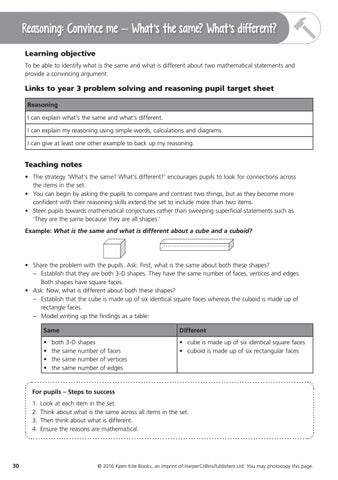
Teaching notes • The strategy ‘What’s the same? What’s different?’ encourages pupils to look for connections across the items in the set. • You can begin by asking the pupils to compare and contrast two things, but as they become more confident with their reasoning skills extend the set to include more than two items. • Steer pupils towards mathematical conjectures rather than sweeping superficial statements such as ‘They are the same because they are all shapes.’ Example: What is the same and what is different about a cube and a cuboid?
• Share the problem with the pupils. Ask: First, what is the same about both these shapes? – Establish that they are both 3-D shapes. They have the same number of faces, vertices and edges. Both shapes have square faces. • Ask: Now, what is different about both these shapes? – Establish that the cube is made up of six identical square faces whereas the cuboid is made up of rectangle faces. – Model writing up the findings as a table: Same
Different
• • • •
• cube is made up of six identical square faces • cuboid is made up of six rectangular faces
both 3-D shapes the same number of faces the same number of vertices the same number of edges
For pupils – Steps to success 1. 2. 3. 4.
30
Look at each item in the set. Think about what is the same across all items in the set. Then think about what is different. Ensure the reasons are mathematical.
© 2016 Keen Kite Books, an imprint of HarperCollinsPublishers Ltd. You may photocopy this page.
Reasoning: Convince me – What’s the same? What’s different? Bank of ‘Convince me – What’s the same? What’s different? questions 1. What is the same and what is different about this set of numbers? • 7 hundreds, 2 tens, 6 ones • 72 tens, 6 ones • 7 hundreds, 26 ones • 6 hundreds, 12 tens and 6 ones 2. What is the same and what is different about the perimeter of these shapes? 2cm 5cm 8cm
8cm
5cm 6cm
2cm
6cm
5cm
5cm
3cm
5cm
3. What is the same and what is different about these times? • Twenty-five to five o’clock in the evening • 16:35 • 4.35pm
XII
XI
I
X
II
IX
III
VIII
IV VII
VI
V
4. What is the same and what is different about these calculations? • 735 + 265 • 562 + 438 • 754 + 246 • 125 + 875 5. What’s the same? What’s different? 0.5
5 tenths
0 1 2 3 4 5 6 7 8 9 10 10 10 10 10 10 10 10 10 10 10 10 0
5 10
5 ÷10
1
6. Look at these two calculations. What is the same and what is different? 6 2 ×
3
1
8 6 180
See the pupil activities marked with the this strategy.
6
= 186
icon on pages 34 to 36 for topic-based practice of
© 2016 Keen Kite Books, an imprint of HarperCollinsPublishers Ltd. You may photocopy this page.
31
Reasoning: If the answer is X what is the question? Learning objective To come up with as many different possible questions that could have the given answer.
Links to year 3 problem solving and reasoning pupil target sheet Reasoning I can explain my reasoning using simple words, calculations and diagrams. I can give at least one other example to back up my reasoning.
Teaching notes • This strategy encourages pupils to think that there is more than one answer to a problem. • Encourage pupils to look for patterns to help generate more possible questions. For example: If the answer is 600 then: – 500 + 100 – 400 + 200 – 300 + 300 – 200 + 400* – 100 + 500* Ask pupils to consider if the questions with an asterisk* are different from the ones given above. • Also, encourage pupils to think across a range of mathematical ideas so that their answers are not always too repetitive and always using the same operation. Example: If the answer is 64 what is the question? • Share the following possible questions that could match the answer 64. – Model how to use a mind map and explicitly discuss with the pupils how the questions draw on different Year 3 curriculum content areas. 8×8 100 − 36
1 4 of 256
Sam has £1. He buys a lolly for 20p and a packet of sweets for 16p. How much change does he get from £1?
64 50 + 14
40 + 24
30 + 34
512 seashells are shared between eight buckets. How many seashells are in each bucket?
32
© 2016 Keen Kite Books, an imprint of HarperCollinsPublishers Ltd. You may photocopy this page.
Reasoning: If the answer is X what is the question? For pupils – Steps to success 1. Write the answer in the centre of the page. 2. Find as many different questions to match the answer given: • Look for patterns to generate different questions. • Think of different areas of mathematics to find a range of questions.
Bank of ‘If the answer is X what is the question?’ questions
1. The answer to Ravi’s calculation is 780. What could the question to his calculation be using at least three different operations? 780
2. If the answer is 1 , what could the 2 question be?
3. If the answer is £2.75, what could the question be?
4. If the answer is 100mL, what could the question be?
5. If the answer is 20 minutes, what could the question be?
6. If the answer is 250g, what is the question?
7. If the answer is 3 of a metre, what 4 is the question?
See the pupil activities marked with the this strategy.
8. If the answer is 1000, what is the question?
icon on pages 34 to 36 for topic-based practice of
© 2016 Keen Kite Books, an imprint of HarperCollinsPublishers Ltd. You may photocopy this page.
33
Measures 1 Remember, mass uses the units kilograms (kg) and grams (g). Capacity uses the units litres (L) and milliletres (mL). There are 1000mL in 1L. There are 1000g in 1kg. Example:
450mL
300mL
450mL + 300mL = 750mL. This is less than one litre.
Getting started 1
Look at each statement. Decide which is true and which is false. Explain your reasoning. a) 1kg = 1000g b) 1 litre < 750mL c) 400g < 1kg d) 1500mL > 1 litre e) 1kg and 1g = 1100g f) 2 litres < 2200mL
2
Sam adds the weight of these parcels. He says the total amount is less than 1kg. Do you agree? Explain your reasoning. 450g
3
375g
Here are two bottles of a refreshing summer drink. It is a hot day and you are feeling very thirsty. Which bottle of drink would you rather have? Explain your reasoning.
1 litre
54
145g
750mL
Challenge 1 4
Here is a large flask and a teapot. The bottles next to them show their capacity.
2L
250mL
250mL
1L
250mL
150mL 150mL
How much more water does the flask hold than the teapot? 5
Megan arranges the parcels on the scales from heaviest to lightest like this: 1500g 1
0
Kg
2000g
750g
3
0.5
2 1 2
0
Kg
4 5 0
Kg
1
Do you agree with her? Explain your reasoning.
Challenge 2 6
Ben needs 12 litres of water to wash the car. He decides to the fill the bucket up using a 100mL bottle, a 250mL cup and a 1.5 litre bottle. How many different ways can Ben fill the bucket?
7
Lin has five small blocks which are all the same. She balances them on the scale with two weights. Can you find the weight of one small block?
1
750g
How did you do?
14 kg
55
Money Remember, in the UK the units pounds (£) and pence (p) are used for money.
Example: Amy buys a chicken sandwich for £2.50 and glass of orange juice for £1.25. How much change will she get from £5? £2.50 + £1.25 = £3.75
£5 − £3.75 = £1.25
Getting started 1
2
Work out which statements are true and which are false. Explain your reasoning. =
£2
<
£2
=
£2
>
£2
>
£2
Solve these word problems. a) How much change would Raj get from £10 if he spent £5.60 on his shopping? b) Sam buys one adult bus ticket costing £2.40 and two child bus tickets costing £1.10 each. How much does he pay in total? c) If I buy a sandwich for £3.30 and a drink for 80p, how much change do I get from £5? d) Ellie buys two pencils. She pays with a £2 coin and gets 70p change. How much did each pencil cost?
58
Challenge 1 3
Kemi has only three coins in her purse. Which amount could she not have in her purse? £1 and 20p
£1 and 12p
£1 and 15p
£1 and 9p
£1 and 25p
£1 and 4p
£1 and 21p
4
Jen took £2.50 to a cake sale and bought some cakes. At the end of the sale she had 30p left. What items could Jen have bought?
5
Josh and Ravi go to the cinema. They each buy one small box of popcorn. The lady at the popcorn counter says they would save 75p if they bought a large box of popcorn and shared it. What do you think? Explain your reasoning.
£1.75
£3.20
Challenge 2 6
Raj writes some statements about money. Look at each statement and decide if it is true or false. a) £1 and 33p can be made with exactly three coins. b) £1 and 33p can be made with exactly four coins. c) £1 and 33p can be made with exactly five coins. d) £1 and 33p can be made with exactly six coins. e) £1 and 33p can be made with exactly seven coins. f) £1 and 33p can be made with exactly eight coins.
7
Ben and Omar have saved some money. Altogether they have saved £40. Ben has saved £3 more than Omar. How much have they each saved?
How did you do?
59