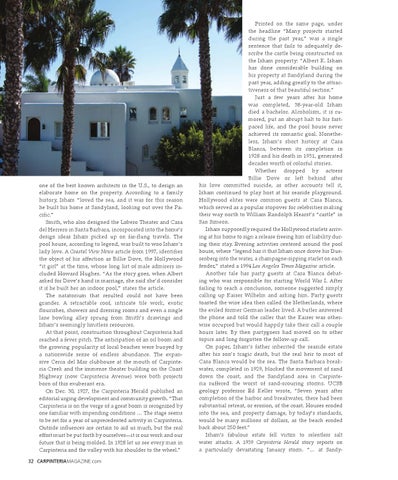
one of the best known architects in the U.S., to design an elaborate home on the property. According to a family history, Isham “loved the sea, and it was for this reason he built his home at Sandyland, looking out over the Pacific.” Smith, who also designed the Lobero Theater and Casa del Herrero in Santa Barbara, incorporated into the home’s design ideas Isham picked up on far-flung travels. The pool house, according to legend, was built to woo Isham’s lady love. A Coastal View News article from 1997, identifies the object of his affection as Billie Dove, the Hollywood “it girl” at the time, whose long list of male admirers included Howard Hughes. “As the story goes, when Albert asked for Dove’s hand in marriage, she said she’d consider it if he built her an indoor pool,” states the article. The natatorium that resulted could not have been grander. A retractable roof, intricate tile work, exotic flourishes, showers and dressing rooms and even a single lane bowling alley sprung from Smith’s drawings and Isham’s seemingly limitless resources. At that point, construction throughout Carpinteria had reached a fever pitch. The anticipation of an oil boom and the growing popularity of local beaches were buoyed by a nationwide sense of endless abundance. The expansive Cerca del Mar clubhouse at the mouth of Carpinteria Creek and the immense theater building on the Coast Highway (now Carpinteria Avenue) were both projects born of this exuberant era. On Dec. 30, 1927, the Carpinteria Herald published an editorial urging development and community growth. “That Carpinteria is on the verge of a great boom is recognized by one familiar with impending conditions … The stage seems to be set for a year of unprecedented activity in Carpinteria. Outside influences are certain to aid us much, but the real effort must be put forth by ourselves—it is our work and our future that is being molded. In 1928 let us see every man in Carpinteria and the valley with his shoulder to the wheel.”
Printed on the same page, under the headline “Many projects started during the past year,” was a single sentence that fails to adequately describe the castle being constructed on the Isham property: “Albert K. Isham has done considerable building on his property at Sandyland during the past year, adding greatly to the attractiveness of that beautiful section.” Just a few years after his home was completed, 38-year-old Isham died a bachelor. Alcoholism, it is rumored, put an abrupt halt to his fastpaced life, and the pool house never achieved its romantic goal. Nonetheless, Isham’s short history at Casa Blanca, between its completion in 1928 and his death in 1931, generated decades worth of colorful stories. Whether dropped by actress Billie Dove or left behind after his love committed suicide, as other accounts tell it, Isham continued to play host at his seaside playground. Hollywood elites were common guests at Casa Blanca, which served as a popular stopover for celebrities making their way north to William Randolph Hearst’s “castle” in San Simeon. Isham supposedly required the Hollywood starlets arriving at his home to sign a release freeing him of liability during their stay. Evening activities centered around the pool house, where “legend has it that Isham once drove his Duesenberg into the water, a champagne-sipping starlet on each fender,” stated a 1994 Los Angeles Times Magazine article. Another tale has party guests at Casa Blanca debating who was responsible for starting World War I. After failing to reach a conclusion, someone suggested simply calling up Kaiser Wilhelm and asking him. Party guests toasted the wise idea then called the Netherlands, where the exiled former German leader lived. A butler answered the phone and told the caller that the Kaiser was otherwise occupied but would happily take their call a couple hours later. By then partygoers had moved on to other topics and long forgotten the follow-up call. On paper, Isham’s father inherited the seaside estate after his son’s tragic death, but the real heir to most of Casa Blanca would be the sea. The Santa Barbara breakwater, completed in 1929, blocked the movement of sand down the coast, and the Sandyland area in Carpinteria suffered the worst of sand-scouring storms. UCSB geology professor Ed Keller wrote, “Seven years after completion of the harbor and breakwater, there had been substantial retreat, or erosion, of the coast. Houses eroded into the sea, and property damage, by today’s standards, would be many millions of dollars, as the beach eroded back about 250 feet.” Isham’s fabulous estate fell victim to relentless salt water attacks. A 1939 Carpinteria Herald story reports on a particularly devastating January storm. “… at Sandy-
32 CARPINTERIAMAGAZINE.com
CarpMag_2014_Winter.indd 32
11/4/14 12:57 PM