RPO Program

Page 1


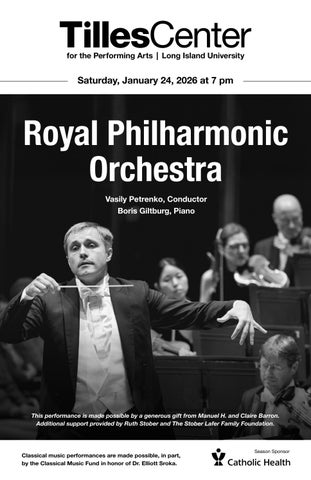
Saturday, January 24, 2026 at 7 pm

Royal Philharmonic Orchestra

This performance is made possible by a generous gift from Manuel H. and Claire Barron. Additional support provided by Ruth Stober and The Stober Lafer Family Foundation.

Classical music performances are made possible, in part, by the Classical Music Fund in honor of Dr. Elliott Sroka.

Vasily Petrenko, Conductor Boris Giltburg, Piano

BERLIOZ

BEETHOVEN

Béatrice et Bénédict, H.138: Overture

Piano Concerto No. 1 in C major, Op.15

Allegro con brio

Largo

Rondo. Allegro scherzando

INTERMISSION

SHOSTAKOVICH

Symphony No. 10 in E minor, Op. 93

Moderato

Allegro

Allegretto

Andante – Allegro

NOTES ON THE PROGRAM

Béatrice et Bénédict, H.138: Overture

HECTOR BERLIOZ (1803–1869)

Hector Berlioz was a creative one-off – a genius of such blinding vision that most of his contemporaries didn’t know what to make of him. ‘A thing is never beautiful or ugly for Berlioz,’ observed the distinguished critic Ernest Newman, ‘it is either divine or horrible.’ Celebrated pianist and composer Ferdinand Hiller noticed the same dichotomy in Berlioz’s facial features: ‘…the glance one moment flashing, actually burning, and the next moment dull, lustreless, almost dying – the expression of his mouth alternating between energy and withering contempt, between friendly smiling and scornful laughter!’

Berlioz’s maverick genius first became apparent in 1830 with his trailblazing Symphonie fantastique, an epoch-defining masterwork that announced a series of bracingly unconventional scores. These included a second symphony (Harold in Italy) scored uniquely for solo viola and orchestra, a third (Romeo and Juliet) whose dazzling theatricality has one foot in the opera house, and Le damnation de Faust, a genre-busting adaptation of Goethe’s Gothic tale. Berlioz’s five-hour epic opera The Trojans defied all attempts to get a complete production staged during his lifetime, and although his light-hearted follow-up, Béatrice et Bénédict, was well received, it proved a sad case of too little too late. He died a disconsolate and lonely figure. An 1864 diary entry says it all: ‘My contempt for the folly and baseness of mankind, my hatred of its atrocious cruelty, has never been so intense.’

Although Berlioz composed several works which eclectically draw upon theatrical staging and operatic paraphernalia, he completed only three which were indisputably intended for the opera house: Benvenuto Cellini (1838), Les Troyens (first version, 1858) and Béatrice et Bénédict (1862). The latter, based on Shakespeare’s Much Ado About Nothing, was Berlioz’s last major work, and is uncharacteristically light in tone, or as he himself put it, ‘written with the point of a needle’. The fleet-fingered, rhythmically buoyant Overture anticipates some of the opera’s melodic material yet dazzlingly manages to avoid the customary potpourri of edited highlights.

Programme note © Julian Haylock, edited by the Royal Philharmonic Orchestra

Piano Concerto No. 1 in C major, Op.15

LUDWIG VAN BEETHOVEN (1770–1827)

Ludwig van Beethoven’s early musical career was linked inextricably with the piano, both as a performer and composer. His early lessons at the hands of his alcoholic father would have broken many a lesser child – the boy Ludwig was regularly dragged from his bed for an impromptu tutorial, or to perform in front of a drunken gathering. Late at night, neighbours reported seeing him practice ‘standing on a low bench in front of his clavier, sobbing fitfully’ as his father looked menacingly on. Despite this appalling abuse, by his early 20s, Beethoven had taken Vienna’s salons by storm.

By now, Beethoven was already more than a match for any of his contemporaries in Germany, as can be gathered from an account given in the magazine Musikal by Carl Junker in 1791: ‘I also heard one of the greatest of pianists – the dear, good Beethoven... I heard him extemporise in private; yes I was even invited to propose a theme for him to vary. The greatness of this amiable, light-hearted young man as a virtuoso, may in my opinion be safely estimated from his almost inexhaustible wealth of ideas, the altogether unique expression in his playing, and the great powers of execution which he displays.’

From now on, Beethoven’s musical development progressed at a staggering rate. He moved to Vienna, had a series of indifferent consultations with Joseph Haydn, and quickly realised that the only way forward was to win sponsorship from wealthy patrons. Accordingly, he dedicated his Op. 1 Piano Trios to that great lover of chamber music, Count Moritz Lichnovsky (brother of Karl). This shameless piece of flattery clearly had the desired effect, for within a month of the publication of the trios, Beethoven was invited to premiere three new piano sonatas (destined to become Nos. 1–3) at the Count’s palace.

The resulting triumph led to a series of concerts in the city’s salons, throughout which Beethoven amazed all onlookers with his unconventional playing and phenomenal powers of improvisation. On 29 March 1795, Beethoven created a sensation with the premiere of his B-flat major Piano Concerto (destined to become ‘No. 2’ in its revised form). By now, he had made many personal enemies of pianists who had fallen by the wayside in comparison with his somewhat unruly but prodigious talent. Yet despite his unpredictable behaviour and irascible outbursts, the aristocracy had taken him very much to its collective bosom. Indeed, such was his success that by the turn of the century, Beethoven had become fully established both as an independent pianist and composer and can therefore be considered the first major freelance musician.

The First Piano Concerto was dedicated to Countess Babette von Keglevics, a gifted pupil with whom the 25-year-old composer was very much enamoured at the time. Cast in the standard three movements, it brims over with original touches, such as the very opening, where the militaristic first theme is played not by the trumpets (as would have been customary at the time) but by the strings playing pianissimo (very quietly). The second main ‘theme,’ announced by the first violins, turns out to be little more than a decorated descending scale answered by a rising/falling chord sequence in the woodwind. Then, most surprisingly, the piano’s very first entry has very little to do with this introductory material at all. Beethoven retained a great deal of affection for this opening movement, for which he wrote no fewer than three versions of the soloist’s cadenza.

The central Largo is the longest of all Beethoven’s concerto slow movements, its calm, flowing phrases providing the perfect antidote to the opening Allegro con brio’s muscular athleticism. For the finale, Beethoven lets his hair down with a scampering main theme introduced by the soloist and immediately taken up by the full orchestra. He saves his best joke for the very end, when just as it sounds as though the music has quietly petered out, he adds a final vivacious outburst that never fails to catch out the unwary listener.

Programme note © Julian Haylock, edited by the Royal Philharmonic Orchestra

Symphony No. 10 in E minor, Op. 93

DMITRI SHOSTAKOVICH (1906–1975)

Dmitri Shostakovich was Russia’s finest post-revolutionary composer. Artistically highly complex and enigmatic, nothing in his music is ever quite as it seems. Like Gustav Mahler, Shostakovich viewed the symphony as an all-embracing psychological drama. Unlike Mahler, he spent the greater part of his creative life under an oppressive political regime that denied him absolute freedom of expression and ultimately led him to deal in secret musical codes and ciphers. As a result, much of Shostakovich’s symphonic work can rarely be taken at face value. The semantic uncertainty of Shostakovich’s musical metaphors is made all the more harrowing by their presentation, with passages of fiery, naked aggression often colliding almost headlong into music of fragile purity.

More than any of his previous symphonies, the Tenth brings to a head the expressive ambiguities inherent in Shostakovich’s bewilderingly complex musical personality. It is also the one that lies closest to the claustrophobic, highly introspective world of his string quartets. Following close after the death of Stalin in the spring of 1953, during a period of comparatively relaxed political interference (even Pravda, the official Soviet newspaper, openly encouraged increased ‘independence, courage and experimentation’), there were many who had expected an optimistic symphonic embracing of new artistic freedoms –they were sorely disappointed.

Shostakovich composed the Tenth Symphony during a spell of intense creative activity in the summer of 1953. Retiring to his favourite country house (or ‘dacha’), which he rented in Komarovo, he worked from July to September like a man possessed, starting straight after breakfast and working through until late into the following evening, allowing himself only a short break for lunch. Clearly exhausted by such a punishing schedule, the 47-yearold composer later reflected, somewhat self-deprecatingly, that this had been ‘more of a defect than a virtue, because there is much that cannot be done well when one works so fast.’

The premiere was given on 17 December by the Leningrad Philharmonic Orchestra under Yevgeny Mravinsky, Shostakovich’s regular symphonic protagonists, and made an overwhelming impression, even if some found the decidedly bleak outlook rather forbidding. Shostakovich’s colleague and almost exact contemporary, Dmitri Kabalevsky, revealingly commented: ‘I am deeply convinced that the conflict it portrays arises from the tension now existing throughout the world,’ a view that was fully endorsed by Vaclav Dobias: ‘Few contemporary composers could have reflected the grief and hopes of contemporary man as Shostakovich has in his Tenth Symphony.’ However, many felt that far from offering a mouthpiece for the hopes, aspirations and feelings of the Soviet ‘everyman,’ Shostakovich had turned in on himself as never before. The result is a severely isolationist musical landscape of almost unremitting pain and anguish, whose unsettling influence underpins even the superficial optimism of the closing pages.

Such was the interest generated by this first major post-Stalinist musical offering that the Moscow branch of the Union of Soviet Composers spent three days debating the work’s meaning and impact, and whether it was worthy of an ‘official’ seal of approval. For his part, Shostakovich remained obstinately secretive about the work: ‘It would be much more

interesting for me to know what the listener thinks and to hear his remarks,’ he insisted, whilst intimating that there was indeed a specific underlying programme. When later pushed further to reveal the nature of this ‘secret story,’ he remained unmoved: ‘No! Let them listen and guess for themselves.’ The only certainty regards the terrifying whiplash scherzo second movement that appears to have been intended as a musical portrait of Stalin himself.

The opening Moderato, by far the longest of the four movements, is among Shostakovich’s most personal utterances, a chilling, desolate musical landscape inhabited by the ghosts of those who suffered and perished under the Stalinist regime. The unremitting, gloomy intensity of the composer’s vision is encapsulated via a supreme economy of material, the entire structure being derived from the tormented juxtapositions of three main themes. The first is announced at the very opening by cellos and basses, rising effortfully from the depths as though it were carrying the burden of Soviet oppression on its back, only to find release in a more lyrically expressive idea introduced initially by the clarinet, whose insidious, winding profile suggests feelings of utter desolation lying behind the thin veil of heightened expressive warmth. A third theme, led by the flute, takes the process still further, the macabre sensation of a slow waltz sustaining such emotional pressure being disturbingly at odds with its normally fragile, salonesque associations.

There follows a bombastic, visceral Allegro that dramatically counterbalances the ambiguities of the opening movement with its unmistakable directness of utterance. Intended as a musical portrait of Stalin, the mind-numbing senselessness of its hurtling forward momentum leaves one in no doubt as to Shostakovich’s allegiances. Unquenchable motoric rhythms and throttling outbursts of uncompromising angularity combine to unleash this devastating cry of political outrage.

With the Allegretto third movement, a special sense of personal identity is suggested by the appearance of Shostakovich’s musical monogram, DSCH. Derived from the German transliteration of his name (Dmitri SCHostakovich), and then converted from Germanic nomenclature (S=Es=E flat; H=B natural), the resulting four-note motto (D–E flat–C–B) became a prominent feature in the composer’s music, perhaps most notably the autobiographical Eighth String Quartet (1961), which is saturated with it. Here, the DSCH motif first appears in the flute and piccolo as an extension of the distorted, almost satirised waltz with which the movement opens. The strangely disembodied nature of this spectral domain makes it the most enigmatic movement of all. In contrast to the clenched-fist impact of the remainder of the work, one encounters a world of uncertainty, an impenetrable sequence of remote musical metaphors, the exact meaning of which lies tantalisingly obscured from view.

The finale seeks to resolve these ectoplasmic meanderings with grand gestures of a generally more affirmative nature, yet one still senses an underlying angst which threatens to destabilise the whole structure. Eventually, this erupts in the form of the most bitingly cynical ending to any of Shostakovich’s works, with a major-key transformation that surrealistically sends up this apparently triumphal resolution in a way that recalls the knockabout antics of a Marx Brothers movie. Shostakovich saved his best double-take till last.

MEET THE ARTISTS

VASILY PETRENKO, CONDUCTOR

Vasily Petrenko is Music Director of the Royal Philharmonic Orchestra, a position he assumed in 2021, and which ignited a partnership that has been praised by audiences and critics worldwide. The same year, he became Conductor Laureate of the Royal Liverpool Philharmonic Orchestra, following his hugely acclaimed 15-year tenure as their Chief Conductor from 2006 to 2021. He is the Associate Conductor of the Orquesta Sinfónica de Castilla y León and has also served as Chief Conductor of the European Union Youth Orchestra (2015–2024), Chief Conductor of the Oslo Philharmonic Orchestra (2013–2020) and Principal Conductor of the National Youth Orchestra of Great Britain (2009–2013). He stood down as Artistic Director of the State Academic Symphony Orchestra of Russia ‘Evgeny Svetlanov’ in 2022, having been their Principal Guest Conductor from 2016 and Artistic Director from 2020.

He has worked with many of the world’s most prestigious orchestras, including the Berlin Philharmonic, Bavarian Radio Symphony, Leipzig Gewandhaus, London Symphony, London Philharmonic, Philharmonia, Accademia Nazionale di Santa Cecilia (Rome), St Petersburg Philharmonic, Orchestre National de France, Czech Philharmonic and NHK Symphony orchestras, and in North America has led the Philadelphia Orchestra, Los Angeles Philharmonic Orchestra, Cleveland Orchestra, and the San Francisco, Boston and Chicago Symphony orchestras. He has appeared at the Edinburgh Festival, Grafenegg Festival and BBC Proms. Equally at home in the opera house, and with over 30 operas in his repertoire, Vasily has conducted widely on the operatic stage, including at Glyndebourne Festival Opera, the Opéra National de Paris, Opernhaus Zürich, Bayerische Staatsoper and the Metropolitan Opera, New York.

Recent highlights as Music Director of the Royal Philharmonic Orchestra have included wide-ranging touring across major European capitals and festivals, China, Japan and the USA. In London, recent acclaimed performances have included Mahler’s choral symphonies and concerts with Yunchan Lim and Maxim Vengerov at the Royal Albert Hall, performances at the BBC Proms, and the Icons Rediscovered and Lights in the Dark series. In the 2025–26 Season, at the Royal Albert Hall, they will perform three mighty Mahler’s symphonies alongside Bernstein’s Chichester Psalms and Korngold’s Violin Concerto. At the Royal Festival Hall, highlights include Shostakovich’s Symphony No.10, Messiaen’s Turangalîla-Symphonie, orchestral music from Wagner’s Parsifal and Scriabin’s Symphony No. 3, ‘The Divine Poem.’ Vasily has established a strongly defined profile as a recording artist. Amongst a wide discography, his Shostakovich, Rachmaninov and Elgar symphony cycles with the Royal Liverpool Philharmonic Orchestra have garnered worldwide acclaim. With the Oslo Philharmonic Orchestra, he has released cycles of Scriabin’s symphonies and Strauss’ tone poems, and an ongoing series of the symphonies of Prokofiev and Myaskovsky. In autumn 2025, he launched a new partnership between the Royal Philharmonic Orchestra and the Harmonia Mundi label, with Elgar’s Falstaff and Rachmaninov’s The Bells, to be followed by subsequent releases of Strauss, Bartók and Stravinsky.

Born in 1976, Vasily was educated at the St Petersburg Capella Boys Music School and St Petersburg Conservatoire. He was Gramophone Artist of the Year (2017), Classical BRIT Male Artist of the Year (2010), and holds honorary degrees from Liverpool’s three universities. In 2024, Vasily also launched a new academy for young conductors, coorganised by the Primavera Foundation Armenia and the Armenian National Philharmonic Orchestra.

vasilypetrenkomusic.com

BORIS GILTBURG, PIANO

Artist-in-Residence (25/26), Dresden Philharmonie

Guest Artistic Curator (25/26 - 27/28), Portland Piano International

Boris Giltburg is lauded across the globe as a deeply sensitive, insightful and compelling interpreter for his narrative-driven approach to performance. Critics have praised his “interplay of spiritual calm and emphatic engagement” as “gripping... one could not wish for a more illuminating, lyrical or more richly phrased interpretation” (Suddeutsche Zeitung).

During the 2025/26 season, Giltburg appears with the Leipzig Gewandhaus Orchestra, Frankfurt Radio Symphony, Philharmonia Orchestra, Helsinki Philharmonic, Salzburg Mozarteum, Warsaw Philharmonic, Essen Philharmonic, Basque National and Taipei Symphony orchestras. Throughout the season, Giltburg is Artist-in-Residence at the Dresdner Philharmonie and returns to the orchestra on three occasions, and embarks on a tour to Italy. This season sees Giltburg collaborating with leading conductors including, Jukka-Pekka Saraste, Krzysztof Urbański, Dima Slobodeniouk, Dalia Stasevska, Kahchun Wong, Jun Märkl and Anja Bihlmaier. Giltburg’s long list of orchestral collaborators extends to the Czech Philharmonic, Orchestra dell’Accademia Nazionale di Santa Cecilia, Finnish Radio Symphony, Orchestre National de France, Oslo Philharmonic, Philharmonia Orchestra, NHK Symphony and Seoul Philharmonic, among others.

Giltburg regularly gives recitals in the world’s most prestigious halls, including Concertgebouw, Amsterdam; BOZAR, Brussels; Elbphilharmonie, Hamburg; Southbank Centre and Wigmore Hall, London; Carnegie Hall, New York; Rudolfinum, Prague; and Konzerthaus, Vienna. Following the success of his Beethoven Piano Sonatas cycle across eight sold-out concerts at the Wigmore Hall, he continues the project at Flagey, Brussels, Palau de la Música, Valencia and Teatro Municipal in Santiago de Chile. In recent years Giltburg has also engaged in a series of in-depth explorations of other major composers such as Ravel and Chopin.

Giltburg is widely recognized as a leading interpreter of Rachmaninov: “His originality stems from a convergence of heart and mind, served by immaculate technique and motivated by a deep and abiding love for one of the 20th century’s greatest composerpianists.” (Gramophone). This season sees Giltburg perform the complete Rachmaninov Preludes during the opening weekend of the Southbank Centre’s 25/26 season and Rachmaninov’s 3rd Piano Concerto with the Philharmonia Orchestra at Bold Tendencies. In 2025 Giltburg released an album of Rachmaninov’s landmark Piano Sonatas nos. 1 and

2 alongside his own version of The Isle of the Dead, based on Krikor’s arrangement, which received the Preis der deutschen Schallplattenkritik / German Record Critics’ Award.

A consummate recording artist, Giltburg has recorded exclusively for Naxos since 2015. He was awarded the Opus Klassik Award for Best Soloist Recording of Rachmaninov’s concerti and Etudes Tableaux and a Diapason d’Or for Shostakovich concerti and his own arrangement of Shostakovich’s Eighth String Quartet. Among others, he has won a Gramophone Award for the Dvořák Piano Quintet on Supraphon with his regular collaborators, the Pavel Haas Quartet, as well as a Diapason d’Or and Choc de Classica for their joint release of the Brahms Piano Quintet.

Giltburg feels a strong urge to engage audiences beyond the concert hall. His blog “Classical Music for All” is aimed at a non-specialist audience, which he complements with articles in publications such as Gramophone, BBC Music Magazine, The Guardian and The Times.

‘AN ORCHESTRA ON TOP FORM’ THE GUARDIAN ON THE ROYAL PHILHARMONIC ORCHESTRA

The Royal Philharmonic Orchestra (RPO), with Music Director Vasily Petrenko, is on a mission to bring the thrill of live orchestral music to the widest possible audience. The RPO’s musicians believe that music can – and should – be a part of everyone’s life, and they aim to deliver on that belief through every note. Based in London and performing around 200 concerts per year worldwide, the RPO brings the same energy, commitment and excellence to everything it plays, be that the great symphonic repertoire, collaborations with pop stars, or TV, video game and movie soundtracks. Proud of its rich heritage yet always evolving, the RPO is regarded as the world’s most versatile symphony orchestra, reaching a live and online audience of more than 70 million people each year.

Founded in 1946 by Sir Thomas Beecham, live performance has always been at the heart of what the RPO does, and through its thriving artistic partnership with Vasily Petrenko, the RPO has reaffirmed its status as one of the world’s most respected and in-demand orchestras. In London, that means flagship concert series at Cadogan Hall, the Southbank Centre’s Royal Festival Hall, and the iconic Royal Albert Hall, where the RPO is proud to be Associate Orchestra. The Orchestra is also thrilled to be resident in four areas of the UK: Crawley, Hull, Northampton and Reading. And around the world, the RPO flies the flag for the best of British music-making.

The RPO remains true to its pioneering, accessible roots. Now in its fourth decade, the RPO Resound community and education programme continues to thrive as one of the UK’s – and the world’s – most innovative and respected initiatives of its kind.

Passionate, versatile and uncompromising in its pursuit of musical excellence, the Orchestra looks to the future with a determination to explore, to share and to reaffirm its reputation as an orchestra with a difference: open-minded, forward-thinking and accessible to all.

Discover more online at rpo.co.uk

ROYAL PHILHARMONIC ORCHESTRA

FIRST VIOLINS

Duncan Riddell

Tamás András

Janice Graham

Esther Kim

Lauren Bennett

Savva Zverev

Andrew Klee

Kay Chappell

Anthony Protheroe

Erik Chapman

Adriana Iacovache-Pana

Imogen East

Momoko Arima

Judith Choi-Castro

Joanne Chen

Izzy Howard

SECOND VIOLINS

Andrew Storey

Alexandra Lomeiko

Charlotte Ansbergs

Jennifer András

Peter Graham

Stephen Payne

Manuel Porta

Inês Soares Delgado

Sali-Wyn Ryan

Charles Nolan

Susie Watson

Matthew Oshida

Clare Wheeler

Susan Evans

VIOLAS

Abigail Fenna

Wenhan Jiang

Liz Varlow

Joseph Fisher

Ugne Tiškuté

Esther Harling

Jonathan Hallett

Pamela Ferriman

Gemma Dunne

Raquel Lopez Bolivar

Kate Correia De Campos

Annie-May Page

CELLOS

Rosie Biss

Jonathan Ayling

Chantal Woodhouse

Roberto Sorrentino

Jean-Baptiste Toselli

Rachel van der Tang

Naomi Watts

Anna Stuart

Emma Black

George Hoult

DOUBLE BASSES

Jason Henery

Alice Durrant

Ben Wolstenholme

Joe Cowie

Martin Lüdenbach

Lewis Reid

Guillermo Arevalos

James Goode

FLUTES

Amy Yule

Joanna Marsh

Diomedes Demetriades

PICCOLO

Diomedes Demetriades

Joanna Marsh

OBOES

Tom Blomfield

Hannah Condliffe

Patrick Flanaghan

COR ANGLAIS

Patrick Flanaghan

CLARINETS

Sonia Sielaff

Katy Ayling

James Gilbert

E-FLAT CLARINET

James Gilbert

BASSOONS

Richard Ion

Ruby Collins

Fraser Gordon

CONTRABASSOON

Fraser Gordon

HORNS

Alexander Edmundson

Ben Hulme

Finlay Bain

Zoë Tweed

Paul Cott

TRUMPETS

Matthew Williams

Kaitlin Wild

Mike Allen

Toby Street

TROMBONES

Roger Cutts

Ryan Hume

BASS TROMBONE

Josh Cirtina

TUBA

Josh Cirtina

TIMPANI

James Bower

PERCUSSION

Stephen Quigley

Martin Owens

Gerald Kirby

Richard Horne

Saturday, January 24, 2026, 7pm | Tilles Center for

MANAGEMENT TEAM

Managing Director

Sarah Bardwell

Business Development Director /

Deputy Managing Director

Huw Davies

Finance Director

Ann Firth

Director of Artistic Planning and Partnerships

Tom Philpott

Concerts Director

Frances Axford Evans

Tours Manager

Rose Hooks

Tours Coordinator

Victoria Webber

Director of Community and Education

Chris Stones

Senior Orchestra Manager

Kathy Balmain

Orchestra Manager

Rebecca Rimmington

Librarian

Patrick Williams

Stage Managers

Dan Johnson

Toni Abell

Sam Swift

Adam Pascal
Isaac Mizrahi
Royal Philharmonic Orchestra
Indigo Girls
ABT Studio Company
Dianne Reeves
Silkroad Ensemble with Rhiannon Giddens
Josh Groban

Turn static files into dynamic content formats.

Create a flipbook
Issuu converts static files into: digital portfolios, online yearbooks, online catalogs, digital photo albums and more. Sign up and create your flipbook.
RPO Program by Tilles Center for the Performing Arts - Issuu