This is an official Army publication, prepared under the direction of the Centre for Historical Analysis and Conflict Research (CHACR). The information it contains is for official use only and may not be reproduced for publication in any form without the express permission of the Ministry of Defence. Individuals or agencies wishing to reproduce material should contact the Editor. The views expressed herein are those of the author concerned and do not necessarily conform to official policy. Crown Copyright applies to all material published in this Review except where acknowledgement is made to another copyright holder; this does not affect the intellectual property rights of non-MoD authors. No article, illustration or image may be reproduced without the permission of the Editor.
Clearance: All military contributors are responsible for clearing their material at commanding officer or equivalent level. Beyond this, responsibility for clearance with the MoD lies with the Editor. Contribution from overseas commands must be cleared by the relevant Command Headquarters before submission. The British Army Review assumes such clearance has taken place.
Submissions: Articles should not normally exceed 3,000 words. Material for the next issue should be sent, for the Editor’s consideration, to:
The British Army Review, Robertson House, Royal Military Academy Sandhurst, Camberley GU15 4NP
AI, Automation, and War: The Rise of a Military-Tech Complex
55 DOCTRINE Newly released publications
FROM THE EDITOR
REPUTATIONS NEED RESOURCING
Allow me to begin this editorial leader where my last left off: “If you’re not swotting up on NATO and all-things Allied Rapid Reaction Corps it’s time to get cramming.” This ‘answer’ to the countering Russian expansionism exam question was robustly, and repeatedly, proffered at the Centre for Historical Analysis and Conflict Research’s latest conference, which included the Chief of the General Staff and an array of defence experts – uniformed and academic, British and beyond – among its speakers.
‘NATO must be the main effort’, ‘no service or nation can meet the demand alone’, ‘NATO is the only option we have’. For those in the British Army this is not a revelation. The Security Defence Review was explicit as to the necessary direction of travel – ‘NATO First’ –and the Service is doing all that it can to act today and rapidly modernise its capabilities to ensure it can meaningfully contribute to deterring or, should the need arise, countering any further acts of Russian aggression on Alliance soil.
The message from within the ranks is that the demand from Brussels can be met, that we are ‘good for a corps’ and that the British Army will do as it always does, step up and be counted. Few of our allies, while cognisant of the significant economic and capability challenges faced by the UK’s Armed Forces, doubt this to be the case. As evidenced by the insights shared on the pages that follow, the Army brand – based on a compelling mix of professionalism and strong moral fibre – remains largely unblemished. The Service, like any other organisation or institution, is imperfect, but widely respected, not least for its ‘can do’ attitude to getting a job done, no matter the tools available.
Hard won reputations, however, are easily lost and should we be required to fight, British soldiers will need more than resourcefulness to preserve theirs – not least if NATO finds itself defending the territory of member nations without the US by its side.
Reputations must be resourced to endure and
the British Army – and those dependent on our NATO contribution – cannot afford for funding pledges to be deferred or reneged on, for procurement wheels to turn slowly, for political resolve and belief in the Security Defence Review’s mandate to waver, or for the UK population at large to withdraw support for those who serve. The burden of delivering what NATO expects requires whole-of-society sacrifices.
But it is a burden we must bear. As one speaker at the CHACR conference put it, ‘we are not at war, but we are not at peace’. Those in Defence have long been awake to the threat posed by Russia, but the alarm bell of Putin’s ongoing ‘special operation’ in Ukraine has remarkably not yet stirred all the UK’s polity. Here’s hoping those unmoved do not need to hear the wail of air raid sirens to be convinced, because if they do the British Army has little chance of maintaining its good name.
The time for urgency, action and investment is now. – Andrew Simms
PERFIDIOUS ALBION? TIME FOR SUBSTANCE NOT SHADOWS
AUTHOR
Major General (Retd)
Dr Andrew Sharpe is Director of the British Army’s CHACR.
WHEN I worked in a NATO appointment, about 25 years ago admittedly, there was a poster that came out annually, that was displayed in many offices and corridors in the NATO buildings in Brussels and the SHAPE buildings in Mons. The poster contained two elements. The principal element was a calendar, annotated with that year’s projected NATO-significant events. The second element, however, was the heavily-illustrated outer border of the calendar. Around that border was a series of cartoons or caricatures, each picture depicting, in a gentle leg-pulling sort of way, a humorous portrayal of the national characteristics of the NATO member nations as seen through the eyes of the cartoonist. They were caricatures and therefore, as such, neither fair nor accurate, but were a clichéd version of national stereotypes. The picture of the French officers, for example, had them lingering over a long, wine-infused lunch; the Spanish picture had an officer dozing in the sun taking a siesta; the Dutch officers were standing (in clogs, of course) in a field of tulips smoking what was obviously a joint; an Italian officer was driving a red car at great speed while wildly waving his arms around; the Germans, in leather shorts, were drinking steins of beer and eating sausages; and so on. This was NATO showing that it had a collective sense of comradely humour, that member states and their respective staff officers could tease each other, and that all
could be comfortable with these hackneyed tropes of each other.
But the picture of ‘the Brit’ always struck me as being of a different tone. The British caricature featured a buck-toothed chap in a blazer and tie, smiling charmingly and warmly shaking the hand of a generic non-British military officer while saying “my dear friend, how charming to meet you!”. So far, so innocuous. What was disturbing, however, was the shadow of the two characters, which could be seen cast on the wall behind them. The hand-shaking Brit’s shadow matched the blazer wearer to which it was attached. The generic non-Brit shadow, however, was a different story. This shadow was seen being gripped by the British shadow not by the hand, but by the ankle, and was upside down, and was being shaken thoroughly so that everything that it owned was tumbling from its pockets. At first sight this was hugely amusing, to Brit and non-Brit alike. On reflection, though, it began to make me uncomfortable. Perhaps I was being oversensitive as a Brit recipient of the fun being poked in my direction. Perhaps the French felt the same mild disquiet at the suggestion that they took food more seriously than work, or the Spaniards resented the laziness implications of the siesta picture. But I don’t think, even if they did, that the barb in the humour was quite so potent in any of the other caricatures as it was in the British one.
So what made the British picture different? All
1The principal contenders being the Marquis de Ximenes and Jacques Benigne Bossuet, but it was a phrase popularised by Napoleon Bonaparte and his foreign minister Charles Talleyrand.
the others were teasing an irrelevant (to the conduct of international business) national characteristic. The British one, however, carried a message: the Brits are not to be taken at face value; the Brits are charming scammers; the Brits will say one thing and mean another; the Brits are out to get from the rest of us whatever they can while fooling us that they are our friends. Albion, the poster said, is indeed perfidious. This trope was not making gentle fun in the same way as the other pictures; this picture was a cautionary tale with a clear message: “don’t trust the Brits!”. I would be unsurprised if the same calendar/poster is still, annually, renewed and on display on NATO’s walls, with new pictures added, of dour Finns in saunas, and smiling blond-haired Swedes lounging on Ikea furniture. But the new pictures joining the old ones are unlikely to say, subliminally: “don’t trust these allies”.
The immediate, and very British, reaction to this stereotype is to feel that it is unfair and unwarranted. Yet we have a track record, in the eyes of many: the phrase ‘Perfidious Albion’ is at least 200 years old, and has wide traction in a variety of corners of the world, both friendly and hostile to Britain. The phrase was likely first coined in the late 18th century by the French (it is attributed to several French originators)1 , and it became widely used, with Napoleon Bonaparte’s encouragement, throughout Europe during the Napoleonic wars, as France attempted to isolate and sanction Britain, and Britain sought to undermine French power in Europe by persuading the other European nations to continue the armed fight against Bonaparte with a combination of diplomatic pressure and the power of trade and money. At the heart of Bonaparte’s strategy to subdue Britain was the message that the British were not to be trusted because they were trying to stay out of entanglement in the European conflict, while using their soft power and trade money to get others to ‘do their fighting for them’ in their underhand and self-interested struggle to bring down Revolutionary France. This period in Britain’s relationship with Europe still lingers in national memories. (Regular readers of The British Army Review will have spotted a reference to this in the last issue where Russia’s view of Britain and the British Army was explored.) Such characterisations, whether fair or unfair, are very hard to shake off.
In the recent Strategic Defence Review the UK reaffirmed its intent to place NATO at the very heart of its Defence strategy and policies. The Army is undergoing a re-structuring in order to align itself properly with that intent. The nation’s political and military leaders have, at repeated NATO meetings and summits, stated
“At the heart of Bonaparte’s strategy
to
subdue
Britain was the message that the British were not to be trusted because they were trying to stay out of entanglement in the European conflict, while using their soft power and trade money to get others to ‘do their fighting for them’ in their underhand and self-interested struggle to bring down Revolutionary France. This period in Britain’s relationship with Europe still lingers in national memories. Such characterisations, whether fair or unfair, are very hard to shake off.”
their intent to show leadership and commitment to the NATO cause. For this commitment to be tangible Britain will need to go well beyond its current forward basing strategy. Britain has, under Article III of the Treaty, an obligation to have in place an effective national defence plan (which has been practised and proved), protecting its citizens at home, its critical national infrastructure (from undersea cables, through the cyber security of our businesses and institutions, to the electricity in our homes and the ATMs in the high street). At the same time, under Article III, the UK is expected not only to secure its own Defence assets, but also to ensure that the infrastructure and capabilities are in place to deliver Defence assets to NATO when they are required. With that aspect of the Treaty covered Britain must simultaneously give
its attention to its Article V responsibilities. At the heart of that commitment sits the provision of a fully operational warfighting corps and the guarantee that that critical asset can be delivered to NATO in a timely manner, to best effect, whenever and wherever it is needed. It is upon this critical capability (the Supreme Allied Commander’s most important and most potent reserve, and thus trump card) that the real substance of Britain’s Army-centred contribution to NATO will be judged.
In the lead article that follows this introduction, written by Lieutenant General Sir Ian Cave, the nation’s military representative at NATO HQ, it is made very clear that Britain aspires to a ‘leadership role’ in NATO; and that, in terms of quality, the British Army is highly respected by its NATO allies in such a way as to give real substance to that aspiration. He also makes the expectation of NATO members very clear: that the Alliance will have the full and unbending commitment of the British (with at least 3.5 per cent of their gross domestic product properly allocated to Defence), and that the British Army’s contribution will be, although multifaceted, founded upon the provision of that fully-resourced warfighting corps, with two fully-resourced British divisions, supported by two further divisions (from Canada and Italy), and backed up by all of those combat, combat support and combat service support enablers, both traditional and modern, that such a commitment demands.
My instinct is that the British illustration on any future caricature will be judged and drawn according to how much Britain’s actual contribution to NATO, and to Defence in the wider sense, is made up of real substance, and how much of it is ephemeral shadow.
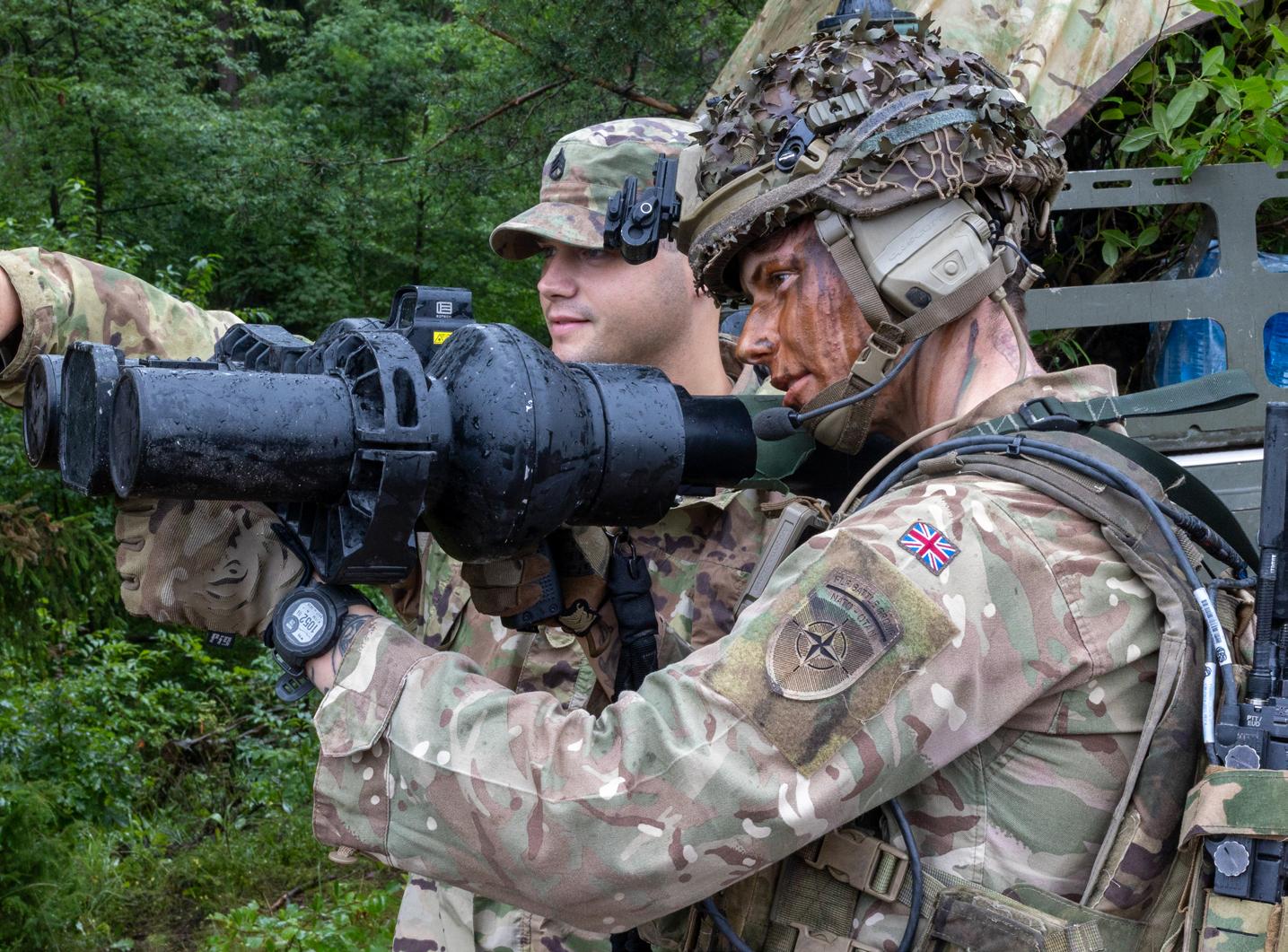
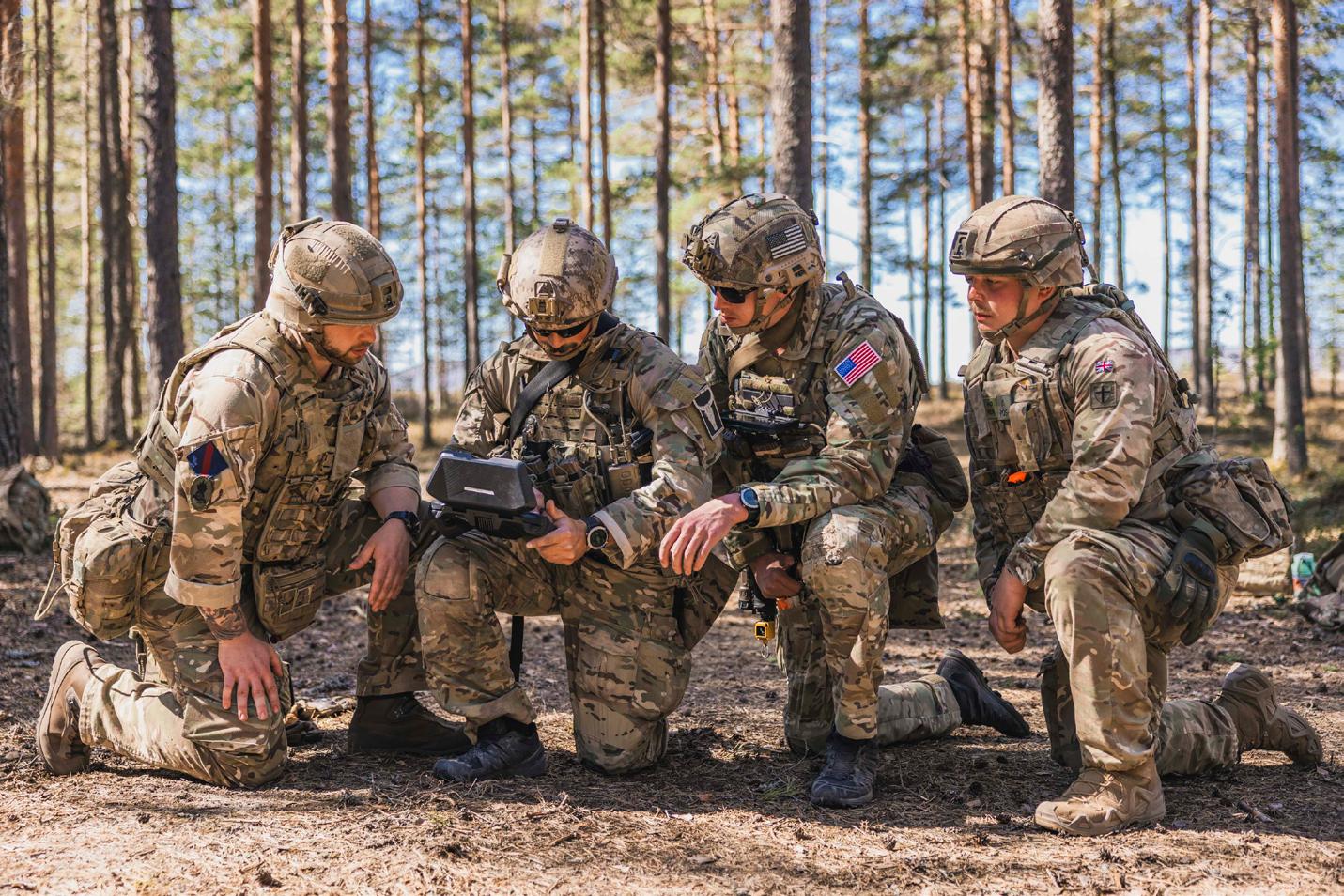
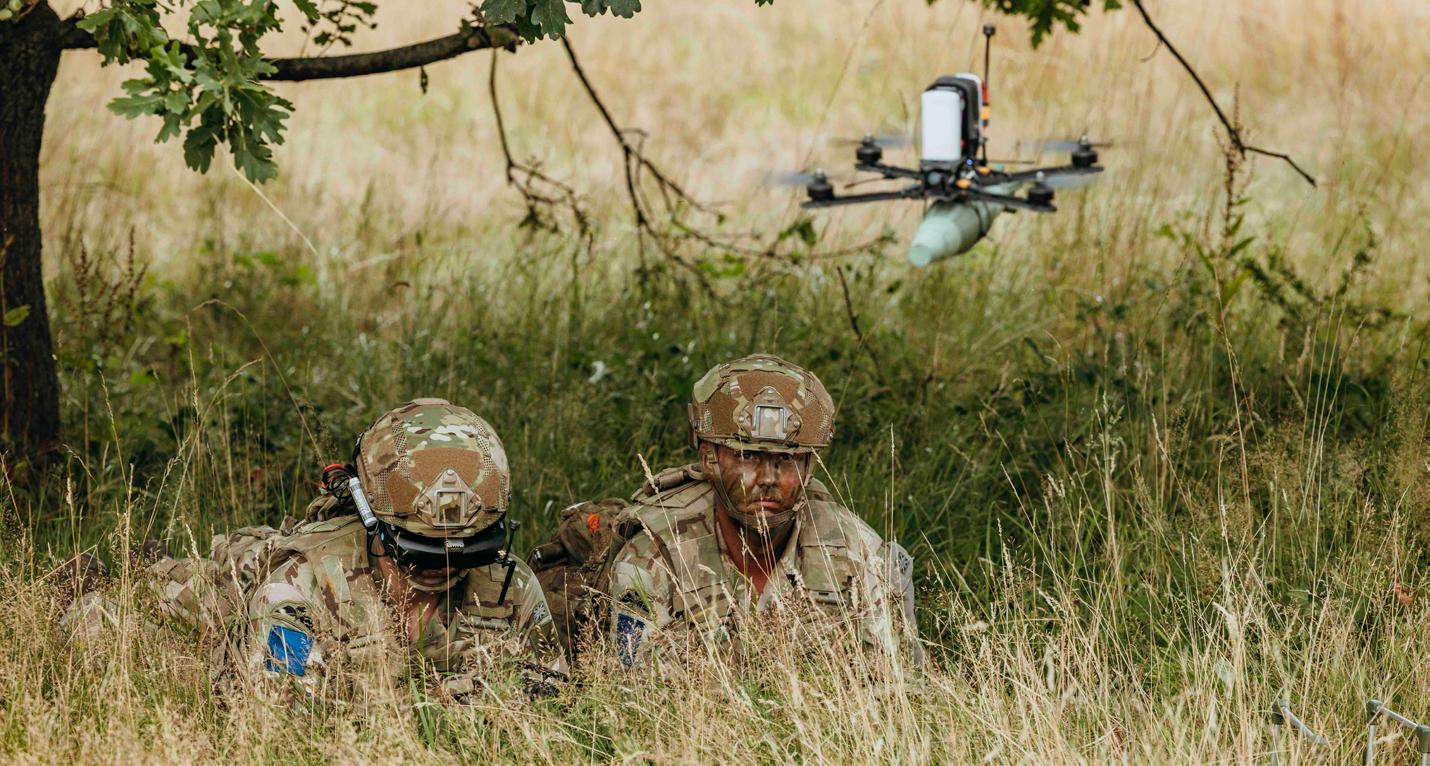
An American and British soldier test counter-drone technology in Poland during Project Flytrap, part of efforts to ensure NATO forces are equipped to detect, track and disable drones on tomorrow’s battlefield.
A VIEW FROM BRUSSELS: WHAT NATO WANTS AND OUR ALLIES’ APPRAISALS OF TODAY’S ARMY
AUTHORS
Lieutenant General Sir Ian Cave is the United Kingdom military representative to NATO and the EU.
Brigadier Paul Dupuy is the United Kingdom deputy military representative to NATO.
TO understand what NATO wants from the British Army in 2025, it is worth reflecting on how we got here. In 1949 the founders of the Alliance recognised that Europe was facing an existential security threat. To respond effectively demanded a collective effort, building political and military structures able to co-ordinate and direct collective defence, and, most significantly, unity among allies. With this came obligations including an agreement that an attack against one ally is considered as an attack against all allies, and a commitment, by means of continuous and effective self-help and mutual aid, to maintain and develop their individual and collective capacity to resist armed attack. Since the Russian invasion of Ukraine in 2022, NATO has returned to the core issues of that founding period, which endured until the early 1990s, and the re-creation of the structures and disciplines of collective deterrence and defence – doctrine, plans, command and control, enhanced capabilities, civil defence, and defence industries – and all in the context of accelerating technological change. Allies are being asked to invest in the
capabilities required for effective deterrence now, rather than face the cost of fighting a war. The cost of such, as agreed at NATO’s The Hague Summit earlier this year, is a commitment by all allies to spending 3.5 per cent of gross domestic product on core defence requirements by 2035, with some committing to meeting that target within the next few years. Before turning to what this means for the British Army, one should consider what this means for the UK.
The UK is one of the largest allies in NATO, both in terms of size of economy (third of 32) and population (fourth of 32), and enjoys a unique position. As a NATO member with a permanent seat on the UN Security Council, and one of the Alliance’s three nuclear powers, the UK is at the centre of the Alliance, both politically and militarily. It plays a pivotal role. And with that comes expectation of both mass and effect. It has a strong reputation and a history of commanding, leading and doing. The UK’s strategic culture, global role, investment and capabilities ensure it is well placed to lead across the key challenges, both political and military, that NATO is facing in
a more dangerous and unstable world. As such the Alliance continues to need the UK to contribute accordingly – NATO needs the UK’s nuclear deterrent, its capabilities across all the domains – money and hardedged military capability matter – and its leadership. And, as the Strategic Defence Review articulates, the UK needs NATO. Its strategic strength comes from its allies and the Strategic Defence Review signifies a shift in deterrence and defence, to a more robust war fighting readiness in order to deter threats and and strengthen security in the Euro-Atlantic. For the British Army, the NATO demand affects its people, its thinking, its commitments and its capabilities.
At the most basic level NATO wants three things of the British Army (and other allies): its capabilities to be able to fight and sustain operations to provide deterrence and be ready in the event of crisis and conflict; its continued contribution to current NATO operations, missions and activities, providing operational outputs, day-to-day vigilance and deterrence; and its leadership and innovation to help maintain comparative advantage over potential adversaries. In light of the deteriorating strategic environment, and therefore an ever more dangerous situation,
the need to accelerate activity across all these requirements is fundamental. NATO needs forces, held at readiness, underpinned by enablers, supplies and stockpiles where they are required, capable of posing strategic dilemmas – deterring adversaries and, if necessary, defending the Alliance. At the heart of NATO’s land capability demand signal of the UK is a fully provisioned and enabled Strategic Reserve Corps.
The Alliance’s leaders, political and military, have been clear on the nature of the Strategic Reserve Corps demand: NATO wants an enabled, fully capable and deployable warfighting corps. A priority recognised by the Strategic Defence Review. A force led by the Headquarters Allied Rapid Reaction Corps (HQ ARRC) to provide one of the Alliance’s two Strategic Reserve Corps – able to deploy and support NATO operations anywhere across the Alliance’s area of responsibility and ready to execute missions to support deterrence and help manage escalation. The ARRC has an excellent reputation and proven record. The challenge now is to reset it for today’s threat; work which is ongoing and will require significant investment. This is about packaging the right mix of credible combat, support and enabling capabilities,
incorporating new and emerging highend technologies, to provide the Supreme Allied Commander Europe options for both deterrence and defence. The UK is one of the few allies who have the scale, capacity and capability to do so. The challenge is how to optimally balance mobilisation, to include incorporation of emerging technology to enhance lethality, whilst modernising through recapitalisation of Army equipment.
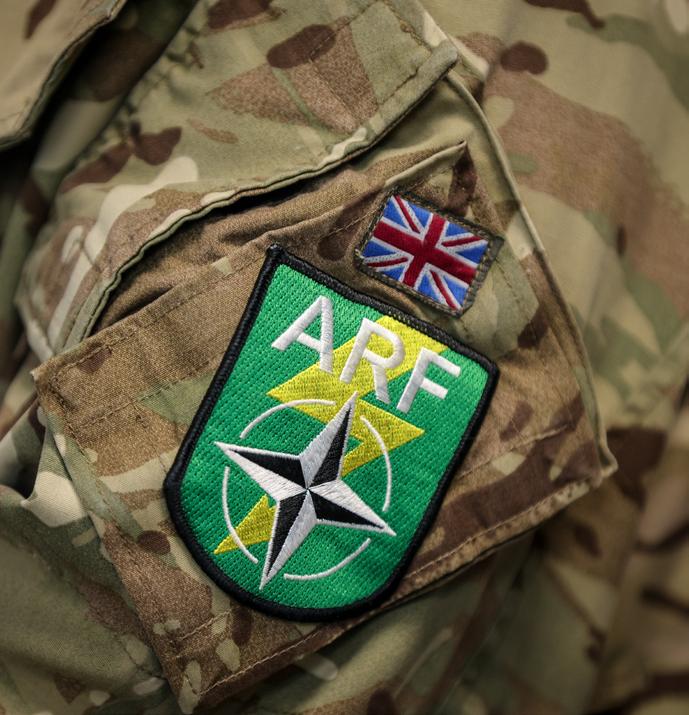
The Alliance wants the UK’s continued contribution to current NATO operations, missions and activities – supporting modern deterrence (day-to-day vigilance) and wider Alliance military activity. The UK, again, has a strong track record, and already makes a substantial land contribution by leading the forward presence brigade in Estonia and supporting the recently established Allied Reaction Force – most notable through 1 (UK) Division’s role as the inaugural land component. Additionally, the recently reaffirmed commitment and extension of support to KFOR [Kosovo Force], centred around the provision of the land Strategic Reserve Force as well as a permanently deployed Intelligence, Surveillance and Reconnaissance Task Force, is a strong signal. However, in a deteriorating security environment the Alliance
“The challenge is how to optimally balance mobilisation, to include incorporation of emerging technology to enhance lethality, whilst modernising through recapitalisation of Army equipment.”
will need to sustain and potentially enhance these efforts – the demand is likely to grow. British Army capabilities will continue to be sought. There is challenge and opportunity in current operations, in particular those aligned to generating deterrence. An Alliance infers mutual interdependence, put bluntly, commitment, to deliver what has been offered. To be there when required, as determined by NATO commanders, at declared readiness. This may force more work to assure commitment plots and readiness cycles, but is nondiscretionary given the UK’s commitment to deliver our part in NATO plans. The risk is as likely to manifest through logistic enablement as readiness, yet the effect on the front line is the same. The opportunities are clear, not least the ability to experiment and trial new capability on operations. We already seize opportunities through Asgard and the like, but there’s opportunity to do more, not least through fielding new capability with KFOR’s Intelligence, Surveillance and Reconnaissance Task Force.
The Alliance also values British Army leadership, its strategic, operational and tactical thinking, and its innovation. The UK and the British Army have significant influence throughout the NATO Command and Force Structures – built upon the Service’s considerable experience, education and approach – something that is valued and wanted. The Alliance also seeks its leadership through commitment, demonstrating the importance of NATO by supporting its key outputs and leading on the ground. This is particularly pertinent in supporting and aligning training activities and exercises, which underpin deterrence, demonstrate unity and enable the enhancement of collective capability. Additionally, it wants the British Army’s innovation, built on effective experimentation and informed by the lessons of Ukraine. There is opportunity to set the pace – for example through the development of the recce-strike complex and digital targeting web – and enable wider Alliance modernisation and enhanced capability.
“The presence of the British Army, equipped, enabled and deployed, reassures and demonstrates our ironclad commitment to the Alliance.”
The British Army is highly respected by its NATO allies. The quality of its contributions is well recognised – from forward presence in Estonia and the Strategic Reserve battlegroup for KFOR to its Op Interflex support to Ukraine – and its participation in nationally led NATO activities is continually sought. This is specifically true of the nations where UK land efforts have been prominent. It’s important to remember that history, geography and national strategic culture matter. It’s striking to map national enthusiasm to spend more at pace on defence. Nations, especially those adjacent or near to the Russian border, want to be able to ‘touch and feel’ the commitment of other allies. This is about physically sharing risk – a measure of unity and solidarity beyond words – and living up to the obligations of the Washington Treaty. The presence of the British Army, equipped, enabled and deployed, reassures and demonstrates our ironclad commitment to the Alliance. And, in an unstable world, where the demands on all allies are increasing significantly, nations increasingly look to the larger allies for reassurance through presence. The demand for reassurance activity from the UK may also rise as the US European Land presence refines subject to the Pentagon’s posture review work.
The UK and the British Army should expect, as they already do through NATO defence planning processes, to be held to account by allies. The demand requirement has sharpened and allied leaders have aligned more national resource to defence. And yet we also sit, again, on a seam of transformation, as digital targeting, artificial intelligence (AI) and uncrewed systems come
to prominence and we seek to enhance the lethality of existing systems through the addition of new technology. And it is for now additive, not either/or, as we seek to enhance the lethality of on hand systems through overlaying enhanced targeting and consumable/attritable UAS and one-way effectors. The NATO force planning process will allow us to navigate this transition from platform to effects-based capability scoring but, in the meantime, physical capability which leaders and citizens (allied and adversary) can see and be reassured/ deterred by retains significant value.
At a human level the British Army enjoys an unparalleled reputation. The quality of our soldiers, their leaders and our training is universally recognised. Almost everyone has an anecdote they’re keen to share about the time they’ve shared with us. These engagements are characterised by professionalism, indomitable spirit, humour, competence and reliability. And we’re good at maximising the capabilities we do have to both reassure and deter.
As the Alliance resets to the core issues of its founding period, re-creating the structures and disciplines of collective deterrence and defence, in the face of Russian revanchism, it’s perhaps useful to consider the following challenges. How can the British Army provide both sufficient mass and lethal effect to meet its share of NATO demand? As NATO’s Defence Planning Process evolves, how do we generate evidence to substantiate a shift from a platform-based paradigm to one built on digital/AI enabled effect? How do we reassure Allies and deter adversaries through digital/AI enabled effects which, ordinarily, will be masked from view? And how do we build readiness through study, exercise and rehearsal on the ground, with the plans to build competence with which to reassure and deter, as well as to generate the evidence required to continually refine the plans?
And, finally, how do we reinforce our signalling of staunch and unwavering commitment to contribute fully to NATO demands, so that all that the British Army has to offer, and the reputation that has been so hard-won, continue to be valued highly by our allies?
WAR’S UNCHANGED DEMANDS: BOOTS, GROUND AND INTERPERSONAL VIOLENCE
AUTHOR
Dr Ben Connable is a retired US Marine Corps officer, executive director of the non-profit Battle Research Group, and is the author of Ground Combat: Puncturing the Myths of Modern War
1See the Ground Combat Database, available as of November 2025, battleresearchgroup.org/database; and Ben Connable, Ground Combat: Puncturing the Myths of Modern War (Washington, D.C.: Georgetown University Press, 2025).
2See Connable, Ground Combat, 2025, introduction and chapters 1 and 9.
3For a range of recent, cited articles see: Ben Connable, War Stats Do Not Measure Up, Battle Research Group (October 2025), battleresearchgroup.org/publications/war-stats
4For example, see the U.S. Marine Corps concept of Force Design: U.S. Marine Corps, Force Design 2030 (Washington, D.C.: Headquarters, U.S. Marine Corps, March 2020), available as of November 2025, hqmc. marines.mil/Portals/142/Docs/CMC38%20Force%20 Design%202030%20Report%20Phase%20I%20 and%20II.pdf
5On this point see Connable, Ground Combat, 2025, chapter 1.
6For example, see: Eado Hecht, “Drones in the NagornoKarabakh War: Analyzing the Data,” (Military Strategy Magazine, 7, No. 4, 2022), 31-37.
WHAT does NATO want or need from the British Army? Alas, we cannot successfully anthropomorphise our alliance to obtain a singular answer. We must therefore turn for a response to our collective analyses of modern war which – also, alas –are a hot mess. So I provide my answer here based on an admittedly limited review of 423 modern battles and continuing review of wars around the world.1 NATO needs lots and lots of talented, motivated infantry backed by combat aircraft, armour, artillery and drones. Boiled down to a singular essential, the alliance needs masses of talented and motivated British Army infantry.
At first glance this is an anachronistic reply. Leaders across the Western world are bombarded daily by an almost singular message: modern war is changing so rapidly that traditional combat power has been rendered all but redundant.2 Networked drones, autonomous lethal weapons, precision missiles and artificial intelligence relegate previously core assets like infantry, artillery, armour and even manned aircraft to at best a supporting role.3 In this light, infantry are in some cases being reimagined for reduced, small-scale, special-operations-style tasks.4
Wise leaders absorb these more extreme perspectives with healthy scepticism. And as well they should, because in such a disturbingly normalised extreme this view is unsubstantiated junk. It is drawn primarily from two wars – Nagorno-Karabakh and Ukraine – and is being radically oversold
by our partners in industry and some in the think tank world. This is a normal if unhelpful interwar trend.5 As we drift further and further away from hard-won combat experience, we grow increasingly vulnerable to breathless imaginings of war.
Ruthlessly objective analysis and hard evidence are the cure for unwarranted fantasies. Evidence of drone dominance from the Nagorno-Karabakh war was flimsy, at least partially fabricated, and broadly oversold.6 Evidence from the Ukraine war is compelling but also badly skewed and in many crucial ways idiosyncratic. War as it is fought along the Donbas front in Ukraine in 2025 will not look like war fought elsewhere in the future, or perhaps even in Ukraine in 2026. Preparing for future wars requires holistic, comparative analysis of all current wars including but by no means limited to Ukraine.
That brings us back to the Ground Combat Database (GCD), a coded study of nearly 500 battles, 423 of which occurred between 2003 and 2022. This study includes a range of battles from both Nagorno-Karabakh and the Ukraine war, and also from Syria, Iraq, Afghanistan, Mali, Libya, Sri Lanka, Yemen, and many other wars. Do these wars matter if all we are considering is a fight against the Russians in Europe? Yes, they do, for a range of important reasons:
n Russia has applied its ground, air and missile forces across the Middle East and Africa revealing a wide array of strengths and prospective weaknesses.
n Western military forces have also fought in many places around the world, showing their own strengths and weaknesses in varying terrain against varying foes.
n Nearly every armed force in the world applies a mix of Russian, Chinese and Western weapons and equipment, providing ample opportunity for analysis.
n Perhaps most importantly, understanding modern war requires study in width, depth and context; we must put immediate lessons in broader perspective.
No singular character of modern war emerged from the analysis of the global ground-combat dataset. This perspective on the so-called character of war comports with the old British Army land warfare manual.7 Still, relevant findings emerged. For example, main battle tanks were employed by one or both sides in over two-thirds of all modern battles. In four-fifths of these cases, one or both sides employed manned combat aircraft in a groundsupport role. And infantry were employed by both sides in each case without exception.8
In every case I studied, ground was held or taken only by infantry. Therefore, perhaps the central indicator of success in war – the control of terrain – hinged on the success or failure of soldiers fighting primarily with rifles, machine guns, mortars, shoulder-fired rockets and in some cases employing small drones. Having immersed myself in the uneven evidence from these many cases, I can also confidently report that the quality and motivations of those infantry forces were essential to the recorded outcomes.
Therefore, as we consider what NATO needs most from the British Army it is important to place the qualifiers ‘talented’ and ‘motivated’ in front of infantry. In the many battles I reviewed, talented and motivated infantry suffering from a sharp disadvantage in weapons, kit and technology routinely defeated better armed but lower quality infantry.9 In some noted cases, poor infantry will to fight led to catastrophic, strategic failure; see Iraq 2014.10 In other cases, strong will to fight directly contributed to strategic success; see Ukraine 2022.11
As British Army leaders know all too well, talent derives in great part from good recruiting; hard, expertly designed training; and good leadership. It encompasses straightforward performance like fitness and both tactical and technical acumen. And, as the war in Ukraine and many other conflicts have shown, it also hinges on the self-motivated adaptability.12 This may
“British Army and Royal Marine units dealt with the consequences of inadequate manpower in Iraq and Afghanistan... they would suffer exponentially from lack of manpower depth in a prospective war with Russia on the European continent.”
originally be a British Army approach to the development of both talent and motivation: allow for a good bit of free thinking within the necessary confines of military discipline.13
No technical aspect of modern warfare has eliminated or even reduced the requirement for adaptability; the Army’s Future Soldier programme is predicated on that assumption.14 For example, look closely at the frontline in Ukraine, and also in the ongoing wars in Myanmar, Sudan, Gaza, the Sahel, etc., and one sees the real impact of group 1 (small) drone proliferation.
In general, infantrymen or repurposed infantrymen fly these drones. Infantrymen adapt, adding the complex layer of drone feeds and drone threats into their calculus. Then they get to the unremittingly hard and traditional business of taking and holding ground with rifles, grenades and other tools of war that look remarkably like those from the Second World War. So, case evidence recommends remaining committed to traditional training methods that include focus on individual soldier and unit-level adaptability.
Mass is also an important qualifier. I stretch the traditional meaning of the term here to encompass concentration of troops to fill a frontline trace, reinforce and replace losses. Handfuls of talented and motivated infantry are good but generally insufficient to win either irregular or conventional wars. British Army and Royal Marine units dealt with the consequences of inadequate manpower in Iraq and Afghanistan.15 As many astute observers in the UK have noted, they would suffer exponentially from lack of manpower depth in a prospective war with Russia on the European continent.
Moreover, NATO has always depended heavily on masses of British and American infantry – of course, as well as the many combat enablers from both armies – to deter war and plan for successful defence against prospective Russian aggression. Writing as an American I regretfully suggest our services
may not be available when needed. Therefore, as other member states gradually build up their own ground-combat capabilities, the alliance need for massed, talented and motivated British Army infantry is immediately increased.
If one boiled NATO’s defensive plans down to their essentials it might become clear that a great burden has been placed on the British Army to provide something it presently has only in limited numbers.16 At least from this perspective the task at hand is clear. It is not my place to recommend defence or budgetary policy to Britain’s political leaders. But I can recommend here an even more robust, evidence-driven analysis that might help generate the political will to fund a larger, infantry-focused British Army.
7British Army, Land Operations, Army Doctrine Publication AC 71940 (Warminster, UK: Land Warfare Centre, 2016), 1-5 and others. Note that this publication was withdrawn from circulation and application in May of 2022.
8For all these findings see the Ground Combat Database and Connable, Ground Combat, 2025, chapter 8.
9Also see extensive work on will to fight from the RAND Corporation. Accessed November 7, 2025, rand.org/ard/ projects/will-to-fight/publications.html
10See: Ben Connable, Iraqi Army Will to Fight: A Will-toFight Case Study with Lessons for Western Security Force Assistance (Santa Monica, Calif.: RAND Corporation, 2022).
11See: Ben Connable, “Ukrainian and Russian Will to Fight: An Early War Assessment” (Lawfare, March 4, 2022), accessed November 7, 2025, lawfaremedia. org/article/ukrainian-and-russian-will-fight-early-warassessment
12For a definition and analysis of adaptability see: Ben Connable, Warrior-Maverick Culture: Evolution of Adaptability in the U.S. Marine Corps, thesis (London, UK: King’s College London, 2016), chapters 1 and 2.
13Many resources on this point are available. I recommend reviewing the articles in Issue #182 of the British Army review, accessed November 7, 2025, chacr.org.uk/wpcontent/uploads/2023/02/BAR_SPR23.pdf. Also see: John Baynes, Morale: A Study of Men and Courage (Garden City Park, N.Y.: Avery Publishing Group, Inc., 1998); F.M. Richardson, Fighting Spirit: Psychological Factors in War (New Delhi, India: Nahraj Publishers, 2009); and Connable, et al., Will to Fight (Santa Monica, Calif.: RAND Corporation, 2018).
14“Future Soldier,” British Army, accessed November 7, 2025, army.mod.uk/learn-and-explore/army-of-thefuture/readiness/future-soldier
15And also during the withdrawal from Kabul in 2021: Jamie Robson, “Reflections on Readiness, Op Pitting & the Integrated Review” (British Army Review, no. 182, spring 2023), 30-35.
16It is interesting to note that the 2023 refresh of the Integrated Review fails to mention infantry. Accessed November 7, 2025, assets.publishing.service.gov.uk/ media/641d72f45155a2000c6ad5d5/11857435_NS_ IR_Refresh_2023_Supply_AllPages_Revision_7_WEB_ PDF.pdf. For more on personnel levels see, for example: “Resilience of the UK armed forces,” House of Lords Library, January 19, 2023, accessed November 7, 2025, lordslibrary.parliament.uk/resilience-of-the-uk-armed-forces
REPLENISH ‘RESERVES’ IN READINESS FOR RAINY DAY
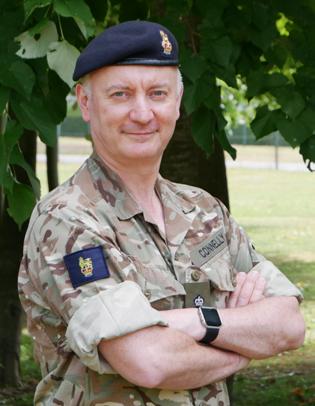
AUTHOR Brigadier Vincent Connelly is Deputy Commander Standing Joint Command, Professor of Psychology at Oxford Brookes University and the civilian NATO Science and Technology Organisation Human Factors and Medicine Panel Liaison Officer to the NATO Committee on Reserves.
N1NATO HQ (2022). Strategic Concept 2022. NATO publications. nato.int/nato_static_fl2014/assets/ pdf/2022/6/pdf/290622-strategic-concept.pdf
2NATO HQ (2025). NATO MC 044/03 NATO Policy on Reserves. NATO publications.
ATO is attempting to improve its defence and deterrence posture and strengthen allies’ commitment to defence resourcing. The 2022 NATO Strategic Concept outlines its three essential core tasks – deterrence and defence, crisis prevention and management, and cooperative security – and in doing so sets out the Alliance’s strategic objectives within a radically changed security environment. World events have highlighted the need for NATO to enhance resilience and its ability to defend against a near-peer, large-scale conventional attack. The war in Ukraine has demonstrated the emphasis on protracted, attritional warfare and the increasing requirement for mass. Building on this, the Strategic Concept states there is a requirement across NATO to “adjust the balance between in-place forces and reinforcements”.1 Reserves and reserve forces are key to reinforcement as well as to national and Alliance-wide resilience plans, including in the UK. The Strategic Concept also reminds allies that national resilience is a key aspect of collective defence and reserves and reserve forces often play a major role in these efforts.
For many years, most of NATO’s armies have
shrunk, moving to smaller, lighter formations delivering high-readiness, high-technology forces. These forces have tended to focus on out of area counterinsurgency missions and not on national resilience tasks. Overall, there has been a diminishing number of potential reinforcements available across NATO to scale forces up and provide mass in the event of a crisis. To address these issues, NATO has adopted the Deterrence and Defence of the Euro-Atlantic Area (DDA) concept within its Family of Plans (FoP). An essential part of the DDA is to contribute forces to the full range of NATO operations. This requires NATO allies to deliver a larger pool of sustainable forces. “The potential lack of suitably trained and readily available military workforce poses one of the most significant challenges to the implementation of the DDA FoP, one that Reserves can help mitigate.”2
THE UK RESERVES CONTEXT
The UK has followed this ‘post-modern’ shrinking army trend and the proportion of reservists and reserve forces available as reinforcements has diminished substantially despite the risks of this approach being recognised in a large number of external reports over the last 15 years. For example, the pool of individual ex-regular reservists traditionally used as individual augmentation to fill regular and reserve forces workplace gaps on mobilisation has been in abeyance since 1991. The Army Reserve’s vital role to expand the Army upon mobilisation, with the extra units required to fight and win a protracted war, has been replaced by the individual augmentation role that was the province of the ex-regular reserve. Collective
training and warfighting equipment for the Army Reserve has shrunk as much as the workforce. The 2025 Strategic Defence Review has highlighted the requirement for the UK to regenerate the ex-regular reserve pool and deliver a 20 per cent increase in the size of the Army Reserve. The Strategic Defence Review has also stated our policy should be “NATO first” as a general rule.
OUR NATO ALLIES
Across NATO, our allies have also been adjusting the balance of their reinforcement potential by rapidly expanding their reserve forces. France is doubling its reserve forces to 105,000 and creating new reserve units. Poland aims to increase its training of reservists to 100,000 a year. The Netherlands is increasing its reservists from 8,500 to 20,000 by 2030. Belgium is tripling its reserve forces in the same time period. Norway is increasing its reserve forces by 13,700, including a completely new Army Reserve Light Brigade with an expansion of the reservist Home Guard by 15,000. Germany plans to. Sweden, Finland, the Czech Republic, Slovakia, Romania, Hungary, Estonia, Lithuania and Latvia also plan to substantially increase their current reservist workforce.
NATO POLICY ON RESERVES
NATO itself has also been working on its own policies to assist nations in developing their national reserve forces. On the 11th October 2024, NATO approved MC 0441/3, NATO Policy on Reserves. The document advocates for a collective vision on reserves across NATO and the aim is to promote the utilisation of reserves in contributing to NATO’s core tasks (deterrence and defence; crisis prevention and management; cooperative security), operations, missions and activities with the focus on the collective defence of the Alliance. The new policy defines and describes how the Alliance and allies can enhance reserves to meet the increasing demand for military workforce. The policy represents a call to action that each NATO nation “should take all necessary measures to increase the level and importance of reserves and reserve forces inside their Armed Forces”.
The policy was written at NATO HQ by the NATO International Military Staff in the Policy and Capabilities Division, with the assistance of subject matter experts from the Military Committee, the two Strategic Commands (Allied Command Operations and Allied Command Transformation), the NATO Committee on Reserves, and the three Advocacy Reserve Organizations –the Interallied Confederation of Reserve Officers, the Interallied Confederation of
“The NATO policy exhorts all allies to consider the expansion of their current levels of reserve elements in order to increase the pool of correctly postured, fullytrained and equipped forces and individuals to meet the demand signal for modernised collective defence.”
Medical Reserve Officers, and the Interallied Confederation of Reserve Non-Commissioned Officers. The policy therefore represents considerable expert input driven by strong central NATO leadership with a collegiate and rapid collective agreement delivered over a relatively short period (for NATO or any large military organisation) of less than a year. The policy is aligned with the NATO 2022 Strategic Concept, the Alliance Concept on Deterrence and Defence of the Euro-Atlantic Area, NATO Warfighting Capstone Concept, and the Alliance Concept for Multi-Domain Operations.
The policy gives a set of easy-to-understand definitions agreed cross nationally. Reserves consist of various categories of personnel not normally employed on full-time military service, who may be activated and placed under military command. Reserve forces are formed units that are entirely or predominantly staffed by reservists. Reservists are individuals who have undergone military training and can be called into active service for a set period of time in peace, crisis or conflict. Reservists may join with a background as an ex-regular, an ex-conscript or volunteer. Reservists can be individual augmentees who fill national workforce requirements at unit or headquarters level. Additionally, reservists may hold specialist skills or qualifications not readily available to regular forces.
AUGMENT DETERRENCE AND DEFENCE
ENABLE STRATEGIC DEPTH ENHANCE INTEROPERABILITY AND READINESS
BENEFITS OF RESERVES
ENHANCE SOCIETAL RESILIENCE AND ALLIANCE COHESION
THE NATO POLICY ON RESERVES VISION
The NATO policy vision is for nations to deliver “suitably trained and qualified Reserves that enhance Allies’ and the Alliance’s ability to deliver the three core tasks through contributing to the workforce requirements of a Multi-Domain enabled Alliance”. The vision consists of five principles (see graphic below) that lay out the inherent benefits of reserves to NATO and to nations in terms of military capabilities alongside taking advantage of civilian knowledge skills and experience, reflecting a “whole of society” approach. The policy encourages nations to build and maintain national reserve systems based on this collective vision. The policy sets out the key factors behind the development and delivery of the five principles.
AUGMENT DETERRENCE AND DEFENCE
Reserves provide a key foundation of deterrence as reservists display the national determination to fight a sustained conflict and to integrate its citizens into a national armed forces endeavour while reserve forces illustrate the capacity to expand the units of the armed forces on mobilisation. The NATO policy exhorts all allies to consider the expansion of their current levels of reserve elements in order to increase the pool of correctly postured, fullytrained and equipped forces and individuals to meet the demand signal for modernised collective defence. Allies are encouraged to consider the readiness states and posture of their reserves to ensure a timely and relevant response, and create the proper links from nation-based reserves capabilities to integrate with NATO defence planning requirements.
National policies and communications should reflect the augmentation of their armed forces with reserves in the transition from peace to crisis to conflict. This is reflected in our own Strategic Defence Review recommendations around reserves as being integrated within a whole of society approach.
ENABLE STRATEGIC DEPTH
SUPPORT CRISIS RESPONSE
This is a key principle that has arguably been allowed to wither in the British Army. Reserve forces provide the basis for expanding national armed forces in crisis and conflict as well as augmenting workforce gaps with reservists. Reserve forces contribute to NATO’s ability to withstand protracted attritional warfare with additional collective capabilities alongside a reservist workforce that can be mobilised and deployed as needed, especially within enabling functions. The NATO policy asks nations to exploit reserves’ civilian occupations, specialisations
“Reservists may have experience of NATO’s two new operational domains (cyberspace and space) and emerging disruptive technologies. Their connections with industry and academic partners provide unique perspectives on civil-military
interactions.”
and competencies. It also reminds nations that reserves that have prior military experience can provide valuable leadership, mentorship and training to junior regular personnel or newly recruited personnel when expanding the armed forces. This is a key feature for reconstitution of an army reliant on volunteers from civil society. It is relatively easy to produce basic trained soldiers but they need experienced officers and senior non-commissioned officers to deliver units. In peacetime it is easy to forget this and allow experienced reserve officers and senior noncommissioned officers to waste away once their regimental duties are complete.
ENHANCE INTEROPERABILITY AND READINESS
NATO is an international alliance and reserves, as much as regulars, need to be aware of what that means for their practice and readiness. Nations should ensure that their reserves are educated, trained, exercised, equipped and prepared to NATO standards, facilitating seamless integration and cooperation with allied forces during NATO operations, missions and activities and common exercises. Training programmes for individuals and collective training that enable the reserves to meet readiness states remains a national responsibility. Consideration should be given to pre-mobilisation, integration and post-mobilisation training to ensure rapid generation of reserves. It will be necessary for allies to train their reserves to operate in a multi-domain enabled Alliance with new capabilities and doctrines.
NATO education and training aimed at improving the skills of regular military personnel should also be accessible to reserves. Reserve forces often include a broad range of skill sets gained from outside
the military. Reservists may have experience of NATO’s two new operational domains (cyberspace and space) and emerging disruptive technologies. Their connections with industry and academic partners provide unique perspectives on civil-military interactions. Allies are encouraged to make the most of these opportunities with their reserves.
The new policy also encourages nations to offer reservists into the Peacetime Establishment and the Crisis Establishment of the NATO Command Structure. This would provide expanded career opportunities for experienced UK Army reservists who, with their joint military and civil knowledge, skills and experience, could provide a key UK influence on reserves matters across NATO.
SUPPORT CRISIS RESPONSE
Reserves are a valuable asset in crisis response when leveraged within a whole-of-society approach. Reservists’ training, diverse skill sets and ability to bridge the gap between military and civilian sectors make them effective and efficient for crisis response efforts including humanitarian assistance, disaster relief and
3Armstrong, M. (2020). Every possible capability: Some implications of the Army Reserve call-out for Operation Bushfire Assist , 2019-2020. Australian Army Research Centre. researchcentre.army.gov.au/library/occasionalpapers/every-possible-capability-some-implications-armyreserve-call-out-operation-bushfire-assist-2019-2020
4Bryant, S. & Patterson, R. (2025, January). A Resilient Alliance and the Role of the Reserves. NATO STO Research Workshop HFM-390: Reserve Forces: Challenges and relevance to NATO. Joint NATO Winter Plenary Meetings 2025 on Reserves, NATO HQ, Brussels, Belgium. sto.nato.int/document/reserve-forces-challengesand-relevance-to-nato-and-national-security
stabilisation. Close allies to the UK, such as Australia3 and the USA,4 lead the way in using reserves in this respect. Other European nations also use reserves in a crisis. Denmark has recently mobilised national defence reservists in response to local drone incursions.5
Reserves are a valuable asset in crisis response when leveraged within a whole-of-society approach. The Security Defence Review makes clear that reserve forces are vital for crisis support as well as national defence.
ENHANCE SOCIETAL RESILIENCE AND ALLIANCE COHESION
Strong reserves are a key component of NATO’s military capability and overall cohesion, but nations need to invest more in their reserve forces to develop this capability and cohesion. Reserves also serve as a bridge between the civil and military worlds and enhance a whole-of-society approach by leveraging military and civilian experience in a more comprehensive way, delivering efficiency by reducing duplication of effort and optimising resource. Improved public support is a prerequisite to generating more reserves and efforts in this regard should be enhanced. For the UK, the Security Defence Review has highlighted the importance of communication with the public for both the Army Reserve and especially the regular reserves. Internal communication with serving regulars will also be important to highlight any reserve liability after full-time service and to raise the profile of the reserve forces all round.
POLICY GOVERNANCE
NATO’s International Military Staff Policy and Capabilities Division is the lead on reserve related topics. Considerations on conceptual matters concerning reserves are addressed within the NATO Military
Committee Working Group Strategic Policy & Concepts. The policy delivers an enhanced supporting role for the NATO Committee on Reserves (formerly the NATO Reserve Forces Committee) as the standing advisory body to the NATO Military Committee. The NATO Committee on Reserves can be tasked by the Military Committee in accordance with established procedures. The NATO Committee on Reserves is also now the primary point of contact on reserve issues for the NATO International Military Staff since it provides the official position of NATO allies’ reserves. The formal integration of the NATO Committee on Reserves into NATO governance will strengthen the readiness and effectiveness of Alliance reserves by providing a forum for the exchange of information with the NATO Military Committee (and International Military Staff ) maintaining awareness and identifying improvements and integration opportunities. It also gives the NATO Military Committee potentially much more visibility of the status and readiness of each nation’s reserve forces.
The NATO Committee on Reserves organisation and structure comprise a chair, a director and a secretariat for a two-year tenure usually, though not exclusively, led by one nation. Each NATO nation is invited to deliver a national delegation with a Head of Delegation, who is assigned to represent their nation on reserve issues. NATO partner nations can be invited to join as observers. Associated NATO International Military Staff, Allied Command Operations and Allied Command Transformation staff join NATO Committee on Reserves meetings and working groups. The Netherlands holds the chair until June 2026, followed by Italy until 2028 and then the UK will lead from 2028 to 2030, just when the Security Defence Review deliverable on UK reserves will be coming to pass.
It is well established in research literature that reserves are prone to marginalisation within their national armed forces, especially in the ‘post-modern’ era and that advocacy for reserves should be built into policy and decision-making structures.6 NATO’s reserves have several advocacy organisations that are long established and the new NATO policy specifies their formal role to represent the views of individual reservists. The new policy strongly encourages the NATO Committee on Reserves and Advocacy Reserve Organizations to cooperate through promoting and improving the wider understanding of reserves and reserve capabilities, identifying and sharing best practice and encouraging and facilitating the participation in NATO activities by reservists.
“The availability of reserves depends heavily upon individual motivation to serve, which is directly influenced by
national policy, legislation and factors, such as family, community and employer support.”
The Advocacy Reserve Organizations communities consist of the Interallied Confederation of Reserve Officers, the Interallied Confederation of Medical Reserve Officers and the Interallied Confederation of Reserve Non-Commissioned Officers. The latter is the coordinating body. The UK has strong presence across the Advocacy Reserve Organizations communities and activity in the UK is officially organised through the UK Reserve Forces Association. The Association supports the work of the Advocacy Reserve Organizations through involvement of UK reservists in their commissions, committees, working groups and research projects.
SUPPORTING THE RESERVES
Finally, the new policy encourages all nations to recognise the availability of reserves depends heavily upon individual motivation to serve, which is directly influenced by national policy, legislation and factors, such as family, community and employer support. Nations are encouraged to develop employer support policies, civilian employment protection and family support mechanisms to increase reserve recruitment and retention.
The UK has quite advanced reserve support employer, employment and family support policies and practices compared to many of our NATO allies. However, these are often at risk of funding cuts or low prioritisation even though they have a strong impact on reserve readiness. A recent UK research project demonstrated that 70 per cent of reservists
who work for an employer with a supportive policy are comfortable asking their managers for time off for training while only 25 per cent of reservists whose employers have no policy are comfortable asking for time off for training.7 Another project demonstrated that family support for mobilisation is underpinned by good welfare support from the reserve unit.8
CONCLUDING THOUGHTS
The new NATO Policy on Reserves highlights the growing importance that the highest levels of NATO command now have in each nation’s reserves components. NATO is well aware that each nation needs reserves to contribute to national resilience, to scale their forces up, sustain mass and fulfil their national contribution to the full range of NATO operations. However, it is up to nations to bring the new policy to life and resource their reserves to meet the policy aspirations. The policy brings opportunity, scrutiny and the chance for the UK, through the NATO Committee on Reserves and Advocacy Reserve Organizations, as well as our other NATO facing staff, to deliver influential leadership on reserves in NATO. However, public scrutiny9 on the state of the Army Reserve and the Regular Reserve may indicate that the British Army has some way to go on achieving the NATO Policy on Reserves aspiration. The 2025 Security Defence Review lays out the challenge and sets out milestones to betterment for the Army Reserve. The new NATO Reserves Policy provides a benchmark for NATO, the UK and the British Army to deliver on those Security Defence Review milestones and show that we are, indeed, NATO first, regular and reserve.
6Connelly, V. (2020). Understanding and explaining the marginalisation of part time Reservists. Armed Forces and Society. https://doi. org/10.1177%2F0095327X20948591
7Connelly, V., Morrison, Z. & Carter, B. (2025, January). Part-Time Military Service and Sacrifice: Understanding the Outcomes of Long-Term Reserve Service with Partners and Employers. NATO STO Research Workshop HFM390: Reserve Forces: Challenges and relevance to NATO. Joint NATO Winter Plenary Meetings 2025 on Reserves, NATO HQ, Brussels, Belgium. https://www.sto.nato.int/ document/reserve-forces-challenges-and-relevance-to-natoand-national-security
8Connelly, V., Hennelly, S., Fear, N. T., Morrison, Z., Gribble, R., & Smith, J. (2024). Reservist families and their understanding of military welfare support as a (non) military family. Journal of Military, Veteran and Family Health, 10(2), 47-62. https://kcmhr.org/pdf/ jmvfh-2023-0074.pdf
9Lalor, S., Gordon, J., Jameson, S., O’Neill, P., Straughan, G. Hockley, C., Wynne-Jones, G. & Connelly, V. (2024). The United Kingdom Reserve Forces External Scrutiny Team Annual Statutory Report 2024. The Council of RFCA’s, London, UK. https://assets.publishing.service. gov.uk/media/678e7669ea48a571517acfab/Council_ of_Reserve_Forces__and_Cadets__Associations_Scrutiny_ Team_annual_statutory_report_2024.pdf
BERLIN BRIEF: TOWEL TENSIONS TO A POOLING OF RESOURCES?
AUTHOR
Professor Matthias Strohn is Head of Historical Analysis at the CHACR.
EVEN though the image is fading, German-UK relations are still often characterised by clichés that stem from the World Wars, football (no, it was not a goal!) and the win-at-all-costs race to lay claim to the pick of the poolside sun loungers. Despite these frictions, the historical relationship between the two nations has actually been overwhelmingly positive, not least in the area of defence and security. Without the Prussians and the soldiers of the King’s German Legion, Waterloo might have ended very differently. The Great Siege of Gibraltar between 1779 and 1783 might have ended with a British defeat and the loss of the Rock had it not been for the German regiments involved on the British side. After the Second World War, the British forces in West Germany supported the NATO effort and helped to ensure that the Cold War did not turn hot. Clearly, these events relate to the past rather than the present, so what is the state of the relationship between the two nations today? What is Germany’s view of its cousin across the Channel, and what are German expectations of the UK in the realm of security and defence?
Let’s address the elephant in the room first: Brexit matters. Wide parts of the UK population might not want to talk about this episode any more, but it is hard to exaggerate the impact that Brexit has had on the German view of the UK. One of the post-Second World War pillars on which West Germany was built was reconciliation, European integration and unification. Thus, Brexit went against the DNA
of modern Germany. In addition, the way the political establishment handled the departure from the EU was viewed with astonishment and was seen as unbefitting of a country with such a long and proud political history. Like it or not, the shadows of Brexit will continue to linger despite the conciliatory rhetoric to the opposite.
During the Cold War, the British Army of the Rhine was an integral part of the NATO deterrent. In its heyday, approximately 80,000 British military personnel were stationed in Germany. The end of the Cold War, changing global realities and necessities, and monetary aspects resulted in the withdrawal of British troops from German soil. The 2010 Defence and Security Review, which announced the withdrawal of the remaining 20,000 troops from bases in Germany, was a drastic shift. Not only for the British Army, which – as a result – has now become an army largely based in Britain and not overseas, but also for German-British defence relations. The very small British footprint left in Germany in places such as Paderborn, Sennelager, Minden, Wulfen and Mönchengladbach cannot hide the fact that things have changed. As a consequence, German-British cooperation (and thus also expectations and, perhaps most importantly, mutual understanding) suffered considerably. In the German case, it was expected that Britain would fulfil its NATO obligations. Apart form this, it is probably fair to say that Britain was not among those nations that were in the centre of considerations for political and military decision makers. These positions were reserved for other nations and for different reasons. The obvious and clear
number one has remained the US. France has always played a special role in German international defence relations for political reasons. In recent years, the Netherlands has integrated its army into the German Bundeswehr. German-Polish cooperation in the Multinational NATO Corps has been seen as an embodiment of the political will to strengthen the cooperation with central and Eastern Europe, despite the political tensions between Warsaw and Berlin.
After the end of the Cold War and the reduction of UK troops, both overall and within Germany, the Allied Rapid Reaction Corps formed the main link between Britain’s land domain contribution to NATO and Germany. The Corps was stood up in 1992 in Bielefeld and was based on the former First British Corps, thus showing a clear link to the legacy of the British Army in the Cold War. The move from Bielefeld to Rheindahlen in 1994 did not change this picture, but the 2006 relocation from Germany to Gloucester was a visible shift in outlook and the Corps’ mission. During this time, NATO was somewhat struggling with its raison d’être; the Cold War had been ‘won’, Europe seemed safe and secure and operations in other parts of the world, such as Afghanistan, loomed large. Things were to change quickly, however. The Russian aggression in Eastern Europe blew new life into the Alliance. NATO was no longer brain dead, as President Macron had announced in 2019. Collective defence and deterrence in Europe were on the agenda again. With this came a new period of political and military cooperation.
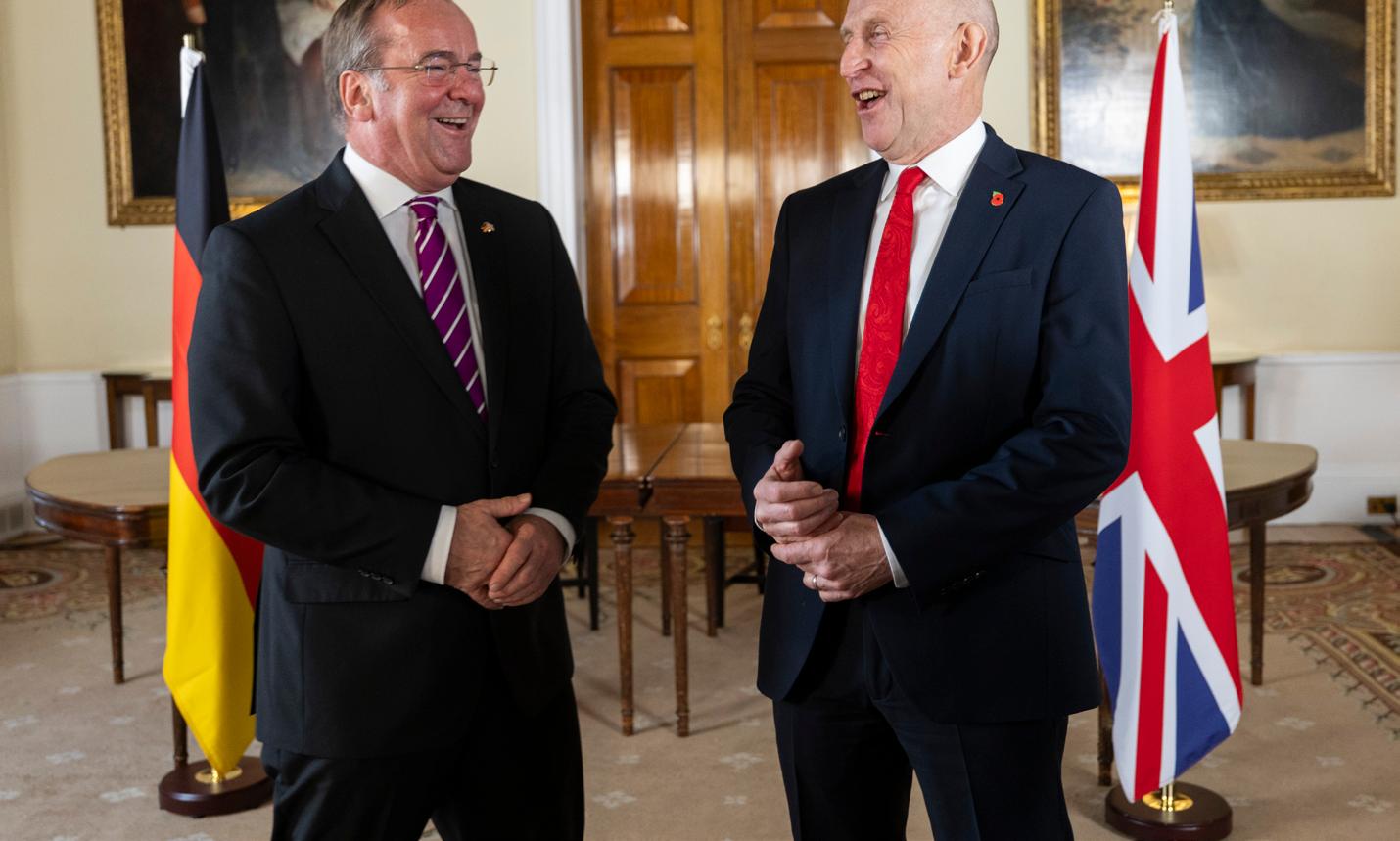
In respect of Germany and the UK, the pinnacle of this development to date has been the signing of the Trinity House Agreement. On 23 October 2024, John Healey, Secretary of State for Defence, and Boris Pistorius, Federal Minister of Defence, signed the agreement which has opened the door to a new era of collaboration. This found its embodiment in the stated objectives of the declaration.1 The aims of the Agreement are:
n To reinforce the security of the EuroAtlantic region, recognising that long-term European defence is key to the security of both participants;
1The full text of the declaration can be found at gov.uk/ government/publications/uk-germany-trinity-houseagreement-on-defence/agreement-on-defence-co-operationbetween-the-ministry-of-defence-of-the-united-kingdom-ofgreat-britain-and-northern-ireland-and-the-federal-ministry [accessed 22/11/2025].
“The [Trinity House] Agreement has shown very clearly that the days of mutual ‘friendly disinterest’ are over. The number of high-ranking military delegations visiting each other’s country has increased significantly. Military cooperation has reached new levels.”
n To support the Defence industries of the two participants, enhancing cooperation in research and technology, and developing co-operative equipment programmes;
n To enhance bilateral interoperability between the respective armed forces across all domains, and working together to strengthen standardisation in NATO;
n To ensure mutual support for actions in the area of defence in the United Nations and NATO, and bolstering complementary co-operation between NATO and the European Union;
n To co-ordinate long-term military support for Allies and partners, fostering stability and bolstering defence capability to support all mutual allies in addressing threats to their territories.
To deliver on these objectives, a number of fora have been created. These include the Military Steering Committee, which oversees co-operation between the participants’ armed forces and drives interoperability; the Ministerial Group on Equipment and Capability Co-operation, which pursues industrial and military capability co-operation; and the Defence Policy Dialogue, which pursues close liaison on defence policy, key defence issues and global horizon-scanning.
The Agreement has shown very clearly that the days of mutual ‘friendly disinterest’ are over. The number of high-ranking military delegations visiting each other’s country has
increased significantly. Military cooperation has reached new levels. For the armies, the joint engineer battalion in Minden is still the embodiment of cooperation – although more could probably be achieved and closer cooperation and integration of other units and formations should be envisaged. In 2024 it was announced that Germany will deploy submarine-hunting P-8 aircraft to the UK. German helicopter pilots are being trained in the UK. Cooperation in defence procurement has increased and will most likely continue to grow – from cooperation on Boxer armoured vehicles via the Eurofighter (Typhoon) to kick-starting collaboration of the development of land-based drones.2 One might say that these are bilateral agreements and that the benefit for NATO might thus be marginal. Far from it. These co-operations will streamline procurement processes, training and doctrine. They will lead to an enhanced understanding of the other nation’s capabilities and how these can be used for NATO within the current and future threat scenarios.
What does this mean for Germany’s perception of the UK and its role within NATO? Britain is seen as a key ally – and increasingly so. For Germany, all domains are important when it comes to the British contribution to NATO. At sea, Britain’s role in protecting the northern flank is vital. This is recognised by Germany and its navy, which is far less of a blue water navy than the Royal Navy. In the land domain, the ARRC is a clear expression of intent by Britain to support its NATO allies and to secure the Eastern flank. For a land power such as Germany, which also has a
“Germany and Britain have entered a new phase of close cooperation in defence and security... The consequence is not only an increased exchange and cooperation at the national levels, but also an increased interest of Germany in the UK’s NATO role and the synergy effects that can be created.”
clear operational focus on Lithuania within NATO, this support is invaluable. The political expression of will is as important as the military prowess and fighting power that the Corps brings to the eastern flank. The same applies to the air domain, in particular with regards to fixed-wing aircraft deployed to Eastern Europe. Work is under way to further improve the German-British (and NATO) cooperation with regards to logistics and Germany’s role as a transit country for military deployments in Europe. The ‘NATO first’ strategy that the latest British Strategic Defence Review announced fits into this picture and it has been warmly welcomed by Germany, which, similar to the UK, sees NATO as the cornerstone of collective defence in Europe.
All of this looks very good and paints a very rosy picture. There are, naturally, some areas in which views and perceptions differ. Germany is aware of the financial issues that the UK is facing. In 2022, the then German Inspekteur des Heeres (Chief of the General Staff) said that the Bundeswehr was ‘naked’ and did not have enough troops and materiel to deter an aggressor or to fight.3 This is now being addressed. Germany has put its cards on the table and it has recently announced the largest increase in its defence budget in history. The German Chancellor,
Friedrich Merz, revealed in May 2025 that the government will give the Bundeswehr the required monetary support to make it the strongest conventional military force in Europe. Within this context, there are some concerned voices that talk about the current state of the UK armed forces and their general lack of material. It seems doubtful whether the UK will be willing and also financially able to shoulder an increase of the defence budget on a similar scale to what has been signed off in Berlin. In October 2025, the UK media reported that senior British military leaders suggested that Britain should share its nuclear weapons with Germany. Whether this will happen or not is unclear. Certainly, it will not happen soon. However, the reactions that the author of this article has heard in German circles are clear: this idea is primarily perceived as a sign of Britain’s financial dilemma and a request for the Germans to pay the bill for the most expensive asset in the British national defence arsenal.
Some German defence and security experts are also somewhat confused about Britain’s engagement in the Joint Expeditionary Force, the UK-led northern European military partnership. Its role outside of NATO is being questioned, and a number of my German associates believe that the Force is Britain’s
attempt to re-gain a foothold in continental Europe after Brexit.
On the whole, however, it is clear that Germany and Britain have entered a new phase of close cooperation in defence and security (and are potentially closer than ever). Nations will never fully agree on everything, but Germany and the UK are currently on a very good mutual path. The consequence is not only an increased exchange and cooperation at the national levels, but also an increased interest of Germany in the UK’s NATO role and the synergy effects that can be created. Considering Germany’s traditional approach to defence, this will happen within the NATO framework, which remains the key construct for German defence policy. Britain as a major player of the Alliance will therefore remain of special interest to Germany. If Britain and Germany combine their strengths and opt for ever-increasing cooperation and perhaps even integration, NATO will be stronger and Europe will be much safer. And who knows, Britain and Germany might even call a ceasefire on the placement of towels whilst on holiday.
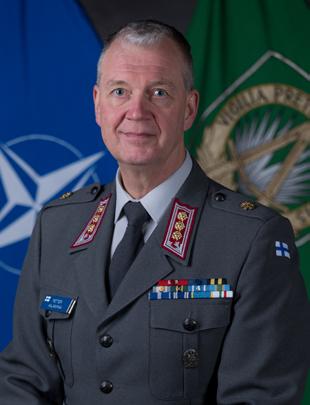
Kajanmaa served as the Finnish National Military Representative to NATO’s Supreme Headquarters Allied Powers in Europe (2022–2025) and is the author of Sotilasstrategia [Military Strategy].
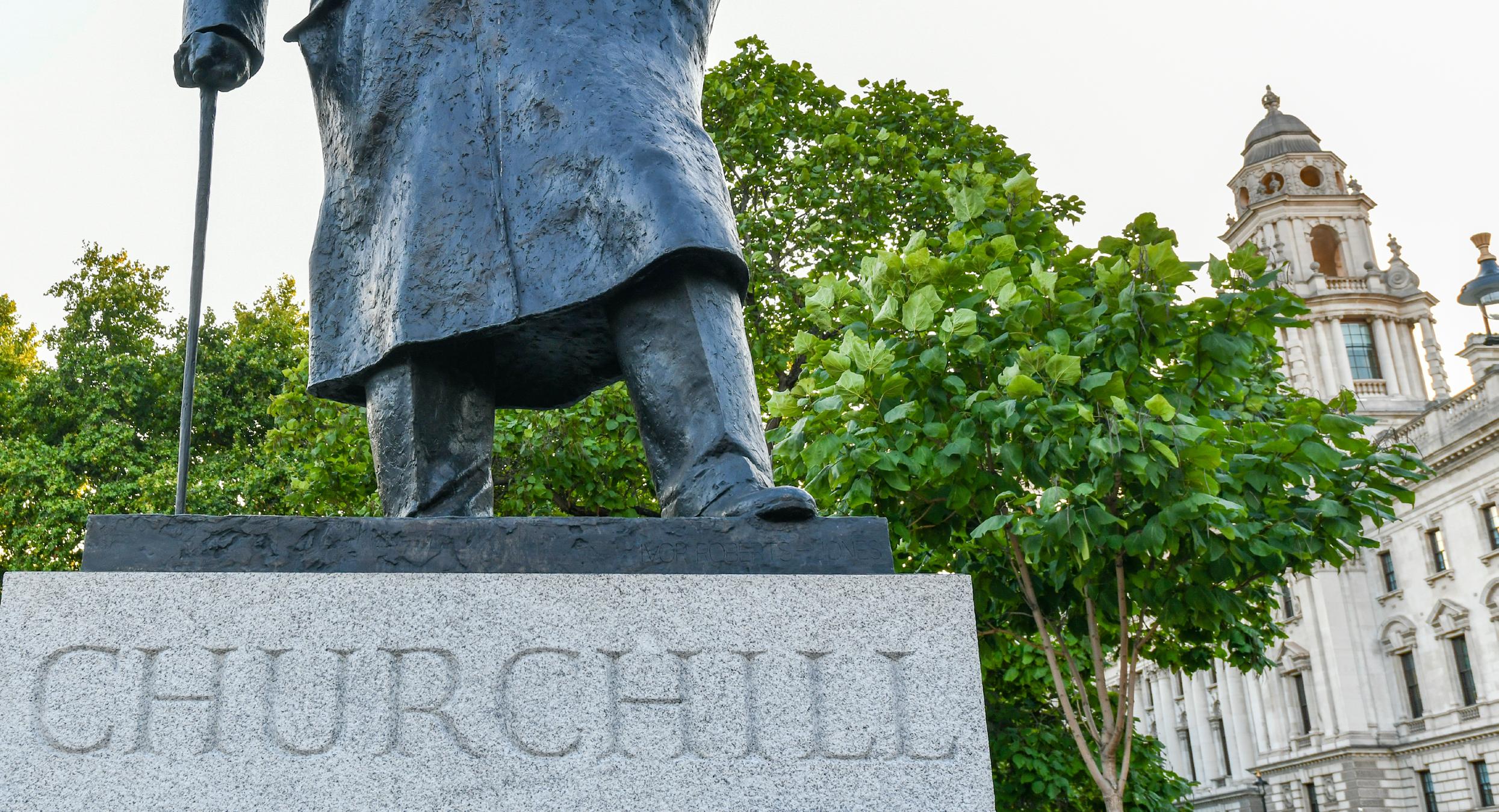
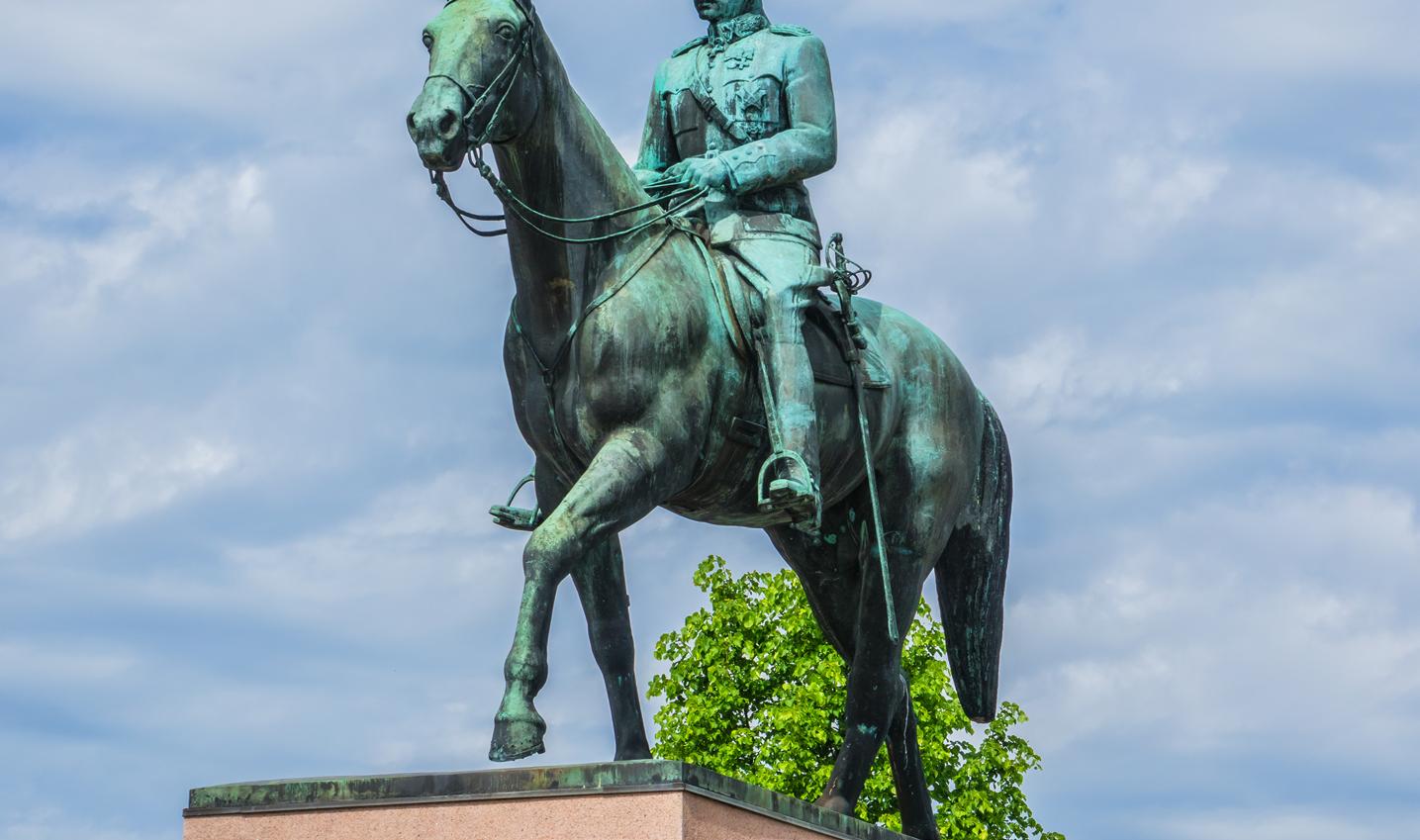
IN 1941, the Supreme Commander of Finland, Marshal Carl Gustav Emil Mannerheim, initiated the Continuation War against the Soviet Union. In response, the Prime Minister of the United Kingdom, Winston Churchill, was compelled to declare war on Finland. The historian Lord Andrew Roberts has described both leaders as aristocrats, cavalry officers, seasoned travellers, veterans of the Great War and staunch anti-communists. They were both known for delivering powerful public speeches and for continuing to lead their nations well into their advanced years.
Mannerheim, in turn, replied: “It was very kind of you to send me a personal message in these trying days, and I have fully appreciated it.”
More than eight decades on from this most cordial and courteous declaration of war, how have relations fared? Do Finns trust a country that – for a brief episode – was officially an enemy, and what are their thoughts on the present-day alliance?
On 29 November 1941, Churchill wrote a personal letter to Mannerheim: “I am deeply grieved at what I see coming, namely, that we shall be forced in a few days, out of loyalty to our ally Russia, to declare war upon Finland... It is not necessary to make any public declaration… I wish I could convince Your Excellency that we are going to beat the Nazis... My recollections of our pleasant talks and correspondence about the last war lead me to send this purely personal and private message for your consideration before it is too late.”
The roots of the relationship between the now NATO partners lie deep within the monarchy – first the Kingdom of Sweden, and later the Russian Empire. Prior to Finland’s independence, the country established social and cultural ties with the UK. For instance, the culture of English gentlemen’s clubs was introduced to Finland during the period of the Grand Duchy of Finland.
The majority of Finns possess a strong command of the English language, with approximately 70 per cent of the population able to speak it at a conversational level or higher, according to recent data. In schools, our children are taught to speak British English. In many other comparable countries, this is no longer the case, as American English has gained dominance. Nevertheless, the Brits believe that we still make the effort – and
sometimes even succeed. And the effort should be rewarded, at least intellectually.
Conversely, J.R.R. Tolkien was profoundly influenced by the Finnish language, Finland and the Finnish national epic Kalevala in shaping his legendarium and invented tongues. The author admired the Finnish language for its phonetic beauty and structure, describing it as a “complete wine-cellar filled with bottles of an amazing wine” that intoxicated him.
British humour carries a strong element of satire aimed at the absurdity of everyday life. Common themes include sarcasm, tongue-in-cheek remarks, banter, insults and self-deprecation. Jokes are made about everything, and almost no subject is off-limits, though a lack of subtlety when addressing controversial issues is sometimes considered insensitive. Many British comedy series have become popular in Finland, as their dry wit and dark humour resonate with Finnish sensibilities. Examples of TV shows that have enjoyed success in Finland include, among many others, Monty Python’s Flying Circus, Keeping Up Appearances, Mr. Bean, The Fast Show and Blackadder.
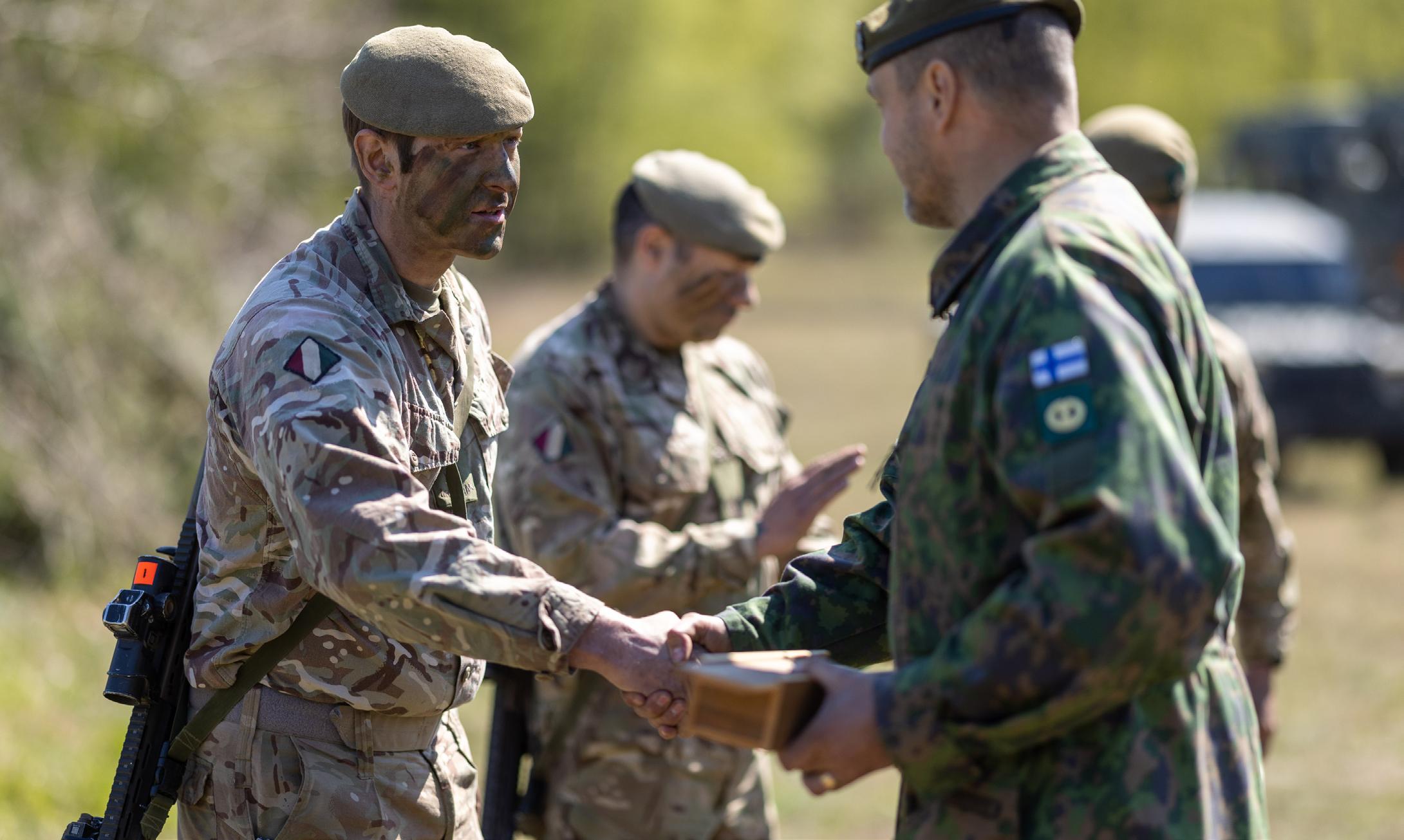
I have spoken with several Finnish officers serving in NATO and it has become clear that the British and Finns genuinely enjoy each other’s company and wish to work together. There are likely several reasons for this. The British and Finns share enough common values, a similar view of society and even a comparable sense of humour, yet they are also refreshingly different in some respects, such as in their approach to carrying out activities. In this sense, the relationship could be characterised by the way in which we often complement each other in the best possible manner, to the point where, at times, one plus one is, in fact, much more than two.
A discussion that aptly illustrates this complementarity and sense of humour took place in the corridor of the NATO command structure’s headquarters. The topic was a publication from the British Ministry of Defence, which Finns regard highly. A British one-star flag officer remarked dryly that while the Department is adept at producing “beautiful pieces and fine presentation,” they lack what he longed for – Finnish decisiveness and execution capability. This, he stated, is why we must work together.
From my own experience, the British, much like the Finns, hold their history and traditions in high regard. This brings us closer to one another in many ways. The British have long
“The quality that we Finnish soldiers particularly appreciate in our British colleagues is their professionalism. This is especially evident when planning operations and overseeing their execution. Most of the British are among NATO’s finest.”
appreciated Finland’s actions, particularly the nation’s yearning for freedom, throughout history. Notably, Churchill was a great friend of Finland, who sincerely admired Finland’s conduct during the Winter War and highly valued the fact that Finland preserved its independence. This is demonstrated by the correspondence between Churchill and Mannerheim referenced at the start of this article. We have not been on opposite sides of the table historically (that ‘obligatory’ Second World War chapter aside).
I began my service as the National Military Representative to the Supreme Headquarters Allied Powers Europe in the summer of 2022, just after Finland had submitted its application to join NATO. During the first weeks and months in my office, I frequently sought guidance and assistance from my British colleague and his office – and I always received invaluable advice. The UK endorsed Finland’s accession to NATO in early July 2022 and my British counterpart personally came to inform me of the news.
The quality that we Finnish soldiers particularly appreciate in our British colleagues is their professionalism. This is especially evident when planning operations and overseeing their execution. Most of the British are among NATO’s finest. Additionally, they have a strong work ethos and their morale is high – two values that are deeply respected in Finnish culture. It is very natural to work alongside the British, and as a reserved Finn, I find it refreshing to have an open and courteous counterpart. I believe the British also come
to appreciate us after the initial shock of our straightforward attitude and perpetually serious demeanour.
One example of mutual military respect is reflected in a comment from a British fourstar officer: “I have now seen a country that has a defence plan, a command structure to implement it, trained troops and wellmaintained equipment.” British politeness never fails. But honestly, my opinion, as well as that of my national colleagues, is that within the heart of NATO, it is easier to work with like-minded partners – and that is why we often turn to the British. As one Finnish OF-4 put it: “With them, it seems that almost anything is possible.”
Certainly, there is room for criticism. In Britain, English is spoken primarily, but there are various dialects, and accents can vary considerably. Listening to native speakers from the UK can, therefore, sometimes be challenging, especially when they use regional dialects or overly sophisticated “Oxford” pronunciation. The use of fancy words and convoluted sentence structures can be quite irritating for non-native speakers. On occasion, I have felt a slight sense of satisfaction hearing English native speakers struggle with Polish or Finnish place names.
We have a saying that a clock is more than just a decoration – meaning that discipline with regard to time is important. This is not always the strongest trait for Brits, especially when one gives a brief about a topic they are particularly passionate about. And then there
is the obsession with exercising year-round in just shorts and a T-shirt, as I observed when I visited the British headquarters in a sleetsoaked Pristina in 2001.
In Finland, we are accustomed to the fact that every officer, including those from the Air Force and Navy, is relatively well-versed in the matters of the Army. From my experience, in Britain, which is an island nation, the situation is quite the opposite. Instead, every officer in the Royal Air Force and Army is likely trained to think in terms of naval matters and to converse using what could be described as ‘naval jargon’ when necessary. The British (naval) strategic thinking is unparalleled, particularly in regards to an ability to create new lines of thought and assess an overall situation in changing circumstances.
A significant difference, which is quite difficult to comprehend, is the British attitude to rank. This is where Finland and the United Kingdom differ. However, it seems that British commanders, in particular, respect and admire the fact that Finns are ‘equally at home’ both in the commander’s reception and in conversing with the last soldier in a training exercise. In Finland, every officer has, at some point, served as a conscript and participated in enlisted tasks.
As a new Alliance member, we have admired the British “NATO first” strategy. It has been implemented not only in the British NATO headquarters but also in other command
“The British are, paradoxically, at their best when they are at their worst. They are adept at turning weaknesses into strengths and, through this, advancing their national saga.”
structure HQs. One reason for this might be that in every headquarters, there is a British flag officer in the command group. This, in my opinion, reflects that strategies in the UK truly matter, but also that British service personnel are capable of operating successfully in highly demanding roles, drawing on their experience and training.
The British are, paradoxically, at their best when they are at their worst. They are adept at turning weaknesses into strengths and, through this, advancing their national saga. Examples of this include, at various levels, the Battle of Britain, the Cold War, the threat posed by the Soviet Union and communism and… Brexit. Today, in light of the new threat facing Europe and the world, they have clearly shouldered responsibility and sought to take the initiative and provide leadership.
I am confident that conflict between Finland and the United Kingdom, as described in the earlier historical context, is no longer possible. Both countries share common membership
in the Council of Europe, the European Court of Human Rights, the International Criminal Court, the Joint Expeditionary Force (JEF), NATO, the Organisation for Economic Co-operation and Development, and the Organization for Security and Co-operation in Europe. Bilaterally, the two nations have a mutual defence agreement and a strategic partnership agreement. Since 2022, Finland, alongside Sweden, has been part of a mutual defence treaty with the UK.
A United Kingdom-led multinational military partnership, the JEF was established for rapid response and expeditionary operations, with a primary focus on Northern Europe and the Baltic Sea region. Its partners include the UK, Denmark, Estonia, Latvia, Lithuania, the Netherlands, Norway, Iceland, Sweden and Finland. Exercises conducted within the JEF framework play a crucial role in the Finnish Defence Forces’ supplementary training activities. JEF cooperation, alongside other international exercise collaborations, enhances the capabilities of all participating nations and is an integral part of the Finnish Defence Forces’ routine international interactions.
All this, and much more, binds the Finns and the Brits together. On an individual level, after any shared celebrations, the only ones who are on time for work, presentable, with shaved beards, impeccable attire and still working throughout the day without complaint, are the Brits and the Finns. This, of course, stems from something deeper.
STILL SPECIAL? FRIENDS OR A FORCED FRATERNITY?
AUTHOR
Major Rocco P. Santurri III has served with the US Army Civil Affairs and Psychological Operations Command since 2010. He has deployed in support of Operation Enduring Freedom and Operation Atlantic Resolve and is also employed as a defence strategist in the civilian sector.
FOR as long as there have been armies, soldiers – incessant gossipers by nature – have formed perceptions about soldiers from other armies, whether friend or foe. The historical record is rich in ancient military narratives and, more recently, accounts from individuals (often written in the midst of combat operations) offering their views on others in uniform. Egyptian military scribes, Caesar’s accounts of Gaul, and the Greek soldier and writer Xenophon’s first-hand missives from Persia are but a few. Later, Froissart’s Chronicles during the Hundred Years War and Recollections of Rifleman Harris by an English soldier during the Napoleonic Wars offered observations of opposing armies, ranging from technical assessments to personal feelings towards their adversaries. From the First World War, the volume of accounts increased significantly, with soldiers capturing their experiences with the enemy and historians offering more strategic commentaries, primarily based on memories
from influential generals and admirals. Some perceptions of armies are based on legend and rumour, highlighting inhuman feats; others come from ferocious hand-to-hand combat, providing indisputable proof of an enemy’s courage and tenacity. Consistent across both is the inevitability of perceptions between armies, whether to instil courage in one’s soldiers, diminish the perceived infallibility of the enemy, or pass the time during the many idle hours awaiting battle.
Fortunately, physical injury is not a current concern when uncovering American perceptions of the British Army. My forefathers in the Continental Army could never have envisioned Anglo-American relations in 2025, a quarter of the way into the new millennium. From its roots in the Second World War, the aptly termed “Special Relationship” has indeed been special, as well as sturdy, resilient and adaptable. But much had changed in the final days of the Allied advance into Germany as compared to the state of the two armies in 1914,
when the British Army was much stronger than its American counterpart. Even with General Montgomery leading the D-Day invasion in 1944, a discernible shift in the power balance was apparent. Post-Second World War, US military capabilities rapidly outpaced those of its British counterparts, mainly due to its population and economic potential.
Unsurprisingly, American perceptions of the British Army changed as well, and continued to do so through the Suez Crisis, Korean War, Gulf War and the ill-fated Global War on Terror. Clear trends became apparent over the decades, as the American military colossus continued to grow courtesy of everballooning defence budgets, including a whopping $850 billion in 2025 against $30 trillion in gross domestic product. Meanwhile, the UK military spent roughly $81 billion of its $3.6 trillion gross domestic product on defence in 2025. The foundation of a changed American relationship toward the British military steadily took root; inexorably, perceptions changed too.
Which brings us to the current day. The Special Relationship remains the bedrock of alliances and plays critical roles in the preservation of the Western-inspired rulesbased international order. Each year, British and US personnel come together for myriad
“While there are American perceptions of sibling rivalry, they are often framed in a fraternal sense.... Good-natured banter rarely ventures into ill-natured commentary.”
training exercises, deployments, steady-state operations and professional development at staff colleges and advanced degrees at non-military academic institutions. Personally, I have interacted with my British counterparts across each of the categories mentioned; currently, I work alongside British military personnel at the United Nations Command in Korea. These experiences, coupled with many anonymous responses from US noncommissioned and commissioned officers I’ve directly worked with, have produced a
significant number of data points identifying recurring American perceptions of the British military. These include:
n Most American military personnel view the British military as very professional with a higher level of military bearing. Underpinned by centuries of tradition and military decorum, many US service members concede that the British Army surpasses the US military in overall professionalism, with a strong sense of self and trust in individual capabilities bordering on over-confidence.
n Because of or despite this, the British military is perceived as highly interoperable and easy to work with, while striking a valuable balance between formality and a lighter, occasionally self-deprecating sense of humour. It is this last
quality that often endears British personnel to their American counterparts.
n The British military prioritises quality over quantity – a core ‘truth’ of US Special Operations Forces. The British Special Air Services, in particular, is looked upon very favourably as one of the most elite special forces in the world. American perceptions of British skill and proficiency are often attributed to the British military writ large, going beyond British special operations.
n While there are American perceptions of sibling rivalry, they are often framed in a fraternal sense, echoing the “fraternal association of English-speaking peoples” coined by Winston Churchill in his famous speech that introduced the “Special Relationship” concept. Good-natured banter rarely ventures into ill-natured commentary.
n Many respondents viewed the British military as systemically underfunded. In some ways, it boosts the British military’s stock; personnel conduct and proficiency are highly regarded despite lacking the budgetary largesse of the Americans.
n Many responses hinted at a crisis of confidence in the British military; such responses were more prevalent among the American officer corps. Perceptions ranged from concerns about funding and its geopolitical role post-Empire to individual soldiers grappling with their place in multinational operations and organisations.
n Many of these perceptions tie into a broader sentiment that reaches back to D-Day. General Montgomery leading Allied forces in the largest amphibious assault ever to free Western Europe was indeed a seminal, apex moment that the British military rightfully
“Prevailing perceptions of each other reflect respect and consideration. At the same time, washed over are the occasional grievances, as decades of shared interests and shoulder-to-shoulder efforts against challenges, episodic or existential, overcome periodic dust-ups.”
holds dear. Living in London and attending Second World War commemorative events certainly left an indelible impact on me. Since then, the prominence of the British military has diminished, with the US continuing its monopoly on the Supreme Allied Commander Europe billet at the forefront of NATO military operations. This lingering yearning for days past, when the Brits led the way – a sort of ‘Monty influence’ – translates into occasional spats during multinational operations, some of which were noticeable during NATO operations in Serbia. Tensions are not limited to the general officer level; I personally witnessed similar issues on multinational exercises more than once. But such American perceptions are at minimum partially borne of US culpability. One could posit that the American military is also experiencing an existential debate: the sun is setting on the American Empire as unipolarity quickly becomes an historical footnote. Future generations may look back and realise the Americans were just a few steps behind the British in the ‘imperial afterglow’ process (curiously like Dr KublerRoss’ five stages of dying). Consequently, if the British soldier is affected by the ‘Monty influence’, then the American soldier is affected by the ‘Eisenhower influence’ or ‘Patton influence’ as well; the former the overall leader
of the Allied effort in Europe during the Second World War, skilful at managing disparate personalities, including General Montgomery, the latter a hard-charging and provocative combat leader supposedly feared by the Germans. Consequently, heavy-handedness by the Americans in multinational political and military affairs has rightfully prompted pushback from its NATO allies, eager to remind Washington this is a team effort. A final, tangentially related note: with the US Army bringing back its Second World War era dress uniforms, it comes as no surprise to this officer that the ‘Ike’ jackets, an optional overcoat, have been flying off the shelves. Seldom known is the Ike jacket was originally inspired by the British battle jacket.
From my perspective as a career Civil Affairs officer, I’ve noticed over the years the profound differences between US and the British Civil Affairs, namely the Civil Affairs Group and 77th Brigade. US Civil Affairs is often very proficient at the tactical and operational level, while our British counterparts have consistently demonstrated a better grasp of strategic-level second and third order considerations and effects. Often during multinational training and exercises, respective US and British Civil Affairs work well together, given the varying perspective each has on the operating environment that, in sum, make for a robust common operational picture.
While official polling numbers are not available, it is a safe bet that the British military is a preferred partner of the US. It certainly has been my experience as I look back upon a career steadily reaching its culmination. Throughout the multiple interactions I have had with the British military, on exercises, in a war zone, at university or through my current billet at the United Nations Command, the intangibles Churchill mentioned in his famous speech remain true today, as do the perceptions repeated by many of my American peers. There is no escaping history; English colonists founded America, and despite the battles and separation, it is difficult to deny the enduring fraternalism between the British and American militaries. Prevailing perceptions of each other reflect respect and consideration. At the same time, washed over are the occasional grievances, as decades of shared interests and shoulder-to-shoulder efforts against challenges, episodic or existential, overcome periodic dust-ups. With the American Empire in the early stages of decline, a few steps behind the decades-long imperial afterglow of the British Empire, perceptions of each other are likely to be shaped with greater empathy and accommodation in the years to come, amid the remaking of the world.
Baltic brothers: Captain Stephen Goula (US Army), commander of Task Force Dakota, and Brigadier General Andrew Ridland, the Deputy Commanding General of 1st Armoured Division, during a meeting in Estonia to discuss joint efforts to support NATO’s mission on the eastern flank.
DANISH DOSSIER: LOW-DOWN ON ‘WORKING WITH THE BRITS’
THIS article reflects my personal views and tries to offer some insight into what – from the perspective of a member of a partner nation – it means to ‘work with the Brits’, and why a new British Army focus on ‘NATO first’1 would be an offer worth taking. It argues the well-used message that the better we understand each other culturally and turn our differences into opportunities, the “Stronger Together”2 we are, and – in turn – the better placed the British Army will be to meet both its NATO first pledge and the ambitions of the Security Defence Review, and become the strong partner NATO needs. With luck, this might lead to some discussion and reflection in a time of transformation and adaptation to the present challenging politicalmilitary situation in Europe.
As a ‘direct Dane’ there is of course the risk of me failing the fine balance between being too blunt and missing the mark of trying to offer some useful insight to what it means to ‘work with the Brits’. But I have had some of my best years in uniform with the British Army and like my Viking forebears almost a 1,000 years ago, I too have made my fair share of ‘cultural hiccups’. I admire your esprit de corps, your people and your willingness to take the lead and ‘just get on with it’ when others might hesitate, which is what NATO needs. The intent is not to point any fingers and what I argue could probably be said about most armies (including the Danish – albeit on a smaller scale because, as we say in Denmark, “small kids, small problems and big kids, big problems”).
BRITISH CULTURE, BALANCING HISTORY WITH MODERN TIMES
To understand the British Army, you must first appreciate the cultural backdrop that shapes its ethos. The British society and Army are steeped in traditions with a twist of adaptation to modern realities. Who doesn’t love a Sunday roast shared with family in a
AUTHOR
Lieutenant Colonel Jesper Stroier
(ACOS G9 CIMIC, HQ
Allied Rapid Reaction Corps) is a Danish Army officer who has worked alongside the British Army for almost 30 years.
classic British countryside pub, or the fantastic display of Trooping the Colour? (Though at the same time wondering why you cannot have a mixed cold and hot water tap like the rest of the world). These traditions coexist with a culture that values formality and a certain ‘stiff upper lip’ – a phrase that many foreigners might interpret as a degree of arrogance and distance or maybe reservation from opening up and getting too close. Who has not had the response of ‘oh, I’m fine’, ‘don’t mind me’ or ‘you should come over for dinner’ (which all usually mean the opposite)? This cultural DNA also understandably permeates the British Army, influencing its approach to discipline, ceremony and leadership. This can be seen in the greater distance between ranks than in less formal armies. This can sometimes cause conflict, for example, when younger British officers are working with more experienced partner nation non-commissioned officers, or if there is a difference in the level of education and rank between nations. In the Danish Army, a captain will have attended the Intermediate Command and Staff Course (Land), and a senior major the Advanced Command and Staff Course, which is why a company commander in Denmark is a captain (something not always understood or appreciated by the Brits).
While modernisation has transformed the British Army, its strong regimental system and
1UK SDR 2025.
ceremonial traditions are still a unique blend of old and new that not many armies have retained. This system, with its deep historical roots, fosters loyalty and identity but also adds complexity to organisational structures which is not easily understood and can at the same time look both fascinating, challenging and somewhat outdated to some.
British officers are transforming and becoming more modern too (luckily ‘no sandwiches in the mess’ is a thing of the past), but there is still a degree of formality to communication and dress, and an emphasis on etiquette and protocol which can sometimes surprise partners from more informal cultures. For this reason, I have always told my partner nation colleagues to remember to occasionally include a sir or ma’am in conversation. It eases the situation, but in fairness it also reinforces a level of professionalism and mutual respect across different cultures, which we less formal nations could learn from. Understanding these cultural nuances are essential for effective cooperation.
NATO FIRST, A NEW MANTRA OR JUST A SLOGAN
For the British Army, the 2025 Security Defence Review dictates NATO first. But what does it take to meet the intended strategic imperative and not be just another new slogan? This commitment should mean aligning doctrine, procedures and communication systems with NATO standards, and when you do have to prioritise, it should always therefore be NATO as priority one. Of course it is not that simple, but from tactical planning to operational execution, British forces should continue to prioritise interoperability, ensuring seamless integration with allied units. The time when it could be said that “the British write the best doctrine in the world; fortunately, they do not read it”3 should be a thing of
2“Stronger Together” is an official NATO slogan.
the past (noting that now it should be NATO doctrine the Brits are reading). English as the operational language of NATO gives you Brits a natural advantage. You might be the next Shakespeare or Robert Burns but just remember not everyone in your organisation is a native speaker, and misunderstandings reduce operational output. Keep the language simple and use the official NATO acronyms. But emphasis goes beyond language, it includes aligning with NATO command structures, standardised reporting formats, shared digital platforms and the like. Not being able to share information because you are using a semi-interoperable UK system is not helpful and only reduces lethality.
A NATO first approach will enhance coalition cohesion and ensure that British units can lead or integrate into NATO formations without friction. Exercises such as Joint Warrior and Avenger Triad, and deployments under a NATO flag, demonstrate the UK’s dedication to collective defence and British HQs often serve as framework nations for NATO missions, enabling multinational forces to operate effectively. The new role of the Allied Rapid Reaction Corps (ARRC) as a “fully enabled” Strategic Reserve Corps is a very strong message and ambition in support of this.
However, this ambition demands determination and further investment in training and technology to keep pace with evolving NATO requirements and lessons from the war in Ukraine. The British Army already invest a lot of resource in interoperability training, aiming at ensuring that your officers and soldiers understand NATO procedures and can operate seamlessly in combined and joint environments. Yet, interoperability is not without challenges, balancing national doctrine with NATO standards requires flexibility and maybe a greater willingness to sometimes compromise. Occasionally, there might just be another way of doing it right.
PROFESSIONALISM AND CHALLENGES: HIGH STANDARDS AMID CONSTRAINTS
As you are aware the British Army is widely regarded as professional, ambitious and a standard-setter within NATO. Your officers and soldiers are trained to operate in complex environments and British staff officers are known to take the lead and occupy key positions in NATO headquarters.
Yet, this reputation comes with challenges. The British Army is widely considered relatively ‘top heavy’ and officers’ short time in post, rotating every two years, reduces experience in post and ensures that the officer “accumulates
multiple postings, leading to large numbers of senior officers”4 compared to similar sized armies. This leads to maintaining a somewhat complex and bureaucratic hierarchy that maybe more reflective of historical structures and global ambitions rather than what can be effectively sustained today and ultimately leaves less at ‘the sharp end’. Back at Army HQ, we international liaison officers often discussed whether it was in the British Army DNA to try to solve any problem by setting up a new 2* HQ. With a regular strength down to circa 73,000 and growing numbers amongst many European partners, the British Army might soon find itself level with some of the medium-sized armies in Europe. Added to this it faces well-known capability gaps in very crucial and expensive areas such as air defence, long-range fires and heavy armour. These shortfalls complicate efforts to meet NATO expectations, especially as the UK strives to achieve a defence spending target of 3.5 per cent or more of gross domestic product, which looks very difficult in the present financial climate.
Balancing ambition with resources is a persistent challenge to us all and it requires difficult decisions on force design, capabilities, equipment, personnel and modernisation priorities. There are programmes in place in the British Army that seek to address some of these issues by restructuring, investing in digital systems and technology and aim to enhance lethality and deployability. However, progress is incremental and resource constraints remain significant. I would therefore argue that the British Army should take the offer and use its new NATO first ambition to continue to strive to attract partners, it should be obvious why partner nations want to come to you –not least when it comes to the ambitions of the ARRC as a fully enabled NATO corps. Delivering all the needed capabilities will be a challenge, which is why ‘every little helps’.
STRATEGIC POSITION:
GLOBAL AMBITIONS AND DOMESTIC REALITIES
Despite obvious challenges the UK still occupies a strategic position as one of the major European military powers. As a permanent member of the UN Security Council (P5) and one of only three NATO nuclear powers, Britain wields significant influence in global security affairs. This status underpins its high ambitions, from leading NATO initiatives to projecting power internationally. The UK maintains a continuous at-sea nuclear deterrent and invests in advanced capabilities such as cyber defence and space operations, as well as taking a strong leading position in the support to Ukraine.
Yet, these ambitions must be reconciled with resource constraints and a struggling domestic economy. Still firmly rooted in Europe but now outside the EU, the UK seeks to maintain a strong transatlantic balance with the US while sustaining credibility within NATO and the EU. This balancing act is complex: Britain must demonstrate leadership without overextending itself, and the British Army must remain an attractive organisation to the partners it needs, to ensure that commitments remain credible and sustainable in an era of fiscal austerity and evolving threats at home and abroad.
The Security Defence Review highlights this tension, and while acknowledging the need for prioritisation, it remains vague about specifics and lacks solutions. For partners, this means that while the UK remains a reliable ally, its ability to deliver on every ambition is increasingly linked to limited resources. The challenge for Britain is to maintain influence without compromising operational effectiveness, a delicate balance that shapes its defence posture and international partnerships.
CONCLUSION
Working with the British Army is both rewarding and challenging. Its blend of tradition and modernity creates a distinctive military culture that values professionalism, ceremony and resilience. The British Army’s commitment to interoperability and putting NATO first will offer an opportunity for British forces to remain integral to the Alliance and collective defence, even as ‘the Brits’ (like the rest of us) navigate structural, capability and financial challenges. For us as international partners, understanding these dynamics is essential to fostering effective cooperation. Despite constraints, the British Army still embodies a legacy of leadership and adaptability that makes ‘working with the Brits’ a unique experience that I can only recommend. Ultimately, collaboration with the Brits offers lessons in balancing a strong national culture with innovation and ambition with pragmatism.
The British Army is still a strong partner with a strong desire and ambition to take the lead where needed, and with a renewed mandate to put NATO first there are opportunities to set new standards and principles that will remain relevant to all NATO partners as we face the challenges of the future together.
3This quote is widely attributed to General Kurt von Hammerstein-Equord, a German general, though it’s often repeated in NATO circles as a humorous observation about British military culture.
4Dr. Jack Watling, RUSI 2021.
FIREFIGHTING ON NATO’S FLANKS? THE UNITED KINGDOM MOBILE FORCE
AUTHOR
Professor Andrew Stewart is Head of Conflict Research at the CHACR.
1‘British Defence Policy – The Impact of Recent Events in Czechoslovakia’, Note by the Defence Policy Staff, 23 September 1968, DEFE4/231, The National Archives, Kew (hereafter ‘TNA’).
3Marc DeVore, ‘The Airborne Illusion: Institutions and the Evolution of Postwar Airborne Forces’, SSP Working Paper (June 2004), 12-14; Lieutenant Colonel David M. Glantz, ‘The Soviet Airborne Experience’, Combat Studies Institute, Research Survey No.4 (November 1984), 148-150.
4Peter M. Wargo, ‘The Evolution of Soviet Airmobility: Impact on the Seventies’, Military Review (Vol.LV, No.11; November 1975), 3-13.
5Col A.A. Sidorenko, ‘The Offensive (A Soviet View), Soviet Military Thought No.1 (Washington DC: US Government Printing Office, 1973, cited by Glantz, ‘The Soviet Airborne Experience’, 152-153.
6‘Handbook on Soviet Ground Forces’, US Department of the Army, FM30-40 (30 June 1975), 6-33, 36, 37.
7‘Soviet Military Power’, US Department of Defense, 1984, 49-50.
8Gianluca Devoto, ‘The evolution of NATO doctrine: Toward abandonment of flexible response?’, The International Spectator (Vol.19, No.1; 1984), 23; AVM N. Cameron (ACDS(Policy), ‘Czechoslovak Crisis –Possible Further UK Measures to Support NATO’, 20 September 1968, DEFE4/231, TNA.
FOLLOWING the August 1968 invasion of the Czechoslovak Socialist Republic by four Warsaw Pact countries, the then Supreme Allied Commander Europe General Lyman L. Lemnitzer (US Army) viewed events as confirmation of his worst fears. His assessment – also held by the British Defence Policy staff – was that enemy intentions could not be reliably predicted and “…in any future crises, we can expect little or no tactical warning”.1 How best to exploit the concept of surprise featured prominently in the thinking of Soviet military planners throughout much of the Cold War.2 Airborne forces were seen as a critical resource, as was demonstrated the year before the crushing of the Prague Spring. During the 1967 ‘Dnepr’ exercise, which encompassed the Baltic and Belorussian Military Districts and was the largest since the end of the Second World War, an entire division of 8,000 troops was dropped successfully on a target along with supporting specialist armour and assault guns.3 Three years later, along the Dvina River in modern day Belarus, a slightly smaller airborne force of 7,000 troops took just 22 minutes to land successfully on its objective.
Unbeknown to NATO observers, all of the Soviet Union’s airlift would have been needed to repeat this in a wartime setting and Soviet thinking moved on, influenced in part by close examination of American experiences in Vietnam.4 Writing in 1970, Colonel A. Sidorenko had highlighted that heliborne forces could “perform various raid methods, make surprise assaults on withdrawing and approaching enemy columns, control points, and rear service areas, and cause panic in the enemy disposition”.5 Five years later a
US Army assessment reached much the same conclusion, warning air-landed or heliborne forces could operate up to 160 kilometres in the rear area “seizing bridges and fords, capturing airfields for follow-up landing of airborne troops and heavy equipment, and carrying out sabotage operations against enemy nuclear launching and communications facilities”.6 Carried out possibly in conjunction with amphibious landings, the potential to disrupt both offensive and defensive operations increasingly seemed a very real threat to NATO and its conventional warfighting plans. Negating the associated possibility of losing before substantial reserve forces could arrive in theatre would persist as a significant challenge throughout the remainder of an unfought Third World War and beyond.7
With NATO’s adoption in 1967 of its new ‘flexible response’ strategy, the conditions were already being set for an improvement of the Alliance’s conventional defence posture and gradually greater emphasis was attached to making additional troops available for deployment to Europe at short notice.8 A study on External Reinforcements for the Flanks proposed setting up immediate reaction forces, one for the north flank and the other for the south, that could be deployed rapidly in a crisis while a more significant strategic reserve was prepared. The Alliance had long held
mobiles forces: the Allied Command Europe Mobile Force had been conceived in 1959, creating a multinational body “that could be moved quickly to the NATO periphery during periods of tension”.9 A 5,000 strong force –with the US, Canada, West Germany, Belgium and Italy providing battlegroup-sized infantry units and Britain contributing one battalion – its primary focus was the northern option, with the south as a secondary role. The force was not deployed during the Czechoslovakia invasion, a failure which many NATO military leaders saw as demonstrating a lack of political will.10 As concerns about Soviet intentions grew, with it there was increased resolve to strengthen this capability and requests to provide further troops for a rapid reaction ‘fire brigade’ role, the government in London viewed the United Kingdom Mobile Force (UKMF) as providing a possible solution.11
Following the announcement by Prime Minister Harold Wilson’s Labour government in January 1968 that, within three years, it would withdraw troops from major military bases east of Aden, 3rd (UK) Division, which had previously formed the strategic reserve for the worldwide role, had been retitled as the UKMF.12 Given the primary task of reinforcing NATO in Europe, the focus was primarily in the central region in support of 1st (British) Corps and 1st (Belgian) Corps – either securing the approaches to the Paderborn Plain, occupying a defensive position, or operating to the west of the Weser. It was also earmarked for possible deployment in Zeeland, Jutland or Schleswig-Holstein on NATO’s northern flank and to north-east Italy, Greece and Turkey in the south. Within 12 days of orders being issued to deploy, the sizeable force of 29,000 troops (formed in three potentially air-transportable brigades with 10,000 vehicles and guns and carrying 30 days of stocks) would move via sea lift to Ostend and Zeebrugge and airlifts to bases in Germany, and assemble in Sennelager.13
Following the 1974 Defence Review and the following year’s Army Restructuring Plan and further reorganisation of the UK’s land forces, the division was redeployed to the British Army of the Rhine and the UKMF role passed to 16th Parachute Brigade.14 As a reinforced brigade with a logistics support group and a reduced Royal Air Force element, this new organisation of 5,000 troops was considerably smaller than its predecessor and its organisation and equipment dictated it should be used for ground holding positional defence tasks. A degree of mobility was envisaged with the retention of some support helicopters but there were doubts about how this might work.15 Despite this and the reduction in size,
“Soviet planners had long shown an interest in the region [north flank], which they viewed as having a weaker defence and being more vulnerable to ‘lightning thrusts’. If the Danish islands and the Jutland peninsula could be captured, including the airfields around Hamburg, NATO would face significant strategic problems.”
the UKMF retained its previous deployment options to all three Allied Command Europe regions and was still required to fight within the overall concept of operations of the corps to which it was assigned and be self-sufficient for 30 days. In April 1977 the brigade reorganised and was re-designated as the 6th Field Force, which the following year assumed the UKMF role.
Responding to pressure to increase the available mobile reserves, and as part of what in 1980 was termed the ‘Trans-Atlantic Bargain’, NATO heads of government agreed to improve the Alliance’s capability to reinforce Europe rapidly in a crisis.16 The intent was to establish a more comprehensive and closely coordinated reinforcement plan than had previously existed, by increasing the number of US reinforcements in Europe in return for greater host nation support and infrastructure funding by the European partners. The following year US General Bernard W. Rogers produced his Rapid Reinforcement Plan and one of its precepts was the dedication of reinforcements as far as possible to a specific theatre of operations.17 The Supreme Allied Commander Europe (SACEUR) believed this would facilitate better operational planning and increase the scope for host nation support and the stockpiling of supplies. As far as the UKMF was concerned, he proposed it be assigned to Allied Forces Northern Europe, the most northern NATO command, headquartered outside of Oslo. Responsible for the defence of the whole of Norway and Denmark and, in the event of war, northern Germany in and around Schleswig-Holstein, the UKMF would help defend the Allied Forces Baltic Approaches [BALTAP]. Until 2002 when it was deactivated, Baltic Approaches – which encompassed the key German port of Hamburg along with Schleswig-Holstein, the Danish islands and the Skagerrak and Kattegat – was of vital importance to NATO.18 With its headquarters at Karup in Denmark, at its core were
significant maritime and air forces including the entire Danish components, the West German Navy and British and American naval forces in the Western Approaches. Its land component with its headquarters at Rendsburg consisted of two elements, LANDZEALAND responsible for the defence of Zealand and the other adjacent Danish islands and LANDJUT covering Jutland and Schleswig-Holstein.
Allied Forces Northern Europe provided a strong reminder of the importance for planners of basic military geography. It presented NATO with a possible route to counter-attack any Soviet general offensive and the potential to penetrate and manoeuvre in its enemy’s flank and rear. This danger dictated a strong Warsaw Pact response but this flank also offered considerable opportunities, indeed Soviet planners had long shown an interest in the region, which they viewed as having a weaker defence and being more vulnerable to “lightning thrusts”.19 If the Danish islands and the Jutland peninsula could be captured, including the airfields around Hamburg, NATO would face significant strategic problems. General Sir Anthony Farrar-Hockley commanded Allied Forces Northern Europe from 1979 to 1981 and, writing subsequently in his memoir, he noted the significance of this key terrain, not just for his command but the Alliance’s
9Lieutenant Colonel Calvin H. Creasy, ‘A Perspective of the ACE Mobile Force’, Military Review (Vol.LV, No.11; November 1975), 3-13.
10Sean Maloney, ‘Fire Brigade or Tocsin? NATO’s ACE Mobile Force, Flexible Response and the Cold War’, Journal of Strategic Studies (Vol.27, No.4; 2004), 598607.
11‘Czechoslovak Crisis – Possible Further UK Measures to Support NATO’, DEFE4/231, TNA.
12The future of the United Kingdom Mobile Force (Land) (UKMF(L)), Historical Background’, 6 October 1986, B-1, DEFE13/2086, TNA.
13‘United Kingdom Mobile Force Deployment to Allied Forces Central Europe – Joint Theatre Plan (NATO) Number 74, Operation MUFFIN’, Chiefs of Staff Committee, 11 January 1973, DEFE5/195, TNA.
14‘Historical Background’, DEFE13/2086, TNA.
15DeVore, ‘The Airborne Illusion…’, 18.
16‘Historical Background’, DEFE13/2086, TNA.
17David Isenberg, ‘The Rapid Deployment Force: The Few, the Futile, the Expendable’, Cato Institute Policy Analysis, No.44, 8 November 1984.
18‘Visit of CINCNORTH to Chief of the General Staff’, 23 July 1984, DEFE 70/722, TNA; Admiral Hanshermann Vohs, ‘The BALTAP Region: The NATO Position on the Baltic Sea’, Military Review (Vol.LV, No.12; December 1975), 78-79.
19Eugene Hinterhoff, ‘NATO’s Flanks’, Military Review (Vol.XLV, No.6; June 1965), 50.
entire defence. Whilst fully recognising the maritime considerations, including the need to retain access to ports in north-west Germany – critical for theatre level entry and the movement of reinforcements and supplies, he worried about a rapid Soviet thrust moving Russian aircraft to forward positions.20 Losing the Baltic Approaches threatened to dislocate not just the entire northern flank but also offered a potential direct corridor to attack the British Isles.
An Impact Study prepared within NATO indicated that it would mean SACEUR losing all his strategic land reserve, air mobile reinforcement capability and a major part of his air defence requirements.21 Nonetheless, work continued to implement the Rapid Reinforcement Plan and, in the face of Italian concerns, a reserve American mechanised brigade and the Portuguese Composite Brigade were allocated to north-east Italy. While there was no evidence that the Danes would fail to meet their agreed commitments, there was also some anxiety in Copenhagen about the political impact of weapons and equipment stocks being pre-positioned within
20Anthony Farrar-Hockley, Opening Rounds: Lessons of Military History, 1918-1988 (London: Andre Deutsch, 1988), 153.
21‘UK/US Pol/Mil Talks, 26/27 June 1984: Brief No.11b – South West Asia: Implications of RDF for NATO’, 19 June 1984, FCO46/3930, TNA.
22‘Letter to Brigadier Alastair Dennis from Major General A L Watson’, 18 May 1981’, FCO 46/2583, TNA.
23Jonathon Riley, ‘Oft in Danger’: The Life and Campaigns of General Sir Anthony Farrar-Hockley (Helion & Company, 2015), 393; later cuts, specifically the reduction of regular Danish troop numbers along with the cancellation of some modernisation plans, did subsequently raise concerns.
24‘Provisional War ORBAT of the New UKMF(L)’, 1 April 1978, DEFE 70/431, TNA.
25‘Home Defence and Security of UK Base: Annex G to Home Defence Plan, Serial 7, Operation CHOCK’, n.d., DEFE 11/879, TNA.
26‘Army Organisation and Structure - United Kingdom Mobile Force (UKMF) Organisation: Annex A’, 18 November 1977, DEFE 70/431, TNA.
27‘Measure 4.50, To Deploy the United Kingdom Mobile Force: Government War Book, Volume 1’, January 1980, CAB 175/53, TNA; ibid., ‘Army Organisation and Structure - United Kingdom Mobile Force (UKMF) Organisation: Annex, Composition of the New UKMF(L)’, n.d., DEFE 70/431; ‘NATO Rapid Reinforcement Planning: Danish Defence, Reinforcement (Draft)’, 22 September 1981, FCO 46/2583.
28‘Measure 4.50…’, CAB 175/53, TNA.
29Tony Geraghty, ‘Slow take-off for Mrs T’s rapid force’, The Sunday Times, 8 March 1981, 14.
30‘Commander’s Diary: HQ Logistic Support Group (Jan –Dec 1985)’, WO305/6584, TNA.
the country.22 The major Baltic Approaches partner, in the mid-1980s the Danes were described as a “staunch” NATO member “contributing proportionately well above its size to the defence of Europe…” with maritime and air resources and a land component consisting of a corps headquarters and one-and-a-half mechanised divisions helping defend Jutland and the Danish islands.23
By January 1983 agreement had been reached and, for its revised role, the UKMF was configured as an expeditionary force, capable of fighting alongside – but logistically largely independent of – partners, although likely relying on host nation support for transport and domestic services, mainly through the deployment phase. It now had a strength of 13,000 troops – with provision for up to 2,000 battle casualty replacements – and included a logistic support group, locating battery and electronic warfare troop. Mobility was assisted by a support helicopter element with five Chinooks and ten Pumas adding another 600 personnel to the total strength. Moving from British bases using maritime and air military and civilian resources would take five days. With an agreement between British and NATO commanders that its primary role would be counter-penetration/blocking, there were three deployment options with SchleswigHolstein and Jutland considered the best locations, but Zealand also had to be retained due to political considerations and to reassure the Danes. As part of the latter, plans were made to stockpile 100 tons of artillery ammunition at NATO Depot Dejbjerg; a 1978 study had indicated that the UKMF in its then reduced order of battle would require 20 times that amount of ready use ammunition.24
According to UKMF planning documents produced for 6th Field Force prior to the 1983 agreement, with no sealift they were to deploy through Lyneham and Brize Norton.25 Regular units were kept at seven days’ notice at all times, reduced in times of tension, while advance and key parties were permanently on 24 hours’ notice.26 With approximately 40 per cent of the force reservists, the intention was that it might deploy without them if a crisis developed very quickly.27 In addition, two battalions from The Parachute Regiment also had potential commitments in West Germany and Northern Ireland and it was acknowledged that it would take at least 16 days before the mobile force could be fully constituted.28 This meant that, working on a standard NATO planning scale, in the event of a surprise Warsaw Pact move the UKMF would arrive 13 days after the commencement of hostilities. The other issue remained that of lift as there were insufficient aircraft and the Royal Air Force had no recent experience or training on mass airborne assaults.29
While open source information detailing later developments remains limited, towards the end of 1985 a series of scenario-based exercises were conducted to test UKMF planning and preparedness.30 These began in the September with Royal Hurdle, in which the force deployed by air and sea to protect ‘South Englander’ from an attack from its ‘North Englander’ neighbour, and continued the following month with Purple Victory, in which ‘Britannia’ was threatened from the north by ‘Barbaria’ and 5 Airborne Brigade was deployed in the first instance to coordinate the evacuation of British nationals but also to honour defence obligations. This
DEFE
13/2086: The National Archives, London
cycle culminated in late November with the command post exercise Ridds Rum to rehearse 1 Infantry Brigade in command and staff procedures when operating in a mobile setting. In the scenario, the British force was portrayed as “a reinforcing formation deployed from an allied nation prior to the outbreak of hostilities” with four phases, which included a counter-attack against enemy heliborne/airborne forces. Immediately prior to this, in the June, Bandit Girl had taken place and was one of the frequent recces to confirm details for the LANDJUT option one activity, specifically local arrangements for receiving and hosting the incoming British force as it moved up to assigned positions facing the East German border. The official documents demonstrate a high level of activity but do not reference any outcomes or what lessons were learnt.
The evidence elsewhere suggests that British mobile forces were overloaded with commitments. Even after post-Falklands reforms were implemented, a short period during which funding and resources were made available, the UKMF’s existence was being questioned, it being argued that “some of its tasks are beyond its capabilities [and] more realistic employment options should be renegotiated”.31 In October 1986 a paper was produced in response to a need to now reduce costs; during the previous two years cuts had focused on equipment programmes but the goal was to make wider savings including manpower reductions with the least impact on operational effectiveness. The UKMF was seen as offering the most potential with its “very high teeth to tail ratio” and discussions continued into the following year and through to the end of the Cold War.32 The concept, however, prevailed and Exercise Certain Shield 91 was the first real test of what was now termed a rapid reaction corps, which one ministerial document believed “should have a busy role to play in a future Army”.33 Headquarters Allied Rapid Reaction Corps (HQ ARRC) has, since its establishment the following year, provided NATO with a rapidly deployable and flexible headquarters for operations and crisis response. Beginning with its command of the land component of the NATO Implementation Force operation in Bosnia in 1995, there have been subsequent significant roles during the Kosovo War and, perhaps more notably, in Afghanistan.34
A requirement has, however, persisted for highly mobile forces which can deploy rapidly in response to a sudden crisis. At the NATO Wales Summit in 2015, Germany, the Netherlands and Norway agreed to contribute to the interim Very High Readiness
“NATO’s Cold War planners were no different from their modern successors and, within their contingency planning, the latter must anticipate the worst case.”
Joint Task Force, another brigade-sized force of approximately 5,000 personnel intended to deploy at speed and reinforce frontline troops. This was viewed as a more responsive core for the NATO Response Force, which had been announced at the NATO Summit in Prague in November 2002 and reached initial operational capability two years later. Replacing the NATO Response Force, and described as “a critical component of the new NATO Force Model”, NATO’s Allied Reaction Force was stood up in July 2024 with the NATO Rapid Deployable Corps Italy designated as providing the initial temporary headquarters. It can serve as a rapid deployable strategic reserve “delivering forces, fires and effects within 10 days to either strengthen deterrence or provide strategic dilemma to adversaries” and is charged with delivering much the same as was intended from the UKMF. In February 2025 the Allied Reaction Force participated in exercise Steadfast Dart 2025, its first large-scale deployment including all of its components and the year’s largest NATO exercise.35
NATO’s Cold War planners were no different from their modern successors and, within their contingency planning, the latter must anticipate the worst case. In 2024 the House of Commons Defence Committee warned that “even when a country ensures it has an adaptable and agile force structure, it can still be subject to a so-called ‘strategic surprise’: an unpredicted development that has a decisive and fundamental, transformative, sometimes revolutionary, effect on perceptions of readiness”.36 Describing the challenge
facing the wider Allied Forces Northern Europe region 45 years ago, Farrar-Hockley’s biographer concluded: “If there was sufficient political will to mobilise and reinforce in the event of crisis, then [the commander] could probably hold his ground; if the Warsaw Pact was able to mount a surprise attack, or seize the initiative, the game would be over before it started”.37 Whilst no evidence can be found of his thinking on the UKMF, he had fought at Arnhem where he had experienced first-hand what can happen when light, mobile forces reach too far forward. As a shock or coup de main force, there have been notable successes ranging from Eben Emel to Port Said. Where the task asked of them was too great, there were disasters such as Crete, Arnhem and Dien Bien Phu. The greater the distance from the main force the greater the risk of light troops being overwhelmed.38
Whether the UKMF could have responded to a rapid Soviet thrust is unclear but the evidence points to considerable challenges, although issues with manpower and lift seem to have been unpleasant truths which were borne at risk. It might have been able to initially halt the spread of the blaze but there was every chance that a rapidly spreading conflagration would have proven too much for the fire brigade.
31‘CINCNORTH’s call on CGS - 24 Jul 84, Memorandum from Colonel Hyde’, 28 July 1984, DEFE 70/722, TNA.
32‘The future of the United Kingdom Mobile Force (Land) (UKMF(L))’, 6 October 1986, DEFE13/2086, TNA; ‘United Kingdom Mobile Force’, House of Commons Debate, 23 January 1987, Hansard (Vol 108), cc.8245W.
33Kenneth Carlisle to Minister (AF), 13 September 1991, DEFE13/2589, TNA.
34Lieutenant General Sir Jeremy Mackenzie, ‘The ACE Rapid Reaction Corps – Making It Work’, RUSI Journal (February 1993), 16-20; ‘Allied Rapid Reaction Corps’, NATO, arrc.nato.int; ‘Allied Rapid Reaction Corps’, British Army, army.mod.uk/learn-and-explore/about-the-army/ formations-divisions-and-brigades/headquarters-alliedrapid-reaction-corps
35‘Stand up of Allied Reaction Force marks a new era for NATO’, 1 July 2024, shape.nato.int/newsarchive/2024/stand-up-of-allied-reaction-force-marks-anew-era-for-nato; ‘Allied Reaction Force (ARF)’, NATO, nato.int/cps/en/natohq/topics_234091.htm; ‘NATO Response Force (2002-2024)’, NATO, nato.int/cps/en/ natohq/topics_49755.htm
36House of Commons Defence Committee, ‘Ready for War?’, First Report of Session 2023–24, Hansard, 30 January 2024, 11.
37Riley, ‘Oft in Danger’, 395.
38For a wide-ranging discussion of modern light forces, see ‘Might is Light’, Ares & Athena, Issue 28, 7 August 2025, chacr.org.uk/2025/08/07/ares-athena-issue-28might-is-light
REDUNDANCY OR RENEWAL?
AIR MANOEUVRE IN THE TWENTY FIRST CENTURY
AUTHOR
Brigadier Ed Cartwright was appointed Commander 16 Air Assault Brigade in summer 2025.
A1Ministry of Defence (2020). UK Air Manoeuvre: JDN 1/20.
2Symes, P.R. (2015). Air Manoeuvre historical analysis study report. DSTL/TR89992. Dstl DSA Division, 31 July 2015.
3Ministry of Defence (2020). Defence Operational Capability Audit Report 20/01.
IR manoeuvre – the movement of land forces by air to a position of advantage1 – has a mixed press in the annals of military history. Notable successes on D-Day, crossing the Rhine in 1945, and more recently by French airborne forces in Africa have been overshadowed by heavy German losses on Crete, disaster at Arnhem, and the 2022 failure of Russian forces to secure Hostomel Airport. Despite a chequered past, a 2015 Defence Science and Technology Laboratory (Dstl) study judged that air manoeuvre offers Defence “unique capabilities that could not be undertaken by other arms and services”.2 Similarly, a 2020 Ministry of Defence capability audit described the UK’s Air Manoeuvre Task Force as “one of Defence’s primary conventional response options”.3 European and allied armies continue to invest in air manoeuvre, but Russia’s invasion of Ukraine has once again cast the shadow of doubt over a contested capability. The failure to secure Hostomel Airport and the rapid proliferation of air defence technology and drones offers literal and metaphorical ammunition for detractors to argue that the
parachute is dead and the helicopter barely survivable on the contemporary battlefield. This article is not about parachuting or The Parachute Regiment but instead casts an objective(ish) eye on air manoeuvre as a capability and argues that the requirement to generate NATO’s Strategic Reserve Corps, in combination with the opportunities presented by technological advancement, signpost the enduring utility of air manoeuvre and should herald its renewal rather than its redundancy.
Dstl’s 2015 study examined 213 separate air manoeuvre operations from 1941 to 2014. It is unequivocal about the benefits of air manoeuvre across the spectrum of conflict. The study cited five “unique capabilities” of air manoeuvre:
n Strategic geographical accessibility;
n Operational flexibility;
n Tactical area coverage;
n Timeliness;
n Economy of force.
Put simply, air manoeuvre combines the benefits of air power (principally speed and reach), with the ability to put soldiers where it matters
(access). J F C Fuller captured the potential of air manoeuvre in 1932 when he stated that “the history of war has shown again and again that a handful of men at a certain spot at a certain hour is frequently a far more powerful instrument of war than ten times that number on the same spot twenty-four hours later”.4
Despite the advantages of air manoeuvre, it suffers from being on the seam between the air and land components. This tension has played out between single Services since the inception of air manoeuvre, most famously between Air Chief Marshal Charles Portal and Field Marshal Alan Brooke in the Second World War. The history of air manoeuvre formations in the Army’s order of battle exposes the institutional uncertainty that plagues the capability. At the end of the Second World War, the 1st and 6th airborne divisions were downsized into 16 Independent Parachute Brigade, which was then disbanded in 1977 when it was felt that nuclear power and armour would keep the nation safe, not parachute silk. In 1983, after six years without a dedicated air manoeuvre formation, 5 Infantry Brigade was converted into 5 Airborne Brigade to demonstrate UK commitment to expeditionary operations outside Europe and rapid power projection to reassure NATO allies. In 1989, 24 Airmobile Brigade was formed to create a counterpenetration capability using aviation. The limits of UK aviation capacity were quickly exposed and the 1998 Defence Review merged 24 Airmobile and 5 Airborne brigades to become 16 Air Assault Brigade and capitalise on the forthcoming Apache attack helicopter.
This short historiography of disbandment and mergers exposes the tension between using air manoeuvre offensively (in the Second World War) or largely defensively (during the Cold War). An even starker tension exists between air manoeuvre forces’ role in expeditionary crisis response and their place as a core component of warfighting capability. These tensions pervade what little doctrine exists (the last formally endorsed air manoeuvre doctrine was published in 2002)5 and are evident but unresolved in the 2020 Ministry of Defence capability audit.6
The uncertainty and tension that plague air manoeuvre has been amplified by Russia’s invasion of Ukraine. Detractors seized upon Russian forces’ failure at Hostomel to expose the limits of helicopters on the contemporary battlefield.7 They argue that modern heatseeking man-portable air defence (MANPAD) systems such as the Russian SA-24 and SA-29 litter the battlefield and are highly effective against even modern heat-seeking counter measures. Furthermore, the proliferation of drones has led inevitably to a rapid increase in air defence systems, including interceptor drones that could pose an ever-greater threat to aircraft.
Although reasonable, these criticisms do not paint a full picture, and nor do they herald the redundancy of air manoeuvre. Russia is believed to have employed 34 helicopters and 200-300 Russian airborne soldiers at Hostomel.8 Despite choosing to conduct the assault by day and employing a route and
“The uncertainty and tension that plague air manoeuvre has been amplified by Russia’s invasion of Ukraine. Detractors seized upon Russian forces’ failure at Hostomel to expose the limits of helicopters on the contemporary battlefield.”
“The Ukrainians enjoyed some early success – downing one of the attacking Ka-52s. As the Russian aircraft was making a strafing run, a soldier attempted to engage it with an 9k38 Igla (SA-24) surface-to-air missile system, but his target was initially too close. However, as the Russian helicopter continued to fly past him, it moved beyond the minimum fire range, allowing him to re-acquire and engage. The missile hit the helicopter, sending it crashing onto the runway. That was the first of at least three helicopters shot down that day.” – Read more about the events at Hostomel in Issue #187 of The British Army Review: The Battle of Irpin River.
height that exposed them to MANPAD attack, the first wave of helicopters successfully delivered air assault troops onto their objective with the loss of only two helicopters to MANPADs.9 The justification for the Russian decision to abort the infiltration of the main force of between 1,000 and 5,000 soldiers in up to 41 aircraft is not entirely clear. What is clear is that like at Arnhem, over-reaching and underestimating one’s enemy were the key ingredients for disaster, not the infiltration method.
A broader appreciation of the use of aviation and air manoeuvre in Ukraine reveals that not only did Ukrainian forces use helicopters to get reserve forces to Hostomel just in time to help repulse the invaders, but Ukraine’s Army Aviation branch has kept their helicopters in the fight into 2025, conducting up to 300 sorties a month.10 Ukrainian aviation conducts attack, air defence (shooting down Shahed drones) and lift sorties, some within two to three kilometres of the front.11 Russian helicopters also remain active the length of the frontline. Rather than proving the redundancy of air manoeuvre, Ukraine indicates that with good intelligence; the right tactics, techniques and procedures; and ideally modern defensive aide suites, air manoeuvre is still alive and well.
Accepting that air manoeuvre is not dead is very different from it being on the cusp of renewal. Air manoeuvre must be both useful and usable for NATO to justify increased investment in straitened times.
Air manoeuvre has two principal uses in war: it can unlock an enemy’s defensive scheme, and it offers a highly mobile and flexible reserve. The utility of air manoeuvre to unlock
4Fuller, J. F. C. (1932) Lectures on F. S. R. III (Operations between Mechanized Forces). London: Sifton Praed & Co.
UK Ministry of Defence. (2002). Army Field Manual, Volume 1, Part 12: Air Manoeuvre. Shrivenham: Development, Concepts and Doctrine Centre.
Ministry of Defence. (2020). Defence Operational Capability Audit Report 20/01.
Ricchi, F. (2025) Finabel – European Army Interoperability Centre. Above the Battlefield, Below Expectations. [online] Finabel. Available at: finabel.org/ above-the-battlefield-below-expectations
Centre for Historical Analysis and Conflict Research. (2024). The Battle of Irpin River.
Zabrodskyi, M, Watling, J, Danylyu, O, and Reynolds, N. (2022). “Preliminary Lessons in Conventional Warfighting from Russia’s Invasion of Ukraine: February–July 2022”, RUSI Special Resources.
10Ukrainian General Staff.
11Ibid.
an adversary’s defence was illustrated on both D-Day and the crossing of the Rhine. Hostomel could have been an equally apposite example had it succeeded. Seizing an airfield only 10 kilometres northwest of Kyiv should have opened the way to the capital.
Ukraine also offers a useful example of the enduring utility of an air mobile reserve in defence. As Russian forces poured across Ukraine’s borders in February 2022, Ukrainian air assault forces were flown onto areas of key terrain. Most notably, air assault forces seized critical junctions on the M5 highway to prevent Russian forces from severing the principal line of communication between Kyiv and Odessa and thereby threatening Ukraine’s second city. Similarly, albeit not in a warfighting scenario, in 1999 air manoeuvre elements of the UK’s 5 Airborne Brigade conducted a forced entry into Kosovo and secured key terrain including the Kacanik Defile to facilitate the withdrawal of Serbian forces.
In addition to these two core functions, air manoeuvre offers three other important advantages. First, surprise. In 2005 General Rupert Smith wrote: “Forces can be moved by air, greatly enhancing the surprise, reach and tempo of the overall manoeuvre. Forces can be deployed from depth into depth at unexpected speed and direction.”12 This remains the case today and is well illustrated by Hostomel, albeit with the wrong outcome for the Russian invaders. Some commentators13 have argued that surprise is a thing of the past, but no number of sensors will ever be able to predict human behaviour. Seeing more does not necessarily equate to knowing more and while persistent observation of the battlefield might make surprise harder to achieve, it also dramatically increases opportunities for uncertainty and deception.
Second, air manoeuvre forces can hold key enemy capabilities or terrain at risk, forcing an adversary to spread its forces to defend from air assault. Third, as a highly mobile reserve, air manoeuvre forces are well suited to responding to an adversary’s air assault or
12Ministry of Defence (2020) UK Air Manoeuvre: JDN 1/20.
13Cancian, M.F., 2023. The Challenge of Military Surprise in an Open World. Center for Strategic and International Studies (CSIS). Available at: csis.org/ analysis/challenge-military-surprise-open-world
14Land Intelligence Fusion Centre (2024) How Russia Fights V5. Ministry of Defence.
15DeVore, M.A. (2015). When Failure Thrives: Institutions and the Evolution of Postwar Airborne Forces. European Journal of International Security, 1(1).
“Drones could be a central ingredient in the renewal of air manoeuvre as a core (and corps) capability... Inserting a force equipped with large numbers of drones (or just drone batteries) into complex terrain allows them to kill at range before subsequent ground manoeuvre.”
special operations. Russia has approximately 45,00014 personnel in their VDV (airborne forces), as many as 15,000 Spetsnaz and up to 1,000 support helicopters. Allied air manoeuvre formations offer NATO a suitably agile counterforce. These three advantages of air manoeuvre support the somewhat counterintuitive deduction that air manoeuvre forces can be at their most effective when held in reserve at the corps level and not employed.
Critics could argue that investing in a force that is best not used is intellectually and fiscally questionable. Furthermore, using Second World War case studies and quoting the likes of Fuller and Smith could be criticised for being retrospective. However, not only does the continued use of air manoeuvre in Ukraine reinforce its utility today, but recent technological advancements could help air delivered forces overcome some of their traditional shortcomings and thereby accelerate the renewal of air manoeuvre as a capability of enduring utility.
Drones could be a central ingredient in the renewal of air manoeuvre as a core (and corps) capability for three reasons. First, drones may be flipping the protection paradigm. In his 2015 excoriation of airborne forces Marc Devore argues that lightly armed airborne forces are unacceptably vulnerable to armour.15 Although indisputably correct, unlike light infantry and airborne soldiers, armour cannot dash into basements or easily hide in complex terrain. Survival on the battlefield has always required a mixture of physical protection and concealment, but concealment is in the ascendancy in an era of both persistent observation and increasing
precision; it’s easier to hide a paratrooper than a tank.
Second, drones are redefining force projection. Another enduring criticism of air manoeuvre forces is that once they have escaped their parachute harnesses or disembarked their aircraft, they are very limited in where they can go and what they can kill. Inserting an air manoeuvre force equipped with large numbers of drones (or just drone batteries) into complex terrain allows them to kill at range before subsequent ground manoeuvre. Air manoeuvre forces should no longer be constrained to landing on or near contested terrain (usually bridges or airfields). They can now land-off, shape and then fight their way in – a ‘double bounce’ rather than the traditional refrain of ‘fly, dig and die’.
Third and finally, sustainment need no longer be the Achilles’ heel of air manoeuvre. Although often celebrated for lasting longer than their food or ammunition was supposed to, air manoeuvre forces have historically been difficult to sustain. Uncrewed resupply – by ground or air – could change this. In 2024 less than a battalion of Ukrainian marines held a small pocket of ground around the village of Krynky on the left (east) bank of the Dniper for over six months against a vastly superior Russian force. Routine resupply of food, water and some ammunition was done by drone while heavier stores were transported by small boats constantly at risk of detection and attack from Russian drones.
The shifting paradigms of protection, projection and sustainment may make air manoeuvre forces more useful, but the endurance of air
manoeuvre as a capability demands that it is both useful and usable in near-peer warfighting in support of a specific NATO mission. The utility of air manoeuvre in expeditionary crisis response is not in question, but its value fighting Russia in Europe is.
NATO describes its own model of Forward Land Forces as potentially “insufficient against a reconstituted Russian Army that has advantages in geography, domain, and readiness and can present a mass and momentum dilemma”.16 To stop Russia seizing NATO territory and achieving tactical advantage by transitioning to the defence, NATO has rewritten its war plans to reassure eastern European nations that they will not be expected to cede territory. Instead, NATO intends to defend every inch of land despite Russia’s obvious advantages, particularly in time and geography.
Defending every inch against a numerically superior force requires a combination of sizable and credible in-place forces and an agile and robust strategic reserve. As NATO’s Strategic Reserve Corps, the UK-led Allied Rapid Reaction Corps (ARRC) must be able to contribute to both deterrence by denial – i.e. preventing a Russian invasion by persuading the Kremlin of its inevitable failure; and deterrence by punishment – i.e. making the cost of invasion unacceptably high. A renewed air manoeuvre capability could play an important part in both forms of deterrence but has almost unique utility in deterrence by denial.
Prior to the outbreak of violent conflict, and potentially as part of an Article 4 response to Russian provocation, air manoeuvre, and specifically a massed parachute insertion, offers an agile and highly visible demonstration of UK commitment to NATO and our European allies. A massed parachute (airborne) or massed helicopter (air assault) insertion offers a way of keeping an enemy off balance while the Strategic Reserve Corps deploys rather than treating the deployment of forces as a preparatory or administrative move. Once on the ground, and in line with the recently published Army Operational Design,17 an air manoeuvre force could also hold critical enemy capabilities at risk and pose multiple dilemmas for Russian war planners.
A credible strategic reserve must be able to move fast and be first to the fight. Getting air manoeuvre forces to “a certain spot at
a certain hour”18 could deter invasion by adjusting the force ratio calculations that drive Russian planning. Furthermore, the rapid infiltration of air manoeuvre forces to reinforce or seize key terrain (such as critical transport hubs) could be one way to prevent Russia establishing anti access area denial capabilities on NATO territory.
Should deterrence by denial fail, and again in line with the Army’s Operational Design, air manoeuvre forces equipped with long range effectors from 1(UK) Division could spearhead the Army’s reaction force and reinforce our advance force (and allies’) ability to use land fires to degrade Russian air defences. As RUSI recently argued, and the Chief of the General Staff frequently explains,19-20 fighting from the land is likely to become increasingly critical to NATO’s ability to defeat cheap and easily manufactured long-range drones and suppress Russian air defence systems. Air manoeuvre, and specifically air-land operations during which people and systems are moved by aircraft and disembarked, offers one way of getting land fires to the right place at pace. The NATO air component’s expectation to use fifth generation fighters (the ‘assassins’) to open the skies for fourth generation fighters (the ‘thugs’) could come up short if ubiquitous air defence systems outnumber high end munitions on NATO jets. Land fires, potentially airlanded and employed in conjunction with air manoeuvre forces, will almost certainly be part of the solution.
Air manoeuvre also offers commanders the option of vertical envelopment that could solve some of the problems that will inevitably face a NATO corps fighting in Europe. For example, the British Army has a very limited number of M3 amphibious bridging rigs and general support bridges which, even with allied support, offers little capacity for crossing rivers and bodies of water. Furthermore, bridging assets are slow and extremely vulnerable to artillery and drone attack. Russian forces discovered this to their cost in May 2022 when Ukrainian surveillance drones spotted Russian forces preparing to cross the Siverskyi Donets River. Estimates vary, but image analysis suggests that Ukrainian artillery destroyed up to 100 Russian
armoured vehicles. In the absence of greater crossing capacity, vertical envelopment by air manoeuvre offers options to secure the far bank, establish a lodgement and pre-position air defence systems before exposing bridging assets and attempting to cross.
In conclusion, Russia’s invasion of Ukraine has precipitated a fundamental re-think of how Europe defends itself and NATO’s revised plan for Deterrence and Defence of the Euro Atlantic Area has clarified the UK’s role. With a forward-deployed and persistently engaged advance force, and a Strategic Reserve Corps consisting of reaction and response forces at varying notice to move, the UK can play a critical part off-setting Russia’s advantages in time and geography and projecting force to the right spot at the right hour. Air manoeuvre offers our island nation the ability to exploit the air flank at the speed of relevance to mitigate risk, seize opportunities and present dilemmas for our enemy, both before and after the outbreak of conflict. Rather than flying, digging and dying, the advent and proliferation of drones should soon enable air manoeuvre forces to project, protect and sustain themselves in a way that was not possible only a few years ago. The future of air manoeuvre is no more certain than its past, but the war in Ukraine is not the death knell that some suggest. The UK’s role at the heart of NATO’s Strategic Reserve Corps and the rapid technological advancements on display in Ukraine signpost the enduring utility of air manoeuvre and should herald its renewal rather than its redundancy.
16U.S. Army Europe and Africa. (2025). Eastern Flank Deterrence Line Concept.
17UK Ministry of Defence. (2025). Army Operational Design.
18Fuller, J. F. C. (1932) Lectures on F. S. R. III (Operations between Mechanized Forces). London: Sifton Praed & Co.
19Watling, J. and Reynolds, N. (2023). Future of Fires: Maximising the UK’s Tactical and Operational Firepower. RUSI.
20Walker, R. (2025). Chief of the General Staff speech at RUSI Land Warfare Conference 2025. UK Government. Available at: gov.uk/government/speeches/chief-of-thegeneral-staff-speech-at-rusi-land-warfare-conference-2025
AUTHOR
Major Laurence Thomson is the Chief of the General Staff’s Visiting Fellow at RUSI. As part of the Military Sciences team, his research is focused on land power lethality, contemporary conflict and British Army modernisation.
EXCEEDINGLY GOOD* WISDOM: KIPLING’S LESSONS FOR THE 21ST CENTURY
SUPERFICIALLY the 21st century battlefield – characterised by the proliferation of long-range precision munitions, artificial intelligence, autonomous systems and myriad technological marvels – bears little resemblance to the dusty imperial frontiers of Rudyard Kipling’s era. Yet beneath the digital veneer, the essence of war remains one of human endeavour: visceral, passionate and uncertain. These are the very facets Kipling captured with brutal clarity, revealing much that is as relevant in today’s wars as it was then.
His works explore enduring themes related to the nature of war, its moral dimensions and the imperative to transform and adapt in the face of annihilation. Kipling’s was an unstable world punctuated by rising nationalist popularism, fragmenting world order and atavistic cravings which are both accelerated and enabled by rapid technological advances. This commentary will focus on considering his canon in three areas: institutional learning and strategic failure; the nature of the British soldier; and the soldier’s place in British society.
KIPLING IN CONTEXT
1Ministry of Defence, Strategic Defence Review 2025 Making Britain Safer: secure at home, strong abroad, (HMG, 2025).
2Gen Sir. R. Walker, ‘Chief of the General Staff Speech at RUSI Land Warfare Conference 2025’, (HMG, 17 June 2025).
3Richard Evans, ‘Before the First World War: what can 1914 tell us about 2014?’, (Newstatesman, 23 January 2024).
4Lord D. Alton, ‘Global Tensions: Parallels between the past and present’, (GIS AG, 21 February 2025).
To read Kipling is not only to escape into history, it is to gain a different perspective on the present day through a penetrating historical lens. His works provide an understanding of Britain’s geopolitical situation and the dilemmas facing its military and political leaders. But, as the looming spectre of Great Power Competition returns, what has he to say that is relevant in Britain’s “new era of threat”?1 What does his writing add to a contemporary British Army focused on seeking to move data “horizontally, not just vertically, at light speed, with a precision focus on the defeat mechanisms to an adversary’s fighting system, from top to bottom, from back to front”?2
Kipling wrote and experienced conflict in a time of profound change amid an era of total war, societal division and global disorder. Richard Evans describes how such times draw “uncomfortable parallels” with today, giving “an ominous foretaste” of things to come.3 Whilst Lord Alton notes how the rise in today’s “extreme forms of nationalism, imperialistic ambitions… [and] a depressed air of inevitability” mirrors conditions at the turn of the 20th century that preceded the two most destructive wars in human history.4
Kipling was born in Bombay, now Mumbai, in British crown-ruled India on 30th December 1865. After briefly returning to England for
*Save your guffaws. I am acutely aware that Mr Kipling is a fictional brand character and not the celebrated author, but wasn’t going to let such a detail deny the use of an exceedingly obvious headline. – Editor
6
school, he spent his early career in India before travelling extensively across the wider British Empire. He was variously a journalist, war correspondent, writer and historian. Poor eyesight prevented him from becoming a soldier but he was a chronicler and critic of military life: a paradoxical figure who contrasted the romanticised ideal of empire with the gritty reality of frontier soldiering. Many will recognise the name of Rudyard Kipling from Plain Tales from the Hills (1888), Barrack-Room Ballads (1892) and most famously The Jungle Book (1894).
His works can be broadly categorised in three periods: British imperial (1886-97), the Boer War (1900-1903) and the First World War (1915-32). Each differs in subject and temperament but all go some way to describe the ‘lived experience’ of soldiers and soldiering in their time. This is the foundation of Kipling’s enduring popularity and can be credited for his ability to provide a window into a past that, despite distance, reveals timeless the many characteristics of a soldier in general and a British Army soldier in particular.
INSTITUTIONAL LEARNING AND STRATEGIC FAILURE
Modern militaries operate in a world of accelerating complexity: hybrid threats, contested domains and rapid technological change. The imperative to learn, especially from failure, remains. The steep learning curve of warfare is a common theme of Kipling’s writing and he frequently discusses lessons and failures. Parallels are revealed with today in areas such as military doctrines of adaptive learning, post-conflict review and organisational reforms.
The British Army suffered repeated disasters in the early stages of the Boer Wars before re-learning its previous hard-won lessons. Recessional (1897) and its constant refrain “lest we forget – lest we forget!” was published at the end of Queen Victoria’s jubilee celebrations as a call for reflection and humility. Writing at a time when the global might of the British Empire seemed unassailable, Kipling was seemingly out of step with the popular mood.
Kipling’s calls for temperance and caution in victory – as a challenge to doctrinal complacency at the exact moment of its vindication – were only subsequently recognised as sound advice when it was too
5Katharine
late. Katharine Gerould noted in The Atlantic (1919) how Kipling’s warnings had been ignored before the First World War.5 She concluded that he had “the disadvantage of telling the truth prematurely” and “if England had been prepared in 1914, there would have been no war in 1914”. For today’s defence organisations, it echoes the need to remain humble in the face of evolving threats and to resist the seductions of legacy thinking. As the UK seeks to lead within NATO and modernise its force structure, Kipling’s caution remains relevant. Britain must channel this approach to ensure it has strategic credibility: this demands humility and hardware, not just rhetoric and hubris.
In his poem M.I. (1901), Kipling captures the frustration of tactical learning being delayed by institutional inertia. His verse reminds us that adaptation must be anticipatory, not solely reactive. This sentiment resonates with current efforts to absorb lessons from Ukraine on munitions stockpiles, dispersed command and drone warfare. The Strategic Defence Review’s £1.5 billion investment in an ‘alwayson’ munitions pipeline and the proposed Defence Readiness Bill reflect a recognition that institutional adaptation is key. Principally, so Britain does not have to learn lessons the hard way:
“I wish myself could talk to myself as I left ‘im a year ago; I could tell ‘im a lot that would save ‘im a lot on the things that ‘e ought to know! When I think o’ that ignorant barrack-bird, it almost makes me cry.
I used to belong to an Army once (Gawd! What a rum little Army once), Red little, dead little Army once!”
The Lesson (1901) is Kipling’s exploration
into the consequence of learning from others’ mistakes. Despite being over 120 years old it has remained an iconic poem because its sharp criticisms are recognisable to modern readers. It is regularly drawn out of retirement and has most recently been shared in relation to the 2021 fall of Afghanistan.6 Kipling’s description of how the British had been defeated “conclusively, comprehensively, and several times and again” by a technologically inferior enemy aptly described the coalition’s ignoble defeat by the Taliban. As does his condemnation of an “Army in our own image” that has ill-suited structures, tactics and equipment which too closely “mirrored its makers’ ideals… and mental attitude” rather than reality on the battlefield.
Kipling’s strategic lens naturally applies when turned to the human level. If institutions must learn, so too must individuals. The next section explores Kipling’s portrayal of the soldier as more than a system component but as a moral actor.
THE NATURE OF THE BRITISH SOLDIER
Even though the 21st century British soldier is called upon to operate drones, navigate a cyber battlefield and coordinate joint fires the essence of their make-up appears surprisingly unchanged. Stoicism in the face of adversity, irrepressible humour and that uniquely British acceptance of anti-establishment individuality. This latter one being something that, from personal experience, our allies frequently find bewildering. Especially in relation to our eclectic mix of regimental traditions and dress policies.
For many, the poem which most fittingly describes the emotional and moral resilience of the British soldier is If (1910). Addressing
Gerould, ‘The Remarkable Rightness of Rudyard Kipling’, (The Atlantic, January 1919).
Spencer Jones, ‘The British Army and the Lessons of the Boer War’, (War on the Rocks, 11 March 2024).
the reader in a steady litany of tests, each conditional ‘if’ becomes a virtue drill essential to good soldiering. Kipling frames the soldier’s greatest battle as the one fought within. The need for professional self-control to master fear, pride and impatience to be able to operate in chaos and execute with clear decision-making. Kipling’s work offers a rich portrait of the British soldier, shaped by humour, hardship and resilience.
In today’s media-saturated environment, where soldiers are scrutinised and celebrated in equal measure, he reminds us that integrity must be defended, not just in combat, but in culture. The poem’s structure mirrors the psychological demands of command and endurance. For soldiers navigating decentralised missions, ethical dilemmas and high-pressure environments, ranging from urban combat to cyber and the electromagnetic spectrum, it is a blueprint for composure, integrity and perseverance.
Alongside the individual is the communal, which Kipling explores in Stalky & Co (1899). Set in a boarding school, the selection of short stories follow the formative years of young officer cadets learning to outwit authority and adapt under pressure. The tales are lighthearted and mischievous but relate to serious lessons on adaptability and the importance of peer learning. Modern soldiers must do more than follow orders – they must think, adapt and mentor. Yet courage and camaraderie remain their indelible bedrock. Framed by moral clarity, Kipling defines the British solider as an equilibrium of self-mastery, adaptive leadership and collective learning.
As the UK develops its formations with ever increasing amounts of robotics and autonomous systems, Kipling’s emphasis on peer bonds and informal leadership offers a counterweight to technological determinism. The human element of cohesion, trust and humour remains irreplaceable.
Kipling’s soldier is not just a fighter – he is a citizen, a comrade and a bearer of moral weight. But what happens when the war ends? The final section of this article explores Kipling’s reflections on the soldier’s return, and the societal tensions that follow.
THE SOLDIER’S PLACE IN BRITISH SOCIETY
The Strategic Defence Review calls for a “whole-of-society” approach to national security.7 It recognises that resilience in the face of sophisticated and complex threats depends upon the integration of civil, military and government capabilities. Yet this ambition
“Kipling’s lesson is that the soldier is not merely an instrument of policy but a central component of warfighting readiness.”
must confront a persistent emotional and cultural divide between those who serve and the society they defend. This is not a new phenomenon. Kipling, writing in Tommy (1890), exposed the schizophrenic nature of British attitudes to its military personnel. The poem’s oft-repeated refrain captures how soldiers – then as now – can be celebrated in war one day, then sidelined in peace the next:
For it’s Tommy this, an’ Tommy that, an’ Chuck him out, the brute!”
But it’s “Saviour of ‘is country” when the guns begin to shoot;
An’ it’s Tommy this, an’ Tommy that, an’ anything you please;
An’ Tommy ain’t a bloomin’ fool - you bet that Tommy sees!
This duality persists today; as does the soldiers awareness of it. The need for an Armed Forces Covenant commitment to ensure “those who serve or have served… should not be disadvantaged because of their service” is itself an acknowledgement that such disparities exist.8 That said, it is a tangible measure by the British Government in a multi-pronged approach to rehabilitate the Armed Force’s image in society. An approach much needed in light of declining public trust in institutions,9 broader societal disengagement and apathy following failed campaigns in Afghanistan and Iraq.10
From the soldier’s perspective, the gulf can feel even wider. In Chant-Pagan (1919), Kipling gives voice to the alienation of a returning veteran who is struggling to reconcile the intensity of his service experiences with civilian life:
“Me that ‘ave been what I’ve been –Me that ‘ave gone where I’ve gone –Me that ‘ave seen what I’ve seen –‘Ow can I ever take on With awful old England again.”
This sentiment resonates today, not only amongst British veterans (regardless of whether they have seen combat or not) but other nationalities in contemporary conflicts. There is growing evidence11 that many Ukrainian soldiers returning from the front lines are struggling to reintegrate back into civilian life, likewise their Russian adversaries.12 The challenge is not simply one of employment or
housing but of cultural reintegration. Often, they report feeling emotionally and culturally disconnected, being apart from a society they feel has carried on without them. There is much promise in the launch of Project Valour, a £50 million government sponsored national veteran support initiative, that promises “to improve the coordination of services at a national, regional and local level to ensure that veterans receive the support they need”.13 One imagines Kipling would have been supportive.
IF YOU CAN THINK – AND NOT MAKE THOUGHTS YOUR AIM…
The UK is pivoting its Armed Forces from expeditionary campaigning to deterrence and warfighting readiness to meet the ambition of the Strategic Defence Review 2025. It is a landmark shift and the Armed Forces are accelerating towards becoming “a more lethal, integrated force” that has internalised the lessons of modern warfare from Ukraine and adapted ready for future conflict. Yet beneath the surface of political rhetoric and proud investment announcements lies a deeper challenge: how does Britain prepare the human, ethical and institutional foundations of its military power? Without historical context and a sense of perspective this challenge risks feeling like a race of mortal peril, against an unpredictable clock, without a finish line.
For the British Army, Kipling has much to say that carries direct implications for its dual-track ambition of modernisation and transformation. Foremost amongst them for the soldier. As force and command structures change in response to the conditions of modern war, so the moral and social conditions of service will change. Kipling’s lesson is that the soldier is not merely an instrument of policy but a central component of warfighting readiness. They demand consideration and attention concomitant with any military capability.
7Ministry of Defence, Strategic Defence Review 2025.
8Ministry of Defence, Statutory Guidance on the Armed Forces Covenant Duty covering the United Kingdom, (HMG, Nov 22), p. 7.
9Lily Gibbs and Natasha Mutsebi, ‘Trust, public engagement and UK Parliament’, UK Parliament Post, No. 66, (HMG, 21 May 25).
10Elise Uberoi and Neil Johnston, ‘Political disengagement in the UK: Who is disengaged?’, Parliamentary Research Briefing, (HOC Library, 21 Nov 22).
12Anastasia Tenisheva, ‘Russia faces a fraught homecoming for hundreds of thousands of Ukraine War veterans’, The Moscow Times, (19 Sep 25).
13Office of Veterans’ Affairs, ‘VALOUR: Information and Next Steps’, (gov.uk, 4 Jul 25).
SUSTAINMENT IN THE PRECISION AGE:
EFFICIENCY TO SURVIVABILITY
AUTHOR
Lieutenant Colonel Jon Judge currently commands 21 Engineer Regiment, supporting divisional rear operations and delivering amphibious obstacle crossing in partnership with the Bundeswehr.
F1-2Bowder, Major General James, ‘The Land Operating Concept – a New Way of Winning’. British Army Review, Autumn 2023, pp. 6 – 10. Available at: chacr.org.uk/ wp-content/uploads/2023/09/BAR-185for-web.pdf
3A slight adaption on the phrase “You can’t move (or kill) if you’re already dead” from: Cartwright, E. (1AD). Knives to a Gunfight: Lessons from the war in Ukraine. British Army Review, Spring 2025(191), pp.28–33.
OR most of the post-Cold War era, Western land forces have been organised, equipped and sustained around a platform-centric paradigm. Combat power was concentrated in optimised individual systems. Sustainment logic followed suit with large depots and predictable main supply routes designed to feed platforms, not networks. Efficiency was the baseline, underpinned by an assumption that stand off meant safety. That assumption has been shattered by the find-and-fires revolution.1 Rear areas are now transparent, targetable and consequential with the predictability and efficiency of a ‘just in time’ sustainment model transformed into liabilities. Armed forces are rapidly adapting to this new epoch. The shift to network-centric warfare, linking sensors, shooters and decision-makers into distributed kill chains, has transformed how lethality is generated. That same logic must now extend to the rear area. If the capacity to multiply lethality by several factors depends on resilient networks at the front, it equally depends on networked sustainment in the rear. Without it, the reality of multiplied lethality risks culmination when put to the test because it outstrips the capacity to sustain.
This article argues for that transition; from platform-centric sustainment, optimised for efficiency and scale, to network-centric sustainment, designed for resilience, deception and tempo. It proposes three lines of effort to realise this shift; densifying route networks to create ambiguity and redundancy; dispersing sustainment nodes for survivability; and integrating remote and autonomous systems to maintain and observe the network at pace. Together, these measures describe a sustainment architecture fit for the precision age, one that can endure under observation, absorb adversary fires and preserve the tempo required for multiplied lethality in a transparent battlespace.
Two caveats upfront. First, this is not a directive to do everything now. Much is feasible today, but the intent is to rebalance attention towards sustainment architecture and encourage experimentation during the pre -war window.2 Second, efficiency still matters, but it must be secondary to survivability. Put simply, you’re not efficient if you’re dead.3 The aim is choice, proposing options that let commanders pivot between efficiency and survivability as conditions dictate, or as Lieutenant General
Lance Landrum describes, “disaggregate to survive, re-aggregate when necessary”.4
Finally, in this context, the rear area refers to the depth of the battlespace dedicated to sustaining, protecting and regenerating combat power, traditionally assumed to sit beyond the reach of direct enemy action. It remains a useful framework for understanding the sustainment problem, but in the precision age it should be viewed as a functional construct rather than a fixed geographic space.5
THE REAR AREA IN THE PRECISION AGE: A THREAT-INFORMED APPROACH TO SUSTAINMENT
Key to understanding the threat to the rear is the terrain. Sustainment activity takes place largely across fixed infrastructure, optimised for efficiency in peacetime and therefore often concentrated. Consider ports, airfields, refineries, rail and road networks; all are easily identifiable from a cursory glance at the map. This concentrated, fixed network is essential for the efficient transportation of huge volumes of goods and materials in peacetime, volumes that are likely to increase during conflict. This creates an intractable problem for sustainment planners; an existing network is essential for efficiency and volume but is, at the same time, fixed and predictable, and therefore highly susceptible to targeting.6
The advent of persistent intelligence, surveillance and reconnaissance and ubiquitous commercial imagery has transformed routine logistics into patternof-life data. Congested ground lines of communication, especially during rotations and resupply, now present lucrative, high pay-off, targets. Strikes can be timed to exploit predictable movements, turning reararea logistics into a critical vulnerability. The situation is exacerbated by what analysts have termed the post-Cold War efficiency trap: a strategic shift toward lean, centralised logistics systems optimised for peacetime but ill-suited to contested environments and precision strike.7
This is already evident in Ukraine. In some cases, Ukrainian forces have suffered greater
“For decades, British sustainment has relied on a simple geometry; two or three main supply routes connected by a handful of laterals... In today’s transparent battlespace, however, this degree of simplicity is
a liability, precipitating predictability which in turn invites precision fires.”
losses during troop rotations than in direct contact, with additional reporting suggesting approximately 50 per cent of casualties are in the rear.8 The most recent evidence from that conflict suggests that defenders increasingly target resupply elements rather than forces in contact, disrupting ground lines of communication and causing manoeuvre forces to outpace their own sustainment.9 For NATO, this evolution is particularly relevant to any future territorial restoration operation, especially against an adversary whose doctrine and recent practice demonstrate a sophisticated ability to exploit rear-area vulnerabilities
4Slusher, M. (2025). Lessons from the Ukraine Conflict. [online] Available at: csis-website-prod.s3.amazonaws.com/ s3fs-public/2025-05/250501_Slusher_Ukraine_Conflict
5For a useful discussion on the Rear Area see: Breach, A. (2021). The ‘Rear Area’ no Longer Exists. [online] Wavell Room. Available at: wavellroom.com/2021/03/10/therear-area-no-longer-exists & Allen, G. (2021). In Defence of the Rear Area. [online] Wavell Room. Available at: wavellroom.com/2021/07/20/in-defence-of-the-rear-area
6Watling, J and Horne, S, ‘Assuring the Tactical Sustainment of Land Forces on the Modern Battlefield’. RUSI occasional Paper, 2024. Available at static.rusi. org/sustaining-land-forces-final-proof.pdf (accessed 18 November 2024).
7Slusher, M. (2025). Lessons from the Ukraine Conflict. 8Watling, J. and Reynolds, N. (2025). Tactical Developments During the Third Year of the RussoUkrainian War. [online] Available at: static.rusi.org/ tactical-developments-third-year-russo-ukrainian-warfebruary-2205.pdf
9-10Watling, J. (2025). Emergent Approaches to Combined Arms Manoeuvre in Ukraine: October 2025 Insights Papers [online]. Available at: static.rusi.org/emergent-approachescombined-arms-manoeuvre-ukraine-oct-25.pdf [Accessed 5 Nov. 2025].
RETHINKING SUSTAINMENT FOR THE PRECISION AGE
This threat environment demands more than incremental adaptation; it requires a paradigm shift underpinned by two key principals:
n A networked approach creates redundancy. A networked sustainment architecture, comprising multiple routes and laterals, nodes and modalities, offers inherent resilience. Redundancy allows forces to absorb disruption, reroute flows and maintain tempo even under persistent attack. Rather than relying on a few major supply routes, a networked approach distributes risk across a lattice of options. The primary driver is not logistics but survivability, where tempo and redundancy are inextricably linked.
n Signature management becomes a deliberate act. A networked system also enables forces to manage their own signature. With a limited number of routes, key locations and movements are easily inferred, and high traffic volumes, predictable schedules and concentrated infrastructure all disclose intent. By contrast, a distributed and densified network allows forces to manipulate the information environment. Through deliberate orchestration of movement, emissions and pattern-of-life, forces can present a reality of their choosing. Consumable and attritable elements can be made visible, while critical assets are subdued and enveloped by the surrounding noise. In this way, transparency is not just mitigated; it is exploited, with the network being a canvas for deception.
BUILDING REDUNDANT NETWORKS FOR RESILIENCE
For decades, British sustainment has relied on a simple geometry; two or three main supply routes connected by a handful of laterals. The model proved effective for the vast quantities of materiel required for manoeuvre warfare against adversaries with limited capacity to strike the rear. During Op Granby, for example, some 35,504 personnel, 13,500 vehicles and vast quantities of materiel moved
up and down a single route to resupply 1 (UK) Division; the routine hazard was traffic collision, not interdiction.11 In today’s transparent battlespace, however, this degree of simplicity is a liability, precipitating predictability which in turn invites precision fires.12
In response to this problem of transparency and predictability, densification of the route network with additional routes and laterals can have an exponential impact. To illustrate this point, consider travelling from London to Leeds on a single route, e.g. the A1; there is only one unique path (the A1). With another route option (e.g. the M1) and the introduction of two lateral links (e.g. the A57 and the M18) the number of unique paths increases to eight. Now with three routes (A1, M1 and another N-S Route) and three lateral links (e.g. A57, M18 and A635) the number of unique paths rises to 81, and with four routes and four lateral links, the number of unique paths would be 1,024. This is not abstract mathematics, it is operational ambiguity at scale. A densified network, frustrates pattern-setting, complicates intelligence, surveillance and reconnaissance analysis and forces adversaries to dilute fires across multiple options. It also buys redundancy when routes are cut and enables surge capacity to preserve tempo when aggregation is necessary or desired.
The fundamental point is that increasing the density of the route network exponentially enhances the ability to avoid predictable movement patterns. The result is a system that resembles a tube map rather than a stick figure. While this approach may be constrained in desert environments, it is far more practical in developed regions such as Northeast Europe. In this context, route network densification is a critical response to the transparent battlefield and provides the foundation for sustainment fit for the precision age.13
Achieving this effect demands physical and digital action together. It begins with remote sensing and classification with geospatial
11Baker, Colonel Matt, ‘Operation Desert Sabre – 1st Armoured Division’. British Army Review Special Report –‘The Gulf War’, Winter 2020, pp.10 – 12. Available at army.mod.uk/media/11016/bar_gulf_war-vol1-final.pdf
12Watling, J and Horne, S, ‘Assuring the Tactical Sustainment of Land Forces on the Modern Battlefield’.
13Bowder, Major General James, ‘The Land Operating Concept – a New Way of Winning’.
14See discussion on ‘reimagining logistics in a constrained environment’ - Slusher, M. (2025). Lessons from the Ukraine Conflict.
15Breach, A. (2021). The ‘Rear Area’ no Longer Exists.
“Achieving
this effect [route network densification] demands physical and digital action together... Once routes are identified, engineers prioritise short, ‘quick win’ upgrades by strengthening culverts, hardening verges and easing turn circles; targeted interventions to unlock heavy‑vehicle access on existing routes without major construction.”
analysis and (where available) LIDAR [light detection and ranging] to identify candidate routes and choke-points, supplemented by commercial imagery and host-nation data to map secondary road options. Engineer reconnaissance then follows a tiered approach, embedding with deep reconnaissance formations on the advance, supplemented by reconnaissance in the close, and confirmed in the rear, to seed options early and activate them quickly. Once routes are identified, engineers prioritise short, ‘quick win’ upgrades by strengthening culverts, hardening verges and easing turn circles; targeted interventions to unlock heavy -vehicle access on existing routes without major construction.
Physical work alone, however, is insufficient. A densified network must be orchestrated through a network management cell embedded within a formation protect function. The cell would integrate military police, sustainment headquarters, engineer effect, host-nation authorities and contractors to manage circulation, enforce emission control corridors and implement deception routing.
A digital layer overlays the lattice, providing a live picture of route status, congestion, ground-based air defence envelopes and threat indicators. Lightweight artificial intelligence decision support recommends routing options that decorrelate patterns, manage electromagnetic signatures and trigger predictive maintenance windows for critical assets.
None of this dismisses the value of direct, efficient routes in the right context. If manoeuvre in the traditional sense is achievable, i.e. if forces can exploit depth and freedom of movement, then a streamlined sustainment geometry remains advantageous. The point is choice. A densified network provides resilience when manoeuvre is constrained by fires, terrain or political limits. It gives commanders the ability to switch between efficiency and survivability as conditions dictate,14 rather than being locked into a brittle template that our adversaries are already adept at targeting.
The benefits of route network densification are clear, creating ambiguity for enemy targeting cycles, redundancy when routes are interdicted, and tempo through surge options and failover paths. The approach also incorporates civil-military integration, absorbing host-nation contractors and displaced persons into a managed lattice rather than an ad-hoc scramble. Nevertheless, this kind of network will inevitably come at a cost as complexity increases command burden. Complexity must be mitigated by a mix of digital orchestration and simple standard operating procedures. Civil-military friction over road priorities demands early CIMIC [Civil-Military Cooperation] engagement. Signature exposure must be managed through emission control policies and deception measures such as dummy convoys and alternating ‘hot’ and ‘cold’ corridors. Doctrinally, network densification must be seen more as a sustainment effect than a geographic or linear problem. A problem that demands a combined arms approach, integrating engineers, logisticians, military police and communications and information systems under a coherent rear-area security or protection framework.15
SURVIVABILITY BY DESIGN
The traditional divisional support area tends to be conceived as a large, templated footprint, spread across an area comparable to a medium-sized town in the United Kingdom, such as Reading, where critical sustainment functions are collocated for efficiency. Conceptually, the approach prioritises
simplified command and control alongside the efficiencies inherent in economies of scale. In practice, however, it creates a target-rich environment. Training simulations assume relocating divisional support areas twice in ten days, but this tempo is questionable and risks false comfort.
Rather than hinge on wholesale relocation, survivability in the rear area must be designed in from the outset. The answer is to replace monolithic divisional support areas with a constellation of modular nodes, interspersed across the densified route network. Each node is multi-disciplinary by design, capable of hosting a logistics hub, maintenance and repair point, medical step-up, or even a surge command post. Redundancy should drive planning ratios, for example, three potential node locations for one ‘active’, and plan for graceful degradation rather than logistic efficiency. Nodes require cover from view from air and ground (including mitigation against ‘dickers’), regularised electromagnetic signatures and rapid access to multiple route options.
Dispersion delivers two fundamental benefits. First, it complicates enemy targeting, presenting a constellation of smaller nodes that force an adversary to dilute effort and
“Uncrewed ground vehicles equipped with sensors can conduct route reconnaissance at scale, reducing exposure for engineer elements and accelerating network activation.”
raises the cost-benefit threshold for long-range strikes. No single node is survivable against all threats but the presence of so many enhances the survivability of them all. Second, it enables deception. By varying node activity, alternating hot and cold sites, and managing signatures, the force can present a reality of its choosing, being seen without being understood. This exploits known vulnerabilities in rigid, top-down adversary structures, which struggle to interpret ambiguous patterns.16
Designing such a network demands careful coordination with other key capabilities. Nodes should be positioned within ground-based air defence envelopes and ground security perimeters. They should leverage host-nation infrastructure wherever possible, re-purposing industrial sites and hardening selected urban locations. While exploiting existing infrastructure is essential, it will not provide
a complete solution. Purpose -built austere logistics nodes will therefore be required, incorporating deliberate design features such as camouflage, cover, concealment and signature management. A light artificial intelligence layer can help allocate stocks, balance loads and route convoys across the constellation, ensuring coherence even as nodes switch roles or go offline.
This approach is not without challenges. Control complexity increases as nodes proliferate, demanding robust governance and clear command relationships. Those risks are manageable, especially if cohered within the existing warfighting functions. A rear-area protection framework, integrating engineers, logisticians, air defence, medics and communications and information systems specialists, can set standards for node survivability and enforce common procedures. The goal is a sustainment architecture that is harder to target, easier to adapt and capable of supporting multiplied lethality under a precision threat.
REMOTE AUTONOMOUS SYSTEMS AS ENABLERS OF RESILIENT SUSTAINMENT ARCHITECTURE
The sustainment challenge in the precision age extends beyond the physical movement of supplies; it encompasses execution under conditions of persistent surveillance and elevated threat. Remote and autonomous systems offer significant potential to mitigate these risks. Uncrewed ground vehicles equipped with sensors can conduct route reconnaissance at scale, reducing exposure for engineer elements and accelerating network activation. Static and mobile platforms provide traffic monitoring, feeding real-time data into orchestration tools that randomise movement patterns and prevent congestion. Embedded sensors on critical infrastructure (bridges, culverts and fords) enable predictive maintenance, reducing the likelihood of route failure. Collectively, these measures render network densification feasible by expediting survey, monitoring and light upgrade tasks.
The principal value of remote and autonomous systems lies in integration. When employed as additive capabilities within a networked sustainment architecture, they multiply human effort rather than replace it. This approach does not require waiting for full autonomy; it
16Dylan, Huw, Gioe, David V and Littell, Joe, ‘The Kherson Ruse: Ukraine and the Art of Military Deception’. Modern War Institute, 10 December 2022. Available at mwi.westpoint.edu/the-khersonruse-ukraine-and-the-art-ofmilitary-deception (accessed on 7 July 2025).
leverages extant technologies within a lawful, coherent and tactically relevant framework.
INTEGRATING THE PHYSICAL AND DIGITAL INTO PROTECTION: A SUSTAINMENT NETWORK OPERATIONS APPROACH
Optimising the sustainment network requires integration within existing warfighting functions. At the higher tactical level, a Sustainment Network Operations cell within the protect function should fuse engineer status, logistics priorities, military police traffic control, host-nation inputs, ground-based air defence coverage and threat intelligence, surveillance and reconnaissance into a single picture. The Sustainment Network Operations manages network effects, not platforms, such as route activation, emission control corridors, deception surges and node role-switching.
A combined arms approach is essential, with the Sustainment Network Operations acting as the integration mechanism, broadly analogous to the Joint Air Ground Integration Cell. Engineers lead network creation, upgrades and deception measures tied to physical estate. Logisticians shape demand and stock levels within signature constraints. Signals/communications and information systems provide the digital fabric, resilient communications and interoperability through open architectures and commercialoff-the-shelf solutions supporting NATO interoperability. Military police enforce circulation and deconfliction. Host-nation actors and contractors are partners, not adjuncts. Fires and ground-based air defence integrate survivability envelopes with routing choices to keep movement under cover.
ADDRESSING REASONABLE OBJECTIONS
Any proposal that challenges entrenched
“Efficiency in war is not about shortest routes or lowest cost per ton‑kilometre, it is about survivability and tempo. A network that frustrates targeting cycles and absorbs disruption is, by definition, efficient under fire.”
doctrine will draw scepticism. One common objection is that the approach looks inefficient. It does and that is the point. Efficiency in war is not about shortest routes or lowest cost per ton-kilometre, it is about survivability and tempo. A network that frustrates targeting cycles and absorbs disruption is, by definition, efficient under fire.
Another concern is that forces lack the control capacity to manage a dispersed network. Densification and dispersion do increase control tasks, which is why the digital layer matters. A Sustainment Network Operations function, fully integrated into the protect function, can orchestrate flows and manage complexity. Remote and autonomous systems reduce human exposure by taking on reconnaissance and monitoring tasks, shifting effort from soft tissue jeopardy to higherorder decisions.
A third objection is that this adds complexity and cost. Complexity is deliberate and buys survivability. Cost is offset by using existing infrastructure and commercial technology, but the rear area must not become a cost regulator for investment in the close and deep fight. The rear may not win the war, but it could certainly lose it.
Finally, some may ask whether this is simply
an expensive shopping list. It is not. It is a conceptual framework to rebalance attention toward sustainment architecture. Much can be trialled now with existing equipment and commercial remote and autonomous systems. The imperative is not to buy more, but to think differently and experiment whilst the pre-war window remains open.
EXPLOITING THE PRE-WAR WINDOW
Delivering sustainment fit for the precision age demands a conceptual shift. From platforms to networks, from efficiency to survivability, from monolithic divisional support areas to modular constellations and from exquisite point-solutions to integrated physical-digital architectures. Crucially, it does not repudiate efficiency. When traditional manoeuvre is possible, elongated networks may well be the correct option. What changes is the baseline; survivability must be designed in, and options must exist to pivot when manoeuvre is constrained.
Three lines of effort enable this flexibility. Densified route networks make ambiguity the default, building redundancy without paralysing the force. Dispersed, modular nodes make survivability collective, not singular, and create the noise within which to hide. Remote and autonomous systems, adopted through a practical framework, make the network observable and maintainable at the required tempo with technology available today, not in a speculative future.
These are options to trial before needed. In peace, we have time but constrained resources; in war, we will have resources but no time. The pre -war window is therefore the moment to think, experiment and prepare, so that when the rear area becomes contested, our networks are ready to sustain the close and enable the deep. Precision demands precision, starting with how we sustain.
A STRATEGIC FOOTHOLD IN A MOUNTAIN OF A CONTINENT
AUTHOR
Colonel Andy Pitt is the Commander of the British Peace Support Team (Africa). He has previously served in MOD as the policy officer for Somalia and BPST(A), COS Scorpius (Ukraine) and AH Mil Chambray (Gaza).
THE British Peace Support Team (Africa) (BPST(A)) is one of the UK’s most successful and costeffective strategic investments on the African continent. Established in Nairobi in September 2000, this multi-award-winning team of 13 British Army staff, supported by Kenyan personnel and contractors, delivers approximately 120 capacity-building activities annually across Africa. BPST(A) is a proven platform that directly advances UK strategic interests whilst maintaining our influence in a continent that will be relevant to global dynamics for the foreseeable future. The prognosis for Africa is not rosy,1 but their challenges into the future will not remain isolated to the continent, and engaging at
source will be more effective and efficient than dealing with their consequences at home.
BPST(A)’s relevance is reinforced by the UK’s National Security Strategy 2025,2 which emphasises the role that diplomacy has with the UN and the Commonwealth to support conflict prevention. The UN’s 2025 Peacebuilding Architecture Review supports BPST(A) as the UK’s primary African peace keeping actor at the centre of “strengthening peacekeeping… to bring a more strategic approach and greater coherence and impact to national and international peacebuilding and sustaining peace efforts”.3 And the member state pledges at the Berlin Ministerial confirmed a commitment to peacekeeping.4 The Strategic Defence Review 2025’s “NATO first” policy is explicitly and rightly about prioritisation rather than exclusivity, ensuring we don’t abandon a complex globe to focus on a single region: British interests are too widespread for that. BPST(A) represents a lowcost, highly-efficient way to maintain important strategic relationships without detracting from NATO readiness.5
BPST(A)’s approach aligns perfectly with consultation for the UK’s new Africa Approach, a five-month process with 47 African governments and more than 600 stakeholders.6 As the Foreign Secretary
1UK Government, ‘Global Strategic Trends Out to 2055’, (Ministry of Defence 2024), https://assets.publishing. service.gov.uk/media/67dc3b740298101d2d671216/ Global_Strategic_Trends_Out_to_2055_GOV.pdf
2HM Government, ‘National Security Strategy 2025: Security for the British People in a Dangerous World’ (London: Cabinet Office, 2025), https://www.gov.uk/ government/publications/national-security-strategy-2025
3United Nations, ‘2025 Peacebuilding Architecture Review’, (New York: UN, 2024) https://www.un.org/ peacebuilding/sites/www.un.org.peacebuilding/files/ documents/pbar_workshop_report_final.pdf
4United Nation, ‘Peacekeeping Ministerial May 2025’. (New York, UN, 2025) https://peacekeeping.un.org/sites/default/ files/list_of_member_state_pledges_final_updated.pdf
5HM Government, ‘The Strategic Defence Review 2025 - Making Britain Safer: secure at home, strong abroad’ (London: Ministry of Defence, 2025), gov.uk/government/ publications/the-strategic-defence-review-2025
6Foreign, Commonwealth & Development Office, ‘The UK’s new Approach to Africa: summary of consultation, June 2025’ (London: FCDO, 2025), gov.uk/government/ publications/the-uks-new-approach-to-africa-summary-ofconsultation
“Africa’s
scale is difficult to visualise from a European experience. Geographic size is not the only scale of significance. Population growth, poverty, resources, lack of freedom, instability, corruption and extremism are also at the top of global charts.”
emphasised, “Africa wants Britain to help them to have more choices” in an increasingly complex geopolitical environment.7 BPST(A) provides an important part of this objective through professional military, police and civilian education and capacity-building that strengthens African institutions while supporting UK government efforts to advance shared interests.
A STRATEGIC SUCCESS STORY
BPST(A)’s track record speaks for itself. The team has earned the Firmin Sword of Peace (2007) and the ‘Champion for Maximising Talent’ Women in Defence Award (2024), reflecting both operational excellence and institutional innovation. The UN refers to BPST(A) as “excellent” at Assistant Secretary General level, whilst British high commissioners and ambassadors across Africa consistently name it as one of their most effective tools for influence and access.
This success stems from BPST(A)’s sophisticated approach to capacity-building that goes beyond traditional training models. The team works at strategic, operational and tactical levels with police, military and civilian partners, addressing the full spectrum of peacekeeping challenges. The team is culturally sensitive and respectful, building load-bearing trusted relationships through prioritising African needs and identifying the overlap with UK interests. Thousands of British soldiers have deployed on short-term training teams through BPST(A), gaining invaluable experience whilst building enduring partnerships that serve UK interests across the continent.
The team’s effectiveness multiplies UK influence far beyond its modest resource investment. Leveraging its credibility and brand, BPST(A) provides the UK with excellent engagement with African decisionmakers, UN leadership and regional organisations. This engagement enables enhanced UK influence on issues ranging from peacekeeping mandates to trade relationships to election security.
AFRICA’S STRATEGIC IMPORTANCE TO UK INTERESTS
Africa’s scale is difficult to visualise from a European experience (see graphic right).8 Geographic size is not the only scale of significance. Population growth, poverty, resources, lack of freedom, instability, corruption and extremism are also at the top of global charts. Africa’s significance to UK strategy extends far beyond historical ties or humanitarian impulses, aligning with key priorities outlined in the National Security Strategy 2025’s Strategic Framework.9 The continent presents four interconnected strategic priorities that directly impact UK national security and prosperity.
STRATEGIC RESOURCES AND ECONOMIC SECURITY
Africa holds the world’s largest reserves of rare earth minerals essential for defence technology and economic competitiveness. The Defence Industrial Strategy identifies these materials as critical for achieving the vision of the UK as a leading tech-enabled defence power.10 As global competition for these resources intensifies, the UK’s early investment in African partnerships, including through programmes like BPST(A), can support negotiation for preferential access to critical materials. Strategic competitors are on occasion accused of securing resource access through arrangements that undermine governance and stability. The UK’s capacitybuilding approach strengthens partner nations while securing sustainable access to essential resources.
GEOSTRATEGIC POSITION AND GLOBAL ACCESS
Africa’s geostrategic importance continues to grow as great power competition expands
beyond traditional theatres. China’s base in Djibouti and port investments across the Indian Ocean indicate Beijing’s recognition of Africa’s strategic value as the western flank of the Indian Ocean. BPST(A)’s network of partnerships provides the UK with extensive situational awareness and potential access for other [His Majesty’s] Government actors across the continent, complicating competitor strategies whilst preserving UK options for future contingencies. Not only is the growth of China on the continent a challenge to the UK’s position and its deep historical links, the interference of Russia, through its state and non-state actors, undermines the access of NATO countries in Africa. NATO’s ability to forge alliances and protect its (and the EU’s)
7African Business, UK foreign secretary details new ‘Africa Approach’, 28 July 2025, african.business/2025/07/ politics/uk-foreign-secretary-details-new-africa-approach 8africa-share-768x402.jpg (visualcapitalist.com).
southern flank is challenged by relatively unfettered adversarial action.
RULES-BASED INTERNATIONAL SYSTEM
Africa comprises the largest regional bloc in the UN General Assembly, with collective influence over international standards, trading relationships and global governance. The UN Secretary-General’s Action for Peacekeeping initiative emphasises “collective action by all peacekeeping stakeholders” including regional partners, highlighting the critical importance of African engagement.11 African populations consistently prefer Westernstyle democracy and in general view the UK’s historical connections positively.12
BPST(A) reinforces these preferences through professional military education and capacitybuilding that embeds international norms and standards in African security institutions, directly supporting the UN’s Human Rights Due Diligence Policy framework13 and the UK’s position as the penholder on Women, Peace and Security in the UN.
STABILITY AND CRISIS
Endemic instability in Africa regularly requires international intervention, inevitably involving the UK as a UN Security Council permanent member. The recent increase in successful coups from one per year in the decade to 2021 to eight since 2021 demonstrates the continuing and accelerating need for preventive capacity-building.14 BPST(A)’s preventive approach reduces the likelihood of crises requiring expensive military intervention while positioning the UK as a preferred partner when challenges arise. This aligns with UN Security Council Resolution 2719 (2023), which recognises the role of “African Union peace support operations
11United Nations, ‘Secretary-General’s Initiative on Action for Peacekeeping’, un.org/en/A4P
BPST(A) is part of a mobile training team that has been conducting IED threat mitigation courses across Africa. They do this together with the International Peace Support Training Centre and United Nations Mine Action Service.
“British Peace Support Team (Africa) exemplifies the Ministry of Defence’s comparative advantage through its focus on building sustainable institutional capacity rather than providing temporary solutions.”
in maintaining regional and continental peace” that provide significant “comparative advantage, as ‘first responders’ with the political will”.15
THE MOD’S COMPARATIVE ADVANTAGE IN AFRICA
The Ministry of Defence possesses unique capabilities for African engagement that other government departments cannot replicate, as recognised in the Strategic Defence Review 2025’s emphasis on developing “new measures to anticipate and prepare for risks that emerge from scientific or technological developments” including those arising from fragile state environments.16 Security and stability form the foundation for all other development goals, making defence engagement a critical enabler for broader UK objectives.
BPST(A) exemplifies the Ministry of Defence’s comparative advantage through its focus on building sustainable institutional capacity rather than providing temporary solutions. The UN’s current approach recognises that “peacekeeping faces several challenges such as protracted conflicts, elusive political solutions, increasingly dangerous environments, rising peacekeeping fatalities, and broad and complex mandates”.17 BPST(A) addresses these challenges proactively by building the capacity of African institutions to prevent and manage conflicts before they require international intervention.
This sophisticated understanding allows BPST(A) to deliver effects across multiple government objectives simultaneously whilst supporting the UN’s evolving approach to peacekeeping. As the UN reviews its peace operations to improve and maintain relevance and effectiveness, BPST(A)’s flexible, partnership-based model provides exactly the kind of innovation required.18 Whilst building African peacekeeping capacity, the team advances UK influence in the UN, indirectly supports counter-terrorism efforts, strengthens the rules-based system, and creates opportunities for trade and investment, but there is more the team can do.
STRATEGIC OPTIONS AND RECOMMENDATIONS
The UK faces a strategic choice about its future role in Africa that will influence its global position for decades, as acknowledged in the UK’s new Africa Approach consultation findings.19 Current reviews of defence engagement recognise BPST(A) as a proven success story particularly given the National Security Strategy 2025’s commitment to spending five per cent of gross domestic product on national security by 2035.20
OPTION 1: STRATEGIC ENHANCEMENT
The UK should increase investment in BPST(A) and similar programmes to maintain its competitive advantage in Africa, aligning with
the Strategic Defence Review’s vision of making “defence an engine for growth – boosting prosperity, jobs and security for working people across the UK”.21 Enhanced investment would demonstrate UK commitment to the partnerships identified in the Africa Approach consultation, where respondents consistently requested more UK engagement, particularly in defence and security capabilities.22
Enhanced investment would demonstrate UK commitment to long-term partnership while complicating competitor (Russia, China) strategies. African partners consistently request more UK engagement: increased programming would strengthen existing relationships while creating new opportunities for influence and access.
OPTION 2: COLLABORATIVE EXPANSION
The UK should develop partnerships with European allies to expand the reach and impact of programmes like BPST(A), building on the European Union’s investment of over €2.6 billion in African Union-led peace support operations since 2007. The EU’s commitment to supporting “capacity-building of armed forces in partner countries” through its Common Security and Defence Policy demonstrates the potential for enhanced UK-EU collaboration in this space.23 Joint UK-EU initiatives could multiply available resources, providing the UK a burden sharing arrangement whilst maintaining British leadership in African engagement.
Collaborative approaches should build on BPST(A)’s existing relationships and expertise rather than replacing them. The team’s 25 years of institutional knowledge and established partnerships provide an ideal foundation for expanded multinational programming.
OPTION 3: FOCUSED CONSOLIDATION
If resources remain constrained, the UK should consolidate African engagement around proven programmes like BPST(A) whilst reducing less effective activities. This approach prioritises quality over quantity, ensuring maximum return on investment whilst maintaining essential capabilities for future expansion.
23European External Action Service, ‘EU Statement - UN General Assembly: High-level Thematic Debate on the Multifaceted Aspects of Peace and Security in Africa,’ 25 June 2025, EU Statement - eeas.europa.eu/delegations/ un-new-york/eu-statement-un-general-assembly-high-levelthematic-debate-multifaceted-aspects-peace-and-security_en
“Africa’s problems do not remain in Africa. Migration, terrorism, resource scarcity and economic instability affect UK interests regardless of British engagement levels.”
Consolidation should preserve unique capabilities whilst integrating more closely with other UK government activities. Enhanced coordination between defence engagement, diplomatic initiatives, and development programming would enhance effects whilst reducing costs.
THE FALSE ECONOMY OF WITHDRAWAL
Reducing UK engagement in Africa could be a
misstep with long-term consequences for British influence and security. The current debate often frames African engagement as a choice between immediate priorities and long-term positioning, but this binary thinking misses the interconnected nature of global challenges.
Africa’s problems do not remain in Africa. Migration, terrorism, resource scarcity and economic instability affect UK interests regardless of British engagement levels. The choice is between a proactive partnership that shapes outcomes favourably or reactive responses to crises that originate from British disengagement. The UK in general and the British Army in particular will need to come back to Africa one day, and almost certainly sooner than we think. Experience, influence and reputation on the continent will affect success. Those who have to grapple with those problems will thank us for the small investment we make in the interim.
BPST(A) costs less annually than a single armoured vehicle but provides access and influence across an entire continent. This extraordinary return on investment demonstrates the value of sustained engagement over sporadic intervention. Once BPST(A)’s capabilities and relationships are lost, they cannot be easily recreated: competitors will fill the vacuum, and African partners will adjust their expectations accordingly.
RECOMMENDATIONS FOR THE FUTURE
BPST(A) is a strategic asset and should be considered as such. The team provides unique value that directly advances Defence and UK interests while supporting broader international stability.
Immediate actions: Secure long-term funding commitments for BPST(A) that extend beyond current budget cycles. Increase integration with other government departments to maximise cross-departmental benefits. Expand partnerships with European allies to multiply available resources and expertise.
Medium-term development: Develop BPST(A) as a centre of excellence for UK African engagement, providing expertise and coordination for other government activities. Create formal mechanisms for sharing BPST(A)’s insights across government.
“The United Kingdom can choose to maintain its position of influence through proven programmes or cede this strategic space to competitors who recognise Africa’s growing importance.”
Long-term vision: Position BPST(A) as the foundation for expanded UK influence in Africa as the continent’s global importance grows. Develop successor programmes that build on BPST(A)’s model for other regions. Use BPST(A)’s success to demonstrate the value of patient, professional engagement over short-term interventions.
CONCLUSION
The British Peace Support Team (Africa) represents the British Army at its international best: professional, effective and forwardlooking. In an era of constrained resources and competing priorities, BPST(A) delivers exceptional value through sustained engagement that builds lasting partnerships and genuine influence.
The strategic question is not whether the UK can afford to maintain BPST(A), but whether it can afford to lose this unique capability. Africa
will play an increasingly relevant role in global affairs over the next quarter-century. The UK can choose to maintain its position of influence through proven programmes like BPST(A) or cede this strategic space to competitors who recognise Africa’s growing importance.
BPST(A) has adapted and thrived through 25 years of strategic change. With appropriate support and recognition, the team will continue to advance UK interests while contributing to international stability and African development. The choice to maintain and enhance this strategic asset reflects confidence in the UK’s global role and commitment to the partnerships that will define the nation’s future influence.
The UK remains a soft power superpower with unique advantages in Africa.24 BPST(A) provides the platform to leverage these advantages into sustained influence and tangible benefits. Maintaining this capability is about positioning the UK for future success in an increasingly multipolar world where influence matters more than ever.
24British Council, ‘Global Britain: the UK’s soft power advantage,’ 2021, britishcouncil.org/research-insight/ global-britain-uk-soft-power-advantage; House of Commons Defence Committee, “Defence Diplomacy: A softer side of UK Defence,” May 2023, publications.parliament.uk/pa/ cm5803/cmselect/cmdfence/792/report.html
A British soldier giving instructions to a member of Uganda People’s Defence force during a training event supported by BPST(A).
WINNING THE PEACE IN UKRAINE: STRENGTHENING UKRAINIAN SOCIETY AGAINST GREY ZONE ACTIVITY
WITHOUT a significant uplift in materiel and intelligence support, Volodymyr Zelensky may be compelled to accept a truce with Russia from a position of weakness, which could see Ukraine losing 20 per cent of its territory. With a tentative peace will come a significant demobilisation of soldiers, the super-charging of domestic politics along an increasingly militaristic culture and the holding of elections within a resource-poor environment.
Against these issues exists the problem of manpower and recruiting sufficient soldiers to be able to hold the front lines.1 This presents a moment of key weakness for Ukraine due to the likely expanding and enduring media/ information campaigns in the grey zone, emanating from a Kremlin which seeks to promote societal division and destabilisation.
THE PROBLEM
Grey zone activity can be defined as aggression by states or their proxies against other countries or their interests using means below the threshold of armed military aggression.2 One element of this is media and messaging – exemplified by the concept of Foreign Information Manipulation and Interference; acts of which have attempted to undermine European elections and sow perceptions of division within NATO.
Significant research and commentary has been put forwards which focuses on the social, health and economic issues which the Ukrainian Government faces and will increasingly have to contend with in the future. Increased focus, however, must be put on how Russia, through the grey zone, will seek to exploit this to undermine internal unity, expanding on current issues and amplifying discontent.
With cuts to USAID ($1.4 billion of which was earmarked for Ukraine within $12 billion of wider cuts) which supported independent journalism, public news outlets, mental health and psychosocial support programmes, the effects are profound on Ukraine’s physical,
AUTHOR
Having spent much of his career in operational languages and the conceptual development of fighting power, Major James Ashton (AGC) now acts as XO of the Joint CIMIC Group.
social, health and media resilience. The continuance of programmes supporting these elements is important for the ongoing recruitment of ever-younger soldiers and their later reintegration, possibly in a state of trauma and injury.
An initial major target for Russian grey zone activity could be the mass of demobilised soldiers which is currently estimated to be 1.2 million (Morgan, 2025).3 With the cessation of kinetic activities, a bow-wave of newly demobilised men and women will add to this number, bringing it closer to two million, or by some estimates, four million – a number that equals ten per cent of the Ukrainian population. As McFee et al (2024)4 state “without immediate action, many veterans will face significant hardship that impacts not only their own well-being but affects their communities and Ukrainian society as a whole”.
1Blomfield, Adrian, Fermin Torrano, and Audrey Macalpine. 2025. ‘Why Divided Ukrainians Are Refusing to Fight for Zelensky’. Telegraph (UK), August 14.
2Defence Committee: Defence in the Grey Zone, 2024.
4McFee, Erin, Jonathan Röders, Rimjhim Agrawal, Emma Van Den Aakster, and Daryna Sudachek. 2024. Between Frontline and Home Front: Reintegration, Resilience and Participation Strategies for Ukraine’s Veterans. Corioli Institute. doi.org/10.59498/49814.
5Blomfield, Adrian, Fermin Torrano, and Audrey Macalpine. 2025.
Additionally, there is growing discontent amongst Ukrainians that they will be called up to fight in what could be painted as a losing situation. This is at a time when there is widespread anger at the practice of young men effectively being abducted in the street by recruiting sergeants. This perceived statesponsored kidnapping allows the dwindling manpower resource to be exploited by external players. Meanwhile, unofficial estimates suggest more than 400 soldiers are abandoning the battlefield daily – exhausted by years of war, frustrated by rigid, top-down command and disheartened by those avoiding service.5
It is the serving and veteran community which, perhaps uniquely, could have an outsized impact on the successes and pitfalls of future Ukraine, especially if the age draft is lowered from 25 to 18 – an action which, despite the impact on mortgaging the country’s future population, could see an extra 800,000 potential recruits and Ukraine’s ability to maintain the war.
RELEVANCE
With Russian grey zone activity through direct messaging already targeting the families of serving Ukrainian soldiers and prisoners of war, understanding the social, health and economic needs of these groups will allow for the design and implementation of policies which can nullify or deflect information activities aimed at causing insurrection and division.
Significant discussion has been published on the reconstruction of Ukraine. Many of these needs are immediate, including housing, transport, energy and jobs – with the UN estimating a total cost of $524 billion. However, more consideration needs to be given to what must come first and for who, in order to sustain societal stability and promote economic growth. Neither has there been sufficient analysis on the potentially outsized role of recently demobilised soldiers and veterans in securing a peaceful and resilient society operating under liberal democratic and pluralistic norms. The reintegration of veterans into society is cited as being of high importance
according to discussions with civil society organisations,6 but the analysis on how to do this needs to go further.
Against this, Moscow’s asymmetric techniques and enablers – often thought of in relation to confrontation with the US and NATO, but also demonstrated in action within Western elections – seek to offset conventional superiority or areas of greater technical sophistication on the part of an adversary by exploiting vulnerabilities in its society, government, military strategy and capabilities. The Kremlin’s broad array of asymmetric tools includes, for example, its information and influence, cyberwarfare, electronic warfare and unmanned and autonomous and counterspace capabilities, as well as advanced data analytics and artificial intelligence algorithms.7 These are powerful tools which could be used in the attempt to fracture societal cohesiveness and as yet have not been comprehensively analysed in the context of successfully reintegrating veterans.
UKRAINIAN VETERANS GROUPS AND THE SOCIAL SITUATION IN UKRAINE
General attitudinal surveys conducted in 2024 reflect the importance for the wider Ukrainian population of reintegrating millions of Ukrainian veterans and service personnel into society, with this being stated as the second most pressing issue after that of tackling corruption. Civil society organisations responding to a 2024 Chatham House survey outlined a series of key societal challenges. In order of importance they were:
n Reintegrating veterans (supplying prosthetics, creating jobs, providing mental health support).
n Strengthening unity within the country around the strategy for victory.
n Supporting a wartime generation of children and young people in obtaining a quality education.
n Solving the acute demographic crisis.
n Introducing a functioning war-specific economy.
n Reintegrating internally displaced persons.8
These results consistently show direct and indirect concern for veterans’ reintegration. It is clear, however, that these issues are linked. Reintegrating internally displaced persons (and those from abroad), for example, will help the demographic crisis and give better social support to demobilised veterans who will be
“Moscow’s asymmetric techniques and enablers seek to offset conventional superiority or areas of greater technical sophistication on the part of an adversary by exploiting vulnerabilities in its society, government, military strategy and capabilities.”
seeking family reunification and economic opportunities.
Further to this, many veterans will have faced traumatic experiences in the field. According to Professor Simon Wesley from King’s College London, the best therapists for traumatised soldiers are the comrades who served alongside them. With Ukraine only recently overcoming long-held stigma over mental health needs, combined with a mental health system which is trying to reform itself, innovative approaches must be embraced to resolve the needs of veterans. With meaningful paid work being key to good mental health and the maintenance of a family, one approach would be to encourage business start-ups by small groups of demobilised soldiers. This would maintain a sense of both comradeship and community, reducing the possibility of isolation and despair which can disproportionately affect men.
THE UNITY CHALLENGE
Reintegration and national unity is becoming more of a challenge with polices from Kyiv
6Lutsevych, Orysia. 2024. Ukraine’s Wartime Recovery and the Role of Civil Society.
7Bendett, Samuel, Mathieu Boulègue, Richard Connolly, Margarita Konaev, Pavel Podvig, and Katarzyna Zysk. 2021. Advanced Military Technology in Russia.
8Lutsevych, Orysia. 2024.
9The Kyiv Independent. 2024. ‘EXPLAINER: Does Ukraine Have Political Opposition?’ June 26. kyivindependent.com/explainer-how-ukraines-politicalopposition-has-responded-to-more-than-2-years-of-fullscale-invasion-and-martial-law
10Stats from kiis.com/ua
seeking to remove Ukrainian-Russian cultural and religious links. This has been seen with the removal of Russian (and other languages such as Romanian) as a recognised language. This is particularly affecting those in the East where the population is of a higher percentage Russian speaking. Additionally Ukrainian lawmakers passed legislation in August 2024 banning religious organisations with ties to Russia which has recently, in June 2025, led to unrest over the severing of ties with the Russian-affiliated Ukrainian Orthodox Church of the Moscow Patriarchate.9 These, and other small cracks, are targets for Russian grey zone exploitation.
Drawing on public attitude survey data, in some circumstances it is possible to gather information from serving soldiers and veterans on a range of issues and compare this to wider society. From this data, projections can tentatively be made as to where areas of weakness in Ukrainian society could be exploited.
Surveys suggest that trust in the Government is low, currently standing at 13 per cent, with a trust/distrust rating of the parliament standing at minus 55 per cent. This high distrust of the parliament does not, however, equate to a high distrust of all parliamentarians, with more than half of Ukrainians being able to name at least one faction who they do have trust in. However, for the Defence Forces, support remains consistently high, with a trust/distrust balance of plus 90 per cent. The public’s trust in the armed forces is welcome, if unsurprising and suggests that this could be translated into political support.
Risks exist in two areas, however. These are levels of trust in the judiciary and media. For the former, it is critically low, at only 12 per cent trust for courts and nine per cent for prosecutors. For the media, there is 27 per cent trust against 42 per cent that do not trust, with less faith being put into large media operations and more into Telegram and YouTube ‘experts’.10 Combined with a low trust in Government, this creates an open opportunity to create division between people and institutions of state, which could lead to a reflexive action to consolidate power centrally.
According to separate polling by the Democratic Initiatives Foundation, the opinion that only elected democracy, the rule of law and an independent court can ensure order in the country is shared by 42 per cent of Ukrainians. Contrary to this, 23 per cent of respondents consider it possible to combine democracy and a ‘strong hand’, and 19 per cent are convinced that the best way to ensure order is a ‘strong hand’. This suggests that faith in democratic structures and an independent
judiciary is far from absolute and could be exploited as an intra-societal fracture point.
Further to this, differences exist between different regions of Ukraine. Among residents of the Eastern region, 33 per cent of respondents supported democracy, which compares quite starkly against residents of the Central region where support is highest at 47 per cent. 22 per cent of residents of the East support a strong man-type leadership against 17-18 per cent in the West and Centre.11 This shines a spotlight on how the traditionally Russian-speaking Southeast, could – if societal needs were not met – become fertile ground for Russian media and disinformation campaigns promoting messages criticising democratic structures and demanding action. An example could be through competitive visions on desired forms of government, with more authoritarian leanings – if successfully elected to Government – resulting in progress on EU accession coming to a standstill.
Reactionary political attitudes can be exacerbated by stress. Analysis shows that the level of stress depends somewhat on the region, with stress increasing in the East. In particular, 90 per cent of respondents experienced stress in the West of Ukraine, 86 per cent in the Centre, 92 per cent in the South and 97 per cent in the East.12 In sum, the combination of greater displacement of people, the greater exposure to war and stress, and the greater potential for alienation from a Ukrainianspeaking central government places Eastern Ukraine as the region most at risk from – and most susceptible to – information manipulation as part of wider grey zone activity.
THE EXPANSION OF RUSSIAN SPECIAL SERVICE ACTIONS
According to Kalensky and Osadchuk,13 the information warfare blitzkrieg witnessed in 2014 has now transformed into an information war of attrition that has been ongoing for over a decade. Russia’s full-scale invasion was accompanied by genocidal rhetoric targeted towards domestic Russian audiences, and information operations aiming to paralyse both Ukrainian resistance and international support for Ukraine. The Russian military appears to be increasing spending in preparation for increased operations in this field.
A 2024 RUSI paper identified that Russia’s special services actively seek to expand their capacity in areas that pose strategic threats to NATO states. These appear to be geographical in scope, with the focus being Europe, the Islamic world and Africa. Regarding Europe, the General Staff of the Armed Forces of the Russian Federation is restructuring how
it manages the recruitment and training of special forces troops and is rebuilding the support apparatus to be able to infiltrate them into European countries. The report’s ultimate conclusion is that Russia is using unconventional methods such as destabilisation to expand its influence, evade containment, and destabilise and disrupt its adversaries.
In Ukraine, Roman Tychkivskyy, the Strategic Initiatives Director from the Ukraine-Moldova American Enterprise Fund, reports that Russianborne misinformation targeting the Ukrainian populace has been well documented, with Ukraine currently losing the information war in some sectors. The Russian strategy, it appears, is to fracture societal cohesiveness, with the example being given of children being driven to engage in acts of sabotage through messaging apps such as Telegram. Of particular interest to Russian disinformation agents are the children of Ukrainian service personnel – particularly those personnel who have been captured and are held as prisoners of war. Sending the message that the Ukrainian state does not care about its lost soldiers, it appears the aim is to spread a feeling that families are also being forgotten and disregarded. This has led to children –particularly those from more isolated and lower income regions – committing acts of arson through heightened feelings of anger and frustration.
In a report entitled Between Frontline and Home Front, McFee et al discuss the social and class disparities amongst veterans.14 Mandatory mobilisations, the report details, have exposed social and class disparities, with affluent individuals being more able to avoid service by leaving the country; something lessresourced citizens are unable to do. Inequality such as this acts to deepen socioeconomic divides and impacts veterans’ willingness to return to the front lines due to exhaustion and stress. It follows then, that this feeling of
“Ukraine’s path to countering foreign information manipulation lies not just in maintaining plurality, overlap and freedom of action in the messaging and media space, but in implementing effective policies responding to the needs of a war weary population.”
inequality can readily be exploited in the information zone.
CONCLUSION
Ukraine’s path to countering foreign information manipulation lies not just in maintaining plurality, overlap and freedom of action in the messaging and media space, but in implementing effective policies responding to the needs of a war weary population. Societal resilience and national security, to a growing extent, hinges on Kyiv’s ability to effectively reintegrate veterans, address socioeconomic disparities, and counter Russian grey zone activities.
As such, national veterans reintegration and resilience programmes must look at cross-thematic, interconnected and mutuallysupporting issues in order to prevent social fragmentation and political radicalisation. Key actions would be to provide incentives for veterans working together in the private sector, resulting in not only in mutual psychological support, but acting as an incentivisation of industrial development to reverse population and economic decline. Additionally, such programmes must continue to partner with civil society organisations to ensure inclusive, trauma-informed reintegration. This should see reduced vulnerability and susceptibility to disinformation targeting veterans with enhanced societal cohesion and trust in democratic institutions.
11Stats from www.dif.org.ua
12Stats from www.kiis.com.ua
13‘Hybrid CoE Research Report 11: How Ukraine Fights Russian Disinformation: Beehive vs Mammoth’. n.d. Hybrid CoE - The European Centre of Excellence for Countering Hybrid Threats. Accessed 30 January 2025. hybridcoe.fi/publications/hybrid-coe-research-report-11how-ukraine-fights-russian-disinformation-beehive-vsmammoth
14McFee, Erin, Jonathan Röders, Rimjhim Agrawal, Emma Van Den Aakster, and Daryna Sudachek. 2024.
Elena Tita/the Collection of war.ukraine.ua
DIFFICULTIES IN DIGESTING THE ARMY’S ALPHABET SOUP
AUTHOR
The Boxer is a serving British Army officer who floats around the Service like a butterfly and whose words can sting like a bee.
WEEVES was acutely aware that the prolonged sigh that accompanied his commanding officer’s audible mutterings about “forward planning not extending to the Strategic Reserve Corps’ diary demands” served as an early warning that another problem for him to solve was imminently inbound. And less than a minute later it arrived. “Weeves, there’s a wargame for the SRC tomorrow in the Divisional HQ and I can’t go,” shouted Lieutenant Colonel Jooster from his adjoining office. “Can you ask OC A Company to do the honours?”
“OCs A, B and C are all out tomorrow on the brigade battlefield study,” replied Weeves. “Do you want me to ask OC D to go?”
“G’awd no,” barked the colonel. “This is important, we can’t have ‘the upside-down swan’ representing the Battalion.”
Weeves, adjutant of the 3rd Battalion (there wasn’t a First or Second Battalion) nodded his agreement, unseen by his boss. Major Foretonne-Bedford was known, across the Battalion, for an uncanny ability to flap at the slightest thing. “Would you be happy for me to send a captain?”
“Anyone but ‘Flipping-Bedford’,” answered the commanding officer loudly as Sergeant Lacey, the regimental accountant, walked into Weeves’ office, giggled and wordlessly dropped some forms for signing on his desk. Weeves was about to explain when the phone rang.
“What do you mean ‘you’ve blown a drone out of the sky’?” exclaimed Weeves.
Recent Army powers to shoot down ‘intrusive or threatening UAVs’ had led to numerous sightings and the relocation of the local model aeroplane club but no actual engagements with hostile drones. With the A1 not that far away from camp, Weeves had been clear the soldiers couldn’t just shoot at stuff in the sky. Multi-tasking with the call, Weeves emailed his ‘fantastic four’ captains about the SRC task.
“Are you sure it was a drone?” asked Weeves sceptically, as the colonel wandered in, concerned. “It sounded like a drone, it hovered around the ammunition point, circled round and that’s when Elton shot it,” narrated Weeves. The commanding officer was now fully engaged and sat on the end of Weeves’ desk with an anxious look on his face.
“How many rounds did he fire?” asked Weeves, immediately concerned as Private
John shared his name and style of glasses with the famous singer songwriter. “It must be more than 30 because he had to reload,” repeated Weeves incredulously.
“Is it a P-I-D?” piped up the colonel. Weeves looked confused (with his ‘personnel’ head on he couldn’t see what drones had to do with officially sanctioned allocations of people to posts): he was also busy trying, simultaneously, to understand how someone, entrusted with the defence of the camp, needed more than 30 rounds to hit a nearby hovering target. “We don’t know what type it is yet, colonel,” replied Weeves.
“So, they did have a PID?” questioned a now excited Jooster.
“P, I, what sir?” clarified Weeves.
“PID. Positive identification, Weeves. Come on. Oh, I forget you’re the post-Afghanistan cohort.” Trying to juggle two conversations and a little put out, not least because Colonel Jooster’s ‘Herrick’ service extended to 31 days in Camp Bastion, Weeves suddenly started to grasp what had happened. He echoed the report from the main gate: “So, you haven’t found the drone yet but after Elton shot it, there was a puff of white feathers in the sky because the drone was disguised as a bird.” He turned to the colonel, “I think we can relax, it sounds like another ‘speckled Jim’ just bought it”.
Crisis averted Weeves went back to his email. Captain Tom Bryan had been the first to reply accompanied by his infamous email signature block, ‘BRYAN IS MY SURNAME’.
However, what surprised Weeves was the somewhat vague nature of the response. Tom Bryan, whilst not the fittest of officers, in fact he was decidedly chubby, was committed to his profession and an assiduous reader of military journals. Surely, he would want to be involved in planning the UK’s contribution to NATO’s Strategic Reserve Corps. The next two responses were similarly evasive until finally one of the captains agreed to represent the Battalion. ‘Gorgeous’ George was one of the fittest men in the Battalion and had been ever since he’d joined over 25 years ago. He jumped at the chance.
Two days later George asked to see Weeves in his office.
“How did you get on yesterday?” opened Weeves when George came in.
“Erm… it wasn’t quite what I thought it was going to be about,” replied George. “I thought
“I remember demanding we get the ATO sent to us as a matter of life and death. Cue blue lights and some guy in a duvet suit waddling into camp expecting a suspect package. All I wanted was the Air Tasking Order so I could plan flights to Kenya.”
it was about the SCR, the new fitness test. They kept talking about NATO and how the Division was tier three. I couldn’t make head nor tail of it. I knew the Army had its issues, but I didn’t think we’d dropped down to tier three.”
“Don’t worry, tier three is not a bad thing. It just means we’re at 30 to 180 days’ notice to move.”
“Oh, that’s good then,” replied George.
Slowly making sense of what had happened,
Weeves realised why chubby Tom Bryan hadn’t been so keen to volunteer.
“So, did you find out what the Battalion’s role in the SRC might be?” asked Weeves.
“Not really. I think they were all a bit surprised I’d turned up in my running kit.”
Later that day the CO wandered into Weeves’ office, intensely tapping a reply into his mobile phone (using one finger and with his tongue poking out), and distractedly asked who’d represented the Battalion at the SRC wargame.
“I sent Gorgeous George,” said Weeves quietly, hoping that the CO’s focus on whatever he was typing into his phone would act as cover, “I’m afraid the other captains were NFI.”
“Really?” replied the still-distracted colonel, “I thought that they went out of business years ago because of IKEA?”
After a moment of surreal confusion, Weeves gathered himself, waited for the CO to stop tapping and look up, and tried again (this time starting with ‘we’ instead of ‘I’ in the hope of making the CO feel included in the decision): “We sent Gorgeous George, sir,” he said hesitantly.
“Doesn’t sound like his sort of thing,” replied the colonel, “what did he find out about the Battalion’s future role in the defence of the longest standing alliance in human history?”
Weeves then had to explain that everyone had mistaken the SRC with the SCR – the Soldier Conditioning Review – and that there, regrettably, wasn’t much to report back. He braced himself for a ‘hairdryer moment’ from the typically short-tempered colonel. Fortunately, the CO was in a good mood.
“Every day, is a school day, Weeves,” joked Jooster, “I bet the Divisional HQ staff wondered why George turned up in his Ron Hills. When I was a captain, I remember demanding we get the ATO sent to us as a matter of life and death. Cue blue lights and some guy in a duvet suit waddling into camp expecting a suspect package. All I wanted was the Air Tasking Order so I could plan flights to Kenya. I guess we should be more precise in our use of acronyms. After all we do work for an organisation that drives with its lights on during the day and turns them off at night.”
The Boxer will be back in the next issue of The British Army Review
REVIEWS
TITLE
Published by Osprey Publishing, Hardback, £30.00, ISBN: 9781472856340
The Rise and Fall of the British Army: 1975-2025
AUTHOR Ben Barry
REVIEWER
Lieutenant Colonel Tom Falconer Hall, Army Health Branch
WARTS-AND-ALL ANALYSIS
AN AIDE FOR THOSE WRITING NEXT CHAPTER
As the British Army transforms to deliver a tenfold increase in lethality over the next decade, whilst serving as one of NATO’s two strategic reserve corps, it is perhaps time for a period of introspection to understand how the Service’s past has shaped the institution of today.
Ben Barry’s The Rise and Fall of the British Army does this by examining the Service’s history over the last half-century. He first gives an account of a 30-year rise in capability, doctrine and professionalism, which was driven by the crucible of the Cold War, honed through rigorous NATO exercises and then subsequently tested on operations. The author then outlines an insidious fall, with its origins in the peace dividend of the 1990s, which only became evident from the mid2000s onwards. He describes how “the Army was bent well beyond its design limits”, with a mismatch between commitments and funding, coupled with the requirement to rapidly adapt to counterinsurgency in Afghanistan. Finally, he describes a “decade of defeat, decline and disruption” which has led to what Barry labels as “a much-reduced force”.
“This
book’s unique feature is its exploration of the conduct of operations and major exercises over the past 50 years and their reciprocal relationship with the development of land doctrine.”
gain some perspective on the Army’s outlook, culture and modus operandi both in barracks and on deployment, and on how these have adapted to internal and external challenges since the mid-70s. The book is exceedingly readable and understandable from the off, with its first chapter, Naming of Parts, comprehensively outlining the rationale and reality of the Army’s structures, training and regimental system using minimal jargon (though a select glossary is provided to help with unfamiliar acronyms). There are also some interesting surprises, including nuggets such as the fact that the British Army was the first major military to introduce camouflage patterns for combat uniform, but did so not for operational reasons, rather than “to improve recruiting by making soldiers appear more distinctively modern”.
Barry does this from an insider-outsider’s perspective. He was a serving officer from 1975 to 2010 and is now an associate fellow at the Centre for Historical Analysis and Conflict Research. However, this book is certainly not a memoir. It is a rigorously researched institutional narrative rooted in a wide range of academic, journalistic and military source material, enhanced by the author’s own experience, observations and, perhaps most crucially, conversations with soldiers and defence officials.
Barry’s real strength is in providing a coherent institutional history. This allows the reader to
Compared with other recent histories of the British Army, this book’s unique feature is its exploration of the conduct of operations and major exercises over the past 50 years and their reciprocal relationship with the development of land doctrine. This is largely done chronologically, but quite rightly a chapter is reserved for Operation Banner in Northern Ireland, given its span from 1969 to 2007. Considerable space is given to explaining the development of armoured warfare plans for 1 British Corps during the Cold War: from the more static forward defence plans of the 1970s, charting doctrinal development, through to the Bagnall reforms of the 1980s that brought a greater offensive mindset, emphasising manoeuvre and counterattack. Barry explores the human dimension of this intellectual evolution, highlighting the influence of informal cohorts – such as the so-called ‘Ginger Group’, named after General Sir Nigel Bagnall’s hair colour – in shaping armoured warfare
doctrine. He then traces how these discussions laid the groundwork for contemporary land doctrine through the formal establishment of the concept of fighting power, comprising its conceptual, moral and physical components.
The Army’s relationship with the Ministry of Defence and the government more widely is evaluated in depth. Unsurprisingly for a former soldier, Barry emphasises the necessity of balancing ends, ways and means to ensure success, as seen on Operation Banner from 1977 onwards, but less so in the expeditionary campaigns of the 21st century. The reasons he identifies for this include a lack of political leadership, inconsistent priorities across government departments, in particular a divergence between government’s defence ambitions and the Treasury’s willingness to fund them. He has developed a set of criteria to judge the level of governmental support for military campaigns, which he describes as the Learmont Test (named after Brigadier Learmont, the deputy commander of the Commonwealth Monitoring Force supporting
TITLE
Published by Princeton University Press, Hardback, £28, ISBN: 9780691265148
AI, Automation, and War: The Rise of a Military-Tech Complex
AUTHOR Anthony King
REVIEWER
Major
Luke Turrell,
Directing Staff, Land Command and Staff College
the transition to Zimbabwe’s independence, who stated “the MOD and UK met our every request” for operational support). Barry applies the Learmont Test to subsequent operations, particularly those in which he felt levels of support may have fallen short.
However, beyond the complexities of militarypolitical relations, the author asks the Army some searching questions. For instance, why was the 5th Infantry Brigade – arguably the Service’s least ready deployable formation (its soldiers not even routinely scaled with modern rucksacks) – chosen as the reinforcement for the Falklands War instead of a better prepared and balanced brigade? More broadly, Barry argues that the Army’s can-do attitude can lead to overconfidence, which, coupled with lapses in institutional memory, at times results in inertia. Problems in procuring and fielding equipment are a perennial theme of the book (along with a lack of supply of spare parts). His evaluation of the recent shortfalls in culture and behaviours, described by the author as “disgraceful”, gives serious pause for thought,
although he acknowledges the collective efforts being made to address them.
What does all this mean for the Army of today? This broad sweep of recent history places the contemporary challenges into the context of those that have gone before, particularly given the increasing NATO requirements since 2022, including the return to corps level warfighting. The book ends at the 2025 Strategic Defence Review, described as “the last chance to stop further decline”. However, a reading of Barry’s history also shows how we can harness the Army’s considerable strengths to inform future success. The will to fight of the British soldier is evident throughout the book, as is the essential role of strategic leadership in driving adaptation, innovation and change. This excellent title offers profound insights into the drivers of the Army’s long-standing strengths and weaknesses. It is therefore essential reading for anyone playing a role in shaping the future of what Max Hastings describes as still “one of our finest national institutions”.
DECODING THE DIGITAL
AGE
OF MILITARY AFFAIRS
As my children would testify, in normal circumstances, I couldn’t hope to do justice to a book on artificial intelligence (AI) and automation as I am digitally inept and still refer to laptops as ‘magic boxes’. Fortunately, Professor Anthony King’s offering approaches AI not as a precursor to a fully automated Terminator-style character of war, but situated in “its social, institutional, and organisational context”. The result is a genuinely insightful book, relevant to serving military personnel but also any organisation that, naively, thinks the technology will only change how they access and process information.
As a sociologist, King makes the point that rather than seeing AI as ‘revolutionary’ technology, it must be seen as a “manifestation of collective human expertise, not as a thing-in-itself”. Misplaced conceptions of human-machine teaming forget the human programmers who trained the AI and the engineers who maintain it as “technology does not work in isolation from people”. The author goes further, supported by extraordinary access to officers, soldiers and civilians at the cutting edge of contemporary operations. This leads to the main point of this highly entertaining and readable book. Whilst civilians have worked with and for military forces across the world for years,
especially in procurement, King highlights that AI has already led to a “new social configuration”. The end of the Cold War led to a ‘peace dividend’ and a drastic reduction in defence research and development budgets. Defence industry, venture capitalists and tech companies picked up the baton. Far from the civilian world benefiting from the off cuts of defence design, defence became the beneficiary of rapid, experimental innovation. King’s point, however, is that this social configuration of tech companies and defence ministries, military professionals and civilians has produced a new ‘military-tech complex’. He explores it through chapters named after how AI interacts with military functions like ‘planning’, ‘targeting’ and ‘cyber operations’.
Unlike many books with AI in the title, contemporary case studies, borne, no doubt, from King’s enviable personal contacts entertain and maintain the readers’ attention. In one example, King describes how a senior British officer “fell off his chair” when told a new piece of software had saved 11.5 hours of staff time and produced 42 staff products which contained 81 per cent more information and were 91 per cent higher quality than traditional, human produced military planning. However, “AI is not alchemy… it needs constant expert supervision for it to operate
properly”. In this respect, King serves to temper the more extreme expectations of AI. 8 Engineer Brigade used an AI-automated intelligence system to support Liverpool City Council during the Covid pandemic, increasing virus detection by 20 per cent and reducing hospitalisations by 43 per cent. Crucially, King is clear AI hasn’t automated planning, military decision making or command. And in the case of 8 Brigade, the crucial enabler wasn’t data or AI, it was partnerships between individuals and teams. Equally, whilst bots and algorithms have amplified narratives, they haven’t invented or initiated them, nor have they orchestrated cyber campaigns. As we near the end of the third decade of the 21st century, human audiences still define meaning in information operation messages, not AI.
In perhaps the most interesting and insightful section, the author explores the development of the relationship between US, and latterly UK, Special Forces and Palantir, a company founded by Peter Thiel of PayPal and Trump inauguration fame. It’s a story that perhaps only the most informed military officers already know. Faced with the mass of data generated by the Global War on Terror, Palantir offered US Special Forces, at the nexus of transnational defence-intelligence, the opportunity to process and synthesise multiple data sources – processing big data and finding patterns at a scale quite impossible for humans. As a business model, they hit a rich seam. Not only was the US Special Operations Command (SOCOM) better funded than the regular ‘green army’ (the US Army spent $37,000 per soldier in 2023, SOCOM spent $140,000) their unique location in an entrepreneurial organisational culture was free from heavy bureaucratic oversight and enabled them to forge a relationship with the tech sector.
The lesson, however, was not the power of ‘big data’. King emphasises that “blinded by the remarkable technical powers of AI, many have overlooked the human collaboration between the tech sector and Special Operations Forces”. He quotes Thiel’s assertion that his software “was effective not
“You only need to remember Elon Musk’s decision to block Ukrainian access to Starlink to realise that tech primes are now part of the strategic community.”
because it operated completely autonomously but because, on the contrary, it was used and refined by skilled human users”. He also makes the point that the success of General McCrystal’s Joint Special Operations Command in hunting Al-Qaida across Iraq was due to collaborative leadership by someone who consciously sought to be inclusive and supportive. However, he acknowledges that “the heroic ‘hands on’ leader (of the 20th century)... had been overwhelmed by the accelerating speed, swelling complexity and interdependence of the contemporary operating environment”.
Fast forward to Ukraine in 2022-2023 and Palantir was embedded within the US XVIII Airborne Corps (Task Force Dragon), commanded by General Chris Donoghue but also containing Jared Summers, a Silicon Valley entrepreneur. With ‘many’ Palantir contractors deploying forward to Wiesbaden, the company processed open source, encrypted and satellite data to identify precise locations of Russian HQs that were then passed to the Ukrainian Armed Forces to target a Russian army “starved of data and analytically sluggish”. Whilst the tech was important, Task Force Dragon was not so much a human-machine team, as an expert human ensemble consisting of military and civilian professionals. King is clear “to be effective, they could not just design software in the abstract and transfer it to the military users… they had to work closely… refining the software… as the mission changed and the data matured”.
AI is not, according to King, going to automate war. Leaders will still need to make decisions, interpret
complex situations and design strategies. What is new, is an “ecology… a military-tech complex, which is altering – and, in some cases, displacing – the old military-industrial complex”. Far from a part human, part software team, what King has identified is the birth of new human (military and civilian) teams conducting the business of war. And new accompanying risks.
Beyond the military ethics of civilians within the tactical level ‘kill chain’, you only need to remember Elon Musk’s decision to block Ukrainian access to Starlink to realise that tech primes are now part of the strategic community. The increasing reliance on data, computing power and capital provided by venture capitalists makes this a certainty. It is transforming the way states defend themselves and fight each other, with profound implications for civil-military relations and the settlements established between governments, industry and the armed forces in the 20th century. King concludes: “Cyborgs will not take over. Killer robots will not replace humans. But AI and its accompanying military-tech complex will change the armed forces, the way they fight, and their relations to the state and society.”
“We are on the edge of a historic reformation of military affairs.” For military professionals and defence industry it can’t be stopped. It can only be understood. And reading this book is the necessary first step in that process.
DOCTRINE
The Land Warfare Centre Warfare Branch recently published the following document.
Pam 101: Combat Aviation, Edition 3
This publication supersedes Pam 101: Army Aviation Operations, Edition 2, dated 2012. It expands on the tactical activities and requirements set out in NATO and British Army doctrine to enable UK land and joint forces in their planning, integration and execution of combined arms operations with 1st (UK) Aviation Brigade. Combat Aviation is the capstone land aviation doctrine for the British Army and assigned Joint Aviation Command elements in the conduct of operations. It is the primary special-to-arm doctrine for Army Aviation. It describes how one of the British Army’s two recce-strike brigades fights as part of the combined arms team, shaping operational environments, preventing conflict, and how it conducts warfighting and major combat. The publication is predominately focused on the conduct of land operations by the Aviation Brigade, its battlegroups and supporting units as the UK’s only combat aviation element providing a capability that is trained and equipped to fight across brigade, divisional and corps echelons, at UK, NATO and US levels.
FURTHER READING...
Ares & Athena #28: Might is Light
”As the UK re-evaluates its doctrinal and force development stance, including in light of the opportunities offered by the recent Security Defence Review, the research project captured in this Ares & Athena, commissioned originally by 1st UK Division, explores a range of aspects of the utility of light forces. We have divided this publication into three parts. The first explores the history of light forces and offers examples of how they may have been used and useful in the past – by design, as opposed to by necessity. The second explores how specific-to-purpose light forces have and can be used and those battlespace circumstances that demand their use. The third looks at the emphasis that is placed upon light forces by some of the Nordic members of the NATO alliance alongside whom the UK is expecting to operate. In so doing we ask in what way might ‘might be light’? – Major General (Retd) Dr Andrew Sharpe, Director CHACR.
Scan the QR code above to visit the digital edition.
“THE PURPOSE OF THE BRITISH ARMY IS TO PROTECT THE UNITED KINGDOM BY BEING READY TO FIGHT AND WIN WARS ON AND FROM THE LAND.”