tO subs Cribe : www.businessfranchiseaustralia.com.au or www.isubscribe.com.au
CGB PUBLISHING PO BOX 17
P0 MON a , QUEENSL a ND 4568 www.businessfranchiseaustralia.com.au www.businessfranchisenz.co.nz
Publisher From the
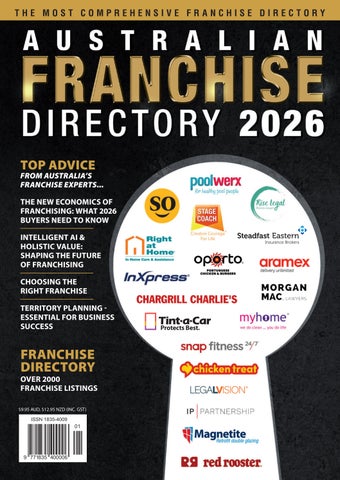
Thank you for choosing our Australia and New Zealand Business Franchise Directory for 2026.
If you are considering becoming a franchisee and taking the leap to business ownership you have come to the right place. Our 2026 Australian Franchise Directory is full of knowledgeable insights from our team of experts and is the most comprehensive list of franchise systems and services providers across Australia and New Zealand.
The publication is the only one available in print and digital formats. In the 2026 Directory you can find essential advice and information from qualified lawyers and accountants to industry experts with years of experience. For example: The FCA (Franchise Council of Australia) talks about the meaning of Recalibrate: strengthening franchising and positioning the FCA for the road to 2026 and is written By Jay Westbury, Chief Executive Officer. Jason Gherke Director, Franchise Advisory Centre helps us to understand What does Reasonable Opportunity for a return on investment actually mean. Stewart Germann our expert from New Zealand, covers matters to be aware of when franchising in New Zealand. Phil Chaplin of CFI Finance explains The New Economics of Franchising: What 2026 Buyers Need to Know. Robert Toth of Sanicki Lawyers helps you to understand what Franchisees should know before taking up a Franchise. This edition of the Australian Directory has an abundance of great advice from well know names in the industry so turn to the contents page to learn more.
Buying a Franchise has the benefit of buying a business with established procedures and systems in place making it a less risky option for those wanting to create a lifestyle change. Becoming a Franchise owner is a large investment of your time and finances, so in addition to our list of franchise systems, franchise service providers and expert articles, we have included a list of useful information and helpful organisations.
Whether you are considering buying a franchise or have recently established a franchise system, the team from Australian Franchise Directory 2026 wish you the best of luck and success with your franchising journey.
For all the latest and updated news throughout 2026 you can also check out our website www.businessfranchiseaustralia.com.au
Vikki Bradbury Business Franchise Directory
R EC ali BR at E : S t RE n G th E nin G FR an C hi S in G an D p OS iti O nin G th E FC a FOR th E RO a D TO 2026
Jay Westbury | CEO | Franchise Council of Australia
CEO Jay Westbury brings over two decades of experience in leading peak industry bodies, including his previous roles as CEO of Retail Drinks australia (formerly australian liquor Stores association) and the Australian Travel Industry Association (formerly Australian Federation of Travel Agents). Both sectors have close ties to franchising, giving Jay a deep understanding of the unique challenges and opportunities within this industry.
W hat S h O ul D FR an C hi SEES K n OW BEFORE ta K in G up a FR an C hi SE
Robert Toth | Special Counsel | Sanicki Lawyers
Robert is Special Counsel at Sanicki Lawyers, with over 35 years’ experience in Franchise, Licensing and Distribution law acting for both local and International franchisors, franchisees and master franchisees and with expertise in dispute resolution.
Robert is an Accredited Commercial Law and Franchise Specialist, a member of the Franchise Council of Australia (FCA) and the International Franchise Lawyers Association (IFLA) and regularly writes for franchise and corporate journals online.
The New e co N omics of f ra N chisi N g: w haT 2026 Buyers Need To K N ow
Phil Chaplin | CEO | CFI Finance
hil Chaplin is the Chief Executive Officer of CFi Finance, a specialist finance company servicing australia’s franchise, accommodation, and fitness sectors as well as small businesses more broadly. he has over 20 years’ experience in providing finance to businesses across australia and new Zealand and has managed finance companies in the private and banking sectors.
phil is a former chair of the Equipment Finance division for the australian Finance industry Association and has been called on to provide insight and input into government policy, industry education, and to international players seeking to enter the australian finance sector.
nt
MARK CARTER | Owner of MC Academy and International Keynote speaker/Trainer/Coach
Mark Carter is an international keynote speaker, behavioural analyst, trainer, coach, and author. his EDx talk was the trailer for add Value (WilEY). With 28+ years in global learning and development, he consults franchise networks on leadership, culture, value, and performance. his keynotes and programs bridge human behaviour with technology, including AI, to help leaders replicate success through people, systems, and culture.
Vali Dati O n - What Qu ES ti O n S S h O ul D i BE a SK in G?
Doug Downer is The Franchise Guy ™
Doug started his franchise career at McDonald’s in 1983 and after 40 years working in the franchise sector at senior levels both as a Franchisor, Franchisee and Master Franchisor, Doug Downer started the award-winning franchise consulting brand called Franchise Ready. he currently owns 3 businesses that operate in the franchise sector, and has run 8 franchise brands at CEO level and has been a franchisee of 8 different brands.
Doug has been recognised in the top 30 Franchise Executives in australia on five occasions and was recognised in the SEO Samba top 100 Global influencers in Franchising on 5 occasions. his business Franchise Ready has developed ans supported over 300 brands into franchising and has offices in australia, nZ, uK, india, Singapore, MEna region and uSa
What DOES R E a SO na B l E Opp OR tunit Y FOR a RE tu R n O n in VESt ME nt aCtuallY ME an?
Jason Gehrke | Director | Franchise Advisory Centre
Jason is the director of the Franchise Advisory Centre and has been involved in franchising for more than 30 years at franchisee, franchisor and advisor level. he advises both existing and potential franchisors and franchisees, and conducts franchise education programs throughout Australia. he has been awarded for his franchise achievements, and publishes Franchise news & Events, Australia’s only fortnightly electronic news bulletin on franchising issues. In his spare time, Jason is a passionate collector of military antiques.
t h E F R an C hi SOR St R i KES Ba CK
Bill Morgan | Director | Morgan Mac Lawyers
Bill has practised as a solicitor in australia since 1998 and is a solicitor of the Supreme Court of England and Wales, with over 25 years’ experience in Commercial Litigation and Dispute Resolution. Bill is a Director of Morgan Mac Lawyers where he leads the Commercial Litigation Practice, acting for clients in complex commercial disputes.
Bill is an arbitrator and a nationally accredited mediator. Bill has been a panel mediator for the Office of the Franchising Mediation Adviser and acted as a privately appointed mediator for franchisors and franchisees. he has also acted as a conciliator. With a practice at Morgan Mac lawyers that has a specific focus in Franchise law, Bill specialises in franchising includes drafting and advising on franchise documents for franchisors, acting in the sale and purchase of franchised businesses and acting in franchise dispute litigation and mediation processes.
Ch OOS in G th E Ri G ht F R an C hi SE
Brian Keen | Founder | Franchise Simply
Brian Keen has been involved in the franchise industry for more than 30 years and, today, is the Founder of Franchise Simply and Microloan Foundation Australia.
in his book hOW tO FR anChiSE MY BuSinESS SiMplY, Brian’s drawn on his first-hand knowledge and experience to outline the processes he uses to successfully franchise businesses today and how his no-hype franchising process saves tens of thousands of dollars in the process.
his hands-on business experience as a multi-unit franchisee, franchisor and consultant helping many of the big names create their own franchise systems and growth over the years has been fed into Franchise Simply, helping today’s SMEs grow their business by franchising.
Fred Nadde | CEO | Steadfast Eastern Insurance Brokers
Fred Nadde is CEO of Steadfast Eastern Insurance Brokers. A licenced general insurance broker servicing the needs of SME to corporate companies.
Steadfast Eastern insurance Brokers is part of Steadfast Group limited, australasia’s largest broker network and an ASX listed company (SDF).
CHAPTER 12 59
Hayley Busuttil | Assistant Commissioner in the International Support and Program line | ATO
ayley Busuttil is an assistant Commissioner in the international Support and program line at the axation Office. She is an advocate for fairness in the system and believes that education is the key to helping taxpayers, including small business owners, get things right from the start.
ayley is passionate about investing in people and building a capability that supports Government in delivering services to the community.
tERR it ORY p lannin G - ESSE ntial FOR B u S in ESS S u CCESS
Peter Buckingham | Managing Director | Spectrum Analysis Australia Pty Ltd
peter is a Certified Franchise Executive (CFE), as well as a Certified Management Consultant and Fellow of the Institute of Management Consultants and was one of the co founders of Spectrum in the mid ‘90’s.
As well as managing the company, he still enjoys being an active participant in many projects handling most of the specific site evaluations we are asked to perform for major retailers. Special areas of expertise include Site Selection and Sales Prediction Modelling, franchise territory planning, Local Area Marketing and Strategic Network Planning.
MATTERS TO BE AWARE OF IN RELATION
O FR an C hi S in G in n EW ZE alan D
Stewart Germann ONZM | Principal | Stewart Germann Law Office
Stewart Germann who is acknowledged as new Zealand’s leading franchising lawyer with over 40 years’ experience in this area, is a recognised national and international guest speaker at franchise conferences in new Zealand, australia and uSa
Stewart Germann l aw Office (SGl) is new Zealand’s longest established specialist franchising law firm and Stewart is included in the international Who’s Who of Franchise l awyers for 2024.
’s clients include many of new Zealand’s best known national and international franchise brands and Stewart has extensive franchising contacts worldwide and locally. Stewart Germann is actively involved in international franchising, has published articles in the International Journal of Franchising Law and has attended and participated in many FCA conferences.
hOW F R an C hi SE lE a DERS Can Mana GE
St RESS an D St RE n G th E n t h E i R Bu S in ESS in tO u G h t i MES
Tony Meredith | Business Coach and founder of Tony Meredith Coaching Tony partners with franchisors and franchisees across Australia to help them strengthen leadership, improve sales performance, and create sustainable growth.
Drawing on more than 25 years of experience in business, leadership, and team development, tony teaches franchise owners how to move from running operations to leading people. his work focuses on practical systems, consistent performance, and the human traits that turn good operators into great business owners.
F R an C hi SE Su CCESS: Wh Y YO u R pERSO nal B R an D i S YO u R M OS t pROF ita B l E aSSE t
Lauren Clemett | The Brand Navigator | Your Brand True North
l auren Clemett is an award-winning personal branding expert, known as the Brand navigator. Told as a child that she had wordblindness and would never be able to read or write properly, she went on to become a 5 time best selling author and now uses her dyslexia as her greatest asset - helping others understand how the brain sees brands. She has worked at leading advertising agencies and in brand management since before the internet, helping launch hundreds of global brands and appears in worldwide media, as the sought after personal branding specialist. As a keynote speaker, Lauren shares how you can turn distraction into attraction and get a clear direction to stand out from the crowd as a magnetic leader. th
Helen Kay | Managing Director | Rise Legal Business Lawyers
elen Kay is an accomplished business and franchise lawyer with over two decades of legal s the founder of Rise legal, helen specialises in delivering strategic and practical commercial and franchise legal solutions. her exciting career has seen her in pivotal roles at prestigious law firms, consistently offering exceptional legal counsel. her unique combination of hands-on experience and visionary leadership positions her as an invaluable asset in the realm of commercial law and franchise expertise, assisting franchisors and franchisees in safeguarding their business through comprehensive commercial legal support.
MAKE YOUR NEXT MOVE A CRAVEABLE ONE!
Craveable Brands is home to Aussie favourites Red Rooster , Chargrill Charlie’s , Oporto and Chicken Treat .
Aussies love chicken, it’s the nation’s #1 protein and we’ve got every craving covered. From flame-grilled, fried, or roasted, our chicken is cooked to perfection.
Ready to turn that passion into a thriving franchis e? Join a network backed by:
Trusted national brands
Full training & support
Proven business model
Scalable growth potential
r ecali B raT e
STREN g THENIN g FRANCHISIN g AND p OSITIONIN g THE FCA FOR THE ROAD TO 2026
Jay Westbury | CEO | Franchise Council of Australia
Recalibration is not a sign of weakness. It is a sign of maturity.
In every successful industry, there comes a moment when incremental adjustment is no longer enough. There is benefit in pausing, reassessing and deliberately realigning to ensure you are equipped for what comes next. Australian franchising is at precisely that point.
The fundamentals of the industry remain strong. Franchising continues to provide one of the most effective pathways into small business ownership, combining
entrepreneurial drive with the support of established systems. It is deeply embedded in local communities, delivers employment at scale and enables brands to grow responsibly. Franchising contributes $174 billion to the Australian economy, comprises 90,000 franchisee small businesses, and employs more than 500,000 australians. those figures speak to significance, resilience and reach. But significance alone does not guarantee confidence, trust or influence.
The operating environment for franchising has changed markedly in recent years. Regulatory expectations
are higher. Franchisees are more informed and more engaged. Governments and regulators are seeking deeper insight into how franchise systems operate in practice, not just in theory. Media narratives are sharper and less forgiving. At the same time, small business conditions remain challenging, with cost pressures, workforce constraints and compliance demands continuing to weigh heavily. Recalibration, in this context, is not about retreat or repair. It is about alignment. It is about ensuring that franchising’s practices, standards and representation are aligned with
contemporary expectations and that the organisation representing the sector is equipped to lead with credibility.
That is the task the Franchise Council of Australia has taken on with purpose and intent as we look toward 2026.
Why
franchising
itself must recalibrate
For franchising to thrive in the years ahead, it must be clearly understood.
Too often, debate about franchising has been shaped by partial information, outdated assumptions or isolated experiences. that does not reflect the reality of a n industry that is diverse, sophisticated and continuously evolving. Nor does it support good policymaking or informed decision-making by prospective franchisees.
Recalibration begins with acknowledging that franchising must do a better job of explaining itself not defensively, but confidently and transparently. This means being clearer about how franchise relationships work, how risks and rewards are shared, how disputes are addressed, and how systems support franchisees over the long term.
It also means lifting the visibility of good practice. Across Australia, thousands of franchise systems operate professionally, invest heavily in training and support, and work constructively with franchisees to improve performance. These stories must be told consistently, credibly and with evidence.
a confident industry does not shy away from scrutiny. It welcomes informed discussion and understands that trust is earned through openness and accountability. The role of the FCA is to help franchising operate and present itself in that way.
r ecalibrating the fca : leadership W ith intent
The FCA’s recalibration has been deliberate and practical. It has not been driven by slogans, but by clear decisions about where the organisation adds the greatest value.
At its core, this recalibration has focused on five interconnected areas: governance, advocacy, member value, engagement and reputation. Each is essential. None can be treated in isolation.
g overnance: building credibility from the inside out
Strong advocacy and external influence are only possible when an organisation’s internal foundations are sound.
Over the past year, the FCA has prioritised financial discipline, transparency and operational stability. this has included tighter financial management, clearer reporting to the Board, and a sharper focus on aligning resources with strategic priorities.
Just as importantly, it has involved building a capable, stable and motivated secretariat team with a clear sense of purpose. A peak body does not need
to be large to be effective, but it does need to be disciplined, focused and professional.
This recalibration of governance has enabled the FCA to operate with confidence and credibility. it allows us to engage externally knowing that our own house is in order, a prerequisite for leadership in any sector.
a dvocacy: from reaction to influence
One of the most visible recalibrations has been in the FCA’s approach to advocacy.
The FCA has shifted decisively away from reactive commentary and towards structured, evidence-based engagement with government and regulators. This approach recognises a simple truth: influence is built through consistency, credibility and trust over time.
the FCa’s work on the 2024 Franchising Code of Conduct exemplifies this recalibrated posture. Our engagement was substantive, informed and focused on practical outcomes for members. It strengthened relationships with Treasury, the ACCC and the Minister for Small Business, positioning the FCA as a constructive and credible participant in policy discussions.
This is advocacy that aims not just to respond to policy proposals, but to shape the context in which they are developed. As we look to 2026, this approach will remain central, advocating firmly where needed, but
always grounded in evidence and understanding.
r ecalibrating understanding: the a ustralian f ranchise o utlook 2026
One of the most important strategic investments made by the FCA has been the development of the Australian Franchise Outlook 2026.
The Outlook represents a fundamental recalibration in how franchising presents itself to policymakers and stakeholders. For the first time, the sector has a comprehensive, accessible and evidence-based reference point that explains franchising as it actually operates today.
The Outlook brings together sector data, franchisee and franchisor insights, and practical context to paint a balanced picture of the industry — its scale, diversity, challenges and opportunities.
Every Federal Member of Parliament and Senator has received a personal copy of the Australian Franchise Outlook 2026. That distribution is not symbolic; it is strategic. Policymakers make better decisions when they understand the sectors they regulate, and the Outlook is already being used as a reference point in discussions around small business, employment and regulation.
For the FCA, the Outlook marks a shift from reactive explanation to proactive education. It allows us to anchor advocacy in shared understanding, reducing reliance on anecdote and assumption. As we move toward 2026, the Outlook will continue to underpin our engagement, ensuring that franchising is discussed on the basis of facts, not myths.
m ember value: delivering for quality impact
Recalibrating member value has meant being disciplined about where the FCA invests its time and energy.
Members have been clear about what they value most: credible advocacy, practical insight, opportunities to connect, and a professional organisation that represents them well. The FCA has responded by refining its offerings rather than expanding indiscriminately.
Education and professional development have been strengthened through targeted webinars, forums and
learning sessions focused on realworld issues. This has also presented a new interest in the Certified Franchise Executive (CFE) offered by the FCa with new and record numbers taking u up the opportunity. State chapter activity has been reinforced to reflect local conditions and priorities. National events have been reshaped to deliver both substance and engagement.
This focus on relevance over volume ensures that member value is felt, not just promised.
Recalibrating standards and pride: the Franchise Industry Awards
The establishment of the Franchise Industry Awards (FIAs) represents another critical recalibration for the FCA and the sector.
At one level, awards are about celebration. But at a deeper level, they are about standards and confidence. The FIAs were created to demonstrate that franchising in Australia is capable of recognising excellence through rigorous, independent and transparent assessment.
The inaugural FIAs in June 2025 showcased the depth and professionalism of the sector, with finalists across 23 categories and more than 530 attendees. Importantly, the Awards recognise excellence not just in scale or growth, but in leadership, franchisee support, culture and operational performance.
For government and regulators, the FIAs send a clear signal that franchising is serious about lifting standards and celebrating best practice. For members, they provide meaningful recognition that reflects the complexity and professionalism of running franchise businesses.
Strategically, the FIAs now sit alongside the National Franchise Convention as one of the FCA’s two signature national platforms. Together, they create balance: one focused on learning, debate and insight; the other on recognition, pride and celebration. This dual structure will be central to how the FCA engages the ecosystem through to 2026.
e ngagement: reconnecting the ecosystem
The FCA’s recalibration has placed renewed emphasis on engagement across franchisors, franchisees, suppliers, advisers and partners. This
has involved rebuilding presence in rooms, strengthening state-based activity, and listening carefully to the experiences of members across different sectors and regions.
Initiatives such as Women in Franchising exemplify this approach. They provide platforms for leadership, contribution and connection while strengthening the sector as a whole. Engagement of this kind builds resilience and shared purpose, essential qualities as the sector navigates change.
r eputation: from defence to confidence
The combined impact of the Australian Franchise Outlook and the Franchise Industry Awards is already reshaping how franchising is perceived.
Together, they recalibrate the narrative from one of defence to one of confidence. importantly, it’s confidence grounded in evidence, professionalism and self-assessment. this matters because reputation influences outcomes. It shapes how regulators engage, how policymakers listen, and how prospective franchisees assess opportunity.
By investing in credible information and meaningful recognition, the FCA is ensuring that franchising is understood as a mature, responsible and opportunity-driven sector.
Recalibration is not an endpoint. It is preparation.
As we look to 2026, the FCA is focused on ensuring that franchising enters its next phase from a position of strength. That means continuing to lift professionalism, advocating with evidence, delivering real member value, and maintaining an organisation that is stable, credible and forward-looking.
Franchising’s future in Australia is strong. But strength must be matched with clarity, leadership and alignment. The FCA has recalibrated for that task and we are delivering for our members and partners as we shape what comes next. As we say now, #franchisinginforce.
Jay Westbury | CEO Franchise Council of Australia
03 9508 0888
info@franchise.org.au www.franchise.org.au
f r a n c h i s e n e t w o r k n o w
f o r t h e l o w c o s t
i n v e s t m e n t o f $ 8 5 , 0 0 0 + G S T
WHAT SHOULD FRANCHISEES KNOW B efore Ta K i N g
u P a fra N chise
Robert Toth | Special Counsel | Sanicki Lawyers
If you are in the market to take up a franchise opportunity there are no lack of franchises on offer these days.
We have seen over the past 2 years a huge increase in franchise opportunities on offer both from overseas and locally.
We have seen many business closures and many companies reducing their staff levels leading to redundancies.
This means more franchisees in the market looking to take up a franchise to earn an income from low cost mobile franchises to professional service franchise in the areas of bookkeeping, accounting finance, broking, home care and conveyancing.
s o many f ranchises s o little time
With so many franchises on offer how do you pick the right franchise for you? We have seen an influx of new franchise systems from the uS, uK, and Europe as well as many new local franchise systems in the hospitality, home care and children’s education and sports sectors as well as the fitness, health and beauty services.
Some of these franchise systems have come into the Australian market successfully while others have failed and left many people losing a lot of money, so franchisees need to be careful and do your due diligence on the franchisor just as much as the franchisor will do their due diligence on you.
A new franchise from overseas can be a great first on the ground opportunity but it carries greater risk as opposed to joining a well-established franchise system that has been up and running for many years.
Some recent franchisors that were not so successful included uFC Gym, Godfreys, 85 Degrees coffee chain, Carl’s Jr to name a few and they all failed due to a variety of reasons.
Covid changed many people’s approach to their employment seeking greater independence and more flexible work hours.
Franchising allows you to operate your own business supported by the franchisors brand systems training and marketing support. The process of selecting the right franchise for you should be taken carfully with input from your family, partner and with expert legal and financial support. it can be filled with excitement, and trepidation at the same time and as with any business venture it comes with risk.
the franchise register
Franchisees can look up a franchisor on the ACCC Franchise Register (which is a mandatory obligation for franchisors) which will give them some high level detail about the franchise system. If a franchisor is not on the register, you should not deal with that franchisor as it is a breach of the Franchising Code
of Conduct. All Franchisors must also update their information yearly.
Franchisors no longer need to register a Key fact sheet with the ACCC.
Franchisees now more than ever, due to the complexity of the legal documents should seek specialist franchise legal advice before committing to a franchise to understand their key obligations, responsibilities and risks.
blue skies
Franchisees can get caught up with the gloss, glamour and sales pitch of the Franchisor’s glossy brochures, and their marketing spiel about “being your own boss” and sign up in haste, only to find that it was not what they thought or what the Franchisor represented.
But once you have signed up it can be very difficult to exit without crystalising a loss.
We have seen franchisees go into a franchise for the wrong reasons some of these (which are real life cases) were:
a. Taking up a franchise for their adult children to operate- the problem here being that the children didn’t like the business, it was hard work, and they left after a few months leaving the parents to run the business.
b. acquiring a franchise for their spouse or partner (thinking they were doing the right thing). The thought being that going into a franchise would give them motivation – the problem
here was the spouse found the stress of the business too much and they had to abandon the business due to health issues shortly after commencing and then crystalised a huge loss.
c. acquiring a Charcoal chicken business having been made redundant from middle management at a large company – the problem here was after 12 months selling charcoal chickens in the middle of summer, the franchisee realized that this was not for him and got out selling at a loss.
do W hat you are good at or do W hat you love
We often ask clients to consider their skill set and work history and to look forward and ask themselves if they will be able to run the franchise in say 3 years selling the same products or services. So, ask yourself these questions:
• Do i still want to be selling charcoal chickens in 3 years?
• Even with training do my skills and personality suit the proposed franchise?
specialist advice
The best way to make an informed decision is to get advice from a Specialist Franchise lawyer and
accountant who are members of the Franchise Council of Australia (FCA).
Seeking advice from your local conveyancer, family lawyer or neighbour over the fence is not proper legal advice and will not reduce your risk! Specialist Franchise lawyers know what is going on in the sector – the good, bad and the ugly!
financial considerations
Irrespective of how attractive and compelling the franchisors marketing and sales pitch may be, the decision to join should not be an emotional one. If the numbers don’t work, after doing your own cash flow projections (with support from your accountant or financial advisor) then you are better to walk away!
As much as there is always risk going into any business you can limit that risk by asking the franchisor to provide you with indicative cash flow models from existing franchisees and have these reviewed by your accountant.
You should consider the following :
• Can you take a reasonable wage for my hours worked.
• Does the cash flow show you can cover my finance to fund the franchise.
• What percentage your occupancy costs (rent, outgoings insurances, security bond ) will be as a percentage of your gross revenue
- ideally this will be low end around 12% to 15% and no more than 20% to 25% of your gross revenue.
• What amount of working capital will you need for the first 6 to 12 months of operation?
• What opening stock level do you need and how you will fund it?
• What supporting staff you will need to operate the business and factor in those costs in your projections
• Will you be able to lease plant and equipment and assets such as a vehicle ?
• What is the expected return on your investment (ROI) will the business build value to sell in the future?
These are all things to consider and factor into your cash flow projections before you decide.
the ne W franchise code changes 2025/26
The New Franchise Code came into effect on the 1 april 2025 and the key changes are around greater:
• Disclosure by franchisors around supplier rebates, leases, online sales, social media, earnings information, capital expenditure and end of term arrangements.
Other key changes are
• Return on investment
Franchisees must be given a “reasonable opportunity” to recoup their capital investment on entering into the agreement.
“Reasonable opportunity” is not defined in the code and will depend on a variety of factors such as the term of the Franchise Agreement and capital costs outlaid by the franchisee.
This does not mean the Franchisor is giving a contractual guarantee the franchisee will make a profit from the Franchise business.
There are no guidelines of how “returns” are to be measured, so we will have to wait and see how this plays out in the future.
This does seem to shift the business risk a little more away from the franchisee as an owner operator to the Franchisor and may set expectations in the mind of franchisees.
Franchisors should ensure going forward they keep detailed financial data that supports the fact that the business model offered to its Franchisees will be financially viable and therefore meet the obligation to “give the Franchisee” a “reasonable opportunity” to make a return on its investment.
The new Code allows for existing Franchisees to opt out of the disclosure (“consideration period”) and cooling off period, on a renewal of their franchise or if they acquire a second franchise in the same system.
the disclosure period
This is now called the “consideration period” and prohibits franchisors (and franchisees) from signing the franchise agreement in that 14-day period.
the marketing fund has now been renamed the “Specific Purpose Fund” and will enable the Franchisor to use the funds from
Franchisees for a specific purpose which could include marketing social media or specific projects.
Although it gives the Franchisors more flexibility as to what the funds can be applied towards it does not change the franchisor’s obligations to have the fund audited.
restraints of trade
are they on their way out?
In Australia, restraints of trade in franchise agreements have been enforceable where they are considered reasonable and the Franchisor complies with Clause 41 of the Code.
The clause has now been amended to now apply where the Franchisee has an option for a further term and, the Franchisor refuses to grant the further term (and the conditions of clause 41 are met).
if the Franchisee requests the further term under their agreement and the Franchisor refuses the Franchisor cannot then rely on the restraint to stop the franchisee setting up a competing business.
A breach of these provisions by the Franchisor exposes them to civil penalties.
So, while agreements can still legally contain a non-compete clause, the ability to enforce it is more restricted
compensation for non-renewal
the new Code requires Franchisors to include in their agreement a buyback obligation to compensate the Franchisee in the following circumstances:
a) where the Franchisor refuses to renew the franchise term and or on its expiry; or
b) where the Franchisor during the franchise term decides to withdraw from the Australian market (this arose from the car dealership cases); or
c) the Franchisor decides to rationalize its network in Australia; or
d) the Franchisor changes its distribution model in Australia (again this arose from the car dealership cases).
The compensation payable by the Franchisor to the Franchisee in the above cases must cover purchase of the Franchisees stock and all “essential specialty equipment, branded product or merchandise purchased or maintained by the Franchisee” that
“could not be repurposed for a similar business”, and any other things the Franchisee was required to purchase or maintain under the franchise agreement or operations manual.
mediation
The new Code now allows the ASBFEO the right to name and shame Franchisors who refuse to engage in or withdraw from the ADR mediation process.
legal costs
The Franchisor can only charge the Franchisee a once off fixed fee for the issue of the franchise documents, but they now must not exceed “reasonable and genuine” costs for the services.
five year review
the new Code requires a review each 5 years to assess the Code’s impact and operation to coincide with the Code’s sunset process.
the sign up process
Franchise opportunities are advertised and promoted online, on mobile cars and billboards and via word of mouth and through business agent’s consultants or directly by the Franchisor. When dealing with a business agent or sale representative of the Franchisor bear in mind their goal is to sign you up as fast as possible as that is how they make their commission and reach their targets.
On enquiry you will be asked to sign an nDa (confidentiality agreement) before the franchisor releases further financial or other confidential information about the franchise system, and you will be asked to complete a detailed application form with personal and financial details for the franchisor to review to give you preliminary approval.
In this period, ideally you should have met the franchisor founders or directors, as this will give you direct insight as to who you will be dealing with and if your objectives align and also if you can work with them.
I have always said that “people like to do business with people they like “a simple but important concept. So, if you do not feel that is the case up front that may be a red flag to look elsewhere.
A larger franchise system will be more corporatized so you be unlikely to meet the founder or directors.
Once you are approved, the franchisor will ask for a deposit or Document fee to be paid before they prepare and issue the suite of franchise documents which will commence the 14 day disclosure (consideration) period. In this period, you cannot sign the franchise agreement. The suite of franchise documents should include:
• the Disclosure statement attachments in the form required by the Code:
• the Franchise agreement in the form required to be signed; and
• the lease, offer to lease, sublease or Occupancy License Agreement where premises are involved;
• a no prior representation statement on which the Franchisor will rely .
the no prior respresentaion statement
This is an important document the Franchisor can rely on if there is a dispute down the track so Franchisees should not ignore it. Franchisees should set out in the statement any special promises or concessions offered by the Franchisor (or its agent or broker).
This document protects the Franchisor, so, if there have been any special concessions don’t rely on verbal promises, make sure it is in writing and set out in the Franchise Agreement or the prior representation statement. Any concessions should be set out in the Agreement and signed by both parties and dated prior to or on the date the Franchise Agreement is signed.
seeking legal advice
It is not compulsory for franchisees to seek legal, accounting, and financial advice however many franchisors will now insist their prospective franchisees get legal and financial advice as this reduces risk to the franchisor.
Seeking legal advice from a Franchise Specialist Lawyer will assist you to work
through the volume of documents and the sign on process.
An experienced Franchise lawyer will focus on the important commercial issues and identify issues of concern where there may be room for negotiation, rather than recommending wholesale or unnecessary changes which are unlikely to be accepted and aggravate the relationship with the franchisor or their legal team from the very beginning.
the four commandments from the desk of toth !
One- irrespective of whether you seek legal advice (which we highly recommend) you should still read and become familiar with the documents as it is your contract and sets out your rights and obligations and those of your franchisor.
Two- Do not rely on advice from your suburban conveyancing lawyer, nextdoor neighbor, or your mate at the pub! That’s not advice.
Three- accept that entering into a franchise carries risk and although easy to get into, they are not so easy to get out of, so do your homework before you commit.
Four- Franchisors will often say their agreements are not negotiable but that is not always the case, and in fact we often negotiate reasonable concessions particularly when it is a new franchise keen to roll out.
Things to reasonably negotiate might be a reduced royalty over the first 12 months to get a chance to build the business, minimal or no marketing fee, reduced minimum performance criteria.
disclosure document
Franchisors need to give the franchisee the Disclosure statement to Franchisees at least 14 days before they either enter into an agreement or make a nonrefundable payment.
the 14-day disclosure period only starts once the Franchisor has made the full and proper disclosure required and provided all relevant documents including the leasing information and includes earnings information in the disclosure.
If lease information is given later or differs, the Franchisee has another 14day disclosure period from that date. Neither the Franchisor nor Franchisee
can reduce or waive the 14-day disclosure period as it is a minimum mandatory period under the Code.
lease / occupancy information
The Franchisor must provide full details of the lease and occupancy rights with a copy of any lease documents for example – the offer to lease- agreement to lease- lease- sublease- occupancy license and lease disclosure statement issued by the landlord.
If they do not provide full and accurate information about the lease rights in the disclosure document the 14-day disclosure period does not start until they provide that information.
if the final lease details are different to the information in the disclosure document previously given, the 14 day cooling off period only starts when that information is given, so the Franchisor risks a Franchisee being able to walk away.
For Franchisors this means the days of signing up a franchisee without a site or while in negotiation for a site are fraught with risk for the franchisor.
Franchisors must also disclose if they hold any interest in the lease or freehold and any rent incentives they receive.
rebates and financial benifits
The percentage of rebates the Franchisor receives (financial benefit) from each supplier over the last financial year as a percentage of all purchases by Franchisees in the group (this excludes supplies by the Franchisor or associate of a franchisor) now has to be provided. There is no need to disclose this information if the agreement allows the Franchisee to buy from non-approved suppliers or the rebate is paid to a cooperative fund controlled by the Franchisor.
Rebates do not include payments by a franchisee to the franchisor, master franchisor or associate for a wholesale supply and a lease incentive (received by the Franchisor) is not a rebate, but franchisors still need to disclose the lease incentives.
earnings information
Franchisors, where they give earnings information must give it in the disclosure statement (not after signing the Franchise Agreement) and include
a statement that the information is correct to the best of their knowledge or state that the information may not be accurate.
A breach may attract a civil penalty of $66,000 and failing to provide the information means the 14-day disclosure period commences only when the information is given and attached in it.
capital
e X pendenditure
Franchisors can only require a Franchisee to undertake capital expenditure if a majority of Franchisees agree where it affects the majority, or the express consent of the individual Franchisee is given.
term and restraint
Franchisors need to disclose if the Franchisee has any right to goodwill at the end of term and if the agreement has a restraint or non-compete clause. The Code has been amended to provide that a Franchisor can only rely on a “serious breach” of a restraint of trade clause. As “serious breach” is not defined it will be again something to be tested in the future, but any breach would have to be before the term ends.
This means restraint of trade provisions will be more difficult for franchisors to enforce however Franchisors will still be able to protect their ip, know-how and confidential information.
termination rights
The seven grounds for a Franchisor to terminate for “special circumstances” now require the Franchisor to give a franchisee 7-day prior notice of termination even for special circumstances which then allows the franchisee to raise a dispute.
The Franchisor cannot terminate the franchise if the Franchisee raises a dispute in which case the parties must try and resolve the matter in the 28day period or refer the matter to the ASBFEO for mediation or arbitration. In the meantime, the Franchisor can require the Franchisee not to operate the business in the 28-day period.
franchisee e X it rights
Often a Franchisee may feel they were put under some pressure to sign up a franchise and feel they have little choice but to go ahead but under the New Code Franchisees do have a number
of opportunities to change their mind and pull out before they open the doors of the business as follows:
• Disclosure period
Franchisees can elect not to proceed in the 14-day disclosure period from when the Franchisor has issued the full suite of franchise documents – In this case the Franchisee is entitled to a full refund of any money paid including a deposit or document fee.
• Cooling off rights
Franchisees can elect not to go ahead in the 14-day Cooling off period (being the period after they executed the franchise agreement and paid the Franchise fees). In this case the Franchisee is entitled to a refund of all money paid less a Retention Sum which must be set out in the Disclosure statement. It is usually stated as a fixed fee the Franchisor can retain to cover their costs for having interviewed and processed the Franchisee.
• Early termination rights for franchisees during the Term
The Franchisee can now at any time during the franchise term by giving 28 days’ written notice seek to terminate the Franchise Agreement giving reasons why it wishes to exit, for example their personal circumstances have changed and they must relocate overseas.
the Franchisor has 28 days to respond to the request and indicate if it agrees to the termination. If it does not agree the Franchisor must give reasons in writing for the refusal.
It is highly unlikely Franchisors will agree to allow a Franchisee to exit (unless there are exceptional circumstances). There is no guidance under the Code what is considered “good or acceptable” reasons and again this will need to be tested in the future.
• Mutual agreement
The Franchise Agreement can of course be terminated by mutual agreement at any time.
legal costs
The Franchisor can no longer charge Franchisees legal costs for any undetermined and future legal service costs, other than an upfront fixed fee set out in the agreement.
the upfront “fixed amount of dollars” (fixed fee) can only be for preparing,
negotiating, and executing the agreement and must be set out in the Disclosure Statement.
selling a franchise business
Franchisees now benefit from a 14-day cooling off right, even after settlement of the business.
Therefore, when selling a franchise business there should be special condition in the Contract of sale that makes settlement conditional upon the 14-day cooling off period in favor of the purchaser having expired.
specific purpose marketing funds
the Code uses the word Specific purpose fund in place of marketing fund and now extends the fund obligations to the “fund administrator” who could be the franchisor, a master franchisor or a third party authorized to administer the fund for the franchisor or master franchisor.
the operations manual
Most franchise agreements include provisions requiring franchisees to comply with the Operations manual and therefore franchisees should ask to see the Operations manual before entering into the franchise agreement or in the disclosure or cooling off period.
the franchise agreement
This is the contract setting out the parties’ rights and obligations, (generally weighted in favor of the Franchisor) with consequences for a failure to comply which may give rights to serve a breach notice and even termination.
It is often assumed that the agreement will contain positive obligations on the Franchisor however most agreements will state the Franchisor “may” not that they “must” do certain things. A subtle but important distinction.
this makes it difficult to allege a Franchisor has breached the agreement where the agreement does not set out positive obligations.
Franchisees should also remember they do have protection under the Franchise Code, the Australian Consumer Laws and unfair contract provisions and can instigate the dispute resolution process and seek mediation or arbitration via
the ASBFEO where a dispute cannot be resolved directly with the Franchisor. If a dispute arises we suggest you seek Legal advice as early as possible so a strategy can be discussed and solutions considered to resolve the dispute commercially and without the threat and costs of litigation.
the
fees payable to the franchiosr ?
franchise fees
Franchisors are tending to reduce the up-front franchise fee to make their franchise more attractive and affordable and often include the training fee into the up-front franchise fee.
royalty
The service fee or royalty is usually expressed as a percentage of the franchisee’s gross sales, or it can be a fixed weekly or monthly fee.
Most franchises, however, charge a percentage royalty for example 8% of the gross revenue. This works for the franchisor as they receive their royalty on the franchisee’s turnover while the Franchisee carries all the costs of operating the business!
This is one of the key reasons many franchisees fail where the royalty and associated occupancy costs are too high and there is insufficient margin on sales.
This is the basis on which the Code requires the Franchisor to ensure that the franchisee can get a reasonable opportunity to make a return on their investment.
It is therefore critical for Franchisees to do their own objective financial analysis and prepare cash flow projections with their accountant before they commit to see if the business model is financially viable. This means the model should allow you to take a reasonable salary for your effort and cover your overheads, rent, staff and operating costs?
Tip: If relying on the franchisor’s earnings information, ensure their model makes provision for a salary to the owner /operator before showing a profit.
W orking capital
We often find that the working capital requirements set out by franchisors in their disclosure documents are grossly understated particularly for a new greenfield site, so check with your
accountant what a reasonable amount of working capital is needed to avoid financial stress in the first 6 to 12 months of operation.
term and rene W al
Due to changes to the Code and the early termination of the agreement longterm franchise agreements are less likely and most systems tend to offer 5-year terms with options, but it does depend on the nature of the business. Just bear in mind that if you sign up to a 20-year term the only way you can really is by selling the business during the term.
sites and territories
Mobile franchises (such as those providing gardening or cleaning services) will generally be granted for a specific territory – listed as a number of postcodes or marked on a map attached to the agreement.
the territory may be exclusive or nonexclusive and this should be understood so you are aware if the Franchisor or other Franchisees can operate or market in your territory.
this has also been affected by online sales and the Code require Franchisors to disclose what occurs when there are online sales.
What the Code does not do is to make franchisors allocate revenue for on line sales to the Franchisee, so you need to
carefully check the Franchise Agreement and the Franchisors policy on this issue.
Retail franchises (such as cafes or gyms) generally are not allocated a territory just a site from which they operate.
good W ill
Most Franchise Agreements provide that any ‘goodwill’ developed in the franchise business remains with the Franchisor on the basis that the Franchisee has only developed its goodwill due to the rights granted by the Franchisor to use its system, brand, and IP and therefore once that ends there is no goodwill the Franchisee can claim.
under the new Code disclosure requirements, Franchisors must set out if the Franchisee is entitled to retain any goodwill at the end of the term.
It is generally accepted that both the Franchisor and Franchisee generate their own goodwill however the Franchisees goodwill is very much tied to whether they have a lease or occupancy right and what term is left on their franchise agreement to sell.
If you have 6 months left on your lease and franchise term, then you have little to sell!
summary
There are many tricks and traps to be aware of, and the best insurance is to get Specialist Franchisee legal and
financial advice.
The Franchisor does their due diligence on you, so do your due diligence on them and talk to other franchisees in the system to get feedback.
Once you are in a franchise it is not easy to get out without crystallizing a financial loss and Franchisors are not in the business of buying back franchises.
Most franchise businesses have a lifespan after which you will likely want to sell and move on, so just as you consider taking up a franchise, think about your exit plan! how long will you stay in the business before you want to move on and sell.
Discuss your plans with your wife, partner or beloved other, and make sure everyone in the family is on board with your decision as it is a huge step emotionally and financially.
The best investment is getting the right advice from a Franchise Law Specialist before you commit so you can make an informed decision.
Robert Toth Special Counsel | Accredited Commercial Law and Franchise Specialist |
Sanicki Lawyers 0412 673 757
Robert@sanickilawyers.com.au
https://sanickilawyers.com.au/
WANTED: Motivated Business Partner!
Transform your people and management skills into a high-income with one of Australia’s fastest growing business opportunities.
If you’re looking for the opportunity to generate a healthy six-figure income, with the flexibility and freedom to have time for the things that matter most, a MyHome business could be perfect for you.
MyHome isn’t a job… It’s probably Australia’s most exciting and fastest growing management franchise. MyHome allows you to combine your hardwon people and management skills with MyHome’s world leading systems, technology, support and premium brand to create the perfect opportunity to return to the workforce.
With high margins, low overheads, consistent recurring income, great cashflow and high demand – MyHome’s proven business model will help you create a business that allows you to enjoy a high-income with regular working hours, and lifestyle flexibility. And to build a valuable asset for you and your family in the process.
ENQUIRE NOW To find out more about the MyHome management franchise and how it can offer you the income and the work life balance you’ve been dreaming of visit www.myhomefranchise.com.au/BFM-directory
Or scan the QR code for instant access
ENQUIRE NOW To find out more about the MyHome management franchise and how it can offer you the income and the work life balance you’ve been dreaming of visit www.myhomefranchise.com.au/BFM-directory Or scan the QR code for instant access
Why Choose a MyHome Management Franchise
Premium Home Cleaning
Business
Low Initial Investment
Industry Leading Training & Support
Turn Key Operation & Fast Track Start-up
Proven Business Model & Systems
Multi-billion-dollar market. Poorly served. High demand.
Request your information pack now to discover what sets MyHome apart, and how becoming a MyHome Owner Manager gives you executive earnings without the stress, long hours and commute. Visit www.myhomefranchise.com.au/BFM-directory
Or scan the QR code for instant access
T HE N EW E CONOMICS OF F RANCHISING :
w haT 2026 Buyers Need To K N ow
Phil Chaplin | Chief Executive Officer | CFI Finance
If you’re thinking about becoming a franchisee in 2026, you’re stepping into one of the most interesting economic environments we’ve seen in quite some time. Interest rates are still a little higher than they were a few years ago, inflation is cooling but still lingering in everyday costs, labour remains a key challenge for many industries, and technology — particularly AI — is reshaping how businesses operate.
Yet despite these headwinds, the appetite for franchising continues to grow. More people are deciding that if they’re going to work hard, they’d prefer to build something for themselves rather than for somebody else. Franchisors are adapting their models, lenders are refining how they assess risk, and investors increasingly view franchise ownership as a legitimate asset class rather than a lifestyle experiment.
In short, the economics of franchising are evolving — and buyers need to understand the forces at play.
1Today’s borrowing costs are actually pretty normal
There’s no shortage of commentary about interest rates. They’re “higher than they were”, “putting pressure on borrowers”, and “affecting affordability”. Those things might feel true — if your memory only goes back four or five years (or if you’re talking about Sydney’s ever-scorching property market).
But zoom out a little and the picture changes. Setting aside the COViD era (2020–2022), we’re actually back in the range that has been “normal” for two decades or more.
More importantly, entrepreneurs borrow for opportunity, not for interest rates. The price of capital matters, but the real question is whether the business can generate strong, consistent returns. When it comes to borrowing, remember:
• Match funding to purpose.
Fit-out and equipment belong on longer-term finance; working capital needs flexibility. the right lender understands franchise operations and structures the loan to support, not strain, the business.
• preparation can drive price. a clear cashflow, realistic assumptions and a credible plan signal resilience — which lenders value, and which
franchisees benefit from long after the loan settles.
• Strong unit economics matter more than ever.
Good franchises comfortably earn more than they cost to finance. Reliable cashflow turns interest into just another expense, and strong models quickly separate themselves from weaker ones.
2t he cost landscape may have shifted — bu T i T ’s no T quicksand inflation may not dominate headlines anymore, but costs have settled at new baselines. Things aren’t getting cheaper — but the biggest risks often stem from how costs are managed, not the cost levels themselves.
Where costs are sitting today
• Fit-out and construction: Elevated since pre-pandemic days, but the biggest expenses usually come from scope creep — design changes, unclear specifications or unnecessary upgrades.
• l abour: Wage growth continues, and for most franchise models it’s the single largest cost pressure.
• Equipment: Slower to fall in price than expected, but more stable than in the supply-chain chaos of 2021–22.
How smart operators stay ahead
• Get into the detail. tight scopes and firm quotes reduce fit-out surprises. avoid upgrades that don’t support revenue.
• Roster to real demand. use forecasting tools. Staff to customer patterns, not convenience.
• Multi-skill your team.
Versatile staff reduce total hours required.
• Reduce churn.
Good hiring and early training save far more than they cost.
The good news is that many franchise categories have increased prices without losing customers — especially in convenience, wellness, pets and personal services. Disciplined operators are finding that the cost landscape is not a barrier but a test of operational discipline. Strong systems support franchisees with clear pricing strategy, helping revenue keep pace with movement in costs.
3 l enders are assessing franchisees differently in 2026
Banks and specialist lenders haven’t necessarily become tougher — but they
are more focused on the elements that drive genuine success. That scrutiny benefits everyone. prepared applicants are more likely to be approved and more likely to succeed.
Three themes dominate lending decisions in 2026:
Business literacy
Enthusiasm is no longer enough. Lenders look for franchisees who can:
• read and understand cashflow
• explain their assumptions
• distinguish between profit and cash
• challenge optimistic forecasts
these skills used to be “nice-to-haves”. Today, they’re essential — and they materially increase survival rates.
Resilience capacity
This is where many applications succeed or fail. Lenders want to see:
• enough capital to trade through a slower-than-ideal start
• a buffer for unexpected costs
• a plan for handling revenue shortfalls
This isn’t about putting up hurdles — but it is a stress-test. Franchisees who can weather the early months typically outperform over time.
System quality
not all franchises are equal. lenders now examine:
• real sales performance
• realistic start-up cost estimates
• dispute histories and franchisor support
• multi-unit operator success
• outlet turnover and stability
Good systems welcome this scrutiny because it validates their model. For buyers, it’s another layer of protection.
4 Working capital is the real risk
New franchisees often focus on loan size, when the real determinant of early success is something far simpler: having enough cash to trade with confidence.
Working capital — your opening reserve — carries you through the natural rhythm of a new business. It cushions surprises, smooths seasonal dips, and lets you market properly instead of reactively.
Why reserves matter
• Revenue takes time to stabilise. Few franchises hit peak performance from day one.
• Expenses arrive early. Wages, stock and suppliers don’t wait for revenue to catch up.
• Opportunities require cash. Good marketing and smart early decisions cost money.
The franchisees who protect a modest cash buffer typically find their first year far smoother and reach profitability sooner. Cashflow doesn’t need to be complicated — it just needs attention. In 2026, that discipline is one of the biggest competitive advantages a new franchisee can have.
5
t he rise of capitallight franchises
not all franchises require large upfront investment. More franchise systems now offer lower-cost, lower-overhead models that reduce the barrier to entry. These
formats give buyers more choice and more flexibility in how they start.
Common capital-light models include:
• mobile services
• home-based consulting or support
• compact retail kiosks
• on-demand service models with minimal equipment
The benefits
• lower upfront investment
• smaller fixed costs
• faster break-even
• more flexibility in operations
The considerations
• higher reliance on personal drive and local lead generation
• brands may be newer or less established
• resale values can vary
Done well, capital-light models often deliver strong returns on invested capital and can be an excellent way to learn franchising while building towards larger opportunities.
6
t he ai advantage: running leaner, smarter, faster
AI is no longer emerging tech — it’s now standard infrastructure. The best franchise systems already use it for:
• rostering
• inventory management
• demand forecasting
• automated marketing
• customer service
• training and Kpi tracking
For new franchisees, AI reduces operational noise and gives smaller businesses access to tools that once only large chains could afford. used well, AI ensures:
• staffing matches demand
• orders don’t get missed
• customers receive timely communication
• key metrics stay visible
In 2026, the most successful franchisees aren’t the ones grinding the longest hours — they’re the ones using technology to amplify the hours they have.
7
l ocation still matters — but not ho W it used to
Location remains important, but the rules have changed.
Three shifts to understand
1. Foot traffic is more fluid.
hybrid work has permanently reshaped CBD and suburban patterns.
2. Customers discover you online first.
local search, Google reviews and social media influence buying decisions long before someone passes your door.
3. Secondary locations now work for many models.
Fitness, wellness, beauty, services and certain QSRs rely more on digital funnels than premium rent.
a high-rent site is no longer automatically a high-value site — but a weak digital strategy almost always undermines performance.
8
f ranchise selection in 2026: a smarter due-diligence checklist
Buyers need to evaluate franchises with clearer eyes than ever. a practical duediligence framework:
1. Stress-test the numbers.
What if revenue builds slower? What if wages increase faster? Robust models survive imperfect conditions.
2. Speak to at least three existing franchisees.
ask about profitability timing, surprises, and how well the franchisor supports them during difficult periods.
3. Assess franchisor strength.
Look for reinvestment in tech, training and brand building — not reliance on selling more franchises.
4. Check scalability.
Even if you start with one site, choose a system where multi-unit growth is realistic.
5. Review marketing fund transparency.
Clear reporting usually signals a disciplined, well-managed network.
This isn’t about eliminating risk — it’s about understanding it.
9
t he mindset shift: franchisees as investors
The strongest franchisees in 2026 don’t think like job-seekers — they think like investors. They:
• make decisions based on data
• think beyond a single unit
• understand leverage
• focus on efficiency and return on capital
• view franchising as a long-term asset
This mindset consistently drives better performance and strengthens networks overall.
c onclusion: the economics have changed — but the opportunity is still strong
the 2026 landscape looks different from even a couple of years ago. Costs are a little higher. Planning matters a lot more. Lenders are being more selective. And technology (AI) is reshaping operations.
A fundamental premise remains however, well-chosen franchises with strong fundamentals continue to perform extremely well. These shifts aren’t reasons to hesitate — they’re reasons to prepare well, understand the numbers, and choose wisely.
If you’re ready to engage with the new economics of franchising — and to build your business on solid foundations — 2026 could be exactly the right time to take the leap.
Phil Chaplin | CEO | CFI Finance www.cfifinance.com.au
iNT ellige NT ai & h olis T ic Value: S HAPING THE F UTURE OF
F RANCHISING
MARK CARTER | Owner of MC Academy and International Keynote speaker/Trainer/Coach
e volution of ai
From the earliest tools managed by human hands to the industrial revolutions of steam, electricity, electronics and now digital, we have moved relentlessly toward a world in which automation and intelligence are no longer optional.
The four industrial revolutions charted a path of increasing scale, speed and complexity, and now the era of artificial intelligence (ai) is firmly upon us. in Australia, the latest national report notes that the AI ecosystem is maturing, with emerging specialisations across research, workforce and companies.
We might declare that the question is no longer if AI will be adopted but how. And for the franchising sector, which is built on replication, systems, and consistency
of experience, that “how” becomes a strategic focus.
Yet as we deploy ai at pace, we must remember technology itself carries no moral compass. Rather, the ethics of intelligence, human intelligence, remain firmly in control. Our ancestral brain, wired for fight or flight, is likely to react when change threatens stability, particularly within models like franchising where replicability and brand integrity matter so much. The shift here is not just technological but behavioural, cultural and leadership centric.
ai in f ranchising
In the franchise world, systems, standards, brand promise and the franchisee/franchisor relationship all rely on crucial components: consistency and
trust. That makes the introduction of AI both promising with opportunity and fraught with risk.
On the opportunity side: ai offers stronger data analytics, real time insight, automation of manual tasks and new ways to personalise experience at scale. One Australian article featured with Business Franchise au captures this: AI (potentially) replaces guesswork with real time insight. I add potentially, because that promise depends entirely on the integrity of the data being fed into systems. if the data isn’t real, factchecked, and reliable, what you’ll get is ai hallucination, fiction, or ai slop.
Legal commentators are now pointing out that a well-designed ai policy across a franchise system can serve as a significant competitive advantage. it
provides clarity, mitigates risk, and sets the cultural and operational tone for how technology is used responsibly.
From a market perspective, reports increasingly highlight how airlines, QSRs, retail chains, and service franchises are already experimenting with AI for site selection, supply chain forecasting, marketing personalisation, and workforce optimisation.
For instance, Gitnux 2025 dataset indicates that 67 % of franchise brands are leveraging AI for customer engagement, 45% report increased operational efficiency and nearly 40% plan to deploy AI chatbots in the next 12 months.
For Australian franchisors, the time to identify and activate an AI strategy is now — not when regulation forces your hand, but while there’s still room to innovate with intent, integrity, and foresight.
u se c ases of ai in f ranchising
Franchise systems have two overarching strategic pillars, or parent objectives, when it comes to implementing any AI strategy: data & operational efficiency,
and customer experience & intimacy. Within those two themes here’s six practical use case categories with some expanded ideas:
1. Predictive & performance analytics - From location selection to sales trends, from equipment maintenance forecasting to staffing needs prediction. For example, in service based franchises, AI may analyse historical job volumes, seasonality and local demographics to predict staff levels required. across site selections too.
2. Supply chain & logistics optimisation – Inventory re ordering triggers, quality control monitoring, equipment failure prediction (so you minimise downtime), logistics routing. Franchises with high inventory or distributed sites are especially well positioned to benefit.
3. Onboarding & training – Franchise systems, more than many businesses, value uniformity of training and system replication. AI can personalise learning journeys for new franchisees or employees, identify optimal candidates for franchising (with great caution), and scale virtual learning.
This is especially relevant in an era of hybrid remote/in person.
4. Service enhancement & delivery – AI powered chatbots, virtual assistants, automated customer support and self service portals that leverage conversational AI, knowledge base learning and feedback loops. The ability to capture and feed customer interaction data back into system improvement is part of the opportunity.
5. Marketing & sales personalisation – From recommending products or services based on prior behaviour, to dynamic pricing, personalised campaigns, micro segmentation, and tailored marketing content. AI enables franchisors and franchisees to send “uniquely me” offers rather than generic blasts.
6. Stronger bonds & loyalty programmes – Beyond the immediate transaction, AI can help a franchise brand deliver value added extras: surprise & delight moments, predictive problem solving for customers, clarifying emotional value, strengthening relationship value and personal value. For example, the next gen loyalty programme might propose
a complementary experience based on past behaviour, not just points. These use cases also work in conjunction to illustrate the value model featured in my tEDx talk and ‘add Value’ model, published globally by Wiley. i’ve long worked with the five value elements, in this instance: tangible value (efficiency, cost saving, time saving), emotional value (surprise, delight, innovation, storytelling, personalisation), service value (problem solving, reliability), relationship value (repeat business, loyalty, trust) and personal value (helping franchisees and teams feel they are using advanced tools responsibly and innovatively).
c autions of ai in f ranchising
While the promise is substantial, caution is absolutely required. in the franchise context the risks are accentuated by brand reputation, legal exposure, system consistency, and the fiduciary requirement that franchisors exercise control and oversight. a few red flags to watch out for include:
• Legal and compliance risk: Experts warn that using AI to draft core documents (franchise agreements, disclosure statements, operations manuals) without qualified legal oversight is “risky and tends to be non compliant”.
• Bias, accuracy and trust: AI may embed or amplify bias, or generate outputs that appear plausible but are wrong. Governance frameworks for safe, responsible AI emphasise transparency, fairness and reliability are critical.
• Brand dilution or inconsistent experience: Franchise systems rely on consistent customer experience. If AI tools, used locally by franchisees, deviate from approved brand standards, brand value may erode.
• Data privacy and security: Franchises hold customer data, POS data, staff data and site analytics. AI deployments must ensure robust protection, especially as regulation in Australia tightens. The national white paper on AI governance emphasises this.
• Change management and human factor: Franchisees and staff may be uncertain or fearful of change. Simply deploying AI tools without human centred change programs risks rejection, misuse or under utilisation.
e thical u se and c harter of u se of ai in f ranchising
i’m fortunate to have well-placed AI leaders and experts in my circle, including Joshua Morley, Group ai Officer for akkodis. With both the opportunities and risks AI presents, it makes sense to learn from those working deeply in the field and get on the front foot by aligning your own charter for the ethical use of AI in franchising.
Creating such a charter is more than a compliance exercise, it’s a tangible manifestation of values grounded in my ValuE model, while also reflecting the lenses of human behaviour and the broader franchise ecosystem.
The charter is voluntary, building on prior conversations with Joshua, but it can be adapted, owned by franchisor leadership, communicated clearly to franchisees, and embedded into system operations. The following eight core principles provide a starting framework: a model to brainstorm, expand, and shape with your own blue sky thinking to initiate, ideate, and implement your franchise’s AI charter.
1. Privacy & Security First
protect client, customer, and staff data with rigorous safeguards. use data only for its intended purpose and ensure compliance with privacy and consumer laws. As I highlighted in a previous feature with CEO World Magazine, rushing into AI without these measures can create serious risk. Trust is the cornerstone of every franchise network, without it, systems falter, relationships strain, and brand credibility suffers.
2. Ethical Use
AI should enhance human and societal wellbeing, not simply chase efficiency or profit. Each initiative must reflect the franchise system’s ethics, values, and brand promise. prioritising “humans first” ensures AI delivers meaningful value, rather than creating short-term gains at the expense of your people, customers, or communities.
3. Human Oversight & Control
ai is a tool, not a decision-maker. Franchisees and franchisor leaders remain accountable for outcomes. This principle came up repeatedly during closed-group ai dinners I’ve hosted with leaders from major
Australian corporations: human oversight is non-negotiable. Decisions should be auditable, supported by AI, but ultimately guided by experienced humans who understand context and nuance.
4. Transparency
Declare where and how AI is being used, from customer chatbots to predictive analytics or personalisation engines. Outputs must be explainable in plain business terms to franchisees, customers, and regulators if needed. Transparency is not just about compliance, it builds trust and confidence across the network, reducing fear and misinterpretation of AI capabilities.
5. Inclusivity
Champion fairness and diversity in AI design and deployment. Assess datasets for bias, for example, location selection scoring should not disadvantage certain communities. AI initiatives should serve all stakeholders equitably: franchisees, customers, and the communities your brand touches. Inclusivity also strengthens adoption, engagement, and long-term brand loyalty.
6. Environment Now, Not Later
Consider the environmental footprint of AI infrastructure and data operations. Energy-intensive data centres, excessive computation, or poorly optimised models can harm both communities and brand reputation. Thinking sustainably is not optional, it’s a competitive differentiator and reflects broader societal expectations of responsible business.
7. Societal Considerations
AI’s impact extends beyond the franchise walls. Evaluate whether deployments strengthen or erode human connection, opportunity, and wellbeing. As I’ve written previously in Mumbrella and other features, efficiency alone is not enough, technology must also be aligned with the franchise system’s social purpose. Ask continually: “Does this initiative serve people, communities, and broader societal goals?”
8. Good Governance
Lead with proactive governance rather than waiting for regulation to catch up. Build internal frameworks that integrate technology, ethics, legal compliance, and business operations.
Rather than wait for legislation or regulatory catch up, franchisors should take the initiative. They have a unique opportunity to set industry standards for AI use, creating clarity and confidence across their networks before legislation mandates it.
By embedding your own refined charter and strategy into franchise system governance, you will position yourselves as leaders rather than followers of regulation. Doing so also demonstrates that the franchising industry, where brand, trust and replicability are foundational, ethical AI is not just an add on, but a core capability.
c onclusion
The advent of AI in franchising won’t wait for perfect conditions, the genie is out of the bottle. The challenge for the franchise industry is clear: design your AI strategy, execute with rigour, and lead ethically: not because regulation demands it, yet, but because your franchise brand, your network, your people, and your customers expect and deserve it.
For franchisors and franchisees alike, adopt AI in ways that honour the system’s vision, mission, and values, protect brand integrity, empower people, and deliver real value. Embrace
data and operational efficiency. Deliver enhanced customer intimacy. But never lose sight of the human at the centre of the system.
Once you begin your AI journey, learning becomes continuous. There is no ‘finished.’ Just as people never stop needing new skills, AI demands ongoing curiosity, review, and improvement. Include AI in training and double down on change programs to accompany technology rollouts, investing in education and support to enable adoption and reduce stress across the network.
AI has become one of my most in-demand keynote and workshop topics. I intentionally titled the keynote intElliGEnCE to reflect the term’s dual nature: artificial intelligence represents technological advancement, while Adaptive Intelligence captures the human behavioural adaptability required to implement AI responsibly, rather than repeating the reckless, tech and datadriven gold-rushes of the past.
the single question i open and close with, regardless of the franchise I’m speaking to, is simple: how will AI, or any innovation, add Value? then brainstorm through all five elements of value: tangible, emotional, service, relationship and personal. If an AI initiative can tick
most of those boxes, you’re on the right path. Simultaneously play devil’s advocate and ask: how might this initiate value destruction?
AI is a powerful tool, but the leadership behind it must define its purpose and boundaries. In the franchise world, where replication, consistency and trust underpin success, an ethical charter and real-world value for ai are not optional; they are foundational.
AI may play a role in shaping the future of franchising, but it’s the leaders who shape AI. The choices you make today will define the legacy your network leaves tomorrow.
Mark Carter | Owner of MC Academy and International Keynote speaker/ Trainer/Coach
+61 417 400 712
info@markcarter.com.au
www.markcarter.com.au
Online Academy: portal.markcarter.com.au
ValidaT io N W HAT Q UESTIONS SHOULD I BE ASKING ?
T HE M OST I MPORTANT S TEP IN THE P ROCESS
Doug Downer | t he Franchise Guy™
Don’t make the same mistakes I made. I have owned 8 different franchises as a franchisee and not all of them have been a success, so let me share with you what I did wrong, so you don’t make the same mistakes.
Buying a franchise isn’t buying a business, you’re buying into someone else’s business.
You’re actually buying a system on how to run a business and here’s the thing, you’re often not the first person to do so, so there’s a lot you can learn from others and the best way to do this is to complete your due diligence.
Due diligence is often thought of as getting professional advisors to review the legal documents, the financials and the business model but often the people doing this due diligence have little or no experience of that particular franchise, and in some cases in franchising at all.
I’m not suggesting that you don’t get professional advisors, it’s actually mandatory for franchisors to advise potential franchisees to get that professional advice and for these advisors to review the documents and summarise their findings for their clients and to sign the certificates of advice. There are some excellent advisors out there, you just need to find the right ones, just like finding a franchise to enter, you need to do your research.
Too often people fall in love with the idea of being a business owner or with a concept, my mantra is to fall in love with the business model and in order to understand the business model you need to get advice from the people that know.
These resources include the professional advisors but should also include the franchisor and franchisees.
Often our family and friends have opinions about business ownership and franchising and they’re usually not qualified to make informed commentary on either, if someone hasn’t run a business, a franchise or the specific franchise that you’re interested in their commentary will be an opinion often not backed up by facts and evidence and if they’re employees they’re probably risk averse and comfortable in paid employment and people considering business ownership and franchising are often cut from a different cloth, interestingly only 18% of the population ever goes into business ownership and they’re the ones that you should speak to, having said that it is important to have the support of your family as going into business will require understanding and support of the ones you love.
There are only three groups of people you should listen to.
1 the p rofessional advisor
The professional advisors will be cautious which is what you want because a majority of people entering business ownership are optimistic and underestimate what is involved in going into to business. The advisors have to sign the certificates of advice so they will be cautious and they can temper your enthusiasm, which you need. The right professional advisors will also have the experience you need to properly evaluate the business aspects of the franchise that you are considering.
2 the f ranchisor
Responsible franchising assumes the franchisor will not be too salesy in their process but the franchisor should love their brand and believes in their business and business model so they will talk passionately about their opportunity, you actually want them to be enthusiastic and believe in their business opportunity for a franchisee. The best franchisors never sell a franchise, I know, it sounds counter intuitive because we are all selling something but in Franchising the best franchisors grant a franchise to the right prospect. They’re assessing whether the franchisee should be allowed to become a franchisee and use the Intellectual
property and business model that the franchisor has created.
3 the f ranchisees
Talking to franchisees of the network is the best way to really know what the franchise system and opportunity is like, and you have the opportunity to do so by speaking directly with that network’s franchisees. under the franchise Code of Conduct, franchisors make available to potential franchisees a suite of legal documents which includes the Franchise Disclosure Document, this document shares important information that the government requires the franchisor to share with prospective franchisees so they have full disclosure of the business they are considering and shares with the prospect the key information that they need to know to make an informed decision. You can ask for the franchise disclosure document as part of your discovery process, but some franchisees will only release this at the appropriate time in their recruitment process.
Most disclosure documents will include a list of both present and past franchisees and their contact details. The latter may be a reason why the franchisor is unwilling to provide you with the disclosure document as this contains these details. These exited franchisees are not in themselves a red flag, but if the franchisor discourages you from talking to franchisees or specifying who you should talk to, that could be a red flag. Franchisors shouldn’t have anything to hide and should be open to your talking to anyone you wish within the business.
I am a strong believer that not everyone is right for business, for franchising and for particular franchises, so people leaving a franchise system or even potentially being bitter is just part of life and business. ultimately, every franchise system has some disgruntled franchisees. asking the right questions of them and other franchisees will give you an accurate read on the franchisor and the franchise system. You should speak to both current and past franchisees and ask them questions about the franchisor and their personal experience with the franchise. Remember you may hear some less than favorable responses and if you do, you should explore that with the franchisee to understand if it is a system related issue or an issue for that particular franchisee.
s o What W ere my mistakes?
I’ve made mistakes as a franchisee, not because I’m not cut out for business but because I didn’t take my own medicine: What do I mean by that, well I advise prospective franchisees of what to look for and what to ask but on occasion, I haven’t followed my own advice, I’ve fallen in love with the idea rather than the soundness of the business model, my business failures have been entering franchises that were too young and didn’t have enough of a track record of performance both in sales and profitability across multiple outlets and of the franchisors themselves, in that they were not experienced enough to grow a franchise system and in one case a franchisor that was just too greedy and unfortunately i didn’t find out about that until well into my franchise partnership with them. I cannot emphasise enough that the values need to be aligned and even if the concept is good, the franchisor needs to be good, good at what they do and a good person.
h o W to evaluate the f ranchisor
The best franchisors want the right people to enter their network, they want people that share their values, drive and standards because individual franchisees are a reflection of the whole network, when we work with emerging franchisors their number one concern is what if the franchisee doesn’t run the system or maintain the standards the way we do?
The best franchisors have the best standards and only accept the best applicants for their network. The reason I write about this here is that if you ever feel like you’re being sold to, it could be a red flag that the franchisor is desperate to get people on board, they should be putting some rigor into their recruitment process and assessing whether the franchisee is the right fit for the brand and that the business opportunity can meet the potential franchisees personal and business objectives.
In order to know if the franchisor is the right person for you to partner with or join a business with, you really need to get to know them and their business intimately, and there are several ways to do this — searching online reviews of the franchisor, reviewing how your application has been managed by the key executives in the business and the overall professionalism of the process they use to recruit franchisees. These initiatives are important, but attending a discovery day will give you the final verification if this business may be the right business for you, and for that purpose, you should visit the franchisor’s head office.
the discovery day is a face-to-face meeting, usually at the head office of the franchise company, which takes place between one or more prospective buyers and the franchise company. It’s called this because it used to be the way that prospective buyers discovered who ran the company and learned about the company and ownership opportunity. Today, the Internet allows prospective buyers to research much
of the information they would have learned at discovery day, but it doesn’t allow prospects to have a face-to-face meeting with the executive team. This is one of the biggest benefits of discovery day. Meeting the executive team allows prospective buyers to get a true feeling for what the company is about, what their beliefs are and what they believe is the key to being successful.
During the pandemic, many discovery days and interviews took place online. Although this can expedite the process and you can see the people that you are dealing with, nothing can substitute seeing the franchisor and their support team in their offices.
The discovery day is so called because it is a day of discovery. For the franchisor and for you, the prospective franchisee. It’s your chance to discover what it’s like at the head office and who the team that is going to support you are, who they are as people and as franchise executives, what their values are, what the culture, their vison and mission for their business and their franchisees are.
Whilst you’re evaluating them, they’re evaluating you and determining if you’re the right fit for their business. usually, the owner, founder, CEO and key executive team will be in attendance so they can determine if you’re the right fit. the best franchisors never sell a franchise, they grant the rights to the ‘right’ franchisee. For this reason, they need to interview you, spend time with you and understand why you are going to be the right fit for them and uphold the standards and the brand that they have created, they’re putting a lot of trust in you to use and represent their brand.
there are a lot of questions you can find online or in my book ‘invested’ how to be successful as a franchisee available on amazon or you can simply google what questions to ask, and you will find thousands of responses, either way, do your homework, get the right professional advisors, don’t let the franchisor sell to you and most importantly speak to franchisees of the network that you’re considering.
Doug Downer - The Franchise Guy™ Franchise Ready
+61 2 8999 1120
www.franchiseready.com.au
w haT does R EASONABLE O PPORTUNITY FOR A RETURN ON INVESTMENT
ac T ually mea N ?
Jason Gehrke | Director | Franchise Advisory Centre
Changes to the Franchising Code of Conduct following the 2023 Schaper Review commenced in early 2025, with some elements deferred for commencement until 1 November 2025.
Of these deferred elements, the most significant is the new requirement for franchisors to provide franchisees with a reasonable opportunity for a return on their investment. This applies to all franchise agreements for agreements entered into on or after 1 November 2025.
Specifically, section 44(2) of the new Code states that:
“A franchisor must not enter into a franchise agreement unless the agreement provides the franchisee with a reasonable opportunity to make a return, during the term of the agreement, on any investment required by the franchisor as part of entering into, or under the agreement.”
The provision does not mandate what the return on investment should be, but instead requires that franchisees be given a fair chance to make a return, and which may challenge some existing franchise offers. it has led to concern and confusion among franchisors due to the non-specific nature of the provision, and prompted the Franchising Code watchdog, the Australian Competition and Consumer Commission (ACCC), to release additional guidance material to help franchisors comply.
the guidance material identifies a number of factors that may count toward a reasonable opportunity. These include the duration of the agreement; the terms and conditions of the agreement; the underlying business model; the amount of the investment; business type; location; costs and fees; economic conditions; regulation; competition; franchisee’s skills and resources; level of franchisor support; and the length of agreement.
The guidance factors go beyond many initial impressions which considered that the provision would focus mostly on the term of the agreement and the initial investment, and puts franchisors on notice to more closely monitor franchisees’ financial performance and respond accordingly if it is unlikely the
franchisee will achieve a reasonable return.
When the Schaper Review into the Franchising Code of Conduct was released in December 2023 the recommendation to include a reasonable opportunity for a return on investment triggered considerable debate in the franchise sector.
Initial responses mistakenly focussed on a reasonable return on investment, rather than the altogether different concept of a reasonable opportunity for a return on investment. the first (ie. the reasonable return on investment) cannot be guaranteed by government legislation, nor may even be guaranteed or realisable by franchisors. Besides, reasonable return on investment could mean different things to different people. For example, a former banker who invests in a franchise may expect a higher rate of return than someone who was a customer of a franchise and loved the product or service so much they decided to become a franchisee.
Even before this new provision was added to the Franchising Code, potential franchisees should have been asking themselves the following basic question:
“If I invest in this franchise, will I be able to earn my money back and pay myself an appropriate wage or salary for the work I perform (at the very least) during the time I have available to me in the initial franchise term (or balance of the existing term if buying an already established franchise)?”
if the answer to this question is no, then a potential franchisee should look elsewhere or discontinue their search altogether.
note also that the question takes a bare minimum approach to return on investment (ie. getting back the initial investment, plus an appropriate wage or salary for the work performed by the franchisee in the business. This doesn’t consider the opportunity cost of the invested capital, such as how much
interest would the franchise investment have generated if the money was left in a bank account, or how much capital growth and income would have been generated if invested into an alternative type of asset such as shares or real estate.
Regardless of the return itself, the Code’s focus is on the reasonable opportunity provided to the franchisee to achieve that return.
Obviously if the franchise term is unrealistically short compared to the investment, such as a 12-month term against a $5 million investment, then this will likely fall foul of the Code unless the franchise can somehow generate $10 million in sales at a very high (eg. 50%) level of net profitability. (note: this is an exaggerated example and does not indicate what could occur in any franchise)
An appropriate term relative to the franchise investment is important, but it is not the only element that will
determine whether the franchisor has provided a reasonable opportunity for the franchisee to achieve a return on their investment.
This is where the ACCC’s guidance information becomes essential reading for franchisors and potential franchisees to better understand the other factors that may be considered in determining if a reasonable opportunity for a return on investment has been provided.
These include:
t he terms and conditions of the agreement
Is the agreement so restrictive in regards to, for example, trading hours (either too short or too long and expensive to operate) that the franchisee will be unable to get a return on their investment?
t he underlying business model
Is the business model optimized or is its ability to provide goods or services held back by out of date practices, old technology, inefficient processes, supply chains, etc?
t he amount of the investment
This will typically be viewed as the initial upfront investment however it might also include working capital as well. For example, some service franchises cost under $50,000 to acquire, but might take a year or two before they generate sufficient revenue to cover their own costs. In the meantime, those costs are paid by the business owner out of working capital, which is an extension of the investment amount.
b usiness type
This is a completely absurd example, but imagine you are buying a franchise that specialises in clearing land mines. You only need to make one mistake for that to end badly, and that would deny you a reasonable opportunity to get a return on your investment.
l
ocation
While some franchisors will find a location for a franchisee, others will let the franchisee find their own location (but still require the franchisor’s approval in order to start operating from that location). If the location is is remote, too
difficult to access, or has some other major drawback, then this might deny a franchisee the opportunity for a return on investment.
c osts and fees
Most franchise brands will charge some kind of ongoing fee (also known as a royalty) in return for the use of its brand, systems and support. The fee and any other business costs must be high enough to deliver meaningful inputs into a franchisee’s business, but also low enough so that a franchisee can still make money.
e conomic conditions
This reasonable opportunity factor is notable because it is an element generally outside of the franchisor’s control as franchisors cannot control economic factors, only how they respond to them. If a franchisee invests in a silver-service fine-dining restaurant franchise during a recession when people can’t afford to eat out at highend establishments, this will obviously impact the franchisee’s reasonable opportunity to get a return on their investment.
Franchisee’s skills and resources
This factor, while entirely central to the franchisee, becomes an issue for the franchisor if they allow a franchisee to join who is manifestly unsuited to the brand and the work required in the franchise. For example, a franchisee who suffers vertigo will be unsuited to any franchise that requires them to work at heights. If the franchisor isn’t filtering-out candidates who suffer from vertigo (as perhaps one of many selection criteria they will consider), then the franchisee may be denied a reasonable opportunity for a return on their investment.
the difficulty for franchisors in assessing the skills and resources of a franchisee lies in the detail. Franchisors will need to consider the suitability of their selection criteria going forward, and similarly, potential franchisees should never assume that just because they can afford to buy a franchise that they will be given one. The purpose of selection criteria is to weed out unsuitable candidates, mostly to protect the brand, but sometimes to protect the candidates from themselves too.
l evel of franchisor support
Support is well within the orbit of the franchisor. The level and nature of the support will often be determined by the business model and the nature of the royalty itself. The amount of support, availability and timing (including initial induction training) can all influence the trajectory of a franchisee’s business and whether or not it can achieve a return on investment.
take heed
Where franchisees may currently only be achieving a return on their investment in their second term, franchisors may need to reconsider and lengthen the initial term going forward to comply with the new provision. Changing the length of an initial term (which is commonly five years for many brands) to a longer term (eg. seven years) may create additional leasing complications for site-specific concepts. Mobile franchise concepts not tied to a lease are unlikely to be similarly challenged in this regard. Equally, franchisors may need to review and reduce the initial investment cost of their greenfield franchise offer to improve a franchisee’s ability to get a return during the initial term, or to overcome the need to grant a longer initial term.
To mitigate their risk of claims under the reasonable opportunity provision, franchisors should also improve their monitoring of franchisees’ financial performance to identify and support operators tracking below performance levels required to get a return during the initial term
For more information about Reasonable Opportunity and to read the ACCC’s guidance information, visit https://www.accc. gov.au/business/industry-codes/ franchising-code-of-conduct/ the-franchise-agreement#tocreasonable-opportunity-to-make-areturn-on-investment
Jason Gehrke, Director Franchise Advisory Centre
07 3716 0400
jason@franchiseadvice.com.au
www.franchiseadvice.com.au
THE f ra N chisor sT ri K es Bac K
Bill Morgan | Director | Morgan Mac Lawyers
In our previous article on the decision of the Supreme Court of New South Wales (No 3) Lindfield NSW Pty Ltd v Netdeen Pty Ltd t/as GJ Gardner Homes (No 3)1, we highlighted the risks of legal liability to a franchisor when changing a business model or a franchise system, especially if that leads to a decision to not renew a franchise agreement. The risk of legal liability for breach of a franchise agreement or Australian Consumer Law (ACL) unconscionability may arise in such circumstances.
in the lindfield case the primary judge found that the franchisor had breached a key term in the master franchise agreement and acted unconscionably in making a decision not to renew a master franchisee’s master franchise as part of a demastering process that had not been disclosed to the master franchisee.
The franchisor, Netdeen Pty Ltd t/as GJ Gardner homes did not agree with the decision and struck back with an Appeal.
The appeal decision by the New South Wales Court of Appeal was delivered on 28 august 2025 (netdeen appeal).2
In this article, we focus on the implications of the lindfield appeal for franchisors and franchisees and their legal representatives and what lessons should be learned from this case to avoid or minimise the risk to franchisors of litigation and to the commercial risks of franchisees arising from a change in business model or a franchise system that leads to non-renewal of a franchise agreement.
s ummary of o utcome
the key contract term was clause 4.7 of the master franchise agreement which states:
4.7 (Franchisor’s Rights)
Notwithstanding that the Master Franchisee may be otherwise entitled to exercise the option for renewal, the Franchisor may, by written notice to the Master Franchisee within 21 day s after receiving notice, under part 4.3, refuse to renew the Master Franchise upon grounds, honestly and reasonably held, that renewal of the Master Franchise would not be in the best interests of the Franchisor and other G J Gardner homes Master Franchisees and/or Sub-Franchisees. Without limitation as to other matters that may reasonable [sic] taken into account in determining whether such grounds are reasonable, regards may be had to the Master Franchisee’s
a. percentage of market share to date;
b. ability to service Franchisee to date;
c. demonstrated skill and performance to date;
d. ability to achieve the targets set out in the Development Schedule;
e. demonstrated support or lack thereof for the Franchisor, its Directors and officers, the Franchisor’s business as a whole and the Franchise Network.
in the lindfield appeal, the appellant, who was the franchisor, was partly successful and was able to set aside the decision of the primary judge in relation to liability for unconscionable conduct and obtain a decision on the breach of contract claim that the primary judge’s interpretation of clause 4.7 of the contract was erroneous. The Court of Appeal also did not agree with either the franchisor’s or master franchisee’s interpretation of clause 4.7.
As the primary judge did not make conclusive findings on whether the franchisor discharged its onus of proving that the substantial reason for nonrenewal was the master franchisee’s performance rather than the franchisor’s desire to change its business model and not continue with master franchises (de-mastering), which were matters the Court of Appeal could not decide, there needs to be a retrial on this issue.
The primary judge also erred in assessing damages against the
franchisor in the sum of $20 million.
b reach of c ontract c laim
The key issue before the primary judge was whether there was an implied term in the franchise agreement that the franchisor should consider the interests of the master franchisee when deciding whether to renew the master franchise agreement. The primary judge was prepared to find the implication of such a term and that clause 4.7 of the master franchise agreement necessitated the consideration of the best interests of the master franchisee. Strikingly, this construction of the primary judge was not supported by either party on appeal. Both the franchisor and franchisee had their own interpretation of clause 4.7 in the Appeal.
As the franchisor had not disputed that it did not take into account the interests of the master franchisee, the primary judge, once he found an implied term that the franchisor should have considered the interests of the master franchisee, concluded that the franchisor was liable for breach of the implied term.
The argument before the Court of appeal required the Court to consider different and competing arguments by the franchisor and the master franchisee on the proper construction of clause 4.7 of the master franchise agreement.
The Court did not accept the arguments on interpretation of clause 4.7 from either party, and found that properly construed, clause 4.7 of the master franchise agreement required three things:
1. The franchisor must have formed an opinion that renewal would not be in the best interest of the franchisor and other GJ Gardner homes master franchisees and/or sub-franchisees for the reasons (the master franchisee’s performance) set out in clause 4.7;
2. This opinion be based on grounds that are honestly and reasonably held by the franchisor when making the decision to refuse renewal of the master franchise;
3. These grounds are the substantial reason for the decision to refuse to renew.
provided those requirements were met, the franchisor was entitled to refuse renewal of the master franchise agreement.
On this basis, the appeal was successful in relation to the finding against the franchisor on the breach of contract claim.
The Court of Appeal was unable to make a decision on whether to allow the appeal in full on the breach of contract claim because it was not able to decide whether there had been a breach of
clause 4.7 of the master franchise agreement. A retrial was needed on the question whether the franchisor breached clause 4.7 of the master franchise agreement by its decision dated 20 July 2023 not to renew the franchise agreement, and what damages should be awarded if a breach is found
t he u nconscionable c onduct c laim
The primary judge found that the Franchisor had engaged in sharp practice because the decision to demaster in 2020 could not co-exist with the renewal of the franchise agreement, as of 20 July 2023, when the franchisor’s Board decided to decline the renewal of the master franchise agreement for a further 10-year term.
The Court of Appeal observed that the critical finding underpinning the primary judge’s conclusion that the franchisor acted unconscionably was that the franchisor had refused to renew the master franchise agreement in circumstances in which it had engaged in the sharp practice of deceiving the master franchisee into believing that renewal was a real possibility to be decided in accordance with clause 4.7.
The Court of Appeal observed that the finding could not stand given the primary judge had not been able to conclude that the franchisor did not genuinely determine the question of renewal at a meeting of its Board of
Directors on 20 July 2023. Without this finding, there was no basis for the primary judge to have found that the franchisor deceived the master franchisee into believing that renewal was a real possibility to be decided in accordance with clause 4.7.
Importantly, the Court of Appeal observed that a finding that the franchisor complied with clause 4.7 of the master franchise agreement (the issue for the retrial) necessarily involves a finding that at the Board meeting on 20 July 2023, the franchisor gave genuine consideration as to whether it should refuse renewal under clause 4.7. if this happened, there was no deception or sharp practice as found by the primary judge because compliance with clause 4.7 on any construction of the clause put to the Court of Appeal involved renewal remaining a possibility up to the time when a decision was in fact made by the Board not to renew at the meeting on 20 July 2023.
Further, the Court of Appeal pointed out that sharp practice was found by the primary judge to be the deceiving of the master franchisee into believing there was a possibility of renewal. however, the primary judge made no finding that the franchisor represented that renewal of the master franchise was guaranteed or probable, nor that the franchisee acted to its detriment on any such representation. In the absence of such a representation, the franchisee must have appreciated that the possibility of
non-renewal was a real one.
It was not clear to the Court of Appeal, given that the primary judge characterised sharp practice as deceiving the master franchisee about the possibility of non-renewal of the master franchise agreement being a real possibility, why it is that the unconscionable conduct was the failure to renew as opposed to earlier deceptive conduct, which the franchisee at trial did not rely on as being unconscionable. In circumstances in which the master franchisee knew that non-renewal was a possibility and did not lead evidence that it changed its position in reliance on any misleading representations, it is not apparent why non-renewal of the master franchise agreement was itself unconscionable.
It was also unclear to the Court of Appeal why the franchisor can be said to have not acted in good faith by rejecting the master franchisee’s application to renew under clause 4.7, if the franchisor honestly believed on reasonable grounds that renewal was not in the best interest of the relevant parties specified in clause 4.7. it is not clear how the franchisor exercising its rights under clause 4.7 could be regarded as contravening reasonable standards of conduct or as otherwise being in bad faith.
The Court of Appeal noted that “good faith” does not restrict a party from promoting its own legitimate interests or imposing obligations inconsistent
with the terms of an agreement. On this basis, the Court accepted the franchisor’s submission that the issue of compliance with or breach of clause 4.7 was dispositive of the claim of unconscionable conduct, given that the master franchisee’s position was that the unconscionable conduct was the non-renewal of the master Franchise Agreement.
The Court of Appeal considered that the following two considerations are of little relevance to the question of ACL unconscionable conduct, where parties voluntarily enter into a franchise agreement that grants the franchisee the option to renew, but contains a clause, such as clause 4.7, which makes clear that the franchisee’s rights are not absolute but subject to a power and right of the franchisor to not grant renewal:
1. The fact that both parties acknowledge the value of a renewal option in pre-contractual negotiations.
2. The fact an option is important to the franchisee in its decision to enter into a master franchise agreement.
The Court also observed that an obligation on the franchisor to honestly and reasonably believe that renewal is not in the best interests of the franchisor, as well as other master franchisees and/or sub-franchisees, provides some protection to the exercise of a master franchisee’s option to renew, because it prevents the arbitrary exercise of the franchisor’s power of non-renewal.
the fact that the exercise of a nonrenewal power deprives the master franchisee of an asset which has grown in value has little value in circumstances in situations where a master franchise agreement contains:
1. a clause such as clause 4.7 which gives the Franchisor a right not to renew;
2. A clause that provides that a master franchisee will not be entitled to any payment, pre-payment or compensation for any goodwill attaching to the business on termination of the master franchise agreement.
take- aW ays
The Court of Appeal decision in the Netdeen Appeal does not change the takeaways in our earlier article on the linfield case.
In fact, the Appeal decision further reinforces the importance of:
1. Taking care in the drafting of a clause that allows the franchisor not to renew a franchise agreement;
2. Carefully drafting clauses that reinforce such a right such as a clause providing for no payment or compensation for the franchise business or its goodwill on termination of a franchise agreement;
3. The franchise agreement containing, as a relevant factor in a clause giving a franchisor the power to decide whether to renew a franchise
agreement, whether it is in the best interest of the franchisor and other franchisees to renew given any change to the business model or franchise system during the current term of the franchise agreement, or expected changes to be implemented after the renewal date;
4. Carefully managing a change in business model, for example, in this case, a de-mastering process, and obtaining legal advice that assesses the risk of the change in terms of clauses in the franchise agreement that deal with termination and nonrenewal of franchise agreements.
The risk of legal liability and expensive legal proceedings from a change in business model leading to non-renewal of a franchise agreement should not be underestimated and should be continually assessed before, during and after the process is implemented and completed. The franchisor and master franchisee, the subject of this article, have already litigated this dispute to the end of a trial and an appeal, and a re-trial on some issues lies ahead if the matter does not settle.
Bill Morgan, Director Morgan Mac Lawyers
07 3221 2221
bill@morganmac.com.au www.morganmac.com.au
c hoosi N g T he r igh T
f ra N chise
Brian Keen | Founder | Franchise Simply
In this directory you’ll come across franchise groups of every shape and size — long-established networks that dominate their sectors and fresh newcomers with innovative ideas. My aim here is simple: to help you cut through the noise, see the sector clearly, and choose a franchise that aligns with your skills, your ambitions, and the lifestyle you want to build.
Australia’s franchise sector remains a powerhouse. The latest national data shows we now have around 1,340–1,350 franchise systems operating 94,000–98,000 outlets, generating $180–184 billion for the economy and directly employing close to 600,000 Australians. That’s nearly 10% of the million or so employing businesses across the country.
it’s a significant slice of our smallbusiness landscape — and it continues to evolve.
Recently the Franchise Council of Australia (FCA) released the State of Franchise Report – September 2025, and the findings are attracting plenty of discussion. Conducted independently by FRANdata, the survey captured insights from more than 120 franchise brands, representing 16,781 businesses — a substantial cross-section of the sector.
The result is a strong snapshot of how franchisors are performing, how they’re feeling, and what they’re worried about.
What the i ndustry i s
t elling u s
Revenue Performance
The survey spans a broad mix of industries and geographies, offering valuable insight into small-business trading conditions.
79% of franchisors reported year-onyear revenue growth.
nearly half of those (48%) saw growth between 1–5% — essentially on par with inflation.
21% recorded a decline, but most by less than 5%.
Despite economic headwinds, the majority remain on stable footing.
o ptimism in the s ector
a striking 78% of brands are optimistic about the next six months. That’s a leap from 50% in the previous quarter — no doubt influenced by seasonal trading but also the resilience and entrepreneurial mindset that remain hallmarks of franchising.
p ersistent c hallenges
Several concerns have consistently ranked in the top five across years of FCA surveys:
Staffing shortages – still a major obstacle for franchisees.
Recruiting new franchisees – interest remains strong, but conversion is harder.
Franchisee financial performance –economic pressure is real.
Economic conditions – cost-of-living increases and high operating expenses are biting.
access to finance – though many brands are strengthening relationships with lenders, this remains a hurdle.
State-by-State Differences
Queensland is leading on financial performance.
New South Wales is the most active for expansion planning.
These numbers are revealing, but what they don’t show is the sheer breadth of operators in the franchise world — from the giants everyone knows to the microbrands quietly building impressive, sustainable businesses.
t he b ig n ames and the h idden s urprises
When most people think of franchising in Australia, they picture the major brands: Jim’s Group, 7-Eleven, Subway. These household names have thousands of outlets and dominate national conversation.
But there are some unexpected players, too. Metcash, owner of IGA, tops the list in sheer franchise numbers. Harvey Norman and McDonald’s follow closely. Even Jetstar, owned by Qantas, uses a franchised structure in Singapore, Japan and Vietnam.
Global brands like IKEA operate here as franchises, and almost every fuel station and car dealership across the country fits under the franchise umbrella.
It’s a bigger, more diverse world than most people realise.
t he r eal e ngine r oom: s maller, e merging b rands
The bulk of Australia’s franchise sector is
made up of small businesses. According to IBISWorld, the range is enormous –from home care to home renovation, from creative arts to childcare.
In fact, 95% of franchisors and almost all franchisees employ fewer than 20 people. These smaller networks are where you’ll find real innovation, passion and opportunity.
Many were hit hard during COViD and have spent the past few years navigating rising costs and shifting consumer expectations. Yet these are also the brands driving the most exciting new ideas — particularly in personal services, wellness, and home-based offerings.
Where the g ro W th i s h appening
personal services and Wellness
Demand for wellbeing, escapism, and creative outlets has surged since COViD. We’ve seen a dramatic increase in interest from people running fitness studios, health food concepts, art-based services, and allied-health practices.
paint and sip studios
A standout example is Paint and Sip Studios, which blends entertainment, creativity and social connection. l aunched in 2018, they now operate 44 franchisees and 73 franchisor-run units, covering every state except the Northern Territory. They even expanded during COViD — extraordinary in that environment.
This mirrors the broader trend in creative experiences: activities that help people unwind, connect, and tap into something playful.
floatation & Wellness centres
Wellness centres are booming too.
Take LoKAHI Wellness in Melbourne, which started with float tanks and now offers everything from cryotherapy to vitamin infusion. after only five years, they’re gearing up for national expansion.
Or City Cave, now with 70 outlets across four states, and expanding into new Zealand and the uS. their model demonstrates how strongly Australians are embracing holistic health services.
ndis and home care
The NDIS sector continues to grow rapidly, attracting high-quality franchise operators committed to client care.
Brands include:
Nurse Next Door
Just Better Care
Simply Helping
Pearl Home Care
Alongside these, niche services are emerging too — such as Blue Tongue Adventure (day programs) and Taking Care Mobile Massage, which specialises in elderly care.
This part of the market is broad, essential, and deeply communityfocused.
allied health
Allied health franchises now reach well beyond traditional clinical models.
A great example is Charlie Wilde, created by a prominent Melbourne dentist. they’ve built a same-day, mobile teeth-whitening service delivered in homes, offices and event spaces.
At the other end of the scale is Specsavers, now with nearly 900 outlets. They’ve transformed optometry in australia by delivering affordability at scale — and have recently expanded into audiology, disrupting yet another industry.
Meanwhile, smaller brands such as Physio Inq are emerging with strong early traction, growing to 18 franchisees in just a few years.
home renovation and trades
With many households choosing to renovate instead of relocate, niche trades continue to see strong demand. Refresh Renovations is a prime example. their project-management software streamlines the entire
renovation experience for customers and franchisees. They’ve grown to 77 franchisees in seven years — impressive for a specialised sector.
Other emerging brands focus on outdoor structures, kitchens, roof restoration, gutter cleaning, and highpressure house washing. It’s a sector that rewards clear systems and strong local reputation.
market-stall origins
Some of today’s rising franchises started at farmers’ markets and weekend events.
in Brisbane you’ll find Gnocchi Gnocchi Brothers, which grew from a market stall into popular restaurants in Brisbane and Sydney.
For families, travelling kids’ attractions like Teddy & Co Funland are building recognition across Queensland and national show circuits.
These grassroots beginnings demonstrate how franchises can grow organically from genuine customer demand.
s mall and s taying s mall — b y c hoice
There’s a misconception that a franchise must become big to be successful. Not true. Many franchisors deliberately keep their networks small to maintain tight control, support franchisees more personally, and operate comfortably within their preferred lifestyle.
A wonderful illustration is Old Macdonald’s Travelling Farms Operating since 1991, they bring farm animals to events large and small.
They have just 10 outlets across the Eastern States and WA — and that’s exactly how they like it. Their passion lies in caring for their animals and creating magical experiences for children, not building a mega-brand.
Another example is Sandwich Express Holdings in Townsville, which runs a highly focused, three-franchisee business specialising in simple, high-quality offerings. they’re thriving within their chosen scale, proving that small regional franchises can be both sustainable and successful.
There are countless similar stories — family-run, regionally based franchises that prioritise community connection and quality over rapid expansion.
e merging f ranchises to Watch
Many young brands are still testing and refining their model with early franchisees — an essential stage that requires learning, patience and adaptability.
One worth watching is Little Boomers
Basketball after just over five years, they have an impressive 48 locations and growing rapidly. Their focus on children’s sport — a consistently strong market — positions them well for continued growth.
Early-stage franchises that reach stability within four years are doing exceptionally well. These are the brands to track closely.
t he b igger p icture
The breadth of franchising becomes clear when you compare two longstanding examples:
Old Macdonald’s Travelling Farms – 10 outlets after more than 30 years. Poolwerx – close to 800 units and still expanding.
Both are successful. Both serve their markets well. Both offer very different visions of what a franchise can be.
That’s the beauty of this model. It’s flexible enough to support microbusiness owners, national chains, and everything in between.
f inal t houghts
Franchising remains one of the most adaptable, opportunity-rich business models available. Whether you’re looking at a large, established network or a small emerging brand, the key question is the same:
“is this the right fit for me?”
Look for systems that align with your strengths, industries you genuinely enjoy, and franchisors who support their people. Because, as history shows again and again:
When franchisors look after their franchisees, the whole group thrives.
Brian and Prue Keen Founders Franchise Simply 0417 211 366
F RANCHISEE I SSUES AND iN sura N ce s olu T io N s
Starting a new franchise business in Australia can be rewarding for franchisees, but the level of success will depend on several factors such as the industry you operate in, the location of your premise and your ability to manage the business effectively.
as a Franchisee you will face a range of financial, operational and legal issues, the severity of which can be managed by specific insurance products and robust risk management strategies. It is important to understand some of these issues so you can put measures in place to minimize such exposures.
k ey i ssues for f ranchisee operators
Franchisees often face challenges such as limited autonomy, significant operational costs and potential conflicts, all while operating within the Franchisors guidelines and complying with the Franchise Code of Conduct.
f inancial and operational c hallenges
High Costs and Financial Pressure: Franchisees often face substantial expenses, including upfront set up fees, ongoing royalties, advertising contributions and renewal charges. Added to this are high labor costs driven by minimum wage
Fred Nadde | CEO | Steadfast Eastern Insurance Brokers
requirements and penalty rates, along with steep commercial rents – particularly in shopping centers and rising energy costs, all of which significantly impact profitability.
Lack of Autonomy: Franchise agreements typically enforce strict rules covering aspects such as store layout, product offerings and marketing strategies, leaving little room to adapt to local market needs or introduce innovative ideas.
Supply Chain and Pricing Disputes: Franchisees are typically required to source goods from approved suppliers, which can lead to disputes over perceived unfair pricing, unreliable supply or a desire for flexibility to source locally.
Business Interruption: unpredictable events like natural disasters, pandemics (e.g. covid -19, Floods), or supply chain disruptions can severely impact the business continuity.
Regulation and Brand Damage: If other franchisees in the network behave badly (for example, wage theft scandals), it can harm the brand’s reputation. This bad image can hurt individual franchisees’ businesses, even if they are doing everything right.
l egal and r egulatory i ssues:
Employment Law compliance: A major risk for franchisees is adhering to the Fair Work Act and relevant modern awards. Common issues include underpayment of wages, failure to pay superannuation, use of sham contracting arrangements, or inadequate record keeping. importantly, if franchisees breach workplace laws. Franchisors can also be held liable.
Franchisor Power Imbalance and Disputes: The franchisor often holds significant power and franchisees may feel pressured to sign unfair terms, leading to disputes over misleading disclosure documents, unfair termination or insufficient support. the aCCC has a dedicated information page on the franchise code of conduct and franchisor- franchisee relationship due to the frequency of such disputes.
Regulatory change: Ongoing reviews and amendments to the Franchising Code and employment laws mean a constant need for vigilance and adaption to remain compliant.
Intellectual property misuse: Incorrect use of trademarks or proprietary systems can lead to legal action.
h o W can insurance help?
Whilst robust systems and governance are essential for risk management, franchisees can also access a range of insurance products in the Australian market to safe guard against substantial financial impacts arising from these risks.
Franchisees must conduct thorough due diligence, seek independent legal and financial advice and ensure their insurance coverage is comprehensive and “fit for purpose” for their specific business and industry needs.
Some recent Fairwork and Franchise Code of Conduct cases highlight the importance of adequate insurance coverage.
Fair Work Ombudsman v 85 Degrees Coffee Australia P/L 2024 FCA 576 (The “85 Degree case”)
in June 2024, the Federal Court Fined 85 Degrees Coffee australia $1.44 million for not stopping underpayments to nine workers at eight Sydney stores in 2018. this was the first time the Fair Work Ombudsman used new Laws to make a franchisor responsible for its franchisee’s actions.
Employee claims such as unfair dismissal, discrimination, harassment and adverse actions
Employment practices Liability (EPL) Insurance
Statutory Fines and Penalties
Statutory Liability Insurance
Day-to-day Business risks such as fire, theft, glass,property damage, public claims
Business Interruption
Business Insurance pack or Industrial Special Risks (ISR) as part of a group policy
Business Interruption insurance as part of a business pack or an ISR.
Covers the legal costs and potential damages /settlements resulting from claims made by current, former or prospective employees regarding wrongful dismissal, discrimination, workplace harassment or other employment breaches. This is often a section of a broader Management Liability insurance policy.
Protects the business and its Directors and Officers against certain fines and penalties imposed due to breach of legislation. With respect to Occupational Health and Safety Laws, defence costs are covered but not fines in most states.
A bundled policy covering essential risks such as fire and perils, burglary, public/product liability and equipment breakdown.
Provides cover for lost income and increased costs of working is the business is disrupts by a covered event (e.g. fire, water damage, wind damage, malicious damage and other events.
Protects the business against financial loss due to employee or third-party fraud/theft.
Covers the costs associated with data breaches, cyber-attacks, data restoration and potential third-party claims arising from a cyber incident. This is becoming extremely common irrespective of the size of the size of your business.
This is compulsory insurance for employers in Australia, providing compensation to employees for injuries sustained during their employment. Each state has its own regulator to manage policies, handle claims for injured workers and oversee rehabilitation programs.
Professional Negligence (if applicable) Professional Indemnity Insurance
Legal Expenses Legal expenses insurance
Bakers Delight Holdings Limited V Fair Work Ombudsman (2025) FCAFC 144 (The Bakers Delight appeal)
In October 2025, the Full Federal Court ruled that franchisors must prove workers weren’t underpaid if a franchisee fails to keep proper records. The decision came after a 2019 audit found ongoing wage breaches.
r ecent d evelopments in the f ranchise c ode of c onduct
Amendments to the Franchising code of conduct in April and November 2025 introduced significant changes:
• Most code breaches now incur civil
Covers claims made against the franchisee for financial compensation arising from a breach of professional duty or services rendered (relevant for some specific franchise types).
Provides coverage for the business or individual when managing the potential costs associated with legal disputes. It covers a variety of scenarios such as contractual disputes, employment contract and rent disputes.
penalties, potentially up to $198,000 per breach for companies.
• the aCCC has issued penalties for non-compliance, including cases against harvey norman and others for failing to update information on the National Franchise Disclosure Register.
• new l aws from January 1, 2025, criminalize intentional wage underpayment under the Fair Work Act 2009 with severe penalties. These cases and regulatory changes highlight the significant legal and financial risks for both franchisee and franchisors, stressing the importance of appropriate insurance covers such
as Employment Practices and Statutory Liability.
If you are not sure where to start or how to arrange cover, speak to your local broker but ensure they understand the franchise landscape, alternatively, look up Find an insurance Broker - Steadfast where you can access specialty brokers around australia or call our office directly on 1300 500 700.
Fred Nadde | CEO
Steadfast Eastern Insurance Brokers
1300 123 300
fred@steadfasteastern.com.au
www.shopinsurance.com.au
FRANCHISE
OPPORTUNITIES:
Southern Downs & Granite Belt
Greater Newcastle
Bathurst & Goulburn
Country Victoria
Batemans Bay
Melbourne
Adelaide
Armidale
AUSTRALIA'S PREMIER
Home Care Franchise Network
Right at Home was one of the first companies to enter senior care and is now an industry leader. With nearly 800 global locations across five countries and over US$996 million in annual sales, Right at Home is one of the world’s largest home care franchise networks making a positive difference in the lives of thousands of clients, caregivers, and family members every day.
Are you looking to make a meaningful life change for the better?
Secure your family’s future with Right at Home Australia and make a difference in your community, whilst building a business in the thriving and dynamic home care industry. You’ll enjoy the freedom to grow your own business, with the full support of a quality, national home care brand delivering domestic support, personal care, skilled nursing, and allied health services.
The foundation of becoming a successful Right at Home business owner is a deep passion for looking after people and a commitment to providing high-quality care. You do not
have to have previous home or health care experience. We provide you with the necessary training to ensure your services are delivered at the highest standard.
The home care market is guaranteed to grow for the next 20 years. The entry costs and overheads are very low compared with most businesses.
With 60 established offices, Right at Home Australia has available territories in regional New South Wales, regional Victoria, South Australia, Tasmania, and regional Western Australia.
Call us on 1300 363 802 or email franchise@rightathome.com.au to discuss your home care franchise opportunity today.
Pla N ahead FOR THE YEAR AHEAD
h ayley b usuttil | a ssistant c ommissioner in the i nternational s upport and p rogram line | a ustralian taxation o ffice
The start of a new year is the perfect time to set your franchise up for success. While you’re implementing your new goals, marketing strategies and sales targets, don’t forget one of the most important parts of running a business –staying on top of your tax and super obligations. Getting organised early can mean less stress, better cash flow and more time to focus on building your franchise. Whether it’s lodging your business activity statement (BAS), managing goods and services tax (GSt ) or preparing for big changes like Payday Super, a little planning now can make running your franchise easier.
Let’s break down some of the key tax and super obligations so you can start the year strong and stay ahead.
gst 101
When to register for gst
You need to register for GSt if the GSt turnover from your franchise’s activities is $75,000 or more in a 12-month period. Check each month to see if you’re reaching the GSt threshold of $75,000 or likely to exceed it.
When working out your GSt turnover, include both your taxable and GSt-free sales. Don’t forget to also include the value of any non-monetary payments (such as products and services) that you may receive in exchange for your goods and services.
Before you register for GSt, you’ll need to have an australian business number (aBn). You can register for GSt:
• at the same time you register for an ABN, or
• via Online services for business, or
• through your registered tax or BaS agent, if you already have an ABN.
When you’ve registered for GSt, you must:
• include 10% GSt in the price you charge for your goods and services sold in australia – unless they’re GStfree or input taxed
• issue tax invoices to your customers
• collect GSt on your taxable sales and report and pay it to the ATO by lodging your BAS.
Find out more at ato.gov.au/ registerforGST
Top tip: Set aside the GSt you collect in a separate account, for example, you could transfer it into another bank account within the business. This helps ensure the money you have collected is ready when it’s time to pay your BAS and doesn’t get caught up in your dayto-day cashflow.
Another top tip: Did you know that some business accounting software can produce tax invoices and automatically generate reports of your GSt liabilities and credits at BaS time?
claiming gst credits
Once you’ve registered for GSt, you can claim GSt credits for GSt included in the price you pay for things you use in your franchise when you lodge your BAS.
GSt credits offset against the amount of GSt you need to pay. this means you may be entitled to a refund if your GSt credits are greater than the GSt you collect.
You can claim GSt credits if:
• you intend to use your purchase solely or partly for your franchise, and it doesn’t relate to making input-taxed supplies
• the purchase price includes GSt
• you provide, or are liable to provide, payment for the purchase
• you have a tax invoice from your supplier (for purchases more than a$82.50).
If the tax invoice doesn’t specify the amount of GSt included in the price, you can work out the GSt amount by dividing the price by 11. This will give you the amount of GSt credit you can claim.
Remember, if a purchase is for both business and private purposes, you can only claim a GSt credit for the business portion.
Top tip: Don’t forget you need to claim GSt credits within the 4-year time limit.
Find out more at ato.gov.au/ claimGSTcredits
When to cancel your gst registration
Make sure you cancel your GSt registration and other registrations (including your ABN) if you’re:
• selling or closing your franchise
• changing your franchise business structure – for example, from a partnership to a company (unless the old business carries on another business).
You also need to ensure you’ve met all your tax and super lodgment, reporting and payment obligations before you cancel your registrations. You’ll no longer receive BaS for GSt after you cancel your GSt registration.
Top tip: You can cancel your registrations all at the same time via Online services for business or through your registered tax or BAS agent. Make sure you’ve met all your tax and super lodgment, reporting and payment obligations before you cancel your registrations.
Find out more at ato.gov.au/ cancelGSTregistration
p ay as you go W ithholding
If you have any employees, you need to withhold a portion of their pay for tax, called pay as you go (paYG) withholding. By withholding tax for your workers or payees, you are helping them to meet their end-of-year tax liabilities. Remember you must keep the right records, and to contact us before the due date if you need more time to lodge or pay.
Top tip: Your accounting software, our tax tables or online tax withheld calculator can help you get your paYG withholding right.
For more information, visit ato.gov. au/paygw
s ingle t ouch p ayroll ( stp )
if you employ staff, you must report the right information through Stp-enabled software for every employee, on time, every time. This means on or before
each payday. If you’re not reporting through STP, you should start reporting now to avoid penalties.
You also need to lodge a finalisation declaration through your Stp-enabled software by 14 July each year for all amounts you reported in STP.
Top tip: It has never been more critical for employers to make sure their STP reporting is timely, accurate and complete. We’re increasingly using STP data to determine if employers are meeting their employer obligations including super guarantee and paYG withholding.
Find out more at ato.gov.au/STP
f ringe benefits ta X ( fbt )
If you’re an employer and you provide perks to your staff, their families or associates, you might be providing what’s known as a ‘fringe benefit’ –which could attract FBT. It’s important to understand how FBT works and take time to get it right to avoid unexpected liabilities, extra paperwork and potential costly penalties down the track.
Top tip: The current FBT year runs from 1 April 2025 to 31 March 2026, so if your franchise is (or think it could be) providing fringe benefits during this time – start preparing to meet your obligations now.
Find out more at ato.gov.au/FBT
bas 101
what’s a bas?
Your BAS will help you report and pay your:
• GSt
• paYG withholding
• pay as you go (paYG) instalments
• other taxes.
When you register for an aBn and GSt, we will automatically send you a BAS when it’s time to lodge. Most businesses lodge their BAS online through Online services for business because it’s quick, easy and secure.
Top tip: It’s important to lodge and pay your BAS in full and on time to avoid paying interest. The longer it takes you to pay, the more it will cost you through general interest charge. You can no longer claim interest charges incurred on or after 1 July 2025 as a tax deduction.
You can find out more at ato.gov.au/ GIC.
quarterly or annually, depending on your GSt reporting cycle. Your due date will be on your BAS.
avoid the last-minute rush and schedule time in your calendar to prepare your BAS. If you lodge your BAS:
• monthly, your BaS is due on the 21st day of the following month (for example, your January BAS is due 21 February)
• quarterly, your BaS is due on 28 February, 28 april, 28 July and 28 October
• annually, your BaS is due on 31 October (or 28 February if you don’t need to lodge a tax return).
if you’re experiencing financial difficulties, support is available. You may be eligible to set up a payment plan, and for debts under $200,000, you may be able to do this using the ATO’s online services. Keep in mind that payment plans require an up-front payment, and you should complete repayments as quickly as possible to help reduce interest charges that continue to accrue.
Top tip: Lodging online, or through a registered tax or BAS agent, may give you extra time to lodge and pay.
Another top tip: Consider switching
may make it easier for you to stay on track with smaller, more manageable payments.
Find out more at ato.gov.au/ BASduedates
s uper
Don’t forget you also need to pay super in full, on time and to the right fund for your eligible employees. Paying super is an important part of being an employer, as it provides for your workers in their retirement.
Currently, super must be paid by each quarterly due date. With the upcoming Payday Super reform starting 1 July 2026, super will need to be paid at the same time as salary and wages.
Top tip: Check your employees’ super fund details are up to date – an easy way to tell if you need to make updates is if you’re receiving error messages about rejected contributions. Keeping accurate records now will save you time down the track.
u pcoming change –p ayday s uper
Payday Super starts 1 July 2026. Put simply, Payday Super is about paying super on payday. As I mentioned above,
this means you’ll need to pay your employees their super at the same time as you pay their salary and wages.
As a franchise owner, there are steps you can take now to put yourself in the best position to be ready for 1 July. These include:
Start making your super payments more frequently. You may currently pay your employees their super every quarter, but you can switch now to make these payments weekly, fortnightly or monthly.
Check your employees’ super fund details are up to date. An easy way to tell if you need to make updates is if you’re receiving error messages about rejected contributions. Keeping accurate records now will save you time down the track.
Review your internal governance and assurance processes around super reporting. Good payroll governance helps your business run smoothly. If you’re currently using the ATO’s Small Business Super Clearing ouse (SBSCh), it will permanently close from 1 July 2026. Don’t wait until last minute¬ – transition to an alternative service now. Check with your current payroll software provider to see if they offer super payment functionality as part of your subscription package. Your tax professional may also be able to help.
• Finally, look at your cash flow to understand how moving to paying super more frequently will affect your business.
More information and resources available at ato.gov.au/paydaysuper
m y final thoughts
Running a franchise is exciting. A little planning now, like keeping accurate records, automating your systems and setting funds aside for tax and super, can make it easier down the track to stay on top of your tax and super obligations. Think of it as setting the foundation for a successful year. The more organised you are with tax and super, the more time you will have to grow your franchise and look after your team.
Hayley Busuttil Assistant Commissioner | International Support and Program
line | Australian Taxation Office ato.gov.au/CashFlowTips
YOUR WINDOW OF OPPORTUNITY IS NOW
Are you ready to take the lead in the home improvement and window glazing industry? Start your journey with a Magnetite franchise! Join us and become part of a thriving business that o ers innovative solutions and exceptional support.
At Magnetite, we are dedicated to helping our franchise partners establish successful retro t double glazing businesses. We o er a hands-on training program, a proven business model, and ongoing business and technical support to promote your growth.
Magnetite specialises in double glazing existing windows and doors, complemented by a range of products including seals, tinting, and other window treatments. Our solutions deliver all the bene ts of double glazing without the cost and mess of replacing windows.
Ready to join the Magnetite franchise network? Email info@magnetite.com.au or call 02 9565 4070 today!
Terri Tory Pla NN i N g ESSENTIAL FOR BUSINESS SUCCESS
p eter b uckingham | m anaging d irector | s pectrum a nalysis
Territory Planning is essential for success and is most effective when using facts and data not guesswork. Effective Territory Planning requires a few simple steps to come up with the best result that suits your business concept and helps give confidence to potential franchisees.
the two big questions we are commonly asked before a territory planning project commences are ‘how many territories should we make for a particular market’, and
‘how do we make each territory of similar sales potential’?
In many cases, you already have some of the knowledge to answer these questions, and a territory planning project is about extracting this information and applying it across your markets.
With the Government placing more responsibility on Franchisors to show that there is a realistic opportunity for a franchisee to build a profitable and sustainable business – the responsibility for realistic territory planning is resting more on the shoulders of the Franchisor.
STEP 1 - Where does my crystal ball say we are heading?
The success of a Territory Planning project requires a Business plan, which shows where you are heading. Your plan, created by you, provides you (maybe with assistance) with the blueprint on how to move forward and forces you to answer questions about your business goals.
Ask yourself ‘What total revenues do I believe my concept can generate in five and ten years’? this will give you an answer and logic like:
I have two shops, or I have a small company running three vans in a particular area. I currently have a turnover $1,200,000 and am only covering a small portion of my total market. With advertising and promotion, in five years my business plan says we will be selling $10,000,000, and then 10 years out we should be doing $20,000,000 in our target market.
What is a successful business turn over?
What revenue will make a business successful, based on your knowledge of the business and some form of forecast profit and loss Statement?
With turnover of $400,000 i will make a reasonable living for the operator, or franchisee, or head Office. if you are turning over $500,000, you will be considered successful and generating a good living (say $100,000 - $150,000).
s imple calculation e X ample
in five years we should have about 20 territories ($10M / $500,000), and in 10 years around 40 ($20M / $500,000) in our home market.
This is our home market goal. We are best to cut up the number of territories we plan for the long term, as we can always ask a franchisee to have their core territory and care take some others for an agreed period. If you have a vision of how your mature business is to look, then you should be setting things up in that direction.
In the scenario above, our market is cut into 40 territories, even if we only franchise four out initially and have each franchisee care taking the remaining nine. In two years, we may have eight franchisees, each looking after five
areas. in five years, we may have 20 franchisees looking after two each, and at ten years we plan to have all territories filled.
The worst thing you can do is cut the number of territories to match the number of franchisees you have now. Trying to take back territory from a franchisee is like trying to take an ice cream off a three year old, once they have had a taste!
STEP 2 - How big are the major Australian Cities?
If we know how many franchises, we believe we should have in our home market, we can calculate how many we could have nationally. The table below gives us the relative population and numbers of households for the five major capital cities in Australia:
(incl. Newcastle / Central Coast / Wollongong
Source: ABS Census 2021 (Urban Centre / Locality boundaries)
As an idea for proportional representation, if a business had 100 territories across the five major capital cities in Australia, you should have a distribution along the following lines:
Sydney (incl. Newcastle / Central Coast / Wollongong) 33
Melbourne (incl. Geelong) 28
b ri S bane (incl. Gold Coast & Sunshine Coast) 19
Perth (incl. Mandurah) 12
a delaide 8
Our experience shows that for 100 stores or territories in the five major capital cities, most businesses will open 25 to 35 across the rest of Australia. this is normally not quite proportional to population, as you must have a substantial major town to begin with, especially if it is a retail concept.
STEP 3 - Territory Planning for Business to Consumer business – B2C
u nits of a rea in b uilding t erritories
The most common unit of area we use is Postcode. There are two types of postcodes. the first type is the Australian Bureau of Statistic’s Postcodes, which do not change between Census, and these are one of the units that our Census data comes at. The second type is Australia Post’s postcodes, and these can change in small amounts on an annual basis, due to postcode boundaries being altered or new ones added.
if a territory planning project requires maps to define territories, we normally recommend that Australia Post’s postcodes are used noting the date (year) to avoid any confusion.
t he s cientific a pproach
With the broad number of territories established in your business plan our main aim should be for similar amounts of sales OppORtunit Y in each area.
the approach is to create ‘units of Demand’(uoD) for each postcode in the market area based on Census data for population, households, businesses or employees, with a method to increase the potential demand of a postcode if it is favourable to what we are selling or decrease it if unfavourable.
Once the algorithm is established, we create the number of ‘uoD’ for each postcode. We review the total for the market and divide by the number of territories we want, which provides the ‘uoD’ of an equitable nature we need in each Territory.
eX ample
Market Research for a lawn mowing franchise shows their target customers are high-income households. people in the higher income brackets have double the probability of using them than people in the lower income brackets.
Therefore:
• 10,000 households in Sydney’s Eastern Suburbs offer 15,000 uoD
• 10,000 households in Sydney’s Western Suburbs offer 7,500 uoD
When we calculate every postcode in Sydney based on the number of households (1,425,000), and the average income of the postcode, we may find we have 1,500,000 uoD.
the Franchisor or head Office based on research what makes a territory large enough to sustain a business and they can operate 50 stores or territories across Sydney. Knowing not all postcodes are of similar size, they have concluded that each territory should have between 27,000 and 33,000 uoD.
Across Sydney Metro there are around 260 postcodes, so they would be grouping around 4 – 7 postcodes together to make a territory of between 27,000 – 33,000 uoD.
Following this, they can produce a map of the Market showing the exact territory boundaries to be included in Franchise Agreements as marketing areas.
STEP 4 - Online mapping and how do I describe my territories to a potential franchisee?
Online mapping has improved greatly in the last few years, so it is much easier to use the statement – “A picture tells 1,000 words”.
Whether you have a Google based system, or we use other commercial providers, our job is to make the franchisor able to supply correct data for the potential franchisee, whether that be at a Franchise Expo, on a Zoom call or in person.
Demo – Mango Maps using Spectrum Analysis:
Please have a play with the attached demonstration we have made for sites, territories and other information (eg competitors) that you may wish to visualise. This imagines we have 20 Spectrum Car washes in Melbourne. We can do much, much, much more with it, but you can see the ease of usage.
For example, we run the mapping for F45 training in over 60 countries using this system.
We do not include any instructions as:
1. It is so simple I expect everyone can use it – just follow your intuition and try ticking on and off the boxes on
the right, zoom in and zoom out, and click on anything else for information (which comes up in a box on the left of the screen).
2. You can screen print off it to show territories in Agreements.
Spectrum Analysis has also developed a high value information package to assist franchisors and franchisees to understand the areas in which their business operates. having done the territory planning for the business, each territory can be identified, mapped, and all the relevant information supplied.
Major data sources include the 2021 australian Census of population &
housing, and the 2024 and soon to be released 2025 ABS Counts of Australian Businesses, which provide insights into where potential customers live and work.
A Data Pack consists of any combination of pages and not just limited to the following sections:
1. Local Area Fact Sheet highlights key features with respect to your business; population counts or population growth estimates, demographic indicators, and the addresses of competitors and generators.
2. Demographic Summary
Census 2021 data, shows the demographics for the local area and compare this with the averages across the state or capital city.
These comparisons highlight the relative ‘strengths’ or determining the suitability of an area.
3. Business & Employment Summary
2024 aBS Counts of australian Businesses shows the number of businesses in an area, categorised by size and by the industry. Some values in the local area are compared with the averages across the state or capital city.
4. Map of Local Area
This shows the roads, road names, postcode and/or suburb boundaries and labels, train lines, rivers, and other features as agreed.
5. Land Use/Zoning Map
This map utilises Mesh Blocks, which are the smallest geographic unit used by the ABS. Each Mesh Block has been encoded with the land use or zoning making it easy to visually identify the industrial and commercial precincts, as well as schools, hospitals, parks, and residential areas.
6. Map of Household Density
Layering the local area over the top of a graphic indicator of household density. The number of households per square kilometre is calculated for each mesh block, suburb or postcode in Australia.
7. Map of Target Market Index
This map retains the geographic information while also presenting other data in graphical form. In this case, the data presented is a Target Market Index (or TMI). A TMI combines one or more demographic variables that are related to the success of your business.
8. Customer Heat Map
Visual display of your customer database addresses in the form of graduations of colour from blue (indicating no customers) through green (indicating medium customer concentration) up to red (indicating high concentrations). This map, particularly when used in combination with the TMI map, will help focus Local Area Marketing to areas.
9. Business Distribution Map & Business Hit List
Spectrum Analysis has entered into a partnership with a respected List supplier, who hold and maintain a database of approximately 700,000 businesses in Australia. Spectrum has encoded the entire list. Each record in the list contains the Company Name, Address, Phone Number, ANZSIC Classification title, and Business Type.
a territory planning project, requires you to look at where you believe the business should be in five- and 10-years’ time, and the revenue required to make it a successful. We need to understand the DRiVERS of the business and divide our markets up to give similar opportunity within each territory. It is better in the long run to set this up initially.
For further information or discussion, contact Peter at Spectrum Analysis australia p ty ltd on 03 9830 0077 or email peterb@spectrumanalysis.com.au
Spectrum Analysis specialises in assisting major retail chains and franchisors in property decisions –territory planning, where to place new sites, which stores should we close, and what sales do we expect to achieve at new stores or within territories?
For further information, visit our website.
Peter Buckingham Managing Director
Spectrum Analysis Australia Pty Ltd peterb@spectrumanalysis.com.au
www.spectrumanalysis.com.au
MATTERS TO BE AWARE OF I N RELATI ON TO f ranchising in New Zeala N d
Stewart
Germann ONZM | Principal | Stewart Germann Law Office
New Zealand is one of the most deregulated countries in the world to conduct small to medium-sized business. There is no specific legislation controlling the operation of franchising in New Zealand and other countries like New Zealand include Singapore and the United Kingdom.
Prospective franchisees who are looking at buying into a franchise must tread carefully and do their homework. New Zealand is an exciting and fast developing market which contains at least 546 franchise systems.
• Franchising new Zealand 2024 Survey: the results showed that the sector’s revenue has risen by $10.4 billion since the last survey in 2021 to $47.2 billion which is equivalent to 11% of nZ’s GDp
• Franchisors and units: new Zealand is home to 546 business format franchisors, with 27,300 franchise units operating across the country
• Employment: 114,340 people are employed directly in business format franchising
• Community Engagement: nearly 90% of franchises contribute to their communities through financial donations, sponsorships, and other means
• technology: the adoption of modern technologies, including artificial intelligence, is becoming essential, with 72% of respondents either using or planning to implement AI
• Disputes: only 1.5% of franchisees were involved in a dispute in the last 12 months and 19% of franchise brands were involved with mediation being very successful
• Franchise units by Sector: administration and support services as the most popular followed by retail (non-food), accommodation and food, and construction.
l egal p osition
although there are no specific franchising laws, there are existing laws which protect franchisees; and the three main laws which provide such protection are the Fair Trading act 1986, the Commerce act 1986 and the Contract and Commercial Law Act 2017. Those Acts focus in particular on misrepresentations and restrictive trade practices which include anti-competitive behaviour.
Once a franchisee has chosen a particular brand and franchise system and wishes to progress further with enquiries, the first question to ask is whether the franchisor belongs to the Franchise Association of New Zealand (FANZ). The FANZ was formed in 1996 and publishes the Code of Practice and
Ethics which all members must comply with. Many franchisors belong to the FANZ but some have chosen not to join yet still comply with the Code. Others may choose not to join and do not comply with the Code so be aware.
The Code of Practice has four main aims which are as follows:
1. To encourage best practice throughout franchising.
2. To provide reassurance to those entering franchising that any member displaying the logo of the FANZ is serious and has undertaken to practise in a fair and reasonable manner.
3. to provide the basis of self-regulation for franchising.
4. to demonstrate to everyone the positive will within franchising to regulate itself.
The Code applies to all members including franchisors, franchisees or affiliates such as accountants, lawyers and consultants and all prospective new members of the FANZ must agree to be bound by the Code before they can be considered for membership.
What does the Code cover?
1. Compliance - all members must certify that they will comply with the Code and members must renew their certificate of compliance on an annual basis.
2. Disclosure - a disclosure document must be provided to all prospective franchisees at least 14 days prior to signing a franchise agreement. This disclosure document must be updated at least annually and it must provide information including a company profile, details of the officers of the company, an outline of the franchise, full disclosure of any payment or commission made by a franchisor to any adviser or consultant in connection with a sale, listing of all components making up the franchise purchase, references and projections of turnover and possible profitability of the business.
3. Certification - the Code requires franchisors to give franchisees a copy of the Code and the franchisee must then certify that he or she has had legal advice before signing the franchise agreement.
4. Cooling Off period - all franchise agreements must contain a minimum 7 day period from the date of the agreement during which a franchisee may change its mind and terminate the purchase. This is very important and the cooling off period does not apply to renewals of term or re-sales by franchisees.
5. Dispute Resolution - the Code sets out a dispute resolution procedure which can be used by both franchisor and franchisee to seek a more
amicable and cost-effective solution. the Code requires all members to try to settle disputes by mutual negotiation in the first instance. however, this process does not affect the legal rights of both parties to resort to litigation.
6. advisers - all advisers must provide clients with written details of their relevant qualifications and experience and they must respect confidentiality of all information received.
All franchisor members of the FANZ must have a franchise agreement which contains a dispute resolution clause and a cooling-off provision. in order to resolve disputes, mediation is the favoured method and it has a high success rate in relation to franchising disputes. however, if mediation does not work then there is always litigation which is certainly at the divorce stage of the relationship.
d isclosure d ocument
Prospective franchisees must be given a disclosure document and franchise agreement by the franchisor. The disclosure document must provide certain information including the following:
• Details of the franchisor and its directors including experience and a viability statement with key financial information of the franchisor;
• Details of any bankruptcies, receiverships, liquidations or materially relevant debt recovery;
• Criminal, civil or administrative proceedings within the past five years;
• a summary of the main particulars and features of the franchise;
• a list of components making up the franchise purchase;
• Details of any financial requirements by the franchisor of the franchisee; and
• Other information as listed in the Code.
Franchising in New Zealand covers goods and services in many areas including general retail, leisure and education, business and commercial, food and beverage, health and fitness, computer and technology, home and building services.
What is a franchise?
It is helpful and essential to understand the definition of the franchise. the term
“franchise” is defined in the Rules of the FANZ as follows:
“Franchise” means the method of conducting business under which the right to engage in the offering, selling or distributing of goods or services within New Zealand includes or is subject to at least the following features:
• the grant by a Franchisor to a Franchisee of the right to the use of a Mark, in such a manner that the business carried on by the Franchisee is or is capable of being identified by the public as being substantially associated with a Mark identifying, commonly connected with or controlled by the Franchisor; and
• the requirement that the Franchisee conducts the business or that part of the business subject to the Franchise Agreement, in accordance with the marketing, business or technical plan or system specified by the Franchisor; and
• the provision by the Franchisor of ongoing marketing, business or technical assistance during the term of the Franchise Agreement.”
Consideration should also be given to the definition of a franchise agreement which means a contract, agreement or arrangement, whether express or implied, whether written or oral, between two or more persons by which one party to the agreement (“the franchisor”) grants, authorises or permits the other party to the agreement (“the franchisee”) the right to operate a franchise. Any contract, agreement or arrangement which purports to be a franchise agreement shall be deemed to be a franchise agreement for the purpose of this definition, notwithstanding that it may lack any or all of the requirements or attributes referred to in the definition of “franchise”.
c ompetition l a W
The Commerce (Cartels and Other Matters) Amendment Act 2017 changed the Commerce act 1986 by replacing the previous prohibition on price-fixing between competitors with an expanded prohibition on cartel provisions, which extends to market allocations and output restrictions, as well as to price-fixing, by competitors. The New Zealand cartel prohibition is very wide and will have quite an impact on franchise networks. Some additional clauses must be inserted into franchise agreements and there must be explanations, in plain
language, as to why certain clauses are necessary. Consideration must be given to cartel clauses in franchise agreements; for example, clauses that set or influence prices, restrict output or allocate markets will be caught. The possibility that alternative arrangements might achieve the same or a similar commercial outcome as a cartel clause should also be considered. Another consideration is whether the collaborative activity exemption or the vertical activity exemption would apply. Expert legal advice should be obtained in relation to this Act.
There will not be a cartel arrangement in place where parties are not in competition with each other. In most franchise systems the franchisor will not be in competition with its own franchisees but that is not always the case. For example, a franchisor that owns its own outlet might be found to be in competition with franchisees. Similarly, where a franchisor sells online direct to the end consumer, yet at the same time has franchisees who sell to those consumers, it may also be in competition with its franchisees. There may also be instances where the franchisees are in competition with each other. Where a franchisor is in competition with a franchisee or where franchisees are found to be in competition with each other, there will be a competitive relationship, so the franchisor needs to be cognisant that there may be provisions in its franchise agreements that amount to cartel provisions.
The Commerce (Criminalisation of Cartels) Amendment Act 2019 introduced a new criminal offence for cartel conduct and the criminal sanctions reflect the covert nature of cartels and the harm they cause to consumers and the economy. The Commerce act 1986 provides a number of statutory exceptions that would not constitute a cartel arrangement and may be pro-competitive. these exceptions relate to collaborative activities (for example, joint ventures or franchise arrangements), joint buying, vertical supply contracts and specified liner shipping arrangements as stated earlier in this paper. There are no defences for mistakes of fact relating to the elements of joint buying and promotion and vertical supply contracts. Therefore, it would be possible in the future for a director of a franchisor company to be criminally liable under the Act for a cartel offence. For an individual who
commits an offence the penalty on conviction could be imprisonment for a term not exceeding 7 years or a fine not exceeding $500,000, or both. For a company which commits an offence the penalty could be up to $10 million so great care must be taken.
r estrictive c ovenants
The New Zealand courts have recognised that it is reasonable for a person in the position of a franchisor to impose a contractual restraint upon competitive conduct by a franchisee or an ex-franchisee, but such restraints must not exceed the boundaries of the court’s notion of reasonableness. the first principle is that it is reasonable for a person to stipulate that if he or she is willing to disclose all secrets of how to establish a particular business enterprise, then the recipient of the information cannot immediately terminate the contract and set up a competitive business using the information received during the course of the relationship. If the courts did not provide protection to franchisors against conduct like this, there would be no incentive for the owners of established businesses to share their secrets with others and enhance their business skills. The second principle is that it is important for the well-being of the community that every individual should, in general, be free to advance his or her skills and earning capacity.
The Contract and Commercial Law Act 2017 in New Zealand gives the courts authority to rewrite a restrictive covenant and to allow an excessive covenant to be enforced at a lesser level. Section 83 of the Act states as follows:
“83 Restraints of trade
(1) The court may, if a provision of a contract constitutes an unreasonable restraint of trade –
(a) delete the provision and give effect to the contract as so amended; or
(b) modify the provision so that, at the time the contract was entered into, the provision as modified would have been reasonable, and give effect to the contract as so modified; or
(c) decline to enforce the contract if the deletion or modification of the provision would so alter the bargain between the parties that it would be unreasonable to allow the contract to stand.
(2) The court may modify a provision even if the modification cannot be effected by deleting words from the provision.”
The ability of the courts to modify excessive restraints is constrained by the principle that terms that could never have been considered reasonable will not be modified, as to do so would be contrary to the public interest. This is the doctrine of restraints that are in terrorem, which translates into ‘contracts that terrorise a contracting party’. If a franchisor could only ever have reasonably sought a two-year restraint within a 5-kilometre radius of the business in which the person established goodwill, then a nationwide restraint for 10 years could never be regarded as reasonable; and in that case the courts would refuse to rewrite the clause to determine that the period
of 10 years should be two years and the area of the restraint should be 5 kilometres rather than the entire country. What then is a reasonable restraint? There are two factors – area and time. So the message is clear in New Zealand – for a restraint to be enforceable, it must be reasonable.
There have been a number of restraint of trade cases in the franchising sector both in Australia and in New Zealand in recent years. Two recent cases are Top ten Group new Zealand ltd v tasman Tourism New Zealand Ltd and Water Babies international ltd v Williams & Others.
non-compete and other restrictive covenants need to be included in the relevant franchise agreement to be enforced during the term of the agreement. An example of such a clause is as follows:
“The franchisee shall not during the term or any renewal period or at any time following the termination of this agreement or its expiration through the effluxion of time except with the prior written approval of the franchisor carry on or be directly or indirectly engaged or concerned or interested whether as principal, agent, partner, shareholder, investor, financier, lender, director, employee, consultant, independent contractor or otherwise howsoever in any business conducted in competition with the business, the franchisor and its other franchisees, or any similar business.”
In other words, a franchisor and a franchisee have a relationship for the term of the franchise agreement. During that period the franchisee must not compete with the particular franchise system and must not divulge confidential information to any third party outside the system without the consent of the franchisor. A breach of these covenants will usually give rise to an event of termination allowing a franchisor to terminate the franchise agreement with the particular franchisee plus it will allow the franchisor to enforce the personal covenants given by the directors and shareholders of the franchisee in relation to the restraint.
u nfair c ontract t erms
The Fair Trading Amendment Act 2021 brought in new obligations and restrictions relating to unfair contract terms, unsubstantiated representations, extended warranties,
shill bidding, unsolicited goods and services, uninvited direct sales and lay-by sales, consumer information standards, product safety and product recalls, internet sales and auctions and auctioneers.
The existing prohibition on unfair contract terms has been extended in consumer contracts to small trade contracts worth under NZ$250,000 so this will affect franchising.
A contract is a standard form small trade contract if each party is engaged in trade (i.e. two businesses), it is not a contract between a business and a consumer, and the relationship between the two parties in trade in relation to the goods, services or interest in land provided does not exceed the annual threshold.
The Commerce Commission can apply to a Court for a declaration that a term in a contract is unfair. If it is found to be unfair by a Court then that business must not include a term (or is amended with the Court’s approval) or attempt to enforce or rely on the term. A business may also face:
• in the case of an individual fines not exceeding $200,000 and a company a fine not exceeding $600,000
u nconscionable c onduct
The Commerce Commission can seek penalties and fines as above. The Commerce Commission could also could bring civil proceedings; for example seeking a declaration from the Court in relation to unfair contract terms. The remedies include damages, injunctions and other Court orders.
Whether the new amendments apply to any contract will depend on whether it falls within the definition of a standard form small trade contract. When looking at the annual value threshold this is assessed when the relationship first arises.
no definition is provided in the act. however, the prohibition is intended to address similar conduct as in Australia, where the courts have found conduct unconscionable that is ‘against conscience by reference to the norms of society’. The intention is that New Zealand courts will be able to draw on existing Australian case law.
i ndependent l egal a dvice
• Court orders stopping that business from applying or enforcing that term and or orders directing a refund or payment of damages
The same Amendment Act introduced unconscionable conduct in trade provisions which are much broader and they apply to all conduct and not just contractual terms.
The unconscionable conduct in trade provisions are much broader as it applies to all conduct not just contractual terms. The term unconscionable conduct is not defined but the Amendment Act states that a Court can take the following into consideration:
• the relative bargaining power of the parties;
• the extent to which the parties acted in good faith;
• Whether the affected person was reasonably able to protect their interests; and
• Whether unfair pressure or tactics were used.
It may be that New Zealand will take guidance from Australian cases but at this stage no guidance or comment has been provided by the Commerce Commission.
It is essential for prospective franchisees to obtain independent legal advice from a lawyer experienced in franchising as well as independent accounting and taxation advice. A franchisee should have a number of meetings with the franchisor and its representatives and all questions and answers should be written down and carefully kept for future use if required. prospective franchisees should be able to rely upon everything they are told but be wary of financial projections provided by the franchisor. That is a dangerous area and in my opinion, franchisors should not provide financial projections at all but should provide actual financial results with the direction that the franchisee must go to its own independent accountant.
a ttractive m arket
New Zealand is very attractive for franchising and many overseas systems have entered the market including from australia, uSa, Canada and the united Kingdom. International franchising is thriving and New Zealand is very desirable because there are no franchise specific laws.
Stewart Germann ONZM
Franchising Lawyer at Auckland, New Zealand
stewart@germann.co.nz
H OW F RANCHISE L EADERS C AN
m a N age sT ress a N d sT re N gT he N Their Busi N ess
IN T OUGH T IMES
Tony Meredith | Business Coach and Founder | Tony Meredith Coaching
Leadership is rarely defined when everything is flowing smoothly. Strong sales, consistent staffing and predictable customer behaviour make it easy to feel competent and in control. The real test arrives when that certainty disappears. In the franchise sector, where local decisions operate within a broader brand system, pressure doesn’t just challenge operations. It challenges identity, confidence, and the habits leaders rely on to keep their businesses steady.
Across Australia and New Zealand, franchise operators are navigating an increasingly complex environment. Rising wage costs, supply chain irregularities, shifting customer expectations and tightening margins have forced many franchisees and franchisors to rethink how they operate. Stress, in this context, is not an occasional event. It is a predictable feature of business life.
Yet the presence of stress does not automatically lead to struggle. The difference between operators who endure tough periods and those who emerge stronger often lies in how they interpret pressure and how intentionally they respond to it. Elite franchise leaders understand that stressful moments can clarify priorities, tighten systems and strengthen team culture, provided they are approached with structure and composure.
In this article, I share a strategic exploration of five principles that form a high-performance mindset for modern franchise leadership.
1
f ocus on What y ou c an c ontrol
When external pressures escalate, leaders often expend emotional energy on circumstances they cannot influence, such as inflation trends, local competition, shifting foot traffic or macroeconomic uncertainty. This is a natural cognitive response. under stress, the brain scans broadly for risk, sometimes fixating on the wrong variables.
high-performing franchise operators counteract this by narrowing their field of view to the areas where their actions meaningfully shift outcomes. they focus on the quality of the customer experience, the consistency of operational routines, the engagement level of their team, and the controllable financial levers in their p&l
The discipline is simple but powerful. Identify your controllable inputs, refine them, and trust that stronger fundamentals will buffer you from
turbulence more reliably than reactive decision-making.
2 o pen c ommunication
k eeps t eams g rounded
Silence is rarely neutral in a business. When leaders withdraw into problemsolving mode, their teams often interpret that silence as something far more serious than reality. uncertainty becomes its own form of pressure, particularly for frontline staff who rely on clear direction to feel safe and effective. Exceptional franchise leaders recognise communication as a stabiliser. They share context, not just instructions. They update their teams even when answers are still forming. They check in frequently, not to micromanage, but to ensure alignment and reduce speculation.
During stressful periods, communication quality matters more than communication volume. Elite operators frequently use three techniques:
1. Transparency without overwhelm: offering the “why” behind decisions helps people understand the broader story without being burdened by unnecessary detail.
2. Short, predictable communication rhythms: daily micro-huddles and weekly team check-ins anchor the team when conditions outside the store feel unsettled.
3. Active listening: seeking input on challenges before they escalate helps leaders build psychological safety, which directly correlates with performance under pressure.
People don’t expect their leaders to have all the answers, but they do expect clarity, honesty and presence. When communication remains steady, morale holds, and operational execution improves, even during turbulent periods.
3 o ptimise b efore y ou o verreact
Stress has a way of accelerating decision-making. leaders feel compelled to act quickly, often if dramatic moves will produce dramatic relief. Yet rapid shifts like cutting staff, slashing prices, abandoning marketing activity or making abrupt operational changes can destabilise a business more than the initial pressure itself.
Elite franchise operators develop the discipline of strategic pause. They step back and examine their business with a more measured lens: Where are the inefficiencies hiding? Which systems are under strain? What minor adjustments could reduce pressure without significant disruption?
Often, it is not a sweeping change but a series of micro-optimisations that restore stability. Things like:
• tightening roster accuracy
• Refining local marketing spend to channels that convert
• improving customer handover points to reduce bottlenecks
• aligning inventory levels with actual demand patterns
• Rebalancing Kpis so teams focus on meaningful measures
Stress exposes inefficiencies with remarkable precision. Leaders who treat these signals as diagnostic cues use stress as fuel for operational mastery.
4 d evelop r esilience and a daptability
In the franchise sector, resilience and adaptability are complementary rather than interchangeable skills.
Resilience keeps leaders grounded. It allows them to maintain emotional balance, think clearly, and continue making decisions even when results temporarily decline. Resilient operators understand that setbacks are cycles, not verdicts. They avoid overreacting to short-term fluctuations and maintain perspective when others lose theirs.
On the other hand, adaptability keeps the business moving. Adaptable leaders adjust systems, test new
approaches and iterate quickly. they view shifts in customer behaviour or operational challenges as opportunities to experiment rather than as threats to stability.
When combined, resilience and adaptability form a leadership position that is both steady and dynamic. This is crucial in franchise environments where conditions vary sharply across locations and markets.
Elite operators cultivate these qualities intentionally through structured routines, reflective decision-making habits, ongoing learning, and the ability to separate temporary discomfort from meaningful strategic signals.
5d on’ T g o iT a lone Franchising’s most significant advantage is its shared knowledge. Yet, many operators under pressure will withdraw, convinced they must solve their challenges independently. This isolation amplifies stress and reduces access to insights that already exist within the network.
Strong franchise systems are built on consistent collaboration. Examples such as field managers who act as strategic partners, franchisors who provide context and direction, and franchisees who share what’s working and what isn’t. The value of these relationships
increases exponentially during tough times.
The operators who regularly engage with their peers tend to make better decisions because they see patterns earlier and avoid costly missteps. Also, they recover more quickly because they are not navigating stress alone.
A franchise network is a living system. When leaders tap into its collective intelligence, their resilience becomes a shared asset rather than an individual trait.
l eading t hrough p ressure
The essence of leadership becomes visible when conditions become uncomfortable. Pressure reveals habits, exposes blind spots and tests the strength of a franchise’s systems. It also reveals the discipline, steadiness and strategic clarity that differentiate highperforming operators from those who struggle.
Elite franchise leaders consistently do three things during stressful moments:
1. They focus on what they can control, not what they fear
2. They bring teams closer, not push them away
3. They respond to stress with structure, not speed
These behaviours do not eliminate turbulence, but they make the business resilient enough to navigate it confidently.
So, when the next period of pressure inevitably arrives, the most valuable questions a franchise leader can ask are reflective ones:
Where is my attention right now? On controllable actions or uncontrollable noise?
have i helped my team feel informed, grounded and purposeful?
am i optimising or overreacting?
Who in my network can help me see this moment more clearly?
The leaders who learn to manage their business through stress are the same leaders who develop the capabilities to grow during the next upswing. They don’t wait for calm seas. They build the skill to navigate through storms with clarity, confidence and composure.
Tony Meredith | Business Coach and Founder | Tony Meredith Coaching.
Morgan Mac Lawyers specialises in Business Law, Franchise Law, Commercial Litigation and Dispute Resolution.
We have been assisting franchisors and franchisees in areas including franchise dispute resolution strategies, business sales, leasing and franchise documentation, and legal and regulatory compliance.
Commercial Litigation and franchising are complex areas of law. We help our clients to resolve or navigate legal matters and obligations, and recommend strategies to minimise and manage the risks of legal non-compliance and legal disputes.
We work with our clients to achieve their commercial objectives and the best possible outcome for our clients.
f ra N chise s uccess:
W HY Y OUR P ERSONAL B RAND IS Y OUR M OST P ROFITABLE A SSET
Lauren Clemett | The Brand Navigator | Your Brand True North
The dream of buying a franchise comes with a seductive myth that a recognised brand and the head office’s marketing machine will handle everything. The expectation is that customers will simply walk through your door because the brand name is above it.
While brand recognition and a proven system remain a powerful reason why franchise businesses have significantly higher success rates compared to independent operators, thriving in a
competitive market demands something more personal, more proactive, and utterly essential. To really stand out as a leading business brand, you need a powerful personal brand as well.
You’re more than just the face of the business; you also need to be engaged with your community, a proactive marketer, a business leader and the authentic champion that brings the brand’s mission to life locally. Your longterm success also needs to be fueled by your convictions, values, and the meaningful connections you cultivate in your own backyard.
r eframing the f ranchisee m indset
The critical shift for the modern franchisee is to move away from the ‘hiding behind the brand’ mindset. the fear of self-promotion, that worry of being loud, brash, or salesy, is a significant roadblock to success. We need to reframe this because building a personal brand is not about being a celebrity; it’s about establishing trust, credibility, and impact.
a lignment: t he n onn egotiable s tarting p oint
Before you can effectively champion the brand, you must genuinely believe in it. Your personal values, communication style, and professional aspirations should align seamlessly with the franchise’s mission. This synergy is paramount for authenticity and allows your passion to shine through, creating genuine customer connections.
Consider your ideal work environment and preferred leadership style, what sort of team you want to employ and the daily requirements you will fulfil as the business leader. Which franchise brand is going to give that to you? alignment is essential because when you truly embody the brand, communicating its value proposition feels natural, not forced
e mbracing the r ole of a l ocal eX pert
Your head office provides the marketing frameworks and the target demographics, but only you can truly delve into and understand your local market. Who are your potential customers, and what are their specific needs?
What does your particular community need, want and look forward to that you can start to be a part of? Who are your local collaborators, and what opportunities exist to capture more market share with joint ventures?
Once you have this understanding, your personal brand comes into play. You need to actively position yourself as the local expert.
Build Credibility and Trust: This isn’t about reciting marketing slogans. It’s about sharing your knowledge and insights related to your product or service. For example, if you run a fitness franchise, you share insights on local nutrition trends. If you run a cleaning franchise, you share tips on maintaining a healthy home environment. This valuable content builds credibility and trust within the community.
t he p o W er of b eing s een and c onnected
Your personal brand is a powerful asset that directly impacts your franchise’s success. Being seen and connected simply means making yourself a positive, known quantity in the community.
Digital marketing platforms, especially social media, are essential tools. however, the mistake many make is only sharing generic, corporate-approved content. The secret sauce is injecting you into the narrative.
● Be Human: Share your journey as an entrepreneur, showcase your team, and tell stories. Don’t be afraid to put yourself or your team in front of the camera. Authenticity resonates deeply with customers and makes both your personal and business brands more memorable and recognisable.
● Go Beyond the Transaction: utilise tools your franchisor provides, like a Customer Relationship Management (CRM) system to track interactions and personalise your marketing efforts. this shows you are committed to the relationship, not just the sale.
Real-world interaction is irreplaceable. Being a person of impact means actively engaging with your community.
● Show Up: Actively engage by attending or sponsoring local events, joining business networks, and participating in local initiatives. This is where the magic of collaboration happens. Building relationships with other local businesses can lead to
powerful and valuable referrals. You don’t need to be the loudest person in the room - you just need to be consistently present and genuinely interested in supporting the local ecosystem.
l everaging t echnology for m a X imum i mpact
The fear that a proactive marketing role will consume all your time is understandable. however, modern marketing technologies are designed to make you more effective, not just busier. Your franchisor will be able to steer you in the right direction but there are tools you can use to repurpose, re-create and proactively market with relevant promotions nd campaigns.
Explore ai-powered tools for content creation, social media scheduling, and email marketing. Automating these routine tasks frees up your time to focus on what only you can do: building authentic relationships and providing excellent customer service. utilise social media analytics to understand your audience’s preferences. Being proactive with this data allows you to tailor your content for maximum impact, making your business a stand-out success.
t he p o W er of c ollaboration
While taking ownership of your local marketing is vital to building long-term loyalty and brand recognition for yourself as the franchisee and business owner, remember that successful franchising is a collaborative journey.
Don’t hesitate to seek guidance and support from your franchisor. They have invaluable resources and expertise to help you overcome local marketing challenges. And connect with fellow franchisees. Sharing experiences, best practices, and innovative marketing strategies is incredibly beneficial and a key to learning and growth.
Franchise success is a powerful combination of leveraging the brand’s established strength and developing your unique value proposition as an individual. Your personal brand is the bridge between a national promise and a local delivery. By stepping out from behind the corporate logo, establishing yourself as an industry and community leader, you will ultimately drive your long-term success.
Lauren Clemett, the Brand Navigator, Your Brand True North
https://www.linkedin.com/in/ laurenclemett
https://yourbrandtruenorth.com/
THE INTEGRAL ROLE OF INTELLECTUAL PROPERTY PROTECTION IN safeguardi N g your fra N chise ’ s fu T ure
Helen Kay | Managing Director | Rise Legal Business Lawyers
Intellectual property protection plays a central role in the long-term health and value of any franchise system. In franchising, your brand is not simply a marketing asset. It is the core product that franchisees buy into. Everything that makes your business identifiable and commercially valuable, from names and logos to systems and processes, falls under the umbrella of intellectual property, often referred to as IP.
In a highly competitive sector like franchising, where brand consistency and consumer trust drive commercial success, IP
protection becomes a commercial strategy as much as a legal one. Strong ip frameworks give franchisors confidence that their brand is protected nationally, and they give franchisees confidence that they are investing in something secure, proven, and enforceable.
this article expands on the broader risk-management approach we have discussed previously and focuses specifically on how intellectual property protection strengthens a franchise system. It also explains how franchise lawyers contribute to building, refining, and protecting these ip assets so the entire network benefits.
i ntellectual p roperty: t he l ifeline of y our f ranchise
Every successful franchise relies on a clear and recognisable brand identity. This identity is made up of several different forms of ip these include trademarks, copyright material, confidential information, know-how, operational systems, and the overall “look and feel” of the business. Each plays a distinct role in differentiating the franchise in the market.
Strong ip protection offers several practical benefits:
• it preserves brand consistency across all franchise units.
• it gives franchisees confidence in the value of the system they are buying into.
• it protects the franchise network against competitors who may try to imitate the brand.
• it preserves the resale value of franchise businesses by protecting the goodwill of the brand.
In a franchise system, IP is not optional. It is the asset that binds the entire network together.
Below we look at core IP components and why each is essential.
1 t rademark r egistration
A trademark legally protects elements that distinguish your brand, such as your business name, logo, slogans, and even specific product names. in a franchise setting, trademarks serve a structural purpose. They give franchisors exclusive rights to these brand elements throughout Australia, and in some cases overseas if registered internationally.
A registered trademark:
• prevents others from using identical or confusingly similar marks.
• allows franchisors to license the brand to franchisees formally.
• protects the integrity and distinctiveness of the franchise system.
• helps avoid disputes between franchisees or third parties over branding.
From a regulatory perspective, trademark registration is one of the first steps in establishing a franchise, because without it, a franchisor cannot safely grant rights to use the brand. This means franchise lawyers should assist franchisors early with selecting registrable trademarks, conducting availability searches, and filing applications with IP Australia.
For franchisees, the presence of a registered trademark reinforces the legitimacy of the brand they are joining and protects the investment they make in marketing and signage. It ensures everyone operates under a secure and uniform brand identity.
2
c reating a s eparate ip h olding e ntity
Many established franchise systems choose to place their core IP in a separate company. The aim is simple, to keep the most valuable assets out of reach of operational risk.
If the franchisor’s trading entity is sued, experiences financial difficulty, or takes on liability, IP sitting in that same entity can be exposed. An IP holding company (often called an “IP Entity”) separates and protects these assets.
This structure is common in franchising because:
• it reduces the risk of losing valuable assets during a legal dispute.
• it keeps the ip secure even if operational businesses change or expand.
• it allows clearer licensing arrangements within the group.
• it provides stronger reassurance to franchisees that the brand is protected.
Franchise lawyers help set up the structure correctly, ensuring the IP Entity owns the trademarks and other IP while licensing them back to the franchisor’s trading company.
3 ip l icensing a greements
Once the IP is safely registered and held in a separate entity, the franchisor must have a licensing agreement in place with the IP Entity that sets out how the franchisor is allowed to use the IP. The franchisor then passes this licensed right to each franchisee under the franchise agreement.
This creates a chain of legal permission that:
• protects ownership of the ip.
• Ensures the franchisor and franchisees can legally use the brand.
• Sets clear rules around how and when the IP can be used.
The franchise agreement itself also reinforces these rules and outlines expectations for franchisees. This includes brand guidelines, approved suppliers, marketing practices, and any restrictions on modifying the brand.
Clear IP agreements prevent misuse, disputes, or variations in how franchisees present the brand to the public.
4 n on- d isclosure a greements ( nda s)
Franchise systems rely heavily on know-how, processes, manuals, and strategies that are not public. This information is commercially sensitive and can provide competitors with an advantage if disclosed.
NDAs are an essential tool for:
• protecting training materials.
• Securing new franchisee onboarding discussions.
• preserving confidential operating procedures.
• preventing employees or former franchisees from sharing sensitive information.
These agreements support the wider IP framework by ensuring that trade secrets and internal knowledge stay within the network.
While NDAs cannot stop every misuse, they provide a strong legal basis to act when information is used improperly.
5
r estraints of t rade
Restraints of trade protect the franchise system by limiting what a franchisee can do during and after their time in the network.
In franchising, restraints typically apply to:
• Operating a competing business
• using confidential information
• Soliciting customers or staff
• Operating in a protected territory These restraints must be reasonable in scope, geography, and duration to be enforceable under Australian law. When drafted correctly, they protect the integrity of the network and prevent
franchisees from using their insider knowledge to compete directly once they leave the system. They also protect existing franchisees who rely on the brand’s exclusivity in their region.
i ntellectual p roperty as the b ackbone of a f ranchise n et W ork
In the franchising world, intellectual property is not merely a legal asset. It is the backbone of the entire franchise network. Every franchisee relies on the strength, consistency, and enforceability of the brand they are buying into to build goodwill, attract customers, and grow value over time.
When IP protection is robust and well structured, it creates a stable environment in which franchisors can maintain brand integrity and franchisees can operate with confidence. Consistent standards are easier to enforce, customer experience is protected, and the commercial value of the network is preserved across all locations. Conversely, weak IP protection exposes a franchise system to compounding risk. Brand dilution, internal disputes, imitation by competitors, and erosion of goodwill can quietly undermine the
system from within. These issues rarely affect just one outlet. they flow through the network, impacting recruitment, franchisee confidence, and long-term brand perception.
For this reason, intellectual property protection is increasingly recognised by experts in the industry as a strategic pillar of sustainable franchising. It supports not only legal compliance, but brand trust, network cohesion, and long-term enterprise value.
IP protection is not something to be ignored.
Book a quick chat with me, Helen Kay, Principal of Rise Legal Business Lawyers: https://calendly.com/ contracts-lawyer/zoom-meeting
Disclaimer: This article is intended for informational purposes only and should not be considered legal advice. Consult with a qualified commercial lawyer for personalised advice related to your specific circumstances.
Liability limited by a scheme approved under Professional Standards Legislation.
Helen Kay | Managing Director Rise Legal Business Lawyers
1300 064 707
info@riselegal.com.au
https://riselegal.com.au
franchise listings Categories
AUSTRALIA
aCCOUNtING
NEW ZEALAND
“Australia’s franchise sector remains a powerhouse. The latest national data shows we now have around 1,340–1,350 franchise systems operating 94,000–98,000 outlets, generating $180–184 billion for the economy and directly employing close to 600,000 Australians. That’s nearly 10% of the million or so employing businesses across the country.”
Brian Keen
ANZ mOBILE LENDINg
7/833 Collins Street
Docklands ViC 3008 phone: 0481 007 663
AUSSIE HOmE LOANS level 28, 225 George Street Sydney NSW 2000 Phone: 13 13 33
AUSSIE mORTgAgE mASTERS
PO Box 2033 Ocean Keys Clarkson WA 6030 phone: 1300 666 186
BANK OF QUEENSLAND (BOQ) GpO Box 898 Brisbane, 4001
Level 15, Corporate Centre, 2 Corporate Centre 2 Corporate Court, Bundall, QlD, 4217 Phone: 1300 313 397
FIFO CApITAL L16, 390 St Kilda Road, Melbourne Vic 3004 phone: 1300 852 556
“In every successful industry, there comes a moment when incremental adjustment is no longer enough. There is benefit in pausing, reassessing and deliberately realigning to ensure you are equipped for what comes next. Australian franchising is at precisely that point.”
FCA
fIRsT CLAss ACCoUnTs
Suite 302/237 Scottsdale Drive, Robina QlD 4226
Contact: national Office
Phone: 07 555 38200 or 1800 118 611
Email: info@firstclassaccounts.com or recruitment@fcfg.com.au
Website: www.firstclassaccounts.com
Business description:
First Class Accounts is Australia’s largest bookkeeping franchise. Our franchisees collectively service around 10,000 businesses throughout Australia and take pride in delivering a range of services helping small-medium sized businesses work smarter through the delivery of accurate, compliant bookkeeping services. You will receive extensive on-going training in our proven systems as you establish your own bookkeeping business from our dedicated business support manager, dedicated marketing department and dedicated technical team.
Membership: Franchise Council of Australia
Year established: 2000
Number of franchise outlets: 125
Franchise business establishment fee: $45,000 + GSt
Training & support: 9 week induction training followed by 13 week marketing and business launch program. Plus, unlimited ongoing business, marketing, and technical support throughout your franchise term. Locations available: Australia nationwide
“Your personal brand is a powerful asset that directly impacts your franchise’s success. Being seen and connected simply means making yourself a positive, known quantity in the community.”
Lauren Clement
Aged And disAbility CAre serViCes
AdVertising & mArketing
ACCOunting & finAnCiAl serViCes
Level 1, 12 Cribb Street, Milton, Brisbane QlD, australia 4064
Phone: 07 3177 9906
Contact: Daryl Sahli
Email: franchise@rightathome.com.au
Website: www.rightathomefranchise.com.au
Business description:
the demand for in-home care services has never been greater. An ageing population, shorter hospital stays, the need for disability care, government budget pressure, and a general preference for ageing at home are fueling demand for care services that help preserve independence and wellbeing. Families facing cost-of-living pressures, children, and careers, are struggling to find the time to care for their ageing loved ones. Over the past thirty years families have become more mobile and no longer live close to their ageing parents, making it almost impossible to provide the support their parents need.
Right at home was one of the first companies to enter aged care and is now an industry leader. With nearly 800 global locations across five countries and over uS$996 million in annual sales, Right at home is one of the world’s largest home care franchise networks making a positive difference in the lives of thousands of clients, caregivers, and family members every day.
The upfront franchise fee is $120,000 and you will need approximately $80,000 in working capital. Established franchise offices make returns many times this investment every year. Most offices reach financial breakeven within 12 months of opening. We have finance available for qualified Right at home candidates. We currently have 60 franchisees in our system covering every State and Territory except Tasmania. Key available territories include Southern Downs & Granite Belt, Greater newcastle, Bathurst & Goulburn, Country Victoria, Batemans Bay, Melbourne, adelaide, and Armidale.
Membership: Aged and Community Care Providers Association and FCA
Year established: Right at home was founded in 1995, franchising the concept 30 years ago and brought the model to Australia in 2013 Number of franchise outlets: 60 Offices and growing rapidly
Initial franchise fee: $120,000
Investment required: $200,000 which includes the $120,000 fee and $80,000 working capital (the amount of working capital depends on factors such as rent for your office, your own experience, and the professionals you need to employ to get started).
Training & support: Comprehensive training and support
Locations available: Across Australia
SENIOR HELpERS – AUSTRALIA
163 Sheridan Street
Cairns north 4870 QlD phone: 07 4281 6816
SImpLY HELpINg
5C Ground Floor/28-30 Jackson St toorak ViC 3142 phone: 0405 516 179
“Don’t forget you need to claim GST credits within the 4-year time limit.”
2/8 leo Graham Way Oxenford QlD 4210 Phone: (07) 5601 6525
“From a regulatory perspective, trademark registration is one of the first steps in establishing a franchise, because without it, a franchisor cannot safely grant rights to use the brand. This means franchise lawyers should assist franchisors early with selecting registrable trademarks, conducting availability searches, and filing applications with IP Australia.”
Helen Kay
ABS AUTO BRAKE SERVICE
level 2, 327 Ferntree Gully Road
Mt Waverly, 3149 ViC phone: 03 8878 1111
AUS-DENT
2/14-16 Birkett place Geelong ViC 3220 phone: 03 5223 1128
AUTO pLUS
Factory 7, 14 Capital place Carrun Downs, ViC 3201 phone: 03 9770 8117
mOBILE pLASTIC & VINYL REpAIRS 3/16 Veronica Street Capalaba QlD 4157 phone: 07 3245 2055
mOTIVITY FRANCHISINg phone: 0425 239 863
NANOTEK CAR CLEANINg PO Box 375 north Richmond nSW 2754 phone: 1800 nanotek (626 683)
NATRAD RADIATORS & AUTO AIR 252-256 hammond Road
Dandenong South ViC 3175 Phone: 03 9795 1255
NEW LIFE REpAIR SERVICES unit 5/634-644 Mitcham Road
Vermont ViC 3133 phone: 03 9873 7745
NISSAN mOTOR COmpANY
locked Bag 1450
Dandenong South ViC 3164 phone: 03 9797 4111
NO WET WATERLESS CARCLEAN phone: 0422 568 030
NOVUS AUSTRALIA unit 1, 2 Jenner Street nundah QlD 4012 phone: 07 3625 2400
OppOSITE LOCK
592 Whitehorse Road
Mitcham ViC 3132 phone: 03 9873 8279
OZZY TYRES
unit 1-3/200 hoxton park Road hoxton park nSW 2170 phone: 02 9825 0355
pEDDERS SUSpENSION
6 Bridge Road
Keysborough ViC 3173 Phone: 03 9706 3500
pIRTEK FLUID SYSTEmS 3-7 Garling Road Kings park nSW 2148 phone: 02 8822 9000
pRO-AXLE AUSTRALIA
3G, 49 the northern Road
Narellan NSW 2567 phone: 02 4647 1867
RENT 2 OWN CARS AUSTRALIA
203 Brisbane Road
Mooloolaba QlD 4557 phone: 0439 628 765
RUST FREE (AUSTRALIA)
20 unwin Street
Moorooka QlD 4105
Phone: : (07) 32 555 777
RYCO 24•7
37 Strong Road
BaRinGa QlD 4551 13 46 73
SELECT CLEANINg Suite 441, 29 Smith Street
Parramatta NSW 2150 phone: 1800 153 483
SHINE HAND CAR WASH
20 Manningham Road
Bulleen ViC 3105
phone: 03 9078 0770
SNAp-ON TOOLS (AUSTRALIA)
PO Box 6077
Blacktown nSW 2148
phone: 1800 762 766
SUpERFINISH EXpRESS
pO Box 85
Redcliffe QlD 4020 phone: 07 3284 8055
THE TYRE FACTORY
69-71 lonsdale Street
Dandenong ViC 3175 phone: 03 8710 8973
level 9, 3
Contact: Warren Koopmans
Phone: 03 8809 2700
Email: info@tintacar.com.au
Website: www.tintacar.com.au
Business description: Australia’s Trusted Automotive Protection Franchise.
Tint a Car, Australia’s leading automotive window tint brand enjoys over 50 years of proven success. Built on quality, trust and innovation, we’ve evolved beyond tinting to meet today’s automotive protection demands. Franchisees benefit from exclusive, highmargin products including ceramic coatings, paint protection film (ppF), dash cameras and premium car care solutions.
Our proven franchise model delivers strong national branding, proven systems, marketing and hands-on support, empowering franchisees to build scalable, profitable and future-ready businesses.
Join a brand with a legacy of success and a profitable vision for the future.
Year established: 1972
Number of franchise outlets: 100
Initial franchise fee: $15,000
Total Investment required: $50,000
Training & support: There is a large emphasis on application and installation training plus ongoing support from Franchise Manager and in-house Marketing team.
HOTONDO HOmES pO Box 354 Moorabbin ViC 3189 phone: 1800 677 156
HOUSpECT FRANCHISINg SYSTEmS phone: 08 8344 2590
JIm’S BUILDINg INSpECTIONS phone: 131 546
JIm’S BUILDINg mAINTENANCE phone: 131 546
JIm’S DIggERS phone: 131 546
JIm’S FENCINg phone: 131 546
JIm’S FLOORS phone: 13 1546
JIm’S pAINTINg phone: 131 546
JIm’S pAVINg phone: 131 546
JIm’S pERgOLAS phone: 131 546
JIm’S ROOFINg phone: 131 546
JIm’S SHADE SAILS phone: 131 546
JIm’S SKIp BINS phone: 131 546
LASER pLUmBINg AND ELECTRICAL Suite 8/1020 Doncaster Road Doncaster East ViC 3109 phone: 03 9842 1488
adrian lafleur
Email: adrian@magnetite.com.au
Website: www.magnetite.com.au
Business description: Magnetite specialises in double glazing existing windows and doors, offering all the benefits of double glazing without the cost and mess of replacement windows. Our award-winning, proven solutions improve energy efficiency, reduce noise, and enhance comfort. With a strong network of experienced franchisees, now is the ideal time to make a difference to Australian homes and buildings.
805/100 Walker Street North Sydney, NSW. 2060 1 300 960 136
ANg gLOBAL BROKERAgE
805/100 Walker Street North Sydney, NSW. 2060 1 300 960 136
“AI may play a role in shaping the future of franchising, but it’s the leaders who shape AI. The choices you make today will define the legacy your network leaves tomorrow.”
Mark Carter
ARAmEx
level 9, 491 Kent Street
Sydney NSW 2000 Australia
Email: recruitment.au@aramex.com
Website: www.aramex.com.au
Business description:
Put yourself in the driver’s seat of success when you join Aramex, a leading global provider of transport, logistics and courier services.
in australia, more than 800 courier franchisees and 28 regional franchisees benefit from the award-winning aramex franchise system that has been honed by more than 30 years of success.
aramex offers courier franchisees the training, support, and technology they need to run their own rewarding franchise business in their local communities. No prior business experience is needed. Find out more and apply to join the network that delivers.
Year established: 1994
Number of franchise outlets:
28 Regional Franchises
Initial franchise fee: Available upon application
Investment required: Dependent on territory. Please visit our website to view the current opportunities
Training & support: Extensive training and ongoing support is provided – no previous business experience required.
Locations available: Territories available across Australia and New Zealand.
AUSSIE mORTgAgE mASTERS
PO Box 2033 Ocean Keys Clarkson WA 6030 phone: 1300 666 186
unit 2a, 87-89 Moore Street, leichhardt, nSW, 2164 phone: 02 8999 1120
FRANCHISE SImpLY
805/100 Walker Street
North Sydney, NSW. 2060
Phone: 1300 960 136
gLASS ART AUSTRALIA
13 Davison Road
Blakiston SA 5250
phone: 08 8388 6477
gO gLOBAL
805/100 Walker Street North Sydney, NSW. 2060 Phone: 1300 960 136
gREEN CLEEN
unit 39, 5 ponderosa pde
Warriewood NSW 2103
Phone: 1300 550 523
HR COACH PO Box 2292
Fortitude Valley QlD 4006
phone: 1300 550 674
IBALANCE BUSINESS INSTITUTE
4 Queens Road
Mt Pleasant WA 6153
phone: 1300 422 526
ICmI PO Box 2311
prahran ViC 3181
Phone: 03 9529 3711
Level 5/116 Adelaide Street, Brisbane QlD 4509
Phone: 1300 469 765
Email: Kellie.cranch@inxpress.com
Website: au.inxpress.com, nz.inxpress.com
Business description:
as a trusted third-party logistics provider (3PL), we leverage strong partnerships with major carriers—including Dhl, FedEx, tnt upS, Startrack, and other domestic providers, to deliver competitive shipping rates with exceptional customer service.
Our cutting-edge technology platform simplifies the shipping process, allowing businesses to book and manage their freight with ease. Whether it’s domestic or international shipping, our innovative solutions help companies streamline logistics, reduce costs, and enhance efficiency. With a commitment to personalised support and industry-leading technology, InXpress empowers businesses to take control of their shipping needs with confidence.
Year established: 2000
Number of franchise outlets: 46
Initial franchise fee: $85,000
Investment required: $85,000
Training & support: 5 Days training in Brisbane and ongoing support
JAYmAK - FOOD & BEVERAgE REFRIgERATION
Level 10 Commercial Tower, 36 Marine Parade
Southport QlD, 4215
Phone: 1300 529 625
INTERNATIONAL KEYRETURN
2/38 Oxford Close Phone: 1300 250 162
LEADERSHIp mANAgEmENT AUSTRALIA
1/6 university place Clayton ViC 3168 phone: 1800 333 270
m2 COmmANDER Phone: 132 777
mAIL BOXES ETC (mBE)
Ground Floor, 99 Bathurst Street Sydney NSW 2000 1800 556 245
mAIL pLUS
level 45/680 George Street Sydney NSW 2000 Phone: 1300 65 65 95
mETROpOLITAN SHREDDINg SERVICE phone: 0418 966 067
With over 35 years of proven success, Stagecoach Performing Arts stands as a renowned name internationally, with over 300 successful franchisees worldwide. Stagecoach is the ultimate ticket to entrepreneurship. As a franchisee, you’re not just running a performing arts school; you’re shaping a future for your students, creating your own legacy, and building a thriving business. At Stagecoach, you have the independence of business ownership with the support of an established brand and head office.
Year established: founded in 1988
Number of franchise outlets: 350 Initial franchise fee: $20,000
Investment required: $17,000
Training & support: Extensive training and ongoing support is provided Locations available: Across all territories
TABATINgA pO Box 2318
Burleigh BC QlD 4220 phone: 07 5587 9035
THE REAL LEARNINg EXpERIENCE
15 Amethyst Dr Blackmans Bay TAS 7052 phone: 03 6229 8302
TWINKLE TOE BABY HAND & FEET
SCULpTURES phone: 1300 78 11 55
“A franchise network is a living system. When leaders tap into its collective intelligence, their resilience becomes a shared asset rather than an individual trait.”
Tony Meredith
AmC COmmERCIAL CLEANINg
6 Keysborough Close Keysborough ViC 3173 phone: 03 8769 6000
BEBRITE CLEANINg phone: 1300 131 664
BILLY BROWN CLEANINg 21/2 Carmen Drive Carlingford nSW 2118 phone: 1300 304 540
KLEENIT unit 1, 524 abernethy Road Kewdale WA 6105 phone: 1800 255 336
“The discovery day is so called because it is a day of discovery. For the franchisor and for you, the prospective franchisee. It’s your chance to discover what it’s like at the head office and who the team that is going to support you are, who they are as people and as franchise executives, what their values are, what the culture, their vison and mission for their business and their franchisees are.”
Business description: Myhome is probably the most exciting and fastest growing business opportunity in Australia today.
With world leading systems and an incredible operations and management app, MyOPTM, Myhome is ideal for someone who is looking for the opportunity to turn their professional background, people and management skills into a great business they’ll be proud to own and run.
Specialising in premium residential cleaning across australia, this turn-key management franchise offers a healthy six-figure income and true lifestyle flexibility.
Membership: Franchise Council of Australia
Year established: 2021
Number of franchise outlets: 25
Initial franchise fee: $75,000
Total Investment required: $110,000
Training & support: Our comprehensive training and support includes initial onboarding to help you get your business set up, our 90 Day Fast Track launch programme to build your team and customer base and on-going support from our experienced head Office team for the lifetime of your business. as a Myhome franchise owner you benefit from training and support in all the essential areas for running a successful business.
Locations available: Multiple premium locations across Australia.
the Entertainment Quarter, Building 208/1M lang Road, Moore Park, NSW, 2021 Phone: 02 9302 2200
JONNEE COFFEE
78 Merola Way Campbellfield ViC 3061 phone: 1800 566 633
LATTE CARTELLE
5a hartnett Close
Mulgrave ViC 3170 phone: 1300 783 342
LAVA COFFEE
pO Box 442
Dee Why NSW 2099 phone: 0404 755 759
mICHEL’S pATISSERIE pO Box 1549
Southport QlD 4215 phone: 1800 067 619
mUFFIN BREAK BAKERY CAFE the Entertainment Quarter, Building 208/1M lang Road, Moore Park, NSW, 2021 Phone: 02 9302 2200
mUZZ BUZZ unit 1, 30 Wheeler Street Belmont Wa 6104 phone: 08 92778666
pIE FACE
7 Grand avenue
Camellia nSW 2142 phone: (03) 9413 1400
pRESSE CAFÉ
1 university avenue Macquarie university nSW 2109 phone: 0402292288
RAW ENERgY CAFÉ
PO Box 1217
Mooloolaba QlD 4557
Phone: 1300 201 202
“Most franchise brands will charge some kind of ongoing fee (also known as a royalty) in return for the use of its brand, systems and support.”
Jason Gherke
unit 1, Ground Floor, 6-8 holden Street, ashfield, nSW 2131
Phone: (02) 8565 5400
Website: https://www.soulorigin.com.au
Business description:
Soul Origin is not just a brand; it is a friend to Aussie food lovers. Back in 2011, they set out on a mission, to shake up the fast-food industry and create a space where people could grab food that is not just quick but also fresh, wholesome, and delicious. Now, with 170 stores across the country, they have become the go-to spot for foodies looking for quality food on the go. and guess what? they are just getting started.
Soul Origin has set its sights on further expansion and innovation. Their commitment to providing healthy, fresh food will continue to inspire changes in the fast-food industry. as they grow, they bring with them a promise that nutritious food should be accessible to all. take the next step and join a Food and Coffee Franchise with Soul Origin!
Membership: Australian Franchise Council
Year established: 2011
Number of franchise outlets: 170
Initial franchise fee: $60,000
Investment required: $300,000 - $500,000
TASTE OF EUROpE 2/3 Knox Street Double Bay nSW 2028 phone: 02 9327 2826
THE CHEEKY BEANS pO Box 1411
Lane Cove NSW 1595 phone: 02 9425 6200
THE CHOCOLATE ROOm level 36 Gateway 1 Macquarie place Sydney NSW 2000 phone: 1300 246 276
THE COFFEE CLUB level 13, 199 Grey Street South Brisbane QlD 4101 phone: 1800 975 005
THE COFFEE EmpORIUm Level 1, 51 Phillip Street Parramatta NSW 2150 Phone: 02 9635 1222
Gourmet food at its best - Since 1989. at Chargrill Charlie’s, we’ve been serving up homestyle cooking that brings people together; families, friends, and communities. What began as a humble kitchen feeding those closest to us has grown into a beloved brand with 24 stores across Sydney, Melbourne and Brisbane. And we’re just getting started, with bold plans to double our footprint over the next three years. When you step into Chargrill Charlie’s, you’re more than a customer, you’re family. That philosophy extends to our loyal customers, our dedicated staff, and our valued Franchise Partners. We’re built on genuine relationships, an unwavering work ethic, and a passionate team that keeps people coming back. It’s no wonder we’ve earned our place as Australia’s most extraordinary chicken shop. We stay true to what we do best: creating delicious, wholesome food made from scratch daily using real ingredients and a whole lot of love. We don’t follow fleeting trends, we honour tradition with thoughtful, crafted meals that feel like home. As a Chargrill Charlie’s Franchisee, you’ll have the backing of Craveable Brands, home to Chicken Treat, Oporto and Red Rooster with 600+ restaurants and 180 experts supporting your success.
Membership: FCA
Year established: 1989
Number of franchise outlets: 24
Investment required: From $900,000 (+ GSt)
Training & support: Full training and support
Locations available: nSW, ViC and QlD
“Did you know that some business accounting software can produce tax invoices and automatically generate reports of your GST liabilities and credits at BAS time?” ATO
At Chicken Treat, we’re on a mission to share our crave-worthy chicken with more people across the country. Whether it’s our golden, crispy fried chicken or our juicy, slow-roasted rotisserie, we serve up the best of both worlds, making it deliciously hard for our loyal customers to choose.
Proudly Australian and founded in 1976, Chicken treat is a true Wa icon, with over 64 stores across the state. Now, we’re taking things to the next level. With an ambitious growth strategy underway, we’re expanding through new store openings, modern refurbishments, and exciting menu innovations, all while staying focused on delivering an exceptional customer experience. after more than 40 years of satisfying chicken cravings, the demand is growing - and we’re looking for passionate Franchisees to help us meet it.
As a Chicken Treat Franchisee, you’ll be backed by Craveable Brands, the force behind Chargrill Charlie’s, Oporto and Red Rooster. With a network of over 600 restaurants and 180 industry experts, we’re here to support you every step of the way.
Membership: FCA
Year established: 1976
Number of franchise outlets: 64
Investment required: $400,000 (+ GSt)
Training & support: Full training and support Locations available: WA
COCO CUBANO phone: 02 9816 4777
DOmE COFFEES AUSTRALIA
219-221 Railway parade Marylands WA 6051 phone: 08 9386 3099
“There’s a misconception that a franchise must become big to be successful. Not true. Many franchisors deliberately keep their networks small to maintain tight control, support franchisees more personally, and operate comfortably within their preferred lifestyle.”
Brian Keen
PO Box 3126, Norwood SA 5067
Phone: 1300 172 782
Email: franchise@fastapasta.com.au
Website: https://www.fastapasta.com.au/
Business description:
Proudly Australian owned, with an authentic italian heritage and more than 40 years of success, Fasta Pasta is Australia’s largest independently owned Italian casual dining franchise, serving genuine Italian food made with fresh ingredients, offering great value and traditional customer service.
Our evolving menu features favourite classics and lighter options for both dine-in and takeaway. Customers appreciate the freshness of our meals, the consistency of our offering, and the relaxed, family-friendly environment our restaurants provide.
For investors seeking a trusted hospitality brand with strong community presence and longstanding national recognition, Fasta pasta offers a rewarding franchise opportunity.
Level 1 117 Clarence Street Sydney NSW 2000 02 8115 9550
NANDO’S AUSTRALIA
40 Mollison Street abbotsford ViC 3067 phone: 03 9385 0777
NENE CHICKEN AUSTRALIA
120 turner Street port Melbourne ViC 3207 phone: 03 8526 4488
“Franchise success is a powerful combination of leveraging the brand’s established strength and developing your unique value proposition as an individual.”
Lauren Clement
CHARgRILL CHARLIE’s
CHICKEn TREAT
fAsTA PAsTA
“The two big questions we are commonly asked before a territory planning project commences are ‘How many territories should we make for a particular market’, and ‘How do we make each Territory of similar sales potential’?”
Oporto is one of Australia’s most recognisable quick-service restaurant brands, bringing the vibrant flavours of portuguese-inspired flame grilled chicken and burgers to customers across the country. With its upbeat, contemporary branding, and vibrant, modern menu, Oporto has carved a unique space in the QSR industry, standing out as the home of Portuguese inspired flavours.
Right now, Oporto is in a period of rapid growth, with a network of 212 restaurants across australia and forecasted to grow to 250+ in next 3 years. Oporto is driven by strong customer demand and a relentless focus on fresh, flavoursome portuguese inspired food. Australians can’t get enough of our signature portuguese flame-grilled chicken, and burgers, including the iconic Bondi Burger and we need more passionate Franchise Partners to help us expand into key locations across the country. Oporto is a proud member of Craveable Brands, alongside Chargrill Charlie’s, Chicken Treat and Red Rooster, supported by a dedicated team ready to help franchise partners succeed. Join us and be part of the Oporto legacy, delicious food, a fun experience, and the chance to make a real difference!
Membership: FCA
Year established: 1986
Number of franchise outlets: 212
Investment required: $450,000 (+ GSt)
Training & support: Full training and support
Locations available: Australia wide
OUTBACK JACKS BAR & gRILL
Suite 31104, SpC 3, 9 lawson Street
Southport QlD 4215
Phone: 07 5532 7071
pANAROTTI’S
unit 4 / 37-47 Borec Road
Penrith NSW 2750
phone: 02 4732 5399
pAppA RICH
120 turner Street, port Melbourne, Victoria phone 03 9645 4667
Red Rooster is one of Australia’s most iconic food franchises, blending over 50 years of experience with modern tastes and customer centric technology. With a network of 325 stores across Australia, Red Rooster has become a household name.
Founded in the 1970’s and Australian owned, it’s a roast and fried chicken franchise offering vast opportunities for aspiring Franchisees. For generations, Australians have turned to Red Rooster to satisfy their chicken cravings. As australia’s first and favourite chicken shop, and the only fast-food company that truly specialises in both roast and fried chicken, we have earned a special place in the hearts of Aussie customers. But while our history is built on tradition, our future is driven by innovation and customer demand.
Red Rooster’s parent company, Craveable Brands, operates more than 580 restaurants with 13,000 employees across four chicken brands, serving over 1 million customers weekly. Our Franchisees benefit from our customer focused approach and innovative technology, including online delivery, app-led services, catering, and contactless service. When you join Craveable Brands, you’ll have a team of experts by your side, supporting you every step of the way.
Membership: FCA
Year established: 1972
Number of franchise outlets: 325
Investment required: $450,000 (+ GSt) Training & support: Full training and support Locations available: Australia wide
ROLL’D
Rear of First Floor, 376 Glenhuntly Road
Elsternwick ViC 3185 phone: 03 8564 8186
SABATINI’S Franchise Retail Brands
19b Guardhouse Road phone: 07 3999 8950
SHINgLE INN CAFES
Suite 4, 23 Breene place
Morningside QlD 4170 Phone: 07 3399 3000
STEVE COSTI’S FAmOUS FISH
3/346 Main Street
Mornington ViC 3931 phone: 03 5976 8614
TACO BILL mEXICAN RESTAURANTS
375 Clarendon Street
South Melbourne ViC Phone: 03 9690 2077
THAILANDER
11/171-183 Rooks Road
Vermont ViC 3133 phone: 1300 764 484
THEOBROmA
3A Kia Court preston, ViC 3072 phone 03 9480 1030
THE SpORTINg gLOBE
201/127 Market Street
South Melbourne ViC 3205 phone: 03 9645 4798
WENDYS AUSTRALIA
65 Epping Road, Level 2, Macquarie park, nSW 2113
ZAmBRERO
level 2, 80 Wentworth avenue
Surrey hills nSW 2010 Phone: 02 9252 9673
fOOd –
retAil
BASKIN ROBBINS ICE CREAm
level 8/301 Coronation Dr
Milton QlD 4064 phone: 07 3624 5800
BEARD pApA 58 Gladesville Road hunters hill nSW 2110 phone: 02 9817 7592
BEN & JERRY’S 219 North Rocks Road North Rocks NSW 2151 phone: 1800 010 811
BOOST JUICE BARS
level 8, M-City Building and Business District, 2107-2125 Dandenong Road,Clayton ViC 3168 phone: 03 9508 4409
BRODIES mEALmAKERS 28 Curzon Street
tennyson Brisbane QlD 4105 Phone: 07 5573 0255
BUCKINg BULL 5 henry Street loganholme QlD 4129 phone: 07 3423 0555
COLD ROCK ICE CREAmERY
Level 9, 616 St Kilda Road
Melbourne ViC 3004 Phone: 03 9533 9932
CHOCOLATE gRApHICS phone: 07 5528 1400
CRAVE ICE CREAmERY
Franchise Retail Brands 19B Guardhouse Road
Banyo QlD 4014 phone: 07 3999 8950
DANNY BOYS ROCK STAR SANDWICHES 88 Musk avenue
Kelvin Grove Qld 4059 phone: 0409 365 483
DONUT KINg pO Box 1549
Southport QlD 4215 phone: 1800 067 619
FLANNERYS NATURAL gROCERS unit 2/38 Eastern Service Road
Stapylton QlD 4207 phone: 07 3054 4395
FOODCO gROUp PO Box 303
Double Bay NSW 1360 Phone: 02 9302 2200
FRITZ gELATO PO Box 656
toorak ViC 3142 phone: 03 9826 6114
gELATISSImO pO Box 6646
Silverwater nSW 2128 phone: 02 8845 0100
gOLDEN NUTS FRANCHISINg 61A Athens Road
Onehunga Auckland NZ phone: +64 21 126 3059
REd RoosTER
INDIA AT HOmE
unit 2/96-100 Rodeo Drive
Dandenong ViC 3175 phone: 03 9792 3839
ISLAND WAY SORBET
pO Box 2058
Kingscliff nSW 2487 phone: 02 6674 8461
KICK! JUICE BARS pO Box 1411
Lane Cove NSW 1595 phone: 02 9425 6200
LAS OLAS 10 Pearl Street torquay ViC phone: 03 5264 8877
LENARD’S CHICKEN
unit 1/31 Veronica St Capalaba QlD 4157 phone: 07 3100 7800
LORD OF THE FRIES pO Box 455 prahran ViC 3181 Phone: 1300 667 552
mRS FIELDS BAKERY CAFÉ unit 11 / 7-15 Gundah Road Mt Kuring gai nSW 2080 phone: 02 9472 8555
NEW ZEALAND NATURAL
level 3 / 8 West Street North Sydney NSW 2060 phone: 1300 051 494
NIgHTOWL CONVENIENCE
1/184 Main Street Kangaroo point QlD 4169 phone: 0475 980 219
NUTSHACK
2 Duke St, Windsor, ViC, 3181 Phone: 1300 003 326
ROYAL COpENHAgEN ICE CREAm CONE CO. pO Box 382 Mona Vale nSW 2103 Phone: 02 9997 2296
COFFEEtREat is a unique hole in Wall Takeaway Cafe and is owned and operated by the proprietor, Chelsea hayward. the business commenced trading in January 2016 in Country Seaside Warrnambool Victoria.
it is a family owned business providing it‟s customers “a hole in Wall Coffee Experience”. We specialize in the sales of Coffee, iced Beverages, toasties, Melts, Cakes & pastries. “At COFFEETREAT our mission is to deliver an exceptional takeaway coffee experience to our customers, one cup at a time”.
We make no apology for our aim - to offer quality products combined with an unforgettable service experience to each and every customer who visits our stores in Australia and beyond. Our aim is to become the preferred destination for takeaway coffee lovers worldwide, known for our outstanding quality, exceptional service, and genuine commitment to making a positive impact on coffee communities and the environment.
13a / 663 Victoria Street abbotsford ViC 3067 phone: 03 8851 4200
XQUISITO pO Box 7181
Bondi Beach NSW 2026 phone: 1300 765 081
YOgURTLAND AUSTRALIA 50 hunter Street Newcastle NSW 2300 Phone: 1300 709 709
“A Territory Planning Project, requires you to look at where you believe the business should be in five- and 10-years’ time, and the revenue required to make it a successful. We need to understand the DRIVERS of the business and divide our markets up to give similar opportunity within each territory. It is better in the long run to set this up initially.”
Peter Buckingham
BLOW DRY BAR 10 Vawser Court
Coramandal Valley Sa 5051 phone: 0400 228 053
JOHN BRENNAN HAIR FRANCHISINg PO Box 266
Glenorie nSW 2057 phone: 02 9453 4865
FRANCK pROVOST
100 William Street
Woolloomooloo NSW 2011 phone: 02 9331 5147
HAIRHOUSE WAREHOUSE
Level 1, 605 Doncaster Road
Doncaster ViC 3108 phone: 03 9234 2200
JUST CUTS First Floor 4-6 the Kingsway Cronalla, NSW phone: 02 9527-5444
mAESTRO HAIRDRESSINg
90 Douglas Parade
Williamstown ViC 3016 phone: 03 9397 5983
RODNEY WAYNE HAIRDRESSINg pO Box 825
Shortland Street Auckland CBD phone: +64 9 358 4644
Bodystreet Gmbh An der Steinernen Brücke 1 85757 Karlsfeld bei München phone: + 49 0 89 4522415 0
BODYTECH
269 Bay Street Brighton NSW 2216 phone: 0426 383 825
BOXINg FIT
4/11 Salmon Street port Melbourne ViC 3207 phone: 1300 269 348
4a/305 Montague Rd West End, QlD 4101
Phone: 0425 367 420
Contact: Jason Mason
Email: franchise@citycave.com.au
Website: https://www.citycave.com.au/
Business description: City Cave restores balance in an increasingly unbalanced world. As Australia’s largest wellness network, we go beyond simple relaxation, delivering science-led Float, infrared Sauna, and Massage therapies designed to calm the nervous system, support recovery, and help people feel like themselves again. Our purpose-designed environments, high operational standards, and welcoming teams create a consistent experience built on trust. City Cave makes the art of feeling better accessible for every human, so you can breathe deeper and truly unwind.
“You’re more than just the face of the business; you also need to be engaged with your community, a proactive marketer, a business leader and the authentic champion that brings the brand’s mission to life locally.”
Lauren Clement
HEALTHY INSpIRATIONS
pO box 54
Burnie TAS phone: 03 6432 4749
HIDOW AUSTRALIA
5/115 Currumburra Road
ashmore QlD 4214 phone: 1300 911 442
HYpOXI AUSTRALIA
7 Blackfriars Street
Chippendale nSW 2008 phone: 02 9281 2033
JETTS FITNESS 24/7
31 Brisbane Road
Mooloolaba QlD 4557 phone: 07 5458 5300
KX pILATES Phone: 1300 KX PILATES
LIFECARE HEALTH phone: 03 9529 8899
LISTEN TO YOUR BODY First Floor, 19-21 Centreway East Keilor ViC 3033 Phone: 03 9331 5673
“New franchisees often focus on loan size, when the real determinant of early success is something far simpler: having enough cash to trade with confidence.”
Phil Chaplin
snAP fITnEss 24/7 gym
level 1, 238 Old Cleveland Road, Coorparoo QlD 4151
Phone: +61 414 457 835
Contact: Gabe Condello
Email: gcondello@liftbrands.com
Website: www.snapfitness.com/au/franchise
Business description:
Snap Fitness is a global 24/7 gym franchise offering a proven business model with predictable recurring revenue. Clubs are designed to be efficient, scalable, and customisable to local communities. Franchisees receive ongoing support across property, operations, marketing, hR, it and beyond. The brand has been recognised with multiple industry awards, including ‘Best Fitness Franchise’ at the Global Franchise awards, reflecting its operational strength and growth potential.
Membership: FCA
Year established: 2009
Number of franchise outlets: 280+
Initial franchise fee: $62,000
Investment required: $650,000
Training & support: Access Snap Academy training and full support from our Brisbanebased apaC office. Our teams in Operations, leasing, presales, hR, Marketing, and it provide end-to-end support from start to finish.
Locations available: territories selling fastcontact Gabe for availability.
Poolwerx is Australasia’s largest pool and spa care brand, with 33+ years of success. Start with a mobile franchise, grow into retail stores, multiple vans, and new territories, or buy an established business. Enjoy diverse income streams servicing residential and commercial clients in a thriving industry. as a multi-awardwinning, people-focused industry leader, Poolwerx provides the support you need to grow your own business. Contact us today to discover if Poolwerx is right for you!
Training & support: no pool experience? no problem! poolwerx provides 4-weeks of training at our state-of-the-art Brisbane pool School, plus ongoing support and upskilling. With 55+ experts in marketing, hR, it, legal, supply chain, and technical fields, along with in-field mentoring and an active peer network, we give you everything you need to grow and succeed in your business..
Marketing Support: poolwerx kick-starts any new franchise with marketing support valued at $10K.
Our experienced marketing team is here to help you grow, with support customising local marketing solutions alongside powerful national and regional campaigns. These strategies strengthen the brand, attract more clients, grow your business, and boost your profits—because your success is our success!
Locations available: australia, new Zealand, and uS.
pUREpROTECT
PO Box 576
Woollahra NSW 1350 phone: 1800 664 602
REFACEIT
161 Cooroy Belli Creek Road Cooroy QlD 4563 phone: 0413 802 226
RYCO
19 Whitehall Street Footscray ViC 3011 phone: 03 9680 8000
XpRESSO mOBILE CAFE PO Box 57 Carina QlD 4152 Phone: 1300 655 559
“Look for systems that align with your strengths, industries you genuinely enjoy, and franchisors who support their people. Because, as history shows again and again.”
Brian Keen
pet stOres, prOduCts & serViCes
ADVANCE pET SITTINg
PO Box 6515
upper Mt Gravatt QlD 4122 phone: 1300 873 277
AUSSIE pOOCH mOBILE
unit 4, 13-15 Brewer Street
Burpengary QlD 4505 Phone: 1300 369 369
BARK BUSTERS + DOg TRAININg
PO Box 139
Dapto NSW 2530 phone: 1800 067 710
DASH DOg WASH
Suite 36, 209 Toorak Road, South Yarra, Victoria 3141 Phone: 1300 369 369
DON’T FRET pET!
67 Cooloolabin Road
Yandina QlD 4561 Phone: 1300 307 021
DOgTECH phone: 02 9554 9356
DOgUE FRANCHISINg
240 Oxford Street
Bondi Junction NSW 2022 phone: 02 9386 1998
BLUE WHEELERS, WASH CLIp AND gROOm
Suite 36, 209 Toorak Road
South Yarra ViC 3141 Phone: 1300 659 055
JIm’S DOg WASH phone: 131 546
NOSE TO TAIL DOgWASH
237 Bush Road
Albany, Auckland NZ phone: +64 9 448 2227
pAmpERED pUp
12 Minimine Street
Stafford QlD 4053 phone: 0408 880 023
pAWS pET SITTERS
pO Box 728
Everton park QlD 4053 phone: 1300 88 paWS
pERSONALISED pET
PO Box 326
Budgewoi NSW 2262
Phone: 1300 COLLAR (1300 26 55 27)
pETBARN mOBILE DOg WASH Quarter One, level 2, 1 Epping Road North Ryde 2113 phone 0402 902 620
“For Australian franchisors, the time to identify and activate an AI strategy is now — not when regulation forces your hand, but while there’s still room to innovate with intent, integrity, and foresight.”
TESTEL PO Box 291 unley Sa 5061 phone: 1300 881 116
THE DRUg DETECTION AgENCY phone: 1300 4DEtECtiOn
BUSY BOOKKEEpINg pO Box 851
Robina QlD 4226 auS phone: +61 7 5553 8200
CAL SYSTEmS PO Box 221
Waikanae phone: 04 293 6899
CFO ON-CALL pO Box 9415
Wyoming nSW 2250 auS phone: 0800 180 400
ENABLEmE LTD pO Box 498
Shortland Street, Auckland phone: 021 760 046
FIFO CApITAL pO Box 851
Robina QlD 4226 auS phone: 0800 333 436
FIRST CLASS ACCOUNTS pO Box 851
Robina DC QlD 4226 auS phone: 0800 777 552
HUmpHRIES ASSOCIATES PO Box 13 676
Auckland NZ phone: 09 634 3150
JUST LOANS PO Box 2560
Dunedin 9044 phone: 0800 333 455
mIKE pERO mORTgAgES PO Box 2060
Christchurch 8015 phone: 03 377 7440
NEW ZEALAND HOmE LOANS PO Box 161 hamilton 3240 phone: 07 839 0998
NEW ZEALAND pOST & KIWIBANK level 12, new Zealand post house 7 Waterloo Quay Wellington 6011 phone: 09 336 8284
SmALL BUSINESS ACCOUNTINg pO Box 47 818
Ponsonby, Auckland phone: 0800 114 722
THE INTERFACE FINANCIAL gROUp phone: 09 302 7704
gIggLE TV phone: 06 355 3480 REDWORX national Franchise Support Office lower hutt Contact: 0800 REDWORX (7339679)
“Starting a new franchise business in Australia can be rewarding for franchisees, but the level of success will depend on several factors such as the industry you operate in, the location of your premise and your ability to manage the business effectively.”
Fred Nadde
0800 2 FIX IT phone: 0800 234 948
AA AUTO SERVICE & REpAIR PO Box 5
Auckland phone: 09 966 8800
AUTO ONE pO Box 3342
Napier phone: 06 843 5949
COLORgLO INTERNATIONAL phone: 09 524 6214
DRI WASH ‘N gUARD pO Box 3410
narrellan DC nSW 2567 auS phone: +61 2 4648 6100
ENZED
private Bag 14906, Panmure, Mount Wellington, Auckland phone: 09 574 1744
EXTREmE AUTOmOTIVE pARTS DISTRIBUTORS pO Box 1518
hamilton phone: 0800 498 7363
FINAL TOUCH pO Box 1083
Cambridge 3450 phone: 09 358 1141
ImpORT4LESS phone: 03 528 1003
HONDA pO Box 97-340
South Auckland Mail Centre Manukau City phone: 09 262 7304
mAg & TURBO WAREHOUSE pO Box 97528
Manakua phone: 0800 MaGS 4 u
mARSHALL BATTERIES PO Box 36026
lower hutt, Wellington phone: 04 568 4269
mAZDA NEW ZEALAND PO Box 132057
Sylvia park, auckland 1644 phone: 0800 800 626
mIDAS NEW ZEALAND PO Box 305521
Triton Plaza, North Shore Auckland 0757 phone: 09 415 0232
mINI TANKERS FUELS & OILS unit 3, 110 Mays Road
Onehunga, Auckland Phone: 09 622 2671
mOTIVITY FRANCHISINg
Suite 170, 15 Albert Avenue
Broadbeach QlD 4218 auS phone: +61 425 239 863
NOVUS phone: 03 366 0870
OIL CHANgERS NEW ZEALAND unit 12 / 14 acheron Drive Christchurch phone: 03 343 6080
pIRTEK
10 Ross Reid Place East Tamaki Auckland phone: 09 274 6925
“The franchisees who protect a modest cash buffer typically find their first year far smoother and reach profitability sooner. Cashflow doesn’t need to be complicated — it just needs attention. In 2026, that discipline is one of the biggest competitive advantages a new franchisee can have.”
Phil Chaplin
A BUYER’S CHOICE HOmE INSpECTIONS phone: 0800 863 636
ACCESSmAN 2 Alloy Street Sockburn Christchurch phone: 03 341 3566
ADEN FRANCHISE gROUp 10 Boston Road Mt Eden Auckland Phone: 09 377 6311
Panmure, Mount Wellington Auckland phone: 09 574 1500
FLOORINg DESIgN PO Box 5136
Greenmeadows, napier 4145 phone: 027 559 2281
gENERATION HOmES phone: 0274 908 399
gJ gARDNER
19 tarndale Grove Albany 0751 phone: 09 415 2488
gRANITE TRANSFORmATION
7/5 Talavera Road north Ryde nSW 2113 auS phone: +61 2 8817 5900
HAmmER HARDWARE Private Bag 102925
North Shore Mail Centre
Auckland phone: 09 443 9953
HORIZON HOmES pO Box 805
Orewa, Auckland phone: 027 412 5373
HOTONDO HOmES
Australia phone: +61 3 9559 5000
HRV VENTILATION phone: 0800 hRV123
HYDRAULINK pO Box 12826
Penrose Auckland Phone: 09 525 2626
JENNIAN HOmES pO Box 847 tauranga 3140 phone: 07 578 2301
JUST CABINS pO Box 68171
newton, auckland 1145 Phone: 021 716 776
KINETIC ELECTRICAL pO Box 8628
havelock north, hawke’s Bay phone: 06 878 1103
KITCHEN STUDIO
447B Blenheim Road
Middleton, Christchurch phone: 03 964 4580
KITCHENS REFRESHED pO Box 75-937
Auckland phone: 0800 100 130
LANDmARK HOmES NZ
PO Box 500
Tauranga phone: 07 578 2295
LASER ELECTRICAL gROUp
PO Box 19005
Avondale Auckland phone: 09 820 3800
LASER pLUmBINg
PO Box 19005
auckland 1746 phone: 09 820 3800
LATITUDE HOmES
PO Box 72512
papakura 2244 phone: 09 298 5811
LOCKWOOD HOmES
private Bag RO 3034
Rotorua phone: 07 347 7691
mAgNETITE
Australia phone: +61 2 9565 4070
mITRE 10
Private Bag 102925
North Shore Mail Centre
Auckland phone: 09 443 9900
mODA
PO Box 21709
henderson auckland phone: 09 835 2221
mR FENCERS SYSTEmS pO Box 5343
Frankton hamilton phone: 07 855 6010
mR pLUmBER
pO Box 112-305 auckland 1642 phone: 0800 800 202
mR SANDLESS NZ phone: 0800 744 693
NAKED pOOL COmpANY
24 McColl Street
Newmarket Auckland phone: 0800 204 044
NAVIgATION HOmES
673 Karaka Road
auckland 2580 phone: 09 294 6135
NEW ZEALAND HEAT pUmpS
PO Box 35202
Shirley Christchurch phone: 0800 200 400
NZ FLOORSANDINg CO pO Box 13286
tauranga 3141 phone: 0800 693 566
pINKFIT
PO Box 12 069
Penrose, Auckland phone: 021 814 113
pLACEmAKERS
150 Marua Road
Mt Wellington 1134
Auckland City Phone: 09 525 5100
pLUmB’IN
private Bag 300 987
Albany, Auckland phone: 09 448 0280
pREp & pAINT pRO Phone: 07 552 5311
pROVISTA BALUSTRADE SYSTEmS phone: 0275 961 264
RAINCATCHER SYSTEmS phone: 0800 724 622
REALTY RETURNS, THE pROpERTY
ImpROVERS Phone: 09 213 7993
REFRESH RENOVATIONS PO Box 109 193
Newmarket Auckland Phone: 09 531 5357
REZLAB gROUp HOLDINgS
57 higgins Road
hamilton phone: 0800 REZlaB
SHED BOSS Phone: 0 7 579 1525
SIgNATURE HOmES PO Box 305393
Triton Plaza
North Shore City 0757 phone: 09 415 2468
SpOUTINg ON THE SpOT pO Box 58 404
Botany Manukau phone: 09 265 2147
SUNBRIgHT LAmp DISTRIBUTORS phone: 09 478 9824
SUpERBUILD phone: 0800 GO 4 SupER
TACA NZ Australia phone: +61 3 8727 5000
TASmAN INSULATION PO Box 12 069
Penrose Auckland Phone: 09 579 2139
THE BARN COmpANY phone: 09 438 1562
TINT pRO pO Box 13 108
Onehunga phone: 0800 846 877
VENLUREE phone: 09 913 4185
VERSATILE HOmES AND BUILDINgS phone: 0274 970 128
UVTEC PO Box 20 Tauranga phone: 07 548 2723
WARmUp NEW ZEALAND phone: 09 820 3850
WET SEAL pO Box 33-720
Takapuna Auckland phone: 0800 436 000
WINDOW DRESSINgS phone: 021 345 109
“Stress exposes inefficiencies with remarkable precision. Leaders who treat these signals as diagnostic cues use stress as fuel for operational mastery.”
Shed 5, Level 1, Lever Street, ahuriri, napier 4112
Email: recruitment.nz@aramex.com
Website: www.aramex.co.nz
Business description:
Put yourself in the driver’s seat of success when you join Aramex, a leading global provider of transport, logistics and courier services.
In New Zealand, more than 300 courier franchisees and 18 regional franchisees benefit from the award-winning aramex franchise system that has been honed by more than 40 years of success.
aramex offers courier franchisees the training, support, and technology they need to run their own rewarding franchise business in their local communities. No prior business experience is needed. Find out more and apply to join the network that delivers.
Year established: 1984
Number of franchise outlets:
18 Regional Franchises
Initial franchise fee: Available upon application Investment required: Dependent on territory. Please visit our website to view the current opportunities
Training & support: Extensive training and ongoing support is provided – no previous business experience required
Locations available: Territories available across New Zealand and Australia
“Prospective franchisees who are looking at buying into a franchise must tread carefully and do their homework. New Zealand is an exciting and fast developing market which contains at least 546 franchise systems.”
Stewart Germann
BELLA VISTA ACCOmODATION PO Box 262 Oamaru 9444 phone: 03 4379 055
BEST WESTERN pO Box 1987 north Sydney, nSW 2059 auS phone: 0800 2378 93
QUEST SERVICED ApARTmENTS (NZ) level 4, 19-21 Como Street
Takapuna Auckland phone: 09 366 9680
ARCHgOLA phone: 09 426 0013
BRUCIES LAWNmOWINg & gARDEN CARE phone: 09 267 7244
CENTRAL LANDSCApE & gARDEN SUppLIES pO Box 64132
Botany Auckland 2163 Phone: 09 273 5352
ECOTEC SYSTEmS 40 anderson lane RD 2, Tauranga 3172 phone: 07 548 1414
JIm’S mOWINg phone: 03 377 5544
JIm’S TREES & STUmp REmOVAL phone: 06 843 2848
KWIK KERB PO Box 103 Mt Ommaney QlD 4074 auS phone: 0800 865 945
LAWN FIX phone: 07 548 0008
pALmERS gARDEN WORLD pO Box 331 586
Takapuna Auckland phone: 09 443 9910
pImp mY LAWN pO Box 2437
Stortford Lodge hastings 4153 phone: 0800 111 001
RApID LAWN Phone: 021 365 296
WOOLgRO phone: 09 570 1985
YARD ART & mOULDS INTERNATIONAL phone: 09 431 3176
ZONES LANDSCApINg SpECIALISTS phone: 021 118 5810
mObile frAnChises
BARK BUSTERS phone: 0800 167 710
DRIVINg mISS DAISY pO Box 8489 havelock north 4157 phone: 06 877 0072
FIBRENEW pO Box 29-300 Fendalton Christchurch phone: 03 358 4290
FREEDOm COmpANION DRIVINg SERVICES pO Box 302 424
north harbour auckland phone: 0800 956 956
JIm’S TEST AND TAg phone: 131 546
mOBILE HAND CAR & mARINE gROOmINg
1300 Weranui Road
RDI Silverdale
Auckland Phone: 09 307 3737
pURE pROTECT
pO Box 9428
Newmarket Auckland phone: 09 280 4830
SmALLpRINT AUS & NZ
unit 4 2-4 Williams Grove Bonbeach ViC 3196 phone: 1800 762 557
THE DRUg DETECTION AgENCY (TDDA) pO Box 301678
Albany, North Shore City 0752 phone: 02 1917 148
THE mOVINg BOX gUY pO Box 302 540 north harbour Auckland 751 phone: 0800 210 210
THE SHOT mOBILE PO Box 65 Port Chalmers Dunedin 9023 phone: 03 472 8618
VIVA ENERgY AUSTRALIA 720 Bourke Street, Docklands ViC 3008 03 8823 4897
VOYAgES - ULURU mEETINg pLACE
Level 9, 179 Elizabeth Street Sydney NSW 2001 phone: 02 8296 8067
WAIVESTAR gROUp phone: 03 9487 2100
WOOLLAm CONSTRUCTIONS pO Box 7154
East Brisbane QlD 4169 phone: 07 3456 1600
“All franchisor members of the FANZ must have a franchise agreement which contains a dispute resolution clause and a cooling-off provision.”
Stewart Germann
“The bulk of Australia’s franchise sector is made up of small businesses. According to IBISWorld, the range is enormous – from home care to home renovation, from creative arts to childcare.”
Brian Keen
frAnChise COnsulting & deVelOpment
ALLIANCE pROJECT SERVICES
Suite 6, 137 Main Street
Osborne Park WA 6017 phone: 08 9444 5100
BUSINESS DEVELOpmENT ALLIANCE
level 2, Suite 6a, 47 Kishorn Road Applecross WA 6153 phone: 08 9364 3811
REmARKABLE FRANCHISES pO Box 383 Maylands WA 6931 phone: 08 6555 7780
RESURg gROUp PO Box 196 Alexandria NSW 2015 phone: 1300 132 138
RETAIL DOCTOR gROUp PO Box 209
Milsons Point NSW 2061 phone: 02 9460 2882
RETAIL E-VIRONmENT
624 St Kilda towers, 1 Queens Road
Melbourne ViC 3121 phone: 03 9863 7313
SHERpA gROUp 3 May Terrace
Brooklyn Park SA 5032 phone: 08 8354 4887
SmART FRANCHISE phone: 0466 376 386
THE FRANCHISE INSTITUTE
PO Box 667
Vaucluse nSW 2030 phone: 1300 855 435
THE FRANCHISE SHOp
Suite 19, 653 Mountain highway
Bayswater ViC 3153 Phone: 1300 139 557
THE FRANCHISE WHISpERER
Suite 28a, 82 Keilor Road
Essendon north ViC 3040
phone: Steve +61 433 288373
Karen+61 419 155758
VISION ALLIANCE
pO Box 7429
Baulkham hills BC nSW 2153
phone: 1300 764 920
“A trademark legally protects elements that distinguish your brand, such as your business name, logo, slogans, and even specific product names.”
Helen Kay
wfd ConsULTIng gRoUP
Head Office: 415 Canterbury Rd, Surrey hills Vic 3127
Licensed: ViC, nSW, QlD, Wa, Sa, nt, taS
Contact: Colin Crawford
Phone: 1 300 249 276
H/O: + 61 3 9999 5488
Email: info@franchisedevelopments.com.au
Website: www.franchisedevelopments.com.au
Business description:
Why do some franchise groups succeed, and others fail? the answer is simple. the more strategic planning you do at the beginning, the more franchise success you will have in the future.
WFD has assisted hundreds of local, national and overseas companies to expand their networks in Australia and internationally. In doing so, our clients start their franchise expansion fully ready for the journey ahead.
With 27 years in the franchise industry, we know what works. Our proven system for expanding a business is straightforward.
• We develop an Expansion Strategy plan
• We prepare the legal Documentation
• We review and/or prepare Operation Manuals
• We market the franchise opportunity, anD
• We recruit the RiGht franchisees, selected after personality profiling.
We are ‘the original one-stop shop’ for business owners planning to grow their company locally, nationally, internationally.
For a confidential discussion give Colin Crawford, our CEO, a call on 1300 249 276
Year established: 1994
“If I invest in this franchise, will I be able to earn my money back and pay myself an appropriate wage or salary for the work I perform (at the very least) during the time I have available to me in the initial franchise term (or balance of the existing term if buying an already established franchise)?”
Jason Gherke
BUSINESS LENDINg
11 Bonnet Avenue
Como NSW 2226 phone: 0419 242 546
CfI fInAnCE
Level 3, 5 Cribb Street, Milton, QlD 4064
Phone: 1 300 659 676
Email: hello@cfifinance.com.au
Website: www.cfifinance.com.au
Business description:
CFI Finance is an SME lender and specialist funder to the franchise sector. CFI has deep relationships with franchise networks across Australia and New Zealand, and unrivalled expertise and experience when it comes to franchise finance.
CFI has helped thousands of entrepreneurs to achieve their new business goals with funding to start, buy, or grow their business.
Year established: 2014
gOgETTA
Park Tower, 20 Pidgeon Close
West End QlD 4101
Phone: 1300 512 591
SILVER CHEF
Park Tower 20 Pidgeon Close
West End QlD 4101
phone: 1800 191 684
TRAXION TRAININg
Suite 2D, 91 upton Street
Bundall QlD 217
phone: 1300 286 694
AON FRANCHISE INSURANCE phone: 03 9211 3184
ARRIVIS
Suite 3, 85 Curzon Street north Melbourne ViC 3051 Phone: 03 9329 1255
BARKER mEIER INSURANCE BROKERS PO Box 7053 hutt Street
“Set aside the GST you collect in a separate account, for example, you could transfer it into another bank account within the business. This helps ensure the money you have collected is ready when it’s time to pay your BAS and doesn’t get caught up in your day-to-day cashflow.”
PRoCELLA InsURAnCE soLUTIons
pO Box 10857, Southport QlD 4215
Phone: 1300 196 133
Email: mail@procellains.com.au
Website: www.procellains.com.au
Business description:
People are generally unsure about insurance. The truth is most people do not understand insurance. It is for this reason, Procella Insurance Solutions exists. We strive to protect our client’s assets and lifestyles and educate our customers on how to maximise the cover and minimise the costs of their insurance policies.
Why procella? Your Success, Our Commitment: Choosing the Right Small & Medium Business Insurance Choosing the right Insurance means choosing a partner that is as invested in your success as you are. We offer:
• Expertise: Our team comprises industry veterans with extensive knowledge and experience in business insurance.
• tailored Solutions: We provide insurance solutions that are customised to meet the specific needs of your business.
• unwavering Support: Our customer service team is dedicated to assisting you at every step, ensuring that you have the support you need when you need it.
• Competitive pricing: We offer competitive pricing without compromising on the quality of our services.
Our policy is to arm you with the right knowledge to ensure you’re covered. We can clarify any questions you may have so that you’re in control of your insurances.
as a General insurance Broker, we are able to provide insurance solutions across a broad and diverse range of insurance products for all clients. it all starts with a quick chat.
“The leaders who learn to manage their business through stress are the same leaders who develop the capabilities to grow during the next upswing. They don’t wait for calm seas. They build the skill to navigate through storms with clarity, confidence and composure.”
Steadfast Eastern Insurance Brokers (SEIB) is part of Steadfast Group limited, australasia’s largest broker network and an ASX listed company.
SEIB has a history going back to the late 1970’s looking after the insurance needs of Australian businesses.
Franchisors and Franchisee interests have been insured and managed under our trading name “shopinsurance.com.au” with franchisees across many industries such as Just Cuts, hairhouse Warehouse, Gloria Jeans, Royal Stack and Subway.
We understand the complexities of insurance, whether you’re a franchisee or franchisor, no risk is too small or too big for our dedicated team of 15 specialized managers and a claim support team second to none.
We can assist with Risk management programs, structured group insurance programs or simple business packs for franchisees.
Group and individual covers for:
• accident and health insurance programs
• Business insurance and industrial Special Risks programs
• Cyber insurance
• Corporate Group travel
• Management liability insurance
• Medical Malpractice
• liability insurance
• professional indemnity insurance
Give our team a call on 1300 500 700 australia wide and see how we can make a difference. Year established: 1999
ACTUATOR SYSTEmS AUSTRALIA PO Box 1032 hamilton QlD 4007 Phone: 1300 905 299
167 St Georges terrace, perth Wa 6000 phone: 08 9420 1564
FCB gROUp
level 18, 607 Bourke Street
Melbourne ViC 3000 phone: 03 9098 9400
FEINAUER
Level 9, 231 Adelaide Terrace
Perth WA 6000 phone: 08 9420 8100
FERgUSON CANNON
pO Box 5851
Maroochydore QlD 4558 phone: 1800 640 509
FLOWER AND HART
GpO Box 219
Brisbane QlD 4001 Phone: 07 3233 1233
FRANCHISE LEgAL
Suite 601, 321 Pitt Street
Sydney NSW 2000 phone: 1300 798 501
gABLE LAWYERS
St Kilda Rd Towers
level 1, 1 Queens Road
Melbourne ViC 3004 phone: 03 9863 9544
gADENS LAWYERS
Level 25, Bourke Place 600 Bourke Street
Melbourne ViC 3000 Phone: 03 9252 2555
gSm LAWYERS
228 Smith Street
Collingwood ViC 3066 phone: 03 9419 2077
HAARSmA LAWYERS
116 Wright Street
Adelaide SA 5000 phone: 1300 830 830
HALL & WILCOX
Level 11, Rialto South Tower
525 Collins Street
Melbourne ViC 3000 Phone: 03 9603 3555
HILLHOUSE BURROUgH mCKEOWN
GpO Box 1709
Brisbane QlD 4000 phone: 07 3220 1144
HOLDINg REDLICH
GpO Box 2154
Melbourne ViC 3001 Phone: 03 9321 9999
HOLmAN WEBB LAWYERS
Level 17, Angel Place, 123 Pitt Street
Sydney NSW 2000 phone: 02 9390 8000
HUNT & HUNT
level 5, 114 William Street
Melbourne ViC 3000 phone: 03 8602 9200
HWL EBSWORTH
level 14, 264-278 George Street
Sydney NSW 2000
phone: 02 9334 8555
IP PARTnERsHIP
pO Box 10857, Southport QlD 4215
Phone: 07 5591 2522
Email: sr@ippartnership.com.au
Website: https://www.ippartnership.com.au/
Business description:
A specialist business, franchising, and intellectual property legal firm. the firm acts for Franchisors, Franchisees, and business owners Australia wide. IP Partnership value long term relationships with its clients and provide prompt, professional and expert legal services within its specialised field of business law, franchising, and IP. Businesses looking to become a franchise, franchisors looking for a law firm to engage as outsourced inhouse counsel, individuals looking to buy or sell a franchised business or parties to a franchise dispute are encouraged to contact IP Partnership.
Call IP Partnership Lawyers if you are an Australian or New Zealand based business looking to:
• turn your business into a Franchise (to operate in both Australia and New Zealand);
• Buy or sell a Franchise;
• Expand offshore and require protection of Trade Marks internationally;
• prepare or review your businesses’ contracts and terms & conditions;
• lease commercial premises;
• Engage a legal team as your business’ external inhouse commercial legal team. Year established: 1995
KELLS LAWYERS
Suite 4, level 9, 66 hunter Street
Sydney NSW 2000 phone: 02 9233 7411
KEmp STRANg GpO Box 475
Sydney NSW 2001 Phone: 02 9225 2500
KHQ LAWYERS 15/440 Collins Street
Melbourne ViC 3004 phone: 03 9663 9877
LAC LAWYERS pO Box 5638
West Chatswood NSW 1515 phone: 02 9904 6800
LEgALITE PO Box 3096
Richmond ViC 3121 phone: 03 9448 2393
“It is essential for prospective franchisees to obtain independent legal advice from a lawyer experienced in franchising as well as independent accounting and taxation advice.”
Colony Jactin house, 24 hood Street ancoats M4 6WX, united Kingdom
LONDON Spaces Oxford Street, Mappin house, 4 Winsley Street, london W1W 8hF
Contact: legalVision
Phone: 1300 544 755
Email: info@legalvision.com.au
Website: https://legalvision.com.au
Business description: legalVision has a dedicated franchising team with extensive experience advising clients on franchise network setups and growth strategies.
We advise dozens of franchise networks across a range of industries, including food, retail, wellness, professional services, support services, cleaning, education and events. Our clients include some of Australia and New Zealand’s largest franchise networks as well as small franchise systems.
Our lawyers have significant expertise in developing franchise systems, including drafting and updating franchise documentation, business structuring, brand management, dispute resolution and regulatory compliance.
Our focus is on providing technically excellent and commercially pragmatic advice, that allows our clients to meet their commercial objectives in a timely and cost-effective manner.
Our franchising team regularly works with our other specialist legal teams including intellectual property and trade marks, employment, corporate and commercial, leasing, regulatory and dispute resolution. This ensures our franchise clients have expert assistance for all their legal needs.
Year established: 2012
LEIgH ADAmS
Level 3, 171 Clarence Street
Sydney NSW 2000
phone: 02 9964 0022
LEWIS HOLDWAY
pO Box 138, Collins Street West
Melbourne ViC 8007
Phone: 03 9629 9629
LODHIA LAWYERS
pO Box h97
australia Square nSW 1215
Phone: 02 9233 7000
LYNCH ANDREWS
Suite 12, Level 10 The Christie Centre
320 Adelaide Street
Brisbane QlD 4000
Phone: 07 3221 2775
mACpHERSON KELLEY
Waterfront Place, Level 30, 1 Eagle Street
Brisbane QlD 4000
phone: 07 3235 0400
mADgWICKS LAWYERS
level 6, 140 William Street
Melbourne ViC 3000
phone: 03 9242 4744
mARSH AND mAHER
Level 2 100 Wellington Parade
East Melbourne, ViC 3002
phone: 03 9604 9400
mARSHALLS + DENT + WILmOTH
Level 21, 570 Bourke Street
Melbourne ViC 3000
Phone: 03 9670 5000
mATTHEWS FOLBIgg
level 7, 10-14 Smith Street
Parramatta NSW 2150
Phone: 02 9635 7966
mCINNES WILSON LAWYERS
GpO Box 1089
Brisbane QlD 4001
Phone: 07 3231 0600
mCLAUgHLINS
PO Box 2067
Southport QlD 4215
Phone: 07 5591 5099
mCmAHON FEARNLEY
level 3, 256 Queen Street
Melbourne ViC 3000
Phone: 03 9670 0966
mCW LAWYERS
PO Box 1065
Sutherland nSW 1499 phone: 02 9589 6666
mEYER VANDENBERg GpO Box 764
Canberra City ACT 2601 phone: 02 6279 4444
mILLS OAKLEY pO Box 453
Collins Street West
Melbourne ViC 8007
Phone: 03 9670 9111
mINTERELLISON
Level 22 One Eagle,1 Eagle Street
Brisbane QlD 4000
Phone: 07 3119 6000
Suite 27, Level 6 The Astor Center, 445 upper Edward Street, Spring hill, QlD, 4000
Phone: (07) 3221 2221
Email: info@morganmac.com.au
Website: www.morganmac.com.au
Business description:
We have worked with the franchising sector for over 25 years.
The franchise related legal services we provide include:
• Court work and dispute resolution for franchisors and franchisees
• Franchise mediation
• Franchise dispute solutions and strategies
• purchase or sale of franchise businesses
• advising on franchise documents
• advising on franchise renewal or exit
• preparing franchise documents
• Risk and compliance advice
• Commercial and retail leasing
• privacy and privacy policy advice
We work with our clients to implement their commercial objectives. Our aim is to achieve the best possible outcome for our clients.
Year established: 2016
level 3, 545 Blackburn Road, Mount Waverley ViC 3149
Contact: Raynia Theodore
Louise Wolf
Esther Gutnick
Phone: 03 8540 0200
Fax: 03 8540 0202
Email: franchiselaw@mst.com.au
Business description:
With 40+ years’ experience in the franchising sector, MST Lawyers is one of Australia’s leading franchising law firms. Our specialist lawyers have extensive knowledge of franchise laws and business models. Our clients, local and international, rely on us to provide current and relevant advice to ensure they are compliant with all applicable laws. We act for a range of clients from franchisors establishing, buying, selling or restructuring franchise networks to franchisees who are buying or selling their franchise. We provide the full suite of legal services to franchise networks, including advice relating to the Franchising Code and consumer law compliance, leasing, employment law, intellectual property, privacy, insolvency, and dispute resolution. Most of the work we perform is on a fixed fee basis based on an agreed scope of works which gives our clients certainty as to their legal spend. Finalist in FCA Franchise industry awards 2025 - Franchise Service provider of the Year Category.
Membership: Franchise Council of Australia, and law institute of Victoria.
Year established: 1959
mURFETT LEgAL pO Box 6314
East perth Wa 6892 phone: 08 9388 3100
NICOLE LEggAT AND ASSOCIATES
Suite 1, Level 1 1 Transvaal Avenue
Double Bay nSW 2028 phone: 02 9328 6917
NORTON ROSE FULBRIgHT GpO Box 4592SS
Melbourne ViC 3001 phone: 03 8686 6000
NRg LEgAL 20 hunter Street
Sydney NSW 2000 Phone: 02 9233 2511
pACE LAWYERS
192 Gilbert Street
Adelaide SA 5000 phone: 08 8410 9294
pCL LAWYERS
level 8, 446 Collins Street
Melbourne ViC 3000
Phone: 1300 907 335
pIpER ALDERmAN
Level 16, 70 Franklin Street
Adelaide SA 5000 phone: 08 8205 3333
REDCHIp LAWYERS
Locked Bag 2
Fortitude Valley BC QlD 4006
Phone: 07 3223 6100
RIBA BUSINESS LAWYERS
34 Duporth avenue
Maroochydore QlD 4558 phone: 07 5479 1488
moRgAn mAC LAwyERs
msT LAwyERs
RIsE LEgAL
Offices: Gold Coast | perth | Sydney servicing clients Australia wide Phone: 1300 064 707
Email: info@riselegal.com.au
Website: www.riselegal.com.au
Business description:
We’re not your average law firm; we’re Rise Legal, your trusted sidekick in the exciting world of franchising! Since our launch in 2012, we’ve been helping business owners across Australia, sprinkling our unique blend of legal expertise and zest into every project we tackle.
Our Power Pack of Services:
Franchise Document Crafters: Transforming legal jargon into sparkling, clear documents for franchisors.
Agreement Sleuths: Diving deep into agreements and disclosure docs for franchisees – no fine print escapes our super-vision!
Business Deal Gladiators: Buying or selling a business? We’re in your corner, fighting for your success.
Legal Guardians: Your business’s safety is our super mission. We’re here to shield you!
Structure Strategists: Let’s build the strongest foundation for your business empire. Why Rise Legal?
think of us as the cape-wearing, problemsolving, legal dynamos who actually care. Boring law firm? not us! We’re all about creating tailor-made solutions with a sprinkle of excitement. Our Fixed Fee packages? they’re like superpowers for your budget – no surprises, just pure value.
Call to Action!
Don’t navigate your franchise journey alone! Grab your phone or shoot us an email. let’s chat about how our Fixed Fee Packages can power-up your business.
Year established: 2012
ROBBINS WATSON
PO Box 2505
Burleigh BC QlD 4220 Phone: 07 5576 9999
ROBERT JAmES LAWYERS GpO Box 761 Melbourne ViC 3001 phone: 03 8628 2000
“For franchisees, the presence of a registered trademark reinforces the legitimacy of the brand they are joining and protects the investment they make in marketing and signage. It ensures everyone operates under a secure and uniform brand identity.”
Helen Kay
“We might declare that the question is no longer if AI will be adopted but how. And for the franchising sector, which is built on replication, systems, and consistency of experience, that “how” becomes a strategic focus.”
Sanicki Lawyers is a commercial franchising licensing and intellectual property practice and a member of the (IFLA) International Franchise lawyers Association and (FCA ) Franchise Council of Australia with over 35 years expertise in the Franchise sector.
Year established: 2009
SLATER & gORDON
44 Market Street
Sydney NSW 2000 phone: 1800 555 777
SLF LAWYERS
level 8, 160 Queen Street
Melbourne ViC 3001 phone: 03 9600 2450
STEpHENS LAWYERS & CONSULTANTS
PO Box 16010
Collins Street West ViC 8007
Melbourne ViC 3000 phone: 03 8636 9100
SWAAB ATTORNEYS
level 1, 20 hunter Street
Sydney NSW 2000 phone: 02 9233 5544
TALBOT OLIVIER
level 8, Wesfarmers house, 40 the Esplanade
Perth WA 6000 phone: 08 9420 7100
THOmSON gEER
GpO Box 3909
Sydney NSW 2001 phone: 02 8248 5800
THYNNE & mACARTNEY
GpO Box 245
Brisbane QlD 4001 phone: 07 3231 8888
TRESSCOX LAWYERS
level 9, 469 la trobe Street
Melbourne ViC 3000 phone: 03 9602 9444
WISEWOULD mAHONY
level 8, 419 Collins Street
Melbourne ViC 3000 phone: 03 9629 8333
YOUR LAW FIRm
7 Techno Park Drive
Williamstown ViC 3016 phone: 1300 896 500
wfd ConsULTIng gRoUP
Head Office: 415 Canterbury Rd, Surrey hills Vic 3127
Licensed: ViC, nSW, QlD, Wa, Sa, nt, taS
Contact: Colin Crawford
Phone: 1 300 249 276
H/O: + 61 3 9999 5488
Email: info@franchisedevelopments.com.au
Website: www.franchisedevelopments.com.au
Business description:
At WFD, we develop franchise systems and recruit franchisees. Being actively in the game, we are up-to-date with the latest Franchise Code requirements for franchisors and franchisees.
We have our own in-house lawyers, or work with our client’s legal team to draft, prepare and review all franchise agreement documentation. Our legal services include:
• protecting franchisor intellectual property
• Franchise documentation legal brief preparation
• prepare and review Franchise agreements
• prepare and review Disclosure Documentation
• Conducting Franchise Compliance audits
• international Franchising
With 27 years in the franchise industry, WFD legal is thE specialist in the australian franchising and licensing industry.
WFD is ‘the original one-stop shop’ for business owners planning to grow their brand locally, nationally, internationally. For a confidential discussion give Colin Crawford our CEO a call on 1300 249 276 Year established: 1994
ADVANTAgE SOLUTIONS
2 Greenwood Street abbotsford ViC 3067 phone: 03 8417 9888
CUSTOm HOSpITALITY SYSTEmS unit 15 / 538 Gardeners Road
Alexandria NSW 2015 phone: 1300 308 603
mINIpOS PO Box 169
Brunswick heads nSW 2483 phone: 1300 791 420
NCR SILVER phone: 1800 940 975
ORDERmATE 59 Fennell Street port Melbourne ViC 3207 Phone: 1300 667 067
Head Office: 415 Canterbury Rd, Surrey hills Vic 3127
Licensed: ViC, nSW, QlD, Wa, Sa, nt, taS
Contact: Colin Crawford
Phone: 1 300 249 276
H/O: + 61 3 9999 5488
Email: info@franchisedevelopments.com.au
Website: www.franchisedevelopments.com.au
Business description:
Selecting the right franchisees is one of the most important factors in franchising success.
We recruit franchisees australia-wide. We have a successful track record of handling the recruitment process for both high profile national brands and for new franchise groups.
We’ve been recruiting franchisees for over 27 years, so our experience in selecting the ‘right franchisee’ is second to none in the Australian franchise industry.
Our Recruitment Services include:
• handling the selection process from the initial enquiry through to the signing of the Franchise Agreement.
• preparing recruitment marketing material that specifically targets ‘interested parties’ based on curated databases.
• personality profiling of candidates.
• Recruiting Franchisees, Master Franchisees and Licensees.
• Selling australian Franchisor’s i p. Rights internationally.
Note: In Australia, you need to be a Licensed Business Broker to sell an existing franchise business unless you are the owner of the business, or their accountant or lawyer.
To recruit franchisees for your network, give Colin Crawford, our CEO, a call on 1300 249 276 for a confidential discussion.
Business description: Stewart Germann is acknowledged as new Zealand’s leading franchising lawyer and has over 40 years’ experience in this area. Stewart Germann law Office (SGl) is new Zealand’s longest established specialist franchising law firm and has won multiple awards in franchise law both nationally and internationally. the firm is passionate about franchising and business law. the firm has acted for many australian franchisors who have brought their systems successfully into New Zealand. Year established: 1993
WALKER & CO
PO Box 5605
Wellington phone: 04 499 7809
URLICH mCNAB KILpATRICK
PO Box 633
Whangarei 0140 phone: 04 9470 2400
ImAgE CENTRE pO Box 78070 Grey lynn auckland Phone: 09 360 5700
THE RADIO NETWORK 54 Cook Street Auckland CBD Auckland phone: 09 367 4646
ONLINE RESULTS
unit 10/ 6 Omega Street
Rosedale Albany
Auckland phone: 0800 333 510
SpYgLASS gROUp 17 Nixon Street
Grey lynn auckland phone: 09 915 0086
GLOBAL expansion
GLOBAL E xp ANSION
We can help to put your franchise system in an operational position to attract successful franchisees.
We are members of the IFA and other respected organisations.
The transition process can be daunting, but we know the trusted business and legal players who can take you through the first minefield.
Constant changes within the codes of conduct can create a massive challenge to franchise systems wanting to move outside of their established markets.
iNdex a-Z
A USTRALIA
aMC COMMERCial ClEaninG
aMCal - SiGMa hEalthCaRE 94
anDERSEnS FlOOR COVERinGS
anDERSOn RiCE laWYERS
FitnESS
MOBilE lEnDinG
aRBOnnE intERnatiOnal- auStRalia
CaFÉ
aRRiVE On tiME applianCE REpaiRS
aCtiOn
aCtuatOR SYStEMS auStRalia
aD MaRKEtinG auStRalia
aDDiSOnS
aDEnBROOK hOMES
aDVanCE pEt SittinG
aDVanCED natiOnal SERViCES 79
aDVantaGE SOlutiOnS
aGilitY MERCEDES-BEnZ FinanCial
aGl REtail EnERGY
aiRCOat auStRalia
alDOn tutORinG 84 ALI BABA 88
aliVE CliniCS
LINKLATERS 112 allianCE pROJECt SERViCES 110
108 alpha-h COnCEntRatED SKinCaRE 78 ALTER IT
pESt
auSSiE MOBilE GROOMinG
auSSiE MORtGaGE MaStERS
auSSiE OutDOOR alFRESCO CaFÉ BlinDS
auSSiE phOnE BROKERS
auSSiE pOOCh MOBilE
BaRRY
BaSE
ClEan GREEn StRata 82
ClEaninG WiZaRD 82
CLEANTASTIC 82
CluB aSSiSt 77
CluB FinanCial SERViCES 106
COaSt tO COaSt thE GOlDEn ROaSt 88
COatES GROup 106
COatES SiGnCO SERViCE 107
COCO CuBanO 86
CODERS 111
COFFEE BELLA 92, 108
COFFEE CultuRE 85
COFFEE GuRu 85
COFFEE MaChinE EXpRESS 83
COFFEETREAT 88
COlD ROCK iCE CREaMERY 87
COlEMan GREiG 113
COLLINS BOOKSELLERS 94
COlOnial plantatiOn ShuttERS 91
COlOR tECh SYStEMS 77
COMINO PRASSAS 113
COMMERCial FOOD MaChinERY 108
COMMOnWEalth BanK 108
COMMuniKatE Et al 106, 107
COMplEtE FRaMinG 94
COMplEtE pROpERtY REJuVEnatiOn 91
COMputER GYM 84
COMputER tROuBlEShOOtERS 80, 83
COn-X-iOn 96
COnCEpt FaCtORY 107
CONCRETE TAXI 79
CONDON ASSOCIATES 106
COOChiE hYDROGREEn 92
COOEE 117
COOKinG thE BOOKS 111
COOlaBah tREE CaFÉ 88
COOpER autOMOtiVE 77
COOpER GRaCE WaRD 113
CORDlESS FiltER MaChinE
CORE9 FITNESS
CORpORatE thEatRE 108
COSOFF CuDMORE KnOX 113
COSt REDuCtiOn analYStS 108
COuntRY ChiCKEn 88
COuRiERS plEaSE 83
COVERall ClEaninG COnCEptS 82
COWELL CLARKE 113
CR liGhtinG anD auDiO 84
CRaVE COMMuniCatiOnS 96
CRaVE iCE CREaMERY
CRaZY CanDlES
CREatiVE BREW MaRKEtinG anD DESiGn 106, 107
CRECER COnSultinG
GROut pRO 79
GSM laWYERS 113
GuaRDian - SiGMa hEalthCaRE 95
GuaVa BEan ESpRESSO BaR 85
GuttER-VaC 91 GYMBaROO 81
haaRSMa laWYERS 113
haiRDRESSERS On thE MOVE 92
haiRFREE 78
haiRhOuSE WaREhOuSE 89, 95 hall & WilCOX 113 hall ChaDWiCK 106
han’S CaFE 85
hannaFORD - SEED pROtECtiOn SPECIALIST 91 haRCOuRtS 93 haRDWaRE2SitE 79 haRRY’S CaFÉ DE WhEElS 85 haRVEY WORlD tRaVEl 96
haYES KniGht 106 hEaDMaRK 107
hEalthY haBitS 88 hEalthY inSpiRatiOnS 90
hEalthY liFE 95
hElEn O’GRaDY ChilDREn’S 84
hEllO haRRY 86
hEnnY pEnnY hatChinG 81
hERtZ auStRalia 94
hEY DEE hO MuSiC 84
hiDOW auStRalia
hillhOuSE BuRROuGh MCKEOWn 113
hip pOCKEt WORKWEaR
hiRE a huBBY 91
hiRE a tRaDESMan 92
hiRE FOR BaBY 81
hiRE FOR BaBY
hitMan pROFESSiOnal pESt COntROl
hOG’S auStRalia
hOliStiC GROup
hOlMan WEBB laWYERS 113
hOMBRE MEXiCan Cantina 88
hOME CaRinG 76
hOME EntERtainMEnt EXpRESS 94
hOME iCE CREaM 92
hOME SERViCE pROFESSiOnalS 91
hOME SORtED! 91 hORSElanD
hOWaRD RiCh & aSSOCiatES
hOWaRDS
DiFFEn thE tYRE FaCtORY (Wa)
KEllS laWYERS
KEllY SpORtS
KEMp StRanG
KEnKlEEn
laSER pluMBinG anD ElECtRiCal 79 LATTE CARTELLE
lauBMan anD panK 95 laVa COFFEE 85
lCl Fun lanGuaGES 84
lEaDERShip ManaGEMEnt auStRalia 81
lEaSEEaGlE 109, 116
lEaSinG inFORMatiOn SERViCES 109
lEGalitE 113
lEGalViSiOn 114
lEiGh aDaMS 114
lEMOntREE MaRKEtinG 106, 107
lEnaRD’S
MRS FiElDS BaKERY CaFÉ 88
MSi taYlOR BuSinESS SERViCES 106
MSp phOtOGRaphY 93
MSt laWYERS 114
MuFFin BREaK (FOODCO GROup ptY ltD ) 89
MuFFin BREaK BaKERY CaFE 85
MuRFEtt lEGal 114
MuRRaY pESt & WEED COntROl 91
MuZZ BuZZ 85
MY FiRSt GYM auStRalia/nEW ZEalanD 82 MY hOME 91
MYGuEStliSt 107
MYhOME 20, 83 MYOB 106
MYStERY CuStOMER 109 n-hanCE 80
NADS LASER CLINIC 79 nanDO’S auStRalia 86
nanOtEK CaR ClEaninG 78 NARELLAN POOLS 93
natiOnal auStRalia BanK 108
natiOnal SalES aCaDEMY 116
natRaD RaDiatORS & autO aiR 78 nCR SilVER 115 NEC 112
nEnE ChiCKEn auStRalia 86 NETCOMM 112 NETSTARTER 112