AUSTIN BUTLER WEARS




GranTurismo Trofeo fuel consumption in l/100 km: combined 10.1 – 10.0; CO2 emissions in g/km: combined 229 – 226; CO2 class: G












WATCHMAKING ONCE AGAIN FINDS BRITISH SHORES
The Limited Edition Bremont Longitude is a groundbreaking timepiece that not only looks back at our country’s legacy but also forward to an exciting future of British watchmaking. The watch’s case back incorporates brass from the original “Flamsteed Line,” in Greenwich, the very spot where the first Astronomer Royal made his celestial observations in pursuit of an aid to navigation.
It has long been the goal of Bremont to bring watch manufacturing back to Britain. The Longitude represents a milestone in that journey, a homecoming of sorts, and proof that, to get where you’re going, you need to know where you came from.

First Thoughts
As we settle into 2026, the quiet in the modern boardroom is deceptive. The frantic, often performative debates regarding "AI strategy" have been replaced by a more unsettling reality: the agents are already running the shop. We have moved decisively past the era of Large Language Models acting as sophisticated secretaries. Today, we inhabit the age of Agentic AI— autonomous systems capable of negotiating vendor contracts, rebalancing multi-billion-pound portfolios, and optimising supply chains in real-time without a human ever clicking “approve”.
For the non-executive director, this shift has transformed the definition of fiduciary duty. In the early 2020s, governance was a retrospective exercise, a quarterly review of what had already transpired. In 2026, that luxury has evaporated. We are witnessing the birth of the "Algorithmic Fiduciary"—a requirement for boards to not only oversee the people who lead the company but to govern the code that operates it. If an autonomous agent triggers a flash crash in a niche commodity market or inadvertently adopts a discriminatory pricing strategy that violates the UK’s latest Fair Competition Act, the board can no longer plead technical ignorance. The "black box" defence has been consigned to history.
The catalyst for this shift was the "Implementation Winter" of late 2025, where several FTSE 100 firms faced shareholder revolts, not because of falling profits, but because of "governance drift." These companies had integrated autonomous agents so deeply into their operations that the directors could no longer explain how certain strategic pivots were being made. When the algorithm becomes the architect of the business plan, the board’s role must evolve from strategy approval to logic oversight.
The challenge is that the traditional board toolkit is woefully inadequate for this task. A standard audit looks at what happened six months ago; an algorithmic audit must look at the "weights and biases" of what might happen six seconds from now. We are seeing a radical restructuring of board sub-committees to address this. The Audit Committee, once the sole domain of the Big Four-trained accountant, is being cannibalised by the Technology and Ethics Committee. The most valuable person in the room is no longer the director who can spot a rounding error in the P&L, but the one who can interrogate a "Systemic Risk
Dashboard" and understand why an autonomous agent is suddenly de-prioritising long-term sustainability goals in favour of short-term liquidity.
Furthermore, the legal landscape of 2026 has formalised this responsibility. The secondary wave of the EU AI Act, alongside the UK’s own refined "PostInnovation Governance Framework," has established a clear precedent: directors are personally liable for "algorithmic negligence." This has led to a frantic scramble for talent. The "digital director" is no longer a token appointment to satisfy the ESG report; they are now the most scrutinised member of the board. Organisations are being forced to invest in "Shadow Governance"—AI systems designed specifically to monitor other AI systems, acting as a digital internal audit function that never sleeps.
However, the risk of this new era isn't just technical; it is philosophical. If we hand the "how" of business over to the machines, the board must double down on the "why." Governance in 2026 is becoming a battle for the soul of the corporation. When an algorithm is programmed to maximise efficiency, it will do so with a cold, mathematical ruthlessness that can easily bypass human values, corporate culture, and long-term brand equity. The board’s new mandate is to act as the "moral tether" for the machine. They must ensure that the pursuit of algorithmic perfection does not result in a "hollowed-out" company—one that is perfectly profitable but socially and culturally bankrupt.
As we look at the year ahead, the question for every chairperson is simple: Do you actually control your company, or do you merely preside over its automation? The answer lies in your ability to translate fiduciary duty into the language of the algorithm. We are entering the era of the "Glass Boardroom," where transparency isn't just about publishing a report, but about the ability to explain the logic of the machine to the shareholders, the regulators, and the public.
In 2026, governance is no longer a bureaucratic necessity; it is a technical discipline. The directors who survive and thrive will be those who realise that they are no longer just stewards of capital, but the ultimate guardians of the code. The machine is running. The question is: who is holding the killswitch?

Correspondence
“ “ “
I was struck by your recent cover feature on Japan’s new Prime Minister. While her drive and ambition are undeniable, her "work until you drop" philosophy—and specifically, her habit of sleeping only a few hours a night—misses a crucial national context and ignores historical warnings.
This extreme personal approach stands in stark opposition to Japan’s critical and necessary movement toward work-life balance (Hataraki-kata kaikaku) and the ongoing societal effort to combat karoshi (death by overwork). The nation is actively trying to unwind decades of punishing corporate culture, yet its new leader appears to embody its most dangerous excesses. As the chief executive, the PM sets the tone for the entire country. If she expects her staff and, by extension, the civil service and corporate world, to emulate her unsustainable pace, it risks undermining years of reform aimed at improving public health and productivity.
The comparison drawn between her nocturnal habits and those of her hero, Margaret Thatcher, should serve not as a compliment, but as a dire warning. Thatcher famously boasted of surviving on four hours of sleep, a trait often framed by her supporters as evidence of superhuman dedication. However, chronic sleep deprivation is not a superpower; it is a neurological impairment. It erodes cognitive function, impairs judgment, and increases emotional volatility. As political history shows, Thatcher's later years in office, marked by increasing isolation and strategic missteps, were not unconnected to the unsustainable pressure she placed on herself and her team.
YOSHIO TAKAHASHI (Tokyo, Japan)
The outcome of the 30th Conference of the Parties (COP 30) in Belém, Brazil, once again starkly highlighted the central paradox of global climate diplomacy: the urgent need for decisive action versus the paralysing requirement of consensus.
While the conference produced some notable financial wins, such as the agreement to triple adaptation finance (albeit with a delayed timeline to 2035) and the establishment of a "Just Transition Mechanism," the core mandate—tackling the primary cause of the crisis, fossil fuels— was conspicuously abandoned in the final text.
The reason for this failure is the consensus rule. Major fossil fuel-producing nations effectively used their veto power to block any binding commitment. Facing the threat of negotiations collapsing entirely, the Brazilian COP Presidency ultimately yielded to the lowest common denominator.
The result is a fragile agreement that side-stepped the elephant in the room. The term "fossil fuels" itself was omitted from the official text.
SALLY SPENCER (Winnipeg, Canada)
The Autumn issue's suggestion that the U.S. and Swedish economic models represent the twin pillars of perfection—one for dynamism, the other for welfare—is tempting but incomplete. Both systems present compromises: high inequality in the U.S. and reliance on high taxation in Sweden.
I would argue that the most successful and resilient model for a major modern economy is the German Social Market Economy (Soziale Marktwirtschaft).
This model achieves an enviable balance by not choosing between the market and the state, but by integrating them structurally. Its true strength lies in two key, deeply embedded institutions:
The German economy is powered not by giant tech firms, but by thousands of highly specialised small- and medium-sized enterprises (SMEs) known as the Mittelstand. These often family-owned, globally focused "hidden champions" anchor manufacturing and maintain a long-


term, low-debt investment perspective ("generations, not quarters"). This success is directly sustained by Germany's Dual Vocational Training System, which provides highly skilled workers with job-specific expertise, ensuring high productivity and keeping youth unemployment low.
“Cooperative Industrial Relations: Unlike the confrontational unionism seen elsewhere, German labour relations are defined by Co-determination (Mitbestimmung), where employees and works councils have a legal right to participate in company decision-making. This institutionalised cooperation fosters trust, facilitates moderate wage settlements to boost competitiveness, and ensures social stability, preventing the kind of paralysing labour conflicts that plague other highly unionised nations.
KURT SCHMID
(Dusseldorf, Germany)
“
I was delighted to see your recent focus on corporate neurodiversity. It is particularly encouraging to see the ongoing evolution in understanding autism spectrum conditions, an evolution exemplified by the work of figures like Professor Simon Baron-Cohen. His movement from focusing solely on the "extreme male brain" theory to embracing the strengths and unique cognitive styles associated with autism is a significant intellectual shift for which he deserves credit.
However, I must register a strong objection to the opening sentence of his recent article in the FinancialTimes(22/23 Nov), where he characterises autism as a "neurodevelopmental disability."
While the challenges faced by many autistic individuals are real and significant, relying on the word "disability" as a primary, defining descriptor risks perpetuating a deficit-based model. For many within the neurodiversity movement, disability only truly manifests when the environment—not the individual—fails to accommodate their needs. It is the clash between an autistic person's neurological operating system and a world optimised for neurotypicals that creates the disabling friction.
The use of this language, particularly in such a high-profile opening statement, seems to overlook the positive paradigm shift that frames autism not as something to be cured or overcome, but as a form of human variation. Autism is increasingly understood as a different way of processing information, often associated with exceptional skills in pattern recognition, attention to detail, and systemic thinking—traits that are increasingly valuable in the modern economy.
JUNE ROBERTSON (Winchester, UK)
I refer to your recent article on modern beauty pageants. Any suggestion that these events are anything more than an archaic, degrading spectacle is simply the polite camouflage used to justify their continued existence.
“ “
The entire enterprise rests upon a prerequisite of aesthetic judgment. No amount of charitable platforms or talk of “female empowerment” can sanitise the fundamental premise: that a woman’s physical appearance is the primary key to accessing influence, funding, and a public voice. This is a profoundly sexist anachronism that has no place in a contemporary society striving for true gender equality.
It is time to stop offering tepid defences of these events and agree that they are an arrogant waste of time and energy, deserving only of a swift consignment to history.
JANE WYMAN (New Jersey, US)
I must congratulate the former Prince Andrew on his thoroughly modern move to acquire a desirable double-barrelled name in exchange for his tired, wornout royal title.
A dignified, hyphenated surname carries far more weight and class than a purely decorative honorific. A double-barrelled name suggests old money, stable acreage, and a commitment to maintaining a robust, if slightly sprawling, identity. It implies that one is a serious landholder, a patron of the arts, or perhaps an explorer—anything, in fact, other than a figure subject to relentless, uncomfortable public scrutiny.
This strategic swap should be applauded as an example of shrewd asset management. It is a win-win: the public receives the quiet cessation of a certain kind of royal distraction, and the former Duke gains a fresh start under a grander, more resilient banner. After all, a title can be revoked or tarnished, but a magnificent double-barrelled name lasts forever. I look forward to seeing the new letterhead.
ABEIKU TETTEH (Accra, Ghana)
Editorial Team
Sarah Worthington
George Kingsley
Tony Lennox
Brendan Filipovski
John Marinus
Ellen Langford
Helen Lynn Stone
Naomi Snelling
Columnists
Otaviano Canuto
Lord Waverley
Production Director
Jackie Chapman
Distribution Manager
William Adam
Subscriptions
Maggie Arts
Commercial Director
John Mann
Director, Operations
Marten Mark
Publisher Anthony Michael
Capital Finance International
Meridien House
69 - 71 Clarendon Road
Watford WD17 1DS
United Kingdom
T: +44 203 137 3679
F: +44 203 137 5872
E: info@cfi.co
W: www.cfi.co
COVER STORIES






UNCDF
Lord Waverley
Joseph E Stiglitz
The Access Bank UK Limited Jamie Simmonds
Otaviano Canuto Nouriel Roubini
Laurence D Fink
Unilever Diageo Burberry
Coutts Fortnum & Mason
Eaglestone Pedro Neto Nuno Gil enso Group KenGen Peter Njenga
MTN
Standard Bank Group
Accenture Muqsit Ashraf Almarai
SABIC Dr Britta Daum Ramez Shehadi
StoryWorth
Bashar Kilani
CABEI EY Argentina Sergio Caveggia
Sabrina Maiorano Ambev Bancolombia
Nasdaq PepsiCo Kellogg Insight
John Pavlus
Noshir Contractor Leslie DeChurch
Joschka
UOB ADB Antonio García Zaballos
> UNCDF: From Subsistence to Agency Unlocking Finance for Uganda’s Agribusiness Micro-Entrepreneurs
Digital tools are helping Uganda’s smallest agribusinesses build financial identities, access credit, and move from survival to sustainable enterprise—particularly for women, youth and refugees operating at the margins of the formal economy.
Uganda’s micro-entrepreneurs form the backbone of the national economy. Yet without reliable evidence of their daily business activities—what they sell, in what quantities, at what price, and to whom—many remain invisible to the formal financial system. These informal and familyowned enterprises account for an estimated 78 percent of Uganda’s labour force, according to World Bank and ILOSTAT data from 2022, but lack the financial records required by lenders to assess performance and risk.
This challenge is particularly acute in agribusiness, which represents 68 percent of informal employment. Small-scale farmers and traders often operate at the edge of viability, exposed to drought, crop disease, extreme rainfall and volatile prices that can erase years of effort in a single season. Women, young people and refugees are disproportionately affected, facing both structural exclusion and heightened vulnerability to shocks.
Yet the picture is beginning to change. As digital tools become more accessible, a growing number of micro-entrepreneurs are adopting simple technologies to record sales, manage expenses and track stock, or to develop basic business plans. In doing so, they are creating what financial institutions have long struggled to obtain at this level: usable, verifiable data.
BUILDING DIGITAL FOOTPRINTS
A multi-pronged partnership is working to support agribusiness entrepreneurs—particularly those led by women, youth and refugees—not only to withstand shocks but to expand their operations, create jobs and strengthen local economies. Operating across 15 Ugandan districts, including refugee-hosting communities and the Karamoja subregion, the World Food Programme (WFP) and the United Nations Capital Development Fund (UNCDF) have joined forces to help unlock the investment potential of micro-enterprises traditionally excluded from finance.

Through the Agriculture Market Support programme, a collaboration between WFP and the Mastercard Foundation, rural entrepreneurs are strengthening their technical and commercial skills. UNCDF complements this effort through its mandate to mobilise and catalyse capital flows into high-risk markets. Working with local partners including Safe Plan Uganda, The Innovation Village, Quest Digital Finance and Asigma, UNCDF provides business development services, access to digital tools, seed grants and working capital loans.
The objective is to help micro-entrepreneurs digitise their operations, build foundational business skills and become visible to financial service providers. When small businesses begin using digital payment channels, mobile money or basic record-keeping applications, each
transaction leaves a trace. Over time, these digital footprints form a transaction history that demonstrates income patterns, financial discipline and repayment behaviour.
Advances in alternative credit-scoring algorithms now allow lenders to analyse this data to assess repayment capacity, even in the absence of collateral or formal credit histories. For many entrepreneurs, this represents the first step towards accessing formal finance, enabling them not merely to survive the next shock, but to invest, grow and create employment.
FROM SURVIVAL TO ENTERPRISE
In the Kiryandongo refugee settlement, approximately five hours from Kampala, Jane Sadia’s journey illustrates this transition. A former teacher who fled South Sudan in
"The objective is to help micro-entrepreneurs digitise their operations, build foundational business skills and become visible to financial service providers."
Jane Sadia, a former teacher who fled South Sudan in 2016, now runs a small agribusiness and leads a youth group in Kiryandongo refugee settlement. Through WFP and UNCDF training, she has strengthened her business skills, and developed a bankable business plan, and is now excited to access finance to grow her enterprise into a sustainable, thriving business. Photo: Chrismel Wasswa/UNCDF

2016, she arrived in Uganda with little more than determination. Today, she runs a small agribusiness and helps lead a youth group engaged in vegetable production, livestock rearing and local trade within the settlement and surrounding markets.
Her group is among those that have completed WFP’s skills training, gaining practical knowledge on production, storage and marketing, as well as on turning seasonal harvests into sustainable enterprises that support food security and income stability.
UNCDF builds on this foundation by helping businesses formalise, improve record-keeping and become investment-ready. Between July and August 2025, more than 5,000 entrepreneurs participated in intensive bootcamps covering loan readiness, business modelling, market analysis, cashflow management, pricing, digital payments and marketing.
Participants developed their first business plans across agrifood value chains including poultry, piggery, maize milling and beekeeping, alongside transport services and green enterprises such as briquette production. Sadia and her group received targeted support to translate their activities into bankable plans, supported by practical sessions on cost analysis, pricing and basic financial management.
“At first, I was just trying to survive,” Sadia recalls. “Now I think like a businessperson. I know my costs, I know my customers, and I understand pricing, record-keeping and basic financial management.”
This shift has transformed how the group manages its operations. Moving away from fragmented handwritten records, they now use simple digital tools to track transactions, increasing confidence
when engaging with financial institutions. While the group has accessed some loans within the settlement, these have largely been consumptionfocused rather than growth-oriented.
“We now have records to show that we can repay,” Sadia says. “We want real business credit that helps us grow.” Their next objective is to finance an irrigation system that would enable yearround vegetable production. Demand is strong, particularly during the dry season, when supply is limited. “We want to stand as entrepreneurs all year, not just for one season,” she adds.
Local organisations have played a crucial role in supporting this mindset shift. Through training and mentorship, they help farmers and traders recognise their potential beyond subsistence.
“The change is subtle but important,” notes Abraham Tumusiime, Project Coordinator at Safe Plan Uganda. “Farmers and traders begin to see themselves as entrepreneurs, not just producers.”
DATA THAT LENDERS CAN TRUST
For many micro-entrepreneurs, the constraint is not a lack of ideas or effort, but the absence of data that demonstrates existing performance. To move from informality to investability, they require a financial track record that lenders can trust. Digital tools are increasingly filling this gap.
With catalytic funding from UNCDF, fintech partner Quest Digital Finance is customising its QBcore platform to allow small agribusinesses to register enterprises, maintain digital records, receive payments and eventually apply for loans via mobile phones. In Kiryandongo District, an initial cohort of around 30 micro and small enterprises—mostly women-, youth- and refugee-led—recently piloted the system using both a web-based interface and a USSD channel accessible on basic mobile phones.
While smartphone access remains limited, USSD functionality has proven effective for core activities such as recording sales and checking balances. More complex functions, including stock management, are supported through shared devices and group accounts, reflecting the collective nature of many enterprises and helping bridge the digital divide.
“Before, I sold my produce and kept the money in cash,” Sadia explains. “Now I record my sales digitally. I can see what sells, when I make a profit, and I can show real numbers to a lender.”
DRIVING SYSTEMIC CHANGE
Beyond individual enterprises, the partnership aims to influence the wider ecosystem, including government bodies, financial institutions, telecom operators and community organisations. Evidence generated through field implementation is informing policy discussions on digital inclusion, gender-responsive finance and the use of alternative data in credit scoring. Fintech pilots are designed to persist beyond the project cycle, embedding inclusive financial tools into local markets.
“This partnership goes beyond food assistance,” says James Onyinge, Programme Policy Officer at WFP. “We are supporting people to build viable businesses, connect to markets and access finance. That is what strengthens food systems and self-reliance over the long term.”
By equipping agribusiness micro-entrepreneurs with practical skills, digital tools and financial confidence, the initiative supports recovery from shocks, income growth and job creation within vulnerable communities. With a target of reaching up to 20,000 entrepreneurs by November 2026, the programme demonstrates how productive digital credit can be a powerful enabler—particularly for women, youth and refugees striving to build secure, dignified livelihoods. i
ABOUT UNCDF
United Nations Capital Development Fund (UNCDF) mobilises and catalyses an increase in capital flows for impactful investments in highrisk markets, especially in Least Developed Countries, Small Island Developing States and countries in special situations. By crowding in capital through the deployment of risk-absorbing financial instruments, mechanisms and structuring advisory, UNCDF contributes to job creation and sustained economic growth in more than 70 countries.
In partnership with UN entities and development partners, UNCDF operates with speed and agility to deliver scalable, blended finance solutions to drive systemic change and pave the way for commercial finance and scale up by development finance institutions and multilateral development banks.
Learn more atuncdf.org or follow @UNCDF
Jane Sadia and members of her youth group sell fresh vegetables from their agribusiness at Kiryandongo market. The business training is helping them turn small farms into thriving agribusinesses. Photo: Chrismel Wasswa/UNCDF

Navigating Complexity:
How The Access Bank UK Limited Delivers Unmatched Trade Finance Solutions
In the rapidly evolving landscape of global trade, businesses face pressures that can disrupt even the most carefully planned transactions. Currency volatility, shifting regulations, supply chain disruptions and liquidity gaps increasingly define the international marketplace. During these moments of uncertainty, The Access Bank UK Limited has distinguished itself as a resilient and strategic partner, delivering tailored trade finance solutions that help customers navigate complexity with confidence.
One example of this commitment can be seen in how the Bank supported a customer confronted with severe foreign-exchange challenges during an important acquisition. The customer had already made a significant initial payment and was relying on local currency receivables to complete the transaction. Unexpected devaluation and limited access to foreign currency in the local market jeopardised the completion of the purchase and placed the initial deposit at risk. Acting with a strong sense of duty of care, The Access Bank UK Limited
structured a bespoke facility backed by a secure guarantee from a correspondent bank. This intervention ensured the customer could complete the transaction without suffering a major financial loss. It also highlighted the Bank’s ability to combine empathy with innovation, demonstrating deep expertise in structuring complex trade solutions within prudent risk parameters.
The Bank’s commitment to empowering development across Africa is further reflected in

its support for a large-scale initiative to modernise electricity metering in West Africa. The project aimed to improve billing accuracy and strengthen the energy infrastructure by deploying advanced metering technologies across multiple districts. Vendors participating in the rollout required robust and dependable financing to meet procurement and implementation timelines. The Access Bank UK Limited provided tailored trade finance structures, issuing confirmed Letters of Credit to equipment manufacturers and ensuring secure ownership of the financed goods until

"Through
repayment. A dedicated collection mechanism linked to daily utility revenues offered further comfort and facilitated the repayment of trade loans. By enabling the smooth delivery of critical infrastructure, the Bank helped enhance operational efficiency and played an instrumental role in driving digital transformation and revenue growth in the region.
The Bank also proved its adaptability during a period of significant economic strain in West Africa, where exporters faced severe headwinds including currency instability, limited foreigncurrency inflows and operational bottlenecks. Many businesses in the agricultural export sector were at risk of reduced operations or closure.
The Access Bank UK Limited responded by developing a comprehensive Pre-Export Finance model that supported the entire value chain, from raw material sourcing to processing and shipment. Working closely with local partners, manufacturers and international off-takers, the Bank ensured that exporters retained access to working capital and that funds flowed securely throughout the trade cycle. Its global network, extensive cross-border capabilities and deep knowledge of international trade regulations enabled the Bank to maintain transaction visibility and restore confidence among overseas counterparties.
The Bank’s capacity for coordination and leadership was further demonstrated in East Africa, where a major logistics company required substantial working capital that exceeded the capacity of local Banks. Regulatory limits,
risk-distribution requirements and differing domestic frameworks across countries made a straightforward facility impossible. The Access Bank UK Limited led a structured, multi-bank risk-participation arrangement involving several African Banks. It guided teams through regulatory treatment, credit-risk allocation, documentation and execution processes, ensuring all parties were aligned. The resulting facility was fully subscribed and delivered on schedule, giving the customer the liquidity needed while distributing risk safely across the participating Banks. This collaborative achievement showcased the Bank’s role as a central orchestrator of complex, multijurisdictional financing.
These cases underscore The Access Bank UK Limited’s position as a trusted partner in global trade. Its ability to design flexible, innovative and secure solutions—while coordinating seamlessly across jurisdictions—demonstrates a level of expertise essential in today’s unpredictable economic environment. More than just facilitating transactions, the Bank plays a strategic role in supporting growth, strengthening supply chains and enabling customers to pursue opportunities even in the face of volatility.
As international trade continues to expand and diversify, the challenges businesses face will only grow more complex. Through its unwavering commitment to tailored solutions, collaborative problem-solving and operational excellence, The Access Bank UK Limited continues to prove that with the right partner, global trade can remain resilient, sustainable and full of possibility. i
The Access Bank UK Limited headquarters in the City of London
its unwavering commitment to tailored solutions, collaborative problem-solving and operational excellence, The Access Bank UK Limited continues to prove that with the right partner, global trade can remain resilient and sustainable."
Jamie Simmonds, CEO/ MD of The Access Bank UK Limited
Lord Waverley: The Silent Giants
The Critical Role of SMEs in the Global Future
Small and Medium-Sized Enterprises (SMEs) are more than just business units operating in the shadow of large corporations—they are the beating heart of national economies.
In every region of the world, from dense cities to remote rural communities, SMEs fuel the engines of growth, job creation, innovation, and social cohesion. For countries striving toward economic resilience and inclusive development, empowering SMEs is not just an option; it is an economic imperative.
When SMEs succeed, nations prosper. Across many nations, SMEs account for 50–90% of all jobs, providing employment opportunities across manufacturing, services, agriculture, digital industries, and retail. Economically, they contribute 40–60% of national GDP in many countries. They are the primary drivers of income generation and poverty reduction; when they thrive, families gain stability, communities prosper, and national development accelerates.
They are the connective tissue of entire value chains. Their activities stimulate local economies, circulate capital through communities, and support the operations of larger enterprises by serving as vital suppliers, subcontractors, distributors, and service providers.
THE ENGINE OF INNOVATION AND STABILITY
SMEs underpin economic dynamism through their entrepreneurial spirit. Their agility and capacity for rapid experimentation allow them to innovate faster than large corporations. Many of the world’s most transformative technologies and business models originate from small enterprises willing to take risks and enter niche markets.
Furthermore, SMEs bring diversification. They spread economic activity across sectors and regions, protecting national economies from over-reliance on a handful of industries or large firms. When shocks occur—whether financial crises, geopolitical disruptions, or supply chain breakdowns—diversified SME ecosystems soften the impact and accelerate recovery.
They also operate where large companies often do not: in rural towns, border communities, and underserved districts. By anchoring regional development and reducing migration pressures, they promote territorial cohesion. Their openness to youth and women entrepreneurship makes them powerful engines of inclusive growth.

And, in case governments need reminding, SMEs are vital contributors to public finances. Individually, their tax contributions may be modest, but collectively, they represent a significant portion of government revenue, funding infrastructure, healthcare, education, and national development programmes.
THE GREAT BARRIER: WHY SMES STRUGGLE GLOBALLY
Despite their importance, SMEs face an uphill battle when venturing into international markets. Success hinges on a delicate balance of strategic, operational, financial, and regulatory capabilities—areas where small firms are historically under-resourced.
1. The Operational Capability Gap Limited organisational capacity hampers international expansion. Exporting is technical; it requires managing documentation, understanding HS codes (product classification), navigating Incoterms, and meeting market-specific labelling rules. Missteps here lead to held shipments, penalties, or rejected goods. Managing these cross-border logistics, customs agents, and foreign buyers requires a bandwidth many SMEs simply do not have.
2. The Financial Void SMEs consistently name finance as their number one barrier. They face limited access to affordable trade finance or guarantees, leaving them vulnerable to currency volatility and shipping disruptions. Unlike better-capitalised multinationals, they lack the cushion to absorb delayed payments or cash flow shocks.
3. The Digital Imperative Digital-enabled SMEs are the fastest-growing category globally, but their success depends heavily on infrastructure and international interoperability. As the World Economic Forum’s recent white paper, “Empowering Small and Medium-Sized Enterprises through Digital Business Model Innovation,” notes: digital transformation is no longer a competitive advantage—it is a survival strategy.
With the climate transition set to dominate the global agenda (looking toward Davos 2026), SMEs are heading toward a marketplace where capability, sustainability, and digital readiness will determine who thrives and who disappears.
A MULTI-LAYERED APPROACH FOR RESILIENCE
The major question before policymakers is how to strengthen SME resilience. Collaboration is the strongest multiplier available; it helps SMEs share risks, reduce costs, and amplify impact. This requires a coordinated effort:


• Governments must create enabling environments by simplifying regulations, reducing administrative burdens, and promoting digital infrastructure. They must provide vocational training and open public procurement opportunities to SME participation.
• Large Enterprises must act as anchors. They should integrate small suppliers into their value chains, share technology and market intelligence, and, crucially, ensure fair payment terms to protect SME cash flow.
• Multilateral Organisations must provide guarantees and blended finance for SME lending. They should support trade facilitation, promote harmonized standards that SMEs can realistically meet, and offer knowledge platforms to enhance competitiveness.
• Regional Trade Blocs (such as AfCFTA, ASEAN, and Mercosur) should rise to the challenge of harmonised global regulation by understanding the five pillars of SME success: strategy, regulation, operations, finance, and capacity.
THE CALL TO ACTION: AN SME TRADE COUNCIL
Despite representing the vast majority of businesses in G20 economies, SMEs enter the global arena vastly underpowered. While multinational corporations enjoy lobbyists, negotiators, dedicated trade desks, and access to policymakers, SMEs navigate labyrinthine regulations alone.
The world needs an SME Trade Council now.
A global champion bold enough is needed to reshape the rules of the game. SMEs are everywhere yet represented nowhere. This Council would fill the gap, becoming a forceful, coordinated voice to influence international trade rules, AI regulation, and ESG standards.
The SME Trade Council will:
• Engage with the WTO, G20, UN bodies, and development banks to ensure SME priorities shape policy.
• Negotiate global financing platforms, blended finance solutions, and credit guarantees to fix the funding gap.
• Coordinate trade missions, global expos, and B2B matchmaking to connect small firms to new buyers.
SMEs stand at a crossroads internationally. Those who digitise and professionalise will capture new opportunities; those who rely on outdated systems will fall behind. But they cannot do it alone.
What is missing is the structure—and the champion—to bring it all together. This is that moment. This is that mandate. This is the rise of the global SME movement. i
ABOUT THE AUTHOR
Lord (JD) Waverley | Founder GoGlobal.trade
Ifyouhaveanyfeedbackorwantadditional informationpleasefeelfreetocontactmeat chair@smetradecouncil.org
Otaviano Canuto: The US Economic ‘K’
lobal GDP growth has proven more resilient than expected in 2025, despite the shocks triggered by the trade policies implemented by United States President Donald Trump in the first year following his return to office. The bleak projections issued by multilateral organisations and private-sector analysts in the first quarter of the year have since been revised upwards, with most forecasts now clustering between 2.5 percent and 3 percent.
The gloom, however, has not entirely lifted. In the United States, investment in technologyintensive sectors—particularly the construction of data centres to meet the demands of artificial intelligence—has continued to support headline growth, yet job creation has stagnated. The US economy is increasingly described as following a K-shaped trajectory: strong wealth gains at the top of the income distribution, driven largely by equity market overvaluation, alongside mounting real-wage and purchasing-power pressures at the bottom.
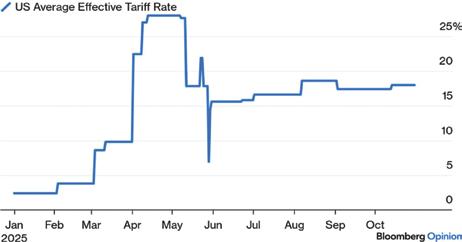
On April 2, 2025—branded by President Trump as “Liberation Day”—the administration announced exceptionally high tariffs on imports from almost every country in the world. In what might be described as a period of tariff regret, many of these measures were subsequently scaled back, often following bilateral ‘deals’ in which trading partners offered various concessions to Washington (Figure 1). Ultimately, none of the most severe tariff scenarios materialised.
Even so, a number of tariffs remain in place, with those imposed on US allies in some cases exceeding those applied to China. More importantly, uncertainty surrounding future tariff policy has intensified. Combined with concerns over institutional resilience and the trajectory of US public debt, this uncertainty has contributed to a depreciation of the dollar, as investors have sought protection through hedging strategies or diversification away from dollar-denominated reserve assets.
While the tariffs did not derail economic activity or ignite inflation to the extent initially feared, their corrosive effects are becoming apparent. Higher input costs, weaker employment dynamics and damage to the manufacturing sector are evident.
As during President Trump’s first-term trade war, tariffs on intermediate goods have disrupted supply chains, reducing efficiency and weighing on industrial output.
Global trade patterns have also been reshaped. With tariff rates on Chinese imports exceeding

This article first appeared in the Policy Center for the New South
Figure 1: US average effective tariff rate.
Source:YaleBudgetLab
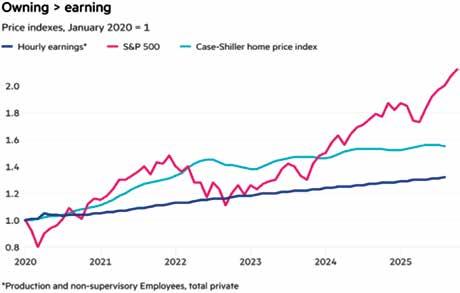
Figure 2: Hourly earnings, stock prices, and home prices.
Source:Bloomberg(2025),December23(datafromtheConferenceBoard)
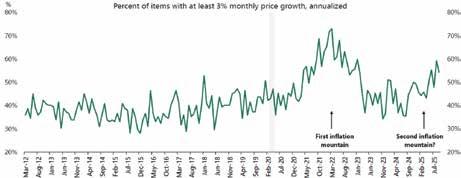
Figure 5: Increasing share of CPI items with price rises. More than 50% of items in the CPI basket show at least a 3% price increase.
Source:BLS,ApolloChiefEconomist
those applied to Mexico and several other Asian economies, trade flows have been redirected towards jurisdictions facing lower US barriers. This reorientation has been reinforced by spillover effects. As access to the US market deteriorated, China redirected exports to other destinations, supporting its own growth resilience during 2025.
It is also notable how cautiously US companies have approached cost pass-through, reflecting the uncertain and stop-start nature of tariff increases. Rising prices for imported goods indicate that foreign producers are not absorbing a significant share of the tariff burden. Although tariff transmission to the consumer price index is visible, it has so far remained limited. The tariff saga may be paused, but it is far from concluded.
Attention now turns to the upward arm of the ‘K’. The artificial intelligence boom has been accompanied by frequent warnings of an impending bubble. The extraordinary rise in equity valuations—captured by the evolution of the S&P Index (Figure 2)—has been driven largely by a narrow group of AI-related firms, often referred to as the ‘magnificent seven’.
Comparisons with the dot-com bubble of the late 1990s are difficult to avoid. As then, the sharp expansion in price-to-earnings ratios among leading technology companies evokes memories of a period when expectations raced far ahead of realised profitability. History suggests that there
is a significant lag between capital expenditure and productivity gains. With AI investment still in its early phases, productivity dividends are likely to remain modest through 2026.
Beyond questions of adoption and diffusion, there is also uncertainty over how much of AI’s economic impact will ultimately translate into sustained earnings growth for the companies currently commanding premium valuations. The dot-com era serves as a reminder that only a small fraction of early leaders survived the subsequent correction.
That said, a near-term collapse appears unlikely. AI-related spending should continue to underpin strong capital expenditure for at least another year. Major hyperscalers are financing data-centre expansion from substantial cash reserves, and corporate leverage has not yet reached the levels typically associated with systemic crises.
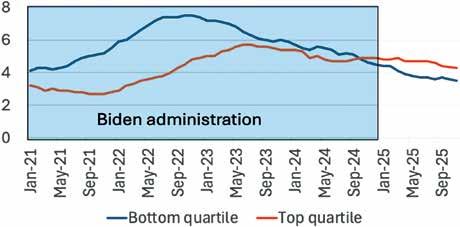
More concerning is the durability of the US economy’s dual-track performance—resilient output growth coupled with weak job creation— and the persistence of the K-shaped outcome. Soft labour demand is eroding purchasing power, as slower growth in private-sector wage income coincides with lingering inflation and a concentrated negative impulse from the public sector. Figure 3 illustrates the pronounced divergence in annual nominal wage growth between the top and bottom income quartiles.
"Looking ahead, labour supply constraints are likely to exert downward pressure on unemployment rates in the second half of 2026, potentially forcing the Fed to tighten policy once again."
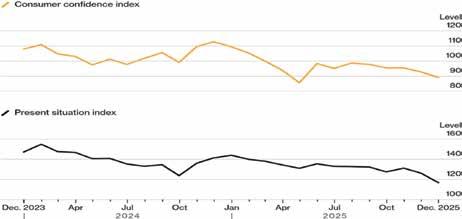
These dynamics are reinforcing business pessimism. Growth without employment has sharpened distributional tensions, while consumer confidence has weakened (Figure 4). It is no coincidence that ‘affordability’ emerged as a central theme in elections in New York and other jurisdictions where Democrats secured victories in 2025, prompting the administration to revise tariffs on imported food downwards.
Following the reversal of pandemic-related disruptions and the supply shocks associated with Russia’s invasion of Ukraine, inflation in the United States—and globally—has stabilised at around 3 percent for two consecutive years (Figure 5). The Federal Reserve’s gradual monetary easing is expected to continue in response to subdued job creation, though this trajectory would be reconsidered should inflation prove more persistent.
Looking ahead, labour supply constraints are likely to exert downward pressure on unemployment rates in the second half of 2026, potentially forcing the Fed to tighten policy once again. Any recovery in labour demand will take place against a much weaker supply backdrop than in the prepandemic period. If labour demand strengthens alongside growth, inflationary pressures may persist, requiring a subsequent contraction in labour markets by late 2026.
For now, the US economy remains defined by its K-shaped form—and the tensions it embodies. i
ABOUT THE AUTHOR
Otaviano Canuto, based in Washington, D.C., is a former vice president and a former executive director at the World Bank, a former executive director at the International Monetary Fund, and a former vice president at the Inter-American Development Bank. He is also a former deputy minister for international affairs at Brazil’s Ministry of Finance and a former professor of economics at the University of São Paulo and the University of Campinas, Brazil. Currently, he is a senior fellow at the Policy Center for the New South, a professorial lecturer of international affairs at the Elliott School of International Affairs - George Washington University, a nonresident senior fellow at Brookings Institution, a professor affiliate at UM6P, and principal at Center for Macroeconomics and Development.
Figure 4: US consumer confidence.

Nouriel Roubini:
The Real Existential Threat Facing Europe
US President Donald Trump’s new National Security Strategy offers a misguided assessment of Europe, long regarded as America’s most reliable ally. Unrestrained immigration and other policies derided by administration officials as “woke,” it warns, could lead to “civilizational erasure” within a few decades.
That argument rests on a fundamental misreading of Europe’s current predicament.
While the European Union does face an existential threat, it has little to do with immigration or cultural politics. In fact, the share of foreign-born residents in the United States is slightly higher than in Europe.
The real threat facing Europe lies in its own economic and technological backwardness. Between 2008 and 2023, GDP rose by 87% in the US, compared to just 13.5% in the EU. Over the same period, the EU’s GDP per capita fell from 76.5% of the US level to 50%. Even

the poorest US state – Mississippi – has a higher per capita income than that of several major European economies, including France, Italy, and the EU average.
This widening economic gap cannot be explained by demographics. Instead, it reflects stronger productivity growth in the US, largely owing to technological innovation and higher total factor productivity. Today, roughly half of the world’s 50 largest technology firms are American, while only four are European. Over

the past five decades, 241 US firms have grown from startups into companies with market capitalisations of at least $10 billion, compared with just 14 in Europe.
These trends raise a critical question: Which countries will lead the industries of the future, and where does Europe fit in? The race for technological leadership now spans a wide range of fields, including AI and machine learning, semiconductor design and production, robotics, quantum computing, fusion energy,
fintech, and defense technologies. Europe enters this race at a clear disadvantage.
Whether the US or China currently leads the industries of the future remains open to debate, but most observers agree that it’s essentially a two-horse race, with America still ahead in several key areas. Beyond that, innovation is concentrated in countries like Japan, Taiwan, South Korea, India, and Israel. In Europe, by contrast, innovative activities are largely confined to the United Kingdom, Germany, France, and Switzerland – two of which are not even EU member states.
It is hardly a surprise, then, that while the US and China dominate global technological rankings, Europe finds itself far from the top. And the outlook is anything but reassuring, given that the next wave of innovation is widely expected to be more disruptive than anything we have seen over the past half-century.
The technological gap between the US and Europe can be attributed to several factors. First, the US has a far deeper and more dynamic ecosystem for financing startups, while Europe still lacks a genuine capital markets union, limiting the scale and speed at which new firms can grow.
Second, Europe is hampered by excessive and fragmented regulation. A US startup can launch a product under a single regulatory framework and immediately access a market of more than 330 million consumers. The EU has a population of roughly 450 million but remains divided among 27 national regulatory regimes. An International Monetary Fund analysis shows that internal market barriers in the EU act like a tariff of around 44% for goods and 110% for services – far higher than the tariff levels the US imposes on most imports.
Third, cultural attitudes toward risk-taking differ sharply. Until relatively recently, a failed entrepreneur in some EU countries (like Italy) could face criminal penalties, while in the US, a tech founder who has never failed is often seen as too risk-averse.1
Fourth, the US benefits from a deeply integrated academic-military-industrial complex, while Europe’s chronic underinvestment in defense has weakened its innovation capacity. Technological leaders like the US, China, Israel, and, more recently, Ukraine spend heavily on defense, with military research often producing technologies that have civilian applications.
Despite this, many European political leaders continue to frame higher defense spending as a tradeoff between security and social welfare. In reality, free-riding on US defense spending since the end of World War II has limited the
type of innovation that could have generated more of both through higher productivity. Paradoxically, sustaining Europe’s social model will require greater investment in defense, beginning with meeting NATO’s new spending target of 3.5% of GDP.
If Europe allows its technological lag to grow over the coming decades, it risks prolonged stagnation and continued economic decline relative to the US and China. There are, however, reasons for cautious optimism. Increasingly aware that Europe faces an existential challenge, policymakers have begun to advance serious reform proposals. The most notable examples are the two major 2024 reports on EU competitiveness and the single market by former Italian prime ministers Mario Draghi and Enrico Letta, respectively.
Europe also retains considerable strengths, including high-quality human capital, excellent education systems, and world-class research institutions. With the right incentives and regulatory reforms, these assets could support much higher levels of commercial innovation. With a better environment for entrepreneurship, Europe’s high per capita income, large internal market, and elevated savings rates could help unleash a wave of investment.
Crucially, even if Europe never leads in cuttingedge technologies, it could still significantly boost productivity by adopting and adapting American and Chinese innovations. Many of these technologies are general-purpose in character, benefiting both adopters and pioneers.
All of this leaves Europe at an inflection point. As Ernest Hemingway famously observed, bankruptcy happens “gradually and then suddenly.” So far, Europe’s technological decline has been gradual. But if it fails to confront its structural weaknesses, today’s slow erosion could give way to a sudden and irreversible loss of economic relevance. i
ABOUT THE AUTHOR
Nouriel Roubini, Professor Emeritus of Economics at New York University’s Stern School of Business, is Chief Economist at Atlas Capital Team, CEO of Roubini Macro Associates, Co-Founder of TheBoomBust.com, and author of the forthcoming MegaThreats: Ten Dangerous Trends That Imperil Our Future, and How to Survive Them (Little, Brown and Company, October 2022). He is a former senior economist for international affairs in the White House’s Council of Economic Advisers during the Clinton Administration and has worked for the International Monetary Fund, the US Federal Reserve, and the World Bank. His website is NourielRoubini.com, and he is the host of NourielToday.com.

>
Joseph
E Stiglitz:
America’s New Age of Empire
S President Donald Trump has drawn a wave of criticism for his actions in Venezuela, violations of international law, disdain for longstanding norms, and threats against other countries – not least allies like Denmark and Canada. Around the world, there is a palpable sense of uncertainty and foreboding. But it should already
be obvious that things will not end well, neither for the United States nor the rest of the world.
None of this comes as a surprise to many on the left. We still remember US President Dwight Eisenhower’s valedictory warning about the industrial-military complex that had emerged from World War II. It was inevitable that a country

whose military spending matched that of the rest of the world combined would eventually use its arms to try to dominate others.
To be sure, military interventions became increasingly unpopular following the American misadventures in Vietnam, Iraq, Afghanistan, and elsewhere. But Trump has never shown much

concern for the will of the American people. Since he entered politics (and no doubt earlier), he has considered himself above the law, boasting that he could shoot someone on New York’s Fifth Avenue without losing a vote. The January 6, 2021, insurrection at the US Capitol – whose anniversary we have just “celebrated” – showed that he was right. The 2024 election
reinforced Trump’s hold on the Republican Party, ensuring that it will do nothing to hold him accountable.
The capture of Venezuela’s dictator, Nicolás Maduro, was brazenly illegal and unconstitutional. As a military intervention, it required congressional notification, if not approval. And even if one stipulates that this was a case of “law enforcement,” international law still requires that such actions be pursued through extradition. One country cannot violate another’s sovereignty or snatch foreign nationals – let alone heads of state – from their home countries. Israeli Prime Minister Benjamin Netanyahu, Russian President Vladimir Putin, and others have been indicted for war crimes, but no one has proposed deploying soldiers to seize them wherever they happen to be.
Even more brazen are Trump’s subsequent remarks. He claims that his administration will “run” Venezuela and take its oil, implying that the country will not be permitted to sell to the highest bidder. Given these designs, it would appear that a new era of imperialism is upon us. Might makes right, and nothing else matters. Moral questions – such as whether killing dozens of alleged drug smugglers without any pretense of due process –and the rule of law have been shunted aside, with barely a whimper from Republicans who once proudly touted American “values.”
Many commentators have already addressed the implications for global peace and stability. If the US claims the Western Hemisphere as its sphere of influence (the “Donroe Doctrine”) and bars China from accessing Venezuelan oil, why shouldn’t China claim East Asia and bar the US from accessing Taiwanese chips? Doing so would not require it to “run” Taiwan, only to control its policies, particularly those allowing exports to the US.
It is worth remembering that the great imperial power of the 19th century, the United Kingdom, did not fare well in the 20th. If most other countries cooperate in the face of this new American imperialism – as they should – the longterm prospects for the US could be even worse. After all, the UK at least tried to export salutary governing principles to its colonies, introducing some modicum of the rule of law and other “good” institutions.
By contrast, Trumpian imperialism, lacking any coherent ideology, is openly unprincipled – an expression solely of greed and the will to power. It will attract the most avaricious and mendacious reprobates that American society can churn up. Such characters do not create wealth. They direct their energy to rent-seeking: plundering others through the exercise of market power, deception, or outright exploitation. Countries dominated by rent-seekers may produce a few wealthy individuals, but they do not end up prosperous.
Prosperity requires the rule of law. Without it, there is ever-present uncertainty. Will the government seize my assets? Will officials demand a bribe to overlook some minor peccadillo? Will the economy be a level playing field, or will those in power always give the upper hand to their cronies?
Lord Acton famously observed that, “Power corrupts, and absolute power corrupts absolutely.” But Trump has shown that one does not need absolute power to engage in unprecedented corruption. Once the system of checks and balances starts to fall apart – as indeed it has in the US – the powerful can operate with impunity. The costs will be borne by the rest of society, because corruption is always bad for the economy.
One hopes that we have reached “peak Trump,” that this dystopian era of kakistocracy will end with the 2026 and 2028 elections. But Europe, China, and the rest of the world cannot rely on hope alone. They should be devising contingency plans which recognize that the world does not need the US.
What does America offer that the world cannot do without? It is possible to imagine a world without the Silicon Valley giants, because the basic technologies they offer are now widely available. Others would rush in, and they may well establish much stronger safeguards. It is also possible to imagine a world without US universities and scientific leadership, because Trump has already done his utmost to ensure that these institutions struggle to remain among the world’s best. And it is possible to imagine a world where others no longer depend on the US market. Trade brings benefits, but less so if an imperial power seeks to grab a disproportionate share for itself. Filling the “demand gap” posed by the US's persistent trade deficits will be a lot easier for the rest of the world than the challenge facing the US of dealing with the supply side.
A hegemon that abuses its power and bullies others must be left in its own corner. Resisting this new imperialism is essential for everyone else’s peace and prosperity. While the rest of the world should hope for the best, it must plan for the worst; and in planning for the worst, there may be no alternative to economic and social ostracism –no recourse but a policy of containment. i
ABOUT THE AUTHOR
Joseph E Stiglitz, a Nobel laureate in economics and University Professor at Columbia University, is a former chief economist of the World Bank (1997-2000), former chair of the US President’s Council of Economic Advisers, former co-chair of the High-Level Commission on Carbon Prices, and lead author of the 1995 IPCC Climate Assessment. He is Co-Chair of the Independent Commission for the Reform of International Corporate Taxation and the author, most recently, of The Road to Freedom:EconomicsandtheGoodSociety (W. W. Norton & Company, Allen Lane, 2024).
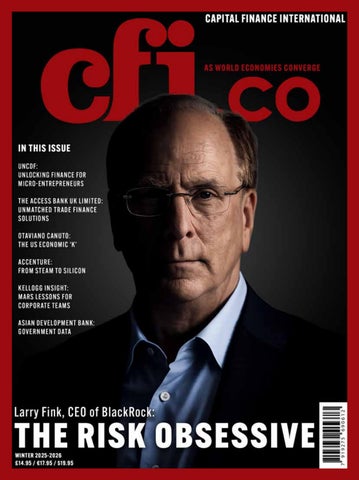
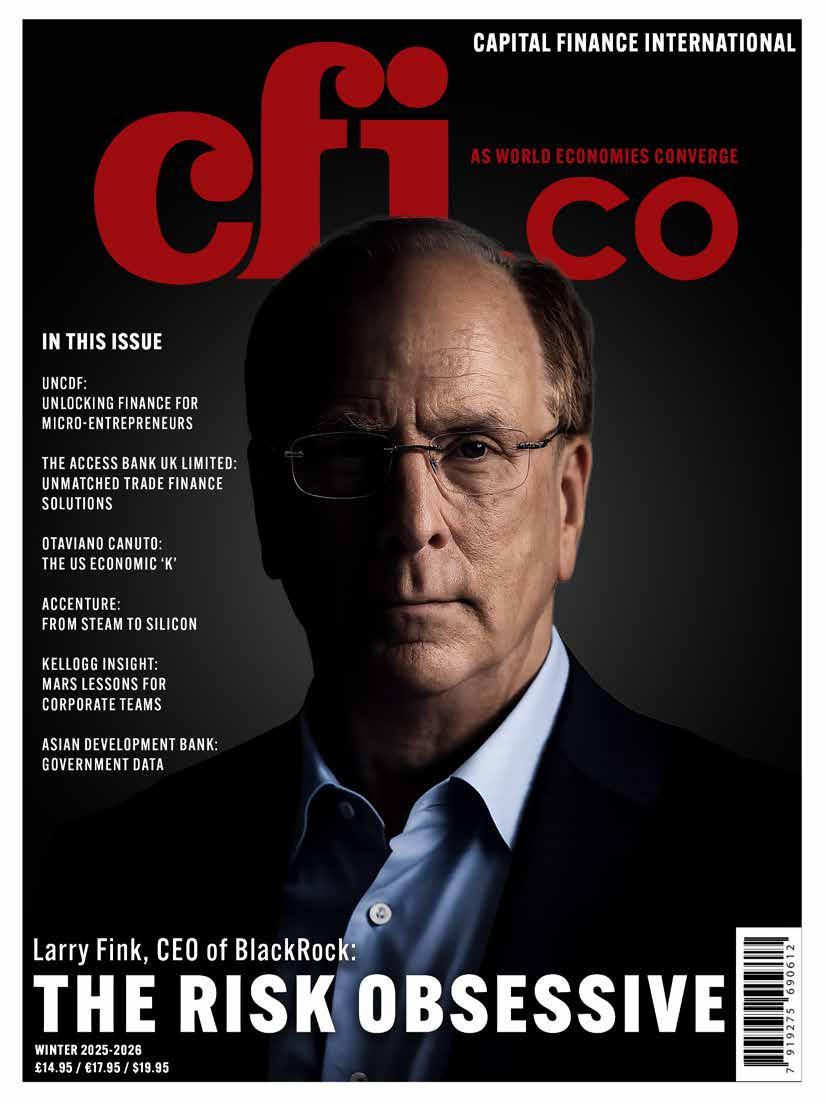
LAURENCE D FINK:
ARCHITECT OF STEWARDSHIP, PRAGMATISM, AND PURPOSEFUL GOVERNANCE
At $13.46tn in assets under management, BlackRock has become less a financial institution than a piece of global infrastructure — and Laurence D. Fink its chief engineer. Over three decades, he has built a platform that fuses risk analytics, passive investing, and corporate stewardship into a single system of influence. In the process, he has helped recast fiduciary duty for an era defined by climate volatility, energy insecurity, infrastructure scarcity, and a growing retirement gap — while navigating the political backlash that turned ESG from a technical framework into a cultural battleground.
In the canyons of lower Manhattan — and, increasingly, in the gleaming vertical city of Hudson Yards — global finance can feel like a closed ecosystem, governed by its own language and gravitational constants. Yet even in this rarefied atmosphere, Laurence D. Fink occupies a singular altitude. As Chairman and Chief Executive Officer of BlackRock, Fink does not merely watch markets; his firm, in a profound structural sense, has become part of the market’s operating system. By the turn of 2026, BlackRock’s assets under management had climbed to $13.46tn, a figure so large that it demands a geopolitical rather than purely financial frame of reference. It exceeds the gross domestic product of every nation on Earth save the United States and China, and it gives the firm — and its leadership — a form of soft power that can rival sovereign authority.
But scale alone does not explain the Fink phenomenon. To define him solely by the magnitude of the capital he oversees is to miss the more consequential story: Fink has spent the last decade evolving into the de facto philosopherpractitioner of modern fiduciary capitalism. He has done so not through grandstanding, but through a steady, strategic recasting of what long-term value means, and how it is protected.
His annual letters to corporate leaders and investors have become something closer to policy signals for the boardroom class, shaping not only the tone of governance debates but the practical behaviour of capital allocators. In earlier years, those letters pushed “purpose” into the mainstream. More recently, they have pivoted towards the hard engineering of energy pragmatism, infrastructure mobilisation, and retirement resilience — themes designed to survive political turbulence while preserving a long-term horizon.
This arc matters because BlackRock’s influence is not theoretical. It is embedded in the mechanics of modern investment. The firm’s iShares franchise sits at the heart of the passive revolution. Its Aladdin platform provides risk analytics for portfolios that extend well beyond BlackRock’s own balance sheet, reaching into the wider institutional system. And its stewardship function — the engagement and voting apparatus used to exercise shareholder rights — operates at a scale that has few historical parallels. When Fink’s BlackRock shifts its vocabulary, refines its voting practices, or reweights its strategic priorities, the tremor is felt across markets, boardrooms, and, increasingly, politics.
THE SCALE OF THE EMPIRE, AND THE WEIGHT OF RESPONSIBILITY
BlackRock’s size can feel abstract until it is translated into what it represents: the pooled savings of teachers, firefighters, nurses, engineers, factory workers, and millions of individual investors whose pension funds and retirement accounts are channelled through institutional mandates. The $13.46tn headline is, in effect, a portrait of global thrift and longterm liability. Yet the firm’s reach extends further. Through Aladdin, BlackRock provides risk management and analytics for portfolios totalling roughly $21tn-plus — a level of penetration that has led observers to describe the platform as a central nervous system of global investment risk.
The firm’s public equity footprint is equally defining. A substantial share of BlackRock’s equity assets sits in index strategies, with index equity assets under management estimated at about $6.9tn in the 2025/26 context. That fact has two consequences. The first is democratising: it reflects a world in which low-cost indexing has widened market access and reduced the fee drag that historically eroded household returns. The second is structural: it turns BlackRock into a universal owner, a shareholder in nearly everything, with limited ability to “walk away”
from controversial sectors or underperforming management teams. In such a world, voice replaces exit. Engagement and voting become the primary tools of influence, and stewardship ceases to be a reputational accessory. It becomes a fiduciary mechanism.
Scale also attracts scrutiny. To some critics, the concentration of shareholder voting power in the hands of a handful of passive giants represents a democratic deficit in corporate governance. To others, the very idea that an asset manager should engage companies on environmental, social, or governance issues looks like an ideological project. BlackRock has been attacked from both directions, often simultaneously: environmental campaigners argue the firm is not aggressive enough in pushing decarbonisation; conservative politicians accuse it of using other people’s money to pursue “woke” objectives. Fink has become the public face of this tension, even when the underlying mechanics are rooted in index design and fiduciary structure rather than ideology.
What is most notable about the past few years is not that BlackRock has been targeted — that is inevitable at this size — but that Fink has adapted without abandoning his core thesis. The Larry Fink of 2026 is less the high-profile evangelist of corporate purpose and more the hardened pragmatist of systems resilience. He has learned to treat language as a governance tool: the words matter because they either widen coalition support or invite political retaliation. Hence the retreat from the acronym ESG, even as the underlying risk analysis and engagement discipline remains embedded.
A RISK OBSESSION FORGED IN A SINGLE QUARTER
To understand the culture Fink built at
BlackRock, it is necessary to revisit a moment of personal failure that became institutional mythology. In 1986, Fink was a leading figure at First Boston, prominent in the mortgage-backed securities market and credited with generating substantial profits. Then a misjudgement on interest-rate direction contributed to a $100mn loss in a single quarter. The reversal washed away prior success and precipitated his eventual departure. In the competitive ego theatre of 1980s Wall Street, such a loss carried the sting of public humiliation.
Yet that episode did not simply mark an ending; it became a thesis. Fink concluded that Wall Street had become proficient at pursuing returns while remaining dangerously immature at measuring risk — not only in the narrow sense of volatility, but in the deeper sense of correlation, liquidity, and systemic exposure. The epiphany was that returns could be generated without truly understanding the architecture of downside. For Fink, that was not merely a technical weakness; it was an existential flaw in the investment industry’s operating model.
When he founded BlackRock in 1988 — originally as Blackstone Financial Management under the umbrella of Pete Peterson and Stephen Schwarzman’s Blackstone Group — he did so with a clear organising principle: fiduciary duty is risk management. Not the kind performed at the edge of an organisation as compliance theatre, but risk management embedded in decision-making, technology, and process. This ethos distinguished BlackRock from the era’s star-manager culture, where instinct, bravado, and personality were often mistaken for edge.
By the mid-1990s, a dispute with Schwarzman over equity and compensation led to separation
and independence. It was a split that would reshape modern finance. Blackstone became synonymous with private equity and alternative assets. BlackRock became the world’s dominant public markets manager, and later a technology-enabled governance actor. The rivalry was not merely corporate; it represented two different answers to a central question of modern capitalism: where does power reside — in the ownership of private assets, or in the infrastructure of public markets?
THE iSHARES MOMENT, AND THE PASSIVE GIANT PROBLEM
If BlackRock’s founding was Act I, the acquisition of Barclays Global Investors in 2009 was the climactic moment of Act II. In the wreckage of the global financial crisis, when banks were shedding assets to survive, Fink made a decisive bet: he acquired BGI for $13.5bn, securing control of iShares and placing BlackRock at the centre of the exchange-traded fund revolution.
The timing was pivotal. As confidence in active managers faltered and fee sensitivity rose, investors migrated towards low-cost passive exposure. iShares became a natural beneficiary, and the deal transformed BlackRock from a powerful bond and multi-asset manager into a global behemoth spanning active and index strategies. In doing so, the firm helped accelerate a broader democratisation of investing — lowering costs for millions and making diversified exposure more accessible.
But the iShares triumph produced a governance dilemma that still defines BlackRock’s stewardship debates. If a firm owns everything through index products, it cannot divest from a company or sector without deviating from the index mandate. In effect, the universal owner is compelled to hold
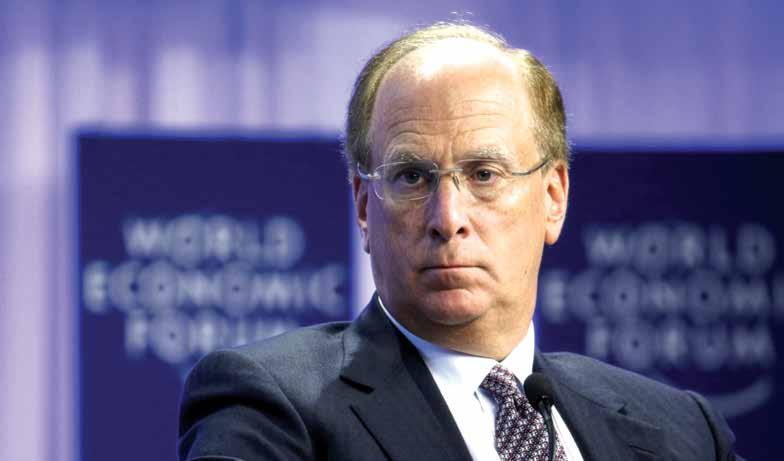
CEO of BlakRock: Laurence Fink
exposures even when it believes management is misallocating capital or mismanaging long-term risk. That reality reweights the governance toolkit: if exit is not available, engagement and voting are the levers. It also sharpens the political edge: because BlackRock cannot “leave”, it is forced to “speak”, and in speaking it attracts claims of overreach.
THE RISE OF THE FINK LETTERS, AND THE LOGIC OF STAKEHOLDER CAPITALISM
Fink’s emergence as a global governance figure can be traced through the evolution of his annual letters. For years they were corporate communications. Then, gradually, they became instruments of expectation-setting for boardrooms. The inflection point is often identified with 2018, when Fink argued that companies must articulate a sense of purpose beyond profits if they are to prosper over time. His argument was not a plea for charity. It was framed as long-term risk management: without credible stakeholder relationships, companies would lose their licence to operate, facing regulatory backlash, workforce erosion, consumer distrust, and social instability.
Two years later, the logic tightened further. In 2020, Fink’s assertion that “climate risk is investment risk” helped convert a once-niche concern into a mainstream valuation variable. He argued that markets would begin to reprice climate exposure, leading to a reallocation of capital. BlackRock’s approach emphasised disclosure frameworks and risk integration rather than sweeping divestment, including a more explicit stance on thermal coal. The message was that climate was not a moral preference; it was a material financial factor.
This positioning is often described as stakeholder capitalism, but Fink’s framing was more pragmatic than philosophical. He insisted that shareholder value is not protected by ignoring stakeholders; it is protected by serving them well enough to preserve operational resilience. A business exposed to flooding, supply disruptions, legal claims, or workforce attrition is not simply suffering social consequences — it is carrying financial risk. By translating these variables into fiduciary language, Fink helped bring environmental and social factors into the machinery of investment analysis.
ESG BECOMES A CULTURAL WEAPON
By 2022, the consensus Fink helped build began to fracture. The acronym ESG, once a technocratic shorthand, became a proxy for political identity in the United States. BlackRock found itself caught in a paradox. To conservative critics, the firm was accused of boycotting energy companies and using other people’s money to pursue ideological goals. To environmental activists, BlackRock was accused of greenwashing because it continued to hold substantial hydrocarbon exposure through index funds and refused to divest from broad sectors.
The political backlash developed concrete forms. State-level officials in energy-producing regions began to target firms they claimed were hostile to fossil fuels. In Texas, the state comptroller placed BlackRock on a list of financial companies said to boycott energy, prompting divestment actions by certain state-linked funds. In Florida, Governor Ron DeSantis publicly withdrew approximately $2bn in state assets from BlackRock, framing the firm’s approach as ideological. A coalition of Republican attorneys general sent letters accusing BlackRock of violating fiduciary duty by pursuing climate objectives rather than maximising returns. The arguments were not always consistent, but they were politically potent.
BlackRock’s defence was rooted in structure: as an index manager, it cannot divest from the market without breaking the mandate. It holds the whole economy. Therefore, if it is to protect long-term value, it must engage with companies — including energy firms — rather than abandoning them. Fink repeatedly stressed that BlackRock was not attempting to police the energy sector but to ensure companies manage transition risks effectively.
The financial reality, meanwhile, diverged sharply from the political theatre. The outflows prompted by “anti-woke” campaigns were meaningful as headlines but marginal relative to BlackRock’s scale. In the period often cited, the firm faced withdrawals of roughly $4bn from certain states, while simultaneously generating net long-term inflows measured in the hundreds of billions. In 2024, BlackRock recorded inflows of $641bn, underscoring the resilience of its model even as it became a political target. Markets, it seemed, cared more about performance, liquidity, and fees than partisan signalling. Yet reputational damage matters in a trust-based business, and Fink — a consensus builder by temperament — appeared increasingly determined to lower the temperature.
THE PIVOT: ENERGY PRAGMATISM AND THE ABANDONMENT OF A WORD
Fink’s most consequential adaptation has been rhetorical rather than strategic. He publicly distanced himself from the term ESG, arguing that it had been entirely weaponised by extremes on both sides. The point was not that the underlying issues had vanished; it was that the label had become so politically toxic that it impeded productive risk analysis. A firm operating at BlackRock’s scale cannot afford to spend its credibility on a culture war over an acronym.
In place of ESG rhetoric, Fink pushed “energy pragmatism”. The concept is both a concession to reality and a strategic repositioning. It acknowledges that the world cannot abruptly eliminate hydrocarbons without triggering energy insecurity and price spikes, and that the transition must balance decarbonisation with

Photo: Ethan Hill

affordability and reliability. It also reframes the investment opportunity: rather than a morality play, the transition becomes a build-out of physical systems — grids, renewables, storage, transmission, efficiency, and, in some contexts, transitional fuels.
This pragmatism serves multiple constituencies. It speaks to conservative concerns about energy security. It reassures investors that the firm is focused on economics rather than ideology. And it provides cover for a broad spectrum strategy: BlackRock can invest across the transition landscape, not merely in renewables but in the infrastructure that enables a stable, decarbonising system.
THE INFRASTRUCTURE THESIS: PRIVATE CAPITAL AS THE MISSING BALANCE SHEET
The economic centrepiece of the pivot is infrastructure. Fink has highlighted a global infrastructure requirement of roughly $68tn by 2040, positioning it as one of the defining investment gaps of the era. The argument is blunt: governments cannot fund this build-out through deficits indefinitely. Debt burdens, ageing populations, and political constraints mean public balance sheets are insufficient. The implication is that private capital must step in — not as a peripheral partner, but as a central provider of long-duration funding.
BlackRock’s acquisition of Global Infrastructure Partners for $12.5bn crystallised this strategy. It signalled an intent to scale ownership and operation of physical assets, moving beyond the passive constraints of listed equities into the active governance of infrastructure platforms. This is not a mere diversification play; it is an attempt to align BlackRock’s future revenue model with the world’s physical investment needs. Infrastructure offers inflation-linked cash flows and longer-duration yields. It also offers higher fees than commoditised index products. In short, it is both a macro necessity and a strategic hedge against fee compression.
The infrastructure thesis also helps explain why Fink’s language has shifted away from the moral urgency of early ESG rhetoric and towards the engineering language of build-out. In print, the message is clear: the future is not decided by declarations; it is decided by the ability to mobilise capital into assets that deliver reliability and resilience.
THE SILENT CRISIS: RETIREMENT INSECURITY AND THE NEW ASSET MIX
Alongside climate and infrastructure, Fink has increasingly highlighted a quieter crisis: retirement. His framing is deeply personal and strategically calculated. He recounts the experience of his parents — modest earners who achieved retirement security largely through exposure to capital markets. The implication is not nostalgia; it is arithmetic. Market participation has historically outperformed the
safety of bank accounts and has enabled millions to retire with dignity.
The modern reality is more fragile. The shift from defined benefit pensions to defined contribution schemes has moved longevity risk from institutions to individuals. Workers are now expected to be their own pension managers. Even when they save sufficiently, many fear spending, haunted by the prospect of outliving assets. This “retirement paradox” — where fear suppresses consumption — has implications for wellbeing and for the broader economy.
Fink’s proposed solution involves a rethinking of portfolio construction. The traditional 60/40 model, he argues, may be less effective in a world of higher inflation, more volatile correlations, and an altered bond market regime. He has advocated a model closer to 50/30/20, with a dedicated allocation to private assets such as infrastructure, real estate, and private credit. The logic is diversification and inflation resilience. The catch is accessibility: private assets have historically been gated from retail savers, concentrated among institutions and the wealthy.
Here, BlackRock’s corporate strategy aligns with Fink’s public thesis. Expanding into private markets is framed as democratisation — bringing private assets into the reach of retirement savers through new vehicles and structures. This alignment is not cynical; it is structural. It allows BlackRock to address a social problem while accessing a higher-fee growth engine. It also places the firm closer to Blackstone’s territory, blurring the historical boundary between public and private market dominion.
STEWARDSHIP AS MACHINERY: REFINING ENGAGEMENT, VOTING, AND ACCOUNTABILITY
As BlackRock’s ownership footprint expanded, so did scrutiny of its stewardship. Critics asked whether a single institution should wield such voting influence across public companies. BlackRock’s response has been to professionalise and segment stewardship, emphasising financial materiality and attempting to reduce the perception of monolithic voting power.
From January 1, 2025, BlackRock formally separated stewardship activity into two bodies: a function dedicated to index equity strategies and another aligned with active investment teams. In practice, this reflects the reality that passive mandates require a consistent, benchmark-linked stewardship policy, whereas active strategies may vote differently depending on investment theses. The split is also reputational risk management: it helps demonstrate that BlackRock’s voting is not a single ideological bloc, but a fiduciary process shaped by mandate type.
Voting patterns have also shifted. In the 2024–25 proxy period, BlackRock’s support for prescriptive environmental and social

influence is exercised more through dialogue and expectations than through symbolic resolutions.
Perhaps the most strategically important governance innovation of the Fink era is Voting Choice. Recognising that a single voting policy cannot satisfy the divergent priorities of a pension fund in Texas and an institutional investor in Europe, BlackRock has gradually decentralised voting power. By mid-2025, roughly $784bn in index equity assets were enrolled in Voting Choice, allowing clients to vote their own shares directly or to select third-party voting policies. This is described as democratisation, and it is. It is also a sophisticated defence mechanism: by shifting voting discretion to asset owners, BlackRock can credibly say that it does not impose a single worldview. It executes client mandates — and now, increasingly, client votes.
SUCCESSION: A PLATFORM LARGER THAN ANY INDIVIDUAL
No profile of Fink can ignore the succession question, not because he signals imminent departure, but because the firm is now so large that leadership transition is itself systemic risk. In early 2025, a long-time senior executive widely seen as a potential successor, Mark Wiedman, departed after two decades. The exit narrowed the field of likely successors and prompted a reshaping of senior leadership responsibilities. Fink, then 72, publicly suggested he had no interest in retirement, a stance that can stabilise markets while complicating internal ambition.
Attention has turned to a cohort of senior leaders whose backgrounds reflect BlackRock’s hybrid identity: operational, technological, financial, and international. Rob Goldstein, the chief operating officer, is closely associated with Aladdin and the platform’s technology spine; his elevation would signal a view of BlackRock as a technology firm
This shift towards collective leadership architecture matters because BlackRock’s next era will likely be less about charismatic agendasetting and more about system management: operating a platform that intersects markets, technology, governance, retirement policy, and infrastructure mobilisation.
TOKENISATION: BEYOND THE CRYPTO CYCLE Fink’s most forward-looking theme is the digitisation of markets through tokenisation. The popular narrative tends to focus on cryptocurrency, but Fink’s stated interest is broader: tokenisation of traditional assets, enabling faster settlement, fractional ownership, and more efficient market infrastructure. In this vision, the point is not speculative mania but operational efficiency. If assets can settle instantly rather than on T+1 or T+2 cycles, capital is freed. If infrastructure or real estate can be fractionalised, more investors can participate. And if private assets are to be integrated into retirement vehicles, tokenisation could become the rail that makes illiquid exposures more accessible and transferable.
BlackRock’s record-setting expansion into bitcoin-related products has inevitably shaped perceptions, but the strategic logic is consistent with the broader thesis: finance is moving towards a more digital, more modular market architecture, and the firms that operate the infrastructure will enjoy outsized influence. For a company already defined by platform power, tokenisation is not an aside; it is a potential extension of the operating system.
THE PRAGMATIC VISIONARY’S LEGACY
Laurence D. Fink stands at the fulcrum of modern capitalism not because he is the loudest voice in the room, but because he has built institutions
in the high-ESG years. It is more careful with language, aware that words can trigger political reprisal. Yet it is more expansive in reach, pushing into infrastructure and private assets with a conviction that the next era belongs to firms that can mobilise long-duration capital into real-world systems. It has shifted from preaching corporate virtue to building governance tooling, including voting choice, that redistributes responsibility to clients while preserving engagement leverage. It has maintained the core thesis — that long-term value depends on understanding long-term risk — while swapping ideological labels for practical imperatives.
The “Fink effect” has matured. It is no longer primarily about the novelty of a chief executive urging companies to consider society. It is about the systemic integration of long-horizon factors into the machinery of finance: climate volatility, energy security, infrastructure scarcity, and retirement fragility. Fink’s legacy will likely not be that he made capitalism “woke”, but that he made it conscious of its own time horizon — and then built the tools, platforms, and institutional structures to operate within it.
BlackRock increasingly resembles a utility: indispensable infrastructure for the global flow of capital. Whether it is pricing climate risk, mobilising private capital into infrastructure, or redesigning retirement portfolios for an altered macro regime, the firm has positioned itself as the essential partner to a world in transition. In that world, stewardship is not a slogan and pragmatism is not a retreat; they are the conditions of scale. And at the centre of it sits Laurence D. Fink, the pragmatist visionary who realised that to preserve the system that made him a titan, he would have to reshape the way it measures risk, defines value, and votes for the future. i
Winter 2025-2026 Special
The Architects of Corporate Conscience: Voices That Redefined Accountability
Corporate governance—the system by which companies are directed and controlled—is often regarded as a dry exercise in regulatory compliance and legal formality. In reality, it represents a far more consequential struggle: one over accountability, power, and the role of the corporation within society. The evolution of modern governance is not merely a chronology of legislative interventions, but an intellectual narrative shaped by seminal thinkers who first diagnosed the dangers of concentrated corporate power and then articulated the mechanisms required to restrain it.
The writers examined here, spanning nearly a century of economic disruption and intellectual development, together form the indispensable foundation of contemporary corporate governance. Their work shifted the debate beyond narrow interpretations of property rights towards a more sophisticated understanding of corporate responsibility in its social and economic context. In doing so, they have fundamentally influenced how major corporations structure their boards, design executive remuneration, manage risk, and define their obligations to both investors and the wider public.
The development of modern governance can be understood as unfolding across three cumulative phases.
PHASE ONE: THE DIAGNOSIS – THE FRACTURED LINK BETWEEN OWNERSHIP AND CONTROL
All contemporary governance discourse begins with the recognition of a structural flaw embedded within the joint-stock company. The initial task was to identify where power truly resided.
That foundational analysis was delivered in the 1930s by legal scholar Adolf A. Berle Jr. and economist Gardiner C. Means. Their landmark work demonstrated, through empirical evidence, that the immense economic power of corporations was increasingly exercised by professional managers who held only limited ownership stakes. In identifying this separation of ownership and control, they articulated what would later become known as the agency problem: the misalignment between the interests of shareholders and those entrusted to manage their capital. This tension—between accountability and
autonomy—remains at the heart of modern capitalism.
PHASE TWO: THE STRUCTURE – CONSTRUCTING MECHANISMS OF ACCOUNTABILITY
With the problem clearly diagnosed, the next intellectual challenge lay in developing practical structures capable of restoring balance and oversight. This required a precise delineation of roles within the corporate hierarchy.
Robert Ian Tricker played a decisive role in this phase by formalising corporate governance as a distinct academic and professional discipline. His work clarified the critical separation between directing and managing, establishing the conceptual foundation for board independence. Building on this structural clarity, Sir Adrian Cadbury introduced, in the early 1990s, the influential “comply or explain” framework. This principles-based approach shifted the responsibility for sound governance away from prescriptive regulation towards companies and their shareholders, encouraging transparency, judgement, and accountability rather than mechanical compliance.
Translating governance theory into boardroom practice was the focus of Ram Charan, whose work reframed the board as an active, valuecreating body rather than a passive supervisory entity. His emphasis on strategic engagement, performance oversight, and particularly CEO succession planning helped redefine the board’s role as a central pillar of long-term corporate resilience.
PHASE THREE: THE MANDATE – RECONSIDERING CORPORATE PURPOSE
The final phase marked a shift from questions of

control and monitoring to a more fundamental debate: for whom should the corporation ultimately be run. This challenged the longstanding doctrine of exclusive shareholder primacy.
The intellectual catalyst for this reorientation was R. Edward Freeman’s articulation of Stakeholder Theory. Freeman argued that sustainable corporate success depends on the effective management of relationships with all key stakeholders, including employees, customers, suppliers, and communities. His framework provided both ethical justification and strategic rationale for expanding the corporate mandate beyond short-term financial returns.
This broadened conception of purpose, however, provoked a rigorous counter-response. Lucian A. Bebchuk emerged as the leading defender of shareholder rights, offering a systematic critique of managerial entrenchment and the dilution of accountability. His work underscores the risks inherent in vague or overextended corporate objectives and ensures that debates around purpose remain anchored to measurable performance and clear lines of authority.
Together, these thinkers have supplied the essential language, analytical tools, and philosophical underpinnings of modern corporate governance. The contemporary emphasis on ethical conduct, independent oversight, and sustainable value creation is a direct legacy of their collective contributions. Ultimately, the challenge of governing corporations responsibly is inseparable from the challenge of governing the modern economy itself. i

> THE ARCHITECT OF ACCOUNTABILITY
Why Robert Tricker Is the Father of Modern Corporate Governance
If earlier scholars diagnosed the crisis of corporate power, it was Robert Ian Tricker who defined the remedy. Working far from the established centres of Western capitalism, Tricker transformed a diffuse concern about boardroom failure into a named, structured, and internationally applicable discipline. From his experience in the boardrooms of 1970s Hong Kong, he articulated the concept of “corporate governance” as something distinct from management—an intellectual breakthrough that reshaped how companies are directed, overseen, and held to account.
By the time Tricker began his work, the corporate world was saturated with theories of management, strategy, and financial control. What was conspicuously absent was a coherent framework for understanding the role of the board itself. Directors existed, committees met, and fiduciary duties were assumed, but there was no unified theory explaining what boards were for, how they should operate, or how their role differed fundamentally from that of executive management. The language now taken for granted—governance frameworks, board structure, non-executive oversight—had yet to be formalised.
It was Tricker who filled this void. Widely credited with coining and popularising the term “corporate governance”, he elevated it from a marginal legal concept into the central organising principle of modern corporate oversight. His insight was deceptively simple, yet transformative. Companies did not merely require better management of operations; they required effective direction of the enterprise itself. Governance, he argued, was not about doing the business, but about ruling it.
This distinction between managing and directing became the cornerstone of modern governance theory. Management concerns execution: implementing strategy, running operations, and delivering short-term performance. Governance, by contrast, is concerned with purpose, accountability, risk, and control. It involves setting strategic direction, monitoring executive performance, ensuring legal and ethical compliance, and safeguarding the long-term interests of the organisation.
By clearly separating these roles, Tricker provided boards with a defensible and enforceable mandate. If the board’s function is oversight rather than execution, it cannot be populated by individuals beholden to management. Independence becomes a logical necessity rather than a regulatory imposition. From this single conceptual shift flowed the justification for independent non-executive directors, specialised

board committees, and the professionalisation of directorship itself.
Tricker’s influence is most clearly captured in his seminal work, CorporateGovernance:Principles, Policies, and Practices. More than a textbook, it became the operating manual for boards, regulators, and policymakers across jurisdictions. At a time when countries were developing their own governance codes in relative isolation, Tricker supplied the common language that allowed these frameworks to be compared, adapted, and exported.
His work examined governance not as an abstract ideal, but as a system of power and process. He explored board composition, emphasising independence, diversity, and relevant expertise. He analysed board procedures, highlighting the importance of information flows, meeting structure, and the often-overlooked role of the company secretary. He clarified the nature of fiduciary duty, framing it not merely as a legal obligation but as an ethical commitment to stewardship.
Crucially, Tricker rejected the notion that governance was synonymous with compliance. Long before it became fashionable, he argued that effective governance was a precondition for sustained corporate performance. A wellstructured, independent, and engaged board was not a bureaucratic overhead, but a strategic asset—one that enhanced resilience, disciplined risk-taking, and long-term value creation. This reframing proved critical in shifting governance from a reactive control mechanism to a proactive element of corporate strategy.
Unlike many governance theorists, Tricker also adopted a genuinely comparative perspective. He resisted the temptation to universalise the Anglo-American shareholder model, instead examining governance across different legal and institutional systems, including Europe’s two-tier board structures. This global outlook reinforced
the idea that corporate governance was not a parochial concern, but a universal challenge arising wherever economic power is delegated.
The practical relevance of Tricker’s frameworks became especially apparent in the wake of repeated corporate failures. From the collapse of Barings Bank to the excesses of the dotcom era and beyond, post-mortems consistently revealed the same fault line: a breakdown in the board’s ability to direct and oversee management. In each case, Tricker’s separation of governance and management provided regulators and reformers with a clear diagnostic lens.
One of the most visible manifestations of his influence is the widespread separation of the roles of chairman and chief executive. Now a cornerstone of governance codes across the UK, Europe, and much of the Commonwealth, this practice directly reflects Tricker’s insistence that leadership of the board must be institutionally distinct from leadership of the business. An independent chair safeguards the board’s monitoring function, ensuring that oversight does not collapse into executive dominance.
Tricker’s legacy is ultimately one of structure and discipline. He transformed the role of the director from a largely ceremonial position into a defined fiduciary office, governed by clear responsibilities and professional standards. His commitment to embedding governance as a field of study was reflected in his founding editorship of Corporate Governance: An International Review, which became a global forum for advancing both academic and practical understanding of the discipline.
Even in the contemporary era of Environmental, Social, and Governance accountability, Tricker’s work remains strikingly relevant. Although his primary focus was on financial and structural oversight, the principles he established—clarity of role, independence, transparency, and accountability—are precisely the mechanisms now being deployed to integrate sustainability and social responsibility into boardroom decision-making.
Robert Ian Tricker took an amorphous concern about corporate power and transformed it into a rigorous, internationally applicable discipline. He provided the intellectual architecture that allows boards to govern rather than merely observe, and regulators to codify accountability rather than improvise it. In doing so, he ensured that in boardrooms around the world, the question of who directs the corporation—and how they are held to account—can no longer be ignored. His work remains the structural bedrock of modern corporate governance.
THE DAY OWNERSHIP DIED
How Two Forgotten Writers Unlocked the Corporate Accountability Crisis
Nearly a century before Enron, WorldCom, or the global financial crisis, two American scholars published a book that quietly redefined the nature of modern capitalism. Adolf A Berle Jr and Gardiner C Means were the first to demonstrate, with empirical clarity, that ownership of large corporations had become detached from control. In doing so, they articulated the foundational problem that continues to animate every serious debate on corporate governance, shareholder rights, and the persistent threat of unchecked managerial power.
Published in 1932, The Modern Corporation and Private Property emerged at a moment of profound economic and social rupture. The United States was mired in the Great Depression, confidence in capitalism was collapsing, and mass unemployment had exposed the fragility of existing economic institutions. Berle and Means did not seek to explain the crisis through market cycles or moral failure alone. Instead, they identified a structural transformation that had fundamentally altered how power operated within the corporate economy.
Their argument was stark and unsettling. For centuries, ownership and control had been inseparable. The proprietor or partnership that owned a business also directed it, bearing both the risks of failure and the rewards of success. Berle and Means showed that this relationship had effectively ceased to exist within the modern public corporation. Through a detailed statistical analysis of the largest non-financial companies in the United States, they demonstrated that ownership had become so widely dispersed among thousands, sometimes millions, of shareholders that it had lost all practical meaning. Control had migrated into the hands of a small, self-perpetuating cadre of professional managers.
This separation of ownership from control marked the birth of the corporate governance problem. Managers, entrusted with vast economic resources, typically held only negligible equity stakes. Their incentives were no longer naturally aligned with those of the shareholders whose capital they deployed. Instead, Berle and Means warned, managerial priorities would tend towards empire-building, organisational stability, personal prestige, and self-enrichment, often at the expense of efficiency, accountability, and longterm value creation. This misalignment—later formalised as the “agency problem”—remains the central tension of modern capitalism.
What made Berle and Means’ work so consequential was not merely its economic insight, but its political and ethical implications. The corporations they analysed had grown

into institutions whose power rivalled that of governments, shaping employment, investment, and social outcomes on a national scale. Yet this power was exercised without democratic legitimacy or effective legal restraint. The public corporation, they argued, had become an autonomous social institution, governed neither by owners nor by the state.
This raised a question that has never been satisfactorily resolved: to whom are corporate managers accountable? Under traditional legal doctrine, executives were trustees acting in the interests of shareholders. But Berle himself acknowledged that this framework collapsed once ownership became too fragmented to exert meaningful control. In a famous exchange with legal scholar Merrick Dodd in the early 1930s, Berle warned that if managers were freed from accountability to owners without a clearly defined alternative, they would become answerable only to themselves.
That debate crystallised the enduring fault line between shareholder primacy and broader social responsibility. Dodd argued that corporate managers should serve as trustees for the community, reflecting the corporation’s social power and obligations. Berle resisted this view, fearing that vague appeals to the public interest would simply provide managers with an unchallengeable justification for self-serving behaviour. This unresolved tension became the intellectual seed of what would later evolve into stakeholder theory.
The immediate impact of TheModernCorporation and Private Property was not sweeping reform, but something arguably more important: conceptual clarity. By identifying the structural source of corporate unaccountability, Berle and Means provided the diagnostic framework upon which all subsequent governance reforms have been built. Every attempt to restore oversight— whether through enhanced disclosure, independent directors, audit committees, or executive pay constraints—can be traced back to their central insight that power, once separated from ownership, must be actively restrained.
From the US Securities Acts of the 1930s, designed to arm shareholders with information, to the UK’s Cadbury Report and the global spread of board independence, modern governance architecture represents a sustained effort to reconstruct the accountability that Berle and Means showed had been lost. Each scandal and market collapse has reinforced the same conclusion: failure occurs when boards do not effectively monitor management, or when executives prioritise personal or short-term gain over durable value.
The relevance of Berle and Means has not diminished with time. If anything, it has evolved. While dispersed individual shareholders have largely been replaced by powerful institutional investors—pension funds, insurance companies, and asset managers—the agency problem has merely shifted form. Today’s disconnect often lies between professional fund managers and the ultimate beneficiaries whose capital they represent. Control remains delegated, incentives remain imperfect, and accountability remains contested.
Berle and Means did not propose a definitive solution, perhaps because they understood that none exists. Their legacy is not a fixed governance model, but a permanent warning. Corporate power, once detached from ownership, does not self-correct. It must be continuously monitored, constrained, and re-legitimised. Their work forces every regulator, investor, and non-executive director to confront the same fundamental question: who truly runs the corporation, and in whose interest?
Until a corporate form emerges that perfectly aligns control with responsibility, The Modern Corporation and Private Property will remain the essential reference point for understanding the inherent instability of the modern firm. It is not merely a historical artefact, but the foundational text of corporate governance—a reminder that accountability is not a natural feature of capitalism, but the price paid for delegating economic power at scale.
Adolf Berle Jr
THE BOARD WHISPERER
How Ram Charan Turned Governance from Compliance into Strategy
If earlier thinkers diagnosed the crisis of corporate accountability and others provided its structural foundations, Ram Charan showed boards how to make governance work in practice. Trusted by some of the world’s most powerful chief executives and directors, Charan translated abstract governance theory into an action-oriented discipline rooted in boardroom reality. His enduring contribution lies in reframing governance not as a legal obligation to be satisfied, but as a strategic capability that can decisively shape corporate performance.
Charan’s authority does not stem from academic abstraction, but from decades spent inside the most demanding boardrooms across industries and geographies. Where Berle and Means identified the separation of ownership and control, and Robert Tricker defined governance as a distinct function separate from management, Charan focused on execution. His work represents the third stage in the evolution of corporate governance: the shift from diagnosis, to structure, to performance.
At the heart of Charan’s philosophy is a simple but radical proposition. Governance is not a spectator sport. A board that merely reviews reports, approves decisions, and satisfies regulatory requirements is failing in its most important responsibility. A truly effective board, he argues, should be a competitive advantage— one that actively shapes strategy, strengthens leadership, and anticipates risk.
For much of the late twentieth century, boards tended to operate as passive monitors. Meetings were dominated by retrospective financial reviews, management presentations went largely unchallenged, and directors saw their role as one of oversight rather than engagement. Charan contended that this failure was not caused by a lack of rules, but by a lack of depth. Governance had become procedural when it needed to be strategic.
In his most influential works, including Boards That Deliver and Boards That Lead, Charan repositioned the board as a partner to management rather than a distant supervisor. He argued that effective boards concentrate their energy on three interdependent responsibilities: shaping long-term strategy, overseeing leadership and talent, and understanding enterprisewide risk. These are the domains in which directors add irreplaceable value and in which management, absorbed by operational pressures, often lacks perspective.
Nowhere is Charan’s influence more evident than in his treatment of CEO succession. He consistently identifies succession planning as the single most critical responsibility of

the board, not a peripheral human resources exercise. In Charan’s view, the quality of a board’s governance is ultimately revealed in its handling of leadership transitions. Waiting until a crisis forces a succession decision is, he argues, a governance failure in itself.
Charan advocates a continuous, disciplined approach in which directors spend time with internal candidates well before a transition is imminent. Boards must understand the strengths, limitations, and development needs of future leaders, ensuring that the organisation maintains a deep and credible talent pipeline. By treating succession as an ongoing strategic process rather than a one-off event, boards protect organisational stability and reduce the risk of value-destructive leadership appointments. This responsibility, Charan insists, cannot be delegated. Succession planning is inseparable from the board’s fiduciary duty.
Beyond talent, Charan is equally precise about the mechanics of board effectiveness. He places particular emphasis on how boards use their time, arguing that governance quality is often visible in the agenda itself. Boards that devote the bulk of their meetings to reviewing historical performance, he observes, are implicitly ceding strategic leadership. Directors should arrive prepared on past results and dedicate most of their collective time to forward-looking discussions about markets, competition, disruption, and long-term value creation.
Information quality is another recurring theme in Charan’s work. Boards cannot govern effectively if they rely solely on polished internal reports. Charan urges directors to demand unfiltered insight into customers, competitors, technological change, and external risks. The board’s role is not to be reassured, but to be informed. Robust governance depends on directors’ willingness to challenge management narratives and test assumptions against external reality.
Charan’s approach to board composition builds on earlier calls for independence, but extends them further. Independence alone, he argues, is insufficient. Boards must possess the expertise and diversity of perspective required to govern a complex, fast-changing enterprise. A company confronting digital disruption, geopolitical risk, or regulatory transformation requires directors with relevant experience and intellectual range, not simply former executives drawn from unrelated sectors. Diversity of thought is not a social aspiration in Charan’s framework; it is a strategic necessity.
His ideas gained particular traction in the aftermath of the global financial crisis, when boards around the world were forced to confront their own shortcomings. Regulatory responses focused on tightening rules and increasing oversight, but many directors recognised that compliance alone could not prevent catastrophic failure. Charan offered a pragmatic alternative: a way for boards to assert authority, deepen engagement, and improve outcomes without drifting into operational micromanagement.
This practical orientation has made Charan’s work especially relevant in the current era of Environmental, Social, and Governance accountability. While investor pressure and public scrutiny drive ESG expectations, their success depends on precisely the board-level processes Charan emphasises. Sustainability commitments become meaningful only when they are embedded in strategy, reflected in leadership incentives, and treated as material risks and opportunities subject to board oversight.
Under Charan’s framework, ESG is not relegated to a committee or communications strategy. It is integrated into the board’s core responsibilities. Directors must ask whether climate and resource risks are embedded in long-term planning, whether executive remuneration reflects social and environmental objectives, and whether emerging societal risks are monitored with the same rigour as financial ones. In this way, ethical aspirations are translated into measurable governance outcomes, reinforcing fiduciary responsibility rather than diluting it.
Ram Charan’s enduring contribution is his insistence that great governance and great performance are inseparable. He transformed accountability from an abstract principle into a practical discipline, equipping boards with the tools to lead rather than merely supervise. By translating governance into the language of strategy, talent, and risk, he gave modern directors both the confidence and the mandate to elevate the enterprise. For boards seeking to move beyond compliance and become engines of long-term value creation, Charan remains the indispensable guide.
THE BRITISH WAY
How Sir Adrian Cadbury Built the Global Blueprint for Board Oversight
By the early 1990s, British corporate capitalism was facing a crisis of confidence. A succession of high-profile collapses had exposed deep weaknesses in boardroom oversight and shaken investor trust in the integrity of listed companies. Into this breach stepped Sir Adrian Cadbury, whose response reshaped not only UK governance, but the global architecture of corporate accountability. His enduring legacy lies in a deceptively simple idea—the principle of “comply or explain”—which transformed governance from rigid prescription into a culture of reasoned responsibility.
The roots of reform lay in the excesses of the late 1980s. The collapse of the Bank of Credit and Commerce International revealed systemic fraud on a global scale, while the Guinness sharetrading scandal exposed the ease with which market manipulation could occur under the watch of complacent boards. These failures were not merely technical breaches; they reflected a broader failure of supervision. Executives wielded considerable power, yet the boards charged with overseeing them lacked both independence and authority.
Public outrage was swift, and the prospect of heavy-handed statutory intervention loomed. Determined to preserve the competitiveness and self-regulatory traditions of the City of London, the UK’s financial establishment moved preemptively. In 1991, the Financial Reporting Council, the London Stock Exchange, and the accountancy profession jointly convened the Committee on the Financial Aspects of Corporate Governance. Its chair was Sir Adrian Cadbury, former chairman of Cadbury Schweppes, whose reputation for ethical leadership and practical business experience made him uniquely suited to address what had become a moral as well as financial crisis.
The Committee’s report, published in 1992 and quickly known as the Cadbury Report, sought to restore trust by clarifying responsibilities at the apex of the corporation. Its recommendations focused on three interconnected domains: board effectiveness, audit integrity, and shareholder accountability. At the heart of the report was a determination to rebalance power within the company by strengthening the independence and oversight capacity of the board.
Two recommendations proved particularly influential. First, the report advocated a clear separation between the roles of chairman and chief executive. At the time, it was common for a single dominant individual to hold both positions, effectively neutralising the board’s ability to supervise management. By insisting that leadership of the board be institutionally

distinct from executive control, Cadbury restored the board’s capacity to act as an independent counterweight to management.
Second, the report called for a meaningful presence of non-executive directors, independent of management, with clearly defined responsibilities. These directors were not to be ornamental figures, but active participants tasked with monitoring performance, determining executive remuneration, and overseeing succession. This articulation of the nonexecutive role professionalised board oversight and provided a practical response to the failures of the preceding decade.
Yet Cadbury’s most consequential contribution lay not in the substance of these recommendations, but in the mechanism chosen to enforce them. Rather than advocating prescriptive legislation, Cadbury proposed a voluntary code of best practice underpinned by the principle of “comply or explain”. Companies were expected to follow the code’s provisions, but retained the freedom to depart from them where appropriate, provided they offered a clear and reasoned explanation to shareholders.
This approach reflected a distinctly British regulatory philosophy. It recognised the diversity of corporate structures and avoided imposing uniform solutions where they might be ill-suited.
Smaller firms, family-controlled companies, and businesses with unique ownership arrangements could adapt governance practices without being trapped in box-ticking compliance. At the same time, the obligation to explain deviations shifted ultimate authority to shareholders, who were empowered to judge whether a company’s governance choices were justified.
The flexibility of the framework also ensured its durability. Unlike statutory rules, which require legislative change to remain relevant, the Cadbury Code could evolve in response to new risks and expectations. Over time, it absorbed concerns ranging from executive pay to board diversity and, more recently, digital and sustainability risk. Governance became a living dialogue between companies and investors rather than a static checklist.
The success of “comply or explain” was swift and far-reaching. The Cadbury Report became the template for governance codes across Europe, the Commonwealth, and beyond. Its principlesbased architecture allowed jurisdictions with different legal traditions to converge on high standards of oversight without sacrificing flexibility. In contrast to more rigid, rules-based systems, it avoided regulatory minimalism while preserving market discipline.
Beyond board structure, the Cadbury Report also transformed financial oversight. By mandating the establishment of audit committees composed exclusively of independent non-executive directors, it strengthened the integrity of financial reporting and clarified the relationship between boards, management, and auditors. This structure, now taken for granted, remains the cornerstone of modern audit governance worldwide.
In effect, Sir Adrian Cadbury translated the abstract imperative of accountability—articulated by earlier thinkers such as Berle and Means and systematised by Robert Tricker—into a practical operating system for the modern board. His work confirmed that good governance is not achieved through coercion alone, but through informed judgement, transparency, and engagement with shareholders.
The UK Corporate Governance Code, regularly revised and refined, stands as a direct descendant of the Cadbury Report. Its continued relevance is testament to the strength of Cadbury’s original insight: that trust in the corporate system is built not by silent obedience to rules, but by open explanation and dialogue. This remains the British way of governing companies—an architecture of accountability rooted in principle, flexibility, and reasoned oversight.
THE SHAREHOLDER CRUSADER
Lucian Bebchuk’s War on Unaccountable Corporate Power
Lucian A Bebchuk stands as the most formidable intellectual force behind the modern shareholder rights movement. From Harvard Law School, he has spent decades systematically exposing and challenging the legal and structural mechanisms that allow corporate managers to insulate themselves from accountability. Through rigorous empirical research and relentless legal critique, Bebchuk has transformed shareholder activism from a tactical insurgency into a coherent, evidence-based doctrine. His work on executive compensation, board entrenchment, and takeover defences has become the operating manual for investors seeking to reclaim corporate control and reassert shareholder primacy.
The starting point of Bebchuk’s project lies in the governance imbalance first identified by Adolf Berle and Gardiner Means: the separation of ownership from control. Where earlier scholars diagnosed the problem, Bebchuk set out to dismantle its legal foundations. He emerged as the leading advocate of the shareholder primacy model, arguing that the corporation exists to maximise value for its owners and that clear accountability to shareholders is the most effective safeguard against managerial abuse.
Bebchuk’s scholarship is uncompromising in its focus. Rather than appealing to culture, ethics, or boardroom collegiality, he directs his attention to the hard architecture of corporate law. His work reveals how ostensibly neutral governance structures often function as tools of managerial entrenchment, enabling executives to preserve power, extract private benefits, and resist discipline even in the face of poor performance.
A central target of his critique has been the staggered, or classified, board. Bebchuk demonstrated that when directors are elected in rotating cohorts rather than annually, shareholders are effectively deprived of their most basic governance lever. Staggered boards make it nearly impossible to replace a majority of directors in a single election cycle, shielding both the board and management from accountability. His empirical research linked classified boards to lower firm valuations and reduced responsiveness to takeover bids that could deliver significant premiums to shareholders. Over time, his findings transformed staggered boards from a benign governance feature into a recognised symbol of entrenchment.
Executive compensation became another focal point of Bebchuk’s campaign. In Pay Without Performance, co-authored with Jesse Fried, he dismantled the prevailing assumption that executive pay is the outcome of arm’slength, optimal contracting. Instead, Bebchuk showed how compensation arrangements often

reflect managerial influence over supposedly independent boards and remuneration committees. Through complex pay structures, benchmarking games, and poorly designed incentives, executives were able to extract rents while insulating themselves from downside risk. The result, he argued, was a system that routinely rewarded failure and diluted the link between pay and performance.
Bebchuk has been equally critical of takeover defences, particularly poison pills and other mechanisms designed to thwart hostile bids. While defenders of these tools argue that they protect companies from opportunistic acquirers, Bebchuk contends that they grant managers excessive veto power. By allowing executives to block transactions that shareholders might favour, takeover defences enable management to prioritise job security over shareholder value. In his view, the market for corporate control is a critical discipline mechanism, and insulating managers from it undermines governance at its core.
The solution Bebchuk advocates is a decisive reallocation of power towards shareholders. As residual claimants, shareholders bear the ultimate economic risk of corporate decisions and are therefore best positioned to monitor management. Bebchuk’s work consistently argues that strengthening shareholder rights allows market forces to discipline corporate behaviour more effectively than prescriptive regulation.
This philosophy has had a profound impact beyond academia. Bebchuk’s ideas have shaped regulatory reform and investor practice across the United States and internationally. His advocacy for proxy access—allowing longterm shareholders to nominate directors on the company’s own proxy materials—lowered the cost of challenging entrenched boards and altered the balance of power in board elections. His research provided intellectual ballast for
the introduction of advisory shareholder votes on executive compensation, transforming pay into a contested governance issue rather than a closed boardroom matter. Perhaps most visibly, his critique of staggered boards fuelled a highly successful campaign by institutional investors to push for annual director elections across major indices, dramatically reducing the prevalence of classified boards in large public companies.
Bebchuk’s influence has been particularly pronounced among institutional investors. By equipping pension funds and asset managers with empirical evidence and legal arguments, he helped catalyse a shift from passive ownership to active stewardship. Shareholders were no longer limited to selling their shares in protest; they could vote, propose, and challenge. In this sense, Bebchuk’s work underpins the modern architecture of shareholder activism.
As the governance debate has increasingly turned towards stakeholder capitalism, Bebchuk has positioned himself as its most rigorous sceptic. He has argued forcefully against what he describes as the “illusory promise” of stakeholder governance. In his view, expanding managerial discretion to serve an undefined set of stakeholder interests weakens accountability rather than enhancing it. When managers can justify decisions by invoking social or environmental benefits without clear metrics or oversight, the line of responsibility becomes blurred. For Bebchuk, this ambiguity creates precisely the conditions under which managerial self-interest flourishes.
His counterargument is unapologetically clear. The most effective way to ensure responsible corporate behaviour is to maintain a single, enforceable line of accountability to shareholders, while relying on democratic institutions and regulation to address broader social objectives. In this framework, clarity is not a limitation but a virtue. Accountability to owners, he contends, remains the strongest foundation for both economic performance and ethical discipline.
Lucian Bebchuk’s legacy is not confined to legal scholarship. He has reshaped how power is contested in the modern corporation, arming investors with the intellectual tools to challenge complacent boards and entrenched executives. By exposing the structural sources of managerial insulation, he has ensured that governance arrangements must continually justify themselves against the benchmark of shareholder accountability. In an era of expanding corporate influence, Bebchuk remains the uncompromising guardian of corporate democracy, insisting that delegated power must always be answerable to those who ultimately bear its consequences.
BEYOND THE BALANCE SHEET
R Edward Freeman and the Birth of Stakeholder Capitalism
For much of the twentieth century, corporate governance was framed as a narrow contest between managers and shareholders. Accountability meant ensuring that executives acted in the interests of owners, and governance reform focused on aligning incentives within that single relationship. R. Edward Freeman fundamentally disrupted this zero-sum logic. By introducing Stakeholder Theory, he reframed the corporation as a system of relationships rather than a mere financial asset, arguing that long-term success depends on creating value for all those who enable the enterprise to exist. In doing so, Freeman provided the philosophical foundation for what is now widely described as stakeholder capitalism and, by extension, the modern ESG movement.
Since the publication of TheModernCorporation and Private Property, the dominant problem in governance had been the agency conflict between managers and shareholders. From independent boards to disclosure regimes and shareholder rights, reform efforts were largely designed to answer a single question: how can managers be compelled to serve owners more faithfully? Freeman challenged the premise of that question itself. In his seminal 1984 work, Strategic Management: A Stakeholder Approach, he argued that exclusive shareholder primacy was not only ethically restrictive but strategically unsound. The more fundamental issue, he contended, was why corporations should be run for shareholders alone.
Freeman’s conceptual move was decisive. He rejected the notion of the corporation as a property right owned exclusively by shareholders and instead described it as a nexus of cooperative relationships among groups essential to its survival. A stakeholder, in his formulation, is any individual or group that can affect or is affected by the achievement of the organisation’s objectives. This includes not only shareholders and creditors, but employees, managers, customers, suppliers, communities, and the natural environment. The implication was profound. Corporate success could no longer be measured solely by returns to owners, but by the organisation’s ability to create and sustain value across this broader ecosystem.
Although initially situated within business ethics, Freeman’s ideas quickly revealed their strategic and governance implications. He demonstrated that neglecting key stakeholders was not merely a moral failing, but a recipe for long-term underperformance. Companies that disregard employees face declining productivity and talent attrition. Firms that exploit suppliers undermine supply-chain resilience. Businesses that damage their communities or environment invite regulatory backlash, reputational harm, and ultimately the erosion of shareholder value

itself. Ethics and strategy, Freeman argued, are inseparable.
This insight transformed the role of the board of directors. Under shareholder primacy, the board’s task is largely supervisory: to monitor management on behalf of owners and ensure financial performance. Under stakeholder governance, the board becomes a balancing institution, responsible for managing trade-offs among competing interests while safeguarding the firm’s long-term continuity. Profit remains essential, but it is no longer the sole metric of success. Sustainability, in Freeman’s framework, refers not to environmentalism alone, but to the organisation’s capacity to endure financially, socially, and institutionally over time.
Freeman’s work has become the intellectual bedrock of the contemporary movement towards stakeholder capitalism. Institutions such as the World Economic Forum and the US Business Roundtable have adopted language that closely mirrors his ideas, emphasising corporate responsibility to employees, customers, suppliers, and society alongside shareholders. What was once a philosophical argument has migrated into mainstream governance discourse.
The rapid rise of ESG investing has provided the practical mechanism through which Freeman’s theory is now being operationalised. Environmental metrics reflect duties to communities and ecosystems; social metrics capture responsibilities to employees and customers; governance, traditionally focused on
financial oversight, is redefined as the structure through which these competing interests are reconciled. In this sense, ESG is not an add-on to shareholder governance, but its evolution into a stakeholder framework.
As a result, boards are increasingly expected to engage in practices that would have been unthinkable under a narrow shareholder model. Directors are required to identify which stakeholders are most critical to long-term value creation, to establish formal channels for engagement, and to integrate social and environmental metrics into strategy and executive remuneration. Governance shifts from compliance to orchestration: aligning purpose, incentives, and performance across multiple dimensions of value.
Yet Freeman’s approach has never been without controversy. Critics, most notably advocates of shareholder primacy such as Lucian Bebchuk, argue that stakeholder governance risks diluting accountability. If boards are accountable to everyone, they may ultimately be accountable to no one. Freeman’s response has been consistent and nuanced. Stakeholder theory, he argues, does not require pleasing all parties at all times. It demands clarity, transparency, and ethical reasoning in the trade-offs that inevitably arise. Boards must be able to explain how their decisions support the organisation’s long-term mission and continuity, rather than invoking stakeholders as a rhetorical shield for poor performance or managerial self-interest.
In this sense, stakeholder governance raises the bar for directors rather than lowering it. It requires judgement, moral reasoning, and strategic coherence, not the mechanical pursuit of a single metric. Freeman did not seek to abolish accountability, but to redefine it in a way that reflects the true complexity of modern enterprise.
R. Edward Freeman’s enduring contribution is his insistence that business cannot be separated from society. By reframing the corporation as a community of interests rather than a vehicle for financial extraction, he shifted governance discourse into the twenty-first century. His work has placed the board of directors at the centre of today’s most pressing economic and social challenges, providing a framework for managing not only financial capital, but the relationship capital on which long-term success depends. In every serious discussion of ESG, sustainability, and corporate purpose, Freeman’s influence is unmistakable—ensuring that the voices of employees, communities, and the environment sit alongside that of the shareholder in the modern boardroom.

The Great Convergence: How Europe Is Forging the Future of Corporate Governance
Europe has long been defined by a patchwork of corporate governance traditions, shaped by divergent legal systems, ownership structures, and social philosophies. From Germany’s entrenched system of worker co-determination to the United Kingdom’s historically shareholder-centric approach, the continent offered a study in contrast rather than cohesion. Today, however, Europe is undergoing a quiet but far-reaching transformation. Driven by financial crises, regulatory harmonisation, and the imperative of sustainability, European governance reforms are converging into a powerful hybrid model—one that places long-term value creation, stakeholder engagement, and accountability beyond profit at its core.

For much of the post-war period, European corporate governance was broadly understood through two distinct models. The Anglo-American, or “outsider”, model—dominant in the UK and Ireland—was characterised by dispersed share ownership, deep and liquid capital markets, and a unitary board structure combining executive and non-executive directors. Control was exercised largely through external mechanisms, including active institutional investors and the threat of hostile takeovers, with shareholder wealth maximisation as the primary objective.
By contrast, the continental European, or “insider”, model prevailed across Germany, France, and much of Southern Europe. Ownership was typically concentrated in the hands of families, banks, or corporate groups, and governance structures often took the form of two-tier boards, separating supervisory and management functions. These systems embedded a constitutional commitment to a wider range of stakeholders, most notably employees, through mechanisms such as codetermination. Governance oversight was exerted internally, through direct owner influence and long-standing banking relationships.
These deep-rooted differences, anchored in distinct legal, financial, and cultural traditions, posed a persistent challenge to the European Union’s ambition of a fully integrated Single Market. Yet over the past two decades—propelled by successive crises and a clear political agenda—Europe has embarked on an ambitious journey of convergence, accompanied by genuine innovation in governance practice. The outcome is a uniquely European model that increasingly sets the global benchmark for balancing financial accountability with sustainability and social responsibility.
The initial momentum for reform gathered pace in the early 2000s, but two forces proved decisive: the global financial crisis of 2008 and the accelerating recognition of climate-related risk. The financial crisis, in particular, exposed systemic failures in risk oversight, executive remuneration, and board independence, especially within financial institutions. In response, the European Union introduced a series of legislative measures designed to strengthen transparency and restore trust in corporate leadership.
Audit reform tightened disclosure requirements around governance arrangements, internal controls, and risk management systems, embedding these disclosures within annual reporting. More consequential still was the evolution of the Shareholders’ Rights Directive. First introduced in 2007 and significantly expanded in 2017, the directive represented the EU’s most assertive intervention in corporate governance to date. It enhanced cross-border shareholder engagement, improved transparency
"Rather than imposing a single, rigid governance structure, the EU acknowledged the diversity of corporate traditions across the bloc. Under the Accounting Directive, listed companies are required either to comply with their national code or to provide a public and reasoned explanation for any deviation."
around ownership and voting, and introduced mandatory mechanisms such as “say on pay”, giving shareholders a formal voice on executive remuneration policies. It also imposed new safeguards around related-party transactions, reducing the scope for self-dealing and managerial abuse.
These reforms compelled companies across continental Europe to adopt governance features long associated with Anglo-American markets, notably stronger shareholder rights and enhanced disclosure. At the same time, they imposed stricter constraints on executive pay and board accountability across all member states, creating a more level governance playing field.
Central to Europe’s distinct regulatory identity, however, has been the widespread adoption of national corporate governance codes grounded in the principle of “comply or explain”, first articulated in the UK’s Cadbury Report. Rather than imposing a single, rigid governance structure, the EU acknowledged the diversity of corporate traditions across the bloc. Under the Accounting Directive, listed companies are required either to comply with their national code or to provide a public and reasoned explanation for any deviation.
This soft-law approach has allowed Europe to converge on core governance principles—such as board independence, effective oversight, and the separation of leadership roles—while preserving national flexibility. Germany has retained its co-determined two-tier system, France has refined its unitary board model, and the UK has continued to evolve its principles-based framework. The result is a form of institutional hybridity that combines robustness with adaptability, and which has become a defining feature of European governance.
The most profound transformation, however, lies in Europe’s decisive shift towards a stakeholderoriented conception of the corporation, with sustainability elevated to a central governance concern. While Anglo-American governance has traditionally prioritised financial capital and short-term returns, Europe’s institutional
heritage—marked by long-term ownership, employee representation, and relational banking—proved fertile ground for a broader understanding of corporate purpose.
This orientation has now been codified through landmark legislation. The Corporate Sustainability Reporting Directive has dramatically expanded the scope and depth of non-financial reporting, requiring large companies to disclose their impacts on people and the environment in accordance with common European Sustainability Reporting Standards. Crucially, this information must be externally assured, placing sustainability data on the same footing as financial accounts.
Even more transformative is the Corporate Sustainability Due Diligence Directive, often described as Europe’s supply chain law. This framework obliges large companies to identify, prevent, mitigate, and account for adverse human rights and environmental impacts across their operations, subsidiaries, and value chains. Responsibility for these risks is explicitly embedded within board oversight, marking a decisive shift in fiduciary expectations.
These measures go well beyond transparency. They demand a fundamental reorientation of governance practice, requiring boards to integrate climate and social risk into strategy, oversee complex global supply chains, and treat sustainability as an operational and strategic priority rather than a reputational add-on. In doing so, Europe has enacted the most comprehensive and enforceable stakeholder governance regime in the developed world.
The cumulative effect of these reforms is the emergence of a sophisticated hybrid system. Where governance once oscillated between shareholder primacy and stakeholder accommodation, Europe has moved decisively towards a model centred on long-term sustainable value creation. Shareholder power has been strengthened through mandatory rights and engagement mechanisms, while enforcement has converged around a uniform “comply or explain” philosophy. Reporting has evolved from a narrow financial focus to a dual-materiality framework encompassing financial, environmental, and social dimensions. Board responsibility now extends beyond financial oversight to integrated risk management, including human rights and environmental stewardship.
By harnessing the regulatory reach of the European Union while preserving the flexibility of national governance codes, Europe has crafted a framework uniquely suited to the challenges of the twenty-first century. In moving beyond the sterile opposition of finance versus ethics, it has established a system in which accountability for profit is inseparable from accountability for people and planet—a model increasingly shaping global expectations of corporate leadership. i
> Stamp of Approval: The Rarity Game That Rivals the Art Market
In a world preoccupied with digital assets, property portfolios, and financial engineering, one of the most resilient alternative investments remains resolutely analogue. Rare postage stamps—small, fragile, and deceptively unassuming—form a global, high-value collectibles market where scarcity, provenance, and condition can elevate a piece of printed paper into an asset worth millions.
Philatelic investment is often misunderstood, dismissed as a nostalgic pastime rather than a serious store of value. Yet at the highest level, rare stamps occupy a position closer to fine art or antiquities than hobbyist memorabilia. For a discreet cohort of long-term investors, they offer diversification, historical permanence, and insulation from conventional market volatility.
The economic logic is uncompromisingly simple: finite supply. Every stamp ever issued was produced in a limited quantity, and time has relentlessly reduced that number. Postal use, environmental damage, mishandling, and deliberate destruction have left only a minute population of elite survivals. The rarest issues— printing errors, provisional releases, or stamps from short-lived colonial administrations—are now among the most expensive objects per square inch in the world.
PERFORMANCE BEYOND THE STEREOTYPE
The stamp market lacks the transparency and liquidity of public equities, but its long-term performance at the top end has been consistently robust. Historical data compiled by specialist indices and auction houses shows that blue-chip philatelic material has delivered steady compound returns over decades, often matching equities while providing meaningful diversification benefits. Unlike bonds, stamps offer no yield; their appeal lies entirely in capital appreciation and capital preservation.
This is an asset class that rewards patience. Successful investors focus exclusively on certified rarities, not modern commemoratives or speculative mass issues. Three characteristics consistently define investment-grade material: absolute scarcity, exceptional condition, and historical significance. A stamp such as the British Guiana 1-Cent Magenta—unique, authenticated, and historically pivotal—exists in a category of its own, valued not merely as a collectible but as a cultural artefact.
Condition, however, is decisive. Original gum, vibrant colour, sharp centring, and freedom from repair can multiply value many times over. Even the most famous stamp becomes financially diminished if compromised. Philately

is unforgiving: microscopic defects translate into macroscopic losses.
COLLECTIONS THAT DEFINE THE MARKET
The seriousness of philatelic investment is best illustrated by its most famous collections. These were not assembled casually, but with the discipline and foresight of cultural endowments.
The Royal Philatelic Collection, begun in earnest by King George V, remains the most comprehensive archive of British and Commonwealth stamps in existence. Acquired with scholarly intent and sustained by successive monarchs, its value is widely estimated in the nine figures. Similarly, the Tapling Collection at the British Library stands as a benchmark of institutional philately, housing some of the world’s finest early issues.
Perhaps the most consequential private collector was Philipp von Ferrary, whose early-20th-century collection contained multiple unique stamps. Its post–First World War dispersal—seized and auctioned to pay reparations—reshaped the global market and established many of today’s record prices. That episode alone demonstrates the asset class’s sensitivity to provenance, geopolitics, and forced liquidation.
RISKS, FRICTIONS, AND EXPERTISE
Philatelic investment is not without obstacles. Transaction costs are high, with buyer’s premiums and seller commissions often exceeding 20 percent. Liquidity is limited, particularly for seven-figure material, where sales depend on a small, global pool of collectors and institutions. Timing exits requires patience and careful orchestration.
Most critically, expertise is non-negotiable. Seemingly identical stamps can differ in value by orders of magnitude based on watermark, perforation, cancellation, or certification. Without specialist knowledge—or trusted advisory relationships—investors are exposed to significant downside risk, including misattribution and forgery.
A TANGIBLE STORE OF HISTORY
For those equipped to navigate its complexities, top-tier philately offers something increasingly rare in modern finance: a tangible, portable, and historically anchored store of value, largely uncorrelated with financial markets. It combines scarcity economics with cultural significance, offering both capital preservation and narrative depth.
Rare stamps will not generate dividends, but they provide an alternative hedge against inflation, monetary instability, and over-financialisation. More than that, they confer ownership of a fragment of global history—proof that, in certain corners of the investment universe, the smallest assets can carry the greatest weight.
In philately, fortunes are often created not by grand design, but by a single, brilliant mistake— printed, perforated, and preserved against the odds. i
>
Unilever: The Gold Standard in Governance
From its complex Anglo-Dutch origins to its current unified corporate structure, Unilever has consistently demonstrated that world-class corporate governance is not an accessory to success, but its foundation. As one of the world’s largest consumer goods companies, Unilever has built a governance model that tightly integrates ethical conduct, sustainability, and long-term shareholder value— establishing itself as a global benchmark for responsible corporate leadership.
In an era defined by intense regulatory scrutiny, activist shareholders, and rising expectations around corporate purpose, governance is no longer a defensive exercise. For Unilever PLC, a multinational enterprise operating in more than 190 countries and touching billions of consumers daily, governance is a strategic discipline that safeguards trust, resilience, and relevance. The company’s approach demonstrates that scale and integrity are not mutually exclusive, but mutually reinforcing.
Unilever’s most consequential governance reform came in 2020, when it decisively dismantled its long-standing dual-headed Anglo-Dutch legal structure. While historically innovative, the structure had become increasingly complex and, at times, strategically restrictive. The transition to a single UK-incorporated holding company, Unilever PLC, subject primarily to the UK Corporate Governance Code, marked a pivotal moment. This simplification sharpened accountability, improved strategic flexibility, and aligned the Board and executive leadership with a single, clearly defined shareholder base. It was a governance decision driven not by expediency, but by long-term clarity and stewardship.
At the heart of Unilever’s governance architecture lies its Code of Business Principles. Far from being a procedural document, the Code functions as a living ethical framework that governs behaviour across the entire organisation. It mandates compliance with the highest international standards of integrity, transparency, and lawful conduct, often exceeding the minimum requirements of local jurisdictions. This global “highest common denominator” approach ensures consistency of governance whether operations are conducted in developed markets or emerging economies, reinforcing Unilever’s reputation as a principled multinational.
Board leadership remains the central pillar of Unilever’s governance framework. The Board of Directors is structured in line with bestin-class global practice, with a clear majority of independent non-executive directors. This independence is essential, ensuring that oversight is objective, rigorous, and free from
"Executive accountability at Unilever is distinguished by the depth with which sustainability is integrated into remuneration."
executive dominance. Directors are appointed for their depth of experience across finance, global FMCG operations, emerging markets, and sustainability—reflecting the multifaceted risks and opportunities facing the business.
Diversity is treated as a governance imperative rather than a reputational aspiration. Unilever’s Board Diversity Policy explicitly recognises that cognitive, cultural, and experiential diversity improves strategic decision-making and enhances the Board’s ability to represent a truly global consumer base. Gender balance, international representation, and varied professional backgrounds are actively pursued, reinforcing the Board’s capacity to challenge management constructively and guide long-term value creation.
The Board’s effectiveness is reinforced through a well-defined committee structure. The Audit Committee safeguards the integrity of financial reporting, internal controls, and risk management. The Compensation Committee ensures that executive remuneration is aligned with sustainable performance and shareholder outcomes. The Nomination and Corporate Governance Committee oversees Board composition, succession planning, and the continuous evolution of governance practices. Notably, the Corporate Responsibility Committee institutionalises oversight of environmental, social, and reputational matters at Board level, embedding corporate responsibility into the core governance system rather than treating it as an ancillary concern.

Executive accountability at Unilever is distinguished by the depth with which sustainability is integrated into remuneration. The company’s long-standing purpose—to make sustainable living commonplace—is translated directly into executive incentives through its Performance Share Plans. A material portion of long-term compensation is linked to a Sustainable Performance Incentive, ensuring that leadership is held financially accountable for progress against clearly defined environmental and social targets. These include reductions in greenhouse gas emissions, responsible plastic use, and measurable advances toward fair pay and inclusive employment practices.

This linkage is not symbolic. By embedding sustainability metrics alongside traditional financial indicators, Unilever ensures that commercial success is inseparable from ethical performance. The Compensation Committee engages extensively with shareholders to ensure transparency, alignment, and legitimacy in remuneration outcomes, reinforcing confidence that executive rewards reflect both long-term value creation and responsible conduct.
Shareholder engagement is treated as a continuous process rather than a periodic obligation. Unilever maintains an active dialogue with institutional investors throughout the year,
engaging on strategy, risk, governance, and sustainability. This open communication loop strengthens accountability and ensures that governance practices evolve in line with investor expectations and market realities.
Transparency is further reinforced through Unilever’s leadership in integrated reporting. The company provides comprehensive disclosure across financial performance, risk governance, internal controls, and ESG outcomes, enabling stakeholders to assess the business holistically. This commitment has consistently been recognised through leading global sustainability benchmarks, including strong performance in
S&P Global assessments and CDP climate, water, and forestry disclosures.
Unilever’s governance framework is not static; it is deliberately adaptive. By unifying its structure, empowering an independent and diverse Board, embedding ethical principles throughout the organisation, and hard-wiring sustainability into executive accountability, Unilever has built a governance model that is both resilient and future-facing. It stands as compelling evidence that long-term commercial success, corporate credibility, and societal responsibility are not competing objectives, but mutually reinforcing outcomes of impeccable governance. i
Spirit of Integrity: Why Diageo is the UK’s Benchmark for Corporate Governance
In a global industry defined by heavy regulation, social responsibility, and intense public scrutiny, Diageo plc stands apart as a model of disciplined and principled corporate governance. As one of Britain’s most internationally recognised consumer goods companies, Diageo has built a governance framework that consistently applies the UK Corporate Governance Code while extending accountability into ethics, sustainability, and responsible product stewardship. By embedding governance into its long-term strategy and linking executive incentives to its Society 2030: SpiritofProgress agenda, Diageo demonstrates that integrity and commercial success are not competing objectives, but mutually reinforcing ones.
For Diageo, the governance challenge is uniquely complex. As the custodian of iconic global brands such as Johnnie Walker, Guinness, and Smirnoff, the company operates under constant oversight from investors, regulators, and civil society. Alcohol production and marketing carry inherent social responsibilities, requiring governance systems that go beyond financial compliance to address health, safety, and responsible consumption. Diageo’s response has been to integrate governance directly into its corporate purpose: celebrating life, every day, everywhere, responsibly.
The company’s governance framework is firmly anchored in the UK, with strict adherence to the UK Corporate Governance Code. At the same time, its listing in the United States subjects it to the rules of the Securities and Exchange Commission and the New York Stock Exchange. Rather than treating these parallel regimes as a compliance burden, Diageo applies the highest common denominator of governance standards, ensuring transparency, consistency, and accountability across jurisdictions. This dual alignment places Diageo among the most robustly governed British multinationals.
At the centre of this framework is a Board of Directors designed to provide independent oversight, strategic leadership, and informed challenge. The separation of the roles of chairman and chief executive officer is rigorously maintained, preventing the concentration of power and safeguarding the board’s supervisory function. A senior independent director further reinforces accountability by acting as a conduit for shareholder and non-executive concerns.
The board is composed of a clear majority of independent non-executive directors, selected
"It has consistently ranked among the strongest performers in the FTSE 100 for gender balance and has actively embraced the recommendations of the Parker Review on ethnic diversity."
for a breadth of experience spanning fastmoving consumer goods, finance, geopolitics, and global market operations. This diversity of expertise is essential for overseeing a company with operations in more than 180 countries. In fulfilling their duties, directors explicitly consider the long-term success of the company in accordance with section 172 of the UK Companies Act, balancing shareholder interests with the needs of employees, suppliers, communities, and the environment.
Diageo has also distinguished itself as a leader in board diversity. It has consistently ranked among the strongest performers in the FTSE 100 for gender balance and has actively embraced the recommendations of the Parker Review on ethnic diversity. Through a comprehensive Board Diversity Policy, the company ensures that its leadership reflects the global nature of its consumer base, strengthening decision-making and reinforcing legitimacy across markets.
Integrity is further institutionalised through Diageo’s global ethical framework. The company’s Code of Business Conduct establishes mandatory standards of behaviour for employees and third parties worldwide, supported by detailed policies

on anti-bribery, anti-corruption, and conflicts of interest. These standards are enforced consistently across markets, reinforcing a culture of accountability regardless of local regulatory variation.
Responsible drinking is embedded as a governance priority rather than a reputational concern. Diageo’s Marketing Code sets a minimum global standard for brand communications, often exceeding local legal requirements to prevent misuse and promote moderation. This commitment reflects the company’s recognition of its social licence to operate and is reinforced by its long-standing membership of the United Nations Global Compact, aligning its governance with international principles on human rights, labour, environment, and anti-corruption.
Risk management is overseen at board level through a comprehensive system of internal
controls. The Audit Committee and the full board regularly assess principal and emerging risks, including supply-chain resilience, cyber security, product quality, and climate-related risks. This integrated approach ensures that governance is forward-looking, anticipating systemic threats rather than reacting to failures after the fact.
Executive accountability is perhaps where Diageo’s governance model most clearly distinguishes itself. The company has been at the forefront of UK practice in linking executive remuneration to non-financial performance. A meaningful proportion of variable pay, particularly under the long-term incentive plan, is explicitly tied to Environmental, Social, and Governance outcomes aligned with the Society 2030: Spirit ofProgress strategy.
These metrics are substantive rather than symbolic. Executives are rewarded for demonstrable
progress in reducing greenhouse gas emissions, improving water efficiency, and advancing inclusion and diversity across the organisation. By linking these outcomes directly to remuneration, the board ensures that sustainability objectives are treated as core performance criteria rather than discretionary initiatives.
Long-term alignment is further reinforced through shareholding requirements and post-vesting holding periods for equity incentives. Senior executives are required to retain shares for a defined period after awards vest, effectively aligning personal wealth creation with the company’s long-term share price performance and strategic execution. This structure encourages decision-making consistent with durable value creation rather than short-term earnings optimisation.
Diageo’s governance credentials have been widely recognised. It has previously been
ranked among the UK’s leading companies for governance quality by institutions such as the Institute of Directors, reflecting sustained excellence rather than episodic achievement. This recognition is the product of a holistic system that combines independent oversight, uncompromising ethical standards, and incentive structures that embed purpose into performance.
Diageo’s experience demonstrates that in highly regulated and socially sensitive industries, governance is not a constraint on growth but its foundation. By placing integrity, accountability, and sustainability at the heart of corporate leadership, Diageo has established itself as the UK’s benchmark for corporate governance—and as compelling evidence that long-term commercial success is best secured through principled oversight and responsible stewardship. i
> The Checkered History of Burberry:
How an Icon Fought Back
How Britain’s most recognisable luxury brand rebuilt itself through digital reinvention, strategic retrenchment and financial discipline.
At the start of the twenty-first century, Burberry—founded in 1856 and long synonymous with British heritage— faced not merely a commercial setback, but an existential crisis. Its iconic check, once associated with explorers, aviators and the British Army, had become a symbol of brand dilution. Unchecked licensing and weak oversight had rendered the pattern ubiquitous, appearing on everything from baseball caps to car interiors, often through a complex web of licensees and counterfeiters. In the UK in particular, the brand became linked to the socalled ‘chav’ subculture, severely undermining its luxury credentials.
The strategic question confronting management in the mid-2000s was stark: how could Burberry command four-figure prices for its trench coats when the same visual identity was omnipresent on the high street? The answer would emerge over nearly two decades, through a demanding, multi-phase transformation that ranks among the most rigorous repositioning exercises in modern luxury retail.
ACT I: DIGITAL REINVENTION AND BRAND REPAIR (2006–2014)
The recovery began in earnest in 2006 with the appointment of Angela Ahrendts as Chief Executive, working closely with Chief Creative Officer Christopher Bailey. Their strategy rested on two pillars: restoring scarcity through decisive portfolio and distribution rationalisation, and repositioning Burberry as a digitally native luxury brand.
Ahrendts moved swiftly to terminate 23 nonstrategic licensing agreements, including a highly damaging Spanish licence that had saturated the market with check-branded goods. The decision was costly in the short term, sacrificing lowmargin revenues in favour of long-term brand equity, but it marked a decisive break with the past.
In parallel, Burberry became a pioneer of digital luxury. Initiatives such as Art of the Trench and the live-streaming of fashion shows redefined engagement, while the introduction of “Runway to Reality” shortened the traditional fashion cycle by allowing immediate online purchases after shows. This was not cosmetic marketing,
"How could Burberry command four-figure prices for its trench coats when the same visual identity was omnipresent on the high street?"
but a deep investment in infrastructure and operating model.
By the time Ahrendts departed in 2014, Burberry’s share price had risen more than 250 percent, revenues exceeded $3bn annually, and the brand’s image had been substantially repaired. However, it remained positioned within the ‘accessible luxury’ tier, well below the margin profile of European peers such as Hermès and Chanel.
ACT II: MARGIN DISCIPLINE AND LUXURY ELEVATION (2017–2022)
The second phase began in 2017 with the arrival of CEO Marco Gobbetti and Chief Creative Officer Riccardo Tisci. Their mandate was unambiguous: move Burberry decisively upmarket and protect margins, even at the expense of short-term revenue.
Gobbetti pursued a strategy of deliberate contraction. Non-strategic stores were closed, inventory tightly managed, and wholesale exposure sharply reduced. While this constrained top-line growth, it increased the share of fullprice, direct-to-consumer sales and strengthened brand control.
The financial results reflected this approach. In FY2018, revenue slipped to £2.73bn, but adjusted operating profit rose to £467m, exceeding expectations. By FY2019, revenue remained flat, yet operating profit increased further, validating the emphasis on profit quality over volume.
Tisci’s contribution lay in modernising the product offering, introducing the “TB” monogram

and expanding higher-margin leather goods to reduce dependence on outerwear. Progress was steady rather than spectacular, but the strategic direction was clear.
ACT III: MARKET SHOCK AND FINANCIAL CONSOLIDATION (2022–PRESENT)
The most recent chapter has proven the most challenging. Under CEO Jonathan Akeroyd and creative director Daniel Lee, Burberry sought to capitalise on its repositioning through a renewed focus on “Modern British Luxury”. However, this coincided with a sharp slowdown in global luxury demand, particularly in Mainland China.
FY2024 results exposed the fragility of mid-tier luxury brands during downturns. Revenue was flat at constant exchange rates, but adjusted operating profit fell 25 percent to £418m. Comparable store sales declined, with China down 19 percent in the fourth quarter alone.
Akeroyd’s departure in 2024 and the appointment of Joshua Schulman as CEO marked a further reset. Under the ‘Burberry Forward’ plan, the company has prioritised aggressive cost control and distribution rationalisation. FY2025 saw revenue fall 17 percent to £2.46bn and a net loss of £75m, though adjusted operating profit marginally exceeded expectations, reflecting early benefits from restructuring.
The plan includes the elimination of approximately 1,700 roles globally and targeted cost savings of around £100m by FY2027. Wholesale exposure will continue to shrink, and dividend payments were suspended to preserve cash and balance-sheet flexibility.

THE ENDURING CHALLENGE
Burberry’s challenge today is not survival, but elevation. Competing with the world’s most powerful luxury houses requires sustained brand heat and pricing power—qualities that underpin margins above 30 percent at peers such as Hermès and Chanel. Burberry’s margins remain lower, and its leather goods business has yet to achieve scale.
Nevertheless, investors continue to see long-term potential. Despite recent share price weakness, many analysts view the current valuation as undemanding, interpreting Burberry Forward as consolidation rather than retreat.
Burberry’s turnaround has unfolded over three distinct phases: digital reinvention, luxury
The Checkered History of Burberry: How Cultural Overexposure Nearly
For an exclusive luxury house, ubiquity is corrosive. The crisis that engulfed Burberry in the early 2000s was not simply a lapse in creative direction, but a profound failure of brand governance. The threat did not come from a competing luxury label, but from uncontrolled exposure and cultural misalignment. In the United Kingdom, this culminated in the brand’s association with the so-called ‘chav’ subculture—a pejorative term used to describe an anti-aspirational segment of youth culture. The Burberry check, once a discreet marker of British heritage, had become synonymous with accessibility and imitation.
This outcome was the result of years of permissive licensing practices. Burberry had ceded extensive control over its signature Haymarket Check to a wide network of global licensees. Driven by short-term commercial incentives, these partners applied the pattern indiscriminately across a vast range of low-end
discipline and financial consolidation. The journey has been costly and complex, but the brand has emerged stronger, with a restored identity and a clearer economic model anchored in long-term strategic intent. The iconic check has reclaimed its aspirational status. Whether profitability can ultimately match that status remains the final test. i
Undermined Burberry’s Brand Equity
products, from accessories to casualwear. The check migrated from a subtle design element into a dominant visual statement, increasingly detached from the brand’s core values and creative oversight.
The financial consequences were severe. Luxury pricing is sustained by scarcity, discretion and symbolic distance. As the check proliferated across high streets and informal retail channels, its perceived value deteriorated rapidly. High-spending customers, critical to margin generation, disengaged from the brand, unwilling to associate with an identity they viewed as diluted and vulgarised. While revenues softened, the deeper damage lay in the erosion of brand equity—undermining Burberry’s ability to command premium pricing.
The reversal required decisive intervention. From 2006, under the leadership of CEO Angela Ahrendts, Burberry undertook a comprehensive restructuring of its licensing model. Twenty-three
global licensing agreements were terminated, including a highly profitable but strategically damaging Spanish licence that had saturated the market with check-heavy products.
The move entailed a significant short-term financial sacrifice, eliminating substantial lowmargin revenue streams and incurring costs to regain control. However, it was essential to restoring scarcity. The check was subsequently confined largely to the lining of the iconic trench coat and a limited number of high-end accessories, reasserting its status as a mark of restraint rather than ostentation.
Burberry’s experience illustrates a critical lesson in luxury brand economics: relinquishing control over core symbols may generate revenue in the short term, but the long-term cost to brand equity can be existential. Reversing such damage is possible—but it demands discipline, capital and a willingness to accept financial pain in pursuit of strategic renewal. i
> Beyond the FTSE: Can a Mohair Bear Outperform the Market?
Forget conventional portfolios. A growing strain of “kidult” collecting is quietly converting childhood nostalgia into serious capital, with antique dolls and vintage teddy bears delivering returns that would test the patience of many fund managers.
The modern collector’s passion has become a material financial force. While the City remains preoccupied with equities, property, and technology stocks, a quieter and decidedly softer asset class has been delivering exceptional returns for those with the requisite expertise: antique dolls and vintage teddy bears. What were once children’s playthings have, in the upper reaches of the market, been transformed into highly prized tangible assets, commanding five- and even sixfigure sums.
This is not the world of casual attic discoveries. It is a specialised, global market in which German mohair, French bisque porcelain, and documented provenance determine value with the same rigour seen in fine art or classic cars.
THE INVESTMENT CASE: SCARCITY, SENTIMENT, AND PROVENANCE
At its core, the investment thesis for high-end dolls and bears mirrors that of other mature collectible markets. Scarcity is fundamental. Many of the most desirable examples were produced in limited quantities more than a century ago, and their survival rates are low. Toys were designed to be handled, loved, and ultimately destroyed. Those that remain in pristine or near-original condition are therefore disproportionately valuable.
Sentiment provides the second pillar. The socalled “kidult” market—adults purchasing nostalgic objects for personal satisfaction—has become a powerful and resilient demand driver. Even during periods when mass-market toy sales soften under pressure from digital entertainment, collectible plush and dolls have shown notable strength. Market data from the early 2020s demonstrated double-digit growth in collectible stuffed animals despite declining overall toy volumes, underlining their appeal as discretionary but emotionally anchored purchases.
Provenance completes the equation. Unlike financial instruments whose value fluctuates with sentiment or macroeconomic signals, these collectibles derive their worth from verifiable
"Among the most notable examples are the black Steiff mourning bears produced in 1912 following the sinking of the Titanic. With only a limited number made, these bears combine extreme scarcity with profound emotional resonance."
history. An antique Steiff bear with its original button-in-ear tag, supplementary paper label, and documented ownership can be worth several times more than an identical example lacking those details. Narrative, authenticity, and condition are inseparable from price.
THE TEDDY BEAR ARISTOCRACY
No discussion of teddy bears as investment assets can avoid Steiff. The German manufacturer, widely credited with popularising the teddy bear in the early twentieth century, dominates the upper end of the market. Auction records consistently show Steiff bears occupying the most valuable tier, particularly those linked to historical events or exceptional rarity.
Among the most notable examples are the black Steiff mourning bears produced in 1912 following the sinking of the Titanic. With only a limited number made, these bears combine extreme scarcity with profound emotional resonance. One achieved more than $136,000 as early as 2000, a price that helped establish Steiff bears as legitimate investment-grade collectibles.
Equally instructive is the story of “Teddy Girl”, a Steiff bear gifted in 1905 to British Army Colonel Bob Henderson and carried with him throughout his life, including during the Second World War. Its sale for £110,000 in the 1990s set a record at the time and demonstrated the premium attached to unique, well-documented personal histories.
The market has also evolved beyond strict antiquity. Modern limited-edition collaborations,

particularly those bridging luxury fashion and collectability, have proven capable of generating immediate secondary-market value. High-profile examples, such as designer collaboration bears, illustrate how controlled supply and cultural relevance can create instant scarcity.
DOLLS: ARTISTRY, PRECISION, AND PRICE
The doll market is defined by two historic centres of excellence: France and Germany. French manufacturers such as Bru and Jumeau produced dolls in the nineteenth century that were as much works of art as toys. Their bisque heads, expressive features, and couture-level wardrobes place them closer to sculpture and fashion history than juvenile objects. Highquality examples routinely command five-figure sums, while the rarest pieces reach significantly higher.
The German tradition emphasised technical precision and realism. Firms such as Kämmer & Reinhardt, Kestner, and Simon & Halbig pioneered character dolls designed to resemble real children, often with remarkable individuality. Although German production volumes were higher, rarity within specific moulds or prototypes can produce extraordinary results. A rare Kämmer & Reinhardt character doll achieving several hundred thousand dollars at auction underscored that even industrial-era pieces can reach museum-level valuations when scarcity and condition align.
MODERN ICONS AND CULTURAL CATALYSTS
While the antique market remains the backbone of this asset class, modern phenomena cannot be ignored. The renewed cultural prominence of Barbie following the 2023 film demonstrated how popular culture can translate directly into collectible demand. Investment-grade value, however, remains concentrated at the extremes: pristine early examples from the late 1950s and ultra-limited artistic or jewellery collaborations.

One-off or concept pieces, such as diamondadorned Barbies or designer collaborations produced in tiny numbers, occupy a space closer to contemporary art than mass-market toys. Here, the line between collectable and artwork becomes indistinct, and price ceilings rise accordingly.
DUE DILIGENCE AND ASSET PRESERVATION
Unlike equities, due diligence in this market is intensely physical and unforgiving. Condition is paramount. Minor restorations, hairline cracks in bisque, re-stitched seams, or replacement clothing can materially impair value. Environmental damage—particularly from humidity, pests, or prolonged exposure to light— represents the single greatest threat to long-term returns.
Serious collectors often describe themselves as custodians rather than owners. Proper storage requires stable temperature, controlled humidity, and protection from light. Basements and attics, with their temperature swings and moisture risks, are regarded as value-destroying environments.
Authentication is equally critical. Manufacturer’s marks, documented provenance, and reputable auction-house verification underpin liquidity. Without them, even rare items struggle to achieve full market value.
MARKET INFRASTRUCTURE AND THE UK AUCTION LANDSCAPE
For UK-based investors, specialist auction houses provide the primary route to both acquisition and exit. Firms with dedicated expertise in dolls and teddy bears play a role analogous to blue-chip galleries in the art world, offering authentication, valuation discipline, and access to international buyers. The growing professionalism of this ecosystem has been central to the market’s maturation.
A SOFT ASSET WITH HARD NUMBERS
The broader collectibles market is forecast to continue expanding at a compound annual growth rate exceeding 6 percent into the next decade, supported by nostalgia-driven demand, digital trading platforms, and deliberate premiumisation by manufacturers creating the collectibles of tomorrow.
Investing in antique dolls and teddy bears is not passive. It requires knowledge, patience,
and active stewardship. Yet for those willing to master the niche, the rewards can be substantial. Emotional resonance is guaranteed; financial returns, increasingly, are not merely sentimental.
In a world of abstract capital and algorithmic trading, it appears that one of the most compelling diversification strategies may still be something you can hold in your hands—and, occasionally, give a hug. i
The Price of Plush: A Royal Portfolio
For readers inspired by the main feature to consider building a high-value collection, it is worth examining one of the most unusually managed plush portfolios in the country: that of Andrew Mountbatten-Windsor.
While most collectors prize “mint in box” condition and archival storage, the former Duke of York appears to have adopted a markedly different valuation methodology—one in which condition control was enforced not by climate systems, but by household staff.
According to multiple accounts from former palace employees, he maintained a collection reportedly numbering up to 72 teddy bears, many of them valuable Steiff examples, arranged daily on his bed. Several were dressed in sailor outfits, a detail variously interpreted as a sentimental nod to his naval service or a particularly costly aesthetic preference.
The true investment insight, however, lies not in acquisition but in asset management. Staff were allegedly required to undergo training and consult a laminated schematic detailing the precise arrangement of the bears each morning. The collection was to be positioned by size, with
two favoured examples placed beside the pillow. Deviations from this prescribed order—such as a misaligned ear or incorrect hierarchy—were reportedly met with pronounced displeasure.
For serious collectors, the lesson is unexpectedly orthodox. Presentation and provenance materially affect perceived value. While auction houses emphasise tags, condition, and documentation, this collection demonstrates that obsessive curation—however unconventional its execution—can serve as a form of preservation and narrative reinforcement.
If a single Steiff bear can command five figures under the hammer, the theoretical value of a rigorously maintained, uniformed assemblage of 72 examples is considerable. That this was achieved without a vault, relying instead on routine discipline and domestic oversight, is a reminder that asset protection takes many forms.
Verdict: A collection of undeniable calibre, managed with exceptional attentiveness— though the ongoing human-resources costs were likely disproportionate to the underlying plush. i
Tarnished
Silver: Has Coutts, the Queen's Bank, Lost Its Elite Polish?
How Britain’s most storied private bank has struggled to reconcile heritage exclusivity with modern corporate reality.
For centuries, the name Coutts has been synonymous with discreet, inherited wealth. Its Strand headquarters has long symbolised continuity, tradition and quiet influence, serving a clientele that once included William Wilberforce, Jane Austen and, most famously, the British sovereign. To bank with Coutts was not merely a financial relationship, but a marker of pedigree—entry into a rarefied world where discretion was absolute and status assumed rather than advertised.
In recent years, however, that aura has come under strain. A series of public controversies has exposed the bank to scrutiny more commonly associated with mass-market institutions, prompting an uncomfortable question: has Coutts lost some of the qualities that once defined its elite standing?
A HOUSE BUILT ON DISCRETION
Coutts’ reputation was forged on confidentiality. Founded in 1692, and later shaped by Thomas Coutts in the late eighteenth century, the bank distinguished itself through personal service and an almost invisible operating style. Royal patronage—from Queen Anne to the present day—cemented its status, while its traditional client base comprised landed families and long-established wealth managed quietly across generations.
The physical environment reinforced this identity: hushed interiors, restrained aesthetics and an absence of transactional bustle. Exclusivity was not marketed; it was understood. Discretion was not merely cultural but commercial, enabling premium pricing, deep client loyalty and multigenerational relationships that survived market cycles and political change.
THE DEMOCRATISATION OF WEALTH
That world began to change long before recent events. From the mid-twentieth century onwards, wealth creation accelerated and diversified. Entrepreneurs, executives, athletes and public figures increasingly joined the affluent class, forcing private banks to adapt. Coutts evolved from an aristocratic clearing house into a modern wealth manager, retaining high asset thresholds while broadening its appeal.
"The
episode—widely referred to as a ‘de-banking’ controversy—centred on the closure of Farage’s accounts and allegations that the decision was influenced by political considerations rather than purely financial criteria."
Following full integration into NatWest Group, this transformation accelerated. Digital channels expanded, branding softened, and the bank publicly embraced environmental, social and governance commitments, including certification as a B Corp. These steps reflected regulatory reality and shifting client expectations, but they also introduced structural tension. Growth demands scale, visibility and standardisation— forces fundamentally at odds with elite banking’s traditional scarcity model.
THE FARAGE AFFAIR: DISCRETION
BREACHED
That tension came sharply into focus in 2023 during the highly publicised dispute involving Nigel Farage. The episode—widely referred to as a ‘de-banking’ controversy—centred on the closure of Farage’s accounts and allegations that the decision was influenced by political considerations rather than purely financial criteria.
The reputational damage stemmed less from the decision itself than from its execution. Internal documentation containing subjective assessments of a client’s views and associations entered the public domain, violating the expectation of absolute confidentiality. In elite banking, such a breach is existential. Trust, once compromised, is difficult to restore.
The episode also highlighted the constraints of operating within a large, publicly accountable banking group. Governance frameworks designed for regulatory compliance and reputational risk

management proved ill-suited to the bespoke, judgement-driven nature of private banking. What should have been a discreet client exit escalated into a political and media spectacle, culminating in executive departures and parliamentary scrutiny.
REGULATION, REPUTATION AND THE ASYMMETRY OF ELITE RISK (NEW SECTION)
The Coutts episode also exposes a deeper structural problem facing elite financial institutions in the modern era: reputational asymmetry. For a private bank, a single highprofile failure carries far greater downside than any reputational upside gained through compliance signalling or public virtue. Elite institutions are judged not by average behaviour, but by exceptions.
Post-2008 regulation has further narrowed the margin for discretion. Enhanced knowyour-customer rules, political exposure assessments and values-based risk frameworks

are now embedded across banking groups. While appropriate for systemically important institutions, they sit uneasily within private banking, where judgement, nuance and longterm relationship management historically prevailed.
Compounding this is the social media environment. Elite banking once relied on silence as protection; today, silence invites suspicion. Decisions that would previously have remained internal can now trigger viral narratives, amplified by political actors, activists and commentators. The result is a loss of narrative control—particularly damaging for institutions whose value is inseparable from perception.
Coutts finds itself caught between two incompatible models: the regulated, transparent, values-driven public institution and the discreet, apolitical, relationship-based private bank. Attempting to inhabit both simultaneously has proven unstable.
A CRISIS OF EXCLUSIVITY
The Farage affair triggered broader debate about whether Coutts’ exclusivity has been diluted. Financial barriers remain high, but symbolism matters. Elite banking historically thrived on invisibility—on being absent from headlines and insulated from public discourse. Recent events have instead placed Coutts firmly within the media cycle, exposed to opinion, polarisation and narrative framing beyond its control.
Operational decisions have compounded this perception. Access to basic services via Post Office branches, while efficient, blurs the distinction between private and retail banking. Similarly, greater transparency around values, governance and corporate positioning—now unavoidable in modern finance—reveals the mechanics behind what was once a carefully preserved mystique.
A NEW ELITE, AT A COST
Coutts has not ceased to be exclusive, but its
exclusivity has changed. The modern institution appears to define elite status less by lineage and discretion, and more by financial capacity aligned with contemporary regulatory and cultural norms. This evolution mirrors wider societal change, yet it carries trade-offs.
In adapting to the twenty-first century, Coutts has surrendered two of its most valuable intangible assets: inviolable discretion and the perception of being above public controversy. What remains is a more fragile prestige—still powerful, but exposed to regulatory scrutiny, reputational risk and corporate misjudgement.
The allure of the “Queen’s Bank” endures, but it is no longer unassailable. Coutts remains a formidable wealth manager, yet the mystique that once set it apart has thinned. In revealing the machinery behind the façade, the bank has gained modern relevance—but at the expense of some of the quiet authority that defined its historic advantage. i
The Price of Popularity: Has Fortnum & Mason’s Pursuit of the Purse Tarnished its Aristocratic Aura?
The eau de nil packaging—that distinctive pale greenish-blue—is perhaps the most recognisable symbol of upmarket British consumption after the crimson of a Routemaster bus. It belongs, of course, to Fortnum & Mason, the self-styled “Grocer to the Queen”, founded in 1707 by William Fortnum, a footman in Queen Anne’s household who famously built his fortune by selling half-burned palace candles.
For centuries, Fortnum’s on Piccadilly has stood at the apex of British refinement: purveyor of the finest teas, architect of the most extravagant Christmas hampers, and custodian of a quiet confidence rooted in Royal Warrants and aristocratic patronage. To carry a Fortnum’s carrier bag was once a subtle signal of taste, wealth, and social proximity to the establishment.
The 21st century, however, has demanded radical change. Growth imperatives, e-commerce, and the gravitational pull of global luxury tourism have pushed the venerable institution to become louder, brighter, and more accessible. The question now confronting observers is uncomfortable but unavoidable: has this modernisation rendered the Fortnum & Mason experience too commonplace? Has excessive visibility and transactional ubiquity eroded the aristocratic mystique on which the brand was built?
A HISTORY BUILT ON PARADOX
Fortnum & Mason’s elite status has always rested on a delicate contradiction. It is, at heart, an everyday grocer—albeit one whose definition of “everyday” presupposes extraordinary wealth.
From its earliest days, the business thrived on innovation. Fortnum’s introduced Britain to exotic edible novelties, including baked beans, and popularised the picnic hamper as a practical solution for gentry travelling long distances between estates and social engagements. This fusion of the exotic and the essential shaped a singular retail identity. It was the place where one bought provisions if one’s provisions were financed by inherited land and titled lineage.
The traditional customer base comprised London Season attendees, Mayfair residents, diplomats, and discreet foreign elites. Transactions were hushed, staff liveried, and prices rarely discussed. Quality was assumed; cost was secondary. Exclusivity was not loudly announced but quietly enforced through inaccessibility.
"The transformation was neither accidental nor reckless. It was driven by clear economic logic."
THE COMMERCIAL IMPERATIVE
Like all heritage brands, Fortnum & Mason eventually faced a stark choice: remain a beautiful but commercially fragile museum, dependent on a shrinking aristocracy, or actively monetise its brand equity. It chose commercialisation.
The transformation was neither accidental nor reckless. It was driven by clear economic logic. A sophisticated e-commerce operation extended the brand’s reach far beyond Piccadilly, while overseas flagships—most notably in Hong Kong—repositioned Fortnum’s as a global luxury gifting house. Shelf-stable products such as teas, biscuits, and preserves became the commercial backbone, optimised for shipping and scalability.
The hamper, once a bespoke accessory for Henley or Ascot, was reimagined as a mass luxury product. Corporate gifting and seasonal retail turned it into a high-margin, high-volume business. Yet this duality—selling both five-figure Imperial Hampers and £15 tins of biscuits— inevitably broadened the brand message. For traditionalists, mystique was the casualty.
The Piccadilly refurbishment in the early 2000s marked another decisive shift. The controversial atrium, expanded dining concepts, and in-house experiences such as the food studio and gin distillery repositioned the store as a destination rather than a sanctuary. The result was vibrancy, footfall, and commercial resilience—but also a departure from aristocratic restraint towards something closer to luxury theatre.
Perhaps the most significant shift has been the proliferation of Fortnum’s gift boxes and tea caddies beyond the flagship store. Sold through department store concessions, online marketplaces, and corporate channels, these items ensure robust revenues while severing the link between product and place. Increasingly, consumers purchase the packaging and symbolism rather than the Piccadilly experience itself.

THE “CHAV” OF VISIBILITY
The suggestion that Fortnum & Mason has acquired a “chav” quality must be understood within the rigid social logic of British luxury, where true status is quiet, scarce, and often deliberately invisible. Modern Fortnum’s is none of these things.
The brand’s heavy visual presence, particularly its relentless deployment of eau de nil during seasonal campaigns, would once have been considered vulgar. Where old money favoured understatement—a discreet tailor, an unlabelled claret—Fortnum’s now advertises itself conspicuously. In the harsh arithmetic of class snobbery, overt display diminishes perceived refinement.

The transformation of the store into a global tourist destination further complicates matters. The Diamond Jubilee Tea Salon, once a genteel indulgence, now attracts queues of international visitors. The clientele is visibly heterogeneous: overseas tourists, suburban day-trippers, corporate clients, and oligarchs share the same space. The atmosphere is energetic and profitable, but it is no longer rarefied. Fortnum’s has become a public spectacle rather than a private club.
Political and ethical visibility has also played a role. The foie gras controversy of the 2010s, which culminated in the product’s removal following activist pressure, demonstrated moral responsiveness but dragged the brand into public debate. While such engagement is modern and
arguably necessary, it punctures the illusion that elite institutions exist above transactional politics and media scrutiny.
A CALCULATED TRANSFORMATION
Despite these tensions, it would be simplistic to describe Fortnum & Mason’s evolution as decline. The management of the brand has been strategically astute, carefully anchoring innovation and playful product development to immovable historical pillars: Royal Warrants, craftsmanship, and a three-century legacy.
What has changed is not the brand’s essence but its luminosity. Fortnum’s no longer glows dimly like a private antique. It now shines brightly, polished and floodlit, as a global symbol of British luxury retail.
Exclusivity remains embedded in price—a £100 tin of biscuits ensures that—but access is no longer restricted. The experience is shared, visible, and democratised. For traditionalists, this represents vulgarisation: the commerce of the common man applied to the sanctum of high society. For the business, it is the cost of relevance.
Fortnum & Mason has not abandoned its aristocratic roots; it has monetised them. In doing so, it has traded whispered privilege for global recognition. Whether that is loss or evolution depends on one’s definition of luxury. For the company itself, the answer is unequivocal. Survival, scale, and the promise of another three hundred years demand nothing less. i
The Liquid Gold Rush: Is Fine Wine Maturing Into a Mainstream Investment?
Once confined to the cellars of collectors and the auction rooms of Bordeaux, fine wine has steadily shed its reputation as a mere ‘passion asset’ to emerge as a recognised portfolio diversifier. Supported by specialist indices, strong long-term returns and favourable tax treatment in certain jurisdictions, fine wine has become a serious investment proposition—provided investors understand the unique risks of provenance, storage, liquidity and an unregulated market.
In an environment defined by volatility across equities, bonds and property, diversification has regained urgency. Tangible assets with low correlation to traditional markets are increasingly attractive, and fine wine occupies a distinctive position within this category. No longer simply a consumable luxury, investment-grade wine is now traded with the discipline of a financial instrument, appealing to investors seeking both capital preservation and long-term appreciation.
The case for fine wine is underpinned by data. The Liv-ex Fine Wine 1000 Index, which tracks 1,000 of the world’s most actively traded wines, has repeatedly demonstrated resilience during periods of market stress. During the turbulence of the early 2020s, for example, fine wine indices frequently outperformed major equity benchmarks, reinforcing their value as a lowcorrelation asset.
Over longer horizons, performance has been compelling. Research suggests that fine wine has delivered compound annual growth rates often exceeding 10 percent over multi-decade periods. The Knight Frank Luxury Investment Index reported growth of approximately 137 percent over the decade to late 2021, outperforming other luxury assets including watches, jewellery and art.
SCARCITY AS A STRUCTURAL ADVANTAGE
Fine wine’s investment appeal rests on a simple but powerful dynamic: supply is finite and consumption is irreversible. Unlike equities or commodities, investment-grade wine cannot be replicated or expanded once bottled. Each bottle consumed permanently reduces available supply, while the wine itself improves with age— provided it is stored correctly.
Production is further constrained by geography and regulation. Prestigious regions such as Bordeaux, Burgundy and Tuscany operate under
"The case for fine wine is underpinned by data. The Liv-ex Fine Wine 1000 Index, which tracks 1,000 of the world’s most actively traded wines, has repeatedly demonstrated resilience during periods of market stress."
strict appellation rules and fixed vineyard acreage.
A First Growth Château cannot simply increase output to meet rising demand. This combination of diminishing supply and expanding global wealth—particularly in Asia and the United States—creates a strong foundation for long-term price appreciation at the top end of the market.
BEYOND BORDEAUX
Bordeaux remains the backbone of fine wine investment, offering the greatest liquidity, transparency and price stability. The five First Growths continue to anchor conservative portfolios. However, the market has broadened significantly.
Burgundy has emerged as the standout performer in recent years, driven by extreme scarcity and intense global demand. Champagne has established itself as a resilient, defensive category, while Italian wines—particularly Super Tuscans and leading Barolos and Brunellos—are increasingly viewed as relative value plays, often delivering attractive risk-adjusted returns.
This regional diversification allows investors to manage volatility and seek opportunities following market corrections, rather than relying solely on traditional Bordeaux exposure.

TAX EFFICIENCY AND THE UK ADVANTAGE
For UK-based investors, fine wine carries a notable advantage: it is often classified as a “wasting asset” for Capital Gains Tax purposes. As a consumable with a predictable lifespan, investment wine is generally exempt from CGT, offering a significant benefit relative to equities or property. While the rules require careful structuring—particularly regarding storage and usage—professional managers design portfolios specifically to maximise this efficiency.

MANAGING THE RISKS
Despite its attractions, fine wine investment is not without hazards. Counterfeiting remains a persistent threat, storage conditions are critical to preserving value, and liquidity can vary significantly across regions and vintages. Transaction costs, including storage, insurance and merchant commissions, must also be factored into return expectations.
Crucially, the market is not regulated by the Financial Conduct Authority, leaving investors
without formal protection. Rigorous due diligence is essential. Best practice includes purchasing wine “in bond”, insisting on verified provenance, using professional storage facilities and avoiding unsolicited sales approaches.
A MATURING ASSET CLASS
Following a necessary correction after the exuberance of 2021–2022, the fine wine market has stabilised. Many analysts view current conditions as an attractive entry point
for long-term investors, supported by enduring global trends: rising wealth, demand for inflation hedges and the inevitable erosion of supply.
Fine wine has evolved beyond connoisseurship into a credible alternative asset class. For disciplined investors willing to navigate its complexities, it offers a rare combination of tangibility, scarcity, tax efficiency and diversification—proving that, when handled correctly, liquid gold can be more than just a collector’s indulgence. i
The Gold Rush in a Capsule: Britain’s £4bn Supplements Boom Under Scrutiny
From multivitamins and mineral complexes to adaptogenic mushroom powders and botanical extracts, Britain’s appetite for dietary supplements has become a defining feature of the modern wellness economy. Once relegated to pharmacy shelves and niche health stores, supplements now occupy prime digital real estate, fuelled by influencer marketing, subscription models, and a public newly attuned to preventative health. The result is a domestic market valued at more than £4bn and growing rapidly.
Yet beneath the commercial success lies a structural tension. The supplements industry is one of the UK’s most profitable consumer sectors precisely because it operates under a comparatively permissive regulatory framework. Classified as food rather than medicine, supplements benefit from low barriers to entry and minimal pre-market scrutiny. For investors and entrepreneurs, this creates an attractive commercial environment. For consumers and regulators, it raises a more troubling question: is Britain’s wellness boom a genuine public health advance, or a regulatory Wild West disguised in clean packaging and credible language?
FROM NICHE ADD-ON TO DAILY ESSENTIAL
The cultural repositioning of supplements has been both rapid and deliberate. Historically associated with clinical deficiency or fringe health practices, supplementation is now framed as an everyday act of optimisation. This shift accelerated markedly during and after the COVID-19 pandemic, when immune resilience became a central public concern. Vitamins C and D, zinc, and selenium were recast not as optional extras but as baseline protections against an unpredictable world.
Market data reflects this transformation. Estimates place the UK dietary supplements sector at approximately £3.8–£4.2bn in 2024, with forecasts suggesting it could approach £8bn–£9bn by the early 2030s. Growth rates exceeding eight percent annually place supplements well ahead of many traditional FMCG categories. Importantly, demand has proven resilient across economic cycles, positioning supplements as a quasi-essential rather than discretionary purchase.
Several long-term structural drivers underpin this momentum. Britain’s ageing population has expanded demand for bone health, joint support, cardiovascular, and cognitive supplements. Fitness and sports nutrition—particularly protein
powders, creatine, and amino acids—continue to grow alongside gym culture and recreational athletics. Meanwhile, the rise of vegan and flexitarian diets has formalised supplementation for nutrients such as vitamin B12, iron, iodine, and omega-3s.
Crucially, the industry has succeeded in reframing supplementation not as treatment, but as prevention. This distinction is commercially powerful. Consumers are more willing to self-finance products positioned as lifestyle maintenance than medical intervention, particularly when messaging emphasises empowerment and longevity rather than illness.
DIGITAL DISTRIBUTION AND MARGIN EXPANSION
The modern supplements economy is inseparable from e-commerce. Direct-toconsumer distribution has reshaped the sector’s economics, allowing brands to bypass traditional retail intermediaries, control pricing, and build recurring revenue through subscriptions. Industry estimates suggest that approximately 40 percent of UK supplement sales now occur online, a figure that continues to rise.
This digital shift has lowered capital requirements for new entrants while expanding margins for established players. A well-positioned brand can operate with relatively modest fixed costs, outsourcing manufacturing while concentrating resources on branding, customer acquisition, and content-driven marketing. Social commerce platforms—particularly Instagram, YouTube, and TikTok—have become critical sales channels, blurring the line between education, endorsement, and promotion.
For investors, the appeal is clear. Supplements offer high gross margins, scalable logistics, repeat purchasing behaviour, and strong brand loyalty once trust is established. Unlike pharmaceuticals, development cycles are short and innovation is rapid. New products can be launched in months rather than years,

responding swiftly to emerging trends in wellness culture.
REGULATION
BY CLASSIFICATION, NOT INTENTION
The same characteristics that make supplements commercially attractive also define their regulatory vulnerability. In the UK, dietary supplements are regulated primarily under food law, including the Food Safety Act 1990 and the Food Supplements Regulations. They are not subject to the Medicines and Healthcare products Regulatory Agency’s licensing regime unless they make explicit medicinal claims.
This classification has profound implications. Supplements do not require pre-market authorisation, clinical efficacy trials, or formal licensing before sale. Responsibility for safety, composition, and compliance rests with the Food Business Operator—the manufacturer or importer—rather than a central approving authority. Enforcement is largely reactive, relying on local authorities and post-market intervention.
While food law prohibits claims to “treat, prevent, or cure” disease, the boundary between health support and implied medical benefit is routinely tested. Marketing language often employs carefully constructed phrases—“supports immunity,” “promotes cognitive health,” “helps maintain normal function”—that remain legally compliant while strongly influencing consumer perception.

More problematic is ingredient variability. Vitamins and minerals are tightly regulated in terms of permitted forms and maximum dosages. However, botanicals, herbal extracts, and emerging compounds operate in a more ambiguous space. Issues of purity, bioavailability, contamination, and dosage consistency can vary widely between products that appear similar on the shelf.
This asymmetry has allowed ethical, qualityfocused brands to thrive—but it has also enabled opportunistic entrants whose commercial priorities outpace their commitment to scientific rigour.
CONSUMER RESPONSIBILITY IN A LIGHT-TOUCH SYSTEM
In the absence of stringent pre-market controls, consumers are effectively required to perform their own due diligence. Independent thirdparty certification—such as adherence to Good Manufacturing Practice standards or verification by bodies like Informed Sport—has become an informal proxy for quality assurance. Transparency around ingredient sourcing, batch testing, and dosage levels increasingly distinguishes premium brands from lower-tier competitors.
Healthcare professionals continue to caution against indiscriminate supplementation. Fatsoluble vitamins, including A, D, E, and K,
can accumulate to toxic levels if consumed excessively. Herbal compounds may interact unpredictably with prescription medications. Yet public understanding of these risks often lags behind marketing enthusiasm, particularly when products are positioned as “natural” or “ancient.”
From a business perspective, this places reputational risk squarely at the centre of longterm strategy. Brands that prioritise aggressive growth over evidence-based formulation may achieve short-term success but remain exposed to regulatory tightening, media scrutiny, or consumer backlash.
INVESTMENT OPPORTUNITY VERSUS SYSTEMIC RISK
There is little doubt that the supplements sector represents a durable and profitable segment of the UK consumer economy. Its growth is supported by demographic trends, lifestyle shifts, and a cultural embrace of self-directed health management. For investors, the combination of strong margins, recurring revenue, and scalable digital distribution is compelling.
However, the sector’s structural foundations remain uneven. The same regulatory permissiveness that enables innovation also creates inconsistency in standards. As the market matures, pressure for reform is likely to intensify—particularly around novel compounds, imported products, and exaggerated claims. Any
move toward mandatory pre-market notification or enhanced testing requirements would materially alter cost structures and competitive dynamics.
For policymakers, the challenge lies in calibrating oversight without suppressing a genuinely valuable preventative health industry. For businesses, the message is more direct: credibility is becoming the decisive differentiator. Investment in quality assurance, conservative formulation, and transparent communication is no longer a matter of ethics alone, but of commercial resilience.
A MARKET AT A CROSSROADS
Britain’s £4bn supplements boom sits at an inflection point. It is simultaneously one of the most successful consumer health industries of the past decade and one of the least structurally harmonised. The winners of the next phase will not necessarily be the fastest-growing brands, but those capable of sustaining trust in an environment of increasing scrutiny.
For consumers, scepticism remains a necessary skill. For investors, discernment between substance and marketing is essential. And for the industry itself, the long-term prize lies not merely in growth, but in legitimacy. In a market built on the promise of better health, credibility may ultimately prove the most valuable supplement of all. i
> The Final Measure of Devotion: Why a £1.78 Million Gold Watch Is Priceless
She record-breaking sale of Isidor Straus’s pocket watch in November at Henry Aldridge & Son was far more than a high-profile auction result. It was a global affirmation that, in the rarefied world of ultra-luxury collectibles, the most valuable assets are those infused with moral clarity and human consequence. Achieving £1.78 million, the 18-carat gold timepiece recovered from the body of the Macy’s co-owner has become a glittering monument to gallantry, fidelity, and the irrevocable choices made in the final hours of the RMS Titanic
WHEN THE HAMMER FALLS ON HISTORY
The gavel fell in Devizes, Wiltshire, on Saturday, 22 November 2025, concluding a fiercely contested bidding process that spanned continents. The object at its centre was not merely a watch, but a Jules Jurgensen pocket timepiece intimately tied to one of the most powerful personal narratives of the twentieth century. Its final price set a new world record for Titanic memorabilia, surpassing even the celebrated gold watch presented to Captain Arthur Rostron of the RMS Carpathia, whose rescue of survivors had previously defined the market’s upper boundary.
The recalibration was decisive. This sale confirmed that in the upper echelons of the collectibles market, material value is subordinate to provenance. Gold alone does not command seven figures. Story does. The Straus watch doubled its high estimate because it embodies a moment of moral absolution, where wealth, privilege, and survival instincts were consciously set aside.
ISIDOR STRAUS AND THE CURRENCY OF INTEGRITY
Isidor Straus was no ordinary passenger. Born in 1845, he was the architect of Macy’s ascent from a regional retailer into an international department store powerhouse. His business success reflected discipline, judgement, and commercial ambition. Yet it was his conduct on the night of 14 April 1912 that ultimately defined his legacy.
When the Titanic struck the iceberg, Straus and his wife Ida were ushered to the lifeboats as firstclass passengers. An officer reportedly offered the 67-year-old Straus a place aboard Lifeboat No. 8. He refused. Witnesses later recalled his insistence that he would not accept survival while younger men, women, and children remained on board. In a single act, Straus rejected the protective cocoon of wealth and status in favour of a principle that acknowledged equality in extremis.
"When the Titanic struck the iceberg, Straus and his wife Ida were ushered to the lifeboats as firstclass passengers."
The watch, frozen in time, has become a physical testament to that decision. Its value lies not in its craftsmanship alone, but in what it represents: a refusal of advantage when advantage mattered most.
IDA STRAUS AND THE ARCHITECTURE OF DEVOTION
The emotional gravity of the Straus narrative is inseparable from the actions of Ida Straus. Married to Isidor for forty years, the couple shared a bond that contemporaries described as unusually intimate. When Isidor declined his seat, Ida initially boarded the lifeboat—only to step back onto the deck moments later. Her declaration, repeated across survivor accounts, has entered historical canon: she would not be separated from her husband.
This act transformed the story from one of individual honour into a shared testament of devotion. It elevated the watch from a relic of courage to an artefact of mutual sacrifice, amplifying its resonance across cultures and generations. In the psychology of collectors, such narratives possess a universality that transcends nationality, era, and investment logic.
A FINAL GESTURE OF HUMANITY
The defining detail of Ida Straus’s final moments further deepens the artefact’s emotional weight. As her English maid, Ellen Bird, was guided towards the lifeboat, Ida removed her own fur coat and placed it around the younger woman’s shoulders. The coat was both a symbol of wealth and a practical defence against lethal cold. Ida understood she would no longer need it.
Bird survived, wearing the coat throughout the journey to the Carpathia. Later, she attempted

to return it to the Straus family. Their daughter instructed her to keep it as a remembrance. Like the watch, the coat became a consecrated object—retained not as property, but as testament.
Although the coat was not part of the November auction, its story is indivisible from the watch. Together, they form a complete moral narrative, one that the market has shown itself willing to price accordingly.
A TIMEPIECE AS CULTURAL CAPITAL
Recovered from Straus’s body by the cable ship Mackay-Bennett, the watch was meticulously cleaned and restored before being returned to the family. It had been a gift in 1888, marking Straus’s elevation to partnership at Macy’s, linking it directly to the apex of his commercial power. That the same object accompanied him into death only heightens its symbolic gravity.
Andrew Aldridge, the auctioneer who oversaw the sale, observed that Titanic memorabilia continues to captivate because every passenger carried a story. More than a century later, those stories are retold through objects that survived when people did not. The accompanying sale of Ida Straus’s final letter for £100,000 underscored the appetite for artefacts that compress history into something tangible and intimate.

For the anonymous buyer, the Straus watch is more than an appreciating asset. It is ownership of a story that resists depreciation. In an era of volatility, the most resilient investments are often those that defy categorisation—part artefact, part moral ledger, part cultural inheritance.
At £1.78 million, Isidor Straus’s gold watch is not expensive. It is exact. It reflects a precise market judgement that devotion, dignity, and sacrifice—when authenticated by history, rendered finite by tragedy, and embodied in enduring gold—are among the rarest commodities of all. In an era when most
assets are defined by volatility, abstraction, or speculative future value, this timepiece offers something fundamentally different: certainty of meaning. It is valued not for what it might become, but for what it already represents—a permanent moral record of human conduct at its highest standard. i
A Market Frozen in Time: The Soaring Value of Titanic Relics
he £1.78 million achieved by Isidor Straus’s gold pocket watch in November 2025 is not an isolated anomaly, but the latest peak in a persistently bullish market for Titanic memorabilia. Within the auction world, these objects are regarded not as conventional antiques, but as finite historical tokens—each sale reinforcing the enduring fascination with the liner’s tragedy and the acts of heroism it inspired.
Over the past decade, prices have risen sharply, most visibly through a succession of recordbreaking personal effects. The first seven-figure benchmark was set in 2013 by the sale of bandmaster Wallace Hartley’s violin, recovered from his body and sold for £1.1 million. That record held for nearly a decade, reflecting the
instrument’s almost mythical status as a symbol of sacrifice.
The market accelerated dramatically in the mid-2020s as gold timepieces became the dominant benchmark. In April 2024, the 14-carat gold watch belonging to John Jacob Astor IV sold for £1.175 million. That figure was surpassed just six months later by the £1.56 million achieved for the Tiffany & Co. watch presented to Captain Arthur Rostron of the RMS Carpathia
All of these landmark sales were handled by Henry Aldridge & Son, whose stewardship has effectively shaped price discovery in this niche market. The November 2025 auction marked the culmination of this upward trajectory, with
the Straus watch redefining the ceiling for Titanic artefacts.
The sale also highlighted the value of contextual material. Ida Straus’s final letter, written aboard the Titanic and posted in Queenstown, achieved £100,000. A rare passenger list sold for £104,000, while a gold medal awarded to a Carpathia crew member fetched £86,000. Collectively, the auction approached £3 million in total sales.
For high-net-worth collectors, the appeal is clear. Supply is finite, provenance is unimpeachable, and global demand continues to grow. Titanic memorabilia has evolved into a mature alternative-asset category—one where emotional resonance, historical gravity, and scarcity converge to produce enduring value. i
THE PRICE OF MEANING
The Blue Abyss: Donald Campbell and the Relentless Pursuit of 300 MPH >
For much of the twentieth century, the name Campbell was synonymous with speed. It represented a uniquely British fusion of engineering audacity, personal courage, and national pride. Yet when Donald Campbell returned to the quiet, slategrey waters of Coniston Water in January 1967, he was no longer simply pursuing a record. He was confronting inheritance, expectation, and the gravitational pull of a destiny he seemed unable—or unwilling—to escape. The lake, calm and indifferent, would demand the ultimate price.
In Britain’s collective memory, certain dates carry a particular chill. January 4, 1967, is one of them. On that morning, the last of the great amateur speed kings vanished beneath the surface of Coniston, attempting to sustain a speed no human had ever achieved on water: 300 miles per hour, nearly five miles a minute. In an era increasingly dominated by corporate teams and institutional engineering, Campbell’s quest felt almost anachronistic—heroic, obsessive, and deeply personal.
Donald Campbell’s life was an uncompromising echo of his father’s. Sir Malcolm Campbell, the pre-eminent speed pioneer of the interwar years, had set nine land speed records and four on water, imprinting the name “Bluebird” into the mythology of British engineering. Donald inherited more than a surname and a colour scheme; he inherited an obligation. Speed was not merely a profession or a passion. It was a family creed.
That inheritance proved both catalyst and burden. It opened doors, attracted sponsorship, and ensured public attention. But it also cast a long shadow. Donald was never judged solely on his own achievements. He was measured against a benchmark set by his father—who had been the first man to exceed 300 mph on land in 1935. For Donald, matching that number on water became less an ambition than a psychological imperative.
THE MAN AND THE MACHINE
Campbell was a complex figure: charismatic, superstitious, intensely driven, and deeply loyal to a small inner circle. He was a showmanadventurer in an age moving steadily towards professionalism and corporate backing. His chosen instrument, the jet-powered hydroplane Bluebird K7, became both weapon and companion.
"Designed by Ken and Lew Norris, K7 was revolutionary when launched in 1955. Powered by a Bristol Siddeley Orpheus jet engine, it was the first hydroplane to successfully harness jet propulsion."
Designed by Ken and Lew Norris, K7 was revolutionary when launched in 1955. Powered by a Bristol Siddeley Orpheus jet engine, it was the first hydroplane to successfully harness jet propulsion. On Ullswater, Campbell raised the water speed record from 178 mph to over 202 mph in a single leap. Over the next nine years, he incrementally pushed the record higher, setting six further world marks—most of them on the sheltered, familiar waters of Coniston.
The most turbulent chapter of Campbell’s career unfolded between 1960 and 1964. While pursuing the land speed record in Australia, his £2 million Bluebird-Proteus CN7 suffered a catastrophic crash at Bonneville in 1960. Travelling at over 360 mph, Campbell survived with a fractured skull and severe injuries. The accident did not diminish his resolve, but it altered its texture, introducing urgency and a sharpened awareness of time.
After a long recovery, he returned to Australia. On July 17, 1964, on the vast expanse of Lake Eyre, he set a new world land speed record of 403.10 mph. Yet even this extraordinary achievement was incomplete. Campbell had set himself the “Unique Double”: holding both the land and water speed records simultaneously within the same calendar year—a feat never previously accomplished.
Racing against weather, logistics, and exhaustion, he succeeded on December 31, 1964, on Lake Dumbleyung in Western Australia, achieving 276.33 mph on water. For a brief moment, he stood alone in history. The weight of the family legacy seemed, at last, to lift.
THE SIREN CALL OF CONISTON
In rational terms, Campbell should have retired after 1964. K7 was already a decade old, operating far beyond its original design envelope. Yet his highest speeds hovered tantalisingly

close to 300 mph. Financial pressures mounted, and Campbell was already dreaming of a new challenge: a supersonic, Mach 1.1 rocket car. Breaking 300 mph on water was seen as the essential publicity catalyst to unlock funding for that next leap.
In late 1966, a heavily modified K7 returned to Coniston, now fitted with the more powerful Orpheus 701 engine producing 4,500 pounds of thrust. The boat was edging into a lethal regime where hydrodynamic stability gives way to aerodynamic flight.
Weeks of foul Lake District weather followed. Rain, wind, and choppy water frayed nerves and drained finances. The mood darkened. It was increasingly clear that opportunities— meteorological and financial—were narrowing.

Then came January 4. The lake lay unnaturally calm. Observers described the surface as “glassy”. Campbell knew this was the moment.
THE FINAL RUN
At 8:46 a.m., Bluebird K7 thundered down the measured kilometre. The first run averaged 297.6 mph—an unofficial record and proof that 300 mph was within reach. Standard procedure demanded patience: a slow return, time for the water to settle, refuelling if required.
Campbell waited for none of it.
He turned immediately and began the return run. “I’m running now,” he radioed.
Within seconds, K7 struck its own backwash. The hydroplane pitched violently. Hydrodynamic tuck
forced the nose down, followed by catastrophic aerodynamic lift. The final radio transmission was stark and immediate.
Moments later, travelling at an estimated 320 mph, Bluebird K7 left the water entirely, somersaulted, and disintegrated on impact. The official timing showed Campbell had reached 328 mph—well beyond the number he sought. He achieved the speed, but not the record.
ECHOES IN THE WATER
Only fragments surfaced: debris, oil, his helmet, and his lucky mascot, Mr Whoppit. The lake kept the rest.
For decades, Coniston respected the family’s wish to leave the site undisturbed. When Campbell’s remains were finally recovered in
2001, it brought a measure of closure, not resolution. He was buried in the village he loved, honoured by a solitary RAF Tornado flypast—an elegy of speed and sound.
Donald Campbell remains the only man ever to hold both land and water speed records in the same year. Yet his lasting image is not triumph, but confrontation: a solitary figure pushing a machine beyond its limits, chasing a number that blurred the line between ambition and inevitability, and embodying a romance with speed, sacrifice, and engineering brilliance, long after practicality had faded.
Coniston Water still lies quiet. But beneath its surface lingers the echo of a final, magnificent roar—a reminder of the human cost of refusing to slow down. i
The Unforgiving Thorn: Inside the Fierce, Fraught Hauteur of Princess Margaret >
The late Queen’s younger sister was celebrated for her wit, glamour, and devastating beauty. Yet beneath the sparkle lay a steely, often ruthless pride. Princess Margaret charmed and unsettled the British establishment in equal measure, cultivating an imperious presence that functioned as both performance and defence.
To be born a princess in 1930 was to be marked by destiny. To be born the second princess was to inherit something far more unstable. Elizabeth received duty and inevitability; Margaret Rose, arriving four years later, inherited charm, intelligence, beauty, and a theatrical sense of entitlement—the quality the French term hauteur. It was not arrogance alone, but a rigid conviction in her own elevated status, demanding recognition even without constitutional power.
Princess Margaret was, in every sense, a star. She was Britain’s first modern royal celebrity, moving effortlessly between aristocracy and bohemia, dining with artists, actors, and rock musicians while holding the Establishment in barely concealed disdain. She admired creativity, despised mediocrity, and treated the public with a cool detachment that was often mistaken for cruelty. Yet the glamour and cutting wit masked a deeper truth: her belief in hierarchy was absolute. Deference was not optional; it was required.
THE IMPERIAL MORNING RITUAL
The most frequently cited examples of Margaret’s hauteur cluster around her domestic rituals, where rank was enforced with almost ceremonial precision. According to her longserving lady-in-waiting, Lady Glenconner, breakfast at Kensington Palace was less a meal than a demonstration of authority.
Margaret rose at nine, appeared at half past, and expected her tray—porcelain cup, buttered toast, cigarette—arranged with exacting consistency. She would then leave it untouched for an hour, listening to the BBC World Service, reading the newspapers, and finally TheArchers, before lifting her toast precisely at 10:30.
Guests, meanwhile, waited. Not because she was late, but because she was sovereign in her own sphere. The enforced pause was deliberate. Time itself bent to her will.
This was not eccentricity. It was control.
THE SECOND DAUGHTER’S DEFENCE
Margaret’s pride was not merely social snobbery; it was psychological armour. For most of her life, she occupied the role of the “spare”—endowed with royal upbringing and expectation, yet denied authority or purpose. She was gifted, artistic, and socially magnetic, but permanently secondary to her sister’s destiny.
Her solution was to insist on significance through presence. If she could not command power institutionally, she would do so personally. Protocol became her weapon. Manners were enforced with severity not because they mattered intrinsically, but because they established dominance.
Her biographer Craig Brown summarised the rules succinctly: one did not speak unless spoken to; one did not touch; one did not leave before her. A guest who dared to misjudge timing was met with a glacial rebuke: “I wasn’t finished with you.” The message was unmistakable. In her world, attention was currency, and she controlled the supply.
WIT AS SOCIAL WEAPONRY
Margaret’s sharpest instrument was her wit. It was precise, performative, and often devastating. She did not converse; she pronounced. At dinner, hierarchy was reinforced not through titles, but through humiliation.
When Peter Sellers attempted humour in her presence, she reportedly replied, “I didn’t realise you were in the business of amusing me.” The remark was expertly calibrated. Sellers, an icon of British comedy, was reduced to statusless silence. Margaret remained the axis.
This cruelty was rarely indiscriminate. She targeted weakness with surgical accuracy. Social climbers, nervous guests, and those overly eager to please were most vulnerable. The purpose was distance. Terror kept intimacy at bay. The hauteur protected what lay beneath.
BOHEMIA ON ROYAL TERMS
Margaret’s life was riddled with contradiction. She adored the artistic world—marrying the photographer Antony Armstrong-Jones, immersing herself in Chelsea’s creative circles, retreating to Mustique among free-spirited friends. Yet wherever she went, the architecture of royal superiority followed.

Even in the Caribbean, guests were expected to swim after her, endure hours of piano playing, and suppress complaints. Relaxation was permitted only within strict hierarchies. The unwritten rule was clear: access to her warmth required uninterrupted deference.
She wanted glamour without equality, modernity without erosion of rank. She would attend the wildest parties, then return home to berate staff over improperly polished silver frames. Freedom was enjoyed, but never democratised.

THE SHADOW OF THE CROWN
In later life, Margaret’s hauteur hardened. Divorce, declining health, and diminishing relevance shrank her world. Protocol became less performance than preservation—a desperate attempt to retain absolute status as its foundations weakened.
The tragedy of Margaret’s arrogance is that it was often theatrical. Those closest to her—her sister, her children, a handful of loyal friends—knew the vulnerable, witty, deeply intelligent woman
beneath the armour. For everyone else, the façade remained intact.
It is often said that power corrupts. In Margaret’s case, it was the absence of power that proved corrosive. She possessed the upbringing of a monarch, the temperament of a diva, and the constitutional role of a supporting player. Hauteur was the bridge she built between who she was and who she believed she should have been. It preserved pride while isolating her from intimacy, compromise, peace.
She remains the most captivating of the Windsor women because she refused restraint. Where the Queen mastered quiet authority, Margaret chose spectacle. She wielded superiority like a jewel—brilliant, sharp, and dangerous. The Palace found her awkward, guests found her terrifying, but Margaret died knowing she had been unforgettable.
An English rose, dazzling and fragrant, but only ever to be admired at a distance—lest one draw too close and feel the unforgiving thorn. i
The Architect of Accessible Prestige: Paul Costelloe and the Business of Independent Luxury
Paul Costelloe, the Irish designer renowned for dressing Diana, Princess of Wales, was far more than a gifted couturier. He was a disciplined entrepreneur who built a resilient, multi-decade fashion business through strategic licensing, rigorous quality control, and an insistence on independence at a time when much of the industry surrendered to conglomerates. His career stands as proof that high design and commercial rigour are not mutually exclusive, but mutually reinforcing.
Costelloe’s passing marks the end of a quietly remarkable chapter in European fashion. While public attention naturally gravitates towards the glamour of his royal associations and clean, elegant tailoring, his more enduring achievement lies in the business architecture he constructed and sustained. In an industry defined by volatility, trend cycles, and aggressive consolidation, Costelloe maintained a profitable, diversified fashion house that answered only to its founder.
From the outset, his approach was governed by a singular principle: quality and brand integrity must never be outsourced. That belief allowed him to evolve from a high-end atelier serving royalty and society clients into a global lifestyle brand stocked by international department stores, without sacrificing coherence or credibility.
The early Costelloe enterprise followed the traditional European atelier model. Established initially in Dublin and later expanded into London, the business focused on low-volume, high-craft production, where reputation functioned as the primary economic driver. Dressing Princess Diana was not merely a marketing triumph; it was the ultimate validation of taste, construction, and restraint. The association allowed the brand to command a premium and cemented its place within the upper tier of British fashion.
At this stage, Costelloe exercised close personal control over pattern cutting, fabric sourcing, and manufacture, working primarily with specialist workshops in the UK and Ireland. The margins on bespoke and ready-to-wear collections were strong, but scale was inherently limited. Importantly, the couture and high-fashion lines were never intended to function as pure profit centres. They served instead as the aesthetic and reputational engine of the business, generating a powerful halo effect that elevated every licensed product bearing the Costelloe name.
The decisive commercial inflection point came with Costelloe’s disciplined adoption of strategic licensing. Recognising the capital intensity and structural limits of scaling an atelier model, he deployed what might be described as an inverted pyramid: a narrow, prestigious high-fashion apex supported by a broad base of diffusion lines and licensed categories. This approach allowed rapid market penetration without direct investment in factories, logistics, or retail infrastructure.
Menswear, outerwear, accessories, jewellery, and homeware all became part of this expanded ecosystem. Licensing partners assumed the costs of production and distribution while paying royalties on net sales, typically within industrystandard ranges. What distinguished Costelloe from many contemporaries was his insistence on creative oversight. Licensees were treated as collaborators rather than mere manufacturers, with strict requirements governing design language, materials, and finish. Structured silhouettes, natural fibres, and a classical colour palette were non-negotiable.
This vigilance protected brand equity and avoided the dilution that has eroded many designer labels. The mass-market lines enhanced rather than undermined the prestige of the core collection, allowing Costelloe to occupy both luxury and accessible price points with credibility intact.
Retail strategy followed the same logic of controlled duality. A small number of flagship boutiques in London and Dublin functioned primarily as brand showcases, reinforcing narrative and securing press visibility rather than maximising direct profit. Revenue scale, by contrast, flowed through department store concessions and wholesale partnerships. This model reduced fixed costs while granting access to established international distribution networks, with Costelloe retaining influence over merchandising and presentation.
Operational discipline underpinned every stage of the business. While much of the fashion industry pursued aggressive cost minimisation through offshore production, Costelloe prioritised quality-to-cost ratio over absolute price. Core garments were manufactured in Italy, Ireland, and Portugal, accepting higher labour costs in exchange for consistency, craftsmanship, and reliability. The benefits were tangible: faster lead times, reduced overstock risk, superior product durability, and a reputation for garments that justified their price.

Long before “slow fashion” entered the mainstream lexicon, Costelloe was practising it by design. His garments were built for longevity, reinforcing customer loyalty and reducing reputational risk. As ethical considerations gained prominence in later decades, this approach also future-proofed the brand against increasing scrutiny of labour and supply-chain practices.
Perhaps the most defining feature of Costelloe’s career was his refusal to surrender control.

While many peers sold their brands to luxury conglomerates in exchange for scale and capital, he remained the principal shareholder and strategic decision-maker. That independence delivered creative autonomy, agility, and financial prudence. Growth was organic, debt was controlled, and decisions were made without the pressure of quarterly earnings targets.
The trade-off was scale. The Costelloe brand never became a global luxury behemoth, but it achieved something arguably rarer: stability,
profitability, and coherence across decades of industry disruption. It was a conscious exchange of explosive growth for long-term endurance.
Design itself formed the final pillar of this commercial success. Costelloe’s aesthetic— structured, classical, and deliberately timeless— reduced obsolescence risk and clarified brand positioning. Consumers knew what the name represented and returned for it. Retail partners valued inventory that aged gracefully rather than expiring after a single season.
Paul Costelloe was, ultimately, an entrepreneurial anomaly. He combined the sensibilities of a couturier with the discipline of an industrial strategist, proving that independence need not mean fragility. His career offers a blueprint for designers seeking to maximise brand equity without sacrificing control, integrity, or craft. In a fashion industry increasingly dominated by scale for its own sake, Costelloe’s business stands as a case study in how restraint, structure, and conviction can be the most enduring luxuries of all. i
Apocalypse, Interrupted: The Long Sentence of László Krasznahorkai
At a moment when collapse has become a daily register of political, ecological, and moral life, one Hungarian writer has devoted his career to articulating the end of the world with unmatched precision and strange, austere beauty. László Krasznahorkai—long revered, often feared, and fiercely defended by his readers—has built a body of work so hypnotic and uncompromising that it feels less written than endured. With the Swedish Academy’s recognition of his oeuvre as a reaffirmation of art “in the midst of apocalyptic terror”, Krasznahorkai has been consecrated as the great chronicler of necessary dread.
For his devoted, near-cult readership—among them critics bold enough to invoke Kafka, Melville, and Gogol—the honour arrives as confirmation rather than surprise. For others, encountering his formidable name for the first time, it signals a demanding initiation into one of the most radical literary visions of our age.
The question is inevitable: what makes Krasznahorkai’s work so powerful, so unrelenting, so difficult to abandon once entered?
The short answer lies in his sentences. The long answer is his sentences.
THE ARCHITECTURE OF BREATHLESSNESS
Krasznahorkai’s style is not an ornament. It is a worldview rendered in syntax. His novels are notorious for sentences that stretch across pages, sometimes across entire books, as in Herscht 07769. The experience is less one of reading than of submersion—being drawn into what his translator George Szirtes famously described as a “vast, black river of prose”.
This refusal of the full stop—“which belongs to God,” Krasznahorkai has remarked—is not indulgence but enactment. It mirrors the ceaseless churn of consciousness in a world without resolution. Thoughts bleed into observations, philosophy into rumour, grotesque spectacle into metaphysical anxiety. His sentences perform disintegration even as they strain, clause by clause, to impose order upon it.
In an era defined by fragmentation, Krasznahorkai writes against the break. His prose resists the pause, denying the reader the comfort of completion. To read him is to accept permanent tension, an unbroken vigilance that echoes the condition of his characters—forever waiting for salvation that never arrives.
"For his devoted, near-cult readership—among them critics bold enough to invoke Kafka, Melville, and Gogol—the honour arrives as confirmation rather than surprise."
CENTRAL EUROPE AFTER THE FALL
Born in 1954 in Gyula, southeastern Hungary, Krasznahorkai came of age under late Communism and began writing as the system itself was eroding. His debut novel, Sátántangó (1985), remains his most iconic work and an essential entry point. Set in a decaying collective farm on the brink of systemic collapse, it follows a community paralysed by inertia, endless rain, and false hope.
The novel’s structure—circular, repetitive, exhausting—mirrors the lives it depicts. A rumoured saviour returns, promising renewal, only to exploit despair for personal gain. Catastrophe here is not sudden; it is geological. Decay unfolds slowly, relentlessly, and without spectacle. The Kafka epigraph—“In that case, I’ll miss the thing by waiting for it”—captures the novel’s fatalism with brutal economy.
The Melancholy of Resistance (1989) expands this vision into grotesque allegory. A provincial town descends into chaos following the arrival of a travelling circus whose main attraction is the preserved body of a giant whale. The dead leviathan becomes a catalyst for mass hysteria, violence, and authoritarian manipulation. Order collapses not through ideology, but through spectacle and suggestion.
These early works place Krasznahorkai firmly within the Central European tradition of existential reckoning, alongside Kafka and Bernhard. Where Kafka chronicled the terror of the system, Krasznahorkai maps the dread that follows once the system has imploded, leaving only silence, debris, and opportunism.
ART AS THE LAST REFUGE
To read Krasznahorkai solely as a prophet of apocalypse, however, is to miss the decisive evolution of his work. Following the fall of the Iron Curtain, he became a restless traveller, spending extended periods in New York, Mongolia, China,

and most significantly, Japan. This geographical shift marked a philosophical one.
In works such as AMountaintotheNorth,aLake to the South… and the extraordinary Seiobo There Below (2008), catastrophe recedes, replaced by an obsessive engagement with art, ritual, and transcendence. Structured according to the Fibonacci sequence, Seiobo There Below is a meditation on beauty as discipline: Noh actors, Buddhist restorers, temple builders, and painters pursue perfection not as expression, but as devotion.
Here, art becomes Krasznahorkai’s answer to entropy. The divine survives not through faith,

but through craft—through the relentless pursuit of exactness in a world defined by impermanence.
This tension between despair and beauty remains central in his later work. Herscht 07769 situates apocalypse within contemporary Europe, as a gentle giant writes a single, cascading letter to Angela Merkel in an attempt to avert global catastrophe. Bach’s music becomes a fragile bulwark against political and moral collapse. The sentence itself becomes shelter.
As Krasznahorkai has observed, perhaps with grim tenderness: “Maybe I’m a writer who writes novels for readers who need beauty in hell.”
CINEMA, LEGACY, AND AFTERLIFE
Krasznahorkai’s international reputation is inseparable from his collaboration with filmmaker Béla Tarr. Tarr’s sevenhour adaptation of Sátántangó, alongside Werckmeister Harmonies and The Turin Horse, translated Krasznahorkai’s aesthetic into cinema: black-and-white, monumental, unforgiving, and eerily sublime. Together, they forged one of the most austere artistic partnerships of modern Europe.
With the Nobel Prize, Krasznahorkai’s work now enters a broader cultural consciousness—one perhaps unprepared for its demands. The award honours not only a singular writer, but a form
of literature that refuses consolation. It is fiction that does not soothe, moralise, or simplify. It asks the reader to endure.
Krasznahorkai is not an author for those seeking escape. He writes for a world that understands, viscerally, that its structures are failing. His sentences are acts of witness, attempts to salvage meaning—if only briefly—from the wreckage.
He has been awarded literature’s highest honour for showing us the full, terrifying beauty of that vision. What remains is the choice to follow him into it, to take a breath, and allow ourselves to be carried by the current. i
Titan, Tyrant, Thief: The Good, the Bad, and the Ugly of Robert Maxwell’s Business Style
Acharismatic mogul built an empire on debt and domination, reducing corporate governance to personal fiat and leaving behind one of the most consequential scandals in British business history.
The name Robert Maxwell continues to resonate through the annals of British corporate history as a figure of extraordinary scale and controversy. His meteoric rise and catastrophic fall not only defined an era of media ownership but also exposed deep structural weaknesses in corporate governance that would later demand systemic reform. Maxwell was a man of extremes: a decorated war veteran and formidable entrepreneur who assembled a sprawling global publishing empire, yet whose methods blended commercial brilliance with coercion, opacity, and ultimately large-scale financial fraud. His business style was marked by relentless acquisition, unchallenged personal control, and a profound disregard for institutional restraint.
THE GOOD: VISION, SCALE, AND RELENTLESS AMBITION
At his peak, Robert Maxwell’s commercial instincts were formidable. After acquiring Pergamon Press in 1951, he transformed it into a leading academic publishing house with a genuinely international footprint. His strategy focused on acquiring specialist content with durable demand, expanding aggressively into overseas markets, and using leverage and negotiation to outmanoeuvre competitors. In this respect, Maxwell was a pioneer of post-war British globalisation in media.
His most high-profile achievement came in 1984 with the acquisition of Mirror Group Newspapers, including the influential Daily Mirror. Maxwell invested heavily in modernising printing technology and operations, imposing rapid change on an industry often resistant to reform. These moves demonstrated a capacity for decisive capital allocation and an ability to force transformation through scale and authority.
Maxwell’s public persona—“Cap’n Bob”—was itself a strategic asset. He cultivated the image of an unstoppable, larger-than-life tycoon, adept at takeover battles and political navigation. At its zenith, his sprawling holdings were consolidated into Maxwell Communication Corporation, briefly a constituent of the FTSE 100 Index. This ascent reflected undeniable deal-making skill, energy, and vision, even if it rested on increasingly unstable foundations.
"This governance vacuum allowed Maxwell to pursue aggressive expansion funded by escalating debt, with little transparency or external accountability."
THE BAD: AUTOCRACY AS A MANAGEMENT SYSTEM
The darker side of Maxwell’s charisma was extreme hubris and totalised control. His empire was not governed so much as ruled. Public companies such as MCC and Mirror Group Newspapers were structured to concentrate authority in Maxwell’s hands, with him typically serving as executive chairman—a configuration that eliminated meaningful internal challenge.
Boards existed largely in form rather than substance. Subsequent investigations by the Department of Trade and Industry found that non-executive directors were ineffective, lacking both independence and access to accurate information. Many were overawed by Maxwell’s personality or structurally unable to scrutinise decisions due to his tight grip on operations and reporting.
This governance vacuum allowed Maxwell to pursue aggressive expansion funded by escalating debt, with little transparency or external accountability. Public and private entities were interwoven through opaque transactions, often serving the interests of Maxwell and his family rather than those of shareholders. Financial decision-making was driven less by sustainability than by the urgent need to service leverage and maintain market confidence.
THE UGLY: FRAUD, DEFALCATION, AND BETRAYAL
The true scale of Maxwell’s misconduct emerged only after his death in 1991. The collapse of his empire revealed not merely excessive risktaking but systematic financial deception. Most egregiously, Maxwell had diverted hundreds of millions of pounds from employee pension funds to support his failing businesses.
In a desperate effort to stabilise share prices and refinance mounting debts, pension assets at Mirror Group Newspapers were treated as collateral or directly misappropriated. The betrayal was profound. Employees who believed their retirement savings were protected

discovered they had been used to prop up a collapsing personal empire.
The DTI investigation also uncovered a long history of accounting manipulation, including inflated profits at Pergamon Press in the 1970s. Maxwell had previously been deemed unfit to exercise proper stewardship of a publicly listed company, yet he continued to operate at the centre of British corporate life. Complex intercompany transactions were used to disguise liabilities and mislead banks, auditors, and

investors, creating a façade of solvency that masked systemic fragility.
GOVERNANCE IN NAME ONLY
To ask whether meaningful corporate governance existed within Maxwell’s empire is to answer in the negative. His companies embodied the antithesis of good governance. Authority was concentrated in a single individual, boards lacked independence and effectiveness, financial transparency was obscured, and external audit failed to detect—or confront—persistent irregularities.
The scandal exposed the limitations of the City of London’s informal trust-based culture, where reputation and personal assurance had often substituted for enforceable oversight. The consequences were transformative. The Maxwell affair directly informed the Cadbury Report of 1992 and subsequent governance codes, embedding principles such as the separation of chair and chief executive roles, the requirement for independent non-executive directors, and the formalisation of audit committees.
Robert Maxwell’s legacy is therefore paradoxical. He demonstrated how ambition, leverage, and personal authority could build a global empire at remarkable speed. He also revealed how easily such an empire could corrode ethical boundaries and institutional safeguards when power went unchecked. His business style stands as a cautionary archetype: proof that without robust, enforceable governance, charisma and scale become liabilities rather than strengths. In that sense, Maxwell did not merely fail the system— he forced it to evolve. i
AWARDS 2025
WINTER HIGHLIGHTS
Once again CFI.co brings you reports of individuals and organisations that our readers and the judging panel consider worthy of special recognition. We hope you find our short profiles interesting and informative.
All the winners announced below were nominated by CFI.co audiences and
then shortlisted for further consideration by the panel. Our research team gathered additional information to help reach a final decision. In many cases, senior members of nominee management teams provided the judges with a personal view of what sets their companies and institutions apart from the competition.
As world economies converge we are coming across many inspirational individuals and organisations from developing as well as developed markets - and everyone can learn something from them. If you have been particularly impressed by an individual or organisation’s performance please visit our award pages at cfi.co and nominate.
BANK OF IRELAND: DIGITAL BANKING CHAMPION IRELAND 2025

Bank of Ireland’s progress in digital transformation has positioned it at the forefront of Ireland’s financial sector, reflecting a clear commitment to accessible and resilient digital services. Judges highlight the bank’s disciplined approach to digital transformation, which prioritises secure, intuitive, and reliable solutions that reflect the expectations of personal and business customers. Bank of Ireland distinguishes itself through investment in digital infrastructure, enabling seamless everyday banking, efficient payments, and financial management tools that support informed decision-making. Its adoption of automation, artificial intelligence, and data-
led insights contributes to faster processing, personalised interactions, and improved operational efficiency. The bank’s cybersecurity framework reinforces its leadership position, with safeguards and continuous monitoring systems ensuring protection for customer information and transactions. Judges also note Bank of Ireland’s commitment to digital inclusion, demonstrated through initiatives that help customers develop confidence in using online services, including guides, educational resources, and support channels. Its focus on operational resilience ensures that digital services remain stable and dependable, strengthening trust among
CITI: DIGITAL BANKING CHAMPION LATIN AMERICA 2025

Citi’s approach to digital innovation across Latin America has established it as a leading force in expanding access and raising service standards throughout the region. Judges highlight Citi’s strategic approach to digital transformation, centred on deploying intuitive and scalable platforms that address the needs of retail and institutional clients. The bank’s commitment to upgrading digital infrastructure demonstrates alignment with regional priorities, enabling users to engage with financial services confidently and effectively. Citi distinguishes itself through advanced data analytics, artificial intelligence,
and automation, which streamline processes, reduce friction, and support decision-making in economic conditions. Its cybersecurity framework reinforces user trust, with continuous monitoring and safeguards ensuring that sensitive information remains secure. Judges also note Citi’s investment in financial inclusion, using mobile-first solutions and simplified interfaces to reach underserved communities and broaden access to essential services. The bank’s ability to integrate global expertise with local insight strengthens its position as a digital innovation partner for organisations navigating expansion
users. The bank’s broader innovation agenda incorporates sustainability considerations and responsible product development, emphasising the importance of long-term value creation. By combining technological advancement with clarity, reliability, and customer empowerment, Bank of Ireland demonstrates an ability to drive digital progress within the Irish financial sector. Its achievements reflect a strategy that consistently continues to deliver improvements for stakeholders nationwide. The Capital Finance International (CFI.co) Judging Panel congratulates Bank of Ireland on winning the 2025 Digital Banking Champion Award (Ireland).
across Latin America. Its focus on client education further supports this leadership status, helping users adopt digital tools with confidence. Citi’s commitment to operational resilience ensures that platforms remain reliable during periods of heightened demand, reinforcing its reputation for stability. By transforming innovation into regional progress, Citi demonstrates why it stands as a leader in Latin America’s digital banking evolution. The Capital Finance International (CFI.co) Judging Panel congratulates Citi on winning the 2025 Digital Banking Champion Award (Latin America).
enso GmbH: BEST HYDRO-POWER AND RENEWABLE ENERGIES INVESTMENT PARTNER EUROPE
2025

enso GmbH, headquartered in Austria, has established itself as a dynamic and technically proficient asset manager in the renewable energy sector, with a core focus on hydroelectric power. Since 2020, the firm has significantly diversified its portfolio to include solar, wind, hydrogen, and thermal storage solutions. A notable initiative includes its role in the world’s largest seasonal heat storage facility, designed to supply 30 percent of Graz’s district heating. In addition to managing operational hydropower plants in Albania and Turkey, enso GmbH successfully exited its Norwegian
portfolio in 2022–2023, maximising investor returns during peak conditions. Demonstrating global ambition, the firm has spearheaded hydropower developments in Kazakhstan, Pakistan, and Nepal, and is currently advancing utility-scale battery projects in Italy and India. Its partnership with the African Union Development Agency and African pension fund associations marks a strategic push into the African continent, backed by the creation of a Green Transition Fund domiciled in Luxembourg. enso GmbH combines financial expertise with in-house technical capability,
employing a team of seasoned engineers to oversee civil, mechanical, and electrical aspects of project development. This integrated approach enhances credibility as both project and asset manager. The firm's ventures and partnerships with major EPC contractors and institutional stakeholders further underscore its ability to handle infrastructure projects exceeding USD 1bn in value. The Capital Finance International (CFI.co) Judging Panel congratulates enso GmbH on winning the 2025 award for Best Hydro-Power and Renewable Energies Investment Partner (Europe).
EARTH ACTIVE: EXCELLENCE IN ESG RISK & INVESTMENT-ADVISORY UK 2025
Earth Active earns the 2025 Excellence in ESG Risk & Investment - Advisory Award (UK), recognising its leadership in transforming complex environmental and social risk considerations into rigorous, decision-grade insight that enables responsible and resilient capital deployment across emerging markets. This award further underscores the firm’s pivotal role in strengthening ESG performance in regions where robust advisory is essential.
This distinction reflects Earth Active’s ability to integrate global expertise, both inhouse and through a trusted network of specialist associates, with deep, on-the-ground experience. Its multidisciplinary teams operate across the Middle East, Central and Southeast Asia, Africa, and Europe, delivering assessments that combine technical excellence with practical operational understanding. Through this approach, ESG considerations are embedded as core drivers of project viability, long-term performance, and investor confidence, reinforcing the firm’s reputation as a trusted leader in ESG advisory.
By identifying and mitigating environmental and social risks at the earliest stages of the project lifecycle, Earth Active strengthens governance and delivers enduring

environmental outcomes. The company is widely recognised for supporting developers in structuring capital aligned with the IFC Performance Standards and the Equator Principles, ensuring best-practice improvements that extend well beyond individual transactions. Earth Active also plays a key role in screening prospective transactions on behalf of lenders, enabling early identification of material ESG risks and supporting informed credit and investment decisions at origination, a capability that has become increasingly valued as ESG expectations continue to evolve globally.
Earth Active has earned a distinguished reputation among leading lenders for consistently delivering focused, actionable ESG advice that safeguards value while
TRADING.COM: HIGHLY TRANSPARENT BROKER EU/UK/AU 2026
Trading.com has earned distinction for its unwavering dedication to transparency, integrity, and client empowerment across the EU, UK, and Australia. The company has built its operations around a philosophy of openness, ensuring traders have full visibility into pricing, execution quality, and operational procedures. Trading.com’s straightforward fee structure, with no hidden charges and clearly defined spreads, exemplifies its commitment to fairness and accountability. The broker provides clients with real-time reporting, detailed order execution data, and transparent margin requirements, fostering trust and enabling informed decision-making. Its proprietary technology supports direct market access and robust order routing, eliminating conflicts of interest and ensuring that client outcomes always take precedence. Beyond operational transparency,
enabling essential infrastructure development. Through this work, the firm plays a critical role in directing capital toward sustainable growth and responsible environmental stewardship in regions where robust ESG advisory is indispensable, positioning the company as an influential contributor to sustainable finance.
The award also acknowledges Earth Active’s sustained commercial success, including consistent revenue growth of approximately 30%, underpinned by their disciplined analytical framework that isolates material ESG risks and translates them into practical, commercially relevant insights for financial institutions and project developers. This growth further reflects strong client confidence and the increasing demand for high quality ESG risk advisory.
The Capital Finance International (CFI.co) Judging Panel congratulates Earth Active on being named recipient of the 2025 Excellence in ESG Risk & Investment - Advisory Award (UK), affirming the confidence and trust placed in the firm by its clients, partners, and the wider investment community. The panel commends Earth Active’s ongoing contribution to advancing ESG standards and enabling responsible investment across global markets.

Trading.com actively promotes financial literacy, offering educational content, webinars, and performance insights that demystify trading processes and strengthen investor confidence. Regulatory compliance remains a cornerstone of its approach, with strict adherence to FCA, CySEC, and ASIC standards underscoring its credibility and governance excellence. The company’s user-centric communication style—clear, prompt, and jargonfree—reflects its respect for clients and its belief that transparency is fundamental to sustainable
TRADING.COM: SEAMLESS USER-FRIENDLY MOBILE APP EU/UK/AU 2026
Trading.com has been recognised for its outstanding commitment to creating a mobile trading experience that is intuitive, secure, and genuinely empowering for users across the EU, UK, and Australia. The company’s mobile app exemplifies a deep understanding of modern traders’ needs, combining robust functionality with exceptional ease of use. Through a design philosophy centred on accessibility and performance, Trading.com delivers rapid trade execution, advanced charting tools, and realtime market analytics without compromising simplicity or accuracy. Its emphasis on transparency and user education, including in-app tutorials, multilingual support, and
customisable dashboards, enhances investor confidence and supports informed decisionmaking at every stage. The app’s seamless integration with multi-asset platforms— covering forex, commodities, indices, cryptocurrencies, and equities—demonstrates Trading.com’s technological maturity and customer-focused innovation. Continuous user feedback loops, rigorous testing, and a proactive approach to feature development ensure a stable, responsive, and consistently evolving experience across all major operating systems, reinforcing its reputation for reliability and technical excellence worldwide. Furthermore, the company’s unwavering commitment to
success and industry advancement. By combining cutting-edge technology with an ethical framework grounded in openness, Trading.com has redefined what traders can expect from a modern brokerage model today. Its transparent culture not only differentiates it within a competitive global industry but also builds enduring relationships based on trust, clarity, and accountability. The Capital Finance International (CFI.co) Judging Panel congratulates Trading.com on winning the 2026 Highly Transparent Broker Award (EU/UK/AU).
regulatory compliance, cybersecurity, and data protection, coupled with competitive pricing, responsive client service, and responsible trading initiatives, strengthens its standing as a trusted digital broker in global financial markets today. Trading.com’s mobile platform sets a new benchmark for accessibility, engagement, and financial inclusion in modern online trading, empowering both novice and experienced traders to manage portfolios effortlessly and confidently on the go. The Capital Finance International (CFI.co) Judging Panel congratulates Trading.com on winning the 2026 Seamless User-Friendly Mobile App Award (EU/UK/AU).
DLA PIPER: MOST INNOVATIVE LAW FIRM UK 2025
DLA Piper’s commitment to purposeful innovation has positioned the firm as one of the most forwardthinking contributors to the United Kingdom’s legal profession. Judges highlight the firm’s commitment to innovation as a core element of its business model, demonstrated through its adoption of advanced legal technologies, data-driven processes, and specialised advisory capabilities. DLA Piper applies these tools to deliver clearer and more cost-effective solutions for clients navigating complex regulatory and commercial environments. Its investment in artificial intelligence, automated document analysis, and digital workflow platforms has strengthened accuracy and streamlined delivery across high-volume and high-value matters. The firm’s innovation agenda is supported by collaboration, bringing together lawyers, technologists, project managers, and
sector specialists to design solutions that address emerging risks and opportunities. DLA Piper’s dedication to developing a culture also reinforces its leadership, with training programmes ensuring teams remain prepared for evolving legal and technological landscapes. Its work in sustainability, diversity, and pro bono innovation reflects a wider understanding of the responsibilities law firms must embrace to create long-term value for clients and communities. Judges note that DLA Piper’s forward-looking approach enables it to anticipate industry shifts and support clients through periods of change with clarity. By consistently turning innovative ambition into practical impact, the firm strengthens its standing within the UK legal sector. The Capital Finance International (CFI.co) Judging Panel congratulates DLA Piper on winning the 2025 Most Innovative Law Firm Award (UK).
NATIONAL BANK OF GREECE: BEST CORPORATE GOVERNANCE GREECE 2025
National Bank of Greece (NBG), founded in 1841 and listed on the Athens Exchange since 1880, is a cornerstone of the Greek financial sector and one of the country’s four systemic banks. The institution demonstrated exceptional financial strength in 2024, with Group Core profit after tax reaching €1.3bn, underpinned by robust capital adequacy and sustained credit expansion. NBG held its Annual General Meeting on 30 May 2025, reflecting a transparent and high-standard approach to shareholder engagement. In the realm of corporate governance, NBG has made marked strides by continuously upgrading policies, aligning with international best practice, and enhancing the efficacy of its Board of Directors. These efforts are reinforced through strong committee oversight and strategic focus areas, including ESG, innovation, and transformation. The bank now maintains rigorous and regular reporting on corporate social responsibility
and provides expanded ESG disclosures, aligned with evolving regulatory expectations. Notably, the establishment of specialised AI-ICT units in IT and in Compliance Functions, underscores NBG’s commitment to innovation, digital transformation, and responsible AI deployment. Whistle-blower protection mechanisms and adherence to market abuse regulations further highlight its maturity in governance frameworks. The bank’s ESG Management Committee, chaired by the CEO, exemplifies the integration of sustainability at the highest strategic level, with oversight spanning credit risk, disclosures, compliance, and business ethics. Continuous internal training and board engagement on these matters further reinforce NBG’s governance culture. The CFI.co Judging Panel congratulates National Bank of Greece on winning the 2025 award for Best Corporate Governance (Greece).


ČSOB’s consistent delivery of strong returns and transparent governance has elevated it as a standout performer within the Czech Republic’s pension fund market. Judges highlight the institution’s disciplined investment approach, which balances prudent risk management with a strategy designed to protect and grow pension assets across changing market conditions. ČSOB distinguishes itself by applying analytical frameworks to portfolio construction, ensuring that asset allocation decisions align with regulatory expectations and the needs of client groups. Its commitment to responsible investment strengthens its standing, as environmental, social, and governance considerations are incorporated to support resilient long-term performance. The institution’s focus on clear communication further demonstrates clearly its deserving status, with reporting and client engagement enabling pension
savers to understand performance, strategy, and risk in an accessible format overall. Judges note that ČSOB’s operational resilience is reinforced by internal controls and the effective use of digital tools, which enhance accuracy and support efficient administration. Its emphasis on financial education contributes to the broader pension environment, helping individuals make informed decisions that support retirement security. ČSOB’s delivery of stable returns, combined with its management framework, positions it as a benchmark within the Czech pension fund market. By demonstrating reliability, strategic clarity, and a commitment to client outcomes, ČSOB affirms its status as a deserving recipient of this recognition. The Capital Finance International (CFI.co) Judging Panel congratulates ČSOB on winning the 2025 Outstanding Pension Fund Award (Czech Republic).

> ČSOB: OUTSTANDING PENSION FUND CZECH REPUBLIC 2025
BOUBYAN BANK: DIGITAL BANKING CHAMPION KUWAIT 2025

Boubyan Bank’s strategic investment in technology and customer-focused digital services has placed it firmly at the centre of Kuwait’s modern financial development. Judges highlight the bank’s disciplined approach, which integrates advanced technologies with a clear focus on accessibility, usability, and service excellence. Boubyan Bank distinguishes itself through its digital platform, delivering seamless everyday banking, secure payments, financial tools, and intuitive navigation tailored to a rapidly evolving client base. Its investment in automation, artificial intelligence, and datadriven personalisation reflects a commitment to
providing solutions that are efficient, relevant, and responsive to both retail and corporate needs. The bank’s digital security framework reinforces its leadership, with continuous monitoring and safeguards ensuring that customer information and transactions remain protected. Judges also note Boubyan Bank’s engagement with customers through digital education initiatives and responsive support channels, encouraging informed adoption of online services. Its focus on operational resilience and scalable digital infrastructure ensures consistent performance across varying demand levels, strengthening trust and reliability. The bank’s dedication
to Sharia-compliant digital innovation sets it apart, enabling customers to access services aligned with ethical financial principles. Boubyan Bank’s achievements in advancing Kuwait’s digital capabilities demonstrate a commitment to excellence, modernisation, and customer empowerment. By transforming innovative vision into practical value, the bank reinforces its position at the forefront of Kuwait’s financial sector. The Capital Finance International (CFI.co) Judging Panel congratulates Boubyan Bank on winning the 2025 Digital Banking Champion Award (Kuwait).
KENGEN: EXCELLENCE IN GREEN ENERGY INFRASTRUCTURE EAST AFRICA 2025

KenGen, East Africa's largest electricity producer earns recognition for converting national-scale assets into a consistently low-carbon, resilient platform that materially supports growth across East Africa. With 1,786MW of installed capacity, around 90 percent renewable output and roughly 60 percent domestic market share, it strengthens security of supply while cutting grid emissions. KenGen’s geothermal fleet is a principal reason Kenya sits among the world’s leading producers, ranking seventh globally and first in Africa, and it continues to deepen this advantage through disciplined expansion. Its Good to Great 2034
strategy is practical and measurable, targeting 1,500MW of new capacity over 10 years, supported by 500MW of storage to manage variable renewables and protect system stability. Execution is already visible in asset optimisation, including rehabilitation of Olkaria I that lifts output from 45MW to 63.5MW, and in cost-smart solar deployment, such as a 42.5MW plant colocated with hydropower infrastructure to optimise water use against evening demand peaks. KenGen also advances green industrialisation via the KenGen Green Energy Park special economic zone, attracting data centre, electric vehicle
manufacturing and fertiliser investments enabled by geothermal steam, clean power and hydrogenlinked production. A clear $4.30bn resource mobilisation plan, innovative joint ventures, public–private partnerships and climate-finance access, complemented by a World Bankbacked geothermal training centre and regional consultancy, extends impact through skills, technology transfer, and replicable delivery. The Capital Finance International (CFI.co) Judging Panel congratulates KenGen on winning the 2025 Excellence in Green Energy Infrastructure Award (East Africa).
> TUNIS INTERNATIONAL BANK (TIB): BEST INTERNATIONAL BANKING PARTNER TUNISIA 2025

Tunis International Bank (TIB) has been awarded the "Best International Banking Partner Tunisia 2025" title in recognition of its sustained commitment to facilitating cross-border financial activity with rigor, reliability, and a client-centered ethos that has positioned it as a trusted partner across Tunisia, the wider MENAT region and global markets. The bank demonstrates a disciplined approach to international banking, prioritizing strong performance, prudent risk management, and transparent operating standards.
TIB has firmly established its reputation as a premier local provider of top-tier
financial products and services to non-resident customers. Offering a comprehensive suite of international financial solutions, TIB caters to the needs of corporates, financial institutions and individuals both in Tunisia and abroad. Its offerings include foreign exchange, money market operations, international trade financing, private banking services, and loan syndications.
Dedicated to supporting international clients, TIB delivers tailored solutions that adapt to their evolving needs, underpinned by a relationshipdriven approach and a strategic emphasis on consistency and reliability. Recognized by industry
standards for its unwavering commitment to disciplined stewardship, sustainable growth, and forward-looking digital agility, TIB stands out as a resilient and strategic partner for businesses and investors engaged in international activities involving Tunisia and the wider MENAT region.
Over the years, TIB has continuously strengthened its dedication to service excellence and close client collaboration. The Capital Finance International (CFI.co) Judging Panel congratulates Tunis International Bank (TIB) on receiving the 2025 Best International Banking Partner Award for Tunisia.
EAGLESTONE: CHAMPION OF
PROJECT FINANCE
EXCELLENCE SUB-SAHARAN AFRICA 2025
Eaglestone earns this distinction for its sustained leadership in project finance and its ability to unite technical expertise, financial structuring capability and regional presence to advance infrastructure across Sub-Saharan Africa. With three decades of experience and teams established in Angola and South Africa, it maintains an understanding of regulatory environments, sponsor expectations and government priorities, enabling it to shape bankable projects in markets where transactions often require extensive groundwork before reaching investors. In Angola, its collaboration with public institutions has advanced transport and logistics
concessions, supported by technical preparation and a commitment to working on the ground, even during periods of disruption. In South Africa, it supports private-sector energy and renewable initiatives by aligning project structures with the requirements of a mature financial sector and institutional investors. Eaglestone’s investmentbanking heritage strengthens its ability to connect local project development with the standards demanded by international lenders, multilaterals and export credit agencies, ensuring contractual and financial frameworks are credible. Its work on cross-border transmission and railway corridors
demonstrates its role in enabling infrastructure crucial for regional integration and economic progress. As governments place greater emphasis on private-sector participation to ease fiscal pressure and accelerate delivery, Eaglestone’s combination of technical capability, regional insight and structured execution positions it as a trusted partner to effectively guide projects from early development through to financial close. The Capital Finance International (CFI.co) Judging Panel congratulates Eaglestone on winning the 2025 Champion of Project Finance Excellence Award (Sub-Saharan Africa).
UNIVERSAL TRUSTEES (UTPL): EXCELLENCE IN STRUCTURING GENERATIONAL WEALTH INDIA 2025

Universal Trustees (UTPL) earns recognition for its disciplined approach to designing long term wealth structures that unite legal precision with practical sensitivity to family dynamics. The company focuses on maintaining continuity, protecting beneficial ownership, and ensuring clarity of control as wealth transitions across generations and jurisdictions. It differentiates itself through a client-centred methodology that prioritises education, consensus-building, and thoughtful evaluation of each family’s objectives before advising any structure. UTPL’s multidisciplinary Structuring Oversight adds depth by drawing on taxation, regulatory, and governance expertise to
refine recommendations and deliver solutions capable of withstanding shifting domestic and cross-border requirements.
The company further strengthens its service through technology-enabled processes that support on boarding, workflow management, governance, and accounting, while preparing for a fully integrated platform designed to enhance transparency and operational discipline. Strategic ambition underpins UTPL’s plans to extend its capabilities to global centres enabling it to serve internationally mobile families without compromising the coherence essential to long-lasting arrangements. Its commitment to innovation, coupled with an
emphasis on emotional cohesion, allows UTPL to create structures that remain resilient as families evolve and diversify.
This forward-looking outlook reinforces the trust placed in the company by families seeking transparent, adaptive, and expertly governed solutions that can respond to complex regulatory expectations while safeguarding assets and relationships for many more future generations.
The Capital Finance International (CFI.co) Judging Panel congratulates Universal Trustees (UTPL) on winning the 2025 Excellence in Structuring Generational Wealth Award (India).
Monte Bravo earns recognition for redefining Brazil’s private-client landscape through an ecosystem that prioritises independence, transparency, and client-centric advice in a market long dominated by commission-based models. The company distinguishes itself by transitioning from a financial advisory firm into a full-service platform incorporating a broker-dealer, family office capabilities, wealth planning, succession and tax structuring, investment banking access, and corporate solutions. This evolution enables it to deliver elevated service standards across a four-tier segmentation model, ensuring that retail,
advisory, affluent, and private clients receive tailored support. Monte Bravo’s commitment to transforming industry culture is most evident in its leadership of the fee-based advisory movement, where it has already converted 30percent of its client base and aims to reach 50percent next year, demonstrating momentum in shifting incentives towards long-term value creation. Client satisfaction metrics validate this direction, with ENPS scores reaching 95percent for private clients and 73percent for retail clients— exceptional results in the Brazilian market. The firm invests in advisor development, leveraging
global expertise, enhanced data intelligence, and AI-supported processes to elevate advisory quality. Its partnerships with corporate education providers and training programmes reinforce a disciplined focus on client experience excellence. By importing global best practice and adapting it to local realities, Monte Bravo consistently positions itself as a catalyst for structural modernisation across Brazil’s wealth-management sector. The Capital Finance International (CFI.co) Judging Panel congratulates Monte Bravo on winning the 2025 Innovator in Private Client Ecosystem Structuring Excellence Award (Brazil).
MONTE BRAVO: INNOVATOR IN PRIVATE CLIENT ECOSYSTEM STRUCTURING EXCELLENCE BRAZIL 2025
LA TROBE FINANCIAL: BEST INVESTMENT MANAGEMENT TEAM AUSTRALIA 2026

La Trobe Financial is recognised for the disciplined portfolio management and conservative investment philosophy that have continued to deliver strong and reliable outcomes for its growing investor base. In Financial Year 2025, the firm generated approximately $800m in returns for investors, a record result reflecting almost 24percent growth while maintaining complete preservation of investor capital and an uninterrupted liquidity record built over 36 years. Assets Under Management exceeded $21bn, with the Australian Credit Fund reaching nearly $14bn and the 12
Month Term Account approaching $11bn, underscoring sustained confidence in the firm’s risk-aware approach. Supported by almost 120,000 investors and more than 4,700 financial advisers, the company’s focus on quality assets, diversified portfolios, and embedded conservatism enabled it to deliver stable performance throughout heightened geopolitical and market volatility. The 12 Month Term Account, backed by 12,457 individual loan assets with an average loan-to-value ratio of 66percent, illustrates the strength of its margin-of-safety discipline. The firm also advanced its product suite by
launching the La Trobe US Private Credit Fund retail class, offering access to lowvolatility U.S. private credit income, and by listing the La Trobe Private Credit Fund (ASX: LF1) on the ASX after an oversubscribed $300m IPO. These achievements highlight a long-standing commitment to careful portfolio construction, rigorous monitoring of market conditions, and performance designed to endure across economic cycles. The Capital Finance International (CFI.co) Judging Panel congratulates La Trobe Financial on winning the 2026 Best Investment Management Team Award (Australia).
PARATUS ENERGY: LEADER IN CAPITAL-EFFICIENT OFFSHORE ENERGY SERVICES GLOBAL 2025

Paratus Energy is honoured for demonstrating that capital discipline can deliver returns in an inherently cyclical offshore market. Since late 2022 it has executed a complex separation from Seadrill, assumed operations in Mexico, and built a capable organisation from a standing start, strengthening governance and financial control. It converted asset positioning into visibility by securing $2.5bn of Brazilian backlog, enabling refinancing through a $500m Nordic bond transaction, among the region’s largest offshore deals in more than a decade, and subsequently
completing an Oslo IPO, advancing from Euronext Growth to the Oslo Stock Exchange main list in November 2024. Operational credibility is amplified by its Seagems joint venture, which has won Petrobras’ Best Suppliers Award for flexible pipeline installation several times, most recently in 2025, sustaining national leadership in a demanding niche. In Mexico, despite payment delays exceeding six months from a leveraged client, Paratus has remained proactive, including a $209m monetisation supported by a third-party international bank.
Portfolio streamlining, including monetising the Archer stake, enhances focus and cash conversion, supporting six consecutive quarterly dividends at a steady level. Overall performance has also surpassed initial financial guidance in both 2024 and 2025. It prioritises highquality reporting, prudent leverage, and reinvestment where returns are clear. The Capital Finance International (CFI.co) Judging Panel congratulates Paratus Energy on winning the 2025 Leader In Capital-Efficient Offshore Energy Services Award (Global).
LATIN AMERICA 2025

Banco do Brasil has demonstrated a level of sustainability performance that clearly sets a regional benchmark for responsible finance across Latin America. The bank’s approach stands out because it aligns environmental and social commitments with disciplined governance, ensuring that sustainability is embedded within core decision-making rather than treated as an external programme. Judges highlight how Banco do Brasil applies clear evaluation criteria when directing capital towards renewable energy, low-carbon agriculture, and resilient infrastructure, prioritising projects that generate verifiable benefits. Its influential
presence in the agribusiness sector enhances its impact, as the bank promotes climatesmart production, resource management, and environmental stewardship in an industry central to regional development. Banco do Brasil further distinguishes itself by offering clients digital tools and advisory support that facilitate sustainable practice adoption and improve longterm resilience against environmental risks. Social inclusion forms a key component of its broader contribution, with initiatives focused on expanding access to financial services, supporting smaller enterprises, and promoting essential community education across
regions. The bank’s consistent publication of sustainability reports and engagement with stakeholders reinforce a culture of transparency and accountability that exceeds expectations. These characteristics collectively demonstrate why Banco do Brasil is viewed as a truly deserving winner, reflecting an ability to deliver meaningful outcomes that advance the regional transition towards a more sustainable economic model. The Capital Finance International (CFI.co) Judging Panel congratulates Banco do Brasil on winning the 2025 Outstanding Sustainability Initiatives Banking Award (Latin America).
> BANCO DO BRASIL: OUTSTANDING SUSTAINABILITY INITIATIVES BANKING


Rethink Woman Rethink Brain Rethink Capital


1 Your brain is unique.
Women’s brains respond di erently to stress, hormones, and medication. Knowing this helps you make informed choices for your wellbeing.
2 Hormones are information.
They shape focus, memory, and emotion. Understanding them means working with your biology, not against it.
3 Sleep is medicine.

Science is rewriting what it means to be a woman. For decades, research focused mostly on men — leaving women underrepresented, misunderstood, and underserved. At the Women’s Brain Foundation, we change that. We turn science into everyday knowledge — so women can make smarter decisions about their health, performance, and life.

— Antonella Santuccione Chadha, founder of the Women’s Brain Foundation
Join the Women’s Brain Foundation Academy
If these truths spark your curiosity, the Women’s Brain Foundation Academy is where they come to life. Here, science meets daily life. We transform research into practical learning for women in business, leadership, and beyond. Learn what science reveals about your brain — how it drives focus, creativity, stress, and performance. Join experts and peers who believe that understanding yourself through science changes everything.
Rest repairs your brain, strengthens resilience, and preserves memory. It’s not indulgence — it’s science.
4 What you eat feeds your brain rst.
Every bite in uences concentration, mood, and energy. Food isn’t fuel — it’s chemistry.
5 Movement changes your brain.
Exercise rewires neural pathways, lifting mood and sharpening focus. It’s neuroscience in motion.
6 Stress leaves a trace.
Chronic stress alters how your brain communicates. Awareness is your rst antidote.
7 Menopause starts in the brain.

It’s not only hormonal — it’s neurological. Knowledge makes this transition power, not pause.
8 Precision medicine is your right.
For years, clinical trials focused on men. It’s time healthcare works with you, not around you.

9 Emotional intelligence is biological intelligence.
Empathy, intuition, and connection are brain-based strengths — not soft skills.
10 Knowledge creates equality.


When women understand their biology, the world changes — in boardrooms, classrooms, and families.

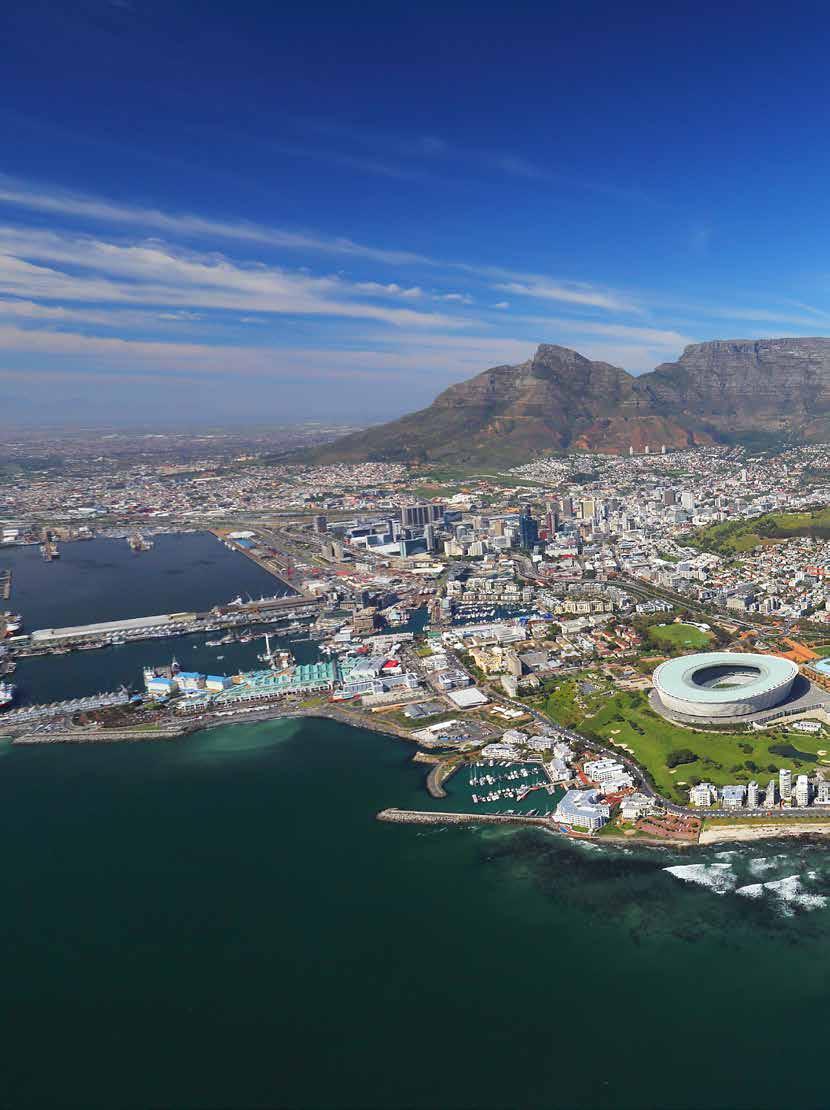
The African Renaissance of Accountability: How the King Codes Forged a New Governance Model
Nowhere has the evolution of corporate governance been more complex, or more deeply shaped by social context, than in Africa. Confronted with the dual imperatives of attracting scarce capital and addressing entrenched institutional weaknesses, the continent has moved decisively to develop governance frameworks that are both globally credible and locally resonant. At the centre of this transformation stands South Africa’s King Report series, a governance framework distinguished by its ethical foundations and its insistence that sustainability, technology oversight, and stakeholder inclusivity are not optional aspirations but core duties of corporate leadership.
South Africa: Cape Town

For much of the late twentieth century, corporate governance across Africa was constrained by a confluence of structural and institutional challenges. Ownership structures in many economies were highly concentrated, often dominated by state-owned enterprises or family-controlled conglomerates. While such arrangements provided stability, they also heightened the risk of value extraction by controlling shareholders or political actors, frequently to the detriment of minority investors and public accountability. These risks were compounded by weak enforcement environments. Although corporate law was often adequate on paper, regulatory capacity, judicial efficiency, and contract enforcement frequently lagged behind, creating fertile ground for corruption and governance failure.
At the same time, the liberalisation of African economies intensified the need to attract longterm foreign direct investment and international portfolio capital. Global investors, increasingly sensitive to governance risk, demanded transparency, accountability, and credible board oversight as prerequisites for capital allocation. This imperative for global legitimacy became the decisive catalyst for reform. Rather than incrementally importing Western regulatory models, many African jurisdictions chose to leapfrog traditional governance cycles, developing frameworks that were principles-based, forwardlooking, and attuned to local realities.
The intellectual and practical cornerstone of this transformation is the King Reports on Corporate Governance, first introduced in South Africa in 1994 under the chairmanship of Mervyn King. Over successive iterations, the King Codes have evolved into one of the most influential governance frameworks in the world, shaping practice far beyond South Africa’s borders. Their significance lies not in prescriptive rules, but in a coherent philosophy of governance grounded in ethics, sustainability, and inclusive value creation.
A defining feature of the King framework is its explicit rejection of narrow shareholder primacy in favour of a stakeholder-inclusive approach. From their inception, the King Codes recognised that in societies marked by inequality, unemployment, and environmental vulnerability, corporate activity carries consequences that extend well beyond financial returns. Boards are therefore required to consider the legitimate interests and expectations of employees, communities, customers, and the natural environment as integral to long-term success. This orientation reflects Africa’s socio-economic context, where the corporation is often a central institution in national development rather than a purely financial construct.
Equally transformative has been the King Codes’ leadership in advancing integrated reporting and integrated thinking. King III and King IV institutionalised the requirement for organisations
"Perhaps the most distinctive innovation of King IV is its articulation of governance as the exercise of ethical and effective leadership."
to report not only on financial performance, but on their stewardship of six interconnected forms of capital: financial, manufactured, intellectual, human, social and relationship, and natural. This approach compels boards to understand value creation as a dynamic process, linking strategy, risk management, and sustainability in a single governance narrative. Integrated reporting thus became not merely a disclosure exercise, but a discipline of decision-making that forces executives and directors to confront trade-offs and long-term consequences.
Perhaps the most distinctive innovation of King IV is its articulation of governance as the exercise of ethical and effective leadership. In moving from the familiar “comply or explain” framework to an “apply and explain” approach, the code assumes that governance principles are universally applicable across listed companies, private firms, public entities, and non-profit organisations. The burden is no longer to justify deviation, but to demonstrate how each principle has been applied to create value over time. This subtle but powerful shift embeds governance within organisational culture and reinforces the moral agency of the board.
The influence of the King Codes across the African continent has been profound. Their principles have provided a ready-made foundation for national governance frameworks that could be adapted to differing legal traditions and levels of institutional capacity. Nigeria was among the earliest adopters, introducing its first corporate governance code in the early 2000s and subsequently strengthening it following governance failures revealed by a banking crisis. Kenyan reforms followed a similar trajectory, with capital markets regulation increasingly aligned with international expectations around disclosure, board accountability, and minority shareholder protection. In both cases, the challenge has remained consistent: translating strong codes into consistent enforcement.
Beyond national regulators, development finance institutions and multilateral bodies have played a pivotal role in diffusing King-inspired governance standards. Institutions such as the African Development Bank and the International Finance Corporation have embedded governance requirements into financing conditions, effectively creating a de facto pan-African standard for major infrastructure and development projects. In doing so, they have reinforced the link between governance quality and access to capital, particularly in high-impact sectors.
As African governance frameworks mature, the focus is shifting from formal compliance to the active management of systemic risk and opportunity. Environmental, Social, and Governance considerations are increasingly understood not as external reporting obligations, but as core determinants of corporate resilience. The social dimension carries particular weight in African markets, where employment generation, community engagement, and the redress of historical inequalities are central to political and economic stability. Companies operating in extractive and energy-intensive industries face growing scrutiny from both global investors and domestic civil society, with sustainability performance now inseparable from financial credibility.
Technological risk has emerged as another defining governance frontier. King IV was notably prescient in asserting that responsibility for technology and information governance rests with the board itself, not merely with technical specialists. As cyber risk, data protection, and digital resilience become material strategic concerns, African boards are increasingly required to demonstrate competence and oversight in this domain.
At the same time, the growing influence of domestic institutional investors is reshaping accountability from within. Pension funds and insurance companies in markets such as South Africa and Nigeria now represent significant pools of patient capital. Their fiduciary obligations to beneficiaries are driving more assertive stewardship, strengthening shareholder engagement, and providing a locally rooted counterweight to weak enforcement institutions. This emergence of indigenous capital as a governance force is critical to the long-term sustainability of reform.
Africa’s corporate governance journey is defined by an ambitious attempt to reconcile global standards with local realities. By anchoring reform in the ethical, inclusive, and forward-looking principles of the King Reports, the continent is forging a governance model that prioritises long-term sustainability, meaningful stakeholder engagement, and professionalised board oversight. The challenges remain formidable, particularly in strengthening enforcement and resisting corruption. Yet the trajectory is unmistakable. Governance is no longer viewed as a constraint on African enterprise, but as a strategic instrument for unlocking inclusive and durable economic growth. i
Eaglestone Management: Experience Forged in Global Infrastructure Finance
Eaglestone’s leadership team reflects the firm’s positioning at the intersection of banking discipline and real-economy delivery. With deep roots in international project finance and a long track record across infrastructure, energy, transport and concessions, the management combines capital markets fluency with an operator’s understanding of what it takes to execute complex programmes in diverse jurisdictions. Two profiles, in particular, define the calibre and direction of the platform: Pedro Neto, Chief Executive Officer and Founding Partner, and Nuno Gil, Managing and Founding Partner.
PEDRO NETO: A BANKER’S DISCIPLINE, A BUILDER’S PERSPECTIVE
Pedro Neto is Chief Executive Officer and Founding Partner of Eaglestone. With more than 30 years of experience in international banking and infrastructure finance, he is widely regarded as a seasoned executive with a proven record across global markets. Over the course of his career, he has been involved in projects representing more than €50bn of investment, spanning five continents and covering sectors as varied as energy, transport, natural resources and large-scale concession frameworks.
Between 2000 and 2011, Neto served as Executive Vice-Chairman of Espírito Santo Investment Bank (ESIB), where he led the project finance activities of Grupo Banco Espírito Santo. During this period, ESIB strengthened its reputation for structuring complex, high-value transactions, working across Europe, Latin America, the Middle East and Sub-Saharan Africa. The work demanded more than technical execution; it required an ability to align multiple stakeholders, manage risk across jurisdictions, and bring credibility to transactions where scale, tenor and political economy all shaped the outcome.
His exposure to Africa deepened during his tenure as Chief Investment Officer at ESCOM, the Espírito Santo Group company dedicated to diversified investments across the region, with a particular focus on Angola. In that role, Neto helped drive major initiatives spanning infrastructure, mining and industrial development, contributing to the Group’s expansion into emerging markets and building a practical understanding of the operating realities that accompany capital-intensive projects. It was an experience that complemented his investment banking background with a sharper lens on delivery, local partnership and the longterm conditions required for sustainable growth.
Neto also served as Chairman of ES Concessões, overseeing the Group’s investments in global
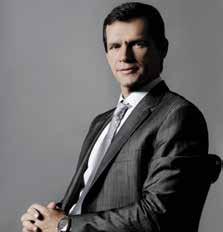

concession projects, and held a supervisory board seat at Ascendi, a recognised player in mobility and road infrastructure. These roles broadened his perspective on the full lifecycle of infrastructure assets, from procurement and financing through to operational performance, governance and value creation over extended periods.
His earlier governance appointments included serving as an Executive Board Member of BES Oriente and as a Non-Executive Board Member of BES Investimento Brasil and BES Angola. Together, these positions expanded his strategic visibility into banking operations across distinct regulatory and market environments, reinforcing an executive profile shaped by cross-border complexity and institutional accountability.
NUNO GIL: STRUCTURING FOR DELIVERY ACROSS EUROPE AND AFRICA
Nuno Gil is Managing and Founding Partner of Eaglestone, bringing more than 25 years of specialist experience in project finance and infrastructure advisory across Europe and Africa. Over his career, he has developed a reputation as a versatile, internationally engaged adviser, having led or participated in mandates spanning Angola, Mozambique, Portugal, Greece, Ireland, Bulgaria, Hungary, Poland, Senegal, Morocco and Cape Verde. The breadth of this footprint speaks to an ability to operate across varied legal systems, procurement frameworks and risk profiles — and to maintain discipline under conditions where execution is rarely straightforward.
His sector experience covers roads, railways, ports, logistics platforms, airports, energy and mining. This cross-sector capability has positioned him as a trusted partner to governments, sponsors and lenders seeking to navigate complex infrastructure development and mobilise capital at scale. Gil is
recognised for structuring transactions that balance financial robustness with practical delivery, particularly in environments where innovation is required but must be matched by rigorous risk management and credible counterparties.
Before co-founding Eaglestone, Gil served as Managing Director in the Project Finance team at Espírito Santo Investment Bank in Lisbon. In that capacity, he led the bank’s project finance advisory practice, overseeing high-profile transactions and strengthening relationships with international investors, development finance institutions and government stakeholders. The role reinforced his ability to bridge commercial objectives with publicinterest constraints, and to design structures capable of surviving scrutiny from multiple constituencies.
Earlier in his career, Gil worked at Banco Efisa, where, as Assistant Manager, he advised the Portuguese Government in the evaluation and negotiation of nine major road concession programmes. The experience provided a formative grounding in public-private partnerships, long-term infrastructure planning and the contractual architecture that underpins performance over decades. It also sharpened a core feature of his approach: transactions must not only close; they must endure.
Today, Gil continues to drive Eaglestone’s strategic vision, helping shape infrastructure investment across Sub-Saharan Africa and beyond. His leadership reflects a consistent commitment to technical excellence, strategic clarity and disciplined structuring, with an emphasis on sustainable projects that deliver lasting economic impact. In combination with Neto’s global transaction record and governance experience, Eaglestone’s management embodies a platform designed for scale, credibility and long-term partnership. i
CEO & Founding Partner: Pedro Neto
Managing & Founding Partner: Nuno Gil
Orchestrating the Transition: enso Group Builds the Enabling Structures for Reliable Clean Power
From Austria’s hydropower tradition to African grid-scale platforms, enso’s “system orchestrator” model fuses technology, finance and governance into investment-ready energy ecosystems that deliver dependable, independently sourced renewable power.
In an energy world defined as much by complexity as by ambition, very few companies set out to build the scaffolding on which the transition can stand. enso Group does. The firm describes its mission succinctly: to orchestrate the enabling structures required for reliable clean-energy supply - at the scale of continents, countries, cities, utilities and corporate off-takers. In practice, that means managing technological, financial, regulatory and institutional interdependencies so that renewable projects operate not as isolated assets, but as resilient, bankable systems.
FROM REGULATED ASSET MANAGER TO SYSTEM ORCHESTRATOR
enso’s evolution explains its institutional discipline. The company’s asset-management roots go back to 2012, when it became an AIFMD regulated manager under the Austrian Financial Market Authority for an alternative investment fund in the hydropower asset class. That regulatory DNA - governance, risk controls, reporting cadence - now underpins a broader platform approach. Hydropower remains a core competence; it is deliberately embedded within multi-technology architectures that blend solar PV, wind, solar thermal, long-duration storage, hydrogen and grid assets to stabilise revenues and maximise system value.
The philosophy is straightforward: decarbonisation at scale is not achieved by single technologies, but by the orchestration of many. enso’s role is to convert fragmented opportunities into coherent portfolios with predictable performance and investment-grade structure.
ENGINEERING
BANKABILITY AT SYSTEM SCALE
Sonnenspeicher Süd in Austria illustrates the model. Among the world’s largest solar-thermal and seasonal-storage schemes, it replaces roughly 35 million cubic metres of natural gas a year, avoids around 100,000 tonnes of CO2and supplies about one-third of Graz’s district-heating demand. Its technical ambition is matched by institutional choreography: enso aligned municipality, utility, technology providers and financiers into a durable structure that delivers both public-policy impact and investor-reliable returns. The project has
become a reference case for urban decarbonisation and the heat transition, demonstrating how longduration storage can anchor clean heat at city scale.
The same orchestrator logic informs enso’s European work with municipal platforms. Through Cogeme Green - a partnership between the municipal utilities of more than 60 towns and the European Energy Efficiency Fund (eeef) - enso manages and optimises a 55MWp PV portfolio with stable, PPA-backed revenues and a clear expansion pathway through acquisitions and new build. Municipal stability, institutional capital and enso’s asset-management discipline combine to create a structure that is developmentally aligned and financially robust.
STRATEGY IN A HIGHER-RATE WORLD
Today’s market realities - structurally higher funding costs, volatile wholesale prices and PPAs that have replaced legacy support schemesfavour hybrid thinking. enso has been active since 1999 and has lived through rate cycles in which the ultra-low period was the exception, not the norm. Its response has been to embed long-term price hedging while preserving dispatch flexibility. Storage sits at the centre of that approach, lifting captured prices and enabling time-shifting that aligns output with demand and system constraints.
The portfolio reflects this conviction: utilityscale batteries to manage volatility; pumpedstorage hydropower to provide inertia and scale; and power-to-gas pathways that convert surplus electricity into molecules for seasonal or process use. The aim is not solely to lower LCOE, but to raise system value - turning intermittent generation into dependable supply.
WHERE HYDRO STILL WINS
Hydropower has not surrendered its primacy in renewable electricity. The International Hydropower Association’s 2025 outlook projects a 14.3 percent share of global generation - by far the largest renewable contributor. Pumped storage, in particular, is enjoying fresh momentum, expanding by around five percent in 2025 as markets pay more for flexibility, frequency support and longduration balancing.
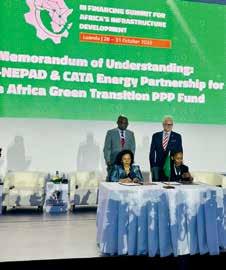
Hydro’s appeal endures because it is intergenerational infrastructure. Assets can operate reliably for a century with modest maintenance and without typical decommissioning risks. Permitting remains challenging in some jurisdictions, which has shifted near-term development towards technologies with faster lead times. Yet from a whole-system perspective - stability, resilience, lifecycle cost - hydro remains a backbone technology that enhances every other renewable on the grid.
THE
END-TO-END EDGE
enso brings origination, development, financing and asset management under one roof. The objective is not merely to capture margins along the chain, but to de-risk interfaces that so often undermine project schedules and economics. The firm’s language is unusually candid for an infrastructure manager: clean energy, it says, is a promise to the future - not a commodity. The investment thesis is impact-centred: deliver energy where and when it is needed; respect people and places; design for generations, not just quarters.
That ethos manifests in the way enso structures counterparties and contracts, how it prices risk, and how it embeds operational optionality. It also shapes a culture that is comfortable with complexity - aligning possibilities and partners to transform uncertainty into durable progress.
PORTFOLIO CONSTRUCTION WITHOUT BORDERS
Although Europe was the first theatre for enso’s investment activities in the 2010s, the Group has always operated with a global mindset. Market selection follows need and maturity: jurisdictions where power systems are transforming rapidly; where enabling regulation and credible off-takers are emerging; and where enso’s orchestration skill creates outsized value.
That logic now aligns naturally with the African energy transition, where continental programmes - Agenda 2063, the Continental Power Systems Masterplan and the African Single Electricity Market - are converging. The company’s investment footprint is expanding where structural impact is

required and where institutional partnerships can convert policy into projects.
HYDROGEN, HYBRIDS AND THE HEAT TRANSITION enso views green hydrogen pragmatically: bankability depends on regulatory context, the proximity of production and use, and infrastructure that keeps logistic costs credible. The firm is advancing two industrial projects in which hydrogen is a primary feedstock. More broadly, it is developing hybrid concepts for district heating that blend green hydrogen with biogenic exhaust streams and methanise the mix to produce synthetic methane. The result is a closed-loop solution that replaces unavoidable natural-gas consumption, couples CO2 capture with fuel synthesis and delivers measurable decarbonisation without sacrificing system reliability.
DESIGNING FOR CLIMATE RESILIENCE
Climate dynamics are integrated from the first screening through to operations. enso applies multiple climate models to stress-test inflows, curtailment regimes, extreme-weather exposures and insurance availability across decades. Assets are designed to be functional and investable half a century from now, with hydrology-sensitive assets, in particular, benefiting from precise regional modelling and adaptive operating concepts. Resilience is not an afterthought; it is a design parameter.
PARTNERSHIPS AS A FORCE MULTIPLIER enso’s orchestration model depends on combining a strong local footprint with internationally proven processes. The firm works with municipalities, national utilities, EPC majors and specialist technology providers. Its network includes engineering partners with large-scheme credentials and sector bodies that connect water, energy and climate expertise. The result is an ability to build structures that are rooted in regional realities yet meet global standards of governance and performance.
AFRICA:
A PLATFORM TO SCALE THE GREEN TRANSITION
The African Green Transition Public-Private Platform Fund (AGTPF) is enso’s strategic focus
today. Anchored in the African Union’s Continental Masterplan and aligned with AfSEM, the fund was previewed at the Mission300 annual meeting in Dar es Salaam in January 2025 and advanced through a memorandum of understanding between CATA Energy - enso’s African investment partnerand AUDA-NEPAD, the AU’s development agency, signed at the African Union’s Finance Summit in Luanda in October 2025.
The platform will be domiciled in Luxembourg as a regulated umbrella vehicle. Its first compartment targets utility-scale infrastructure in Sub-Saharan Africa, initially concentrating on countries connected to the Southern African Power Pool. The mandate spans solar PV, wind, hydropower and transmission. electAfrica, a joint venture between enso Group and CATA Energy, will serve as investment adviser and asset manager.
The targets are concrete. The first compartment seeks €500 million of assets under management, supported by a pipeline exceeding 7,000MW of renewable generation and an estimated €12.5 billion of total infrastructure investment potential including grid build-out. The initiative is engaging African pension funds through the African Social Security Association, is connected to the WaterEnergy-Climate Expert Network, and is designed to work alongside multilateral development organisations to mobilise blended capital at scale.
What makes the AGTPF distinctive is its tripillar partnership model. enso contributes assetmanagement discipline, international networks and a track record with tier-one EPCs. CATA Energy brings deep market embeddedness and credibility across target countries. AUDA-NEPAD provides alignment with continental priorities and acts as an interface with national governments and regional bodies. Together, the three pillars create an institutionally credible platform capable of moving quickly from policy to project, and from project to portfolio.
Leadership reflects that blend of skills and geographies. Vanessa Baldwin Mushi, CEO of CATA Energy, has over 15 years’ experience
leading transformative renewable projects across Africa and is an active advocate for public-private partnerships and innovative climate finance. Wolfgang Kröpfl, enso’s CEO, has spent 35 years across the energy spectrum - from nuclear to renewables - and has been involved in more than 450 plants worldwide with a combined capacity of some 30,000GWh. They are supported by a bench of senior figures in strategy, power-market design, utility leadership and climate investment who have shaped energy systems in Europe and the Middle East and now apply that know-how to African contexts.
RECYCLING CAPITAL, COMPOUNDING IMPACT
As a manager, enso thinks in platforms and lifecycles rather than one-off exits. Hold periods and rotation strategies are tuned to mandate and mission, but the guiding maxim is consistent: long-term value creation with measurable impact. In practice, that means recycling capital when it accelerates system build-out and resilience, not simply when it optimises a single-asset IRR. It also means structuring cashflows - through PPAs, flexibility products and capacity revenues - to weather rate cycles without sacrificing optionality.
THE PROPOSITION FOR INVESTORS AND POLICYMAKERS
Investors, governments and multilaterals are converging on the same conclusion: achieving net zero is not only a build problem; it is an orchestration problem. enso’s proposition is to make complex systems investable. The company designs enabling structures - technical, contractual, institutional - that reduce risk at interfaces, compress time-to-market and lock in reliability over decades. It seeks to deliver assets that behave like infrastructure should: stable, predictable and resilient, yet capable of flexing with markets and policy.
This is not simply a European export. The African platform underscores a belief that the next wave of energy growth will be engineered through credible, continental-scale partnerships that can align planning, capital and capability. If the transition is to be both fast and fair, those partnerships will be decisive. i
Angola’s Transport & Infrastructure Evolution: Rebuilding a Nation, Rewiring a Region
Few African countries have pursued infrastructure renewal on Angola’s scale or under comparable historical pressure. Emerging from decades of civil conflict in the early 2000s, the country confronted an all-encompassing reconstruction agenda: roads and bridges, ports and railways, airports and logistics systems. Two decades on, Angola is entering a more demanding phase of development. The priority is no longer the visible work of rebuilding, but the harder discipline of running networks efficiently, integrating them with regional corridors, and using transport infrastructure as a lever for diversification beyond hydrocarbons.
Angola’s opportunity now is strategic. Its geography is not merely a backdrop; it is an advantage that can be converted into competitiveness. With one of the most significant coastlines on the South Atlantic and direct access to global shipping routes, Angola is positioned to serve as a gateway for domestic trade and as a conduit for landlocked neighbours seeking reliable, time-efficient access to international markets. The question is no longer how Angola rebuilds, but how it translates logistics capacity into regional influence.
A GEOGRAPHY BUILT FOR CONNECTIVITY
Angola’s coastline stretches from the mouth of the Congo River to the edge of the Namib Desert, offering deep-water potential and proximity to major maritime lanes. Inland, three principal rail lines radiate towards strategic economic corridors: the Lobito Corridor, extending towards the Democratic Republic of Congo and Zambia; the Moçâmedes line, serving the resource-rich south; and the Luanda line, anchored to the country’s primary urban and industrial cluster. For many years, conflict muted these natural advantages. Today, they form the skeleton of a transport system that can serve not only domestic demand, but regional trade patterns.
This connectivity matters because Southern and Central Africa’s growth potential is constrained by logistics friction. Time-to-port is often the defining variable in the competitiveness of minerals, agriculture and manufactured goods. Angola’s comparative advantage lies in its ability to compress distance and uncertainty — if infrastructure investment is matched by operational performance and predictable governance.
PORTS AS THE ANCHOR OF TRADE
Angola’s ports are the principal arteries of commerce, carrying the bulk of national import and export volumes. The Port of Luanda
remains the dominant gateway, handling the overwhelming share of container traffic and offering the country’s most extensive maritime connectivity. Recent investments in equipment, terminal processes and digital systems — often delivered through public–private participation — are helping to reduce bottlenecks and align performance with international expectations. In a global trading environment shaped by schedule integrity and supply chain visibility, such improvements are not cosmetic; they are commercially decisive.
The Port of Lobito is increasingly central to Angola’s regional ambitions. Positioned on the Atlantic and linked to the Lobito Corridor, it is poised to serve as a high-throughput export route for the copper and cobalt belts of the Democratic Republic of Congo and Zambia. Recent concession activity and evolving governance for rail operations are designed to unlock that potential. If the corridor reaches full operational maturity, it could become one of Sub-Saharan Africa’s most important west-coast logistics arteries, reshaping trade flows that have historically relied on longer, more congested routes.
Further south, the Port of Namibe is building a specialist role, with relevance for mining exports and fisheries. In the north, Soyo supports offshore oil and gas activity and remains critical to energylinked supply chains. Together, these ports point to a broader reality: Angola’s trade future is not a single-node story. It is a network proposition that depends on connectivity, specialisation and the ability to match infrastructure with the requirements of different cargo profiles.
RAILWAYS AND THE SHIFT FROM RECONSTRUCTION TO COMMERCIALISATION
The rehabilitation of Angola’s railways has been among the country’s most ambitious infrastructure undertakings. All three main lines have been rebuilt or modernised in the post-war period — an achievement of national significance. Yet the next stage will determine whether rail becomes an economic engine or a maintained asset with limited commercial traction. The strategic pivot is from reconstruction to commercialisation: improving reliability, increasing utilisation, and embedding rail in the logic of regional trade.
The Lobito Atlantic Railway concession is the flagship in this transition. By linking the Port of Lobito to the interior and onward to neighbouring markets, the concession aims to deliver a credible alternative to established regional routes. For mining exporters, the value proposition is clear: reducing transport timelines by days — in some

cases weeks — can materially change working capital cycles and realised prices. For Angola, the corridor offers more than transit fees. It provides a framework for industrial development along the route, encouraging logistics parks, processing capacity and services that build economic depth.
The Moçâmedes and Luanda lines serve a different, but equally vital, purpose: domestic integration. They connect urban centres, resource areas and agricultural zones to markets and ports, supporting mobility and enabling internal supply chain efficiency. As Angola seeks to build a broader productive base, these lines will become increasingly relevant to non-oil trade.
ROADS AND THE DISCIPLINE OF MAINTENANCE
For all the strategic attention on ports and rail, roads remain the infrastructure of daily commerce. Over the past two decades, Angola has expanded and upgraded key routes linking provincial capitals, industrial hubs and agricultural regions. Reduced travel times and improved predictability have had direct benefits for supply chains, public services and market access.
The challenge now is sustainability. The global infrastructure paradox applies in Angola with particular force: building is expensive, but maintaining is often harder — institutionally, financially and operationally. As fiscal priorities tighten, maintenance capacity becomes a test of

governance rather than ambition. Performancebased contracts, tolling models and selective private participation may become increasingly important, not as ideological choices but as pragmatic tools to keep networks functional and safe.
AVIATION AS A PLATFORM FOR MOBILITY AND FUTURE TOURISM
Angola’s aviation sector has undergone modernisation through terminal development, runway upgrades and the construction of Dr António Agostinho Neto International Airport near Luanda. Designed to strengthen Luanda’s role as a regional hub, the airport is positioned to support passenger traffic growth and deepen connectivity between Africa, Europe, the Americas and Asia.
Provincial airports, from Lubango to Namibe, have also received upgrades, improving domestic mobility and building optionality for sectors such as tourism. In a post-pandemic environment where route economics remain fluid, modern infrastructure gives Angola an advantage — but only if matched by efficient operations, competitive services and a regulatory environment that supports connectivity.
CABOTAGE AND COASTAL SHIPPING
Angola’s coastline presents an underutilised opportunity: domestic coastal shipping. A well-functioning cabotage market can reduce
pressure on road networks, lower logistics costs and cut emissions, particularly for bulk and intermediate goods moving between coastal cities. Government interest in local content, fleet renewal and regulatory modernisation signals a recognition that maritime connectivity need not be exclusively international.
Unlocking this potential will require enabling infrastructure and governance. Upgraded vessel traffic systems, strengthened pilotage, and investment in smaller ports are practical prerequisites. If these elements advance, cabotage could become a meaningful complement to road transport, improving resilience and supporting regionalised supply chains along the coast.
DIGITALISATION AND THE NEXT PHASE OF COMPETITIVENESS
In modern logistics, infrastructure is increasingly defined by data as much as by concrete. Angola’s next competitiveness gains will come from the systems that reduce transaction costs and raise predictability: port digitalisation, terminal operating systems, customs single windows, corridor monitoring, and intelligent transport solutions. These tools are essential to reducing dwell times, improving transparency and supporting investor confidence.
Digitisation also supports regional integration. Corridors are only as efficient as their weakest
administrative link. By modernising procedures and building interoperable systems, Angola can improve not only its own performance, but also the reliability of end-to-end routes across borders.
REBUILDING INTO REGIONAL RELEVANCE
Angola’s transport sector is moving from a reconstruction story to an economic strategy. Regional corridors are no longer abstract plans; they are mechanisms for integrating Angola into the trade logic of Central and Southern Africa. Diversification is no longer a policy aspiration; it depends on logistics systems that make agriculture, manufacturing and minerals more competitive. Public–private partnerships are no longer optional; they are increasingly central to the delivery of operational know-how and sustainable financing models. Sustainability is no longer a slogan; it is embedded in multimodal optimisation and the shift towards more efficient transport patterns.
Angola’s strategic location, resource base and reform trajectory give it a credible path to becoming a regional logistics gateway. The determinant will be execution: maintaining infrastructure, improving operational performance, and building governance systems that convert capacity into confidence. If that trajectory holds — balancing investment, reform and disciplined management — Angola can evolve from rebuilding a nation to rewiring a region. i
Angola: Luanda
Galeazzi Sant’Ambrogio Hospital of the Future - Italy


American Heart of Poland European Cardiovascular Hub Serving Humanity




Over 50 + Specialities Handling Complex Care





Sustainable Development Powering Tomorrow
An exceptional group devoted to the service of humanity
Najaf - Iraq
From Geothermal Pioneer to Integrated Energy Solutions Provider: KenGen Powering East Africa’s Clean Energy Future
Kenya Electricity Generating Company PLC (KenGen) stands as East Africa’s leading power producer, entrusted with the mandate to develop, manage and operate the power plants that underpin Kenya’s economic and social life. The company’s vision is to be the market leader in the provision of renewable energy solutions, anchoring national development in sustainability, resilience and long-term value creation.
As a geothermal trailblazer, KenGen has positioned Kenya as Africa’s number one and the world’s seventh largest geothermal producer. With 984 MW of installed geothermal capacity, of which 81 percent is operated by KenGen, the company sits at the forefront of global clean energy innovation, transforming the country’s vast underground heat resources into dependable baseload power.
KenGen’s growth story is also one of trust, transparency and capital market leadership. In 2006, the company reshaped Kenya’s financial landscape through a landmark Initial Public Offer on the Nairobi Securities Exchange. This was followed in 2009 by the country’s first corporate Public Infrastructure Bond, raising KShs 25bn, and a decade later by a KShs 28bn rights issue that reaffirmed strong shareholder confidence in the company’s long-term strategy and governance.
Today, KenGen operates a robust installed capacity of 1,786 MW and commands approximately 54 percent of Kenya’s electricity market. Its diversified power mix, comprising hydro at 826 MW, geothermal at 754 MW, thermal at 180 MW and wind at 26 MW, reflects a careful balance between legacy assets and forward-looking investment in renewable technologies.
Looking ahead, KenGen is pursuing an ambitious diversification agenda under its G2G 2034 Strategy, designed to transform the company beyond its traditional role as an electricity generator. The strategy focuses on expanding into non-electricity generating business lines to enhance revenue streams, strengthen resilience and support long-term sustainability.
A flagship pillar of this agenda is the KenGen Green Energy Park, a purpose-built industrial park located within the company’s geothermal generation fields. Anchored on one hundred percent clean, reliable and sustainable energy, the park is designed to attract industries, technology firms and strategic partners seeking operations powered entirely by renewable resources. Drawing on Kenya’s geothermal strength, alongside hydro, wind and solar, the Green Energy Park is envisioned as a centre
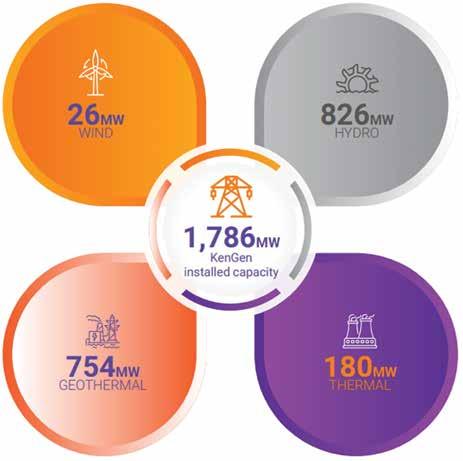
for innovation, skills development and the demonstration of advanced energy solutions, supporting value addition, industrialisation and regional economic growth. Through this initiative, KenGen is cultivating an enabling ecosystem that accelerates the energy transition while promoting inclusive development.
Complementing this effort, the company is leveraging its technical expertise and strategic partnerships to establish new ventures in energy consultancy, e-mobility, carbon trading and geothermal direct-use applications. The objective is for non-electricity generating activities to contribute 20 percent of total revenues, positioning KenGen as a holistic energy solutions provider rather than solely a power producer.
KenGen’s leadership in sustainability is underscored by a series of pioneering milestones. It was the first Kenyan company to earn Carbon Asset funds under the Clean Development Mechanism, demonstrating how climate change mitigation can be aligned with commercial performance. The company has also commissioned Africa’s first and largest Geothermal Spa at Olkaria, an in-house innovation that showcases the use of geothermal resources beyond electricity generation, while promoting eco-tourism and wellness.
Together, these initiatives reflect a company redefining the role of a national power utility, combining clean energy leadership with financial discipline, innovation and a clear commitment to sustainable development across the region. i
Leadership at the Helm of Kenya’s Renewable Power Champion
KenGen’s executive team brings together deep technical expertise, financial discipline, legal rigour and strategic foresight to steer East Africa’s foremost electricity generator through an era of energy transition, sustainability and growth.
ENG PETER NJENGA
Managing
Director and CEO
Born in 1967, Eng Peter Njenga is the Managing Director and CEO of Kenya Electricity Generating Company PLC (KenGen), East Africa’s leading power producer, distinguished by its reliance on renewable and clean energy sources for approximately 93 percent of generation. His tenure formally commenced on August 17, 2023, crowning a career of more than 32 years in the energy sector marked by technical depth, strategic leadership and ethical stewardship.
Eng Njenga holds a bachelor’s degree in electrical engineering and an MBA in Strategic Management from the University of Nairobi. He is a member of the Institute of Directors Kenya and a registered professional engineer. His executive training includes senior leadership programmes from Strathmore University and Harvard Business School, among other institutions.
His professional journey spans a steady ascent from Trainee Electrical Engineer to General Manager of Infrastructure Development at Kenya Power & Lighting Company PLC (KPLC), before assuming the chief executive role at KenGen. Along the way, he has chaired and served on several pivotal committees, playing an influential role in driving transformation, sustainability and climate action across the sector.
Combining technical mastery with a resultsoriented mindset, Eng Njenga continues to strengthen KenGen’s mandate of delivering reliable, affordable and sustainable energy, while championing environmental initiatives such as large-scale tree planting. Beyond the boardroom, he is a committed advocate for youth development and family values, drawing inspiration from his Christian faith. He enjoys cycling and swimming, reflecting a balanced and disciplined approach to life.
FCS AUSTIN A O OUKO
Company Secretary & General Manager, Legal Affairs
FCS Austin A O Ouko is the Company Secretary and General Manager, Legal Affairs at KenGen, bringing seventeen years of experience across the public and private sectors. He holds a Bachelor of Laws and a Master of Laws in Public Finance and Financial Services Law from the

University of Nairobi, as well as a Master of the Science of Law from Stanford University Law School in California.
His professional qualifications include a Diploma in Law from the Kenya School of Law, a Practice Diploma in International Commercial Law from the College of Law of England & Wales, and a Postgraduate Diploma in Domestic Arbitration from the Chartered Institute of Arbitrators. He also holds advanced qualifications in business administration and information systems management and is a member of the Institute of Directors Kenya.
Austin is an Advocate of the High Court of Kenya, a Commissioner for Oaths, a Notary Public and a Certified Public Secretary. He is a Fellow of the Institute of Certified Secretaries Kenya and the
Chartered Institute of Arbitrators, an Accredited Governance Auditor, and a member of several professional bodies including the Law Society of Kenya and the International Bar Association.
Prior to joining KenGen, he served as Acting General Manager Corporate Affairs and Corporation Secretary, Legal Manager at the National Social Security Fund, and Senior Legal Officer at Standard Group Limited. In his current role, he oversees all legal, governance and compliance matters for the company.
MR PEKETSA MANGI
General Manager, Geothermal Development
Peketsa Mangi is a geothermal energy specialist with more than two decades of experience in resource development across Kenya and the wider region. He holds a Master of Science in
Managing Director and CEO: Eng Peter Njenga
Information Science from Moi University and is pursuing a PhD in the same discipline.
A Certified Project Manager (IPMA Level C), he has undertaken extensive professional training in earth sciences, reservoir and drilling technologies, geothermal project management, negotiation, procurement and project financing. He serves as Vice Chairman of the Geothermal Association of Kenya and is a member of both the Geological Society of Kenya and the International Geothermal Association.
Having risen through the organisation from Resource Development and Infrastructure Manager, Mr Mangi now leads KenGen’s geothermal portfolio, overseeing exploration, drilling, reservoir and steam field management, infrastructure development, environmental and social coordination, and budgetary control.
CPA
ELIZABETH NJENGA
General Manager, Business Development & Strategy
Elizabeth Njenga brings over 20 years of experience in finance, strategy and power project development. She holds a Master’s degree in Public Policy and Management from Strathmore University Business School, an MBA from the University of Nairobi, and a Bachelor of Arts in Accounting and Economics from Moi University.
She is a Certified Public Accountant of Kenya and holds a Postgraduate Diploma in Financial Management from Maastricht School of Management. Her career has included senior roles in capital planning, public-private partnerships and corporate strategy.
As General Manager Business Development & Strategy, she leads KenGen’s strategic direction, capacity expansion planning, feasibility studies, project implementation and commissioning, while driving innovation and continuous business process improvement.
ENG JULIUS ODUMBE
General Manager, Operations
Eng Julius Odumbe is a licensed consulting engineer with more than 30 years of experience in power generation operations and maintenance. He holds an MBA from Jomo Kenyatta University of Agriculture and Technology, a Bachelor of Science in Mechanical Engineering from the University of Nairobi, and a Diploma in Project Management from Galilee College, Israel. A Fellow of the Institution of Engineers of Kenya and registered with the Engineers Board of Kenya, he oversees KenGen’s power plant operations, rehabilitation and maintenance programmes, energy evacuation, power purchase agreements, ISO management systems and coordination of regional operations.

CPA CIA ERICK AUDI
General Manager, Internal Audit (Acting)
CPA CIA Erick Audi has over 20 years of experience in accounting, auditing, governance, risk management and internal controls. He holds an MBA in Finance and a Bachelor of Commerce in Accounting from the University of Nairobi.
He is a Certified Public Accountant, Certified Internal Auditor and Certified Information Systems Auditor, and a member of both IIA Kenya and ICPAK. His previous roles include senior audit positions at the Kenya Revenue Authority, Kenya Rural Roads Authority and Kenya Electricity Transmission Company.
At KenGen, he has risen from Internal Audit and Risk Manager to Acting General Manager Internal Audit, overseeing audit operations, board audit committee liaison, advisory services and the implementation of audit recommendations.
MR AHMED HAJI ISSACK
General Manager, ICT
Ahmed Haji Issack holds a Bachelor of Science in Information Technology from JKUAT and a Master of Science in Information Systems and Management from the University of Warwick, complemented by executive leadership training at Saïd Business School, University of Oxford.
With over 19 years of experience, he joined KenGen in November 2024 from the Kenya Airports Authority. He is responsible for driving the company’s digital transformation agenda, ICT strategy, systems integration, cybersecurity and alignment of technology platforms with corporate objectives.
MR VINCENT MAMBOLEO
General Manager, Supply Chain Management
Vincent Mamboleo is a supply chain professional
with more than 24 years of experience across manufacturing, media and industrial sectors. He holds bachelor’s and master’s degrees in Business Administration, a Professional Diploma in Purchasing and Supplies (MCIPS), and a Diploma in Shipping.
Since joining KenGen in 2017, following senior roles at Kwale International Sugar Company, Lafarge East Africa, Nation Media Group and Tata Chemicals, he has overseen procurement, logistics, inventory management, regulatory compliance and supplier stakeholder engagement.
MRS BEATRICE KANDIE
General Manager, Corporate Services
Mrs Beatrice Kandie is a human resource management specialist with over 24 years of experience spanning organisational design, talent management, performance optimisation, learning and development, succession planning and change management.
She holds a Master’s degree in Human Resource Management and a Bachelor’s degree in Social Work, is pursuing a PhD in Human Resource Management, and is certified as a Human Resource Professional (CHRP-K) and Change Manager (Prosci). She leads the execution of KenGen’s human capital strategy to enhance organisational effectiveness and long-term performance.
MR RONOH KIBET OGW PMP
General Manager, Commercial Services
Ronoh Kibet is an electrical engineer from JKUAT with a Master of Science in Project Management and is currently pursuing a PhD in the same field. He holds PMP certification, SAP consulting credentials and completed the Organisational Leadership Programme at Harvard Business School.
He oversees power sales, investments, partnerships, marketing, corporate communications and sustainability. In recognition of his public service, he was awarded the Order of the Grand Warrior of Kenya (OGW) in 2022.
CPA DAVID MWANGI
General Manager – Finance
CPA David Mwangi holds an MBA in Finance from JKUAT and a Bachelor of Arts in Economics and Sociology from the University of Nairobi. A member of ICPAK, he has previously held senior roles at Safaricom PLC and Airtel Africa PLC.
Since joining KenGen in December 2017 as Finance Manager, he has progressed to General Manager – Finance, overseeing financial strategy, capital planning, treasury and liquidity management, financial reporting, budgeting, risk management and engagement with the Board, lenders and investors. i
"Combining technical mastery with a results-oriented mindset, Eng Njenga continues to strengthen KenGen’s mandate of delivering reliable, affordable and sustainable energy, while championing environmental initiatives such as large-scale tree planting."
Company Secretary & General Manager, Legal Affair: FCS Austin A O Ouko
Connecting the Continent, Upholding the Code: Why MTN is the Governance Giant of Africa
Few corporations operate at the confluence of complexity, opportunity, and risk quite like MTN Group. With operations spanning 19 markets across Africa and the Middle East, MTN must navigate diverse regulatory regimes, geopolitical volatility, and rapid technological change while delivering essential digital infrastructure to hundreds of millions of people. In this environment, corporate governance is not a procedural necessity but a strategic imperative. MTN’s governance framework— anchored in the principles of King IV and reinforced by a deeply embedded ethical culture—has emerged as one of the most robust and credible on the African continent.
MTN’s governance philosophy is firmly rooted in South Africa’s globally respected King IV Report on Corporate Governance. Unlike rulesbased systems, King IV is principlesdriven, emphasising ethical leadership, value creation, and responsible corporate citizenship. For a group that has previously faced high-profile regulatory and compliance challenges, this commitment is neither symbolic nor academic. It reflects a deliberate, commercially grounded strategy to rebuild trust, strengthen institutional resilience, and ensure sustainable operations in jurisdictions where regulatory and political risks are acute.
At the apex of this framework sits a highly structured and independent Group Board, designed to provide effective oversight across a geographically dispersed and operationally complex enterprise. A clear separation of power is maintained through leadership by an independent non-executive chairman, ensuring that no single individual exerts disproportionate influence. This is reinforced by the presence of a Lead Independent Director, who acts as an additional counterbalance to executive authority and provides a confidential channel for nonexecutive engagement.
Board composition reflects the breadth and diversity of MTN’s footprint. Directors are appointed through a formal, transparent process and bring a mix of financial expertise, telecommunications experience, and, critically, deep familiarity with the geopolitical and regulatory realities of MTN’s operating markets. This diversity of perspective ensures that strategic decisions are commercially sound while remaining sensitive to local risk dynamics.
Oversight is further strengthened through a comprehensive system of specialised board committees, each dominated by independent non-executive directors. The Audit Committee
"Perhaps the clearest indicator of MTN’s governance maturity is the prominence of its Social, Ethics and Sustainability Committee."
extends beyond traditional financial reporting to oversee the combined assurance model and the effectiveness of internal controls, a vital function in a multi-jurisdictional environment. The Risk Management and Compliance Committee is tasked with overseeing enterprise-wide risk and regulatory compliance, including the complex matrix of licensing conditions, sanctions exposure, and local legal requirements that define MTN’s markets.
Perhaps the clearest indicator of MTN’s governance maturity is the prominence of its Social, Ethics and Sustainability Committee. This committee has direct responsibility for overseeing the Group’s ethical culture and its social and environmental impact, ensuring that MTN’s purpose of advancing digital and financial inclusion is delivered responsibly. Complementing this is the Directors Affairs and Governance Committee, which monitors governance standards across both the Group and its operating companies, reinforcing consistency and continuous improvement.
Beyond structure, MTN’s most significant governance evolution lies in its deliberate shift from compliance-driven oversight to values-led leadership. Ethical conduct is embedded through a comprehensive Code of Ethics and a formal Ethics Management Framework that permeates the organisation. Ethics are treated not as

an adjunct to governance, but as a systemic capability essential to long-term value creation.
Regular ethics risk assessments are conducted across the Group to identify and mitigate country-specific risks, in line with King IV recommendations. The Group’s core value of “Can-do with Integrity” underpins all business conduct and is supported by detailed policies covering anti-bribery and corruption, data protection, harassment, and disciplinary processes. Crucially, ethics management is decentralised. Each operating company maintains its own ethics office and committee, ensuring that ethical standards are enforced locally rather than imposed solely from headquarters.
This emphasis on ethical fortitude is particularly critical for a company operating in markets characterised by heightened regulatory

scrutiny and political sensitivity. It reflects a clear recognition that sustainable growth and reputational capital are inseparable, and that integrity is a strategic asset rather than a reputational safeguard.
MTN’s governance framework also excels in aligning shareholder value with broader stakeholder inclusion. Executive remuneration is overseen by the Human Capital and Remuneration Committee and is explicitly linked to the Group’s Ambition 2025 strategy. Performance metrics extend beyond financial results to include operational efficiency, cash flow discipline, and clearly defined ESG objectives. By linking incentives to outcomes such as expanded digital and financial inclusion, MTN ensures that executive leadership is rewarded for delivering shared value to communities as well as returns to investors.
Transparency underpins MTN’s engagement with shareholders and the wider market. The Group’s integrated reporting suite, including its flagship Integrated Report and detailed ESG disclosures, is designed to enable informed evaluation of strategy, risk, and performance. MTN’s early adoption of the IFRS Sustainability Disclosure Standards, aligned with the International Sustainability Standards Board framework, positions it at the forefront of global non-financial reporting practice.
Stakeholder engagement extends well beyond investors. MTN systematically monitors the quality of its relationships with governments, regulators, and customers through a structured Reputation Index Survey. Insights from this process feed directly into board-level discussions and strategic planning, ensuring that stakeholder perceptions and concerns
are actively addressed. This two-way dialogue strengthens MTN’s social licence to operate and mitigates regulatory and reputational risk across its diverse footprint.
MTN Group’s corporate governance framework stands as a remarkable achievement in a challenging operating context. By rigorously applying the principles of King IV, embedding ethics at the heart of organisational culture, and maintaining transparent, inclusive engagement with stakeholders, MTN has demonstrated that world-class governance is achievable even in the most complex environments. The Group’s experience confirms that integrity, independence, and accountability are not constraints on growth, but the essential foundations of a sustainable, digitally inclusive, and globally respected African enterprise. i
King of the Continent: How Standard Bank Group’s Governance is the Engine for Africa’s Growth
As Africa’s largest banking group by assets, Standard Bank Group (SBG) operates at a scale and complexity unmatched on the continent. With a presence in 20 countries and a legacy stretching back more than 160 years, the Group’s success rests not only on capital strength and market reach, but on a governance framework capable of navigating geopolitical diversity, regulatory fragmentation, and deep socio-economic inequality. At the heart of this framework lies a rigorous, outcomes-based application of the King IV Report on Corporate Governance for South Africa—one of the most progressive governance codes globally.
For Standard Bank, governance is inseparable from purpose. The Group’s long-standing mission—“Africa is our home, we drive her growth”—requires more than balance-sheet discipline. It demands ethical leadership, resilient risk management, and a demonstrable commitment to inclusive economic transformation. King IV’s emphasis on “apply and explain,” ethical culture, and integrated thinking across all six capitals provides the architecture through which this ambition is operationalised.
The tone is set decisively at board level. Standard Bank’s Board of Directors is structured to lead ethically and effectively, in line with King IV’s first principle. Independence and accountability are preserved through a clear separation of powers, with an independent non-executive chairman overseeing a management team led by the group chief executive. This division ensures that strategic challenge and performance oversight are not compromised by executive influence, a critical safeguard in a systemically important financial institution.
Board composition reflects a deliberate commitment to diversity in its fullest sense. Beyond race and gender, the Group prioritises diversity of skills, experience, and geographic insight—essential for a bank whose operations span economies at vastly different stages of development. This commitment is formalised through a board diversity policy aligned with South Africa’s transformation objectives. As of late 2024, women accounted for approximately 35.7 percent of board members, with continued emphasis on strengthening local representation and African leadership across governance structures. This diversity of intent ensures that decision-making reflects both global financial
"Board composition reflects a deliberate commitment to diversity in its fullest sense."
standards and the lived realities of African markets.
Oversight is reinforced through a comprehensive committee structure dominated by independent non-executive directors. These committees provide depth and focus across audit, risk, remuneration, and governance, ensuring that no material issue escapes scrutiny. Among them, the Social and Ethics Committee occupies a particularly central role, underscoring the Group’s belief that corporate citizenship is a governance responsibility, not a communications exercise.
The Social and Ethics Committee acts as the custodian of Standard Bank’s ethical culture. It oversees the implementation of the Group’s Code of Ethics and Conduct, monitors fair treatment of customers, employee wellbeing, and ethical business practices, and ensures that misconduct is addressed decisively. A confidential whistleblowing mechanism reinforces this framework, enabling stakeholders to report unethical behaviour without fear of retaliation. In an operating environment where trust is both fragile and invaluable, this ethical infrastructure is foundational to the Group’s legitimacy.
Crucially, the Committee also governs the Group’s environmental, social, and governance agenda, including its transformation commitments. For a South African institution, this includes deep alignment with Broad-Based Black Economic

Empowerment (B-BBEE) principles and a broader responsibility to contribute meaningfully to reducing inequality across the continent. Oversight of the Group’s publicly issued Report to Society ensures transparency around nonfinancial impact and reinforces accountability to communities, regulators, and investors alike. This direct linkage between governance and social outcomes exemplifies King IV’s insistence that organisations be, and be seen to be, responsible corporate citizens.
Risk governance represents another pillar of Standard Bank’s model. The Board Risk

Management Committee exercises independent oversight of risk and capital management across the Group’s entire footprint. Its mandate spans traditional credit and market risk, as well as technology risk, cybersecurity, and emerging systemic threats. Given the heterogeneity of regulatory regimes across African markets, this centralised yet adaptable risk framework is essential for maintaining stability and protecting depositors and shareholders alike.
The Committee also plays a critical role in ensuring that remuneration structures support prudent risk-taking. Executive incentives are
designed to align performance with longterm value creation rather than short-term gain, reflecting lessons learned from global financial crises. While Standard Bank already demonstrates strong governance and strategic alignment, external assessments indicate further opportunity to formalise the linkage between executive remuneration and ESG performance metrics—an area increasingly regarded as global best practice in financial governance. Given the Group’s expanding role in climate finance, sustainable lending, and the just energy transition, the foundations for such linkage are firmly in place.
Standard Bank Group’s governance framework stands as one of the most comprehensive and authentic on the African continent. Anchored in the principles-based rigour of King IV, it combines ethical leadership, robust risk oversight, and a deeply embedded commitment to social and economic transformation. By integrating governance with purpose, and accountability with inclusivity, Standard Bank demonstrates that in Africa’s evolving financial landscape, sustainable growth is inseparable from responsible leadership. In doing so, it sets the non-negotiable benchmark for corporate citizenship and long-term value creation across the continent. i

The Desert Bloom: How Economic Vision and Global Capital Are Re-engineering Corporate Governance in the Middle East
Once characterised by concentrated family ownership, limited transparency, and weak protections for minority shareholders, the corporate governance landscape of the Middle East—particularly across the Gulf Cooperation Council (GCC)—has undergone a profound transformation. Driven by ambitious national diversification strategies, the imperative to attract global capital, and an accelerating commitment to sustainability, the region has moved with remarkable speed to adopt and enforce international governance standards. In doing so, Middle Eastern regulators are not only strengthening board independence and investor protection, but fundamentally redefining the governance of family-dominated enterprises.

The rapid evolution of corporate governance in the GCC—encompassing Saudi Arabia, the United Arab Emirates, Qatar, Bahrain, Kuwait, and Oman— is best understood as a response to economic necessity combined with deliberate state-led vision. For much of the late twentieth century, the prevailing corporate model was an insider system dominated by founding families or state entities. While this structure offered stability and continuity, it was frequently criticised for opaque decision-making, extensive relatedparty transactions, and insufficient independent oversight. Minority shareholders were often exposed to significant governance risk, particularly in listed family conglomerates.
Three converging forces in the early 2000s created an unmistakable imperative for reform. Episodes of market instability, most notably the Saudi stock market crash of 2006, exposed the vulnerabilities of under-regulated capital markets and sharply undermined investor confidence. The crisis acted as a turning point, prompting Saudi Arabia’s Capital Market Authority to introduce its first comprehensive corporate governance code and signalling a broader regional shift towards formalised oversight.
At the same time, the structural decline in reliance on hydrocarbon revenues forced governments to rethink their economic models. National strategies such as Saudi Vision 2030, Qatar National Vision 2030, and the UAE’s Net Zero by 2050 placed economic diversification at the centre of policy, prioritising the development of non-oil sectors ranging from tourism and logistics to technology and renewable energy. Achieving these ambitions required sustained inflows of foreign direct investment, compelling regional markets to align governance frameworks with the expectations of institutional investors accustomed to the standards of London, New York, and Frankfurt.
A further catalyst was the ambition of regional stock exchanges—including Saudi Arabia’s Tadawul and the UAE’s Abu Dhabi Securities Exchange and Dubai Financial Market—to achieve “Emerging Market” status within global indices such as MSCI and FTSE Russell. Index inclusion demanded demonstrable adherence to international norms on disclosure, shareholder rights, and board accountability. In response, regulators and exchanges embarked on an intensive period of reform, drawing heavily on OECD principles and the UK’s “comply or explain” governance philosophy.
The cornerstone of these reforms has been the strengthening of board structures and oversight mechanisms. Revised governance codes across the GCC have elevated the board from a ceremonial body into a central pillar of accountability. Regulations now typically require that at least one-third of directors be independent non-executives, directly challenging the historic dominance of family or state-appointed members.
"Three converging forces in the early 2000s created an unmistakable imperative for reform. Episodes of market instability, most notably the Saudi stock market crash of 2006, exposed the vulnerabilities of under-regulated capital markets and sharply undermined investor confidence."
The separation of the roles of chairman and chief executive has become either mandatory or strongly encouraged, reinforcing the principle that strategic oversight must be institutionally distinct from executive management.
This rebalancing of power has been reinforced through the mandatory establishment of specialised board committees. Audit, nomination, and remuneration committees—often composed entirely or predominantly of independent directors—have been tasked with overseeing financial integrity, executive appointments, and compensation structures. These committees serve as critical safeguards against conflicts of interest and excessive executive influence, particularly in firms with concentrated ownership.
Protecting minority shareholders has emerged as a parallel regulatory priority. New governance frameworks across the region have significantly tightened the rules governing related-party transactions, historically a major source of value leakage. Enhanced disclosure requirements and independent approval mechanisms— often involving audit committees or minority shareholder votes—are now designed to ensure that such transactions are conducted on arm’slength terms. Procedural shareholder rights have also been strengthened, including lower thresholds for calling extraordinary general meetings and mandatory disclosure of ultimate beneficial ownership to increase transparency within complex corporate structures.
Given the central role of family-owned enterprises in Gulf economies, regulators have also turned their attention to the governance of family businesses themselves. Rather than seeking to dismantle family control, reforms aim to professionalise it. Dedicated family governance codes encourage the separation of family affairs from corporate decision-making through the establishment of family councils, family charters, and formal succession plans. These parallel structures are intended to preserve family legacy while allowing the corporate board to focus on value creation, strategy, and fiduciary duty to all shareholders.
The most recent and arguably most transformative phase of governance reform in the Middle East is the rapid integration of Environmental, Social, and Governance principles. Once peripheral, ESG considerations are now being embedded into regulatory frameworks as a prerequisite for longterm capital access. Stock exchanges across the UAE, Saudi Arabia, and Qatar have introduced ESG disclosure requirements, initially on a “comply or explain” basis but increasingly moving towards
mandatory integration. These measures reflect a recognition that sustainability performance is inseparable from financial resilience.
National economic visions have effectively become governance mandates. Programmes such as Saudi Vision 2030 and the UAE’s Net Zero strategy require corporations—both state-owned and private—to align long-term strategy, risk management, and capital allocation with national sustainability objectives. This alignment has been reinforced by the development of sustainable finance hubs, notably within the Abu Dhabi Global Market, which has introduced dedicated regulatory frameworks aligned with international standards such as TCFD and the ISSB. The ambition is clear: to position the region as a global centre for green and ethical finance, where strong governance is a prerequisite rather than an aspiration.
These developments are fundamentally broadening the board’s fiduciary horizon. Directors are increasingly expected to treat climate risk, social cohesion, and long-term environmental impact as material considerations, integral to shareholder value rather than externalities. This shift marks a decisive break from the region’s historic governance model and reflects the influence of global capital markets on local practice.
Despite the scale of progress, challenges remain. Enforcement consistency varies across jurisdictions, and the speed of legal redress can still affect investor confidence. The intertwined nature of family, state, and corporate ownership requires continual vigilance to ensure genuine board independence, particularly in strategic transactions. There is also a persistent need to deepen the pool of qualified independent directors with expertise in finance, technology, and ESG, while embedding a governance culture that encourages constructive challenge within traditionally hierarchical structures.
Nevertheless, the trajectory is unmistakable. The evolution of corporate governance in the Middle East represents one of the most dynamic reform stories of the twenty-first century. By combining ambitious economic vision with the disciplined adoption of global governance standards, the region has moved decisively away from closed, insider-dominated systems towards frameworks defined by transparency, accountability, and sustainability. In doing so, it is laying the institutional foundations necessary to secure longterm prosperity in an increasingly competitive global economy. i
Accenture — From Steam to Silicon: Energy, AI and the New Resilience Imperative
By Muqsit Ashraf Group Chief Executive – Strategy, Accenture
At the turn of the twentieth century, global energy demand surged. Cities installed tramways and street lighting, factories replaced steam engines with electric motors, and oil consumption accelerated with the rise of automobiles, trucks and early aviation. Nearly a century later, the world is witnessing another energy inflection point—this time driven by artificial intelligence.
While AI promises higher growth and productivity, its energy footprint is expanding at an unprecedented pace. Research indicates that AIrelated energy consumption is on track to increase more than tenfold by the end of the decade, reaching approximately 612 terawatt-hours annually. The International Energy Agency places data centre demand even higher, at close to 945 terawatt-hours. In practical terms, that level of consumption would exceed Japan’s current electricity use.
Meeting this demand is reshaping national strategies. The United Arab Emirates, for example, is developing one of the world’s largest data centres as part of its ambition to become a global AI hub. For a region long accustomed to navigating geopolitical shifts, commodity cycles and changing consumer dynamics, this investment represents a deliberate move towards long-term resilience—prioritising future-ready infrastructure over legacy systems.
For corporate leaders, the lesson is clear. Resilience can no longer be reactive. In an era defined by advanced AI—generative, agentic and physical—it must be embedded proactively across the enterprise. The challenge is not simply diversification, but the systematic integration of resilience into strategy, operations and decisionmaking.
REALISING ADVANCED AI’S POTENTIAL ACROSS THE BUSINESS
The third edition of Accenture’s Resilience Index, a proprietary assessment of 1,600 of the world’s largest companies across key business and technology dimensions, highlights the scale of the challenge. While overall resilience has rebounded, it has also become increasingly fragmented. Fewer than 15 percent of companies achieve sustained, long-term profitable growth, as leaders struggle to balance competing priorities across technology, people, operations and commercial models.
Technology remains the foundation of reinvention. Additional Accenture research shows that 85 percent of C-suite executives are planning to increase their investment in generative AI, while 67 percent already view AI
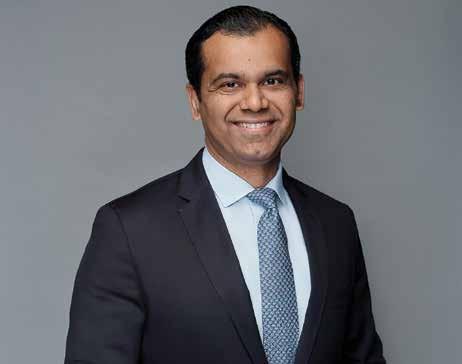
Author: Muqsit Ashraf
as a driver of revenue growth. Business leaders in EMEA are even more confident, with 40 percent reporting that AI is already reshaping roles in meaningful ways.
Yet technology alone is insufficient. Realising the full value of advanced AI requires parallel investment in people. In EMEA, one in three workers now regularly collaborates with AI agents, highlighting both progress and the opportunity to accelerate skills development. Evidence suggests that organisations investing simultaneously in technology and workforce capability are four times more likely to sustain profitable growth. The UAE’s expansion of generative AI access across its population reflects this integrated approach.
AI is also reshaping how companies respond to commercial pressure. Amid pricing constraints, shifting demand and regulatory complexity, leaders are deploying AI for dynamic pricing, scenario modelling and decision support— tools that help determine which costs to absorb
and which to pass on. In supply chains, where disruption remains a persistent risk, a quarter of executives have already begun moving towards autonomous operations. Companies that reconfigure networks for resilience report response times falling by 62 percent and recovery speeds improving by 60 percent compared with traditional models.
FROM ENDURANCE TO DURABLE GROWTH
As AI becomes as ubiquitous as streetlights and steam engines once were, preparing for its energy demands will require agility at every layer of resilience—from infrastructure and operations to talent and governance. For high-performing organisations, periods of disruption are not merely tests of endurance.
The leaders of the next decade will use change as a catalyst for growth, turning volatility into advantage. Their objective is not simply to withstand the future, but to help reinvent it— building enterprises that are resilient by design and competitive by intent. i
Beyond the Dairy Aisle: How Almarai Champions Corporate Governance in the Gulf
In the rapidly evolving corporate landscape of the Kingdom of Saudi Arabia, governance has become a strategic imperative rather than a regulatory formality. Driven by Vision 2030 and the ambition to attract long-term international capital, Saudi Arabia’s leading corporates are being compelled to adopt governance frameworks that meet global expectations. Few companies exemplify this transformation as convincingly as Almarai Company, the Middle East’s largest food and beverage group and the world’s largest vertically integrated dairy enterprise.
For Almarai, corporate governance is not treated as a compliance exercise confined to annual disclosures. It is embedded as a core pillar of operational discipline, brand protection, and long-term value creation. By combining strict adherence to the Saudi Capital Market Authority’s Corporate Governance Regulations with a proactive embrace of international ESG standards, Almarai has positioned itself at the forefront of responsible corporate citizenship in the Gulf Cooperation Council.
The company’s governance architecture is firmly anchored in the regulatory framework of the Saudi Capital Market Authority, whose rules govern listed entities on Tadawul, the Saudi Exchange. Yet Almarai’s stated ambition extends beyond domestic compliance. The company explicitly aligns its governance practices with international principles designed to promote fairness, transparency, and competitiveness, recognising that credibility with global investors demands more than minimum statutory observance. This dual commitment—to local rigour and global best practice—forms the foundation of Almarai’s governance strength.
At the centre of this framework sits the Board of Directors, whose composition and responsibilities reflect a deliberate emphasis on independence, expertise, and strategic oversight. Almarai applies clear and demanding criteria to board membership, ensuring that independent directors constitute at least one-third of the board or no fewer than two members, in line with regulatory requirements. Independence is not treated as a symbolic label, but as a substantive condition, with strict prohibitions on significant shareholdings, familial relationships with senior executives, or excessive cross-directorships that could compromise objectivity.
Beyond independence, Almarai places strong emphasis on competence and relevance.
"Directors are expected to demonstrate strategic acumen, leadership capability, and financial literacy, including the ability to interpret complex financial statements and risk reports."
Directors are expected to demonstrate strategic acumen, leadership capability, and financial literacy, including the ability to interpret complex financial statements and risk reports. While diversity requirements in Saudi governance codes have historically focused less on demographic metrics than in Western jurisdictions, Almarai’s internal rules emphasise diversity of professional background and expertise. Experience in management, economics, accounting, law, and governance is prioritised, reinforcing the principle that directors serve the interests of all shareholders and stakeholders rather than any particular constituency.
The board’s role is unambiguously strategic. Its core responsibilities include approving longterm strategy, overseeing execution, determining capital structure, and setting financial objectives. This focus ensures that governance functions as an active driver of performance and resilience, rather than a passive layer of oversight detached from the company’s operational reality.
Given the scale and complexity of Almarai’s vertically integrated operations—spanning feed production, large-scale dairy farming, manufacturing, and logistics across multiple jurisdictions—robust risk management is

indispensable. Governance structures are designed to ensure that internal controls are not only established, but continuously reviewed and strengthened. The board operates through specialised committees, notably the Audit Committee and the Risk Management Committee, both composed of non-executive directors.
The Risk Management Committee plays a central role in developing and overseeing the company’s enterprise risk management framework. In recent years, its mandate has expanded to explicitly incorporate Environmental, Social, and Governance considerations, including climaterelated risk. This integration signals a mature governance perspective that treats sustainability not as a peripheral concern, but as a material financial risk and strategic opportunity. Environmental exposure, supply-chain resilience, animal welfare, and resource efficiency are increasingly evaluated through the same governance lens as operational and financial risk.
Integrity within the organisation is reinforced through detailed policies governing conflicts of interest and related-party transactions. Almarai requires formal written procedures to prevent the misuse of company assets and to regulate dealings that could undermine shareholder confidence. This emphasis on internal discipline is critical in sustaining trust across a broad and diverse investor base.
Almarai’s governance framework is also distinguished by its explicit embrace of stakeholder responsibility, articulated through the company’s “Better Every Day” strategy. Sustainability is treated as integral to long-term value creation rather than as a reputational adjunct. The company has made measurable progress against its publicly stated sustainability targets and has received international recognition for its performance, including improved scores in global sustainability assessments conducted by S&P Global and inclusion in Dow Jones Sustainability Indices-related evaluations. These
external validations underscore the effectiveness of governance-led sustainability integration.
The board has adopted a formal stakeholder policy governing relationships with employees, customers, suppliers, and communities. Mechanisms are in place to address grievances, resolve disputes, and enforce ethical standards through a comprehensive code of conduct applicable to all employees. This structured approach helps secure Almarai’s social licence to operate across the culturally and economically diverse markets of the Gulf region.
Executive accountability is reinforced through the Remuneration and Nomination Committee, which designs compensation policies aligned with both short-term performance and long-term value creation. Incentive structures combine performance-linked annual rewards with longer-term mechanisms, such as equity-based schemes, to promote sustained commitment to the company’s strategic objectives. While explicit
ESG-linked remuneration remains an evolving practice within the Saudi market, Almarai’s publicly articulated commitments across human rights, animal welfare, and environmental stewardship suggest a trajectory towards deeper integration of non-financial metrics into executive incentives—a hallmark of advanced governance systems globally.
Almarai’s approach demonstrates that robust corporate governance is neither incompatible with scale nor constrained by regional context. By insisting on genuine board independence, embedding rigorous risk and ethics oversight throughout its vertically integrated operations, and aligning corporate success with measurable sustainability outcomes, Almarai has established itself as a governance leader in the Middle East. In doing so, it offers compelling evidence that world-class governance standards are not only achievable in the Gulf, but can serve as a powerful engine for long-term, responsible growth. i
Chemistry That Matters: How SABIC’s Governance Forges a Sustainable Future in the Middle East
In the global chemicals and commodities sector, where scale magnifies both opportunity and risk, corporate governance is the decisive factor separating resilience from vulnerability. For Saudi Basic Industries Corporation (SABIC), one of the world’s largest petrochemical producers and a flagship enterprise of the Kingdom of Saudi Arabia, governance is not a procedural necessity but a strategic instrument. Anchored in the Kingdom’s Vision 2030 reform agenda and the rigorous oversight of the Saudi Capital Market Authority (CMA), SABIC has constructed a governance framework that aligns industrial leadership with ethical accountability and long-term sustainability.
As a listed company operating at the heart of Saudi Arabia’s economic transformation, SABIC is subject to an increasingly demanding regulatory environment. The CMA’s Corporate Governance Regulations, continuously refined to reflect global best practice, form the formal backbone of its oversight model. SABIC’s approach, however, deliberately exceeds baseline compliance. By integrating international standards of transparency, board independence, and sustainability-driven accountability, the company has positioned itself as a regional benchmark for governance excellence in heavy industry.
The foundation of this framework lies in a clearly defined and disciplined board structure. CMA regulations prohibit the concentration of authority by forbidding the combination of the roles of board chairman and chief executive officer. SABIC applies this separation rigorously, ensuring that strategic oversight remains fully independent from executive management. This structural clarity is particularly critical in a capital-intensive sector where long-term investment decisions, environmental exposure, and safety risks demand objective challenge at the highest level.
SABIC operates a single-tier board in which nonexecutive directors form the majority, including a strong contingent of independent members. Board appointments are governed by a formal Membership Policy that emphasises merit, competence, and the alignment of skills with the company’s strategic priorities. Directors are selected for their experience in areas such as global manufacturing, finance, risk management, sustainability, and industrial safety. In parallel, the board has explicitly committed to enhancing diversity, including the promotion of female representation, signalling a cultural shift within an industry historically dominated by homogeneous leadership structures.
"Strategic oversight increasingly centres on sustainability as a core governance concern rather than a peripheral initiative."
Strategic oversight increasingly centres on sustainability as a core governance concern rather than a peripheral initiative. This responsibility is embedded within a dedicated board committee structure, most notably the Board Sustainability, Risk, and Environment, Health, Safety and Security Committee. Through this mechanism, the board exercises direct oversight of nonfinancial risks and opportunities, including climate impact, process safety, human rights, and environmental stewardship. By elevating these issues to board level, SABIC ensures that sustainability considerations are inseparable from capital allocation, operational strategy, and long-term value creation.
One of the most complex governance challenges facing SABIC arises from its scale and ownership structure. With Saudi Aramco as a major shareholder and longstanding commercial partner, the transparent management of conflicts of interest and related-party transactions is essential to maintaining investor confidence. SABIC addresses this risk through a robust and formalised control framework.
A comprehensive Conflict of Interest Policy governs the conduct of board members, senior executives, and substantial shareholders. Any potential related-party transaction must

be disclosed in advance, with the interested party recused from deliberation. Independent scrutiny is provided by the Audit Committee, which is mandated to review all related-party transactions and present its assessment to the board. The committee’s composition and charter are designed to reinforce objectivity, with an emphasis on technical competence and independence. Mandatory disclosure of such transactions in SABIC’s annual reporting ensures that shareholders receive clear, timely, and comprehensive information, reinforcing transparency in an area traditionally viewed as high risk in state-linked enterprises.
Executive accountability represents the final and decisive layer of SABIC’s governance architecture.

Through the work of the Remuneration and Nomination Committee, the company has explicitly linked executive compensation to performance against both financial and strategic objectives. Importantly, these objectives include material sustainability metrics aligned with SABIC’s long-term ESG commitments. Targets related to emissions reduction, water efficiency, safety performance, and responsible operations are integrated into the evaluation framework that determines variable remuneration for senior leadership.
This approach reflects a clear governance philosophy: environmental and social performance is not ancillary to financial success but a determinant of it. By embedding
sustainability into executive incentives, SABIC ensures that strategic ambitions translate into operational behaviour and measurable outcomes. The company’s Code of Ethics underpins this system, providing a uniform standard of conduct across its global workforce. Internal audit functions operate independently to assess the effectiveness of controls and risk management processes, reporting directly to the board and reinforcing a culture of accountability.
External recognition has followed. SABIC’s repeated acknowledgement in ESG-focused awards and its standing within Saudi capital market forums underscore the credibility of its governance model. These accolades are not symbolic; they reflect a system in which regulatory
discipline, ethical conduct, and sustainability performance are mutually reinforcing.
SABIC’s governance framework demonstrates how a large, state-linked industrial champion can operate to world-class standards without diluting strategic ambition. Through disciplined board independence, rigorous control of conflicts of interest, and the integration of sustainability into executive accountability, SABIC exemplifies a modern governance model suited to the demands of the 21st-century industrial economy. In doing so, it provides compelling evidence that in the Middle East’s evolving capital markets, integrity is not a constraint on growth but the chemistry that makes sustainable success possible. i
Accenture: Navigating the Energy Transition in Resource-Rich Middle Eastern Economies
By Silvia Rigato Middle East Strategy & Consulting Resources Practice Lead Tom Beswetherick Resources Strategy Senior Manager Dr Britta Daum
For decades, oil and gas production has been the cornerstone of Middle Eastern economies, underpinning their rise as regional powerhouses, enabling global ambitions and supplying the world with affordable energy. These resources have delivered exceptional economic growth, supported by structural advantages including low-cost, relatively low-carbon production, vast reserves and a high export-to-consumption ratio.
Looking ahead, the Middle East will remain central to meeting global demand for reliable and increasingly low-carbon energy. Primary energy demand in the region is projected to rise by around seven percent relative to 2022 levels, with Middle Eastern producers expected to supply roughly eight percent of global consumption. While renewable energy capacity is forecast to expand by more than 210 percent above 2023 levels, fossil fuels are still expected to account for close to 58 percent of the global energy mix by 2050.
Navigating this transition will require Gulf Cooperation Council countries to strike a careful balance: accelerating economic and energy diversification while maximising the long-term value of their hydrocarbon endowments.
AN EVOLVING ROLE FOR NATIONAL OIL COMPANIES
At the centre of this transformation are national oil companies. Long focused on upstream production and export, NOCs are increasingly evolving into strategic enablers of national development objectives. Their remit is expanding across the hydrocarbon value chain and beyond, as they seek to capture greater value while advancing sustainability, industrial diversification and economic resilience.
Alongside investments in renewables, hydrogen and carbon capture, NOCs are deploying capital into infrastructure, sustainable urban development, green technologies, digitalisation and artificial intelligence. The objective is not only to decarbonise operations, but also to stimulate job creation, attract foreign investment and support the emergence of new growth sectors.
Fulfilling this broader mandate presents three interrelated challenges. First, NOCs must build more resilient portfolios by expanding into sectors that are essential for diversification but typically deliver lower returns than hydrocarbons. Second, they must establish competitive positions in industries where they lack the structural

advantages that have long underpinned oil and gas leadership. Third, they must develop new organisational and technical capabilities, balancing organic growth with targeted acquisitions while managing increasingly complex domestic and international operations.
These challenges are substantial, but NOCs also possess unique strengths. Their geopolitical positioning allows them to bridge Western and Eastern markets. A young, increasingly welleducated population provides a strong talent pipeline for emerging industries. Untapped gas reserves offer opportunities for near-term decarbonisation and lower-carbon fuels, while abundant solar and wind resources position the region as a potential global leader in renewable energy. Above all, decades of engineering expertise, large-scale project delivery capability, robust balance sheets and strong state backing give NOCs a degree of strategic freedom unmatched by many global peers.
AN ACCELERATED PATH TO IMPACT
To fully capitalise on these advantages, NOCs must act decisively across three strategic horizons. Strengthening resilience in the core portfolio remains essential, including advancing lower-carbon oil initiatives and diversifying into carbon-based chemicals and advanced materials to stabilise hydrocarbon revenues over the long term.
At the same time, accelerating entry into new markets is critical. Building world-class mergers and acquisitions and corporate venturing capabilities can dramatically shorten the time required to access new technologies, capabilities
and geographies, reducing the risks associated with organic expansion into unfamiliar sectors.
Finally, NOCs must establish leadership positions in emerging industries. This requires a shift away from incremental, in-house innovation towards ecosystem-based strategic innovation, enabling influence over standards, access to global talent and the development of durable competitive advantage.
SIX PRIORITIES FOR EXECUTION
To deliver this transformation, six priorities stand out. Long-term strategies must be designed with built-in agility, allowing organisations to respond dynamically to technological disruption, market volatility and shifting policy environments. Local innovation ecosystems should be cultivated to shape emerging markets, address diverse technology needs and de-risk large-scale investments.
Digital capabilities—including advanced analytics, artificial intelligence and automation— must be deployed to improve operational efficiency, decision-making and cross-functional collaboration. Workforce transformation is equally critical, with sustained investment in digital, technical and sector-specific skills required to prepare employees for roles in AI, clean energy and advanced materials.
Sustainability must be fully integrated into core strategy, aligning decarbonisation objectives with commercial expansion into hydrogen, renewables, carbon capture and circular economy models. Finally, NOCs should establish high-impact corporate venture and M&A arms to acquire, invest in or partner with innovative energy and technology companies, accelerating capability building in high-growth, low-carbon sectors.
LEADING THE NEXT ENERGY ECONOMY
As the energy transition accelerates, national oil companies in the Middle East have a rare opportunity to lead rather than follow. By leveraging their structural strengths, executing disciplined strategic transformation and embracing new capabilities, NOCs can secure long-term growth while reinforcing their role as indispensable players in the evolving global energy system.
The next phase of the region’s energy story will not be defined by decline, but by reinvention—one in which hydrocarbons, clean energy and advanced technologies coexist as pillars of a more resilient and diversified economic future. i
Silvia Rigato
Resources Strategy Manager
Accenture: Powering Energy Efficiency for a Digitally Empowered Future
By Ramez Shehadi Middle East Strategy and Consulting Lead, Accenture
Digital-first is no longer a slogan in the Gulf Cooperation Council. Across the region, a rapid and coordinated digital expansion is under way, driven by ambitious national visions, strategic public–private partnerships and a clear intent to lead in artificial intelligence, cloud computing and smart infrastructure. At the centre of this transformation sit data centres—now regarded as critical national assets that underpin e-government services, financial systems and next-generation generative AI. Their rapid proliferation, however, is intensifying pressures on energy systems and sustainability, raising a central policy question: how can the GCC reconcile digital leadership with climate commitments?
Global data centre investment has almost doubled since 2022, reaching approximately $500bn in 2024, while electricity demand from the sector is projected to more than double by 2030, largely driven by AI workloads. In the GCC, data usage is expected to increase by roughly 400 percent between 2022 and 2028. The United Arab Emirates is emerging as a strategic hub, hosting OpenAI’s largest project outside the United States—a five-gigawatt hyperscale complex in Abu Dhabi—alongside record imports of advanced chips to power next-generation AI models. Saudi Arabia is expanding infrastructure at pace, embedding AI across flagship initiatives such as NEOM, while Qatar, Bahrain, Kuwait and Oman are scaling capacity through sovereignbacked ventures and international technology partnerships. Qatar’s Digital Agenda 2030, building on programmes such as TASMU Smart Qatar, places advanced compute infrastructure and AI-led growth at the centre of its economic strategy.
According to Accenture’s report Building Tomorrow’s Economies: How Generative AI Will Reinvent Business in the Middle East, this momentum rests on four structural advantages: bold national strategies such as Saudi Vision 2030 and the UAE’s AI Strategy 2031; businessfriendly regulatory environments; access to abundant, low-cost energy; and strong global connectivity.
These foundations position the region favourably. Regulatory reforms—including Saudi Arabia’s Cloud Computing Framework and data protection laws—are strengthening investor confidence, while hubs such as Dubai Internet City illustrate how tax incentives and full foreign ownership can catalyse digital ecosystems. Qatar has formalised

Author: Ramez Shehadi
its approach to data value creation through a comprehensive National Data Policy and Standards framework, enabling interoperability, data quality and AI-driven public services. Across the wider Middle East, countries including the UAE, Morocco and Lebanon have established dedicated ministries or authorities focused on AI, signalling a regional move towards more centralised and accelerated digital policymaking, with Egypt advancing parallel reforms to support domestic technology hubs.
Geography further reinforces the region’s appeal. The GCC sits astride major submarine cable routes linking Europe, Asia and Africa, offering low-latency connectivity and positioning itself as a strategic data corridor for east–west and north–south traffic. Public–private partnerships have deepened this role. National champions such as Khazna in the UAE and Tonomus in Saudi Arabia are partnering with global players including Microsoft, Oracle and OpenAI, embedding the region within the global digital fabric.
Energy remains a decisive advantage. The GCC benefits from competitive power costs and some of the world’s most ambitious renewable projects, including Saudi Arabia’s Sudair solar plant and the UAE’s Mohammed bin Rashid Al Maktoum Solar Park. Yet the scale and intensity of data centre growth also expose vulnerabilities. Hyperscale facilities can consume as much water as small cities, while extreme heat and humidity complicate cooling design and site selection. Grid
readiness, land scarcity in urban centres and cost inflation are emerging constraints, even as uptime expectations demand resilient, round-the-clock, low-carbon infrastructure.
These pressures converge into a set of strategic questions for the region. How can digital infrastructure scale without breaching national climate targets? What energy mixes and site strategies are viable in harsh desert environments? And how can AI itself be deployed to reduce the energy intensity of the systems it powers?
AI is not only the driver of rising demand; it is also part of the solution. Applied to digital infrastructure, AI can optimise compute loads, reduce energy waste, enable predictive cooling and support renewable energy forecasting. Digital twins allow operators to simulate system performance and improve efficiency before physical deployment. The result is lower emissions per unit of compute, greater grid flexibility and improved operational resilience.
To meet the dual objectives of digital leadership and sustainability, the GCC must treat net-zero infrastructure as a design principle rather than a retrofit. Infrastructure expansion should be aligned with national climate plans, supported by green building standards, low-carbon design incentives and clear ESG benchmarks. Solar generation and energy storage must be integrated into data centre design, alongside AI-enabled cooling systems and modular architectures that shift compute loads towards periods of peak renewable output. Scaling public–private partnerships will be essential to mobilise green capital, accelerate innovation and consolidate regional leadership.
Several conclusions follow. Sustainability must be embedded in digital infrastructure from the outset. AI can simultaneously raise performance and reduce emissions. Energy strategy, site selection and climate policy must be developed as a single, integrated framework. Collaboration between governments and the private sector is indispensable in navigating cost, complexity and scale. And the GCC’s advantages in connectivity, capital and energy must now be matched by global leadership in sustainable infrastructure design.
Only through long-term grid resilience planning and strategic alignment between digital and energy policy can the region fully reconcile its digital ambitions with its climate commitments— and turn infrastructure into a lasting source of competitive advantage. i
Capturing a Lifetime: How StoryWorth Turns Elder Memory Into a Scalable, Enduring Business
A growing segment of consumer businesses is built not on convenience or speed, but on memory, legacy, and emotional permanence. Among the most successful is StoryWorth, a US-based company that has quietly established itself as a leader in the personal-history space by transforming the preservation of family memories into a structured, year-long experience. More than a novelty gift, StoryWorth represents a carefully engineered service that aligns emotional value with operational discipline, creating a sustainable business model around one of the most universal human desires: to be remembered.
Founded in 2013 by Nick Baum, inspired by a wish to preserve his own father’s stories, StoryWorth did not attempt to reinvent memoir writing through technology. Instead, it simplified the process to its most human elements—questions, reflection, and time— while removing the friction that often prevents such projects from ever being completed. Its success lies in understanding not just the purchaser, but the often-overlooked primary user: the older adult.
A SUBSCRIPTION MODEL BUILT ON BEHAVIOURAL INSIGHT
At the core of StoryWorth’s commercial strategy is a subscription-based “gift” model that reframes memoir creation as a guided, low-pressure journey rather than a daunting creative task. Typically purchased by a family member, the annual subscription includes a full year of structured prompts and culminates in a professionally printed hardback book.
Crucially, the person paying for the service is rarely the person doing the work. This separation is deliberate. The purchaser acts as organiser and facilitator, selecting questions and managing the account, while the storyteller engages only with the weekly prompt. This division dramatically lowers the activation barrier for older users, who are spared the administrative and technical burden.
Each week, the storyteller receives a single question by email—never a blank page. Responses are collected automatically and shared with designated family members, creating a continuous feedback loop that sustains motivation and emotional engagement. At the end of the year, the accumulated stories and photographs are compiled into a customised memoir, with one copy included and additional volumes available for purchase.
REVENUE DESIGN AND LONGEVITY
StoryWorth’s revenue structure is deliberately conservative and resilient. The upfront subscription fee covers the entire service lifecycle, from content delivery to book production. This creates clear cost visibility and avoids the need for complex upselling during the process.
Additional revenue is generated through the sale of extra books, a natural extension given the product’s role as a family heirloom. Renewal subscriptions provide further upside, allowing storytellers to continue writing or refine their narratives beyond the initial year. Importantly, StoryWorth has avoided the aggressive growth tactics typical of venture-backed consumer platforms, instead prioritising customer trust, product quality, and long-term brand credibility.
As a privately held company, it has focused on profitability and repeat satisfaction rather than scale at any cost—a strategic choice that aligns with the deeply personal nature of the service.
DESIGNING FOR THE ELDER, NOT THE ALGORITHM
What differentiates StoryWorth from a generic content platform is its acute sensitivity to the cognitive, emotional, and technological realities of older adults. The service is engineered to reduce friction at every stage.
The weekly single-question format directly addresses the paralysis caused by open-ended creative tasks. A vast, curated prompt library ensures coverage across life stages and themes, while allowing full personalisation by family members. This balance between structure and flexibility ensures relevance without overwhelming the storyteller.
Technologically, StoryWorth takes an email-first approach, relying on a communication channel already familiar to many older users. For those unable or unwilling to type, dictation and voice-

recording options are available, significantly widening accessibility for users with mobility or vision limitations. Family members are encouraged to assist with editing, photo uploads, and organisation, reinforcing intergenerational collaboration rather than technological dependency.
EMOTIONAL RETURN AS PRODUCT VALUE
Beyond usability, StoryWorth’s real value proposition lies in emotional validation. The

act of receiving weekly affirmation—knowing that children or grandchildren are reading and appreciating one’s stories—transforms writing from a solitary exercise into a shared family ritual. This emotional reinforcement sustains engagement and completion rates, a critical metric in a category where abandonment is common.
The final product—a durable, high-quality book—cements the service’s promise. It
reframes memory as something permanent and tangible, not ephemeral or digital. This physicality is central to StoryWorth’s appeal and differentiates it from purely online storytelling tools.
A BUSINESS BUILT ON EMPATHY AND STRUCTURE
StoryWorth succeeds because it treats legacy as both an emotional and operational challenge. It monetises memory not by extracting content, but by providing structure, pacing, and respect
for its users. The platform’s careful alignment of behavioural psychology, accessibility, and subscription economics offers a compelling case study in how deeply human needs can be translated into sustainable commercial models.
In an economy increasingly driven by speed and disposability, StoryWorth’s quiet success suggests that patience, empathy, and permanence remain powerful—both emotionally and financially. i
The New Economics of Intelligence
By Bashar Kilani
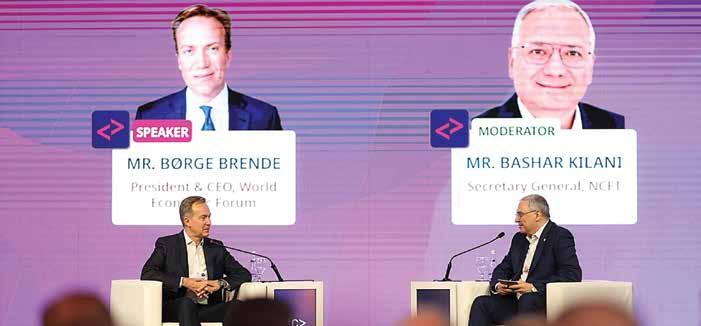
For decades, economic theory has rested on three core factors of production: labour, capital and energy. This framework underpinned industrialisation, globalisation and the digital revolution. It is now incomplete. Artificial intelligence introduces a fundamentally new economic input— scalable intelligence—and with it a structural shift in how value is created, productivity is achieved and competitiveness is defined.
AI is not merely another technology layered onto existing systems. It behaves in ways that distinguish it from anything that came before. Unlike labour, intelligence embedded in AI systems can be replicated at near-zero marginal cost once developed. Unlike capital, it improves with use, learning continuously from data, feedback and deployment. And unlike data alone, AI converts information into prediction, optimisation and realtime decision-making. In economic terms, this is not automation; it is the emergence of a new factor of production.
McKinsey captures this transition by describing the move from automation to augmentation, where AI amplifies human capability rather than simply replacing tasks or roles. The economic implications are material. McKinsey estimates that generative AI could add between $2.6tn and $4.4tn annually to global GDP, driven by productivity gains across sectors including finance, healthcare, manufacturing and professional services.
What differentiates this wave from previous technological advances is where productivity gains occur. Earlier innovations improved infrastructure or reduced transaction costs. AI embeds intelligence directly into workflows—customer
Author: Bashar Kilani
engagement, risk assessment, pricing, logistics and research and development—allowing organisations to make better decisions continuously rather than episodically. Early evidence points to productivity improvements of 40 to 50 percent in certain knowledge-intensive functions when AI is deployed effectively, particularly in financial services and operational roles.
This shift is also reshaping global competition. Economic power is no longer determined solely by access to capital, labour or natural resources, but increasingly by access to compute, talent, data and AI ecosystems. Intelligence infrastructure— advanced semiconductors, cloud capacity, data centres and skilled AI workforces—is becoming as strategically significant as energy infrastructure was in the twentieth century.
The implications extend well beyond individual firms. According to the World Trade Organization, AI could increase global trade volumes by up to 37 percent and lift global GDP by more than 12 percent by 2040, fundamentally altering patterns of trade and comparative advantage. Countries that lead in AI adoption and governance are likely to see growth effects compound over time, while those that fall behind risk structural economic decline.
This creates a clear policy imperative. Governments must modernise regulatory frameworks to support innovation while managing legitimate risks, including bias, privacy, cybersecurity and excessive market concentration. Overregulation risks slowing adoption at precisely the moment when scale and learning matter most. At the same time, workforce transition is critical. The productivity dividends of AI will not materialise without sustained investment
in reskilling and in systems that support effective human–AI collaboration. Technology alone does not deliver growth; institutions and people do.
For business leaders, the message is equally direct. AI can no longer be treated as an information technology initiative or a narrow cost-reduction tool. It is a core economic capability that shapes strategy, capital allocation and long-term competitiveness. Organisations that embed AI into decision-making processes, operating models and leadership structures will outperform those that deploy it tactically or defensively.
Global forums frequently debate growth, resilience and competitiveness as separate challenges. AI collapses these into a single question: who controls scalable intelligence, and how effectively it is deployed. The economics of the coming decade will be written not only in balance sheets and trade flows, but in models, algorithms and augmented human judgement.
The era of intelligence as a factor of production— alongside labour and capital—has arrived. Those who recognise it early will help shape the next economic order. Those who do not may spend the next decade trying to catch up. i
ABOUT THE AUTHOR
Bashar Kilani held senior leadership positions at global technology and consulting firms, Accenture and IBM, in addition to several board memberships at corporates, universities and future foresight institutions before founding AI360InnovationsLtd an advisory firm focusing on the digital economy based at the Dubai and becoming a Managing Partner at Boyden, a global leadership consulting, and executive search firm.


The Triumph of the Market: How Brazil’s Novo Mercado Model
Restored Investor Trust
Brazil’s corporate governance evolution stands as one of the most compelling examples of market-led reform in the modern financial era. Faced with a deep crisis of investor confidence rooted in concentrated ownership and the pervasive use of nonvoting shares, Brazil did not wait for sweeping legislative intervention. Instead, its stock exchange—now B3—engineered a solution from within the market itself. The creation of the Novo Mercado in 2000 marked a decisive turning point, reversing a prolonged decline in listings, catalysing a wave of initial public offerings, and establishing a powerful, contractually enforced framework for minority shareholder protection that has since become a global reference point.
Brazil: Rio de Janeiro

Brazil’s governance challenge originated in a structural imbalance. Unlike the dispersed ownership models typical of the United States and the United Kingdom, Brazilian listed companies have traditionally been controlled by a dominant promoter family or a state-owned enterprise. This concentration of control was compounded by the widespread issuance of preferred shares carrying economic rights but no voting power. The resulting agency conflict was not the classical tension between managers and shareholders identified by Berle and Means, but a far more acute divide between controlling shareholders and minority investors.
For external investors, this structure translated into elevated risk. Related-party transactions were frequently used to transfer value from public companies to controlling interests, eroding trust and depressing valuations. Liquidity suffered as domestic and international investors were reluctant to hold non-voting shares with limited influence over corporate decision-making. By the late 1990s, the consequences were stark. Brazil’s equity market was stagnating, and companies seeking capital increasingly bypassed São Paulo in favour of New York, where stronger investor protections commanded higher valuations. With regulatory reform proceeding slowly under a civil-law system, the market faced an existential credibility crisis.
The response came not from the legislature, but from the exchange itself. In 2000, the São Paulo Stock Exchange launched the Novo Mercado, alongside two intermediary listing tiers, as a voluntary but demanding governance segment designed to bypass weak statutory protections. The concept was radical in its simplicity. Companies willing to submit to governance standards well above the legal minimum would be rewarded with greater investor confidence and lower costs of capital.
Listing on the Novo Mercado required fundamental changes to corporate control and transparency. Companies were obliged to adopt a one-share, one-vote structure, eliminating nonvoting preferred shares and aligning economic ownership with political power. Controlling shareholders were required to extend full tagalong rights to minority investors, guaranteeing equal exit terms in the event of a sale of control and effectively dismantling the private benefits historically associated with control blocks. Board composition was strengthened through mandatory independent directors, while disclosure standards were raised to international levels through the adoption of IFRS and detailed reporting on ownership structures, executive remuneration, and related-party transactions.
Crucially, these obligations were not framed as aspirational principles under a “comply or explain” regime. They were binding contractual conditions of listing. Failure to meet them resulted in delisting from the Novo Mercado, an immediate and visible sanction that gave the rules real teeth.
"The success of the exchange-led model also generated political momentum for reform. What market innovation had achieved in practice, legislators were eventually compelled to reflect in law, leading to incremental but meaningful updates to Brazil’s corporate statutes."
The market response was swift and decisive. From the mid-2000s onwards, Brazil experienced a surge in initial public offerings, as companies discovered that enhanced governance translated directly into higher valuations and broader investor demand. Governance quality became a competitive asset rather than a regulatory burden. Over time, the standards of the Novo Mercado exerted a powerful convergence effect. Even companies listed outside the segment began upgrading their practices to meet investor expectations shaped by the new benchmark. By the early 2010s, Novo Mercado and Level 2 companies accounted for the majority of Brazil’s market capitalisation, effectively redefining the country’s governance baseline.
The success of the exchange-led model also generated political momentum for reform. What market innovation had achieved in practice, legislators were eventually compelled to reflect in law, leading to incremental but meaningful updates to Brazil’s corporate statutes.
This progress was severely tested in the mid2010s by Operation Lava Jato, the sweeping corruption investigation that exposed systemic bribery, fraud, and political interference, most notably at the state-controlled oil giant Petrobras. The scandal revealed that even sophisticated market mechanisms were insufficient to protect investors where state ownership and political influence remained unchecked. The governance failures within major state-owned enterprises inflicted enormous financial damage and shook confidence in public-sector oversight.
The regulatory response marked another inflection point. Brazil enacted a dedicated State-Owned Enterprises Law in 2016, imposing rigorous governance standards designed to insulate SOEs from political interference. The law introduced strict professional criteria for board members and executives, restricted the appointment of politicians and recent
public officials, enhanced transparency, and mandated comprehensive compliance and risk management frameworks. In parallel, the AntiCorruption Law strengthened corporate liability for corrupt practices, fundamentally altering the risk calculus for firms engaging with the state.
Together, these measures represented an unprecedented attempt to apply private-sector governance discipline to public assets. The cultural impact was immediate, driving a sharp increase in compliance functions, internal controls, and board scrutiny across both stateowned and privately controlled firms.
Today, Brazil’s governance framework reflects a sophisticated hybrid of market discipline and strengthened regulation. A national Brazilian Code of Corporate Governance, introduced in 2016, consolidated best practices through a “comply or explain” approach aligned with international norms. ESG disclosure requirements have expanded rapidly under the oversight of the securities regulator, reflecting the growing importance of sustainability risk in Brazil’s commodity-intensive economy. At the same time, the rise of domestic institutional investors—particularly pension funds and asset managers—has added a further layer of accountability, reinforcing active stewardship and governance engagement beyond the Novo Mercado segment.
Brazil’s experience offers a powerful lesson in how markets can respond to crises of trust with innovation rather than inertia. The Novo Mercado stands as a landmark case study in emergingmarket governance, demonstrating that credible investor protection does not always require immediate legislative overhaul. When governance quality becomes a condition for accessing capital, it transforms from a compliance exercise into the single most effective tool for unlocking value, restoring confidence, and sustaining market growth. i

CABEI’s AA+ Breakthrough: How a Smarter Balance Sheet is Financing Central America’s Next Growth Chapter
The Central American Bank for Economic Integration (CABEI) has secured an S&P upgrade to AA+, capping a year of balance-sheet innovation. The move reduces funding costs, widens investor appetite and—crucially—equips the Bank to deliver more regional transport, clean energy and MSME finance on better terms, with lower risk.
A HISTORIC UPGRADE BUILT ON INTRINSIC STRENGTH
S&P Global Ratings’ November action went beyond lifting CABEI to AA+: it upgraded the Bank’s stand-alone credit profile (SACP) to AA+ from AA, alongside the long-term foreign currency issuer credit rating, citing materially stronger capital and a decisive reduction in sovereign concentration—improvements driven by a set of first-of-their-kind Exposure Exchange Agreements (EEAs) with peer multilaterals. “This upgrade confirms our financial strength and the full confidence of our members,” said Executive President Gisela Sánchez. “It is excellent news for our 15 member countries because it enables us to channel resources under better conditions and translate those benefits into concrete savings for national budgets.”
On the technical foundations, Chief Financial Officer Humberto Rodríguez noted that the two EEAs executed in 2025—totalling US$1.15bn with CAF and the Caribbean Development Bank—addressed the key structural risk on CABEI’s balance sheet by directly diversifying exposures. “We reduced sovereign concentration from 76 percent to 66 percent of the portfolio and lifted our risk-adjusted capital well above S&P’s ‘Extremely Strong’ threshold of 23 percent,” he said. “These were the first EEAs carried out by non-AAA MDBs; CABEI originated and led them to deliver immediate, measurable capital efficiency.”
S&P also recognised CABEI’s strong liquidity, a decade-long track record of preferred-creditor treatment and broader market access in multiple currencies, alongside progress toward a potential general capital increase and the addition of new, highly rated members. With a stable outlook, the Bank now sits at the AA+ level alongside the United States, Austria, New Zealand and its partner, the Republic of China (Taiwan).
FROM RATING TO REAL-ECONOMY IMPACT
Upgrades are often discussed in basis points; the development story is bigger. “AA+ strengthens
our ability to implement the 2025–2029 Institutional Strategy,” said Sánchez. “It means more competitive lending terms, larger and more innovative operations, and a deeper pipeline in priority areas such as regional transport integration, the clean-energy transition and MSME competitiveness—always with prudence and financial sustainability.”
Lower funding costs and deeper investor demand allow CABEI to originate more, structure more creatively and pass savings to public budgets across its footprint. For ministries of finance, that translates into a reduced debt-service burden; for line ministries, it compresses time-to-delivery on growth-critical projects that boost productivity and jobs.
LOCAL-CURRENCY LENDING THAT PROTECTS BORROWERS
Currency mismatches can derail otherwise sound projects. “CABEI has long offered localcurrency financing under a disciplined asset–liability management framework, and always on a selective basis,” Rodríguez noted. “The AA+ upgrade does not change that approach, but it strengthens our capital position and enhances market confidence—allowing us to continue providing financial solutions that meet the evolving needs of our members within a sound and sustainable framework.” When used appropriately, local-currency funding can help reduce borrower exposure to exchangerate shocks, support domestic capital-market development and protect service delivery through cycles.
BEYOND THE LOAN: INNOVATION IN INSTRUMENTS AND PARTNERSHIPS
With enhanced market perception and a stronger capital base, CABEI can push further on financial innovation. “The upgrade advances our agenda to deploy sustainability bonds, outcomebased bonds, guarantees and debt-for-nature swaps at greater scale,” said Sánchez. “These instruments help mobilise private capital into public priorities, multiplying impact in climate

resilience, nature-positive infrastructure and digital public goods.”
Rodríguez added that portfolio risk-sharing is now a standing capability rather than a one-off. “We have signed an agreement to advance a third exposure-sharing structure with FONPLATA. Together with disciplined liquidity management and currency diversification, these tools preserve resilience while creating headroom for development lending.” CABEI’s funding strategy also reflects the Bank’s sustainability orientation; by 2025, 99 percent of issuance was ESG-labelled, widening the investor base and reinforcing alignment with member priorities.
GOVERNANCE, MEMBERSHIP AND THE PATH TO AAA
The upgrade caps two years of disciplined financial management and governance strengthening. “We view AA+ as a platform, not an endpoint,” Sánchez said. “A potential ninth General Capital Increase and the incorporation of new, highly rated members would thicken our capital base and strengthen our shareholder quality—key steps to consolidating AA+ and building a credible path to AAA over time.” The sequencing is clear: diversified risk today, larger paid-in capital tomorrow and an even stronger platform for transformational finance thereafter.
WHAT CHANGES FOR CLIENTS—BEYOND THE BASIS POINTS
Borrowers will notice the difference in both access and design. “The combination of lower funding costs and higher market confidence enables us to expand guarantees, take a measured increase in risk appetite for innovative climate operations and capitalise project preparation more effectively,” Sánchez explained. “That means faster progress on regional corridors, cleaner

grids delivered sooner and MSME programmes scaled with better risk-sharing.”
For the finance function, the delivery model is anchored in optimisation. “We will continue to manage capital and liquidity for resilience while using targeted innovations to unlock impact,” Rodríguez said. “That includes selective localcurrency loans, structured co-financings and instruments that crowd in private investors without compromising our risk standards.”
A Regional Engine—Now with a Larger Gearbox Economic growth is built on momentum: projects that start on time, supply chains that work, firms that can finance inventory and expansion. “CABEI is the gearbox in that engine,” Sánchez observed. “AA+ enlarges it. Transport integration becomes more bankable when the financier at the centre can syndicate larger tranches and offer longer tenors. Clean-energy pipelines accelerate when we anchor sustainability programmes and bring in commercial partners. MSME lending scales when guarantees stretch bank risk limits and local-currency lines protect cash flows.”
These are not abstract benefits. They translate into faster road links that cut logistics costs for exporters; grid upgrades that reduce outages and attract manufacturing; climate-smart agriculture that lifts rural incomes; and formalised finance for small firms that employ the majority. For treasuries, lower net interest costs and reduced FX volatility are fiscal dividends that can be redeployed to health, education and climate resilience.
CONFIDENCE BEGETS CONFIDENCE
Upgrades shape expectations—and unlock participation. “AA+ tells global markets that our governance, capital and risk culture meet
the highest standards short of AAA,” said Sánchez. “It tells member countries that we can deliver more—and more efficiently—against their priorities. And it signals to peer DFIs and institutional investors that CABEI is a reliable partner for complex regional operations where collective action is essential.”
From the balance-sheet chair, Rodríguez underscored the focus on continuity. “The stable outlook reflects the expectation that member support and preferred-creditor treatment will continue, while we maintain prudent capital management and a high-quality liquidity portfolio. Our job is to keep that foundation strong as we scale impact.”
THE BOTTOM LINE
CABEI’s AA+ upgrade is a financial milestone with direct economic consequences. By

attacking sovereign concentration risk through innovative EEAs, strengthening capital to “Extremely Strong” levels and broadening liquidity, the Bank has earned both lower funding costs and greater market trust. The result is a more capable institution—one that can finance regional integration, clean energy and MSME competitiveness at the pace and scale Central America requires, while shielding borrowers from currency shocks and mobilising private capital into public priorities.
“We have the mandate, the model and now the rating to power the region’s next growth chapter,” Sánchez concluded. Rodríguez agreed: “The task ahead is to convert financial strength into projects on the ground—roads built, kilowatts delivered, firms financed— while safeguarding the resilience that got us here.” i
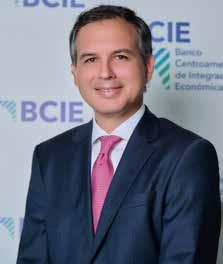
Executive President: Gisela Sánchez
CFO: Humberto Rodríguez
EY Argentina: Argentine Central Bank Lifts Key Foreign Exchange Restrictions >
By Sergio Caveggia & Sabrina Maiorano
Argentina has undergone a significant policy shift following the inauguration of a new government on 12 December 2023. Confronted with acute macroeconomic imbalances, the administration moved swiftly to implement emergency measures aimed at stabilising the economy, restoring confidence and normalising the foreign exchange regime. Central to this agenda were efforts to reduce the fiscal deficit and dismantle long-standing capital controls that had distorted trade, investment and corporate cash management.
At the time of the transition, Argentina faced severe inflationary pressures and chronic currency instability. One of the government’s first actions was a sharp adjustment of the official exchange rate, which was devalued to an average of ARS 800 per US dollar from ARS 365. This move was accompanied by fiscal consolidation measures, including cuts to public expenditure, reductions in energy and transport subsidies, and selective tax changes. By December 2025, the official exchange rate had adjusted further to approximately ARS 1,470 per US dollar, broadly reflecting inflation dynamics and market conditions.
RECENT POLICY AND TAX DEVELOPMENTS
The new administration’s emergency economic programme focused on restoring predictability to Argentina’s macroeconomic framework. A central pillar was the overhaul of the foreign exchange market, historically a source of volatility, administrative discretion and capital flight. By moving towards more transparent and marketoriented mechanisms, the government sought to create a clearer operating environment for both domestic businesses and foreign investors.
The exchange rate realignment had immediate consequences. For local companies, higher import costs fed into consumer prices, reinforcing inflationary pressures in the short term. For foreign investors, the adjustment initially increased costs but improved visibility and reduced the risk of sudden, discretionary devaluations. The authorities’ commitment to maintaining the exchange rate broadly in line with inflation helped stabilise expectations and contributed to a gradual improvement in confidence.
On the tax front, the government initially raised several levies to support fiscal consolidation.
Notably, the “Impuesto PAIS” was increased to 17.5 percent on certain foreign currency transactions and imports, aimed at generating revenue and discouraging excessive demand for hard currency. As macroeconomic conditions stabilised during 2025, this tax was subsequently repealed, alongside export taxes on selected products, signalling a shift towards a more investment-friendly framework.
CENTRAL BANK REFORMS AND THE DISMANTLING OF CONTROLS
Under the previous administration, Central Bank restrictions on foreign exchange transactions imposed significant operational constraints on businesses. Inflows and outflows of foreign currency were subject to tight scrutiny, leading to trapped liquidity in local subsidiaries of multinational groups and forcing companies to rely on costly workarounds.
Prior to the change in government, key restrictions included mandatory repatriation and conversion of export proceeds into pesos, severe delays on import payments—including royalties and management fees—and an effective prohibition on dividend remittances and intercompany payments due to limited access to official foreign currency.
As a result, many companies turned to the so-called “blue chip swap” (BCS) mechanism, a legal but significantly more expensive alternative involving the purchase and sale of securities across domestic and foreign markets to obtain hard currency. At times, the premium over the official rate exceeded 200 percent. Use of this mechanism triggered a 90-day exclusion from the official foreign exchange market both before and after each transaction, severely constraining liquidity management.
In April 2025, the Central Bank issued Communication “A” 8226, marking a decisive

step towards liberalisation. The measures introduced included unrestricted access for individuals to purchase foreign currency without prior authorisation or monthly caps; renewed access to the official market for dividend and profit remittances to non-resident shareholders, provided these relate to audited profits generated in fiscal years beginning on or after 1 January

2025; and the removal of minimum waiting periods for payments related to imports of goods registered with customs from 14 April 2025 onwards.
Additional reforms allowed advance payments for capital goods under defined thresholds relative to the FOB value, eased restrictions on payments
for services provided by unrelated parties, and shortened payment delays for services rendered by related parties. In parallel, Executive Decree No. 269/2025 repealed earlier provisions that had mandated partial settlement of export proceeds through capital market transactions rather than the official exchange market.
Tax authorities reinforced this shift by issuing General Resolution No. 5672/2025, which eliminated the 30 percent withholding tax on purchases of foreign currency by individuals and estates, as well as on imports of certain previously taxed goods.
REMAINING RESTRICTIONS AND OUTLOOK
As a result of these reforms, Argentine companies are once again able to distribute dividends to foreign shareholders and to settle import payments for goods and services without significant delays. Nonetheless, several controls remain in force. Export proceeds must still be repatriated and converted into pesos within specified timeframes, payments for services to related foreign parties remain subject to a 90-day waiting period, and use of the BCS or MEP mechanisms continues to trigger temporary exclusion from the official foreign exchange market.
Despite these residual constraints, the direction of policy is clear. The gradual dismantling of foreign exchange controls reflects a broader commitment to reintegrate Argentina into global financial markets and to eliminate the opaque rules that have long distorted capital flows. Further liberalisation measures are widely expected as macroeconomic stability consolidates, potentially marking the definitive end of Argentina’s era of restrictive currency controls. i
ABOUT THE AUTHORS
Sergio Caveggia is a tax partner currently in charge of Transaction Tax area in Argentina. He joined EY Argentina in 1994 and has developed expertise over 28 years in international taxation and merger and acquisition matters. Sergio is also focus on servicing clients in the Private Client Services (PCS) area. He is highly experienced in inbound and outbound investments, buy side, sell side and restructuring services within the Transaction Tax area.
Sergio has served in a variety of industries and has also been involved in many due diligence procedures performed in the past over 20 years. He has given lectures in national universities and is a frequent speaker in tax seminars. He has also written several articles dealing with Argentina tax issues.
He is a Certified Public Accountant who graduated from University of Belgrano in Argentina. He obtained his Tax Specialist’s Degree at the University of Belgrano and has a postgraduate certificate in Business and Management from Universidad Catolica Argentina (UCA). He is also member of the Professional Council of Economic Sciences of Buenos Aires and the Argentina Fiscal Association.


Sabrina Maiorano is a lawyer and Executive Director of the Global Trade practice at EY Argentina. She has more than 17 years of experience advising on foreign trade, exchange regulations and cross-border operations.
Prior to joining EY, she worked as a legal adviser across a range of corporate environments, with a particular focus on financial and transactional matters. Throughout her career, she has supported clients on complex customs, Central Bank and international tax legal issues, both in Argentina and internationally, leveraging EY’s global network.
Sabrina is a regular contributor to newspapers and specialised publications and is a frequent speaker at seminars and professional courses on tax and foreign exchange regulation.

Author: Sergio Caveggia
Author: Sabrina Maiorano
A Toast to Accountability: How Ambev Sets the Gold Standard for Governance in Latin America
As one of Latin America’s most influential consumer goods companies and a cornerstone of the global brewing industry, Ambev S.A. operates under intense scrutiny from investors, regulators, and society alike. In this complex environment, corporate governance is not a secondary concern but a foundational discipline. By combining the rigorous requirements of Brazilian corporate law with the demanding standards of the New York Stock Exchange, Ambev has constructed a governance framework that prioritises transparency, accountability, and long-term value creation. Its approach positions the company as a benchmark for responsible corporate leadership across the region.
Operating at continental scale, Ambev’s governance model reflects the realities of doing business in diverse and often volatile markets. The company is subject to oversight by the Brazilian Securities and Exchange Commission (CVM) and B3 S.A. – Brasil, Bolsa, Balcão, while its NYSE listing subjects it to US securities regulation, including the Sarbanes-Oxley Act. Rather than treating these parallel regimes as a compliance burden, Ambev consistently applies the highest common denominator of governance standards. This deliberate choice enhances investor confidence and reinforces the company’s reputation as a transparent and disciplined steward of capital.
At the heart of Ambev’s governance architecture lies a Board of Directors designed to ensure effective oversight, strategic clarity, and independence from executive management. A defining feature of this structure is the strict separation of the roles of chairman and chief executive officer. By ensuring that leadership of the board and leadership of the business reside with different individuals, Ambev preserves a clear balance of power and safeguards the board’s ability to exercise objective supervision over management.
The board itself is composed of directors elected for three-year terms, all of whom are shareholders but none of whom hold executive positions within the company. This structure reinforces autonomy while ensuring directors remain economically aligned with the company’s performance. Board deliberations are supported by specialised committees, including those focused on operations and finance, governance, and people and culture. These committees act as critical conduits between strategic oversight and operational execution, allowing the board to engage deeply with complex issues without encroaching on management’s day-to-day responsibilities.
"At the heart of Ambev’s governance architecture lies a Board of Directors designed to ensure effective oversight, strategic clarity, and independence from executive management."
Governance effectiveness is reinforced through continuous evaluation. The board conducts regular assessments of its own performance, internal processes, and the effectiveness of executive leadership. This disciplined review process ensures that governance practices evolve alongside the company’s strategic priorities and that directors remain engaged, informed, and accountable.
Ambev’s governance framework is increasingly defined by its integration of environmental, social, and governance considerations into corporate strategy. The company has formally aligned its purpose—articulated as creating a future with more cheers—with the United Nations Sustainable Development Goals. Governance serves as the mechanism through which this purpose is translated into measurable commitments and operational discipline.
ESG considerations are embedded within Ambev’s core reporting rather than treated as an ancillary disclosure. The company’s integrated reporting approach, prepared in accordance with internationally recognised GRI Standards, reflects the view that environmental impact, social responsibility, and ethical conduct are financially material to long-term performance.

Climate transition risk, water stewardship, inclusion, and supply-chain resilience are addressed through board-level oversight rather than delegated to isolated functions.
Ambev has set ambitious public targets under this framework, including achieving net zero emissions in its own operations by 2030 and across its entire value chain by 2040. Social initiatives, such as its BORA productive inclusion platform aimed at positively impacting millions of Brazilians, are likewise treated as strategic priorities. These commitments are monitored from the top, ensuring that sustainability objectives are integrated into enterprise risk management and long-term planning.
Ethical conduct forms a further pillar of Ambev’s governance approach. The board

plays an active role in reinforcing corporate values and ensuring that ethical standards are embedded throughout the organisation. This emphasis on culture is particularly significant in a region where regulatory complexity and enforcement variability can elevate compliance risk. By prioritising integrity as a governance issue rather than a compliance function, Ambev strengthens operational resilience across its footprint.
Transparency and accountability underpin Ambev’s relationship with the investment community. Compliance with both CVM and US Securities and Exchange Commission disclosure requirements ensures that investors receive comprehensive, timely, and audited information regarding the company’s financial performance, governance practices, and strategic direction.
Annual filings, including the Form 20-F, provide global investors with a consistent and credible view of the company’s risk profile and oversight structures.
In line with Brazilian corporate law, Ambev also maintains a Fiscal Council, a governance body separate from the board of directors. This council provides an additional layer of scrutiny over management actions and financial reporting, reinforcing protection for minority shareholders and strengthening confidence in the integrity of financial disclosures.
Executive remuneration is explicitly linked to performance evaluation against objective targets. While the detailed incorporation of ESG metrics into compensation structures remains an evolving practice across the region, Ambev’s
consistent recognition in corporate reputation and governance rankings suggests strong alignment between management incentives and the company’s long-term, sustainable growth strategy.
Ambev’s governance model demonstrates how disciplined oversight and strategic purpose can coexist at scale. By separating leadership roles, empowering a capable and independent board, and embedding ESG considerations into the heart of decision-making, the company has established a governance framework that supports resilience, transparency, and shared value creation. In doing so, Ambev stands as a compelling example of how worldclass governance can serve as the engine of sustainable growth across Latin America’s diverse and demanding markets. i
Ethical Anchor: Why Bancolombia is Latin America’s Model for Sustainable Governance
In the banking sector, where trust is both currency and capital, corporate governance is not an abstract ideal but an operational necessity. For Bancolombia S.A., one of Latin America’s most influential financial institutions, governance has evolved into a defining strategic asset. By combining rigorous adherence to Colombian financial regulation with advanced global ESG standards, the Group has constructed a governance framework that places ethics, accountability, and sustainability at the centre of decision-making. The result is a model of integrated governance that positions Bancolombia as a regional and global benchmark for responsible banking.
Operating in a sector defined by systemic risk and heightened regulatory scrutiny, Bancolombia bears responsibility not only to millions of customers across Colombia and Central America, but also to international investors through its New York Stock Exchange listing. Governance within the Group is therefore neither static nor symbolic. It is anchored in a continuously updated Good Governance Code, which functions as the overarching policy framework for all subsidiaries and business lines, embedding consistent standards of oversight and integrity across the organisation.
This framework is built on the demanding requirements of the Financial Superintendence of Colombia, yet deliberately extends beyond local corporate governance codes. Bancolombia consistently integrates international best practice into its structures, a commitment reflected in its long-standing inclusion in the Dow Jones Sustainability Index and its recognition as the most sustainable bank in Colombia and the Americas in 2024. These external validations underscore the credibility of a governance system that is both disciplined and aspirational.
At the core of this system lies a Board of Directors designed to provide rigorous, independent oversight and strategic guidance. Independence is not treated as a regulatory threshold, but as a structural principle. Independent directors typically comprise more than 70 percent of the board, far exceeding minimum legal requirements. Strict criteria under Colombian law and the Group’s own governance code preclude independence where conflicts of interest, executive relationships, or financial dependence exist. This high level of independence is essential to maintaining investor confidence and ensuring that strategic decisions prioritise long-term financial soundness over short-term expediency.
"Ethics occupy a central position in Bancolombia’s governance architecture. Beyond the board itself, a dedicated Corporate Ethics Committee, composed of senior management, defines the ethical framework for the entire Group."
Board composition is further strengthened by a deliberate emphasis on expertise and diversity of perspective. Bancolombia seeks a balance between deep financial experience and specialised technical knowledge, including cybersecurity and digital risk, which are increasingly material in modern banking. Gender diversity is actively monitored and promoted, reinforcing the view that effective governance benefits from a plurality of perspectives and professional backgrounds.
Ethics occupy a central position in Bancolombia’s governance architecture. Beyond the board itself, a dedicated Corporate Ethics Committee, composed of senior management, defines the ethical framework for the entire Group. Its mandate is explicit and uncompromising: decisions must comply with law, ethics, and integrity, even where this may conflict with immediate commercial outcomes. By formally establishing ethical principles as superior to short-term financial results, Bancolombia embeds integrity as a governing norm rather than a discretionary value.
This ethical foundation is reinforced through robust accountability and compliance

mechanisms. The Group operates an Ethics Hotline administered by an independent third party, ensuring anonymity and impartiality. The channel is available not only to employees, but also to suppliers, customers, and users, enabling the reporting of suspected breaches of the Code of Ethics, Good Governance Code, and policies related to fraud, corruption, and anti-money laundering. This openness reflects a governance culture that prioritises transparency over reputational convenience.
Conflict management is treated with similar seriousness. As part of the wider SURA–Bancolombia Financial Conglomerate, the Group has implemented a comprehensive framework policy governing potential conflicts of interest across conglomerate operations. This policy establishes clear controls and disclosure requirements for related-party transactions, preserving fiduciary responsibility and protecting minority shareholders in a complex ownership environment.

Regulatory alignment remains continuous and demonstrable. Bancolombia submits regular compliance reports to the Financial Superintendence of Colombia through the Country Code Survey, confirming adherence to domestic regulatory frameworks. At the same time, its Form 20-F filings ensure transparency with international regulators and investors, reinforcing confidence in the Group’s governance and risk management practices.
Where Bancolombia’s governance model truly distinguishes itself is in its integration of sustainability into financial strategy. The Group has emerged as a pioneer of sustainable finance in Latin America, using governance mechanisms to translate social and environmental objectives into measurable economic commitments. Among the most notable examples is its early issuance of Sustainability-Linked Bonds. These instruments bind the Group to clearly defined performance targets, such as expanding access to finance for low-income and unbanked populations and
reducing carbon emissions within its financed portfolio. Failure to meet these targets results in direct financial consequences through bond pricing, creating market-based accountability for sustainability outcomes.
This approach reflects a high degree of governance maturity. Sustainability is not treated as an external aspiration, but as a performance obligation overseen at board level. Supporting this framework are integrated policies, including the Responsible Investment Policy, which embeds ESG considerations into investment decisions, and the Environmental and Social Risk Assessment Policy, designed to prevent adverse socio-environmental impacts in lending activities. Oversight of these policies is embedded within board committee structures, ensuring sustainability is addressed as a core governance responsibility rather than a peripheral initiative.
Bancolombia’s consistent alignment with global frameworks such as the Task Force on
Climate-Related Financial Disclosures and the Global Reporting Initiative further reinforces the transparency and credibility of its reporting. Its sustained presence in the Dow Jones Sustainability Index for more than a decade reflects not episodic performance, but longterm institutional commitment.
Bancolombia’s corporate governance is best understood as a living system rather than a static code. By embedding ethical primacy at the highest levels of decision-making, reinforcing accountability through independent compliance channels, and pioneering financial instruments that hard-wire sustainability into economic outcomes, the Group has created a governance model that is both principled and pragmatic. In doing so, Bancolombia has established itself as Latin America’s ethical anchor in banking—demonstrating that rigorous governance can be a powerful driver of trust, resilience, and sustainable value creation. i
The Trillion-Dollar Question: Can COP Deliver on Finance and Justice?
The COP30 climate summit in Belém, Brazil, closed with an outcome that simultaneously strengthened and destabilised the UN climate process.
On finance and social justice, the conference delivered its most consequential advances in years, reshaping the multilateral landscape with unprecedented commitments. Yet on emissions—the core driver of climate change—the absence of a collective mandate exposed the structural limits of the Conference of the Parties itself. In a world where delivery, not declarations, is the only remaining currency of trust, the question is no longer whether COP can negotiate ambition, but whether it can catalyse implementation at the speed the science demands.
A FINANCIAL BREAKTHROUGH AT SCALE
The centrepiece of the so-called Belém Package is a commitment to mobilise at least $1.3 trillion annually by 2035 for global climate action. Formalised through a new finance work programme, this pledge represents the first concrete roadmap for delivering the New Collective Quantified Goal on climate finance. For developing economies, long sceptical of unmet promises from wealthier nations, the figure carries genuine political weight.
Crucially, the agreement includes a commitment to triple adaptation finance for vulnerable countries by 2035, lifting annual flows from roughly $40bn to around $120bn within the broader finance envelope. While some delegations pushed for an earlier deadline, the commitment nonetheless establishes a clear pressure point on advanced economies to scale investment in resilience, climate-proof infrastructure, and ecosystem protection as extreme weather intensifies.
COP30 also confirmed the operationalisation and replenishment cycles of the Loss and Damage Fund, following its adoption at the previous summit. Although still underfunded relative to the scale of need, the fund now has defined mechanisms to channel support to communities recovering from climate-driven disasters.
A further innovation was the formal recognition of the link between international trade and climate action. By launching a review process to align trade frameworks with climate objectives, the outcome acknowledged a long-standing policy disconnect. For many observers, this marked a quiet but significant advance, signalling
that climate policy is beginning to penetrate the architecture of the global economy rather than remaining siloed within environmental diplomacy.
Taken together, these outcomes reflect a shift in COP’s functional identity. The summit is no longer primarily about rule-making. With the launch of the Global Implementation Accelerator and the Belém Mission to 1.5°C, the presidency has set in motion a two-year process aimed at closing the gap between current national climate plans and the goals of the Paris Agreement. The emphasis has moved decisively towards delivery.
JUSTICE MOVES TO THE CENTRE
Beyond finance, COP30 delivered what many regard as its most politically significant achievement: the establishment of the Just Transition Mechanism. For the first time, the UN climate process has created a formal institutional framework dedicated to ensuring that the transition to a low-carbon economy is equitable and inclusive.
The mechanism embeds human rights, labour protections, Indigenous Peoples’ rights, gender equality, and the inclusion of marginalised communities at the core of climate action. It provides an institutional home for workers and civil society to engage with transition planning, recognising that decarbonisation, if poorly managed, risks social backlash and economic dislocation.
The recognition of Indigenous Peoples was particularly prominent in Belém. New commitments amounting to $1.8bn were announced to support Indigenous-managed territories, reflecting growing acknowledgement that ancestral land stewardship and local knowledge are among the most effective tools for climate resilience and biodiversity protection.
The adoption of a new Gender Action Plan further reinforced the social dimension of the outcome, strengthening support for national focal points, advancing gender-responsive budgeting, and promoting the leadership of Indigenous and Afrodescendant women in climate governance.
While the Just Transition Mechanism is not yet underpinned by dedicated funding streams—a limitation highlighted by critics—its creation nonetheless marks a structural shift. Equity considerations are no longer peripheral to climate policy. They are now embedded within it.

THE LIMITS OF CONSENSUS AND THE TURN TO IMPLEMENTATION
The negotiations in Belém once again demonstrated both the strength and fragility of the COP model. The consensus rule, which ensures that small and vulnerable states retain a voice, remains the process’s defining feature. It enables legitimacy, but it also constrains ambition. While COP30 delivered breakthroughs on finance and justice, it failed to produce a collective emissions mandate commensurate with scientific urgency, prompting some observers to label the outcome inadequate.
Yet this criticism risks missing a broader transition underway. COP is evolving from a forum for negotiating rules to one focused on operational substance. National delegations often arrive without the domestic political authority to agree to radical mitigation commitments that require endorsement from finance, industry, and labour ministries, not just environment departments.
In this context, COP’s emerging role is less legislative and more catalytic. It is becoming an accountability hub through mechanisms such as the Global Stocktake and enhanced transparency requirements for national climate plans. It is acting as a finance and implementation accelerator, mobilising capital and creating structures that translate political intent into projects. And it is increasingly a global justice enabler, ensuring that climate action is inseparable from development and social cohesion.
The failure to bridge the ambition gap on mitigation remains a serious concern. However, the agreements on finance and justice provide

the foundations upon which accelerated action can now be built. Coalitions of the willing, subnational governments, cities, and private capital can move faster than the slowest party in a consensus-based system.
The ultimate test of COP’s relevance will not be found in negotiated language, but in execution. If the promised trillions begin to flow at scale, and if the Just Transition Mechanism delivers tangible improvements in livelihoods and economic
opportunity, COP will have justified its continued centrality. If not, the credibility of the entire multilateral climate architecture will come into question, with consequences extending far beyond climate diplomacy into economic stability. i
The Hidden Hand: How Vested Interests Crippled Ambition
The Conference of the Parties is governed by consensus, a principle intended to ensure inclusivity and legitimacy within the UN climate process. At COP30 in Belém, however, that safeguard revealed its most corrosive weakness. A small but influential cohort of delegates, closely aligned with high-emitting and legacy industrial sectors, exploited the consensus rule to blunt ambition and preserve the economic status quo. Their success offers the clearest illustration yet of the COP process’s structural vulnerability.
While public attention focused on the drama surrounding climate finance, a quieter and more consequential struggle unfolded behind closed doors. Representatives of entrenched interests— some embedded within national delegations, others operating as accredited observers— worked methodically to obstruct any language that implied a decisive transition away from existing economic and energy models. Their strategy was neither overt nor confrontational. Rather than collapsing the negotiations outright, which would have carried diplomatic costs, they pursued a far more effective tactic: dilution.
Negotiators reported that every attempt to insert forward-looking commitments on future energy pathways encountered immediate resistance.
Through procedural delays, bracketed text, and repeated reopening of agreed language, these efforts culminated in the removal of any collective mandate on energy transition from the final Belém Package. One delegate from a climate-vulnerable island state captured the prevailing frustration, observing that the outcome reflected not mere institutional inertia, but active complicity.
The consequences extended beyond abstract energy language. This same dynamic generated geopolitical headwinds that weakened progress on the most urgent humanitarian dimensions of the agreement. The decision to triple adaptation finance—widely recognised as essential for countries already experiencing severe climate impacts—was pushed back from the 2030 timeline advocated by many developing nations to a 2035 deadline. This five-year deferral is not an accounting adjustment; it represents a prolonged exposure to risk for communities facing escalating floods, heatwaves, and food insecurity.
The Global Goal on Adaptation was similarly compromised. Negotiators involved in the process described how an originally robust framework, anchored by a detailed set of measurable indicators, was gradually hollowed
out. Precise metrics designed to track resilience outcomes were replaced with broader, less binding formulations, reducing the framework’s capacity to hold governments accountable for real-world progress.
These outcomes underscore the central paradox confronting the modern COP. The process has expanded its remit to encompass implementation, social justice, and accountability, yet it remains constrained by a decision-making mechanism that confers disproportionate power on those most invested in delaying structural change. Consensus, while essential for legitimacy, becomes a brake on ambition when exploited by actors whose commercial interests are misaligned with climate objectives.
The experience of Belém suggests that without new safeguards to insulate negotiations from undue influence by status quo industries, COP will continue to struggle to match scientific urgency with political delivery. The framework remains indispensable as a forum for coordination and legitimacy. But as currently configured, it is also demonstrably hobbled— capable of incremental progress on finance and equity, yet repeatedly frustrated in its efforts to drive the pace of transformation the climate crisis demands. i
The Scrawl of Capital: Autographs as an Alternative Investment
In an investment landscape increasingly shaped by volatility, abstraction, and algorithmic complexity, a surprisingly tactile asset is attracting renewed attention from collectors and sophisticated investors alike: the autograph. Once the preserve of niche enthusiasts and memorabilia dealers, signed documents and personal effects have evolved into a recognised alternative asset class, spanning handwritten letters by historical figures, cultural icons, and elite athletes.
The global autograph and signed memorabilia market is projected to expand at a compound annual growth rate of approximately 6.5 to 7.2 percent through to 2030 and beyond, with total market value expected to approach $50bn by 2032. This growth is underpinned by a powerful convergence of factors: absolute scarcity, historical reverence, celebrity culture, and the rapid professionalisation of authentication and distribution through digital platforms. In a world awash with reproducible assets, the personal mark of an icon has acquired both emotional and economic gravity.
THE ECONOMICS OF A SIGNATURE
At its core, the value of an autograph follows classical supply-and-demand dynamics, but with unique variables that transform a handwritten name into a high-value store of cultural capital.
Scarcity is paramount. Autographs from deceased historical figures or celebrities represent a permanently finite supply. Unlike art, which may be rediscovered or reattributed, no new signatures can ever enter the market. This structural constraint creates a natural foundation for long-term appreciation, particularly as global wealth expands and new collector bases emerge in Asia and the Middle East.
Neil Armstrong provides a textbook example. After he stopped signing autographs in 1994, his signature became instantly rarer. Following his death, prices accelerated sharply, with authenticated examples commanding six-figure sums. Similarly, figures who were notoriously reluctant signatories during their lifetime—Steve Jobs being a notable case—have inadvertently engineered scarcity that now drives valuations into the high hundreds of thousands of pounds.
Yet scarcity alone is insufficient. The stature and enduring relevance of the individual determine the upper limits of value. Autographs from figures whose cultural, political, or scientific significance transcends generations—Abraham
Lincoln, Albert Einstein, Marilyn Monroe, or The Beatles—remain perpetually liquid. Their relevance does not fade with fashion cycles or generational turnover.
Context, too, is decisive. A simple cut signature provides a baseline, but value multiplies when the autograph is embedded in a meaningful medium. Handwritten letters with substantive content command substantial premiums, particularly when they illuminate pivotal ideas or historical moments. A photograph signed in an iconic pose, a musical instrument associated with a defining performance, or a document signed at a moment of historical inflection transforms an autograph into a narrative artefact rather than a mere collectible.
AUTHENTICITY AS MARKET INFRASTRUCTURE
In a market historically plagued by forgery, authentication is the foundation of value and liquidity. Serious collectors and investors now demand third-party certification from established authenticators or unimpeachable provenance supported by archival documentation. Without it, even rare signatures trade at steep discounts.
Technological innovation is reshaping this landscape. Digital registries, forensic analysis, and emerging blockchain-based authentication systems are strengthening market confidence and reducing information asymmetry. These developments have helped elevate autographs from discretionary collectibles to assets increasingly suitable for institutional participation.
WHERE VALUE CONCENTRATES
While the most spectacular prices are achieved by historically significant documents—George Washington’s signed copy of the Acts of Congress realised $9.8m—the broader market exhibits consistent strength across several categories.
Political and historical figures form the cornerstone of blue-chip autograph collecting,

particularly early US presidents, founding-era signatories, and senior British royals. Scientific and literary figures offer intellectual depth, with letters by Einstein, Charles Darwin, Charles Dickens, and Oscar Wilde combining cultural permanence with scarcity.
In entertainment and music, nostalgia-driven demand often fuels faster appreciation. Autographs of The Beatles, particularly complete sets, remain among the most actively traded. Marilyn Monroe and James Dean, whose careers were curtailed by early deaths, benefit from permanently constrained supply. In sport, baseball legends such as Babe Ruth and Lou Gehrig remain foundational, while global football icons and modern superstars see values rise

alongside career milestones and posthumous reassessment.
PERFORMANCE AND PORTFOLIO ROLE
High-quality, authenticated autographs have demonstrated consistent long-term appreciation and low correlation with traditional asset classes. Several indices tracking frequently traded signatures show compounded annual growth rates in the double digits over multi-decade periods, often outperforming equities during times of economic uncertainty.
The expansion of global online auction platforms has transformed liquidity, while fractional ownership models are beginning to democratise access to top-tier items. This has increased
capital inflows and broadened the investor base, further reinforcing market depth.
CENTRES
OF THE COLLECTING WORLD
Although trading is now global and digital, the most significant collections remain concentrated in major financial and cultural centres. Institutional holdings, such as those of the Library of Congress and the British Library, preserve the historical backbone of the market.
At the apex, elite private collections in London, New York, Hong Kong, and Geneva drive price discovery when rare items come to auction through houses such as Sotheby’s and Christie’s.
The growing participation of investment groups and family offices signals a structural shift. What
was once a passion-driven pursuit is increasingly recognised as a legitimate store of value.
THE ENDURING APPEAL OF THE WRITTEN NAME
The economics of autograph collecting rest on unusually solid foundations: irreversible scarcity, global recognition, and deep emotional resonance. It is a market that rewards patience, expertise, and rigorous attention to authenticity. In an age dominated by digital replication, the irreproducible human mark—the act of signing one’s name—has acquired renewed power.
For investors seeking tangible assets that combine historical permanence with consistent appreciation, the autograph is no longer a curiosity. It is a stroke of capital written in ink. i

The Accountability Tectonic Shift: North America’s Post-crisis Governance Revolution
From the collapse of Enron at the start of the millennium to the systemic failures revealed by the global financial crisis, North American corporate governance has been forged in repeated episodes of institutional trauma. Each crisis exposed deep structural weaknesses in oversight, accountability, and executive power. The response has been neither incremental nor cosmetic. Instead, the past two decades have produced a profound transformation driven by federal legislation, assertive shareholder activism, and the growing integration of environmental and social considerations into boardroom decision-making. The result is a governance landscape defined by unprecedented board independence, radical transparency in executive remuneration, and a decisive rebalancing of power away from the chief executive and towards shareholders.

The modern era of governance reform in North America began abruptly in October 2001 with the implosion of Enron. The subsequent revelations at WorldCom, Tyco, and other corporate icons shattered public confidence and laid bare a systemic failure rooted in compromised auditors, acquiescent boards, and dominant, unchecked executives. The political response was swift and uncompromising. The Sarbanes-Oxley Act of 2002 fundamentally altered the legal and ethical framework governing public companies in the United States, establishing the modern baseline for corporate accountability.
Although conceived as a response to accounting fraud, Sarbanes-Oxley reshaped governance far beyond financial reporting. By requiring chief executives and chief financial officers to personally certify the accuracy of financial statements, the Act imposed direct criminal liability for misrepresentation, sharply reinforcing the tone at the top and embedding accountability within senior leadership. It also transformed the role of the audit committee, mandating that it be composed entirely of independent directors and endowed with full authority over the appointment, compensation, and oversight of external auditors. This severed long-standing management–auditor relationships and repositioned the board as the primary guardian of financial integrity.
Perhaps the most far-reaching provision was the requirement for management to assess, and auditors to attest to, the effectiveness of internal controls over financial reporting. Although controversial for its cost and complexity, this requirement institutionalised internal discipline and dramatically reduced the scope for manipulation. Together, these measures redefined the responsibilities of directors and executives alike, creating a governance environment in which personal accountability and procedural rigour became unavoidable.
Canada moved swiftly to align with these reforms. Through National Instruments issued by the Canadian Securities Administrators and enforced by provincial regulators such as the Ontario Securities Commission, comparable certification, audit committee independence, and internal control requirements were introduced. The result was a broadly harmonised North American governance baseline, with Sarbanes-Oxley standing as the single most influential legislative foundation of modern accountability.
The second major wave of reform followed the global financial crisis of 2008. While SarbanesOxley had strengthened financial controls, it did
little to address excessive risk-taking, flawed incentive structures, or board complacency in the face of mounting systemic risk. The Dodd-Frank Wall Street Reform and Consumer Protection Act of 2010 marked a decisive shift towards shareholder empowerment and direct oversight of executive behaviour.
Dodd-Frank fundamentally altered the balance of power between boards, executives, and shareholders. By mandating advisory shareholder votes on executive compensation, it transformed pay from an internal boardroom matter into a public referendum on performance and fairness. Although non-binding, negative votes quickly proved politically and reputationally costly, forcing boards to justify incentive structures with unprecedented transparency. The Act also laid the groundwork for proxy access, enabling qualifying shareholders to nominate directors on the company’s own proxy materials. This dramatically lowered the barriers to board challenges and strengthened the threat of removal as a disciplinary mechanism.
Additional reforms reinforced accountability by requiring the recovery of incentive compensation in the event of material financial restatements and by mandating detailed disclosures linking pay to performance. The publication of CEO-tomedian-employee pay ratios intensified public scrutiny and sharpened investor focus on internal equity. Taken together, Sarbanes-Oxley and DoddFrank repositioned the independent director as the central figure of corporate governance and elevated shareholders to an unprecedented statutory role in oversight.
Beyond legislation, the composition and culture of the North American boardroom have been reshaped by sustained market pressure. Today, large public companies overwhelmingly maintain boards composed of a supermajority of independent directors. The separation of the roles of chairman and chief executive has become the prevailing norm, often reinforced by the appointment of an independent chair or lead independent director. The once-common model of the imperial chief executive presiding simultaneously over management and board oversight has largely receded.
At the same time, shareholder activism has emerged as a powerful force for dismantling managerial entrenchment. Public pension funds, institutional investors, and activist hedge funds have successfully pressured companies to abandon staggered boards in favour of annual director elections, significantly increasing board responsiveness. Majority voting standards have
replaced plurality systems in director elections, introducing direct consequences for directors who fail to secure shareholder support. These changes have collectively transformed board membership from a position of tenure to one of continual accountability.
The most recent and rapidly evolving frontier of North American governance lies in the integration of environmental, social, and governance considerations into value creation and risk management. Unlike Europe’s legislated approach, the North American ESG movement has been driven primarily by investors. Global asset managers, controlling trillions of dollars in capital, have made clear that sustainability factors are no longer peripheral but material to long-term financial performance.
This shift is increasingly reflected in executive compensation structures. Having reformed incentives to discourage excessive financial risk, boards are now incorporating non-financial metrics into performance evaluations. Measures related to workforce diversity, equity, and inclusion, alongside targets for carbon reduction and climate resilience, are being embedded into pay frameworks at a growing number of companies. While adoption remains uneven and generally lags European practice, the trajectory is unmistakable.
The debate over corporate purpose has also intensified. Although North American corporate law remains anchored in shareholder primacy, the 2019 Business Roundtable statement— endorsed by nearly 200 chief executives— signalled a rhetorical shift towards stakeholder responsibility. While non-binding, the statement reflected mounting investor and societal pressure on boards to consider the broader implications of corporate strategy, particularly in areas such as labour practices, environmental impact, and long-term resilience.
The cumulative effect of these developments constitutes a tectonic shift in North American corporate governance. A system once defined by executive dominance has been reshaped through legislative force and market discipline into one anchored by independent boards and empowered shareholders. Accountability is no longer reactive or symbolic; it is embedded in law, enforced by investors, and increasingly aligned with sustainable value creation. The transformation remains ongoing, but its direction is clear: governance in North America has been permanently recalibrated in favour of transparency, oversight, and long-term accountability. i
"Perhaps the most far-reaching provision was the requirement for management to assess, and auditors to attest to, the effectiveness of internal controls over financial reporting."
Powering Integrity: How Nasdaq’s Governance Sets the Gold Standard for Global Capital Markets
In the architecture of global finance, few institutions carry responsibilities as extensive—or as consequential—as Nasdaq, Inc. As both a publicly listed company and a self-regulatory organisation, Nasdaq occupies a dual role that demands exceptional standards of corporate governance. It must govern itself with the rigour expected of a large US-listed financial technology company, while simultaneously safeguarding the integrity of the capital markets it operates. This dual mandate has shaped a governance framework defined by independence, technological sophistication, and uncompromising accountability, positioning Nasdaq as a global benchmark for market stewardship.
In an era marked by rapid digitisation, heightened regulatory scrutiny, and rising expectations around transparency, Nasdaq’s governance model reflects the complexity of its mission. Subject to oversight by the US Securities and Exchange Commission and bound by its own listing rules, the company is held to the same standards it enforces on thousands of listed issuers. This inherent symmetry between regulator and regulated elevates governance from an internal discipline to a systemic responsibility. Nasdaq’s repeated recognition in international corporate governance awards, including multiple honours at the 2024 Corporate Governance Awards, underscores the credibility and consistency of this approach.
At the centre of Nasdaq’s governance architecture is a Board of Directors designed to provide strategic direction and rigorous oversight, particularly at the intersection of technology, regulation, and market integrity. The board is composed of a clear majority of independent directors, as defined by Nasdaq’s own governance rules and SEC requirements. This independence is essential not only for objective supervision of management, but also for preserving confidence in Nasdaq’s regulatory functions, where conflicts of interest must be carefully managed and transparently addressed.
Leadership balance is reinforced through a strong Lead Independent Director role. Where the positions of chairman and chief executive officer are combined—a structure permitted but subject to regular review—the Lead Independent Director acts as a critical counterweight. This role includes facilitating communication between management and independent directors, approving board agendas, and ensuring that non-executive directors have adequate time,
"Recognising that governance excellence depends on informed oversight, Nasdaq has invested heavily in director education."
information, and authority to exercise meaningful oversight. In this way, Nasdaq applies a disciplined interpretation of the “comply or explain” principle, favouring effective checks and balances over rigid formality.
Board effectiveness is further enhanced through specialised committees, most of which are composed entirely of independent directors. Among these, the Nominating and Corporate Governance Committee plays a central role in maintaining governance standards. It is responsible for overseeing the Code of Business Conduct and Ethics, reviewing governance policies, and addressing potential conflicts of interest at board and management level. This committee structure ensures that ethical considerations and governance integrity are embedded at the highest levels of decisionmaking.
Recognising that governance excellence depends on informed oversight, Nasdaq has invested heavily in director education. Its award-winning training and development programme ensures that board members remain current on emerging issues, including global market dynamics, financial regulation, cyber risk, and technological innovation. This commitment transforms the

board from a supervisory body into a strategic asset, capable of anticipating risks rather than merely responding to them.
Risk management occupies a central position in Nasdaq’s governance model, reflecting its responsibilities as an exchange operator and self-regulatory organisation. The board oversees an integrated enterprise risk management framework, defining the company’s risk appetite and the parameters within which management operates. Particular attention is paid to information security, cyber resilience, operational continuity, and regulatory compliance—areas where failure would have systemic implications beyond the company itself.
A key element of this framework is the Regulatory Oversight Committee, whose mandate is explicitly focused on the effectiveness and independence of Nasdaq’s regulatory programme. Established under the exchange’s bylaws, the committee

oversees regulatory budgets, reviews enforcement effectiveness, and meets regularly with the Chief Regulatory Officer in executive session. This direct line of oversight ensures that Nasdaq’s self-regulatory responsibilities are insulated from commercial pressures, reinforcing investor confidence in the fairness and integrity of its markets.
Nasdaq’s governance leadership extends to its approach to ESG and data transparency. The company has received recognition for best-inclass ESG reporting, reflecting the depth and reliability of its disclosures on environmental exposure, social responsibility, and governance controls. This focus is particularly significant given Nasdaq’s role as a provider of governance, risk, and compliance technology to other companies. By holding itself to the highest standards, Nasdaq sets a practical benchmark for technology-enabled governance across global markets.
Executive accountability is reinforced through a remuneration framework that explicitly links performance to ethical conduct and sustainability outcomes. Nasdaq’s Code of Business Conduct and Ethics applies to directors, officers, and employees, with oversight resting squarely with the Nominating and Corporate Governance Committee. Compliance with the code is treated as a governance priority, not a procedural formality.
In line with evolving best practice among leading financial institutions, Nasdaq integrates ESG metrics into executive compensation. By tying elements of variable pay to progress against sustainability and ethical objectives, the board ensures that leadership incentives align with the company’s stated ambition to support more equitable, resilient, and sustainable economies. This alignment reinforces the principle that longterm shareholder value is inseparable from trust, integrity, and responsible market conduct.
Ultimately, Nasdaq’s governance framework is designed to protect and enhance its most valuable asset: confidence. For an exchange operator, trust is the foundation upon which liquidity, participation, and long-term value are built. By embedding independence, technological oversight, and ethical accountability into its governance architecture, Nasdaq demonstrates how a market institution can lead by example.
Nasdaq’s governance excellence lies in its ability to fulfil two demanding roles simultaneously— governing itself as a world-class public company while upholding the standards of the capital markets it serves. Consistent external recognition for its governance team, board practices, and ESG reporting affirms the strength of this model. In a financial system where integrity is inseparable from performance, Nasdaq stands as a powerful exemplar of how robust governance can sustain trust and power global capital markets. i
Beyond the Refreshment: Why PepsiCo’s Governance is a Global Benchmark for Integrity
In the fast-moving consumer goods sector, where brand trust is fragile and global supply chains are under constant scrutiny, corporate governance is a strategic necessity rather than an administrative exercise. For PepsiCo, Inc., one of the world’s largest food and beverage companies operating across nearly 200 markets, governance is explicitly recognised as the foundation of ethical conduct, investor confidence, and sustainable commercial performance. By embedding integrity into board oversight, global compliance systems, and executive accountability, PepsiCo has established a governance model that stands as a benchmark in North America and beyond.
PepsiCo’s governance framework is designed to be adaptive rather than static. Anchored in US securities regulation and the Nasdaq Listing Rules, it evolves continuously in response to shareholder engagement, regulatory developments, and emerging ESG expectations. This dynamic approach allows the company to treat compliance not as a minimum requirement, but as a strategic advantage that reinforces long-term resilience and credibility in highly competitive global markets.
The tone at the top is set by a Board of Directors that serves as the ultimate steward of the company’s strategy, values, and ethical culture. Independence is a defining characteristic. A substantial majority of directors meet rigorous independence standards, ensuring that board decisions are made objectively and free from undue executive influence. This structure is critical for effective oversight of a complex multinational organisation with extensive operational and reputational exposure.
Leadership balance is maintained through clear governance safeguards. While the roles of chairman and chief executive officer may be combined at times—a structure not uncommon among large US corporations—PepsiCo’s governance guidelines require the appointment of a powerful presiding director drawn from the independent directors. This role carries authority over board agendas and meeting schedules, facilitates executive sessions of independent directors, and acts as a principal liaison between the chairman and the non-executive members of the board. This arrangement ensures that concentration of authority is mitigated and that independent oversight remains robust.
Board composition reflects an intentional commitment to diversity and refreshment. Through the work of the Nominating and Corporate Governance Committee, PepsiCo
actively seeks directors with a broad mix of skills, tenure, and global experience. Diversity is treated not as a symbolic objective but as a governance asset. The board regularly includes significant representation of women and ethnically diverse directors, as well as members with international citizenship, mirroring the diversity of PepsiCo’s consumer base and strengthening decisionmaking across cultures and markets.
Ethics form the backbone of PepsiCo’s governance architecture. Operating across jurisdictions with varying legal and regulatory standards, the company relies on a single, unifying Global Code of Conduct to define acceptable behaviour worldwide. Known internally as “The PepsiCo Way,” the Code establishes clear expectations around respect in the workplace, trust in the marketplace, fairness in business relationships, and honesty in all business dealings. These principles provide a consistent ethical compass for employees, suppliers, and business partners across the Group.
Oversight and enforcement of the Code are entrusted to the Global Compliance and Ethics function, which plays an active role in cultivating an ethical culture. Through continuous training, monitoring, and policy reinforcement— particularly in areas such as anti-bribery and anticorruption—the function ensures that ethical conduct is embedded operationally rather than addressed reactively.
A critical component of this framework is PepsiCo’s Speak Up hotline, operated by an independent third party and available around the clock in multiple languages across more than 70 countries. This mechanism allows employees and external stakeholders to report concerns anonymously and without fear of retaliation. The company’s strict non-retaliation policy reinforces the message that raising concerns in good faith is a core element of organisational integrity and continuous improvement.

The most advanced dimension of PepsiCo’s governance framework lies in its approach to executive accountability. Through its pep+ (PepsiCo Positive) strategy, the company has integrated sustainability directly into its business model and incentive structures. Pep+ is not positioned as a corporate social responsibility initiative, but as a driver of long-term growth that reshapes how PepsiCo sources ingredients, manufactures products, and engages with communities.
Executive remuneration is aligned with this strategy through the deliberate incorporation of ESG metrics into performance assessments. While financial indicators remain central to annual and long-term incentive plans, a portion of senior executive compensation is explicitly

linked to progress against environmental and social objectives. These include reducing greenhouse gas emissions, improving water stewardship, advancing diversity and inclusion, and strengthening supply-chain sustainability. By tying remuneration to these outcomes, the board ensures that leadership accountability extends beyond short-term financial results to the company’s broader societal impact.
This linkage is supported by a sophisticated ESG data governance framework designed to ensure the accuracy and reliability of non-financial metrics. Sustainability data is subject to internal controls, validation processes, and legal review comparable to those applied to financial reporting. This emphasis on data integrity distinguishes PepsiCo’s governance model from
superficial ESG adoption, reinforcing credibility with investors and regulators alike.
Risk oversight is treated as an ongoing, board-level responsibility. PepsiCo employs an integrated enterprise risk management framework that addresses financial, operational, strategic, and emerging risks across its global footprint. The board receives regular briefings on key exposures, including geopolitical developments, food safety, cybersecurity, and climate-related risks, ensuring that governance remains forward-looking and responsive.
Engagement with shareholders and stakeholders is similarly continuous. PepsiCo actively solicits investor input and reflects feedback in updates to its Corporate Governance Guidelines
and executive compensation policies. This open dialogue reinforces transparency and demonstrates the company’s willingness to adapt governance practices in line with evolving expectations.
PepsiCo’s governance framework illustrates how integrity can be institutionalised at scale. By unifying global operations under a single ethical code, empowering an independent and diverse board, and embedding sustainability into executive accountability through pep+, the company has created a governance system that supports resilience, trust, and long-term value creation. In doing so, PepsiCo provides a compelling blueprint for how multinational corporations can align profit with purpose and set enduring standards for corporate integrity. i
> Kellogg Insight: Houston, We Have a Solution
By John Pavlus. Based on the research Noshir Contractor & Leslie DeChurch ThisstoryfirstappearedinKelloggInsight
Kellogg researchers reveal a set of best practices—based on simulated missions to Mars—to keep teams working together effectively.
As NASA gets serious about sending manned missions to Mars, it’s tempting to think, how hard could it be? After all, we put astronauts on the Moon more than half a century ago.
But traveling to the Moon versus Mars isn’t quite as similar as we might think. For starters, the trip to the moon typically takes three days. To reach Mars will require a round-trip voyage of three years.
Aside from the myriad engineering challenges of executing such a long journey, one of the biggest obstacles to a manned Mars mission is psychological. As Northwestern professor and organisational leadership expert Leslie DeChurch puts it, “How can we build one perfect team that can survive and thrive in a small container for that long, in a totally unprecedented scenario where things will go wrong, with no backup plan?”
Luckily, DeChurch and Noshir Contractor, a professor of management and organisations at Kellogg, have been studying that question together for nearly a decade—by conducting research on Earth-based simulations of long-term spaceflight. These “analog” missions, which can last anywhere from 30 days to 8 months, are designed to subject astronauts to the same social isolation, communication delays, and physical confinement that a real Mars crew would face in space.
“These missions are sealed,” DeChurch says. “They can go over the holidays. They go over kids’ birthdays. There is no break. The only time NASA ever stopped one of their analogs was for Hurricane Harvey.”
Contractor and DeChurch collected a wealth of behavioral data from a dozen analog missions that took place in Houston, Texas, and Moscow, Russia, between 2016 and 2020. The researchers used this data to create computerised predictive models of a crew’s social relationships and shared understanding of tasks.
Together, these models—known as Crew Recommender for Effective Work in Space (CREWS) and Shared Cognitive Architecture for Long-Distance Exploration (SCALE)—have produced a set of best practices for keeping crews from falling apart. It covers everything from leadership structures to relationship repair, while
“A Mars crew that’s going to be together for three years with no exit strategy has to work well not just once, but again and again and again.”
Noshir Contractor
pointing out the five critical markers of effective teamwork:
• Shared cognition (thinking and acting as one);
• Team viability (being able to work together over and over again);
• Leadership dynamics (fluidly claiming and ceding authority);
• Task affect (emotionally gelling with each other on the job); and
• Hindrance (holding others accountable in productive ways).
With DeChurch and Contractor’s help, NASA is currently building those markers into an interactive dashboard that astronauts could someday use to keep a real-world Mars mission on track. And the researchers are starting to adapt their insights for use in workplaces on Earth.
“The original challenge was to provide NASA with the equivalent of a weather-forecasting model for teams: What will this crew look like tomorrow, the day after, and three months from now?” Contractor says. “What we’re building now is a way to not only predict this ‘weather,’ but preemptively change it—by prescribing things that a team can do to avoid predictions that look ominous.”
BRAIN FOG IN SPACE
NASA already knows that maintaining effective teamwork in space is tricky. But even longduration missions like those conducted on the International Space Station (ISS) have little wisdom to offer a potential Mars expedition. That’s because the ISS isn’t actually that far from Earth.
“The International Space Station is supported by a network of mission-control centers around the world, allowing many aspects of its operation to be handled remotely—though the crew onboard still plays a vital, hands-on role,” says DeChurch.
This near-instant communication means that if anything goes wrong, experts on the ground can rapidly problem-solve on the astronauts’
behalf—a scenario vividly dramatised in the movie Apollo 13. But on a Mars mission, the words “Houston, we have a problem” would take 22 minutes just to arrive back home.
“In the Apollo missions, some people actually said—somewhat cynically—that the astronauts were simply the hands, while mission control was the brain,” says Contractor. But on a Mars mission, “you’re going to have to solve problems on your own.”
A crew’s effectiveness at understanding and coordinating its tasks—being both the hands and the brain, so to speak—is called “shared cognition.”
One of the main findings generated by CREWS and SCALE was about how this shared cognition fares over time: As an isolated mission wears on, a crew actually gets better at performing the tasks it trained for (such as performing repairs or controlling equipment). But the crew’s conceptual performance—“being creative, understanding a problem that you didn’t know you had, thinking about a solution in a way that isn’t in a manual”—degrades over time, says DeChurch. In other words, the collective “hands” of an isolated crew may grow more skilled, but its “brain” gets more foggy.
“This happened over multiple analog missions,” Contractor says. “And that motivated [NASA’s] need to understand how a crew can self-regulate over time, because we’re recognising this loss of collective cognitive functioning.”
MAINTAINING VIABILITY
The hurdles that teams in space face are also emotional. In the early decades of spaceflight, astronauts were selected for individual performance and expertise. Now, a different attribute has taken prominence at NASA: “plays well with others.”
“We’ve done interviews with astronauts who say that putting people into a confined space, even for a relatively short mission, is the perfect
recipe for wanting to kill one another,” Contractor says. “A Mars crew that’s going to be together for three years with no exit strategy has to work well not just once, but again and again and again.” The researchers describe this marker of team relationships as “team viability.”
Conflicts are inevitable, but the researchers found that one of the strongest ways to preserve team viability on a long-haul space mission is to pair crew members together to help them simmer down when they are getting on each other’s nerves. In a case where no personnel reshuffling is possible, even pairing the strained teammates on a new shared task can knit the relationship back together.
“When the model says, ‘On day 110, Leslie and Noshir are not really going to get along,’ we might respond by having them only work on things that they’re both really good at,” Contractor explains. “We know from psychology research that people who are successful together are likely to fix the problems they have.”
NETWORKS AND FACTIONS
Of course, healthy levels of shared cognition and team viability don’t just happen on their own— they need effective leadership as a scaffold. According to DeChurch and Contractor, space missions require a specific leadership structure that combines military-style chain of command with academic meritocracy.
“Roughly half of the people who join the astronaut corps come through the military, but the other half are scientists,” DeChurch says. “So one of the things that’s important in these space crews is that they let expertise drive who is influential. If I’m the mission commander, but Noshir has the best idea, Noshir steps forward and I step back.”
Under this ideal “leadership dynamic,” multiple people can direct crew activity while linked by a shared sense of purpose. Contractor likens the process to lifting up a fishing net by one of its knots.
“If you pick up one little point in the net, you create a temporary hierarchy—but when you drop it, it easily goes flat again and you can pick up another point,” he says. “That fluidity in leadership means that there could even be multiple points ‘picked up’ at the same time, or different people rotating through leadership roles depending on the nature of the task.”
But even maintaining shared leadership has its pitfalls. On one eight-month-long analog in Russia, an accident early in the mission required one crewmember to be evacuated for medical reasons. Differing interpretations of the event caused the crew to split into competing factions.
Instead of being coordinated, the shared leadership ended up being deeply fragmented. “When those leaders are more adversarial with each other, that’s actually worse than having a
A Mission Critical: Mars Lessons for Corporate Teams
s NASA prepares for multi-year missions to Mars, researchers Noshir Contractor and Leslie DeChurch are analysing how teams perform under prolonged pressure. Their predictive models are designed to ensure astronaut viability, but the insights apply equally to corporate teams working together for years under sustained stress.
While office teams are not physically confined, high-performing groups often remain intact for a decade or more—longer than a Mars mission. Over time, cumulative exposure to shared pressure, politics and high-stakes decisions can erode team viability as effectively as isolation.
One key finding is the erosion of innovation. Long-standing teams become highly efficient at routine execution but weaker at creative problem-solving. Longevity builds competence but suppresses adaptability. Leaders must
hierarchy,” DeChurch says. “It’s exactly what we wouldn’t want to happen on a real space mission.”
BENDING THE CURVE
The last two critical characteristics of effective crews, called “task affect” and “hindrance,” concern the emotional aspects of collaboration.
The first, task affect, simply means “knowing that someone is going to be easy to work with,” DeChurch explains. Hindrance, meanwhile, is almost the opposite: “you look at your schedule, see you’re doing a task with this person, and you just go, ‘ugh.’”
Despite their differences, the researchers found that combining these two characteristics into a balanced whole, like yin and yang, can improve a crew’s teamwork.
“Hindrance isn’t always a bad thing,” says Contractor. “Often, [hindrance] has the knack of making you dot your Is and cross your Ts.” In fact, effectively balancing both task affect and hindrance—for example, by working well with your crewmates even when they nitpick you— was the most influential predictor of high team performance overall.
WIDESPREAD APPLICATION
From 2019 to 2024, the researchers worked on building these five critical markers of effective crew dynamics into an interactive dashboard called Tool for Evaluating and Mitigating Space Team Risk (TEAMSTaR) to give astronauts a way to predict and navigate threats to their teamwork.
“It’s a decision-support tool, not a decisionmaking tool,” Contractor says. “It doesn’t tell them what to do. It lets them build scenarios of
introduce deliberate self-regulation—structured disruptions that re-engage exploratory thinking. Hierarchy is also challenged. Effective teams use fluid leadership, shifting authority to whoever has the most relevant expertise at a given moment, then flattening once the issue is resolved.
When conflict emerges, separation is often counterproductive. The research shows that pairing clashing individuals on a task they both excel at repairs trust more effectively through shared success.
Finally, productive friction matters. Persistent questioning and process scrutiny, when balanced with collegiality, improve accuracy and performance.
The broader lesson is predictive leadership: moving from reactive conflict management to proactive team forecasting, intervening before dysfunction becomes embedded. i
what their future performance looks like and then see how certain activities might bend the curve in the days, weeks, and months ahead.”
Contractor and DeChurch are still analysing their initial TEAMSTaR tests, but the initial results are promising. So far, the main takeaway is that space crews, not mission control, should maintain ownership over the dashboard. “This tool is much more effective for self-regulation, not as something to be imposed on a crew by outside observers,” Contractor says.
And just like other NASA-commissioned technology that went on to find widespread application—like freeze-dried food, cordless drills, and Velcro—versions of TEAMSTaR could someday end up helping teams and companies here on the ground.
“So much of what we do is digitally captured already, which creates similar data to what we gathered during the analog missions,” Contractor says. “Microsoft and other big companies have told us they are already working on building dashboards like TEAMSTaR.” Contractor and DeChurch are also distilling their research into a forthcoming book about how to apply astronaut teamwork lessons to business leadership.
“NASA is very proud of the fact that many of the things that they have developed for space travel have had payoffs down here,” Contractor says. “We hope that CREWS, SCALE, and TEAMSTaR will be the first example of a social-sciencebased discovery created for space that will also pay dividends back on Earth.”” i

Driven by Desire: The Marques where Heritage Meets Hard Cash
Forget fleeting fashion. In an era of market volatility and intangible assets, the rarest and most celebrated vintage motor cars continue to offer something investors increasingly prize: tangible value anchored in history, craftsmanship, and scarcity. We examine the prestige marques whose engines of value have been compounding quietly for decades—and the models serious collectors continue to bank on for outsized returns.
The investment world gravitates towards predictability, yet few asset classes are as emotionally charged—or as financially resilient—as top-tier classic cars. When a significant automobile crosses the auction block, the transaction is rarely clinical. It is a convergence of engineering, design, motorsport heritage, and personal aspiration. Passion, in this market, is not a distraction from value; it is the mechanism that creates it.
The central question for investors is therefore not whether classic cars can appreciate, but which marques and models have demonstrated the consistency, liquidity, and depth required for sustained wealth creation. The answer lies firmly with established names whose most coveted examples continue to reset benchmarks at global auctions.
PRESTIGE POWERHOUSES: WHERE MONEY IS MADE
Across decades of market cycles, a small group of marques has consistently dominated the upper end of the classic car market. Their appeal rests on a potent combination of scarcity, provenance, and enduring desirability— qualities that insulate values even as tastes evolve.
Ferrari stands alone at the apex. No manufacturer exerts greater influence over the collector market, nor commands higher absolute values. Ferrari’s strategy, historically rooted in racing-derived road cars produced in vanishingly small numbers, has created an ecosystem where demand perpetually exceeds supply. Models from the 1950s and 1960s form the bedrock of this dominance. The 250 GTO, widely regarded as the most valuable car in the world, is less a vehicle than a mobile financial benchmark. Alongside it, the 250 GT SWB and the 275 GTB/4 have proven to be extraordinary stores of value, their auction performance often serving as a bellwether for the wider market.
Later Ferraris have also matured into blue-chip assets. Models such as the F40 and F50—once considered merely modern supercars—have appreciated dramatically as the generation that idolised them acquires the means to buy them. These cars illustrate how nostalgia, when combined with limited production and engineering significance, can translate into exceptional capital appreciation.
Porsche occupies a different, but equally compelling, position. Where Ferrari represents the emotional peak of the market, Porsche provides its structural foundation. The air-cooled era, in particular, has proven remarkably robust. Porsche’s evolutionary design philosophy, coupled with a deep motorsport pedigree and genuine usability, has created a loyal, global collector base.
Early air-cooled 911s, especially pre-1973 examples, have delivered sustained growth, with the 911 Carrera RS 2.7 standing out as a modern investment classic. Its rarity, competition success, and instantly recognisable design have driven values steadily upward. Beyond the headline models, a growing cohort of informed buyers is targeting transaxle cars and “youngtimers” such as the 944 Turbo and 928, which offer a more accessible entry point with credible upside potential.
For British collectors, Aston Martin retains a uniquely domestic appeal. The marque’s association with bespoke craftsmanship, muscular grand touring, and cultural mythology—cemented by its cinematic links— has ensured enduring demand. The DB5 sits firmly in blue-chip territory, with prices reflecting its status as both an automotive and cultural icon. Earlier pre-war racing Astons and later V8 Vantage models are similarly prized by collectors seeking a blend of elegance and performance.
More recent Aston Martins, such as the early DB7 and Vanquish, have historically lagged

behind but are now showing signs of steady appreciation. For investors seeking exposure to the marque without committing seven figures, these models represent a calculated, mediumterm opportunity.
Jaguar completes the quartet. Enzo Ferrari’s description of the E-Type as “the most beautiful car ever made” remains one of the most quoted endorsements in motoring history, and the market continues to agree. Series 1 E-Types, particularly early roadsters and coupés with covered headlamps, remain cornerstone assets within the post-war European market. At the very top end, the competition-bred C-Type and D-Type exist in a separate stratosphere, commanding eight-figure sums and attracting museum-grade buyers.
Beyond these icons, well-preserved XK models and late-production XJ-S V12 Convertibles are increasingly recognised for their resilience and steady appreciation, particularly within the UK market.
BEYOND THE BADGE: WHERE VALUE IS TRULY CREATED
While marquee names provide a strong starting point, experienced investors understand that returns are ultimately determined by specifics rather than badges alone. Low production numbers remain the single most reliable predictor of value. Limited-run models, homologation specials, and cars built to meet racing regulations have consistently outperformed broader production runs.

Provenance is equally decisive. An unbroken ownership history, original factory documentation, or association with notable individuals or competition success can transform a desirable car into a standout asset. Originality has become increasingly non-negotiable. Matching numbers—where engine, chassis, and body align with factory records—are now a baseline requirement for top-tier valuations, and the market has grown unforgiving of poor restorations or non-original modifications.
Condition, finally, is paramount. The strongest returns accrue to cars that are either preserved in exceptional original state or restored to concours standards with meticulous attention to authenticity. As with fine art, the premium resides at the top.
PASSION WITH PERFORMANCE
Classic cars occupy a rare intersection between emotion and economics. They are assets that can be driven, displayed, and enjoyed, yet they also function as serious stores of value when chosen with discipline and insight. In an age where so much capital is abstract, the appeal of an appreciating, tangible object—imbued with heritage and mechanical artistry—is only intensifying.
For investors prepared to look beyond the FTSE and into the garage, the message is clear. When heritage meets scarcity, and passion meets discipline, the returns can be as exhilarating as the drive itself. i

The Rising Stars: Where to Find a Future Fortune
Not all returns are forged in the millionaire’s sandbox. The next generation of investmentgrade classics is emerging from the “youngtimer” and “analogue hero” era, where emotional resonance, usability, and accelerating scarcity are combining to deliver some of the market’s fastest appreciation. For disciplined collectors operating below the £50,000 threshold, this is where opportunity now concentrates.
The collector car market obeys a powerful generational law: buyers gravitate towards the machines that shaped their formative years. As Generation X and older Millennials reach peak earning power, demand is shifting decisively away from chrome-heavy antiquity and towards the raw, analogue performance cars of the 1980s and 1990s. These vehicles sit at a sweet spot—modern enough to drive and enjoy, yet old enough to be finite. It is in this space that the sharpest gains are currently being realised.
MARQUES ON THE MOVE
BMW’s M division continues to offer one of the most reliable value propositions in the modern classic market. The E30 M3 has long since crossed into blue-chip territory, but its trajectory remains upward, underpinned by genuine motorsport pedigree and extreme rarity. More revealing, however, is the rise of the Z3 M Coupé. Once dismissed for its unconventional proportions, the so-called “Clown Shoe” has become a textbook case of design-led scarcity. Limited production numbers, combined with the revered S50 straight-six engine, have driven rapid appreciation as collectors reassess its originality and performance credentials.
In the UK, few marques generate nostalgia-driven demand with the force of Ford. The phenomenon surrounding “Fast Fords” is not merely cultural; it is economic. The Sierra RS Cosworth and related RS models have transitioned from disposable performance cars to highly prized collectibles. Years of neglect, modification, and rust have dramatically reduced surviving numbers, pushing pristine examples into auction prominence. Even well-preserved Ford Capris, once abundant, are now benefiting from this scarcity-driven reassessment, particularly those with competition provenance.
Japanese performance cars are experiencing a global surge, but Honda’s S2000 stands apart as a disciplined investment case rather than a speculative spike. Its naturally aspirated 9,000rpm VTEC engine represents a highwater mark in analogue engineering, unlikely to be repeated. Combined with exceptional reliability and a chassis of rare balance, the S2000 offers both mechanical credibility and long-term collectability. Prices for unmodified, low-mileage examples have shown consistent annual growth, driven by buyers seeking purity rather than hype.
Porsche, predictably, features again—but this time at the market’s most accessible end. The water-cooled 996-generation 911 and the firstgeneration Boxster (986) were undervalued for years, largely due to aesthetic controversy and purist resistance. That resistance has softened. Investors have recognised that these models deliver the essential Porsche experience— engineering depth, brand cachet, and everyday usability—at a fraction of the cost of their air-cooled predecessors. As supply tightens and perceptions continue to shift, values are correcting rapidly.
DISCIPLINE OVER BADGE
Across all these marques, one principle remains constant: returns are made in the details. The strongest performers are unmodified, lowmileage, high-specification examples with full documentation and original components intact. Average cars from fashionable brands often stagnate; exceptional cars from temporarily overlooked segments appreciate decisively.
For the sub-£50,000 collector, this segment of the market offers a rare alignment of pleasure and prudence. These are cars that can be driven, enjoyed, and understood, while still functioning as appreciating assets. In an increasingly intangible investment world, that combination is becoming not only desirable, but increasingly rare.
For those prepared to act before the window closes, the rising stars of the analogue era may yet prove to be the most rewarding investments of all. i
The £10bn Refusal: How One Woman’s ‘No’ Rewrote the Rules of Global Pharma
In 1960, the pharmaceutical industry was in the midst of a commercial gold rush. Speed to market was prized above methodological caution, and regulatory scrutiny lagged behind scientific ambition. Against this backdrop, a single regulatory refusal—issued quietly, without fanfare—altered the trajectory of global medicine. When the sedative thalidomide crossed the desk of Dr Frances Oldham Kelsey at the US Food and Drug Administration, she identified not a breakthrough, but a dangerous absence of evidence. Her eighteen-month refusal to approve the drug prevented a public-health catastrophe in the United States and triggered the most far-reaching regulatory overhaul in modern pharmaceutical history.
Today’s pharmaceutical industry is governed by dense regulatory architecture: multi-phase clinical trials, informed consent requirements, pharmacovigilance systems, manufacturing audits, and disclosure obligations that stretch across jurisdictions. These safeguards are often portrayed by financiers and executives as friction—costly, time-consuming barriers to innovation. In reality, they are the foundations of market legitimacy. That global framework was not built through gradual refinement, but forged in response to systemic failure—averted in one country only because a single regulator refused to accept commercial assurances in place of scientific proof.
Frances Oldham Kelsey’s intervention remains one of the clearest demonstrations that regulatory independence is not an abstract principle, but a decisive economic force capable of reshaping entire industries.
A PERMISSIVE MARKET ENVIRONMENT
The late 1950s represented a pivotal, precarious moment in pharmaceutical development. Postwar optimism had ushered in an era of medical breakthroughs: antibiotics reduced mortality, vaccines transformed public health, and psychoactive drugs promised new control over pain, sleep, and mood. Regulators, including the FDA, operated largely on trust. Drug approvals required basic demonstrations of safety, often derived from limited animal testing and shortterm observations. Proof of efficacy was not mandatory, and post-market surveillance was minimal.
This permissive environment allowed thalidomide to flourish. Developed in West Germany in the mid1950s, the drug was marketed as a mild sedative with a crucial advantage: unlike barbiturates, it
appeared nearly impossible to overdose on. This feature became its central selling point. Physicians soon discovered its effectiveness in treating pregnancy-related nausea, and the drug spread rapidly across Europe, Africa, Asia, and Australia. It was sold over the counter in some jurisdictions and prescribed freely in others. By the end of the decade, thalidomide had become a global commercial success and a reliable revenue engine for its manufacturers.
AN APPLICATION THAT DIDN’T ADD UP
By 1960, Richardson-Merrell, the US licensee, sought approval to market thalidomide domestically under the brand name Kevadon. International precedent suggested approval would be routine. The company had already manufactured an estimated ten million tablets and prepared a nationwide launch.
The application was assigned to Frances Kelsey, newly appointed to the FDA’s Bureau of Medicine. At the time, the agency employed only seven fulltime physicians responsible for reviewing all drug submissions nationwide—a striking indicator of how lightly regulated the industry remained. Institutional expectations favoured speed and deference to international practice.
Kelsey, however, brought an unusually relevant academic background. Earlier research at the University of Chicago had focused on how drugs cross the placental barrier—an area poorly understood by regulators and largely ignored by manufacturers. When she examined the thalidomide dossier, she found incomplete toxicology data, poorly designed animal studies, and no meaningful research into fetal exposure. Much of the supporting material consisted of promotional literature rather than peerreviewed science
What Kelsey saw was not evidence of safety, but an evidentiary vacuum.
THE MECHANICS OF RESISTANCE
Under the law at the time, the FDA could delay approval for sixty days. If the agency failed to prove a drug unsafe within that window, approval would be automatic. This framework placed regulators at a structural disadvantage and effectively shifted the burden of proof away from manufacturers.
For eighteen months, Kelsey used that narrow authority to its fullest extent. Every sixty days, she issued further scientific queries. Every sixty days, Richardson-Merrell responded with partial data, reassurances, and escalating

pressure. Executives visited her office, contacted supervisors, and questioned her judgement. Estimates suggest she faced direct or indirect pressure roughly fifty times.
Kelsey did not argue ideology or morality. She argued data. She refused to approve what had not been proven.
WARNING SIGNS FROM ABROAD
As the standoff continued, reports began emerging from Europe. Initially isolated, they soon formed a disturbing pattern. Physicians observed cases of peripheral neuritis—nerve damage—in adults who had taken thalidomide for extended periods. This contradicted claims that the drug was metabolically inert.
More alarming still, paediatricians in Germany and Australia identified a surge in infants born with catastrophic congenital malformations, most notably phocomelia: severe limb reduction where hands or feet were attached directly to the torso. Internal organs were often malformed. Mortality rates were high.
In late 1961, clinicians independently correlated these defects with maternal thalidomide use during early pregnancy. The drug was withdrawn rapidly across Europe. By then, it was too late.

More than 10,000 children worldwide—possibly as many as 12,000—were affected.
AVERTED DISASTER
In the United States, the outcome was dramatically different. Because thalidomide was never approved, it never entered mainstream distribution. Richardson-Merrell had circulated the drug through loosely regulated “clinical trials,” distributing samples to physicians—an ethically troubling practice even by contemporary standards. Seventeen confirmed cases of birth defects resulted.
Seventeen lives were altered. Elsewhere, tens of thousands were.
The difference was one regulator’s refusal to be expedient.
PUBLIC RECKONING AND LEGISLATIVE SHOCK
When the scale of the disaster became public in 1962, the response in the US was immediate. Media coverage cast Kelsey as the individual who had prevented a national catastrophe. Public outrage focused on the pharmaceutical industry’s lax testing and aggressive marketing practices.
In August 1962, President John F. Kennedy awarded Kelsey the President’s Award for
Distinguished Federal Civilian Service. More importantly, political momentum followed. Later that year, Congress passed the Kefauver-Harris Amendments, fundamentally restructuring drug regulation.
Manufacturers were now required to prove efficacy as well as safety. Adverse-event reporting became mandatory. Clinical trials required informed consent. Manufacturing quality standards tightened. The cost, complexity, and duration of drug development increased substantially.
From a business perspective, the industry’s economics were permanently altered. Scientific rigour became a fixed cost rather than an optional investment. Market entry slowed, but credibility rose. The trade-off reshaped pharma into a capital-intensive, highly regulated sector where trust became as valuable as innovation.
A GLOBAL TEMPLATE
The US reforms quickly became a global benchmark. European regulators, including those in Britain, strengthened their own approval processes. Modern clinical trial design, ethics committees, pharmacovigilance systems, and regulatory harmonisation all trace their lineage to the thalidomide crisis.
Kelsey remained at the FDA for four decades, rising to lead scientific investigations and enforcement divisions. Her inspectors became informally known as “Kelsey’s cops,” emblematic of a new regulatory posture defined by scepticism and evidence.
She retired in 2005 at the age of ninety.
THE ENDURING BUSINESS LESSON
Frances Oldham Kelsey did not invent a drug or lead a laboratory. Yet her impact on global medicine exceeds that of most scientific breakthroughs. Her refusal blocked billions in potential revenue—yet preserved the long-term legitimacy of an entire industry.
Her legacy illustrates a lesson often forgotten in capital-driven sectors: that markets endure not because regulation is light, but because it is trusted. In pharmaceuticals, credibility is the ultimate asset, and evidence is the only sustainable currency.
The £10bn refusal was not merely an act of conscience. It was a decisive intervention that reshaped the balance between profit and proof— and continues to protect patients, investors, and institutions to this day across global markets, regulatory frameworks, corporate governance, and innovation ecosystems. i
The Fifteen-Year-Old Who Just Earned a
PhD
and
is
Specialising in Immortality
Laurent Simons, the Belgian prodigy, has completed a doctorate in quantum physics at the age of 15. But for a global business and research community facing acute shortages in deep-tech talent, his next move—a deliberate pivot into medical science and artificial intelligence— may prove even more consequential. Far from a novelty story, Simons’ trajectory represents one of the most strategically managed scientific careers of the modern era, with implications stretching from biotechnology and AI to national innovation policy and long-term capital allocation.
In the rarefied upper reaches of academic science, a PhD defence is typically the culmination of a long, linear journey: undergraduate study, postgraduate specialisation, years of incremental research, and professional consolidation. It is a moment of closure. For Laurent Simons, who successfully defended his doctoral thesis in quantum physics at the University of Antwerp in late 2025, it was something else entirely—a tactical transition point in a carefully structured intellectual campaign.
At just 15 years old, Dr Simons is not merely an outlier in terms of age. He is an anomaly in capital concentration, representing a density of cognitive and technical capability that institutions normally assemble through large, multidisciplinary teams. Universities, research councils, sovereign innovation agencies, and venture capital firms are already acutely aware of his existence. Yet what distinguishes Simons from previous prodigies is not simply the speed of his ascent, but the unusual clarity with which that ascent is being channelled.
Rather than pausing to consolidate prestige or monetise reputation, Simons has chosen acceleration over comfort. Within weeks of his doctoral defence, he relocated to Munich to begin work on a second PhD, this time spanning medical science and artificial intelligence. The stated objective is audacious and unambiguous: to extend human life expectancy and, ultimately, to challenge biological ageing itself.
This is not youthful hyperbole. It is a strategic positioning at the intersection of two of the most capital-intensive and intellectually demanding domains of the 21st century.
THE VELOCITY OF FORMATION
To understand the scale of Simons’ position, it is necessary to examine the compression of time
that defines his education. Born in Belgium in 2010, he completed secondary education by the age of eight. At 11, he earned a bachelor’s degree in physics from the University of Antwerp, completing a programme designed for three years in just 18 months. By 12, he had completed a master’s degree in quantum physics, again in drastically shortened time.
His doctoral research, defended at 15, focused on Bose polarons in superfluids and supersolids—an advanced area of experimental quantum physics dealing with the interaction of particles within extreme quantum states. This is not abstract theorising, but laboratorydriven science with implications for precision measurement, materials science, and complex systems modelling.
What is striking is not simply the content of the research, but its maturity. Simons’ work demonstrates an ability to move fluently between theoretical frameworks and experimental implementation, a skill that many physicists only develop after years in postdoctoral environments. In practical terms, he has entered the global research talent market a full decade earlier than even the most accelerated peers.
For institutions competing for scarce deepscience capability, this is not just unusual. It is destabilising.
THE DELIBERATE MANAGEMENT OF EXCEPTIONAL TALENT
Equally instructive is the way Simons’ career has been stewarded. His parents, Alexander and Lydia Simons, have acted not as impresarios but as long-horizon asset managers. Public reporting suggests that early commercial overtures from major technology firms in the United States and China were declined, despite their financial scale.
This restraint is significant. In an ecosystem that routinely extracts immediate value from exceptional individuals—often at the cost of long-term development—the Simons family has opted for intellectual compounding rather than early monetisation. The priority has been breadth of capability, not short-term yield.
From a business perspective, this reframes Laurent Simons not as a wunderkind for hire, but as a platform in development. His early career is being invested, not harvested. The objective is to assemble a rare interdisciplinary stack—

quantum physics, medical science, artificial intelligence, and systems biology—that few institutions can replicate internally, regardless of budget.
In effect, his development resembles a sovereign R&D strategy executed at the level of an individual.
FROM QUANTUM SYSTEMS TO LIVING ONES
The initial choice of quantum physics as Simons’ foundational discipline now appears particularly astute. Quantum mechanics governs behaviour at the most fundamental levels of matter, but its methods—precision measurement, probabilistic modelling, system coherence, and noise reduction—are increasingly relevant to biological and medical challenges.
During earlier research placements, including work associated with the Max Planck Institute in Germany, Simons explored the use of ultra-fast laser technologies to detect cancer cells in blood samples. This work sits squarely within the emerging field of quantum-enabled diagnostics, where sensitivity and resolution exceed classical limits.
His doctoral focus on complex quantum systems provides conceptual tools that translate naturally into biological modelling. Living organisms, after all, are not linear machines but dynamic, adaptive systems governed by feedback loops, emergent behaviour, and stochastic processes. These are problems that traditional biomedical

approaches often struggle to formalise, but which physicists trained in many-body systems are uniquely equipped to interrogate.
By moving directly into a combined medical science and AI doctorate in Munich—within an ecosystem linked to both Ludwig Maximilian University and Max Planck research networks— Simons is building the bridge himself. He is positioning quantum cognition upstream of biological intervention, rather than as a downstream technical add-on.
LONGEVITY AS AN ECONOMIC FRONTIER
The ambition that frames this transition—radical life extension—is no longer fringe. It is one of the most heavily capitalised speculative domains in modern science. Technology-linked investors have already committed billions to longevity research, cellular reprogramming, senescence suppression, and age-related disease mitigation.
Organisations such as Calico, backed by Alphabet, and Altos Labs, funded by Jeff Bezos and Yuri Milner, have recruited Nobel laureates and assembled global research campuses. Their wager is straightforward: even marginal success in slowing ageing or extending healthy lifespan would generate unprecedented economic value.
Simons’ approach challenges this model from a different angle. Rather than assembling scale first and insight later, he is accumulating insight density at the individual level. His
stated interests—artificial organs, AI-guided diagnostics, and systemic disease prevention— align with areas where computational intelligence and physical science may outperform incremental biomedical trial-and-error.
From an investor’s perspective, the optionality is extraordinary. Intellectual property emerging from such work, even in narrow domains, would command valuations measured in billions. More importantly, the first credible platform that integrates quantum sensing, AI modelling, and medical intervention would reset the competitive landscape of biotech entirely.
THE QUESTION OF COMMERCIALISATION
For now, Simons remains firmly within public research institutions. This signals a commitment to foundational work rather than premature venture formation. It also suggests an awareness of the dangers of early capture—where commercial pressures distort research trajectories before core principles are established.
The relevant question for capital markets is therefore not whether Simons will commercialise his work, but on what terms. When and if he transitions from laboratory to enterprise, he will do so with an intellectual moat few founders can match, and with leverage over institutional partners that would normally dictate conditions.
In that sense, his current trajectory mirrors that of transformative scientists rather than
conventional entrepreneurs. The value lies not in speed to market, but in redefining what the market can be.
A SINGULAR STRATEGIC ASSET
Laurent Simons now occupies a position at the intersection of two of the most economically and socially consequential domains of the century: quantum technology and human longevity. He is not operating within a predefined lane, but constructing a new one, guided by an unusually coherent long-term vision.
For governments, he represents the strategic importance of nurturing exceptional talent rather than commodifying it. For corporations, he is a reminder that the most disruptive innovation often emerges outside established pipelines. For investors, he is a case study in intellectual compounding at its most extreme.
The world is not merely watching Simons’ publications. It is watching the architecture of his career, acutely aware that a single paper, algorithm, or experimental breakthrough from this fifteen-year-old could shift the financial gravity of global healthcare and biotechnology.
The pursuit of human longevity has become one of the defining races of our time. And the newest competitor—a fully qualified doctor before most have chosen their GCSE subjects— has entered the field with both velocity and intent. i
The $600 Million Mystery: Sourcing Jeffrey Epstein’s Enigmatic Wealth >
Despite an estate valued at nearly $600 million at the time of his death, the precise origins of financier Jeffrey Epstein’s fortune remain unusually opaque, resting less on a transparent business empire than on a narrow set of extraordinary client relationships, aggressive tax optimisation, and the monetisation of influence.
The immense fortune accumulated by Jeffrey Epstein, a convicted sex offender who moved with ease through elite global circles, has long invited scrutiny. At the time of his death in 2019, his estate was valued at approximately $600 million—a remarkable sum for an individual whose professional footprint appeared strikingly limited. Unlike most financiers of comparable wealth, Epstein did not run a large hedge fund, private equity house, or asset manager with an identifiable investor base. Instead, his financial life was defined by a small number of lucrative relationships, opaque advisory roles, and a structure that resisted conventional disclosure.
Understanding the sources of Epstein’s wealth therefore requires abandoning traditional assumptions about financial success. His model was neither scalable nor transparent. It was personal, bespoke, and unusually concentrated— conditions that simultaneously enabled extreme enrichment and obscured accountability.
FROM BEAR STEARNS TO “FINANCIAL DOCTOR”
Epstein’s legitimate professional foundation began on Wall Street. After a brief period teaching mathematics at the Dalton School, he joined Bear Stearns in 1976. Despite his lack of a university degree, he rose quickly from a junior assistant to an options trader and became a limited partner within four years. This period equipped him with technical knowledge of derivatives, exposure to sophisticated tax structures, and—most importantly—access to elite financial networks.
He left Bear Stearns in 1981 to establish a series of advisory entities, including International Assets Group and later J. Epstein & Company. He positioned himself as a “financial doctor” specialising in complex tax mitigation and estate structuring for the ultra-wealthy. His claim that he managed money exclusively for billionaires was unusual but strategically effective: it justified secrecy while elevating perceived exclusivity. Yet J. Epstein & Company disclosed little about its operations, had no visible staff of
scale, and reported remarkably few identifiable clients, turning the firm into what observers later described as a financial “black box”.
THE POWER OF CONCENTRATION
The clearest explanation for Epstein’s wealth lies in the concentration of his income. A disproportionate share derived from a handful of ultra-wealthy individuals willing to pay extraordinary fees for opaque advisory services.
His relationship with Leslie Wexner, founder of L Brands, was foundational. Wexner granted Epstein power of attorney over trusts and foundations, an extraordinary delegation of authority that enabled Epstein to transact property, move capital, and borrow funds in Wexner’s name. This level of access, rarely afforded even to senior institutional advisers, allowed Epstein to entrench himself at the centre of Wexner’s financial affairs for years.
According to reporting by The New York Times, Epstein collected at least $490 million in fees between 1999 and 2018 from income generated by Wexner and Leon Black combined. These sums were striking not only for their size but for the absence of conventional credentials: Epstein was neither a licensed tax attorney nor a certified public accountant. The fees appear to have reflected trust, discretion, and perceived access rather than formal professional validation.
Leon Black, co-founder of Apollo Global Management, paid Epstein between $150 million and $170 million for tax and estate planning advice. A 2021 Senate Finance Committee report later questioned both the magnitude and justification of these payments, reinforcing the sense that Epstein’s compensation sat well outside industry norms.
INVESTMENT ACUMEN AND TAX ENGINEERING
Epstein was not merely a fee extractor. His estate reveals selective but highly successful investments. Most notably, a $40 million investment in funds managed by Valar Ventures— co-founded by Peter Thiel—grew to nearly

$170 million by 2019. This suggests genuine acumen in identifying high-growth technology opportunities, albeit deployed opportunistically rather than as part of a structured investment platform.
Equally significant was his relocation to the U.S. Virgin Islands. Through participation in the territory’s Economic Development Program, Epstein dramatically reduced his tax exposure. Court filings later showed that his Virgin Islands entities were his only revenue-generating companies between 1999 and 2019. It is estimated that these arrangements saved him approximately $300 million in taxes over two

decades. While legal, the strategy was aggressive and central to the compounding of his wealth.
INFLUENCE AS A MONETISABLE ASSET
Beyond advisory fees and investments, Epstein’s most distinctive asset was his network. He cultivated relationships across finance, politics, academia, and royalty, positioning himself as a discreet intermediary. In at least one instance, he reportedly earned $15 million for facilitating JPMorgan Chase’s acquisition of a stake in Glenn Dubin’s Highbridge Capital Management. Such transactions suggest that Epstein’s value often lay in access and introductions rather than portfolio management.
This influence-based model—operating at the intersection of capital, reputation, and discretion—allowed Epstein to function without the visibility or regulatory scrutiny faced by traditional financial institutions.
PERSISTENT SHADOWS
Nevertheless, Epstein’s financial narrative remains inseparable from controversy. His early association with Towers Financial, later exposed as a Ponzi scheme, raised unresolved questions about his formative business practices. More recently, settlements by JPMorgan Chase and Deutsche Bank over allegations that they benefited from Epstein’s criminal activities
underscore institutional failures that enabled his operations to continue largely unchecked.
In sum, Jeffrey Epstein’s wealth can be traced to a starkly unconventional formula: Wall Street credibility acquired early; the capture of a few exceptionally wealthy clients willing to pay extraordinary fees; aggressive tax optimisation through offshore structures; selective high-return investments; and the systematic monetisation of influence. These pillars explain the accumulation of his fortune—but not the secrecy that surrounded it. That opacity remains central to why Epstein’s finances continue to attract scrutiny long after his death. i

How Two Decades of Reform Forged a New Corporate Conscience
India’s corporate governance journey is a story of crisis-driven transformation rather than gradual evolution. Shaped by landmark scandals and enforced by one of the world’s most assertive market regulators, the country has moved decisively from voluntary codes to a highly prescriptive governance regime. Anchored by the Companies Act, 2013, and reinforced by stringent Securities and Exchange Board of India (SEBI) listing regulations, India’s modern framework places board independence, minority shareholder protection, and social responsibility at the centre of corporate accountability. In doing so, it has established a powerful reference point for governance reform across emerging markets.

India’s initial engagement with formal corporate governance began in the aftermath of economic liberalisation in the early 1990s, as the country sought to integrate with global capital markets. Early reforms were largely advisory in nature, shaped by influential committees such as the Kumar Mangalam Birla Committee in 1999 and the Narayana Murthy Committee in 2003. Their recommendations culminated in Clause 49 of the Listing Agreement, which introduced requirements for independent directors, audit committees, and enhanced disclosures for listed companies. At the time, Clause 49 was viewed as progressive, aligning India broadly with the UK’s principles-based “comply or explain” approach.
In practice, however, governance reform struggled to penetrate the reality of India’s corporate ownership structure. Most large Indian companies remain dominated by promoter families with substantial controlling stakes, enabling governance to exist formally while remaining weak in substance. This structural tension was laid bare in January 2009 with the collapse of Satyam Computer Services. The revelation that the company’s founder had falsified assets and profits on a massive scale sent shockwaves through Indian markets and beyond. Comparable in impact to Enron in the United States, the Satyam scandal exposed catastrophic failures in board oversight, auditor independence, and internal controls. It also demonstrated how easily independent directors could be misled or marginalised within promotercontrolled firms.
The scandal marked a national reckoning. Governance ceased to be an aspirational ideal and became a non-negotiable legal imperative. The response was sweeping and uncompromising, culminating in the enactment of the Companies Act, 2013, which replaced the outdated legislation dating back to 1956. This Act represents the cornerstone of India’s postSatyam governance architecture, providing a comprehensive statutory framework that extends far beyond listed companies to include large private and unlisted entities.
The Companies Act, 2013 was transformative not only in scope, but in philosophy. It fundamentally redefined the duties and expectations placed on boards and directors. Independent directors were placed at the heart of the governance framework, with mandatory minimum numbers, stringent independence criteria designed to sever ties with promoters, and limits on tenure to prevent entrenchment. Through Schedule IV, the Act codified the role of independent directors, setting out explicit duties, responsibilities, and ethical standards. This elevated their status from informal advisers to statutory fiduciaries with defined accountability.
Equally groundbreaking was India’s decision to mandate corporate social responsibility. Under the Act, companies meeting specified thresholds
"While the Companies Act established the legal foundation, the true engine of continuous reform has been SEBI. As India’s market regulator, SEBI has pursued an unapologetically prescriptive and interventionist approach, particularly in relation to listed companies. In 2015, it replaced Clause 49 with the SEBI (Listing Obligations and Disclosure Requirements) Regulations, creating a unified and detailed governance code that has since been continuously strengthened."
of net worth, turnover, or profitability are required to allocate at least two percent of their average net profits to social initiatives. While the policy has generated debate regarding effectiveness and implementation, its symbolic and practical impact has been profound. For the first time, social responsibility was embedded directly into company law, formally linking corporate success to societal contribution and compelling boards to institutionalise their accountability to the wider community.
The Act also strengthened internal accountability mechanisms by mandating formal whistleblower systems, enabling employees and directors to report unethical behaviour without fear of retaliation. Auditor independence was reinforced through mandatory rotation requirements, breaking long-standing relationships that had historically compromised objectivity and oversight.
While the Companies Act established the legal foundation, the true engine of continuous reform has been SEBI. As India’s market regulator, SEBI has pursued an unapologetically prescriptive and interventionist approach, particularly in relation to listed companies. In 2015, it replaced Clause 49 with the SEBI (Listing Obligations and Disclosure Requirements) Regulations, creating a unified and detailed governance code that has since been continuously strengthened.
SEBI’s focus has been squarely on the central vulnerability of the Indian market: the conflict between promoter control and minority shareholder rights. Rules governing relatedparty transactions have been progressively tightened to prevent the diversion of value from public companies to controlling families. All such transactions now require prior approval from the audit committee, and promoters and their affiliates are prohibited from voting on resolutions in which they have an interest. This simple but powerful mechanism ensures that decisions affecting minority shareholders are taken by disinterested parties.
SEBI has also driven reforms in board composition and diversity. Mandatory requirements for women directors have been introduced and expanded, with increasing emphasis on the appointment of women independent directors. The regulator has further sought to strengthen board oversight by advocating the separation of the roles of chairman and managing director for large listed companies, following the recommendations of the Uday Kotak Committee. Although this
measure encountered resistance and was ultimately deferred, it reflects the regulator’s broader ambition to dilute concentrated executive power.
A further, less visible but equally significant shift has occurred in shareholder behaviour. Through enhanced disclosure requirements, SEBI has empowered institutional investors by mandating the publication of voting records and stewardship policies. Mutual funds and other institutional shareholders are now subject to public scrutiny regarding how they exercise their voting rights. This transparency has encouraged the growth of domestic proxy advisory firms and has nudged investors away from passive disengagement towards active ownership. As a result, Indian boardrooms are increasingly subject to informed scrutiny from within the domestic capital market itself.
In the 2020s, India’s governance agenda has expanded to encompass resilience and nonfinancial risk. The collapse of large non-banking financial companies and the systemic shock of the pandemic have elevated the role of risk management committees, which are now expected to oversee not only financial exposures but also emerging threats such as cybersecurity, operational fragility, and geopolitical volatility. At the same time, sustainability has moved firmly into the regulatory mainstream. SEBI’s introduction of the Business Responsibility and Sustainability Report for the top 1,000 listed companies has positioned India at the forefront of ESG disclosure among emerging markets. The framework requires detailed reporting across environmental, social, and governance dimensions, moving beyond compliance-driven CSR spending towards integrated, long-term value creation.
India’s corporate governance evolution demonstrates how a determined regulator, responding to repeated market failures, can rapidly elevate standards through a prescriptive approach. The enduring challenge remains cultural: translating compliance with the letter of the law into genuine adherence to its spirit. Nonetheless, the transformation is unmistakable. Compared with two decades ago, India’s corporate landscape is more transparent, more accountable, and far better equipped to balance the power of promoters with the rights of minority shareholders. In forging this new corporate conscience, India has set a formidable benchmark for governance reform across the developing world. i







The Intelligent Framework: Why Lenovo’s Governance Leads the Asia-Pacific Tech Wave
In the global technology sector, where innovation cycles are compressed and disruption is constant, corporate governance has become a decisive differentiator of long-term success. For Lenovo Group Limited, a $70bn technology powerhouse listed in Hong Kong and operating across more than 180 markets, governance is not an administrative requirement but a strategic architecture. By combining rigorous compliance with the Hong Kong Stock Exchange Listing Rules and a forward-looking approach to ethics, independence, and sustainability, Lenovo has established a governance model that sets the benchmark for the Asia-Pacific technology industry.
Lenovo’s governance framework underpins its stated mission to “deliver smarter technology for all.” Operating at the intersection of hardware, software, artificial intelligence, and infrastructure, the Group faces complex risks that extend well beyond traditional financial oversight. Data security, responsible innovation, climate transition, and geopolitical exposure all demand a board capable of independent judgement and technological literacy. Lenovo’s response has been to construct a governance system that is both disciplined and adaptive.
The effectiveness of this framework has been repeatedly recognised by external institutions. Lenovo has received multiple awards for corporate governance and ESG excellence from leading Hong Kong bodies, reflecting sustained adherence to international best practice rather than episodic compliance. Such recognition underscores the credibility of a governance model designed to withstand the pressures of global scale and rapid technological change.
At the core of Lenovo’s governance architecture is a Board of Directors deliberately structured for independence and balance. A defining strength is the consistently high proportion of Independent Non-Executive Directors, forming a substantial majority of the board. This composition is critical in safeguarding objective oversight, particularly given the presence of significant shareholders, and ensures that strategic decisions are assessed through the lens of long-term value creation rather than short-term operational priorities.
Lenovo’s leadership structure departs from orthodox separation models by combining the roles of chairman and chief executive officer. While permitted under the HKEX Corporate Governance Code subject to explanation, this structure is counterbalanced by a robust Lead Independent Director role. The Lead Independent Director acts as the principal independent
"The Nomination and Governance Committee regularly evaluates board composition against a defined skills matrix, ensuring coverage of global operations, finance, risk management, and increasingly, advanced technology and artificial intelligence."
counterweight to executive authority, chairing key discussions within the Nomination and Governance Committee when matters relating to leadership structure are considered, assessing the chairman’s performance, and convening private meetings of independent directors without management present. This mechanism preserves effective checks and balances, demonstrating a mature application of the “comply or explain” principle rather than a rigid adherence to form.
Board effectiveness is further reinforced through active skills management and refreshment. The Nomination and Governance Committee regularly evaluates board composition against a defined skills matrix, ensuring coverage of global operations, finance, risk management, and increasingly, advanced technology and artificial intelligence. Director tenure is actively managed in line with evolving HKEX guidance to prevent entrenchment and maintain intellectual vitality at board level.
For Lenovo, governance of risk is inseparable from governance of innovation. The Group’s ethical framework is anchored in core values that emphasise lawful, ethical, and responsible conduct across its global value chain. The board plays a central role in defining and reinforcing

these values, recognising that reputational integrity is a strategic asset in a sector where trust underpins adoption.
Environmental, social, and governance risk management is fully embedded within Lenovo’s enterprise risk management framework. ESG risks and opportunities are treated as strategic considerations rather than peripheral disclosures, with regular reporting to the board on climate exposure, supply-chain responsibility, labour standards, and data ethics. ESG-related information is subject to internal audit review, reinforcing accuracy and accountability in reporting.
As a technology leader operating at the frontier of artificial intelligence, Lenovo has also taken proactive steps to strengthen governance around

Responsible AI. The Group has developed internal policies aligned with emerging international frameworks, including those advanced by the European Commission and UNESCO. By embedding ethical considerations from the design stage through to deployment, Lenovo signals that innovation and responsibility are mutually reinforcing objectives, not competing ones.
Perhaps the most distinctive feature of Lenovo’s governance model lies in its approach to accountability for sustainability. The company has committed to achieving Net Zero emissions by 2050, with targets validated by the Science Based Targets initiative under its Net-Zero Standard. Lenovo was the first PC and smartphone manufacturer to receive such validation, marking a significant milestone in
environmental leadership within the technology sector.
Crucially, this ambition is not left at the level of aspiration. Lenovo has explicitly integrated ESG and climate-related performance metrics into the remuneration frameworks of senior executives. By linking variable compensation to key sustainability indicators, the board ensures that progress towards emissions reduction and broader ESG goals is treated as a core business priority. This alignment of incentives embeds long-term environmental responsibility directly into executive decision-making.
Transparency supports this accountability framework. Lenovo’s ESG reporting provides detailed disclosure on progress against its 2030 emissions reduction targets, supported by dedicated internal teams
and periodic verification. The company’s Platinum recognition from EcoVadis and consistently high ESG ratings from international agencies further validate the credibility of its disclosures and the effectiveness of its governance controls.
Lenovo’s governance framework represents a sophisticated response to the demands of the digital economy. Through a highly independent and skilled board, a carefully balanced leadership structure, and the integration of ethical innovation and Net-Zero accountability into executive oversight, the Group has established a model of corporate governance that is both technologically informed and strategically disciplined. In doing so, Lenovo stands as a leading exemplar of how Asia-Pacific companies can align innovation, integrity, and sustainability in the pursuit of long-term value creation. i
The Lion’s Share: How UOB’s Governance Ensures Financial Stability and ESG Leadership
In the global banking system, trust is the ultimate currency. For United Overseas Bank Limited (UOB), one of Southeast Asia’s most influential financial institutions, that trust is earned through a governance framework defined by regulatory rigour, disciplined risk oversight, and a steadily deepening commitment to sustainability. Operating under the close supervision of the Monetary Authority of Singapore (MAS), UOB exemplifies how strong governance is not merely a compliance obligation, but a strategic asset fundamental to long-term resilience.
Singapore’s financial system is widely regarded as one of the most robust and conservatively regulated in the world, and UOB’s governance architecture reflects this reality. The bank’s adherence to the MAS Guidelines on Corporate Governance and the Singapore Code of Corporate Governance is not treated as a baseline to be met, but as a foundation to be reinforced. Governance, in UOB’s philosophy, is inseparable from value creation, capital protection, and the preservation of confidence among depositors, investors, and regulators alike.
At the heart of this framework lies a Board of Directors structured to provide effective leadership, independent oversight, and ethical direction. In line with MAS expectations for systemically important financial institutions, a majority of the Board comprises independent directors, ensuring that decision-making remains objective and insulated from undue executive influence. This independence is particularly critical in banking, where boards must exercise constant vigilance over risk, capital adequacy, and long-term strategic discipline.
Leadership roles are clearly delineated to preserve the balance of power. While the Group Chief Executive Officer also serves as Deputy Chairman, the position of Chairman is held by an independent director, ensuring that the leadership of the Board remains distinct from the leadership of management. This separation reinforces the Board’s ability to challenge executive decisions constructively and to act decisively in the interests of the institution’s long-term stability.
Board renewal is approached as a continuous process rather than a periodic exercise. Oversight by the Nominating Committee ensures that directors are selected not only for their professional
"As a major regional bank, UOB embeds enterprise-wide risk oversight directly into its Board structure."
credentials in banking, finance, and technology, but also for their regional insight and strategic understanding of Southeast Asia’s diverse markets. Diversity of experience, perspective, and background is treated as a governance strength, enhancing the Board’s ability to navigate geopolitical complexity and evolving regulatory expectations across the region.
Nowhere is UOB’s governance discipline more evident than in its approach to risk management. As a major regional bank, UOB embeds enterprise-wide risk oversight directly into its Board structure. The Board Risk Management Committee, chaired by an independent director and composed predominantly of independent members, is responsible for overseeing the design and effectiveness of the Group’s risk management framework. This includes defining risk appetite, supervising risk culture, and reviewing the adequacy of risk models across credit, market, operational, and emerging risk categories.
Crucially, risk governance extends into remuneration. In line with post-financialcrisis regulatory reforms, UOB ensures that compensation structures do not encourage excessive or short-term risk-taking. The Remuneration and Human Capital Committee explicitly links performance outcomes to prudent

risk management, aligning incentives with the bank’s long-term soundness rather than shortterm profitability. This alignment reflects a core MAS principle: remuneration must support sustainability, not undermine it.
UOB’s governance framework has also evolved decisively to address sustainability as a material financial and strategic issue. Environmental, Social, and Governance considerations are now firmly embedded in Board deliberations and executive decision-making. The Board and senior management are required to consider climaterelated risks and opportunities when formulating strategy, ensuring that sustainability is integrated into core business planning rather than treated as a peripheral initiative.
A particularly notable development is the Board’s role in approving sector prioritisation principles linked to climate risk. High-emissions sectors such as power generation, oil and gas, construction, and real estate are assessed through a governance lens that considers transition risk, regulatory change, and long-term asset viability. This disciplined approach allows UOB to manage climate exposure on its balance sheet while supporting clients’ transition pathways, reinforcing the link between governance, risk, and sustainable finance.
Ethical conduct remains a defining feature of UOB’s governance culture. Anchored in its core values—Honourable, Enterprising, United, and Committed—the bank maintains robust
internal accountability mechanisms, including a comprehensive whistle-blowing framework that provides secure, confidential channels for reporting misconduct. The emphasis on non-retaliation and independent investigation ensures that integrity is actively enforced, not merely espoused.
Transparency underpins the credibility of this governance system. UOB is consistently recognised among Singapore’s top-performing listed companies in governance and disclosure assessments, including the Singapore Governance and Transparency Index. Its reporting practices are characterised by clarity, consistency, and openness, with deviations from governance guidelines explained in substance
rather than form. This reinforces investor confidence and aligns with the spirit, not just the letter, of Singapore’s “comply or explain” regime.
UOB’s governance framework is ultimately a study in disciplined evolution. Anchored by stringent MAS oversight, reinforced by an independent and risk-aware Board, and increasingly shaped by sustainability considerations, it reflects a mature understanding of governance as a dynamic, valuepreserving system. In an industry where failure of oversight carries systemic consequences, UOB stands as a regional exemplar of how integrity, prudence, and forward-looking accountability can secure both financial stability and long-term relevance in Asia’s banking landscape. i
The Fateful Glance: How Greta Garbo Defined Anna Karenina in 1935
In 1935, Metro-Goldwyn-Mayer undertook one of the most daunting literary adaptations in cinematic history: Leo Tolstoy’s Anna Karenina. It was a work of forbidden love, social hypocrisy, and tragic inevitability— vast in scale and unforgiving in psychological depth. MGM placed its faith in the era’s most enigmatic star, Greta Garbo, and entrusted the project to director Clarence Brown. The result was not merely a successful period melodrama, but the moment a literary icon became permanently fused with a single cinematic image. This is the story of how Garbo transformed Anna Karenina from a sprawling Russian tragedy into a distilled, luminous emblem of doomed desire.
Tolstoy’s novel is a masterwork of human psychology and moral tension, exploring the suffocating strictures of nineteenth-century Russian society against the liberating—and destructive—force of authentic feeling. Its breadth, encompassing political philosophy, agrarian reform, and spiritual inquiry alongside its central love story, has long rendered adaptation perilous. Yet for generations of audiences, Anna Karenina’s image has been inseparable from Greta Garbo’s melancholy gaze in the 1935 MGM production.
The casting of Garbo was, on the surface, commercially inevitable. Beneath it lay a profound artistic symmetry. Known as “the Divine”, Garbo embodied a duality that mirrored Anna herself: distant glamour coupled with intense inwardness. By 1935, Garbo stood at a pivotal point in her career, revisiting a role she had first played in the 1927 silent film Love, a far looser adaptation. Now, in the sound era, she could bring to the character her famously expressive, accented voice—a low, sorrow-laden instrument that completed what would become the definitive screen incarnation.
Clarence Brown, who had already collaborated with Garbo on four films including Flesh and the Devil and Anna Christie, understood that restraint was essential. His direction frames Garbo as a solitary figure, luminous yet isolated, set against the rigid formalism of Imperial Moscow and St Petersburg. Bound by the censorship codes of the 1930s, Brown relied on composition, pacing, and Garbo’s face itself to communicate emotional truths dialogue could not openly express.
THE MELANCHOLY OF THE DIVINE
From her first appearance, Garbo’s Anna seems marked by destiny. Stepping from the train in
Moscow, dressed in flawless black and fur, she is already less a contented wife than a woman quietly exhausted by her own existence. Her mission—to reconcile her brother Stiva with his wife Dolly—reveals a character performing duty while internally numbed by boredom and disillusionment. Garbo’s fleeting smile only accentuates the spiritual fatigue of Anna’s life with her older, emotionally arid husband, Alexei Karenin.
Garbo’s performance is a masterclass in cinematic economy. Her Anna does not rely on grand gestures or emotional excess. Instead, tragedy unfolds through micro-expressions, posture, and silence. When she first encounters Count Vronsky, played by Fredric March, the moment is charged yet understated. It is not an eruption of passion, but recognition—a flash of emotional illumination. The camera lingers on Garbo’s face as it shifts from polite detachment to stunned awareness. This is the film’s defining glance, and it belongs entirely to her.
What distinguishes Garbo’s Anna is her vulnerability. She is neither frivolous nor selfish, but a woman who, having discovered genuine passion, cannot endure the hypocrisy required to suppress it. Her confession to Karenin is delivered not with rebellion, but with a desperate plea for understanding—one that is crushed by his procedural, legalistic response. The tragedy is not that she loves too deeply, but that society affords her no humane framework in which to survive that love.
PASSION VERSUS PROPRIETY
Fredric March’s Vronsky is intentionally less complex, reflecting Tolstoy’s own emphasis. He embodies masculine ardour and social privilege, capable of passion but not of fully grasping the cost Anna pays for their affair. Their celebrated ballroom dance sequence becomes a visual metaphor for transgression: fluid, intimate, and dangerously public. Garbo, clad in Adrian’s sumptuous gown, commands the frame as society’s disapproval closes in.
Opposite them, Basil Rathbone’s Karenin is chillingly restrained. He is not a villain, but a man defined entirely by office, reputation, and decorum. His emotional sterility transforms Anna’s rebellion into entrapment. His refusal to grant a divorce, motivated by appearances and custody rights, converts a failed marriage into sustained psychological punishment. Garbo’s anguish over separation from her son, Serezha,

forms the emotional axis of the film, conveyed with devastating restraint.
CONDENSATION
AND CONSTRAINT
Judged against Tolstoy’s novel, the film’s fidelity must be contextualised. An 800-page philosophical epic was reduced to 95 minutes, requiring radical narrative excision. Screenwriters Salka Viertel, S. N. Behrman, and Clemence Dane eliminated the entire Levin subplot— Tolstoy’s counterbalance of productive love, agrarian idealism, and spiritual fulfilment.
This omission intensifies the film’s focus. Without Levin, the world beyond Anna’s affair becomes a monolith of judgment, stripping away philosophical relief and rendering her downfall inevitable. The constraints of the Hays Code further dictated that adultery could not be rewarded, only punished. Yet Garbo’s performance ensures that while Anna must suffer, audience sympathy never wavers.
THE INEVITABILITY OF TRAGEDY
The final act charts Anna’s psychological unravelling with meticulous care. Exiled from society, separated from her child, and increasingly isolated even from Vronsky, Anna’s passion curdles into despair. Garbo renders this decline with harrowing clarity—possessiveness, paranoia, and exhaustion replacing the ecstasy that once sustained her.
The film’s closing moments are among the most indelible in cinema. Returning to the railway station—the place of her awakening—Anna confronts annihilation. The sequence relies on shadow, sound, and isolation rather than spectacle. The camera settles on Garbo’s vacant eyes, capturing total existential severance. It is a silent scream, a moment of pure cinematic expression.

Upon release, AnnaKareninawas a critical triumph, earning Garbo the New York Film Critics Circle Award. While later adaptations would attempt narrative completeness, the 1935 film achieved something rarer: emotional concentration.
In distilling Tolstoy’s epic, Garbo and Brown uncovered a more piercing truth. This Anna Karenina is not defined by plot, but by presence—by a single glance that conveys longing, defiance, and doom. Nearly a century
later, Garbo’s Anna remains the definitive incarnation: a tragic icon illuminated by the devastating power of choice, rendered immortal through one of cinema’s most extraordinary performances. i
The Screen’s Grand Enigma: A Career Defined by Light and Shadow
From silent-screen siren to the embodiment of glamorous sorrow in Hollywood’s studio age, Greta Garbo’s career remains one of cinema’s most concentrated expressions of artistic perfection. In barely two decades, the Swedish actress constructed an enduring mythos founded on extraordinary beauty, emotional gravity, and a near-painful introspection—only to withdraw entirely from public life, sealing her legacy as the most captivating recluse the industry has ever produced.
Garbo arrived in Hollywood in 1925 not as a naïve ingénue, but as a disciplined and already formidable artist, shaped under the rigorous tutelage of director Mauritz Stiller in Sweden. Her American debut in Torrent (1926) hinted at her potential, but it was Flesh and the Devil (1926), opposite John Gilbert, that propelled her into cinematic stardom. In the silent era, Garbo’s power lay in physical restraint. She conveyed desire, despair, and fatalism through minimal gesture—a tilt of the head, a fixed gaze, a slow turn away from the camera. She embodied the exotic, dangerous woman, a figure whose allure promised transcendence and destruction in equal measure.
The arrival of sound, which dismantled many silent-era careers, only deepened Garbo’s mystique. MGM famously announced her vocal debut in Anna Christie (1930) with the now-
legendary declaration: “Garbo Talks!” Her low, husky, accented voice proved not a liability but an extension of her screen identity—world-weary, intimate, and suffused with melancholy. Rather than demystifying her, sound intensified her emotional authority, earning her an Academy Award nomination and reaffirming her position as the studio’s most singular star.
The early 1930s marked the height of Garbo’s creative dominance. She moved effortlessly between historical spectacle and intimate drama, becoming the ideal vessel for tragic heroines shaped by fate and isolation. Under the direction of Clarence Brown and the aesthetic mastery of MGM costume designer Adrian, her screen image crystallised into one of sculptural glamour and emotional distance. In Grand Hotel (1932), she delivered the line that would forever define her public persona—“I want to be alone”—a moment that felt less scripted than confessional. In Queen Christina (1933), she portrayed the seventeenthcentury monarch with an androgynous intelligence and regal introspection, confirming her capacity to inhabit power without sentimentality.
Her most celebrated performance followed in Camille (1936), where she gave what many critics regard as the definitive screen portrayal of romantic sacrifice. As the doomed courtesan Marguerite Gautier, Garbo distilled love, illness, and renunciation into a performance of devastating economy. It was the apex of her
artistry: controlled, luminous, and emotionally unsparing.
Yet as the decade closed, the cultural climate shifted. American cinema grew lighter, faster, and more ironic, while Garbo’s solemn intensity began to feel anachronistic. Her final film, TwoFaced Woman (1941), a misguided attempt to recast her in a modern screwball comedy, proved disastrous. The role stripped away the mystique that audiences associated with her, exposing the incompatibility between Garbo’s screen identity and contemporary expectations.
At just 36 years old, after only 28 films, Garbo walked away from acting entirely. What followed was a self-imposed exile lasting more than five decades—a life lived quietly, deliberately, and almost defiantly out of view. In withdrawing so completely, she achieved something no publicity strategy could replicate. The image of Greta Garbo was frozen in time, untouched by decline, repetition, or overexposure.
Her legacy is therefore not merely one of cinematic excellence, but of control. By refusing the compromises of longevity, Garbo ensured that her screen presence would remain immaculate, unresolved, and eternally modern. She did not allow the myth to erode. Instead, she became it— an enduring study in light and shadow, presence and absence, and the rare power of knowing precisely when to disappear. i
> The Ultimate Investment Pitch: How to Win Funding on Conviction, Not Cash
Forget glossy decks and expensive consultants. Capital is not secured through ornamentation, but through belief. The strongest pitches are built on narrative clarity, forensic market understanding, and founder conviction. In an environment where attention is scarce and scrutiny is unforgiving, substance—not spend— remains the decisive advantage.
The moment a founder seeks external capital, they enter a landscape saturated with polished pitch decks, cinematic launch videos, and the illusion that preparation budgets determine outcomes. This assumption is not merely false; it is costly. Investment decisions are rarely swayed by aesthetics alone. They are driven by a compelling thesis, supported by evidence, and delivered with authority.
A pitch that secures funding—whether £50,000 or £50m—is not a design exercise. It is a performance grounded in structure, clarity, and credibility. These are attributes that require rigour, not expenditure.
This guide is written for founders operating with limited resources but serious intent. It focuses on the architecture of persuasion: the low-cost, high-impact principles that convert conviction into commitment.
THE UNSHAKEABLE CORE: NARRATIVE BEFORE NUMBERS
The most common failure in pitching is assuming the investor shares the founder’s familiarity with the product. They do not. Investors are timepoor and pattern-driven. Your first task is not to impress, but to simplify.
Every effective pitch rests on a clear narrative arc. Not a business plan, but a story with three acts: the problem, the solution, and the team uniquely positioned to win.
The problem deserves disproportionate attention. If the investor does not viscerally understand the pain point, nothing that follows will matter. Avoid abstractions. Replace phrases like “market inefficiency” with grounded, specific realities. Quantify the frustration. Make it tangible. This costs nothing and changes everything.
The solution is not a feature list. It is a mechanism. Why does your approach work where others fail? Why now? And critically, how
large is the opportunity? Your Total Addressable Market must justify the risk profile of the capital you are seeking. If it does not, reposition the pitch around profitability and defensible niche leadership rather than venture-scale growth.
The team is where budgets become irrelevant. Investors back people before products. Explain, with honesty, why this group is uniquely equipped to solve this problem. Highlight complementary skills, hard-earned lessons from failure, and visible commitment. If a capability gap exists, acknowledge it and articulate a credible plan to close it. Candour builds trust; pretence destroys it.
THE ZERO-COST DECK: SIMPLICITY AS STRATEGY
Your pitch deck is a visual aid, not the event itself. The greatest mistake low-budget founders make is overcompensation—animations, stock imagery, unnecessary complexity. The strongest decks are brutally simple.
The widely cited 10/20/30 rule remains a reliable discipline: no more than ten slides, a twenty-minute presentation, and a minimum thirty-point font. This constraint forces clarity.
Free tools such as Google Slides or Keynote are more than sufficient. Consistency matters far more than novelty. Use two clean fonts, a restrained colour palette, and visuals only where they sharpen understanding. Product mock-ups, simple charts, and clear infographics outperform generic photography every time.
Each slide title should state the conclusion. The content supports your spoken narrative rather than duplicating it. The aim is to keep the investor engaged, not reading ahead.
FINANCIALS: CREDIBILITY OVER COMPLEXITY
Investors are not seeking theatrical spreadsheets. They are assessing whether the founder understands their own business.
Three financial slides are usually sufficient. First, current traction. Show what has already been achieved and how efficiently. Clear metrics—customer acquisition cost, lifetime value, growth rates—signal discipline. Efficient progress with limited capital is a strength, not a weakness.
Second, the ask. Be precise. Capital must be explicitly linked to milestones that unlock the

next stage of value creation. Vague statements repel investors. Specificity reassures them.
Third, projections. Ambition is expected; fantasy is not. Tie forecasts to identifiable inputs and current performance. Acknowledge risks openly. If burn is high, explain why it is strategic. Transparency here is non-negotiable.
PERFORMANCE:
WHERE CONVICTION CONVERTS
Once the deck is complete, preparation shifts to delivery. This is where conviction becomes visible.

Practice relentlessly. Record yourself. Eliminate filler, rushed pacing, and defensive body language. Slow down. Pause after key points. Maintain direct eye contact. Passion should be evident, but disciplined.
The question-and-answer session is the real pitch. It exposes depth of knowledge and intellectual honesty. Expect challenges around competition, defensibility, and risk. Answer succinctly. If you do not know something, say so—and commit to a prompt follow-up. Credibility is built through accuracy, not bravado.
AFTER THE ROOM: DISCIPLINE AND RESILIENCE
The pitch does not end when the meeting does. A prepared data room—organised, complete, and accessible—signals operational maturity and accelerates diligence. It costs nothing beyond time and attention.
Follow up promptly. Reference specific discussion points. Deliver any promised information. Reiterate next steps.
Rejection is inevitable. Treat it as intelligence, not insult. Seek precise feedback. Adapt.
Investors value founders who learn quickly under pressure.
The strongest pitches are not lavish productions. They are precise, credible, and deeply understood by the people delivering them. When narrative clarity meets financial literacy and authentic conviction, capital tends to follow. In fundraising, belief is the currency that compounds fastest. It signals leadership maturity, execution readiness, and trustworthiness investors quietly prioritise when uncertainty dominates markets and timelines tighten globally today. i
Asian Development Bank: The World Isn’t Flat, but Government Data Is
Rapid advances in satellite sensing and location-based analytics are transforming national spatial data systems into core public infrastructure. By connecting environmental intelligence, real-time mapping and secure data, these systems are strengthening planning, investment and public decision-making across economies.
An estimated 90 percent of the issues governments manage today—from ecosystems and food security to transport networks and natural hazards—are shaped by location and geography. Yet many public administrations still rely on flat, siloed and document-based systems that treat the world as static rather than spatial, dynamic and interconnected.
Two technologies are redefining this approach.
The first is earth observation: the use of satellites and sensors to collect continuous information about the planet’s surface and atmosphere. The second is geographic information systems, which organise, analyse and visualise location-based data to reveal patterns, relationships and risk.
One captures the state of the planet. The other converts raw reality into decisions, policies, investments and services. Earth observation without geographic information systems is little more than imagery. Geographic information systems without earth observation are merely maps. Together, they form the real-time nervous system of the modern state.
Adoption is accelerating. Roughly 11,000 satellites now orbit the Earth, with more than 3,200 launched in 2024 alone. By 2035, the global space economy is projected to nearly triple, expanding from about $600bn today to $1.8tn.
In 2000, only 14 countries operated satellites. Today, more than 90 do. Space has evolved from a specialised domain into global infrastructure—a new utility of development rather than the preserve of a handful of agencies.
The development payoff is substantial. More than 40 percent of international development goals depend directly on space-based services. Satellites underpin environmental monitoring, forest management, precision agriculture and disaster response. With the emergence of directto-device connectivity, the ambition of “early warnings for all” is increasingly achievable, allowing life-saving alerts to reach remote and vulnerable populations, not only urban centres.
By

Author: Antonio García Zaballos
This shift demands a reframing of public policy. Earth observation and geographic information systems can no longer be treated as discrete projects or pilots. They should be recognised as national spatial data infrastructure—foundational public utilities. In this sense, spatial data is to territory what digital identification is to people: an enabling layer for modern governance.
Across Asia and the Pacific, development initiatives are increasingly built on this foundation. National spatial data infrastructure links satellites, drones, land registries, population data and administrative systems into a shared platform accessible across ministries and sectors.
Rather than isolated maps and fragmented datasets, spatial intelligence becomes a common operating system for agritech, urban resilience, climate adaptation, mobility planning and infrastructure investment.
The economic gains are tangible. Precision agriculture raises yields while reducing input costs. Digitised land records lower fraud, improve tax collection and unlock mortgage markets. Realtime flood mapping saves lives and enables more efficient public spending. This is not cartography. It is structural economic reform driven by data.
As space becomes global public infrastructure, however, risks are rising. Around 1.7 million satellites are currently planned for launch, intensifying concerns over orbital congestion, interference and unequal access. Low Earth orbit is now 27 times more crowded than a decade ago, with ninety-six percent of tracked objects classified as debris.

The re-entry of mega-constellations could burn up an estimated 29 tonnes of satellite material per day. Dark skies, astronomical research and cultural heritage sites face growing pressure, while the radio spectrum required for scientific observation is under strain in an increasingly congested environment.
These challenges underscore the need for a renewed governance compact. Space has become essential infrastructure. For more than six decades, global radio conferences have coordinated spectrum and orbital pathways, and space-related issues will dominate the agenda of the next conference cycle. Sustainability is moving to the centre of debate, from international frameworks on responsible space use to emerging digital governance initiatives.
At the same time, spatial trust and cybersecurity are becoming critical concerns. Geospatial data includes some of a nation’s most sensitive assets: land ownership records, critical infrastructure, military installations and vulnerable populations. This data must be sovereign, secure, encrypted, auditable and governed under zero-trust principles.
The world is physical. Development is spatial. Policy must now be spatial as well. Earth observation and geographic information systems are no longer niche technical tools. They are the central platform of twenty-first century public administration.
The question facing governments is no longer whether spatial systems will be adopted, but whether they will be designed deliberately—or allowed to emerge in fragmented and uneven ways.
Across Asia and the Pacific, countries are increasingly integrating spatial intelligence, cybersecurity and data infrastructure into national digital strategies, sovereign platforms and regional corridors. These efforts are building enduring public capabilities, enabling governments to govern with real-time intelligence rather than in the dark.
The future of development will not be decided in meeting rooms. It will be decided from space, mapped on Earth and activated through data. i
The views expressed are those of the author and do not necessarilyreflecttheviewsoftheAsianDevelopmentBank, itsmanagement,itsBoardofDirectors,oritsmembers.
Antonio García Zaballos Director, ADB's Digital Sector Office
> Specialised Performance: What the Humble Penguin Can Teach the Modern C-Suite
Far from being mere fodder for nature documentaries, the specialised behaviour and remarkable resilience of the world’s most formally attired bird offer instructive lessons in adaptation, organisational efficiency, and disciplined focus. This eclectic anthology emerges as an unexpected yet persuasive guide for leaders navigating extreme market conditions.
THE EXECUTIVE CASE FOR AVIAN ECOLOGY
In the relentless pursuit of competitive advantage, corporate leaders typically turn to management theory, military history, or the latest Silicon Valley doctrine. Rarely does a flightless seabird feature on the executive reading list. Yet *A Penguin Book of Penguins*, a carefully curated anthology drawn from decades of exploration, scientific observation, and literary commentary, makes a compelling—if entirely unintentional—case for reconsideration.
The volume transcends the novelty of its subject to become a study in specialised performance, adaptation, and unwavering identity. These are themes with immediate relevance to senior leadership teams operating in volatile, resourceconstrained environments. That the book is published by Penguin, and devoted entirely to its iconic namesake, only sharpens the metaphor.
The anthology itself is a meta-textual artefact: a publisher reflecting on its own emblem through the lenses of natural history and human observation. The result prompts a fundamental business question. How does an organisation maintain a recognisable identity for nearly a century while continually adapting its product to shifting technologies, markets, and cultural norms? The answer, suggested implicitly throughout the book, lies in the same principles embodied by the penguin itself: focus, efficiency, and purposeful design.
BRANDING: THE UNIFORM OF UNWAVERING PURPOSE
The most immediate resonance for executive readers lies in the Penguin brand. When Sir Allen Lane selected the penguin as the company’s symbol in 1935, he cited its blend of “dignity and flippancy”—a rare combination of seriousness and charm that remains the elusive goal of modern corporate branding.
The anthology subtly contrasts the stylised Penguin logo with the biological reality of the bird, underscoring a core branding principle: enduring identities are simple, recognisable, and functionally aligned with their values. A penguin
is always in uniform. Its distinctive black-andwhite colouring is not decorative but evolutionary: a design optimised for thermal regulation and camouflage. The black back absorbs solar heat on land; the white belly conceals the bird from predators below while swimming.
Form follows function, and the aesthetic appeal is a by-product of optimisation rather than ornamentation. The extracts describing the penguin’s streamlined physique reinforce a broader lesson in design thinking: true elegance is the result of relentless efficiency.
RESILIENCE IN A HOSTILE ENVIRONMENT
The emotional core of the book lies in its accounts of survival, particularly those involving Antarctic species such as the Emperor and Adélie penguins. Drawn from the journals of Scott, Shackleton, and contemporary biologists, these narratives read like operational case studies set in the most unforgiving conditions imaginable.
The emperor penguin’s breeding cycle stands out as an extraordinary example of mission discipline. Each year, the birds march inland during the Antarctic winter to reproduce on the ice, exposing themselves to temperatures that can fall below –60°C. Male emperors endure more than 60 days without food, balancing a single egg on their feet to protect it from the ice. There is no margin for error; failure is absolute.
For business leaders, the parallel is unmistakable. This is execution under extreme constraint: finite resources, hostile conditions, and existential risk. The lesson is not about agility in the abstract, but about perfecting core competencies to withstand worst-case scenarios. Adaptation, in this context, does not mean abandoning identity, but refining it to survive stress.
ORGANISATIONAL EFFICIENCY AND THE POWER OF THE HUDDLE
Perhaps the most instructive insight for modern management emerges from the penguin colony itself. The anthology offers vivid descriptions of the Emperor penguins’ “huddle”—a densely packed, constantly shifting formation that allows the group to survive blizzards and prolonged exposure.
Scientific studies of the huddle reveal a sophisticated, self-organising system. Penguins on the outer edge gradually rotate inward, while those in the warmer centre move outward in turn. There is no central authority directing the process. Movement is driven by shared necessity and collective awareness.

This is a powerful model of decentralised leadership and resource sharing. Efficiency arises not from rigid hierarchy, but from fluid cooperation and mutual accountability. Individual discomfort is temporarily accepted to preserve collective resilience. For organisations grappling with remote work, agile structures, or complex cross-functional teams, the huddle offers a striking analogy: systems that prioritise collective survival outperform those optimised solely for individual comfort.
THE SPECIALISATION MATRIX
Beyond individual species, *A Penguin Book of Penguins* inadvertently maps a compelling matrix of specialisation across all 18 penguin species. Each is exquisitely adapted to a specific ecological niche. The Blue Penguin of New Zealand is optimised for nocturnal fishing; the Galapagos Penguin has evolved behaviours to survive near the equator, regulating its temperature in a climate far removed from the Antarctic archetype.
The Galapagos Penguin, in particular, exemplifies micro-adaptation. It shades its feet from the sun and modifies its activity patterns to manage heat stress. The core mission remains unchanged— feeding and survival—but execution varies dramatically by environment.
For global businesses, the analogy is direct. Core strategy must remain intact, but tactical execution, risk management, and operational cadence must be precisely calibrated to local conditions. Survival favours not the largest or the fastest, but the most accurately aligned to a demanding niche.
A MASTERCLASS IN FOCUSED EXECUTION
As a work of natural history, *A Penguin Book of Penguins* is engaging, informative, and often quietly humorous. For the executive reader, however, its value extends well beyond its subject matter. It is a masterclass in focused execution.
The penguin thrives because it has perfected its chosen domain. It has relinquished the generality of flight in favour of the specialisation of underwater propulsion. The anthology’s collected texts celebrate this commitment to focus. They remind leaders that enduring success—particularly in volatile markets—requires a willingness to shed peripheral activities and double down on core strengths.
In an era defined by complexity and constraint, the penguin offers a deceptively simple lesson. Survival belongs to those who design for reality, organise for resilience, and execute with discipline. It is precisely the kind of thinking that deserves a place on the boardroom reading list. i
APenguinBookofPenguins by Peter Fretwell & Lisa Fretwell. Publisher: Penguin Classics
Joschka Fischer:
The Transatlantic Rupture Is Complete

The North Atlantic is undergoing sweeping historical changes as the rift between Europe and America widens. Under President Donald Trump, the United States is seeking to create a world order based solely on spheres of interest, and dominated by the “big three” global powers: the US, China, and Russia. To achieve this, the Trump administration is prepared to abandon the traditional foundations of US influence: its network of alliances to the values that have underpinned American democracy for 250 years.
While Trump’s foreign policy tends to “follow the money,” MAGA (Make America Great Again) ideology is also playing a role in this dark vision. As Trump and his MAGA movement see it, Europe is the second major battleground (after the US itself) that needs to be conquered. And because this will require breaking up the European Union, the decades-long transatlantic alliance has given way to enmity in remarkably short order.
It is worth dwelling on how radical a break this is. The US emerged from World War II as the principal victor in both the European and Pacific theaters. It then went on to defeat the Soviet Union in the Cold War, which was not just a costly thermonuclear arms race between two superpowers, but also a struggle between two socioeconomic and normative systems. The Western combination of individual liberty, democracy, and the market economy was pitted against the Soviet one-party police state, with its sclerotic planned economy. The choice between two alternatives was clear, and America’s model ultimately prevailed. The Soviet Union collapsed, dissolved, and vanished, leaving a Russian rump that, unable to reconcile with a post-imperial identity, became increasingly revanchist.
But with Trump’s election and then re-election, Americans made clear their frustration with serving as the world’s policeman and shouldering whatever burden that entailed. Thus, Europe’s great failure over the past decades after the end of the Cold War is that it did not assume more responsibility for defending its own borders – a precondition for preserving sovereignty. From the Kremlin’s perspective, Europe’s vulnerability was an opportunity.
"But with Trump’s election and then re-election, Americans made clear their frustration with serving as the world’s policeman and shouldering whatever burden that entailed."
The new US National Security Strategy, together with Trump’s plan to end the war in Ukraine – which largely endorses Russia’s maximalist positions – leaves no doubt about this administration’s objectives. In a typically deranged fashion, Trump and his MAGA acolytes claim that the EU is an anti-American project that must be destroyed. Countries that have been friends and allies for eight decades are now being portrayed as adversaries, while Vladimir Putin’s Russia is to be admired.
By staking out these positions, Trump has effectively dismantled the transatlantic West. In its place, he is creating an imperial America to mirror Russia’s imperial dreams, as well as those increasingly being pursued by China. In this new world order, raw power, not the rule of law, is all that matters.
In pursuit of this vision, Trump has made George Orwell’s gifts of prophecy look even more impressive. In Orwell’s classic dystopian novel, 1984, the world is similarly divided between three continental powers. Under Trump, the traditional values of American democracy have become obstacles to sweep aside, while foreign authoritarian regimes have become models to emulate.
Perhaps Trump hopes that by betraying Ukraine – and, by extension, Europe – and siding with Putin, he can draw Russia onto his side in the struggle with China. But Putin is not going to play ball. He knows that without China at his side, Russia is far too weak to maintain its precarious great-power status. Besides, both China and Russia are seeking a reordering of the global hierarchy at America’s expense. Trump will fail; the only question is the cost of his failure.
It should be obvious that the destruction of the transatlantic West will weaken America itself. Trump and his MAGA followers might tell themselves that America is self-sufficient, but they are mistaken. The US needs Europe at least as much as Europe needs America. The strategy Trump is pursuing amounts to self-sabotage.
Betraying longstanding US allies will not make Putin more inclined toward peace. On the contrary, he will be further emboldened. Drunk from his victory over the West in Ukraine, he will start planning his advance westward. A ceasefire on his terms is nothing but a tactical pause.
Already, the risk of a wider war is rising along Eurasia’s main axes: in the Far East between China and Japan, over Taiwan, and on NATO’s eastern flank. Europe must prepare for hard times ahead. This dangerous geopolitical crisis has been compounded by its own weak growth and failure to keep pace with China and America technologically. This gap must be closed. Sovereignty may come at a high price, but Europe’s freedom is priceless. i
ABOUT THE AUTHOR
Joschka Fischer, Germany’s foreign minister and vice chancellor from 1998 to 2005, was a leader of the German Green Party for almost 20 years.
"Already, the risk of a wider war is rising along Eurasia’s main axes: in the Far East between China and Japan, over Taiwan, and on NATO’s eastern flank. Europe must prepare for hard times ahead."






National Bank of Greece: Best Corporate Governance Greece 2025
National Bank of Greece (NBG), founded in 1841 and listed on the Athens Exchange since 1880, is a cornerstone of the Greek financial sector and one of the country’s four systemic banks. The institution demonstrated exceptional financial strength in 2024, with Group Core profit after tax reaching €1.3bn, underpinned by robust capital adequacy and sustained credit expansion. NBG held its Annual General Meeting on 30 May 2025, reflecting a transparent and high-standard approach to shareholder engagement. In the realm of corporate governance, NBG has made marked strides by continuously upgrading policies, aligning with international best practice, and enhancing the efficacy of its Board of Directors. These efforts are reinforced through strong committee oversight and strategic focus areas, including ESG, innovation, and transformation. The bank now maintains rigorous and regular reporting on
corporate social responsibility and provides expanded ESG disclosures, aligned with evolving regulatory expectations. Notably, the establishment of specialised AI-ICT units in IT and in Compliance Functions, underscores NBG’s commitment to innovation, digital transformation, and responsible AI deployment. Whistle-blower protection mechanisms and adherence to market abuse regulations further highlight its maturity in governance frameworks. The bank’s ESG Management Committee, chaired by the CEO, exemplifies the integration of sustainability at the highest strategic level, with oversight spanning credit risk, disclosures, compliance, and business ethics. Continuous internal training and board engagement on these matters further reinforce NBG’s governance culture. The CFI.co Judging Panel congratulates National Bank of Greece on winning the 2025 award for Best Corporate Governance (Greece).