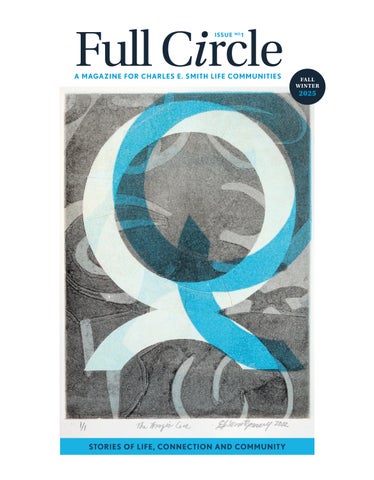
Full Circle Fall/Winter 2025

Page 1


Full Ci rcle

A MAGAZINE FOR CHARLES E. SMITH LIFE COMMUNITIES

LIFE CAN BE VIEWED AS THREE CONCENTRIC CIRCLES.

AT THE CORE IS FAMILY, THEN FRIENDS , AND THEN COMMUNITY.

OUR LIVES SHOULD BE DEDICATED TO BUILDING AND STRENGTHENING THESE CIRCLES IN MUTUAL SUPPORT OF ONE ANOTHER.

Welcome to Full Ci rcle

STORIES OF LIFE, CONNECTION AND COMMUNITY

Dear Friends,

In my first year at Charles E. Smith Life Communities (CESLC), one thing has become clear: we are who we are because of people like you - community members who give of their time, talent and treasure to support our mission to deliver quality care and meaningful life experiences to older adults, with dignity and compassion rooted in Jewish values.

Our story began more than a century ago with one man’s simple, but profound, act of loving kindness. When Hymen Goldman met an older Jewish man in need on the streets of D.C., he didn’t walk away. He rallied family and friends, found him a safe place to live, and in doing so, planted the seeds of what would become CESLC. That same spirit still beats at the heart of our community today in every moment of connection that makes this place feel like home.

And what a home it is. Every hallway hums with life. You’ll hear music drifting from the social halls, the clink of glasses at our weekly happy hours, a burst of laughter in the garden or a group of friends deep in a competitive game of mahjong. Our community is vibrant because of the people who fill it—and because of people like you who believe every older adult deserves to live with joy and purpose.

This spring at our Annual Sara and Samuel J. Lessans Healthcare Symposium, we explored the power of con-

nection and we learned that researchers have shown that strong social ties and a vibrant community are key to living longer, healthier lives. It is our community that sustains us.

That’s why we created this new magazine. Full Circle is replacing our Lifetimes newsletter and opens the doors a little wider so you can see, feel and experience what your support makes possible. Twice a year—in the fall and spring—we’ll share the stories of people and moments that bring CESLC to life.

What you’ll find in these pages isn’t just a snapshot of programs and events—it’s a glimpse into a community built on connection. From our origins to today, we have always been supported by people who want to make a difference in the lives of older adults.

I hope as you turn the pages, you see yourself in these stories—because you are in them. You are part of the laughter, the music, the friendships and the sense of belonging that make CESLC what it is. And I hope you’ll feel, as I do, that there’s no place quite like it.

FULL CIRCLE is published by Hebrew Home of Greater Washington, Inc., DBA Charles E. Smith Life Communities. Hebrew Home is a registered charity in Maryland and Virginia. A copy of our financial statement is available from the Maryland Secretary of State or the Virginia State Office of Consumer Affairs.

Kenneth H. Becker, Chair

Bruce J. Lederman, President/CEO

Angela Willingham, Vice President Resource Development Willingham@ceslc.org

Erica Heiney, Director of Communications

Laura McDaniel, Editor

Julie Babler, Creative Director

©2025 by Hebrew Home of Greater Washington 6121 Montrose Road North Bethesda, MD 20852

Contact us: giving@ceslc.org www.smithlifecommunities.org

Hebrew Home of Greater Washington 301-770-8476

Assisted Living 301-450-7433

Independent Living 301-450-7097

Hirsh Health Center 301-816-5004

ElderSAFE™ Center

301-816-5099

ON THE COVER EJ Montgomery

“Magic Cue,” 2012 monoprint etching 12” x 9”, ed. 1/1

photo credit: Greg Staley courtesy of Lily Press®

FEATURES

EJ Montgomery

Full Ci rcle

Power of Connection, an interview with Allison Gilbert

100 years ago, members of the community gathered to dedicate Hebrew Home for the Aged

ON Campus

LOTTE BUFF

KNITTING A LEGACY

Lotte Buff was a kind and generous person. She volunteered throughout her life, including delivering Meals on Wheels for decades. She was also very well known as a knitter extraordinaire, a well-deserved descriptor. Throughout her adult life she handknit more than 70 sweaters, dresses, coats, jackets and suits for herself, and knit items for her children, grandchildren and greatgrandchildren.

Her friends and neighbors at Ring House certainly admired her beautiful sweaters over the eight years she lived there, and upon her passing at one hundred three and a half years old, her family found a beautiful way to honor her time there and share that talent. At the celebration of her life at Ring House, the sweaters were displayed around the room, and Lotte’s family invited residents to choose a sweater to take with them.

Artist i c bonds

Artwork by Ring House residents and art students Rose Grossman, Ruth Birnbaum and Blu Berman was shown July 1-31, at Kensington’s Chesapeake Framing Company alongside pieces by their longtime instructor Martina Sestakova.

The exhibition, Artistic Bonds, was a celebration of the womens’ creative time, love of art history and the joy they find in each other’s company in the Ring House art room.

Learn more about this special collaboration on Martina’s blog: radostbymartinasestakova.com/news.

Residents Josie Traum (seated) and Elaine Schenberg, wearing Lotte’s sweaters. Lotte’s daughter, Janice Balin (standing) still volunteers regularly at Ring House.
PHOTO : Gary Landsman
RING HOUSE CONNECTIONS

ERIC MEYERS NAMED 2025 HYMEN GOLDMAN HUMANITARIAN AWARD RECIPIENT

Eric Meyers was named the 2025 Hymen Goldman Humanitarian Award recipient in recognition of his unwavering support and service to Charles E. Smith Life Communities, including his leadership as board chair during the height of the pandemic.

Meyers joined the Board of Advisors in 2010, joined the Board of Governors in 2015 and was chair from 2019 to 2021. He remains involved in the Board of Governors and serves as chair of the Strategic Planning Committee as well as a member of the Guardian Campaign Committee.

The Hymen Goldman Humanitarian Award was established in 1972 to remember Mr. Goldman by honoring and recognizing someone with a long-standing commitment to the organization whose leadership, philanthropic commitment and generous spirit reflected those of Hymen Goldman.

In his acceptance address, Meyers recognized contributions of others who also have led the board. “I accept this distinction on behalf of all those who have given of their time and imagination to prepare the path forward,” he said. “I hope that together we have made this organization a better place to work and this community a better place to live, for fully 115 years.”

In addition to his service to Charles E. Smith Life Communities, Meyers is principal at Meyers Hurvitz Abrahams LLC. He founded and operated The Capital Financial Group, a multi-faceted financial services firm, for almost four decades. Meyers is the former Maryland state captain for the American Association of Life Underwriting for Legislative Affairs as well as a member of the National Association of Independent Financial Advisors. He has held leadership positions for a variety of civic and community groups, including serving as past president of Temple Beth Ami in Rockville, Maryland.

HEBREW HOME EARNS NATIONAL QUALITY AWARD FOR THE SECOND TIME

Hebrew Home of Greater Washington has earned a 2025 Silver National Quality Award from the American Health Care Association and the National Center for Assisted Living.

The Silver Award recognizes organizations that meet progressively rigorous standards of performance to further improve the lives of residents and associates in long-term care.

Hebrew Home of Greater Washington is among less than 150 skilled nursing centers nationally and the only one in Maryland to earn the Silver Award this year. This marks the second time Hebrew Home has received this prestigious recognition.

Ruth Birnbaum, Untitled #9, acrylic on canvas
Rose Grossman poses with her artwork at the artist reception.
PHOTO : Audrey Rothstein
PHOTO : Gary Landsman

ANAND BALAJEE BALASUBRAMANIAN, PT, DPT

Program Director, Housing and Wellness Services

Associ ate Spotli ght

KEY RESPONSIBILITIES

As program director, I lead therapy and wellness services across all levels of care at Charles E. Smith Life Communities — including skilled nursing, assisted living, memory care and outpatient services in independent living. My responsibilities include ensuring clinical excellence, optimizing operational efficiency, mentoring a team of highly skilled clinicians and driving innovative care initiatives that enhance resident outcomes and overall wellness. I also collaborate closely with leadership, business development and medical partners to advance our mission of delivering exceptional, person-centered care.

EXPERIENCE AND EDUCATIONAL BACKGROUND

I joined CESLC in 2019, bringing with me more than 20 years of experience in physical therapy and more than a decade in regional rehab operations across Maryland, Virginia, West Virginia and Ohio. I hold a Doctorate in Physical Therapy from Loma Linda University, California, and am licensed in Maryland, Virginia and West Virginia. Over the years, I’ve led multi-site operations, developed specialized clinical programs and implemented strategies that have driven measurable improvements in care delivery.

WHAT I ENJOY MOST

It’s incredibly rewarding to see residents regain their independence and confidence through therapy. Supporting and mentoring my team is equally meaningful and one of the most fulfilling parts of my role.

RECENT INNOVATIONS

We’ve embraced cutting-edge rehab technologies like Mynd VR (virtual reality in rehab), VirtueSense (for neuro-reeducation and cognitive engagement), and zero-gravity treadmills for safe gait training and fall prevention. These tools have significantly enhanced clinical outcomes and resident engagement.

HOW I MEASURE SUCCESS

Success is a blend of clinical outcomes, patient satisfaction and operational performance. Internally, we evaluate efficiency, regulatory compliance and team engagement. I strongly believe true success occurs when our residents thrive, our associates feel supported and empowered and our services continue to grow. In short, if we can make a meaningful impact in the lives of our residents and their families — no matter how big or small — that is true success.

GUIDING PRINCIPLES

I believe in compassionate leadership, integrity in practice and the power of collaboration. My approach centers on empathy, accountability and excellence. CESLC’s values — Tzedek (doing what is right), Chesed (kindness), and Kavod (respect and dignity) — guide my daily work and leadership style.

FINAL THOUGHTS

I’m proud to be part of a community that leads with integrity, innovation and compassion. CESLC’s values not only define our culture — they elevate the impact of our work every day.

DOLLS AS THERAPY

Can baby dolls really benefit older adults living with dementia? Arlette Kesseng, director of nursing at Hebrew Home of Greater Washington’s SmithKogod Residence, had read about the potential therapeutic effects of dolls and wondered if it would work for residents, so she applied for a grant to buy baby dolls and bassinets and accessories like bottles and pacifiers.

“The first time I saw her smile was when I held a doll in front of her.”

She introduced the dolls to residents living in the memory care unit in early July, hoping to bring a smile to their faces, or maybe help soothe others who were feeling agitated or anxious.

The first session exceeded expectations. Kesseng says she’s now collected many stories of positive reactions.

She recalls one resident who typically keeps to herself, “The first time I saw her smile was when I held a doll in front of her. She took the doll and held it for about 10 minutes, and she was smiling the whole time.”

Now, at regular Thursday sessions, residents laugh, hug, cuddle, kiss and talk to the dolls, giving them the small moments of joy Kesseng hoped for.

This program was made possible thanks to a grant from the Harold & Shirley Robinson Hebrew Home Youth Philanthropy (H2YP) Program.

H2YP empowers high school students to learn about philanthropy by actively engaging in the grantmaking process. Over several months, students meet with Charles E. Smith Life Communities leaders, learn about the organization’s mission and programs, and assess grant proposals from associates.

This year’s program concluded with more than $25,000 in grant requests submitted. The students awarded $8,500 to five projects that support residents and enhance campus life.

PHOTO: Gary Landsman

WORD ON THE STREET

“The chi cks have hatched!”

SERVING THOSE WHO SERVE WORD

New life is hatching at Hebrew Home. Through partnerships with local farms and organizations, the recreational therapy team brings eggs and caterpillars to campus, giving residents the opportunity to witness the cycle of life for chicks, butterflies and ducks. After the animals are hatched, the ducklings and chicks return to their farms, while butterflies are released outside. The hatchings are live-streamed, allowing room-bound residents to participate and family, friends and community supporters to enjoy using the power of social media.

Rapid response from first responders is a vital part of keeping our campus safe. Associates across departments delivered dinner to three shifts of firefighters at Rockville Station 23 as a way of expressing their sincere gratitude for their support. The meals were thoughtfully prepared by our dining services team.

“Thank you!”

ON Campus

SNAPSHOT

Drum Ci rcle

LIFE AT LANDOW HOUSE

Residents of all abilities come to the Drum Circle at Landow House for the social connections, the chance to express themselves, lively mental stimulation and most of all for the joy it brings.

Unf i ltered

In this section, we feature a candid conversation to offer an authentic glimpse into the passion, expertise and experiences that shape our community. These unfiltered interviews are presented as they were spoken, edited only for length.

FOR THIS INAUGURAL EDITION, WE HEAR FROM DR. ELISA GIL-PIRES, OUR CHIEF MEDICAL OFFICER, ABOUT THE ART OF GERIATRIC MEDICINE AND PALLIATIVE CARE—AND THE PROFOUND RESPONSIBILITY OF WALKING ALONGSIDE RESIDENTS AND THEIR FAMILIES AT THE END OF LIFE.

n high school, I volunteered at a nursing home. I think that’s where I got comfortable with older people and people living with dementia. And then I got my first job there, so I have been in geriatrics since I was 15.

I coordinate care with our nursing team and our other teams and their families. Sometimes I may have a half-hour plan, but the person is not doing well, and so I need to call an emergency family meeting and a team meeting and now four hours of my day are gone because you just can’t take that stuff lightly. We handle that extremely delicately.

I’m helping them and their families in that last stage of life get the best out of their days and out of their life. And then I’m going to help them die. Peacefully, with dignity, the way that they want to.

It’s challenging for sure. It’s draining because you have to separate your emotions, obviously.

I’m a Leo. Leos are natural born leaders. I don’t study the horoscope or anything, but I think there’s some validity to it. I grew up in the middle of three brothers. I think that made me naturally become a little bit more resilient and tougher. And my mother is also a Leo and she’s really strong. And then, curiously, my daughter is also a Leo. She was born on my birthday.

That was her due date and she came on her due date. And my son’s due date was Valentine’s Day and he came on Valentine’s Day.

As I became more sophisticated in geriatric medicine and I learned to trust that there was an art component to this kind of work, I learned to trust my instincts, which every doctor does at some point.

I always tell my patients ‘I’m on this journey with you, you’re not alone, I’m going to guide you every step of the way and you have nothing to be worried about,’ and every single one of them says ‘Yeah, I’m not worried,’ because they know they’re not alone.

How many other careers or job specialties could you say ‘I had the privilege and the honor of holding that person’s hand when they left this earth?’ It’s a really special moment. It’s a really sacred experience.

People don’t come here to die. It’s really just an extension of the lives they were living outside of here. We’re just making it available and easier for them. You wouldn’t know this is a nursing home. You shouldn’t know this is a nursing home.

I don’t care for tv watching really. But WWE relaxes me after long days and weeks. Mindless, fun entertainment while admiring their athletic determination and passion for the job.

I have two geriatric dogs. I’ve only ever had old dogs, again, probably a sign I belong in geriatrics.

I have a rescue, he’s a dachshund, mixed dachshund. He’s like a big hot dog, wiener dog, he might be mixed with a basset hound. His name’s Fred. He looks like a Fred. And then the other one is Bear. She’s a mixed Australian shepherd. They’ve been raised together their whole life, so we took them both. They’re like 14 and 15 now. I’m preparing my kids for what’s coming because they’re older dogs. I’m just getting everybody ready for them. So geriatrics is my true calling, as you can see.

PHOTOS : Gary Landsman

{FULFILLING A MITZVAH}

Participating in the writing of a Torah is a rare and sacred opportunity to fulfill one of Judaism’s 613 commandments

THE TORAH PROJECT

riting is underway for a new Torah for Ring House, one of Charles E. Smith Life Communities’ two independent living residences, prompted by the need for a lighter Sefer Torah to make it easier for all who wish to lift, read and connect with the Torah. The new Torah is being fully funded by donations, and we are inviting the entire community to take part in this meaningful mitzvah.

Senior Rabbi and Director of Spiritual Life Daniel Braune-Friedman said the idea came to him when some of the clergy shared the older handwritten Sefer Torahs were too heavy to hold, and that made him realize that many of our residents never get to hold them.

Rabbi Shmuel Herzfeld is the scribe, and while he writes some every day from September through December, he will provide regular updates and will hold writing sessions at Ring House for members of the community who wish to witness the sacred process and even write a letter or word with him.

THERE ARE 304,805

LETTERS IN THE TORAH

PHOTOS: Lisa Helfert

THE TORAH SCROLL CANNOT BE WRITTEN FROM MEMORY. IT MUST BE COPIED WITH COMPLETE PRECISION BY A SOFER, OR SCRIBE, WHO IS SPECIALLY TRAINED IN THE LAWS THAT GOVERN BOTH THE WRITING AND THE ASSEMBLY OF THE SCROLL.

At an opening lecture in July, Rabbi Herzfeld shared the inspiration, meaning and process behind the new Torah, and explained the spiritual significance and the practical steps involved.

Participating in the writing of a Torah is a rare and sacred opportunity to fulfill one of Judaism’s 613 commandments—the mitzvah of writing a Torah. According to Jewish tradition, every Jew is obligated to take part in the creation of a Torah scroll. Even writing or sponsoring the inscription of a single letter is considered a complete fulfillment of this mitzvah.

Rabbi Herzfeld has completed 10 Torah scrolls, and said his dream is

he founded to make Torah study more accessible to all. A published author and host of the popular “5Minute Daf Yomi” podcast, Rabbi Herzfeld brings deep scholarship and joyful engagement to his work. He has written five full length books on the Torah, and has released a graphic novel called “The Making of a Torah Scroll.”

His connection to Ring House is especially meaningful—his parents are proud residents, and he is honored to write this Torah for a community that has become part of his family’s life. This will be the twelfth Torah he has written, a sacred milestone made even more special by his personal connection to our community.

CHARLES E. SMITH LIFE COMMUNITIES CURRENTLY HAS 8 TORAHS

We hope you’ll join us in fulfilling this sacred mitzvah.

to write 100 – 3 a year for the next 30 years. “Over the years, the more I do this mitzvah, the more I love this.”

Rabbi Herzfeld is a respected Modern Orthodox rabbi, educator and Torah scribe. He previously served as senior rabbi of Ohev Sholom—

The National Synagogue in Washington, D.C., and now leads Yeshivas Elimelech, an inclusive yeshiva

To learn more or make your donation, please scan the QR code or email us at giving@ceslc.org.

THE BEAUTIFUL LIFE OF AN ARTIST

PHOTO : John Woo
“FIRST LIGHT,” 2024, Screenprint, 22” x 15”
Montgomery’s print The Magic Cue is the cover art for this issue.

BECAME A POSITIVE FORCE AT HEBREW HOME, WHERE SHE WAS KNOWN AS MISS EJ.

No matter what part of EJ Montgomery you first discover—the artist, the curator, the connector, the fierce friend—you’re going to love her and want to know more.

Let’s say you first see some of her prints. Modern, lively, strong. And then you see a more recent series of pieces that are softer, more detailed, with a touch of whimsy. Either way, they draw you in, you’re hooked.

And the more you learn about her, the more there is to her story. She was a force, in so many ways. Her friends

and family use that phrase to try to capture her, as even they struggle to pay proper homage.

They offer that she was quietly proud of her work as an artist but also amazed at how people responded to it. And they all tell about the print she completed at age 94, which would turn out to be her last.

Given the rigors of the process, creating a print is an impressive achievement for any artist, much less at the age of 94. That she had been living with Parkinson’s for many years made it all the more notable. Or maybe

they mentioned it because of the piece itself, a lovely composition of vibrant color and movement, energy all but jumping off the page.

Her collaborator in printmaking was Susan Goldman, a master printer and accomplished artist, filmmaker and teacher. They had worked together since 2010 and had forged a deep friendship as well as an artistic bond.

Their collaboration on First Light took place over several months. They started the process at Hebrew Home, where EJ lays the foundation for the piece. This involves drawing in black on tracing paper, creating five unique pages, one for each color she wants in the final print. She has

Photographs courtesy of Lily Press®
PHOTO: Erwin Thamm, courtesy of Lily Press®

always liked calligraphy, circles, lines and other interesting elements, which over her lifetime have become her own vocabulary of marks. Drawing on this repository, she confidently brings her idea to the pages. She already knows the color palette and where and how the marks will interact, so this initial part of the process flows smoothly.

Susan takes the drawings to her studio to make film positives of the five pages, and mixes the colors to EJ’s precise specifications in preparation for printing day.

When that day comes, EJ is in the studio for the printing work. It’s a bit of a party, as several other colleagues have come to help, there’s music, and, carefully away from the paper and ink, snacks. The vibe in the studio is joyful, their efforts are productive and the prints are completed.

For the final step, Susan holds some paper to keep her signature precisely where they want it, EJ carefully signs all 20 of the prints.

There’s something else special about this piece. Unlike most of the other prints they made together, this time EJ has had a name in mind all along. In the past, Goldman says they often spent a lot of time thinking about what a piece had to say and talking over various words and taking time to name it. This time, EJ knows the piece will be called First Light, a nod to water sparkling at dawn when the sun is coming up.

DURING HER YEARS AT HEBREW HOME, ARTISTS WOULD COME TO PAINT WITH HER, AND VISITORS

LEARNED TO BE PREPARED FOR SOME ARM TWISTING TO TAKE HER SOMEWHERE

THE BEAUTIFUL LIFE OF AN ARTIST

Montgomery‘s astounding body of work spans more than six decades, including sculpture, metal work, textiles, painting, printmaking, photography and mixed media, and it is shown in galleries across the country. Goldman considers her one of the three mothers of African American art, along with Samella Lewis and Elizabeth Catlett. All three broke boundaries and were at the forefront of advocacy for artists of color, women, and, as Goldman says, “everybody.”

Montgomery also was a respected curator who organized more than 200 exhibitions in her career. She was appointed art commissioner and chair of the Art Committee of San Francisco by then Mayor Moscone. She later worked for the United States Department of State, fostering fine art programs in the U.S. and internationally.

Her career is well documented, the early work painting doll faces, then jewelry design and coming into view with her metal works, then moving into printmaking. Advocating for and mentoring artists, organizing voices that didn’t otherwise have an audience, working within city and national government for art as diplomacy.

The stories of her as a friend and family member are less well known. In her family, she was known as Vangie. And while her family appreciated her achievements, they loved the kind woman who lit up when she saw them coming down the hall to visit her. She had stood beside mayors and was often invited to the White House, but they knew the real Vangie as the queen who loved to win a quarter at bingo.

Her friends and family were planning a party for her 95th birthday on May 2, 2025, but Montgomery died May 1. The event at Hebrew Home was held as scheduled, as a celebration of life where many of the people who were better for knowing her told of the enormous impact she had on their lives.

SHE HAD STOOD BESIDE MAYORS AND WAS OFTEN INVITED TO THE WHITE HOUSE, BUT THEY KNEW THE REAL VANGIE AS THE QUEEN

WHO LOVED TO WIN A QUARTER AT BINGO.

Stephany Neal tells of meeting EJ at the behest of another artist friend – this is how the stories go, EJ had contacts in every corner and she saw fruitful connections before anyone else. Stephany has returned to the U.S. after working as a contractor with performing artists for the State Department in Paris, and meets EJ who mentors her in programming visual artists. Neal had already established an impressive career, but Montgomery helped Neal expand her repertoire. For instance, Neal organized The Color in Freedom Experience—An Interactive Journey along the Underground Railroad, a 52-piece exhibition shown, among other places, at the U.S. Mission in Geneva, and it is still touring.

In addition to this professional meeting of the minds, they became the closest of friends. EJ also befriended Stephany’s granddaughter and spent time with her doing things like painting a little tea set, and later helped her get a good internship at the Smithsonian that helped her become a rising star at Pace University, where she is a film student who is already collecting awards for her work.

During her years at Hebrew Home, in addition to her collaborations with Goldman, other artists would come to paint with her, and visitors learned to be prepared for some arm twisting to take her somewhere. “EJ would go somewhere every day if someone would take her. Every day,” Neal says. And each time Neal agreed to take her on an errand, ostensibly one destination at the outset, they ended up traveling from Maryland to D.C. to Virginia

“I WAS ALWAYS VERY IMPRESSED

and back. Every time. She also loved to eat, and the two of them became well known at the Silver Diner as the ladies who ordered nine pieces of bacon and a stack of quinoa pancakes.

One time Neal was trying to get Montgomery returned in time to pick up her granddaughter from school, but Montgomery insisted they swing by the airport to pick someone up. He’ll be standing at the curb, it’ll only take a minute, she cajoled. Neal objected, committed to keeping her after school McDonald’s date with her granddaughter, which stopped Montgomery not a bit. All of them joined the child for a burger and fries. No matter that the gentleman was an esteemed scholar in town to give a keynote speech at a conference, to Montgomery he was just a guy who needed a ride and some lunch. “She was quite a character, that EJ,” Neal says. “I miss her.”

volleyball and participating in pet therapy, ice cream socials, trivia, as well as having a voice in the residential council and the food committee. She was kind to everyone there and was beloved by residents and associates alike. “I was always very impressed by her ability to be so present and so helpful,” Goldman says. “Everyone knew her and loved her.”

BY HER ABILITY TO BE SO PRESENT AND SO HELPFUL. EVERYONE KNEW HER AND LOVED HER.”

Goldman is who suggested Hebrew Home to Montgomery, when the time came. Goldman’s father had lived in independent senior living at Revitz House and then segued to Hebrew Home, and Goldman was impressed with the life he had there. In turn, Montgomery became a positive force at Hebrew Home, where she was known as Miss EJ. She joined in on the fun to be had, playing balloon

LEARN MORE: PRINTMAKING LEGACY PROJECT

To learn more about EJ Montgomery you may enjoy watching this documentary, produced by the Printmaking Legacy Project. Susan Goldman is the director of this group that works to preserve and disseminate the legacy, history, practice and understanding of the fine art of printmaking to the national and international arts community, students and the general public. The project documents the collaboration among universities, workshops and professional print studios and how their participants fundamentally changed the course of development in American printmaking and American art.

SCAN TO WATCH

Montgomery and Stephany Neal at The Kemper Museum of Contemporary Art, in 2017, at the exhibition Magnetic Fields: Expanding American Abstraction, 1960s to Today. The exhibition was the first U.S. presentation dedicated exclusively to the formal and historical dialogue of abstraction by women artists of color. Montgomery was one of the artists.

EJ MONTGOMERY

EJ Montgomery’s career began at age 14 when she was given an oil painting set. After graduating from high school in New York, she moved to Boston where she worked painting faces on dolls and religious statues. In 1952 she married Ulysses Montgomery, an engineer, and they moved to Los Angeles where she began working with Thomas Usher, an African American jewelry designer. She earned an associate’s degree in art from Los Angeles City College, and then studied metalsmithing at California State University in Los Angeles. She later earned a Bachelor of Fine Arts from the California College of Arts and Crafts, (now California College of the Arts) in 1968. She did additional studies in African/African American Art History at California State University, Berkeley.

EJ
PICTURED ABOVE: Portrait of Evangeline J. Montgomery (1973), Oakland Post Photograph Collection, MS 169, African American Museum and Library at Oakland, Oakland Public Library, Oakland, California.
{ENRICHING LIVES }

The Power of Connection

For generations, Dr. Ruth Westheimer broke barriers and brought joy, candor and courage to conversations that shaped our lives. In her final book, The Joy of Connections, co-authored with award-winning journalist Allison Gilbert, she reminds us that relationships are not just meaningful—they are essential to health and longevity. In this exclusive Q&A, Allison shares insights from her collaboration with Dr. Ruth, offering practical wisdom and heartfelt inspiration on how to nurture joy and connection at every age.

Allison Gilbert

Co-Author of The Joy of Connections, with Dr. Ruth

Westheimer

“Our goal was simple: to offer practical, uplifting strategies for building and maintaining meaningful relationships at any age.”

AAngela Willingham: I’m so delighted to talk about Dr. Ruth Westheimer and The Joy of Connections with you, Allison. But first, I have to share a quick story. I grew up in the 1980s watching Dr. Ruth with my grandmother, and it always felt a little mischievous because no one talked about sex openly back then—certainly not in small-town Oklahoma. We’d sit together watching this tiny Jewish woman with a thick German accent say things we’d never heard on television. Nannie would blush and giggle, and her giggle would make me giggle, until we were both laughing so hard we were crying. Honestly, most of the time I had no idea what we were laughing about—but it didn’t matter. It was pure joy! In a way, Dr. Ruth helped me feel connected to one of my favorite people even back then, so it’s a true full-circle moment to be talking with you now. What inspired you and Dr. Ruth to write The Joy of Connections?

Allison Gilbert: Thank you so much for sharing that memory with me! I’m sure many people reading this will have their own fond recollections of Dr. Ruth – she was an American icon and I’m so very honored to do whatever I can to ensure that her legacy endures.

Dr. Ruth and I met when I was writing a story about her for The New York Times Dr. Ruth was deeply concerned about the loneliness epidemic, having grown up an orphan of the Holocaust and surviving the death of Fred Westheimer, her beloved husband. Prolonged social isolation can increase the risk of dementia, cardiovascular disease, stroke and early death.

When we decided to write The Joy of Connections, our goal was simple: to offer practical, uplifting strategies for building and maintaining meaningful relationships at any age. Friendships, connection to family, romantic partnerships, bonds with neighbors and the ties we have to community groups – have all been proven to make us happier and help us live longer.

AW: The book focuses on how meaningful relationships enrich our lives. Why do you think this message is so important—and so timely— right now?

AG: The former U.S. Surgeon General Dr. Vivek Murthy declared loneliness an epidemic and now the World Health Organization is calling for massive changes in how we think about our overall health and well-being. It’s no longer just essential to think about our physical health and mental health. We must now consider our social health. For older adults, the consequences of ignoring social health are particularly severe – but fixable. Investing in our relationships is medically urgent. The more we nurture connection, the more we protect our health and longevity.

AW: I love how both you and Dr. Ruth bring such different perspectives to this topic. How did your backgrounds complement one another as you wrote the book?

AG: Dr. Ruth brought decades of expertise in human relationships, always with her trademark candor

and humor, while I contributed a deep focus on storytelling and research into the science of social health. Together, we blended her wisdom with actionable, evidencebased advice. Readers will also gain new insights into Dr. Ruth’s remarkable life – stories they’ve never heard before.

AW: Why is social isolation — and conversely social connection so crucial for healthy living for older adults?

AG: Older adults are more likely to face life transitions—retirement, loss of a spouse or changes in mobility—that can shrink social circles. Yet staying socially engaged improves memory, boosts immunity and even lengthens life. Connected older adults have a lower risk of depression, heart disease and cognitive decline. In short, friendship and community are powerful forms of preventive medicine.

AW: Can you share one or two simple, practical ways we can all strengthen our connections with others?

AG: Start small. Call one relative on the phone today just to say “hello.” Invite one neighbor to share a cup of tea. Scheduling “connection appointments” can make reaching out a habit, not an afterthought. When you weave joy into these moments—through laughter, shared stories or simply being fully present—they become the glue that holds relationships together. Joy isn’t an accessory to connection; it’s the fuel that keeps it alive.

AW: Why do you believe joy is such a vital part of building meaningful relationships?

AG: Joy creates positive memories, and those memories draw us back to one another again and again. Especially for older adults, moments of joy can counteract feelings of isolation and give us energy to keep participating in life. Joy makes connection feel less like a chore and more like a gift.

AW: Gratitude and kindness come up a lot in your writing. How do they fit into the larger picture of cultivating connection?

AG: Gratitude shifts our focus from what’s missing to what we have, helping us notice and appreciate the people around us. As for kindness, it not only benefits the recipient, but it simultaneously boosts the giver’s mood and sense of being important to others. Studies show that small acts of kindness can increase happiness and reduce feelings of loneliness. Together, gratitude and kindness form a daily practice that have the power to strengthen the foundation of any relationship.

AW: If you could leave us with one lasting message about the power of connection, what would it be?

AG: Connection isn’t just something we “get” from others—it’s something we can nurture and actively create. Especially as we age, relationships become an essential source of physical health and overall well-being.

AW: Thank you, Allison, for sharing your insights with us. We are so thrilled you’ll be the featured speaker at our annual President’s Circle Dinner in November, and we can’t wait to learn even more from you and what it was like to work with the incredible Dr. Ruth!

Until November, join Allison on Instagram @itsallisongilbert

“Connected older adults have a lower risk of depression, heart disease and cognitive decline.”

LIVE IN THE LAYERS LIVE IN THE LAYERS

{ENRICHING LIVES }

EXPRESSIVE WRITING AND CREATIVE AGING

“Live in the layers, not on the litter.”

These mysterious lines came to poet Stanley Kunitz in a dream. He was in his mid-seventies when he wrote “The Layers,” which soon became one of his most celebrated poems. At the time, Kunitz was grieving the loss of several close friends and believed he was near the end of his life. (He wasn’t, in fact! He was 95 when he served as U.S. poet laureate, and lived to be 100.)

I often teach this poem in writing classes for older adults. Its core metaphor of geological layers urges us to value the richness of our past over the surface-level “litter” of regrets or hardships. Kunitz’s poetry is rich with themes of transformation and self-renewal—an invitation to keep exploring, no matter our age.

You don’t need to be a poet laureate to find joy in writing and your own creativity. Whether it’s through journaling, letters, memoir or poetry, writing is one of the most accessible ways to make sense of our lives. And it requires no special

equipment—just pen, paper and the time to reflect.

In fact, writing supports not only personal growth, but our physical and mental well-being. Psychologist James Pennebaker was the first to study the benefits of “expressive writing” for health. His research participants wrote for only 15 to 20 minutes over several consecutive days, focusing on meaningful life experiences. Pennebaker instructed them to connect thoughts to feelings and develop detailed narratives—rich with sensory images, active verbs and other elements of vivid writing. The results were striking: participants experienced better immune function, lower blood pressure, fewer doctor visits—even quicker recovery from surgery. These benefits are similar to those offered by meditation, talk therapy or exercise.

At Ring House, residents have the opportunity to explore this kind of personal expression through our ongoing writing program. Led by a professional instructor, the class invites participants to experiment

with poetry, memoir and other creative forms. Residents share their work, reflect on their experiences, and often discover new meaning in familiar memories. The supportive, workshop-style environment encourages self-discovery and connection.

Through writing, they can witness and celebrate the stories that have shaped them and create a legacy to share with loved ones.

Poetry and storytelling programs are frequently offered at Charles E. Smith Life Communities. But the power of creativity to heal and reveal is not limited to the written word. As many residents can attest, the arts provide more than entertainment—they’re a bridge to memory, healing and self-expression. Whether through music, storytelling, drama or cultural outings, many residents are rediscovering their passions, exploring new talents and connecting deeply with themselves and each other.

For Anna, a resident of Revitz House, the journey back to music has been especially meaningful. Born in Russia, she took piano lessons as a young child and fell in love with music. But Anna’s early joy was cut short when her family fled Russia as refugees and began a new life in the United States. It wasn’t until years later, as an older adult living at Revitz House, that she returned to the piano.

Taking lessons again has been deeply moving for Anna. “It brought

IF YOU’RE CURIOUS TO TRY EXPRESSIVE WRITING YOURSELF, HERE’S AN EASY WAY TO BEGIN:

Write for 20 minutes a day, over three to five consecutive days.

Find a private, comfortable space, or invite a friend to try the practice with you.

Choose a meaningful life experience to write about.

You can start with a simple prompt like “I remember…”

As you write, connect your feelings to your thoughts.

You can use a prompt like “Back then, I felt… but now I see…” to reflect on your life.

back pleasant memories of my life as a child,” she shared with Executive Director Diane Stern. “And now, it gives me great pleasure.” She now participates in recitals at Revitz, where she shares her music with the community—a source of pride and healing.

Her story is just one of many at Charles E. Smith Life Communities. Through arts programming, residents have access to performances at local theaters such as Strathmore Music Center, National Theater, and Olney Theater. Another dynamic partnership is with Theater J, a Washington-based professional theater that celebrates and explores the Jewish experience and the universal human condition. For some residents, it is their very first time attending a professional show. “I never imagined I’d see a live play,” one resident said after an outing. “It was magical.”

These moments—whether sparked by poetry, music or a simple return to a long-lost passion—remind us how creativity can help us reconnect with ourselves. The arts give shape to memories, meaning to our experiences, and sometimes, even a new beginning. Engaging in creative practice can help us renew and celebrate our layers. Like Stanley Kunitz, we might find that we, too, are not done with our changes.

Rachel Moritz is the author of two books of poetry. She is based in Minneapolis, and has taught life writing, memoir and poetry classes to writers 55-plus in communities throughout Minnesota.

Photo credit: Maya Washington

OUR Past FROM THE ARCHIVES 1925

community gathered to dedicate Hebrew Home for the Aged at 1125 Spring Road, NW, Washington, D.C. With room for 35 residents, the building was a bold step forward for the mission that began 15 years prior. It also laid the cornerstone for what Hebrew Home has become today. Now, as Charles E. Smith Life Communities, we are a vibrant, welcoming campus where nearly 1,200 older adults find care, joy, connection and purpose.

Hebrew Home of Greater Washington

6121 Montrose Road

North Bethesda, MD 20852

RETURN SERVICE REQUESTED

A

When Hymen Goldman met an older Jewish man in need in 1910, he took action—an act of gemilut chasadim (loving-kindness) that planted the seeds of what is now Charles E. Smith Life Communities.

Today, our annual Guardian Campaign donors carry that same spirit of loving-kindness forward, making contributions that help Hebrew Home of Greater Washington provide exceptional skilled nursing and rehabilitation, a vibrant spiritual life, engaging recreational therapy, and safety through ElderSAFE™ Center—ensuring every resident is known, valued and celebrated, no matter their ability to pay.

Turn static files into dynamic content formats.

Create a flipbook
Issuu converts static files into: digital portfolios, online yearbooks, online catalogs, digital photo albums and more. Sign up and create your flipbook.
Full Circle Fall/Winter 2025 by ceslc - Issuu