This publication is intended for information purposes only and the information herein should not be applied to specific fact circumstances without the advice of counsel.
The British Columbia Branch of the Canadian Bar Association represents more than 6,500 B.C. members and is dedicated to improving and promoting access to justice, reviewing legislation, initiating law reform measures and advancing and improving the administration of justice.
BarTalk Publication sales Agreement #40741008
Choice in Supports for Independent
Living (CSIL) Home Support Program
Congratulations to lawyers Ken Kramer, Tim Louis and advocate Roger Jones, for their work to improve the funding available for people with disabilities who require home support services.
Isidore Starr Award
The Isidore Starr Award was presented to Dr. Wanda Cassidy (Centre for Education, Law & Society [CELS] and Faculty of Education at SFU) for her work in law-related education. Dr. Cassidy is the only non-American to receive this prestigious award for excellence.
Future Wipeout Star?
Victoria criminal lawyer Paul Pearson of Mulligan Tam Pearson auditioned for Wipeout. Ten semi-finalists will reportedly be announced on August 9. Good luck, Paul Pearson!
\ Watch Pearson’s funny audition tape
http://www.youtube.com/ watch?v=joW2InT2nR4
Write Us
send your Letters to the editor to:
Deborah Carfrae
BarTalk editor
The B.C. Branch of the Canadian Bar Association fax: 604-669-9601
Note: BarTalk undertakes every effort to publish letters to the editor, subject to space and editorial discretion. Letters to the editor can also be found in BarTalk Online at www.cba.org/bc.
LAW WeeK 2011 VANCOUVeR
KUDOs
CITIZENSHIP CEREMONY
BARRY SULLIVAN LAW CUP
DIAL-A-LAWYER
PUBLIC FORUM
OPEN HOUSE
Photo credit: Patricia Jordan
Inside This Issue
Our accomplishments arise in part from the wisdom and experience of others. for younger lawyers or sole practitioners, obtaining that foundation can be difficult. Mentoring addresses this. We look at the many ways mentoring occurs in the B.C. legal community.
News and Events
2 Choice in supports for Independent Living (CsIL) Home support Program
Isidore starr Award future Wipeout star?
Law Week 2011 – Vancouver Photos
18 CLC Offers Inside Track on New Developments in the Law
CBA skilled Lawyer series
TRU Names Wally Oppal as Chancellor
19 Training Administrative Tribunal Members on the Charter
fred Headon elected 2nd Vice-President
Anne giardini Wins R.V.A. Jones Award
20 Law Week 2011 – fun Run Photos
get Mentored – Receive CPD Credit
CLeBC Update
21 Legislative Update
Branch & Bar Calendar
Law Week 2011 – Kamloops Photos
22 Health & Wellness TIP
Obtaining Oral Reasons for Judgment – B.C. Court of Appeal
6th Annual Pro Bono Appreciation Breakfast
Lawyer Referral service (LRs)
25 2011 golf Tournaments
F ROM T HE P RESIDENT
Young or Old We all need mentors.
“As
you walk down the fairway of life you must smell the roses, for you only get to play one round.”
– Ben Hogan
As I write this, my penultimate BarTalk column as CBABC President, my mind is awash with many thoughts – this issue’s topic of young lawyers and mentoring; my own first steps in the CBA as a young lawyer; my recent attendance at Don Brenner’s special sitting; and the obvious, if not sentimental “circle of life” analogy that comes from introspection.
At the risk of becoming sentimental, I must confess that this year has been an emotional one. By that I mean that I
have encountered so many people and been affected by their stories about how they have found their way into law and have fared in this most jealous of professions.
While I have expended my own energy, I have been the recipient of so much more energy in return –particularly from our younger lawyers who are embarking on their own lifelong journey in the law. All of them have been eager, idealistic and not just a little bit terrified. They are entering a world in which technology has changed the pace of life and work in a fundamental way and there appears to be less time for them to learn from their more experienced colleagues.
This brings us to mentoring. We have excellent formal mentoring programs through CBA and our various Forums and Sections. They continue to be well supported by lawyers and appreciated by young lawyers.
At the same time, there is so much opportunity for informal, sometimes brief mentoring in every interaction
spite my lack of finesse, and happily picked up the slack when one of our party pulled up injured midway through the round and our foursome was reduced to three.
He made the experience fun and relaxing – I hadn’t picked up a club in more than 10 years and he appreciated that. He made our score look respectable. He made us want to play together again the next year.
we have with each other. Whenever we enter into a situation with a desire to learn, or an offer to pass on an experience, or a way to demonstrate good judgment or a calm demeanour, we are mentoring each other.
Thankfully our profession is full of willing mentors and mentees – some young lawyers, and some (like me) not so young lawyers.
This brings me to the late Honourable Don Brenner, QC. I was privileged to get to know him over the past few years because of my role on the CBA Executive. He was the consummate mentor –generous with his time, accessible, and a great listener.
At last year’s CBA/VBA golf tournament I joined him in a foursome, and had the opportunity to spend a relaxing afternoon with him.
Some would say you can tell a lot about people by how they play golf. Don metaphorically “smelled the roses” during the round I played with him. He was calm, de-
As a younger lawyer, I was learning a lot from Don, even in the most informal of circumstances on the golf course.
Of course, we won’t get to play together again. But we can learn from Don’s approach to life. Take on every challenge with vigour and enthusiasm. Make those around you feel important and valuable. And always, always take the time to smell the roses on the way.
I look forward to seeing you at the golf tournament this year on June 16. Yes, you do have the time and it is for a very good cause – to support our law students.
By the way, our “threesome” is looking for a fourth – a ringer with patience and a good sense of humour!
See you there.
Stephen McPhee president@bccba.org
E x ECUTIVE DIRECTOR
CAROLIN e N e VIN
Starting Fresh keeping your love of the law alive.
spring is truly sprung, and we’re entering a quieter period in the legal calendar. It’s a good time to look at where we might refresh what we’re doing, and revisit ideas about how we’d like things to look a little different in our lives by the time things get back up to speed in the fall.
I’ve spent a lot of time talking to lawyers about the challenges they face in daily practice, and some of the discrepancies they see between their ideals of life in law (“making a difference”) and the more mundane realities of their current practices. There are a limited number of legal positions in social justice or other helping agencies, and even fewer that pay well. The trick for most lawyers, then, is to make changes within their current environment.
First, I want to recommend some excellent resources that you have on hand should you be seriously unhappy where you are. The Lawyers Assistance Program (LAP) offers several workshops about examining alternate career options. PPC Canada (formerly Interlock) has great counselling available. Finally, the CBABC‘s legal recruitment supplier, The Counsel Network, will talk with you about options at any time.
Second, the straw that often breaks the lawyer-camel’s back is not the sheer volume of work, but the lack of power to set one’s own priorities within that pile of work. Remember the Psych 101 research on monkeys given random shocks? They developed ulcers (and probably psychoses) from never knowing from one moment to the next when something bad was going to happen to them. For single and small firm practitioners, this is a personal time and client management issue. For larger firms and departments, while you’ve
hired the best and the brightest to work with you, have you considered whether there is a more collaborative and engaged way of setting workload priorities (including the opportunity for some work of special interest to the lawyer)?
Third, is it truly unreasonable to set clearer client expectations regarding access and turnaround? I know there’s a perceived power imbalance, and people tend to put this on the “too hard” pile. But there are ways to mitigate even the most inevitable intrusions, and to at least consider the possibility of reframing the client’s expectations in terms of extra value you can bring to the task with a different timeline. Here is the key question: What is the behaviour you seek from clients to make your law firm/department an attractive place to work, and how will you put this into action? This is a management issue, but it’s also an individual lawyer issue.
Fourth, we come to the critical matter of collegial interaction. This is not a social “nice-to-have;” life in the law is significantly more satisfying when you aren’t feeling isolated. The Law Society has identified mentorship and interaction with others as critical to the development of excellent lawyers (especially with respect to courtroom advocacy skills). Anyone who has been a mentor will tell you that the return is often much greater than the investment – the pleasure of sharing one’s experiences, and learning from another’s perspective on the law, is often a rejuvenating “jolt” that invigorates both parties. So is time spent in CBABC Section meetings; often cited as one of the most enjoyable aspects of life in the CBA, and providing opportunities to learn and talk with other lawyers about areas of law you all care about. Make a “fresh start” this year and commit to getting out of your own office to talk with others about legal and life matters – it is a very important contributor to keeping you intrigued about, satisfied with (and competent in!) the law.
Caroline Nevin cnevin@bccba.org
nothingofficial
TONY WIL s ON
Come to the Annual Conference in Vegas Gamble on 12 CPD credits.
Ihave been on dozens of professional committees in my long and illustrious career at the Bar, but I’ve never been on one more interesting than the Organizing Committee of our B.C. Branch’s “Annual Conference Somewhere Reasonably Hot For 12 Easy CPD Credits While Possibly Hungover” Committee.
I confess the last thing I need are more CPD credits. Writing, lecturing, pontificating, teaching and bragging as much as I do for CLE, CBA, CFA, IBA, INTA, BCLI and SFU, I had more than 80 CPD credits last year. Next year, I’m planning to trade them like carbon credits for cases of New Zealand Pinot Noir with the poor sods who never have enough. But having gone to past years’ conferences in Phoenix and LA, I think it’s fabulous and would encourage you all to fly to Vegas to attend this year’s brew-ha-ha; if not for the 12 CPD credits, then for the
copious amount of wine that seems to find its way to the bathtubs of the CBA hospitality suites, which is always paid for by the Branch’s immediate Past President, who traditionally dresses as Elvis on the conference’s first night. And if we’re lucky, Wally Oppal, QC may speak about sports. Or law. Or something.
The most interesting experience I’ve had on the Committee has been the hours and hours deciding on the name of a seminar that dealt with the prostitution laws in Nevada, or lack thereof, without offending anyone, and while making it legally relevant. There was “Sex and the City” (Zzzzzzz), “Sex, Law and Outlaws” (truly boring), “The Laws of Sin City”(truly unoriginal), and “No sex please... we’re lawyers” (truly untrue). I wanted to call it “Come to the Sex Seminar,” but I was outvoted because it didn’t have the word “law” in it.
Anyway, here’s a few of the other programs that are sure to be
are not available for this session. Offered Saturday night, around midnight. Appropriate dress required. No weirdos please.
offered at this year’s Conference between November 17 and 20 at the Cosmo in Vegas: U.S. Constitutional Law – A Primer: There’s an outfit in Vegas that caters to people from Canada who want to shoot guns to test America’s very strange constitutional laws. I for one would love to learn how to shoot an AK-47 in case Sarah Palin is correct and The End of Days is just around the corner. Or in case of Zombies. So for one CPD credit, you’ll learn everything you have to know about U.S. Constitutional Law, as well as how to shoot M-16’s, 9mm Glock’s and AK47’s. Offered at 7:30 a.m. Sunday, just before church.
Brothel Law: Another interesting session designed to whip up controversy is the Vegas Brothel Law lecture, lead by Madame Sindi Spankalot, an experienced legal expert. Two CPD credits are available for this activity. Ethical/ professional development credits
Gaming Law: 1.5 CPD ethics credits are available for this session, to be held on the $20 Blackjack tables at the east end of the Cosmo. The theme of the session is that gambling is morally evil and wrong. You will learn rules, options, advanced betting strategies and master charts for blackjack, including simplified card counting methods and how to get free rooms just for playing. The session will run for eight hours starting Sunday at 11:00 a.m., just after church. Serious players only.
Pharmaceutical Law: Offered Saturday morning at 8:30 a.m., this session will examine the legal issues surrounding the claims made by drug companies. What drug is the best cure for a hangover? Tylenol? Midol? Advil? Motrin? Cialis? Viagra? Attendees will be selected at random to perform a “blind test” of the various remedies and assess the validity of the claims. Two CPD credits.
What happens in Vegas stays in Vegas. Unless you bump into me. Operators are standing by for your bookings.
ontheweb
PATRICIA JORDAN
CBA Resources for Young Lawyers Committees,
Conferences, Forums and Sections.
The Canadian Bar Association (CBA) is dedicated to helping lawyers do their jobs better and advocating on their behalf. The British Columbia Branch of the CBA (CBABC) can introduce you to young lawyers nationwide and assist in developing your networking skills through its Committees, Conferences, Forums and Sections. Young lawyers can build expertise in their areas of practice and gain visibility through participation in Sections and Forums at both the National and Branch levels. Almost two-thirds of all members are involved in the CBA’s 41 National Sections and Conferences.
As a CBA member, you will receive valuable discounts on communications, entertainment, office supplies, and professional and travel services, in addition to many other benefits.
Learn about these discounts in “Member Savings” under “Membership.” All CBABC members receive free access to lawyer and law firm listings in the B.C. Lawyer’s Directory website at www.bccba directory.org.
As a benefit of membership, lawyers have access to Practice Advisory Panel (PAP) listings of senior practitioners who volunteer to assist other lawyers seeking advice on a particular aspect of the law. The PAP member has usually practised for more than 10 years, and is generally so experienced in their particular area of law as to be capable of making a presentation on the subject. Another benefit of membership is the online CBABC Mentoring Registry that connects mentors and mentees by area of law and location. It can be accessed through links on the Law Society of British Columbia website and the CBABC website.
All CBABC members are welcome to participate in their
CBA PRACtICeLINK PoDCASt
Young Lawyers: How to Take the Nightmare Out of Networking \ www.cba.org/CBA/YoungLawyers/Main/podcasts.aspx
Section’s listserv and articling/law students who are members are welcome to participate in the Articling/ Law Student listserv. CBABC listservs are discussion groups that are provided and administered by CBA for the professional benefit of its members. Section listservs are available to any Section where 20 Section members express an interest in participating. Send an email to pjordan@bccba.org to join.
Visit the “Law Student and Young Lawyer Resources” page in “Practice Resources” at www.cba. org/bc for more information.
DID You KNoW?
Law school students can enjoy all the benefits of CBA membership for just $20.
Articling/Bar admission students pay just $82.43 to join the CBA.
CBABC articling and law students are eligible to receive three free Section enrolments.
This 29-minute podcast offers young lawyers useful tips on how to navigate the sometimes daunting world of networking. Produced by Young Lawyers-CBA, it discusses the importance of creating relationships and provides advice on how to start that process at a fictional wine and cheese function.
CBABC ARtICLeS ReGIStRY – CALL FoR LAW FIRMS
The Articles Registry (Registry) was developed by the CBABC as a searchable database where law firms may post their need for an articled student, specifying length of articles available and practice areas. Students can search for available articles by interest, location and start date. The Registry is available at www.cba.org/bc in “Practice Resources.”
Create an account today! There are many law students who are currently seeking articles in British Columbia.
Patricia Jordan is the CBABC Web Manager. She welcomes your comments, questions and suggestions. Tel: 604-646-7861; Email: pjordan@ bccba.org; visit: www.cba.org/bc.
practicetalk
DAVID J. BILIN s KY
Getting Back in Touch With the Future Opening
your mind to reverse mentoring.
r Change your thinking Change your mind Back to the future...r
– Music and Lyrics by D. Ross, B. Wray, J. Wray; recorded by Diana Ross.
When one thinks of mentoring, one tends to think of the sage, wise counsel passing along his or her accumulated wisdom to the younger generation. While there is considerable need for this to occur, it is not the only mentoring that can take place in a law firm. Matt Starcevich, PHD, in an article: “What is Unique about Reverse Mentoring, Survey Results,” in www.coachingandmen-
toring.com quoted Alan Webber, the co-founder of Fast Company in describing reverse mentoring (“RM”),“It’s a situation where the old fogies in an organization realize that by the time you’re in your forties and fifties, you’re not in touch with the future the same way as the young twenty-something’s. They come with fresh eyes, open minds, and instant links to the technology of our future.” Jack Welch, Chairman of GE, has ordered his top 600 managers to reach down into their ranks for Internet junkies and become their students.
A RM relationship can benefit both parties – the one doing the mentoring as well as the person being mentored. The younger associate gets face time with a senior partner. The senior partner gets the opportunity to gain new skills and see the world through younger eyes. In the survey, Starcevich asked “Why enter into RM?,” 41 per cent selected, “To gain technical expertise” and 25 per cent selected, “To gain a younger perspective.” This
supports the notion of capitalizing on the technical knowledge base and younger perspective of the mentor.
older partner: 41 per cent said “have an open mind and attitude.” Thirty-three per cent said “listen and learn.”
Other conclusions of the survey are interesting. No respondent in a RM relationship was over 55, which may indicate that those 55 and over suffer from “hardening of the attitudes.”
Sixty-eight per cent of those surveyed found that they were “satisfied” or “very satisfied” by the RM relationship. Still that indicates that there is considerable room for improvement. Starcevich indicated that satisfaction levels could be raised by having “a clear game plan” and “clear rules of engagement.”
The participants themselves stated:
Thirty-three per cent felt “finding time to meet,” 28 per cent “opening up and considering different ideas/perspectives” and 25 per cent “listening without forming judgements” were the biggest challenges in making the reverse mentoring relationship productive.
The advice they would give the younger mentor: 28 per cent said both “patience” and “being open to your partner.”
The advice they would give the
The respondents also saw the relationship as more of a peer-topeer relationship. Not surprisingly, “A commitment of time, having a game plan/goal and rules of engagement as well as listening, being open minded and patient seem to be central ingredients for any mentoring relationship not just a reverse relationship. These results indicate that there is nothing unique about reverse mentoring. These same challenges need to be managed in any mentoring relationship. The operative word is mentoring.”
When it comes to gaining a fresh perspective, it seems that changing your thinking and changing your mind is the way to get back to the future.
The views expressed herein are strictly those of the author and may not be shared by the Law society of British Columbia.
David J. Bilinsky is the Practice Management Advisor for the Law Society of British Columbia. Email: daveb@lsbc.org Blog: www.thoughtfullaw.com
dave’s techtips
iPad2
Having recently acquired an iPad2 (www.apple.com/ipad/), I am just starting to explore how to integrate this tablet into my daily workflow. As with any new gadget, I had questions as to the degree the iPad2 would replace my MacBook or fit into my existing workflow. surprisingly, I have found that, rather than replacing my MacBook, the iPad has integrated into the workflow quite nicely. so here are the initial steps in my journey with the iPad2: I realized that using the onboard screen keyboard was not something that I was prepared to do long-term if I was going to use the iPad seriously. so the first thing that I did was to purchase a Kensington iPad wireless keyboard + case (http://us.kensington.com/ html/17835.html):
This provided me with a nice bluetooth keyboard along with a very attractive leather case for carrying and protecting the iPad. The bluetooth setup was straightforward and the iPad “discovered” the keyboard in short order once the settings were turned on in “system Preferences” on the iPad. In addition, the Kensington case props the iPad up on an angle in front
of you with the keyboard out level in front. great for working at a desk but not really suitable for lap-use, since the iPad is just propped up and if you shift or move, this may dislodge the iPad from its “groove” that keeps it upright. But otherwise I love the case and the keyboard. The case is really designed for the original iPad, which is thicker, so the iPad2 really needs a small bit of foam between the back of the iPad and the case to keep it tight in the case. Not really a problem.
Then I downloaded and installed the AirDisplay app (http://itunes.apple.com/us/app/ air-display/id368158927?mt=8)
that allows me to use the iPad as a second display with my Mac (it also works for PCs). Now this app cost $9.99 but it was worth every penny! Installation on the iPad was straightforward as well as on the Mac (it did require a reboot of the Mac to complete the installation). But now I have a second display wherever I may be! With a battery life of 10 hours, I don’t have to worry about finding an AC outlet to power the second display. Auto-rotation of the iPad is detected, so I can switch from portrait to landscape display simply by turning the iPad (the Kensington case will hold it in both positions, but in landscape it is angled back nicely while portrait mode is vertical unless you can prop it up against something. But now I can work from dual screens using the Mac and the iPad! I have become totally hooked on using dual screens and this feature is great. You can “drag and drop” between the Mac and the iPad2, you can resize windows for the iPad display etc. for serious work times where you wish to emulate your office environment as much as possible, then using the iPad2 and the MacBook (or PC) in dual-display modes allows you to feel like you are back at your office with all the trappings.
(This is an excerpt of a post on http://bit.ly/jwLPQ8).
sections
Keep Current A review of provincial Section meetings.
Sexual
orientation
and Gender Identity Conference (SoGIC)
Meeting: March 31, 2011
Speaker: various
Photo: Brian Yuen, Co-Chair
topic: the Current State of the Law on the Criminalization of HIv transmission, exposure and Non-Disclosure
Young Lawyers okanagan
Meeting: January 19, 2011
Speaker: the Honourable Judge Marguerite Shaw
topic: views from the Bench Relating to the Practice of Law by Young Lawyers
Young Lawyers victoria
Meeting: April 28, 2011
Speaker: the Honourable Judge evan Blake and the Honourable Judge Adrian Brooks
Photo: Steve Chapman, Chair.
topic: Provincial Court Small Claims Practice
– Settlement Conferences and Hearings
Freedom of Information and Privacy Law
Meeting: February 21, 2011
Speaker: Professor Benjamin Goold (photo)
topic: Why Privacy Matters: Privacy, Democracy and the Limits of Police Power
Sexual Orientation and Gender Identity Conference (SOGIC)
uGuest speaker Janet Dickie provided an overview of the provisions of the Criminal Code relied upon, and the legal tests developed to prosecute HIV transmission, exposure and non-disclosure. This included a discussion of the relevant assault provisions of the Criminal Code, R. v. Cuerrier, and the interpretations of “serious bodily harm,” “significant risk” and “deprivation.” Janet also discussed the sentencing options and the factors considered in determining them. Jenny Rutherford discussed the assessment of “significant risk” and the complexities of this assessment in light of factors such as condom use, viral load and rates of transmission. She addressed the impact of expert evidence in the prosecution and defence of these charges, including the use of expert evidence to determine the significance of the particular risk by calculating the actual risk of transmission in the circumstances (given condom use, viral load, etc.). Michael Vonn spoke to the challenges faced by public educators and persons with HIV given the uncertainties of the relevant legal tests; specifically, regarding how risk will be calculated and what constitutes sufficient disclosure.
Young Lawyers Okanagan
uThe Honourable Judge Marguerite Shaw emphasized many keys points to remember with respect to the practice of law in general. These included
tips such as: get off on the right foot when you come to court, and learn good habits from the start. Be ethical, as it takes a lifetime to build your reputation but only a nanosecond to destroy it. No client, colleague or case is worth your reputation. If you have made a mistake, as we all do, say you have made a mistake. If you do not know something, say so. Judge Shaw brought some comments on this topic from her colleagues at the Provincial Court and provided the attendees with some very useful strategies and recommended practise when appearing in court. The Judge also shared suggestions that were more specific to criminal cases.
Young Lawyers
Victoria
uThe Honourable Judge Evan Blake and The Honourable Judge Adrian Brooks commented on many issues relevant to young lawyers in Settlement Conferences and Hearings in Small Claims Courts. The Settlement Conference is a tremendous opportunity for the lawyer’s clients, as settlement can remove the stress of a possible trial. Sometimes the possible solutions are simple – does the adverse party merely want an apology? It is important for lawyers to examine the hurdles to settlement, especially where those hurdles do not involve money. The Settlement Conference is not the end of settlement talks. These can continue up to trial. Small claims practise is frequently difficult for younger lawyers because the solutions are typically about the facts and not about the law, as are small claims trials. Lawyers at small claims trials tend to
overemphasize the law and underemphasize the facts. The speakers advised that lawyers should always prepare thoroughly, have their documents in order, and focus on their “winning point.”
Freedom of Information and Privacy Law
uProfessor Benjamin Goold of the University of British Columbia Faculty of Law, focused on understanding privacy as a restraint on the power of the state, explaining why law enforcement ought to refrain from surreptitious surveillance and give greater weight to privacy rights, both individual and collective. Professor Goold sought to define the concept of privacy, and to give it a meaning that carries a substantial weight when it is balanced against other interests, such as crime prevention and national security. Highlights included Professor Goold’s argument that privacy is not merely an individual right, but a collective right that is the necessary bedrock to the effective exercise of other fundamental collective rights, such as freedom of association, religion and expression. Thus, when viewed as a collective right, privacy carries a much greater weight when balanced against other interests, including law enforcement and security.
For enrolled CBA members, more detailed information and available minutes from the Section meetings are online at www.cba.org/bc in Sections under Professional Development.
CBABC New Section: Charity and Not-for-Profit Law Section
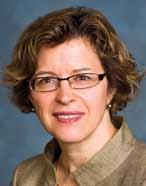
This new section was off to a great start and an enthusiastic turnout for their first meeting, which highlighted “Parallel foundations: Potential Perils in Light of abakhan v. Braydon.” guest speaker Margaret Mason (photo) of Bull Houser & Tupper LLP addressed the inaugural meeting for the new Charity and Not-for-Profit Law section. she provided an overview of the Income Tax act’s evolving requirements for inter-charity transfers, and the challenge for lawyers presented by the British Columbia Court of Appeal’s 2009 decision in abakhan v. Braydon. Mason’s presentation reviewed how lawyers should discuss proposed inter-charity transfers with clients and accountants, the professional conduct obligations imposed on lawyers by the Handbook, and potential strategies for completing an effective transfer between charities. she emphasized the need to avoid discussions of asset protection, document the purposes of transfers, and consider the rights of current and potential creditors (including tort claimants). Contact information for the executive is available through the forums and sections page on the CBABC website.
features
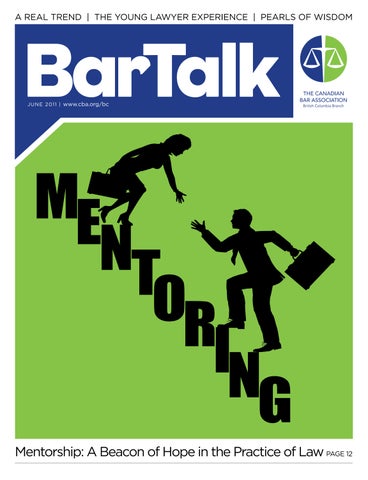
Mentorship: A Beacon of Hope in the Practice of Law The mentee and mentor perspective.
Did you know that of all women called to the Bar in 2003, only 66 per cent retained practising status in 2008 in comparison with 80 per cent of men called in the same year?
Did you know that the number of lawyers in the older age ranges (50-65) has increased significantly whereas the number of lawyers in the younger age range (25-40) has remained the same or declined?
The hypothesis that will be examined in this article is that the above statistics can be changed with a revival of the mentorship concept, and with a lot of creativity and determination. Below is just one example of how the disastrous statistics can be circumvented.
tHe MeNtee PeRSPeCtIve –
tHe StoRY oF CANDACe CHo
In August 2009, I was called to the Bar, but found myself unemployed due to the worldwide financial crisis.
Equipped with my undergraduate degree in marketing and my entrepreneurial spirit, I decided to take the plunge and to start my own law firm. I decided that my competencies and interests would be well suited by building an estate litigation practice.
I approached Trevor Todd for a business lunch in February 2010, and we hit it off right away. Trevor had, in fact, been looking for a junior lawyer to refer work to for some time. He began referring me files.
After a few months practising independently, I realized that I needed mentorship. I was a young and inexperienced lawyer pretending to my clients that I had all the answers, when, in reality, I was insecure about my abilities and decisions. I proposed to Trevor that I pay him a mentorship fee in addition to the referral fee that I was paying him. Trevor accepted my proposal, which allowed us to forge a unique mentorship relationship.
Dennis Milne. Dennis was an excellent counsel with a wealth of experience. His guidance forged my legal career.
Even today, when in doubt, I inevitably ask, “What would Dennis have done?” and the solution magically appears. Dennis’ support and advice gave me much needed confidence, especially when I was a novice. It continues to support me today.
As these mentoring relationships have fallen by the wayside, we are all losing out. Unquestionably, the benefits of mentoring are reciprocal! When I shared my views with Candace over lunch, we reached a mentoring agreement in no time.
Trevor and I meet for a dim sum lunch once a week to discuss litigation strategy, client management, politics, and any other topic that interests us on that particular day. The net effect of this relationship is that I get the wisdom and knowledge from an experienced lawyer to help me manage my practice, but I have the freedom to determine my own hours, run my own business, and have final say on how to conduct my files. Conversely, Trevor receives monetary compensation, but does not have the risks of having to pay any fixed salary or overhead costs.
tHe MeNtoR PeRSPeCtIve
–tHe StoRY oF tRevoR toDD Early in my career, I had the great benefit of a wonderful mentor –
Each relationship will be unique but Candace and I discuss every topic under that sun –most days we share several emails. Our exchange of marketing ideas has been especially stimulating. When Candace faces challenges in dealing with opposing counsel, I help with effective strategies for stick handling such files.
From a mentor’s perspective, it is flattering to think someone else believes our opinion is important. The fresh enthusiasm of a young lawyer is contagious and reinvigorating. The fresh ideas and perspectives Candace brings helps rejuvenate me. It is especially rewarding to believe that in some way I help to ensure this bright young lawyer will remain and thrive in our profession rather than give up in frustration and stress.
Candace Cho and Trevor Todd.
gAIL M C K AY
Supporting the Young Lawyer experience From classroom to courtroom.
Preserving a sense of self in one’s life may be part of a young lawyer’s quest for work-life balance. That self is likely distinct from the duty “to oneself” contemplated in the “Canons of Legal Ethics” in the B.C. Professional Conduct Handbook, which commends each of us to maintain the honour and integrity of our profession. With guidance and mentoring, Generation Y lawyers can learn how the two selves may be brought more intimately together – or even within the same calculus. The legal profession and law schools may be able to create a cantilever of skill support and ethical foreknowledge to engineer this subtle change.
An interesting example is being set up at Thompson Rivers University Law School. In a recent interview, Chris Axworthy, founding Dean of Law, said he believes the number of stakeholders to whom law schools are accountable is now broadening in a manner that may facilitate this shift in self-perception. He is committed to ensuring grads are ready to “hit the ground running” when they begin articling, not just for their own sakes but for the sake of those in the legal profession hiring or otherwise interacting with them. He is initiating programs so that, besides having mastered traditional core competencies and digitally sophisticated research skills
that squarely meet the needs of the profession, students will have the opportunity to apply those skill sets in a law student clinic working with “live” clients. To place the professional responsibility for representing the disadvantaged on the shoulders of the profession rather than upon the inexperienced student, and to avoid any implication that the poor or marginalized matter less, Dean Axworthy plans to engage mentors in the Dugald Christie style of pro bono mentorship. A practising member of the Bar will provide one-on-one guidance to the student and continuity
statement by an educational institution committing funds and a program to help poor people.” Through experience in the law clinic, a student’s sense of self may be integrated more intrinsically with the self contemplated in the Professional Conduct Handbook. Therefore, it is hoped this actual client relationship, combined with a genuine mentorship arrangement, will impart to the student ethical and social educational values, which cannot be replicated in any other setting.
Young practising lawyers may worry that their professional role may wholly subsume any time or space for personal principles and interests. However, in his article “Sustainable Professionalism”
Young lawyers are “recasting our understanding of professionalism by way of a new lawyering sensibility.”
to the client when the student is engaged in exams or gone for the summer. By broadening the number of stakeholders (students, law firms hiring those students, the local community), the clinic itself, as Arthur B. LaFrance points out in “Clinical Education and the Year 2010,” then becomes “a palpable presence and a clear public
Trevor C.W. Farrow maintains that young lawyers are “recasting our understanding of professionalism by way of a new lawyering sensibility.” Like Dean Axworthy, who believes ethical lawyering involves treating students like professionals from day one so that they behave as professionals throughout their tenure at law school and onward, Mr. Farrow supports a sustainable model that honours this new approach to professionalism. Whereas the older model of teaching ethics, “by constantly foregrounding the interest of clients, invariably backgrounds the person serving that client,” young lawyers can now have a more informed choice in the calculus of social consciousness and self perception.
Gail McKay, Assistant Professor at Thompson Rivers University.
features
up to Speed with the Aboriginal Lawyers Forum ALF hosts its first CBABC Forum event.
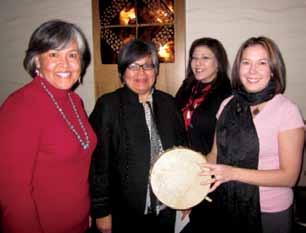
on February 25, 2011 the CBABC Aboriginal Lawyers Forum (ALF) and UBC Indigenous Law Students Association (ILSA) hosted a speed mentoring event. This event paired senior lawyer mentors with junior lawyer/student mentees for eight-minute mentoring sessions. In each session, the mentors introduced themselves and their practice, offered tips and advice, and answered questions from the mentees. At the conclusion of each session, an ALF representative beat a traditional Aboriginal drum to alert the participants it was time to switch and move on to the next session. After all the mentors made the rounds, the group was invited to enjoy some delicious appetizers and network in a relaxed environment. This portion of the evening offered a great chance for many of the participants to network and visit with each other.
Ms. Jackson proposed the event as a fun and unique way to host a networking/mentoring event that was not the typical “wine and cheese.”
The ALF would like to thank the ILSA for co-hosting the event,
The purpose of this event was to introduce the junior lawyers/ students to the senior lawyers in a fun atmosphere. The participants were encouraged to keep in touch and establish a deeper mentorship relationship in the future. The idea for this event came from Isabel Jackson, ALF Vice-Chair.
students and lawyers face, including retention and discrimination.
The ALF attempts to address these issues through a mandate focused on: providing networking opportunities; leadership and support; mentoring; and opportunities to both celebrate and stay connected to Aboriginal culture. Due to the nature and mandate of the ALF, our members are primarily but not exclusively of Aboriginal descent, and we welcome all
as well as the volunteer mentors who made this event possible: Barbara Buckman, Janelle Dwyer, Alixe Cormick, Isabel Jackson, Judith Kenacan, Shawn Bob, Katrina Harry, Lee Robin Schmidt and Bertha Joseph.
This event was the seventh ALF event and the first event ALF has hosted since it officially became a CBABC Forum in December 2010. The ALF started in January 2010 as a grass roots group created by Aboriginal lawyers for Aboriginal lawyers to provide peer support and enhance the stature and influence of Aboriginal people in the legal profession. Further, the ALF was started as one way for Aboriginal lawyers to address the various issues Aboriginal law
CBABC members to join.
In addition to hosting events, the ALF publishes a quarterly newsletter, the Forum Drum, in an effort to connect with Aboriginal lawyers across the province.
The ALF Executive is comprised of Christina J. Cook, Chair; Isabel Jackson, Vice-Chair; Members at Large are Rosalind Campbell, Katrina Harry, Karen Whonnack, Geordie Hungerford, Angela Cousins and Vancouver Island Representative Colleen Spier.
For more information on the ALF or any of the upcoming events, please email ALF@bccba.org.
photo (L-R): Rosalind Campbell, Isabel Jackson, Christina J. Cook and Katrina Harry.
C HRI s TINA J. C OOK
Right
A ReAL trend
Articling and practising in B.C.’s smaller cities.
As the population of British Columbia, The Best Place on Earth, continues to grow at a steady pace, so have opportunities for lawyers to gain experience outside of the traditional job markets. Students and associates alike have increasingly begun to seek articles and employment away from the larger cities in the Lower Mainland, citing the undiscovered beauty of B.C.’s growing interior and smaller coastal cities and towns, the perceived slower pace of life and the opportunities to establish oneself firmly in a smaller legal community, as motivating factors in shifting their focus for employment outside of the larger urban centres.
Founded in March 2009 and funded by the Law Foundation, the Rural Education and Access to Lawyers (REAL) initiative is a three-year program from the B.C. Branch of the Canadian Bar Association that sets out to help law students achieve just that. In 2010, 21 summer positions were filled through the REAL initiative, providing students with legal experience in various communities across British Columbia, from 100 Mile House to Summerland and beyond. At present, postings for second year law students were available through REAL in Quesnel, Powell River, Ucluelet and Salmon Arm, giving students seeking
employment in British Columbia a chance to experience a part of the province they may have never contemplated working in. REAL’s mandate not only provides students with placements for summer jobs, but was also created to “address the current and projected shortage of lawyers practising in small communities and rural areas of British Columbia in order to ensure these communities continue to enjoy access to legal services” (www.realbc.org).
As access to justice becomes a growing concern, the increase of junior associates practising in smaller communities has the potential to provide local populations with increased access to legal services, especially in those communities where established lawyers begin to retire from the practice of law.
With the growing trend of students and associates seeking articles and employment outside the Lower Mainland, it’s easy to see why Thompson Rivers University (TRU) was also chosen as the location for the first Canadian law school to open in more than 35 years. In September 2011, the Thompson Rivers University Faculty of Law will commence its first six-semester program in the city of Kamloops, population
approximately 86,000. Founding Dean and former Attorney General of Saskatchewan, Chris Axworthy, QC, will build the program from the ground up in partnership with the University of Calgary. With a relatively central location, and a thriving legal community, Kamloops and TRU’s law school have the potential to attract even more young lawyers to the communities where access to legal services is needed. According to the Law School at Thompson Rivers University Backgrounder, “during the decade from 2011 to 2021, an average of approximately 290 lawyers each year in B.C. will reach the age of 65. During that period the population of B.C. will increase from 4.25 million to 5.1 million,” creating a need for services when senior lawyers begin to retire, especially in smaller communities.
“When searching for articles, Kelowna seemed like a natural choice,” said one junior associate currently practising in the Okanagan Valley, “Having visited Kelowna as a child, I had fond memories of the city, and had also heard great things about Interior B.C.’s legal community from practitioners I spoke to in Vancouver. The opportunity to go skiing, golfing, and boating all in the same day, and all in the same city, didn’t hurt either.”
Jasroop S. Grewal is a young lawyer practising with the firm of Pihl Law Corporation in Kelowna and is the current Chair of the Young Lawyers – Okanagan Section. To contact Jasroop: jasroop.grewal@pihl.bc.ca.
N ICOL e B YR es
Sharing Pearls of Wisdom
Via the CBABC Women Lawyers Forum.
the late Debra Van Ginkel, QC dreamed of a mentoring program where women lawyers mentored women lawyers. As a result, the CBABC Women Lawyers Forum’s mentoring program was born and is now in its eighth year. This program is the largest mentoring program in Canada, and so far has matched nearly 700 lawyers in mentoring relationships from all over the province1.
While mentors provide support and encouragement to their mentees, most mentors also benefit from the mentor-mentee relationships. Joan Gordon, this year’s winner of the WLF Debra Van Ginkel, QC Mentoring Award, acknowledged that her experience volunteering as a mentor had unexpectedly enriched her life.
Besides its formal mentoring program, the WLF offers a number of other informal mentoring opportunities through its award lunches, networking events, newsletters and what has become an annual “Hot Tips from Hot Mentors” program held each September in conjunction with the WLF’s fall Launch Event. Over the years, women lawyers and judges have generously provided a wealth of advice and insight in a way that women lawyers, in particular, can relate to. The following is a sample of some of the pearls of wisdom shared by these remarkable women.
It is important to plan for the things you really want to do and accomplish. Set goals and define your own path, but be open to opportunities and possibilities that may arise. Your priorities will change as your career evolves so take the time to re-evaluate from time to time.
You are personally responsible for your own happiness and career satisfaction. There will always be unexpected requests or demands that you cannot control, but do not abdicate control of the things you can influence.
resources required to develop these skills.
Be impeccable with your word – say what you mean and do what you say. Your reputation and integrity are your most valuable assets.
While the practice of law often requires that you vigorously advance positions, which may be adverse to another party, treat others the way you would like to be treated.
Being a lawyer is a tough job: expectations are high, the issues complex and the hours long. Setting boundaries will help you manage all of the work demands as well as other important responsibilities to our families, communities and ourselves.
Do not give up when you feel discouraged, disillusioned or doubt your abilities, and accept the fact that you will make mistakes. Take comfort knowing this happens to all of us and that you will learn more from your mistakes than from your successes.
“Work Life Balance” is illusory. Demands of work and demands of family/life will fluctuate. Accept that the best you can do is to choose your priorities, and that give and take will be necessary.
The top two skills required by successful lawyers are communication and leadership skills. Invest the time and
Look after yourself: eat well, exercise regularly and schedule personal time. The physical and mental resiliency you gain by doing this will pay off in spades – you will manage stress better, be more productive, and be better able to positively affect your sphere of influence.
Seek out mentors and champions, from both within and outside your firm. They will provide you with inspiration and support.
Nicole Byres is the Vice-Chair of the WLF and a partner at Clark Wilson LLP.
1 The WLF is grateful for the continued financial and administrative support of the WLF’s Mentoring Program by the CBABC Branch, and for the volunteer efforts of the WLF Mentoring Committee, led by Co-Chairs Julie Fisher and Deborah Taylor.
2011 BarTalk Reader Survey Results
Why you do and don’t like us.
We thank all our readers who, whether it was under the inducement of winning a Kindle or just to help us improve this magazine, participated in our recent survey on the strengths, weaknesses and areas for improvement of BarTalk. These surveys are vital for the Editorial Board and staff in planning to make this magazine relevant and readable.
We learned a lot. The first and most important is that we are being read, not set aside and neglected. You told us the reasons. Our articles are relatively short, they are practice-oriented and B.C. focused and they are (mostly) readable. Readers said, “It feels like a community paper” and “It’s an organization newsletter – this is what our association is doing.” Our efforts to ensure our coverage is provincewide were appreciated, as was the fact that we seek contributors from our membership. One reader indicated “I am more likely to read the article if I know the author.” Readers also indicated that it is easy to read BarTalk in one sitting without a “huge time commitment.”
One major change for BarTalk since the launch of the August 2009 issue has been the move to colour and use of more photographs and graphics. This new layout and format is well-liked, although some readers admonished not to go “glossy.” One in
particular said, “The ink smells nice.” At least it wasn’t glue.
In comparison with other legal publications, the general satisfaction rate of our readership in our content and format is high. You reported reading (or at least skimming) our regular columnists, for which I am sure they are appreciative. Sixty percent of readers were in favour of retaining the paper version as opposed to being simply online. (If you would prefer to only receive BarTalk electronically, email bartalk@bccba.org to let us know and we will remove you from the printed version mailing list. Then watch for a notification in the CBABC News and Jobs email that the new issue of BarTalk is available to read online.)
cohesive and comprehensive, we set a theme for each one. We received many ideas for future themes. Possibilities include alternative billing practices that increase client satisfaction and reduce accounts receivable; succession planning for lawyers; starting, building and marketing a practice; client management; use of paralegals; international law and multi-jurisdictional practices; alternative career options and alternative models for legal practices; corporate and in-house law practices. Expect to see many of these addressed in the months to come.
Criticisms included that the magazine is too litigation-focused, that we need to have more information on practice issues for young lawyers and law students and that we focus too much on lawyers in private practice and need to have more for corporate and government counsel and sole practitioners. A number of suggestions were made to improve the online version, including having a chat space for reader comments.
As part of our effort to cover a cross-section of legal issues and to also make editions of BarTalk more
In summary, we know we are moving in the right direction for most readers. We hope that with the theme format we can have issues that are of particular interest to solicitors and barristers and to those in various niche legal markets. We are not an academic journal and it is our goal to give you news of the B.C. Branch, practiceoriented ideas and insights into different types of legal practice.
Whenever you feel the urge, please feel free to email bartalk@bc cba.org to tell us how we are doing.
Left photo: Michael Welsh, Chair, BarTalk Editorial Board.
Right photo: Chantal Cattermole, prizewinner of the 2011 BarTalk Reader Survey, is holding her new Kindle wireless reading device.
MICHA e L W e L s H
news&events
CLC Offers Inside Track on New Developments in the Law
The 2011 CBA Canadian Legal Conference (CLC) in Halifax, August 14-16, will deliver quality speakers and concrete ideas for navigating the changing legal landscape, with interactive professional development sessions designed to provide thoughtful answers to difficult questions.
Professional development features prominently on the agenda with 12 hours of accredited professional development over two days for lawyers of all backgrounds, including programs on current privacy issues, multi-jurisdictional class actions, advocacy before administrative tribunals, drafting effective settlement agreements, renegotiating underfunded pension plans, the new Canadian securities regulator – and more. And for corporate counsel, a full stream of dedicated Canadian Corporate Counsel Association programming is planned.
Along with the PD sessions, the CLC features a roster of starstudded speakers, including:
His Excellency the Right Honourable David Johnston, Governor General of Canada, Opening Plenary, August 14
President and editor-in-chief of The Huffington Post Media Group Arianna Huffington, Opening Plenary, August 14
Star of CBC’s Dragons’ Den and marketing guru Arlene Dickinson, Breakfast, August 15
Author of Start With Why, Simon Sinek, Closing Lunch, Tuesday, August 16
\ Register for Canada’s premier legal conference before June 30 to qualify for early bird discounts. Details and registration: www.cba.org/halifax2011/
NATIONAL N e W s CBA Skilled
Lawyer Series
With more than 5,500 registrations received so far, the skilled Lawyer series (sLs) is a runaway hit with members. fulfill your professional development requirements while sharpening essential corporate and litigation skills with the CBA’s sLs. Accessible, accredited, and affordable online sessions will help ensure you’re at your best in the boardroom or the courtroom.
\ Details www.cba.org/pd/packagefeatures.aspx
KUDO s TRU Names Wally Oppal as Chancellor
The Honourable Wally Oppal, QC, a former B.C. attorney general and judge, has been appointed chancellor of Thompson Rivers University (TRU) in Kamloops. “Wally Oppal is a well respected British Columbian,” Karl deBruijn, Chair of the university’s Board of governors, said in announcing the appointment. “I know his commitment to justice and to our province will inspire a whole new generation as they build their futures at TRU.”
Training Administrative Tribunal Members on the Charter
following a resolution passed at the CBA 2011 Mid-Winter Meeting in Charlevoix, the Association is urging the federal, provincial and territorial governments to develop and implement a mandatory training program for all members of tribunals on the Canadian Charter of rights and Freedoms. The objective is for tribunal members with authority to deal with legal questions to gain a practical understanding of the Charter and how it applies to their jurisdiction.
“The supreme Court of Canada recently held, in r. v. Conway,
NATIONAL N e W s
that every administrative tribunal with authority to deal with questions of law has the jurisdiction to apply the Charter and to issue remedies in accordance with it,” says Mathieu Bouchard, Chair of the Administrative Law section, in his letter to Justice Minister Rob Nicholson.
fred Headon of Montreal has been elected National second Vice-President of the CBA, the first in-house counsel to be elected to this position. The second vice-presidency is the first step on the ladder to the national presidency, a post he will assume in August 2013.
“fred Headon brings the unique perspective of corporate counsel to the CBA leadership, and his election reinforces our Association’s role as the voice for all segments of the Bar,” says President Rod snow of Whitehorse.
Anne Giardini Wins R.V.A. Jones Award
Anne Giardini, QC of Vancouver, president of Weyerhaeuser Company Limited Canada, received the Canadian Corporate Counsel Association’s (CCCA) 2011 Robert V. A. Jones Award. The award pays tribute to her active involvement in the in-house community, along with her writing on substantive legal issues important to all corporate lawyers.
fred Headon currently leads Air Canada’s in-house labour and employment law team at the company’s headquarters in Montreal. from 1999 to 2006, he was a partner at McCarthy Tétrault in Montreal, where he practised labour and employment law, human rights and privacy law, and administrative and constitutional law.
In 1998, he spent eight months at the faculty of Law at the National University of Rwanda where he taught upper-year law courses and supervised research by graduate students in human rights and constitutional law. since 2007, fred Headon has sat on the Canadian Corporate Counsel Association’s (CCCA) Board of Directors. He is currently a member of the CCCA’s executive Committee and has been a frequent speaker at both CBA and CCCA events.
Ms. Giardini joined Weyerhaeuser as in-house counsel in 1994, became general counsel in 2006, and, two years later, president of the Canadian subsidiary. She holds a law degree from the University of British Columbia and a master’s degree in law from Trinity Hall at the University of Cambridge in England. She is licensed to practise law in both British Columbia and Ontario and has been admitted to practise as an in-house counsel in the State of Washington. Her expertise crosses many disciplines. Ms. Giardini has broad commercial practice expertise, including forestry and natural resources law, administrative law, First Nations law, contract preparation and negotiation, employment and labour law, corporate reorganizations, divestitures and acquisitions, pension governance and environmental law.
Ms. Giardini has been active in the CCCA since 2002 and in the CBA since the start of her career.
Connie Sugiyama (left) congratulates Anne Giardini, QC.
news&events
LAW WeeK 2011 – fUN RUN
go to www.bclawweek.org to view more photos of all Law Week 2011 events.
Get Mentored – Receive CPD Credit
Mentorship has long been recognized as an excellent way for lawyers to enhance their legal skills and knowledge, and can be very effective for providing postcall training and education for young lawyers. Recognizing this, in January 2010, mentoring was approved as an accredited form of learning as part of the Law Society’s CPD program.
Both the mentor and the mentee can claim six hours of CPD credit for mentoring time together. To enable lawyers practising in different locations to participate easily, mentoring can either be face-to-face or by telephone. Each mentoring session must be a minimum of 30 minutes, totalling at least six hours during the year. To qualify, mentors simply file a
brief Mentoring Plan on the Law Society website, identifying how the intended mentoring topics meet the approved CPD guidelines.
\ Lawyers interested in finding a mentor can check out the Mentoring Registry on the CBABC website.
www.cba.org/bc
IMPRoveMeNtS to CLeBC oNLINe PuBLICAtIoNS AND SeARCH eNGINe
exciting changes are coming soon to CLeBC’s online products and services.
We’ve developed a sophisticated new search engine with the assistance of LexUM (the software developers behind CanLII). The new search engine will allow visitors to the CLeBC website to search quickly and effectively across all
CLeBC’s products and services using keywords and filtering by product types or practice areas. The improved online practice manuals will be much easier and quicker to navigate. We’ll be introducing a commenting feature that will give subscribers the ability to leave comments associated with sections of the text. Our legal editors will also be able to add information about new developments as they happen.
CLeBC’s practice manual subscriptions include both the print and access to the online version of the book. The online version features links to case law and legislation, full text searching, navigation with an ever-present
and expandable table of contents, and downloadable forms and precedents. subscribers have access to our Cases and Legislation Considered feature, which alerts users to where a case, statute or rule is referred to in all online practice manuals. Look for these changes in June; visit the CLeBC website at www.cle.bc.ca.
For further information contact CLEBC customer service at 604-893-2121 (toll-free in Canada at 1-800-663-0437) or at www.cle.bc.ca.
fe ATUR e f ROM TH e LAW s OCI e TY O f BRITI s H COLUMBIA
N e W s CLEBC Update
Photo credit: Patricia Jordan
BRANCH & BAR
IN FORCE
Current from February 22, 2011 to April 19, 2011
legislative Update is provided as part of the CBaBC legislative and law reform program. It is a service funded by CBa membership fees, and is, therefore, provided as a benefit of CBa membership. The full version of legislative Update is now only published online and available to CBa members exclusively at www.cba.org/bc.
FINAL AGREEMENT CONSEQUENTIAL AMENDMENTS
ACT, 2007, S.B.C. 2007, C. 36 (BILL 41)
Sections 64.1, 64.2, 65.1, 97.1(c), 104.1, 120.1, 155.1 and 178.4 are in force april 1, 2011
FORESTS AND RANGE STATUTES AMENDMENT ACT, 2008, S.B.C. 2008, C. 4 (BILL 8) Section 4 is in force april 1, 2011
HAIDA GWAII RECONCILIATION ACT, S.B.C. 2010, C. 17 (BILL 18) Sections 1, 3 to 5 and 7 to 21 are in force February 23, 2011
MAA-NULTH FIRST NATIONS FINAL AGREEMENT ACT, S.B.C. 2007, C. 43 (BILL 45)
Sections 1 to 3, 5 to 15, 17 and 18, and chapters 1 to 25, 27 and 29 of the Schedule are in force april 1, 2011
MISCELLANEOUS STATUTES AMENDMENT ACT (NO. 3), 2010, S.B.C. 2010, C. 21 (BILL 20) Sections 10 and 14 are in force april 1, 2011
PROTECTED AREAS OF BRITISH COLUMBIA AMENDMENT ACT, 2009, S.B.C. 2009, C. 19 (BILL 10)
Section 7 is in force april 1, 2011
JUNE
7
CBaBC PD Webinar: Is Social Media right for My Practice and My Firm?
8 CBaBC Women lawyers Forum – aGM
9
CBaBC PD Joint Seminar: The Top Ten Causes of Claims
CBaBC PD Joint Seminar/Webinar with Colin Gonsalves
10 The lawyers assistance Program of British Columbia 11th annual Gratitude lunch
Vancouver 10th annual Battle of the Bar Bands
15 CBaBC PD Joint Seminar: The Top Ten Causes of Claims
16 CBaBC/Vancouver Bar association 15th annual Golf Tournament
17 CBaBC PD Seminar: E-Filing and Family rules
CBaBC aboriginal lawyers Forum – Online auction and reception
18 Provincial Council
22 CBaBC PD/Criminal Justice-Vancouver Seminar: Civility in the Criminal Bar
JULY
7 New Westminster Bar association and Fraser Valley Bar association Golf Classic
8 CBaBC PD Seminar: advanced Client relations Skills for lawyers
LAW WeeK 2011 – KAMLOOPs
Photo credit: Bob Needham
Health & Wellness TIP
Worries? What worries?
Worrying about the “what ifs?” in a situation takes a lot of time and energy, and anxiety can quickly escalate. first, find out the facts about a situation – your worries may turn out to be unfounded. If you’re still concerned, plan your strategy, with a friend if necessary, so that you feel more in control of the situation.
Obtaining Oral Reasons for Judgment – B.C. Court of Appeal
starting April 4, 2011 the judgment typist will no longer mail out Court oral reasons for judgment. As of this date, once the oral Court reasons for judgment are signed they will be placed on the website. If counsel or a party wish to obtain a copy of the oral Court reasons for judgment, they may either obtain them from the Court’s website; send an email to the judgment typist office at CA-orals@courts.gov.bc.ca;
or contact the judgment typist by telephone at 604-660-2729.
The oral chambers reasons for judgment have never been distributed to the parties or counsel. They are placed in the Court file after they are signed. Currently, any party may obtain a copy of the oral chambers reasons for judgment by contacting the judgment typist by telephone at 604-660-2729.
On March 31, 2011, at the Century Plaza Hotel in Vancouver, Access Pro Bono (APB) and the Salvation Army Pro Bono Program hosted their Sixth Annual Pro Bono Appreciation Breakfast. The breakfast provides an annual opportunity for APB and the Salvation Army to thank their
L to R: Chief Judge Crabtree, Chief Justice Finch, Troy McLelan, Chief Justice Bauman
many volunteer lawyers who generously assisted low-income British Columbians to obtain access to justice over the previous year. \ More info http://probononet.bc.ca/
Many lawyers advertise that they give free consultations. Benefits of joining the Lawyer Referral Service (LRS) include: no sign up fees or hidden costs, free advertising throughout B.C., and the choice to provide a complimentary consultation or charge a small $25 consultation fee. The LRs function is to help the public get access to justice and to connect lawyers with potential clients whose legal interests match. When people call the LRs they do not get an automated service, but are able to speak with an experienced live operator confidentially about their situation and be referred to a lawyer that best fits their needs.
Lawyer Referral Service is the only service of its kind run by the B.C. Branch of the Canadian Bar Association and funded by the Law foundation of B.C. We proudly provide this service so that B.C. residents can efficiently find the right lawyer, and so lawyers can easily connect with clients in need of their assistance.
To join, call the Lawyer Referral Service at 604-687-3221 or 1-800663-1919. Application insert is enclosed in this June BarTalk
grantsapproved
Continuing Programs and Projects
The Board of governors of the Law foundation of B.C. met on April 2, 2011 and approved funding for a number of continuing programs and projects.
Chair Margaret sasges is pleased to announce that funding totalling $6,233,092 was approved for 42 programs and projects:
Funding totalling $5,232,592 was approved for the following 23 continuing programs:
CoMMuNItY LeGAL ASSIStANCe SoCIetY
$734,950 Operating expenses
$395,500 Poverty Law services
$140,000 Community Advocate support Line
$575,000
WeSt CoASt eNvIRoNMeNtAL LAW ASSoCIAtIoN Programs and eDRf
$535,480
B.C. PuBLIC INteReSt ADvoCACY CeNtRe Operating expenses
$359,800 uNIveRSItY oF vICtoRIA Law Centre Clinical Program
$297,490 teNANt ReSouRCe AND ADvISoRY CeNtRe SoCIetY Tenants’ Legal Advocacy Program
$288,640 PeoPLe’S LAW SCHooL SoCIetY Operating expenses
$280,600
B.C. LAW INStItute Operating expenses
$235,200
B.C. CIvIL LIBeRtIeS ASSoCIAtIoN Operating expenses
$184,650
WeSt CoASt
DoMeStIC WoRKeRS’ ASSoCIAtIoN
Legal Advocacy Program
$167,550
WeSt CoASt LeAF
ASSoCIAtIoN Operating expenses
$143,866
NeLSoN CAReS SoCIetY The Advocacy Centre 2011-2012
$143,866
NeLSoN CAReS SoCIetY
The Advocacy Centre 2012-2013
$117,060
ISLAND JADe SoCIetY
Legal Advocacy Program
$110,000
PovNet SoCIetY PovNet Program
$91,200
B.C. FAMILIeS IN tRANSItIoN
Legal support services Program 2011-2012
$91,200
B.C. FAMILIeS IN tRANSItIoN
Legal support services Program 2012-2013
$87,670 MoSAIC
Legal Advocacy Program and front Line Advocacy Workers Coordination Program 2011-2012
$87,670 MoSAIC
Legal Advocacy Program and front Line Advocacy Workers Coordination Program 2012-2013
$75,000
DZe L K’ANt FRIeNDSHIP CeNtRe SoCIetY
Legal Advocacy and Workshops Program
$69,600
BAtteReD WoMeN’S SuPPoRt SeRvICeS Legal Advocacy Program
$20,600
uNIveRSItY oF
SASKAtCHeWAN Native Law Centre
Funding totalling $135,500 was approved for the following 10 small projects:
$15,000
B.C. CIvIL LIBeRtIeS ASSoCIAtIoN electronic Devices Privacy Handbook Project
$15,000
B.C. LAW INStItute family status Legal Research Project
$15,000
CeNtRe FoR GLoBAL StuDIeS
International Legal education for High schools (ILeHs) Project
$15,000
DoxA DoCuMeNtARY FILM FeStIvAL Justice forum Project
$15,000
KINDALe DeveLoPMeNt ASSoCIAtIoN Providing Legal education for Parent and families of Persons with Disabilities
$15,000
SoCIAL HeALtH & eCoNoMIC DeveLoPMeNt SoCIetY
The Central Coast Legal Workshop series
$15,000
tAKLA LAKe FIRSt NAtIoN Takla Lake first Nation Alternative Justice Project
$13,500
vICtoRIA ReStoRAtIve JuStICe SoCIetY Crown Case Referral Capacity Building Project
$12,000
LAWYeRS RIGHtS WAtCH CANADA
The Applicability of International Human Rights Law in British Columbia: Legal education for B.C. Lawyers and Citizens
$5,000 vANCouveR CoMMuNItY CoLLeGe FouNDAtIoN Online-Development of “Law for Court Interpreters” Project
Funding totalling $240,000 was approved for the following three Public Interest articling Fellowships:
$120,000 CoMMuNItY LeGAL ASSIStANCe SoCIetY Public Interest Articling fellowships
$60,000
B.C. LAW INStItute Public Interest Articling fellowships
$60,000
B.C. PuBLIC INteReSt ADvoCACY CeNtRe Public Interest Articling fellowships
Funding totalling $600,000 was approved for the following two projects:
$525,000
B.C. CeNtRe FoR eLDeR ADvoCACY AND SuPPoRt elder Law Clinic
$75,000
WAtARI ReSeARCH ASSoCIAtIoN systems Negotiator Project
Funding totalling $25,000 was approved for the following Child Welfare Fund Grant request:
$25,000 ALISoN MCPHAIL feasibility study: Options for children’s legal services in B.C.
\ For full details of the programs and projects that received funding, please visit www.lawfoundationbc.org.
professionaldevelopment
The B.C. Branch of the Canadian Bar Association is recognized by the Law society of British Columbia as a provider of professional development activities. CBABC is committed to providing relevant and cost-effective ways to obtain your mandatory Continuing Professional Development (CPD) hours.
Conferences
tHe 6tH ANNuAL CBABC BRANCH CoNFeReNCe
Upcoming Seminars/Webinars
TO Viva Viva LEX VEGAS II LEX VEGAS II
Date: November 18-20, 2011
Speakers: Variety of B.C. and Us speakers
Location: Las Vegas, Nevada
Details: Complete all 12 of your 2011 CPD credits, including the two hour required professional responsibility and ethics, client care and relations, and practice management component. Don’t miss out! Last year’s popular CBABC Annual Branch Conference in scottsdale sold out quickly. Mark your calendars and register early to avoid disappointment!
Attendance at all seminars listed below will provide you with 100 per cent of the required two hour professional responsibility and ethics, client care and relations, and practice management component for 2011 Law society of British Columbia reporting.
the CBABC presents: tHe toP teN CAuSeS oF CLAIMS: BuMPS, PotHoLeS AND FLAtS oN tHe RoAD to AN ACCIDeNt-FRee PRACtICe
Speakers: susan forbes, QC and Margrett george of Lawyers Insurance fund
\ Don’t forget to visit our new one-stop PD resource site www.cba.org/pd/ to create a personalised account based on your PD needs! Go to www.cba.org/bc for updates on Professional Development seminars.
memberservices
seasonal promotions and special offers to members are promoted weekly via CBABC News and Jobs. Visit the CBABC website for links to various activities and promotions on the MeMBeR sAVINgs page under MeMBeRsHIP.
\ CBABC MEMBER SERVICE PROVIDER – BOOK B.C. HOTELS ONLINE: CBA members receive exclusive savings when they book hotel rooms through meetingmax, CBABC’s newest member service.
\ EAT! VANCOUVER! – JUNE 10-12, 2011 – NEW VANCOUVER CONVENTION CENTRE WEST: gather a group (16 +) from your office and take advantage of the group rate. go to www.eat-vancouver.com for more information.
We are Chartered Accountants who work with lawyers and nancial advisors to develop innovative US and cross-border tax strategies for clients with US investments and business operations. Our services include:
• US Federal and state tax return preparation
• Consulting on transfers to/from US
• Acquisition of US real property
Warren Dueck, FCA/CPA Steve Flynn, CA/CPA Laura McLeman, CA
BarTalk Gets Results
l
e V e NT s
2011 Golf Tournaments
The 2011 CBABC/vancouver Bar Association 15th Annual Golf tournament will be held at University golf Club on thursday, June 16th. Participate in this funfilled day of golf and prizes, and support law student scholarships. for registration forms, go to www. cba.org/bc/pdf/events/van_golf_ tournament.pdf.
The 2011 New Westminster/ Fraser valley Bar Association Golf Classic will be held at guildford golf Course on thursday, July 7th. Dinner and golf is $95, dinner is $40. Net proceeds to the CBA Lawyers’ Benevolent fund. for registration forms, please contact Perry Armitage at McQuarrie Hunter.
barmoves
Who’s Moving Where and When
Who’s Moving Where
Shea Coulson has joined farris, Vaughan, Wills & Murphy LLP’s Vancouver office as its newest associate. shea works primarily in the area of litigation and dispute resolution.
Annamarie Kersop joined Lawyers West LLP as a partner. Annamarie’s practice focuses on motor vehicle accident and personal injury claims.
John C.H. Kim has been promoted to partner at fasken Martineau DuMoulin LLP where he was previously an associate. John advises clients in the energy, mining and natural resources sector.
Chris Bystrom has been promoted to partner at fasken Martineau DuMoulin LLP. Previously an associate at the firm, Chris continues to practice in the firm’s Litigation and Dispute Resolution group.
Carrie Schroeder joins fraser Milner Casgrain LLP (fMC) as an associate in the firm’s corporate/ commercial group. Prior to joining fMC, Carrie articled at Cassels Brock & Blackwell LLP in Toronto and worked as an engineer in the pharmaceutical industry.
Lawrence Smith has joined Kuhn & Company in Abbotsford and Vancouver as associate counsel. Lawrence was formerly a partner with Waterstone Law group LLP. He practices primarily employment litigation.
Kirsten H. Jenkins has recently left RBC Dominion securities as an estate planning consultant to go back to private practice at Aydin Bird. she will continue to specialize in estate planning and estate administration.
elizabeth Khean is now an associate with edwards, Kenny & Bray LLP. elizabeth has joined the corporate commercial group and has a general corporate commercial solicitor’s practice.
Betty Lin has joined North shore Law LLP to practice in the family Law group.
Jennifer Dezell has been named partner at fraser Milner Casgrain LLP in Vancouver.
sPACe Is AT A PReMIUM AND AVAILABLe ON A fIRsT-COMe
fIRsT-seRVeD BAsIs sO seND YOUR BAR MOVe (MAX. 35 WORDs) AND PHOTO TO CBA@BCCBA ORg NOW
fOR MORe BAR MOVes gO TO BarTalk ONlINE
Marie-Claire Dy has been named partner at fraser Milner Casgrain LLP in Vancouver.
newmembers
March & april 2011
Regular Members
Adam J. Barker Fang & Associates
Vancouver
thomas Berger North Vancouver oloff Biermann Langley
Articling Students
Asheesh Arora Buckley Hogan
Surrey
Janet Connolly Wyllie & Co
Nelson
Angela Houston
Ginny tsai has been named partner at fraser Milner Casgrain LLP in Vancouver.
Andrew Prior has been named partner at fraser Milner Casgrain LLP in Vancouver.
Sheilagh Sparks has been appointed to the partnership of North shore Law LLP. sheilagh restricts her practice to family law and mediation.
Kara Naish has joined Webster & Associates. she brings 13 years of experience in personal injury law to the firm’s brain injury law practice.
Donna M. Greschner University of Victoria Faculty of Law Victoria
C.R. Nathaniel Johnson Cates Carroll Watt Kamloops Son Le Vancouver
Chelsea F. Lott Carfra & Lawton Victoria
Andrea e.A. Penner “First Law Corporation Quay Law Centre” New Westminster