this publication is intended for information purposes only and the information herein should not be applied to specific fact circumstances without the advice of counsel.
the Canadian Bar association, British Columbia Branch represents more than 6,300 B.C. members and is dedicated to improving and promoting access to justice, reviewing legislation, initiating law reform measures and advancing and improving the administration of justice.
Bartalk Publication sales agreement #40741008
R
Comments on the New Design and BarTalk Online
Comments on the New Design of BarTalk
Kudos to the CBABC. The new BarTalk is fabulous – visually appealing, more white space which makes it easier to read, and good use of graphics. It’s a win! Well done.
Just wanted to let you know how much I liked the redesigned BarTalk. Great work, I really like the new layout.
The new BarTalk looks great: bold headlines, colour photos. It makes for an enjoyable read!
I just wanted to drop you a note to say how fantastic the new BarTalk look is. I enjoyed reading it from cover to cover. I trust that you are getting a positive reaction across the board.
Great new look!
Just wanted to let you know I think the new BarTalk looks excellent.
BarTalk Online
I’m not sure who to compliment, but I was so thrilled with the new website that I had to drop someone a note!
I’m sitting here reviewing PLTC material on the Wills Variation Act… the first paragraph refers to an 1998 BarTalk article that sounds perfect. I thought that not in million years will I get my hands on that. Well, I did and it’s thanks to your website having the archived articles and making them so easy to find. Thanks a lot!
— Carla Kelly Campbell, Burton & McMullan, LLP
1-877-669-9601
Note:
at www.cba.org/bc.
Inside This Issue
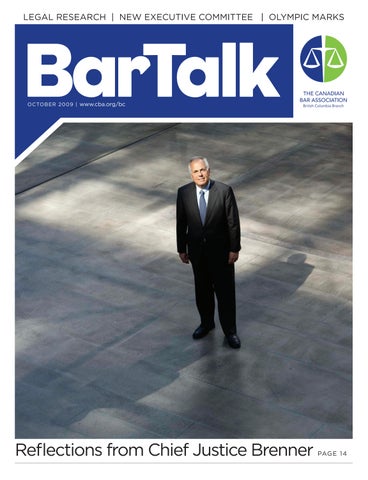
this september, the Honourable Chief Justice Donald Brenner departed the Bench and in this issue he offers his reflections on nine years leading the supreme Court of British Columbia. his example, as a lawyer who has reached one of the pinnacles of the profession, should serve as great inspiration to new students just weeks into their first term of law school. Law students and seasoned practitioners alike will benefit from reading the articles in the issue that touch upon the always-pertinent theme of Legal research in these pages you will learn important practice tips, from how to harness the resources of the public library system to developing solutions for conducting legal research in the hinterlands, along with a number of other strategies for building time saving efficiencies into your work.
News and Events
22 irish eyes smile on CBa’s dublin Conference
23 Continuing Legal education highlights
24 Legislative update CLeBC update
Branch & Bar Calendar
25 Bench & Bar dinner Form
26 Lawyers hourly Rates to Become extinct??? annual Report ReaL initiative Now accepting applications for 2010 summer student Funding
Also In This Issue
From t he President
James m . Bo N d
A Social Responsibility, Not a Political Play
CBa support for the administration of justice.
as one of our past Presidents and a very sage fellow has said to me on many occasions, “you don’t pick fights with people who buy ink by the barrel.” Fair enough. However, I think that recent commentary concerning the Canadian Bar Association, and in particular, the underlying attack on the role of the CBA in Canadian society generally cannot be ignored. I am referring, of course, to the criticism in certain quarters of our organization’s insistance that Omar Khadr be returned from Guantanamo Bay to be dealt with by the Canadian justice system, and our organization’s decision to urge the Canadian government to seek clemency for all Canadian citizens who face the death penalty abroad.
The Canadian Bar Association is legislatively mandated to promote the administration of justice. It is a role that has
been set out for us by government in the legislation which incorporated our organization in 1921. Fostering and supporting the rule of law is fundamental to promoting the administration of justice.
In addition, as lawyers we all recognize the fundamental importance of protecting the rule of law and administration of justice. They form the bedrock upon which our democratic society is based. As officers of the court, the role that we play as protectors of that bedrock, from attempts to chip away at it, is so ingrained in us it almost becomes second nature – as it should be.
Given how important the protection of the rule of law and the administration of justice is to a free and democratic society such as ours, it is surprising that some political commentators suggest our work to ensure that protection is a political play. Surely, citizens of Canada regardless of political stripe would agree that the preservation and protection of
the popular thing to do, but because it’s the right thing to do.
the foundation of our democratic and social institutions are of fundamental importance. In addition, it does not take much effort (a quick trip to the CBA website to review past resolutions of our organization will suffice) to see that the CBA has consistently called governments to task for actions or inactions which adversely affected the rights and freedoms of Canadians, regardless of the political stripe of the governments.
In short, our efforts to protect the administration of justice is a social responsibility – not just of our organization, but of all lawyers. Our work in this area will not always be popular in all political quarters – and the level of popularity in each quarter may vary depending on the political stripe of the government of the day. However, the Canadian Bar Association will continue to speak out when the administration of justice is at issue, not because it’s
I should also say that while protection of the administration of justice is something that the Canadian Bar Association is committed to, it is not the only kind of work we do. Our input is actively sought on legislative initiatives at both the federal and provincial levels. We work hard to ensure that the practice and professional lives of our members are supported and strengthened. We also provide a significant amount of professional development to our members and lawyers generally.
If you would like to know more about some of our recent activities in areas other than our work on the administration of justice, or if you would like to know more about the Canadian Bar Association’s reasons for continuing to press the Canadian government on Omar Khadr and on clemency for all Canadians facing the death penalty abroad, I invite you to check out my blog at www.cbabcprezblog.blogspot.com. You can also follow me on twitter at www.twitter.com/cbabcprez.
I wish you every success in your professional and personal lives.
James m. Bond president@bccba.org
The Way of the Samurai Why honour defines the legal profession.
it is an accepted truth in my half-Japanese household that a ninja kills you asleep in bed, but a samurai kicks you awake to see his face – and only then will he kill you. The implication is that, unlike the ninja, a samurai lives by a code of honour that precludes sneaky behaviour and requires that even an enemy be treated with a measure of dignity. While both may take a life, it is the samurai who will do it with honour.
The concept of a code of honour seems almost quaint in our hyper-secular and libertarian society. Yet, even the most jaded of modern hearts responds to the myths and movies that show loners and gangs who live the values of bravery, loyalty, integrity, compassion, skill and sacrifice for the greater good. Classic westerns, Jedi Knights, even the Transformers hold immense attraction, perhaps not least because we long for a path of clear choices.
Let’s face it: a code of honour makes life a great deal simpler. Everything’s white and black, there’s not much gray to ponder. How attractive that clarity looks in a life faced with endless information and choices; where money and power are given too much value; and where the stress of modern life leads to poor health and even poorer behaviour.
Wikipedia’s definition of a code of honour is as follows: a set of rules or principles governing a community, based on a set of rules or ideals that define what constitutes honourable behavior within that community. The use of an honour code depends on the idea that people (at least within the community) can be trusted to act honourably. Those who are in violation of the honour code can be subject to various sanctions, including expulsion from the institution.
It is here that the legal profession truly sets itself apart as a community of honour. Yes, the business interests of law firms may
distress; sometimes through a direct offering of expertise or cash, other times through a respectful referral to LAP or the Benevolent Society.
have grown in importance. Yes, government lawyers work within a system that is at times political. And yes, corporate counsel may face great pressure to meet their employer’s objectives. But no-one stands more clearly committed to a code of honour than the band of men and women who choose life in the law.
The concept of a code of honour seems almost quaint in our hyper-secular and libertarian society.
Over the past 12 years, I have had the great privilege of seeing this truth in action. I have heard from numerous people profoundly grateful for pro bono services provided by members of the Bar – from exceptional veterans in the largest firms, to the best and brightest of our newest lawyers.
I have seen lawyers who may or may not know each other come together to help one of their own in
I have seen thousands of lawyers volunteer their time and brains to benefit their communities through local organizations, or to benefit their profession and Canadian society through the CBA. And I have witnessed the dedication of Law Society Benchers and staff who impose judgment, sanctions and expulsion on those who violate the profession’s code of honour, while providing reparation to anyone harmed. In fact, it is one of the profession’s hallmarks that all lawyers contribute in order to pay for any harm done by the few.
The code of the samurai is not a far-flung analogy for the profession – finely honed adversarial and negotiating skills; a true sense of honour and integrity; deep compassion for those less fortunate; an abiding loyalty to one another; commitment to a life of service; and faith that one’s purpose is to make things better. To all of you honourable people, a deep samurai bow.
caroline nevin cnevin@bccba.org
nothingofficial
Reality Cheque
Maybe we’re not quite as valuable as we think we are.
my daughter is entering Grade 12 this year, which means she has only a few hoops left to jump through before she graduates, and then discovers that life will force her to jump through hundreds more on her way to what she will inevitably “do for a living.” I’m told it won’t be law, which she describes as “Job Z.” Oh well.
The amazing thing is that the three year old girl who I used to take to “parent participation pre-school” in the 1990s (instead of sitting at my desk recording billable hours on some forgettable file), is now a self-assured and confident young woman who drives a car, scuba dives with me in Mexico, speaks fluent French, skis like a pro and is looking at University calendars as I write this. She pens stories in her spare time and
has no difficulty sitting in her room for hours immersed in a new book. A friend from Victoria emailed me last month and said, “Emma’s in Grade 12? How did that happen?”
Since we’ve had our two kids, my wife and I have always left the house and returned from our respective law offices at sensible hours, in large part, to have dinner together as a family, and to not let the practice of law consume us like it can (and does) consume others. It’s a trade-off in terms of compensation, but we think it’s a good one. They’re only kids once, and then they’re not. Blink, and you may miss it.
But between 8:00 a.m. and 3.30 p.m. we have more or less surrendered our kids to their teachers since they were in Grade 1, (and if you count Kindergarten, even longer). So the daytime upbringing of our most important “treasure” has been entrusted to other people between the months of September to June, Monday to Friday, for almost 12 years now (summers,
holidays and Pro-D days excepted). That may well amount to 15,000 billable hours per child, if teachers billed by the hour (being professionals of course, they don’t). At my hourly rate, that’s $6 Million each. And that doesn’t include the after hours marking time, sports coaching time, lesson prep time, one–on-one time and the countless hours that their teachers put in over and above simply showing up for class. So to an enormous extent, the people who are responsible for shaping what direction our kids’ learning will take, (and arguably, who they will inevitably become as adults) are their teachers.
Although I am olive green with envy over their impressive pension plan, why is it that society pays me (and you) buckets more money to draft contracts, close business transactions or defend insurance companies than those who are responsible for educating the most important people in our lives?
Sure, it’s great for me to charge $400 per hour for what I do, but why is drafting a franchise agreement for yet another new chain of pizza restaurants worth more than teaching my kids French or Biology or how to successfully jump through the hoops that life will put in front of them? Regrettably, it’s the same society that thinks CEO’s, Hedge Fund Managers and professional hockey players are worth gazillions of dollars a year, but teachers shouldn’t be paid more than $70,000 because they get summers off and can go home at 4.
It’s all too easy to be seduced by our own sense of self-importance, just because we’re paid a lot of money, or we know how the levers of power work, or because others put a value on the legal profession that, dare I say, is sometimes out of proportion with other vocations and callings. In many ways, teachers are more valuable than lawyers, because unlike us, they don’t talk about changing the world. They do it day by day. Child by child.
Some of my closet friends in the world chose to become teachers rather than lawyers. And it makes me very happy that my daughter wants to become one too.
tony Wilson is a Franchise, trademark and intellectual Property lawyer at Boughton in vancouver. twilson@boughton.ca
Legal Research Online a wealth of information at your finger tips.
in today’s competitive market, conducting cost-effective legal research online is essential for lawyers. Effectively using online tools and technology to find a decision or legal information in a timely manner is paramount. If you are unfamiliar with the area of law or topic you are researching, then you may consider beginning with the Canadian Encyclopedic Digest (CED) on Westlaw Canada, or Halsbury’s Laws of Canada on Quicklaw, to provide an overview of the topic and references to journal articles and primary sources. Much of your case law and statutory research can be done on CanLII, a free online resource funded by Canadian law societies. Legal search engines, blogs and wikis are other information tools that are gaining prominence in Internet research. Wikis are collaboratively created websites, where users can generate and edit content. While legal wikis can provide a good start-
ing point for legal research, care should be taken in checking accuracy against other sources. Further, courts are unlikely to recognize information compiled by anonymous users without a peer review or other forms of quality assurances as authoritative.
A good example of a Canadian legal wiki is legaltree.ca. It publishes resources and literature that are contributed by lawyers in the Canadian legal community. The site has search options for resources by subject area, articles and news columns, including thousands of secondary sources for books and websites on all areas of Canadian law. Another option is to search online databases like WorldCat.org and HeinOnline.org. HeinOnline’s content spans multiple library collections with more than 40 million pages of research material that is available to subscribers in more than 180 countries. Blogs that focus on a particular area are also useful sources for current information on specialized topics.
product works can dramatically improve search results.”
CBABC LisTservs
Many blogs offer RSS feeds that notify you of new postings. A list of Canadian law blogs is available on the Canadian Bar Association B.C. Branch (CBABC) website at cba.org/bc in “Public and Media” under “Legal Links and Blogs.”
The “Best Guide to Canadian Legal Research” at legalresearch.org, created by Catherine Best of Boughton Law Corporation, is a comprehensive, well presented website. It has been freely available online since 1998. I asked Catherine what prompted her to create this top Canadian legal research website.
“My goal was two-fold. I wanted to introduce students to a process for research that incorporated commentary and analysis. Many students go directly to full text case law and neglect other research tools. I also wanted to give lawyers tools to help them use electronic sources effectively. A little knowledge of how a
Listservs are another option for sourcing legal information. The CBABC offers its Section members several listservs that serve as a vehicle for communication respecting professional interests, including matters of law, practice and procedure, and legislative developments. CBABC listservs allow Section members to communicate with hundreds of other participating lawyers via email. For information on how you can subscribe to your Section’s listserv see “Practice Resources” at cba.org/bc.
siTe DU JoUr Legalresearch.org \
The “Best Guide to Canadian Legal Research” website offers tips on how to develop a search strategy, search case law, conduct legislative research, keep current and much more. There is an emphasis on electronic sources, including links to leading sites, guides to electronic research, and comparisons between electronic research tools.
Patricia Jordan is the cBABc Web manager. she welcomes your comments, questions and suggestions. tel: 604-646-7861; email: pjordan@ bccba.org; visit: www.cba.org/bc.
Pat R i C ia J o R da N
practicetalk
david J. B i L i N sky
A Leopard or a Chevy The future is here...
r What’s New Pussycat? r – Music by Burt Bacharach, lyrics by Hal David,recorded by Tom Jones.
this morning I walked into the office only to be greeted by the “blue screen of death” on my office IBM Lenovo. Whatever had caused the crash had also corrupted the database of one of my most treasured applications. A couple of hours later I gave up and called IT in to try and fix things – who said (of course) that they would need my laptop “for a couple of hours” (translate – the better part of a day); but we can give you a loaner to use. I said: “Don’t bother... I have my MacBook.”
With the release of Snow Leopard, the latest version of Apple’s operating system for the MacIntosh, my MacBook just
got better. Unlike Microsoft’s recent release of Vista, this latest release of the operating system is not only faster that its predecessor, it is also smaller. OK you say – Windows 7 is coming out and it will be a fairer comparison to Snow Leopard. But really I think the real competition is not between Windows 7 and Snow Leopard. It is between Macs running Snow Leopard and Netbooks running Windows XP Home. Reason? IT departments will by and large continue to implement Microsoft’s operating system and stay with the devil they know – hence PC’s will continue to hold the lion’s share of the corporate market. In my view, the real battleground will be over the devices that are portable and which lawyers buy for themselves. And that is where Macs will be up against Netbooks. These are diametrically opposite ends of the spectrum. On one hand you have Apple’s full-featured laptops with high-end components and a dependable operating system. On the other hand, you have stripped
down, inexpensive devices that are really just aimed at reading email, browsing and basic word processing.
core2 duo) and lots of memory (2 Gigs RAM), a sharp 13 inch screen and all the applications that come built-in on a Mac.
The Netbooks are positioned at just providing enough processing to get you through a trip. The MacBook is intended as a full desktop replacement, that can be integrated into your Windows network via Microsoft Exchange integration and MS Word for the Mac compatibility. The MacBook will allow you to view video on a big sharp screen, synch with iTunes and your iPod and do all the other things you would like to do. A Netbook is a Chevy – it will eventually get you there but without a whole lot of bells and whistles.
The MacBook is akin to a Cadillac – it ensures that you never need to make a compromise along the way and you will arrive in style and have power to burn along the way.
Personally I prefer my MacBook as I can centralize everything in one place and work from one machine. I have a fast processor (2.4 GHz
My MacBook allows me to move seamlessly from my personal to my professional life. For example, TimeMachine is an automatic backup utility on the Mac. Keychain stores all my passwords and user names. I can print any document to PDF automatically. iPhoto not only organizes digital photos, it is a photo-editing application as well. There are business applications as well such as Microsoft Office suite for the Mac (which includes Excel, Word, PowerPoint and Entourage – an email client similar to Outlook) that allow you to work seamlessly on the Mac. Randy Singer, the MacAttorney, lists over 170 native Mac applications for use in the practice of law (www.macattorney.com/).
Which is the one for you? We know that GM has sold a lot of Chevys over the years as well as many Cadillacs. The good thing is that you have a choice... and can decide whether to prowl with a leopard or not.
david J. Bilinsky is the practice management Advisor for the lsBc. email: daveb@lsbc.org Blog: www.thoughfullaw.com the views expressed herein are strictly those of the author and may not be shared by the Law society of B.C.
dave’s techtips
Time to Keep Time
Lawyers live by time. as such it is important to track your time even if you don’t bill by the hour, in order to determine your profitability in a file, as a lawyer, a practice group and as a firm. there are many metrics that help assist with this, but they all have as their starting point an accurate measure of the time worked on a daily basis. one of the most interesting metrics is a lawyer’s effective hourly rate (EHr) which is the total fees received on a file divided by the total time put into a file (not just billed). oftentimes ehR is compared to a lawyer’s standard billable rate. while most lawyers consider it fortunate to have an ehR that is 95 per cent of their standard billable rate, some lawyers who have moved into alternative billing have found that their ehR can be multiples of their standard rate and that their clients are delighted in how they bill. as they say, it is all in the presentation.
on the other hand, future financial difficulties are oftentimes indicated by a change in time recording and billing habits; one of the first signs of a lawyer in trouble is either a failure to record time or alternatively, a failure to bill out wiP. either can indicate a lawyer suffering from burnout, substance abuse, stress or some other problem that is affecting their work.
in any event, it is important for a lawyer and a firm to have accurate and contemporaneous time records. how can technology help here? there are a number of tools and applications that can ease the burden of keeping time.
Timekeeping Tools
here is a selection of time keeping applications for a busy lawyer: monetasuite (www.monetasuite.com) is composed of three applications: monetamail, monetamobile, monetadocs as well as monetaserver. these applications track time when working in outlook, in excel or word on a PC and on your mobile device by monitoring active windows and emails. output in an an excel spreadsheet or PdF document. this is a simple, automated way of tracking your time. monetamail is $99/usd/year. timeslips (www.timeslips. com/) is the standard for time and billing by professionals. it not only tracks time, it generates bills, tracks receivables and integrates into most accounting packages. $499.95 usd rainmaker (www.rainmakerlegal.com) offers time and expense collection as well as financial management, CRm (customer relationship management), conflict checking, collection management, document management and more. Cost is not disclosed.
Pclaw (http://tinyurl.com/ o7lr8o) is an integrated legal trust, general accounting and
time and billing solution and more. PCLaw has been the traditional legal solo/small firm accounting standard. First user is $1140.00 Cdn. lawstream (www.lawstream. com) is an integrated legal trust and general accounting, time and billing, practice management solution for PC’s as well as for macs. mac users rave about this product. Cost not disclosed. Amicus Accounting/Amicus Attorney (www.amicusattorney. com) is an integrated time and billing, legal and trust accounting and case management solution. amicus accounting $349 usd initial licence, amicus attorney (small Firm edition) $499 usd initial licence.
Further thoughts on Time
if you only bill by time, you have a theoretical “ceiling” in the amount you can bill (24 x 365 x standard hourly rate) every year. By knowing what it costs you in time on a typical file, you can start to move into alternative billing solutions that provide certainty to the client and a guaranteed profit to you over the long haul. mark Robertson has co-written a book that covers the whole spectrum of value billing by lawyers. you can read a sample chapter at: http://tinyurl.com/ lvjqug. mark’s book explores the options in this regard. he is living proof that this works; he has built his practice around value billing.
sections
Keep Current A review of provincial Section meetings.
Alternate Dispute resolution okanagan
Meeting: June 10, 2009
speaker: ron smith
Topic: The Distance Mediation Project of the B.C. Mediator roster society
Alternate Dispute Resolution Okanagan
uBusiness Law
Meeting: June 4, 2009
speaker: Joel Nitikman, Fraser Milner
Casgrain LLP
Topic: Top Ten Tax Tips for solicitors, 2009
Commercial and real estate okanagan
Meeting: August 4, 2009
speakers: Derek sanders of KPMg LLP and simone Brunton of grant Thornton LLP
(photo: Michael Litchfield and Derek sanders)
Topic: Business valuation for Purchase/sale Transactions
Wills and Trusts victoria
Meeting: June 2, 2009
speaker: F. Kenneth Walton, QC
Topic: Clauses for Power of Attorneys and Wills
On May 31, 2009 a pilot project called “The Distance Mediation Project” was established by the B.C. Mediator Roster Society and funded by the Law Foundation to provide free family mediation services when one party resides in a non-urban area of British Columbia with a population less than 10,000 and where regular services are unavailable. Mr. Smith discussed how a committee created by the B.C. Mediator Roster Society will undertake a feasibility study to determine whether similar civil law mediation programs used around the world can be applied to family law, and will perform a sample study of 38 family law mediations in B.C. The types of media that clients have access to, such as Skype, Mediation room, Juripax or simple teleconferencing, will decide the forum for the mediation.
Business Law
uMr. Nitikman presented and summarized in detail each of the 10 Tax Tips for lawyers 2009 and explained a “lesson to be learned” at the end of each tip. This popular annual luncheon event with guest speaker Joel Nitikman was well-attended by 50 members in-person and another 13 by Webinar. His top ten list with ten lessons to be learned included: 1) GST and ITC’s –who is “acquiring” the supply; 2) Partnerships – or not; 3) Principal Residence Trusts; 4) 87(4)/Husky Oil; 5) GST/CCAA/BIA/323; 6) Transfer Pricing into Canada; 7)
Part IV and Divorce; 8) PFIC’s; 9) LOB; and 10) 256(9) Elections.
Commercial and Real Estate Okanagan
uMr. Sanders and Ms. Brunton, both Chartered Accountants and Chartered Business Valuators presented on the topic of Business Valuation and the use of Chartered Business Valuators in the Purchase and Sale of a business. The presentation began with a discussion of value drivers for business and an overview of various methods of valuation. Also discussed was the various levels of valuation reports and in what circumstances a valuation should be prepared. The presentation was well received by the Section who followed up with various questions relating to the use of valuators in particular purchase and sale transactions.
Wills and Trusts Victoria
uThirty members attended the last dinner meeting of the 2008/2009 Section year to hear Mr. Ken Walton, QC discuss and present two papers on “Some Thoughts on Power of Attorney” and “The Neutrality of the Estate Executor.” The interplay between the Adult Guardianship Act, Patients Property Act, the Representation Agreement Act, and the Power of Attorney Act was discussed with respect to property and health care directives. In particular, discussion included circumstances when a committee is appointed when the patient has named a Representative and/or a Power of Attorney. A good opportunity to determine a person’s
committee choice is when taking instructions for a will, as the document may then be witnessed and executed in the same manner as the will is executed. On the second topic, Mr. Walton indicated that in Wills Variation litigation the executor is to take a neutral position as stated in current law. He discussed the merits of insertion of clauses which would allow an executor to defend variation claims. Discussion ensued regarding whether the executor/estate would be liable for costs if he defended claims, and/or be personally liable to the beneficiaries for defending. The state of law is that court may review testator’s wishes to determine respective equities. To offer the testator an estate planning mechanism, such as setting up trusts, is an alternative to directing the executor to defend a claim in the testator’s will.
For enrolled cBA members, more detailed information and available minutes from the section meetings are online at www.cba.org/bc in sections under Professional development.
Do You Have 12 Hours?
attendance at CBa section presentations, either inperson, by teleconference or webinar, counts toward your mandatory reportable Professional development requirement of 12 hours by the Law society. Check your hours online at www.cba. org/bc under Professional development.
with
Clift
LAW PrACTiCe MANAgeMeNT CHAir 09/10
“i think sections are important for young practitioners to gain confidence, assume responsibility, and give back to the CBa and the legal community at large by serving on section executives. Being a section member creates a sense of community and collegiality, both seemingly threatened commodities in the law today.”
se C tio N N ews
Don’t Miss the Great Debate!
is there a place for work Life Balance in the practice of law? Join the work Life Balance section at the vancouver Club on october 29, 2009 at 12:30 p.m. to find out! Jordan Furlong, editor of CBa’s National magazine will moderate our teams of debaters with mitchell h. gropper, QC of Farris vaughan wills & murphy LLP and Peter Ritchie, QC of Ritchie sanford defending work life balance in the practice of law, and Nicole howell of hamilton howell and vista Pourbahrami of Borden Ladner gervais LLP arguing contra.
se C tio N N ews
How rural lawyers find their law. Legal research in the Hinterlands
“Research is what I’m doing when I don’t know what I’m doing.”
– Wernher von Braun
iwas asked to describe how legal research is conducted by those of us in the further flung areas of B.C. While Penticton is not exactly in the boondocks, the way we do it here likely mirrors the experiences of lawyers in most rural areas.
Much has changed in the past decade that levels the playing field for rural and urban lawyers. Some of us recall practising law when there were no fax machines or computers, let alone the Internet – just an electric typewriter with “whiteout” capabilities. Mail was stamped, not “e”.
Research meant reading through texts and digests and pouring through endless tomes from various law reports. It was easy for city lawyers in Vancouver or Victoria, as the courthouse libraries contained most law reports and many texts and digests in different practice areas. The same could not be said in small courthouses in more bucolic settings, but at least the few reporting series present were kept up to date. Any more esoteric topic meant a trip to the big city, however.
Then technology made its entrance. The difference it makes was summed up by Arthur C. Clarke. “Sufficiently advanced technology is indistinguishable from magic.”
Now research is almost all online. Personal exceptions are Martin’s Criminal Code, B.C. Annual Practice, and CLE and TLABC course manuals. The same applies for most lawyers in this area. Some buy the odd textbook and other practice manuals.
Courthouse libraries, at least in smaller towns, have stopped updating almost everything. Only the computer terminal is really used. All those dust-laden statutes and law reports should be given a deserved demise and the space put to better use.
website respectively. A few lawyers use the Law Courts website to find cases, although from personal experience it is not “user friendly” and is more useful as a way to keep current by glancing through new Court of Appeal cases released daily. Many lawyers also update themselves using a couple of the weekly CLEBC online digests. Most court forms are available online in PDF form.
Now lawyers look at legislation, digests and then cases online, noting up the cases found and using keyword searches to look for others. Some use Westlaw Canada (Carswell) while others use Quicklaw. CanLII has the considerable advantage of being “free” (unless you consider the subsidy it gets from some of your Law Society fees a payment) and the database continuously improves. Keyword searches are easy and effective. Provincial and federal statutes and regulations are easily accessible online from the Queen’s Printer B.C. Laws and Justice Canada Justice Laws
Finally, while in pre-computer days we could phone colleagues for help when “stuck,” we now have listservs. The TLABC offers very popular ones that are widely used. They are the new form of mentoring and are very effective when you are getting nowhere with your own research or need an answer in a hurry. Being able to ask for help must be very tempting, as a few lawyers seem to use the listserv almost exclusively rather than doing the research work and thinking for themselves. We should use Internet research tools and our own brains and not expect our online colleagues to carry us through. As Einstein said: Computers are incredibly fast, accurate, and stupid; humans are incredibly slow, inaccurate and brilliant; together they are powerful beyond imagination.
michael Welsh moved from vancouver to the sunshine coast in the 1980s. in the late 1990s he crossed the mountains to osoyoos where he grew grapes with a law practice on the side. he is now a partner in a small law firm in Penticton.
Save money and time. Non-Legal Background research
With perpetually less time to invest, what can you do to improve your non-legal research? Take a sound approach to unknown subject areas and use key social media tools. The best part? The right approach and the tools are free.
THe rigHT APProACH
When you tackle legal research, you know the process to follow. Unfortunately, your research may also take you outside law, to a field with its own terminology and history. Research librarians understand that there’s a process that works for every field. Get a general overview. 1. Wikipedia may not be the most accurate source, but it’s a great place to start. It gives you enough information to start talking intelligently, and points you to the next place to go. You can also use a specialized encyclopedia – have you checked your local library’s databases for free online access? With your Vancouver Public Library library card, for example, you have access to over 20 specialized encyclopedias online. Check an industry source. 2. Professional and industry associations are incredible sources of information. Their websites often hold career sections that explain the field in detail.
Their staff love talking about the industry and will happily answer your questions, even without knowing why you want to know.
Find a specialized database. 3. For health and medical topics, the free abstracts on PubMed are often all you need to understand current research. For other topics, your local library subscribes to databases, and you have free access from your desktop after you login with your library card. Some great sources to try are Academic Search Premier, Business Source Complete and AccessScience. Follow links and citations. 4. When you find a good article, whether in Wikipedia or a library database, follow the links to find more material on the same topic. Like cases cited in a judgment, the citations in an article lead you to new knowledge. Seek outside help. 5. You won’t always have time to follow this process yourself. Call a librarian at a public or university library for help. When budget allows, consider enlisting a professional research firm, like InfoAction, the fee-for-service division at Vancouver Public Library.
THe rigHT TiMe For soCiAL MeDiA
Researching a person? Social media can give you an understanding that you could never get otherwise. When people don’t turn on their privacy settings, they put their world on display.
FACeBooK
Stuck with a client or witness who’s reluctant to share? Check out their Facebook profile to find out about hobbies, pets, relatives, problems at work, and even to see photos of their weekend activities. One research subject hiding a criminal past had married and taken his wife’s name, but created two profiles on Facebook and linked them with a comment to friends on his wall. Suddenly the two names were connected, and his past revealed.
LiNKeDiN
Looking for current or past employees of a company so you can get an insider’s perspective? LinkedIn profiles include a work history. It’s critical to create your own profile in LinkedIn now – the more people you’re linked to, the bigger pool you get to search.
With the full resources of the Internet and library at your disposal, and the right approach, you’ll save both time and money, and arm yourself with the knowledge you need for every argument.
christina de castell is the manager of infoAction at the vancouver Public library.
Ch R isti N a de Caste LL
Chief Justice Donald Brenner retired Some reflections. feature
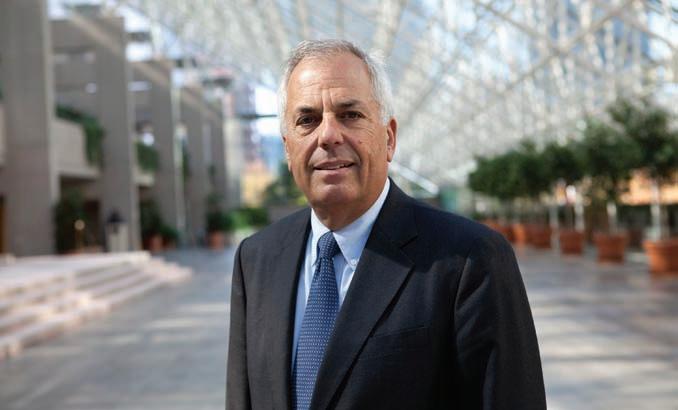
After seventeen years as a judge of the Supreme Court of B.C. including the last nine as chief justice I decided in June that I would step down on September 7th. It was not an easy decision. I have enjoyed my tenure since 1992 as a trial judge and I have particularly enjoyed the last nine years as chief justice. This is so in no small measure due to the unstinting support and help that I received from the lawyers of British Columbia.
It is probably true that there is really no good time to go; yet I believe, for me, as well as the court, this is the right time.
Our court today is as strong a trial court as exists anywhere. This is due to the strengths of my judicial colleagues and the commitment and dedication of our judicial administration and court services staff who support us.
When I was asked nine years ago to accept my position, I agreed but expressed the view that somewhere in the five to eight year range was probably about right for this position: long enough to get some things done, yet not too long to start getting stale. My view has not changed.
I believed then as I do today that institutions such as this court benefit from a periodic turnover in leadership.
I delayed my planned departure until the new civil and family rules
of court became law. In May this year, the final recommendations of the Rules Revision Committee were accepted by former Attorney General Oppal and passed into law as the new government’s first order of business after the election.
erosion of the independence of either the courts or the Bar. Without an independent Bench and Bar, the rule of law is but a hollow phrase.
I have been grateful for the support that I, as well as all of my judicial colleagues in B.C., have always received from the Bar in our province. The CBABC in particular has not failed to speak out when judges have come under inappropriate attack. I know that the judiciary will be able to continue to count on the CBABC in the years ahead; equally, I expect
I am pleased that the new rules incorporate the important principles recommended by those who worked so hard to bring about these badly needed reforms.
In today’s world one of the few constants is unremitting and indeed accelerating change. Managing that change to improve the court system and access to our court must always be a significant part of a chief justice’s role. Leading our court further into the digital age will also be an important task facing my successor.
A chief justice must remain ever vigilant to guard against any
that the judiciary will do its utmost to uphold the independence of the Bar.
I am very proud of all that we were able to accomplish together over the last nine years. This was only due to the unstinting support I received from my judicial colleagues and the Bar of our province. No chief justice could ask for more.
In closing let me again, on behalf of myself and all of my judicial colleagues, thank all of the members of the CBABC for all that you have done for us over the past nine years.
guest
Pro Bono Merging into the Fast Lane
Two organizations to become one.
The crisis of obstructed access to justice continues to worsen in British Columbia, and its steady decline parallels the gradual dismantling of legal aid and the growing complexity of our judicial processes. Tapping into the profession’s noble tradition of pro bono service, B.C.’s pro bono organizations mobilized in the late 1990s and early 2000s to meet the exploding demand for free legal services, all the while maintaining that pro bono services are meant to complement and not substitute for a properly funded legal aid system. Operating in virtual silos, the Salvation Army Pro Bono Program, the Western Canada Society to Access Justice and Pro Bono Law of B.C. led the organized pro bono charge toward the goal of a more accessible legal system.
In the mid-2000s, the three pro bono leaders recognized the counter-productivity of their solitary stances and gradually began to work in close collaboration with one another. The joint administration of projects revealed greater and greater potential for enhanced pro bono service delivery, and the organizations flirted with the once unimaginable idea of merging into one. The Law Foundation of B.C. embraced the idea and committed to funding a newly merged pro bono organization through its early years and beyond.
Emboldened by funder support
and common sense, Access Justice and Pro Bono Law of B.C. agreed to merge operations by December 1, 2009, and then merge into a single new pro bono organization by April 1, 2010. The new (as yet unnamed) organization will combine the operational strengths of its predecessors – Access Justice’s advice clinics and Pro Bono Law of B.C.’s representation programs – while working in close coordination with the Salvation Army. Once launched, it will offer seamless “cradle to grave” pro bono legal services to a higher number of clients than any other pro bono organization in Canada.
decreased competition for fund- ing from government, foundations, law firms and individuals; stable operations with long- term viability and vision for increasing access to justice in B.C.; and budget efficiencies permitting more clients to be served at less cost.
The viability of the new organization should be a matter of substantial pride to the B.C. Bar, since it reflects B.C.’s position as the province with the highest rate of pro bono engagement among
The new organization will be well positioned to respond to the rapidly changing and ever-increasing legal needs of B.C.’s marginalized populations. At the same time, B.C.’s pro bono funders, lawyers and clients will all benefit from the many synergies and efficiencies that will flow from a merged organization, such as: more efficient operations, includ- ing more effective client bookings and referrals, and unified lawyer recruitment and training; a wider array of pro bono services available to individuals in all areas of B.C., and an elimination of service and advocacy redundancies;
lawyers. The new organization will serve low and modest income clients in communities ranging from Victoria to Prince Rupert to Fort St. John to Fernie and points in between. Its limitless potential for scope of service is a testament to the undying willingness of B.C. lawyers to provide pro bono services where sorely needed.
Jamie maclaren, executive director, Pro Bono law of B.c., jmaclaren@ probononet.bc.ca. www.probononet.bc.ca www.accessjustice.ca
Allan Parker, executive director, Western canada society to Access Justice, allan.parker@accessjustice.ca. (photo credit: simon Bruce)
Jamie maC La R e N a N d a LL a N Pa R
Law Society promotes business case to keep women in private practice. retaining Women Lawyers
An exodus of women from the legal profession and a looming shortage of lawyers has prompted the Law Society of B.C. to build a business case to encourage law firms to take steps to keep women lawyers in private practice.
”We tracked new women lawyers between 2003 and 2008 and found that one third of them dropped out of the profession in that period,” said Kathryn Berge, QC, who is Chair of a Law Society task force formed to address the issue.
“This happened during a time when a record number of women entered the law – in greater numbers
than men – yet today they represent only 29 per cent of private practice lawyers in the province.
“The flight of women from law comes when we are facing a looming lawyer shortage,” she said. “Unless something changes, we will see a serious negative impact on public access to legal services as baby boomers retire, particularly in small communities.”
The business case outlines the demographic issues facing the legal profession in B.C. and explains the business advantages of retaining and advancing women in private practice.
“The benefits of retaining women lawyers are significant,” said Berge,
who practises in a small firm in Victoria. “Keeping and developing talent increases efficiency, client service, lawyer morale and future recruitment ability. This holds true in both good and bad times. There is also the benefit of a stronger and more sustainable firm culture based on merit, flexibility and diversity.”
One thing the business case does not suggest is that women should receive special treatment. It stresses the competitive advantages of creating firms that retain and advance talented lawyers, with a focus on serving clients in effective ways that make business sense and people sense.
The business case contains reference materials and a best practices toolkit, which will be of value to firms of all sizes seeking to improve their retention rates of women lawyers. The Retention of Women in Law Task Force is one of the initiatives the Law Society has implemented in furthering its strategic plan goal to enhance access to legal services.
A copy of the business case is available at lawsociety.bc.ca
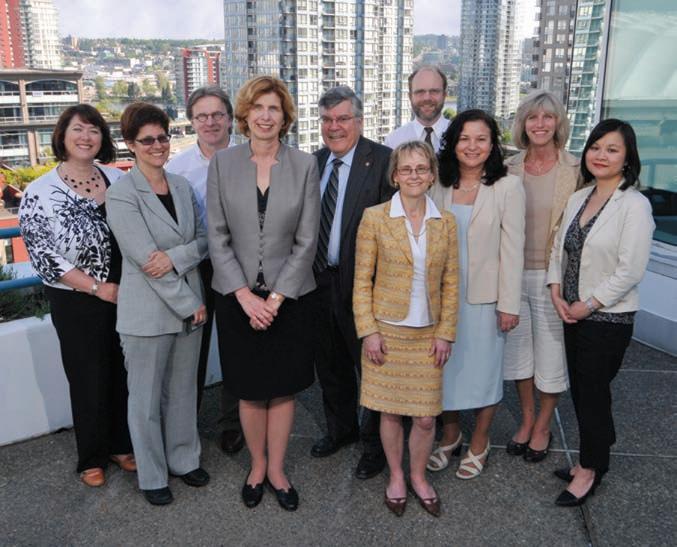
Photo: the law society’s retention of Women in the law task Force, left to right: Jennifer conkie, Qc, elizabeth vogt, richard stewart, Qc, Kathryn Berge, Qc (chair), Gavin hume, Qc, Anne Giardini, michael lucas (manager, Policy & legal services), maria morellato, Qc, Jan lindsay and susanna tam (staff lawyer, Policy & legal services). not pictured: rosanne Kyle.
Photo credit: Brian dennehy Photography www.lawsociety.bc.ca
Cou R tesy o F the Law s o C iety o F B.C.
Statutory protection for Games branding. Protecting the olympic Marks
Two major challenges facing Olympic committees are attracting sponsors and muchneeded sponsorship money, and fending off those who seek to create an association between themselves and the Olympics and its associated goodwill for free: “ambush marketing.” At past Olympic Games, the struggle has been as hard fought as any of the athletic events. Given the importance of sponsorship funding to the success of the Olympic Games, this is for good reason. The Olympic and Paralympic Marks Act, S.C. 2007, c. 25 is armed with a combination of broad prohibitions against unauthorized “association” with the Olympics, and sweeping enforcement provisions.
The central focus of the Act in this regard is found in sections 3 and 4. Section 3 prohibits the unauthorized use of Olympic or Paralympic marks, or any marks likely to be mistaken for them. Subsection 4(1) targets ambush marketing, creating a broad prohibition against promoting or otherwise drawing attention to a business in a manner likely to mislead the public into believing that its goods or services are approved, authorized, or endorsed by an Olympic organizing committee, or even that a “business association” exists between a person’s business and the Olympic Games, Paralympic Games, or an organizing committee.
In determining whether or not ss. 4(1) has been contravened, subsection 4(2) requires a court to take into account whether or not a person has used, in any language, a combination of words set out in part 1 of Schedule 3 of the
or interlocutory injunction sought under it, by providing that an applicant will not have to show that it will suffer irreparable harm. An authorized applicant therefore, will simply need to show an arguable case that the offending advertisement breaches sections 3 or 4 of the Act, and that the balance of convenience, irreparable harm aside, favours granting the injunction.
The Act provides strong protection for the Olympic and Paralympic marks. This protection is likely to be tested in relation to the Vancouver 2010 Olympic Games as
Act, including:
“Games,” “2010,” “Medals,” and “Tenth”; or a combination of one of those words with a word from part 2, including:
“Winter,” “Sponsor,” “Gold,” “Silver,” “Bronze,” “Vancouver” and “Whistler.”
Should a Court find that sections 3 or 4 have been contravened, on application by an applicant authorized under the Act, it may make any order it considers appropriate. The examples provided in section 5 of the Act include relief by way of injunction and recovery of damages or profits, punitive damages, or, tellingly, an order for the publication of a “corrective advertisement.”
In terms of enforcement, the Act alters the test for an interim
they have been at past Olympics, and lawyers in British Columbia will see it first-hand. Approaches can be creative; for example, during the 1994 Winter Olympics, Visa aired commercials promoting its official sponsorship of the games, and the fact that American Express was not accepted anywhere in the Olympic Village. American Express promptly aired its own commercials offering the following, truthful, riposte: “If you are travelling to Lillehammer, you’ll need a passport, but you won’t need a Visa.”
mark Fancourt-smith is a commercial litigator at Fasken martineau whose practice includes intellectual property litigation, trade secrets, and fraud.
feature exeCutive Committee 2009/2010
James M. Bond President
James is a Partner in the vancouver office of Lang michener LLP, where he also serves as Chair of the firm’s student Recruiting Committee. James’ practice is concentrated in the areas of mergers and acquisitions, franchise and distribution, privacy, technology, and intellectual property law. he holds a Bv Rating from martindale-hubbell, has been ranked for four years as a “Leading Lawyer” in Canada by the legal publication, LexPeRt, and has been named one of “Canada’s Best Lawyers” in each of the last three years.
James is an active volunteer, and is a former member of the executive Committee of the vancouver Bar association, a former Legal advisor and a current member of the Canadian Franchise association Pacific Region Council, and a member of the Canadian Franchise association Franchise service supplier Council.
James regularly writes and lectures in primary practice areas, and has published several articles, taught courses, and presented papers at a number of conferences. he holds a Ba from the university of Calgary, where he was a Queen elizabeth ii scholar, and an LLB from the university of alberta. he was called to the British Columbia Bar in 1996.
stephen g. McPhee vice President
stephen began his legal career in south africa and was called there in 1997. his law degree was earned at the university of stellenbosch, situated in the heart of the south african winelands, which makes his successful academic performance there even more impressive. he immigrated to Canada in 1997, obtained his Canadian legal accreditation in 2000, and was called to the Bar in B.C. in 2002.
stephen is a partner with Ramsay Lampman Rhodes in Nanaimo and practises general commercial and civil litigation, personal injury and family law. he has a special interest in adR.
stephen is an elected member of Provincial Council for Nanaimo County. he has been the Nanaimo adR section Chair, and served on the executive of the Nanaimo Family section since 2003.
he has served on the CBa B.C. Branch executive Committee since 2005.
Miriam A. Maisonville Past President
miriam a. maisonville was called to the Bar in British Columbia in 1986 and the Bar in alberta in 1991. a graduate of the university of British Columbia law school in 1985, miriam practises with the ministry of the attorney general, appeals and special Prosecutions, conducting fraud prosecutions and appeals. a member of the Bilingual Prosecutors group, she also conducts French language prosecutions.
miriam practised civil litigation and conducted criminal defence work prior to joining the ministry of attorney general in 1994. she is a past Chair of the vancouver Criminal section from 2003-2004 and was elected to Provincial Council in 2004. in 2006-2007 she served as secretary-treasurer to the CBa B.C. Branch and in 2007-2008 as the Branch vice President. she is member of the CBa National Council and is the past Chair of the CBa National Conference of French speaking Common law members. she is the past President of the association des Juristes d’expression Française de la ColombieBritannique. she is a member of the Judicial Council for British Columbia and is a past member of the CBaBC advisory Committee to the Judicial Council for British Columbia.
miriam has been a guest lecturer and presenter at numerous conferences and seminars on both legal and practice issues and issues within the profession, including mentoring. she is a past contributor of the Continuing Legal education society’s annual Review of Law and Practice, in the area of Criminal Law, and she recently authored chapters for introducing evidence at trial. her other community involvement in the past has included serving for the Canadian Red Cross, on the Board of governors of the developmental disabilities association Foundation and volunteer competitive swim coaching.
sharon Matthews secretary-Treasurer
sharon matthews combines a practice focussing on aviation cases, product liability cases and class actions with service to the legal community.
sharon is a partner with Camp Fiorante matthews and acts for plaintiffs in aviation and product liability cases and on class actions. in the course of this practice, sharon has acted as counsel at trials and on appeals in British Columbia, alberta, ontario and at the supreme Court of Canada.
in addition to her practice, sharon volunteers in the legal community. she sits on B.C. Provincial Council and the CBa National Council, and has served on a multitude of CBaBC committees, including the 2003-2004 executive Committee. she also volunteers as a roster lawyer for Pro Bono B.C., and is a member of the trial Lawyers association of British Columbia. she is a former member and Past President of the advocates’ Club. she is a frequent speaker at continuing legal education events including B.C. Continuing Legal education and osgoode Professional development.
sharon’s efforts and productivity in these endeavours were recognized with the 20022003 CBaBC President’s medal and in 2006 with the uBC Law alumni association outstanding young alumna award.
feature
Michael r. Dunn officer
michael R. dunn received a Ba (hons.) in economics from uBC in 1988, and LLB from uBC in 1992, and was called to the Bar of B.C. in 1993. he is an active volunteer, and has volunteered his time to a number of organizations including the south grandview Residents association, and the young associates of the vancouver art gallery.
michael R. dunn founded the vancouver Law Firm of dunn & Company in 1993. he has practised at every court level in British Columbia. he has acted as Counsel in serious criminal matters, and before many of the administrative tribunals in B.C., including the environmental appeal Board of B.C., and the investment dealers association. he specializes in the area of complex civil litigation. he has been a member of the Law society of upper Canada since February 2005, and is representing Class action litigants nationally in several product liability actions.
From 2002 until 2006, michael R. dunn was the Chair of membership, member of the National membership Committee of the CBa, member of the CBaBC Legislation and Law Reform Committee, and member of the CBaBC Law week Committee. he is a member of the ontario Bar association, a member of National Council, and an officer of the executive Committee of the CBa B.C. Branch.
Martin russell officer
martin received his Ba from the university of western ontario in 1987 and graduated from Queen’s university with an LLB in 1997. he was called to the British Columbia Bar in 1998. martin’s private practice consists of wills and estates, conveyancing, and business law. he has been the Co-Chair of the wills and trusts-okanagan section since 2006. martin moved to kelowna in 2002 and enjoys the lifestyle that the okanagan has to offer.
Clinton sadlemyer officer
Clint graduated from the university of saskatchewan in 1991 and was called to the Bar in British Columbia in 1993. he practises exclusively in the field of Criminal defence at king sutton sadlemyer in Nanaimo. he is currently in his second term as President of the Nanaimo County Bar association and is a member of Provincial Council for Nanaimo. Clint is a member of the Legal services society Criminal tariff Committee and the Law day Committee for Nanaimo. Clint plays guitar and was the driving force behind Nanaimo’s First annual Battle of the Lawyers’ Bar Bands in october of 2008, and is planning the next one. Clint also volunteers with the Lawyer’s assistance Program. Clint is married to his life partner of 31 years, michelle, and has three children and one grandchild.
Kerry L. simmons young Lawyers’ representative
kerry practises at Cook Roberts LLP where she assists clients with family law and civil litigation disputes. Called to the Bar in 2000, kerry has been a member of Provincial Council as a section Chair from 2001-2007 and as an elected member for victoria County since 2007. this is her second year serving as young Lawyers’ Representative. kerry is also a sessional instructor at the Faculty of Law, university of victoria teaching Civil Procedure and drafting. among her professional and community contributions, she is the Chair of the inquiry Committee of the College of dental hygienists of British Columbia.
Jennifer spencer equality representative
Jennifer spencer is an associate at Blake, Cassels & graydon LLP, having summered and articled at the firm after earning her law degree from the university of victoria (2002). she practises corporate-commercial litigation acting on a broad range of commercial matters, including contract disputes, corporate governance matters and torts claims, especially product liability. Jennifer also works extensively in aboriginal law, including consultation processes, strength of claim analysis, governance issues, and natural resource use for both aboriginal governments and industry. her practice sees her in all levels of court in British Columbia, the Federal Court, and various administrative tribunals, including the Coroner’s Court, from time to time.
Jennifer’s background focuses on social justice and she has a masters degree in law and politics. access to justice and pro bono initiatives are important to Jennifer: she serves on both the Blakes national pro bono committee and with Pro Bono Law B.C.’s civil chambers duty counsel project. Jennifer also advises several charitable organizations on corporate governance and risk management issues.
each spring, Jennifer is found coaching the uBC Law Faculty’s moot team at the national kawaskimhon moot in aboriginal law. throughout the year, she can be found at the advocates’ Club and chairing the CBa’s aboriginal Law (vancouver) section.
as the equality and diversity Representative, Jennifer’s focus for the coming year is on the retention of women and minorities in the legal profession. she is also passionate about the aboriginal Law students scholarship trust!
news&events
Irish Eyes Smile on CBA’s Dublin Conference
Clemency for Canadian citizens facing the death penalty, the dispute resolution process for Aboriginal students, and the Irish model for self-administered courts highlighted the CBA’s 2009 Canadian Legal Conference in Dublin, Ireland. The 2009 Canadian Legal Conference presented CBA members with an ideal opportunity to connect with leaders in law from Canada and Europe and learn from their experiences.
resoLUTioNs
CBA Council debated a number of issues, including: expanding the scope of the dispute resolution process for Aboriginal
students; enabling CBA membership for public sector lawyers in the territories; and Conference representation on the Board of Directors. Council also overwhelmingly adopted a resolution urging the Canadian government to restore its policy of unequivocally seeking clemency for all Canadians facing the death penalty abroad.
oPeNiNg PLeNAry
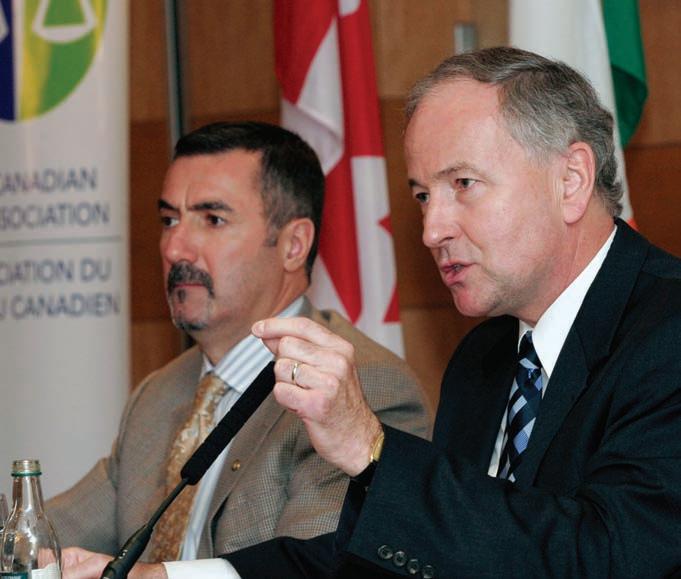
Appearing via video, Chief Justice Beverley McLachlin praised the work of the CBA in defending judges and speaking out to support judicial independence. Minister of Justice Rob Nicholson
spoke about the need for constant dialogue among all stakeholders in our system of justice, including the government and the CBA, to improve the legal system for Canadians.
Then CBA President Guy Joubert’s presidential address described the legal profession’s role as stewards of legal knowledge and guardians of the rule of law for future generations.
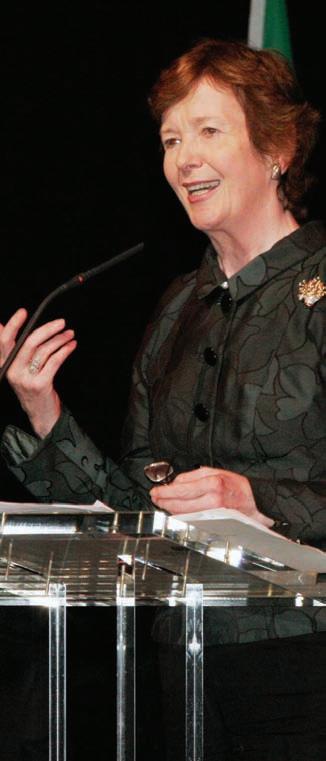
Keynote speaker Mary Robinson, former president of Ireland and United Nations High Commissioner for Human Rights, placed all of the opening plenary’s themes in the context of the history of Ireland and the ongoing quest for human rights.
JUDiCiAL ADMiNisTrATioN
A panel of eminent Irish jurists, led by Chief Justice of Ireland John Murray, shared their thoughts and experiences with CBA Council on how Irish courts came to be self-administered.
In the mid-1990s, in the wake of several crises in the running of the courts, the Irish government undertook to reform how its courts were run. Unacceptable delays caused court cases to drag on endlessly.
From the reforms emerged the Courts Service, an independent organization charged with managing the courts, supporting judges and informing the public. Over the last ten years, it has transformed how the courts are run in Ireland. Instead of being answerable only to the minister, courts are now run by an independent board, led by a chief executive who is answerable to the public. Whether the Canadian courts should adopt a similar model remains to be seen.
Justice minister rob nicholson (right) joins then President Joubert at “dialogue with members.”
N atio N a L N ews
Continuing Legal Education Highlights
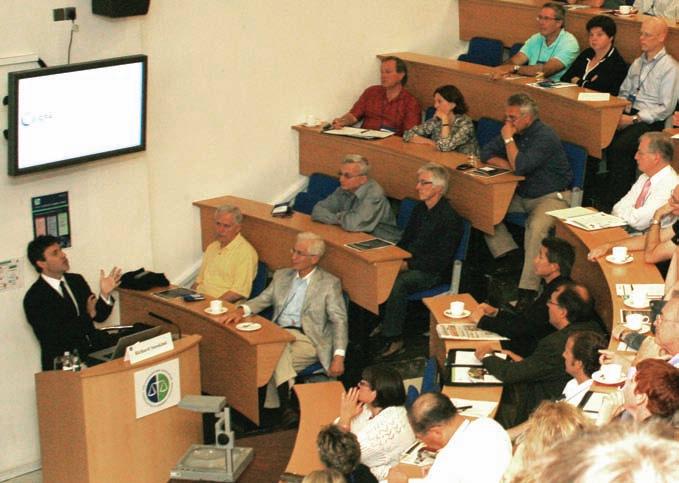
The future of lawyers. The future was on everyone’s mind as attendees listened closely to Richard Susskind, legal futurist and author of the widely read book The End of Lawyers? Speaking to a packed house of lawyers and judges, Professor Susskind, also a special adviser to the CBA, painted a picture of a profession relentlessly transformed by technology that makes legal services much easier to deliver, for much less – thereby complicating efforts by lawyers to maintain income streams they have previously enjoyed.
Counter-terrorism and human rights. A sobering panel discussion on counter-terrorism and human rights was moderated by Professor William Schabas, the director of Irish Centre for Human Rights (ICHR). Among the panelists was Phil Shiner, one
of Britain’s top human rights lawyers, who discussed the appalling track record on torture of the U.S. and U.K. governments. Attendees received a detailed and explicit inventory of alleged acts of torture perpetrated by military and intelligence authorities. Panelists raised concerns about lower standards of what constitutes torture.
Global anti-corruption compliance. One of two CLEs presented by the Canadian Corporate Counsel Association featured a panel of experts on anti-corruption compliance, moderated by Christa Wessel, a partner at Gowling Lafleur Henderson LLP. Panelists shared their perspectives on international efforts to crack down on the bribery of foreign public officials and the long reach of the U.S. Foreign Corrupt Practices Act,
the Canadian Corruption of Foreign Public Officials Act and other regional anti-corruption and anti-bribery laws.
Expert witnesses. Achieving credibility with expert witnesses in litigation was the subject of another well-attended CLE. Former CBA President Simon Potter, a partner with McCarthy Tétrault in Montréal, and Bob MacDonald, a chartered accountant with Navigant Consulting, provided concrete tips for how to carefully select and prepare expert witnesses for trial, from the points of view of both litigation counsel and expert witness.
richard susskind (bottom left) on technology and the future of the legal profession.
N atio N a L N ews
Former irish President mary robinson at the opening Plenary in dublin.
IN FORCE
current from June 18, 2009 to september 2, 2009
legislative Update is provided as part of the CBaBC legislative and law reform program. It is a service funded by CBa membership fees, and is, therefore, provided as a benefit of CBa membership. The full version of legislative Update is now only published online and available to CBa members exclusively at www.cba.org/bc.
Fish Protection Act, s.B.c. 1997, c. 21 (Bill 25) Section 9 is in force august 20, 2009
iNJUNCTioNs – BriTisH
CoLUMBiA LAW AND PrACTiCe, 2ND eDiTioN
Injunction applications are always urgent; lawyers prosecuting or defending them must respond quickly and knowledgeably. The second edition of ClEBC’s Injunctions – British Columbia law and Practice, scheduled for release in October, will reflect significant changes to law and practice since the first edition was published. The book outlines general principles, provides valuable practice information, and covers procedural and substantive law governing the granting and enforcement of interlocutory injunctions – all in a handy 6” by 9” softbound book. It includes forms and precedents, tables of cases, legislation, and references, and a comprehensive index.
ANNoUNCiNg CLeBC-Tv
ClEBC is pleased to announce a new series of online courses to be delivered right to desktops through live video streaming from ClEBC-TV, starting in September. Programs include The Paperless Office; Practising law Would be Great if it Weren’t for Problem Clients; Inadvertent Disclosure of Documents; Ethical Issues – ask the Experts; Conflicts – Issues and Solutions for Big and Small Firms; and How Not to Miss a limitation or Deadline – Beat the Clock! Watch www.cle.bc.ca for details.
LAsT KiCK AT THe CAN
Have yet to complete your CPD hours for 2009? ClEBC will hold a last kick at the Can Program December 7th-11th, 2009, offering streaming webcast archives of ClEBC’s 15 most popular programs from the past year.
Further information on cleBc publications and courses is available from cle customer service at 604-893-2121 (toll-free in canada at 800-663-0437) or at www.cle.bc.ca.
This year's Bench & Bar Dinner comes to the Pan Pacific Hotel in Vancouver, offering members of the legal profession and the judiciary a unique opportunity to enjoy an evening of good company and conversation.
The Dinner will honour the recipient of the CBABC Georges A. Goyer, QC Memorial Award for Distinguished Service (to be announced this fall).
Bench
& Dinner
Bar
The Canadian Ba r Association, B.C. B ranch and the Law Society of B. C.
warmly invite members of the p ro f ession a nd th e judiciary to attend the 25th Annual D inner for the Bench a nd Ba r
Date: Wednesday, N ovember 4 , 2009
Time: Reception – 5:45 p.m. (cash bar)
Dinner – 6:30 p .m. (cash bar)
Place: The Pa n Pa cific Hotel
C r ystal Pa vilion, L ob by L evel
300 – 999 Canada Place Way
Vancouver, B.C.
Dress: Business attire
Tickets: $85.00 per person ($80.95+$4.05 GST )
Tickets are limited and available only while quantities last, so order early.
For more information or special requirements, contact Meghan Kavelman, CBABC, at 604-646-7855 or tollfree at 1-888-687-3404 ext. 306.
Name:
Firm:
Address: :edoc latsoP :ytiC :elimiscaF :enohpeleT
Be part of the celebration as the Law Society marks 125 years of protecting the public interest in the administration of justice.
Join the CBABC Executive and Provincial Council and the Law Society Benchers in paying homage to those who have made outstanding contributions to the cause of justice in British Columbia.
Visa MasterCard Cheque enclosed (payable to the Canadian Bar Association, B.C. Branch)
Credit card number: Expiry date:
Signature:
BY FAX: Please fax your ticket order, with credit card information, to 604-669-9601 or 1-877-669-9601.
BY MAIL: Mail your ticket order, with payment, to Meghan Kavelman, CBABC, 10th Floor – 845 Cambie Street, Vancouver, B.C. V6B 5T3.
Lawyers Hourly Rates to Become Extinct???
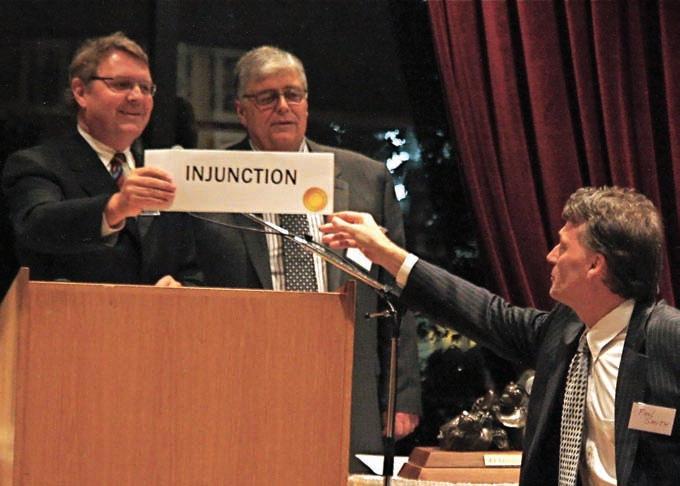
The 2nd Annual Boughton/ BCLI Great Debate is an event where legal topics are argued in a light-hearted way, rather than through the blood lust of litigation. This year’s resolution of “the hourly rate for lawyers compares to the asteroid for dinosaurs” may cause a new Ice Age between the UVic team of BarTalk columnist, Tony Wilson and Dean Donna Greschner and the UBC team of Advocate Deputy Editor, Michael Bain and Dean Mary Anne Bobinski. The event, hosted by Boughton
Annual Report
Law Corporation and the B.C. Law Institute, will be attended by many of B.C.’s top judges and lawyers and emceed by CBC Radio’s Rick Cluff. To obtain your tickets to the October 28th Dinner and Debate at the Law Courts Inn in Vancouver, contact Elizabeth Pinsent of BCLI at 604-822-0142.
tony Wilson is served with an injunction by Paul smith during a lighter moment in 2008’s Boughton Great debate, with cBc radio 1’s rick cluff looking on.
the CBaBC 2008/2009 annual report is online now. in order to cut down on our paper usage and preserve the environment the CBaBC is no longer publishing a print version of our annual Report. however should you be interested in obtaining a printed copy please contact us at 604-687-3404 and one will be sent to you.
REAL Initiative Now Accepting Applications for 2010 Summer Student Funding
The Rural Education and Access to Lawyers Initiative (REAL) is now accepting applications from lawyers and law firms in rural areas and small communities for funding to cover the salary costs of a summer student for 2010. The Regional Legal Careers Officer will be conducting on campus information sessions at UBC, UVic, UofA, UofC and USask in October in order to promote the summer positions to law students throughout Western Canada.
Please visit \ www.realbc.org or www.cba.org/bc and click on reAL.
eve N t
N
grantsapproved announcements
HSBC Bank Canada
Law Foundation Chair, mary mouat, commends hsBC Bank Canada (“hsBC”) for its commitment to paying one of the most competitive rates of return on lawyers’ pooled trust accounts. this ensures hsBC a top spot on the Law Foundation’s preferred list of financial institutions for lawyers pooled trust accounts.
during these unprecedented times, with interest rates at a record low, hsBC voluntarily stepped forward, as was done in the past, with a new agreement that set it above other financial institutions in the rate of return paid to the Foundation. thanks go to Roderick (Rory) J.R. Langran, assistant vice President, global Payments and Cash management, for the leadership shown in making this new agreement possible.
increased revenues enable the Law Foundation to fund programs that make the justice system accessible to British Columbians. the funded programs include professional legal education, public legal education, law reform, legal research, legal aid and law libraries.
the Canadian Bar association B.C. Branch, the Law Foundation, and the Law society encourage lawyers to consider which financial institutions provide the best support to the Law Foundation when deciding where to place their trust accounts.
Vancouver City Savings Credit Union
Law Foundation Chair, mary mouat, commends vancouver City savings (“vancity”) for its commitment to paying one of the most competitive rates of return on lawyers’ pooled trust accounts. this ensures vancity a top spot on the Law Foundation’s preferred list of financial institutions for lawyers pooled trust accounts.
during these unprecedented times, with interest rates at a record low, vancity voluntarily stepped forward, as was done in the past, with a new agreement that set it above other financial institutions in the rate of return paid to the Foundation. thanks go to Catherine Ludgate, manager Community Business Banking, for the leadership shown in making this new agreement possible. increased revenues enable the Law Foundation to fund programs that make the justice system accessible to British Columbians. the funded programs include professional legal education, public legal education, law reform, legal research, legal aid and law libraries.
the Canadian Bar association B.C. Branch, the Law Foundation, and the Law society encourage lawyers to consider which financial institutions provide the best support to the Law Foundation when deciding where to place their trust accounts.
Law Foundation of British Columbia GRADUATE FELLOWSHIPS 2010/2011
vALUe: up to five (5) awards of $13,750 each (subject to change).
CLosiNg DATe: January 8, 2010.
FieLD oF sTUDy/ eLigiBiLiTy: Full-time graduate studies in law or a law-related area. applicants must either be residents of British Columbia; graduates of a British Columbia law school; or members of the British Columbia Bar.
WHere TeNABLe: Recognized universities in Canada, the u.s. or abroad. Note: the Law Foundation graduate Fellowship is not available for the graduate programs of the Faculties of Law at the university of British Columbia and the university of victoria as the Law Foundation makes separate grants to the graduate Fellowship programs at these universities.
APPLiCATioNs: Please visit our website, www.lawfoundationbc.org or contact us at Law Foundation of B.C., 1340 – 605 Robson street, vancouver, B.C. v6B 5J3 / tel. 604-688-2337 / email lfbc@tlfbc.org for an application form or further information.
memberservices
every issue of BarTalk highlights regular discounts available to members from a range of national and regional preferred suppliers. seasonal promotions and special offers to members are promoted weekly via cBABc News & Jobs don’t miss any promotion by subscribing to the member services e-bulletin: email members@bccba.org or fill in and fax the sign-up box below to: 1-877-669-9601 (toll-free) • 604-669-9601 (Lower mainland).
teCh tiP: member services are available 24/7 via the CBaBC website. to access member services on the site, log onto www.cba.org/bc, then choose member savings from the drop-down list under membership. on the member savings page, you will find links to the suppliers highlighted below, plus many more.
Playhouse Theatre Company
season 2009/2010 starts october 10th. get your tickets now for the great upcoming shows. CBaBC members receive various discounts of up to 20 per cent off. teCh tiP: select arts & entertainment on the member savings page.
ProGroup
CBaBC has negotiated preferred rates that offer CBaBC members and their family substantial discounts when purchasing or leasing a car. For those of you who are on a budget, they also sell used cars. Call today! teCh tiP: select auto Leasing, Rental, and sales on the member savings page
Sign Me Up!
yes, please send me monthly updates on the latest CBaBC promotions.
NAMe
FAx ...............................
eMAiL .............................
Please complete this form and fax back to: 604-669-9601 toll free: 1-877-669-9601 or sign up by emailing your information to members@bccba.org
Canucks Tickets
hockey fans, the wait is over. Canucks tickets for games starting september 21st through to march 30th went on sale in september. CBaBC members receive up to 20 per cent off the box office pricing. tickets sell out fast and are sold on a first-come, first-serve basis, so be sure to order early to avoid disappointment. teCh tiP: select sports on the member savings page.
Fall Ski Promotions
save when you hit the slopes this ski-season! CBaBC is offering members outstanding discounts on ski packages in kelowna, kamloops, vernon, and vancouver. more mountains may be added; be sure to keep checking the website for updates in the fall/winter season. teCh tiP: select alpine Resorts on the member savings page.
Kelowna: Big white ski Resort, up to 15 per cent discount Kamloops: sun Peaks Resort, up to 15 per cent discount vernon: silver star mountain Resort, up to 15 per cent discount vancouver: whistler Blackcomb, up to 25 per cent discount on lift tickets, and up to 40-50 per cent discount on rentals. (Note: tickets will be valid during the 2010 Olympics)
FoR saLe
established general law practice for sale on beautiful salt spring island. The practice serves an increasingly affluent and eclectic client base. You will take over a charming “downtown” office with plenty of interesting work and ocean views. Work/life balance? You won’t find a better opportunity than this! For more information, please contact Eamon Murphy by telephone: 250-5375505, or by email: eamon@cmwlaw.ca
seekiNg wiLLs
seeking Will of Norma yvonne Lougheed, Deceased. Call Andrew MacKay of Alexander Holburn Beaudin & Lang LLP at 604-484-1700.
seRviCes
intellectual Property
Let us assist you in providing protection for your clients. Douglas B. Thompson Law Corporation – Registered Patent Agent, Registered Trade Mark Agent. Practice restricted to Intellectual Property, Victoria, B.C. (www.BCpatents.ca) Email: doug@BCpatents.ca.
PositioN avaiLaBLe
Live, work and play in the east Kootenays. Associate Lawyer. Thinking about making a change? Is city life becoming too hectic and unrewarding? Do you enjoy the outdoors and want to put down some roots in south east British Columbia? Rockies Law Corporation, the largest law firm in the East Kootenays, is seeking a committed professional for its office in Fernie, B.C. The successful candidate will be an energetic self-starter, able to work independently and add value to our people-oriented firm. This position would suit either a recently-called lawyer who is a quick study who is able to work toward assuming responsibility for an established clientele, or an experienced lawyer who wishes to take on an existing book of clients and the benefits of a growing practice. The successful candidate must enjoy living and working in the Rocky Mountains, relate well to clients of all ages and backgrounds, and work with a high degree of professionalism while maintaining the straight-forward, integral, and personal approach that we strive to provide to all of our clients. Reply in confidence to careers@rockieslaw.com.
BarTalk Gets Results
CLAssiFieD (per line)
CBaBC members/Firms
$25
iNserT (all of B.C.)
CBaBC members/Firms
$1,250
Commercial organizations
$2,500
Next deadline: November 12
Next mailing: December 4
Premium full-page colour ads available.
direct
barmoves
Who’s Moving Where
Kristal Low has been appointed by Josephson angus Barristers as a new associate barrister with their downtown vancouver commercial litigation law firm. Prior to joining Josephson angus Barristers, ms. Low worked at Lawson Lundell in vancouver.
Kelsey Moore has recently been called to the B.C. Bar and has joined goodwin & mark in New westminster as an associate. she will practise civil and commercial litigation.
Frederic r. sierecki has joined mcCrea & associates, immigration and Citizenship Lawyers. Frederic was called to the B.C. Bar on may 20, 2009.
Marina L. sedai is pleased to announce the opening of sedai Law office, an exclusively immigration and citizenship law practice.
Laura Baptie has joined Farris, vaughan, wills & murphy LLP kelowna office as its newest associate. Laura joins Farris’ kelowna office as a solicitor, working primarily in the areas of corporate and commercial law, real estate, and wills & estates.
Joan young, lawyer at national law firm Lang michener LLP, has been appointed as a director of the victoria airport authority for a three year term. young is the nominee of the Capital Regional district.
gurleen s. sahota has joined edgar & Co. as an associate, where he will be specializing in labour, administrative and human rights law.
Altaf Jina of Park Place seniors Living has been reappointed to the Board of CLeBC. he has also been reelected to the Board of health employers association of B.C.
newmembers
BaR moves suBmissioNs (max 35 woRds) to CBa@BCCBa.oRg
moves suBmissioNs (max 30 woRds) to FoR moRe BaR moves go to BarTalk ONlINE
Catherine sas, QC of C.a sas immigration Law Centre is pleased to announce that they are sharing office premises in gastown with La Liberte and Co and Rita sidhu, trial Lawyer.
July & august 2009 regular Members
Joseph J. Berta Brawn Karras & Sanderson
Surrey
Michael B. Brotchie Hobbs Giroday
Vancouver
olubode Fagbamiye
Leonard Law
Victoria
Terry LaLiberte, QC of La Liberte and Co is pleased to announce that they are sharing office premises in gastown with Catherine sas, QC of C.a sas immigration Law Centre and Rita sidhu, trial Lawyer.
Kasandra Cronin of La Liberte and Co is pleased to announce that they are sharing office premises in gastown with Catherine sas, QC of C.a sas immigration Law Centre and Rita sidhu, trial Lawyer.
rita sidhu will be practising in the areas of personal injury, civil litigation and criminal defence as of october 2009. she will be sharing office space at historic gaoler’s mews in gastown with Catherine sas, QC, terry La Liberté, QC and kasandra Cronin.
Kelly Ford
Blake, Cassels & Graydon LLP
Vancouver
David A. goldberg
Maxwell Bulmer
Hopman
Vancouver
Leilani D. Karr
Shortt & Arsenault
Vancouver
robert Kwasnicki Doak Shirreff LLP
Kelowna
Alison M. Latimer Arvay Finlay
Vancouver
Damon o’Brien
Scott-Moncrieff & Company
Sidney
Michelle L. Perry
Ives Burger Courtenay
Jude Popp
Lawson Lundell LLP
Vancouver
Anjalika samarasekera
Bolton & Muldoon
Vancouver
elin r.s. sigurdson
Arvay Finlay
Vancouver
Articling students
Karen Ameyaw
Richards Buell Sutton LLP
Vancouver
emma Butt
British Columbia Law
Institute
Vancouver
genevieve Chang
Richards Buell Sutton LLP
Vancouver
Natasha grof
Velletta & Company
Victoria
Deborah Lindsay
Johnston
Harper Grey LLP
Vancouver
Jake Jeffrey Locke
Borden Ladner Gervais LLP
Vancouver
steven Meurrens
Richmond ivy Mui
Maynard Kischer
Stojicevic
Vancouver
Celia Pendery
Vancouver
To view all new \ members please visit www.cba.org/bc/ bartalk_06_10/10_09/ membership.aspx