Solicitor's Liens Protected
CBABC advocacy wins liens exemption in PIPA
0n May 18, Bill 30, the Miscellaneous Statutes Amendment Act (No.2) was proclaimed, and a two - and-a-half year campaign by the CBA to protect solicitor 's liens came to a successful conclusion . The story of the behind - thescenes work to bring about this end is known to only a few, but reflects the best of CBA advocacy on behalf of B.C. lawyers
Every day in our province, lawyers accept work from clients on the understanding that payment will come later. The basis for that act of faith lies in the common law right known as a solicitor's lien, namely the right to be paid should the clients request their legal file or ask for it to be transferred to another lawyer. This assists many clients in B.C. to retain lawyers for their worthy cases despite their lack of immediate funds.
The "product" lawyers provide to their clients isn ' t as tangible as a physical file - it is the skills and experien ce they bring to bear on a legal matter. However, the file itself frequently contains a mixture of personal information about the client and the analysis of the facts and the law. In addition, the file may contain items paid for by the lawyer such as expert reports, on the expectation of those costs being covered under a contingency fee or other delayed payment arrangement. Under the Personal Information Protection Act (PIPA) as originally drafted, a client could potentially demand the file without compensation. www.cba.org/bc
When PIPA was first introduced , the CBA w as immediately concerned that it did not have an explicit exemption for material subject to a solicitor's lien. Key members of the CBABC Freedom of Information and Privacy Law Section, including Tamara Hunter, Clark Ledingham, Mike Lucas of the Law Society and Stuart Rennie of the CBABC, began the work of pressuring the government to move a potential amendment up the legislative agenda priority list. Over the next two years, it became a top CBA government relations focus raised in all meetings with Ministers and MLAs. Lest the legislative loophole become widely known before it could be mended, the CBA's approach was to quietly work toward securing the exemption
It is a testament to the positive working relationship between the CBA and lead senior bureaucrats in government - Chris Norman and Sharon Plater in particular - that an amendment w a s finally drafted and passed. Their patient, thoughtful efforts to mitigate the unintended consequence of the original Act were exemplary. Thanks are also due to previous minister Joyce Murray and current minister Mike De Jong, as well as former and current Attorneys General Geoff Plant, QC and Wally Oppal, QC and th e Law Society of B.C., for their work in ensuring that the importance of solicitor 's liens was understood and supported by government. BT
Law Week is our celebration of the anniversary of the Charter of Rights and Freedoms. It is also the one time during the year when the law rightly shifts into the spotlight. We welcomed the knowledgeable presence of the public into our local courthouses to watch mock trials, consult with lawyers at information booths, take free legal classes and learn about rights due to all Canadians
CAROLINE NEVIN LETTERS TO THE EDITOR
Canadian Bar Association , B.C Branch
1Oth Floor , 845 Cambie Street Vancouver, B.C V6B 5T3
Tel: 604-687-3404
Toll-free lin B.C !: 1-888-687-3404
BarTalk is published six times per year by the Canadian Bar Associat ion, British Columbia Branch.
BarTalk Senior Editor Caroline Nevin 604-687-3404, ext. 320 cnevin @bccba org
BarTalk Editor
Deborah Carfrae bartalk@bccba org
Editorial Board Chair
David Dundee ddundee@kamloopslaw com
Editorial Board Members
Johanne Blenkin
Susan MacFarlane
Eugene Raponi
Gurminder Sandhu
Barinder Sanghara
Veronica Singer
Dierk Ullrich Miriam Vale
©Copyright the British Columbia Branch of the Canadian Bar Association 2006
This publication is intended for information purposes only and the information herein should not be applied to specific fact circumstances without the advice of counsel.
The Canadian Bar Association, British Columbia Branch represents more than 5,800 members within British Columbia and is dedicated to improving and promoting access to justice , reviewing legislation, initiating law reform measures and advancing and improving the administration of justice
BarTalk Publication Sales Agreement #40741008
LETTER TO THE EDITOR
(VOL. 18, NO. 2)
In the April 2006 edition of Bar Talk , a letter from Charlie C. Tutt struck a chord in me Mr. Tutt
Send your LETTERS TO THE EDITOR to :
Caroline Nevin, Bar Talk Senior Editor
Canadian Bar Association, B.C. Branch Fax : 604-669-9601 Toll - free fax: 1-877-669-9601
said that as a junior lawyer he found that E-ma i l: cnevin@bccba org
most of the articles in Bartalk very negative and depressing He was wondering if there were any senior lawyers who found their personal/ family lives, as well as their practice of law rewarding and fulfilling, or whether he had made a poor career choice.
As a 1983 call living and working in the Kootenays , I would like to emphasize that he made a good career choice - that you can h a ve your cake and eat it too!
I make a good living from my law practice, and I still spend lots of time with my wife, family, and friends. I take lots of holidays and days off, yet most of the time I enjoy my practice and I look forward to going back to work
As a sole practitioner doing only criminal law, I have more control over my time than most lawyers Since I can usually schedule cases to fit my calendar, I can take lots of time off. I also "office share" with a good friend who does civil litigation. My relationship with the people I deal with in the court system is good and supportive.
Therefore, Mr. Tutt and younger lawyers who are wondering if they have made a good career choice, I believe the answer is YES Especially so if you choose an area of law that you enjoy and have some talent in Deciding on the area of law that suits you is critical. For example, I am hopeless doing wills, estates , real estate, etc., yet I thrive defending people in trouble. If you enjoy what you are doing and honestly try to help people, you should have a happy life, make a reasonable living, and feel good about yourself. I know other lawyers who also are happy with their work.
I hope this letter counter-balances some of the articles in Ba r Talk Mr. Tutt was commenting on. I invite some other senior la wyers to offer some positive insight on being a lawyer in British Columbia.
-Patrick H. Dearden , P]D! bt
Pro Bono: Do We Do Enough?
Irecently had an interesting discussion with one of the very dedicated lawyers in British Columbia involved in providing pro bono services to the public. The impression I received from our discussion was that he felt the lawyers in British Columbia do not volunteer enough p ro bono services to the indigent. I r espectfully disagreed with him, but the conversation prompted me to consider using this column to talk about the legal profession's dedication to volunteer work and
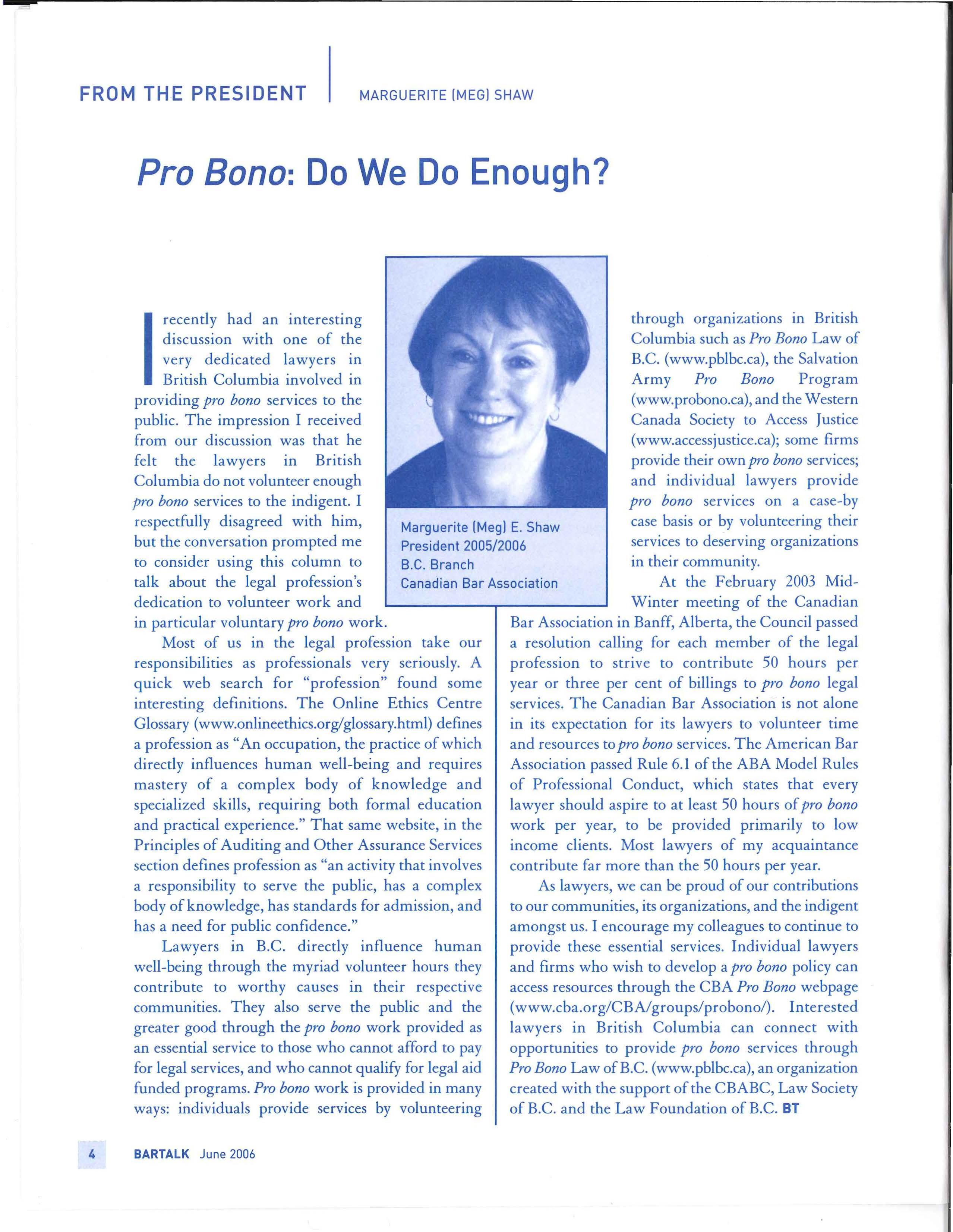
Marguerite (Meg) E. Shaw Pres i dent 2005/2006
through organizations in British Columbia such as Pro Bono Law of B.C. (www.pblbc ca), the Salvation Army Pro Bono Program (www.probono.ca), and the Western Canada Society to Access Justice (www.accessjustice.ca) ; some firms provide their own pro bono services; and individual lawyers provide pro bono services on a ca se-b y case basis or by volunteering their services to deserving organizations in their community
B.C. Branch Canadian Bar A s sociation At the Februar y 2003 Midin particular voluntary pro bono work.
Most of us in the legal profession take our responsibilities as professionals very seriously. A quick web search for "profession" found some interesting definitions The Online Ethics Centre Glossary (www.onlineethics org/glossary.html) defines a profession as "An occupation, the practice of which directly influences human well -being and requires mastery of a complex body of knowledge and specialized skills, requiring both formal education and practical experience." Tha t same website, in the Principles of Auditing and Other Assurance Services section defines profession as "an activity that involves a responsibility to serve the public, has a complex body of knowledge, has standards for admission, and has a need for public confidence ."
Lawyers in B.C. directly influence human well-being through the myriad volunteer hours they contribute to worthy causes in their respective communities. They also serve the public and the greater good through the pro bono work provided as an essential service to those who cannot afford to pa y for legal services, and who cannot qualify for legal aid funded programs Pro bono work is provided in many ways: individuals provide services by volunteering
Winter meeting of the Canadian Bar Association in Banff, Alberta, the Council pa ssed a resolution calling for each member of the legal profession to strive to contribute 50 hours per year or three per cent of billings to pro bono legal services. The Canadian Bar Association is not alone in its expectation for its lawyers to volunteer time and resources to pro bono services. The American Bar Association passed Rule 6.1 of the ABA Model Rules of Professional Conduct, which states that every lawyer should aspire to at least 50 hours of pro bono work per year, to be provided primarily to low income clients. Most lawyers of my acquaintance contribute far more than the 50 hours per year. As lawyers, we can be pro u d of our contri b utions to our communities, its organizations, and the indigent amongst us. I encourage my colleagues to continue to provide these essential services. Individ u al lawyers and firms who wish to develop a pro bono policy can access resources through the CBA Pro Bono webpage (www.cba.org/ CBA/groups / probono/) Interested lawyers in British Columbia can connect with opportunities to provide pro bono services through Pro Bono Law of B C. (www.pblbc ca), an organization created with the support of the CBABC, Law Society of B.C and the Law Foundation of B C BT
FRANK KRAEMER, QC EXECUTIVE DIRECTOR
So You Want to Get Paid ...
The practice of law offers personal satisfaction in many ways. For some, it is the challenge of legal analysis, for others it is crafting the persuasive winning argument and for still others, it is being recognized by your peers and your community as a respected professional. But underlying all of this is the undeniable need to generate the revenue that permits you, as a Ia wyer, to pursue that aspect of the practice of law that satisfies you
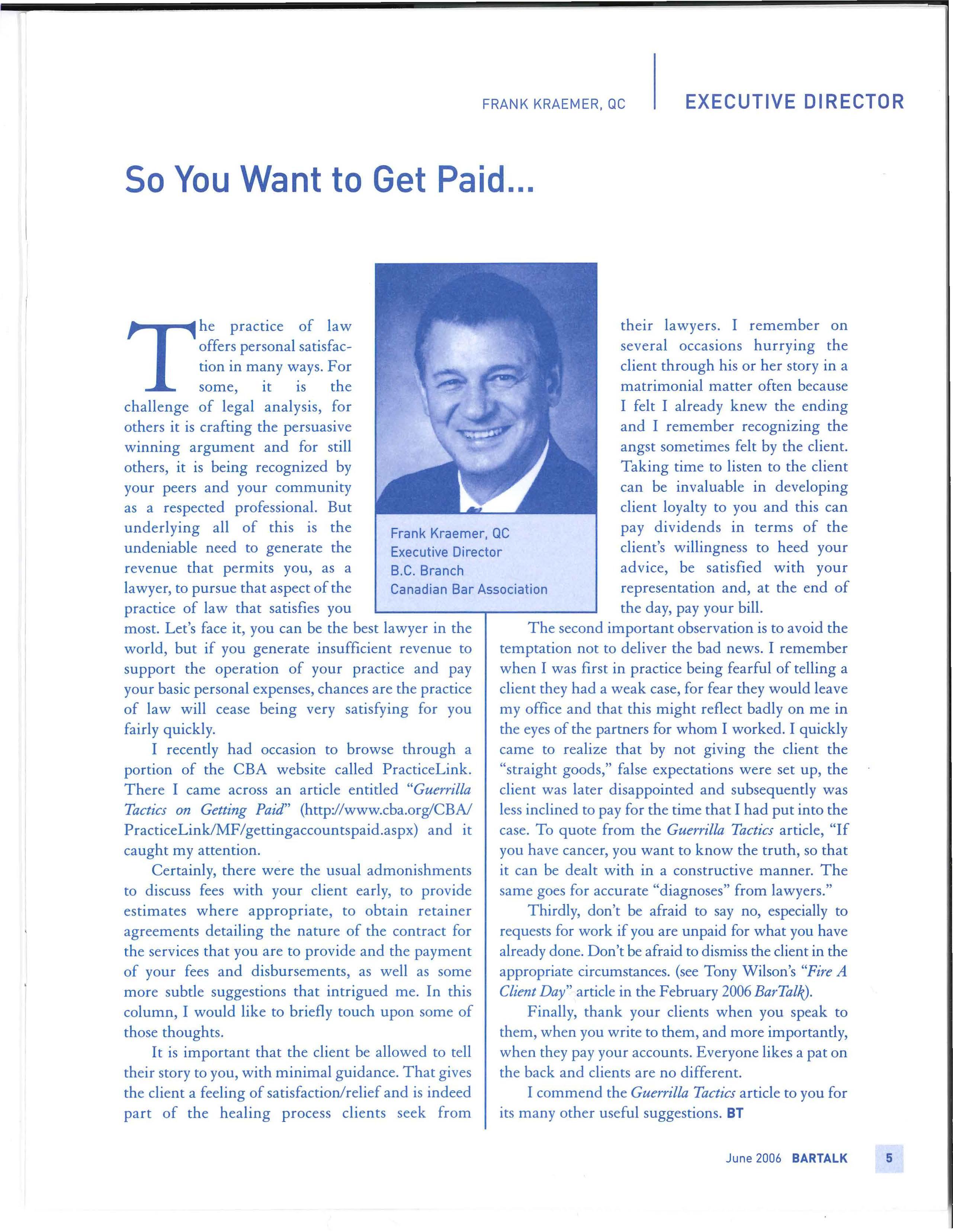
Frank Kraemer, QC Executive Director B.C. Branch
Canadian Bar Association
most. Let's face it, you can be the best lawyer in the world, but if you generate insufficient revenue to support the operation of your practice and pay your basic personal expenses, chances are the practice of law will cease being very satisfying for you fairly quickly.
I recently had occasion to browse through a portion of the CBA website called PracticeLink. There I came across an article entitled "Guerrilla Tactics on Getting Paid" (http://www cba.org/CBN PracticeLink/MF/gettingaccountspaid.aspx) and it caught my attention.
Certainly, there the usual admonishments to discuss fees with your client early, to provide estimates where appropriate, to obtain retainer agreements detailing the nature of the contract for the services that you are to provide and the payment of your fees and disbursements, as well as some more subtle suggestions that intrigued me. In this column, I would like to briefly touch upon some of those thoughts.
It is important that the client be allowed to tell their story to you, with minimal guidance. That gives the client a feeling of satisfaction/relief and is indeed part of the healing process clients seek from
their lawyers. I remember on several occasions hurrying the client through his or her story in a matrimonial matter often because I felt I already knew the ending and I remember recognizing the angst sometimes felt by the client. Taking time to listen to the client can be invaluable in developing client loyalty to you and this can pay dividends in terms of the client's willingness to heed your advice, be satisfied with your representation and, at the end of the day, pay your bill.
The second important observation is to avoid the temptation not to deliver the bad news. I remember when I was first in practice being fearful of telling a client they had a weak case, for fear they would leave my office and that this might reflect badly on me in the eyes of the partners for whom I worked. I quickly came to realize that by not giving the client the "straight goods," false expectations were set up, the client was later disappointed and subsequently was less inclined to pay for the time that I had put into the case To quote from the Guerrilla Tactics article, "If you have cancer, you want to know the truth, so that it can be dealt with in a constructive manner. The same goes for accurate "diagnoses" from lawyers."
Thirdly, don't be afraid to say no, especially to requests for work if you are unpaid for what you have already done. Don't be afraid to dismiss the client in the appropriate circumstances. (see Tony Wilson's "Fire A Client Day" article in the February 2006 Bar Talk).
Finally, thank your clients when you speak to them, when you write to them, and more importantly, when they pay your accounts. Everyone likes a pat on the back and clients are no different.
I commend the Guerrilla Tactics article to you for its many other useful suggestions. BT
Legal Aid Test Case Moving Forward on Two Fronts
The CBA's legal aid test case is moving forward on two fronts, reports Susan McGrath, CBA Past President and spokesperson on legal aid. "Our test case counsel are currently preparing for discovery of documents. We are hoping that both sides cooperate to move the discovery phase expeditiously forward "
At the same time, counsel has reached an agreement with the defendants about timing of defendants' applications to strike out the CBA's statement of claim The hearing will begin on June 19 "The CBA had anticipated this type of preliminary challenge," notes Susan McGrath. The test case was launched on June 20, 2005
More information http://www.cba.org/CBA/Advocacy/legalAid/
Supreme Court of Canada Intervention
In keeping with its public interest advocacy policy, the CBA has intervened before the Supreme Court in the case of Little Sisters Book and Art Emporium v. Commissioner of Customs and Revenue The issue is whether advanced costs can be granted to a small, for-profit corporation invo lved in Charter litigation
International Treaties and Conventions
Need an update on the increasing number of International law decisions and interpretations?
This one-day CBA Continuing Legal Education seminar delivers the goods for you on Sept. 29, 2006 in Montreal.
Leading experts will offer updates on decisions and interpretations on international treat i es and conventions related to :
• Trade and investment (e.g. WTO. NAFTA)
• Commercial transactions and private international law (e g. Sales of Goods, arbitration)
Labour and human rights (e g ILO, CEDAW, European Court of Human Rights).
Details and registration
http:!/www. c ba. org/ c ba/ cle/ cle 00/intl_06 aspx

The CBA sees this as an access-to-justice issue, and has intervened to argue that advanced costs should not be limited to not-for-profit groups undertaking
Charter challenges This is one of a series of cases in which CBA will intervene, with a view to building a better foundation for the legal aid test case . The CBA is represented by J J Camp, QC and Melina Buckley, both of Vancouver, who are also counsel for the legal aid test case.
Required Reporting
The Law Society now requires lawyers to report annually on their professional development activities. The Benchers also now encourage each practising lawyer in B.C. to complete a minimum of 12 hours of coursework (the equivalent of two full course days) and 50 hours of self-study each year. The targets are set as minimum expectations for the profession but are not mandatory. Attendance at CBA Section presentations is reportable as coursework, and review of Section mi n utes/materials is reportable as self-study hours [as long as it is not for the purpose of research for a file/easel.
*
CBA Practicelink- Podcasting: The Latest Addition to the Legal Marketing Toolkit
CBA PracticeLink has developed a new podcast on, what else, podca sting! Podcasting lets lawyers showc a se their expertise in a convenient, innovative and professional-looking format , and requires very little time and money. It can also help you enhance your online presence, become a leader in a niche market , and generate leads for new work
To listen , and to check out the site's new interactive features and newsfeeds , visit : http :// www cba org/ practicelink

Leading the Canadian Law Firm in the 21st Century: Managing the Future
Intense competition, rapid technological change, demanding expectations of clients, and changing attitudes of lawyers and staff are realities in the operation of today's law firms. As a leader in your firm, your priority is to ensure its stability and growth and you'll want to join industry experts, managing partners and in-house counsel for an in-depth analysis of the latest challenges and techniques in Halifax , Nov. 5-7, 2006.
On the agenda:
• What to do about Neil - Moving beyond the rules to practical solutions;
• The talent pool: The business case for retention, accommodation and promotion of the best and brightest; and
• R;sk management: Best practices and models for identifying and managing claims, losses, and crises.
As well, strategies, approaches and war stories, and networking opportunities with colleagues abound, in fabulous Halifax, famous for its legendary East Coast hospitality and entertainment!
Details and registration - http://www.cba.org/ cba/cle/cle00/leading_06.aspx
Great Big Sea at 2006 Canadian Legal Conference
U.S. Special Counsel Patrick Fitzgerald, General Rick Hillier, Rick Mercer and Great Big Sea: there will be something for everyone at the 2006 CBA Canadian Legal Conference in St. John's, Newfoundland, Aug. 13-15.
Two full days of educational programs feature winning advocacy skills in an ex parte hearing, fighting fraud through the courts, and public health-private information, and many more. For in-house counsel, dedicated programming includes how Canada's energy boom will affect business and the latest in pension, employment, bankruptcy and insolvency law.
Plus, don't miss the outstanding pre- and post-conterence tours featuring the best that St. John's and its surrounding areas have to offer. Enjoy a relaxing city tour, hike the Discovery Trail, see the far east of the Western world at Cape Spear, visit breathtaking Gros Marne and much more -a world of new adventure awaits visitors to the island.
Golfers can try their hand at some of the island's most challenging courses, and participate in the Law for the Future Fund Golf Tournament for a chance to win a Saturn Sky convertible in the Hole-in-One contest.
A full children's and youth program is also planned, which will be packed with activities that all ages can enjoy. The three-day program will take young attendees to scenic and educational destinations such as Salmonier Nature Park, the Freshwater Resource Centre, Bowring Park and Newfoundland Science Centre.
Also on the agenda are marketing seminars, as well as networking and recreation opportunities that you'll only find at the CBA Canadian Legal Conference.
Details, registration, and tours: http://www.cba.org/clc
Section Update
Keep your practice current
The following are brief summaries of several recent Section meetings held throughout the province. More detailed information and available minutes from the Section meetings are accessible online at www.cba.org/bc for enrolled CBA members.
ADR -VANCOUVER
MEETING : March 21, 2006
SPEAKER: Jerry McHale, QC, Ass i stant Deputy Minister, Justice Services, Ministry of Attorney General
TOPIC: Civil Justice Reform: Is sues and Updates
Mr. McHale provided a PowerPoint presentation at this meeting. A summary of highlights were as follows: There are many signs of public discontent with the system, and civil justice reform is a h igh priority for the Ministry of the Attorney General. The Ministry, bench and bar are actively engaged in reform discussions through the Justice Review Task Force Key principles for effective reform are access to justice, affordability, proportionality, client-centred processes, and fairness. We also need more management data to better understand what happens to cases in the system. Key strategies include litigation avoidance (dispute prevention, DR clauses in contracts, etc.), streamline procedures (e.g. Rule 68, simplified forms, case management), avoiding adversaria l contests (ADR, collaborative law, JCC, etc.), and legal education and information.
ENTERTAINMENT LAW
MEETING: March 30, 2006
SPEAKER: Juliet Smith, Fraser Milner Casgrain LLP
TOPIC: Financing in the Film Industry i n Canada
Juliet Smith provided an extensive review of the many aspects of film financing, both from the perspective of a producer and from the perspective of a bank An indigenous producer accesses financing from many sources including tax credit, pre-sales, government funding agencies, and deferrals. As receipt of these monies is spread out over the production and can extend until months after the production is delivered, many producers interim finance their production through a Bank. Currently, there is a high level of work in the film industry in British Columbia.
8 BARTALK June 2006
ENVIRONMENTAL LAW
MEETING: March 15, 2006
SPEAKER: Andrew Gage, West Coast Environmental Law
TOPIC: WCELs Current Initiat ives
West Coast Environmental Law is known as being the "duty counsel for the environment." It has developed three main programs. The Environmental Citizenship Program provides legal support to individuals and communities working on environmental issues. The Sustaining the Land Program allows WCEL to take a more proactive ro le and focus its resource use ensuring that rights holders are not ignored. This program also strongly encourages "Smart Growth" when private landowners and the environmental community work together. The goal of the Sustainable and Liveable Communities Program is to achieve environmental, economic, and "liveable" communities. Publications by WCEL such as Smart Bylaws are used by municipalities, policy drafters, and legislators.
FAMILY LAW- NANAIMO
MEETING: Apri l 1 1, 2006
SPEAKER: The Honourable Judge Cowling & The Honourable Judge Saunders
TOPIC: Discussion of Ex Parte applications at the Provincial & Supreme Courts
The judges commented on the good work being done by Nanaimo counsel and Nanaimo family duty counsel in provincial court. The issue of ex parte orders was discussed. The judges present agreed that it was their practice that ex parte orders shou ld have a fixed term and expire on a fixed date and be accompanied by a requirement that they be served forthwith on the other party. It was their preference that all applications without notice are provided with an affidavit giving a complete background and explaining why the application had to be made without notice. If the affidavit was not filed then the person would have to take the stand and swear as to why the matter had to be heard without notice.
FREEDOM OF INFORMATION & PRIVACY LAW
MEETING: March 22, 2006
SPEAKERS: Chris Harris, Chief Privacy Officer and Manager of Information & Privacy, Translink
TOPIC: Experience with FOIPPA matters
Mr. Harris summarized the purpose of FOIPPA, namely to make public bodies more accountable to the public and to protect personal privacy. The protection of personal privacy is achieved by giving the public a right of access to records, preventing unauthorized collection, use or disclosure of personal information by public bodies, and providing for an independent review of decisions made under the Act. Since TransLink was created, Mr. Harris has been the formal delegate of the "Head of the Public Body" pursuant to the Act. He discussed his experience with FOIPPA generally and with section 21(1)(b), including the situation leading to Commissioner's Order 2001-39 and the subsequent judicial review (access to records including contracts with a third party).
LABOUR LAW
MEETING: March 14,2006
SPEAKER: Don Jordan, QC, Taylor Jordan Chafetz, John Rogers, Victoria Square Law Office LLP, Willy Laurier, RCMP !Police-Labour Communications Group] & The Honourable Allan McEachern, Fasken Martineau DuMou l in LLP
TOPIC: Contempt and Enforcement
Mr. Jordan who wrote an editorial during the Truckers' blockade at the ports voiced concern about how it continues to be an issue . There is a policy about how the police get involved in disputes, not just in labour disputes where there are blockades. Willy Laurier of the RCMP tries to ensure that police and municipal forces adhere to policy as consistently as possible. The Honourable Allan McEachern mentioned that judges don't like applications for injunctions and certainly not contempt cases.
LEGAL RESEARCH
MEETING: February 15, 2006
SPEAKER: Stanley Martin
TOPIC: Research i ng and Drafting Pleadings
Mr. Martin led an excellent discussion of the purpose and practice of pleadings His key points included: There is a tension between the traditional style of pleading (material facts only) and the modern narrative style. Texts like Bullen are less helpful as a result. McLachlin & Taylor Court Forms is a useful B.C resource. Pleadings are still useful in that they guide discoveries,
set out the issues at stake, and drive summary and interlocutory processes Rule 19 is the main rule that governs pleadings. Always plead principles of law or statutes you will rely on . Although there are few e r technical objections to pleadings today, pleadings remain impo rtant and should be properly drafted Various processes these days are now commenced without pleadings per se (petitions, mediations). A pleading will require some evidence in support, or it is an abuse of process
MUNICIPAL LAW
MEETING: February 16, 2006
SPEAKER: The Honourable Mr. Justice Robert Bauman, B.C. Supreme Court
TOPIC: Presenting a Municipal Law Matter to the Supreme Court under Rule 18A
At this Section meeting, Justice Bauman provided tips on good advocacy. When drafting your material , keep in mind the three "C's" of drafting - material should be concise, chronological, and complete Consider the evidentiary issues. Is a final Order being sought, and if so, are you relying on any hearsay evidence? Oral advocacy is alive and well and does make a difference to your case. Outline the points you are going to make and in what sequence You should assume that the judge knows nothing of the area of law you are arguing and adjust your argument accordingly as you proceed. End your argument with a quick summary of your central points.
YOUNG LAWYERS- OKANAGAN
MEETING: March 28, 2006
SPEAKERS: Garry Benson, Benson Edwards LLP
TOPIC: A Perspective on Developing your Legal Practice
Mr. Benson who practises in Kelowna and whose background was in senior government and with the RCMP provided members with an informative presentation of his experience and perspective on developing your legal practice In a point-form summary, he gave several tips on building a practice, starting up your own firm and practice expectations. BT
You've got mail!
Watch for the special envelope marked 2006-2007
Section Enrolment and Directory Order forms. Sections are a benefit of CBA membership and are restricted to CBA members. Enrol in Sections by August 22, 2006 to begin receiving notices of the year's first meetings!
June 2006 BARTALK
DAVID J BILINSKY
Placing Trust in People
An integral path to leadership

I've never questioned the answers given
To find the faith that's been lost within 'cause where / lay my trust in others Where it lies the ft.. ground is thin J
Writer and vocalist, Sarah Mclachlan
Trust is an ethereal quantityit can be as strong as a rock and yet vanish in an instant. Once gone, it can take a
David J. Bilinsky is the
Practice Management Advis o r at the Law Soc iety of B.C. E-mail: daveb@lsbc.org
long time to restore - and for some, it may never be fully capable of restoration. Trust is closely related to integrity and leadership. Covey defines leadership as " [C]ommunicating to people their worth and potential so clearly that they see it in themselves." In a law firm setting, it is obvious that trust, integrity, and leadership are three qualities that any managing partner worth his or her salt would strive to acquire and demonstrate, particularly if they wish to empower and inspire their people to perform at the top of their potential for the betterment of the firm as a whole
But how exactly do you communicate trust to people? How do you develop and demonstrate your integrity and leadership skills? How is it that there are certain leaders - Sir Winston Churchill for example, who could seemingly inspire people to follow him into hell itself - while others have difficulty just getting people to follow them to lunch? Here are a number of suggestions put forward in this regard 1 to build trust, integrity, and leadership in your firm:
SPEND TIME WITH YOUR TEAM:
Building leadership and trust is a "hands-on" activity. You have to get out and share what your people are doing Some managers think they can manage from
behind a closed door - and for a rare few that may be true. For the vast majority of us however, we have to show that our deeds match our words - and that means being out of the office, listening, discussing, sharing, and communicating. Team building is all about shared experiences- and if you as a leader are not there to take part in the sharing, then the team will get the message fairly shortly that either the requested activity is not high on your radar screen or that you really are not committed to the task.
LISTEN TO YOUR PEOPLE WITHOUT JUDGMENT OR CRITIQUE:
Listening is an under-rated component of building trust. The (mis)conception of a leader is that they must be busy "doing stuff." In fact the opposite is trust- a captain's role is to watch and listen and not to adjust the trim of the sail but only to offer a suggestion that the trim might need checkingwhich should be enough for the crew to take ownership of the problem and to work out the solution for themselves.
PERMIT OTHERS TO INFLUENCE YOUR DECISIONS RATHER THAN DISMISSING THEIR OPINIONS:
The fastest way to communicate distrust to those immediately next to you is by not allowing them to have any influence over your actions - notwithstanding that they are closer to the action and you presumably hired them for their judgment.
REVEAL AND SHARE RELEVANT INFORMATION WITH YOUR PEOPLE:
Silo-ism, privacy, harding, or withholding of information - all of these are signs of a person who holds information as a way to control power. At the
heart of this behaviour is fear- that the leader would have less influence if the information were widely known. In fact the opposite is true - the greater the sharing of information with your team, the greater the team feels inspired and informed that in fact they are taking the correct action and that you, as leader, are helping them achieve the right results
BE WILLING
TO
DEPEND ON YOUR PEOPLE RATHER THAN KEEPING TOTAL CONTROL IN YOUR HANDS:
Once your team realizes that you are feeding them all the relevant information, then they come to the conclusion that you are depending on them to exercise their judgment based on that information and come forward with their best suggestions. This is synergy - where the actions of the team are much stronger and better than any one person acting alone. The act of placing trust in them is reflected back many times over- and results in a stronger and more resilient team - and in better decisions overall.
GIVE THE COMPLEX A COMMON SENSE EDGE:
Your job as leader is to keep the dialogue focused on the needs of your organization and to quietly but rigorously subject all possible solutions to the acid test of how this advances your strategic goals and objectives. If a suggestion passes the acid test- by all means encourage your team to move forward with all due dispatch However, if it does not, then you have an educational opportunity on your hands . . . where you can discuss the proposed solution in private with the person and have them think through how it does not meet the needs of the organization Your role is to show how their opin ion is valued and they are encouraged to come back with a better suggestion in the future. The idea is to affirm the trust and commitment of the person while quietly demonstrating how they could do it better the next time
TEACH YOUR PEOPLE:
One of the strongest messages that any leader can make is to not just model the behaviour that you wish , but rather to take the time to teach it to others and in turn , encourage those you teach to become teachers. All of us learn faster and better when a mentor helps guide our development. Your job as leader is to be a mentor and in turn, to allow others you have
mentored to grow from your experiences and evolve to become mentors themselves . Do not be so focused by the "here and now " that you lose touch with the longer-term objectiv es and growth of your people and your organization.
ASK YOUR PEOPLE TO HELP YOU IDENTIFY OBSTACLES TO THEIR SUCCESS AND THEN REMOVE THOSE OBSTACLES QUICKLY:
One of the perks of leadership is the ability to take action -quickly Accordingly, when one of your team comes forward with something that is preventing him or her from achieving their goals - then you can achieve star-quality by taking immediate steps to remove that obstacle. More ov er, you will find that you have made a deposit in the "goodwill " side of the ledger that can pay dividends for years to come - by earning the respect and thanks of someone on your team By laying down fertile ground for the ideas, energy and commitment of your team, you have allowed their trust in you to sprout, take root and grow. Along the way, you have demonstrated your integrity and stand to reap the benefits of building a strong and capable team under your leadership . BT
1Based on : Chapman , K (2003) Th e lead er 's code : a p eopl e- sense guide to leadership Ne w York: iUniverse Inc
The views expressed herein are strictly those of the author and may not be shared by the author's employer, the Law Society of B C.
Mark Your Calendars for the 2006 Pacific Legal Technology Conference
The Pacific Legal Technology Conference returns to Vancouver on October 13, 2006 Set the day aside for you and your staff to jo i n us at the Vancouver Convention and Exhibition Centre and learn the latest that technology has to offer. This year the Conference will be held in conjunction with the ABA Law Practice Management Section 's fall meeting and will feature an encore presentation of the best-ever sessions from ABA TechShow.
TONY WILSON
Distractions at the Speed of Crack
That BlackBerry vibrating in your pants may be telling you to slow down
Tragedy struck me recently. Having just retired my First Generation iPod a nd
substituted it for a thinner, cooler iPod with 20 more Gigabytes of space and the capability to play Video, it fell from my lap getting out of the car at my son 's hockey game. In the 90 seconds it took me to realize it was gone , it had been run over by a smiling wom a n in a Volkswagen who had no idea of the havoc she had created to my display screen, my contact list, and my pride. When I explained this disaster to a few other lawyers, all they could say was: "Too bad it
couldn't have been your Bla ckBerry. "
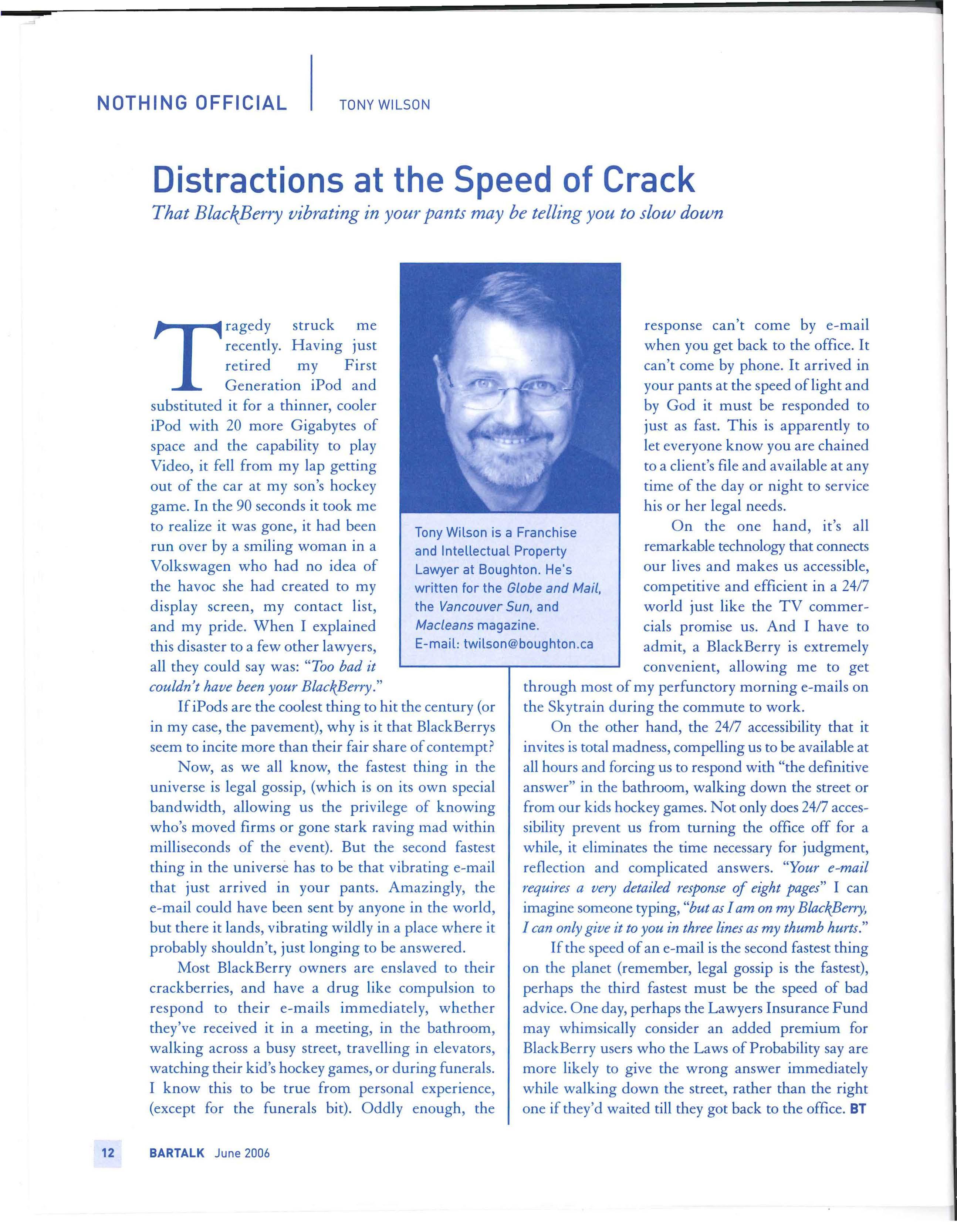
Tony Wilson is a Franchise and Intellectual Property Lawyer at Boughton He's written for the Globe and Mail,
the Vanco u ver Sun, and Macleans magazine E-mail : twilson@boughton.ca
If iPods are the coolest thing to hit the century (or in my case, the pavement), why is it that BlackBerrys seem to incite more than their fair share of contempt ?
Now, as we all know, the fastest thing in the universe is legal gossip, (which is on its ow n special bandwidth , allowing us the privilege of knowing who's moved firms or gone stark raving mad within milliseconds of the event). But the second fastest thing in the universe has to be that vibrating e-mail that just arrived in your pants. Amazingly, the e-mail could have been sent by anyone in the world, but there it lands , vibrating wildly in a place where it probably shouldn't, just longing to be answered
Most BlackBerry owners are enslaved to their crackberries, and have a drug like compulsion to respond to their e-mails immediately, whether they've received it in a meeting, in the bathroom, walking across a busy street, travelling in elevators, watching their kid 's hockey games, or during funer als I know this to be true from personal experience, (except for the funerals bit) Oddly enough , the
response can't come by e-mail when you get back to the office . It can't come by phone. It arrived in your pants at the speed oflight and by God it must be responded to just as fast. This is apparently to let everyone know you are chained to a client 's file and available at any tim e of the day or night to service his or her legal needs.
On the one hand , it 's all remarkable technology that connects our lives and makes us accessible, competitive and efficient in a 24/ 7 world just like the TV commercials promise us. And I have to a dmit, a BlackBerry is extremely
convenient, allowing me to get through most of my perfunctory morning e-mails on the Skytrain during the commute to work.
On the other hand, the 24/7 accessibility that it invites is total madness, compelling us to be available at all hours and forcing us to respond with "the definitive answer" in the bathroom, walking down the street or from our kids hockey games Not only does 24/ 7 accessibility prevent us from turning the office off for a while, it eliminates the time necessary for judgment, reflection and complicated answers. "Your e-mail requires a very detailed response of eight pages" I can imagine someone typing , "but as I am on my BlackBerry, I can only give it to you in three lines as my thumb hurts. "
If the speed of an e-mail is the second fastest thing on the pla net (remember, legal gossip is the fastest), perhaps the third fastest must be the speed of bad advice . One day, perhaps the Lawyers Insurance Fund may whimsically consider an added premium for BlackBerry users who the Laws of Probability say are mor e likely to give the wrong answer immediately while walking down the street, rather than the right one if they'd waited till they got back to the office BT
CBA Membership Has Its Benefits
The CBA offers many benefits to its members in areas such as advocacy, professional development opportumtles, a voice to improve the justice system, and services to improve your bottom line. Members receive discounts from preferred suppliers that are carefully selected to ensure personal and business benefits. Many services provide direct cost-savings that enhance law firm profitability.
THE CANADIAN BAR INSURANCE ASSOCIATION
The CBIA has been providing Canada's legal profession with a
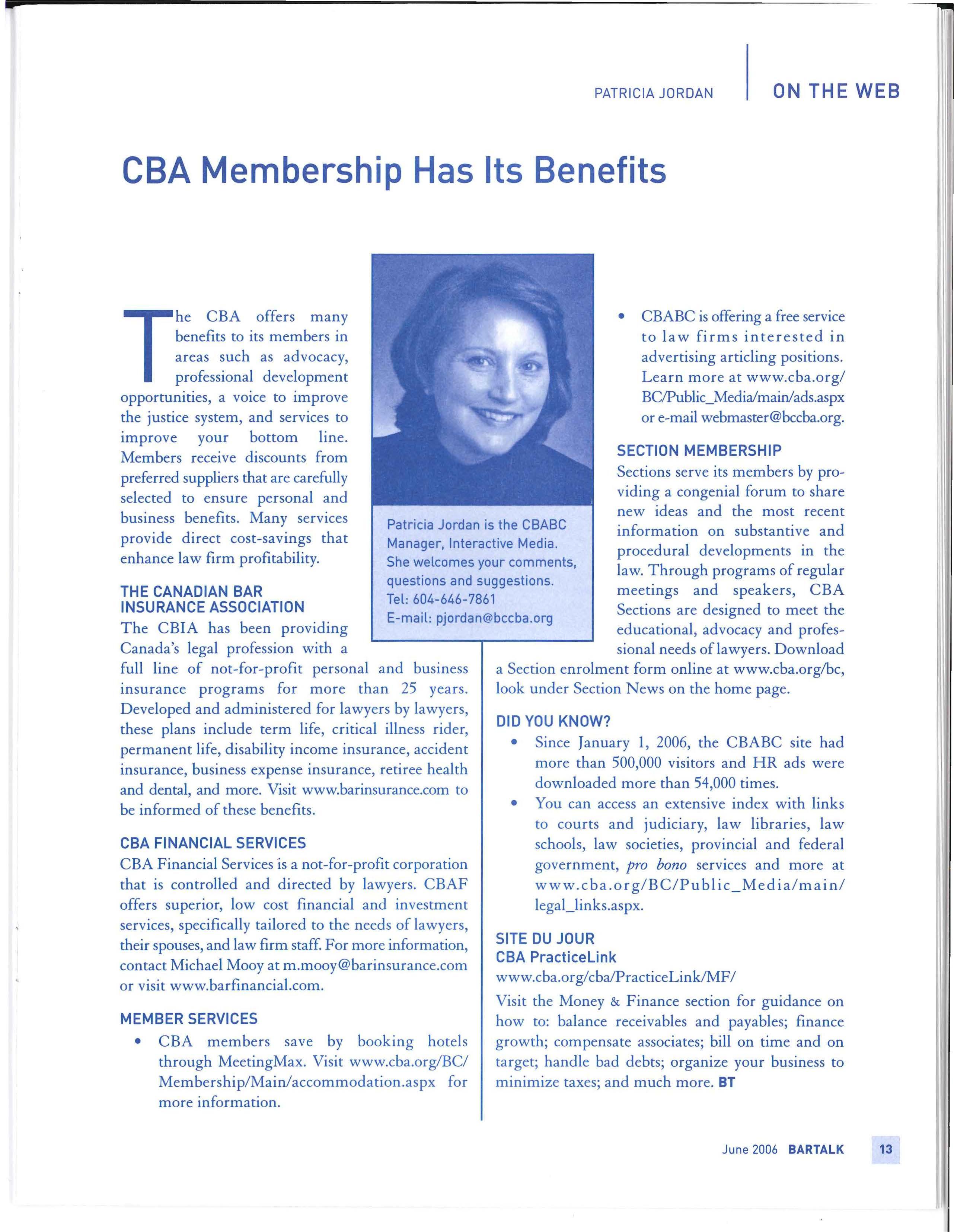
Patricia Jordan is the CBABC
Manager, Interactive Media. She welcomes your comments, questions and suggestions. Tel: 604-646-7861
E-mail: pjordan@bccba org full line of not-for-profit personal and business insurance programs for more than 25 years . Developed and administered for lawyers by lawyers , these plans include term life, critical illness rider, permanent life, disability income insurance, accident insurance, business expense insurance, retiree health and dental, and more. Visit www.barinsurance.com to be informed of these benefits
CBA FINANCIAL SERVICES
CBA Financial Services is a not-for-profit corporation that is controlled and directed by lawyers. CBAF offers superior, low cost financial and investment services, specifically tailored to the needs of lawyers , their spouses, and law firm staff. For more information, contact Michael Mooy at m.mooy@barinsurance .com or visit www.barfinancial.com.
MEMBER SERVICES
• CBA members save by booking hotels through MeetingMax. Visit www cba.org/ BC/ Membership/Main/ accommodation.aspx for more information
• CBABC is offering a free service to law firms interested in advertising articling positions . Learn more at www.cba.org/ BC/Public_Medialmainlads.aspx or e-mail webmaster@bccba.org.
SECTION MEMBERSHIP
Sections serve its members by providing a congenial forum to share new ideas and the most recent information on substantive and procedural developments in the law. Through programs of regular meetings and speakers, CBA Sections are designed to meet the educational, advocacy and profes-
sional needs of lawyers. Download a Section enrolment form online at www.cba .org/bc, look under Section News on the home page.
DID YOU KNOW?
• • Since January 1, 2006, the CBABC site had more than 500,000 visitors and HR ads were downloaded more than 54,000 times. You can access an extensive index with links to courts and judiciary, law libraries, law schools, law societies, provincial and federal government, pro bono services and more at www . cba .or g/BC/Pu bl ic_Media / main / legal_links aspx
SITE DU JOUR
CBA PracticeLink
www.cba.org/cba/PracticeLink!MFI
Visit th e Money & Finance section for guidance on how to : balance receivables and payables; finance growth; compensate associates; bill on time and on target; handle bad debts ; organize your business to minimize taxes; and much more. BT
ACTS IN FORCE
Every effort is made to ensure the accuracy of the information provided to you in this article but the information should not be relied upon. Lawyers should refer to the specific legislative or regulatory provision. You will see a refe r ence in some cases to the number of the Bill when it was introduced in the House. This number may be different f rom the chapter number of the new Act which is quoted after the title of the Act and which is the proper citation for the Act The Bill number has been given to make it easier for you to note up the Bills you may have in your library.
CURRENT FROM MARCH 2, 2006 to MAY 12, 2006
Legislative Update is provided as part of the CBABC leg islative and law reform program. It is a service funded by CBA membership fees, and is therefore provided as a benefit of CBA membe rs hip The full vers ion of Legislative Update is now published online, available to CBA members exclusively at www.cba.org/bc.
ACTS IN FORCE
CIVIL FORFEITURE ACT,
S.B.C. 2005, C. 29IBILL 13)
Act is in force April 20, 2006
COURT JURISDICTION AND PROCEEDINGS TRANSFER
ACT, S.B.C. 2003, C. 28IBILL 31 I
Act is in force May 4, 2006
EMPLOYMENT STANDARDS !COMPASSIONATE CARE LEAVE) AMENDMENT ACT, 2006, S.B.C. 2006, C. 4IBILL 8)
Act is in force April 27, 2006
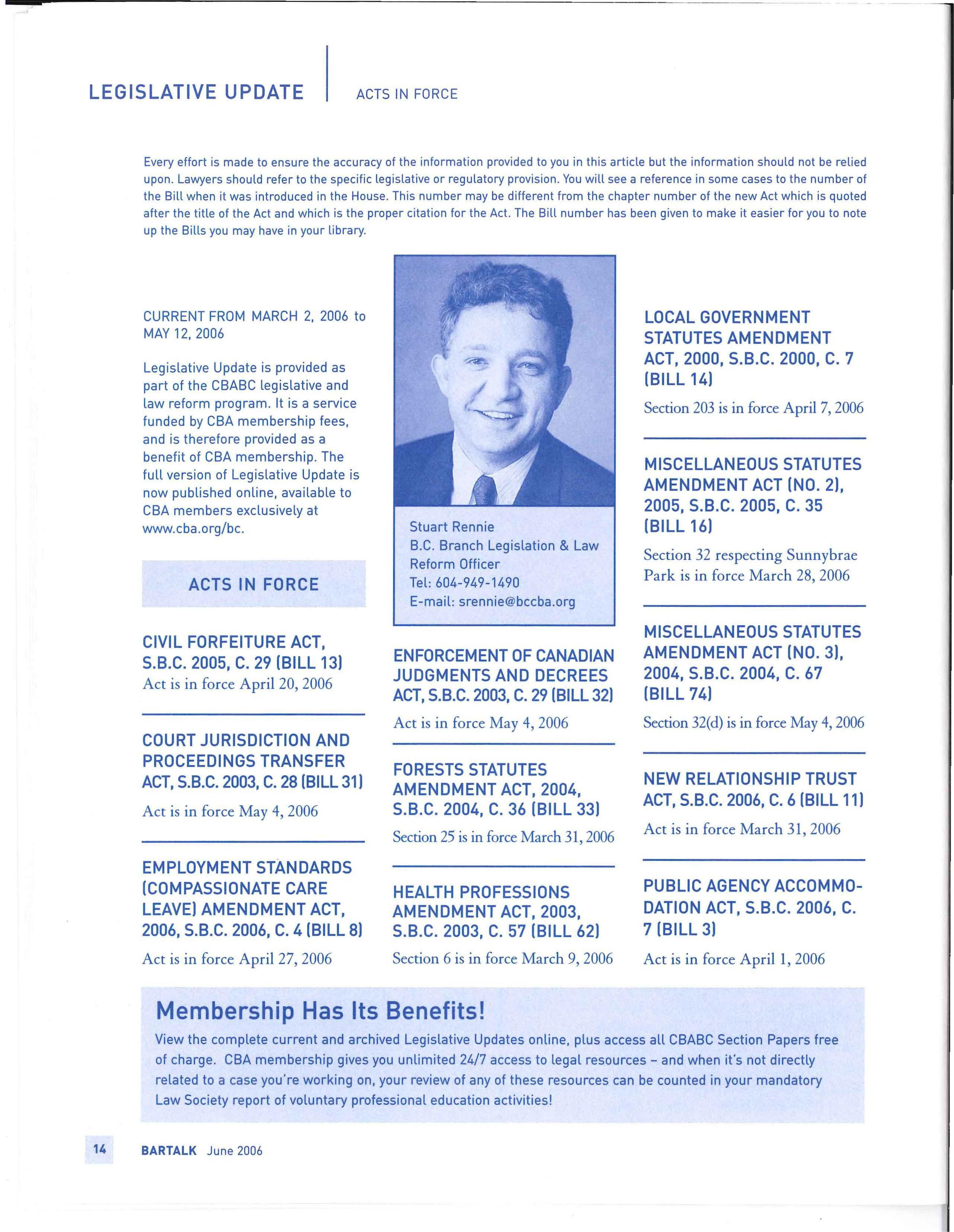
Stuart Rennie
B.C. Branch Legislation & Law Reform Officer
Tel: 604-949-1490
E-mail: srennie@bccba.org
ENFORCEMENT OF CANADIAN JUDGMENTS AND DECREES
ACT, S.B.C. 2003, C. 29IBILL 32)
Act is in force May 4, 2006
FORESTS STATUTES AMENDMENT ACT, 2004, S.B.C. 2004, C. 36 !BILL 33)
Section 25 is in force March 31,2006
HEALTH PROFESSIONS AMENDMENT ACT, 2003, S.B.C. 2003, C. 57 !BILL 62)
Section 6 is in force March 9, 2006
Membership Has Its Benefits!
LOCAL GOVERNMENT STATUTES AMENDMENT ACT,2000,S.B.C.2000,C. 7 !BILL 14)
Section 203 is in force April 7, 2006
MISCELLANEOUS STATUTES AMENDMENT ACT INO. 2), 2005,S.B.C.2005,C.35 !BILL 16)
Section 32 respecting Sunnybrae Park is in force March 28, 2006
MISCELLANEOUS STATUTES AMENDMENT ACT INO. 3), 2004,S.B.C.2004,C.67 !BILL 74)
Section 32(d) is in force May 4, 2006
NEW RELATIONSHIP TRUST ACT, S.B.C. 2006, C. 6 IBILL 11 I
Act is in force March 31, 2006
PUBLIC AGENCY ACCOMMODATION ACT, S.B.C. 2006, C. 7IBILL 3)
Act is in force April1, 2006
View the complete current and archived Legislative Updates online , plus access all CBABC Section Papers free of charge. CBA membership gives you unlimited 24/7 access to legal resources- and when it's not directly related to a case you're working on, your review of any of these resources can be counted in your mandatory Law Society report of voluntary professional education activities!
Plain Language: The Craft of Simplicity
The plain legal language movement in B.C. can be traced back to the Access to Justice Task Force. Its two reports, in 1984 and 1988, pointed to problems in the arcane wording of legal proceedings and documents
Some believe that making language plain is a matter of rules about composition: shorter sentences, fewer syllables per word, larger type, or prohibitions on some words. The U .S. Securities and Exchange Commission, ICBC, banks and many other
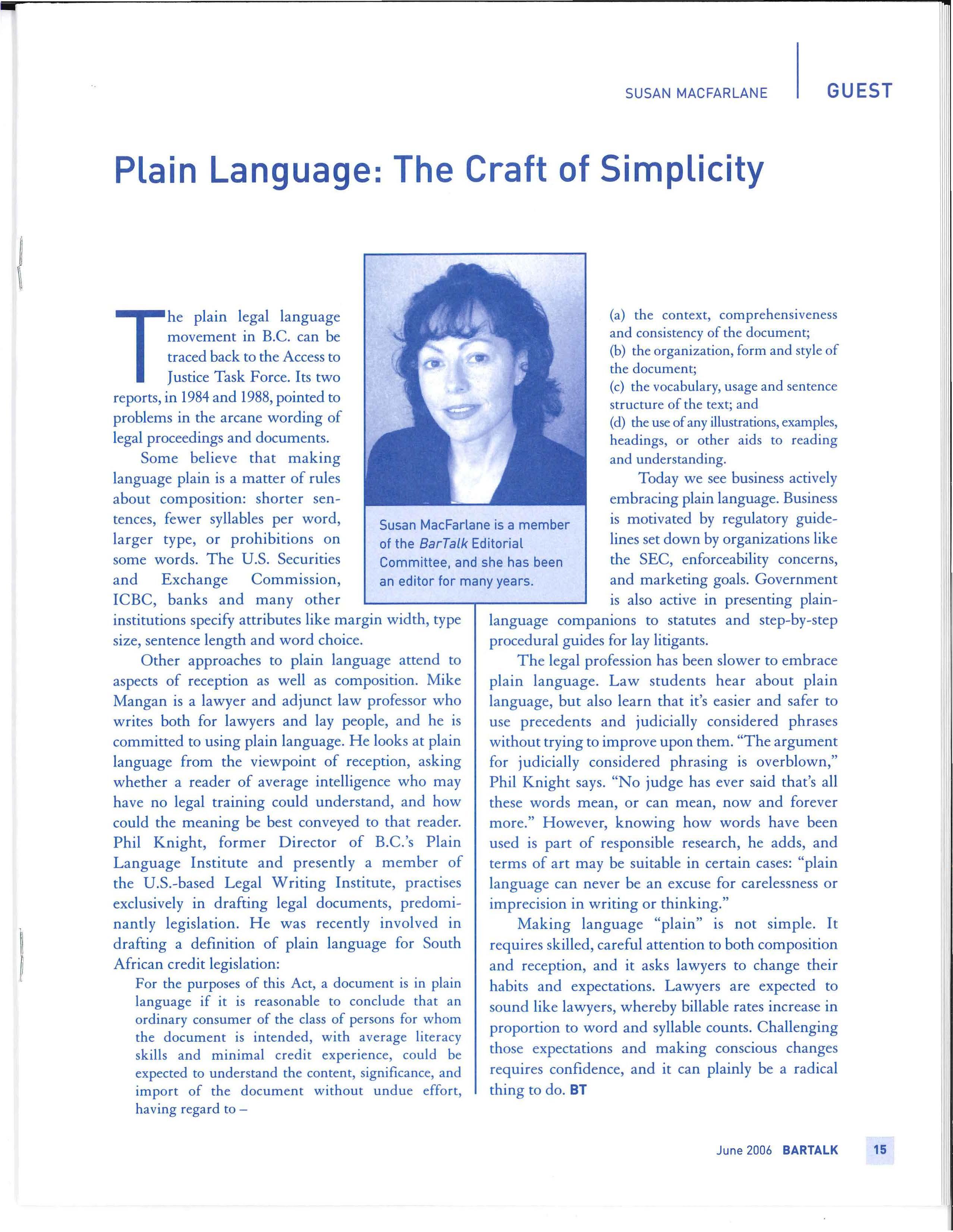
Susan MacFarlane is a member of the Bar Talk Editorial
Committee, and she has been an editor for many years.
institutions specify attributes like margin width, type size, sentence length and word choice
Other approaches to plain language attend to aspects of reception as well as composition. Mike Mangan is a lawyer and adjunct law professor who writes both for lawyers and lay people, and he is committed to using plain language He looks at plain language from the viewpoint of reception, asking whether a reader of average intelligence who may have no legal training could understand, and how could the meaning be best conveyed to that reader Phil Knight, former Director of B.C.'s Plain Language Institute and presently a member of the U.S.-based Legal Writing Institute, practises exclusively in drafting lega l documents, predominantly legislation. He was recently involved in drafting a definition of plain language for South African credit legislation:
For the purposes of this Act, a document is in plain language if it is reasonable to conclude th a t an ordinary consumer of the class of persons for whom the document is intended, with average literacy skills and minimal credit experience, co uld be expected to understand the content, significance, and import of the document without undue effort, having regard to-
(a) the context, comprehensiveness and consistency of the document;
(b) the organization, form and style of the document;
(c) the vocabulary, usage and sentence structure of the text; and
(d) the use of any illustrations, examples, headings, or other aids to reading and understanding
Today we see business actively embracing plain language. Business is motivated by regulatory guidelines set down by organizations like the SEC, enforceability concerns, and marketing goals Government is also active in presenting plain-
language companions to statutes and step-by-step procedural guides for lay litigants.
The legal profession has been slower to embrace plain language. Law students hear about plain language, but also learn that it's easier and safer to use precedents and judicially considered phrases without trying to improve upon them. "The argument for judicially considered phrasing is overblown," Phil Knight says . "No judge has ever said that's all these words mean, or can mean, now and forever more." However, knowing how words have been used is part of responsible research, he adds, and terms of art may be suitable in certain cases: "plain language can never be an excuse for carelessness or imprecision in writing or thinking."
Making language "plain" is not simple. It requires skilled, careful attention to both composition and reception, and it asks lawyers to change their habits and expectations Lawyers are expected to sound like lawyers, whereby billable rates increase in proportion to word and syllable counts. Challenging those expectations and making conscious changes requires confidence, and it can plainly be a radical thing to do
Building a China Practice
The May lOth meeting of B.C.'s Legal Marketing Association was on building practice with Chinese clients needing advice on Canadian law. The writer carried out case studies of how several smaller firms and practice groups had succeeded. Ronald Josephson, founder of litigation boutique Josephson & Co. directly shared his firm's success. The program started with an outline of one firm's four-year record.
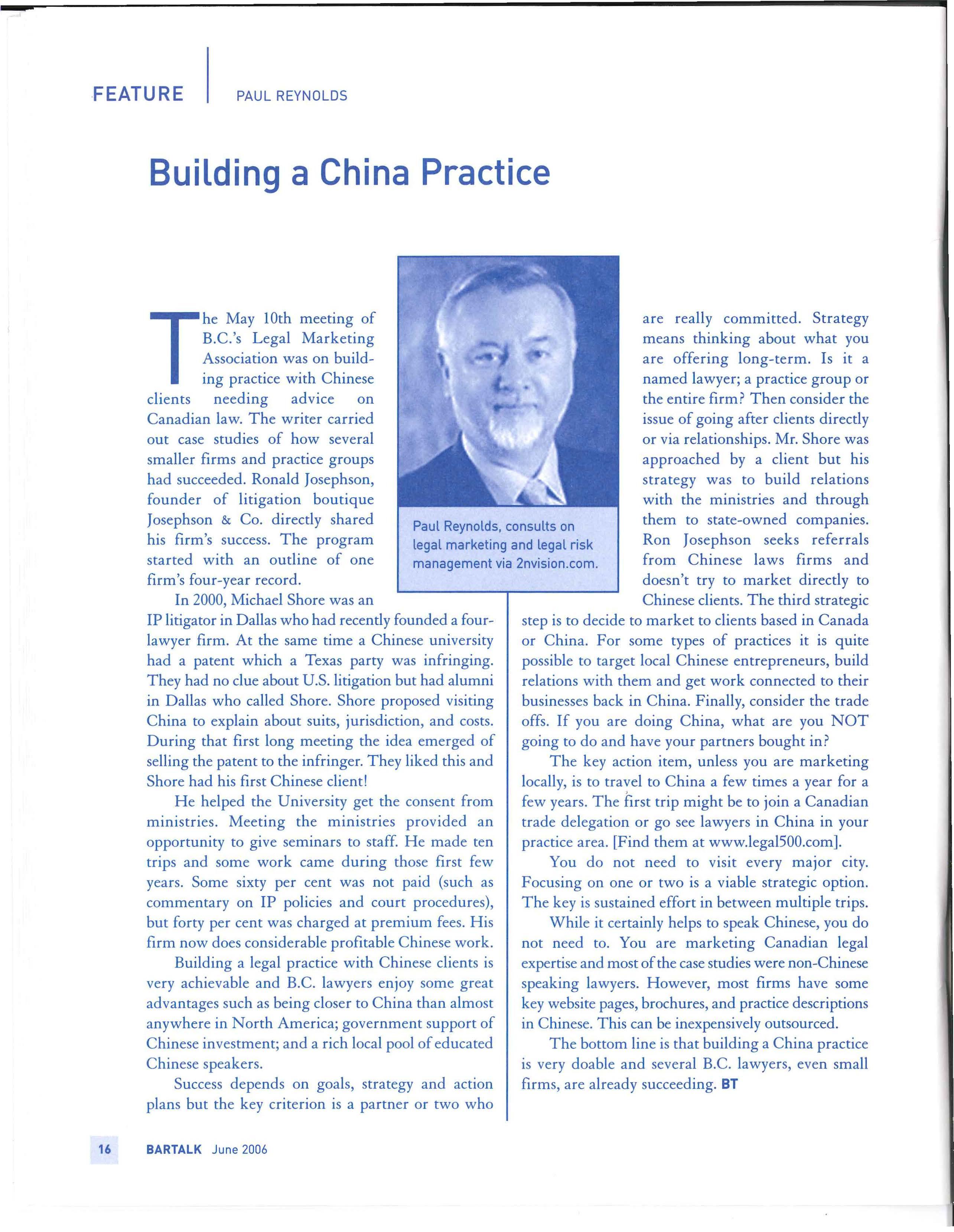
Paul Reynolds, consults on legal marketing and legal risk
are really committed. Strategy means thinking about what you are offering long-term . Is it a named lawyer; a practice group or the entire firm? Then consider the
issue of going after clients directly or via relationships. Mr. Shore was approached by a client but his strategy was to build relations with the ministries and through them to state-owned companies. Ron Josephson seeks referrals from Chinese laws firms and doesn't try to market directly to management via 2nvision.com .
In 2000, Michael Shore was an IP litigator in Dallas who had recently founded a fourlawyer firm At the same time a Chinese university had a patent which a Texas party was infringing. They had no clue about U.S. litigation but had alumni in Dallas who called Shore. Shore proposed visiting China to explain about suits, jurisdiction, and costs. During that first long meeting the idea emerged of selling the patent to the infringer. They liked this and Shore had his first Chinese client!
He helped the University get the consent from ministries. Meeting the ministries provided an opportunity to give seminars to staff. He made ten trips and some work came during those first few years. Some sixty per cent was not paid (such as commentary on IP policies and court procedures), but forty per cent was charged at premium fees . His firm now does considerable profitable Chinese work.
Building a legal practice with Chinese clients is very achievable and B.C. lawyers enjoy some great advantages such as being closer to China than almost anywhere in North America; government support of Chinese investment; and a rich local pool of educated Chinese speakers.
Success depends on goals, strategy and action plans but the key criterion is a partner or two who
Chinese clients. The third strategic step is to decide to market to clients based in Canada or China. For some types of practices it is quite possible to target local Chinese entrepreneurs, build relations with them and get work connected to their businesses back in China . Finally, consider the trade offs. If you are doing China, what are you NOT going to do and have your partners bought in?
The key action item, unless you are marketing locally, is to travel to China a few times a year for a few years. The first trip might be to join a Canadian trade delegation or go see lawyers in China in your practice area . [Find them at www.legal500.com].
You do not need to visit every major city.
Focusing on one or two is a viab le strategic option. The key is sustained effort in between multiple trips. While it certainly helps to speak Chinese, you do not need to. You are marketing Canadian legal expertise and most of the case studies were non-Chinese speaking lawyers. However, most firms have some key website pages, brochures, and practice descriptions in Chinese. This can be inexpensively outsourced
The bottom line is that building a China practice is very doable and several B.C. lawyers, even small firms , are already succeeding. BT
Click to Win (More Business): Six Ways to Increase Your Website ROI
YOUR WEBSITE IS YOUR TOP MARKETING TOOL
Two recent surveys conyour website 1s your most Important marketing tool. The statistics are American , so consider them persuasive, not binding, but don't ignore them.
A 2005 survey of nearly 1000 small law firms (20 lawyers or less) by LexisNexis MartindaleHubbell found websites are the number one marketing tool. Eighty-nine per cent of respondents considered them valuable.

Doug Jasinski LL.B. is the Principal of Skunkworks Creative Group Inc (www.skunkworks.ca) and the
A 2006 survey of 119 U S. corporate, transactional and defense firms of varying size conducted by Alyn- Weiss & Associates arrived at a similar conclusion- websites are now considered the single most effective marketing tool, surpassing seminars and presentations/ speeches for the first time. This makes sense considering your website's many roles:
• Strangers use it to find you;
• Prospects use it to verify you;
2. LOAD IMPORTANT CONTENT NEAR THE TOP OF THE PAGE
Google's ranking formula gives greater weight to text appearing near the top of the page than to that lower down.
3. CREATE A PRACTICE GROUP BLOG
Search engines - and clients - like targeted content, updated regularly. That's what blogs provide. Most Canadian firms still aren't on board, so get ahead of the curve.
4. INCLUDE KEYWORDS IN YOUR TITLE TAGS President of Access Legal Systems Inc. (www.lawone.ca). Title tags appear at the very top of your website browser window. Search engines consider them important . You should too. Most potential clients will type "Victoria family lawyers" into Google , not your firm name.
5. ADD DIRECTORY LISTINGS
• Clients use it to validate both you and their
• • own decision to retain you; Prospective students and lateral hires use it to assess you; and Other counsel use it to size you up
OKAY, IT'S IMPORTANT. NOW MAKE IT MORE PROFITABLE.
Here are six relatively simple steps you can take to increase your site's return on investment (ROI):
1. BEEF UP YOUR BIO
Most clients hire individual lawyers, not law firms, so don ' t skimp on bio content. Update your transactions, cases, and other accomplishments regularly.
Online directory listings include both free and paid v a rieties and benefit your site in two ways: they provid e additional "front doors" to your site, and they improve your search engine rankings It 's a judgment call on how many constitute "enough," but they are growing in importance.
6. RUN A GOOGLE ADWORDS CAMPAIGN
Ninety-nine per cent of Google's US $6 billion in 2005 revenues came from "AdWords." Smart marketers understand their effectiveness. AdWords are listings that appear down the right hand side of the page when you perform a Google search. As an advertiser, you only pay when someone clicks on your ad You can choose the search terms you want, and tightly control costs. Want to cap spending at $1 a day? You can.
That's six potential ways to generate more business. Pick one and initiate it today BT
JANICE MUCALOV, LL.B
Hiring and Working with Support Staff: A Guide for Solo and Small Firm Lawyers
Good, qualified support staff are critical to the success of every law practice. An efficient legal secretary can greatly improve your bottom line as well as helping to make your office a pleasant, stress-free place to work. Poor staff can cost you time and money, and negatively impact client relations and the work environment.
Large firms have their own human resources departments or can hire outside search agencies to assist them. But it's different if you practice in a one-lawyer shop or small law firm. When should you hire a new assistant? Where do you find someone in today 's tight marketplace? Do you have to pay top dollar? How can you train your staff to be effective firm marketers and improve client service?
THE IMPORTANCE OF DELEGATION
Sole practitioners, in particular, may feel that they can operate their practice without any support staff whatever. "Technology has conspired with traditional attitudes to make many sole practitioners believe they truly can go it alone," says Edward Poll, the California-based president of Law Biz Management.
Most lawyers are passable typists, and word processing, billing software , voicemail and e-mail may make it easy to think you don't need human assistance. Indeed, a sole practitioner without any staff could probably produce about 1,200 billable hours a year, working 50 hours 0 a week and taking two weeks' vacation, estimates Art Ita lo, a legal consultant with Italo Consulting in Georgia.
But it's a mistake to try and do everything yourself. According to Poll, lawyers should do on ly two thingspractice law and market to attract new lega l work. Everything else should be delegated to somebody else, and in fact, can be done better by someone else . Sure, there 's a cost to hiring a secretary or as sistant. But if you leverage the skills of this person at $25 or $30 hour so you can bill out at $200 to $300 hour, your increase in profit will be substantial.
WHEN SHOULD YOU HIRE?
So how much business should you have before you hire a new staff person? "Hire when you're at the point that you can produce enough billable work to justify hiring that person, or when they can take work off your desk so you can do more billable work," says Poll. Can you churn out enough billable work to match the new staff person's $30,000 or $40,000 salary? Your break-even point is when the additional revenue generated or reduced strain on you equals the increased cost of hiring someone. "Anything above that is gravy "
Start looking as soon as you foresee a need If you come across a qualified person before then, hire them, as the work will come. If you don't have enough work to justify hiring a full - time staff person, at least use a parttime employee, or sub-contract out the work as needed.
Small law firms may wonder when they should hire an office manager to handle the accounting, payroll, billing, purchasing of office supplies and personnel matters. Italo notes that "these are time consuming tasks that multiply with the number of partners and are often assigned to a managing partner (whose billable hours promptly go right in the toilet) " If the managing partner or other lawyers in you r office are wasting valuable hours on non-billable administrative tasks, then it's time to shift this burden onto a salaried employee.
WHO TO HIRE? A SECRETARY OR A PARALEGAL?
Both can assist with word processing and administrative tasks like dea ling with the courts, private investigators, and process servers. But knowing what your specific ne eds are will help you hire the right person.
Generally, a lega l secretary is more appropr iate for typing, managing files, and reproducing work
A paralegal (who commands a higher salary) is trained to help prepare and draft pleadings, contracts, and other legal documents; interview clients and witnesses; and conduct research.
HIRE THE BEST CANDIDATE
Hire the best candidate you can afford, recommends Lonny Balbi of Balbi & Company Legal Centre in Calgary, who has a special interest in law office management.
"There 's also a much better payback to getting someone experienced at the start, rather than trying to train a junior person," he adds. A person with training and experience in a law firm environment should help your firm produce more revenue than taking the time to train a junior person (remember, large firms say it takes about three years for young lawyers to cover their costs).
If you practice in a high-production office, you can't afford a person who makes mistakes, notes Poll. The higher the volume or greater complexity of the work, the more experienced a person you need.
It's also important that the person you hire is congenial and will fit in with the culture of your firm.
SHOULD YOU PAY TOP DOLLAR TO HIRE THE BEST?
Paying a generous salary is key to attracting first-rate support staff (you usually get what you pay for).
Legal consultant Art ltalo estimates that a truly outstanding person can increase your billing capacity by one to two hours per day versus an average staffer. He therefore says it's well worth your while to pay such a person $10,000 more a year in salary than you might initially be considering.
But a top salary doesn't always guarantee the best candidate. Applicants may be interested in other benefits instead. Research has shown that if given a choice, many employees would prefer to have more time off than to earn more money. So consider offering flexible hours or a four-day work-week to attract worthy contenders
Lonny Balbi's family law office closes every Friday at noon- and "the support stafflove it!" says Balbi.
HOW TO FIND AND HIRE QUALITY SUPPORT STAFF
Where to Look: Old-fashioned newspaper ads are probably your best search tool, says Balbi . Employee search firms are expensive (the fee is usually three months of the employee's salary), and with so few good applicants around, they're likely to refer all those that respond to their inquiries. Also seek referrals from colleagues and your local bar association. Balbi also suggests looking at the colleges and schools where paralegals and legal secretaries are trained .
Further:
• Write a Proper Job Description
• Prepare for the Interview
• Evaluate the Candidate 's Qualifications
• Check References
• Administer a Skills Test
Making a Decision: Understand that hiring the ideal staff person is a frustrating, time-consuming process
When Balbi's firm advertised for a receptionist, they received 200 responses But for a legal secretarywith the current shortage- you might be lucky to get two or three responses. Whatever the position you're searching for, make sure you speak with a sufficient number of applicants to ultimately feel confident about the person you decide on.
TECHNIQUES FOR WORKING EFFECTIVELY WITH STAFF
It's trite advice for bringing out the best in your staffbut worth repeating. Be respectful and polite , and treat staff in the same way as you would want to be treated . Beyond that, here are a few additional key pointers: Make the Job Interesting: Employees want to be challenged, to learn new tasks, and to use a range of different skills Give your staff more responsibility than simply cranking out documents
Don't Micro-Manage: The aim is to allow your assistant to handle assignments with minimal instructions , notes Paul McLaughlin, former practice management advisor with The Law Society of Alberta.
Communicate Instructions Clearly: McLaughlin provides this example: When you say, "Please see if John Smith can come in for a meeting ," do you mean, "Find out when the client is available; I will decide on the time for the meeting"? Or do you mean, "Arrange the meeting, send a confirming letter and put the time and date in my calendar"?
Give Approval: Positive reinforcement goes a long way to bringing out the best in staff. "Many lawyers seem to believe that it's a sign of weakness to compliment an assistant for a good performance," says McLaughlin. But approval is a more powerful motivator than disapproval. Time off or a simple gift, such as box of chocolates, are always appreciated too. BT
Janice Mucalov is a freelance writer in Vancouver. This article was adapted from the full article on CBA Practicelink: http://www.cba org/CBA/ Practicelink/WWP/supportstaff.aspx.
Law Week 2006
Ambitious program ignites interest in annual event
Law Day celebrates the anniversary of the Charter of Rights and Freedoms each year with a different theme The 2006 theme was "The Law-Friend or Foe?" Throughout Law Week many activities and events take place in various communities around British Columbia organized by local lawyers.
The CBABC thanks the Law Week Committee members for their hard work in organizing Law Week 2006 The committee, chaired by Michael L. Warsh, included Barbara D Sage, Michael R. Dunn, Arsen Krekovic, Forrest L. Nelson, Debra Granger, Alison Z. A. Campbell, Sarah L. Klinger, So Yin Woo, Cindy Lee, and Cindy Cheuk
Law Week is funded by the Canadian Bar Association, the Law Foundation ofB. C , and the Vancouver Bar Association. For the first time this year, a number of businesses and organizations sponsored Law Week 2006 events. The CBABC and the Law Week Committee wish to thank the following sponsors for their generous support :
Lang Michener LLP, Fasken Martineau LLP, Davis & Co. LLP, Dye and Durham, Canadian Springs, Avis, and St. John's Ambulance.
Open Houses
Open Houses were held in Comox Valley, Cowichan Valley, Kelowna, Prince George, Van couver, and Victoria. They included mock trials, meet the sheriff, taser demos, tours, law classes, law consultations, Q & A's with judges, speeches, information booths and more. Here are a few summaries of local events:
VICTORIA- SATURDAY, APRIL 22, 2006
Victoria held its second annual Law Day at the Victoria courthouse. Approximately 250 peop le came to see the mock trial of Hansel and Gretel, as well as presentations by loca l law enforcement agencies The public also had the opportunity to ask questions of a judge and of the sheriffs', to view displays by justice-related organizations, to attend information sessions at the courthouse library, and to tour the sheriffs' t r ansportation and holding facilities
The day was a resounding success due in no small part to the support of the Victoria Bar Asso ciation, the Law Courts Education Society, Court
••

Services, the Legal Assistant Program at Camosun College and others.
VANCOUVER- SATURDAY, APRIL 22, 2006
The CBA hosted a Law Week Open House at the Law Courts in downtown Vancouver from 10:00 a.m. to 2:30 p.m . The Open House had four free 90 -minute legal classes offered by the Peoples' Law School for members of the public. The topics were Family Law, Wills and Estates, Employment Law, and Landlord and Tenant Law.
In the morning, elementary students performed a Shrek mock trial. The Vancouver College grades 10 to 12 put on a murder trial. At midday, keynote speakers stepped up to the podium.
Sixty new citizens were wekomedandswomin at the Vancouver Law Courts on April 22
In addition to the legal classes, mock tria ls and speeches, there were information booths by law-related organizations and a Citizenship Court where 60 new citizens took their citizenship oath.
The Law Week Committee wants to extend a special thank you
[from left to right) Cindy Rozen of the Citizenship Court, Attorney General Wally Oppal, QC, and citizenship judge Vera Radyo.
to the following individuals for speaking at Law Day: The Honourable ChiefJustice Donald Brenner, Attorney General Wally Oppal, QC, Senator Mobina Jaffer, QC, and Meg Shaw, CBABC President; The Honourable Judge Daniel M B. Steinberg and Trevor Armstrong for presiding over the mock trials, Andrew Nip of the Peoples' Law School for facilitating the program; and Cindy Rozen of the Citizenship Court for helping to coordinate the Citizenship Ceremony with Law Week.
Dial-A-Lawyer
The CBA held its province-wide "Dial-A-Lawyer" program on April 22, 2006 between 10:00 a.m and 2:00 p.m. During that time, members of the public called to speak with a lawyer volunteer about legal problems for up to 15 minutes.
There were over 200 inquiries to Dial-A-Lawyer this year. This does not include the large volume of calls handled by Success, the Mandarin and Cantonese speaking organization that has cooperated with us for the last four years in hosting Dial- A- Lawyer.
and to the staff at the Canadian Bar A ssociationtheir enthusiasm for Law Week is the true measure of our pride in our institutions of Justice " The Law Week Committee thanks all the volunteers who answered Dial-A -Lawyer calls .
Fun Run/Walk
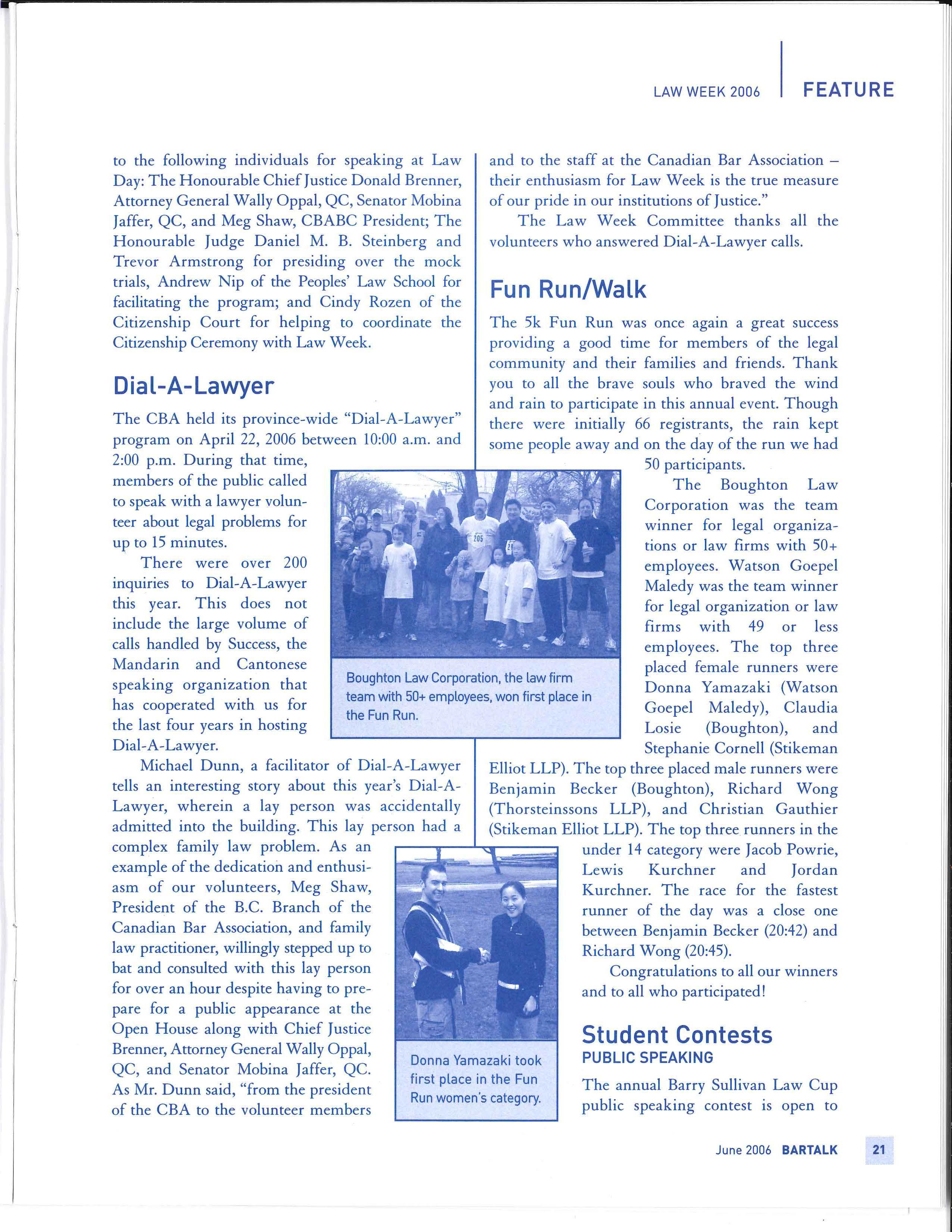
The 5k Fun Run was once again a great success providing a good time for members of the legal community and their families and friends Thank you to all the brave souls who braved the wind and rain to participate in this annual event. Though there were initially 66 registrants, the rain kept some people away and on the day of the run we had 50 participants.
Boughton Law Corporation, the law firm team with 50+ employees, won first place in the Fun Run.
Michael Dunn, a facilitator of Dial-A-Lawyer tells an interesting story about this year's Dial -ALawyer, wherein a lay person was accidentally admitted into the building. This lay person had a
The Boughton Law Corporation was the team winner for legal organizations or law firms with 50+ employees. Watson Goepel Maledy was the team winner for legal organization or law firms with 49 or less employees. The top three placed female runners were Donna Yamazaki (Watson Goepel Maledy), Claudia
under 14 category were Jacob Powrie, 1-- Lewis Kurchner and Jordan
Donna Yamazaki took first place in the Fun Run women's category
Kurchner. The race for the fa stest runner of the day was a close one between Benjamin Becker (20:42) and Richard Wong (20:45).
Congratulations to all our winners and to all who participated!
Student Contests PUBLIC SPEAKING
Losie (Boughton), and Stephanie Cornell (Stikeman Elliot LLP). The top three placed male runners were Benjamin Becker (Boughton), Richard Wong (Thorsteinssons LLP), and Christian Gauthier (Stikeman Elliot LLP). The top three runners in the complex family law problem. As an example of the dedication and enthusiasm of our volunteers, Meg Shaw, President of the B C. Branch of the Canadian Bar Association, and fam ily law practitioner, willingly stepped up to bat and consulted with this lay person for over an hour despite having to prepare for a public appearance at the Open House along with Chief Justice Brenner, Attorney General Wally Oppal, QC, and Senator Mobina Jaffer, QC. As Mr. Dunn said, "from the president of the CBA to the volunteer members
The annual Barry Sullivan Law Cup public speaking contest is open to June 2006 BARTALK 21
Student Contests continued
students enrolled in Law 12 classes throu g h o ut B.C . The contributions of Barry Sulli va n t o both th e legal and educational professions are hon o ur ed each year through the presentation of thi s C up t o the provincial winner. Congratulations to th e top finishers:
1. Lindsay Spencer, West Point Gre y A cade my, Vancouver
2. Sam Nuyens, W. L. Seaton Secondary, Ve rnon
3. Nicco Bautista , Vancouver College , Vancou ver
4. Grace Shaw, Little Flower Academy, Vancouver
ESSAY CONTEST
The Law Week Essay contest was open to students enrolled in grades 10, 11 and 12- Law, English and Social Science Studies throughout B.C . The L a w Week theme of "The Law-Friend or Foe? " appears to have been well received by students.
Congratulations to the top finishers :
1. Eric He, Fraser Heights Secondary School, Surrey
2 Mary Leong, St. Thomas Aquinas, North Vancouver
3. Navraj Dhanawa, Tawanis Secondary School, Surrey
4. Amanda Malenstyn, Tawanis Secondary School, Surrey
POSTER CONTEST
New this year was a Poster Contest. The Law Week Poster Contest was open to elementary school students from kindergarten to grade 3. Congratulations to the top finishers :
1. Shannon Young , Heritage Christian Online Sch o ol , Kelowna
2. Brody Reilander, Surrey
Connect Home Learner Program, Surrey
3 Sarah Warsh, Pauline Haerrer, Nanaimo
4 Ka a vya and Kavin Khalsa School, Surrey
Mohan,
Student Mentor Program
Th e Student Mentor Program has been a successful p art of Law Week Strong support from lawyers has prov ided a va luable opportunity for many high school stu dents to explore law as a career opt ion and to b r oaden their understanding of the legal profess ion
The program has two components. The first co m p onent invo lves the students being matched wit h lawy e rs who practise in the students' lega l area of int erest and t he students attending the lawyers' place o f work for a half day. High school law teachers and hig h school counsellor s nominate students who t hey fe el h ave the aptitude and interest to study law
The second component entails having lawyers a tt en d a h igh school law class to discuss their work a n d in cr ease th e understanding of students about t he le gal profess ion.
In Nana imo t his year, 7 high schools, 13 students, a nd 12 lawyers participated. As Michael Warsh, one o f th e fa cili t a t ors ' of the Student Mentor Program, stated, "Th is p rogram gives lawyers a rare opportunity to share their specialized knowledge and experience with students " T h e Law Week Committee looks forward to the continuing success of this program next year and thanks the following Vancouver Island lawyers for their participation this year : Timothy J. Huntsman, Ian W iebe, Christopher Churchill, Barbara M. Smith, Albert E. King, QC, Sandra L. Dick, G. Glen Ridgway, QC, Bentley J. Falkenberg, Bruce Soloway, Nicole Cederberg, Peter MacNeil, Ingrid Hennig, Elizabeth E. Stra in , and Joseph B. Martin
Congratulations to Shannon Young !top photo). first place winner in t he poster contest for kindergarten to grade
3 contestants in Br iti sh Columbia, and to Sarah R Warsh (bottom pho t o! , who won third prize

In the Lower Mainland, 14 schools, 25 students, and 31 lawyers participated in this year's Student Mentor Program.
The Law Week Committee gives special thanks to the Provincial Crown Counsel's office and to the lawyers on the lower mainland fo r their support.
Kootenay Bar Association Annual Weekend Retreat
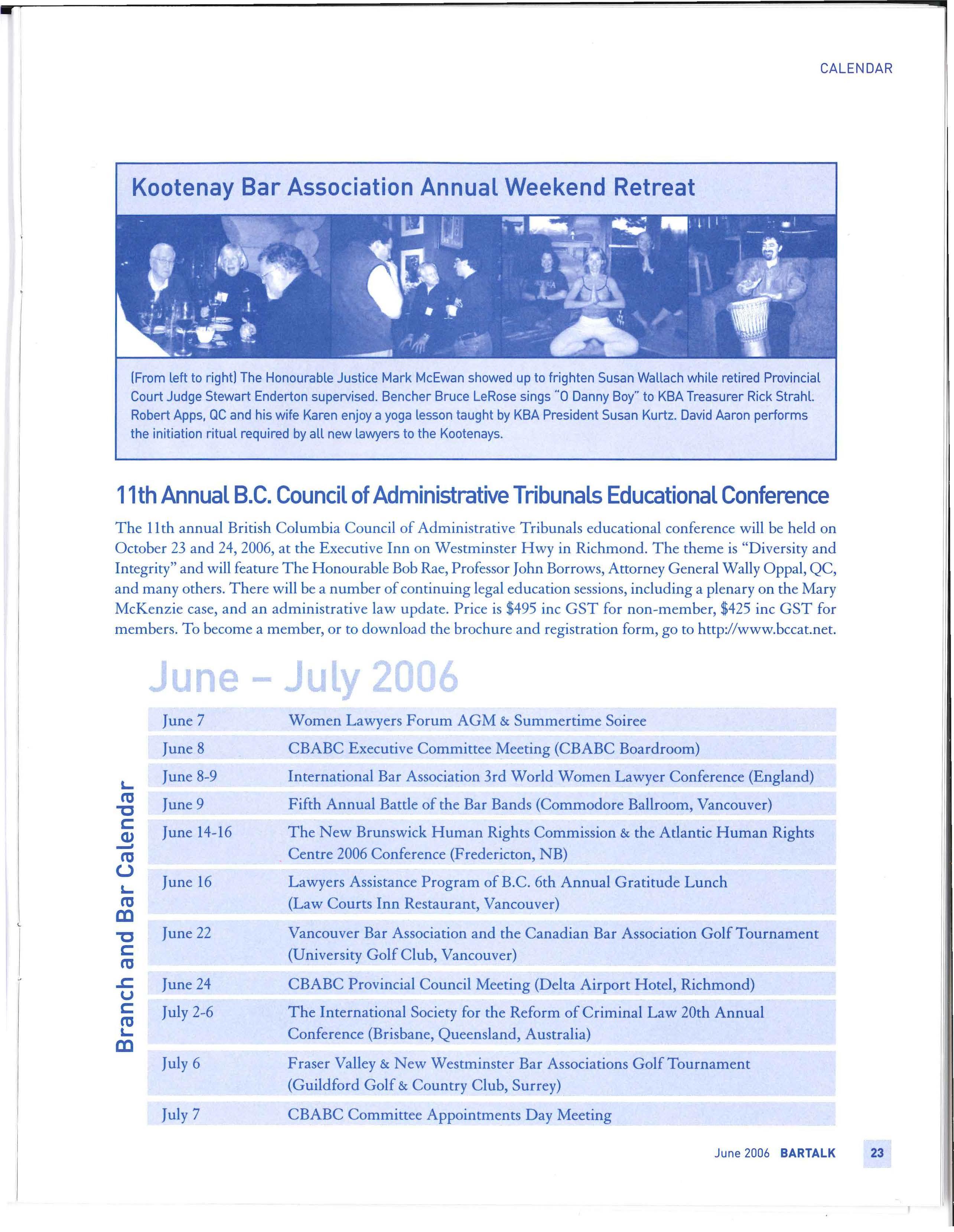
(From left to right) The Honourable Justice Mark McEwan showed up to frighten Susan Wallach while retired Provincial Court Judge Stewart Enderton supervised Bencher Bruce LeRose sings "0 Danny Boy" to KBA Treasurer Rick Strahl. Robert Apps, QC and his wife Karen enjoy a yoga lesson taught by KBA President Susan Kurtz. David Aaron performs the initiation ritual required by all new lawyers to the Kootenays.
11th Annual B.C. Council of Administrative Tribunals Educational Conference
The 11th annual British Columbia Council of Administrative Tribunals educational conference will be held on October 23 and 24, 2006, at the Executive Inn on We stminster Hwy in Richmond The theme is "Diversity and Integrity " and will feature The Honourable Bob Rae, Professor John Borrows, Attorney General Wally Oppal, QC, and many others. There will be a number of continuing legal education sessions, including a plenary on the Mary McKenzie case, and an administrative law update. Price is $495 inc GST for non-member, $425 inc GST for members. To become a member, or to download the brochure and registration form, go to http:// www bccat.net.
June 7
June 8
L..
June 8-9 ro June 9
June 14-16
June 16 L..
June 22
c
June 24
u c July 2-6
ro
July 6
July 7
Women Lawyers Forum AGM & Summertime Soiree
CBABC Executive Committee Meeting (CBABC Boardroom)
International Bar Association 3rd World Women Lawyer Conference (England) Fifth Annual Battle of the Bar Bands (Commodore Ballroom, Vancouver)
The New Brunswick Human Rights Commission & the Atlantic Human Rights Centre 2006 Conference (Fredericton, NB)
Lawyers Assistance Program of B.C. 6th Annual Gratitude Lunch (Law Courts Inn Restaurant, Vancouver)
Vancouver Bar Association and the Canadian Bar Association Golf Tournament (University Golf Club, Vancouver)
CBABC Provincial Council Meeting (Delta Airport Hotel, Richmond)
The International Society for the Reform of Criminal Law 20th Annual Conference (Brisbane, Queensland, Australia)
Fraser Valley & New Westminster Bar Associations Golf Tournament (Guildford Golf & Country Club, Surrey)
CBABC Committee Appointments Day Meeting
Making Booking Hotels Easy
MeetingMax online bookings help you save time and money. If you haven't done so already, make sure to go to www.cba.org/bc and see what discounts you are entitled to as CBABC member. MeetingMax allows you to quickly and conveniently check, compare and book hotels all around B.C. with just a few clicks of your mouse.
CBABC at Home Registry is Perfect For Summer Getaways
This Registry caters exclusively to CBA members traveling with i n Canada, the USA and international destinations. Through the Registry, members may arrange short and longterm home exchanges. Members can also host other members in their home or be hosted. CBA members with a second home or with access to temporary accommodations need not exchange homes on the same dates. For the out-oftown wedding, graduation, conference, or for just getting away, the Registry offers a no cost alternative to pricey hotels. The easy-to-use Registry makes family vacations, senior/retired vacations, and work-related home and hospitality exchanges both attractive and affordable. See the website for details.
Arts and Entertainment
We are offering up to 20 per cent off regular prices for some of Vancouver's most popular attractions and sporting events. Playland is now open and offers CBABC members, up to 20 per cent off. Visit the website for ticket info.
CBABC Member Services
E-mail NEWS List
Want to find out which new benefits and promotions are available to you? Join the CBABC Member Services e-mail NEWS list and you'll receive a monthly e-mail message with what's new in Member Services, travel and accommodation discounts, special promotions, exclusive events and more. Upon joining, your e-mail address will be added to the confidential Member Services distribution list. For details, visit www.cba.org/bc, or e-mail members@bccba.org
Attention Sports Fans
CBABC is proud to offer its members great discounts for Vancouver's favourite sports teams. We have teamed up with the Vancouver Canadians and the BC Lions to offer members up to a 20 per cent discount on tickets, as well as with the BC Lions to offer discounted season tickets. Join us in supporting
*local sports teams and the CBABC scholarship fund. Call Josey Schaefer at 604-687-3404 for more information.
Lawyers' Cases
CBABC is pleased to introduce its newest supplier of Lawyers ' Cases. "Bugatti" only uses quality full grain leather for a classic design, which you will be proud to own. Looking for a perfect gift for clients or students? We can have these bags personalized and at your door in no time Check out www.cba .o rg/bc (see "Membe r Savings" under "Membership") or call Josey Schaefer toll free at 1-888-687-3404 for more information.
Upcoming Promotions
Check out www.cba org/bc, (see "Member Savings" under "Membership") for current and upcoming promotions. We are continually updating the website to pass along great savings to all of our B.C. members.
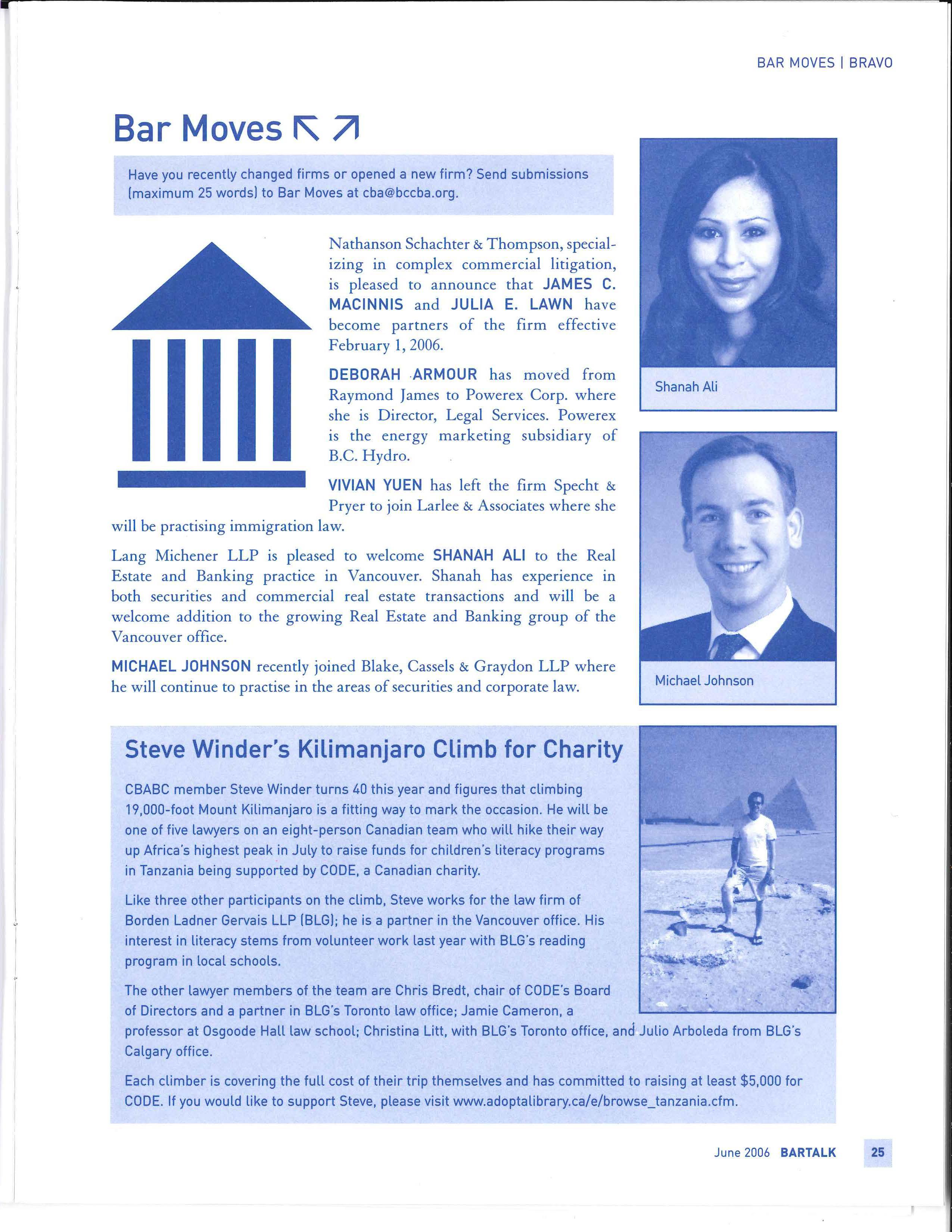
Bar Moves 1': 71
Have you recently changed firms or opened a new firm? Send submissions (maximum 25 words] to Bar Moves at cba@bccba.org.
Nathanson Schachter & Thompson, specializing in complex commercial litigation, is pleased to announce that JAMES C. MACINNIS and JULIA E. LAWN have become partners of the firm effective February 1, 2006.
DEBORAH ARMOUR has moved from Raymond James to Powerex Corp. where she is Director, Legal Services Powerex is the energy marketing subsidiary of B.C . Hydro .
VIVIAN YUEN has left the firm Specht & Pryer to join Larlee & Associates where she will be practising immigration law.
Lang Michener LLP is pleased to welcome SHANAH All to the Real Estate and Banking practice in Vancouver. Shanah has experience in both securities and commercial real estate transactions and will be a welcome addition to the growing Real Estate and Banking group of the Vancouver office.
MICHAEL JOHNSON recently joined Blake, Cassels & Graydon LLP where he will continue to practise in the areas of securities and corporate law
Steve Winder's Kilimanjaro Climb for Charity
CBABC member Steve Winder turns 40 this year and figures that climbing 19,000-foot Mount Kilimanjaro is a fitting way to mark the occasion. He will be one of five lawyers on an eight-person Canadian team who will hike their way up Africa's highest peak in July to raise funds for children's literacy programs in Tanzania being supported by CODE, a Canadian charity.
Like three other participants on the climb, Steve works for the law f i rm of Borden Ladner Gervais LLP (BLG); he is a partner in the Vancouver office. His interest in literacy stems from volunteer work last year with BLG 's reading program in local schools.
The other lawyer members of the team are Chris Bredt, chair of CODE's Board of Directors and a partner in BLG's Toronto law office; Jamie Cameron, a
professor at Osgoode Hall law school; Christina Litt, with BLG's Toronto office, and Julio Arboleda from BLG's Calgary office.
Each climber is covering the full cost of their trip themselves and has committed to raising at least $5,000 for CODE. If you would like to support Steve, please visit www.adoptalibrary ca/e/browse_tanzania.cfm.
PRACTICE MADE PERFECT
CLEBC Update
ANNOTATED PRECEDENTS- TRUSTED PRACTICE TOOLS
Don't waste time, effort and money reinventing the wheel. The well-drafted annotated precedents help you create documents efficiently and ensure that you understand the nuances of the law rather than simply using "boilerplate."
Created by experienced leaders in the profession, CLEBC's library of collected annotated precedents include:
• British Columbia Creditors Remedies
• Buying and Selling a Business
• Canadian Criminal Jury Instructions
• Civil Jury Instructions
• Commercial Leasing
• Desk Order Divorce
• Family Law Agreements
• Real Estate Financing
• Supreme Court Chambers Orders
• Wills Precedents
SUPPORT STAFF EDUCATION
Ensuring that your support staff stays informed about the latest legal developments is as crucial as your own ongoing professional development. CLEBC offers a variety of publications and courses in all major practice areas specifically designed for support staff.
Have your staff learn the best approaches from leading experts with CLEBC deskbooks: Conveyancing Deskbook, Family Law Deskbook Company Law Deskbook and published in January Wills and Estates Deskbook and courses Basic Corporate Procedures for Legal Support Staff and Lawyers (June 23) and Advanced Conveyancing Topics for Legal Support Sta.ff(October 25).
Watch for CLEBC e-mails and mailings for more information on all publications and courses offered, or check CLEBC website at www cle.bc.ca.
Directory 2007 is coming!
Don't miss out on getting your Preferred Area of Practice (PAP) listings for clients and other lawyers to see- fill out the enclosed order form. To book your advertising or pre-purchase a Directory, go online to www.bccbadirectory.org. Watch for your Directory Listing Proof in June.
\;II_ 1\P MS VOLUNTEER LEGAL ADVOCACY PROGRAM
Mu ltiple Sclerosis Soc iety of Canada Soc it canadienne de Ia sc irose en plaques
People with multiple sclerosis are often faced with a variety of legal challenges involving human rights, employment equity, estate planning, and fami ly law issues.
The Multiple Sclerosis Society's Volunteer Legal Advocacy Program was developed to provide a resource of volunteers with legal expertise to work towards meeting the specific needs ofVLAP members The VLAP has been successfully implemented in Victoria, N anaimo, Prince George, Kamloops, Kelowna, Fraser Valley and Vancouver. We are presently recruiting lawyers in all areas of law.
If you are interested in making a difference in the lives of people affected by MS, p lease contact 1-800-268-7582 or heather.armstrong@mssociety.ca
Our Goal: to provide advocacy support and legal advice to those affected by MS.
THE@LAW FOUNDATION
OF BRITISH COLUMBIA
T h e Board of G overn ors of th e L a w Foundation of B .C. m et on Ma rch 25, 2 006. Cha ir Wa rre n Wilson , Q C is pleased to announ ce that funding t otalling $3,341 , 880 has been app roved fo r continuing progra m s, and projects:
Funding totalli ng $3,241,880 was approved for the following 17 continuing programs:
$705,900
WEST COAST ENVIRONMENTAL LAW ASSOCIATION
O p erat in g 200 6/20 07 an d E n vir onm ental Dispu te Resol u tion Fund
$654,500
COMMUNITY LEGAL ASSISTANCE SOCIETY
O pera ting E xpe n ses 20 06/2 007
$262,400
PEOPLE'S LAW SCHOOL SOCIETY
Ope rati ng Expen ses 2006/2 00 7
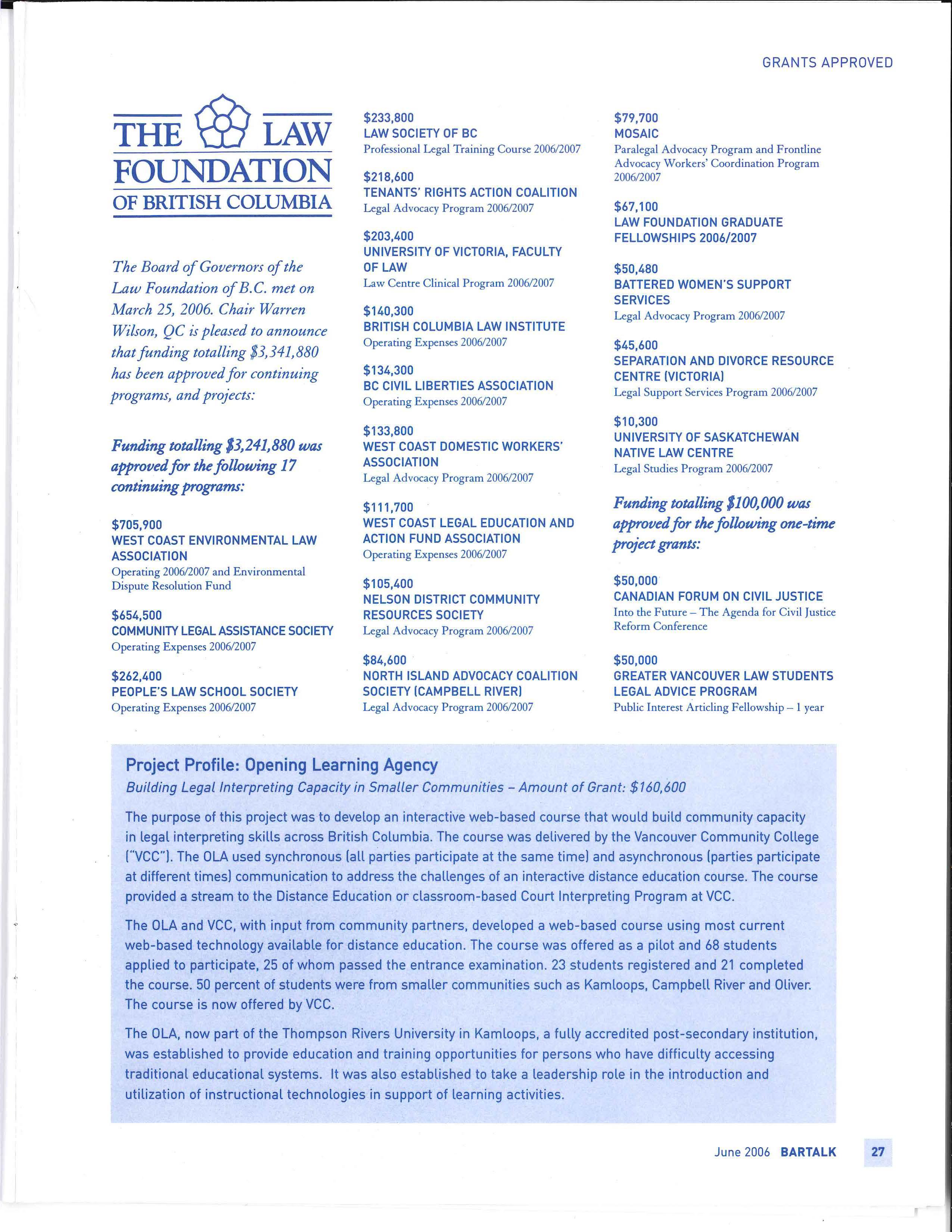
$ 233 ,800
LAW SOCIETY OF BC
P rofessiona l Legal T ra ining Co u rse 2006/2007
$218 ,600
TENANTS ' RIGHTS ACTION COALITION Legal Advocacy Program 2006/2007
$203,400 UNIVERS ITY OF VICTORIA , FACULTY OF LAW
Law Ce n t re C lin ica l Progra m 2006/2007
$140 ,300
BRITISH COLUMBIA LAW INSTITUTE Ope rating Expenses 2006/2007
$134,300
BC CIVIL LIBER TIES ASSOCIATION Ope rating Ex pen ses 2006/2007
$133 ,800
WEST COAST DOMESTIC WORKERS' ASSOCIATION
Lega l Advocacy Program 2006/2007
$111,700
WEST COAST LEGAL EDUCATION AND ACTION FU ND ASSOCIATION Ope ratin g Ex pen ses 2006/2007
$105,400
NELSON DISTRICT COMMUNITY RESOURCES SOCIETY Lega l Advocacy Program 2006/20 07
$84,600
NORTH ISLAND ADVOCACY COALITION SOCIETY [CAMPBEL L RIVERI L ega l Advocacy P rogr am 2006/2007
Project Profile: Opening Learning Agency
$7 9,7 00 MOS AIC
Pa ralega l Advocacy Prog ram a nd Frontl in e Ad vocacy Workers' Coord inati on Prog ram 200612007
$67 ,100
LAW FOUNDATION GRADUATE FEL LOWSHIPS 2006/2007
$50,480 BATTERED WOM EN' S SUPPORT SERVICES L ega l Advocacy Program 2006/2007
$45,600
SEPARATION AND DIVORCE RESOURCE CENTRE [VICTORIA!
L ega l Su pport Serv ices Program 200612007
$10 ,300
UNIV ERSI TY OF SASKATCHEWAN NATIVE LAW CENTRE
L ega l Stu dies P rog ram 2006/2 007
Funding totalling $100, 000 was approved for the following one-time project grants:
$50,000
CANADIAN FORUM ON CIVIL JUSTICE Into t he F utu re- T he Agenda fo r Civ il Ju stice Reform Co n fe rence
$50 ,000
GREATER VANCOUVER LAW STUDENTS LEGAL ADVICE PROGRAM
P ub lic Inte rest Articling F ell ows h ip - I year
Building Legal Interpreting Capacity in Smaller Communities- Amount of Gr ant: $160,600
The purpose of this project was to develop an i nteractive web-based course that would build community capacity in legal interpreting skills across British Columbia . The course was delivered by the Vancouver Community College [ 'VCC"). The OLA used synchronous [all parties participate at the same time] and asynchronous [parties participate at different t i mes] communication to address the challenges of an interactive distance education course. The course provided a stream to the Distance Education or classroom-based Court Interpreting Program at VCC.
The OLA and VCC , with input from community partne r s, developed a web-based course using most current web-based technology available for distance education. The course was offered as a pilot and 68 students applied to participate, 25 of whom passed the entrance examination 23 studen t s reg i stered and 21 completed the course. 50 percent of students were from smaller communities such as Kamloops , Campbell River and Oliver. The course is now offered by VCC
The OLA, now part of the Thompson Rivers University in Kamloops, a fully accredited post-secondary inst itution , was established to provide education and training opportunities for persons who have difficulty access i ng traditiona l educational systems It was also es t ablis he d to take a leadership role in the i ntroduction and utilizat i on of instructional technologies in support of learning act ivities
CLASSIFIED (per line)
CBABC Members/Firms
Commercial Organizations
Next deadline : July 7
DISPLAY
3" X 2 5"
CBABC Members/Firms
Commercial Organizations
6" X 2 5"
CBABC Members/Firms
Commercial Organizations
Next deadline : July 7
INSERT (all of B C )
CBABC Members/Firms
Commercial Organizations
Next deadline: July 14
Next mailing: August 4
Direct Bar Talk advertising inquiries to : Jesse Tarbotton Communications Co-ordinator
Tel: 604-646-7856 or 1-888-687-3404
E-mail: jtarbotton@bccba.org
http://www. cba. org/cba/Practice Lin k/M FI
Access CBA's award-winning online collection of articles, tools, and tips to help cope with the day-to-day issues of running a law practice . Topics include billing, marketing, client care and technology, all in the context of helping lawyers strike a balance between work and home life. Visit the Money & Finance section for recent a rticles on:
• How to Get P a id
Practice Restricted To WCB
Sec . 257 Determinations , Opinions and Court Applications on referral 604-267-3033
• Claims and appeals
• Vice Chair at Review Board for 6 years
• More than 25 years personal injury litigation
Ishkanian &
Barristers & Solicitors Cell604-868-3034 Fax 604-264-6133 vishkanian@pepito.ca
SERVICES
a, B. C (www.BC pa te nts. ca) E-mail: d oug@ BC pa tents ca
Five Ways to Get More Business from Existing Clients
How to Adjust Your F ees With out Losing Clients
How to Develop and Implement a Strategic Plan for Your Firm
The Billable Hour-Here to Sta y ?
Planning Ahead for P a rtn er R etirement
Tel: 604-270-4466 Fax: 604-270-8355
Car Purchase Pla n Toll Free: 1-888-385-4466
Hammer s mith Way Richmond , B C V7A 5E9 Canada