JYNNEOS comes to Plattsburgh
BY ALEKSANDRA
Clinton County Health Department and the Stu dent Health and Counsel ing Center collaborated to bring a targeted monkeypox vaccine initiative to campus Friday, Sept. 30. Twenty-five people, students and civil ians alike, received their first dose of the JYNNEOS vaccine that day.
The CCHD and SHCC saw enough interest in a monkeypox vaccine among SUNY Plattsburgh students to host a clinic. Susan Sand, assistant di rector for medical services, sent a survey to the SUNY Plattsburgh student popu lation Sept. 9. No Platts burgh residents were sur veyed for interest in the vaccine, Supervising Pub lic Health Nurse Nichole Louis said. However, civil ians were notified of the clinic through press releas es, radio announcements and social media.
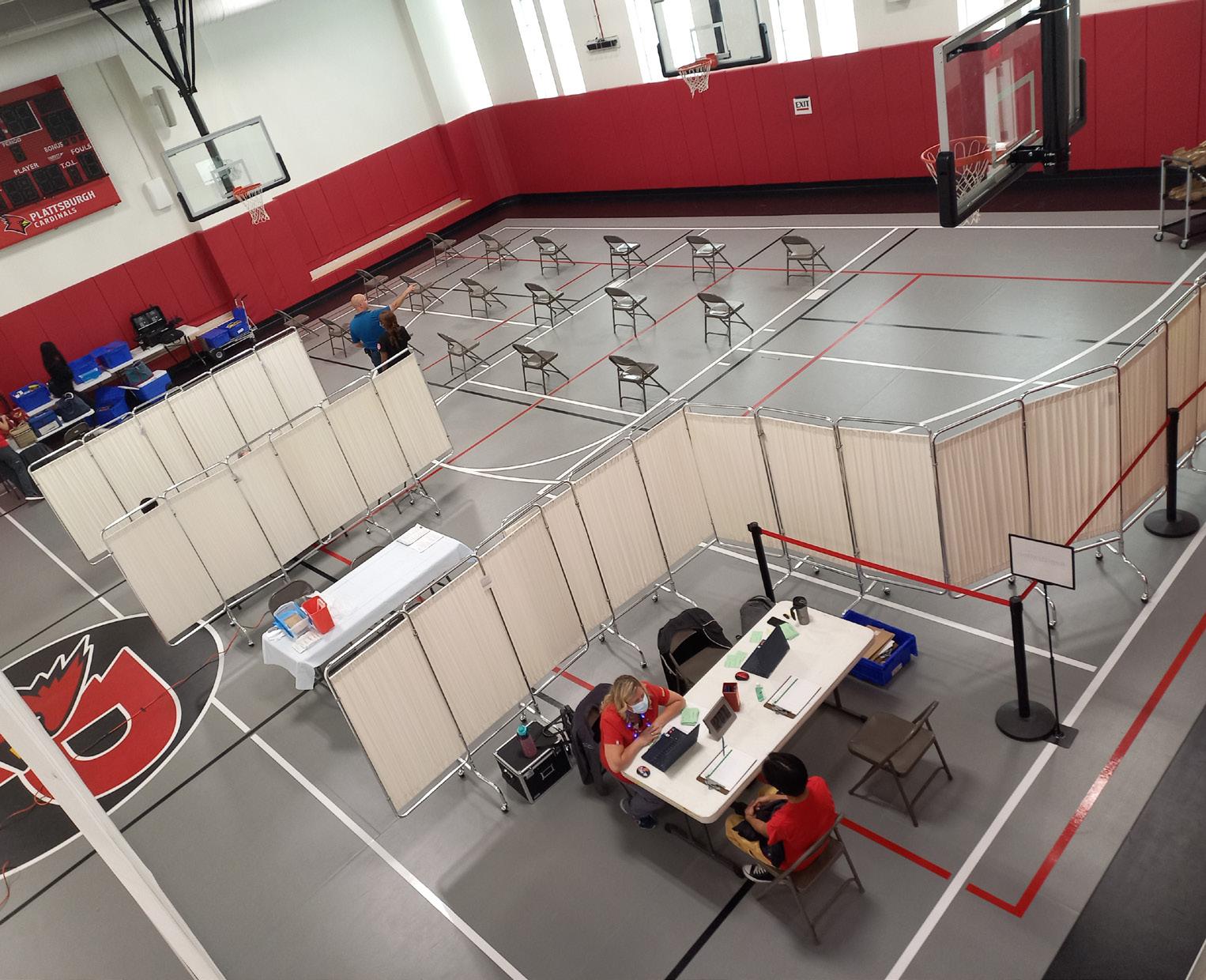
The clinic occupied half of Memorial Hall’s bas ketball court, divided by a large white screen. The tables used to administer vaccines were separated by smaller white screens with wheels. These priva cy measures were imple mented at SHCC’s request because the vaccine’s eli gibility requirements can reveal sensitive informa tion about people who re ceive it, Louis said.
The vaccine was avail able to those who may have been exposed to monkeypox or are at greater risk of being ex posed to monkeypox. This includes being in close contact with some
one diagnosed with mon keypox, having multiple sexual partners or having sex at events or commer cial sex venues in the past two weeks as a man or transgender or nonbina ry person. People whose sexual partners identify with these scenarios or anticipate “experiencing any of the above scenar ios” are also eligible for the vaccine.
People who have expe rienced a “severe allergic reaction after a previous dose of JYNNEOS” should not get the JYNNEOS monkeypox vaccine, the Centers for Disease Con trol and Prevention state. The CDC also suggests people discuss getting the vaccine with their health care provider if they are allergic to “the antibiot ics gentamicin or cipro floxacin, or chicken or egg protein.” It is also not recommended to get the COVID-19 vaccine within four weeks of receiving the JYNNEOS vaccine.
Parker Leclair, a junior majoring in geology, is one of the people who received their vaccine.
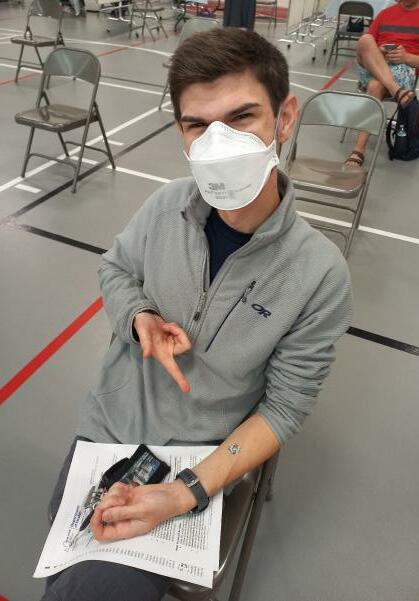
Leclair said the shot felt different from a COVID vaccine: his forearm hurt after the vaccine was ad ministered, and the fluid felt like it sat under his skin in “a little pocket.”
“I’m glad I did it,” Leclair said. “I hate needles, but it’s worth it.”
Leclair said he got the vaccine because he “would rather not have to be as concerned” about monkeypox, as the COVID pandemic gave him a lot of anxiety. While he encour aged his peers to get the vaccine, Leclair said the
decision is a personal one.
“I would say it’s a per sonal decision, based on previous reactions to vaccines, but if it’s a con cern, I think it’s worth it,” Leclair said.
Another vaccine recipi ent, an elderly man who requested his name not be
used, said the vaccine did not hurt. On his decision to get the vaccine, he said, “I have sex with men.”
The man said he was not afraid of neither the vac cine nor the disease.
“I’m 80,” he explained, shrugging.
Computer science soph
omores Justin Kumrow and Ulises Ortega-Morales said they are not inter ested in receiving a mon keypox vaccine in the case they are eligible.
SA speaks on Black Solidarity Day class
ALEKSANDRA
The 60th legislation of the Student Association declared it would “push further” than the legisla tion before it to maximize the value the celebration of Black Solidarity Day Nov. 7 can bring to the campus. That can poten tially mean mandating faculty to cancel classes for the day. Additionally, the SA Senate approved “up to $800” for an edu cational trip for the en trepreneurial club C.E.O., gave the Muslim Student Association permanent club status and granted the new club APOSA pro visional club status.
The discussion began at the meeting of the SA Ex ecutive Council Monday, Sept. 26. Professor John McMahon attended the meeting as a guest to pro vide the Executive Council with information about the social justice teach-in happening on Black Soli darity Day, as well as learn how faculty can “contrib ute to its success.”
When the 55th legisla tion of the SA tried to add Black Solidarity Day to the academic calendar, they were “very hard on ‘no classes’” and thus unsuc cessful, McMahon said.
College supports neurodiverse students
 BY JESSICA LANDMAN
 Writer
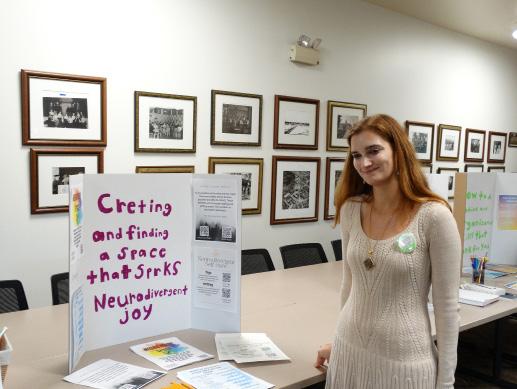
Marlee Bickford-Bushy, the graduate mentor for student support services and student accessibil ity services, hosted her first Neurodiversity and Navigating college event Sept. 27, in the Alumni Conference Center.
According to a Har vard study, about 20% of undergraduate college students in the United States reported having a disability, including neu rodivergence. Neurodi versity is the differences in behavioral traits and how a brain may function in comparison to what is considered a “normal” brain. Some of those dif ferent variations include autism spectrum disorder, attention-deficit hyperac tivity disorder, down syn drome and dyslexia.
Bickford-Bushy was di agnosed with autism and therefore sympathizes with the struggles neuro divergent students like her may experience through out their college careers.
“Neurodiversity entails
the concept that each of us has different mind varia tions, and that’s normal,” Bickford-Bushy said.
The purpose of this
event was to spread awareness and inclusiv ity as well as give all stu dents a place to feel wel come and start anew after
COVID-19. This program was mainly directed at first-year students to help with adjustment from the K-12 system’s structure to
that of a college.
Bickford-Bushy said, “A lot of times we are told to be like everyone else, to have study skills just like
everyone else, and that doesn’t work for us.”
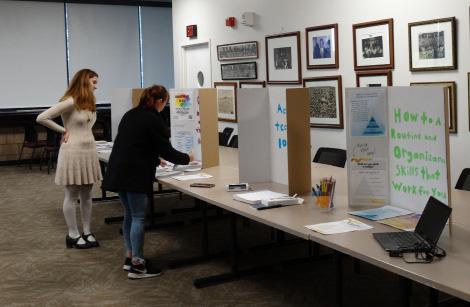
Available at this event were resources that helped students in build ing routines, understand ing their needs and deter mining the importance of tasks to help fulfill them, as well as learning how to avoid shutdowns, meltdowns and burnout. These skills can help stu dents thrive in college.
Some stations featured technology that has been useful for neurodivergent students, items such as fidget toys that could be helpful when dealing with attention deficien cies and well-known authors who have also struggled with problems related to neurodiversity in their past.
Also highlighted at the event was the upcom ing “neuro-pride” group on campus. Along with that is a new neuro-pride space that is in the works of being set up.
FRIDAY, OCTOBER 7, 2022VOLUME VOLUME 107 | ISSUE 4 SUNY Plattsburgh’s independent student newspaper since 1997 OPINIONS | A3 A FUTURE IN NUCLEAR ENERGY SPORTS | B1 CROSSCOUNTRY RECAP ARTS & CULTURE | B4 REPRODUCTIVE JUSTICE FORUM
SIDOROVA News Editor BY
SIDOROVA News Editor
ALEKSANDRA SIDOROVA/Cardinal Points
Parker Leclair poses after receiving his first dose of the JYNNEOS monkeypox vaccine.
VACCINE l A5 SA l A2
BRYN FAWN/Cardinal Points
Marlee Bickford-Bushy, who organized the event, stands next to a stand offering neurodivergent students advice.
Staff
SUPPORT l A2
SUPPORT
from page A1

This will become a “space made by neurodivergent students for neurodivergent students” according to fly ers promoting the new space.
Being a neurodivergent student in college can be dif ficult. Bickford-Bushy spoke on her experiences while attending high school.
“It was definitely different for me because you go in, a lot of times, with a concept known as masking, where you have a lot of anxiety, and sometimes masking can even lead to depression,” Bickford-Bushy said.
Masking is a “social survival strategy” for neurodiver gent people, according to the Healthline article “Autism Masking: To Blend or Not to Blend” by clinical psycholo gist Dr. Alex Klein. Masking behaviors can include forc ing eye contact, faking smiles, scripting conversations and minimizing one’s interests to appear neurotypical — just like everyone else. People may choose to mask to
SA
The 59th legislation suc ceeded, reaching the pro vost “using almost the same language,” but had to settle for a compromise: classes were to continue despite the social justice teach-in “due to academic freedom concerns.” This arrange ment left many students, including a few members of the Executive Council, having to choose “be tween class and an event that speaks to their com munity and identity,” as SA President Taiba Azeem said. Coordinator for Clubs and Organizations Deasha Gilmore said the dilemma left her feeling unsupport ed by her professor.
McMahon said there are currently “conversa tions and disagreements” on whether professors should hold class on Black Solidarity Day. In his un derstanding, emails will be sent out encouraging faculty to let students at tend the teach-in. McMa hon said his hope was for there to be at least an in formal norm for no classes so more students could at tend the teach-in.
“I know, and my fellow planners know, that this is a problem,” McMahon said. “It places a lot of bur den on students to make difficult decisions.”
Besides canceling class es, the Executive Council suggested making class attendance for that day optional, offering extra
credit for attending the teach-in or assigning work related to the teach-in to encourage more students to attend.
“This day is a day of val ue,” Coordinator for Stu dent Affairs and Diversity Peculiar Joseph said. “Yes, we should really have classes, but there should be a way for people to ac tually go to this teach-in.”
The SA plans to pursue action, although it is still unclear what course of ac tion it will be.
“I don’t know how the professors are going to feel if all of us come together and we say to them, ‘No, this day is really important to us, and you’re going to have to work around our schedules,’” Gilmore said. “I feel like we can push that. We just have to be very stern.”
feel safe, make friends, fit into their environment or suc ceed at their jobs.
Bickford-Bushy said these problems can often make it difficult for students to go into professors’ offices or ask for help.

“It was great to come in, to see professors that were ac cepting. Also to work more with professors who wanted to know more about you,”

Bickford-Bushy said.


Bickford-Bushy said that in order to have the best experience in college, it is important for students to be open and honest with their professors about the chal lenges they face from being neurodivergent.
There are a plethora of resources students can uti lize on campus if they are struggling with neurodiver sity. A good place to start would be Student Support Services or Student Accessibility Services to meet with staff to build schedules and habits that can optimize the college experience.

the conference, and that the event offered students “great networking oppor tunities” as well as compe titions to participate in.
“This is our first full year being a chapter of CEO, so I think it means a lot to make a presence at this national convention,” Per ry said. “It would be the first time ever that Platts burgh is going to have rep resentation here.”
Perry explained that the $800 would be split evenly between the four attendees, reducing each individual’s cost of attend ing the event from $822.32 to $622.32. Perry said the club will be requesting a grant from College Aux iliary Services to further help with costs, but the rest would be paid “out of pocket.” The grant was unanimously approved.
The Muslim Student As sociation’s whole eboard attended the Senate meet ing to request permanent club status. Permanent club status can be granted after 90 academic days of the club’s existence and entitles a club to receive a fixed budget allocated to it every spring semester.
permanent club status.
The new club requesting provisional club status was APOSA, standing for Apos tolic Students and Associ ates. The club is a chapter of Apostolic Church Inter national, based in Ghana with some branches in New York City.
Vania Nyarko, the presi dent of APOSA, said the club provides students ac cess to church profession als offering guidance in areas of careers, finance, spirituality and decisionmaking. The club does not currently have fixed meeting times, but aims to host biweekly meetings and is looking to formally introduce itself to the stu dent body by hosting a banquet. The club will be receiving some funding from the church as well as additional resources for club activities, such as in strumentals for worship. Through a unanimous de cision, APOSA received provisional club status.
At the Senate meeting, Vladamiere Perry, the pres ident of C.E.O., a club for entrepreneurially-minded students, requested an $800 grant for four club members, including Perry, to attend the Collegiate En trepreneurs Organization’s 39th annual conference in Chicago Oct. 28-30. Perry said this would be the first time the Plattsburgh chapter of CEO attended
An MSA representative said the club has already hosted its first event this semester, a hot chocolate social to attract new mem bers. Coordinator for Clubs and Organizations Deasha Gilmore confirmed that the MSA applied for pro visional club status last academic year and had “a lot of successful events.”
The Senate unanimously agreed to grant the MSA
Lastly, as part of the endof-meeting reports, Sena tor Liza Ali announced a meeting with club presi dents is scheduled for 3 p.m. Friday, Oct. 21 in the Amnesty Room at Angell College Center. The meet ing is also open to other club members. It will serve as an opportunity for Gilm ore to share additional in formation and help club leaders with problems and concerns they may have.
NEWSA2 ▪ Friday, Oct. 7, 2022▪News Editor Aleksandra Sidorova CP Corrections There are no errors to report this week. If you see an error in Cardinal Points, email cp@cardinalpointsonline.com Detective Burghy has nothing to report this week. Weekly Memes ALEXA DUMAS/Cardinal Points Multimedia GOT A NEWS TIP? Contact the news editor at cp@cardinalpointsonline.com.
BRYN FAWN/Cardinal Points
A student attending the event takes informational flyers with Marlee Bickford-Bushy by her side.
Continued
Email JESSICA LANDMAN cp@cardinalpointsonline.com
Continued from page A1 Email ALEKSANDRA SIDOROVA cp@cardinalpointsonline.com
Students survey sidewalks, explore
BY HANNAH CLUCK Contributor
The planning of city layouts is a pro cess that involves every citizen in the se lected area, whether they know it or not. The residents of the town are the people utilizing the town on a day-to-day basis. They are on the front lines of the whole process that goes into developing an ef ficient, functioning city.

Planning the layout of a city is more vital than it may seem. The placement of buildings, parking lots and parks has to be taken into consideration when developing a pedestrian-friendly, consumer-friendly city. If a good or service is located in an inconvenient area, it will remain unused resulting in waste and poor use of land. The tedious details of city planning is equally as important as city layout. These tedious details being the maintenance of sidewalks, benches, greenery, etc. The tedious details that encourage residents to actually utilize the town and immerse themselves in the community.
This is the case for our own town of Plattsburgh. The town relies on feedback from residents to morph Plattsburgh into a more pedestrian-friendly, safe and ap pealing town. A walk audit was performed with the Plattsburgh Health Department that included students from an environ mental planning class at Plattsburgh State. The audit consisted of the group walking and inspecting the conditions of various roads like Broad, Brinkerhoff, Margaret and Couch streets. The students conducting a survey were able to submit data to the city on the current conditions of town facilities like sidewalks, benches, bike lanes and bus stops.
One common theme found within the
audit was that the sidewalks were not even close to meeting ADA compliance. ADA is the Americans with Disabilities Act, protecting the safety and rights of residents with disabilities. To meet ADA compliance, sidewalks must be five feet in width, and consist of main tained ADA pads, the textured patch at the end of sidewalks to let those visu ally impaired know that there is a road. The sidewalks were merely three feet in width, resulting in easily piled up foot traffic, decreasing efficiency. Many of the ADA pads were completely missing as well, risking the lives of residents
with disabilities in the area.
In addition to the sidewalks, the state of the crosswalks were frightening. Lo cated on Broad Street are several poorly marked crosswalks, with cars whirring by at fast speeds; one of these crosswalks being for the Plattsburgh middle school. The state of these sidewalks jeopardizes the safety of anyone using them. Cars stopping to let those who need to cross is not a given.
The town was granted funding to better the conditions of Plattsburgh to implement needed and useful change. The town has started several initia
tives to jumpstart this change, one of them being the Margaret Street Project. The goal of this project is to transform Margaret Street and the town needs feedback. Residents of Plattsburgh and students are able to access the Margaret Street Project website and submit their own opinions to the town. Residents are able to be the voice of change and make a tremendous impact on the town throughout its journey of development.
Email HANNAH CLUCK cp@cardinalpointsonline.com

Nuclear energy shapes U.S. future
BY ROCCO GOLDEN Contributor
scandals
amidst media
Florida governor Ron DeSantis has continued to keep his name in the head lines. Originally his scandals began with his “don’t say gay” bill, and now have shifted to the allegation of trafficking im migrants to Martha’s Vineyard, Massa chusetts. Some fear that with American politics inching toward fascism, DeSan tis may become the next Donald Trump.
February of this year, DeSantis visited a Holocaust museum, witnessing a cattle car replica used to transport victims. He gave a speech at the convention.

“You can read it on a sheet of paper, but what does that actually mean when you see the tragedy,” DeSantis said in his speech.
Months later, a bombshell dropped. It was revealed DeSantis had filled a plane with immigrants and sent them to Mar tha’s Vineyard. DeSantis used $12 mil lion dollars from a program DeSantis signed which was originally intended for deportation. It was also revealed De Santis had the immigrants profiled at the Texas border, and misled them with gift cards and promises of jobs and homes, according to National Public Radio.
They were then brought to Martha’s Vineyard, an island off the coast of Massa chusetts. There were no homes, no shelter,

no food or support of any kind for these men, women and children. Local authori ties were not made aware of their arrival either. These confused people, seeking asylum, were handed false brochures.
These brochures detailed how there were English classes available to them, where they could find work and shelter, and how to finish their legal require ments. On the plane, they were forced to sign their address falsely, mostly to homeless shelters nowhere near Mar tha’s Vineyard. This was deliberate as they would be required to report to ICE to be seen before a judge. For some it would be within the upcoming week.
These immigrants were following the legal processes. None of these immi grants were going to enter the country il legally. These men, women and children seeking asylum were following the books.
Yet, suddenly they were whisked away and now are plastered all over news headlines. No names have been released. No stories delivered.
Elizabeth Ricci, an immigration attor ney from Florida, argues what DeSantis did was human trafficking. “An entice ment like [shelter, working papers, etc.], regardless of whether you sign a waiver, is fraud and that is part of the definition of human trafficking,” Ricci told NPR.
Energy in the United States has for a long time been a hot topic of debate. The typical debate is that the country needs to switch to renewable energy faster. Now, on paper it totally makes sense. Renewable energy would obviously seem like something to im plement everywhere.
The issue with renew ables such as wind and solar is that the total energy out put is less than that of other sources. More energy infra structure would be needed, as well as more batteries to store the energy, which would defeat the purpose of going to clean energy in the first place, as batteries for these kinds of energy re quire materials that need to be mined and refined.
The process of making batteries and other parts for newer machines such as EVs is just as harmful to the environment as using a combustion engine for a long time.
What if there was an en ergy source that produced a lot of energy and didn’t have emissions? There is. It’s called nuclear energy.
Nuclear energy has been around since the mid-20th century. The energy mak ing process comes from fission. Put simply, fis sion is a chain reaction of atoms that releases a lot of energy through heat, which is used to create steam to power turbines. The process itself pro duces just as much, if not more, energy than other sources, and with zero carbon emissions. It’s the
best of both worlds.
There are a few reasons as to why nuclear energy isn’t as prominent as you would think. It’s expen sive, building nuclear power plants tends to be more expensive than all other energy sources. Nu clear waste is also one of the problems of nuclear energy. However, with the right storage and manage ment, nuclear waste can be taken care of safely.
A misconception peo ple make is how much nuclear waste is actu ally produced. The United States, on average, pro duces around 160,000 cu bic feet of nuclear waste per year. That may sound
like a lot, but that could easily fit into your local Walmart. The pros of nu clear energy outweigh the cons. There are certainly a lot of current issues with today’s nuclear en ergy, but in all reality, the issue is the government.
The U.S. government has, in essence, failed to keep up with changing technol ogy over the past decades. This is for a multitude of reasons, whether it be lob bying, laziness, or the fact of rising polarization, the federal government just hasn’t delivered on what they claim to be doing.
FRIDAY, OCTOBER 7, 2022
BY BRYN FAWN Associate Opinions Editor BRYN FAWN/Cardinal Points ENERGY l A4 ROLDNARDY NORELUS/Cardinal Points
ROLDNARDY NORELUS/Cardinal Points DeSantis’
pile
POLITICS l A4
Mahsa Amini death sparks protests
An outcry for change with in Iran has been prevalent through protest, a protest that began Sept. 21 against the Islamic Republic. Why? The death of a 22-year-old woman, Mahsa (Zhina) Amini, who was in police custody after she was “not fully complying” with Iran’s veiling laws.
The country’s morality po lice claimed she was not wear ing her hijab properly, and her actions were improper reli gious observance in public. A hijab is a Islamic head cover ing that some Muslim women wear, but is mandatory in Iran. After a few days in custody, au thorities claim she died from a heart attack. However, many people believed there was an evil sense of corruption behind her untimely death, and at some point during her arrest, she was tortured.
Crowds chanted and women danced in Kurdistan, her home province, and downtown Teh ran, Iran. Hundreds of women everywhere began to hold up signs calling for reform, started cutting their hair amid crowds and began burning their hijabs in the streets. Several other places such as NYC and around the world, began to shout back at the injustice of a young wo mens’ life coming to an end.
“The participation of women from all walks of Iranian life, and the symbolism of remov ing the hijab and then burning it — not outside some Islamic center in Europe, but in Teh ran, Qom, Isfahan and other large Iranian cities — is unprec
POLITICS
Continued from page A3
edented,” according to New Lines Magazine, a media house in Washington, D.C., and an ar ticle written by a woman who grew up in Iraq.
While President Hassan Rouhani was in power in 2017, under the morality police it was ensured that arrests for dress code violations would no longer occur. Under President Ebrahim Raisi, these rules have become more restricted, and in turn, has caused moral turmoil. These protests are making a statement against a polarizing patriarchy that has gone on for far too long. As there have been other protests over other issues in Iran, this has been one of the most polarizing in terms of what women are truly fighting for. Freedom to practice their religion in the way they deem fit, not controlled by the coun try they live in.

“After Islam, the hijab ad opted a different meaning and function. The old status conventions were eliminated and all women were obliged to completely cover all their hair, neck and ears. Tied to the hijab verse in the Quran was a demand to dress modestly, with an emphasis on conceal ing the bosom. The hijab be came associated with modesty and acquired the function of privatizing sexuality by hiding a woman’s physical appeal to “foreign” men outside her im mediate family and spouse,” NLM stated.
Understanding what the hi jab represents to a man is vi tally important to fully under
stand why these protests are important. Since the begin ning of time, men have tried to control women in any aspect possible. Tying something into religion, and using it as a form of control and not of a woman’s free will to express her religion, is the biggest part of the problem. Women should not be punished for showing a small bit of her hair, or what men deem is the “proper” way to express their religion. Amini’s death was unjust, and even having her in custody was an irrevocable mistake. The sexualization of women is caused by men, and they are the same ones pun ishing women for a concept that they created, regardless of the Quran’s teachings.
“While Islamic jurispru dence and fatwas oblige all Muslim women to wear a hi jab for the purpose of modesty and concealing sexual appeal, and the Quran also mandates that no skin beyond the face and hands be revealed, failure to follow these requirements to the letter is not an unfor giveable or cardinal sin, ac cording to the Quran itself,” accord to NLM.
Yet, men still treat women in Iran like they have committed a crime if a woman is seen as not wearing her hijab or properly wearing, and use these teach ings as a way to build their democracy. The core function of the hijab is to conceal a woman’s sex appeal, accord ing to Islamic text. Regardless of these teachings and those
is problematic because the state should not be interfering with federal immigration policy,” said Self.
Residents in Martha’s Vineyard came to gether as a community and scrambled to provide their new neighbors with whatever they could.
Attorney Rachel Self gave a public state ment regarding the situation, documented by many media outlets.
“[The immigrants] were lied to again and again,” Self stated. “They [were told] there would be jobs and housing awaiting for them when they arrived. This was obvi ously a sadistic lie.”
Self continued to explain and even show the map and brochure given to the immi grants. Self also explained how the web site given to the immigrants was incorrect to register addresses, which could jeopar dize their case.
“It is clear this was an intentional at tempt to ensure that these migrants were removed [unintelligible] when they failed to change their address with the proper agency. This was a purposeful derailment designed to prevent people from comply ing with federal immigration policies. This
Continued from page A3
Self continued to share what the immi grants experienced on the plane, and how Homeland Security officers falsified their paperwork, giving the immigrants random addresses where they could not possibly report to ICE.
“It could not be clearer that this is an attempt to ensure that these people are ordered removed, even as they try as hard they can to comply with the instructions provided to them. There is no other reason to list someone’s address as a homeless shelter in Tacoma, Washington when they ship him to Massachusetts. It is sickenly cruel, throwing obstacles in the way of people fleeing violence and oppression.”
Self said.
Yet, this is not the end for DeSantis’ PR team.
It has been revealed DeSantis’ appointed County Commissioner was photographed in a Klu Klux Klan outfit, smiling widely.
He has swiftly resigned with the drama surrounding the image. The image had originally made its rounds in Gadsden County, and was eventually brought to the attention of Sheriff Morris Young. Young
who wish to follow, the notion that women must be covered at all times is simply a part of a much bigger issue that has been building for years. West ern Muslims use the hijab as a symbol of inclusivity and di versity, wearing it as a sense of pride for their beliefs and their faith. So why is it being forced upon women in Iran to ap pease men, and not to appease their own belief?
The issue is choice. The issue is not giving women the right to express their religion within the confines of the Islamic Re public, without the constraints and structure that men believe is moral. The issue is a political agenda controlling a woman’s belief and what she chooses to do with it.
reported to Politico that he brought the photograph to Jeff Moore, the County Com missioner. Moore did not deny that it was him in the photograph.
“I’m not surprised DeSantis would appoint someone with this ideology, it’s the kind of person I can see him pick ing,” President of the National Asso ciation for the Advancement of Colored People Tallahassee Chapter Mutaqee Akbar told Politico.
Florida’s Secretary of State, Michael Ertel, has also been revealed to be photo graphed in blackface, mocking Hurricane Katrina victims. The Tallahassee Democrat originally obtained the photograph and released it to the public. Ertel has also re signed with the coverage of his history. De Santis has stated he is sad to see Ertel go, but also does not wish to reap the backlash of having a racist tied to his campaign.
It is hard to say if this is the end or just the beginning of scandals for DeSantis. Yet, it is evident that his words given in his speech are still relevant today.
Email BRYN FAWN cp@cardinalpointsonline.com

Fortunately, there is some light at the end of the tunnel. Ac cording to an article by Consumer News and Business Chan nel, the Department of Energy has committed $50 million to nuclear fusion companies. The $50 million will help compa nies prepare detailed plans, and it will help bolster and give U.S. fusion companies credibility. Fusion is an up and coming technology that is different from fission. Fusion energy is by far the best source of energy for the future.
There is no competition for fusion with regards to energy output. Fusion can create millions of times more energy than fossil fuels, and it doesn’t produce any nuclear waste or greenhouse gasses.
Now, obviously, there are pros and cons to everything. The


issue with fusion energy is that the technology isn’t quite there yet. If the government would spend money on something that is worthwhile, instead of a bunch of useless programs, nuclear fu sion should be the top pick. Sufficient funding would be able to accelerate technological advancement. The conditions needed for fusion are difficult to replicate, advanced technology that doesn’t exist yet is needed for sustainable fusion energy production. Hopefully in the coming years fusion energy gains some much needed ground. Why have fossil fuels or ugly wind and solar farms when there is fusion energy? Nuclear fusion would be the best option for creating a clean, sustainable future whilst also having more than enough energy output. Fusion energy is just outright better than all other energy sources. Ma terials are getting more expensive, it would be better to invest in fusion now than later.
Email ROCCO GOLDEN
four Marks of
Spring
Spring
five Marks of Distinction Spring 2014, four Marks of Distinction Spring 2012, four Marks of Distinction Spring 2011, four Marks of Distinction Fall 2010, five Marks of Distinction Fall 2009, four Marks of Distinction Spring 2009, four Marks of Distinction Fall 2008, four Marks of Distinction Spring 2005, four Marks of Distinction
Spring 2004, four Marks
Fall 2003, four Marks
2002, four Marks
2001, four
OPINIONSA4 ▪ Friday, Oct. 7, 2022▪Opinions Editor Jessica Johnson
ACP
Hall of Fame Inducted in Fall 2010 All American
2018,
Distinction
2016,
of Distinction
of Distinction Fall
of Distinction Fall
Marks of Distinction Award Winning Cardinal Points has received the following awards from the Associated Collegiate Press (ACP): Pacemaker Recognition Fall 2010, Honorable Mention 2006-2007, Newspaper Finalist Editorial Taken from 100 participants Editorial Board 118 Ward Hall SUNY Plattsburgh Plattsburgh, NY 12901 Editorial Board: 518.564.2174 or at cp@cardinalpointsonline.com Contact CP: Faculty Adviser Shawn Murphy Editor in Chief Olivia Bousquet Photo Editor OPEN Public Relations Chair Melanie Lanzo News Editor Aleksandra Sidorova Sports Editor Liam Sample Opinions Editor Jessica Johnson Managing Editor Sydney Hakes Arts & Culture Editor Sydney Hakes Graphics Editor Zoe Nguyen Web Editor Alexa Dumas Associate Sports Editor Collin Bolebruch LETTER TO THE EDITOR Send to: cp@cardinalpointsonline.com. ALL LETTERS MUST: • Be 250 words or fewer • Be emailed by 6 p.m. Monday
78%22% Associate Opinions Editor Bryn Fawn
ENERGY
ROLDNARDY NORELUS/Cardinal Points
cp@cardinalpointsonline.com
Ortega-Morales said he took four shots of the COVID vaccine and still caught it, suffering in tense cough and nausea.
“I go for flu shots. I’m not anti-vax,” Ortega-Morales said. “But still I’m not in terested. If I get [monkey pox], I get it.”
Ortega-Morales also said he is “focused on studying” and believes he is unlikely to contract monkeypox “considering my looks.”
Kumrow shared OrtegaMorales’ sentiment, sim ply saying, “It’s sexuallytransmitted.”
However, the assump tion that monkeypox is a
sexually-transmitted dis ease is false. Dr. Deirdre Schaefer, a physician at the SHCC, said: “Children can get it, adults can get it — I want to make that clear. We do not want a stigma at tached to monkeypox. Anyone can get it.”
Schaefer said that al though monkeypox is “sexually transmissible,” it can spread through any kind of physical contact, whether holding hands or lying in a monkeypox pa tient’s bedsheets. Schae fer also said the potential stigma of monkeypox has not affected people’s willingness to get the vaccine, as high rates of monkeypox vaccinations in New York City suggest.
Although Clinton Coun ty has seen zero reported
monkeypox cases so far, Schaefer believes in the importance of preventative action before an outbreak emerges. The CDC have not yet released data on the JYNNEOS vaccine’s effec tiveness, but based on the success of the vaccine for smallpox, a disease simi lar to monkeypox, Schae fer believes a vaccine can offer “excellent protection” against monkeypox.
“If you have a vaccine for an illness that is po tentially preventable by using the vaccine, I’m all for it,” Schaefer said. “Vaccinations work when you’re proactive.”
Email ALEKSANDRA SIDOROVA cp@cardinalpointsonline.com

NEWSA5 ▪ Friday, Oct. 7, 2022▪News Editor Aleksandra Sidorova
VACCINE Continued from page A1
ALEKSANDRA SIDOROVA/Cardinal Points
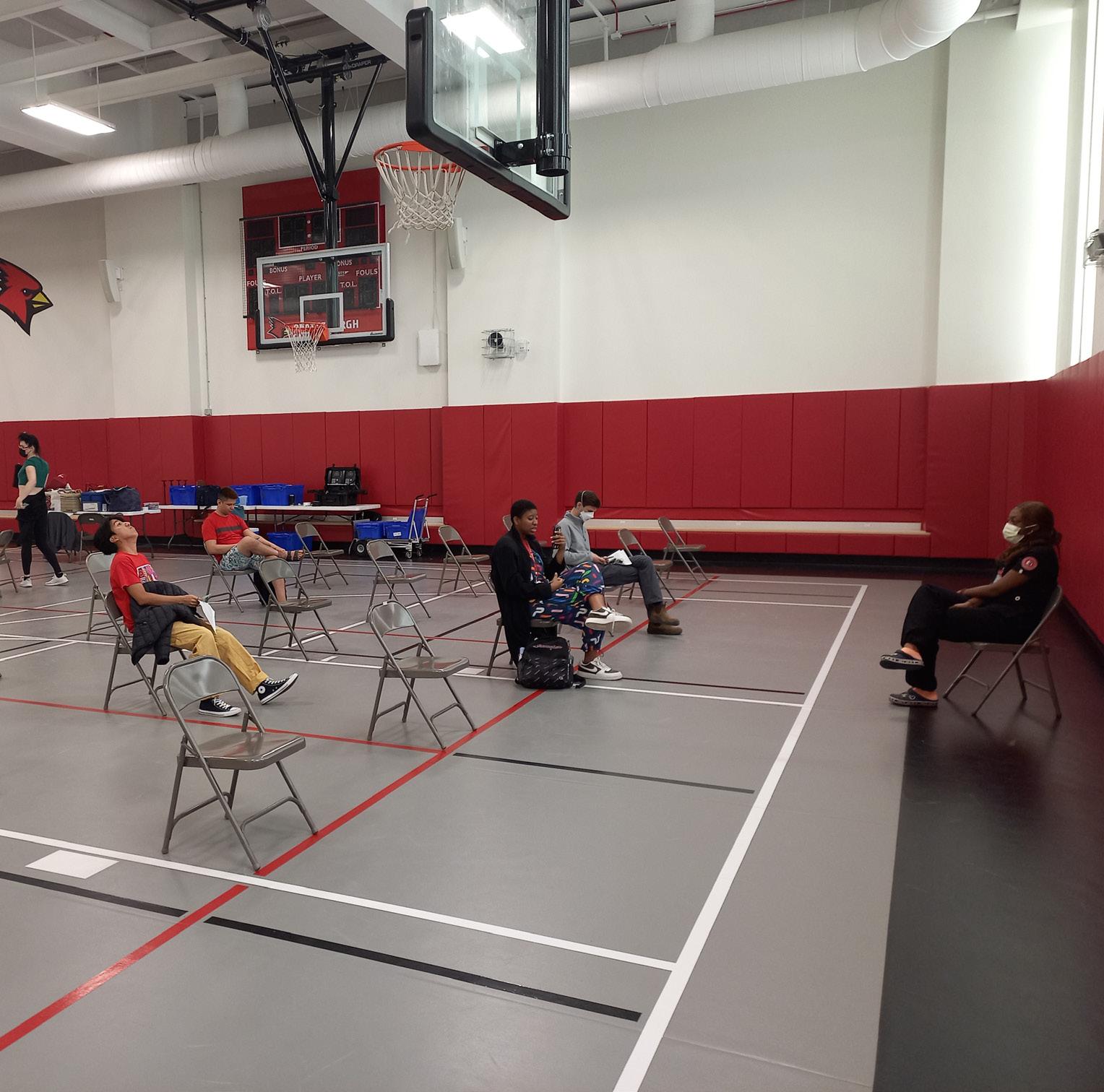
Shyanne Belizaire monitors patients for any adverse allergic reactions.
ALEKSANDRA SIDOROVA/Cardinal Points
The clinic occupied half of Memorial Hall’s basketball court.
This Week in
Pride Celebration




NEWS▪ Friday, Oct. 7, 2022▪News Editor Aleksandra SidorovaA6
Photos: 7th Annual
Photos by Bryn Fawn
Camille Nerney offers hugs to those who need them.
Behavioral Health Services North set up an interactive booth in Trinity Park.
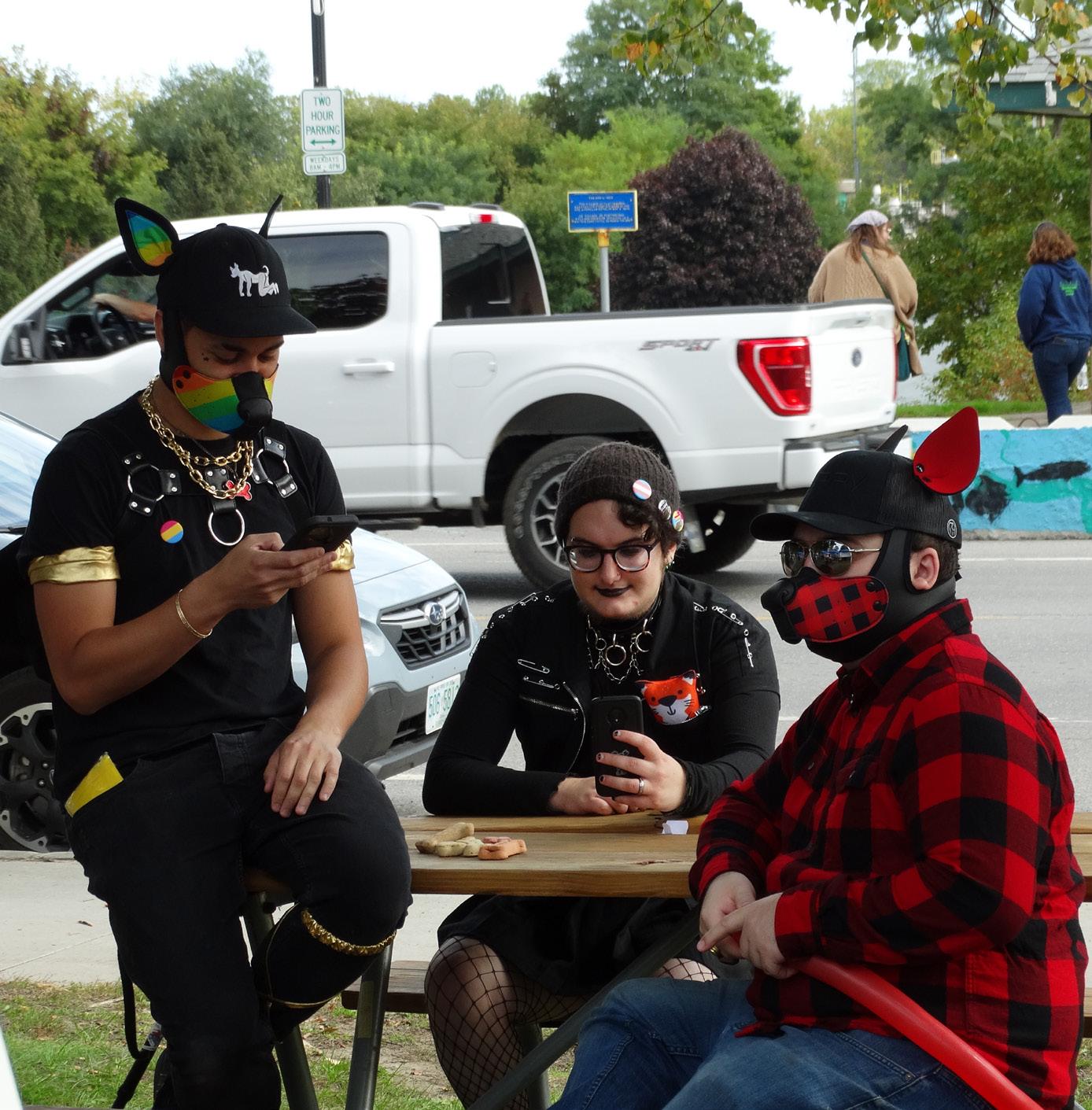
A group of alternatively-dressed attendees hang out. Three teens holding queer pride flags enjoy the celebration.
A child plays with a gay pride flag planted into the ground.
Cross country running through season
BY COLLIN BOLEBRUCH
SAMPLE
It has been an exciting sea son for the Plattsburgh Car dinals cross country teams. Along with its sufficient start to the season, the team welcomed a new head coach and a brandnew indoor track and gymnasi um facility as a part of the Field House complex.
This track will be utilized pri marily for the upcoming track and field season, but the cross country team will be using it for practices.
Part-way through last season, Jordan Naylon joined the track and field team. This season, she takes the reins as the head coach of both the men’s and women’s cross country teams.
“I’m really enjoying her coach ing style. She has an individualbased coaching approach where going into each meet, she’ll cre ate a specific, to the individual, plan for what we’re going to do during the race and debrief us af terward,” sophomore Noah Bon steel said. “Her goals for us as a team are pretty high.”
Both teams have placed favor ably in the season’s five meets so far. Cross country hosted its own meet Sept. 3 to begin the sea son, the 40th annual Cardinal Classic, involving five complete men’s teams and three complete women’s teams.
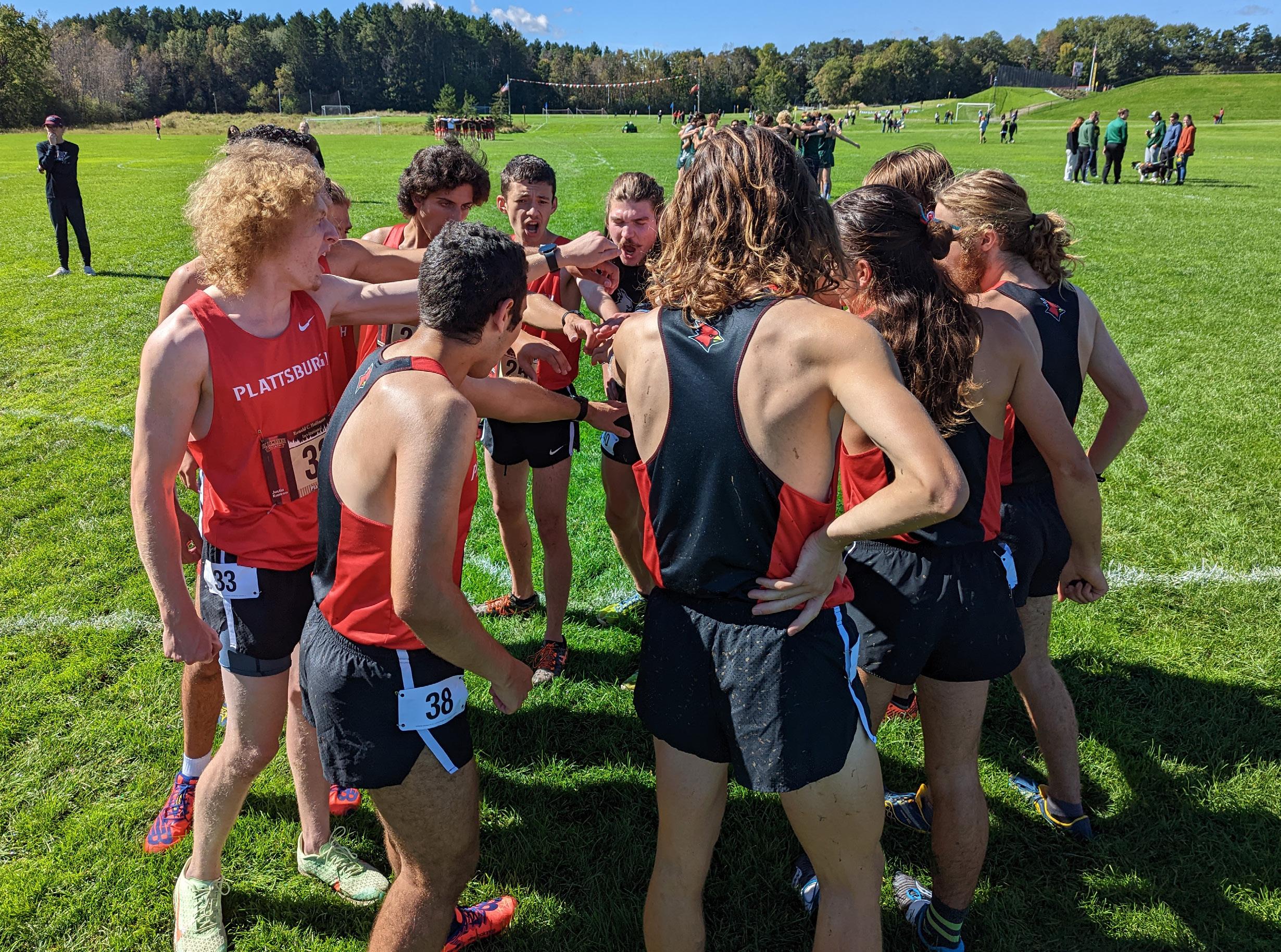

For the women’s squad, graduate student Aislyn Mc Donough came in eighth place of 37 runners and ran her 5k in 21:16. Overall, the team fin ished in third place out of the three teams, just behind the Clarkson Golden Knights.
The men’s team competed against a larger field of compe tition that featured 64 runners. Bonesteel and junior Micheal Brockway finished within four seconds of each other for fourth and fifth respectively in the 6k. The squad placed second behind the St. Lawrence Saints.
“[The season] it’s been more of a learning experience, not just for me as my first time be ing a head coach, but also for the athletes,” Naylon said. “They’ve been taking really good steps forward mostly be cause I’m believing in them
that they can do that sort of thing, but also, taking that and believing in themselves.”
The teams then traveled to Oswego Sept. 10 for the Oswego State Invitational. The men ran a 5k and finished among the top of the leaderboard. In a field of over 90 runners, Plattsburgh had three top-10 finishers. Bonesteel finished 0.2 seconds outside of fourth place for the best time among the Cardinals.
First-year Ethan Kahl placed 10th, hiS firSt collegiate career finish inside the top-10.
Overall, the team finished second among seven complete teams, many of which were SU NYAC rivals.
“I think second place is a re ally, really good spot for us as a team because we’re so young. So we were really happy about that,” Bonesteel said.
The women also ran a 5k. The team was led by another epic
performance from McDonough, who finished sixth out of over 40 runners. The Cardinals fin ished last among the four teams that attended.
The teams’ next meet came across state lines in Middlebury, Vermont for the Aldrich Invi tational. The Middlebury Pan thers’ men and women’s teams are both regionally ranked. The women ran a 4k and were con sistent across the board, with all five of its runners finishing within 15 places of each other. Of the five competing teams, Platts burgh finished third.
“We kind of got into a rut at the beginning of the season, where we were downplaying [ourselves] and we were talking about like how difficult it is, how hard it is and how much we don’t want to do it. Naylon kind of caught our drift and was like, ‘all right we have to turn it around,’” McDonough said. “We’ve been
focusing on having a better out look and it really has been pay ing off a lot.”
The men’s individual place ments varied more than the women’s yet also finished third overall. The team was led by Bonesteel and Brockway fin ishing within two seconds of each other for eighth and ninth place, respectively.
One week after the Aldrich In vitational, the team competed in its most recent meet Sept. 24 in St. Lawrence at the Ronald C. Hoffmann Invitational. This course is the same one used for upcoming Mideast Region Championships, which the Car dinals will also be competing in.
The Ronald C. Hoffman Invi tational had the largest field of competition this season for both the men and women, bringing a challenge for both teams. The women were faced with its first 6k of the year.
“I think there were a lot of nerves just because we had been getting used to 5k’s and that’s a little more comfortable than a 6k,” McDonough said. “I think it was really more overcoming nerves than physical pain.”
Although McDonough said Naylon reassured the team and reminded them of the work they have put in this season, she also said she struggled with being engaged.
McDonough went on to finish 24th of 77 runners, she said she “didn’t hit the time that I wanted to” and was “a little bit slower at the meet than last year.” She attributes this to the absence of alumna Rebecca Block, who ran for the team last year and was someone McDonough would tag along with. Without her this year, she feels she is still learning how to stay mentally engaged.
Seidman aids first SUNYAC win
BY LIAM SAMPLE Sports Editor
With its back against the wall, the Plattsburgh women’s soccer team came alive, picking up its first conference in commanding fashion.
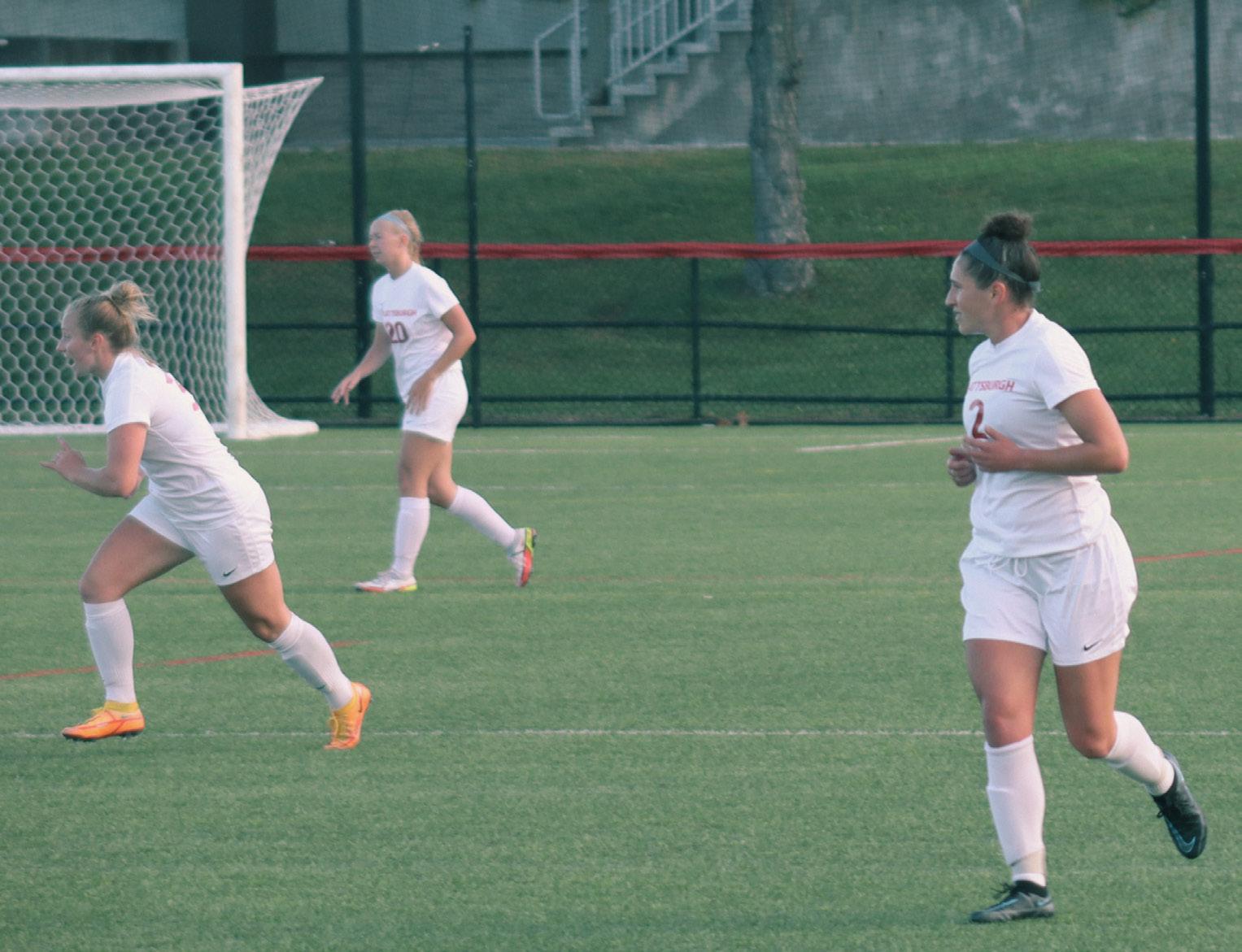
The Cardinals were at a low point in the season after losing to the Pots dam Bears, who came from behind and scored two goals in the second half to shock Plattsburgh. Now 0-3-1 in the con ference, Plattsburgh traveled to Brock port and went on to beat the Golden Eagles 2-0 behind a masterclass from graduate student Allison Seidman, who scored both of the goals.
Coming into Brockport, Plattsburgh’s offense had only produced three goals in the last five games and needed a jolt.
“My job is to score or assist goals. Coming off Potsdam, that was a very, very tough game to lose,” Seidman said. “I just had to get into the mindset that I needed to score, and I needed to produce for the team because I knew I could do it.”
Brockport came into the game with a 2-1 conference record and sat above Plattsburgh in the SUNYAC standings. The Cardinals did not waste any time trying to secure its first conference win.
Before the eight- minute mark and following a corner kick from the Golden Eagles, sophomore goalkeeper Lauren Haley sent the ball upfield. After back and forth between the teams, gradu ate student Kirsten Villemaire played a through ball from midfield to outside the penalty area. Seidman, infamous
for her speed, turned on the jets, push ing the ball past a defender and into the box. With no hesitation, Seidman shot the ball into the lowside of the goal.
“I kind of felt strong. I just pushed through those girls and I stayed com posed,” Seidman said.
With a goal less than 10 minutes into play, it seemed like a recipe for a high offense game. However, it turned out to be the opposite, with both teams bat tling defensively. Only seven shots were registered total between the two teams over the half with Plattsburgh tally
ing one more than Brockport. Seidman said she has so much trust in the team’s backline. She said, from facing her de fenders in practice, that they’re all tal ented in their own way.
“The goal was to stay disciplined in this game. [Against] Potsdam, we were definitely flying out a little more,” junior defender Nora Fitzgerald said. “Trying not to get caught flat, because they were trying to find that through ball.”
Going into the second half, Platts burgh’s determination shined as it did not waste any time trying to extend the
lead. This time just over four minutes into the half, the Cardinals stole the ball in the defensive zone and sent it way upfield. Villemaire chased it into the far corner, with two defenders on her, she made a pass into the middle of the penalty area. Seidman raced to the ball and beat the goalkeeper.
“That pass from Kirsten [Villemaire] was unbelievable. I think that having the speed that I have, that’s why that goal was able to happen because I had to sneak around the defenders.” Seidman said.
She said that this goal was her favor ite of the two. Her goal total is up to four on the season, as she leads the team. Villemaire, who assisted both goals, brings her assist count up to four.
“Me and Kirsten [Villemaire], we just kind of know where we are on the field. We just work well together.” Seidman said. “I think that these two goals were just a prime example of what we actu ally can do. We’re talented players and we finally were able to show people that we can work together to get the result we need.”
Junior defender Kayla Myers said the goal is what the team has been working on and said “it played out exactly how you would want it to.” She also said these goals from Seidman were “exactly what the team needed.”
“I think that [Seidman] really just put it all out there and went for it,” Myers said. “Just taking that extra chance, I think [that she was] believing in herself and everyone else was believing in her.”
FRIDAY, OCTOBER 7, 2022
Provided by Jordan Naylon
The men’s cross country team prepares for the Ronald C. Hoffman Invitational, which was hosted by St. Lawrence.
& LIAM
Associate & Sports Editor COUNTRY l B3
RYAN NISTA/Cardinal Points
Allison Seidman (2) gets set up on the offensive front. She leads the team in goals.
WSOC l B2
Schedule/Results
Men’s Soccer Tennis
Women’s Soccer Volleyball
Country
Standings
School SUNYAC Record
Brockport 5-0-0 7-1-4
Cortland 2-0-2 7-3-1
Oneonta 2-1-1 7-1-2
New Paltz 2-1-1 5-3-3
Plattsburgh 1-2-2 5-4-2
Geneseo 1-1-1 7-3-1
Buffalo State 1-2-1 3-4-3
Oswego 1-2-1 4-5-1
Potsdam 0-2-3 4-3-4
Fredonia 0-4=2 1-7-3
placed
Lawerence
Cardinal Stats
Women’s Soccer
WSOC
Continued
page
Brockport amped its offense up after the goal, but the defensive line and Hal ey held strong. She made a huge one on one save on sophomore forward Mary alice Skutnik with 5:21 remaining in the game to preserve the shutout. Fitzger ald described it as a “sick save.” Haley finished with four saves for her first ca reer SUNYAC shutout.
Plattsburgh went on to pick up anoth er shutout win in a non conference game on the road against the St.Lawrence Saints Oct 4. The team won 1-0 behind a
nine save performance from Haley.
The Cardinals return home in a cru cial conference game against the Os wego Lakers. This installment of the famous rivalry could determine results in the playoffs, as Oswego is among the top teams in the standings. Plattsburgh is tied with Buffalo State for sixth in the conference, which is the final spot to get into the conference playoffs.
“Obviously, losing like we have, it definitely is different than what we are used to,” Seidman said. “But, I think that now, being able to show what we have so late in the conference, it will drive us to keep winning.”
Email LIAM SAMPLE cp@cardinalpointsonline.com
Men’s Soccer
Goals
Volleyball
Tennis Singles Overall
Doubles
Women’s Soccer
School SUNYAC Record
New Paltz 5-0-0 8-1-1
Cortland 3-0-1 7-0-3
Geneseo 3-0-1 6-3-1
Oswego 2-1-1
Brockport 2-2-0 3-5-2
Potsdam 2-4-0
Buffalo State 1-2-1
Plattsburgh 1-2-1
Oneonta 0-3-1
Fredonia 0-4-0
Tennis
School SUNYAC
New Paltz
Cortland
Oneonta
Geneseo
Brockport
Plattsburgh
Oswego
Fredonia
Volleyball
School SUNYAC Record
Cortland
Brockport
New Paltz
Oswego
Buffalo
Geneseo
Potsdam
Fredonia
Plattsburgh
Volleyball loses six straight games
BY COLLIN BOLEBRUCH & LIAM SAMPLE
&
It was a bittersweet weekend for the Plattsburgh Cardinals women’s volleyball team.
The Cards (4-9) celebrated the 50-year anniversary of Title IX Sept. 30 and then its senior day Oct. 1. On the court, the team’s struggles continued, winning one set over two games against the Oneonta Red Dragons (6-9) and the New Paltz Hawks (11-2) at Memorial Hall. The losses are the team’s fifth and sixth straight.
Players on the team spoke of the significance of Title IX, which is a federal civil rights law that prevents discrimination based on sex in educational environ ments. Graduate student Kait lyn Bjelko said it is important for people to realize what Title IX actually is and, as a women’s athlete, asserted its importance.
According to an Instagram post from the Plattsburgh State Athletics account, Liza Vicen cio, the associate head athletic
trainer and former head coach of the team, came to perform an honorary coin toss in cel ebration. Vincencio was hired to her initial role as head coach in 1994.
Plattsburgh began compel lingly in its first set against Oneonta, winning four of the first five points. Both teams were winless in conference play going into the match. The teams exchanged points for the remainder of the match. In the middle of the set, senior Jenn Braun tallied a clutch kill that increased the lead and put the Cards up 16-13. From there, Plattsburgh picked up momen tum, taking six points out of the next eight points and even tually won the set 25-21.
“It was really good for us to be home and have the environment that we should have,” junior Emma Rivers said. “Conference play is definitely difficult for us, and we’re struggling a little.”
In the second set, the Red Dragons came out firing and created a mounting 22-10 lead. Despite the hole, the Cardinals
began to capitalize on its op ponents’ mistakes, winning 10 of the next 11 points to cut the deficit to three. The comeback would be cut short, and Oneon ta took the set 25-21.
From there, the Red Dragons burned Plattsburgh, taking the next two sets 25-13 and 25-17, re spectively. Oneonta registered its first conference win and moved to a 1-3 SUNYAC record. It currently sits among the bottom spots in the SUNYAC standings.
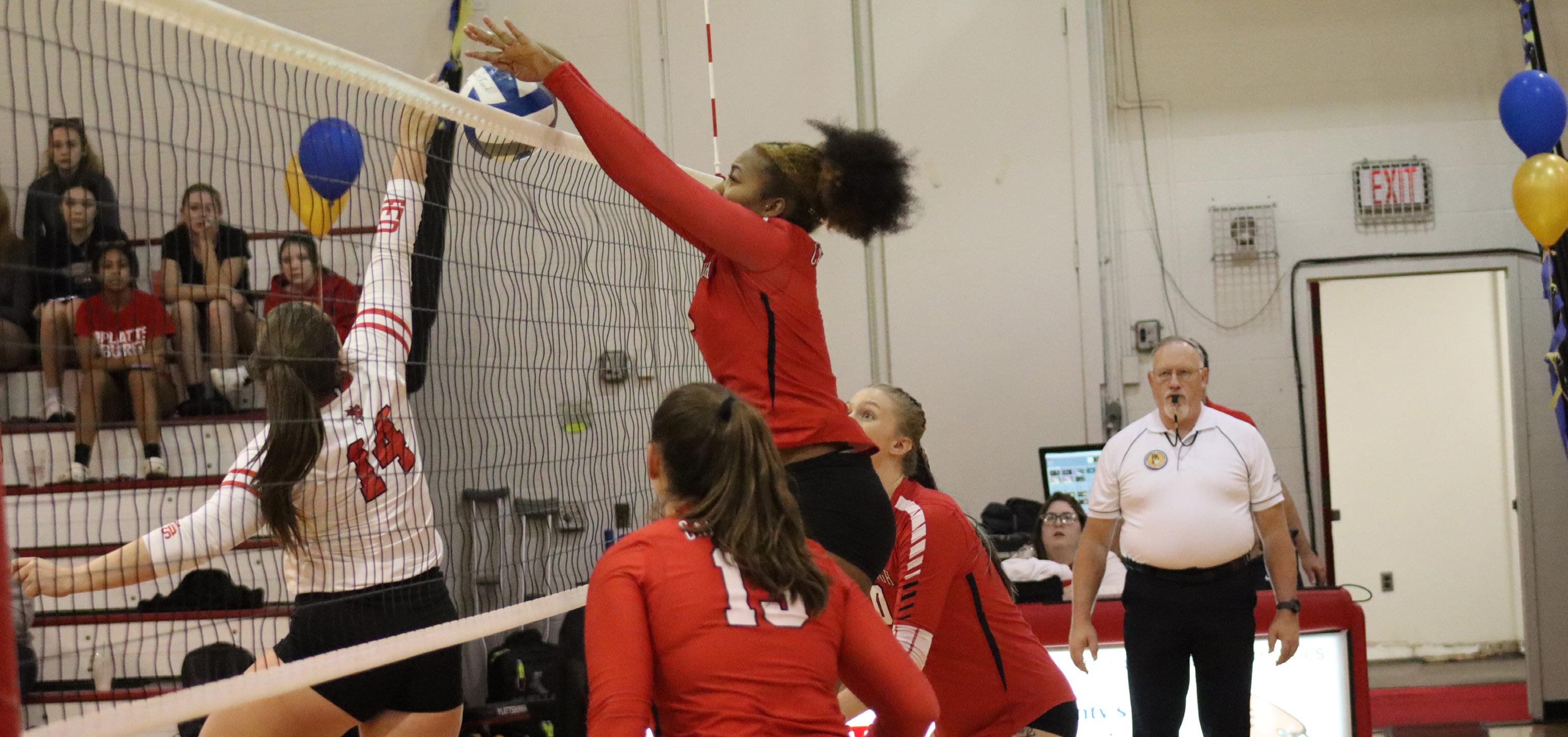
The next day, the team cel ebrated its seniors in a ceremo ny prior to the game. The team commemorated two fifth years, Bjelko and Alicia Fisher, along with senior Braun.
“The day was really cute, we got gifts and they decorated the gym,” Braun said. “I think it was celebrated well, after we had a tailgate outside, it was fun.”
Rivers said the environment was “fun” and celebrating the se niors’ importance was great. She added that a lot of families came up to Plattsburgh to celebrate, which added to the weekend.
New Paltz has emerged as one
of the strongest teams in the con ference and showed that against the Cardinals. In the first set, it allowed Plattsburgh to score only seven points in a statement win. The Hawks did not back off in the second set. Despite back to back kills from Fisher and Braun down the stretch, New Paltz took the set 25-12.
Plattsburgh started to find its footing in the crucial third set in an all-around team effort.
The teams traded points early on and leveled the score to 5-5.
The Hawks attempted to run away with the game, but firstyear Kyleigh Ganz stood in its way and tallied three kills on four Cardinal points to make it 10-13 in favor of New Paltz.
Both sides exchanged points, but Plattsburgh fell short to lose the set 20-25. This was the Cardinal’s sixth time being swept this season. New Paltz is now 4-1 in the conference, good for third place.
“We have a really young team and I think we just need to work together,” Bjelko said. “I think we can definitely come back and
compete in the SUNYAC for sure.”
Plattsburgh currently stands with a 0-4 SUNYAC record, its worst start since 2019. The egg in the wins column solidly plac es the Cards in the conference basement. The Cardinals are still without junior Payton Zophy, who suffered an ankle injury two weeks ago. According to Zophy, the injury could keep her side lined for the remainder of the season, but she’s hoping that isn’t the case.

“I have faith we can [pick it back up], but if everyone’s not in it at the same time, it’s never going to happen,” Braun said. “If we want to be able to win games, we have to be at that level every game.”
Plattsburgh travels west to take on Buffalo State Oct. 7 and Fredonia Oct. 8. Rivers said that if the team works hard in practice this week, it will have a chance of picking up its first conference wins of the season.
Scoreboard
10/1 1-2 loss vs. Brockport* 9/30 0-9 loss @ New Paltz* 10/4 0-3 loss @ Union 10/6 vs. Brockport @ 3 p.m.* 10/8 @ Oswego @ 1.p.m.* 10/7 vs. Geneseo @ 9 a.m.* 10/12 vs. Oneonta @4 p.m.* 10/8 vs. Fredonia @ 9 a.m.*
10/1 2-0 win @ Brockport* 9/30 1-3 loss vs. Oneonta 10/4 1-0 win vs St.Lawerence 10/1 0-3 loss vs. New Paltz 10/8 vs. Oswego @ 1 p.m.* 10/7@ Buf, State @ 6 p.m. 10/9 vs. William Smith @2 p.m10/8 @ Fredonia @ 1 p.m. Cross
9/24 Men
5th of 8 @ St.
9/24 Women placed 5th of 7 @ St. Lawerence 10/15 @ Connecticut College Invitational @ 12 p.m. * = conference game
7-3-2
6-7-0
6-3-2
6-4-1
2-6-1
2-6-3
5-0 11-3
3-0 13-4
4-1 11-2
4-1 14-6
State 1-2 8-6
1-2 6-8
1-3 10-6 Oneonta 1-4 6-9
0-3 2-14
0-4 4-9
Record
4-0 4-1
4-2 6-3
3-1 4-2
3-1 3-3
2-2 2-5
1-3 3-4
1-6 1-8
0-3 0-7 Men’s Soccer
SPORTSB2 ▪ Friday, Oct. 7, 2022▪Sports Editor Liam Sample
Brian Coughlan 4 Juan Velez 3 T-4 2 Assists Brian Coughlan 5 John Hayes 2 Dylan Shalvey 2 Save Percentage Marcial Vasquez .900 Teddy Healy .750
Kills Jenn Braun 84 Payton Zophy 80 Jeannette Ashong 55 Digs Payton Zophy 112 Shannon Fitzpatrick 107 Madison Bolinger 74 Scoreboard last updated 10/5
Goals Allison Seidman 4 Kirsten Villemaire 3 T-2 2 Assists Kirsten Villemaire 4 Avery Durgan 2 Nora Fitzgerald 2 Save Percentage Lauren Haley .875 Julia Ennis .818
Hallie Hurwitz 4-1 Alyana Leandry 4-3 Sarah Benowitz 3-4
Overall N. Svantner & S. Svantner 4-2 Bond & Hurwitz 1-4 Leandry & J. Svantner 1-5
from
B1
RYAN NISTA/Cardinal Points
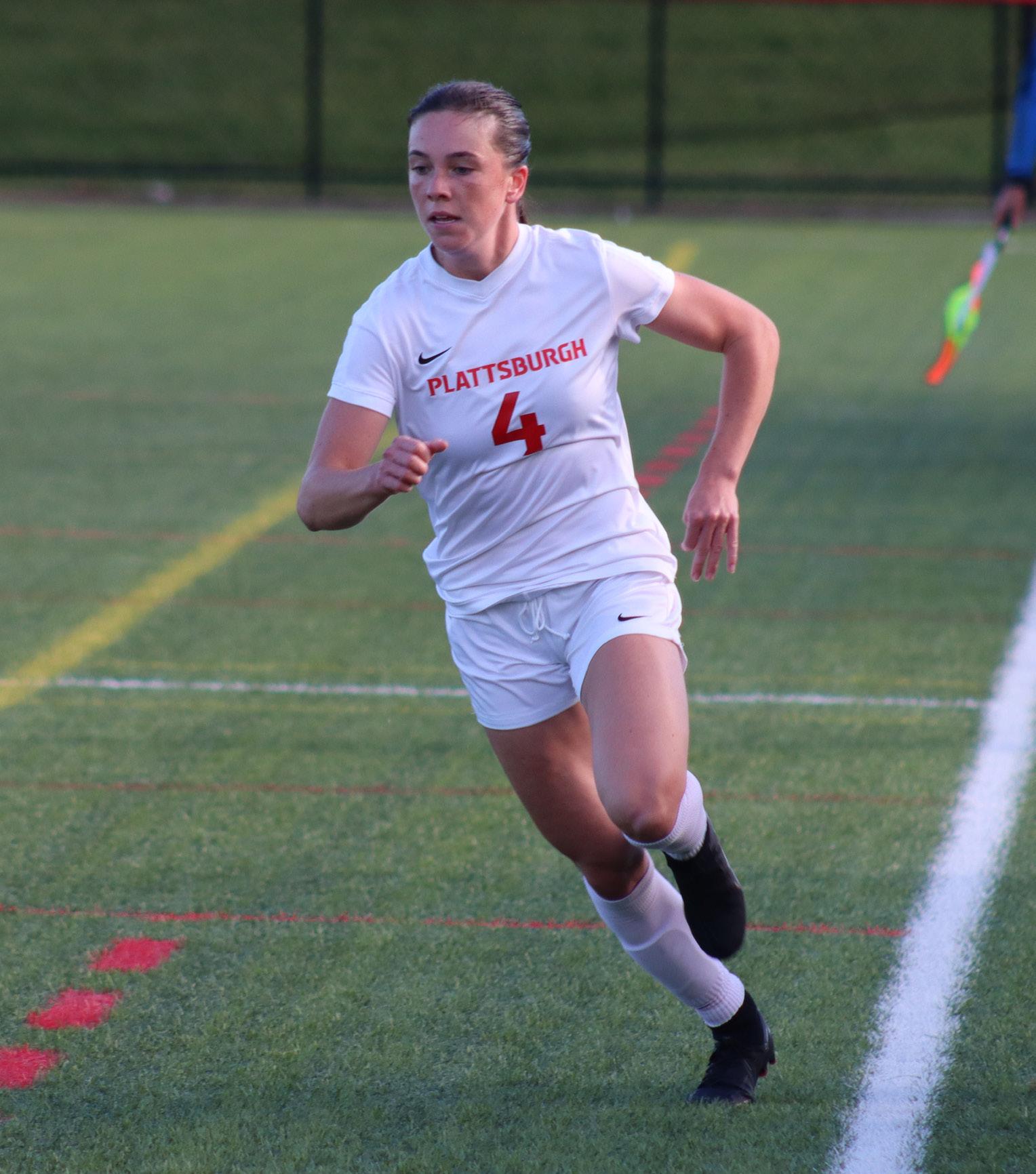
Nora Fitzgerald (4) dribbles the ball up the sideline. She plays both offense and defense.
Associate
Sports Editor Email COLLIN BOLEBRUCH & LIAM SAMPLE cp@cardinalpointsonline.com
RYAN NISTA/Cardinal Points
Middle hitter Alicia Fisher (9) blocks at the net against Oneonta setter Kayla Rende (14) . Plattsburgh celebrated 50 years of Title IX before the start of the game.
Healy returns, men’s soccer loses at home
The Plattsburgh Cardinals men’s soccer team welcomed sophomore Teddy Healy back into the goal for its latest match up. Healy missed the last two games with a bruised sternum he suffered in a collision against New Paltz. In his absence, the Cardinals (5-4-2) went 1-0-1 in away conference games with ju nior Marcial Vasquez filling in.
Plattsburgh hosted the confer ence opponent Brockport Golden Eagles (6-1-4) Oct. 1 and lost by a score of 1-2. Top sophomore mid fielder John Hayes missed the match for undisclosed reasons. The home loss drops the Cardi nals to a 1-2-2 record in the SU NYAC, good for fifth in the stand ings. Brockport has possession of the top spot in the SUNYAC standings with a 4-0 record. The Cards are still searching for a con ference win on its own pitch with two more opportunities in the up coming week.
Healy, who visited the hospi tal for his injury, made his re
turn to his position after 10 days away from gameplay. While he was away, Vasquez recorded nine saves and only allowed one goal for a total save per centage of .900. Healy said that it feels as if he is back to 100% physically and his return to the pitch “feels fine, feels normal.”
Assistant Coach Geoff Spear aided with Healy’s return. He described transitioning Healy back into games as mostly “get ting him to where he was physi cally feeling well.” Another variable, he said, was “getting back into the groove.”
“It’s like climbing a ladder. It’s tough climbing up, but you fall down pretty quickly,” Spear said. “I think he’s climbed right back up to where he was before [the injury].”
For a promising conference team, losing a starter is always scary, but Spear had confidence in the replacement, Vasquez.
“I knew he had the skills, I knew he had what it took,” Spear said. “It was, ‘could he relax and play?’ And I think he did a su per phenomenal job when he
got that opportunity. He played within himself, he did what he did well.”
just three shots.
Healy was almost immediately tested by Brockport. Just over a minute into the game, Golden Ea gle sophomore Russ Domm sent a ball at the bottom right of the goal and Healy was there to stop it. That was Brockport’s only op portunity for a while, as the next 10 minutes included four Platts burgh shot attempts. None con nected with the back of the net.
Brockport’s next shot didn’t come until around the 25-min ute mark, when Domm sent a ball over the goal. Under two minutes later, Plattsburgh scored its first and only goal. Sophomore Brian Coughlan put a ball in unassisted to become the team’s sole leader in goals on the year with four.
“When you play a lot of the minutes and you’re a guy they look for, you’ve got to try and convert as many chances as you get,” Coughlan said.
The Cardinals finished the half with a 1-0 lead over the conference’s top team, allowing
Plattsburgh’s momentum was halted soon into the second half. Within nine minutes of each oth er, Brockport’s Domm and fifthyear Matthew Stefaniw tucked away transition goals to make the score 2-1. The Cardinals would not recover from the dual scores.
“We tried to go forward a little bit too quickly, we didn’t hold on to the ball as well [as the first half],” Head Coach Chris Taylor said. “Essentially, we had a rough 20 minutes, that was really it. Outside of that, we were outstanding. By far the better team.”
Plattsburgh recorded three more shots over the rest of the game. In the last 10 minutes of play, the Cardinals had five corner kick opportunities, only one re sulted in a shot attempt.
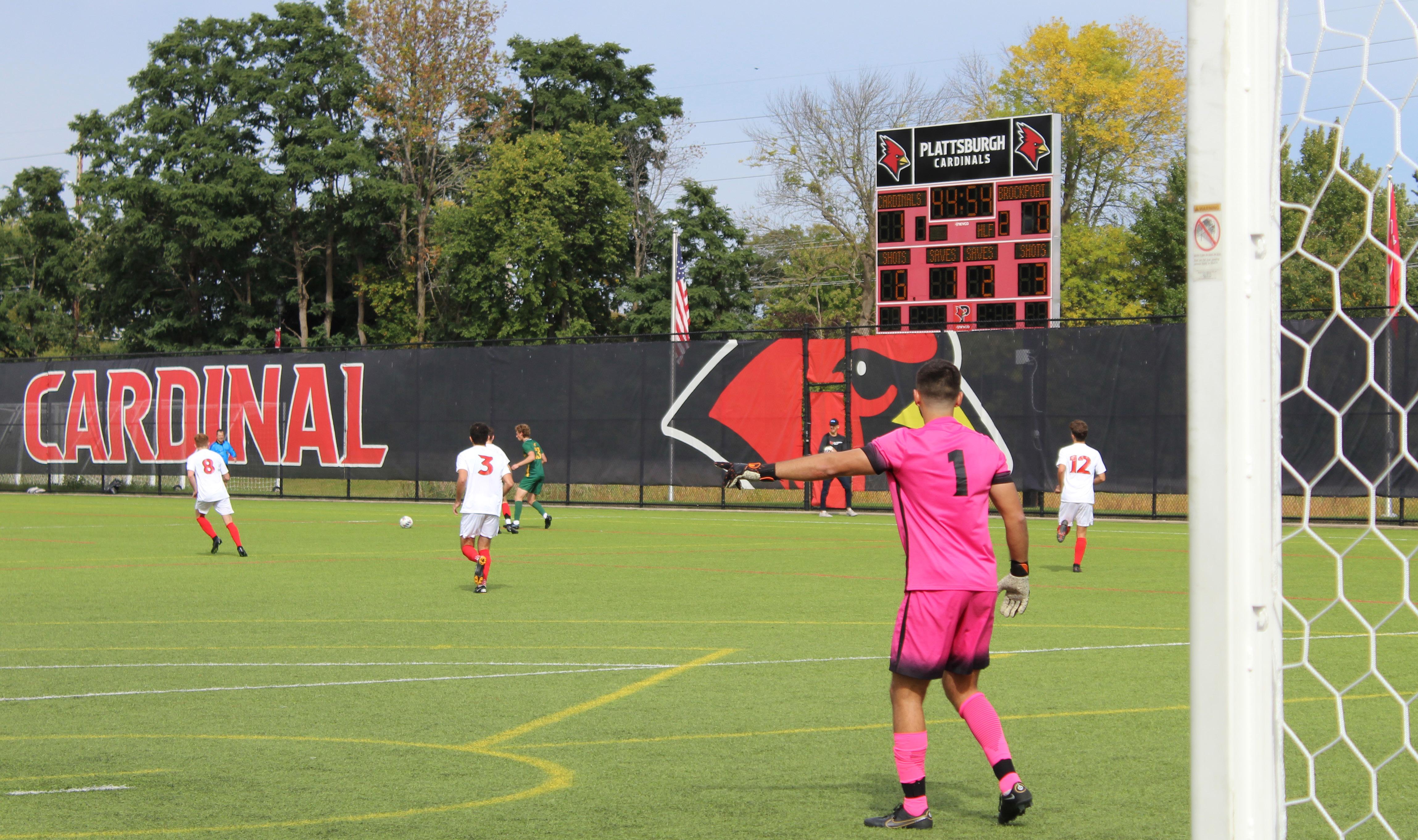
“We’ve just got to convert a couple of our chances in the box. We’re there, it’s just really that last finish that we need,” Coughlan said.
Coughlan was the lone goalscorer on the day. Senior Juan Velez and junior Dylan Shalvey
produced a shot on goal each for a team total of four, matching Brockport in the category. Healy saved two and allowed two for a .500 save percentage, his lowest number in the statistic in exactly a year, when he saved just .333% of shots against Oneonta in his firstyear season.
The Cardinals hit the road for its fifth conference matchup, playing the rival Oswego Lak ers (4-5-1) Oct. 8. Plattsburgh is 32-15-1 against Oswego all-time, which includes a 17-7 record in away matches and a current ten game undefeated streak. Oswe go has yet to win at home this season. The contest is crucial for the Cardinals, as the Lakers would jump it in the SUNYAC standings with a win.
“We’re more than good enough to win that game,” Tay lor said. “I don’t walk away from this thinking [Brockport] is the best team in the league. If they are, I think we’re pretty good.”
BY COLLIN BOLEBRUCH Associate Sports Editor Email COLLIN BOLEBRUCH cp@cardinalpointsonline.com
Nonetheless, the women finished fifth of the seven com plete teams at the meet, beat ing out Clarkson, who the team previously finished below at the Cardinal Classic. Platts burgh’s top seven runners com pleted the race within almost five minutes of each other. On top of this, Naylon mentioned that senior Natalia Castro im proved by four minutes from last season.
The men were tasked with an 8k. Among the tough competi tion, Bonesteel still performed strongly, coming in tenth in a field of over 100 runners. Kahl finished second on the team, just five seconds ahead of Brock way. The men also earned fifth overall of eight complete teams.
“[This meet] was our first 8k and 6k, which was a big jump for a lot of [the team], especial ly our first-years,” Naylon said. “I was pleasantly surprised with how they handled it, es pecially their first competition and going out that hard, that was actually really surprising.”
The Cardinals participate in its last regular season meet of the year in Waterford, Connect icut in the Connecticut College Invitational hosted by the Con necticut Camels Oct. 15.
McDonough, who said it is her third time going to the Con necticut College Invitational, emphasized how it is always a fun meet. She said how the team will be able to see the other teams in the region and how it
matches up to the competition.
“Connecticut will definitely be a big meet for us to really hammer down on our mindset and focus on where we need to be placement wise,” Mc Donough said.
Naylon said the course for the upcoming meet is flat and can
remember going to that meet when she was a student. Nay lon, a 2013 graduate of Cortland and an indoor track All Ameri can, was an assistant coach for Cortland for six seasons before coming to Plattsburgh. Mc Donough provided high praise for Naylon, saying “she is the
most dedicated coach I have ever had.”
Naylon will be tested, as following Connecticut, the teams will enter the competi tion phase of the season. This part of the season begins with the SUNYAC Championships, hosted by Oswego, Oct. 29 and
could later include the Mideast Region Championship in St. Lawrence Nov. 12.
SPORTSB3 ▪ Friday, Oct. 7, 2022Sports Editor Liam Sample
COLLIN BOLEBRUCH/Cardinal Points Goalkeeper Teddy Healy (1) directs the defense. In his sophomore campaign, Healy has played 810 minutes and started nine games, allowing 11 goals for a 4-4-1 record.
COUNTRY Continued from page B1
Provided by Jordan Naylon
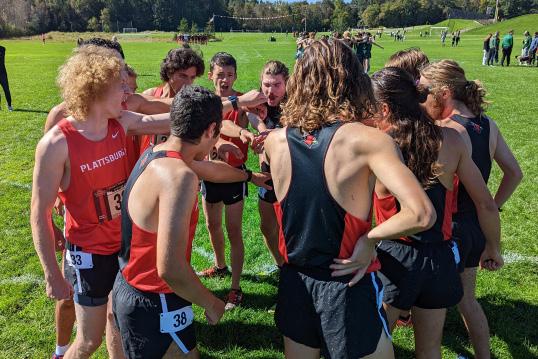
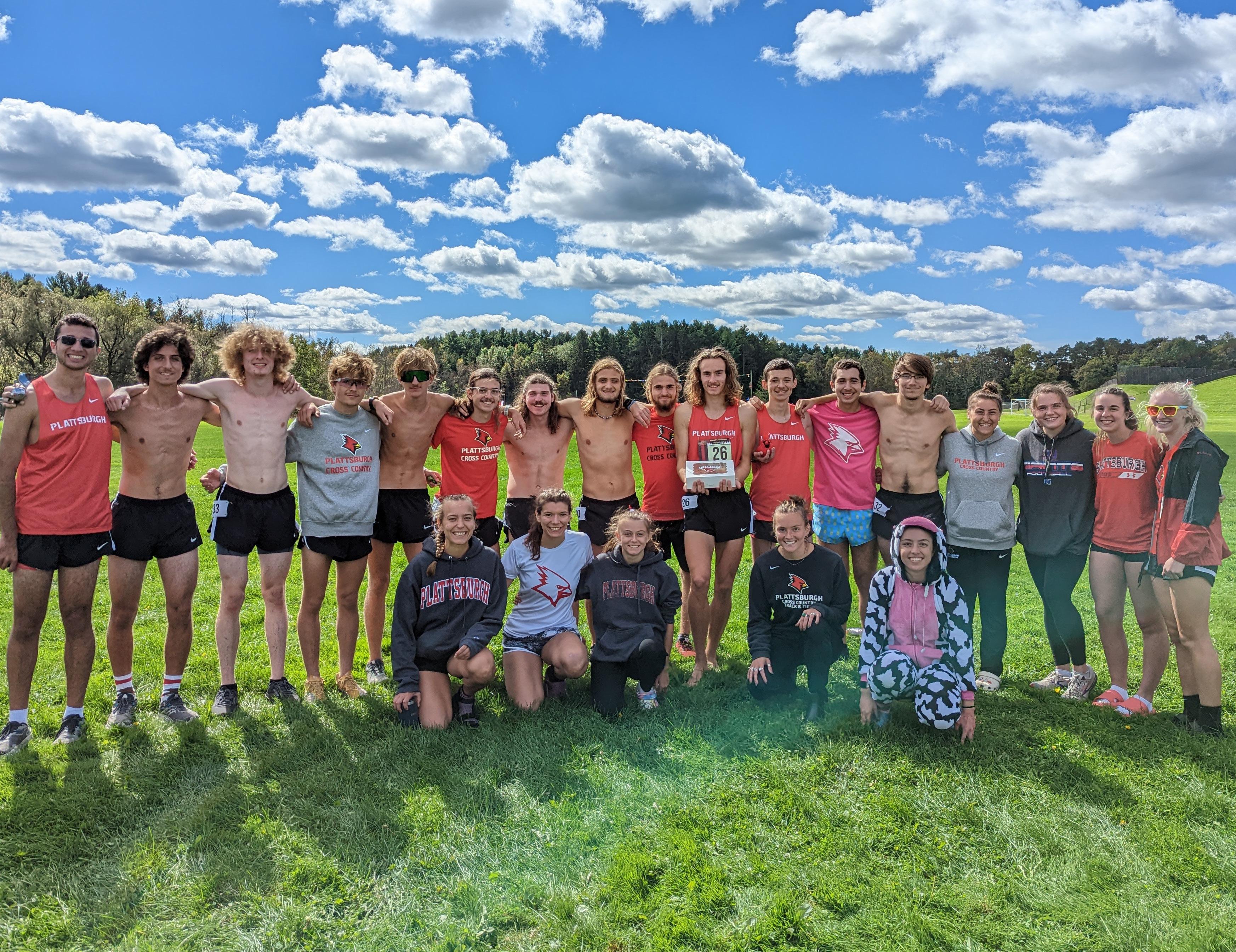
The cross country teams celebrate following its most recent meet. Both teams finished fifth overall and have its next meet Oct. 15.
Email COLLIN BOLEBRUCH & LIAM SAMPLE cp@cardinalpointsonline.com
Family Study Room aids parents
BY SYDNEY HAKES Managing/Arts & Culture Editor
In an initiative to reach out to underrepresented groups on campus, the Feinberg Library has opened a Family Study Room hoping to aid student parents and caregivers.
The room is open to all students accompanied by a child 12-years-old or younger. As a small room with a single computer, it’s first-come, first-serve.
Students will need to check in at the front desk, and be let into the room by a library employee.
The room is on the third floor of the library in Room 315. Parents and caregivers are fully in charge of the children under their supervision.
Children can not be left alone at any given time.
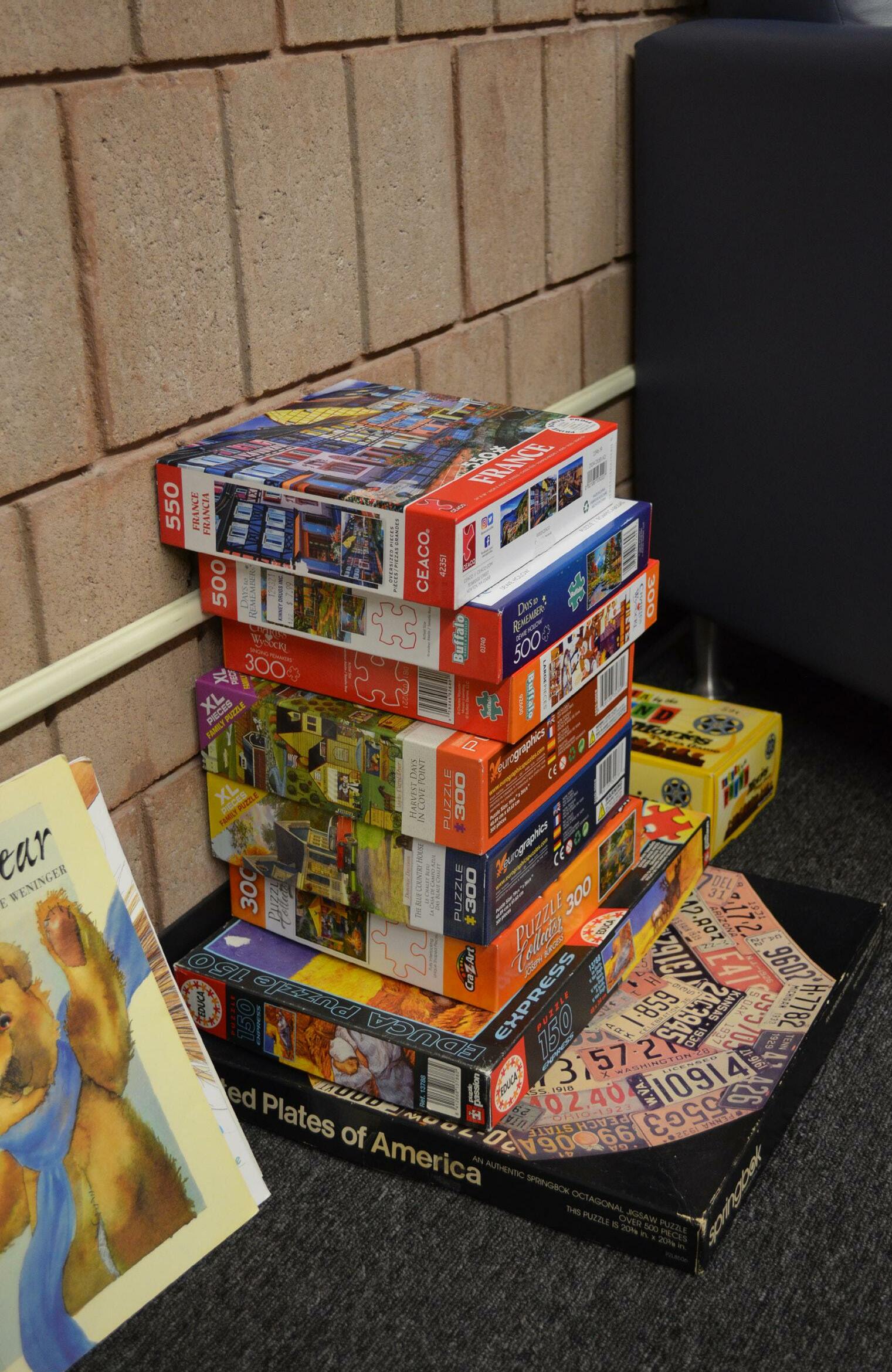
Fitted with a desk, com puter and office supplies, the rest of the room is a splash of color. Books and puzzles line the walls, stuffed animals are sitting against the walls waiting to greet whoever comes in. All sharp corners and electrical outlets are childproofed. A poster listing the guidelines is on the wall. The information can also be found under the Li brary Family Study Room Guidelines link on the SUNY Plattsburgh website.
Library Director Elin O’Hara-Gonya came up with the idea for a family room when she was weed
ing through her eightyear-old daughter’s toys.
“I had a mountain of kids’ stuff sitting at my house,” O’Hara-Gonya said. “One day, I put two and two together: empty office, children’s toys.”
O’Hara-Gonya also works weekly at the ref erence desks, wanting to “stay connected” to the campus community in stead of being in her office all day. She’s noticed the occasional student coming in with a child, whether it was their child, sibling or any child they might have been responsible for.
“It’s always challenging being a student and being a parent at the same time, because you want a quiet place to study outside the home, but at the same time, that often requires that you bring your child with you,” O’Hara-Gonya said. “On top of that, you have the library stereotype of the shuching, not being able to make any noise.”
She wanted to commu nicate to parents or care givers that they were wel come in the library and could fulfill their rental and familial obligations while having a safe space to study or research.
She ran the idea by the library staff and provost who were all strongly in support. She then jumped into some research.
Curious if this would be a successful venture, she reached out to all the SUNY library directors to
see if they have a similar space and how they’ve been received. Only one college had a similar fam ily-focused room, Monroe Community College. They actually have two rooms, both being reported as heavily utilized and having had no liability concerns.
While it was surpris ing that out of 64 SUNY campuses, only one had a designated family room, O’Hara-Gonya’s question seemed to pique the inter est of other colleges. Hud son Valley Community College reached out to her asking how far along in the process she was and to up date them on how it goes.
The project is a first of many for O’Hara-Gonya. This is her eighth month as the Library Director, a title she received after 17 years working at the college.
In her new role, O’HaraGonya hopes to implement more resources and pro grams to reach out to un derrepresented groups on campus. She hopes these new strategies increase student engagement with the library’s services, spac es and resources.
While the room has not been used yet, O’Hara-Go nya wants to put out the message that there is now a specific space for the people who may need it.
Email SYDNEY HAKES cp@cardinalpointsonline.com
Forum covers reproductive justice
BY KIYANNA NOEL Staff Writer
The Gender and Women’s Studies Forum hosted “Reproductive Justice: My Body, My Choice” on Sept. 28 in the Alumni Conference Room of the Angell College Center.


The panel had different speakers shedding light on Roe vs. Wade being overturned, the Dobbs vs. Jackson case and the different stigmas surrounding the Planned Parenthood organization. The presentation was given to a group of over 50 students and faculty.
Dr. Connie Oxford, the associate professor and chair of the Gender and Women Studies department, started the discussion and introduced the speakers of the morning. Dr. Ilona Flores, an ad junct lecturer for the anthropology and gender and women’s studies depart ments and the Latin American studies program, joined the meeting on Zoom. While Dr. Raymond Carman, an asso ciate professor of the Political Science Department, and Gray Adkins, a 2016 Plattsburgh graduate and Planned Par enthood representative, were in person.
Flores was the first presenter, and she addressed the regions where abortion is legal and illegal. Flores elaborated on the cases where women have been sent to jail for having abortions or experienc ing miscarriages in different countries. Flores went over international laws in many Latin American countries and the crises in these countries that women face when they don’t have control over their bodies.
“Since then, according to the Guard ian, at least 182 women who’s suffered obstructive emergencies have been prosecuted for abortion or aggravated homicide,” Flores said when discussing El Salvador’s policies and restrictions on women’s bodies. However, she also mentioned the progressive side of abor tion in other Latin American countries.
“In the last two years Mexico, Argen tina and Colombia have decriminalized or fully legalized abortion. In fact, in
February of this year, abortion access has extended to the first 24 weeks of pregnancy within Colombia itself,” Flores said.
Her speech helped the audience to understand why and how abortion can be good in some countries and the dan gers of not having access to it in others.
Carman’s presentation went over the different legalities when it comes to the Supreme Court and their decisions. He started off by mentioning the exposure of the leaked draft of their opinion of Roe vs. Wade then brought the audience back to a similar case of Dobbs vs. Jack son Women’s Health Organization. The case was a landmark decision of the U.S. Supreme Court in which the court held that the Constitution of the United States does not confer a right to abortion.
Carman broke down the contents of the leaked document and explained the details to the audience, so there was no confusion on what was being banned and the reasoning behind it.
Adkins’ colorful and interactive pre sentation went over local abortion ac cess. He started by acknowledging the questions that come with abortion ac cess and different examples of situa tions that arise when going to a Planned Parenthood in the North Country and in general. Adkins also spoke about the stigmas surrounding getting an abor tion such as support when you enter a Planned Parenthood office and seeing someone of the same color or race as you, as well as the promise of confiden tiality. Cost concerns are also a topic that he addressed in his presentation.
“Well, let’s try to remember also that just because you might arrive at one solution to that situation, other people are going to arrive at other completely different solutions. The exercise is not to practice deciding what other people should do with their bodies and their life. It’s just to start to grapple with those ideas and understand how stig mas and barriers are impacting people’s lives right now,” Adkins ended before dismissing the conference and opening the floor for questions.
FRIDAY, OCTOBER 7, 2022
OLIVIA BOUSQUET/Cardinal Points
Puzzles and books sit among other childrens toys in the Family Study Room.
BRYN FAWN/Cardinal Points Email KIYANNA NOEL cp@cardinalpointsonline.com
The roaring screams from the practice at the neighboring rugby pitch don’t im pede on the beauty of the garden. Even with wilting sunflowers and half empty beds, the garden is full of color and life.
The garden, and subsequent club, was created around 2008 by students who wanted to form a better understanding of food production. While the garden now focuses on flowers and produce, it began out of interest in food justice and security, growing mostly edible plants.

It was admired by Belle Morley, a ju nior biomedical sciences student who was in the garden for the first time. She saw the club tabling at the involvement fair and was interested in learning more.
Gardening has always been personal for Morley. It was something she did with her father back home.
“My dad isn’t a man of many words, so being in the garden together was a way for us to bond,” Morley said. “I learned a lot, like how some plants don’t like wind, or what random plants I’m allergic to.”
She now grows indoor plants — specifi cally desert plants — but loves the oppor tunity to get outside in a real garden again.
For students stuck in small dorms or apartments, the garden is an oasis where they can grow their own food to take home.
Providing fresh produce for students is only one benefit the garden provides the community, and has been for over a decade.
Lucas Haight, a Plattsburgh alumnus,
joined the club in 2011 before graduat ing with an English degree in 2015. At the time, the garden was half the size it currently is, and was mostly raised beds that students who lived in town over the summer would utilize.
He noticed the garden from his dorm in Wilson one day and decided to walk over and check it out. With no previous gardening experience, he “became ob sessed” with it.
After graduating, Haight got a job as a home gardener for individual clients and gardening at a resort in Lake Placid, along with volunteering in local gar dens, but couldn’t help but notice a drop in involvement in the campus garden. He decided to come back to the garden he spent four years in, with new ideas of adding flowers and perennial plants.
Haight has an obvious passion for the garden, even explaining how a snowcovered and wilted garden in the winter months has a purpose to the ecosystem.
“While we dig up the beds before win ter, I make sure to leave seed heads for the animals,” Haight said. “They have something to eat, and are being repur posed by nature.”
While students are welcome to take home whatever grows, the club also coordinates with local food banks to donate produce every week. They’re also known to set up stands at campus events to sell flower bouquets. In the past, the club attended conferences about food justice and security that Haight hopes they can get back to.
Katie Guyer, a psychology major and transfer student from Brockport, is hap py to just be working in a garden.
As a transfer student, she spent a lot
of time looking at the list of clubs on the SUNY Plattsburgh website. None ap pealed to her, many being academic in nature and she didn’t want a club like that on top of classes. To her luck, a friend in formed her of the campus garden.

“It was right in my niche,” Guyer said. “I’ve gardened my entire life with my mom and really enjoy it. I’ll be coming back as often as I can.”
Besides weekly tending to the garden, and the greenhouse they use in the spring, mid-October brings garlic planting. Once the garlic comes up in the spring, half will be donated to local organizations.
The garden has a lot of “potential,” a word used by Haight. With more student involvement, they can further their mis
sion of raising awareness about where food comes from, how it grows and pro mote sustainability in the community
“All it takes is coming out,” Haight said.
“There’s so many ways it’s rewarding, whether personal or for volunteer work. We can always use more helping hands.”
The club meets in the garden Mondays at 5 p.m., moving the meetings inside come winter. The garden can be found at the end of Towers Way behind Sibley Hall. Updates can be found on the Ins tagram page, @plattscampusgarden.


GEMINI
CANCER
VIRGO
AQUARIUS
SCORPIO

ARTS & CULTUREB5 ▪ Friday, Oct. 7, 2022▪Arts & Culture Editor Sydney Hakes ARIES March 21 - April 19 The Eight of Worlds card represents adapting to different situations and circumstances. Don’t be afraid to change and challenge yourself to try new things. LEO July 23 - August 22 The Three of Crystals represents new ideas coming to light and being openminded to ideas that aren’t conven tional or practical. SAGITTARIUS November 22 - December 21 The Five of Wands card represents changing your perspective and opening your mind to different outcomes and possibilities. TAURUS April 20 - May 20 The Hermit card represents seeking higher knowledge and fulfilling mate rial and spiritual needs.
May 21 - June 20 The Fool-Child card represents the beginning and the end of a situation. Change is inevitable, remember that things aren’t happening to you, but for you.
June 21 - July 22 The Woman of Wands card repre sents being intuitive and trusting your gut instincts.
August 23 - September 22 The Six of Crystals represents confu sion and being overstimulated. Try to remain grounded mentally this week and not overwhelm yourself. LIBRA September 23 - October 22 The Art card represents expressing creativity and using your hands. You may consider making a vision board to express yourself.
October 23 - November 21 The Strength card represents show ing who you are and living in your own skin. CAPRICORN December 22 - January 19 The Universe card represents com pletion and finishing a goal. It’s about fully going through with something and actually completing it.
January 20 - February 18 The Nine of Wands represents standing tall and having integrity. You may find yourself having to be open and truthful. PISCES February 19 - March 20 The Ace of Wands represents the truth coming to light and finding out information.
BY KIYANNA
NOEL Staff Writer
SYDNEY
HAKES/Cardinal Points Volunteers dig up the beds. In the spring, they’ll be replanted with new produce. SYDNEY HAKES/Cardinal Points A miss willmott zinnia stands tall in the evening sun. GARDEN Continued from page B6
SYDNEY
HAKES/Cardinal Points A few good raspberrys sit on a branch. Fruit trees sit in the distance. Email SYDNEY HAKES cp@cardinalpointsonline.com
Garden flourishes on campus
 BY SYDNEY HAKES Managing/Arts & Culture Editor
The yellow petals became gold, the wind lightly bent the sunflower stalks and rustled a few more seeds to the ground. The sun was setting over the Plattsburgh Campus Garden, breathing life into it on the eve of a frosty fall.
ARTS & CULTUREB6 ▪ Friday, Oct. 7, 2022▪Arts & Culture Editor Sydney Hakes
ZOE NGUYEN/Cardinal Points GARDEN l B5
