OPINION
Epstein files supposedly on way to public
SPORTS
Women’s hockey crushed in third period.


![]()
Epstein files supposedly on way to public
Women’s hockey crushed in third period.


BY GRANT TERWILLIGER
News Editor
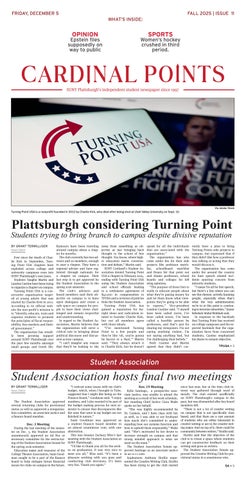
Ever since the death of Charlie Kirk in September, Turning Point USA chapters have exploded across college and university campuses even into SUNY Plattsburgh’s own lawn.
Students Vaughn Martin and Landon Castine have been trying to organize a chapter on campus.
Turning Point USA is a conservative organization targeted at young adults that was started by Charlie Kirk in 2012. According to its official website the non-profit’s mission is to “identify, educate, train and organize students to promote the principles of fiscal responsibility, free markets and limited government.”
The organization has steadily been growing support around SUNY Plattsburgh over the past few months amongst small groups and Greek life.
Rumours have been traveling around campus about a chapter for months.
The club currently has two advisers and 20 members, enough to start a chapter. They have a regional adviser and have registered through nationals for a chapter on campus. Their last step is to get approved by the Student Association in the spring 2026 semester.
The club’s advisers and board members said their objective on campus is to have open dialogues and create a safe space on campus for people to have their views challenged and remain respectful and understanding.
In regard to the Student Association, Martin believes that the organization will serve a critical rule in bringing about political discourse and discussion across campus.
“I can’t imagine any reason that they’d be looking to shy
away from something as objective as just bringing back thought to the school of free thought. You know, where higher education meets conversation and debate,” Martin said.
SUNY Cortland’s Student Association denied Turning Point USA a chapter in February 2024, ending with Turning Point USA suing the Student Association and school officials leading to a settlement agreement of $42,000 in compensation to TPUSA and a revision of policies from the Student Association.
Turning Point USA has gained a reputation for farright ideas and radicalism related to founder Charlie Kirk, but not all members agree with those ideals.
“I’ve mentioned Turning Point to a few people and they’re like ‘oh, you’re gonna be fascist or a Nazi,’” Martin said. “They always attach it to Charlie Kirk, but he doesn’t
speak for all the individuals that are associated with the organization.”
The organization has also come under fire for their side projects like professor watchlist, schoolboard watchlist and Deans list that point out and shame professors, school boards and colleges for left wing opinions.
“The purpose of those lists is really to educate people about what they’re paying money for and let them know what viewpoints they’re going to be able to express,” Vice-president Landon Castine said. “I myself have been called racist, I’ve been called sexist, I’ve been called a horrible person by professors, and that’s just for sharing my viewpoints. I’m not saying anything violent, I’m not saying anything bad, but I’m challenging their beliefs.”
Both Castine and Martin agreed that they didn’t cur-
rently have a plan to bring Turning Points side projects to campus, but expressed that if they didn’t like how a professor was talking or acting that they would discuss it.
The organization has come under fire around the country for hate speech related incidents spurring concern from minority students.
“I mean I’m all for free speech, but there’s a line where you can see this rhetoric actively harming people, especially when that’s what the very administration we’re in at this point is continuing to terrorize minorities,” Junior Rebekah Abdul-Wahhab said. In response to the backlash that Turning Point has received on college campuses and the expected backlash that the organization faces from concerned students, Castine emphasized his desire to remain objective.
BY GRANT TERWILLIGER
News Editor
The Student Association approved several returning clubs for provisional status as well as approved a reorganization committee, an associate justice and a finance board member.
Dec. 3 Meeting
During the last meeting of the semester on Dec. 3, the Student Association unanimously approved an Ad Hoc or necessary committee for the restructuring of the Student Association Senate for the spring 2026 semester.
Education major and treasurer of the College Theater Association, Sami Goodman sought to be a part of the finance board to help mitigate future financial issues for clubs on campus in the future.
“I noticed some issues with my club’s budget, which, when I brought to Tyler, suggested that I might like being on the Finance Board,” Goodman said. “I enjoy numbers, and I also wanted to be part of the budget making process for next semester to ensure that discrepancies like the ones that were in my budget are not finished in nature.”
Sami Goodman was approved as a student finance board member in an almost unanimous vote, with one abstention.
This was Senator Zachary Wiss’s last meeting with the Student Association at SUNY Plattsburgh.
“I’d like to thank you all for the wishes on graduation. It was very nice to meet you all,” Wiss said. “It’s been a pleasure working with you guys and conducting club decisions. It’s been very fun. Thank you again.”
Kylie Santiago, a prospective associate justice, was unable to attend the meeting as a result of her work schedule, but standing Chief Justice Ciara Wade spoke on her behalf.
“She was highly recommended by Dr. Carmen, and I have class with her as well, so I was able to see firsthand how much she’s committed to understanding how our systems function and how to uphold them responsibly,” Wade said. “She’s motivated by her desire to increase strength on campus and that strong minded approach is what we need on the team.”
The Student Association Senate approved Santiago as an associate justice in an 11-1-1 vote.
Sophomore Anthony Horlitz represented the Creative Writing Club, Horlitz has been trying to get the club started
since last year, but at the time club interest was gathered through word of mouth. The club existed unofficially on SUNY Plattsburgh’s campus in the past, but was dismantled after key board members left.
“There is not a lot of creative writing on campus that is not specifically class based, and that there are a vast amount of students who are either interested in creative writing or are in the creative writing major. And on top of it, there could be community between writers,” Horlitz said. Horlitz said that the objective of the club is to create a space where students can get constructive feedback on their writing and grow as writers. The Student Association Senate approved the Creative Writing Club for provisional status in a unanimous vote.
BY ADAM BLANCHARD Staff Writer
SUNY Plattsburgh senior Alexis “Doc” Adamkowski stands above her peers with her thoughtful approach to her artwork.
Adamkowski’s academic career led her to become a double major in anthropology and art with a focus in painting and drawing. She incorporates her knowledge of botany and anatomy into her works.
Adamkowski grew up in a small village named Vernon, New York. She would live in a garden center owned by her parents. During her childhood, both of Adamkowski’s passions would form and blossom.
“I just remembered I was like 10 or so when I drew a bearded iris for the first time,” Adamkowski said. “That’s kind of when it clicked into place for me, honestly.”
Adamkowski’s career path had not always included art. Faced with naysayers and doubters day after day in high school, Adamkowski would stray away from art for the first two years of her college career. There was no erasing her love for art, however, as she would come to adopt it as one of her majors, despite financial concerns.
“At the end of the day, there’s no accounting for passion,” Adamkowski said. “I’d rather be middle-class and happy than upper-class and miserable.”
Now having studied art collegiately for three semesters, Adamkowski has developed an art style like no other. She uses bright colored mediums such as soft pastel, oil paint and acrylic paint. Adamkowski used the term hypercolor to describe her art. Her works consist of a wide spectrum of colors that aren’t ordinarily used, requiring a deeper examination of each piece.
“Anything that I can have a very color dominant piece is always going to be something I work well with,” Adamkowski said.
Adamkowski finds herself continuing to improve upon her work every semester, with her progress being most evident in her current series, Echoes of Eden. The series focuses on feminine sexuality, with each work incorporating botanicals and a nude model. She draws her

inspiration from the Renaissance and Ancient classical Greco-Roman art, evident in the realism her works portray.
Adamkowski’s process in creation requires distinct methods because of her subject matter. The most difficult part, Adamkowski said, is finding models that are willing to be drawn nude or have their pictures taken for reference.
To remedy this, Adamkowski tends to invite her friends to model, as they are familiar with her work and have a preestablished connection.
“I sit down with them and we have an hour or two long interview with them about my project,” Adamkowski said.
The questions focus on the subject’s sexuality, allowing Adamkowski to get a deeper understanding of the individual. As she gathers information, Adamkowski chooses how to compose the piece, what botanicals to use and how to have the subject pose. She compensates every model out of her own pocket and hands them a print once
the work is finished in order to build even stronger relationships.
“When I broached this subject with a couple of them, I was worried that it was going to be awkward,” Adamkowski said. “But they were very excited to get into my process.”
In addition to her current series, Adamkowski has become an accomplished artist and continues to reach higher. Adamkowski has an art piece displayed in the Studio Select exhibit in the John Myers Fine Arts building, which is part of her current series. She has also requested to have one of her pieces be put into the Munson Williams Art Museum’s Sidewalk Art Show, located in Utica.
In the future, Adamkowski hopes to become a freelance artist or gallery artist, but isn’t opposed to teaching, as she has a background in teaching already. She has held a position as a substitute teacher at Vernon Verona Sherrill high school since 2022.
“There’s always new art, new movements coming out,” Adamkowski said. “And I want to stay in that atmosphere of youth and creativity.”
Art is a cornerstone of Adamkowski’s existence and has permeated every facet of her life. She believes that art is misunderstood by many, yet it subsists in every aspect of one’s life.
“The best part about art is that you can have two people on opposite sides of the world look at the same piece and identify with it in a similar way,” Adamkowski said. “It’s a connection that transcends language borders, politics, everything. It’s universal.”
BY AUBREY HAYES & ANNA REISMAN Contributors
Many undergraduates view University Police as party poopers whose only job is to stop students from urinating on campus buildings or from carrying a 30-rack of Coors on a Friday night to a frat house.
But in reality, these officers actively contribute to campus life and actually do want students to have fun.
Take 36-year-old Officer Zachary Reese, one of 12 staff in the University Police department. A constant presence on campus since he joined in 2021, Reese has seen it all, from rowdy weekends to late-night emergencies. He has also been part of the squad’s effort to become more approachable by hosting events and patrolling with K-9 Labs.
“Just because we’re around doesn’t mean something bad is going on,” Reese said during an interview at the University Police headquarters behind the college bookstore. “We do a lot of foot patrols. We try to be interactive with our campus community.”
One popular new initiative that Reese helped launch is a Water Pong Tournament, held in Whiteface Hall and co-organized with on-campus community advocates. The first tournament this past spring included more than 16 teams of combined officers, students and staff.
Reese said he would like to see more events happening on campus, in part because of his own experience at SUNY Albany, where he went to on-campus concerts every semester. “Just something for students to go be engaged with on campus,” said Reese, who studied sociology and criminal justice as an undergraduate before attending the Zone 9 Plattsburgh Police Training Academy.
Day-to-day, UP officers start their shift with a briefing of upcoming tasks and goals. They take calls, help on cases, do shift training, and patrol campus alongside the department’s recently added K-9 police dogs Izzy and Reva, English Labradors (and siblings) who joined the

force in 2024 and quickly made the officers appear more approachable.
“I’ll just be walking around, and people ask me, ‘Hey, where’s Izzy?’” Reese said. “Nobody knows what our names are, but everyone knows the two dogs.”
“Izzy is the cutest little pup that brightens my day,” said 21-year-old senior Lillian Gilroy. “I love getting to see her and her officer around campus.”
There’s also a serious side to the UP’s work, cases that might call for a person to be restrained and even detained. When things do get serious, the UP has a new tool for it: the BolaWrap, a device that shoots a Kevlar cord that wraps tightly around a person. The tool was even tested on Reese, but it has yet to be deployed outside of training.
Reese’s colleague, Lieutenant Conrad LaVarnway, said 90% of a UP officer’s job is to be a positive figure on campus. Most calls are for building inspections, street patrols, and emergency mental-health crises.
“We do a lot of mental health calls and welfare checks,” said LaVarnway, who also joined the department in 2021 and moonlights as a crisis intervention instructor at the Zone 9 Academy. “We do those welfare checks for students, whether they are having a day, or may-
be their family is concerned about them and want us to check up on them. Crisis intervention stuff is a lot of what we do here.”
Mental health resources are also available by way of the Student Health & Counseling Center and Behavioral Health Resources North (BHSN) networks that are available to all students and local residents.
“You try to... speak to them, get on their level, understand why they’re feeling the way they are,” Reese said of the health checks. “And then see what we can do to either help them in that situation or let them know what resources are available, both on campus and locally.”
UP must also respond to the fire alarms that are regularly triggered by students’ blow dryers, hair curlers, and hair straighteners, or from kitchen activity or smoking indoors. LaVarnway said Whiteface Hall, a nine-floor freshman dorm, had about 70 alarms during the 2023-2024 academic year.
Sometimes the alarms are real, of course. The day before graduation in May, LaVarnway rescued a student from the third floor of a burning house near campus. Then there was the time in March 2024 when state police were in pursuit of a vehicle on Interstate 87 that
drove onto college grounds. The driver ditched their car by Kehoe Hall, then ran through multiple academic buildings, as well as a residence hall, before being apprehended by university police.
Collin MacDonald, a 19-year-old business major at SUNY Plattsburgh, said the officers “provide a sense of safety and security.”
Vella Cook, a 20-year-old junior psychology major, said that “knowing there’s people around that are here to protect me and my peers gives me a huge relief and makes it easier to roam campus freely.” Most of the time the UP officers go unnoticed. But they’re always on call, available via the 12 blue light phone kiosks spread around campus as well as the yellow box phones in all of the dorm buildings. They also have a 24/7 phone number, (518) 564-2022.
“Everyone should save our phone number,” said Reese. “You never know when you’ll need it.”
BY JUSTIN RUSHIA Contributor
Higher winter temperatures and declining snowfall, driven by climate change in the Adirondacks, has become an economic and cultural concern for outdoor enthusiasts and area businesses.
“At the most basic level, winters aren’t as cold as they used to be,” Sunita Halasz, a clean water community advocate for the Adirondack Council and member of the Adirondack Climate Outreach and Resilience Network, said. “Spring shows up early, and we’re seeing more intense storms, particularly flooding, but we’ve also had droughts.
Halasz explained that these weather shifts trigger cascading effects throughout the region. Forests, wetlands, and lakes are stressed; harmful algal blooms and invasive species are on the rise; and unpredictable freeze-thaw cycles force towns to use more road salt, which harms both the environment and drinking water.
Halasz, who participated in a multi-organization group that recently held community climate resilience listening sessions throughout the 14 counties of Northern NY, added that the human impacts are just as significant. Residents of the Adirondacks are dealing with spikes in heat-related illness, more ice-related injuries on ski slopes, and air quality alerts from wildfire smoke drifting into the region.
“People talked about warming winters affecting their pride in being from the very cold North Country. All aspects of our communities and our collective psyche end up being affected by global warming,” Halasz said.
Brody Olden, vice President of SUNY Plattsburgh’s Ski and Outdoors Club, has spent nearly his whole life on the slopes of the Adirondacks. A Chestertown native, Olden has noticed a trend over the past few years: the ski season is creeping later into winter.
“When I was younger, I remember being able to ski the glades as early as December,” Olden said. “Now we don’t get enough snow for that until late January or even February. The seasons are starting later and ending earlier.”
Olden’s observations align with regional data from the New York State Climate Impacts Assessment, which show that parts of northern New York have lost up to 3 weeks of snow cover compared to the 1980s.
Traditionally, in the Adirondacks, it is common for resort trails to be open and busy on Thanksgiving weekend. Now, Mountains such as Whiteface and Gore, which were once packed with early-season visitors, face unpredictable and limited openings.
To make up for lost snow, resorts like Gore and Whiteface rely heavily on artificial snowmaking.
Continued from page 1

“Artificial snow’s good for laying a base,” Olden said. “But if it’s even a little warm, it’ll just turn right back into ice before it turns into snow.”
According to the New York State Department of Environmental Conservation, winter precipitation in New York is expected to decrease as snow, even though total winter precipitation may slightly increase, producing rain rather than snow.
The process of artificial snowmaking mixes water and compressed air, then blasts tiny droplets into the air, where they freeze before hitting the ground. But it only works when temperatures drop below about 28°F.
Data from the National Oceanic and Atmospheric Administration show that average winter temperatures in the Adirondack region have risen by nearly 3 degrees Fahrenheit since the 1970s.
Louis Lang, a Gore Mountain employee and lifelong skier, said that resorts like Gore are spending more on snowmaking technology just to stay open, even as the energy costs to run these machines climb.
“We have to cover almost all the trails with snowmaking because there isn’t enough natural snow anymore,” Lang said. “Gore has around a hundred snow guns, and they run a lot when it’s cold enough. But if the weather warms up, it’s hard to keep that snow from melting.”
Lang also pointed out that the changes in weather affect more than just the condition of the trails; they also affect revenue.
“People get emotional with these topics. I do get it. Politics affect your life, so you may get emotional. I totally understand it, but that’s not the way that we want to go about our debate. We want to be objective, we want to be reasonable, and we want to be respectful of everybody’s beliefs, no matter how much we may vehemently disagree with them,” Castine said.
Abdul-Wahhab said that she feels that with an influx of mixed information and the rise of conservatism on college campuses students should seek to fully understand their political affiliations.
“I would really be interested to know how this will change and shape the future of students that are coming in and students that are here now,” Abdul-Wahhab said. “There’s just so much going on around the world, and we’re being inundated with it every single day, but when it’s this close to home, I think it’s even more imperative that people fully understand what this means.”
Abdul-Wahhab said that she is concerned for the safety of minority students and diverse students on campus.
“The way it stands now, where we’re trying to uplift and spotlight diversity and inclusion, doesn’t exactly push students out that may not agree, whereas Turning Point actively does, in my opinion,” Abdul Wahhab said.
Continued from page 1
“If there’s no snow, fewer people come to ski,” Lang said. “If people aren’t coming to ski, the mountain loses money, and employees get less hours. Warmer winters are making it tough for everyone.”
A decline in the number of skiers not only affects the mountain itself but also the local businesses around it. Restaurants, hotels, gas stations and outdoor shops rely on a steady flow of winter visitors. A lack of traffic can result in significant financial losses for the entire community.
Many Adirondack residents rely on seasonal jobs, like those at Gore, to make ends meet. This forces these workers to find other off-season employment, which isn’t always available in small Adirondack towns.
According to Halasz, this financial pressure extends far beyond ski resorts.
Climate change is exposing weaknesses in the Adirondack region’s housing and infrastructure. Much of the housing stock is old, drafty, and difficult to upgrade, she said.
“Climate change just makes the situation more dire. People need insulation, heat pumps, weatherproofing—but there aren’t enough contractors, and funding is limited,” Halasz said.
Without quality housing, communities struggle to attract and retain skilled workers, which affects school enrollment, healthcare access, and local tax bases.
Flooding has also become a major financial burden.
“Counties and towns are dealing with unprecedented road repair costs,”
Jurmia Brown Garth represented the Organization of Women of Color as the vice- president and said that she feels that the club could help build an even stronger and safer community at SUNY Plattsburgh.
“We want the club to be a real balance between a safe space for women on campus and a place where people can educate themselves. So we want to do some meetings with cozy decor, maybe decorating mugs and sipping hot chocolate,” Garth said. “Then, talk about women in STEM and women in higher education. So we definitely want to have a good balance, and want to make it interesting.”
The organization existed on SUNY Plattsburgh’s campus in the past, but as the Organization of Women of Ethnicity. President Giovanni Samuel felt that the name was outdated and reached out to a former alumni to reinstate the club under a different name and learn about how to run the organization.
Halasz said. “At the homeowner level, people are having basement flooding, driveway washouts, and this can be tens of thousands of dollars in damage, often not covered by insurance. Or it can be a smaller-scale problem, but still stressful and expensive, like a resident can’t get out of their driveway to go to work for a few days,”
The changing weather has even affected events here at SUNY Plattsburgh. Each year, the ski and outdoors club hosts Rail Jam, a freestyle skiing and snowboarding competition event on the hill outside of Memorial Hall.
“A lot of the time, we have to bring in snow from other places,” Olden said. “Two years ago, the rail area was all ice and trucked in snow. Last season, we got lucky with a big storm and actually had powder for Rail Jam.”
“We’re not sure yet how the event is gonna turn out,” Olden said. “But we try to stay optimistic.”
The organization currently has 10 members. Samuel said that they will most likely talk about some more difficult topics, this is one of the reasons that the organization has an absences article.
“I think there are definitely some heavy topics, like the higher rate of deaths and inequity, that’s definitely a sensitive topic, and I think a lot of the topics about race and gender could be sensitive and hurtful and maybe hard to talk about,” Samuel said.
The organization was approved by the Student Association Senate for provisional status in a unanimous vote.
By Hiram Cowhey


As of Dec. 5
BY KAMIKO CHAMBLE Sports Editor
The Plattsburgh State Cardinals returned to the ice fully resolved, seeking redemption after a tough loss 5-2 against Middlebury.
The Cardinals went against Stevenson University to face the Mustangs for their last game of November. The team maintained its composure under pressure and brought home a 4-3 overtime victory. At the opening puck drop, the Mustangs struck first. Stevenson took a 1-0 lead about six minutes into the first period. Plattsburgh was on the back foot from the start. Nevertheless, the Cardinals showed signs of offensive pressure and started to win puck battles as they settled into the game.
Late in the first period, Plattsburgh tied the game on a power play. First-year forward Gabriel Filion scored the shot with assists from junior forward Vladislav Pshenichnikov and first year defender Thierry Lizotte. On even footing again the Cardinals had momentum going into the last minute of the stanza.
Stevenson unexpectedly hit back seconds before the period ended. The Mustangs were persistent in holding onto their lead.
In the second session, the Mustangs began aggressively. In the first three minutes, they found the back of the net and extended the advantage to 3–1. With a two-goal deficit against a Mustangs team that was rolling, the Cardinals were at a low point; however, Plattsburgh answered. Alexandro Moliner, a soph-
BY KAMIKO CHAMBLE Sports Editor
The Cardinal/Panther Classic between the Plattsburgh State Cardinals and the Middlebury Panthers on November 30 started off promisingly for Plattsburgh before a third period collapse, ending 1-6.
Middlebury attacked first midway through the opening, but the Cardinals kept their structure intact and limited the Panthers’ zone time through aggressive backchecking and smart defensive play. Pushing the pace throughout transition and attempting to build a quick forecheck, Plattsburgh also created a number of early opportunities. Despite falling behind 1-0 at the end of the first, the Cardinals displayed a poise that suggested a powerful comeback in the second half.
The response occurred instantly. Kayson Ruegge, a sophomore forward, scored a sharp one-timer only 56 seconds into the second half to tie the score for Plattsburgh. Senior forward Molly Riggi carried the ball with confidence before threading a cross-ice feed to first-year forward Zoe Puc, who then found Ruegge on the back side for a clean finish.
The Cardinals pressed for more after tying the game. They sustained offensive-zone pressure and made Middlebury’s defense switch to shot-blocking. During this surge, forwards sophomore Tessa Morris and junior Emily Kasprzak created excellent moves, but Middlebury’s goalie stopped everything that came after the equalizer.
Plattsburgh was unable to score a second goal despite controlling large portions of the period.
Unfortunately for the Cardinals, the final frame told a totally different story. Middlebury pushed Plattsburgh on its heels right away with a strong forecheck to start the period. Momentum com-

omore forward, scored a crucial goal midway through the second half to cut the lead to one and give the team new life. Pshenichnikov provided the assist. The Cardinals strengthened their forecheck, applied more pressure in the offensive zone and began winning more battles along the boards with the score now at 3–2. The energy had shifted. Plattsburgh took advantage of another power-play opportunity as the second period was coming to an end. With just seven seconds remaining in the period, sophomore forward Quinn Tavares blasted home the equalizer 3–3. It was a new story heading into the final period. Sharp puck movement, good zone time and efficient utilization of the man advantage were all part of the climb back to even footing. The third period was a hotly contested battle. Both goalies endured steady shot volume, and neither team was able to produce enough
continuous pressure to break the deadlock. While the forwards continuously forechecked in an attempt to cause turnovers, Plattsburgh’s defense put forth a lot of effort, blocking shots and clearing the crease. The game entered sudden-death overtime under the traditional next goal wins rule as the clock ran out, the excitement increased but the scoreboard stayed the same. In overtime, the Cardinals continued to skate aggressively. About three minutes into the extra period, senior forward Colin Callanan buried the game-winner off a feed from Filion, boosting Plattsburgh to a hard-fought 4–3 come-from-behind triumph.

pletely changed in the Panthers’ favor after a costly turnover close to the blue line resulted in the game-winning score.
Middlebury took advantage of every mistake Plattsburgh made as they battled to exit the zone cleanly. In the third period, the Panthers scored four goals in total with Plattsburgh still standing at one.
As Middlebury surged, Plattsburgh’s attacking rhythm fell apart. As they battled just to get out of the defensive zone, the Cardinals’ possession time decreased and they made fewer shots. Even during late power-play opportunities, they could not construct a cycle or set up a shooter in the slot.
Although the 6–1 loss stings, the game revealed both strengths and vulnerabilities within Plattsburgh’s lineup. Ruegge, Riggi and Puc really stood out demonstrating chemistry, vision, and scoring touch. Their second-period goal showed the type of quick-strike potential Plattsburgh can harness
moving forward. Defensively, the Cardinals had strong stretches early, blocking shots and limiting Middlebury’s clean entries, but sustaining that level of play proved difficult under sustained pressure. Despite the final score, Plattsburgh exits this encounter with great experience and evident areas for development.
The flashes of high-quality performance, especially from younger players like Ruegge and Puc, suggest hopeful improvement in a future rematch.


BY SOPHIE ALBERTIE Opinions Editor
A single statement turned cultural zeitgeist: release the files. This week, another couple of developments have been made in the case of uncovering the files of convicted sex offender and alleged sex trafficker Jeffrey Epstein. A case that has only accrued attention since the death of Jeffrey Epstein and the re-election of Donald Trump as President of the United States. Now, following the Epstein Files Transparency Act signed into office on Nov. 19, the answers seem to be slowly revealing themselves – at least partially.
Kathryn Ruemmler, a lawyer who went on to become the chief legal officer of Goldman Sachs, is being shielded by Epstein’s estate to keep 277
email correspondences hidden between her and Epstein. Those that were released involved Ruemmler asking for career advice. A federal judge in the state of Florida has ordered the release of the grand jury sex offender investigation transcripts from 20 years ago. These bids were denied initially, before Trump asked again after changing his own mind on the matter. What are the chances of the American people getting the full truth, without censor bars and missing pages?
Besides protecting the identities of the victims, the rest of the secrecy boils down to who decides to speak first.
Representative James Comer of Kentucky, and chair of the House Oversight Committee, obtained Epstein’s 50th birthday book back in Sept. Sandwiched be-
tween an archive of cryptic messaging and crude illustrations lie interactions between Epstein and Trump.
“We have certain things in common,” Trump transcribed to Epstein in the book.
Comer diverged from Trump when it came to the agreement of the file release. Until just recently, Trump began to denounce the investigation, asking the reporters why they were still talking about him. Comer confirmed the validity of the birthday book in court even when Trump’s attorneys told the judge that Trump’s transcription to Epstein was fabricated by the Wall Street Journal. Now, the full documents are available online for those who go looking.
Little by little, a guise of progress is produced by updates of other docu-
ments being unsurfaced. Trump is officially on board with the release after telling a reporter to be quiet and calling her a “piggy” when she asked him about the files. Two events that happened in surprisingly close proximity to one another. The DOJ has 13 days to release everything, which will most likely be only some things.

BY SOPHIE ALBERTIE Opinions Editor
Wrap it up Spotify, you had one job.
Spotify wrapped day, a holiday more anticipated than Christmas for people with an amassed screentime.

I am an avid participant in the festivities every year, and look forward to being as insufferable as everyone else is about my music taste when the clock strikes midnight on this jolly event. Imagine my dismay when I go to include myself in the fun of posting songs in a numbered order on my instagram story, and see that the songs aren’t numbered this year.
What is up with that?
Now, there’s a whole process involved that I just have no time for. Scrolling through my wrapped playlist and counting the 45th or 58th out of 100 songs to let the people know I have the world’s best music taste. Something so important should be more easily accessible. Anyway, this is important to anyone reading this as well. I know I wasn’t the only one to be peeved by the laziness this year, especially when new features like a wrapped party are created, where you and nine friends can be chronically online about your music taste together. Or listening clubs, where Spotify subscribers are grouped into separated categories based on their profiles. Cloud state society represent.
Numbering each song on the wrapped playlist seems to be the simplest most unavoidable part, and yet, it went in one ear and out the other of those who were supposed to be the most tuned in.
Still better than Apple rewind.
Email SOPHIE ALBERTIE cp@cardinalpointsonline.com
cp@cardinalpointsonline.com
‘Frankenstein’ instant Del Toro
BY SOPHIE ALBERTIE Opinions Editor
Jacob Elordi has range.
The extent of Elordi’s talent is best seen in Guillermo Del Toro’s newest gothic soap opera “Frankenstein,” a retelling of the classic story by Mary Shelley. Follow Oscar Isaac as Victor Frankenstein, the mad scientist who produces the creature, played by Jacob Elordi, in his lab during an experiment which calls into question what it means to be human.
When Victor’s beloved muse Elizabeth, played by Mia Goth, uncovers the treatment The Creature is being put through for the sake of a scientific breakthrough, the question becomes one of human morale: Will the created turn against their creator if treated with no mercy, no matter how unthinking and unfeeling the created may seem?
Viewers will feel nothing short of strangely paternal towards the character Elordi depicts as they follow him on a journey of self accep -

tance, leading to a storyline and conclusion that will have audience members emotionally attached to the classic tale long after the credits roll. As always, Del Toro delivers a spell binding film both in aesthetic and general interpretation, delving into the romantic rainy world he always seems to create with his films. This is a picture that stands alongside its predecessors, such as “Shape of Water.” A dynamic created between
two characters that strongly parallel the intimacy of the relationship between Elizabeth and The Creature, only without the romance. Here, the cryptid of a child leans toward the comfort of a human mother, like the water monster leaned toward the connection of the human woman. once again blurring the lines of humaneness between person and sub-person, and showing a curious connection between human and creature.

This is a classic story, only now even more gorgeous through the lens of the right director. Four stars from me.

ALBERTIE cp@cardinalpointsonline.com
BY MICHAEL PURTELL Editor in Chief
It’s surreal to be editorializing myself as my last act as EIC.
As a journalism student — and hopefully a graduate in eight days — all I would like to say with my farewell letter is support this paper however you can. The people in this office and scouring campus for interviews are some of the most authentic, impassioned members of the Cardinal flock.
In my time at the newspaper, I have been a writer, section editor and I am leaving here as the head honcho. At every level, I found my time worthwhile personally and professionally. My portfolio is a real pride point for me and my contacts list is as well. I’ve made so many important connections through this catalyst. I doubt there are many who can say they are more connected to the campus than me.
I joined the department and the paper simultaneously after transferring to Plattsburgh from Binghamton’s English department. To be frank, I knew I had skill as a writer, but I was worried my background in fiction and academic writing styles would stop me from really enjoying or thriving in a newsroom.
No anxiety of mine has ever been more wrong.
My first real beat was in the sports section, and immediately I’d come to learn that the true joy of writing for a newspaper are the stories you get to uncover everywhere. Every person you spoke to had something fascinating to say, or had a passion they were eager to share and I got to be the catalyst for that. Even stories that felt routine at first blush became fascinating as I sat for each interview.
Come write for Cardinal Points. If you have even the smallest interest, support this newspaper and this campus. The people here are worth the effort, including you. Pitch a story, speak to someone new and learn something new and feel the pride of having your name attached to this publication.
I owe Jack Downs, Jayne Smith, Justin Rushia, Emma Deo, Collin Bolebruch, Grant Terwilliger, Aleksandra Sidorova and many others for helping me become the person who will walk that stage in a week.
Come to the first meeting next semester, Monday in Ward 110 at 7 p.m. Talk to the people working to keep the paper alive and the students connected and throw your hat into the ring. You’ll do great — I know I did.

