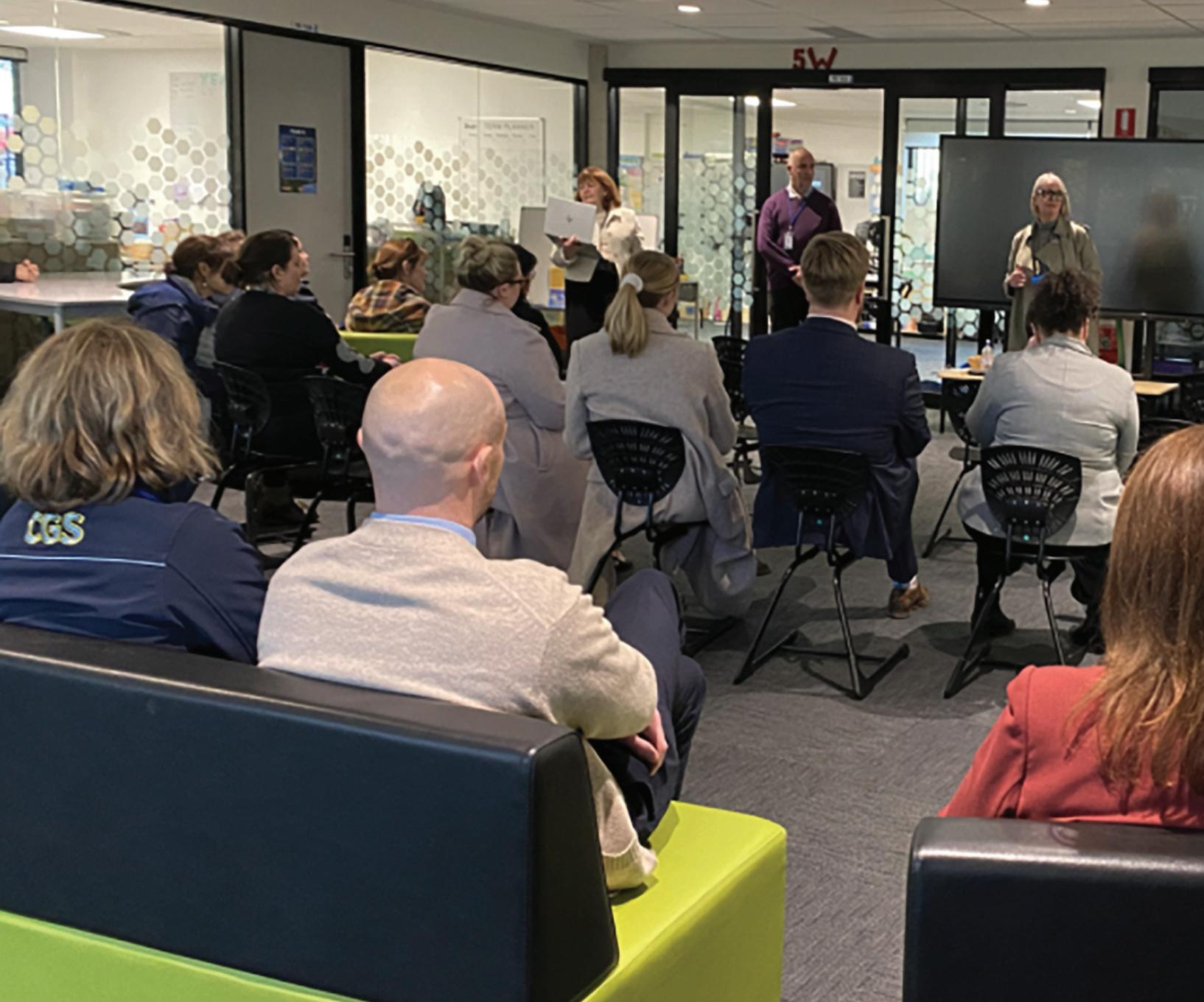
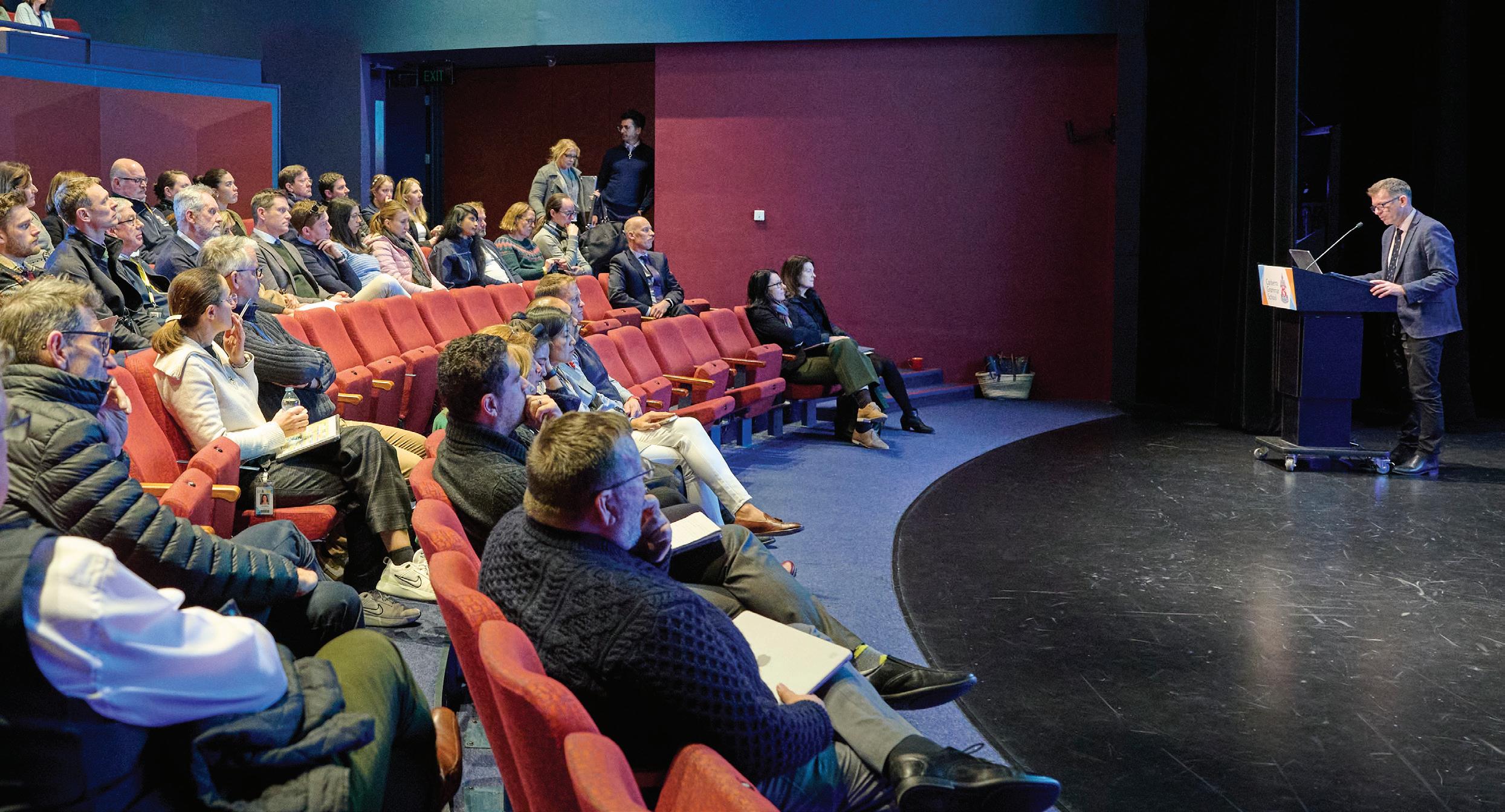
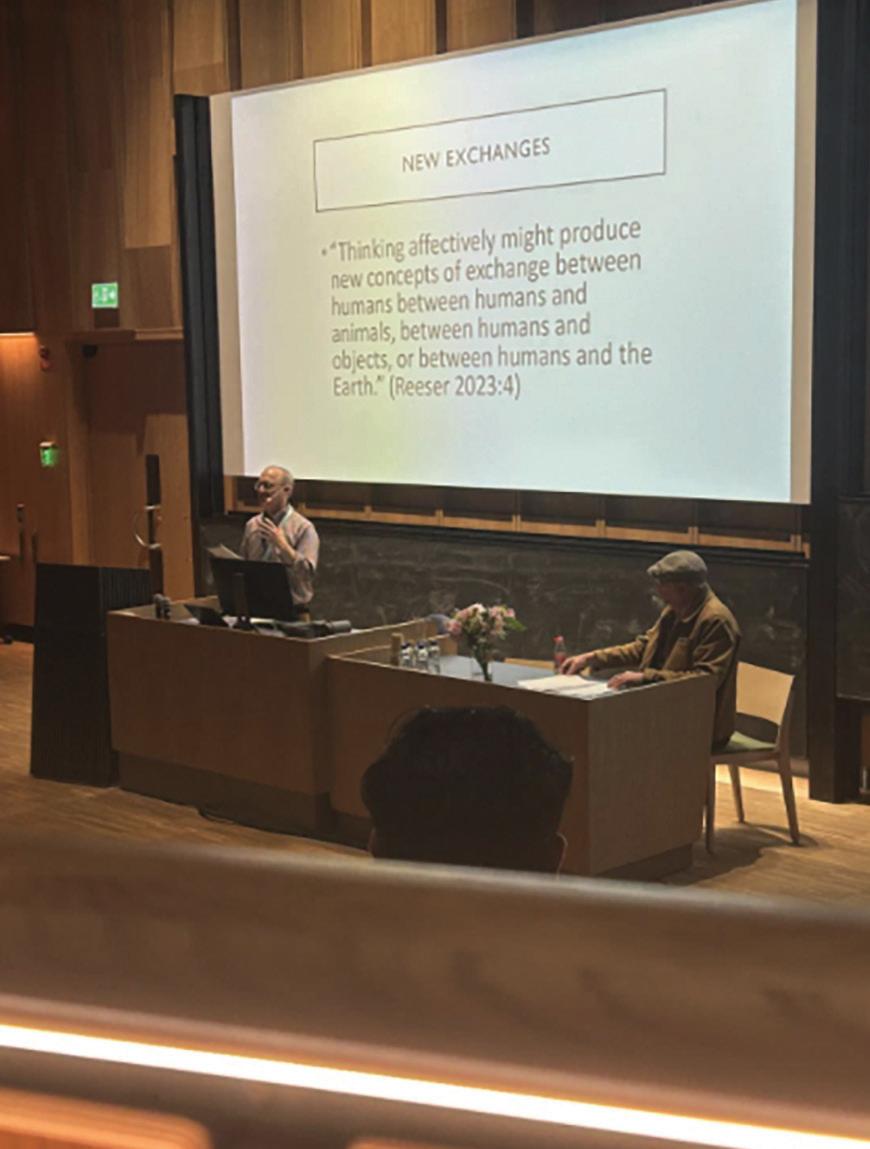
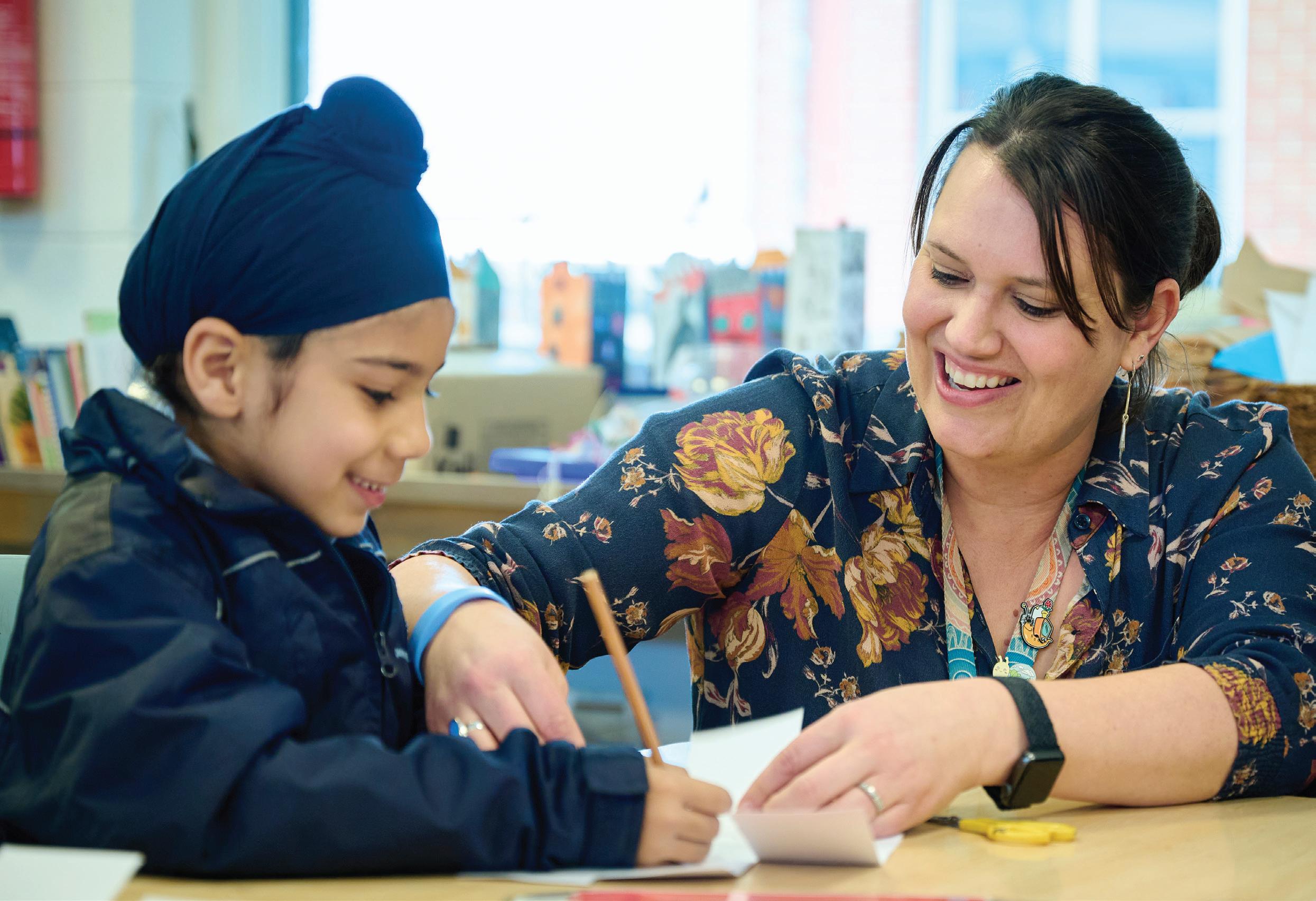
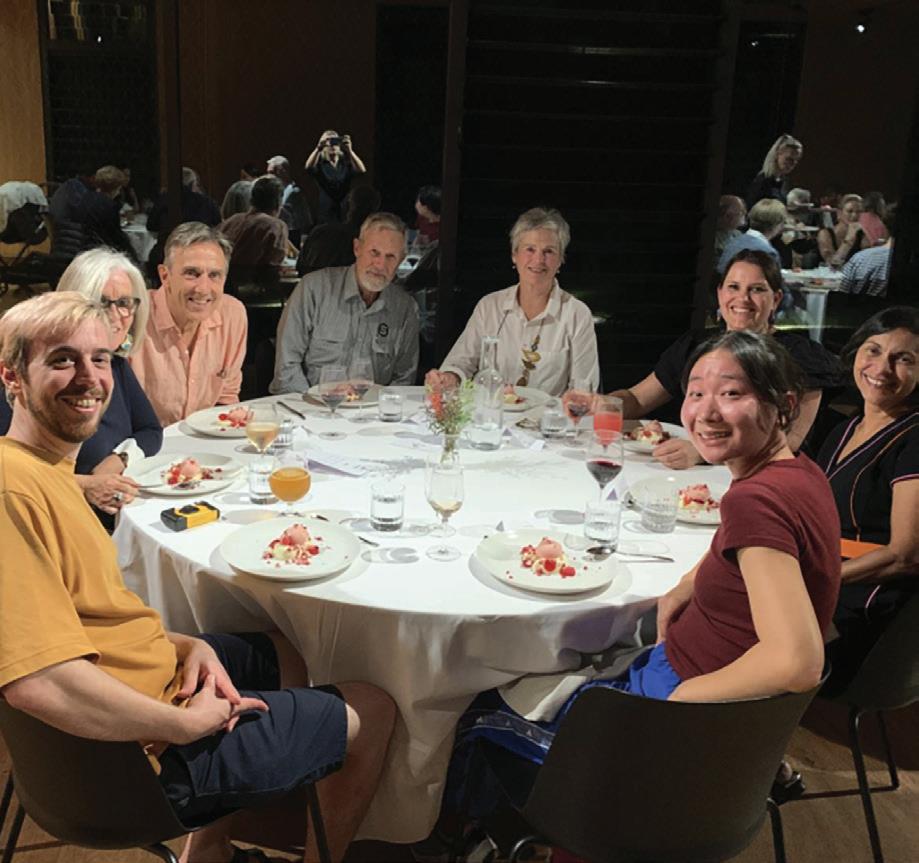
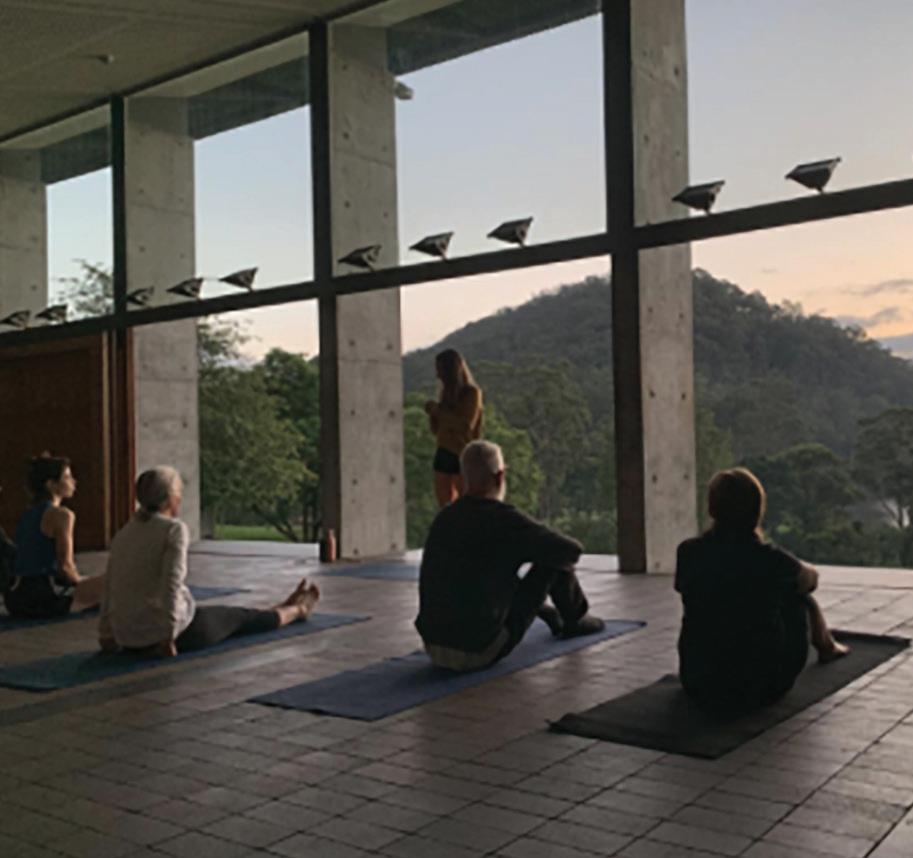
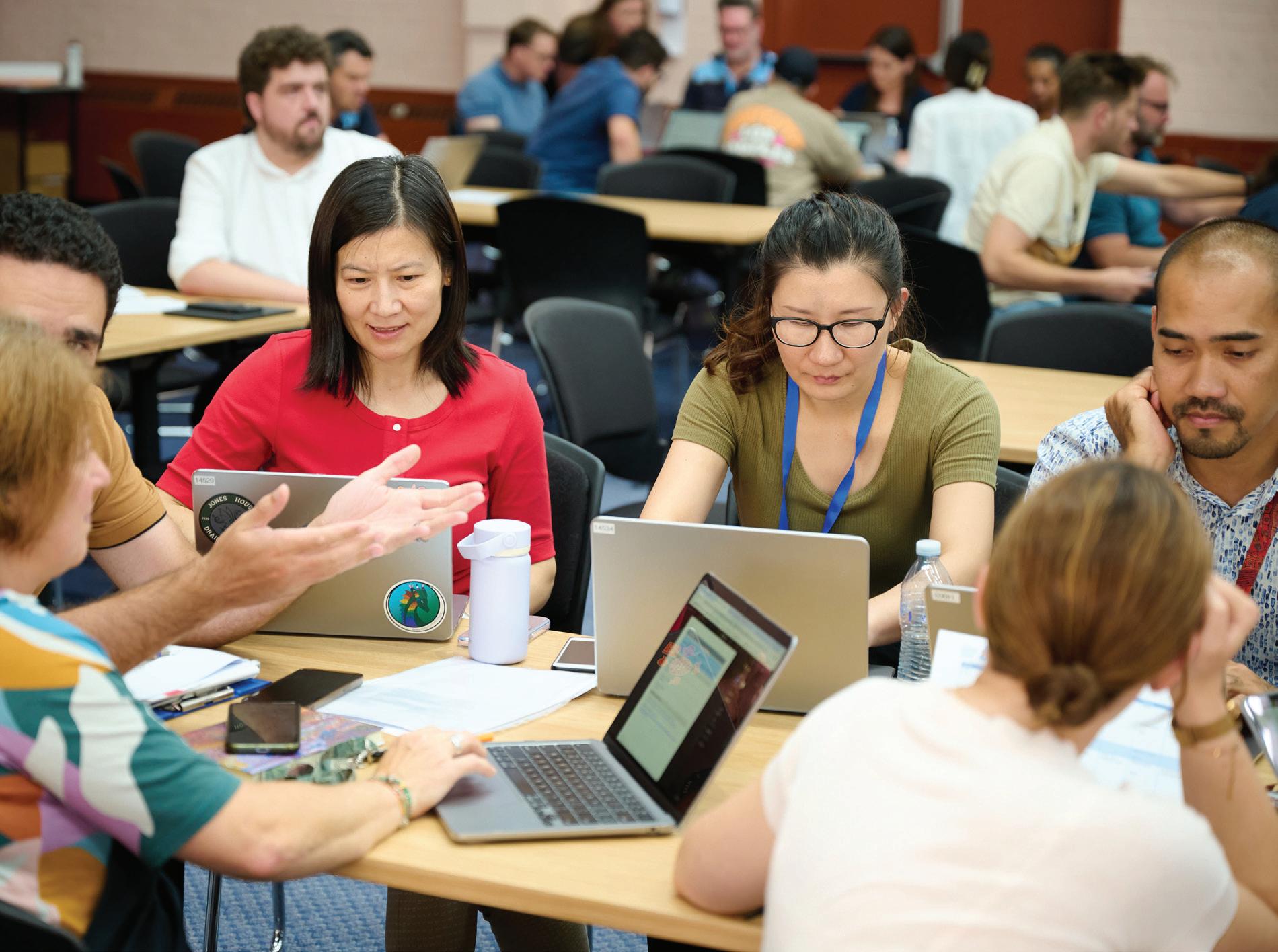
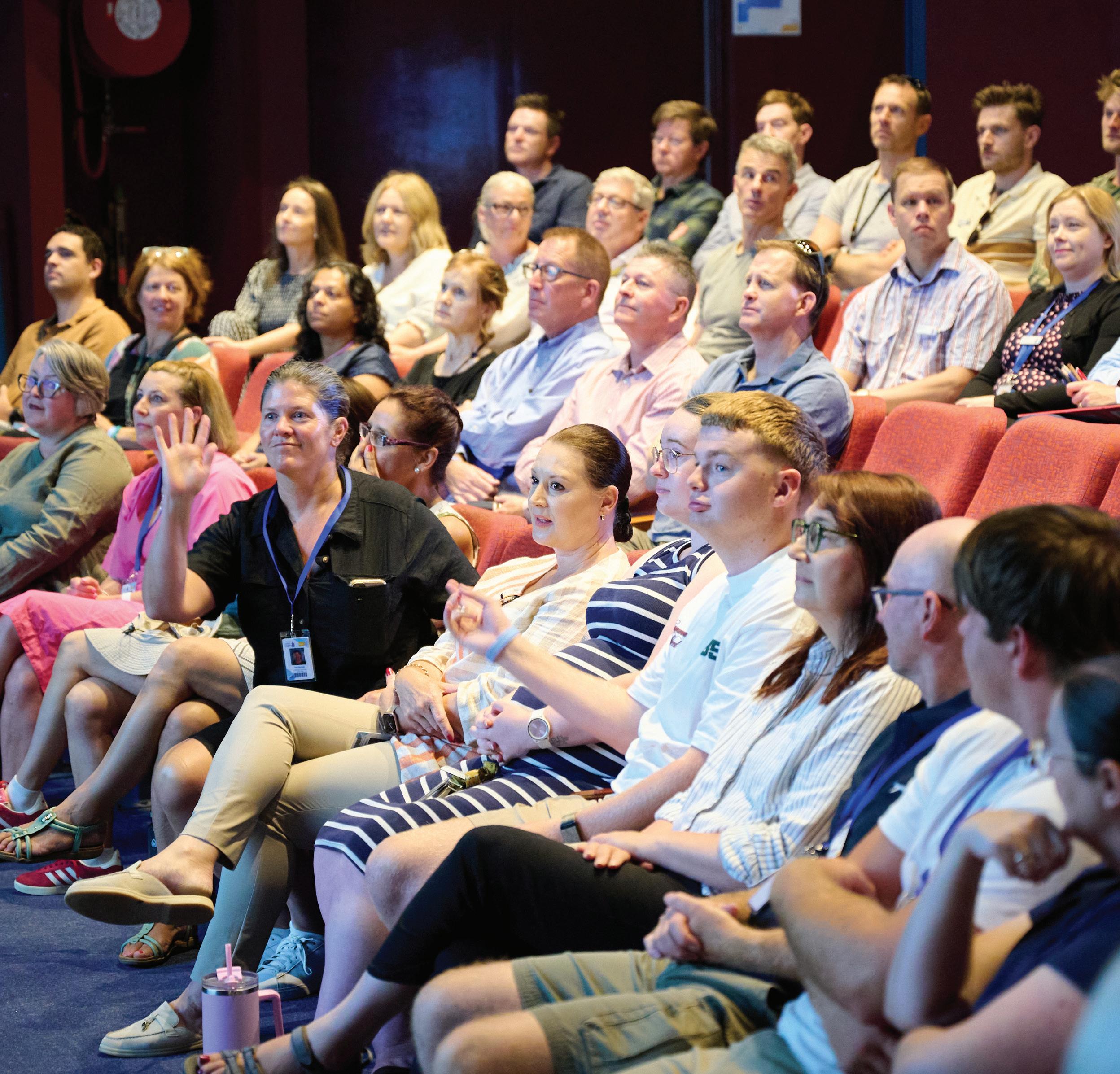
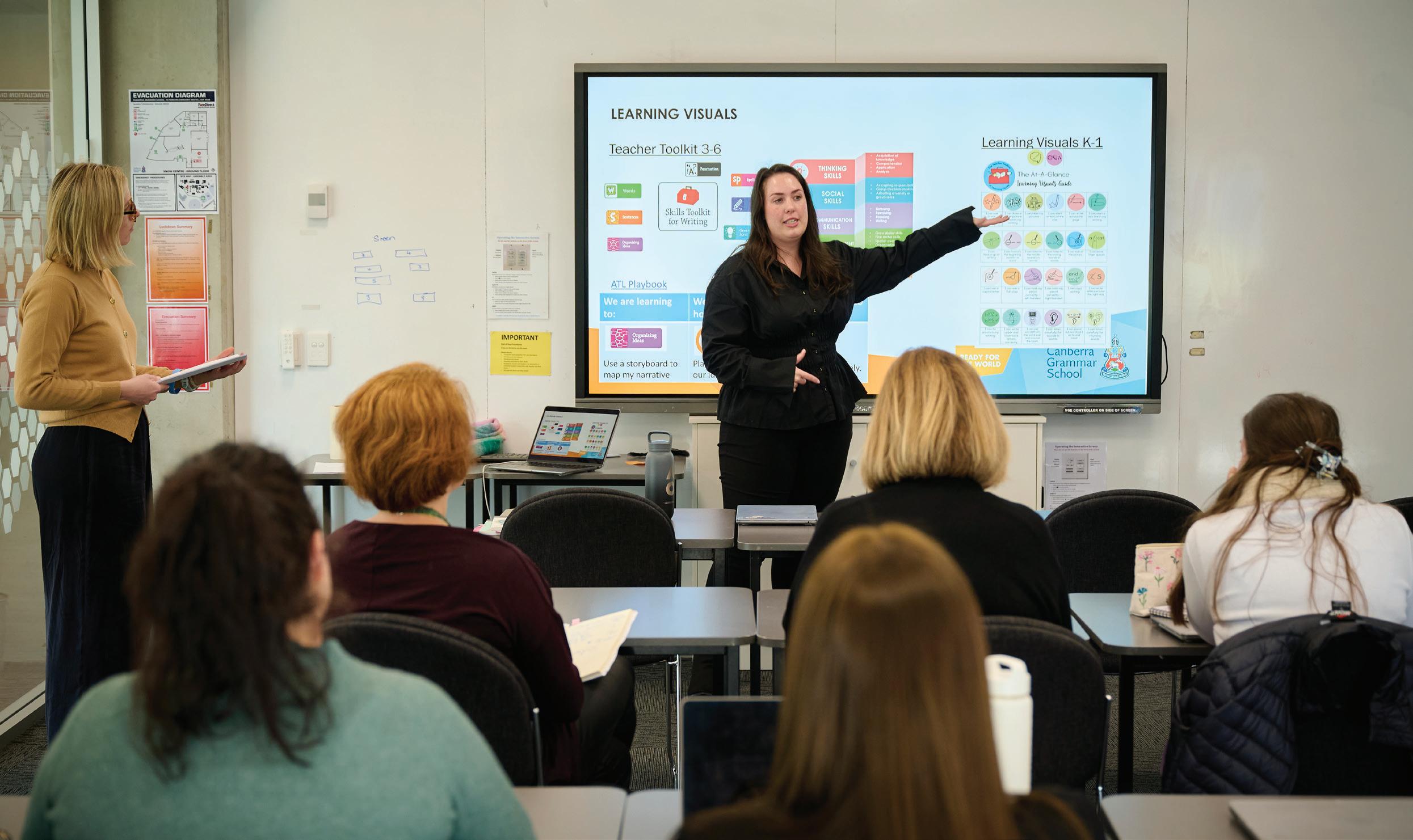
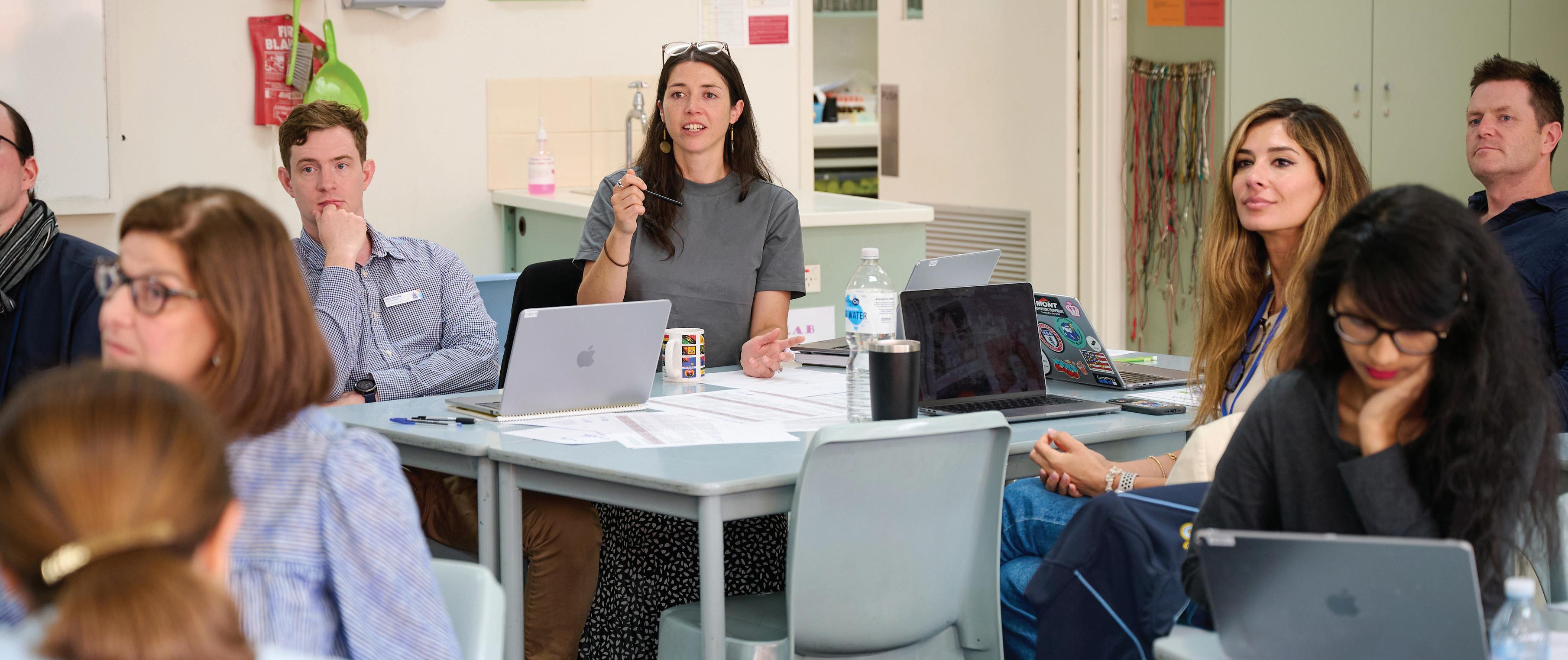
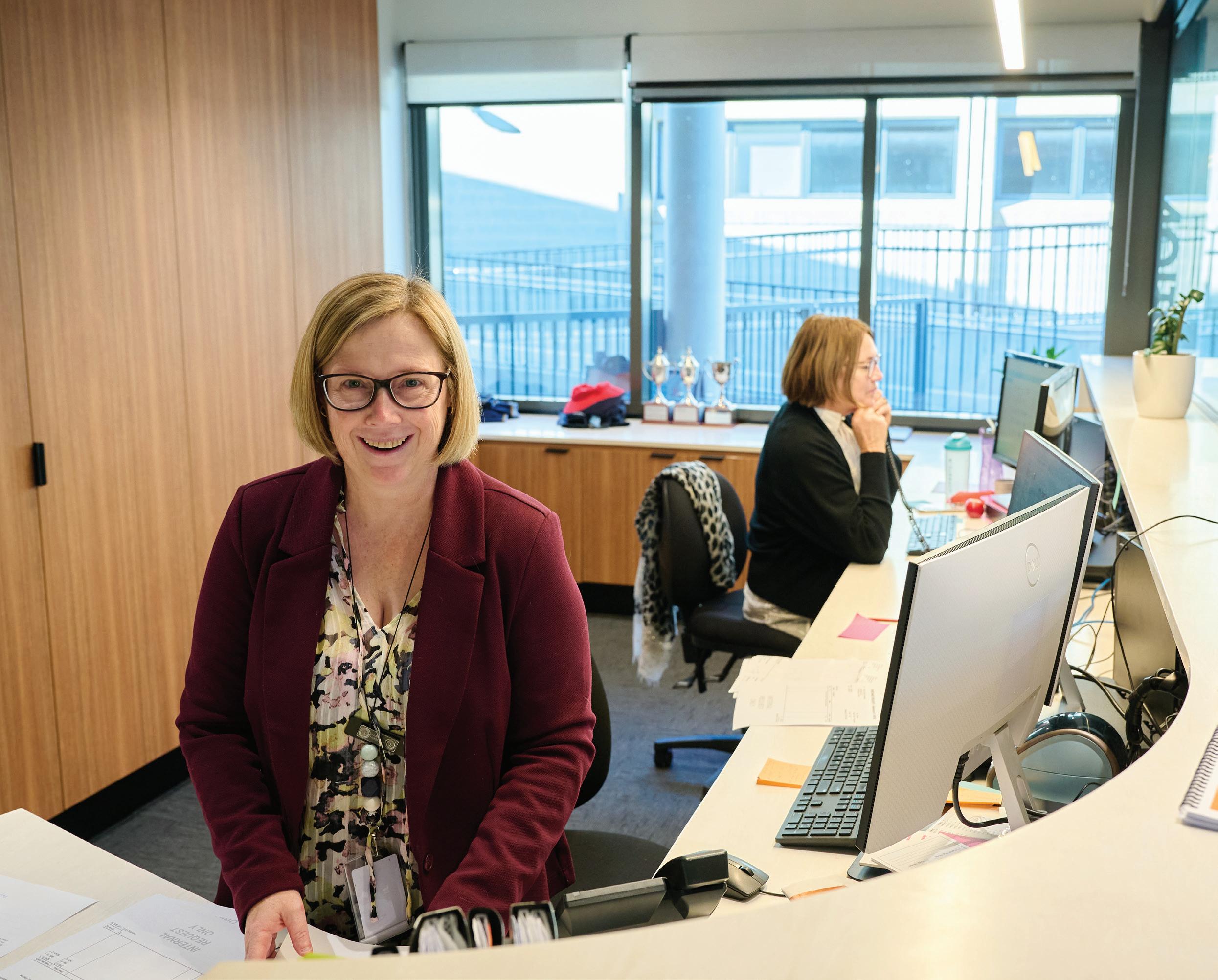
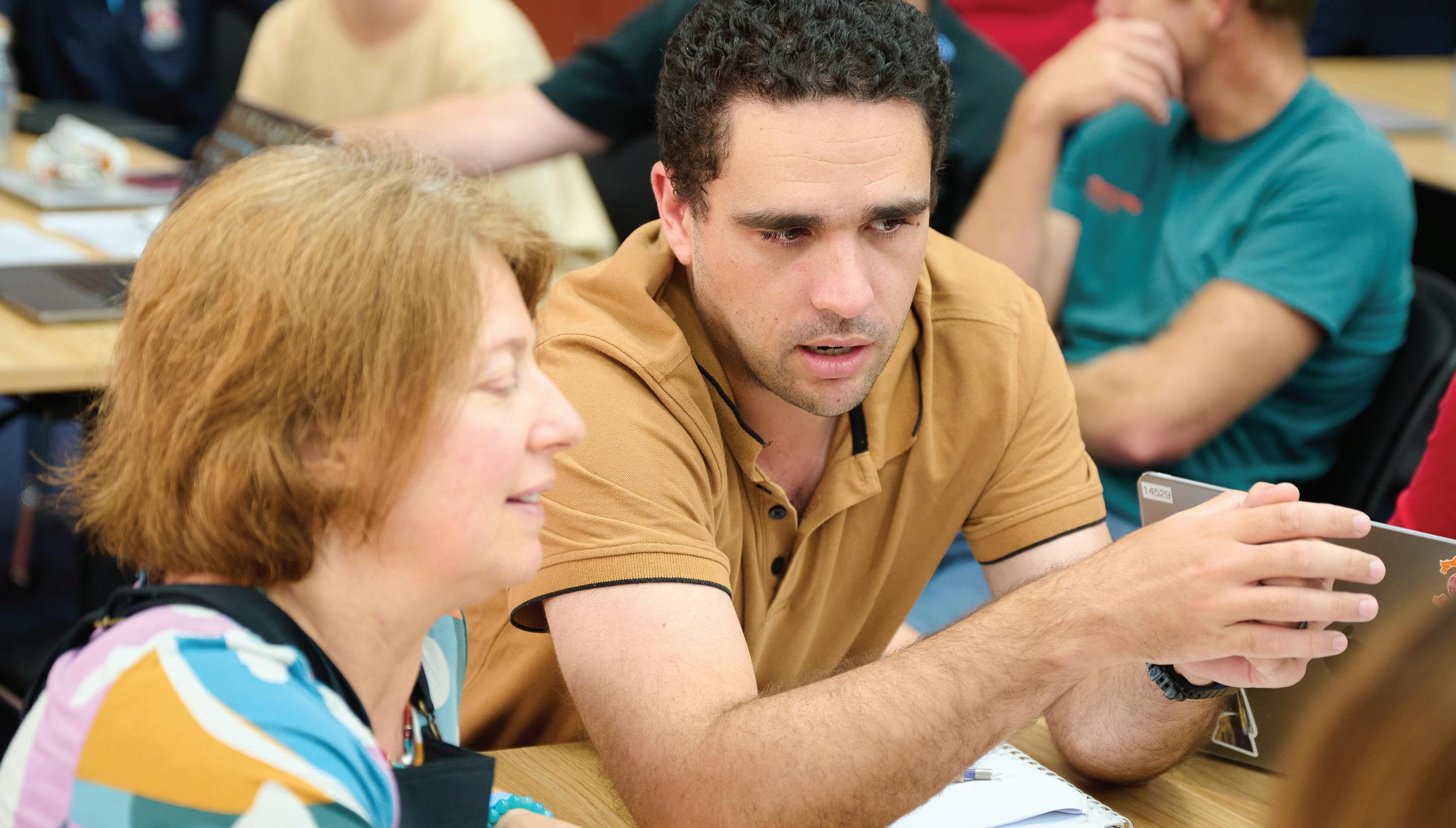
A FULFILLING AND REWARDING WORKPLACE: AT CANBERRA GRAMMAR SCHOOL, WE ARE A STIMULATING AND FULFILLING COLLEGIAL COMMUNITY. WE REMAIN COMMITTED TO HIGH-QUALITY PROFESSIONAL LEARNING AND SIGNIFICANT INVESTMENT IN THE PROFESSIONAL GROWTH OF OUR TEACHING AND OPERATIONAL TEAMS.
FOREWORD
When we wrote our CGS100 Strategic Plan, a few years ago, we deliberately framed the School’s mission as the education of our students as curious, creative, confident and compassionate citizens of the world.
Early drafts had endeavoured to express that more holistically, as applicable to staff as well as students, perhaps even to families and alumni too; a whole community learning and growing together in pursuit of those qualities — the 5Cs — that we believe define our capacity to flourish in the modern world.
After years of growth, change and upheaval at the School, and in the midst of the immediate post-COVID staffing challenges that demanded so much effort just to operate, let alone to educate, our conscious intention was to direct focus unequivocally to our fundamental reason for doing all that we do: our students.
That can hardly be a mistake in a school; yet, on reading this edition of CGS Aspire, I find myself wishing that we had kept to the broader framing of our aspiration. Clearly, our School’s mission applies to us all. Every page of this volume — which is once again longer, fuller, richer even than the last impressive edition — manifests our staff as the very model of all that we strive to nurture in our students.
All represented here — Primary and Senior, operational and teaching — demonstrate exactly what it is to be curious, creative, confident and compassionate citizens of the world: asking questions, researching and reflecting; proposing ideas, making connections and finding solutions; collaborating, leading, and daring uncertainty; giving of themselves in care for the young and their families; and sharing their learning in collegial generosity with one another in the creation of community.
That is our aspiration at work; and it is our aspiration at scale. As this journal has grown year on year, it has proven that what it represents is not just isolated idealism or the product of pockets of dedication; it is a culture, and it is a thriving culture.
Yes, there is significant investment and support from the School, and we are proud of that commitment; and, yes, there are institutional initiatives; but these pages reveal something deeper: the personal dedication that drives each project, the intellectual curiosity that sparks collaboration, and the organic culture of learning that sustains our shared pursuit of excellence.
The vast diversity of inquiry in this volume reflects the infinitely varied texture that is the experience of Canberra Grammar School itself. It captures who we are as a School every bit as much as all that we celebrate in our students. To all who make that true, I am immensely grateful.
Sincerely,
Justin Garrick Head of School
PROFESSIONAL KNOWLEDGE
INCLUSION IN MODERN EDUCATION: JUDITH LOCKE
By Ms Carolyn Morrison Assistant Director of Student Development – Senior School
With concern increasing around the number of mental health presentations in young people, there is a significant focus on how educators and parents can work together to help young people develop their social and emotional skills. Social and emotional learning (SEL) skills involve developing the ability to understand and manage our emotions, establish positive relationships, develop empathy for others, set and achieve goals and feel good about ourselves. Research shows children and young people with social and emotional learning skills have better academic outcomes, as well as improved physical health and a better quality of life.
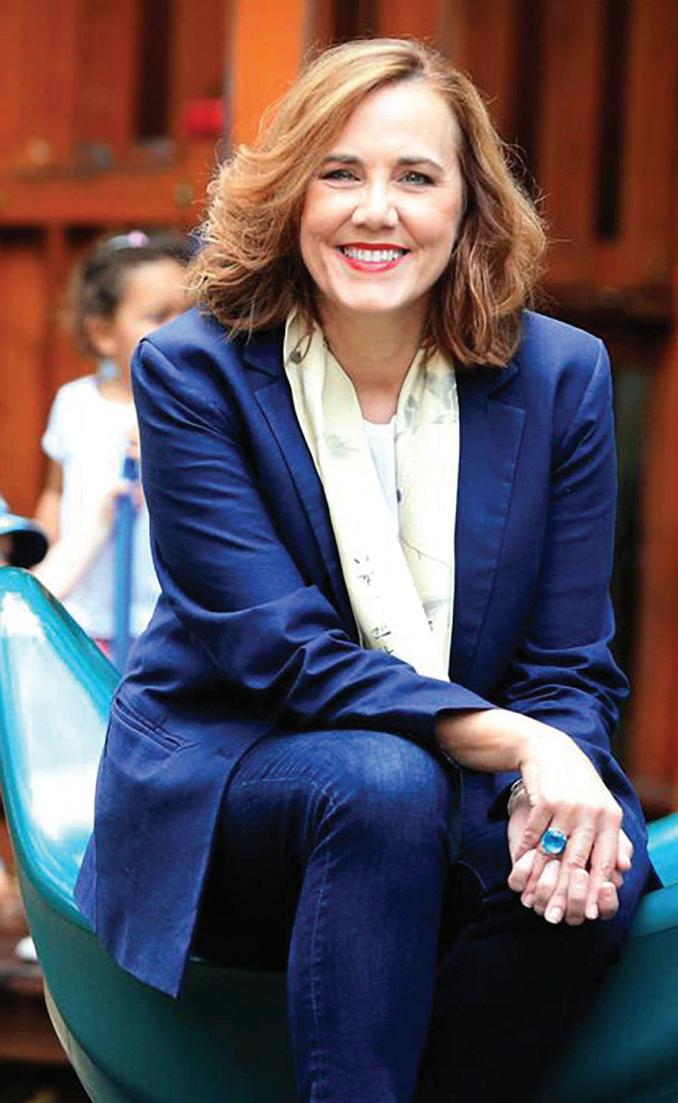
Registered clinical psychologist, Dr Judith Locke presented to staff and parents earlier this year to share her thoughts and strategies as to how we can help develop young people who are confident, capable and independent. She discussed the change in the style of parenting, as well as how school environments have changed and what impact this has on how young people cope when things don’t quite go as planned.
According to Dr Locke’s research around modern parenting, family wellbeing and how children and parents interact with academic environments, a significant influencing factor associated with the increasing number of young people developing mental health concerns is linked to students not having the appropriate skills to manage their emotions effectively. Judith summarised how we can help support young people to develop these skills in five main areas:
• Challenge: Students need to face challenges to develop resilience.
• Encouragement: Encouraging young people to face the consequences of their choices allows selfregulation development. Experiencing what is likely to happen when they make poor choices or do not put enough effort into a task, creates ‘teachable moments’ and they learn through experience in a safe and secure environment. If they have not been working as hard as they should, they need to face and experience their poor results or a school detention, as this will hopefully ignite internal motivation.
• Rescue: Do not rescue them when they have not done something (like left their lunch or PE uniform at home) as this will enable them to develop their own skills to assist them and learn how to be resourceful when they are challenged in the future.
• Rights of Others: Making them aware of the rights and needs of others will assist in their understanding of their sense of responsibility for themselves, their family and the broader community.
The five key points affirmed for many parents and teachers we are on the right track. Whilst we do not like seeing our children/students fail, we would rather them do it in the safety of the school environment and be there to help them reflect and learn from the situation. These practical and proven strategies for parents and teachers ensure children have the best chances of becoming genuinely confident and capable, and to realise their potential.
INSIGHTED SUMMIT: DATA STORYTELLING & VISUALISATION
By Ms Kate Harvey-Sutton Director of Teaching Development – Primary School
Noun. Data Storyteller.
One who helps others bring data to life, in order to make evidence-informed decisions.
—
Dr Selena Fisk
Members of our academic and pastoral teams and I recently took part in the virtual InsightED Summit , a six-hour online event hosted by Dr Selena Fisk. Featuring two keynote presentations and eight school case studies, the summit offered a rich blend of practical strategies and frameworks for data-informed teaching and learning.
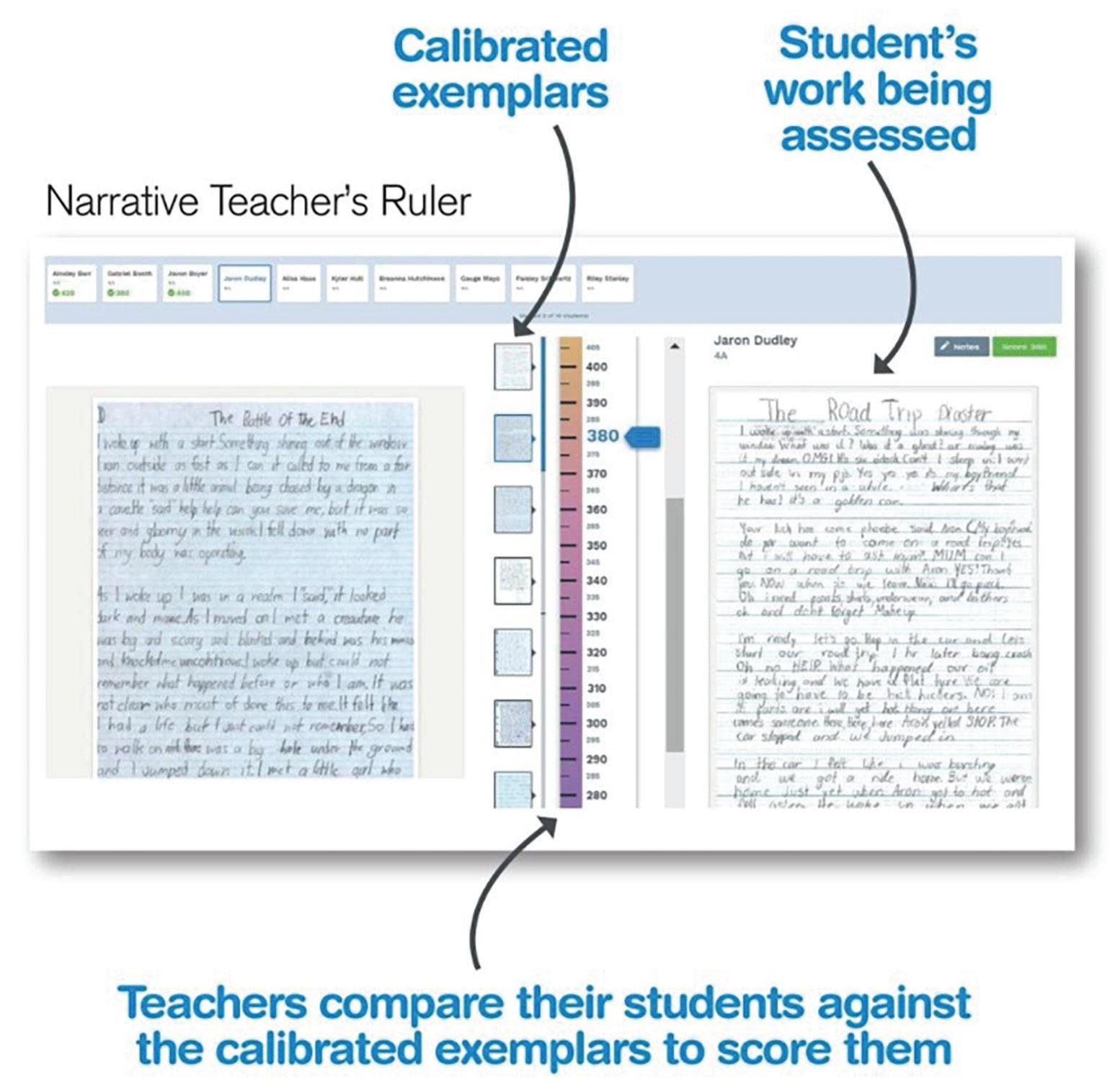
Fisk began by challenging schools to clarify their data intentions: what are we measuring: attendance, NAPLAN, formative tasks. More importantly: why? As she reminded us, data should inform and inspire improvement - not overwhelm. The day was broken into three sections highlighting the importance of data literacy, visualisation, and storytelling and illustrated how they empower teachers to engage meaningfully with data, whether that’s monitoring student wellbeing, curriculum planning, or professional development. Her session underscored that everyone should be equipped to understand and use data in their daily practice.
A major highlight came from Kat Greenbrook, a New Zealand-based expert and author of The Data Storyteller’s Handbook. Kat introduced us to powerful narrative structures like ABT (And–But–Therefore) and PGAI (Problem–Goal–Action–Impact), showing how to frame data in clear, compelling stories tailored to specific audiences. Her emphasised technique helps avoid unnecessary complexity, clearly distinguishing between visualisation and storytelling.
The event’s case studies: from tracking student wellbeing to improving staff motivation through data parties — were both inspiring and directly relevant to our Primary School context. Practical tools like annotated dashboards and narrative charts demonstrated how to turn numbers into stories that catalyse conversation and change.
The large volumes of data we collect at our School can be presented as more than graphs and tables. Selena Fisk’s Insighted Summit highlighted how data storytelling and visualisation can turn information into meaningful stories that spark conversation, guide decision making, and support student learning.
Additional Reflections:
“Telling a data story involves more than merely presenting the data visual. The way you present the data must be connected to a data-driven message that clearly convey what the audience should understand.”
– Lucy Garven
“Data can be interpreted in so many ways. Effective data storytelling requires more than presenting visuals, it must be grounded by a clear, data-driven message. This message should guide the audience’s understanding and highlight the significance of the data.”
– Lisa Kaptein
“Our School is rich with data, from assessments and attendance to wellbeing and engagement. The challenge lies not in how much we have, but in how clearly we can interpret it. By learning to distil these sources, we can better understand both the intended and unintended impacts of our decisions, and move towards more thoughtful, evidence-informed action.”
– David Hazelton
“This data presentation was a valuable reminder that what we choose to measure - and whymatters deeply. Data can have both intended and unintended impacts, with lasting positive or negative consequences. But even when outcomes aren’t ideal, they offer opportunities.”
– Sarah Maldon
“Importantly, our impact can be seen not just in numbers, but in the process, culture, and people. Rather than rushing to the next goal, taking time to celebrate data helps build a positive culture and acknowledges the efforts of both staff and students. Celebrating success is not a detour — it’s part of the journey.”
– Cindy Hyett
The InsightED Summit reinforced a critical insight:
Data matters most when we make it meaningful.
— Dr Selena Fisk
INSIGHTS INTO CLASSROOM MANAGEMENT WITH DR MARK DOWLEY
By Mr Jeremey Atkinson Mathematics Teacher – Senior School and Ms Ann Hamer Director of Teacher Development – Senior School
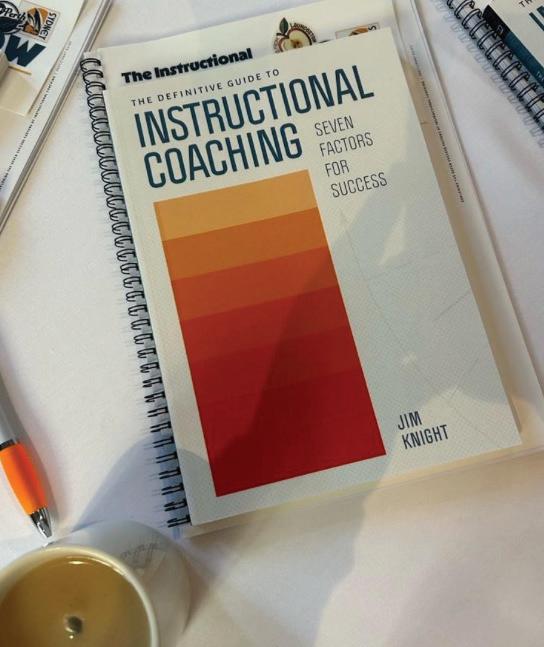
Teaching has become more complex as technology is developing, as mental health issues are on the rise, as students are required to have individualised plans etc. So having a focus on classroom management seemed a good place to start the year because classrooms are complex places. Dr Mark Dowley from Brighton Grammar School has worked extensively in the instructional coaching space for teachers and he comes with many tried and tested routines that are known to work. From a full staff presentation to several workshops, Dr Mark Dowley was generous with his time and in sharing his wisdom and knowledge.
A well-versed public speaker and master of managing his audience, Dr Mark Dowley did not disappoint. He started the full staff session by providing validation, supported by data, of the work teachers do in the classroom. His words were refreshing to hear and when looking around the audience, he had many teachers hanging onto his every word. He understands the complexities of teaching because he is a mathematics and PE teacher as well as an academic.
Student engagement is, Mark told us, the central key to classroom management, again using research data to demonstrate its strong correlation to both academic achievement and social wellbeing. He offered three guiding principles to serve as our starting point:
1. Behaviour can be viewed as a curriculum
2. Success is a powerful motivator
3. Students need to know they belong and that you believe in them
During the next 30 minutes, which felt more like 10, Dr Mark Dowley provided practical strategies to aid fostering positive classroom management. He broke these into: tools, routines and scripts demonstrating how they work together with simple but effective implementation into practice. All the while he was at pains to stress that it is consistency of approach in our classrooms that makes the world of difference. If we all work together to set standards, we help each other. If we consistently demand high standards of behaviour, we will support all teachers. He urged us to relate our reasons for good behaviour to our values, for example, we value creativity, so this is why we need to explore this topic.
Many teachers enjoyed the session and felt it was a valuable keynote speech. The follow up workshops did not disappoint either. They continued the theme of consistency and high standards. Mark is a proponent of explicit teaching, and through video of his class, allowed us to focus on what engagement looks like and why we need to challenge each student to value the time they have in class. Although he is very structured in his teaching, he encouraged us to look at activities such as group work in the same way: guide students through allocating roles, talk about what effective group work looks like, set the standards. He finished the day with a workshop for Heads of Department and Heads of Student House’s and this covered systems we have in school. Using a system such as effort grades, he talked about the need to set an accurate record of effort. If all students are getting excellent, the system is not effectively capturing how well students are working. It does not help us to guide students in their learning.
The sessions were engaging and thought provoking. We are not Brighton Grammar School, but we are a place of learning, and we are on the journey towards building the learning culture we want to see through our MYP implementation and our commitment to academic success for all. This can only be achieved through clear, consistent behaviour management in our classrooms.
The Classroom Management Handbook: A practical blueprint for engagement and behaviour in your classroom and beyond Paperback – 22 March 2024 by Oliver Lovell (Author), Dr Mark Dowley (Author) is available in all Departments and in the Senior School Library.
EXPLORING THE USE OF GENERATIVE AI AS A RESOURCE IN PRIMARY MATHEMATICS EDUCATION
By Ms Tia Widdison
Year 6 Teacher – Primary
School
As digital technologies evolve, generative AI is emerging as a powerful resource for supporting mathematical understanding in primary classrooms. Through the Centre for Educational Research, Western Sydney University, we were invited to participate in an exciting research study conducted by Professor Catherine Attard. The research is aimed at exploring ways that teachers can design mathematics resources using generative AI tools such as ChatGPT or Microsoft Copilot. The study also set out to explore the impact of designing and using such resources on teacher workload and on the student experience of mathematics lessons.
Across Terms 2 and 3, we participated in interviews and Zoom sessions to discuss our experiences with resource design in general, along with any of our prior experiences using generative AI tools. Guided by Professor Attard, we considered the kinds of prompts asked of the AI tool, asking it to design rich mathematical experiences, complete with resources and rubrics. Three lessons were planned in collaboration, before being conducted in the classroom and observed by Professor Attard. Following each lesson, a small focus group of students reflected on their experience of the tasks, gathering valuable insights from the student perspective.
After participating in this research project, our biggest takeaways were:
• When using AI, it is essential that you define important terms first, to ensure there is an agreed understanding. For example, we began our conversation with ChatGPT by defining what the AI deemed as a ‘rich mathematical task’.
• We found that generative AI is more useful when you are clear on the purpose of the task. The more context and information you can provide, the more reliable work product it can produce. We made sure to always define ourselves and our School context.
• We found the AI was average at developing ideas for lessons based on specific outcomes, and that it was necessary to copy and paste the wording of an outcome, rather than just the number. It occasionally hallucinated (a term used to explain when an AI generates incorrect, misleading, or entirely fabricated information), resulting in an inappropriate task, not fit for purpose.
• The AI seemed to work more efficiently when we divided the tasks up. For example, designing specific warm up games or activities separately from the main lesson resulted in more engaging and appropriate activities.
• The biggest disadvantage we found of generative AI (ChatGPT) at this point was its formatting. Where we tried to copy and paste its lesson format into our own school template, it did not work and required more time spent on manually inserting it.
• It is necessary to choose the correct AI for the purpose intended. While ChatGPT seemed helpful for lesson design, Claude.ai was more reliable with resource creation.
• While AI is beginning to make lesson planning easier and less time consuming, it is essential that you not only view its creations with a critical eye, but you also take the time to interrogate its questions, to answer them yourself and confirm that what it has produced is reliable and valuable.
Once Professor Attard’s research is shared, it is hoped that the results will benefit the broader teaching community by providing insights into the design and implementation, and exemplars of the AI generated mathematics resources. We appreciated the opportunity and time to explore how we can make the best use of this new technology, not only to decrease teacher workload, but to design creative and impactful lesson experiences for students to enjoy.
INCLUSIVE EDUCATION
By Ms Alison Jost Head of Inclusive Learning Department – Senior School
On 19 May, during one of our professional learning slots, we had the pleasure of welcoming Ms Karen Toohey to our School. Karen is the Discrimination, Health Services, Disability & Community Services Commissioner. She spoke to teachers about the importance of inclusion and the need for us to support all of our students, no matter what their needs. Highlights from Karen’s presentation are below. We enjoyed the opportunity to hear from Karen’s extensive experience and following her talk, teachers attended a wide range of workshops focusing on different facets of inclusion.
“Young people basically get one chance at an education, and we know the profoundly negative impact on social, economic and physical wellbeing outcomes of not being able to participate fully in education.
Participation means not just turning up but being fully able to be themselves on a social, spiritual, physical level.
We hear sometimes diversity and inclusion thrown around as negative terms but the underlying principles, as you know are about ensuring full social, spiritual and economic participation of people in our community, actively recognising and removing barriers to full participation.
This priority arises from recognition that some individuals and groups do experience discrimination, vilification, bullying and harassment and this affects not only the individual but whole groups within the community.
A recent incident of violence towards one of ACT’s multicultural leaders reported in the media had a chilling effect on many parts of our community that saw themselves in that experience.
Similarly, media coverage of an incident last year to do with a young Aboriginal student with a disability had a profoundly undermining effect on the ACT community members about their confidence in sending their children to school.
We know that diversity & inclusion contributes to the safety, wellbeing and productivity of the whole community.
Exclusion of some from optimising their individual opportunity will in the end cost the whole community. And while I don’t want to run an economic argument of the benefits of inclusion and diversity it’s one lens to bring to our thinking about the onus on all of us to optimise the opportunities and participation of all children and young people.
In 2011 after seeing some data showing Australia ranked the lowest of 29 OECD (organisation for economic cooperation and development) countries for economic participation of people with a disability in employment, I initiated some work in Victoria looking at the experiences of students with disabilities and barriers to participation.
While that was over a decade ago, we still see the same types of issues being brought to our attention – kids on part time attendance patterns, denied adjustments because of diagnostic requirements, not being consulted properly about the adjustments they need, families overwhelmed and angry.
Near 45% of people with a disability live in poverty versus 1 in 10 for Australians without a disability. So, these are not theoretical issues for us as a community.
When I started at the Australian Human Rights Commission back when the Disability Discrimination Act came into effect disability discrimination was about wheelchair access, access to language or Auslan interpreters. It has become much more complex as we recognise disabilities such as autism or neurodivergence. These should not be a barrier to young people getting an education and being able to optimise their education and therefore their participation back then in the world post school.
I know and acknowledge you are the frontline in this work.
In many settings we have moved beyond the issues around low expectations for students with a disability which was very much the experience of some students, and parents, when I started working in this field. Now some of the children and young people I dealt with run their own business, hold down senior executive and CEO positions, and as we have seen, have award winning TV shows and sporting careers.
But we also know that the challenges of accessing services like the NDIS, health services and knowing this time is a onetime offer these students will not have access to again, which can complicate the relationship between school, student and family.
I’ve used disability as an example as it can be seen as more challenging because it requires educators, employers and service providers to provide a customised response and to do things, take action, rather than not do things such as other types of discrimination like sexual harassment or racial vilification.
Inclusion is complex and requires a commitment to conscious decision making, understanding the possibility of unconscious bias without being afraid of uncovering it and addressing it, and not being afraid of criticism.”
– Ms Karen Toohey
DEEPENING OUR MATHEMATICAL PEDAGOGY WITH PROFESSOR CATHERINE ATTARD
By Ms Lisa Kaptein
Associate Director of Academic Education (Mathematics) – Primary School
Our School’s commitment to strengthening mathematical pedagogy continued this year with an inspiring professional learning session led by Professor Catherine Attard from the University of Western Sydney. As the current Chair of the Australian Association of Mathematics Teachers (AAMT), Professor Attard brings a wealth of expertise and insight to mathematics education. Her current research explores the integration of artificial intelligence (AI) in designing rich mathematical tasks, which presents an exciting development aimed at reducing teacher planning workload while enhancing student engagement.
Professor Attard facilitated a whole-staff professional learning session focused on the power and potential of rich mathematical tasks. She began by acknowledging the ongoing pedagogical dialogue around direct instruction versus inquiry-based learning. Her message was clear: rich tasks provide meaningful opportunities for explicit teaching while fostering deep mathematical thinking and providing students with the opportunity to engage with problem-solving is critical to the development of this thinking.
WHAT MAKES A RICH TASK “RICH”?
Together, we explored the essential characteristics of high-quality rich tasks. These included:
• Productive struggle: encouraging students to persevere through challenges.
• Multiple strategies: allowing diverse approaches to problem solving.
• Low floor, high ceiling: tasks that are accessible to all learners but offer depth for extension.
• Language-rich contexts: using word problems to embed numeracy in real-world language.
• No obvious answer: promoting curiosity and critical thinking.
• Diversity of problems: exposing students to varied mathematical situations.
• Choice in collaboration: allowing students to work individually or in groups, depending on their learning preferences.
These elements sparked rich discussion among staff and reinforced our shared understanding of what effective mathematics teaching looks like in practice.
Teachers then engaged in a series of hands-on rich tasks sourced from Maths 300, a resource well-known for its inquiry-based tasks. The energy in the room was fantastic as staff collaborated, problem-solved, and reflected on how these tasks could be adapted for their own classrooms. This session marked a significant milestone in our School’s ongoing mathematics journey, one that has been evolving over the past three and a half years.
AI IN MATHEMATICS PLANNING: A GLIMPSE INTO THE FUTURE
Our session with Professor Attard concluded with a brief outline of her current research into the utilisation of AI to create rich tasks. Professor Attard then shared the ‘Chat’ that she had created called Engaging Maths Rich Task Generator. This tool has been pre-loaded with curriculum content and the AAMT’s Pedagogy in Mathematics Position Paper, enabling it to generate tasks tailored to specific year levels and topics that are aligned with the philosophy of Rich Tasks.
Each generated task can include:
• Learning intentions
• Success criteria
• Common misconceptions
• Enabling and extending prompts
• Warm-up activity suggestions
• Rich Task
• Assessment points with rubrics
While the tool offers a valuable starting point, Professor Attard emphasised the importance of teacher judgement in refining and adapting tasks to suit specific learning objectives and student needs. With thoughtful prompting, the AI can assist in crafting tasks that are both rigorous and engaging.
Professor Attard has generously given permission for us to include the link (via QR Code) to the Engaging Maths Rich Task Generator in this article for the staff of CGS to explore in their planning.
Just one precious hour of professional learning with Professor Catherine Attard was extremely valuable and affirming! Via challenging hands-on activities, collaborative learning and mathematical discussion, Catherine truly endorsed our beliefs underpinning CGS Primary’s pedagogical approach to Mathematics. Catherine addressed the current “hot button” debate around direct instruction versus inquiry; in her role as AAMT Chair, she wholeheartedly supports “teachers on the ground” being given autonomy to plan, refine and teach according to individual contexts and needs within their classrooms. Catherine shared her research about the three aspects of EngagementCognitive (thinking hard), Operative (working hard) and Affective (feeling good) - and reinforced how critical the teacher’s role is in fostering student engagement. Already, we are experimenting with her AI tool to assist in planning meaningful and motivating Maths lessons.
– Anna Gray, Year 2 Teacher
Professor Catherine Attard’s workshop was incredibly inspiring. The learning engagements she presented were deceptively simple yet deeply complex, accessible, differentiated and highly engaging for students. I was especially struck by the notion, drawn from Marilyn Burns, of uncovering rather than simply covering the curriculum. This idea challenges us at CGS to consider how we can uncover the curriculum for our students, making mathematics more engaging, meaningful, and connected across the wider curriculum.
– Sally Nicholas, Year 1 Teacher
We had the privilege of participating in a professional learning session with Dr Catherine Attard, whose passion and expertise in mathematics education made for an engaging and thought-provoking experience. As a Kindergarten team, we valued the practical strategies she shared for creating engaging, differentiated, and dynamic classroom environments. The hands-on approach, combined with open discussions around balancing inquiry-based learning with explicit teaching, allowed us to reflect deeply on our own practice. We also appreciated the opportunity to explore the role of AI in supporting effective planning, ensuring it can be used in purposeful and appropriate ways to enhance student learning.
– Molly Brown, Kindergarten Teacher
Professor Catherine Attard reminded us that knowing our students is at the heart of effective teaching. By blending explicit instruction with flexible, responsive strategies, we can create rich, open-ended problems that have a low floor and high ceiling. This smarter approach keeps engagement high, encourages productive struggle, and helps every learner stretch their thinking.
– Kathy Johnston, Year 4 Teacher
A highlight of Professor Attard’s Maths PL was exploring a range of engaging strategies to take back into the classroom. I trialled a number of these approaches in my Stretch and Challenge class and found they supported deeper thinking and encouraged students to approach problems in new ways. It was valuable to see how quickly the strategies could be implemented and how positively the students responded to them.
– Sarah Maldon, Head of Individual Learning
EXPLICIT TEACHING STRATEGIES: FOCUS ON VOCABULARY INSTRUCTION
By Ms Emily Dempsey
Year 5 Teacher – Primary School
EXPLICIT TEACHING AT CGS – WHAT DOES IT LOOK LIKE?
Much has been reported in the media about the role of explicit teaching in improving literacy and numeracy results in previously low achieving schools. But what does explicit teaching look like in the context of Canberra Grammar School? A school with levels of literacy and numeracy that are already higher than those recommended by the Grattan Institute?
Inspired by the professional development day led by Lorraine Hammond and hosted by the Snow Foundation, we were determined to explore how explicit teaching strategies can complement and extend student learning within an inquiry-based school environment. Our aim was to begin by focusing on a small component of English (vocabulary) and utilise specific components of explicit teaching whilst still allowing for teacher autonomy. According to Dr Hammond, even small adjustments in lesson design and implementation can make a significant impact on student outcomes.
WHAT IS EXPLICIT TEACHING?
Explicit teaching is a structured, systematic approach that involves:
• Clear explanations of new concepts – providing accurate information
• Teacher modelling with visual and physical supports
• Logical progression of knowledge and skills
• Frequent practice and feedback to reinforce understanding
This method ensures students build a strong foundation for learning by making each step transparent and accessible, regardless of ability.
CONNECTION TO COGNITIVE LOAD THEORY
Cognitive load theory is the theory behind how memory works and how the human brain stores information. It focuses on understanding how information is moved from the working memory to the long-term memory. Working memory has limited capacity. Only a small amount of info can be taken in and processed at a time. On average, the human brain can hold between two and seven pieces of information at a time. By applying Cognitive Load Theory to lesson structures, the teacher’s goal is to transfer working memory into long term memory.
To do this, teachers try to minimise all the other things going on in the classroom so we can attend to the important things that can be transferred into long term memory. We remove any distracting content and continually revisit the content we want students to retain. The point of this is to teach students first, leaving no room for guess work. Providing students with opportunities to connect new knowledge with prior knowledge is imperative to building long term memory. Some educators call this ‘front-loading’, giving the students the skills and information they need before they run with it. This involves a lot of repetition. A lot of vocab work. A lot of me, then us, then you (but only once the teacher knows the student understands). This front-loading approach ensures that students are well-prepared for transdisciplinary and conceptual learning.
Be Explicit – provide explicit instruction and modelling of new vocabulary (content).
I do, We do, You do approach – teacher modelling, repeating and reinforcing, shared practice and independent application.
Use Visuals – incorporate images, objects and other visual aids to support and build understanding.
Connect to Prior Knowledge – help students link new words to familiar concepts.
Provide Opportunities for Practice – use the new words in multiple, varied contexts. Practice – practice – practice.
Make it Engaging – in conjunction with routines, use games, stories, and creative tasks to make learning enjoyable and memorable.
FOCUS ON VOCABULARY INSTRUCTION
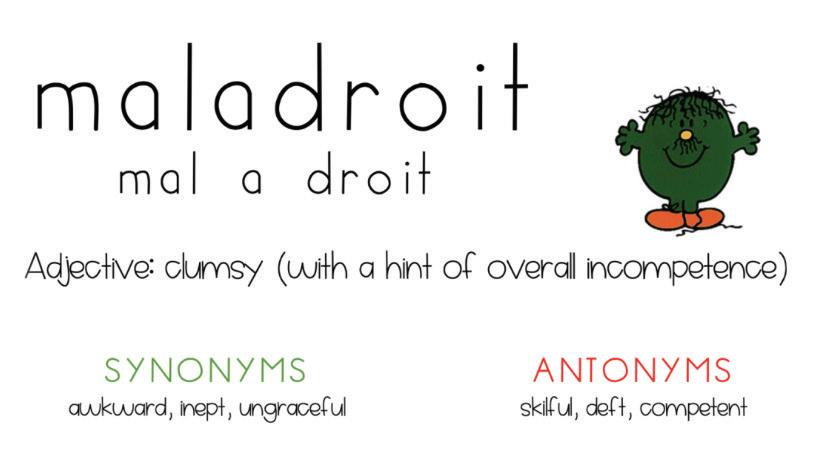
When students enter Year 3 at Canberra Grammar School, explicit teaching of vocabulary and comprehension becomes more targeted. Building on the strong foundational skills targeted in the Early Years, students explore Orthography (spelling conventions and rules of the English language), Morphology (the parts of the word that hold meaning e.g. prefixes and suffixes) and Etymology (the origins of words).
Vocabulary, according to ‘The Science of Reading ’ is an “unconstrained” skill, meaning it continues to develop throughout a student’s life. Students with a strong vocabulary can better understand the text they are reading, while those with limited vocabularies may struggle to grasp the meaning of what they are reading. Efficient and effective instructional routine for vocabulary must be explicit, engaging and include multiple opportunities for exposure to new words.
WHAT DOES AN EXPLICIT VOCABULARY LESSON LOOK LIKE?
Here’s a more detailed breakdown of an effective vocabulary instructional routine:
1. Introduction and Pronunciation:
• Introduce the word: Present the new word clearly and have students repeat it to ensure correct pronunciation.
• Write the word: Write the word on the board or display it visually, drawing attention to its spelling and any relevant patterns.
2. Definition and Explanation:
• Student-friendly definition: Provide a definition using language that students understand, avoiding overly complex or technical terms. Students repeat this definition back to the teacher a number of times during the lesson and, when prompted, throughout the day.
• Visuals and examples: Use pictures, videos, gestures, or real-life examples to illustrate the word’s meaning.
• Connections: Explain how the word relates to other known words, including synonyms and antonyms, and discuss its part of speech.
3. Exploration and Deep Processing:
• Examples and non-examples: Provide both examples and non-examples of the word to clarify its meaning and usage in context.
• Contextualisation: Use the word in various sentences and discuss its meaning within those contexts.
• Active engagement: Use activities like graphic organisers, sentence stems, acting out the word, or asking yes/no questions to promote deeper processing.
4. Active Use and Application:
• Sentence generation: Have students create their own sentences using the new word, either orally or in writing.
• Partner talk and integration into writing: Encourage students to discuss the word with a partner and use it in their writing.
• Review and reinforcement: Regularly revisit the word through games, activities, and opportunities for students to use it in different contexts.
5. Extended Instruction and Application:
• Multiple exposures: Provide repeated exposure to the word in various contexts and through different activities to ensure long-term retention.
• Real-world connections: Encourage students to look for the word in their reading, listening, and everyday conversations.
Rather than seeing inquiry and explicit teaching as competing approaches, I see them as complementary. Incorporating explicit strategies into an inquiry environment deepens learning, enriches the student experience, and ensures rigour in everyday teaching. When used together, they spark curiosity, deepen understanding, and give every learning experience the richness and rigour students deserve.
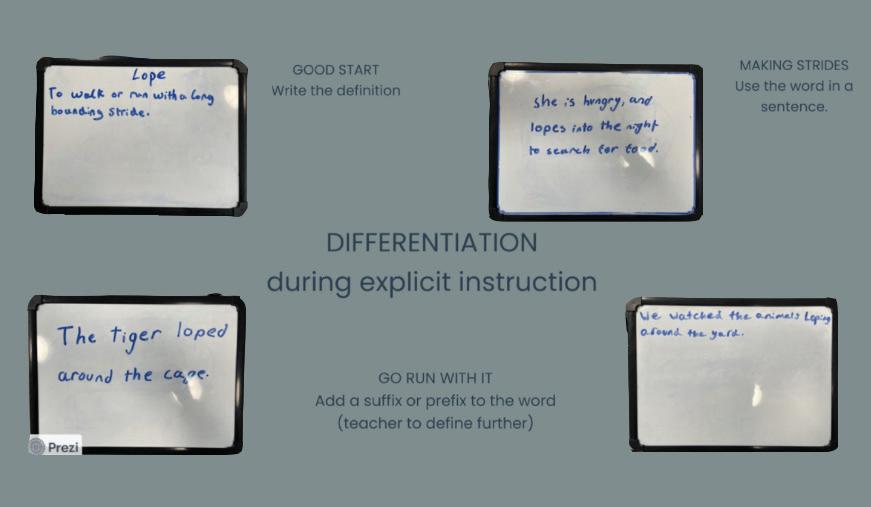
Example of a vocabulary slide to introduce a new word
Examples of differentiation in a Year 5 vocabulary lesson.
DIFFERENTIATION IN THE LANGUAGE CLASSROOM: A CHINESE TEACHING JOURNEY
By Ms Chunli Xu Chinese Teacher – Primary School
In a differentiated classroom, the teacher assumes that different learners have different needs and proactively plans to address those needs.
— Carol Ann Tomlinson
As a Chinese language teacher in the Primary School, one of the most rewarding yet challenging aspects of my teaching is navigating the wide range of language proficiencies in my classroom. Across different year levels, I teach students who have a Chinese heritage background and strong fluency in Chinese speaking and listening. These students often demonstrate natural ease with tones, pronunciation, and basic conversation. On the other hand, others are complete beginners, encountering the language for the first time. This rich linguistic diversity is one of the classroom’s greatest strengths, bringing depth and peer learning opportunities — while also being one of the greatest challenges for teaching and differentiation in the Chinese classroom. The question I often ask myself is: How do I ensure every student is engaged, challenged, and supported in their Chinese language journey?
In Term Two, I had the opportunity to attend a valuable CPL session titled ‘Differentiation in the Language Classroom,’ presented by Nabila Aliane, Director of the Alliance Française, Canberra. Nabila is an experienced language teacher. She brought a wealth of insight and purpose to the twohour session, focusing on why differentiation is essential and how we as language teachers can implement it in practical, studentcentred ways.
The workshop emphasised that differentiation isn’t just about teaching to ability — it’s about
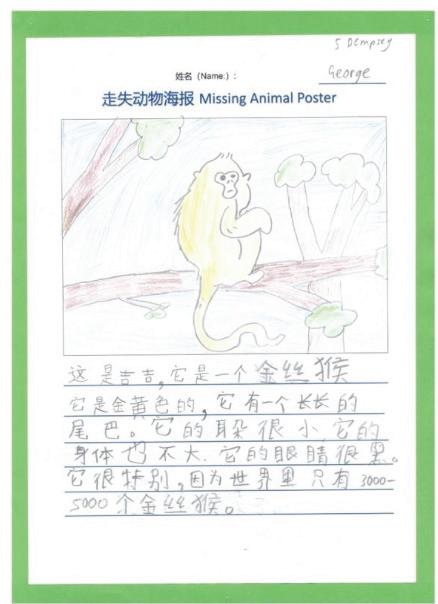
“ 这是吉吉,它是一个金丝 猴。它是金黄色的,它有一个 长长的尾巴。 ”
(This is jí jí, it is a golden snub-nosed monkey).
It is golden coloured. It has a very long tail).
A great example of descriptive sentences from a Chinese heritage student, with creative use of colour words and accurate grammar.
designing learning that respects and responds to students’ backgrounds, strengths, and readiness levels. This experience significantly impacted my approach to planning and teaching in the Chinese classroom, specifically in designing differentiated assessments.
A DIFFERENTIATED ASSESSMENT: THE ‘MISSING ZOO ANIMAL’ POSTER
After the workshop, I redesigned the Year 5 summative assessment task from a vocabulary and sentence test to creating a ‘Missing Animals Poster’:
Task Overview:
• Choose one zoo animal: real or fictional
• Design a poster as a zookeeper to describe the missing animals using Chinese vocabulary such as colour, size, and the food they eat.
How the Task Was Differentiated:
• Content
• Student choice: students selected the animal that they liked, ranging from a monkey and a lion to Kung Fu Panda.
• Advanced students had been encouraged to include adjectives and write in full sentences, such as: 我的动物叫小熊, 它是一只熊猫。它有黑色和白色的毛,眼睛周围是黑色的。
(My animal’s name is xiǎo xióng. It has black and white fur. There is black around its eyes.)
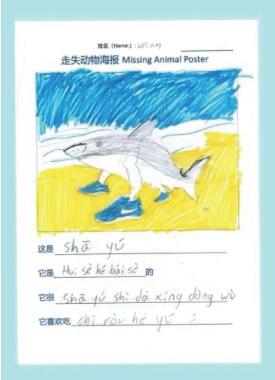
• Beginners focused on learning essential animal-related vocabulary. They were supported with vocabulary banks, sentence frames, and exemplars. For example: 这是 。它是 和 的。
(This is . It is coloured).
Process:
• Students could work with a partner or work alone.
• Students could draw their posters by hand or use their iPads to digitally design the missing zoo animals.
• Some students drafted their sentences with my help, and others used digital translation tools such as Google Translate.
Product:
• The missing animal posters ranged from colourful hand-drawn designs to digital pictures
REFLECTIONS ON STUDENT GROWTH & MY OWN LEARNING
The missing animal poster activity brought out the best in every learner and reflected the diversity in the classroom:
• One Chinese heritage student designed a detailed poster about 金丝猴(golden snub-nosed monkey), using full and descriptive sentences to describe its appearance
• One creative poster featured a “功夫熊猫”(Kung Fu Panda) who had mysteriously gone missing from the zoo. The panda’s favourite food is dumplings and soup. The full sentence is written as “它喜欢吃 饺子和汤。” (“it likes eating dumplings and soup.”) This kind of creation is exactly what inquiry-based language learning encourages in the Chinese classroom. It also demonstrated students’ understanding of Chinese vocabulary, sentence structure and their ability to apply them in creative, authentic ways.
• Some students’ missing animal was drawn by hand, while others used their iPad to digitally design their missing animal.
Overall, this differentiated assessment brought out the best in every student. Heritage students enjoyed showing off their fluency by writing detailed and descriptive full sentences. Beginning learners also felt proud and successful when they could confidently fill in the sentence frame in Chinese – and many students even went beyond their scaffolded vocabularies.
Language learning is not linear, and progress looks different for every student. What I’ve learned from the workshop is: differentiation does not mean extra planning or lower expectations. Differentiation is a philosophy. It supports student voice, agency, and choice, which align beautifully with the PYP ethos of personalising learning. It’s about how to make room for all students to succeed on their terms, whether they’re beginners or fluent speakers. I plan to offer more choice-based projects and integrate more technology to support students’ learning needs in the future to make language learning personal, purposeful, and joyful.
Left: “ 这是功夫熊猫 ” (This is King Fu Panda). This poster shows a very cool Kung Fu Panda who enjoys eating dumplings and drinking soup. This student joined CGS in Term 1 with no previous experience of learning Chinese in his previous school.
Left: Hand-drawn meerkat is as cute as the digitally designed elephant
Below: Students created their missing animals poster using Pinyin, Chinese characters and sentence starters that align with their various language abilities.
PROFESSIONAL PRACTICE
CAREERS: BEYOND SCHOOL
By Ms Carmen Love Economics Teacher – Senior School
VISIT TO UQ
The weather was glorious as always when I visited the University of Queensland’s St Lucia and Gatton campuses in May. The purpose of the visit was to have firsthand experience of the campus when speaking to students about this university as an option. I also wanted to see the facilities for their well-regarded music, veterinary and agriculture courses and to strengthen the relationship with the Future Students’ Team for assisting student applications. The Gatton campus was the highlight of the trip – a student in her last year of Veterinary Studies gave me a tour of the campus and the facilities including: the workshop where students practice all manner of medical procedures on toy and real animals, as well as their consult rooms for practicing advising and counselling clients. It was insightful to hear about the challenges of the course and the advice that having a bit of life experience and maturity before completing the degree is actually preferable.
VISIT TO ADFA
In contrast to sunny Queensland, the visit to ADFA took place on a particularly crisp Canberra morning. The purpose of this visit was also to have a firsthand experience of the campus and gain some insight into the challenges and highlights for students studying there. We spoke with current students from all three forces about their motivations to join Defence and their aspirations post study. ADFA recruitment officers shared advice for successful applications, given the process is quite rigorous and has many stages. Representatives from UNSW also detailed the support students receive to ensure their study is balanced and flexible depending on the demands of their training. As we have many students interested in Defence careers, this was an extremely useful session. And as always, the networking with other Careers Advisors in our region proved valuable, with some contacts for work experience identified, and ideas for career programme offerings being the subject of conversation.
These visits, as well as those to UC and ANU in recent times are essential to ensure the Careers Office has the most recent and relevant information to share with students both in individual meetings and through our Career’s Website. It is uncanny how often we speak to a student right after a visit and that is the particular institution they are interested in!
Funded by the Staff Professional Excellence Fund
HOW EA s IN EDUCATION MEMBERSHIP ENHANCES PROFESSIONAL GROWTH & CONNECTION
By Ms Sam Bloom
Executive Assistant to Deputy Head (Head of Primary School)
In today’s dynamic school environment, Executive Assistants (EAs) are no longer just behind-thescenes support, we are the key drivers of connection, clarity and calm within a busy and complex school environment. Our work demands adaptability, strategic thinking, and the ability to link people and processes with ease. Being part of EAs in Education has strengthened my professional practice by helping me build valuable connections, access practical tools and resources, and apply new approaches that improve how I support our team and school operations.
Through this membership, I have access to a wide range of live workshops and learning opportunities that not only support my growth but enhance the way I operate within my school community. Whether liaising with parents for Admissions Interviews, drop-in sessions or co-ordinating with staff for Professional Growth Cycle or Development Plans, the skills I have gained have helped me bring more presence, purpose, and clarity to every interaction.
One of the most significant benefits of being part of EAs in Education is the flexibility it offers. The live workshops are highly engaging, and having access to recordings allows me to revisit content at a time that suits my schedule. This is a huge advantage in the fast-paced world of school administration with conflicting priorities. This flexibility allows me to deepen my learning without disrupting my daily responsibilities.
Game changing workshops are:
• Thrive as an EA: Elevate Your Wellbeing by Aimee Presnall
• Mastering Priorities and Boundaries: The Attentional Economy By Dr Paul Teys
• Understanding Marketing in Education Leadership by Bianca Coleborn
• The Wind Under Our Wings by Dr Timothy Hawkes OAM
• AI Tools for EAs: Next Steps by Leon Furze
• Pathways to Progress: Embracing Change and The Essential Role of Career Development for Admin. Professionals by Candice Burningham
• Technology Hacks for the Senior Executive’s Office by Katie York
• Presence, Poise and Purpose – Enhancing Communication Capacity for Success in all Settings by Emma Palmer.
Participating in these professional workshops has equipped me with the tools, insights, and confidence to perform at my best, both personally and professionally. From mastering time and technology to enhancing communication, wellbeing, and strategic thinking, each session empowers me to work more efficiently and collaboratively. This initiative continues to enhance our School environment by promoting greater organisation, stronger connections, and a forward-thinking culture. It supports staff more effectively, streamlines leadership processes, and ensures our operations run with greater clarity, care and impact.
I am grateful to Canberra Grammar School for encouraging and supporting professional learning for administrative staff. By investing in resources such as EAs in Education, the School not only acknowledges the value of our role but also provides the tools to elevate our practice and compound our effectiveness.
Being part of a network that understands the unique context of education-based administration has reinforced that we are never working alone. We belong to a dynamic and growing profession that continues to shape the heart of our schools. Through shared learning, practical tools, and inspiring ideas, EAs in Education has become more than a resource, it is a professional community I am proud to be part of.
LEADERSHIP: A JOURNEY
By Ms Erum Hamza
Strategic Operations Project Manager – Whole School
Leadership. It is a word that carries weight, expectation, and responsibility. Yet, as I embarked on a leadership development journey this year through the CGS Catalyst Leadership Development Programme and my coaching sessions with Suzi Finkelstein, I found myself questioning: What does it truly mean to lead? Who is a leader? And, more importantly, what kind of leader am I, or would like to be?
This journey led to even more questions. One that I wrestled with deeply: Do I need to change who I am to become a leader? So often, leadership is associated with authority and assertiveness. But does that mean I must come across as directive? That is not me. I have always believed in the power of collaboration and humility. I have found that I can drive results while remaining true to who I am.
Yet even as I reaffirmed this belief, doubt lingered. Was I embracing authenticity, or was I simply avoiding discomfort? Did I need to push myself into a role that didn’t feel natural, or was leadership something to be defined on my own terms?
These questions led me to reflect on the leaders who have left a lasting impact on me. Those people I admire, aspire to be like, and genuinely respect. Upon reflection, I realised that only few of them held formal positions of authority, many did not: my husband, my parents, some of my colleagues, even sometimes friends. These were people who did not just point the way but led by example. In moments of need, they demonstrated wisdom, courage, or kindness.
That was the first shift in my perspective. Leadership is deeply personal. It is shaped by context, experience, and the values one holds. Even after recognising that leadership is not a checklist of traits but a lived experience, I still found myself holding more questions than answers.
It was through my coaching sessions with Suzi that I began to untangle these thoughts.
In my deeply engaging, enlightening, and transformative conversations with Suzi, I would often say something in the flow of discussion, only to realise I had just uncovered an answer I had long been seeking. Suzi did not offer me answers. She gave me something far more valuable — the space to uncover my own answers and the opportunity to reflect, refine, and reshape them.
The coaching sessions, the leadership programme, and the ongoing feedback, all felt like a mirror held up to who I am, how I lead, and how others perceive me. I knew it was contributing to my growth, but I would be lying if I said it was easy. However, I came to realise that I did not have to feel comfortable to keep going. I just had to stay open, even when it was hard, and trust that the discomfort would not last forever, but the insight I would gain from it would.
Through it all, I have also learnt to extend the same grace and compassion to myself that I so willingly offer to others. In the beginning, I would fixate on a single piece of constructive feedback and overlook the many comments that recognised my strengths and contributions. Over time, I’ve come to realise that leadership isn’t just about identifying areas for growth — it’s also about recognising where I excel, acknowledging how far I’ve come, and being kind to myself along the way.
If leadership is not a fixed set of traits but a journey of growth and continuous evolution, then I find myself still walking that path. I am still learning, still becoming. My leadership is being shaped by every conversation, every challenge, every difficult decision I make, and every moment of self-reflection.
So as I move forward, I hold onto this. Leadership is not a destination. It is a practice, a mindset, a way of being, and above all, a journey. And on this journey, I am not just a leader. I am, and always will be, a learner!
LEADING THE PRIMARY SCHOOL THROUGH A SUCCESSFUL PYP EVALUATION VISIT: A REFLECTION
By Dr Sandra Webster Deputy Head (Head of Primary School)
As the Head of Primary School, leading our School through a successful Primary Years Programme (PYP) Evaluation Visit has been a professionally rewarding experience. When I started at CGS in 2021, the Primary School had just undergone a PYP Evaluation Visit. This then provided us with a clear direction in terms of a five-year action plan to guide school development and to prepare for our next visit. It also provided us with the opportunity for a carefully thought out, paced and strategic journey that demanded foresight, teamwork, resilience, and a deep belief in the purpose behind the process.
One foundational aspect of our success lay in thorough, robust, and timely planning. From the outset, we approached the visit not as a single event to ‘get through’, but as an opportunity to reflect, refine, and grow. We worked backwards from the anticipated visit window, establishing a clear roadmap that allowed time for honest reflection, documentation, and collaborative review. This timeline was critical in managing workload and ensuring meaningful engagement, rather than rushed compliance.
Central to this process was our staff. Preparing them wasn’t about rehearsing scripted answers or checking boxes – it was about building genuine understanding and ownership of our programme. We invested in regular professional conversations around the PYP Standards and Practices, explored what they looked like in our context, and identified areas for both celebration and growth. These discussions not only deepened our team’s knowledge of the PYP framework but reinforced their collective agency in shaping our School’s learning culture.
A key tool in guiding this process was our Programme Development Plan (PDP). Far more than a compliance document, the PDP became a living framework that encouraged thoughtful professional dialogue. As a leadership team, we deliberately positioned the PDP as a shared responsibility. Staff were invited into conversations about goal setting, evidence collection, and prioritisation. This transparency led to a richer understanding of the programme’s development trajectory and prompted purposeful dialogue around teaching, learning, and leadership. The PDP helped us to stay focused and strategic, while simultaneously cultivating a reflective culture.
Buy-in from staff was essential for this process and was ultimately one of the most celebrated aspects of the Evaluation Visit. Without this, the visit becomes a hollow exercise. We were intentional in involving all stakeholders in our journey – from classroom teachers to specialist staff, learning assistants to leadershipeveryone had a voice. By fostering transparency and collaboration, the visit was no longer ‘someone else’s
responsibility’; it was a collective ‘ours’. The result was a staff who not only felt prepared, but proud to share our story with the visiting team through high level professional dialogue that demonstrated a robust, rich and deep understanding of the PYP framework.
It’s important to acknowledge that the Evaluation visit is not merely an accountability measure. When approached meaningfully, it serves as a powerful catalyst for professional growth. The lead-up provided opportunities for staff to revisit and articulate their practice, reflect on student learning, and engage more deeply with the ‘why’ behind what we do. This led to a noticeable uplift in pedagogical confidence and collective efficacy across our team. Staff began to see themselves not just as practitioners, but as reflective inquirers – modelling the attributes we seek to develop in our students.
An advantage in navigating the process was my own training as an IB Evaluator Leader and prior experience as a Council of International Schools (CIS) evaluator. Understanding the intent behind the evaluators’ questions, the structure of the visit, and the language of the IB documentation gave our School an edge. I was able to decode the visit’s rhythms, anticipate areas of focus, and support staff with insights into what evaluators truly look for – evidence of authentic implementation, contextual relevance, and reflective practice. Rather than creating or feeding into unnecessary stress or performance pressure, this clarity helped us to remain calm, open, and honest throughout the process.
The visit itself was affirming. The evaluators were professional, insightful, and approached our context with respect and curiosity. Their questions prompted meaningful dialogue, not interrogation. Their presence reaffirmed the strengths we knew we had and constructively challenged us to go further. It felt less like an inspection and more like a shared inquiry into our School’s identity, values, and aspirations.
On reflection, the PYP Evaluation visit was more than a milestone – it was a mirror. It allowed us to see the coherence and alignment in our practices, the strength of our community, and the potential we still hold. Leading through it required intentional planning, inclusive leadership, and a belief in the process as a tool for growth.
When preparing for the next visit, my advice is simple: Start early, involve everyone, and embrace the journey. With preparation grounded in purpose and a culture of collective responsibility, an Evaluation Visit becomes not just a challenge to meet – but a celebration of all that we are.
IB CAREERSRELATED PROGRAMME: LEADING THE LEARNING
By Ms Catherine Dobner Director of Academic Education – Senior School
Over four weeks, I participated in the IB Careers-related Programme (CP) Leading the Learning Category 1 course. Delivered online, the course offered a deep and practical introduction to the CP framework, with a focus on the core components:
• Personal and professional skills
• Language and cultural studies
• Community engagement
• Reflective project.
It also explored how these elements integrate with career-related studies and Diploma Programme subjects.
The course encouraged reflection on how the CP could be implemented in our School context. I developed a detailed action plan that outlines the steps needed to bring the CP to life at CGS. This includes reviewing policies, adjusting timetables, building collaborative planning structures, and ensuring students are supported through every stage of the programme.
What stood out most was the CP’s potential to offer students a meaningful and flexible pathway that connects academic learning with real-world experience. It aligns with CGS’s values and offers a new way to support student agency, engagement, and future readiness. I look forward to working with colleagues to explore how the CP can enrich our curriculum and expand opportunities for our students.
SERVICE AT CGS
By Ms Kate Smith-Loone Assistant Director of Academic Education (MYP Coordinator) – Senior School
On August 11, teachers in the Senior School attended a CPL session on MYP and service. As part of our vision at CGS to be compassionate citizens of the world, all students in the IB Middle Years Programme will be taking part in service activities of their own choosing and reflecting on them. This is an expansion of our wonderful service programme in Year 10, IB Diploma CAS and House service led by Graeme Lendrum, Fabian Lopez-Gibson, Graham Maltby and our HoSHs. Students can take part in activities beyond school or at school within their houses or by joining the Sustainability Club, Duke of Edinburgh, knitting for the Catherine Hamlin Foundation, helping coach sporting teams or taking part in the Great Book Swap, just to name a few.
Service importantly takes place in the classroom and is often embedded in our teaching and learning. Therefore, as part of our professional learning programmes, we took the time to see where we already have service embedded, either through advocacy or research. We then looked for new opportunities for us to develop authentic service within our units of work and explicitly plan them to make learning more authentic in the classroom. This has the additional benefit of developing compassionate citizens of the world and for students to see real world applications for what they are doing in the classroom.
Our House programme is a key feature of life at CGS and in our professional learning, staff were given the opportunity to learn about the types of service each house does, recognising the breadth and depth of service at school. Having a schoolwide approach and shared vision of Service at CGS is an exciting next step in our professional learning and we look forward seeing our students and staff embrace this opportunity.
THE ENVIRONMENT IS SPEAKING: RETHINKING LEARNING SPACES
By Ms Kate McCracken
Year 4 Teacher –
Primary School
The environment should act as an aquarium which reflects the ideas, ethics, attitudes, and culture of the people who live in it.
– Loris Malaguzzi
What are our learning spaces really saying to our students? Are they inviting curiosity? Encouraging independence? Whispering permission to explore and think for themselves? Or are they unintentionally saying: ‘Sit down, face the front, and wait for instruction’? These are the questions I found myself asking as I completed a unit on learning environments during my Master of Leadership and Management in Education.
Through this unit, I examined the concept of the environment as the “third teacher,” an idea originating from the Reggio Emilia approach to education. The theory suggests that the environment — alongside adults and peers — plays a powerful role in shaping how students think, feel, and behave. This resonated deeply with my own beliefs as an educator, particularly given my background in Environmental Science and my experience teaching in both traditional classrooms and bushland learning environments.
Drawing on the work of Strong-Wilson and Ellis (2007), I was challenged to consider how learning spaces are never neutral. Every choice — furniture layout, display content, lighting, access to materials — sends a message to students about what kind of learning is valued. Fraser (2012) emphasises that environments are “pedagogical statements,” while Edwards (2002) advocates for settings that are flexible, responsive, and rich in possibility. These perspectives encouraged me to reflect not just on the spaces I teach in, but on the assumptions those spaces carry.
During my time at Eltham College, we were fortunate to teach alongside an 80-acre Environmental Reserve. We didn’t just use it occasionally — it became a central feature of our inquiry programme. Students engaged in real-world learning: engineering cubbies, collecting wildlife data, and tracking seasonal change. The landscape itself became the provocation, and the students followed their own questions with genuine purpose. Our kitchen garden projects similarly became spaces of visible thinking and sustainable action — and those experiences continue to influence the way I teach.
Now, in the International Baccalaureate Primary Years Programme (PYP) context at Canberra Grammar School, I think about how we can embed those same principles within and beyond the classroom walls. A thoughtfully arranged space says: “We trust you to lead your own learning.” A quiet corner with tools for observing and recording tells students: “Your ideas matter.” A display that centres student questions — rather than pre-written outcomes — reflects the belief that inquiry is a shared journey.
Completing this unit reaffirmed for me that the physical environment has the potential to amplify — or undermine — the messages we send students through our pedagogy. At CGS, we are incredibly fortunate to have beautiful grounds and innovative learning spaces, from the Innovation Hub to open breakout areas. But the challenge (and opportunity) lies in using these spaces with intention. How can we align the messages in our environments with the school’s values of curiosity, creativity, confidence, and compassion?
This professional learning experience has shaped not only my teaching practice but also how I think about leadership. Leaders shape culture — and culture is often most powerfully felt in the smallest details: a shared space that invites collaboration, a classroom that reflects students’ identities, an outdoor learning opportunity that fosters agency.
As educators, we are constantly communicating — with our words, our actions, and yes, with our walls. The question I continue to ask is: what do I want my classroom to say?
COLLABORATIVE PATHWAYS: STRENGTHENING TRANSDISCIPLINARY CONNECTIONS IN THE PYP
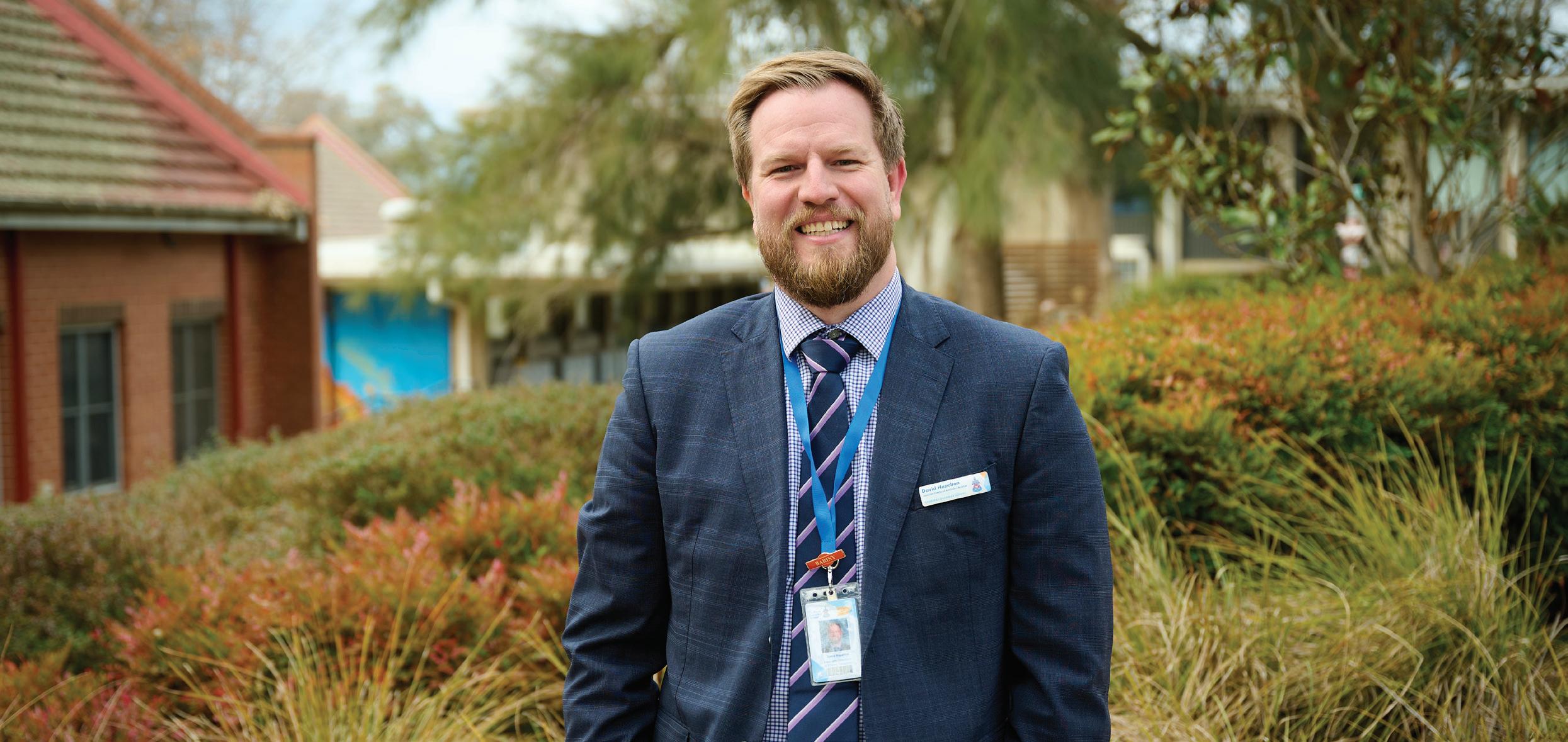
By Mr David Hazelton Associate Director of Academic Education and PYP Co-ordinator – Primary School
The completion of our Primary Years Programme (PYP) evaluation in Term 3 represented a significant milestone in our ongoing journey as a learning community. The process provided an opportunity to critically reflect on our practices, deepen collective understanding of the PYP framework, and reaffirm our commitment to concept-driven and transdisciplinary learning.
A key challenge identified in the previous evaluation was the need to strengthen collaboration in curriculum planning across different areas of the Primary School, with a focus on specialist teaching areas. This challenge was framed by long-standing critiques of PYP transdisciplinary, which argued that relying solely on central ideas to link subject areas often led to connections that were perceived as superficial or inauthentic. In response, we set out to develop structures and systems that promoted deeper collaboration and more authentic integration. In my role, I have worked closely not only with cohort teaching teams but also with specialist teachers in Visual Arts, Music, Physical Education, Chinese and Indonesian. Our shared goal was to enhance both vertical and horizontal articulation of the curriculum, ensuring that PYP learning experiences across the School supported sustained inquiry, learner agency and deep conceptual understanding.
The first step in addressing this challenge was to examine the coherence of our existing curriculum. It became evident that authentic transdisciplinary connections could be realised by deliberately embedding conceptual understanding across subject areas. To support this, all staff participated in a two-day professional learning programme focused on conceptual understanding. Building on this shared foundation, we collaboratively mapped conceptual progressions across year levels, identifying opportunities for students to revisit and extend ideas over time. Engaging with staff during the conceptual learning workshop offered valuable insights into their understanding and helped establish a shared vision for the year ahead. As a newcomer to CGS and stepping into a leadership role, this professional learning experience was pivotal in shaping my capacity to support and influence teaching teams effectively.
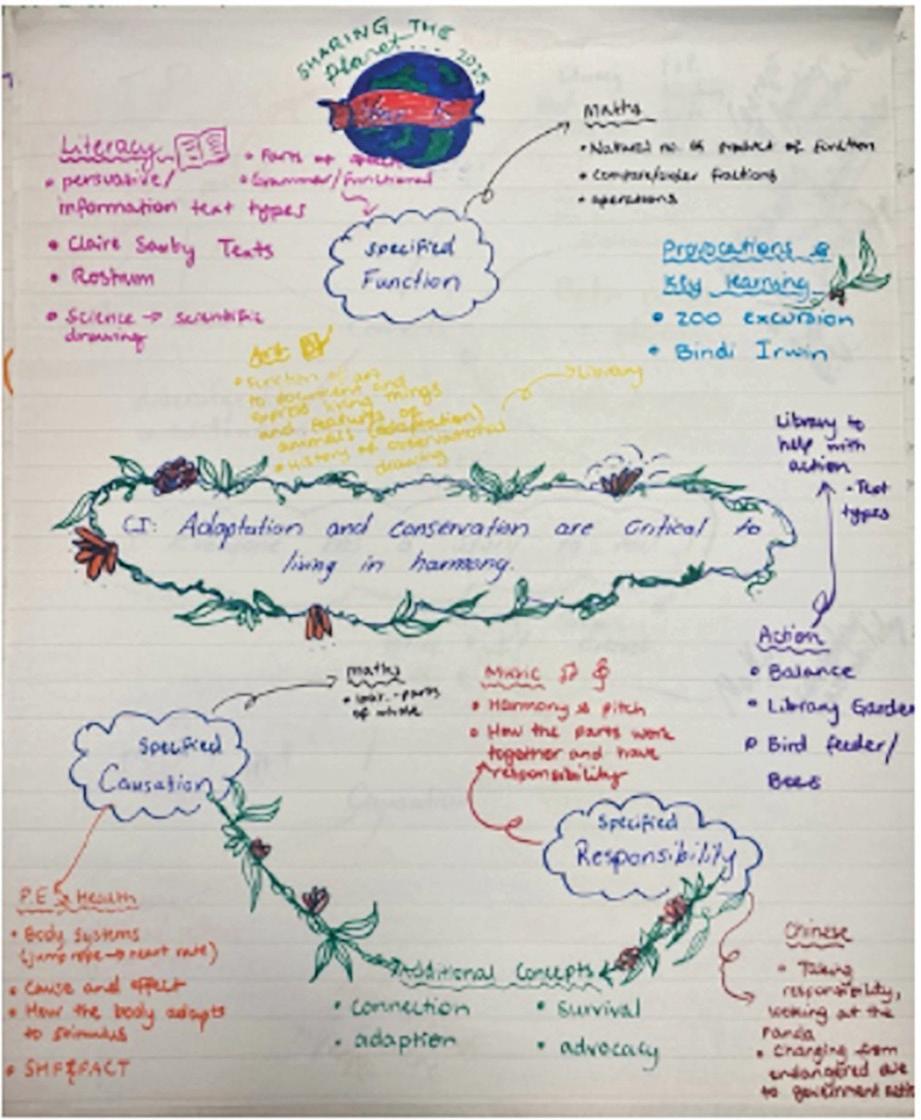
To kickstart collaborative discussions across the Primary School, we introduced 'conceptual speed dating' sessions. This professional learning involved short, focused discussions on both specified concepts from the PYP framework and additional concepts identified through inquiry. Teams worked together and with the pedagogical leadership teams to assess their upcoming units and moved through spaces, each area designed to examine their content through different conceptual lenses.
An example of this in practice is through our Year 5 Sharing the Planet unit, where specified concepts such as function, causation and responsibility established a shared conceptual language, while additional concepts, including connection, adaptation, survival and advocacy, provided subject-specific depth and authenticity. The concept of function was explored across disciplines: in Mathematics through number operations, in Science through body systems, and in Literacy through persuasive and informational texts. Causation was examined in PE and Health by investigating how the body adapts to stimuli such as changes in heart rate, and in Mathematics through fractions as parts of a whole. Responsibility was highlighted in Music through the role and interplay of harmony and pitch in creating songs, and in Chinese through inquiry into conservation, using the example of panda protection and the role of governmental action. Additional concepts deepened this inquiry further, with adaptation examined through scientific drawing and observation of animals, connection developed through shared texts in Literacy and Science, and survival and advocacy made tangible through anticipating avenues of student action. Taken together, this unit demonstrates how specified and additional concepts can operate in tandem to enable both authentic disciplinary depth and transferable understanding across subject areas. The success of the ‘conceptual speed dating’ meant that teams were starting to ask for more regular and structured times to share, something that we will look to schedule in more regularly next year.
Assessment practices were also enhanced through a masterclass led by Tania Lattanzio, which focused on designing rubrics to highlight conceptual understanding. This professional learning was encouraging, as it resonated strongly with the work already undertaken during the first half of the year. While her ideas aligned with practices we were embedding, they sharpened our collective focus on the “so what” of each Unit of Inquiry, ensuring that learning extended beyond surface connections to deeper, transferable meaning. Engaging in this workshop with a small group of staff allowed me to reflect on what is working well and determine the next steps for staff meetings and in planning sessions.
The positive feedback from the IB Evaluation team affirmed our efforts as a reflective and inclusive learning community committed to continuous improvement. By integrating specialist expertise, strengthening collaborative structures and embedding conceptual depth into planning and assessment, we have enhanced pedagogical coherence across the Primary School. These practices will continue to shape teaching and learning, ensuring that students are empowered to construct meaning, take purposeful action and thrive in an increasingly complex and interconnected world.
Although stepping into this role so close to an evaluation felt like jumping in the deep end, the genuine engagement of staff, their commitment to professional learning, and their professionalism have made a significant difference. I have felt a sense of immediate impact and have already seen encouraging growth in how our specialist teachers are connecting with cohorts. CGS has truly proven to be a dynamic and supportive environment for learning and leadership development.
EDUCATION OUTDOORS: EXPLORING THE POSSIBILITY OF A RESIDENTIAL PROGRAMME FOR CGS
By Mr Dan McNamara Head of Outdoor Education – Senior School and Mr Stuart McNeill Director of Active Education – Senior School
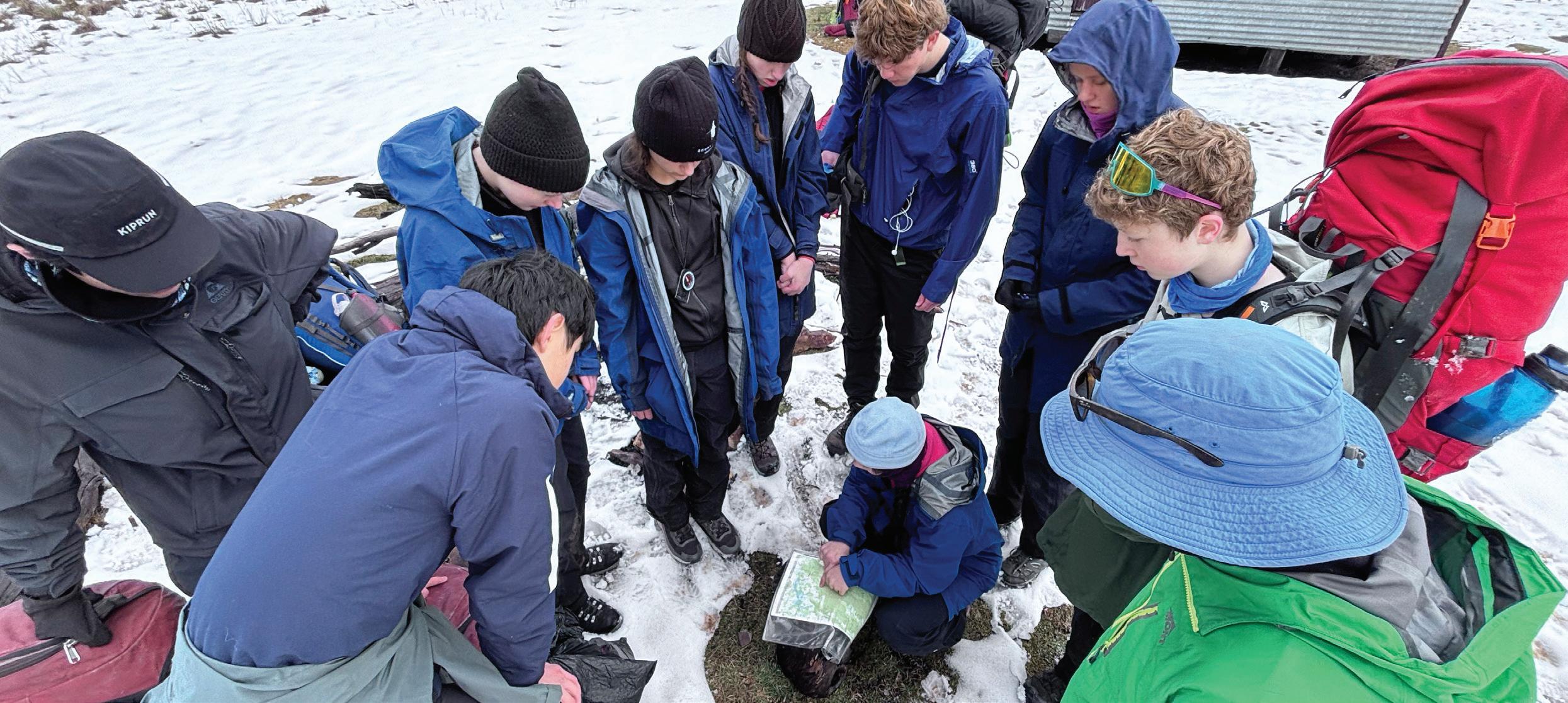
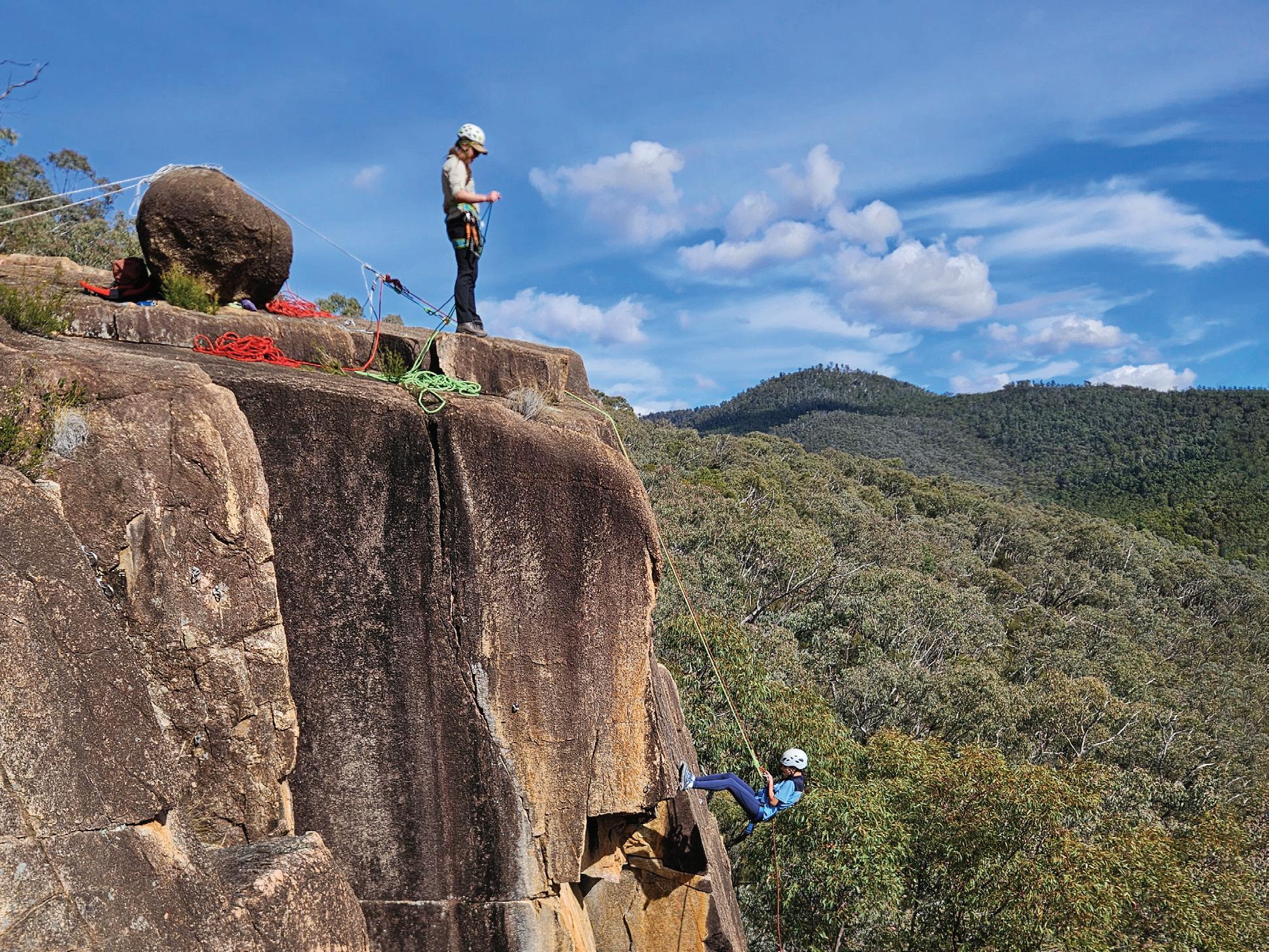
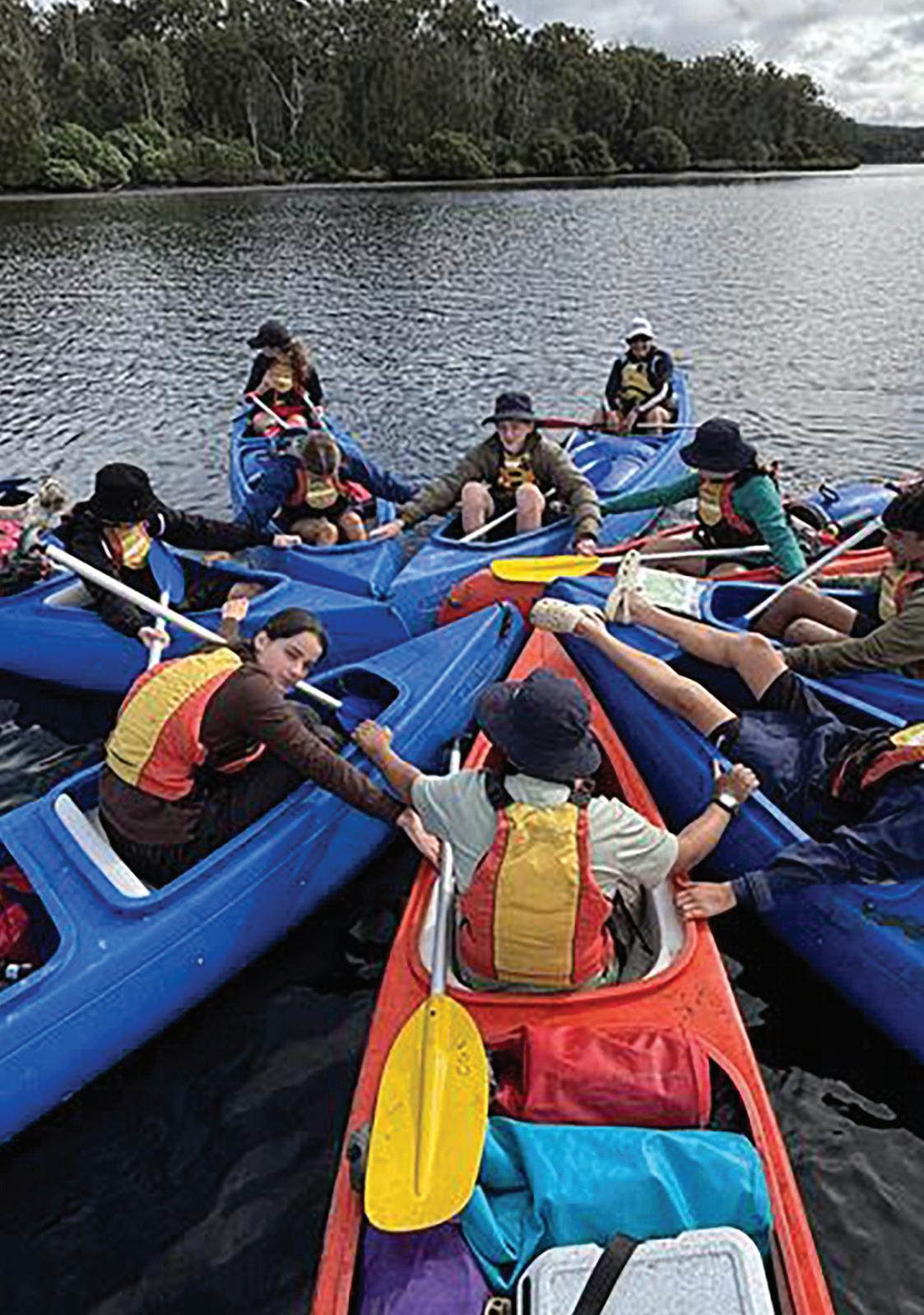
Outdoor Education at Canberra Grammar School plays a vital role in delivering the CGS100 Strategic Plan by developing well-rounded students who embody our core values. During Term 3, 2025 Dan McNamara and Stuart McNeill were tasked with conducting an action-research project to investigate other schools with residential programmes, to develop a long-term vision for a residential Outdoor Education Campus that will serve as a hub for immersive, curriculum-aligned, and values-driven experiences for CGS students.
THE WHY VISION FOR THE CANBERRA GRAMMAR SCHOOL OUTDOOR EDUCATION CENTRE
Our vision is to establish a world-class Outdoor Education Campus, allowing CGS to offer:
• A progressive, sequential K – 12 Outdoor Education curriculum
• Extended Year 9 residential immersion (4 – 8 weeks)
• Embedded service learning, cultural knowledge, and leadership development
• Authentic Indigenous partnerships, deepening understanding of Country and First Nations Perspectives
• Alignment with global models of excellence while retaining the unique CGS identity.
THE HOW OUR TARGET GROUPS
Our task was to establish contact with four Sydney schools and where possible arrange site visits. The fours schools were Trinity Grammar – Field Studies Centre, SCEGS Redlands – High Country Campus, Newington College – Eungai Creek, Pymble Ladies College – Vison Valley.
Immersion programme to encourage students to learn about themselves and those around them. Strong service element.
Programme connected to Self, Others and the Natural world … related to the seasons, Autumn, winter, spring, summer. Rite of passage/ritual theatre essential.
Experiential programme with interdisciplinary content, outdoor learning, social and emotional learning.
Through both site visits and wide reading, it was clear that it is no coincidence that Year 9 has been selected as the intentional target group for these programmes as this period of adolescence is widely reported as the lowest point of engagement in a student’s journey through school. The Residential and Outdoor Education experience is hypothesized to boost motivation and engagement and develop 21st Century skills (Mann, Gray & Truong 2023). These skills are highly sought after in the modern workforce and include cognitive skills of creative and critical thinking, and the social skills of communication and collaboration.
• Aims and objectives need to be clearly articulated and known through whole school implementation
• A well-thought-out programme enhances the point of difference and is something which the whole school can benefit from
• Property selection is crucial and is the first step prior to developing the curriculum which focuses on Place Based learning
• Consideration needs to be given to device policy and working with families off-grid
• Infrastructure design and layout is essential in helping to deliver programme outcomes
• Staffing and rostering considerations are fundamental to ensuring sustainable programmes and in encouraging staff retention
• A good programme will improve student engagement, motivation and educational outcomes
• Thought needs to be devoted to framing the start of programme and the re-integration back to a main school environment.
RECESS FOR RESILIENCE: TURNING SMALL MOMENTS INTO LIFELONG STRENGTH
By Mr Adam Hall Director of Service and Action – Primary School
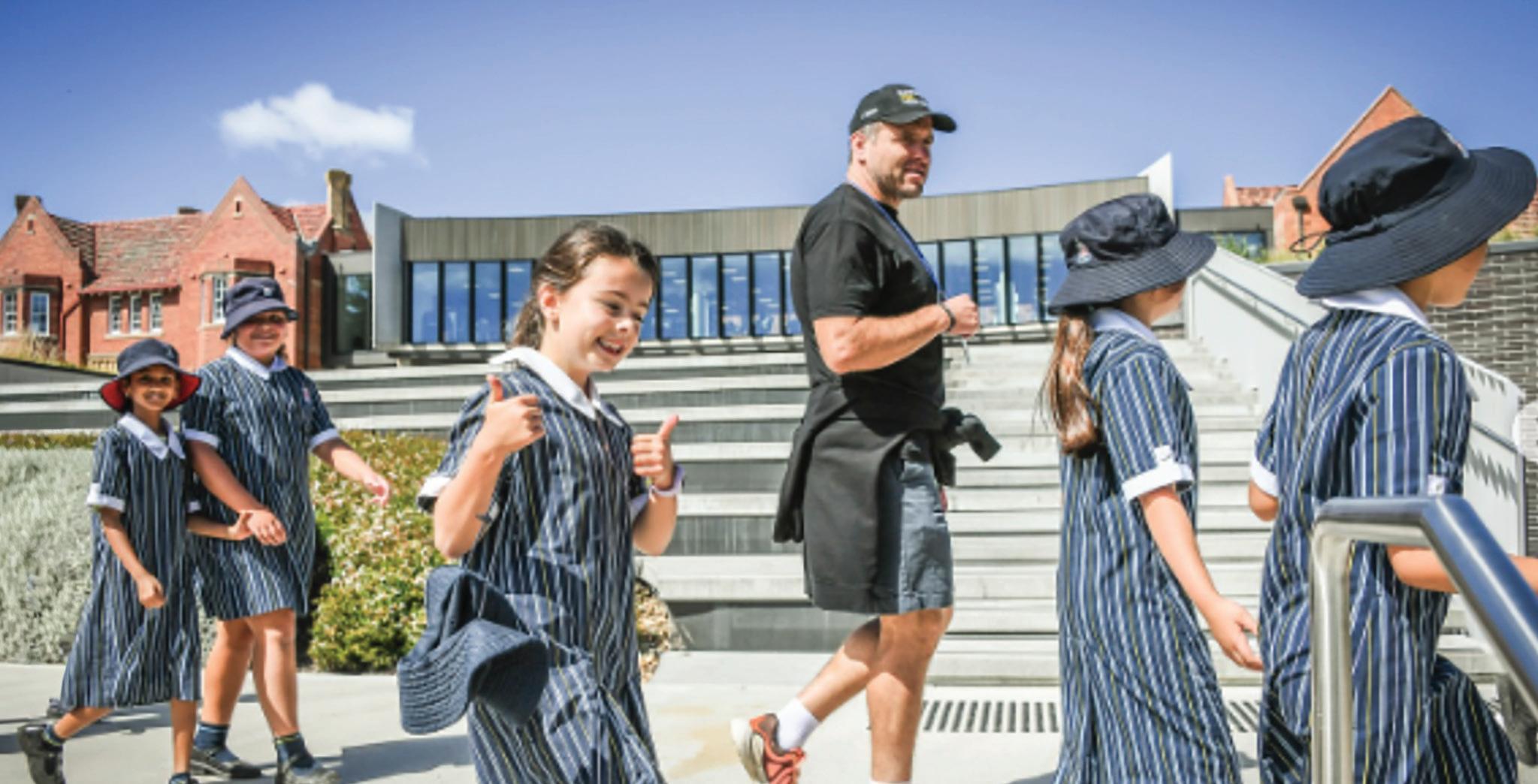
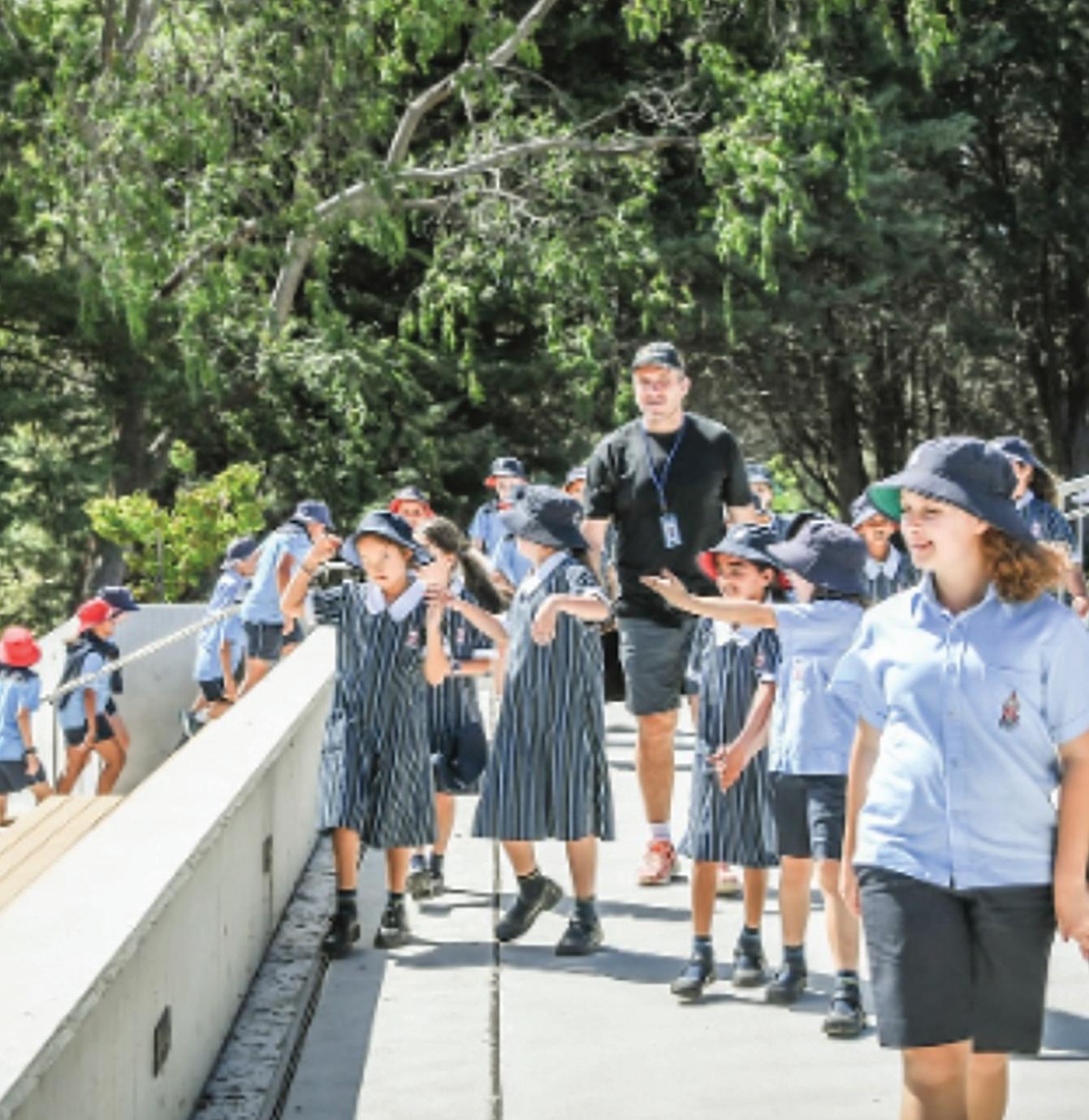
At Canberra Grammar School, we’ve discovered something powerful hiding in plain sight, the School recess break. What was once simply a pause in the day has become a purposeful ritual, a space for connection, conversation, and community building.
This is Recess for Resilience, an initiative designed to promote mental wellbeing, strengthen relationships, and get bodies moving through a simple but powerful idea, Walk, Talk, and Check-In.
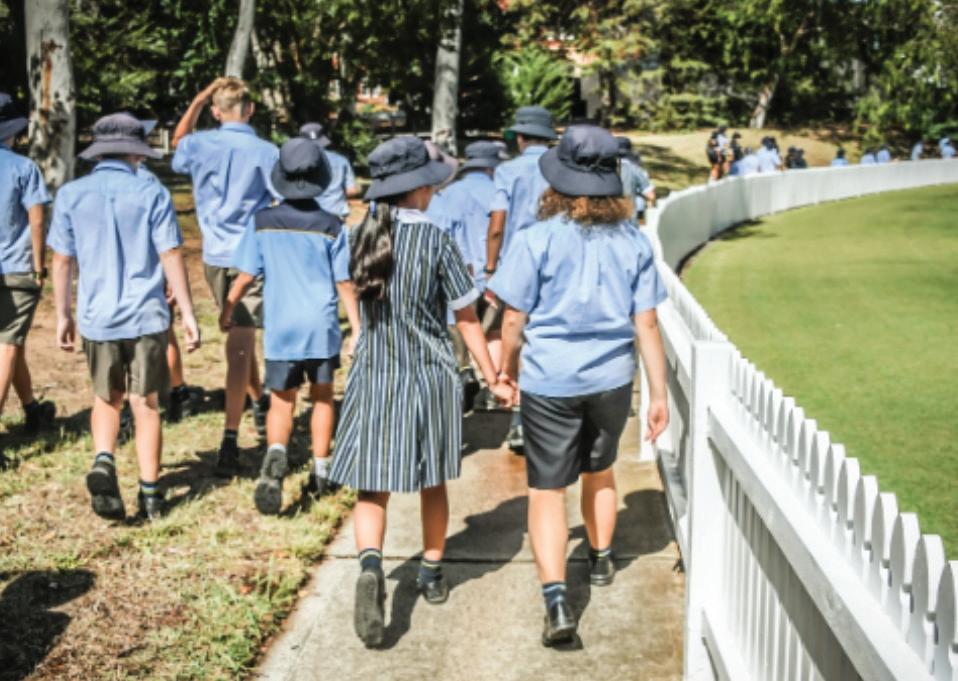
Once a week, during first break, students and staff come together for a short walk around the campus. There’s no roll call, no scoreboard, and no pressure, just an open invitation to join in. Week after week, we see strong voluntary participation from all year levels.
Born from the inspiration of Running for Resilience, an adult community running movement built on similar principles, Recess for Resilience works in partnership with it while adapting that same spirit to the schoolyard. What began as a simple wellbeing initiative at Canberra Grammar School, with a vision to create a dedicated ‘Wellbeing Path’ is now embraced in six schools across the ACT, each making it their own while holding onto the heart of the idea.
WHY IT WORKS
The genius of Recess for Resilience is in its simplicity. It’s ten minutes of walking and talking, yet it unlocks benefits far beyond the playground.
Builds Community: Students and staff from all parts of the School walk together, breaking down barriers and creating shared moments.
Supports Mental Health: Casual, friendly conversations make it easier for students to check in on each other and themselves.
Promotes Physical Activity: A 10-minute walk gets the body moving and the mind refreshed.
Creates Visibility for Support: Strategically placed staff make it clear who students can approach if they need help, a form of playground duty with deeper purpose.
Harnesses Student Energy: Students add their own touches, music, fruit stations, encouragement, turning it into a peer-driven movement of care.
THE THREE CORE IDEAS
Each Recess for Resilience Walk reinforces three principles that underpin resilience:
• Connection matters
• Conversation matters
• Movement matters
These aren’t “nice extras” they are proactive factors for mental wellbeing. Walking together builds belonging. Talking openly reduces stigma. Moving physically supports emotional regulation.
THE BIGGER PICTURE
Recess for Resilience isn’t just a school event; it’s a cultural shift. By weaving wellbeing into the rhythm of the week, it normalises talking about feelings, noticing when someone’s struggling, and celebrating the small moments that make us feel human.
WHY WE DO THIS – THE SCIENCE BEHIND IT
• Connection reduces mental ill-health risks
• Regular movement regulates mood, focus, and energy
• Nature improves resilience and emotional wellbeing
• Check-ins reduce stigma and increase help-seeking
• Rewind / Do Over: What would you change about this week? Why?
• 1–5 Scale: “How are you feeling today?” Follow up with “Why that number?”
• Encourage sharing: Model openness — talking about struggles and successes builds trust.
KEYS TO SUCCESS
• Consistency: Start every walk with a 10-second reminder of why we’re here.
• No Pressure: Attendance is optional, but presence is powerful.
• Student Leadership: Let House or School Captains lead, ownership boosts engagement.
• Parent Involvement: Encourage families to try it at home.
THE HEART OF IT ALL
Recess for Resilience isn’t about ticking boxes or launching flashy initiatives. It’s about the quiet power of habit. These shared walks, honest conversations, and gentle check-ins aren’t just making recess better, they’re helping to build stronger, safer, more compassionate communities.
Year 5 Student feedback:
“It’s not just walking, it’s like practising how to be a good friend. We talk, we listen, and we notice how people are really going.” Another added, “Every week we get better at checking in. It’s like building a muscle for kindness.” A third summed it up simply: “I like that we can just walk and chat. You learn how to ask how someone’s going and really mean it.”
And really, that’s the goal. To make mental wellbeing as everyday as eating lunch or tying our shoes.
Because resilience is not built in the extraordinary moments, it’s built in the recesses.
GRAMMAR MATTERS WORKSHOP
By Ms Sophie Lerat Head of Languages and Acquisition – Senior School
With literacy as one of the Senior School priorities this year, it was important for me to refresh my grammar knowledge. In the Language Acquisition department, our goal is to map out our explicit teaching of it, and it was crucial to get my metalanguage right.
This workshop was a self-paced online opportunity to do so, prior to delivering an internal CPL on parsing. It is very well structured, focusing on the nine main parts of speech or word classes. Each module defines a category and guides the learner through many examples.
As it is intended for teachers in Australia, it refers to the Australian Curriculum and provides examples of activities that could be implemented in class. I particularly liked how it occasionally compares English to other languages, explaining why non-native speakers of English tend to make certain common mistakes.
For example, in English, object pronouns follow the verb — I like apples – I like them —but in many other languages (including French), the pronoun comes before the verb — j’aime les pommes – je les aime. Another example: in some languages, he and she are not distinct, so even though it is impossible to know all languages, being aware that these differences exist is powerful when addressing literacy.
Similarly, the workshop highlights common mistakes made by English speakers and explains them through a grammar lens, such as saying Sophie and myself went to the shops instead of Sophie and I.
As a language teacher, my grammar knowledge was already quite extensive, but the clear organisation and delivery of this course was nevertheless valuable. I would encourage any teacher, regardless of subject area, to register — after all, we are all English users. We are lifelong learners, and we need to equip ourselves to better facilitate learning in our classrooms and ultimately improve our students’ literacy.
FROM HESITATION TO SATISFACTION: MY EXPERIENCED TEACHER ACCREDITATION JOURNEY
By Ms Tina Tang Chinese Teacher – Senior School
When I was a student teacher back in 2015, I remember being introduced to the newly endorsed Australian Professional Standards for Teachers. Flipping through the thick AITSL documents, I couldn’t help but wonder — how many trees must be sacrificed just to define a teacher’s role? Fast forward to this year, I finally took the plunge and began my Experienced Teacher accreditation. At first, I was motivated by the idea of having a certificate that said “Experienced” or the new term, “Accomplished” — and, perhaps, the thrill of a challenge. Now, six months later, after a journey filled with highs and lows, I’m proud to say: I made it. Just in time. As I soak in the satisfaction of finally being ‘accomplished,’ I want to share my experience with colleagues — especially those at the start of their teaching careers who might feel overwhelmed or sceptical about whether the process is worth it. To them, I say: it absolutely is. Just do it.
What surprised me most was how much I enjoyed the reflection process. It became an opportunity to look at my teaching practice holistically: from educational theory to programme design, student surveys to exam data analysis, classroom management to parent communication. What began as an “evidence folder” gradually became a portfolio of my best work. Writing the annotations made me realise what drives my daily practice. I even began to appreciate the Standard descriptors more, reading them again and again, connecting them to my teaching. It gave me a deeper appreciation for the diverse nature of our profession.
So many colleagues had said to me, “This is the best place to do your accreditation — we have so much support!” And they were right. I am incredibly grateful to Ms Ann Hamer, my outstanding accreditation supervisor, for her wisdom and guidance. I also owe thanks to my Head of Department, Sophie Lerat, for her encouragement, and to our amazing administration assistant Josie for her help with booking (and rebooking!) all my meetings.
Every fortnight, I met with Ann to review my work and clarify the descriptors. The AISNSW online resources were also a fantastic support — clear, accessible, and practical. I was also fortunate to have many senior school colleagues who had already completed the Experienced Teacher accreditation. They were genuinely happy to see me take on this journey and always welcomed my questions, offering encouragement and support.
In the end, what made this journey truly rewarding was witnessing my own growth. I found myself becoming more confident, more reflective, and more assured in my teaching identity. As the Chinese saying goes, “学海无涯” (xué hǎi wú yá) — “The ocean of learning is boundless.”
As teachers, we are constantly learning — about pedagogy, literacy strategies, student wellbeing, and school-related regulations. Teacher accreditation offers us a unique opportunity to pause, reflect, and refocus on the heart of our profession: teaching itself. I encourage anyone considering accreditation to embrace it as a learning journey.
READING INSTRUCTION IN THE YEAR 1 CLASSROOM
By Mr Toby Armstrong Teacher – Primary School
Mr Armstrong, will Tina be helping us with reading today?
— Year 1 student
Without context, you might assume that Tina is one of our wonderful learning assistants. Whilst she’s not on the payroll, she definitely helps 1A with their learning, and although she tends to rush and has some work to do on her Tricky Words, we’re always glad for her visits. Tina is, in fact, a Guginyal (Kookaburra) puppet, who has become a central part of 1A’s reading lessons.
Tina, along with Denise (Buru/Kangaroo, likes yoga and sleeping), have both been more fully integrated into shared reading as part of my professional goal of becoming more systematic in Literacy instruction this year. I have been able to achieve this in part as a result of some short, practical training offered by The Literacy Place and facilitated through the School’s CPL process. I engaged in that training during Term 1, having signed up for three self-paced online courses to hone my skills in handwriting instruction, guided reading and shared reading.
My goal was to provide a richer Literacy programme each week, including modelled, guided, shared and independent reading sessions, alongside daily explicit phonics lessons. I was also keen to be more systematic in handwriting instruction, in response to identified needs within the current Year 1 cohort. I had a reasonable level of confidence in my literacy skills prior to starting the training: we were in good routines with our InitiaLit lessons, writing was going well, and the children were enjoying daily modelled reading during fruit break. But I had been finding it difficult to schedule the range of reading lessons required for a deep and broad programme which connected to our Units of Inquiry and would meet the needs of all learners.
Some of the strategies provided by The Literacy Place met exactly those needs. The training provided a simple means of structuring reading lessons across each week, offered resources to guide teaching, and gave me a framework with which to build a more engaging, talk-rich approach. The actionable nature of those strategies meant that I could put many of them in place straight away, and the results have been exciting to watch.
One example is 1A’s eager participation in shared reading four times a week: each week we build confidence through repeated reading of a picture book, discuss our prior knowledge and context, have fun making predictions and jump between modelled and choral reading. The children also work to build self-monitoring skills, discuss and retell texts with talking partners, make links with the spelling and grammar concepts we have learned in InitiaLit and, most importantly, have fun with stories. By Friday, we are ready to play drama games to aid comprehension, such as hot seating, making tableaux of our favourite pages and creating conscience alleys.
Guided reading and handwriting lessons have also been areas of growth for me. Whilst I already had a firm grounding in how to manage those processes, The Literacy Place’s training gave me a more structured, evidence-based means of delivering efficient, successful lessons. In addition, prioritising my skills in Literacy teaching encouraged a more systematic approach to scheduling those lessons, preparing texts and materials effectively, and managing classroom processes. The children know what to expect in those lessons, and as they have grown in confidence an independence, my teaching has become more targeted and effective.
So where do Tina and Denise fit? They provide the children with a means of identifying and fixing common reading errors. When Tina comes to read a page from that week’s text, she makes mistakes which mirror those of the children, like misreading long vowel sounds or missing a suffix. The children are excited to help, telling her when to stop, conferring with their talking partners and then offering Tina a ‘fix-up strategy’ from a range of previously taught options. By deferring those errors onto a puppet, we now have a means of teaching self-monitoring and the metalanguage of reading. But critically for me, we also have a familiar, fun addition to our lessons, one which reminds me of the magic that children find in reading and stories.
Now that we are working more systematically to combine explicit instruction, repetition, practice and enjoyment, the children’s reading is really taking off. The results of our work are evident in their independent reading, as well as the links they are making between home and school. Towards the end of Term 2, one little boy who has experienced significant challenges with reading approached me, excited to tell me that his mum had ordered several of our shared reading texts for home. Not only was he taking his knowledge of reading home with him, but he was also excited to engage with those texts again and to share them with his parents. Tina would be proud!
AUSTRALIAN BOARDING SCHOOLS ASSOCIATION (ABSA) TAKING THE REINS CONFERENCE
By Mr Tom Leddy PDHPE Teacher, Boys Boarding House Supervisor – Senior School
Earlier this year I had the opportunity to participate in the Australian Boarding Schools Association (ABSA) Taking the Reins Conference held at Bond University. The ABSA conference focusses on leadership in boarding particularly aimed at staff transitioning into new boarding roles.
The Taking the Reins Conference is a two-day programme held in the Gold Coast that provided me with opportunities to learn, develop and share with like-minded individuals. I was particularly interested in networking with other boarding staff taking on new leadership roles.
This is a professional learning and networking conference shared with those in similar situations and gives participants practical skills and a strong understanding of the challenge of taking on a new leadership role in boarding.
Throughout the conference, we heard from boarding staff and headmasters from across the country about their boarding experiences. They shared stories and advice on how to build support systems with colleagues. They provided insights into practical solutions to managing challenging situations, stepping into new leadership roles and how to best support staff, parents, and students in boarding.
The conference was a great professional development experience to enhance my leadership skillset as I stepped into the Assistant Head of Boys Boarding role last term. One of the themes that was reinforced throughout was the importance of continuing to develop strong relationships and creating a safe and supportive environment for all students to excel. It was identified that by focusing on creating a nurturing environment that promotes emotional resilience, mental health and a sense of belonging provides students with an opportunity to thrive. A highlight for me was the opportunity to network with likeminded individuals to share real world examples and learn from one another’s solutions and leadership styles.
Learnings from the conference have supported me to understand how I can carry my skills in pastoral care leadership into the unique boarding context. As someone who has been involved with pastoral care of our students for several years, starting my role as the Assistant Head of Boys Boarding is an exciting opportunity. Looking forward we must embrace change, innovate and prioritise holistic development for the students under our care. Professional development opportunities like this allow for continued growth and support for staff within our community and I strongly encourage anyone interested to get involved.
DEVELOPING CGS CARE EDUCATORS THROUGH TRAINEESHIPS
By Ms Tanya Alcorn Director of CGS Care – Primary School
Fostering a highly skilled workforce is a key commitment at CGS Care. We believe traineeships play an important role in strengthening the out of school hours sector. As the sector continue to grow, traineeships play a crucial role in developing a skilled workforce to meet the increasing demands. The ongoing supply of highly skilled, capable employees is imperative to ensure that the sector continues to thrive.
Traineeships provide the steppingstone for educators to gain valuable experience while working towards a recognised qualification in Early Childhood Education and Care. This approach allows us to maintain consistent educators for the children, fostering authentic relationships and creating opportunities to nurture young minds. It also offers a rewarding career path filled with creativity and, personal growth and meaningful connections with children, families and the school community.
Educators who are being trained on the job are learning firsthand how they can grow, shine and provide exceptional education for the children in our care. It also provides an improved understanding of theory through practical application.
Having trainees in our services has provided a career path in Education and Care. Starting with a Certificate III, educators can progress to a Diploma and then continue onto a teaching degree, with each stage building on the last to support their journey in education.
CGS Care over the past few years has had staff that began with their Certificate III and Diploma as traineeships and are now either in Associate Director positions or classroom teachers.
Currently CGS Care have 4 educators who are studying their Certificate III and another studying their Diploma in Early Childhood Education and Care. Having a few trainees has boosted morale among the team and has created a supportive work environment where they can assist each other on their journey.
Studying my certificate 3 has greatly improved my growth potential at CGS and inspired me to pursue childcare more thoroughly alongside my regular tertiary education. As well as being another qualification, it has also provided me with training directly relevant to my role to make a better educator. Also, because it was important to me and the service to promote professional development to ensure educators are providing the best possible and most up to date care for the children we look after.
– Emma Heldon Certificate III Trainee
To have a more In-depth understanding of the National quality framework. To be qualified to work across age groups from the ELC and from K-6. I would like to be more qualified to increase my skills and knowledge and progress further in a career in Education and Care. I would like to pursue my Diploma once completing my certificate to enhance my career path at CGS.
– Vanessa Turner Certificate III Trainee
Studying my Cert III has been an incredible experience, as I have been able to apply its teachings to environments that go beyond the CGS environment. It has allowed me to further understand my motivations and the way I approach being a childcare educator, ultimately fostering strong development in these areas. I am grateful for the lessons my Cert III has taught me thus far and look forward to everything else the qualification has to offer.
– Ruby Casey Certificate III Trainee
I decided to do a traineeship because it’s an opportunity to take the next step in my career, helping me grow in confidence and competence. I wanted to gain hands on experience and build practical skills while learning on the job. I’m eager to apply what I’ve learned in a real work environment and continue to develop professionally. My role at work allows me to contribute to the team while also learning from experienced colleagues.
– Safa Ibrahim Diploma Trainee
BRIGHTPATH LEAD MARKER NARRATIVE: HOW WE ASSESS TEXT SAMPLES
By Ms Kathy Johnston
Year
4 Teacher
– Primary
School
At the end of 2024, Kate Harvey-Sutton suggested I take a look at the Brightpath Progress. In Year 4 we were keen to explore ways to not only teach writing more effectively in a differentiated classroom, but to then moderate the writing so we could better assess our students’ efforts. Specifically, we were looking for data that could help inform our practice. Brightpath with its focus on formative assessment using calibrated exemplars, emphasis on teacher judgement – I will address this later – and clear student feedback seemed like the perfect fit.
So, Term 2 this year we decided to really give it a go. As part of our narrative writing focus, we decided to set the students a formative assessment writing session each week over 6 weeks. This turned out to be slightly ambitious, however, we did achieve 3 focused formative writing assessments in this time. Right from the first experience I could see that this was going to be a powerful addition to our practice. Once the students had written their piece in response to the set prompt, we were able to use the ‘Assisted Marking’ to evaluate their writing. From here a number that equates to an exemplar on the ‘Brightpath Ruler’ is given and this in turn is linked to a clear report that outlines what the students can currently do and what they need to do in order to improve. In 4J I printed out the student report for each child for them to see. I then did an individual conference with them where we read their story together editing and talking about what they had written. We used the report to identify what they can already do in their writing, and to look at what they could do to improve. I then asked the children to select 3 or 4 of the suggested improvements to be their writing focus for the week.
Over the course of the three formative assessments every child in my class improved in their ‘score’ by an average of 100 points. Wow! I wanted to know more. So when I saw the opportunity to attend an in-person course to become a lead marker for narrative writing I was excited to attend.
A NOTE ABOUT BRIGHTPATH PROGRESS
Source: BRIGHTPATH.COM.AU/ABOUT-RESEARCH/
To arrive at their Brightpath ruler, researchers at The University of Western Australia supported by grants from the Australia Research Council have worked for decades to create this framework. It is based on a two-stage method of assessment.
Stage 1 involves using pairwise comparisons to construct a scale by calibrating exemplars (student writing samples) of student performances on an open-ended assessment task. Sets of exemplars are then selected as anchor points on a scale, which is referred to as the Teacher’s Ruler.
Stage 2 includes making assessments by judging where performances sit on the scale constructed in stage one. Teachers assess their students’ work by judging which of the calibrated performance a student’s work is most alike.
Source: BRIGHTPATH.COM.AU/ABOUT-RESEARCH/
THE COURSE
The course was designed to empower us as educators to trust our judgement as professionals. The day was fast paced and full. The presenter, Evelyn Temmen, knowledgeable and patient. The company diverse and eager. It truly was a wonderful experience. “The aim when assessing work in relation to the Brightpath Ruler is to use your informed professional judgement and make an on-balance judgement about each piece of writing.”
To help us build the confidence to do so we were lead through a process to assess several exemplars. The most important take aways were:
1. Always read the student’s work out loud. It was amazing how much this actually impacted my understanding of their writing. I know I do this when I am editing and checking my own writing, and I have always encouraged students to do this too, but to see it as a vital first step in an assessment marking was noteworthy.
2. Authorial choices: audience, text structures, ideas, character and setting and vocabulary are of greater importance than writing conventions. Evelyn led us through an in depth exploration of each of these different authorial choices. Each choice was unpacked and then using the first exemplar we were asked to use our professional judgement to place the exemplar on the Brightpath Ruler.
A NOTE ABOUT PROFESSIONAL JUDGEMENT
Evelyn strongly encouraged us to use our professional judgement throughout the course. Each time we were asked to make an assessment it was fascinating that out of the 20 people attending, our assessments were within 20 points of each other. Evelyn pointed out that 20 points is actually the allowable error. When questioned about this, Evelyn sited several studies that found a high level of consistency in teacher judgements. This improved even further with experienced markers. After attending the course, I looked further into the research by reading the sited papers found here. From my small sample of the course attendees and with my reading I am comfortable accepting this understanding.
At the end of the course and to attain our Lead Marker certification every participant is to take part in a reliability study. This study requires us to score 25 narrative performances. They will then analyse the data to examine inter-marker reliability, and they will provide us with feedback about how our scores compare the average markers’ scores.
CONVENTIONS OF WRITING
From Authorial choices we moved to Conventions of Writing
• Cohesion: We want ideas to flow and link. Does the text flow or is it necessary to re-read to gain meaning? Contributing factors for cohesion includes grammatical factors, maintaining tense, maintaining narrative stance, connectives, conjunctions, articles.
• Paragraphing: An important element in cohesion. The inclusion of paragraph breaks and the selection of connectives and linking words assist in maintaining the flow of a text.
• Lexical: Word associations. Students select vocabulary best suited to their writing. This may include grouping words together, repeated words for effect.
• Sentence Structure: What type of sentences are the students using? Is the writer maintaining tense within a sentence? Look for subject/verb agreement, missing words, correct use of modals etc.
• Punctuation: The purpose of punctuation is to make the meaning of the text clear and to assist the reader in accessing the writing. Punctuation can be read in to assess sentences but cannot be read out. This links to the read the students work out loud initial point.
• Spelling: Words are classified as; simple, common, difficult and challenging.
Again, we were asked to score the exemplars with reference to their use of the conventions of writing. Again, our judgements were very close.
Finally, we were asked to bring it all together by scoring the exemplars, looking at both the authorial choices and the conventions of writing. This time there were some varying opinions involving two pieces. Some had the pieces the other way round on the Brightpath Ruler. This created a lively and interesting conversation about subjectivity and connection to the writing. When we looked closely however, even though we had a disagreement on the position in the progression, they were still scored within 40 points of each other on the Brightpath ruler.
USING THE RULER TIPS
• Read the whole text aloud and decide which exemplar on the ruler is most like the one you have.
• Bear in mind that no two performances will be identical and that you must make an on-balance judgement.
• Getting to know the exemplars is important, however, teacher only need to know about five exemplars common to their year level well.
ASSISTED MARKING
Brightpath also has an AI assisted marking option for teachers to use. This is what we have been using in Year 4. Evelyn said that this was a useful tool and a good starting point for teachers. She pointed out that the Assisted marking tended to put more emphasis on the conventions of writing over the authorial choices and for this reason it was important for teachers to evaluate each writing sample themselves to ensure the assessment is as accurate as possible.
In conclusion, I had a wonderful day engaged in spirited discussion and deep learning. I am more convinced than ever that Brightpath Progress is an excellent fit in my search to provide data informed differentiated teaching for my students. As a formative tool for writing, it is indeed powerful. As an assessment too to inform teaching and learning programmes it is equally useful. I left the course eager to continue on my Brightpath journey.
Now, sitting here back at school, although I do feel more empowered to accurately assess my student’s writing, I must admit to feeling a little apprehensive about completing the reliability study – wish me luck!
Funded by the Staff Professional Excellence Fund
SEEING, LISTENING, LEADING: A JOURNEY THROUGH THE RITES OF PASSAGE FRAMEWORK
By Mr Dan Wetherall Associate Director of Students – Primary School and Mr Adam Hall Director of Action and Service
– Primary School
At Canberra Grammar School, we speak often of holistic education, of nurturing not just the academic, but the emotional, social, and spiritual growth of our students. Recently, we had the privilege of participating in a transformative professional development experience that brought this philosophy into sharp focus: the Rites of Passage Leadership Training, led by Dr Arne Rubenstein and his team at the Rites of Passage Institute.
Nestled in the misty hills of Mullumbimby, the setting for the Rites of Passage Leadership Training was nothing short of idyllic. A perpetually lit fire pit served as the heart of the gathering space, radiating warmth and symbolism. We slept in dorm-style tents, shared nourishing meals from a communal kitchen, and found peace in the embrace of nature. The environment invited reflection, connection, and presence. A space where participants were challenged to ‘drop in’ and as best they could, forget the distractions of the outside world and home. Surrounded by a diverse group of inspiring individuals, the stage was set for something truly transformative.
This training was far more than a professional course. It was a deeply personal journey one that challenged us to reflect on our own relationships, leadership styles, and the way we, as educators, support our students through the key transitions in their lives.
The Rites of Passage Framework is grounded in the understanding that human development is marked by significant transitions, moments that, when guided with care and intention, can shape identity, build resilience, and foster a deep sense of belonging. The training equipped us with tools to design and facilitate these experiences in a way that is emotionally safe, inclusive, and culturally responsive.
Over three immersive days, we joined thirty plus participants from diverse backgrounds, including educators from around the world, to explore what it truly means to lead young people through meaningful change. We didn’t just learn about the framework, we lived it. Through storytelling, ritual theatre, personal challenges, and shared vulnerability, we experienced the very essence of what we hope to offer our students: authentic connection, community, and growth.
FROM INSIGHT TO ACTION AT CGS
The insights gained from this training are already shaping our work in the Primary School. Programmes like TRIBE, SQUAD, and Recess for Resilience are being enriched with new strategies that deepen emotional literacy, foster peer connection, and empower students to navigate their own transitions with confidence.
Facilitating Meaningful Check-Ins: We’re embedding structured, emotionally safe check-ins that allow students to express themselves authentically. The term ‘Golden Check-in’ is being used within our staff and coming into our classrooms to build meaningful connection. Our students are learning to ask each other “What is going on for you today?”, as well as practising the skill of listening.
• Designing Thoughtful Challenges: Activities are being refined to promote growth while ensuring psychological safety, especially in camps and leadership programmes.
• Using Empowering Language: We’re modelling language that honours and uplifts, reinforcing a culture of mutual respect across our School community.
We are mapping out how these principles can be embedded across our programmes, with the support of our broader school community.
Perhaps the most profound takeaway from this experience is the reminder that to truly lead, we must first be willing to see and listen to our students, our colleagues, and ourselves. The training reminded us that leadership is not about control, but about creating space. Space for growth, for challenge, for connection and transition.
On the final evening of the course, each participant completed a personal challenge in front of the group. It was humbling, inspiring, and emblematic of the journey we had taken together. It was a rare and powerful experience to witness and share genuine vulnerability within a group of people who had only just met yet had already built a remarkable level of trust that made such openness possible. It reminded us that transformation is not a solo act: It is a communal one. It was clear that throughout the history of Rites of Passage, the transformation was not the act of an individual but rather the culmination of work from a community.
A heartfelt thank you to Dr Arne Rubenstein for his leadership, wisdom, and generosity in guiding this experience. His work through the Rites of Passage Institute has created a powerful framework that is already making a meaningful difference in the lives of our students and staff.
As we continue to evolve our approach to student wellbeing and leadership at CGS, the Rites of Passage Framework offers a powerful lens through which to view our work. It challenges us to be intentional, to honour the transitions our students face, and to create experiences that are not only educational, but truly transformative.
This was not just professional development, it was a call to lead with heart, to teach with presence, and to build a school culture where every student feels seen, heard, and empowered to grow.
Funded by the Staff Professional Excellence Fund
PROFESSIONAL ENGAGEMENT
MEN AND MASCULINITIES IN TRANSITION
By Mr Andrew Jones ADT Teacher – Senior School
As part of my ongoing PhD studies at the University of Southern Queensland, and with the kind support of Canberra Grammar School, I was able to attend and present my research at the Nordic conference on masculinity research at Stockholm University, Sweden, 11–13 June 2025. The conference was hosted by the Department of Child and Youth Studies and the Gender Academy at Stockholm University, in collaboration with the Nordic Association for Research on Men and Masculinity (NORMAS). The aim of the conference was to create a space for Nordic and international dialogue on contemporary masculinity research. The conference theme was Men and Masculinities in Transition, focusing on men, masculinity and transitions in a wider sense, including transitions across the life course, climate change, green transitions, transitions to more caring and inclusive masculinities, transitions across gender identities, theoretical and methodological transitions in research focussing on men and masculinities, as well as other social, political and personal transitions relevant to masculinity studies.
Keynote speakers were varied across the themes and included Steven Roberts, Professor at Monash University, Australia, who spoke on the nature of education contexts for Australian boys in schools and outlined the challenges we face here in our schools. Valerie Sperling, Clark University, USA, spoke on world politics and masculinities, focussing on current conflicts, Russian politics, revolution and political violence. This keynote was then followed by Maria Eriksson Baaz, Professor of Political Science, specializing in International Politics at the Department of Government, Uppsala University, speaking on ideology and conflict within recent world events.
Ulf Mellström, Professor in Gender Studies from Karlstad University, provided a theoretical lens on framing current masculinity theories, while Todd W. Reeser, Associate Dean for Faculty Affairs, Professor of Gender, Sexuality, and Women’s Studies, outlined his research on theoretical and interdisciplinary approaches to masculinity issues and gender.
I presented my research on the first day of the conference, along with other Australian academics who spoke on topics of navigating masculinities and social change in single-sex boys’ schools, and how to improve school-based mental health education for boys. My own paper was well received and contributed to the afternoon’s discussion on masculinities in the context of education, where I was able to answer questions within the debate and was offered other viewpoints from other academics on how to frame aspects of my own research.
Following the presentations, I was able to make connections with other academics and attend presentations of other research papers that looked at other topics including gender equity, queer theory, traditional masculine corporate structures, trans identities and other intersections of politics, class, race and religion.
My own paper was titled Blurred Lines: Negotiating Masculinities in the Art Classroom, a Critique of Male Artist/Teacher Identities in Flux. I outlined my own research examining our understanding of the connection between a male art teacher’s pedagogy, their identity and notions of compulsive gendered performance within the workplace. My paper posed questions to a society divided by identity politics, and the ramifications of male teachers facilitating a curriculum to young people that produces and critiques artworks with intense depictions of identity, culture, power and gender. I outlined how art classes can be embedded with culturally learned meanings and structures, and with power relations that influence the production of and response to such images. My research paper explored how this positioning is filled with ambiguity and tensions within the teacher and artist identity, and is also challenged within hegemonic school structures, along with gender equity values centred on men teaching art in schools. My presentation reflected current thinking on the nature of visual arts education and possible ramifications for males within the profession when centred on the influence of the human body within the canon of Western art, its gendered power imbalances, and ongoing contexts in relation to social justice awareness and a post-#MeToo context. I posited that my work may possibly highlight further understanding into the relationship between ‘teacher’ and ‘artist’ identities, as well as highlight resilience and positive strategies for men working in the teaching profession.
The final goal of this research is to seek further insight into the morals, ethics and routines of school life, and opportunities to critique gender roles in the classroom, and to make the art classroom a place of equity and learning for everyone.
Attending this conference enabled me to represent Canberra Grammar School and the University of Southern Queensland within the international arena of current masculinity research. It enabled me to connect with other Australian academics who are working towards a common understanding of framing masculinities and making more nuanced analyses of improving outcomes for boys, as well as engaging in discussion with leaders in the field who are working towards building a more equitable society for all. The Nordic Association for Research on Men and Masculinity is a world leader in framing these complex issues and exploring research that may enable change to affect greater gender equity. Events such as this not only share emerging knowledge and research but also challenge their audience to find ways towards a more just world and enable more opportunities for male identities to be understood beyond the restrictive and narrow versions of male behaviours. This event has enabled my ongoing studies to progress with feedback from international leaders in the field, along with more nuanced research that focusses on meeting the needs of students in relation to masculinities in the classroom and wellbeing contexts.
BUNDANON
Ms Jessica Dabro
Acting Head of Primary Art/Art Teacher –Primary School (Red Hill and Northside)
Last year, I attended a professional development course at Bundanon, just outside of Nowra on the Shoalhaven River. Bundanon is a gallery, museum, and education centre set within a protected wildlife sanctuary on over 1,000 hectares of bushland. The property was gifted to the Australian people in 1993 by Arthur and Yvonne Boyd, with the aim of supporting artists, educators, and the broader community to engage with both the arts and the natural environment.
As a visual art teacher, I had several reasons for attending: to reconnect with my own creative practice, to visit this historic and culturally important site, to be inspired by the landscape, and to consider new ways of linking the environment, culture, and interdisciplinary thinking into the art classroom.
The experience offered a mix of structured and open-ended opportunities. On arrival, we were taken on a guided tour of the property and introduced to the architectural design of both the original homesteads and the newer buildings — including The Bridge, the award-winning accommodation centre. Designed with sustainability in mind, The Bridge and the Boyd Education Centre reflect Arthur Boyd’s en plein air painting practice and allow you to experience the changing climate of the Shoalhaven landscape — waking with filtered light, listening to the sounds of nature, and enjoying views from open-air breezeways.
In the afternoon, we broke into groups for outdoor creative sessions — drawing, painting, and making in response to the landscape. These sessions reinforced the benefits of slowing down, observing with all five senses, and responding directly to place. It was a reminder of how meaningful outdoor artmaking can be, especially when linked to student wellbeing, sustainability, and personal connection to land.
That evening, we came together for a shared meal of seasonal, locally sourced food. It was a chance to meet other educators, creatives and people working across education, the arts, and environmental fields.
The next day started with sunrise yoga overlooking the river. Throughout the day we explored the gallery, listened to artist talks, and took a guided tour of the historic Boyd homestead. A standout was the touring exhibition by Australian Indonesian artist Jumaadi, which opened conversations around identity, cultural storytelling, and the different ways artists explore themes of belonging.
PROFESSIONAL REFLECTIONS
Seeing such a wide range of work — from traditional to experimental — reminded me how important it is to give students opportunities to learn foundational skills while also encouraging risk-taking and conceptual thinking.
The cross-disciplinary nature of Bundanon — blending art, science, history, and Aboriginal culture — also made me consider the potential for more integrated learning in the primary years. It prompted me to think about how we can build stronger links between subjects, and how the art room can continue to be a place for exploring real-world issues in creative and critical ways.
NEXT STEPS
Since returning, I’ve started to think about how I can embed more of these approaches into my own practice. This might include:
• More opportunities for outdoor artmaking
• Units that more clearly link to First Nations perspectives and sustainability
• Exploring local environments as inspiration and inquiry
• Using collaborative, cross-curricular tasks to broaden student engagement and connection to place.
The experience highlighted the role of art not just as a subject, but as a way of learning, questioning, and making sense of the world — and how important it is to share that with our students.
OUR HUMANITY, CONNECTED: THE IB CONFERENCE, SINGAPORE
By Ms Ann Hamer Director of Teaching Development
–
Senior School and Ms Ailsa Mackerras
Assistant Director of Teaching Development
–
Senior School
The IB conference in Singapore was focused around the theme of ‘Our Humanity, Connected’ and the conference proved to be an interesting place where Asian and Pacific countries came together to connect, celebrate and interrogate the International Baccalaureate. The focus on humanity came through several of the keynote speakers. Dr Darnell Fine was an excellent presenter who explored how he had been marginalised as a child and how he had made it his mission to make his students feel both seen and valued. He explored the idea of human connection and how we create this through story telling. As Chimamanda Ngozi Adichie says,
The single story creates stereotypes, and the problem with stereotypes is not that they are untrue, but that they are incomplete. They make one story become the only story.
Dr Fine then questioned how international the IB was as the key educationalists and influencers have all been older, white, males. If it is narrated through a Western lens, then how does the rest of the world feature in the IB? These challenging questions framed the conference and the conversations which ensued.
The second keynote speaker was Dr Sandra Milligan from Melbourne University. She focused her comments on how we measure student performance around key competencies in a way that supports learners. To be able to gather evidence about complex performance and then rate this on a scale of competence with a degree of confidence and be able to tell students their strengths and weaknesses, was the aim of her research. She has been working with schools to find ways of assessing and reporting key competencies students require to be successful, such as agency in their learning. For her, our humanity lies in the way we assess and record achievements of the competencies children need to thrive.
The second keynote speaker was Dr Sandra Milligan from Melbourne University. She focused her comments on how we measure student performance around key competencies in a way that supports learners. To be able to gather evidence about complex performance and then rate this on a scale of competence with a degree of confidence and be able to tell students their strengths and weaknesses, was the aim of her research. She has been working with schools to find ways of assessing and reporting key competencies students require to be successful, such as agency in their learning. For her, our humanity lies in the way we assess and record achievements of the competencies children need to thrive.
Finally, the third keynote speaker was Mr Andreas Schleicher, Director at the OECD. His presentation focused on data from across many countries and key trends. It is fascinating to see how one country, such as Singapore can have very high academic performance, but be much lower in promoting resilience in students. Whereas a country like Peru can have low academic performance but be building very resilient students. Students in Denmark seemed to come out the winners in all categories, performing highly, having a good school/leisure balance and being resilient, as well as being open to diversity, being psychologically well and feeling a sense of agency. Although connected, we are all achieving different outcomes in our respective cultures. He continued to explore data around the role technology and the worsening trends in mathematics as more time is spent on digital devices, the role of AI and the role of professional development in schools. It was a wide reaching and challenging presentation about what the future holds for students and teachers across the globe, in a time where there is greater polarisation.
In addition to the keynote speeches, there were many significant and engaging workshops. There were lots of references to the Careers Pathway (CP) as an alternative to the DP, how we test our curriculum for diversity, the effect of AI, as well as a session on reading and the effect of the digital world on young readers of today.
A full-day workshop on how teachers can utilise AI and support students in their use of AI was practical and thought-provoking. The facilitator consciously embedded the IB’s position on AI use across the workshop and supported participants to experiment with tools in an ethical and transparent way. Approaches to developing rigorous policies and protocols around AI use were covered and participants left with a huge range of practical resources.
Learning from teachers at other IB schools was a valuable opportunity at the conference. The impact of transdisciplinary learning was emphasised in a workshop focusing on how one school introduced a Year 10 collaborative research project. Students were able to learn about a transdisciplinary topic of interest, moving through an inquiry cycle to then present to the teachers and peers. The project emphasised the value of curiosity and allowed students to develop self-regulation and collaboration skills.
The conference also invited participants to learn about the direction of research conducted by the IB. Researchers from the IB summarised current projects, such as those related to diversity and inclusion, student wellbeing, and competencies of the future. In a session on research into wellbeing, the relationship between teacher wellbeing and student wellbeing and performance was explored and teachers were invited to engage in the IB’s micro credentialing to further learn about the research and how to apply it in their context.
In conclusion, the IB conference in Singapore successfully highlighted the interconnectedness of our humanity through a series of thought-provoking keynote speeches and engaging workshops. The diverse perspectives of Dr Darnell Fine, Dr Sandra Milligan, and Mr Andreas Schleicher underscored the importance of inclusivity, comprehensive assessment, and resilience in education. The conference not only provided valuable insights into the current state and future of the IB but also fostered a collaborative environment where educators could share best practices and innovative ideas. As we move forward, the lessons learned from this conference will undoubtedly shape the way we approach education, ensuring that it remains a powerful tool for connecting and uplifting communities across the globe.
FOSTERING SHARED UNDERSTANDING: DEEPENING CONCEPTUAL LEARNING IN THE PRIMARY SCHOOL
Ms Lucy Garven Deputy Head of Primary School, Director of Academic Education and PYP Co-ordinator – Primary School
STARTING THE YEAR WITH PURPOSE
The new school year began with a unified vision, bringing together class teachers, specialist educators, and the leadership team for a dynamic two-day professional learning workshop. This experience strengthened professional connections and established a shared language and collective goal for the year ahead.
Led by experienced IB workshop facilitators, the sessions explored the principles of conceptual learning, moving beyond surface-level knowledge to help students make enduring, transdisciplinary connections.
WHY CONCEPTUAL LEARNING MATTERS
Conceptual learning empowers students to transfer understanding across contexts, think critically and creatively, and engage with the “big ideas” that underpin curriculum content. Through reflective discussions, staff examined how skill acquisition and conceptual understanding intersect and are both essential components of inquiry-based learning.
A key focus was the balance between explicit skill instruction and fostering conceptual depth. Teachers explored how targeted skill development can unlock deeper understanding and support students in navigating complex concepts.
A COLLECTIVE APPROACH
A shared goal across the Primary School created coherence and purpose. Staff collaborated to align planning and connect units across year levels and subjects, fostering creativity and responsiveness. This collective responsibility, supported by a common professional language, is strengthening student understanding and engagement.
KEY TAKEAWAYS FROM THE WORKSHOP
The workshop reinforced the importance of designing learning experiences that lead to enduring understandings with ideas that transcend facts and assist students to make sense of the world. Teachers mapped out specified and related concepts to support knowledge transfer and meaning-making over time.
By connecting new learning to prior knowledge, teachers can scaffold student thinking, promote access and challenge, and encourage deeper inquiry. Differentiation strategies were embedded throughout planning to ensure all learners, regardless of readiness, interest, or ability, could engage meaningfully and connect with Units.
Conceptual learning fosters independent thinking and abstract understanding through authentic tasks, provocations, and reflective practices. Planning for students to analyse, apply, and transfer their learning remains a central aspiration.
LOOKING AHEAD
Throughout the year, teacher practice has continued to evolve through shared specialist planning, conceptual “speed dating” sessions, anchor meetings, collaborative discussions, independent reading, and reflection. The IB PYP Evaluation process has further supported and deepened this growth. Intentional professional engagement and collaboration have cultivated a rigorous and connected learning culture that focusses on student growth and the development of enduring understanding.
POWERFUL PARTNERSHIPS
By Ms Lucy Bourke Kindergarten Teacher – Primary School
As a second-year teacher, navigating the numerous challenges of the role can be both demanding and rewarding. A key obstacle involves managing the complexities of classroom dynamics while setting clear expectations and cultivating strong, professional relationships with students and their families. At the outset of my teaching career, my primary focus was on delivering timely feedback to students, fostering clear and effective communication — including managing challenging conversations with parents — and cultivating a supportive professional network by surrounding myself with positive, collaborative colleagues. Attending the ‘Powerful Partnerships’ workshop was able to provide me with guidance and approaches, gaining valuable insights that have helped me manage these responsibilities more effectively.
VALUABLE & TIMELY FEEDBACK
Providing valuable and timely feedback to students was a key professional goal I set for myself, recognising it is a critical role in supporting student growth and learning. Powerful Partnerships provided valuable skills and guidance on how to deliver feedback that is specific, constructive, and actionable. For instance, engaging intensively with a designated group daily during Literacy or Mathematics instruction, meticulously observing their responses, and delivering prompt feedback to ensure its effectiveness and comprehension.
I now understand the importance of addressing students’ strengths while clearly identifying areas for improvement, all communicated in a way that motivates and encourages continued effort. By prioritising prompt feedback, I can help students stay engaged and make meaningful progress, fostering a more effective and supportive classroom environment.
CHALLENGING CONVERSATIONS
Dealing with difficult conversations with parents can be challenging, but the guidance from Powerful Partnerships has been invaluable in helping me approach these situations effectively. They emphasise the importance of empathy — truly understanding parents’ concerns and feelings — which helps build trust and openness. Staying calm throughout the conversation is key to preventing emotions from escalating and keeping the focus on the student’s best interests. Additionally, maintaining professionalism by using clear, respectful language ensures that the discussion remains constructive, and solutions oriented. Thanks to this guidance, I feel more confident navigating tough conversations with parents in a way that fosters collaboration and support.
THE MARIGOLD EFFECT
To grow professionally and stay motivated, I aim to surround myself with colleagues who inspire me through their dedication, creativity, and willingness to collaborate. Building strong relationships with such peers creates a supportive environment where I can learn, share ideas, and continuously strive to be a better educator. I have been lucky enough to work with encouraging, supporting, and nurturing teachers, who inspire me each day to strive for excellence, foster a positive learning environment, and continuously grow both personally and professionally.
I highly recommend completing the Powerful Partnerships workshop for early career teachers. This programme provided valuable guidance by addressing common uncertainties and offered a supportive environment to openly express the challenges faced as a new educator. It reinforced that feelings of uncertainty are shared by many and reassured me that I am making meaningful progress, with continuous growth ahead.
78th MIDWEST CLINIC
By Mr Chris Retter Coordinator of Woodwind, Brass and Percussion – Senior School
Attending the 78th Midwest Clinic in Chicago was an incredibly enriching professional development experience that deepened my understanding of music education, leadership, and student engagement. Over five days, I had the privilege of learning from world-class educators, conductors, and researchers through a range of thought-provoking sessions. From Dr Tim Lautzenheiser’s reflections on building meaningful relationships in the classroom, to Tobin Stewart’s exploration of leadership and self-awareness, each session offered valuable strategies and mindsets that I’ve already begun applying in my own teaching. A key takeaway was the quote from Timothy Keller: “Humility is not thinking more of myself or less of myself; it is thinking of myself less.” This reinforced the idea that effective leadership is about serving students, not seeking validation.
Sessions on student retention, wellbeing, and motivation were particularly impactful. A standout metaphor — “Be a gardener” — emphasised the importance of nurturing students and programme culture rather than focusing solely on outcomes. Through presenters like Phillip Hash and Eric Rath, I gained strategies for reducing burnout, enhancing student motivation, and addressing attrition with empathy and purpose. Some of the most memorable points included using gratitude practices, limiting digital overwhelm, and prioritising connection with students both musically and personally. I was especially inspired by Dr Carter Briggers’ creative application of Ted Lasso’s optimism to the classroom, reframing failure as a “First Attempt in Learning.”
Conducting-specific sessions, such as those led by Emily Threinen and Dr Joel Schut, offered rich insights into the emotional and technical artistry of leading an ensemble. Ms Threinen’s emphasis on “starting the music, not the ensemble” and Dr Schut’s diagnostic listening framework have both challenged and expanded how I approach rehearsal and gesture. These perspectives reinforced the idea that great conducting is rooted in communication, presence, and intentional listening. I’ve also been exploring new ideas from sessions on electroacoustic music, data-informed programme development, and online learning tools — some of which I’ve already begun incorporating into my Year 7 classes this Semester. One of Dr Schut’s essential takeaways was, “The fastest way to grow is facing a weakness head-on,” emphasising setting clear listening challenges as an effective way to quickly enhance conductor and ensemble growth.
Beyond the sessions, I had the privilege of attending several phenomenal performances, with the Inagakuen Sogo High School Wind Orchestra standing out as one of the most inspiring concerts I’ve ever witnessed. Their musicality, precision, and commitment set a benchmark for excellence that I’ll carry with me into my future teaching.
The Midwest Clinic provided invaluable insights and inspiration that will directly influence my teaching and conducting practices. Having documented key takeaways from all the sessions I attended, I feel well-equipped to apply these learnings in my work with students and ensembles. The clinic reinforced my commitment to fostering a dynamic, student-centred music programme that emphasises artistic growth, leadership, and engagement. I am deeply grateful for the opportunity to have attended, and I look forward to further developing these ideas in my teaching practice.
TEACHING LEARNING FOR UNDERSTANDING BY PROJECT ZERO: A RESEARCH CENTRE AT THE HARVARD SCHOOL OF EDUCATION
By Ms Angella Hopkins, Ms Emma Finucan, Mr Matt Gover, Ms Safia Saboor & Ms Emily Ireland
English Department, Science Department and Mathematics Department
– Senior School
A team of five teachers were lucky enough to join educators from around the world to participate in a semester long course offered by Project Zero, a research centre at the Harvard School of Education. We met fortnightly over a period of 14 weeks to discuss readings and our learning progress. We contributed to online forums both as a team and as individuals.
Teaching Learning for Understanding was a rigorous interrogation of what we do to equip our students with the knowledge, skills and dispositions they need to be citizens of an ever-changing world. We can no longer predict the world they will enter and so the reliance on knowledge dissemination is no longer enough. The important question of ‘what is life-worthy learning? ’ provided the underlying principle in our study.
The set text, Future Wise by David N. Perkins (available in our school library) accompanied our deep dive into the challenges of Teaching Learning for Understanding.
We wondered how students authentically apply knowledge through the notion of life-worthy learning. We grappled with how to shift our perspective of assessment to performances of understanding and the translation of this into designing learning experiences that encourage students to think beyond our classroom. We confronted our practice to consider if we are providing meaningful feedback that helps students deepen their life-worthy learning rather than just correcting their mistakes in the moment.
The most significant learning from this course was understanding that true education goes beyond content delivery — it is about creating meaningful connections between learning and life application. We discovered that performances of understanding are not just assessment tools, but powerful learning experiences that ‘teach for learning’. The concept of ‘life-worthiness’ particularly resonates with our team, challenging us to constantly evaluate whether what we are teaching will genuinely benefit our students beyond the classroom walls.
What do you want your students to do to build and demonstrate their understanding toward life worthiness? Are the Understanding Performances …
Thoughtful
Visible
Sequential
Purposeful
• actions that are accompanied by thinking abilities and dispositions?
• rich and varied activities that go beyond knowledge?
• asking students to use their knowledge in new contexts and in different ways?
• requiring students to make their thinking visible for themselves and for others?
• allowing students to be actively engaged with what they are doing in an observable way?
• designed in a way that students reach understanding, building on what they know and taking into consideration their ideas and their questions?
• organised as exploratory performances, guided inquiry, and culminating performances?
• contributing to develop understanding of the Understanding Goals and the Generative Topic?
• explicitly helping students understand why they are doing what they are doing?
Each team member created a ‘project’ using the principles of Learning for Understanding. We devised a generative topic, not unlike the key question of an IB classroom, to drive our projects. In brief, the projects we at CGS designed are listed in the following page.
We are incredibly grateful for this opportunity as it was an enriching and refreshing opportunity to evaluate and grow as educators. Harvard provided the platform for teachers around the world to collaborate and realise that we share a common language despite our different countries and educational jurisdictions. We hope that Harvard remains a bastion of intellectual and critical thought in the political climate it exists within so that others may also be gifted this experience.
Generative Topic: Perspective influences the way we tell stories. “What story do you prefer?” – a study of ‘voice’ in Life of P i.
There are multiple ‘voices’ in Life of Pi; the author – director Ang Le, the narrator - writer who acts as the frame and recounts story, the narrator adult Pi, the character - child Pi. Each ‘voice’ offers a perspective and a bias through storytelling. The fourth voice is the reader, the students’ voice where they consider which story they prefer and the implication of perspective on meaning.
– Angella Hopkins
Generative Topic: Exploring Relationships; Friendships, Family, and Love
Exploring Shakespeare’s texts is important to the development of critical thinking and understanding in English students. Engaging in the love of literature - which is often associated with Shakespeare’s writing - enhances student experience in this subject. Rather than simply engaging in understanding literature, the focus of the unit is placed on exploring and understanding relationships. This is something that many, if not all, Year 9 students are engaging with in personal and school lives. Exploring relationships, from friendships, family, romantic, and enemies; students can take learning outside of the classroom and into the world with them.
– Emma Finucan
Generative Topic: Unlocking Alchemy. How can coal become diamond but not gold? How is knowledge of elements used across industry; cooking, pharmacy, jewellers.
Students are interested in the application of chemistry and how identical chemical formulae can have drastically different appearances. By linking in industries of cooking, pharmacy and jewellery, an otherwise complex topic, students will go home and talk to family to make connections as they are making dinner; ‘life-worthy’ learning.
– Matt Gover
Generative Topic: Measurement and Geometry in construction and design. How do we measure the lengths of objects that are immeasurable or difficult to measure?
Learners explore how different 2D and 3D shapes are used in architecture for specific functional and aesthetic reasons. They consider how the structure and stability of buildings are influenced by geometric design. Students will see how their understanding of area, perimeter, surface area, volume, trigonometry and Pythagoras’ theorem becomes ‘life worthy’ as they understand the structures of large buildings, how they were constructed and how we can use different tools to measure their heights.
– Safia Saboor
Generative Topic: Mathematical Mastery: Unlocking the Power of Algebra and Exponents
The generative topic is important as it is crucial for future students’ understanding and future learning in mathematics, engaging by connecting to real-world applications, accessible by breaking down complex concepts into manageable parts, and connectable by linking mathematics to other subjects such as science and technology, and to practical scenarios outside of school.
– Emily Ireland
JIM KNIGHT INSTRUCTIONAL COACHING ROADSHOW
Ms Kate Harvey-Sutton
Director of Teaching Development – Primary School
Ms Lindsay Reid
Economics Teacher – Senior School
Mr Luke Mildren
Mathematics Teacher – Senior School
Attending the Instructional Coaching Roadshow presented by renowned author Dr Jim Knight, along with Senior School colleagues provided a unique opportunity for us to connect and engage in a shared learning experience. This two-day event, centred on the ‘Seven Success Factors for Instructional Coaching,’ based on the ‘Impact Cycle, a three-stage process designed to help instructional coaches collaborate with teachers to set that goals that align with classroom needs. The Roadshow offered invaluable insights into creating effective coaching programmes that enhance teaching and learning.
The first day focused on the ‘Who I Am’ component of coaching practice, emphasising the importance of partnership, communication, and leadership. Dr Knight highlighted the complexities of working with adults and the necessity of effective communication strategies. This session underscored the significance of understanding our own identities and biases to foster positive coaching relationships.
On the second day, the emphasis shifted to the ‘What I Do’ aspect, where we explored practical strategies for effective coaching. This included utilising an effective coaching cycle, mastering teaching practices, gathering and using data efficiently, and demonstrating leadership. These strategies provided actionable tools to implement in our daily coaching practices.
Dr Knight’s presentation style was a blend of experienced storytelling, references to authors and researchers in the field, as well as a touch of humour. This approach not only conveyed the depth of his expertise but also made the sessions engaging and relatable for us all.
Engaging with educators from such a broad range of educational backgrounds during the event allowed us to reflect and engage in valuable discussions about best practices and common challenges. These interactions underscored the universal nature of teaching, and the shared commitment we all have to student success.
Returning to school, we feel inspired to apply the concepts learned, including utilising the Impact Cycle whilst utilising opportunities to use video and checklist strategies to continue to promote a coaching culture that prioritises collaboration, reflection, and growth. The Roadshow reaffirmed our belief in the power of instructional coaching as a catalyst for positive change in education and are excited to continue to build a partnership approach at CGS.
Some key takeaways included:
Data makes the invisible visible
Coaches bring hope
Coaches are a second set of eyes and a second set of hands
Coaching provides freedom within form
Real change does not happen right away
POWERFUL PARTNERSHIPS AS AN EARLY CAREER TEACHER AT CGS
By Ms Jaliah Carlyle-Harris Teacher – Primary School
Community, Collaboration and Confidence - the ‘Cs’ that both define and reflect my experience as a Graduate Teacher at Canberra Grammar School.
It is both an honour and a privilege to have the opportunity to begin my teaching career at CGS. I was, and continue to be, inspired by the commitment and care that is integral to the teaching profession and the life of our School. I was motivated to join the community of teaching and learning at CGS because it was evident through my time in various roles - visiting prior to employment, as a learning assistant completing my degree, as a preservice teacher on placement, and finally through my initial 6 months as a new graduate teacher - that this is a place that both facilitates, prioritises and is built on these two founding concepts. Being a part of the CGS community has illuminated core personal and professional values through a process of reflection, review and refinement.
Teaching at CGS has been one of the most fulfilling and enriching opportunities for both my personal and professional growth. Through collegial and collaborative networks, I have been supported to challenge myself, develop my understandings of the world around me - and my place in it; seek and fulfil learning and development avenues and continuously self-reflect on my personal practice - and the impact thereof.
A concept that I continuously reflect on is that of trust - reciprocal professional trust. I put trust into the School, its guiding leadership, principles and priorities to support and enrich my ‘firsts’ as a teacher.
I have been met with a strong return of this trust, through the parents, students, colleagues and leadership interactions across the School. This has been a defining and deeply valued part of my experience evolving at CGS.
In the beginning of 2025, I had the opportunity to attend the workshop ‘Powerful Partnerships’ run by Jodie Davey, alongside a fellow CGS new career teacher. This was a validating first professional development experience - aimed at graduate teachers. This CPL opportunity not only provided accessible and relevant content and concepts; it worked on unpacking and moving beyond the imposter syndrome that quite often consumes us as we step into new roles and responsibilities. It was intimidating starting a career alongside a flock of highly experienced educators. However, I have come to see that it is an immense privilege, and a supporting structure that has uplifted the start of my career and deeply enhanced my experience of teaching in the critical first few months as a new educator. This CPL centred on defining and encouraging support systems integral to early career success. A key takeaway from the course was the value and victory of a strong mentor. This was not a new idea to me, however, was repositioned as paramount to my unfolding practice.
I have been very lucky to have two formal mentors at CGS that have curated support throughout the various trials and triumphs of the academic year. Offering their strengths to help me craft my own unique and authentic teacher identity. The mentorship provided has been a highlight of my professional growth and an authentic example of powerful partnerships in action through which I have been afforded a robust support system, where perspective and experience can be leveraged and offered to collaboratively problem solve challenges, celebrate successes and exchange ideas and advice in a mutually meaningful manner.
To my mentors, and the broader CGS community, I give my sincere thanks. Thank you for the trust, the opportunities, the support, the encouragement, and the faith that you have demonstrated in my ability to succeed as a new career educator.
ARTS UP FRONT: PUTTING CREATIVITY FIRST
By Ms Caitlin Dominey
Visual Arts Teacher – Senior School
In March, I attended “Arts Up Front”, which is a day full of creative arts workshops for both primary and secondary school teachers. It was a great day of learning new creative skills, brushing up on some old creative skills and networking with other teachers from schools across the ACT. The workshops I participated in included: digital drawing using the iPad programme Procreate, screen printing and Ikebana flower arranging with a focus on sustainability. The benefits of this experience go beyond skill development, as I spent the day networking with creative teaching staff across the ACT. It was a great opportunity to network with old colleagues now at other schools and talk programming, processes, and projects for students.
My key area of interest during the workshops was on the use of Procreate on iPads to create digital drawing. This is an excellent, intuitive drawing programme which takes some of the great functions of PhotoShop and simplifies them in a way that students can easily navigate. The creative outcomes for students using this programme are incredibly exciting for application in the creative MYP and IB courses. IB Visual Arts requires students to produce complex digital documents which incorporate drawing, research, artwork images and annotations. The ability to use Procreate to draw, upload images, hand write annotations and incorporate multiple forms of media into a single document allows our IB students to keep all the best aspects of a physical visual diary, while incorporating all the best of ICT and online research to produce a digital document suitable for IB assessments.
ProCreate also creates an opportunity for students who may struggle with their fine motor skills to create artworks which reflect their artistic intention. Where traditional drawing does not allow them to fully realise their creative vision, the range of tools and the programme’s ability to automatically adjust the curvature of lines, allows these students to have a bridge between their creative ideas and an actual realisation of those ideas in an artwork. In the workshop, after some introduction to the functions of the programme I created a GIF file, appropriating the Mona Lisa into a raining storm cloud. What a fun, playful and creative programme.
ACEL MIDDLE LEADERSHIP SUMMIT 2025
By Mr Patrick Curtin Head of Burgess House – Senior School
In early June, middle leaders from across Australia gathered at the RACV Royal Pines Resort on the Gold Coast for the ACEL National Middle Leadership Summit 2025. The two-day event, themed “Connecting our Middle Leaders,” offered a rich programme of keynote presentations, masterclasses, and collaborative sessions designed to empower and inspire those in pivotal leadership roles within schools.
The summit focused on building professional connections, fostering leadership agility, and supporting staff wellbeing. Attendees explored practical strategies for leading with authenticity, cultivating trust, and strengthening team dynamics. Highlights included sessions led by renowned educators such as Amy Green, Kylie Lipscombe, Sharon Tindall-Ford, Lisa Newland, and Nicholas Conigrave.
A key feature of the event was drawing attention to the AITSL Professional Standards for Middle Leaders, a framework designed to support and define the role of middle leaders in Australian schools. Created in partnership with the Queensland Department of Education, these standards aim to bridge the gap between the existing standards for teachers and principals, offering clarity and guidance for educators in middle leadership positions.
What stood out most for me through the many discussions was realising that leadership starts with self-awareness. Understanding who I am helps me see how my actions and decisions reflect my values and shape the kind of leader I want to be. These things are linked heavily with improving student and organisational performance, creating positive culture and allowing for improved creativity and greater job satisfaction among colleagues. Middle leadership is an essential part of the school environment and greater research and development in the coming years will highlight the importance of developing strong identity and values in our future middle leaders at Canberra Grammar School.
Figure 1: The interconnection between the 2 groups of standards
ASPIRING LEADERS REFLECTION
By Mr Joshua Kew
Year 5 Teacher – Primary School
A year and a half ago, I was fortunate enough to undertake the Aspiring Leader’s programme at CGS, becoming a part of the primary based team that began their leadership journey. This experience has taught me a great deal about leadership, providing a greater insight into leadership, education and my colleagues that will no doubt prove invaluable in years to come.
In forming the foundation of leadership, readings were chosen to inform team practice, raise awareness of team dynamics and provide perspectives about leadership in the higher areas of our organisation. ‘The Five Dysfunctions of a Team’, ‘The Change’, ‘The Leadership Challenge’, ‘Becoming a Mindful Leader and Influencing the Educational Experienc e’, and ‘Between Two Worlds: Indigenous Leaders Exercising Influence and Working across Boundaries’ helped form a foundation for discussions about leadership and how we view the workings of people within our schooling and wider contexts, and the ever-changing and fluctuating priorities given to leadership to carry out in schools. Their insights allowed us to consider how we might engage within our teams and how various perspectives and roles in education are shaped by our actions and understandings of one another.
Putting this into context in the wider world, a group of us took a trip to Tumbarumba, organised as part of the high school history department and Aspiring Leaders’ programme. During this trip we spent time with a local indigenous elder, who spoke passionately about the impact he was having in his local community developing leadership amongst the younger generations. His focus for developing and growing all the people he worked with was inspirational and a reminder of why we do what we do. Time was also given to reflecting on our impact as leaders, and the discussions about intention towards your goals as a leader provided insight into what we personally might target and how we construct and build purpose around what we do. It was a pleasure to see his work evident in the strong relationships he had with other people in the community, and it was uplifting to spend time in nature connecting to land and to hold conversations with each other about leadership and growth.
Having outside perspectives in leadership though is important and being given the opportunity to shadow an executive leader from another school was a great eye opener. For this task, I was fortunate to follow around a Deputy for the day and was able to witness a wonderful example of leadership and support with everyone we encountered. From teachers being observed, to handling difficult conversations with peers, managing escalating situations, and even just engaging in discussions about school directions over lunch, the example of leadership and focus on compassion, respect and support shone throughout every interaction. His example provided a key insight into how approaching and seeing the person in front of you made a real impact and difference not only to that person, but the wider environment around you.
But more than anything, at the heart of my leadership journey through Aspiring Leaders has been my team. I’ve been privileged to have worked with them for nearly two years and they have been critical in my development as a leader, providing a space to grow and put into practice what I’ve learnt throughout my journey. I’d had an initial conception of what leadership was and how I might approach it with the team, and while initially some of the choices I made worked, there were some difficult and trickier parts of leading I hadn’t anticipated.
For context, we were a new team, with half of the team being new to Year 5 and the second half having been together for a year or two at this point. Knowing there were some challenging experiences that had plagued the team previously, building collaboration and cohesiveness of the team became key. Through this, two strategies that worked well were to build a supportive and caring space, where we trusted one another and began looking out for one another.
Getting to know the team was the first step. Putting into action what we had learnt through our readings and experiences, spending time talking, both about school and life in general formed a stronger connection amongst the team, knowing that we see each other firstly as people and actively look out for one another. Building a team bond in the form of food and sharing naturally flow next. What began by bringing in some chocolate has now grown to sharing meals during planning and enjoying each other’s company, making our planning time together a highlight of the week.
Additionally, support though has grown from chatting and eating together to having difficult conversations. This was harder initially, especially during the earlier times where we were still new with one another, but each difficult conversation, whether it be academic, planning or personal based, helped to forge a greater and stronger connection to each other and our overall team goals. As an aspiring leader, this time has allowed me to learn, critique and refine what we do and how we do it, beginning to build upon what has been theory and bring into practice culture that pushes the team to progress and grow.
As the climax of Aspiring Leaders, we were tasked with creating a project that would meet the needs of the school and be impactful. Initially focusing on the measurement of student self-assessment, the project has now evolved to map out student learning and achievement for each individual student in Year 5. Utilising this tool allows our team to not only know the academic strengths of our students but also shed insight into our teaching practices and how we might refine them to improve student learning and outcomes. Mapping this required modifications and feedback from the team, including its functionality, user-interface and relevance, and has now led to more enriching and supportive data conversations as a team. This continues to build our aim to give all students high-quality education whilst aiming to bring about the best in our own teaching for the students.
From readings to trips around the place, to witnessing first hand examples of leadership and learning to lead, each moment of Aspiring Leaders has helped shape my view and understanding of leadership, particularly about the kind of leader I wish to become moving forward. I know I still have more to learn, but what has stayed with me throughout this journey is the focus that leadership is not about me: leadership is about the people. And I could not imagine a better way to spend my time than by leading and supporting the people around me to bring out their best and achieve highly. Is that not something worth aspiring to?
THE CATALYST EFFECT
By The Strategic Operations Office Whole School
The Catalyst Leadership Programme at Canberra Grammar School served as a transformative experience for a diverse group of thirteen staff members across executive, leadership, and management roles, who embarked together on a journey of growth and professional development. The Catalyst Leadership Programme was designed by Balance Partners, with co-founders Rupert Hoskin and Shilpa Limsay bringing their expertise to craft an experience tailored to the personal and professional development of the CGS leaders. This initiative stands as a testament to Canberra Grammar School’s enduring commitment to nurturing leadership potential and fostering continual staff growth within its community.
The journey started with an in-depth 360-degree feedback process. Each participant gathered perspectives from managers, colleagues, and direct reports, gaining valuable insight into their strengths as well as areas needing improvement. For many, it was an eye-opening experience to view themselves through the lens of others, laying the groundwork for genuine self-reflection and purposeful development. This honesty was not always comfortable, but it was profoundly valuable. In confronting such truths, the leaders laid a foundation for growth grounded in self-awareness and the courage to change.
From there, each participant entered into one-on-one coaching with Shilpa Limsay. Known for her candour, Shilpa created a space where avoidance had no place and growth came only through honesty. Her style was direct, at times confronting, but always underpinned by sincerity and deep care for the individual’s development. With her guidance, participants built Individual Development Plans that were both ambitious and grounded in reality. These plans were then refined through Development Council sessions, where Shilpa worked alongside line managers to align personal aspirations with the School’s strategic priorities. What emerged was not a set of abstract goals but living roadmaps, shaped through honest dialogue and shared accountability.
The programme unfolded further through immersive leadership forums under the twin guidance of Shilpa and Rupert. In ‘Lead Self’ and ‘Lead Others,’ participants engaged in storytelling, dialogue and challenging exercises that tested both intellect and character. Shilpa’s presence kept discussions honest, stripping away pretence to reveal the essence of leadership responsibility. Rupert, drawing on decades of global leadership experience, brought frameworks, models and a wider horizon, offering participants the ability to see their roles not only within the School but also in the context of broader organisational and human
dynamics. These sessions delved into the nuances of personal influence, the art of decision-making, and the weight of leadership responsibility. Through practical exercises, and open dialogue, staff were encouraged to step outside their comfort zones and experiment with new approaches to leading both themselves and their teams. The collaborative environment fostered honest conversation about challenges and success. Each interaction was carefully designed to cultivate both self-awareness and practical skills, forming a solid foundation that would later support the application of these insights in School initiatives.
Catalyst placed a strong emphasis on translating theory into tangible outcomes through a signature initiative: the ‘Design of the CGS Experience’ project. This practical component challenged participants to apply their developing leadership skills in the School context, fostering collaboration and innovative thinking. Here Rupert’s methodical frameworks provided both structure and rigor, equipping staff with tools for collaboration, problem-solving and impact. Through these sessions, staff explored advanced problemsolving strategies, honed their ability to engage diverse stakeholders, and learned how to drive meaningful impact within complex environments.
As part of this process, the Strategic operations team developed the CGS Strategic Project Methodology Framework. This framework will provide a systematic method for identifying, planning, and implementing School initiatives to maintain alignment with overall School objectives. The Whole School Leadership Team is currently piloting the framework, which is intended to support the planning and execution of strategic initiatives at Canberra Grammar School.
Every component of Catalyst was connected - feedback led to development plans, which fed into coaching, which informed forums, which flowed into project work, all of which fed back into the Development Council discussions. This cohesive design meant that each element reinforced and built upon the last, creating a truly integrated experience.
Catalyst’s true legacy lies not only in the lessons it imparted but in the deeper consciousness it awakened, reminding us that authentic leadership begins with self-knowledge, grows through responsibility, and is sustained by a lifelong pursuit of growth. Although the programme’s chapter closes, its influence endures through the thirteen participants who now carry its spirit into the fabric of the School. In their choices, collaborations and quiet acts of leadership, the insights gained will ripple outward, nurturing teams, inspiring colleagues and enriching the CGS Experience. In this way, Catalyst becomes more than a programme; it becomes a living force, an ongoing catalyst for personal evolution and the collective transformation of the CGS community.
FUNCTIONS OF BEHAVIOUR WORKSHOP
By Ms Isabella Bone Health and Exercise Science and Performing Arts (Dance) Teacher – Senior School
In April 2025, educators from across the ACT came together for a transformative Professional Learning opportunity led by Kelly Oldfield: The Functions of Behaviour. As part of our School’s ongoing wellbeing initiative in collaboration with AISNSW, this session provided invaluable insights that directly support our commitment to fostering safe, inclusive, and emotionally intelligent learning environments.
The workshop focused on understanding behaviour not as a disruption to manage, but as a form of communication to interpret. Participants explored the four primary functions of behaviour - seeking to obtain something, avoiding or escaping something, gaining sensory input, and connecting with othersand developed a deeper understanding of the underlying needs these behaviours often reflect.
Oldfield guided educators through a practical toolkit of strategies, including:
• Customised approaches to behaviour change based on specific behavioural motivations
• Escalation and De-escalation Techniques, with a focus on proactive planning
• The role of Environmental and Practice Influences in shaping student responses
• Practical Behaviour Tracking systems and trend analysis
• Building and sustaining Relationships as the foundation of behavioural success
• Utilising Visual and Non-verbal Supports to reduce anxiety and support communication.
What set this workshop apart was its grounding in ACT-wide data and practical conversations. Participants reviewed behavioural trends from a variety of schools, fostering rich conversations about consistent patterns and how systemic practices can either reinforce or disrupt student wellbeing. The session offered an opportunity to reflect on what is working, what is not, and what needs to evolve.
Oldfield’s approach offered a clear and thoughtful perspective on the everyday complexity in a classroom. Each classroom presents a unique set of dynamics, and every student brings their own strengths, needs, and challenges. The goal is not to fit students into predetermined roles within this puzzle, but to remain flexible – rotating the puzzle piece for the best fit - adjusting strategies, perspectives, or approaches to better support each learner. It is through these subtle adjustments that stronger connections are made, and classrooms become more cohesive, compassionate spaces for learning. The Functions of Behaviour workshop provided another essential piece: the understanding that behaviour is best supported through insight, not reaction.
With Social Emotional Learning already embedded in our curriculum through the “CASEL 5” competencies, this workshop further empowered teachers to identify student needs with greater clarity and compassion. Every interaction, no matter how small, has the potential to reinforce a culture of care because, as we know, people are a product of their environment. Providing the conditions in which students can learn, showing understanding and placing value on the silent behaviours, will in turn, encourage and support learning and instructional strategies. This workshop has enriched our shared language around behaviour and wellbeing. Ultimately, it reminded us that the key to behaviour support is not control — it is connection.
PRIMARY INDUSTRIES EDUCATION FOUNDATION AUSTRALIA (PIEFA) CONFERENCE
By Ms Laura Southwell Agriculture and Science Teacher – Senior School
PIEFA is a not-for-profit organisation established to encourage greater learning about Food and Fibre Production in Australian Schools. It is the peak body for primary industries education in schools and it works closely with ACARA and the State and Territory school systems and education departments to provide a source of information on primary industries for educators to better equip students with, not only knowledge about what goes into their food and fibres, but also what career opportunities exist in primary industries.
The PIEFA Conference is held every two years and the theme for this year’s conference was “Securing the Future of Food and Fibre Education”. The conference consists of two days of keynote speakers, lightning sessions, workshops, industry showcase and networking opportunities for Primary and Secondary educators. The third day of the conference was an optional field trip to local primary industries such as the Mulloon Institute, the National Arboretum and Mt Majura Winery.
One of the main purposes of the conference is to showcase educational resources available to teachers so that food and fibre education can be delivered in the classroom from Foundation all the way through to Year 12. PIEFA, has a number of websites to assist teachers access these resources, such as:
• Primezone (PRIMEZONE.EDU.AU) provides access to free, curriculum-aligned educational resources to teach students about where their food and fibre comes from.
• PIEFA (PIEFA.EDU.AU/EDUCATION-RESOURCES) has a range of other links for educators.
AUSTRALIAN CURRICULUM: FOOD & FIBRE CURRICULUM CONNECTION
The Curriculum connection: Food and fibre provides a framework for all young Australians to understand and value primary industries both across learning areas and specifically within Design and Technologies. This Curriculum connection identifies 5 interrelated key aspects for learning about food and fibre. These are:
• Sustaining Life
• Valuing Resources
• Designing Solutions and Meeting Challenges
• Economy
• People.
Food and fibres are the human-produced or harvested resources used to sustain life. They are produced in managed environments such as farms and plantations or harvested from wild populations. Challenges for world food and fibre production include an increasing world population, an uncertain climate and competition for resources such as land and water. Students should have an opportunity to engage in these challenges by understanding the processes of food and fibre production and by investigating innovative and sustainable ways of supplying agriculturally produced raw materials.
Through the Food and fibre connection, students have the opportunity to gain knowledge and understanding about the production of the food they eat, fibres they use and the environment they live in.
The Australian Curriculum addresses learning about food and fibre production in 2 ways:
• In content descriptions as in F–6 HASS, Geography 7–10, Design and Technologies, Digital Technologies and Science.
• In content elaborations in other learning areas, such as Mathematics.
LEADERSHIP SEMINAR FOR OVERSEAS PRINCIPALS (LSOP)
By Mr Oliver Thompson Deputy Head (Head of Senior School)
During winter break, I was honoured to join the US Department of State’s seventh Leadership Seminar for Overseas Principals (LSOP). Since 2019, this seminar, overseen by the Office of Overseas Schools, has supported US families and students abroad. While Canberra Grammar School does not receive direct assistance, we have strong ties with the US Embassy in Canberra, helping US families from ELC to Year 12. Gaining insights from this experience helps us better support our diverse and transient student body.
This year, the seminar had a particular focus on Adaptive Leadership with Artificial Intelligence and Emotional Intelligence. School leadership at all levels represents some of the most challenging work. Given the complexity of our modern school environments, our capacity is often reduced and spread across major projects, student and family issues as well as ensuring our colleagues are appropriately supported. The key learning from the seminar was developing ideas and practical applications that allow leaders to reflect on these complexities with a strategic vision that enables the organisation to keep moving forward.
Author Rosalind Wiseman was one of the facilitators at the seminar. She spoke passionately about the difference between dignity and respect. Her approach and insights reflect much of our thinking in the Senior School. Rosalind said, ‘When we demand respect, we find ourselves in a race to the bottom; when we give each other dignity, it becomes a race to the top.’ As we work towards increasing student agency and giving students a genuine voice in the CGS education, this will be a strategic priority in shaping the school we aspire to be.
During the seminar, we heard from a variety of speakers on emotional intelligence, Artificial Intelligence, and the opportunities it offers for schools, as well as discussing approaches to school leadership, finances, and governance. These discussions involved 27 participants and facilitators. The formal and informal sessions provided excellent networking opportunities and a chance to share the great work we do at Canberra Grammar School with colleagues from around the world.
LEGAL STUDIES ASSOCIATION CONFERENCE
By Ms Lindsay Reid Economics Teacher – Senior School
Earlier this year, I had the opportunity to attend the Legal Studies Association (LSA) conference in Sydney, a rich and rewarding two-day professional learning experience. The presentations were incredibly valuable, covering key syllabus areas such as criminal law and human rights, with one of the highlights being a keynote address from the Australian Human Rights Commissioner, Ms Lorraine Finlay. The conference also featured targeted sessions on each of the optional topics, including highly relevant and practical workshops on both Family Law and World Order. These sessions not only deepened my understanding of recent legal developments but also provided fresh perspectives and teaching strategies to take back into the classroom.
Beyond the content, the conference was an excellent opportunity for networking and professional discussions with other Legal Studies teachers across the state. I returned feeling reinvigorated, armed with up-to-date statistics on crime in NSW and a range of student-centred strategies to enhance exam preparation. Of particular benefit were the demonstrations of effective retrieval practice exercises, which I have already begun implementing in my senior classes to strengthen memory retention and exam performance. Overall, the conference reinforced the importance of staying current with legal issues and pedagogical approaches to ensure our students are critically engaged and well-prepared.
STAFF PROFESSIONAL
EXCELLENCE FUND (SPEF) INITIATIVES
Staff from across the school can access SPEF to help them develop and grow professionally. Outlined here are some of the initiatives undertaken this year, showcasing the range of opportunities our staff enjoy.
THE RESILIENCE PROJECT TEACHER SEMINAR
By David Smart Deputy Head (Senior Specialist Care) and Brendan Mowlam Senior School Teacher
The Resilience Project Teacher Seminar 2025 was a powerful and timely professional development experience that deepened our understanding of how to foster emotional resilience in both staff and students. Centred around the evidence-based pillars of Gratitude, Empathy, and Mindfulness (GEM), along with Emotional Literacy (EL), the seminar offered practical strategies to support wellbeing in educational settings.
Keynote speakers, including Hugh van Cuylenburg, inspired us to reflect on the importance of self-care for educators. The message was clear: to effectively support student mental health, teachers must first prioritise their own wellbeing. This insight aligns closely with our roles at Canberra Grammar School, where we lead initiatives in student and staff wellbeing, chaplaincy, and pastoral care.
The seminar highlighted the urgent need for resilience education, especially in light of statistics showing that one in four adolescents experience mental illness, with many not seeking help. We were encouraged to integrate GEM+EL practices into our existing structures—through Tutor Group activities, Chapel messages, and staff wellbeing initiatives.
While the challenge remains in embedding these practices within a crowded curriculum, the seminar provided both inspiration and actionable ideas.
EA/PA LEADERSHIP SUMMIT
By Zoe Wieringa
Executive Assistant to the Head of Senior School
The summit focused on building skills for the modern Executive or Personal Assistant role, and it was clear that Canberra Grammar School is already leading in this space. The event reinforced the idea that EAs and PAs are not just support staff, but strategic partners who contribute meaningfully to leadership and organisational success.
Keynote speakers Asher Keddie and Liane Moriarty were particularly inspiring. Their stories highlighted the importance of passion, resilience, and authenticity in achieving professional excellence. A major takeaway from the summit was the value of cultivating a strong personal brand and the central role that relationships play in career growth. These insights have motivated me to continue refining my professional identity and to invest in meaningful connections within and beyond the workplace.
The opportunity to network with like-minded professionals was equally valuable. Sharing experiences and strategies with others in similar roles has already sparked new ideas and opened doors for future collaboration. Overall, the summit was a timely reminder of the evolving nature of the EA/PA role and the importance of continuous growth, leadership, and connection in shaping a successful career.
MULTILIT SUMMIT
By Emma Johnston-Robinson
Primary School Teacher
Attending the MultiLit Summit 2025 was a valuable opportunity to deepen my understanding of evidencebased literacy instruction and its practical application in the classroom. The summit brought together national and international experts who explored the distinction between evidence-based and evidenceinformed approaches, reinforcing the importance of aligning teaching practices with how students actually learn.
Key presentations by Dr Jenny Donovan, Sarah Richardson, and Dr Karen Ray offered rich insights into literacy policy, pedagogy, and student support. Dr Ray’s workshop on handwriting fluency was particularly impactful, providing strategies I plan to implement to enhance literacy development in my students. Sarah Richardson’s model for learning-focused conditions also offered a clear framework for creating engaging and effective classroom environments.
The summit highlighted ongoing challenges in the education sector, including confusion around terminology and inconsistent adoption of best practices. These discussions underscored the need for clearer guidance and stronger collaboration among educators. Moving forward, I aim to contribute to the development of the CGS Literacy Handbook, apply new strategies in my teaching, and actively share resources with colleagues to foster a more informed and cohesive approach to literacy education.
This experience has strengthened my commitment to delivering high-impact, research-informed instruction that supports all learners.
STRENGTHS-BASED LEADERSHIP TRAINING
By Joshua Kew Primary School Teacher
Participating in the Strengths Mastery – 12 Steps to Strengths-Based Leadership and Influence programme was a transformative experience that significantly deepened my understanding of leadership through the lens of personal strengths and values. The training provided practical frameworks and reflective tools that helped me align my leadership style with my core values, enhancing authenticity, trust, and team engagement.
Key insights included the importance of recognising both the power and potential vulnerabilities of personal strengths, and how these influence decision-making and relationships. Exploring leadership archetypes and communication models such as the Four Conversations and Extended DISC allowed me to tailor my approach to different team dynamics, fostering collaboration and resilience.
The programme challenged me to redefine my perspective on leadership, not as a fixed skillset, but as a lifelong journey shaped by reflection, empathy, and adaptability. It also heightened my awareness of others’ strengths, encouraging a more inclusive and empowering team culture.
Moving forward, I plan to implement action plans that support staff and student development, facilitate leadership roundtables, and contribute to mentorship and professional learning initiatives. This experience has equipped me to lead with greater clarity and purpose, and to help build a more connected and strengths-focused school community.
INTRODUCTION TO LEADERSHIP COACHING
By Kaitlyn Delaney History Teacher – Senior School
Participating in the Introduction to Leadership Coaching course was a pivotal step in my leadership development journey. As part of the Aspiring Leaders Course I, this two-day programme provided a comprehensive introduction to coaching within educational contexts, equipping me with the foundational skills and confidence to lead effective coaching conversations.
The course explored three core elements of coaching: the GROWTH conversational framework, key coaching skills, and a coaching Way of Being. These components helped clarify the distinction between coaching and mentoring—an area I initially found challenging. Through live demonstrations and peer practice sessions, I gained valuable insights into how coaching fosters growth, performance, and goal setting in a professional setting.
One of the most impactful aspects was the opportunity to practice coaching in real time. Although initially daunting, these sessions built my confidence and helped me internalise the principles of effective coaching. I now feel prepared to contribute meaningfully to the CGS Coaching programme and apply coaching strategies in my role as AHoSH.
This experience has not only enhanced my leadership capabilities but also inspired me to pursue further coaching development. I’m committed to fostering a positive coaching culture at CGS and using these skills to support staff and student growth.
ABSTRACT WONDERLAND ACRYLIC PAINTING WORKSHOP
By Caitlin Dominey ADT Teacher – Senior School
Participating in the two-day Abstract Wonderland workshop with Tracy Saywell was a creatively enriching experience that expanded my understanding of acrylic painting techniques and their application in the classroom. Tracy’s extensive background in fashion, fabric design, and tertiary arts education brought a professional lens to the versatility of acrylics, often underestimated in comparison to oils.
The workshop focused on building a semi-abstract, large-scale painting using layered techniques inspired by artists like Joan Blond. We explored the full spectrum of acrylic materials, learning about opacity, viscosity, mediums, and finishes. This hands-on experience challenged me to break old habits and embrace a more experimental, forgiving approach to painting—one that encourages playfulness and adaptability.
A key takeaway was the emotional experience of receiving feedback as a learner, which reminded me of the importance of offering student critique with curiosity and empathy. The workshop has already influenced my teaching practice, with techniques integrated into the Year 8 MYP 'Artist as Activist' unit and plans to share insights with the ADT department through CPL sessions.
Overall, this experience reinvigorated my artistic practice and provided valuable tools to help students engage with contemporary art-making in a dynamic and accessible way.
CONASTA 72 – LABORATORY TECHNICIAN PROFESSIONAL LEARNING
By Tanja Olivier and Lesley Hilder Laboratory Managers – Senior School
Attending ConASTA 72 in Perth was a valuable and inspiring professional development experience for both of us as Laboratory Technicians. The conference offered a rich blend of workshops, keynote presentations, and networking opportunities tailored to the needs of school science technicians. With over 200 sessions, we explored topics ranging from rock and mineral identification to safe chemical handling and the use of resources like ASTA’s ScienceAssist and RiskAssess.
Highlights included hands-on learning, engaging discussions with fellow technicians, and practical demonstrations of safety protocols for hazardous chemicals. The sessions reinforced the importance of understanding chemical properties and implementing control measures to maintain engaging yet safe science experiments. The Dolphin Discovery Centre excursion and the exploration of thrombolites added a fascinating environmental dimension to the learning.
The opportunity to connect with suppliers and other technicians from across Australia was invaluable, offering insights into best practices and innovations in school science labs. The conference reinforced the need for ongoing professional development to stay current with legislation and safety standards.
We’ve already begun applying what we learned — enhancing safety procedures, updating resources, and sharing insights with our teams. ConASTA 72 has strengthened our commitment to safe, informed, and inspiring science education at CGS.
AFMLTA INTERNATIONAL LANGUAGES CONFERENCE 2025
By Audrey Tian Languages Teacher – Senior School
Attending the 25th AFMLTA International Languages Conference in Adelaide was an inspiring and intellectually rich experience. Over three days, I engaged with keynote speakers and attended ten targeted sessions that offered both theoretical insights and practical strategies for enhancing language education.
One of the most impactful themes was the integration of generative AI in language teaching. Tools like ChatGPT, when used critically and with verification, can streamline lesson planning and feedback processes. I was particularly intrigued by the use of Clipchamp for video feedback, which, combined with annotated student work, offers a more engaging and effective way to support language development.
The conference also deepened my understanding of visual literacy as a core component of language learning. Strategies for teaching literal, inferential, and evaluative visual literacy are especially relevant for MYP and DP assessments. Professor Angel Lin’s keynote introduced the concept of Ecological Languaging Competences (ELC), framing language acquisition as a sensory, cultural, and emotional process—an idea that resonates deeply with holistic education.
Ultimately, the conference reinforced the irreplaceable role of teachers in fostering human connection and student wellbeing, even as AI tools become more prevalent. I return to CGS with renewed motivation and practical strategies to enrich my teaching practice.
NATIONAL GEOGRAPHY CONFERENCE – DARWIN
By Edmund Gilding Geography Teacher – Senior School
Participating in the National Geography Conference in Darwin was a professionally enriching experience that offered deep insights into mangrove ecosystems and their relevance to coastal management. Guided by mangrove ecologist Kristin Metcalfe, the field tour through East Point Reserve provided firsthand exposure to ecological transitions across intertidal zones, highlighting the role of species such as Fiddler Crabs and Mudskippers in maintaining mangrove health and biodiversity.
The tour underscored the ecological importance of mangroves in mitigating coastal erosion, supporting marine and avian life, and adapting to rising sea levels. It also addressed threats such as cyclones, human encroachment, and climate-driven species migration. These insights will be directly applied to the Year 8 Geography unit on Landforms and Landscapes, particularly in exploring coastal systems and management strategies.
The experience has inspired the development of new fieldwork investigations for CGS excursions, including studies on mangrove health, biodiversity, and erosion control. These investigations align with Australian Curriculum standards and aim to foster critical thinking and scientific inquiry.
Bringing personal experience into the classroom will make the content more engaging and relatable for students, transforming abstract concepts into tangible learning. This conference has significantly enhanced my capacity to deliver meaningful, experiential geography education.
DIVERSE LEARNERS SYMPOSIUM – NATIONAL EDUCATION SUMMIT 2025
By Rania Kalimeris
Inclusive Learning Assistant – Senior School
Attending the Diverse Learners Symposium at the National Education Summit in Brisbane was a deeply enriching and empowering experience. Over two days, I engaged with passionate educators, presenters, and exhibitors who shared innovative strategies and heartfelt stories that deepened my understanding of how to better support neurodivergent students.
The symposium offered practical tools for inclusive education, with a strong focus on wellbeing, behaviour management, and reducing student anxiety. Highlights included a moving interview with a young woman reflecting on her school challenges, and an inspiring presentation by Adrian Wilkinson, an assistant principal diagnosed with autism later in life. These moments reinforced the message that neurodiverse individuals are “different, not broken” and that fostering independence and self-awareness is key to meaningful growth.
The biggest challenge now lies in applying this knowledge effectively. My goal is to create safe, calm, and inclusive environments where students feel seen and valued. I plan to share insights with my ILD team, explore strategies like Key Word Sign and body scans, and advocate for wellbeing practices that support both students and staff.
This experience has strengthened my commitment to being a compassionate and informed Learning Support Assistant for all learners, and to contributing positively to our school community.
AISNSW GEOGRAPHY ANNUAL CONFERENCE 2025
By Lauren Hargreaves
Geography
Teacher – Senior School
Attending the AISNSW Geography Annual Conference was a highly valuable professional learning experience that directly supported my 2025 goals and strengthened my understanding of the updated HSC Geography syllabus. The conference theme, Sustainable Pathways: Educating Future Geographers for a Changing World, aligned closely with AITSL Standard 2: Know the Content and How to Teach It.
A highlight was the keynote by Professor Albert Van Dijk from ANU, who explored the relationship between climate change and the global water cycle. His insights into hydrology, vegetation, soil health, and ecological resilience reinforced the importance of both mitigation and adaptation strategies in environmental education.
Equally impactful was the panel session, Navigating New Territory, which featured experienced senior Geography teachers sharing their approaches to the revised Stage 6 syllabus. Attending alongside my colleague Jeremy Waterford allowed us to reflect collaboratively, discuss strategies in real time, and strengthen our delivery of the new course.
The conference provided practical resources, expert insights, and a strong sense of collegiality within the Geography teaching community. I left feeling confident and well-equipped to implement the new syllabus effectively, with renewed motivation to deliver engaging, evidence-based learning experiences for our students.