Native erasure highlighted at town hall
BY JANET GUERECA Staff Writer
The last racial equity and social justice town hall for the semester focused on creating awareness of the unique challenges faced by Native communities.
CBS2/KCAL9 reporter and anchor Lesley Marin moderated the discussion. Kyle Whyte, Professor of Environment and Sustainability at the University of Michigan and Member of the White House Environmental Justice Advisory Council, and ELAC student John Ray were a part of the panel.
The panel focused on what can be done as a community to honor, respect and take action to help the
Native American communities.
One of the significant issues that have negatively impacted Native American communities is the erasure of Native history.
“Just because we don’t have the same exposure as other communities doesn’t mean that we’re not here. Because of the past, and due to the traumas being put on reservations and boarding schools and the loss of the culture, we’re not really seen as here anymore,” Ray said.
The educational system is a part of the erasure of Native history.
“The education that we’re exposed to sends us on pathways, and if we can change that even just a little bit, and indigenous history is a huge part of that change, we can go
really far as a society,” Whyte said.
Whyte said, the United States education system doesn’t teach that there are other forms of government.
He said there is no emotional connection to the land and how human actions damage the environment. The lack of connection affects adults because it blocks their creativity in finding solutions to climate change.
Whyte’s research has focused on climate change and protecting Native American communities. They are among the most severely impacted by climate change.

The instability in the climate is putting communities through harm that their ancestors were not accustomed to.
Husky Food Pantry aids students
BY GRACE WONG Staff Writer
The Husky Snack Shack is a free food pantry focused on fighting food insecurity for students currently enrolled at East Los Angeles College.
The Husky Food Pantry awards student athletes by giving away a free reward from the food pantry.
The teams involved are men basketball, baseball, water polo and other sports.
The history of the Husky food pantry started in 2018. Athletes who earn good scores on practice sports receive free snacks.
The type of snack depends entirely on a point system set up for the athletes. Student athletes may need to get six points in an aerobic exercise. This would earn a student two snacks per day or three days of snacks during the week. Unfortunately the pantry has limited food for students. The amount of basic food was
far behind the amount needed for students.
Since the COVID-19 shutdown food insecurity has risen for students, ELAC and the Associated Student Union (ASU) food pantry worked together and decided to change the way to get the food students needed.

Athletes can apply for a food gift card that was created to assist athletic students with food insecurity.
The ASU office aids students in completing the application for a self-assessment on food insecurity. After the application is submitted, ASU will contact the student for a meeting to identify their needs, and help the student find resources.



Some sources were grocery gift cards from grocery stores like Food for Less. The value is $25 for each card.
Carlos Guerrero, the student services assistant said when students returned to campus in 2021, student leaders took the survey and changed how students got food security from
the Husky Food Pantry. Students did not need to fill out the application form to get snacks.
Guerrero said students can get food from the Husky Food Pantry. Each of them could have three items per day. This includes one big item, one small snack and one bottle of water. Some candies are also available. Students can pick up their items from the windowed area.
Last year, the food pantry served multiple students with a budget of $5000 to $6000. This year, the Husky Food Pantry has served thousands of students.
The money for the pantry comes from student enrollment and is paid for with the ASU fee of $7 to help students get their snacks for free.
ASU plans on finding additional food vendors to sustain the program.
The Husky athlete support center has additional ways of helping these student athletes that include financial aid, physical and mental health, academic and ongoing virtual support.
Whyte’s research showed that tribes are experiencing extreme weather events, new insects, and new environmental conditions. These events bring disease and affect food quality. Coastal communities are experiencing erosion and have had to move due to flooding.
“The environmental racism Native people faced began when the government dispossessed them of land to make way for industry and profit. The government relocated Native American communities closer to polluted areas.
“Education systems imposed by the US government stripped them of generations of knowledge they had of the environment. That knowledge included all the solutions on how
to live with the land,” Whyte said.



Whyte said to serve Native communities, it is crucial to visit welcoming tribes and have people willing to learn from these tribes.
He said investing in what Native people are doing, and boosting awareness of their people is important.
“The thing that we can do most to honor indigenous people is to take responsibility. For many tribes, what we want to see people doing in our homelands is people taking responsibility, fighting for justice and over time creating more opportunities for Native people to lead. That’s a slow process because when people have been oppressed for generations, you’re not going to
change that very quickly. It’s going to take time,” Whyte said.
Ray said colleges can look into creating clubs that focus on the Indigenous activities on campus.
“The school can have history classes based exclusively on indigenous properties, indigenous people. I believe that we need to get our voice out there. We need to have people know that we’re still here, we’re alive, we are not extinct,” Ray said.
ELAC President Alberto J. Román agreed that the college needs more clubs and opportunities for bonding and collaboration. Román said, this is something that ELAC can work toward and put an action plan around.
Pup Edition

VOLUME 78, ISSUE 11 | WWW.ELACCAMPUSNEWS.COM | WEDNESDAY, NOVEMBER 30, 2022 | SINGLE COPY FREE - ADDITIONAL COPIES 50 CENTS News Briefs
The Country Wife opening weekend The ELAC Theater Arts Deparment opening of “The Country Wife” is on Friday at 8 p.m. in the Proscenium Theater, P2. Tickets on sale at https://elactheaterarts. ticketleap.com/the-country-wife/dates.
The Ramón Show at ELAC The ELAC Game Club and ASU are hosting “The Ramón Show: Spiritual Cheerleading 101.” It’s an immersive comedy and dance party on December 1 at 6:30 p.m. in building F5209. Reserve your seat at http://bit.ly/ramonshow.
This week’s issue of Campus News was written, prodcued, edited and photographed by the Journalism 101 class.
CN/STEVEN ADAMO
CN/JANET GUERECA
HUSKY PANTRY—ELAC student Gabriela Torreblanco helps students approaching the pantry by providing them with their choice of snack.
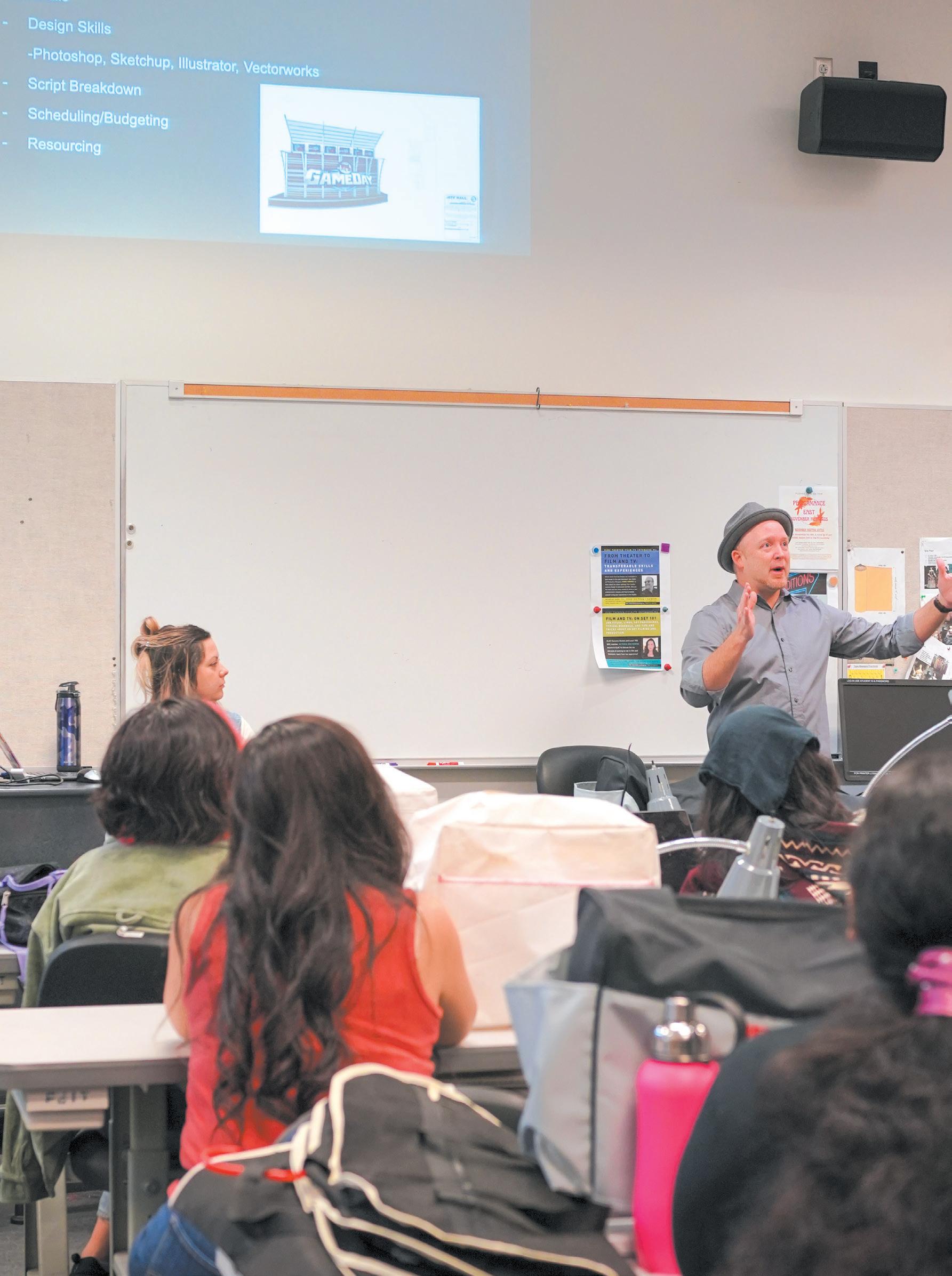
FROM THEATER TO TV—NCIS Los Angeles Production Designer Chris Hansen discusses his career pathway from theater to film and television.
CN/TERESA ACOSTA
East Los Angeles: Gentri cation in
the name of beauti cation
BY NICHOLAS JIMENEZ Staff Writer
Gentrification is not that good because this requires the cost of East Los Angeles’ communities to inflate in price.
Gentrification is when wealthy people move into and improve poor communities.
This leads poor areas to experience an influx of middle-class or wealthy people who renovate and rebuild homes and businesses.
This has become a common phenomenon in many communities in California, like East Los Angeles.
Many caucasian people who pursue living in East L.A. attempt to significantly impact the community in a positive way.
Many times, the community will not allow them and criticize them because other community members would rather keep the integrity of their community the same.
This happened in my neighborhood a few times.
The city attempted to control one side of my street, not allowing pedestrians to park their cars.
The community came together and fought with the city’s decision to block off the street. The city had a meeting with people in my neighborhood and realized that the community hated the rule due to the lack of parking spaces.
The lack of parking spaces in the neighborhood is a big problem and the city attempted to make it worse.
After witnessing my mom fight for street parking to be kept the same, I realized that many wealthy people want to update the East L.A. community.
Around East L.A., gentrification is happening because of many new laws being passed even though many never hear about them.
In East L.A., many new homes that are being built or renovated are out of the price range of most
low-income citizens.
The home value prices rise every year and will continue to grow through gentrification.

I appreciate how wealthy people want to help the community look new, but don’t understand that people just want their community to remain the same.
Enrollment fees reduce student
enrollment
BY MARISSA VALLES Staff Writer
Enrollment fees stand in the way of low-income students furthering their education.
Community colleges like East Los Angeles College are often believed to be an affordable way for low-income students to further their education without having to pay much.
However, anyone who has tried to enroll in classes without financial aid knows this isn’t the case.
The enrollment fee is $46 a unit at ELAC. A student is considered full-time when they take 12 units.
To be a full-time student, it would cost roughly $552 depending on whether or not a student is charged additional fees.
This estimate also doesn’t take into account materials purchased for class.
Not all students have $552 lined up to spend. Many students also work in addition to going to school and have other financial obligations, such as caring for their family.
Students who receive financial aid usually have these enrollment fees waived, but not all students at ELAC are eligible for financial aid.
Students who don’t have U.S citizenship aren’t allowed to file for FAFSA, making them ineligible to receive financial aid.
If a student is ineligible for financial aid, they are expected to pay for all enrollment fees out-ofpocket.

Although, ELAC offers to waive tuition fees for undocumented students through AB 540, undocumented students still need to meet certain requirements to qualify.
During the 2021-2022 school year, enrollment fees acquired during the pandemic were forgiven and students with outstanding charges were allowed to enroll in classes.
Although this was a good start that impacted students who had outstanding charges, it was only done once and it hasn’t been done since.
The forgiveness of these fees brings to question if the amount of outstanding charges impacted the enrollment rate.
If so, why are enrollment fees even in place if they can abruptly impact enrollment rates?
Students shouldn’t be punished for not being able to pay enrollment fees.
Instead of forcing students to pay these enrollment fees or face not being able to enroll in classes, enrollment fees should be removed completely.
If enrollment fees must stay in place, there should be alternatives for students to be able to enroll in classes despite having outstanding fees.
One suggestion would be getting rid of deadlines that fees need to be paid by. These deadlines are what cause students to be considered ineligible to enroll in classes.
Getting rid of deadlines will allow students to pay on their own schedule and not stress about having to come up with money to pay off their balance.
Other alternatives include allowing payments to be made in installments and lowering how much students must pay per unit.
We can all agree that students shouldn’t have to pause, or even end their academic journeys because of outstanding fees.
The communities
community,
Any
People
Campus News encourages letters to the editor relating to campus issues. Letters must be typed and double spaced. Submitted material becomes the property of Campus News and cannot be returned. Letters should be limited to 300 words or less. Campus News reserves the right to edit letters for grammatical errors or libelous content.

Anonymous letters will not be printed. Writers must sign submissions and print their names and a phone number where they can be reached. Letters should be addressed to the editor of Campus News. Submissions can be made at the mailroom in building E1 or the Journalism department of ce in the Technology Center in E7-303.

East Los Angeles College Campus News 1301 Avenida Cesar Chavez E7-303
Monterey Park, CA 91754 (323) 265-8819, Ads (323) 265-8821 Fax (323) 415-4910
The East Los Angeles College Campus News is published as a learning experience, offered under the East Los Angeles College Journalism program. The editorial and advertising materials are free from prior restraint by virtue of the First Amendment to the United States Constitution.
opinions expressed are exclusively those of the writer. Accordingly, materials published herein, including any opinions expressed, should not be interpreted as the position of the Los Angeles Community College District, East Los Angeles College, or any of cer or employee thereof.
WEDNESDAY, NOVEMBER 30, 2022 OPINION 2 www.ELACCampusNews.com EAST LOS ANGELES COLLEGE CAMPUS NEWS
The
EDITOR IN CHIEF Soleil Cardenas MANAGING EDITOR Teresa Acosta FRONT EDITORS Marissa Valles OPINION EDITORS Yudith Macias NEWS EDITORS Janet Guereca Nicholas Jimenez FEATURE EDITORS Grace Wong ARTS EDITORS David Uribe COPY EDITORS Juan Calvillo Daniella Molina ONLINE EDITOR Annette Quijada ART DIRECTOR Steven Adamo ADVERTISING Stefanie De La Torre ADVISER Jean Stapleton
are filled with people who have lived in East L.A. their whole lives. So when city council wants to pass new rules or when new homes are being sold for a higher price, it just makes the community feel as if they are not being heard or thought of when making these decisions.
CN/YUDITH MACIAS
The city is worried about how the community thinks it needs to change or what to put in place.
community in East Los Angeles would come together, decide what issues to face first and assist those who need assisting.
can request the city to fix the parking problem in their
or how to fix the sidewalks in the community.
There are good intentions to better the community, but city council does not realize those same people want to have a familiar environment.
CN/SOLEIL CARDENAS
College Corps encourages civic engagement
BY MARISSA VALLES Staff Writer
The College Corps invited students to participate in democracy by serving their communities.

East Los Angeles College Corps hosted a watch party panel that featured political staff members Josh Fryday and Heather McGhee. Both have experience in political activism.
Smith, the event moderator, spoke with Fryday, Chief Service Officer under Governor Newsom, and McGhee, a policy advocate, who each encouraged students to engage in civic work.
“You don’t have to have any special degrees, skills or permission. Most importantly, to get loud and to get active.” McGhee said.
Fryday agreed that students don’t need extensive experience to get involved, and applauded College Corps students for taking the initiative to help out their community.
“You could be using your time and talent for a lot of other things but you have stepped up to serve your community.” Fryday said.
ELAC is one of 45 campuses across the state to participate in the College Corps program.
The College Corps program focuses on getting students engaged in serving their communities and learning important leadership skills. These skills will help them both academically and in the work force.
Fryday said that despite what people may believe, everyone has an important voice in a democracy.
“There’s a lot of ways to get engaged, and the only way a democracy works is by everyone taking these small steps.
“Never cease your voice.
“Never give up the fact that you have a voice and a powerful place at the table,” Fryday said.
Fryday and McGhee said they hope students take away something from the program.
“Ultimately, the kinds of experiences that students are
going to have now, whether if it’s at a food bank or at a small grassroots organizations or tutoring, are bringing you in proximity of people whose stories are going to help you really understand who are the best advocates for the solutions.
‘Everyday Urbanism’ offers
vendors architectual marvels
BY NICHOLAS JIMENEZ Staff Writer
Margret Crawford Creator of “Everyday Urbanism,” an architecture style, said the exterior of Los Angeles could be more unique.
A professor at Berkeley Crawford, was a guest speaker on Zoom November 18 to discuss her upcoming program “Berkeley Connect.”
During the presentation, Crawford said “Everyday Urbanism” is a live experience. She wrote many articles about Urbanism and has projects in China.
Crawford said, the art of selling in Los Angeles blurs the line between building spaces.Crawford said “The vendors challenge the boundaries between public and private by selling stuff from their front yard or on their cars”
Crawford said different buildings in California looked through the architect’s plans.
She said Los Angeles is known for the architecture throughout the city.Buldings end up having mutiple lives in Los Angeles.

One of the strangest events she witnessed in Los Angeles was an oil change service that became a taco stand after 6 p.m.
Crawford said city planners see a whole set of activities that were problems that need to be taken care of in General Urbanism.
She said she was surprised by the outcome, when she saw people alter the space they were in.
Another example of General Urbanism are day laborers, who are people who regularly look for work.
Crawford said some cities in California tried to control garage sales. Beverly Hills tried but failed. This is because garage sales happen on private land.
Garage sales are examples of pushing boundaries when considering what is private or public land.Home owners can allow people on their front yards and garages.
Crawford said vendor’s respond to people’s needs with food or through selling umbrellas when it rains.
Street vendors are now legal after organizations came together to make them legal.
Crawford said designers should help vendors design their carts.
Unfortunately, she said it wouldn’t work because of the price and the cart being heavy.
She said day vendors fought for economic space in Los Angeles to sell stuff from their houses.
Crawford likes how vendors offer new perspectives when thinking about cities and how they show off their exterior designs.
Day vendors sell clothes on chain link fences and present murals that share the stories of multiple lives.
Street Vendors that sell handmade food bring people a nostalgic feeling.
Vendors provide new economic opportunities in existing spaces by turning the building into a coffee shop or into a garage store.
Crawford said her trip to China showed more aspects of urbanism. Vendors make shops or hotels from empty spaces and let college students use them.
She also said that people in China will build their own house in villages they live in. The vendors in China would sell vegetables or food and work throughout the day.
She said everyday Urbanism operates in China and Los Angeles.
“What are the best solutions, and whose voices can be brought to the halls of power tomorrow, the next day, and the rest of your life,” said McGhee.
“Rolling up your sleeves and getting on-the-ground experience will make [students]

so much more credible, but also knowledgeable about the kind of change that we need in this country.
“Not only are you making a difference now in what you’re doing but you’re also taking these lessons with you for the
EAST LOS ANGELES COLLEGE CAMPUS NEWS 3 News www.ELACCampusNews.com WEDNESDAY, NOVEMBER 30, 2022
rest of your life,” Fryday said. Students can find updates and information about ELAC’s College Corps on their Instagram @elaccollegecorps.
CN/BREANNA FIERRO
CN/BREANNA FIERRO
Transfer mentor wants to help students for a better future
BY MARISSA VALLES Staff Writer
Former East Los Angeles College student and current transfer mentor Bianca Trevizo empowers students who come from underprivileged communities and helps them further their education.
Trevizo knows all too well how challenging and overwhelming the transfer process can be.
Trevizo currently works as a mentor at the Transfer Center. Before she began working at the Transfer Center, she was a student at ELAC.
“I attended East Los Angeles College from 2017-2019, earned my Associates of Arts for Transfer in English, and then transferred to UCLA as an English major,” Trevizo said.
However, this did not come without challenges. For Trevizo, one of the biggest challenges with transferring was finding the time to complete the transfer application.
“I applied to multiple systems — CSUs, UCs and privates. This meant I had to keep track of 3 separate applications and essays on top of my ELAC schoolwork,” Trevizo said.
Trevizo also worked part-time
which made things more difficult.
“Sometimes I would come to the Transfer Center straight after work or class to make sure I complete applications in time,” Trevizo said.
Trevizo’s perseverance paid off and she graduated from UCLA in 2021 with a Bachelor’s degree in English and a minor in education. She is currently earning her Master’s degree in education from USC.
She came back to ELAC as a Transfer Mentor because she said it’s important to help students from communities where isn’t typical their education.
“I wanted to work in the Transfer Center because I wanted to help bridge the gap of knowledge between students and their longterm goals.
“As someone that comes from a marginalized and underrepresented background, I want to empower community college students to pursue a higher education beyond ELAC,” Trevizo said.
Many students at ELAC are the first in their family to obtain higher education and not being able to turn to family members for help when transferring can make the process difficult.
This is where the Transfer Center can help . The Transfer Center offers
students help in a variety of ways, ranging from hosting workshops with information about CSUs and UCs to one-on-one application assistance.
As a transfer mentor, Trevizo makes sure that students receive the help they need.
“By visiting the Transfer Center, students have access to counselors, mentors and immediate transfer application assistance.
“We highly recommend students visit us in the center if they are thinking about or planning to transfer.
“We want to make sure they are exploring different universities, are on track with their courses and know how to navigate transfer applications correctly,” Trevizo said.
The transfer application for CSUs and UCs is currently open until November 30.
Students can visit the Transfer Center located in D7 for help with the transfer process.
The Transfer Center is open 8 a.m. - 5 p.m. on Mondays through Wednesdays and 8 a.m. - 3:30 p.m. on Thursdays. The Transfer Center is also available over the phone at (323)-265-8623.
Wildfire smoke affects human health
BY GRACE WONG Staff Writer
Between the months of July through November it is wildfire season. Wildfire season directly and indirectly harms human health Smoke exposure is a significant factor in increased health issues during fire seasons. High heat or dry powerful winds are the ingredients to create a wildfire.
Kim Troung, a biology student at East Los Angeles College, said wildfire smoke composition includes: smoke from combustion of natural biomass.
This is a complex mixture of particulate matter, carbon dioxide, water vapor, exhaust fumes, hydrocarbons and other surface chemistry, anesthetic and trace minerals.
The individual compounds present in smoke number in the thousands. Troung said that wildfire smoke is hazardous.
Stanford University conducted an allergy and asthma study that was published recently.
The research said wildfire smoke is the same as secondhand cigarette smoke. It makes people sick and causes coughing or trouble breathing.
Wildfires have rough pieces of particles that can be inhaled into the upper respiratory system.
Still, the small amounts of particles can bypass the defense mechanism of your upper respiratory system and penetrate deep into a person’s lungs.
Wildfire smoke increases the risk of neurodegenerative diseases like mental illness and Alzheimer’s.

The following Wildfire smoke affects com from inhalation: An increase in susceptibility to viral and bacterial infections. Especially respiratory infections.
• Eye irritation - eyes feel dryness or itchiness.
• Throat irritation - sore throat, feeling dry or scratchy.
Chest discomfort - feeling heavy pressure.
• Congestion - feeling blocking or jamming.
Wheezing -croaking or making hoarse sounds.
Partica De La Cuadra, a nursing student at ELAC, said there is no safe distance from a wildfire.
Asthma can affect children if they are exposed to smoke for five consecutive days.
The elderly may have strokes or increased heart attacks with smoke inhalation. Pregnant women may have premature births after being exposed to wildfire smoke.
De La Cuadra said the news reported that a fire in August of 2020 burned 3.7 million acres in California, 26 people were killed and seven thousand structures destroyed.
Clean breathable air during the wildfire season, is a priority.
Ways people can protect their health during the wildfire season include:
Paying attention to the air quality ratings and keeping track of one’s risk.
• Staying indoors as much as possible.
Keeping indoor air clean by closing windows.
• Not burning candles, smoke indoors or using toxic cleaners to clean a home.
Using a HEPA filter can reduce the small particle concentrations by 85%.
California has miles of coastline and idyllic weather.
It is one of many reasons why people love to live in California.
Wildfires need to decrease in order for California to continue thriving and reduce the respiratory health risks of its people living in the state.
College campus have safe space for LGBTQ+ community
BY DAVID URIBE Staff Writer
The LGBTQ+ center provides aid and a welcoming atmosphere for all LGBTQ+ students and individuals.
East Los Angeles College is one of the many college campuses that have created centers.
ELAC’s center has provided many resources and aid to students who are gay, bi, lesbian and transgender. These centers have proven exceptional at helping those individuals.
What the LGBTQ+ center strives to do at ELAC is to create a safe supportive space on campus for LGBTQ+ students, faculty and staff.
Its focus is on building a more visible inclusive network among allies and LGBTQ+ community members themselves.
The center offers resources that help share information on common challenges and best practices for LGBTQ+ scholars.
It has also increased programming
and events held for individuals and the overall LGBTQ+ community.
Creating a secure and accepting environment is crucial, and using pronouns is one method to ensure that LGBTQ+ community members feel included.
ELAC even says that pronouns matter here. Pronoun knowledge is equally as crucial for communicating with others as much as name knowledge.
Failing to pay attention to someone’s pronouns might cause communication issues.
Inaccurate information might be annoying or affect a person’s willingness to converse. Using pronouns makes it evident that people value and respect others.
It is possible to create a culture of care that supports a more welcoming atmosphere for LGBTQ+ persons.
This can be accomplished by asking, providing and using everyone’s pronouns as the norm.
A person uses the pronouns that are most secure and reassuring to them.
The 2020
one in four young people, (ages 13 to 24), use pronouns other than he/ him or she/her.
For young people who identify as transgender or nonbinary, using the proper name and pronouns is a straightforward show of support.
College campuses are locations
where LGBTQ+ can discover many activities and services that help them develop into their full selves and connect to a community that has dealt with the similar concerns.

Students who are questioing their identities can feel the tolerance that a center provides on any given campus.
Students can discover accepting classmates, understanding teachers, and even mentors who can motivate you to live your truth.
Of course, not all college campuses are inclusive. Some campuses still have prejudices like homophobia, transphobia, and others.
It’s crucial to know what you want to get out of college, conduct your homework, and select a school that suits you.
ELAC even offers gender neutral restrooms for those that want it.
ELAC is one of the first Los Angeles Community Colleges to raise the pride flag as a sign of solidarity with LGBTQ+ students.
ELAC has a LGBTQ+ center located at F5 building 204.
The center is open MondayFriday from 8 a.m. to 4:30 p.m. Lynn Wood is the LGBTQ+ resource coordinator at the center.
4 www.ELACCampusNews.com EAST LOS ANGELES COLLEGE CAMPUS NEWS WEDNESDAY, NOVEMBER 30, 2022 Features
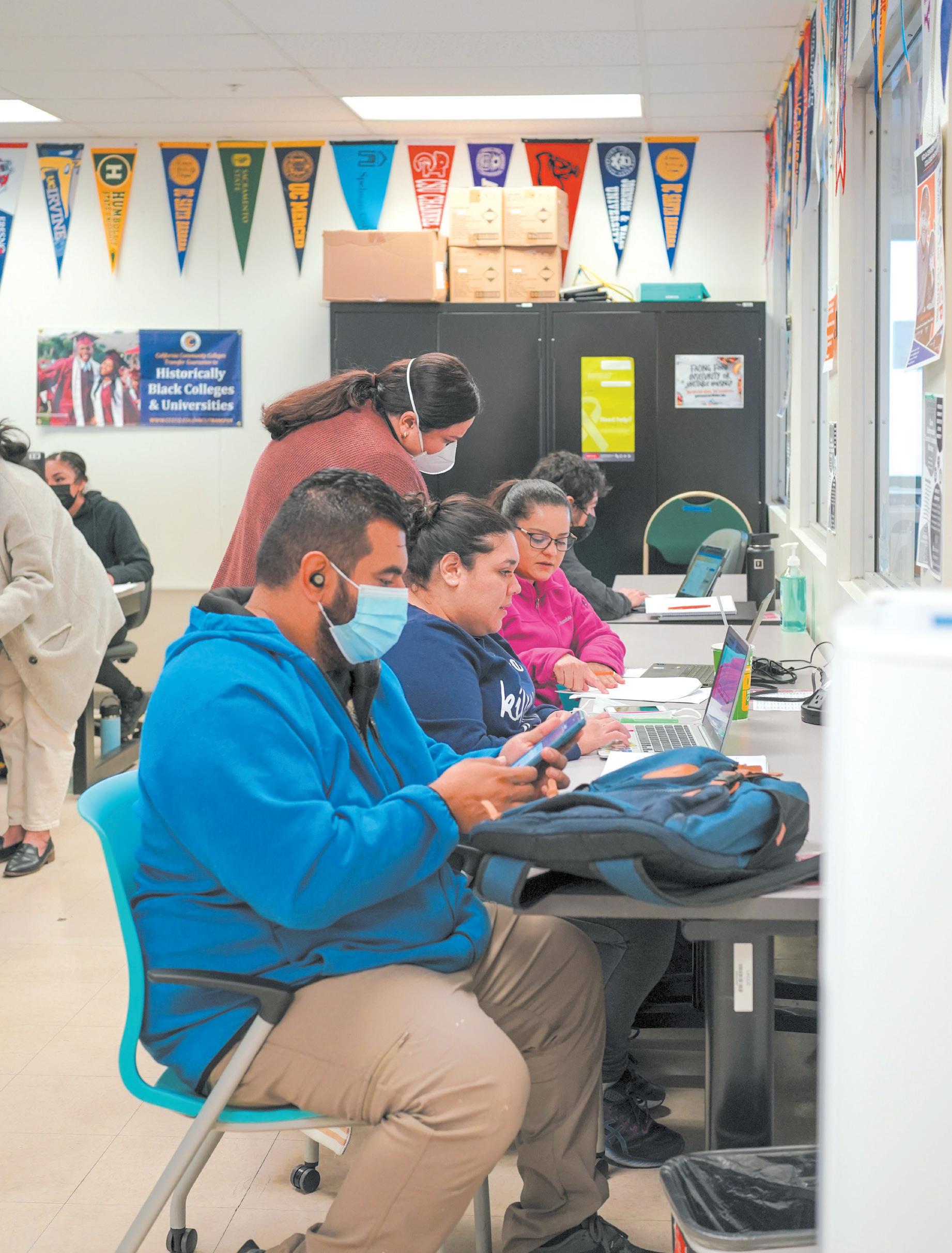
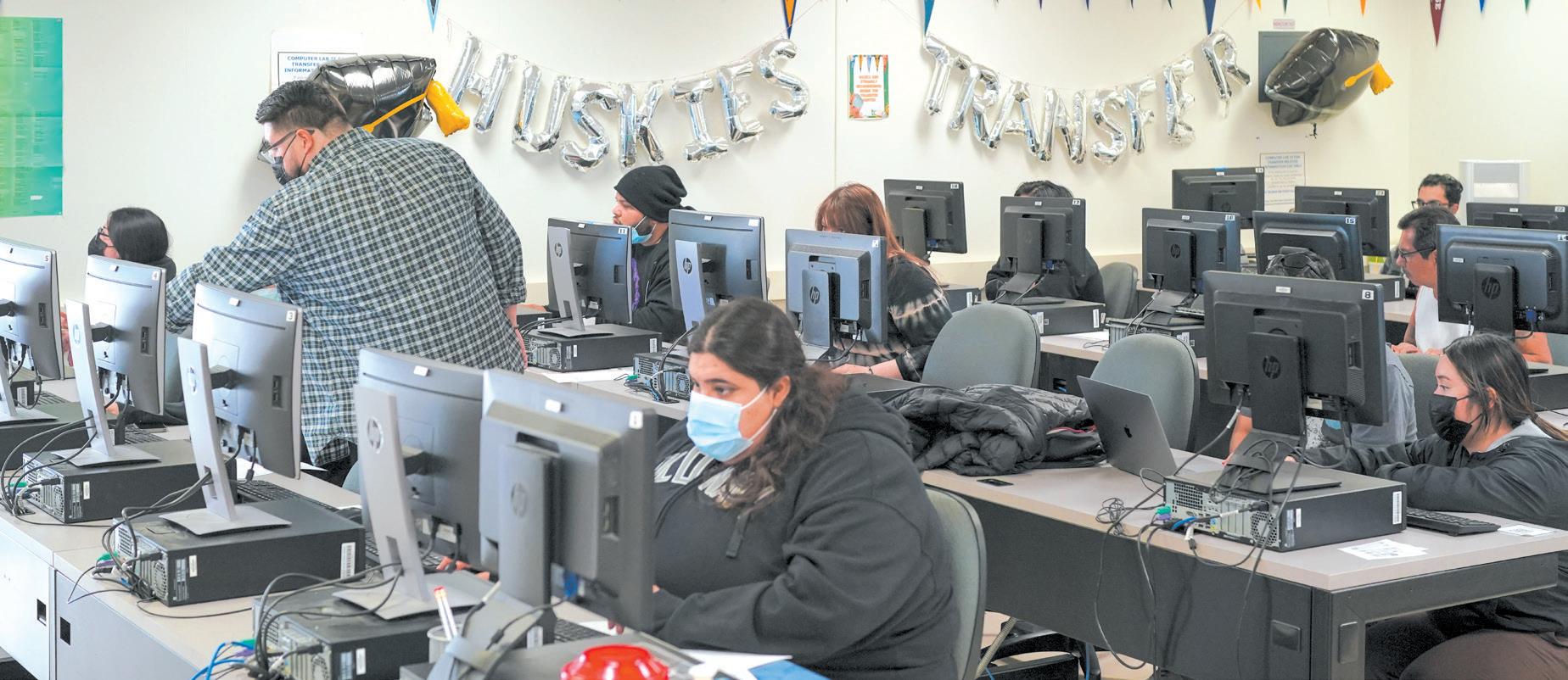
PUSHING DEADLINES—Students in the Transfer Center rush to finish their transfer applications before Nov. 30.
CN/MARISSA VALLES
CN SOLEIL CARDENAS
National Survey by The Trevor Project found that
CN/STEVEN ADAMO
TRANSFER SEASON—Transfer Center mentors help students rush to complete their applications a day before they are due.
CN/MARISSA VALLES
To keep clean breathable air during wildfire season, we need to protect our health as a priority.
VPAM’s ‘New Voices’ emerges in Art Exhibition
 BY GRACE WONG Staff Writer
“New Voices” showcase became a significant part of the 2022 District Wide Juried Student Art Exhibition arranged by the Vincent Price Art Museum and Los Angeles Community College District.
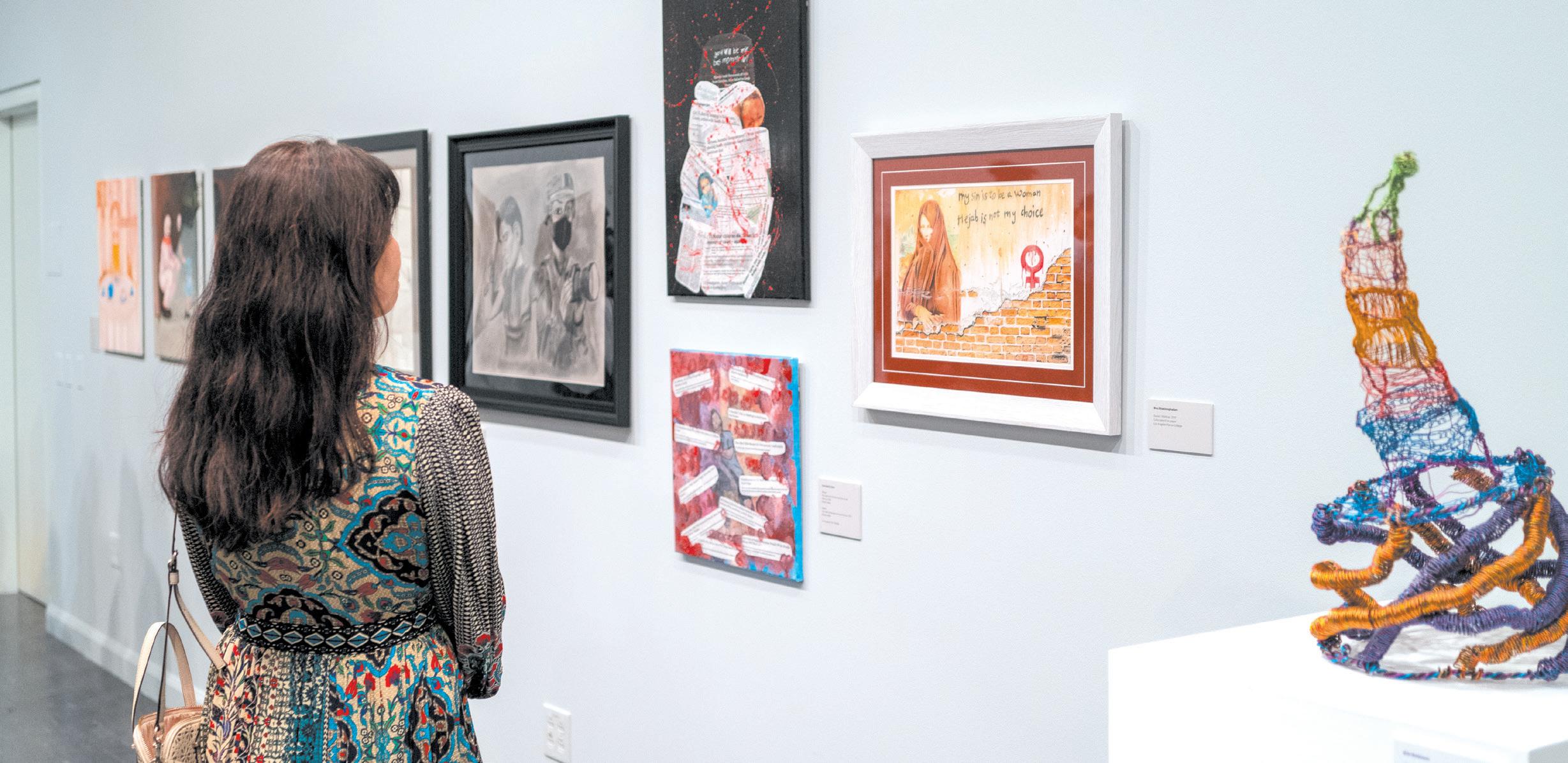
East Los Angeles College art students have exceptional artwork produced throughout the academic year and displayed hundreds of student artwork in the Vincent Price Art Museum.
The museum has five art galleries that can accommodate temporary rotating exhibitions, student shows, and artist and community projects.
This year, the exhibition community invited all LACCD art students to join the “New Voices” exhibition event to demonstrate student artistic achievement and engagement in contradictory propositions.
The artists use various techniques to create their works. Such as acrylic on canvas, charcoal on paper, oil on canvas and aluminum foil.
The subject included the cross-individual and collective narratives, local geographies, and emotionalism and social justice issues.
• Acrylic paint is bright colors, sharp brushstrokes and fast-drying paint. It uses synthetic resin to bind pigments; it can dilute with water light or thick. It depends on the artist’s needs.
• Charcoal on paper is a solid drawing stick that produces a black line when stroked across the paper. The medium is prized for its ability to create an interplay between light and shadow, known as chiaroscuro. Oil on Canvas – oil paint is made by sling color in oil. The mixture remains a vibrant color and makes it dries slowly. The artists have time to work on details.
• Aluminum foil is used in acrylic paint; it is best though any craft paint will also work.
Eighty-one art students participate from 9 different campuses of the LACCD, which include ELAC, Los Angeles City College, Los Angeles Harbor College, Los Angeles Mission College, Los Angeles Pierce College, Los Angeles Southwest College, Los Angeles Trade – Technical College, Los Angeles Valley College and West Los Angeles College.
The artwork categories are granted to artists. Jury Prizes, Individual Juror awards and Museum Staff Picks.
The Art critics have been selected by the arts professionals’ jury of leading art: June Edmonds, Jennifer Frias, and Hamza Walker.
Kyla Kim from Los Angeles City College, and her “Bloody, Not Rotten” (2021 Oil) piece, on canvas won the jury Prize second place.
Donara Vardanyan from Los Angeles City College and her “Destroyed Peace” (2022 acrylic) on canvas won the jury prize first place.
The “New Voices” exhibition started on November 5, 2022 and will continue to January 21 in Vincent Price Art Museum.
The exhibit is open from noon till 4 p.m., from Wednesday to Saturday. Sarah Resendiz says that admission is free and reservations are recommended to ensure prompt entry into the museum when arriving.
Walk-up access is on a first-come, first-served basis until the museum reaches capacity.
To make a reservation, please get in touch with (323)-265-8841 or info@ vpam.org.
ProductionManagerpreps for‘TheCountryWife’
BY YUDITH MACIAS Staff Writer
Netflix ‘Young Royals’: what is this show even about?
BY YUDITH MACIAS Staff Writer
Netflix series has recently released a second season of “Young Royals.” Season two airing had high expectations and which was highly anticipated by its fandom. “Young Royals” follows Prince Wilhelm as he learns to navigate his new life at Hillerska Boarding School. Here, he becomes acquainted with a fellow classmate, Simon, who was the black sheep of the school.
Simon is from a low income family, but attends Hillerska on a scholarship. Along with his sister Sara. Wilhelm and Simon develop a relationship that which does not last long after as information about their relationship is leaked to the public.
But Wilhelm’s second cousin August is eventually revealed as ultimately the culprit that caused the couple to separate.
The second season focused more on the relationship between Sara and August, Marcus and Simon, and Wilhelm and Felice.
In the first season, Sara asked August to vouch for her so she can get a spot in the girls dormitory at Hillerska.
In return, Sara would keep quiet about August leaking the information about WIlhelm and Simon. Their relationship starts off rocky as August believes Sara told
that he was the one that posted the video when it was Felice. Their relationship becomes steady as they both start to turn to each other for comfort. August shows more interest in Sara as the series goes on but in the end it does not go too well.
As previously mentioned, Felice reveals to Wilhelm that August was the one who leaked the video of him and Simon. Through this, they became close and bonded over their hatred for August.
Felice becomes someone Wilhelm can depend on this season, however at a cost. In the first season, the audience was given more information about Felice as a character.
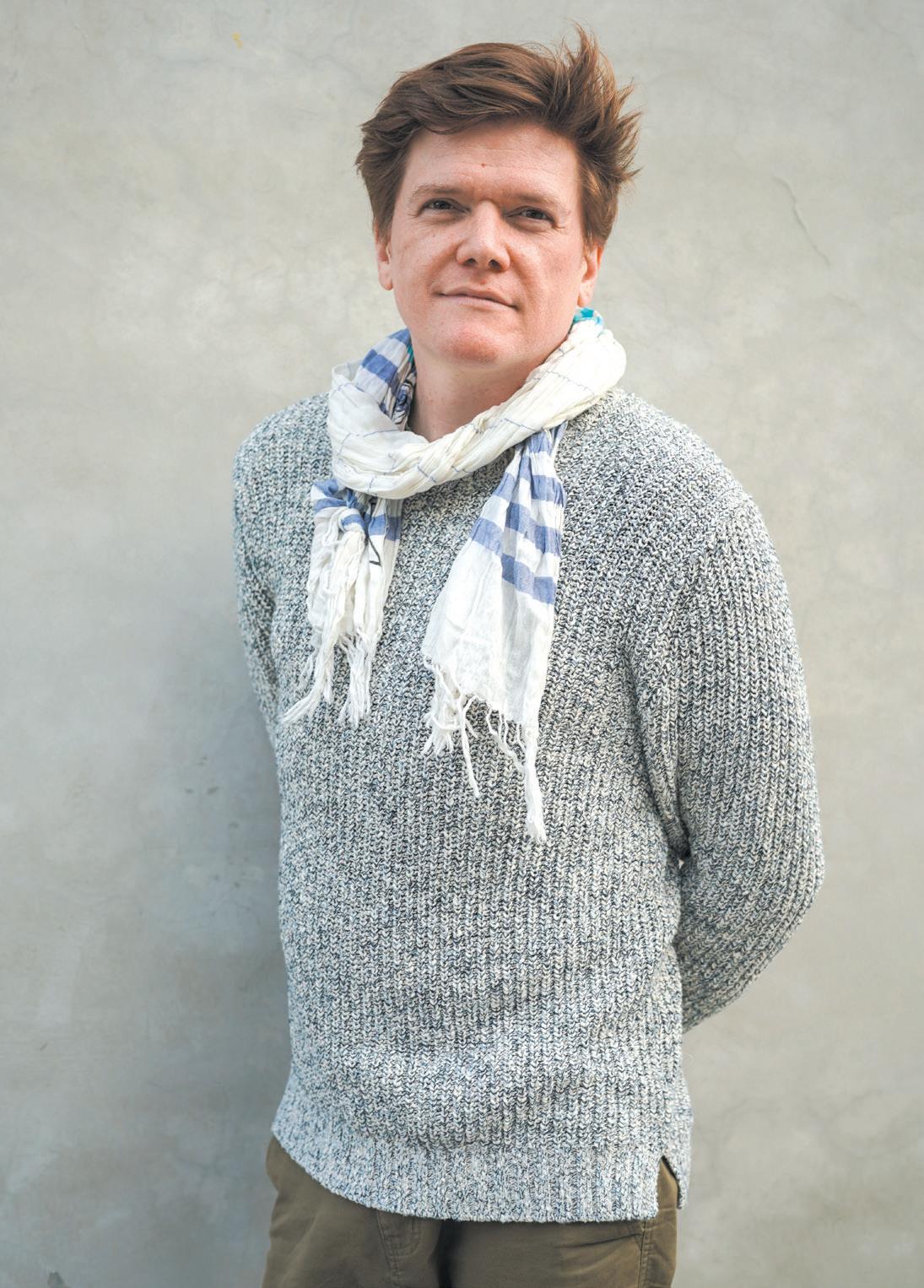
In the second season, it feels as if though Felice was used to push others to grow and failed to show how she matured as well.
The audience did not learn more about her, which raised many questions. Why did she stop straightening her hair? What were her motives in becoming close to Wilhelm? Overall, it was strange how she was downgraded playing a background character while other background characters like Stella and Henry received more screen time.
Marcus and Simon’s relationship was definitely not a fan favorite. Marcus is a third year back at Simon’s old junior high. Marcus invited Simon to karaoke after
hearing how good of a singer he is.
To get over Wilhelm, Simon’s friends Ayub and Rosh encouraged Simon to give Marcus a chance after showing interest in him. When they do get together, the relationship becomes one-sided. Marcus pushes for the relationship to keep going, while Simon mentions he thinks that he is not ready for another relationship.

The first time they have this conversation, Marcus mentioned how he will not hurt him like Wilhelm did. He even goes as far to mention that Simon is nothing like his father, who was an abusive alcoholic. It is interesting because Simon never mentioned anything about his father to Marcus.
It seems like Marcus is desperately hanging onto Simon which is funny considering how they have only interacted a handful of times.
In the end, they bitterly break up because Marcus can not handle Simon not prioritizing him.
There were a total of six episodes this season, which makes the series feels a bit rushed. Some story lines can not completely developed as they are over and done with within the first 10 minutes or never mentioned again throughout the season.
“Young Royals” can be renewed for a third season with more episodes so that the storyline is not rushed and can fully blossom into what it is meant to be.
ELAC professor Francois-Pierre Couture dedicated his days teaching students about the theater setup. Couture is currently in duel roles as the Scenic and Lighting Director as well as production manager.
He first traveled to California from Montreal, Canada to attend UCLA. He completed his masters degree in 2003
A typical day for him is about 10 to 15 hours long.
On campus, he is busy teaching and training students how to efficiently work together to set up shows. He trains students by assigning them work on set.
Some help with the prop designs while others work on the scenery designs.
This helps the students to learn and understand how the process works so that they can put their own work on the stage.
As production manager, he makes sure that all aspects of the production are on schedule.
He makes sure that the students and staff involved have calendars and resources they need so that the production could happen in a timely fashion.
He also checks over the resources to confirm they are coordinated.
There are many departments working on top of each other, like the Costume, Hair and Makeup Design Department and the Directing Department, so Couture, along with the director, designers and supervising faculty staff make sure to coordinate everyone so they can work as efficiently as possible.
Productions take a long time to prepare, says Couture.
When students and staff are not actively working on one, they are planning and preparing for the next production.
Couture says that the production
team is going to have a meeting to discuss the details for their next spring play.
Toward the middle of summer, they will have meetings for the fall production.
“‘The Country Wife’ is a restoration comedy about love and unfaithfulness,” says Couture.
It is about men and women trying to have affairs with the other characters.
Though the play itself was controversial at the time of its release– the 1700s for its ‘sexual explicitness,’ Couture mentions that the production itself is a little spicy but at the same time is not putting
sexuality on stage. “It’s not geared that way,” he says. Anyone can come in and watch the production.
“Not only this, but because this play is from the 1700s, the language and the way the actors are portraying the characters is of the era,” Couture says. It is good training for the students, which allows for them to better understand different scripts in old English.
“The Country Wife” opens on Friday, at 8 pm in the P2 Proscenium Theater. Tickets are available for purchase now at: elactheater.org. Ticket prices are $10 General and $12 at the door.
EAST LOS ANGELES COLLEGE CAMPUS NEWS 5 Arts www.ELACCampusNews.com WEDNESDAY, NOVEMBER 30, 2022
Wilhelm
CN/TERESA ACOSTA
CN/TERESA ACOSTA
COURTESY OF VARIETY.COM
CN/TERESA ACOSTA
François-Pierre Couture
‘FOLK DANCES’—Acrylic on canvas art piece painted by Nicole Vargas from East Los Angeles College.
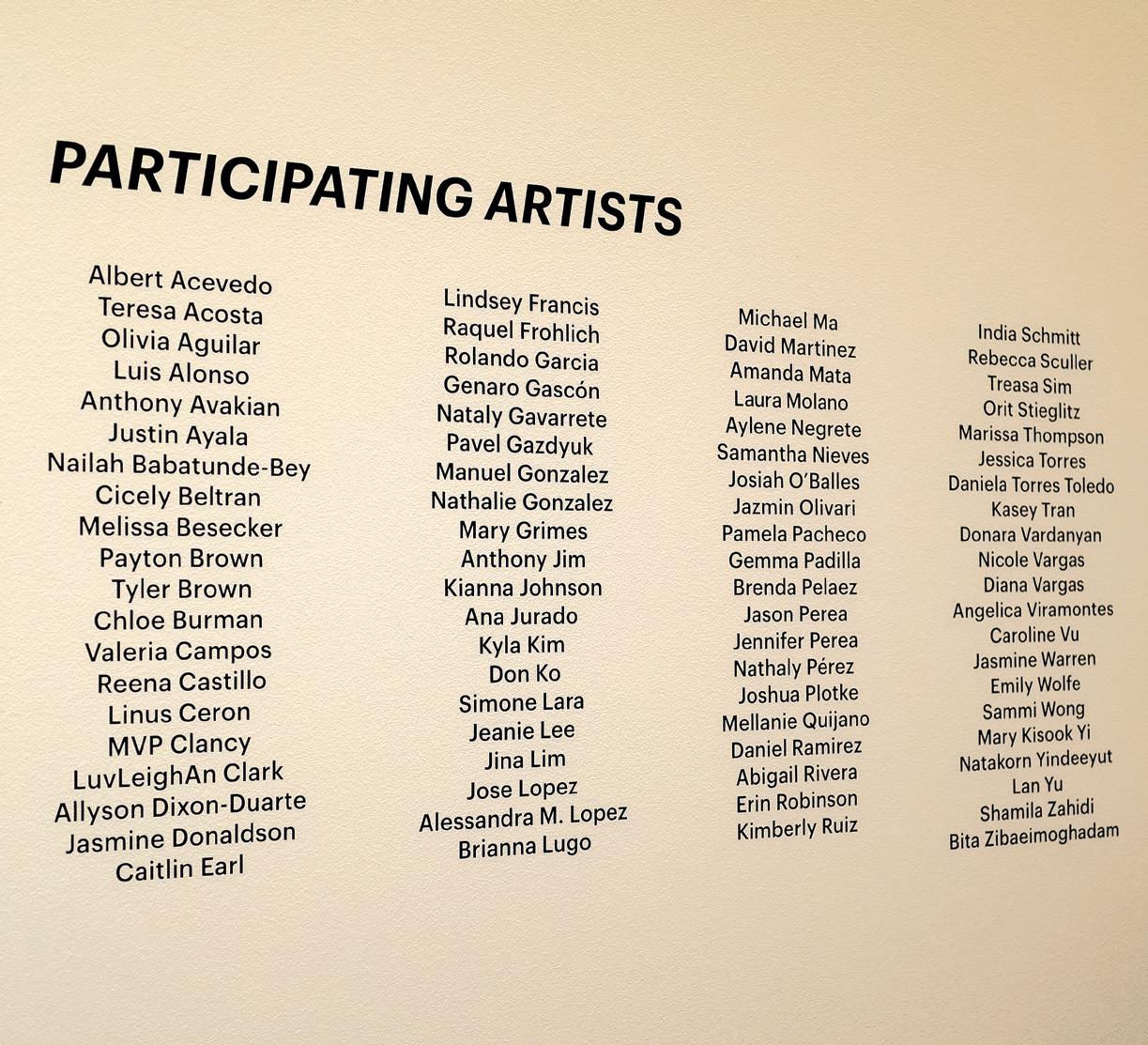
UP AND COMING—Participating artists names written on the wall outside the ‘New Voices’ exhibit.
NEW VOICES—Art admirer browses throught the art exhibition on opening night.
Wrestler takes third place at The Brawl
BY OSCAR MARTINES Staff Writer
The Brawl returned to East Los Angeles College as 12 colleges competed in 10 weight classes in search of winning the first-place medal.
The tournament would see Devin Peries (197 lb) place third in his respective bracket.
In the 125 lb bracket, Husky alum Adrian Curiel would kick off his first match with a victory over Christian Castillo of Victorville Valley College.
In the semifinal, Adrian Curiel would lose to Dylan Atherton of Rio Hondo College. Curiel was dominated until falling to a pin in the second round of the match.

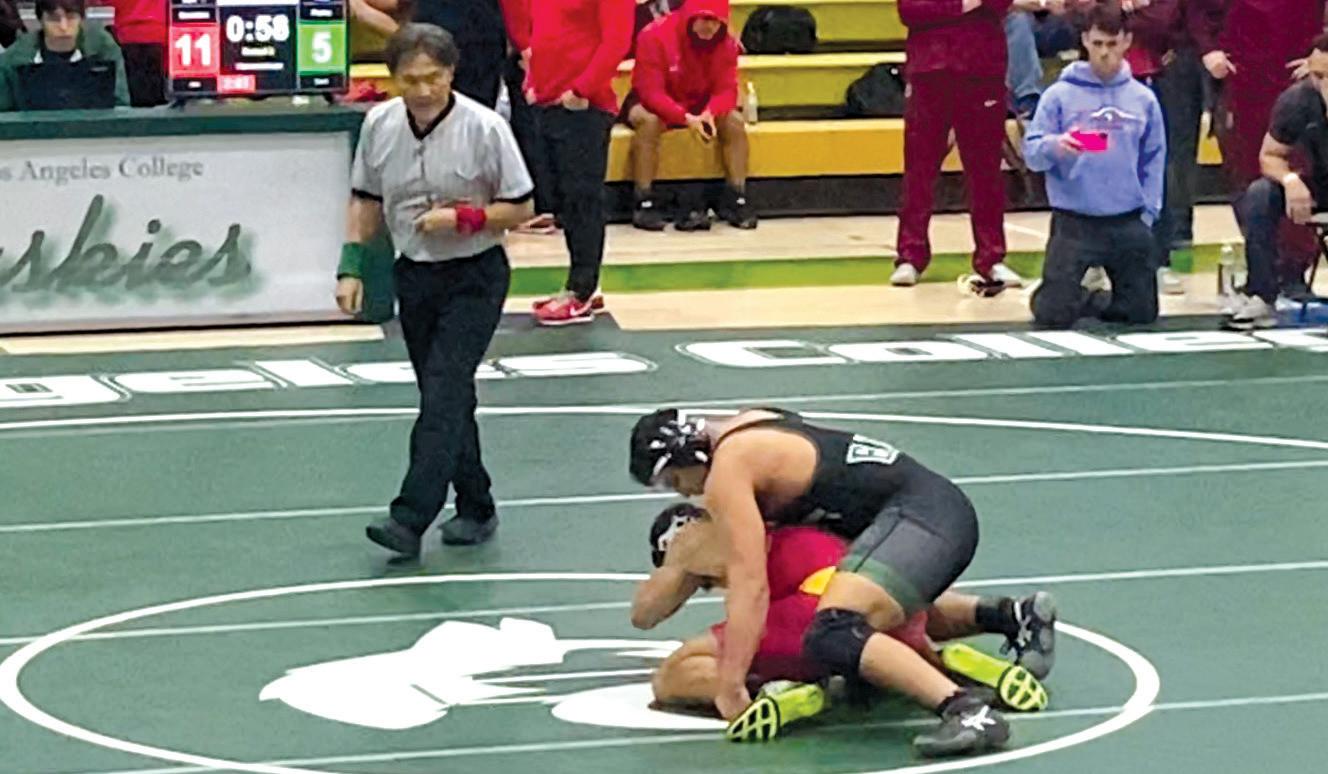
In the semifinal of the consolation bracket, Curiel would suffer his final loss of the day to Bakersfield alum Richard Martinez.
A first-round challenge that ruled in favor of Bakersfield would swing the momentum away from Curiel, which would result in him getting pinned.
Aiden Thome (133 lb) saw two early exits as his first-round match against Trevor Bass of Victor Valley ended in defeat, followed by another defeat to Zacariah McIlvain of Mt. San Antonio College in the first round of the consolation bracket.
Despite having a strong start against McIlvain, the Husky was unable to contain the comeback and fell in the first round of the match.
The 141 lb bracket saw Ethan Irizarry represent for the Huskies.
Unfortunately, Ethan Irizarry would see a first-round exit after falling to Anthony Gardner of Cerritos College.
Ethan Irizzary would square up against Brandon Fairman of Mt. San Antonio in the consolation bracket.
A beautiful early takedown by
Ethan Irizzary was not enough, as Brandon Fairman would immediately take advantage to seal the first-round win.
Arcadio Zuniga and Jacob Shibata would represent ELAC in the 157 lb bracket.
Arcadio Zuniga would fall in the first round to Carlos Martinez of Bakersfield College and would then fall once again in the first round of the consolation bracket to Adan Leyva of Moorpark College.
Jacob Shibata’s quarterfinal encounter with James O’Neal of Victor Valley would end in defeat.
In Round Two of the consolation bracket, Jacob Shibata would taste defeat once again as Julian Carranza of Victor Valley would survive an early takedown to pin Shibata for the win.
Troy Garza (184 lb) started off with a win over Cerritos alum Michael Felix.
Two strong takedowns gave Troy Garza the early lead in the first round of the match. Despite a small comeback from Michael Felix in the second round, Troy Garza finished the match with a W. Unfortunately, Troy Garza
In the second round, Devin Peries would turn things around, executing some great takedowns that resulted in him finishing the
off with the victory.
“He’s really improved on his feet. He was really fast on his feet. He was able to go right and then go left, jam up his opponents and take them off balance,” head coach Miguel Soto said about Devin Peries after the tournament.
Things would then look complicated for Devin Peries after suffering a defeat to Tim Saunders of USC in the semifinal match.
Despite doing everything he could to turn the match in his favor, Devin Peries was unable to keep up with Tim Saunders throughout the encounter.
With a third-place finish on the horizon, Devin Peries would bounce back from the loss by claiming victory against Manreev Singh of San Jose State in the semifinals of the consolation bracket.
An early takedown from Manreev Singh would not keep Devin Peries off balance, who delivered a great performance and dominated all three rounds.
The third-place match would be decided between Devin Peries and Owen Ormsby of Cerritos.
Owen Ormsby would take control of the match in the first round. However, the second round would be decisive on Devin Peries’ path towards claiming a medal.
A couple of takedowns followed by a strong third-round finish led to Devin Peries winning the thirdplace match and gain a medal for ELAC in the tournament.
“Near the end of the matches, I tried to stay in there, conserve my energy a little bit, and in this match, the same situation,
“I just conserved my energy and went for the kill near the end,” Devin Peries said after winning the medal.
Respawn: Game Club’s impact on students’ lives
BY OSCAR MARTINES Staff Writer
The first rule of Game Club is: never talk about Game Club.
Beginning as a small group of students with no faculty adviser, East Los Angeles College Game Club has grown to become a welcoming club that encourages socialization through video games.
It hasn’t always been easy for Game Club to be where it is today. Now they want to use their platform to help others find their place at ELAC.
ELAC’s Game Club surfaced in 2017 after Michael Nitzani, a sociology professor, took the club under his wing alongside Julissa Garcia and Joseph Holguin, who became Faculty Advisers for the club.
Nitzani’s love for video games began at an early age while he was
going through a tough time in his life with his family.
Nitzani expressed how The Legend of Zelda helped him gain a feeling of accomplishment and gave him many happy memories.
Since then, he has enjoyed taking care of Game Club, where he enjoys the fun atmosphere and interactions between club members.
ELAC’s Game Club tries to put their focus not only in video games, but also in other subjects such as communication and mental health.
Even when the pandemic hit, many members of the club turned to video games to help with their mental health and continue the strong bond they had with each other.

“I had a lot of fun just playing video games and ignoring the awful news. It was a nice pastime,” said Elijah Mena, a first-year member of the Game Club.
Even as the pandemic led to fewer members assisting the club
meetings, it still opens its arms to those who seek a social group that interacts with one another through video games.
When talking about the goal of the club Nitzani said, “playing video games and interacting with people triggers happiness and that is kind of what we want to bring, that joy to ELAC.”
He said how the socialization of the club is so powerful and how it would lead to friendships not only in the club, but outside of it as well.
MENA Game Club Member
“I try to encourage them to challenge the rules and to go see these places and develop longlasting friendships,” Nitzani said.
The club also encourages members to not only socialize with group members at the meetings, but to go out and enjoy what the world has to offer. To provide club members the opportunity to interact outside the club meetings, the club takes trips to other colleges, such as their recent trip to UC San Diego. The club also plans to take other trips to colleges such as UC Berkeley, San Francisco State and Stanford University. Not everything in this club revolves around video games. During his free time, Nitzani also manages a baseball team and umpires on the weekend, a job he has loved doing for over 18 years. Mena said that he loves to do poetry and talk to random strangers in his free time.
Despite what others say about gamers, they tend to explore other realms of the world besides video games.
You can expect a lot of interaction when joining the ELAC Game Club. Some of the video games they play include Super Smash Bros, Uno, Mario Kart and other assorted board games.
When Mena attended his first meeting, he thought that he was joining an environment full of gamer-awkward individuals. However, after playing video games with them, he saw them as new people that were good and fun to be around with.
While speaking to a few of the club members, Joseph Holguin, president of the club and student at ELAC, had a very powerful message to those who wanted to truly experience Game Club.
“Make friends here and then just take it outside. Take it to the next level in your friendship here at the
club,” Holguin said.
ELAC Game Club wants students to feel invited and at home. “It’s an experience you can only feel by coming to Game Club,” Mena said.
“We’ve seen that video games, the club, the friendships have been so beneficial for mental health that we want to give back to the community,” Nitzani said.
To do this, ELAC’s Game Club is presenting “The Ramon Show,” an interactive show performed by Ruby Marez that focuses on gaming and mental health. This show, funded by ASU, will take place at ELAC on Thursday, December 1st at 6:30 p.m. in F5-209.
ELAC Game Club meets on Thursdays at F5-209 from 2:30-5 p.m. Their Facebook page ELAC Game Club offers club members an opportunity to share their experiences with video games while keeping people updated about future club meetings and upcoming events.
SportS 6 www.ELACCampusNews.com EAST LOS ANGELES COLLEGE CAMPUS NEWS WEDNESDAY, NOVEMBER 30
would not return for his semifinal encounter against Jakob Edwards of Cerritos.
The best Husky performance would be displayed by Devin Peries in the 197 lb bracket.
The quarterfinal match saw Devin Peries defeat Angel Anguiano of Cerritos College in a very entertaining encounter.
A thrilling first round full of takedowns and perfect escapes saw Angel Anguiano take the advantage.
SMACKDOWN—Devin Peries has the advantage on USC fighter Tim Saunders.
SLEEPER HOLD—Devin Peries headlocks USC fighter Tim Saunders in the semifinal match.
CN/OSCAR MARTINES
CN/OSCAR MARTINES
match
“He’s really improved on his feet. He was really fast on his feet. He was able to right and then go left, jam up his opponents and take them off balance.”
MIGUEL SOTO Men’s Wrestling Head Coach
CN/SOLEIL CARDENAS
“It’s an experience you can only feel by coming to Game Club.”
ELIJAH
East Los Angeles: Gentri cation in
the name of beauti cation
BY NICHOLAS JIMENEZ Staff Writer
Gentrification is not that good because this requires the cost of East Los Angeles’ communities to inflate in price.
Gentrification is when wealthy people move into and improve poor communities.
This leads poor areas to experience an influx of middle-class or wealthy people who renovate and rebuild homes and businesses.
This has become a common phenomenon in many communities in California, like East Los Angeles.
Many caucasian people who pursue living in East L.A. attempt to significantly impact the community in a positive way.
Many times, the community will not allow them and criticize them because other community members would rather keep the integrity of their community the same.
This happened in my neighborhood a few times.
The city attempted to control one side of my street, not allowing pedestrians to park their cars.
The community came together and fought with the city’s decision to block off the street. The city had a meeting with people in my neighborhood and realized that the community hated the rule due to the lack of parking spaces.
The lack of parking spaces in the neighborhood is a big problem and the city attempted to make it worse.
After witnessing my mom fight for street parking to be kept the same, I realized that many wealthy people want to update the East L.A. community.
Around East L.A., gentrification is happening because of many new laws being passed even though many never hear about them.
In East L.A., many new homes that are being built or renovated are out of the price range of most
low-income citizens.
The home value prices rise every year and will continue to grow through gentrification.
I appreciate how wealthy people want to help the community look new, but don’t understand that people just want their community to remain the same.
Enrollment fees reduce student
enrollment
BY MARISSA VALLES Staff Writer
Enrollment fees stand in the way of low-income students furthering their education.
Community colleges like East Los Angeles College are often believed to be an affordable way for low-income students to further their education without having to pay much.
However, anyone who has tried to enroll in classes without financial aid knows this isn’t the case.
The enrollment fee is $46 a unit at ELAC. A student is considered full-time when they take 12 units.
To be a full-time student, it would cost roughly $552 depending on whether or not a student is charged additional fees.
This estimate also doesn’t take into account materials purchased for class.
Not all students have $552 lined up to spend. Many students also work in addition to going to school and have other financial obligations, such as caring for their family.
Students who receive financial aid usually have these enrollment fees waived, but not all students at ELAC are eligible for financial aid.
Students who don’t have U.S citizenship aren’t allowed to file for FAFSA, making them ineligible to receive financial aid.
If a student is ineligible for financial aid, they are expected to pay for all enrollment fees out-ofpocket.
Although, ELAC offers to waive tuition fees for undocumented students through AB 540, undocumented students still need to meet certain requirements to qualify.
During the 2021-2022 school year, enrollment fees acquired during the pandemic were forgiven and students with outstanding charges were allowed to enroll in classes.
Although this was a good start that impacted students who had outstanding charges, it was only done once and it hasn’t been done since.
The forgiveness of these fees brings to question if the amount of outstanding charges impacted the enrollment rate.
If so, why are enrollment fees even in place if they can abruptly impact enrollment rates?
Students shouldn’t be punished for not being able to pay enrollment fees.
Instead of forcing students to pay these enrollment fees or face not being able to enroll in classes, enrollment fees should be removed completely.
If enrollment fees must stay in place, there should be alternatives for students to be able to enroll in classes despite having outstanding fees.
One suggestion would be getting rid of deadlines that fees need to be paid by. These deadlines are what cause students to be considered ineligible to enroll in classes.
Getting rid of deadlines will allow students to pay on their own schedule and not stress about having to come up with money to pay off their balance.
Other alternatives include allowing payments to be made in installments and lowering how much students must pay per unit.
We can all agree that students shouldn’t have to pause, or even end their academic journeys because of outstanding fees.
The communities
community,
Any
People
Campus News encourages letters to the editor relating to campus issues. Letters must be typed and double spaced. Submitted material becomes the property of Campus News and cannot be returned. Letters should be limited to 300 words or less. Campus News reserves the right to edit letters for grammatical errors or libelous content.
Anonymous letters will not be printed. Writers must sign submissions and print their names and a phone number where they can be reached. Letters should be addressed to the editor of Campus News. Submissions can be made at the mailroom in building E1 or the Journalism department of ce in the Technology Center in E7-303.
East Los Angeles College Campus News 1301 Avenida Cesar Chavez E7-303
Monterey Park, CA 91754 (323) 265-8819, Ads (323) 265-8821 Fax (323) 415-4910
The East Los Angeles College Campus News is published as a learning experience, offered under the East Los Angeles College Journalism program. The editorial and advertising materials are free from prior restraint by virtue of the First Amendment to the United States Constitution.
opinions expressed are exclusively those of the writer. Accordingly, materials published herein, including any opinions expressed, should not be interpreted as the position of the Los Angeles Community College District, East Los Angeles College, or any of cer or employee thereof.
WEDNESDAY, NOVEMBER 30, 2022 OPINION 2 www.ELACCampusNews.com EAST LOS ANGELES COLLEGE CAMPUS NEWS
The
EDITOR IN CHIEF Soleil Cardenas MANAGING EDITOR Teresa Acosta FRONT EDITORS Marissa Valles OPINION EDITORS Yudith Macias NEWS EDITORS Janet Guereca Nicholas Jimenez FEATURE EDITORS Grace Wong ARTS EDITORS David Uribe COPY EDITORS Juan Calvillo Daniella Molina ONLINE EDITOR Annette Quijada ART DIRECTOR Steven Adamo ADVERTISING Stefanie De La Torre ADVISER Jean Stapleton
are filled with people who have lived in East L.A. their whole lives. So when city council wants to pass new rules or when new homes are being sold for a higher price, it just makes the community feel as if they are not being heard or thought of when making these decisions.
CN/YUDITH MACIAS
The city is worried about how the community thinks it needs to change or what to put in place.
community in East Los Angeles would come together, decide what issues to face first and assist those who need assisting.
can request the city to fix the parking problem in their
or how to fix the sidewalks in the community.
There are good intentions to better the community, but city council does not realize those same people want to have a familiar environment.
CN/SOLEIL CARDENAS
College Corps encourages civic engagement
BY MARISSA VALLES Staff Writer
The College Corps invited students to participate in democracy by serving their communities.
East Los Angeles College Corps hosted a watch party panel that featured political staff members Josh Fryday and Heather McGhee. Both have experience in political activism.
Smith, the event moderator, spoke with Fryday, Chief Service Officer under Governor Newsom, and McGhee, a policy advocate, who each encouraged students to engage in civic work.
“You don’t have to have any special degrees, skills or permission. Most importantly, to get loud and to get active.” McGhee said.
Fryday agreed that students don’t need extensive experience to get involved, and applauded College Corps students for taking the initiative to help out their community.
“You could be using your time and talent for a lot of other things but you have stepped up to serve your community.” Fryday said.
ELAC is one of 45 campuses across the state to participate in the College Corps program.
The College Corps program focuses on getting students engaged in serving their communities and learning important leadership skills. These skills will help them both academically and in the work force.
Fryday said that despite what people may believe, everyone has an important voice in a democracy.
“There’s a lot of ways to get engaged, and the only way a democracy works is by everyone taking these small steps.
“Never cease your voice.
“Never give up the fact that you have a voice and a powerful place at the table,” Fryday said.
Fryday and McGhee said they hope students take away something from the program.
“Ultimately, the kinds of experiences that students are
going to have now, whether if it’s at a food bank or at a small grassroots organizations or tutoring, are bringing you in proximity of people whose stories are going to help you really understand who are the best advocates for the solutions.
‘Everyday Urbanism’ offers
vendors architectual marvels
BY NICHOLAS JIMENEZ Staff Writer
Margret Crawford Creator of “Everyday Urbanism,” an architecture style, said the exterior of Los Angeles could be more unique.
A professor at Berkeley Crawford, was a guest speaker on Zoom November 18 to discuss her upcoming program “Berkeley Connect.”
During the presentation, Crawford said “Everyday Urbanism” is a live experience. She wrote many articles about Urbanism and has projects in China.
Crawford said, the art of selling in Los Angeles blurs the line between building spaces.Crawford said “The vendors challenge the boundaries between public and private by selling stuff from their front yard or on their cars”
Crawford said different buildings in California looked through the architect’s plans.
She said Los Angeles is known for the architecture throughout the city.Buldings end up having mutiple lives in Los Angeles.
One of the strangest events she witnessed in Los Angeles was an oil change service that became a taco stand after 6 p.m.
Crawford said city planners see a whole set of activities that were problems that need to be taken care of in General Urbanism.
She said she was surprised by the outcome, when she saw people alter the space they were in.
Another example of General Urbanism are day laborers, who are people who regularly look for work.
Crawford said some cities in California tried to control garage sales. Beverly Hills tried but failed. This is because garage sales happen on private land.
Garage sales are examples of pushing boundaries when considering what is private or public land.Home owners can allow people on their front yards and garages.
Crawford said vendor’s respond to people’s needs with food or through selling umbrellas when it rains.
Street vendors are now legal after organizations came together to make them legal.
Crawford said designers should help vendors design their carts.
Unfortunately, she said it wouldn’t work because of the price and the cart being heavy.
She said day vendors fought for economic space in Los Angeles to sell stuff from their houses.
Crawford likes how vendors offer new perspectives when thinking about cities and how they show off their exterior designs.
Day vendors sell clothes on chain link fences and present murals that share the stories of multiple lives.
Street Vendors that sell handmade food bring people a nostalgic feeling.
Vendors provide new economic opportunities in existing spaces by turning the building into a coffee shop or into a garage store.
Crawford said her trip to China showed more aspects of urbanism. Vendors make shops or hotels from empty spaces and let college students use them.
She also said that people in China will build their own house in villages they live in. The vendors in China would sell vegetables or food and work throughout the day.
She said everyday Urbanism operates in China and Los Angeles.
“What are the best solutions, and whose voices can be brought to the halls of power tomorrow, the next day, and the rest of your life,” said McGhee.
“Rolling up your sleeves and getting on-the-ground experience will make [students]
so much more credible, but also knowledgeable about the kind of change that we need in this country.
“Not only are you making a difference now in what you’re doing but you’re also taking these lessons with you for the
EAST LOS ANGELES COLLEGE CAMPUS NEWS 3 News www.ELACCampusNews.com WEDNESDAY, NOVEMBER 30, 2022
rest of your life,” Fryday said. Students can find updates and information about ELAC’s College Corps on their Instagram @elaccollegecorps.
CN/BREANNA FIERRO
CN/BREANNA FIERRO
Transfer mentor wants to help students for a better future
BY MARISSA VALLES Staff Writer
Former East Los Angeles College student and current transfer mentor Bianca Trevizo empowers students who come from underprivileged communities and helps them further their education.
Trevizo knows all too well how challenging and overwhelming the transfer process can be.
Trevizo currently works as a mentor at the Transfer Center. Before she began working at the Transfer Center, she was a student at ELAC.
“I attended East Los Angeles College from 2017-2019, earned my Associates of Arts for Transfer in English, and then transferred to UCLA as an English major,” Trevizo said.
However, this did not come without challenges. For Trevizo, one of the biggest challenges with transferring was finding the time to complete the transfer application.
“I applied to multiple systems — CSUs, UCs and privates. This meant I had to keep track of 3 separate applications and essays on top of my ELAC schoolwork,” Trevizo said.
Trevizo also worked part-time
which made things more difficult.
“Sometimes I would come to the Transfer Center straight after work or class to make sure I complete applications in time,” Trevizo said.
Trevizo’s perseverance paid off and she graduated from UCLA in 2021 with a Bachelor’s degree in English and a minor in education. She is currently earning her Master’s degree in education from USC.
She came back to ELAC as a Transfer Mentor because she said it’s important to help students from communities where isn’t typical their education.
“I wanted to work in the Transfer Center because I wanted to help bridge the gap of knowledge between students and their longterm goals.
“As someone that comes from a marginalized and underrepresented background, I want to empower community college students to pursue a higher education beyond ELAC,” Trevizo said.
Many students at ELAC are the first in their family to obtain higher education and not being able to turn to family members for help when transferring can make the process difficult.
This is where the Transfer Center can help . The Transfer Center offers
students help in a variety of ways, ranging from hosting workshops with information about CSUs and UCs to one-on-one application assistance.
As a transfer mentor, Trevizo makes sure that students receive the help they need.
“By visiting the Transfer Center, students have access to counselors, mentors and immediate transfer application assistance.
“We highly recommend students visit us in the center if they are thinking about or planning to transfer.
“We want to make sure they are exploring different universities, are on track with their courses and know how to navigate transfer applications correctly,” Trevizo said.
The transfer application for CSUs and UCs is currently open until November 30.
Students can visit the Transfer Center located in D7 for help with the transfer process.
The Transfer Center is open 8 a.m. - 5 p.m. on Mondays through Wednesdays and 8 a.m. - 3:30 p.m. on Thursdays. The Transfer Center is also available over the phone at (323)-265-8623.
Wildfire smoke affects human health
BY GRACE WONG Staff Writer
Between the months of July through November it is wildfire season. Wildfire season directly and indirectly harms human health Smoke exposure is a significant factor in increased health issues during fire seasons. High heat or dry powerful winds are the ingredients to create a wildfire.
Kim Troung, a biology student at East Los Angeles College, said wildfire smoke composition includes: smoke from combustion of natural biomass.
This is a complex mixture of particulate matter, carbon dioxide, water vapor, exhaust fumes, hydrocarbons and other surface chemistry, anesthetic and trace minerals.
The individual compounds present in smoke number in the thousands. Troung said that wildfire smoke is hazardous.
Stanford University conducted an allergy and asthma study that was published recently.
The research said wildfire smoke is the same as secondhand cigarette smoke. It makes people sick and causes coughing or trouble breathing.
Wildfires have rough pieces of particles that can be inhaled into the upper respiratory system.
Still, the small amounts of particles can bypass the defense mechanism of your upper respiratory system and penetrate deep into a person’s lungs.
Wildfire smoke increases the risk of neurodegenerative diseases like mental illness and Alzheimer’s.
The following Wildfire smoke affects com from inhalation: An increase in susceptibility to viral and bacterial infections. Especially respiratory infections.
• Eye irritation - eyes feel dryness or itchiness.
• Throat irritation - sore throat, feeling dry or scratchy.
Chest discomfort - feeling heavy pressure.
• Congestion - feeling blocking or jamming.
Wheezing -croaking or making hoarse sounds.
Partica De La Cuadra, a nursing student at ELAC, said there is no safe distance from a wildfire.
Asthma can affect children if they are exposed to smoke for five consecutive days.
The elderly may have strokes or increased heart attacks with smoke inhalation. Pregnant women may have premature births after being exposed to wildfire smoke.
De La Cuadra said the news reported that a fire in August of 2020 burned 3.7 million acres in California, 26 people were killed and seven thousand structures destroyed.
Clean breathable air during the wildfire season, is a priority.
Ways people can protect their health during the wildfire season include:
Paying attention to the air quality ratings and keeping track of one’s risk.
• Staying indoors as much as possible.
Keeping indoor air clean by closing windows.
• Not burning candles, smoke indoors or using toxic cleaners to clean a home.
Using a HEPA filter can reduce the small particle concentrations by 85%.
California has miles of coastline and idyllic weather.
It is one of many reasons why people love to live in California.
Wildfires need to decrease in order for California to continue thriving and reduce the respiratory health risks of its people living in the state.
College campus have safe space for LGBTQ+ community
BY DAVID URIBE Staff Writer
The LGBTQ+ center provides aid and a welcoming atmosphere for all LGBTQ+ students and individuals.
East Los Angeles College is one of the many college campuses that have created centers.
ELAC’s center has provided many resources and aid to students who are gay, bi, lesbian and transgender. These centers have proven exceptional at helping those individuals.
What the LGBTQ+ center strives to do at ELAC is to create a safe supportive space on campus for LGBTQ+ students, faculty and staff.
Its focus is on building a more visible inclusive network among allies and LGBTQ+ community members themselves.
The center offers resources that help share information on common challenges and best practices for LGBTQ+ scholars.
It has also increased programming
and events held for individuals and the overall LGBTQ+ community.
Creating a secure and accepting environment is crucial, and using pronouns is one method to ensure that LGBTQ+ community members feel included.
ELAC even says that pronouns matter here. Pronoun knowledge is equally as crucial for communicating with others as much as name knowledge.
Failing to pay attention to someone’s pronouns might cause communication issues.
Inaccurate information might be annoying or affect a person’s willingness to converse. Using pronouns makes it evident that people value and respect others.
It is possible to create a culture of care that supports a more welcoming atmosphere for LGBTQ+ persons.
This can be accomplished by asking, providing and using everyone’s pronouns as the norm.
A person uses the pronouns that are most secure and reassuring to them.
The 2020
one in four young people, (ages 13 to 24), use pronouns other than he/ him or she/her.
For young people who identify as transgender or nonbinary, using the proper name and pronouns is a straightforward show of support.
College campuses are locations
where LGBTQ+ can discover many activities and services that help them develop into their full selves and connect to a community that has dealt with the similar concerns.
Students who are questioing their identities can feel the tolerance that a center provides on any given campus.
Students can discover accepting classmates, understanding teachers, and even mentors who can motivate you to live your truth.
Of course, not all college campuses are inclusive. Some campuses still have prejudices like homophobia, transphobia, and others.
It’s crucial to know what you want to get out of college, conduct your homework, and select a school that suits you.
ELAC even offers gender neutral restrooms for those that want it.
ELAC is one of the first Los Angeles Community Colleges to raise the pride flag as a sign of solidarity with LGBTQ+ students.
ELAC has a LGBTQ+ center located at F5 building 204.
The center is open MondayFriday from 8 a.m. to 4:30 p.m. Lynn Wood is the LGBTQ+ resource coordinator at the center.
4 www.ELACCampusNews.com EAST LOS ANGELES COLLEGE CAMPUS NEWS WEDNESDAY, NOVEMBER 30, 2022 Features
PUSHING DEADLINES—Students in the Transfer Center rush to finish their transfer applications before Nov. 30.
CN/MARISSA VALLES
CN SOLEIL CARDENAS
National Survey by The Trevor Project found that
CN/STEVEN ADAMO
TRANSFER SEASON—Transfer Center mentors help students rush to complete their applications a day before they are due.
CN/MARISSA VALLES
To keep clean breathable air during wildfire season, we need to protect our health as a priority.
VPAM’s ‘New Voices’ emerges in Art Exhibition
BY GRACE WONG Staff Writer
“New Voices” showcase became a significant part of the 2022 District Wide Juried Student Art Exhibition arranged by the Vincent Price Art Museum and Los Angeles Community College District.
East Los Angeles College art students have exceptional artwork produced throughout the academic year and displayed hundreds of student artwork in the Vincent Price Art Museum.
The museum has five art galleries that can accommodate temporary rotating exhibitions, student shows, and artist and community projects.
This year, the exhibition community invited all LACCD art students to join the “New Voices” exhibition event to demonstrate student artistic achievement and engagement in contradictory propositions.
The artists use various techniques to create their works. Such as acrylic on canvas, charcoal on paper, oil on canvas and aluminum foil.
The subject included the cross-individual and collective narratives, local geographies, and emotionalism and social justice issues.
• Acrylic paint is bright colors, sharp brushstrokes and fast-drying paint. It uses synthetic resin to bind pigments; it can dilute with water light or thick. It depends on the artist’s needs.
• Charcoal on paper is a solid drawing stick that produces a black line when stroked across the paper. The medium is prized for its ability to create an interplay between light and shadow, known as chiaroscuro. Oil on Canvas – oil paint is made by sling color in oil. The mixture remains a vibrant color and makes it dries slowly. The artists have time to work on details.
• Aluminum foil is used in acrylic paint; it is best though any craft paint will also work.
Eighty-one art students participate from 9 different campuses of the LACCD, which include ELAC, Los Angeles City College, Los Angeles Harbor College, Los Angeles Mission College, Los Angeles Pierce College, Los Angeles Southwest College, Los Angeles Trade – Technical College, Los Angeles Valley College and West Los Angeles College.
The artwork categories are granted to artists. Jury Prizes, Individual Juror awards and Museum Staff Picks.
The Art critics have been selected by the arts professionals’ jury of leading art: June Edmonds, Jennifer Frias, and Hamza Walker.
Kyla Kim from Los Angeles City College, and her “Bloody, Not Rotten” (2021 Oil) piece, on canvas won the jury Prize second place.
Donara Vardanyan from Los Angeles City College and her “Destroyed Peace” (2022 acrylic) on canvas won the jury prize first place.
The “New Voices” exhibition started on November 5, 2022 and will continue to January 21 in Vincent Price Art Museum.
The exhibit is open from noon till 4 p.m., from Wednesday to Saturday. Sarah Resendiz says that admission is free and reservations are recommended to ensure prompt entry into the museum when arriving.
Walk-up access is on a first-come, first-served basis until the museum reaches capacity.
To make a reservation, please get in touch with (323)-265-8841 or info@ vpam.org.
ProductionManagerpreps for‘TheCountryWife’
BY YUDITH MACIAS Staff Writer
Netflix ‘Young Royals’: what is this show even about?
BY YUDITH MACIAS Staff Writer
Netflix series has recently released a second season of “Young Royals.” Season two airing had high expectations and which was highly anticipated by its fandom. “Young Royals” follows Prince Wilhelm as he learns to navigate his new life at Hillerska Boarding School. Here, he becomes acquainted with a fellow classmate, Simon, who was the black sheep of the school.
Simon is from a low income family, but attends Hillerska on a scholarship. Along with his sister Sara. Wilhelm and Simon develop a relationship that which does not last long after as information about their relationship is leaked to the public.
But Wilhelm’s second cousin August is eventually revealed as ultimately the culprit that caused the couple to separate.
The second season focused more on the relationship between Sara and August, Marcus and Simon, and Wilhelm and Felice.
In the first season, Sara asked August to vouch for her so she can get a spot in the girls dormitory at Hillerska.
In return, Sara would keep quiet about August leaking the information about WIlhelm and Simon. Their relationship starts off rocky as August believes Sara told
that he was the one that posted the video when it was Felice. Their relationship becomes steady as they both start to turn to each other for comfort. August shows more interest in Sara as the series goes on but in the end it does not go too well.
As previously mentioned, Felice reveals to Wilhelm that August was the one who leaked the video of him and Simon. Through this, they became close and bonded over their hatred for August.
Felice becomes someone Wilhelm can depend on this season, however at a cost. In the first season, the audience was given more information about Felice as a character.
In the second season, it feels as if though Felice was used to push others to grow and failed to show how she matured as well.
The audience did not learn more about her, which raised many questions. Why did she stop straightening her hair? What were her motives in becoming close to Wilhelm? Overall, it was strange how she was downgraded playing a background character while other background characters like Stella and Henry received more screen time.
Marcus and Simon’s relationship was definitely not a fan favorite. Marcus is a third year back at Simon’s old junior high. Marcus invited Simon to karaoke after
hearing how good of a singer he is.
To get over Wilhelm, Simon’s friends Ayub and Rosh encouraged Simon to give Marcus a chance after showing interest in him. When they do get together, the relationship becomes one-sided. Marcus pushes for the relationship to keep going, while Simon mentions he thinks that he is not ready for another relationship.
The first time they have this conversation, Marcus mentioned how he will not hurt him like Wilhelm did. He even goes as far to mention that Simon is nothing like his father, who was an abusive alcoholic. It is interesting because Simon never mentioned anything about his father to Marcus.
It seems like Marcus is desperately hanging onto Simon which is funny considering how they have only interacted a handful of times.
In the end, they bitterly break up because Marcus can not handle Simon not prioritizing him.
There were a total of six episodes this season, which makes the series feels a bit rushed. Some story lines can not completely developed as they are over and done with within the first 10 minutes or never mentioned again throughout the season.
“Young Royals” can be renewed for a third season with more episodes so that the storyline is not rushed and can fully blossom into what it is meant to be.
ELAC professor Francois-Pierre Couture dedicated his days teaching students about the theater setup. Couture is currently in duel roles as the Scenic and Lighting Director as well as production manager.
He first traveled to California from Montreal, Canada to attend UCLA. He completed his masters degree in 2003
A typical day for him is about 10 to 15 hours long.
On campus, he is busy teaching and training students how to efficiently work together to set up shows. He trains students by assigning them work on set.
Some help with the prop designs while others work on the scenery designs.
This helps the students to learn and understand how the process works so that they can put their own work on the stage.
As production manager, he makes sure that all aspects of the production are on schedule.
He makes sure that the students and staff involved have calendars and resources they need so that the production could happen in a timely fashion.
He also checks over the resources to confirm they are coordinated.
There are many departments working on top of each other, like the Costume, Hair and Makeup Design Department and the Directing Department, so Couture, along with the director, designers and supervising faculty staff make sure to coordinate everyone so they can work as efficiently as possible.
Productions take a long time to prepare, says Couture.
When students and staff are not actively working on one, they are planning and preparing for the next production.
Couture says that the production
team is going to have a meeting to discuss the details for their next spring play.
Toward the middle of summer, they will have meetings for the fall production.
“‘The Country Wife’ is a restoration comedy about love and unfaithfulness,” says Couture.
It is about men and women trying to have affairs with the other characters.
Though the play itself was controversial at the time of its release– the 1700s for its ‘sexual explicitness,’ Couture mentions that the production itself is a little spicy but at the same time is not putting
sexuality on stage. “It’s not geared that way,” he says. Anyone can come in and watch the production.
“Not only this, but because this play is from the 1700s, the language and the way the actors are portraying the characters is of the era,” Couture says. It is good training for the students, which allows for them to better understand different scripts in old English.
“The Country Wife” opens on Friday, at 8 pm in the P2 Proscenium Theater. Tickets are available for purchase now at: elactheater.org. Ticket prices are $10 General and $12 at the door.
EAST LOS ANGELES COLLEGE CAMPUS NEWS 5 Arts www.ELACCampusNews.com WEDNESDAY, NOVEMBER 30, 2022
Wilhelm
CN/TERESA ACOSTA
CN/TERESA ACOSTA
COURTESY OF VARIETY.COM
CN/TERESA ACOSTA
François-Pierre Couture
‘FOLK DANCES’—Acrylic on canvas art piece painted by Nicole Vargas from East Los Angeles College.
UP AND COMING—Participating artists names written on the wall outside the ‘New Voices’ exhibit.
NEW VOICES—Art admirer browses throught the art exhibition on opening night.
Wrestler takes third place at The Brawl
BY OSCAR MARTINES Staff Writer
The Brawl returned to East Los Angeles College as 12 colleges competed in 10 weight classes in search of winning the first-place medal.
The tournament would see Devin Peries (197 lb) place third in his respective bracket.
In the 125 lb bracket, Husky alum Adrian Curiel would kick off his first match with a victory over Christian Castillo of Victorville Valley College.
In the semifinal, Adrian Curiel would lose to Dylan Atherton of Rio Hondo College. Curiel was dominated until falling to a pin in the second round of the match.
In the semifinal of the consolation bracket, Curiel would suffer his final loss of the day to Bakersfield alum Richard Martinez.
A first-round challenge that ruled in favor of Bakersfield would swing the momentum away from Curiel, which would result in him getting pinned.
Aiden Thome (133 lb) saw two early exits as his first-round match against Trevor Bass of Victor Valley ended in defeat, followed by another defeat to Zacariah McIlvain of Mt. San Antonio College in the first round of the consolation bracket.
Despite having a strong start against McIlvain, the Husky was unable to contain the comeback and fell in the first round of the match.
The 141 lb bracket saw Ethan Irizarry represent for the Huskies.
Unfortunately, Ethan Irizarry would see a first-round exit after falling to Anthony Gardner of Cerritos College.
Ethan Irizzary would square up against Brandon Fairman of Mt. San Antonio in the consolation bracket.
A beautiful early takedown by
Ethan Irizzary was not enough, as Brandon Fairman would immediately take advantage to seal the first-round win.
Arcadio Zuniga and Jacob Shibata would represent ELAC in the 157 lb bracket.
Arcadio Zuniga would fall in the first round to Carlos Martinez of Bakersfield College and would then fall once again in the first round of the consolation bracket to Adan Leyva of Moorpark College.
Jacob Shibata’s quarterfinal encounter with James O’Neal of Victor Valley would end in defeat.
In Round Two of the consolation bracket, Jacob Shibata would taste defeat once again as Julian Carranza of Victor Valley would survive an early takedown to pin Shibata for the win.
Troy Garza (184 lb) started off with a win over Cerritos alum Michael Felix.
Two strong takedowns gave Troy Garza the early lead in the first round of the match. Despite a small comeback from Michael Felix in the second round, Troy Garza finished the match with a W. Unfortunately, Troy Garza
In the second round, Devin Peries would turn things around, executing some great takedowns that resulted in him finishing the
off with the victory.
“He’s really improved on his feet. He was really fast on his feet. He was able to go right and then go left, jam up his opponents and take them off balance,” head coach Miguel Soto said about Devin Peries after the tournament.
Things would then look complicated for Devin Peries after suffering a defeat to Tim Saunders of USC in the semifinal match.
Despite doing everything he could to turn the match in his favor, Devin Peries was unable to keep up with Tim Saunders throughout the encounter.
With a third-place finish on the horizon, Devin Peries would bounce back from the loss by claiming victory against Manreev Singh of San Jose State in the semifinals of the consolation bracket.
An early takedown from Manreev Singh would not keep Devin Peries off balance, who delivered a great performance and dominated all three rounds.
The third-place match would be decided between Devin Peries and Owen Ormsby of Cerritos.
Owen Ormsby would take control of the match in the first round. However, the second round would be decisive on Devin Peries’ path towards claiming a medal.
A couple of takedowns followed by a strong third-round finish led to Devin Peries winning the thirdplace match and gain a medal for ELAC in the tournament.
“Near the end of the matches, I tried to stay in there, conserve my energy a little bit, and in this match, the same situation,
“I just conserved my energy and went for the kill near the end,” Devin Peries said after winning the medal.
Respawn: Game Club’s impact on students’ lives
BY OSCAR MARTINES Staff Writer
The first rule of Game Club is: never talk about Game Club.
Beginning as a small group of students with no faculty adviser, East Los Angeles College Game Club has grown to become a welcoming club that encourages socialization through video games.
It hasn’t always been easy for Game Club to be where it is today. Now they want to use their platform to help others find their place at ELAC.
ELAC’s Game Club surfaced in 2017 after Michael Nitzani, a sociology professor, took the club under his wing alongside Julissa Garcia and Joseph Holguin, who became Faculty Advisers for the club.
Nitzani’s love for video games began at an early age while he was
going through a tough time in his life with his family.
Nitzani expressed how The Legend of Zelda helped him gain a feeling of accomplishment and gave him many happy memories.
Since then, he has enjoyed taking care of Game Club, where he enjoys the fun atmosphere and interactions between club members.
ELAC’s Game Club tries to put their focus not only in video games, but also in other subjects such as communication and mental health.
Even when the pandemic hit, many members of the club turned to video games to help with their mental health and continue the strong bond they had with each other.
“I had a lot of fun just playing video games and ignoring the awful news. It was a nice pastime,” said Elijah Mena, a first-year member of the Game Club.
Even as the pandemic led to fewer members assisting the club
meetings, it still opens its arms to those who seek a social group that interacts with one another through video games.
When talking about the goal of the club Nitzani said, “playing video games and interacting with people triggers happiness and that is kind of what we want to bring, that joy to ELAC.”
He said how the socialization of the club is so powerful and how it would lead to friendships not only in the club, but outside of it as well.
MENA Game Club Member
“I try to encourage them to challenge the rules and to go see these places and develop longlasting friendships,” Nitzani said.
The club also encourages members to not only socialize with group members at the meetings, but to go out and enjoy what the world has to offer. To provide club members the opportunity to interact outside the club meetings, the club takes trips to other colleges, such as their recent trip to UC San Diego. The club also plans to take other trips to colleges such as UC Berkeley, San Francisco State and Stanford University. Not everything in this club revolves around video games. During his free time, Nitzani also manages a baseball team and umpires on the weekend, a job he has loved doing for over 18 years. Mena said that he loves to do poetry and talk to random strangers in his free time.
Despite what others say about gamers, they tend to explore other realms of the world besides video games.
You can expect a lot of interaction when joining the ELAC Game Club. Some of the video games they play include Super Smash Bros, Uno, Mario Kart and other assorted board games.
When Mena attended his first meeting, he thought that he was joining an environment full of gamer-awkward individuals. However, after playing video games with them, he saw them as new people that were good and fun to be around with.
While speaking to a few of the club members, Joseph Holguin, president of the club and student at ELAC, had a very powerful message to those who wanted to truly experience Game Club.
“Make friends here and then just take it outside. Take it to the next level in your friendship here at the
club,” Holguin said.
ELAC Game Club wants students to feel invited and at home. “It’s an experience you can only feel by coming to Game Club,” Mena said.
“We’ve seen that video games, the club, the friendships have been so beneficial for mental health that we want to give back to the community,” Nitzani said.
To do this, ELAC’s Game Club is presenting “The Ramon Show,” an interactive show performed by Ruby Marez that focuses on gaming and mental health. This show, funded by ASU, will take place at ELAC on Thursday, December 1st at 6:30 p.m. in F5-209.
ELAC Game Club meets on Thursdays at F5-209 from 2:30-5 p.m. Their Facebook page ELAC Game Club offers club members an opportunity to share their experiences with video games while keeping people updated about future club meetings and upcoming events.
SportS 6 www.ELACCampusNews.com EAST LOS ANGELES COLLEGE CAMPUS NEWS WEDNESDAY, NOVEMBER 30
would not return for his semifinal encounter against Jakob Edwards of Cerritos.
The best Husky performance would be displayed by Devin Peries in the 197 lb bracket.
The quarterfinal match saw Devin Peries defeat Angel Anguiano of Cerritos College in a very entertaining encounter.
A thrilling first round full of takedowns and perfect escapes saw Angel Anguiano take the advantage.
SMACKDOWN—Devin Peries has the advantage on USC fighter Tim Saunders.
SLEEPER HOLD—Devin Peries headlocks USC fighter Tim Saunders in the semifinal match.
CN/OSCAR MARTINES
CN/OSCAR MARTINES
match
“He’s really improved on his feet. He was really fast on his feet. He was able to right and then go left, jam up his opponents and take them off balance.”
MIGUEL SOTO Men’s Wrestling Head Coach
CN/SOLEIL CARDENAS
“It’s an experience you can only feel by coming to Game Club.”
ELIJAH
