MEDIA PARTNER OF THE YEAR
UNITED NATIONS
2015 ENVIRONMENTAL MEDIA AWARD LEADERSHIP AWARD 2008
BusinessMirror A broader look at today’s business
www.businessmirror.com.ph
n
Sunday, September 23, 2018 Vol. 13 No. 344
2016 EJAP JOURNALISM AWARDS
BUSINESS NEWS SOURCE OF THE YEAR
P25.00 nationwide | 2 sections 16 pages | 7 DAYS A WEEK
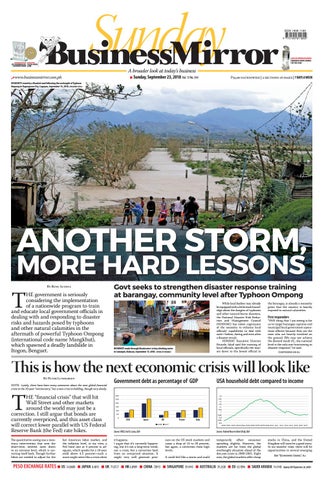
RESIDENTS stand by a flooded road following the onslaught of Typhoon Ompong in Tuguegarao City, Cagayan, September 15, 2018. AP/AARON FAVILA
ANOTHER STORM,
MORE HARD LESSONS T
By Rene Acosta
HE government is seriously considering the implementation of a nationwide program to train and educate local government officials in dealing with and responding to disaster risks and hazards posed by typhoons and other natural calamities in the aftermath of powerful Typhoon Ompong (international code name Mangkhut), which spawned a deadly landslide in Itogon, Benguet.
Govt seeks to strengthen disaster response training at barangay, community level after Typhoon Ompong While local leaders may already be equipped with a little stock knowledge about the dangers of typhoons and other natural-borne disasters, the National Disaster Risk Reduction and Management Council (NDRRMC) has taken cognizance of the necessity to enhance local officials’ capabilities to deal with such—before, during and even after a disaster struck. NDRRMC Executive Director Ricardo Jalad said the training of local officials, specifically the mayors down to the lowest official in
RESIDENTS wade through floodwaters to buy drinking water in Calumpit, Bulacan, September 17, 2018. AP/BULLIT MARQUEZ
the barangay, is already a necessity given that the country is heavily exposed to natural calamities.
First responders
“ONE thing that I am seeing is for us to target barangay captains and municipal local government operations officers because they are the ones who are heavily involved on the ground. [We may not achieve the desired result if]…the national level is the only one functioning in disaster response,” he said. Continued on A2
This is how the next economic crisis will look like By Peter Lundgreen
NOTE: Lately, there have been many comments about the next global financial crisis to the 10-year “anniversary,” but a new crisis is building, though very slowly.
T
HE “financial crisis” that will hit Wall Street and other markets around the world may just be a correction. I still argue that bonds are currently overpriced, and this asset class will correct lower parallel with US Federal Reserve Bank (the Fed) rate hikes.
The quantitative easing was a monetary intervention that sent the short-term interest rates down to an extreme level, which is correcting itself back. Though further hikes are needed to adjust for the
hot American labor market, and the inflation level, in my view, a Fed fund rate at 4 percent is adequate, which speaks for a 10-year yield above 4.5 percent—such a move might seem like a crisis when
PESO EXCHANGE RATES n US 54.0600
Government debt as percentage of GDP Government debt as pct. of GDP
USA - Household debt compared to income
300 250 200 150 100 50 0
USA USA
Japan Japan
UK Storbritannien 2008
France Frankrig
Italy Italien
2017
Source: FRED, Fed St. Louis, USA
it happens. I argue that it’s currently happening, but it’s not a long-term trend, nor a crisis, but a correction back from an overpriced situation. It might very well generate pres-
USA household debt compared to income
1.3 1.25 1.2 1.15 1.1 1.05 1 0.95 0.9 0.85 0.8 2000 2001 2002 2003 2004 2005 2006 2007 2008 2009 2010 2011 2012 2013 2014 2015 2016 2017
Source: Federal Reserve Bank (Fed), USA
sure on the US stock markets and cause a drop of 15 to 20 percent, but again, a correction from high levels. It could feel like a storm and could
temporarily affect consumer spending slightly. However, the markets are far from the global overbought situation ahead of the dot.com crisis in 2000-2001. Right now, the global markets offer cheap
stocks in China, and the United Kingdom will soon be a good story. In six months’ time, there will be opportunities in several emerging See “Economic Crisis,” A2
n JAPAN 0.4815 n UK 71.0727 n HK 6.8909 n CHINA 7.8913 n SINGAPORE 39.4945 n AUSTRALIA 39.2638 n EU 63.1096 n SAUDI ARABIA 14.4148
Source: BSP (September 20, 2018 )
NewsSunday BusinessMirror
A2 Sunday, September 23, 2018
www.businessmirror.com.ph
Another storm, more hard lessons Continued from A1
Jalad said that as local officials, barangay leaders are the first responders whenever a calamity strikes. Besides, local officials are expected to know every nook and cranny of their respective areas. One important lesson after Ompong, the NDRRMC head said, was that disaster-response training has become a necessity for all local officials in disaster response, notably so from the killer landslide in Benguet, which buried a small community of miners in heaps of mud and debris. Government officials admitted that the landslide, one of the more than 50 or so recorded in the whole of the Cordilleras, spoiled the national government’s preparations for Ompong, and even frustrated President Duterte, as admitted by Presidential Spokesman Harry L. Roque Jr. during a command conference at Camp Crame.
Lessons learned
PHILIPPINE National Police (PNP) Spokesman Senior Supt. Benigno Durana said all agencies of the government have learned lessons— both negative and positive—from the typhoon. Negative because of the loss of lives in Benguet, and, positive because of the “almost zero casualty” in the Cagayan region, where Ompong made its landfall and unleashed its full wrath. Jalad said there is a need for communities around the country to really understand and internalize risk and the hazards and dangers, and one way of putting it into their minds is through education, with their leaders as trainers. “That really needs to cascade to the people,” he said, adding that while there is a program at the lo-
cal level through the communitybased disaster-risk reduction and management training, it takes time before such is imparted to the last person in the community. This is why they wanted to train barangay officials, also in order for them to become trainers themselves. As the norm, every time a typhoon threatens the country, it is always the national government, through the NDRRMC, that has been instructing local officials, including governors, to implement a preemptive evacuation, and at the extreme, a forced evacuation. The task preoccupies the office in issuing repetitive instructions and in coordinating with the local officials.
Whose call?
AS officials have hinted, the landslide in Itogon could not have snuffed out the lives of too many people had its mayor implemented forced evacuation, although the local chief executive claimed he had ordered a preemptive evacuation, which was apparently disregarded by the miners and their families. Jalad said Barangay Ucab, where the landslide occurred, is considered a hazard area, and by this, its residents should have been moved to a safer place. According to him, a lesson that should be learned from the incident—and overall, from the typhoon—is for officials to judiciously carry out orders, including the advisories for evacuation. In Cagayan and Isabela, which both bore the brunt of the typhoon, the massive loss of lives was prevented after local officials exercised their better judgment and moved the residents to safer grounds, and reminded them to prepare and take extra cautions, in contrast to what
HUNDREDS of residents gather inside a gym as they evacuate their homes after a landslide struck their village in Naga City, Cebu, September 20, 2018. AP/BULLIT MARQUEZ
had transpired in Benguet. Jalad said implementing a forced evacuation is a call by local officials, and they can enforce it with the help of the local police in their areas.
Room for more improvements
AS for the NDRRMC, one thing that it should also improve is its public information-dissemination effort, as observed by no less than Transportation Secretary Arthur P. Tugade during a Cabinet briefing led by President Duterte in Cagay-
an a day after Ompong battered Northern Luzon. Tugade said that, while Cagayan and Isabela were already under Storm Signal No. 4, a television channel was still reporting that the province is still under Signal No. 3. The secretary’s impression redounds to the manner by which the NDRRMC reports casualties from typhoons. Three days after Ompong wrought devastation, the NDRRMC reported the typhoon has so far killed eight people in Luzon, despite
the bodies that were being unearthed from the landslide in Benguet, and the more than 70 that were already counted and reported by the various regional offices of the PNP. When asked why the NDRRMC was so slow in its count—which, observers say, is usual for the agency under its present leadership— NDRRMC Spokesman Edgar Posadas said they merely follow a protocol in the identification and revalidation of casualties, a task that is being undertaken by a cluster, whose head is the Department of the Interior and
Economic crisis…
market countries. Thus, I do not expect the financial markets to spark the next real crisis. The next global crisis, however, will look very different, and I am significantly worried that it will one day arrive. One could say that there is nothing to worry about, as I have argued that the global economy feels robust. As an example, Graphic 1 states that the US households are significantly less debtridden than before the global crisis from 10 years ago. Overall, this is a healthy development, and a lot of researches show that US households are still scared by the crisis 10 years ago and therefore borrow less. It could also reflect that in the US, a majority of the jobs created is in the low-salary segment, and the number of employees hired on temporary contract remains high, like in many countries in the world. This doesn’t give enough comfort to borrow money, or the income might not qualify for a credit score that is high enough to achieve full financing for a car or a home. The growing number of households with low income is the main reason why a 20-percent drop in the stock markets only affects private consumption marginally. A bigger number of households simply don’t have any savings that could be hurt by a sell-off in the equity markets. The middle class with some savings in stocks to withstand bad times is simply disappearing in several countries. The 1.5 billion people in Asia that will move up from a poor economic household situation to the lower middle income in the next 10 years won’t have any significant savings for a long period either. This alone is a big change in how households can withstand a crisis. It further underlines that the next global crisis will be very different compared to prior crises. The problem, though, is that the political leadership and their economic advisors tend to suggest the same tools for crisis manage-
Local Government. Protocols are well and good in dealing with crises, but in the aftermath of Ompong, it may be good for all entities with disaster management-related work to step back and review, with a cold eye, when and where exactly the rules must be heeded, and what the people on the ground must understand about risk assessment—before, during and after a disaster. As the experts say, manuals are helpful but one must always account for human behavior.
Continued from A1
ment, which has been used in the past 40 years. The trust in increased government spending has been universal since the crisis 10 years ago. But it also confirms a shift in who holds the risk compared to before the financial crisis. At that time, households and corporations were heavily loaded with debt, or leveraged. Since then, corporations, in particular, have improved their balance sheets and are now, in general, doing very well. Many governments are instead debt-loaded, where the graphic shows some large economies in the world, though others, like India, have done better. I argue that the next global crisis will happen when the trust disappears in government’s capability to repay debt. Can it happen? Sure, it can. And to circle back to the growing number of low-income households without savings, then they can only hope for help from the government in case of sudden growing unemployment. All in all, the economic liability explodes for the public finances if the next global crisis hit governments, which is my worry. Investors getting scared about government risks can trigger this situation. It has been seen before and will happen again. In case of a crisis, investors will take flight, and traditionally, a currency therefore gets cheaper, which again helps the country’s exports, and this way, a recovery is initiated via an increased export of goods. But in the next global crisis, investors might take flight into newer options like cryptocurrencies. This will weaken the currency that investors leave, but it doesn’t increase the value of another national currency, which means the devaluation effect becomes less against the prior crises. Some consumers might choose to move their savings to places they are comfortable with, which could be an account at large corporations they know, like an Internet-based
company where they spend their money anyway. I could very well imagine this happening as companies are getting bigger than countries, and savers might even very understandably prefer to invest in securities issued by large global corporations instead of, for example, Italian government bonds. If this will be the development, then it starts getting more challenging to conduct fiscal policy, particularly monetary policy. It means that it can be harder for a country to move out of an economic crisis. Further, the hope for an export-driven recovery becomes more difficult because economic growth is getting more domestic in most countries. Many countries are becoming more protective, but what’s important is that more economic growth is service-sector driven. It means that a country in economic trouble must recover on its internal strength, which is very difficult, as the Greece experience shows. A government debt crisis doesn’t necessarily have to happen globally, but such a crisis can spread and generate an extraordinary run toward the alternative flight destinations. Should that time come, I only see one realistic escape for the countries that end up caught in a debt trap—that is a debt write-off by the creditors. Because the risk is government debt, then the time horizon is long and unclear, which is why I only add a bit on the risk barometer, though the barometer is slowly moving in that direction.
• Peter Lundgreen is the founding CEO of Lundgreen’s Capital, the leading independent advisor to Danish municipalities and public institutions in Europe. He has a solid 30-year experience in the finance industry and has been sharing his financial and economic know-how the past decades. Although based in Denmark, Peter’s expertise transcends the European financial zone and market, as he has created a high level of proficiency and competency on major global economies and finance markets, particularly in China.
The World BusinessMirror
www.businessmirror.com.ph
Sunday, September 23, 2018
A3
CHINA RACES TO GET TOYS, CAR PARTS TO U.S. BEFORE TARIFFS HIT T
HE race is on to get Chinese goods into the US before President Donald Trump’s tariffs bite. At sea and in the sky, the US president’s trade war with China has ignited a freight frenzy. Hyundai Merchant Marine Co.’s vessels leaving China for the US are full, deliveries to California ports are surging, and cargo rates for journeys across the Pacific are at a four-year high. The levies that kick in on Monday have amplified the busy pre-holiday season, as Chinese manufacturers rush everything from toys to bikes to car parts into American stores before tariffs hit. At Air China Ltd., freight to the US is booming.
In Jiangsu province on China’s east coast, E.D. Opto Electrical Lighting Co. dispatched a batch of car lights by sea to Los Angeles in late August, earlier than planned. “It takes about 25 days, so I hope we can make it,” said export manager Melissa Shu. The company is racing to complete an order for another US customer who’s prepared to pay extra for air freight if it means dodging the new tariffs, she said.
Consumer benefit
STARTING Monday, a 10-percent duty applies to $200 billion of Chinese imports— Trump’s biggest salvo yet in a trade war
between the world’s largest economies that now directly hits US consumers. After that, American importers have until the end of the year to stockpile Chinese products before the tariff leaps to 25 percent. As companies accelerate shipments from China to beat those deadlines, American consumers could get a leg-up: anticipated price hikes on household goods at retailers like Walmart Inc. and Target Corp. might be held off in the short term. In China, this front-loading of exports helped push China’s trade surplus with the US to a record in August. Trump has threatened duties on a further
$267 billion of made-in-China goods, which would hit nearly all other consumer products, including mobile phones, shoes and clothes. That escalation could spur US companies to preemptively load up on those goods, too, Deutsche Bank AG said in a report this week. The National Retail Federation in the US warned that duties will lead to higher prices and even product shortages.
Toy shipments
IN the industrial hub of Dongguan in southern China, toy maker Lung Cheong Group—which supplies Hasbro Inc.—is getting squeezed by American customers
watching their calendars. “More clients in the last two months are asking if we can deliver goods ahead of the scheduled time to avoid the upcoming tariffs,” said Chairman Lun Leung. For small high-tech toys that have higher retail selling prices, some clients are willing to upgrade from sea freight to air, he said. Such expedited orders are helping to fill ports along the US West Coast. Imports to northern California’s Port of Oakland surged 9.2 percent in August. That was the busiest August in the port’s 91-year history. At the Port of Long Beach, imports of containers
rose 9.4 percent this year through August. That comes after a record 2017. Spot freight rates from Shanghai to Los Angeles, the biggest US port, reached $2,362 per 40-foot container in the week ended September 13, the highest weekly level since December 2014, according to the Drewry World Container Index. The threat of the looming tariffs is supercharging business at Hyundai Merchant Marine, South Korea’s biggest shipping company, and APL Ltd., one of the largest shippers on the trans-Pacific route, during the industry’s peak season, representatives for the companies said. Bloomberg News
A4
Sunday, September 23, 2018
The World BusinessMirror
www.businessmirror.com.ph
Wealthy Americans are last in sustainable investing–UBS
A
merican millionaires are lagging behind wealthy counterparts elsewhere when it comes to sustainable investing. US investors ranked last among those surveyed in 10 countries with at least $1 million of investable assets, with only 12 percent claiming to have put money into environmental, social and corporate governance-related holdings, according to UBS Group AG. That compares with 60 percent of respondents in China and 53 percent in Brazil. “Americans are focused on making money,” said Cary Krosinsky, who teaches sustainable investing at Yale and Brown universities.
“Business is business.” Sustainable investing incorporates broad societal concerns and personal values into investment decisions, while generally still trying to make a market-rate return. This can include such
areas as investing in renewable energ y, development debt or strategies aimed at promoting gender diversity. While pension funds and other institutional investors control a large part of the market and have been leaders overseas, individuals in the US haven’t had the same sort of direction, said Andrew Lee, head of Americas sustainable and impact investing at UBS’s global wealth unit. Still, while a smaller percentage of Americans allocate assets sustainably, those who do put al-
Americans are focused on making money. Business is business.”—Krosinsky
most half into such investments, according to UBS. “Once people are convinced, they do it with high conviction,” Lee said.Defining sustainable investing can prove difficult, with more than two-thirds of respondents saying the terminology around the topic is confusing. Investors are also unsure what sort of returns they’ll get. “The term sustainability itself means different things to different people,” said Christine Harada, president of impact-investing company I(x) Investments and former chief sustainability officer in the Obama administration. “There’s also a political perception issue— when people think about sustainability they think of it a bit as a California kind of fringe-y thing, when in reality there are very compelling economics.” Bloomberg News
Reckoning with loss of homes, livelihoods after Florence
S
PRING LAKE, North Carolina—With Florence’s floodwaters receding in some places and still menacing others, tired and waterlogged North Carolinians are finally getting a chance to take stock of the destruction from the wind and floodwaters. When rivers spilled from their banks this week, many were forced to flee their homes in multiple inland cities. Now that waters are receding, property owners along its banks are picking through debris and figuring out what’s left of their homes and livelihood. Jose Perez-Santiago, an Afghanistan war veteran, retrieved belongings on Wednesday
from a Spring Lake house swamped by the overflowing Little River. “I didn’t realize we would lose everything,” said Perez-Santiago. “We’ll just have to start from the bottom again.” For some locals in Wilmington, a coastal city littered with downed trees and floodwaters, the storm offered the bittersweet bargain of nonstop, tiring work that comes with a paycheck for helping others. Stanley Hall, 54, had to walk 6 kilometers to get to a downtown Wilmington hotel to join up with about 50 other locals doing temporary work for SERVPRO, which specializes in cleaning up water damage in homes and buildings. Hall
said he’s earning $12 an hour for the SERVPRO work, $2 more than his temp agency normally pays. He’s also been working about double a normal week’s worth of hours—meaning plenty of overtime pay. “I ain’t mad about that, that’s for sure,” he said. Inland in Lumberton, which was hard-hit by flooding from the Lumber River, Wavon Rogers spent several days after the storm as a civilian volunteer using his boat and truck ferrying 18 people either away from flooded homes, or back to retrieve medicine and essential belongings. With the sun out and some Lumberton roads drying, he’s shifting back to his day job
as an electrical contractor, helping homeowners restore power or hook up generators. He told a reporter by phone he only had a few minutes to talk while working on one job before heading to others. “I’m putting services up at this moment, wiring generators,” he said. Lumberton homeowner Kenneth Campbell said he found at least a foot of water in his one-story home when a friend took him into his flooded neighborhood on a boat on Tuesday. “The water was right above my floors,” he said. Campbell’s house also flooded during Hurricane Matthew, and he hadn’t expected to face the prospect of rebuilding two years later. Asked whether he thought his home and flood insurance would offer enough this time to rebuild, or if he would need further government assistance, he said he wasn’t sure. “That’s hard to say,” he said, in a low, sad-sounding voice. “Things are always changing.” In Campbell’s neighborhood, Kevin Caudle has donned waders to wade in and check on his house multiple days this week. He fears that the floodwaters could be creeping above his crawlspace and could cause more damage. “Came over to the house to pump water out from under the crawlspace today but when I arrived the water had risen probably 3 to 4 inches in over the crawlspace entrance,” he told a reporter in a text message. “Very disheartening but we will make it through it.” AP
In this July 18 file photo, Brendan Kennedy (third from right in front), chief executive officer and founder of British Columbia-based Tilray Inc., a major Canadian marijuana grower, leads cheers as confetti falls to celebrate his company’s IPO (TLRY) at Nasdaq in New York. Investors are craving marijuana stocks as Canada prepares to legalize pot next month, leading to giant gains for Canada-based companies listed on US exchanges. AP
It’s ‘high times’ for ascending cannabis stocks on Wall Street
N
EW YORK—Reefer Madness has gripped Wall Street. Investors are craving marijuana stocks as Canada prepares to legalize pot next month, leading to giant gains for Canada-based companies listed on US exchanges. Some experts are concerned that the ending will be a buzz kill. Billions of dollars have poured into the stocks in the last few months, and investors smell green (money, not leaves) in the air as they consider the opportunities these companies might have as the marijuana market in Canada grows, along with the possibility that the US and other countries could follow suit. The value of one company, British Columbia-based Tilray, has jumped tenfold since its initial public offering just two months ago. The company had $20 million in sales in 2017, but it’s now worth considerably more than Macy’s or Hasbro. With those huge gains have come extreme swings. Wednesday was a trip for Tilray stock: after closing at $154 the previous day, it opened at $233 a share, soared to $300, and then plunged to $151 before rallying to close at $214. Trading was halted several times because of that volatility. For some people on Wall Street, it’s bringing back unpleasant memories. “We just went through this eight months ago with cryptocurrencies,” said investor Ken Mahoney, chief executive officer of New York-based Mahoney Asset Management. He said the investors buying these stocks at their current prices are already betting on enormous successes, but even if legal marijuana takes off, some of the companies will fail. It’s easy to see why investors are so optimistic. This week Coca-Cola acknowledged it could one day offer cannabis-infused drinks. That came after reports Coke was in talks with Aurora Cannabis about
drinks containing cannabidiol, or CBD, a marijuana component that isn’t psychoactive. Aurora stock, which is listed in Canada, surged. That would be a sort of return to Coca-Cola’s roots, as the drink contained some cocaine when it was invented. In August, Molson Coors said it will team up with Hydropothecar y Cor p. to sell marijuanai n f u sed d r i n k s, a nd C a nopy Growth announced a $4-billion i nve s t me nt f rom C on s te l l a tion Brands, the company that makes Corona beer. The stocks jumped on Tuesday when the Center for Medicinal Cannabis Research at the University of California San Diego said the government will allow it to import capsules containing cannabis compounds from Tilray so the center can study their effectiveness in treating tremors. “The total global [cannabis] category could reach upward of $200 billion, as suggested by Constellation Brands,” said Stifel analyst Christopher Growe. Canopy Growth has more than doubled in value this year, and another rival trading in the US, Cronos Group, has jumped 78 percent. KushCo Holdings has surged 36 percent and GW Pharmaceuticals, which recently received government approval for a cannabis-derived drug used to treat seizures, is up 29 percent. Growe said the value of the 22 largest marijuana companies trading in Canada has more than doubled since August 15, when the Canopy-Constellation deal was announced. Recreational marijuana will become legal across Canada on October 17, and consumable forms of the drug will be legal in 2019. Marijuana remains illegal in the US at the federal level, but it’s legal for recreational use in nine states and Washington, D.C., and for medical use in 31 states, according to the National Conference of State Legislatures. AP
In a world of robots, carmakers persist in hiring more humans
C
ar-industry employees concerned that robots will put them out of work needn’t worry—at least for now. Of the 13 publicly traded automakers with at least 100,000 workers at the end of their most-recent fiscal year, 11 had more staff compared with year-end 2013, according to data compiled by Bloomberg. Combined, they had 3.1 million employees, or 11 percent more than four years earlier, the data show. Carmakers in China and other emerging markets, where growth is strongest, favor human labor because it requires less up-front investment, said Steve Man, an analyst at Bloomberg Intelligence in Hong Kong. In developed markets, tasks that can be handled by robots were automated years ago and automakers are now boosting hiring in research and development as the industry evolves. “There’s been a lot of growth in emerging markets, especially China, so that’s one reason automakers are adding staff,” Man said. “More staff is being added on the R&D side, with
the push for autonomous, electric, connected vehicles.” A trio of Chinese automakers— SAIC Motor Corp., Dongfeng Motor Group and BYD Co., in which Warren Buffett is a major investor—increased staff by at least 24 percent. Volkswagen AG accounted for more than one in five jobs among the group of 13, and increased its employee count by 12 percent in the period. General Motors Co., which shrank its payroll 18 percent to 180,000, and Nissan Motor Co., which contracted by 2.8 percent to 139,000 workers, were the sole carmakers whose staff got smaller, the data show. GM’s numbers were affected by the sale of its European division to PSA Group last year. About 40 percent of autoworkers were women in 2017, compared with 38 percent four years earlier, based on data from about 30 of the largest vehicle producers worldwide. The analysis didn’t take into account wages or location of the workers. Auto companies are hiring more for software positions than hardware
roles to prepare for a future in which more vehicles are communicating with each other and their surroundings, Man said. The rising popularity of electric cars is also set to cause an upheaval at manufacturers that make parts for internal-combustion engines. Total vehicle production worldwide in 2017 rose 11 percent to 97 million units, compared with 2013. Chinese plants cranked out 30 percent of all vehicles last year, followed by 12 percent in the US, 10 percent in Japan, 6 percent in Germany and 5 percent in India. Five of the top 12 producing nations— it took 2 million units to qualify last year—were in Asia, three in North America, three in Europe and one in South America. Global vehicle sales totaled 85 million units last year, an increase of 11 percent from 2013. Half of those sales last year were in the Asia-Pacific region, a slight uptick because the proportion from Latin America fell from four years earlier with demand waning in Brazil. Bloomberg News
Faith Editor: Lyn Resurreccion • www.businessmirror.com.ph
25TH SUNDAY IN ORDINARY TIME: ‘MARK 9:30-37’
Spiritual childhood brings joy MSGR. JOSEFINO S. RAMIREZ SUNDAY GOSPEL IN OUR LIFE
T
ODAY’S Gospel leads us to a scene where the disciples argue among themselves, trying to understand what Jesus was saying about dying and rising again but were reluctant to ask Him. How many of us have not struggled to understand certain teachings of faith, but felt reluctant to ask questions for fear of exposing our ignorance? One too many times, I suppose. Jesus teaches us in this passage that for us to be successful or get ahead in the spiritual world is to become like a child. Back when children and women were seen as little more than property, children were deemed to be useless until they are old enough to help with housework. In simple terms, they were humble and lowly. The child referred here represents all of us. The greatest people in God’s kingdom are not the rich and the powerful, but the poor and the helpless; not the ones with the most servants, but those who serve others the most. If we spend more time devoting it to causes for the lowly, sick, humble, the oppressed, we become successful from God ’s point of view.
We are like the disciples sometimes when we think of success in our worldly ways. We fall into using our ambitions to get ahead. We are afraid to ask questions to understand and fulfill the will of God but forge ahead with the wrong idea of true greatness and power. I don’t think any of us would want to end up conspiring with people bearing such distorted ideas. It can be difficult to let go of our earthly desires to succeed in life. Part of us being human is the need to be in control, to be independent and reach our goals no matter what it takes. But there are many things life can offer us that lie in God’s hands. And that is always possible. A servant’s heart and hand is a humble heart and a humble hand that leads us to the road to greatness. True power and success, as Jesus came among us, comes in the form of serving others with God in control. Prayer renews and refreshes our desire to be like and for Jesus in the world. Let us pray to be like a child, a new birth, to start anew and march on to serve others—to be well on our way to the new road to happiness.
Sunday
Sunday, September 23, 2018
A5
SAINT PIO DE PIETRELCINA: FIRST STIGMATIST PRIEST By Corazon Damo-Santiago
‘I
NEED to love You more and more, but I don’t have any more love in my heart. I have given all my love to You. If You want more, fill my heart with Your love, and then oblige me to love You more and more and I will not refuse you.” He was praying before a wooden crucifix on September 20, 1918, when he was overwhelmed by numbness, drowsiness and fell asleep on the floor. When he woke up, he dragged himself to his cell and in horror examined his wounds. “Soaking in his own blood, he praised and thanked the Lord.” Padre Pio’s stigmata became the core of controversy that divided the religious and other people, friends or foes. On July 26, 1933, after “11 years of persecution and 25 months of absolute isolation,” he celebrated Mass publicly. On March 25, 1934, he was permitted to hear confessions of men and then women on May 12, 1934.
Born holy
“PEPPA, the child was born wrapped in white veil and that’s a good sign. He will be holy,” said the midwife to Giuseppa when she lifted the new-born baby in the afternoon of May 25, 1887. The next day, the baby was baptized in Saint Mary of the Angels Parish. He was named Francesco Forgione in honor of Saint Francis of Assisi, the patron saint of Ma. Giuseppa, her mother. Quiet, shy and deeply religious, Pio avoided games and arguments. When he heard others blaspheme God or the Blessed Mother, he would run off and hide weeping and kneel to pray. Pio described himself that from childhood he was “Un macherone senza sale [A noodle without salt].” A colorless character. His diary recorded how he suffered from the gruesome appearances of the devil, who beat him. An entry stated, “I didn’t know what saint to turn
to. I called out to my guardian angel. And after having to wait a little, he finally came to my aid.” He also recounted that the devils come when his mother puts off the light in his room. Fr. Charles Mortimer Carty in Padre Pio, The Stigmatist, narrated what he said to his mother when asked why he was waving his hands continuously: “Stinging pains on my hands.” It was the day the Stigmata of Saint Francis of Assisi was being commemorated. Fr. Salvatore Pannullo, pastor of the parish in Pietrelcina, recounted that he saw the stigmata on Father Pio’s hand on September 7, 1910, and Pio implored that they pray together for God to remove the visible signs but not the suffering. On September 8, 1911, Fr. Pio wrote his spiritual director Father Benetto of San Marco in Lamis about “sharp strong pains in the middle of the palms of his hands and on his feet.”
Be ordained before death
HE was 15 when Pio entered the novitiate of the Capuchin Friars at Marcone, Benevento. Two weeks after, he wore the Franciscan habit, was named Fra. Pio in honor of Pope Saint Pius V, the patron saint of Pietrelcina. On January 27, 1907, he made his final solemn profession of vows. At 17 he suddenly fell ill. He was tormented with “intestinal irritability and terrible headaches, fevers, coughs, chest pains, fainting spells and cold sweats. Doctors were puzzled about his illnesses. “I am a mystery to myself,” he emphasized. “He no longer entertained hopes to get well. He even welcomed death.... He had only one remaining desire: to be ordained a priest before he died,” noted Renzo Allegre in Padre Pio: Man of Hope. He was ordained on August 10, 1910, in the Cathedral of Benevento. He celebrated his Mass at the church where he was baptized on August 14, 1910. As a monk, he was granted
dispensation to live outside the monastery because of his precarious health. He was allowed to celebrate Mass in the parish and help in parish work but disallowed to hear confession to avoid contaminating others with his tuberculosis. From 1910 to 1916 he lived in Pietrelcina except for a few months when he was drafted to serve in the military since Italy was involved in World War I. He was discharged from military service on July 22, 1916, due to poor health.
Beyond reality
CHURCH history is replete with stories about saints with stigmata, who accepted the wounds joyfully and with resignation. But Father Pio did not only try to hide it initially. He, likewise, prayed to have its physical features hidden. Renzo Allegri included a chapter in a biography of Father Pio on his conversation with Jesus. “Let me suffer and let me die from suffering. But take away these signs that cause me so much embarrassment, Pio was quoted as saying. Jesus said: “You will bear them from 50 years, and then you will see me.” To Modesto Vinelli, a photographer who had photos of the stigmata in 1918, Father Pio shared his 50 years life. “Modesto, we have 50 years ahead of us.” Every year, on September 20, Modesto wished him well, and the Pio answered him in scrabbled words concerning time. On the 25th anniversary of his stigmata, he said, “Modesto, remember that we still have 25 years.” On September 20, 1968, Pio declared: “Modesto, the 50 years are over.” Padre Pio was not only gifted to read the future. He was also endowed with the grace to reconcile people with God, communicate with angels, speak and understand other languages, bilocation (be in two or more places at the same time) and levitation (raise himself from the ground). His presence can also be felt by sweet smell
of flowers. Doctors attest that he abstained from sleep and food beyond man’s natural capacities.
Contemplation under the stars
THE Capuchin fathers organized a big affair to celebrate the 50th anniversary of Father Pio’s stigmatization, which he vehemently disapproved. Since September 20 was a Friday, the affair was moved to September 22, a Sunday. Although he was not feeling well, he was ordered by the superior to celebrate a Mass with singing. He obeyed. Exhausted, he was unable to sing. At the end of the Mass, he collapsed on the altar, and was wheeled to the sacristy. It was his last Mass. At dawn Father Pio requested Father Pellegrino, who was entrusted to care for him, to hear his confession, renew his act of profession as a religious monk and accompany him to the veranda for a few minutes of contemplation under the stars. Back to his room, he kept saying “Jesus, Mary” in ecstasy, in a voice that became steadily fainter. The doctors rushed to answer Father Pellegrino’s call for help. But Father Pio was already dead when they arrived. Heaven welcomed him at 2:10 a.m. on September 23, 1968. Fifteen years after his death, the process for his beatification started on March 20, 1983, and was closed on January 21, 1990. The oral and written testimonies were compiled in 104 volumes. Padre Pio whose only desire was “to be a poor friar who prays,” was beatified on May 2, 1999, and canonized on June 16, 2002, in Rome by Pope John Paul II. When his body was exhumed on March 3, 2008, 40 years after his death it was in fair condition. His beard has grown long, too. Santiago is a former regional director of the Department of Education National Capital Region. She is currently a faculty member of Mater Redemptoris Collegium in Calauan, Laguna, and of Mater Redemptoris College in San Jose City, Nueva Ecija.
Science
A6 Sunday, September 23, 2018
BusinessMirror
Sunday
‘Universities, industries tie up key for PHL’s 4th industrial revolution’
H
Story & photo by Stephanie Tumampos
ow should a country prepare for the fourth industrial revolution? Science Secretary Fortunato T. de la Peña called on universities to work with industries in the country to propel local enterprises to the fourth industrial revolution (IR).
“I am asking the universities not only to do R&D [research and development] but to do extension work in our industries,” de la Peña said in an interview with the BusinessMirror. “It’s a request or a call while working together with the Commission on Higher Education [CHED] and it means the universities can help in bringing our SMEs [small and medium enterprises] upward.” He made this remark during the recent 16th Development Policy Research Month forum with the theme, “Harnessing the Fourth Industrial Revolution: Creating Our Future Today,” held at a hotel in Quezon City. He said that the DOST itself has long adopted policy shifts to develop the country’s 18 regions. These have redirected the Department of Science and Technology’s efforts to address inequalit y among Filipinos, determine different programs through industries and higher-education institutions to conduct research with innovation to solve problems and conduct proposal driven activities under the department’s Harmonized National R&D Agenda for 2017 through 2022.
Should enterprises jump to the fourth IR?
Not so fast, the secretary said. “I think we have to categorize the enterprises that we serve in the DOST.” De la Peña emphasized that there are still enterprises that are categorized in the first IR, second IR and third IR and that “ if we push every enterprise to the fourth IR, those who are still in the earliest stages might still be left behind.” He explained that the industrial revolutions have evolved throughout time and it started when new manufacturing processes were used in factories. The first industrial revolution came when men used steam and simple machines and there are still some industries in the country that are in this era.
The second industrial revolution already had electricity and bigger machines to help in production, while the third revolution has involved electronics, automation and information technology. The fourth industrial revolution involves a mix of the different technologies, such as digital, biotechnology and artificial intelligence to name a few.
Philippines still in 2nd and 3rd IR
According to de la Peña, the Philippines’s enter pr ises and manufacturers are still in the second and third IR. He said that during one of their enterprise visits to Infanta in Pangasinan, they visited a salt factory which used traditional cooking by using big metal pans and wood fire. “We went there to personally check the situation and the intervention we are going to do,” he said. The DOST chief added that the interventions they would implement would involve automation and safer machines for the salt factory. “We want to help these industries not just to jump to a higher IR but also to have uniformity, minimize human error, implement safer standards for employees and introduce them to automation so they could produce more output.” The DOST recommended to the salt factory to produce iodized salt. He said the science department wants to gradually help the enterprises develop to the next level, and for those who are prepared can be assisted further. “We have to see the range of services and we have a number of strategies to achieve that,” he added.
Science Secretary Fortunato T. de la Peña gives his keynote speech at the 16th Development Policy Research Month forum held at a hotel in Quezon City.
T h e s e s t r at e g i e s i n c lu d e branching out from the direct intervention in firms. “We will still continue that [direct intervention], but we are now looking at the needs of the sector.” He said that at this time, each intervention should not only benefit an individual firm but should help everyone in the sector. With an innovation center particular for the sector, such as food processing, the DOST chief said, “I won’t expect them to have an ICT [information and communications technology] incubator. Universities can be tapped since this is part of their function as an extension.” Another strategy that the secretary told the BusinessMirror is through the platforms that the science department has started. “We have the One Laboratory Network, One Store and One Expert which are actually our tools of lifting them [SMEs] up,” he said. The One Laboratory Network is a platform where a laboratory can accept samples even without the characterization equipment but send these to the proper lab that can handle the sampling. The One Store is an online facility where products of MSMEs can be sold. The One Expert is a web site, where Filipinos can visit and type in keywords of topics they want to learn, which, in turn, will be redirected to a list of related results and links.
New R&D and the patriot program
New R&D priorities and facilities
I am asking the universities not only to do R&D [research and development] but to do extension work in our industries.”—de la Peña
have also been set up and can be instrumental in the journey to the fourth IR. “Our launching of the R&D for artificial intelligence would be one,” de la Peña said. “We have the facilities that we have either set up or are sup p or te d l i k e t he A d m ate l [Advanced Dev ice and Mater ia ls Testing Laborator y] for materials and product testing, the Electronics Product Development Center for protot y ping, and we have the different facilities at the Metals Industr y Research and Development Center, the dye and mold, the auto parts,” de la Peña added. The DOST chief also emphasized the role of the young Filipinos in shaping the country toward fourth IR. For this reason, the Filipino Patriot Scholars Project (FPSP) was established. The DOST-Science Education Institute’s FPSP aims to promote patriotism and nationalism among DOST scholars and engage in community and social responsibility. In its second year now, the program is implemented as a workshop for incoming scholars of the DOST-SEI scholarship prog ra m s. A for m at ion pro gram, the FPSP instills among scholars the value of social responsibility, servant leadership and professional excellence. “We have young people, the scholars, who we are supporting, and they have an obligation to our country. One of the things they can do is immersion in industry,” de la Peña said. The DOST chief wants to see young Filipinos from different universities immersed in various industries that the countr y is offer ing, especially in the fourth IR level. “ Yo u k n o w, t h e s e y o u n g scholars are ver y well-attuned in technolog y,” de la Peña said.
Equipment with radioactive materials reported missing
A
The missing gauge looks similar to the equipment in the photo. DOST-PNRI
“potentially dangerous” moisture densitygauge equipment containing radioactive materials was reported missing a month ago around the area of the MWSS Compound storage facility in Bigte, Norzagaray, Bulacan. According to the Department of Science and Technology-Philippine Nuclear Research Institute (DOST-PNRI), a licensee reported the equipment missing to the Norzagaray municipal police station. T he moisture densit y gauge is f u l ly shielded, and is safe as it is, the DOST-PNR I said in a news release. “However, it is potentially dangerous because it contains radioactive materials that emit high levels of ionizing radiation. If found, the unit should not be opened or tampered with to avoid exposure to harmful radiation
rays,” the DOST-PNRI warned. T he missing equipment is a Trox ler 34 40 moisture densit y gauge, which is used by the PNR I l icensee, an industr ia l firm, for testing of soil, asphalt and concrete mater ia ls. It weighs around 41 kilograms, which is contained in a transport orange-colored box measuring 30 by 14 by 17 inches. Attached to the transpor t containment and on the equipment is the radiation symbol in yellow triangle with three fanlike black blades. If anybody sees the radiation symbol, he or she should keep away from the equipment. Scrap metal dealers and buyers of used metal items are asked to be on alert for sellers of the equipment or its parts. Medical practitioners are advised of the possibility that patients may appear with symptoms
of radiation exposure, the DOSTPNRI added. The DOST-PNRI is the agency mandated to license and regulate the use of radioactive materials in industry, medicine, academe, research and other applications. T he DOST-PNR I has not if ied t he Ph i l ippine Nat iona l Pol ice a nd t he Of f ice of C iv i l Defense about the incident and has requested for assistance in t he sea rc h a nd recover y of t he m issing equ ipment. Those who may have seen, touched or have been near to the equipment should immediately report to the nearest police station, and contact the DOST-PNRI as soon as possible through: Teofilo V. Leonin Jr., chief, Nuclear Regulatory Division, DOST-PNRI, at telephone: 9208796, 9296011 local 244; mobile: (0915)-1946085; and e-mail: tvleonin@pnri. dost.gov.ph. S&T Media Service
www.businessmirror.com.ph • Editor: Lyn Resurreccion
Russia’s elite space program opens doors to Filipino scholar
T
By Rizal Raoul S. Reyes
e ac h e r - r e s e a r c h e r Wilfredo K. Pardorla Jr. of Saint Cecilia’s College-Cebu Inc. is very inspired from the experience and knowledge he acquired from Samara University’s 14th International Summer Space School in Russia, saying that it helped broaden his horizon in space satellite technology. “Samara University offers one of the best aerospace engineering courses. It is like the Massachusetts Institute of Technology in the US. They had built in-house and launched their own satellites and nanosatellites, such as AIST-1, AIST-2, AIST-2D, Samsat-218, Samsat-QB50, etc,” he said in an e-mail interview with the BusinessMirror. It was a milestone for Pardorla for being the first and only Filipino to qualify in the elite space program. It was made possible with the support from the Department of Science and Technology-Philippine Council for Industrial, Energy, Emerging Technologies Research and Development (DOST-PCIEERD) and the United Nations Office for Outer Space Affairs (Unoosa). Samara University is one of the best institutions that offer aerospace education courses in the world. The university established the International Summer Space School in 2003 with the Progress Rocket and Space Center and the Volga Branch of the Russian Academy of Cosmonauts, and is supported by Unoosa, the DOST-PCIEERD said in a news release. Pardorla pointed out in the interview that the space program had already achieved milestones since its conception in 2003, such as the Young Engineering Satellite (YES) 2 international project and 14 PhD degrees and 60 master degrees.
Qualifying program; nanosat
F r om March 26 to April 7 Pardorla par ticipated in a two-week distanteducation training program—the first stage of the summer space school—along with 200 final year undergraduates, master’s degree students, PhD students, young researchers and engineers On April 12 the number of participants was narrowed down to 40 after an analysis of test results from the first stage of training. Pardorla was among the selected participants invited to Samara University in Russia for the second stage of the summer space school. It was a workshop program from August 20 to 31 with lectures, presentations, roundtables, and group projects on the design and operation of nanosatellites, exuding the summer space school’s theme this year, “Future Space Technologies and Experiments: From a mission idea to a nanosatellite project.” In this year’s 14th International Summer Space School, Pardorla and his batchmates came up with four nanosatellite mission proposals with their respective teams. He and his comembers from India, Et h i o p i a , M ex i co, Pe ru a n d Tu n i s i a worked on the Nanosatellite for Th e r m o s p h e r i c Ato m i c Co m p o s i t i o n and Density Measurements I Nanosat, which aims to study the composition of the upper and lower thermosphere through mass spectrometr y. “All the knowledge we had gained from the summer space school was tested in applicative manner through a nanosatellite project work that underwent defense with the panel of experts from Samara University and other universities. This had incorporated mission analysis, 3D simulations assembling and testing and modeling nanosatellite functionality, calculations of power, link and mass budgets, etc.,” he said.
Opened new doors
Pardorla said his Russian scholarship on satellite technology opened new doors for his career that will enable him to participate in pushing space science in the country. Since he is just a tyro in space science, he admitted that the training in Samara University was a big boost to his study in satellite technology. After his Russian stint, Pardorla is not resting his on his laurels as he plans to pursue more professional and technical fields so he could help in enhancing the proposed Philippine Space Agency (PhilSA) in the coming years. The bills creating the PhilSA are being discussed in the two houses of Congress. Moreover, he is expected to train and collaborate with students, researchers and engineers specializing in satellite
Wilfredo K. Pardorla Jr. in Russian Samara University’s 14th International Summer Space School program Wilfredo K. Pardorla Jr.
technology applications (STA), propose programs and missions for nanosatellite applications and share what he have learned during S&T events. “With the learning that I had, I am certain that I can already help develop the field of space science here in the country and in my institution, especially in nanosatellites/cubesat programs. We are one step higher in a achieving a cubesat project implementation that will be assembled and done in-house in some of our universities in the Philippines,” he said.
Microsatellite program
The country’s foray in space exploration was boosted with the launch of the first Filipinomade microsatellite called Diwata-1 in April 2016. Diwata-1 was assembled by nine Filipino scientists and engineers in collaboration with Japan’s Tohoku and Hokkaido universities, and the Japan Aerospace Exploration Agency, under the Philippine Scientific Earth Observation Micro-satellite Program. The 50-kilogram microsatellite, with the size of a coffee table, has captured thousands of photographs taken over the course of 5,000 passes around Earth. These images can be used for disaster management, crop inventory, monitoring of territorial waters of the country for security and others. Diwata 2 is expected to be launched in the last quarter of this year. At the same time, Maya-1, a 1U or 1.75-inches, cube satellite that was developed by Filipino engineers in Japan, was deployed into orbit from the International Space Station (ISS) on August 10. Maya-1’s possible applications are collecting data to generate early warnings for landslides and flash floods, complementing systems for monitoring health conditions of people in remote areas, and systems for tracking endangered species like the Philippine eagle, and fishing vessels.
Space tech application
Pardorla noted that the knowledge he acquired in Russia would be a big help in the development of future space technology applications in the country, especially in the forthcoming establishment of PhilSA. “If possible, I’m planning to conduct workshops in partnership with the DOSTPCIEERD and with some universities to maximize the scope for nanosatellite trends in the country,” he said. It should be noted that Pardorla, together with his comentors and high-school students, have launched a high-altitude balloon as a technology demonstration in April 2016, which made Saint Cecilia the first academic institution in the country to accomplish the feat. The project was supported by the DOST-PCIEERD through Young Innovators Program which led the conception of the High-Altitude Balloon Life Support System “Karunungan”—also a Philippines’s first and launched it in May 2018. He said Saint Cecilia also ventured into model rocketry, which had gained this year’s DOST-PCIEERD YIP research grant. It is positioned to become one of the bases for future launch vehicles for the country’s next generation of satellites to orbital missions and beyond. “Filipinos should be more open into S&T, especially in space studies, and cultivate the research culture into our community and country,” Pardorla said. “I am hoping that I will not be the last to join the summer space school and that there will be more who will be interested and be qualified in this astounding opportunity in the years to come,” he added.
Tourism&Entertainment BusinessMirror
Editor: Carla Mortel-Baricaua
Sunday, September 23, 2018 A7
STAY MORE THAN A DAY IN THE HIGHLANDS, NESTLED EAST OF THE METRO
Rediscover and visit Antipolo anew
Enjoy members-only travel perks on AirAsia web site and app
Y
OUR holidays with AirAsia are about to get better! AirAsia BIG members will enjoy more perks, including instant discounts, when they book flights directly on airasia. com or via the AirAsia app. AirAsia Group Chief Commercial Officer Siegtraund Teh said, “Our guests are at the heart of everything we do, and we relentlessly challenge ourselves to deliver more value to our guests. We are pleased to reward our BIG members with a range of exclusive benefits when they book flights via our web site or app, allowing them to enjoy low fares all year round.” AirAsia BIG members will get to enjoy the following exclusive travel perks:
1Getflights.instant member discounts for all Enjoy P130 savings on return flights or P65 savings on one-way trips for all new bookings made on airasia.com or the AirAsia app. The discount is applicable to all flights, as well as promotional fares. A COLORFUL garden in Luljetta’s Place gives that romantic summer vibe.
J
THE Parish of the Immaculate Heart of Mary, a favorite among soon-to-wed couples.
Story & photos by Gelyka Ruth R. Dumaraos
UST over an hour drive from Mega Manila, one can be up in the mountains enjoying the view of Manila’s skyscrapers, getting the vibe of the distance but not really being away from the Metro at the same time. More than this, as the melting pot capital of the province of Rizal, Antipolo is a haven of arts, food and distinct destinations combined, something that many would find worthy of checking out for more than just a day or two. According to Antipolo City Tourism Officer Mar Bacani, the goal is exactly that: To bring in more tourists and make them stay longer. “Tourism is one of our top priorities. It is our goal to make Antipolo at par with other leading Philippine destinations because we can offer good food, art, experiences and even accommodation.” To prove so, the local tourism draws up tours highlighting various destinations and local businesses which greatly contribute to the continued rise of tourism possibilities in the area.
For a weekender trip
HERE’S a sample guide on scoring the best of what Antipolo City has to offer: Day one. Hop in a van and head to Antipolo for an early-morning breakfast at Café Cristina in the mountain resort Cristina Villas. The café, perched on a hill, welcomes the cool, gentle breeze while giving a distant view of the metropolitan skyline. After sipping on a cup of freshly brewed coffee or chocolate drink, a quick tour around the area won’t hurt. While it takes a few uphill steps, one can kick-start his Antipolo adventure with a thrilling zip line ride, overlooking the 2.5-hectare property’s main amenities, such as swimming pools, spa, gym, function areas and hotel. The property is just a stone’s throw away from one of Antipolo’s
main attractions—Hinulugang Taktak. Legend has it that, during the 16th century, a local priest was forced by the local people to drop the bell in the river due to its harsh and unbearably loud sound when rung during Angelus; thus the name “Hinulugang Taktak,” which literally means “where the bell was dropped.” Today, the legendary site is one of the most important landscapes in the province of Rizal, and is must-visit for first timers in Antipolo. Come lunchtime, best to check out The Bistro at Le Blanc Hotel has to offer. Savor some good old Filipino-Asian cuisine from sisig, kare-kare, and sinigang to rib eye steak and Korean Beef Stew. After which, it’s time to freshen up and check in to Luljetta’s Place Garden Suites, the new addition to the growing accommodation and recreation services of Loreland Realty And Development Corp. Antipolo’s best-kept secret hideaway is probably the Luljetta’s Hanging Gardens, a spa offering various health and wellness services, situated on the cliff of the mountain. In the afternoon, after all the strolling and gastronomic adventures, it’s time to rest and relax while admiring the serene and picturesque backdrop of mountains, and a commanding view of Bataan and Laguna de Bay. Start by having a dip in its infinity pool or resting your feet at the Dr. Fish Spa. There is also an option to avail yourself of either a head and back massage or foot reflexology. When done with the massage, one can go to their secluded meditation lounges and lush gardens for some quiet time. For people who are into visiting food parks, the new 11 Circle
.Aside from getting the best flight deals to over 130 destinations and having priority access to sales, members can now use their AirAsia BIG Points to pay for flights and add-ons, such as seats, meals, checked baggage and more. However, AirAsia BIG Points cannot be redeemed to cover taxes, fees and charges.
3Seamless one-click payment with BigClick.
You are now one step closer to low fares with our BigClick payment feature. BigClick provides a faster and more convenient checkout for all purchases. Guests can save the trouble of reentering their card details for every payment as BigClick allows members to securely store their credit and debit card details. Save your card details now and earn 100 AirAsia BIG Points.
4Find the lowest fares with Low-Fare Finder.
Members can use the Low-Fare Finder feature to search for the lowest all-in fares. The lowest fares will be reflected in green when members select their desired traveling dates.
your flight and add-ons with My 5Manage Bookings .
HINULUGANG Taktak returns as one of Antipolo’s main attractions.
For romantic ‘I dos’
ARTIPOLO, the local artist group, displays artworks in partner establishments like Café Lupe.
Food Hub and Events Place is just about the go-to place to end your day. Food stalls offer international food—from ramen, pizza, chicken wings, burgers and pasta, to booze and sweet delights. Day two. The next morning, have a hearty breakfast buffet at Luljettas Place. A quick dip into its lap pool is also option before packing your things. Never miss going to Antipolo without catching a Sunday mass. A nice option is the frequently flocked Parish of the Immaculate Heart of Mary along Taktak Road. If dining with a spectacular view is preferred, Café Lupe Antipolo is a nice place to grab lunch. Situated in Sumulong Highway, the café offers a good view of the Manila skyline while you enjoy their fresh signature
and crunchy brick oven pizza. A number of house specialties include Paella ala Lupe, Chicken Ala Mexicana, Pasta Bolognese and Glazed Pork Belly. Café Lupe Antipolo also houses KTV rooms, bed and breakfast, events venue and a boxing gym. Before heading home, have a quick side trip to Pasalubong Center and sample Antipolo’s famous delicacies. One should never miss trying out Antipolo’s suman wrapped in ibus. It is usually dipped in latik or coco jam and sprinkled with roasted and grounded cashew nuts for some added texture. Other delicacies worthy of bringing home as pasalubong are broas, peanut brittle, cashew nuts, mangoes, polvoron, turrones de mani, lengua, uraro and glazed peanuts.
SPRAWLED across the city are several beautiful churches and lovely wedding venues, an attraction to engaged couples and their families to book for several days and go for that wedding ceremony held in the highlands. The Parish of the Immaculate Heart of Mary is one of the most preferred churches for the wedding rites because of its modern architecture fitted with all white and glass panels designed by Architect Dominic Galicia. Its contemporary design is surprisingly in contrast with the natural landscape which makes it more appealing and romantic for exchanging vows. It is so popular that wedding date reservations on a weekend this year up to the next is close to impossible since all dates had been already reserved early on. Other good options are the Boso-Boso Church, Saint Joseph the Worker Chapel, Saint Antony of Padua Church, Saint John Mary Vianney Parish Church, Antipolo Cathedral and more. For wedding-related activities, more and more hotels and resorts around Antipolo offer such amazing promos. One is the Le Blanc Hotel, an all-white hotel dedicated to Hon. Komong Sumulong, the former Majority Floor Leader of the 8th Congress (1987-1992) representing the First District of Rizal. It’s minimal yet classy ambiance makes the perfect background for the prenuptial shoots, on the day wedding preparation and reception.
For more than just day trips
AT Luljetta’s Hanging Gardens, the hydro-massage pool comes with a stunning view
and add-ons can now be paid with 2Flights AirAsia BIG Points
SUMAN sa ibus is a distinct delicacy found in Antipolo
ACCORDING to Bienvenido Tours owner Ramon Marinas, the leading tour operator in the province of Rizal and a proud local himself, Antipolo has all there is to be a thriving tourism destination. He says, “They only come here to go to church, dine and for some sightseeing. We want them to stay longer, that’s why we are developing more tour options, to give them reasons to do so.”
Left out a meal or extra checked baggage after checking out? Fret not, as managing upcoming flight and purchasing addons is made easy with “My Bookings” feature. As usual, don’t forget to pre-book online to enjoy better savings! To register as an AirAsia BIG member for free, simply go to airasia.com and click “Sign up.”
FRANK REICHENBACH
MARCO POLO ORTIGAS MANILA WINS PHILIPPINES’S LEADING HOTEL IN WORLD TRAVEL AWARDS
M
ARCO Polo Ortigas Manila is honored to have been recognized as the Philippines’s Leading Hotel for 2018 during the recently concluded World Travel Awards. Held last 3 September, the World Travel Awards celebrated its 25th anniversary. Known as the ultimate hallmark of industry excellence, the award-giving body celebrates key businesses in travel and tourism through its annual programme that goes across the globe. “Our team at the Marco Polo Ortigas Manila is truly humbled with this global recognition,” said General Manager Frank Reichenbach. “This award is a testament not just to our excellent service but also the continued support and patronage of our guests. Such an achievement only provides further motivation to continue delivering delight beyond expectations to everyone who visits the hotel,” he added. In the bustling commercial district of Ortigas Center, Marco Polo Ortigas Manila offers distinguished guests 316 well-designed rooms and suites, including two Continental Club floors. The Philippines’s first sky hotel, it devotes full levels to address the global traveler’s needs, with dedicated spaces for business meetings and social events as well as fitness and relaxation. Marco Polo Ortigas also boasts of four specialized dining destinations that feature international culinary favourites, a contemporary taste of Cantonese faire, a casual coffee lounge and a trendy sky bar with the most stunning view in the Metro.
A8 Sunday, September 23, 2018
S
EOUL—The Pyeongchang Winter Olympics closed seven months ago. Left behind are empty venues, feuding over who pays for upkeep, and an icy ski course that’s now an abandoned dirt runway, strewn with rocks and unused gondolas. Rare trees once stood before the course was gouged out of a mountainside, and plans called for replanting the piste and restoring the forest. Other venues sit mostly deserted: a speed-skating arena, a hockey center, a bobsled track and a ski-jump. Meanwhile, host Gangwon province has failed to persuade the national government to pay for maintenance, which would save the province $5.3 million annually. The eventual solution may be simple: raze the costly venues. The possibility surfaces as four bidders try to land the 2026 Winter Games. Beijing has already been awarded the 2022 edition. “Honestly, I can’t think of any other way,” said Sangho Yoon, a senior researcher at Seoul’s Korea Economic Research Institute. “Whether it’s the national government or regional government, somebody will have to pay. The history of past host cities isn’t promising. Very few of them experienced a meaningful tourism bump after the Olympics.” South Korea spent about $13 billion on preparing for and staging the Winter Olympics. It spent about $110 million alone on the Pyeongchang Olympic stadium, a temporary structure demolished after the closing ceremony on February 25. Provincial officials cling to the dream of developing a ski resort to drive the economy in one of South Korea’s poorest regions, reluctant to let Pyeongchang’s legacy be defined by demolished venues. The Pyeongchang Olympics were generally viewed as a success, though some venues lacked fans and atmosphere, and a doping scandal kept away many Russian athletes. South Korea’s central government has agreed to a six-month study by the Korea Development Institute before deciding on next steps. The result may simply delay the inevitable, since the institute is run by South Korea’s finance ministry. Gangwon Gov. Choi Moon-soon has floated the idea of cohosting the 2021 Asian Winter Games with North Korea, which he says would mean keeping the facilities intact. But it’s unclear whether North Korea is a feasible host. On Wednesday South Korean President Moon Jae-in and North Korean leader Kim Jong Un announced a sweeping set of agreements that also promised a joint bid to hold the 2032 Summer Olympics. No details were offered. “If Gangwon insists on keeping the venues, it’s much better to build plans around the 2022 Winter Olympics in Beijing, presenting the region as a training ground for Olympic athletes before they head into China,” said Yoon, the researcher. “You know that the Olympics will be held in Beijing, but you don’t know what will happen with North Korea.” The International Olympic Committee (IOC) blames Korean organizers for the costly unused venues, saying it
Sports BusinessMirror
Editor: Jun Lomibao | mirror_sports@yahoo.com.ph
‘RAZE COSTLY VENUES’
A GENERAL view of the downhill slope of the 2018 Pyeongchang Winter Olympics is seen at the Jeongseon Alpine Center in Jeongseon, South Korea. AP
repeatedly warned about building unneeded stadiums. The IOC, however, has encouraged previous Olympic organizers to construct expensive arenas that are abandoned when the games end. “We’ve never been shy to raise concerns about the legacy of some of the venues [in Pyeongchang] that we read about right now,” Christophe Dubi, executive director of the Olympics Games, told The Associated Press. Dubi said “on the positive side” that the Pyeongchang Olympics “would generate a profit.” A more accurate word is “surplus,” and any surplus refers
to the operating budget for running the games themselves, and not to the other spending typically needed to build venues, ready roads and transportation, and then maintain empty venues. This also overlooks so-called opportunity costs—what might have resulted if the billions spent on the Olympics were used for something else. The Japanese city of Sapporo withdrew earlier this week from pursing the 2026 Winter Olympics, citing a deadly earthquake that killed 41. Four bidders remain: Stockholm, Sweden; Calgary, Canada; Milan and Cortina d’Ampezzo,
Italy; Erzurum, Turkey. In October, the IOC will select all—or some—to go forward with formal bids by February. The IOC will pick the winner in September next year. Erzurum in eastern Turkey is the outlier, presenting new security challenges and veering from the IOC’s desire to return to a “traditional” winter sports area after games in Sochi, Russia, and Pyeongchang. The other three have pluses—and minuses. “I can tell you for ‘26, we are ruthless on this: Don’t even consider building a venue if there is not a 50-year legacy
plan,” Dubi said. Stockholm has never held the Winter Olympics and would seem ideal, but the bid lacks clear government support. However, it will not require a public referendum to go forward. Calgary, Winter Olympics host in 1988, will hold a nonbinding referendum on November 13. Referendums have killed a half-dozen Olympic bids in the last several years. Turin, the host of the 2006 Winter Olympics, withdrew this week from a three-pronged Italian plan, leaving Milan and Cortina to salvage the bid. AP
Retiring at 43? You’re on F.I.R.E.
C
He was a software engineer in a suburb of Denver, writing code for a medical device. The job was high-pressure: He had to document every step for the Food and Drug Administration, and a coding error could lead to harm or death for patients. Jensen was making about $110,000 a year and had benefits, but the stress hardly seemed worth it. He couldn’t unwind with his family after work; he spent days huddled over the toilet. He lost 10 pounds. After one especially brutal workday, Jensen searched online: “How do I retire early?” and his eyes were opened. He talked to his wife and came up with a plan: They saved a sizable portion of their income over the next five years and drastically reduced expenses, until their net worth was around $1.2 million. On Tuesday, March 10, 2017, Jensen called his boss and gave notice after 15 years at the company. He wasn’t quitting, exactly. He had retired. He was 43. Although Jensen’s story may seem exceptional, a more modest version of the stockbroker who makes a killing on Wall Street and sails off to the Caribbean, he is part of a growing movement of young professionals who are intently focused on quitting their jobs forever.
Hacking your way to retirement
MILLENNIALS have embraced this socalled FIRE movement—the acronym stands for financial independence, retire early—seeing it as a way out of soul-sucking, time-stealing work and an economy fueled by consumerism. Followers of FIRE tend to be male and work in the tech industry, left-brained engineer-types who geek out on calculating compound interest over 40 years, or the return on investment on low-fee index funds versus real-estate rentals. Indeed, much of the conversation around FIRE, on Reddit message boards or blogs like Mr. Money Mustache, revolves around hacking one’s finances: strategies for increasing your savings rate to the hallowed 70 percent, tips for cheap travel through airline rewards cards, ways to save nickels and dimes at the grocery store. Some practice “lean FIRE” (extreme frugality), others “fat FIRE” (maintaining a more typical standard of living while sav-
ANNA GODEASSI/THE NEW YORK TIMES
ARL JENSEN experienced what he calls “the awakening” sometime around 2012.
ing and investing), and still others “barista FIRE” (working part-time at Starbucks after retiring, for the company’s health insurance). To be “firing” is to slash one’s expenses to maximize saving, while amassing income-generating investments sufficient to support oneself. To have “fired” is to have achieved that goal. “A lot of people think you’re a new-age hippie,” said Jensen, who sold his four-bedroom, four-bathroom house, downsized to a more modest home and maxed out retirement accounts while firing. “They can’t even wrap their minds around it.” In retirement, Jensen and his wife and two daughters plan to live on roughly $40,000 a year generated from investments. Because his wife works, they have yet to draw on those accounts. It’s a life rich on time but short on luxuries: Groceries are bought at Costco, car and home repairs are done by him. “People always assume there’s an external circumstance: ‘Oh, you must have received an inheritance,’” Jensen said. “We’ve just chosen to live far below our means. That itself is a radical idea.”
Opting out of the work force
EQUALLY radical is opting out of the work force in your 30s or early 40s, a time of life when men and women are normally leaning into their careers or, less happily, enduring the daily grind to pay the bills until Social Security kicks in. Jason Long, a pharmacist in rural Tennessee who retired last year at the ripe old age of 38, said his father had a hard time understanding why Long couldn’t continue to work and collect his $150,000 salary. But Long said he was deeply unhappy in his job, where over his career he witnessed
2 BusinessMirror
drug costs skyrocketing, sick people battling health insurers and the over-prescription of opioids and the addiction crisis. His customers, angry, financially stretched, often lashed out at the person behind the counter. “There were days when I had 12- or 14hour shifts where I didn’t use the restroom, where I didn’t eat, because so much work was piled up on me,” Long said. Like Jensen, he had been saving a sizable portion of his income over the past decade, and he and his wife had a paid-for house and an investment portfolio worth a little more than $1 million. Why stick around? “The reality is the numbers are there for me,” Long said. “To go to a job that’s making you miserable every day, it doesn’t make sense to pad the bank account at that point.”
Why they hate work
QUITTING the rat race isn’t a new concept. From the Shakers of the 1700s to the backto-the-land hippies of the 1960s and 1970s, a strain of Americans has always embraced simple living. One of the bibles of the FIRE movement, Your Money or Your Life, which teaches readers to reduce their spending and value time (or “life energy”) over material gain, was published in 1992. But Vicki Robin, who wrote that financial guide with Joe Dominguez, said the FIRE crowd is a different breed of dropout from those in the 1990s. “Our aim was not just to have a whole bunch of people quit their jobs,” Robin said. “Our aim was to lower consumption to save the planet. We attracted longtime simple-living people, religious people, environmentalists.” The FIRE adherents are, by contrast, “very numbers oriented, fascinated by the minutiae of taxes and accounting,” she said.
SEPTEMBER 23, 2018
They are also benefiting from a lengthy bull run in the stock market and, in some cases, the privilege of class, race, gender and background. It’s difficult to retire at 40 if you work a minimum-wage job, say, or have crushing student-loan debt, or did not have the same opportunities as others because you grew up poor in a crime-ridden neighborhood. But if, as Robin said, FIRE adherents “don’t have the aspirational part” of earlier generations, why are they so determined to quit the work force? Many millennials haven’t been working longer than a decade, if that. It’s about having agency, she said: “The worker in this economy has very little sense of control over their existence. People are expendable. You’re a young person and you look ahead and you say, ‘What’s there for me?’”
A goal post that kept moving
THAT accurately describes how Kristy Shen and Bryce Leung felt. The married couple from Toronto became minor celebrities (and the target of online haters) when they retired from their tech jobs in 2015 to travel the world full-time. They were in their early 30s at the time. Shen’s wake-up moment came when she watched a fellow IT colleague collapse at his desk after clocking 14-hour days. For several years before that, she and Leung, following the path laid out by their parents, had tried to buy a house in Toronto’s everescalating real-estate market. But, Shen said: “It didn’t matter how much you saved, it was a goal post that kept moving. And I was seeing people stressed out paying their mortgages.” Although they had good educations and well-paying jobs in the booming tech sector, Shen and Leung faced the looming threats of outsourcing and artificial intelligence, and had no hope of a retirement pension, or even that their employers would exist in five years. At the same time, their jobs were allconsuming. Rather than chain themselves to a costly mortgage, and therefore to highpressure jobs, the couple decided to pour their money into an investment portfolio and peace out.
Go where it’s cheap
BY ditching a big city, Shen and Leung exemplify another reason for the popularity of FIRE: the high price of urban life, especially in places like New York and Southern California. There are the insane housing prices, the high cost of child care, the temptations of so-called lifestyle creep. “We were spending nearly $3,000 a month on rent, and that was considered a good deal,” Continued on Page 7
BusinessMirror
CATCHING UP WITH
MARCUS ADORO
PHOTOS BY BUTCH GIOVANNI CAPOY
MUSIC
4
Sound BusinessMirror
SEPTEMBER 23, 2018 | soundstrip.businessmirror@gmail.com
CATCHING UP WITH
MARCUS ADORO
with a chuckle. You have to appreciate this musician who marches to the beat of his own drum, unmindful of trends. We talked about Squid 9’s new album Circuit Shorts, and Adoro’s initial foray into the genre. “Nung na-introduce ako sa electronic music, I felt born again,” he revealed. “Alam ko lang maggitara, pero heto wala akong alam. Ang daming butones. Tignan natin kung ano kaya.” Under the name Electronic Coups, the music sounded at times like 1980s German band Trio and often, ambient, as Adoro made use of samples from ordinary noise: from ceiling fans to GI Joe films. “Parang mood music din yung electronica. Kukuha ka ng inspirasyon sa pang-araw-araw na buhay.”
by Rick Olivares
W
HEN thinking of former Eraserheads guitarist Marcus Adoro, one would probably conjure images of his Bohemian nature. He was one musician who didn’t care much about the trappings of success. Now the former E-head enjoys relative obscurity as he has relocated to La Union to live the life of a surfer. “I became a beach boy,” he quipped one Tuesday night outside the Pablo Gallery inside Cubao Expo, where former bandmate Raymund Marasigan and his electronic band Squid 9 was holding a listening party for their
new album. He declared: “I’m living the life of what the Beach Boys sang about.” Eventually the music bug bit him, and Adoro returned with Markus Highway that combines rock and surf music. “A soundtrack to my life at that time.” Make no mistake, he still surfs and he has his own hidey-hole in the surfing town of San Juan. But right now, he has his hands full on two other things.
Schedules and surfing CURRENTLY, Adoro is doing some bit of acting with an actual speaking role in Timmy Harn’s upcoming film “Dog Days: Pinoy Hoop Dreams” about an Amerasian chasing a dream that takes him on a journey. “It’s a mixed genre that is exciting,” he succinctly put, as the guitarist had had cameos and appearance over the years—but this one has more meat into the acting bones. “Meron challenges, but it is fun.” AND he also is putting up a new guitar and blues-based band together. Adoro was only recently able to acquire a female lead. “Sa ngayon, aayusin muna namin yung mga kanta bago kami mag-gig or mag-record.” “Then balik ako ng La Union this weekend—to surf,” he said
Being low profile ADORO admitted he misses the pace, while being inspired by Squid 9’s new work. There was a gleam in his eyes as he listened to the music in the background. He raised his beer can to the direction of Marasigan and smiled. “I hope to go back into it. Maybe not soon, but in the near future.” “Marami kaming mga hilig,” he said of his old bandmates. “Kahit naman sina Ely (Buendia) at Buddy (Zabala). We all have our passions and we want to do as much as we can, while we can.” “Meron ako mga interests na hindi ko basta basta na-share kasi mas low profile ako. But hopefully soon, regular na ulit yung tugtugan.” Adoro also noted that his former bandmates have released their new work on vinyl and cassette—something he admitted is on his bucket list. “Soon… Soon... Sa tamang oras, maglalabas din tayo. But who knows, maybe [in an] eight-track, para todo na!” Adoro laughed. Then he drank what was left of his beer and disappeared into the night.
MUS
d trip
soundstrip.businessmirror@gmail.com | SEPTEMBER 23, 2018
5
SIC ON PRINT
G
LOBAL customer experience specialist Transcom Worldwide Philippines Inc. recently held its music fest, “Tunog Transcom Tayo,” on September 15 at the Metrotent in Pasig City.
PHOTOS BY JEROME G. ASCAÑO
Tuning in to people, music, fun
More than 3,000 Manila-based Transcom employees, leaders and guests attended the concert-type event as they cheered and sang-along to the performances of Talata, Taken by Cars, Kokoi Baldo, Kitchie Nadal, Hale, 6Cyclemindand Rivermaya. “The people of Transcom are hard-working and events like this is our way of
expressing our gratitude to the commitment they’ve been showing to their work despite the odd hours, traffic and weather. Tunog Transcom Tayo is also our way of being attuned to our people’s need for togetherness and fun,” said Transcom CEO for Global English Region Mark Lyndsell. Aside from freeflowing bar chow, booze
and drinks, guests were also entertained by games, prizes and raffle draws. Employees with superb singing talents also had the opportunity to showcase their talents with the incorporation of “The Viral Voice” contest. The event will also have a run in Transcom’s Iloilo site on September 22 and in Bacolod on September 23.
6
SEPTEMBER 23, 2018 | soundstrip.businessmirror@gmail.com
Sound trip BusinessMirror
MUSIC ON PRINT
LANCE RAYMUNDO REPRISES SONG FOR THE ‘HASHTAG’ GENERATION By Leony R. Garcia
“That’s true love: accepting for who you are, and what you have become. Just like in the video, it wasn’t sure that his face was restored or has improved from the accident. Yet the woman embraced him and accepted him.”
T
ARGETING millennials and the “pop generation”, Viva Records recently released #YATO, a rework of Lance Raymundo’s previous gem, You Are the One. The mid-tempo ballad has already reached 6,000 hits barely four days after it was launched on September 7 via Spotify. Raymundo excitedly shared the good news during the viewing of the song’s music video on September 14 at the Black Maria Cinema in Mandaluyong City with his family and friends from the media in attendance. “I am extremely happy that even kids could relate to the song, especially with the lyrics of the song. Nagulat ako, the young ones are sending me private messages through Facebook and my Instagram account, all saying that they love it,” the singer-actor shared. SoundStrip was there to cover the momentous event of Raymundo, who once figured in an accident when a 90-pound barbell crashed on him while in a workout session.
Foremost, a singer
Finding happiness
Raymundo from making himself more determined to hone his craft as an actor. For years after the accident, he immersed in theater-acting and took on various roles as Jesus Christ in various “cenakulo” plays, as well as poet and romanticist Huseng Batute (Jose Corazon de Jesus in real life), among others. “But singing is my first love. Basically, I am singer. I started out as [one]. When I signed with Viva Artist Management, I thought the best thing to do was to sing again. It’s like going back to where I really belong. After all, I have already [recorded] around 200 songs,” he said.
THE mishap though did not stop
What was the inspiration behind #YATO?
“It’s actually the song I wrote for my second girlfriend. She’s happily married now, but we’re still friends. At that time we were together, I felt she was the one. So the lyrics came to me very spontaneously and I wrote the song in one seating. That’s how the song came to be,” he explained. The music video was inspired by the near-death traumatic experience of the crooner-thespian. But at the end of the video, her girlfriend/ partner, played by Janna Victoria, accepted him wholeheartedly, no matter how he looked like.
PRESENTLY Raymundo sees love as acceptance, sharing and generosity. “You don’t find happiness or make yourself whole because of your partner. It’s the other way around. You accept your partner and share with him/her your happiness.” He admitted it was not anything like such during his first, immature love. “I only had three relationships, but all of them are special in their own given time. Maybe that’s the reason I’m not looking for love at the moment. I’m still full of it.” Aside from acting, Raymundo has also been dabbling into hosting. So what’s next after #YATO? “The next single is on the pipeline, then the album!” he quipped. SoundStrip will look forward to that. Meantime, catch #YATO via iTunes and Spotify, then follow the comebacking singer’s gigs via his official Facebook account.
Lyric, TOA seal partnership
L
By John Aaron Mark Macaraeg
YRIC Organ and Piano Store Corp. has further expanded its reach to their musicianenthusiasts as well as loyal customers by opening another branch at the SM Mall of Asia on September 18. Owner Joy Cristobal shared that Lyric has gone a long way—from
being a piano store, to what it is now: a music store diversified with music instruments and pro audio: “Everyone knows that Lyric first started by selling only pianos. My parents actually started it. As a second-generation owner, I am proud that my son also contributes to the expansion of our store.” Cristobal was also honored that along with their branch opening was the corporate launch of TOA
Electronics to the country, their new partner in bringing professional audiotype equipment and intercom systems closer to their Filipino consumers. TOA Electronics is a Japan-based technology company that focuses on bringing clear-sounding intercom speakers as well as wireless and professional audios. Its Managing Director Takashi Nimo is thankful to Lyric in ushering their company to the
Philippine music market, which was “a real, big help.” Lyric’s newly opened branch is at the second floor (North Wing) of the SM Mall of Asia in Pasay City.
4IR: Are young Pinoys ready?
S
INGAPOREBASED Asean Youth Community (AYC) and local consultancy firm Ygoal Inc. recently launched the local version of the AYC to help prepare young Filipinos for the Fourth Industrial Revolution (4IR).
According to Ygoal, the 4IR brings technological advances that are changing the nature of work. “This rapidly changing landscape requires young people to develop 21st-century skills in order to adapt and thrive not only in the Philippines, but as part of the Asean Economic Community (AEC), which aspires to be the fourth largest economic bloc by 2030. Are the Filipino youth ready?,” the consultancy firm’s statement said. Citing data from the Philippine Statistics Authority (PSA), Ygoal noted that the country’s median age is 23 years old and Filipinos aged 15 to 34 make up over 45.1 percent of the country’s labor force. To help Filipino youth take advantage of opportunities in the 4IR, the AYC, a regional youth-empowerment program based in Singapore, launched on September 17 its presence in the Philippines through Ygoal. For its initial campaign, the AYC Philippines will hold a three-day pilot boot camp in November. This will serve as an avenue to develop design thinking, creative collaboration, leadership and community development. The program will also provide the participants opportunity to practice their learning through community immersion with social entrepreneurs or to apply for internship in AYC’s partner companies in the Philippines and other Association of Southeast Asian Nations (Asean) countries. Though it is not part of the Asean Ministerial Sectoral bodies, the AYC promotes
(FROM left) Asean Youth Community (AYC) Country Director and Ygoal Inc. President Ireneo G. Demecais Jr., AYC Program Chairman Delane Lim,, AYC Executive Director Lei Montilla and Future Ready Asia CEO Lionel Paul Dorai pose during the September 18 launch of the AYC in the Philippines at the De La Salle University in Manila. Asean community building as a youth-led civic initiative. “Formal structures have constraints that prevent agility and tolerance in the fail-learn cycle. We are discovering how trust networks are more effective in moving forward to create synergies that achieve our vision for youth empowerment,” AYC Executive Director Lei Motilla said. The AYC claims it promotes the idea that young people can develop 21st-century skills and be competitive in the region if they are bridging leaders first in their local communities. AYC emphasizes the need to facilitate understanding and relevance of the SDGs articulated by local youth themselves and not by privileged outsiders. “We have to empower young people to gain skills ready for emerging industries in Asean, without leaving behind youth in local communities with limited access to opportunities,” AYC Program Chairman Delane Lim was quoted in the statement as saying. Lim, a youth development advocate from Singapore, is one of those who saw
emerging challenges in youth development and decided to take action. He mobilized his network in the public and private sector across the region to gather resources and form a youth-empowerment initiative for the 2018 Singapore Asean Chairmanship. “If we want young people with great ideas and solutions to scale, we need to build a strong base of a self-organized [AYC], to enable horizontal learning and cross-cultural collaboration,” Muhammad Faishal Ibrahim, Singapore’s Senior Parliamentary Secretary for Family and Social Development and Education, said. Thus, the strategy of AYC is to establish its presence across Asean countries by collaborating with the public and private sector “with a common goal of empowering the Asean youth as partners for sustainable growth.” “The ecosystem approach with an entrepreneurial model is designed to provide incentives that sustain youth organizing as a common base to support SDG advocacy operations in the region, while encouraging grit to constantly learn, unlearn and relearn to collaborate creatively at doing
good beyond good intentions for the Asean community.” “AYC in the Philippines aims to empower youth to be #AseanReady by enabling opportunities to increase employability and develop entrepreneurship among Asean youth by integrating 21st-century skills with leadership practice in community development,” AYC Ygoal President Ireneo G. Demecais Jr. said. To be guided and aligned with existing initiatives for 21st-century skills in the 4IR, youth empowerment and Asean community building, the AYC actively seeks the mentorship of a network of enablers to coordinate its efforts across regional organizations, such as the Asean Foundation, UN Asia-Pacific youth interagency network and the Ramon Magsaysay Awards Foundation (RMAF) Inc. According to Motilla, the AYC is also establishing a mentoring partnership with RMAF to ensure the generation of emerging leaders in Asean is guided by “change-makers” across the region who have grounded years of experience in social development.
Retiring at 43? You’re on F.I.R.E. Continued from Page 2
said Scott Rieckens, 35, who, along with his wife, Taylor, 33, and their daughter until recently lived in Coronado, California, across the bay from San Diego. “We made something like $160,000 between the two of us, but we didn’t have a whole lot left over.” After hearing a podcast interview with Mr. Money Mustache, a.k.a. Pete Adeney, whom The New Yorker called “the Frugal Guru” (he retired at 30), Scott Rieckens became fired up. He told his wife they should ditch their leased BMW and quit eating out so often. But even with those lifestyle cuts, they couldn’t increase their savings
rate substantially unless they relocated to a cheaper community, a deleveraging tactic the FIRE crowd calls “arbitrage.” The idea, Adeney said, is “to reap the high salary” of a place like Silicon Valley, “then take that nest egg out to any of the thousands of nice, affordable cities and towns we have in this country and begin a second stage of life on your own terms.” Retiring from mandatory labor TAYLOR RIECKENS, who works in recruiting, was initially reluctant to give up her BMW and beachy life and the prestige that went with it, until she saw a retirement cal-
7 BusinessMirror
culator that showed they could retire in 10 years if they adopted FIRE and moved, or when they were 90 if they continued their upscale lifestyle in Coronado. “I never paid attention to the finances. I thought it will all work out,” she said. “After I had a baby, I had stress around how I could spend more time with her. I was almost a slave to my job because of the way we were living.” Last year the couple left Southern California in search of a community that would give them more financial freedom, a journey Scott Rieckens, formerly a creative director for a creative agency, is chronicling
SEPTEMBER 23, 2018
in a documentary, Playing with FIRE. They ended up in Bend, Oregon, where there’s no state sales tax and they could afford to buy a house. Gas for their used Honda CRV with 186,000 miles (they got rid of the BMW and downsized to one vehicle) is a dollar-per-gallon cheaper than in San Diego, although Scott Rieckens often rides his bike around town. “The whole retire-early thing is unimportant to me. It’s more about gaining control of your time,” he said. “If you dive into the definition of retirement, what you’re retiring from is mandatory labor. It’s not necessarily about piña coladas on the beach.” NYT
Motorcycle makers try minting new riders with youth programs
M
ride a Harley over the summer and to document the experience on social media as a way to engage with a younger audience. The announcement of the program brought in 7,500 applications and, by Harley’s count, more than 3,500 online and broadcast placements, including USA Today, MTV UK, and Maxim magazine.
OTORCYCLE sales in the United States went into a skid in 2008 and have been sliding toward the guardrail ever since. That slide started with the 2008 recession and has been hard to steer out of partly because of demographics: Almost 50 percent of motorcyclists are 50 and older—riders who don’t necessarily have many bike purchases left in them. Manufacturers have grasped that to increase sales, it was no longer enough to just manufacture cool new motorcycles—they needed to manufacture new motorcyclists. Now an industry that has long focused in large part on selling bigger, more expensive bikes to baby boomers is looking at new ways to get younger riders onto their machines. The biggest effort started as an afterthought from a race producer but is now an ambitious outreach program called the Ride Initiative, and it’s intended to recruit a new generation of riders using the backdrop of monster truck rallies. “They look at it as, ‘We can lose a generation of riders,’” said Dave Prater, a senior director at Feld Entertainment, which created the program. “We need a collective effort to get kids back on bikes.”
Aging ridership
PHOTOS provided by the Motorcycle Industry Council of children at one of its Ride events in Glendale, Arizona. MOTORCYCLE INDUSTRY COUNCIL VIA THE NEW YORK TIMES
First ride
MOTORCYCLE manufacturers have (mostly) united under the banner of the Motorcycle Industry Council, a manufacturer’s trade group, to produce the program, which is aimed at giving thousands of children their first motorcycle ride. The council’s efforts join other longstanding programs, like the riding academies held by Harley-Davidson, which makes up nearly half the domestic motorcycle market and isn’t an industry council member. The American Motorcycle Association has backed the Plus 1 Initiative, which asks riders to encourage people to take up riding. And innovative dealerships, like Malcolm Smith Motorsports in Riverside, California, have held their own events to draw young newcomers. They’re all reacting to the same worrying numbers. Retail motorcycle sales peaked in the United States in 2007 at 1.1 million bikes, according to the Motorcycle Industry Council. In 2009, after the recession, sales plummeted to 655,000. Sales continued to slide, to 538,000 bikes in 2017. Feld Entertainment—which runs shows like Disney on Ice, Marvel Universe Live! and Supercross motorcycle racing events— had heard the factory race teams it works with bemoan the lack of new riders for years. When Feld presented its Supercross five-year plan to the industry council’s board of directors in August 2017, it showed
The result was a threeyear outreach program to run at touring monster truck event, the Monster Jam—the kind of place you could find motor sports fans who are not necessarily motorcyclists, but could be. The Ride Initiative has completed its first year, using a 10,000-squarefoot area with two riding ranges, where children ages 6 to 16 are outfitted in full safety gear, given basic instructions and then put aboard a minibike or all-terrain vehicle with restricted horsepower.
Easy way
a single slide that proposed a Ride Initiative, among other possible attractions.
Unexpected traction
PRATER, one of the architects of the idea, had been inspired by his own experience, both as someone who had ridden as a boy and became a motocross competitor, and as a father who was introducing his two sons to the sport. After the presentation, one of the board members asked to look at the ride program. The idea got unexpected traction, but there were two problems. First, the time to sell parents on motorcycling isn’t necessarily right after watching racers jump motorcycles 30 feet in the air. The other was that Supercross fans already liked motorcycles. But, one board member suggested, what about using other shows Feld puts on?
8 BusinessMirror
YOUNGER riders could put on the protective gear and take a straddle bike through an obstacle course, and those not up to riding could wear 3D goggles to take a simulated ride, or just dress up for a photo. “Ask any rider about their first ride, they know the bike they were on, the year, and who gave them the ride,” said Tim Buche, president of the industry council. “Let’s give kids that experience.” Matthew S. Levatich, president of Harley-Davidson, pointed to his company’s roughly 250 Riding Academies in the United States as an easy way to get into riding—not only can prospective riders receive instruction on a Harley, he said, they will be introduced to people who will keep them engaged in motorcycling. “Ridership is more than training riders,” Levatich said. “It’s giving them people to ride with.” The company also hired eight interns to SEPTEMBER 23, 2018
THE trend toward an aging ridership has become clear. In its 2017 annual report, the Motorcycle Industry Council said 46 percent of riders were over 50, up from 38 percent just two years earlier. The median age had risen to 47 from 32 in 1990. Robert Pandya, a motorcycle marketing consultant and the founder of an ad hoc advisory group, Give a Shift, pointed to a lack of interest among millennials as a drag on sales. “As an industry we failed to market to Generation X in order for it to be part of their lives to pass it on to the kids,” said Pandya, whose group has held panel discussions and produced a state of the industry report with recommendations. “We skipped over that generation, now we are feeling the pain, because youth riding isn’t what it used to be.” The industry council held its final 2018 Ride event in Nashville, Tennessee, in June, and it drew more than 3,000 children who signed up to ride. The council collected their information to track whether they make a purchase, but it could be years before the organizers know if any of those children turn into riders. The initiative is evolving, having spotted an oversight: It didn’t connect Ride attendees’ parents with dealerships where they could buy the bikes their children rode at the event. The council plans to create partnerships with dealerships next year.
Young ‘never-evers’
ALEXANDER SMITH, general manager of Malcolm Smith Motorsports, hadn’t noticed increased interest from two Ride events held nearby in Anaheim, California. “I haven’t seen or heard any anecdotal evidence of it driving traffic into the dealership,” said Smith, the son of Malcolm Smith, an American Motorcycle Association hall of fame endurance rider. But the dealership has made its own promotional efforts that point to the potential for success. The dealership invites what Smith called young “never-evers” for a day of free instruction and rides. The event has drawn an average of 75 children ages 10 and younger at the annual event since it began three years ago, Smith said. The resulting sales more than cover the cost of the 20 bikes and insurance for the event, he said. It’s promising enough that the dealership will do it twice this year, with the next event in November. “We have a high conversion ratio to the event,” he said. “Last year we sold more minibikes than ever before.” New York Times News Service