See “Pasa,” A2
ROTARY CLUB OF MANILA JOURNALISM AWARDS
2006 National Newspaper of the Year 2011 National Newspaper of the Year 2013 Business Newspaper of the Year 2017 Business Newspaper of the Year 2019 Business Newspaper of the Year 2021 Pro Patria Award PHILIPPINE STATISTICS AUTHORITY 2018 Data Champion
BusinessMirror A broader look at today’s business
EJAP JOURNALISM AWARDS
BUSINESS NEWS SOURCE OF THE YEAR
(2017, 2018, 2019, 2020, 2021) DEPARTMENT OF SCIENCE AND TECHNOLOGY
2018 BANTOG MEDIA AWARDS
NO FUNDS YET FOR BIZ SECTORS HIT BY TARIFFS www.businessmirror.com.ph
T
n
Thursday, August 28, 2025 Vol. 20 No. 319
P25.00 nationwide | 4 sections 28 pages | 7 DAYS A WEEK
By Andrea E. San Juan @andreasanjuan
HE government will not yet earmark a budget and roll out measures for industries that may be affected by the tariffs imposed by Washington as negotiations are still ongoing, according to Trade and Industry Secretary Cristina A. Roque. “No, we don’t have that budget for the industries. But what we have is we’ll be able to do major B2B, major trade missions for
them to sell in other countries all over the world. Because we have to bear in mind that the US is not See “No funds,” A8
HMO H1 net income soars 131%, says IC By Reine Juvierre S. Alberto
T
@reine_alberto
HE health maintenance organization (HMO) industry maintained its profitability in the first half of the year, as its net income more than doubled to P1.471 billion. Latest data from the Insurance Commission (IC) showed that the net income of the HMO industry soared by 131.12 percent to P1.471 billion from January to
June this year from P636.6 million in the same period last year. The increase was propelled by higher revenues amounting to P47.032 billion in the first semester of this year, up by 21.36 percent year-on-year from P38.754 billion. Of the total revenues, P45.792 billion came from membership fees, which also saw an increase of 25.23 percent from P36.565 billion a year ago. See “HMO,” A2
HYBRID WORK REDRAWS PHL OFFICE PLAYBOOK–REPORT By Bless Aubrey Ogerio
C
@blessogerio
OMPANIES are rethinking what offices should look like, cutting back on space while channeling resources into layouts designed for collaboration, wellness and flexibility, according to a market report by Cushman & Wakefield. In its Metro Manila Office Q2 2025 report, the global real estate firm said hybrid work is continuing to reshape strategies, with occupiers streamlining their footprints and invest-
ing in adaptable spaces. Flexible workspaces, it noted, are increasingly being used to cushion uneven growth and fluctuating occupancy costs, offering scalability and resilience in a shifting market. Cushman & Wakefield also flagged a rising demand for green-certified and disaster-resilient buildings, as companies align with sustainability targets and long-term operational goals. “These trends reflect a shift in how businesses view real estate—no longer just as a See “Hybrid,” A2
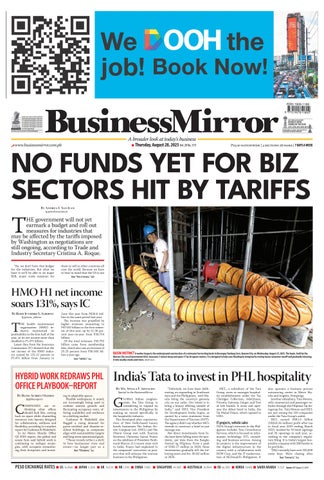
BASIN INSTINCT A worker inspects the underground construction of a rainwater harvesting basin in Barangay Tandang Sora, Quezon City, on Wednesday, August 27, 2025. The basin, built by the Quezon City Local Government Unit, measures 3 meters deep and spans 17 by 28 square meters. It is designed to help ease flooding by temporarily storing heavy rainwater runoff and gradually releasing it into nearby creeks and rivers. NONOY LACZA
India’s Tata to invest in PHL hospitality By Ma. Stella F. Arnaldo Special to the BusinessMirror
G
LOBAL Indian conglomerate, the Tata Group, is considering to expand its investments in the Philippines by making an inroad specifically in the hospitality industry. This developed after representatives of New Delhi-based luxury hotels businesses The Indian Hotels Company Ltd. (IHCL) and The Oberoi Group met with Tourism Secretary Christina Garcia Frasco on the sidelines of President Ferdinand Marcos Jr.’s recent state visit to India. Frasco had explained to the companies’ executives on projects that will enhance the tourism business in the Philippines.
“Definitely, we have been deliberating on expanding in Southeast Asia and the Philippines, with Manila being the country’s gateway city on our radar. Our intent is to bring a luxury offering outside of India,” said IHCL Vice President for Development Anika Gupta, as quoted by a news statement from the Department of Tourism (DOT). The agency didn’t say whether IHCL intends to construct a hotel or just manage one. Net direct investments from India have been falling since the pandemic, per data from the Bangko Sentral ng Pilipinas. From a peak of US$2.17 million in 2020, these investments gradually fell the following years and hit -$0.83 million in 2024.
IHCL, a subsidiary of the Tata Group, owns or manages hospitality establishments under the Taj, Claridges Collection, SeleQtions, Vivanta, Gateway, Ginger, and Tree of Life brands. It owns and operates the oldest hotel in India, the Taj Mahal Palace, which opened in 1903.
IT projects, vehicle sales
TATA Group’s interests in the Philippines includes Tata Consultancy Services, which is focused on information technology (IT), consulting, and business services. Among its projects is the improvement of the digital infrastructure in the country with a collaboration with NOW Corp. and the IT modernization of McDonald’s Philippines. It
also operates a business process outsourcing center in Metro Manila and Angeles, Pampanga. Another subsidiary, Tata Motors, sells commercial and passenger vehicles through the Pilipinas Taj Autogroup Inc. Tata Motors and IHCL are just among the 100 companies under the Tata Group’s ambit. IHCL earned INR1.6 billion (US$18.26 million) profit after tax in fiscal year 2025 ending March 2025, marked by 74 hotel signings and 26 openings in said year, according to the company’s regulatory filing. It is India’s largest hospitality company with 380 hotels in its portfolio. “[We] currently have over 335,000 room keys. We’re chasing after See “India’s,” A2
PESO EXCHANGE RATES n US 56.8460 n JAPAN 0.3858 n UK 76.6739 n HK 7.2939 n CHINA 7.9485 n SINGAPORE 44.2485 n AUSTRALIA 36.9044 n EU 66.2085 n KOREA 0.0408 n SAUDI ARABIA 15.1521 Source: BSP (August 27, 2025)
News
BusinessMirror
A2 Thursday, August 28, 2025
HMO H1 net income soars 131%, says… Continued from A1
Meanwhile, the HMO industry’s total expenses, including income tax, grew by 19.53 percent to P45.561 billion in the first half from P38.117 billion in the same period last year. This included healthcare benefits and claims paid out by HMOs amounting to P36.285 billion, 19.63 percent higher than the P30.331 billion disbursed last year. “Despite the big increase in the payout of healthcare benefits, the HMO industry continued its return to profitability due to higher revenues,” the IC said in a statement on Wednesday. Moreover, total assets held by HMOs jumped by 21.14 percent yearon-year to P83.910 billion in the first half of this year from P69.265 billion. Total invested assets, however, declined by 13.15 percent to P18.229 billion from P20.990 billion. The IC explained that this was due to the maturity of cash equivalents, with a net decrease of 25.87 percent in the first half of this year. Liabilities of the sector also went up by 23.88 percent year-on-year to P72.249 billion from P58.322 billion. HMO’s total equity also increased by 6.57 percent to P11.661 billion from last year’s P58.322 billion.
www.businessmirror.com.ph
On import ban’s eve, govt vows stable rice prices By Samuel P. Medenilla and Ada Pelonia
W
ITH the looming freeze on rice importation next week, Malacañang said Wednesday measures are in place to keep the prices of the local food staple stable, including the auction of 100,000 metric tons (MT) of rice of the National Food Authority (NFA). President Ferdinand Marcos Jr. issued the directive, covering 1.2 million bags of NFA rice, to the Department of Agriculture (DA) to ensure the country’s food security. “The floor price of rice is expected to reach 25 to 28 pesos per kilo depending on its age,” Palace Press Officer Claire Castro said in a press briefing
explaining the potential impact of the rice auction. She said the measure will also allow the release to free up the NFA warehouses so it can store additional rice stocks with the upcoming harvest season. In an interview with reporters on the sidelines of a poultry exhibit in
Economists adjust growth… Continued from A12
“We will need several months of data to evaluate the impact, but what
we have seen from several models is that the US will be negatively affect-
Pasay City on Wednesday, DA Secretary Francisco Tui-Laurel Jr. said that an initial 25,000 MT of the NFA rice will be auctioned this week. He said the auctioned rice may reach as much as 100,000 MT by November. Earlier this month, Marcos ordered a 60-day suspension on rice importation, starting on 1 September 2025, to protect farmers from a decline in farmgate prices. Based on the latest Philippine Statistics Authority (PSA), the average farmgate price of rice dropped P16.99 per kilo last month from P24.93 per kilo in the same period in 2024. Castro assured the release of more NFA rice as well as other measures including the strict enforcement of the maximum suggested retail price, price monitoring, and coordination with
farmers and retailers will keep rice prices in check. She said DA will also expand the implementation of the P20 per kilo rice program so it can benefit more consumers. “The agency is continuing to consult with farmers, millers, and traders to prevent price manipulation in rice and regulate the market despite the rice import ban,” Castro said. In its latest monitoring report in major markets in Metro Manila, DA reported the price of imported well-milled rice ranged from P35 to P50 per kilo, while for regular milled, it ranged from P30 to P45 per kilo as of Tuesday. For local commercial rice, the price for well-milled ranged from P38 to P52 per kilo and for regular milled, it ranged from P30 to P45 per kilo.
ed,” the team said. Felipe added that the immediate burden will fall on American consumers. “Up until now, the Trump tariffs have not affected the Philippine economy. The one to be affected first and foremost is the American economy,” he told this newspaper. Citing the August release of the Asia-Pacific Consensus Forecasts, they pointed out that growth projections remained largely unchanged across the region. Some countries saw upgrades, including China (+0.2 percentage points), Vietnam (+0.3) and Taiwan (+1).
The economists further noted that the outcome will hinge on how US consumers and firms absorb higher prices, whether by paying more, reducing imports or passing costs onto exporters. In some cases, they said, producers may respond by boosting productivity to lower costs, turning the tariff pressure into an opportunity to strengthen competitiveness. “Our interpretation is that the purpose of the tariffs is to reward or punish geopolitical alignment with or against the US,” the team said in its report.
India’s Tata to invest in… Continued from A1
456,000, as that is the projected demand for 2028,” said Frasco during the meeting. “And so we’re also actively lobbying for tourism investments, especially that the investment climate in the country has vastly improved with our President having recently enacted the CREATE More Act, offering tourism incentives for investments.”
Incentives for investors
AMONG the tourism incentives under Republic Act No. 12066, the Corporate Recovery and Tax Incentives for Enterprises-Maximize Opportunities for Reinvigorating Economy (CREATE MORE) Act are income-tax holidays and duty-free importation on capital equipment, raw materials, spare parts or accessories for new or expansion projects. Frasco also informed the hospitality executives of ongoing infrastructure projects under the Marcos Jr. administration, that will further push tourism in the country. These include the privatization and moderniza-
tion of the Ninoy Aquino International Airport in Manila and the Panglao International Airport in Bohol. She noted that Cebu also maintains a privately operated airport in Mactan. “With [Naia] now having been successfully privatized, we anticipate a bigger passenger capacity as far as Manila is concerned,” she said, with other airport privatization projects expected to follow. As such, “there are massive opportunities, not only for leisure in the country, but also for tourism investment,” she added. There were 50,882 tourists from India in the first seven months of the year, 36.7-percent less than the arrivals in the same period in prepandemic 2019, as per DOT data. The DOT chief earlier met with Indian film executives to urge them to use key Philippine destinations as backdrops for their popular movies. (See, “DOT looks forward to ‘Bollywood’ film productions in PHL,” in the BusinessMirror, Aug. 15, 2025.)
Hybrid work redraws PHL office playbook… Continued from A1
functional space but as a strategic asset that supports growth, sustainability, and employee wellbeing,” said Claro Cordero Jr., director and head of research at Cushman & Wakefield. The second quarter closed with Metro Manila office vacancies at 17.9 percent, slightly higher than the 17.3 percent recorded in the first quarter. Average asking rents for Grade A offices stood at P980 per square meter (sqm), while year-to-date net take-up reached 44,000 sqm. Rental yields for office assets held steady at 6.93 percent. In central business districts (CBDs), demand remained supported by multinational relocations and financial sector expansions. Prime and Grade A rents in CBDs climbed 0.5 percent quarter-onquarter to P1,118 per sqm per month, as vacancies tightened to 10.5 percent from 11 percent. Outside the CBDs, however, conditions were softer. Additional supply and hybrid work trends pushed rents down 1.8 percent quarter-onquarter. Meanwhile, vacancy rates in fringe areas rose to 23.4 percent, up by more than 3 percentage points from the previous quarter and over 5 points higher year-on-year. Oversupply and returned spaces are expected to keep pressure on these markets, with new completions in Quezon City and Muntinlupa likely to add further weight. Cushman & Wakefield said that while CBDs may move toward a landlord-favorable position in the medium term due to limited new supply and sustained demand, fringe markets are likely to see further rental adjustments and concessions. Over 300,000 square meters of new supply is projected through 2027, which the firm said will give tenants stronger leverage through favorable lease terms, pre-fitted offices, and flexible arrangements. “The resilience of Metro Manila’s office market, particularly in the established CBDs, underlines the enduring demand for high-quality and strategically located properties. Meanwhile, fringe areas will require more innovative approaches to address persistent challenges,” Cordero said. Geographic diversification is also gaining ground, with secondary hubs such as Cebu, Clark, and Davao attracting interest from occupiers and investors seeking adaptable, future-ready developments.
Economic resilience, opportunities
THE performance of the office market mirrors the broader economy, where consumption growth, recovering tourism and expanding logistics needs continue to drive activity, per Cordero. “Each sector is adapting to the evolving needs of end-users, creating long-term opportunities for developers and investors alike,” he said. The Philippine economy grew 5.5 percent year-on-year in the second quarter of 2025, supported by strong performances in services at 6.9 percent and agriculture at 7 percent. Inflation, which fell to 1.37 percent in the second quarter and further to 0.9 percent in July, helped lift household consumption by 5.5 percent. Structural reforms and inclusive policies are expected to sustain growth between 6 and 8 percent in the medium term. For the firm, the Bangko Sentral ng Pilipinas’ 25-basis-point rate cut and inflation forecasts of 1.6 percent for 2025 also helped buoy investor sentiment.
Thursday, August 28, 2025
A4
Economy
www.businessmirror.com.ph
Govt becoming top violator of Labor Code–lawmaker By Jovee Marie N. dela Cruz @joveemarie
A
& Justine Xyrah Garcia
LAWMAKER questioned the Civil Service Commission (CSC) over the ballooning number of job order (JO) and contract of service (COS) workers in the government, warning that the state itself has become the country’s “number one violator of the Labor Code.” Citing CSC data, Party-list Rep. Elijah San Fernando of Kamanggagawa said the number of JO and COS workers in government surged by 277,791 between 2022 and 2025. “According to Joint Circular 1 s. 2017 and Joint Circular 2 s. 2020, JO workers are meant for emergency or short-term work, while COS workers are consultants or technical experts hired
for specifics projects,” San Fernando said. But in practice, this is not the case. Across government agencies and local governments, JO and COS workers are performing core and substantive functions like regular employees,” said San Fernando during the CSC budget briefing. CSC Commissioner Ryan Alvin Acosta concurred, admitting that the hiring of JO and COS staff has
become widespread to circumvent civil service laws. San Fernando pressed further, citing Article 295 of the Labor Code, which defines regular employees as those performing “necessary and desirable” work. He asked whether JO and COS workers’ duties fall under this category. Acosta admitted that often they do, noting that LGUs alone still have more than 75,000 unfilled plantilla positions but employ over 650,000 JO and COS workers. San Fernando pointed out that many JO and COS employees remain in the same jobs for years, if not decades. “That’s why I say the number one violator of the Labor Code is the government itself. One-third of civil servants are contractuals. If we want the private sector to follow suit in ending contractualization, the government must first lead by example,” he stressed. The lawmaker also f lagged the paradox of 203,079 unfilled pl a nt i l l a p o s it io n s e x i s t i n g alongside the unchecked growth of temporar y hires. Acosta explained that local governments are constrained by a rule allowing them to use only
up to 40 percent of their budgets for personnel services, forcing reliance on JO and COS workers. He added that in some cases, contractual hiring is linked to patronage politics or to agencies keeping plantilla positions vacant or setting qualifications too high, further limiting regularization. CSC Chairperson Marilyn Barua-Yap explained that one of the ways the CSC is addressing the issue is through the Career Service Examination (CSE) Preference Rating (CSE-PR) program. “We opened the CSE Preference R ating program…we encourage them to take the civil service examination so they can obtain eligibility and qualif y for absorption into government ser vice,” she said. Meanwhile, Bataan Rep. Albert Garcia pushed for the promotion of meritocracy in government, while Cagayan de Oro Rep. Rufus Rodriguez pledged his support for the modernization efforts of the CSC. C S C d at a s ho w t he re a re 919,868 contractual workers— almost one-third of the government workforce. Of these, 650,571 are employed in local governments, while
Stiffer sanctions eyed under old housing laws By Bless Aubrey Ogerio
T
HE Department of Human Settlements and Urban Development (DHSUD) is reviewing decades-old regulations on fines and other penalties imposed on erring real estate companies and practitioners. The review covers the implementing rules (IRR), guidelines, and administrative sanctions under Presidential Decree 957 of 1976, Batas Pambansa 220, and Republic Act 7279 or the Urban Development and Housing Act (Udha) of 1992, as amended by RA 10884.
These frameworks were originally overseen by the defunct Housing and Land Use Regulatory Board and Housing and Urban Development Coordinating Council, and are now being updated under DHSUD to align with present industry conditions. “We need to revisit our laws and policies to ensure relevance and responsiveness in the present times. We cannot remain tied to outdated regulations if we want to deliver better services,” DHSUD Secretary Jose Ramon Aliling said. He added that the move seeks to “protect the interests of all
stakeholders—homebuyers and developers that faithfully follow existing laws and policies.” PD 957 governs the sale of subdivision lots and condominium units, requiring project registration, licensing, and compliance with developer obligations. BP 220 sets standards and technical requirements for economic and socialized housing projects, while RA 7279, as amended, provides the framework for balanced housing development and socialized housing programs for underprivileged citizens. The department said it is also
reviewing the schedule of fines and penalties under these laws to determine whether they remain sufficient and responsive to current challenges in the housing and real estate sector. The Housing and Real Estate Development and Regulation Bureau (HREDRB) is leading the process. “Initially, we have already identified some provisions that need to be updated and amended. For those we can immediately revise within our authority as a department, we will do so as soon as possible,” Housing Undersecretary Sharon Faith Paquiz said.
Manila joins global real estate growth surge
M
A N I L A i s e me r g i n g as a rising investment hotspot, joining global cities in a wave of real estate growth, according to global property consultancy Knight Frank. The Prime Global Cities Index (PGCI) Q2 2O25 report showed that “secondary cities” such as Manila and Christchurch are attracting increasing investor interest, while more established markets like Seoul, Tokyo and Dubai continue to lead global price gains. The Gold Coast and Shanghai were also noted as key contributors to a diverse, global real estate landscape. In Asia, the growth momentum
remains strong, albeit with some moderation compared to previous quarters. Seoul recorded the highest annual growth at 25.2 percent, followed by Tokyo with 16.3 percent in Q2, up from 15.5 percent in Q1. Over the past five years to Q2 2025, Tokyo led price growth with 120 percent, Dubai at 107 percent, and Seoul at 81 percent. Manila placed fifth with a 77.5 percent increase over the same period. Measured by annual percentage change, Manila also ranked fifth, with a 9.1 percent increase over the past 12 months and a 2.2 percent rise in the most recent quarter. Globally, average prime residential prices rose 2.3 percent in
the 12 months to June 2025, a slowdown from previous quarters as markets contend with elevated borrowing costs. “ T he decelerat ion ref lects growing uncertainty over the timing and scale of interest rate cuts in key global economies, pulling the growth rate further below the long-term average of 5.2 percent,” Knight Frank stated. It added, “This quarter’s result marks the weakest annual growth since Q4 2023 and indicates that the momentum seen at the start of the year has softened.” The consultancy noted that while interest rates have eased in recent months, resilience in
prices is being tested by borrowing costs, which remain higher than in recent years. On a quarterly basis, Knight Frank recorded a slight decline of 0.1 percent, a slowdown from the 1.3 percent increase in the first quarter. The share of cities registering annual price growth also fell slightly, from 78 percent last quarter to 75 percent, indicating a broader softening across some markets. The Prime Global Cities Index tracks nominal prices of prime resident ia l proper t ies across 46 global cities using data from Knight Frank ’s international research network. Bless Aubrey Ogerio
191,971 are in national government agencies. Party-list Rep. Johanne Bautista of Trabaho suggested that the CSC should provide more training programs to help JO and COS workers transition into permanent posts. “There are specific qualifications need to be met by applicants. This is also in line with the directive of the President to help develop the skills and capabilities not just by COS and JO, but also of those aspiring to enter the civil service,” Santos said. Party-list Rep. Percival Cendaña of Akbayan agreed, saying contractual workers should be given the education and preparation they need to pass the civil service examination. Under CSC guidelines, JO and COS workers who have served for at least 10 years and have shown valuable skills but lack eligibility for plantilla positions are entitled to preference points. They can receive an additional 10 points on their exam score, which can help them reach the 80-percent passing mark. CSC Commissioner Ryan R. Acosta added that some agencies
impose “very high” qualification standards or intentionally delay opening positions to favor certain applicants. “There are agencies that deliberately avoid opening vacancies because they are waiting to accommodate preferred candidates,” Acosta admitted. Despite these practices, Barua-Yap emphasized that the CSC still exercises oversight since it has the power to approve or reject appointments to plantilla positions. “Once it reaches us, we will catch it anyway. So I think they can appoint them at the start, but in the end, it will come go to us and the CSC will not qualify it,” she said. She added that the CSC is also ready to remind government agencies of their obligation to uphold meritocracy in hiring. “We can always issue encouragement to our heads of agencies to ensure that yung recruitment selection and placement nila would consider strictly the qualifications, the requirements for lawful entry into the civil service ensuring merit and fitness,” Barua-Yap said.
Indonesian firm, FirstGen form strategic partnership
J
AKARTA—PT DSSR Daya Mas Sakti (DSSR), a subsidiar y of PT Dian Swastatika Sentosa Tbk (DSSA) part of Sinar Mas, has entered into an agreement to establish a joint venture with PT FirstGen Geothermal Indonesia, a subsidiary of Energy Development Corporation (EDC), part of First Gen Corporation (First Gen). EDC is the largest renewable energy producer in the Philippines. The agreement marks the beginning of a collaboration aimed at transferring global expertise, enhancing domestic capacity, and unlocking Indonesia’s vast geothermal potential in support of the country’s energy transition agenda. Indonesia holds around 40 percent of the world’s geothermal reserves, equivalent to 24 gigawatts, but only about 10 percent has been developed. Through this partnership, PT DSSR Daya Mas Sakti and PT FirstGen Geothermal Indonesia aim to accelerate the development of geothermal resources that will contribute to national energy security and provide a sustainable source of clean power. The joint venture will focus on the development and management of geothermal resources with a combined potential of approximately 440 megawatts, across six strategic fields located in West Java, Flores, Jambi, West Sumatra, and Central Sulawesi. “This agreement goes beyond investment. It is a strategic collaboration to bring world-class knowledge and best practices from EDC to Indonesia. Our goal is to strengthen national capacity in geothermal development and to fully harness the country’s natural potential for clean energy. Together, we aim to create real value for communities, the economy, and the environment,” said Lokita Prasetya, President Director of PT DSSR Daya Mas Sakti and Vice President Director of PT Dian Swastatika Sentosa Tbk.
Reinforcing this goal, EDC through PT FirstGen Geothermal Indonesia emphasized that the partnership reflects a shared mission to advance Indonesia’s energy transition. Recognized as the largest vertically integrated geothermal company globally, the collaboration provides EDC an opportunity to apply its global expertise in geothermal development to strengthen Indonesia’s renewable energy capacity and contribute to a cleaner, more sustainable energy future. “EDC has decades of experience in harnessing geothermal energy in the Philippines, and we are proud to share this expertise with Indonesia through our partnership with DSSR. By combining EDC’s global capabilities with DSSR’s strong local presence, this joint venture will not only develop projects, but also build capacity and transfer knowledge that will leave a lasting impact on Indonesia’s renewable energy sector,” said Francis Giles B. Puno, vice chairman and chief executive officer of EDC, and president and chief operating officer of First Gen. This collaboration is aligned with the government of Indonesia’s strategy to accelerate the country’s energy transition, expand the share of renewable energy, and achieve the nation’s net zero emission target by 2060. For PT DSSR Daya Mas Sakti and PT FirstGen Geothermal Indonesia, the partnership is also a demonstration of dedication to deliver clean and reliable power, to strengthen Indonesia’s renewable energy capacity, and to create long-term value for communities and the economy. Beyond developing projects, this joint venture embodies a shared vision of contributing to Golden Indonesia 2045—building a resilient, sovereign, and sustainable nation for future generations.
www.businessmirror.com.ph
Thursday, August 28, 2025
Legislators: Ask UN help to stop China aggressive actions at WPS By Jovee Marie N. dela Cruz @joveemarie
L
AWMAKERS on Wednesday filed a resolution urging the Executive Department, through the Department of Foreign Affairs (DFA), to file a resolution before the United Nations General Assembly (UNGA) calling on China to respect the 2016 arbitral ruling and to end its repeated hostile actions against the Philippines in the West Philippine Sea (WPS). House Resolution 192 underscores that nearly a decade after the Permanent Court of Arbitration (PCA) invalidated China’s sweeping “nine-dash line” claims in the South China Sea, Beijing has continuously disregarded the ruling and intensified its aggressive naval, aerial, and coast guard operations within the Philippines’ exclusive economic zone. Lawmakers cited multiple incidents of Chinese aggression, including the ramming of Philippine vessels at Ayungin Shoal in June 2024 that injured seven soldiers, the reckless maneuvers of a Chinese military helicopter against a Philippine surveillance aircraft over Scarborough Shoal in February 2025, and the recovery of Chinese aquatic drones from Philippine waters suspected of military use. Other reported incidents include a Chinese militia vessel that nearly ran aground at Pag-asa Reef, damaging coral reefs valued at P11 million in June 2025; a Bureau of Fisheries and Aquatic Resources (Bfar) vessel being blasted with a water cannon near Panatag Shoal
in June 2025; a Coast Guard (PCG) ship evading Chinese pursuit and a water cannon attack, which later resulted in a collision between two Chinese vessels; and a Chinese fighter jet intercepting a Philippine patrol plane f lying over Scarborough Shoal, all in August 2025. The authors of the resolution stressed that such incidents demonstrate China’s continued defiance of international law and threaten Philippine sovereignty, fishermen and their families’ livelihoods, and regional stability. The measure also noted the growing clamor, led by retired Senior Associate Justice Antonio Carpio, for the Philippines to elevate the dispute before the UNGA. Although UNGA resolutions are not legally binding, they carry significant political weight, represent the consensus of the international community, and can inf luence global norms and policies. House Resolution 192 was principally authored by Laguna Rep. Loreto Amante, Zamboanga del Norte Rep. Adrian Amatong, Dinagat Islands Rep. Arlene BagAo, Akbayan Rep. Percival Cendana, Akbayan Rep. Chel Diokno, Akbayan Rep. Dadah Kiram Ismula, Caloocan Rep. Edgar Erice, Muntinlupa Rep. Jaime Fresnedi, Albay Rep. Cielo Krisel Lagman, Batangas Rep. Gerville Luistro, Zambales Rep. Doris Maniquiz, 1Tahanan Rep. Nathaniel Oducado, Malabon Rep. Antolin Oreta III, Bataan Rep. Antonino Roman III, Oriental Mindoro Rep. Alfonso Umali, and Leyte Rep. Anna Victoria Tuazon.
Marcos to visit Cambodia, attend UN General Assembly session
P
RESIDENT Marcos will go on a state visit to Cambodia and attend the United Nations General Assembly (UNGA) opening session in the US next month. These will be the sixth and seventh overseas trips of the Chief Executive this year. Last month, he made a five-day state visit to India. Palace Press Officer Claire Castro announced the President’s coming trips abroad in a press briefing on Wednesday. “It is confirmed that the President will visit Cambodia from September 7 to 9,” she said. She added Marcos will attend the 80th Session of the UNGA in New York. In its website, UN said
the 80th UNGA will open on September 9, but its high level General Debate will be from September 23 to 27. Castro said the Department of Foreign Affair will release additional details on both trips. Last week, Department of Agriculture Secretary Francisco Tui-Laurel Jr. told reporters that Marcos will hold rice importation talks during his State Visit to Cambodia. Marcos last attended the UNGA in September 2022 a few months after he was elected as President. In November of the same year, the President also went to Cambodia to attend the 40th and 41st Association of Southeast Asian Nations (Asean) Summits. Samuel P. Medenilla
A5
‘China’s sleeper agents, intelligence operatives already embedded in PHL’ By Butch Fernandez
A
@butchfBM
SENATOR warned on Wednesday that Chinese “sleeper agents” and even intelligence operatives from China’s People’s Liberation Army (PLA) are already embedded in the Philippines to engage in espionage. In a Senate hearing for the bill that amends the decades old Anti-Espionage Law, Sen. Panfilo Lacson pressed the concerned government agencies to conduct continuous follow-up operations against those arrested in earlier anti-espionage operations. “The whole network of espionage operations must be dismantled or at least decimated to a large degree kasi agents come and go. Inaresto mo, may papalit diyan. And I have on good information na maraming sleeper agents, even regular members of PLA na nandito. Widespread, na [The whole network of espionage operations must be dismantled or at least decimated to a large degree because agents come and go. You arrest one, another takes his or her place. And I have it on good information that there are sleeper agents and even regular members of the PLA who are here, they are widespread],” he said at the hearing of the Senate Defense committee, which tackled anti-espionage bills, including Lacson’s Senate Bill 33, titled An Act Penalizing Espionage and Other Similar Offenses Against National Security. “Time is of the essence. Their espionage activities are continuing and what we have right now is an outdated law in Commonwealth Act 616,” he added, partly in Filipino.
Arrests
LACSON cited reports showing
Chinese nationals had been arrested for suspected espionage in several areas of the country, including Palawan, Makati, Dumaguete, and even near Camp Aguinaldo, the Commission on Elections office in Manila, and Malacanang. During the hearing, lawyer Ferdinand Lavin of the National Bureau of Investigation said NBI agents had arrested in at least six operations 19 foreign nationals engaged in suspected espionage. Of the 19, 13 were Chinese, five were Filipinos, and one was Cambodian. Lavin said the Filipinos were acting as guides, drivers, or aides. Lacson stressed the need for continuous hot pursuit operations against other suspects, including those stemming from tactical interrogation of those captured. “This is where I am more interested because this does not end with arrest. This is an unusual crime against our national security unlike ordinary criminal cases where we stop at filing charges and pursuing their conviction in court. In espionage, it entails more intelligence and follow-up operations,” he said. “So there must be no letup in our pursuit operations. If we rest on our laurels and we become complacent and relaxed...that is not supposed to be the case. The more we should pursue and be more vigilant in conducting intelligence and law enforcement operations,”
he added. Lacson also pressed the Anti-Money Laundering Council (AMLC) to freeze the assets of those involved in espionage activities, similar to what they did in the case of former Mayor Alice Guo.
Tech issues
BEYOND stopping the use of technology that breaches national security, the preservation of the integrity of institutions, processes and documents is also a crucial part of the defense of national sovereignty, Sen. Risa Hontiveros said on Wednesday. “Dear colleagues, ang soberanya natin, hindi lang nakasukat sa teritoryo. Nasa pag-aalaga rin natin sa integridad at dangal ng ating mga institusyon, proseso, at pati papeles [Our sovereignty is measured not just by the territory. It also lies with safeguarding the in tegrity and honor of our institutions, processes, and even our records],” Hontiveros said in her opening statement as the Senate Committee on Defense opened hearings on proposals to update the archaic anti-espionage law. Lacson, a former National Police chief and veteran Constabulary intelligence officer, is the main proponent of the bill being tackled by the Defense panel led by Senate President Pro Tempore Jinggoy Estrada. In her statement at the start of hearing, Hontiveros pointed out that even before tackling the diversified kinds of drones, as well as the notorious IMSI catcher that can sweep through structures and suck out vital data from mobile phones and gadgets, the hearing should go beyond gadgets and technology. More than the devices or other equipment, the legislative inquiry must also tackle the issues of enough funds, capacity, coordination, and stricter vetting of the membership of organizations that have something to do with security, Hontiveros said. “Given that, I would like to
Nartatez has big shoes to fill–Lacson By Butch Fernandez
L
IEUTENANT Gen. Jose Melencio Nartatez Jr. will have big shoes to fill amid lingering questions behind the relief of his predecessor, Gen. Nicolas Torre III, Sen. Panfilo M. Lacson said on Wednesday. Lacson, who ser ved as National Police chief from 1999 to 2001, said Torre earned the public’s trust with policies such as the five-minute response time rule for police.
Nartatez faces a big challenge because he has big shoes to fill, Lacson said in Filipino in an interview on dzRH radio. “I mentioned before that he was the person the PNP needed because he is mission-oriented and is prepared to sacrifice himself to accomplish his mission. He has a good attitude,” he added, referring to Torre. Lacson said there are questions surrounding Torre’s relief, which he said could have been avoided had there been better coordination
between Torre and the National Police Commission (Napolcom). He noted that what the public is privy to is that one of the reasons why Torre was relieved was his failure to comply with the Napolcom’s directive reversing his order on the reshuffle of senior police officials, including members of the PNP Command Group. Lacson earlier noted that Torre may have overstepped his bounds when he reshuffled members of the Command Group without Malacañang or at least Napolcom approval.
bring to your attention several red f lags,” she added. “On the ground, let us look at the equipment seized from Chinese nationals who were arrested near Malacañang, US Embassy, Camp Aguinaldo-Camp Crame, at Villamor Air Base. A Chinese national was arrested with an IMSI catcher, used to intercept mobile phone traffic. Someone was also arrested with Lidar sensors, which had a triple-camera set-up and navigational satellite system for topographic mapping.” At sea, Hontiveros recalled, drones and solar powered closedcircuit television (CCTV) systens, deploy-and-forget under water drones, as well as acoustic sensors and satellite communications systems have been seized by Philippine authorities from Chinese nationals. Several others were arrested with terrain maps that present the key features of critical Philippine bases or facilities. As for critical institutions that have a bearing on national security, Hontiveros noted that certain Chinese nationals have infiltrated the Coast Guard (PCG) Auxiliary in previous years—signs, she said, that there is a need to fix the screening and vetting of these groups’ roster. She then cited the case of Joseph Sy, a ranking official of a major ferronickels company, who was given the rank of Auxiliary Commodore in the PCG Auxiliary. The Bureau of Immigration has detained Sy allegedly for misrepresenting himself as a Filipino. According to Sy’s industry groups, the BI itself has twice ruled that he is a Filipino, not a Chinese national, and wondered aloud how the same agency can now reverse itself and declare Sy an alien. Finally, Hontiveros also cited to colleagues at the defense committee hearing “the threat posed by foreign, coordinated disinformation and malign influence operations.” This should be acted upon while respective press freedom and freedom of expression, she said.
“We don’t know what went on behind the scenes. We’re not privy to that,” Lacson said. “If there is something Torre did wrong, it would be failure to communicate with the Napolcom when it reversed his order. In the first place, he should have communicated with the Napolcom when he relieved Nartatez.” Lacson also said that following Torre’s relief and his replacement by Nartatez, there is a need to revisit the PNP Law such that See “Nartatez,” A7
A6
Thursday, August 28, 2025
The Nation
www.businessmirror.com.ph
of Pinoys believe midterm ICRC launches book on Marawi’s desaparecidos 83% poll results were accurate–Octa By Manuel T. Cayon @awimailbox
D
AVAO CITY—The International Committee of the Red Cross (ICRC) released on Tuesday a coffee table book on the still missing persons in the 2017 five-month terrorist siege of Marawi City to magnify the continuing search by families of their missing kin. A photo exhibition was also mounted alongside the launch in Iligan City, Lanao del Norte, of the Book of Memories (Ang Aklat ng Mga Alaala) which the ICRC subheadlined as a tribute to Marawi’s missing people and their families’ relentless search for answers. Some 300 people, including families of the missing people, from across Mindanao, witnessed the launching of the book. Local, provincial and regional officials, representatives from the Marawi Compensation Board, National Police-Forensic Group, and religious groups also attended. The 77-paged book was released by the ICRC in commemoration of the International Day of the Disappeared, which falls on August 30. It was to honor the people who have been missing since the 2017 Marawi
conflict, preserving their memories and amplifying the voices of the families that have been left behind. In The Book of Memories, the families share their deeply personal stories, expressing their need for answers as they continue their search for their missing kin. Filipino photojournalist Larry Monserate Piojo captured photographs of the families along with the treasured objects that once belonged to their missing relatives. “Eight years since losing their loved ones, the families have remained resilient in the face of many challenges. While we believe that the authorities are working on clarifying the fate of the missing, continued effort will be needed to reach a conclusion. The book and exhibit serve as a reminder of the families’ determination to know the fate of their loved ones,” said Johannes Bruwer, head of the ICRC’s delegation in the Philippines. The accompanying photo exhibition at the atrium of Robinsons Mall in Iligan City will be open to the public until August 30. The exhibition features photographs from the book “and explores the space between destruction and rebuilding in the aftermath of the
Marawi conflict. Using skeletal house frames as visual metaphor, the exhibit reflects the fragility and resilience of a community that endures.” Prior to the book and exhibit launch, the ICRC said two representatives of the families of the missing said they continue to face hurdles in getting legal documents which would allow them to access social benefits, pensions, property rights, or allow them to remarry. They also asked the authorities to reconsider the rejection of some compensation claims; and urged them to finally release information to the families concerned about the positive identifications that have been made. “We hope that the government could help all families of the missing, whether financially or through other means. There are so many of their children who cannot go to school. And the government should help all families, whether they are Muslims or Christians,” said Litisia Palahang, who has been searching for her son. It said local government authorities, such as the Lanao del Sur provincial government, told their respective efforts such as the creation of a technical work-
ing group on the identification, exhumation and documentation of human remains in the Maqbara cemetery “They said they have not abandoned the families of the missing, despite the challenges that they encounter with the identification process,” the ICRC said. The ICRC said it has registered over 300 cases of people who went missing from the 2017 Marawi conflict. “The obligation to prevent people from going missing and to account for those who are reported missing is enshrined in the Geneva Conventions and its Additional Protocols, to which the Philippines is a party. This includes the dignified management of the dead and the identification of those who remain unidentified,” it added. The ICRC said it is a neutral, impartial and independent organization with an exclusively humanitarian mandate that stems from the Geneva Conventions of 1949. It helps people around the world affected by armed conflict and other violence, doing everything it can to protect their lives and dignity and to relieve their suffering, often alongside its Red Cross and Red Crescent partners.
A
BOUT eight in every ten Filipinos believe that the results of the 2025 national and local elections were accurate, according to a new survey of the Octa Research released on Wednesday. The nationwide study, conducted among 1,200 respondents, found that 83 percent expressed confidence in the correctness of the poll results. Trust was particularly strong in Central Visayas-99 percent) Mimaropa (Mindoro, Marinduque, Romblon and Palawan)-97 percent), Bicol-94 percent, Negros Island-91 percent and Zamboanga Peninsula-91 percent. “This broad level of trust suggests that despite political divisions and intense campaigns, the majority of Filipinos accept the legitimacy of the electoral process and its results. Such confidence strengthens democratic institutions by reinforcing the role of the Commission on Elections [Comelec], election watchdogs, and automated vote-counting systems as credible arbiters of the people’s
will,” the survey noted. Still, skepticism was more pronounced in several Mindanao regions. Distrust was highest in Soccsksargen (South Cotabato, Cotabato, Sultan Kudarat, Sarangani and General Santos)-33 percent, Northern Mindanao-31 percent, and Caraga-28 percent. In Western Visayas, 25 percent of respondents also expressed doubt. Octa Research said this underscores the need for Comelec to expand transparency measures and guard against disinformation. When asked directly about the poll body, 64 percent of respondents said they trust Comelec. Another 33 percent were neutral, while 4 percent expressed distrust. Trust in the conduct of the midterm elections also varied across age groups. Confidence was strongest among older Filipinos, with 79 percent of those aged 75 and above expressing agreement, compared to just 53 percent among voters aged 18 to 24. See “Octa,” A7
The World
Editor: Angel R. Calso
Thursday, August 28, 2025
A7
50% US tariffs take effect on India, threatening $48.2 billion in exports By Rajesh Roy
N
The Associated Press
EW DELHI—Steep US tariffs on a range of Indian products took effect Wednesday, threatening a steep blow to India’s overseas trade in its largest export market.
President Donald Trump had initially announced a 25% tariff on Indian goods. But earlier this month he signed an executive order imposing an additional 25% tariff due to India’s purchases of Russian oil, bringing the combined tariffs imposed by the US on its ally to 50%. The Indian government estimates the tariffs will impact $48.2 billion worth of exports. Officials have warned the new duties could make shipments to the US commercially unviable,
Nartatez. . . Continued from A5
if a PNP chief is terminated, he is automatically retired, to avoid awkward situations where the relieved PNP chief—a four-star general—outranks his successor since the current law allows for only one four-star general in the force.
Octa. . . Continued from A6
The youngest age group also recorded the highest distrust rate at 43 percent.
Stronger voters’ education, info drive
IN a press briefing, Octa Research President Ranjit S. Rye said that
triggering job losses and slower economic growth. India–US trade relations have expanded in recent years but remain vulnerable to disputes over market access and domestic political pressures. India is one of the fastest-growing major global economies and it may face a slowdown as a result.
think tank Global Trade Research Initiative suggest labor-intensive sectors such as textiles, gems and jewelry, leather goods, food and automobiles will be hit hardest. “The new tariff regime is a strategic shock that threatens to wipe out India’s long-established presence in the US, causing unemployment in export-driven hubs and weakening its role in the industrial value chain,” said Ajay Srivastava, the think tank’s founder and a former Indian trade official. The US has for now exempted some sectors such as pharmaceuticals and electronic goods from additional tariffs, bringing some relief for India as its exposure in these sectors is significant.
Exporters fear losses
“This is an absolute shock,” said Dawar, whose business with the US has grown in recent years. Dawar’s clients include the major fashion retailer Zara. Dawar, who is also the regional chairman of the Council for Leather Exports—an export promotion body—said the US should understand that the steep tariffs will hurt its own consumers. Groups representing exporters warn that new import tariffs could hurt India’s small and medium enterprises that are heavily reliant on the American market. “It’s a tricky situation. Some product lines will simply become unviable overnight,” said Ajay Sahai, director general of the Federation of Indian Export Organizations.
ESTIMATES by New Delhi-based
PURAN DAWAR, a leather footwear exporter in northern India’s Agra city, says the industry would take a substantial hit in the near term unless domestic demand strengthens and other overseas markets buy more Indian goods.
That situation happened to Lacson’s predecessor, Gen. Bobby Lastimoso, who was not promoted because the officer who holds the four stars, his Philippine Military Academy Class of 1967 classmate, Gen. Santiago Aliño did not retire even when he had been relieved. In recent memory, Lt. Gen. Leonardo Espina was the acting chief PNP because his PMA Class
of 1981 classmate, Gen. Alan Purisima did not retire despite having been been suspended. Still, Lacson said the PNP is a professional organization that will follow legal orders from the chain of command. He said the relief of Torre is the sole prerogative of the President as commander-in-chief. “The PNP, like any uniformed organization, will follow the chain
of command,” he said. Malacañang meanwhile said a new position has been offered to Torre but he has yet to accept the job. “We will provide details [on the new position] once it has been finalized and General Torre’s approval has been given,” Palace Press Officer Claire Castro said in Filipino in a press briefing last Wednesday. With Samuel P. Medenilla
while the overall results are largely positive, the gaps in younger age groups point to the need for stronger voter education and information campaigns. “I think the key factor is voter education, access to information also. Those become a huge factor…it seems from our [focus group discussions] that many of our young voters don’t know the candidates,” Rye explained.
He urged Comelec to find ways to ensure that the majority of voters are familiar with candidates’ platforms and general action plans. Rye emphasized that millennials—who make up the largest voting bloc—should be a priority. “It’s access to information, it’s the need for Comelec to do more reaching out to our millennials. They’re making up bulk of our
voters,” he added. Based on Comelec data, of t he 68.43 mi l l ion reg istered voters, 23 million are millennials (aged 29 to 44), while 18.3 million belong to Generation Z (aged 18 to 28). The 2025 midterm elections also recorded highest voter turnout in the county’s poll history at 81.65 percent or 55.87 million voters. Justine Xyrah Garcia
Sectors to be impacted by US tariffs
Modi vows not to yield to US pressure
THE tariffs come as the US administration continues to push for greater access to India’s agriculture and dairy sectors.
India and the US have held five rounds of negotiations for a bilateral trade agreement, but have yet to reach a deal. That’s largely because New Delhi has resisted opening these sectors to cheaper American imports, citing concerns that doing so would endanger the jobs of millions of Indians. Prime Minister Narendra Modi has vowed not to yield to the pressure. “For me, the interests of farmers, small businesses and dairy are topmost. My government will ensure they aren’t impacted,” Modi said at a rally this week in his home state of Gujarat. Modi said the world was witnessing a “politics of economic selfishness.” A US delegation canceled plans to visit New Delhi this week for a sixth round of trade talks.
India plans local reforms to cushion the blow from tariffs
THE Indian government has begun working on reforms to boost
local consumption and insulate the economy. It has moved to change the goods and services tax, or consumption tax, to lower costs for insurance, cars and appliances ahead of the major Hindu festival of Diwali in October. The government council will meet early next month to decide whether to cut taxes. The Trade Ministry and Finance Ministry are discussing financial incentives that would include favorable bank loan rates for exporters. The Trade Ministry is also weighing steps to expand exports to other regions, particularly Latin America, Africa and Southeast Asia. Trade negotiations underway with the European Union could gain renewed urgency as India works to reduce its dependence on the US market. The Associated Press video journalist Rishi Lekhi contributed to this report.
A8
Thursday, August 28, 2025
TheWorld BusinessMirror
www.businessmirror.com.ph
European and Iranian diplomats fail to agree on how to avoid reimposition of UN sanctions By Stephanie Liechtenstein & Farnoush Amiri The Associated Press
V
IENNA—Representatives of three European countries threatening to reimpose UN sanctions on Iran over its nuclear program failed to agree with their Iranian counterpart on Tuesday on how to avoid the measures days ahead of a deadline, a diplomat said. The diplomat said efforts would continue to search for a solution ahead of an E3 deadline at the end of this month to invoke the so-called “snapback mechanism” of the 2015 Iran nuclear deal over what the countries have deemed Iran’s lack of compliance. The snapback would mean a return to wide-ranging UN sanctions in place before the deal, including a conventional arms embargo, restrictions on ballistic missile development, asset freezes, travel bans and a ban on producing nuclear-related technology.
A meeting in Geneva
THE talks in Switzerland between representatives of Britain, France
No funds. . . Continued from A1
the only market. The world is the market,” Roque told the BusinessMirror on the sidelines of the hearing for the Department of DTI As to the measures that the government will roll out to protect industries that may be affected by the tariffs, the Trade chief told this newspaper: “Nothing, because nothing is final yet. Everything is still under negotiation. Everything is like a new update. It’s also hard to rely on these things until we find something that’s really final.” Amid the developments in global trade, Roque said it’s still “actually business as usual” for
and Germany—known as the E3— and Iran “ended without a final outcome,” said the diplomat with knowledge of the meeting, speaking on condition of anonymity because they were not authorized to speak publicly about the sensitive discussions. The talks, which had been announced by the Iranian Foreign Ministry on Monday, follow a previous meeting between the Europeans and Iran in Istanbul on July 25. Kazem Gharibabadi, Iran’s deputy foreign minister for legal and international affairs, said on X that Tehran “remains committed to diplomacy’’ and that it was “high time” for the European countries “to make the right choice, and give diplomacy time and space.” The Europeans’ concern over the Iranian nuclear program, which had been enriching uranium to near weapons-grade levels before the 12day Iran-Israel war in June saw its atomic sites bombed, has only grown since Tehran cut off all cooperation with the International Atomic Energy Agency, the UN nuclear watchdog, in the conflict’s wake. That has left the international DTI, adding “I’m excited to look for avenues for these exporters, both locally and globally.” The trade chief added, “We’re just really waiting for what they’re going to tell us because every day or every few days or every week, there’s something new, right?” According to Roque, with the challenges provided by the global trading environment, local producers should consider serving the Philippine market first. “They should also see that the local market is so huge. 115 million Filipinos. I mean, it’s huge. We’re trying to sell to a market that’s so difficult, why not find a market here that’s easier? We have to know how to maneuver. Siyempre mga negosyante tayo
IN this June 7, 2021 file photo, the flag of the International Atomic Energy Agency (IAEA) flutters at the entrance of the Vienna International Center in Vienna. AP/LISA LEUTNER
community further blinded to Iran’s program—as well as the status of its stockpile of uranium enriched to 60% purity, a short, technical step to weapons-grade levels of 90%. IRAN has long insisted its program is peaceful, though it is the only nonnuclear-armed nation enriching uranium at that level. The United States, the IAEA and others say Iran had a nuclear weapons program up until 2003. The Europeans agreed with the US earlier this year to set an end-of-August deadline for invoking the mechanism if Iran fails to
meet several conditions, including resuming negotiations with the US over its nuclear program, allowing UN nuclear inspectors access to its nuclear sites and accounting for the over 400 kilograms of highly enriched uranium. IAEA chief Rafael Grossi told Fox News Channel’s The Story with Martha MacCallum on Tuesday that a team of international inspectors was back in Iran for the first time since the war with Israel in June—when the US also bombed Iranian nuclear sites, including with bunker-buster bombs. The new development indicates
[Of course, being business people], we cannot wait until the US or whatever country can come up with…,” she emphasized further. The country’s Trade chief said the negotiating team is still hoping for the 19-percent country reciprocal tariff to be reduced by Washington even though it’s already in effect. “We’re hoping for that, but we can’t say for sure,” added Roque. In a separate interview on the sidelines of the budget hearing, Trade Undersecretary Allan B. Gepty told the BusinessMirror: “Ongoing pa rin naman ang talks, eh [The talks are still ongoing after all].” Asked which parts are still being negotiated, Gepty said “I’m still not at liberty to disclose.” The Philippine negotiating team signed a non-disclosure agree-
ment with Washington which is valid for four years. During the budget hearing, Roque said the agency has been allocated P12.43 billion, including DTI’s attached corporations. The Trade chief, however, divulged to this newspaper that DTI originally asked for P16 billion from the Department of Budget and Management (DBM). The Exports and Investments Development program has been given P931.94 million, based on the 2026 National Expenditure Program (NEP), higher by 3.28 percent than the P902.30 million earmarked in the 2025 General Appropriations Act (GAA). Meanwhile, for industry development, the DTI was allotted P710.7 million, 8.58 percent higher than the P654.57 million in the 2025 GAA.
Nuclear concerns
that, despite its rhetoric, Iran is taking the looming threat of European sanctions seriously. A diplomat close to the IAEA told The Associated Press that while an agreement on the level of access between the UN watchdog and Iran is not finalized, it is expected to be reached, and that inspection for now would only concern nuclear facilities that were not impacted by US and Israeli strikes.
The road back to sanctions
THE snapback provision of the 2015 Iran nuclear deal can be invoked by any party if they find Iran out of compliance with the requirements. Its purpose is to swiftly reimpose all pre-deal sanctions without being vetoed by UN Security Council members, including permanent members Russia and China. The E3 countries feel an urgency to use the snapback because it expires on Oct. 18 unless the council extends it. On Sunday, Russia proposed a draft resolution to delay the expiration until next spring, which would buy Iran some time. Dmitry Polyanskiy, the deputy
BI. . . Continued from A12
privilege speech on Wednesday, said the BI had moved precisely because it had completed validating Sy’s record and established that he was the same Chinese national Chen Zhong Zen, who held a long-term visa and an alien Certificate of Registration (ACR) card. It is wrong to chastise the agency for correcting a grievous oversight, she said. Sandoval confirmed that Sy was previously a subject of a complaint for deportation for allegedly being an illegal alien. However, the BI spokesperson explained that Sy was cleared by the bureau because there was no evidence then to prove the allegation. “But during that time, there was no evidence against Sy. It was just a person saying that this person is a foreign national with no evidence presented or seen by the BI,” Sandoval explained. Sandoval said based on their review of Cheng’s records, he obtained a long-term visa through Republic Act 7919 or the Alien Social Integration Act of 1995, and was able to establish a business.
Russian ambassador to the UN, said Tuesday that a second version of the proposal is being circulated among the Security Council and is supported by China, another initial party to the nuclear deal with Iran, also known as the JCPOA. “Hopefully, it will be acceptable, and I think it will be kind of a litmus test for those who really want to uphold diplomatic efforts and for those who don’t want diplomatic solutions but just want to pursue their own nationalist, selfish agendas against Iran,” Polyanskiy said. However, it is unlikely the Russian ef for t w i l l receive enough support in the 15-member council to pass because it lacks an explicit mention of the conditions on Iran set by the European countries. Iran contends there is no legal basis for the European countries to reimpose UN sanctions via snapback, claiming they failed to uphold the 2015 Iran nuclear deal after President Donald Trump pulled the US out of the accord in 2018. Amiri reported from the United Nations.
However, Sandoval said there was no proof to show that he went through the Philippine process for naturalization. “If a foreign national wants to become a Filipino, he has to be naturalized. In this case, he is saying that he is a natural born Filipino, when in fact he is not even naturalized.” She added that naturalization process would involve the Office of the Solicitor General and Congress. Sandoval said the BI is currently processing Sy’s deportation and checking if he has other pending cases in the country. The BI official noted that they are expec ting other cases to sur face in connection with Sy’s alleged fake identity. “We would also check if he has other pending cases in the country, which we are expecting because if there are citizenship issues, his other documents might also be questioned such as the Philippine Passport Act,” Sandoval said The BI said they would also be looking at the citizenship status of Sy’s family members since it was indicated in the records that he had a spouse. We are going to look into the status of his family members,” the BI spokesperson added.
Thursday, August 28, 2025
Comelec to print BARMM ballots despite pending redistricting law By Justine Xyrah Garcia
T
HE Commission on Elections (Comelec) announced it will begin printing ballots for the Bangsamoro parliamentary elections on August 28— even without the law approving the proposed redistricting. Comelec Chairman George Erwin M. Garcia on Wednesday said the poll body will proceed with preparations based on the original 73 parliament seats for the Bangsamoro Autonomous Region in Muslim Mindanao (BARMM). “We adopted a resolution to continue preparing for the elections based on the 73 seats. We can no longer wait for the expected law since it has yet to be signed,” Garcia said in an interview. Last week, the Comelec said it would temporarily put ballot printing on hold to give the Bangsamoro Transition Authority more time to finalize Parliament Bill No. 351. The measure seeks to reassign the seven district seats originally allocated to Sulu to the other BARMM provinces. Under the proposed apportionment, Lanao del Sur would have nine district seats; Maguindanao del Norte and Maguindanao del Sur, five each; Basilan and TawiTawi, four each; Cotabato City, three; and the Special Geographic Area (SGA), two. Several municipalities would also be transferred to different districts. If approved, the Comelec said it would need at least two weeks to reconfigure the automated election system to reflect the changes. With the elections less than two months away, however, Garcia said the en banc decided to maintain the original seat allocation and not alter district boundaries. “The status quo will be implemented, where we will still prepare for 73 seats. As for the seven seats, it will be up to the parliament later on what they will do,” he said.
‘NOTA’
Meanwhile, on the proposed “none
of the above” (NOTA) option on the ballots, Garcia said the Comelec is still waiting until the end of the month for comments from causeoriented groups and citizen arms. The poll body earlier explained that complications could arise if NOTA receives the highest number of votes. For district representatives, no candidate could be proclaimed, possibly resulting in a failure of elections and special polls. For political parties, if NOTA secures the majority, the allocation of the 40 party seats in Parliament could also be contested. “Maybe the parliament can amend or clarify the ‘none of the above’ in our existing election code. We said maybe this can be done until the end of September,” Garcia added.
Campaign period starts on Aug. 28
ASIDE from ballot printing, Comelec also reminded BARMM residents that the campaign period will officially begin on August 28. During this period, candidates are prohibited from making donations, appointing or hiring new government employees, releasing or disbursing public funds, and implementing projects such as public works construction. They are also barred from using government resources, providing salary increases to officials or employees, and engaging in activities that involve tampering with election propaganda. Garcia a lso sa id t he same monitoring mechanisms from the May 12 midterm polls will be in place. These include the Committee on Kontra Bigay (for vote-buying and abuse of state resources), Task Force KKK (social media monitoring), and Task Force SAFE (oversight on discrimination and labeling). “We hope the campaign will be orderly so we can prove that we are capable of conducting clean elections in Bangsamoro. This is the first Parliamentary election,” Garcia said.
BOC seized ₧605.29-million smuggled cigarettes in Bulacan By Reine Juvierre S. Alberto @reine_alberto
T
HE Bureau of Customs (BOC) seized approximately P605.29 million worth of smuggled cigarettes stored in a warehouse in Plaridel, Bulacan. In a statement on Wednesday, the BOC said its operatives uncovered 8,647 master cases of imported illicit cigarettes with markings indicating China and Vietnam. The cigarettes lacked the required Bureau of Internal Revenue (BIR) tax stamps and the Philippine-mandated graphic health warnings, indicating that these are illegal. T hree ind iv idua ls were ap prehended dur ing the inspect ion a nd a re now u ndergoing i nquest proceed i ngs before t he Depa r t ment of Just ice, accord ing to t he BOC . A Warrant of Seizure and Detention will also be issued for violation of Section 263 of the National Internal Revenue Code of 1997, as amended, National Tobacco Administration Memorandum Circular No. 02, s.2020 and Section 1113 of Republic Act No. 10863, or the Customs Modernization and Tariff Act. On top of this, criminal com-
plaints will be filed against the registered owner and proprietor of the warehouse where the illicit cigarettes were found. “Our proactive enforcement ensures that we are fully compliant with President Ferdinand R. Marcos Jr.’s directive to stop illicit cigarettes from infiltrating legitimate trade channels and protect the welfare of our citizens,” Commissioner Ariel F. Nepomuceno said. The inspection, carried out under a Letter of Authority, was prompted by intelligence reports from CIIS-MICP, headed by Intelligence Officer IV Alvin Enciso, on suspicious warehouse activities. The Bureau of Customs’ Intel l igence a nd Enforcement Groups led the operation, together with the Intellectual Property Rights Division, CIIS– Manila International Container Port and the Enforcement and Security Service–Port of Manila, and in coordination with the Philippine Coast Guard and barangay officials of Bulihan, Plaridel, Bulacan. “The BOC affirms its unwavering stance in implementing stringent enforcement actions to hold smugglers and illicit cigarette traders fully accountable under the law,” it said.
A9
‘I have no grudge’: Torre speaks out after being relieved as PNP chief By Jovee Marie N. Dela Cruz @joveemarie
F
OR M E R Ph i l i p p i ne Na tional Police (PNP) Gen. Nicolas Torre III on Tuesday said he harbors no ill feelings following his relief from the top post, stressing that he remains a “good soldier” and is ready to ser ve the government in whatever capacity. Speaking to the media after visiting Mamamayang Liberal
(ML) Party-list Rep. Leila de Lima, Torre said he has spent more than three decades in uniform and has learned to accept the challenges and uncertainties that come with the profession. “I have no grudge, and I’m a good soldier. If there’s an order, I just follow it,” Torre said. “This is not the first time it has happened in my career. It happened time and again, and I always managed to bounce back.” Torre also expressed gratitude
to those who have shown him support in recent days. “I really appreciate the gesture; I really appreciate the support and the love. But don’t worry, I’m okay,” he added. Asked whether he had regrets, the former police chief replied that while everyone has “what ifs in life,” he does not consider his relief as one of them. “I don’t think this is something I’ d want to reconsider if given the chance. I’m still
duty-bound to keep the peace,” he said. The former PNP chief also extended well wishes to his successor, Gen. Jose Melencio Nartatez Jr., describing him as “a very good officer.” Torre added that he has taken a leave of absence—the second time in his career—to take time off following the transition. “Obviously, I need the time. I need the time off,” he said. Jovee Marie N. Dela Cruz
Marcos orders lifestyle checks on govt officials amid flood control projects probe By Samuel P. Medenilla @sam_medenilla
P
RESIDENT Ferdinand Marcos has ordered “independent” lifestyle checks for all government officials and personnel involved in the flood control project (FCP) as part of his ongoing crackdown against anomalous public works. It comes days after the Chief Executive said he will hold accountable the contractors of the defective, incomplete, or non-existent FCPs, which he inspected this month. Palace Press Office Claire Castro said the lifestyle checks, which she assured will not be partisan, will initially cover officials of the Department of Public Works and Highways (DPWH), which is in charge of
implementing the FCPs. She said the said checks will be initiated by concerned government agencies such as the Commission on Audit, Ombudsman, Bureau of Internal Revenue, local government units, and the DPWH itself. “So, whichever agency that should have a lifestyle check, let them do it,” Castro said in Filipino in a press briefing in Malacañang last Wednesday. The agencies conducting the lifestyle checks, she said, can also face scrutiny, if the result of their investigation on concerned public officials and personnel will be proven to be questionable. “The President has already spoken [on this issue], so each agency must fulfill its duties,” Castro said. Earlier this month, the Marcos admin-
istration launched its sumbongsapangulo. ph website, where the public can report anomalous FCPs. As of 9 a.m. last Wednesday, the website has received 9,020 reports, which the President used to conduct 11 FCP site inspections in Marikina, Iloilo, Bulacan, and Benguet. Marcos ordered the filing of graft cases against the contractor of a “ghost” FCP in Baliwag, Bulacan last week. “The government’s investigation is also ongoing to identify those behind projects that were supposed to help solve the widespread flooding in the country,” Castro said. She said the President wants to finish the review of P545.64-billion worth of 9,855 FCPs of DPWH under the leadership of DPWH Secretary Manuel M. Bonoan before the end
of his administration. When asked about the reports that former DPWH Secretary Rogelio L. Singson, who served under former President Benigno C. Aquino III, may soon replace Bonoan, Castro said she still has no information on the matter. “Right now, the President has not mentioned anything [about that], so if there will be any action regarding Secretary Bonoan, we will just have to wait. But for the moment, his trust [in Secretary Bonoan] is still there,” she said. As to the DPWH Undersecretary Roberto R. Bernardo’s absence from work, Castro said the official is currently on sick leave. Bernardo was linked to alleged corruption in the DPWH, which the official denied.
DOJ official says Taal Lake search yields 401 skeletal remains in missing ‘sabungeros’ case
A
U T H O R I T I E S have recovered at least 401 human skeletal remains from Taal Lake in Batangas as part of the ongoing search for the missing “sabungeros” (cockfighting aficionados), a Department of Justice (DOJ) official disclosed before the House of Representatives. During a House Committee on Human Rights briefing, DOJ Assistant Secretary Eliseo Cruz said the recovery operations were launched on July 10, 2025, after a whistleblower identified as Julie Patindongan revealed the alleged dumping sites of the victims. The retrieval was conducted in collaboration with the Philippine Coast Guard (PCG), the Philippine National Police (PNP), and the National Bureau of Investigation (NBI). “The disappearance of the missing sabungeros shall never be put in vain, for they are fathers, sons, brothers, and friends whose absence has left enduring pain,” Cruz said, assuring families that the DOJ is committed to pursuing “truth, accountability, and justice” despite attempts to derail the investigation. National Prosecution Service Richard
Anthony Fadullon has found enough basis to proceed with the conduct of a preliminary investigation of the murder and serious illegal detention complaint filed by the families of 34 missing sabungeros or cockfighting enthusiasts. The complaint filed last August 1 named gaming tycoon Charlie “Atong” and several other individuals allegedly belonging to the so-called “Alpha Group” of Pitsmaters, which operates online cockfighting games, as respondents. “The evaluation of the cases pert a i n i n g to t h e m i s s i n g s a b u n g e ro s have been completed and it will not be subjected to preliminary investigation,” Fadullon said, “Subject to the receipt by the panel of the records, subpoenas will be issued for the conduct of the preliminary investigation on dates to be determined by the Panel,” he added. When asked if Ang is among the respondents to undergo preliminar y investigation, Fadullon said: “No details can be released just yet in deference to the Panel that will conduct the investigation.” Ang owns Lucky 8 Star Quest, an
“e-sabong” company that broadcasts Pitmasters cockfighting activities and derbies online. The missing sabungeros were believed to have been summarily executed following their abduction four years ago after they were caught cheating during games. According to Cruz, the skeletal remains were found inside sacks or mesh nets weighted with sandbags to sink them underwater. Each recovery was carefully documented with coordinates, depth, temperature, and distance from the shoreline before being handed over to PNP Scene of the Crime Operatives (SOCO) for forensic examination. On August 10, another set of suspected skeletal remains was recovered in the third quadrant of the lake and immediately turned over to SOCO. Despite these breakthroughs, Cruz acknowledged the dangers faced by technical divers, who have begun suffering medical conditions such as ear infections, coughs, and skin irritation from long-term exposure to the lake’s murky waters. He also cited threats posed by venomous Taal water snakes, for which
the country has no available anti-venom. To sustain the search and forensic analysis, Cruz revealed that the DOJ is in talks with the Japanese government, which has expressed willingness to extend technical and logistical support to the Philippines. Cruz reported that several criminal complaints have already been filed before the DOJ by the PNP Criminal Investigation and Detection Group (CIDG). These include charges for enforced or involuntary disappearance (RA 10353), multiple counts of kidnapping and serious illegal detention (Article 267, RPC), multiple counts of murder (Article 248, RPC), obstruction of justice (PD 1829), violations of the Anti-Graft and Corrupt Practices Act (RA 3019) in relation to direct bribery (Article 210, RPC), corruption of public officials (Article 212, RPC), and related violations under the New Philippine Passport Act (RA 11983). “These complaints have undergone evaluation and have been certified sufficient for the conduct of preliminary investigation,” Cruz noted. Jovee Marie N. Dela Cruz and Joel R. San Juan
MMDA proposes detention ponds in Camp Aguinaldo to combat EDSA flooding and alleviate traffic chaos
S
TRESSING that the existing drainage system along Edsa is insufficient to manage the large volumes of rainwater, resulting in flooding on roads, which causes heavy traffic flow, the Metropolitan Manila Development Authority (MMDA) on Wednesday proposed the construction of rainwater impounding facilities or detention ponds within the Camp Aguinaldo compound. During the presentation of the plan at Camp Aguinaldo, MMDA also noted that Metro Manila experiences recurring
flooding issues, particularly in areas such as Edsa triggered by heavy rains and typhoons, and that the existing drainage system along Edsa is insufficient to manage the large volumes of rainwater, resulting in ponding on roads, which causes heavy traffic flow. “These detention ponds are designed to temporary store excess rainwater during heavy rains and gradually release it into the drainage system along Edsa going into Makiling Creek, preventing the drainage system from becoming overwhelmed,” an
MMDA presentation on the project showed. The same proposal of detention pond was also presented on Wednesday to University of Santo Tomas officials, together with Manila Mayor Manila City Mayor Francisco “Isko Moreno” Domagoso, to address the flooding in España Ave. The agency said it could store up to 37, 200 cubic meters of rainwater and be pumped out by three pumping stations. The detention ponds would have an area of 4, 650 square meters and a depth of 8 meters.
“During rainfall event, floodwaters will be directed towards the detention ponds. Floodwaters will be contained inside the detention ponds until the rain stops,” it added. After the rainfall event, or when the drainage system along Edsa stabilizes, the MMDA said that floodwaters shall pump out to the lagoon and then to Edsa going to Makiling Creek. The agency has yet to put a price tag on the construction of said facility. Claudeth Mocon-Ciriaco
DepEd and Jollibee to develop QSR curriculum in Senior High School TechPro track
T
HE Department of Education (DepEd) and the Jollibee Group have partnered to train the next generation of food service professionals. Jollibee and DepEd recently agreed to codevelop a Quick Service Restaurant (QSR) Senior High School (SHS) curriculum. The QSR curriculum will be tailored for SHS students under the Technical Professional (TechPro) track. The program will pilot in schools nation-
wide and integrate classroom-based instruction with immersive on-the-job training across Jollibee Group brands. Under the program, students will learn key restaurant operations skills such as food preparation, customer service, safety and sanitation, and business communication— helping prepare them for careers in the food service industry after graduation. Ruth Angeles, Jollibee Group Philippines chief human resources officer, said: We believe
in creating more pathways for young Filipinos to achieve meaningful employment. By investing in their skills early on, we also help raise the standards of service in the QSR sector.” The work immersion component of the QSR curriculum will begin in the coming school year. Learnings from the pilot session will be used to refine and potentially expand the program to more schools in the future. Education Secretary Juan Edgardo Angara
welcomed the collaboration saying, “This partnership with the Jollibee Group is a strong example of how public-private cooperation can bring industry relevant learning into the classroom.” “At a time when artificial intelligence [AI] and technology disruption are reshaping industries and jobs, this collaboration gives our learners not only the right skills but also the resilience to thrive,” Angara said. Claudeth Mocon-Ciriaco
A10 Thursday, August 28, 2025 • Editor: Angel R. Calso
Opinion BusinessMirror
www.businessmirror.com.ph
editorial
Remolona’s vision: A simple, inclusive, and secure fintech future for Filipinos
T
HE recent remarks from Bangko Sentral ng Pilipinas Governor Eli M. Remolona Jr. at the Manila Tech Summit 2025 underscore a crucial turning point for the Philippines in its quest to become a fintech innovation hub. His emphasis on simplicity and inclusivity is not just refreshing; it’s essential for the sustainable transformation of the country’s financial landscape. (Read the BusinessMirror story: “Making PHL a fintech hub won’t need complicated tech,” August 26, 2025).
In a world where complex technologies often dominate discussions around innovation, Remolona’s call for “simple solutions that work for every Filipino” resonates deeply. The push for accessibility through initiatives like QR PH and PalengQR PH illustrates a commitment to bridging the gap between formal financial services and the everyday lives of informal workers, market vendors, and small business owners. These solutions empower individuals who have historically been excluded from formal financial systems, allowing them to conduct transactions with the ease of mobile technology. However, innovation cannot stand alone; security is paramount. The BSP’s focus on cyber resilience and measures like the Anti-Financial Account Scamming Act is critical in fostering trust within the financial ecosystem. As highlighted by the TransUnion Credit Perception Index, many Filipinos harbor skepticism about credit systems. Without trust, the most advanced technologies will falter. The BSP’s proactive stance on security is a necessary foundation for encouraging broader financial participation. Moreover, the call for innovation that is relevant and human-centric reinforces the idea that technology should serve real-world needs. The fintech sector must collaborate with regulatory bodies like the BSP to ensure that advancements are not only cutting-edge but also facilitate meaningful change in people’s lives. The vision articulated by Lito Villanueva of FinTech Alliance.Ph —to create technology for good, growth, and trust—aligns perfectly with the BSP’s objectives, emphasizing that technology should be a tool for empowerment rather than exclusion. The ambitions set forth by Villanueva, aiming for 80 percent of adults with digital transactional accounts and a significant portion of retail transactions conducted digitally by 2028, are bold yet necessary. These goals reflect a recognition of the potential for technology to drive economic growth, particularly as the Philippines aspires to become a $1 trillion economy by 2033. However, achieving these targets requires a concerted effort from all stakeholders, including government, private sector, and civil society. The recent survey indicating a 91 percent adoption rate of fintech in the country signals a remarkable shift in consumer behavior, particularly among younger generations. This trend highlights the need for financial institutions to adapt quickly and cater to the evolving expectations of their customers. With electronic wallets becoming the first financial product for many Filipinos, there is a clear opportunity to foster financial literacy and responsible usage of these tools. As the Philippines moves towards becoming a fintech innovation hub, the emphasis must remain on simplicity, inclusivity, and security. By prioritizing these core principles, the nation can transform its financial landscape and empower its citizens, fostering a more equitable and prosperous society. The call to action is clear: let us be architects of our financial future, ensuring that every Filipino can participate, thrive, and trust in the systems that serve them.
Since 2005
BusinessMirror A broader look at today’s business ✝ Ambassador Antonio L. Cabangon Chua Founder Publisher Editor in Chief Associate Editor News Editor Senior Editors
T. Anthony C. Cabangon Lourdes M. Fernandez Jennifer A. Ng Vittorio V. Vitug Lorenzo M. Lomibao Jr., Gerard S. Ramos Lyn B. Resurreccion, Dennis D. Estopace Angel R. Calso, Dionisio L. Pelayo
Online Editor
Ruben M. Cruz Jr.
Creative Director Chief Photographer
Eduardo A. Davad Nonilon G. Reyes
Chairman of the Board President Advertising Sales Manager Group Circulation Manager
D. Edgard A. Cabangon Benjamin V. Ramos Aldwin Maralit Tolosa Rolando M. Manangan
BusinessMirror is published daily by the Philippine Business Daily Mirror Publishing, Inc., with offices on the 3rd floor of Dominga Building III 2113 Chino Roces Avenue corner De La Rosa Street, Makati City, Philippines. Tel. Nos. (Editorial) 817-9467; 813-0725. Fax line: 813-7025. (Advertising Sales) 893-2019; 817-1351, 817-2807. (Circulation) 893-1662; 814-0134 to 36. E-mail: news.businessmirror@gmail.com
www.businessmirror.com.ph
Printed by BROWN MADONNA Press, Inc.–Sun Valley Drive KM-15, South Superhighway, Parañaque, Metro Manila MEMBER OF
Publishers Association of the Philippines Inc.
Peso follows dollar, but where? John Mangun
OUTSIDE THE BOX
A
S far back as 2022, the same prediction has surfaced: the Philippine peso will weaken to 60 against the US dollar. Traders whisper, headlines speculate, and politicians demand explanations. In reality, the peso-dollar level is not a purely “Filipino” story. It mirrors a world where the dollar anchors trade, debt, and finance. Betting against that fact has been a losing game for decades. Yet confidence in the dollar’s decline persists. Some wave BRICS banners, talk of “multipolar currencies,” and assume politics can overrule markets. The evidence points the other way. Dollar dominance rests on liquidity, scale, and trust. History is plain. Sterling ruled when London dominated finance. After World War II, New York took the lead and the dollar displaced sterling—not by decree, but because US markets proved deeper and more reliable. The numbers today tell the same story. American Apple, Microsoft, and Pfizer earn more than half their revenues abroad. On an ownership basis, US firms sold $6 trillion abroad
versus $4.5 trillion at home. That looks more like surplus than deficit. For the Philippines, this is not academic. Every Netflix subscription, Google ad, Microsoft license, or franchise royalty is pesos converted into dollars flowing back to American firms. Invisible in trade data, undeniable in bank ledgers. Trade and finance confirm the pattern. The IMF estimates about 50 percent of global trade is invoiced in dollars. The BIS reports more than 80 percent of offshore debt and loans are in dollars, while 88 percent of foreign-exchange trades involve the greenback. SWIFT shows nearly half of cross-border payments settle in dollars. Even in Europe, more than half of extra-EU imports—especially energy—are priced in “greenbacks.” Consumers entrench the system. The World Bank projects global consumption at $55.5 trillion in 2025. Americans, though 4 percent of the
The dollar’s grip is secure, but gravity limits how high it climbs. For the peso, that means living in a dollar world does not guarantee an ever-stronger greenback—only a persistent one. Like everything else, trade the trend.
population, will spend $17.9 trillion—32 percent of the total. That demand sets the tone. Philippine exporters are paid in dollars. Overseas Filipino workers sent home nearly $36 billion in 2023, reinforcing the peso’s link to the dollar. Debt markets close the loop. About 75-80 percent of emergingmarket sovereign bonds and 60-70 percent of corporate bonds are dollar-denominated. Nearly 60 percent of global reserves remain in dollars. The Bangko Sentral issues dollar bonds and holds dollar reserves for one reason: liquidity resides there. New York orchestrates the liquidity plumbing. The CHIPS system processes $1.5 trillion in large-value payments daily. Wall Street collects more than half of global investmentbanking fees. Shanghai and São Paulo are nowhere close. Even physical cash tells the story. The Fed estimates 60 percent of US banknotes circulate abroad, especially the $100 bill. Europe removed the 500-euro note; Canada phased out its 1,000-dollar bill. The dollar endures
China’s $1 trillion stock rally spurs curbs from broker, funds
A
$1 TRILLION stock rally in China is sparking concerns over growing risks to investors, prompting some of the nation’s brokerages and fund managers to cut back on financing and limit purchases. In the first such public move, Shanghai-based Sinolink Securities Co. raised its margin deposit ratio on new client financing contracts for some securities to 100 percent, according to a posted notice. China last approved a cut in the ratio to 80 percent from 100 percent in September 2023. Meanwhile, a number of domestic mutual fund houses this week imposed daily purchasing restrictions on some of the year’s best performing portfolios. On Wednesday, the feeder fund for the GF Star Growth Index ETF proceeded to cap buying at just 100 yuan ($14), one of the most drastic limits yet during this rally. The Sinolink margin increase was prompted by concern over potential losses for clients should there be a correction after the recent sharp rise in the stock market, people familiar
with the matter said, asking not to be identified discussing private deliberations. It’s unclear whether recent moves were triggered by regulatory guidance. In just the past month, China stocks have added more than $1 trillion to their market value. The Shanghai Composite Index has hit a decade-high and the CSI 300 Index has surged more than 20 percent from this year’s low. Animal spirits are back in China as trade tensions with the US have eased and as investors bet on government moves to bolster the economy. The rally has also been driven by cash-rich investors shifting into stocks amid a lack of alternatives. Trading volumes on mainland exchanges hit more than 3.1 trillion yuan ($433 billion) on Monday, the
In just the past month, China stocks have added more than $1 trillion to their market value. The Shanghai Composite Index has hit a decade-high and the CSI 300 Index has surged more than 20 percent from this year’s low. second highest ever, according to Bloomberg-compiled data. “There may be some bubble in some pockets in the market, this brokerage may be voting to play it safe and to mitigate risks for itself and its clients,” said Chen Shi, fund manager at Shanghai Jade Stone Investment Management Co., referring to Sinolink’s move. “But I don’t think this in itself is a signal of a top forming.” The outstanding balance for margin trading, a barometer for market sentiment, reached over 2.1 trillion yuan this week, a level last seen in June 2015 when stocks were in the height of an epic boom. Analysts have pointed out the ratio of newly added margin purchases reached nearly 12 percent of turnover on Friday to top
as both tool and store of value. Risks exist. US fiscal deficits are large. Sanctions push some nations to seek workarounds. China promotes limited renminbi settlement. These remain small. Panda bonds and bilateral experiments make news; they do not make a system. Which brings us back to USD/PHP 60. Each approach to that level sparks panic, as if Manila were exempt from global arithmetic. Oil imports, foreign debt, and remittances are dollar-linked. Until another nation combines global firms, vast demand, deep markets, and trusted institutions at scale, the dollar will not be replaced. For the Philippines, the exchange-rate headline is less omen than reminder: we live, borrow, earn, and pay in a dollar world—whether the print says 49, 57, or 60. But dominance is not the same as endless strength. The dollar can remain essential yet still trade weaker. US deficits are heavy, and financing both fiscal and current account shortfalls requires sustained inflows; if appetite cools, the dollar softens. The interest-rate cycle has shifted. The Fed’s hikes once pulled capital in, but as policy eases and others hold steady, yield gaps narrow. The dollar is also stretched by long-term measures. Currencies tend to meanrevert: when exchange rates move far above historical averages, trade balances, capital flows, and policy evenSee “Mangun” A11
a high in October, potentially showing a degree of fear of missing out as much of the trading is made on borrowed cash. Flocking to the market, retail investors opened 71 percent more new stock accounts in July than the same month last year, according to exchange data. Chinese authorities have a track record of intervening when the stocks are seen as overheated or oversold, with margin trading and short selling often in its toolbox. Since August 2023, when markets were sliding, authorities have rolled out restrictions that included a ban on lending shares during lock-up periods for short selling and higher margin requirements for hedge funds and investors to borrow securities. Those restrictions were further tightened through 2024. Though historically the moves have done little to address the root causes of weak markets, which include the persistent housing crisis and low consumer confidence. Bloomberg
www.news.businessmirror@gmail.com
Trump’s Fed gamble risks pushing key bond rates even higher By Michael MacKenzie, Greg Ritchie & Carter Johnson
P
RESIDENT Donald Trump’s unprecedented and escalating attack on the Federal Reserve runs the risk of backfiring by hitting financial markets and the economy with higher long-term borrowing costs.
For weeks, he has lambasted Chair Jerome Powell for not slashing interest rates deeply to stimulate the economy and—as Trump sees it— lower the government’s debt bills. He’s already nominated the head of his Council of Economic Advisers to the central bank’s board and is now seeking to oust Governor Lisa Cook, setting the stage for a legal battle over the institution’s political autonomy. Yet for all the Fed’s power over short-term interest rates, it’s the 10year Treasury yield—set in real-time by traders around the world—that largely determines what Americans pay for trillions of dollars of mortgages, business loans and other debts. And even as Powell signals he’s ready to start easing monetary policy as soon as next month, those rates have been stubbornly high for other reasons: Tariffs are threatening to worsen still-elevated inflation; the budget deficit is poised to keep flooding the market with new Treasuries; and Trump’s tax cuts may even deliver a jolt of stimulus next year. Throw in fears that a Fed loyal to the president could cut rates too far, too fast—jeopardizing the central bank’s inflation-fighting credibility in the process—and long-term rates could wind up even higher than they are now, squeezing the economy and potentially roiling other markets. “The combination of weaker US payroll growth and the White House baiting of the Fed, both institutional and personal, is starting to create real issues for investors in US Treasuries,” said David Roberts, head of fixed income at Nedgroup Investments, who expects long-term rates to rise even if short-term ones fall. “Inflation is running way above the Fed’s target. Much cheaper money now would likely stoke a boom, a weaker US dollar, and materially higher inflation.” The pressure on long-term interest rates isn’t unique to the US. They’ve been propped up in the UK, France and other countries by investors’ worries about the same combination of high government debt loads and increasingly unpredictable politics. But the crosscurrents of Trump’s return to the White House have posed their own challenges. During last year’s presidential campaign, when investors started betting on his victory, 10-year Treasury yields rose sharply even as the Fed started pulling its benchmark overnight rate back from a more than two-decade high. That’s because investors were anticipating that the Republican’s tax-cut and deregulation agenda would add fuel to what was, at the time, a surprisingly resilient economy. Since Trump has taken office, though, the Fed has been on hold as his unpredictable trade war upends the economic outlook, spooks foreign investors and threatens to push up consumer prices. When Trump’s April tariff rollout unleashed one of the worst bond selloffs in recent decades, sending yields surging, Trump paused them, saying the markets were “getting a little bit yippy, a little bit afraid.” He has since reimposed the import levies and his trade policy has continued to remain in flux. At the same time, his tax-cut bill is set to add more than $3 trillion to the deficit over the next decade, which will add to the stockpile of debt unless his tariffs are kept in place by future presidents and wind up providing enough revenue to offset the cost. “The US has to issue a tremendous amount of debt in order to fund its deficit,” said Michael Arone, chief investment strategist at State Street Investment Management.
The pressure on long-term interest rates isn’t unique to the US. They’ve been propped up in the UK, France and other countries by investors’ worries about the same combination of high government debt loads and increasingly unpredictable politics. But the crosscurrents of Trump’s return to the White House have posed their own challenges. He said that overhang is adding to concerns about growth and inflation. “As a result, I would expect that long rates will remain higher and more volatile than the market expects.” While Treasury Secretary Scott Bessent has said the administration’s cost-cutting and pro-growth policies would eventually pull down the 10year yield—which he has held up as a key benchmark of success—that hasn’t happened yet. While shorterterm yields have dropped on anticipation of another round of Fed cuts, the 10-year’s rose as high as 4.31 percent Tuesday before settling around 4.26 percent, roughly where it was at the time of Trump’s election in November. The 30-year yield moved up to 4.94 percent. That marked a relatively muted response to Trump’s announcement that he was firing Cook from the Fed over unproven allegations of mortgage fraud, a move that Cook has vowed to fight in court. The Fed said it will abide by the outcome of the case. “The attempted removal of Federal Reserve Governor Lisa Cook dominated traders’ thinking Tuesday. Higher term premium at the long end of the curve has been the biggest fallout so far. However, if efforts to gain political control of the Fed gain more traction, we should expect a larger reaction both in premiums and inflation expectations,” said Bloomberg strategist Edward Harrison. Treasury 10-year yields edged up one basis point to 4.27 percent in Asia trading Wednesday. Those on 30-year bonds held at 4.92 percent. Some of the market’s response reflects expectations that the courts will protect the Fed’s independence. Priya Misra, a portfolio manager at JPMorgan Investment Management, pointed to the “institutional safeguards that protect and jealously guard” the Fed from political pressure. Even Cook’s replacement, she said, would unlikely alter the Fed’s near-term trajectory. Moreover, with job growth slowing and Powell now telegraphing that another round of rate cuts may start as soon as next month, traders are already pricing in five quarterpoint reductions through the end of next year. Powell, a Trump appointee whose term as chair ends in May, has also said he wouldn’t step down from his role and has sought to insulate the central bank from politics. Yet, a mounting effort by Trump to reshape the Fed would almost certainly keep bond markets on edge— and long-term debt yields elevated. Markets have grown accustomed to the Fed’s autonomy, with recent presidents going out of their way not to be seen as influencing the central bank’s policy. Its insulation from electoral politics hasn’t been an issue for investors since the early 1970s, when the Nixon administration sought to keep rates low by pressuring then-Fed Chair Arthur Burns. That has served as a cautionary tale ever since, given the subsequent surge of inflation that many blamed on the central bank for caving to the president. Bloomberg
Opinion BusinessMirror
Thursday, August 28, 2025 A11
Australia’s housing dysfunction mirrored in central bank’s blowout rebuild By Swati Pandey
W
HEN Australia’s central bank resolved to refurbish its 1960s-era Sydney headquarters in 2018, it hardly expected the project would fall victim to the complex construction rules that also hinder the country’s housing sector. But when renovation work began on the heritage building in 2020, vast amounts of asbestos were uncovered. That meant it needs to be stripped right down to its steel frames, blowing out the projected cost almost fivefold and extending the timeline for Reserve Bank staff to return until at least 2031. A key factor in both the delays and rising costs is Australia’s Byzantine building regulations, according to economists, who drew parallels between the RBA’s experience and the impediments to developing new homes for Australians. Meeting the housing needs of Australia’s swelling population has been a fixation of Prime Minister Anthony Albanese’s center-left government as it seeks to ensure affordable accommodation and head off intergenerational inequality. It set an ambitious target for 1.2 million new homes by 2029, but almost immediately fell behind schedule due to planning and associated delays. At an economic reform roundtable convened by the Labor government last week, one of the key problems raised was bottlenecks that slow housing construction. “Australia has some of the most restrictive planning and zoning regulations in the developed world,” said Cassandra Winzar, chief economist at the Committee for Economic Development of Australia who attended the reform roundtable. “That absolutely is holding back housing construction.” Housing in Australia is among
the priciest in the developed world, rents hover near record highs, homelessness is rising and home buyers, increasingly desperate to get a foot on the property ladder, are taking out ever-larger mortgages. Everyone agrees that more supply is needed and yet it is extremely difficult to deliver. The premier of New South Wales, Australia’s most-populous state, called for bipartisan support to tackle the issue after approving a proposal to build 10,000 affordable homes near an abandoned train station in Sydney’s affluent eastern suburbs. “A great city cannot survive as a museum—it must evolve with the times,” Premier Chris Minns said. “For too long, it has been easier to say no to new housing than to find reasons to say yes. That culture has forced a generation to question whether they have a future in this city.” One of the first steps for the RBA, working from a leased building nearby, was applying to the City of Sydney to obtain approvals to strip out the asbestos while salvaging heritage features at its headquarters. The 3-1/2-month process involved public consultation and departmental reviews, the types of hurdles that home builders and developers say drive delays and cost blowouts across the country. The RBA will next need to submit a new application with a reconstruction proposal, approval for which is likely to be drawn out. Already, the estimated cost of the rebuild is A$1.2
Meeting the housing needs of Australia’s swelling population has been a fixation of Prime Minister Anthony Albanese’s center-left government as it seeks to ensure affordable accommodation and head off intergenerational inequality. It set an ambitious target for 1.2 million new homes by 2029, but almost immediately fell behind schedule due to planning and associated delays.
billion ($778 million)—compared with the initially planned A$260 million—and that may increase further. “We often see this with construction projects—cost blowouts, time blowouts,” said CEDA’s Winzar. “The example of the RBA does show you about needing a balance in regulation.” The Labor government has rolled out a number of measures to try to address the supply shortfall under a A$43 billion “Homes for Australia” program. Albanese made further announcements to boost housing following last week’s economic roundtable. With construction times blowing out to more than 10 months from a previous six-to-seven months, the government is wagering that moves like pausing changes to the nation’s safety rulebook—the National Construction Code—and streamlining environmental approvals will finally help unlock supply. Industry players say that while this is a good start, it needs to go further and try to pare back the regulations that run into the thousands of pages. According to the Productivity Commission, there’s not even a clear list of regulations that a developer or
Merz and Macron to offer Moldova support to deter Moscow threat By Samy Adghirni & Andra Timu
G
ERMANY, France and Poland are set to bolster Moldova’s leadership amid mounting concerns among European officials that next month’s parliamentary elections might produce a strong result for pro-Russian parties, hindering the eastern European nation’s efforts to pivot to the West. On Wednesday, Moldova’s proEuropean president Maia Sandu welcomes German Chancellor Friedrich Merz, French President Emmanuel Macron and Polish Prime Minister Donald Tusk in the capital Chisinau. The show of support by three of the European Union’s most powerful leaders to the candidate country on its independence day underscores the risk of a surge in support for the pro-Kremlin opposition in the Sept. 28 contest. That could complicate attempts by Sandu’s party to form a government, according to European officials. The country’s leader has increasingly blamed the Kremlin for an allout effort to steer the election with extensive vote-buying schemes, cyberattacks and misinformation campaigns driven by artificial intelligence. Russia has achieved success in exploiting Moldova’s vulnerabilities in spite of the EU’s efforts, the European officials said, speaking on condition of anonymity as discussions take place behind closed doors. “The Russian Federation wants to control the Republic of Moldova,” Sandu said in a speech last month. It’s the latest development in a longstanding tug-of-war between the Russia and the West over Mol-
dova, a former Soviet nation of 2.4 million wedged between Romania and Ukraine that ranks among the poorest in Europe. Moldova has made significant progress toward EU integration, officially starting accession talks last year. That effort has produced results. The country now sends more than 90 percent of its exports to the 27-member bloc, mostly agricultural products. Last year, the European Commission allocated a record €1.8 billion ($2 billion) over the next three years to support Moldova’s plan to join. But Moscow has deployed blunt instruments to disrupt Moldova’s efforts, halting the flow of cheaper gas, leaving the country with little alternative to buying on international markets at much higher rates, driving inflation. Polls show a number of groups in position to meet the country’s electoral threshold, including the party of former President Igor Dodon, who is openly aligned with Russian leader Vladimir Putin. It’s a close call. Dodon called for a boycott of last year’s referendum to inscribe the goal of EU membership into the Moldovan constitution. Moldovans approved that measure with 50.4 percent voting in favor, though
Mangun . . .
reserves has slipped under 60 percent, and even marginal shifts matter. Politics adds noise; debt fights and sanctions remind partners of risk, encouraging hedging. Relative growth counts too. If Asia and emerging markets outpace the Unit-
continued from A10
tually pull them back toward trend. Diversification, though slow, is real. The dollar’s share of global
The show of support by three of the European Union’s most powerful leaders to the candidate country on its independence day underscores the risk of a surge in support for the pro-Kremlin opposition in the Sept. 28 contest. That could complicate attempts by Sandu’s party to form a government, according to European officials. officials in Chisinau said Moscow spent about €100 million to try to disrupt the referendum, held alongside the presidential election which saw Sandu return to office. Moscow has repeatedly denied allegations of meddling. Wednesday’s high-profile gathering might flatter Moldovans by showing Sandu has an international profile. But it could also backfire, said Adina Revol, a political scientist specializing in relations between Europe and Russia who lectures at France’s Sciences Po institute. “The pro-Russia bloc might also use it to reinforce allegations that the government is submissive to Western powers, which is why the message conveyed during the meeting will be so important,” she said. European officials say they’ve made strides to show ordinary Moldovans that the pro-European path is already bringing benefits, from financial and technical support to the government to short-stay visa free status and the removal of phone roaming fees. ed States, capital follows growth, not symbols. In short, the dollar’s grip is secure, but gravity limits how high it climbs. For the peso, that means living in a dollar world does not guarantee an ever-stronger greenback—only a
builder is supposed to comply with. While rising property prices have long been seen as a positive by governments, the levels they have now reached appear increasingly problematic. Both Albanese and RBA policymakers have highlighted the risk of social discontent due to growing inequality between young people and asset-rich baby boomers. The median price for a house in Sydney has soared more than 200 percent in the past 20 years to a bit over A$1.5 million, according to data from Cotality, a property consultancy. The RBA has also cut interest rates three times this year, taking its benchmark interest rate to 3.6 percent from 4.35 percent, further spurring housing demand. “We have come to see, unfortunately in this country, housing as primarily a way of accumulating wealth,” said Saul Eslake, a veteran economist. “It’s paper wealth rather than something whose primary purpose is to meet a basic human need for shelter and accommodation.” Despite the cost blowout, RBA Governor Michele Bullock will likely be able to avoid any political fallout, unlike her American counterpart. The Federal Reserve’s renovation cost overruns have become a cudgel for President Donald Trump’s campaign against Chair Jerome Powell for failing to lower borrowing costs. The RBA, meanwhile, has a separate governance board to oversee just this sort of project. “It’s very timely that the RBA now has a governance board,” said Jonathan Kearns, chief economist at money manager Challenger Ltd. and a former senior RBA official. “That helps the governor enormously, taking the pressure off her on issues such as this and enabling her to focus more on policy.” Bloomberg
The bloc also provided muchneeded funding to Chisinau to help wean Moldova off its dependence on Russian energy. A strong showing for pro-Russian parties would risk derailing those moves toward the West. Pro-Russian forces already run a separatist region, Transnistria, and are agitating in another region, Gagauzia, causing problems for the central government in Chisinau. However, European officials said Brussels has few resources to provide additional help for Moldova. One challenge ahead is that while Moldova and Ukraine applied to join the bloc together, Moldova is now far ahead of its war-torn neighbor in implementing required forms. The potential “ decoupling” of Moldova—allowing it to go through the accession process separately—could have major benefits, making it a success story for the European Union, said people familiar with the discussions. They added that Moldova hasn’t yet shown interest in asking Brussels to take that step. But there are also major political hurdles for “decoupling,” which risks sending Ukraine a negative signal, they said. President Volodymyr Zelenskyy’s now-reversed attempt to undermine the independence of anti-corruption watchdogs has made policymakers wonder if Ukraine is capable of driving through reforms once a peace deal with Russia is reached, according to the people. With assistance from Kamil Kowalcze and Alan Crawfor /Bloomberg
persistent one. Like everything else, trade the trend. E-mail me at mangun@gmail.com. Follow me on Twitter @mangunonmarkets. PSE stock-market information and technical analysis provided by AAA Southeast Equities Inc.
2nd Front Page BusinessMirror
A12 Thursday, August 28, 2025
www.businessmirror.com.ph
PHILHEALTH BUDGET Economists adjust growth P53.3-B FOR ’26 VIOLATES LAWS: AER forecast upward for 2025 T By Reine Juvierre S. Alberto @reine_alberto
T
By Bless Aubrey Ogerio @blessogerio
HE outlook for 2025 has turned more sanguine, with De La Salle University (DLSU) economists nudging the Philippine growth projection 18 basis points higher to 5.48 percent, even as it remains below last year’s pace and the government’s target.
The August forecast improved from 5.3 percent in July, but still lags behind the 5.7-percent actual expansion in 2024 and the government’s updated goal of 6.5 to 8 percent for 2025. “Recently, improvements in some indicators [such as] employment in health, manufacturing of transport equipment, and external financing led to an upward adjustment in our model’s forecasts,” the DLSU research team—composed of Jesus Felipe, Mariel Monica Sauler, Gerome Vedeja and Clarence Gabriel Fernandez—said in their report.
At the quarterly level, the group forecasted growth of 4.9 percent in the third quarter, slightly lower than the 5.01 percent projected earlier, before rebounding to 6.35 percent in the fourth quarter. For 2026, the economists project growth to climb further to 6.15 percent. They noted that this profile suggests a steadier trajectory in the coming months, contrasting with the slowdown in the latter part of 2024, despite a strong mid-year showing. Felipe, a development economics professor, explained that the quarter-on-quarter differences remain
marginal. “It is difficult to know which are the ones pulling the economy up or down, since all of them end up interacting,” Felipe told BusinessMirror in an email. “What matters to us is that we have been predicting since the start of the administration in 2022 that the economy would grow less than what the government tells us. Deep down, it is a problem of the structure of our economy,” he added. Inflation is also expected to ease. The group sees consumer price growth averaging 1.9 percent in 2025, lower than July’s 2 percent estimate, as year-on-year inflation slowed to 0.9 percent in July from 1.4 percent a month earlier. Despite a brighter topline outlook, weakness is expected in some sectors. Capital formation growth is forecast to slow to 4.16 percent in 2025 from 6.3 percent in 2024, before moderating further to 1.73 percent in 2026. Industrial sector growth is likewise projected to decline sharply to 2.36 percent in 2025 and 3.31 percent the following year.
Trade dynamics
IMPORTS are forecast to decelerate
from a double-digit growth rate of 10.3 percent in the first quarter of 2025 to 1.35 percent in the last two quarters, averaging 4.21 percent for the year. Exports, meanwhile, are seen to grow by 3.91 percent in 2025, slightly better than 2024’s 3.3 percent. By 2026, export growth is expected to outpace imports—5.09 percent versus 3.47 percent—narrowing the trade deficit. On the production side, the anticipated slowdown in industrial output is seen to be offset by gains in services and agriculture. Services are forecast to expand by 6.94 percent in 2025, with a particularly strong 8.26 percent growth in the final quarter, followed by 7.34 percent in 2026. Agriculture, which contracted by 1.89 percent in 2024, is projected to rebound by 5.4 percent in 2025 and 6.68 percent in 2026.
Tariff effect uncertain
ACCORDING to the DLSU team, it is still too early to assess the impact of newly imposed United States tariffs on Philippine exports. See “Economists,” A2
HE proposed P53.261-billion allocation for the Philippine Health Insurance Corporation (PhilHealth) in the 2026 national budget violates laws as it falls “significantly” short of the mandated funding from earmarked revenues, according to an advocacy group. “We strongly call on Congress, particularly the members of the Committee on Appropriations, to prioritize and guarantee funding for the country’s social health insurer, as the current defunding of the premiums of indirect contributors again presents a clear violation of the Universal Health Care Act,” Action for Economic Reforms (AER) said in a statement on Wednesday. According to AER, the P53.261-billion budget allocation for PhilHealth under the 2026 National Expenditure Program (NEP) fails to meet the minimum funding mandated by the Sin Tax Law, worth at least P67.83 billion. Sin Tax Laws in the Philippines mandate the earmarking of sin tax revenues from tobacco and alcohol products, as well as sugar-sweetened beverages, for health. PhilHealth asked for a total of P242.28 billion from the Department of Budget and Management (DBM) during the technical budget hearings, AER said. Of the amount, P198.76 billion was intended to cover expected claims from indirect contributors in 2026, sourced from the sin tax earmarked revenues. In addition, P43.38 billion was request-
ed to improve benefit packages, funded through shares from the Philippine Charity Sweepstakes Office and the Philippine Amusement and Gaming Corporation, as mandated by the UHC Act. However, AER said PhilHealth only received a meager 22 percent of the total amount it sought. “The failure of the Executive branch to allocate the legally mandated funding for PhilHealth undermines the state insurer’s capacity to improve its benefit packages and provide premium subsidies for indirect contributors, which include senior citizens, persons with disabilities and economically vulnerable Filipinos,” AER said. “We urge Congress to correct this shortcoming during the budget legislation process and ensure adequate funding for PhilHealth to cover the premium contribution of the 21.46 million indirect contributors,” it added. The P53.261-billion proposed budget for PhilHealth, however, is lower by 28.44 percent from the P74.43 billion proposed last year for 2025, but was removed by the Bicameral Conference Committee for PhilHealth to utilize its reserve fund. The Department of Finance earlier ordered PhilHealth to transfer P89.9 billion to the National Treasury after the state-run health insurer was found to have over P500 billion in reserve funds. The fiscal strategy to fund the unprogrammed appropriations, however, faced criticism from medical groups, lawmakers, the Church, former Cabinet secretaries and high-ranking officials, among others.
HK top draw for Pinoy travelers in Jan-July ’25 By Ma. Stella F. Arnaldo Special to the BusinessMirror
H
ONG KONG continues to be the top destination of Filipino travelers, who reached 4.34 million from the seven months to July this year. Data gathered by the Department of Tourism (DOT) from the e-Travel application showed 548,603 Filipinos traveled to Hong Kong from January to July this year, 9.23 percent more than the same period in 2024. Overall, the total number of Filipinos who traveled abroad was 10.7 percent more than the 3.92 million in the same period in 2024. The outbound travels of Filipinos also dwarfed the number of foreign tourists who visited the Philippines from January to July this year, which only reached 3.51 million. (See, “3% less foreign nationals toured PHL in Jan-July,” in the BusinessMirror, Aug. 20, 2025.) The same data showed significant double-digit increases in the number of Filipinos who traveled to Taiwan, Thailand, and Vietnam, with the latter registering almost 98 percent more Filipinos. Singapore and Saudi Arabia received less Filipino travelers this year.
SEA destinations dominate
THE Bureau of Immigration, which primarily collects the travel data of Filipino and foreign nationals, has said the outbound data includes Filipinos traveling for tourism and work, either temporarily or with long-term contracts. After Hong Kong, Japan followed as a top destination for traveling Filipinos, which rose by 6.12 percent to 472,077; Singapore at 425,416 (down 7.63 percent); Taiwan at 323,538 (+34.56 percent); and Thailand at 291,374 (+34.21 percent). Other major destinations abroad by Filipino nationals are: the United Arab Emirates at 288,197 (higher by 8.87 percent); Saudi Arabia at
262,327 (-2.46 percent); the United States at 205,826 (+7.38 percent); Vietnam at 200,241 (+97.8 percent); and South Korea at 130,846 (+12.52 percent). On a regional basis, Southeast Asian countries continued to represent a significant portion of Filipino travel hitting 1.1 million in the first seven months of the year, 14.14 percent more than the same period in 2024. Singapore, Thailand, Vietnam were the top destinations in the region, reflecting their relative affordability in terms of travel packages. Also, these countries don’t require entry visas for fellow Southeast Asian travelers.
Fewer CLOY fans?
A CURSORY search of travel packages, for instance, shows a five-days/four-nights package to Saigon inclusive airfare, three-star hotel, transfers, and tours at less than $500 (P28,600) per person on a twinshare basis. Europe was also a major magnet from January to July with 289,680 Filipinos having traveled there, up 4.5 percent from the same period in 2024. Among the top European destinations were: the United Kingdom at 48,283, an increase of 3.37 percent from those who visited in January to July 2024; Italy at 34,733 (+6.34 percent); and Spain at 25,471 (+15 percent). Switzerland continues to be a draw for Filipino fans of the South Korean telenovela Crash Landing on You, although these attracted just 7,773 tourists from January to July 2025, less than one percent down from the same period in 2024. The increase in the number of Filipinos traveling abroad also reflects the robust collection by the government of travel taxes, which reached close to P4 million in the first half of the year. (See, “Tieza’s travel tax collection exceeds pre-pandemic level,” in the BusinessMirror, July 30, 2025.)
SENATE HEARINGS Senators Alan Peter Cayetano and Francis “Kiko” Pangilinan lead separate Senate hearings tackling two vital issues: education and agriculture. Cayetano, chair of the Committee on Higher, Technical, and Vocational Education, questioned CHED Chairperson Dr. Shirley Agrupis on key programs, scholarships and legislative priorities. Meanwhile, Pangilinan, chair of the Committee on Agriculture, Food, and Agrarian Reform, engaged DA Secretary Francisco Tiu Laurel Jr. in a joint hearing on Senate Bill No. 284, which seeks to strengthen rice security and amend the Agricultural Tariffication Act. ROY DOMINGO
BI justifies deportation moves vs miner Sy
T
HE Bureau of Immigration (BI) has defended its move to place Global Ferronickel Holdings Inc. chairman Joseph Sy under deportation proceedings for misrepresentation of his citizenship. In a radio interview, BI spokesperson Dana Sandoval maintained that the 60-year-old Sy and Chinese national Cheng Zhong Zhen are one and the same person. Sandoval said Sy’s real identity
was established through the assistance of government intelligence sources, which prompted the BI to dig deeper into his immigration records. “We looked into our records at the immigration and matched the photos, as well as the biometric information, and the biometric data matched—confirming that the Chinese national and the one presenting himself as a Filipino are one and the same person,” San-
davol said. The Philippine Nickel Industry Association (PNIA) earlier branded Sy’s arrest and continued detention as “unlawful” and “illegal” and called for his immediate release. Sy was arrested last August 21 upon his arrival from Hong Kong for reportedly holding fraudulent Philippine documents. The PNIA pointed out that the BI has recognized Sy’s Filipino citizenship twice based on its previous
rulings. It added that the businessman’s arrest “sends the wrong message to the business and investment community at a time when the Philippines is working to boost investor confidence in the mining industry and position itself as a global leader in responsible and competitive mineral development.” However, Senate Deputy Minority Leader Risa Hontiveros, in a See “BI,” A8
Companies BusinessMirror
Editor: Jennifer A. Ng
Thursday, August 28, 2025
SEC allows more industries to avail of 1-day registration
T
By VG Cabuag
@villygc
HE Securities and Exchange Commission (SEC) has expanded the list of industries that may tap the one-day registration process to 81 from the previous 33. The expanded coverage has allowed the SEC to post a fourfold increase in the number of companies registered through the One Day Submission and Electronic Registration of Companies (OneSEC) to 2,938 as of July, compared to only 1,014 in May. “Company registration marks the first step in legitimizing a
business, which is why we want to make the process as easy and accessible as possible to our stakeholders,” SEC Chairman Francis Lim said. “As we move to streamline the registration process, we hope to encourage more entrepreneurs to use the corporate vehicle in facilitating their business and eventually, raise
funds for expansion by tapping the capital market.” Launched in 2021, OneSEC is a subsystem of the Electronic Simplified Processing of Application for Registration of Company (eSPARC) that makes use of pre-filled application forms to streamline the registration process. The system has allowed companies to complete the registration process in as fast as one minute and 14 seconds, from the start of the application to the receipt of a digital certificate of incorporation. Corporations that are eligible to register via the pass-through system include one-person corporations and regular corporations with two to 15 incorporators, board of directors and stockholders. The SEC has been ramping up pro-
grams that align with its mandate of improving the ease of doing business in the country. To encourage more micro, small, and medium enterprises to register as corporations, the SEC has granted them a 20-percent discount in registration fees, and up to a 50- percent discount in the filing fee for those seeking to tap the capital market. In June, it issued Memorandum Circular No. 6, Series of 2025, which reduced the rates for corporate data requests by half. “This is just the beginning. We will continue to assess our internal policies to identify the bottlenecks that we need to remove to further improve the ease of doing business, thereby reinforcing the trust and confidence of our stakeholders in our systems,” Lim said.
B1
ACEN unit wants to build wind project in Quezon
ACEN Corp.'s wind farm in Pagudpud, Ilocos Norte. PHOTO FROM WWW.ACENRENEWABLES.COM By Lenie Lectura
City & Land to merge with Cityland G T
HE boards of directors of publicly-listed City & Land Developers Inc. have approved a plan to merge with Cityland Development Corp., with the latter as the surviving entity. “The plan is considered as an internal restructuring intended to streamline the corporate structure, improve operational efficiency, eliminate redundancies and enhance overall shareholder value,” the company said in its disclosure. Upon completion of the merger, City & Land will cease to exist as a separate legal entity, and its shares will be delisted from the Philippine Stock Exchange (PSE). “The plan of merger is subject to the approval of the stockholders of both merging corporations at their respective stockholders’ meetings,” the company said. City & Land said the matter will
be for presentation and ratification by stockholders during a special stockholders meeting scheduled on October 10, 2025. The closing date of the stock transfer books will commence on September 11, 2025 and will end on September 12, 2025, the company said. CDC, meanwhile, will increase its authorized capital stock to 7 billion shares from 5 billion shares to provide for the issuance of additional shares necessary to effect the swap. “The next action plans include obtaining the stockholders’ approvals of both companies, execution of the plan and articles of merger and the required regulatory filings with PCC [Philippine Competition Commission] and SEC [Securities and Exchange Commission],” the company said. “The company cannot determine
yet the timetable for the implementation of the merger as such shall still be subject for corporate and regulatory approvals.” The company said the merger is aligned with the companies business direction as it is intended to streamline operations, eliminate duplication of functions and achieve cost savings and other economic efficiencies through the integration of both companies. “By consolidating the businesses under CDC as the surviving entity, the merger will allow for a simplified ownership structure, better operational coordination, enhanced business focus, and reduced overall corporate costs. “ The merger supports both companies’ strategic objectives to maximize stockholder value and strengthen the merged company’s position in the real estate industry,
by enabling it to better respond to market opportunities with greater financial and operational flexibility,” the company said. City & Land was incorporated on June 28, 1988, with the primary purpose of establishing an effective institutional medium for acquiring and developing suitable land sites for residential, office, commercial, institutional, and industrial uses primarily, but not exclusively, in accordance with the subdivision, condominium and cooperative concepts of land utilization and land ownership. Cityland, meanwhile, was incorporated on January 31, 1978, with the primary purpose of engaging in real estate development. The company focuses on acquiring and developing suitable land sites for residential, office, commercial, institutional, and industrial uses. VG Cabuag
Branch blessing marks new chapter Globe bullish on for Fortune Life in Cabanatuan City brodband product By Lorenz S. Marasigan @lorenzmarasigan
G
LOBE Telecom Inc. is banking on its new wireless broadband product The Loop to carve out space in the country’s growing home internet market, positioning it as a flexible alternative to fiber for small households as it tests demand ahead of a wider rollout. Darius Delgado, the chief commercial officer of Globe, said the company is optimistic about the device’s potential, despite initially rolling out less than a thousand units. “It’s actually big because it provides the level of reliability and convenience that a fiber connection cannot give or cannot afford,” Delgado said in an ambush interview. “We are hopeful that it will capture a big size of the market today—young families, small households, people like you.” Unlike traditional home broadband or mobile pocket WiFis, The Loop functions as an all-in-one device powered by Globe’s 5G network.
(FROM left to right) Insurance Specialist Melinda Dancel, NCL Regional Sales Manager Marifi Breis, EVP & COO Emma Abad, Rev. Fr. Alfonso Saulo, Branch Manager Melencio Dela Cruz, and Agency Manager Antonio Asuncion at the Cabanatuan branch blessing.
F
ORTUNE Life marked another milestone with the blessing of its newly relocated Cabanatuan Branch on July 31, 2025, held on the 2nd floor of the BRR Business Center Building, M. De Leon Avenue, Brgy. San Juan, Cabanatuan City. The branch blessing was officiated by Rev. Fr. Alfonso Saulo, while the
ribbon-cutting ceremony was led by Fortune Life Executive Vice President and Chief Operating Officer Emma Abad, together with Branch Manager Melencio Dela Cruz. Also present were North and Central Luzon Regional Sales Manager Marifi Breis, Special Projects Sr. Manager Celso Carlos Magcalas, Agency Manager Antonio Asun-
cion, and the rest of the Cabanatuan Branch agents. This activity reflects Fortune Life’s continued commitment to expanding its reach and enhancing its services to better serve clients in Cabanatuan and neighboring areas. Fortune Life is part of the ALC Group of Companies founded by the late Amb. Antonio L. Cabangon Chua.
@llectura
igaWind4 Inc., a wholly owned subsidiary of ACEN Corp., will develop a wind power project in Quezon province worth P34.524 billion. The proposed 247-megawatt (MW) Banahaw wind power project is still undergoing feasibility study. The construction, it said in a filing, may take about two to five years before it can be fully operational. GigaWind4 will engage multititle consultants to advance the project from the development phase to construction and eventually to the operational phase. “The proposal for the 247-MW Banahaw Wind Power Project represents a substantial stride towards meeting national objectives and satisfying the nation’s rising demand for clean energy. Moreover, the DOE’s efforts to enact policies that attract investments in the wind power sector are in line with the proposed project,” it said. A World Bank study revealed the Philippines’s immense offshore wind potential of 178 gigawatts (GW), underscoring wind’s pivotal role in the country’s clean energy narrative. The proposed 247-MW wind farm significantly taps into this potential,
further broadening the renewable energy portfolio. “Integrating the proposed 247 MW wind farm into the broader energy landscape creates a robust and balanced renewable energy mix, addressing the Philippines’ increasing demand for clean and sustainable energy,” the company said. Further, the Banahaw wind power project contributes to the diversification of the energy mix in Calabarzon. This helps reduce dependence on conventional energy sources and promotes sustainability. “The Banahaw Wind Power Project is not only a significant endeavor in advancing renewable energy, but it also holds great potential to address regional needs and bring about positive socioeconomic changes,” GigaWind4 said. Overall, the company said the Banahaw Wind Power Project does not only diversify Region 4-A’s energy mix but also promises “significant socioeconomic benefits.” “In the pursuit of a sustainable and low-carbon future, the proposal for the 247-MW wind farm represents a strategic initiative. It aligns with the national trajectory towards renewable energy, addresses the necessity for a diversified and resilient energy mix, and significantly contributes to the Philippines’ transition towards clean energy.”
DHSUD chief: Even 1 percent of corruption is unacceptable
E
VEN one percent of corruption should not be tolerated, both by the government and the private sector, if only to give the country a chance to develop into a progressive nation as envisioned by President Ferdinand R. Marcos Jr. Thus, said Department of Human Settlements and Urban Development (DHSUD) Secretary Jose Ramon Aliling in his speech during Tuesday’s Housing Summit organized by the Organization of Socialized and Economic Housing Developers of the Philippines (OSHDP). He rallied the top officials of OSHDP member-companies behind President Marcos Jr.’s drive against corruption in the bureaucracy, and steer the housing sector as a model of a corruption-free and transparent industry. “Even 1 percent of corruption is unacceptable. Both the private sector and the government should work together to achieve zero corruption in the housing sector,” Secretary Aliling said, drawing applause from the stakeholders. “Pakita natin na kaya po ito ng housing sector so we can inspire others to do the same. Tulungan po natin si President Marcos Jr. na labanan ang korapsyon. Seryoso po siya dito. May pag-asa pa po ang ating bayan,” he added.
In his first 90 days in office, Secretary Aliling has introduced reforms under the Department’s 8-Point Agenda in compliance to the President’s Bagong Pilipinas brand of proactive and people-centric governance. Among these reforms are the zero tolerance policy for corruption, streamlining of processes, digitalization, recalibration and expansion of the flagship Pambansang Pabahay para sa Pilipino (4PH) Program. These reforms instantly drew support from stakeholders, with at least 42 private developers committing more than 250,000 housing units under the Expanded 4PH, while various urban poor groups and civil society organizations were engaged as part of Secretary Aliling’s transformative and participative leadership. Currently, there are ongoing investigations on massive corruption allegations involving billions-worth of government flood control projects. No less than President Marcos Jr. discovered “ghost” and sub-standard projects during actual inspections recently. “It’s a matter of political will. Tulungan po natin ang ating Pangulong Marcos Jr. na labanan ang katiwalian upang tuluyan na tayong umunlad,” the DHSUD chief said.
B2
Companies BusinessMirror
Thursday, August 28, 2025
PSE STOCK QUOTATIONS
August 27, 2025
Net Foreign Stocks Bid Ask Open High Low Close Volume Value Trade (Peso) Buy (Sell) FINANCIALS
ASIA UNITED BDO UNIBANK BANK COMMERCE BANK PH ISLANDS CHINABANK CITYSTATE BANK EAST WEST BANK METROBANK PB BANK PBCOM PHIL NATL BANK PSBANK RCBC SECURITY BANK UNION BANK BRIGHT KINDLE COL FINANCIAL FIRST ABACUS FERRONOUX HLDG FILIPINO FUND MANULIFE NTL REINSURANCE PHIL STOCK EXCH SUN LIFE VANTAGE
41.9 140.1 7.6 115.5 62.7 9.39 11.68 71.35 7.38 17.24 54.1 57.8 25.1 77 30.1 0.82 1.47 0.6 6.2 7.72 1,650 0.63 200.2 3,150 0.86
41.95 140.2 7.88 115.6 64 12.44 11.7 71.4 7.5 17.98 54.2 57.9 25.2 77.1 30.2 0.85 1.48 0.67 6.25 7.99 1,652 0.67 202 3,300 0.87
42 135 7.56 112.5 62.6 12.3 11.6 71.8 7.5 17.24 54.65 56.5 25.2 72.8 30.05 0.85 1.48 0.6 6.2 7.7 1,550 0.66 200 3,162 0.87
42 140.9 7.9 116.3 64 12.78 11.98 71.9 7.66 17.24 54.85 57.9 25.2 77.45 31 0.87 1.52 0.6 6.28 7.7 1,652 0.67 202 3,348 0.87
41.7 134.8 7.53 111.5 62.3 12 11.6 71.4 7.3 17.24 54 56.5 25.2 72.8 30.05 0.84 1.48 0.6 6.19 7.7 1,550 0.63 200 3,150 0.87
41.95 140.2 7.89 115.6 64 12.78 11.7 71.4 7.5 17.24 54.1 57.9 25.2 77 30.1 0.85 1.48 0.6 6.25 7.7 1,652 0.67 202 3,300 0.87
29,000 10,342,430 61,000 2,469,370 493,000 41,300 1,287,000 2,688,920 117,200 100 588,320 2,680 4,700 1,387,850 54,600 32,000 441,000 1,000 25,700 300 1,580 449,000 4,120 430 35,000
1,213,960 1,426,611,838 470,434 282,235,714 31,165,741.50 507,256 15,148,548 192,434,946 880,089 1,724 31,879,771 154,791.50 118,440 105,460,598 1,645,385 27,210 659,070 600 160,929 2,310 2,502,140 290,780 832,220 1,357,000 30,450
-20,950 86,035,312 -756 -59,389,139 3,736,199.50 -798,282 66,754,608.50 -751 5,005,814.50 -565 2,833,117 -1,033,880 -218,650 808,000 -
INDUSTRIAL ACEN CORP 2.18 2.19 2.17 2.2 2.13 2.18 20,736,000 44,960,490 -12,153,940 ALSONS CONS 0.57 0.57 0.55 0.55 0.55 0.57 42,000 23,640 ALTERNERGY HLDG 0.92 0.94 0.95 0.95 0.92 0.94 23,000 21,670 41.8 42 42.3 43.4 41.8 41.8 2,494,000 106,011,875 28,950,850.00 ABOITIZ POWER 0.9 0.98 0.98 0.9 0.97 34,000 33,080 RASLAG 0.96 BASIC ENERGY 0.117 0.12 0.116 0.122 0.115 0.117 2,280,000 265,740 CITICORE RE 4.34 4.39 4.4 4.4 4.3 4.39 85,000 372,100 16.5 16.5 FIRST GEN 16.44 16.38 16.38 16.5 153,900 2,534,518 -1,161,874 FIRST PHIL HLDG 77.2 78 77.1 77.2 77 77.2 24,360 1,876,052 545 545 539.5 545 291,680 158,363,440 9,208,755 546 546 MERALCO 42.35 42.45 42 42.55 41.8 42.45 2,898,100 122,944,460 30,419,750 MANILA WATER 2.42 2.5 2.4 2.4 2.49 1,361,000 3,401,780 -112,500 PETRON 2.53 SEMIRARA MINING 33.25 33.25 32.9 32.3 32.25 33.25 1,977,000 64,474,925 -18,676,765.00 SYNERGY GRID 13.96 14.02 13.92 13.8 13.8 13.96 4,660,800 65,054,064 11,946,356 5.83 5.84 5.75 6.03 5.51 5.84 391,000 2,247,258 -362,421 SHELL PILIPINAS 8.21 8.25 8.2 8.25 9,900 81,320 -12,375 SPC POWER 8.25 8.25 1.31 1.32 1.3 1.32 1.28 1.32 13,482,000 17,543,570 -80,400 SP NEW ENERGY TOP LINE 1.55 1.56 1.5 1.57 1.5 1.55 7,248,000 11,140,960 -504,290 AGRINURTURE 0.415 0.43 0.44 0.43 0.45 0.44 850,000 361,650 1.88 AXELUM 1.88 1.92 1.88 1.88 1.88 5,000 9,400 35.1 35.3 35 35.35 34.9 35.1 758,900 26,650,960 1,495,410 CENTURY FOOD 4.65 4.7 4.68 4.77 4.46 4.7 16,897,000 78,762,660 -8,758,890 DNL INDUS 16.3 16.32 16.22 16.12 16.32 408,200 6,653,388 -3,477,508 EMPERADOR 16.48 SMC FOODANDBEV 53.5 53.75 54 54 53.5 53.5 68,020 3,651,611.50 -129,153.50 FIGARO GROUP 0.63 0.64 0.65 0.65 0.63 0.65 913,000 579,160 47,250 ALLIANCE SELECT 0.37 0.395 0.37 0.4 0.37 0.4 100,000 37,300 0.6 0.61 0.6 0.62 342,000 206,580 21,600 0.62 0.62 FRUITAS HLDG 287.6 288 290 290 288 18,790 5,433,300 3,765,310 GINEBRA 287.8 JOLLIBEE 146,206,876 234.6 235 234.4 236.8 232 235 623,110 35,633,376 KEEPERS HLDG 2.64 2.67 2.62 2.68 2.61 2.67 1,034,000 2,741,190 807,790 LIBERTY FLOUR 24.05 25.25 25.3 25.3 23 25.25 3,500 86,445 32,890 7.34 8 7.34 7.34 7.34 7.34 100 734 MACAY HLDG MAXS GROUP 2.42 2.49 2.41 2.41 2.41 2.41 1,000 2,410 MG HLDG 0.067 0.067 0.067 0.068 20,000 1,350 0.068 0.068 MONDE NISSIN 7.18 7.21 7.3 7.35 7.18 7.18 4,638,700 33,443,816 -633,064 SHAKEYS PIZZA 7.6 7.6 7.55 7.55 7.55 7.6 1,500 11,330 ROXAS AND CO 3.96 3.99 3.99 4.02 3.97 3.98 456,000 1,818,950 -12,000 4.17 4.18 4.21 4.21 4.17 4.18 709,000 2,964,560 -2,056,920 RFM CORP 0.052 0.055 0.057 0.057 0.051 0.055 700,000 37,500 1,040 SWIFT FOODS 83.55 83.6 82.4 84.4 82.4 83.55 820,980 68,620,974.50 -18,652,790.50 UNIV ROBINA VITARICH 0.56 0.54 0.55 0.54 0.54 0.55 701,000 385,370 550 VICTORIAS 2.1 2.17 2.12 2.12 2.1 2.1 10,000 21,100 10,500 1.17 1.18 1.19 1.19 1.17 1.18 37,000 43,530 CONCREAT HLDG EC VULCAN 0.29 0.31 0.31 0.31 10,000 3,100 0.31 0.31 EEI CORP 2.85 2.93 2.94 2.94 2.94 2.94 6,000 17,640 MEGAWIDE 2.09 2.08 2.14 2.15 2.08 2.08 216,000 452,510 -2,150 PHINMA 17.58 16.7 17 17.6 16.52 17.6 2,100 35,570 -106 CROWN ASIA 1.64 1.65 1.68 1.68 1.64 1.65 48,000 79,280 -1,660 0.88 0.92 0.92 0.92 4,000 3,680 2,760 EUROMED 0.92 0.92 4.93 5.15 5 5.1 5 5.1 300 1,510 MABUHAY VINYL PRYCE CORP 12.8 12.98 12.6 13 12.6 12.98 3,400 43,580 UNIHOLDINGS 160 115 125 115 115 125 1,470 194,985 13.66 CONCEPCION 13.3 13.5 13.62 13.48 13.5 292,700 3,954,034 2,762,150 GREENERGY 0.127 0.127 0.126 0.127 0.123 0.126 4,210,000 526,720 -1,270 1.91 1.96 2.01 2.01 1.9 1.95 555,000 1,070,600 3,900 INTEGRATED MICR 0.9 0.91 0.9 0.91 160,000 144,170 -910 IONICS 0.91 0.91 PANASONIC 7.72 7.85 7.85 7.85 7.85 7.85 4,800 37,680 0.65 0.65 CIRTEK HLDG 0.64 0.65 0.64 0.64 34,000 21,950 2.61 STENIEL 2.54 2.6 2.54 2.54 2.61 74,000 190,760
HOLDING & FRIMS
ABACORE CAPITAL ASIABEST GROUP AYALA CORP ABOITIZ EQUITY ALLIANCE GLOBAL ANSCOR ANGLO PHIL HLDG ATN HLDG A ATN HLDG B COSCO CAPITAL DMCI HLDG FILINVEST DEV GT CAPITAL HOUSE OF INV JG SUMMIT LODESTAR LOPEZ HLDG LT GROUP PRIME MEDIA REPUBLIC GLASS SOLID GROUP SM INVESTMENTS SAN MIGUEL CORP TOP FRONTIER WELLEX INDUS
0.57 26.25 564.5 29.8 7.23 14.44 0.365 0.51 0.51 7.05 10.28 4.77 688 3.65 25.05 0.62 3.8 13.98 1.42 2.33 1.3 760 62.65 56 0.25
0.58 26.3 565 29.85 7.27 14.88 0.385 0.54 0.56 7.08 10.3 4.78 690 3.9 25.15 0.63 4 14 1.55 3.15 1.32 760.5 62.7 58.75 0.275
0.58 26.7 565 30.85 7.1 14.42 0.38 0.51 0.51 7.1 10.2 4.78 690 3.89 24.5 0.58 4 14.18 1.55 2.33 1.33 774 62.1 56 0.26
0.58 27.3 570.5 30.85 7.34 14.6 0.385 0.51 0.51 7.15 10.3 4.78 695 3.89 25.25 0.68 4 14.2 1.55 3.1 1.33 778 63.05 58.85 0.275
0.57 26 560 29.55 7.1 14.42 0.38 0.51 0.495 7 10.12 4.78 685 3.7 24.35 0.56 4 13.98 1.55 2.33 1.32 757 61.7 56 0.26
0.58 26.3 565 29.8 7.23 14.44 0.385 0.51 0.495 7.05 10.3 4.78 690 3.7 25.15 0.63 4 13.98 1.55 3.1 1.32 760.5 62.7 58.85 0.275
1,862,000 77,800 663,660 1,653,300 2,030,100 4,900 20,000 55,000 1,000,000 736,400 4,086,500 28,000 60,070 72,000 5,544,400 14,809,000 230,000 3,577,500 1,000 33,000 30,000 931,700 146,760 140 850,000
1,071,630 2,062,780 374,864,160 49,336,445 14,687,188 71,218 7,650 28,050 503,000 5,220,134 41,859,030 133,840 41,412,815 266,590 138,690,090 9,318,060 920,000 50,366,626 1,550 79,200 39,710 709,396,240 9,211,864 7,868.50 230,300
483,140 -74,007,195 -2,065,730 -2,854,363 -3,800 -503,000 2,415,982 -19,116,696.00 -23,399,525 -26,309,900 557,900 -14,728,680 2,640 -364,314,890 -1,566,831.50 -148,500
PROPERTY ARTHALAND CORP 0.43 0.435 0.425 0.425 0.42 0.42 2,010,000 851,300 AYALA LAND 29.1 29.15 28.4 29.5 28.05 29.1 27,105,000 788,201,530 221,005,295 AYALA LAND LOG 1.41 1.44 1.44 1.45 1.4 1.41 52,000 74,610 -1,410 8.8 9.26 8.74 8.74 8.74 8.74 1,000 8,740 ALTUS PROP ARANETA PROP 0.48 0.49 0.5 0.51 0.47 0.49 583,000 282,580 AREIT RT 44.55 45 45.05 44 44.6 1,421,200 7,502,540 44.6 63,200,740 A BROWN 0.71 0.74 0.67 0.75 0.67 0.75 4,000 2,830 CITYLAND DEVT 0.59 0.6 0.6 0.68 0.6 0.6 3,706,000 2,332,050 -174,200 CROWN EQUITIES 0.075 0.075 0.074 0.075 0.073 0.074 14,540,000 1,061,450 2.41 2.44 2.45 2.45 2.4 2.44 538,000 1,293,770 26,700 CEB LANDMASTERS 0.65 0.66 0.64 0.65 4,707,000 3,081,300 -647,800 CENTURY PROP 0.66 0.66 3.66 3.68 3.65 3.69 3.65 3.68 1,687,000 6,196,780 132,640 CITICORE RT DOUBLEDRAGON 9.85 9.84 9.8 10 9.61 9.87 139,000 1,361,132 596,936.00 DDMP RT 1.06 1.07 1.05 1.06 1.05 1.06 1,437,000 1,519,600 43,050 5.12 5.16 5.13 5.16 10,400 53,658 53,658 DM WENCESLAO 5.16 5.16 0.219 0.226 0.226 0.226 50,000 11,300 EVER GOTESCO 0.226 0.226 FILINVEST RT 3.57 3.58 3.6 3.66 3.55 3.58 2,118,000 7,647,890 7,460 FILINVEST LAND 0.85 0.85 0.84 0.84 0.84 0.84 2,267,000 1,914,140 -13,440 8990 HLDG 10.12 10.28 10.3 10.3 10.12 10.12 9,400 95,166 77,924 KEPPEL PROP 2.57 2.65 2.57 2.6 2.57 2.57 15,000 38,750 0.63 0.65 0.64 0.8 0.62 0.63 5,348,000 3,801,810 -144,200 CITY AND LAND 2.05 2.03 2.03 2.05 6,119,000 12,509,470 1,564,120.00 MEGAWORLD 2.06 2.06 0.88 0.9 0.92 0.93 0.89 0.9 8,076,000 7,324,810 -245,920 MRC ALLIED MREIT RT 14.78 14.8 14.9 14.9 14.72 14.8 1,782,400 26,394,164 1,361,838 OMICO CORP 0.117 0.117 0.108 0.108 0.108 0.117 20,000 2,250 -1,170 PHIL ESTATES 0.34 0.34 0.335 0.33 0.33 0.34 390,000 128,800 1.92 1.93 1.86 1.94 359,000 683,640 17,280 1.94 1.94 PREMIERE RT 8.03 8.08 7.92 8.08 7.89 8.08 15,752,100 125,963,835 6,464,446 RL COMM RT ROBINSONS LAND 14.66 14.72 14.5 14.78 14.32 14.72 1,191,400 17,424,684 5,055,146 PHIL REALTY 0.13 0.11 0.13 0.116 0.1 0.13 4,340,000 485,830 1.97 ROCKWELL 1.95 2 2 1.92 1.97 55,000 108,700 -1,920 4.12 4.13 4.14 4.14 4.1 4.12 164,000 676,480 SHANG PROP STA LUCIA LAND 2.35 2.63 2.61 2.64 2.6 2.64 3,077,000 8,121,570 SM PRIME HLDG 23.9 23.95 23.1 24 22.85 23.95 9,250,500 218,750,485 18,327,585 VISTAMALLS 1.46 1.39 1.39 1.45 1.38 1.45 5,000 6,980 -60 SUNTRUST RESORT 0.62 0.66 0.6 0.62 0.6 0.62 306,000 186,230 VISTA LAND 1.37 1.38 1.38 1.38 1.36 1.37 156,000 213,040 -75,160 1.79 1.78 1.78 1.8 813,000 1,456,520 VISTAREIT RT 1.8 1.8 SERVICES ABS CBN 4.02 4.09 4.01 4.12 4.01 4.02 45,000 184,150 GMA NETWORK 5.3 5.34 5.32 5.35 5.3 5.34 263,600 1,405,064 0.189 0.189 MANILA BULLETIN 0.178 0.189 0.189 0.189 10,000 1,890 1,585 1,600 1,597 1,620 1,577 1,585 120,210 190,675,715 11,195,690 GLOBE TELECOM 1,214 1,219 1,210 1,230 1,201 1,214 167,060 -64,510,350 PLDT 202,440,760 0.0061 0.0062 0.0063 0.0065 0.0061 0.0062 244,000,000 1,523,700 APOLLO GLOBAL CONVERGE 14.82 14.8 14.96 15.04 14.7 14.82 7,913,000 117,447,130 -35,720,676 DFNN INC 1.14 1.18 1.16 1.2 1.15 1.18 152,000 174,990 -166,840.00 DITO CME HLDG 1.01 1.02 1.05 1.07 1.01 1.02 33,017,000 34,033,650 1,594,750 0.089 0.09 0.092 0.092 0.089 0.09 1,060,000 95,700 -27,600 ISLAND INFO 0.8 0.81 0.94 0.94 0.75 0.8 33,836,000 27,915,200 391,000 NOW CORP 0.212 0.216 0.25 0.25 0.205 0.212 19,410,000 4,236,990 6,680 TRANSPACIFIC BR ASIAN TERMINALS 27 27.5 26.55 27.55 26.55 27.5 114,800 3,132,920 2,679,275 CHELSEA 1.07 1.07 1.04 1.07 1.04 1.04 112,000 117,830 35.65 35.75 36 36 35.6 35.75 98,900 3,538,185 72,245 CEBU AIR 483.8 485 471 487 468.2 485 2,228,720 1,073,185,520 215,079,150 INTL CONTAINER 7.02 7.4 7.78 7.78 7.02 7.02 12,800 91,104 -36 LBC EXPRESS MACROASIA 4.1 4.14 4.14 4.14 4.01 4.1 1,780,000 7,250,960 4,749,450.00 METROALLIANCE A 0.39 0.51 0.4 0.4 0.4 0.4 20,000 8,000 METROALLIANCE B 0.52 0.94 0.5 0.5 0.5 0.5 25,000 12,500 3.91 3.99 3.99 4 3.9 3.9 105,000 410,010 -394,100 PAL HLDG 0.58 0.59 0.55 0.58 143,000 80,950 5,550 HARBOR STAR 0.59 0.59 0.04 0.042 0.041 0.041 0.041 22,300,000 916,800 -88,200 BOULEVARD HLDG 0.042 DISCOVERY WORLD 1.06 1.12 1.06 1.06 1.06 1.06 1,000 1,060 0.415 WATERFRONT 0.415 0.44 0.415 0.415 0.415 50,000 20,750 CENTRO ESCOLAR 15.56 16.06 16.12 16.12 16.06 16.06 700 11,248 801 820 820 820 801 801 80 64,470 FAR EASTERN U IPEOPLE 5.81 6.39 6.4 6.4 6.4 6.4 100 640 STI HLDG 1.45 1.45 1.44 1.43 1.43 1.45 651,000 943,100 840,460 BELLE CORP 1.42 1.42 1.36 1.4 1.35 1.42 523,000 712,600 11,200 BLOOMBERRY 18,012,290 3.39 3.4 3.37 3.45 3.35 3.4 5,303,000 480,790 2.4 2.44 2.3 2.42 2.3 2.42 35,000 83,740 PACIFIC ONLINE PH RESORTS GRP 0.19 0.199 0.202 0.203 0.187 0.199 970,000 191,900 50,350 25.5 25.4 26.1 24.7 25.5 4,254,800 107,993,955 -20,595,260 DIGIPLUS 25.65 PHIL RACING 5.51 6.99 5.51 5.51 5.51 5.51 1,000,000 5,510,000 PHILWEB 3.23 3.27 3.36 3.36 3.14 3.27 3,303,000 10,676,750 2,181,970 ALLDAY 0.078 0.077 0.08 0.08 0.076 0.078 9,460,000 736,760 -306,940 0.46 0.44 0.48 0.44 0.465 1,120,000 508,000 -101,700 ALLHOME 0.465 1.14 1.16 1.16 1.16 1.14 1.16 73,000 84,580 METRO RETAIL PUREGOLD 41.9 41.35 42.5 41.35 42.45 2,133,300 89,454,405 -19,058,860 42.45 ROBINSONS RTL 36.05 36.55 36.4 36.6 34.7 36.55 1,513,400 54,540,925 -30,579,505 PHIL SEVEN CORP 49.8 50.95 50.1 50.3 49.2 49.8 29,800 1,484,143.50 118,160 2.68 2.7 2.7 2.71 2.68 2.69 1,005,000 2,713,490 -2,376,200 SSI GROUP 0.72 0.75 0.76 0.76 0.76 0.76 15,000 11,400 UPSON INTL CORP WILCON DEPOT 8.65 8.69 8.88 8.9 8.51 8.65 950,800 8,307,380 -660,990 APC GROUP 0.125 0.138 0.131 0.14 0.131 0.139 1,190,000 162,110 4.28 EASYCALL 3.55 4.4 4.4 3.48 3.55 74,000 276,430 IPM HLDG 1.78 1.95 1.76 1.77 1.76 1.77 41,000 72,170 0.265 0.265 0.265 0.28 240,000 64,750 -700 0.28 0.28 MEDILINES 0.213 0.216 0.23 0.234 0.213 0.213 4,030,000 881,350 22,200 PRMIERE HORIZON MINING & OIL APEX MINING 6.58 6.59 6.46 6.61 6.46 6.59 5,830,200 38,292,234 2,139,505 BENGUET A 4.3 4.35 4.38 4.38 4.21 4.35 633,000 2,677,210 4.11 4.57 4.75 4.75 4.11 4.11 41,000 169,270 BENGUET B CENTURY PEAK 2.38 2.45 2.45 2.45 16,000 39,200 39,200 2.45 2.45 1.3 1.23 1.3 1.23 1.3 1,236,000 1,568,550 25,200 FERRONICKEL 1.31 GEOGRACE 0.128 0.118 0.124 0.128 0.124 0.124 60,000 7,640 LEPANTO A 0.132 0.133 0.135 0.135 0.131 0.133 8,280,000 1,102,500 LEPANTO B 0.131 0.139 0.132 0.14 0.13 0.139 300,000 40,860 0.0056 0.0058 0.0055 0.0058 0.0054 0.0057 70,000,000 398,600 MANILA MINING A MANILA MINING B 0.0056 0.0058 0.0056 0.0063 0.0056 0.0063 17,000,000 99,300 MARCVENTURES 0.55 0.59 0.59 0.55 0.56 923,000 514,530 14,560 0.56 NICKEL ASIA 2.86 2.88 2.75 2.94 2.75 2.88 6,157,000 17,649,060 109,830 OCEANAGOLD 19.96 19.6 19.8 19.14 19.04 19.8 853,000 16,693,230 -7,260,638 0.33 0.36 0.34 0.365 0.305 0.36 990,000 325,550 ORNTL PENINSULA PX MINING 6.27 6.3 6.31 6.36 6.1 6.3 4,603,900 28,863,801 4,878,828 3.74 3.84 3.84 3.84 2,000 7,680 -7,680 ENEX ENERGY 3.84 3.84 ORNTL PETROL A 0.01 0.011 0.0099 0.01 0.0099 0.01 9,100,000 90,840 PHILODRILL 0.0079 0.008 0.0078 0.008 0.0078 0.008 51,000,000 405,500 PXP ENERGY 2.03 2.09 2.06 2.12 2 2.09 442,000 902,550 -2,120 PREFFERED ACEN PREF A 1,001 1,012 1,002 1,002 1,000 1,000 6,270 6,272,760 AC PREF AR 2,500 2,530 2,504 2,506 2,504 2,506 75 187,820 AC PREF B4R 2,000 2,020 2,020 2,020 2,020 2,020 265 535,300 495 500 499 500 499 500 130 64,990 ALCO PREF F BRN PREF A 94 97 96 96.9 96 96.9 300 28,980 -28,980 102.5 103 103 103 103 103 80 8,240 BRN PREF B BRN PREF C 100.4 102 102 102 101 102 670 68,220 47.2 47.2 CEB PREF 47 46.55 46.55 47.2 11,000 516,300 CLI PREF A2 1,008 1,035 1,030 1,030 1,030 1,030 20 20,600 99.5 101 99.5 99.5 99.5 99.5 30 2,985 CPG PREF B DD PREF 97 97.45 97 97.45 97 97.45 6,040 585,988 EEI PREF B 92.5 93.95 92.5 93.95 92.5 93.95 430 39,891 FDC PREF B 1,002 1,005 1,005 1,005 1,005 1,005 15 15,075 JFC PREF B 951.5 970 952.5 952.5 951.5 951.5 1,000 951,515 9,520 100 101 101 101 101 101 80 8,080 MWIDE PREF 5 MWIDE PREF 6A 102 102 102 101.8 101.8 1,100 112,120 MWIDE PREF 6C 101.1 102.9 103 103 103 103 80 8,240 PCOR PREF 3B 998 1,016 1,000 1,000 1,000 1,000 100 100,000 PCOR PREF 4B 962.5 999 960 990 960 960 2,150 2,067,000 PCOR PREF 4C 1,000 1,010 1,000 1,006 1,000 1,006 435 436,260 1,005 1,030 1,005 1,005 1,005 1,005 20 20,100 PCOR PREF 4E SMC PREF 2F 74.65 75.25 75 75 74.55 74.55 2,220 166,468.50 SMC PREF 2I 73.5 74.5 73.5 74 73.3 74 109,200 8,049,076 SMC PREF 2J 74 75 74 74 74 74 53,940 3,991,560 SMC PREF 2K 73.5 74.5 73.4 73.5 73.4 73.5 267,760 19,680,294 SMC PREF 2N 78.5 79 79.25 79.25 78.3 78.5 670 52,740 81.7 81.9 82 82 81.9 81.9 170 13,929 SMC PREF 2O TECH PREF B2C 15.5 18.44 18.46 18.46 15.5 15.5 3,500 56,914 TECH PREF B2D 9.31 10.4 10.4 10.4 10.4 10.4 200 2,080 VLL PREF 2A 93.2 94 92 93.6 92 93.2 720 66,908 7,360 VLL PREF 2B 99 99.2 98 99.1 98 99.1 290 28,640 -
PHIL. DEPOSITARY RECEIPTS ABS HLDG PDR GMA HLDG PDR
3.61 4.96
3.89 5.33 4.96 5.33 4.95 5.33 210,600 1,044,607
SMALL, MEDIUM & EMERGING
BALAI FRUITAS CTS GLOBAL HAUS TALK ITALPINAS MERRYMART XURPAS NEXGEN ENERGY
0.29 0.41 0.97 0.96 0.52 0.187 3.26
0.3 0.44 0.99 0.97 0.53 0.19 3.45
EXHANGE TRADE FUNDS FIRST METRO ETF
101.6
102
0.295 0.41 1 0.95 0.53 0.19 3.37
0.315 0.425 1 0.96 0.54 0.19 3.48
0.295 0.41 0.97 0.95 0.52 0.187 3.32
0.3 0.425 0.99 0.96 0.53 0.187 3.48
190,000 1,010,000 693,000 47,000 844,000 20,000 21,000
56,900 426,600 682,520 44,990 445,440 3,770 70,990
24,679 -540 -
101.7 102 101.3 102 17,960 1,828,323 -
www.businessmirror.com.ph
EDC forges joint venture deal with Indonesian firm
E
By Lorenz S. Marasigan
@lorenzmarasigan
NERGY Development Corp. (EDC), the Lopez-led renewable energy arm of First Gen Corp., is teaming up with Indonesia’s PT DSSR Daya Mas Sakti to fasttrack the development of geothermal resources in Indonesia. Through its subsidiary PT FirstGen Geothermal Indonesia, EDC sealed a joint venture with DSSR to establish PT FirstGen Geothermal Indonesia. The venture will focus on developing and managing geothermal resources with a combined potential of about 440 megawatts (MW) across six strategic sites in West Java, Flores, Jambi, West Sumatra, and Central Sulawesi. Indonesia holds around 40 percent of the world’s geothermal re-
serves, estimated at 24 gigawatts, but less than 10 percent has been harnessed. The joint venture is expected to support Jakarta’s energy transition agenda, which seeks to expand renewable energy’s share in the power mix and achieve net-zero emissions by 2060. “By combining EDC’s global capabilities with DSSR’s strong local presence, this joint venture will not only develop projects, but also build capacity and transfer knowledge that will
MW Nasulo; 172.5-MW Palinpinon 1 and 2, which comprise of Palinpinon, Sogongon, Nasuji; and 106.99MW Mindanao 1, 2, 3, which include Mt. Apo 1, 2, and binary plant. Aside from geothermal, EDC also operates the 150-MW Burgos wind power plant, and 6.8MW Burgos 1 and 2 solar plants. The 29-MW Palayan Binary Geothermal Power Plant, inaugurated on July 5, 2024, and the recently switched on 22-MW Tanawon Geothermal Power Plant in Sorsogon are two of EDC’s seven growth projects that are up and running. Four more are lined up for commissioning this year. These are the 28-MW Mahanagdong Binary Geothermal Power Plant in Leyte and three battery energy storage systems (BESS) projects totaling 40 MWh, which comprise the 20-MW BESS in BacMan, 10-MW in Leyte, and 10-MW in Negros Oriental. The last growth project in the list is the 5.6-MW Bago Binary Geothermal Power Plant in Negros Occidental by 2026.
leave a lasting impact on Indonesia’s renewable energy sector,” EDC CEO Francis Giles B. Puno said. The venture also aligns with Indonesia’s “Golden Indonesia 2045” vision of creating a sustainable and sovereign economy, while providing a reliable clean energy supply to communities. “Our goal is to strengthen national capacity in geothermal development and to fully harness the country’s natural potential for clean energy,” DSSR President Lokita Prasetya said. In the Philippines, EDC has an installed capacity of 1,418.69 MW, which accounts for 17 percent of the country’s total installed renewable energy capacity. Its geothermal facilities are the 190-MW Bacon-Manito (BacMan) geothermal complex which consists of BacMan 1 and 1, Palayan binary, and Tanawon; 620-MW Unified Leyte which include the Malitbog, Mahanagdong 1, Mahanagdong 2, Upper Mahiao, and optimization plants; 123-MW Tongonan; 49.4-
SEC plans to tweak IRR of REIT law By VG Cabuag @villygc
T
HE Securities and Exchange Commission (SEC) is mulling over the amendment of some of the provisions of the implementing rules and regulations (IRR) of The Real Estate Investment Trust (REIT) Act of 2009. SEC Commissioner Francis E. Lim said the agency is still studying the possible amendments that the commission can introduce to the current IRR. “And if we make the rules liberal, of course, without compromising on investor protection, of course we will do it,” Lim said at the sidelines of 5th Manila Tech Summit, organized by FinTech Alliance.PH. For instance, he noted that the rule on the reinvestment of raised funds may be done for only one year. “It may be too short,” Lim said. “There is this usage of funds that are raised by the sponsors, limited to two infrastructure and real estate market, we may want to expand that to enable the sponsors to invest in other areas.” Lim said the current REIT law can accommodate other incomegenerating assets, such as data centers and tollways.
“And in fact, that’s one clarification that new implementing rules and regulations be put in place. We have to clarify, what are the ‘reitable’ real estate, for example, highways, tollways, anything, any real property that is recurring income, in my opinion is ‘reitable’ because I did the REIT law.” Lim said the agency is still studying the impact of the said amendments, but it should be “as early as possible” so as to improve the liquidity of the Philippine stock market. Passed by Congress in 2009, the REIT law did not take off immediately in the country amid issues on public ownership and taxation on asset transfers. Ayala Land Inc.-backed Areit Inc. was the first to brave the market and listed at the height of the pandemic in August 2020. Four more REITs followed suit the following year—Double Dragon Corp.’s DDMP REIT Inc., Filinvest REIT Corp., Megaworld’s MREIT Inc. and the Gokongwei’s RL Commercial REIT Inc. In 2022, the Villar group added two of its own—VistaREIT Inc. in June and Premiere Island Power REIT Corp. in December along with Citicore Energy REIT Corp. of the owners of Megawide Construction Corp.
MUTUAL FUNDS
August 27, 2025
NAV
ONE YEAR
THREE YEAR
PER SHARE
RETURN*
FIVE YEAR
Y-T-D RETURN
STOCK FUNDS PRIMARILY INVESTED IN PESO SECURITIES (SHARES) ALFM GROWTH FUND, INC. -A215.42-7.45%
0.58%
ATRAM ALPHA OPPORTUNITY FUND, INC. -A
2.065
ATRAM PHILIPPINE EQUITY OPPORTUNITY FUND, INC. -A
1.98%
-1.39%
-1.8%
22.95%
13.64%
14.77%
5.31%
13.77%
2.8822
-9.69%
-0.78%
2.03%
-2.57%
0.7568
3.53%
2%
2.48%
N.A
-7.82%
-4.77%
-3.08%
N.A
-7.54%
-3.4% CLIMBS SHARE CAPITAL EQUITY INVESTMENT FUND CORP. -A 6.07% FIRST METRO CONSUMER FUND, INC. -A
0.5895
FIRST METRO SAVE AND LEARN EQUITY FUND, INC. -A
4.524
-7.56%
-1.69%
1.44%
-1.28%
-11.41%
-3.08%
-0.05%
N.A
2.22%
1.24%
N.A
-2.57% FIRST METRO SAVE AND LEARN PHILIPPINE INDEX FUND, INC. -A 0.6554 -5.49% MBG EQUITY INVESTMENT FUND, INC. -A
83.68
13.57%
PAMI EQUITY INDEX FUND, INC. -A41.8768
-10.1%
-1.84%
1.36%
-1.06%
-4.22%
PHILAM STRATEGIC GROWTH FUND, INC. -A
453.56
-7.93%
0%
1.48%
-1.11%
PHILEQUITY DIVIDEND YIELD FUND, INC. -A
1.5066
PHILEQUITY FUND, INC. -A34.5374-6.11%
0.95%
PHILEQUITY MSCI PHILIPPINE INDEX FUND, INC. -A
7%
6.7%
8.54%
3.34%
0.23%
-1.44%
0.875
-8.64%
0.23%
17.66% -1.88%
2.53%
8.05%
2.46%
N.A
-1.26% PHILEQUITY PSE INDEX FUND, INC. -A4.4931
-8.82%
-0.67%
2.38%
-0.19%
-3.03%
PHILIPPINE STOCK INDEX FUND CORP. -A
742.33
-9.24%
-0.98%
2.13%
-0.36%
SOLDIVO STRATEGIC GROWTH FUND, INC. -A
0.6887
-7.98%
0.42%
2.85%
-2.21%
-3.37%
3.3457
-9.94%
-0.73%
1.56%
-1.28%
0.8333
-10.14%
-1.43%
1.71%
-0.61%
0.75%
6.53%
SUN LIFE PROSPERITY PHILIPPINE EQUITY FUND, INC. -A
-3.6%
-4.27% SUN LIFE PROSPERITY PHILIPPINE STOCK INDEX FUND, INC. -A -4.46% UNITED FUND, INC. -A3.36963.85%1.95%
3.87%
PRIMARILY INVESTED IN PESO SECURITIES (UNITS) COL EQUITY INDEX UNITIZED MUTUAL FUND, INC. -A
1.042
-9.39%
N.A
N.A
N.A
1.0519
-0.83%
N.A
N.A -8.8%
-3.69% COL STRATEGIC GROWTH EQUITY UNITIZED MUTUAL FUND, INC. -A N.A
-0.29%
PHILEQUITY ALPHA ONE FUND, INC. -A
0.9457
-12.77%
-3.38%
1.4%
N.A
PHILIPPINE STOCK INDEX FUND CORP. -A
895.8
-9.86%
-1.23%
N.A
N.A
-4.25%
2.4%
0.19%
EXCHANGE TRADED FUND (SHARES) FIRST METRO PHIL. EQUITY EXCHANGE TRADED FUND, INC. -A,C 101.0038
-9.53%
-0.66%
-4.03% PRIMARILY INVESTED IN FOREIGN CURRENCY SECURITIES (SHARES) ATRAM ASIAPLUS EQUITY FUND, INC. -B
$0.9605
SUN LIFE PROSPERITY WORLD VOYAGER FUND, INC. -A
11.89%
2.3%
-2.26%
1.25%
15.68%
$2.1023
10.95%
11.76%
6.63%
N.A
9.17% BALANCED FUNDS PRIMARILY INVESTED IN PESO SECURITIES (SHARES) ATRAM PHILIPPINE BALANCED FUND, INC. -A
2.1269
ATRAM UNICAPITAL DIVERSIFIED GROWTH FUND, INC. -A
-3.4%
-0.6%
0.77%
-0.25%
-0.23%
1.5967
1.77%
0.66%
0.31%
-1.18% -0.52%
2.35% FIRST METRO SAVE AND LEARN BALANCED FUND, INC. -A
2.4976
-3.66%
-0.79%
0.82%
0.2304
5.98%
5.48%
4.7%
0.41%
1.27%
0.86%
-3.23%
-0.71% FIRST METRO SAVE AND LEARN F.O.C.C.U.S. DYNAMIC FUND, INC. -A N.A
6.18%
NCM MUTUAL FUND OF THE PHILS., INC. -A
1.9469
-4.58%
PAMI HORIZON FUND, INC. -A3.7147-2.27%
2.05%
1.35%
0.31%
PHILAM FUND, INC. -A16.1046-2.82%2.17%
0.81%
-0.04%
-0.22%
SOLIDARITAS FUND, INC. -A2.0968-3.23%
1.56%
1.95%
0.49%
-0.29%
3.4747
-3.75%
0.83%
1.34%
-0.38%
-3.79%
1.02%
2.73%
-0.06%
-0.74%
SUN LIFE OF CANADA PROSPERITY BALANCED FUND, INC. -A
0.67%
-0.54% SUN LIFE PROSPERITY DYNAMIC FUND, INC. -A
0.9203
PRIMARILY INVESTED IN PESO SECURITIES (UNITS) SUN LIFE PROSPERITY ACHIEVER FUND 2028, INC. -A
0.9707
-0.23%
1.32%
0.77%
N.A
0.8476
-6.22%
-0.48%
0.3%
N.A
0.8198
-7.41%
-1.11%
0.31%
N.A
0.75% SUN LIFE PROSPERITY ACHIEVER FUND 2038, INC. -A -1.52% SUN LIFE PROSPERITY ACHIEVER FUND 2048, INC. -A -2.65% PRIMARILY INVESTED IN FOREIGN CURRENCY SECURITIES (SHARES) COCOLIFE DOLLAR FUND BUILDER, INC. -A
$0.0332
PAMI ASIA BALANCED FUND, INC. -B$1.1759
19.5%
SUN LIFE PROSPERITY DOLLAR ADVANTAGE FUND, INC. -A
-1.16%
-0.84%
-3.26%
-0.67%
3.43%
9.15%
2.16%
3.2%
21.23%
$5.124
8.05%
8.34%
4.24%
5.3%
$1.1546
4.39%
4.53%
0.76%
N.A
8.09% SUN LIFE PROSPERITY DOLLAR WELLSPRING FUND, INC. -A 6.32%
Exec: Grab set to launch carpool sevice in PHL
S
UPER app Grab Philippines is set to introduce a pilot carpooling and ride-sharing system in the Philippines before the end of 2025, offering a new mobility option designed to carry more passengers per trip and help ease traffic congestion in Metro Manila. Akin to Grab Singapore’s GrabShuttle service, the system allows multiple passengers to be picked up at one location and dropped off at different destinations, or collected from various pick-up points and transported to a similar destination. In Singapore, Grab uses minibuses or vans to offer GrabShut-
tle, which stops only at pre-selected pick-up points before reaching the final destination. Transportation Secretary Vince Dizon, who visited Grab’s headquarters in Singapore last week, said Grab plans to roll out the service in key areas during peak hours, with guaranteed departures to maximize car capacity and provide commuters with affordable and efficient travel options. “President Marcos has stressed that we must move many commuters as possible. This system from Grab will be one of the many ways we can carry more passengers and discourage the use of single passenger vehicles.” Lorenz S. Marasigan
BOND FUNDS PRIMARILY INVESTED IN PESO SECURITIES (SHARES) ALFM PESO BOND FUND, INC. -A414.22
3.66%
3.3%
2.38%
2.49%
2.77%
ATRAM CORPORATE BOND FUND, INC. -A
1.9422
-0.37%
0.75%
-0.07%
-0.04%
1.88%
COCOLIFE FIXED INCOME FUND, INC. -A
3.5509
4.91%
3.01%
2.11%
3.57%
2.4%
EKKLESIA MUTUAL FUND, INC. -A2.4261
3.37%
3.26%
0.98%
1.66%
2.75% 0.72%
FIRST METRO SAVE AND LEARN FIXED INCOME FUND, INC. -A
2.5485
2.76%
1.83%
-0.59%
1.1%
2.76%
1.35%
2.3% PHILAM BOND FUND, INC. -A4.56253.47% PHILAM MANAGED INCOME FUND, INC. -A
2.64%
2.73%
2.59%
3.34%
PHILEQUITY PESO BOND FUND, INC. -A
4.2605
3.47%
2.75%
1.5%
1.89%
2.44%
SOLDIVO BOND FUND, INC. -A1.10553.59%
2.77%
1.4985
1.26%
1.53%
2.67%
SUN LIFE OF CANADA PROSPERITY BOND FUND, INC. -A
4.81%
4.37%
3.5287
3.91%
3.68%
2.1%
2.44%
3.34%
3.01%
1.38%
1.79%
2.82%
3.18% SUN LIFE PROSPERITY GS FUND, INC. -A
1.869
PRIMARILY INVESTED IN FOREIGN CURRENCY SECURITIES (SHARES) ALFM DOLLAR BOND FUND, INC. -A$522.65
3.12%
ALFM EURO BOND FUND, INC. -AЄ222.61
2.29%
ATRAM TOTAL RETURN DOLLAR BOND FUND, INC. -B
2.69%
1.79%
2.34%
2.38%
1.7%
0.51%
0.82%
1.64%
$1.0774
2.1%
-0.43%
-2.78%
-0.03%
$0.0262
2.34%
2.26%
-0.15%
0.76%
5.12%
-0.5%
-0.13%
23.74%
3.84% FIRST METRO SAVE AND LEARN DOLLAR BOND FUND, INC. -A 4.8% PAMI GLOBAL BOND FUND, INC. -B$1.0642
21.18%
PHILAM DOLLAR BOND FUND, INC. -A$2.4373
2.3%
PHILEQUITY DOLLAR INCOME FUND, INC. -A
$0.0638678
SUN LIFE PROSPERITY DOLLAR ABUNDANCE FUND, INC. -A
2.63%
-0.57%
1.48%
5.06%
2.49%
1.79%
0.93%
1.49%
2.65%
$2.8873
0.56%
0.6%
-2.2%
0.23%
5.07% MONEY MARKET FUNDS PRIMARILY INVESTED IN PESO SECURITIES (SHARES) AIB MONEY MARKET MUTUAL FUND, INC. -A
1.1547
ALFM MONEY MARKET FUND, INC. -A146.53
4.38%
FIRST METRO SAVE AND LEARN MONEY MARKET FUND, INC. -A
N.A
N.A
N.A
3.39%
2.61%
2.55%
2.84%
1.1828
3.3%
4.08%
3.53%
2.53%
2.06% N.A
1.4614
3.94%
3.21%
2.55%
2.58%
2.48% SUN LIFE PROSPERITY PESO STARTER FUND, INC. -A 2.5% PRIMARILY INVESTED IN PESO SECURITIES (UNITS) ALFM MONEY MARKET FUND, INC. -A112.31
4.44%
N.A
N.A
N.A
2.84%
PRIMARILY INVESTED IN FOREIGN CURRENCY SECURITIES (SHARES) SUN LIFE PROSPERITY DOLLAR STARTER FUND, INC. -A
$1.1653
3.44%
3.03%
2.15%
N.A
2.08% FEEDER FUNDS PRIMARILY INVESTED IN PESO SECURITIES (UNITS) ALFM GLOBAL MULTI-ASSET INCOME FUND, INC. -A
44.8302
0.41%
-0.48%
N.A
N.A
1.9767
17.03%
15.02%
13.92%
2.97%
N.A
N.A
N.A
0.96% SUN LIFE PROSPERITY WORLD EQUITY INDEX FEEDER FUND, INC. -A N.A
12.29%
SUN LIFE PROSPERITY WORLD INCOME FUND, INC. -A
1.0729
2.08% PRIMARILY INVESTED IN FOREIGN CURRENCY SECURITIES (UNITS) ALFM GLOBAL MULTI-ASSET INCOME FUND, INC. -A
$0.8148
-0.55%
-0.81%
-3.02%
N.A
3.14% A - NAVPS AS OF THE PREVIOUS BANKING DAY.
B - NAVPS AS OF TWO BANKING DAYS AGO.
C - LISTED IN THE PSE.
* THE FIRST TRANCHE (CORPORATE DEBT FUND 1) OF THE ATRAM UNITIZED CORPORATE DEBT VEHICLE, INC. MATURED ON MAY 25, 2025. “While we endeavor to keep the information accurate, the Philippine Investment Funds Association (PIFA) and its members make no warranties as to the correctness of the newspaper’s publication and assume no liability or responsibility for any error or omissions. You may visit http://www.pifa. com.ph to see the latest NAVPS/NAVPU.”
www.news.businessmirror@gmail.com
Banking&Finance BusinessMirror
Bank Marketing Academy: a first for bank professionals
T
O elevate marketing professionals in the banking sector, the Asian Institute of Management (AIM) and the Bank Marketing Association of the Philippines (BMAP) have partnered to offer comprehensive professional programs to address today’s rapidly evolving financial ecosystem. Marketing professionals in the banking sector face the critical challenge of keeping pace with global trends, customer expectations and digital innovations; all in a highlyregulated industry. This collaboration has resulted to the Bank Marketing Academy, which would offer programs designed and customized for bank marketing professionals to develop a comprehensive understanding of strategic marketing principles specific to the banking industry. This initiative responds to the pressing concern to professionalize, provide continuing education, and certify bank marketing practitioners, equipping them with the latest tools and best practices to thrive and excel in a fastchanging business environment. The BMAP and the AIM recently announce that registrations are now open for the Bank Marketing Professional Program 1. This program is designed to solidify foundations in strategic marketing planning, consumer behavior, regulatory compliance, and digital marketing. The hybrid program will take five half-day sessions that begins with an online class on September 27. These online sessions will also run from October 4, October 11 and October 18. These sessions would be held from 1:30 p.m. to 5:00 p.m. A face-to-face session would be held on October 25, 2025. The program Fee is at a special rate of P45,000 per person, with a 10-percent discount for registrations made before August 31, 2025. Through this program, marketing professionals will gain: n World-class learning from the AIM, an institution recognized glob-
ally for its excellence in management education. n Global perspectives on emerging trends, digital transformation, and international bank marketing practices. n Practical tools and frameworks to strengthen customer engagement, brand positioning, and loyalty. n P rofession a l c red ibi l it y through structured certification backed by the AIM and the BMAP. The Bank Marketing Academy is a first in the industry. Previously, professionals in this field would gain knowledge and experience on the job. This is one of the guiding principles that led to the BMAP and the AIM to develop a series of programs to address the need to upskill financial marketing professionals. By joining this program, your bank or financial institution will enable its marketing professionals to deliver greater value, innovation, and competitiveness in today’s dynamic market, and is open to BMAP and non-BMAP member institutions. Bank marketers can take advantage of the special rate and an AIM Certificate that will be part of a certification program for financial marketing professionals. Watch out for future program offerings in the field of financial/bank marketing. For more information or to reserve slots and enroll, please contact BMAP via bmapsecretariat@gmail. com, or the AIM School of Executive Education and Lifelong Learning (AIM SEELL) via SEELL@aim. edu. Inquiries are also welcome via telephone number +63 2 88924011. For more information, visit www. bmap.org.ph or facebook.com/BankMarketingAssociationPH. Eric Montelibano is a consultant of Integrated Marketing and Communications at CSBank (Citystate Savings Bank) and the president of the Bank Marketing Association of the Philippines (BMAP). He can be reached via erichmontelibano@gmail. com. The writer’s views and his written piece do not necessarily reflect those of the BusinessMirror, the BMAP and the CSBank.
Editor: Dennis D. Estopace • Thursday, August 28, 2025
B3
BSP to let retirees’ money be parked in global funds
T
By Reine Juvierre Alberto
@reine_alberto
HE Bangko Sentral ng Pilipinas (BSP) will allow Unit Investment Trust Funds (UITFs) with foreign exposures to qualify as Personal Equity and Retirement Account (Pera) products, to channel more retirement savings into global markets and deepen capital market development. I n Memora ndu m C i rc u l a r M-2025-035 issued by Financial Supervision Sector Deputy Governor Lyn I. Javier, UITFs created or issued locally that invest in foreign securities or funds may be accred-
ited as Pera investment products, subject to the central bank’s approval process. UITFs are already recognized under the Manual of Regulations for Banks (MORB) and the Manual of
Regulations for Non-Bank Financial Institutions (MORNBFI) as BSPeligible Pera investment products. The latest circular seeks to clarify that structures with offshore exposures, such as global feeder funds or fund-of-funds, may qualify for accreditation. “The availability of these types of funds as investment products provides Pera contributors with additional means to diversify their investment portfolios,” the circular said. This, in turn, will broaden the range of available investment instruments aligned with the objectives of the Pera law (Republic Act 9505) to promote capital market development. By encouraging investment in diversified products, the measure is also seen to contribute to improved price formation and more efficient
allocation of retirement savings. Pera is a voluntary retirement savings program by the BSP, supplementing the existing retirement benefits from the Government Service Insurance System, the Social Security System and other savings and investment instruments. Investment products offered under Pera include UITFs, shares of stock of mutual funds, annuity contracts, insurance pension products, shares of stock or other securities listed and traded in a local exchange, government securities, among others. Data from BSP showed Pera contributors increased by 6.42 percent year-on-year to 5,912 in end-2024 from 5,555. Contributions to Pera also jumped by 23.9 percent to P491.387 million as of end-2024 from P396.309 million in the same period in 2023.
NG bags ₧35B from dual-tranche sale of debt papers
T
HE national government successfully generated a total of P35 billion from its dual-tranche sale of Treasury bonds (T-bonds), on the back of strong demand supported by the recent affirmation of the Philippines’s Acredit rating. The Bureau of the Treasury’s (BTr) auction committee sold last Wednesday the full P10 billion, as tenders reached P93 billion or 9.3-times oversubscribed the programmed offering for the 3-year debt paper. This instrument fetched a lower average yield at 5.634 percent, down by 18.3 basis points from the previous yield of 5.817 percent recorded last July 22. Yields of the government IOUs ranged from a low of 5.620 percent to a high of 5.648 percent. The yield was also lower by 9 basis points than the Philippine Bloomberg Valuation (BVAL) Service Reference Rate for the 3-year tenor of 5.724 percent. Likewise, this declined by 7.4 basis points from the BVAL rate for the security itself at 5.708 percent. The 3-year T-bonds have a remaining life of two years and seven months and a coupon rate of 3.625 percent. Also last Wednesday, the auction committee amassed P25 billion by fully awarding the 25-year T-bonds. Tenders for the bonds amounted to
P35.332 billion, or 1.4 times the P25billion offering. The average yield of the 25-year T-bonds dropped by 27.5 basis points to 6.374 percent from the 6.649 percent posted in the previous auction last June 25. Yields were as low as 6.3 percent to as high as 6.410 percent. However, the average yield is higher by 2.7 basis points than the 25-year PHP BVAL yield of 6.347 percent. It is also up by 6 basis points from the BVAL Reference rate for the security itself at 6.314 percent. The remaining term of the 25-year T-bonds is 24 years and 4 months, with a coupon rate of 6.375 percent.
Vote of confidence
ACCORDING to Michael L. Ricafort, chief economist at Rizal Commercial Banking Corp. (RCBC), the bond yields eased after the latest affirmation of the Philippines’s “A-“ credit rating by Japan’s R&I. “Thereby, a continued vote of confidence on the country’s economic and credit fundamentals from the point of view of international investors and creditors/lenders in terms of lower borrowing costs/funding costs for the national government,” Ricafort said. The RCBC economist added that the
3-year yield also dropped due to higher oversubscription, while the 25-year eased on market liquidity amid weaker appetite for longer tenors. Strong demand from investors forced yields to go down as they scrambled to lock in gains before the Monetary Board, widely expected to cut interest rates by 25 basis points, meets on August 28. Although demand for the 25-year T-bonds was decent, investors had a lower appetite for the longer tenor, which Ricafort noted could be “too long” for some investors. The recent retail treasury bond (RTB) issuance could have also siphoned off some of the excess peso liquidity from the financial system, Ricafort added. The Treasury sold P507.16 billion in five-year RTBs, with P425.51 billion raised as new money. However, the upcoming maturity of government securities on September 9 could add to market liquidity of about P288.659 billion, which could again increase the demand for T-bonds and Treasury bills.
Foreign participants
BELIEVING there is a growing appetite for peso-denominated securities, the Treasury is stepping up efforts to draw in more foreign investments into
the local bond market. A statement the BTr issued last Wednesday noted that National Treasurer Sharon P. Almanza discussed the latter’s potential with executives of BlackRock Inc., Colchester Global Investors and Neuberger Berman Group in Singapore. A roundtable meeting with several institutional investors at Citibank’s Singapore office was also held later, the BTr added. According to the BTr, Almaza and members of her team briefed investors on the country’s economic outlook, as well as ongoing capital market reforms aimed at boosting market liquidity, streamlining taxation and index inclusion efforts. These meetings came after the recent issuance of RTBs reflected strong demand and heightened investor interest in Philippine government securities. Almanza told reporters recently that there is a “substantial” foreign participation in this year’s RTB issuance that, she added, was about a “double-digit percentage” that the government did not see in the past. “These initiatives are part of the government’s broader strategy to attract more foreign participation and enhance market depth,” read the BTr’s statement. Reine Juvierre S. Alberto
Pagcor CEO honored for responsible advertising tack Investors expected to increase
T
HE Philippine Amusement and Gaming Corp. (Pagcor) announced last Wednesday that its Chairman and CEO Alejandro H. Tengco was recognized by the Ad Standards Council (ASC) for his leadership in promoting responsible advertising in the gaming industry during the council’s “Patas na Patalastas” (fair advertising) summit in Makati City. In accepting the Plaque of Appreciation from the ASC, Tengco said the honor was not only for him but also for the men and women of Pagcor who remain committed to fairness, truth, and accountability in discharging their responsibilities. The statement read that Tengco also commended the ASC “for its role in upholding truth, decency, and accountability in Philippine advertising.” “Industries like ours carry an even
greater responsibility to protect public trust,” Tengco said. “Our partnership with ASC ensures that gambling-related advertisements are not only creative and compelling but also ethical, truthful, and mindful of their impact on society.” The ASC and the Pagcor formalized their collaboration last July 16 through a Memorandum of Understanding requiring all gambling-related ads—whether on TV, radio, online, or outdoors—to undergo ASC review and approval before public release. The Pagcor itself also ordered the removal of all outdoor gambling billboards as part of its stricter regulatory measures last month. “These steps are proof that when it comes to protecting the public, we will always choose to do what is right,” Tengco added.
exposure to long govt bonds By VG Cabuag
T
THIS August 27, 2025, photo shows Philippine Amusement and Gaming Corp. Chairman and CEO Alejandro H. Tengco (left) receiving a Plaque of Appreciation from ASC Chairman Golda Roldan (middle). With them is Manila Broadcasting Co. President Ruperto S. Nicdao Jr. (right). CREDIT: PHILIPPINE AMUSEMENT AND GAMING CORP.
LandBank extends ₧60B loan facility to Psalm Corp.
T
HE Land Bank of the Philippines (LandBank) announced last Wednesday that it has extended a P60-billion syndicated loan facility (SLF) to the Power Sector Assets and Liabilities Management Corp. (Psalm) to boost working capital and refinance obligations. A statement issued last Wednesday by the state-run lender read that LandBank committed 60 percent of a
P100-billion SLF for the governmentowned and –controlled corporation. LandBank President and CEO Lynette V. Ortiz, Psalm President and CEO Dennis Edward A. Dela Serna and DBP President and CEO Michael O. de Jesus signed the SLF agreement on July 17. According to LandBank, the loan proceeds is expected to be used to augment Psalm’s working capital, refinance
existing liabilities and cover domestic contractual obligations. The financing is also intended to support Psalm in carrying out its mandate under the Electric Power Industry Reform Act, particularly in managing, privatizing and liquidating the remaining assets and financial obligations of the National Power Corp. “This transaction reflects our collective resolve to strengthening the Philip-
pine power sector—an industry that is fundamental to shaping the future of our economy and uplifting the lives of every Filipino,” Ortiz was quoted in the statement as saying. LandBank and the Development Bank of the Philippines acted as the joint lead arrangers for the syndicated deal, with the DBP issuing the remaining P40billion loan to Psalm.
Reine Juvierre S. Alberto
@villygc
HE anticipated policy rate cut of the central bank is likely to keep bond yields low, making longerduration fixed-income instruments more attractive to investors, according to the Manulife Investment Management and Trust Corp. Jean Olivia de Castro, head of fixed income for Manulife Investment, said as inflation remains subdued and monetary policy remains supportive, investors may increase their exposure to government securities and extend portfolio duration, expecting stable or declining yields. “This environment is expected to reinforce positive sentiment in the fixedincome market and encourage strategic positioning toward longer-term assets,” de Castro wrote in a research note. “If the inflation outlook continues to signal subdued price pressures, demand for traditional government bonds—especially longer-duration securities— could strengthen as investors seek to lock in yields amid a stable inflation environment,” she added. De Castro said, however, interest in inflation-linked securities may wane given limited upside from inflation protection. Shorter-duration bonds, meanwhile, could see less demand amid the current market environment. “Overall, a benign inflation outlook favors adding duration and increased allocation to plain vanilla fixed-income products over inflation-linked alterna-
tives,” she said. De Castro believes the central bank is expected to largely focus on the sharp decline in inflation in July, alongside the 5.5 percent gross domestic product (GDP) growth in the second quarter. This, she added, could be raised during the policy meeting of the Monetary Board on Thursday. She said the inflation and GDP data indicate easing price pressures and resilient economic activity, providing the Philippine central bank with room to further ease its accommodative stance. “The BSP will likely prioritize balancing support for growth with the need to ensure price stability, while also monitoring external risks and financial sector conditions to guide its policy direction,” she said. When the BSP releases its inflation forecast on Friday, the key factors to take note of will include the continued food price deflation, particularly rice and other staples, as well as anchored inflation expectations among consumers and businesses, she said. “Additionally, global commodity prices, supply chain developments and weather-related risks could influence the local inflation outlook. If these favorable trends persist, market expectations are likely to tilt toward a sustained low inflation environment, reinforcing confidence in the BSP’s accommodative policy stance and supporting positive sentiment in the fixed income markets,” de Castro said.
B4
Thursday, August 28, 2025
World Companies BusinessMirror
www.businessmirror.com.ph
Mitsubishi exits Top gold miner Newmont offshore wind sites plans job cuts in cost drive A
N
EWMONT Corp., the world’s largest gold miner, is studying plans to drive down costs that could lead to deep job cuts, following its $15 billion acquisition of Newcrest Mining Ltd. in 2023. The company’s costs jumped after the purchase took its portfolio of mines to about 20 and it expanded into copper mining. Newmont’s allin sustaining costs per ounce—a key metric for gold miners — hit an alltime high earlier in 2025, eroding the earnings generated by record bullion prices. Newmont has told managers it wants to be closer in line with its lowest-cost peers, according to people familiar with the matter. That would mean lowering costs by as by as much as $300 per ounce, or around 20 percent, the people said, asking not to be identified as the plans have not been made public. While the company has not specified the number of jobs it intends to cut, that target could require Newmont to reduce its headcount by thousands, some of the people said. At the end of December, the company
employed about 22,000 people, a figure that doesn’t include contractors. Newmont has already started informing some staff about redundancies, the people said. Over the past few weeks, calls were held between executives and division managers on job cuts and other cost-cutting plants, including potentially curbing long-term incentives. The company is still finalizing the cost-reduction plan and there is no certainty on how it will be implemented, some of the people said. A spokesperson for Newmont said the company announced a cost and productivity improvement program in February. Moves to reshape its structure are one of several steps the firm is taking this year to reduce its cost base, the person added. The biggest gold miners have cashed in on record bullion prices. The metal hit an all time high of
about $3,500 an ounce in April and has mostly traded above $3,300 since then. That’s seen gold equities rally, with Newmont surging 95 percent this year. Newmont’s all-in sustaining costs have risen more than 50 percent in the past five years, driven by higher energy, labor and material prices. In the second quarter, they were almost 25 percent higher than Agnico Eagle Mines Ltd, a rival which has established itself as one of the lowest-cost producers. Newmont said last month that costs are within its guidance range this year, though it does expect them to increase in the second half of the year. Chief Executive Officer Tom Palmer told investors that the com-
pany was looking to make further improvements to its cost structure. The worst of Newmont’s cost issues stem from its purchase of Newcrest two years ago, the people familiar said. Its Lihir operation in Papua New Guinea and Cadia mine in Australia have faced ongoing cost issues. “The bigger challenge for Newmont was that all the Newcrest assets were at a tough part of their life-cycle,” said Bloomberg Intelligence analyst Grant Sporre. “They were and are still under-producing vs their employee base and need a lot of sustaining capex to catch up for the long period where Newcrest under-invested.” Bloomberg News
Lego bets on Asia as sales hit record A
FTER posting record halfyear sales figures on Wednesday, Lego A/S said it would sustain its momentum by doubling down on the market in Asia. The Danish toymaker announced 34.6 billion kroner ($5.4 billion) in revenue for the first half of 2025 – higher than those of rivals Mattel Inc. and Hasbro Inc., and up from $4.8 billion for the first half of last year. Consumer sales also increased by 13 percent. While the toymaker expanded its market share in every major geog-
raphy, Chief Executive Officer Niels B. Christiansen pointed to Asia as playing an important role in Lego’s growth strategy. “There are a lot of children in Asia, and living standards are going up,” Christiansen said in an interview. “That makes Lego more relevant.” To capitalize on the region’s booming middle class, Lego opened its first stores in Delhi and Bangalore earlier this year, as well as a new factory in Vietnam. It also reported positive sales in China after struggling in the country in 2024.
China, India and many Asian countries are only now seeing the first generation grow up with Lego, so building awareness takes longer,” he said. “But it’s a clear longterm bet.” Lego’s new Vietnam plant, its first in Southeast Asia, will serve as the backbone for growth in the broader Asia-Pacific region. It also fits into a strategy of building up regional supply chains to create a buffer against ongoing global trade tensions, Christiansen said. So far, he added, that’s worked. Despite uncertainty over
tariffs, he said sales rose by double-digits in the US for the first six months of the year. “Based on the way we have factories around the world, we have some flexibility to handle some of the things that are happening right now,” he said. “And toys probably aren’t the most politically charged thing in the world, either.” At the moment, most Legos sold in the US are produced at the company’s factory in Monterrey, Mexico. That will change when it opens a new factory in Virginia in 2027. Bloomberg News
GROUP led by Mitsubishi Corp. withdrew from three offshore wind projects in Japan—the latest setback for the sector and the country’s efforts to decarbonize its economy. “Tight supply chains, inflation, exchange rates, and rising interest rates” have significantly changed the outlook for offshore wind since the consortium won the sites in a 2021 government tender, Mitsubishi said in a statement on Wednesday. “We examined every possible measure,” Mitsubishi Chief Executive Officer Katsuya Nakanishi said in a press conference on Wednesday. “Even so, construction costs have more than doubled from what we anticipated when we first placed our bid,” he said, adding there’s a risk they could rise further. The exit is the latest blow to the global offshore wind industry, which has been roiled by cost overruns that have sapped appetite in Europe, and by strong opposition from US President Donald Trump’s administration. And in Japan, where the sector is still nascent, the vote of no-confidence by a major trading house threatens to derail the fossil fuel-dependent nation’s already lagging energy transition. “Japan was already on track to miss its 2030 renewable energy targets, and this development pushes the country further off course,” said Umer Sadiq, Japan analyst at BloombergNEF. Its “energy mix will remain more carbon-intensive than planned, heightening risks around both energy security and decarbonization commitments,” Sadiq said. Japan has sought to jumpstart offshore wind to meet it goal of boosting renewables to as much as 40 percent by fiscal 2040, with
wind comprising 4-8 percent of its electricity mix. Aside from identifying viable sites and carrying out development tenders, the government has held discussions with companies on improving profitability. It’s also considering allowing firms to extend their site permits beyond the original 30 years. To attract developers, Japan could consider government-backed power purchase agreements to reduce financing risks, said Yuriy Humber, founder of energy intelligence services firm Japan NRG. It could also streamline the permitting system and reduce the time needed to pass environmental assessments, he said. An analysis by Japan NRG last year found the process takes between three to five years. Mitsubishi CEO Nakanishi also called for greater business certainty. “In today’s rapidly changing environment, what we really need is a system that provides greater predictability and allows risks to be managed effectively,” he said. Mitsubishi said most of the losses caused by withdrawing from the three projects in Chiba and Akita prefectures have already been accounted for and additional losses are set to be limited. The company recorded a 52.2-billion-yen ($352 million) loss on its domestic offshore wind business in February, when it first announced a review of the ventures. Chubu Electric, a partner in the same consortium, expects to see a 17-billion-yen charge from exiting the projects, it said in a separate statement on Wednesday. The Japanese government will re-do tenders for the three sites the consortium exited, Trade Minister Yoji Muto said on Wednesday in a meeting with Mitsubishi executives. Bloomberg News
Danantara and GEM to develop $1.4-B Indonesia nickel plant
Nvidia investors grapple with China risks ahead of earnings
N
VIDIA Corp.’s China sales have taken on new levels of complexity, and investors will be hoping for a clearer read when the chipmaker reports earnings Wednesday afternoon. The firm’s on-again, off-again sales in the word’s largest market for semiconductors have been a source of confusion for Wall Street. Third-quarter revenue projections for the company are roughly $15 billion apart, twice the difference between the highest and lowest estimates in the second quarter and the widest in percentage terms in at least a decade, according to data compiled by Bloomberg. Nvidia’s China revenues have been an issue since the Biden administration restricted the sale of advanced artificial intelligence chips in the country in 2022. But they’ve been further complicated under President Donald Trump, who stopped chip sales to China in April, then reversed the order earlier this month on the condition that the US government gets 15 percent of the proceeds. And now Beijing is reportedly urging local companies to avoid using Nvidia’s less-advanced H20 processors. “It does complicate the setup,” heading into results, said Matt
Stucky, chief portfolio manager of equities at Northwestern Mutual Wealth Management. “The uncertainty to me is going to be centered around if they’re able to guide to some inclusion of China-based revenues or not, and whether or not that matches up with consensus estimates.” The back and forth over Nvidia’s China sales are causing headaches for Wall Street analysts. For example, Susquehanna analyst Christopher Rolland is refusing to put sales of Nvidia’s H20 chips, which were designed for China, back into his model. UBS’s Timothy Arcuri says the inclusion of China sales could lift Nvidia’s forecast by as much as $3 billion. Investors are already skittish about chipmakers’ exposure to China. Several weeks ago, Advanced Micro Devices Inc. shares tumbled more than 6 percent after the company failed to deliver a clear outlook for its Chinese sales, overshadowing generally solid guidance for the business.
AI spending clues
AS the biggest beneficiary of the AI craze, Nvidia’s earnings will also be closely watched for a read into spending on the technology. “Investors expect both the
results and the guidance to be a couple billion better than consensus,” said Brian Colello, equity strategist at Morningstar Investment Services. “There’s so much fast money in the market, if there’s just a headline number that doesn’t live up that will likely cause a volatile reaction one way or the other.” In addition, the report could have major implications for the broader market, given Nvidia’s stature as the world’s most valuable company. With a $4.4 trillion market capitalization, it has an 8.1 percent weighting in the S&P 500 Index, meaning the stock has the power to swing the entire market. Options traders are pricing in a move of about 6 percent in either direction for Nvidia shares the day after results, according to data compiled by Bloomberg. Wall Street expects Nvidia to report $46.2 billion in revenue for the second quarter and adjusted earnings per share of $1.01, both up roughly 50 percent from the same period a year ago. For the third quarter, consensus estimates project revenue of about $53.5 billion and adjusted earnings per share of $1.21. Analysts and investors are eagerly awaiting Chief Executive
Officer Jensen Huang’s remarks on China, including the development of the B30 chip, which could replace the H20 chip. Of course, Chinese sales aren’t the biggest story for Nvidia, as demand for its Blackwell chips in other markets appears to be so strong that Nvidia could beat estimates without any contribution from the country. That said, with the chipmaker’s stock price less than 1 percet from a record high and up 35 percent since its first quarter earnings report in May, a strong China outlook could be key to keeping the rally going. “The overall story in Nvidia can still play out with everything else going on,” said David Wagner, portfolio manager at Aptus Capital Advisors LLC, adding that any inclusion of revenue from China is “ just icing on a cake.” Chinese AI chip designer Cambricon Technologies Corp., which competes with Huawei Technologies Co. to provide accelerators for developing and hosting AI models, swung to a record profit in the first half. Its results reflect a wave of demand for Chinese chips after Beijing encouraged the use of homegrown technology in a postDeepSeek AI boom. Bloomberg News
MIXED hydroxide precipitate on a conveyer at a nickel processing facility in Indonesia. PHOTOGRAPHER: DIMAS ARDIAN/BLOOMBERG
I
NDONESIAN sovereign wealth fund Danantara has signed a $1.42 billion heads of agreement with Chinese company GEM Co. Ltd. to develop a plant producing batterygrade nickel. The high-pressure acid leach facility will produce 66,000 tons of nickel in mixed hydroxide precipitate a year, Danantara said in a statement on Wednesday, without saying where it would be built or giving a timeline for its construction. The two parties will co-invest in the project, which is expected to involve collaboration with PT Vale Indonesia and other partners. The agreement would be the latest move by Danantara into the Indonesian nickel sector, which accounts for well over half of global supply. The fund, one of President Prabowo Subianto’s flagship initiatives, has signed a memorandum of understanding with French nickel miner Eramet SA exploring possible collaboration. High-pressure acid leach plants— or HPALs—produce a form of nickel
that’s used to make batteries for electric vehicles. There are six of them operating in Indonesia, while another nine are under construction. Nickel prices have languished at subdued levels this year due to booming supply from Indonesia, which forced producers elsewhere to shut down and has even put smelters in the archipelago under pressure. Even HPAL plants—which are typically very profitable—are seeing their margins squeezed by low prices and rising costs for key raw materials. GEM already operates two HPAL plants in Indonesia. The company will also fund a $30 million metallurgical research lab with Bandung Institute of Technology, Danantara said. The sovereign fund, which has $1 trillion of assets under management, has so far largely focused on raising money through collecting dividends from state-owned enterprises, a $10 billion credit line from foreign banks and a plan to sell so-called patriot bonds. Its only major deal has been a $405 million loan to state airline PT Garuda Indonesia. Bloomberg News
Thursday, August 28, 2025
B5
PHL allows commercial use of bird flu vaccine
T
By Ada Pelonia
@adapelonia
HE Food and Drug Administration (FDA), an attached agency of the Department of Health, has approved the commercial use of the country’s first vaccine against bird flu, according to the Department of Agriculture (DA). Agriculture Secretary Francisco Tiu Laurel Jr. said the FDA granted a Certificate of Product Registration (CPR) to global pharmaceutical company Boehr inger Ingelheim for its vaccine against avian inf luenza (AI) dubbed Volvac B.E.S.T. AI plus ND. “This is ready for commercial use, and that’s good news for the [poultry] industry,” the DA chief told reporters on the sidelines of a poultry exhibit in Pasay City on Wednesday.
He noted that with this approval, the poultry sector now has “a strong line of defense” against a transboundary animal disease that threatens both food security and human health. W hile the vaccine provides immunit y against the highly p at ho ge n i c av i a n i n f lu e n z a (HPAI) “most aggressive” subtype H5N1, it also stimulates the bird’s immune system to defend against velogenic Newcastle disease (VND). The DA noted that VND is the
A POULTRY raiser in Central Luzon tends to his chickens in this BUSINESSMIRROR FILE PHOTO.
most severe form of Newcastle disease. It affects a wide range of bird species, especially domestic poultry, due to its highly contagious and often fatal nature. Furthermore, the agency said
the vaccine is administered by injection, either into the bird’s chest muscle or into subcutaneous fat, and is given when the bird is at least 10 days old. It will take 10 to 14 days to develop full im-
munity, it added.FDA’s approval of the vaccine’s commercial use was welcomed by the poultry industry. For one, United Broiler Raisers Association (Ubra) Chairman
Elias Jose Inciong said “it’s about time” for the government to give its green light to the vaccine since this would benefit long-duration productions, such as breeders, broiler-breeders, and the layer industry. Philippine Egg Board Association (PEBA) President Francis Uyehara said the poultry industry has been waiting for the vaccine for years. “This is a very significant improvement in our AI situation and [also in terms of] prevention,” Uyehara told reporters. PEBA Chairman Gregorio San Diego also noted that such a development would prevent the purchase of smuggled bird f lu vaccines. Meanwhile, DA chief said the agency would find a possible way to help smallholder farmers get access to the vaccine even if the budget for AI vaccine was not included in the agency’s 2025 General Appropriations Act (GAA). “We are currently looking for funds for that. We want to help, so we’re finding a way.”
Farmgate price of poultry falls Govt keen on new insurance product for farmers T on tepid demand, typhoons
T
HE average farmgate price of poultry plunged by more than a third, mainly due to tepid demand and higher inventory, according to the United Broiler Raisers Association (Ubra). Currently, farmgate prices have dropped by nearly 38 percent to around P90 per kilo, from the average of P143 per kilo in August last year. Ubra Chairman Elias Jose Inciong said adverse weather conditions, such as the recent successive typhoons, affected demand. “The supply isn’t overwhelmingly high, but there’s poor demand, and it’s normal for a season like this,” Inciong told the BusinessMirror. “It’s raining nowadays, and people aren’t motivated to go out, especially since there was flooding and they run they risk of contracting leptospirosis.” He also noted that despite the positive performance of the poultry sector, the typhoons led to a piling
up of chickens in farms, resulting in the drop in farmgate prices. “When there’s flooding, how will viajeros go to farms? If the chickens pile up in farms, then the farmgate price will decline.” The country’s farm output expanded by 5.7 percent in the second quarter, based on Philippine Statistics Authority (PSA) data. Poultry, which is valued at P75.07 billion, posted a 7-percent increase. The production of chicken and chicken eggs recorded an expansion in their value of production.
‘Wide gap’
DESPITE the steep drop in farmgate prices, dressed chicken still retails at above P200 per kilo in some Metro Manila markets. Inciong said this disconnect is due to a host of factors, including the rise of other retail channels in recent years, which have made demand-supply projection more challenging.
“What the retailers explained to us was that demand wasn’t the same as before, since there’s tight competition from groceries.” Apart from groceries, Inciong noted that people are now turning to meat shops and some cold storage facilities for poultry. “There are also meat shops that sell either local or imported [poultry] and cold storage facilities that are dipping their toes into retailing to a certain extent.” Since most retailers do not sell large quantities of their product, Inciong said they tend to desist from slashing prices. “They need to maximize their revenue per sale which is why they are strongly resistant to decreasing [the price] because they are not volume sellers.” The retail price of chicken in Metro Manila markets range from P160 to P250 per kilo, based on the latest government price monitoring report. Ada Pelonia
HE Department of Agriculture (DA) is planning to introduce an agriculture insurance program in the first half of 2026 which is expected to offer a higher maximum coverage. Agriculture Secretary Francisco Tiu Laurel Jr. said the program will consist of a loan from the World Bank along with pooled funding from local insurers and the Philippine Crop Insurance Corp. (PCIC). The DA chief made the pronouncement after disclosing the challenges that beset the PCIC during the Senate hearing on Agriculture, Food and Agrarian Reform last Wednesday. Such concerns include the corporation’s maximum coverage of P20,000 per hectare for two million rice tillers. According to the DA chief, a $70-million loan from the World Bank will form part of the program aimed at insuring 750,000 farmers over the course of four years. “There will be a grant portion to study the policy, ways forward, and also to design an insurance
product that is favorable and advantageous to our farmers and fisherfolk,” he told reporters on the sidelines of a poultry exhibit in Pasay City on Wednesday. He added that an additional $140 million would come from local insurers, noting that among those who attended the meeting were Pioneer, Malayan, and Pacific Union. “A lot of [companies] attended the meeting yesterday [Tuesday], and they were very interested in this program.” Under t he prog ra m, t he DA c h ief sa id a n idea l coverage for r ice fa r mers wou ld ra nge f rom P50,0 0 0 to P70,0 0 0 per hect a re. He also noted that the pilot implementation of the insurance scheme next year would be done on a staggered basis. The DA chief said the insurance pool would not be “rice-centric,” since it would also cover the livestock sector and high-value crops, including tomatoes, eggplant, and ginger. He said the agency aims to
seek the approval of the Department of Economy, Planning, and Development (DepDev) for the program. Last May, the PCIC said it wants additional funds to increase the number of insured farmers and fishermen to nearly five million by next year. According to PCIC President Jovito Bernabe, the agency’s budget, which stands at P4.5 billion under the 2025 General Appropriations Act (GAA), has remained the same for the last four years. Bernabe said in a previous interview that they want a higher budget of P5.5 billion for 2026. “The additional P1 billion can cover around 600,000 [more] farmers. If we’re at 4.2 million farmers last year, we can reach 4.8 million farmers or almost 5 million [next year].” Bernabe noted that the additional 600,000 farmers consist of 60 percent from the rice sector, 20 percent from the corn sector, and 20 percent from the high-value crops and aquaculture sectors. Ada Pelonia
China’s soy crushers may be facing a winter without US beans J
UST days before the start of the US export season for soybeans, the world’s top importer doesn’t appear to have bought a single American cargo for the coming year. The impasse between China and the US — long its secondbiggest supplier — comes as the two governments negotiate an end to the trade hostilities that have roiled commerce between the countries since Donald Trump returned to the presidency. American farmers have said the stalemate leaves them headed toward a financial precipice, but US government data suggests that Chinese buyers are standing pat. China imposed retaliatory tariffs on US soybeans in March, making cargoes less competitive. The US harvest typically starts in September, which marks the shift from one export season to the next. Chinese mills that crush the oilseed into animal feed will usually book ahead to take advantage of the cheaper
prices and ensure their needs are met for the first few weeks or months of the crop year. The hold-up this time seems to be the trade talks that have been extended to November 10, with Beijing in no mood to give up a bargaining chip. Although Chinese commodities purchases are just one aspect of the discussions, during the first Trump administration, soybeans in particular loomed large as a way to help close what the US characterized as a unfair trade deficit with China. The market is highly seasonal, with American supplies dominating until the southern hemisphere harvest is gathered and shipments from China’s top supplier, Brazil, become available. That could in theory mean a shortage until the next wave of Brazilian beans is ready from February. The hope, of course, is that normal service will resume after Washington and Beijing strike a deal favorable to both their farming constituencies.
SOYBEANS ready for planting at Double G Angus Farms in Tiffin, Iowa. PHOTOGRAPHER: BENJAMIN ROBERTS/BLOOMBERG
But if that’s too tall an order, the consensus among traders and analysts is that Brazil should have enough old-crop stockpiles to cover the gap, while China could always tap its own huge reserves to meet its needs. Its crushers have already scooped up large quantities of Brazilian soybeans in the past few months, with more on the way. Arrivals in the next three months are expected at over 30 million tons, according to Chinese commodities consultancy Mysteel. This
decade, China has imported a total of between 90 million and 105 million tons a year. Brazil had around 37 million tons — or roughly 22 percent of its crop — from last season still to sell as of August 5, according to consultancy Safras & Mercado.
Other levers
IF China doesn’t take US beans, it can just buy from Brazil or Argentina, said a manager at a major Chinese crusher, who declined to be named as he wasn’t authorized
to talk to the media. He said his plant has lined up South American cargoes through November. Still, avoiding the US isn’t risk-free. “Brazil can cover most of their needs, but seasonality makes it dangerous to rely only on South America,” said Kang Wei Cheang, an agricultural broker at StoneX Group Inc. in Singapore. “That’s why, even with politics in play, China usually comes back to US beans when Brazil’s window tightens.” And Chinese crushers will almost certainly have to pay higher prices. Brazilian beans have surged nearly 20 percent since the start of the year and are trading at a hefty premium to their US competition. China’s other levers are to further diversify supplies, or reduce outright demand. To that end, cargoes of soybean meal from Argentina are being trialed, while Beijing continues to push for less soymeal in recipes for livestock rations as
well as restraint on the size of its vast pig herd.
On the wire
AFRICAN nations are ordering more solar panels from China, with imports of the cleanenergy technology surging 60 percent in the 12 months through June, according to climate think tank Ember. Africa has become a new hotspot for Chinese exports as Donald Trump’s tariffs redraw trade for the world’s biggest manufacturing nation. PetroChina Co. has proposed buying three natural gas storage companies for 40 billion yuan ($5.6 billion) to bolster the nation’s infrastructure for the fuel. The company’s profit fell from a record in the first half as crude prices dropped and domestic oil demand flatlined. China is sending a key trade negotiator to the US, a move that signals talks are progressing after President Donald Trump extended a tariff truce earlier this month. Bloomberg News
B6 Thursday, August 28, 2025
Asia’s Modern Hero Awards 2025: A Celebration of Excellence and Impact at Okada Manila
T
he highly anticipated Asia’s Modern Hero Awards 2025 is set to take place on September 5, 2025, at the luxurious Okada Manila. Presented by the Golden Icons, this prestigious event aims to honor exceptional individuals and organizations throughout Asia who exemplify excellence, innovation, leadership, and social impact.
Spearheaded by founder and chairman Dr. Ronnel P. Ybañez, this awards ceremony promises to be a hallmark gathering for industry leaders and change-makers. The Asia’s Modern Hero Awards will celebrate a diverse array of honorees who are making significant strides in their respective fields. The decision to honor these individuals and organizations follows a rigorous evaluation by an esteemed Executive Board, which includes notable figures such as: Dr. Sergio Ortiz-Luis, Jr., President, Employers Confederation of the Philippines (ECOP) Consul Enunina Mangio, President, Philippine Chamber of Commerce and Industry (PCCI) Director General Tereso Panga, Director General, Philippine Economic Zone Authority (PEZA) Congresswoman Marissa Del Mar Magsino, OFW Party-List Representative DivinaLaw, Golden Icons Legal Counsel Usec. Vidal D. Villanueva III, Golden Icons Vice Chairman / Deputy Director General - TESDA-Operations Dr. Ronnel P. Ybañez, REB, EnP, Founder and Chairman, Asia’s Modern Hero Awards In addition to the Executive Board,
the Asia’s Modern Hero Awards Council comprises influential leaders, including Jonathan Ravelas, Senior Adviser at Reyes Tacandong & Co., and Dr. Jikyeong Kang, President and Dean of the Asian Institute of Management (AIM). The awards are built upon three essential pillars: Community Empowerment. Recognizing individuals and organizations that provide vital support to communities affected by crises. Noteworthy initiatives have included delivering medical supplies to healthcare facilities and outreach programs to marginalized groups. Business Collaboration. Fostering sustainable development through a global platform for strategic partnerships. A Business Matching event will connect diverse networks, allowing sponsors to promote their businesses while expanding professional connections. Recognition. Honoring influential leaders who contribute significantly to society, inviting them to join the Hall of
Fame and celebrate their impactful roles in nation-building. The Asia’s Modern Hero Awards 2025 welcomes esteemed guests who will elevate the event’s significance, including: Hon. Bam Aquino, Senator of the Philippines Hon. Bong Go, Senator of the Philippines Hon. Vince Dizon, Secretary of the Department of Tourism Bernadette Sembrano, TV Host and Journalist Karmina Constantino, News Anchor Willard Cheng, Senior Correspondent at ABS-CBN Their participation underscores the collective commitment to excellence and social impact, making this event an unmissable opportunity for networking and collaboration. The Asia’s Modern Hero Awards 2025 promises to be an unforgettable celebration of heroism, innovation, and social responsibility. This is more than just an awards ceremony; it’s a gathering of likeminded individuals united in the pursuit of excellence and the betterment of society. Mark your calendars for September 5, 2025, at Okada Manila. Join us in honoring those who inspire change and drive positive impact across Asia. Together, let’s celebrate the spirit of modern heroism and forge connections that will shape the future.
Enchanted Kingdom, Klook join forces to unlock more magical perks for every guest
E
NCHANTED Kingdom (EK), the first and only world-class theme park in the Philippines, teams up with Klook, Asia’s leading travel and experiences platform, to create more magical experiences in time for all guests. Nico R. Mamon, EK’s Head of Integrated Marketing, shared the premier theme park’s exciting plans and exclusive offers in line with its 30th anniversary celebration this October 2025, highlighting a limited-time anniversary offer for Klook users which includes in-park spending credits worth P300 Wizard Money for every purchase of three regular day passes for visits during Fridays from August 15 to September 15, 2025. EK and Klook first came together in 2017 to make booking admission tickets more convenient, and have since worked together on crafting exciting promotions and irresistible deals. “Collaborating with Klook for the last eight years has allowed us to provide a more seamless online booking experience, making the magic more accessible and hassle-free so our guests can simply focus on creating memories that last a lifetime here at Enchanted Kingdom. That’s why we’re committed to take this partnership further by offering exclusive perks to Klook users, making every visit even more enchanting,” Mamon shared. He added that guests can also look forward to even more surprises, including exciting freebies to be given away throughout the park. “Enchanted Kingdom, to many Filipinos,
PHL is first Asian country to receive full HighLevel Sponsorship for digital work opportunities
W Global Pacific: Reliable, trusted partner of the Philippine culinary industry boom A
S the Philippines experiences an unprecedented surge in culinary innovation and expansion, Global Pacific emerges as one of the industry’s most reliable and trusted partners, supporting food service professionals with globally recognized brands and reliable kitchen solutions. Global Pacific is known for its central ordering system, where clients can place orders through a single sales team and have all their orders delivered to different branch locations nationwide, offering unmatched convenience backed by a strong, reliable logistics network. The company also has a robust culinary team of corporate technical chefs, baristas, and a portfolio of strong brands to support chefs, bakers, restaurateurs, and café owners in keeping up with fast-moving food trends and evolving customer demands. The Philippine food service industry is projected to surge forward, with market value to double from P1.03 trillion (USD 18.41 billion) in 2025 to P2.03 trillion (USD 36.27 billion) by 2030 (Mordor Intelligence). Rising costs, shifting consumer behaviors, and the influence of Gen Z diners and social media have created a landscape where speed, insight, and adaptability are critical to success. From its humble beginnings in Cebu and Manila, Global Pacific has steadily expanded, guided by a commitment to meeting the evolving needs of its clients. Today, the company operates through strategically located branches across key cities nationwide, supported by centralized order processing and a strong fulfillment network. This integrated infrastructure enables reliable, timely delivery to all major cities across the Philippines,
The Global Pacific booth at WOFEX featured all the brands that the company distributes nationwide. ensuring an efficient, customer-focused supply chain that reaches businesses located in major urban centers to the most remote provinces in the country. With food trends now accelerating on platforms like TikTok, customer preferences are evolving faster than ever before. A flavor can go viral in the morning and start showing up on orders by the end of the week. “You can’t afford to wait a year to respond to a trend that’s peaking today,” says Louren Chua, Brand Manager at Global Pacific. “That’s why Global Pacific focuses on bringing trending products and flavors to market quickly. Our sourcing and leadership teams are constantly scanning for what’s next—so our partners can stay ahead.” As a genuine B2B company, Global Pacific goes beyond supplying goods. Its goal is to build long-term partnerships through responsive service and deep category knowledge.
“At Global Pacific, we’ve built a dedicated sales team that truly understands our clients—not just in terms of what they’re ordering, but in how the market is shifting,” says Gracey MalaluanJose, National Sales Manager of Global Pacific. “We support kitchen operations, help respond to cost pressures, and guide menu decisions. Because we work directly with food service operators, we’re able to respond faster than any retail channel could.” Global Pacific distributes a carefully curated range of global and local food service brands trusted by chefs, bakers, café owners, and restaurateurs. These include: Arla, Beryl’s, DLA, Conaprole, Castelvetere, Prochiz, Easy, EasyPro, Easy Signature, Sunshine Dairy, Bakerdream, Dionysus, Aviko, Prairie Farms, Bunge, Andros, Banquet d’Or, OraSi, Master Martini, Flechard, Armando, Yamamori, Mlekpol, and Devondale. The company also features homegrown flagship brands Bravo and Sunny Farms, specifically created to support local food businesses. Bravo is a reliable choice for cafés and bakeries offering quality dairy products and ingredients, while Sunny Farms is tailored for hotels and restaurants seeking quality canned and frozen goods at value pricing. Global Pacific also brings culinary expertise into the equation, with a team of technical chefs trained in reputable culinary schools and renowned hotels. These chefs are available to support partners in menu development, product application and recipe costing and profitability. “We’re proud to have some of the most talented chefs in the industry,” says Charo del Mar, National Trade Marketing Manager. “More importantly, they’re passionate about helping others grow. We’re expanding our reach through online demos and live cooking activations across the country to inspire and support aspiring entrepreneurs.”
Crystal Blue Enterprises Inc. Redefines Pool Ownership with PHL’s First Organized Pool Care Network
W
HEN clients invest in a pool, their first expectation is clear: a reliable, leak-free, and beautiful structure that won’t cause headaches. They want a pool that performs, with no leaks, safe finishes, and efficient circulation, and to have it delivered on time. But pools are not static structures. Unlike walls or flooring, they are living systems with water, pumps,
filters, tiles, grout, and chemicals that need ongoing care. That’s why after-sales service is just as important as construction. Many contractors claim to offer after-sales services, but in reality, it’s often reactive. They show up only when problems arise, like green water, algae, or broken equipment. Crystal Blue takes a different path. It has built the first organized Pool Care Network in the Philippines, a professional system where their technicians are on the road day-to-day, serving multiple clients across Forbes Park, Dasmariñas Village, Bel-Air, Greenhills, Valle Verde, Ayala Alabang, Tagaytay, Cavite, Bulacan, and beyond. This proactive approach ensures: Preventive Maintenance: Regular water chemistry checks, filter cleaning, and inspections before issues develop.
Warranty Integration: The 30-Year Structural Warranty is backed by consistent care, giving clients confidence their investment is protected. Professional Scale: The network is not just caretakers on call, but a structured, growing network that ensures long-term reliability. Eco-Friendly Innovation: Integrated with the company’s Healing Pool technology, their service maintains chlorine-free, wellness-centered water. A pool company that customers can trust for the long term, Crystal Blue believes that building the pool is only half the job. The other half is keeping it beautiful, safe, and reliable for years to come. With the Pool Care Network, Crystal does not just hand over the pool; we stand by it. That’s why more clients choose Crystal Blue as their lifetime pool partner.
is a very iconic childhood experience that many revisit to relive memories, or introduce to their kids. To this day, it remains to be one of the most sought-after activities on Klook,” shared Michelle Ho, General Manager of Klook Philippines. “It’s exciting to be celebrating this milestone with them after years of mutual trust and support. We hope that this most recent collaboration makes everyone’s next trip to the park an extra magical one!” she concluded. For more information and updates regarding this exclusive offer along with EK’s other events and offers, visit htt ps://www.enchante dk ingdom.ph and EK’s official social media accounts @ enchantedkingdom.ph for Facebook and TikTok, and @ek_philippines for Instagram.
HILE many countries struggle with unemployment, the Philippines is racing toward an ambitious goal: creating eight million digital jobs by 2028. The recent HL Accelerator summit at the Quezon City MICE Center offered a glimpse of how that vision is becoming reality, as over 1,500 Filipino freelancers and tech professionals connected directly with international employers—marking the first time HighLevel has fully sponsored and endorsed a community-led event in Asia. What started as a modest community gathering exploded into a phenomenon that attracted 1,500 attendees—with lines around the block for additional entry. The event drew participants from over 10 Southeast Asian countries and attracted government officials from across the Philippines, plus reporters from every major periodical and TV station for a dedicated press conference. The scale caught even sponsors by surprise. “Think about it—with zero official brand influence, Jaycee Tan managed to draw 1,500 attendees,” noted one international observer. Attendees dressed up for the occasion, treating it like a major industry milestone rather than a typical business seminar. The locally organized event, more job fair than conference, featured live hiring sessions where Australian, American, and British agencies interviewed candidates for virtual assistant and CRM specialist roles paying significantly above local wage standards. Ten agencies conducted back-to-back interviews from 2 pm to 5 pm, with several offering immediate employment to qualified candidates. “We’re not just training people for jobs that might exist someday,” said Jaycee “Cece” Tan, co-founder of HL Accelerator, the Filipino-led company behind the summit. “We’re connecting them with employers who are hiring right now, today.” The summit celebrated the first anniversary of HL Pilipinas, which has grown into one of the largest Filipino-led HighLevel communities since launching in 2024. HighLevel, an international CRM automation and sales platform, sponsored the event alongside major industry players, like LevelUp Marketplace and HL Pro Tools. Also included were Hot Prospector, myCRMSIM, Agency Support for HighLevel, SaligPay, Telework PH, and Onesource Inc. recognizing the Philippines as a premier source of digital talent. The partnership represents more than corporate goodwill—it signals HighLevel’s recognition of the Philippines as a transformative market. “Alicia from HighLevel brought the fire, teaching over one thousand Filipinos about entrepreneurship,” said one attendee, referencing Pagano’s dynamic presentation on the HighLevel Certified Admin Program. “Cece and Dea approached us several times with what they were doing, and they were persistent,” explained Pagano. “We kept giving them milestones to meet, saying, ‘Come to us when you hit this, and we’ll see what we can do,’ and they did that. This whole event is testament to their determination.”
The significance extends beyond a single event. As one sponsor noted: “This week, HighLevel changed lives. Next week, HighLevel is going to change the trajectory of a country.” During the summit, HL Accelerator recognized its first cohort of certified HighLevel Admins—professionals who completed rigorous training in CRM automation, SaaS operations, and remote agency management. The certification opens doors to higher-paying positions and, for some, the path to building their own six-figure agencies. The event received strong government support, with the Department of Information and Communications Technology’s ICT Industry Development Bureau (DICTIIDB) serving as co-organizer. Atty. Leandro Angelo “Dino” Aguirre of DICT positioned the summit within the broader EDGE PH program (Empowering Digital Workers of the Gig Industry Ecosystem in the Philippines). “This furthers our roadmap for eight million digital jobs by 2028,” Aguirre said in his opening remarks, highlighting how events like these bridge the gap between government policy and private sector execution. Quezon City Administrator Michael Victor Alimurung acknowledged the significance of international stakeholders investing in local freelancer empowerment. “When there’s opposition, there is rationalization, and when there’s a will, there’s a way,” he told the audience in Filipino, referencing the persistence required to build sustainable digital career pathways. Financial literacy speaker Chinkee Tan addressed the psychological barriers many Filipinos face when transitioning from traditional employment to digital entrepreneurship. “Did you know that you are just one idea away from doubling your income?” he challenged the audience. “Skills pay the bills, knowledge increases your value, and mindset builds the future.” The message resonated with attendees who came seeking not just jobs, but career transformation. Beyond the immediate hiring opportunities, speakers shared advanced monetization strategies, custom app development blueprints, and practical steps for scaling from individual freelancer to agency owner. The summit reflects broader trends reshaping the global workforce. As companies worldwide embrace remote work permanently, countries like the Philippines—with strong English proficiency, cultural adaptability, and competitive labor costs—are positioned to capture significant market share in the digital economy. For the 1,500 professionals who attended the event, the opportunity extends beyond individual career advancement. They’re part of a national strategy to transform the Philippines into Asia’s digital workforce capital, one certified admin and successful freelancer at a time. Those interested in HighLevel certification can visit http://gohighlevel.com/cece-certification for more information.
www.businessmirror.com.ph
Parentlife BusinessMirror
Editor: Gerard S. Ramos • Thursday, August 28, 2025
The gift of a home Adoption in the Philippines has changed under RA 11642. One couple’s journey shows what families need to know. By Pauline Joy M. Gutierrez
W
HEN Siena Marie Gascon married, she believed motherhood would come naturally. “Like many, I prayed to one day have children whom I will love and nourish,” she said. But two years passed with no pregnancy. Medical tests confirmed that both she and her husband were healthy. Still, a baby never came. After five more years, they considered medical interventions. Dejected, Siena began asking herself hard questions: “Why do I want to get pregnant? Why do I want to be a mom? And I realized, if my reason is love, then that love doesn’t need to be tied to biology. I can be a mother through adoption.” Her husband agreed, and with the support of both their families, they began the process. In 2021, they joined an online adoption forum. When her father fell ill during the pandemic, they set the plan aside. By 2022, Republic Act 11642, or the Domestic Administrative Adoption and Alternative Child Care Act, was signed into law. Adoption had become simpler and faster. That gave them the push to move forward. The wait, however, was still nerve-wracking. “From one matching conference [where prospective parents are introduced to the profiles of children in need of families] to five to 10, we still had no match. It was a rollercoaster of emotions. But we did not lose hope, knowing our child was out there waiting for us,” Siena recalled. After twelve months, they were finally matched with a boy. “Reading his file brought us to tears, [and] we decided in that moment to love this child no matter what. Bringing him home made every wait worth it.” The Gascons’ story reflects both the challenges and progress of adoption in the Philippines. In the past, adoption required years in court, sometimes a decade or more. Today, with RA 11642, the process has shifted from judicial to administrative under the National Authority for Child Care (NACC). Families are now matched within six to nine months. “Children are matched with parents based on their needs, not the other way around,” NACC Undersecretary Janella Ejercito Estrada told BusinessMirror at the Adoption and Alternative Child Care Week forum in Quezon City. “A panel of social workers, psychologists, lawyers, NGO representatives and doctors determines the best fit. And there are no fees—adoption is free.” For those not ready for permanent adoption, foster
NACC Undersecretary Janella Ejercito Estrada
care provides temporary placement. Families undergo the same screenings as adoptive parents, though emergency foster homes can be approved more quickly, so children do not remain in institutions. The government provides a monthly subsidy of ₱8,000 per child, or ₱10,000 for children with special needs. According to Estrada, the NACC is currently lobbying Congress to increase the rates, which have not been updated in years. As of August 2025, NACC has finalized 1,311 domestic adoptions and 449 inter-country adoptions, with more than 1,000 children in foster care. Still, many remain in unaccredited institutions, where they risk growing up without ever knowing family life. To address this, the NACC is pushing for full accreditation of facilities and stronger support from local governments. Local government units or LGUs, Estrada emphasized, are crucial partners since local social workers are often the first point of contact for families. “We need at least one social worker in every LGU focusing solely on adoption and foster care,” she said. “They are our frontliners.” Another challenge is the rise of illegal online adoptions, often disguised as charity. Estrada urged
THE family of Rodnel Gascon and Siena Marie Gascon
the public to report such cases: “Children are not commodities. They deserve safe and permanent families.” She noted that children in need of adoption or foster care are among the most vulnerable. “They have lost families and loved ones who could care for them. They have no one to call their own. What they need most is your guidance, love and commitment,” she said, encouraging more families to consider adoption. “For everyone who wants to adopt, don’t be afraid of the process—it’s no longer as long or complicated as before. The NACC is here to support families throughout their adoption journey,” Estrada added. The process begins with the child. Before adoption can proceed, a Certificate Declaring a Child Legally Available for Adoption (CDCLAA) must be issued. The Regional Alternative Child Care Office (RACCO) reviews the petition, posts it publicly, and recommends it to the NACC, which issues the certificate. Decisions may be appealed. Prospective adoptive parents (PAPs) file a petition with the RACCO in their place of residence. They then attend an orientation at the NACC or an accredited child-caring agency and submit documents such as marriage and birth certificates, clearances, medical
records and proof of financial capacity. Home visits and interviews follow before they are declared eligible. If denied—often due to incomplete requirements, health concerns, or questions of readiness—families are informed in writing and may appeal or reapply once the issues are addressed. Once approved, applicants are matched with a child and placed under supervised custody before finalization. Foster families undergo a similar but usually faster process. Under the Hague 1993 Convention, matching is prioritized within the child’s locality or region before considering other regions or intercountry adoption. For example, a child in Manila must first be matched locally before the Inter-Country Adoption Board (ICAB) seeks parents elsewhere. Adoption does not end at placement. Post-care services allow adopted children, once of age, to request information about their biological parents if they wish. For families like the Gascons, adoption was a deliberate choice. “Our son is perfect in our eyes,” Siena said. “Adoption gave us a family, and it gave him one, too.”
Superfood in a can: Why sardines deserve a spot on every Filipino family’s table
WHEN we think of “superfoods,” our minds often jump to imported items, like chia seeds, quinoa, or salmon. But what if I told you that one of the most powerful superfoods for your family’s health has been right here in the Philippines all along, affordable, accessible—even in your neighborhood sari-sari store? I’m talking about sardines. Sardines are tiny, but they pack a huge nutritional punch. Rich in omega-3 fatty acids, calcium, protein, and essential vitamins, they support strong bones, a healthy heart, and even brain development. For Filipino families who juggle tight budgets while wanting the best for their kids, sardines are a hidden hero on the dinner table. But not all sardines are created equal. Mega Sardines, through its System-6 process and vertical integration, has raised the standard for what sardines can deliver in terms of freshness, safety and nutrition. From catch to can in just 12 hours, their sardines are sealed with natural goodness, untouched by human hands, ensuring hygiene and preserving nutrients. No wonder they’ve been recognized as a “Seafood Superfood” by the Medical Wellness Association. So why choose Mega Sardines for your family? Here are six reasons every parent should know: n Freshness guaranteed: Packed within 12 hours from the time of catch, Mega Sardines lock in natural nutrients. n Omega-3 boost: Essential fats that fuel brain
development, heart health, and overall wellness. n Heart health: Nutrients that help reduce inflammation and support cardiovascular health. n Complete nutrition: High in protein, calcium, and essential vitamins that keep kids active and parents energized. n Safe and preservative-free: Automated processing ensures no artificial preservatives and maximum food hygiene. n Sustainably sourced: With plants in Zamboanga and Batangas, Mega produces up to three million cans daily, making sure nutritious meals are always within reach. As a mom, what I appreciate most is how easy sardines are to transform into meals that kids will actually eat. Here are three delicious, family-friendly ways to serve them:
n Tokwa and Sardines with Tausi: A protein-rich dish combining tofu and sardines for a hearty, quick meal. n Pininyahang Sardines: Sweet, tangy, and comforting, this pineapple twist balances flavors kids love. n Sardine Pasta Aglio e Olio: A simple pasta dinner elevated by the richness of sardines. But nutrition goes beyond recipes. It’s also about impact. Since 2019, Mega Prime Foods’ Bigay Sustansya feeding program has helped thousands of undernourished children move toward healthier weight and growth. In fact, the program has boosted the number of kids reaching normal nutritional status by an impressive 46.4 percent. At the ECCP 2025 Nutrition Forum, Marvin Tiu Lim, chief growth and development officer of Mega Prime Foods, shared:
“We measure [our program] before and after, and the results are remarkable. We’ve seen a 46.4 percent increase in children reaching a normal nutritional status. It’s proof the program works. It’s our way of ensuring both kids and parents know how to eat well and make the right choices.” This work is so important because nutrition challenges in the Philippines remain urgent. Action Against Hunger Philippines estimates that 3.4 million Filipinos suffer from malnutrition, while WHO reports that 1 in 10 children and 4 in 10 adults are overweight or obese. That means we are fighting a double battle—both undernutrition and overnutrition. As parents, this can feel overwhelming. We want our kids to grow tall, strong and healthy, but the food landscape can make it difficult. This is where small, everyday choices make a big difference. Choosing nutrient-rich, affordable foods, like sardines is one practical way we can care for our families today—and for their future. The truth is that feeding our families well doesn’t have to be complicated or expensive. Sometimes, it’s as simple as opening a can of sardines and turning it into a warm, nourishing meal. With Mega Sardines, we don’t just get convenience—we get freshness, safety, and science-backed nutrition we can trust. So the next time you pass by your local sari-sari store, remember that inside that familiar can is more than just ulam. It’s omega-3s for your child’s brain, calcium for their growing bones, protein for strength, and nutrients to keep the whole family healthy. It’s also part of a bigger movement to fight malnutrition in our country. As moms and dads, we have the power to shape healthier eating habits at home. Let’s embrace local superfoods, serve meals that fuel both body and mind, and show our children that good nutrition doesn’t have to come with a high price tag. Because sometimes, the simplest meals—like sardines shared around the family table—are the ones that bring the biggest health benefits.
B7
Current, former college Rookie wannabes players are everywhere in Draft Combine ahead of PBA@50 N T
HE Philippine Basketball Association (PBA) will hold the annual Draft Combine next week to officially kick off pre-season activities for its golden anniversary. The Combine, which provides teams the avenue to assess the fitness and abilities of rookie prospects, is set September 4 and 5 at the Ynares Sports Arena in Pasig City starting at 9 a.m. The two-day meet serves as prelude to the Season 50 Rookie Draft on September 7 at the Mall of Asia Music Hall beginning at 5 p.m. Close to 40 players have so far applied for the draft, two days before the deadline for submission by the end of office hours on Friday. Among the marquee names available include Fil-foreign guards Dalph Panopio and Jason Brickman, former National Collegiate Athletic Association MVP Will Gozum, LJay Gonzales of Far Eastern University, Ateneo’s Chris Koon, Christian Manaytay of University of Santo Tomas and College of Saint Benilde’s Mark Sangco. Latest to apply for the draft are former University Athletic Association of the Philippines 3x3 MVP CJ Austria and De La Salle teammate Joshua David, Letran’s Vincent Cuajao and Arthur Roque, University of Perpetual Help’s John Cedric Abis, Justine Guevarra of University of the East, Saint Benilde’s Jake Gaspay and Neil Jay Tolentino of Arellano University. Terrafirma owns the season’s No. 1 overall pick followed by Phoenix. Justin Baltazar was the top overall pick by Converge in the Season 49 draft.
Sports BusinessMirror
B8 | T
hursday, August 28, 2025 mirror_sports@yahoo.com.ph Editor: Jun Lomibao
UAAP Season 88 on September 19 at UST grounds
U
By Josef T. Ramos
NIVERSITY of Santo Tomas (UST) gears up for a loaded University Athletic Association of the Philippines opening weekend with festivities firing off September 19 and ballgames set for the next two days. Season 88 kicks off with a grand opening ceremony at the UST Grandstand and Open Field, channeling the spirit of the university’s Paskuhan and Welcome Walk. Senior men’s basketball hostilities open at the UST Quadricentennial Pavilion on September 20 with matchups still to be finalized by organizers. “Expect a festive atmosphere with vibes similar to Paskuhan and other iconic UST traditions, all designed to give the UAAP community a taste of Thomasian pride and spirit,” said Fr. Rodel Cansancio, director of UST’s Institute of Physical Education and Athletics. UST, which last hosted the league in Season 79 in 2016, expects a crowd of 25,000 to 30,000, with each of the eight member schools allowed up to 1,000 delegates, including 200 officials and athletes. In the event of weather disruptions, the opening ceremony will be moved to Monday. In addition to the usual athletes’ parade, oath of sportsmanship and the lighting of the cauldron, UST will have a drone display, fireworks show and a concert featuring a surprise local artist.
EW YORK—Some things surprised Valerie Glozman when she arrived at the US Open as an 18-year-old tennis player who starts her sophomore year at Stanford next month—the fans asking her for autographs, for one, and private cars to ferry players around. On Tuesday morning, there she was on Court 11, making her Grand Slam main-draw debut. “It’s been really cool. A little bit overwhelming, just because I’ve never been in this scene before,” Glozman, who is from Bellevue, Washington, said with a smile a few days before competing. “But there’s been a lot of fun things.” Glozman is one of 35 current or former college players competing in singles at the US Open. A couple of months ago, Wimbledon matched that number, including 26 men, the highest count at the All England Club in 25 years. In New York, the group includes NCAA champions such as No. 10 women’s seed Emma Navarro from the University of Virginia, and No. 6 men›s seed Ben Shelton from the University of Florida. Simply put, current and former college players are everywhere these days. Historically, high-level players in their teens faced a choice between going to college and trying to make it on the pro tour right away. More and more are choosing both now. “There was just always a stigma... that going to college was kind of death for your professional tennis aspirations,” said Shelton, a two-time Grand Slam semifinalist. His first appearance at the US Open, in 2022, was via a wild-card entry earned by winning the NCAAs. “People are starting to understand the positives of going to college,” Shelton said, “and having that experience and
VALERIE GLOZMAN is one of 35 current or former college players competing in singles at the US Open. AP people on the tour that have passions outside of tennis,” said 2022 Australian Open runner-up Danielle Collins, who won NCAA singles titles for Virginia in 2014 and 2016. “Overall, that’s good for people to have that separation from being a tennis player.” The American college tennis system has long attracted more than just national talent. Cam Norrie, a British player who played at TCU, made it to the Wimbledon semifinals in 2022, for example. Canadian Gabriel Diallo, who played at Kentucky, is the No. 31 seed at the US Open. Both have advanced to the second round. “You’re playing for much more than just yourself,” Diallo said about college. “You’re playing for your teammates, for your coaches, for the school.... Without college tennis, I wouldn’t be the player that I am today.” AP
Alas armed with newfound grit in FIVB worlds
A
Gandler, Cignal vs Japanese visitors Vanessa Gandler and the Cignal High Speed Hitters are out to spoil the finals bid of visiting Kobe Shinwa University in their 4 p.m. match in the Premier Volleyball League Invitational on Thursday at the Smart Araneta Coliseum. The Japanese need to more wins to advance to the finals against unbeaten PLDT, which plays ZUS Coffee in the day’s 6:30 p.m. game. PVL IMAGES
JOSHUA “OWA” RETAMAR: Bigger, stronger Europeans brought out the best in us. IG
UAAP turns down PBA proposal
THE UAAP denied Philippine Basketball Association’s (PBA) proposal to allow its players to enter the rookie draft set September 7. UAAP executive director Atty. Rebo Saguisag told reporters after Wednesday’s press conference at UST’s Dr. Robert Sy Grand Ballroom that “it’s not the right time to green-light” PBA Commissioner Willie Marcial’s proposal. “We have to politely decline at least for this season to allow our players to enter the draft in the middle or actually even before the basketball season begins. There are so many implications,” Saguisag said. “When we make that decision, it is not per sports or per division.” “It is for the whole sporting program of all events. So there’s an implication, and it is too complicated,” he said.
playing for something bigger than yourself.” New entry points for college tennis players. Programs are popping up to help players get from college to the pros. Glozman earned her way to the US Open—where she bowed out Tuesday with a 6-4, 6-2 loss to Dutch player Suzan Lamens—through this summer’s inaugural American Collegiate Wild Card Playoffs, an event run by the US Tennis Association (USTA) that awards six entries for the US Open main and qualifying draws. The male main-draw wild card went to Stefan Dostanic, who played at Wake Forest. He exited the tournament with a loss to former University of Texas player Elliot Spizzirri. This year, the Association of Tennis Professionals, the governing body of the men’s pro tour, expanded its “Next Gen Accelerator” program, which grants spots in lower-level tournaments to college players. The Women’s Tennis Association women’s tour has a similar program. “It’s a really critical time between 16, 17, 18, 19, 20 years old. To be able to make it on that tour, they need so much behind them,” said Tracey Davies, the general manager of USA Tennis. She leads the arm of the USTA that works with college tennis and its players’ pathways to the tour. “Any player in college right now that has that goal, we want to make sure...they’re getting an opportunity to use our resources as a national governing body,” she said. Many players who went to college herald those years as a valuable step. “You’re seeing more well-rounded
TOP officials of host University of Santo Tomas launch Season 87 of the University Athletic Association of the Philippines with representatives from the member schools in a press conference at the Golden Tigers’ lair on Wednesday. UAAP PHOTO
Tiger, Tiger, Burning Bright THE Growling Tigers’ lair in España let out one big roar Wednesday as University of Santo Tomas (UST) broke the silence of the pre-season with a press conference that gave an exciting preview of opening day. Set for a Friday, September 19, the University Athletic Association of the Philippines’ (UAAP) opening ceremonies will take off from where Season 79–UST’s last hosting year–left off. UST officials led by Rev. Fr. Rodel S. Casancio, OP, revealed the grand design of the premier sports league’s always much-anticipated opening. “The UST campus will be one massive stage,” Fr. Rodel said, as the Pontifical, Royal and Catholic University, again opens its grounds to representatives of the other UAAP schools and special guests that have been invited to the occasion. UST broke with UAAP tradition in 2016 by holding its opening ceremonies inside the 21.5-hectare UST campus, a plot of land donated to the Dominicans in 1927 when the university moved from Intramuros to its present location. Most UAAP openings are held in stadia and game venues. (Even the other non-traditional opening ceremony staged by the Ateneo de Manila in 2011 (Season 74) was held at the Marikina
Sports Park—an Olympic-themed event complete with a parade of athletes, torch relay and rocking bands.) But UST loves to do things at home. In 2025 it will do another purely-on-campus opening extravaganza, but this time in much bigger proportions, with more engaging and immersive events, where 25,000 to 30,000 guests are expected. “This will be a bigger, bolder, more spectacular opening with a parade of athletes, the oath of sportsmanship and the lighting of the cauldron, followed by stunning performances, a drone display and projection mapping,” Fr. Rodel revealed. “It will be a really festive atmosphere with vibes similar to the Paskuhan [an annual UST Christmas event which culminates
By Aldrin Quinto
LAS PILIPINAS enters the FIVB Men’s Volleyball World Championship with newfound grit after a grueling three-nation training camp. Joshua “Owa” Retamar, the Philippine team’s first-choice setter, said Alas Pilipinas’ journey was exhausting, but every ounce of effort was worth it. Tuneup matches Morocco, Romania and Portugal led them to tap into reserves of fortitude, which will be crucial in the 32-team world event firing off on September 12. “We were definitely intimidated at first,” Retamar admitted. “But we shook it off.” Alas Pilipinas takes on world No. 42 Tunisia in the opener at the Mall of Asia Arena, World No. 23Egypt on Sept. 16, before wrapping up Pool A play on Sept 18 against No. 13 Iran. Tickets to the world championships—matches are also set at the Smart Araneta Coliseum—are available online via the official web site at www. philippineswch2025.com. The 25-year-old playmaker admitted that they were initially intimidated in tune-up matches against European teams, but shrugged off the shaky nerves. In the end, the stronger opponents brought out the best in them, making them realize that skills are a neutralizer for the handicap against taller opponents. “At first, I was a bit nervous because everyone here is so tall. We felt like high schoolers compared to them,” Retamar said. “But we’re happy because we realized that even if we’re smaller, we can still keep up with them,” “They have a height advantage, but
in a grand concert and a spectacular fireworks display] and the Walk-Through,” he explained further. “We want our guests to experience UST and what we have to offer.” What if it rains? Someone asked. “That too. Because that’s part of what one experiences in UST.” Rain or shine the show will go on, said Fr. Rodel. Unless there’s a typhoon, then the event has to be rescheduled. The show starts at 6 p.m. and is expected to last till eight in the evening. The logistics-challenging event will give athletes, guests, campus media and mainstream media the chance to discover the various spots and attractions of the campus. Now, beautifully landscaped and idyllic in many places, the España campus that was donated to the Dominicans by a rich lady named Francesca Bustamante Bayot was formerly known as the Sulucan Estate. It was a hilly area in Sampaloc, Manila that used to be rice fields and hilly forests. Called Sulucan, its original name is derived from the Tagalog term “sulukan,” or “corner” because it had “lots of dark, hidden nooks.” But back to the present-day UST. That place of Tigers will rock, roll and sparkle with lights and music on September 19, even if it drizzles or rains at tolerable levels. While everyone is invited to roam the grounds, everyone will gravitate towards the vast UST Football Field when the show begins. It will be Ground Zero for the main festivities.
we can match their skills,” he said. “Our training camp has been exhausting, but it was so worth it. It helped us a lot.” Retamar was the youngest national team member at age 19 when he stepped up as the main setter and was instrumental in that historic silver medal at the Philippines 2019 Southeast Asian Games. In the country’s historic participation and hosting of the 32-nation worlds, Retamar is one of the senior members, guiding the new Alas Pilipinas setters Eco Adajar and Elijah Tae-yin Kim under his wing. “The three of us really support each other, especially during games. We always talk about strategies to score quickly, so we’ve become a great trio on the court,” he said. “Even now, I still struggle to act like a senior on the team. That’s why Kuya Bryan [Bagunas] and Kuya Marck [Espejo] always remind me that I need to step up and be a leader.” But under Italian coach Angiolino Frigoni, the UAAP Finals MVP and Best Setter out of National University gained important lessons on and off the court from the world champion tactician. “I’m improving in a lot of ways, even my attitude when it comes to volleyball. Even if I can’t always show it or do what’s expected of me right away, I’m really trying, for myself and for my team,” Retamar said. Retamar is one of the 21 Alas pool members, hoping to make it to the Final 14 and be part of the historic opener on September 12 against Tunisia at the SM Mall of Asia Arena, followed by featuring the popular K-pop BOYNEXTDOOR and Cebuana singer, songwriter and actress Karencitta who’ll be singing the theme song of the worlds in a first-of-its kind opening ceremony.
A Season Theme Song, entitled “Strength In Motion, Hope In Action” (also the league’s season theme) will be played over and over—its pop, upbeat rhythm expected to be a certified “LSS” (Last Song Syndrome) hit in the minds of its listeners. Of course, true to its identity of being the oldest existing university in Asia (founded in 1611) and the largest Catholic university in the world, everything will start with a Mass at 2 p.m. “This is a Jubilee celebration,” Fr. Rodel reminded everyone, referring to the Jubilee Year of 2025, a special Holy Year in the Catholic Church, initiated no less than by the late Pope Francis in December 2024 and will conclude in January 2026. With the Jubilee Year theme of “Pilgrims of Hope,” the culminating event of the day—the concert—has been aptly called the Hope Concert. No basketball games will be played on September 19. It will all be spectacle, camaraderie and fun. The first games of Season 88 will be played at UST’s Quadricentennial Pavilion on Saturday and Sunday. Expect more alternative venues besides Mall of Asia Arena and Smart Araneta Coliseum to showcase the games this season. 2025 has truly shaped up to be a sports-studded year. The FIVB Volleyball Men’s World Championship 2025 will take place from September 21 to 28 and will take up space in the UAAP’s usual hangouts. Stay tuned for the detailed game schedules and playing venues lined up for this extraordinary season.
Envoys&Expats BusinessMirror
envoys.expats.bm@gmail.com | Thursday, August 28, 2025 C1
For this hospitality leader, it’s all about delivering ‘experience beyond expectations’
L
By Anne Ruth P. dela Cruz
AST July, Hilton Manila was officially rebranded as Hilton Manila Newport World Resorts.
The updated name reflects the hotel’s longstanding ownership under its parent firm and formalizes its alignment with the vibrant locale it has called home since opening. Guiding the property through this exciting chapter is seasoned hospitality leader Gagan Talwar, who was appointed general manager in February. With a proven track record in business development, operational efficiency, and team leadership, Talwar has successfully led diverse teams across five countries in the Asia Pacific region. Now at the helm of Hilton Manila Newport World Resorts, Talwar is focused on strengthening the hotel’s market positioning, fostering a culture of service excellence, and ensuring a workplace environment that empowers his team. Guests, he assures, can look forward to the same
elevated hospitality and signature experiences that have long defined the Hilton brand—delivered with a renewed sense of purpose. In this interview, Talwar shares his views on Philippine tourism, and how he plans to lead the hotel to greater heights of success. ENVOYS&EXPATS: What excites you most about working in the hotel and hospitality industry? TALWAR: Hospitality is one of the few industries where you have the opportunity to make someone's day better—sometimes in small, subtle ways, in instances that are truly unforgettable. What excites me most is being part of a purpose-driven profession where genuine care makes a real difference. At Hilton, we’re
guided by a powerful vision: To fill the Earth with the light and warmth of hospitality. That vision is what drives me to create meaningful moments, build connections, and lead teams who take pride in turning service into something truly heartfelt. In your experience, what qualities define successful leadership in this sector? Having worked in multiple countries across Asia Pacific, what cultural insights have shaped your approach to hospitality and team leadership? I’ve had the privilege of working in six countries and 10 hotels—not counting a stint at our Area Office in Singapore—across Asia Pacific. One of the most rewarding aspects has been the opportunity to immerse myself deeply in each culture. Whether it’s understanding different approaches to guest interaction or the values that shape local teams, every country has taught me something new. Through it all, I’ve learned that successful leadership in hospitality hinges on emotional intelligence, cultural adaptability, and purpose.
It’s about staying grounded in our Hilton values while listening, learning, and leading with empathy. I believe in taking individuals and teams from good to great, creating a culture of trust, high standards, and shared ownership. When people feel empowered, connected, and inspired, they deliver the kind of hospitality that truly shines. How does the Hilton brand elevate the guest experience, especially given the many options available in Metro Manila? Hilton stands apart by turning service into something personal, intuitive, and purposeful. Our guests aren’t just checking into a hotel: They’re entering a space where they are genuinely cared for. At Hilton Manila New port World Resorts, we offer more than just convenience, we create thoughtful experiences at every turn: from culinary moments to personalized stays—all within a dynamic destination. We recently introduced our ”Dining Reimagined” campaign: a bold refresh of
our restaurants that brings reimagined menus, updated spaces, and elevated culinary storytelling to the forefront. What also sets us apart is our unbeatable location, which is just a few steps from the airport via an enclosed walkway, easily accessible to Makati via the Skyway, and directly connected to a lifestyle complex offering everything from live theatre and movies, to gaming and shopping. Ultimately, I believe that what elevates the experience isn’t just our amenities, but our team members who embody Hilton’s promise to bring light and warmth to every guest—every time. We are curious about your outlook for the hospitality industry in the next few years. My outlook for the hospitality industry is incredibly encouraging, both globally and here in the Philippines. Travel today is no longer just about reaching a destination; it’s about meaningful experiences, cultural connections, and choosing brands that reflect one’s values.
At Hilton Manila New port World Resorts, we see this shift every day. Guests are seeking authenticity, personalization, and purpose—those are exactly what we aim to deliver. We’ve enjoyed strong occupancy since the start of the year, thanks to our team’s consistent commitment to creating thoughtful, high-quality experiences. Guests return not just for our prime location or amenities, but because they feel genuinely cared for. As domestic tourism grows and travelers become more conscious in their choices, we’re confident in our ability to meet that demand with heart, agility, and intent. We’re also embracing innovation in ways that enhance—not re pl ace —hu m a n con nec t ion. Our Digital Key technology, for example, allows guests to check in, choose their room, and unlock their door from their mobile device, giving them greater flexibility and control, which today’s travelers truly value. Continued on C2
Envoys&
Business
C2 Thursday, August 28, 2025
K-food expo at WOFEX features Pinoy favorites
AMBASSADOR Lee Sang-hwa proudly displays Korean produce at the expo.
A
MBASSADOR Lee Sang-hwa of South Korea promoted the rich and diverse flavors of Korean cuisine at the World Food Expo (WOFEX)-Manila 2025—the largest food exhibition in the Philippines.
The expo featured 14 Korean companies that showcased a wide array of their country’s agri-fishery products. Visitors were treated to popular
staples such as gim (seaweed), eomuk (fish cakes) and soju. Interactive activities—including live cooking demonstrations and K-food recipe sharing—added flavor and fun to
THE envoy hams it up with mascots at the event.
the cultural exchange. Riding on the global success of the Netflix animated film KPop Demon Hunters, Korean food has further cemented its place in international pop culture. In the film, beloved characters Rumi, Mira, and Zoey are shown enjoying streetfood icons like tteokbokki (spicy rice cakes) and gimbap (seaweed rice rolls), further fueling the worldwide appetite for K-food. The Philippines is now the second-largest importer of Korean cuisine in Asean after Vietnam. As of June, exports reached $165.1 million—a 5.3-percent in-
crease from the same period last year. Data from the Embassy of Korea showed particularly strong growth in key categories: ramyeon (instant noodles) at $27.9 million (up 18.7 percent year-on-year), gim at $10.9 million (up 9.2 percent YoY), beverages at $10.3 million (up 37.3 percent YoY), and coffee preparations at $10.1 million (up 55.2 percent YoY). For the embassy, WOFEX Manila 2025 offered Filipino food lovers a chance to discover and ejoy an even broader selection of Korean cuisine that could soon become part of every Filipino's daily diet.
BEE-ENVENUTO!
The Consulate General of the Philippines in Milan welcomed the opening of Jollibee’s third and biggest outlet in Italy. The new store, located at Corso Ventidue 14, was formally inaugurated on July 3 by Consul General Elmer G. Cato together with the beloved mascot and the local franchise holders. As one of the most successful Filipino global brands, Jollibee enjoys strong support from the Filipino community in the Italian city, and has been favorably received by the local Milanese.
Phil. CG in Nagoya conducts culinary For this hospitality leader, it’s all about workshop on popular Filipino dishes delivering ‘experience beyond expectations’ Continued from C1
That same purpose-driven approach extends to our kitchens. Under Executive Chef Lord Bayaban, we’ve deepened our commitment to supporting local farmers by sourcing directly from them seasonal ingredients. It’s a choice that ensures our guests enjoy the freshest, ethically sourced produce while helping strengthen local communities. Hilton’s global momentum, including record-breaking development and a growing lifestyle portfolio, gives us a strong foundation to keep evolving locally. And being part of a company named the “No. 1 Great Place to Work” globally reinforces the people-first culture we build at Hilton Manila Newport World Resorts. It’s one that empowers our team and elevates the hospitality our guests experience every day. Can you share a particularly challenging period in your career—such as a crisis or major change—and how you navigated it successfully? One of the most challenging periods in my career was during the Covid-19 pandemic while I was based at Hilton Kuala Lumpur as hotel manager. As a flagship property in Southeast Asia, Hilton KL was accustomed to high volumes of international business; MICE or meetings, incentives, conventions and events; and luxury leisure travel. Practically overnight, the pandemic brought operations to a halt, with travel restrictions, staffing limitations, and immense uncertainty about the future. Navigating through this period required not just operational agility, but strong emotional resilience and leadership clarity. Our priority was two-fold: ensuring the safety and well-being of our team members and guests, while simultaneously preserving business continuity and preparing for recovery.
TALWAR: Leadership doesn’t happen overnight; it’s something nurtured through time, trust, and opportunity.
I worked closely with crossfunctional leaders to implement stringent health and safety protocols in line with both Hilton’s global standards and local government regulations. We had to reimagine service delivery—from contactless check-ins to restructured food and beverage offerings—while maintaining guest trust and experience. Commercially, we pivoted toward domestic markets and long-stay business, adjusting our pricing and marketing strategies to meet new demand trends. Equally important was maintaining team morale. With limited resources and tough decisions to make, transparent communication became critical. I ensured consistent engagement with our team members through town halls, one-on-ones, and recognition programs, reinforcing a shared sense of purpose. Looking back, it was a period that tested every aspect of leadership: strategic thinking, empathy, and adaptability. But it also brought out the best in our team. We emerged more resilient, innova-
tive, and aligned than ever, and the experience continues to shape my personality and more importantly as a leader today. As someone passionate about developing high-performing teams, how do you identify and nurture potential leaders within your organization? For me, leadership potential is often found in attitude before title. I look for team members who show initiative, ask thoughtful questions, and genuinely care about the work they do and the people they do it with. Once I see that spark, I do what I can to create space for growth— whether that’s through mentorship, stretch opportunities, or simply listening and guiding them through challenges. At Hilton, we’re fortunate to have structured programs that support this growth. Our Lead@Hilton program helps team members at all levels: from line staff to senior leaders, build the leadership skills they need to grow confidently in their careers. At Hilton Manila Newport
World Resorts alone, we’ve had over 50 team members graduate from various levels of the program, which is something we’re truly proud of. We also support the next generation through the Southeast Asia Management Trainee program: a career development track for young professionals who want to build a future in hospitality. It’s been incredibly rewarding to watch these trainees evolve over 18 months: from rotating across departments, to stepping into leadership roles with real confidence and capability. Leadership doesn’t happen overnight; it’s something nurtured through time, trust, and opportunity. My role is to recognize that potential early, support it consistently, and help our people grow from good to great. What can guests look forward to at Hilton Manila Newport World Resorts during your tenure as General Manager? Guests can look forward to an experience that goes beyond expectations. We’re constantly reimagining how we serve: from curated dining offerings and family-friendly programs to wellnessfocused initiatives and immersive events. But more than anything, they can expect the kind of hospitality that feels personal, authentic, and warm. At Hilton, our vision is to be the world’s most iconic host, and that starts by making sure every guest feels seen, heard, and appreciated. Here at Hilton Manila Newport World Resorts, we go the extra mile to anticipate needs before they’re even expressed, so that every stay feels effortless and thoughtfully designed. My commitment is to continue building a culture where service is heartfelt, moments are meaningful, and guests leave with a genuine connection they’ll remember long after they have checked-out.
FILIPINO chef Eugene S. Rodriguez demonstrates the ingredients and methods of Filipino dishes.
T
HE Philippine Consulate General in Nagoya held “A Taste of the Philippines: A Culinary Workshop” at the Toho Gas Kitchen Salon in Sakae, Nagoya on August 19. Japan-based Filipino chef Eugene S. Rodriguez served as instructor to Japanese culinary students, instructors, food enthusiasts and travel coordinators of Aichi Prefecture. Philippine Consul General to Nagoya Shirlene C. Mananquil warmly welcomed the participants in her message and highlighted the importance of food in Filipino culture and the care that goes into its preparation, making each dish a statement and celebration of Filipino hospitality. The workshop introduced to participants the various cultural influences of Filipino dishes, the ingredients used in their preparation, and the significance of dining in Philippine culture as a shared activity among family members, friends, and guests. The participants also learned about the increasing popularity of Filipino
CONSUL GENERAL Shirlene C. Mananquil
dishes overseas through the efforts of young Filipino restaurateurs who have made innovations on classic Filipino dishes. Rodriguez demonstrated to ways to prepare chicken adobo, pininyahang manok, and lumpiang shanghai. The cooked dishes were then served and enjoyed for lunch by the participants. The culinary workshop was the first organized by the consulate for the locals to help mainstream Philippine cuisine and support Filipino entrepreneurs in the food and restaurant business.
&Expats
ssMirror
news.businessmirror@gmail.com | Thursday, August 28, 2025 C3
Singapore marks jubilee of independence; highlights growing partnership with PHL
T
HE Singapore Embassy in Manila hosted a reception early this month to celebrate the citystate’s diamond jubilee. The ballroom of the Shangri-la at the Fort was transformed into an elegant garden on August 9 showcasing the national flowers: Singapore’s Vanda Miss Joaquim orchid alongside the Philippines’ sampaguita. More than 1,000 guests from government, business, diplomatic corps, nongovernment organizations, civil society, academia and media gathered to mark the occasion, demonstrating the strength of the two countries’ bilateral ties. In her remarks, Ambassador Constance See underscored the enduring and forward-looking nature of the Singapore-Philippine relationship, as both marked 55 years of the establishment of diplomatic relations in 2024. Prime Minister Lawrence Wong visited Manila in June 2025 and met with President Ferdinand R. Marcos Jr. and members of his cabinet. “The Singapore story has always been about forging partnerships, staying connected to the world, and making common cause,” See said in her speech. “That is why…as we celebrate National Day, we also honor and affirm our partnership with the Philippines—one of our most trusted and steadfast friends.” The envoy highlighted that her country is consistently one of the Philippines’ top sources of foreign investments, with its share growing by nearly 40 percent over the past five years—reflecting strong confidence
in the latter’s economic potential. She noted that cooperation is increasingly expanding into emerging areas such as renewable energy, carbon markets and sustainability, with both sides committed to climate goals, energy resilience and the green economy. Together, Singapore and the Philippines are also working to conserve critically endangered animal species like the Philippine eagle and Negros bleeding-heart pigeon.
AMBASSADOR Constance See (center) with Usec. Maria Theresa B. Dizon-de Vega (left) and Archbishop Rev. Charles John Brown DD
THE Singaporean envoy and Ambassador Delia DomingoAlbert (left)
SEE with Ambassador Kazuya Endo of Japan and Madame Akiko Endo
THE ambassador with Budget Secretary Amenah Pangandaman (left)
WITH former senator Franklin Drilon
STUDENTS from the Rizal Technological University and Temasek Polytechnic collaborate for a fashion showcase.
‘Deeply meaningful’ posting
IN January, See was in Bacolod where Singapore nature conservation group Mandai Nature and the Talarak Foundation successfully released several of the pigeons back into their natural habitats in Negros and Panay islands. The ambassador also expressed Singapore’s support for the Philippines’ Asean chairship in 2026, emphasizing that their shared commitment to international law and a rulesbased order as essential foundations for peace, stability and prosperity in Southeast Asia. Reflecting on her own posting in Manila, See described her tenure as “deeply meaningful:” “It has been a profound honor to serve as Singapore’s ambassador to the Philippines—as a partner with whom we have built steady, enduring and forward-looking ties.” Elaborating on the synergistic relationship between the Philip-
pines and Singapore, then-Acting Secretary of Foreign Affairs Maria Theresa B. Dizon-de Vega said that the Philippines is keen to partner with Singaporean companies eager to invest in the renewable and green energy sectors. As a reciprocation, Philippine firms have also been increasing their footprint in Singapore in the service and restaurant sectors.
“As the Philippines and Singapore continue to transform and innovate, so will our bilateral relationship. With many opportunities ahead of us, we face our shared future with much optimism and confidence,” confirmed Dizon-de Vega. “We thank Singapore for its unwavering confidence in the Philippine economy, and steadfast support to our
long-term development.” The evening’s celebration also featured an exciting fashion showcase by students from Rizal Technological University and Singapore’s Temasek Polytechnic, as both schools collaborated to create a collection of pieces. The designs reflected a blend of heritage and modernity, as they reinterpreted traditional elements with fresh per-
spectives and contemporary style. The Quezon City Symphonic Band also serenaded the crowd with a Singaporean classic: Home, a song that has deep resonance among many Singaporeans. The diamond jubilee celebration reflected Singapore’s six-decade journey and its deep friendship with the Philippines, with a promise of continued collaboration.
Switzerland celebrates 734th Natl Day in Manila
AMBASSADOR Dr. Nicholas Brühl (center), Undersecretary Hellen De La Vega (left) and Archbishop Rev. Charles John Brown DD
THE AJ Kalinga Foundation Choir performs the national anthems of the Philippines and Switzerland.
DELEGATES at the ADB Headquarters
Taiwan youth delegation’s Manila visit strengthens cultural and business ties
E
THE Swiss envoy with Ambassador Ricardo Luis Bocalandro of Argentina (left) and Chef Thomas Wenger of Enderun Colleges
A
MBASSADOR Dr. Nicolas Brühl hosted the local commemoration of the 734th Swiss National Day, marking Switzerland’s founding under its 1291 Federal Charter. This year’s festivities organized by the Swiss Embassy in Manila were held at the Enderun Tent in McKinley Hill, Taguig City. Foreign Affairs Undersecretary Hellen De La Vega and Apostolic Nuncio Archbishop Charles John
Brown DD joined the ambassador in leading the ceremonies. The program began with the singing of the Swiss and Philippine national anthems by the AJ Kalinga Foundation Choir. The foundation is committed to restoring dignity and hope by empowering the homeless and families of drug war victims. Their stirring performance set the tone for an evening of friendship and cultural exchange. In their speeches, Dr. Brühl and
COMMUNICATIONS Officer Sofia Santelices of the Embassy of Switzerland (from left), Solana Pangilinan and Maricel Pangilinan
De La Vega reflected on the strength and depth of Swiss-Philippine bilateral relations, which now span 68 years since formal diplomatic ties were established in 1957. Both highlighted shared values such as democracy, human rights, and sustainable development. Switzerland Tourism delighted guests with immersive and interactive installations, including the beloved Happy Lily Swiss cow, traditional alp horn players, and a virtual
reality-powered paragliding experience. Each brought the European country’s landscapes, traditions, and alpine adventure to life for Filipino guests. The embassy expressed its gratitude to Switzerland Tourism and all participants who contributed to the success and warmth of this year’s celebration. “A true testament to lasting friendship and shared values between the two nations,” it said.
LEVEN young delegates from Taiwan arrived in Manila on August 11 for a nine-day cultural and professional exchange under the “Taiwan Youth Overseas Expatriate Bridging Program,” organized by Taiwan’s Overseas Community Affairs Council (OCAC). They were welcomed at Ninoy Aquino International Airport by the Culture Center of the Taipei Economic and Cultural Office (TECO) in the Philippines, as well as the Love & Care Foundation. The foundation, together with leaders from the Taiwanese community, hosted a welcome dinner attended by prominent Taiwan business figures who shared their experiences of living and working in the Philippines. They encouraged the young
visitors to broaden their outlook. The delegation visited TECO’s Makati office the following day, where Representative Wallace Minn-Gan Chow highlighted the Philippines as Taiwan’s closest partner under the latter’s New Southbound Policy. They also toured the Asian Development Bank, engaging with Taiwanese professionals there, and met with the Taiwan Association Inc. Philippines to discuss entrepreneurship and industry trends. The program included visits to business chambers, schools, and cultural sites, aimed at deepening understanding of the community’s contributions and further strengthening Taiwan-Philippines friendship and cooperation.
Envoys&Expats BusinessMirror
C4
Thursday, August 28, 2025
envoys.expats.bm@gmail.com
PHL, NZ conduct breakthrough Vice Ministerial FMC in Manila L
UAE, PHL two-way ties reach 51-year milestone
T
HE Philippines and New Zealand have convened their inaugural Vice-Ministerial Foreign Ministry Consultations (FMC), in line with the commitments made by President Ferdinand R. Marcos Jr. and Prime Minister Christopher Luxon during the latter’s official visit to Manila in April 2024. This first vice-ministerial FMC underscored the growing depth and maturity of the bilateral ties. The meeting on August 19 in Manila was co-chaired by Undersecretary for Bilateral Relations and Asean Affairs Ma. Hellen B. dela Vega and New Zealand’s Secretary of Foreign Affairs and Trade and Chief Executive of the Ministry of Foreign Affairs and Trade Bede Corry. Both sides took stock of positive developments following the renewed vigor of both countries’ ties, then pledged to continue working toward establishing a Comprehensive Partnership by 2026.
On defense and security, the Philippine and New Zealand delegations both recognized the significance of the recently concluded Status of Visiting Forces Agreement in fostering interoperability, maritime security, as well as humanitarian assistance and disaster relief. They also committed to strengthen cooperation against transnational crimes. As Pacific nations, the two sides highlighted the significance of their inaugural Maritime Dialogue held in June. On economic engagement, the two delegations expressed readiness to expand two-way trade, strengthen
SECRETARY Bede Corry and Ambassador Catherine McIntosh (fourth and third from left) lead the New Zealand side, while Undersecretary Hellen B. dela Vega (fourth from right) head the Philippine representation.
energy cooperation, and pursue discussions on market access for agricultural products. Also acknowledged was the valuable support extended by New Zealand to various developmental initiatives. These include agricultural programs, joint efforts on climate resilience, and peace and development initiatives in Mindanao. People-to-people links continue to anchor the warm and friendly relations between the two countries. Both sides welcomed growing cooperation on education, including the increased Manaaki New Zealand scholarship opportunities for Filipinos, and discussed potential collaboration in preserv-
ing indigenous heritage. The consultations provided an opportunity to exchange views on regional and global developments, with New Zealand reaffirming its support for the Philippines’ upcoming Asean Chairship in 2026. The FMC serves as a regular venue between the Philippines and New Zealand to review and advance bilateral relations which was previously held at the assistant secretary level. The next Vice-Ministerial FMC will be hosted in New Zealand in 2027, with virtual intersessional consultations. The Philippines and New Zealand will celebrate the 60th anniversary of diplomatic relations in 2026.
South Korean envoy inaugurates Palawan cold chain, distribution hub O N August 12, Ambassador Lee Sang-hwa of the Republic of Korea (South Korea), attended the inauguration of the Northern Palawan Cold Chain and Distribution Hub in El Nido—a project aimed at boosting fisherfolk livelihoods and supporting sustainable economic development. The newly opened facility is part of the “Fisheries Livelihood Support Project for Low-Income Fisherfolk in Northern Palawan:” a joint initiative between the Korea International Cooperation Agency (KOICA) and Good Neighbors Global Impact Foundation which is a leading Korean non-governmental organization (NGO). It is designed to enhance post-harvest handling, storage and distribution of fishery products—ultimately increasing fisherfolk income, reducing losses, and facilitating access to wider markets. “This project is a testament to what can be achieved when governments and civil society work hand in hand,” said Lee. “It is not just about infrastructure—it is about strengthening livelihoods,
AMBASSADOR Lee Sang-hwa (front row, right) leads inauguration of Palawan cold chain hub.
boosting tourism, and uplifting communities.” The ambassador also highlighted the importance of cold-chain systems in island and coastal regions such as Palawan, noting that they serve not only the fisheries sector but also tourism and regional economic growth. He also emphasized the Korean government’s recognition of NGOs as key partners in de-
velopment cooperation, particularly in reaching vulnerable and underserved communities. “The Philippines is KOICA’s second-largest ODA [or official development assistance] partner country globally,” Lee noted. “NGO-led projects such as this one ensure that support reaches the grassroots level where it matters most.” KOICA representatives, officials
from Good Neighbors Global Impact, Undersecretary Jerome Oliveros of the Department of Agriculture, Undersecretary Ferdinand Jumapao of the Department of Tourism, Governor Amy Alvarez of Palawan, Mayor Edna Gacot-Lim of El Nido, Mayor Norbert Lim of Taytay, and other key national and local officials attended the event. The ambassador expressed his gratitude to KOICA, Good Neighbors, the local government, and all stakeholders involved in the project: “I look forward to witnessing the many benefits this project will bring to El Nido—and beyond.” The Embassy of Korea described President Ferdinand R. Marcos Jr.’s surprise visit to El Nido last July as “an inspiring gesture that could pave the way for stronger nationallocal partnerships and future development in the municipality,” Lee listened to members of the Korean community working in the tourism sector on both the tourist draw’s mainland and its resort islands on opportunities and challenges that include water safety concerns.
AST week, the United Arab Emirates (UAE) and the Philippines marked the 51st anniversary of diplomatic relations, celebrating over five decades of friendship, cooperation, and shared progress. Bilateral ties have strengthened across trade, development, culture, and people-to-people exchanges, according to the UAE Embassy in Manila. In November 2024, relations reached a milestone with the visit of President Ferdinand R. Marcos Jr., to the UAE, where he met with Sheikh Mohamed bin Zayed Al Nahyan who is the president of the UAE, and Sheikh Mohammed bin Rashid Al Maktoum who is the vice president, prime minister and Ruler of Dubai. The embassy shared that, in the past three years, both nations have signed approximately 22 agreements focusing on culture, energy transition, legal cooperation, government modernization, and security. The signing of the Comprehensive Economic Partnership Agreement or CEPA, expected in the coming weeks, will further boost trade and investment. Notable recent initiatives, said the embassy, include the UAE’s $20-million pledge to rehabilitate the Pasig River, and a $15 billion agreement between Masdar and the
RIZAL Monument illuminated with UAE colors
Philippines to develop renewable energy projects delivering up to 10 gigawatts of clean power by 2030. The UAE is home to more than 1 million Filipinos, whose contributions enrich every sector of the Emirates’ society. According to its embassy in Manila, the Middle Eastern state remains committed to safeguarding their welfare, while strengthening the bonds with the Philippines. As the two countries celebrate 51 years of enduring friendship, both reaffirm their commitment to advancing cooperation, fostering innovation, and promoting shared prosperity for generations to come.
Israel, Philippines deepen economic ties with gala evening and business forum
FILIPINO and Israeli officials at the event
A
S part of the economic-political visit of Israel’s Minister of Economy and Industry MK Nir Barkat, a festive gala evening was held alongside an official business forum. Former envoy to the Philippines Ilan Fluss, ambassador to Israel Aileen Mendiola, Socioeconomic Planning Secretary Arsenio Balisacan, Director General of the Ministry of Economy and Industry Moti Gamish, Philippine government officials and senior representatives from the local business market saw participation in the event. Representatives of leading innovation companies from the fields of smart agriculture, the food industry, energy, water and infrastructure joined the event. Dozens of business-to-business meetings were conducted and laid the foundation for large-scale commercial cooperation. Barkat said that Israel brings the best of innovation, entrepreneurship and technology to the table. “Our delegation includes companies in agrotech and foodtech focusing on food security, renewable
energy and water management—fields that are vital to the region’s future.” The minister shared that Israeli companies have shown great interest in the Philippines: “The collaborations we [promoted here were] part of the national effort to increase Israeli exports to a trillion dollars per year.” The Israeli delegation included leading firms such as Netafim, Haifa Group, Metzer, Agrotop, BERMAD, Raphael Valves, Plasson, Reshef Aviation, Innovative Agro Industry and Top Greenhouses—companies that represent Israeli innovation in agriculture and industry. The Israeli delegation’s visit also included meetings with senior government officials, visits to agricultural and industrial development sites throughout the Philippines that laid the foundations for future cooperation agreements. According to the Embassy of Israel, the Philippines has become a strategic partner for Israel in recent years. In 2022, exports from the latter have reached a record of $341 million, and are seen to continuously and consistently increase.
MOVE launches integrated platform to mark Asean’s 58th anniversary
J
AKARTA—To mark Asean’ 58th anniversary, Southeast Asia’s leading travel platform MOVE has unveiled “Discover Asean:” an integrated microsite enabling crossborder travel within the region to be more affordable and seamless. Launched in collaboration with the Asean Tourism Association (ASEANTA), the initiative is part of a broader effort to enhance regional tourism integration and connectivity through a digital-first approach. The launch took place at Asean’s Secretariat in Jakarta, attended by Indonesia’s Deputy Minister of Tourism Ni Luh Puspa, Asean Deputy Secretary-General Nararya Soeprapto, ASEANTA president Eddy Krismeidi Soemawilaga, representatives from various tourism
associations, and key stakeholders. MOVE CEO Nadia Omer commented: “As an online travel agency born in Asean, our commitment is to further advance travel and tourism in [the region alongside its] key stakeholders. This microsite serves as a digital gateway to boost tourismdriven economic progress across Asean countries.” Omer added that “it reinforces MOVE’s role as a key partner in driving the region’s digital transformation. We hope Discover Asean will make it easier for travellers to explore more of Southeast Asia in a more affordable and seamless way.” Discover Asean is an integrated microsite designed to make crossborder travel in the region more affordable and seamless. Site visitors
SOUTHEAST ASIA’S leading travel platform has unveiled “Discover Asean” to make cross-border travel within the region more affordable and seamless.
can simply swipe right on the main thumbnails and tap the Discover Asean icon. The platform offers a variety of useful features: Curated
recommendations on local food, culture, activities, and destinations across Asean countries; visa requirements and travel document guidance
tailored to each country’s policies; health and safety travel tips; integrated access to flights, hotels, local transport; and other travel products
available on the app. The microsite’s featured content is sourced from the official Visit Southeast Asia portal, curated and endorsed by the National Tourism Organizations of Asean member states, as well as exclusive editorial content developed in-house by the MOVE content team. This initiative reflects continued efforts to elevate regional travel experiences and promote Southeast Asia to the world. In line with this mission, the travel platform has been nominated alongside other key players of the travel industry as “Asia’s Leading Online Travel Agency” at the World Travel Awards 2025. Vote for MOVE now until August 30 here: https://www. worldtravelawards.com/vote.
Editor: Anne Ruth Dela Cruz
Health&Fitness BusinessMirror
Thursday, August 28, 2025 D1
warns of leptospirosis threat; NGO adopts new community approach DOH govt hospitals ready with fast lanes to combat cervical cancer in PHL T S the country rallies to eliminate By Claudeth Mocon-Ciriaco
A
By Vincent Peter Rivera
cervical cancer by 2030, international non-profit health organization Jhpiego introduced a new communitybased diagnostic model to provide highvolume Human Papillomavirus (HPV) testing directly to women.
With HPV causing almost all of the cervical cancer cases, it was revealed that fewer than one percent of Filipino women undergo regular screening due to barriers including screening coverage, public awareness, and health system capacity especially in underserved communities. “If we need to screen 35 million women in the Philippines, our existing testing machines at public health facilities that could accommodate approximately four to 16 a day is not enough,” Donna Miranda, Cervical Cancer Elimination Program Officer of Jhpiego Philippines, told BusinessMirror. “So we needed to find another alternative with a bigger testing capacity.”
Hub-and-spoke network TO address these barriers, the Centralized Laboratory Model for HPV DNA Screening (CLAMS) pilot project was implemented, a one-day innovative hub-and-spoke network for women to both get tested and even receive treatment through thermal ablation if tested positive. On top of it, women have the freedom to conduct HPV DNA testing through a self-sampling method that only takes approximately two to three minutes and are immediately sent to central laboratories for high-volume and highly accurate screening. After conducting the pilot screening last 2023 to 2024 for 18 months, a total of 4,925 women were screened through HPV DNA testing, with 98.5 percent of them choosing to self-collect, a clear indication that the major-
IN the photo are, from left, Donna Miranda, Cervical Cancer Elimination Program Officer of Jhpiego Philippines; Dr. Ingrid Magnata, Country Program Manager, Jhpiego Philippines; Dr. Christia Padolina, Navotas City Administrator; Dr. Karen See, Quezon City District II Health Officer and Cancer Control Coordinator; Carmen “Menchie” Auste, Global Patient Advocate and CEO, Cancer Warriors Foundation, Inc.; and Marco Sanchez, President, Healthcare Technology Association of the Philippines (HTAP) participated as panelists during the launch of Scaling Innovation for Impact: The CLAMS Model for Cervical Cancer Elimination in the Philippines last August 19, 2025 at the Makati Shangri-La.
ity of them participated in the maintenance of their own health. Miranda added: “Of the 4,925 women screened, seven percent tested positive for HPV, a rate consistent with the global benchmark. This demonstrates the program’s feasibility and viability. Of the women who tested positive, we were able to link 53 percent to care, with these women returning for same-day treatment at a health facility. Among this group, we also detected large lesions in six percent and suspected carcinoma in seven percent.” Dr. Karen See, the District II Health Officer and Cancer Control Coordinator of Quezon City that participated in the pilot screening, supported this data by sharing that CLAMS enabled the city to expand its HPV DNA testing efforts. “Implementing CLAMS helped us reach more women in hard-to-reach areas, including their workplaces,” Dr. See mentioned. “We were able to improve the accessibility [of HPV DNA testing] and enhance follow-up care through the digitalization of screening. We can also track a woman’s progress if she tests positive to ensure she receives the necessary treatment.”
panicolaou Test], which require visual interpretation and cytology, the HPV DNA detects the virus,” she said. “It’s more sensitive and can identify women at risk earlier, So HPV DNA detects the infection of the Human Papillomavirus and even before the lesions develop.” Echoing this perspective, Marco Sanchez, President of the Healthcare Technology Association of the Philippines (HTAP), highlighted the stark difference in effectiveness between HPV DNA testing and the traditional Pap Smear screening test which was invented almost a hundred years ago. “Pap Smear is about 70 percent sensitive, so you will miss a whole lot of women that may have cervical cancer already. Whereas, the molecular testing [HPV DNA] is close to 100 percent sensitive and specific. So it’s truly a game changer particularly when you scale up,” Sanchez stated.
Delivering better, accurate results
Education as a form Of early prevention
ACCORDING to Dr. Ingrid Magnata, Country Program Manager of Jhpiego Philippines, this innovation is a big leap from traditional screenings like the Pap smear and VIA. “Unlike VIA [Visual Inspection with Acetic Acid] or Pap Smear [Pa-
BEYOND providing solutions to the slow and small-scale HPV DNA screening in the country, Navotas City Administrator Dr. Christia Padolina emphasized the importance of educating the younger generation. The goal is to equip them with the necessary knowl-
PHL’s first dedicated cancer hospital elevates palliative care through global training partnership By Candy P. Dalizon Contributor
P
ALLIATIVE care is not merely a service; it is the heart of patient care, a commitment to ensuring every person’s comfort, dignity, and quality of life throughout their health journey. As the first dedicated cancer-specialty hospital in the Philippines, Healthway Cancer Care Hospital (HCCH) is leading this philosophy. To honor its commitment to caring beyond a cure, HCCH, in collaboration with City of Hope Medical Center (USA) and The Ruth Foundation, hosted the End-of-Life Nursing Education Curriculum (ELNEC) training on August 5 and 6, 2025, at its facility in Arca South, Taguig City. “Palliative care isn’t the end of care— it’s the heart of it. It’s what ensures our patients are not only living longer but also living better. It’s about managing pain, providing nutrition, easing symptoms, supporting families, and meeting all of their needs, ensuring that no one faces cancer alone and no one is left behind,” said Dr. Mari Joanne G. Joson, Head of HCCH’s Quality of Life and Survivorship Department, during her opening remarks. “This program will empower all of us—doctors, nurses, and the entire care team—to bring compassion, skill, and dignity to every patient interaction. By combining our local dedication with the global knowledge shared here today, we are not just learning; we are building a stronger, more humane future for cancer care in the Philippines,” added Dr. Joson.
About the ELNEC Program
THE ELNEC program, which celebrated 25 years of advancing palliative care in 2024,
edge for cervical cancer prevention. “I think it’s really through education, and it starts not only for women,” Padolina explained. “It should start in elementary and high school. If you are able to educate adolescents, who are the target for the primary vaccination from ages nine to 15, then we’re better off. This is simply because they would be more aware of how to prevent HPV.” Instilling this knowledge in adolescents will help them avoid risky behaviors, which will in turn make them better protected. Padolina also stressed the need to educate healthcare personnel. “If we do not do something now, it will take us another 70 to 100 years to fully eliminate cervical cancer,” she warned. Following the successful Phase 1 implementation of the CLAMS project in five Metro Manila cities—Manila, Quezon City, Navotas, Taguig, and Muntinlupa— the program is now set to expand its reach. Phase 2 will aim to screen 10,000 women in Cebu, Davao City, and in workplaces in Taguig. This expansion seeks to strengthen follow-up systems to improve return rates for treatment, digitalize health information for stronger national data, and reinforce clinical governance by increasing provider training and treatment capacity.
Jeanine Brant, an oncology clinical nurse specialist at the City of Hope, explained how nurses can help cancer patients manage their fear of dying. Dr. Brant noted that this fear, often called death anxiety, affects about 32 percent of patients in advanced cancer stages. She recommended that nurses initiate conversations with patients as a way to address this fear. She also discussed specific interventions, including hospice therapy, rational emotive behavioral therapy, and logotherapy, a method that helps patients find meaning in their lives, even as they face death.
Navigating Compassion Fatigue IN the photo are, from left, Dr. Jose S. Solano Jr., HCCH Medical Director; Dr. Jeanine Brant from City of Hope Medical Center (USA); Dr. Manuel Francisco Roxas, HCCH Chief Operating Officer, and Dr. Mari Joanne G. Joson, Head of HCCH’s Quality of Life and Survivorship Department
is a collaboration between the City of Hope Medical Center and another organization. City of Hope is one of the largest and most advanced cancer research and treatment organizations in the United States. HCCH has an existing partnership with City of Hope to provide second-opinion services to cancer patients. The two organizations are considering additional joint initiatives to improve cancer patient outcomes and expand opportunities for training and academic partnerships. As a leading national and international educational program, ELNEC trains nurses and other healthcare professionals in the compassionate care of the seriously ill. In the Philippines, The Ruth Foundation facilitates these trainings, with a mission to provide education in palliative and hospice care. Over two days, the training covered key modules, including Palliative Care Nursing, Communication, Pain and Symptom Management, Ethical and Legal Issues, and Cultural and Spiritual Considerations. The
training also included sessions on Loss, Grief, and Bereavement, the Final Hours, and The Heart and Soul of Cancer Care.
The Role of Nurses in Palliative Care
SPEAKERS emphasized that nurses are essential to the practice of palliative care, as they provide the majority of care for those with cancer. As Dr. Rumalie Corvera, a Family Medicine and Palliative Medicine Specialist and founder of The Ruth Foundation, stated, “No other healthcare professional spends more time at the bedside than the nurse, supporting the patients’ physical, psychological, social, and spiritual needs.” During her talk, Dr. Ruth Orillaza-Chi, Executive Director and COO of The Ruth Foundation, highlighted that nurses play a vital role in facilitating clear communication among the entire care team, the patient, and their families to ensure the patient’s wishes are heard and honored. In her lecture on Loss, Grief, and Bereavement, and the Final Hours, Dr.
DR. Brant distinguished between burnout and compassion fatigue, conditions both experienced by nurses. She defined the latter as “secondary traumatic stress disorder.” Compassion fatigue is the emotional exhaustion that can affect caring professionals who are deeply impacted by their patients’ stories of fear and suffering. To combat this occupational hazard, she recommended coping mechanisms such as exercise, a good diet, reading, journaling, and rest. In his closing remarks, Dr. Manuel Francisco Roxas, HCCH Chief Operating Officer, underscored the importance of the training and reminded the nurses of their crucial role in advancing palliative care, a field that still requires significant improvement in the country. “It is our responsibility, especially when a patient’s battle with cancer is not going well, to ensure their journey remains a good one. A good journey is one where the patient finds peace and their family is brought together,” said Dr. Roxas. The training program was a success, with over 50 nurses, doctors, and other healthcare professionals from HCCH, the Healthway Medical Network, and other Metro Manila hospitals participating.
HE Depar tment of Hea lt h (DOH) warned of the threat of leptospirosis cases amid bad weather that may lead to flooding. Leptospirosis urine (pee) from infected animals can contaminate soil and water and make people sick. Leptospirosis, according to the US Center for Disease Control, is a bacterial disease that affects humans and animals. “In humans, it can cause a wide range of symptoms, some of which may be mistaken for other diseases”. Leptospirosis is caused by the leptospira bacteria found in both wild and domestic animals, including rats, dogs, cattle, pigs, horses and insectivores (carnivorous mammals that survive by eating small insects).
Contaminated water THE DOH said that cases of leptospirosis can increase after floods if people have direct contact with contaminated water. Although the surveillance of the DOH showed that leptospirosis cases recorded decreased to only 18 from August 17 to 21, 2025, the DOH continues to remind the public to avoid floodwaters. The total number of leptospirosis cases in the country is 4,436. Symptoms of leptospirosis include fever, chills, headache, muscle pain, yellowing of the skin (jaundice), red eyes, diarrhea, and rash. “See a doctor immediately if you experience any symptoms,” the DOH said. The DOH said that Leptospirosis Fast Lanes are ready to accept patients. The hospitals with leptospirosis fast lanes include: San Lorenzo Ruiz General Hospital, East Avenue Medical Center, Quirino Memorial Medical Center, Jose N. Rodriguez Memorial Hospital and Sanitarium, Jose Fabella
Memorial Hospital, Philippine Orthopedic Center San Lazaro Hospital, Valenzuela Medical Center, Tondo Medical Center, Las Piñas General Hospital and Satellite Trauma Center, Amang Rodriguez Memorial Medical Center, Rizal Medical Center, Jose R. Reyes Memorial Medical Center, National Children’s Hospital, National Center for Mental Health, Lung Center of the Philippines National Kidney and Transplant Institute, Philippine Children’s Medical Center and Research Institute for Tropical Medicine. Outside of Metro Manila, the hospitals with leptospirosis fast lanes include Ilocos Training and Regional Medical Center, Region 1 Medical Center, Jose B. Lingad Memorial General Hospital, Bataan General Hospital, Mariveles Mental Hospital Paulino J. Garcia Memorial Research and Medical Center, Talavera General Hospital Batangas Medical Center, Far North Luzon General Hospital and Training Center, Mariano Marcos Memorial Hospital and Medical Center, Ilocos Sur Medical Center Northwestern Cagayan General Hospital, Batanes General Hospital, Cagayan Valley Medical Center, Southern Isabela Medical Center, Region 2 Trauma Medical Center, Southern Tagalog Medical Center, Bicol Medical Center, Bicol Regional Hospital and Medical Center, Bicol Regional General Hospital and Geriatric Medical Center, Don Jose S. Monfort Medical Center Extension Hospital, Western Visayas Medical Center Western Visayas Sanitarium, Cebu South Medical Center, Mayor Hilarion A. Romero Sr. Regional Teaching and Training Hospital, Northern Mindanao Medical Center, Amai Pakpak Medical Center, Davao Regional Medical Center, Governor Benjamin T. Romualdez General Hospital and Schistosomiasis Center, and Davao Occidental General Hospital.
Iriga City university wants health to be part of its culture, a habit for employees, students By Rory Visco Contributor
F
OR the University of Saint Anthony (USANT) in Iriga City, a “health program” does not only mean a clinic and a hotline but having a campus-wide mindset. According to USANT President Att y. Emmanuel Or tega, menta l health, in particular, is a real issue. “Mental health is a real issue. We try to keep ourselves abreast of any of those trends.” He said the university’s approach begins with access. “We have guidance counselors all over the university,” Ortega says. “This can be in the form of a seminar, or students going to their guidance counselor and the counselor being accessible to them.” Ortega pointed out that during the pandemic, that access deepened. “We actually had trauma counseling and rehabilitation for those who were really devastated,” he shares. The effort, he adds, is ongoing and expanding.
Institutionalized health-related initiatives WHILE many initiatives live outside formal syllabi, Ortega said they are institutional in scope. Integrating mental and public health is a long regulatory process, so USANT moves where it can move fastest: campuswide programs. “What we usually do is have a formal seminar every year where the students get to attend it,” Ortega explains, noting the guidance from the board’s chair, Dr. Victor Ortega, “an expert in public health.” The goal is foundational: equip every student, regardless of discipline, with practical health literacy. Prevention is the north star, he said, adding that USANT is studying partnerships to subsidize annual lab tests for employees, “even just the basics,” to nudge early detection and lifestyle change. “It’s more of a preventive course of action or mindset,” Ortega says. The school already holds
checkups by school doctors, providing parents and staff with timely updates and counsel. Citing the lessons of the pandemic, much of what they did then have been embedded into daily routines and stayed. The university followed very strictly all health protocols like handwashing stations with soap, alcohol points across campus, and a “five-stage water filtration system” to encourage everyone to hydrate themselves, particularly using reusable tumblers, to promote sustainability. Even USANT’s cautious return-to-campus was health-informed, Ortega said. “We didn’t do face-to-face everything all of a sudden. There would be flexible schedules so that the campus is not too full.” Ortega also pointed out that their facilities are being upgraded for earlier interventions, saying they are currently revamping the medical facilities across grade levels, with the aim of doing “at least once a semester” checkups, especially for grade schoolers, and is even “studying” vaccination support for common seasonal illnesses. On the employee side, USANT is exploring laboratory discounts pegged to age and symptoms, with Ortega advocating a cultural shift toward preventive consults, saying “We should have a checkup even if we don’t feel anything.” Movement is medicine, too, Ortega avers. “We didn’t want to remove any greenery, especially in our very big oval,” which they open in the mornings for running and soccer and other physical activities. Sports are structured to build habit, not just trophies. Their weekend team practices for sports to encourage “friendly competition” and camaraderie. Safety also undergirds the entire ecosystem through campus-w ide CCTVs, deployment of public safety personnel all over the campus in all 21 buildings, plus solar-powered streetlights after dark. See “Iriga,” C2
Health&
Business
D2 Thursday, August 28, 2025
Hand, foot, mouth disease cases on the rise–DOH
H
AND, Foot and Mouth disease or HFMD cases in the country have increased by seven percent, the Department of Health said.
As of August 9, 2025, the cases reached 37,368 as compared to the 5,081 of the same period last year. Half of the cases have affected children ages one to three. HFMD is a common illness that usually causes fever, mouth sores, and skin rash, the DOH said. Symptoms may include fever, sore throat, painful mouth
Unsung heroine looks out for health needs of Catanduanes folk By Rizal Raoul S. Reyes Contributor
D
R. Hazel Palmes, currently the chief implementer and adviser on all health matters of the province of Catanduanes, is definitely one unsung heroine, In her article posted on the UNFPA-Philippines website, independent writer Shirin Bhandari shares the career of Palmes. A doctor since 1992, Palmes has dedicated her life to caring for the welfare of the local community. Having finished medical school abroad, Palmes was assigned to a remote barrio in Mindoro, before being dispatched a month later to Gigmoto, Catanduanes. She spent a decade working her way up the medical ladder before becoming the head Provincial Health Officer of the province. Furthermore, Palmes also guides local leaders and coordinates with local government units, agencies, and nongovernment organizations, leading the health cluster during climate disasters and emergencies. “We are vulnerable to typhoons,” Dr. Palmes said. As a typhoon-prone region because of its geographical location, Catanduanes is located along the eastern seaboard of the Philippines, as it directly faces the Pacific Ocean, where
Iriga...
Continued from C1 With regards to bullying, cases are “very isolated,” Ortega notes, thanks to strict but ethical discipline and the guidance office’s preventive seminars. USANT is also studying “prefects of discipline per year level” to reinforce respectful conduct.
Expanding the Circle of Care ORTEGA said they are widening the “Circle of Care” in the campus through partnerships like with the Philippine Red Cross, to providing training for guards and nurses, with plans to expand linkages for health, public safety, and even criminal justice education. “We want to pioneer that,” Ortega says of building real-world exposure through socio-civic and health organizations. Looking ahead, USANT’s health lens extends to its flagship programs. “When it comes to passing percentages, we want to produce board exam placers,” Ortega says of nursing and National Certificate (NC II) Competency Assessment (administered by the Technical Education and Skills Development Authority or TESDA) for caregiving. The playbook: recruit seasoned educators, refresh curricula and retention policies, and intensify practice opportunities so that students from the region “will not go to Manila anymore.” The vision is clear, he said: “Center of development, center of excellence… better graduates, better employability… and again, more lives changed.” When wellness is like a buzzword these days, USANT is doing the work quietly, steadily, systemically. As Ortega puts it, “We want to have a lot of these initiatives… even at a younger age,” so health becomes a habit, and prevention becomes a culture.
the majority of tropical storms form. The island bears the bulk of heavy rain and strong winds and is highly susceptible to storm surges, landslides, and flooding. The mountainous terrain and poor infrastructure contribute to the devastation and obstacles to access the province. “During Typhoon Rolly in 2020, six out of our 11 municipalities suffered major damages, not just in the health sector, but our infrastructure and livelihood were affected.” Dr. Palmes recalled. Humanitarian assistance from UNFPA in the Philippines and partner, World Vision, came to the region with a project on the Minimum Initial Service Package (MISP) for Sexual and Reproductive Health (SRH) in emergencies and crises.
Gender-based violence services UNFPA formed a partnership with stakeholders that are supporters of the implementation of the MISP to make sure that all affected populations have access to life-saving SRH and genderbased violence (GBV) services. MISP is a series of vital, life-saving activities necessary to respond to the SRH needs of affected populations at the onset of a natural disaster or humanitarian crisis. These needs are sometimes overlooked, leading to potential life-threatening consequences.
The timely provision of SRH services can prevent death, disease, and disability related to unintended pregnancy, obstetric complications, sexual and other forms of gender-based violence, HIV infection, and a range of reproductive disorders. “They helped capacitate our provincial reproductive health office, as we coordinated a multidisciplinary team to advocate the needs of women and girls, especially pregnant women during emergencies, or in need of family planning, and those vulnerable to GBV.” Dr. Palmes explains. The team gained confidence through the capacity building and leadership training provided to them.
Finetuning program UNFPA and its partner, the Zuellig Family Foundation (ZFF), are finetuning the program and facilitating the training on MISP governance to equip stakeholders with the technical capacities and leadership skills needed to manage sexual and reproductive health during emergencies to suit the local conditions. These workshops are part of a wider preparedness effort under UNFPA’s Multi-Year Prepositioning Project supported by the Australian Government. Palmes is one of the participants of the health governance workshop during the early phase of the project. When Super Typhoon Pepito pummeled Catanduanes, pregnant women re-
sores that blister and a rash commonly found on the hands and feet. HFMD can spread through contact with: n Droplets with virus particles made after person sneezes, coughs, or talks n Objects and surfaces that have virus particles
Halfway house THE article noted that families were relieved that the halfway house could also accommodate the elderly and their children, keeping them safe from the storm. In remote areas, Dr. Palmes plans to beef up the medical personnel committed to serving their community, and form birthing and pediatric teams to set up an emergency birthing center during a disaster for those unable to travel due to extreme weather and the long distance. “During disasters, we encourage family planning because in the monsoon season, families tend to be vulnerable and face economic challenges,” Dr. Palmes adds. Palmes said MISP is also aimed at supporting adolescents and prevent teenage pregnancies or repeat pregnancies in crisis situations. Under her leadership, the province has also been scaling up efforts to curb HIV/AIDS transmissions by making HIV screening services available in rural health units in Catanduanas. Dr. Palmes hopes more local leaders will receive MISPSRH training since local governments tend to focus on food and shelter during a calamity.
THE management team of Greenmile Coffee is composed of, from left, May Petilla, President and CEO; Shyr Valdez, PR Consultant and Atty Mark Julius Estur, Legal Consultant
A
S a corporate practitioner and executive, coffee has always been an integral part of May Petilla’s lifestyle. It has served as a reliable source of energy during her demanding back-to-back meetings, tight deadlines, and operational pressures. “This experience inspired me to establish a coffee company that emphasizes health without compromising flavor or affordability. The goal is to offer coffee options that cater to diverse lifestyles, providing not only a delightful beverage but also health benefits that enhance overall wellbeing,” she said. Thus was born Greenmile Coffee, a visionary direct-selling company dedicated to providing exceptional coffee and nutritional products that promote individual wellness. Alongside her partners—lawyer Mark Julius Estur and Shyr Valdez, a public relations expert with extensive brand marketing experience—the company recently launched two products: 7in1 Coffee and Fit n’ Curve Coffee.
Organic barley THE 7in1 Coffee is infused with mangosteen, organic barley, malunggay, collagen, and monk fruit as its natural sweetener. It is a full-bodied, vitamin-rich coffee best enjoyed hot. Packed with antioxidants and antiinflammatory properties, it supports wound healing, cell regeneration, weight loss, and digestive and immune health. Monk fruit extract, a healthy sugar alternative, enhances its benefits with natural antimicrobial properties. The Fit n’ Curve Coffee, on the other hand, is infused with L-Carnitine, green tea extracts, white kidney
beans, garcinia cambogia, green coffee bean extract, collagen, glutathione, psyllium fiber, monk fruit extract, and stevia. It works as an appetite suppressant with fat-binding and carb-blocking properties. It may also improve brain function, lower blood pressure, support weight management, boost metabolism, improve insulin sensitivity, and provide fiber-rich antioxidant benefits. “We have ensured that our products stand out by forming strategic partnerships with raw material suppliers and collaborating with food technology experts,” Petilla explained. “This approach has allowed us to create a unique blend that is competitive in terms of price, richness of taste, and flavor. Additionally, we are proud to offer the premium benefit of health advantages in every cup, making our products a top choice for those seeking both quality and nutrition,” she added.
Coffee community BEYOND product offerings, Greenmile Coffee also aims to build a community around the brand. “We believe in sharing this journey with our customers—creating a space where coffee enthusiasts can connect,
“Magkaroon ng mga sintomas ang isang bata ay panatilihin muna ito sa bahay nang pito hanggang sampung araw o hanggang sa panahong mawala ang lagnat at matuyo na ang mga su-
gat [If a child has symptoms, keep them home for seven to ten days or until the fever goes away and the sores are dry.],” the DOH said, adding that the utensils used by the patient should be separated and the place they are staying should be disinfected. Claudeth Mocon-Ciriaco
ceived great care with the MISP for SRH in place, “We were able to communicate and secure the pregnant women in a halfway house, and a midwife and doctor were on hand to monitor the status of women as we coordinated with a nearby hospital and ambulance.” Dr. Palmes says. The ambulance was on standby in case anyone was on the verge of giving birth. “We were very happy as the women were secure, babies were delivered safely, and no one died during the typhoon.” Palmes says.
Drink Your Way to Health with Greenmile Coffee By Anne Ruth Dela Cruz
n Fluid from blisters n Poop
exchange experiences, and support one another in their health and wellness endeavors. Together, we can redefine the coffee experience to be both enjoyable and beneficial,” Petilla said. So far, feedback for the products has been positive, with the company already welcoming 70 distributors during its launch activity in Leyte. Looking ahead, Greenmile Coffee plans to introduce more variants to reach a wider market of coffee drinkers. “We are eager to launch new blends like the rich Dark Roast Collagen Coffee and a sugar-free option for those avoiding sweeteners. Additionally, we are exploring a pure black coffee variant, each with its own health benefits,” Petilla said, noting that the team hopes to release these products by year’s end. Greenmile Coffee invites individuals to join the G-Miler Community, where they can redefine their coffee experience and embrace a healthier lifestyle. For distributorship opportunities, connect with Sales Manager Pete Hurboda at +63 995 413 6978, email phurboda@ greenmilehealth.com, or engage with the company on social media: Facebook: @ GreenMile and Instagram: @greenmile. health
In the front of the photo are, from left, Aymeric Menard, Managing Director of Servier Philippines; Dr. Alejandro “Bimbo” Diaz, PSH President and Dr. Eddieson Gonzales-cardiologist, hypertension Speaker.
Take that first step vs hypertension through blood pressure checks
H
ypertension has been the real pandemic, claiming lives through strokes and heart attacks every minute. Despite easy access to information, tons of local and global awareness campaigns and real-life stories from family and friends, many of us continue to maintain nonchalant and careless lifestyles, ignoring the risks it brings. Many people wonder if this is because we don’t fully understand it, resulting in sheer stubbornness or if we mistakenly believe it’s a battle we can’t win. Whatever the reason, we think it’s worth revisiting the basics of this so-called silent killer. Let’s dive in together. Hypertension, or high blood pressure, is when the pressure in your blood vessels is consistently higher than normal. This means your heart has to work harder to pump blood around your body. The tricky part is that it often has no symptoms, so it can progress without you even noticing. Over time, this can lead to serious and potentially life-threatening issues. So, how do you know if it’s time to see a doctor or if you’re at risk of developing it? Is there a way to prevent it?
Frequency of checking THE essential first step is to get your blood pressure (BP) checked. The frequency of checking your BP depends on your health status, age, and risk factors. Generally, it’s recommended to check it at least once a year for healthy adults and more frequently for those with additional risk factors. Once an individual is diagnosed with hypertension, medications will be prescribed to be taken regularly, along with lifestyle change recommendations. These typically include eating a balanced diet, exercising regularly, quitting smoking, reducing alcohol intake, and managing stress effectively. Taking prescribed medication and adhering to these recommendations are crucial for individuals with hypertension. These steps are vital for living longer and avoiding debilitating complications. Let us go back to the “essential first step: getting your blood pressure checked”. The Interna-
tional Society of Hypertension (ISH) and the Philippine Society of Hypertension (PSH) have been advocating this ever since they established May Measure Month (MMM) in 2017, an annual global campaign to raise awareness about the importance of regular blood pressure checks. Throughout the entire month of May, health organizations, clinics, and volunteers worldwide participate by setting up free BP screening stations and providing educational resources about hypertension. One staunch supporter of this advocacy is Les Laboratoires Servier, a global leader in blood pressure control, locally represented by SERVIER Philippines Inc.
Valuable information AFTER the PSH’s national MMM kick-off ceremony recently, SERVIER held their own event for employees on the 19th of the same month. Dr. Ediesson Gonzales, a cardiologist and expert on hypertension, shared valuable information on the risks associated with the condition. Dr. Alejandro Diaz, a neurologist and president of the Philippine Society of Hypertension, enriched the session with further insights, including how to properly measure blood pressure and the next steps for both global and local MMM initiatives. SERVIER, renowned for its research-based cardiometabolic and venous treatment offerings, takes pride in its evidence-based, guideline-recommended treatment options, particularly in the field of hypertension. Their robust portfolio of Perindoprilbased individualized solutions has been proven to provide consistent life-saving benefits for patients, beyond blood pressure control. This formidable treatment strategy is utilized by both local and international healthcare providers for their patients. Come to think of it, hypertension isn’t that complicated and definitely not an unbeatable foe. Sure, lifestyle changes can be tough, but overall, it just requires a simple, straightforward strategy: Get your BP checked regularly and take your prescribed medications. Plain and simple, don’t you think?
&Fitness
sMirror
Sardines, an everyday ‘superfood,’ may hold key to better nutrition By Rory Visco Contributor
S
ARDINES are stepping into the spotlight, definitely not as a luxury health food, but as an affordable superfood already present in most Filipino homes. It is now being recognized for its nutritional density, delivering omega-3 fatty acids, calcium, protein, and essential vitamins that support heart health, strong bones, and overall wellness. Nutrition experts say that the humble sardine may be one of the most cost-effective ways to improve diets across communities. For families balancing already on a tight budget fix due to rising food costs, the nutritional value in a single can is seen to fill gaps often left by pricier proteins like fresh fish or meat. In fact, public-health organizations point to sardines as a tool in addressing the Philippines’ persistent nutrition challenges. The country faces a double burden. According to the World Health Organization, one in 10 Filipino children is undernourished while four in 10 adults are overweight or obese. Meanwhile, Action Against Hunger Philippines estimates 3.4 million Filipinos are affected by malnutrition. The Department of Health (DOH) has repeatedly stressed the importance of affordable, nutrient-rich foods in addressing these challenges. “We have communities where families skip meals or rely
on energy-dense but nutrient-poor food. Affordable protein sources like sardines can help fill the nutritional void,” a DOH health promotion official said. In line with its National Nutrition Month themes, the DOH has also encouraged households to return to simple, accessible foods that strengthen immunity and promote long-term health. “Sardines are culturally accepted and widely available, which makes them an ideal food to promote in the fight against malnutrition,” the agency noted in a recent briefing.
Renewed attention on sardines
AGAINST this backdrop, sardines’ potential has drawn renewed attention, especially when used in targeted feeding initiatives. One such program is Mega Bigay Sustansya by sardines maker Mega Prime Foods, which has shown tangible results since its launch in 2019. By incorporating sardines into feeding programs, the initiative has helped thousands of children improve their nutritional status, with a 46.4-percent increase in children reaching healthy weight. “We measure [our program] before and after, and the results are remarkable,” said Marvin Tiu Lim, Chief Growth and Development Officer of Mega Prime Foods, at the recent ECCP 2025 Nutrition Forum. “We’ve seen children reaching a normal nutritional status, proof that the program works. It’s our part to ensure both kids and parents know how to eat well and
Thursday, August 28, 2025 D3
make the right nutrition choices.”
that profile. Filipino kitchens have long integrated the use of canned sardines into family recipes, from classics like sardines with tokwa and tausi, to more modern takes like sardines pasta aglio e olio. Such adaptability helps encourage regular consumption, especially among children, who may be more receptive to familiar flavors presented in new ways.
Why “superfood?”
Scaling up nutrition
SARDINES are tagged as superfood because they pack a nutritional punch where a single serving delivers omega-3 fatty acids that support brain function and reduce cardiovascular risks, and calcium, which is needed to keep bones healthy, especially in children and older adults. Its high-quality protein, meanwhile, is crucial for muscle development and energy, and vitamins and minerals such as vitamin D to iron help strengthen immunity. Plus the fact that it is affordable and has a long shelf life make them accessible even to households in remote or underserved areas, where fresh produce or animal protein may not be consistently available. This accessibility has not gone unnoticed. The Medical Wellness Association, which has been at the forefront of advancing the integration and professional development of medical wellness programs, practitioners, products, facilities, and services, recently gave sardines the “Seafood Superfood” endorsement, reinforcing the idea that simple, everyday foods can play a vital role in improving diets. Versatility is also credited to sardines’ appeal. Nutrition advocates have often stressed that meals that provide nourishment as well as being acceptable to local tastes is very important, and sardines fit
FOR Mega Prime Foods, which produces Mega Sardines, it believes that scaling up nutrition means not only ensuring freshness and safety through modern manufacturing processes, but also getting to families wherever they may be, through supermarkets, social commerce platforms, or the neighborhood sari-sari store. With plants in Zamboanga and Batangas that churn out millions of cans daily, this makes sardines among the most widely distributed protein options nationwide. Production and accessibility matter, but experts warned that sardines should be viewed as part of a broader nutrition strategy, and that addressing malnutrition in the Philippines need sustained collaboration between government, health advocates, schools, and the food industry. But the case for sardines remains strong because it is affordable, nutrientdense, and is already blended into Filipino culture. As families search for healthier, budget-friendly meals, sardines may very well be the everyday superfood hiding in plain sight. Whether eaten with rice, pasta, or served with vegetables, sardines demonstrate that good nutrition isn’t always expensive. Sometimes, it comes from a humble can that contains a small fish, but with a big impact.
Payoneer Powers Philippines’ Growing Cross-Border Healthcare Industry
T
HE healthcare outsourcing market is expanding rapidly worldwide, and the Philippines, with over 200,000 remote professionals, is playing a key role in areas like clinical documentation, medical billing, and telehealth. Supporting this growth is the ability to manage global payments efficiently, a gap that fintech company Payoneer helps fill. The Department of Trade and Industry reports that the Philippines is shifting away from traditional BPO services. The country is focusing more on high-value knowledge industries, such as Healthcare Information Management Services (HIMS). In 2024, the HIMS sector generated USD 4.2 billion in revenue. Analysts expect it to grow by nine percent annually through 2028. “The Philippines is becoming a global health technology outsourcing powerhouse, thanks to its skilled workforce, strong compliance standards, and cost-effective operations.” said Monique Avilla, Senior Director of Customer Success for Asia-Pacific at Payoneer. Much of this demand comes from North America, which accounts for 75 to 80 percent of the Philippine HIMS market. Globally, the medical billing outsourcing segment alone is projected to reach USD 30.2 billion by 2030, while the telehealth market is expected to hit USD 455 billion by 2030. This creates a major opportunity for the Philippines to capture a larger share of the global market. However, this growth also brings operational challenges. Healthcare BPOs need to keep up with global demand while managing workforce quality, compliance, and cost efficiency. Among the companies that have
experienced this firsthand is Global Medical Virtual Assistants (GMVA). GMVA is a company that connects U.S.based healthcare providers with Filipino remote professionals, offering support for both administrative and clinical tasks to help deliver quality healthcare services across borders. Prior to working with Payoneer, GMVA faced hurdles in cross-border transaction fees and high maintaining balance requirements, which created unnecessary strain on both the business and its remote professionals. For a business that supports clinics, hospitals, and sensitive patient care in the US, delayed pay risked morale, trust, and overall service quality. “You shouldn’t have to work to get your money when you’re working. Our people need to focus on their patients, not on whether they’ll receive their money on time,” said Michelle DiClemente, Accounting Manager at GMVA. Payoneer’s multi-currency accounts help remote professionals receive payments from clients and companies around the world into a single, secure account. They can get paid in major currencies, manage their funds flexibly, and withdraw to their local bank. This ensures faster and more reliable access to earnings, regardless of where the worker is based. Preston Strada, Marketing Manager at GMVA, said the pandemic accelerated the shift to virtual healthcare and sparked rapid growth in demand for their services. “We’re growing significantly and will continue to grow, so it’s important that we invest in tools that support our scalability,” added Mary Grace Avelino, General Manager at GMVA.
Asian Hospital Strengthens Impact through Community Missions, Health Advocacy, Professional Excellence, Strategic Partnerships
A
SIAN Hospital and Medical Center, a premier tertiary hospital based in the south of Metro Manila, continues to advance its vision of providing Filipinos with top-notch medical services through various initiatives. These include community missions, health advocacy, professional excellence, and strategic partnerships, each reflecting the hospital’s mission of healing, caring, and going beyond hospital walls to create a healthier nation.
AHCI Medical Mission in Tunasan
ASIAN Hospital Charities, the official charity arm of Asian Hospital, in collaboration with the Department of Obstetrics and Gynecology headed by its Chairman, Dr. Valerie Guinto, conducted a Community Medical Mission at the Laguerta Health Center, Barangay Tunasan, Muntinlupa City. The mission provided free vital gynecological and women’s health services, including pap smears and transvaginal ultrasounds. The activity marked a new chapter in empowering healthcare professionals and improving patient outcomes across the region. With the support of dedicated doctors, barangay health workers, and volunteers, in coordination with the Muntinlupa City Health Office, the mission not only addressed immediate health needs but also strengthened trust between communities and healthcare institutions. Women participants also gained greater awareness of their health, a crucial step toward early detection and disease prevention.
Sight-Saving Month Activities
AUGUST is Sight-Saving Month, and Asian Hospital marked the occasion with Ang Bagong Pagtingin Concert featuring OPM legend Gino Padilla on August 8, 2025. In line with this celebration, Asian Hospital proudly launched Cataract Outreach Year 4, an annual mission of Asian Hospital Charities, the official charity arm of Asian Hospital and Medical Center, in partnership with the Department of Ophthalmology led by its Chairman, Dr. Beverly Rosas. This year, the program benefitted 20 patients, giving them the chance to see the world more clearly again. Through this initiative, the communities Asian Hospital serves are not
Award for Excellence in HR Change Management and another Bronze for Best HR Team (MNC). As the only hospital awarded in this year’s HR Excellence Awards, Asian Hospital stands proudly among top organizations from various industries. This achievement reinforces the hospital’s belief that quality patient care begins with empowered and fulfilled employees, whose dedication fuels its daily mission to serve.
HEAL Signing with MCP
ASIAN Hospital Charities, in collaboration with the Department of Obstetrics and Gynecology headed by Chairman Dr. Valerie Guinto, together with dedicated doctors, barangay health workers, and volunteers, partnered with the Muntinlupa City Health Office at the Laguerta Health Center in Barangay Tunasan, Muntinlupa City.
THE team from Department of Ophthalmology headed by Chairman Dr. Beverly Rosas with the OPM legend Gino Padilla.
DR. Carmen Nievera, Dr. Jeorge Garcia, and Dr. Rouel Azores—founder of the Lazarus Project—at the Asya Fashion Show, a charity fashion show for a cause.
AT the Didactic Lectures (hybrid setup) are, from left, Dr. Raymund Erese, Dr. Miguel Mendoza, Dr. Asim Shabbir, Dr. Hildegardes Dineros, Dr. Darwin Salonga, Dr. Marie Chan-Tan, Dr. Michelle Lim-Loo and participants.
THE Human Resources team, led by HR Director Atty. Jose Celestino Torres, at the HR Excellence Awards Philippines 2025 held at the Grand Hyatt Manila.
PRESENT at the MOA signing with Medical Center Parañaque were, from left, MCP Chief Corporate and Strategic Planning Officer Maria Gemma Cruz, MCP Chief Finance Officer Imran Mateen, MCP President Dr. Orlando Diomampo, with Asian Hospital’s President and CEO Dr. Beaver Tamesis, Chief Medical Officer Dr. Carmen Nievera, and Director for Marketing and Patient Experience Hennesy Miranda.
only given the gift of restored vision, but also the hope and opportunities that come with it.
AIS Fashion Gala
ON August 10, 2025, the Asian Institute of Surgery, headed by Dr. Don Ejercito, officially opened its doors, marking a significant milestone in its mission to provide surgical excellence and compassionate care. The launch was celebrated with a charity fashion show, with proceeds dedicated to the Lazarus Project. Founded by Dr. Rouel Azores, the Lazarus Project is the institute’s flagship
charity program that funds life-saving surgical procedures for underprivileged patients. The event symbolized the institute’s vision of combining skill, innovation, and compassion, showing how the medical field can also embrace creativity and community service to deliver lasting impact.
AIS Pre-Congress Workshop and Live Surgery
ASIAN Hospital, through its Asian Institute of Surgery, proudly hosted the first-ever Pre-Congress Workshop and Live Surgery of the Philippine
Association of Metabolic and Obesity Surgery (PAMOS) on July 22, 2025. Held in collaboration with PSGS and PALES, and endorsed by IFSO, the milestone workshop focused on didactics in Laparoscopic Sleeve Gastrectomy, highlighted by a live surgery led by Dr. Asim Shabbir and Dr. Miguel Mendoza. The hybrid format drew 50 onsite participants from Metro Manila, Cebu, Bacolod, and Davao, plus 104 virtual attendees nationwide. Ref lecting the Philippine surgical community’s growing commitment to advancing metabolic and bariatric surgery, the event delivered ex-
ceptional learning opportunities, world-class demonstrations, and a collaborative platform true to Asian Hospital’s promise of “Alagang Deserve, Alagang Sulit.”
HR Excellence Awards Win
ASIAN Hospital earned two distinctions at the HR Excellence Awards Philippines 2025, held at the Grand Hyatt Manila. This recognition highlights the hospital’s ongoing commitment to fostering a workplace where every employee grows and excels, fueling its journey of excellence and success. The hospital bagged the Bronze
TO strengthen connections and deliver excellent patient care, Asian Hospital has partnered with Medical Center Parañaque through the HEAL Program. This partnership demonstrates Asian Hospital’s vision of extending its trusted expertise beyond its walls, making quality healthcare more accessible and reliable for all. Because when it comes to the health of Filipinos, they deserve care that’s truly worth it: Alagang Deserve, Alagang Sulit. Representing Asian Hospital were Dr. Beaver Tamesis, President and CEO; Dr. Carmen Nievera, Chief Medical Officer; and Hennesy Miranda, Director for Marketing and Patient Experience. From Medical Center Parañaque were Dr. Orlando Diomampo, President; Maria Gemma Cruz, Chief Corporate and Strategic Planning Officer; Imran Mateen, Chief Finance Officer; Alexander Ayad, Marketing Manager; and Hainna Verjes, Business Development and Corporate Sales Officer. This collaboration serves as a testament to the hospital’s belief that building alliances with other institutions can multiply its reach and touch more lives. By bridging expertise and resources, Asian Hospital and MCP ensure that more patients receive care that is compassionate, accessible, and world-class. Asian Hospital and Medical Center remains committed to blending innovation with empathy, proving that healthcare is not just about treating diseases but also about uplifting lives. With each mission, partnership, and recognition, the hospital continues to redefine what it means to deliver care with excellence and heart. For the latest news and updates from Asian Hospital and Medical Center, follow their Facebook page at facebook.com/AsianHospitalPH or visit www.asianhospital.com.
Health&Fitness BusinessMirror
D4 Thursday, August 28, 2025
Telemedicine Made Easy: Doctor Anywhere Covers HMOs and Insurance
www.businessmirror.com.ph
Metro Manila Schools, Manila Water Foundation, Erceflora join forces to champion gut health in schools
Healthcare in the comfort of your own home.
E
By Patrick Villanueva
VEN after the Covid-19 pandemic, telemedicine—doctor consultations, monitoring, and treatment provided remotely via phone, video, or messaging—continues to be a convenient alternative for many Filipinos. It streamlines healthcare, cutting down on the time-consuming process of traditional consultations.
Tech-driven FORTUNATELY, Doctor A ny where Philippines, a tech-driven healthcare company and telemedicine leader, has partnered with numerous HMOs and insurance providers to make healthcare more accessible and affordable. Through these partnerships, members can enjoy online consultations without additional costs. Partner HMOs and insurance providers include: AMAPHIL, COCOLIFE Healthcare, EastWest Healthcare, Etiqa Life & General Assurance Philippines, Inc., Flexicare, Forticare Health Systems International, Inc., Fortune Life, Generali, Health Maintenance, Inc. (HMI), Lacson and Lacson Insurance Brokers, Manulife (Medical
Medical conditions such as fever, coughs and colds, allergies, skin concerns, and other non-emergency cases can be addressed effectively through telemedicine. Even patients with chronic illnesses like diabetes or hypertension can receive proper care and management with regular virtual check-ins and digital prescriptions. One of the biggest concerns, however, is whether telemedicine services are covered by HMO plans and insurance. After all, these are benefits that employees or individuals pay for to reduce healthcare costs—and leaving them unused would be a missed opportunity.
PHC launches mindfulness-based wellness program to support employee mental health
I
N a bold move to prioritize mental health and emotional resilience in the workplace, PNB Holdings Corporation (PHC) has launched the Pointsof-You®—Journey to Mindfulness, a pioneering wellness initiative under its PHC Academy, the company’s flagship learning and development platform. The program was officially rolled out on June 27, 2025, at Sol Y Viento Hotels and Resorts, Calamba, Laguna, with employees from various departments participating in the immersive, mindfulness-based experience. Developed by the Training and Organizational Development Department, the program is part of PHC Academy’s Solicitude Pillar, which focuses on holistic employee well-being. It is anchored
on the Gestalt Psychology principle of the “Here and Now,” and is designed to help employees manage stress and anxiety by cultivating present-moment awareness, emotional authenticity, and personal integration. “We recognize that the future of work is not just about performance, it’s about people,” said Gladys K. Uy, PHC’s Vice President for Human Resources and Administration. “The Journey to Mindfulness program is a reflection of our commitment to creating a workplace where mental health is valued, and where our people are empowered to thrive both personally and professionally.”
Three modules THE program unfolds in three mod-
ules—Awareness, Authenticity, and Integration—each designed to guide employee pa r t ic ipa nts t hrough a process of self-reflection, emotional processing, and creative exploration using the internationally recognized Points-of-You® methodology. Participants engaged in guided mindfulness activities, shared personal insights, and built authentic connections with peers in a safe and supportive environment. “This initiative was born out of a deep desire to support our colleagues in navigating the emotional demands of modern work life,” said Neven Rivera, Training and OD Manager and the program’s proponent. “Through this journey, we’re teaching mindfulness and
Secure, HealthFlex, Chinabank Life Assurance Medical Secure, Chinabank Life Assurance HealthFlex), Maxicare, MedAsia Philippines, Medicare Plus, MI Healthcare Inc., Sun Life Grepa, and WellCare Health Maintenance. Patients with these providers can simply link their accounts to the Doctor Anywhere app, and coverage for online consultations will be applied automatically—no need for a Letter of Authorization (LOA) or reimbursement hassles.
DA Healthwise Plan FOR those without HMO or insurance coverage, Doctor Anywhere offers the DA Healthwise plan for just P99 annually. Subscribers enjoy discounted rates and unlimited consultations with general practitioners, specialists, and mental health professionals throughout the year. DA Healthwise is available to all ages, provided the email used is not linked to any existing HMO, insurance, or senior citizen discount. Additional perks include discounted frames from Ideal Vision, a 10 percent discount at Metro Dental, and free eye consultations and comprehensive eye screening at Shinagawa Lasik & Aesthetics Center. With Doctor Anywhere, healthcare is more convenient, accessible, and affordable. Download the app, link your HMO or insurance, or explore DA Healthwise today.
creating a culture of presence, empathy, and self-awareness.” The launch of the Journey to Mindfulness program comes at a time when organizations across the globe are rethinking their approach to employee engagement and mental health. PHC’s proactive stance positions it as a forward-thinking employer that understands the value of emotional intelligence and psychological safety in driving long-term success. “PHC Academy was created to tailorfit learning experiences to the evolving needs of our people,” Uy added. “This program is just one of many ways we’re investing in our employees’ growth— not just as professionals, but as whole individuals.” As the program continues to roll out across the organization, PHC hopes to inspire other companies to take similar steps in embedding mindfulness and well-being into the heart of their corporate culture.
A Japanese onsen experience awaits in the heart of the city By Anne Ruth Dela Cruz
Mizburo
I
N addition to being famous for Mount Fuji, cherry blossoms, and its cuisine, Japan is also known for its onsens. Onsens are natural hot springs, along with the bathing facilities and traditional inns built around them. Considered the ultimate bathing experience, onsens are believed to relieve tense muscles and promote relaxation. Bringing this authentic Japanese spa experience to the Philippines is SM Kenko Spa, located on the 6th and 7th floors of Networld Hotel in Pasay City. Owned by the Jipang Group of Companies, SM Kenko Spa recently reopened its doors after being forced to close at the height of the Covid-19 pandemic. “Actually, we have been operating for almost 30 years. We started in 1998 but we had to close down during the pandemic. Since we had a hot tub, we had to close the water, and the problem is if you don’t use the pipes, they break down. So we had to build SM Kenko Spa from the ground up again and even called in a specialist from Japan to help us,” shared Hirokazu Y. Matsuda, Operations Director of SM Kenko Spa.
Mechanical, plumbing issues
MATSUDA added that it took some time to rebuild the spa due to mechanical and plumbing issues. Meanwhile, he continued to receive constant messages on the spa’s Facebook page, asking when they
PASAY City Mayor Emi Calixto-Rubiano was the guest of honor at the reopening of SM Kenko Spa.
would reopen. Now that SM Kenko Spa is back, Matsuda is inviting everyone to rediscover the Kenko experience. “That’s really like going through a journey of the facilities and services. It starts with showering down. This is a Japanese-style spa, so everyone has to be naked. We actually got a lot of reactions to that, especially from Filipinos, since it is not part of our culture. In Japan, it is very normal and we would like everyone to try it,” he said.
Hot spring
AFTER showering, guests may proceed to the onsen-style baths. These baths mimic the hot spring experience, with water heated to 42 degrees Celsius. “We get a lot of comments because the weather is so hot in the Philippines and yet they have to bathe in 42-degree
water. That’s the temperature that really warms you to the core. Many therapies recommend warming the body from within, and that temperature is just right. It might take some getting used to, but it’s really good,” Matsuda explained. Following the onsen, Matsuda recommends the saunas. The spa has two types—the dry sauna and the steam sauna. The dry sauna, lined with spruce and pine wood planks, provides a mild aroma and low thermal conductivity, ideal for a soothing heat experience. The steam or wet sauna, on the other hand, hydrates the skin for a healthy glow and soothes the respiratory system. Both saunas are designed to induce a deep sweat that eliminates toxins, leaving guests cleansed and renewed. The dry sauna averages 70 degrees Celsius, while the wet sauna is around 50 degrees.
THE next stop is the mizuburo, or cold plunge—a bath of cold water ranging from 10 to 20 degrees Celsius, taken after an onsen soak. “When you alternate between the hot bath and the cold plunge, it gives you a more intense experience. Your body gets shocked; it is anti-inflammatory, raises your heart rate, and is good for overall health. It’s not just for relaxation; it’s really for wellness. Not too many people know that Kenko in SM Kenko means health,” Matsuda noted. Beyond its bathing facilities, SM Kenko Spa is also known for its massage services. Its signature treatment is a combination massage—a fusion of Swedish and Shiatsu techniques— blending relaxation with therapeutic depth. “When we started, we hired a professional Thai trainer to train our therapists, all of whom are licensed. In fact, our therapists are so good that some have even been recruited to work in Japan,” Matsuda said, adding that they are also trained in Japanese culture. Guests may conclude their visit at the 7th floor lounge, sipping tea or enjoying authentic Japanese dishes such as sushi and ramen, prepared by the in-house Japanese chef. “The reopening reaffirms SM Kenko Spa’s unwavering commitment to providing an unparalleled sanctuary for health and tranquility,” Matsuda said.
F
OR many Filipino students, school isn’t just a daily routine—it’s a step toward a brighter future. But behind every recitation, exam, and school day is something just as important: health, specifically gut health. This shared understanding brought together Manila public schools, Manila Water Foundation, and Erceflora Probiotics in Mandaluyong City to launch the “Hygiene and Gut Health Talk.” The program equips teachers and health officers with tools and knowledge to promote hygiene and wellness inside and outside the classroom. “A child’s health is directly tied to their academic performance,” said Ramilo Pascual, School Head at Senate President Neptali A Gonzales Integrated School. “If a student is unwell, whether due to malnutrition or poor gut health, it affects their focus, attendance, and ability to learn.” For Manila public schools and Manila Water Foundation, gut health is no longer just a side topic; it’s a pillar of better education. And with Erceflora now at the heart of this mission, they’re making sure support reaches the students who need it most. “At Erceflora, we believe that gut health is essential to overall wellbeing. For children, a healthy gut helps them feel their best every day, so they can stay active, focused, and ready to learn and thrive in school,” said Rica Mateo, Erceflora ASEA Zone Brand Lead. “By supporting programs that combine education, hygiene, and access to practical solutions, we hope to empower more schools and communities to put student wellness first.” “When students have access to clean water, good hygiene, and support for gut health, they’re more likely to stay in school, stay focused, and excel,” said Nix Hipolito, Program Education Section Head at Manila Water Foundation. “That’s why collaborations like this matter—they help turn health into a strong foundation for learning.”
Reaching the Schools That Need It Most SCHOOL nurses and teachers agree: many students miss class or struggle to focus due to gutrelated issues often caused by poor hygiene, skipped meals, or dehydration. “Stomach pain is one of the most common complaints we see,” shared Mateo. “When students are uncomfortable, it’s hard for them to concentrate, and sometimes, they have to miss class. Having Erceflora probiotics in the clinic really helps support their recovery and keep them in school.” To help address this, schools are receiving probiotic donations— giving school health professionals a quick way to respond to digestive complaints, while also equipping teachers and staff with gut health education they can pass on to students and parents. “At Manila Water Foundation, we want to make sure that Erceflora’s generous donation creates the
greatest possible impact,” said Nix Hipolito, Program Education Section Head at Manila Water Foundation. “Through today’s activity, we’re reaching six Manila public school divisions—Mandaluyong, Marikina, Pasig, Quezon City, and Taguig-Pateros—benefiting over 300 elementary and secondary schools. This strengthens our WASH programs by ensuring both resources and knowledge go hand in hand.” To make the biggest impact, Manila Water Foundation and its partners are focusing efforts on public schools and school divisions that need the most support. With handwashing stations, drinking fountains, and improved hygiene facilities now in place, Erceflora takes the initiative one step further by helping students stay well enough to be consistently present and ready to learn. “When schools have access to safe water, proper sanitation, and probiotics, everyone on campus benefits—students, teachers, and the whole school community,” said Nix Hipolito.
From Advocacy to Action: Gut Health is a Community Effort FOR years, Manila Water Foundation has been leading hygiene education campaigns, but even with strong awareness programs, students in underserved areas lack access to practical health solutions. “Our hygiene program promotes oral health, handwashing, and proper sanitation—all closely tied to nutrition and gut health,” shared Nix Hipolito. “This collaboration propels education into action. If our campaigns raise awareness and are the ‘software,’ probiotics such as Erceflora are the ‘hardware’ that brings our advocacy to life.” For the school, the initiative goes beyond donations—it catalyzes behavior change. “This partnership is a real blessing,” shared Ramilo Pascual. “Not all schools have the same resources, especially in children’s health. Together, we create a healthier learning environment.” And it’s not just the schools that benefit. When parents are also engaged in the discussion, the lessons learned in school can be reinforced at home, creating lifelong habits that benefit the entire community. “Probiotics like Erceflora can play a meaningful role in supporting student health, especially when combined with proper hygiene and access to clean water,” Mateo concluded. “It’s a simple, practical way to help keep students healthy and in school, even with limited resources.” This joint effort proves that gut health isn’t just a wellness issue—it’s an education issue. When students feel better, they learn better. With clean handwashing stations, health talks, and access to practical tools like trusted probiotics, students are empowered to take charge of their well-being, so each one can become healthier, more focused, and more productive in school and beyond.