BusinessMirror
ROTARY CLUB OF MANILA JOURNALISM AWARDS
2006 National Newspaper of the Year 2011 National Newspaper of the Year 2013 Business Newspaper of the Year 2017 Business Newspaper of the Year 2019 Business Newspaper of the Year
A broader look at today’s business
2018 EJAP JOURNALISM AWARDS
BUSINESS NEWS SOURCE OF THE YEAR
DEPARTMENT OF SCIENCE AND TECHNOLOGY
2018 BANTOG MEDIA AWARDS PHILIPPINE STATISTICS AUTHORITY
DATA CHAMPION
THE MINDANAO CONVERGENCE www.businessmirror.com.ph
n
Sunday, September 22, 2019 Vol. 14 No. 347
P25.00 nationwide | 2 sections 16 pages | 7 DAYS A WEEK
OLDEST INDUSTRIAL ESTATE IN PHL SLATES FIRST INVESTMENT SUMMIT IN DECADES
D
By Manuel T. Cayon
AVAO CITY—All is set for the country’s first industrial summit, with at least three business tycoons confirming their participation in discussions seen to result in the crafting of the first industrialization design for the country, the chief of the oldest industrial estate in Mindanao said.
“T
his summit will attempt to finally nail down the dreamed industrialization that we all thought back then to be near at hand, but which eventually went puff. Back then, during the time of Presidents Manuel Garcia and Elpidio Quirino, we all thought that we would be an industrial nation soon, especially when the exchange rate was at two pesos to one dollar.” FRANKLIN M. QUIJANO
Administrator and CEO, Phividec Industrial Authority in Misamis Oriental The industrial summit will be the first ambitious attempt to generate the sparking outflow of big-ticket investment operations toward the regions, and hopefully to reduce the concentration of population in the National Capital Region. Franklin M. Quijano, a former mayor of Iligan City and the current administrator and chief
executive officer of the Philippine Veterans Investment Development Corp. (Phividec) Industrial Authority in Misamis Oriental, said the first summit to be held in Cagayan de Oro City from November 26 to 28, 2019, will also finally draw the attention of the world’s top corporations that are Continued on A2
Eight years on, Fukushima hopes rugby can clean up its image
A WORKER, wearing a protective suit and a mask, levels ground at Tokyo Electric Power Co.’s tsunami-crippled Fukushima Dai-Ichi nuclear power plant in Okuma town, Fukushima prefecture, February 10, 2016. REUTERS/TORU HANAI/POOL
O
By Jon Herskovitz | Bloomberg News
N pristine sports fields in northeastern Japan, the Argentine men’s rugby team practiced their scrums, line-outs and set plays in the sunshine in preparation for their opening game against France this week in the Rugby World Cup. Continued on A2 PESO EXCHANGE RATES n US 52.2800
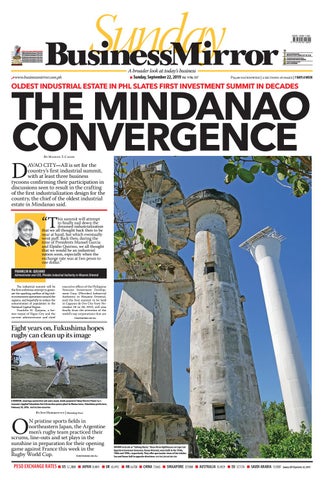
KNOWN to locals as “Tatlong Maria,” these three lighthouses on Cape San Agustin in Governor Generoso, Davao Oriental, were built in the 1940s, 1960s and 1990s, respectively. They offer spectacular views of the Celebes Sea and Davao Gulf in opposite directions. RAKSYBH | DREAMSTIME.COM
n JAPAN 0.4841 n UK 65.4912 n HK 6.6758 n CHINA 7.3665 n SINGAPORE 37.9308 n AUSTRALIA 35.4929 n EU 57.7276 n SAUDI ARABIA 13.9387
Source: BSP (September 20, 2019 )
NewsSunday BusinessMirror
A2 Sunday, September 22, 2019
www.businessmirror.com.ph
Eight years on, Fukushima hopes rugby can clean up its image Continued from A1
About a year ago, the ground beneath their feet was covered with parking lots for the hundreds of workers who had to contain and then clean up the world’s worst nuclear disaster. Eight years after the earthquake and tsunami that caused the meltdown of the Fukushima DaiIchi reactor, the only sign of the devastation at the J-Village sports complex is a radiation monitor showing levels lower than in Tokyo. But residents and businesses in the region are still struggling to persuade the world that their towns and produce are safe. “It has been eight years,” said Saiko Koizumi, 48, a resident of Iwaki, Fukushima. “We drink water out of the taps and have moved on from the life in the immediate aftermath. But outside, the image of Fukushima remains.” At the center of that skepticism is Tokyo Electric Power Co (Tepco)., the company that ran the doomed reactor and was for years lambasted by the public and press for its response to the disaster. Tepco, as the utility is known, rebuilt the training ground Argentina’s Pumas were using to practice and donated it to the local prefecture, one of the finest such facilities in the country. The company set up an office to promote local products like wine and established a communications board to allay public fears about radiation. In the years following the accident, the power company has spent more than $8 billion on recovery and decommissioning of the four affected reactors at the plant. “That doesn’t substitute for true atonement,” said Saki Okawara, 67, a local anti-nuclear activist who is trying to restore business for her brother’s organic farm. “I don’t believe the people of Fukushima trust Tepco.”
Tepco says it wants to help restore the region’s image. Before the accident, Fukushima was known in Japan for its abundant seafood and fresh fruit, including its famous peaches. Hikers and skiers flocked to its mountains and cattle farms raised its prized Black Cattle. “We have a responsibility for the accident and a responsibility for decontaminating the plant and the area. That responsibility involves compensation, damages and the revitalization of the local society and economy,” Tepco said in a statement. It didn’t comment on the use of JVillage for the Rugby World Cup.
Image problem
BUT Tepco has its own image to worry about. While Prime Minister Shinzo Abe wants the utility to fire up other nuclear reactors that were shuttered after 2011, many in the public say they can’t trust it with that responsibility. Meanwhile, neighbor South Korea is raising concerns over potential contamination of the ocean from a planned release of radioactive water from the plant. Earlier this year, the World Trade Organization (WTO) upheld a South Korean ban on some Japanese seafood products that was introduced after the nuclear meltdown. And on September 9, the company’s image took another blow with criticism for its handling of a typhoon-triggered power outage in Chiba Prefecture next to Tokyo that left tens of thousands of households without electricity for over a week and prompted the government to call out its military to speed up what locals have said was an inadequate response. The company also faces increased competition after Japan liberalized its power market in April 2016. Since then, Tepco has lost about 5.3 million customers.
NATIONAL Training Center J-Village in Fukushima, Japan. TAKEHITO KOBAYASHI/THE YOMIURI SHIMBUN/AP PHOTO
None of those troubles compare to the shadow cast by Tepco’s Dai-Ichi plant. The cleanup is expected to take as long as 40 years and cost nearly $200 billion. Three former top Tepco executives were found not guilty by the Tokyo District Court on Thursday of charges including professional negligence resulting in death, closing a chapter in the only effort to hold individuals criminally liable
for the nuclear disaster. The charges were for 44 people, mainly hospital patients, who died when emergency crews couldn’t rescue them due to high levels of radiation.
More reactors
IN July, Tepco said it will decommission four nearby reactors that survived the tsunami undamaged, at a cost of ¥282 billion. That would reduce Japan’s fleet of operable reactors to 33, from 54 before the disaster. Tepco operated 17 reactors in Japan before the disaster and now has only seven operable plants. None are in service as it awaits local government approval to restart them. The catastrophe in 2011 that haunts Tepco also continues to affect those who live around the stricken plant. For some, the Rugby competition and the spotlight of international media may be a chance to help rebuild the region’s image. Except for the small exclusion zone by the reactor, life returned to normal in Fukushima Prefecture several years ago. But residents say the rest of the world still needs to be convinced that the area isn’t a nuclear wasteland. Before the accident, J-Village
was Japan’s first national training center for soccer. Opened in 1997, it hosted the Argentine men’s national soccer team for the FIFA World Cup in 2002. With 11 new soccer fields, it is one of the best sports facilities in the country, and next year it will be the place where Japan’s torch relay begins for the 2020 Summer Olympics in Tokyo. Residents hope that publicity from those events will help. So far the rehabilitation they seek remains elusive. Food from the region is screened before going to store shelves, but a survey showed
that about one in eight Japanese is still hesitant to buy products from the prefecture. The problem is that J-Village is only about 20 km from the Dai-Ichi plant and 7 kilometers from the current exclusion zone. As workers and robots continue the long process of dismantling the reactors and decontaminating the site, even the world’s athletes may struggle to undo the damage to a region that became synonymous with nuclear peril. “Given the harm that has been done, I don’t know if Tepco can ever make things right,” Okawara said.
The Mindanao convergence Continued from A1
owned and managed by overseas Filipinos. Quijano told the BusinessMirror he is confident of the nod of one tycoon, whom he would not name yet. Many of this tycoon’s companies are already operating in Phividec. But he said he was elated that three other tycoons eventually nodded, “even though we know them to prefer to go low key.” “We will not be counting companies and corporations that would participate. We are now going after the participation of the brains behind all these leading corporations in the country today,” he said. Quijano said this will be the first industrial summit to be held since the heyday of industrial activities in the 1950s, when postWorld War II reparations heightened infrastructure activities, and the eventual decline in the 1980s after the failed bid of the Marcos administration to rev up its ambitious 11 major industrial projects. “This summit will attempt to finally nail down the dreamed industrialization that we all thought back then to be near at hand, but which eventually went puff. Back then during the time of Presidents
Manuel Garcia and Elpidio Quirino, we all thought that we would be an industrial nation soon, especially when the exchange rate was at two pesos to one dollar,” he said. “It was the heyday of economic activity, a boom, shall we say,” Quijano said.
Private-led
“THIS summit would try to follow through the directive of President Rodrigo Duterte to cut down on the issuance and approval of economic zones in Metro Manila in order to compel industries to go to the regions,” Quijano said. The summit will be led by the private sector itself. “They would articulate among themselves what business operations they would place in the regions and what they want from government,” he said. “The President has been known to say that he would take care of the peace and order, and elimination of corruption, so that the business sector can do their activities freely and without fear of their security,” Quijano said. The government role here, he stressed, “is just to provide the atmosphere for business to thrive.” The prime movers of the summit will be captains of the indus-
try, from a food and beverage giant and leading airline companies, to banking, telecommunications and real estate. Quijano also disclosed that foreign chambers here have already been apprised of the move “and they were excited,” he added. Quijano said he would like leading Filipino industrialists to take the lead in the regional development, “but we already received a lot of inquiries from China, Japan and other countries which all wanted to establish big industrial operations in the country.” Quijano said he was once shown a PowerPoint presentation of the world’s leading corporations with operations in Europe and North America, “and I was surprised that these were all owned by Filipinos who have not invested yet in the Philippines.” “These are the investments that we want to tap to rev up the areas outside the National Capital Region,” he said. President Duterte earlier issued Administrative Order 18 that orders the Philippine Economic Zone Authority (Peza) to deny further application of economic zones in the NCR to accelerate economic activities in the countryside.
www.businessmirror.com.ph
The World BusinessMirror
US may strike a fatal blow to WTO sooner than expected
A
United States lawyer who is one of the last remaining members of an international panel that rules on trade disputes may resign in December, a move that would cripple the global conflict settlement system. The voluntary departure of Thomas Graham, who has served on the World Trade Organization panel since 2011, would accelerate the appellate body’s looming demise and force countries to fundamentally rethink their reliance on the WTO to settle the surging number of trade disputes. While Graham’s term ends on December 10, panel members in the past have stayed on to finish WTO cases they’re involved in. If he resigns, the seven-member body would no longer have a quorum to rule on pending WTO appeal cases. “I have not yet decided, and I am watching developments closely,” Graham said in an interview at WTO headquarters in Geneva.
Legal limbo
President Donald J. Trump, US Trade Representative Robert Lighthizer and other US critics argue that the WTO dispute settlement system threatens America’s sovereign rights. In response, the European Union, Canada and other member-countries are discussing ways to reform the appellate body to address US criticism that it has strayed from its mandate. The Trump administration, which has threatened to leave the WTO, has refused to consider nominees to replace the four va-
Sunday, September 22, 2019
Global economy sliding toward weakest growth in a decade
I
ntensifying trade conflicts have sent global growth momentum tumbling toward lows last seen during the financial crisis, and governments are not doing enough to prevent long-term damage, the Organisation for Economic Co-operation and Development (OECD) said in its latest outlook.
Shipping containers sit stacked among gantry cranes at the Busan Port Terminal (BPT) at dusk in Busan, South Korea. SeongJoon Cho/Bloomberg
cancies on the panel. The US says panel members have overstepped their mandate by failing to meet its 90-day deadline to decide on appeals; permitting panel members to serve beyond their terms; and by issuing opinions on matters not necessary to resolve a dispute. Graham’s departure would throw all pending and future appeals into legal limbo since there wouldn’t be enough appellate members to resolve disputes. That would essentially allow for any member to veto a claim against them. “I can’t see the US objecting to his resignation,” Scott Miller, a senior adviser at the Washington, D.C.-based Center for Strategic and
International Studies, said in an interview. “Tactically, the US is getting what it wanted by disabling the appellate body.” About a dozen appeal cases are pending, including a dispute over EU restrictions on Russian natural-gas imports and a pair of US-Canadian disputes over paper and softwood lumber. It’s possible that the appellate body may issue a final ruling on any of these cases before the December 10 deadline. It is also likely that WTO members will ask the appellate body to include a tranche of new appeals to their portfolio between now and December 10. Bloomberg News
A3
The Paris-based organization cut almost all economic forecasts it made just four months ago, as protectionist policies take an increasing toll on confidence and investment, and risks continue to mount on financial markets. It sees world growth at a mere 2.9 percent this year. “Our fear is that we are entering an era where growth is stuck at a very low level,” OECD Chief Economist Laurence Boone said. “Governments should absolutely take advantage of low rates to invest in the future now so that this sluggish growth doesn’t become the new normal.” The OECD is the latest institution sounding the alarm over the state of the global economy. In the past two weeks, the Federal Reserve, the European Central
Bank, the People’s Bank of China and numerous of their peers have eased policy to shore up demand, urging governments at the same time that fiscal stimulus will be needed to ensure their efforts won’t be futile. Manufacturing has born the br unt of the economic cr isis brought about by a tit-for-tat trade war between the US and China. The services sector has proved unusually resilient to the malaise so far, but the OECD warned that “persistent weakness” in industry will weigh on the labor market, household incomes and spending. Additional risks stem from a sharper slowdown in China and a no-deal Brexit that could push the UK into a recession and would considerably reduce growth in Europe, according to the report.
What Bloomberg’s economists say
“ T rump ’s br i n k m a nsh ip on trade with China has left consumers, businesses and financial markets on edge. Not knowing whether the next Presidential tweet will ease or exacerbate tensions makes for an environment of extreme uncertainty, pushing businesses to turn cautious on investment and hiring, and households to swing from spending to saving.” —Dan Hanson, Jamie Rush and Tom Orlik The OECD said “collective effort is urgent,” and the effectiveness of monetary policy could be enhanced by “stronger fiscal and structural policy support.” It’s a point central bankers have made for months, and their requests are getting more intense. Following the ECB’s latest monetary stimulus push, President Mario Draghi said it’s “high time” for fiscal policy to take charge, signaling there’s not much more his institution can do. “The takeaway for the euro zone today is do not rely on monetary policy to do the job alone,” Boone said. “Start investing to do the structural reforms that need to be done for more sustainable growth, and do it now.” Bloomberg News
A4
Sunday, September 22, 2019
The World BusinessMirror
China’s mighty trade engine stalls as negotiators seek deal
L
eading indicators of China’s trade performance are pointing to a bad situation becoming worse, adding pressure on negotiators meeting with US counterparts this week to inch toward a deal that would stave off the arrival of yet more tariffs. China’s exports contracted last month and shipments to the US plunged. The tariffs President Donald Trump added this month are set to bite and his administration is preparing to pile on yet more duties in October, and more again in December if there is no breakthrough in the negotiations. Liao Min, deputy director of the Office of the Central Commission for Financial and Economic Affairs and vice finance minister, is leading the delegation that aims to prepare for a meeting of top
negotiators in October. So-called front-loading of shipments ahead of tariffs may help to mitigate the impact on China in the short term but economists surveyed by Bloomberg News still see export growth slowing to 0.3 percent this quarter from a year earlier, flat-lining in the last three months of the year and bottoming out at minus 0.8 percent in the first quarter of 2020. “We expect the outlook for global demand, and thus China’s exports, to remain subdued in the
coming months,” said Louis Kuijs, chief Asia economist at Oxford Economics in Hong Kong. “I don’t think any possible front-loading, or Christmas, is going to change that picture substantially.” Here’s what some key leading indicators say about the outlook for China’s exports:
Export delivery value
This is the most worrying of the indicators, showing a steep decline in Chinese products manufactured but not yet shipped. This may suggest that exporters are cutting back production and that even front-loading activities are slowing down.
PMI export orders
The Purchasing Managers’ Index (PMI) sub-gauge for exports picked up a tad in August while remaining deep in contraction territory at 47.2. The improvement was likely due to some front-loading of US-bound exports in the $300 billion batch of Chinese products hit by additional 15-percent tariffs
from September 1, according to Nomura International. The second tranche faces higher tariffs from December 15. Front-loading shipments now borrows demand from the future, suggesting a weaker outlook ahead.
Trading partner PMIs
The PMIs of many of China’s major trading partners look anemic. There are other bad signs, too. A widely watched index of manufacturing activity in the US compiled by the Institute for Supply Management showed a contraction in August—the first since 2016. The September 3 data release sent US stock prices and bond yields tumbling. What Bloomberg’s economists say... “The signs of front-loading suggest that exports of goods such as toys could weaken should the threatened tariffs be implemented in December. The yuan’s recent weakness offers limited offset to the range of negative forces.” Bloomberg News
China’s growing clout looms over Trump’s dinner with Aussie PM
A
ustralian Prime Minister Scott Morrison’s lavish visit to the White House on Friday—including the second State Dinner of Donald Trump’s presidency—comes at a critical time as both nations seek to counter China’s growing influence in the South Pacific. A day of meetings and the formal Rose Garden dinner—the first for an Australian leader since 2006—give Morrison the opportunity to remind Trump that new challenges to regional security are emerging seven decades after their nations’ alliance was cemented in World War II. While China’s growing economic might is the main catalyst of Trump’s trade war, diplomats in Washington and Canberra are increasingly concerned about Beijing’s geopolitical ambitions. There are signs China’s influence is spreading beyond the South China Sea to the Pacific Islands, a region traditionally under US hegemony and on Australia’s doorstep. “Both countries have taken a long time to recognize the gravity of the challenge China poses in Asia and must now make hard choices to place real resources behind new initiatives in the region,” said Ashley Townshend, director of the foreign policy and defense program at the University of Sydney’s United States Studies Centre. China’s growing influence in the region was displayed in the past week, when the Solomon Islands broke off diplomatic ties with Taiwan in favor of Beijing.
Military bases
Since 2011, China has spent at least $1.6 billion in loans and aid to develop 265 projects in the Pacific Islands, according to research by the Sydney-based Lowy Institute. While that’s dwarfed by the $8.6 billion spent by Australia and the US, mainly on programs to improve governance, education and health services, China has gained an advantage by funding and building much-desired transport and utility infrastructure. The US is concerned Beijing’s end-game is to lure nations into debt traps as leverage to establish military bases in the region. Both Morrison and Trump are trying to counter China’s growing
Scott Morrison, Australia’s prime minister, speaks during an event hosted by Asialink and Bloomberg in Sydney, Australia, on June 26. Brendon Thorne/Bloomberg
reach. Late last year, Australia unveiled a A$2-billion ($1.4 billion) infrastructure fund for the region, while the US joined a group that includes Japan, the European Union and the Asian Development Bank to fund projects. Secretary of State Michael Pompeo last month visited Micronesia, where he held security talks with the Pacific Island leaders. But according to Malcolm Davis, a senior analyst at the Australian Strategic Policy Institute in Canberra, more needs to be done. “It’s really difficult to stop China in its tracks in the Pacific and we’re seeing that for some of these nations it’s very easy to be swayed by money,” said Davis. In his talks with Trump, “Morrison needs to make sure he makes every point a winning point. The US needs to engage more resources in the region, that means a military step up, as well as increased investment and foreign aid.”
Pollution, moon cooperation
Trump administration officials say their defense discussions with Australia will also involve joint work on top foreign policy priorities of the president, including Australian assistance in maintaining freedom of navigation in the Strait of Hormuz as the US weighs a response to the recent attack on Saudi Arabia’s oil facilities that US officials have blamed on Iran. The leaders will also discuss joint efforts to address North Korea’s nuclear weapons program, according to a US official who requested anonymity to discuss the upcoming meeting. But the White House also envisions discussions on coopera-
tion in space, with an anticipated memorandum of understanding between Nasa and Australia’s space agency on joint efforts to return to the moon by 2024, as well as automation and robotics technologies. This push comes despite Trump in June raising questions about Nasa’s efforts to return to the moon—even though he previously directed the agency to pursue that mission. The leaders are also expected to roll out joint programs to address recycling and waste management, with a particular eye toward reducing plastic waste in oceans that threaten the Great Barrier Reef and US shorelines. And Australia and the US will seek to further counter Chinese influence by rolling out a new plan to improve the supply and security of rare earths—the vital elements needed in components for missile systems and consumer electronics. US officials have surveyed sites in the Australian Outback region for new supplies after China signaled it could restrict shipments as part of the ongoing trade war. Earlier this summer, Trump ordered the Pentagon to spur production of a slew of rare-earth magnets used in consumer electronics, military hardware and medical research, amid concerns China will restrict exports of the products.
Warm welcome
The last time an Australian leader received such a welcome in Washington was in 2006 when John Howard was hosted to a State Dinner by his close friend George W. Bush. Howard, who was visiting Washington when the September 11 attacks occurred in 2001, was
one of the first global leaders to pledge support for America’s war aga inst a l- Qaed a in t he Middle East. Morrison’s visit will include an elaborate welcome ceremony on the South Lawn, a gift exchange, a bilateral meeting that includes the two countries’ first ladies in the Oval Office, a State Department Lunch hosted by Pompeo and Vice President Mike Pence, and a midday press conference at the White House. Morrison’s invite is another sign that relations with the US president are off to a good start. Four months ago, Trump tweeted his congratulations to Morrison for a “GREAT WIN!” in Australia’s election, which like the president’s own victory came as a surprise to pundits. Both are conservatives with a strong Christian voter base. The only other State Dinner Trump has hosted was for French President Emmanuel Macron in April 2018. Australia has stood with American forces in every major conflict in the past 100 years. The Pine Gap facility in central Australia hosts a joint US-Australia defense station used in global surveillance. Since the Howard-Bush era, the alliance between the Five Eyes intelligence partners has deepened. In 2011, then-President Barack Obama secured a deal to base about 2,500 Marines in the northern Australian port of Darwin. Morrison’s government last month announced it would send military personnel, a frigate and surveillance plane to aid the USled coalition to protect ships passing through the Strait of Hormuz. Government officials in Canberra believe the red-carpet treatment for Morrison shows Trump recognizes Australia as an ally that pulls its weight and regards it as a model trading partner. Morrison is expected to meet intelligence officials at the Pentagon, inspect an Ohio paperrecycling mill built by Australian billionaire Anthony Pratt, attend an anti-terrorism event hosted by French President Emmanuel Macron in New York, and meet with other global leaders on the sidelines of the United Nations General Assembly, which he is scheduled to address on Wednesday. Bloomberg News
www.businessmirror.com.ph
Drought, wildfires inflict double whammy on Indonesian crops
W
ildfires, smoke and drought are inflicting an increasingly painful toll on Indonesian agriculture, hurting everything from oil palm plantations to rubber trees and rice fields. Raging forest fires in Sumatra and Borneo may curb supplies of palm oil and rubber, while a longer than usual dry season in Java has wilted some of the country’s rice crop, which is the main staple for 270 million people. Indonesia is the world’s top producer of palm oil and second-largest supplier of rubber. Smoke from illegal burning to clear land in Indonesia has been worse than usual this year and spread across Southeast Asia, causing flight disruptions and respiratory illness for thousands of people. While Indonesian President Joko Widodo ordered a crackdown on arsonists, there may be little respite soon as the rainy season won’t start before late October, the weather bureau says. Forest fires to clear land have also wrought havoc in the Brazilian Amazon. Drought and haze have set back ripening of palm-oil fruit and disrupted operations at plantations and mills, potentially slowing production growth this year to about half last year’s rate of 13 percent, said Joko Supriyono, chairman of the Indonesian Palm Oil Association. Dry weather normally takes a while to show up in production, with a greater impact likely to be seen in 2020, he said.
Slash-and-burn
The worse than expected dry weather in Sumatra and Kalimantan in Indonesia and Sabah in Malaysia may reduce output from older palm trees, according to Marcello Cultrera, institutional sales manager at Phillip Futures in Kuala Lumpur. The haze from the forest fires has a small impact on palm-oil extraction rates and output in the very short term, he said.
Farmers in Sumatra and Borneo are using illegal slash-and-burn techniques, which are much cheaper than other methods, to clear land for palm oil, pulp and rubber plantations. More than 320,000 hectares have been burnt in the first eight months of the year, according to the National Disaster Mitigation Agency. Oil palm plantations are generally not the source of burning, according to the Council of Palm Oil Producing Countries. Fires that are recorded in plantations have usually spread there from neighboring areas, where small fires were started, it said in a release. Rubber trees are also at risk. Output, already hit by fungal disease, may plunge 20 percent from 3.67 million tons last year as drought and forest fires disrupt tapping, said Erwin Tunas, executive director of the Rubber Association of Indonesia. The haze blocks sunlight that’s crucial for photosynthesis, the group says.
Prolonged drought
While Java, Indonesia’s top rice producer, hasn’t been hit by wildfires, a prolonged drought has parched farmland, damaging more than 250,000 hectares of rice and causing more than 580,000 tons of losses, according to Edy Purnawan, director of crop protection at the Agriculture Ministry. The government is urging farmers to plant seeds suitable for dry land for the small harvest in the fourth quarter, to make up for the losses, Purnawan said. While the area affected is small compared with Indonesia’s total rice plantings over about 9 million hectares, a less significant crop failure last year helped spur an increase in imports to the highest in six years. Ample stockpiles with state-owned Bulog will probably prevent major new imports this time round. Bloomberg News
Oil’s rising as Iran’s warning of ‘all-out war’ raises tensions
T
he threat of war in the Middle East is pushing oil prices higher again, capping one of the most dramatic ever weeks for crude markets in which 5 percent of the world’s supplies were cut by attacks on Saudi production facilities. While Saudi Arabia’s efforts to restore output and assurances that the world has adequate supply have helped temper some of the unprecedented gains in the aftermath of the attacks, prices are still up almost 8 percent this week at almost $65 a barrel. The US and Saudis say evidence points to Iran’s involvement and the threat of retaliatory action against the Islamic Republic is keeping prices elevated. Iran’s foreign minister warned that any strike would lead to an “all-out war.” The ratcheting up of instability in the world’s most important oil-producing region has raised the risk premium for oil prices, which are almost $5 a barrel higher than before last weekend’s attacks on the Saudi facilities. There’s also prevailing concern about how long it will take the kingdom to fully restore lost production, as it depletes reserves to meet supply commitments and operates without its
usual buffer of spare capacity. “Given the level of uncertainty into the weekend, prices could remain skewed to the upside,” Stephen Innes, Asia-Pacific market strategist at AxiTrader, said in an e-mailed note. Traders are hedging that the initial estimates for the duration of repairs, given the complex nature, could well underestimate the time required, he added. Brent crude for November settlement rose 42 cents, or 0.7 percent, to $64.82 a barrel on the ICE Futures Europe Exchange as of 8:52 a.m. in Singapore on Friday. The global benchmark crude is up 7.7 percent this week, the most since January. It’s a bullish end to an extraordinary week for oil, during which Brent jumped a record 19 percent in the first few seconds after trading resumed on Monday following the weekend attacks. Futures pulled back through the middle of the week as the Saudis said they were aiming to restore lost production capacity by the end of the month. West Texas Intermediate for October delivery rose 64 cents, or 1.1 percent, to $58.77 a barrel on the New York Mercantile Exchange on Friday. Bloomberg News
40-year-old law that spurred US renewables growth gets revamp
A
40-year-old law that’s been key to the growth of renewable energy in the US is set for a major overhaul that could change the way small solar and wind projects are developed. US regulators on Thursday proposed setting new limits on which energy projects fall under the Public Utility Regulatory Policies Act, known as PURPA—a landmark law that helped spur an entire generation of solar and wind farms across the US. What happens to Purpa now will shape the future of the clean energy boom that propelled renewable power generation past coal on America’s grid for the first time ever this year. Purpa requires utilities to purchase power from renewable - energy (RE) projects under certain circumstances. If a developer can build a project for less than a utility can, then they can request a contract to sell power to the utility.
Utilities have long sought changes to the law, which they say saddles consumers with expensive contracts and power they don’t need. Solar and wind developers, meanwhile, say Purpa’s critical to giving renewables a leg up in states that aren’t green-leaning. Th e Fe d e ra l En e rg y R e g u l ato r y Commission, which oversees wholesale power markets, argued on Thursday that Purpa should be updated to reflect changing market conditions—namely, an abundance of natural gas and falling RE costs. “Updating our PURPA regulations has been one of my main priorities since coming to the commission two years ago,” commission Chairman Neil Chatterjee said at a meeting on Thursday in Washington. The aim is to ensure they reflect “today’s markets rather than the energy landscape of the 1970s,” he said. Bloomberg News
Faith
Sunday
www.businessmirror.com.ph • Editor: Lyn Resurreccion
25th Sunday in Ordinary Time: ‘Luke 16:1-13’
Be faithful in little things Msgr. Josefino S. Ramirez SUNDAY GOSPEL IN OUR LIFE
T
he Gospel of today contains a very accurate observation that is also a wise piece of advice: “He who is faithful in a very little thing is faithful also in much” (Luke 16:10). Fidelity! W hat a wonder f u l qu a l it y that we would all like to benefit from. What assurance we have if we can count on a friend who is loyal and faithful. What consolation to know that our partner in life is a faithful spouse. What good could be done if priests and religious were always faithful to their commitments to God and their superiors. Likewise, what dread fills us when we think of the treacherous friend, of the unfaithful spouse, or the lukewarm person of God. Fidelity is a virtue of strength. A person may be amiable to us— but he is a faithful friend only if that bond of friendship endures even in times of trouble and need. We may have been attracted to our lifelong partner, but fidelity will be tested only if the union remains strong even if the attraction has faded and the problems of daily living have to be faced. A consecrated person is faithful—and there are many wonderful examples in our midst—when he remains in his station, even when the odds of indifferentism are up against him. And because it is a virtue of strength, faithfulness has to be natured by little things. Those strong cables that are capable of holding up tons of concrete and steel, get their strength
from each small strand that makes it up. So fidelity in our commitments will only be possible if we are faithful in little things. Do you want to be a faithful friend? Don’t neglect those manifestations of friendship that will nurture your relationship. Remove any trace of duplicity in your dealings, and be really interested in the good of your friends. Don’t give in to the suggestion of envy or jealousy, that would transform friendship into rivalry. Do you want to be a good spouse? Be fa it hf u l in l itt le things. Guard your heart, and have eyes only for your spouse. That wedding ring, to proclaim to the world that you are committed, should be your bond of protection. Those stolen glances, that flirty conversation—those are the little things that can undermine a lifelong loving relationship. And what can I say of consecrated person? Be faithful to your chosen vocation. Do not be sidestepped by other concerns that may, perhaps, give more immediate gratification. We are supposed to be men of God—let us not neglect our personal friendship with God. We are supposed to serve people; let us not look out for ourselves. Keep up the initial fire that made us serve God, and do not look around for other activities that will deviate us from the mission God has given us. Now, more than at any other time, God needs persons who will serve Him, full time and 100 percent.
Mormon leader affirms church’s opposition to gay marriage
The Church of Jesus Christ of Latter-day Saints President Russell M. Nelson addresses the congregation at the close of the gala celebrating his 95th birthday at The Church of Jesus Christ of Latter-day Saints Conference Center on September 6. Nelson has been a transformative president since he took over in January 2018. Leah Hogsten/The Salt Lake Tribune via AP
P
ROVO, Utah—The leader of The Church of Jesus Christ of Latterday Saints reaffirmed the religion’s opposition to gay marriage last week, while explaining that leaders lifted a short-lived ban on baptisms for children of gay parents because they felt the “heartache” it caused. Church President Russell M. Nelson’s remarks in a speech to students at the church-owned Brigham Young University were the most detailed explanation to date of the faith’s surprising move in April to repeal 2015 policies that banned the baptisms and labeled people in same-sex marriages as sinners eligible for expulsion. “We knew that this policy created concern and confusion for some and heartache for others,” Nelson said. “That grieved us. Whenever the sons and daughters of God weep, for whatever reasons, we weep.” Nelson claimed the original policy was motivated by love and a desire to prevent friction between the beliefs of gay parents and their children. Nelson became president last year but was a member of a top governing body called the Quorum of the Twelve Apostles when the policy took effect. Nelson, 95, who is considered a prophet by Church members, said the Church’s longstanding opposition to gay marriage stems from a belief that he and other leaders must follow God’s law that dictates that marriage is restricted to unions between a man and a woman. He contended that leaders can’t change God’s laws but have the authority to adjust Church policy. The comments marked the latest attempt by the Utah-based faith widely
known as the Mormon Church to carve out a more empathetic stance toward lesbian, gay, bisexual, transgender and queer (LGBTQ) people while adhering to doctrinal rejection of gay marriage amid widespread societal acceptance. Critics say the balancing act has led to a confusing push-and-pull of policies that leave LGBTQ members and their allies confused and sometimes distraught. The 2015 policy angered many and led to protests and some defections. The Church considers homosexual relations a sin, forcing gay and lesbian members to avoid intimidate relationships to remain full-fledged members. Laura Root was a lifelong member of the Church until she was kicked out last year for being in a lesbian relationship. She called Nelson’s explanation of the policy and repeal just a few years later illogical. She believes Nelson and leaders love LGBT members but said there is a disconnect. “Is it loving to say, ‘Yeah we love you but we’re not going to give you the freedom to have romantic love in your life?” said Root, a 49-year-old mental health counselor in Boise, Idaho. “It does not feel loving to me. In fact, it feels very cruel.” Joe Wheat, a 24-year-old from Corona, California, was among the nearly 19,000 BYU students who packed the basketball arena to listen to Nelson. Wheat said he was happy to hear that a policy that upset his LGBT friends was motivated by love. “I know it’s really easy to hear about these policy changes and assume the worst,” Wheat said. “More than anything, I felt that everything that is done is really motivated out of love. It’s not meant to tear anybody apart. It’s not meant to hurt anybody.” AP
Sunday, September 22, 2019 A5
CBCP: Divorce unconstitutional in PHL; legal methods available
A
By Samuel P. Medenilla
n official of the Catholic Bishops’ Conference of the Philippines (CBCP) on Wednesday said pending divorce legislation is unconstitutional.
In a statement, CBCP’s Permanent Committee on Public Affairs (PCPA) Executive Secretary Fr. Jerome Secillano singled out the bill filed by Sen. Risa Hontiveros, which legalizes divorce. Hontiveros claimed the law is pro-marriage, pro-family, and pro-children. Secillano admonished Hontiveros in her supposed attempt to “twist facts.” “Divorce can never be pro-marriage, pro-family, and pro-children. Is she saying now that the Family Code and our Constitution are anti-family, anti-marriage, and anti-children since they do not guarantee divorce?” Secillano said. R at her t han pushing for out r ig ht d ivorce, Sec i l l a no u rged t he sen ator to i n stead pu sh
for a bi l l a mend i ng m a r it a l se pa rat ion pol ic ies. A divorce law is not needed in the country as there are already legal processes in place for couples having marital problems, Secillano said on Wednesday. “We acknowledge that marital relationships are not always perfect. But there are legal processes already available to couples on verge of separation,” Secillano said in an interview. Currently, estranged couples in the country have the option to file an annulment of marriage or legal separation. Secillano’s remark came after a Senate hearing tackled a measure allowing divorce in the country, where supporters of the measure,
From the Garden of the Cross By Corazon Damo-Santiago
W
ho can fathom the love of God for men? He created a perfect world for man’s first parents, Adam and Eve, endowed them with wisdom of immensely high order and freedom from suffering and death. But, they still committed the “pride of life” and wanted to be gods. Through the ages, God desired to have a personal union and friendship with men despite their sinfulness. A nd so, He, likew ise, sent prophets to remind men how to avoid sin and follow God’s commandments. Then God wanted to reveal himself even more to man. This was done through Jesus Christ, God’s son who will teach man who God really is.
The new covenant
God named a grandson of Abraham, Jacob, which means one who prevails with God. God, likewise, appointed David to rule all of Israel. The kingdom were Israel in the North and Judah in the South, united during the time of K ing David and brief ly during the reign of his son, King Solomon. Then the
tribes of Israel separated from the kingdom with Jerusalem as its capital. God promised to make a new covenant with the House of Israel and the House of Judah (Jeremiah 31:31), it will be unlike the covenant when God freed them from bondage of Egypt. The covenant will not be written in stone tablets but “upon their hearts. No longer will they have need to teach their friends and kinsmen how to know the Lord, all from least to greatest, shall know Me” (Jeremiah 31, 33-34). In God’s time, Jesus, the second person of the Holy Trinity, became man, died on a cross for the expiation of sins of the whole world” (1 John 2:2). Pope Clement VI, in 1343 “Jubilee Bull Unigenitus Dei Filius,” wrote that Christ “shed His blood copiously as if it were floods, even though one little drop of His blood can suffice to redeem the whole human race.”
Son of God became man
Saint Paul said the first man Adam was “living soul,” and Jesus the last Adam “a life-giving spirit.” The first Adam was made by the last Adam, and “stamped
The CBCP headquarters in Intramuros, Manila. PNA
primarily victims of abuse, shared their ordeal. “Why can’t Sen. Risa Hontiveros focus on reforming these processes? They are guaranteed to be legal and constitutional. She can even make them less tedious and less expensive,” Secillano said. The CBCP-PCPA official noted that people deserve better than pushing for something that will destroy families.
“Let’s not twist facts just to suit a particular agenda. Divorce is a form of ‘ideological colonization,’” Secillano added. Catholic Church officials have repeatedly opposed the passage of divorce law, saying that it is antimarriage and anti-family. The Philippines and the Vatican City are the remaining two nations in the world where divorce is outlawed. With PNA
His image on the first Adam when He created him.” The Catechism of the Catholic Church (CCC), quoting Saint Peter Chrysologus, Sermon 117, states: “That is why Jesus took on Himself the role and name of the first Adam in order that He might not lose, what He had made in His own image.” Adam of the Garden of Eden had a beginning, “the last knows no end. The last Adam is indeed the first as He himself says: I am the first and the last.” In Indiculus, Pope Innocent said that Adam our first parent “betrayed by his freedom forever, would have remained weighed down by his fall had not later the advent of Christ raised him up by His grace.” Saint Thomas Aquinas said: “No mere man could have ever made a complete satisfaction for the whole human race. Only God could pay the debt, but certainly God did not owe it. Hence, it was right that the payer of the debt be both God and man.”
for all time in the world is renewed in every Mass. The Mass ensures that the covenant established by God with His own blood is “made present by the liturgical action” (CCC 1409)—the Eucharistic celebration “of Christ Himself the eternal high priest of the New Covenant acting through the ministry of the priest” (CCC 1410). This covenant ensures that a l l si ns a re forg iven if men truly and humbly repent and confess the sins to a covenant priest of God. During the Last Supper, Jesus took the cup, and said, “ This cup is the new covenant in My blood, which will be shed for you” (Luke 22:20). Mot he r C hu rc h , howe ve r, teaches that this “salvific will of God ” necessitates cooperation of man—repentance for his sins and a continuous collaboration with God’s divine mercy to follow His commandments. And man, endowed with thinking and willingness, can respond to God’s invitation to redemptive grace.
Eucharistic covenant
Damo-Santiago is a former regional director of the Department of Education National Capital Region. She is currently a faculty member of Mater Redemptoris Collegium in Calauan, Laguna, and of Mater Redemptoris College in San Jose City, Nueva Ecija.
God becom ing ma n, e xcept in sin, cr uc if ied a nd r ising aga in on t he t h ird d ay a nd ascending to heaven is t he c l ima x of sa lvat ion h istor y. Jesus’ sacrifice, which extends
A look at Judaism’s place in Israeli politics J
ERUSALEM—Seven decades after Israel’s founding, the debate over Judaism’s place in public life rages on. Israeli political battle lines often fracture along how the country balances Jewish religion and liberal democracy. These tensions were a central issue in this week’s national election, and are sure to influence the composition of the country’s next government. While the country’s Jewish majority is largely secular, parties representing the ultra-Orthodox minority have traditionally wielded considerable political power. Acting as coalition kingmakers, religious parties hold a monopoly on many areas of daily life—from the closure of stores and public transport on the Sabbath to Jewish burial and marriage rites. Israel has granted the ultra-Orthodox community sweeping exemptions from the country’s mandatory military draft. This has built resentment among the secular majority, who are required to serve. After Israel held elections last April, Prime Minister Benjamin Netanyahu’s
prospective governing coalition collapsed because a secular ally, Yisrael Beiteinu party leader Avigdor Lieberman, insisted on legislation to force young ultra-Orthodox men to also serve in the military. Playing on this theme, Lieberman’s party boosted its strength in last week’s election and is poised to be a central player in the next coalition government. He is insisting on a broad secular partnership with the country’s two largest parties. “Israelis voted more on religion and state as a result of the political growth and appetite of the ultra-Orthodox parties,” said Yohanan Plesner, president of the Israel Democracy Institute, a Jerusalem think tank. Of Israel’s 9 million people, 75 percent are Jewish. Most of the population is secular or modern Orthodox, and 14 percent are ultra-Orthodox, according to Israel’s Central Bureau of Statistics. Another 20 percent of the population is made up by the country’s Muslim, Christian and Druze Arabs. As coalition negotiations get set to
begin, here’s a look at religion’s role in Israeli politics:
Orthodox
T h e t wo ultra- O r thodox par ties— the predominantly Ashkenazi United Torah Judaism and Sephardi Shas party representing Jews of Middle Eastern descent—and the religious nationalist Yemina faction, advocate a greater place for Orthodox Judaism in state life, including religious education and shutting public transportation on the Sabbath. They also have rejected efforts to dissolve a long-standing exemption for religious men to study in seminaries in lieu of having to serve in the military. Religious Jewish parties won nearly 20 percent of the vote in last week’s repeat election. In recent decades, those parties have typically united with the conservative Likud party to form a governing coalition. But this time, the religious-nationalist bloc fell short of a majority in the Knesset, Israel’s parliament, winning only 56 of the 120 seats.
Secular
Several of the main liberal parties— Blue and White, Yisrael Beiteinu and the Democratic Union—ran on a secular platform, advocating measures such as universal military draft that includes ultraOrthodox men and civil marriage. Currently, all Jewish marriages in Israel must be performed by the country’s Orthodox Rabbinate, which requires that both partners be Jewish and that the ceremony adhere to Orthodox custom. L i e b e r m a n ’s s t a u n c h l y s e c u l a r Yisrael Beiteinu p a r t y i s s u p p o r t e d mainly by mostly nonreligious, R u s s i a n - s p e a k i n g i m m i g ra nt s f ro m the former Soviet Union. Blue and White, headed by former army chief of staff Benny Gantz, campaigned ahead of election day with ads calling for a “secular national unity government.” Those calls were echoed by Lieberman, who supports a partnership with Gantz and Netanyahu that excludes the ultra-Orthodox parties. AP
Science
BusinessMirror
A6 Sunday, September 22, 2019
Sunday
www.businessmirror.com.ph • Editor: Lyn Resurreccion
Crafting the best way to get the message across in a jovial mood
Coffee Fiesta sells new technology, machines Story & photo by Manuel T. Cayon
D
Mindanao Bureau Chief
AVAO CITY—A consortium of government agencies engaged in research and development work has tapped the Filipino customary time of revelry and gathering to promote and advocate the adaption of technology and mechanization to farmers, this time to coffee farmers, in the Davao region. Farmers were treated in August to a technology galore—from good agricultural practices and presentation of researches, to available gadgets and machinery—to enable them to graduate from farm cultivation to commercial production, not only of coffee but of the other crops and livestock, as well. Farmers were introduced or reminded again on collaboration of coffee farmers and producers and the academic institutions in the localities, the influence of coffee harvest, postharvest and
processing equipment to coffee quality and efficiency, as well as the market potential of producing fine robusta and specialty arabica coffees. The research and developmentfocused Southern Mindanao Agriculture, Aquatic and Natural Resources Research and Development Consortium (Smaardec) got experts to talk on current researches like the varietal study of arabica coffee on Mount Apo highland and the market systems approach to coffee industry development.
‘Technology important for 4th agricultural revolution’
‘T
he reality of digitalizing agriculture is won or lost at the farmer level, where applicability and sustainability have to be tested.” Dr. Glenn B. Gregorio, director of the Southeast Asian Regional Center for Graduate Study and Research in Agriculture (Searca), said this before more than 350 scientists, researchers and educators at the opening of the 25th Federation of Crop Science Societies of the Philippines (FCSSP) and the first Federation of Plant Science Associations of the Philippines (FPSAP) Scientific Conference in Davao City last week. FPSAP is composed of the Crop Science Society of the Philippines, the Philippine Seed Industry Association Inc., PhilFruits Association Inc. and the Philippine Association of Plant Tissue Culture and Biotechnology. With the theme, “Converging Sustainability and Precision to Create Digital Plant Science Innovations,” the conference is convened at the Apo View Hotel and until September 21. “At Searca, we are working toward elevating the quality of life of farmers by improving their access to new, sustainable, resilient production technologies and systems, and help them integrate with modern postharvest and logistics systems,” Gregorio said. He explained the importance of using technology to achieve Agriculture 4.0, but pointed out that there is resistance to adapt to change by adopting modern technologies because of perceived risks associated with them. “We have to embrace these changes to actually change the lives of farmers. Let’s give these technologies and changes a chance so that we can have a better chance of changing the current state of our farmers,” Gregorio said. The theme of the conference highlights this need. “Advances in plant science through the
form of biotechnology or agro-engineering technology can create various impacts in our society and environment, and thus, should incorporate sustainable designs for future generations,” FPSAP President Ryan Rodrigo P. Tayobong said. “Plant science and agriculture must be able to cope with how fast new knowledge is generated and technologies change,” Gregorio affirmed. Speaking from more than 30 years of experience as crop scientist and research manager in international and private institutions, Gregorio urged the conference participants: “We must be innovative to change for a purpose.” In the next five years, he said Searca will focus its efforts to facilitate interconnectedness among the academe, industry and government in order to contribute to the sustainable development goals, particularly on quality education; industry, innovation, and infrastructure; and partnerships for the SDGs, among others. Gregorio challenged the participants to begin innovative approaches in transforming the agricultural sector. “We have to make agriculture attractive and this begins with changing the mindset of farmers from being producers to agripreneurs and in having a holistic approach to the agricultural value chain,” he said. The conference is jointly organized by FPSAP with the University of Southeastern Philippines, and Southern Mindanao Agriculture, Aquatic and Natural Resources Research Development Consortium. It is cosponsored by Searca, Philippine Council for Agriculture, Aquatic and Natural Resources Research and Development; Philippine Rice Research Institute; Corteva Agriscience; Monsanto Philippines-Bayer Crop Science; and CropLife Philippines.
D.O.S.T. labs ‘spice’ up for collaboration
DOST officials attend the launching of #SpicestoDOSTLabS. From left are: Science Assistant Secretary for International Cooperation Dr. Leah J. Buendia, TAPI Director Edgar I. Garcia, former ITDI Director Dr. Nuna Almanzor, ITDI Deputy Director Dianne Ignacio, ITDI Director Dr. Annabelle Briones, STII Director Richard P. Burgos, MIRDC Supervising SRS Florante Catalan, FNRI Supervising SRS Rosemarie Dumag, FPRDI Supervising SRS Adela Torres and PTRI Chief SRS Dr. Julius Leaño. S&T Media Service
A crop expert explains the coffee technology to DOSTPcaard ACD Director Marita A. Carlos (second from left) and Spamast President Ruth S. Lucero (third from left).
With farmers cultivating other crops aside from coffee, and raising animals, other experts also tackled issues on biofumigation technology on potato production, the use of KD fertilizer in rice production and other crops, a package of technology on goat production and an environmental topic on coastal management policy.
The fiesta
The lectures were given during the Coffee Fiesta, a Smaardec regional symposium on research and development highlights at the Digos City campus of the South-
ern Philippines Agri-Business and Marine and Aquatic School of Technology (Spamast). The event was set up in fiesta-like atmosphere, from the indigenous dances and music by the welcoming group of students at the campus gate, to the array of booths of crop researches and technologies available to farmers, and buntings and educational forum at the gymnasium. “You have to craft new ways to sell technology and machines. The fiesta celebration among Filipinos could be one of the best ways to get the message across in a very jovial
mood,” said Marita A. Carlos, director of the Advanced Communication Division of the Philippine Council for Agriculture, Aquatic and Natural Resources Research and Development of the Department of Science and Technology (DOST-Pcaard). The Coffee Fiesta was conceived by DOST-Pcaard to create an avenue conducive for acceptance of farming technology and mechanization. There would be other fiestas to be held for other crops and livestock, including the introduction of halal goat technology, she said.
Providential
A female farmer from Matanao, Davao del Sur, said she raised a few heads of goats at her backyard but admitted that her coffee were not producing enough. “I was not about to come here but I accompanied my neighbor, just the same, because I don’t have anything to do yet in the farm,” she said. But her attending the Coffee Fiesta was providential. “I never knew that there would be potentially good income if only I just tended to my coffee well,” she added. Besides, she said, “my goats
would be additional income, as well because of the tips I got from the lectures.” Besides lectures, organizers also conducted “techno-cliniquing” between the experts and the farmers, as they also distributed planting materials to the farmers. The Coffee Fiesta also held a coffee thesis pitch in among students in the province. The Smaardec said the activity was to reach out and disseminate farming technologies to as many farmers and fisherfolk as possible, to bring farmers and f isher men and their families in the provinces to a yearly regional symposium on research and development. “Now on its 12th year, this year’s Smaardec forum provides options to address inadequacies and to address the urgent issues that threatened productivity of our small and medium farmers. As a bottom-up process of consultation and dialogue between farmers, fisherfolks, rural producers’ organizations and researchers/experts, the forum is aimed at facilitating effective delivery of relevant and timely technologies to clients, technologies that have potential for adoption/ utilization,” the Smaardec said.
Bamboo musical instruments take spotlight in DOST-FPRDI’s R&D program
Besides being the conductor and musical director of Musikawayan, Ret. Col. Gilbert Ramos (left) also trains members of the Biñan Kawayan Music Ensemble
M
or e t ha n a cent ur y ago, a ba mboo ba nd in Malabon played an important role in the 1896 revolution. At a time when the use of the bolo was banned, Malabon Musikong Bumbong helped the K atipunan by hauling and sneaking away their weapons. It also played the revolutionar y songs “A lerta K atipunan” and “Veteranos de la Revolucion.” Three generations after, Ret. Col. Gi lber t R a mos—a g reat grandson of Felix Ramos, one of t he fou nders of Ma l abon Musikong Bumbong—continued the legacy not only by playing but by crafting bamboo musical instruments (BMI), as well.
T
o spice up the promotion of testing laboratories of the Department of Science and Technology, the Technology Application and Promotion Institute (DOST-TAPI) recently launched #SpicestoDOSTLabS at the Advanced Device and Materials Testing Laboratory (Admatel) Building at the DOST Compound in Taguig City. The #SpicestoDOSTLabS, or the “Strategic Promotion through Integrating Collaboration and Engagement of Small and Medium Enterprises to Support the Technology Transfer and Commercialization of DOST-Developed Technologies including Testing Laboratories and Services,” provides a venue for the DOST research and development institutes (RDI) and stakeholders for demonstration, orientation and dissemination of DOST laboratories and services. “With this launching, we are one with you in finding solutions to issues relative to your industry
Members of the band play the tipangklung
The band is now known as Musikawayan and continues to make music beyond Malabon. This year, the Department of Science and Technology-Forest Products Research and Development Institute (DOST-FPRDI) started the Bamboo Musical Instruments Innovation R&D Program to improve the quality of locally made BMI. “We make various types of instruments, such as tipangklung, angklung, mar imba, bumbong, bamban and gabbang, mostly for our clients from schools and music stores,” shared R amos. He admited that though there is a steady demand for their products, one of the challenges
is maintaining the quality of the raw mater i a ls, espec i a l ly since bamboo poles are usua l ly prone to bu kbok (powder-post beet le) at t ac k. According to Program Leader Aralyn L. Quintos, “ The DOSTFPRDI program aims to provide science-backed solutions to BMI problems on sound and structural qualities, playability, tuning and durability.” The program seeks to develop technologies that will prolong the life of bamboo without negatively affecting the musical instruments’ sound quality; standardize the production of selected BMI; develop prototype design; analyze raw material sources and
existing markets; and build a BMI processing facility. “As an off-shoot, we hope to raise public awareness and appreciation for the cultural importance of these musical instruments,” Quintos added. Program partners include the University of the PhilippinesCenter for Ethnomusicology and Philippine Normal University, while funding is provided by the DOST Grants-in-Aid. With Filipino ingenuity and ample R&D support, craftsmen and musicians like R amos can look for ward to making more beautiful music with bamboo.
in improving productivity through an innovative ecosystem for your operations, which improve the quality of products or services and increase the quantity of outputs,” said Dr. Annabelle V. Briones, director of the Industrial Technology Development Institute (DOST-ITDI). Briones also emphasized the importance of collaborations in creating a harmonious relationship for a unified goal. As a series of laboratory visits, #SpicestoDOSTLabS plans to introduce the premier laboratories of the department with Admatel as the first stop. Admatel, as a testing laboratory, is equipped with advanced analytical equipment for analysis and materials characterization, including surface and thermal analysis, sample preparation and external visual inspection. Conceived during the holding of DOST-Tapi’s
Technology Transfer Day in 2016, the event opened and widened the scope of technology transfer and commercialization by tapping the special needs of the stakeholders, particularly the industry players in engaging in research and development (R&D). “We came to realize that in order for our stakeholders to be able to commercialize their technologies, they would need assistance to fulfill initial R&D first that can materialize through the help of our RDI’s laboratory services,” said Engr. Edgar I. Garcia, director of DOST-Tapi. The activity also touched the component of accelerated R&D program for capacity building of RDIs through industrial competitiveness as part of one of the DOST’s banner program, Science for Change. “As a loyal client of Admatel since 2013, I am thankful for their customer-oriented and competent services, high-quality output, and
competitive pricing,” said Manuel Almonte Jr. of Deca Technologies. Admatel’s services provide accurate results and short turnaround time at much lesser cost than commercial laboratories among private and government institutions. “Professionalism, technical competitiveness, reliability and integrity can be found in Admatel’s services,” said Dr. Julius L. Leaño, chief of Philippine Textile Research Institute’s Research and Development Division. Leaño said collaboration provides opportunities to corroborate data, maximize the use of resources, and integrate and harmonize to focus for an excellent R&D work. The launching was attended by at least 75 participants from the industry, academe and government sectors.
Apple Jean C. Martin-de Leon/S&T Media Service
S&T Media Service/Jund Rian A. Doringo
Tourism&Entertainment BusinessMirror
Editor: Carla Mortel-Baricaua
Sunday, September 22, 2019
A7
MARVELOUS MARIVELES Story & photos by Benjamin Locsin Layug
M
ariveles comes to mind as the starting point of the Bataan Death March, during World War II and, during the Marcos Era, as the site of the first “free trade zone” in the Philippines. Nagbayog Cave
Lately, Mariveles is being hyped up as the next adventure and trekking destination, the town being the site of Tarak Ridge, a very challenging and strenuous major hike (which my daughter Cheska and her fiancée Bryan climbed) and Five Fingers, a series of coves that looks like a hand with outstretched fingers when viewed from the air. With my aches and age, the former was out of the question, but the latter was worth a shot. With my son Jandy and friends Maricar Jose and Norman Capule, we left early in the morning for the long 172-kilometer drive from Manila to Mariveles, checking in at the four-story, four-star hilltop Oriental Bataan. Formerly known as the Bataan Hilltop Hotel (opened in September 1974), it was designed by my late uncle and National Artist for Architecture Leandro Locsin, redeveloped by the LKY Property Group and reopened on December 2014. Its Brutalist architectural exterior may be dated but its modern Asian Thai interior was very elegant, vivid and classy. We embarked on our first outdoor adventure to the pebbly Sisiman Beach along picturesque Sisiman Bay. At its southernmost tip, the area is filled with cliffs which provide you an overlooking view of the ocean. Climbing its lighthouse, we had a pictureperfect view of the beach, as well as the beautiful, 213-meter (700 ft.)
high San Miguel Peak, a seafront rock mountain noted for its rock formations. I decided against climbing San Miguel Peak but I allowed Jandy to join Maricar and Norman, both seasoned mountaineers, as they made the 20to 30-minute hike to the summit. At the top, they had a more breathtaking view of Bataan, Corregidor Island, and La Monja Island, as well as a view of a breathtaking sunset. On our third day, after a very early buffet breakfast at the Lobby Lounge, we drove all the way to the seawall where we boarded our hired motorized outrigger boat for the Five Fingers tour. A 45-minute boat ride took us to the first finger (or thumb), Cochinos Point. Cochino in Spanish means “pig.” Upon landing, we trekked up a path that was a bit steep and jagged for around 20 minutes. Once up the hill, we were rewarded with a 360 degree, picture-perfect and rewarding view of hills, cliffs, Mariveles Bay and Mount Mariveles in the distance. Quite tired from the strenuous uphill/downhill trek, we rewarded ourselves with a cool swim, wearing our life jackets, through the narrow, sea sculpted and bat-inhabited Cochinos Cave, all the way out to the sea before making our way, along the side of the hill, back to our boat. From Cochinos, we made our way to the second finger called Talaga Point, the index finger, passing by Natsu Lagoon (Natsu,
Sunset at Sisiman Beach.
Jumper at Nagbalite Cliff.
The Matterhorn-like San Miguel Peak. in Japanese, means summer) and its 20-foot cliff from which you can jump to the lagoon. After Natsu, we made landfall at the calm, shallow and gently sloping Apatot Cove’s beach, named as such because of the abundant apatot trees in the area. Here, we relaxed and swam a bit. From Apatot Cove, we proceeded to the third (or middle) finger known as Hornos Point or Puntang Mahaba, being the longest finger among the
The iconic Oriental Bataan. five. Here, we dropped by Pebble Cave (part of Nagbayog Cove) where we, again donning our life jackets, swam into the mouth of the cave. We also docked at Nagmandala Rock which has stairway-like formations. Because of its rustic-nature concept, it is popular for shoots like prenups. This cove also has the highest point for cliff-jumping at 50 ft. The fourth finger or ring finger is Naiklec Point, and the place to visit here is Mawakis Cove.
Unique ophiolite rock formations at Latain Point. At Longos Kawayan Point, the fifth finger, we made a brief stop at Tinanlakan Lagoon, famous for its 40-foot cliff jump. Here, we watched, while swimming with our life jackets, as many bravely made the plunge. Their guides were helpful in making sure that you jump at the right spot and not hit the rocks. The area of Nagbintana Arch is named as such because of the arching passage in the rock formation that looks like a window. Some
Legend, leisure, adventure L
OUT-OF-THIS-WORLD DEALS Travel enthusiasts score data roaming deals from Smart at the recent Klook Travel Fest last September 7 and 8 at World Trade Center, Pasay City.
egazpi City maybe synonymous to the iconic perfect-coned Mayon Volcano, but beyond this legendary peak, it is a treasure throve of wonders which has been living under the shadow of this majestic geological monument. Named after the equally legendary Spanish conquistador Miguel Lopez de Legazpi, the city was founded in 1959, but its checkered history dates back to the 1500s. So when it recently adopted the tagline “There is More to Legazpi,” the city sees to it that it delivers on this promise to provide a consummate experience of legend, leisure and more. Legazpi is known for Ibalong Festival, Bicol region’s biggest nonreligious festivity which is filled with cultural, entertainment and sporting events, and highlighted by a parade where participating contingents recreate the chapters of the mythology through a street theater presentation. Now on its 28th year, it is a modern recreation of a mid-19th century fragments of 60-stanza epic poem penned by Spanish Friar Bernardino de Melendreras about the glorious precolonial era of the region which was then known as “Ibalong.” Written in the mold of ancient mythologies, the epic tells of superhuman heroes—Baltog, Handyong and Bantong—who rid the land of fearsome beasts and helped it attain its golden era. The epic has an open-ended conclusion as if to allow the readers to draw their own scenarios of heroism in contemporary circumstances. “Ibalong” has inspired countless stage plays and productions, the most prominent of which is a dance musical by Tanghalang Pilipino at
ATV ride at Mayon Lava Trail.
the Cultural Center of the Philippines in 2013. The city is also the site of the summertime Magayon Festival of Albay Province which relives the legend of Mayon Volcano based on the star-crossed love story of a beautiful maiden named Daragang Magayon and her lover Pangaronon. These legends and other historical events are immortalized at the newly opened Museo de Legazpi, one of the country’s most modern local government-run museums. Also dubbed the “City of Fun and Adventure,” Legazpi is Bicol’s regional center, aerial gateway and tourism hub, with a wide array of cozy boutique hotels, homegrown restaurants serving delectable local cuisine, as well as lifestyle malls. Must-do recreational activities which have gained global fame is the all-terrain vehicle (ATV) ride along the surreal Mayon Lava Wall and the Ligñon Hill zipline with the volcano in
the background. The city is also positioning itself as a scuba diving spot with its newly discovered coral reef gardens in Albay Gulf, and a golf getaway with the a par 72, 18-hole Doña Pepita Golf Course, the only one of its kind in Bicol. The city takes pride in Legazpi Boulevard, one of the longest bay roads outside Metro Manila, a tourism and recreational zone with the Dapdap Waterfront Park which will have an esplanade, amphitheater, beach volleyball court, elderly fitness yard, children’s playground and skateboard court. Legazpi has also became a favorite for national and international conferences and events because of its convention facilities and urban amenities. Recognizing the potential of the MICE (Meetings, Incentives, Conventions and Exhibitions) sector, the city government itself has built its own convention center to supplement the city-run Ibalong Centrum for Recreation and the hotel-based conference halls.
go to the arch area for snorkeling. Also around the area is Latain Point, a unique ophiolite rock formation that beautifully jut out into the sky. This cove also serves as a nesting site for migratory birds making it ideal for bird-watching. After our tour, we made a short visit to Lusong Beach where we had a late lunch on board our boat. On the return trip we passed by, but didn’t make landfall, at upscale Camaya Coast Hotel.
This market accounts for the bulk of the city’s 1.2 million annual foreign and domestic tourists. In recognition of its role as an emerging MICE hub, the city will host World Food Expo in 2020, the first time the annual event will be held outside Manila. Beefing up the city’s room inventory is the newl opened 83-room The Oriental Hotel Albay in the downtown area, which will have three food and beverage outlets, a swimming pool, fitness gym, wellness spa, souvenir shops and a 3,000-pax capacity convention hall once fully completed. Because of the unique blend of the mountains and the sea, it is also a preferred venue for adventure sports events, such as the Xterra OffRoad Triathlon Race, Air 21 Le Tour de Filipinas, LBC’s Ronda Pilipinas, the Mt. Mayon Triathlon, the 80-km Mayon 360 Albay Ultramarathon, and dragonboat tournaments, among others. City Mayor Noel Rosal said the city’s business-friendly climate, political stability, and peace and order situation are the best magnets for investors and locators, aside from its natural endowments and urban amenities. He said that Legazpi was named as the country’s Most Business-Friendly City (Component City Category) last year, the most prestigious award by the Philippine Chamber of Commerce and Industry (PCCI), and bagged the Seal of Good Local Governance (SGLG) Hall of Fame of the Department of the Interior and Local Government. It is also undergoing a master-planned gentrification with upscale housing developments, such as Ecohomes Bayshores Condominium and Camella Homes in the upland areas for the growing middle class in the community. As Legazpi recently marked its 60th founding, the city exudes the wisdom of senior citizen and the vibrance of a millennial, as it continues to offer legend, leisure and more.
A8 Sunday, September 22, 2019
Sports BusinessMirror
Editor: Jun Lomibao | mirror_sports@yahoo.com.ph
Coe praises Tokyo 2020 marathon route after test event
I
nternational Association of Athletics Federations (IAAF) President Sebastian Coe has praised the Tokyo 2020 Olympic Games marathon course, after a test event was held in the Japanese capital. The warm-up races on Sunday—known as the Marathon Grand Championship—saw Japanese athletes bid to win a spot on the host nation’s Olympic team. Shogo Nakamura and Honami Maeda won the men’s and women’s races, respectively, and can now look forward to their home Games next year. Second-place finishers Yuma Hattori and Ayuko Suzuki also qualified. Runners followed the Olympic route but the start and finish, at Icho Namiki Avenue in Meiji Jingu Gaien Park, was different, as the Tokyo 2020 Olympic Stadium is still under construction. Athletes passed by Tokyo landmarks, including the Thunder Gate, Imperial Palace, Zojoji Temple and Nihonbashi Bridge. The course is mainly flat and similar to the one used at the Tokyo Marathon, part of the World Marathon Majors series. “The marathon is a growing highlight
of the athletics program, with imaginative courses that show off the best of cities and are challenging for athletes and fan-friendly,” said Coe, a double Olympic gold medalist for Britain over 1,500 meters. “This marathon course highlights the essence of Tokyo—a blend of tradition and modernity,” he added. The heat at the test event reached up to 28 degrees centigrade with a 75 percent humidity. Even warmer conditions are expected when the Olympics are held in July and August, a major headache for organizers after dozens of heatrelated deaths in Tokyo. The Olympic marathons start time has already been moved back to 6 a.m. to avoid the hottest parts of the day. Organizers used the test event to assess issues they may face next year. Insidethegames The warm-up races—known as the Marathon Grand Championship—see Japanese athletes bid to win a spot on the host nation’s Olympic team.
VALVERDE RETURNS TO DEFEND CROWN Alejandro Valverde goes for a second straight crown at the world championships in Yorkshire.
S
PAIN has named its squad for the International Cycling Union (UCI) Road World Championships in Yorkshire— with reigning world champion Alejandro Valverde (Movistar) leading the team once again. Valverde’s support team has an emphasis on riders familiar with the team leader, to aid teamwork on the Harrogate circuit. The 39-year-old, who sprinted to victory from a small group in Innsbruck last year, and has just finished second at the Vuelta a España, will be joined by Movistar teammates José Joaquín Rojas, Marc Soler and Imanol Erviti. The 10 best ranked nations can field eight riders in the elite men’s road race but Spain have nine places thank to Valverde’s victory in Innsbruck last year. A host of ex-Movistar men round out the powerful squad, with Astana trio Ion Izagirre, Gorka Izagirre and Luis León Sánchez included along with Jonathan Castroviejo (Team Ineos). Iván García Cortina (Bahrain-Merida) is the only rider in the nine-man team with no experience riding as Valverde’s teammate. Castroviejo, who finished third in the time trial in Qatar back in 2016, will take part in the time trial. Lluís Mas (Movistar) will also compete in the time trial. Aside of Valverde, who has five wins this
year, including Stage 7 at the Vuelta and the Spanish National Championships, Ion has had the most successful 2019 campaign. The Basque rider won the Vuelta a Valenciana, Tour of the Basque Country and a stage at Paris-Nice. Meanwhile, Sánchez took a stage win at the Tour de Suisse and the overall at the Vuelta a Murcia, while Gorka won the Tour de la Provence. Cortina, a punchy sprinter, looks to be the main backup for Valverde, though the 23-year-old is untested at a senior Worlds. “We have designed a very competitive team thinking about the route we are going to find, and how the race will develop, as well as a team that knows Valverde perfectly,” said new National Team Coach Pascual Momparler to Marca. “Because of the route layout, it’s going to be difficult to get close to the cars and to give orders easily [there are no race radios], especially once we enter the circuit. So it’s important that the riders already have an understanding with Valverde.” The first event of the Worlds will be the new 28-kilometer mixed relay event, which was trialled at the European Championships. Spain will send Castroviejo, Mas, Sebastián Mora (Caja Rural-Seguros RGA) and the Movistar women’s trio of Lourdes Oyarbide, Mavi García and Sheyla Gutiérrez.
Sweden supports Faroe Islands bid for IOC recognition
T
HE Swedish Olympic Committee (SOK) has backed the Faroe Islands’ bid for Olympic Games inclusion. A letter was sent by SOK President Mats Årjes, Vice President Per Palmström and chief operating officer Peter Reinebo to confirm the country’s support. Located between Iceland and Scotland, the Faroe Islands have been a self-governing region of Denmark since 1948. The territory rules on all issues except foreign policy and self defense, and has been recognized by major sporting bodies, such as Fifa and the International Paralympic Committee. However, the International Olympic Committee (IOC) has not granted recognition which means Faroe Islands athletes must compete for Denmark at the Olympic Games. A campaign to change this position has been launched by the Faroese Confederation of Sports and Olympic Committee (FCSOC)
and is also backed by Denmark, Norway and Iceland. Their case has been hindered, however, by an Olympic Charter change in 1996, ruling that National Olympic Committee (NOC) recognition can “only be granted after recognition as an independent state by the international community.” In January, the European Olympic Committees ruled they will not recognize the Faroe Islands but will permit them to compete in sports where they have a recognized national governing body. Puerto Rico, a territory of the United States, does enjoy Olympic recognition despite not being an independent country. “NOC Sweden with this, express support to the Faroese Confederation of Sports and Olympic Committee in the work of getting international recognition by International Federations [IFs] and the IOC,” the SOK letter said. Insidethegames
In the women’s road race, García, Oyarbide and Gutíerrez will be joined by Ana Santesteban (WNT-Rotor) and trade teammates Eider Merino and Alicia González. Spain’s Under-23 and Junior lineups have yet to be revealed.
FIGHT FOR U.C.I. POINTS
BESIDES competing for medals and the prestigious rainbow jerseys, Spain will also be fighting for places at the 2020 Olympics in Tokyo. Only the top 6 nations in the UCI Olympic Qualification Ranking will take five men to Japan next year, and so placings and points in Yorkshire could influence Valverde’s hopes of ending his career with Olympic gold. After the Vuelta a España, Slovenia has moved above Spain into sixth place with 8,724.74 points to 8,636.12. Belgium, Italy, France, the Netherlands and Colombia occupy the top 5 places in the rankings. With the cutoff on the rolling ranking coming at the end of the season on October 27, Spanish riders need to exceed their previous points total for the season-end period by “at least 100 points” according to Momparler. For example, last season, Valverde’s Worlds win and results in the Italian one-day classics to end the year saw him gain 805 points, all of which will be wiped from the records and replaced by his 2019 points total in those races. Spain’s 290 points apiece at Il Lombardia and the Tour of Guangxi will also need to be matched or improved upon if they are to overhaul the Roglič and Pogačar-boosted Slovenian points total and obtain the full complement of riders for Tokyo. Insidethegames
GERMANS KEEP FALLING
Z
URICH—Germany fell one place to No. 16 in the latest Fifa world rankings, which are still led by Belgium. As the 11th highest ranked European team, 2014 World Cup winner Germany risks being in the second-seeded pot and getting a tougher opponent when qualifying groups for the 2022 World Cup are drawn, likely next year. Germany lost a 2020 European Championships qualifier this month to the Netherlands, which rises three places to No. 13. Italy also moves above Germany to No. 15. Belgium is followed by No. 2 France, the 2018 World Cup winner, which trades places with No. 3 Brazil. England stays at No. 4 and European champion Portugal rises one place to No. 5. Mexico leads Concacaf nations at No. 12, and the United States rises one to No. 21. Senegal is Africa’s best at No. 20. Iran at No. 23 tops Asian confederation teams. Insidethegames
Madrigal scion sees early childhood education pivotal in personal devt
Madrigal scion sees early childhood education pivotal in personal devt By Oliver Samson
children, according to Eduque.
Correspondent
Brainchild
E
DUCATOR and Madrigal scion Alexandra M. Eduque believes education at early childhood plays an important role in the total development of a person.
A Habitat for Humanity volunteer at the age of 15, Eduque established in 2012 the nonprofit and nonstock group MovEd.org Foundation Inc. to help realize her vision. Eduque then self-authored a curriculum that promises to properly equip children for personal development through early childhood learning. In the same year, she partnered with the local government of Navotas and Habitat for Humanity Phils. Foundation Inc. to make her self-authored curriculum accessible. That year, MovEd.org—MovEd is short for Molding Optimism and Values through Education—started with one site. Its pilot class had only 37 students. Today, after five years, the curriculum holds a total number of 927 enrollees in 23 learning laboratories for the school year, according to Eduque. Some 415 of the total number of enrollees attend classes in learning laboratories in the National Capital Region. About 512 attend classes in the Bicol region.
Bigger, better TODAY, MovEd.org has six learning laboratories in Metro Manila, three in Navotas, two in Parañaque and one in Pasig. Each learning laboratory is serviced by one teacher and one teaching aide. A learning laboratory in Metro Manila usually has about 50 students, which requires the teacher to need the assistance of a teaching aide due to the class size, Eduque explained. Outside the NCR, MovEd.org has recently expanded its classrooms in the Bicol region. The group has learning laboratories all over the third district of Camarines Sur. Seventeen learning laboratories offer the MovEd.org’s curriculum in the province’s third district municipalities, including Calabanga, Magarao, Ocampo, Camaligan, Pili, Bombon and Canaman. Eduque noted that in terms of concentration of sites, Metro Manila has more students than Camarines Sur at present. “But in terms of number of students, Camarines Sur is bigger,” Eduque said. In the province of Camarines Sur, since the size of class is usually smaller, each learning laboratory is usually serviced by a teacher only; no teaching aide.
A class of MovEd’s early childhood curriculum MovEd
LGU partnership MovEd.org works hand in hand with local government units (LGUs) in making Eduque’s self-authored curriculum accessible to as many children as possible. “Basically, we provide everything from the education to the teacher training and the curriculum,” Eduque said. The curriculum, she noted, covers what the Department of Social Welfare and Development (DSWD) requires. She added they also look at what the Department of Education (DepEd) has for kindergarten students “so that the kids are well-prepared for kinder.” As MovEd.org partners, the local government units provide the classrooms. “We don’t build anything,” she said. “We’re given the facility. The LGUs are also responsible for giving us the teachers or social workers.” The teachers are trained on the curriculum of MovEd.org. The LGU, she added, is also responsible in the selection of children. The age of the early childhood learners should basically range from three to five years old. “We work with them at the age when it has been scientifically proven that cognition and development are most rapid,” Eduque said. “It’s also an age crucial in the formation of their values so that whatever they learn at that age they’ll more likely to bring with them for the rest of their life.”
Curriculum development The curriculum is instructed to provide the students with the necessary learning and skills in order to make them well-equipped for classroom after preschool. Eduque cited a study by the United Nations Children’s Fund that shows the highest dropout rate in developing countries usually occurs during Grade 1 “because students have some helplessness.” “Some don’t even know how to hold a pencil,” she added.
2 BusinessMirror
MovEd.org’s curriculum is designed to prepare children well for classroom after preschool, Eduque explained. The curriculum provides the children with learning and skills required in classroom after preschool. “They already have the sense of confidence that they need to move forward,” the thirtyish scion of the Madrigal clan said. “That’s really what we look at developing, and that is naturally developed along the way.” At preschool age, academic is one thing, Eduque explained. “But it’s also about developing a sense of identity, a sense of awareness, a sense of confidence,” she said.
Read, write and count Eduque observed most people put more value on college education and secondary education, overlooking the crucial role that early childhood education plays in personal development. “What they don’t realize is without quality primary and elementary education, you’ll never get there,” she said. Eduque noted that under the curriculum of MovEd.org, the child “will be able to read, write and count.” The program also seeks to help the parents of early childhood learners provide the children with good health through good nutrition. “We also do in-class feeding in partnership with RS Po Foundation for those students who want to avail themselves of the in-class feeding,” Eduque said. The children spend two hours in learning laboratories plus about half an hour for the feeding. Some of the graduates of MovEd.org’s curriculum have become scholars in private schools, she said. Since the curriculum was offered in 2012, this early childhood program has graduated a total number of 2,302 September 22, 2019
The curriculum of MovEd.org was Eduque’s brainchild; hatched during her undergraduate studies. “I was then a junior in Colombia University in New York and my major was Urban Studies,” she said. “Part of the requirements to graduate was 400 hours on an undergraduate thesis.” Eduque thought of a thesis topic that would be meaningful and benefit her own people. “I was lucky that my professor at that time allowed me to do my thesis in a foreign country; that being the Philippines,” she said. She flew to and from the Philippines for a number of times to work on her thesis. “So, the first site in Navotas was actually an offshoot of my undergraduate thesis,” she said. Before she founded MovEd.org, Eduque was an active volunteer for the Habitat for Humanity, for which she raised funds through her own initiatives. While a volunteer for Habitat for Humanity, she saw the basic necessity for shelter alone was not adequate for the personal development of families. “I realized that while housing will break the poverty cycle, without education and without knowing how to turn that housing into a hope, you may lose that [hope] eventually,” she said. Shelter serves as the hardware for those who need it, Eduque explained. But people also need the software in order to empower themselves, she added.
More labs EDUQUE hopes 10 years from now that MovEd.org would have expanded not only by the number of students, but also geographically. She is looking at growing the number of learning laboratories in Metro Manila, as well as in more provinces in the country. “And hopefully, in 10 years’ time, the landscape would be that more than anything people understand the value of early childhood education,” she said. Eduque believes education is responsible for nation-building. “Education is eventually what builds the society,” she said. “I always believe people are born as a blank sheet. They are shaped by the experiences that they go through and the education that they receive.” She also believes education is crucial in helping one shape his or her own identity, voice and thought. As a nonprofit organization, the early childhood program of MovEd.org is driven by fund-raisers. The organization has also a growing number of individual, corporate and foreign donors, Eduque added.
BusinessMirror
MUSIC
THE SOUND OF SKARLET BROWN
I
By Darwin Fernandez
RONICALLY, change is familiar to everyone. We often reach a stage where we need to embrace something alien to us because growth doesn’t happen by doing the same things over and over. Though an icon has been built behind the name of Put3Ska’s Myra Ruaro in the bands great up rise to mainstream Ska in the Philippines in the early 90s the vocalist dared to show that she was iconic no matter what name she used as Ruaro now plays with the same vigour and passion for music under the title Skarlet Brown.
Despite being almost two decades away from each other and careers in different fields, Put3ska still proved why they are a major mover of Ska during their reunion concert at the Music Museum last May 24. The singer-songwriter Brown still danced and moved with the 14-man Continued on page 4
4
Sound BusinessMirror
SEPTEMBER 22 , 2019 | soundstrip.businessmirror@gmail.com
MUS
RE-INTRODUCING GLOC-9, SONGWRITER By Tony M. Maghirang
A
FTER 22 years in the music business, Gloc-9 is embarking on a new journey. He’s going indie and he’s excited about kick-starting a new chapter in his checkered career. It was a major decision for the rapper-songwriter who’s given OPM such iconic hits as the LGBT anthem “Sirena,” the critique of power and politics in “Upuan,” the paean to our migrant workers in “Walang Natira,” the narrative of prostitution and sex slavery in “Magda.” This time, Gloc-9 is ready to give his fans the fresh jolt of the unexpected with his new song titled “Dungaw.” The accompanying video opens in a party mood in a wake. In an all-white setting from clothing to the walls, the assembled ‘mourners’ carouse delightfully complete with hot horns around an open casket. The color comes in lyrics that begin with mundane observations on the illicit side of making money off another man’s death. Then, by the final canto, Gloc-9 along with the back-up singers, comes out etched against a black background halfrapping about cosmic inquiries about
The Sound of...
from page 3
ensemble, though with a different set of notes, she genuinely sounded like the Queen of Philippine Ska Music.
life, death and God’s place in the scheme of things. He rues: “Why is there sickness without cure? Why is there hunger while others eat without getting sated? Why do sons have to die ahead of their parents?” A comment on the video channel goes: “Damn this one. Politics. Religion. People around you. Without telling the exact words, Gloc 9’s going beast mode here.” By going independent, Gloc-9 may be asking bigger questions beyond the ordinary themes about moon in June by mainstream artists. But a much bigger puzzle is how come the rap artist has chosen to leave the tried and tested practice of sticking to a recording contract. Gloc-9 has this to say. “I’m thankful to all the recording companies that have given me the opportunity (to share my music) all these years, However, I think it has come to a point that I want to know what it’s like to be
A new purpose on stage
After the Put3ska band parted ways, Brown never left the music scene and found herself in the genres of Jazz, Reggae and Blues. Even her love for music influenced her business explorations as she put up the Skarlet Jazz Kitchen. But as she returns to face media in the presscon for the Put3ska reunion gig, it was more than just music to her but rather sharing a new moment with her two kids who weren’t there to see her in Put3ska’s first years. “We’re doing this for our children,” she said, “di nila kami naabutan nung buo pa kami—my boys, they’ve never seen me perform so, I want to show them this side of me.” It was evident that Ska was being shared between generations as both young and old audiences grooved in
the moving force behind my music, from writing to publishing I’d like to experience what it means to fully own my songs and be responsible for their outcome.” The prospects of his music in the digital era is also a source of fascination. He understands that today, the physical CD has become secondary, and the relevance and mileage one gets online is enough to make or break a song. The thought challenges his creativity, and makes the rapper-songwriter want to expand and quite possibly, conquer new horizons. He explains, “It’s important to me that I continue to be heard by OPM listeners and aficionados. I also just realized that my original fans, my children, appreciate my work even more now. And I’d like to reach out to this new generation of listeners.” Right now, Gloc and his management are figuring out ways to do this. Another major shift for Gloc-9 is the decision to hone his songwriting skills by actually opening himself up to writing songs for other artists. “Before, I’d prefer to perform my own songs, even those produced in collaboration with other artists. But
the theatre during the concert. “May Ska pa rin [for the] younger generation, lalo na dahil sa Youtube and internet madali na lang madiscover ang mga new songs.” She mentions the foreign band which takes recent pop songs and gives it a rendition under the elements of Jazz, Blues and Ska with a full big band orchestra.
The HEART of MUSIC
During the hype of the Ska scene, Brown was always on stage to receive applause both locally and outside the country, her contributions to Ska and Jazz was recognized by organizations like AWIT, KATHA, The Rock Awards, and MTV but she made sure to make a difference outside the performing stage. The HEART of MUSIC is a Nonprofit organization (NGO) that Brown
I’ve now come to realize that writing songs for other artists presents a whole new bundle of challenges and I think I’m ready to take on those unique challenges,” he smiles. Gloc-9 has distinguished himself as a rapper/songwriter over the last two decades. Now he’s being reintroduced as an independent rapper and songwriter. Everyone who ever loved the captivating socially-aware songs of this humble fellow (who stands tall above us mere mortals) can’t wait to see what this new chapter of his career will bring. “Dungaw” is Gloc-9’s first independent release. The song is now available on Spotify and all online platforms. Check out the official music video at https://youtu.be/ dELxEmyesEE
put up along with her new group The Brownbeat Allstars in 1998. It cared for low-earning musicians in providing for their healthcare needs.
What hasn’t changed
Singing with a band ever since she was just 15yo, whether it was Myra or Scarlet Brown she knew that music was her life and the decades from the two names her love for it didn’t change. “Para sa ‘kin, pangalawa sa family ko is music,” she said in a light smile, “this is my life, eto yung purpose ko.” Almost unrecognizable from the Myra of the 90s she still swings to the sound of big-band music and plays with some of the members of Put3ska under the groups, Skarlet Swing Machine and The Brownbeat Allstars.
d trip
soundstrip.businessmirror@gmail.com | SEPTEMBER 22 , 2019
5
SIC ON PRINT
THE LATE ISABEL’S DOLL’S HEAD TURNS 15
By Rick Olivares
I
N 2004, The Late Isabel released their debut album, “Doll’s Head.” The album stood out in a sea of nu-metal and retro-sounding bands that were popular at the time. Aside from being a sleeper hit, the album is also notable for being the first ever Filipino gothic rock album released. Nine songs that ushered in nightfall and the eeriness associated with it. “Doll’s Head” evoked the macabre of Siouxsie and the Banshees with Allan Hernandez’ tortured guitar musings, JP Agcaoili’s gloomy drumming, and the thumping fear of Roval Bacale’s bass. What set them apart was the operatic range of vocalist Wawi Navarroza. And she had flair. Did she ever. In the music video for Doll’s Head, she was this alluring vamp whose piercing eyes zapped you into a trance-like state. If Siouxsie and the Banshees recorded a twisted version of The Beatles’ “Helter Skelter,” The Late Isabel’s response was a haunting version of The Sound of Music’s “My Favorite Things.” After that, did anyone remember the way Julie Andrews sang that musicale classic? From music to album packaging, The Late Isabel rose and slithered into everyone’s secret black heart. The textured black and white cover
featured a young girl with her eyes cast upward in muted wonder. It was an image that seemed came out of some antique locket. Or heirloom. In fact, one cannot think about Doll’s Head without thinking about that iconic cover. Fifteen years later, we caught up not only with Hernandez, but also the cover model, Karen Holdnall, who has blossomed into a beautiful woman who now works as a stewardess for AirAsia. “There is some synchronicity involved in those photos of Wai,” bared Hernandez. “When I wrote ‘Doll’s Head’, I had not yet met Wawi. I met her through Doi Porras of Dominion. All I knew of her was that she played bass (for another goth band) Prominence of Cathedrals.” It was while talking to Navarroza that Hernandez was shown pictures of her work that was titled, Polysaccharide, where Karen was the model. “Polysaccharide was how I was seeing the doll’s head song in my head. That was when I knew Wawi would be part of The Late Isabel because she saw in visions what we were hearing in sounds.” “I used to hang out at Wawi’s place all the time,” chipped in Holdnall. “She took a picture of me one time and she asked the band if they could use it for the album cover. They thought the picture was just right and that was how it happened. It was totally unplanned; a spur of the moment idea. I was 11 or 12 years old at that time and little did I know that it open doors for me.”
The video shoot for “Doll’s Head” was also an experience for the young lass. “I was amazed at the experience of watching a band shoot a music video,” she said. “The effects were all pretty cool.” A friend of Navarroza’s saw a picture that she took of Holdnall and asked if she would like to participate in a contest where the winner would land a cover spot on Candy magazine. Karen won and the floodgates soon opened on offers for modelling gigs. “My dad didn’t want me to do it because he thought I was too young and that I should finish my studies first.” The Late Isabel and their debut was a hit and garnered rave reviews from critics. Furthermore, it helped bring some awareness to the goth subculture. The album is now considered a collector’s item
and is rather hard to find in the back seller’s market. “We as a band liked the air of mystery about our music and our image,” added Hernandez. “Even our gig posters reflected that. It would always be about a woman in a stylish and mysterious form.” Doll’s Head was followed up seven years later in 2011 with the EP “Lackadaisical.” And nine years later today, a new album is said to have taken form and is set to be released pending a few more details. The band has somewhat strayed from their goth roots and entered art rock territory. Hernandez laughed at the how each and every effort takes later and later to produce. “I am sure it will be worth the wait for everyone,” laughed Hernandez. “Don’t you love a mystery?”
6
SEPTEMBER 22 , 2019 | soundstrip.businessmirror@gmail.com
Sound trip BusinessMirror
MUSIC ON PRINT
“Feel the rhythm, hear my feelings’
T
oday’s TeenGen is a lot more vocal and expressive with what they’re going through or what’s on their minds. Whether it be a kilig moment with crush, heartbreak, getting recognized in school, or a cause they strongly support. It has been a year since the “Homecoming to Teen Love,” this year, Coke Studio brings its 3rd Season: “MyFeel.” Indeed, no one does it better than Coke when it comes to launches with the Coke Studio Music Festival that commenced the “Coke Studio Season 3: MyFeels” at Circuit Makati with hosts from the Summer Concert Ylona Garcia and Justin Quirino. Headlined by Coke Studio Season 3 artists, the crowd welcomed the rainy season with rush of water and stream of feelings ranging from love, freedom, independence, and moving forward. They moved to the groove of Iñigo Pascual, Ron Henley, Al James, Lola Amour, This Band, and Miss Sarah Geronimo while Janine Teñoso, Clara Benin, Bea Lorenzo,
Silent Sanctuary, Brisom, St. Wolf, Just Hush, UDD, and Morisette serenaded the audience with their solo performances. Also giving surprise numbers were Coke Studio Seasons 1 and 2 alumni’s Ben & Ben, December Avenue, and IV of Spades. Just when we thought 2019 is going too fast and time is running out, Coke Studio came to the rescue with its 3rd Season and made us realize to celebrate every single thing no matter how little they are, look out for the possibilities that learning from triumphs and slumps can give us, and keep in touch with the feels of people around us and ourselves. Coke Studio Season 3 is aired every Saturday 10am on ABS-CBN.
VIVA SIGNS UP SOUTHERN ROCK BAND HEY MOONSHINE
H
ey Moonshine is an eightpiece rock and roll band that had been active in the independent music scene for more than three years now, was recently signed Viva Records.
The band is composed of professionals by day, lawyer Carlo Ybanez (bass player); Angela Rivera (backup vocals) a medical doctor; Gian Sison (lead vocals), a fulltime chef; Bryan Gatmaitan (guitars) and Aris Sison (guitars) who are both engineers; journalist Athena Sayaman (guitars and backing vocals); Shaun Hilario (drums) a teacher; and Ton Gregorio (guitars), a graphic artist. Their music is a combination of southern rock, blues, and rock n’ roll.
The band has a lot of things in store and they are excited to work with the major label. The first step is to re-release their single “We’ll Break this War.” Currently, their 5 song selftitled debut album is available on Spotify which already has more than a 100,000 streams and expect to reach more with the help of the label. Check out Hey Moonshine’s Facebook www.facebook.com/ heymoonshine and Instagram @ heymoonshine.global to get to know more of the band plus other updates.
Young people in Asia Pacific ready to compromise security for ‘likes’
Indigenous peoples can embrace culture through DepEd program Marly E. Oliano
MILLENNIALS UNIVERSE
I
A
REPORT by Kaspersky Lab ZAO revealed that more than half (55.5 percent) of survey respondents in Asia Pacific from the age groups 16 to 24 and 25 to 34 think its impossible to have complete online privacy in the modern digital world.
This was the result of Kasperskys survey, which revealed that online users in Asia Pacific appear to be willing to share their private information in exchange for various personal gains from social media, even quiz results to know what type of flower they are or whose celebrity they look like. In Kasperskys Global Privacy Report 2018 released this year, 39.2 percent said they are willing to sacrifice their private data if they can get additional safety like security checks or surveillance. Of the respondents, 22 percent confessed they share their social-media details to find out the results of fun quizzes while 18.9 percent admitted they will disregard
their privacy if they’ll get something for free, such as a software, service or gift. In a statement, the Russian cyber-security firm said the respondents say they are willing to sacrifice their personal data for short-term gains and “likes” from social media. To note, only two countries from Southeast Asia, excluding not the Philippines, were included in the survey. Originally filled with personal data like addresses, date of births and photographs to easily find and connect friends and families within the network, socialmedia platforms have been reported to be spying on its users and has become breeding grounds for attacks. Those who were surveyed in the region said 53.6 percent of them already experienced having their private or secret data accessed by someone who did not have consent. The online privacy breaches were highest for 16 to 24 year olds at 57.1 percent. The respondents said because of the leakage, they felt disturbed by spams and adverts, felt stressed and thought they embarrassed/offended someone. According to Kaspersky, while the report shows Asia Pacific online users are now wising up to the threats in the online world with 56.7 percent opting to protect their devices for passwords, the carelessness of some when it comes to social-media sharing can be a “downward spiral with often disastrous long-
7 BusinessMirror
term consequences.” So, as we have made peace with the fact that we can never guarantee our digital security, many of us are choosing to sell out when it comes to securing the integrity of our data and persona online but with big potential costs. In fact, many people are unwittingly making themselves an open target, the report said. Our report clearly showed that data security awareness across the region is indeed rising as we speak. Unfortunately, complacency is still prevalent and so is data misuse. We continue to advocate for keeping good digital hygiene. It’s one of the basic ways we can stop our confidential data from falling into the wrong hands, Yeo Siang Tiong, general manager for Southeast Asia at Kaspersky, was quoted in the statement as saying. “At first glance, this habit of giving up our social-media credentials in exchange of knowing which flower we are and so on, may look harmless for big companies. But the truth is, with the high BYOD [bring your own device] adoption in Southeast Asia, a stolen social-media credential of one worker can mean the entire fallout of an enterprise’s online defenses,” Tiong added. “We suggest businesses to also consider having a series of comprehensive and interactive cyber-security training to boost the awareness of their first line of security—their employees.” Rizal Raoul S. Reyes September 22, 2019
ndigenous peoples (IP) are ethnic groups that inhabit the mountains, valleys, plains and shorelines of the country. They belong to diverse ethnolinguistic groups. These groups of people have their unique way of living. Each group has a significant number of people living together. IPs have their own variety of languages, which help them communicate with each other. Family members have a strong bond and each member has his role and responsibility. Their kinship structures or family clans recognize relatives from both parents and are highly regarded. Through the stages of the indigenous people’s life—from infancy to childhood— parents, community dwellers and elders teach young men and women to carry out their responsibilities and duties by involving them in activities that are happening in their community where they belong. They are allowed to attend some religious ceremonies. During their growing years, the children become acquainted with their material culture, such as housing structures, tools, weapons, musical instruments, clothing and other valuable items. They are encouraged to be exposed to and engaged in belief systems, laws, rituals, various tasks, songs, dances, games, home industries and other significant tasks. They are also taught to acquire life-learning skills, such as farming, livestock-raising, food gathering and hunting that mark their identity, of who they are and where they belong. The growing period from childhood to adulthood marks a very important role in the lives of IP children. As they interact with modern technologies, media, and other means, they readily adopt new skills, attitudes and values. Some indigenous processes and practices are still dynamic today and serve as guide in maintaining a peaceful village to live in. Their access to basic education is vital to help them recognize the value of their unique identity, their origin and instill in them the desirable traditional practices, knowledge systems and skills that will lead them to become capable individuals and value-oriented and productive citizens of the country who can compete globally. The program on Indigenous Peoples’ education of the Department of Education (DepEd) has its most significant effect in the life of an IP child. It is through this that he becomes aware of his identity and performs his role responsibly as he responds to the challenges and demands of daily influences of modernization. Children freely pursue social and cultural development. It is also an avenue for them to build their confidence. Without this, IP children can possibly lose their grip in their culture and eventually forget who they are. Being part of the indigenous people belonging to Ikalahan-Kalanguya tribe, one among the identified major ethnolinguistic groups in the Cordillera, I am hoping that through the DepEd’s IP education program, these present and future generations will embrace their unique way of life and be proud of their identity by becoming good citizens of the country to the best of their abilities at home, in school and to the country. Marly E. Oliano is a Grade 6 teacher at the Tan Yan Kee Elementary School, Balete, Santa Fe, Nueva Vizcaya. Oliano has been teaching for 10 years at the same school all subjects in Grade 6. The views Oliano expressed in this column do not necessarily reflect those of the BusinessMirror’s.
Top chef, environmental prize winner future-proofs farms, kitchens in Asia
T
WENTY-year-old top chef Louise Mabulo, the founder of the Cacao Project and Culinary Lounge—a laid-back farm-to-table kitchen studio—is joint-winner of the Young Champions of the Earth Prize for Asia and the Pacific. As world leaders gather at the United Nations headquarters in New York for the Climate Action Summit and General Assembly in the coming days, climate and the environment will be at the forefront of discussions. Youth around the world are already taking action, because
there is no time to lose. Mabulo’s solution, the Cacao Project, has trained over 200 farmers in agroforestry techniques, planting more than 70,000 trees across 70 hectares of land and restoring land devastated during Typhoon Ngoc Ten of 2016. She has also established a Culinary Lounge to source high-value ingredients from local farmers and encourage homegrown food. After witnessing the devastating impact of Typhoon Nock Ten in 2016, which destroyed 80 percent of agricultural land in her area, Mabulo observed that many cocoa trees remained standing. “I had never imagined that the typhoon could cause such wide-scale devastation,” said Mabulo. “At the same time, I had noticed that farming is often associated with poverty. I am dedicated to fight that stigma, to bring value to the community and restore biodiversity.” Since the Philippines is one of the most typhoon- and cyclone-prone countries in
the world, Mabulo had the idea of making high-value and climate-resilient cocoa available to farmers to bring them income in the wake of such disasters, while weather-proofing their farms in the long term. “Building resilience in a climatechanging world is critical to helping communities weather the challenges of extreme weather events,” Inger Andersen, executive director of the UN Environment Programme (UNEP), said. “And in doing so, we can create jobs, build more livable cities, and improve the well-being of the world’s most vulnerable, making sure no one is left behind.” “The business world needs fresh thinking and much more of a start-up culture to tackle global environmental challenges, while ensuring our long-term growth,” Covestro CEO Markus Steilemann said. “The Young Champions of the Earth can help achieve this and everyone at Covestro is proud to support them. We want to help make the world a brighter place.”
A global jury selected the winners among 35 regional finalists from over 1,000 applicants. Over the next year, the creative, innovative and impactful initiatives of the winners will be documented on social media, through regular news updates and video blogs. Sign up and follow their journey here. The prestigious Young Champions of the Earth prize, powered by Covestro, is awarded every year by UNEP to young environmentalists between the ages of 18 and 30, for their outstanding ideas to protect the environment. Mabulo is one of seven winners from Africa, North America, Latin America and the Caribbean, Asia and the Pacific, Europe and West Asia. The winners will receive their award during the Champions of the Earth Ceremony in New York City on September 26, coinciding with the annual United Nations General Assembly meeting and the Climate Action Summit.
From farm to cup, big coffee turns to tech to lure consumers
S
USTAINABILITY-minded millennials increasingly want to know where their cup of Americano or Espresso Macchiato comes from, and some of the world’s top coffee companies are turning to technology for help. Roasters including JM Smucker Co. and Jacob Douwe Egberts are joining a blockchain initiative by Farmer Connect, a startup backed by Swiss coffee trader Sucafina and developed in partnership with International Business Machines Corp. The technology will help firms trace the origin of the beans they buy and sell, as well as their pricing along the supply chain. The digital ledger system, which usually tracks transactions, will also be used to feed customers detailed information about where the coffee was farmed, milled, exported, imported and roasted through a consumer-facing application called Thank My Farmer. Clientele will also be able to directly support sustainability projects, and from next year, make direct payments to farmers. “Our participation in the Farmer Connect blockchain initiative demonstrates our commitment to providing consumers with the transparency they crave while also creating new ways to support smallholder coffee farmers,” said Joe Stanziano, senior vice president and general manager for Smucker, owner of coffee brands including Folgers, Cafe Bustelo and 1850. The platform, now available to members, will open up for the rest of the market next year, said Dave Behrends, founder and president of Farmer Connect and a partner at Sucafina. The start-up plans to raise as much as $20 million at the end of this year or early 2020, making it an
that ensures farmers have been paid a fair price,” he said, adding that some influential roasters could use the data to pressure their margins.
Platform of choice
A cup of coffee beans sits on a table. Millennials concerned with sustainability are getting finicky where their cup of coffee comes from, prompting companies to turn to technology as a tool for such concern. industry-wide initiative, he said.
Price transparency FARMER Connect doesn’t own the data companies input, so when it comes to price—a sensitive topic for many firms— it will be the users’ decision to give others permission to see the value of their purchases and sales. Behrends expects roughly 90 percent of the users to disclose where the coffee comes from, but only about 10 percent to embrace price transparency at the start. “I would expect that as we evolve as a supply chain and consumers demand more
8 BusinessMirror
visibility, the pressure will increase for us to be able to prove that we are paying a fair price to farmers,” he said. “That will be something that will become more of the norm.” Coffee traders have struggled with thin margins and increasingly long payment terms by an ever consolidating roasting industry, meaning some traders may chose not to open up their pricing information. While some roasters require proof traders have paid farmers a fair price, the groups that do so successfully are the ones that allow for margins in the supply chain, Behrends said. “I think traders are fine sharing data September 22, 2019
WHILE tapping blockchain will help cut transaction costs, sharing the data with financing banks could also help companies to achieve lower rates, Behrands said. And farmers gain, too. Growers will get their own app to receive direct payments, input sales and prices, as well as data about themselves. The app, set to be ready in the first quarter next year, will also let farmers verify if the price companies input is correct. “That’s great for two reasons: now we have verified data of how much is going to farmers, it’s not just a trader claiming that they paid the farmer a fair price,” Behrends said. “And for the farmer confirming that, they are building credit history because they are building a digital track record of production and income and for a lot of the farmers in Africa, that history makes them bankable and open for micro-credit loans for the first time ever.” Farmer Connect—also supported by the Colombian Coffee Growers Federation, Japanese trader Itochu Corp., importer RGC Coffee, as well as Sucafina and the trader’s private label roaster Beyers Koffie—is open to later expanding to other commodities such as cocoa and tea. “We believe that Farmer Connect will be the platform of choice for the coffee industry,” said Rajendra Rao, general manager for IBM Food Trust. “We know that both farmers and coffee lovers everywhere will benefit from transparent connectivity.” Bloomberg Opinion