media partner of the year
United nations
2015 environmental Media Award leadership award 2008
BusinessMirror
www.businessmirror.com.ph
A broader look at today’s business
n
Friday, September 22, 2017 Vol. 12 No. 344
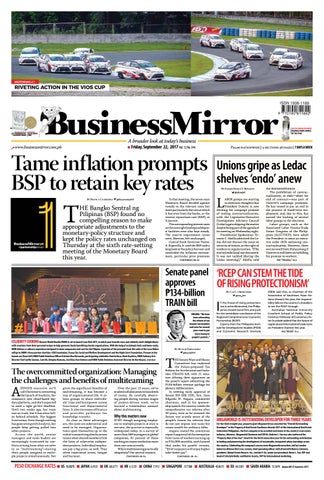
Tame inflation prompts BSP to retain key rates
T
By Bianca Cuaresma
@BcuaresmaBM
he Bangko Sentral ng Pilipinas (BSP) found no compelling reason to make appropriate adjustments to the monetary-policy structure and kept the policy rates unchanged on Thursday at the sixth rate-setting meeting of the Monetary Board this year.
In that meeting, the seven-man Monetary Board decided against tweaks to the relevant rates but more particularly the rate at which it borrows from the banks, or the reverse repurchase rate (RRP), at 3 percent. The corresponding interest rates on the overnight lending and deposit facilities were also kept steady. The reserve requirement ratios were, likewise, left unchanged. Central Bank Governor Nestor A. Espenilla Jr. said the BSP took a long look at the policy horizon and concluded the inflation environment, particular price pressures Continued on A2
2016 ejap journalism awards
business news source of the year
P25.00 nationwide | 5 sections 36 pages | 7 days a week
Unions gripe as Ledac shelves ‘endo’ anew By Elijah Felice E. Rosales
L
@alyasjah
abor groups are starting to entertain thoughts that President Duterte is now ditching his campaign promise of ending contractualization, with the Legislative-Executive Development Advisory Council (Ledac) again skipping the matter despite being part of the agenda of its meeting on Wednesday night. Presidential Spokesman Ernesto C. Abella admitted the Ledac did not discuss the issue on security of tenure, or the right of workers to regularization. “[The end to] endo [was] not discussed. It was not tackled [during the Ledac meeting],” Abella told
the BusinessMirror. The prohibition of contractualization, or endo—short for end of contract—was part of Duterte’s campaign promises. He has vowed to put an end to the practice of fixed-term employment and, due to this, has earned the backing of several labor groups in the elections. Labor groups, such as the Associated Labor Unions-Trade Union Congress of the Philippines (ALU-TUCP), have asked the President to issue an executive order (EO) outlawing contractualization. However, there was no word from Malacañang if Duterte is still keen on fulfilling his promise to workers. See “Unions,” A12
Senate panel ‘RCEP CAN STEM THE TIDE approves OF RISING PROTECTIONISM’ P134-billion TRAIN bill I By Cai U. Ordinario @cuo_bm
ANGARA: “We have been advocating the reform of our income-tax brackets and rates for several years now to put more money in people’s pockets.”
f the threat of rising protectionism is to be eliminated, the Philippines should stand firm and push for the immediate conclusion of the Regional Comprehensive Economic Partnership (RCEP). Experts from the Philippine Institute for Development Studies (Pids) and Economic Research Institute
(ERIA) said that, as chairman of the Association of Southeast Asian Nations (Asean) this year, the responsibility falls on the country’s shoulders to see the RCEP through. Australian National University Crawford School of Public Policy Emeritus Professor of Economics Peter Drysdale added that the future of regional and international trade rests on President Duterte this year. See “RCEP,” A12
celebrity cooking Resorts World Manila (RWM) is set to launch Love Dish 2017, in which your favorite stars and celebrity chefs delight diners with creations from their personal recipes to help generate funds benefiting charity organizations. With the help of acclaimed chefs and home cooks, RWM delivers a culinary experience designed to show compassion and care for the Filipino. A portion of the proceeds from the sales of the Love Dishes will go to RWM’s three partner charities: COR Foundation, Pasay City Social and Welfare Development and the Right Start Foundation. Present at the launch are (from left) RWM Public Relations Officer Kristine Mae Bernardo, participating celebrities Donita Rose, Mark Bautista, RWM Culinary Arts Director Chef Cyrille Soenen, Sam Oh, Dimples Romana, Acel Bisa-Van Ommen and RWM Public Relations Assistant Director Archie Nicasio. ALYSA SALEN
A
given the significant benefits of multiteaming, it has become a way of organizational life. It allows groups to share individuals’ time and brainpower across functional and departmental lines. It also increases efficiency and prov ides pat hways for knowledge transfer. As clear as these advantages are, the costs are substantial and need to be managed. Organizations open themselves up to the risk of transmitting shocks across teams when shared members link the fates of otherwise independent projects. Individual employees pay a big price, as well. They often experience stress, fatigue and burnout.
PESO exchange rates n US 50.8870
T
@butchfBM
Even though assigning employees to multiple projects at once is not new, the practice is especially widespread today. In a survey of more than 500 managers in global companies, 81 percent of those working on teams worked on more than one concurrently. Why is multiteaming practically ubiquitous? For several reasons.
he Senate Ways and Means Committee has endorsed the Palace-proposed Tax Reform for Acceleration and Inclusion (TRAIN) bill, with 21 senators affixing their signatures on the panel’s report submitting the P134-billion revenue package for plenary deliberations. In seeking early approval of Senate Bill (SB) 1592, Sen. Juan Edgardo M. Angara, committee chairman, said in his sponsorship speech the country needs the comprehensive tax reforms after 20 years, even as he stressed the Senate was acutely aware of the people’s clamor for reforms that do not just impose new taxes but create wealth for ordinary folks. Angara touted the committee report’s approval of the exemption from taxes of workers earning up to P25,000 monthly, and claimed that under his panels’ version, “99 of taxpayers will enjoy higher take-home pay”.
Continued on A2
Continued on A2
The overcommitted organization: Managing the challenges and benefits of multiteaming senior executive we’ ll call Christine is overseeing the launch of Analytix, her company’s new cloud-based bigdata platform, and she’s expected to meet a tight go-live deadline. Until two weeks ago, her team was on track, but it has since fallen behind schedule. Her biggest frustration: Even though nothing has gone wrong with Analytix, her people keep getting pulled into other projects. A c ro s s t he w or l d , s e n ior managers and team leaders are increasingly frustrated by conflicts arising from what we refer to as “multiteaming”—having their people assigned to multiple projects simultaneously. But
By Butch Fernandez
Over the past 15 years, we’ve studied collaboration in hundreds of teams. By carefully observing people during various stages of project-driven work, we’ve learned a tremendous amount about multiteaming.
Why this matters now
Megaworld is Outstanding Developer for three years
For the third straight year, property giant Megaworld was awarded the “Overall Outstanding Developer” in the Property & Real Estate Excellence Awards 2017 of the International Real Estate Federation Philippines, the first company to be accorded such honor in the country’s real-estate industry. Likewise, Megaworld Chairman and CEO Dr. Andrew L. Tan was also conferred the “Property Man of the Year” award for the third consecutive year for his outstanding contribution in leading and pioneering the development of sustainable, integrated urban townships across the country. Celebrating the company’s success were Megaworld executives, led by Lourdes Gutierrez-Alfonso (first row, center), chief operating officer; with (from left) Monica Salomon, president, Global-Estate Resorts Inc.; Jericho P. Go, senior vice president; Kevin L. Tan, SVP and head of Lifestyle Malls; and Marivic Acosta, SVP for international marketing.
n japan 0.4535 n UK 68.6771 n HK 6.5239 n CHINA 7.7412 n singapore 37.7388 n australia 40.8673 n EU 60.5301 n SAUDI arabia 13.5699
Source: BSP (21 September 2017 )
A2 Friday, September 22, 2017
BMReports BusinessMirror
Tame inflation prompts BSP to retain key rates Continued from A1
notwithstanding, continues to be manageable. Immed iately, however, Espenilla said inflation risks are skewed to the upside, especially when one takes into consideration the full on impact of the proposed tax-reform program. “The balance of risks to the inflation outlook also continues to be on the upside. While the proposed tax-reform program may exert potential transitory pressures on prices, various social safety nets and the resulting improvement in output, and productivity are also expected to temper the impact on inflation over the medium term,” Espenilla said in a statement. “Latest forecasts show the future inflation path will continue
to be within the target range for 2017 to 2019. Meanwhile, inflation expectations remain firmly anchored close to the midpoint of the government’s [2 percent to 4 percent] percentage point target over the policy horizon,” he added. Against this backdrop, the BSP similarly kept the forecast inflation at 3.2 percent this year up to 2018, or well within the 2-percent to 4-percent official target. Inflation started to creep up in August when it averaged 3.1 percent, from only 2.8 percent a month earlier. This development brought headline inflation in the first eight months to 3.1 percent. The BSP also said that, while prospects for global economic growth have stayed broadly upbeat, geopolitical tensions and lingering uncertainty over macroeconomic
policies in advanced economies continue to pose downside risks to external demand. “The outlook for domestic economic activity remains firm, supported by positive consumer and business sentiment and ample liquidity. Moreover, as credit for production activities continues to expand in line with output growth, the economy’s absorptive capacity is, likewise, seen to improve, thus mitigating inflation pressures over the long run,” Espenilla said in his statement, adding that the BSP will still remain watchful over evolving economic growth and liquidity conditions and their implications for price and financial stability. “Based on these considerations, the Monetary Board believes that prevailing monetary-policy set-
tings continue to be appropriate. Looking ahead, the BSP will continue to be vigilant against any risks to the inflation outlook and will adjust its policy settings as needed to ensure stable prices while supporting sustainable economic growth,” Espenilla added. The BSP will next meet on November 9. It will be the seventh rate-setting meeting of the year. Earlier, economists anticipated one more policy rate adjustment before the year ends. “We remain of the view that the central bank is slightly behind the curve in policy tightening…. We reckon there is a good chance for a 25-basis-point rate hike each in both the fourth quarter of 2017 and first quarter of 2018,” Singaporebased DBS Bank economist Gundy Cahyadi said.
Senate panel approves ₧134-billion TRAIN bill Continued from a1
A total of 21 senators, including Angara, three committee vice chairmen and three ex-officio members, signed the report, which now goes to plenary for debates. The copy of his sponsorship speech given to the media said the ways and means panel version is estimated to help the government draw in some P134 billion in revenues as a result of various measures. Angara, however, touted the “ higher take-home pay” that millions of Filipino workers could benefit from, as the income-tax system is finally amended after 20 years. Besides Angara, those who signed the report are the panel ’s three vice chairmen: Sens. Loren B. Legarda, Joel Villanueva, and Paolo Benigno A. Aquino IV; and the ex-officio members, who all indicated they will introduce amendments after interpellation: Majority Leader Vicente C. Sotto III, Senate President Pro Tempore R a lph G. Recto and Minority Leader Franklin M. Drilon. As endorsed by the Senate Ways and Means Committee, the first P150,000 annual taxable income will be exempted, whi le ret a ining t he P82,0 0 0 tax exemption for 13th-month pay and other bonuses and the maximum P100,000 additional
exemption for up to four dependents. This means an approximate tax-exempt monthly income of P25,000 for workers with four dependents—in line with President Duterte’s campaign promise to exempt workers earning P25,000 and below from income tax. Based on data from the Bureau of Internal Revenue (BIR), almost all, or 99 percent, of the estimated 7.5 million individual income taxpayers will enjoy lower income tax rates. From the current 2 million tax-exempt minimum wage earners, the proposed new tax scheme will triple the exempt income-taxpayers to around 6 million. In a statement, Angara assured that “our workers are finally getting the tax relief due them. We have been advocating the reform of our income-tax brackets and rates for several years now to put more money in people’s pockets.” T he senator c ited, for instance, that a teacher with two dependents, earning a monthly income of about P17,254, is currently taxed at 20 percent. Under the proposal, he or she will be already exempt and will no longer have to pay ta xes. The teacher will be able to take home bigger pay and save rough-
ly P13,176 in annual taxes, or P1,098 monthly savings. Another example cited by Angara is a call-center agent, with no dependent, earning about P16,136 a month is currently taxed at 20 percent. Under the proposa l, his or her cur rent P20,576 annual tax due will be reduced to P4,557 at a lower tax rate of 15 percent, resulting to approximately P16,019 annual savings—close to the call-center agent’s monthly income. “This is tantamount to giving a 14th-month pay to our countrymen,” he added, noting they will be bringing a bigger take-home pay to their families. The bill also provided for indexation or automatic adjustment of the income tax schedule ever y three years so there won’t be any repeat of an outdated and unjust income-tax system where lower-income earners are pushed to higher tax brackets because of inf lation. Moreover, a distinction between the tax treatment of compensation income earners and self-employed individuals and professionals is proposed. Under the Senate version, the 8-percent flat tax on gross sales or receipts is made optional so that self-employed and professionals can choose which tax rate (either
8-percent flat tax or schedular personal income-tax rate) is more favorable to them. “We introduced an 8-percent flat tax for easier compliance. Hopefully, giving them the choice of which tax regime to follow incentivizes them to pay their taxes correctly,” Angara added. According to BIR data, self-employed and professionals only contribute 15 percent of the total incometax collection. He pointed out that with higher income-tax exemption, marginal income earners—who are selfemployed individuals deriving gross sales or receipts not exceeding P100,000—will be exempt from paying income taxes. These include farmers and fishermen, sari-sari store owners, carinderia owners, market vendors and tricycle drivers. “By automatica l ly exempting them from income tax, in effect, marginal-income earners would finally be afforded equal protection and benefits that the minimum wage earners have long been enjoying,” the senator said. He added that the value-added tax (VAT) threshold is also raised to P3 million from P1.9 million—exempting small businesses with total annual sales of P3 million and below from paying VAT. Micro, small and medium enterprises represent 98 percent of all registered businesses in the country, Angara said, adding this would provide them due tax relief that would encourage them to grow, and generate more and better jobs for Filipinos. This developed as members of the Senate Ways and Means panel also endorsed upward adjustments of excise-tax rates on petroleum products. But unlike the House version’s “3-2-1 formula”, spread out at P3 on the first year starting 2018, P2 by 2019 and P1 in year 2020, the senators opted to reverse the P6.00 tax-hike schedule, as follows: P1.75 in the first year, P2 for the second year and P2.25 by the third year. The senators, however, opted to retain the tax exemption for kerosene, used for cooking by millions of Filipinos. The Senate version, embodied in SB 1592, also included a provision suspending imposition of fuel excise taxes when imported oil prices soar to $80 per barrel.
www.businessmirror.com.ph
The overcommitted organization: Managing the challenges and benefits of multiteaming Continued from A1
First, organizations must draw on expertise in multiple disciplines to solve many complex problems. Second, with crowded markets and reduced geographic and industry barriers, organizations now face greater pressure to keep costs down and stretch resources. Third, organizational models are moving away from hierarchical, centralized staffing to give employees more choice in their projects and improve talent development, engagement and retention.
Managing the challenges
We’ve identified several ways that both team and organizational leaders can reduce the costs of multiteaming and better capitalize on its benefits. Priorities for team leaders. Coordinating members’ efforts and promoting engagement and adaptability are the key challenges for leaders. Focusing on those goals early on will help you establish stronger relationships, reduce coordination costs, ease the friction of transitions, ward off political skirmishes and identify risks. Here’s how to do it: ■ Launch the team well to establish trust. When multiteaming, people tend to be hyperfocused on efficiency and are less inclined to share personal information. If you don’t engineer personal interactions for them, chances are they’ll be left with an anemic picture of their teammates. Make sure team members spend some time in the beginning getting to know their colleagues. ■ Map everyone’s skills. Figure out the full portfolio of capabilities that each person brings to the project. Make sure everyone knows how each teammate contributes. This increases the chances that members will learn from one another. ■ Manage time across teams. Talk about everyone’s competing priorities upfront. By identifying crunch periods across projects, you can revamp deadlines or plan on spending more hands-on time yourself at certain points. ■ Create a learning environment. Learning is supposed to be a major benefit of multiteaming—but it often gets crowded out by time pressures. You can designate team members from different functions to colead parts of the project so that they benefit from greater cross-contact. Similarly, pair a highly experienced team member with someone more junior and help them understand what both can gain from the exchange. ■ Boost motivation. On traditional teams, a strong sense of group identity motivates members. But leaders in multiteaming environments need to leverage more of an exchange relationship. The ability to get jazzed about a project flags when members spend only a small amount of time on it. Figure out what team members really value and frame the work in terms of those rewards. Like Christine, you might be feeling the strain of sharing valuable talent with other teams. Before you reach the breaking point, take these steps to clarify and manage your interdependency with other teams. Priorities for organizational leaders. Keep a close eye on how—and how many—members are shared across teams. You can reduce organizational risk and boost innovation by following these steps: ■ Map and analyze human capital interdependence. Patterns of team overlap range from highly concentrated (a large proportion of members are shared by just a few teams) to highly dispersed (the sharing is spread across many teams). Each pattern has its own implications for risk management. When a surprise problem jolts one team, the cry “All hands on deck” pulls shared members off their other teams—with disproportionately large effects on teams that have a concentrated overlap in members. When the overlap is more dispersed, the shock will be felt by more teams but to a lesser extent by each one. When teams are similar in their tasks and culture, transitioning between them is relatively easy, so you can have a large amount of overlap. Transitioning across teams with different tasks or cultures should be kept to a minimum, however—it’s a bigger, costlier shift. Keep a map of the links among teams in your organization through periodic updates from managers and team members. Once you’ve done this analysis, it’s time to address the shortcomings you’ve uncovered—which brings us to the next two steps. ■ Promote knowledge flows. Your goal is to establish knowledge transfer as a cultural norm. Highlight the benefits of sharing, and provide processes and technology to facilitate it. ■ Buffer against shocks. Knowing how teams are connected through shared membership allows you to anticipate where some shocks may be transferred and to design slack into the system to absorb them. None of this is easy. You may need to establish processes that will allow you to track multiteaming more accurately across the organization. You may even need to create a new role to coordinate these efforts. And people may resist the increased oversight—it can feel like micromanagement to team leaders who are accustomed to having freer rein. Still, such investments are worthwhile; it’s more costly to allow the trade-offs of multiteaming to go unchecked. If you’re open about the problems you’re trying to solve with all this transparency, people are less likely to feel constrained by it and more likely to see the upside. Multiteaming is a significant investment of time and effort. But organizations pay a much higher price when they neglect its costs in hot pursuit of its benefits.
The pros
By assigning people to multiple teams at once, organizations make efficient use of time and brainpower. They also do a better job of solving complex problems and sharing knowledge across groups.
The cons
Competing priorities and other conflicts can make it hard for teams with overlapping membership to stay on track. Group cohesion often suffers. And people who belong to many teams at once may experience burnout, which hurts engagement and performance.
The fixes
Leaders can mitigate these risks by building trust and familiarity through launches and skills mapping, identifying which groups are most vulnerable to shocks, improving coordination across teams and carving out more opportunities for learning. The New York Times News Service Mark Mortensen is an associate professor and the chairman of the organizational behavior area at INSEAD. Heidi K. Gardner is a distinguished fellow at the Center on the Legal Profession and faculty chairman of the Accelerated Leadership Program at Harvard Law School. This article draws on research in her book Smart Collaboration: How Professionals and Their Firms Succeed by Breaking Down Silos.
news@businessmirror.com.ph
The Nation BusinessMirror
Editor: Vittorio V. Vitug • Friday, September 22, 2017 A3
Ombudsman OKs graft charges vs ‘banana king’ By Jovee Marie N. dela Cruz
T
@joveemarie
he Office of the Ombudsman has ordered the filing of criminal charges against Rep. Antonio Floirendo Jr. in connection with the questionable joint venture agreement between the lawmaker’s banana firm Tagum Agricultural Development Co. (Tadeco) and the Bureau of Correction (Bucor). In an 11-page resolution dated September 4, 2017, Ombudsman Conchita Caprio-Morales accused Floirendo of violating Section 3(h) of Republic Act 3019 and recommended the filing of criminal charge against him before the Sandiganbayan. The complaint against Floirendo before the Office of the Ombudsman was filed by Speaker Pantaleon D. Alvarez. “[The] office finds that the complaint offered sufficient evidence showing that respondent probably committed a violation of Section 3(h) of RA 3019 and, thus, there is probable cause to indict respondent for the offense,” the resolution read. The resolution said Section 3(h) of RA 3029 prohibits a public officer from directly or indirectly having financial or pecuniary interest in nay business, contract or transaction in which he is prohibited by the Constitution or by any law from having any interest. The case stemmed from the agreements entered into between the Bucor and the Floirendo-family owned Tadeco allowing the company to use land located within the Davao Penal Colony. When the May 21, 2003, agreement between the Bucor and Tadeco was signed, Floirendo was serving his 2001 to 2004 term as congressional representative of the second district of Davao del Norte and he directly owned 75,000 shares of Tadeco
House sets filing, scrutiny of proposed BBL next week
T
he leadership of the House of Representatives is set to file next week the Palace’s version of proposed Bangsamoro basic law (BBL). Majority Leader Rodolfo C. Fariñas of Ilocos Norte, however, said President Duterte, during the third Legislative-Executive Development Advisory Council (Ledac) meeting last Wednesday, has allowed Congress to scrutinize or change the BBL drafted by the Bangsamoro Transition Commission (BTC). “We will file next week the bill for the BBL submitted by the BTC,” Fariñas told reporters. “The President informed us that he will leave to the wisdom of Congress the final version of the BBL,” he added. The draft of BBL was sent by the Palace to Congress last month. The proposed BBL seeks to create the Bangsamoro political entity replacing Autonomous Region in Muslim Mindanao (ARMM). The ARMM was established in 1989 through Republic Act 6734. In the lower chamber, there are versions of the proposed BBL filed by several lawmakers, including Pampanga Rep. Gloria Macapagal-Arroyo. According to Speaker Pantaleon D. Alvarez, the chamber will consolidate lawmakers’ versions of the BBL with the version of the Palace. During the 16th Congress, the passage of the BBL was derailed following the Mamasapano encounter, where 44 members of Special Action Force were killed allegedly by the Moro Islamic Liberation Front and the Bangsamoro Islamic Freedom Fighters. Meanwhile, Fariñas said the Ledac has also agreed to just amend the implementing rules and regulations of the Government Procurement Reform Act, or the Republic Act (RA) 9184, to strengthen the government fight against corruption. “The President reiterated his fight against corruption and we discussed the need to amend the Government Procurement Reform Act [GPPB],” he said. “[However] we agreed that the GPPB created under RA 9184 will first determine if the amendments sought may be carried out by the GPPB through its implementing rules and regulations,” Fariñas added. If not, Fariñas said the procurement policy board will inform Congress of the amendments that need to be legislated upon. In the same Ledac meeting, Fariñas said Duterte has backed proposal of lawmakers allowing barangay captains to retain their positions through holdover capacity. “In regard to the postponement of the barangay and SK elections, the President informed us that he agrees with our position that the incumbent barangay officials will hold over as such because is not really keen in appointing people into elective positions,” Fariñas said. According to the majority leader, the lower chamber will decide on Monday if it will adopt the Senate version of the bill postponing the barangay elections, since “the [Senate] has substantially adopted the version of the House of Representatives (HOR) except for some minor changes.” “If the HOR adopts the Senate version, no bicameral conference committee will be needed,” Fariñas said. Should both house of Congress agree on the same version of the bill postponing the village polls, Fariñas said the bill will be submitted on Tuesday to the Palace for the final approval of the President. The lower chamber passed House Bill 6308 deferring the October 23 barangay and SK elections to May 14, 2018. Under the bill, current barangay officials shall act in a holdover capacity until the next elections is held. The last barangay elections was conducted in October 2013. Party-list Rep. Sherwin Tugna of Cibac, chairman of the House Committee on Suffrage and Electoral Reforms, said the approval will help the campaign of the President against illegal drugs. Earlier, lawyer Edmund Abesamis, national president of Liga ng mga Barangay sa Pilipinas, backed the postponement of the barangay polls, admitting that there is a valid concern that drug syndicates and personalities will use drug money to infiltrate and influence the elections. He said the postponement of barangay election will facilitate the clearing of drug-affected barangay officials who have already been identified to be involved in illegal drugs. Jovee Marie N. dela Cruz
with a subscription cost of P7.5million, the resolution said. It also said Floirendo owned 537,950 shares of Anflo Management and Investment Corp. (Anflocor), which, in turn, owns 4,730,000 shares of Tadeco, amounting to a subscription cost of P473 million. Anflocor is the listed parent company of Tadeco. For his part, Floirendo argued that,
aside from being a public officer in 2003, the other elements of his alleged offense were not established as he did not have any direct or indirect pecuniary interest in the 2003 agreement between the Bucor and Tadeco. However, the Ombudsman said there is no dispute that at the time the 2003 agreement between Tadeco and Bucor was entered into, Floirendo was
a public officer. The Ombudsman added that at that time Floirendo had a direct and indirect financial interest in the contract by owning 75,000 shares of Tadeco worth P7.5 million. Also, the resolution said most of the stocks of Tadeco were owned by Anflocor and under the control of the Floirendo family.
The Ombudsman also accused Floirendo of violating Article VI, Section 14, of the 1987 Constitution prohibiting a senator or a member of the House of Representatives from directly or indirectly having financial interest in any contract with, or in any franchise or special privilege granted by the government or any of its agencies, during his term of office.
Economy
A4 Friday, September 22, 2017 • Editors: Vittorio V. Vitug and Max V. de Leon
BusinessMirror
news@businessmirror.com.ph
Free college education program secures P40-B funding By Jovee Marie N. dela Cruz
T
@joveemarie
he House of Representatives has realigned a total of P40 billion in the proposed 2018 General Appropriations Act (GAA) to finance the full implementation of the Republic Act 10931, or the Universal Access to Quality Tertiary Education Act, the chairman of the House Committee on Appropriations announced on Thursday.
At a news conference, Rep. Karlo Alexei B. Nograles of the First District of Davao City, the panel chairman, said the P40-billion fund will be sourced from the Commission on Human Rights (CHR), P115 million; the Department of Education (DepEd), P30 billion; the Department of Transportation (DOTr), P3 billion; and the Commission on Higher Education (CHED), including state universities and colleges (SUCs), P6 billion. “I’m happy to announce we’ve found P40 billion to finance the
free higher education [law] for 2018,” Nograles said. “We got P30 billion from the Department of Education for their school-building programs, particularly those with site problem, no available space, no vacant lot...we were able to [get] P30 billion from that budget,” he added. “In the Department of Transportation, there are two projects—the Edsa BRT [Bus Rapid Transit] and the Quezon Avenue BRT projects, so when combined we were able to get P3 billion from that,” he said.
“Also, we were able to raise P6 billion from various scholarship programs from SUCs and the CHED, and then the DICT [Department of Information and Com mu n ic at ion Tec h nolog y] [where] there are also various reduction on its projects. So all in all were are able to raise P40 billion for free higher education,” Nograles added. Under the law, the government shall provide free tuition and other fees for students in SUCs, as well as local universities and colleges (LUC) and technical-vocational institutions (TVIs). SUCs refer to public highereducation institutions established by national laws that are financed and maintained by the national government and are governed by their respective independent boards of trustees or regents, while LUCs refer to
I’m happy to announce we’ve found P40 billion to finance the free higher education [law] for 2018.”–Nograles
CHED-accredited tertiary education institutions established and financially supported by local government units (LGUs). Mea nwh i le, Nog ra les sa id the lower chamber has restored the budget of the CHR, the Energy Regulatory Commission (ERC) and the National Commission on Indigenous People (NCIP) from their approved P1,000 allocation after the heads of the three offices appealed to Speaker Pantaleon D. Alvarez. However, Nograles said the House leadership only gave P508 million to CHR for 2018. Originally, the CHR has P623-million budget, which excludes P58 million for the retirement pay of its officials and employees. Wit h t h is development, Nograles added the restoration of the budget for the CHR, the ERC and the NCIP would already be incorporated in the final version of the General Appropriations Bill for third-reading approval by the House of Representatives in plenary. The proposed P3.767-trillion GAA is scheduled to be approved on third and final reading either Tuesday or Wednesday next week, Nograles said.
Rival MRT 3 maintenance providers, DOTr bicker as railway commuters suffer By Lorenz S. Marasigan @lorenzmarasigan
R
EINSTATING Sumitomo Corp. as the maintenance provider of the Metro Rail Transit (MRT) Line 3 will only put passengers in more peril, as technical issues that plague the facility are said to be rooted on the Japanese company’s mistakes during the early stages of the train line. This was the core of Busan Universal Rail Inc. Legal Counsel Charles Perfecto A. Mercado’s statement on Thursday, when he said bringing back the Japanese company into the railway system would be a disservice to its passengers. He also berated Transportation Undersecretary for Railways Cesar B. Chavez, who, Mercado said, seem to be partial in his statements in regard to the Sobrepeña group’s proposal. “Documents sourced from government records and MRT 3 data themselves show that the current travails of the MRT line are rooted to decisions and mistakes made during the early years of the MRT 3 when Sobrepeña’s Sumitomo group built, provided the equipment for and maintained the rail line,” Mercado said. Sumitomo is the builder of the railway facility that traverses along Edsa. It was also the maintenance provider of the train line from 2000 to 2012. According to Mercado, the facility recorded a total of 1,492 glitches in its first year, while in 2008 the glitches reached 1,927, and in 2009 climbed to 2,199. Mercado has repeatedly claimed that the current problems plaguing the MRT 3 stem out of inherent system design flaws, which has been belied by MRT Holdings Inc. Chairman Robert John L. Sobrepeña. Chavez was reportedly quoted as saying that Sumitomo was best in maintaining the line during its stint as upkeep provider. The Sobrepeña group, among other groups, has a pending proposal before the transportation department for the modernization provider of the facility. This includes the reinstatement of Sumitomo as the maintenance provider of the MRT 3. Busan recently filed graft charges against Chavez before the Office of the Ombudsman for over P176.14 million in unpaid billings from September 2016 to July 2017.
‘No final resolution yet on Meralco PSA issue’ By Lenie Lectura
T
@llectura
H E Ene r g y R e g u l ator y C o m m i s s i o n ( E RC ) o n Thursday said that it would still accept manifestations filed by some individuals in the final resolution of the Manila Electric Co.’s (Meralco) power-supply agreement (PSA) petitions. “For filing out of time, the petitions for intervention will be treated as oppositions, instead, to the subject Meralco PSA applications,” ERC Officer In Charge Alfredo J. Non said. Earlier, the ERC denied the petitions of Romeo Junia, Fe Bait, et al., and Uriel Borja, who all asked the ERC to intervene in the ongoing hearings. Their petitions were denied due to technicality. The ERC Rules of Practice and Procedure, particularly in Section 2, Rule 9 thereof, provides that petitions for intervention must be filed with the ERC at least five days before the date of hearing. Instead, the ERC resolved to treat the petitions for intervention as oppositions, considering the length of time that had already elapsed after the initial hearing of the case. Junia and Bait, et. al. filed their respective petitions seven months after the initial hearing, while Borja filed his petition nine months after the initial hearing on the subject Meralco PSA applications. “The ERC Rules of Practice and Procedure is explicit and must be observed. We believe the ERC has been very liberal, and [the commission] has accorded due process to anyone who wishes to participate in any case or proceedings. In this case, we will allow the belated oppositors and accept their manifestations to be considered in the final resolution of the case,” Non added. Meanwhile, various groups are disappointed over the decision of the ERC. “The rejection of the petition is not only a rejection of the consumer’s right to transparency and accountability from distribution utilities, like Meralco and the ERC, it also rejects their right to choose cheaper and cleaner energy alternatives than those offered by Meralco and its partners,” Center for Energy, Ecology and Development (CEED) Executive Director Gerry Arances said. On June 30, CEED, along with multisectoral coalition Sanlakas, Philippine Movement for Climate Justice, Freedom from Debt Coalition, Koalisyong Pabahay ng Pilipinas and other memberorganizations of the Power for People (P4P) organization filed a petition questioning various ir reg ular ities concer ning the process of application, as well as negative consequences which would arise if Meralco’s application is granted. “ T hese ‘s we et he a r t de a l s’ between Meralco and Meralcoowned coal companies are clear attempts to box out competition, particularly those from the renewable energy sector offering to sell power generated at a much lower cost,” Arances said. “Industry experts have already pointed out that rejecting these deals will enable more renewable energy to enter the power mix, which is just what the country needs as renewable energy’s share has been declining since 2009 de-
The ERC Rules of Practice and Procedure is explicit and must be observed. We believe the ERC has been very liberal, and [the commission] has accorded due process to anyone who wishes to participate in any case or proceedings. In this case, we will allow the belated oppositors and accept their manifestations to be considered in the final resolution of the case.”–Non
spite the passage of the renewable energy law,” he said. Arances also stressed that the PSAs, covering the period of 2020 to 2040, are a way for Meralco to secure the extension of their franchise, which is set to expire in 2028. “If approved, Filipinos will be trapped in relying on and paying for costly, dirty and deadly energy from coal for the next 20 years, even if renewable alternatives are actually getting cheaper as we speak.” “Invoking technicalities in their rejection shows clear double standard from the part of the ERC, as they were so willing to set rules aside when Meralco passed their application hours after the ERC closed its doors to meet the deadline, which meant that they would not be required to undergo a competitive selection process and public bidding,” said Sanlakas Secretary-General lawyer Aaron Pedrosa, one of the conveners of the assembly. Sanlakas previously filed a case with the Ombudsman against the ERC, charging its top officials with graft after the office suspiciously moving the implementation of competitive selection process rules four months after taking effect, leaving the door open for the Meralco to skip the competitive selection process. “If our motion for reconsideration is still rejected by the ERC, we will not hesitate to go to the courts in calling for the junking of Meralco’s dirty contracts. The P4P and the growing number of consumers aware of this issue will also continue to hound the ERC and Meralco in front of their offices and in the streets to assert our position,” Pedrosa said. “We have been hurt for far too long. It’s time to end this abusive relationship.”
news@businessmirror.com.ph
AseanFriday BusinessMirror
Editor: Max V. de Leon • Friday, September 22, 2017 A5
Superbug’s spread to Vietnam threatens malaria control
V
ietnam’s main malaria treatment is failing at an alarming rate because of a highly drug-resistant superbug that has spread into the southern part of the country from western Cambodia, scientists said on Thursday. In their letter published in the Lancet Infectious Diseases journal, the scientists said the spread of the superbug across the entire Mekong subregion is a serious threat to malaria control and eradication efforts. “This could result in an important increase in malaria transmission in these countries and severely jeopardize their malaria elimination efforts,” said Arjen Dondorp, coauthor of the letter and head of malaria and deputy head of the Mahidol-Oxford Tropical Medicine
Research Unit in Thailand. Coauthor and colleague Nicholas White said in an accompanying news release that the drug resistance was a public health emergency that must be treated urgently. Vietnam’s Ministry of Health had said in April that malaria resistant to artemisinin has been reported in five provinces and was threatening to spread nationwide. Vietnam reported 4,000 confirmed malaria cases in 2016, dow n 52 percent compar ing with the previous year, its health
4,000 The number of confirmed malaria cases in Vietnam in 2016, down 52 percent
ministry said in the report in April. The government has set a target of eliminating malaria by 2030. Resistance to the treatment has previously been detected in parts of Thailand, Myanmar and Lao PDR. Malaria is a mosquito-borne disease especially deadly to children. The World Health Organization (WHO) estimates 429,000 people, mostly in Africa, died from the illness in 2015. Key strategies against malaria target mosquitoes. A vaccine was licensed in 2015, but it only works in about one-third of children and has yet to be recommended for use by WHO. AP
IN this September 16, file photo, Muslim protesters shout slogans as they hold posters of Myanmar’s State Counselor Aung San Suu Kyi and Wirathu, the leader of Myanmar’s nationalist Buddhist monks during a rally against the persecution of Rohingya Muslims, in Jakarta, Indonesia. When Rohingya Muslims fled persecution and slaughter in Myanmar in past decades, tens of thousands found refuge in Saudi Arabia, home to Islam’s holiest sites. AP
Singapore cements China ties with Lee’s three-day visit to Chinese capital
S
ingaporean Prime Minister Lee Hsien Loong’s visit to China this week signals efforts on both sides to bolster relations that have showed strains over the past year—both in its timing and number of high-level meetings. Chinese President Xi Jinping reaffirmed ties while welcoming Lee to Beijing on Wednesday, the high point of a three-day visit heavy with political overtones for both sides. Lee met four members of the Communist Party’s supreme Politburo Standing Committee—Xi, Premier Li Keqiang, national legislature chief Zhang Dejiang and top graft-buster Wang Qishan—as they prepare for a twice-a-decade reshuffle next month. “This is an extremely high-profile visit that happened at an extremely critical time,” said Li Mingjiang, coordinator of the China program at the S. Rajaratnam School of International Studies in Singapore’s Nanyang Technological University. “It shows the high-level connection between the two nations is stable and they highly regard each other in the relationship.” Singapore expects to be at the forefront of the region’s relations with China next year, when the city-state heads the Association of Southeast Asian Nations. The bloc’s summits have sometimes become a platform for the airing of grievances with China,
especially over its efforts to assert expansive claims to the South China Sea. “We both value the foundation that previous generations of leaders from both countries provided and agreed to continue to promote the healthy development of the two countries’ relationship,” Xi told Lee at the Great Hall of the People. “Your visit this time is a further reflection of the consensus about our countries’ friendship.”
Korea, US
Lee cited North Korea’s weapons testing and a new US administration that is “still developing its policies toward Asia” among shared concerns. “These are all events that impinge on countries both big and small, but they do not disturb our ability to work together and cooperate,” he said. The visit helps quiet speculation over Lee’s relationship with Beijing after Hong Kong authorities detained a shipment of Singaporean armored personnel carriers returning from a training exercise with China’s rival, Taiwan. Singapore and China accounted for $66 billion in two-way trade last year—representing 13 percent of the city-state’s total—and Lee is eager not to miss out on Xi’s “Belt and Road” global tradeand-infrastructure initiative. Lee is also scheduled to visit the US in October. Traveling to Beijing now fits with Singapore’s long-standing
efforts to navigate between the two powers, said Ja Ian Chong, an assistant professor of political science with the National University of Singapore. “The Lee administration and the current Beijing leadership have incentives to smooth over relations before Singapore rotates into the Asean chair next year,” he said. During a meeting with his Chinese counter, Li Keqiang, on Tuesday, Lee pledged to promote stronger Asean-China cooperation during Singapore’s chairmanship. The visit comes at a sensitive time for Xi, who’s preparing for a party congress next month in which as many as five members of the Standing Committee could be replaced. A key question is whether Wang—the 69-year-old architect of Xi’s historic anti-corruption drive—will be among the older members who retire to make way for new blood. Exchanges between the leaders were sprinkled with personal touches that emphasized familiarity between the two sides. Xi’s remark about “previous generations” appeared to be reference to Lee’s father, the late Prime Minister Lee Kwan Yew, who was vocal advocate for China’s rise. Meanwhile, Lee is due Thursday to visit Fujian, a coastal southern province where Xi worked for more than 17 years. Bloomberg News
Business ties complicate Muslim states’ response to Myanmar’s Rohingya
W
hen Rohingya Muslims f led persecution and slaughter in Myanmar in past decades, tens of thousands found refuge in Saudi Arabia, home to Islam’s holiest sites. This time around, Muslim leaders from the Persian Gulf to Pakistan have offered little more than condemnation and urgently needed humanitarian aid. The lack of a stronger response by Muslim-majority countries partly comes down to their lucrative business interests in Southeast Asia, experts say. Much of the Middle East is also buckling under its own refugee crisis sparked by years of upheaval in Syria, Iraq, Yemen and Afghanistan. More than 500,000 people— roughly half the Rohingya Muslim population in Myanmar—have fled to neighboring Bangladesh over the past year, mostly in the last month. The United Nations human rights chief has described Myanmar’s military crackdown and allied Buddhist mob attacks as “a textbook example of ethnic cleansing”. Saudi Arabia is already home to around a quarter-million Burmese people who took refuge in the king-
dom under the late King Faisal in the 1960s. The kingdom pledged $15 million in aid to the Rohingya this week. As the world’s biggest oil exporter, Saudi Arabia competes with Russia to be China’s top crude supplier. Expanding its footprint there requires Myanmar’s help. A recently opened pipeline running through Myanmar , also known as Burma, carries oil from Arab countries and the Caucuses to China’s landlocked Yunnan Province. The 771-kilometer (479-mile) pipeline starts at the Bay of Bengal in western Myanmar’s Rakhine state, from where most of the Rohingya have been forced out. In 2011 a subsidiary of state oil giant Saudi Aramco and PetroChina, an arm of China’s state-owned CNPC, signed a deal to supply China’s southwestern Yunnan Province with up to 200,000 barrels per day of crude oil, just under half of the pipeline’s capacity. Saudi Aramco did not immediately respond to a request for comment on shipments through the pipeline. “One could argue that Saudi Arabia is less likely to be outspoken on this [Rohingya] issue because it
actually relies on the Burmese government to protect the physical security of the pipeline,” said Bo Kong, a senior associate at the Center for Strategic and International Studies who has written about China’s global petroleum policy. The pipeline became operational in April following years of delays. It allows tankers to bypass the Strait of Malacca, cutting typical voyages by about seven days. A natural gas pipeline from Myanmar’s Shwe gas field runs alongside it. Daniel Wagner, founder of consulting firm Country Risk Solutions, said Saudi Arabia is moving ahead with its economic and political agenda in Myanmar and Southeast Asia, yet can still “claim to have stood the moral high-ground” by previously taking in refugees and providing financial aid. “The important point is that natural gas and oil flows through Rakhine state,” he said. Muslim-majority countries have been increasingly promising aid as the number of refugees swells in Bangladesh. Azerbaijan, which also appears to be exporting crude to China through the pipeline, has ordered 100 tons of
humanitarian aid to be dispatched. Turkey, which like Iran jostles with Saudi Arabia to be the Islamic world’s center of influence, has mobilized millions of meals for refugees in Bangladesh and vowed to maintain a refugee camp there. It has also provided clothing, part of more than 150 tons of humanitarian aid supplied overall. Iran, Saudi Arabia’s regional rival, has sent at least 40 tons of aid. Iranian Supreme Leader Ayatollah Ali Khamenei recently took a swipe at other Muslim countries with business interests in Myanmar, urging them to ramp up pressure on the government there. “There are tens of Muslim countries and governments, some of whom have financial and economic transactions with them,” he said. “If we sit somewhere and engage in condemnations, what is the use of this?” Images of burnt Muslim villages in Myanmar and of traumatized and often barefoot Rohingya women, children and elderly crossing into Bangladesh sparked protests in several Muslim countries. A large rally was held to denounce the crisis in Indonesia, which is
working to boost bilateral trade with Myanmar to $1 billion a year. In Pakistan’s largest city of Karachi, tens of thousands protested. Lawmaker Farhatullah Babar of the Pakistan People’s Party has pushed his government to suspend or at least slow the implementation of defense agreements worth hundreds of millions of dollars with Myanmar. He told The Associated Press that an official responded to his request by saying Pakistan is pressing Myanmar through diplomatic channels to stop the violence. “Pakistan should not be seen as strengthening a regime that is using weapons against its own people,” Babar said. He declined to elaborate on the details of the defense agreements. A report by IHS Jane’s in February said Myanmar two years ago bought 16 JF-17 Thunder aircraft, codeveloped by Pakistan and China. The defense weekly said Myanmar is now in advanced negotiations with Pakistan for licensed production of the fighter jet’s advanced thirdgeneration variant. The 57-nation Organisation of Islamic Cooperation (OIC) held an emergency session on the sidelines
of the UN General Assembly in New York this week to discuss the crisis. The organization, headquartered in Saudi Arabia, issued a lengthy statement earlier this month expressing “grave concern” over the exodus of Rohingya. But unless its member-states take tougher action on their own, there is little the OIC can do to pressure Myanmar’s government. Jason von Meding, a specialist in disaster response at the University of Newcastle in Australia, said religious differences are not the only reason Rohingya are being forced out. The government in Myanmar has designated 3 million acres in Rakhine state for development of the area’s rich mineral resources, he said. Farmers and vulnerable minority groups in the state have protested such schemes, calling them landgrabs for which they receive little to no compensation. “There’s no question that there is a lot of religious tension and ethnic division in society there,” von Meding said. “The problem is that it’s a convenient excuse for some people to get on with some very dirty political and business dealings behind the scenes.” AP
A6 Friday, September 22, 2017
BusinessMirror
www.businessmirror.com.ph
The World
www.businessmirror.com.ph
BusinessMirror
Friday, September 22, 2017
a7
North Korea sanctions hurt another victim: China’s rust belt
A
long China’s border with North Korea, residents are more worried about feeding their families than the possibility of nuclear war. In Hunchun, a city of about 230,000 people near China’s shared frontier with North Korea and Russia, protests briefly broke out last month after the United Nations Securit y Council approved sanctions banning exports of seafood and other goods from Kim Jong Un’s regime. Dozens of wholesale stores were shuttered, dealing a blow to the packagers, distributors, drivers and restaurateurs who depend on the trade. “Many people are unemployed now,” said Liu Guanghua, 41, who owns one of the few businesses still open on what’s known as Seafood Street. “Sanctions should be against the North Korean government, but this impacts regular people in China and North Korea.” To w n s o n t h e s o u t h e a s t fringe of China’s rust belt were already struggling with the decline of heav y industries, such as steelmaking and coal mining before becoming collateral damage in the United States-led push to isolate North Korea. The risk of social unrest due to job losses is a sensitive issue for Chinese President Xi Jinping, particularly as the Communist Party prepares for a twice-a-decade reshuffle of top leaders next month. The ability to deliver robust economic growth helps underpin the Communists’ legitimacy in the country’s one-party system. So while US President Donald J. Trump has threatened a trade war if Xi doesn’t use his economic leverage to curb North Korea’s nuclear ambitions, authorities in Beijing need to also weigh the domestic cost of implementing sanctions. The provinces of Jilin (home to Hu nc hu n) a nd Li aon ing haven’t had much success find-
85%
The percentage of North Korea’s $3.47-billion imports in 2015 that were supplied by China, which also absorbed a similar share of its $2.83 billion in exports
ing new drivers of growth after Beijing began scaling back its support for state-owned enterprises in the 1990s, paving the way for entry into the World Trade Organization in 2001. The central government has showered the region with subsidies and investments for the past decade, but few factories have opened to take the place of the shipyards and petrochemical plants that once powered growth. Liaoning, where officials recently admitted they falsified economic statistics for years, saw output shrink 2.5 percent last year— the only one of the 31 provinces administered by Beijing to register a contraction. That served as a drag on China’s national growth rate of 6.7 percent, the slowest pace in about a quarter century.
Empty factories
Reporters visiting an industrial park in the provincial capital of Shenyang this month saw scores of shuttered factories, while men squatting on the streets held redlettered signs asking for work.
“A loss in border trade could potentially destabilize China’s strategic plan to revive the industrial economy in the northeast, a plan the central government won’t allow to be disturbed by international affairs,” said Lyu Chao, who studies border issues at the Liaoning Academy of Social Sciences in Shenyang. “Maintaining stability in northeast China is very important to the government.” While Beijing has joined the i nter n at ion a l com mu n it y i n condemning North Korea’s missile launches and nuclear tests, it doesn’t want a war on the Korean Peninsula or Kim’s regime to collapse. Either event may trigger a rush of refugees and the potential for US troops on its border, risking social unrest and a heightened security presence that could further hinder trade. According to data compiled by the Observatory of Economic Complexity, an MIT project, China supplied 85 percent of North Korea’s $3.47 billion in imports in 2015 and absorbed a similar share of its $2.83 billion in exports. Foreign Ministry Spokeswoman Hua Chunying said at a briefing this month that China has made “enormous sacrifices and paid a heavy price” to comply with UN sanctions. A trader in Dandong, a city of 2.4 million on the Yalu River that lies between China and North Korea, said he traded everything from textiles to tires across the border in the 1990s, after he was laid off from his job as a procurement officer at the Number 2 Construction Factory, an enterprise owned by the city government. “Now I’m sitting idle,” Wang, who asked to be identified only by his family name, said while eating North Korean clams at a local restaurant. “Traders like me have lost money after sanctions hit.” Evidence shows that authorities in border areas previously maintained a balance between comply ing w it h Beijing’s re quests and protecting the local economy, according to Zhao
Tong, a fellow at the CarnegieTsinghua Center for Global Policy in Beijing. But that’s changing: “Now that the central government has a stronger stance and is resolved to take the sacrifice of the local economy, local governments will have to go along with it.” Residents along the border don’t seem very concerned by Trump’s repeated threats to use mi litar y force against Nor th Korea—most recently before a gathering of world leaders at the UN General Assembly in New York. After Trump threatened to “totally destroy” North Korea if attacked, its foreign minister called the warning “the sound of a dog barking.” “ T h is is a peacef u l a rea,” said Fang Hexiang, 37, who sells locally brewed liquor called baijiu in Dandong. “They’ve been there since we were kids and there has been no war.” Piao Zhongzhe, who owns a Korean restaurant in Hunchun, is confident that Kim won’t point his missiles at China. “They’re doing that to the US, not to China,” the 59-year-old said of the frequent missile tests. “They wouldn’t dare to do anything to China because China would destroy them in a few minutes.” W hile smallish local protests are common in China, one in Hunchun after sanctions came into effect in August was notable for directly criticizing the country’s foreign policy. Photos of the event that circulated on socia l med ia showed traders hold i n g ba n ne r s c a l l i n g for cargo to pass across the border and accusing the government of hurting Chinese citizens. By this month, stoicism was setting in. Liu, the store owner in Hunchun, said, while dozens of shops around him have closed, he’s shifting to importing seafood from Russia. “There’s nothing the local government can do,” Liu said. “I was angry when I first found out, but being angry is pointless.” Bloomberg News
Night of anguish for parents at Mexico’s collapsed school
M
E X I CO C I T Y— G u s t avo Ló p ez recognized the boy’s clothes first. His tiny frame, pulled from the wreckage, lay over the jagged pieces of what remained of the school. It was his 7-year-old son. He sat in shock for hours, quietly trying to maintain strength for his 9-year-old daughter, who had escaped the school unharmed. He wondered how to tell her that her younger brother, also named Gustavo, was dead—one of at least 30 children who perished at the Enrique Rebsámen school after it collapsed in the earthquake that devastated Mexico on Tuesday, killing at least 230 people. López waited there for his cousin, Mauricio, who loved the boy and often took him on bike rides and to the movies. By the time Mauricio arrived a few hours later, hundreds of medical personnel, rescuers, volunteers and families were racing around, trying to unearth students still buried in the rubble. “He was my son, too,” Mauricio screamed when he heard the news, collapsing onto the upturned earth as López tried to console him. “I can’t bear this. I can’t!” Such screams of anguish rose above the clamor at the school overnight, markers of loss in the chaotic crowd. Parents climbed trees and playground equipment to get a better vantage of the rescue effort, clinging to the hope that their children would emerge unscathed. Many did, having rushed out before tumbling walls could trap them. Passers-by had also raced to the school immediately after the quake to pluck students from the cavities and openings of the buckled structure. But as the day and night wore on, mostly lifeless bodies were pulled from the wreckage, their names recorded by an army of volunteers
Rescue personnel work on the Enrique Rebsamen primary school that collapsed after an earthquake, in Mexico City, September 20. A wing of the school collapsed during the quake killing scores of young children. AP/Marco Ugarte
keeping lists of the dead. By Wednesday night, five people were known to still be missing, including one student who officials said was alive but trapped as rescuers tried frantically to reach her. Hope was dwindling that any more children would be found alive. “To see a parent carry their own dead baby is something I will never forget,” said Elena Villaseñor, a volunteer whose own home was badly damaged. She held a sheaf of papers with the names of children on them, written large enough for parents to see them from a distance. Her own daughter was safe, she said, having been at a different school that did not collapse. But she could not sit idle while others suffered, and so she raced to this school to help however she could. The death toll across the country—in Morelos, Mexico state, Puebla and Mexico City—climbed to at least 230 people. The
number was expected to rise even higher, as the rescue efforts slowly transitioned into recovery efforts, and more of the missing were marked as dead. Watching that number climb, hour by hour across the city and the broader earthquake zone, was a nation already in mourning. Two weeks earlier, the largest earthquake in a century hit Mexico, killing at least 90 people in the south of the country and offering a grim foreshadowing of the hardship still to come from this one. Perhaps, nowhere was the suffering more concentrated than at the collapsed school. The smell of gas, sweat and earth filled the air overnight as people yelled their messages into megaphones. At first, the lights from police cars and emergency vehicles lit the rescue. Later, a generator was brought to the scene to power floodlights. Of the 400 students who attend the
school, it was unclear exactly how many were there or how many made it out of the building when the earthquake struck on Tuesday afternoon. The injured, more than 60 of them, were sent to area hospitals, while traumatized parents whisked others to safety. At least three parents at the site of Enrique Rebsámen, a Mexico City private school, had been communicating with their children trapped inside. They managed to reach them through the messaging service WhatsApp, begging their children to give them details, like how far from the main door they were when the building collapsed, to help the search efforts. One of the many volunteers, seated at a makeshift desk on Tuesday night, helped keep a list of the injured and the dead; it included at least five adults. Residents donned red vests and formed human chains to remove the chunks of concrete from the school’s broken edifice. Giant piles of water, medicine, blankets and even baby formula hugged the periphery, brought by neighbors who carted it in by the armful. The solidarity in the aftermath of the quake has been repeated at collapsed buildings across Mexico, a quiet but resolute determination to help. Strangers spending hours clearing debris, medics and construction workers plunging into the bowels of broken buildings, students and even children bringing water and food. At the school, the blitz of activity continued all night and into morning. S omeone yelled for medicine: “We need clonazepam, insulin, anesthetics, antihistamines and oxygen tanks.” Workers wore helmets and masks. Bulldozers and excavation machines went in and out of the disaster site. New York Times News Service
A8
Friday, September 22, 2017
The World BusinessMirror
www.businessmirror.com.ph
Trump pushes to reopen Iran nuclear deal; Rouhani says it is a ‘closed issue’
P
Electricity poles and lines lay toppled on the road after Hurricane Maria hit the eastern region of the island, in Humacao, Puerto Rico, on September 20. AP/Carlos Giusti
Hurricane Maria destroys homes, triggers flooding in Puerto Rico
S
AN JUAN, Puerto Rico—The strongest hurricane to hit Puerto Rico in more than 80 years destroyed hundreds of homes, knocked out power across the entire island and turned some streets into raging rivers on Wednesday in an onslaught that could plunge the US territory deeper into financial crisis. Leaving at least nine people dead in its wake across the Caribbean, Hurricane Maria blew ashore in the morning near the southeast coastal town of Yabucoa as a Category 4 storm with winds of 155 miles per hour (250 kilometers per hour). It punished the island of 3.4 million people with life-threatening winds for several hours, the second time in two weeks that Puerto Rico has felt the wrath of a hurricane. “Once we’re able to go outside, we’re going to find our island destroyed,” warned Abner Gomez, Puerto Rico’s emergency management director. “The information we have received is not encouraging. It’s a system that has destroyed everything in its path.” As people waited in shelters or took cover inside stairwells, bathrooms and closets, Maria brought down cell towers and power lines, snapped trees, tore off roofs and unloaded at least 20 inches (50 centimeters) of rain. Widespread flooding was reported, with dozens of cars halfsubmerged in some neighborhoods and many streets turned into rivers. People calling local radio stations reported that doors were being torn off their hinges and a water tank flew away. Felix Delgado, mayor of the northern coastal city of Catano, told The Associated Press that 80 percent of the 454 homes in a neighborhood known as Juana Matos were destroyed. The fish-
20 inches The estimated volume of rain unloaded on Puerto Rico ing community near San Juan Bay was hit with a storm surge of more than 4 feet (1.2 meters), he said. “ Mont hs a nd mont hs a nd months and months are going to pass before we can recover from this,” he said. Gov. Ricardo Rossello imposed a curfew from 6 p.m. to 6 a.m. daily until Saturday to allow rescue crews and officials to respond to the hurricane’s aftermath. “We are at a critical moment in the effort to help thousands of Puerto Ricans that urgently need aid and to assess the great damage caused by Hurricane Maria,” he said. “Maintaining public order will be essential.” Rossello said in an interview on CNN’s “Anderson Cooper 360” that one fatality has been reported but because communications were knocked out in some areas, the total casualty count wasn’t known. Maria weakened to a Category 2 storm later in the day but restrengthened to Category 3 status early Thursday with winds of 115 mph (185 kph). It was centered about 55 miles (90 kilometers) north of Punta Cana, Dominican Republic, and moving northwest near 9 mph (15 kph). Even before the storm, Puerto
Rico’s electrical grid was crumbling and the island was in dire condition financially. Puerto Rico is struggling to restructure a portion of its $73-billion debt, and the government has warned it is running out of money as it fights against furloughs and other austerity measures imposed by a federal board overseeing the island’s finances. Rossello urged people to have faith: “ We are stronger than a ny hu r r ic a ne. Toget her, we w ill rebuild.” He asked President Donald J. Trump to declare the island a disaster zone, a step that would open the way to federal aid. Late Wednesday night, Trump tweeted: “Governor @ricardorossello- We are with you and the people of Puerto Rico. Stay safe! #PRStrong.” Many people feared extended power outages would further sink businesses struggling amid a recession that has lasted more than a decade. “This is going to be a disaster,” said Jean Robert Auguste, who owns two French restaurants and sought shelter at a San Juan hotel. “We haven’t made any money this month.” More than 11,000 people—and more than 580 pets—were in shelters, authorities said. Along the island’s northern coast, an emergency medical station in the town of Arecibo lost its roof, while communication was severed with several emergency management posts. A hospital and a police station reported broken windows, and a tree fell on an ambulance. As the storm closed in on the Dominican Republic, about 4,000 tourists in the Bavara-Punta Cana area on the eastern tip of the island were moved to hotels in Santo Domingo, the capital. About 100 flights were canceled and the government suspended school and sent workers home. “The government has prepared itself for the worst-case scenario and so should the people,” Presidential Administrative Secretary Jose Ramon Peralta said.
Maria posed no immediate threat to the US mainland. The long-range forecast showed the storm out in the Atlantic Ocean hundreds of miles off the Georg i a- Sout h C a rol i n a coa st by Monday morning. Previously a Category 5 with 175 mph (281 kph) winds, Maria hit Puerto Rico as the thirdstrongest storm to make landfall in the US, based on its central pressure. It was even stronger than Hurricane Irma when Irma roared into the Florida Keys earlier this month. Irma sideswiped Puerto Rico on September 6, causing no deaths or widespread damage on the island but leaving more than 1 million people without electricity. More than 70,000 still had no power as Maria approached. As Maria closed in, Trump offered his support via Twitter: “Puerto Rico being hit hard by new monster Hurricane. Be careful, our hearts are with you - will be there to help!” The storm’s center passed near or over Saint Croix overnight on Tuesday, prompting US Virgin Islands Gov. Kenneth Mapp to warn people to sleep in their street clothes and shoes just in case. Saint Croix was largely spared by Irma. There were no immediate reports of deaths or injuries on Saint Croix, but it was still too dangerous on Wednesday to venture out and conduct a thorough check, said Nykole Tyson, a spokesman at the US Virgin Islands Emergency Operations Center. On the island of Dominica, which got slammed late on Monday, Hartley Henry, an adviser to the prime minister, reported at least seven deaths and a “tremendous loss of housing and public buildings.” He said the country was “in a daze,” with no electricity and little to no communications. Dominica’s airport and seaports remained closed, and authorities used helicopters to carry emergency food, water and shelter materials to the island, said Ronald Jackson, head of the Caribbean Disaster and Emergency Management Agency. AP
resident Donald J. Trump is seeking to revisit the nuclear agreement with Iran to toughen its provisions rather than scrap it right away as he has threatened, enlisting allies to pressure Tehran to return to the negotiating table, administration officials said on Wednesday. Trump, who denounced the agreement in a speech to the United Nations General Assembly this week as an “embarrassment to the United States,” wants to expand on it by extending its time frame and imposing new limits on Iran’s development of ballistic missiles. Although European officials strongly back the current deal, some signaled openness to negotiating a separate follow-up agreement. The maneuvering suggested a possible path forward for Trump short of abandoning the accord, but it remains uncertain whether he can reach consensus with the European allies, much less with Russia and China, the deal’s other patrons. Iran on Wednesday ruled out revisiting the agreement as President Hassan Rouhani declared the agreement a “closed issue” and warned that if the US pulled out, Iran might resume uranium enrichment. “We see today the Americans are seeking an excuse to break this agreement,” Rouhani said at a news conference after his own speech to the General Assembly. For that reason, he said, negotiating with “an American government that tramples on a legal agreement would be a waste of time”. The accord, reached in 2015, required Iran to curb its nuclear program in exchange for the lifting of international sanctions. Under US law, Trump has until October 15 to certify whether Iran is complying, and the deal remains vital to America’s national security. While he has done so twice since taking office, he has signaled that he will refuse to do so again. That by itself would not abrogate the deal, but would give Congress 60 days to reimpose sanctions on Iran, an action that would mean an end to the agreement, at least for the US. Trump may see decertification, or the threat of it, as leverage to press Iran and the other powers to restart talks. He could offer to certify for another 90 days if other parties agreed to explore new negotiations. On Wednesday the president teased reporters who asked him whether he had decided what to do. “I have decided,” he said, repeating the phrase three times. Pressed by reporters, he added: “I’ll let you know. I’ll let you know.” Trump remained coy later when he met with Prime Minister Theresa May of Britain and declined to tell her his decision either. “Prime Minister May asked him if he would share it with her and he said no,” Secretary of State Rex W. Tillerson said. Tillerson met in the evening with counterparts from the other countries that brokered the deal—Britain, France, Germany,
Russia and China—as well as Iran’s foreign minister, Mohammad Javad Zarif. It was the first time Tillerson had been in the same room with Zarif since taking office and he described the session as businesslike. “It was a good opportunity to meet, shake hands,” he told reporters. “The tone was very matter of fact. There was no yelling. We didn’t throw shoes at one another.” Tillerson acknowledged that international inspectors have found that Iran “is in technical compliance with the agreement, and no one around the table took exception to that.” But he argued that Iran was violating the larger aspirations of the deal by engaging in destabilizing activities not directly covered by it, like supporting terrorist groups. He also conceded that prospects of persuading the other powers, much less Iran, to revisit the deal were daunting, even as he said he remained optimistic. When negotiating as chief executive of Exxon Mobil, Tillerson said he had learned that “it always gets the darkest before you might have a breakthrough”. No breakthrough was apparent on Wednesday evening. Federica Mogherini, the foreign minister for the European Union who led the 90-minute meeting, rejected scrapping or renegotiating the agreement. “The international community cannot afford dismantling an agreement that is working and delivering,” she told reporters outside the Security Council chamber. “This is an agreement that prevented a nuclear program and potentially prevented military intervention. Let’s not forget that,” she added. “There is no need to renegotiate parts of the agreement, because the agreement is working.” T i l l e r s o n o u t l i n e d t h e Tr u m p administration approach in a television interview on Tuesday. “The president really wants to redo that deal,” he told Fox News. “We do need the support, I think, of our allies, the European allies and others, to make the case, as well, to Iran that this deal really has to be revisited.” Two provisions he focused on involve the expiration of the agreement and its failure to stop Iran from developing ballistic-missiles. Under the deal, some provisions expire, or “sunset”, after as few as 10 years while others are in force longer and some are permanent. And although the UN provisions seek to limit ballistic-missile technology, the nuclear agreement it does not prohibit Iran from developing such weapons. “If we’re going to stick with the Iran deal, there has to be changes made to it,” Tillerson said. “The sunset provision simply is not a sensible way forward. It’s just simply, as I say, kicking the can down the road again for someone in the future to have to deal with.” President Emmanuel Macron of France opened the door to rethinking its terms on Wednesday, two days after meeting with Trump. New York Times News Service
Seoul to resume aid to N. Korea
S
EOUL, South Korea—South Korea on Thursday decided to resume humanitarian aid to North Korea to help children and pregnant women, but didn’t determine when to provide the $8 million worth of assistance amid tensions created by Pyongyang’s nuclear and missile tests. Still, the decision is ensured to trigger heated political debates as many South Koreans have expressed concerns that the aid resumption would distract from efforts to step up sanctions and pressure against the North over its rapidly expanding nuclear weapons program. South Korea suspended humanitarian aid to North Korea after the country conducted its fourth nuclear test in January 2016. The country’s new liberal President Moon Jae-in, who took office in May, has maintained that the issue of providing humanitarian aid to North Korea should be handled independently from political circumstances. After a meeting between ministries and civilian experts, the government decided to support programs by the United Nations Children’s Fund and the UN World Food Program for providing food and medicines to North Korean children and pregnant women, the Unification Ministry said. The ministry said the assistance doesn’t include cash and there’s “realistically no possibility” that the North could use it to support its military. The government will decide when to provide the aid considering the state of relations between the rival Koreas, the ministry said.
The UN assesses that 18 million of the 25 million North Koreans are experiencing varying levels of food shortages and the country also suffers from high child and maternal mortality rates. Son Kum-ju, a lawmaker and spokesman of the opposition People’s Party, said the decision to resume aid was badly timed because it risks sending mixed signals to the international community that’s trying to tighten the screws on Pyongyang. “ The international communit y is strengthening sanctions and pressure against Nor th Korea and even Moon is in the United States to strengthen international coordination against the North Korean problem,” Son said. “If our government contradicts itself and beats to a different beat, it won’t be able to gain the approval of its own people, let alone other countries.” The last time South Korea provided humanitarian aid to North Korea through an international agency was in December 2015, when it gave $800,000 to the UN Population Fund project to evaluate North Korean public-health conditions. Since its fourth nuclear test a month later, North Korea has conducted two more nuclear tests and flight-tested a slew of new missile systems, including developmental intercontinental ballistic missiles that could potentially reach deep into the US mainland when perfected. The North also flew two powerful new midrange missiles over Japan in recent weeks. AP
The World BusinessMirror
www.businessmirror.com.ph
Friday, September 22, 2017
A9
Trump considering stricter cap on refugees
W
ASHINGTON—President Donald J. Trump is considering a further reduction in the number of refugees allowed into the United States as the administration works to reshape American immigration policy, officials say. Trump has already slashed refugee admissions once since taking office. Now he faces a decision on how many to admit in the next budget year. As is often the case with the Trump administration, Cabinet officials are divided as they weigh the costs and potential security risks associated with the program. The Department of Homeland Security has been pushing for a reduction beyond the 50,000 ma x imum-entr y mark set by Trump earlier this year as part of his travel-ban executive orders—a number that is already the lowest in modern American history. In a proposal submitted late last week, the department called for a reduction to 40,000 refugees in the next budget year starting October 1, citing concerns about its workload and ability to adequately vet those seeking entry. The State Department, which oversees the program, has formally recommended that the number be kept at 50,000, according to Trump administration officials who spoke on condition of anonymity in order to discuss internal deliberations. Agencies had been given until the close of business on Wednesday to submit formal recommendations for consideration. State Department officials would have been inclined to set their recommendation higher, several of the people said, but were taking their cues from the president’s executive order and felt that 50,000 was the highest number that would be palatable to him. Trump has until October 1,
50k
The number of incoming refugees, which the State Department has formally recommended; the US welcomed 84,995 refugees in 2016, and former President Barack Obama had wanted to raise that number to 110,000 in 2017
the start of the new fiscal year, to determine how many refugees to admit under the Refugee Act of 1980. He is expected to consider the issue over the weekend, after he finishes up at the UN General Assembly in New York, one White House official said. The US welcomed 84,995 refugees in fiscal year 2016, and former President Barack Obama had wanted to raise that number to 110,000 in 2017. Trump has made limiting immigration the centerpiece of his policy agenda. He temporarily banned visitors from a handful of Muslim-majority nations, has rescinded an Obama-era executive action protecting young immigrants from deportation and insists he’ll build a wall along the southern border.
Guadalupe Gonzalez (center) joins other immigrants taking the citizenship oath during naturalization ceremonies at a US Citizenship and Immigration Services ceremony in Los Angeles on September 20. President Donald J. Trump has issued a videotaped message that is being played for new American citizens at naturalization ceremonies in which he welcomes immigrants to “the American family.” AP/Damian Dovarganes
During his campaign, Trump pledged to “stop the massive inf low of refugees” and warned that terrorists were smuggling themselves into naïve countries by posing as refugees f leeing war-torn Syria. “Thousands of refugees are being admitted with no way to screen them and are instantly made eligible for welfare and free health care, even as our own veterans, our great, great veterans, die while they’re waiting online for medical care that they desperately need,” Trump said last October. Instead, Trump has advocated keeping refugees closer to their homes. In a speech to the United Nations on Tuesday, Trump thanked Jordan, Turkey and Lebanon for taking in hundreds of thousands of refugees from the Syrian conf lict, and described
the US as a “compassionate nation” that has spent “billions and billions of dollars in helping to support this effort.” “We seek an approach to refugee resettlement that is designed to help these horribly treated people, and which enables their eventual return to their home countries to be part of the rebuilding process,” he said, arguing that for the cost of resettling one refugee in the US, the US can assist more than 10 migrants in their home regions. Advocates say that misses the point. “I think that these comments show a basic misunderstanding of the refugee crisis,” said Jen Smyers, who helps run the immigration and refugee program at Church World Service, one of nine organizations that work to resettle refugees in the
US. She said the safe reintegration of refugees into their home countries is always the preferred outcome, followed by integration in a nearby country that shares a refugee’s language and culture. Resettlement is a last resort when those options are impossible. Refugees already face an extensive backlog and waiting periods that can take years. Smyers said that after Trump’s executive order, she had to tell refugees in the pipeline they’d be waiting even longer. “It’s devastating for refugees who are overseas,” she said. Stacie Blake, of the US Committee for Refugees and Immigrants, said the proposed cutbacks were especially concerning given the migrant crises affecting so many parts of the world, including the Rohingya Muslim refugees fleeing Myanmar.
She said Trump’s move could prompt other nations to “back out”, as well. White House Spokesman Kelly Love said in a statement that the administration’s approach to refugee resettlement “is unwavering” and would be “guided by the safety and security of the American people, the protection of US taxpayers, and the application of US resources in a manner that stretches our dollars to help the most people.” DHS Spokesman David Lapan said that, in setting the admissions ceiling, the agency would take into account the “workload capacity of all program partners, including the vetting agencies”, as well as national-security interests. Simon Henshaw, the top State Department official for refugees, said the decision was ultimately Trump’s. AP
Insurers swinging vs GOP health-care bill May to test limits of money
W
A S H I N G T O N —T h e health-insurance industry, after cautiously watching Republican health-care efforts for months, came out forcefully on Wednesday against the Senate’s latest bill to repeal the Affordable Care Act, suggesting that its state-by-state block grants could create health-care chaos in the short term and a balkanized, uncertain insurance market. In the face of the industry opposition, Senate Republican leaders, nevertheless, said they would push for a showdown vote next week on the legislation, drafted by Sens. Lindsey Graham, RepublicanSouth Carolina, and Bill Cassidy, Republican-Los Angeles. That puts Republican senators in a squeeze, especially those whose states would lose money under a complicated formula in the bill. Generally, it would shift federal funds from states that have been successful in expanding coverage to states where Republican leaders refused to expand Medicaid or encourage enrollment. Republican senators from Alaska, Arizona, Arkansas, Colorado, Ohio and West Virginia will all have to decide whether to heed the pleas of consumers who like the current health law—or yield to the will of Republican leaders, donors and voters who demand an end to the Affordable Care Act. That has put the spotlight not only on the three Republicans who killed the repeal drive in July—Lisa Murkowski of Alaska,
John McCain of Arizona and Susan Collins of Maine—but also on those who have been reluctantly supportive, such as Shelley Moore Capito of West Virginia, Cory Gardner of Colorado and Rob Portman of Ohio. Senate Republicans are already under pressure from 11 governors—including five fellow Republicans and a pivotal Alaskan independent—who earlier this week urged the Senate to reject the last-ditch repeal effort. The two major trade groups for insurers, the Blue Cross Blue Shield Association and America’s Health Insurance Plans, announced their opposition on Wednesday to the Graham-Cassidy bill. They joined other groups fighting the bill, such as the American Medical Association, the American Hospital Association, American Association of Retired Persons and the lobbying arm of the American Cancer Society. “The bill contains provisions that would allow states to waive key consumer protections, as well as undermine safeguards for those with pre-existing medical conditions,” said Scott P. Serota, the president and chief executive of the Blue Cross Blue Shield Association. “The legislation reduces funding for many states significantly and would increase uncertainty in the marketplace, making coverage more expensive and jeopardizing Americans’ choice of health plans.” America’s Health Insurance
Plans was even more pointed. The legislation could hurt patients by “further destabilizing the individual market” and could potentially allow “government-controlled single-payer health care to grow,” said Marilyn B. Tavenner, the president and chief executive of the association. Without controls, some states could simply eliminate private insurance, she warned. Insurers had been reluctant to speak out against the Republicans’ previous proposals in hopes that the White House and Congress would agree to stabilize insurance markets by providing critical funding for subsidies aimed at low-income Americans. But with hopes of securing that money before they finalize their rates virtually extinguished, insurers have less to lose by coming out against the proposal. And many within the industry are worried that the next two years will be chaotic, with little support for the current market while states scramble to come up with a new way for individuals to buy policies. “It’s just basically injecting chaos in 50 state capitals for the next two years,” said Sabrina Corlette, a research professor at Georgetown University. At this point, Republicans have not secured the 50 votes they would need to pass the bill, with help from Vice President Mike Pence to break a tie. B u t P r e s i d e nt D o n a l d J. Trump, in New York for meetings with world leaders at the United Nations, said he thought
the health-care bill had “a very good chance” of passing. It has “tremendous support f rom Republ ica ns— cer t a in ly we’re at 47 or 48 already,” he said, and “a lot of others are looking at it very positively.” “A great Bill,” Trump concluded in a tweet later on Wednesday. The latest Republican drive to repeal the Affordable Care Act has created painful choices for Republican senators from states that stand to lose money under the legislation. The bill would eliminate penalties for people who go without insurance and would funnel federal funds to states in the form of block grants for health care or coverage. States could decide how to spend the money, which is now being used for the expansion of Medicaid and for subsidies to help low- and middle-income people buy private insurance. State officials were racing to try to figure out the impact, looking to experts to help them do the calculations. “States, such as Alaska, Connecticut, Delaware, New Hampshire, New Mexico, New York, Oregon, Vermont and Washington, would see reductions of 25 percent or more over the 2020 to 2026 period,” compared with what they would receive under current law, said a monograph issued on Wednesday by Manatt Health, a unit of Manatt, Phelps and Phillips, a national law firm that advises many states on health-care issues. New York Times News Service
pledges to unlock Brexit talks
U
.K. Prime Minister Theresa May is said to be weighing whether to accept for the first time the need to discuss the European Union’s demand for a “Brexit bill” of tens of billions of pounds, in a move designed to kick-start stalled negotiations in Brussels. May will hold talks with her Cabinet ministers before deciding how far she can go in promising money to the EU when she makes a landmark speech on Brexit in Florence, Italy, on Friday, a person familiar with the matter said. The premier has also signaled she’ll try to bypass EU negotiator Michel Barnier in an appeal to heads of the other 27 EU governments. “What I will be doing on Friday is setting out an update on where we are and looking ahead in the negotiations,” May told reporters traveling with her to the United Nations. “The Council has given a mandate to the commission, which has appointed Michel Barnier, but the decision will be taken by leaders.” May is likely to say Britain will continue to pay into the EU until 2020 when the budget period runs out, even though the country is scheduled to leave the bloc March 29, 2019, the person said. Despite this offer to avert what would be a budget black hole— estimated at €20 billion ($23.8 billion)—May is said to be considering whether she can go further. It will be the governments rather than technocrats, such as Barnier, who decide whether the UK has made “sufficient progress” in addressing the terms of the separation. But EU officials, including Barnier, have indicated that milestone may not be reached when leaders convene in Brussels in mid-October.
Money matters
Sticking points include differences over the
financial settlement the EU wants the UK to pay and the rights of its citizens in post-Brexit Britain. But May has changed her language on the questions of payments to the EU. In January she said Britain would no longer “contribute huge sums” to the bloc. In New York this week she has qualified that, saying the payments wouldn’t go on “year on year on year.” The EU wants Britain to pledge to pay the so-called Brexit bill, which includes long-term liabilities for items, such as the pensions of EU staff. One option under consideration, the person said, is whether May will signal clearly that she will discuss the EU’s demands for payments beyond the UK’s current commitments to its budget. The money question has poisoned the negotiations between the EU and the UK, which broke down in acrimony last month as a result. A new round of talks was due this week but was postponed to accommodate the timing of May’s speech. EU negotiators were unmoved by British legal arguments that the UK could leave the bloc without owing anything.
Time pressures
Previous attempts by the UK to go around Barnier to the EU capitals have flopped, with the region’s governments so far united in saying they back him to handle the talks. Barnier said this month that anyone trying to undermine the EU’s strategy would be “wasting their time.” May needs to make progress on the bill and the other divorce terms. Without it, the EU will not agree to move on to discussing the future trade agreement that May wants to come into force after Brexit. And the clock is ticking. Bloomberg News
A10 Friday, September 22, 2017 • Editor: Angel R. Calso
Opinion BusinessMirror
editorial
Beware of martial law and the military
F
rom the mid-1820s to 1832, there was a period of violent conflict between the British colonists and Aboriginal Australians in Tasmania. In November 1828 martial law was declared, effectively providing immunity for killing aboriginal people, which was in force for more than three years.
For 38 years until 1987, Taiwan was under martial law as the government utilized the perceived threat of the need to suppress Communist activities in the island-nation. Army Commander in Chief Gen. Prayuth Chan-ocha declared martial law nationwide in Thailand on May 20, 2014, after seven months of political unrest. One year later, martial law was lifted. Canadian Prime Minister Pierre Trudeau placed the province of Quebec and, particularly, the city of Montreal under martial law from October to December 1970. This was during what has become to be called “The October Crisis” as separatist members of the Front de Libération du Québec kidnapped provincial Cabinet Minister Pierre Laporte and British diplomat James Cross. This came after seven years of politically motivated bombings. Under the authoritarian rule of Ferdinand E. Marcos, the Philippines was placed under martial law from 1972 to 1981, with the government citing an intensifying Communist insurgency. Any government that invokes martial law for any reason other than a natural/man-made disaster or extends martial law for a long period of time is a failure. It is that simple. Even in the instance of Canada in 1970, or now in Mindanao, it is still a failure. Open armed rebellion against the country is absolutely a justification for the imposition of martial law. In truth, the government has an obligation to the people to make such a declaration. But it is still a failure. The government failed to anticipate and stop whatever situation advancing to the point when martial law had to be declared. However, we know that, in the cases mentioned above in Thailand, Taiwan and the Philippines, martial law was imposed for political reasons, even if the official justification might have had some merit. This is the most blatant failure of government and to a certain extent, of the people. Unfortunately, governments that move to martial law to retain or gain power are able to do so because the people have given the control of the future of their country to the government. We have no excuse for allowing a government to become tyrannical. American author Edward Paul Abbey wrote, “A patriot must always be ready to defend his country against his government.” “No man is entitled to the blessings of freedom unless he be vigilant in its preservation,” said General Douglas MacArthur. Dr. Jose Rizal expressed the thought best: “There can be no tyrants where there are no slaves”. However, if the people expect the government to follow the rule of law, so also must the people adhere to the same standard. A government changed by mob rule had better expect the new government to govern by mob rule. Remember also that “martial law” gives increased power to the military authorities. Asking the military to protect the people is also a dangerous road. To paraphrase the political quote, “A military strong enough to give you everything you want is a military government strong enough to take from you everything you have”. Thailand welcomed martial law to control political chaos. Now they have a government controlled by the military.
Better next time James Jimenez
spox
A
S of this writing, the Senate just approved, on third reading, the Senate bill postponing the barangay and Sangguniang Kabataan (SK) elections to May 2018. By now, Friday, it is quite possible that the President has already signed the postponement into law—a month and a day before the elections were originally scheduled after already having been previously postponed from October 2016. By the time the Senate voted to pass the postponement measure, however, the Commission on Elections (Comelec) had already printed 26,189,091 ballots for the barangay elections and 1,761,764 ballots for the SK polls. Thus, for ballot printing alone, the cost so far has come up to at least P83.85 million. Figuring in salaries and other expenses, some estimates have placed the running total at close to P500 million.
Postponement, as it turns out, doesn’t come cheaply. In any case, not all of that expense will be completely for naught. Even assuming that some of the printed ballots will inevitably be lost for any number of reasons, the bulk of it should still be intact eight months on, requiring only some administrative nimbleness from the Comelec to allow their use in May. One possible solution,
BusinessMirror A broader look at today’s business Founder Publisher
T. Anthony C. Cabangon
Editor in Chief
Jun B. Vallecera
Managing Editor Associate Editor City & Assignments Editor
Max V. de Leon Jennifer A. Ng Vittorio V. Vitug
Senior Editors
Lorenzo M. Lomibao Jr., Gerard S. Ramos Lyn B. Resurreccion, Efleda P. Campos Dennis D. Estopace
Online Editor Social Media Editor
Ruben M. Cruz Jr. Angel R. Calso
Creative Director Chief Photographer
Eduardo A. Davad Nonilon G. Reyes
Chairman of the Board & Ombudsman President VP-Finance VP Advertising Sales Advertising Sales Manager Group Circulation Manager
Judge Pedro T. Santiago (Ret.) Benjamin V. Ramos Adebelo D. Gasmin Marvin Nisperos Estigoy Aldwin Maralit Tolosa Rolando M. Manangan
BusinessMirror is published daily by the Philippine Business Daily Mirror Publishing, Inc., with offices on the 3rd floor of Dominga Building III 2113 Chino Roces Avenue corner De La Rosa Street, Makati City, Philippines. Tel. Nos. (Editorial) 817-9467; 813-0725. Fax line: 813-7025. (Advertising Sales) 893-2019; 817-1351, 817-2807. (Circulation) 893-1662; 814-0134 to 36. E-mail: news@businessmirror.com.ph.
www.businessmirror.com.ph
Printed by brown madonna Press, Inc.–San Valley Drive KM-15, South Superhighway, Parañaque, Metro Manila MEMBER OF
getting flak for it, to be honest— the Comelec kept pushing this conversation to the top of its talking points. Decide early, we asked, so that we don’t have to spend money on the preparations that needed to be undertaken. We made a big deal of saying that printing had to start in lateJuly, arguing that the Comelec’s mandate to prepare for scheduled elections could not be ignored. And yet, even when we started printing a month late—in the latter part of August—the air was still thick with postponement talk, but remarkably thin on tangible action in the one sphere that mattered in this discussion: legislation. And so here we are, well within the second half of September, the public treasure lighter by close to half-a-billion pesos, only now seeing the concrete action everyone’s only ever talked about until far too recently. I’m sure there will be shortage of rationalizations for why things had to turn out this way, but maybe— just maybe—we ought to do better next time.
Economic development with or without human rights?
Since 2005
✝ Ambassador Antonio L. Cabangon Chua
barring any legal infirmity, is for the Comelec to pass a resolution to say all the ballots, dated October 23, 2017, should be considered dated May 2018 instead. If that happens, then I daresay it would be the first time that sort of thing will have been done on so large a scale, and all because there is a need to mitigate waste. At this point, the most common question I encounter is why: Why were the elections postponed? I realize that the reasons given for the move—by everyone from the President to the legislators to the pundits—have been repeated far too often for that question to be anything but rhetorical. The people know why, and whether we agree is now beside the point. Now, with all these costs staring us in the face, perhaps the more relevant question is: why did it take so long? As soon as the President expressed his desire to postpone the elections, the Comelec sounded the call for early resolution. Despite being mistaken by some quarters as pushing for postponement—and
Abigail P. Dumalus
EAGLE WATCH
S
eptember marks one of the most pivotal moments in recent Filipino history because of the martial-law proclamation by former President Ferdinand E. Marcos in 1972. Much of the memories of martial law has centered on issues regarding human rights. In response to this, the 1987 Constitution created the Commission on Human Rights (CHR) to ensure that the State will no longer repeat the civil- and political-rights abuses it allowed and implemented during the Marcos presidency. Forty-five years later, under the current administration, we observed a rising wave of “extrajudicial killings”, which remain unresolved. A number of such were attributed to State forces, thereby putting the CHR in the limelight. This has pushed the CHR in a collision with the police and the administration as they sought information for their investigative powers. Such role was seen as political moves by the CHR, making the Lower House give the agency budget allocation of merely P1,000 for 2018. Why is ensuring human rights important? What is its role in economic development? Amartya Sen, winner of the 1998 Nobel Prize in Economics for his work on welfare economics, is one of the most renowned scholars on the impact of rights on the economy. In his 1999 book, Development as Freedom, he considers real economic development as that which allows individuals to have a set of interconnected “freedoms and choices”. While he argues that civil
freedoms and political liberties have intrinsic value because they are ethically and morally important, he suggests that freedoms and liberties may actually fuel growth and development. Human rights become a necessary condition for development, and not merely an outcome. For example, the freedom of elections and free speech help encourage economic well-being. When there is a lack of respect for human rights, anxiety and instability in the economy practically emerge. Ignoring human rights may lead to lower growth, decreased investment and reduced productivity. During the 1993 Vienna Conference on Human Rights, representatives from China, Hong Kong, Indonesia, Malaysia and Singapore declared their belief that disregarding civil and political rights is “advantageous” for rapid economic progress. Noted political leaders from developing countries, particularly those with authoritarian attitudes, believe there is a legitimate
trade-off between a state’s promotion of human rights and its economic development. Characterized as the “Lee hypothesis” in the Asian context (attributed to Singapore’s former Prime Minister Lee Kuan Yew, who rationalized restricting people’s freedoms to facilitate economic success and stability), this has been utilized to reinforce the absence of protection of fundamental civil and political rights in developing countries. In 2005 London School of Economics researchers Andy McKay and Polly Vizard reviewed existing literature and found that there is much less of a trade-off; rather, economic growth and rights might have significant “mutual complementarities”: policies that help promote human rights can positively influence growth, and in a manner that reliably agrees with standard economic theory and evidence on growth determinants/factors. For instance, the right to freedom of movement enriches efficient resource allocation, as people are empowered to make appropriate consumption, employment and investment decisions, thus, productively contributing to economic development. The right to freedom of information and speech would lessen asymmetric, imperfect and incomplete information and accordingly diminish the negative effects on growth, investment and other economic activities. Additionally, freedom of information is crucial in the requirement for public efficiency and accountability among government officials, whereas a lack of information transparency is often followed by corruption, which would have adverse outcomes on the economy. The freedom of assembly and
association would enable individuals to gather, protest and openly criticize government policy statements and actions, so that probable preferences for misconduct and dishonesty are regularly checked. In 1996 Robert Barro validated the importance of higher life expectancy, higher schooling levels, better support for the rule of law and female empowerment as key drivers of economic growth. Stephan Haggard, in his 1999 paper, underscored the significant and favorable impact of democracy in handling the downturn resulting from the 1997 East Asian crisis. In 2002 Dani Rodrik discussed the vital role of effective institutions (e.g., rule of law, security of property rights, efficient conflict resolution arrangements and provision of “safety nets” during economic recessions) in enhancing and sustaining economic development. In 2004 Silvio Borner and his associates suggested the critical significance not only of free elections but also of “rooted democratic checks and balances on the abuse of power” in energizing economic performance. Upholding civil and political freedoms could simultaneously be the “right and smart” course of action, given there is an apparently positive relationship between human rights and economic development. Since economics is about weighing between benefits and costs, the choice of not being mindful and being uncertain in supporting these freedoms could have actual costs and losses to everyone else in society.
Abigail P. Dumalus is a former faculty member of the Economics Department of Ateneo de Manila University. Dumalus is studying at the University of Aberdeen in Scotland.
Opinion BusinessMirror
opinion@businessmirror.com.ph
Friday, September 22, 2017 A11
Stronger global relations The giant who was cursed to kill require business leadership
A
By Michael R. Bloomberg | Bloomberg View
S attention focuses on the United Nation General Assembly in New York, it’s important to remember that, in a global economy, America’s relationship with the world does not depend solely on the state of politics along Pennsylvania Avenue. The ties that bind nations together today are deeply connected to trade and investment. Diplomatic relations are often grounded in economic relations, and while chief executives are not diplomats, they can be voices for cooperation on a wide range of issues in which the private sector can play a constructive role, from security to climate change. That dialogue cannot replace official diplomatic channels, but it can help affirm America’s commitment to our allies in concrete ways. Actions taken by private companies can often carry more weight than words spoken (or tweeted) by public officials. Since January, the Trump administration has been signaling a retreat from the institutions that have played a central role in preserving world order and advancing economic progress over the past seven decades. The president’s failure to affirm Article 5 of the North Atlantic Treaty at last spring’s North Atlantic Treaty Organization summit, his decision to pull out of the UN’s Paris climate agreement, his proposed cuts to foreign aid and his snailpaced filling of the highest-ranking State Department positions have left world leaders questioning America’s commitment to global engagement. They have also diminished the ability of the US to exercise soft power. It is my hope, and the hope of many business leaders in both parties, that the Trump administration will reverse course and recognize that the US is stronger as a nation when it leads on the global stage, including through international institutions, than it is when it retreats from it. But we are not holding our breath. Instead, we are seizing the opportunity to remind world leaders that the private sector can repair and strengthen ties that the public sector allows to fray. This week, leaders of more than 100 companies—many of them US-based—will convene in New York for the first-ever Bloomberg Global Business Forum. More than 50 heads of state, who will be in town for the UN General Assembly, will join them for discussions about how the government and business can work more closely together to create jobs, raise living standards and promote security. While trade policy plays an important role in breaking down barriers between nations, the simple act of increasing dialogue among companies and countries can raise awareness of existing opportunities for, and obstacles to, new investment. Such talks can also lead to public-private partnerships aimed at tackling difficult—and potentially profitable—challenges, from improving agricultural efficiency to building modern infrastructure
(where current trends indicate a $15trillion shortfall in the estimated $94 trillion needed in global infrastructure in the next 15 years). Governments cannot and will not close the gap on their own—and on a wide array of issues, from public health and safety to broadband access and antipoverty efforts, they are inherently limited in what they can get done. To address these and other issues, partnerships with companies will be necessary—and also beneficial, because the private sector is often better at allocating resources productively, controlling costs and using cutting-edge technology to solve problems. It is important that we find ways to encourage governments to build stronger partnerships with the private sector, and to encourage business leaders to think about the larger public challenges facing societies. When political alliances are strained, public-private partnerships can pick up the slack, as is now happening with climate change. When Donald J. Trump announced he was pulling the US out of the Paris climate agreement, chief executives from every major industry announced that the decision would have no impact on their drive to curtail emissions and increase investment in cleaner forms of energy. They recognize that such actions are in their long-term financial health, and many have joined mayors, governors and university leaders in signing on to “America’s Pledge”, an effort to meet and even exceed the emissions-reduction goal that the US set in Paris. Business leaders have a long tradition of supporting global engagement, through both their work and philanthropy. Bringing chief executives around a table with heads of state carries benefits for both groups. And with so much ambivalence at the White House, and with challenges around the world growing in number and complexity, private-sector leaders should pull up their chairs and get down to the business of using markets and partnerships to build a stronger, more stable world.
Tito Genova Valiente
annotations
O
nce there was a giant who loved to lie. He would lie sweet lies, white lies. He discovered people listened to him even when he lied. The other giants loved his lies. Even his loved ones loved to listen to his lies The good thing was this giant always admitted he lies. People were amused that he was a good liar. As he grew older, his lies multiplied. When he turned 20, he told everyone that he was dying. But he was not dying, he was lying. Soon many people were crying for the giant was well loved by many who forgot their sadness when he lied. The giant started to tremble and then collapsed in a heap. The giant’s mother had just arrived when she witnessed her son gasping for breath. By this time, some people already knew he was not really dying. But his poor mother did not know anything. The mother put her hand over her chest. She could not breath. In a few seconds, she was dead. The giant saw this but he could not stop from telling lies. He also saw that his lies could kill. The giant felt no remorse. He looked around and clambered up the tallest tree in the land. He looked towards the east and saw waves rising 80, 90, hundred feet high. Three elves who became curious and were now attending to the giant’s mother asked the giant: What is that sound? Nothing, the giant said, but old whales singing their love songs. Below him, people were busy with their lives. A
new york times
L
eaders from around the world have descended on New York for United Nations meetings, fancy parties, ringing speeches about helping the poor—and a big dose of hypocrisy. And—finally!—this is one area where President Donald J. Trump has shown global leadership. If there were an award for United Nations chutzpah, the competition would be tough, but the medal might go to Trump for warning that, if necessary, “We will have no choice but to totally destroy North Korea.” There were gasps in the hall: A forum for peace was used to threaten to annihilate a nation of 25 million people. There also was Trump’s praise for American humanitarian aid to Yemen. Patting oneself on the back
is often oafish, but, in this case, it was also offensive. Yemen needs aid because the United States is helping Saudi Arabia starve and bomb Yemeni civilians, creating what the UN says is the world’s largest humanitarian crisis. In other words, we are helping to create the very disaster that we’re boasting about alleviating. It was also sad to see Trump repeatedly plug “sovereignty”, which tends to be the favored word of governments like Russia (even as it invades Ukraine and interferes in the US election) and China (as it supports corrupt autocrats from
He looked around and, from afar, saw a tiny, old woman. He ran to her and called her but she would not respond. The old woman was deaf and, thus, could not hear the giant’s voice and therefore, would not die. The giant approached the old woman and, in a loud voice, told her how he was cursed and how he wanted everyone to live again. The old woman understood the sadness and wishes of the giant. The old woman told the giant that only real tears caused by real sadness and real griefs would bring back the people and all his loved ones to life. The giant tried to cry but there was no sadness in his heart. Desperate, he turned to the old woman and raised his arms in helplessness. The old woman understood this plea and pointed the giant to a woman now dead after the waves had receded. The woman had given birth and the infant was there quiet on the wet shore. The infant could not hear anything and could not understand anything. The giant got a flat stone and smashed the infant to a pulp. The giant seeing this started
to tremble, his eyes welled up and he started to sob, and weep. It was the loneliest sound in the world. Slowly as the stars began to sparkle, the people—the giant’s loved ones included—started to move and open their eyes. The giant, seeing how there were again human beings to listen to him, started to tell lies once more. The people started to die again until there was no one left, save the giant who was born to kill, live and tell lies forever. He could not be sad for there was no real grief in his heart. There was no happiness to make him forget about the curse. There was only the universe all to himself. Even the curse did not matter anymore for the giant who was born to lie had no one to tell lies to. The giant who was cursed to kill had no one to strangle, suffocate and smash to death. There was no meaning to his killings. There was no meaning to his life. There was no meaning to his death. There was no meaning to his meanings.
E-mail: titovaliente@yahoo.com.
Papal chef serves menu to support Caritas Manila’s scholars
poorest provinces. It is my gratitude to invite the public and the faithful to dine with Chef Jessie’s restaurants. This is a blessed experience of tasting Chef Jessie’s cooking that Pope Francis enjoyed and at the same time be part of Caritas Manila’s 75 Days of
Charity. Through this endeavor, we could help send students to schools and achieve their dreams. Chef Jessie currently runs three restaurants, namely, Top of the Citi by Chef Jessie, Chef Jessie Rockwell Club and the Chef Jessie Grill at the Grove by Rockwell. Among the recipes included in the special set menu are Chef Jessie’s Ciabatta Bread, Rolls, Butter and Special Dip, which has been loved by Pope Francis and my favorite Super Healthy Salad. Tickets for the special set menu will be given by Caritas Manila to those who can make a P5,000-plus 10-percent pledge and donation to its scholarship program. In solidarity with Pope Francis’s announcement of the first ever World Day of the Poor in November, Caritas Manila is having the 75 Days of Charity. It started on September 5, which is the Interna-
tional Day of Charity, and will conclude on the World Day of the Poor on November 19. Aside from availing yourself of Chef Jessie’s special set menu for the educational sponsorship by Caritas Manila’s YSLEP, you can take part in the 75 Days of Charity by filling can of charities. The cans are distributed this month and will be collected at the end of the 75 Donation Day Challenge. People can also support the charity drive through the Segunda Mana Donations-in-kind program wherein preloved items, such as apparel, footwear, bags, accessories, furniture and appliances that just take up space at home will be sold at Segunda Mana Charity Outlets.
In fairness, there are broader reasons for hope, including astonishing progress against global poverty—more than 100 million children’s lives saved since 1990. Every day, another 300,000 people worldwide get their first access to electricity, and 285,000 to clean water. Global poverty is a huge opportunity, for we now have a much better understanding of how to defeat it: resolve conflicts, invest in girls’ education, empower women, fight malnutrition, support family planning and so on. For the first time in human history, less than 10 percent of the world’s population is living in extreme poverty, and we probably could virtually eliminate it over the next 15 years if it were a top global priority. Trump rightly hailed PEPFAR, the AIDS program President George W. Bush devised, but he also has proposed sharp cuts in its funding. The progress on stopping human trafficking is also inspiring. I moderated a UN session on the topic, and it was heartening to see an overflow crowd engaging in a historically obscure subject, even as a new report
calculated that there are 40 million people who may be called modern slaves. Prime Minister Theresa May convened, perhaps, the largest meeting of foreign ministers ever on human trafficking. We now have the tools to achieve enormous progress against these common enemies of humanity— poverty, disease, slavery—but it’s not clear we have the will. What’s striking about this moment is that we have, perhaps, the worst refugee crisis in 70 years, overlapping with the worst food crisis in 70 years, overlapping with risks of genocide in several countries—and anemic global leadership. “There is a vacuum of leadership—moral and political—when it comes to the world’s trouble spots, from Syria to Yemen to Myanmar and beyond,” notes David Miliband, the president of the International Rescue Committee. Margot Wallstrom, Sweden’s foreign minister, agrees: “I think there’s a leadership vacuum.” There are exceptions: Wallstrom, UN Secretary-General António Guterres, Canadian Prime Minister
Justin Trudeau and more. But many countries are divided at home, distracted by political combat and looking increasingly inward, and in any case, the US remains the indispensable superpower, and it is Awol. Secretary of State Rex Tillerson has achieved a degree of irrelevance that no one thought possible, and Trump is slashing the number of refugees accepted, cutting funds for the UN Population Fund and proposing huge cuts for diplomacy, peacekeeping and foreign aid (fortunately, Congress is resisting). The number that I always find most daunting is this: About 1 child in 4 on this planet is physically stunted from malnutrition. And while it is the physical stunting that we can measure, a side effect is a stunting of brain development, holding these children back, holding nations back, holding humanity back. So it’s maddening to see world leaders posturing in the spotlight and patting themselves on the back while doing so little to tackle humanitarian crises that they themselves have helped create.
Rev. Fr. Antonio Cecilio T. Pascual
SERVANT LEADER
T
he chef of Pope Francis when he visited the Philippines in 2015 continues her devotion of helping the Church as she creates a special set menu for two to support Caritas Manila’s Youth Servant Leadership Program (YSLEP) as part of the social services and development ministry’s 75 Days of Charity.
The proceeds of the special set menu specially prepared by Chef Jessie Sincioco will help sustain the Caritas Manila flagship program, which focuses on supporting the college and technical-vocational education of about 5,000 underprivileged youth, mostly coming from the country’s
Meet the world’s leaders, in hypocrisy Nicholas Kristof
hissing sound then ensued as the waves flew to the shore. What is that? the elves again asked. Just the sea snakes dancing with the shells, the giant grinned with his lies. The skies turned dark and the stars appeared as the waves covered the heavens. A horrifying, crackling flashed as the waves crashed upon houses, killing everyone. Only the three elves with their magic and curse survived. Angered by the giant’s lack of guilt, the elves started to cast their spell and curse upon the giant. You will not be able to stop yourself from lying, the smallest of the elves shrieked. Each time you lie and people hear the lie, they will die, the tallest of the elves moaned. For every lie, your voice will grow bigger and people could hear your lies. The giant told lies and tried to stop himself from lying but he could not. His voice grew hoarser and more vulgar and people from far and wide could hear his lies. Soon people were dying. His children started to die. His father disappeared and his wife was blown apart. The giant could not do anything. He could not stop from lying.
Zimbabwe to Myanmar). Speaking of Myanmar, Aung San Suu Kyi skipped the UN meeting, after being feted last year, because it’s awkward to be a Nobel Peace Prize winner who defends a brutal campaign of murder, rape and pillage. Many Muslim leaders in attendance, like Recep Tayyip Erdogan, did highlight the plight of the Rohingya suffering an ethnic cleansing in Myanmar. If only they were as interested in their own political prisoners. Meanwhile, world leaders usually ignore places that don’t fit their narratives. Everybody pretty much shrugged at South Sudan and Burundi, both teetering on the edge of genocide; at Congo, where we’re headed for civil strife as the president attempts to cling to power; and at the “four famines”: in Nigeria, Somalia, Yemen and South Sudan. To Trump’s credit, he expressed concern on Wednesday about South Sudan and Congo and said he would dispatch UN Ambassador Nikki Haley to the region to see what can be done; let’s hope his administration provides desperately needed leadership.
To know more about Caritas Manila, visit www. caritasmanila.org.ph. For inquiries and donations, please call our DonorCare lines 563-9311, 564-0205, 0999-7943455, 0905-4285001 and 0929-8343857.
2nd Front Page BusinessMirror
A12 Friday, September 22, 2017
Senate eyes lower electric bills through law capping recoverable system losses By Butch Fernandez
T
@butchfBM
he Senate Energy Committee on Thursday inched closer to endorsing plenary approval of a remedial legislation providing relief to power consumers burdened by skyrocketing monthly electricity bills.
Its chairman, Sen. Sherwin T. Gatchalian, confirmed he is targeting to submit a committee report in two weeks following Thursday’s hearing on three related bills filed to reduce existing caps on recoverable system-loss charges passed on to consumers by power companies and electric cooperatives. Gatchalian said he is convening a technical working group to help fast-track the committee report covering the separate bills he and Sens. Joseph Victor Ejercito and Emmanuel Pacquiao filed to bring down electricity cost. Senate Bill (SB) 1188 filed by Gatchalian seeks to reduce the cap on recoverable system-loss charges passed on to consumers by private utilities and electric cooperatives and exempting the system-loss charge component from coverage of the value-added tax (VAT). Ejercito’s SB 1358, on the other hand, also aims to reduce allowable system losses from private-utility companies and rural electric cooperatives, while Pacquiao’s SB 1058 proposes to remove allowable system losses from private-utility companies and reduce cap on recoverable systems losses from 14 percent to 5 percent. “This is a much complicated issue,” Gatchalian said after adjourning Thursday’s hearing on the three bills. “It is easier to lower down system losses, but if you go down to the nitty-gritty, the story takes
turns and gets complicated.” He, however, assured that the Energy Committee would “make sure that there is real benefit” to electricity consumers in the remedial legislation they would submit to the plenary, adding that “the ultimate goal here is to give savings to our consumers”. “The basic principle here is we still have a cap [on recoverable
5% to 10% The range of recoverable system losses that the Senate is now considering
system loss of power firms], ranging from 5-percent and 10-percent cap....We will allow off-ramp, meaning exceptions, but with very stringent conditions,” the senator said, adding this is consistent with the “five for private and 10 for electric cooperatives” formula suggested by the Energy Regulatory Commission. In a position paper submitted to Gatchalian’s committee, the Freedom from Debt Coalition support Pacquiao’s SB 1058 “in so far as it absolutely disallows system-loss
charges by private distribution utilities; [and] only rural electric cooperatives may recover systems losses but up to a maximum of 5 percent and only for design fault and technical loss.” The FDC also voiced support for Gatchalian’s SB 1188 to totally scrap the VAT on system loss. “A loss should not be taxed, to begin with,” the FDC added. G at c h a l i a n d i s p ut e d t h e DOF’s argument that “this [system loss] is part of sales and that anything that is issued a receipt is subject to VAT.” “So, I asked them justify it, but as far as I am concerned, this is a loss, it is not part of sales, it is inherent loss in the sale,” the senator added. “We’re still waiting for a much more concrete argument, I said I don’t buy that—needs to be much more convincing.”
@cuo_bm
I
mproving intra-regional labor access in the Asean will take more than the completion of Mutual Recognition Agreements (MRAs), according to local and international experts. In a briefing on the sidelines of the Philippine Institute for Development Studies (Pid)-Economic Research Institute (Eria) forum on Thursday, experts from the think tanks agreed that efforts to improve certification, when it comes to skills and professions, will ultimately make it easier for workers to get employed in the region. “Don’t bank too much on MRAs,” Eria Senior Economist Ponciano Intal Jr. said. “If you are in a globalized industry, you need terrific certification systems for you to move around the region.”
RCEP. . .
Continued from A1
“As chairman of the Asean, he’s [President Duterte is] going to take Asean with him and he can do it two ways: he can let the guy in Washington dominate, or he can lead Asean to a decisive stand and the way in which he can do the latter is to ramp up the RCEP negotiations,” Drysdale said. “It will really depend on the Philippine chairmanship on whether that progress is made and whether its successful. If Asean
By Ma. Stella F. Arnaldo
@akosistellaBM Special to the BusinessMirror
T
HE Intramuros Administration (IA) has inked a joint memorandum circular with government housing agencies to implement a program that will address the informal-settlers issue in the walled city. In an interview with the BusinessMir ror , I A Administrator Guil ler A sido said the circular involves the Housing and Urban Development Coordinating Council, the Presidential Commission on Urban Poor, the National Housing Mortgage Financing Corp. and the Social Housing Finance Corp. “With the circular, we have created a joint task force to settle, develop and implement the housing program for the informal settlers of Intramuros,” he said. The circular provides that if any resettlement is required, the location has to be “onsite or within the city,” he stressed. Asido said the IA has a working budget of P410 million to accomplish said program. “[The task force] had two meetings already, and the agreement was to develop programs for each and every community,” he added. He pointed out that the circular also provides that any relocation if informal settlers “should not be a displacement—not a total dislocation of the community. We’re avoiding a situation that they will have to return to their old sites. So the program has to be more inclusive.” According to a recent mapping survey undertaken by IA,
Continued from A1
Intal explained that, if a Filipino is certified in the tourism industry, for example, he or she can already work anywhere in the region. Employers looking for workers in the field that are certified can easily hire these applicants. But more than MRAs and the certification, Intal said what is important is for the search cost for prospective employers and potential employees to decline. This will eventually allow greater labor movement in the region. The movement of labor in the region, PIDS President Gilberto Llanto said, is an essential part of economic integration. The problem, he added, is if all the countries in the region will adopt a protectionist stance when it comes to the labor market. “What could somehow delay that would be adopting a protectionist attitude,” Llanto said. “If we have the same attitude around the table, and we have among Asean countries, then that could really tamper with this building up of the
Asean economic community.” Given the differences in domestic regulations, some professions could not take full advantage of the MRAs. Eria Senior Policy Fellow Rebecca Fatima Sta. Maria said that, while some professions have MRAs, domestic regulations can prevent these MRAcovered workers from actually getting jobs elsewhere in the region. Sta. Maria said some professions chose to go through industry associations, while others merely rely on foreign direct investments (FDI) to work in other Asean membercountries. She explained that engineers, for example, went through the Asean Federation of Engineering Organisations (AFEO), which works with governments in the region for the movement of skilled labor, specifically engineers. The organization, Sta. Maria said, has a register of certified engineers and, once they are registered, Asean countries can al-
low them to practice their profession. The other way that skilled labor can move around in the region is through the Movement of Natural Persons (MNPs), which are short-term entry and are dependent on companies’investments in certain countries. “This is temporary entry. It’s less intimidating; it’s less threatening for the general public in the context. Still it’s a sensitive topic. This takes a lot of work; you have to deal with the sensitivities within the country, within the industry,” Sta. Maria said. The Asean explained in a May 2016 brief that MRAs allow for a worker’s skills, experience and accreditations to be recognized across the region. This will enable them to work outside their country. The region currently has MRAs in place for six sectors—engineering, nursing, architecture, medicine, dentistry and tourism. There are also MRA framework agreements for surveying and accountancy.
In a text message to the BusinessMirror, ALU-TUCP Spokesman Alan A. Tanjusay said they are “gravely concerned” over the apparent lack of genuine interest to discuss the policy on security of tenure in the Ledac meeting. “We are aware that there are employers and labor contractors’ agents within the Cabinet and among congressmen who are out to delete the security of tenure bill from moving forward. [They intend to] ensure the precarious short-term contractualized work arrangement in the country would remain and improve their profit margin at the expense of workers,” Tanjusay said. He said the ALU-TUCP condemns these politicians allegedly involved in the plot to keep security of tenure reforms at bay. “We are going to ensure they will have a day of reckoning for this blatant assault at workers’ right to security of tenure,” Tanjusay added. Tanjusay called on the President to issue an EO prohibiting
backs away at this strategic time, then it will not only affect Asean in the long-term future but also the whole global system,” he stressed. Drysdale said apart from celebrating its 50th year of existence, the Asean needs to stay true to its commitment for regional openness. He added the region should “desperately avoid the British and EU disease”since the Asean was not created to mirror these regional blocs. The region can resist this through the RCEP. While industrialized countries, including the United States, has adopted a protectionist stance, Drysdale said this is not a reason for Asean to follow suit.
“All that the Asean stands for is under threat from the end of globalization movement out of America and that’s gonna land right on the middle of Asean in the East Asian Summit here in Manila and your president’s gonna deal with that as chair of the Asean,” Drysdale said. Pids President Gilberto M. Llanto said, however, that while the country is pushing for a more liberal stance when it comes to trade and investment, as well as labor mobility, it should not forget the poor who were left behind by globalization. Llanto added there are millions of Filipinos and Asean citizens who have remained poor,
despite the efforts of governments to open up under the Asean Economic Community (AEC). This, he said, should be addressed not by backing out or opting out of trade agreements, like the RCEP, but through the institution of social safety nets. Llanto added trade agreements, like the Asean Free Trade Area has helped the Philippine economy, as well as others in the region. He said the Asean is one of the country’s largest trade partners. In the January-to-July period this year, total trade with the Asean reached $19.04 billion. This includes the total trade of $2.66 billion
posted in July 2017. “We must introduce in the conversation the concept of social protection,” Llanto said. “The risk is that there’s a retreat from the liberal order as we say, this is just frustration with the fact that theres still many people out of jobs.” Under the AEC Blueprint, the economic integration will benefit businesses and individuals alike. For investors, the same incentives will be available to them regardless of which Asean country they operate in, and they will have access to larger markets and benefit from higher trade flows
‘MRAs not enough to ease Asean labor flow’ By Cai U. Ordinario
GOVT SET TO IMPLEMENT HOUSING PROGRAM FOR INTRAMUROS SQUATTERS
Unions. . . five hundred years and counting The private-sector group making preparations for the 500th anniversary of the arrival of Spain in the Philippines include (from left) Gil Ramos,PhD, economist, business analyst and management consultant; Jimmy Policarpio, president, the Rotary Club of Manila; Andronico Alvizo Jr., proponent, Filipinas Quincentenario Project; and Emmanuel Lopez, corporate secretary of Philippine Quincentenario Center Inc., at the Rotary Club of Manila meeting in a Makati CIty hotel. NONIE REYES
www.businessmirror.com.ph
ASIDO: “We’re avoiding a situation that they will have to return to their old sites. So the program has to be more inclusive.”
there are nine communities of informal settlers in the walled city. These total to 892 households or some 4,000 individuals, all of who live on privately owned properties. These properties amount to 14,260 square meters, just about 3 percent of Intramuros, which occupies a total of 64 hectares. IA is currently speaking with the lot owners to find out what they want to do with their properties. “The plan is either to have a joint venture or a usufruct agreement for the property. We’re in discussions now with the private property owners—there are five—but offhand, the two property owners I spoke with are already willing to go through the program,” Asido said. Meanwhile, in a news conference on Tuesday, the IA administrator said there would be an “open house” in Intramuros this weekend, in celebration of World Tourism Week. Entrance will be free for Fort Santiago, Baluarte de San Diego and Casa Manila. Activities lined up include a free botanical walk at Baluarte de San Diego at 9 a.m., a free bicycle tour at Plaza Roma at 3 p.m., with stalls for food, art and a market at the Baluarte de San Diego from 2:30 to 9 p.m. The grounds are open for picnics and performances.
employers from hiring workers on contractual arrangement. “We will exert all possible means to make the President sign and approve the EO,” he said. The end to contractualization was listed among the agenda items of the Ledac meeting, aside from the Tax Reform for Acceleration and Inclusion (TRAIN), amendments to the Government Procurement Reform Act, proposed bill on cancer management and control and the Bangsamoro basic law (BBL). According to Abella, the Ledac has opted to focus on updates on the TR AIN and BBL. “In the course of the discussion, the President agreed to certify as urgent the proposed measures on the BBL and TR AIN,” Abella said. The TRAIN, which is the first package of the Duterte administration’s Comprehensive Tax Reform Program, is facing scrutiny in the Senate under the watch of Senate Ways and Means Committee Chairman Juan Edgardo M. Angara. On the other hand, the BBL is still in the House of Representatives awaiting sponsorship. and fewer trade barriers. It will also open job opportunities for individuals, increase supply and demand of workspaces and promote competition as a result of the establishment of more small and medium enterprises and multinational companies. Llanto explained that in order to realize a stable economic community in the region, Asean economies should promote the digital economy, pool resources to build the infrastructure they need, facilitate trade and support each other’s rising, expanding consumer markets.