MEDIA PARTNER OF THE YEAR
UNITED NATIONS
2015 ENVIRONMENTAL MEDIA AWARD LEADERSHIP AWARD 2008
BusinessMirror A broader look at today’s business
www.businessmirror.com.ph
n
Sunday, September 9, 2018 Vol. 13 No. 330
2016 EJAP JOURNALISM AWARDS
BUSINESS NEWS SOURCE OF THE YEAR
P25.00 nationwide | 2 sections 18 pages | 7 DAYS A WEEK
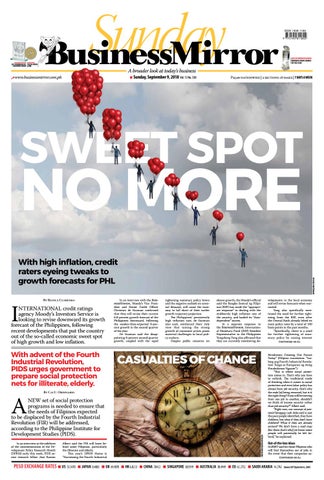
SWEET SPOT
NO MORE
NTERNATIONAL credit ratings agency Moody’s Investors Service is looking to revise downward its growth forecast of the Philippines, following recent developments that put the country out of the so-called economic sweet spot of high growth and low inflation.
With advent of the Fourth Industrial Revolution, PIDS urges government to prepare social protection nets for illiterate, elderly.
A
In an interview with the BusinessMirror, Moody’s Vice President and Senior Credit Officer Christian de Guzman confirmed that they will revise their current 6.8-percent growth forecast of the Philippines downward, following the weaker-than-expected 6-percent growth in the second quarter of the year. De Guzman said the disappointing 6-percent second-quarter growth, coupled with the rapid
tightening monetary policy levers and the negative outlook on external demand, will cause the economy to fall short of their earlier growth trajectory projection. The Philippines’ persistently high inflation rate, de Guzman also said, reinforced their July view that taming the strong growth of consumer prices poses material challenges to local policy makers. Despite public concerns on
slower growth, the Moody’s official said the Bangko Sentral ng Pilipinas (BSP) has made the “appropriate response” in dealing with the stubbornly high inflation rate of the country, and lauded its “datadependent” moves. In a separate response to the BusinessMirror, International Monetary Fund (IMF) Resident Representative to the Philippines Yongzheng Yang also affirmed that they are currently monitoring de-
velopments in the local economy and will revise forecasts when warranted. Yang also specifically mentioned the need for further tightening from the BSP, even after the Central Bank already hiked its main policy rates by a total of 100 basis points in the past months. “Specifically, there is a need for further tightening of monetary policy by raising interest Continued on A2
CASUALTIES OF CHANGE
By Cai U. Ordinario
NEW set of social protection programs is needed to ensure that the needs of Filipinos expected to be displaced by the Fourth Industrial Revolution (FIR) will be addressed, according to the Philippine Institute for Development Studies (PIDS). In an interview at the sidelines of the commemoration of the Development Policy Research Month (DPRM) early this week, PIDS senior research fellow Jose Ramon
Albert said the FIR will leave behind some Filipinos, particularly the illiterate and elderly. This year’s DPRM theme is “Harnessing the Fourth Industrial
PESO EXCHANGE RATES n US 53.5470
VERASTUCHELOVA | DREAMSTIME.COM
I
By Bianca Cuaresma
SKYPIXEL | DREAMSTIME.COM
With high inflation, credit raters eyeing tweaks to growth forecasts for PHL
Revolution: Creating Our Future Today” (Filipino translation: “Isulong ang Fourth Industrial Revolution Tungo sa Katuparan ng Ating Kinabukasan Ngayon”). “This is where social protection comes in. That’s why you have to rethink. The traditional mode of thinking when it comes to social protection and even labor policy has always been job security, that’s why the endo [is] being removed, but is it the right thing? If you will be moving from one job to another, shouldn’t we think of income security rather than job security?” Albert said. “Right now, our concept of pantawid [stopgap cash dole-out] is just the poor people identified, they have children, but what if they don’t have children? What if they are already seniors? We don’t have a road map [for them that’s why] we know some people will potentially be left behind,” he explained.
Out-of-the-box ideas
ALBERT said for those Filipinos who will find themselves out of jobs in the event that their companies auContinued on A2
n JAPAN 0.4802 n UK 69.1078 n HK 6.8223 n CHINA 7.8422 n SINGAPORE 38.9319 n AUSTRALIA 38.4949 n EU 62.2752 n SAUDI ARABIA 14.2762
Source: BSP (September 6, 2018 )
NewsSunday BusinessMirror
A2 Sunday, September 9, 2018
www.businessmirror.com.ph
SWEET SPOT Casualties of change
NO MORE Continued from A1
rates, supported by keeping the fiscal deficit broadly unchanged from last year. This would help reduce inflationary pressures,” Yang said. “At the same time, structural reforms—e.g., tariffication of rice import restrictions, tax reform, amending the BSP Charter, and shortening the foreign investment negative list—should continue or even accelerate. Such reforms would strengthen market confidence and raise growth potential in the Philippines,” he added. While both major international analysts see challenges to the local economy, they are in agreement that the Philippines remains a key economic player in the region. “The fundamentals of the Philippine economy remain strong, although risks have risen in recent months, with managing inflation expectations becoming an important challenge,” Yang said. “I can say we continue to see the Philippines—even after we revise the GDP [gross domestic product] growth projection—as one of the better performing economies in the region,” de Guz-
man said. BSP Governor Nestor Espenilla Jr. had earlier said that while the growth path of the country was tamer in the second quarter of the year, their data showed that it has enough space to absorb the rounds of aggressive monetary policy tightening let out in recent months. Economic managers and markets, however, expressed concern over the inflation shoot-up in August this year. Inflation hit its highest in nine years in August, as recently reported by the Philippine Statistics Authority (PSA), wreaking havoc on the near-term market and business sentiment in the country. The peso, in particular, hit fresh 12-year lows following the announcement, with latest data from the Bankers Association of the Philippines (BAP) showing a P53.85 to a dollar opening value on Friday. ING Bank Manila economist Joey Cuyegkeng earlier affirmed that the recent weakness of the peso was brought about by the high inflation and the market’s perception of a weak monetary policy response—coupled with ex-
ternal factors. Latest BSP survey on local business sentiment also showed a significant slump in confidence in local economy dynamics. Firms surveyed during the period groaned amid increasing prices of basic commodities in the global market, augmented by the effects of the implementation of the Tax Reform for Acceleration and Inclusion (TRAIN) Law on prices of domestic goods. The most pervasive impact cited is that of the higher excise taxes on fuel as imposed by TRAIN, which businessmen said cut across all sectors, raising costs all around. The quarterly Business Expectation Survey (BES) of the Central Bank, results of which were released late Thursday, showed the overall confidence index (CI) of firms during the period slumped to 30.1 percent—the lowest level of business confidence since the first quarter of 2010. The BSP will be having its next monetary policy meeting on September 27, and this early several analysts are predicting another rate hike decision.
Continued from A1
tomate, social protection systems should also be ready to provide them with resources, not only to tide them over, but also to make them more financially secure. He said there are those who would argue that a Universal Basic Income (UBI) may be a better option to ensure that all workers will have a stable source of income even when they do not have jobs, but there are critics who argue that this may make them “lethargic.” Still, Albert said this does not mean that out-of-the-box ideas, such as UBI, and an unemployment pantawid are not worth considering. This is why he thinks measures to improve social protection systems or other measures to cushion the impacts of the FIR must be tested this early. Albert, along with other experts, including Trade Assistant Secretary Rafaelita Aldaba, believes the FIR is not something that will happen in the near or far future, but is something that is already being experienced today. Some of these innovations are being seen in biotechnology, digital technology, nanotechnology and neurotechnology. Aldaba said this is the reason many sectors of the economy are already experiencing the changes brought about by these innovations.
Financing champion
AMID all these concerns, which are on top of the actual need to adapt and invest in innovation to cope with the dawning of the FIR era, Albert said the FIR requires a champion, particularly in terms of financing. “At the end of the day, you also need to put funding and right now, many of our tax-reform measures, which to some extent are very important, [are] more for infra; while
TRAIN [Tax Reform for Acceleration and Inclusion] 1 says 30 percent will go to social protection, these will be for those who will be affected. Regardless of TRAIN, you need to strengthen social protection in the wake of the Fourth Industrial Revolution,” Albert said.
for us. If we are just going to make sure that whatever investment we have in the industrial revolution also does not take away from the need to help the other [Filipinos left behind],” Bernardo said.
Potential ‘casualties’
LAST month Asian Development Bank (ADB) Principal Social Development Specialist Sri Wening Handayani said that if Asian countries fail to adopt innovative employment and social protection measures, many citizens won’t be able to afford retirement. In an Asian Development blog released on Tuesday, Handayani said social protection can improve the future of Asian workers, particularly considering today’s gig economy where workers have shortterm contracts, or are working as freelancers, without any benefits such as retirement packages. Currently, Handayani said, the coverage of social protection programs in Asia is already very low compared to European countries. Based on the ADB’s Social Protection Indicator, less than half of Asia’s population was fully covered by at least one social protection scheme in 2015. Handayani said the range varies from Japan with more than 90 percent of coverage to Nepal with less than 30 percent coverage. To be sure, the Philippines itself still has a long way to go in ensuring that the illiterate, lowskilled citizens can have some protection or are given timely interventions to boost their skills even before they grow old. And one can only hope such can be done before they get completely swamped by the tide of change.
THESE finances will go a long way, especially for thousands of working-age Filipinos who remain illiterate. Since they cannot read and write, they can only do menial jobs, which can easily be automated and leave them jobless and poor. Albert said adult illiteracy remains a concern in the Philippines and so is the desire of many adults to continue their studies. But, he said, there are no facilities that allow them to do this. In a speech on Tuesday, Philippine Center for Islam and Democracy President Amina Rasul-Bernardo said their group conducted a survey on adult illiteracy in the Autonomous Region in Muslim Mindanao (ARMM) and found that 500,000 adults are illiterate, or one-third of the labor force in Mindanao. But Bernardo said that when she became a consultant for the Pantawid Pamilyang Pilipino Program (4Ps), she found the estimate of the government is even higher: at 1 million adults who are illiterate in Mindanao. She said making adults literate will help many members of the labor force transition into higherskilled jobs that pay better and have the means to secure their futures in the FIR. “An easy or low-hanging fruit or endeavor to add to resiliency is to make adults literate. I mean, come on, it’s not rocket science. It’s so obvious it amazes me why the government does not do it. At P5,000 per adult, come on! So literacy, education, clearly is important
Low coverage
www.businessmirror.com.ph
The World BusinessMirror
BILLIONAIRE JACK MA PREPARES FOR LIFE AFTER ALIBABA SUCCESS
J
ACK MA, China’s richest man, is laying the groundwork for a future away from Alibaba Group Holding Ltd., the company he cofounded and turned into an e-commerce juggernaut. In an interview with Bloomberg TV, the Alibaba chairman said he is dedicating more of his time and fortune to philanthropy with the creation of a foundation in his own name focused on education, following in the footsteps of fellow billionaire Bill Gates. Ma, who turns 54 on Monday, has a net worth of more than $40 billion according to the Bloomberg Billionaires Index. While Ma sees himself as an accidental executive who only entered the business world with Alibaba’s founding almost 20 years ago, he has become one of China’s most recognized corporate leaders. Even after stepping down as chief executive officer in 2013, the former English teacher remains the public face of a company with a market value of more than $400 billion and interests spanning e-commerce and Hollywood film production to cloud computing and online payments. “There’s a lot of things I can learn from Bill Gates. I can never be as rich, but one thing I can do better is to retire earlier,” Ma said in the interview. “I think some day, and soon, I’ll go back to teaching. This is something I think I can do much better than being chief executive officer of Alibaba.” When asked if that could happen this year, Ma shrugged and smiled. He didn’t indicate if he would give away his money or put it into a trust as other billionaires have done. “You’ll know very soon. I’ve prepared a Jack Ma Foundation,” Ma said. “All these things that I’ve been preparing for 10 years.” Ma was born in September 1964 to Chinese traditional musician-storytellers living in Hangzhou, an ancient capital that’s become a global high-tech hub and bastion of entrepreneurship, in part because of Alibaba’s base there. He started Alibaba.com in 1999 as a b u s i n e s s - t o - b u s i n e s s m a r ke t p l a c e,
backed by $60,000 from 18 cofounders. With savvy deals and an investment from SoftBank Group Corp., it’s now morphed into a behemoth that can make or break brands. Its customers use its e-commerce platforms to order products that last year saw package deliveries reach 55 million a day. Ma also controls Ant Financial, the online financial platform that runs China’s largest mobile-payment system and money-market fund. The business has more than 870 million users via payment system Alipay and its affiliates. A focus on education wouldn’t surprise keen followers of Ma, who has spoken frequently of its importance to him and some of his shortcomings as a student, including failing China’s national university exam twice. “I was not considered a good student but I improved, we keep on learning all the time. So I want to devote most my time to this,” Ma said. During his time as chairman, he has helped guide growth at home and overseas while also spearheading its 2014 initial public offering, the biggest ever. Ma was among the first foreign business leaders to meet with Donald Trump after his election. Ma has thrived in the spotlight as he became a much sought-after guest for conferences around the world, even as tensions between China and the US have risen over trade. But he has also said in the past that he isn’t happy being the wealthiest person in China, where vast personal fortunes have only emerged in recent years and are subject to intense scrutiny. As someone who has met the leaders of the world’s two largest economies, Ma sees his future philanthropy as a way to bridge the divide between them. “People in China and America, one thing we have in common is the heart of love and respect,” Ma said. “This is a common language we have. The first tech revolution caused WWI, the second caused WWII, now we are a third revolution, what’s gonna happen? It should be a war against poverty, disease, et cetera.” Bloomberg News
OIL SET FOR WEEKLY LOSS AS E.M. CONTAGION FEAR GROW
O
IL is poised for the biggest weekly decline since mid-July as a rout in emerging markets raises contagion fears, while government data showing growing inventories at a key US storage hub also weighed on prices. Futures in New York were little changed, on course for a weekly loss of 2.8 percent. Developing nation equities slipped into a bear market, increasing concerns that the tumult could sap energy demand. Meanwhile, crude inventories at Cushing in Oklahoma rose for a fourth week, with American stockpiles of gasoline and distillates also expanding, the Energy Information Administration reported. The anxiety over emerging economies is the latest global event to damp market sentiment. The escalating trade tension between the US and China has also led investors to shun risk, with crude prices slumping since June on expectations President Donald Trump is set to announce additional tariffs on $200 billion of Chinese imports. Still, speculation that US sanctions on Iran could tighten oil markets despite the
Organization of Petroleum Exporters’ (Opec) pledge to boost output has been supporting prices. The structure of the futures market is reflecting those supply risks, according to Jefferies Llc., with near-term contracts for global benchmark Brent crude trading higher than those for later in what’s known as backwardation. “Oil markets are in the middle of a tug of war as Iran’s supply is falling and Opec’s output boost has been falling short of expectations, putting upward pressure on prices,”Tatsufumi Okoshi, a senior commodity economist at Nomura Securities Co., said by phone from Tokyo. On the other hand, the emerging-market rout and “US-China trade tensions are raising concerns over the global economy and weighing on prices.” West Texas Intermediate for October delivery traded at $67.83 a barrel on the New York Mercantile Exchange, up 6 cents, at 11:12 a.m. in Tokyo. The contract is set for a $1.97 drop this week, the most since July 13. Total volume traded was about 55 percent below the 100-day average. Bloomberg News
Sunday, September 9, 2018
A3
Asian markets fall as US, China renew tariff threat
S
By Annabelle Liang | The Associated Press
INGAPORE—Asian stocks were mostly lower on Thursday as the US and China moved closer to imposing tariffs on billions of dollars of each other’s goods, sounding a call of caution in the markets. Keeping score: Japan’s benchmark Nikkei 225 tumbled 1.0 percent to 22,264.11 and the Kospi in South Korea dropped 0.4 percent to 2,278.90. Hong Kong’s Hang Seng fell 0.3 percent to 26,895.00. The trade spat is one reason the Hong Kong index has dropped 18 percent since its peak in late January. The Shanghai Composite index was 0.7 percent higher at 2,710.70. Australia’s S&P/ASX 200 shed 0.9 percent to 6,105.70. Wall Street: On Thursday US technology companies suffered sharp losses for the second day in a row and emerging markets slid on trade fears. The S&P 500 index dropped 0.4 percent to 2,878.05. The Nasdaq composite, which has a high concentration of technology companies, dipped 0.9 percent to
7,922.73. The index has lost 2.3 percent this week. The Russell 2000 index of smaller-company stocks was 0.8 percent lower at 1,714.47. The Dow Jones Industrial Average added 0.1 percent to 25,995.87, as industrial companies and high-dividend stocks rose. U S - C h i n a te n s ion s: T he Trump administration may impose tariffs of up to 25 percent on an additional $200 billion in Chinese goods, after a public comment period ended Thursday. The imports are equal to nearly 40 percent of all the goods China sold the United States last year. Doing so would escalate a confrontation between the world’s two biggest economies and likely squeeze US companies that import everything from handbags to bicycle
A WOMAN walks by an electronic stock board of a securities firm in Tokyo on Friday. Asian stocks were mostly lower on Thursday, as the United States and China moved closer to imposing tariffs on billions of dollars of each other's goods, sounding a call of caution in the markets. AP/KOJI SASAHARA
tires. China has said that it is ready to retaliate with “necessary countermeasures” if President Donald J. Trump goes ahead with the tariff hike. Commerce Ministry Spokesman Gao Feng said on Thursday that the country is confident it can maintain “steady and healthy” economic growth. It has announced a $60 billion list of American products targeted for retaliation. The Chinese government has said it would help local and even foreign businesses in the country mitigate the effects of the trade dispute. Analyst’s take: “ The market is risk-off and pricing in
the effects of new tariffs. It’s a done deal as far as investors are concerned,” said Francis Tan, investment strategist at UOB Pr ivate Bank. “I don’t t hink that China will retaliate with a full-f ledged devaluation of the yuan. They will turn to other non-tariff measures,” he added. Energy: Benchmark US crude remained flat at $67.77 a barrel. Brent crude, used to price international oils, lost 5 cents to $76.45 a barrel. It lost 1 percent to $76.50 a barrel in London on Thursday. Currencies: The dollar fell to ¥110.55 from ¥110.83. The euro eased to $1.1624 from $1.1625.
Here’s how Trump can formally call China a currency manipulator
I
F President Donald J. Trump wants to follow through on his repeated threats to label China a currency manipulator, all he has to do is turn back the clock. T he Trea su r y Depa r t ment hasn’t accused China of artificially suppressing the value of the yuan because it relies on a 2015 law that sets strict standards for the designation. But a 1988 law—still in effect—sets a looser standard. Treasury Secretary Steven Mnuchin simply has to use it, said several former department officials. T he US is “ look ing ver y strongly at the formula” it uses to decide whether China and other countries are manipulating their currencies, Trump said in an August 30 interview with Bloomberg News. T he W hite House is putting pressure on Mnuchin to publicly shame China and he has gotten increasingly involved in the department’s twice-yearly currency analysis, usually released in October, according to two people familiar with the matter. Declaring China to be a currency manipulator wouldn’t trigger any sanctions or other US penalties, but it would escalate
trade tensions and likely cause a market reaction. “The US has a lot of issues with China, and this is another way for the administration to say: We’re not happy with the way things are going,” said Phillip Swagel, a Treasury official during the George W. Bush administration. “It’s more of a symbolic finding. It could support action down the road.” Trump’s latest threat comes as trade wars and the prospect of monetary tightening from the Federal Reserve roil emerging markets, with currencies from Turkey to India slumping to record lows against the dollar. China has taken action over the past month to support the yuan, including using the daily fixing to rein in declines and making it more expensive to short the currency. The yuan has weakened 6.5 percent against the dollar over the past three months, slipping in August to its lowest value since January 2017. The US Treasury hasn’t branded any country a manipulator since Democrat Bill Clinton was in the White House. China was named five times from May 1992 to July 1994.
The Omnibus Trade and Competitiveness Act of 1988 gives the Treasur y secretar y broad discretion to use a wide range of data—including foreign-exchange reserve coverage, capital controls, monetary policy and inflation—to make a decision. The law’s definition is “very elastic,” said Brad Setser, who did international economic analysis at Treasury during the Obama administration. The Trade Facilitation and Trade Enforcement Act of 2015, however, lays out specific criteria a country must meet to be labeled a currency manipulator. It instructs Treasury to use three tests: A minimum $20-billion trade surplus with the United States, a current-account surplus in excess of 3 percent of GDP, and repeated interventions in currency markets. Right now, China meets only one test—the US trade deficit with China hit $375 billion last year. B ut Tre a s u r y c a n c h a n ge t he t h reshold le ve l s, g iv i ng Mnuchin another way to fulfill Trump’s wish. The Treasury Department’s most recent currency report, released in April, explicitly noted
that a country might be found a currency manipulator under the standards of one law but not the other. Mnuchin played a limited role in the first three reports issued since he took office, changing just a few lines in each, according to two people familiar with the matter. Trump contradicted Treasury’s findings just three d ays af ter t he latest repor t, speculating that China and Russia are gaming their currencies. Mnuchin has told the W hite House that it’s not easy to label China a currency manipulator, frustrating some officials who see him as more loyal to bureaucracy than to Trump’s agenda, according to one person. China doesn’t disclose its interventions in the foreign-exchange market. But Treasury’s own currency reports acknowledge that China hasn’t intervened heavily in the market since early 2017. Following China’s surprise one-time devaluation in August 2015, the central bank was actually intervening to prop up the currency— not drive it down, as Trump has accused Beijing of doing. Bloomberg News
A4
Sunday, September 9, 2018
The World BusinessMirror
Abe’s third term as Japan prime minister may be his hardest yet F
www.businessmirror.com.ph
Macron pushes a broad alliance against nationalists for EU vote
A
By Isabel Reynolds | Bloomberg News
FTER two terms of mixed reform results, Prime Minister Shinzo Abe is vowing to tackle some of Japan’s most intractable problems in the third. Abe is heavily favored to win a September 20 vote to lead the ruling Liberal Democratic Party (LDP) for another three years, with one local newspaper poll showing 87 percent of eligible lawmakers favoring his return. The prime minister and his only rival, former Defense Minister Shigeru Ishiba, registered their candidacies on Friday in Tokyo, marking the official start of the campaign. In recent weeks, Abe, 63, has signaled plans to follow his “Abenomics” policies of monetary easing, fiscal stimulus and structural reform, with a more controversial agenda focused on demographic issues. But the prime minister’s record of watering down proposals after resistance from the public and vested interests has left many skeptical about his resolve to see it through. “It’s been characteristic of the Abe government for the last three or four years that they say all the right things,” said Robert Feldman, a senior adviser at Morgan Stanley Mufg Securities in Tokyo. “Somehow the budget and the actual laws they pass don’t get them toward the things they say they want to do.” Here’s a look at Abe’s agenda:
Abe’s pushing to crack open Japan’s restrictive immigration laws. He’s pledged to create a new residential status for lower-skilled foreign workers next year that would accept laborers for limited stays without their families. The existing foreign “intern” system has been dogged by allegations of forced labor. In an essay published by Hanada magazine last month, Abe said foreign workers must be paid the same as their Japanese counterparts and be protected from exploitation. Still, he argues it’s not “immigration” because they can’t stay.
Foreign workers
Social security
SPOOKED by a labor shortage crippling sectors such as elderly care,
Retirement age
JOBS for life could become more common in Japan, if Abe gets his way. In an interview with the Nikkei newspaper this week, the prime minister said he wanted to focus the next year on creating an environment for people to stay working throughout their lives. That could mean bolstering opportunities for mid-career job changes and encouraging people to stay on past 65. Japan already has a relatively high proportion of elderly workers, including about 30 percent male and 16 percent of female senior citizens. ABE’s counting on keeping more elderly people in the labor force
ABE TOMOHIRO OHSUMI/BLOOMBERG
in year one of his next term. Because it’s essential to health care and social security overhauls he’s planning in years two and three. Abe told the Nikkei that he was considering allowing workers the option of delaying pension payouts past the age of 70, in exchange for higher monthly payments when they do. The Japanese already have among the world’s longest life expectancies—at about 87 years for women and 81 years for men—and Abe said he wants to promote lifestyle incentives to lengthen healthy life spans.
Sales tax
ABE is also seeking to raise the consumption tax to 10 percent from the current 8 percent in October of next year. The last increase to 8 percent in 2014 triggered a recession, leading Abe to twice delay a second hike. Abe told the Nikkei that measures like exempting food from the next increase would help deflect another economic hit.
Constitutional amendment
ABE pledged in a policy pamphlet
China developers gloomiest in almost a decade–survey
The percentage of eligible lawmakers who favor the return of Abe to lead the leading LDP, according to a recent poll.
distributed to party lawmakers ahead of the election to push ahead with a controversial plan to change the pacifist provision of the country’s postwar constitution. He said he would seek to present the LDP’s amendment to the next session of parliament and push for an early vote. The plan faces a rocky road: Natsuo Yamaguchi of Abe’s coalition partner, the Komeito Party, said last month he didn’t think t here h ad been muc h prog ress on consensus-building to support t he pl a n. STUDENTS practice shooting Smith & Wesson Holdings Corp. M&P 40 Airsoft pistol during an all-women class at the Oklahoma Personal Defense Academy in Shawnee, Oklahoma, on November 5, 2011. Domestic handgun production and imports more than doubled over four years to about 4.6 million in 2009, according to the National Shooting Sports Foundation, a gun-industry trade group.
C
HINA’s developers are at their gloomiest in eight years, adding risks to the world’s second-largest economy as it faces pressure from a potentially protracted trade war. A sentiment index of the property market compiled by Standard Chartered Plc. dropped to 38.5 in August, the lowest since it started in 2010. The readings are based on a semi annual survey with 40 senior managers of property firms in nine cities, ranging from the metropolis of Shanghai to the little-known inland town of Huangshi in Hubei province. Deteriorating financing conditions, housing purchase curbs and the looming property tax, which may hurt the long-term prospects of the sector, all contributed to the index’s decline, Standard Chartered economists Shen Lan and Ding Shuang said. China’s realestate sector has been the most robust pillar of investment this year as the economy slows; if it also falters, then that threatens the nation’s resilience at a time when the trade war with the US is intensifying. “Property investment will probably slow later this year, adding to downward pressure on the economy, “ said Ding, the bank’s chief economist for Greater China and North Asia. “If this seriously threatens economic growth, policymakers will consider easing their grip”. In the first seven months, the value of property sales in China jumped 14.4 percent from a year earlier, while realestate development investment rose 10.2 percent. Signs of the risks in the offing showed up elsewhere, too. Although Chinese developers reported impressive earnings this season, the firms’ ability to service their debt dropped to the weakest in three years, data compiled by Bloomberg show. Bloomberg News
87%
PAUL TAGGART/BLOOMBERG
GUN BUSINESS BOUNCES BACK FROM A LONG ‘TRUMP SLUMP’
T
HE American gun industry’s twoyear “Trump slump” might finally b e o v e r. Fe d e r a l b a c k g r o u n d check data released on Thursday indicated stronger-than-expected retail activity in August, a positive indicator that follows closely behind Smith & Wesson’s impressive earnings last week. American Outdoor Brands Corp., the parent company of Smith & Wesson, jumped by more than 3 percent in afternoon trading on Thursday before closing up 1 percent; Sturm, Ruger & Co. also closed up more than 1 percent. The number of checks undertaken by National Instant Background Check System, which is overseen by the FBI, actually declined 5 percent in August compared with the same month last year. But that drop was smaller than analysts predic ted and better than July’s 9-percent drop from a year earlier. The fact that falling background checks, which are used as a proxy for sales, could seem like good news is a sign of just how difficult things have been for gun makers since 2016. Retailers stocked up on inventory a head
of the last presidential election, predicting Democrat Hillary Clinton would win and champion stronger gun-control measures and leading shoppers to stock up on firearms. That vision didn’t come to fruition thanks to President Donald Trump and a Republican-controlled Congress, leaving gun dealers with overstocked shelves and little need to order more. Inventory levels have since started to normalize, and Smith & Wesson’s surprising results last week, with revenue up 7.6 percent compared to last year, provided one of the clearest indicators yet that gun buying is finally picking up. The earnings capped a 48-percent rise in American Outdoor’s share price in August. “We believe the market is going to come back, it’s going to return to growth, maybe slower growth than we’ve seen before,” American Outdoor Chief Executive Officer P. James Debney said on the earnings call. Background checks for long guns—a category that includes popular AR-15-style weapons—fell by more than 11 percent over the last three months. But American Outdoor shipped nearly 38 percent more long guns during that span than the year
prior. Modern sporting rifles like the AR15 tend to have higher profit margins than handguns. Ruger, which announced earnings in early August and saw its shares rise by 20 percent last month, also outperformed the background checks. Gun makers aren’t completely free from the risk that backlash will affect sales. E a r l i e r t h i s y e a r , R u g e r ’s shareholders voted that the company must prepare a report on the risks of selling firearms. An investor who recently proposed a similar measure for American Outdoor purchased 200 shares, the minimum required for such an action. American Outdoor CEO P. James Debney said the investor was pushing “an anti-firearms agenda designed to harm our company, disrupt the local sale of our products and destroy stockholder value.” On Thursday American Outdoor said in a Securities and Exchange Commission filing that it was “extremely disappointed” that Glass Lewis, a prox y advisor y firm, recommended the proposal be passed. The proposal, the company added, “will do nothing to make our communities safer.”
Bloomberg News
RENCH President Emmanuel Macron met with three European leaders on Thursday in an effort to shore up support ahead of bloc-wide elections in May, which could become a showdown between supporters of liberal values and proponents of nationalism. Prime Minister Charles Michel of Belgium, the Netherlands’s Mark Rutte and Luxembourg’s Xavier Bettel gathered with Macron near Luxembourg’s capital city to discuss their European strategy. The meeting comes as Macron’s Republic on The Move party has held talks in recent months exploring joining forces with several European parties, including the liberal ALDE group, which includes the three Benelux leaders. “We see this as a cooperation of the progressive forces that will combat the far right. We need to form a critical mass,” PieyreAlexandre Anglade, a lawmaker in Macron’s party who works on European election strategy, said in an interview. “We see this as a merger of interests, to form a common platform,” he said, adding that they’re also in talks with ALDE, Ciudadanos in Spain, as well as individual politicians in the European People’s Party and the Socialists. Macron’s travels to sit down w ith leaders in more than a dozen capitals across Europe is part of his political strategy to transcend the traditional party system. For the French leader, the European elections loom large as the results will affect the appointment of not just EU lawmakers but also the European Commission president who heads the bloc’s executive arm. Macron expects a very clear bifurcation in the ballot: nationalists versus progressives, an official in his office said.
Progressive solutions
“ THESE progressive solutions
that we carry are the most respectful of the values of our Europe but also the most efficient to face its challenges,” Macron said, pointing the finger at nationalists for trying to destroy the EU. “We share the desire to have a more united and sovereign Europe. I hope we can continue to do this together.” Macron and his envoys, including his party chief Christophe Castaner, are in talks for a common platform across political groups. This was on the table today in Luxembourg, Anglade said, but the 40-year-old leader’s vision of a Europe unbound by borders will have to overcome many hurdles. Bettel, speaking to reporters in Luxembourg, said the gathering wasn’t a campaign meeting ahead of the EU vote, and that this wasn’t “the three liberals inviting the French president” to join their party. Rutte added that forming a cross-party coalition wasn’t “why we met here today.” Castaner, who met former Belgium prime minister and ALDE leader Guy Verhofstadt last week and is on his way to Poland to meet local political parties, is continuing his work to convince Europeans to join Macron’s “alliance.” He traveled to Spain, Greece, Italy, Portugal and several other EU countries to promote the French leader’s plan, Anglade said. Even though Rutte doesn’t share all of Macron’s views he does agree on the essential issues, which could help them become allies, the Elysee presidential palace official said. And Macron’s party is still working to find a partner in Germany, Anglade said. At the press con ference, M ac ron reac hed out to German Chancellor Angela Merkel ahead of their Friday meeting, saying her actions are “on the side of the progressives.” He also asked for the EPP group—of which her CDU party is a key member—to “clarify” its political positions. Bloomberg News
Japan’s power supply system weak link in times of disaster
T
OKYO— Japan’s ultramodern conveniences, its zippy bullet trains, automated ticketing systems and smar t homes work just fine, until the power goes out. The blackout across entire northern island of Hokkaido after a powerful earthquake struck early Thursday showed the weak link in all that technology. It’s a problem shared by most affluent, and increasingly many other countries, but seems more apparent in this seismically overactive nation, where earthquakes and tsunamis are a constant threat and even the high-tech toilets have electronic flushes. T he 6.7- m a g n it ude qu a ke on Hokkaido’s southern coast knocked out power to nearly all 3 million households on the island, forcing essential services, such as hospitals and traffic lights, to use generators or other backups. Damage to some generators was likely to delay the full restoration of power for more than a week, officials said. On Friday, with power restored to about half of all Hokkaido households, Industry Minister Hiroshige Seko urged residents to conserve electricity. “ Unplug appl iances. Families should try to all stay in one room,” he said. “That can help us more quickly restore power in more places.” The vulnerability of the electric grid was driven home most painfully in 2011 by a massive earthquake and tsunami on the northeastern coast of the main island of Honshu, and subsequent meltdowns at the Fukushima Dai-
ichi nuclear power plant. Shutdowns of reactors for safety checks put a chunk of Japan’s power-generating capacity out of commission—straining supplies in this resource scarce nation. Some 3 million households on Hokkaido, whose power supplies generally are only based on the island, were without electricity for nearly a whole day after the quake. After a long, dark night a large share of the lights were back on early Friday in the prefectural capital of Sapporo, a city of 1.9 million. Without power, most tap water systems didn’t work. Traffic and streetlights were dark and cell phones ran out of power. Some land lines were a lso silenced, though public phones were working—for free, carrier NTT said. Hokkaido Electric Power Co., or Hepco, said the large-capacity Tomato Atsuma power plant—source of most power to the region and located relatively close to the quake’s epicenter—will take about a week to restart. As a stopgap, the company restarted three other plants with less generating capacity and switched on dozens of small hydroelectric plants. Officials at METI, the Ministry of Economy, Trade and Industry, which is in charge, told reporters the utility lacked a contingency plan for the failure of all three of Tomato Atsuma’s generators— echoing the lack of emergency planning that caused massive problems at the Fukushima plant. Hepco had only anticipated the possible loss of up to a third of peak power demand, or up to 1.3 million kilowatts, they said. AP
Faith
Sunday
Editor: Lyn Resurreccion • www.businessmirror.com.ph
SAINT PETER CLAVER, PATRON OF ALL CATHOLIC MISSIONS By Corazon Damo-Santiago
P
O P E S o f t h e C a t h o l i c C h u rc h condemned chattel slaver y, or personal slavery. Pope Pius II in 1462 called it a great crime. “Pope Paul III in 1537 called the exploiters of the practice the instruments of Satan.” Chattel slavery considered persons as personal property that can be bought, sold and inherited as commodities. Twelve to 15 million Africans were transported to the New World to supply labor-intensive plantations and gold mines from the mid15th century to the 19th century. Each of the 36,000 Transatlantic voyages carried chattel Africans from 15 tribes to 20 tribes sold by “petty kings in Africa.” For 40 years, Peter Claver, a Jesuit priest alleviated their sufferings.
‘That I am like a slave’
CLAVER, “probably the first white man to take any friendly interest in these unfortunates [slaves],” was born on June 26, 1580, in Verdu, Spain. His mother prayed for his vocation to Hannah, the mother of prophet Samuel and to the Blessed Virgin Mary. That “nothing should come between him and the love of God,” was taught him, who died when he was 13. The next year, he left for Barcelona to study. In Tarragona, Catalonia in Spain, when asked about his motivation to enter religious life, he wrote: “To become a saint, and...save many souls.” He surpassed his classmates in piety and learning. After his novitiate, Claver wrote a pledge on a notebook he kept throughout his lifetime. “I must dedicate myself to the service of God until death, on the understanding that I am like a slave, wholly occupied in the service of his master and in the endeavor to please and content Him in all and in every way with whole soul, body and mind,” he wrote. Alphonsus Rodriguez, the doorkeeper of the Jesuit college in Majorca and who would later become a saint together with Claver, became his best friend. The college superior allowed them to spend 15 minutes a day to exchange spiritual thoughts. Rodriguez, who was acknowledged for his humility, urged Claver to work for the missions to save many souls. After taking his vows on August 8, 1604, Claver was sent to Cartagena, now Colombia, a major port in South America, where about 1,000 African slaves arrived every month. “Unspeakably atrocious,” was how Robert Ellsberg described the condition of the chattel slaves in Saint Peter Claver, Missioner to Slaves.
Bro. Michael, MICM, in Slave of Slaves d escribed the the slaves as “shackled below the ships deck—a floating hell. They lay together...fear-like sardines, naked and bleeding in cold damp of winter or excruciating heat of summer.”
‘For half-dead Africans’
CLAVER negotiated with the captain of the ship to allow him to minister to “halfdead Africans,” who looked like black skeletons. He gave them food, drinks and treated their wounds. He blessed the dead and administered the last rites to the dying. He sought help from a brother and a religious interpreters to help in the apostolate. His missionary zeal was not dampened by antagonistic and callous merchants and “misgivings of his own superiors for his indiscreet zeal,” noted the Missionary Sisters of Saint Peter Claver of North America. Claver humbly explained: “We must speak to them with our hands before we speak to them with our lips.” Between the monthly arrivals of slaves, he went where they were assigned. He had missions, solemnized their marriages, baptized their children and taught catechism, emphasizing they are “precious in the eyes of God.” Baptismal ceremonies were held in the town plaza. It was estimated that he had baptized more than 3,000,000 Africans. At the baptisms Claver gifted each with a medal of Saint Joseph and Mary. From a very corrupt seaport and through his intercessory prayers, the city was slowly transformed into a “good city.” Claver’s sanctity, complimented with miracles and conversions, convinced the people of his holiness. When an epidemic raged in Cartagena in 1650, Claver, who was already old and paralyzed, spent 15 hours a day in the confessional. He died on September 8, the feast day of the Black Virgin. Fifty years earlier, on the same month and date, Claver went on a pilgrimage to the sanctuary of the Madonna on the mountain of Catolonia, where Saint Ignatius de Loyola, the founder of the Jesuits laid his sword at the feast of the Black Madonna. Saint Peter was beatified on July 20, 1850, by Pope Pius IX. He was canonized in 1888 by Pope Leo XIII with his bosom friend, Alphonsus Rodriguez. He was proclaimed the Patron of All Catholic Mission by Pope Leo in 1896. Damo-Santiago is a former regional director of the Depar tment of Education National Capital Region. She is currently a faculty member of Mater Redemptoris Collegium in Calauan, Laguna, and of Mater Redemptoris College in San Jose City, Nueva Ecija.
PHL GEARS UP FOR VISIT OF PADRE PIO’S HEART RELIC
T
HERE’S only a month to go until the incorrupt heart relic of Saint Padre Pio, a Capuchin priest who bore stigmata of Jesus, arrives in the Philippines. The cities of Manila, Cebu and Davao are some of the places to be visited by the relic in its 20-day stay, from October 6 to 26. Fr. Joselin Gonda, rector of the National Shrine of Saint Padre Pio in Santo Tomas, Batangas, said the visit marks two milestones in the saint’s life—the centenary of the appearance of stigmata on his body on September 20 and his 50th death anniversary on September 23. “The visit of the heart relic is a fitting epilogue to these two important events in the life of Saint Padre Pio,” Gonda said during a news conference in Manila on Wednesday. “Besides, it is the Year of the Clergy and the Consecrated Persons. Padre Pio, given as a role model for them, can be an inspiration and challenge to us to have a heart like his, close to the Eucharistic and forgiving heart like the Lord,” he said. Cardinal Luis Antonio Tagle of Manila, by way of an informal suggestion in choosing the saint to underscore the Year of the Clergy and the Consecrated Persons, suggested Padre Pio as the model. In collaboration with the Catholic Bishops Conference of the Philippines (CBCP) Episcopal Commission on the Clergy, chaired by Bishop Buenaventura Famadico of San Pablo, the
historic visit is made possible through the initiative of the Archdiocese of Lipa. The Philippines will only be the fourth country to be visited by the heart relic. Others include the United States, Paraguay and Argentina. “This will also be a ‘time of grace’ for the Filipinos, especially the devotees of Padre Pio, who are now walloping in near hopelessness during these uncertain times of our nation’s history,” Gonda said. Archbishop Gilbert Garcera of Lipa has approved of the detailed plans of the visit, especially during its stay at the Shrine of Saint Padre Pio, which was declared a national shrine by the CBCP in 2015. Since the visit is a nationwide event, the Luzon leg from October 8 to 10 will be hosted by the Archdiocese of Manila; the Visayas leg from October 11 to 13, by the Archdiocese of Cebu; and the Mindanao leg from October 14 to 16, by the Archdiocese of Davao. From Davao, it will go back to Batangas in the morning of October 17, where a concelebrated Mass will be held at the San Sebastian Cathedral in Lipa City. After the Mass, it will proceed to the Capuchin Monastery in Barangay San Sebastian, also in Lipa for the exclusive veneration of the Capuchins of the Philippines. From October 18, the relic stays at the national shrine, and a round the clock venerations take place until its departure on October 26, after the 9 a.m. farewell Mass. CBCPNews
Sunday, September 9, 2018
A5
Pope embraces silence as calls grow for response to allegations
R
OME—As a clamor builds for Pope Francis to respond to the stunning allegations by his former ambassador in Washington that Francis covered up abuse and lied about a meeting with a prominent opponent to same-sex marriage, the pontiff has extolled the virtues of silence. Speaking in a Monday morning homily at the Vatican, Francis said, “With people who don’t have good will, who seek only scandal, who want only division, who seek only destruction—including within the family: silence, prayer.” He added that “the truth is humble, the truth is silent,” and concluded with the prayer, “May the Lord give us the grace to discern when we should speak and when we should stay silent.” Francis has stuck with silence since the allegations first shook the church on August 26. Archbishop Carlo Maria Viganò, the former Vatican ambassador, accused the pope of knowing about sexual misconduct by an American cardinal, Theodore McCarrick, with adult seminarians years before the abuse became public. Viganò also said that Francis lifted sanctions on the cardinal that he claimed had been i mposed by h is predecessor, Benedict XVI. Those allegations remain unproven. On the day of the publication of the bombshell letter containing the allegations, reporters inquired whether the allegations were true. “I will not say a single word about this,” Francis said aboard the papal plane, returning from a trip to Ireland. “I believe the statement speaks for itself. And you have the journalistic capacity to draw your own conclusions. It’s an act of faith. When some time passes and you have drawn your conclusions, I may speak.” That moment has clearly not yet come, and Benedict and other Vatican officials who may be in possession of the information to clear up the mystery—one way or the other—have followed his lead. The silence has made it exceedingly difficult to draw any conclusions.
Not letting up
BUT if Francis’s rumination on the dignity of silence was intended to prompt his critics to also hold their tongues, that seemed a prayer unlikely to be answered. Viganò has shown no signs of letting up in his public campaign to force the pope’s resignation, and his conservative allies in the United States and Rome have sounded doubts about the pope from their pulpits, conservative Catholic media outlets and socialmedia platforms.
The pope lamented this oftenhostile ecosystem in April, when he wrote witheringly in an apostolic exhortation about the tone of the discourse in the conservative Catholic blogosphere. “Christians, too, can be caught up in networks of verbal violence through the Internet,” Francis said, citing vicious examples of defamation in some Catholic outlets. “Here we see how the unguarded tongue, set on fire by hell, sets all things ablaze.” B ut it i s a c o n f l a g r at io n t hat Fra nc is h imsel f may have f ac i l it ated . Critics argue he has enraged conservatives in the church by disregarding traditions but also with a leadership style that led one critic to title his book about the Francis papacy, The Dictator Pope. The pope’s supporters instead interpret the open dissent and remarkable broadsides against Francis as a result of frustrated conservatives, unaccustomed to being out of power, coupled with a pope who is willing to give even his harshest critics much more leeway than his recent predecessors.
Church orthodoxy
THE notion of the pope as the embodiment of church orthodoxy emerged only in the 19th century, according to Massimo Faggioli, a professor of historical theology at Villanova University and a contributor to liberal Catholic journals. At the beginning of the 20th century, Pope Pius X ordered a purge of Catholic theologians taking a modernist approach to teaching the Bible. Smaller purges took place under Pope Pius XII, whose papacy stretched from 1939 to 1958. But it was with the election in 1978 of Pope John Paul II, himself a theologian, that disagreements within the church took on the stigma of unholy dissent. With Cardinal Joseph Ratzinger, later Benedict XVI, as John Paul II’s doctrinal watchdog, the Vatican actively investigated and silenced theologians with a different vision of the church. They made it hard for progressive
Foster debate
CONVERSELY, Pope Francis, he said, “is not doing anything to stop” theologians. Faggioli argued that, as a Jesuit, Francis wants to foster debate so a spirit of discernment can lead people to the truth. “Francis had encouraged in the church an openness of opinions,” he said. Some of the pope’s most highprofile critics have made the most of this leniency, at times challenging the very premise of papal authority.
‘Heretical or sinful’
CARDINAL Raymond Burke, an American Vatican official who is the global leader of traditionalists critical of Francis, was a featured speaker at a Rome event in April about confusion under Francis. In his speech on the limits of papal authority, Burke, an expert in canon law, argued if a pope failed to act in conformity with church revelation, scripture and tradition, his actions “must be rejected by the faithful.” Without specifically mentioning Francis, he argued that a pope’s authority was not “magical, but derives from his obedience to the Lord,” and that the actions of a “heretical or sinful” pope were “void.”
Distaste for Francis
VIGANÒ sat in one of the front rows of the event and apparently took that message to heart. While he did not hide in private settings
his distaste for Francis and the direction in which he was taking the church, his going public against the pope was another matter. People who have spoken with him in the last few weeks said he did not take the decision lightly. “He is a diplomat who was taught to be silent his whole life,” said Marco Tosatti, the conservative journalist who helped him draft the letter accusing the pope. “And there was an oath that he broke doing this.” But by being so outspoken, Viganò has also essentially ensured his protection from censure. Punishing the archbishop now would fuel speculation Francis has something to hide.
Oxygen to critics
INSTEAD, Francis has relied on some outspoken US bishops and an army of progressive Catholics online to defend him. His most active lieutenant, Rev. Antonio Spadaro, the editor of a Jesuit journal, La Civiltà Cattolica, has in the past accused American conservative Catholic bishops of damaging the church by making common cause with US evangelicals to further political interests. Much of the critique of Viganò has been seen through this lens, and the pope’s supporters argue that any response would only give oxygen to critics who are less interested in the truth than in exploiting the sex-abuse crisis to slow down Francis and his agenda. On Sunday Spadaro brought Rev. Federico Lombardi, a former papal spokesman, out of retirement and onto his journal, which is vetted by the Vatican Secretariat of State before publication. Lombardi immediately joined the fight, issuing a statement that same day claiming Viganò had deceived the pope in arranging a private meeting in 2015 with Kim Davis, the county clerk in Kentucky who became a national icon for opponents of same-sex marriage. The pope, however, has remained mum, preferring to let the Gospel do the talking. “Jesus responds with silence before those ‘who wanted to throw him out of the city,’” Francis said during a Mass on Monday, adding that Jesus’ stance reflected a “silence that triumphs.” New York Times News Service
JESUS HEALS A DEAF AND MUTE MAN MSGR. JOSEFINO S. RAMIREZ SUNDAY GOSPEL IN OUR LIFE
T
theologians to find jobs at ecclesiastical universities unless they got on board with the Vatican’s view of the church. When he became pope, Benedict ordered the removal of the editor of a Jesuit journal, America Magazine, because it entertained ideas anathema to conservative orthodoxy. Faggioli said that, under John Paul and Benedict, “the message was: ‘Free thinking is not welcome here, and if you keep doing this, it is going to be bad for you and your career.’”
Jesus responds with silence before those ‘who wanted to throw him out of the city.”’—Francis
23 SUNDAY IN ORDINARY TIME: ‘MARK 7:31-37’
HE gospel today is another one of the many wonderful messages of God’s love through His Son. It reminds us that the physical healing Jesus performed are but illustrations of what He can do in the spiritual realm. We may have a good mind and a healthy
POPE Francis sits in pensive mood during his weekly general audience at the Vatican on August 29. AP/ANDREW MEDICHINI
body today. We might not be blind, deaf, crippled, paralyzed or mentally challenged today, but if we are lost, we have a far more serious handicap than any physical handicap ever endured by anyone in history. When we are lost, we cannot hear God. We cannot see what He is doing. We cannot serve
Him. We cannot walk for Him. Our spiritual body is crippled, and if we die in that condition, we will be lost for eternity. When Jesus heals us, He does not see His healing powers as a sign of His divinity but as loving proof of the Father’s mercy and goodness. He heals us because He is filled with compassion. When we are in the presence of the Heavenly Father, the harshness of the human experience becomes clearer. The closer we live to the heart of God, the more we can feel the heartache of our fellowmen. The secret of compassion is a life of close communion with God. Jesus may have saved you and me by the same blood and the same Gospel, but I guarantee you that He used different methods in each of our lives. Jesus works on all of us at a
personal level. He works in our life in a manner unique to each one of us. He reaches out and touches us. Meeting Jesus in our life is joy in itself. The life of the deaf and mute man will never be the same again after being touched by Jesus. He changed everything for the man, and He can do the same for us. He will do the same for any person who comes to Him today. He cares about us and knows what we are going through. That no matter what we are facing today, we will find help and hope in Him. This is how He does all things well! Today, let us join together and pray that we see the wonders of His love, to hear His voice that calls out, to sing his praises and to know when to rest quietly with Jesus.
Science
A6 Sunday, September 9, 2018
BusinessMirror
Sunday
www.businessmirror.com.ph • Editor: Lyn Resurreccion
ZamPen native chicken gives new source of livelihood
T
Story & photos by Stephanie Tumampos
HE native livestock production is a growing industry in many regional areas in the Philippines. Particularly the native chicken industry, it is seen with much potential as it drives consumers to get quality local products from local farms. More important, it gives opportunities to local communities to earn with lesser capital and encourage rural enterprises through the production of healthier livestock products.
AN inmate of San Ramon Prison and Penal Farm, who is raising ZamPen chickens that gives him a monthly income.
The native chickens underwent a sort of purification in recent years, thanks to the efforts of researchers from different institutions and with the help of the Department of Science and Technology-Philippine Council for Agriculture, Aquatic and Natural Resources Research and Development (DOST-PCAARRD). According to Dr. Synan Baguio, DOST-PCA ARD’s OIC for Livestock Research, there are six native chicken breeds that have been purified. These are the Banaba chicken in Southern Tagalog, the Camarines chicken in Bicol, the Darag chicken in Panay Island, the Boholano chicken in Bohol, the Bolinao chicken in Ilocos region and the Zamboanga Peninsula (ZamPen) native chicken in Zamboanga. “We are currently working on the Patani chicken in Caraga,” Baguio said. “These are the native chickens with darker meat color and are already recognized in their respective areas.”
THE pure Joloanon strain chickens from Zamboanga Peninsula that are being raised at the San Ramon Prison and Penal Farm
Collaboration with San Ramon Prison
AT Wester n Mind a nao St ate Universit y ( W MSU), through the leadership of ZamPen native chicken has been making waves as it has not only attracted local farmers in the region but also has a collaboration with the San Ramon Prison and Penal Farm (SRPPF) in Zamboanga City. The project, titled “Evaluation of the Sustainability and Profitability of ZamPen Native Chicken Production as a Source of Livelihood in Rural Communities,” was recognized at the National Symposium on Agriculture, Aquatic and Natural Resources Development (NSA ARD) in the development category. It has showcased the capabilit y of ZamPen native chicken to be a sustainable livelihood for r ura l communities in the pe n i n su l a a nd g ive hope to SR PPF inmates who w il l soon be star ting a new life.
Purification process
BY using the phenotypic or observable characteristics, Narvaez’s team took 120 stocks all over the Zamboanga Peninsula for the pure Joloanon strain, or the ZamPen native chicken. “It took us four months for our preliminar y investigation of a l l t he Joloa non st ra i n,” Nar vaez said. She explained that they interviewed the sources of the chickens, looked over their practices in raising the chickens and took into consideration the years they have been raising them. “The chickens had random mating and we had to separate those who had off colors from the black color plumage [feather] of pure ZamPen chicken,” Narvaez added. She said the separated chickens were still subject to observation since over the months that they will grow, some chickens would still change in color. After six months of maturity, Narvaez finally selected the male chicken that stood out among the rest and had it mate again with female chickens. The same process was done with the subsequent generation of chicken until the same phenotypic characteristics were observed. This is called the back-crossing method. “We select until the percent of purity [of the breed] has reached a higher number. This was based on the number of chicks produced with a high resemblance to the same plumage color,” Narvaez explained. Right on the third cycle of backcrossing, the team succeeded in obtaining uniformity of color and weight. In 2015 Narvaez, through the WMSU research, started to release the pure Joloanon strain chickens, or the purified ZamPen native chickens, to local farmers. She wanted to check on the genotypic characteristics but decided it was not needed.
Capacity building for prison inmates
THE native chicken project was set to be shared to other beneficiaries. However, Narvaez chose SRPPF as its subsidiary. “After the verification and purification process, we collaborated with the penal farm because, as an academic institution, WMSU could not do a full-blast production,” she said. T he university didn’t have enough land space and the penal farm was a perfect site. “We catered to inmates who were about to be released. We
scheduled their training because they are not allowed to leave the compound if not accompanied by prison guards,” she added. T he team trained 30 inm ates i n t wo batc hes. T he y h ad a t wo - d ay t ra i n i ng a nd l ater went to t he f ie ld to st a r t ra i si ng t he c h ic ken s. “The purpose why I chose them [inmates] is for capacity building,” Narvaez said. She explained that if the inmates were released from prison, they will be given a breed starter composed of five female and one male ZamPen native chickens. Each chicks sold in the penal farm costs P100 each. The inmates receive a salary for their job.
Next steps
NARVAEZ is currently looking for ways to commercially produce feeds suitable for the ZamPen chickens. “We have to formulate our own feeds for the chicken because we only mix feeds and it is definitely laborious,” she lamented. She explained that if there are feeds commercially available in the market and designed for native chickens with local ingredients, it would make the work for chicken farmers a lot easier. “[The feeds should be] high in protein, with carbohydrates, iron, the usual [components] and locally produced,” she added. The ZamPen chickens are currently fed with a mix of commercial feeds and kitchen excess, which is not purely organic. According to Narvaez, “we want it phased out soon.”
Tied to Philippine culture
BAGUIO reiterated that having purified native chickens gives identity to the Philippine culture. “We are sowing the development of native chickens to our own culture. It must be supportive to the local culture itself, where it is being grown, because these are our own domesticated animals that originated in our own lands,” Baguio said. The demand for native chickens are already high and it’s being sold in many areas around the country. However, raising the chickens must be done only in their places of origin. The reason is that it is not assured if the native chickens can survive and produce properly in different environments. Having native chickens in their areas of origin is also easier for farmers to raise them because of their adaption to the environment, and cheaper cost of labor and resources. “A lt hough native chic kens take more time to grow, it is definitely healthier and tastier,” Baguio added. They are fed with kitchen excess and forage materials, such as vegetables, which add natural flavor to their meat, he said. Compared to commercially raised chickens that are grown for only a month and sold in the market, native chickens need 14 weeks to 16 weeks to mature and be sold. “There’s a stark difference in raising [commercial and native chicken] but it is compensated with the price when sold in the market,” Baguio said. Each native chicken fetches between P250 and P300 each. Another purpose in the development of native chickens is the preservation and conservation of the local animal genetic resources. Bag u io sa id , “ We wa nt to keep and develop the unique preferences of different chicken ethnic groups.”
SCIENCE Secretary Fortunato T. de la Peña inspects the trimaran model displayed during the Regional Science and Technology Week celebration held at a mall in Roxas City. JUN N. AGUIRRE
PLASTIC BOTTLES NEEDED FOR TRIMARAN’S FABRICATION By Jun N. Aguirre Correspondent
K
A LI BO, Akl an —A lo c al s hi pya rd in Aklan province may be needing thousands of plastic bottles for the fabrication of an environment-friendly b o at. Engr. Jonathan S alvador of the Metallica Consultanc y and Fabrication Ser vices in New Washington, Aklan, said the plastic bottles will be placed below the hull as par t of its plan to make the trimaran unsinkable. “I am planning to launch a campaign to gather used plastic bottles before the ye a r e n d s,” S a l va d o r s a i d. Th e ve s s e l w i l l b e ru n w i t h m i x g a s a n d o ce a n wave e n e rg y. In February the Department of Science and Technology (DOST) has provided P76 million for the fabrication of a prototype trimaran hybrid vessel. Salvador and the Aklan State University are partners in the project. They were given two years to build the prototype.
During the Regional Science and Technology Week celebration held in Roxas City on August 29, Science Secretary Fortunato T. de la Peña, who served as a keynote speaker, reiterated the fabrication of the trimaran. “ I h ave re ce i ve d re p o r t s t h at t h e fabrication of the [boat] has been stalled due to the government’s procurement program. The DOST may extend the contract for two years when necessary,” de la Peña said during a news conference. The water vessel, when materialized, w i l l b e t h e f i r s t i n t h e co u nt r y a n d probably the world. It was gathered that several countries in Europe will have the same kind of technology and boat to be released in 2025. The vessel would accommodate 100 passengers and four vehicles onboard. The project is also in partnership with the Maritime Industry Authority and the DOST’s Philippine Council for Industr y, Energy and Emerging Technology Research and Development.
PSHS BARES ACHIEVEMENTS OF 2018 GRADUATES
T
HE best of the best in science and mathematics. That is how graduates from Philippine Science High School (PSHS) are well known of. Trained and mentored through a specialized curriculum by the premier science high school in the country, there is no doubt they are indeed the cream of the crop. The PSHS students’ winnings in different international and local competitions, which undoubtedly brought honor and pride to the country over the years, were just one proof of this claim. To name a few of these international competitions, they include the International Math Olympiad, International Junior Science Olympiad, International Physics Olympiad, International Chemistry Olympiad, Asean Plus Three Junior Science Odyssey and the International Biology Olympiad, among others. With an already advanced curriculum, this year’s first batch of graduates under the K to12 program hurdled additional two years of specialized program that best prepared them for college courses in science, engineering, technology and mathematics. For this batch, there were a total of 1,041 graduates. DOST-PSHS System Executive Director Lilia T. Habacon announced the significant and inspiring achievements of the PSHS 2018 graduates. On the national level, the PSHS-Main Campus again ranked first among high schools with 100 or more applicants (Category A) based on 2018 University of the Philippines College Admission Test (UPCAT) mean t-score. In the rankings of the PSHS regional campuses, the PSHS Central Luzon Campus (CLC) ranked first among high schools with less than 100 applicants (Category B) based on UPCAT 2018 mean t-score; Southern Mindanao Campus (SMC) came in second; Ilocos Region Campus (IRC), third; Bicol Region Campus (BRC), fourth; Cagayan Valley Campus (CVC), fifth; Eastern Visayas Campus (EVC), sixth; Western Visayas Campus (WVC), seventh; Cordillera Administrative Region Campus (CARC), eighth; Central Mindanao Campus (CMC), ninth; and Central Visayas Campus (CVisC), 10th. Based on reports from 16 PSHS campuses nationwide, of the 1,043 scholars who took the UPCAT, 948 students, or 91 percent, passed the UPCAT and qualified to study in the University of the Philippines (UP) in any of its campuses in Diliman, Los Baños and Manila. Likewise, among those who applied in other
reputable universities, 482 graduates qualified for Ateneo University in its campuses in Manila, Naga, Davao, Zamboanga and Cagayan; and 342 for De La Salle University (DLSU). Likewise, among those who applied for various scholarships, 895 graduates obtained scholarships from the DOST, 209 (still counting) from UP System, 20 from DLSU, 112 from Ateneo, and 35 from other institutions like De La Salle Health Sciences Institute, Overseas Workers Welfare Administration, SM Scholarships and Cebu Institute of Technology. Internationally, 76 graduates qualified in the following universities: United StatesBrown University, California Institute of Technology, Columbia University, Darthmouth College, Georgetown University, Georgia Institute of Technology, Hofstra University, John Hopkins University, Michigan State University, New York University, Notre Dame University, Pennsylvania State University, Princeton University, Purdue University, Quinnipiac University, Seton Hall University, Syracuse University, Temple University, University of California, University of Cincinnati, University of Illinois, University of Michigan, University of Southern California, University of Massachusetts, University of Washington, University of Wisconsin, Wesleyan University, Yale University, Bringham Young University, Missouri University of Science and Technology, University of Washington, Fordham University, University of Denver and Loyola Marymount University; In Australia—University of Sydney, Queensland University, Western Sydney University, Bond University and Queensland University of Technology; In Canada—University of Manitoba, and University of Toronto Mississauga; in Germany—Jacobs University Bremen; In New Zealand—Otago University; in the United Kingdom—Durham University; in Japan—Nagoya University, Okayama University, Osaka University and Hokkaido University; In Singapore—Yale-National University of Singapore; in Hong Kong—Hongkong Polytechnic University; in Thailand— Chulalongkorn University; In Abu Dhabi—New York University; and in Korea—Yonsei University-Underwood International College. Out of the 75 qualifiers for foreign education, 52 came from the PSHS-MC, 17 from the PSHS-SMC, two each from PSHS-CVC and PSHS-WVC; and one each from PSHS-CLC and PSHS-BRC.
Editor: Jun Lomibao | mirror_sports@yahoo.com.ph
Sports
BusinessMirror
Sunday, September 9, 2018
A7
FAVORED SON? By John Duerden
S
The Associated Press
EOUL—Boy band BTS hit the top of the charts not long after Son Heung-min and his South Korean soccer team stepped atop the Asian Games podium. The performers and athletes brought plenty of acclaim to the country, but it has sparked a national debate on military service. Son Heung-min, who plays for Tottenham in the English Premier League and is the country’s most recognizable sports star, helped his team win a gold medal at the Asian Games. All players on the squad were rewarded for it by getting exemptions from 21 months of military service that South Korean men must start by the time they are 28. A total of 42 athletes won military exemption by winning gold medals in various sports in Indonesia. The government offers the same incentive for any athlete who wins a medal at the 2020 Tokyo Olympics. The rules came into effect in 1973, giving military exemptions to successful athletes or classical musicians or ballet dancers who win certain local and international events, but there is nothing for pop stars who gain international fame. BTS fans have launched a number of online petitions to support their group but in South Korea as a whole, opinion on the wider issue, always sensitive in a country that is still technically at war with North
Korea, is mixed. A July poll on increasing exemptions for athletes found 48 percent of 500 respondents in favor, with 44 percent seeing it as excessive. Regardless, the existing guidelines proved to be such a valuable lure that Son gambled on taking a short break from his Premier League duties in order to fly to Jakarta for the continental event. Now the 26-year-old forward can return to Europe and continue the lucrative five-year contract without the prospect of a long break for military service hanging over him. Goalkeeper Cho Hyun-woo had already registered to start his service with army team Sangju Sangmu in December but the reprieve means that the 26-year-old can follow his dream and play overseas. “I know that fans expect me to go to play in Europe and I will try my best to show that I am good enough,” Cho said. Being on top of your game in the international arena doesn’t give pop stars a break from the military service. Just three days after the soccer team won at the Asian Games, BTS became just one of a select few artists to achieve a second No. 1 on the Billboard Artist 100 charts in the same year. South Korea President Moon Jae-in congratulated the band on social media by posting: “Huge congratulations to BTS on topping the billboard 200 for the second time!” Despite the accolades, the seven members of the group will all have to report for duty in the coming years, just as other performers from other popular bands, such
SON HEUNG-MIN and his teammates celebrate their men’s football gold medal at the Jakarta Palembang 18th Asian Games. AP
as Big Bang, have in the past. In July opposition lawmaker Ha Taekyung questioned how the exemptions were granted. “The general public, including young people, wonder what makes topping the Billboard chart different from winning in other international competitions?” Ha asked. “Winning the former is likely to create bigger added value. But there is no mention of popular culture on the list,” Ha added, also mentioning the global success of PSY and his hit song “Gangnam Style” that broke records in 2012 for views on YouTube. Other options have been mooted. Sookmyung Women’s University professor Hong Sung-soo suggested that postponements of military service may be fairer than exemption. “Offering a long deferment until the age of 35 or 40 and having [the athletes] complete their service after that could be a way of allowing them to serve society with the thing they are truly good at,” Hong wrote in a national newspaper. Korean Olympic Committee President Lee Kee-heung said at the end of the Asian Games that a points system, with credit accrued over time, may be preferable to the existing rule, which rewards medalists from the Olympics and champions from the Asian Games. “I have thought about a system benefiting athletes who acquire a lot of ‘mileage’ with performances in the Olympics, Asian Games and world championships,” Lee said. Prime Minister Lee Nak-yon chaired a Cabinet committee earlier this week to look at reducing the period of military service from 21 months to 18 and the size of the army to 500,000, down from 618,000. He also instructed it to review the system of exemption. At the moment, however, Son Heungmin is preparing to head back to the highest levels of world soccer to continue his career while the clock is ticking for BTS. AP
BusinessMirror
GIVE US THI A8
Sunday, September 9, 2018
www.businessmirror.com.ph
BM GRAPHICS | 082418
T
By Erwin Cabucos
HE water canon hits me like a crashing wave upon the rocks. It feels like one of Manny Pacquiao’s punches, multiplied tenfold. I am thrown metres from the picket line, grazing my elbows. My school uniform is blasted up to my neck and Sister Mary’s veil flies into the air like a paper plane, falling in a limp dishevelled heap to the ground. The stale air is permeated by horrified shrieks. Mud f lecks ever ybody’s skin and clothes indiscriminately and the world becomes a whole lot more brown. We become l i ke a c lu mp of reeds f lattened by a typhoon. Eventually water stops streaming at us. Elders from the Baranganian tribe shiver, and rise slowly, looking frazzled as they come to terms with what has just hit them. My schoolmates from San Pedro Calungsod High School in Southern Philippines scuttle away to escape the possibility of more fire hosing, but I stay with Sister Mary, our principal. As the leader of Kabacan Altar Boys Club, I feel I am second in rank after her, representing our school at this rally. I sweep my palm down my face so I can see better. Sister Mary and I move to the Acacia trees well away from the line of policemen with helmets, shields and batons. People follow us. Our broken placards, crumpled banners and
torn signs are left behind like soaked trash. ‘Those police are cruel,’ Sister Mary mumbles, drying her face and dabbing her grazed elbow with a handkerchief. She looks different from what I am used to seeing her at school, as if she’s been stripped of her dignity as a person. I like Sister Mary as a teacher. She used to cheer on our basketball team last season, but I admire her more now, standing up for those who don’t have a voice in society. ‘I can’t believe they’re doing this to us, tormenting us and wrecking our land.’ She shakes her head, staring at the police who look like aliens in front of the dispersed Barangan tribe and locals in the town plaza. ‘Bastards!’ I shake my head. Her lips curl before she lets out a series of decided nods that seem to have been hauled from her angry gut. The protest leader yells, ‘Dili ninyo kami mapildi! You can’t beat us! Bad karma will storm down on you, money-hungry lot!’ His face
bursts with rage. ‘Red Life Mining, you’ve brought us down. Red Death Mining, leave our town!’ The crowd holds hands and repeats af ter their leader in staccato: ‘Red Life Mining, you’ve brought us dow n. Red Death Mining, leave our town!’ Sister Mary looks around for the rest of her students. ‘Rex,’ she calls me, ‘where have they gone? I hope they haven’t been up to some mischief.’ She pinches the skin of her throat. ‘I knew I shouldn’t have brought you kids here.’ ‘Sister, we’re not kids anymore and I like being here. Don’t worry, I’ll find them.’ I dash through the crowd and start searching for teenage boys wearing white polo shirts embroidered with the image of Saint Pedro Calungsod and school logo: Peace through Justice. I cannot see anyone from our group. I am lost in this ocean of noise and tempestuous rage. The protesters’ knees are shaking and their screams deafen me. We were a jeepneyful when we left Kabacan to travel here in Barangan early this morning. I become frantic, scanning every inch of the centre of town: behind the stage, under the balut vendor shed, at the side of the toilet… Then, behind the banana trees at the base of the hill, I see a group of teenagers with no tops and no pants on, giggling and laughing. Their clothes are strewn on a tuft of Carabao grass nearby. I run towards them. ‘Are you guys, okay?’ They are just waiting for their clothes to dry. They’re giving me thumbs up, looking like those in the soft drink ad. Sister Mary thanks me for checking on them. Mayor Salcedo’s stomach is about to pop out of his white polo shirt as he takes the stage to speak to the crowd. ‘Pasensiya na mga kababayan. Sorry, everyone.
We didn’t intend to harm you, but the police saw someone throwing a banana on the stage and that triggered the use of the water cannons. We didn’t know what it was initially and what else may be thrown next at our officials. We want you to be able to rally, but in a peaceful manner. And we want to explain the benefits of mining here in Barangan.’ ‘Boo!’ the crowd thunders, cupping their mouths. ‘You see, we now live in an industrialised world in need of metal,’ Mayor Salcedo continues. ‘We need mining. Metal is vital.’ ‘What, at the expense of our lives?’ roars a man from the back. ‘We won’t vote for you again! You should be with us, not against us!’ Mr Smith, the Canadian CEO of Red Life Mining moves to the microphone. His sleeves are rolled up. ‘You will not need to swim in the river anymore. You do not need to bring your animals to drink in it anymore. We will build a massive pump for your town where you will get fresh and clean water.’ The sweat under his armpits has darkened his white shirt. ‘We can’t swim or fish in your pump water!’ yells an old man wearing a brown bandana. ‘What if your pump dries-up or stops working? Where are we and our livestock supposed to get water, then?’ screams another. Mr Smith’s voice goes highpitched. ‘The Barangan Water Pumping Station will operate at full capacit y ever y day to supply water for the whole town, especially those who live near the river.’ He places his hands on his hips, pausing intermittently, disrupted by the heckling crowd. ‘The water will be treated and will be safe for everybody. You can bathe in it, even supply your farms with it! You can even cook your rice with it. It will be big. Five electricity
generators. My company’s gift to your community!’ ‘We don’t need your stupid pump!’ hoots a Baranganian lady. ‘We have the river given to us for free by Sandawa!’ The older women in indigenous skirts and blouses have beads of stones, feathers and tree bark hang ing around t heir nec k s. One smiles at me with a crimson mouth from the betel nut she chews. Another lady next to her throws rolled green leaves with a nut and lime powder mixture into her mouth. I remember my grandmother making the mixture herself. She never used to swallow it, but she chewed and spat the red juice all day. Another kind of red stuff she used to make was the mixture from the atsuete seeds; she’d soak the seeds and used the water as food colouring for her chicken and potato stew, producing red gravy. In t he d istance, I see t he balding tip of Mt Hagok-Hagok. It looks wounded from the exposed patches of dynamite blasts. The rain water last week must have caused the river to weep and bleed. We, in Kabacan, a couple of towns away from here, had sudden deluge. The Apo River was swollen of murky water. The fertiliser father applied was wasted. Towns are easily affected. Everything seems connected. I w a l k tow a rd s t he boy s, thinking I can get them to doing something significant along with the rest of Barangan town people who work t heir bac k side of f against these Napoleons. ‘ H i R e x ! ’ E s t e l l a , M ay o r Salcedo’s daughter, smiles at me as she walks out from behind the banana trees, holding some bark sheaths. I didn’t expect her to be around. She looks hot with her long hair and white dress above her knees. Like she’s just resurrected
from Satis House. Ernesto is so lucky – but not to have the mayor as future father-in-law. ‘Would you care to join us?’ she says. ‘Why are you here?’ I reply. ‘Ernesto sent me a text, Papa is here, so I caught the next jeepney.’ ‘Estella, this is their land. Their ancestors are buried here. Every inch of this mountain means life for them, and for us, too. We should support, not stop them.’ ‘Rex, calm down. I’m with you, guys.’ I scoff. ‘What are you holding, then?’ From the moment she explains it to me and I tell her what else we can do with the banana sheaths, I feel a shiver up my spine. As if the tribal god Sandawa has empowered our minds for what we are about to embark on. Estella and I share our idea with the boys and they love it. They give each other high fives. Like ants, they swarm to get the other materials we need. Arnel, Marlon and Ronald come back with more banana stems. The boys peel sheaths from them and continue plaiting, making longer and thicker ropes. Ryan and Xander drop some green coconuts in our midst. They nod their heads as they tell us about the old lady who let them harvest coconuts and lent a knife and a bowl. ‘She hasn’t got much in life but she is trusting and generous,’ says Ryan. Some people are simply happy and generous, even though they haven’t got much. Brix and Steven come back with some atsuete pods. Ely and I scour the atsuete seeds from the pods with our fingers and mix them with coconut water in the bowl. We rub the seeds with our fingers and palms to squeeze the red colour from them. We laugh at our crimson-coloured hands. Mr Smith keeps rumbling on. ‘Bear in mind that these bridges
BusinessMirror
IS DAY www.businessmirror.com.ph
and children’s playgrounds we will build for you cost us millions, but we’re happy to give them to you free because we care about you.” ‘No, we don’t need them!’ The crowd chants. The cacophony seems to ta ke- over t he loud speakers, but the men on stage look unperturbed. Police at the front stand tall and firm. ‘We don’t need your salvation. Spare us from your destruction!’ everyone chants again. Brix stirs our red mixture with a crushed green twig before using it as a paintbrush to write bold texts on our chests and backs. He scribbles Mt Hagok-Hagok on my chest and back, Our Apo River on Xander’s, Our Copper, Our Gold, Our Farmlands, Our People, on others. He also paints vertical lines down our lips. We put the rope we have woven around our necks and Estella knots them together with a longer rope which she will pull when we do the act. Estella reminds us to march to the front of the stage first with sullen faces, then, to crawl low on the ground when she signals. We nod. Estella heaves a deep breath. ‘It’s time!’ She smiles and her eyes light up. I feel nervous. If my parents find out I participated in the protest, they’ll go nuts. They warned me about Father’s brother Uncle Romeo who works as a security guard at the open pit site. He’ll lose his job if I’m seen protesting. I’ll be grounded: no more games, no more internet, no more pocket money and no more hanging out with friends. The punishment always comes in fours. Mother says the number has a bad omen. Ely and Ryan run to the crowd and whisper to them to sing K apa l ig i ra n— t he love -you r environment song. Mr Smith stops speaking as
we pace slowly to the front of the stage. We remain serious. A slight microphone feedback bleats through the speakers but it is overpowered by the crowd’s a capella version of the song. The police aim the water canon at us but Mayor Salcedo flies in front of them, throws his hands in the air, and tells them not to even think about it because the girl at the front pulling the rope that drags the necks of the bunch of idiots with skin writings, is his beloved daughter. Half the police are mesmerised by Estella’s beauty. Her white dress shimmers in the sun while we, in comparison, look scummy. Estella walks slowly in time with the tune and looks down at us with a sad face. Sometimes she pulls the rope tightly, chafing our skin. I have to hold the rope away to stop it from choking me. Then she places her palm, facing down, just above her chest. We duck down and crawl like crabs. My grazed elbows hurt but I try to ignore it. We get to the middle of the space and we freeze. Estella steps to us and kicks us. Everyone is quiet, staring at us. This is the still image we want to project. Estella runs to the stage and up to Mr Smith. She hugs him and reaches to kiss him. He lowers his face and squirms. Estella vomits a goo of red liquid from her mouth. It rolls down the Canadian’s chest and stomach, staining his white shirt. He looks like a vampire that has just sucked a victim dry. Mayor Salcedo grimaces and pulls Estella away. ‘W hat are you doing here?’ His brows draw together in a frown. ‘Papa,’ she grins like Dracula. ‘I am putting the blood back where it belongs!’ ‘Go to my car immediately, you stupid girl!’ He points in
the direction of their Pajero. ‘I will have a word with you when we get home! You don’t know how much trouble you’re in right now, young lady!’ He turns to Mr Smith and asks him if he is okay. Estella doesn’t heed her father’s words. She runs back from the stage and stands near us. Suddenly the tribe’s faglong and tanang gong musical i n s t r u me nt s p ie rc e t he a i r, reverberating off the hills. When the song is over, the Baranganian tribe’s men, women and children walk to the front and start their own tune. They dance. They kick their legs backwards and wave their hands above their heads as they tilt to the side. The rest of the people clap. We remain still, lying in the mud. I breathe in between my underarm and my chest, filling my lungs with the muddy smell. I have never felt this close to the earth. I hear the thudding of people’s feet; muddy water splatters onto my cheek and drips down onto my lips. I watch Sister Mary smudging her white habit with mud. Her veil is still nowhere to be seen. She lies at the end of our line, lays her cheek on the ground and closes her eyes. I close my eyes, too, and try to feel the closeness people have to the earth. Eventually bystanders pull us up and we slowly stand and join the dancing crowd. T he p ol ice st a nd a g ap e i n f ront of us as Mr Smith leaves the stage, shaking his head. With red teeth and mouths, the old Baranganian ladies g r in to each other, dancing, bending, waving, turning and yodelling. A n eagle f lies above us. T he crowd looks up and waves. Erwin Cabucos is a Filipino-Australian writer and teacher residing in Algester, Australia.
Sunday, September 9 , 2018
A vision of foil at 2.35pm at Block 103 Jalan Rajah By Tse Hao Guang
(King’s Road by the way— by which king means emperor naked as a stair o to touch Christo & Jean Claude started with a finger three feet two bodies, theirs (I imagine) post office. der Reichstag. one small tropical island wrapped in nylon fix gold on Buddha’s back don’t show / tell o too much the government I wish would gift (me) jobs & keep elderlies unslipped & get very— —very into perform ance art that night I as I tossed / turned pher entary videogra the docum caught the Bangla scraping stuff off floor stuff like winking in shroud of night 2.35am fly in rich man’s eye) “much greater courage to create things to be gone than remain e.g. human being sans le gacy Mary! says gold flags are in cense papers are unlucky Mr. Mohamed! sheets so very messy & noisy in the wind as dust is eventually every living thing— in ano ther place w/o ‘art inter vention’ mylar wraps live bodies bodying life, as on border beaches as tent cities, lucky, neat, & quiet”
Tse Hao Guang was assembled with parts from Hong Kong and Malaysia. His first full-length poetry collection, Deeds of Light (Math Paper Press, 2015), was shortlisted for the 2016 Singapore Literature Prize. He edits UnFree Verse (Ethos Books, 2017), the anthology of Singapore poetry in form; the cross-genre, collaborative journal OF ZOOS; and critical essays for poetry.sg. He is a 2016 fellow of the University of Iowa’s International Writing Program, and the 2018 National Writer-in-Residence at Nanyang Technological University.
A9
Tourism&Entertainment BusinessMirror
A10 Sunday, September 9, 2018
Editor: Carla Mortel-Baricaua
HOME TO ONE OF THE WORLD'S OLDEST CIVILIZATIONS
THE ANCIENT CITY OF PERSEPOLIS
THE mythical creature lamassu guards the Gate of All Nations.
THE Gate of All Nations creates a grand impression as you enter the ancient city.
I
THE carvings on the pillars provide visitors with a glimpse of life during ancient times.
Story & photos by Joshua Berida
SPENT an eventful day in Shiraz: lost and ripped off by a cab driver; explored the town center’s bazaars and its zigzagging, labyrinthine alleys and narrow streets, and their nonchalant shopkeepers used to foreigners just looking around with no intentions of buying anything; and experienced the country’s cultural capital through its mosques, food and friendly locals. These were the reasons I went to this city, but not the only ones—I also came for Persepolis, the ancient Persian capital.
Former glory
I SHARED a car with a Turkish guy
I met at the guesthouse. Our driver for the day was the manager’s father of the bed and breakfast, who only spoke a handful of English words. We drove out of the city, seemingly out of civilization into an older one, into the coun-
THE view from the nearby hill provides a bird’s eye view of Persepolis.
tryside. We passed by nondescript small towns with Iranian pop and electronic music, mixed with folk songs, as our soundtrack. As we got closer to the ancient capital, rolling hills and rock formations replaced the clutter of buildings and restaurants. It seemed as if we were going to the middle of nowhere and not the former metropolis. As the car drove us to the entrance of Persepolis, more and more people arrived in buses, vans and taxis. There was the growing crowd, and the familiar sight of concessionaires and ticket counters. Back to civilization, I thought to myself. Thankfully, the guy I went with knew how to speak Persian, so he talked to the driver and scheduled when to pick us up. We queued, bought tickets and walked to the entrance, ready to straddle the line between past and present.
‘What makes the scene beautiful is not the architect’s intention but its ruin.’ —John Ruskin
THERE’S something about ruins
that stir the imagination, and conjure up feelings of what was and what could be. As I walked up the staircase of this United Nations Educational, Scientific and Cultural Organization-listed site, I can’t help but feel nostalgia (even for a time and place I haven’t been to). The Iranian visitors outnumbered their foreign counterparts. I could see and sense their eagerness to relive and learn more about their past, compared to us visitors who see the ruinous state of their former capital in a different and detached perspective. As I went up the last few steps of the Stairway of All Nations, the Gate of All Nations beckoned me to enter. Lamassu, mythical creatures with the head of a man, a bull’s body and lion’s feet, carved onto the stone pillars stood guard as if it was still Xerxes’s reign. The visitors took turns taking selfies and pictures of the pillars and the gate, while others put on the 3D glasses to see a reconstruction of the ruins.
THE Gate of All Nations in its ruinous state is still impressive.
I walked further into the complex and found the Hundred-Column Palace. As its name states, it has a hundred columns standing tall, however, what’s left of them are only the stumps. The site’s carvings depict scenes of bravery and hunting prowess of the former Persian kings. The Apadana Palace displayed a different side of the ancient city. The carvings on its walls and staircases showed the subjects of the empire, paying tribute to their king, Darius I, with all sorts of livestock and treasures. I continued to walk up a hill to get a bird’s eye view of Persepolis. The ruined columns and gates and stone statues in various states of disrepair and damage were below me. This used to be a great city; subject nations from all over the kingdom came and paid their respects to the kings, soldiers joked with each other, planned future battles or bragged about their bravery, and the king reveled in the thought that his empire would
last forever. What’s left is nostalgia and maybe even melancholy, a yearning for what once was, as Iranians and foreign tourists alike jostled to take the perfect photo, listened to tell stories of a distant past from the guides, and some would wear 3D glasses to get a glimpse of a bygone epoch, a reconstructed version of the city. I wondered what Xerxes or Darius would feel if they looked into those 3D devices that augmented the state of what was once the Persepolis? Would they feel nostalgic for a city in ruins? Would they tear it down and build a new one? Would they just leave and let the elements level it to the ground? I left these thoughts hanging as I went down and went out the same way I entered. The Turk and I went riding in the same car and exchanged mundane conversations as we returned to the city where the same playlist played on as the shadow of Persepolis receded behind us.
PERSEPOLIS' former glory elicits a sense of awe from today's visitors.
Beijing’s Silk Road extends to Manila with ‘Charming Beijing’ Tourism Promotion
Portugal continues to attract Filipino visitors and investors
H
ITH the landscape of the Atlantic Ocean, the century-old rustic architectural backdrop and wooden trams are frequent sights in this ancient city of Portugal. Perched on the edge of Europe, the capital city of Lisbon boasts an average of 2,799 hours of sun and earned its nickname as the sunniest city. Portugal’s national drink, “porto wine,” and the freshly baked pastel de natas, better known as the infamous “egg tarts,” are particularly popular among the locals and worldwide audience. The record-breaking bridge Vascos da Gama, exquisite coastline of sandy beaches and the delicious Portuguese food culture are enough reasons to explore the country. Better yet, Portugal remains the most affordable destination on the continent for luxury vacations and even residency. Portugal started 2018 with a renewed confidence, showing a growing forecast and strong dynamism in several sectors, such as real estate and tourism. Sales have increased hugely in 2017 and the market has seen a significant shift in buyers’ profile as increasing numbers of investors realize the potential of the Portuguese real estate sector. €359 million were invested in commercial real estate during the first quarter of 2017. There are no restrictions on foreign property ownership in Portugal and transaction costs are generally low, which is one main reason why it’s catching interests of Filipino investors.
ISTORICALLY, the Silk Road (also known as Silk Route) was China’s famous road which literally gave way to Chinese trade across the Mediterranean. It enabled China to create relationships through trade, mostly of China’s silk, with countries like India, Egypt and even Britain, among others. Today, China is reviving its Silk Road days by developing partnerships, extending assistance and building bridges not only with trade but also through tourism, and it will extend its reach to Manila. On September 15 the Beijing Municipal Commission of Tourism Development will present “Charming Beijing: Beijing Tourism Promotion” at the G/F Atrium in SM Aura Premier. With the theme, “The Silk Road Bridges East and West, New Beijing Resonates with People,” it reflects China’s endeavor to revitalize the Silk Road’s eminence into the modern times. This one-day free admission event is open to public and will highlight many of Beijing’s unique characteristics. It will feature a variety of activities to highlight China’s capital like the Beijing Virtual Reality Experience, “I Heart Beijing” Arts and Calligraphy Workshop, 360° Beijing Photo Booth and Beijing Photography Exhibit. Guests can also enjoy entertainment, such as the Traditional Lion and Prosperity God Dance Ritual and a cultural dance performance by the Filipino-Chinese Theatre Dance Company. Charming Beijing is an initiative of the Beijing Municipal Commission of Tourism Development, organized by China Travel Service MICE Co., Ltd. and Write On Track, with venue partner, SM Aura Premier.
W
For the most part, income tax is usually low, and property prices are extremely competitive compared to Manila or other Southeast Asian capitals. Conservative yields vary from 3-7 percent per year. What has been known as the “Golden Visa” has been launched in October 2012 by the Portuguese Authorities in order to attract foreign investment to the country. This visa is now internationally recognized as being one of the most attractive residency programs for investors in the world in part due to its reduced and minimal residency requirement. As of January 1, 2017, Portuguese citizens had visa-free or visa on arrival access to over 160 countries and territories, ranking the Portuguese passport third in the world in terms of mobility (tied countries such as Canada, Greece and Japan). So why not combine the Golden Visa with an interesting investment? The qualifying investment to obtain the Golden Visa consist in purchasing properties worth a minimum of €500,000 anywhere in Portugal. Once the visa is granted, the investor and their dependent family members will be entitled to apply for permanent residency after five years and citizenship after six. The advantages of the Golden Visas are visibly convenient. The residency permit allows the holders to work, live or study in Portugal freely, as well as to travel in Schengen countries for three months per six months’ period, therefore making it extremely
convenient for Filipino businessmen and businesswomen wanting to travel to Europe frequently to follow up on their investment or expansion plans on the European market. The permit is can be extended to qualifying family members without further investment requirements. “Portugal has been a popular country for people who are looking to relocate themselves, their family, as well as their business into Europe. Portuguese are very friendly people, and furthermore welcomes
THE sun-kissed city of Lisbon
migrants easily into their culture and society. The Golden Visa has made Portugal an accessible country to relocate more than ever, especially with the numerous advantages in being a permanent resident of the country,” says Bastien Trelcat, Managing Partner of Harvey Law Group, a leading multinational law firm specializing in corporate law and investment immigration with a worldwide reputation for representing high-profile clients and corporations, with over 19 offices worldwide.
Young social entrepreneur bares ‘more mindful venture’
MUNI Cultural Creatives Inc. Founder and CEO Jen Horn (fourth from left) pose after the Best Friends of the Forest (BFF) Movement’s first event last July 28 in Makati City. PHOTO COURTESY OF BFF MOVEMENT
W
HOEVER said you can’t be a successful entrepreneur and help promote sustainability by empowering environmental efforts clearly hasn’t met Jen Horn yet. Horn is the power behind MUNI Cultural Creatives Inc., the firm operating Munidot-ph. MUNI started as a small community of social entrepreneurs Horn put up six years ago to promote a single advocacy: responsible production and consumption. They organize meet-ups, where they discuss different ways toward achieving a zero-waste lifestyle. Two years after its establishment in November 2012, the online community organized its first-ever MUNI Market, where members presented their various sustainable products and services. The event also served as an avenue for merchants to find ways to profit by cultivating natural and renewable resources. The online community has also branched out and became mobile in the form of MUNI Travels, where participants go to places where sustainable businesses take shape. To date, Horn’s firm has organized over 50 meet-ups all over the country and overseas, establishing connections with different businesses and promoting her advocacy worldwide.
Enabler DESPITE her accomplishments, Horn says she personally doesn’t think of herself as a social entrepreneur. “What we do is create a space that helps enable other social entrepreneurs and hopefully inspire a new breed of entrepreneurs.” Along with other social entrepreneurs, Horn explored the unlikely connection between social entrepreneurship and how businesses affect different environmental advocacies, such as forest conservation. “Our core focus is one of the SDGs [Sustainable Development Goals], which is responsible production and consumption. It also impacts a lot on the other SDGs” like addressing poverty and hunger. Horn said the SDGs, a set of development goals by the United Nations, help not only businesses to contribute to larger global goals. “If you are currently in business or are thinking of creating your business, it might be useful to also look at the SDGs as a point of inspiration,” she said during the Best Friends of the Forest Movement’s first event last July 28 in Makati City.
Stuff
HORN said she embraced advocacy for the environment after watching a video titled The Story of Stuff, a short animation film on consumption. “We consume in a linear way versus a circular way. So it’s like, we take, make and dispose instead of take, make and see how we can use that product more,” she said. “I watched this documentary, which is about how we make all these cool stuff, but what happens after we’re done with it? So that stuck with me for a while.”
2 BusinessMirror
The cutting of trees to make way for a shopping mall in Baguio City “became the final straw” for Horn. “After that, I thought business should be done differently. And instead of focusing on creating products, I wanted to focus on service and gather this community and be able to talk about these things,” she said. Nonetheless, Horn believes people, like her, “don’t become environmentalists overnight.” “With MUNI I try to appeal with what little actions people can take because not everyone is going to be an all-out environmentalist,” she said. “I won’t say I’m an all-out environmentalist either. I am all for creating a more sustainable world, but there are a lot of things you need to consider.” She said it’s not easy to convince people to, for example, stop using plastics all together, or to stop cutting trees. “There’s a process. [These things] take time.”
Lifestyle
HORN said she advocates for a sustainable lifestyle. However, she admits the public is unaware sustainable products are less expensive over time. “Granted that a lot of sustainable brands are a bit expensive, but it also begs the question, whether you’re purchasing all the time and can you also reduce the amount of things that you consume,” she said. “It’s a mindset-shift; slowly. It’s about knowing what resources I’m consuming and how can I consume less. If you think about consuming less, then it actually means you spend less. It’s not necessarily more expensive if you are more conscious of how you consume, and that’s how it can actually start.”
SEPTEMBER 9, 2018
She said MUNI, for one, always asks first how a product can impact the environment? “Are we purchasing products that are made responsibly? Or are we purchasing products made from recyclable materials? These are things that we need to take into consideration,” she said. “We want people to ask more questions about the things that they buy and their impact on the environment and on the community.”
Evaluate
HORN added that while the MUNI platform focuses on businesses, it also encourages consumers to evaluate if the manufacturer uses materials that “aren’t sustainably sourced.” “It pays to start asking these questions. And when you also talk to different brands—whether social entrepreneur or not, the fact that they see consumers are asking these questions means that you value that certain products are made through certain standards.” Horn said she considers online communities like MUNI important to promote sustainability. “Sustainability is much about the people as it is about the planet. We can keep on talking about sustainable living, but not unless you have other people to talk about, or be accountable to, sustainable change won’t happen if you’re just alone,” she said. “For sustainable living, it’s not everyone. So whenever we talk about it in MUNI, we try to approach people where they’re comfortable.” “For us, we just want you to start something, no matter how small,” Horn added. “And hopefully it’s a journey that you progress in for as long as you are connected with the community, as well.” Alyssa Mae Clarin
BusinessMirror
NEW MUSIC FOR
THE NEXT GEN
PHOTOS BY JOHN AARON MACARAEG
MUSIC
4
Sound BusinessMirror
SEPTEMBER 09, 2018 | soundstrip.businessmirror@gmail.com
MUS
Coke Studio hones top, upstart Pin
by Darwin Fernandez
C
OKE STUDIO PHILIPPINES has finally revealed its line-up of 14 artists for the show’s second season themed, “Homecoming.”
And to give people the feeling of missing home, the last artist joining the line-up won’t be revealed until the show’s seventh episode on November 18. To hear their stories of homecoming, Coke Studio will air its first episode on September 16 on ABS-CBN at 11:15 a.m. and via YouTube (YT.com/CokeStudioPH).
“Hugot” poet joins The World Trade Center dazzled with lights and teemed with sounds of cheering fans as Coke ushered-in a new breed of Original Pilipino Music (OPM) acts on September 1. And with the success of Coke Studio Season 1, the launch of Season 2 hopes to bring a whole new flavor to Pinoy sound. Coca-Cola Philippines Vice President for Marketing Stephan Czypionka welcomed the audience to a “new era” and partnership with the musicians as he reminded everyone of the company’s history. “We’ve been working with artists since 1904. [That’s] a 114 years of Coca-Cola music,” Czypionka shared, “We were the first company to have an endorser who was a musician. It was not a rock star; it was not a rapper: It was an opera singer. Every generation has their piece of Coca-Cola music. This generation has Coke Studio.” True to bringing the spirit of OPM closer to the hearts of millennials, Coke Studio brought together IV of Spades, Moira dela Torre and KZ Tandingan.They shared their music to this generation of OPM lovers. Coke Studio described OPM as an integral part of the brand, and the good
things that came out from last season’s collaborations. “For us, it was a journey to bring OPM back to the spotlight where it belongs. We brought together icons of OPM with young bloods, and great collaborations came out,” Czypionka said. “It was a platform that truly showcased talent. For us as a company, it became the best brand platform so far.” So, what’s to be expected of the stories that will be told in Season 2? Czypionka had this to say: “This is what we’re about to do: We’re telling stories of homecoming.” With a million views per episode and eight trending times on Twitter, Season 1 was undoubtedly a success. On the other hand, Season 2, with the same concept, will bring in “new taste,” with a more emotional and narrative scheme to the collaborations. Included in the set of 14 are Ben and Ben, Juan Miguel Severo, Quest and Kriesha Chu. Focused on the feeling of what it’s like to be home, the familiar faces of December Avenue, Shanti Dope, Sam Conception, Khalil Ramos, as well as AJ Rafael and DJ Patty Tiu are set to join Coke Studio.
TRUE to a more emotional theme, spokenword artist Juan Miguel Severo joined 13 other musicians in Coke Studio’s Season 2 line-up reveal at the World Trade Center on September 1. Severo is not particularly known for making music. His fame and admiration among millennials come from a long history of performing on stage, while passionately narrating his heartbreaks through the rising art form of spoken-word poetry. The monologues of the lyricist have caused both laughter and tears among his listeners from acts like “Mga Basang Unan” and “Nadurog Ako.” But he truly gained much love from the youth when his performance entitled, “Ang Huling Tula na Isusulat Ko para sa ‘Yo” went viral. Severo narrated how honored he is that Coke Studio approached him and decided to include spoken-word poetry this season. “I was giddy,” he said in Filipino. “I also sing and write songs, but they approached me because I was a spoken-word poet. That’s what they wanted me to showcase.” Undoubtedly, the young man is worth listening to, especially as he was the first to
popularize spoken-word poetry through television in his appearance in On the Wings of Love. But more than a poet, he is a certified recording artist after signing with PolyEast Records. Not long after, he made it in Spotify Philippines’s Viral 50 Chart with his first single Walls. He can catch a note and ride a beat as well as any other musician could, but how he will incorporate his “hugot” to the theme of “homecoming” is what the audience should look out for: “What can you draw from the idea of coming home? Home is not just a place. It can be a person, a feeling [or] homecoming. It could [also] be that moment when you finally find your purpose in life.” Aside from the Coke Studio on ABSCBN, support Severo through PolyEast Records and Words Anonymous’ YouTube channels, then stream his songs on Spotify.
Ransom Collective returns MEANWHILE, fresh out of Season 1, the Ransom Collective returned to the Coke Studio to welcome the new batch of collaborating artists who were revealed at the World Trade Center. The six-piece ensemble of Kian Ransom (vocals, guitar), Redd Claudio (drums), Jermaine Choa Peck (percussions, vocals), Leah Halili (bass, vocals), Lily Gonzales (keyboards, vocals) and Muriel Gonzales (violin, vocals) shared the spotlight with rising OPM stars Gabby Alipe and John Dinopol of Urbandub.
d trip
soundstrip.businessmirror@gmail.com | SEPTEMBER 09, 2018
SIC ON PRINT
noy sound smiths
FULL CIRCLE: A benefit for ‘Ghelay’
PHOTOS BY JOHN AARON MACARAEG
G
From then, a lot has changed since the band came together in 2014 and graced the Coke Studio to learn with the OPM veterans. Slowly climbing to fame, the young group has made strides to create a significant contribution to the local music scene. Releasing their self-titled EP in 2014, the first song Fools was covered by Urbandub. Fine and well-versed, the band still continues to grow and learn with the long length of time they play together. “We hope people would hear that we’re sort of changing,” Halili shared, “as we mature from our youthful sound to a more defined one.” “Our music reflects our experience,” Lily added. “Since Season 1, there have been a lot of things we’ve experienced differently.” The band is currently focused on touring, and on their individual shows, they aren’t quite ready yet to share the project they have in store for their fans. But the experiences they gained from knowing each other, as well as their stories, drive the music for the young group. “Just by playing together,” Ransom said, “and realizing what we could do. Building [our] chemistry - it’s just an exciting process.” When asked what they felt about coming back to Coke Studio and how they viewed the line-up, the band agreed that it was an interesting combination of new and familiar groups, as well as a surprising number of solo artists. “It’s an honor to be invited back. It’s fun to be a part of [the launch] of Coke Studio Season 2. It’s kind of nostalgic,”
Ransom shared. He went on to say, “It’s a lot different from last year. It was the appearance of legacy OPM bands, with some of the upand-coming ones. Now, they are trying out different things. I’m really curious to see how the sound of Coke Studio has changed from last season to [this] new one.”
World without waste INDEED, OPM was the center of attention at the World Trade Center on that big day, but Coca-Cola Philippines Public Affairs and Communications Director Jonah De LumenPernia had been a part of the program to promote the efforts of Coca Cola in pushing for a sustainable future. “Tonight is about what Coke does and how it brings in the youth for the good work we’re doing,” Pernia said. “One side which is music, and there’s also [another] which is the work we are doing on our footprint on waste from the packaging.” Just outside the concert hall where Coke Studio held its Season 2 launch, the Coke Studio Tune Cycle was placed to encourage concertgoers to deposit their plastic bottles, which will be made into “eco-bricks” and be donated under the company’s advocacy. “As a company, we’ve declared a goal,” Pernia described, “of helping collect every bottle and can that we produce. Not a lot of people know that bottle packaging is the most recyclable type of packaging, and what we wanted to do is to give it a second [lease on] life.”
5
IRLIE DEL MUNDO, simply known as Ghelay, was just like any of us: a fan of food and travel. A dreamer and a leader, she had a keen eye for photography, loved taking pictures of ordinary things, and turned them into extraordinary (https://www.instagram.com/ ghelays_itchy_feet). Ghelay fought bravely against chronic kidney disease, secondary to chronic glomerulonephritis. For almost a year, she battled her sickness, even if the treatment, in conjunction with her illness, left her weak and vulnerable. This made her daily activities and interests stop. Ghelay, who once loved traveling, had difficulty to go to the places she always wanted to visit. She, who once loved all kinds of food, could barely eat. And taking pictures only came
as an afterthought in the struggle against her ailment. These all came to a close when she passed away on August 24. So, on September 12, Wednesday, at 8 p.m. in 19East (Muntinlupa City), an event entitled “Full Circle” will be held to honor her loving memory. Catch premier OPM band Silent Sanctuary, along with the southern rock/peace-loving Hey, Moonshine, the diverse and multi-faceted world music group Pasada and the hard rock, hard-hitting Gin Rum and Truth for a night of good music. Everyone is invited to join this event for a cause. For every ticket purchase, experience the bands from diverse genres and help defray the expenditures of Ghelay’s treatment. Tickets are priced at P500. We hope to see you there!
6
SEPTEMBER 09, 2018 | soundstrip.businessmirror@gmail.com
Sound trip BusinessMirror
MUSIC ON PRINT
‘KAGATAN 28’ LURES LOADS OF VINYL LOVERS
K
by Rick Olivares
AGATAN 28, the third of the quarterly vinyl record sales spree which was held on August 26 at the bohemian and artist’s enclave that is Cubao X, was done and gone in a snap. And of the three held thus far, this one was the best attended, with a steady stream of music fans who came and went by all throughout that day. Every quarter, more than a dozen record sellers based in the northern part of Metro Manila exhibit their wares, with DJs who spin platters all day long. The last two editions saw lean attendances. However, for the latest staging, there were more people, with a lot of new faces included. And a whole lot of records from varying genres, conditions, prices, and origins (pressings) traded hands on that day, with some terrific selections in the bins. Among the interesting titles spotted on sale were first pressings of Nirvana’s In Utero, New Order’s Substance, Xmal Deutschland’s hard-tofind Incubus Succubus, the ever-popular new-wave classic Bringing Home the Ashes from the Wild Swans, the Pretty in Pink soundtrack, the single of the Care’s Flaming Sword, and Pinoy rock legend Mike Hanopol’s new album, Hanopology: Ang Sekreto.
Lim. “In fact, Arbie Bulaong of Treskul Records and Café has started a vinyl bazaar for 45 (RPM-speed) buyers. The first was last July and the next one [will be] this October.” For the record enthusiast, there’s a sense of anticipation every time there’s a sale. When a seller brings down his stocks, there’s a scramble to get first dibs on the goodies. Sellers always gear up for the bonanza and ensure they have new titles. According to Bulaong, “As much as possible, we bring interesting records to every event. Not necessarily the premium high items, but cool records that might appeal to the diverse crowd of Kagatan.” Lim also corroborated the variety of the products (outside the main Record Store Day event): “What has prevented me from selling most of the time is that when I sell, I miss out on so many great finds that in my experience I can only find in Kagatan: The most diverse sellers and definitely, the best prices.”
Pinoy records: priceless
PART of the appeal of these record fairs is the fellowship—the chance to chat with fellow music fans and about their purchases, and well,of course, music. One enthusiast feasted on the bargain bins where records ranged from P50 to P100. “I am a student and on a very tight budget,” he said. “It would be nice to get records such as Carole King’s Tapestry in better condition, but when I can afford to upgrade, then I will.” This particular vinyl newbie works at a nearby supermarket and spent some hardearned P1,000 on a bunch of records. Kagatan 28 was also notable for a lot of new faces in the crowd, especially of the younger set. One young buyer who is in his mid-20s wearing a New Order “Substance” shirt related that he has gotten into vinyl in these past four years. When asked why he prefers the analogue format over streaming or downloads, he said he
AND as always, there was a bunch of original Pilipino music (OPM) records from the 1970s and 1980s on hand; however, they were naturally pricey. That didn’t stop one person from getting Sampaguita’s debut album for P3,000. Near-mint to very good conditions of that album fetch anywhere from P5,000 to P7,000! (The “king of the hill” in terms of desired OPM releases are albums of the Juan Dela Cruz Band that are exorbitantly priced.) One American expat in attendance was looking for an album by legendary folk group Asin. Unfortunately, there wasn’t any available. This was the first Kagatan in a while that had a bit more variety as there were music-themed T-shirts on sale. And 7-inch singles were also prominently on display this time around, thanks to aficionados like Jamie Lim, Elwyn Zalamea, Roland Savellano, and CIVG. “There are more buyers for singles,” affirmed
Fellowship among fans
liked the fact of being able to touch the records, read the lyrics, and admire the album artwork. He not only buys the music of today, but also has backtracked to the music of yesteryears. And that is the magic of music and
vinyl. They define our lives, are balms that soothe, and are time machines that take us back. The next and last Kagatan for the year is slated some time in November.
Use of technology in investing still eludes millennials—broker
FIRST Metro Securities Brokerage Corp. (FirstMetroSec) Business Development head Andro Leo L. Beltran talks about investing in this undated photo. PHOTO COURTESY OF FIRSTMETROSEC
T
HE stock brokerage arm of the Metrobank Group said millennials lag behind baby boomers and Gen X in terms of financial literacy. In a statement released late August, First Metro Securities Brokerage Corp. (FirstMetroSec) said it estimates less than 10 percent of these “digital natives” have an investment or savings in some way or form. Digital natives is a term attributed to millennials, because using technology for them is said to be innate. However, FirstMetroSec thinks otherwise. “Millennials in general have a lot of financial aspirations,” FirstMetroSec Business Development Head Andro Leo L. Beltran was quoted in the statement as saying. “Often you’d hear they desire to gain financial independence by the time they reach 40, some [hope to do so] even as early as 30.” Beltran added the millennials’ wish list “often includes being able to travel the world, spend worry-free and enjoy morethan-average standard of living for them-
selves and their family.” “But a great majority has no clear strategy on how to achieve this,” he explained. “And if ever they do, they tend to go conservative, not maximizing the opportunities and resources available to them.” Sans citing sources, FirstMetroSec said data show less than 1 percent of Filipinos invest in the stock market. “Although it is where one can significantly grow his money, we noticed that millennials tend to be apprehensive due to unfamiliarity, confusion and intimidation,” Beltran said. “We think this shouldn’t be the case, especially now that technology has already made stock-market investing a lot easier and intuitive, especially for the tech-savvy millennials.” Beltran finds it paradoxical that the supposed digital natives themselves have fears about stock-market investing. “If they can figure out how to shop or sell pre-owned items online without the help of a manual, they can surely handle an online trading platform.” He explained that the concept is pretty much similar. One can choose the item—or from the listed securities the stock—from a catalog you want to purchase, fund your shopping—or online trading—account, buy— or place a bid—and wait for the item to be
7 BusinessMirror
delivered to your doorstep in two to three days—or wait for someone to sell the stock. Beltran added that, just like online shopping, an investor has to do his research. “If you read reviews or compare prices before you buy items online, you have to do the same when you invest in stocks, lest you find yourselves losing the value of your investment. Although stock investing has many benefits—such as high returns, income from dividend and liquidity—there are also corresponding risks that may be due to market volatility and wrong stock picks, among others.” “That is why it’s crucial you keep yourselves abreast of what’s happening to the market and the company you wish to invest in. Most online trading accounts give investors access to their research and publications. They are there to guide you in making a smart investment decision,” Beltran said. He also admonished millennials to stop saying they have no time to trade stocks. “That is becoming an excuse. Data on Filipinos’ Internet usage suggest otherwise.” Beltran cited Global Web Index as saying Filipinos are connected to the World Wide Web over five hours daily, with nearly four hours spent on social-media sites. “We’re not saying social media is bad. In fact, it can even help you get started into in-
SEPTEMBER 9, 2018
vesting in the stock market,” Beltran said. “There are online communities that promote healthy exchange of ideas and knowledge about investing.” He added FirstMetroSec is advocating for “a more balanced and purposeful use of your time online.” “You only need 10 minutes on average to trade stocks, so it’s really not time-consuming,” the brokerage executive said. “You can even use your smartphones.” Beltran, of course, cited online stockbrokers like FirstMetroSec have a mobile app version of their online trading platform. “You can trade wherever you are.” “If you’re still apprehensive, you can always get guidance from experts. Don’t be paralyzed by fear of the market,” Beltran said. “You are bound to lose more in the end if you don’t act.” He said millennials can connect with investing influencers if they are on online social-networking platforms. “A lot of them are more than willing to give assistance to those who are really interested.” Beltran added, “You can also check the free seminars or webinars offered by the Philippine Stock Exchange and some financial institutions. Maximize your use of technology to include starting or growing your investments.”
Millennials Down Under are sick of paying for Boomers’ health
AUSTRALIAN millennials are said to be switching to public health care as the economy expects a big wave of elderly people. BLOOMBERG NEWS
A
USTRALIA’S millennials have found another reason to resent cashed-up baby boomers: they’re subsidizing their health care. Fed up with paying for insurance that mostly benefits older patients, young Australians are quitting private health cover in droves. For many of them, it’s a no-brainer: premiums have soared as much as 70 percent in the past eight years. The amount of insured people in their mid-to-late twenties alone has dropped 14 percent in the past three years. Millennials are switching to public
health care—known as Medicare—as the system prepares for an onslaught of retirees: around a fifth of Australians will be aged over 65 by 2040. With health costs continuing to rise amid stagnant wages growth, that leaves not only insurers exposed to funding pressures, but the economy as well. As health’s burden on the budget grows, the government is hoping that its forecast return to surplus in 2020 won’t be a one-off. “If you’ve got an increasing proportion of the population reliant on Medicare, in particular younger people, then that obviously puts pressure on the funding,” Shane Oliver, chief economist at AMP Capital Investors Ltd. in Sydney, said. “That puts pressure on the budget deficit.” Australia’s health insurance is structured so that members are pooled into a so-called risk equalization system that
8 BusinessMirror
requires healthy young people to support the claims of older patients. Older persons tend to claim more frequently than younger, on average. The industry’s changing dynamics can be seen in Australia’s listed health insurance firms. Medibank Pvt Ltd., the nation’s largest provider, said the outlook for the local industry remained flat when it posted a slightly lower profit in August. Its rival NIB Holdings Ltd. is seeking to diversify away from its flagship health insurance business. “With affordability becoming an issue and more people switching to public health care, plus stricter premium increase approvals and rising competition from off-shore providers, the days of easy money aren’t coming back any time soon,” Graham Witcomb, senior analyst at InvestSMART, said. Health is shaping up as a key political
SEPTEMBER 9, 2018
battleground ahead of a general election that must be called by May. The main opposition Labor party—currently on track to win—has flagged capping health insurance premium rises at 2 percent if it takes office. That could place industry margins under even more pressure, Macquarie Bank Ltd. analysts said in a note this week. The government, meanwhile, has flagged offering health insurance discounts of up to 10 percent for people aged under 30. Stephen Duckett, director of the health program at the Grattan Institute, is skeptical. “My view is that this isn’t going to be enough to change the balance for the people under 30,” said Duckett, who thinks the government should consider a major review of health insurance. “I think we will continue to see them dropping out.” Bloomberg News