MEDIA PARTNER OF THE YEAR
UNITED NATIONS
2015ENVIRONMENTAL MEDIA AWARD LEADERSHIP AWARD 2008
BusinessMirror
www.businessmirror.com.ph
A broader look at today’s business n
Saturday, September 8, 2018 Vol. 13 No. 329
2016 EJAP JOURNALISM AWARDS
BUSINESS NEWS SOURCE OF THE YEAR
P25.00 nationwide | 12 pages | 7 DAYS A WEEK
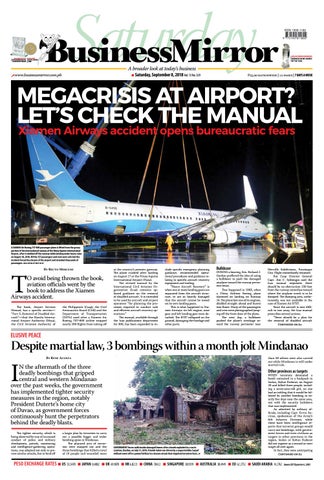
MEGACRISIS AT AIRPORT? LET’S CHECK THE MANUAL Xiamen Airways accident opens bureaucratic fears
A XIAMEN Air Boeing 737-800 passenger plane is lifted from the grassy portion of the international runway of the Ninoy Aquino International Airport, after it skidded off the runway while landing under heavy rains on August 18, 2018. All the 157 passengers and crew were safe but the incident forced the closure of the airport and stranded thousands of passengers. MIAA MEDIA AFFAIRS VIA AP
T
By Recto Mercene
O avoid being thrown the book, aviation officials went by the book to address the Xiamen Airways accident. The book, Airport Services Manual, has a specific section— “Part 5, Removal of Disabled Aircraft”—that the Manila International Airport Authority (Miaa), the Civil Aviation Authority of
the Philippines (Caap), the Civil Aeronautics Board (CAB) and the Department of Transportation (DOTr) used after a Xiamen Air Boeing 737-800 airline stopped nearly 200 flights from taking off
at the country’s premier gateway. The plane crashed after landing on August 17 at the Ninoy Aquino International Airport (Naia). The revised manual by the International Civil Aviation Organization (Icao) contains updated guidance on the removal of disabled aircraft. It is intended to be used by aircraft and airport operators “for planning the processes required to conduct safe and efficient aircraft recovery operations.” The manual, available through the Icao publications department for $90, has been expanded to in-
clude specific emergency planning guidance, recommended operational procedures and guidance relating to specific aircraft recovery equipment and tooling. “Heavy Aircraft Recovery” is when one or more landing gears are separated from the aircraft structure, or are so heavily damaged that the aircraft cannot be towed on its own landing gears. This is what happened to Xiamen Airways: its left engine, nose gear and left landing gear were detached. The B737 collapsed on the ground, damaging the fuselage and other parts.
Bulldozer
DURING a hearing, Sen. Richard J. Gordon proffered the idea of using a bulldozer to push the damaged airplane toward the runway perimeter fence. That happened in 1983, when a China Airlines Boeing plane slammed on landing on Runway 24. The plane lost one of its engines, skidded straight ahead and bursts into flame. Many of the passengers and crew were photographed jumping off the front door of the plane. The next day, a bulldozer pushed the plane’s wreckage toward the runway perimeter near
Merville Subdivision, Parañaque City. Flight immediately resumed. But Caap Director General Capt. Jim C. Sydiongco said the Icao manual stipulates there should be no obstruction 150 feet from the runway centerline toward where the airplane wreck is to be dumped. The dumping area, unfortunately, was not available in the case of Xiamen Air B737. Since the aircraft is now difficult to tow away, the Icao manual prescribes several actions. “There should be a plan for the removal of disabled aircraft Continued on A2
ELUSIVE PEACE
Despite martial law, 3 bombings within a month jolt Mindanao
I
By Rene Acosta
than 50 others were also carried out while Mindanao is still under martial rule.
N the aftermath of the three deadly bombings that gripped central and western Mindanao over the past weeks, the government has implemented tighter security measures in the region, notably President Duterte’s home city of Davao, as government forces continuously hunt the perpetrators behind the deadly blasts. The tighter security, which is being observed by way of increased conduct of police and military checkpoints, patrols, monitoring and intelligence-gathering operations, was adopted not only to prevent similar attacks, but to fend off
a larger plan by terrorists to carry out a possible bigger and wider bombing spree in Mindanao. The planned acts of terrorism were mapped out and the three bombings that killed a total of 16 people and wounded more
PESO EXCHANGE RATES n US 53.5470
Other provinces as targets
GOVERNMENT forces walk beside damaged homes after a bomb exploded in a van in Lamitan, Basilan, on July 31, 2018. A bomb-laden van driven by a suspected Abu Sayyaf militant went off in a powerful blast in a brazen attack that reignited terrorism fears. AP
WHEN terrorists detonated a bomb contained in a backpack in Isulan, Sultan Kudarat, on August 28 and killed three people, including a seven-year-old girl, no one had an inkling that it would be followed by another bombing in exactly five days near the same area, not with the security lockdown that was implemented. As admitted by military officials, including Capt. Ervin Encinas, spokesman of the Army’s 6th Infantry Division, while there have been intelligence reports that terrorist groups would carry out bombings, with government forces and even civilians as targets in other provinces in the region, Isulan or Sultan Kudarat did not register as a second or next target all over again. In fact, they were anticipating Continued on A2
n JAPAN 0.4802 n UK 69.1078 n HK 6.8223 n CHINA 7.8422 n SINGAPORE 38.9319 n AUSTRALIA 38.4949 n EU 62.2752 n SAUDI ARABIA 14.2762
Source: BSP (September 6, 2018 )
A2 Saturday, September 8, 2018
News
BusinessMirror
www.businessmirror.com.ph
Megacrisis at airport? Let’s check the manual Continued from a1
and the movement area should be established for an aerodrome, and a coordinator designated to implement the plan, when necessary.”
Royal Cargo
THE Icao manual added that “the disabled aircraft removal plan should be based on the characteristics of the aircraft that may normally be expected to operate at the aerodrome.” The plan said this should include, among other things, a list of equipment and personnel on, or in the vicinity of the aerodrome, which would be available for such purpose. Arrangements for the rapid receipt of aircraft recovery kits available from other aerodromes should also be included. For the equipment, the Miaa hired Royal Cargo Inc. Alberto T. Nañez, Royal Cargo Inc. operations manager, told the BusinessMirror he suggested to Miaa officials the use of 500-tonner and 200-tonner telescopic cranes. The B737 is only 66 tons fully loaded. After the passengers, cargo and fuel were evacuated, the plane weighed only 48 tons. Nañez told the BusinessMirror “the larger cranes are wide enough to accommodate the B737, which now weighed much less but has a wingspan that prevents easy access of associated equipment to be deployed.” He said moving the cranes from their headquarters to the crash site took time, not only because it was not built for speed, but because “we had to wait for clearance from the control tower before we could enter the runway.” It took Royal Cargo 12 hours to move the cranes into position.
Special group
ACCORDING to Miaa General Manager Eddie V. Monreal, the Miaa has a specialized group that handles disabled aircraft recovery. The Miaa sent members of
this group abroad two years ago for training. In actual recovery operations, it is this group that makes the decision on how to speedily assemble the removal equipment and the decision when to call on outside help, which is relayed to the Naia manager who sits at a crisis committee room. Since the big bosses are communicating with each other and are updated on the situation, there is no need for Transportation Secretary Arthur P. Tugade to be at the crash site, if the Icao manual is interpreted. The estimated time for the deployment of equipment and disabled aircraft removal equipment to the site should be provided, the Icao manual said. “In the case of reportable accident, the Director of Civil Aviation and Ministry of Transport must be notified,” the manual said. “The aircraft or wreckage must not be moved or interfered, except under the authority of the Director General.” An established command structure and clear lines of communication between various parties is essential to the efficient removal of a disabled aircraft. While tabletop exercises can help to anticipate and prepare for various aircraft removal scenarios, a postmortem of an actual disabled aircraft removal event should be conducted to examine areas where improvements can be made.
Crisis committee
DURING a Senate hearing, Monreal admitted there was no prior prearranged recovery agreement with crane operators that has the capability to lift disabled aircraft. He also admitted the absence of a crisis committee. This group is composed of the relevant officials of the DOTr, Caap, CAB, Miaa, Philippine Airlines (PAL), Cebu Pacific (CEB) and other airport stakeholders. Former Caap Deputy Director General Willy Borja said the cri-
ED MONREAL, General Manager of the Manila International Airport Authority, gestures during a news conference on August 20, 2018, on the incident involving the Xiamen Air Boeing 737-800 passenger plane that skidded off the runway while landing in heavy rain at the Ninoy Aquino International Airport. All the 157 passengers and crew were safe but the incident forced the closure of the runway for 36 hours and stranded more than 13,000 passengers on international flights. At left is Civil Aviation Authority of the Philippines Director General Jim Sydiongco. AP/BULLIT MARQUEZ
sis committee could have identified moves to speedily remove the disabled plane “and to anticipate problems that might occur due to airport closure.” He said one of these problems is the sudden arrival of stranded airplanes in the provinces and those from Xiamen Airways. Borja said the Caap should have anticipated this and informed the Miaa that many airplanes in the provinces could no longer wait and has to return to Manila, “not only to bring the stranded passen-
gers but to fly to other scheduled destinations.” “You cannot provide a slotting formula as if the airport operation is on normal mode,” Borja told the BusinessMirror. “This is a crisis situation for everybody, especially for the airlines, that has other routes and flight schedules to serve. They also had to deal with more than 100,000 delayed passengers.”
COA matter
BORJA said the second obvious problem was the appeal by stranded passengers for food, water and shower facilities—three days after the incident. Sen. Ralph G. Recto compelled Monreal to admit at the Senate hearing that the Naia has “cash on hand,” amounting to P15 billion.
(Not million as the BusinessMirror earlier reported). The chief of the Public Affairs Office (PAO) of the Miaa, Connie Bungag, has said feeding passengers “is the job of the airlines concerned and not the Naia.” Bungag said the Miaa was worried releasing funds would get the airport administration in trouble with the Commission on Audit (COA). Foreign Affairs Secretary Alan Peter S. Cayetano was said to have used the department’s funds to give P5,000 for each stranded passenger. The money was made available at the airport counters or at the headquarters of the Department of Foreign Affairs (DFA) in Pasay City. Former Caap Director General
Elusive peace... that the attack would be carried out against security forces, supposedly in Marbel, South Cotabato, as intelligence reports had earlier indicated. “There were reports…[on possible] IED [improvised explosive device] attacks. It’s not here in central Mindanao, but in adjacent provinces,” Encinas said after the second bombing in Isulan on September 2, which hit an Internet shop and left two people dead and 14 others injured. The successive bombings happened despite the existence of intelligence reports about threats of attacks by terrorist groups, as also admitted earlier by Defense Secretary Delfin Lorenzana following the suicide bombing in Lamitan City, Basilan, on August 31 that killed 11 people and wounded at least eight others. The bombing, according to Lorenzana, was carried out by a Moroccan member of the Islamic State, supposedly for the local terrorist Abu Sayyaf Group (ASG). The twin bombings in Sultan Kudarat, on the other hand, were blamed by military officials on the Bangsamoro Islamic Freedom Fighters or one of its factions that is a believer of the IS.
Basilan attack as a model
WHEN the Lamitan bombing happened, fears ensued that it will be used as a model and would be duplicated by other terrorist groups in waging their campaign against the government. However, this
Ramon S. Gutierrez said he perfectly understands Bungag’s or the Naia’s stance, given the climate of suspicion hanging over every public spending. “It is the threat of the COA, running after government employees with legal charges, even after they have retired, that kills any desire to think outside the box,” Gutierrez said in an interview. He added that if the Naia wanted to spend some money to feed the passengers and avoid the COA legal hounds, “they have to convene the board members and get a unanimous decision.” “In case the COA asks for justification for such expenditures later, the employees could always say it was a board decision,” Gutierrez added.
continued from A1
was dismissed by security officials, but to the contrary as shown later by the Isulan blasts. The bomb, according to Lorenzana and military officials, was intended to bring harm to some 4,000 children who were scheduled for graduation from the feeding program of the Department of Education, and whose event was slated at the city plaza. In Isulan’s first bombing, the homemade bomb was detonated near a pack of people who had come for the night market as the town marks its twin festivities, including its fiesta. The second bombing was also detonated inside an Internet café. All the three attacks were poised for maximum casualty by targeting a large gathering of people.
Terrorism for a cause
WHILE the government is taking measures to address the threats of attacks, not only in central Mindanao but in other parts of the region, security officials were also working to determine what fuels these attacks and the calls that propel them. While these terror groups are the combination of IS, ASG and Maute and the BIFF or its faction, all were working for slightly different causes, but all pursuing their objectives through terrorism. In the case of the BIFF or its faction, the group, as noted by the military, intensified its bombing activities right after the Bangsam-
oro Organic Law (BOL) was passed into law. The BIFF, a breakaway group of the Moro Islamic Liberation Front, is opposed to the BOL, whose prime mover was the MILF. Even Lorenzana admitted that there are groups who wanted to spoil the law for the Moros, as they are not totally sold to the idea. He said one issue that could spell trouble even among the Moros themselves is the power and position, and who gets them. “As I see it, the trouble lies in the apportioning or positioning,” Lorenzana said, noting the existence of different Moro tribes. There are also cities and areas that do not want to be included in the coverage of the BOL. In the meantime, the defense chief said there are at least six foreign IS members who remain unaccounted for and were stirring the cause of the international terrorist group in Mindanao. Like a sneak preview for a sequel to a horror movie, such information sends chills down the spine of civilian communities tired of all the war and strife, and looking to finally see peace—and progress—on the horizon. When this will happen, no one knows. Meantime, what was touted as the sense of security the people have from having martial law in Mindanao has been weakened by the knowledge that no amount of preparations can, after all, keep out a determined terrorist.
www.businessmirror.com.ph
The World BusinessMirror
TRUMP OFFICIALS CRY ‘NOT ME!’ AS HE FUMES OVER ‘NYT’ COLUMN By Zeke Miller & Jonathan Lemire The Associated Press
W
ASHINGTON—One after another, President Donald J. Trump’s top lieutenants stepped forward on Thursday to declare, “Not me.” They lined up to deny writing an incendiary New York Times opinion piece that was purportedly submitted by a member of an administration “resistance” movement straining to thwart Trump’s most dangerous impulses. By e-mail, by tweet and on camera, the denials paraded in from Cabinet-level officials—and even Vice Pre s i d e nt M i ke Pe n ce — a p p a re nt l y crafted for an audience of one, seated in the Oval Office. Senior officials in key national security and economic policy roles charged the ar ticle’s writer with cowardice, disloyalty and ac ting against America’s interests in harsh terms that mimicked the president’s own words. Tr u m p w a s i n c e n s e d a b o u t t h e column, calling around to confidants to vent about the author, solicit guesses as to his or her identity and fume that a “deep state” within the administration was conspiring against him. He ordered aides to unmask the writer, and issued a n ex t ra o rd i n a r y d e m a n d t h at t h e newspaper reveal the author to the government. In an interview on Thursday with Fox News, Trump said it was unfair for the person to pen the editorial anonymously because there’s no way to discredit it. H e s u g g e s t e d i t “m ay n o t b e a Republican, it may not be a conservative, it may be a deep state person who has been there for a long time.” As striking as the essay was the long list of officials who plausibly could have been its author. Many have privately s h a re d s o m e o f t h e a r t i c l e’s s a m e concerns about Trump with colleagues, friends and reporters. With such a wide circle of potential suspicion, Trump’s men and women felt they had no choice but to speak out. The denials and condemnations came in from far and wide: Secretary of State Mike Pompeo and Secretary of Defense Jim Mattis denied authorship on a visit to India; Interior Secretary
Ryan Zinke chimed in from American Samoa. In Washington, the claims of “not me” echoed from Vice President Pence’s office, from Energy Secretary Rick Perry, from Ambassador to Russia Jon Huntsman from Dan Coats, director of national intelligence, and other Cabinet members. The author professed to be a member of that same inner circle. So could the denials be trusted? There was no surefire way to know, and that only deepened the president’s frustrations. On Twitter, Trump charged “The Deep State and the Left, and their vehicle, the Fake News Media, are going Crazy - & they don’t know what to do.” White House officials did not respond to requests to elaborate on Trump’s call for the writer to be turned ove r to t h e g ove r n m e nt o r o n t h e unsupported national security grounds of his demand. Some who agreed with t h e w r i t e r ’s p o i n t s s u g g e s t e d t h e president’s reaction actually confirmed the author’s concerns. R u d y G i u l i a n i , t h e p r e s i d e n t ’s attorney, suggested that it “would be appropriate” for Trump to ask for a formal investigation into the identity of the op-ed author. “Let ’s assume it ’s a person with a security clearance. If they feel w r i t i n g t h i s i s a p p ro p r i ate, m ay b e they feel it would be appropriate to disclose national security secrets, too. That person should be found out and stopped,” Giuliani said. As the initial scramble to unmask the writer proved fruitless, attention turned to the questions the ar ticle raised, which have been whispered in Washington for more than a year: Is Trump truly in charge, and could a divided executive branch pose a danger to the countr y? Former CIA Director John Brennan, a fierce Trump critic, called the op-ed “active insubordination...born out of loyalty to the country.” “This is not sustainable to have an executive branch where individuals are not following the orders of the chief executive,” Brennan told NBC’s Today show. “I don’t know how Donald Trump is going to react to this. A wounded lion is a very dangerous animal, and I think Donald Trump is wounded.”
Saturday, September 8, 2018
A3
Stabbing of a leading Brazilian candidate could reshape race
R
IO DE JANEIRO—The wounding of a leading Brazilian presidential candidate has the potential to reshape the election contest after dramatically exposing the deep polarization in Latin America’s largest nation. Far-right congressman Jair Bolsonaro, a former army captain who has promised to crack down on crime, has long argued that Brazil is in chaos and needs a strong hand to be steadied. After a knife-wielding man stabbed the candidate in the abdomen during a campaign event on Thursday, Brazilians surged on to social media to argue over whether the attack supports Bolsonaro’s assertions that the country is off the rails or whether his heated rhetoric contributed to inciting the attack. Dr. Luiz Henrique Borsato, who performed emergency surgery on
the candidate, said Bolsonaro’s recovery so far was “satisfactory.” He said the candidate would remain hospitalized for at least a week after a two-hour operation to stop serious internal bleeding. In numerous videos posted on social media of the moment of the attack, Bolsonaro could be seen on the shoulders of a supporter, looking out at the crowd and giving a thumbs up with his left hand. He is seen flinching and then goes out of view. Other videos show supporters carrying him to a car and hitting a man who was apparently the attacker.
A suspect, identified by authorities as 40-year-old Adelio Bispo de Oliveira, was arrested within seconds. Police did not give a motive, but one official said the man appeared to be mentally unstable. “Our agents there said the attacker said he was ‘on a mission from God,’” Luis Boudens, president of the National Federation of Federal Police, told The Associated Press. “Their impression is that they were not dealing with a mentally stable person.” After more than four years of revelations of widespread corruption within Brazil’s political class, anger is running high in the country, and analysts initially predicted this would be a change election. But no true outsider has emerged. Instead, Bolsonaro, despite being a congressman since 1991, has harnessed much of the anger and presented himself as a maverick who will clean up a corrupt system. He also promises to confront a surge in crime, in part by giving police a freer hand to shoot and kill while on duty. The public’s anger is partially
responsible for making this year’s campaign the most unpredictable in years for Brazil, and the attack could lead to another seismic shift. The man leading polls, former President Luiz Inacio Lula da Silva, has been barred from running by electoral authorities because he was convicted of corruption and is in jail. That puts Bolsonaro in the lead position, though it is unclear how the attack might affect the campaign for the October 7 presidential ballot. In the hours following the attack in Juiz de Fora, about 125 miles (200 kilometers) north of Rio de Janeiro, Bolsonaro supporters predicted it would carry him to the presidency. “They made Bolsonaro a martyr,” said Jonatan Valente, a student who joined a small vigil for Bolsonaro in São Paulo. “I think the left shot itself in the foot because with this attack they will end up electing Bolsonaro.” But it is unknown when he can get out again on the campaign trail and if his injuries will impede his ability to campaign. AP
CALIFORNIA TAKES FINANCIAL BLOW FROM UNRELENTING WILDFIRES
S
HASTA-TRINITY NATIONAL FOREST, California—California is taking a financial wallop from unrelenting wildfires that have drained its firefighting budget and prompted nearly $1 billion in property claims even before the start of the dangerous fall fire season, officials said on Thursday. The disclosures came as a roaring blaze in a rural area near the Oregon state line closed 72 kilometers of heavily traveled Interstate 5, the main highway from Mexico to Canada. Fierce orange flames forced panicked truckers to abandon big-rigs and brought screams from motorists as they watched the advancing fire in Shasta-
Trinity National Forest. A decision was expected on Friday on when to reopen the highway. The wildfire flared just weeks after a blaze in the Redding area killed eight people and burned about 1,100 homes. California’s insurance commissioner said on wzzwwwwThursday that victims of that fire and one in the Mendocino area—the two largest blazes in the state so far this year—have filed more than 10,000 claims so far totaling $845 million. Th e t wo w i l d f i re s d e s t roye d o r damaged a combined 8,800 homes and 329 businesses. “The worst may be yet to come,” Commissioner David Jones warned at a
San Francisco news conference, noting that California wildfires are typically more destructive after September 1. Last year, for example, wildfires that killed more than 40 people and destroyed thousands of buildings in counties north of San Francisco didn’t spark until October. Also on Thursday, the director of the state’s firefighting agency said in a letter to lawmakers that the agency only had about $11 million remaining in its annual budget and anticipates needing another $234 million to add firefighters and helicopters, and to cover other costs of fires expected later this year. The department had spent $432 million
through the end of August, said Ken Pimlott of the California Department of Forestry and Fire Protection. The Legislature budgets for firefighting costs based on historical averages. Cal Fire has requested extra money in seven of the past 10 years but never this early, according to the Department of Finance. In far Northern California, officials said they had no plans to re-open Interstate 5 on Thursday and would reevaluate early Friday—a decision that slowed or stalled truckers who rely heavily on the highway to transport goods along the West Coast. They were advised to take an alternate route adding 160 kilometers that could take at least six hours. AP
ExportUnlimited
A4 Saturday, September 8, 2018 • Editor: Efleda P. Campos
BusinessMirror
PHL food, beverage exporters to US A urged to comply with FDA requirements
70 local MSMEs to showcase products and services in Caexpo
T
HE Department of Trade and Industry, through the Foreign Trade Service Corps (FTSC) and Export Marketing Bureau (EMB), is urging all food and beverage exporters to the United States to renew the registration of their food facilities as mandated by the United States Food and Drug Administration (US FDA). The Food Safety Modernization Act (FSMA) requires that food facilities should renew their registrations with the FDA during “the period beginning on October 1 and ending on December 31 of each even-numbered year.” With this requirement, renewals should be done this year within the period
October 1 to December 31, 2018. Shipments from the Philippines may be refused entry to the US when the associated food facility registration is not renewed properly. For further inquiries, exporters may contact FURLS Helpdesk through phone: 1-800-216-7331 or 301-575-0156 or through e-mail at FURLS@fda.gov.
For first-time food exporters to the US, the relevant guidance on food facility registration is found at: https://www.fda.gov/Food/GuidanceRegulation/FoodFacilityRegistration/default.htm. Meanwhile, Philippine exporters are also urged to review their labels to assure compliance with the new FDA requirements on the Nutrition Facts labels for food, beverages and dietary supplements, which will take effect on January 1, 2020. Labeling errors are a leading cause of FDA detentions. The relevant information is contained in: https:// www.fda.gov/Food/LabelingNutrition/ucm537159.htm. The US FDA has updated the packaged foods and beverages’ Nutrition Facts label with a new design for easier reading and simpler identification. In addition to these upcoming deadlines, Philippine exporters to the US need to be aware that the compliance deadlines have passed
for the FSMA Preventive Controls Rule for both small and large facilities. This rule requires facilities to implement written Hazard Analysis and Risk-Based Preventive Controls (HARPC) Food Safety Plans. Plans, such as Hazard Analysis of Critical Control Points (HACCP), British Retail Consortium (BRC), International Organization for Standardization (ISO), and Safe Quality Food (SQF) do not satisfy this new requirement. Facilities that have not yet developed their plan are recommended to do so immediately as the US FDA may request a facility’s Food Safety Plan as part of a routine inspection. Additionally, the US importer is expected to request a copy of the facility’s plan to fulfill the importer’s requirements under FDA’s Foreign Supplier Verification Program rule. US FDA’s FSMA Preventive Controls Rule can be viewed at https://www.fda. gov/Food/GuidanceRegulation/FSMA/ ucm334115.htm.
BOUT 70 Philippine micro, small and medium enterprises (MSMEs) are participating in the 15th China-Asean Expo (Caexpo) from September 12 to 15, 2018 at the Nanning International Convention and Exhibition Center in Nanning, the capital of Guangxi Zhuang Autonomous Region in southwestern China. The Philippines will showcase an array of food and beverage products, fashion wearables, arts and crafts, personal care, food supplement and services, expecting to generate sales worth $26 million. Additionally, a separate businessto-business (B2B) meeting room will be set up for the first time inside the Philippines Commodity Hall Area to give Philippine participants the opportunity to present both their needs and their offers, which are expected to result in new collaborations. The delegation is being organized by the Department of Trade and Industry-Center for International Trade Expositions and Missions with partner agencies that include the provincial government of Tarlac, Philippine Trade and Investment Center-Guangzhou, DTI-Export
DTI-EMB conducts info session on PHL-Efta FTA By Patricia Blacer
Trade-Industry Development Specialist, DTI-EMB
T
HE Export Marketing Bureau (EMB) of the Department of Trade and Industry (DTI) conducted an information session regarding the recently ratified Philippines-European Free Trade Association Free Trade Agreement (PHLEfta FTA) on August 30 at the DTI International Building in Makati. The information session, under the Philippine Export Competitiveness Program (PECP), was attended by close to 50 participants, composed of exporters, business support organizations, officers from relevant government agencies and other export stakeholders. The PECP is an EMB umbrella program that aims to boost the competitive stance of exporters and stakeholders through the conduct of information sessions, seminars, workshops and similar activities. For this session, guest speakers from Efta state embassies in Manila, the Bureau of Customs, and DTI-EMB officers presented an overview of market opportunities for exporting to the Efta states. DTI-EMB Market Officer Gold Grospe started the series of discussions by giving a summary of what the PHL-Efta FTA is all about and an economic background on Efta member-states: Switzerland, Norway, Iceland and Liechtenstein. Deputy Head of Mission and Chargé d’ Affaires Mathias Domenig
of the Embassy of Switzerland presented a briefer on the current trade relations of the Philippines and Switzerland. His presentation, entitled “Create growth and opportunities through improved market access and framework conditions,’’ tackled opportunities for Filipino exporters and how they can take advantage of Switzerland as an open market, multicultural society, with a high purchasing power. He also remarked Swiss buyers’ purchasing decision highly favors sustainability-oriented labels or “green’’ products. Domenig ended his discussion about the complementarity of Philippine and Swiss economies, with both having machineries and mechanical appliances as common export products. Pharmaceuticals are the Swiss’s top traded products to the Philippines, while electrical machineries remain the Philippines’s top export product to Switzerland. Deputy Head of Mission and Chargé d’ Affaires Larissa Kosanovic of the Royal Embassy of Norway presented a lecture, entitled “How to Export to EFTA Countries – Norway” which served as a briefer on Norwegian trade relations with the Philippines. According to statistics, machineries, mechanical appliances, and vehicles are some of Norway’s top imports which post a lot of potential for Philippine manufacturers. For exporters, Kosanovic underscores that significant opportunities await Philippine-made grocery items, such as fruits and vegetables, clothing, footwear, furniture, ceramics and
DTI supports Aspire’s capacity-building, business-matching session in Bacolod By Myrtle Faye L. Solina
R
As an enrollee of the Ripples + Program, Malagos has benefited from the assistance provided by the DTI-EMB program. Ripples + assists emerging micro, small and medium enterprises (MSMEs) in the development of their products and services through strategic interventions, such as trainings and capacity-building; investment; marketing and promotions; support for innovation; product development and design; and market access facilitation through mutual recognition arrangements and certifications. These interventions or modes of assistance will ensure that the companies are competent and export-ready. The program has worked toward increasing the number of internationally competitive local product and services exporters with EMB at the helm. Also by joining different food fairs internationally and locally, Malagos has been recognized globally.
TIDS Food and Agri-Marine Dvision (FAMD), DTI-EMB
T SPEARHEADING the information session on the Philippines-European Free Trade Association Free Trade Agreement held at the Department of Trade and Industry (DTI) International Offices were (from left): Customs Operations Officer Gina German, DTI-Trade and Investment Promotion Group Undersecretary Nora K. Terrado, Norwegian Embassy Deputy Head of Mission Larissa Kosanovic and Swiss Embassy Deputy Head of Mission Mathias Domenig.
handicrafts and chemical products. She also talked about important Norwegian business culture and practices such as their high regard for quality, health and safety, traceability and reliability. Kosanovic ended her presentation by citing useful web site links for interested and would-be exporters to Norway. Customs Operations Officer Gina German of the Bureau of Customs gave an overview on Rules of Origin for the PHL-Efta FTA, and explained the concept of originating goods. She also discussed some examples on product-specific rules (PSRs) for Philippine exports to the Efta states, and how to file an Origin Declaration
for both approved and non-approved exporters. German also tackled the Registered Exporters (REX) System, a new system for certification of origin of goods under the Generalized System of Preferences. This system requires exporters from a GSP beneficiary country like the Philippines to register with the appropriate authority—the BOC for the Philippines. Registered exporters are free to issue Certificates of Origin or a declaration called Statement of Origin. German noted that there will soon be a Customs Memorandum Order (CMO) to be issued that will identify the guidelines on this
new REX System for EU-GSP. After a series of discussion on Efta, EMB introduced Tradeline Philippines, an interactive business intelligence platform that provides stakeholders with an integrated export information system on trade statistics, market and product information, as well as supplier and buyer database. A presentation of the web site’s features was conducted by Senior Trade Industry Specialist Susette Manrique of the Knowledge Processing Division. After the lectures, an open forum was conducted where participants asked questions and interacted with the resource speakers.
Malagos Chocolates founder-owner launches book on company’s history EGIONAL Interactive Platform for Philippine Exporters Plus (Ripples +) Program enrollee and award-winning chocolate company Malagos Chocolates recently launched the book The Malagos Book of Chocolate to mark their sixth year in the chocolate-making business during the World Food Expo (Wofex) held at the World Trade Center on August 1 to 4. The event was headed by Charita Puentespina, founder of Puentespina Farm and Malagos Chocolate, and Rex Puentespina, farmer and chocolate maker of Malagos Chocolate. Department of Trade and Industry’s Trade and Investments Promotion Group Undersecretary Nora K. Terrado, Design Center of the Philippines Executive Director Rhea O. Matute, and DTI-Export Marketing Bureau (EMB) Assistant Director Anthony Rivera also joined the company’s milestone.
Marketing Bureau, DTI-Bureau of Domestic Trade Promotion, DTIRegional Operations Group, Board of Investments, the Department of Agriculture-Agribusiness and Marketing Assistance Service and the Tourism Promotions Board. The province of Tarlac is this year’s selected “Province of Charm.” It will showcase the cultural tourism and investment priority areas of the province. China was the Philippines’s top trading partner in 2017, with trade valued at $25.48 billion, up 16.19 percent, from the $21.9 billion recorded in 2016. The Philippines exported $8.02 billion worth of merchandise to China in 2017, up 25.8 percent, from the $6.37 billion posted in 2016. The country imported $96.08 billion worth of merchandise from China in 2017, up 14.25 percent, from the $84.11 billion reported in 2016. Since 2004 the Caexpo has been held annually in Nanning, South China. It is organized by the People’s Government of Guangxi Zhuang Autonomous Region and cosponsored by the ministries of Commerce or Trade and Industry of China and the 10 Asean member-countries, as well as the Asean secretariat.
The company was frequently cited by international award-giving bodies year after year for producing some of the best chocolates in the world. Its most recent recognition was from the 2018 Academy of Chocolate Awards, where its Malagos 72-percent Dark Chocolate and its Malagos 85-percent Dark Chocolate were given the Bronze award in the Tree-to-Bar Category. At the same awards’ Drinking Chocolate category, its Malagos 72-percent Dark Chocolate and its Malagos 100-percent Dark Chocolate received the Bronze award, while its Malagos 85-percent Dark Chocolate was given the Silver award. The brand also received the 2018 Great Taste Award, where four of its products were recognized. The Great Taste Awards gave Malagos 100-percent Unsweetened Chocolate the highest rating in the Hot Chocolate Drink category, making it
one of only two products to receive the recognition. “These awards are a testament to our commitment to raising the quality of Filipino chocolates,” Rex said. “Early on, we knew that the Philippines, especially Davao, has the potential for competing with the best chocolates in the world. We are committed to staying true to this vision,” he added. From initially making only the traditional tableas or chocolate disks, the company has invested in equipment and expertise to produce finefood chocolates that meet international standards. On their sixth year in the chocolate industry, the company launched The Malagos Book of Chocolates written by best-selling author Clinton Palanca and featured photographs by renowned photographer Neal Oshima. The book highlighted 70 recipes from 46 chefs and bakers, including
prominent Filipino chefs Romy Dorotan, Myrna Segismundo, Claude Tayag and Jordy Navarra. The recipes were compiled by Ginny Roces de Guzman. “This book captures our journey from being a cacao producer to becoming one of the most-awarded Filipino chocolate brands in the world,” Puentespina said. The Malagos Book of Chocolate is available online at www.malagoschocolate.com and at their stores in Manila and Davao. During the event, the company also introduced additions to its product lineup of unsweetened baking chocolate, chocolate bars and roasted chocolate nibs. Today, it produces word-class products, such as chocolate-coated dried fruits like guyabano (soursop), pineapple, mango and young coconut. It also now has pralines—chocolate treats filled with whiskey, rum, salted caramel or chocolate ganache.
HE Department of Trade and Industry-Export Marketing Bureau (DTI-EMB) participated in the recently concluded Agribusiness Support for Promotion and Investment in Regional Exposition (Aspire) Capacity Building and Business Matching Session for Agribusiness Entrepreneurs of Visayas Area Business Conference at L’Fisher Hotel, Bacolod on August 30 and 31. Aspire is a program spearheaded by the Department of Agriculture (DA) in partnership with the DTI, the Philippine Chamber of Commerce and Industry (PCCI), and the private sector. It aims to promote opportunities in the agribusiness sector to boost trade and investments and build a strong partnership with other government and private-sector industry groups. The program advocates to integrate market-development support services to farmers; fishers; micro, small and medium enterprises; and other stakeholders who are part of the supply and value chains by providing platforms, such as capacity-building, consultancy and business-matching activities. Its overarching objective is to develop the capacity of its stakeholders on the supply side to take advantage of market opportunities. In her speech, Alegria S. Limjoco, president of the PCCI, emphasized the aspiration of the Philippines to scale up the agricultural sector. She further mentioned that to meet this, the Philippines has to improve the competitiveness of the sector with the ultimate goal of uplifting the lives of the Filipino people relying on this sector, to limit the importation of the country and to be on a par with its neighboring countries such as Malaysia and Thailand. Meanwhile, Roberto Amores, president of Philippine Food Processors and Exporters Organization Inc., encouraged the participants to keep on improving and emphasized their critical role in the global value chain as suppliers of raw materials. Business meetings were facilitated by the DTI-EMB’s Food and Agri-Marine Division led by its Chief Rose Marie G. Castillo. Suppliers and manufacturers from Aklan, Antique, Capiz, Guimaras, Iloilo and Negros Occidental participated on the said activity.
Sports BusinessMirror
Editor: Jun Lomibao • mirror_sports@yahoo.com.ph
MEDALISTS AT THE SENATE Senate Finance Committee Vice Chairman Juan Edgardo “Sonny” Angara welcomes the Jakarta
Palembang 18th Asian Games medalists during a 2019 budget committee hearing on Thursday. Also present are Philippine Sports Commission Chairman William Ramirez and Commissioners Charles Raymond Maxey and Celia Kiram. Angara renews his call for bigger allowances for athletes and urges the country’s sports officials to hasten the rehabilitation of sports facilities throughout the country.
Saturday, September 8, 2018
A5
A6
BusinessMi
Saturday, September 8, 2018 | Editor: Jun Lomibao
CYCLING TOURISM: A WIN-WIN SITUATION E
VERY DAY during the summer months, cyclists can be seen making their way up the roads that snake to the summit of Mont Ventoux in the South of France. Riders from across the world travel to this part of Provence to tackle the storied climb made famous by the Tour de France. Those riders may spend the night in a local hotel, eat at local restaurants or visit one of the numerous bicycle shops to be found in the villages at the base of the mountain.
No matter the discipline, the most iconic bicycle races in the world are often intrinsically linked to the location where they take place. The great sporting moments that unfold on roads, trails, tracks and in velodromes spark the imaginations of the public, inspiring them to travel to the same venues. Many cycling fans opt to spend their holidays riding the same roads as their cycling heroes, be it the Italian Dolomites, French Alps, Spain’s Pyrenees or in Flanders, Belgium.
MARKETING OPPORTUNITY
REGIONS and cities that host elite races increasingly understand that there is a marketing and tourism opportunity to be seized in parallel. A race that is televised, shared on social media and reported on in the world’s press, not only showcases the beauty of a region but also attracts amateur cyclists. These riders may take part in organised mass-participation events or simply ride in the region ahead of A CYCLIST climbs the Muur van Geraardsbergen in Flanders, Belgium. UCI PHOTO
the elite riders. Others travel to the venue after the event, inspired by what they witnessed from afar. Many regions develop guided routes based on elite races. For example, in Flanders, Belgium, three routes inspired by the annual spring classic, the Ronde Van Vlaanderen, are on offer. They vary from 78.4 kilometers to 115.5 kms in length. A dedicated tourism web site— Cycling in Flanders—has been created for the region, marketing a visit as being a “pilgrimage for cycling fans.” The web site not only details cycling routes and events but also provides information about local hotels, B&Bs, restaurants, bicycle rentals, tour guide operators and other services. Providing such information helps boost the attractiveness of the region as a holiday destination, and at the same time supports local businesses. Also listed on the web site are attractions that are of particular interest to cycling fans, such as the Tour of Flanders Museum in Oudenaarde or the Circuit Zolder, an F1 circuit where it is possible to cycle on the racetrack at certain times. When it comes to the tourism market, it is important to cater to all abilities: Some visitors wish to emulate their heroes on testing climbs or challenging trails, while others may simply be seeking to integrate cycling into their family vacation in an area known for cycling.
UCI News
BURYING THE HATCHET
T
HREE years on, Peter Sagan (BoraHansgrohe) and the motorbike driver who caused him to crash and then quit the Vuelta a España in 2015 have formally buried the hatchet. Sagan and Jesus Esteban, the in-race moto driver who inadvertently collided with the rider late in Stage 8 of the 2015 race, met and made up during the 2018 Vuelta a España’s rest day recently. The Bora-Hansgrohe rider gave Esteban a signed world champion’s jersey, whilst Esteban gifted Sagan with the front windscreen of the motorbike which he had been driving that day and which was broken when he collided with the rider. According to a Tinkoff-Saxo team press release at the time, as a result of the accident, Sagan suffered wounds and burns of first and second degree on the left side of his body, from the hip to the lower leg. He also had a contusion on his left forearm with an intramuscular haematoma. His shorts ripped to shreds, revealing
his injuries, the then-Tinkoff-Saxo rider punched the Vuelta medical car, gestured vehemently at the race motorbike, then appeared to kick his own bike. Fined 300 Swiss Francs by the commissaires for his actions, Sagan finished the stage, but then quit the Vuelta that evening. Esteban was expelled from the race, while the organization offered an apology. Although the team threatened legal action, it did not materialize. Three years on, when the two met after Bora-Hansgrohe’s rest-day training ride, under much more relaxed circumstances, Sagan put the tumultuous events of that year’s Vuelta in a bigger perspective, arguing that every cloud has a silver—or in his case, rainbow-colored—lining. According to Spanish news agency EFE, Sagan told the driver: “Thanks to that crash, I became world champion, so I have to thank you. “The crash meant I left the race, but it wasn’t so bad because I had won a stage and
I was going to quit soon anyway. From that day onward, my road toward three World Championships began.” The Vuelta race jury for this year, meanwhile, docked Sagan 20 seconds for drafting behind a team car as the world champion fought his way back from a mechanical during Saturday’s Stage 8 to Almaden. Sagan eventually regained the bunch and finished second to Alejandro Valverde (Movistar) over the final uphill sprint. Sagan suffered a mechanical with about 50 kilometers remaining in the 195.5-km stage that looked on paper at least to be wellsuited to the Slovakian fast man’s skills. He has yet to score a win since his near-disastrous crash at the Tour de France, and the team had this flat stage with its rising finish marked up for him as part of his comeback to form. Things started out to script for the stage, which came one day before Sunday’s first big mountain test. A three-rider move went up the road almost immediately with Thiago Machado (Katusha-Alpecin), Jorge Cubero (Burgos-BH) and Hector Saez (Euskadi-Murias). The trio posed little threat to the GC or the sprint teams’ plans, however, and their gap was allowed to
go up to a minute while Bora, Quick-Step Floors, Trek-Segafredo and Cofidis took turns on the front. The rather uneventful stage took a turn for Sagan with just over an hour to race when he was forced to stop. As riders do, Sagan spent some time in the caravan as he made his way back to the tip of the racing, lingering behind the LottoNL-Jumbo car and others. His time in the slipstreams apparently caught the eye of race officials, who decided Sagan had at some point crossed the line from grey area to penalty. The 20-second GC slap will mean little to Sagan, as he is already nearly 45 minutes behind race leader Rudy Molard (GroupamaFDJ) and runner-up Valverde. His drop from 93rd place to 99th overall won’t concern Sagan as much, as he’ll rue the missed opportunity to snag one of the few sprint stages remaining in this year’s Vuelta. “We managed to keep a small break, the guys then pulled hard to bring it back, and I was in a good spot for the sprint,” Sagan said in a statement released by the team. “I gave my all in the hard, final meters but it wasn’t enough to win. Still, I feel my form is improving each and every day.” Cyclingnews
LOIC CHETOUT receives medical treatment after crashing in Stage 9, as Michael Cherel’s back is a mess.
NO S
AS ‘A PE
CHOPPER CAUSES CRASH
C
RASHES during a stage are an unwelcome but not unexpected part of racing, but riders expect to be safe from incidents once they cross the finish line. That was not the case after Stage 6 of the Vuelta a España, when a low-flying helicopter blew unsecured barriers across the road and into unsuspecting riders. The incident was shown only briefly on television, but there were plenty of fans filming, and other angles of the incident have been posted on social media. Leaves and debris can be seen being blown into the air before the barriers slight from the left to the right of the road. There were people around, but nobody was able to stop them before they move into the peloton, which has just concluded a
dramatic Stage 6. A few riders had a lucky escape, such as Movistar’s Nairo Quintana and Alejandro Valverde, but AG2R La Mondiale’s Julien Duval was not so fortunate. The Frenchman, who has been suffering in the opening days of the race and sits last in the overall classification, had made it through an earlier incident to finish in the front group. However, as he made his way to the team bus, he was taken out by the barriers. The 28-year-old required two stitches to his wound. Duval’s teammate Tony Gallopin just made it through and can be seen in fan footage putting his foot out to prevent the barriers from knocking him over. Sergio Henao (Team Sky) was right behind Duval and was also
CHAOTIC STAGE FINALE
I
IT’S “forgive and forget” for Peter Sagan and the Vuelta motorbike driver from the 2015 crash.
RELAND’S Dan Martin (UAE Team Emirates) has criticized the finale of Stage 7 of the Vuelta a España, which featured a high number of mechanical incidents, crashes and punctures, as “just chaos.” The Irishman, who is not fighting for the overall title, was wrongly described as suffering a mechanical on one of the more difficult descents at the finish. In fact, he lost four-anda-half minutes after trying to shepherd home the team’s sprinter, Simone Consonni. “We’ve been riding on these beautiful roads all day, and then the last 15 kilometers, it’s just chaos,” Martin fumed. “Obviously, it’s good for television, but it’s not nice to ride on. I just hope that the guys who were affected by the crashes are OK and that the mechanicals didn’t affect the race too much.” Martin said that the final segment of climbing over a third category climb near the finish at Pozo Alcon, followed by a spectacular—but twisting and poorly surfaced—descent, had been the worst. “It would have been nice if they’d swept the road, you know?” he said. “It’s was a really, really bad road surface, the number of mechanicals and problems you saw, crashes...” Martin himself later said that he
didn’t have any problems on the road, rather he was helping out teammates when he had a reported mechanical. “It was our sprinter, he went so deep to get over the climb there, and we thought that was it, we thought it would be easy to the finish, especially with the headwinds, yeah, so I waited for him and obviously all hell broke loose, there was that steep climb we didn’t know about.” As for his own condition, Martin said he was not in the best of shape yet. “I’ve got heavy legs at the moment, I’m not fully ‘back’ from the Tour yet, so it’s hard work, and I’m trying to do a good job for Fabio [Aru] hopefully in a psychological way as well as in the race. “The team is riding really well here around Fabio, we’re a young team here and we’ve had a lot of different programs. “Hopefully we can continue like that, and it’ll be a bit easier on Saturday”—theoretically a flat stage—“and we can have a go on Sunday.” Cyclingnews
THE CLIMB
THE peloton makes its way up a hillside near Bristol in England during Stage 3 of the Tour of Britain. AP
irror CYCLING
mirror_sports@yahoo.com.ph | Saturday, September 8, 2018
A7
Froome, Thomas to miss UCI World Championships
T
EAM Sky has confirmed that Chris Froome and Geraint Thomas will not race in the International Cycling Union (UCI) World Championships that begin with the team time trial on September 23. The two Grand Tour champions cast doubt upon their participation in a press conference before the Tour of Britain. Team Sky Sports Director Scott Lancaster confirmed the decision had been made for both riders to end their seasons after their home Tour. “Froome and G [Thomas] will finish their seasons here, it’s good to finish, on not necessarily a form wise high, but on a morale and psychological boost for next year on a high,” Lancaster told Cycling Weekly. “I think G originally thought about it [racing at Worlds], I would have wanted him there in the team time trial but obviously he is burnt out after a massive season and the stress they put themselves under with training and diet, etc.”
SUCH THING
PERFECT RACE’ taken off his bike by the barriers but managed to get his left foot out before hitting the tarmac. It was not a good day for the Vuelta a España organizers on Thursday with the finale of Stage 6 marred by two serious, but avoidable, crashes. Prior to the finish line incident, poorly indicated and ill-protected bollards parked a crash that would split the bunch and see Thibaut Pinot (Groupama-FDJ) and Wilco Kelderman (Team Sunweb) lose more than a minute in the overall classification. Victor Campenaerts was the rider who hit the barriers first and also ended up with stitches—10 in his elbow. Bollards, and the removal of them, have been a hot topic for several years, with a number of riders involved in crashes caused by them. Despite the crashes, all riders involved were able to finish the stage and are expected to start Stage 7 from Puerto Lumbreras to Pozo Alcon.
A LOW-FLYING helicopter causes a crash in Stage 6 of the Vuelta a España.
Cyclingnews
BLAME A STRAY BIDON
C
OFIDIS’S Loic Chetout and AG2R La Mondiale’s Mikael Cherel used the rest day at the Vuelta a España to recover from the crash they were both involved in during the early part of Stage 9 over the weekend. The crash—apparently the result of a stray water bottle—happened around 40 kms into the 200.8-km stage, and brought down a number
of riders, but Chetout and Cherel were the only two left on the deck after the tangle of bikes was extricated from battered limbs. Chetout found himself in a storm drain on the left-hand side of the road, and the 25-year-old at least appeared to have come off worse with almost the entire back of his jersey ripped open and much of the left leg
of his shorts missing. Cherel, meanwhile, was at the bottom of the pile, and took his time to remount while medical staff gave him the once over, but then rode on sporting a bloodied right elbow and a severely torn jersey. Explaining what had happened came in the form of a tweet from 32-year-old Cherel on Sunday evening: “Sometimes you miss water bottles that have been lost, or stupidly dropped, on the road by just a couple of centimeters, but other times you
hit them square on...” Once riding again, Chetout received medical attention from the race doctor’s car, which included having an injury to his thigh looked at, but the two Frenchmen were later seen chatting together once safely back in the confines of the peloton, no doubt comparing who had the least amount of jersey material left on their back. Both riders finished the stage, although no reports on their injuries have yet been released by their teams. Cyclingnews
Both riders were listed on British Cycling’s long list for the national team events, but have yet to officially inform the federation of their decision. Froome centered his whole season around an attempt at winning both the Giro d’Italia and the Tour de France. He succeeded at the Giro d’Italia in May, then turned around and finished third behind Thomas and Tom Dumoulin at the Tour de France. Thomas took the lead of the Tour de France on Stage 11 and never lost the maillot jaune, adding his first Grand Tour victory to victories in the Critérium du Dauphiné and the British time trial championships this season, and a second place in the Volta ao Algarve in February and third in Tirreno-Adriatico in March. The absence of the duo puts Dumoulin as the top contender for the individual time trial and leaves the road race wide open for a variety of climbers and roulers. Cyclingnews
GERAINT THOMAS (left) and Chris Froome say they are fatigued from the Grand Tours.
Moscon on expulsion: I didn’t do anything G IANNI MOSCON has revealed that he received no additional punishment from Team Sky following his expulsion from the Tour de France for striking Elie Gesbert (Fortuneo-Oscaro) in the opening kilometers of Stage 15. Moscon is currently serving a five-week ban from racing that was handed to him by the International Cycling Union (UCI) and can return to competition on September 15, but continues to train hard, convinced he will be selected for the Italian team for the World Championships in Innsbruck, Austria. In an interview with Tuttosport published, Moscon denied that he had tried to hit Gesbert, despite television footage demonstrating that he had turned and raised his arm at the French rider. Team Sky released a video apology from Moscon in the immediate aftermath of his expulsion from the Tour, but the Italian has now said that he “didn’t do anything” and claimed that his disqualification from the Tour had its roots in Team Sky’s unpopularity. “I haven’t thought much about what happened at the Tour because I didn’t have much to think about because I didn’t do anything,” Moscon said. “If I had really tried to punch Gesbert, then in the images why doesn’t he even lean back to avoid this phantom blow? In reality, I just told him to get lost in an obvious way. But Team Sky is unsympathetic for a lot of people and attracts animosity. And, given what’s happened before, I’m the black sheep, the easiest one to damage.” Moscon’s rap sheet over the past two seasons is a lengthy and unedifying one. He racially abused Kévin Reza during the 2017 MOSCON
Tour de Romandie, and though his Team Sky allowed him to complete the Tour de Romandie, he was later side-lined for six weeks. In September of last year, Moscon was disqualified from the World Championships road race in Bergen when video emerged of him taking a tow from the Italian team car after he was caught up in a crash on the penultimate lap. Last October Moscon was accused of deliberately causing Sebastien Reichenbach (FDJ) to crash during the Tre Valli Varesine, but the UCI disciplinary committee dropped the case in June, citing a lack of evidence due to the absence of video footage. Reichenbach suffered a fractured elbow and hip in the crash, and the Swiss rider believed Moscon deliberately caused the crash in retribution for his part in highlighting how the Team Sky rider had racially abused Reza at the Tour de Romandie. Following Moscon’s racial abuse of Reza in 2017, Team Sky had said: “Gianni knows that there is no excuse for his behavior and that any repeat will result in termination of his contract.” Manager Dave Brailsford refused to discuss Moscon’s future on the team during the Tour de France, though Team Sky later opted to withhold him from racing until the UCI announced its sanction in early-August. “The team was always on my side, I didn’t even get a fine,” said Moscon. “And G[eraint Thomas] was very kind to me in Paris, as were all of my other teammates.” Returning in time for the World Championships Moscon is scheduled to return to racing at the Coppa Agostoni one-day race on September 15 and will also line out at the Coppa Bernocchi the following day as he bids to earn a place in the Italian team for the World Championships in Innsbruck. After previously living in Monaco, Moscon has this year relocated to Innsbruck—the city is two hours from his native Livo in Trentino—and is very familiar with the exceedingly difficult parcours. Despite his ban from racing, Moscon began his Worlds preparation in August with a training camp on the Stelvio, where he was accompanied by Team Sky directeur sportif Dario Cioni. In an interview in this month’s edition of the Italian Bicisport magazine, Moscon said that he has been in regular contact with Italian Coach Davide Cassani. “Cassani has never abandoned me. He called me to ask what had happened and how I was,” Moscon told Bicisport. “Davide knows how to establish an extraordinary human rapport with his boys, which goes beyond his formal role as coach. We’ll see what condition I have, but I have demonstrated with Sky what I know how to put myself at the service of the team.” Cyclingnews
OurTime
A8 Saturday, September 8, 2018 • Editor: Efleda P. Campos
BusinessMirror
‘Apolong’ Tasya, my great grandmother, is an Igorot
E
By Micah Hatulan | Special to the BusinessMirror
VERY individual living in this world dreams of living a long life, but it is not for us to decide. When someone just turned 100 years old, we are usually amazed by it. In this era, it’s unusual for a person to reach that age; that’s why we consider it as a milestone.
Even reaching half of a century is hard to achieve. My great-grandmother is now 101 years old. She lives in a place where motor vehicles are seldom seen and heard. Only the chirping birds can be heard clearly. Fresh and healthy air is not just sensed by the nose, but can be felt by the whole body. In this place high up in the mountains of Benguet, you seemed to be living in a time freeze when mobile phones weren’t invented yet. It is surprising that there are people who live seemingly in the middle of nowhere. If you visit my great-grandmother, you endure a 13-hour bus ride from Metro Manila and walk for nearly an hour on the cliffs of Tublay, Benguet, to reach the humble home of my Alapong Tasya. My great-grandmother is Imelda Tomas Pontino, but we call her
Alapong Tasya. Alapong is a KanKanaey word, the native dialect of the Igorot, which means Lola. She was born in the mountains of Benguet on May 16, 1917. When she was 19, she married the head of a tribe from Mountain Province, Thomas Pontino, my great-grandfather. He was a respected deer hunter because of his enormous hunts, but what made his reputation was his being a fierce headhunter. Our family still keeps his spear and shield used during his hunting days. My great-grandparents met while Lolo Thomas was searching for his brother who went hunting and never returned. His search took him to Benguet. After they met, Lolo Thomas turned his back from his brutal hunting life and chose to be with Alapong Tasya. He learned how to plant and grow his own crops and to live with other tribes peacefully. They were
blessed with seven children. Their fifth daughter, Lola Irene, is my grandmother. Lolo Thomas died at the age of 89. He was buried in the front yard of their hut. This was where my Alapong wanted her husband to be buried. When her time comes, she expressed her wish to be buried beside her husband. I was 13 years old when I first met my Alapong because it was hard to reach their place. I’ve only been there twice. The first thing I noticed when I saw her was the unusual color of her eyes. They were blue. From her children down to the fifth generation, no one in the family inherited her blue eyes. She doesn’t know why her eyes are blue, but those eyes were the reason her brothers needed to hide her during the Japanese occupation here in the Philippines. A Japanese soldier saw her while she was doing laundry by the lake and, from then on, she was hunted by the Japanese to be one of their comfort women. But she was never captured. Her brothers built an underground shelter to serve as her hiding place when the Japanese arrived to search for captives. She showed us the location of that refuge, but it has since been washed down by the heavy rains. At her age, it is surprising to see her manage to do heavy work like carry a large basket full of potatoes
on her head and climb up the mountains. When asked what her secret is in reaching her age, she would answer in Ilocano, “ Eat vegetables.” Meat is a rarity in this place. But when people do, they do it during “Kanao” when they eat a lot of meat. It’s thanksgiving time to their god for giving them a bountiful harvest. Vegetables and fruits are the main sources of food in their place. It is Mother Nature at its finest. My family asked her multiple times to come and live with us in the city. We even told her that we have a television. But she answered in Ilocano, “No, I was born here. I will die here.” Alapong was in tears when it was time for us to go back home. She said she never thought she has a big family. She hugged us one by one and said, “When you come back here, I may not know you anymore because my memory is fading, and I’m forgetting a lot of things.” A few days after Alapong marked her 101st birthday, she slipped down a mud staircase and broke her back. Her children have all been pleading to her to go to the hospital for treatment, but she always refused. Now, she’s having a hard time to get up and walk. Her son, a farmer, gave up his farming to attend to his mother. The blood of Alapong Tasya and Lolo Thomas runs in my veins, making me one-fourth Igorot. It is a heritage I am very proud of.
Think Chinese home prices are high? Try buying a grave
E
SCALATING home prices in China may be making it an ever more expensive place to live, but pity the sick and elderly: It’s also becoming an increasingly less affordable place to die. Grave prices have outpaced home prices in every one of the past three years, according to Fu Shou Yuan International Group Ltd., China’s largest publicly traded operator of cemeteries and funeral facilities. The cost of an average plot, roughly the size of half a yoga mat, has surged 41 percent since the first half of 2015 to 100,483 yuan ($14,800). A gauge of home prices in 70 Chinese cities advanced 23 percent over that period. Fu Shou Yuan filings showed that’s about 112,545 yuan per square meter in 2017—double the 56,196 yuan per sq m it costs to buy an apartment in the southern metropolis of Shenzhen, China’s most-expensive city. “Supply is very limited,” said Hao Hong, a chief strategist at Bocom International Holdings Co. “We’ve heard about some people who bought flats in Shanghai to store cremains instead of expensive graves.” Shanghai-based Fu Shou Yuan, whose name translates to “good fortune longevity garden,” sold 6,214 graves across China in the first six months of 2018 with the average unit price rising 7 percent year-on-year. Land that’s used for graves has so far escaped the long arm of China’s regulators, said Yan Yuejin, a property analyst at China Real Estate Information Corp. in Shanghai. “That’s partly fueled the soaring prices.” Beijing has imposed various property curbs over the years in an attempt to cool the housing market but needs to ensure there isn’t a sudden decline in home prices that could harm the broader economy. By some estimates, real estate accounts (directly and indirectly) for as much as 30 percent of gross domestic product.Bloomberg News
SAMPAGUITA VENDOR
Aling Elaija Rouqe Gregorio, 66, is a sampaguita and candle street vendor. She sells her merchandise around the Saint Nicholas of Tolentine Cathedral, more commonly known as the Cabanatuan Cathedral. She has eight children, with one working in Japan. She continues to sell because she refuses to be homebound. Besides, she wants to be close to the house of God. IAN JUDE AVELLANOSA
www.businessmirror.com.ph
A new US law helps banks flag fraud against seniors
D
AWN SHAW, a retired legal secretary in northern Maine, made two stops weekly without fail. One was her church. The other was her local bank, where she swapped stories about her children and their families with the branch manager. Gradually, Shaw, a widow, began showing signs of confusion, prompting the manager to check her account. The manager found an automatic monthly withdrawal had recently been set up. She knew Shaw did her banking in person, not electronically, so she notified Shaw’s nearest daughter, Cathy. They discovered someone had used Shaw’s banking information to steal her money. “It wasn’t a lot of money,” said Shaw’s other daughter, Judith M. Shaw, who is the administrator of the Maine Office of Securities. “But it made me realize why it is important for frontline bank employees to identify red flags early.” It was not only her meticulous mother who was being defrauded. In the last decade, Judith Shaw said, there has been a steady rise in financial fraud against older people in Maine. Her mother’s experience a few years ago prompted this idea: Encourage state officials to start a pilot program that would train bank employees to recognize suspicious activity, like sudden large transfers, in exchange for greater protection from legal liability for reporting it. In early-2014 hundreds of employees at Maine’s banks and other financial institutions began learning how to recognize unusual account activity that might indicate fraud or financial exploitation. The pilot program went so well that one of Maine’s senators, Susan M. Collins, introduced legislation to take it national. The result, the Senior Safe Act, which became law in May, gives banks that accept such training more certainty that they would not be punished for disclosing account information to the authorities. Without that protection, banks and their employees run the risk of being sued by clients, or fined or penalized by regulators. “As baby boomers hit their milestones and retire, there’s been a growing focus on what we can report,” said Robert G. Rowe, associate chief counsel for the American Bankers Association. “The law gives us safe harbor to report suspicious activity.” The act is too new to have a national track record, but in Maine, Shaw said that since 2014, reports to her office about seniors being exploited financially jumped to a total of 70—from zero. “That may not seem like much nationally,” she said, “but it’s a lot for a small state like Maine.” Retirees across the country are increasingly the targets of various
financial frauds. One in 5 older consumers say they have been the victim of some form of financial abuse, according to the Consumer Financial Protection Bureau. Despite efforts to combat it, instances of fraud abound. The Federal Trade Commission, for example, received 2.7 million reports of it in 2017. That figure covers only some of the varied kinds of fraud that can drain a person’s bank account, and makes it impossible to know the overall amount of victims’ losses. True Link Financial, a financial services firm for older people, pins the cost to older consumers at $36.5 billion annually. As customers age, they become a prime target for fraud, experts say, because they can have a lifetime of savings sitting in their accounts. More than 60 percent of bank customers are older than 50, and they hold 70 percent of deposit balances, according to a 2017 survey by the American Bankers Association. Frauds involving bank accounts come in many forms, including check washing, the practice of erasing and substituting different information on a check; duplicating checks; unauthorized debit charges; and submitting fake checks for deposit, said Laurel Sykes, chief risk officer at Montecito Bank & Trust, a large private bank in California. “One of our customers, a retired professional, thought he was hired as an IT worker from home,” Sykes said. “He gave up his banking credentials so he could get the promised paycheck deposited. But it never happened. He asked us about it, and we had to tell him that it was a scam.” Another popular way to access customer accounts, Sykes has found, starts when a person selling an item on a service like Craigslist receives a check for an amount larger than the asking price. “Then the buyer calls and says, ‘I paid too much, send me back $100, or $400,’” Sykes said. “They try to get the customer’s banking information that way.” Wiring money can be another way to obtain a person’s account information. The bank, on California’s affluent central coast, has also dealt with a major uptick in check fraud, with more than five times as many fraudulent check cases reported so far in 2018, compared with the same period of 2014, she said. “It’s been a heartbreaking year,” she said. As they encounter more fraud directed at older customers, banks are stepping up their warnings, monitoring and education efforts. First Financial Bank in Abilene, Texas, for example, certifies its employees as “fraud busters” after they are trained to recognize potentially fraudulent actions. Bloomberg News
Elderly Koreans shut out of family reunions use back channels
S
EOUL, South Korea—Kim Kyung-jae will probably never be chosen in the government lottery that would allow him to reunite one last time with his relatives in North Korea. But that’s no problem, he said this week in an interview, even as a small group of the lucky South Koreans who won the lottery met with their loved ones in North Korea. The 86-year-old Kim is one of a dwindling number of elderly South Koreans who, frustrated with North Korea’s reluctance to allow more frequent reunions and by the small chance that they’ll be selected before they die, found unofficial networks to communicate with their North Korean relatives. For three decades, Kim has been sending his North Korean sister letters and aid. “It’s absolutely regrettable that other South Koreans don’t know
about these communication channels,” Kim said, showing a bunch of letters with North Korean stamps that his sister has sent to him over the years. During this week’s reunions, which end on Sunday and are organized by the rival governments, hundreds of Koreans, many in their 70s or older, have been reunited for the first time since the 1950-1953 Korean War. But they are just a tiny fraction of the separated families in the Koreas, where millions were split during the turmoil of the war. This is the 21st time the Koreas have had such reunions, but they don’t occur regularly because of long periods of bad feelings between the rivals, and Pyongyang’s reluctance to expose its people to the outside world. So Kim and others turn to friends, brokers and others in China, Japan and elsewhere to try to find out
whether their relatives in North Korea are still alive and to arrange exchanges of letters, photos, phone calls and sometimes face-to-face meetings with them. Officially, both Koreas ban their citizens from contacting each other without government approval. But South Korea allows and even quietly helps finance backchannel contacts among separated families on humanitarian grounds. It’s likely that Seoul keeps the backchannel programs lowkey because of worries about angering North Korea, which refuses South Korea’s push to have more frequent official reunions because it uses them as political leverage. South Korean officials have occasionally told separated families of their support for unofficial exchanges, but they’ve stopped short of major publicity campaigns because of concerns about brokers swindling people.
According to a Seoul government tally on civilian-arranged exchanges between separated families, there have been about 11,610 cases of letter exchanges and 1,755 face-to-face encounters involving 3,416 Koreans since 1990. By comparison, before this week’s reunions, government-sponsored programs saw 19,770 people reunited in person since 2000; none was given a second chance to reunite. The backchannel exchanges flourished during a previous “Sunshine” era of inter-Korean detente, but the number has sharply decreased in recent years as many elderly refugees in South Korea have died and North Korea has tightened control on its once porous border with China. Because thousands of separated family members die each year in South Korea without getting a chance to attend the on-again off-again gov-
ernment-organized reunions, these informal exchanges are often the only way for some to communicate with their relatives in the North. Kim, who once ran a fisheries export business in Japan, said he has friends there who print out his e-mails and mail them to his younger sister and other relatives in North Korea. When they get replies from North Korea, they scan and e-mail them to Kim. When he wants to give his relatives clothes, shoes and other items, he uses brokers in China to send them by parcel post after paying them 200 yuan ($30) for each 20-kilogram (44- pound) box. He said he’s helped about 30 other South Koreans correspond with their relatives in North Korea or send them aid parcels. These South Koreans are mostly from where Kim grew up in North Korea, before the war, on the east coast. AP
BusinessMirror
Editor: Gerard S. Ramos • lifestylebusinessmirror@gmail.com
DIGITAL PLATFORM TO TRANSFORM CUSTOMER EXPERIENCE
WITH the age of digital technology changing the way Filipinos live, play, work and do business, global cement manufacturer Cemex Holdings Philippines (www. cemexholdingsphilippines.com) will soon launch an innovative digital platform in the country to elevate the building materials industry’s standard in delivering superior experience and services for Filipino customers. Cemex Go is positioned as a tool that adds value to customers’ businesses by enhancing their operating efficiency and competitiveness. Through the first-of-its-kind, fully digital customer integration platform, customers can get more business done in less time by being able to transact and interact with Cemex anytime, anywhere using their mobile devices. The simplified processes and shift from manual to digital reduce customers’ administrative burden and allow them to focus more on strategy, growth opportunities and other business matters. Currently, over 10,000 customers have already embraced Cemex Go across three continents, which cover close to a quarter of Cemex’s customer base worldwide. By the end of 2018 it is expected to be available in all of Cemex’s geographies, including the Philippines, serving approximately 45,000 customers. “A customer-centric mind-set is at the core of our relentless pursuit of continuous innovation and improvement. This is why Cemex Go creates an experience that is superior to anything that has been provided in the past, and is a pioneering platform in the global building materials industry,” explained Ignacio Mijares, president and CEO of Cemex Holdings Philippines. To be launched in the Philippines this month, Cemex Go is set to lead the digital transformation of the country’s construction industry in terms of customer experience. The platform offers four pillars of benefits for customers, such as better accessibility, efficient tracking of accounts, transparency, and enables printing of documents such as invoices, official receipts, among others. Covering the full customer journey, Cemex Go allows customers to place orders, review their history of transactions, track their shipments in real time via GPS, receive instant notifications of their order status, adjust their orders and enjoy full visibility of all the information they need to better manage their business. In short, with Cemex Go, customers will be able to do in minutes what historically has taken hours, all in just a few clicks away. “In these interconnected times, Cemex Go places the power to succeed in today’s fast-paced and dynamic market in the hands of our customers through greater productivity, transparency and efficiency,” said Mijares. “We will continue to lead the digital transformation in our industry by applying the latest technologies to improve our delivery of personalized experience and benefits, and move us closer to our customers worldwide.”
/
OLX Philippines General Manager Raffy Montemayor and Greenfield Development Corp. HR and Sales Head Manuel Diloy
/
PROPERTY24 Key Account Manager Melizza Hernandez, Regus Area Director Ana Joy Rocero and Area Manager Edizon Zausa
Saturday, September 8, 2018 A9
How do you cross the line from calling-out to bullying? PRIMETIME
DINNA CHAN VASQUEZ @dinnachanvasquez luckydinna@gmail.com
B
EFORE the Internet became everyone’s birthright, a celebrity or politician involved in a scandal would have had to endure weeks of being in newspapers until the next big issue came along. Or until another public figure made a mistake. Or had a deep dark secret revealed. That’s not the case anymore. A public figure who is called out on the Internet would have it coming via different channels. If he or she is extra unlucky, even relatives and friends will be bashed. Wikipedia describes call-out culture as the “social phenomenon of publicly denouncing perceived racism, sexism, homophobia, transphobia and other forms of bigotry. Denunciation can happen in person or online.” Recently, several YouTube stars based in the United States have been called out on the Internet because of some old tweets of theirs that were dug up. It all started when YouTube star Gabriel Zamora posted a picture of himself with Manny Mua, Laura Lee and Nikita Dragun on Twitter accompanied by a caption that seemed to throw shade at Jeffree Star. The picture showed them sticking up their middle finger. So what happened next? Star’s fans dug up old tweets of the four and some of those tweets were apparently racist. In 2012 Laura Lee wrote: “Tip for all black people if you pull ur pants up you can run from the police faster.. #yourwelcome.” Between the four (Manny Mua, Lee, Dragun and Zamora), they’ve lost thousands of followers and endorsement and collaboration deals, including Lee with retailer Ulta Beauty. Such is the power of the callout culture. In the Philippines YouTube star Michelle Dy also got embroiled in a copyright controversy with Star, something for which she has already apologized. After that, she was in a Twitter war of sorts with Anna Cay, who made a series of tweets which seemed to refer to Dy. No tagging was involved, however. I don’t appreciate racism or any form of discrimination or bigotry, and I understand that call-out culture is needed. But how is it when the line between calling-out and bullying has been crossed? In the Philippines the bashers of this female star dug up her old tweets. By old, I mean she was only 15 years old when she wrote those tweets, included some cussing and dissing certain stars and even members
of her family. This girl is near in age to my daughter and I do know that when they were 15 or thereabouts, they would post the weirdest things online. They didn’t know any better. We were lucky there was no Internet to document what we were doing while we were growing up because I think we did even crazier things then. In the case of this star, I think her bashers have definitely crossed the line when they involved her friends and even ex-boyfriends. They can hate her, that’s their right, but to attack what she did when she was a minor is very wrong, in my opinion. An Asian rap artist’s career was over the moment a netizen questioned his credentials, including his having attended educational institutions in the US. Other netizens joined the bandwagon and continued to attack his credibility even after the artist had already proven that he indeed attended the schools he said he did. It’s so easy for someone to call-out another person
online, celebrity or not. It’s so easy for us to bash a brand, institution or store on Facebook, Twitter and Instagram, and I’ve been guilty of this in the past. Yes, certain individuals or groups have to be calledout. It is necessary. The Internet is a good venue to call-out wrongs committed against marginalized groups and people, but I really hope we don’t cross the line and call for the mob to attack the target’s family, friends and associates. For instance, is it really necessary to point out to a celebrity that she or he has gained weight or looks old in a photograph? I have seen strangers do this on Instagram and like any curious person, I look at their profiles and it always happens that they have Bible verses in their bios. Their profile pictures show them with their children and/or loved ones. But I’d like to think that almost every netizen is a work in progress and that in a decade or less (hopefully), every person would be more responsible and mindful on the Internet. ■
Virtual-reality tour brings biblical-era Jerusalem to life BY ILAN BEN ZION The Associated Press
CHEERS TO FIVE YEARS OF SUCCESS
PROPERTY24 Philippines, the premier real-estate portal of OLX Philippines, recently celebrated its fifth anniversary with an exclusive dinner for partners, top agents, realtors and developers. During the event, OLX Philippines General Manager Raffy Montemayor, together with head of real estate Tina Bautista, welcomed guests and partners. “For five years, we have managed to generate 2.8 million unique leads, we have grown more than 2.7 times in views, and we have the privilege of working with more than 6,000 property sellers throughout the Philippines,” shared Bautista. Taking part in the special occasion were some of the partner clients and top real-estate developers, including Greenfield Development Corp., BPI Buena Mano, Regus, Eastwood Property Holdings, DMCI Holdings Inc., Filinvest Land Inc. and Taylormade Construction and Development. Needless to say, property buyers and sellers are in good hands especially with OLX Philippines and Property24 Philippines’s combined reach, which has been dubbed, as “The Power of Two.” Together, they have flourished as the top property portal in the Philippines that it is today.
JERUSALEM—A Jerusalem museum is breathing life into the ancient city with a new virtual-reality tour that allows visitors to experience how archaeologists believe Jerusalem looked 2,000 years ago. The Tower of David Museum, which is housed in the Old City’s ancient stronghold, plans to launch the high-tech guided tour this month ahead of the Jewish holiday of Sukkot. The virtual-reality guide, “Step into History,” offers visitors a chance to “walk in the streets of Jerusalem and enjoy the present and take a look back to the past,” said Tower of David Museum Director Eilat Lieber. Working with archaeologists from the Israel Antiquities Authority, Lithodomos VR created 360-degree simulations of how Jerusalem’s citadel, palaces, streets and ancient Jewish temple are believed to have appeared during its heyday under King Herod in the first century BC and during the life of Jesus. Herod, a Roman vassal who ruled Judaea from 37-4 BC, invested heavily in large construction projects across his realm, including a major expansion of the Jewish Temple in Jerusalem and the fortress and palace where the Tower of David stands today. His monuments, including the mountaintop fortress at
Masada and the port city of Caesarea, are among the most visited sites in Israel. “Especially with Jerusalem, I think the biggest challenge was getting it right,” said Simon Young, founder of Lithodomos VR, an Australian startup. “There’s a lot of different opinions about how Jerusalem looked in the ancient world... Of course, we want to do justice to Jerusalem and to make it as accurate as possible.” Lithodomos VR’s team of archaeologists and artists has produced similar projects in London, Rome, Athens and other cities. The Tower of David Museum also houses an innovation lab in a chamber at the top of a Herodianera keep that once served as the chambers of Jerusalem’s Ottoman governor. The lab, launched in October 2017, hosts start-ups such as Lithodomos VR that are developing technologies to enhance visitor experience, with a particular emphasis on virtual and enhanced reality. The site also holds an elaborate light show that projects moving images in intricate detail on the ancient walls of the Old City. Accompanied by a guide, visitors will be able explore nine different vantage points in the city, starting at the citadel—an Ottoman-era fortress built atop remnants of several earlier bastions—then meandering through the Old City’s Jewish Quarter
down toward the remains of the Second Jewish Temple. In order to keep from crashing into modern Jerusalem, visitors carry the goggles between sites, then put them on once they are stationary. At each point, a narrator explains the historical significance of the structures they can see in the goggles: the columned marketplace of the Cardo, the heart of the ancient city; the soaring towers of Herod’s citadel; the opulent pools of his pleasure palace and the temple. The VR tour around the Old City takes approximately two hours, the museum said. The tour is confined to the Old City’s Jewish Quarter. The Old City lies in east Jerusalem—an area captured by Israel in the 1967 Mideast war and claimed by the Palestinians as their future capital. Israel rejects any division of the Old City—home to Jerusalem’s most sensitive Jewish, Muslim and Christian holy sites. Young says the Lithodomos VR team would be interested in adding additional historical layers to the virtual-reality guide that would allow people to explore Jerusalem during other periods, such as the Crusades. Judy Magnusson, an Australian tourist who previewed the tour on Monday ahead of its launch, said the virtual-reality enhanced experience “brings history to life” and makes the stories about the city “more real.”
A10 Saturday, September 8, 2018
BusinessMirror
www.businessmirror.com.ph
Job-search mobile app launched to serve 4.1 million Tesda graduates, other ‘blue-collar’ workers
H
BY RODERICK L. ABAD Contributor
OMEGROWN job-search app provider FindWork officially launched in the Philippines, benefiting all the 4.1 million certified Technical Education and Skills Development Authority (Tesda) graduates, as well as other skilled and service-sector workers in the country. Created by tech experts and app innovators Kevin Williams and Allen Tan, this online recruitment platform was established to cater specifically to the large yet underserved “blue-collar” market, which the company referred to as trabahunters who are always looking for employment opportunities. “When we decided to launch FindWork, it’s not about just the technology. It’s about the people that we are reaching out to. This [blue-collar] population in the Philippines makes up over 56 percent of the working population,” Williams, CEO of FindWork, said during the kick-off event held at the Shangri-La Makati last week. According to him, this labor force experiences almost a 5-percent average turnover yearly. Nevertheless, there’s no job-search platform available that specifically catered to this sector until FindWork had its soft launch three months ago, shortly after its
kickoff in Indonesia. “So, as we are focusing on this market, we are looking at how can we deliver the best solution to the people of the Philippines,” he said. Part of this endeavor is their tie-up with Tesda, which he described as “a game-changing partnership for us and for the people of the Philippines.” Such collaboration guarantees that the 2.1 million graduated and 2 million upcoming graduates under the Tesda program will immediately be included in the FindWork system to increase their chances of employment. “We in Tesda are happy that we finally have a partnership with FindWork,” Tesda Director Cariza A. Dacuma said. “We found a solution with them to connect our graduates and the employers.” The employment-search platform also tied up with Southeast Asia’s leading financial services provider, TrueMoney. Both endeavors aim to foster stress-free and opportunity-driven growth for the trabahunter market. “We are actually going to offer tools for these Filipinos to better manage their finances once they start earning in the future. So [we] potentially offer solutions for them to save money, affordably send remittances out to their relatives in the provinces, and to better manage their expenses, as well,” TrueMoney Managing Director Xavier Marzan said.
Since recruitment is a two-way process that requires communication between the employer and applicant, FindWork tied up with Smart Communications. This specifically leverages on the telco’s infrastructure to provide data to a market that’s reliant on free data surfing. It also ensures that the job-search app can always be used with all its components without lagging or having to disable features. “One of the biggest problems [of connecting an employer to a prospective employee] is communication. How will a hiring company reach out to jobseekers? It’s very difficult. We wanted to partner with Smart [to] offer the FindWork app for free inside a free net. So now, anybody that’s searching for a job can get access free of data charges,” said Williams. FindWork has special filters to help both parties easily find matches based on experience, training, position and even geolocation. Also, it has a chat feature that allows employer and jobseeker to talk in real time. “Everybody has a smartphone,” he explained. “So it was only natural for us to utilize this as the next step for better job searching by first underscoring that the hiring process is a two-way street.” Among the big companies that FindWork has signed up are Vivo, SM, Hotel Sogo, Starbucks and Office Warehouse. Each company regularly posts four
to five job openings on average. The app is currently available on Androidpowered mobile phones and will be up for iOS devices in the next few weeks. It’s for free to use by the jobseekers, but charges an affordable price on hiring firms for job postings. “Today, we have over 500 companies and over 40,000 trabahunters, with both parties enjoying a 30-percent success rate from initial pairing to shortlisting,” Williams said. “For jobs, we have more than 1,000 jobs [posted]. Right now, everyday we’re signing up companies. The target is 50 to 100 jobs per day [at the] minimum per location. So, hopefully, by the end of the year we can have one jobseeker [who] will be [having] one available job post for him,” FindWork Country Head Rommel Torres said. Beyond the private sector, the company also has forged alliances with local government units, such as Manila, Makati and Taguig. “We are partners with the mayors and congressmen to have job fairs per barangay [within their respective areas of jurisdiction],” he said. “[In the] next few weeks, we will be in [the] Calabarzon and Camanava [areas], and the next few months, we will be launching also in different cities, [such as] Cebu and Davao, with the help of our partners in Tesda to make sure that everyone will have a job in the location that’s near them.” ■
TELLTALE BITS OF DNA HELP TRACK PAST AND ELUSIVE WILDLIFE
MARK OLMEDO (from left), Asus TPR; David Lacsamana, Converge ICT product manager; Onins Aquino, sales head NCR consumer; Angela Gutierrez, marketing director; Eason Lin, Asus PH country manager for open platform; Florence Valiao, Asus-OP assistant marketing manager; Sandra Tubale-Dingal, segment marketing manager-consumer; and brand and content team
The most powerful partnership this side of gaming IN line with the “Game Changer” campaign, two major tech companies, Asus Republic of Gamers and Converge ICT, have forged a historic partnership set to alter the landscape of eSports and online gaming in the country. The media event was held at Joy-Nostalg Hotel at Ortigas business district. Powered by Converge’s pure end-to-end fiber Internet network, Asus Republic of Gamer’s flagship router, called ROG Rapture, is now on offer for subscribers to Converge’s FiberXtreme plans, with irresistible discounts on installation fees and more perks for gamers and gaming enthusiasts alike. The event was attended by key local
tech and media correspondents, with Converge FiberX influencers, PC gaming analysts, Richard “Bossmac” Suba of Back2Gaming and top female Twitch streamer Ann B. Mateo gracing the event. Converge is an official peering partner of major video game publishers, such as Valve (Dota 2) and Garena (League of Legends), as well as the game-streaming industry’s top platform, Twitch. The FiberXtreme gaming plans are now available throughout Converge’s pure, end-to-end fiber-optic network (www.convergeict.com/add-on/fiberxgaming).
Digital solutions for better LRT 1 customer experience THE Light Rail Manila Corp. (LRMC), in partnership with the Hub of Innovation for Inclusion (HiFI) of the De La Salle-College of Saint Benilde (DLS-CSB), recently announced the winners of the two-day hackathon, HackaTren 2018, a competition aimed to crowdsource ideas and solutions to further help improve customer experience on the Light Rail Transit (LRT) Line 1, held at the Manila Grand Opera Hotel, Manila. Tara! Customer Experience Management System, which features trip planning, wayfinding, customer-feedback management, rewards system and advertising using
LRMC President and CEO Juan Alfonso (left) and HiFI Social Designer and Director Abigail MapuaCabanilla (right) with winners James de Perio (from left), Damiel Quiming and Jet Alcantara of Team NyxDev.
technologies, such as RFID and augmented reality (AR), bagged the top prize, including a P100,000 cash prize. The idea was pitched by Team NyxDev, comprised of system developers Daniel Quiming, Jet Alcantara and James de Perio. The runners-up were Team AR Botics with their proposal CommutAR, an AR platform that provides users with trip and tourism information; and the Team National Teachers’ College with their Light Manila app for trip planning and online purchase of tickets. To ensure customer-centric solutions, the DLS-CSB HiFI oriented participants on the design-thinking process, where the “trifecta for innovation, namely, desirability, feasibility and viability,” were reiterated for the programs and informationtechnology solutions to be presented on the day. Some of the challenges provided to the participants included: how commuting experience can be more entertaining and relaxing, and how to leverage technology to make commuting a social activity. Other points considered the utilization of the LRT 1 as a top-of-mind alternative for commuters to beat traffic, to schedule trips in advance and to make the trains workfriendly. The HackaTren 2018 winners were determined based on the value, design, quality and uniqueness of the proposed solutions. The panel of judges included LRMC CEO Juan F. Alfonso, LRMC Corporate Communications Director Rochelle Gamboa, LRMC Information Management & Technology Head Randy Sac, Asia Society for Social improvement and Sustainable Transformation Asia Managing Director Sreenivas Narayanan, Chief Evangelist Officer VJ Africa, and HiFI Director Abigail Mapua-Cabanilla.
NEW YORK—On a scorching summer day, Mark Stoeckle threw a bucket into the murky waters of New York’s East River to fill up three small plastic bottles. The biologist hopes the water he collected contains the genetic trail of the river’s diverse life, including all of its fish—and of course, the occasional rat. “We’ve cleaned up the East River significantly, but we’re still dumping a lot of stuff,” said Stoeckle of Rockefeller University. “This will give us a better idea of whether fish are recovering or not.” He doesn’t have to catch the slippery fish himself —a dangerous task given the river’s rocky bottom and strong currents. He just needs to look for the tiny bits of DNA they leave behind to track them. Animals lose hair, scales and feathers as they move. They also discard skin cells and waste. All of these leave traces of genetic material that can be detected hours, weeks or even millennia later. Scientists say analyzing the DNA floating in waterways or hiding in soil, which they call environmental DNA or eDNA, promises to help in managing and protecting biodiversity. The tactic has become increasingly popular within the past few years and has already provided clues of ancient mammoths in Siberia, early warnings of frog die-offs in California and evidence of elusive sawfish in Mexico. For Sam Chew Chin, a fish ecologist at York College in New York, the DNA sampling reminds him of childhood shows he loved such as Star Trek. “Whenever they’d find a new planet, they would scan it for life,’” he said. “Detecting environmental DNA is kind of the closest we come to being able to do that. It’s pretty neat.” Chew Chin said he used to be a “muddy-boots and bloody-desk biologist.” Studying fish meant capturing them and eventually killing them. Now, he searches for whales off of Long Island or fish in the Hudson River by testing water— an advance that has made his job faster and cheaper. It wasn’t always like that. Nobody really cared about eDNA a decade ago, said Danish geneticist Eske Willerslev, who pioneered the technique. He had been traveling to Siberia to sample permafrost. The frozen soil was so cold that he thought ancient genetic material could have remained intact throughout the years. In 2002, with a handful of permafrost samples the size of a sugar cube, he was able to identify the genetic material of
bison, horses and many different plants that lived hundreds of thousands of years ago. He also found the preserved DNA of mammoths. Environmental DNA “helps us reach the inaccessible,” said Willerslev from the Natural History Museum of Denmark, adding that this approach will play a key role in scientists’ quest to understand nature. Examples of this are appearing in other fields, where eDNA has changed how researchers think about conservation. When Colleen Kamoroff spent the summer collecting water in 2015 from the lakes in California’s Sierra Nevada, she saw a healthy group of native mountain yellow-legged frogs hopping around. One month later, they were all dying. The culprit: a microorganism that has caused the decline of about 200 amphibian species around the world, called chytrid fungus. Curious whether the frogs could have been saved if she had seen early signs, Kamoroff, a wildlife biologist who works for Yosemite National Park in California, started looking for chytrid fungus DNA in the water she had sampled. She was surprised to find it. “Maybe if we knew they were infected at that point, we could have been more prepared. We could have started treating them” with medication, she said. If a species is reduced to the verge of extinction, protecting the area where animals live or breeding them in captivity can sometimes help rescue it. It has been done before. But knowing where those last survivors hide is a common headache for conservationists. Marine biologist Ramon Bonfil has spent more than three years looking for the last sawfish of Mexico where tropical waters were once teemed with the elusive and strangelooking rays. Now, they’re nowhere to be found. The last specimen was accidentally caught in 2016. Other than that, no one has seen a live sawfish for almost a decade. Gill nets, drones and fishermen have all failed to spot them. Bonfil, however, discovered sawfish DNA in three water samples he took two years ago in the state of Veracruz. It’s a weak signal, which could mean there aren’t many creatures swimming around. But it’s recent. “The key is knowing where they are. Until we find them, we won’t be able to protect them,” said Bonfil. AP
IN this August 10 photo, Mark Stoeckle throws a bucket into New York’s East River. Scientists say scooping a bottle of water or a sample of soil can be enough to detect the genetic material of endangered or elusive species. It’s an approach that can help them better monitor and protect the environment. AP
BusinessMirror
www.businessmirror.com.ph
Saturday, September 8, 2018 A11
IGTV is going to change how you use Instagram BY JONAH ENGEL BROMWICH New York Times News Service
T
HOSE who make a living through Instagram—a group of influencers who can be critical of developments on the platform—are thrilled about the company’s latest feature, Instagram TV. The feature, which allows users to stream videos up to an hour long, has already appeared within the app, bringing a new mode of entertainment to an environment that already takes up a whole lot of its users’ free time. It will also exist as a stand-alone app for those who want all full-screen video all the time, making it a platform all its own, presenting video after video to you for as long as you can take it. Sam Sheffer, a former tech journalist, has 165,000 subscribers to his YouTube channel and only 29,800 followers on Instagram. He said that he still intended to use the new feature. “Everyone spends time on Instagram,” he said. “Every single person is always on Instagram. When you go to YouTube, you’re actively looking for something. Instagram, you’re waiting in line and it’s like, let me just go waste some time.” One of the platform’s stars who appeared at Instagram’s behest for its recent announcement was Bryce Xavier, the model and violinist who’s used his IGTV videos so far to showcase his dancing ability and to talk seriously about bullying. Xavier has already begun making regular short IGTV videos. He would not comment on the financial arrangement that led to his appearance at Instagram’s San Francisco office for the announcement, where he gushed about the new feature onstage. (The event, which was heavily delayed, was streamed live from San Francisco to other cities where journalists and Instagram employees gathered—and waited—to watch the announcement.) Xavier was really excited about the app’s emphasis on vertical video. “For a lot of our fan base, the simplest things in a sense can be kind of difficult for them,” he said. “Just trying to turn your screen to look at another platform, some people might see that as kind of difficult. It’s easier to have something made specifically for a phone.” Bryan Lanning, 28, a YouTuber whose channel, Daily Bumps, has 3.4 million subscribers, said that he viewed IGTV as a new market to explore, one where it would it be easier to gain a following of younger people. “We’re going to see what kind of
brands are hopping on board, what the monetization policies are,” he said. “The cool thing, all of that has to be established for the first time just like it was with YouTube.” Lanning’s wife, Missy Lanning, 28, has a bit more than half a million followers on Instagram. In time for the announcement, she posted her first IGTV video (called “Our first IGTV video!”), in which the couple asked followers what they wanted to see. “It’s a completely new concept so it’s like, it’s different,” Bryan Lanning said in the video. “I want to be able to kind of like take you with me and maybe even be able to upload throughout the day?” Missy Lanning said, imagining the content possibilities. Celebrities and media brands quickly took advantage of the new feature. Kim Kardashian West posted a two-minute plug of her KKW pop-up beauty shop in Los Angeles. Selena Gomez released a short horror video directed by Petra Collins, who has 769,000 followers on Instagram. And New York Magazine, BuzzFeed and other media companies released dozens of videos on the platform. Another influencer who appeared at the event, Katie Austin, who dispenses recipes and fitness tips on her account (usually on a beach in head-to-toe
VIBER’S NEW FACELIFT INCLUDES LIGHTNING-SPEED CHATS AND OTHER COOL CHANGES Viber, the leading messaging app, rolls out a new chat screen design that gives its 1 billion registered users a beautiful and remarkably efficient chatting experience, with messages sent and delivered at twice the speed, and users receiving status updates. The upgraded design is now available for all iPhone and Android users. Have you ever been chatting with a friend and wondered: Did they even open my message? What is taking them so long to respond? Viber takes instant messaging to “ultra” real-time level with its chat screen facelift and the following new improvements that you can now enjoy as a part of its ever-growing community: ■ FASTER MESSAGES THAN EVER BEFORE. You can now exchange messages twice as fast as before, so your chats will flow more naturally and move along more quickly and eliminate the panic of an unanswered text. ■ QUICKER MESSAGE STATUS ICONS. You can now quickly see whether your recipient has read your message with these new message delivery status icons: one black check mark means your message is sent; two black check marks means your message has been delivered to your recipient’s phone; while two purple check marks means your recipient has seen your message. ■ BIGGER AND BRIGHTER CHAT BUBBLES. Viber’s new brighter chat color scheme and bigger chat bubbles show more content in the screen,
making it easy for you to see and focus more on the chat’s content at one glance. ■ A SHARPER GIF, PHOTO AND VIDEO EXPERIENCE. Now, you can receive bigger photos or videos from your family and friends in bigger, better-quality thumbnails in your chat screen. Of course, Viber is equipped with end-to-end encryption by default, making it the safest messenger out there. Users know that, by using Viber, their data and content isn’t shared with third parties, and even Viber itself can’t access it— giving users 100-percent privacy. “Providing an exceptional communication experience to the hundreds of millions of people using Viber passionately every day is what drives us for constant innovation. We wanted to give our users a fresh stunning look, that not only looked good but really runs better from the inside out” says Ofir Eyal, vice president of product for Viber. “Everything we do revolves around how we communicate with each other and how we ultimately connect. Now, no matter where our users are located around the world, they will have the fastest service available, all without compromising a fun, quirky and visually stunning chat experience.”
/
WITH its fresh new facelift, Viber now offers users a beautiful and remarkably efficient chatting experience with messages sent and delivered at twice the speed, and delivery status updates
athleisure), said she planned to release two to three videos a week, mostly serialized cooking and fitness shows. She expected IGTV to alleviate the difficulty of coaxing fans to follow her from the app to YouTube, where she said her subscriber base is much smaller than the 141,000 strong who follow her on Instagram. She would not disclose if Instagram paid her to appear at the event. “I was saying all day yesterday this was top 3 best moments of my life,” she said. “I feel like this is really going to change a lot in the social-media world, and social media is one of the most important things in any industry.” Instagram would not comment on any financial arrangement it had made with those who appeared at the event. Instagram said it has not yet decided how and when it will monetize IGTV. Those interviewed did not seem concerned. Businesses were also eager to take the new platform for a test drive. Laurin Hicks, 29, an associate director of digital brand marketing at Benefit Cosmetics, said IGTV would be an easy transition for the brand, which already posts videos on the grid and Instagram Stories. “This is going to be helpful,” she said of the feature. “This long-form video outlet will allow us to be a bit more curated and even episodic in
telling our brand story. We’re going to need to produce more content, but in the scheme of things it’ll let us tell our story in a more 360-degree way.” “This is a huge opportunity for any sized creator to grow,” said Kent Heckel, primarily a YouTube vlogger who has been critical of the company in the past. He said that Instagram was the only platform big enough to take on YouTube and that it had a natural advantage on the phone. He expects many faithful users of that platform to gravitate to IGTV, where highly produced, glossy videos have already sprung into rotation. Creators said that the key difference between IGTV and YouTube was that, on the Google-owned video platform, users sought out videos directly. Instagram, on the other hand, allowed for their videos to be discovered spontaneously, and the seamless autoplay will make it even more difficult. The vertical video format, which Instagram has emphasized as a selling point, was popularized by Snapchat, which IGTV seeks to supplant. Instagram reported last year that users under 25 spent more than 32 minutes a day on the app and that those 25 and older spent more than 24 minutes a day, numbers that an independent analytics company, App Annie, said were consistent with its findings. ■
Now you can cut those messy wires DERIVED from the term “Based on Users,” Baseus, the popular and reliable digital accessories brand, makes products with the needs of its users in mind. On August 29 at Le Petit Souffle, Century City Mall, the newest addition to the Baseus family was launched: the #GoWireless line. Enjoy the advantages of fast charging for your mobile devices without the hassle of untangling cables and looking for a plug outlet. Here are four products from the line: ■ Baseus 1+1 Wireless Charger Backpack Power Bank 5000mAh (P2,490) has the unique design of a wireless charger power bank with magnetic PU case that is shockproof and anti-scratch, ideal for daily use with your iPhone X. The magnetic case tightly secures the charger to your phone, which adds more that 150 percenr extra power. Both battery pack and case can be charged wirelessly. It’s designed with a four LED lights to indicate the power level and charging status, and a foldable kickback stand so you can watch videos hands-free. Attach your iPhone lightning headphones to enjoy music or make a call; or use your lightning cable (not included) to sync data, while you charge. ■ Baseus Bracket Wireless Powerbank 8000mAh (P1,590) is a small and lightweight wireless charging pad and power bank in one. Sleek and fashionable, it features a stylish full-screen digital display. It supports 5W wireless charging and has a USB dual output so you can charge three devices at once—the one on the charging pad and two attached via USB cable. There is also a convenient pullout stand to hold your phone upright. ■ Baseus Wireless Charger Gravity Car Mount (P1,490) allows you to charge conveniently as it rests on the mount attached to the dashboard air vent. The mount’s built-in intelligent clip automatically adjusts to the phone’s required current, with a charger output of 5V/2A, 9V/1.7A. Compatible with most Qi-enabled wireless charging phones 4.0 to 6.5 inches wide, its gravity feature allows you to lock and remove your phone with a one hand motion and can hold your phone securely so you can use it for navigation while you drive.
■ Baseus Simple Wireless Charger (P1,190) does away with the need to plug a cord into an outlet. Simply place devices on this charger plate to charge them wirelessly. With its ultra-thin, compact and lightweight design, it features a transparent tempered glass surface, high-technology chips, and visible circuits for a more secure and visible charging process. It has DC 5V and 9V input voltage, making the charging pad more universal. Once the battery is fully charged, the device will automatically sleep, preventing overcharging. Its upgraded temperature control keeps the temperature low while charging, while its internal magnetic isolation sheet helps to ensure that there is no harm to human health. This wireless charger is directly compatible with builtin wireless charging receiver smartphones. For information, visit www.baseus.com, or follow @officialbaseusph on Facebook and Instagram.
/
BASEUS Simple Wireless Charger
Editor: Gerard S. Ramos • lifestylebusinessmirror@gmail.com
BusinessMirror
Saturday, September 8, 2018 A12
Oppo F9: Is there more to this selfie expert than �lash charge and �lashy looks? THE TECHNIVORE ED UY
whereiseduy@gmail.com
U
NTIL a few months ago, I never thought that I would be talking about Oppo and praising it for possibly setting new trends in design and innovation. Sure, it was my favorite “selfie expert” and it had a history of phones that combined pretty good specs and competitive pricing, but as far as design goes, Oppo was never really known for taking risks. All that changed with the Find X, arguably one of the most innovative and best-looking smartphones of 2018. And if the Find X established Oppo in the premium flagship segment, its latest release, the Oppo F9, proves that it can also deliver a stand-out device in the midrange category. The Oppo F9 boasts of a gradient dual-tone design, fast-charging support and a waterdrop notch to create an almost bezel-less display. But can the F9’s flashy new look and flash charge feature satisfy our hungry Technivores?
DESIGN AND BUILD QUALITY
A FEW months ago, I remember saying that the F7 was hands down the best-looking midrange smartphone the company had ever brought to the country, I take that back—the F9 easily takes that crown. The Oppo F9 features a different look compared to the F7 and its quickly obvious just by looking at the screen. While the F9 doesn’t have that fun little popup camera of the Find X, it does push the boundaries of design with its “waterdrop” notch. This waterdrop design, gives the F9 a 90.8 percent screen with 19.5:9 aspect ratio. There are still some tiny bezels on the sides and a small chin, but you have to commend Oppo for their take on this polarizing feature. It’s the tiniest “notch” I’ve ever seen in a smartphone, and something I feel that other smartphone makers would try to imitate. The notch houses the 25MP camera, while situated above it is the slit for the earpiece. Also up top is where you can find the secondary microphone while located below are the loudspeaker, microUSB port, main microphone and 3.5mm audio jack. On its back you’ll find another big difference as the F9 now sports a 16MP and 2MP dual rear camera setup with a chrome frame LED flash and a snappy fingerprint scanner. If you liked the size of the F7, you’ll find the F9 equally nice to hold. The F9 retains that solid and premium build with a glossy curved frame that is smooth but easy to grip. The backside of the F9 is a lot prettier because of this shiny finish with a gradient color treatment. It’s not as “loud” as compared to Huawei’s Nova series, but enough to make you stop to admire and examine the elegant petal-shaped patterns from different angles. You can’t go wrong with the Sunrise Red or the Twilight Blue, or you could wait for the Starry Purple version which has the twinkling star effect. Our review unit came in Twilight Blue, which has a Black top that turns Royal Blue toward the lower back panel, and it’s the more masculine choice among the three options. Since it’s a glass-backed phone, it can be a fingerprint magnet and a bit slippery. So I’d recommend using the transparent protective case that comes in the box, since it would be a criminal waste to hide that stunning gradient pattern. Turn the screen on and the F9 treats you to a bright 6.3-inch display with Full HD+ resolution (2340 x 1080) or equal to 409ppi. In our experience, the display of the Oppo F9 Pro is quite commendable. The colors are sharp and vibrant with good viewing angles, and compared to the F7, the sunlight legibility has also improved significantly. You can further tweak the display settings and make adjustments to the color temperature of the
screen and as well as font size. If the waterdrop notch still bothers you, there’s also an option to switch off “Notch Area Display.” The speaker is quite loud and crisp (just don’t max it out) and you’ll have no problems listening to it when playing games or watching videos, although like other midrange devices using earphones is still the better option.
CAMERA AND PHOTO QUALITY
UNLIKE the F7, the F9 now features a dual camera setup: there’s the main 16MP rear shooter, plus a secondary 2MP sensor for bokeh effects. The selfie camera is still one of the highest at 25MP. Camera modes include Time Lapse, Slo-Mo, Video, Portrait, Panorama and Manual. Portrait features 3D lighting effects (natural, film, mono tone light, film light and bi-color) like the one on the Find X. There’s also 50 plus stickers/backgrounds you can choose from, Super Vivid mode and AI Beauty Technology 2.1. Compared to the F7, I’d say the secondary camera of the F9 does help in making image quality a lot better. There’s AI scene recognition, and it was able to recognize different scenes and made adjustments accordingly. Photos are sharp and the colors are pretty accurate with nice contrast. It can handle indoor conditions, but like most midrange devices it struggles in lowlight conditions and details become smudgy and noise becomes more evident. As for the front camera, I still think OPPO remains the selfie expert. The F9 beats the competition when it comes to selfie quality. There’s a good amount of detail, the exposure is accurate and the colors are great. I have to commend its AI Beauty mode, as it makes you look good but not “impossibly flawless” good. You know what I mean. Video, well, is just average. The audio is clear and the EIS makes shots a bit more stable. The F9 can shoot at a maximum resolution of 1080p at 30fps. You can also activate AI Beauty but only at 720p and you can only shoot slow motion video at 720p/120fps. Another thing worth mentioning is that I do like how you can now add the photographer’s name to the watermark option. My only complaint about the camera is that there’s no separate “wide-aperture mode,” or at least an option to control the depth of field. I also wish they’d finally move the camera settings to the camera app so you don’t have to go to the main settings menu.
BATTERY AND PERFORMANCE
IF you’ve seen their ads, Oppo has been hyping the
F9’s fast-charging feature, and rightfully so, because its something you don’t usually get in midrange devices. Oppo’s VOOC Flash Charge Technology provides a charging speed of up to four times faster than regular charging. This means that a quick fiveminute charge is enough to enable two hours of talk time. It also boasts an intelligent five-layer protection system from the adaptor to the port and interior of the phone. VOOC replaced the voltage reducing circuit with an MCU, effectively preventing the mobile phone from overheating while charging, and making VOOC an ingenious fast-charging technology. You can also use your phone for gaming or watching videos while keeping the speed of fast charging, which high-voltage fast charge can’t do. It has a 3,500mAh battery that can last you an entire day of use, and because of VOOC you don’t have to worry since you can completely charge your phone in less than two hours. The F9 is powered by a MediaTek Helio P60 octacore CPU and Mali-G72 GPU—the same setup you’d find on the F7. The F9, however, gets a higher 6GB RAM, which helps it perform a lot better and run apps smoother. The F9 runs Android 8.1 Oreo and their latest ColorOS 5.2 UI. Tinkering with the settings, I found a few things you have to try out, such as Assistive Ball (like the Assistive Touch in iPhones) Smart Sidebar that lets you quickly access apps and tools, Gesture Controls (similar to the iPhone X), Smart Driving, Smart Assistant, Clone Apps, Game Space and App Split Screen. There are very few preinstalled apps, which is nice, and only includes the usual Google apps, Facebook, Opera, ORoaming and Lazada leaving you around 49+ GB out of 64 GB usable storage which you can further expand via a microSD card.
FINAL WORD
IS the F9 more of a refinement than an upgrade of the F7? In some ways, yes. But the new waterdrop screen design, gradient dual tone color finish, increased RAM, dual rear cameras, and the larger battery with VOOC Flash Charge are more than enough reasons to get the F9, especially if you planning to upgrade from your F3 or even F5 phones. Like the Find X, the F9 proves that Oppo is more than just the Selfie Expert and that the brand is capable of taking risks to create unique-looking phones. If you want a phone that stands out, has a great display, an excellent front camera for selfies, the F9 is a really good option.
THE SAFEST HEADPHONES FOR OUTDOOR FITNESS FOR those who love to run, or go to the gym to workout, nothing can be more motivating than listening to your favorite playlist. However, finding a pair of headphones that is both durable and safe for runners can be a bit challenging. Recently, I discovered a brand called Aftershokz (www.facebook.com/beyondthebox.ph), which they claim is the safest headphones for outdoor fitness. Aftershokz are wireless, open-ear sport headphones that are perfect for runners, cyclists, hikers and outdoor enthusiasts delivering the ultimate level of comfort and situational awareness, without compromising on premium sound. The headphones use bone conduction technology to transmit audio waves to the inner ears through the skull, bypassing the eardrums completely. Place them on your cheekbones, just in front of your ears. This leaves your ear canals open, allowing you to remain alert and aware of ambient sounds while you enjoy your music. Bluetooth connectivity gives you the ability to be free of wires and make and receive phone calls. The Aftershokz headphones comes in two options, the Aftershokz Trekz Titanium and Trekz Air. The Trekz Titanium won the CES Innovations Award and Red Dot Award for its outstanding design and engineering. It features a premium titanium frame, an element chosen not only for its strength and durability, but also for its infinite flexibility. The Aftershokz Trekz Air, meanwhile, is the next generation in bone conduction technology and the brand’s lightest headphones, which deliver comfort and sound quality at the same time. Inspired by the demands of elite and aspiring athletes, the Trekz Air is 20 percent lighter than Trekz Titanium, weighing just 1.06oz. Both headphones feature the OpenFit design that provides infinite flexibility, a secure fit, and the ultimate level of comfort that can withstand the most rigorous of activities; and PremiumPitch+ Sound that optimizes the sound and includes additional features like LeakSlayer technology, which ensures music is directed exactly where it should be. Aftershokz headphones are also IP55 rated to repel sweat, moisture and dust. A single charge will last six hours of music play and talk time. You can charge fully in 1.5 hours, but a quick 15-minute charge provides enough boost to get you through a long workout or marathon call. It even has a voice prompt feature called Audrey Says that will seamlessly guide you through power, pair, play and talk options and settings. ■