MEDIA PARTNER OF THE YEAR
BusinessMirror
UNITED NATIONS
2015 ENVIRONMENTAL MEDIA AWARD LEADERSHIP AWARD 2008
A broader look at today’s business
www.businessmirror.com.ph
n
Sunday, September 2, 2018 Vol. 13 No. 323
2016 EJAP JOURNALISM AWARDS
BUSINESS NEWS SOURCE OF THE YEAR
P25.00 nationwide | 16 pages | 7 DAYS A WEEK
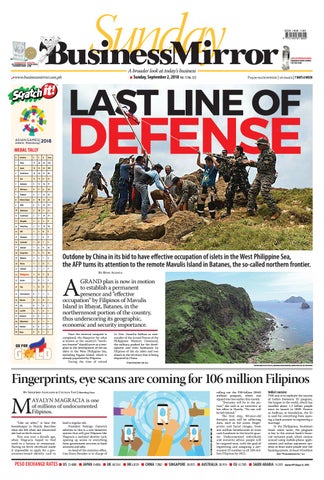
LAST LINE OF
DEFENSE
MEDAL TALLY R
Country
G
S
B
Total
1
China
71
48
29
148
2
Japan
33
31
43
107
3
South Korea
23
26
31
80
4
Iran
12
11
8
31
5
Indonesia
9
12
16
37
6
DPR Korea
9
5
6
20
7
Thailand
8
7
23
38
8
Chinese Taipei
6
10
12
28
9
India
6
5
14
25
10
Uzbekistan
5
10
7
22
11
Kazakhstan
3
7
24
34
12
Mongolia
3
2
4
9
13
Hong Kong
2
5
13
20
14
UAE
2
3
0
5
15
Singapore
2
1
6
9
16
Cambodia
2
0
1
3
17
Vietnam
1
6
9
16
18
Kyrgyzstan
1
4
5
10
19
Malaysia
1
4
1
6
20
Macau
1
2
0
3
21
Lebanon
1
1
2
4
22
Philippines
1
0
7
8
23
Jordan
1
0
3
4
24
Iraq
1
0
0
1
25
Turkmenistan
0
1
2
3
26
Bahrain
0
1
0
1
26
KSA
0
1
0
1
26
Lao PDR
0
1
0
1
29
Myanmar
0
0
2
2
30
Afghanistan
0
0
1
1
30
Pakistan
0
0
1
1
30
Qatar
0
0
1
1
Outdone by China in its bid to have effective occupation of islets in the West Philippine Sea, the AFP turns its attention to the remote Mavulis Island in Batanes, the so-called northern frontier.
A
By Rene Acosta
GRAND plan is now in motion to establish a permanent presence and “effective occupation” by Filipinos of Mavulis Island in Itbayat, Batanes, in the northernmost portion of the country, thus underscoring its geographic, economic and security importance. Once the internal conquest is completed, the blueprint for what is known as the country’s “northern frontier” should serve as a template in the development of the six islets in the West Philippine Sea, excluding Pagasa Island, which is already populated by Filipinos. During the time of retired
Lt. Gen. Juancho Sabban as commander of the Armed Forces of the Philippines Western Command, the military pushed for the development and even habitation by Filipinos of the six islets and two shoals in the territory that is being disputed by China. Continued on A2
PHOTOS COURTESY OF THE P.I.O., NORTHERN LUZON COMMAND, ARMED FORCES OF THE PHILIPPINES
Fingerprints, eye scans are coming for 106 million Filipinos By Siegfrid Alegado & Cecilia Yap | Bloomberg News
M
“Like an alien,” is how the housekeeper in Manila describes what she felt when she discovered she had no birth record. That was over a decade ago, when Magracia hoped to find work in a factory or restaurant. Having no birth certificate made it impossible to apply for a government-issued identity card to
land a regular job. President Rodrigo Duterte’s solution to this is a new biometric system that will give Filipinos like Magracia a national identity card, opening up access to everything from government services to bank accounts and jobs. As head of the statistics office, Lisa Grace Bersales is in charge of
PESO EXCHANGE RATES n US 53.4880
JULIATIMCHENKO | DREAMSTIME.COM
AYALYN MAGRACIA is one of millions of undocumented Filipinos.
rolling out the P30-billion ($563 million) program, which was signed into law earlier this month. “Everyone will be in the picture,” she said in an interview at her office in Manila. “No one will be left behind.” The first step, 60-year-old Bersales said, will be collecting data, such as eye scans, fingerprints and facial images, from one million beneficiaries of state cash handouts in the fourth quarter. Undocumented individuals and minority ethnic people will be targeted next, with the goal of registering and assigning a permanent ID number to all 106 million Filipinos by 2022.
India’s success
THE aim is to replicate the success of India’s biometric ID program, the largest in the world, which has enrolled about 1.2 billion people since its launch in 2009. Known as Aadhaar, or foundation, the ID is used for everything from opening a bank account to registering a marriage. In the Philippines, Southeast Asia’s worst saver, the program is key to the central bank’s financial inclusion push, which centers around using mobile-phone applications and online payments systems to draw more people into the banking system. At least 10 million See “Fingerprints,” A2
n JAPAN 0.4806 n UK 68.5342 n HK 6.8139 n CHINA 7.7802 n SINGAPORE 38.9315 n AUSTRALIA 38.7414 n EU 61.7305 n SAUDI ARABIA 14.2619
Source: BSP (August 24, 2018 )
NewsSunday BusinessMirror
A2 Sunday, September 2, 2018
www.businessmirror.com.ph
LAST LINE OF DEFENSE Continued from A1
In endorsing, in late 2017, the House bill seeking to declare the Kalayaan Island Group (KIG) “alienable and disposable” land for agricultural, residential and commercial purposes, then Majority Leader Rodolfo Fariñas said the islets and reefs have a total land area of 79 hectares, including the biggest island called Pagasa (32.7 ha). The six islets are: Likas, 18.6 ha; Parda, 12.7 ha; Lawak, 7.9 ha; Kota, 6.45 ha; Patag, 0.57 ha; and Parata, 0.44 ha. The two shoals also considered part of the KIG are Ayungin (Second Thomas) Shoal, where a rusting, former hospital ship was lodged by the AFP as the country’s sentinel amid Chinese incursions; and Rizal (Commodore) Reef. While the tack was intelligently devised to solidify the country’s ownership of the Beijing-contested features and morph it into a purely civilian issue away from a heated security dispute, this scheme was never pursued by the two previous administrations. Thus, what is known as the Philippines’s Kalayaan Island Group is in a perpetual stage of geopolitical limbo, officially owned by the Philippines but living in the perpetual shadow of a hegemonic neighbor from the northeast.
Lighting up Mavulis
PHILIPPINE officials apparently have a more deliberate plan for the so-called northern frontier. As the penultimate phase in the occupation by Filipinos of the Philippines’s own territory, the Armed Forces Northern Luzon Command
is moving to energize Mavulis, a 4-square-kilometer jagged island, with the help of other stakeholders, especially in the private sector. Lt. Gen. Emmanuel Salamat, commander of the Nolcom, is expecting to sign a memorandum of agreement with the One Meralco Foundation for the installation of power through solar photovoltaic (PV) technology in the multipurpose facility that it is building on the island. The initiative forms part of a larger plan to deploy and sustain the presence of regular soldiers in the island and to encourage residents of Batanes to settle there, thus establishing effective control by Filipinos over the rich island. The solar PV equipment should provide sustainable power for the lighting and communication systems requirement in Mavulis, the significance of which the Nolcom— in partnership with other stakeholders—has been working to create awareness among Filipinos.
Development challenges
THE construction of the multipurpose facility, including a fishermen’s shelter in the most isolated and northernmost uninhabited island of the country, began early this year with the help of stakeholders, both in the public and private sectors. According to Lt. Col. Isagani Nato, Nolcom spokesman, the building of the facility was quite a challenge for them, given the daunting obstacles posed by nature and the extreme activities that had to be done, especially compounded by the island’s isolation.
He described it as, “a difficult task to meet as the ground work and transportation are affected by the weather and proximity of the island to its adjacent inhabited island of Itbayat,” he said. “The Mavulis project has a unique set of works program being monitored on a weekly basis since
it started. It allows flexibility of sequence as it engages stakeholders’ efforts in the share of construction materials,” he added. Due to the bad weather throughout the adventurous “ship-to-shore” unloading of materials, the project is still way below its originally intended completion period. “The completion of the fishermen’s shelter will increase presence of local fishermen in the region, contributing to the protection and management of our marine resources, as well as enhancing the information gathering around this northern maritime area,” Nato said.
Economic benefits
OWING to its richness, the military and the municipal government of Itbayat have been working to secure Mavulis (or Mavudis to the locals) away from foreign poachers and intruders—including Vietnamese, Chinese and Taiwanese—for the economic benefits of Batanes and even its adjoining provinces. Salamat admitted that before the military began carrying out its maritime domain awareness missions, basically through patrols in the latter part of 2016 with the arrival of assets and equipment for the Armed Forces, the island has been irregularly populated or visited by fishermen from the three countries. Apart from wild goats that
used to dot the island before they were hunted and eaten by the foreign intruders, Mavulis’s surrounding waters are home to rich stocks of fish of various species, the main reason poachers are lured into them. A first visit by soldiers and officials of Itbayat to the island in 2016 unearthed trash with Chinese markings, which indicated the regular presence of Chinese visitors in the area. “We are very thankful for this visit. We have been looking forward to this for decades and I hope that our presence out there will be sustained because we can only do so much in preserving our territorial integrity, as well as our source of livelihood, which is fishing,” former Itbayat Mayor Ruelle Ibañes said then. Ibañes complained that local fishermen were being intimidated by the presence of foreign poachers in bigger vessels. The situation, however, gradually changed beginning in 2017, as the Nolcom sustained its maritime patrol in the country’s northern waters, with no less than local officials reporting about the decreasing presence of foreign fishermen in the area. “Our scarce resources and means in protecting our own territory was obliterated by the AFP’s genuine concern [for] our people by keeping our people safe and free from threats of foreign poachers,” the Batanes provincial govern-
Fingerprints...
people can’t open bank deposit accounts because they don’t have identity documents and cards. For many Filipinos, it’s a nightmare to transact with formal financial institutions, which require at least two government-issued ID cards and other documents. About 7.4 million Filipinos don’t even have the most basic record of identity, a birth certificate, the statistics authority estimates. A reliance on cash means many of them turn to loan sharks and pawnbrokers for loans that carry interest rates of as much as 20 percent a month.
Fintech boost
FOR financial technology companies like Globe Telecom Inc. and Jack Ma’s Ant Financial, the national ID system—known as PhilID—is a boon in a country where 70 percent of the population own a mobile phone. “This legal recognition is essential to citizens, assuring them
ment wrote the Nolcom. The air and sea patrols by the Air Force and the Navy, and even by the Philippine Coast Guard, were being conducted, both for territorial operations and for the government’s effort to provide a fishing haven for Filipino fishermen.
‘Security Goliath’
MORE than the economic benefits offered by Mavulis to the residents of Batanes, the imposing rock-like feature still provides the country a feeling of even just a small ounce of security in the face of a Chinese march in the West Philippine Sea, especially if it will be developed into a full and complete military installation. Mavulis, as strategic military planners have described it, should be the “retreating ground” and the last security defense for the military, if and when Beijing occupies the territory that it insists it owns, and this includes even Scarborough Shoal near mainland Zambales. Mavulis borders Taiwan and sits on the Bashi Channel, which connects the West Philippine Sea or even the South China Sea and the Pacific Ocean. The Bashi Channel is considered as a strategic waterway that the Chinese Navy, including its submarines, have to cross in the unlikely event that they will attack American forces in Guam and Hawaii, thus highlighting its importance not only for the country, but for its allies.
Continued from A1
of their most basic human rights such as their right to access financial services,” said Lito Villanueva, managing director at FINTQnologies Corp., the financial technology unit of PLDT Inc.-backed software company Voyager Innovations Inc. A nationwide ID program will reduce the company’s risk and transaction costs and help its goal of bringing 30 million people into the formal financial system by 2020, he said. Businesses like Ayala Corp. and Aboitiz Equity Ventures Inc. also see opportunities, submitting a proposal to the statistics agency to collect, manage and authenticate identity information of individuals. Bersales said the government prefers a competitive auction, but will consider the proposal along with about 40 other companies that have submitted informal plans. The contract will be awarded in November. The biometric system isn’t
without its critics. Religious groups, the media and data privacy watchdogs have raised concerns that the ID can be used to centralize and monitor transactions. Leftist lawmakers who objected to the bill said it can be used to harass opponents of Duterte. Bersales said the concerns were unfounded and any data collected will be subject to existing privacy laws. The statistics agency has tapped the National Privacy Commission to craft rules for storage and use of collected data, she said, adding that “privacy must be encoded in every part and design of the system.” For the 31-year-old housekeeper Magracia, it’s all about finally becoming official. “People say a birth certificate is important and more especially so when you die,” she said. “They say you can’t be buried without it, so I’m still hoping to get one someday if given the chance.”
The World BusinessMirror
www.businessmirror.com.ph
August turns ugly for emerging markets as currency crises widen
E
merging market assets are headed for a monthly loss as declines in A rg e n t i n a a n d Tu r ke y s p a r ke d fears of global contagion and amid a renewed intensification of US-China trade tensions. The MSCI EM index of currencies is down 2.2 percent for August as of 11:57 a.m. in Singapore, poised for a fifth monthly loss, the longest stretch since September 2015. In Asian trading on Friday, the Indonesian rupiah slid to its lowest since 1998, while the Indian rupee was set for its biggest monthly drop in three years and a fresh record low. P l e n t y o f i nve s t o r s — i n c l u d i n g BlackRock Inc. and Pacific Investment Management Co.—have viewed emerging market declines as an opportunity to stock up on securities likely to benefit from growth rates set to outpace those of the rich world in the long run. But that’s not panned out this month, with developed-
nation equities comparing favorably, thanks in part to solid corporate earnings. The emerging asset class’s latest woes came from Argentina, where the peso tumbled to a record low, prompting policymakers to boost a benchmark interest rate to 60 percent. In Turkey a report that the central bank’s deputy governor was set to resign sank the lira. Also hurting sentiment: President Donald Trump was said to move ahead with a plan to impose new tariffs on China as soon as next week. “Argentina’s problems will probably keep investors’ focus on emerging markets with weaker fundamentals, leading to sell-offs in those countries like we’ve seen in Turkey,” said Koji Fukaya, chief executive officer at FPG Securities Co. in Tokyo. “Argentine assets are unlikely to see a turnaround soon with just the IMF support because there hasn’t been any fundamental improvements in the country.” Bloomberg News
McCain ANDREW HARRER/Bloomberg
john McCain’s prison, now a luxury hotel, shows his legacy in Vietnam
T
he site of the “Hanoi Hilton,” the notorious prison where John McCain endured years of brutal treatment as a prisoner of war, now houses a high-end hotel and office complex where Vietnamese sip cappuccinos and shop for US-branded golf equipment. McCain, who died on Saturday, August 25, after battling brain cancer, ended up in Hoa Lo Prison after he was shot down on a bombing run during the Vietnam War 51 years ago. Its transformation over the years is one sign of the late senator’s legacy in the Southeast Asian nation. “Because of John McCain, the US and Vietnam were able to reconnect,” said Adam Sitkoff, executive director of the American Chamber of Commerce in Hanoi. The investment and trade that followed helped transform the Southeast Asian nation. “In the past two decades, the per-capita income of Vietnamese has more than quadrupled,” said Sitkoff. “It’s a big part of his legacy.” In the decades following the conflict, McCain was relentless in pushing the US government to normalize diplomatic and economic relations with its former enemy: the embassy said he made 23 trips to Vietnam. Though a critic of the nation’s one-party system and human-rights record, McCain nonetheless sought closer ties and became a popular figure for many in the country. “Landed in #Hanoi, where people always greet me in the most incredibly friendly manner,” McCain tweeted on August 7, 2014. After news of his death broke, Vietnamese who once scrambled into air shelters as American bombs rained down on Hanoi mourned the senator’s passing. Hoang Manh Cuong, 60, recalled running to Hanoi’s Truc Bach Lake in 1967 when news spread that the American pilot had been captured there. On Monday morning, he bowed and prayed at a concrete monument to the former US senator beside the lake, which residents have turned into a makeshift shrine with flowers and incense. “Although he was once our enemy, he did a lot to help restore relations between the US and Vietnam,” Cuong said. “That helped open the economy and improved our lives dramatically. We owe him for that.” The former Navy pilot was Nor th Vietnam’s most prominent prisoner of war. After returning from five-and-a-half years of captivity, McCain began a congressional career that made him a force in national and international politics. He ran for president in 2000 and 2008, winning the Republican nomination in his second campaign but losing to Democrat Barack Obama.
Embracing capitalism
In 1988, shortly after he joined the Senate, McCain wrote in a Washington Post opinion column that Vietnam “has an enormous amount to gain by satisfying requirements for a normalization of diplomatic and trade
relations. Vietnam is one of the 10 poorest countries on Earth, with an economy kept afloat only by Soviet economic largesse.” After McCain’s support helped President Bill Clinton’s normalize diplomatic relations with Vietnam in 1995, investment began to flow in and trade with the US and other Western allies began to grow rapidly. Vietnam’s communist leaders embraced capitalism and the country now has one of the world’s fastest-growing economies, expanding 6.8 percent in the second quarter. McCain long pushed for the lifting of a ban on the sale of US lethal weapons to Vietnam, which occurred in 2016 under President Ba rack Obama. The two countries have gradually strengthened military ties, with Vietnam calling for greater US engagement in the region to balance the increasing influence of China, which shares a border with Vietnam and has built facilities on disputed islands in the South China Sea.
Solitary confinement
In March, Vietnam welcomed the USS Carl Vinson to the city of Danang, the first visit by a US aircraft carrier since the fall of Saigon in 1975. Vietnam viewed the Trans-Pacific Partnership trade deal, which President Donald Trump withdrew from shortly after taking office, as key to building closer economic ties with the US and reducing its reliance on China, its largest trading partner. As a prisoner of war, McCain said he was repeatedly beaten and spent more than two years in solitary confinement. In mid-1968, as his father took over as commander of US forces in the Pacific, McCain’s captors sought to hurt PoW morale by offering him early release. McCain refused. The Hoa Lo Prison was demolished in the 1990s and only the gatehouse now remains as a museum.
‘Good friend of Vietnam’
Tran Trong Duyet, the prison’s former director, called the American “stubborn” and “very loyal to his country” in a phone interview. He denied that McCain was mistreated, and said the two spoke often. “I thought that if the war ends, he would become a great politician. He has been considered a good friend of Vietnam.” State-controlled media published and broadcast news of McCain’s death, favorably recalling the politician’s role in improving US and Vietnam diplomatic relations. Vietnam’s Deputy Prime Minister Pham Binh Minh signed a book of condolence at the US Embassy, and the foreign ministry said he made “great contributions to healing the wounds of war.” “Two former enemies are now friends, in large part because of John McCain,” said Tran Viet Thai, a deputy director general at the Diplomatic Academy of Vietnam in Hanoi, where the country’s diplomats are trained. “We are burning incense for him.” Bloomberg News
Sunday, September 2, 2018
A3
China’s factories show resilience amid danger from Trump tariffs
C
hina’s official factory gauge unexpectedly strengthened this month, signaling some resilience as the economy braces for an escalation of the trade war with the United States.
The manufacturing purchasing managers index (PMI) stood at 51.3 in August versus 51.2 in July and exceeded the forecast of 51 in a Bloomberg survey of economists. The nonmanufacturing PMI, covering services and construction, also rose to 54.2, the statistics bureau said Friday, compared with 54 in July. Levels above 50 indicate improvement. With the US already raising tariffs on $50 billion of Chinese goods, such strength may prove difficult to sustain, and levies on another $200 billion may be imposed as soon as next week. That said, government measures to ensure the supply of credit and stoke investment in infrastructure may
be already brightening the outlook among businesses at home. “ T he nation’s pro-g row th measures have taken effect to stabilize sentiment,” said Ding Shu a ng , c h ief econom ist for Greater China and North Asia at Standard Chartered Plc., who accurately forecast the PMI this month. Ding cited more proactive fiscal policy, tax cuts, expedited bond sales and better credit access for smaller companies. The onshore y uan climbed 0.15 percent to 6.8339 to the dollar as of 10:51, after the People’s Bank of China set a strongerthan-expected daily reference rate. The Shanghai Composite Index dropped 0.5 percent, while
the Hang Seng Index declined 1.2 percent. China announced on Thursday that it will exempt foreign institutions from paying some taxes on interest gains in the onshore bond market as part of efforts to support the economy. The exemption announced after a State Council meeting presided over by Premier Li Keqiang covered corporate income and value-added taxes for a period tentatively set at three years. The reading for smaller manufacturers rose to 50 in July after remaining in the deterioration zone for three months, highlighting that central bank policies to support that vital part of the economy may be helping to underpin confidence. The reading for larger companies edged lower for a third month, though was still at a robust level of 52.1. The official PMI result runs counter to some leading data as collated by Bloomberg Economics’ deck of early indicators. That showed output weakening aga in in Aug ust, as dema nd from key trading partners
softened and sentiment among stock investors worsened. “This quarter and the next three are going to be pretty weak,” said Andrew Polk, cofounder of research firm Trivium China in Beijing. “Infrastructure investment is just so low it’s going to be a real challenge for them to get that unstuck. There’s not enough shovel ready projects so they can dump in all the bond financing for local governments. That money’s not going to be deployed very quickly.”
External demand
Risks to external demand from the trade tensions appeared in the data, highlighting the uncertainties for Chinese factories. President Donald Trump wants to move ahead with a plan to impose tariffs on $200 billion in Chinese imports as soon as a public-comment period concludes next week. New export orders dropped to 49.4, the lowest level since February, when the Chinese New Year disrupted production. Bloomberg News
India’s world-beating growth not enough to end jobs drought
T
he world’s fastest-growing major economy isn’t growing nearly fast enough. That may seem like an absurd description for India, an economy the International Monetary Fund (IMF) expects to expand 7.3 percent in the fiscal year through March 2019 and 7.5 percent in the next. Yet the reality is that even at its current pace, India is having trouble creating enough new jobs for its massive work force or enough wealth to broaden its middle class. With its demographic tailwind and massive developmental needs, Asia’s third-biggest economy should be growing at double-digit rates. Holding India back are glacial economic reforms, a fragile banking sector, rigid labor laws and a spotty educational system that imparts limited skills to the 12 million young people who enter the job market each year. Prime Minister Narendra Modi is trying to address these challenges. He’s introduced a nationwide consumption tax, an insolvency code for companies a n d a p ro g ra m to b o o s t d o m e s t i c manufacturing under his signature Make in India campaign. Yet, analysts generally agree that more needs to be done to open up the economy, attract foreign capital and generate the kind of wealth and business opportunities that has broadened the middle class in China, whose $12.2-trillion economy is more than four times as big as India’s ($2.6 trillion).
Underachiever
“It hasn’t embraced global trade and foreign direct investments in the way China aggressively succeeded,” said Jim O’Neill, a former Goldman Sachs Asset Management chair and ex-commercial secretary to the UK Treasury and who coined the acronym BRIC in 2001 to describe Brazil, Russia, India and China as a group. “India has created big wealth for a limited number of people at the highest income levels, but it hasn’t created a massive pool of consumers by creating hundred of millions of middle income class,” he said. India’s economy has averaged 7 percent growth since its reforms began in 1991 under Prime Minister P.V. Narasimha Rao. China, by contrast, expanded by an average of almost 10 percent each year since its economic opening and modernization started some 40 years ago. The latest pulse check for India’s e co n o my co m e s Fr i d ay. Eco n o m i s t s forecast gross domestic product expanded 7.6 percent in the three months through June from a year earlier. Ahead of the data, India’s rupee dropped below 71 to a US dollar, a new low that could possibly deter foreign investors, fan imported inflation and prompt intervention from
the central bank—all having implications on growth in coming months.
Jobs challenge
With more than 90 percent of India’s labor force employed in the nation’s informal economy, the government has struggled to produce reliable jobs data to even get an accurate read on the level
of joblessness in India. A glimpse into just how dire the job market is came in March, when the government announced 90,000 vacancies at the state-run Indian Railways, the nation’s biggest civilian employer, and a staggering 28 million people applied. The rail jobs pay a minimum of 216,000 rupees ($3,085) per year—a princely
amount in a country where per-capita income is about $1,800, versus more than $8,800 in China. India should be enjoying a demographically powered economic dividend at this stage of its development. It’s one of the youngest countries in the world with a median age of 28, compared to China’s 37 and 47 in Japan. Bloomberg News
A4
Sunday, September 2, 2018
The World BusinessMirror
Trump says his ‘great job’ means Democrats can’t impeach him
P
resident Donald J. Trump said that Democrats shouldn’t try to impeach him, citing a strong economy, his performance on foreign policy and the danger of setting a precedent making it too easy to remove future presidents.
“I don’t think they can impeach somebody that’s doing a great job,” Trump said on Thursday in a White House interview with Bloomberg News. “You look at the economy, you look at jobs, you look at foreign, what’s going on with other countries. You look at trade deals. I’m doing a great job.” Republicans have tried to frame the November elections as a decision about whether Democrats will be able to impeach Trump. W hile Democrat ic leaders have largely
avoided t a l k i ng about i mpeachment, some Democratic candidates and outside groups have dangled the prospect of removing the president from office to help boost turnout in the election. Trump said that if he’s impeached, then every future president would be in danger of the same fate whenever the opposition gains control of Congress. “So you get elected as a Republican or a Democrat and the opposite party gets put into the House. That would mean,
oh, let’s impeach him. Can’t do it,” Trump said. “If you look at the definition of impeachment, that’s a high bar and that would take a long time to fight that if you’re doing a good job. And I’m doing a great job.” Remov ing t he president from office remains a distant prospect for Democrats. To gain a House majority, Democrats need to f lip 23 seats, a prospect that independent analysts say is within reach.
I
well that the smallest mistake in the region will bear a heav y cost for them.” Iran has been threatening to halt exports from Hormuz, the world’s most important oil chokepoint, since early July. Bagheri ’s comments come after the US reimposed a set of economic sanctions that had been eased against Iran as part of a 2015 international nuclear agreement. The measures are set to intensify in November when t he y w i l l target Iran’s oil sales—the lifeline of its economy.
Bloomberg News
I don’t think they can impeach somebody that’s doing a great job. You look at the economy, you look at jobs, you look at foreign, what’s going on with other countries. You look at trade deals. I’m doing a great job.”—Trump
US President Dona ld Trump’s decision to withdraw from the nuclear accord in May comes amid tensions between Iran and regional rival Saudi Arabia, which has close ties with the Trump administration. Saudi Arabia and Gulf A rab nations a l ig ned w it h the kingdom have been bolstered amid Trump’s efforts to isolate Iran politically and on the economic front. Other parties have said the nuclear accord is functioning and necessar y to maintain security in the region.
Muslim governments stay silent as China cracks down on Uighurs
The party will have a tougher time gaining two seats to control the Senate, where Democrats have 26 seats to defend, compared with just eight for Republicans. But while impeachment is a simple majority vote in the House, conviction requires a two-thirds majority in the Senate. That means a significant number of Republicans would have to vote against Trump.
Iran to block Middle East oil exports if it can’t ship ran will halt Middle East oil exports if it’s not allowed to ship its crude through the Strait of Hormuz, according to a top military official. I f t he I s l a m ic R e pu bl ic can’t use the Strait for its oi l ex por ts, “there w i l l be no security for others either and no other crude will be exported from this region,” Armed Forces Chief of Staff Mo h a m m a d B a g he r i s a i d , state-run Mehr news agency reported. The US Army and other militar y forces present in the Middle East “ know full
www.businessmirror.com.ph
The Trump administration has stated its goal is to cut Iran’s oil revenue to zero. Iranian President Hassan Rouhani said last month that “it’s an incorrect belief that all oil producers would be able to export and Iran would be the only country unable to export oil.” The Strait of Hormuz is at the mouth of the Persian Gulf, the world ’s biggest concentration of tankers that carry about 30 percent of all seaborne-traded crude oil and other liquids during the year. Bloomberg News
Uighur men have haircuts at a barber shop in Urumqi, Xinjiang province, China, on July 9, 2009. NELSON CHING/ Bloomberg
A
s calls grow in the US and Europe to pressure China to halt alleged human-rights abuses against its Muslim minority, Beijing has so far escaped any serious criticism from governments across the Islamic world. Almost three weeks after a United Nations official cited “credible reports” that the country was holding as many as 1 million Turkic-speaking Uighurs in “re-education” camps, governments in Muslim-majority countries have issued no notable statements on the issue. The silence became more pronounced this week after a bipartisan group of US lawmakers urged sanctions against senior Chinese officials. “We are hopeful that the State Department will seek addition opportunities to condemn these abuses while also undertaking robust diplomatic engagement with like-minded governments to further elevate this human-rights crisis in international forums and multilateral institutions,” lawmakers led by Sen. Marco Rubio of Florida and Rep. Chris Smith of New Jersey wrote Wednesday in a letter to Secretary of State Michael Pompeo and Treasury Secretary Steven Mnuchin. They joined European Union officials who have previously expressed concern about the camps in Xinjiang. By contrast, the leaders of Indonesia, Malaysia and Pakistan haven’t released public statements on the clampdown. Neither has Saudi Arabia. Even Turkey, which has in the past offered favorable policies to Turkic-speaking groups and hosts a small Uighur population of its own, remained silent as Prime Minister Recep Tayyip Erdogan grappled with an economic crisis.
Trade ties
The split underscores how China’s position as a key trading partner and aid provider to many Muslim-majority nations—as well as its long-standing policy to avoid commenting on the internal affairs of other countries—is now paying off. The alleged abuses are also occurring in one of China’s most remote and heavily policed frontiers, making it hard to acquire firsthand evidence, such as photos and videos, that might sway public opinion in the Islamic world. “China generally has friendly relations with most Muslim countries, mostly around trade,” said Hassan Hassan, senior fellow at the Tahrir Institute for Middle East Policy, a Washington think tank. The Muslim world is largely unaware of the situation in Xinjiang, he added. “It’s not covered almost at all in Arabic media, and even jihadis don’t dwell on it as much as they do about other conflicts.” China officially denies problems in Xinjiang, a vast region the size of Alaska bordering Pakistan and Afghanistan that’s home to some 10 million Uighurs. On Thursday Beijing warned the US lawmakers not to interfere in its internal affairs. “ T he policies and equa l r ights that Chinese minorities enjoy are far better than in the US, which has lot issues with racism and human rights protection,” Chinese Foreign Ministry spokesman Hua Chunying told a briefing in Beijing. The lawmakers should focus on issues at home “instead of interfering in other countries’ internal politics, playing
judges on human rights and casting blame, or even threatening to impose unreasonable sanctions,” she said.
‘Strike first’
China’s clampdown has been fueled by President Xi Jinping’s orders to “strike first” against Islamist extremism following deadly attacks in the region involving Uighurs, and reports that some members of the minor it y were fighting a longside terror groups in Syria. A Communist Party-run newspaper has rebuked criticism of the crackdown, arguing that it had prevented Xinjiang from becoming another Syria. The silence on Uighurs contrasts with outrage last year when some 700,000 Rohingya Muslims fled clearance operations by the Myanmar military, which the UN has since likened to genocide. One big difference between the two cases: Myanmar’s economy is 180 times smaller than that of China, which is the top trading partner of 20 of the 57 member-states of the Organisation of Islamic Cooperation (OIC). China accounts for about a tenth of Saudi Arabia’s oil exports and roughly a third of Iran’s, according to shiptracking data compiled by Bloomberg. It is Malaysia’s top source of foreign investment. And it has ensured the flow of more than $60 billion in loans for China-Pakistan Economic Corridor infrastructure projects. Muslim nations “ don’t want to damage their relations with China, and consider China a potential ally against the West and the US, and therefore they are trying to stay silent,” said Omer Kanat, chairman of the executive committee at the World Uyghur Congress, an overseas Uigher advocacy group. Over the years, these governments have vocally opposed US slights of Muslims, including President Donald Trump’s 2017 ban on travel from seven Muslim-majority countries. Iranian foreign minister Javad Zarif called it “a great gift to extremists.” An expert testifying before a United Nations human-rights panel on August 10 cited reports that Beijing may be holding up to one million Uighurs in re-education camps. Bloomberg reported in January on the government conducting experiments with facial recognition technology in the region. The governments of Turkey, India, Indonesia, Pakistan, Malaysia, Kazakhstan, Saudi Arabia and Egypt did not respond to requests to comment for this stor y. Multiple phone calls to the OIC for comment were not answered.
Dangerous spillover
To be sure, maintaining trade ties isn’t the only motivator. Some governments are loathe to draw global attention to their own shabby human- rights records. Beijing has largely refrained from involving itself in conflicts in the Muslim world. Those nations “don’t particularly respect human rights themselves, so it’s hard to imagine that they would jump at an opportunity to criticize China,” said David Brophy, senior lzecturer in Modern Chinese History at the University of Sydney. Still, it could prove increasingly difficult to maintain their silence, as China’s policies in Xinjiang spill across its borders. Bloomberg News
Faith Editor: Lyn Resurreccion • www.businessmirror.com.ph
Sunday
Sunday, September 2, 2018
A5
Catholic board seeks laity-led abuse probe
A
committee created by the Catholic Church specifically to prevent sexual misconduct by clergy on Tuesday issued a damning assessment of the failings to stem the abuse, calling it an “evil” caused by “a loss of moral leadership.” The National Review Board called for an investigation led by parishioners, saying a new wave of abuse scandals point to a “systematic problem” and that the bishops themselves can’t be trusted to lead an investigation. Some survivors of clergy sex abuse said the call was a disingenuous attempt by the Church to get around a true independent investigation. The board was formed in 2002 in the wake of the clergy sex-abuse scandal that started in the Boston Archdiocese and rocked the Church globally. The committee said it was compelled to seek a lay-led investigation after recent revelations from a grand jur y investigation into six Catholic dioceses in Pennsylvania and allegations that led to the resignation last month of ex-Cardinal Theodore McCar r ic k, t he for mer archbishop of Washington, D.C. T he g rand jur y repor t es timated 300 Roman Catholic priests in Pennsylvania molested more than 1,000 children— and possibly many more—since the 1940s, and accused senior church officials, including McCar r ick, of systematica l ly covering up complaints. McCarrick for merly ser ved the church in Pennsylvania. “Intimidation, fear and the misuse of authority created an env ironment t hat was ta ken advantage of by clerics, including bishops, causing harm to minors, seminarians and those
most vulnerable,” the board said in its statement. “The culture of silence enabled the abuse to go on virtually unchecked.” Dennis M. Doyle, a professor of religious studies at the University of Dayton in Ohio and a Catholic theologian, said the National Review Board’s call would be a notable shift in the Church’s history of a hierarchal authority. The call for a lay-led investigation, he said, “is an acknowledgement that the people in power can’t be in charge of investigating themselves.” It also seems to take a page from a three-page letter issued a week ago by Pope Francis, who blamed the Church’s top-down culture for allowing the abuse to take place in a shroud of secrecy. T he pope demanded an end to “c ler ica l ism”—t he cu lture that places pr iests on a pedesta l. He said lay Catholics must help end t hat c u lt u re, since rank-and-file members of the church are often the ones who most fer vent ly hold up their pr iests as beyond reproach. Cardinal Daniel DiNardo, the president of the US Conference of Catholic Bishops, also this week asked for a meeting with the pope to discuss the crisis. The review board said the recent revelations make it clear that the crisis could not be fixed by church hierarchy. “What needs to happen is a genuine change in the Church’s culture, specifically among the bishops themselves,” it said.
Pope Francis reaches out to hug Cardinal Archbishop emeritus Theodore McCarrick after the Midday Prayer of the Divine with more than 300 US bishops at the Cathedral of Saint Matthew the Apostle in Washington on September 23, 2015. Jonathan Newton/The Washington Post via AP, Pool
Besides an investigation led by the laity, it recommended creating a whistle-blower system independent of the bishops
Intimidation, fear and the misuse of authority created an environment that was taken advantage of by clerics, including bishops, causing harm to minors, seminarians and those most vulnerable.” —National Review Board
Martyrs of September Aleteia.org
Martyrs of September 2 By Corazon Damo-Santiago
F
ranc e w a s p o p u l a t e d w it h C at hol ic s pr ior to soc i a l a nd pol it ic a l up heavals in 1787. T he agitations reached initia l c lima x in 1789, t hus, t he e x pression Revolution of 1789 to denote t he end of ancient reg ime in France. On October 10, 1789, the properties of the Catholic Church were seized by the National Constituent Assembly as assignats, or security for expropriated lands. On July 12, 1790, the Civil Constitution was approved, which subordinated the Catholic Church to the French government, which the pope and clergy detested.
The archbishop of Arus, France, refused to uphold the Constitution and was imprisoned.
Martyrs of the Church
Rumors spread that “foreign and royalist armies would attack Paris,” supported by prisoners who would be freed. On the eve of August 9, 1792, “a Jacobin insurrection overthrew the leadership of Paris Commune, headed by Jerome de Villeneuve who proclaimed a new revolutionary commune, headed by transitional authorities.” (Wikipedia) The royal family of King Louis XVI fled on August 10, 1792, and a “de facto revolutionary commune” took over the government.
to field allegations anonymously and then report them to the local bishop, law enforcement and the Vatican.
Since the religious were considered state employees, they were required to swear an oath of allegiance to the state. Priests who abide by the order became constitutional jurors, and those who refused were imprisoned, killed or deported. Monaster ies were emptied and transformed into prisons. Religious orders were dissolved. The initial atrocities started when 24 priests, who were being transported for imprisonment in l’Abbaye in Paris, were attacked by an angry mob. (Webchron) On September 2, 1792, the angry crowds went to the Carmelite church where priests and religious were imprisoned. All were
mandated to take the mandatory oath of loyalty to the government. Refusal meant they were enemies of the state and were “hacked to death as they passed down the stairway.” They called on Archbishop John du Lau to come out. He came out and said: “I am he whom you seek.” In a few minutes, they cracked his skull, stabbed him and trampled him to death. The bishop of Beauvais, who was wounded on the leg, called: “I do not refuse to die with the others, but I cannot walk. I beg you to have the kindness to carry me where you wish me to go.” Bishop François Joseph de la Rochefauld was killed with his brother, Pierre Louis de la Rochefauld, bishop of Saintes. (Nobility org.) Ambrose Chevreux, the last superior-general of the monastic congregation of Saint Maur, was also executed. O n S e pte mb e r 3, t he c rowd w e nt t o t h e L a z a r i s t S e m i n a r y t o e x e c ut e t h e p r i e s t s . Of the 90 pr iests, four were able to escape. When the revolution ended, 1,500 Catholics had been killed. On October 17, 1926, Pope Pius XI beatified 191 of them. Their feast is on September 2. S a nt iago i s a for mer reg ional direc tor of the De par t ment of Educat ion Nat ional Capital R eg ion. She is c ur rently a fac ult y member of Mater R edemptor i s Colleg ium in Calauan, L ag una , and of Mater R edemptor is College in San Jose Cit y, Nue va E c ija.
Marci Hamilton, a professor at the University of Pennsylvania and expert on religion and the law, said the review board’s call doesn’t go far enough to fix the crisis or prevent clergy sex abuse that has roiled the Church for decades. One of the long-standing difficulties in identifying cases has been that victims can sometimes take years before they are willing or able to step forward. In many instances, the statute of limitations prevents law enforcement from prosecuting priests in these long-ago cases. Hami lton sa id it ’s cr it ica l that the statute of limitations be extended. “It’s time for prosecutors and lawmakers to step up regardless of what happens in the
church,” he said. Tim Lennon, president of Survivors Network of those Abused by Pr iests (Snap), ca l led the move by the review board a weak effort that needs to go much farther. The organization wants a church-wide independent investigation into pedophile priests, such as the one conducted by the Pennsylvania grand jury. “The Church is looking every which way to have a cooperative partner so they can continue their cover-up. Snap demands that all investigations be independent, separate, with subpoena power and testimony under oath,” Lennon said. “Otherwise it is a sham and whitewash.” AP
22nd Sunday in Ordinary Time: ‘Mk 7:1-8, 14-15, 21-23’
Fighting ‘internal’ sins Msgr. Josefino S. Ramirez SUNDAY GOSPEL IN OUR LIFE
I
n explaining the actuations of His disciples of neglecting some of the Jewish ritual washings, Jesus Christ explained that “there is nothing outside a man which by going into Him can defile Him; but the things which come out of a man are what defile Him” (Mark 7:15). The people could not understand what Jesus meant, but it would be explained later on. The Jews made a lot of fuss over the type of food they could eat. Certain items where forbidden because they were considered as “unclean,” not in the hygienic or physical sphere, but in the religious one. Such was the old dispensation. But Christ had come to bring a new dispensation, and in this one, more emphasis was to be laid on the inner dispositions. Through Christ’s words, no type of food could really be considered “unclean” from the religious point of view. Instead, we have to be watchful over the things that came out “from within, out of the heart” (Mark 7:21). The transgression of the law of God, which is what constitutes sin, really starts from our inner being. After all, the transgression has to be “voluntary,” it is something that is willed. And willing is a supremely interior act. That is why Saint Augustine describes sin as a “turning away from God” and a “turning toward creatures.” Unfortunately, some people with desires to improve and to be followers of Christ forget the importance of the inner dispositions.
They readily admit that it would be wrong to kill, to steal, to commit adultery, etc.; but they don’t give any importance to the envy, the hatred or the lust, which are the real roots of those external sins. It is, therefore, impor tant in the spiritual life to give value to what are called “internal” sins, such as bad thoughts, desires, imaginations and the like. Although internal sins may not have as serious a consequence as when it is also externalized, in a certain sense, internal sins can be a more dangerous enemy, just as a spy or a hidden enemy can be more dangerous than one who is out in the open. It is harder for us to detect an internal sin than an external one. A person might harm another out of anger, and because he sees the external injury, he may come to his senses and be sorry for that sin. But if a person merely harbors thoughts of resentment, he may not even notice it, thinking himself to be the most charitable of men. It can be amusing at times to see people claim that they bear no hatred for anyone, yet mention a certain name and you can see them flush with anger or resentment. I am not saying that it would, therefore, be better to execute an internal sin in the name of “being more spontaneous and natural.” All I mean is that, if we truly want to put the Christian way of life into practice, we should be attentive to our internal dispositions and carry on the ascetical combat in that sphere.
Science
A6 Sunday, September 2, 2018
BusinessMirror
Sunday
www.businessmirror.com.ph • Editor: Lyn Resurreccion
Air pollution causes lower verbal, math scores
W
ASHINGTON, D.C.— While health has long been thought of as the most common casualty of air pollution, a landmark study from an International Food Policy Research Institute (IFPRI) researcher establishes for the first time that exposure to air pollution over a long period significantly impacts cognitive abilities, as measured through steep reduction in verbal and math tests scores.
“Long-term exposure to air pollution impedes cognitive performance in verbal and math tests,” said study author Xiaobo Zhang, senior research fellow at IFPRI and distinguished chairman-professor of economics at Peking University. “The damage on cognitive ability by air pollution also likely impedes the development of human capital. Therefore, a narrow focus on the negative effect on health may underestimate the total cost of air pollution,” Zhang added. “Our findings on the damaging effect of air pollution on cognition imply that the indirect effect of pollution on social welfare could be much larger than previously thought.” The study was held in China in 2010 and 2014. It noted that air pollution is a ubiquitous problem in developing countries. It cited the global ambient air pollution database
compiled by the World Hea lth Organization, which said that the top 20 most pol luted cities are all in developing countries. T he W HO said that a lmost a l l of t he cities (98 percent) in low and midd le-income countr ies w ith more than 100,000 residents fail to meet W HO air qua lit y g uidelines. “Therefore, the research findings on China, the largest developing country with severe airpollution, can also shed light on other developing countries,” the study said. The report includes 86 major cities in China in 2000 and covers most of the country’s cities in 2014. In the Philippines—among the polluted in developing countries—the average particulate matter (PM) 2.5 concentration in early-2018 is 21 microgram (μm) per cubic meter annually, which is twice over the recommended value, news reports said.
A woman wearing a mask for protection against pollution walks on a pedestrian overhead bridge as office buildings are shrouded with smog in Beijing in this December 20, 2015, photo. AP/File
In the study, air quality was measured using the air-pollution index, which is calculated based on daily readings of three air pollutants, namely sulfur dioxide, nitrogen dioxide and PM smaller than 10 μm (PM10). The API ranges from 0 to 500, with larger values indicating worse air quality, the study said. While the health consequences of air pollution are well known, few studies have examined its impact on cognitive abilities. The study, “The impact of exposure to air pollution on cognitive performance,” coauthored by IFPRI’s Zhang, Xin Zhang of Beijing Normal University and Xi Chen of Yale University, was published in the latest issue of the journal, Proceedings of the National Academy of Sciences. The study, with a sample size of nearly 32,000, examined the relationship between cognitive
test scores, taken from the nationally representative China Family Panel Studies longitudinal survey conducted in 2010 and 2014, with short- and longterm air-pollution exposure calculated from official API values. CFPS is a nationally representative survey of Chinese families and individuals. Both verbal and math scores decreased with increasing cumulative air-pollution exposure, with a steeper decline for verbal scores than math scores, according to the key findings of the study. The decline in verbal scores was more pronounced among males than females, the study said. Among males, the decline in verbal scores became more pronounced with age, and this age dependence was greater in those with less than a middleschool education compared with a middle-school education or more.
“ T he damage air pollution has on aging brains likely imposes substantial health and economic cost, considering that cognitive functioning is critical for the elderly to both running daily errands and making highstakes economic decisions. This finding has been neglected in the policy discourse, and has important policy implications,” Zhang said. Cognitive decline or impairment are risk factors of Alzheimer’s disease and other forms of dementia for the elderly. As the most expensive form of cognitive decline, Alzheimer’s disease alone costs $226 billion of health services and 18 billion labor hours of unpaid caregiving in 2015, the study said. The study noted that, given that senior citizens have to make a host of complex high-stake economic decisions—such as
D.O.S.T.-supported halal center building set to open By Edd K. Usman
Special to the BusinessMirror
‘T
o halal or not to halal,” with apologies to the Bard, that is the question in the global trade of Muslim food products. At the center of the question is an estimated 1.8 billion Muslim population as of 2015, while the global market for halal foods reached $1.4 trillion in 2017. If you were a food manufacturer, you would be crazy to not put your mind and wallet in the consistently ballooning trade of halal foods across the world. This is considering that nonfood products, such as pharmaceuticals and cosmetics, are not yet included in the equation. Statista.com cited a report putting the market value of halal foods worldwide, predicting that the Muslim-friendly food products will climb to $2.6 trillion in 2023.
Science for halal products
One good thing for the fledgling Philippine halal industry is that the Department of Science and Technology (DOST) is promoting halal food through various initiatives. Science Secretery Fortunato T. de la Peña, in a text message to the B usinessM irror, said: “We support the entire Halal Program led by the DTI [Department of Trade and Industry]. The DOST takes care of providing the facilities and laboratory test service to make sure that the food or product is free from components not acceptable for halal, like porcine and alcohol.” The DOST, he said, now has three operational laboratories for halal forensic, meaning verification and testing, of products. De la Peña was referring to the Halal Laboratories of DOST-Soccsksargen under Regional Director Dr. Hadja Shayma Zenaida P. Hadji Raof Laidan; DOST-Davao Region under Regional Director Dr. Anthony Sales; and DOST Calabarzon with Regional Director Alexander Madrigal, in their respective turfs in Davao City, Cotabato City and in Laguna. De la Peña said each of the laboratory costs around P37 million, excluding the building where they are housed. “We have trained technical staff. We also implement R&D [research and development] projects to develop new products. Other than food, there are health-care products and even
cosmetics that should be halal,” he pointed out. The DOST leader said the agency has a P100-million budget for research and training components.
‘Queen of halal in Asia’
In a related development, Laidan, because of her strong support and work to scale up the country’s halal industry, earned the honorary title “Queen of halal in Asia” during the January 2018 World Halal Assembly in Manila that was organized by DOST-Soccsksargen. Bosnia-Herzegovina’s Mufti Mustafa Ceric, one of the experts and speakers during the event, conferred Laidan the title for her untiring effort to push forward the Philippine halal industry. Apparently, Ceric recognized the DOSTSoccsksargen’s regional director’s various initiatives. Among them are her projects to establish a new and modern halal center in Koronadal City, South Cotabato; the halal laboratory in Cotabato City; the holding of international conferences on halal products and attending and participating in fora abroad, among others. Barring any unforeseen events, the DOSTSoccsksargen will inaugurate in October or November what Laidan said “will be known as Philippine National Laboratory and Science Center Building [in Koronadal City] that will house [DOST-Soccsksargen’s] Philippine Halal Laboratory.” “This will serve as a one-stop shop for halal. Before its completion, we already have an existing laboratory in Cotabato City operating since 2010. So, this will be strengthened if we can already transfer to Koronadal,” she added. She cited the strategic location of the new halal laboratory, saying it is near big companies in the cities of General Santos and Davao, and international airports.
Attract foreign biz
Laidan hastened to add that the laboratory would provide halal services not only to local and national companies but also to international businesses. It seems it is working this early. “ Fo r e i g n c o m p a n i e s a r e a l r e a d y contacting us, asking if they can come to
DOST Soccsksargen Regional Director Dr. Zenaida P. Hadji Raof Laidan DOST Soccsksargen
see our building,” she revealed. At present, she said DOST-Soccsksargen already has existing basic equipment to address the halal industry, but they plan to upgrade, thereby the need for its inclusion in the budget proposal for 2019. “We will also try to enlist assistance from other entities,” Laidan said, not discounting potential assistance from the Organization of Islamic Cooperation (OIC).
Seal of quality
It can be recalled that DOST launched in 2015 the DOST-Soccsksargen’s Halal Logo, its Seal of Quality, which is internationally recognized, thus eliminating technical barriers in trading and export. The process of halal certification, she emphasized, not only has a religious aspect but also includes scientific process to determine a product’s “halalness.” For its Halal Logo, the DOST regional office adopted the OIC’s Standards and Metrology Institute for the Islamic Countries (OIC-SMIIC), which is accepted by the 57-member countries of the pan-Islamic organization. Laidan emphasized the importance of a halal laboratory. “We have forensic [verification and testing], the standardization of the products [because] different countries have different requirements and standards. So we are internationally recognized.... We know the standards of these countries,” she said. She said the DOST laboratories will help micro, small and medium enterprises standardize their halal products, as well as
their other products, noting that MSMEs have no laboratory.
Verification and certification
Laidan plans to make the DOST-Soccsksargen Halal Laboratory “a certifying laboratory,” meaning it is not just for the usual DNA verification and testing of products for pork and alcohol contents. “We should be a certifying laboratory because other laboratories are only for verification,” she said. Th e D O S T re g i o n a l d i re c to r n o te d that some aspects or stages of the food process—from farm to plate—are not reflected or seen in the laboratory, like the slaughtering of animals, manufacturing, handling and preparation. “So, we have two [functions], forensic verification and certification [that a product is halal],” Laidan explained. She said for halal certification, DOSTSoccsksargen will tie up with the ulama, or high-ranking Muslim religious leaders, and Sharia lawyers.
Halal and hospitality industry
Laidan took note of the expanding halal global trade, citing halal and its importance in the hospitality industry. In a speech in General Santos City during what was billed the “Student Power Conference 2018” recently, she said she believes that education must be taken seriously to empower future the human resources of the country that can contribute to the development of other
halal industries for the Philippines’s inclusive growth and development. The Joji Ilagan International School of Hotel and Tourism Management organized the event that assembled hundreds of participants from schools and universities, and hotel and restaurant managers from across the region. Laidan cited the DOST regional office’s Philippine Halal Program in securing the integrity of food and services in establishing a Halal Hospitality Industry as a priority. “It is by knowing and understanding the key concepts of halal and how to ensure its integrity that the Philippine Halal Industry can smoothly progress. With the DOST-Soccsksargen Halal Laboratory, we can protect our Muslim tourists with halalcertified kitchens and halal-certified food products,” Laidan emphasized. “Halal, as a way of life, does not only focus on food and nonfood products. It also cuts across other services, including tourism, banking and financing, logistics and many others,” she noted. The DOST regional office said the “Muslim travel market is now widely recognized as key growing tourism sector projected to be worth $222 billion by 2020 and is growing at an annual rate of 4 percent.” The Philippines has much to gain from the global halal market that covers many aspects. It is high time for the country to benefit from its eco-friendly tourist attractions, plus its diverse rich culture. What does halal tourism mean? It is not just about Muslim-friendly food and nonalcoholic beverages. Huffington Post mentioned a few: It is about “halal activities, halal hotels, as well as being held in sites that are equipped with facilities in which Muslims can worship... places of worships in shopping mall centers and major tourism facilities.” Usman is a freelance journalist who is on science, information technology and current events, among others. He won the “Best Science Feature Story” in the first University of the Philippines Science Journalism Awards 2018 on February 17, and the DOST-PCIEERD “Kabalikat Award” for Print Media on June 27, 2014.
purchasing health insurance and planning retirement—the decay in cognitive ability induced by air pollution will likely impair the quality of the important decisions. “Given that cognitive ability shapes human behavior and decision making, our result provides supporting evidence on the findings about the negative effect of air pollution on decision making, risk attitude and behavior. The damage on cognitive ability by air pollution also likely impedes the development of human capital,” the study said. The research estimated that reducing fine particulate matter concentrations to the US Environmental Protection Agency standard (50 μg/m3) would increase verbal and math scores by 2.41 and 0.39 points, respectively, equivalent to an increase from the median to the 63rd and 58th percentiles, respectively. “These research findings on China, the largest developing country with severe air pollution, also shed light on other developing countries,” Zhang said. A previous study by the same author, Xiaobo Zhang, had documented the negative impact of air pollution on mental health and subjective well-being. IFPRI is an international research center that seeks sustainable solutions for ending hunger and poverty. It was established in 1975 to identify and analyze alternative national and international strategies and policies for meeting the food needs of the developing world, with particular emphasis on low-income countr ies and on the poorer groups in those countries. IFPRI with Lyn Resurreccion
Scientists confirm water ice on moon’s surface for first time
W
ASHINGTON—For the first time, scientists have directly observed definitive evidence of water ice on the moon’s surface, US space agency National Aeronautics and Space Administration (Nasa) has said. Most of the newly found water ice lies in the shadows of craters near the moon’s polar regions, where sunlight never reaches and the warmest temperatures never reach above minus 250 degrees Fahrenheit (about minus 157 degrees Celsius), Nasa said in a statement earlier this week. “These ice deposits are patchily distributed and could possibly be ancient,” the statement said. “At the southern pole, most of the ice is concentrated at lunar craters, while the northern pole’s ice is more widely, but sparsely spread,” it added. Previous observations found possible signs of surface ice at the lunar southpole, but these could have been explained by other phenomena, such as unusually reflective lunar soil. In the latest study, scientists used data from Nasa’s Moon Mineralogy Mapper (M3) instrument to confirm the presence of solid ice on the moon. M3 collected data that not only picked up the ref lective properties of ice but was able to directly measure the distinctive way its molecules absorb infrared light, so as to differentiate between liquid water or vapor and solid ice. “With enough ice sitting at the surface—within the top few millimeters—water would possibly be accessible as a resource for future expeditions to explore and even stay on the Moon, and potentially easier to access than the water detected beneath the Moon’s surface,” the statement said. Xinhuanet
Tourism&Entertainment BusinessMirror
Editor: Carla Mortel-Baricaua
Sunday, September 2, 2018
A7
Hainan’s High Five
where you can see locals engaged in their folkways. At the mountaintop is a sculpture of a deer where Sanya was named after. Hiking up to the statue rewards with stunning views of the peninsula’s undulating contour. Meanwhile, Sanya Bay, regarded as the warmest beach in the city, has an expansive, mile-long stretch of white sands. As a bonus, you can catch a glimpse of the iconic 108-meter-high Guan Yin bronze statue at the Nanshan Temple complex.
Story & photos by Bernard L. Supetran
W
ith a fascinating ancient civilization and more than a billion citizens, China is undoubtedly on every jaded traveler’s proverbial bucket list, notwithstanding the language barrier and the diplomatic row in the West Philippine Sea. With scores of destinations beckoning you to visit, making the choice can be as difficult as scaling the Great Wall. The island of Hainan, the smallest and southernmost province, is a unique place to begin an Odyssey to Chinese sights and sounds. Situated off the mainland, it is an eclectic mix of the old and the new, and breaks one’s preconceived notion of monotonous Buddhist temples and Oriental houses. The island province, perhaps just one-third the size of Luzon, is dubbed as China’s counterpart to Hawaii and Dubai because of its beaches and posh resort hotels. To raise its profile as a global tropical getaway, the government made Hainan visa-free for 30 days to 59 countries, including the Philippines, but such declaration doesn’t extend to the mainland. Chartered flights to the capital city of Haikou are mounted occasionally by Philippine Airlines through select tour agents led by Juan World Philippines and its partner China Tee International Travel Services.
With a plethora on a first-timer’s checklist, here are the top 5 mustsees for an all-time high in Hainan.
Movie town
Step back in time in Haikou’s little version of Hollywood in this 567-hectare nostalgic theme park where some of the Chinese period movies are made. A joint venture between Feng Xiaogang and Huayi Brothers Media Group, its centerpiece is the 1942 Street, which contains 91 buildings built to recreate the Republican Era in Chongqing. They include Chiang Kai-Shek’s residence, where guests can have snapshots with actors in the circa-1940s military uniforms. Other landmarks in the World War II-inspired street are the Xishan Bell Tower, Cathay Theatre and the Shanghai Rong Guang Theatre. Instagram addicts will have a visual with the postcard-pretty structures in the 300-meter-long Nanyang
The Je T’aime Undersea Restaurant offers a feast to one’s eyes and palate.
Je T’aime Undersea Restaurant
For a taste of luxe living, tourists flock to Atlantis Hotel Sanya
Street, a circa 1950s Beijing street, the Park View Area, the Europeanthemed Church and Square and the Avenue of Stars, which bears the signatures and handprints of Chinese and international celebrities. While making snapshots,there are rows of street cafés where you can munch on local specialties and souvenir shops where you can make your initial shopping.
Yetian Li Minority Nationality Village
This cultural theme park is a must-see, which showcases the indigenous way of life of the Li and Miao tribes, which have been living in Hainan for over 3,000 years. Li’s traditional crafts of pottery, dance and the hammering skills were awarded the World Intangible Culture Heritage status. The Miao
minority group, who dwells in the tropical rainforest, meanwhile, are famous for silver handicrafts and rattan weaving. Far from being a static destination frozen in time, the village is a living museum where guests are welcomed with the typical tribal rituals, followed by indigenous dances, music, games and food tastings on the side. Visitors can stay longer to have a more intimate understanding of the Li and Miao people by immersing in their cultures by trying out their craft and sampling their cuisine.
Beach overload
For beach bums who can’t shake off their fascination for the sea, the southern coastal city of Sanya won’t disappoint. Just ask Miss World organizers why they have made it the
The Movie Town Haikou, where every street and corner is Instagram-mable
Wellness lifestyle on the high seas T ravelers no longer have to ditch their exercise routines and healthy lifestyles with Oceania Cruises’s unrivalled array of complimentary well-being options. Oceania Cruises’s exclusive wellness shore-excursion series, expansive vegan menus, as well as fitness and treatment offerings at the Canyon Ranch Spa allow guests a blissful, fully integrated wellness retreat at sea. Featuring the famed Canyon Ranch Spa at sea and Canyon Ranch Spa Cuisine, Oceania Cruises, the world’s leading culinary and destination-focused cruise line, continues to pioneer health, fitness and wellness while at sea.
More than a spa
While Canyon Ranch’s signature experience is a relaxing massage, the revitalizing treatments extend well beyond those offered in a traditional spa. Oceania Cruises is also pairing select Canyon Ranch Spa treatments with an exclusive shore-excursion series, Wellness Tours Inspired by Canyon Ranch. With carefully crafted shore excursions, guests can experience the very best of each destination while on an enriching wellness tour.
clusive baths boast a thousand-year-old therapeutic tradition advocated by the presence of renowned kings, popes and artists throughout history. Travel to Rome on the 12-Day Dazzling Europe Voyage for $3,229 per guest.
Vinyasa Yoga at Monte Carlo Bay | Monte Carlo, Monaco - Perched on a beauti-
ful peninsula overlooking the azure waters of Mediterranean Sea, the Monte-Carlo Bay Hotel & Resort offers paradise views as guests enjoy a private vinyasa yoga class, a dynamic style of yoga recognized for a host of mindbody benefits. Travel to Monaco on the 14Day Mediterranean Symphony Voyage for $2,909 per guest.
The Pope’s Thermal Baths | Civitavecchia, Italy - Guests can enjoy an afternoon of heavenly relaxation and restorative benefits at the Viterbo Terme dei Papi, or the Thermal Baths of the Popes, in this famed papal city. Originating in Etruscan times, the ex-
Passengers can now enjoy wellness cruises
The Greek Gods of Wellness | Corfu, Greece-Ambelonas, an artisanal organic
goods company and one of Greece’s most stunning wine estates is the ideal backdrop for uncovering compelling insight on emotional, spiritual, intellectual and physical wellness during a stroll around the lush vineyard and herb plantation. The experience is crowned with a tranquil meditation and yoga session followed by a wholesome plant-based lunch. Travel to Corfu on the 10-Day Greek Isles Explorer Voyage from US$3,349 per guest.
The Life of Laughter | Palamos, Spain -
This enlightening tour invites guests to discover the myriad benefits of laughter, including the rush of stress-reducing endorphins
released as they enjoy a joyful laughter session in an elegantly restored farmhouse-hotel in the heart of Costa Brava. Travel to Palamos on the 28-Day Marvels of Europe Voyage at $6,899 per guest
Not all about the buffet
On Oceania Cruises, the finest cuisine at sea now includes an expansive array of plantbased options. These dishes are in addition to the line’s already comprehensive selection of vegetarian, gluten-free and kosher meals. The Raw Juice and Smoothie Bar serves raw, cold-pressed juices and vegan smoothies all morning long from 7 to 11 a.m., and choices include Acai Berry bowl, Chia Cashew Yogurt Bowl, Tropical Green Smoothie and Rise & Shine Juice, among many others. The bars are currently available onboard Marina and Riviera, while the vegan menus are available fleet, wide on the brand’s six ships—Regatta, Insignia, Nautica, Marina, Riviera and Sirena. The vegan menus are featured in the Grand Dining Room at breakfast, lunch and dinner, including a total of more than 250 dishes, including appetizers, soups, salads, entrees and desserts. Featuring a fleet of intimately luxurious ships, Oceania Cruises offers an unrivaled vacation renowned for the finest cuisine at sea. With their multitude of unique wellness experiences, they also help guests reinvigorate their body, mind and spirit while traveling.
pageant’s venue seven times, and you’ll get an idea why this has been China’s “beach capital” of sorts. With sleepy shores and blue waters stretching almost infinitely, each section with an interesting character, which makes it unique from the nearby cove. Riyue Bay is an internationally acclaimed surfing spot for its waves and powdery beaches. Yalong Bay boasts of luxurious resort hotels, which make it an upscale spot. The waters are gin-clear, making it perfect for snorkeling and scuba diving. Dadonghai Bay offers a chill-out vibe for basking under the sun to get the next shade of tan. At night, it is ideal for a nocturnal crawl as the party crowd pours in for barbecue, drinks and lounge music. The traditional fishing village of Luhuitou Peninsula is a curious find
An entertaining afternoon tea (read: merienda) in Sanya is way more interesting with the synchronized swimming and acrobatics of its mermaids. Scores of fishes and manta rays are a mesmerizing sight to behold as you feast on the buffet of noodles, finger foods, pastries and ice cream, which may well be your early dinner. If you are up to the challenge, you can plunge on a scuba 101 lesson in this man-made seawater tank and swim with the marine creatures.
Atlantis Hotel
For a touch of ultra luxe living, swing by this 54-hectare seven-star property with the 52-story hotel as its centerpiece. There are 1,160 guestrooms, 154 suites and five palatial underwater suites. The sprawling complex includes the gigantic open-air Lost Chambers Aquarium, water theme park, and a host of family-oriented recreational facilities where 24 hours isn’t enough to enjoy them all. Foodies can choose from the 21 restaurants, bars and lounges, whose top-of-the-line is the Ossiano Underwater Restaurant & Bar, which has opulent floor-to-ceiling glass windows with a mesmerizing view of the aquarium and a menu featuring seafood from around the world.
Visitors enjoy the sun and sand at Sanya beach
Royal Air eyes Macau-Subic flights
T
he Department of Tourism (DOT) is now working with Royal Air to mount chartered flights between Macau (MFM) and Subic Bay International Airport seven times per week. “Royal Air is among our airline partners, which the DOT is working with to bring in tourists from China. Through our Route Development Team, we are providing marketing support to air carriers to increase tourist traffic to underutilized international gateways in the Philippines, such as the Subic Bay International Airport,” DOT Undersecretary for Tourism Development and official Spokesman Benito C. Bengzon Jr. explained. Royal Air is planning to mount daily flights from Macau to Subic Bay on a daily frequency using a 97-seater aircraft. The said flight is expected to produce additional 697 international air seats, or about 35,308 seats per year, from China. “Subic Bay is a special economic zone in the Philippines, which by law allows the entry of foreign nationals without the
required visa for a maximum of 14 days. This is a good opportunity for Philippine tourism, as Chinese nationals do not need to queue in our consular offices in China to secure the entry visa to the Philippines. Subic Bay has a lot to offer to leisure and business travelers with its natural, cultural and adventure attractions coupled with world-class accommodations and other tourist facilities,” Bengzon added. Royal Air has just inaugurated its new Macau-to-Mactan Cebu International Airport route on June 21. The new MFM-CEB route has daily frequency using the same type of aircraft producing a total of 35,308 international air seats per year from China. Royal Air is a registered air carrier in the Philippines, which was granted the right to provide chartered air services through a Certificate of Public Convenience and Necessity issued by the Civil Aeronautics Board in May 2017. Likewise, Royal Air now flies from Macau to Lallo International Airport in Cagayan using BAE RJ-100 aircraft with 97 mono-class seat capacity on a four-times-per-week schedule.
Sports
BusinessMirror
A8 Sunday, September 2, 2018
Editor: Jun Lomibao | www.businessmirror.com.ph
BLOODY SILVER J
By Jun Lomibao
AKARTA—Rogen Ladon ended up a wounded silver medalist in men’s flyweight of boxing on Monday—the left side of his forehead just above the eyebrow almost heavily bandaged to cover a wound that not only hurt his bid for a gold medal, but the entire Filipino nation’s heart.
Ladon looked to have the clear upper hand in his final bout against Uzbekistan’s Jasurbek Latipov, but a head butt ended his dream of winning the country’s fifth gold medal in the 18th Asian Games that come to a close on Sunday. The stadium announcer called it a Referee Stopped Contest-Second Round, but the verdict still went to the judges’ scores which,
ROGEN LADON bites the silver medal, a wounded warrior after coming out of a controversial loss to Uzbekistan’s Jasurbek Latipov. NONIE REYES
except for the Indonesian, went the Uzbek’s way, 3-1. “It’s a big disappointment,” Ladon said after the medal ceremony that had a sullen Philippine Olympic Committee President Ricky Vargas handing him his silver. “It’s a major disappointment. Not only me, but the entire country aspired for the gold medal,”
he added. Vargas, POC Chairman Abraham Tolentino and Alliance of Boxing Associations in the Philippines Secretary-General Ed Picson could only shrug their shoulders over the controversial loss absorbed by Ladon—the third after Nesthy Petecio in the preliminaries and Carlo Paalam and Eumir Felix Marcial in
the semifinals last Thursday. With the loss, the Philippines ended its campaign with four gold, two silver and 15 bronze medals—a tally that was good for No. 19 in the medal standings and far better than the lone BMX cycling gold Daniel Caluag won in Incheon in 2014. Ladon’s coaches—Ronald Chavez and Nolito Velasco—were wary of the cut before the final bout and had to scramble for any remedy. They got one—Dermabond, derma glue that closes wounds temporarily, thanks to a social-media post by volleyball player Mika Reyes, whose Indonesian fan gave the adhesive for free. But the derma glue could not
withstand a head butt by the Uzbek. Ladon’s wound, which was about an inch, opened prompting the referee to summon the match doctor, who eventually stopped the fight. The fight was stopped with only 22 seconds gone in the second round. “He [Uzbek] was in the ropes and when he sprung back, he gave me the head butt,” said Ladon, who stressed he was certain to have outscored his opponent in the first round. Picson again lashed at the judges’ decision, saying several national federations have also expressed their dismay. But Picson said the federations could only helplessly accept the verdicts and could only air their grievance in the International Boxing Association Congress which is conducted every four years. “In the AIBA, there are no protests. The best we could do is to go to the congress,” he said. With four gold medals—courtesy of weightlifter Hidilyn Diaz, skateboarder Margielyn Didal and golfers Yuka Saso, Bianca Pagda nganan and Lois Kaye Go—the Philippine delegation goes back home starting on Monday with a better haul than Incheon. But China remained as the most dominant in Asia with 273 medals—123 of them gold—followed by Japan with 70 golds and South Korea 45.
VOLLEYBELLES GIVE INDONS SCARE ANEW
CHICANO 10TH, HUELGAS 16TH ASIAN GAMES IN TRIATHLON
J
AKARTA—John Chicano and Niko Huelgas proved they are the best in Southeast Asia but not in the 18th Asian Games as they finished 10th and 16th, respectively, in men’s triathlon on Saturday in Palembang. Racing against world-class rivals, Chicano, a silver medalist in the 2017 Malaysia Southeast Asian Games, clocked one hour, 54 minutes and 33 seconds in the 1.80-km swim/20-km bike/10-km run race, surpassing his personal best of 1:56.00 set in the 2016 Subic International Triathlon. Chicano duplicated the 10th-place finish of Jonard Sam, who clocked 1:59.00 in the 2014 edition in Incheon. Huelgas, who bagged back-to-back golds in the 2015 Singapore and 2017 Malaysia SEA Games, logged 1:58.39, surpassing his previous time of 1:59.17 in placing 11th in the 2014 Incheon Games. He also eclipsed his winning time of 1:59.30 for his second SEAG mint in Putra Jaya two years ago. After Chicano and Huelgas, the best Southeast Asian finisher was Malaysian Ryan at No. 21 (2:04.20), while the only other notable placer from the region was his compatriot Adrian Yeo (2:05.31) at No. 23 among the 28 out of 34 entries who finished the race. Japan’s Junpei Furuya, currently ranked the highest Asian at No. 55 in the International Triathlon Union world ratings, easily took the gold in 1:49.33, while Uzbekistan’s Ayan Beisenbayev (1:50.38) and China’s Li Mingzu (1:50.49) copped the silver and bronze, respectively. “I am satisfied with the results of both Rambo [Chicano’s nickname] and Niko because we were really trained for the Asian Games,” said national men’s coach Melvin Fausto, who was celebrating his 46th birthday and was pleased to see one of his wards make it to the top 10. “Masaya po ako dahil nakapasok ako sa magic 10 at saka nahigitan ko pa ’yong aking best time,” noted Chicano, who saw making his individual Asian Games debut after seeing action in the mixed relays in the Incheon Asiad. “It doesn’t matter who finishes ahead as long as we did well. We always look at our entry in triathlons as a team effort so I am happy for Rambo,” said Huelgas, who plans to compete in other forms of triathlon such as the 70.3 Ironman event. “Pero balik pa rin ako for training in regular Olympic triathlon event so I can defend my SEAG title in the Philippines next year,” he said. The Pinoy triathletes bring down the curtain on the country’s 18th Asian Games campaign here on Sunday as they see action in the mixed relay. Singapore Southeast Games women’s triathlon queen Claire Adorna opens the relay, followed by Chicano, Kim Mangrobang and Mark Hosana, respectively. They will all see action in each of the shortened 300-meter swim, 7-km bike and 1.8-km run of the mixed relay. Jun Lomibao
ABABA SOARS HIGH IN DANAO GOLF TOURNEY
INDONESIA’S Santini Manganan makes mincemeat of the Philippine defense put up by Kim Fajardo, Abigail Marano and Dawn Nicole Macandili. NONIE REYES
J
AKARTA—The Philippines took the same four-set route before bowing to host Indonesia, 17-25, 25-23, 19-25, 20-25, to close its women’s volleyball campaign in the 18th Asian Games with one victory and four losses on Saturday at the Gor Bulungan Gym inside the Gelora Bung Karno complex. With star spiker Aprilia Santini Manganang almost unstoppable in leading the Indonesian attack, the Filipinas faded in the fourth set to yield the seventh-place spot to the hosts in front of a rabid home crowd. Manganang delivered 16 kills and three blocks for 19 points, while her sister, an equally powerful Amasya Manganang, finished with eight points she laced with crucial hits in the third and fourth sets. The second setback to Indonesia placed the Philippines in eighth place—a good-enough windup ahead of Chinese Taipei, India and Hong Kong in the 11-nation competition. Head coach Shaq delos Santos was satisfied with the performance that saw the Philippines returning to Asian Games volleyball since New Delhi in 1982.
“We came here with a very modest goal of making it into quarterfinals, so it’s still a mission accomplished for us,” said delos Santos. A straight-set win over Hong Kong in the preliminaries booked the Filipinas a slot in the quarterfinals where they ran into mighty China. Delos Santos said the seventhplace finish is a strong booster for the country’s bid in next year’s 30th SEA Games. “We will not stop. We’re just starting the national team program. Our training and exposure in other major tournaments would definitely continue.” Mylene Paat was the lone bright spot with 10 hits, while Alyssa Valdez and Aby Marano chipped in nine and six markers, respectively, for the Nationals, who will march to the AVC Asian Cup in Nakhon Ratchasima, Thailan, in the next couple of weeks. “After this, we’ll be going to the AVC Asian Cup,” delos Santos said. “Again, our hopes are high. I hope the team would carry all the lessons they gained here and show improvement when we face other Asian teams again in Thailand.” Jun Lomibao
JHONNEL ABABA wins the inaugural Club Filipino de Cebu Invitational crown.
J
HONNEL ABABA blew a three-stroke lead but fought back from one down twice then pulled through in another pressure-packed windup with a clutch putt to foil Kim Joo Hyung and snare the inaugural International Container Terminal Services Inc. (ICTSI) Club Filipino de Cebu Invitational crown by one on a closing 70 in Danao City on Saturday. Resigned to a playoff duel with the young Korean after a wayward drive on the par-four 18th, Ababa played out from the 10th fairway, hit a 52-wedge shot from 110 yards to within 10 feet then drilled in the uphill putt to escape with the par and the win on a 205 total in the rain-shortened P3.5-million ICTSI-sponsored event, his first on the Philippine Golf Tour (PGT) in a long while. It was actually his fourth in the season, counting his three victories in the PGT Asia, including at Forest Hills in July where he beat six others in the local tour’s most crowded finalround duel in recent years. He did face another severe test this week – from a talent-laden international field to a tricky course to a wobbly final-round stint that saw him squander a three-stroke lead he gained from the rain-suspended third round. He fell behind by one to Kim after a double-bogey on the par-3 No. 12 on another missed tee-shot and to Aussie Damien Jordan after 13 holes. But he rebounded strong on both occasions, flashing the kind of resolve that wins bigtime championships, his birdie-birdie feat from No. 14 shoving him back to the lead which he kept until he hit that errant drive on the final hole. “I was already prepared to go into a playoff. But my caddie [Edwin Sanchez] told me to just be safe and try to salvage a bogey at most,” said Ababa. “But I made a great uphill putt and that’s it.” That putt clinched another P650,000 purse for the former national hotshot with the victory also bolstering his confidence heading to next week’s Aboitiz Invitational at the Orchard, another $100,000 event on PGT Asia where he considers himself “lucky.”