MEDIA PARTNER OF THE YEAR
UNITED NATIONS
2015 ENVIRONMENTAL MEDIA AWARD LEADERSHIP AWARD 2008
BusinessMirror
www.businessmirror.com.ph
A broader look at today’s business
n
Sunday, October 22, 2017 Vol. 13 No. 11
2016 EJAP JOURNALISM AWARDS
BUSINESS NEWS SOURCE OF THE YEAR
P25.00 nationwide | 2 sections 14 pages | 7 DAYS A WEEK
PHL TOURISM: LOOKING AT BRIGHTER SIDE
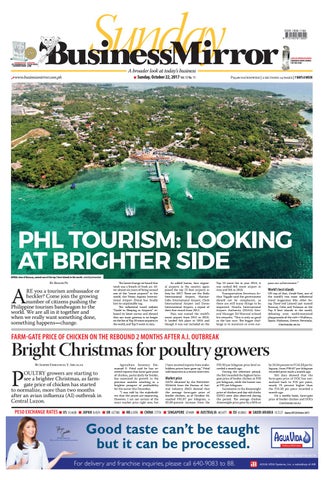
AERIAL view of Boracay, named one of the top 3 best islands in the world. LEN4FOTO | DREAMSTIME
A
By Roger Pe
RE you a tourism ambassador or heckler? Come join the growing number of citizens pushing the Philippine tourism bandwagon to the world. We are all in it together and when we really want something done, something happens—change.
The latest change we heard this week was a breath of fresh air. After almost six years of being named one of the “worst airports” in the world, the Ninoy Aquino International Airport (Naia) has finally lost its unpalatable tag. The influential travel website “Guide to Sleeping in Airports” released its latest survey and showed that our main gateway is no longer on the list of Top 20 worst airports in the world, and Top 5 worst in Asia.
As added bonus, four regional airports in the country again joined the top 25 best airports in Asia for 2017. These are the Iloilo International Airport, MactanCebu International Airport, Clark International Airport and Davao International Airport, a repeat of their fine record from 2012. Naia was named the world’s worst airport from 2011 to 2013. It landed 4th place in 2014 and though it was not included on the
Top 10 worst list in year 2015, it was ranked 8th worst airport in Asia and 5th in 2016. Transportation Secretary Arthur Tugade said the government should not be complacent, as there are still many things to be improved. Manila International Airport Authority (MIAA) General Manager Ed Monreal echoed his remarks, “This is only as good as the last race. The bigger challenge is to maintain or even sur-
pass our achievement.”
World’s best islands
ON top of that, Condé Nast, one of the world’s two most influential travel magazines (the other being Travel and Leisure) just named Boracay, Cebu and Palawan as the Top 3 best islands in the world, defeating even world-renowned playgrounds of the rich—Mallorca, Spain; Mykonos, Greece; Bermuda, Continued on A2
FARM-GATE PRICE OF CHICKEN ON THE REBOUND 2 MONTHS AFTER A.I. OUTBREAK
Bright Christmas for poultry growers
P
By Jasper Emmanuel Y. Arcalas
OULTRY growers are starting to see a brighter Christmas, as farmgate price of chicken has started to normalize, more than two months after an avian influenza (AI) outbreak in Central Luzon. PESO EXCHANGE RATES n US 51.4630
Agriculture Secretary Emmanuel F. Piñol said he has received reports that farm-gate price of chicken, particularly for broiler, has sustained its growth in the previous months resulting in a brighter prospect of profitability for the sector this December. “I was told by the stakeholders that the prices are improving. However, I am not certain of the exact market price right now, but
I have received reports from stakeholders prices have gone up,” Piñol told reporters in a recent interview.
Market price
DATA obtained by the BusinessMirror from the Bureau of Animal Industry (BAI) showed that the average farm-gate price of broiler chicken, as of October 16, reached P92.07 per kilogram, a 65.89-percent increase from the
P55.50 per kilogram price level recorded a month ago. During the reference period, the BAI recorded the highest farmgate price of broiler chicken at P93 per kilogram, while the lowest was at P91 per kilogram. Increments in the dressweight price of chicken and day-old chicks (DOC) were also observed during the period. The average chicken dressweight price grew by a fifth or
by 20.34 percent to P116.33 per kilogram, from P96.67 per kilogram recorded price mark a month ago. BAI data showed that the farm-gate price of DOC has normalized back to P25 per piece, nearly 75 percent higher than the P14.33 per piece recorded a month ago. On a weekly basis, farm-gate price of broiler chicken and DOCs Continued on A2
n JAPAN 0.4574 n UK 67.7305 n HK 6.5976 n CHINA 7.7774 n SINGAPORE 37.9409 n AUSTRALIA 40.5477 n EU 61.0042 n SAUDI ARABIA 13.7227
Source: BSP (20 October 2017 )
NewsSunday BusinessMirror
A2 Sunday, October 22, 2017
www.businessmirror.com.ph
PHL tourism: Looking at brighter side Continued from A1
Barts; Turks and Caicos, Bali, Virgin and Cayman Islands, among others. In 2016, Palawan was chosen by Conde Nast as the most beautiful island in the world, while Travel and Leisure Magazine, chose it as World’s Best Island three times in a row, 2015, 2016 and 2017. “It’s no wonder that Palawan ranked as the most beautiful island in the world. The clear aquamarine water, limestone cliffs, and lagoons of the island province of the Philippines are only some of its most basic highlights,” said editor Cynthia Drescher. “Palawan is home to nature reserves on both land and sea, with dolphins just offshore, marine gardens of giant clam, sea turtles nesting on white sand beaches, 600 species of butterflies, and lush palm forest like a Gilligan’s Island fever dream,” she said. In choosing Boracay as World’s Best Island for 2017, Conde Nast described Boracay as an “itty-bitty island (just under four square miles) in the Western Philippines that is as close to a tropical idyll as you’ll find in Southeast Asia, with gentle coastlines and spectacular sunsets. Fold in a thriving nightlife scene, and you have one of the top tourist spots in the region.” It says of Cebu and Visayan islands: “Cebu is the most densely populated island in the Philippines, famous for its beaches on the mainland as well as across its surrounding islands. Not as wild
as Phuket in Thailand, Cebu City is more personal, with plenty of upand-coming restaurants and shopping.” The influential travel magazine exalts Palawan as home to Puerto Princesa’s Underground River, one of Seven Natural Wonders of the World, with one of the longest underground river systems, traveling five miles through a subterranean cave. Karstsand other natural rock formations created by dissolving limestone, loom in every direction, which lovers of nature must see.
One of Asia’s best
MEANWHILE, Pangulasian Island in El Nido also won Condé Nast Traveler Readers’ Choice Awards this year. Named one of Asia’s Top Resorts, it was also included in the magazine’s “Gold List 2017: Our Favorite Beach Resorts in the World”.Both prestigious categories were awarded to the resort for two consecutive years. Over 300,000 travelers and dedicated readers took part in the annual Readers’ Choice Awards survey – submitting thousands of ratings to help create a list of winning favorites. The highly coveted list celebrates and recognizes the “Best in the World” and is also the longest-running recognition of excellence in the travel industry. Pangulasian Island of El Nido Resorts, also known as the “Island of the Sun”, is right infront of a powdery white sand beach and unspoilt turquoise waters overlooking Bacuit Bay.
AERIAL view of Boracay, named one of the top 3 best islands in the world. LEN4FOTO | DREAMSTIME
The resort offers 42 villas, all with a private balcony, boasting of breathtaking views of both sunrise and sunset. Guests across the globe choose to linger at the island’s floras and faunas, stroll along its 750 meters long beach and snorkel to encounter its mesmerizing underwater scenery and diverse marine life.
Bring Home A Friend
AMID a fiesta celebration, the Department of Tourism relaunched “Bring Home a Friend to the Philippines”, aimed at raising inbound tourism figures and spur more economic activity in the country. Introduced by Mina Gabor, former Tourism Secretary in 1994, the promotion hopes to receive positive reaction from the United States, Japan, Middle East and Hongkong. “These are the places where a lot of Filipino communities are. Eventually, we hope to spur more travel from other areas, DOT Secretary Wanda Teo said. “Bring Home a Friend is our shout-out to the world to come and see the Philippines: a country of diverse cultures, rich traditions, and unrivaled biodiversity,” the Secretary added. Participating officers from different tourism industry associations, foreign diplomatic community, congress, support government agencies and media promised to give their all-out support to the program. The promotion can win Filipinos an upscale condo from Megaworld, a brand new Toyota Vios or a P200,000 Duty Free shopping when they invite friends to visit the Philippines on their next vaca-
tion. A music video featuring movie matinee idol PioloPascual was especially created to create awareness for the program.
Tourist arrivals up 12.7%
TOURISM is poised to become the country’s top dollar-earning industry as Philippine lawmakers rallied behind Department of Tourism Secretary Wanda Teo to mount an “all-out promotion campaign,” as she disclosed yet another doubledigit increase in international visitor arrivals for the first semester. “Amid setbacks and mounting challenges, tourist arrivals are way up. Beefing up the DOT’s war chest, at least restoring it to its previous level (P1B), would go a long way in boosting our branding campaign, expected to be on a par with those of our Asian neighbors,” Teo stressed. “In the face of challenges, the country continued to receive the growing influx of tourists from across the globe, desiring to see our world-class destinations and experience the renowned Filipino hospitality,” Teo said. During the congressional hearing, the DOT chief reiterated the agency’s commitment to a more competitive branding campaign as it sets higher targets for the coming year.
More foreign tourists have arrived in the Philippines this year, staying for more days and spending more money, as indicated by the data collected by the DOT for the month of January. “We have to keep the momentum going now that we are in the implementation phase of the Tourism Development Plan for 20172022, which aims to unleash the potentials of our tourism industry and make it more competitive,” Teo said.
Emerging tourist destinations
WITH a relentless push in promoting other undiscovered destinations, the Philippines is on the road to achieving its tourism arrival goals. As more infrastructure and development are realized, it is expected to pole vault from where it is now to the elite club of Asian tourism. Baler and Siargao are now becoming surfing capitals of Asia. Bohol and the Bicol region continue to mesmerize. The beguiling islands of Romblon and Siquijor are now on the bucket list of new tourists. There are many more to explore in this archipelago of more than 7,100 beautiful islands. All you need is just pack your bags and book a ticket.
Bright Christmas for poultry growers Continued from A1
grew by 3.44 percent and 23.17 percent, respectively.
Flocks reloaded
THE United Broilers Raisers Association earlier told the BusinessMirror that some poultry growers have started to reload their flocks to take advantage of the expected increase in demand for broiler meat as the holiday season approaches. This, they noted, contributed to the recovery of the farm-gate price of broiler chicken. While bird flu struck mostly commercial layers, the farm-gate price of broilers took a hit because consumers panicked over the government’s discovery of the outbreak.
No chicken import
AS the farm-gate price of broiler chicken reaches a profitable level for poultry growers, Piñol pronounced that he will not authorize any special importation chicken this year as local output remain
ample to meet the domestic demand, especially during the holiday season. He made the statement after his recent meeting with local meat importers who asked him about his stance on the possibility of a special importation for chicken meat. “They [meat importers] should somehow show sympathy to our Filipino poultry raisers who are just started to recover after the liveweight price of chicken sunk drastically,” he said. “It is only three months before the year ends and let us allow our poultry farmers to earn even a little bit this December,” he added. The idea of allowing a special importation for chicken meat floated just five days after the AI incident in San Luis, Pampanga was confirmed, as worries about the sufficiency of local supply were raised by the government. However, the local poultry industry immediately debunked the notion that there could be possible shortage in production due to AI.
Inventory
THE industry noted that they are more than capable of supplying the country’s poultry meet requirement, even during the Christmas when demand from consumers usually increases. Latest data from the National Meat Inspection Service showed that the country’s chicken inventory level, as of October 2, reached 39,037.91 metric tons (MT), 8.48 percent higher than the 35,986.12 MT recorded level same time period last year. However, the latest inventory figure was nearly 7 percent lower than the 41,975.55-MT volume of dressed chicken held in the country’s accredited cold storages in the previous week. Bulk of the dressed chicken inventory in the first week of October or about 75.71 percent came from local poultry sector which reached 29,555.59 MT. About 31.63 percent of the locally dressed chicken were stored in accredited cold storages in Central Luzon, where the AI incidents were reported.
The World BusinessMirror
www.businessmirror.com.ph
Kobe scandal shows cost of race to improve metals
B
ehind the scandal engulfing Kobe Steel Ltd. over the falsification of data for some of the materials it supplied is a harsh reality for Japanese steel companies: the need to provide higher and higher quality metals to compete. Kobe Steel rocked Japan’s industrial economy with revelations this week that it faked data on the quality of some aluminum, copper and iron powder sales. CEO Hiroya Kawasaki said more cases could emerge as the company continues its investigations. Among those affected are automakers—among the biggest customers for steel producers—who h ave b e e n s e e k i n g m o re a d va n ce d products to cut weight while retaining strength and versatility. “The steelmakers are really trying to protect their turf, because this is a lifeand-death situation for them,” said T hanh Ha Pham, senior vice president in Japan for investment bank Jefferies Group Llc. “It’s improve or die.” The trade-off for carmakers between a vehicle that’s strong enough to be safe, but light enough to be energy efficient has led to an array of alloys and efforts to break the dominance of steel, from McLaren’s iconic carbon-fiber Formula One supercar in the 1990s to Ford Motor Co.’s decision to switch its venerable F150 pickup to aluminum in 2015. While Kobe Steel’s falsified repor ts may be an isolated incident in the i n d u s t r y, J a p a n’s s te e l m a ke r s h ave spent a for tune developing new t ypes of steel and other metals to meet demands from automakers for fuel- efficienc y, whether the car has a 3 0 0 - k i l o g r a m p e t ro l e n g i n e u n d e r t h e h o o d, o r a 3 0 0 - kg l i t h i u m - i o n battery. About two-thirds of the weight of most vehicles is still steel.
Reaching limit
But some in the industry see a limit to how thin steel can go, because it would need to be so rigid that it can no longer be molded into car parts. “We can keep going like this for another 10 years,” Toshinao Minakuchi, head of the automotive steel sheet technical solutions department at Nippon Steel & Sumitomo Metal Corp., said in a September 5 interview. “But, at some point, the limit is coming for steel.” Nippon Steel, Japan’s top producer, is working to improve both the strength a n d fo r m a b i l i t y o f i t s h i g h - te n s i l e steel by 20 percent to 30 percent over the next five to 10 years and is also conducting research on mixing steel with other materials. A Nippon Steel spokeman later said the company isn’t in a position to comment
on the quality issue, saying that it isn’t involved in aluminum and copper products. The pressure for ever-lighter, thinner and stronger materials has prompted an increase in the use of other metals, such as aluminum, as well as advanced polymers and carbon fiber. Materials companies, including Royal DSM NA and Teijin Ltd., are to trying to marry the properties of steel and plastics by developing a new generation of hybrid products that integrate the two. “Fusion is the future,” said Yuji Nakahara, president of DSM’s Japan unit, which is working with steelmakers on some projects. He predicts the plastic content of vehicles will rise to 25 percent by 2030, from about 15 percent now. “All parts of the car should be multimaterial composites going for ward: the right material in the right place.” Ko b e S t e e l s a i d m o re t h a n 2 0 0 customers, which it didn’t identify, were sold products that failed quality control tests, but there have been no reports of safety issues. A spokesman for the company said pressure to meet delivery deadlines was one reason behind the failure, but the incident is linked to the company ’s quality management, not its customers.
Lighter cars
As countries, like China, India and the UK announce plans to phase out fossil fuel-powered vehicles, the pressure o n s t e e l m a ke r s m a y a c c e l e r a t e a s carmakers tr y to shed weight to extend the driving range of each battery charge. Even California, the largest car market in the United States, is mulling over a bar on the sale of vehicles powered by internal-combustion engines, according to Mar y Nichols, chairman of the California Air Resources Board. The use of plastic in c ars isn’t new. Fiberglass and plastic panels have been used in cars for decades, from the much vilified East German Trabant of the 1950s, to high-tech Formula One race cars and the recent first efforts to make car bodies with 3D printers. But none is yet able to match the cost and versatility of steel. Carbon fiber is 10 times stronger than steel, but up to 18 times more expensive, according to SBI Securities Co. It’s as much as six times more costly than aluminum. “ Te n ye a r s a g o, I t h o u g ht s te e l must getting close to its limit, but, instead, Japan’s steelmakers just kept persevering,” Yasunari Hotani, general manager of auto business development group at Teijin, said in a September 1 interview. “I never expected they would be able to do so much. Bloomberg News
Abenomics trickles down to smaller Japan companies
G
row th is reaching the smaller corners of Japan, a change from the early days of Abenomics. Total profits at small- and medium-sized companies are at a record high, while both small manufacturers and small service companies are the most upbeat in years as the economy’s growth run stretches to the longest in more than a decade. While these companies still face a host of problems, and many are struggling to offer workers pay rises, their improving fortunes is bullish for Prime Minister Shinzo Abe as he heads into a national election on Sunday. For years, his policies were seen benefiting mostly large, listed exporters and their shareholders, which hasn’t always played well with voters. “The benefits of economic growth are slowly spreading,” said Yuichi Kodama, chief economist at Meiji Yasuda Life Insurance Co. in Tokyo. “Construction and real-estate related companies are doing well with demand rising ahead of the Olympics. The hospitality sector is also benefiting from the surge in tourists.” In the early days of Abenomics the prime minister introduced in 2013, monetary easing sent the yen tumbling, swiftly pushing profits to record levels at big exporters, such as Toyota Motor Corp. But most smaller companies, which were more focused on the domestic market and more likely to suffer from
higher import bills, were left behind. The picture is changing with Japan’s expansion likely to have reached an expected seventh straight quarter in the July-to-September period. Exports have grown by double digits in six of the past eight months, and domestic demand is strengthening. “It’s not just the dollar-yen rate and external demand, but domestic demand is also having an effect,” said Yusuke Miyairi, an economist at Nomura Securities Co. Miyairi points to electronic parts, machinery and labor-saving technology a s a re a s w h e re ro b u s t d e m a n d i s benefiting smaller companies. Olympicsrelated demand is also driving the construction sector, while a years-long tourism boom is suppor ting smaller services companies, according to the Shinkin Central Bank Research Institute. But the nation’s worsening labor shortage is especially hard on smaller companies, and it could get worse for them quickly, warns Yasutoshi Nagai, chief economist at Daiwa Securities Co. He says some small companies are already being forced to raise wages more than larger ones in an effort to attract workers. “Small- and medium-sized companies are suffering from a lack of labor, so if the labor market gets any tighter than it is now, they really won’t be able to secure employees,” he said. Bloomberg News
Sunday, October 22, 2017
A3
China boosts global econ through best performance in last 10 years
C
hina’s robust expansion is boosting a global economy that’s already racking up its best performance in a decade.
China on T hursday announced that the world ’s second-biggest economy expanded by 6.8 percent in the third quarter, following on from weekend musings from central bank governor Zhou X iaochuan of a 7-percent pace for the second half. And in a sign the consensus view of a shar p slowdown next year is fading, Goldman Sachs economists raised their forecast for 2018’s expansion to 6.5 percent. Evidence of the upswing was on display in Asia on Thursday: South Korea’s central bank lifted its economic growth estimate for 2017, Japanese exports grew by double digits for a third straight month in September and Australian unemployment unexpectedly dropped. The International Monetary Fund (IMF) last week upgraded its growth outlook for the United States, the euro area, Japan and China and said the global economy’s performing at its best pace in the last 10 years. “China’s third-quar ter eco nom ic d at a a re a not he r re f lection of a globa l Goldilocks economy in 2017,” said William A d a ms, sen ior i nter n at ion a l econom i st at PNC Fi n a nc i a l Ser v ices Group in Pittsburgh who prev iously worked for the Conference Board in Beijing. “ T h is v i r t uou s c yc le l itera lly touches a l l cor ners of the world, from China to Canada and Austra lia.” The IMF projected the global economy will grow 3.6 percent this year and 3.7 percent next, in both cases an increase of 0.1 percentage point from its previous estimate, with Asia contributing 63.3 percent of the expansion. The revival of import demand in China has been a source of strength across Asia and there’s been a strong revival of Asian exports to the US and Europe, making the global upswing “a highly synchronized affair,” said Klaus Baader, chief Asia-Pacific economist at Société Générale SA. Zhou said the driving force b e h i n d C h i n a’s s e c o n d - h a l f acceleration would mainly be household consumption. That was ref lected in data released on Thursday with retail sales accelerating to 10.3 percent in September from a year earlier. Consumption, which in Chinese statistics includes some government spending, contributed 64.5 percent of growth in the first three quarters of 2017, 2.8 percentage point higher than the same period of 2016. “The boost China is providing to the global economy is changing in nature,” Baader said. “It is likely to be less skewed toward commodity-producing countries in future, and more toward countries that provide services to Chinese households, in particular tourism services.” China’s increasing impact on the world, as well as it grandiose ambitions, were highlighted by President X i Jinping on Wednesday, when he addressed Communist Party leaders gathering in Beijing this week to map policy for the next five years. He said China is contributing about 30 percent of global growth and outlined a three-decade road map to toward great power status, saying by 2050
the countr y would be a global leader in innovation, inf luence and militar y might. China’s latest data all but guarantees it will contribute around 35 percent of world growth this year, says James Laurenceson, deputy director of the Australia-China Relations Institute at the University of Technology in Sydney. W hi le C hina’s g row t h jolt for t he world s e e m s s e c u re this year, headwinds loom. The
world needs to push through reforms, defuse political tensions and overcome disruptions from the impact of technolog y and other changes, IMF Managing Director Christine Lagarde said last week. Risks include volatile capital markets and tighter financial conditions with spillover consequences around the world, she added. W h i le Z hou a nt ic ipates a possible 7-percent expansion in the second half of 2017, he also warned about the buildup of leverage, saying corporate debt is too high and that there’s no clear fiscal mechanism to restrain local governments. The durability of China’s expansion will be tested as leaders press on with their plans to tackle swelling debt,
China’s third-quarter economic data are another reflection of a global Goldilocks economy in 2017. This virtuous cycle literally touches all corners of the world, from China to Canada and Australia.”—Adams
cut excess capacity and clean up pollution. China’s potential downside impact on the global economy was highlighted in 2015, when it roiled financial markets enough to nudge the Federal Reserve (the Fed) away from raising interest rates. The Fed said then that the US economy and inflation may be restrained by “recent global economic and financial developments,” and Fed Chairman Janet Yellen later said the financial turmoil reflected investor concerns about risks to Chinese growth. Still, for now China’s enduring economic growth is a welcome tailwind for Communist Party leaders gathering in Beijing. Xi told delegates that China is transitioning from a rapid growth model to one more focused on high-quality development. “China is hugely important for the world economy,” said Rob Subbaraman, chief economist for Asia ex-Japan at Nomura Holdings Inc. in Singapore. “There is a lot at stake for the whole world for China to successful transition to a new growth model driven more by productivity, consumption, services and private enterprises.” Bloomberg News
A4
Sunday, October 22, 2017
The World BusinessMirror
Abe’s rural voters fear poll win may mean more pain
C
hiyoko Yamamoto works in one of the best regions in Japan—a place with one of the lowest rates of unemployment, a growing economy and the highest level of female employment in the country.
Indeed, Fukui, about 300 kilometers west of Tokyo on the Sea of Japan, should be a poster child for Abenomics, the economic model of Prime Minister Shinzo Abe, who called a snap general election on October 22. Yet, Yamamoto, a 53-year-old textile worker, sees little benefit to her or her family from all the years that Abe has been priming the economy with monetary and fiscal stimulus. Like most workers in Japan, she’s seen few signs of the healthy wage gains Bank of Japan Governor Haruhiko Kuroda has consistently promised. Instead she’s more concerned about Abe’s pledge to raise the sales tax again to help fund the government’s plans. “It increases my ex penses. That’s all I care,” said Yamamoto, who has worked for more than 20 years at textile company Fukui Tateami Co. “I can’t say my life is getting better.” Fukui is a stronghold for Abe’s Liberal Democratic Party, which opinion polls suggest will retain power in Sunday’s election. With a weak and fractured opposition and public attention focused on national security because of the threats from North Korea, Abe may be set to become Japan’s longest-serving prime minister. Abe, 63, has also touted his economic record, with six straight quarters of growth, unemployment less than 3 percent and the stock market at its highest level in more than two decades. As evidence of his policy success, he has repeatedly pointed to the rise in the jobs-to-applicant
ratio, which is now over 1 in all 47 prefectures. As the nation’s workforce grays and shrinks, Abe has called for women to pick up the slack in the world ’s thirdlargest economy. “It isn’t easy to get wages to rise, but it’s impossible that wages will fail to increase forever,” said Motoshige Itoh, professor at Gakushuin University in Tokyo and a member of the government’s economic and fiscal policy council. In Fukui, the jobs-toapplicant ratio is 2.1, the nation’s highest along with Tokyo, and the jobless rate is down to 1.9 percent. Many women are already working, often in industries like textiles that traditionally employed females, or making up for those who left the region to look for opportunities in Tokyo. But employers here have seen too many false dawns and wages remain stubbornly restrained. The region, a major center for nuclear power, suffered heavily from the shutdown of reactors following the Fukushima disaster in 2011. Much of its industry is small and medium-sized manufacturers producing cloth or spectacles—businesses that have slender margins and require many skilled workers. In the five years through 2016, monthly wages in Fukui have ris-
en 1.5 percent on average, or just 0.5 percent adjusted for inflation, according to the prefecture. This year, both measures are falling. “Japanese labor costs are still high,” said Yoshihide Takagi, 64, Fukui Tateami’s managing director, pointing to competition from China. “I don’t have a choice but to be cautious about wages.” Part of the concern among managers lies with Japan’s restrictive labor rules, which have encouraged companies to hire part-time or contract staff, or get cheap foreign workers through a government training program, rather than full-time staff who are hard to fire in a downturn. At Hironen Textile Industry Co., the factory is booming, thanks to a surge in exports on the back of a weaker yen. Operating profit is growing, the company has added eight new looms, and staff are working flat out to meet orders. The company’s President Koichi Fujiwara has raised the starting pay for new graduates bit by bit, but remains cautious about the future. In the aftermath of the Global Financial Crisis, half the factory’s production stopped, managers had their pay cut and the company held study sessions to get government money for training. “If I raise pay a lot now, I can’t cut it easily when the economy gets worse,” Fujiwara, 59, said. “I don’t want employees to think wages will keep rising forever.” Inspection manager Noriko Oda says workers are stretched to keep up with demand, “We check everything with our own eyes,” she said. “We don’t have enough people. We are scraping by.” Despite the high ratio of female employment, Oda, 34, is one of the few women managers, and the ratio in Fukui is lower than
It isn’t easy to get wages to rise, but it’s impossible that wages will fail to increase forever.”—Itoh
the national average. Women in the area typically earn 30 percent less than men. Hiroshi Kajiyama, minister for regional revitalization, and Seiko Noda, minister for women’s empowerment, declined interview requests for this story. Faced with a labor crunch, but unwilling to raise wages, some factories are hoping instead for Japan to allow in more cheap foreign labor. In Sabae, Japan’s center for eye-glasses in central Fukui, the number of foreign residents rose 11 percent to 887 in the year through September—just 1.3 percent of the population. A third of them were in a controversial government program that was set up to train people from developing nations. “Our No. 1 challenge is to stop people from moving to Tokyo,” said Mayor Hyakuo Makino, 75, wearing a spectacles-shaped jacket pin. “We can’t ignore foreign labor. Without them, our manufacturing base won’t work.” Sabae has hundreds of frame makers between houses and farmland, but Chinese competition has gutted the business and factories are trying to survive by making high-end frames that can command higher prices. “We’ve had little success,” said Ryozo Takeuchi, chairman of Takeuchi Optical Co., which has about 80 employees. Only about 30 percent of the local glasses makers gave any summer bonuses this year, said Takeuchi, also president of the Fukui Optical Association. Inside his t wo-stor y plant there is a faint smell of oil as Sachiyo Ono assembles tiny parts w ith an electr ic screwdr iver. The 46-year-old mother of two lives nearby, next door to her parents-in-law. Like Yamamoto, she’s more worried about another sales tax increase. “We won’t be able to make ends meet unless my husband and I both work,” she said. “If a big win by the LDP means the sales tax will go up, I don’t want to vote for them. But I can’t count on any other parties either.” Bloomberg News
www.businessmirror.com.ph
Spain unleashes historic power to end Catalan independence push
P
rime Minister Mar iano Rajoy will deploy the Spani s h go v e r n me nt ’s mo s t w ide - r a ng i ng con st it ut ion a l powers for the first time in the countr y’s histor y as he seeks to land a decisive blow on the Catalan separatist movement. Spanish stoc k s and bonds dropped as Rajoy’s government said it will move forward with the process of suspending the powers of the Catalan administration after regional President Carles Puigdemont refused to shelve his claim to independence. Spain’s government issued a statement on Thursday morning invoking Article 155 of the Constitution “to restore the legality” of the semi-autonomous region. Rajoy is deploying his ultimate constitutional weapon in an effort to end the cycle of brinkmanship he’s been dragged into since an illegal referendum in the region on October 1, which the separatists claim gives their cause legitimacy. P u i gd e mont on T hu r s d ay threatened to make a unilateral declaration of independence unless the government in Madrid agrees to talks. Puigdemont’s response came to an ultimatum from Madrid to renounce his claims for secession by 10 a.m. Thursday or face the consequences. Spain’s benchmark stock index was down 0.8 percent as of 12:54 p.m. in Madrid. The spread between the country’s 10-year government bond and similarly dated German bunds widened by 2 basis points. “If the central government persists in blocking dialogue and continues its repression, the Catalan Parliament may proceed, if it considers it appropriate, to approve a formal declaration of independence,” Puigdemont said in a letter to Rajoy. Separatist lawmakers huddled in the regional parliament to plot their response following the central government’s statement. With Rajoy due to attend a twoday summit of European Union leaders in Brussels later in the day, his advisers were meeting with the opposition Socialists to finalize the measures they will take. The Cabinet will meet on Saturday to approve the plan which then needs authorization from the Spanish
Senate, where Rajoy’s People’s Party has a majority. The Senate is due to meet on Tuesday. One move still open to Puigdemont to fend off the state intervention would be to call early regional elections to seek a renewed mandate for independence, though Catalan officials have ruled out that option this week. If Rajoy does end up taking control of the region, he will eventually have to call elections himself to restore the democratic order.
Regional elections
“All roads lead to new elections,” said Antonio Barroso, a political-risk analyst at Teneo Intelligence in London. “The question is how we get there. Puigdemont may try to beat Rajoy to it. It’s a way to keep up momentum for the independence movement.” Article 155 of the 1978 Constitution allows the central government to force any of its 17 regions to adhere to the law when disobedience “gravely threatens the general interest of Spain.” Its two short sentences appear to give the central government a broad remit to bring a rebellious region to heel, but because it’s never been written into law, there’s no road map for action, or clear path to avoid delays and battles with opposition parties in the Senate. “Debates could turn into a real psychodrama,” constitutional scholar Jorge de Esteban Alonso wrote in a law blog in September. A delay of at least two weeks in actually applying the crackdown under Article 155 is very likely, he said. Once the measures are approved, implementing them will also pose risks for Rajoy. When he sent in Spanish police to seize ballot boxes during the m a kesh i f t referendu m , t he y were drawn into violent clashes with activists which caused outrage around the world and may have driven some moderates into the separatist camp. Avoiding a repeat of those scenes may be pivotal for Spain’s $1.3 -tr il lion economy, which counts on Catalonia for a fifth of its output. Hundreds of companies have set up headquarters elsewhere in the country to avoid a legal limbo with the threat of secession hanging over them. Bloomberg News
Solace or silence? Not all families of fallen soldiers get Trump call
W
ASHINGTON—Some got sympathy and solace. Some got silence. One got a promise of cash. Relatives of people who died in military service have recounted varied interactions with President Donald J. Trump in the difficult days and weeks after their loved one’s death. Despite Trump’s boast that he reaches out personally to all families of the fallen, interviews with families members did not support his claim. Some never heard from him at all, and a few who did came away more upset. The Associated Press reached out to the families of all 43 people who have died in militar y ser vice since Trump became president and made contact with about half the families. Of those who would address the question, relatives of nine said they had heard from Trump by phone or mail. Relatives of nine others said they haven’t. Several spoke of being comforted by Trump but at least one call went awry: Cowanda Jones-Johnson told the AP that Trump spoke disrespectfully of her fallen nephew, Sgt. La David Johnson, when he called family members Tuesday. Johnson was among four servicemen killed in Niger earlier this month. Chris Baldridge of Zebulon, North Carolina, told The Washington Post that Trump promised him $25,000 of his own money when they spoke in the summer about the loss of his son, Army Sgt. Dillon Baldridge, killed in Afghanistan, but the check never came. The White House said Wednesday, after the report, that “the check has been sent.”
Others waited for calls that did not come. Army Sgt. Jonathon M. Hunter died in a suicide bombing attack in Afghanistan in August, his family was told to expect a call from Trump. But it didn’t happen. Hunter, 23, from Columbus, Indiana, died 32 days into his first deployment since joining the Army in 2014. Mark Hunter, his father, said a military casualty officer informed the family that Trump would call and the family was let down when he didn’t. “Disappointed that he at least didn’t call and thank me for my son and our ultimate sacrifice,” Hunter said. “That’s all I wanted to hear. He didn’t have to say nothing else. That’s all I wanted to hear. From him — not the vice president.” The family spoke with Vice President Mike Pence, who grew up in the same southern Indiana city, at the ceremony honoring the return of the soldier’s remains at D over Air Force Base in Delaware. So did several other families who lost loved ones in uniform. Calling every family member isn’t a presidential tradition. Trump’s recent predecessors have reached out to Gold Star families through letters, private meetings and invitations. For Presidents George W. Bush and Barack Obama, who saw far more war dead on their watch, individual phone calls would have been a time-consuming task. Still, Trump this week used his calls as evidence of his support for the military, suggesting he did more to honor the families than his predecessors. “I think I’ve called every family of someone who’s died,” Trump said, then
Myeshia Johnson cries over the casket of her husband, Sgt. La David Johnson, who was killed in an ambush in Niger, upon his body’s arrival in Miami. President Donald J. Trump told the widow that her husband “knew what he signed up for,” according to Rep. Frederica Wilson, who said she heard part of the conversation on speakerphone. In a Wednesday morning tweet, Trump said Wilson’s description of the call was “fabricated.” AP
adding, “virtually everybody.” He said it’s his practice both to make phone calls and send letters. Trump spokeswoman Sarah Huckabee Sanders repeated the claim Wednesday, saying the president “has made contact with all of the families that have been presented to him through the White House Militar y Office.” She did not say whether that contact necessarily meant a phone call, or only a letter, and she did not not address the specifics of why families of some war dead have
received neither. When someone is killed in action, a Pentagon officer notifies next of kin and sends information to the White House office that is confirmed and assembled. “Once that process is completed, the president or other members of the administration can engage in contact,” she said. That process appears to have broken down. After Army Spc. Christopher Michael Harris, 25, of Jackson Springs, North Carolina, was killed in a suicide attack in Afghanistan in August, the White House
offered to set up a call but “it fell through” and no letter came from the president, either, said his widow, Brittany Harris. Aaron Butler, a 27-year-old guardsman from Monticello, Utah, was killed Aug. 16 at a booby-trapped building in Nangarhar Province, Afghanistan. His mother, Laura Butler, and family spokesman Bill Boyle said Trump has not called or sent a letter. The family is not complaining. “The family is very careful that they do not want to be pulled into a partisan slugfest,” Boyle said. Jodie Missildine’s 20-year-old stepson, Alex Missildine, was killed on October 1 when an IED exploded near his vehicle in Ninawa Province, Iraq. He had been in Iraq for less than a month. Jodie Missildine said the family had received an outpouring of support from Washington since receiving news of Alex’s death. But when asked if Trump had been in contact, she demurred, saying, “We will not speak ill of a president who adores his troops.” In his claims, Trump made no distinction between combat and non-combat deaths. Past practice suggests that those who die fighting are more likely than militaryaccident victims to prompt a president to reach out personally to the family. After US Army Specialist Isiah Booker died on January 7 in Jordan, apparently when operating heavy construction equipment, President Barack Obama did not call. Neither did Trump after he took office that month. Chereisa Booker, of Schertz, Texas, said Trump had taken office by the time a condolence letter was processed and she and her husband received the
letter. They also asked for and got one from Obama. But no calls. Booker said “not really” when asked if she wanted to hear from Trump. But Sheila Murphy did after her son, Army Spc. Etienne J. Murphy, 22, died May 26 after an armored vehicle he was riding in rolled over in Syria. “Because it was non-combat, I feel like maybe he thought it was an accident, it doesn’t matter,” Sheila Murphy said of Trump. “But my son was in Syria.” She says she’s waited in vain for a letter, even after writing to Trump six weeks ago to tell him she was still deeply grieving. “I hate sunrises because I have to deal with another day that my son is not here,” she told the AP on Wednesday. “I welcome sunsets because I’m hoping that maybe when the sun goes down I won’t have to deal with another sunrise. So sunrises are my enemy right now.” Cynthia Kimball received a letter from the president, but no call, after her Navy son John Henry Hoagland III died in the collision between the USS John S. McCain and a merchant vessel in August. “They said we could order more copies of it if we wanted,” she said. “It was pretty generic. I hate to say that, because it did come from Washington and the president. But, I’m going to guess that it was the same or similar to the letter that everybody else received.” McCain, himself, though, called her and other families of the victims. He left a “really nice” phone message with his cell phone number in case she needed anything, she said. Kimball lives in Fort Benning, Georgia, and her son grew up in Cleveland, Texas. AP
Science
www.businessmirror.com.ph • Editor: Lyn Resurreccion
BusinessMirror
Sunday
Sunday, October 22, 2017 A5
SEI@30: Recognizing champions, partners
A
Story & photos by Stephanie Tumampos
lmost everybody was mistyeyed after watching the video of the hardships he had early in life. The sixth among 11 children, he had no baon (school lunch), but this did not deter him from going to school. He even had to walk long distances having no money, too, for transport fare.
And like National Hero Dr. Jose P. Rizal, he patiently studied his lessons at night with the aid of a gasera (gas lamp), or a candle, when his mother would dissuade him from consuming the kerosene from the lamp. No, this was not your usual afternoon telenovela. It was the life of Dr. Nestor Acala, a former scholor of Department of Science and Technology’s Science Education Institute (DOST-SEI). Born from a poor rice-farming family in Marawi, Acala never knew his life would change. “I was born poor and we had a hard time finding money to feed ourselves, what more for education,” Acala said in Filipino in his testimony about his life struggle and success during the 30th anniversary of the DOST-SEI last month at the Philippine International Convention Center. The event, a recognition program for the institute’s partners, was the third of the three-day celebration with the theme “Service. Excellence. Innovation.”
Scholarships transform lives
Acala’s life was transformed when his teachers urged him to take the DOST-SEI scholarship when they saw his potential. “When I took the scholarship exam of the DOST-SEI and passed it, I had the chance not just to go to college but also had the means to help my family back home” through the allowance he had received. He took his undergraduate and masteral studies in mathematics at MSU-Marawi, and eventually, a doctoral degree. Now with a PhD in mathematics, Acala is an assistant professor at the same university. “Ayaw kong lagi lang kaming nakabuntot sa kalabaw [I don’t want us to be forever tailing the carabao],” Acala said in his testimonial during the anniversay. Nobody among Acala’s 10 brothers and sisters have graduted
Dr. Nestor Acala (second from left), a former scholar of the Department of Science and Technology’s Science Education Institute (DOST-SEI), receives a certificate of recognition from DOST-SEI Director Dr. Josette Biyo (left) and Science Secretary Fortunato T. de la Peña. With them is Acala’s wife, Reca Arbolonio Acala.
“The DOST-SEI has been at the forefront in building our future leaders. Some of them are actually leading their respective fields right now. To date, we are proud to have produced almost 40,870 scholargraduates through the various undergraduate and graduate scholarship programs the institute offers,” Dr. Josette Biyo, DOST-SEI director, said in her speech.
Reached 95 percent Sen. Paolo Benigno A. Aquino IV delivers his message during the 30th anniversary celebration of the DOST-SEI.
from high school. His father reached just Grade 4, while his mother is illiterate. “Our family’s difficulties became instrumental to make me strive to study hard,” he said. Being a former scholar and having earned a doctoral degree, he added that he could have worked in a private company to earn more. “But I see my former situation among the students in Marawi,” whom he wanted to help. “I hope they will also be given a chance just like the chance given to me.” He said: “I am proof that giving a scholarship to even just one student of a poor family breaks the chain of poverty.” One of his nieces he has helped send to college has already graduated; thus, she is currently helping her family. “Because of t he DOST-SEI scholarship,” he added, his “outlook on success has changed.” He is now less materialistic and puts more premium in helping others. The story of Acala—whose experience as a scholar was the highlight of the celebration—is just one of the thousands of scholars who have successfully achieved academic excellence and success through the aid of the DOST-SEI in its various undergraduate and graduate scholarship programs.
The DOST-SEI scholarship services began when former President Corazon Aquino signed Executive Order 128 on January 30, 1987, as part of the reorganization of the then-National Science and Technology Authority. Biyo said they plan to have 7,000 to 8,000 new scholars by 2018. “But more than the number, it is the high quality of these graduates that we are most proud of,” she added. She said the DOST-SEI has reached almost 95 percent of the country in getting in touch with students to obtain a scholarship, and will try to realize the “100-percent goal” in the nearest time possible. In his speech, Acala said he “will volunteer to reach the rest of the 5 percent Filipinos” so that, like him, “their lives can also be changed through the help of the DOST-SEI.” He added his dedication toward paying it forward will continue by helping in giving more opportunities to Filipinos in obtaining DOST-SEI programs, such as scholarships.
3% of GDP for R&D
Biyo lamented the sad fact that “we see our neighbors in Southeast Asia who have started to eclipse us [Philippines] as we suffered severe decline across many economic sectors.” These could be attributed to low research and
development (R&D) spending, brain drain and other factors. The United Nations Educational, Scientific and Cultural Organizaton (Unesco) said, “Sustainable Development Goal 9 calls on governments to promote sustainable industr ia lization and innovation by ramping up spending on R&D and increasing the number of researchers.” The Unesco has recommended 3 percent of GDP as the target for the budget for R&D for every country. In the past years, the Philippines has only 1 percent or less of GDP for R&D budget. The pending House Bill 4581, called the Science for Change Program Act, is proposing to have R&D spending of 2 percent of GDP by 2022. The proposed law aims to help accelerate science, technology and innovation development for the country’s goal to keep up with current global technology and innovation. Biyo added that the sustainable strategy is the institutionalization of the science and technology (S&T) Scholarship program “that will strengthen our competencies, help us solve pressing problems and improve our innovation potential by producing quality people in multiple fields.” Science Secretary Fortunato T. de la Peña agreed with Biyo, and said in his message that the SEI is not only supporting scholars but “ its programs help in promoting science, technology, engineering and mathematics [STEM], and in innovating for STEM education and teaching it has also produced outstanding results that oftentimes can’t be seen in the usual metrics.”
Recognizing S&T champions, partners
The DOST-SEI has achieved many of its goals with the help of its partners, who have helped contribute in promoting its programs and in
informing the public of its services and accomplishments. Biyo said the handing of recognition to SEI’s champions and partners was just a simple gesture of gratitude, a “give back,” to the organizations and individuals who have helped in fulfilling its mandate of producing a critical mass of scientists and engineers, from the Filipinos whose lives have been impacted positively due to the many programs they co-implemented. The awardees came from the private, academe, non-governmental groups, the media and government sectors. Recognized as Scholarship Champions were Science Secretary de la Peña, Science Undersecretaries Dr. Rowena Cristina Guevara and Dr. Carol M. Yorobe, and former SEI Directors Dr. Ester Ogena and Dr. Filma Brawner. Partner Individuals were Alicia Asuncion of the SEI Scholarshhip Division, Dr. Aletta Yñiguez of the University of the Philippines (UP) Marine Institute, Dr. Rogel Mari Sese of the Philippine Space Science Education Program, May Pagsinohin of the Philippine Foundation for Science and Technology, Dr. Segundo Joaquin Romero Jr. of the Ateneo de Manila University, Creselda Doble of Ateneo de Manila University, Dr. Geraldo Petilla of the National Research Council of the Philippines and Regina Paz Lopez, managing director of ABS-CBN Foundation Inc., and journalists Angelo Palmones of dzRH, Lyn Resurreccion of the BusinessMirror, lawyer Melvin Calimag of Newsbytes.ph, Melly Tenorio of the Philippine Broadcasting Service and Ruby Shaira Panela of Rappler. For the Partner Institutions, recognized were organizations that have served in the science education landscape. They were the AdMU, De La Salle University, University of San Carlos,
National Bureau of Investigation, Land Bank of the Philippines, Department of EducationDivision of Taguig City/Pateros, Mariano Marcos State University-College of Teacher Education, Bicol University-Regional Center for Science and Mathematics Education Development, Department of Education (DepEd) Ilocos Region, DepEd Central Luzon, DepEd Bicol Region; DepEd Western Visayas, DepEd Northern Mindanao, Indigenous Peoples Education Office-DepEd, Resources for the Blind Inc., UPDiliman, Central Luzon State University, Philippine Normal University, Mindanao State UniversityIligan Institute of Technology, West Visayas State University, UP-Marine Science Institute, DOST-Philippine Atmospheric Geophysical and Astronomical Services Administration, Mathematical Society of the Philippines, UP-Los Baños, Commission on Filipinos Overseas, BPI Foundation Inc., Hari Foundation Inc., Goethe-Institut Philippinen, Goethe-Institute Thailand and Philippine Science Centrum.
More opportunities for S&T in the country
The push for S&T in the country would not have been realized without the efforts of people behind science policies. Sen. Paolo Benigno Aquino IV, the keynote speaker, emphasized the role of S&T in the country as it strives for development. Aquino highlighted the science and education policies and reforms that have been passed and others on their way for passage into law. “We will ensure that we hit our development goals,” Aquino said. Aquino added that the free tuition law on tertiary education in state colleges, which became a law in August and will be implemented in 2018, will help the DOST-SEI in funding more students who are less privileged but have the potential to be future scientists and engineers who could further help the country. Biyo said, “Thirty years have breezed and our experiences only fuel us even more.” The experiences, learning and forged partnership “will make us stronger and even determined to bring service to the people in the name of science education.” For de la Peña, the human resources development program of the DOST-SEI “has immeasurable impact,” noting that the scholars were not the only ones who have been supported by the department but also their respective families, such as in the story of Acala.
Southeast Asian media action needed to communicate climate change By Johnny F. Goloyugo
T
HE gloom-and-doom scenario of climate change continues to persist even with the availability of unshared scientific innovations by end users, especially farmers, in mitigating and adapting them. How can institutions mobilize the media as a powerful partner in communication and engagement to respond to this worldwide issue? “There is an urgent need for media practitioners,” said Dr. Rex Navarro of the Consultative Group on International Agricultural Research Climate Change, Agriculture and Food Security (CGIAR CCAFS) Program at the recently held Asian Media Information and Communication Inc. (Amic), “to have an accurate, science-based understanding of climate change and enhance their skills on environmental reporting.” “The media is a powerful partner in bringing about wider public awareness and understanding of climate-change science and in helping change the behavior of next users, so its engagement must be
a sustained process,” Dr. Navarro said in his paper, “Mobilizing Science for Climate Change, Agriculture and Food Security: Engaging the Southeast Asian Media.” Already, climate change is threatening the resurgence of Asia, including challenges characterized by “inequalities, conflicts, unsustainable practices, and corruption,” the Amic stressed. Senior consultant Julian Gonsalves of the International Institute for Rural Reconstruction noted that “inequality is an issue that is glossed over by most climate-change folks and rarely a subject of emphasis.” Gonsalves, like his colleagues at the International Rice Research Institute (IRRI), is time and again advocating the use of climate-smart agriculture (CSA) to reduce gaps created by past approaches that exacerbated the situation of the poor. It’s a new chance to be pro-poor.” Understandably, the existing partnerships of CGIAR CCAFS around the world, especially with the national agricultural research systems (NARS) in Southeast Asia, suffer from min-
iscule media treatment of climate change unless a super typhoon like Yolanda in the Philippines, hurricanes Harvey and Irma in the United States or long-term drought in Africa take their devastating toll on human lives and food security.
initiatives, among others. Australian Climate Commissioner Will Steffen noted that “communicating the observed and potential consequences of climate change is a challenging task, one that is often done poorly in the media.”
Hindering factors
No scaremongering
Reporting climate change by the media is rooted on several factors, such as lack of training to make climate change relevant and interesting, complex jargon, lack of access to specialist knowledge in some developing countries, much of the science is Western and written in English, and lack of resources to travel outside city centers to gather firsthand evidence and testimony or to attend international climate conferences. Also by journalists’ admission, climate-change stories get “pigeonholed” or dismissed as “environment stories,” when, in fact, such stories have far-reaching implications for energy policy, food security, economic development, poverty alleviation, international relations and technological
“How the media communicates risk and uncertainty to their audiences is a critical issue. It is vitally important that the public are aware of the risks associated with unmanaged climate change.... The media need to convey this information clearly and accurately without resorting to scaremongering,” warned Lord Nicholas Stern, chairman of the Grantham Research Institute on Climate Change and the Environment of the London School of Economics and Political Science.
Regional engagement
A distinct Asian communication strategy, which is now addressing the multifaceted challenges of climate change, is being implemented by the CGIAR CCAFS in collaboration with NARS and national
media partners through seminars focused on science innovations on climate change, agriculture and food security and communicating climate change. The CGIAR CCAFS have so far completed six media seminar-workshops in Cambodia, Lao PDR, Vietnam and the Philippines. Among country-specific topics discussed during these seminars included farmer-oriented technologies responding to climate impacts (Cambodia), improving the resilience of the agriculture sector to climate change impacts (Laos), forests for people and thinking beyond the canopy (Vietnam), and mainstreaming climate change in agriculture (Philippines). On the other hand, the regional media seminar-workshops in the Philippines are being done to localize climate-change issues related to agriculture and food security. These are aimed at enhancing the repor ting skills of journalists and sustaining the media coverage of contemporar y climate -change issues that will influence polic y-makers and key stakeholders.
Climate change: ‘Gets mo na ba?’
An excellent example of this collective endeavor is CCAFS’s partnership with the Philippine Agricultural Journalists Inc. (PAJ) in association with the Department of Agriculture through its regional field offices, Philippine Federation of Rural Broadcasters, IRRI and private business establishments, such as San Miguel Cor. Metro Pacific Investments Corp., Philex Mining Corp., Smart and SL Agritech. Until recently, the themes “Climate change: Gets mo na ba?” and “Climate change; Maawatanyon” in the seminarworkshop series held by the PAJ-CCAFS in Legaspi City, Tacloban City, Siargao Island, Cagayan, Ilocos Sur and soon in Alaminos, Pangasinan, is a binding review mechanism and point to the fierce urgency in connecting the dots, through the media, in confronting climate change in order to achieve food security, sustainable economic growth, sound environmental stewardship and strengthened governance in the Philippines, Southeast Asian region and the rest of the world.
Faith A6 Sunday, October 22, 2017
Sunday
www.businessmirror.com.ph • Editor: Lyn Resurreccion
Tributes pour in for the late Cardinal Vidal
C
By Rosabell C. Toledo | Correspondent
ebu Archbishop Emeritus Ricardo Cardinal Vidal passed away on Wednesday morning. The cardinal had lived 86 full years of laughter, friendship and unyielding service to the Church. For these he will be remembered, and in remembering, he lives on.
Pope Francis himself extended his sympathy over Cardinal Vidal’s death, citing the latter’s hand in “constant advocacy of dialogue and peace in the Philippines.” “I commend his soul to the infinite love and mercy of our Heavenly Father,” the pope said in a telegram received by Cebu Archbishop Jose Palma on Wednesday. Condolences were a lso extended to the faithful of Cebu,
with whom Cardinal Vidal spent nearly three decades of his life, despite originally hailing from Marinduque. “Deeply saddened to learn of the death of Cardinal Ricardo Vidal, I extend my sincere condolences to you, and to the clergy, religious and lay faithful of the Archdiocese of Cebu,” the pope’s telegram read. Members of the Catholic Bishops’ Conference of
Deeply saddened to learn of the death of Cardinal Ricardo Vidal, I extend my sincere condolences to you, and to the clergy, religious and lay faithful of the Archdiocese of Cebu.” —Pope Francis
Saint John Paul II, the Great By Corazon Damo-Santiago
S
aint John Paul II died in 2005, the year he had earlier proclaimed as Year of the Eucharist—“the source and summit of life and mission of the church.” The requiem Mass for him on April 28, 2005, set “world records both for attendance and number of heads of state at a funeral.” Four million mourners, which included about a hundred dignitaries— kings, queens, presidents, prime ministers and leaders of other religions. Broadcasted globally, it was one of the greatest media event in history. When he was canonized on April 27, 2014, Divine Mercy Sunday, a sea of humanity converged in Vatican City to rejoice. In attendance were “more people than all his predecessors had during the previous 400 years.” Bishop Jean Zeibo of Bamaki Mali sums up the reason: “He went all over the world [129 countries during his pontificate]. Today, they were coming to him.”
Pope for the world
Why is he so loved wherever he went? Because he was a “pope for the people of all nations. A pope one could love and touch.” In his homily at the inauguration of his pontificate on October 22, 1978, John Paul articulated his vision and mission and shared it to the world: “Open wide the doors for Christ...help the pope and all who serve Christ...and with Christ’s power...serve mankind.” Two of the major hallmarks of his pontificate were the launching in 1992 of the New Catechism of the Catholic Church and the introduction of the Mysteries of Light in the Rosary. As shepherd of the Church, his legacy includes 14 encyclicals, 15 apostolic exhortations, 45 apostolic letters and 11 apostolic constitutions. As co-patron, he gathered the young people of the world to celebrate World Youth Day, urging the young people to construct and “ free history from the false paths it is pursuing.”
Aware of the role of families in a modern world, he is co-patron, too, of the World Meeting of Families. He emphasized: “As the family goes, so goes the nation and so goes the whole world in which we live.” Rejecting anti-Semitism among the Polish, he called the Jews our older brothers. Having helped save the lives of Jews, the Jewish Community in Italy honored him as “Righteous Among Nations,” a title the Israeli government adapted in April 2006 to honor his legacy. He provided the leadership to resist persecution under the Communist regime and helped end the Communist rule in Poland and all of Europe. As bishop of Rome, he visited 317 of the 332 parishes of his diocese. As head of the Catholic Church, he made 146 pastoral visits in Italy and more than a hundred outside. As pontiff, he improved church relations with Eastern Orthodox churches, Anglican communities, Judaism and even Islam. In consonance with his emphasis on universal call to holiness, he declared 1,338, beatified and proclaimed 482 as saints, more than the combined tally of his predecessors during five centuries. Dubbed as “Pilgrim Pope” he made 250 trips, some 775,321 miles and visited several times all continents except Antarctica. That he is literate in 12 languages and used nine extensively was a tremendous plus factor during his visits in 129 countries. His sojourns drew huge crowds, but the largest was the closing ceremony of the 10th World Youth Day in the city of Manila on January 15, 1995. About 4 million people were gathered at Quirino Grandstand in Rizal Park in Intramuros, Manila, that to reach the altar in his pope mobile was impossible. So, he was airlifted by a helicopter to the back of the Grandstand. By the time he died, he had named most of the members of the College of Cardinals—231 in all.
Multitalented man
K arol Josef Wojtyla was born on May 18, 1920, in Wadowice, Poland. This makes him the
Pope Francis is greeted by Cardinal Ricardo Vidal as he meets the cardinals for the first time after his election, at the Vatican, on March 15, 2013. L’OSSERVATORE ROMANO/CBCP
the Philippines (CBCP) mirror the pope’s deep mourning and lamentations, Cardinal Vidal having also previously served as the conference’s president. He strived to maintain a low-key, neutral stance on political matters, but he was not silent when it mattered. For instance, he led the CBCP in calling out the “unparalleled fraudulence” in then-President Ferdinand Marcos’s call for a snap election in 1986. Vidal also appealed to then-President Joseph
Estrada to give up his position after sustained allegations of graft and corruption. Furthermore, Cardinal Vidal championed causes, such as the canonization of San Pedro Calungsod, as well as the ongoing appeal for the beatification of Archbishop Teofilo Camomot. For the CBCP, Cardinal Vidal’s legacy lives on. “Cardinal Vidal cannot die. He who has always shared in the dying and rising of the Lord daily in his priestly life cannot die. He
first non-Italian pope after 400 years and the first from a Communist country. His father, Karol, an ethnic Pole, is a Polish Army lieutenant. Emilia, his mother, is a schoolteacher. A sister died before his birth, his mother died when he was 9, and his brother also died when he was 12. At an early age, he was taught how to live the Catholic faith, work hard and be self-disciplined. He lived with his father in an apartment behind the parish church. As a working student of drama in Jagiellonian University, he was in stage plays and was one of the pioneers of Rhapsodic theater. When his father died, he lost all the people he loved; he was 20 years old. When the Nazi German forces invaded Poland in 1939, the university was closed, and he worked in a quarry, then in a chemical factory to avoid deportation to Germany. He hid in the basement of his uncle’s house when the Gestapo rounded 8,000 men in Krakow on August 6, 1944, to curtail uprising. During the 12 years of Nazi regime in Poland, he helped the Jewish community and saved a 2-year-old Jewish boy by giving him to a Gentile Polish. Cardinal Stefan Sapieha encouraged him to be a priest, so he attended courses in secret in the Episcopal Palace, an underground seminary under the Archbishop of Krakow, while an actor in clandestine plays. On November 1, 1946, Cardinal Sapieha ordained him. Aware of his exceptional attributes, the cardinal sent Wojtyla to study in Rome where he obtained a doctorate in sacred theology, defending successfully his doctoral thesis on the Doctrine of Faith of Saint John of the Cross on June 19, 1948. In Poland he was assigned as chaplain in different parishes and in charge of university students in Krakow. As president of the Solidarity of Mary, he organized students in discussion groups to pray, help communities, and spend leisure activities together, hiking, camping, bicycling and kayaking while teaching moral theology and social ethics in major seminaries in Krakow.
He wrote literary articles with the pseudonym Andrezej Jaweri or Stanislaw Andrezej Jaweri. His numerous works included five books, Crossing the Threshold of Hope in 1994, the first; and Memory and Identity in 2005, his fifth book. He was appointed bishop in 1958 and cardinal in 1967.
now joins the immortal ones who served the Lord faithfully here on earth. His wisdom and his humility, his love for priests and his devotion to the Virgin Mary must live on in us whom he has left behind,” CBCP President Archbishop Socrates Villegas said. For those who remained in close proximity to Vidal, he cannot only be remembered for his greatness, but also for his goodness. “All these years, I have witnessed how people run to him to
report mistakes. There are times when he got mad or dismayed, but he always made it a point to forgive. When he chided someone, it never ended up with him getting angry. It always ended with a hug, a reminder of God’s love to all,” said Fr. Joseph de Aquino, Vidal’s secretary, who had always considered him as a second father. Cardinal Vidal’s own brother, Juanito, the youngest, stands witness to the former’s dedication to service, and extends his gratitude to those who paid their respects. “Thank you for remembering my brother, and for taking care of him,” said Juanito, who disclosed that he was very close to his brother. He remembered feeling lonely when Vidal was first stationed in Cebu, but was told by his brother that he had “to go where God tells me to.” Also joining family, friends and the faithful in remembering Vidal is Malacañang. “The Palace condoles with the Cebu faithful on the demise of Cebu Archbishop Emeritus Ricardo Cardinal Vidal this morning,” Presidential Spokesman Ernesto Abella said in a statement on Wednesday. Abella added Vidal had a friendly, cordial relationship with President Duterte, despite the CBCP and the government’s frequent ideological clashes. “We are thankful for the kind bishop’s pastoral role of the Catholic faithful,” Abella said.
‘I am all yours’
As pope, his coat of arms had the letter “M” to signify his devotion to the Blessed Mother. His motto is Totus, Tuus (I am all yours). He kissed the soil of host countries he visited as a sign of respect and humility. And wherever he went, he carried a portable altar— his breviary. Leading the church in the Great Jubilee 2000, which was attended by 8 million pilgrims, he prepared Christians to “celebrate it with faith, in the hope which does not disappoint in the love which seeks nothing in return.” As Pope John Paul II entered Saint Peter’s Square on May 13, 1981, Mehmet Ali Agca, a Turkish gunman and member of the militant fascist group Grey Wolves, shot him. John Paul instructed doctors not to remove his brown scapular during surgery. He said that Our Lady of Fatima helped him since May 13, the date of first appearance of Our Lady to the three children of Fatima in 1917. John Paul visited Agca in prison on December 27, 1983, spoke to Agca as a brother and forgave him. John Paul died in the Vatican’s Apostolic Palace on April 2, 2005, on the Vigil of the Sunday in Albis, also commemorated as Divine Mercy Sunday, which he earlier instituted. Following his passing “Santo subito! (Saint now!) were heard loudly in Saint Peter’s Square. Proclaimed Venerable on December 19, 2009, he was declared saint on May 1, 2011. Saint John Paul II’s feast day is on October 22, the anniversary of his papal inauguration. Santiago is a former regional director of the Department of Education National Capital Region. She is currently a faculty member of Mater Redemptoris Collegium in Calauan, Laguna, and Mater Redemptoris College in San Jose City, Nueva Ecija.
This marble statue representing the tragedy of migration was donated by Pope Francis during his visit to the United Nations Food and Agriculture Organization on the occasion of the World Food Day on October 16. The statue commemorates Aylan Kurdi, the 3-year-old refugee boy drowned in September 2015 while crossing the Mediterranean Sea. AP/Andrew Medichini
Pope at UN demands response to hunger, climate, migration
R
OME—Pope Francis demanded on Monday that world governments collectively commit to end rising world hunger by resolving the conflicts and climate change-related disasters that force people to leave their homes in search of their daily bread. Francis drew a standing ovation last Monday at the United Nations (UN) Food and Agriculture Organization, where he marked the UN’s World Food Day by calling for governments to work together to tackle the interconnected problems of hunger, global warming and migration. He cited the Paris climate accord, in which governments committed to capping heat-trapping emissions, as an example of taking action to fight global warming based on scientific evidence. But in what appeared to be a jab at the United States, which has announced it is withdrawing from the accord, Francis lamented that “unfortunately some are distancing themselves from it.” Francis said negligence and greed over the world’s limited resources are harming the planet and its most vulnerable people, forcing many to abandon their homes in search of work and food. “We are called to propose a change in lifestyle and the use of resources,” Francis told the audience, which included agriculture ministers from the Group of Seven nations. “We cannot make do by saying ‘someone else will do it.’”
Last month the UN reported that the number of chronically hungry people in the world was rising again after a decade of declines, thanks to prolonged conflicts and climate change-related floods and droughts. While the 815 million chronically undernourished people last year is still below the 900 million registered in 2000, the UN warned that the increase “is cause for great concern.” Francis said the answer wasn’t to reduce the world’s population but rather to better manage the planet’s abundant resources and prevent waste. Francis called the population control argument—which the Catholic Church has long opposed—a “false solution.” Rather, he called for a new model of international cooperation that incorporates love, fraternity and solidarity into responding to the needs of the poorest. Francis said it’s not enough to respond with pity, “because pity is limited to emergency aid.” Love, he said, “inspires justice and is essential to bring about a just social order.” In a tangible sign of his message, Francis’s gift to the UN food agency to commemorate his visit was a marble sculpture of Aylan, the toddler who was washed up on a Turkish beach in October 2015. The sculpture, which features a wailing angel over the little boy’s corpse, symbolizes the tragedy of migration, the Vatican said. AP
Sports BusinessMirror
Editor: Jun Lomibao | mirror_sports@yahoo.com.ph
Sunday, October 22, 2017
A7
JORDAN SCORES AGAIN C
HARLOTTE, North Carolina—Michael Jordan is showing he still has the ability to score big—even though he hasn’t played in nearly 15 years. The Hornets owner’s latest slam dunk off the court might come by way of the National Basketball Association’s (NBA) new uniform contract with Nike. Since the Jordan Brand is a Nike subsidiary and the namesake of the six-time NBA champion, the Hornets will be the only NBA team to wear the Jordan Brand “Jumpman” logo on their uniforms this season. That would appear to be a merchandizing windfall. After the switch from Adidas, the other 29 NBA teams will wear the Nike “swoosh” on their uniforms. Charlotte’s All-Star point guard Kemba Walker loves the idea of the Hornets being a slightly unique—and knows it’s because of Jordan. “I mean, he’s the GOAT [Greatest of All Time],” Walker said. “Everybody loves MJ. Everybody loves the way he competed and the way he carries himself.” Especially off the court. There isn’t a player in the league who doesn’t want to emulate the NBA’s greatest pitchman. Though Jordan was not made available to be interviewed for this story, others praised his savvy and longevity. Oklahoma City guard Russell Westbook is a representative for the Jordan Brand, which sponsors 21 active NBA players. Westbrook is soaking up as much knowledge as he can working with Jordan. The reigning league Most Valuable Player said he’s tried to use what Jordan has done with marketing skills as a model for his own success. “He set himself up, not just on the basketball court, but in business,” Westbrook said. “.... He set himself up tremendously—his kids, his family—by doing the right things on and off the court.” Jordan last soared through the air in the NBA in 2003. But even now, at 54, his marketability doesn’t seem to be tapering off. Forbes Magazine estimated last December that Jordan has made $1.7 billion since leaving the University of North Carolina in 1984—more than any athlete ever. The vast majority of his wealth has come from marketing, since Jordan earned just $93 million during his playing career. It’s led all led to Jordan being able to call his own shots—like exclusive use of the Jumpman logo. “Well, he does own the team,” Westbook quipped. “He gets to pick that for sure.” Hornets forward Marvin Williams, who, like Jordan, played college basketball at North Carolina, said he knows the uniforms will be extremely popular with NBA fans simply because of the “international symbol” Jumpman has become. The logo features a silhouette of Jordan leaping through the air, his legs scissored with a basketball outstretched in one hand. “That symbol—I have seen people have it on their clothes, their cars, tattoos,” Williams said. Larry Miller, president of Jordan Brand, said the logo represents greatness “so it’s a natural fit to have it on the uniforms of MJ’s team.” “Aligning his team and his brand brings everyone in the Jordan family closer together,” Miller said in an e-mail to The Associated Press, “and it’s a win for both organizations.” The Hornets recently opened an expanded team store at their downtown arena and are still receiving new Jumpman merchandise, but it’s not staying on the shelves very long. Hornets Executive Vice President and Chief Sales and Marketing Officer Pete Guelli said the team is expecting a “substantial increase” in merchandize sales. AP
EGYPTIAN fans celebrate after their win over Congo in the 2018 World Cup Group E qualifying soccer match in Alexandria, Egypt, earlier this month. AP
EGYPTIAN DAILY: BEWARE OF RUSSIAN WOMEN By Hamza Hendawi
C
The Associated Press
AIRO—Egyptian fans traveling to watch their soccer team play at the World Cup should lower their expectations about meeting the kind of beautiful Russian women men rave about at home, according to an article published in a Cairo daily that reads like an informal travel advisory. Youm7, or Seventh Day, says Egypt’s qualification for the World Cup has made many male fans dream about traveling to Russia to meet local women, “but because we in Youm7 are always looking out for you, we decided to open your eyes about the reality of Russian women before you start packing.” Stereotyping foreign women is widely common among Egyptian men, with those from Russia routinely represented as being blonde, passionate and with athletic bodies. Just as common is the harassment of foreign and local women in Egypt and men bragging about their sexual prowess. Hundreds of thousands of Russians annually visited Egypt until October 2015, when Islamic militants blew up a bomb they planted aboard a Russian airliner, killing all 224 people onboard. The bomb went off shortly after the aircraft took off from a
popular Red Sea resort city in Egypt’s Sinai Peninsula, prompting Moscow to suspend air links with Egypt. If the suspension remains in place until next year’s World Cup, Egyptian fans will have to reach Russia via a third destination, making their journey significantly longer and more expensive. Playing on the theme of local soccer fans eager to befriend Russian women, a video widely shared on social media purportedly shows three Russian women joyously swaying to popular Egyptian music known as “mahraganat” while in a car. “How Russian women reacted when they heard of Egypt’s qualification,” read the comment accompanying the video. In an article published in the newspaper’s online edition on Wednesday, reporter Menna Allah Yehia advised traveling fans to pack their checkbooks. “Generally, Russian women love money and always look for it,” she wrote. In another piece of advice, she wrote: “Don’t try to escape your fat wife to look in Russia for the skinny woman of your dreams. It is difficult to find a Russian woman with an average weight. They are either very slim or very fat.” The article appeared on the back page of the newspaper’s print edition on Tuesday, with
fans to a mobile-phone application teaching conversational Russian and providing descriptions of popular Russian dishes and the street addresses of cheap eateries. One news site introduced fans traveling to Russia to a dating application in case they wanted to meet women while they are there. If two users like how the other one looks, according to the instructions, they can meet in the chat room and get to know each other “under the category of friendship, love or whatever else they want.”
Fifa kicks in $.6M for World Cup travel costs
Z
THE Michael Jordan “Jumpman” logo is shown on merchandise at the Charlotte Hornets’ fan store in Charlotte. AP
a photograph of a blonde Russian woman with the country’s red, blue and white flag painted on both cheeks. “The reason I wrote the article was to represent Egyptian women, many of whom expressed fear on social media their husbands will travel to Russia and hook up with Russian women,” Yehia told The Associated Press. She said she based the views stated in the article on personal experiences and dismissed the notion she stereotyped Russian women. “All I am saying is that many [Russian women] have these traits or habits, but we don’t mean all of them,” Yehia said. Seven-time African champion Egypt qualified for the World Cup with a 2-1 victory over Republic of Congo on October 8. The win sent the Pharaohs to their first World Cup since 1990 and for only the third time ever. Their qualification left Egypt buzzing with excitement, with thousands of fans already making plans to travel to Russia to watch the team play. They won’t know which of the eight groups Egypt will be placed in until the draw on December 1 in Moscow, but local travel agents already are taking reservations and offering discounts. Online news sites are, meanwhile, educating fans about how to get rooms in cheap hotels in Russia and how to move around the country. They have introduced
URICH—International Football federation (Fifa) will pay $600,000 to help teams travel to two intercontinental World Cup playoffs next month. Fifa says it will contribute $150,000 each toward travel costs for the soccer federations of Australia, Honduras, New Zealand and Peru. The New Zealand media this week reported that soccer officials made their case to Fifa for financial help toward chartering a plane. There are no direct flights to get the All Whites team from the first leg in Wellington on November 11 to the return game in Lima on November 15. Honduras hosts Australia in San Pedro Sula on November 10, and the second leg is November 15 in Sydney. Intercontinental playoffs decide the final two places in the 32-team World Cup lineup. The draw will be on December 1 in Moscow. AP
Porte to make racing return in Japan Cup
S
YDNEY—Australian cyclist Richie Porte will race for the first time since he was seriously injured in a crash at this year’s Tour de France, when he lines up for his BMC team at the Japan Cup criterium and road race from Sunday. Porte suffered a fractured pelvis and clavicle when he fell on the descent from Mont du Chat during the ninth stage of the Tour in July. He said at the time that he wouldn’t rush
his recovery but “hopefully I’ll pull the BMC jersey on by the end of the year.” BMC confirmed in a statement on Thursday that Porte would race in Japan, his last event of the 2017 season. He last raced in the event in 2013. AP Richie Porte has recovered »fromAUSTRALIAN his injuries.
BusinessMirror
Sunday, October 22, 2017
A8
www.businessmirror.com.ph
Certainly a train
love story Her eyes were beautiful and the light makeup brought out the true features of her face. She had nice scar-less legs and her arms were the arms of a Disney princess. Unreal nice arms.
By Wayne Benitez Castillo
I
Note from the train operator
n a parallel universe, she wou ld have jumped of f C h a ron’s t r a i n a nd spilled her blood on the rail tracks of Sty x. He, in that same world, will only feel a slight thud as the train comes to a halt at Vito Cruz Station. He’ll gasp at the sight of her protruding bones and the blood that smears the platform. For her, life ended as soon as she embraced the cold steel alloy.
For him, her death will resuscitate him from his literary grave, and he’ll have something new to write about—but certainly NOT a train love story. Instead, we’ll probably be reading a crime/thriller/gore type of story right now. As for me, I’m just thankful that I don’t have to go to jail.
Vito Cruz
The doors opened and a young woman boarded the train. It was as if an angel walked through the gates of heaven! She must
be a student, holding all those notebooks in her arms. She almost war ped him back to the 4 0 s. She wore a n e x pensive looking polka dotted dress. A knee high skirt matching the color of her top and a brow n leather shoulder bag. She must be 21 or 22 but with the fashion taste of her dead grandmother. Overall, she looked like someone who is f u l ly d irected in life and never had any trouble or problem that caused her to break out into tears. Her eyes were beautif u l and the light
makeup brought out the true feat u res of her face. She h ad nice scar-less legs and her ar ms were the ar ms of a Disney pr i ncess. Un rea l n ice a r ms. She stood look ing f rom lef t to r ight, t hen f i xed her ga ze at his d irection as if seeing a familiar face. He assumed that she wou ld not sit beside him. She cou ld have sat any where, but on t he contrar y, she took pa ins in wa l k ing t he long way to where he was. It was 9 P.M. on a weekend a nd t he tra in was basica l ly empt y so you can
He turned his head pretending to look at the window therefore leaving a gap between them, but every now and then the jolting of the train helped to recreate the contact between their shoulders.
He looked at her, waiting for her to look in his direction and meet his stare. This entire mind game should be decided by how she would respond.
probably see how star t led he was when she sat beside him. Why in the world? Why beside him with all the space between them?
To Gil Puyat
Their shoulders jerked against each ot her as t he tra in moved t h roug h t he ra i l s. He cou ld feel an extreme physica l closeness w it h her. He t hought of mov ing away a litt le to leave a space bet ween t hem for fear t hat t his propinquit y bet ween t hem might be of fend ing her. But t he tra in is a lmost empt y
and she chose to sit beside him; if t here’s someone to move, it shou ld be her. Now her leg is g ra zing his as t he tra in jolts, his r ight shou lder aga inst her lef t. He tur ned his head pretend i ng to look at t he w i ndow t herefore leav ing a gap bet ween t hem, but ever y now a nd t hen t he jolt i ng of t he t ra in helped to recreate t he contact bet ween t heir shou lders. He decided not to budge an inch t hink ing t hat he’ l l ap pear presumptuous to her, but if he doesn’t move, she might think that he’s tak ing pleasure
BusinessMirror
www.businessmirror.com.ph in these light contacts of covered f lesh. He remained in his position thinking what he should do. The woman all of a sudden looked inside her bag and her hand seemed to be filing something out. She got an ex pensive look ing fountain pen and what seemed to be a folded page of a newspaper and began w riting. Newspaper?
Gil Puyat
Back in high school, he w rote his f irst love poems and a weekly serialized love story that he shared with his classmates. He was so good that one day he was asked to come to the Faculty Room (It became too popular it caught t he teac hers’ at tent ion.) — not to be commended for his literary pursuits—but to be confronted about the part of the story where the woman slept in the man’s house. He sat in a monoblock chair and was literally surrounded by his teachers. There was real concern in their faces. Is this true? Did this really occur? W hile we praise your…intelligence and…creat ivit y…, we think that someone your age should NOT be wr iting things like this. We discourage you f rom continuing this stor y. It would be really bad if the Chancellor or her minions get a hold of these. Do you understand what we’re saying? Of course, he did. T he moment he walked out of that room, he knew he had a real encounter with the concept of censorship and book burning. It reminded him of a colored picture of Adam and Eve in a pictured Bible for adults— they were standing half naked looking afar and the leaves that happened to be in front of them concealed their sensitive parts entirely. To him, it was hy pocrisy and failure to grasp the idea of their banishment—to be ashamed of our sins is one thing, to conceal it is another. The following week, he released the final part of his story just to send a message to his oppressors. He was only 13 back then. In his col lege days, he dreamed of becoming a published writer. It came sooner t h a n e x pec ted—at t he age of 19, his poetry appeared at Philippines Graphic, at 22 in Manila Times. He was happy for a fulfilled dream but he wanted more. He often imagined himself as a promising prospect in the literary scene. Hallucinated in an illusionary pile of books he authored, he told himself that winning an award would be only a matter of time. Of course, it was all just a figment of his imagination—his arrogant attempt at projecting himself being at par or even greater than the writers he had read. He dared to f ly too close the Sun.
He’s 28 now and his feathers of wax melted without any award or published books. He’s jobless and sells books online to make ends meet. Whether or not he’d felt he was destined for book launches and college speeches, all that is now lost in the past can never be done differently. He felt he was done and the future seemed bleak. Done at 28 (did he even start at all?), stale and unexciting, that’s what he thinks of himself now. But this woman seated beside him, with her youth and beauty could resuscitate him from the literary grave. She was something he could write about. His brain already started to pile the titles for a story: The Woman in the Train An LRT Love Story An Almost Train Love Story Not a Train Love Story The Night Train, a woman While thinking this, he tried peeking at what she was scribbling with her pen. He couldn’t read it, but it was cursive and in small fonts. She seemed to be so absorbed in it that he’s now looking directly but discreetly at her. He noticed the f lesh peeking from the inside of the woman’s dress. He immediately turned his look away and he felt guilty for having seeing them. What if she really wanted him to see it? What kind of a woman would want to show her young breasts to a stranger? A whore? Does she look like a whore to you? These thoughts battled inside his head as they arrived at the next station. A couple of people exited the train while he was still in an internal warfare with his libido.
To Libertad
She stopped writing, folded the newspaper and put it back inside her bag. Now he could never discover the mystery of whatever she wrote in there. It could be the greatest revelation of our time for all he knew. He felt like snatching her bag and get the newspaper out to uncover whatever confidentiality the newspaper had just possessed. Suddenly the woman moved closer to him closing the gap that he had created earlier. Not that she intended to really move but she seemed to feign it in along with every jerk of the train. It was now evident and clear that she seemed to be thinking about him at that very moment too for she looked to his direction and swept a glance at him, as if waiting for his move. Come on now! A writer once said that women are complicated creatures, but he thought, so are men. They can’t always decipher the signals that a woman would send them. Mostly, it creates misunderstanding in each other. That’s not what he wanted to happen—to create a scene and spend the rest of the night in a police station for his lewdness. If there’s anything he learned from his past experiences with
Their image of one another was set from the beginning without saying a word—a mutual exchange between them already took place even before knowing it. She will be his inspiration, him, her hope.
women, it is that if the message isn’t clear, it must be some sort of trickery. Don’t give a fuck. Literally and metaphorically. But he decided, somehow, to transmit a message to her. He looked at her, waiting for her to look in his direction and meet his stare. This entire mind game should be decided by how she would respond. If her eyes would show any deep-seated hostility, then every presumption he formulated since she sat beside him were all signs that he needs to see a psychiatrist. If she would return the favor and look back at him, the picture would be painted clearer between them of what they really wanted to happen. The thought of ending up in a motel (he’s thinking of that building near EDSA Station) with her that night made him feel imbecilic and electrified his spirit at the same time. What was he thinking? If she’s easy to get, it’s not worth it. But he thought, a writer needs experience, and this is one of the things he should undergo. He thought of it as a metamorphous process to set his writing prowess kicking again. Again, of course, it’s only in his imagination—much likely an excuse for him to share a bed with this woman.
Libertad
She observed him from the corner of her eye. He is definitely looking at her. If she wanted to make a move, she should do it now. She’s leaving at the next station. She’s leaving the world tonight and maybe he could save her. Make her change her mind. But she thought of how silly she was. How silly they both were. It was evident that they were interested in each other. They send signals. Transmit signs to the sensitive nerves of their shoulders and legs. But neither of them seems to want to pull the trigger. She thought she had done enough to make her intentions known but he seemed to be thinking too much. Men, she thought, they would never know where to lay their hands if you don’t lead them. She took a deep breath as they moved midway to the next station. She wanted to embrace him and tell him to hold her tight, never let go, and attempt to love her. Of course, she would never do that though that night, in the eve of her death, she thought she could offer herself to anyone. She knows that he’s a writer. At 14 she happened to read his works at Philippines Graphic in their school library and checked him on Facebook to read his works in his Notes. At 17 she even bought copies of the newspaper when he was published. She even happened to see him when she watched Cinemalaya with her friends (she was too shy to approach him) and she never thought of seeing him again until she boarded the train earlier. She thought it was predestined. She bought train tickets to have herself torn to bits by the train. She could have jumped right away when his train arrived but she decided to prolong her march to death and do it at EDSA station. But when the doors of the train opened and she saw him there, she realized it was not Charon’s train she boarded to spread her blood and guts in the rail tracks of Styx but something much more sinister: the possibility of love. That night, anything could mean something to her. She wanted to strike a conversation
with him. She sat next to him no matter how strange it was. She felt ashamed to deliberately offer herself by his side as if saying: here I am. But she might as well try to save herself from her own hands. Selfish. The idea of saving herself by loving this man. This stranger. But all these coincidences have to mean something, would it? She decided to make her last move. She tur ned to him and smiled. And looked him deep in the eyes. She wanted to say hi and that she read his works, but she only managed a stammer, tried again, and her words rolled over and over in her mouth for a long time, all she managed was a very loud and overly enthusiastic “Hello!” Then there was a discomforting, sweet silence.
Edsa Station
She’s turned to him and her eyes
Sunday, October 22, 2017 were trembling as if pleading. He was utterly surprised when she said Hello! He rummaged through the mental files of beautiful words and romantic literary references of books he had read. He sought help from Barthes to Neruda, but nothing seemed to fit to what he could say to her—it is as if words became powerless—almost useless, and he felt ashamed but he didn’t conceal it. They remained looking at each other for a long time as if looking in a mirror and gasped at the discovery of a new mole that has always been there since birth. Illusion and fantasy must be taking over his reality. Is she a mirage? She must be one. A mirage in the train headed to the desert of the moon. He only managed to look at her. She could be inspiration for his writing. A break from his yearlong writer’s block. But more than
She thought she had done enough to make her intentions known but he seemed to be thinking too much. Men, she thought, they would never know where to lay their hands if you don’t lead them.
A9
anything, this moment could mean happy days and querulous nights, beautiful memories and suspicions of infidelity but it doesn’t matter. He will aim for the Sun again, this time with her, and if they fail, they will have one another in this burden of existence. When they went out, she threw the newspaper away which she scribbled on earlier. What were you writing in the newspaper? He asked. “Not hing!” she blushed and laughed and thought that earlier, she could have been bleeding to death or decapitated and couldn’t have lived to experience this moment. Yes, it no longer matters. Charon and his train can leave for now without mangling her body against the cold steel. Both of them wanted to say I love you but they know it won’t amount to anything at that moment— maybe the right words would be, I want to know you. Knowing, meaning having knowledge of—to know each other would be the only way to grasp the uniqueness of one another among the billions of people they could possibly end up with. Their image of one another was set from the beginning without saying a word—a mutual exchange between them already took place even before knowing it. She will be his inspiration, him, her hope.
Tourism&Entertainment A Birthday in Batad T BusinessMirror
A10 Sunday, October 22, 2017
Editor: Carla Mortel-Baricaua
By Celine Reyes | Photos by Dennis Murillo
he month of May came with its sharp colors and unwavering heat, rolling into April like a raging truck. With its loud shades and blaring hues, it made everything so well defined. May was my birth month. And to me, it had come to mean many things. Its trademark clarity and sharpness may be permanent, but what it held always varied every year. Two years before, it came with dread and grief. It brought hope the year after that. This year I did not know what gift—or sorrow—it would bear. The night before my birthday, I found myself on the back of a rickety bus on the way to Ifugao. My fiancé, in his thoughtfulness, convinced me to celebrate in the mountains. Green had always been my color. Emerald was my birthstone, in fact, and I've always felt drawn to the mountains and the trees. What better way to turn a new leaf than to do it among actual foliage? And so my birthday began with a tricycle ride. With my eyes, I followed the peaks that loomed in the distance. The sun was up and the mist was slowly dissolving. When the road ended, we proceeded on foot, going through a path where leaves dappled the sunset.
It took us about an hour before we reached the village of Batad. We proceeded to a homestay—a shack of dark polished wood that creaked with every step. From here, a slab of mountain, carved into tiers, peeked from the cluster of houses. We had lunch here, idling for quite a while to just take in the view. In the afternoon, our tour guide fetched us and herded us through the maze that was Batad's famed rice terraces. It was true what they say about this place—it truly was nature’s amphitheater. It was a good time to be in Batad, for harvest is not until a few months. A draft blew. The rice stalks swayed, a wave across a sea of green. We asked to go down the village, but our tour guide had other plans. He led us along the upper fringes of the terraces, up to the mouth of a craggy path. On steps carved from stone and leaning on railings in need of repair, it took us almost an hour to reach our destination: Tappiyah Falls.
Batad was a sea of green since harvest wouldn’t be in a few months
For such a fabled falls, only a handful of people joined us that day. The three of us were the only Filipinos there. The rest of the visitors were Westerners. This got me curious, but I pushed it to the back of my mind. The scene before me demanded my full attention. Flowing dead center of a sheet of rock, Tappiyah Falls was an elegant cascade, a fierce jet, almost creamy from the sheer force. It fed a large pool, brown where the water landed. The brown then blossomed into a deep, crystal green—an uncanny, but beautiful gradient. A bed of
Batad is truly nature’s amphiteater
Looking over at the village of Batad nestled comfortably in the mountains
Marveling at the Tappiyah Falls
boulders and gravel interrupted the runnel before continuing off to a rushing stream. It was a few more hours before dusk, but the light here was already dream-like. Mist formed from the spray of the falls, settling in the air like a veil. We decided to go for a swim, for the green looked so inviting. I waded just until the water was up to my waist and the water shocked me to the core. It wasn’t freezing, just enough to jar the spirits. By the time we got out, we were the only ones left. Light was even softer now. The edges growing dark like a photograph with a vignette. We walked back up the stone path, then round the terraces to the village. The sky had turned a bluish gray, but still somehow everything looked so crisp. While we used thoughtful footholds to go up or down the paddies, I wondered what May this year had meant for me. The answer came with the breeze. This year—the silver year— carried with it a sense of pride;
Souvenirs sold at the village
a pride borne by persisting. That’s what I did for the past year—I persisted. Like the ageold terraces of Batad, I stood my ground and did what I was supposed to do. Most days, the yield had been disappointing, but the good days made it all worth it. Come evening, we had dinner at the homestay. It was a beautiful night. Cool. Almost all traces of summer forgotten in the chill. The moon hung low, bright against a dark, clear sky. The silhouettes of mountains were darker. It wasn’t long before the dining hall came to life. Other guests went
pouring in, looking spent from a day of touring. Again, I was surprised by how all of them there were foreigners. The next day, we made our way out of the village, and happened upon a couple—a Korean woman and a Dutch man. They were waiting for a tricycle just as we were and we had taken to make small talk to pass the time. “You have a beautiful country,” she told me. Remembering what May had brought me this year, I let the gift of pride buoy me, let it lift me up without shame. "Thank you," I replied, not just to her but to the entire Universe.