BMReports Can PHL wean itself off coal? By Rea C
T
United nations
2015 environmental Media Award leadership award 2008
Part One
HE Philippines, being a country more susceptible to the effects of climate change, is being urged by various sectors to adapt to the use of renewable energy (RE), instead of coal, as main source of energy. Based on a 2015 report by Greenpeace, titled Coal: A Public Health Crisis, the Philippines is most vulnerable to health risks associated with its use of coal for power source.
Photo shows the ongoing construction of a 540-megawatt coal-fired power plant in Kauswagan, Lanao del Norte province, by GNPower Kauswagan Ltd. Co. As activists cite the ill effects of coal, the Philippines is still expecting construction of nearly 40 coal-power plants. Nonie Reyes
media partner of the year
@ReaCuBM
Continued on A2
BusinessMirror A broader look at today’s business
www.businessmirror.com.ph
n
Monday, October 16, 2017 Vol. 13 No. 5
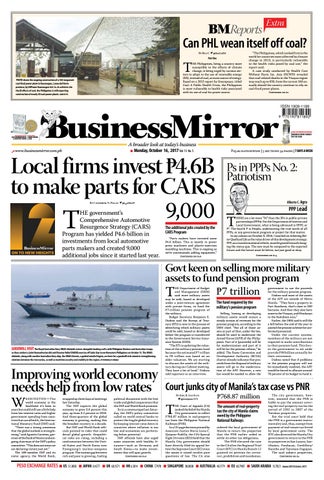
Local firms invest ₧4.6B to make parts for CARS 9,000 T By Catherine N. Pillas
GOODWILL VISIT The Royal Australian Navy HMAS Adelaide cruises alongside landing crafts with Philippine Marines and Australian troops as they conduct a joint Humanitarian Aid and Disaster Relief (HADR) exercise off Subic Bay in northwestern Philippines on October 15. The HMAS Adelaide, along with another Australian Navy ship, the HMAS Darwin, a guided missile frigate, are here for a goodwill visit aimed at strengthening relations between the two navies, as well as maritime security and stability in the region. AP Photo/Bullit Marquez
Improving world economy needs help from low rates A S H I N G T O N —T h e world economy is the healthiest it’s been in years but could still use a little help from low interest rates and higher government spending from countries that can afford it, the International Monetary Fund (IMF) said. “There was a strong consensus that the global outlook is strengthening,” said Agustin Carstens, governor of the Bank of Mexico and outgoing chairman of the IMF’s policy committee. “This does not mean we are declaring victory just yet.” The 189-member IMF and its sister agency, the World Bank,
wrapped up three days of meetings last Saturday. The IMF expects the global economy to grow 3.6 percent this year, up from 3.2 percent in 2016. And three-quarters of the global economy is growing, making this the broadest recovery in a decade. But IMF and World Bank officials pointed to risks that could derail global growth. Geopolitical risks are rising, including a confrontation between the United States and North Korea over Pyong yang’s nuclear-weapons program. The income gap between rich and poor is growing, fueling
PESO exchange rates n US 51.3850
2016 ejap journalism awards
business news source of the year
P25.00 nationwide | 5 sections 34 pages | 7 days a week
Ps in PPPs No. 2: Patriotism Alberto C. Agra
@c_pillas29
he government’s Comprehensive Automotive Resurgence Strategy (CARS) Program has yielded P4.6 billion in investments from local automotive parts makers and created 9,000 additional jobs since it started last year.
W
“The Philippines, which ranked first in the world for countries most affected by climate change in 2013, is particularly vulnerable to the health risks posed by coal use,” the report said. A case study conducted by Health Care Without Harm Inc. Asia (HCWH) revealed that coal-related deaths in the Visayas region may reach up to 650, from the current 240 annually should the country continue to rely on coal-fired power plants.
political discontent with the free trade and global cooperation that the IMF and World Bank promote. So in a communiqué last Saturday, the IMF’s policy committee called on world central banks to protect the fragile global recovery by keeping interest rates down in countries where inflation is too low and economies are performing below potential. IMF officials have also urged some countries with healthy finances—such as Germany and South Korea—to make investments that will spur growth. Continued on A16
ead
T
The additional jobs created by the CARS Program
“Parts makers have invested some P4.6 billion. This is mostly in power press machines and plastic-injection moulding machines. This is ongoing as we’re continuously adding equipment,” Continued on A16
PPPC.LAgra Alberto
here are a lot more “Ps” than the 3Ps in public-private partnerships (PPPs). For the Department of Interior and Local Government, what is being advanced is PPPP, or P4. The fourth P is People, underscoring the true north of all PPPs, or any government program or project for that matter. In my column on October 3, 2016, I touched on Achieving Better Quality of Life as the value driver of this development strategy. PPP, as a transformational vehicle, must be geared toward changing the status quo. The now must be compared to the expected future and the future must be better, not just good or okay. Continued on A15
Govt keen on selling more military assets to fund pension program ₧7 trillion T he Department of Budget and Management (DBM) said more military assets may be sold, leased or developed under a joint-venture agreement with private firms, to fund the P7-trillion pension program of the military. Budget Secretary Benjamin E. Diokno said the Bureau of Treasury (BTr) is now in the process of identifying which military assets could be sold, leased or developed before the program is transferred to the Government Service Insurance System (GSIS). “The BTr is updating the valuation of the military pension fund because the estimated P7 trillion to P8 trillion was based on an older valuation. We are starting to discuss the assets of the military during our Cabinet meeting. They have a lot of land,” Diokno told reporters in an interview.
The fund required by the military’s pension program
Selling, leasing or developing military assets would ensure a steady stream of revenues for the pension program, according to the DBM chief. “But all of those assets or part of that, under the law, should be used to modernize the Armed Forces [AFP] of the Philippines. Part of it [proceeds] will be for modernization and part of it will be for the pension reform,” he added. The Bases Conversion and Development Authority (BCDA) charter already indicates that proceeds from the disposal of military assets will go to the modernization of the AFP. However, a new law would be needed to allow the
government to use the proceeds for the military pension program. Diokno said most of the assets of the AFP are outside of Metro Manila. “They have a property in Fort Bonifacio, that’s close to 200 hectares. And then they also have some in the Visayas, and Mindanao in the Bukidnon area.” Earlier, the DBM said it will file a bill before the end of the year to amend the pension scheme for uniformed personnel. Under the current system, members of the military are not required to make contributions to their pension fund. This forces the government to set aside provide P90 billion annually for their retirement. Diokno noted that if problems in the pension program will not be immediately resolved, the AFP would be forced to allocate around 70 percent of its budget to fund it.
Court junks city of Manila’s tax case vs PNR By Joel R. San Juan
T
@jrsanjuan1573
HE Court of Appeals (CA) junked the bid of the Manila City government to collect P768.87 million in real-property tax from the Philippine National Railways (PNR). In a 13-page decision penned by Associate Justice Maria Luisa C. Quijano-Padilla, the CA’s Special Eight Division (SED) held that the Manila City government should have directly filed its appeal before the Supreme Court (SC) since the issues it raised involve pure questions of law. The CA also
₧768.87 million
The amount of real-property tax the city of Manila claims owed by the Philippine National Railways ordered the local government of Manila to return the properties that the PNR earlier ceded to settle its other tax obligations. The PNR elevated the case to the CA after the Regional Trial Court (RTC) in Manila Branch 12 granted its petition for certiorari, prohibition and mandamus.
The city government, however, insisted that the PNR is liable to pay the amount covering the real-property tax for the period of 1992 to 2007 of the Tutuban properties. But the trial court held that the PNR is a government instrumentality and, thus, exempt from payment of real-estate tax levied by local government units. The RTC also directed the Manila City government to return to the PNR its properties in San Lazaro, Santibañez, Pandacan, Cordillera/ Bacorba and Tayuman-Dagupan. The said subject properties, Continued on A2
n japan 0.4577 n UK 68.1571 n HK 6.5814 n CHINA 7.7978 n singapore 38.0038 n australia 40.1779 n EU 60.7987 n SAUDI arabia 13.7023
Source: BSP (13 October 2017 )
BMReports BusinessMirror
A2 Monday, October 16, 2017
Can PHL wean itself off coal? Continued from A1
HCWH’s Raphael Lopez said in a forum mid-September that the group’s second case study confirmed premature deaths were attributed to operating coal-fired power plants. Lopez, HCWH coordinator for health-energy initiatives, added that “the projected premature deaths from the combined emissions of existing and new plants” were also confirmed by the study.
Dependence
DESPITE the health risks, the Philippines still continues to be dependent on coal, according to Greenpeace. “More than one-third of the energy used to generate electricity in the Philippines comes from burning coal, and several new coal plants are expected to start commercial operations by 2020,” the environmental activists’ group said. “The Department of Energy [DOE] continues to award new coal operating contracts [COCs] for exploration, with at least 39 new COCs awarded in 2015 alone.” Lopez explained that, if the government is considering the health of the public, it should shift from the use of coal-fired power plants as energy sources and turn to the
PHL. . .
Continued from A16
victims/survivors must be addressed if those longer-term rights are to be availed of and fulfilled,” the study read. Data also showed that only 49 percent of NAPs-WPS in Indonesia, Nepal, the Philippines and Timor-Leste were focused on CSRV. These actions, UN Women said, are focused on legal, livelihoods, security, psychosocial, health, and transitional justice in Indonesia, Nepal, the Philippines and Timor-Leste. However, around 24 percent of the help CSRV victims received were on the legal aspect; 22 percent on livelihoods; and 20 percent on security. Only 16 percent and 10 percent of the actions are focused on the psychosocial and health, respectively, of the victims themselves. Actions to attain transnational jus-
renewable ones instead. “It is, therefore, recommended that the government phases out of coal and fully embrace renewableenergy sources in the Philippines based on public-health considerations.”
to be borrowed by Meralco PowerGen Corp., the power-generation arm of Manila Electric Co., the country’s largest distribution utility. They are targeting local and foreign banks, including JP Morgan Chase, the FDC said.
to keep global warming below 1.5 degree Celsius, which is the safest level still possible and is also the goal of the Paris climate agreement.”
Coal plants
Fossil financing
Not cheap
LAST Friday anti-coal activists, in protest over the plan to build the Atimonan coalfired power plant in Quezon province, held a rally at the offices of multinational bank JP Morgan Chase in Bonifacio Global City in Taguig. The Atimonan coal-fired power plant is one of 36 new coal plants, which is expected to be built by the private sector, according to the August data from the DOE. The Freedom from Debt Coalition (FDC) said a dozen of these plants are “committed ” or have established firm financing while 24 are “indicative” or are in the process of securing regulatory permits and financial closing. “Despite criticism, the Duterte administration has increased the share of coal in the country’s energy mix,” the FDC said in a statement. The total project cost of the 1,200-megawatt Atimonan coal-fired power plant is at P135 billion, most of the project funding is
CITING a Rainforest Action Network report, the FDC said JP Morgan Chase ranked third globally in the list of 37 international banks that financed extreme fossil-fuel activities from 2014 to 2016. Chuck Baclagon of inter nationa l env ironment organization 350.org said, “JP Morgan Chase has a track record of financing of the most carbon-intensive, financia lly r isky and env ironmentally destr uctive sectors of the fossi l-f uel industr y: extreme oil [tar sands, A rctic and ultra-deepwater oil], coa l mining, coa l power and liquefied natura l gas [LNG] ex port”. From 2014 to 2016, JP Morgan poured $20.035 billion in the financing of extreme fossil fuels, trailing the Bank of China and the China Construction Bank with $22.097 billion and $21.051 billion, respectively, Baclagon added. “Banks and financial institutions must stop financing coal and fossil fuels if we are
IAN Rivera, coordinator of the Philippine Movement for Climate Justice (PMCJ), considers coal as the dirtiest fossil fuel. Rivera linked fossil-fuel use to global warming and also to supertyphoons. He asserted that the “impact of coal-fired power plants on air and water pollution, as well as its effects on the health of surrounding communities, is highly documented”. Greenpeace Southeast Asia’s Ben Muni, meanwhile, said, “Investing in coal poses a huge reputational risk for banks and investors as people are realizing the world over that it is one of the biggest contributor to climate change.” “Not only that, it is also an investment risk,” Muni said. “Coal phaseout is taking off globally and we will fight for it to speed up in the Philippines. Therefore, coal infrastructure will soon become stranded assets.” He added that coal is not cheap. “[Coal] exacts a huge cost in terms of the lives and livelihoods of people and communities.” To be continued
tice are even less, at 6 percent. “The provision of urgent, interim and longer-term health and psychosocial care and services is of utmost priority for survivors and, yet, is one of the weaker areas of actions included within the plans,” UN Women said. UN Women said CSRV refers to incidents of sexual violence against women and men, girls, or boys in conf lict or postconf lict areas. These include incidences that occurred in the Philippines, such as sexual slavery; women captured and held in detention and experiencing forced stripping and nudity, sexual torture and assault, mutilation of sexual organs, among others; and forced into marriages by soldiers. UN Women’s data showed that in some cases in the Philippines, girls were forced into early marriages to protect them from rape. In the Philippines these incidents stem from the country’s experience of several
armed conflicts since its independence in 1946 and the period of martial law between 1972 and 1981. “There is emerging evidence of the sexual violence experienced by women and girls in this region at the hands of security forces,” the report read. “This has included acts such as killings, targeted sexual violence and abuse by soldiers, including sexual slavery and mass rape in conflict-affected area. Girls as young as 7 years of age were raped by state forces,” it added. The report also stated that the abuse of women continued in evacuation areas where there is a lack of secure bathing and dressing areas. It added that this also increased the level of domestic violence in these areas. UN Women also said some women who became pregnant as a result of being raped were forced to marry their perpetrators who would later abandon them.
Further, the report said, women whose husbands were killed due to the conf lict were unable to assume legal ownership of their land which they relied on for their livelihood. “Women experience multiple forms of sexual harm, including mutilation of sexual and reproductive organs, cutting off of breasts, mutilation of reproductive organs and cutting open pregnant women’s wombs,” the report stated. “Women were also forced to have sex with husbands in front of soldiers, some were abducted and did not return, others who returned and/or survived these assaults live with the stigma,” it added. UN Women said there is a need to address the social, security, legal, health and economic impacts that multiply and sustain the repercussions of CSRV in women and girls globally. Attention should also be given to children victims/survivors of CSRV, including those who were born of rape.
www.businessmirror.com.ph
Court junks City of Manila’s tax case vs. PNR Continued from A1
which were not being used by PNR in its railway or train operations, were ceded in 2003 by the PNR to the city government by virtue of a memorandum of agreement (MOA) or a dacion en pago to settle its realproperty tax obligations In upholding the trial court’s decision, the CA’s SED held that the issues raised in the petition filed by the Manila City government are pure questions of law that should have been raised in a petition for review and directly filed with the SC. In its petition, the Manila City government insisted that, although the PNR is referred to as a government instrumentality, its existence proved otherwise. It noted that the PNR is engaged in a railroad or transportation business and is not vested with a special function or jurisdiction by law. Furthermore, the Manila City government argued that Republic Act 10149 or the GOCC Governance Act of 2011, did not include the PNR as an instrumentality. T he Manila Cit y government added that PNR’s prayer to have its MOA with the latter is already barred by prescription since it was executed on December 3, 2003. But the CA pointed out that based on records, as well as arguments of the parties involved, the issue revolves around the correct application of the law, as well as the jurisprudence to determine liability of the PNR’s properties. “As can be gleaned from the foregoing, the remaining issues in the preset involve the determination of the nature of PNR’s property and the latter’s corresponding tax liability, if any,” the CA explained. “This requires an examination of PNR’s charter along with other related laws. Seeing these matters involve pure questions of law, the appeal is deemed improper and the dismissal thereof becomes the unavoidable outcome.” Concurring with the ruling were Associate Justices Rodil Zalameda and Carmelita Salandanan Manahan.
TPB goes green with ‘fun’ tourism campaign Continued from A16
CSR campaigns are being organized in various parts of the country by the TPB’s corporate planning and business development department, led by Marivic M. Sevilla as officerin-charge. “Our CSR initiatives and activities are designed according to the specific needs of the target communities in relation to tourism as TPB’s value-added contribution to sustainable development,” she said. “We also partner with government and nongovernmental volunteer organizations. For the stonewalling activity and distribution of school supplies in Banaue, our partners are the Black Pencil Project and the North Luzon Command of the Philippine Army,” Sevilla added. In 2015 the TPB started doing its corporate citizenship program with several community activities in Boracay Island and in the provinces of Bohol and Camiguin. It has, since then, reached Mindoro, Leyte and Palawan. “Through the ‘Fun Goes Green’ CSR campaign, we are taking the TPB to the people in a bid to make tourism an aspirational community endeavor,” Montano said.
www.businessmirror.com.ph
The Nation BusinessMirror
AFP reaffirms commitment in fight against illegal drugs By Rene Acosta @reneacostaBM
A
rmed Forces Chief of Staff Gen. Eduardo M. Año reaffirmed last Sunday the military’s commitment to the country’s war against illegal drugs, citing their February 2017 Memorandum of Agreement (MOA) with the Philippine Drug Enforcement Agency (PDEA). “The pronouncement came after President Duterte signed a memorandum tasking PDEA as sole agency to conduct the anti-illegal drugs campaign of the government,” military public affairs office Col. Edgard Arevalo said. “The Armed Forces of the Philippines has always been in support role to the PDEA, Philippine National Police [PNP] and the National Bureau of Investigation [NBI] in any illegal- drugs operations, unless we are otherwise requested to lead, especially in conflict-affected areas,” he added. The recent memorandum from the commander in chief signed on October 10 directed the “PNP, NBI, Bureau of Customs and all other government agencies to leave to the PDEA the conduct of all campaigns and operations”. “In line with the February 2017 MOA, the AFP has been a significant force provider to the anti-illegal drugs operations, especially in conflict-affected areas, particularly where conditions for insurgency, secessionism and terrorism persist,” Año said. The military also expanded the
Joint Counterintelligence Task Force NOAH, an ad hoc unit created and mandated by the AFP to conduct drugs-related counterintelligence operations. NOAH assists law-enforcement agencies in the identification, investigation and neutralization of persons in the use, sale, manufacture and distribution of illegal drugs. Regional task groups under the AFP Unified Commands were also established to coordinate direct action, intelligence, legal support and community relations to the PDEA, as force employer, and its regional offices nationwide. Data from the regional task groups showed that a total of 6,981 operations have been jointly conducted since July 2016 up to September 2017, resulting in the arrest of 1,241 drug suspects and the killing of 146. Joint raids of drug laboratories also yielded in the seizure of a total of P1.9 billion worth of shabu manufacturing equipment, significantly crippling the production of methamphetamine in the country. More than 52 kilos of shabu were also confiscated in the operations. Internal security operations conducted against terror groups also resulted in the neutralization of several drug suspects in Mindanao. The military apprehended Abu Sayyaf Group kidnap-for-ransom leader and il lega l-dr ug pusher Butchoy Hassan, alias Black and Bocci, in Sitangkai, Tawi-Tawi, on March 14.
Editor: Vittorio V. Vitug • Monday, October 16, 2017 A3
PHL joins air patrols to rid extremist threats in Southeast Asia–Palace
T
By Elijah Felice E. Rosales
@alyasjah
he Philippine government appears to have learned its lesson on terrorism and is taking the extra mile in trying to avoid the occurrence of another “Marawi seige”.
In line with this, Presidential Spokesman Ernesto C. Abella said Manila has opened a new round of security mechanism with Jakarta and Kuala Lumpur. Following joint maritime patrols in June, the three countries last Thursday launched joint air patrols as part of efforts to rid Southeast Asia of extremist threats. “The fight against terrorism in
the region continues to get a boost. The coordinated joint air patrols between the Philippines, Indonesia and Malaysia were launched in Malaysia to better counter the movement of terrorist groups and to strengthen the security of our three nations and that of the region,” Abella said. The Philippines, Indonesia and Malaysia have vowed to strengthen border security after Marawi
City suffered from an almost takeover from the Daesh-inspired Maute Group in May. “By sharing information and exchanging best practices, we hope to improve the interoperability of our forces and help better secure areas of common maritime interest,” Abella explained. Defense Secretary Delfin N. Lorenzana, during the launching of the joint air patrols, said the security mechanism intends to bolster the region’s fight against terrorism. “The effect of this is we can prevent others from coming, in and also from escaping, because a lot of the fighters are also Malaysian and Indonesian and nationals from the Middle East,” Lorenzana said. Under the security mechanism, the air patrols will make rounds monthly among the three countries,
with Malaysia taking the lead on the first round of operations. The Philippines will take over in the next round, followed by Indonesia. After rounds of operations, they will decide whether to include more countries in the joint air patrols. Meanwhile, in a television interview aired last Friday, President Duterte said the conflict in Marawi City “is almost over”. “It’s almost over—almost is because of the hostages. The monkey wrench…is because of the lives of the hostages,” the President said. Duterte added he cannot force the issue because it might cost the government more lives of soldiers and civilians. Nonetheless, he vowed to finish the conflict without having to hurt cultural and religious sensitivities, such as bombing mosques and other places of worship.
Senators eye wider access to intelligence documents
A
Senate oversight panel has expressed support for a proposal to widen senators’ access to certain sensitive information with national security implications, but will hold further discussions with the proponent, Sen. Richard J. Gordon. In a phone interview last Sun-
day, Senate Oversight Committee on Intelligence Chairman Sen. Gregorio B. Honasan II said, “We still have to discuss it, so we can avoid duplication,” referring to Gordon’s move to seek creation of a separate Senate Special Select Intelligence Oversight panel with upgraded ac-
cess to top-secret documents.
At present, senators are only allowed access up to documents tagged as “Secret”. There are four levels of access, to intel documents: Restricted, Confidential, Secret and Top Secret. “No slight on Senator Greg [Honasan], but we’re only allowed up to Secret, [not
Top Secret]” levels of access to top sensitive documents,” Gordon said, noting that this sometimes hampers the lawmakers’ work, as they need crucial background information in crafting legislation and providing inputs to key national policies and programs. Butch Fernandez
Economy
A4 Monday, October 16, 2017 • Editors: Vittorio V. Vitug and Max V. de Leon
BusinessMirror
Jan-Aug infra spending up 11.9%–DBM
Workers from the engineering division of the Manila City Hall undertake road improvements in Padre Faura, Manila. Aside from the rehabilitation and construction of more roads, the government will roll out other massive infrastructure projects to further boost Philippine growth. FILE PHOTO
By Jovee Marie N. dela Cruz
I
@joveemarie & Rea
Cu
the government has spent P40.1 billion in infrastructure and capital outlays in August alone, expanding by 18.1 percent from the P34 billion recorded last year. “The amount includes payments for completed infrastructure projects of the DPWH [Department of Public Works and Highways], capital outlay projects of the Department of Education, and Department of Health [DOH],” the DBM report read. “The upswing in infrastructure and other capital outlays, resulted from the implementation of public infrastructure projects of the DPWH and the Department of Transportation, other capital outlay projects in state universities and colleges, the DOH and the modernization program of the Department of
@ReaCuBM
nfrastructure spending in January to August this year expanded by 11.9 percent to P337.6 billion, from the P301.7 billion a year ago, data from Department of Budget and Management (DBM) showed.
According to the DBM, the increase in government spending boosted the country’s GDP in the second quarter. Data from the DBM showed that the remaining pro-
gram balance available for release for the rest of the year amount to P452.9 billion, or 13.5 percent of the P3.35-trillion budget. Based on data from the DBM,
National Defense-Armed Forces of the Philippines,” it added. Under the Duterte administration’s “Build, Build, Build” program, at least P9 trillion until 2022 is programmed for infrastructure, which would help usher in the “golden age of infrastructure” in the Philippines. Malacañang’s infrastructure buildup and human capital development would sustain public support for President Duterte, a vice chairman of the House Committee on Appropriations said last Sunday. Rep. Luis Raymund Villafuerte of Camarines Sur made a statement after the latest Pulse Asia survey showed 80 percent of Filipinos approve of and trust President Duterte. According to Villafuerte, the poor are the primary beneficiaries of Malacañang’s “unprecedented” massive public investments in infrastructure and human capital development. “Unlike in the past when only a few can partake of the gains of the country’s decade-old robust economic growth, today on the Duterte watch, the people can see and feel that there are sustained efforts to ensure that growth remains high and that all Filipinos can truly benefit from it,” he said. Villafuerte said the President’s popular support will continue, “given that Malacañang has apparently been pursuing without letup his ambitious Build, Build, Build infrastructure program complemented by increasing investments in education, health and other social services”. He said the government’s programs to make it easier to do business in the Philippines and to attract more investments will create quality jobs for the people while the tax-reform program will support the government’s massive investment strategy.
Subsidies extended to GOCCs down 17.7% in August
S
ubsidies given by the national government to government-owned and -controlled corporations (GOCCs) declined by 17.7 percent to P6.08 billion in August, from P7.402 billion a year ago, according to data from the Bureau
of Treasury (BTr). BTr data showed that the bulk of the subsidies, or P2.818 billion, went to the National Irrigation Administration (NIA), which has stopped collecting irrigation service fees starting January.
From January to August, subsidies allocated by the government to GOCCs have reached P81.171 billion, 2.4 percent higher than the P79.257 billion recorded in the same period last year. The Philippine Crop Insurance Corp. received the second biggest allocation at P1.4 billion, followed by the Social Housing Finance Corp., with P929 million. Other GOCCs that were granted subsidies in August were the Small Business Corp., with P350 million; National Power Corp., P263 million; Philippine Children’s Medical Center, P89 million; Subic Bay Metropolitan Authority, P65 million; Philippine Heart Center, P38 million; Philippine Rice Research Institute, P38 million; and the Philippine Institute for Development
Studies, P27 million. Also given subsidies were the Lung Center of the Philippines, with P22 million; Center for International Trade Expositions and Missions, P16 million; the Cultural Center of the Philippines, P12 million; Zamboanga City Special Economic Zone Authority, P8 million; the Aurora Pacific Economic Zone and Freeport Authority, P7 million; and the Southern Philippines Development Authority, P3 million. Data from the BTr showed that, compared to the July disbursements of P16.867 billion, the subsidies given out by the government in August declined by nearly 64 percent. The bulk of subsidies in July was given to the Philippine Health Insurance Corp. Rea Cu
www.businessmirror.com.ph
Data Privacy Compliance —are organizations ready?
W
ith the increase in legal requirements around the world, organizations are facing stiffer penalties for security breaches involving personal information and noncompliance. This upward trend of tightening rules saw Singapore’s PDPC taking enforcement action against 11 firms for data-privacy breaches in April this year. Further, companies processing personal data of European residents will have to take heed of the new European General Data Protection Regulation (GDPR) to avoid penalties of 4 percent of their global revenues or €20 million, whichever is greater. Public and private companies that failed to beat the September 9 deadline for the registration of their dataprocessing systems starting with the registration of their data-protection officer (DPO) could face compliance checks, the National Privacy Commission (NPC) warned. “Failure to register may subject a company or an agency to compliance checks, compliance orders and, depending on attendant circumstances, may be considered evidence of unauthorized processing, punishable under the Data Privacy
Act,” Chairman and Privacy Commissioner Raymund Enriquez Liboro said. “For one thing, in case an organization suffers a data breach in the future, its nonregistration would imply lack of due diligence, critical in defending against charges of negligence,” Liboro added. As we all know, in case the NPC finds an organization wanting, it will trigger a formal investigation that could possibly result in prosecution. “Given these data privacy compliance issues, Henry Schumacher, president of the European Innovation, Technology and Science Center Foundation [EITSC] outlined, we have assembled a team of data security experts to help information security, privacy and compliance professionals architect and implement the best security and privacy practices for your organization.” In an effort to give organizations ample time to comply, the NPC has earlier divided the registration process into two phases and extended the deadline for the more rigorous second phase to March 8, 2018. The first phase, however, which essentially consists of a DPO registration, is not subject to an extension.
Modern jeepneys to feature tap-and-go payment system By Lorenz S. Marasigan @lorenzmarasigan
T
he government aims to fully integrate the tap-and-go payment system to “modern jeepneys” starting 2018, a tentative timetable showed, as designs for the upgraded public transport means were unveiled last week. Under the Public Utility Vehicle (PUV) Modernization Program of the transportation department, the automated fare-collection system should be incorporated in the modern jeep by the first quarter of 2018. It should be fully integrated by 2020, the tentative timetable showed. Already, AF Payments Inc., the company behind the beep card—a tap-and-go payments system for different transportation means and a few retail stores—paraded its technology during the first Philippine Auto Parts Expo (PhilApex) last week. Several of the modern jeepney prototypes on display at the event were furnished with a working beepcard reader that employs a tap in, tap out scheme. Passengers tap in upon riding, and tap out before alighting. The fare is calculated based on the distance traveled. This is the first
ever automated fare-collection solution made for jeepneys. The system essentially eliminates the driver’s task to collect the fare from passengers, thereby reducing the risk of being distracted from driving. ”We are ready to support the Department of Transportation’s modernization program. We have developed a beep card service that is affordable to jeepney operators and will surely be appreciated by commuters in Metro Manila, who have already purchased 4 million beep cards,” AF Payments President Peter Maher said. The transportation department is moving to modernize the public transportation sector in the Philippines by 2020. This involves the phasing out of old jeepneys, and equipping them with Euro 4 emission standard engines. They will also be required to be equipped with speed limiters, GPS, dash cam and CCTV to ensure safety and security of the commuters. Jeepney operators are scheduled stage a nationwide strike today, Monday and Tuesday, to protest the modernization program, which transport groups have claimed will negatively impact the livelihood of “more than 200,000 drivers”.
Pinoy SMEs taught how to apply elements of social compliance in production
F
ilipino manufacturers and exporters should familiarize themselves with the key elements of social compliance, as corporate social responsibility (CSR) is an increasingly critical factor in the decision-making of foreign buyers, according to a group in the Philippines representing overseas buyers. Fernanda Aguilar, ex-officio director of the Foreign Buyers Association of the Philippines (Fobap), stressed in a recent talk in Makati City before local small and medium enterprises (SMEs) that social compliance “has now become a global standard and minimum requirement, and another measure of factory performance”. Essentially, this means, she said, that foreign buyers will be checking to see if the goods they are sourcing were produced in “ethical” factories. An ethical or socially compliant factory, Aguilar explained, is one that maintains “lawful, safe and respectful working conditions” and runs operations “with no negative impact on the environment”. It is a work environment that
“respects human rights [with regard to] fair wages and benefits, equal opportunities; [is] free from drugs and health hazards; is safe and free of any kind or form of discrimination, physical abuse, or use of child labor,” Aguilar added. At the same seminar, Li & Fung Compliance Manager Vicente Aganon Jr. pointed out that foreign importers want to source only from compliant factories in order to meet their respective countries’ requirements, as well as international codes of conduct that promote the human rights of workers. This is so buyers, in turn, can protect their clients, usually global retailers like Wal-Mart, Costco, Target, whose brand reputation could be tarnished for associating with noncompliant suppliers, Aganon said. Foreign buyers also seek to avoid costly legal suits and consumer outrage should they source from factories that are found to use child labor, pay slave wages, have unhealthy and unsafe work conditions, or
pollute the waterways. To steer clear of these situations, international buyers are increasing audit and monitoring their suppliers’ factories to avoid setbacks from non-compliance, Aganon said. On their part, Aguilar said, Filipino SMEs can expand their export orders and improve their competitiveness by adhering to CSR practices. They should hire only workers 18 years old and above, not force employees to work beyond eight hours against their will, and not stop them from engaging in collective bargaining. Workers must be given their fair wages and mandated benefits, and not be harassed or discriminated against for their race, gender, or religion. Manufacturers must also comply with regulations on laborers’ health and safety. Factories should be well lit and ventilated, and have the proper temperature setting, for example, Aguilar said. They should install first-aid kits and fire extinguishers, and keep fire exits accessible and aisles clear of obstructions. Moreover, they are required to check electrical
wiring integrity, conduct employee safety training, and provide proper personal protection equipment. At the same time, waste management and disposal should follow relevant rules and regulations, and the necessary environmental permits obtained. Robert M. Young, chairman and president of Fobap, told the Philippine Exporters Confederation Inc. in an exclusive interview on the sidelines of the seminar that social compliance is no longer an option but a necessity. “If you do not shape up, you’ll be shipped out,” he said, adding that many buyers keen to source from the Philippines instead go to other Asean countries because Filipino factories are still mostly not compliant. However, he acknowledged that compliance presents huge challenges for SMEs, and called on the government to consider ways to mitigate the cost of compliance, including through a rewards program and greater access to financing for small entrepreneurs. Philexport News & Features
Agriculture/Commodities BusinessMirror
www.businessmirror.com.ph
Editor: Jennifer A. Ng • Monday, October 16, 2017
A5
Rice imports in 2018 to hit 1.7 MMT–USDA
P
By Jasper Emmanuel Y. Arcalas
@jearcalas
hilippine rice imports next year could increase by more than half to 1.7 million metric tons (MMT), from the 1.1 MMT projected for 2017, according to the United States Department of Agriculture (USDA).
A farmer piles up grain harvested from a rice field in Nueva Ecija. FILE PHOTO
The USDA Foreign Agricultural Service (USDA-FAS) had earlier said that the scrapping of the quantitative restriction (QR) on rice would boost demand for lower-priced imports. The latest projection of the USDA-FAS for 2018, however, is lower by 100,000 metric tons (MT). The FAS attributed this to the change in the National Food Authority’s (NFA) importation policy. “ Ph i l i p p i n e i m p o r t s a r e trimmed 100,000 MT to 1.7 MMT based on limitations set by the government on import
arrival times,” the USDA-FAS report read. The USDA-FAS also slashed its forecast for rice exports to the Philippines this year by 500,000 MT to 1.1 MMT. However, its latest forecast was still higher by 37.5 percent than last year’s estimate of 800,000 MT. “Philippine imports are cut 500,000 MT to 1.1 MMT based on government announcements that the minimum access volume [MAV] imports will be allowed beginning in late-December,” the report read. Despite this, total milled rice
traded globally this year would remain at 44.557 MMT, according to the USDA-FAS. “Global trade is nearly unchanged this month, as larger imports by Bangladesh and Nigeria nearly offset reductions for the Philippines and Ghana,” it said. In a separate report, the USDA-FAS projected that Philippine milled-rice production next year would reach 11.20 MMT, 4.19 percent lower than the estimated 11.69-MMT output this year. The USDA-FAS attributed the decrease to the expected contraction in area planted with rice next year. Data from the USDA-FAS showed that the country’s rice areas next year may shrink to 4.5 million hectares, from 4.72 million hectares this year. Meanwhile, yield per hectare is projected to maintain at 3.95 MT per hectare. For this year, the NFA Council (NFAC) revised the rules and regulations governing rice imports under the MAV scheme, staggering the arrival of shipments into two periods. The NFAC is the highest policy-making body of the NFA. Under Memorandum Circular AO-2017-08-002, rice imported by the private sector will arrive from December 20 until February 28, 2018, and from June 1, 2018 until August 31, 2018. R ice traders and far mers’ groups can import 293,100 MT of rice from Thailand and Vietnam. They can also import 50,000 MT of rice from China, India and Pakistan; 15,000 MT from Australia; and 4,000 MT from El Salvador. Based on the list uploaded on the NFA’s web site, as of September 25, 297 private firms and cooperatives are seeking to import 2.2 MMT of rice under the MAV scheme.
International conference to boost protection of migratory animals–DENR By Jonathan L. Mayuga @jonlmayuga
O
ver 900 delegates from over 120 countries will arrive in the Philippines starting this week for the 12th Session of the Conference of the Parties (COP12) to the Convention on the Conservation of Migratory Species of Wild Animals (CMS). Theresa Mundita S. Lim, director of the Department of Environment and Natural Resources’s Biodiversity Management Bureau (DENR-BMB), said the meeting will be held in Manila from October 22 to 28. “We are very excited. Everybody is excited about this event,” Lim said. An expected output of the event is the Manila Declaration, wherein the 124 range states or signatories to the CMS will renew the commitment to protect the migratory species of wild animals in countries along their migratory routes or pathways. The Philippines is expected to put its best foot forward in hosting the historic event, the first to be held in Asia. The last COP meeting to the CMS was held in Quito, Ecuador, from November 4 to 9, 2014. With the Philippines hosting the international conference, which is held every three years, the DENRBMB plays the role of the focal point and is in charge of all aspects of the preparations in coordination with the CMS Secretariat. In a telephone interview, Lim said Environment Secretary Roy A. Cimatu has been regularly briefed on the event’s preparations over the past few weeks.
“The secretary will preside the meeting. Welcome banners are in place. We have started the promotional campaigns,” she said. According to Lim, Cimatu himself will call for a security briefing, to ensure the safety and security of the delegates from the airport to the hotels and the event venue. “We need to make more hotel reservations because the hotels nearest to the venue are already fully booked. We just need to make additional reservations,” she said. “We are encouraging the public to support the conference by helping us promote the objectives of the convention, which is to protect migratory species,” Lim added. According to Lim, Cimatu is “hands-on” with as far as preparations is concerned, including the safety and security of delegates, traffic management and rerouting and other event activities. A letter-request and invitation have been extended for President Duterte to deliver the welcome remarks and deliver the keynote address for the high-level policy meeting. According to the CMS web site, the COP will be preceded by a HighLevel Panel on October 22. On the evening of COP, an award ceremony under the Migratory Species Champion Program will also be held on the same day during which several governments, organizations and companies will be recognized as “Migratory Species Champions” for their long-term support to initiatives that benefit migratory species. The slogan for the Conference,
“Their Future is Our Future—Sustainable Development for Wildlife and People”, is linked to the Sustainable Development Goals agreed to by governments in 2015 to end poverty and hunger, improve health and education, combat climate change and protect oceans and forests. The participants are expected negotiate and potentially agree on coordinated measures on how to reverse the impacts already being felt on these animals and to ensure the species’ survival. The negotiations will revolve around placing these species on Appendix I of the treaty, which affords full protection and requires all countries to ensure that there is no taking or on Appendix II, which foresees putting in place management strategies among countries for species that cross their borders. A total of 35 migratory species are up for listing in appendices for stronger protection measures under the CMS. These include protection for five species which the Philippines is pushing under various resolutions. The Philippines is pushing for the listing of the whale shark or butanding, the world’s largest fish, from Appendix II to Appendix I; inclusion of the Christmas frigate bird in Appendix I; inclusion in Appendix II of the White-spotted wedgefish; inclusion of the Black Noddy in Appendix II. The Black noddy (Anous minutus) subspecies worcesteri, an endangered seabird species, is a kind of seabird that breeds only in two islets in the Tubbataha Reefs Natural Park off Palawan province.
The war on poverty 2
I
ended my column on “The War on Poverty” last week with the following messages: “We need to deliver support services to farmers and fishermen, such as financing, incentives, technolog y, irrigation, postharvest facilities, farm-tomarket roads, improved logistics and integration in the supply chain to fully develop the potential of the agricultural industry to develop rural areas and the countryside. As a consequence, some 20 million rural Filipinos can be lifted out of poverty. And the children of farmers will stop moving from rural areas to urban centers or become overseas Filipino workers. Isn’t this what the 10-point socioeconomic agenda of the Duterte administration has in mind? Fighting poverty in agriculture?” A recent Department of Labor and Employment (DOLE) report states that approximately 4.2 million youths are out of school or unemployed. Poverty continues to keep Filipino youth away from school, despite free education from primary to tertiary level. The numerous other expenses for keeping a child in school, such as daily transport, food and miscellaneous school fees remain a heavy burden for many households. Malnutrition is another factor that negatively affects poor students (I still hope that eventually my Urban
Henry J. Schumacher
europe Beat Farming project can be realized). These 4.2 million youths are among many other Filipinos who need greater inclusion in the fruits of economic growth, with emphasis on the much needed focus on growth in agriculture and inclusive food-supply chains. Back to the 10-point socioeconomic agenda of the Duterte administration: How high is agriculture on their agenda? Only 11 of the administration’s 75 flagship projects are for the agriculture sector. Rightfully, the Business Mirror in its editorial on October 11 said: ‘It takes money to make money in agri.” However, it is worth remembering also that the agriculture does not stop at the farm. Very much part of the agricultural system are the agricultural processing enterprises, the packaging industry, the agricultural input manufacturers and importers, and the trade, storage (including cold storage) and transportation (including refrigerated containers) sectors. The effective integration of these various elements of
the agricultural system within a competitive market environment continues to loom large in the country’s unfinished agenda. If we want to achieve change, we have to focus on agri-food supply and value chains. But seizing the opportunities in agriculture entails not only creativeness and daring on the part of the private investor; it also involves a great deal of political will—both national and local—to effect long needed changes in the sector’s institutions, from access to finance to access to extension work, from mechanization to land titles, from allowing land-reform beneficiaries to consolidate their small land holdings into viable land sizes that will allow competitive agri production. We will have to think in terms of trading and buying stations close to farmers; we have to look at intercropping and severe reductions in postharvest losses. In other words, plenty of work to do, preparing for increased production and trade of agrifood products, a l low ing the farmers to create income which will keep their children on the farm rather than moving into urban centers. Poverty reduction in the Philippines is only possible if the revolution in agri-food succeeds. The time to do it is now! For more information, contact Schumacher@mcasia.org.
A6
Banking&Finance
Monday, October 16, 2017 • Editor: Jun B. Vallecera
BusinessMirror
www.businessmirror.com.ph
BSP offers relief measures to lenders in ravaged areas
L
By Bianca Cuaresma
Foreign banks in PHL help increase FDI, employment
@BcuaresmaBM
enders affected by the tropical depression Maring will be subject to less strict regulatory measures on loans and, in turn, can provide debt relief to their borrowers, the Bangko Sentral ng Pilipinas (BSP) said. Last Sunday the Central Bank released a statement saying banks in places ravaged by the tropical depression—which hit Luzon in September—will be granted temporary regulatory and rediscounting relief measures. The central bank said banks and nonbank financial institutions with quasibanking functions whose head offices and branches are located in the areas that were identified by the National Disaster Risk Reduction and Management Council as affected by the tropical depression will be given the usual package for temporary relief. These areas include Malabon City, Manila City, Marikina City, Navotas City, San Juan City, Taguig City and Valenzuela City in the National Capital Region (NCR), and Bulacan and Zambales in Central Luzon. Banks and other lenders in Batangas, Cavite, Laguna, Quezon and Rizal
in Southern Luzon will also be given the same package. With these measures, the outstanding loans of borrowers in the affected areas will now be excluded from the computation of past due ratios of smaller banks in the areas, provided these are restructured or given relief. All banks are also allowed to provide financial assistance to their officers and employees affected by the calamity even if the purpose of the assistance is not identified as eligible for credit accommodation under their existing BSP-approved Fringe Benefit Programs. Other measures also include the nonimposition of penalties on legal reserves deficiencies of smaller banks with head office and/or branches in the affected areas, and a moratorium on monthly payments due to the BSP for banks with ongoing rehabilitation programs. Also, subject to BSP approval, there
T
Workers ride on a backhoe as they cross a flooded street in Manila on September 12, 2017. Classes in schools and work in government offices have been suspended in the capital and nearby provinces as heavy rains pour, causing floods in low-lying areas due to tropical Depression Maring. AP
will be booking of allowance for probable losses on a staggered basis over a maximum of five years for all types of credits extended to individuals and businesses in calamity-affected areas. For all rediscounting banks affected, meanwhile, the BSP is granting a 60-day grace period to settle the outstanding rediscounting obligations as of declaration date of a state of calamity with the BSP. It also gave moratorium on monthly
payments due to the BSP for smaller banks with ongoing rehabilitation programs. The BSP said the measures will be in effect for a defined period and are covered by additional specific and other prudential conditions. This temporary regulatory and rediscounting relief measures are usually extended by the BSP to areas affected by natural calamities, such as typhoons and El Niño.
SSS reform measure Perspectives to improve benefits Are customers really at the center of your business?
B
y creating a customer-centric business, you can decide where to play, what to do and how to win—and be better placed to deliver the growth that stakeholders expect. “The purpose of business is to create and keep a customer,” observed management guru Peter Drucker in the 1950s. For manufacturers and retailers serving the consumer, that mission remains, it’s just that creating and keeping customers has become significantly more difficult in the past 60 years—and particularly in the past five years. Companies have not been complacent, pumping billions of dollars into customer-service programs—but is the investment really paying off?
Retaining customer loyalty
Yet, in an uncertain marketplace, even iconic brands and retailers are vulnerable—a fact their leaders seem to recognize. The 2017 Top of Mind Survey shows that customer trust/loyalty remains a top 3 priority for 33 percent of companies over the next two years. Nearly three out of four executives identified this area as very critical to critically important to the success of their business. The other top-ranking priorities were product and pricing strategies (29 percent) and customer experience (26 percent). In comparison, such previously hot issues as talent management, geographic expansion and social and environmental responsibility were a priority for less than 20 percent. Brand loyalty is a particular concern because, as the 2017 Edelman Trust Barometer shows, distrust of business has seldom been higher. Brands have not been immune to this skepticism, with studies showing consumers have less faith in them, don’t trust them to handle their data and are more cynical than ever about the traditional forms of advertising that are used to promote them. One intriguing finding from the Top of Mind Survey is that only 56 percent of executives in China considered brand loyalty/ consumer trust as a key issue. This does not necessarily mean they are ignoring the challenge—it could be that they recognize that brand loyalty is just weaker among Chinese consumers than in some developed markets. The suggestion that “The customer is king” is one of the oldest marketing mantras, but this is not the same as actually having a customer-centric organi-
zation. As Julio Hernandez, global head of customer, KPMG International, says: “Many companies define their customer strategy with a slogan—and underpin that with a few key attributes. But they still fall into the trap of focusing on what they can sell to the customer—not what the customer wants to buy from them.” KPMG’s research suggests that truly customer-centric organizations have a number of common characteristics. They are more likely to: n Collaborate with partners/suppliers. n Embrace a culture of innovation and collaboration. n Personally engage with end-users/ customers. n Use social media to promote their brand and engage with consumers. n Drive digital transformation throughout the business. n Have an agile, demand-driven supply chain. n Invest in the right technologies. n Provide a compelling customer experience. n Have an effective pricing strategy across channels. n Use data analytics to predict customer preferences and behaviors. For the purposes of this research, firms with “excellent” capabilities in seven or more of these areas were considered to be more customer centric.
How to transform your company
In terms of corporate evolution, Ranjay Gulati, professor of Business Administration at Harvard Business School, has identified four stages in the journey to customer centricity. Initially, companies are product-driven, focused on the excellence of their technology, with a diffuse understanding of their customers. Once they start investing in market research, they acquire a basic understanding of their customers and can begin to target them in a much more segmented way, but the research they have is not used to influence product development or inform strategy. This is the stage at which many companies become complacent, thinking they are “customer centric” because they know more about their customers. One large US consumer electronics retailer offers striking proof of this tendency. Management thought they knew their customers pretty well and were shocked to discover that 55 percent of their customers were women—and they didn’t
like the in-store experience which, given that the shops had been designed to suit men, was understandable. Organizations only begin to become genuinely customer centric when they turn insight into action and shift their focus from selling products to solving customer problems. This, Gulati suggests, may lead businesses to become agnostic about whether they produce all the outputs needed to solve customers’ needs and develop an ecosystem of partners and collaborators to meet demand. The return on investment (ROI) for this kind of corporate transformation is, Gulati’s research suggests, both clear and dramatic. Between 1999 and 2007, his study of 500 companies showed that those with a deeper commitment to customer centricity grew sales by 233 percent, rather than the 10 percent achieved by the typical company in the Standard & Poor’s 500. The Top of Mind Survey also shows a clear correlation between high-growth companies, and their level of customer centricity. With that kind of ROI—and the realization, reflected in last year’s Top of Mind Survey, that companies need to become customer centric, why have so many businesses found this goal difficult to achieve? One reason is that too many companies focus on a single customer metric—the Net Promoter Score (NPS) is particularly popular—as if this is a magic formula that guarantees success. The need for clarity and focus—particularly during times of great organizational change—is understandable, but executives need to put such data into a broader, subtler context. Knowing that a customer is satisfied is useful, understanding why they are satisfied—and applying that knowledge—can help transform the business. The article “Insurers are on the road to strategy-aligned deal-making” by Ram Menon, KPMG in the US was taken from KPMG’s publication entitled The Frontiers in Finance. © 2017 R.G. Manabat & Co., a Philippine partnership and a member-firm of the KPMG network of independent member firms affiliated with KPMG International Cooperative (KPMG International), a Swiss entity. All rights reserved. For more information on KPMG in the Philippines, you may visit www.kpmg. com.ph.
T
he Social Security System (SSS) announced that a corresponding benefit increase will coincide with the proposed monthly pension increase for its member-pensioners, which is included in the SS Reform Act of 2017 currently being deliberated in the Senate. According to the state-run pension fund, the estimated monthly pension of a member with at least 30 paying years will increase to P20,300 from the current maximum pension of P10,900 by 2022, if the monthly salary credit (MSC) or coverable income of a member increases to P30,000 in five years as part of its proposed reform agenda. SSS President and CEO Emmanuel F. Dooc said the success of the proposed SS Reform Act of 2017 will improve the benefits being received by the members and pensioners. These benefits include maternity, sickness and funeral, once the reform agenda is implemented as these are computed based on the MSC. “The estimated pension could increase to as much as P20,300 by 2026. As we have proposed earlier, the adjustment in MSC should increase gradually every year to P20,000 next year, to P25,000 in 2020 and P30,000 in 2021. As we increase the coverable income, the benefits also increase because this is the basis for computation of SSS benefits,” Dooc said. Under the current maximum MSC of P16,000 and monthly contribution rate of 11 percent, which is shared by both employer and employee, the maximum basic monthly pension is only P10,900 for a member who retires with 30 credited years of service or the number of years the employee has paid in SSS contributions. In the current MSC structure, the maximum average daily salary credit is at P533, which makes the employee eligible for a sickness benefit of P480 per day. If the MSC and contribution rate will be adjusted to P30,000, the sickness benefit per day will increase to P900. Maternity benefits for caesarian delivery will increase from P41,600 to P78,000 under a maximum MSC of P30,000, while a normal birth will get P60,000 from the current P32,000 under the proposed P30,000 maximum MSC. Rea Cu
he entry of foreign banks into the local lending system may have come with early concerns, but the Bangko Sentral ng Pilipinas (BSP) said the nonresident players have been contributing to the economy since local laws have allowed their full entry in 2014. In a recent speaking engagement, Deputy Governor for the Supervision and Examination Sector Chuchi Fonacier said foreign banks in the Philippines have attracted foreign direct investments (FDI) and served as channels for the flow of funds and investments into the economy. In particular, for example, Fonacier said foreign banks facilitated financial transactions amounting to $15.7 billion between the Philippines and other countries, such as the United States, Japan, China and Thailand. The deputy governor also said foreign banks in the country have produced quantifiable increases in employment numbers, thus helping the country in its drive to alleviate poverty. As of end-2015, data from the BSP said foreign banks employed a total of 7,088 personnel, of which 6,959, or 98.2 percent, were Filipinos. Fonacier also lauded the foreign banks’ heavy investment on training and seminars on the latest developments and trends in banking as a means to boost the competitive advantage among their work force. Foreign banks, Fonacier said, also contributed to the offering of a wider array of financial products and enhanced delivery of financial services by capitalizing on and enhancing existing banking technology and support systems for banks’ front and backroom operations, thus resulting in higher customer satisfaction. The deputy governor said the BSP is continuously supporting the Asean bank ing integ ration because of the many opportunities it brings to the country, and the Central Bank expects more of these benefits upon the entry of other banks from other jurisdictions in the region. Under t he A sea n Ba n k ing Inte gration Framework (Abif ) timetable, each countr y should have concluded at least one Abif arrangement by 2018 and by 2020, there should be the conclusion or near conclusion of at least one bilateral accord for each of the 10 countries. Fonacier said the Philippines is currently on track with its Abif commitments, citing concluded negotiations with Bank Negara Malaysia, as well as current discussions with Bank of Thailand and Indonesia. The deputy governor also expressed confidence in the local banking system’s ability to absorb these new banks and compete with them. “While we are aware of the risks associated with banking integration, such as contagion, as well as financia l and macroeconomic instabilit y, we are confident that the Philippines is ready for integration and is able to manage and deal with potential risks,” she said. Bianca Cuaresma
Case clippings
By Justice S J Ranada Jr.
LAND REGISTRATION–burden of applicant The burden of proof in overcoming the presumption of State ownership of lands of the public domain is on the person applying for registration, who must prove that the land subject of the application is alienable, thru a positive act of the government, such as a presidential proclamation or an executive order; an administrative action; investigation reports of Bureau of Lands investigators; or a legislative act or statute. Diaz–Enriquez v. Director 06 Sep 2017
GR 168065 Martires, J
www.businessmirror.com.ph
The World BusinessMirror
Editor: Lyn Resurreccion • Monday, October 16, 2017 A7
Trump’s speech sparks new US-Iran war of words
T
EHRAN, Iran—President Donald J. Trump’s refusal to certify the Iran nuclear deal has sparked a new war of words between the Islamic Republic and America, fueling growing mistrust and a sense of nationalism among Iranians.
The speech has served to unite Iranians across the political spectrum—fed also by anger over Trump’s refusal to refer to the Persian Gulf, the waterway through which a third of all oil traded by sea passes, by name. The reaction is undercutting those trying to change Iran’s clerically overseen government from within, and likely will strengthen the hand of hard-liners who long have insisted the United States remains the same “Great Satan” denounced in the 1979 Islamic Revolution. “Under the deal, it was supposed to be that we get concessions, not that we give more concessions,” the hard-line newspaper Kayhan raged. Iranian officials and media outlets last Saturday uniformly condemned Trump for accusing Iran of violating the spirit of the 2015 accord and calling on Congress to toughen the law governing US participation. Trump said he was not ready to pull out of the deal but warned he would do so if it were not improved.
In a televised speech shortly after Trump made his announcement, Iranian President Hassan Rouhani said his country would remain in the deal, but criticized Trump’s words, referring to them as “cursing and futile accusations.” Rouhani also said Iran would continue to build and test ballistic missiles, something allowed under the nuclear deal, though Americans believe it violates the accord’s spirit. “We have always been determined, and today we are more determined,” Rouhani said. “We will double our efforts from now on.” The Iranian president also offered a list of moments that showed the United States could not be trusted by the average Iranian, dating back to the 1953 CIA-backed coup that cemented US-backed Shah Mohammad Reza Pahlavi’s power. Like many others in Iran, Rouhani focused on the fact that Trump used the term “Arabian Gulf” to refer to the Persian Gulf. Some traded online video clips of past American
Pedestrians make their way on a sidewalk in downtown Tehran, Iran, last Saturday. AP/Vahid Salemi
presidents calling it the Persian Gulf, while one semiofficial news agency published a photo gallery with the title “Persian Gulf forever.” Posts with #PersianGulf and the Iranian flag circulated on social media. The name of the body of water has become an emotive issue for Iranians who embrace their country’s long history as the Persian Empire, especially as US Gulf Arab allies and the American military now call it the “Arabian Gulf.” Rouhani even suggested during his speech that Trump needed to “study geography.” “Everyone knew Trump’s friendship was for sale to the highest bidder. We now know that his geography is, too,” Iranian Foreign Minister Mohammad Javad Zarif wrote on Twitter. Zarif went on, with sarcasm, to mention Bahrain, the United Arab
Emirates and Saudi Arabia, all hereditarily ruled Gulf nations, writing: “No wonder supporters of Trump’s inane Iran speech are those bastions of democracy in the Persian Gulf.” Later in the day, Zarif said in a televised interview that “Trump and the US are not in a position to certify Iran’s compliance to its commitments” under the deal. Zarif said the United Nations’ nuclear watchdog, the International Atomic Energy Agency, is the only authorized body for certification of the deal. “Any time that the Islamic Republic feels activities are not enough in lifting sanctions, it can have its own options, and one of them is quitting the deal,” he added. Reformist activist Mostafa Tajzadeh, who spent seven years in prison following the turmoil of the 2009 disputed reelection of President
Mahmoud Ahmadinejad, also urged a united stance against Trump. “One nation, one message: No to #Trump. We’re all in this together,” Tajzadeh tweeted. Recent surveys have said an increasing majority of Iranians are skeptical that the US will live up to its obligations in the nuclear deal. Meanwhile, most have yet to see the benefits of the deal itself as Iran’s economy still struggles to overcome rampant inflation, few jobs and bad loans to its banks. “Iran has in no way violated the nuclear deal, and as far as we know it has always remained committed to its promises, but it has always been [the Americans] who have broken their promises and have had other options on the table,” Tehran resident Hamed Ghassemi said. The US has also levied new sanctions against Iran’s paramilitary Revolutionary Guard, whose forces fight the Islamic State group in Iraq, support embattled Syrian President Bashar al-Assad, have tense encounters with US warships in the Persian Gulf and run the country’s ballisticmissile program. However, the US has balked at adding the Guard’s name to a formal State Department list of foreign terrorist organizations. That could have proven problematic, especially with the Guard’s vast economic holdings across Iran. Gen. Masoud Jazayeri, a Guard commander and spokesman for Iran’s joint armed forces staff, said late Friday that the country’s military will continue boosting its power and influence. AP
US to propose gutting Nafta tribunals with legal disputes
U
NITED States North American Free Trade Agreement (Nafta) negotiators are proposing to essentially do away with the independent tribunals that oversee the trading and investment relationship, either by eliminating them altogether or substantially scaling back their roles, people familiar with negotiations say. The US has proposed its changes for two types of independent dispute settlement rules under the Nafta—so-called investor-state rules, as well as provisions to settle state-to-state disputes at an independent panel. For investor-state dispute settlement, presently laid out in Nafta’s Chapter 11, the US wants a system where nations opt in, effectively allowing each country to decide if it will take part, the people said, speaking on condition of anonymity as talks continue. For the state-to-state disputes, contained in Chapter 20, the US wants to replace them with nonbinding advisory panels, the people said. A spokesman for US Trade Representative Robert Lighthizer declined to comment. The US has publicly said it wants to abolish altogether Chapter 19 panels, which examine antidumping and countervailing duty cases, and made a proposal to that effect in previous sessions before delivering the proposals on Chapters 11 and 20 in this round. Bloomberg News
A8
Gencars Inc. Celebrate
A BusinessMirr
Monday, October 16, 2017 | www.businessmirror.com.ph
ISUZU MOTORS LTD PRESIDENT
EXPANSION WITH SANTA R
N
O less than the President of Isuzu Motors Ltd. witnessed the latest move in the expansion efforts of Isuzu Gencars Inc. Isuzu Motors Ltd. a few weeks before it celebrates its 39th anniversary today. President and Representative Director Masanori Katayama came over from Japan to join other top Isuzu officials at the soft opening last Sept. 27, Wednesday, of Isuzu Gencars Santa Rosa, the seventh in the company’s chain of dealerships. Along with Mr. Katayama at the soft opening of the newest distributor of Isuzu’s strong and powerful diesel-powered buses, trucks and cars were Hajime Koso, president of Isuzu Philippines Corporation (IPC), and Shojiro Sakoda, executive vice president. Also present was industry colleague Kazushi Okawa, executive vice president and Group CEO Machinery of Mitsubishi Corporation Japan. They joined D. Edgard A. Cabangon, president and CEO of Isuzu Gencars Inc., in leading the ceremonial ribbon cutting for the new
dealership, located along the Santa Rosa – Tagaytay Road in Barangay Pulong Sta. Cruz, Santa Rosa City. In a message during the Santa Rosa dealership soft opening, Mr. Koso described 2017 as “a very special year for all of us in Isuzu because it marked the 20th year since we formally opened in the Philippine market.” Noting Isuzu Gencars’ own 39th anniversary a few weeks later, or on Oct. 16, 2017, he said: “For me,
AMB. ANTONIO L. CABANGON-CHUA ISUZU GENCARS, INC FOUNDER.
ISUZU GENCARS MAKATI
ISUZU GENCARS STA. ROSA
there is no better way to celebrate our joint anniversaries than to open Isuzu’s newest dealership.” The opening of Isuzu Gencars Santa Rosa, Mr. Koso said, “is yet another achievement of Isuzu Gencars that will surely become a landmark in Santa Rosa City. It will expand our sales and aftersales coverage in the province of Laguna and nearby places.” Isuzu Gencars was founded by
the late Ambassador Antonio L. Cabangon Chua on October 16, 1978, with the opening of the first dealership, Isuzu Gencars Makati, on a one-hectare property housing a spacious Isuzu vehicle showroom, and a Five (5) – Star service shop at the corner of Chino Roces Avenue (formerly Pasong Tamo) and De La Rosa Street in Makati City. The opening of Isuzu Gencars Santa Rosa further carries forward
the company’s expansion in the fast-developing and progressive province of Laguna and the entire Southern Tagalog region. Only last year, or on August 31, 2016, less than two months before its 38th anniversary, it opened its sixth dealership at the Grand Terminal Complex on Diversion Road, Alangilan, Batangas City. The place is known as Automotive Row in Batangas for being the
home of several major automotive vehicle manufacturers. Mr. Cabangon, for his part, expressed appreciation and thanks for the trust and confidence given to the Isuzu Gencars chain of dealerships by IPC. He gave assurance that Isuzu Gencars will carry on its commitment to strengthen its partnership with the Japanese vehicle manufacturer. “We are determined to build
es 39th Anniversary
ror Special Feature
WITNESSES LATEST
ROSA DEALERSHIP
Masonari Katayama (4 th from right), Isuzu Motors Ltd president and Representative Director, is photographed with others at the soft opening of Isuzu Gencars Santa Rosa. From left: Youichi Masuda – Isuzu Motors Int’l Thailand president; Shinishi Takahashi, Isuzu Motors Ltd., senior executive officer; Hajime Koso, Isuzu Philippines Corporation president; Rosabel B. Dimacuha, Isuzu Gencars, Inc. vice president for Sales & Marketing; Lerma O. Nacnac, executive vice president; D. Edgard A. Cabangon, Isuzu Gencars president and chief executive officer; Kazushi Okawa, Mitsubishi Corporation Japan executive vice president and Group CEO Machinery; ShojiroSakoda, IPC executive vice president; and Shigeru Wakabayashi, Mitsubishi Corporation Japan Division chief operating officer, Isuzu Business Division.
and strengthen Isuzu Gencars Santa Rosa’s capability to meet the need for brand new vehicles and
automotive service and products of motorists in Laguna and nearby places like the cities and towns
in Quezon Province,” he stressed. Mr. Cabangon also recalled that the Santa Rosa event was the second such momentous occasion where his father and the company’s founder, Ambassador Cabangon Chua, was not present. The Ambassador passed away on March 11, 2016 and was no longer around to attend the opening of Isuzu Gencars Batangas City. Mr. Cabangon continued: “Wherever he may be now, I am sure my Dad is very happy that we are continuing his efforts to keep expanding to more key places where we will bring Isuzu’s reliable vehicles, products and automotive service to the biggest number of Filipino motorists.” Besides Santa Rosa and Batangas City, there are Isuzu Gencars dealership in five other key places. Following the opening of its maiden branch in Makati, Isuzu Gencars opened up its second dealership in 1996, Isuzu Gencars Batangas, in barangay San Roque, Sto. Tomas, Batangas. Isuzu Gencars San Pablo, Inc., the company’s third outlet, started its operations on November 17, 2000. It is located along Colago
Monday, October 16, 2017
A9
FIVE-STAR SERVICE SHOP
Avenue, San Pablo City, Laguna. This third dealership caters to the brand-new vehicle requirements as well as the vehicle service needs of Isuzu vehicle owners in Laguna, Quezon Province and the Bicol Region. Its fourth outlet, Isuzu Gencars Legazpi, opened on July 17, 2006 at J. P. Rizal Street, Legazpi City, Albay, and its fifth outlet, Gencars Naga, on August 8, 2008 at Maharlika Highway, Pili, Camarines Sur. Both Legazpi City and Naga City outlets serve the motoring needs of major establishments in Bicolandia that require an improved mode of transport with modern facilities for after-sales service and parts. Besides opening up new outlets, Isuzu Gencars has been expanding existing ones. From 1,100 square meters, Isuzu Gencars San Pablo now occupies a 2,100-sqm lot, while Isuzu Gencars Naga has expanded from 1,900 sqm to 3,600 sqm. In Metro Manila, Gencars has acquired a 700 sqm lot in Bangkal, Makati City, where it now operates a stockyard that can accommodate more than 50 new vehicles.
Well-trained mechanics attend to truck brought to Isuzu Gencars Service Division for check-up and maintenance.
Service Division worker uses Tech II Diagnostic Tool and Global Isuzu Diagnostic Service System to check on condition of a vehicle.
T
HANKS to its belief that continuous training of its personnel and updating of skills are important, the Service Division of Isuzu Gencars is well-known as one of the best providers of automotive service in the country. Its emphasis on manpower training has earned for the Service Division numerous awards from Isuzu Philippines Corporation (IPC) for its quality service operations. Like IPC, Isuzu Gencars believes that its responsibility to its customers extends to the upkeep and maintenance of its vehicles. Its pool of client-friendly service crew who are equipped with the latest technical expertise in car maintenance and repair are responsible for Isuzu Gencars Service Division’s capability to guarantee total customer satisfaction. Employees and technicians are holders of certificates from the Technical Education and Skills Development Authority (TESDA), including National Certificates 1 to 4. Mechanics and other car care work-
ers receive regular update training to ensure that their skills continuously improve. They are trained to repair all kinds of Isuzu vehicles, especially trucks. To make sure that each vehicle is given full attention and the proper care, Gencars implements a “service by appointment” scheme for a more organized handling of repairs and checkups. Mechanics are also sent out in the field to attend to customers who prefer to have their vehicles serviced on-site, for fleet or corporate accounts. The Isuzu Gencars Service Shop is classified as a 5-Star automotive service shop, won after passing the standards set by the Department of Trade and Industry (DTI). For years, it has been among the industry’s best service provider for vehicles. Gencars Service Shop’s top-of-theline equipment also ensure more efficient car maintenance services. Among these are Tech II Diagnostic Tool and Global Isuzu Diagnostic Service System.
GENCARS: A RELIABLE PARTNER OF ISUZU THROUGH THE YEARS
A
S Isuzu Philippines Corporation celebrated its 20th anniversary last Sept. 27, Gencars celebrates its own 39th anniversary today as a trusted distributor of diesel-powered Isuzu vehicles. Gencars, therefore, began operating 19 years ahead of today’s IPC, underscoring its strength and reliability as a partner of the Japanese vehicle maker. It began its long partnership with Isuzu in October 1978 when Ambassador Antonio L. Cabangon Chua conceptualized and established the very first dealership in Makati City. Gencars began as a franchised dealer of General Motors Philippines, a partnership of General Motors of the United States and Isuzu of Japan. The partnership introduced the Isuzu brand in the country through its trucks in the 1950s. These were much in demand to meet post-war development needs. By September of 1985, General Motors Philippines shut down because of the prevailing political chaos in the country. The Ambassador, never running out of hope, felt that Isuzu would buy the majority stock of GM Philippines, enabling Gencars to continue selling, this time vehicles from Japanese manufacturers. Time proved
him right. The year 1989 marked the rebirth of Isuzu Motors Pilipinas, Inc. Gencars Inc., formerly a franchised dealer of General Motors Philippines, Inc. (GMPI) for Isuzu Gemini and Opel cars, again became one of its franchised dealers. An offer from Sime Darby Philippines in 1994 to become tire distributor paved the way for the establishment of the Gencars Building, which now houses the sales and administrative offices of Isuzu Makati Gencars. In July 1997, Isuzu Philippines Corporation (IPC) took over the business operation from Isuzu Motors Pilipinas, awarding a franchise to Gencars as one of its dealers. In the same year, the company adopted the trade name Isuzu Makati, retaining Gencars, Inc. as its corporate name. This change in name further binds Gencars Inc. to the image of strength and dependability, precisely the qualities that customers count on for their Isuzu vehicles. With its expansion today into a network of seven outlets, Isuzu Gencars continues to be a reliable partner of IPC in the distribution and maintenance of its efficient and high-quality light and medium trucks and passenger cars in more parts of the country.
Gencars Inc. Celebrates 39th Anniversary
A10
A BusinessMirror Special Feature
Monday, October 16, 2017
www.businessmirror.com.ph
ISUZU GENCARS BATANGAS NAMED Gencars feels close IPC DEALER OF THE YEAR FOR 2016 to Pope Francis through Popemobile
W
INNING awards is getting to be a habit for the Isuzu Gencars chain of dealerships. In awarding ceremonies held last February 2017, its branch in Sto. Tomas town known as Isuzu Gencars Batangas received the Dealer of the Year Award for 2016 from Isuzu Philippines Corporation.
The Dealer of the Year Award won by Isuzu Gencars Batangas is the third DOYA for the company. The award first went to Isuzu Gencars Makati when it was launched by IPC in 2004. The following year, or in 2005, Isuzu Gencars Makati was named DOYA once more, making it the only back-toback Dealer of the Year Awardee out of IPC’s 21 distributors. Other awards garnered by the same branch during the same occasion were 2nd Best in Parts Operation; 3rd Best in Sales Operation, and 3rd Best in Service Op-
From left: Mr. Shojiro Sakoda, Executive Vice President - Isuzu Philippines Corp. (IPC), Cenon Liwanag, Parts Supervisor - Isuzu Gencars Batangas, Shiela Hernandez, Service Admin Head - Isuzu Gencars Batangas, D. Edgard A. Cabangon, President & CEO - Gencars, Inc., Jerin Guevara, Assistant General Manager - Isuzu Gencars Batangas, Lerma O. Nacnac, Executive Vice President - Gencars, Inc., William Abril, General Manager - Isuzu Gencars Batangas, Sharon Tan, Mr. Hajime Koso, President - Isuzu Philippines Corp. (IPC), and Mr. Daisuke Inaba, Vice President for Sales - Isuzu Philippines Corp. (IPC)
erations. Its officer Mark Anthony Hernandez was awarded as Sales Executive of the Year. Isuzu Gencars Batangas was also named second place Dealer of the Year Awardee for 2015. D. Edgard A. Cabangon, president and chief executive officer of Isuzu Gencars, paid tribute to Ambassador Antonio L. Cabangon Chua, founder of the Isuzu
Gencars dealership network, for all the awards being conferred on the company. “This is for you, Dad. You may not be with us anymore but we know that you are there leading us. Thank you for the guidance and inspiration,” he said on receiving the award. IPC president Hajime Koso, in remarks made at the awarding ceremonies in Taal Vista Hotel, Tagaytay
City, said the Japanese vehicle manufacturer seeks to bring “the most relevant and most competent vehicle models to the Philippine market. We need these products to reach customers in every corner of the country. It is our dealers who ensure that this happens, and on whom we also depend to provide the best possible after-sales services to Isuzu owners.”
Pope Francis in Fatima, Portugal on Popemobile from Isuzu Gencars N its 39th anniversary, Isuzu Gencars Inc. feels Vatican standards, and at the same time add a Pinoy as blessed as it did in 2015 when it provided touch to its overall design.“. the Popemobile that carried the Pope to vari Pope Francis himself described the Popemobile ous places in the country during his visit. It was two as a “beautiful car,” impressed by the Filipino-made years ago when the late Ambassador Antonio CabanIsuzu Popemobile. It was then that he requested angon Chua heeded to the request of the church to proother similar vehicle to be brought to the Vatican for vide the vehicle that is going to be used by the Holy his use in going around and meeting the people. See during the Papal Visit. The two-cab vehicle was converted into a single More so a second Popemobile had been donated cab one to make room for the pope’s chair and adagain to the Pope, who has used it to other foreign visditional seats for his companions. A shield made of its. The latest of these places was in Fatima, Portugal, plexiglass was placed in front to protect the pope in May this year when he attended the canonization of from the elements. Sturdy railings were attached to two shepherd children to whom the Virgin Mary apthe sides of the vehicle for the pope and his security peared more than 100 years ago. personnel to hold on to while in transit. For both the Popemobile used in the Philippines The pope’s emblem emblazoned with a banig and the second that was sent to the Vatican, Isuzu design adds a Filipino touch to the car. The chair is Gencars used an Isuzu D-Max unit that was custommade from Italian leather with red carpet imported ized with the help of Almazora Motors to meet strict from Italy.
O
The World BusinessMirror
www.businessmirror.com.ph
Editor: Lyn Resurreccion • Monday, October 16, 2017 A11
N. Korea ready for missile test as South-US drill approaches Korea. The US nuclear-powered submarine Michigan is also likely to take part.
Fighter jets
North Korean soldiers march during a visit by Australian Defense Minister Marise Payne and Foreign Minister Julie Bishop to the border village of Panmunjom in Paju, South Korea, on October 12. AP/Ahn Young-joon
S
outh Korean military officials are readying for another possible missile launch by Pyongyang as they prepare for a joint military drill with the United States on the disputed peninsula this week.
Multiple South Korean media reports citing unidentified military officials last Saturday and Sunday said North Korean missile vehicles “kept appearing and disappearing” from the map and “transporter erector launchers” had been spotted carrying ballistic missiles from near Pyongyang and North Pyongan province. A joint military drill between the US and South Korea will be
held from Monday through Friday, Yonhap reported last Sunday, citing an unidentified military source who said Pyongyang was ready to fire missiles “any time.” “Anything could happen, especially before China’s party convention on October 18 and during the time between postdrills and Trump’s visits in the region,” said Shin Beomchul, a professor at the Korea National Diplomatic Acad-
emy in Seoul. “There is also the possibility for North Korea to test shorter-ranged ballistic missiles, which in the past did not lead to UN sanctions.” Historically, the North had tended not to provoke directly during the military drills. North Korea’s state-run media agency Korean Central News Agency (KCNA) last Saturday criticized the joint military ex-
ercise, calling it a “reckless act of war maniacs.” Earlier, the White House said US President Donald J. Trump would travel to Asia from November 3 to 14, during which he will visit South Korea and possibly the demilitarized zone that separates the two Koreas. As part of this week’s drill, the US has deployed the aircraft carrier USS Ronald Reagan to South
Anything could happen, especially before China’s party convention on October 18 and during the time between postdrills and [US President Donald J. Trump’s visits in the region.”—Beomchul
Separately, US weapons systems including F-35A and F-22 stealth fighter jets, B-1B bombers and RQ-4 surveillance drones, will participate in the Seoul International Aerospace and Defense Exhibition being held from Tuesday through Friday, although they won’t be armed, according to a Yonhap report. North Korea conducted its sixth and most powerful nuclear test on September 3, and has launched more than a dozen missiles this year as Kim Jong Un’s regime seeks the capability to hit the continental US with an atomic weapon. The United Nations has imposed stringent sanctions on North Korea for its weapons tests. Trump has said all options—including military—are on the table to stop Kim, and the White House ruled out talks with Pyongyang. A war of words has escalated between the two leaders in recent weeks, with Trump labeling Kim “Rocket Man” and telling the UN that the US would “totally destroy” North Korea if it attacks. K im responded by ca l l ing Trump a “dotard” and warning of the “highest level of hard-line countermeasure in history.”
Hydrogen bomb
Foreign Minister Ri Yong Ho suggested last month that could include testing a hydrogen bomb in the Pacific Ocean. He later said the US had declared war and his country had the right to shoot down American warplanes flying in international airspace. The comments came shortly after US bombers and fighter jets flew near its eastern coastline. North Korea on September 15 fired its second missile over Japan in as many months, a rocket that
flew far enough to put the US territory of Guam in range. The country has repeatedly threatened to launch a missile near the American territory in the Pacific. In July North Korea fired two intercontinental ballistic missiles on steep trajectories into the sea between the Korean peninsula and Japan. The regime said those launches put the entire US in its range.
Australia warned
North Korea also turned its focus on Australia at the weekend, warning the US ally of the risks of siding with Trump. Joining the US in seeking to increase pressure on North Korea would mean Australia “will not be able to avoid a disaster,” the state-run KCNA last Saturday cited a foreign ministry spokesman as saying. “Australia is showing dangerous moves of zealously joining the frenzied political and military provocations of the US,” the spokesman was quoted as saying, citing Foreign Minister Julie Bishop’s visit last week to South Korea. C h i n a’s Com mu n i st Pa r t y Congress, scheduled to open on Wednesday, could be a trigger for new provocative action by North Korea, Bishop told reporters last Sunday. North Korea has sought in the past to embarrass China at times when the country is a focus of global attention, she said. “There may be another provocative act by North Korea around the time of the 19th Party Congress,” Bishop said in Sydney. “We hope not, but this seems to have been a pattern of behavior.” Bishop and Australia’s Defense Minister Marise Payne last week visited South Korea, and the demilitarized zone that separates the country from its neighbor, backing potential tougher measures aimed at compelling North Korea to negotiate. Bloomberg News
PBOC gov: China’s 6.9% growth ‘may continue’ Trump’s ‘Obamacare’ move jolts
E
conomic indicators show “stabilized and stronger growth” and the momentum of a 6.9-percent expansion in the first six months of 2017 “may continue in the second half,” People’s Bank of China (PBOC) Governor Zhou Xiaochuan said. Imports and exports increased rapidly, fiscal income grew and prices have been steady, Zhou added, according to a statement the central bank released last Saturday after he attended meetings of global finance chiefs this week in Washington. The effects of a campaign to rein in leverage are showing, and China will monitor and prevent shadow banking and real estate risk, he said. China’s broadest gauge of new credit, released last Saturday, exceeded projections, signaling that the funding taps remain open even as the government pushes to curb excessive borrowing. “Positive progress has been achieved in economic transformation,” the statement said. “China will continue to pursue a proactive fiscal policy and a prudent monetary policy, with a comprehensive set of policies to strengthen areas of weakness.” Zhou’s comments, delivered before a gathering of Group of 20 finance ministers and central bankers, come before the release of third-quarter GDP, scheduled for October 19. Economists project a moderation to 6.8-percent growth from the 6.9-percent pace in the second quarter, amid government efforts to reduce overcapacity and ease debt risk.
Reform call
Steady growth in the world’s second-largest economy gives policymakers additional room to push
ahead with reforms. Zhou recently made a fresh call to further open up the financial sector, warning that such an overhaul will become more difficult if the window of opportunity is missed. Some analysts say they expect reforms will pick up should President Xi Jinping further consolidate power after the 19th Party Congress starting next week. Zhou is also in Washington for meetings of the World Bank and International Monetar y Fund (IMF), where officials expressed an increasingly upbeat economic outlook. He is scheduled to speak on a global economy panel on Sunday with Federal Reserve Chair Janet Yellen, Bank of Japan Governor Haruhiko Kuroda and European Central Bank Vice-President Vitor Constancio. The IMF this week increased its global growth forecast amid br ightening prospects in the world’s biggest economies. It also raised its China growth estimate to 6.8 percent this year and 6.5 percent in 2018, up 0.1 percentage point in each year versus July. “We expect that the authorities can and will maintain a sufficiently expansionary macro policy mix to meet their policy target of doubling 2010 GDP by 2020,” Changyong Rhee, the fund’s Asia and Pacific director, said at a briefing last Friday in Washington. “However, as this expansionary policy comes at the cost of a further large increase in debt, it also implies that there’s more downside risk in the medium term due to this rapid credit expansion.” Aggregate financing to the economy stood at 1.82 trillion yuan ($276 billion) in September, the PBOC said last Saturday, compared
with an estimated 1.57 trillion yuan in a Bloomberg survey and 1.48 trillion yuan the prior month. A report last Friday showed that exports and imports both accelerated. Growth is forecast to slow after a robust first half, when it started the year with the first back-to-back quarterly acceleration in seven years, then surprised economists by matching that 6.9-percent expansion again in the second quarter. Meanwhile, the PBOC’s new tailored move to steer credit to small businesses, farmers and start-ups also indicates that the leadership remains vigilant about economic growth while also refraining from easing monetary policy across the board to contain overall leverage. The PBOC said on September 30 it will reduce how much cash some banks must hold as reserves from next year, with the size of the cut linked to lending to parts of the economy where credit is scarce. It has kept benchmark lending rate at a record low for almost two years. “Grow t h i n C h i na is ver y strong,” Markus Rodlauer, IMF’s Asia and Pacific deputy director, said at the briefing. “There’s no need for expansionary fiscal and monetary policies.” Zhou also told finance chiefs China encourages private-sector investment in Africa, and that it has expanded rapidly in recent years. “Ex per ience shows a large demand of cross-country infrastructure in Africa, especially in the energy and power sector,” the statement said, adding that development banks have “huge potential” and can do more for the continent. Bloomberg News
health care, political worlds
W
A SHI NGTON—P resident Donald J. Trump’s abrupt move to cut off federal payments to insurers jolted America’s health care and political worlds alike, threatening to boost premiums for millions, disrupt insurance markets and shove Republicans into a renewed civil war over their efforts to shred “Obamacare.” Defiant Democrats, convinced they have important leverage, promised to press for a bipartisan deal to restore the money by year’s end. That drive could split the GOP. On one side: Pragmatists seeking to avoid political damage from hurting consumers. On the other: Conservatives demanding a major weakening of the Affordable Care Act as the price for returning the money. “The American people will know exactly where to place the blame,” declared Senate Minority Leader Chuck Schumer, Democrat-New York, all but daring Trump to aggravate what could be a major issue in the 2018 congressional elections. The money goes to companies for lowering out-of-pocket costs like copayments and deductibles for low- and middle-income customers. It will cost about $7 billion this year and help more than 6 million people. Ending the payments would affect insurers because former President Barack Obama’s law requires them to reduce their poorer customers’ costs. Carriers are likely to recoup the lost money by increasing 2018 premiums for people buying their own health-insurance policies. The National Association of Insurance Commissioners estimates that Trump’s move would produce
a 12-percent to 15-percent upsurge in premiums, while the nonpartisan Congressional Budget Office has put the figure at 20 percent. That’s on top of premium increases from growing medical costs. Medical organizations, as well as the US Chamber of Commerce, the country’s largest business group, joined last Saturday in a letter to House and Senate leaders imploring Congress to restore the payments. Without congressional action, the letter said, “millions will face higher premiums, fewer choices and less access to the medical care they need.” The insurance industry behemoths America’s Health Insurance Plans and Blue Cross Blue Shield Association signed the letter, along with the American Medical Association, the American Academy of Family Physicians, the leading hospital associations and more. Experts say the political instability over Trump’s effort to undermine Obama’s health-care law could also prompt more insurers to leave markets. As Trump frequently points out, next year about half of US counties will have only one insurer on “Obamacare’s” online marketplaces, up from the one-third of counties with one carrier in 2017. Trump relished his latest blow against the law he pledged to repeal during his presidential campaign, only to see the effort crash in the GOP-run Senate this summer. He’s long derided the subsidies as bailouts to insurers, even though the payments and the cost reductions for consumers are required by law. The scrapping of subsidies would
affect millions more consumers in states won by Trump last year, such as Florida, Alabama and Mississippi, than in states won by Democrat Hillary Clinton. Nearly 70 percent of the 6 million who benefit from the costsharing subsidies are in states that voted for the Republican. “Congress, they forgot what their pledges were,” Trump told religious conservative activists last Friday, recalling GOP candidates’ repeated vows to repeal Obama’s law. “So we’re going a little different route. But you know what? In the end, it’s going to be just as effective, and maybe it will even be better.” He later reiterated his belief that his move would press Democrats to bargain over major changes in the law and said, “There’s going to be time to negotiate health care that’s going to be good for everybody.” Trump’s move was hailed by conservative groups, including Heritage Action for America and Freedom Partners, backed by the Koch brothers. Rallying against it were medical and consumer organizations as well as the chamber. Nineteen Democratic state attorneys general are suing Trump over the stoppage. Attorneys general from California, Kentucky, Massachusetts and New York were among those who filed the lawsuit in federal court in California to stop Trump’s attempt “to gut the health and well-being of our country.” A federal judge has found that Congress never properly approved the payments. The subsidies have continued under Obama and Trump until now, despite prior Trump threats to block them. AP
Green Monday BusinessMirror
A12 Monday, October 16, 2017
www.businessmirror.com.ph • Editor: Lyn Resurreccion
Sardines: Conserving the silver fish
S
warming around us was a giant wave of sardines, moving as one to avoid circling predators like tuna and mackerel.
I was with underwater photographer Danny Ocampo diving in Moalboal, known for its “sardine run”—where millions of sardines aggregate just meters from shore. Beneath us, hungry mackerels swooped down like dive-bombers. In an instant, dozens of hapless sardines were gone. The rest swooshed on and the bubbling free-for-all continues, floating silver scales were all that’s remained of the departed.
Uncanned
When I ask people about sardines, they usually equated it with the canned products (or with the crowded Metro Rail Transit or Light Rail Transit). But what do sardines actually look like? Surprisingly, most people don’t know, for when they open sardine cans, they get faceless fish swimming in sauce, heads and tails already chopped off. Sardines are bullet-shaped fish that cruise the world’s oceans in vast schools. In Africa individual sardine schools are 7 kilometers long and nearly 2 km wide! Forming the building blocks of the marine food chain, they gorge on wafting clouds of zooplankton and are, in turn, eaten by larger marine predators like mackerel, tuna and sharks. Six major sardine species are commercially harvested in the Philippines—and except for fish geeks—they all look alike (silver
Resorts World Manila is off to a green start
R
e sorts Wor l d M a n i l a ( RW M ) e m p l o y e e s a r e walking the environmental talk through the company’s Live and Love Green (LLG) program. Now on its fourth year, the employees’ enthusiasm for its monthly recycling program is stronger than ever, with RWM on track to exceed the annual target. Employee-volunteers closed out the third quarter of the year with a total of 15.3 tons of recyclable materials collected, out of its 18-ton goal for 2017. T he col lec ted rec yc l ables, which wou ld have ot her w ise gone to a landfill, are donated to the Tzu Chi Foundation Ph i l ippi nes. T he fou nd at ion processes t he mater ia ls into useful items, such as shirts and blankets to be used in disaster relief drives. “ RW M v a lu e s t h e i m p o r tance of conserving resources, preser v ing nature for f uture generations and reaching out to victims of calamities,” said Archie Nicasio, RWM assistant director for corporate communications. “ T hrough LLG, we are able to meet all three goals while creating an informed and involved employee base.” Besides its rec yc l ing ef for ts, RW M a lso conducts eco awareness and reforestation at t he L a Mesa Nat u re R eser ve i n Q uezon C it y, i n cooperat ion w it h A B S - C BN L i ng kod K apa m i ly a Fou nd at ion Inc.’s Ba nt ay K a l i k a sa n P rog ra m. T hrough t he act iv it y, 20 0 seedlings of native tree species are being grown to be transferred to an RWM-adopted arboretum.
vision,” Oceana Philippines Vice President Atty. Gloria EstenzoR amos said. “ Vibrant oceans teeming with life—able to feed Filipinos and act as bastions for biodiversity.”
Saving the oceans to feed the world
₧7.43B
The equivalent amount of 344,730,201 kilograms of sardines the country netted in 2015
fish with beady eyes). Though small in size, their economic contribution is anything but tiny. In 2015 the country netted 344,730,201 kilograms of sardines, amounting to P7.43 billion—proving that the industry is one of the country’s major economic drivers. Thousands of Filipinos are employed as fishers, traders or factory workers in the canning, fish drying and bottling sectors. Zamboanga alone employs over 30,000 people. Though the production trend for sardines seems to be increasing since 2000, some local stocks are showing signs of overfishing—like smaller sizes for mature fish and dwindling catch rates for commercial ring-netters. Despite the sheer size of sardine shoals, they aren’t limitless.
Conserving Philippine sardines
Armed with massive nets and tracking gear, commercial fishing vessels can make short work of sardine schools—even those as large as the ones in Moalboal,
Fresh sardines are sold for as low as P50 per kilogram. Gregg Yan
Cebu. Without proper management, they may someday be overfished to the point of extinction. Impossible? The story of the Passenger Pigeon—once among Earth’s most common birds—is ominous. A single, billions-strong f lock f lying above Southern Ontario in 1866 was 1.5 km wide and 500 km long. It would have filled the sky from Manila to Ilocos Norte with birds! Sadly, Martha, the world’s last Passenger Pigeon, was laid to rest in 1914, just 48 years later—her kind completely eradicated by commercial hunting. “Given how important sardines are to our economy, we
should ensure that our fisheries are well-managed. We fully support the Bureau of Fisheries and Aquatic Resources [BFAR] in creating a science-based management framework for sardines,” Oceana Philippines senior marine scientist Jimely Flores said. Over the past five years, closed seasons banning sardine fishing have been implemented in the Visayan Sea, Tañon Strait and Zamboanga, which produces 80 percent of the country’s output. But sardine reproduction is influenced by many factors. Closed-season regulations are just one of many solutions needed. “Reviewing quotas and minimum fish sizes, banning certain
types of fishing gear and enhancing our closed-season policies will allow our fish stocks to recover,” BFA R A ssi st a nt Director for Technical Services Drusila Bayate added. Global conservation organization Oceana believes that by combining sound science and policies to manage fisheries in just 25 countries, humanity can secure 90 percent of the world’s wild seafood and feed a billion people every day, forever. Moalboal and many places in the countr y still harbor immense shoals of sardines, soaring above and around coral reefs exploding with life. “Now this is the world we en-
As we near the end of our dive, I took a closer look at the sardines, all of whom were nervously trying their best to not be noticed. It was pretty hard because, at first, they all looked similar—but soon some popped out, being larger than others or sporting scars or bite marks. So these are the sardines we’ve been eating since we were kids— only this time, they are no longer faceless. Alive, they flit and flirt and reflect the azure iridescence of the sky above. They’re numerous, yes—but individually, they’re very vulnerable. As Ocampo signaled our ascent, I took a last look at the shoal, still busy as ever. More mackerel swooped in. The slowest and unluckiest sardines disappeared. Unlike in Moalboal, where sardines enjoy a degree of protection, many more swim in waters where the real free-for-all happens. Except this time, the mackerel and tuna are in commercial boats— hauling whole schools with colossal nets and high-tech fishing gear like sonar and GPS. W hen the BFA R fina l ly rol ls out a sound sardine-management plan, these silver fish can breathe easier. But if commercia l fishers keep hau ling more than what each generation of sard ines can replenish, then I can only wonder how long it might be before there’s nothing left but silver sca les, wafting silent ly in the blue. Gregg Yan/Oceana Philippines
Alert: Nature on the verge of bankruptcy R
OME—Pressures on global land resources are now greater than ever, as a rapidly increasing population, coupled with rising levels of consumption, is placing ever-larger demands on the world’s land-based natural capital, warns a new United Nations report. Consumption of the earth’s natural reserves has doubled in the last 30 years, with a third of the planet’s land now severely degraded, adds the United Nations Convention to Combat Desertifications (UNCCD) new report, launched last month in Ordos, China, during the Convention’s 13th summit. “Each year, we lose 15 billion trees and 24 billion tons of fertile soil,” as said in the UNCCD report, The Global Land Outlook (GLO), adding that a significant proportion of managed and natural ecosystems are degrading and at further risk from climate change and biodiversity loss. In basic terms, there is increasing competition between the demand for goods and services that benefit people, like food, water and energy, and the need to protect other ecosystem services that regulate and support all life on Earth, according to the new publication. At the same time, terrestrial biodiversity underpins all of these services and underwrites the full enjoyment of a wide range of human rights, such as the rights to a healthy life, nutritious food, clean water, and cultural identity, adds the report. And a significant proportion of managed and natural ecosystems are degrading and at further risk from climate change and biodiversity loss. The report provided some key facts: from 1998 to 2013, approximately 20 percent of the Earth’s vegetated land surface showed persistent declining trends in productivity, apparent in 20 percent of cropland, 16 percent of forestland, 19 percent of grassland and 27
percent of rangeland. These trends are “especially alarming in the face of the increased demand for land-intensive crops and livestock.”
More land degradation, more climate change
Land degradation contributes to climate change and increases the vulnerability of millions of people, especially the poor, women and children, the UNCCD said, adding that current management practices in the land-use sector are responsible for about 25 percent of the world’s greenhouses gases, while land degradation is both a cause and a result of poverty. “Over 1.3 billion people, mostly in the developing countries, are trapped on degrading agricultural land, exposed to climate stress, and, therefore, excluded from wider infrastructure and economic development.” Land degradation also triggers competition for scarce resources, which can lead to migration and insecurity while exacerbating access and income inequalities, the report warned. “Soil erosion, desertification, and water scarcity all contribute to societal stress and breakdown. In this regard, land degradation can be considered a ‘threat amplifier’, especially when it slowly reduces people’s ability to use the land for food production and water storage or undermines other vital ecosystem services. “
High temperature, water scarcity
Meanwhile, higher temperatures, changing rainfall patterns, and increased water scarcity due to climate change will alter the suitability of vast regions for food production and human habitation, according to the report. “The mass extinction of flora and fauna, including the loss of crop wild relatives and keystone species that hold ecosystems together, further jeopar-
dizes resilience and adaptive capacity, particularly for the rural poor who depend most on the land for their basic needs and livelihoods.” Our food system, the UNCCD warned, has put the focus on short-term production and profit rather than long-term environmental sustainability.
food security, employment and migration, in particular.” “As the ready supply of healthy and productive land dries up and the population grows, competition is intensifying, for land within countries and globally. As the competition increases, there are winners and losers.”
Monocultures, genetically modified crops
No land, no civilization
The modern agricultural system has resulted in huge increases in productivity, holding off the risk of famine in many parts of the world but, at the same time, is based on monocultures, genetically modified crops, and the intensive use of fertilizers and pesticides that undermine long-term sustainability, it added. And here are some of the consequences: food production accounts for 70 percent of all freshwater withdrawals and 80 percent of deforestation, while soil, the basis for global food security, is being contaminated, degraded and eroded in many areas, resulting in longterm declines in productivity. In parallel, small-scale farmers— the backbone of rural livelihoods and food production for millennia— are under immense strain from land degradation, insecure tenure, and a globalized food system that favors concentrated, large-scale and highly mechanized agribusiness. This widening gulf between production and consumption, and ensuing levels of food loss/waste, further accelerates the rate of land-use change, land degradation and deforestation, warned the UN Convention.
Global challenges
Speaking at the launch of the report, UNCCD Executive Secretary Monique Barbut said, “Land degradation and drought are global challenges and intimately linked to most, if not all, aspects of human security and well-being—
According to the Convention, land is an essential building block of civilization, yet its contribution to our quality of life is perceived and valued in starkly different and often incompatible ways. A minority has grown rich from the unsustainable use and large-scale exploitation of land resources with related conflicts intensifying in many countries, the UNCCD stated. “Our ability to manage trade-offs at a landscape scale will ultimately decide the future of land resources— soil, water and biodiversity—and determine success or failure in delivering poverty reduction, food and water security, and climate-change mitigation and adaptation.”
A bit of history
Except for some regions in Europe, human use of land before the mid-1700s was insignificant when compared with contemporary changes in the Earth’s ecosystems, the UNCCD noted, adding that the notion of a limitless, humandominated world was embraced and reinforced by scientific advances. “Populations abruptly gained access to what seemed to be an unlimited stock of natural capital, where land was seen as a free gift of nature.” The scenario analysis carried out for this Outlook examines a range of possible futures and projects increasing tension between the need to increase food and energy production, and continuing declines in biodiversity and ecosystem services.
Fro m a re gi o n a l p e r s p e c t i ve, these scenarios predict that sub-Saharan Africa, South Asia, the Middle East and North Africa will face the greatest challenges due to a mix of factors, including high population growth, low per-capita GDP, limited options for agricultural expansion, increased water stress, and high biodiversity losses.
Solution
These are the real facts. The big question is if this self-destructive trend can be reversed? The answer is yes, or at least that losses could be minimized. On this, Barbut said that the GLO report suggests, “It is in all our interests to step back and rethink how we are managing the pressures and the competition.” “The Outlook presents a vision for transforming the way in which we use and manage land because we are all decision-makers and our choices can make a difference—even small steps matter,” she further added. For his part, UN Development Programme Administrator Achim Steiner stated, “Over 250 million people are directly affected by desertification, and about 1 billion people in over 100 countries are at risk.” They include many of the world’s p o o re s t a n d m o s t m a r g i n a l i z e d people, he said, adding that achievi n g l a n d - d e gra d a t i o n n e u t ra l i t y can provide a healthy and productive life for all on Ear th, including water and food security. The GLO shows that “each of us can, in fact, make a difference”. Can Mother Nature recover? The answer is a clear yes. Perhaps it would suffice that politicians pay more attention to real human needs than promoting weapons deals—and that the big business helps replenish the world’s natural capital. IPS
Biodiversity Monday BusinessMirror
Asean Champions of Biodiversity Media Category 2014
Monday, October 16, 2017 A13
Editor: Lyn Resurreccion • www.businessmirror.com.ph
Protecting the endangered ‘pawikan’ By Jonathan L. Mayuga @jonlmayuga
provinces, namely, Cavite, Bataan and Zambales. It will be a network of the three provinces in support of marine turtle conservation. “The establishment of Cabatales was a result of the Governor’s Forum conducted in 2016,” de los Reyes said. The DENR-BMB, he added, provides technical assistance to the LGUs under the three provinces. He said the agreement among the provinces is being reviewed by the provincial governments of Cavite, Bataan and Zambales.
W
ith the continuing decline of the global population of marine turtles, the Philippines is mulling over to move for stronger conservation measures under the Convention on the Conservation of Migratory Species of Wild Animals (CMS).
Director Theresa Mundita S. Lim of the Department of Environment and Natural Resources’ (DENR) Biodiversity Management Bureau (BMB) said she intends to take the opportunity to make the pitch when the country hosts the 12th Conference of Parties (COP12) of the CMS in Manila from October 23 to 28. As host of the meeting, Lim said the Philippines is privileged to set the tone of the talks. She added side events for Sulu Sulawesi would be a good venue for the Philippines to pitch the call for marine turtles’ protection and conservation. Discussions on sustainable tourism, she added, will also be an opportune time to raise the issue of marine turtle conservation “because marine turtles are also ecotourism attraction.” “If we are able to manage tourism in all the areas they pass through, then that will support our protection efforts,” Lim said. An environmental treaty under the aegis of the United Nations Environment Programme, CMS, which is also called the Bonn Convention, provides a global platform for the conservation and sustainable use of migratory animals and their habitats. A party to environmental treaty along with 123 other countries, the Philippines is the only country in Asia, which signed the treaty. It has been a party to the Bonn Convention since 1994.
Globally endangered
Global population of the marine turtles is dwindling owing to the unabated poaching for their meat, shell and eggs, while reproduction is mired by habitat destruction, accidental by-catch, ocean plastic pollution and climate change. One of the 17 mega-diverse countries in the world because of the high concentration of plant and animal species, the Philippines is also a biodiversity hot spot because of the rapid rate of biodiversity loss.
Pawikan Conservation Program
Five of the seven known marine turtle species can be found in the Philippines. It hosts one of the most important nesting sites of the green turtles—the Turtle Island Wildlife Sanctuary in TawiTawi province—in Southeast Asia.
Biggest threats
A A Yaptinchay, director at the Marine Wildlife Watch of the Philippines (MWWP), a non-governmental organization (NGO) advocating for the conservation and protection of marine-wildlife and their habitats, said the biggest threats to marine turtle population include poaching. “Eating the eggs and meat [of marine turtles] is still rampant throughout the country,” he said. Also, Yaptinchay said the unabated development of many coastal areas is destroying beaches, the nesting sites of marine turtles. Other problems threatening marine turtle population are by-catch in fisheries, marine debris and plastic pollution causing numerous deaths. “All these need to be addressed,” Yaptinchay added. The MWWP has been a partner of the DENR in protecting and conserving marine wildlife. Its most recent project involves the localized movement stud ies of mar ine tur t les in feeding areas, development of a database system for marine turtles for better research and monitoring and a component of infor mation, communication, education and advocacy to help increase the public’s awareness and technical expertise through, training and genetic studies for population assessment.
Illegal wildlife trade
Poor enforcement of environmental laws, particularly the law against wildlife trafficking, is a big problem in the Philippines. On September 11 elements of the Philippine Regional PoliceRegional Maritime Unit in the Autonomous Region in Muslim Mindanao arrested six fishermen for possession of 23 live marine tur t les, assor ted dr ied f resh
Environmental activist Alexandra Cousteau with a green marine turtle during a visit to explore Apo Reef last year. Oceana Philippines
turtle meat and turtle shells, in violation of Republic Act 9147, or the Wildlife Resources Conservation and Protection Act. T he ar rest was made on the waters of Barangay Timuddas, Pata, Sulu. The ongoing marine turtle population-management program of the government continues to suffer a huge setback from the unabated illegal wildlife trade, particularly the poaching of endangered marine turtles, despite the ongoing campaign of various law-enforcement units. By-catch of marine turtles and other nontarget species in fisheries is also a cause for concern, as fishers tend to slaughter anything for food or added income. Conservation experts from the United States have recently expressed alarm over the problem, noting that the US and the Philippines share a vast population of marine turtles in the Pacific. Several marine turtles from the US have been tracked through satellite telemetry as traveling all the way from US territories to forage in the Philippines, particularly in Mindanao.
US-Philippines collaboration
The Philippines and the US are currently working to collaborate for a research project on shared marine turtle population, particularly the Pacific. Initial meetings were held last month between the US and the Philippines through representatives from the Pacific Islands Fisheries Science Center under the National Oceanic and Atmospheric Administration (NOAA) and the DENR-BMB to explore possible areas of collaboration. During the meetings, experts from NOAA and the Philippines shared initial findings of ongoing research aimed at protecting and conserving the marine turtles, including studies on their behavior at sea using satellite telemetry. NOA A ex perts also shared technologies to reduce by-catch of marine turtles and other nontargeted species in fisheries, which the DENR-BMB hopes to adapt to reduce the mortality of turtles.
Network of MPAs
The DENR is currently developing networks of marine-protected
If we are able to manage tourism in all the areas they [marine turtles] pass through, then that will support our protection efforts.”—Lim
areas (MPAs) to boost its ongoing conservation program for marine turtles. “ T he establishment of a network of MPA s w il l ensure the protection of know n nesting grounds and habitats of mar ine tur t les, loca l ly know n as pawikan,” Lim said in an interv iew on Tuesday. Pablo de los Reyes of t he DENR-BMB said in presentation during one of the meetings with US NOA A experts that through the project called “Development of a Network of Protected Areas to Safeguard Marine turtles and their Habitats in the SuluSulawesi Seascape,” the DENRBMB has identified four MPAs as initial components. These are the El Nido-Taytay Management Resource Protected Area (ENTMRPA) shared by the towns of El Nido and Taytay in Palawan; the Tubbataha Reefs Natural Park (TRNP), a bird and marine sanctuary in the middle of the Sulu Sea; Turtle Islands Wildlife Sanctuary (TIWS), in Turtle Islands, Tawi-Tawi; and MPAs in the municipality of Balabac, also in Palawan. The ENTMRPA, TRNP and TIWS are protected areas covered by the National I nt e g r a t e d P r o t e c t e d A r e a s System (Nipas) Act. The DENRBMB is working to establish an MPA in Balabac, Palawan. Another initiative, he said, is the establishment of a network of MPAs called Cabatales, which expands the coverage in three
De los R eyes and Dr. R izza A raceli Sa linas repor ted during the same meeting that the Paw i k a n C o n s e r v at io n P r o gram (PCP), which star ted in 1979 and focused in Tawi-Tawi, is also extended in other areas, w it h t he suppor t of va r ious DENR par tners. Among its activities include the monitoring of nesting sites, the collection of morphometric data and the application of turtle tags. From 1982 to 2016 Salinas said 14,997 marine turtles were tagged under the program. T here a re c u r rent ly t h ree turtle hatcheries in Tawi-Tawi: on the islands of Taganak, Lihiman and Baguan. T he activit y involves the col lection of mar ine tur t le eg gs to protect t hem aga inst nat ura l pred ation of anima ls and humans, and against damage caused by natural phenomenon like storm surges and c limate-change tr ig gered sea-level r ise. L a s t y e a r, u n d e r t h e p r o g ram, 72,941 eg gs t hat were col lected f rom var ious uns a fe ne s t i n g s ite s we re t r a n s pl anted into t he hatc heri e s . During the period, 71,487 were hatched and eventua l ly released into the ocean. Beyond the Turtle Island Wildlife Sanctuary, a total of 5,150 marine turtles were also tagged. The DENR-BMB also conducts surveys of nesting habitats. It has identified 546 sites in 208 towns in 46 provinces. As part of the illegal wildlife-trade campaign, Salinas reported that apprehensions conducted between June 2010 and July 2017 had involved a total of 9,228 eggs, 47 green turtles and 1,785 hawkbills turtles. Those apprehended perpetrators include Malaysian, Chinese and Vietnamese poachers trespassing in Philippine waters, she reported. Currently, the DENR has forged partnerships under PCP with 21 LGUs, 12 NGOs, fou r people’s orga n i z at ion s, seven academic inst it ut ions, six private sectors and three national government agencies.
14 marine protected areas vying for 2017 Para El Mar awards
O
rganizers of the 2017 Para El Mar Awards and R e co g n it ion h ave re leased the top 14 nominees for the Most Outstanding Marine Protected Area Award this year. Making it to the top 14 are the Agsalin Fish Sanctuary in Gloria, Oriental Mindoro; Tres Marias Marine Sanctuary in El Nido, Palawan; Agay-ayan and Caloco Integrated Marine and Coastal Wetland Sanctuary in Tinambac, Camarines Sur; Calatagan Pyramid Artificial Reef Marine Protected Area in Calatagan, Batangas; Ayoke Island Marine Protected Area in Cantilan, Surigao del Sur; Uba Marine Protected Area in Cortes, Surigao del Sur; Lanuza Marine Park Sanctuary in Lanuza, Surigao
del Sur; Kamanga Marine Ecotourism Park and Sanctuary in Maasim, Saranggani; Sanipaan Marine Park in Samal Island, Davao del Norte; Mantalip Marine Reserve in Bindoy, Negros Oriental; Barangay Ermita Marine Protected Area or Camotes Reef in San Carlos City, Negros Occidental; Iniban Marine Protected Area in Ayungon, Negros Or ienta l; Sinandigan Mar ine Sanctuary in Ubay, Bohol; and Buntod Reef Marine Sanctuary in Masbate City, Masbate. T he a nnu a l Pa ra El Ma r awards, which means “For the Seas,” gives recognition to best practices in the management of marine-protected areas (MPAs). The 2017 awarding is the sixth for the prestigious award.
T he Ma r i ne P rotec ted A r ea s Suppor t Net work (MSN ), t h rou g h it s se c ret a r i at , t he U P Ma r i ne Sc ience Inst it ute, i n cooperat ion w it h t he De pa r t ment of Env ironment a nd Nat u r a l R e s ou rc e s ( DE N R ) Coa st a l a nd Ma r i ne Ecos y s tem s M a n a gement P rog ra m, aims to showcase the countr y’s best per for ming MPA s to ser ve a s a mode l for e x i st i ng a nd soon-to -be est abl ished MPA s. “It is part of a performancebased incentive mechanism to reinforce effective management and good, science-based governance,” MSN said in a statement. The DENR supports the establishment of locally managed MPAs to boost the protection and conservation of coastal and
marine biodiversity, including their habitats. According to the DENR-Biodiversity Management Bureau (BMB), there are 240 protected areas in the Philippines, 70 of which are MPAs. There are also 1,751 local MPAs established by various local government units (LGUs) nationwide. Besides ensuring the protection and conservation of coastal marine biodiversity, locally managed MPAs—which includes fish sanctuaries, mangrove forests, seagrass beds and coral reefs—are known to boost the income and livelihood of coastal communities through increased fish catch and ecotourism. The awarding of this year’s winners will be held at the Iloilo
Convention Center in Iloilo City on October 19 and 20. Environment Secretary Roy A. Cimatu and Sen. Loren B. Legarda are expected to grace the occasion. The MPAs that made it as this year’s finalist are locally managed and backed by local ordinances. Besides the 14 finalists for the locally managed MPA Categor y, eight are fina lists for National Integrated Protected Areas System sites and three for MPA Networks. Two MPAs will also be given a special recognition for their exemplary performance in introducing and consistently promoting best practices. T he t wo-day prog ram w i l l start with presentations from the
LGUs of the finalists for all categories, followed by the launching of the DENR’s Biodiversity Resources Information Network Group-Hub of People and Environment, and the Department of Science and Technology-funded Biodiversity Research and Information Network Group-Hub of Marine Ecosystems. This is a joint collaborative undertaking of the two projects to link science to policy and action for resiliency and knowledge systems. MSN has over 20 organizations coordinated by the Marine Environment and Resources Foundation Inc. and the support foundation of the University of the Philippines Marine Science Institute. Jonathan L. Mayuga
A14 Monday, October 16, 2017 • Editor: Angel R. Calso
Opinion BusinessMirror
www.businessmirror.com.ph
editorial
Bloggers and real journalists
T
welve years ago, the BusinessMirror began publication. Our founder, the late Ambassador Antonio L. Cabangon Chua, believed that there was room in the market— yes, “market”, as this is still a business venture—for another newspaper. We are somewhat unique in not having been born from the political landscape of either before the Edsa Revolution or in its aftermath, or created with a particular political partiality. Ambassador Cabangon Chua made a specific and conscious decision from day one that the BusinessMirror would present the news without a political color—pun intended. However, that does not give us any special moral or ethical journalistic high ground. The whole purpose behind “freedom of the press” was to allow anyone with pen and paper to champion any viewpoint that they wished and let the people decide in their minds what was right and wrong. Likewise, this freedom allowed newspapers to slant or not to slant their news coverage any way they wanted to and, while annoying at times, it is vital in a free nation. Yet, if you read the opinions of our own columnists, within the boundaries of good taste, anything goes, and that is also vital for a free press and a free nation. All political and social-issue viewpoints are welcomed and encouraged on these pages to advance sensible discussion. The recent Senate hearings supposedly on the issue of “fake news” was actually part of the continuing controversy between what some would like to frame as “traditional” versus “new” media. We find that a false argument because it still comes down to what it has for hundreds of years – one pen on one piece of paper—whether delivered by the Internet or the printed page. In fact, freedom of the press has never in history been more accessible because of the Internet. One critical difference between the so-called traditional and new media is when you read the opinions of any of the columnists in any of the 15 or more major Philippine broadsheets and tabloids: You see their name, and probably their picture. That is not true for the bloggers. The discussion between “real” journalists and bloggers has included the idea that bloggers do not have accountability to an editor or publisher. That may or may not be important. However, hiding behind anonymity is important. Of course, it is anyone’s right to be anonymous. But to claim that their identity must be hidden to protect themselves from government suppression or personal attacks from the public is a feeble argument. Traditional opinion writers never hide. On February 24, 2006, the Daily Tribune was raided by the Philippine National Police at the height of the State of Emergency imposed by President Gloria Macapagal-Arroyo. The police remained in the paper’s office until the State of Emergency was lifted. The paper continued to publish normally, making defiant statements throughout that government occupation. If you think that traditional opinion writers are not subject to personal and sometimes vile attacks, you have obviously never read the “comments” left behind on every Philippine newspaper’s web site. Real journalists are willing to risk even life and limb to stand in front of their opinion, not hidden behind in the shadows wearing the mask of a false name and a fake identity. Maybe these anonymous bloggers are not brave enough to publically claim their opinions. Or, perhaps, these are people whose publically stated views are not what they really believe and what they post on the Internet. United States President Harry S. Truman was fond of saying, “If you can’t stand the heat, get out of the kitchen”. Since 2005
Disengagement and the benefits of being a lifelong learner Atty. Jose Ferdinand M. Rojas II
RISING SUN
R
ecently, I noticed a candy kiosk at the mall where three cleaver-wielding men were chopping long sticks of hard candy into tiny pieces. People were gathered about them, watching the process. I wondered about the kind of physical and mental strain that the workers had to go through during their long shifts doing that kind of repetitive manual labor. I wondered, too, what kind of educational requirement was needed for someone to get a job like that. A friend was recently talking about how employers in the Philippines have the outdated habit of requiring inappropriate qualifications from potential employees. For example, requiring a college diploma just to be able to sell chicken; or looking for fair skinned applicants to fill in a post in the retail market. Some of these qualifications are biased and downright absurd.
Decriminalizing libel
BusinessMirror A broader look at today’s business
Atty. Lorna Patajo-Kapunan
legally speaking
✝ Ambassador Antonio L. Cabangon Chua Founder Publisher
T. Anthony C. Cabangon
Editor in Chief
Jun B. Vallecera
Managing Editor Associate Editor City & Assignments Editor
Max V. de Leon Jennifer A. Ng Vittorio V. Vitug
Senior Editors
Lorenzo M. Lomibao Jr., Gerard S. Ramos Lyn B. Resurreccion, Efleda P. Campos Dennis D. Estopace
Online Editor Social Media Editor
Ruben M. Cruz Jr. Angel R. Calso
Creative Director Chief Photographer
Eduardo A. Davad Nonilon G. Reyes
Chairman of the Board & Ombudsman President VP-Finance VP Advertising Sales Advertising Sales Manager Group Circulation Manager
Judge Pedro T. Santiago (Ret.) Benjamin V. Ramos Adebelo D. Gasmin Marvin Nisperos Estigoy Aldwin Maralit Tolosa Rolando M. Manangan
BusinessMirror is published daily by the Philippine Business Daily Mirror Publishing, Inc., with offices on the 3rd floor of Dominga Building III 2113 Chino Roces Avenue corner De La Rosa Street, Makati City, Philippines. Tel. Nos. (Editorial) 817-9467; 813-0725. Fax line: 813-7025. (Advertising Sales) 893-2019; 817-1351, 817-2807. (Circulation) 893-1662; 814-0134 to 36. E-mail: news@businessmirror.com.ph.
www.businessmirror.com.ph
Printed by brown madonna Press, Inc.–San Valley Drive KM-15, South Superhighway, Parañaque, Metro Manila MEMBER OF
Things like these—being overqualified at work, lack of training, unchallenging or meaningless labor—are causing disengagement in the workplace. Some of the symptoms are a low morale, dead eyes and uninspired action, slow thinking and ideas that are blah, spending too much time staring into space, chatting, or being engaged in unproductive activities.
A
libel is a public and malicious imputation of a crime, or a vice or defect, real or imaginary, or any act, omission, condition, status or circumstance tending to cause the dishonor, discredit or contempt of a natural or judicial person, or to blacken the memory of one who is dead (Article 353, Revised Penal Code). The elements of defamation are: (1) There must be defamatory imputation; (2) It must be public; (3) It must be malicious; and (4) The imputation must definitely refer to a particular person, living or dead, or to a juridical person that can be identified. The law protects the honor of a dead person, as well as a living person (Monton, 116 Phil 1116). Libel via traditional media (writing, painting, lithography, engraving, radio, photograph, theatrical exhibitions, cinematographic exhibition or similar means) is punishable by imprisonment of six months to four years and/or fine of P200—P6,000 (Article 355, Revised Penal Code). The Cybercrime Law of 2012, which makes reference to Article 353 of the Revised Penal Code, punishes cyber libel, which covers new media—like the Internet. A person found guilty of libelous comments on the Internet could spend up to 12 years in prison with no possibility of Parole. “In 2016 a year of heated political debates that also took place in cyberspace, online libel emerged as
the top complaint of Filipino Internet users, with 494 complaints recorded compared to 311 recorded in 2015. It comprised 26.49 percent of the 1,865 cybercrime complaints for 2016.” (Rappler, citing Katerina Francisco @kaifrancisco published January 27, 2017). Several Bills have been filed both in the Senate and the House of Representatives to decriminalize traditional and cyber or e-libel. Historically, libel was conceived as a repressive tool against criticisms and insults to the colonial powers who ruled us. Our libel laws are “archaic”, as they go as far back as the Spanish Codigo Penal and were reinforced by the 1932 Revised Penal Code during the American occupation. Notwithstanding that Section 4, Article III of our Constitution provides that “no law shall be passed abridging the freedom of speech, of expression, or of the press xxx”. We have not eliminated our archaic and repressive libel provisions in our Revised Penal Code. Alexander Adonis was jailed in 2010
A WE Forum article described this group of employees as the “zombie work force”. Aside from making the employee unfulfilled and unhappy, disengagement also hurts the business and the community in general. For businesses, this translates to quicker/ higher turnover, more absenteeism and lower customer satisfaction. Companies lose money and opportunities, which eventually leads to a decline in national growth and development. It could lead further to a loss in economic competitiveness, which hurts the national economy in a big way. According to the World Economic Forum’s Global Human Capital Report of 2017, only 62 percent of global human capital is currently developed. Experts are putting the blame on workers’ anxiety about modern changes in the economy and the workplace, i.e., the nature of jobs is changing and machines are taking the center stage. People feel less secure in their jobs, leading to less motivation, indifference and disengagement. The lack of adequate
training is also an issue. Employees have to step up in terms of skills and capabilities as roles and job conditions change very quickly. If they can’t keep up, they get left behind. In the Philippines, for example, low wages and dismal work conditions are primary factors in the growing job insecurity. One solution lies in becoming a lifelong learner, which can be loosely defined as someone who engages in learning activities throughout one’s life, “with the aim of improving knowledge, skills and competencies within a personal, civic, social and/or employment-related perspective”. Experts advise engaging in a regular exercise of self-assessment where one’s skills are sincerely reviewed for marketability and usefulness. If they are not up to par, then a decision needs to be made on how to increase one’s income potential to face the challenges of the present and future. The “half-life of a job skill is about five years;” so, to stay in the game, one would ideally work to get ahead before his/her value declines.
and was in prison for three years for libel. He was convicted without any representation. Joaquin Briones was locked up for five years for libel. Upon his release, he made an editorial, which was, likewise, made subject to another libel complaint. Sometime in August this year, Ted Failon and members of his staff were ordered arrested, and he posted bail in a Tagaytay City court where former Metropolitan Manila Development Authority (MMDA) Chairman Francis N. Tolentino (now Presidential political adviser) filed a libel case for alleged irregular purchases by the MMDA chairman exposed by Failon. The National Union of Journalists of the Philippines (NUJP) has renewed its call for Congress to decriminalize defamation, saying the case of Failon “again underscores how onion-skinned government officials wield the antediluvian criminal libel law as a bludgeon in their vain hope to cow critical journalism into silence” (InterAksyon, August 16, 2017). I am currently a respondent allegedly in at least two libel cases. A powerful law firm headed by a panicking law dean has publicly threatened to file more libel cases against me for every statement I utter allegedly maligning their/his reputation. Obviously, the threat is intended to silence me and suppress my freedom of expression. I agree with the NUJP and other advocacy groups like the Center for Media Freedom and Responsibility that criminal libel is one of the most abused means to suppress freedom of expression and press freedom in the Philippines. Those who claim their reputations have been tarnished should squarely respond to the valid issues raised against them instead of seeking to jailing journalists,
citizens (and now lawyers) for taking a stand on subjects of public interest and significance. In his dissenting opinion in Disini, et al v. Secretary of Justice (GR 2033335), February 11, 2014, Justice Marvic Mario Victor F. Leonen said: “In essence, Philippine libel law is a ‘fusion’ of the Spanish Law on defamacion and the American law on libel. It started as a legal tool to protect the government and the status quo. The bare text of the law had to be qualified through jurisprudential interpretation as the fundamental right to expression became clearer. In theory, libel prosecution has slowly evolved from protecting both private citizens and public figures to its modern notion of shielding only private parties from defamatory utterances. “Libel law now is used not so much to prosecute but to deter speech. What is charged as criminal libel may contain precious protected speech. There is very little to support the majority view that the law will not continue to have this effect on speech. “It is time that we now go further and declare libel as provided in the Revised Penal Code and in the Cybercrime Prevention Act of 2012 as unconstitutional.” But he pointed out that decriminalization of libel does not mean that no recourse can be obtained for scurrilous and defamatory remarks on reputation. Any offended party may opt to pursue his case through the institution of a civil action for damages where the court may restore his sullied name. Moreover, there is a strong clamor in the international community to decriminalize libel, and this sentiment is embodied under Article XIX, General See “Kapunan,” A15
www.businessmirror.com.ph
Opinion
Reunions and homecomings
Ps in PPPs No. 2: Patriotism
BusinessMirror
By Alberto Agra
Siegfred Bueno Mison, Esq.
PPP Lead
THE PATRIOT
A
few weeks ago, my college classmates at the United States Military Academy (USMA) at West Point, New York, celebrated homecoming weekend. Although I was not able to attend that special day for the Class of 1987, the activities planned by our alma mater allowed us to rekindle the camaraderie, reminisce the good memories and memorialize 30 years since we left our Rockbound Highland Home. There is one common denominator in the few reunions I have attended with my classmates in University of the East High School, in USMA and in Ateneo Law School—happiness. In contrast, I have attended quite a few funerals in the past few weeks. Against the backdrop of thousands of extrajudicial killings and outrage over the untimely death of a hazing victim, it seems as if the season for death is at an all-time high. Using the famous lines in the hit television series, Game of Thrones, it appears that “winter is coming” here in the Philippines. And death, or the danger of death, almost always leads people to reflect on the gift of life and the afterlife. As opposed to homecomings and reunions where the prevalent emotion is joy and bliss, the more common disposition during wakes and funerals is grief and sorrow. I have been told that grief is our last act of love to those who have passed away. Indeed, in the wakes I have recently attended, the outpouring of grief was palpable. When death comes too early, as in the case of Javi Villareal, the 20-year-old son of a coworker in Ateneo Law School, doubt is also present. Those left behind ask questions hardly anyone knows the answer. In doubt or in grief, we must be able to feel and express both emotions in order to find peace in the event of death. One of the best ways to find peace is to rely on His grace, surrender to His will and, most important, trust in His timing. One friend even believes that we must trust in Him so much so that instead of giving condolences to grieving families, we must tell them to rejoice, for their loved one has finally rejoined his Creator. Although I find it inconceivable to celebrate death, my growing faith has allowed me to realize and acknowledge that there is, indeed, some reason to be joyful. I now tell grieving families to be at peace, for their departed loved one has been reunited with their Father. This peaceful approach to death reminds me of one prayerful friend, Ernie Lopez. His colorful life story can inspire the most dejected and depressed among us. Every morning, Ernie sends scripture verses and reflections to his friends by way of an online thread aptly titled “Daily Fix of A Few Good Men”. He prays constantly and relentlessly with his family, household help, coworkers and friends. He prays for both strangers and loved ones. Even for the most mundane events that happened during any given day, Ernie
One of the best ways to find peace is to rely on His grace, surrender to His will and trust in His timing. One friend even believes that we must trust in Him so much so that instead of giving condolences to grieving families, we must tell them to rejoice, for their loved one has finally rejoined his Creator. gives thanks through prayers. His habit of prayer gives him peace of mind and of spirit. The dark clouds that hover in his life during times of sorrow are converted into a rainbow through prayer. I personally have yet to live a similar life, as my mind is preoccupied with work, family, friends and relationships. It is undeniably difficult to achieve peace in such a fast-paced world, but we must use these worldly undertakings as avenues for prayer. A passage from Romans 14:8 resonates with me: “If we live, we live for the Lord; and if we die, we die for the Lord. So, whether we live or die, we belong to the Lord.” Death is painful and often difficult, but it is, in a sense, one way of going home. As such, Philippians 3:20 tells us: “Our citizenship is in heaven. And we eagerly await a Savior from there, the Lord Jesus Christ.” Thus, when faced with death, we must pray and even relish with peace in our hearts, for death is a homecoming. And as for homecomings, in the words of my USMA classmate Michael Pratt, “The mountaintop is not meant to teach us anything, it is meant to make us something. The moments on the mountaintop are rare moments, and they are meant for something in God’s purpose.” To me, Pratt’s poignant expression exemplifies how we should all feel when we are at home. Yes, in death, we must grieve. But, paradoxically, we must also find time to celebrate. To those left behind by some of our media friends, Joe Taruc, Tony Calvento, Erick San Juan and Roy Sinfuego, as well as former fellow public servants Sen. Dominador Aytona and Rep. Henedina Abad, please be assured that your loved ones are in a much happier place now—home. For questions and comments, please e-mail me at sbmison@gmail.com.
We used to build things By David Brooks
New York Times News Service
T
hey say that fighting a wildfire is the closest thing to being in combat. The trees explode, the wind whips down while the oxygen disappears and the fire “sheets” along the ground, streaking sideways like rushing waters. Today’s California fires remind me of the largest fire in US history, the Big Burn of 1910, which destroyed 3 million acres in Idaho, Montana and Washington. One of the towns the fire destroyed was Wallace, Idaho. A lone train arrived to take people away, and panic ensued. As my New York Times colleague Timothy Egan describes in The Big Burn, his history of the fire, men yanked women out of their seats, taking their place. The US Forest Service had been created five years before by President Theodore Roosevelt and Gifford Pinchot. The
10,000 men who were rounded up to fight the fire were led by a small group of young foresters, many of them from the Yale School of Forestry, which graduated its first class in 1904. One of the foresters, though decidedly no Yalie, was Ed Pulaski. By the time the fire hit Wallace, Pulaski had been up in the mountains fighting fires for a month. He came down to get food for his men. “Wallace will surely burn,” he told his wife and 10-year-old daughter, before returning up the mountain to care for his fighters. “I may never see you again.” Pulaski and his men were soon surrounded by flame. Hand on his gun, he forced them to lay face down in the mud of an abandoned mine tunnel. He covered the small entrance with a wet cloth to try to prevent the air from being sucked out by the inferno. Soon, his face caught fire and he
Continued from A1
P
PPs are utilized for more services, better services, affordable services and timely services. “More” and “better” are the key words here. People is the purpose. PPP is better for a purpose. That column is the first of the series on Ps in PPPs. Aside from the series under PPP Lead—PPP Conversations and Dissecting PPP Contracts —this columnist will discuss other Ps. The second P, to further stress the People in PPPs, is Patriotism. Patriotism differentiated from Nationalism. Sydney Harris wrote that “the difference between
patriotism and nationalism is that the patriot is proud of his country for what it does, and the nationalist is proud of his country no matter what it does; the first attitude creates a feeling of responsibility, but the second a feeling of blind arrogance that leads to war.” Quora.com further explains, “patriorism is proud of a country’s vir-
Monday, October 16, 2017 A15
tues and eager to correct its deficiencies xxx while the pride of nationalism xxx denies its deficiencies xxx.” Yes, there are deficiencies. There are policy, infrastructure, financing and integrity gaps. The country lacks roads, mass-transport systems, hospitals, power facilities, adequate water supply, bridges and socialized housing units, among other hard and soft projects. The government, on its own, does not have the monopoly over solutions, ideas, resources and good intention. Partnerships is critical and resource exchange necessary. PPP addresses the deficiencies. PPP is one way (but not the only way) by which these gaps may be plugged. PPPs calls on the parties—government (national government agencies, government-owned and -controlled corporations and instrumentalities, and local government units) and private sector proponents (PSPs)—to co-own, co-create, codevelop, coauthor,
codetermine, codrive, cosign, colearn, co-fund, codesign, co-evaluate, co-communicate, co-sell, cosupport and co-think. The parties are not the only patriots. The parties to a PPP contract are not the only ones who can and should bring this country to greatness and goodness. The President, Congress, courts and regulatory agencies, and civil-society organizations and taxpayers are all challenged. We are all called to be patriots. We must be part of the solution. Fencesitters are not patriots. Love, devotion and inspiration. Patriots, us, must vigorously love our country, and passionately devote ourselves to partnering with the government. We must be unwavering in our commitment to inspire others, to unlearn-learnrelearn, and to participate in programs of the government. If our country fails, the government is not the only one to blame.
The need for certification of compilation services
to perform said service (contracted CPA). The contracted CPA shall not be the same CPA who renders the attest services (external audit services) for the organization (as its external auditor). Because of the selfreview threat or risk as mentioned in paragraph 200.5 of Section 200 of the Code of Ethics, CPAs acting as external auditors are prohibited from preparing or assisting in the preparation of their client’s financial statements and notes thereto. This gave rise to a new type of accounting service referred to in said Resolution
03—Compilation Services. Under the Philippine accountancy law, CPAs may practice their profession in any of the four sectors—public practice, commerce and industry, government and education. Irrespective of area of practice, all CPAs should possess the same level of competency or proficiency with respect to accounting rules and standards. To attain this level playing field, CPAs are required to undergo or attend Continuing Professional Education (CPE) programs that require accumulation of CPE credits prior to the renewal of their professional licenses with the Professional Regulatory Commission (PRC). Considering that compilation is a new type of accounting service and has a direct link to the attest service of external auditors, there is a need to ensure that CPAs performing this service satisfies the competency and proficiency requirement, which necessitates the certification prescribed in this Board Resolution 3. However, this promulgation was met with some opposition from both CPA and non-CPA sectors. First time I heard of this—I wondered why? It looked so simple and straight-forward to me. But when we consider self-interests and other personal motivations, the reasons for their
objection becomes questionable. Why the resistance in the implementation? Others even result to bad-mouthing the Resolution and its authors. Is this because: It will cause a dent in a niche of work currently done by some external auditors which now has to be done by others? CPAs who used to do this without the need to be certified will now have to comply? Their thinking has been influenced by others who have vested interests? There is an issue of leadership— Using the Resolution as the reason? They refuse to understand, or, simply do not understand? In the interest of fair play and professionalism, I am writing this article hopefully to clear some, if not all, the issues raised on the Resolution.
Remarks No. 47 of the International Covenant on Civil and Political Rights, of which the Philippines is a state party. It provides: “Defamation laws must be crafted with care to ensure that they comply with paragraph 3, and that they do not serve, in practice, to stifle freedom of expression. All such laws, in particular penal defamation laws, should include such defenses as the defense of truth and they should not be applied with regard to those forms of expression that are not, of their nature, subject
to verification. At least with regard to comments about public figures, consideration should be given to avoiding penalizing or otherwise rendering unlawful untrue statements that have been published in error but without malice. In any event, a public interest in the subject matter of the criticism should be recognized as a defense. Care should be taken by States parties to avoid excessively punitive measures and penalties. Where relevant, States parties should place reasonable limits on the requirement for a defendant to reimburse the expenses of the successful party. States parties should consider the decriminalization of defamation and, in any case, the applica-
tion of the criminal law should only be countenanced in the most serious of cases and imprisonment is never an appropriate penalty. It is impermissible for a State party to indict a person for criminal defamation but then not to proceed to trial expeditiously—such a practice has a chilling effect that may unduly restrict the exercise of freedom of expression of the person concerned and others. (Underscoring supplied.) Indeed, if senators and representatives enjoy immunity from prosecution even if they defame, discredit, dishonor, accuse others in their privilege speeches or inquiries in aid of legislation, ordinary mortals like us common Filipinos must enjoy the same
immunity. With advanced technology, common Filipinos air their opinions and grievances online on matters they feel are of public concern or which affect their well-being. Decriminalizing libel under Article 335 of the Revised Penal Code and Cyberlibel under the cybercrime law of 2012 will encourage public discourse and debate without fear or threat of incarceration or restraint of liberty. As to allegations of damage to one’s reputation and honor, as in the libel cases filed against me, it assumes that one indeed has reputation and honor to protect. Our libel laws recognize truth as a defense—and more often than not, the truth hurts!
collapsed. After five hours in what they assumed would be their coffin, the men stirred. Forty-one were still alive, with only five dead. Pulaski never received a cent from the government for his heroism. But Pinchot used the fire to tell the story of the Forest Service, the small band of underfunded heroes who risked their lives to save others. The fire turned out to be the making of that new and embattled agency. When you look back at that era, you are struck by how many civic institutions were founded to address the nation’s problems. Not only the Forest Service, but also the Food and Drug Administration, the municipal reform movement, the suffrage movement, the Federal Reserve System, the Boy Scouts, the 4-H clubs, the settlement house movement, the compulsory schooling movement and on and on. Four amendments to the
Constitution were passed in those years. In fact, when you look back on most periods of US history, you see a rash of new organizations being created. In the 18th century, Benjamin Franklin helped build the University of Pennsylvania, the Philadelphia Fire Department, The Pennsylvania Gazette, The American Philosophical Society, the Pennsylvania Hospital and much else. In the 1930s, the alphabet soup of New Deal agencies were created. The late-1940s saw the creation of the big multinational institutions: the United Nations, North Atlantic Treaty Organization, the World Bank, the International Monetary Fund, the beginnings of the European market. When you look around today, you see a lot of history-making new companies being created, but you don’t see too many big civic organizations. There are some great social entrepreneurs, like Bill
Drayton, who started Ashoka, but the only vast national civic movements I can think of are the charter school movement and the tea party. We’ve got just as many problems as previous generations faced—as many as in the progressive era, I’d say. Why has there been this decline in civic institution building? Political polarization has got to be a big culprit. The federal government can’t build anything new, even something as obvious as a national service program. The churches have let us down, too. The Christian churches have been behind most of the big social movements in US history, such as abolition, poverty programs and civil rights. But for the past generation, the church has been fighting a defensive war against the sexual revolution, not an offensive assault for opportunity and human dignity. The affluent have also been less entrepreneurial. Many civic institutions in
past decades were created by people like Roosevelt and Pinchot, who inherited family empires but devoted their lives to civic institution building. But I wonder if there is also a malaise, a loss of faith in the future and a loss of expertise in institution building, a sense of general fragmentation and isolation. US foreign policy, which used to be about building positive coalitions to make life better, now seems to be based on the idea that we should defensively withdraw from things. There has been a loss of civic imagination. The good news is that one could have said the same thing in 1890, when politics was steeped in corruption and the economy wracked by crisis. But by 1910 the landscape was transformed. There were new organizations, new movements, a new mentality and a new burst of optimism. Even the worst fires clear the way for new growth.
Alfredo J. Non
DEBIT CREDIT Part One
T
he Professional Regulatory Board of Accountancy (BOA) has been mandated to monitor the conditions affecting the practice of accountancy and adopt such measures, including the promulgation of accounting and auditing standards, rules and regulations and best practices as may be deemed proper for the enhancement and maintenance of high professional, ethical, accounting and auditing standards. In the pursuit of this mandate, the Board issued Resolution 03, Series of 2016—Requiring the Submission of Certificate by the Responsible Certified Public Accountant (CPA) on the Compilation Services for the Preparation of Financial Statements and Notes thereto. In simple terms, the resolution requires that the person responsible for the preparation of a company’s financial statements must be a CPA. This CPA shall either be employed by the organization (CPA employee) or, contracted by the organization
Kapunan. . .
continued from A14
To be continued Alfredo J. Non is the officer in charge of the Energy Regulatory Commission. He was a partner of the SyCip Gorres Velayo & Co. He is a Certified Public Accountant. This column accepts contributions from accountants, especially articles that are of interest to the accountancy profession, in particular, and to the business community, in general. These can be e-mailed to boa.secretariat.@gmail.com
2nd Front Page BusinessMirror
A16 Monday, October 16, 2017
www.businessmirror.com.ph
Govt seeks private partners to build Manila cruise terminal By Ma. Stella F. Arnaldo
G
@akosistellaBM Special to the BusinessMirror
OVERNMENT tourism agencies are seeking private-sector investors to help construct a cruise port and terminal in Manila. This developed as the Tourism Infrastructure and Enterprise Zone Authority (Tieza), the Department of Tourism (DOT) and the Cultural Center of the Philippines (CCP) formally signed on October 10 a memorandum of agreement (MOA) to craft a feasibility study and master plan for the development and operation
of a cruise port on CCP property. The Tieza is a government-owned and -controlled corporation under the DOT tasked with developing tourism infrastructure, as well as developing and manag ing tourism-enterprise zones and go ve r n me nt - o w ne d tou r i s m properties. In an e-mail to the BusinessMir ror ,Tiez a COO
Pocholo Paragas said: “We will align with the ‘Build, Build, Build’ program of the Duterte administration and open ourselves to both local and foreign partnerships [in constructing the cruise port].” He said he envisions a state-of-theart cruise port, which will feature a seafood market as well as various concessions. Under the National Tourism Development Plan for 2016-2022, the Duterte administration seeks to develop an “international cruise port and marina in Manila”. It also targets the number of cruise visitors to reach 456,164 via 402 ship calls by 2022, from a projected 117,000 visitors via 105 port calls in 2017. Tieza is eyeing the reclaimed area of Manila Bay near the Philippine Senate, which is owned by the CCP, as the site of the Manila cruise port. “Said location was confirmed by cruise-line operators as an ideal location due to its
accessibility to major tourist attractions in Metro Manila and the environs,” Paragas said. At present, the Tieza and the Department of Public Works and Highways (DPWH) are already undertaking technical studies within the reclaimed area to further evaluate its suitability for the project. But Paragas noted that “alternative sites, such as the [Pagcor] Entertainment City coastal areas, which could attract private-sector investments will, likewise, be considered.” He also underscored that “a dedicated cruise port shall enable the city to be a hub for flyand-cruise programs”. In the absence of private-sector investors, however, the project “can be a sole government undertaking, if the DPWH is willing to finance it”, said the Tieza chief. But he stressed, “We are inclined to partner with the private sector on the construction since this is a
TPB goes green with ‘fun’ tourism campaign
T
By Cai U. Ordinario @cuo_bm
O
Contributor
Continued on A2
which its Superstar Virgo serviced from March 19 to May 23, for its Asean cruise promotion. The cruise took passengers from Manila to Hong Kong, passing by Laoag and Taiwan. The DOT has expressed confidence that more international cruise operators will be committed to bring in more cruise passengers to the country with the construction of the Manila Cruise Port Terminal. According to the Tieza, the scope of its MOA with the CCP and the DOT include the following: due diligence investigation; preliminary engineering designs with cost estimates and program of work; preparation bidding/transaction documents; technical and administrative assistance; master plan as tourism-enterprise zone; and technical assistance in the securing of an environmental compliance certificate.
‘PHL MUST FOCUS ON NEEDS OF SEXUAL-VIOLENCE VICTIMS IN AREAS TORN BY CONFLICT’
By Roderick L. Abad
HE Tourism Promotions Board (TPB) has added more flair to the Department of Tourism’s battle cry, “It’s More Fun In the Philippines”, by engaging stakeholders to help sustain what the country can offer to both the local and foreign visitors. “Yes, we in the TPB are making the Fun in the Philippines go green through environmental initiatives that set an example to host communities on how to preserve their natural, cultural and historical destinations as tourism heritage sites,” said Cesar Montano, COO of the TPB. He emphasized the need to give tourism the appropriate value, significance and appreciation for its wide-ranging positive socioeconomic and environmental impact on the host communities. “In fact, the vision is to turn every community into a destination worth visiting and our CSR [corporate social responsibility] activities are geared in that direction,” Montano added. The projects for a cause of TPB differ in nature, from mangroveand tree-planting to solar-lampmaking, feeding programs, typhoon-rescue missions and even stonewalling of certain parts of the Banaue Rice Terraces. All these are aimed at making people aspire for tourism worthiness as a way to generate income for their communities in lieu of harmful extractive industries and, thus, give rise to sustainable socioeconomic grassroots development. Just recently, 19 employees of the TPB went to Banaue. They stonewalled some of the eroded portions of the famed rice terraces. Capping the two-day activity was the distribution of school supplies to the pupils of the Patilong Elementary School in Banaue View Point. Themed “Fun Goes Green”, the
huge undertaking. Moreover, the cruise port will also include landside development, such as concession areas, which should be funded by the private sector.” At present, the Tieza is creating a technical working group with the DOT and the CCP to manage the conduct of the feasibility study and master-planning exercise. The Tieza chief estimated that the feasibility study will take about 18 months to complete “from the notice of proceed for the winning consultant”. Tieza has targeted the completion of the Manila cruise port “before end of term of President Duterte”. The DOT has said international cruise calls to the Philippines have been growing at an average of some 28 percent over the past years, from 56 calls in 2014 to 72 calls in 2016. The rise in port calls to an estimated 105 is due to the designation of Manila as a home port by Star Cruises,
WOODSMAN A man arranges assorted wooden crafts transported from Bicol and sold on a sidewalk along Dapitan Street in Manila. The local government of the city of Manila has said it has cleared its streets of so-called illegal vendors. ROY DOMINGO
Local firms invest ₧4.6B to make parts for CARS Continued from A1
said Ferdinand I. Raquelsantos, president of the Philippine Parts Maker Association Inc. (PPMA) in an interview last Friday. This and the increase in production of local assemblers, Toyota Motors Philippines and Mitsubishi Motors Philippines Corp. (MMPC), also resulted in the need for more workers in the local automotive sector. According to the Department of Trade and Industry’s Policy, small and medium businesses are the main beneficiaries of the CARS Program, which directs major car assemblers to source more local parts for the vehicle model they have enrolled. The CARS Program requires an increase in local content to around 50 percent of the parts of every locally assembled vehicle, including “strategic” vehicle parts not being produced in the Philippines at the moment. MMPC First Vice President and Corporate Secretary Dante Santos
said most parts of a vehicle are protected under proprietary licensing. Under the CARS Program, to be able to localize these parts, the license holders (the foreign parts makers supplying to the mother company of the assemblers) have to conclude a technical licensing agreement or joint-venture agreements with Philippine parts makers and produce them here. This would enable much-needed transfer of technology to local parts makers. But the identification of parts to be assembled locally is dictated by the two car-assembler participants, Toyota and Mitsubishi. Raquelsantos said nine local parts makers have concluded JVs or technical licensing agreements with foreign suppliers, but a big portion of the mandatory auto parts to be made locally are still made in-house by Toyota and Mitsubishi. “The big body shells and large plastic parts are still made inhouse, but small and medium parts makers in PPMA have made an
arrangement with the large parts suppliers-members of PPMA supplying to the assemblers to subcontract their smaller parts to other members,” Raquelsantos added. The PPMA conceptualized this solution, as car assemblers were reportedly giving more importance to parts made in-house, which tends to edge out smaller parts makers in the supply chain. Initially, parts makers had hoped that a lot of the auto parts mandated in the CARS Program could be localized. Raquelsantos said he had expected that at least 31 JV agreements or technical licensing agreements would be concluded between local parts makers and foreign suppliers last year. The PPMA chief said in a previous interview that 90 percent of auto-parts suppliers are considered small and medium businesses. Prior to the program, Raquelsantos added some small parts makers were being considered as microenterprises due to low production.
nly 5 percent of government strategies and plans are focused on conflict-related sexual violence (CRSV) committed against women in the Philippines, according to United Nations (UN) Women. A paper commissioned by UN Women and the government of the United Kingdom noted that the majority, or around 80 percent of those priorities in the Philippine National Action Plans on Women, Peace and Security (NAPsWPS) were strategic. The rest were practical actions, such as addressing health and psychosocial needs, among others. “In the Philippine NAPs, the opposite is the case. The
The provision of urgent, interim and longerterm health and psychosocial care and services is of utmost priority for survivors.” —UN Women
majority of actions related to CRSV are at the strategic level. While this will work to promote longer-term changes, the day-to-day needs of See “PHL,” A2
Improving world economy needs help from low rates Continued from A1
IMF Managing Director Christine Lagarde appealed to countries to enact reforms that will make their economies more efficient and spread prosperity to those who have been left behind. Specifically, Lagarde argued that countries could improve their economies and reduce inequality by putting more women to work, improving their access to credit and narrowing their pay gap with men. Last Saturday Ivanka Trump, the president’s daughter and a White House adviser, appeared with World Bank President Jim Yong-kim to launch a World Bank initiative to support womenentrepreneurs. The World Bank fund has raised $350 million, which is designed to allow the World Bank to deploy at least $1 billion in capital to finance women-owned businesses. Ivanka Trump told the audience that she wanted to “spend a lot of time offering any value that I can as a mentor”. T he World Bank and IMF
delegates are still adjusting to the Trump administration, which is skeptical of international organizations and contemptuous of freetrade agreements. This week the US pulled out of the United Nations Educational, Scientific and Cultural Organization, the UN’s cultural agency. It is has balked at providing additional capital to the World Bank unless the antipoverty agency rethinks the way it distributes loans. It has scrapped an Asia-Pacific trade deal and is threatening to pull out of the North American Free Trade Agreement with Canada and Mexico. Treasur y Secretar y Steven Mnuchin said he carried in his pocket a list of all the Group of 20 nations and the size of the trade balances the US has with each of those nations. With most of the G 20 countries, the US is running a trade deficit. In a speech last Saturday to the IMF policy group, Mnuchin said he wanted to see the IMF be a more “forceful advocate” for strong global growth by taking a harder look at countries that abuse world trade rules. AP