media partner of the year
United nations
2015 environmental Media Award leadership award 2008
BusinessMirror
www.businessmirror.com.ph
A broader look at today’s business n
Sunday, October 15, 2017 Vol. 13 No. 4
2016 ejap journalism awards
business news source of the year
P25.00 nationwide | 2 sections 16 pages | 7 days a week
Duterte order effectively ends leadership infighting in Subic port
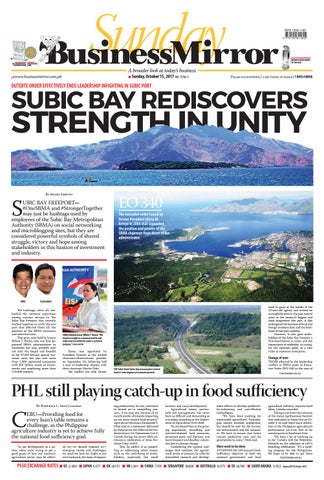
Subic Bay rediscovers
strength in unity S
By Henry Empeño
UBIC BAY FREEPORT— #OneSBMA and #StrongerTogether may just be hashtags used by employees of the Subic Bay Metropolitan Authority (SBMA) on social networking and microblogging sites, but they are considered powerful symbols of shared struggle, victory and hope among stakeholders in this bastion of investment and industry.
Diño
EO 340
The executive order issued by former President Gloria M. Arroyo in 2004 that separated the position and powers of the SBMA chairman from those of the administrator.
Escolango
The hashtags, after all, embodied the common aspiration among various sectors in the Subic Bay Freeport that recently worked together to unify the one post that affected them all: the position of the SBMA chairman and administrator. That post, now held by lawyer Wilma T. Eisma, who was first appointed SBMA administrator in December last year, presides over not only the length and breadth of the 67,452-hectare special economic zone, but also over more than 1,500 registered companies with $10 billion worth of investments and employing more than 115,000 workers.
ened to gnaw at the insides of the 25-year-old agency and reverse its accomplishments in the past several years as the country’s biggest and most progressive free port, it also endangered the business of local and foreign investors here and the livelihood of free-port workers. However, it also gave stakeholders of the Subic Bay Freeport a first-hand lesson in unity, and the importance of malasakit, or caring, for the common good, as a core value in economic enterprise.
SBMA Administrator Wilma T. Eisma: “We found strength in a common battle and rediscovered solidarity under a common purpose.” henry empeño
Eisma was appointed by President Duterte to the unified chairman-administrator position on September 26, following half a year of leadership dispute with then-chairman Martin Diño. The conflict not only threat-
Change of men
Those affected by the leadership conflict in SBMA point to Executive Order (EO) 340 as the root of
The Subic-Clark-Tarlac Expressway joins Central Luzon’s twin engines of economic growth.
Continued on A2
PHL still playing catch-up in food sufficiency
C
By Roderick L. Abad | Contributor
EBU—Providing food for every Juan’s table remains a challenge, as the Philippine agriculture industry is yet to achieve fully the national food sufficiency goal. “In our development as a nation, when we’re trying to get a good grasp of how our country’s agriculture sector may be affect-
ed by—or should respond to— emerging trends and challenges, we need not look far. Right in our own backyard, the issue of improv-
PESO exchange rates n US 51.3850
ing productivity, for one, continues to hound us—a compelling concern, if we may say, because of its ramifications ultimately impacting on our drive toward food security,” Agriculture Secretary Emmanuel F. Piñol said in a statement delivered by Director for the Office of the Undersecretary for Operations Leo P. Cañeda during the recent 60th anniversary celebration of Atlas Fertilizer Corp. (AFC). This, he added, is as compelling as addressing other issues, such as the well-being of stakeholders, especially the small
farmers and rural development. Agricultural issues, particularly soil management, has never been as difficult and demanding as it is today, according to the Department of Agriculture (DA) chief. He attributed this to the growing population, dwindling and nutrient-drained land resources, persistent pests and diseases, and more frequent and deadlier calamities due to climate change. Considering the various challenges that confront the agricultural sector at present, he calls for intensified research and develop-
ment efforts to develop productivity-enhancing and cost-efficient technologies. “We have been pushing for sustainable agriculture. Technologies should increase production, but should be safe for the farmer, the environment and the consumer. We have to ensure that farms remain productive now and for generations to come,” Piñol said.
More work to be done
ATTAINING the 100-percent foodsufficiency objective of both the national government and local
agriculture industry requires hard labor, Cañeda conceded. Taking a cue from the outcome of the Asean Agribusiness Summit that took place in Pasay City on October 4, he said there was a reiteration of the Philippine agriculture’s performance vis-à-vis that of its counterparts in Southeast Asia. “We have a lot of catching up to do,” Cañeda told the BusinessMirror on the sidelines of AFC’s founding celebration. “It’s a working progress for the Philippines. We hope to be able to get there Continued on A2
n japan 0.4577 n UK 68.1571 n HK 6.5814 n CHINA 7.7978 n singapore 38.0038 n australia 40.1779 n EU 60.7987 n SAUDI arabia 13.7023
Source: BSP (13 October 2017 )
NewsSunday BusinessMirror
A2 Sunday, October 15, 2017
www.businessmirror.com.ph
Subic Bay rediscovers strength in unity Continued from A1
the misfortune. The order, signed by President Gloria M. Arroyo in 2004, separated the position and powers of the SBMA chairman from that of the SBMA administrator, the original appointee under Republic Act 7227, which created the SBMA. The split positions apparently worked well under two sets of appointees before: Chairman Francisco Licuanan and Administrator Alfredo Antonio from 2004 to 2006, and Chairman Feliciano Salonga and Administrator Armand Arreza from 2006 to 2011. But that soon changed when Diño, popularly known as chairman of the Volunteers Against Crime and Corruption (VACC) and PDP-Laban’s surrogate presidential candidate for then Mayor Duterte, took over as SBMA chairman in October 2016. At first, Diño exemplified in Subic the “change” that the Duterte administration has promised. Vowing to capitalize on the achievements of his predecessor and the support of President Duterte to make Subic the best free port in Southeast Asia, he won over the Subic constituency by promising to look after the interests of both the investors and the lowly workers. But it soon became apparent that the former barangay captain from Quezon City had wanted to wield power also as administrator. Just two weeks after his arrival in Subic, and as Malacañang sought nominees for the SBMA administrator post, Diño’s allies began calling for the consolidation of the SBMA chairmanship with the administrator position, pointing out that the appointment of separate officials to the two posts
violated the law. When then SBMA Deputy Administrator for Legal Affairs Randy Escolango was designated by the Palace as OIC administrator on the third week of October, there began a series of foil and counterfoil between the two officials. In a memorandum dated December 12, 2016, Diño averred that, “In faithful compliance to the instructions of President Duterte, I have caused the institution of criminal as well as administrative cases against Atty. Randy B. Escolango relative to his claim that he was designated by the Office of the President as OIC Administrator and to his string of unlawful and unauthorized actions.” At one point, Diño stopped all business transactions in the SBMA. Escolango also fought back, voiding over 30 office orders and memoranda issued by the chairman for lack of authority, including the appointments of some 14 high-level consultants. Escolango also voided what he called Diño’s “self-appointment” as officer in charge of the SBMA’s Law Enforcement Department, whose head was then on terminal leave prior to retirement.
Confusion
“The result was chaos in the service,” said Amethya dela Llana, manager of the SBMA Ecology Center, who was among the SBMA employees who had called out the chairman’s actions as unbecoming of an official. The infighting at SBMA temporarily abated upon the appointment of Eisma as administrator in late December. In their first “State of the Freeport” last April, Diño and Eisma outlined in broad strokes an ambitious program to expand
the Subic Bay Freeport’s infrastructure, and then leverage the same to position Subic as a major production and distribution hub in the Asean region. The duo then echoed the national mantra of “Build, Build, Build” to keep Subic Bay sustainable, as well as to help in national developmental efforts. The following month, however, Diño again broke the spell by issuing Administrative Order 01-2017, which sought to create a task force under his office ostensibly to “inspect, monitor and faithfully implement the laws in the conduct of business and financial operations and collections” of the agency. Eisma cried out that the creation of such a task force would interfere and encroach upon the power, function and duty of the administrator and CEO. She also lamented the accusation in Diño’s order that the SBMA was in dire financial straits and in danger of collapse. With the outcry, the SBMA board of directors issued a letter on June 1 chiding their chairman for his utterances, saying that they “cannot support your action of issuing an administrative order well beyond the scope of your duties as chairman of the board, unilaterally declaring that the operations of SBMA are in danger of ‘financial collapse’ and creating a task force… without approval of the board.”
The last straw
This ensuing conflict sparked an investigation by the House of Representative on EO 340, which separated the position and functions of the chairman from that of the administrator. It also galvanized the local community to action, voicing out their concerns on the issue.
In a joint manifesto, seven local chief executives in communities around the Subic Bay Freeport decried Diño’s actions and also expressed support to Eisma in the ongoing leadership tussle. The manifesto signed by Bataan Governor Albert Garcia, Olongapo City Mayor Rolen Paulino, Mayor Antonio Joseph Inton of Hermosa, Bataan; and Zambales Mayors Jay Khonghun of Subic town, Estela Antipolo of San Antonio, Elvis Soria of San Marcelino, and acting Mayor Christian Esposo of Castillejos, declared “unwavering and unconditional support to the SBMA Administrator and Chief Executive Officer, Atty. Wilma T. Eisma”. On June 8 the Subic Bay Freeport Chamber of Commerce headed by businesswoman Rose Baldeo wrote House Speaker Pantaleon Alvarez to say that “it would be for the benefit of the SBMA and its locators to have only one person for the position of SBMA chairman and administrator instead of separating the two.” Baldeo added that the confusion caused by the separation of positions “runs contrary to the mandate of the SBMA to create a harmonious environment for the businesses to generate employment opportunities in and around the zone and to attract and promote productive foreign investments.”
Unity call
Upon assumption as the first woman SBMA chairman and administrator on September 26, Eisma promptly called the unification of the SBMA chairman and administrator positions as a victory for the Subic Bay Freeport. “We all claim this victory today as stakeholders of the Subic Bay Freeport Zone who are cognizant of the vision for Subic as a haven for economic production in this part of the globe, and as a progenitor of inclusive growth in this part of the country,” she said in a statement. “But in claiming this victory, we cannot forget our moorings: We won not because we have remained while others had to go; we won because we have seen a wrong and we decided—together—to set it right,” she added. The SBMA official also said that while the conflict in the agency proved to be trying times for Subic stakeholders, it resulted in a firmer SBMA and Subic Bay. “We emerged triumphant not only because we were grounded on truth and reason, but because we found strength in a common battle and rediscovered solidarity under a common purpose,” Eisma added.
One Subic
The return to just one top official for the SBMA has provided fresh
hopes for business locators, workers, residents in the Subic Bay Freeport area. “First, there is harmony because there is only one direction to take and there is no conflict; and second, there is also efficiency and things move faster,” Dela Llana said. Then there is the new-found joy in that shared experience. “This is the reward that we get for undergoing that ordeal together—winning the struggle,” she added. Last week, the Subic Bay Freeport Chamber of Commerce (SBFCC) also issued a statement congratulating Eisma for her appointment. “Moving forward, the locators of Subic Bay expect many great things from Attorney Eisma, which is both a compliment and a heavy burden on her shoulders,” the SBFCC statement said. “Being the chamber and the voice of the business community, we are here to support her endeavors that will improve the business environment of Subic. In the same breadth, we are also here [so] that her leadership and policies will be fair to all the stakeholders of the Subic Bay Freeport Zone,” it added. Changes may be introduced in Subic, but the stakeholders will always opt for more of the same: more and better business.
PHL still playing catch-up in food sufficiency Continued from A1
when the time comes.” The current Philippine Development Plan (PDP) 2017-2022— the first medium-term plan to ensure that the long-term visions for the country by 2040 will be accomplished—seeks to expand economic opportunities in the agriculture, forestry and fisheries (AFF) sector. Under this blueprint, the country’s GDP is targeted to grow between 7 percent and 8 percent in the medium term. It, likewise, seeks to achieve a gross value added (GVA) target for agriculture of 2.5 percent to 3.5 percent in the medium term. “So we’re still at it, except that we need a lot of catching up to do. We need to be able to live up to our own expectations with regard to how agriculture should grow in the coming years,” he said. To the merit of the industry’s improved performance to date, agriculture recovered with a 6.3-percent growth in the second quarter of 2017, from a 2-percent decline during the previous year. The long-dormant sector turned out to be the surprise of the period, as it contributed 0.5 percentage-point to the overall 6.5-percent GDP growth. Subsectors palay, corn, sugarcane and poultry, as well as agricultural services, all surged, while forestry increased by 32.2 percent from a decrease of 27.5 percent in 2016. On the contrary, fishing dropped by 2.9 percent from last year’s level. Meanwhile, export data revealed that agricultural machineries rose by 57 percent from April to June 2017, compared to negative 51 percent during the same period in 2016.
Underfertilized
INDUSTRY think tanks would agree that the country’s soil is underfertilized, such that productivity is affected in varying degrees by the so-called factors of production like the seed type and land preparation, as well as water, nutrient and pest management, among others. “As you may have known,
our vetting of productivity has in many instances been based on the application of these factors. The farms which have complied with our standards or ‘checks’ have generally performed better compared to those which have not,” Piñol noted. All of the DA’s recommended standards across commodities are science-based, empirically documented and backed by field trials, as norms would dictate, while trends in productivity have somehow ran parallel with the level of use of fertilizer. “So this is where balanced crops-specific and soil-specific fertilization comes in,” Cañeda pointed out. Agricultural yields were reported to have scaled new heights, even on a par with the experience of other countries, especially in Southeast Asia. If at all, as experience again would show, all the efforts to increase more of the productivity were only stalled by comparatively higher cost of production, thus, effectively negating whatever productivity gains were achieved, and how these gains could have improved the welfare of the local farmers. “This, [along with] improving our operating efficiency through lower per-unit cost of production, remains our biggest hurdle which we hope to overcome through our continuing development partnership with stakeholders, such as your group and your industry,” the DA secretary said. Cost efficiency in the county is so wanting, whereas it takes even double the price of whatever other countries are able to accomplish in producing free rice, corn and other vegetables. “So cost efficiency is very important. We need to address that. And, hopefully, this will impact on productivity. Because no amount of productivity will bring us to higher levels of food security or whole development if the basic issue of cost efficiency is not frontally and sufficiently addressed,” Cañeda said. For Piñol, this can be an uphill battle to engage all players with stakes in rural and agricultural development.
“But we can start somewhere. Indeed, it is only by increasing our efficiency that we can secure a gateway toward increased competitiveness and greater involvement and access in a globalizing economy,” he said. On the DA’s part under his leadership, Piñol pledged to lift the agriculture sector to a higher level of development existence, as evident in the actions they have taken in support of their 10-point agenda, focusing on agriculture road map, research and development, irrigation development, land-use plan, hybrid rice technology development, farm mechanization and farmers’ access to financial programs. “We have been walking the talk, as they say, guided by this agenda and the leverage afforded by our budgetary and manpower support,” he said.
Food on the table
AS the Philippines, together with the rest of the globe, is set to observe World Food Day (WFD) on October 16, Piñol said that this year’s event reaffirms anew what can be achieved as a result of selfsustaining economy and countryside growth. “This means that if only we can use our country toward more food security and prosperity, especially in the rural areas, we just might be able to mitigate if not altogether arrest movement of some of our countrymen to go elsewhere in search of the proverbial greener pasture,” the agriculture secretary said. More and more Filipinos would not have gambled to go abroad just to ensure their families back home do not live miserably with an empty stomach had their motherland is fertile enough to offer them vast opportunities. “The fruits of development in the countryside will keep our people home-based instead of being pushed out or pushed away by unfavorable local conditions,” Piñol said. The 2017 WFD is themed “Change the Future of Migration— Invest in Food Security and Rural Development.”
The World BusinessMirror
www.businessmirror.com.ph
Saudis mull over slower subsidy, spending cuts to support economy
S
audi Arabia may cut energy subsidies more gradually and take longer to balance its budget, Finance Minister Mohammed Al-Jadaan said, as the kingdom seeks to soften the impact of its drive to repair public finances. The prices of some subsidized domestic energy products will rise to international levels later than previously envisaged, AlJadaan said in an interview in Washington on Thursday, where he is attending the International Monetary Fund’s (IMF) annual meeting. He also said authorities will refrain from rushing to meet a target to balance the budget by 2019 as they assess how the economy is reacting to fiscal policy. “We will move with our schedule, but areas where we think actually we can adjust the reforms so that they’re not as aggressive, we will,” he said. A balanced budget and the subsidy cuts are central to the kingdom’s long-term plan to wean the economy off oil, after the plunge in crude prices caused the shortfall to reach more than 16 percent of gross domestic product in 2016. But the government’s austerity drive, which included slashing spending and curtailing state largess, caused non-oil economic growth, the engine of job creation, to stagnate. Al-Jadaan’s remarks come after an assessment by IMF staff, in which they said the kingdom could afford a slower pace of austerity to avoid crippling the economy. “This is possibly the first time for the IMF to tell a country to slow down,” Al-Jadaan said. “We are taking IMF advice very seriously.” ‘Longer period’ Even before that IMF advice, the government had already abandoned some of its attempts to save money, when salary and benefit cuts for state employees were reversed. Under the latest subsidy plans, the prices of some energy products might fall short of international levels this year, but would be gradually increased “over a longer period of time,” Al-Jadaan said. And while the government is on track to reduce the budget deficit to below 10 percent of gross domestic product (GDP) this year, authorities don’t see the need “to go from 10 percent to zero in two years,” he said. Bloomberg News
Sunday, October 15, 2017
A3
Auto industry sees threat to profits, jobs in Trump’s bid to revamp Nafta
T
he Trump administration’s push to change the automobile rules in the North American Free Trade Agreement (Nafta) will lead to higher costs on manufacturers and could put jobs at risk, according to research sponsored by an auto supplier trade association. The administration is set to seek an increase in the amount of a vehicle’s components that must come from within the region to qualif y for dut y-free status under the pact. But changing the so-called rules of origin would increase manufacturing costs and expose carmakers to new tariffs, leading
to higher vehicle prices and lower demand for costly technology and safety features, according to research prepared for the Motor and Equipment Manufacturers Association, the auto suppliers’ trade group. “Up to 24,000 jobs could be impacted, could be lost actually, if we start increasing the cost
No amount of spin by corporate lobbyists representing companies who outsource can change the facts on what has happened to workers as a result of Nafta. Nafta renegotiation will only be successful if it leads to higher wages for workers in all three countries and puts an end to our crippling auto trade deficit with Mexico.”—Powell
A worker polishes a Fiat 500 vehicle at Chrysler Group Llc.’s assembly plant in Toluca, Mexico, on November 8, 2013. Automakers are expanding production in Mexico to capitalize on lower labor costs that bolster the profitability of vehicles sold in the US market. Susana Gonzalez/Bloomberg
of products,” Xavier Mosquet, a senior partner at the Boston Consulting Group, said at a conference for the group, citing an analysis he prepared for it. The warnings come amid a growing chorus of automotive executives and industry groups warning that the Trump administration’s hard-line stance in talks to renegotiate Nafta could lead to negative consequences for the sector. Charles Uthus, vice president for international policy at the American Automotive Policy Council, told the conference that Nafta has created some $10 billion in annual savings for the auto industry in North America since it took effect. Eliminating those efficiencies would amount to “essentially a $10-billion tax on the auto industry in North America,” he said. The US had a $64-billion trade
deficit with Mexico last year, largely thanks to a trade imbalance in autos. Trump has said reducing trade deficits is the administration’s top priority in the renegotiation of Nafta, a goal shared by the largest union for US auto workers. “No amount of spin by corporate lobbyists representing companies who outsource can change the facts on what has happened to workers as a result of Nafta,” United Auto Workers President Dennis Williams said in a statement. “Nafta renegotiation will only be successful if it leads to higher wages for workers in all three countries and puts an end to our crippling auto trade deficit with Mexico.” After repeating threats to exit the accord, Trump on Wednesday wouldn’t say how he was leaning on a Nafta deal as he met with Canadian Prime Minister Justin
Trudeau at the White House. Negotiators from Canada, Mexico and the US began the fourth round of talks to revamp the trade pact on Wednesday outside of Washington. Auto industry lobbyists and executives are paying close attention to US proposals on the rules of origin for vehicles. Those rules will be a major focal point in the current round of talks. Commerce Secretary Wilbur Ross said this week the US will propose a hike to rules of origin percentage, and regional procurement rules and “you’ll find that the car companies will adapt.” Auto executives and groups have warned such changes will upset a thriving North American auto industry by burdening the complex supply chain erected around Nafta with added costs and complexity. Bloomberg News
Southeast Asian stock markets quietly kill their trading link
A
system that connected stock markets in Malaysia, Singapore and Thailand has closed down, five years after its high-profile debut. T h e A s e a n Tr a d i n g L i n k started with Bursa Malaysia and Singapore Exchange Ltd., with The Stock Exchange of Thailand also joining. It was heralded at its launch as breaking the barriers to cross-border trade and offering a single entry-point to three of Southeast Asia’s biggest stock markets, with thousands of listed companies. Bourses in Vietnam, the Philippines and Indonesia were expected to eventually take part. The link’s end was announced quietly, with Singapore Exchange’s only statement on the move made in a consultation paper on rule
changes that was published on Tuesday. “With effect 6 October 2017, the Asean trading linkage will no longer be in operation,” the company said. Trading turnover has grown since the link’s introduction, the Asean Exchanges said in a response to questions. That has “created new and efficient methods of facilitating cross-border transactions,” the regional bourses group said, explaining the decision to shut the link. “We are not surprised to see the decommissioning of the Asean Trading Link,” said Melinda Sam, chief executive officer of the Securities Association of Singapore. “Stockbroking firms had their own links to their counterparties way before Asean Trading Link was mooted.” Bloomberg News
Singapore GDP rose 6.3% in Q3 on export bounce
S
i ngapore ’ s e c o n o m y gained traction in the third quarter as a pickup in exports helped to drive up manufacturing. A report show that Singapore’s gross domestic product (GDP) rose at a seasonally adjusted and annualized rate of 6.3 percent in the third quarter from the previous three months, according to preliminary figures from the trade ministry on Friday. Median estimate of 12 economists in a Bloomberg survey was for a 3.7-percent gain. GDP climbed 4.6 percent from a year earlier, versus median estimate of 3.8 percent
Singapore has enjoyed a more solid growth patch this year as global trade continues to rebound and the electronics sector shows a particularly impressive upswing. Prime Minister Lee Hsien Loong said in August that the economy will probably grow 2.5 percent this year, which would be the fastest since 2014. At the same time, a weak labor market is weighing on consumer demand with retail enduring a painful transition away from traditional brick-andmortars to e-commerce. Employment contracted in the last two quarters. Bloomberg News
Emissions rise from an oil refinery at sunset in Texas City, Texas, on February 16. Asia’s energy importers will benefit from more opportunities for arbitrage, supply diversification if United States President Donald J. Trump’s pro-energy policies drive meaningful upsurge in US crude, LNG exports, BMI Research reports. Luke Sharrett/Bloomberg
Oil heads for weekly gain amid market rebalancing
O
il is heading for the biggest weekly gain since mid-September after United States crude stockpiles extended declines and as the the head of Organization of Petroleum Exporting Countries (Opec) said a market rebalancing is under way. Futures were little changed in New York, up 3 percent for the week. US crude supplies fell by 2.75 million barrels last week, according to Energy Information
Administration (EIA) data on Thursday. Opec expects efforts to clear the global glut with its allies, including Russia to succeed by the end of the third quarter of next year, according to people familiar with the group’s internal forecasts. Oil has rebounded from the biggest weekly loss since May on signs that output cuts led by the Opec are draining a surplus. The Inter nationa l Energ y A genc y
predicts progress on clearing the glut may stall next year, while Opec Secretar y-General Mohammad Barkindo said Sunday that further steps might be needed to sustain the recover y into 2018. We s t Te x a s I nt e r m e d i at e for November del iver y was at $50.75 a ba r rel on t he New York Merca nt i le E xc ha nge, up 15 cents, at 8:0 4 a.m. in Hong Kong. Tota l volume traded was
about 74 percent be low t he 100 -day average. Pr ices slid 70 cents to $50.60 on T hu rsd ay, d ropping for t he f irst t ime in fou r sessions. Brent for December settlement was at $56.44 a barrel on the London-based ICE Futures Europe exchange, up 19 cents. Prices are up 1.5 percent this week. T he globa l benchmark cr ude traded at a premium of $5.37 to December WTI. Bloomberg News
A4
The World BusinessMirror
Sunday, October 15, 2017
www.businessmirror.com.ph
Kobe Steel scandal unravels cost of race to keep improving metals
B
ehind the scandal engulfing Kobe Steel Ltd. over the falsification of data for some of the materials it supplied is a harsh reality for Japanese steel companies: the need to provide higher and higher quality metals to compete.
Kobe Steel rocked Japan’s industrial economy with revelations this week that it faked data on the quality of some aluminum, copper and iron powder sales. Chief Executive Officer (CEO) Hiroya Kawasaki said more cases could emerge as the company continues its investigations. Among those affected are automakers— among the biggest customers for steel producers—who have been seeking more advanced products to cut weight while retaining strength and versatility. “The steelmakers are really trying to protect their turf, because this is a life-and-death situation for them,” said Thanh Ha Pham, senior vice president in Japan for investment bank Jefferies Group Llc. “It’s improve or die.” The trade-off for carmakers between a vehicle that’s strong enough to be safe but light enough
to be energy-efficient has led to an array of alloys and efforts to break the dominance of steel, from McLaren’s iconic carbonfiber F1 supercar in the 1990s to Ford Motor Co.’s decision to switch its venerable F150 pickup to aluminum in 2015. While Kobe Steel’s falsified reports may be an isolated incident in the industry, Japan’s steelmakers have spent a fortune developing new types of steel and other metals to meet demands from automakers for fuel-efficiency, whether the car has a 300-kilogram petrol engine under the hood, or a 300-kilogram lithium-ion battery. About twothirds of the weight of most vehicles is still steel.
Reaching limit
But some in the industry see a limit to how thin steel can go, because it would need to be so rigid
that it can no longer be molded into car parts. “We can keep going like this for another 10 years,” said Toshinao Minakuchi, head of the automotive steel sheet technical solutions department at Nippon Steel & Sumitomo Metal Corp. “But at some point, the limit is coming for steel.” Nippon Steel, Japan’s top producer, is working to improve both the strength and formability of its high-tensile steel by 20 percent to 30 percent over the next five to 10 years and is also conducting research on mixing steel with other materials. A Nippon Steel spokesman said the company isn’t in a position to comment on the quality issue, saying that it isn’t involved in aluminum and copper products. The pressure for ever-lighter, thinner and stronger materials has prompted an increase in the use of other metals, such as aluminum, as well as advanced polymers and carbon fiber. Materials
companies, including DSM NA and Teijin Ltd., are to trying to marry the properties of steel and plastics by developing a new generation of hybrid products that integrate the two. “Fusion is the future,” said Yuji Nakamura, president of DSM’s Japan unit, which is working with steelmakers on some projects. He predicts the plastic content of vehicles will rise to 25 percent by 2030, from about 15 percent now. “All parts of the car should be multi-material composites going forward: the right material in the right place.” Kobe Steel said more than 200 customers, which it didn’t ident if y, were sold products that failed quality control tests, but there have been no reports of safety issues. A spokesman for the company said pressure to meet delivery deadlines was one reason behind the failure, but the incident is linked to the company’s quality management, not its customers.
We can keep going like this for another 10 years. But at some point, the limit is coming for steel.” —Minakuchi
Lighter cars
As countries such as China, India and the UK announce plans to phase out fossil fuel-powered vehicles, the pressure on steelmakers may accelerate as carmakers try to shed weight to extend the driving range of each battery charge. Even California, the largest car market in the US, is mulling over a bar on the sale of vehicles powered by internalcombustion engines, according to Mary Nichols, chairman of the California Air Resources Board. The use of plastic in cars isn’t new. Fiberglass and plastic panels have been used in cars for decades, from the much vilified East German Trabant of the 1950s, to high-tech Formula 1 race cars and the recent first efforts to make car bodies with 3D printers. But none is yet able to match the cost and versatility of steel. Carbon fiber is 10 times stronger than steel, but up to 18 times more expensive, according to SBI Securities Co. It’s as much as six times more costly than aluminum. “Ten years ago I thought steel must be getting close to its limit, but instead Japan’s steelmakers just kept persevering,” said Yasunari Hotani, general manager of auto business development group at Teijin. “I never expected they would be able to do so much.” Bloomberg News
Turkish troops enter Syria in joint peace mission with Russia and Iran
T
u r k e y sent special forces and commandos over the border into Syria, the start of a joint mission with Russia and Iran to monitor a cease-fire agreement and pacify a stronghold for Islamic militants—but one that also has major implications for the region’s Kurds. The operation to establish a combat-free zone in Syria’s northwest province of Idlib, which is largely controlled by former al-Qaeda militants, began late Thursday, Hurriyet newspaper said without citing anyone. Thirty armored cars carrying more than 100 special forces and commandos crossed the frontier late Thursday, the report said. The incursion is one of Turkey’s biggest yet in the Syria conflict, adding to the nation’s geopolitical risks following an attempted coup in 2016 and subsequent political crackdown. The Lira tumbled after the US and Turkey suspended visa services for each other’s citizens on Sunday, a sharp escalation of simmering tensions between the two over US military involvement in Syria and Turkey’s closer ties with Russia. Turkey’s deployment emphasizes the closer ties between President Recep Tayyip Erdogan and his Russian counterpart Vladimir Putin, a relationship viewed with concern by Turkey’s North Atlantic Treaty Organization allies. It also represents a shift in Ankara’s attitude toward Syrian leader Bashar al-Assad. Turkey has long opposed any political transition under him, but Russia’s intervention in Syria’s civil war shored up the president after years of Turkish and US insistence that he must go. Rebels from the Turkey-backed Free Syrian Army crossed into Syria on Saturday. The Turkish troops are expected to follow them into the northwestern city of Idlib, with Russians stationed nearby. Turkey has also threatened to clear Afrin, a city in northern Syria, of Kurdish forces it regards as belonging to a terrorist group with links to the PKK, which has long battled for autonomy in Turkey’s southeast. Doing so would prevent the Kurds from linking enclaves they control along the frontier with Turkey. Bloomberg News
White House COS says he’s not quitting or being fired
P An employee fixes part of a web server inside the Facebook Inc. Prineville Data Center in Prineville, Oregon, on April 28, 2014. The Facebook Prineville Data Center features leading energy-efficient technology, including features such as rainwater reclamation, a solar-energy installation for providing electricity to the office areas and reuse of heat created by the servers to heat office space. Meg Roussos/Bloomberg
Facebook is watching you, Belgian data-privacy agency warns in court
F
acebook Inc. was accused of Big Brother-style snooping on Internet users in a fresh attack on the social network by Belgium’s data-privacy watchdog. The regulator sought a court order on Thursday forcing Facebook to stop any collection of data for advertising purposes and the provision of “misleading” information to users, under the threat of a €250,000, or $296,000, daily penalty. The company said it disagreed with the allegations. “What Facebook is doing is unprecedented in monitoring the browsing habits” of millions of people in Belgium, regardless of whether they are signed up to the service, Ruben Roex, a lawyer for the regulator who works at law firm Time.Lex, told a Brussels court. “Facebook systematically
collects data without any action by the user, which users didn’t consent to, or which wasn’t clarified to the users.” Facebook has been a target for Belgium’s data-protection commission since at least 2015, when a court ordered it to stop storing nonusers’ personal data. While the US tech giant won on appeal last year, Thursday’s hearing is the first in a European court to go to the heart of the company’s use of technology deemed to be essential to its proper functioning.
‘Like button’
The operator of the world’s largest social network uses technological means, such as cookies, pixels or so-called plug-ins underpinning its iconic “Like” button, that are “very invasive” and are
able to stay on people’s computers for as long as two years, the court was told. The regulator said it was “striking” that similar techniques were used to also track nonusers for commercial purposes. “ That’s our biggest concern,” Willem Debeuckelaere, president of the Belgian data-protection commission, said in an interview at the court after the hearing. “We are talking now about practically the whole Belgian population who use the internet.” Belgian has a population of about 11.3 million people. Users who increasingly depend on Facebook to stay connected to peers, can only sign up if they “consent to everything or nothing,” Roex said. Facebook “is de facto asking for a blanket consent to monitor your browsing behavior
and that goes way, way too far.” Facebook, whose lawyers will present their defense in court on Friday, said in a statement it disagrees with the Belgian watchdog’s claims and that “putting people in control of their privacy is at the heart of everything we do.”
User-friendly
“Over recent years, we’ve made our policies clearer and more user-friendly to help people in Belgium and all over the world understand how we use information and cookies to make Facebook better,” the Menlo-Park, California-based company said in the statement. “The cookies and pixels we use are industry standard and enable hundreds of thousands of business and
publishers to serve ads on and off Facebook.” Facebook, whose European base is in Ireland, said it remains open to “discussing key elements with them and the Irish Data Protection Commissioner.” Facebook has been under scrutiny by other European regulators. The company earlier this year agreed under Dutch pressure to stop targeting ads based on users’ sexual orientation as European regulators revealed a concerted clampdown on some of the social network ’s data practices. This came on top of a maximum fine of €150,000 by France’s privacy regulator for combining user data to display targeted advertising and “illegal tracking” via cookies of what users do on and off the site. Bloomberg News
resident D o n a l d J . Trump’s chief of staff (COS), John Kelly, surprised reporters on Thursday when he conducted the White House’s daily news briefing himself and joked that he isn’t planning to quit and doesn’t expect to be fired. “I am not so frustrated in this job that I’m thinking of leaving,” he said to open his briefing, an apparent nod at occasional reports he has considered quitting. “Unless things change, I’m not quitting, I’m not getting fired, and I don’t think I’ll fire anyone tomorrow.” The first reporter he called on asked whether he’s frustrated, as he suggested. “No, I’m not frustrated,” he said. “This is really, really hard work, running the United States of America. I don’t run it. But I’m working for someone who’s dedicated to serving the country in the way he’s talked about for a number of years.” He also brushed aside media coverage suggesting he has maintained firmer control of the White House staff than his predecessor. “Is this the iron hand that I brought to the staff?” the former Marine general mused from the podium. “I just brought some organization to it.” He called the president “Mr. Trump” at least twice—a departure from the White House custom in which staff members usually publicly refer to the office-holder as “The President”—and said previous presidents had left a number of problems for the White House to resolve. Bloomberg News
Sports BusinessMirror
Editor: Jun Lomibao | mirror_sports@yahoo.com.ph
Sunday, October 15, 2017
A5
OLYMPIANS AS EXHIBIT A
MICHAEL PHELPS appears in Angst to share his story of being bullied and depressed, leading to severe anxiety. AP
By Mark Kennedy The Associated Press
N
PSC Children’s Games visits Smokey Mountain
T
HE Philippine Sports Commission (PSC), through the Philippine Sports Institute (PSI), are holding the Children’s Games’ “Palaro Kontra Droga: PSC-PSI Manila MultiSport Camp” this weekend at the Smokey Mountain in Tondo. “The PSC wants participants to discover their talents and potentials in baseball and softball, finish college and become good citizens,” PSI National Capital Region program coordinator Cesar Pradas said. The event is intended for the youth of families residing at Smokey Mountain. Through the initiative of PSC Chairman William Ramirez and supervision of PSI National Director Mark Velasco, the event will focus not only on the value of youth in sports but also to encourage the younger
generation in fighting illegal-drug use. The program is being held in partnership with the City of Manila and public schools in Tondo. Baseball and softball games were held at the Smoking Mountain Field last Saturday, while swimming and taekwondo will be conducted at the Rizal Memorial Sports Complex today. Atleast 500 children are expected to attend. “The youth will enjoy playing and will appreciate the value and importance of sports in their lives. They will feel that they have roles to play in our society, thus building their self-confidence,” Pradas said.
EW YORK—A new documentary about anxiety argues that everyone, to some extent, suffers from stress, nerves and social fear. And, to make their point, the filmmakers have enlisted as Exhibit A the most decorated Olympian in history. Michael Phelps appears in Angst to share his story of being bullied and depressed, leading to severe anxiety. The swimmer, winner of 28 Olympic medals, would look in the mirror and not like what he saw. “Once I opened up about that and things that I had kept inside of me for so many years, I then
found that life was a lot easier. I got to the point where I understood that it’s OK to not be OK,” he says in the film. Angst, an IndieFlix film designed to be screened at schools and community centers, features candid interviews with children and young adults discussing their anxiety, along with advice from mental-health experts and resources and tools. Phelps is like a muscular explanation mark for what the filmmakers wanted to show—that even world champions can feel low. “I’m grateful because my mission with this film is to help make the world a better place, and I believe he is so additive on that level,” said Scilla Andreen, CEO and cofounder of IndieFlix. “If we can introduce prevention, self-care and well-being to our children—even in the pre-K and kindergarten years—they can have a completely different life.” Andreen hopes the film will reach more than 3 million people around the world from 25,000 community and school
screenings. Angst was filmed in the United States and United Kingdom and is appropriate for children starting at age 10. “Anxiety is totally treatable,” she said. “It can be a precursor to so many things that can then lead to addiction, homelessness, dropping out of school and a host of other mental-health challenges.” Anxiety disorders are the most common mental-health challenge in the US, impacting 54 percent of females and 46 percent of males, with age 7 being the median age of onset, according to the World Health Organization. The American College Health Association has found that undergraduates reporting “overwhelming anxiety” jumped to 62 percent in 2016, from 50 percent in 2011. “Talking about it is the most effective thing you can do and, of course, the last thing you want to do,” Andreen said. In addition to talking, writing about your feelings or connecting to music can help. “Anything that helps you to take a break from the anxiety and move the energy to the front of the brain.” Andreen, whose distribution-streaming
service embraces projects that push for social change, was bullied as a child and learned something about herself while working on the film. “Everyone has anxiety. And I learned in making the movie that I have social anxiety. I never even knew that. I just thought I was born less than everyone else, and that was my lot in life. I would always have to work harder, try harder, never fit in,” she said. “I don’t feel so alone.” In addition to the documentary, IndieFlix is creating a web-based series on anxiety to dig deeper into the issue and has produced a virtual-reality component that allows users to experience a panic attack firsthand. Andreen believes anxiety levels are so high in part because of the pace of modern life and the amount of time people spend with their electronic devices, which takes away from connecting in person and developing empathy. “We need more face time with each other,” said Andreen, a former Emmy-nominated costume designer. “We just stopped doing it. We’re out of practice, that’s all.”
Center of attention at UCLA media day
L
OS ANGELES—There’s a new Ball on the court at University of California, Los Angeles (UCLA). Cameras and cell phones captured the moment on Wednesday as LiAngelo Ball walked toward the center of the court at Pauley Pavilion. The younger brother of Lakers guard Lonzo Ball was making a debut of sorts at UCLA media day. The freshman was not made available to the media, but he was there for pictures and practice. Freshman Chris Smith noticed the hoopla as he walked alongside his teammate and said, with a hand over his eyes: “There’s a Ball brother here?” and jokingly looked around. Ball is sure to be under a microscope and face expectations unlike those faced by most college basketball players. “It’s hard. Obviously, Lonzo sets a very high bar,” UCLA Coach Steve Alford said. “I will say, knowing the family like I know, they’re all made that way. They’re all made in a championship pedigree. Gelo [pronounced Jello] is not going to be any different than that. He’ll figure out his role as he gets into this thing. I know he’ll fight and compete and extend his role as much as he possibly can because he’s got that championship DNA that I think all of them have.” The Ball family was thrust into a media spotlight thanks to the brothers’ outspoken father, Lavar. Lonzo Ball played just one year at UCLA, where the Bruins finished 31-5 and lost to Kentucky in the Sweet Sixteen. LiAngelo follows this season. Lavar Ball has pulled his youngest son, LaMelo, out of high school and has said he’s home schooling him. Ball is one of seven freshmen joining
the Bruins but clearly is the most heralded because of the name on the back of his jersey. “I think he has a pretty good head on [his shoulders],” junior Aaron Holiday said. “Obviously, coming in being one of the Ball brothers and his dad, there’s a lot going on with him so he’s handled himself pretty well, and I think he’s good with that.” He’s proven to be a reliable shooter in his young career and once had 72 points in a highschool basketball game. “He can shoot it, and we’re going to need it,” Alford said. “He’s lost weight. He’s in much better shape. I like the strength he adds. He gives us a different look when you’ve got maybe speed and athleticism in different areas of our backcourt. Gelo brings a whole different look of someone who is 230-235 pounds. You don’t see a lot of guards with that kind of body, so we can post him. He can extend the floor to the NBA 3 with ease. He’s like a lot of freshmen right now. As he learns defensively what needs to take place, he’s going to be a very valuable piece.” LiAngelo Ball is listed at 6-foot-5, 230 pounds, measurements that were updated in July. His new teammates have noticed his shooting touch and, in a few weeks, they’ll take the new Ball show on the road when UCLA takes a trip to China. “He’s been really well and shoots the ball extremely well,” senior center Thomas Welsh said. “That’s one thing if you give him space in the corner or wherever it is, he can knock the 3 down. I’m excited to see what he has to bring. All the freshmen have their own flavor and style in the game. Seeing how they all work into the new system will be interesting.” AP
SOCCER TRAINING
Australia’s Travis Head plays soccer during a training session ahead of their third Twenty20 match against India in Hyderabad, India, recently. AP
PRESIDENT Donald J. Trump is not resting his guards against National Football League players. AP
TRUMP: ABOUT TIME W
ASHINGTON—President Donald Trump says “it is about time” that National Football League (NFL) Commissioner Roger Goodell demands “that all players STAND for our great National Anthem-RESPECT OUR COUNTRY.” Trump made a reference on Twitter to Goodell’s meetings next week with NFL owners, where they will consider changes to a game manual that says players “should” stand during the national anthem. That’s a guideline that the league has left to the discretion of players who have kneeled in larger numbers after Trump’s criticism. NFL owners will have their annual fall meeting in New York next Tuesday and Wednesday, and the league has invited the players’ union to take part. “Commissioner Roger Goodell reached out to NFLPA Executive Director DeMaurice Smith [on Wednesday] and both he and player leadership will attend the league meetings next week,” the NFL said in a statement. “There has been no change in the current policy regarding the anthem. The agenda will be a continuation of how to make progress on the important social issues that players have vocalized. Everyone who is part of our NFL community has a tremendous respect for our country, our flag, our anthem and our military, and we are coming together to deal with these issues in a civil and constructive way.” Goodell told club executives on Tuesday in a memo obtained by The Associated Press that the anthem issue is dividing the league
from its fans. He said the NFL needs to move past the controversy. “The real dialogue and the real issues have been overtaken by the controversy,” Goodell told NFL Network. “What we want to do is get back to focusing on the actions that we want to take to really improve our communities and support our players to get things done.” Goodell met on Tuesday with Miami Dolphins players, law enforcement and community leaders. “The NFL is doing the hard work of trying to move from protest to progress, working to bring people together,” NFL Spokesman Brian McCarthy said in a statement. Trump told supporters last month that owners should fire players who kneel during the anthem, reigniting the movement started by former San Francisco quarterback Colin Kaepernick over his view of police mistreatment of black males. In an interview on Fox News Channel’s Hannity airing on Wednesday night, Trump said the NFL could’ve avoided this issue by suspending Kaepernick. “I watched Colin Kaepernick, and I thought it was terrible,” Trump said. “And then it got bigger and bigger and started mushrooming. And, frankly, the NFL should have suspended him for one game, and he would have never done it again. They could have then suspended him for two games, and they could have suspended him again if he did it a third time, for the season, and you would never have had a problem.” AP
Faith A6 Sunday, October 15, 2017
Sunday
www.businessmirror.com.ph • Editor: Lyn Resurreccion
On the death-penalty revival
Priest: ‘What message are we sending the youth?’
T
he revival of the death penalty would risk sending the wrong message to society, especially the young people, a Catholic priest said. Jesuit priest Fr. Silvino Borres Jr., president of the Coalition Against the Death Penalty (CADP), said that to have a civil society, the country must respect life, not demand death. “ W hat kind of message are we telling our young people? ” Borres said in his homily during a Mass to mark the World Day Against the Death Penalty at the Catholic Bishops’ Conference of the Philippines (CBCP)
Chapel in Manila on Tuesday. He sa id t he gover nment shou ld not be i n t he bu si ness of k i l l i ng it s people, add i ng t h at t he poor a nd m i nor it ies a re more l i ke ly to receive a deat h sentence. T he p r i e s t s a i d t he p o o r would always be at greater risk for execution because most of them are deprived of adequate and competent lega l counsel during their trial.
Capital punishment is reprehensive precisely because the government uses all its resources to kill a person. That’s what makes this scandalous and atrocious.”—Borres
Pope: Catholic guide needs updating on death penalty
V
A T I C A N C I T Y— P o p e Francis marked the 25th anniversar y of a landmark compilation of Catholic teaching by saying on Wednesday it should be changed to address an issue close to his heart: the death penalty. During an anniversary ceremony at the Vatican, Francis repeated his insistence that capital punishment is “inadmissible” under any circumstance. He said the death penalty violates the Gospel and amounts to the voluntary killing of a human life, which “is always sacred in the eyes of the Creator.” The Catechism of the Catholic Church, issued a quarter century ago by Saint John Paul II to give Catholics an easy, go-to guide for church teaching, doesn’t exclude recourse to the death penalty. W hile say ing its need is increasingly rare “ if not practica l ly nonexistent,” the Catechism says capital punishment is per missible if it’s the only way to defend life against an “unjust ag gressor.” The death penalty has been abolished in most of Europe and
South America, but it is still in use in the United States and in several countries in Asia, Africa and the Middle East. Francis acknowledged that, in the past, even the Papal States had allowed this “extreme and inhuman recourse.” But he said the Holy See had erred in allowing a mentality that was “more legalistic than Christian” and now knew better. Noting that church doctrine can develop over time, Francis said the Catechism “should find a more adequate and coherent” way to express the Gospel message about the dignity and value of every human life. “It’s necessary to repeat that no matter how serious the crime, the death penalty is inadmissible because it attacks the inviolable dignity of the person,” he said. Francis has long made prison ministry a mainstay of his vocation. On nearly every foreign trip, he has visited with inmates to offer words of solidarity and hope, and he still stays in touch with Argentine inmates he ministered to during his years as archbishop of Buenos Aires. AP
Pope to enter Rohingya minefield with Myanmar-Bangladesh trip
V
ATICAN CITY—Pope Francis will wade into the religious and political minefield of Myanmar’s crackdown on Rohingya Muslims and the effects of their exodus to Bangladesh when he visits both countries next month. The Vatican on Tuesday released the itinerary for the November 26 to December 2 trip, which has taken on greater visibility since Myanmar security forces responded to Rohingya militant attacks with a broad crackdown in August. Hundreds of thousands of Rohingya have fled to Bangladesh in what the United Nations has called “textbook ethnic cleansing.” The itinerary makes no mention of a papal meeting with Rohingya in either country. Francis, however, is likely to at least refer to their plight since he has already denounced the “persecution of our Rohingya brothers” on several occasions from the Vatican. The trip motto is peace, harmony and love among people of different faiths. Francis’s first speech in Myanmar is likely
to refer to the issue when he addresses Myanmar’s top civilian leader, Aung San Suu Kyi, government officials and Myanmar’s diplomatic corps in the political capital, Nay Pyi Taw, on November 28, his first full day of activities in the country. The following day he meets with the Sangha supreme council of Myanmar’s Buddhist monks, one of the most socially and politically influential institutions in the majority Buddhist country. The group has been silent over the population’s criticism of the Rohingya. Myanmar’s Catholic cardinal, Cardinal Maung Bo, has defended Suu Kyi against international criticism over the Rohingya crackdown, stressing that her role is limited by the Constitution and that the army is the main power broker in the country. After a Mass for Myanmar’s tiny Catholic community, Francis travels to Bangladesh, where he is expected to address delicate interfaith relations during an interreligious meeting on December 1 in the garden of the archbishops’ residence. AP
Jesuit priest Fr. Silvino Borres Jr. (center), president of the Coalition Against the Death Penalty, presides over a Mass to mark the World Day Against the Death Penalty at the Catholic Bishops’ Conference of the Philippines Chapel in Manila, on October 10. CBCPNews
“Capital punishment is reprehensive precisely because the government uses all its resources to kill a person. That’s what makes this scandalous and atrocious,”
Borres said. No doubt, according to him, about the necessity for punishment of crimes and the demands for justice. However, he added, “we are questioning
whether it [extreme penalty of death] leads to any good.” “We urge our lawmakers to take an enlightened action. Let us show the world that pursuit of
justice is not incompatible with mercy and compassion,” he said. T he bishops’ pr ison ministr y a lso af f ir med its “option for life and justice” that moves beyond punishment. “We consider the move to restore capital punishment as unenlightened, counterproductive and counter progressive,” said Rodolfo Diamante, executive secretary of the CBCP Commission on Prison Pastoral Care. “The stance against the death penalty is in no way a posture to let criminal offenders go scotfree. We believe in justice and it is ranked high in its hierarchy of values,” he said. Bills to reinstate the capital punishment are pending before the Senate. Despite the Philippines being a signatory to a global treaty against the death penalty, the House of Representatives have adopted measures contrary to this. The House of Representatives and the Senate must agree on the provisions of the proposed law before it is sent to President Duterte for approval. Roy Lagarde/CBCPNews
Fatima apparition revisited, after a century By Corazon Damo-Santiago
‘T
ell King Louis XIV of France to consecrate the country to the Sacred Heart of Jesus.” This was Jesus’ command to the future Saint Margaret Mary Alacoque before she died on October 17, 1690. Jesus desired to be honored with magnificence into the palaces of kings and princes, honored as much as he has been despised, humiliated and outraged in his passion,” Emile Bougaud says in Life of Blessed Margaret Mary Alacoque. The king of France refused to obey. A hundred years after, on June 17, 1789, the king of France, Louis XVI, was stripped of his power by the third estate and four years later was executed by guillotine.
As promised, all happened
Sister Lucia dos Santos, one of the three children who witnessed the apparition of the Blessed Virgin on October 13, 1917, in Fatima, died on February 13, 2005, short of two months for her 98th birthday. Both Francisco Marto and his sister Jacinta died at an early age of 11 and 10, respectively. Both were canonized by Pope Francis on May 13, the First Centennial of the First Apparition of the Blessed Virgin Mary at Fatima. T he B l e s s e d Mot he r p ro nounced six prophecies that all came true—the miracle of the sun on October 13, 1917; end of World War on November 11, 1918; death of Francisco Marto on April 4, 1919; death of Jacinta Marto on February 20, 1920; the Great Light of January 25, 1938; and World War II. T h e C at ho l i c C hu rc h h a s given the public the prophetic revelations at Fatima its full approbation.
Miracle of the sun
From all places of Portugal, 70,000 people came to watch the sun danced on October 13, 1917. Although it was raining the entire morning, the rain stopped and the sun appeared at noontime. When the Blessed Mother opened her hands and ascended, the reflection of her own light was projected on the sun. Dos Santos narrates in her Memoir: “We beheld Saint Joseph with the child Jesus and Our Lady
The image of Our Lady of Fátima in the Chapel of the Apparitions in Fatima, Portugal. The chapel was built on the place where Our Lady talked to the little shepherds. Wikimedia commons
in white with a blue mantle beside the sun. Saint Joseph and the child Jesus were seen to bless the people, and traced the sign of the cross with their hands. “When the apparition disappeared, Our Lord and Our Lady appeared...the Lord blessed the world and vanished. “ The sun cast different colors—yellow, blue and white. It trembled constantly. It looked like a revolving ball of fire falling upon the Earth. The third time it spun in a zigzag motion, it started to fall on Earth so the people cried, prayed and begged for mercy and made acts of contrition.” Described as a “dreadful sensation,” all the people, amazed by the miracle, wept and prayed. It is a miracle, too, that the people, drenched with rain who had been kneeling on the muddy grounds, but appeared all dry and in clean clothes later. Even the people who lived 25 miles from Fatima and were unbelievers witnessed the miracle of the sun—fading and glowing, giving off shafts of myriad hues, which colored people, trees earth and air. The Lady, likewise, confided to the three children on July 13, 1971, her third apparition, a Great Secret in three parts: “ The vision of hell, where the souls of poor sinners go; a public and solemn ceremony of the
consecration of Russia at a future date; and the third secret which involves the vision of a post-apocalyptic world with a future pope executed on a hill, before a cross outside a devastated city along with priests, bishops, religious and members of the laity,” according to The Fatima Timeline.
Our Lady’s requests unheeded
On Ju ly 16, 1926, dos Santos e nt e re d t he D orot he a n Si s ters of Tuy. On June 13, 1929, while she was pray ing at the Holy Hour at the chapel, she w itnessed the Myster y of the Most Holy Tr init y, which she “was not per mitted to revea l.” Our Lady then said to her: “The moment has come in which God asks of the Holy Father to make, and to order that in union with Him, and, at the same time, all the bishops of the world, make the consecration of Russia to my Immaculate Heart, promising to convert the country on this day of prayer and worldwide reparations,” according to Mark Fellows in Sister Lucia Apostle of Mary’s Immaculate Heart. In Aug ust 1931 in R ianjo, Spa i n, Jesu s told Si ster Lucia how ver y displeased he is “ because the Catholic bishops had not yet obeyed his command that they solemnly and publicly consecrate Russia to the Immaculate Heart of Mar y.
Jesus said to her: “Make it known to my ministers, they follow the example of the king of France in delaying the execution of my command, like him they will follow him into misfortune. It is never too late to have recourse to Jesus and Mary,” Fr. Nicholas Gruner says in Jesus Tell Us: Make It Known. In October 1943 the bishop of Fatima wrote Sister Lucia an order to write the Third Secret. The “contents are so terrifying that she could not bear to commit them to paper.” On January 2, 1944, Our Lady appeared to Lucia in the convent infirmary and bid her to write the Third Secret, and expressly ordered that the secret be revealed to the world not later than 1960. Asked later why in 1960, Sister Lucia answered: “Because the Blessed Virgin wishes it so, and it will be clearer by then.” The entire Third Secret was personally given by Sister Lucy to her confessor, the bishop of Gurza, Dom Manuel Ma. Ferreira da Silva, on June 17, 1944, who delivered it on the same day to the bishop of Fatima, Dom Jose Correira da Silva. On March 25, 1948, the Feast of Anunciation and Holy Thursday, Sister Lucia entered the Carmelite Order and received the name Sister Mary Lucia of the Immaculate Heart. As the world anxiously awaits the full revelation of the Third Secret, the pope authorized the then-Portuguese news agency, the Agência Noticiosa de Informação, to report that John X XIII has decided that the Third Secret will not be revealed in 1960 and “would probably rema in forever under absolute seal,” the Fatima Timeline said. Sister Lucia was officially forbidden to talk about the Third Secret. Too, she was not allowed to receive any v isitor except close relatives and friends she has known for a long time, until her death on February 13, 2005. Her cell in the Coimbra Convent in Portugal was sealed.
Santiago is a former regional director of the Department of Education National Capital Region. She is currently a faculty member of Mater Redemptoris Collegium in Calauan, Laguna, and Mater Redemptoris College in San Jose City, Nueva Ecija.
Tourism&Entertainment BusinessMirror
Editor: Carla Mortel-Baricaua
Sunday, October 15, 2017
A7
What we lost and found in Japan
M
By Leony R. Garcia
a clean and immaculately whitecovered seat taxi driven by a senior citizen.
y recent trip to Osaka was far from the usual traveling scenario where a relative or friend would be fetching you from the terminal. It was the first time I went to a foreign land all by myself (not with the usual media junket)—and with a 14-year-old person with disability student, my daughter Angeline, in tow. It was also the first time that Angeline was traveling by plane on a foreign trip. Angeline is being treated for rheumatic heart disease (RHD) for seven years now. Her ailment caused her to be delayed in academics, with her motor skills badly affected. To this day, she still has a hard time grasping a pen and she hates long walks because she tires easily. However, she was the reason for the Japan travel. Her school, Saint Francis School-VSA arts Philippines, was invited to participate in the Rock & Art 2017 Osaka Festival, to showcase their talent in Saori Japanese weaving. The delegation consisted of kids with various disabilities and talents, which is why weaving therapy is included in the special curriculum, called Learning Through the Arts. Saori is a handweaving program founded by a Japanese lady, Misao Jo, in 1968 for self-expression and had produced 40,000 weavers in Japan, regardless of age, gender, disability or intellectual aptitude. It was then brought overseas in more than 40 countries. Saint Francis School in Quezon City served as the Saori Urban Handweaving Center in the Philippines. When my contact person in Osaka said she cannot see us upon arrival at Kansai International Airport, I resolved to myself that I should be able to make it to our hotel destination on my own. We boarded the Cebu Pacific flight on time at 3:30 p.m. and arrived at Kansai International Airport at 7:30 p.m. (8:30 p.m., Japan time). The long queue at Kansai immigration due to high traffic of foreign and local tourists, held us up for an hour or more. My focus then was to be able to reach our hotel destination, which is Sun Plaza 2 Annex. The lady officer at the Tourism Information Counter gave me this direction: “Go upstairs, buy tickets and ride the train going to the Shin Imamiya Station. From there you only walk two minutes and you are in your hotel.” But the teller gave me tickets for Haginochaya station instead, perhaps because of the misleading address of the hotel in Nishinari-ku Haginochaya. Thus, we missed our station and we had to transfer rides four times before we finally alighted.
Hello Kyoto
Seamless, efficient Japan Railway System
For most Japanese, trains are part of daily life. The majority of people use local trains to commute—to both school and work—and even travel around Japan. The nation’s rail network is an idol of transportation enthusiasts around the world. The Shinkansen, or highspeed rail network, was the world’s first. After more than 50 years, it remains a symbol of the country’s economic success after the devastation of World War II. Today, these bullet trains stretch across the country, bringing rural locales and cities far from big cities, such as Osaka, Tokyo and Yokohama, into a centralized, urban fold. However, with at least 11 train lines plying Osaka’s railway, riding the train isn’t as simple as anyone may think, especially for a firsttimer in Japan like me. It’s complicated. They have lifts and escalators alright, but to play safe, we had to use the stairs, going up and down, to transfer lines. Imagine my daughter negotiating the long stairs filled with fears and anxiety. From the deserted Haginochaya station, Angeline and I started searching for our hotel. The only station staff motioned to us that it’s just within the area. We rounded the area several times asking Japanese on bikes to help us locate the hotel. The Osakans were helpful and polite when you ask for help despite the language barrier. Using their high-tech mobile phones, they would take time to Google the hotel and show you exactly the image and address of the hotel. Two elderly customers of the last bar we knocked in said they knew our hotel. One of the men took our luggage and offered to see us through the hotel. And they did! That was the longest walk I ever had—and for my daughter who hardly walks long back home. It was past midnight when we arrived at the hotel and the reception area was already closed. We had to wait till 7 a.m. before we can get the key to our reserved room. My main concern that moment was for Angeline to rest and get much-needed sleep after a strenuous day from the railway’s mini amazing race to our hotel. So after feeding her with a hot dog bun and hot cup noodles from the nearby Family Mart, I made her sleep on the four seats put together—at the hotel lobby.
Constructed in 1605 and in memory of political leader Toyotomi Hideyoshi, Japan's famous Kodaiji Temple features temple halls, gravel and landscape gardens, tea houses and a bamboo grove.
Deers roam around Nara Park and interact with guests.
I realized traveling is not for the faint at heart. I need to think of an easy way out of this situation. So when a Japanese couple approached me and offered to book us in the nearby hotel, I asked for the Wi-fi password of Sun Plaza 2 so I could communicate with my contact person. It was almost 2 a.m. when she picked up my call through the Facebook Messenger. She said she would go down to give our key. But she did not come and we never met because we were at the wrong hotel! While Angeline was sleeping, I busied myself posting updates on FB, recording our journey and charging our gadgets, among others. At 5 a.m., I woke her up and we started rounding the area to locate our hotel. We stopped by the Family Mart for some breakfast and coffee. Failing to locate our hotel, we went back to the Sun Plaza 2 to wait for a staff to help us. An hour later, a utility staff showed up to clean the lobby. Showing him the address, written in Japanese by the information officer at Kansai Airport, the man led us to the main gate of the hotel and to the main street. Pointing to the left side of the street, Sun Plaza 2 Annex is on the other side of Sun Plaza 2 some 300 meters away. The lady tourism Information officer at Kansai airport was right: Sun Plaza 2 Annex is just 20 to 50 steps away from the Shin
Imamiya station exiting through the JR line. Haginochaya station is three stations away from the Shin Imamiya so imagine how far we had walked to reach our hotel. Our contact person was still sleeping when we knocked on her door. And finally, in our hotel room, we slept the sweetest sleep of our life some 2,000 miles (by plane) away from the Philippines. Angeline and I woke up at lunch time invigorated and spirited. Setting aside the “bad dream” we had, we decided to enjoy our first day in Osaka roaming around the area, buying food from the nearby 24hour grocery just ahead of the Shin Imamiya Station and walking past our hotel to the nearby subway station to look for other establishments of interest. The Japanese love walking, I observed. I was told they can walk from 1 kilometer to 3 km. It’s a common sight in Osaka from morning till night: foreign and local tourists with their luggage and suitcases, rolling traverse the sidewalk either on their way to their hotel destination or the train station. Bicycles are also a transportation of choice. Young and old, man or woman, students or the working class, including fashionably garbed women with makeup, ride bicycles. For longer trips, they take the bus or trains on scheduled trips. Foreign and local tourists
Hong Kong Gears Up for ‘Spooktacular’ Halloween
L
ooking for haunted, hair-raising, spinechilling action? Hong Kong has already pulled out all the stops for the ultimate Halloween experience that will surely get the adrenaline pumping. Asia’s World City showcases its largest Halloween celebration at the Ocean Park Halloween Fest 2017, which promises an intense, nail-biting experience of unparalleled horror with its 11 haunted attractions. One of the must-see Halloween attractions include Kowloon Ghost City, where the legendary walled city of Hong Kong that was torn down over 20 years ago will be brought back from the past at this year’s Halloween Fest, together with an ensemble of ghostly residents. This year, the “city of darkness” will be brought to Ocean Park as Kowloon Ghost City reflects the dark side of old Hong Kong. The incorporation of local elements into Halloween Fest appeals to local residents and tourists alike as Ocean Park’s Halloween celebrations continue to grow as a world-class event. As the sun sets, guests can embark on a
hellish journey at Rise of the Ancient Evil: The Cursed Forest Arises After Dark. Guests will have to go through an eerie forest before stumbling through bloodcurdling funeral halls inhabited by hungry, demonic souls. Visitors who stumble across ghostly traps will be haunted by a resident evil warlock and his army of Chinese vampires. This year’s highlights also include Saw presented by Blue Girl Beer, which captures the most iconic and twisted moments from the powerhouse Saw horror franchise; Buried Alive presented by Yahoo! Hong Kong, a haunted house where guests will be buried alive alone from which they have to make their way out; Phobia Experience, a haunting cluster of attractions that take guests’ senses to the limits; and two family-friendly attractions, Whiskers & Friends Halloween Party and Spooky Candy Factory. For those who are looking for a more whimsical Halloween vibe, guests can wave their freak flag at Disney Halloween Time 2017 presented by Hong Kong Disneyland Resort.
All mischievous party lovers are invited to dress the part and join over 40 Disney friends and villains in the best Halloween party ever. Guests can choose from a range of wicked entertainment offerings, especially made for families and kids. Go trick-or-treating with Winnie the Pooh and friends, who have put
on their Halloween disguise for the first time, and get little treats with nifty tricks. Get ready for awe-inspiring resort experiences one after another, both day and night! As theme parks gear up for this yearly spook fest, celebrate Halloween like a local with the thrilling attractions that await at Hong Kong.
with their luggage in tow all walk to take the train. Surviving the subway My good friend from Osaka, Leona Nepomuceno, the attaché and director for West Japan of the Philippine’s Department of Tourism, invited us for lunch and to visit the DOT Osaka office on August 24. Through Messenger, she gave us this detail: Take the Midosuji or red line on the subway. Get off at Honmachi, five stations away from the station nearest your hotel, the Dobutsuen-Mae station. At Honmachi exit at Gate 7, then exit at Saint Regis Hotel. Look for Tsuraya Gold Building, and Hommachi Dis Building with the Its More Fun in the Philippines signage would be next.” We went to the subway, but took the upward direction going to Maruhan, an imposing building offering a variety of entertainment amenities, like pachinko parlors, bowling alleys, golf driving ranges, amusement facilities, cinemas and other leisure-related businesses. We also found our favorite Daiso store, which is just across the street from Maruhan. After some stroll within the area, we decided to go down again and ride the subway. Taking extra care not to repeat our first train experience, I counted the train stations and listened intently to the voice over direction so I wouldn’t miss Hommachi. Over a hot chashu ramen and gyoza for lunch at the famed Ippudo, almost a kilometer leisurely walk from the DOT office, Leona said she herself almost resigned from her post because of the long distance walk in Osaka. But after two years, she said, she can now walk up to 3 km just like most of the Osakans. Since Angeline was already complaining of long walk, Leona decided that we take a cab on our way back to Sun Plaza 2 Annex. It was a short taxi ride, or perhaps, it was just because there is no traffic in Osaka. Our taxi fare amounted to ¥1720 for a 20-minute ride of
After the two-day festive event at Saori headquarters at 5-13-4 Nakano-cho Miyahojima-ku, it was time to roam and explore Osaka. Our group booked earlier on Klook web site and we got the Kyoto-Arishiyama-Nara Park-Todaiji Temple tour. We survived the train ride from the JR line to Osaka City Air Terminal (Ocat), where our Limon bus travel service was waiting. In a jiffy, we were in Kyoto. Located in the western outskirts of Japan, with the mountain across the Ōi River, Kyoto is famous for its numerous classical Buddhist temples, as well as gardens, imperial palaces, Shinto shrines and traditional wooden houses. For a better feel of the place, we rounded the Higashiyama District, where the streets are lined with by small shops, cafes and restaurants that have been catering to tourists and pilgrims for centuries. These businesses retain their traditional design, although many have been renovated through the years, according to our tour guide, and they continue to serve customers today, selling local specialties, such as Kiyomizu-yaki pottery, sweets, pickles, crafts and other souvenirs. From Higashiyama, our group is transported to Arashiyama, a nationally designated Historic Site and Place of Scenic Beauty. We strolled around its famed Bamboo Grove and took photos to our heart’s delight. After a leisurely walk on the 500-meter cool bamboo path, we proceeded to Kyoto station to ride the train going to Nara Park, where deer and reindeer roam and interact with tourists. But the highlight of the Nara tour is the Kodaiji Temple, which was constructed in 1605 in memory of Toyotomi Hideyoshi by the great political leader’s wife. It features temple halls, gravel and landscape gardens, teahouses and a bamboo grove. We missed the temple as Angeline already complained of the long walk. We contended ourselves with picture-taking of the gigantic allwood structure, called Nandaimo Gate, leading to Kodaiji Temple and taking refuge from the heat of the sun by sitting under the shady trees of Nara Park while cooling up with a soda drink. After which, we took the Limon bus to Ocat, rode the train to JR line and rest for the night. The next morning would be our flight to Narita International Airport to visit relatives at Chiba Prefecture, a one-hour land drive to Japan’s famous Tokyo. Our trip to Japan was made possible by Cebu Pacific Air, which has the most extensive network between Japan and the Philippines, linking Tokyo (Narita), Nagoya, Osaka (Kansai) and Fukuoka to Manila.
Science
BusinessMirror
A8 Sunday, October 15, 2017
Sunday
www.businessmirror.com.ph • Editor: Lyn Resurreccion
There’s a climate bomb under your feet
L
ong before most people ever heard of climate change, scientists divided a patch of Harvard University-owned forest in Central Massachusetts into 18 identical 6-meter by 6-meter squares. A canopy of red maple and black oak trees hangs there, looming above the same stony soil tilled by colonial farmers. Rich in organic material, it was exactly what the researchers were looking for. They broke the land up into six blocks of three squares each. In every block, one square was left alone, one was threaded with heating cables that elevated its temperature 9 degrees Fahrenheit (5 degrees Celsius) above the surrounding area. The third square was threaded with cables but never turned on, as a control. That was 26 years ago. The purpose was to measure how carbon dioxide (CO 2 ) may escape from the Earth as the atmosphere warms. What they found, published on October 5 in the journal Science, may mean the accelerating catastrophe of global warming has been fueled in part by warm dirt. A s the Ear th heats up, microbes in the soil accelerate the brea kdow n of organic mater ia ls and move on to others that may have once been ig nored, each time releasing CO 2 into the atmosphere. Extrapolating from their forest study, the researchers estimate that over this century the warming induced from global soil loss, at the rate they monitored, will be “equivalent to the past two decades of carbon emissions from fossil-fuel burning and is comparable in magnitude to the
cumulative carbon losses to the atmosphere due to human-driven land use change during the past two centuries.” The good news, however, is that the research community is now fully on the case. Over the past week, at least four high-profile papers largely funded by the United States government have contributed new evidence, observations and insight into the role of soil and forests in the global carbon cycle—the flow of material in and out of land, air, life and sea that’s currently broken and getting worse. From a technical perspective, what they’re talking about here is plain old dirt. Ground. Loam. Land. Trees and leaves. From a practical perspective, it’s something different entirely. Soil is also cotton, corn, soybean, wheat, oranges, cattle and the rest of humanity’s food and fiber. When it’s healthy, it grows most everything we need. It absorbs and retains moisture that might otherwise flood valleys where people live. It also absorbs and retains carbon that might otherwise be heating up the atmosphere. T he at mosphere gets a l l t he at tent ion in c l imate c ha nge, most ly bec ause t hat ’s where
Forest-management project in Peru Bloomberg
t he wa r m ing happens. Even the oceans draw more concer n than soil, especia l ly when their warming temperatures help fuel massive storms and floods that kill humans and destroy communities. The seas hold 60 times more carbon than the atmosphere and absorb more than 90 percent of the heat that industrial pollution generates. The soil, meanwhile, has been mostly ignored until lately. It’s both hugely influential on global warming and something humanity has a good deal of control over. T he top 3 meters or so of the Ear th store more carbon than the entire atmosphere and a l l plants combined. Ta k ing care of the planet’s soil is “cr itica l for stabilizing atmospheric CO 2 concentrations,” according to a sy nthesis by Stanford Universit y’s Rober t Jackson and five col leag ues, published recent ly
i n A nnual R eview of Ecolog y, Evolution and Systematics. Scientists aren’t going to resolve the global carbon cycle down to the last atom soon. What the Annual Review authors do point out, though, is that land use and agricultural practices can simultaneously trap carbon in soil—helping the fight against warming—and improving yields for all the things humanity’s swelling population will need in coming decades. Reducing tillage and fallow time, managing grazing better, planting more legumes and other practices all help keep more carbon in the ground. Back when the soil researchers were setting up their Harvard forest plots in 1991, Earth-system science and soil-health science were completely different fields. That’s been changing in ways that should be encouraged, according to another report, in
Global Change Biology, also published on October 5. Bind ing scientists, pol ic ymakers and landowners together in conversation could have a significant effect on reducing global CO 2 , perhaps, offsetting projected emissions from thawing permafrost in the rapidly melting, high-latitude Northern Hemisphere. The authors tout as a hopeful example the International Soil Carbon Network, a scientific initiative designed to pool data and identify gaps in monitoring and knowledge. “Soils have entered an ‘anthropogenic state,’ with most of the global surface area either directly managed by humans or indirectly inf luenced by human activities,” they write. Warming soil may set off a chain reaction of carbon emissions that “could be very difficult, if not impossible, to halt.”
The hopeful calls for collaboration laid out in the Annual Review and Global Change Biology must nevertheless be tempered by the steady drumbeat of off-putting news from other parts of the Earth science research community. Late last month scientists from Woods Hole Research Center and Boston University published in Science an analysis of satellite data showing one of the most dramatic turnabouts in recent memory. Long thought of as sponges that suck in CO 2 from the atmosphere, tropical forests may actually be a source of emissions. Deforestation is obviously an enemy of forests; what the authors found was that forest degradation—losing healthy patches here or there to human or natural causes—is more damaging to carbon-soaking capacity than previously believed. The Harvard forest study leaves readers on a similarly thoughtprovoking note. The research itself found that soil loses its carbon in pulses of microbial activity. Microbes feast away on organic matter in elevated temperatures, chewing it down to CO 2 and emitting it. Then the soil settles down to emission rates seen in unheated areas, the microbes having exhausted their food source. After a time, new microbes move into the heated patches and eat up harder-todigest material, such as lignin, the stuff that makes wood hard. Then they, too, get sated and die off or move on, reducing emission rates with them. Scientists have long been concerned that once humans kicked off warming of the atmosphere and seas, other parts of nature will take what we’ve begun and run with it. Some things are in our control—land use, pollution from fossil-fuel combustion. A global pulse in microbial carbon-munching, however, they write, “could be very difficult, if not impossible, to halt.” Bloomberg News
Strengthening support for biotechnology in PHL South Luzon LGU execs eye By Rex L. Navarro
Special to the BusinessMirror
I
n its September 15 issue, the B usinessM irror cited diocesan priest Fr. Emmanuel Alparce, a member of the Department of Agriculture Biotech Program Technical Committee on Information, Education a n d Co m m u n i c at i o n , w h o s a i d t h at lawmakers should be open-minded about the biotechnological developments being conducted in the country that seek to curb poverty and improve the lives of Filipinos. The priest gave this remark after Makabayan bloc lawmakers filed a resolution seeking to conduct an inquir y on the development of Golden Rice in the country. Indeed, there is an urgent necessit y toward strengthening biotechnology in the country. Toward this end, the Coalition for Agriculture Modernization in the Philippines (CAMP), a science-based think tank and advocacy group, is proposing a legislation to streamline complicated and cumbersome biosafety regulations on biotechnology products and provide vigorous support for modern biotechnology to promote environmental and food safety, and help reduce hunger and poverty in the Philippines. According to CAMP, Bt eggplant, a biotechnology product of the University of the Philippines Los Baños that is designed to reduce the use of chemical pesticides in planting eggplant, could have been released for commercial production in the Philippines three years ago, but this was not possible due to strict and time-consuming biosafety regulations. These regulations have been exploited by ideological enemies of modern technology to delay approval of Bt eggplant and other products of biotechnology. With the current regulatory framework, it takes 65 months (almost five and-a-half years) to complete all requirements for the
Dr. Lourdes D. Taylo, study leader in the Bt eggplant project of the University of the Philippines Los Baños, checks the eggplants at the Bt eggplant field trial site in the University of Southern Mindanao in 2012. Manuel Cayon
commercial release of modern biotechnology products. The delays give farmers no choice but continue applying chemical pesticides to their crops two or three times a week, and consumers continue buying and eating eggplants loaded with pesticides. Since the 1990s there has been a strong opposition to genetic engineering that produce genetically modified or biotech crops because of imagined risks to environment, animal and human health. The risks have been studied thoroughly by independent scientists worldwide, leading to the conclusion that the ideologically inspired opposition have no scientific basis. The National Academy of Science and Technology of the Philippines (NAST) states that “when used properly, genetically modified organisms [GMOs]are good for farmers and good for the environment. GM foods are safe for animals and humans.” Along with this, the United States National Academy of Sciences cites that “there is no difference between traditional and biotech crops in terms of risks to human health, nor any negative effects on environment from biotech crops.” Similarly, the World Health Organization (WHO) declares that “no effects on human health have been shown as a result of the
consumption of GM foods by the general population in the countries where they have been approved.” The University of Wisconsin made a survey covering 900 reports on studies of biotech crops’ impact on human health. The assessment of epidemiological data on the incidence of cancer and other human-health problems over time found no substantial evidence that foods from biotech crops were less safe than foods from nonbiotech crops. The European Commission in Belgium concludes that, “from the efforts of more than 130 research projects, covering a period of more than 25 years of research, and involving more than 500 independent research groups, biotechnology, and in particular GMOs, are no more risky than conventional breeding technology.” Indeed, for the last two decades, biotech crops contributed to food, feed and fiber security, and increased productivity by 574 million tons and economic gain of smallholder farmers by $167.8 billion. In 2016 up to 18 million farmers in 26 countries planted 185.1 million hectares of biotech/GM crops (i.e., corn, soybean, cotton, canola, sugar beet, alfalfa, papaya, squash, potato, eggplant and pineapple) as
reported by the International Service for the Acquisition of Agribiotech Applications. In the Philippines about 800,000 hectares of Bt corn were planted last year which greatly improved the livelihood of farmers due to higher yields and lower costs of production. From the foregoing, the Philippines urgently needs strong political support for biotechnology and biotech crops in order to produce more food for a continuously ballooning population that is growing at 2.7 percent per year on a shrinking arable land. Motivated by love of country, Filipino biotechnology scientists work hard to advance their knowledge on this field without much fanfare to help address such a challenge. Unfor tunately, their scientific work is not widely understood and appreciated and even rabidly opposed by a strong local and global anti-GMO lobby. Strong political support for biotechnology is, therefore, needed for Filipino scientists to produce high-yielding, pest-resistant biotech crops that could survive frequent floods, droughts, high temperatures and high salinity in coastal areas due to climate change. To s u r m o u nt s o c i a l a n d p o l i t i c a l roadblocks to biotech crops, there is an urgent need to enact a national law that will support and accelerate science-based i n n ovat i o n s a n d te c h n o l o g y, re d u ce time - consuming biosafety regulations and provide an enabling environment for the widespread utilization of results of biotechnology research in different ecosystems throughout the country. Dr. Rex L. Navarro, PhD, is a member of the Coalition for Agriculture Modernization of the Philippines and former director of Strategic Marketing and Communication, International Crops Research Institute for the Semi-Arid Tropics, Andra Pradesh, India.
climate-resilient agriculture By Johnny F. Goloyugo
A
GRICULTURAL productivity will soon be measured by how local government unit (LGU) executives in 17 regions in Southern Luzon understand how climate change affects agricultural productivity and ways of implementing well-tested tools and processes in establishing climate-smart villages (CSVs) in their respective areas. The LGU executives are scheduled to attend a two-day roving workshop focused on agriculture, climate risks and livelihood challenges, the Adaptation and Mitigation Initiative in Agriculture (AMIA) project framework of the Department of Agriculture (DA) aimed at delivering climate-resilient agriculture (CRA) at local levels. The Cavite-based International Institute for Rural Reconstruction (IIRR) will hold the workshop in Guinayangan, Quezon, from October 16 to 18. Guinayangan is a third class and vulnerable municipality that has been experiencing various climate challenges typical in many parts of the Philippines. Until recently, the introduction of climate-smart agriculture (CSA) makes it a model CSV. The United Nations Food and Agriculture Organization defined CSA as “agriculture that sustainably increases productivity, enhances resilience [adaptation], reduces/removes greenhouse gases [mitigation] where possible and enhances achievement of national food security and development goals.” CSVs, on the other hand, are “sites where farmers, researchers, local government partners and the private sector come together to understand which CSA practices are best suited for a particular
location,” according to the Consultative Group on International Agricultural Research-Climate Change, Agriculture and Food Security Program. “The workshops will give participants a chance to directly interact with farmer-researchers and farmer-learning groups [FLGs] and get a firsthand look at how CRA is implemented at the grassroots level,” said Enrica Esmero, IIRR Training and Capacity Development Program specialist. The workshop will also showcase CRA tools and approaches, such as FLGs, participatory action research, participatory varietal selection, green leaf manure testing and upland farming systems, Esmero added. The workshop speakers will include Agriculture Undersecretary Joel Rudinas, Dr. Saturnina Halos (DA-Amia), IIRR Country Program Director Emily Monville-Oro and Guinayangan municipal agriculturist, among others. “It is especially important for the public to be informed about the concept of climate change and how it affects agricultural production now, since this would greatly impact food security in the near future,” Monville-Oro explained. Climate change, as described by the United Nations Framework Convention on Climate Change, refers to “any change in climate over time, whether due to natural variability or as a result of human activity.” “There is also need to share information about CRA practices today, since these approaches have already been proven effective in mitigating the effects of climate change among smallholder farmers who are one of the most vulnerable segments of society,” Monville-Oro said.
Journey
»life on the go
BusinessMirror
Editor: Tet Andolong
Sunday, October 15, 2017
A9
Island in the sun Buaya Beach
Story & photos by Bernard L. Supetran
W
HEN Calypso King Harry Belafonte sang the hit “Island in the Sun”, he might not be attributing it only to his beloved Jamaican, but to all sun-kissed, windswept islands across the tropics, which capture the soul and bucolic allure of his hometown.
In northern Iloilo province is this telltale island of Sicogon, which was once the archipelago’s poster image as a beach haven long before Boracay became a household name. Its powdery sand has graced countless tourism calendars, brochures and postcards up to the early-1990s, when it slowly faded from the limelight. In the town of Estancia, dubbed as the “Alaska of the Philippines” because of the rich, deep-sea aquatic resources caught off its waters, the island was once the playground of the rich and famous because of the luxury yachts that dock here for an escapade at an upscale resort. No less than Gloria Diaz frolicked in its crystal-clear waters in the classic movie Ang Pinakamagandang Hayop sa Balat ng Lupa, a few years after she was crowned Miss Universe. This sizzling island is not merely waxing on nostalgia of its glory days, but has come out from slumber to join the league of major tropical hideaways in the country’s booming tourism industry. Early this year, Balay Kogon, a native-themed double-A boutique resort opened to begin luring back travel bugs who have been to the place more than two decades
Balay Kogon
Balay Hilltop premium room
Binakol na manok
ago, and attract beach bums looking for new places to get their tan. This is the only accommodation in Sicogon that evokes an authentic island vibe, minus the madding crowd of the more popular party colonies. More often than not, you can have the pristine Buaya beach unto yourself, especially on weekdays, where you can recreate Gloria Diaz’s memorable scenes. The 24-room property, a joint venture of a local developer and Ayala Land Inc., has a variety of comfy garden, beachfront and hilltop rooms. It is the latter, though, which has the best view where you can gaze at the sleepy
Mulo Pulo is the rock island seen from the view deck
shores and a fisherfolk village in the next cove. If you’re looking for the pulsating nocturnal life of the so-called 24/7 island, Sicogon will be a disappointment because what it offers is unadulterated quiet time, a communion with the mountains and the sea, and its ultimately Almighty Creator. Across Balay Kogon is the dome-shaped Tomaquis, an un-
inhabited, thickly vegetated island that you can easily paddle by kayak or walk leisurely during low tide in the morning. Also a swimming distance away is the Mulo Pulo reef, punctuated with coraline rocks, which is ideal for pictorials or lazy small talk with family and friends. The undulating Mount Opao, which serves as the island’s spine, is a trekker’s delight that provides
a commanding view of both eastern and western coasts of Sicogon. The resort also serves as hub in hopping around the equally enchanting neighboring isles, most notably Gigantes in Carles town, which has been a social-media sensation because of its talcum sand and the Tangke saltwater lagoon formed by the jagged rocks. A master-planned tourism estate, the resort aims to replicate
the model of its sister chain El Nido Resorts, which is recognized for its e nv i ron me nt - f r ie nd l y systems and community-oriented programs. Once fully completed, a sprawling complex will comprise the Huni Bed and Breakfast, a Seda Hotel branch, a low-density lifestyle mall with retail and dining outlets. A dedicated airport is also in the works, which will bring guests direct to Sicogon via leisure carrier Air Swift. But for now, visitors have to take the longer and more adventurous route of an earlymorning flight to Roxas City, a one-and-a-half-hour van or bus ride to Estancia from the city’s transport terminal at Pueblo de Panay in order to catch the 12 noon boat trip to Sicogon, which docks a few minutes away from Balay Kogon. On the way back, a boat leaves Barangay San Fernando at 12 noon for the Estancia feeder port, where you can take the vehicle bound for Iloilo City, about three hours away. From here, you can take the 10:40 p.m. AirAsia flight, the last trip out of the city. You can linger a little longer to explore the idyllic city and countryside. Even in its present state, this island in the sun is simply irresistible for the likes of Harry Belafonte and Gloria Diaz, and other jaded stylish travelers.
Journey
»life on the go
A10 Sunday, October 15, 2017
BusinessMirror
Editor: Tet Andolong
Discovery Shores Boracay:
One of the best in Southeast Asia
Y
EAR after year, Discovery Shores Boracay has been proving itself to be the Philippines’s best luxury resort as it is consistently being recognized all over the world.
The property’s sincerity in fulfilling its promise to always deliver a distinct brand of service has earned it another accolade to be proud of as it was recently named to the 2017 Travel + Leisure World’s Best Awards. Made for the purpose of delighting guests with unique and memorable experiences, Discovery Shores Boracay ranked seventh
in the Top Best Resort Hotels in Southeast Asia. The T+L World’s Best Awards survey was based on ratings from travelers all over the world and focused on service, location, facilities, food and overall value. An independent Filipino brand, the resort is the only Philippine property on the list and shared the prestigious recognition alongside top resorts hailing
from Thailand, Vietnam and Indonesia, among others. Celebrating its 10th anniversary, Discovery Shores Boracay is known for its stunning location, authentic Filipino hospitality and excellent brand of service fondly called “Service That’s All Heart.” It is also a dining destination through Sands and Indigo restaurants—both serving a de-
lightful menu of satisfying local and international dishes. The resort is also home to Terra Wellness Spa, a world-class spa that assures guests with ultimate rejuvenation and relaxation. Discovery Shores Boracay has recently been chosen as the Favorite Beach Resort Hotel by The People’s Choice Awards 2017 and received numerous recogni-
years ago, and curating its many variants has been his passion ever since. Hasegawa himself has become adept at hand-carving the ice spheres that are traditionally used for Japanese whiskey, and holds a weekly master class with different themes, introducing the flavors, the textures and the stories in each bottle. He has also created “whiskey flights”—three tastes of whiskey, topped off by a tall glass of whiskey mixed with sparkling water, which is called a highball. Every quarter, he also goes through LIT’s private reserves, fishing out a rare or limited edition whiskey to share with a few patrons. LIT has over 300 different whiskeys, some of them exceedingly rare. As with everything they do, these whiskeys are prepared with an eye toward curation, carefully served alongside a well-chosen menu. It’s this commitment to detail that sets LIT apart, and this dedication extends beyond Hasegawa’s favorite spirit. Everything
that is found in LIT—from the texture of the food, to the way they serve their selection of beer, to the signature cocktails that the bar has created—is designed to deliver an authentic experience. One that won’t be found anywhere else in the country. Recently, LIT had even brought in the multiawarded Fumitake Ohba—senior bartender of Code Name Mixology, which is listed as one of Drinks International’s top 50 bars in Asia—to hold a workshop at LIT and display his mastery at cocktails. It’s the first of a planned set of events, called the Bar Master Series, which will fly in top connoisseurs from around the world to share their secrets with people from the local bar industry. With Ohba-san’s visit, as well as the efforts of Hasegawa, the bar has expanded its scope, including drinks with new textures, such as the sharp Takeo Sour; the sweet Japonism Fragrance; and the gin/sake mixture, Green Tea Martini. It also serves a
whole lineup of premium Japanese beers, including classic Japanese ale, as well as the prized malt-heavy brews. It is in this way that the bar serves a complete experience, though one that remains somewhat obscure. This is largely because many of the hard-core enthusiasts in the Manila scene have chosen to keep silent about it, perhaps in keeping with the place’s spirit. LIT has, as a consequence, become a somewhat open secret. While you will rarely find it featured in popular media or among the list of top bars across the Internet, you will likely find it in conversations between people in the know. No other bar has the same range in its selection, has the same depth of knowledge, or knows what it is to be truly Japanese. As the very first authentic Japanese bar in the country, visiting LIT means discovering a piece of Japanese culture. The Japanese bar experience is something more personal, something more intimate. And in
An undiscovered culture O
MOTENASHI—the way of hospitality. This lies at the heart of Japanese culture. What this means is that every gesture, every detail is meant as a courtesy to another. Omotenashi, likewise, lies at the heart of LIT Manil. It is the only place where true Japanese bar culture exists in the country. Here, with its uncommon cocktails, craft beers and rows of whiskey, the spirit of Japanese bar culture is recreated in full. Walking into the place, you immediately notice the curiously tight interior, with a bar that stretches along one side and seats placed right across it. There is also a single table inside and another one by the door. Still, this arrangement is intentional, recalling Japan’s intimate bars where people are encouraged to interact. At the center of this interaction is Francis Tosei Hasegawa, who serves as LIT’s own guide to Japanese bar culture. The Japanese connoisseur discovered a taste for whiskey
tions from TripAdvisor, such as the 2017 Traveller’s Choice Awards and Certificate of Excellence. It is also nominated in the 2017 World Luxury Hotel Awards under the following categories: Luxury Wedding Destination, Luxury Island Resort and Luxury Family Resort. Discovery Shores Boracay shares this achievement with
The Discovery Leisure Co. Inc.— the management company behind the distinguished Discovery brand of properties (Discovery Suites, Discovery Country Suites Tagaytay, Discovery Primea and Club Paradise Palawan) and its owning company, Discovery World Corp. discoveryshoresboracay.com.
Ohba in action
the same way that you slowly get to know the different beers, cocktails and whiskeys of Japan, LIT is something you develop a
relationship with. Lit Manila is at Ground Floor Serendra, Bonifacio High Street, Taguig.
PNP, Petron bring Lakbay Ligtas to more communities nationwide T HE National Police (PNP) and leading oil company Petron Corp. strengthen their commitment in ensuring the safety and security of Filipinos with the expansion of the pioneering community safety program Lakbay Ligtas. Throughout October, Lakbay Ligtas will transform nearly 700 Petron service stations in key points in Metro Manila and provinces across the country into police outposts, enabling the PNP to immediately respond to emergencies through select Petron service stations. This brings the total number of Petron stations with Lakbay Ligtas booths to 1,000. Under this partnership between the PNP and Petron, police officers will patrol participating stations and utilize Lakbay Ligtas outposts for handling complaints and referrals, as well as for posting and distributing materials on crime prevention. The stations will also serve as assembly areas for police community-related activities. Petron station personnel, meanwhile, will receive basic training from the PNP on how to respond to
emergencies reports made in and through Petron stations. “We are fortunate to have the support of like-minded organizations from the private sector like Petron, as we carry out our mission to serve and protect Filipinos nationwide. The continuing expansion of Lakbay Ligtas complements our efforts to fight criminality, especially drug-related offenses, by making communities safer and more secure,” PNP chief Director General Ronald M. dela Rosa said. In just two years, Lakbay Ligtas has significantly grown its scope and reach, starting out with only 20 pilot Lakbay Ligtas booths in 2015. After much success, the program was launched nationwide the following year, covering 300 Petron service stations in Luzon, the Visayas and Mindanao. For 2017, 680 new stations (331 in Luzon, 184 in the Visayasa and 165 in Mindanao) will serve as additional touch points to promote safer communities through increased police visibility and crimeprevention awareness. Participating stations will be marked with a “Lakbay Ligtas Point” poster, which also includes details
of the PNP’s 24/7 Police Quick Response Center hot line. “The positive feedback we received from dealers and customers encouraged us to further expand the coverage of our Lakbay Ligtas program. Through our partnership with the PNP, which spans more than four decades, we are able to bring our shared advocacy of safety and security, and caring for our communities to more Filipinos,” Petron VP for National Sales Archie Gupalor said. Lakbay Ligtas also supports the PNP and the Department of the Interior and Local Government’s (DILG) Enhanced Managing Police Operations, which aims to stop the rise of criminality in Metro Manila through the extensive use of checkpoints, mobile and beat patrols and police operations. There are 2,300 Petron stations nationwide—the widest network of service stations in the country. A program similar to Lakbay Ligtas also exists in Malaysia, underscoring Petron’s strong commitment to safety and nation-building.
Journey
»life on the go
Editor: Tet Andolong
BusinessMirror
Sunday, October 15, 2017 A11
The Admiral Hotel soon to rise
A
N exciting and exquisite concoction of luxury Filipino hospitality, breathtaking view of Manila Bay and architectural spectacle is coming your way.
Anchor Land Holdings Inc. (ALHI) recently celebrated a milestone in the construction of The Admiral Hotel with a topping off ceremony. This marks the near completion of the structure, signaling the rise of luxury boutique accommodation in the heart of Manila. The Admiral Hotel is classified as a boutique
hotel, to be rated as five-star, making it the first of its class in the Philippines. The hotel is set to be an architectural showcase that comes with the world-famous, majestic view of Manila Bay. Keeping the heritage classic design of the old Admiral Apartments, The Admiral Hotel pays tribute to the neo-
classical period while beautifully merging it with contemporary concept and conveniences. Designed by Asya Design Partners, the architectural firm known for its vast portfolio that includes SM Mega Fashion Hall, City of Dreams and Robinsons Magnolia, the building takes its cue from the scenery and the history of the old Admiral structure. “Asya designed the entire project to make sure that the units would have a view of Manila Bay. It’s all about getting that spectacular view,” said Albert Yu, Asya Design Partners chairman. The interior design by EMESAE Design Corp., renowned for Dusit Thani Davao and ShangriLa Fort, is also something to look
forward to. “The old Admiral Apartment was built in the 1930s and bore the art deco style like most of the buildings during that time. The Admiral Hotel will have some details reminiscent of the art deco era. We have to create a story that would relate to the history of the building. There are furniture pieces, artworks on the wall and even some of the detailing that’s reflective of art deco,” Paolo Suarez, EMESAE president, shared. Breathtaking in its grandeur, The Admiral Hotel will bear a façade evocative of European sophistication. At the same time, all 126 furnished suites will have a prime vista of Manila Bay which looks every bit spectacular from sunrise to sunset.
Under the management of Accor Group’s elite Sofitel Collection, The Admiral Hotel is set to provide five-star service for the guests while relishing the breathtaking view of Manila Bay. “For us at Accor, we will provide very hands-on, personal and intimate luxury. It’s really where people would feel as if they’re walking into their own home. [The service] will be very reflective of Filipino hospitality and we know that the Philippines is very friendly and personal as it is,” Accor Group’s Adam Laker explained. The Admiral Hotel’s location is one of the most sought-after and is deemed as an ideal setting for a hotel anchored on heritage and high-end luxury.
“The Admiral Hotel’s prime location at Roxas Boulevard in the historic city of Manila affords guests to both take in cultural sights and enjoy the modern offerings of the nearby Entertainment City as they traverse the scenic stretch of the boulevard. The hotel guests would be able to enjoy the best of both worlds— the old and the new,” Anchor Land Holdings Inc. President Elizabeth Venturas said. “Apart from the location, we aim to provide the best experience to our market, that’s why we’ve decided to work with partners who have mastered their craft and are renowned in their respective fields,” Ventura added. The Admiral Hotel is set to open its doors to the public in 2018.
our SingaporeAir mobile app and KrisFlyer program to ensure that we provide more benefits to our customers,” SIA Senior Vice President-Sales and Marketing Campbell Wilson said. Commenting on the partnership, Jason Thompson, head of GrabPay, said, “Grab is honored to serve as Singapore Airlines’s land-transport partner in Southeast Asia. We have a shared commitment to innovation and delivering safe and high-quality travel experiences to passengers. At the same time, we are constantly making the Grab platform more rewarding for our customers. With GrabRewards, a dollar spent on Grab is more
valuable than a dollar spent in cash. By integrating Grab’s and SIA’s loyalty programs, customers can look forward to using their points when they plan for their next holiday. This partnership is a significant recognition by one of the most prestigious airlines in the world and I’m incredibly excited about what we’re going to achieve together.” Grab today is in more than 100 cities across seven countries, including Singapore, Indonesia, the Philippines, Malaysia, Thailand, Vietnam and Myanmar. Singapore Airlines operates services to over 60 destinations in more than 30 countries on five continents worldwide.
SIA customers can now book Grab rides through SingaporeAir mobile app
S
INGAPORE Airlines (SIA) and Grab announced a partnership to provide customers with more seamless travel experiences. SIA and Grab will integrate their mobile apps to offer enhanced convenience to customers when traveling to the airport in six countries across Southeast Asia, including Indonesia, Malaysia, the Philippines, Singapore, Thailand and Vietnam. This marks the coming together of the world’s most awarded airline and Southeast Asia’s leading ride-hailing and payments platform. SIA customers can now book Grab rides through the SingaporeAir mobile app. Customers using the app will see an option to book a Grab ride to the airport in time for their scheduled flight. Selecting this option will direct customers to the Grab app, where they can choose to order a Grab ride to the airport on-demand. The airport will be automatically listed as the destination, so the user simply fills in the pickup
point and desired time. Members of SIA’s KrisFlyer and Grab’s GrabRewards programs will enjoy additional benefits under the new partnership. GrabRewards members have the flexibility to convert their GrabRewards points into KrisFlyer miles. Customers also stand a chance to win a pair of Economy Class tickets to the Maldives in a contest. To take part, customers simply have to enter the code “GRABSQ” in the promo field in the Grab app booking screen for every Grab ride they take between October 9 and November 9. The customer with the most Grab rides booked during this period will win. “We are thrilled to bring more convenience to our customers on the ground and in the air through our new partnership with Grab, while also offering KrisFlyer and GrabRewards members the opportunity to convert points to miles and redeem them for award flights or flight upgrades. We are constantly seeking to enhance
Journey BusinessMirror
»life on the go
A12 Sunday, October 15, 2017
Editor: Tet Andolong
Good times, good food
D
By Jacqueline Salvador-Marvida
RIVEN by the entrepreneurial spirit of its founding chairman, Dr. Gerardo “Gerry” Malvar Castillo, Allegra’s Kitchen opened its first store on September 8, 2015.
The restaurant is along the Lifestyle Strip of Santo Tomas, Batangas. Dr. Gerry has always wanted to put up something of his own concoction on top of venturing with franchising businesses of other food outlets. He wanted to reinvent the best burger he has been accustomed to since he was a child. Allegra’s Kitchen was born in memory of “Allegra”—a sweet, loving golden retriever that was a special companion to Dr. Gerry for 15 years. Allegra is derived from the Italian word, which means bright and cheerful. Dr. Gerry has decided to put up his own burger place and adapted the name of his favorite pal, Allegra. With the help of dedicated individuals, memories of Allegra became a reality through Allegra’s Kitchen. It grew so quick that they now have five branches in less than a couple of years. Its new addition are in Lipa, Batangas; Batangas City, Santa Rosa, Laguna; and San Pablo, Laguna. Allegra’s first celebrity endorser
Enzo Pineda, who is the newest member of Kapamilya Network, will be busy with several store visits, attending outlets and spearheading the promotional campaign “Ang Puso ko Nasa Allegra”. “I love food, and I am honored to be chosen as the ambassador of Allegra’s Kitchen,” Pineda said. “Besides tasting delicious food, knowing the history of Allegra’s Kitchen and meeting people behind its success were some of the best moments for me. I’m proud to be part of a family that focuses on providing good food and good service to its customers. Definitely, it’s always good food for good times in Allegra’s Kitchen,” Pineda added. No doubt, Pineda is into good food, and he gladly share this passion to his family. “Cooking is one of my favorite hobbies. I love to cook for my family during my spare time.” “My ultimate favorite is definitely the Allegra’s doubledecker burger.” It is made from 100-percent pure beef patty and
Dr. Gerardo Malvar Castillo (left) and Enzo Pineda
paired up with fresh ingredients. Super yummy! And, for dessert, my choice is the Nutella overload freak shake. It speaks for itself, and it has the best ingredients for a shake,” Pineda said. Most of our ingredients are sourced locally, shared Glen Mayhew Jr., assistant manager for sales and marketing. “We do have our own commissary in Batangas, and that’s why we can maintain the quality of our food. Our baby back ribs, however, are extra special, since we import ibérico black pigs in Spain, known to be the best source quality of meat. Aside from baby back ribs, Allegra’s Kitchen’s specialties are burgers, pastas and steaks served in ambience created by its rustic style and bright-colored interiors that makes for an inviting and re-
laxing restaurant. “We have very good feedback from our customers, mostly working professionals and students who are food enthusiasts, so we are definitely expanding our operations. We plan to open 10 branches this year. Allegra’s Kitchen is also open for franchising. The first franchise store was opened in SM San Lazaro. We are also looking for highly motivated and hands-on operators or managers who share the same values with Allegra’s kitchen, and who are committed to quality and service. With our expertise and full support, for sure, they will be having good times when they become a franchisee of Allegra’s Kitchen, Mayhew said. www.allegraskitchen.com.ph.
Microtel: The no-frills hotel that made it big
F
OR most people, leisure almost always meant expensive, but hotelier Jose Mari del Rosario proved it otherwise. After a globetrotting career in hospitality, del Rosario finally took off his necktie, put on a crisp, blue shirt and opened what would be the first international hotel chain for the Filipino midmarket. Microtel by Wyndham was his pasalubong to his countrymen. Through it, he sought to accommodate the emerging tourism markets in the countryside in the early-2000s. “I’ve lived in Canada, Switzerland, Germany, Japan and the United States, just to name a few, but I felt that the Philippines is always home,” the CEO recalled. Even then, when he was still working in the luxe hotel segment, it became clear to him that the void in the travel market lies elsewhere. It wasn’t the grandeur of a hotel stay or the indulgence of complimentary baskets or high thread-count linens that drew his kababayan; it was a simple, secure home to call their own for the duration of their travels. He shared, “When you travel around the country back then, you still have to worry: Am I going to be in a firetrap? Do I have to
A comfortable slumber
Master of the house Microtel CEO Jose Mari del Rosario
use a tabo? Is there hot water? Is there even electricity?” He wanted to address all these worries, and these became the nucleus of his business model for Microtel— a ‘no frills hotel’ that consistently delivers high-quality service and a safe and comfortable stay.
Five-star quality on a budget
Microtel chose Tarlac, Batan-
gas and Cavite for its first three locations, but has since grown its hotel chain to 13 properties. Today, the no-frills hotel is present in all three major islands, and it is expected to further its reach with its 14th hotel in the works. “We feel that the middle class is growing and getting more and more sophisticated, in terms of tastes. There’s a great opportunity
for facilities like us; we just have to keep up,” del Rosario said. Most of Microtel’s senior staff came from the same luxe-hotel background as del Rosario, and are now applying their years of professional experience in their daily operations. One of the key areas they are focusing on is, surprisingly, their chiropractic beds.
Stronger performance by going off-peak
“Why do we emphasize a good bed? You know, eight out of 24 hours, you’re in bed. Then there are also other factors that go with
it, like good temperature and strong water pressure.” For hotel chains, he explained, the crucial hours are actually at nighttime. Service during these hours leave a lasting impression to hotel guests, and so Microtel strives to tend to their clientele’s needs and provide them all the conveniences they deserve. This high standard poses a challenge for the chain’s operations team, which keeps an eye on the cost and level of efficiency in the organization. For this, Microtel consulted with the Meralco Biz Partners to help them manage their performance
as they bulk up at night. This resulted to Microtel signing up for Peak/ Off-Peak program, which extends competitive rates to businesses whose energy demands fall during “off-peak hours”. Since signing up in the program, Microtel has generated P2.3 million in energy savings which, Microtel Director of Operations Robbie Gonzalez says, is flowed back to the Microtel system to keep operating costs low, room rates affordable and service efficient. “We have a simple formula for our management style— good service emanate from happy employees, which will result in happy guests, and happy guests mean both happy management and loyal guests. In the end, we have happy shareholders,” del Rosario expounded. When asked how Microtel has achieved so much in its years of operations, del Rosario answered, “We’ve had a vision, and we see its fulfillment in what we are doing. There is definitely sense in putting a world class yet value-priced hotel that appeals to the broader segment of the market. And I feel that we’ve done a good job in executing and delivering the product. Simply put, people stay in Microtel because they just have to try it.”