United nations
2015 environmental Media Award leadership award 2008
BusinessMirror
www.businessmirror.com.ph
A broader look at today’s business
n Sunday, October 8, 2017 Vol. 12 No. 360
2016 ejap journalism awards
business news source of the year
P25.00 nationwide | 2 sections 12 pages | 7 days a week
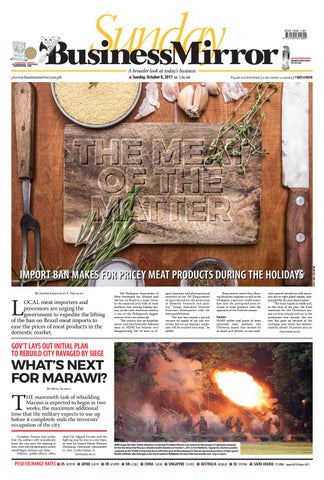
IMPORT BAN MAKES FOR PRICEY MEAT PRODUCTS DURING THE HOLIDAYS
L
By Jasper Emmanuel Y. Arcalas
ocal meat importers and processors are urging the government to expedite the lifting of the ban on Brazil meat imports to ease the prices of meat products in the domestic market.
The Philippine Association of Meat Processors Inc. (Pampi) said the ban on Brazil is a major factor in the expected price hike of meat products this coming holiday season, as the Latin American country is one of the Philippines’s biggest sources of its raw materials. “The country ban on Brazilian meats and [mechanically deboned meat or MDM] has become very disappointing, but we have to re-
spect [sanitary and phytosanitary] concerns of our DA [Department of Agriculture] for the protection of domestic livestock and poultry,” Pampi Executive Director Francisco Buencamino told the BusinessMirror. “The ban has caused a partial vacuum on supply of our raw materials, but we are hoping a resolution will be reached very soon,” he added.
Buencamino noted that allowing Brazilian suppliers to sell to the Philippine importers would somehow ease the anticipated price increase of meat products with the approach of the Yuletide season.
Factors
Pampi earlier said prices of some processed meat products this Christmas season may increase by as much as 6 percent, as raw mate-
rials sourced abroad are still expensive due to tight global supply, compounded by the peso depreciation. “The meat supply is stable and, at this time of the year, the [raw] materials for the Christmas season are here already and are in the production line already. But our cost has gone up because of the exchange rate, which has deteriorated by almost 10 percent year on Continued on A2
Gov’t lays out initial plan to rebuild city ravaged by siege
What’s next for Marawi?
T
By Rene Acosta
he mammoth task of rebuilding Marawi is expected to begin in two weeks, the maximum additional time that the military expects to use up before it completely ends the terrorists’ occupation of the city. President Duterte said earlier that the soldiers will immediately leave the city once the fighting is over, then the rehabilitation works would begin without any delay. Military public-affairs office
chief Col. Edgard Arevalo said the fighting may be over in a few days, as seen by Armed Forces Western Mindanao Command commander Lt. Gen. Carlito Galvez Jr. Continued on A2
PESO exchange rates n US 50.9510
Army troops fire their 105mm Howitzers to welcome President Duterte as he arrives for the turnover of command ceremony for the new Army Chief Maj.Gen. Rolando Joselito Bautista on October 5, 2017, in Fort Bonifacio, Taguig City. Bautista assumes command for the 87,000-strong Army forces with thousands of them deployed in Marawi and nearby provinces to fight against Muslim militants who laid siege to the city in southern Philippines for more than four months now. AP/Bullit Marquez
n japan 0.4519 n UK 67.4999 n HK 6.5263 n CHINA 7.6538 n singapore 37.4392 n australia 40.0628 n EU 59.9184 n SAUDI arabia 13.5866
Source: BSP (5 October 2017 )
Sergey Shibut | Dreamstime
media partner of the year
NewsSunday BusinessMirror
A2 Sunday, October 8, 2017
www.businessmirror.com.ph
The ‘meat’ of the matter Continued from A1
year,” Pampi Vice President Jerome D. Ong, who is also the president of CDO Foodsphere Inc., said in an earlier interview with reporters. “For canned goods and hot dogs [there might be] very minimal [increase of about] zero percent to 3 percent, perhaps. But for hams, it could be as much as 5 percent to 6-percent increase. This is because the global prices of pork have gone up, plus the [weaker] foreign exchange,” Ong added.
Thin supply
Despite the resumption of imports from some European countries, Ong said the global price of MDM is still higher than usual, as world supply continues to be thin. MDM is another raw material used by meat processors in making hot dogs and canned goods. In July Pampi told the BusinessMirror that the government’s decision to ban meat imports from Brazil could result in as much as 15-percent increase in the retail price of some processed-meat products sold locally. Brazil is another top source of raw materials by meat processors, especially MDM. Pampi noted that the retail price of hot dogs could go up by 10 percent to 15 percent, while canned goods that are MDMbased, such as meat loaf, beef loaf and luncheon meat, could increase by as much as 10 percent.
“[MDM price] doubled [this year], but has since stabilized, but it has not come back to original levels. It’s back to about $650 per metric ton [MT], which is still expensive. There are new countries or markets that would open, and we have to compete with them,” he said. “There’s always a natural momentum for price to go up, and it’s really hard to force it down. Hopefully, by early next year, it goes down some more; but we do not see it going back to the old level [of $400],” he added. Industry players said the price of MDM doubled to as much as $800 per MT in the first quarter. This is due to the closure of Philippine borders to poultry products, including MDM, from most European countries where there are avian-influenza (AI) outbreaks. Meat processors source most of their raw materials, such as MDM, from Europe.
told the BusinessMirror. “But since there was no basis to begin with, the Philippines could just have restored their eligibility.” Cham noted that lifting the ban on the Latin American country before the year ends would not have any effect on the prices of meat products this holiday season anymore. Should the government resume the issuance of permits to importers of Brazilian meat, Cham noted, then it would only benefit them next year. “It is now too late in the day for [meat] product[s] to arrive in time for the Christmas season. Importers are resigned to [the fact that there may be] no Brazilian meat for the rest of the year,” he said. “Hopefully if [Bureau of Animal Industry] will issue [sanitary and phytosanitary import clearances] this month, then importers can start planning for the January arrival [of imports],” he added.
Who will benefit?
Final report
Meanwhile, Meat Importers and Traders Association (Mita) President Jesus C. Cham urged the government to expedite the lifting of the ban, arguing that it “was not justified in the first place.” “We had hoped that the Philippines would expedite the lifting of the ban, especially we know now that the ban was not justified in the first place. We understand that the outbreak of the bird flu also contributed to the delay,” Cham
Earlier, Mita urged the DA to reconsider its zero-tolerance policy on salmonella, which was the reason Agriculture Secretary Emmanuel F. Piñol issued Memorandum Order 32 authorizing the temporary suspension of the accreditation of all Brazilian meat establishments. Mita stressed that the tests conducted by the government on meat imports are not in accordance with the Codex Alimentarius. The discovery of the existence
of salmonella in some meat imports from Brazil prompted the DA to impose a temporary ban on goods coming from a country more than 18,000 kilometers away. However, the DA, particularly its attached agency the National Meat Inspection Service (NMIS), junked the appeal of the meat traders, citing health and food-safety concerns for the local market. NMIS Executive Director Ernesto S. Gonzalez told the BusinessMirror that the Philippine mission to Brazil has recently completed the inspection on the suspended Brazil foreign meat establishments (FMEs). “Yes, they just arrived and [I’m] still waiting for the final report,” Gonzalez said, adding that the report would be released within the month. The government will only lift the ban on the Brazil FMEs once they have been cleared by the
DA’s technical team that conducted the inspection, according to Piñol.
Too slow
In August the Brazilian Animal Protein Association (ABPA) urged Manila to fast-track the investigation into the contamination of some meat shipments with salmonella to the Philippines in July. ABPA Vice President and Technical Director Rui Vargas made the appeal after the Philippine mission that would conduct an inspection of some meat establishments in Brasilia was postponed due to the discovery of avian influenza (AI) in some towns of Central Luzon. “The audit of the Philippines is important because more than 30 listed Brazilian establishments export to them. And we had a document from the Philippines this year notifying us of our problems at five exporting establishments in
a range of companies that we think are noble,” Vargas told the BusinessMirror in an interview in São Paulo, Brazil. “We are now awaiting and expecting that, by end of September, there should be a visit by the Philippine mission. It is still being confirmed,” Vargas added. Vargas said they find the Philippine government’s action in addressing the issue with Brazil and salmonella somewhat “slow.” “They told us they postponed because it has to be necessary to be quarantined because they came from avian influenza [AI] problem, and we have restrictive rules here on AI. We do not allow entry for people who visited establishments with poultry in the last 15 days,” he said. “I am not satisfied on the rate they are addressing this. I find it a little bit slow, but we accept it because it is reasonable,” he added.
What’s next for Marawi?
Chinese Ambassador to the Philippines Zhao Jianhua (right) hands a Chinese-made CQ-A5b assault rifle to Defense Secretary Delfin N. Lorenzana during a turnover ceremony on October 5 in Camp Aguinaldo in Quezon City. The 3,000 weapons and millions of rounds of ammunition form part of Chinese military donation to the Philippine military in its fight against Muslim militants who laid siege to Marawi City in southern Philippines for more than four months now. Looking on at left is Armed Forces Chief of staff Gen. Eduardo M. Año. AP/Bullit Marquez Continued from A1
If the period extends, then it may span for one week, or at the maximum two weeks, which will still be ahead of the October 26 deadline set by Armed Forces Chief of Staff Gen. Eduardo Año. “The request of General Galvez, the commander of the Western Mindanao Command…is a few more days. It may span for a week or two; it depends,” Arevalo said. “We are just as interested as everyone else in ensuring that this will be over the soonest possible time so that we could put in full swing the reconstruction and rehabilitation of Marawi,” he added. Arevalo, however, said that, as much as possible, they do not want to give a deadline, as it will bear down on the safety of the operating troops, who are up against ordnance, homemade bombs and snipers.
Earlier rehabilitation
While military officials are seeing the start of the repair and rehabilitation toward the end of this month, Defense Secretary Delfin Lorenzana hinted that the work may start sooner than the military’s projection. “When we were there [Marawi] two days ago, we said 10 days is already long, 10 to 15 days to [finish the operation]. Within this month, middle of this month, it should be over,” Lorenzana said on Thursday. Lorenzana, who is the head of the government’s task force on
the city’s rehabilitation, said he understood the reluctance of the soldiers in finishing the operation at the end of September, due to security reasons. “Now, I can understand the reluctance to finish the job at the end of September because they were actually thinking of saving the civilians inside,” he said. “If you remember, they [government forces] were able to extricate 17 civilians from inside [the battle zone]. If they went in there [on] full [personnel and firepower] blast, they could have killed everybody. So now I see the wisdom of the military commanders on the ground to do it slowly and carefully… every life that we can save there is worth the delay,” Lorenzana added. Military officials said the repair and rehabilitation of Marawi hinge upon the end of the military operation because the soldiers could not be fighting while at the same time doing the construction works. Small works were, however, already being done by soldiers who also work as engineers, especially in areas cleared of terrorists.
Ground works
On Wednesday, soldiers, policemen and local officials have begun cleaning the badly battered barangays of Marawi from the rubbles and debris in preparation for the massive rehabilitation and reconstruction. Col. Romeo Brawner, deputy
commander of Joint Task Force Ranao, said the cleanup activity was initiated by members of the task force, members of the Marawi City Police Office, Barangay Peace Keeping Action Teams (BPATs), local officials and disaster personnel. The activity covered roads, houses, buildings, hospitals, schools and other buildings in barangays Matampay, Tampilong, Poblacion, Datu Saber, Green, Loksadatu, Basak Malutlut and East Basak. The seven barangays were the scenes of heavy fighting between soldiers and terrorists until a couple of days ago since the battle erupted on May 23. It was in Basak Malutlut where the terrorists even launched their siege of the city.
Fixing power lines
The military said that other agencies, which were also tapped to help in the rehabilitation, have also jumpstarted their efforts. One of these agencies is the Department of Energy (DOE), which is looking to fully restore power in the city by completely rehabilitating power supply until next year. The military said the energy department began early its rehabilitation program to ensure that the affected residents will have power once they return to their homes. The DOE is already erecting posts and poles and reconnecting power cables to houses, especially in the areas earlier affected by the war, but have been cleared.
BusinessMirror
news@businessmirror.com.ph
Commerce Dept defers ruling on China’s status as nonmarket economy
T
he Commerce Department has deferred a decision on whether China should be treated as a market economy until after President Donald J. Trump’s visit to the Asian nation next month. Commerce on Thursday delayed a decision on whether to impose preliminary duties on aluminum-foil imports from China to penalize Chinese suppliers from selling the product in the US at less than fair-market value. The department said it will announce its determination on the antidumping probe, along with a decision on China’s non-market economy status, no later than November 30. The department launched the review in April. Under the rules of the World Trade Organization, countries that don’t consider China a market economy have more flexibility in how they calculate tariffs to impose on Chinese products found to break trade rules. T he Com merce move puts off another decision that could inf lame relations with China as Trump prepares for his first trip as president to the world’s second-biggest economy.
The World
Commerce Secretary Wilbur Ross recently said the US won’t decide whether to impose tariffs on foreign steel until after the administration’s push for tax reforms by year end. The White House announced last month that Trump will travel to Asia from November 3 to 14, including stops in Japan, South Korea, China, Vietnam, and the Philippines. “In all cases, the department conducts a full and fair assessment of the facts,” Ross said on Thursday in announcing the delay. “This extension will ensure that the highest standards are followed in this case as we seek to guarantee fair treatment for US workers and businesses.” A final determination on antidumping duties in the Chinese aluminum-foil probe would be made 75 days after the preliminary decision. In August the US imposed preliminary countervailing duties on Chinese aluminum foil from China, ranging from 16.56 percent to 80.97 percent, after finding they were subsidized. In 2016 US imports of aluminum foil from China were valued at $389 million, according to Commerce. Bloomberg News
US wins S. Korea’s nod to amend free-trade deal
T
he United States has won South Korea’s agreement to amend their trade deal, overcoming previous reluctance to change the five-year-old pact, which the Trump administration blames for increasing its trade deficit, particularly for vehicles. South Korea plans to start the necessar y process for amendment, the nation’s trade ministry said in a news statement after the second round of talks concluded in Washington. US Trade Representative Robert Lighthizer said he will work to “resolve outstanding implementation issues, as well as to engage soon on amendments that will lead to fair, reciprocal trade.” No announcement was made regarding how the deal might be amended. T he first set of talks ended in stalemate in Aug ust, w it h t he US c a l l ing for rev isions to the agreement and South Korea balking and instead proposing a study on its economic impact. The trade friction comes as the military allies try to find ways to increase strategic cooperation in response to an increasingly aggressive North Korea. President Donald J. Trump h a s t h reatened to w it hd raw from the deal, known as Korus, if South Korea doesn’t agree to terms that would reduce America’s growing trade deficit with the country, though he hasn’t made any concrete proposals. “It seems South Korea took a step back,” said Heo Yoon, a professor at Sogang University’s graduate school of international studies in Seoul. “The US will play hardball in discussions,” but South Korea must take a holistic approach and consider not just relations with the US, but also with North Korea and China, he said. T h e U S i s S o u t h K o r e a’s second-l a rgest t rad i ng pa r tner and t his push to a lter t he dea l comes at a d if f icu lt time for Seou l. Relations w it h its largest e x por t market, China, have soured over t he decision to a l low t he US to deploy a missi le shield sout h of Seou l, and there is no sig n that Nor th Korea or t he US are interested
Sunday, October 8, 2017
A3
IMF’s Lagarde says global growth picking up despite social tension
T
By Andrew Mayeda | Bloomberg
he world economy is gaining strength and extending the broadest recovery since the start of the decade, even as issues such as inequality threaten to fray the fabric of society, International Monetary Fund (IMF) Managing Director Christine Lagarde said. T he I MF ’s upd ated g loba l forecast w i l l l i kely be “even m o r e o p t i m i s t i c ” w h e n i t ’s released ne x t week , L aga rde said in a speech on T hursday at Ha r va rd Universit y. T he IMF w ill release its World Economic Out look on October 10 at its a nnu a l meet ings in Wash ington. In Ju ly the f und projected t he globa l economy w i l l g row 3. 5 percent t h is yea r a nd 3.6 percent in 2018. A “cyclical pickup” in investment and trade in advanced economies, especially in Europe and Japan, is creating better-thanexpected growth, Lagarde said. US growth will be “above trend” this year and next, though forecasts are fluid due partly to the
3.5%
The International Monetary Fund’s July projection of global growth for 2017, and 3.6 percent in 2018
shifting prospects of tax reforms, she added. Nearly three quarters of the world is “experiencing an upswing” in terms of gross domestic product, and the end result is the broadest-based acceleration
in global growth since the start of the decade, according to the Washington-based fund. Led by China and India, Asian emerging markets remain strong, while the outlook has become “a bit brighter” in other emerging and developing economies, including commodity exporters in sub-Saharan Africa and Latin America, she said.
Sunny break
“We are seeing some sun breakthrough,” Lagarde said in prepared remarks of her speech. “But it is not a clear sky.” She warned that the global economy faces a number of t hreats, f rom h igh level s of debt in many countries to rapid credit expansion in China and “excessive risk-taking” in financial markets. Persistently low growth since the 2008 financial crisis has reinforced the problem of inequality, while exposing “long-running weaknesses” in the world’s ability to adapt to technological change and global integration, she said. “Our social fabric is fraying, and many countries are experiencing increased political polarization,” Lagarde added. The sunnier outlook sets a positive tone for next week’s IMF meetings, which bring together finance ministers and central bankers from the fund ’s 189
member-countr ies. T hey may be heartened by the fact that President Donald J. Trump hasn’t followed through on most of his trade threats, such as vows to impose tariffs on foreign steel and penalize companies that shift production abroad.
Global backlash
Still, US efforts to overhaul the North American Free Trade A g reement a nd a t rade dea l with South Korea are still under way. W hile Chancellor Angela Merkel’s party remained in power in last month ’s German election, an anti-immigrant party gained a toehold in the nation’s parliament, underscoring the backlash against globalization in rich economies. Central banks should communicate t heir pl a ns c lea rly and raise rates to more normal levels smoothly to avoid market turbulence and tightening financial conditions that could derail the recover y, she said. Countr ies w it h hea lt hy pub lic finances, such as Germany and South Korea, should invest more in their own economies, Lagarde said. Countries should try to boost productivity, which, in turn, would lift wages, through steps such as cutting red tape and spending more on research and development and infrastructure, she said.
in tr y ing to negotiate an end to t he cur rent tensions.
Autos dispute
The US ef for ts to nar row its trade gap w i l l probably focus heav i ly on t he auto industr y, mea n i ng t he ad m i n i st rat ion may push to increase t he number of American-made cars that can be sold in South Korea, Troy Stangarone, senior d irector of congressional affairs and trade at t he Korea Economic Institute in Washington, said before the ta l k s. Autos are a source of tension, g iven t hat t he US has an $18.8 -bi l lion trade def icit in vehic les. South Korea treats the first 25,000 US-made vehicles imported by each manufacturer per year as compliant with local safety and testing regulations, so long as the vehicles meet US standards. Lifting that cap would boost US-made vehicle imports, says Matt Blunt, president of the American Automotive Policy Council, a Washington-based group that advocates for General Motors Co., Ford Motor Co. and Fiat Chrysler Automobiles NV on trade issues. “There’s a long list of regulations that are problematic, which we would argue have a disproportionate impact on US automobile manufacturers,” Blunt said. “We think a way to cut through that would be to remove that 25,000-vehicle cap.” Hyundai Motor Co., the South K orea n autom a ker, s a id t he agreement has been beneficial to both nations. “ Hy u nd a i h a s a lways sup por ted f ree t rade a nd h igh ly va lues t he t rade pac t bet ween t he Un ited St ates a nd K orea ,” it s a id i n a st ate me nt . T he dea l “ i s pa r t ic u l a rly i mpor t a nt f rom a geopol it ic a l a nd st rateg ic perspect ive,” it sa id. The US also could pressure South Korea to accelerate the reduction of agricultural tariffs, many of which are being phased out slowly over 10 years or longer, David Salmonsen, senior director at the American Farm Bureau Federation, told Bloomberg BNA prior to the meeting. Bloomberg News
A trader in the Ten Year Options Pit at the Chicago Board of Trade in Chicago, Illinois, yawns after the Federal Reserve raised interest rates for the 16th straight time, on May 10, 2006. Joe Tabacca/Bloomberg News
Markets yawn at political drama as economic optimism prevails
W
ith Catalan separatists raging, a cloudy outlook for US tax overhaul and all eyes on who President Donald J. Trump will nominate to head the Federal Reserve, there are a lot of risks out there for investors. Or at least you’d think there were. Despite the headlines, financial markets are experiencing unprecedented calm and unprecedented gains. Take the S&P 500 Index, which has posted a positive total return in every month since the election. The gauge is on its longest daily winning streak since 2013, and if October ends green it’ll be the best monthly stretch in nearly 90 years, according to a Deutsche Bank AG analysis. The steady gains without any breakout moves are possibly the result of investors being stuck between two warring narratives: Sell on political risks, such as a hawkish Federal Reserve chairman, or buy on encouraging economic data like Thursday’s
better-than-expected jobless claims. For now, the latter argument has the edge, said Quincy Krosby, chief market strategist at Prudential Financial Inc. “You have these disparate risks crossing the headlines, but it’s the market’s job to look through that and see if it’s different than before,” Krosby said. “The risk appetite increases when you have liquidity in the markets, when the economy is solid, when credit conditions are healthy, which they all are now.” There’s little doubt that stocks have been quiet. The S&P 500 has moved 1 percent or more in either direction on just 4.2 percent of this year’s trading days, a rate that if it lasts through the end of the year would make 2017 the least volatile on record. Currencies have followed suit. The JPMorgan FX volatility index plunged after grinding higher through the summer ahead of significant events like the upcoming
Japanese elec tion. Since the four th quarter’s usually among the more volatile stretches, the lack of movement now is notable, according to Jefferies Llc. strategist Brad Bechtel. “You would think that volatility in FX would actually pick up on those things, but so far, it’s going the other way,” Bechtel said. “The dollar’s rallying, and that helps depress volatility levels because that indicates potentially a healthier US.” The only place where there are signs of life is in US government bonds. Bank of America Corp.’s MOVE Index, a gauge of price swings in the US Treasury market, rose 7.9 percent in the last two weeks. Even so, it still sits 21 percent below its five-year average. Quarterly trading volume in the largest exchange-traded fund tracking the S&P 500 fell below $1 trillion for the first time since 2007, according to Bloomberg Intelligence’s Eric Balchunas. ETF trading
typically picks up during major macro events, as investors hedge and move positions with broad exposures. During the financial crisis, ETFs represented about 50 percent of total US equity trading volume, compared with about 30 percent in the first half of this year, data compiled by JPMorgan Chase & Co. show. Looking at the tumultuous events going on across the globe, and trying to calculate the unknown affects of the Fed’s unwinding and the European Central Bank’s tapering, has investors paralyzed, said Andrew Brenner, head of international fixed income at Natalliance Securities in New York. “Think of it like you have your two Greek gods, the water and the sun, fighting each other and right now it’s not going anywhere,” Brenner said. “It’s going to end badly. We’re about ready to make a big move that will happen by the end of this year.” Bloomberg News
A4
The World BusinessMirror
Sunday, October 8, 2017
US intelligence report: China expanding military bases globally
C
By Nafeesa Syeed | Bloomberg
hina’s first overseas military base in the small African country of Djibouti is “probably the first of many” the country intends to build around the world, which could bring its interests into conflict with the US, according to American intelligence officials.
“China has the fastest-modernizing military in the world next to the United States,” according to insights provided on Thursday by US intelligence officials, who asked not to be identified discussing the information. That will create “new areas of intersection—and potentially conflicting—security interests between China and the United States and other countries abroad,” according to the officials. The People’s Liberation Army announced the establishment of a logistics support base in Djibouti in July, saying it would back up China’s military’s naval escort, peacekeeping and humanitarian
Trump says White House gathering might be the ‘calm before the storm’
U
NITED STATES President Donald J. Trump offered cryptic remarks Thursday night while posing for photos with military leaders, saying the gathering might represent “the calm before the storm.” He made the comments among senior military leaders and their spouses in the White House State Dining Room ahead of a dinner expected to include the discussion of a range of national security issues. “You guys know what this represents?” Trump asked assembled members of the media. “Maybe it’s the calm before the storm.” Asked repeatedly by reporters to clarify his comments, Trump said, “You’ll find out.” During a meeting with military leaders earlier in the afternoon, Trump said his administration was focused on “challenges that we really should have taken care of a long time ago, like North Korea, Iran, Afghanistan, Isis and the revisionist powers that threaten our interests all around the world.” During those remarks, the president also appeared to issue a vague threat toward the regime in North Korea, which has antagonized the US president with a series of nuclear and ballistic-missile tests. “We cannot allow this dictatorship to threaten our nation or our allies with unimaginable loss of life,” Trump said. “We will do what we must do to prevent that from happening. And it will be done, if necessary—believe me.”
Fire and fury
Trump’s latest remarks echoed comments he made in August, when he warned that North Korea will face a devastating military strike if it continues threatening the US. “North Korea best not make any more threats to the United States,” Trump told reporters in Bedminster, New Jersey, at the time. “They will be met with fire, fury and, frankly, power the likes of which this world has never seen before.” The president rebuked his secretary of state, Rex Tillerson, last Sunday, saying he “is wasting his time trying to negotiate with Little Rocket Man,” the label he’s given to North Korean leader Kim Jong Un. A day earlier in Beijing, Tillerson told reporters that the US was talking to North Korea “directly, through our own channels.” Trump also is expected to soon announce his decision on whether to “decertify” the Iran nuclear accord in the coming days, which would prompt a congressional review period on the accord. Bloomberg News
missions in Africa and western Asia, as well as military exercises and emergency evacuation. As part of China’s expanding militar y and economic clout, the country is taking a stronger stance on territorial claims in the South China Sea, relations with Taiwan and in promoting its “One Belt, One Road” trade initiative. Where Chinese interests conflict with the US, Beijing is “actively seeking to undermine US influence,” according to the officials. The rare comments on how US intelligence agencies view China’s ambitions come as President Xi Jinping seeks to consolidate
support at this month ’s Communist Par t y Cong ress, held once every five years. President Donald J. Trump plans to visit China next month and, while the two countries have found areas of cooperation, including over United Nations sanctions against North Korea, they have unresolved disagreements over trade, Beijing’s territorial claims and Syria’s civil war.
Steel dispute
C o m m e rc e S e c r e t a r y W i l bur Ross, visiting Beijing last month, stressed his intent to
cut the US trade deficit with the world’s largest exporter through “increased exports of high-value US goods and services to China and improved market access.” Ross also announced a probe i nt o C h i n a’s s t a i n l e s s - s t e e l f langes for alleged unfair subsidies, the latest move after the US trade representative opened an investigation into China’s intellectual-property practices. According to the intelligence officials, “Chinese leaders see the US-led world order, most notably the US alliance network and promotion of US values worldwide,
Chinese leaders see the USled world order, most notably the US alliance network and promotion of US values worldwide, as constraining China’s rise and are attempting to reshape the world order to better suit Chinese preferences and growing clout.” —US intelligence officials
as constraining China’s rise and are attempting to reshape the world order to better suit Chinese preferences and growing clout.” Ahead of the Communist Party Congress, officials in Beijing have increased “control of domestic dissent.” The world’s second-largest economy is on track to reach its 6.5-percent annual growth target, the officials said. The country is fueling that growth, in part, by seeking deeper technology collaboration with US companies.
Bannon’s warning
Former Trump adviser Stephen Bannon has called the transfer of US technology to China “the single biggest economic and business issue of our time,” adding that “if we don’t get our situation sorted with China, we’ll be destroyed economically.” The US intelligence officials suggested China’s government is aware of the threat that perception poses to its ambitions. “Beijing is trying to downplay concerns that this state-led technology acquisition drive creates an unlevel playing field, forces technology transfer to China, limits foreign companies’ access to the Chinese market, and is a threat to U.S. and other countries’ economic strength.”
Tens of thousands have yet to submit Daca renewals
W
A SH I NG T ON —Te n s of thousands of young people eligible for renewed protection from deportation had yet to submit their applications hours before a Trump administration deadline on Thursday night. The administration was finalizing details of an immigration wish list that could jeopardize a long-term fix. Under a phase-out plan announced by the president last month, more than 150,000 young people covered by the Obama-era Deferred Action for Childhood Arrivals (Daca) program whose permits were set to expire before March 5 were given the chance to submit renewals—provided they arrive by October 5. Trump gave Congress six months to come up with a legislative replacement for the program. It shielded from deportation hundreds of thousands of young people, many of whom were brought into the US illegally as children, and allowed them to work legally in the country. While final numbers wouldn’t be available until next week, Department of Homeland Security Spokesman David Lapan said that about 118,000 of the roughly 154,000 people eligible for renewals had submitted their applications by midday on Thursday. That left 36,000—or about 23 percent of those eligible— outstanding. Facilities processing applications were prepared to accept courier deliveries until midnight, he said. The deadline approached as the Trump administration finalized the details of a set of immigration principles that could upend efforts to come up with a permanent fix for Daca recipients, often known as “Dreamers.” According to people familiar with ongoing discussions, the principles were expected to include elements of proposed legislation that would dramatically reduce legal immigration rates and overhaul the green card system to prevent extended family members, including siblings and adult children, from joining permanent residents in the US.
Gustavo Andrade (left) and activists from United We Dream, an immigrant youth-led organization, leave the Senate Hart Office Building after taking their advocacy message to Capitol Hill in Washington on Thursday. AP
The White House was expected to endorse principles of the DavisOliver bill, which aims to give local law-enforcement officials the power to enforce immigration laws and allow states to write their own immigration legislation. The White House was also expected to call for billions of dollars in funding for border security, more immigrant detention beds and immigration judges. It remained unclear whether the principles, which were expected to be announced in the coming days, would serve as a broad immigration wish list or specific demands the White House expected in exchange for signing Daca legislation. W h ite House Press Sec re tar y Sarah Huckabee Sanders declined to discuss specifics on Thursday, but back in mid-September she said the list would l i kely inc lude demand ing an end to so-called sanctuary cities
that refuse to share information with federal immigration authorities, funding for more immigration judges, and “supporting things like the R AISE Act” limiting legal immigration. But Ali Noorani, the executive director of the immigration advocacy group National Immigration Forum, said that, if those expectations held true, there was little chance for a Daca deal. “If the president winds up tying these elements to the Dream Act,” he said, Trump would wind up responsible “ for deporting 800,000 young people, which pretty much nobody wants except Stephen Miller,” Trump’s hardline senior policy adviser, who was working on the principles. Immigration advocates spent weeks trying to publicize Thursday’s Daca deadline. Earlier this week, dozens of Daca recipients traveled to Washington to try to pressure members of Congress
to vote on the Dream Act, which would provide an eventual path to citizenship. Sen. David Perdue, RepublicanGeorgia, one of the authors of the RAISE Act, said, “Democrats really want a fix on Daca, and we really want a fix on the immigration system.” “This is a landmark opportunity to fix the Daca problem and once and for all fix the vagaries of this immigration system that really doesn’t work,” he said. But Sen. Jeff Flake, Republican-Arizona, who has introduced his own immigration legislation, said it was unlikely the Senate would accept a proposal slashing legal immigration, noting that any Daca legislation will have to attract Democratic support. “With the deadline we have with Daca, I think it’s unrealistic to think we can do broader immigration reform like that,” he said. “I don’t see that happening.” AP
news@businessmirror.com.ph
Latest NSA breach blamed on Russian security software maker Kaspersky
W
ASHINGTON—In the latest case of an insider removing sensitive data from the nation’s largest intelligence agency, Russian hackers obtained classified documents that a National Security Agency (NSA) employee had taken and stored on his home computer. Investigators believe the hackers may have penetrated the computer by exploiting Kaspersky Lab antivirus software, a Russian brand widely used around the world, that the employee was using, according to officials briefed on the matter. The highly classified material involved the agency’s techniques for breaking into foreign computer networks to collect intelligence, the officials said. The case appears to be separate from a larger breach of security, by a group calling itself the Shadow Brokers, which has been publicly posting samples of the agency’s hacking tools periodically for more than a year. The case was first reported by The Wall Street Journal on Thursday. Investigators say the contractor does not appear to have intended to let the sensitive cybertools escape to the outside world. Officials believe he took the material home— an egregious violation of agency rules and the law—because he wanted to refer to it as he worked on his résumé. The maker of the antivirus software installed on his home computer, Kaspersky Lab, is a Russian company that US security officials have long feared may cooperate with—or be infiltrated by—the Russian government. The officials did not make their concerns public, and the antivirus software remains popular. But last month the federal government ordered the Kaspersky software removed from all government computers. The FBI has been investigating whether Kaspersky products, especially the well-reviewed antivirus programs, contain “back doors” that could allow Russian intelligence agencies into any computers or networks on which it is running. The company has always denied that it has any links to Russian intelligence. It is unclear whether the NSA breach played a major role in the government’s decision to ban Kaspersky products. While the Russian theft was first discovered two years ago, the Kaspersky link was only understood more recently. T he concer ns about K aspersk y Lab date back many years, in pa r t because its fou nder, Eugene K a s persk y, at tended a KGB tec hnica l col lege a nd ser ved in militar y intelligence. Tim Evans, a for mer NSA lawyer, said that in 2008 he was dispatched by the agency to the US Patent Office to retrieve ever y patent application filed by K aspersk y so that the agenc y cou ld study the names of its employees for know n officers of the Federa l Secur it y Board of the Russian Federation, the KGB’s successor. “This is an old question for the NSA,” said Evans, now with Adlumin, a cybersecurity contractor. While federal prosecutors in Maryland are handling the case, the agency employee who took the documents home does not appear to have been charged. In the past, taking classified information from agency premises and storing it on an insecure computer has been considered a prosecutable offense. John M. Deutch, who served as director of the CIA in 1995 and 1996, was investigated after classified information was found on his unclassified laptops. He agreed to plead guilty to a misdemeanor but was pardoned by President Bill Clinton. New York Times News Service
Sports BusinessMirror
Editor: Jun Lomibao | mirror_sports@yahoo.com.ph
Sunday, October 8, 2017
A5
CONCERNS ON DEMENTIA L
By Rob Harris The Associated Press
ONDON—Earning a place in a Premier League club’s academy offers an irresistible path to fame, glory and wealth. Parents, though, are becoming increasingly aware of the potential health risks their children will be exposed to. At Manchester City, offering reassurance and trying to allay concerns about any longterm brain damage caused by blows to the head now starts long before a professional contract is on offer.
“When we have young academy players—and we are talking 8, 9, 10, 11, 12—we get the parents in and talk to them about it,” City club doctor Matthew Brown told The Associated Press. “Concussion is a massive issue.” Just last week, Ireland forward Kevin Doyle retired from soccer after complaining of repeated headaches from heading the ball and concussions while playing for the Colorado Rapids in Major League Soccer in recent months. It was a preventative measure by the 34-year-old former Premier League player to try and avoid permanent damage. Medics are yet to verify definitive links
between impacts to the brain and the early onset of dementia within footballers, and Ireland Assistant Coach Roy Keane was dismissive of Doyle’s anxieties on Tuesday. “If you’re worried about the physical side of any sport, then play chess,” Keane said. “It is part of the game, players picking up injuries. [Doyle] is a center forward, and he gets a few knocks from center backs. I’m sure he has given out a few himself.” A notoriously tough midfielder during his playing career with Manchester United and Ireland, Keane is trying to protect the game’s physicality. Governing bodies, though, realize they cannot be indifferent if football
is to blame for retired players suffering from degenerative brain diseases. In research published earlier this year, six of 14 former players were found to have signs of Alzheimer’s disease after their brains underwent post-mortem examinations. The Football Association and Professional Footballers’ Association in England are stepping up the research being undertaken, and the way Alzheimer’s or memory loss has afflicted several members of England’s 1966 World Cup winning squad has sharpened the need to investigate. Geoff Hurst, who scored a hat trick in England’s 4-2 win over West Germany in the
1966 final, will launch an Alzheimer’s Society walk next week to raise awareness. “Dementia is becoming one of the most serious illnesses and it is increasing,” Hurst said. “My involvement with the players from my squad who have got it is seeing how the families deal with it all, and it is arguably one of the most debilitating aliments families can face.” Hurst believes Martin Peters, the other scorer at Wembley 51 years ago, would no longer recognize him. “If you have a physical disease, or a broken leg, you can recover from it and get better in time,” Hurst said, “with dementia it only goes
Nothing to look forward to this time in Pyeongchang T
HE National Hockey League (NHL) became entwined with the Olympics before young stars like Connor McDavid, Jack Eichel or Auston Matthews even pulled on a pair of skates. Nagano in 1998 started a string of five consecutive Olympics featuring NHL players, a tradition that became so routine that young players around the world added dreams of winning a gold medal to their hopes of someday lifting the Stanley Cup. “I’ve always been alive in the days where the NHL teams allow their players to go to the Olympics,” Eichel said. “I’ve had a lot of good memories watching the Olympics and seeing a lot of great players play, so it’s something you’ve always looked up to.” There’s nothing to look forward to this time: Instead of going to South Korea this winter to play for their home countries, NHL players face an 82-game season that will keep right on going on during the Olympics. The Games will instead include a mix of players from the minors, colleges and Europe. “It’s going to be weird for everybody,” said Colorado Avalanche forward Nathan MacKinnon, who was hoping to make Canada’s Olympic team. “It won’t feel right watching other guys wear that maple leaf and they’re good players, but they’re not the best players in the world at that tournament. Whoever wins it, hopefully Canada wins it. That’d be awesome. But it just won’t feel the same. They’re not world champions, technically, because they’re not the best players.” Almost six months since the league announced it would skip the Pyeongchang Olympics, most of the NHL’s best players are resigned to their missed opportunity. That Canada won’t have Sidney Crosby and Jonathan Toews to go for the three-peat, that McDavid, Matthews and Eichel won’t make their Olympic debuts quite yet. Russian superstar Alex Ovechkin, who was vocal about saying he’d go no matter what, said last month that he and other players have never had to choose between their NHL teams and the Olympics, and “should not have to be in position to make this choice.” Washington Capitals teammate Evgeny Kuznetsov said after not making the team for Sochi that he thought about signing in the Kontinental Hockey League so he could play in Korea, while countryman Vladimir Tarasenko simply expressed frustration that a lifelong dream and a chance at Russia’s first Olympic gold with NHL players was snatched away. “It’s very disappointing you’re not going to have the chance to be there when we have as short of careers as we do,” Swedish defenseman and Ottawa Senators captain Erik Karlsson said. “It’s going to be some guys’ only opportunity to go and they’re not going to be able to since it’s not our decision to not attend.” That decision belonged to NHL owners, who saw no tangible benefit from stopping the season for over two weeks to let players take part in the Olympics. “The fact of the matter is, we find the Olympics incredibly disruptive with no
WUSHU MEDALISTS IN WORLDS Hergie Bacyadan (second
from left) displays the silver medal in the men’s 70-kilogram division, while (from left) Divine Wally (48 kg), Francis Solis (56 kg) and Arnel Mandal (52 kg) show their bronze medals they clinched in the recent 14th World Wushu Championships in Kazan, Russia. The Philippine Sports Commissionsponsored team composed of nine athletes finished 16th overall among 50 countries.
RUSSIA’S Alexander Ovechkin and Pavel Datsyuk celebrate a goal against the USA during a men’s ice hockey game at the 2014 Winter Olympics, in Sochi in February 2014. AP
positive benefit, no opportunity to promote our presence or anything else of the Olympic experience,” Commissioner Gary Bettman said. “We have enough experience to understand what the Olympics represents. The people who suggest that somehow this is an opportunity to grow the game, it didn’t grow the game in Japan, it didn’t grow the game in Italy.” The league believes playing exhibition games in China and regular-season games in Sweden does more to grow the game than the Olympics. But NBC Sports, which has the
league’s national television rights, will instead be showing the Olympics this February with no NHL games scheduled on its networks between Feb. 8 and Feb. 25, the day of the gold-medal game, and the trade deadline set for Feb. 26. During that time, New York Rangers captain Ryan McDonagh expects teammates to root for their countries. Considering the 13-hour difference from the Eastern time zone (noon ET is 1 a.m. the following day in Pyeongchang), it may be difficult for players to
watch, but many will try. “Like any fan of sport I like to watch the Olympics, so I’ll definitely be paying attention to it,” McDavid said. Two-time US Olympian Patrick Kane said he will be interested to see which players are chosen. A lot of players have friends or former teammates in the running to make a national team, which adds a silver lining to the bitter disappointment. AP
one way, albeit at different levels.” It’s why families of fledgling players are starting to take note of the risks. Manchester City’s medical team tell parents of academy entrants that the playing style championed throughout the club by first-team manager Pep Guardiola—keeping the ball on the ground—isn’t just aesthetically pleasing. It’s safer, too, according to City’s doctor. “At Manchester City we have a philosophy of football, we play beautiful football,” Brown said. “There isn’t a lot of heading. I am not going to say there isn’t ever any heading because obviously there is. “When I speak to the parents of these young kids about concussion and any concerns they may have and the hypothetical risk of links to dementia at an early age, I say to them ‘as a club we are doing everything we can to both limit heading, [and] diagnose, assess, manage and rehabilitate head injuries’.” In 2015 the US Soccer Federation recommended a ban on headers for players 10 and under in a bid to address concerns about the impact of head injuries. The United States has also seen a $1-billion settlement between the National Football League and thousands of its former American football players who have been diagnosed with brain injuries linked to repeated concussions. “I don’t imagine we are going to change the rules of football because of this situation,” Brown said. “Obviously, there have been some quite publicized reports of ex-professional players that have dementia. But we’ve done a bit of work with experts around the country and they’ve said at the moment there’s no exact link between heading the ball and concussion or chronic traumatic encephalopathy. “In the future will they ever prove a link? I don’t know. I think there are so many variables, I really do. So all we can do is just reduce the risk to the player.” The family of former England striker Jeff Astle, whose death at age 59 in 2002 was attributed to repeatedly heading heavy, leather balls, has been pushing for better protection for modern players. The priority for the Astle family has been convincing football to recognize the problem even exists. “It is very encouraging that, for the most part, football is beginning to take the issue of concussion seriously and, along with more research, a cultural change is beginning to take place,” Peter McCabe, chief executive of the Headway brain injury association, said in response to Keane’s comments at the Ireland training camp. “It is vital that we continue to conduct more research into the potential long-term implications of heading footballs to ensure people are able to make informed choices.”
BEN MBALA and the Green Archers will clash with the Ateneo Blue Eagles today.
MBALA: IT MEANS EVERYTHING
F
OR Most Valuable Player Ben Mbala of defending champion De La Salle, facing Ateneo sums up in three words: It means everything. “You don’t need to say anything about Ateneo and La salle, it’s just Blue versus Green and it says it all,” the 6-foot-8 Cameroonian Mbala said. Mbala and the Green Archers clash with their archrivals, the Ateneo de Manila Blue Eagles, at 4 p.m. today at the Smart Araneta Coliseum. The match between last season’s finals protagonist closes the first round of eliminations of the Season 80 University Athletic Association of the Philippines. Ateneo is unbeaten in six games, while De La Salle is at second with a 5-1 record, its lone loss inflicted by an upset from the University of the Philippines. The Green Archers swept the Blue Eagles in the Season 79 finals, but Mbala stressed they would be facing an Ateneo side that has become stronger. “They’ve [Ateneo] improved. They played better than last year. 6-and-0. We need to come prepared,” said Mbala, who scored his career-high 39 points in their recent 106-100 victory over University of the East on Wednesday.
“But, believe me, my teammates and coaching staff would be able to come up with a great game plan for us to be able to compete against them. It would be interesting, but at the end of the day we’ll just enjoy the game.” Coaches Tab Baldwin and Sandy Arespacochaga have been drawing the best out of the Blue Eagles, especially Thirdy Ravena and Chiz Ikeh. “Last year was last year. Bygones are bygones. Another game, another year, another opportunity,” said the 6-foot-7 Nigerian Ikeh, who is averaging 10 points, 10.2 rebounds, 1.2 assist and one block per game this season. De La Salle is coming off back-to-back victories over University of Santo Tomas and UE, but questions over maturity and teamwork emerged after the Green Archers scored close calls over National University and Adamson University—not to mention their loss to UP. “Actually the best thing here is that for the last two games against UST and UE, we averaged, I think, 20.2 team assists per game and that’s the biggest improvement that we’ve got,” De La Salle Assistant Coach Miguel Solitaria said. ” The Green Archers will play without last season’s top rookie Aljun Melecio, who is down with dengue. Lance Agcaoili
Science
BusinessMirror
A6 Sunday, October 8, 2017
Sunday
www.businessmirror.com.ph • Editor: Lyn Resurreccion
Winning NorMin inventions excite crowds at S&T contest
C
heers and applause filled the Limketkai Atrium as the winners of the Department of Science and Technology’s Regional Invention Contest and Exhibit (DostRICE) were announced. The winning inventions have been crowd favorites throughout the three-day RICE showcase, which ran concurrently with the Regional Science and Technology Week (RSTW) celebration recently.
Members of the winning team from Iligan City East National High School receive their Sibol Award from Department of Science and Technology-Northern Mindanao Regional Director Alfonso P. Alamban and Director Edgar I. Garcia of Technological Application and Promotion Institute. S&T Media Service
Clinching the top award in the Outstanding Utility Model category was the Dry Grain Picking Apparatus by Consorcio S. Namoco Jr., Juvy T. Cloma, Gerby C. Rabago and Reginal A. Surbano of the University of Science and Technolog y of Southern Philippines (USTP). The inventors received a prize of P30,000 for their brainchild. Meanwhile, in the Likha or C re at ive R e s e a rc h c ate gor y, the Low-Cost Wireless Remote Power Monitoring Dev ice for
Transformer Load Management c laimed the top spot w ith a P25,000 bounty. Karl Martin A. Aldueso, Marven E. Jabian and Kister Genesis M. Jimenez, all from the Mindanao State University-Iligan Institute of Technology, were the brains behind the said device. In the Sibol Student Creative Research categor y for college level, the top slot went to the Air Quality Monitoring and Filtering Device by Christian Grant O. Bunane, Mike Francis N. Caiña and
Genard E. Delfin, with adviser Engr. Wencel Jean Carranza, also of the USTP. The invention won the college team P25,000. Likewise, P25,000 went to the winning Sibol Student Creative Research for high-school level, the X Y VO: A l l-natura l Sore Throat Lozenges from Allium schoenoprasum (Sibujing ) Stalk Extract by Verneece Charity F. Amlon, K iarah S. Garma, Ur iah Ma xine D. Lumbo and Angela R ayne J. Torres, with adviser Honey R itzel G. Barillo of the Iligan City East National High School. These winning innovations will represent Northern Mindanao in next year’s National Invention Contest and Exhibit. “We have a record-breaking number of participating inventions this year,” DOST-Northern Mindanao Regional Director Alfonso P. Alamban proclaimed at the awarding ceremony. A total of 99 innovative entries from local inventors were preselected from numerous submissions, vying for top prizes in four different categories. This was the highest number of en-
39
The total number of inventions in Northern Mindanao which have already applied and in the process of application for Intellectual Property Rights—the highest number in the country
tries in the history of RICE in Northern Mindanao. In her keynote message during the opening program, DOST Undersecretary for Regional Operations Brenda Nazareth-Manzano noted the recognition and utilization of local inventions. “ T he outputs of our innovators merit our recognition,” Manzano said, “ but more than that, these scientific outputs should be utilized by us, the greater public, to help answer our needs wherever suitable.” She especially addressed the student participants, describing the budding scientists as “key to the development not just of our country as a whole but of each individual Filipino.” DOST-Northern Mindanao has also assisted a record-breaking number of these inventions in applying for Intellectual Property Rights (IPR) support from the Technology Application and Promotion Institute. Some 34 inventions from this year’s contest have already been applied for IPR, plus five more in process, for a total of 39—the highest in the country. Before the announcement of RICE winners, all the competing inventions were publicly displayed at the exhibit from September 19 to 21. Visitors of all ages flocked to the booths of these entries, where the inventors demonstrated how their creations worked. Besides the RICE entries, other displays during the RSTW celebration included successful technologies and enterprises assisted by DOST-Northern Mindanao, as well as DOST-Northern Mindanao programs and services. The RICE and NSTW culminated with Science Secretary Fortunato T. de la Peña congratulating DOST-Northern Mindanao and Tapi, both of which spearheaded the invention contest. Hyacinth J. Tagupa and Benjoe Rey B. Visayas/S&T News Service
Present at the signing of the Core Funding Agreement at De La Salle Health Sciences Institute (DLSHSI) are (from left, seated) Dr. Mark Mulligan, MD; DLSHSI President Br. Gus Boquer, FSC; and Dr. Jeffrey Lennox of Emory University. Joining them are (standing, from left) Anna Reyes (DLSHSI); Dr. Melchor Victor Frias IV, coinvestigator and DLSHSI CRS leader; Dr. Charles Yu, DLSHSI vice chancellor for research; Dr. Maricel Gler (Makati Medical Center); Tanisha Sullivan, assistant director for Programs for Emory Clinical Trials Unit; and Arlene Lacorte (DLSHSI).
US-NIH taps De La Salle as clinical trial site for a global TB study
A
United States health institute has chosen the leading Philippine health institute to be a clinical-trial site in a global study on tuberculosis. The US’s National Institutes of Health (NIH)-National Institute of Allergy and Infectious Disease (ACTG) has chosen De La Salle Health Sciences Institute (DLSHSI) as the clinical-trial site. DLSHSI is the first in the Philippines to be tapped by NIH as a clinical-trial site. The trial will be under the umbrella of a multicountry study, entitled “Protecting Household Contacts on Exposure to Newly Diag nosed Inde x Mu lti-Dr ug Resistant Tuberculosis Patients [Phoenix MDRTB].” It aims to protect children and other family members from gett ing infected w it h t uberculosis after a member of the household contracts multidrug resistant TB. In the Philippines the challenge of controlling TB has become more difficult with many patients developing multidrug resistant TB, and as a result,
Nobel Prize honors technique for seeing molecules’ details
Launch of Sputnik 60 yrs ago opened space era S M OSCOW—The launch of Sputnik 60 years ago opened the space era and became a major triumph for the Soviet Union, showcasing its military might and technological prowess. It also stunned the rest of the world. Details of the development and the launch of the first artificial satellite were hidden behind the veil of secrecy that surrounded the Soviet space program and only became known decades later. A look at some little-known facts behind the October 4, 1957, launch of the unmanned spacecraft:
By-product of the Soviet missile program
Amid a tense Cold War arms race with the United States, the Soviet Union focused its efforts on building the world’s first intercontinental ballistic missile capable of delivering a hydrogen warhead to the US. The R-7 missile was built by a team led by Sergei Korolyov, and tests of the rocket began in 1957. Korolyov, a visionary scientist and a shrewd manager at the same time, pressed the reluctant military brass to use one of the first R-7s to put a satellite in orbit. He warned Soviet leaders that the US was also developing a satellite and won the Kremlin’s permission for the launch.
Simple design
While there already was a project for a full-fledged scientific satellite, Korolyov ordered his team of engineers to design a primitive orbiter to save time and beat the US into space. The craft, which was built in only a few months, was named PS-1, for “Prosteishiy Sputnik”—the “Simplest Satellite.”
November 3 launched Sputnik 2, which weighed about 508 kilograms (1,120 pounds). It carried the world’s first passenger, a dog named Laika. While the dog died of the heat soon after the launch, the flight proved that a living being could survive in space. On April 12, 1961, the Soviet Union made another giant leap ahead of the US when Yuri Gagarin became the first human in space. The Soviet lead in space prompted the US to pour money into research and technology. In 1969 the US won the race to land the first man on the moon, while the Soviet program collapsed in a series of booster rocket explosions.
In this photo made on October 2, a mock-up of the First Earth Sputnik is on display at the Museum of Cosmonautics in Moscow, Russia. AP/Ivan Sekretarev
The satellite, weighing less than 84 kilograms (about 184 pounds) and slightly larger than a basketball, was a pressurized sphere of polished aluminum alloy with two radio transmitters and four antennas. An earlier satellite project envisaged a cone-shape vehicle, but Korolyov opted for the sphere. “The Earth is a sphere, and its first satellite also must have a spherical shape,” he was quoted as saying.
Start of space age
While the rest of the world was stunned by the Soviet accomplishment, the Kremlin’s leadership seemed to be slow to grasp the scope of the event. The first official Soviet report of Sputnik’s launch was brief and buried deep inside the pages of Pravda, the Communist Party’s daily newspaper. Only two days after the launch did it come out with a banner headline and quotes of the foreign accolades.
Unknown hero
Light and sound in the sky
Sputnik contained a radio transmitter, broadcasting a distinctive “beep-beepbeep” sound. Pravda published a description of Sputnik’s orbit to help people watch it pass. However, it didn’t mention that the light seen moving across the night sky was, in fact, the spent booster rocket’s second stage, which was in roughly same orbit as the satellite. The tiny orbiter itself was invisible to the naked eye. Sputnik orbited the Earth for three months before burning up in the atmosphere.
Leading space race
Thrilled by the global furor caused by Sputnik’s launch, the Kremlin immediately ordered Korolyov to launch a new satellite to mark the November 7 anniversary of the 1917 Bolshevik Revolution. His team succeeded in building a spacecraft in less than a month, and on
Amid the shroud of secrecy around the Soviet rocket and space program, Korolyov was never mentioned in any contemporary accounts of the launch. His key role was known only to a small circle of senior Soviet officials and space engineers. Korolyov was only allowed to publish the nonsecret parts of his research under the pseudonym “Professor K. Sergeyev,” while Leonid Sedov, a member of the Soviet Academy of Sciences with no co n n e c t i o n to s p a ce p ro g ra m , wa s erroneously praised in the West as the Father of Sputnik. S oviet leader Nikita Khrushchev rejected the Nobel committee’s offer to nominate Sputnik’s designer for a prize, insisting it was the achievement of “the entire Soviet people.” Korolyov’s daughter, Natalia, recalled later that her father sometimes felt bitter about the secrecy. “ We are like miners—we work underground,” she quoted him saying. “No one sees or hears us.” AP
e x posing chi ldren and ot her members of their household to this more severe disease. Dr. Melchor Victor Fr ias I V of DLSHSI’s Col lege of Medicine and former vice chancellor for research at DLSHSI w il l be the coinvestigator and Clinical Research Site leader. As a trial site, DLSHSI will receive funding from the NIH, while DLSHSI will be responsible for conducting the trial, which includes providing qualified personnel, equipment, materials, facilities and patient recruitment, enrollment and completing the required visits. On September 19 representatives from US-NIH’s Center for TB, US Centers for Disease Control and Prevention, and Emory University, signed a Core Funding Agreement with DLSHSI President Br. Gus Boquer, FSC, to start up the study. Emory University is a leading research institution, medical, education and health facility based in Atlanta Georgia in the US and is one of the clinical-trial units also funded by the NIH.
TOCKHOLM—Three researchers based in the United States, the United Kingdom and Switzerland won the Nobel Prize in Chemistry on Wednesday for developing a way to create detailed images of the molecules that drive life—a technology that the Nobel committee said allowed scientists to visualize molecular processes they had never previously seen. The 9-million-kronor ($1.1-million) prize is shared by Jacques Dubochet of the University of Lausanne, Joachim Frank at New York’s Columbia University and Richard Henderson of Medical Research Council Laboratory of Molecular Biology in Cambridge, Britain. The Royal Swedish Academy of Sciences said their method, called cryo-electron microscopy, allows researchers to “freeze biomolecules” mid-movement. The technology “is decisive for both the basic understanding of life’s chemistry and for the development of pharmaceuticals,” it said. For instance, the academy said the technique was used when scientists began suspecting the Zika virus was causing the epidemic of brain-damaged children in Brazil. Images of the virus allowed researchers to “start searching for potential targets” for Zika drugs. Frank said he was “fully overwhelmed” on hearing he had won. “I thought the chances of a Nobel Prize were minuscule because there are so many other innovations and discoveries that happen almost every day,” he said. “So yes, I was in a way speechless.” He said he hasn’t yet thought about what to do with the prize money, but added: “I was telling my wife that we don’t have to worry about a dog sitter anymore.” American Chemical Society President Allison Campbell said the technology is like “the Google Earth for molecules.” “This discovery allows the scientist to
zoom in down to the fine detail [giving] that fine resolution that you want to have,” she told The Associated Press. “Having all the exquisite detail just gives you a wealth of information about that protein molecule and how it is interacting with its environment.” Nobel chemistry committee member Heiner Linke added: “It’s the first time that we can see biological molecules in their natural environment and how they actually work together down to the individual atoms.” Elec tron microscopes once were thought to be useful only for examining nonliving material because the electron beam destroys biological material. But cryo-technology—freezing material at extremely low temperatures—protected the examined material from damage. Dubochet’s contribution was to freeze the water in the sample being examined so quickly that it vitrified—forming a kind of glass rather than ice, whose crystalline structure diffracted the electron beam. Frank developed mathematical models to sharpen fuzzy electron microscope images, and Henderson, in 1990, was able to generate a 3D image of a protein at atomlevel resolution. The annual prize rewards researchers for major advances in studying the infinitesimal bits of material that are the building blocks of life. Recent prizes have gone to scientists who developed molecular “machines”— molecules with controllable motions— a n d w h o m a p p e d h ow ce l l s re p a i r damaged DNA, leading to improved cancer treatments. It’s the third Nobel announced this week. The medicine prize went to three Americans studying circadian rhythms: Jeffrey C. Hall, Michael Rosbash and Michael W. Young. The physics prize went to Rainer Weiss, Barry Barish and Kip Thorne for detecting gravitational waves. AP
Faith www.businessmirror.com.ph • Editor: Lyn Resurreccion
Sunday
Sunday, October 8, 2017 A7
Lucifer, fallen angel and evil By Corazon Damo-Santiago
Conclusion
New Age practices
Archbishop Socrates Villegas holds a candle as he leads a prayer service for the victims of extrajudicial killings and those who were slain under the government’s crackdown against illegal drugs outside the Cathedral of Saint John the Evangelist in Dagupan City recently. Glenn Muñoz Lopez
More bishops offer sanctuary for witnesses to drug killings
M
ore bishops are joining Archbishop Socrates Villegas in offering any help they can for those who want to testify against cases of summary killings in the country. Bishop Roberto Mallari of San Jose said that, if there is anything the diocese could do, it is to provide refuge to those who fear for their lives. “I’m really one with him [Villegas], and we are opening our doors as sanctuary to those who want to stand for the truth,” Mallari said over Church-run Radio Veritas on Thursday. Bishop Ruper to Sa ntos of Balanga also agreed to shield people whose testimonies could shed light on the wave of drugrelated killings. “We support and we are in
solidarity with Archbishop Soc,” Santos said. Offering sanctuar y for the Church is not new. In recent years, the Church has protected real and potential victims of human-rights abuses, including people on the run because of their political beliefs, especially during the martiallaw period. It has been a long practice of the Church, said Lingayen-Dagupan Archbishop Emeritus Oscar Cruz and Novaliches Bishop Emeritus Teodoro Bacani. During the Arroyo administration, Cruz
provided sanctuary to whist leblowers against jueteng, a mu lt i m i l l ion - p e s o u nd e r g rou nd lotter y, while Bacani protected Sammy Ong, who testified on the alleged cheating in the 2004 elections. The issue of church sanctuary has come out recently when Villegas offered protection for some policemen who want to testify against summary executions. However, his offer is ver y clear. He said, “ We will look prudently into the sincerity of
their motives and veracity of their stories.” “Within the bounds of church and civil laws, we express our willingness to grant them accommodation, shelter and protection, including their families, if necessary,” Villegas added. In the Diocese of Kalookan, some witnesses to the killing of a 17-year-old-student Kian Loyd de los Santos during a police antidrug operation have sought protection from the church. Roy Lagarde/CBCPNews
Within the bounds of church and civil laws, we express our willingness to grant them [witnesses] accommodation, shelter and protection, including their families, if necessary.”—Villegas
Vatican urges online protections for kids amid porn scandal
R
OME—The Vatican secretary of state urged law-enforcement agencies, governments and social-media sites on Tuesday to take responsibility to protect children from online sexual abuse and exploitation—a statement that came even as one of his diplomats is caught up in an international childporn investigation. Secretar y of State Cardinal Pietro Parolin said the case of Monsignor Carlo Capella was “very painful” for all involved. P a r o l i n s a i d t h e Va t i c a n w a s treating the Capella case with “utmost concern, utmost commitment” but also confidentiality to protect the integrity of the investigation. He spoke to reporters on the sidelines
of a Catholic Church-sponsored conference on protecting children from online threats. Canadian police have issued an arrest warrant for Capella, accusing him of accessing, possessing and distributing child pornography during a visit to an Ontario church over Christmas. He is now in the Vatican after being recalled from the Vatican’s embassy in the US. Vatican prosecutors have also opened an investigation into Capella’s actions. Parolin—Capella’s boss—headlined the opening of the four-day conference on protecting children online that has drawn leading researchers in public health, Interpol, the United Nations, government representatives, as well as executives from Facebook and Microsoft.
The conference ended on Friday with proposals presented to Pope Francis. Parolin urged participants to “regain co nt ro l o f t h e d e ve l o p m e nt o f t h e digital world” to make sure children are protected, saying companies that promote and drive the digital world have a particular responsibility. “This congress must take responsibility for those minors at the world’s ‘peripheries’ of which Pope Francis continually speaks,” Parolin said. “[They] are the preferred target of networks of exploitation and of organized online violence.” Par ticipants offered sobering statistics about the problem. Last year Interpol identified five child victims of online abuse every day. Also last year
the Internet Watch Foundation identified more than 57,000 web sites containing child sexual-abuse images. Sixty percent of all that material online is hosted in Europe, said Ernesto Caffo, who founded the Italian group Telefono Azzurro, which tracks online child abuse. The conference is addressing both the harm done to children who are abused in child porn and the effects on children’s development from being exposed to online pornography. “How can we stop these terrorist attacks on the hearts of children?” asked the Rev. Hans Zollner, the conference organizer and head of the Center for Child Protection at the Pontifical Gregorian University. AP
Because Satan is not subject to human conditions, he posses “unimaginable possibilities to harm people”. He can infest houses w ith strange sounds and sights. He can also possess man “directly on the body and indirectly on the soul,” according to Fr. Adolf Faroni in The Likes and Dislikes of The Devil. The devil can do whatever he wishes with the person he possessed. If not cured, through exorcism, the possessed person is reduced “almost to the state of a beast,” with his brains and bodily functions affected and will that constantly deteriorates psycho physiologically. When confronted with problems or sickness, Satan can influence man to believe that God is unfair to allow him to experience such difficulties. It is during deep state of depression that man commits suicide. It is the characteristic of the devil to “cause gnawing anxiety and deep sadness and set up obstacles for men to ponder wisely about their states of being,” Saint Ignatius of Loyola said. Peter, addressing the Christians, emphasized: “Be alert, be on watch, your agony, the devil roams around like a roaring lion looking for someone to devour. Be firm in your faith and resist him,” according to 1 Peter 5:8-9. Peter is aware that when trust in God wavers and dies in the heart, man is likely to abuse his freedom and disobey God’s commandments. All subsequent sin would be disobedience toward God and lack of trust in his goodness, said the Catechism of the Catholic Church (CCC). Fr. Francis Syquia, director of Manila Office of Exorcism, in his book, Exorcism Encounters with the Paranormal and the Occult, has cautioned the young and those inclined to New Age practices not to delve in the “power, mystery and thrills of the world of occult, which is intimately tied up with the demonic.” Some of the different practices and instruments of the New Age Movement are: “angel guides, angelic channeling, astral projection, astrolog y, aura work, automatic handwriting, amulets, channeling, crystal healing, crystal divination, crystal balls, dousing, fortune telling, out-of-body work, past-life regression therapy, psychic development, psychic healing, rebirthing, shamanism, Silva mind control, soul travel, Ouija board, spellcraft, spirit of the glass, spirit guides, spiritualism, spiritism, transcendental meditation, séances, tarot cards, trance mediums, trance work and Wicca [witchcraft].”
FTS Foundation sponsors confirmation
F
i f t y young men and women from the SM Retail, including four SM Foundation scholars, received the Holy Sacrament o f Co n f i r m a t i o n re c e n t l y a t t h e National Shrine of Saint M ichael and the Archangel. The Confirmation was facilitated by the Felicidad T. Sy (ETS) Foundation as par t of its religious advocacy. Present at the confirmation rites were FTS Foundation CEO Mel Elido, SM Foundation’s Linda Atayde and Eleanor Lansang.
The 50 men and women, who received the Holy Sacrament of Confirmation led by the Felicidad T. Sy Foundation, are shown in photo with Fr. Genaro Diwa, parish priest of the National Shrine of Saint Michael and the Archangel.
Lucifer before the Lord, by Mihály Zichy (19th century) Wikimedia Commons
Moira Noonan, in Ransomed From Darkness, asserted that “demons would play whatever roles they were asked to.” Father Syquia said demons know “who has strong psychic abilities, and would try to lure those persons into their realm through the practice of the occult.”
Saint Michael, the Archangel
Because of the thin line that d iv ides t he pa ra nor m a l a nd parapsychology, many unknowing readers become enmeshed in New A ge pract ices. T hus, curious seekers of excitement should remember that New Age practices are “ demonic, deceptive, dreadful and disastrous” to spirituality. Church literature is replete with the drawings of an angel whispering on one ear and the devil on the other ear. How true it is for God to assign to each person a guardian angel to “enlighten and protect, direct and govern” him. He can then avoid temptation with divine help through his good angel. This reality is based on the Shepherd of Erma written between 140 and 155. Fr. Robert Faricy, SJ, professor at the Pontifical Gregorian University in Rome and an expert in spiritual warfare cautions that “the naiveté of priests and other pastoral workers” on the wiles of the devil can be dangerous. In Deliverance from Evil Spirits, Fr. Michael Scanlan, TOR, and Randall J. Curner attribute “many of the problems blamed on physical, hormonal, psychological and environmental factors” to evil spirits’ doings. “Part of the difficulty of resisting demonic attacks,” according to Fr. Benedict Heron, OSB, in I Saw Satan Fall, is due to the fact that most of the demonic attacks are “not recognized as such, even by many Christians.” Because the battle against Satan, which is the main task of Saint Michael the Archangel, is still being waged today, people are encouraged to pray always the Prayer to Saint Michael the Archangel: Saint Michael the Archangel, defend us in battle, be our safeguard, against the wickedness and snares of the devil May God rebuke him, we humbly pray And do thou, O prince of the heavenly host, By the power of God, Bind into hell Satan and all The other evil spirits Who prowl about the world Seeking the ruin of souls. Amen Santiago is a former regional director of the Department of Education National Capital Region. She is currently a faculty member of Mater Redemptoris Collegium in Calauan, Laguna, and Mater Redemptoris College in San Jose City, Nueva Ecija.
Tourism&Entertainment A8
Sunday, October 8, 2017
BusinessMirror
Editor: Carla Mortel-Baricaua
Mรถvenpick Resort Boracay will soon entertain guests before 2017 ends
Mรถvenpick Hotel Mactan Island Cebu suite
Mรถvenpick President and Chief Executive Olivier Chavy
When in Cebu, visit Mรถvenpick Hotel Mactan Island