MEDIA PARTNER OF THE YEAR
UNITED NATIONS
2015 ENVIRONMENTAL MEDIA AWARD LEADERSHIP AWARD 2008
BusinessMirror
www.businessmirror.com.ph
A broader look at today’s business n
Sunday, October 7, 2018 Vol. 13 No. 358
2016 EJAP JOURNALISM AWARDS
BUSINESS NEWS SOURCE OF THE YEAR
P25.00 nationwide | 2 sections 16 pages | 7 DAYS A WEEK
EVERDANCER | DREAMSTIME.COM
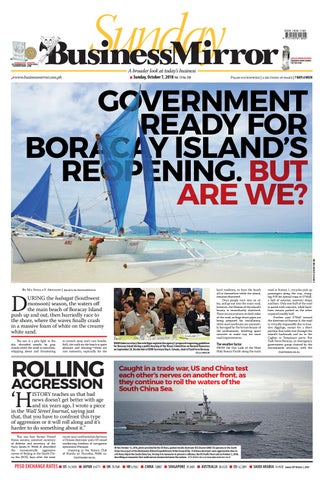
GOVERNMENT READY FOR BORACAY ISLAND’S REOPENING. BUT ARE WE?
By Ma. Stella F. Arnaldo |
D
local residents, to have the beach all to themselves while the island, remains shuttered. Once people turn into an alley, and go out into the main road, however, the illusion of the island’s beauty is immediately shattered. There are excavations on both sides of the road, as huge drain pipes are being prepared for installation, while one’s eardrums are constantly barraged by the brrrat-braaat of the jackhammer, breaking apart concrete to make way for more road improvements.
Special to the BusinessMirror
URING the habagat (Southwest monsoon) season, the waters off the main beach of Boracay Island push up and out, then hurriedly race to the shore, where the waves finally crash in a massive foam of white on the creamy white sand.
The sun is a pale light in the sky, shrouded mostly by gray clouds while the wind is merciless, whipping about and threatening
to wrench away one’s rain hoodie. Still, the walk on the beach is quite pleasant and relaxing—these are rare moments, especially for the
ROLLING AGGRESSION ‘H
ISTORY teaches us that bad news doesn’t get better with age and six years ago, I wrote a piece in the Wall Street Journal, saying just that, that you have to confront this type of aggression or it will roll along and it’s harder to do something about it.” This was how former United States senator, assistant secretary of defense and secretary of the Navy James H. Webb Jr. described the incrementally aggressive moves of Beijing in the South China Sea (SCS), days after the most
recent near-confrontation between a Chinese destroyer and a US vessel conducting freedom of navigation operations (Fonops). Guesting at the Rotary Club of Manila on Thursday, Webb asContinued on A2
PESO EXCHANGE RATES n US 54.3450
DENR Undersecretary Sherwin Rigor explains the agency’s proposed reopening guidelines for Boracay Island during a public hearing of the House Committee on Natural Resources on September 28. Beside him is DENR Secretary Roy A. Cimatu, chair of Task Force Boracay. STELLA ARNALDO
The weather factor
FROM the Our Lady of the Most Holy Rosary Parish along the main
road in Station 1, tricycles pick up passengers along the way, charging P25 for special trips to D’Mall, a hub of eateries, souvenir shops and bars. Only one-half of the road is paved with concrete, while backhoes remain parked on the other unpaved muddy half. Further past D’Mall toward the direction of Station 3, the road is virtually impassable due to massive diggings, except for a short portion that takes one through the island’s backroads and on to the Cagban or Tampisaan ports. But Task Force Boracay, an interagency government group chaired by the environment secretary, with the Continued on A2
Caught in a trade war, US and China test each other’s nerves on another front, as they continue to roil the waters of the South China Sea.
IN this October 13, 2016, photo provided by the US Navy, guided-missile destroyer USS Decatur (DDG 73) operates in the South China Sea as part of the Bonhomme Richard Expeditionary Strike Group (ESG). A Chinese destroyer came aggressively close to a US Navy ship in the South China Sea, forcing it to maneuver to prevent a collision, the US Pacific Fleet said on October 2, 2018, describing an encounter that could worsen tensions between the nations. PETTY OFFICER 2ND CLASS DIANA QUINLAN/US NAVY VIA AP
n JAPAN 0.4771 n UK 70.7681 n HK 6.9362 n CHINA 7.8887 n SINGAPORE 39.3605 n AUSTRALIA 38.4328 n EU 62.5891 n SAUDI ARABIA 14.4920
Source: BSP (October 5, 2018 )
NewsSunday BusinessMirror
A2 Sunday, October 7, 2018
www.businessmirror.com.ph
Government ready for Boracay Island’s reopening. But are we? Continued from A1
tourism and interior secretaries as vice chairmen, is optimistic that when Boracay reopens on October 26, at least 70 percent of the main road will be fixed, although not completely paved. The monsoon rains have been the main obstacle to the government’s rehabilitation effort, according to Environment Secretary Roy A. Cimatu. “The weather has been unpredictable…[it has affected] the laying of the pipes,” he told the BusinessMirror recently. Yet, when the downpour stops, and the sun peeks through, it takes a while before the construction workers and pipe layers take up their jobs again. “They aren’t working 24/7 as the government has promised,” said a local resident who declined to be identified. “If you notice, there are portions along the main road where no work is being done, and yet the diggings are there, the pipes are there, and the backhoes are just sitting there!”
Testing the hotels, infrastructure
BEFORE the reopening, the task force will be conducting a “dry run” of the island’s hotels and support systems from October 15 to 25. Out of the recorded 430 hotels with some 15,000 rooms, so far only 25 hotels—with some 2,000 rooms— have been accredited by the Department of Tourism (DOT) to resume operations on October 26. The agency is currently inspecting 13 more accommodations for possible accreditation, based on the latest submission by the Department of Environment and Natural Resources (DENR). But Cimatu expressed confidence that by reopening date, there will be about 5,000 rooms available for booking for the public. He said 1,000 rooms will be made available each day during the period—“first day [of the dry run], 1,000 rooms; second day, another 1,000; third day, another 1,000 rooms, and so on.” During the dry run, the task force will be able to test its proposed digital identification system, transport schemes, as well as the electricity, water supply and sewerage system. To be able to control the number of people who arrive on the island, the DENR has proposed digital access bracelets for residents, workers and tourists. The proposal has been put on the backburner pending a meeting between the DENR and private tourism stakeholders. The digital ID access bracelet was described as “unusual” by Tourism Congress of the Philippines
(TCP) President Jose Clemente III, one of the lucky few stakeholders allowed to attend the task force meeting on the island last September 28. “It’s something unheard of. I have never seen it in any other beach destination. You can see it in theme parks or amusement parks, but not on a beach or island,” he asserted. DOT Undersecretary for Tourism Regulation Coordination and Resource Generation Arturo P. Boncato explained: “There are nuances that are unique to the tourism industry. If you regulate the entry, it will all reach out to how bookings are made. And when you make bookings, there are many channels [and] many distributions, as well.”
Limiting tourist arrivals
THE DENR saw the need to control and monitor the ingress and egress of tourists, workers and residents on the island to be able to properly maintain and sustain its environment. As per the DENRs study on the island’s carrying capacity, Boracay can only support 19,125 tourists per day, with daily arrivals to be kept at 6,405. (See,“Only 249 resorts can be allowed on Boracay— DENR”, in the BusinessMirror, April 28, 2018.) The Environmental Literacy Council defines “carrying capacity” as an ecosystem’s ability to support people and other living things without having any negative effects. “It also includes a limit of resources and pollution levels that can be maintained without experiencing high levels of change. If carrying capacity is exceeded, living organisms must adapt to new levels of consumption or find alternative resources. The size of the human population, consumption of resources, and the level of pollution and environmental degradation that results can affect carrying capacity. Carrying capacity, however, need not be fixed and can be expanded through good management and the development of new resource-saving technologies.” Part of the move to reduce the number of daily tourist arrivals on the island, especially during the peak months of February, April and May, is to limit the number of flights. Tourism Secretary Bernadette Fatima Romulo Puyat has said she has already started talking with pioneering flag carrier Philippine Airlines and budget carrier Cebu Pacific Airways to cut their number of flights servicing Boracay. While certain commitments may have been made by the airlines to her, the issue still has to be fleshed out further.
ENTRY points for tourists, workers and residents were presented to the House Committee on Natural Resources in a public hearing on September 28 on Boracay Island. STELLA ARNALDO DOT Undersecretary for Tourism Development Planning Benito C. Bengzon Jr. said, “We will meet [with] the Civil Aeronautics Board next week to discuss the possibility of reducing the number of flights to gateways used by Boracay-bound tourists [i.e., Kalibo and Caticlan airports]. While we recognize the importance of regulating tourism inflow to the island, we will also consider the interest of the airlines for their operations to remain commercially viable.” If one actually makes it onto the island despite the fewer flights, DENR Undersecretary for Attached Agencies Sherwin S. Rigor said the ID system, in whatever form that the task force will approve, should show the guest’s details, such as what hotel he is booked in and how long he will be staying. Supposedly included in the payment for his airfare are land and sea arrangements, via van and banca, that will take him to the island. Southwest Tours, which had been operating as a land-transfer provider even before the island’s closure, will resume its operations starting October 26.
E-vehicles to provide transport services
THERE will be three points of entry to the island, Rigor explained. There will be two pontoons by the beachfront for the tourists, whe-
Rolling aggression Continued from A1
serted that economic growth can never justify “territorial expansion,” adding that—with their long shared history and special relations between their peoples—the Philippines and the US must continue to strengthen their relations “in order to guarantee stability in this part of the world.” He suggested that affected claimant countries like the Philippines condemn Chinese militarization in the strategic waterways “and work together multilaterally,” but lamented that China refused to follow a multilateral approach. “I think our military in recent years has started to do much more; we cannot accept that [China’s refusal to allow the US and its allies to free passage in the SCS.]” At the same time, he conceded, that it has indeed taken the US a long time— nearly two decades—to act decisively after China started building ostensible “fishermen’s shelters” that later became the nucleus of the now sprawling fortified facilities in the disputed waters. He revealed that he was one of those in Washington who first
flagged the danger of China’s expansionist strategy, and was joined in this regard by his Filipino friend and fellow Annapolis graduate, the late Rep. Roilo Golez. Asked by a member of the audience how the US sees the end game in the SCS, Webb said: “Speaking as a member of the Senate, we’re not looking for war, but we’re looking for ways to stop aggression so that there won’t be a war, and that’s the best answer I can do.”
Close call
ACCORDING to a Bloomberg report, the “close call” between a US and Chinese destroyers in the disputed South China Sea last week added to tensions between two countries already embroiled in an escalating trade war. The US accused China’s navy of “unsafe and unprofessional” conduct near an occupied reef in the South China Sea after a Chinese destroyer maneuvered near the bow of the USS Decatur, an Aegisclass destroyer based in San Diego. While close encounters between US and Chinese forces are hardly unprecedented, particularly in the South China Sea, ana-
lysts said these incidents could increase as the broader relationship between Washington and Beijing comes under strain. The world’s two biggest economies are locked in a trade war, and years of Chinese investment in its military—the country unveiled its first domestically built aircraft carrier last year—mean it can deploy with greater confidence against the US and other countries. “Everything in the bilateral relationship is connected,” said Bonnie Glaser, the director of the China Power Project at the Center for Strategic and International Studies in Washington. Trade and military power are linked in the Chinese point of view, and the Trump administration’s policy seems to be to “thwart China’s rise to power in trade and everything else,” she added. The USS Decatur was sailing “in the vicinity” of Gaven Reefs on Sunday, when a Chinese destroyer confronted it in “an unsafe and unprofessional maneuver,” according to Lt. Cmdr. Tim Gorman, a spokesman for the US Pacific Fleet. The destroyer “approached within 45 yards of Decatur’s bow, after
re the bancas can dock, while the Tampisaan and Cagban ports are reserved for the workers, local residents and walk-in tourists. Once on the island, the DENR official said, the guest has two modes of transport to choose from provided by Grab and HirNa, ridehailing companies that will become not only vehicle owners, but fleet managers as well. “Grab will be investing some P100 million to purchase 40 fourwheeled e-vehicles that will service the circumferential road, using an ‘Unli-ride’ scheme. [The payment is] P300-350 per person, good for three days, using a top-up payment scheme,” Rigor explained. Grab, which will use four-wheeled e-vehicles, will have identified stops in its designated road network. Davao-based TNC HirNa, on the other hand, will function as a “fleet manager” of e-tricycles. “If you have a cell phone, you book a tricycle, it will come to you. You pay for the distance based on the LTFRB [Land Transportation Franchising and Regulatory Board) matrix. It may be a bit expensive [than other urban areas] but cheaper compared to contracting conventional tricycles.” About 200 e-trikes will be donated by the DENR to the local government of Boracay under its P1.73-billion e-trike project funded by the Asian Development which Decatur maneuvered to prevent a collision.” China accused the US of violating its “indisputable sovereignty,” a claim that runs counter to a 2016 ruling by an international arbitration panel in The Hague that acted on a case filed by Manila. “We strongly urge the US side to immediately correct its mistake and stop such provocative actions to avoid undermining China-US relations and regional peace and stability,” Foreign Ministry Spokesman Hua Chunying said on Tuesday in a statement. Modern destroyers are among the largest US surface warships, outstripping the previous generations of the vessels that fought in World Wars I and II. The Decatur is 505 feet long and carries a crew of about 300, according to the Navy. Gaven Reefs is a part of the Spratly Islands archipelago claimed by China and other nations. China first took possession of what maritime experts call the “feature” in 1988 and has built what was mostly a set of submerged coral into a paved development with communications towers, wind turbines and administrative buildings, according to an analysis of aerial photographs by the Asia Maritime Transparency Initiative at CSIS. While the naval near-miss was reported by CNN on Sunday, details about the confrontation only emerged when both sides issued statements on Tuesday.
Bank. These e-trikes will operate on top of the 267 e-trikes already plying the streets of the island before it was closed on April 26.
No parties, no alcohol
OTHER changes are also in store for visitors to this white-sand paradise that has become known as one of the hottest party destinations in the country. Based on the recent resolutions by the task force: • Tables, chairs, massage beds and beach umbrellas along White Beach, Puka Beach and other beaches are prohibited within the 30-meter easement; • Sandcastle making “will be regulated” to stabilize the natural sand formation/nourishment; • No souvenir shop/food stalls will be allowed on the beachfront; • Open fire and the use of kerosene gas, lights, lamp and the like shall be banned, along with the fire dancing on the beachfront; • No constructions of any improvements, such as stages for entertainment performances, will be allowed within the easement; • Diving and water sports activities are suspended while the DENR undertakes biodiversity assessment; and • Casinos and online gambling are prohibited and covers gaming establishments operating before the island’s closure.
Competing claims
BEIJING claims more than 80 percent of the South China Sea, based on a 1947 map showing vague dashes—the so-called nine-dash line. Five other countries, including Vietnam and the Philippines, have also staked claims in the area, one of the world’s busiest shipping routes. Although the US takes no position on the competing claims, its navy regularly carries out “freedom of navigation operations,” or Fonops, by sending warships and aircraft near disputed waters to demonstrate the right to travel through what it considers international waters and airspace. The People’s Liberation Army (PLA) has sought to contest such moves in territory it considers China’s. “No surprise that the PLA is challenging Fonops near Spratlys,” tweeted Zack Cooper, who studies US defense strategy in Asia at the American Enterprise Institute in Washington. “This type of limited probe is an attempt to contest rules and norms. It fails as long as we continue to operate.” The incident would have contravened the Code for Unplanned Encounters at Sea that was agreed to by China, the US and other countries in 2014, said Collin Koh Swee Lean, research fellow at Singapore’s S. Rajaratnam School of International Studies. The code aims to curb the chances of accidents and reducing the risk of es-
Will it still be fun? THOSE overflowing parties that made the island a hub of wild merrymaking during the Labor Day holiday in May, known as Laboracay, have been totally banned. The task force has decided that parties should be kept within the premises of hotels and resorts. Also, there will be no smoking in public places; no drinking of alcohol while walking on the beach; while fireworks will be banned before 9 p.m. Absent all the usual activities that regular visitors and tourists engage in prior to the island’s closure, will it still be fun to visit Boracay? “Of course!” said the DOT’s Boncato. “Isn’t it peaceful to the mind when you see a beach only tourists like us are enjoying? You won’t step on broken glass, there won’t be cigarette butts [littered on the sand].” He emphasized the sustainable tourism practices that must be implemented on the island and other destinations in the country. “Our secretary has, again and again, said we will do our best to use best practices in sustainable tourism for Boracay. This is not going to be the last. In fact, Boracay is the start. Go to other island destinations, it will have the same philosophy; you need to convert it back to basics, to a more sustainable form.” calation if one occurs. “The reported 45 yards separation gives extremely little margin for safety,” Koh said. “It seems to me that this was deliberate and could have been sanctioned by higher levels as part of the retaliatory moves by China in recent times.”
Fraught maneuvers
BEIJING last month refused a US warship entry to Hong Kong, and its top naval officer canceled a high-level meeting with his US counterpart. The Associated Press reported on Monday that Defense Secretary James Mattis had dropped plans to visit China later this month, citing US defense officials it didn’t identify. The Decatur incident represented at least the second time this year that the US has accused the Chinese navy of acting unprofessionally. In May, Chinese warships warned two US navy ships away from the Paracel Islands in the South China Sea and maneuvered in a “safe, but unprofessional” manner, according to a CBS report. That assessment meant the ships maneuvered erratically without a collision risk, it said. The US didn’t show signs of being intimidated by the incident. The country will “continue to fly, sail and operate anywhere international law allows,” said Gorman, the Pacific Fleet spokesman. Reports by Recto Mercene and BloombergNews
Editor: Angel R. Calso | www.businessmirror.com.ph
The World BusinessMirror
Sunday, October 7, 2018
A3
World’s richest lose $63 billion on trade tensions, stock slide
Oil producers need to pump more or put demand growth at risk
R
ISING oil prices may hurt demand in some of the world’s fastest-growing nations unless producers take steps to boost supplies, according to the International Energy Agency (IEA). “I wouldn’t be surprised if we revise our numbers,” Fatih Birol, the executive director of the Paris-based adviser, said in a phone interview, referring to the IEA’s forecast for demand growth this year of 1.4 million barrels a day. High energy prices are hurting consumers today, and could hurt the economies of exporting countries tomorrow, he said. Brent crude, benchmark for half the world’s oil, has gained more than 20 percent since mid-August due to concern over supply losses from Venezuela and Iran. Saudi Arabia, the world’s largest exporter of crude, is comfortable with Brent above $80 a barrel as the global market adjusts to the loss of Iranian supply from US sanctions, according to people familiar with the kingdom’s view. Brent traded
near $86 a barrel this week, the highest in almost four years. “We are rather worried that the expensive energy is back, which may be hurting the global economy at a vulnerable time,” Birol said. “The oil-exporting countries must, in my view, take these developments into consideration and it is high time for those countries to put more oil in the markets and comfort the markets.” India is among emerging-market economies struggling with a combination of a weakening currency and rising oil prices. The nation, which enjoyed a 12th straight month of demand growth in August, could see its trade deficit worsen because of the high crude, according to Birol. The nation moved to cut retail fuel prices on Thursday. “With these prices, I would expect that the demand growth in India, other parts of Asia and in the Americas will be negatively affected,” Birol said, adding that there may be slowdown in demand growth. Bloomberg News
T
HE combined net worth of the world’s 500 richest people fell the most in six months on Thursday, according to the Bloomberg Billionaires Index. The group shed 1.2 percent of its combined net worth as luxury stocks tumbled following reports of a Chinese trade crackdown, and as US equities slid on concerns over rising Treasury yields. Europe’s richest person, Bernard Arnault, saw his fortune fall about $3.5 billion, the most of anyone on the index. The founder of the world’s biggest luxury goods maker, LVMH Moet Hennessy Louis Vuitton SE, is now worth $73.5 billion. Brothers Alain and Gerard Wertheimer, who own Chanel, lost $775 mil-
lion, whi le Francois Pinau lt, founder of Gucci owner Kering, took a $1.6-billion hit. Tech moguls weren’t spared. Amazon.com Inc.’s Jeff Bezos, Facebook Inc.’s Mark Zuckerberg, Microsoft Corp.’s Bill Gates and Alphabet Inc. cofounders Larry Page and Sergey Brin, plunged $8.4 billion. Warren Buffett, the world ’s third wealthiest person, was the only billionaire in the top 10 to end the day richer. His fortune climbed $1.2 billion to $90 billion. Bloomberg News
BERNARD ARNAULT, chief executive officer of LVMH Moet Hennessy Louis Vuitton SE, and Helene Arnault arrive for a state dinner in honor of French President Emmanuel Macron at the White House in Washington, D.C., on April 24, 2018. ANDREW HARRER/BLOOMBERG
France’s H2 growth may fall short of what Macron needs
F
RANCE’S economic rebound in the second half of the year won’t be quite strong enough to meet targets Emmanuel Macron’s government has fixed in its budget calculations, according to national statistics agency Insee. Growth in the euro area’s second-largest economy will slow
to 1.6 percent from 2.3 percent in 2017, Insee said on Thursday. The government set out its 2019 budget last month based on expansion of 1.7 percent this year and next. France’s economy is recovering from a sharp slowdown in the first half of the year when transport strikes and firmer inflation
held back consumer spending. The sluggishness forced Macron’s government to raise its debt and deficit forecasts, and a softerthan-expected rebound in the second half could push the deficit wider still. The economy faces both international and domestic risks,
Insee said. Weakness in emerging markets, the consequences of protectionist trade measures and Brexit could all hurt growth, whi le it ’s uncer ta in whet her French consumer confidence will be lifted by the promise of tax cuts in the final months of 2018. Bloomberg News
A4
Sunday, October 7, 2018
The World BusinessMirror
Oil’s march toward $100 is just what electric carmakers need
O
IL’S march toward $100 a barrel is coming at just the right time for automakers investing billions in the switch to electric cars. Fuel prices reached a four-year high last month, concentrating consumers’ minds on the relative costs of internal combustion versus electric motors. For companies preparing to bring a record number of electric and hybrid models to market in 2019, oil’s rally could turbocharge demand. “The higher the price of oil, the more tailwind we’re going to have behind electric cars,” Carlos Ghosn, chairman of Renault SA and Nissan Motor Co., said at the Paris Motor Show on Wednesday. As production of Tesla Inc.’s Model 3 grabs much of the attention, carmakers in Asia, Europe and the US plan new models across all market segments in 2019, from cheap city runabouts to high-performance roadsters. Germany’s car giants are all readying new models. Audi is slated to start selling the E-Tron sport-utility vehicle later this year,
while Mercedes will follow with the EQC in 2019. BMW’s Mini unit also plans to release the much-anticipated Mini Electric hatchback. In Japan, sales are likely to get a boost from the release of Honda’s Clarity Plug-In Hybrid and Urban EV models. Nissan will start selling a longer-range version of its best-selling Leaf. And in China, which accounts for almost half of worldwide sales, domestic producers like BYD Co. and BAIC Motor Corp. will extend ranges as the industry braces for local EV plants from Tesla and other foreign manufacturers. Even ultra-premium brands are getting in on the act. Aston Martin has plans for battery-powered Rapide sports car, complete with a top speed of 155 miles per hour. Porsche will sell a two-seater model without internal combustion, the Taycan. In total, the number of plug-in
hybrid and battery vehicles for sale worldwide will rise 20 percent to 216 next year, according to Bloomberg NEF research. W hile electr ic and plug-in hybrid vehicles are still a tiny fraction of global sales, growth rates have been spectacular. In the second quarter, deliveries increased by 77 percent year-onyear to 411,000 vehicles worldwide, according to Bloomberg NEF. Even before the latest rally in oil prices, that was forecast to rise a further 49 percent by the same quarter next year. “We’re already seeing demand outstripping supply,” said Fiona Howarth, chief executive officer of Octopus Electric Vehicles, a British car-leasing firm. High oil prices “will add to the acceleration of growth. EVs are coming quicker than most people think.” Crude oil has jumped 27 percent this year to more than $85 a barrel and major traders predict prices could reach $100 this winter as US sanction of Iranian exports strain global supply. The rally has started to feed through to prices at the pump. In the US, average gasoline prices are on the verge of breaching $3 a gallon for the first time since 2014.
The increasing ability of consumers to switch away from fossilfuel powered vehicles will be a concern for the oil sector, from giant integrated companies like Exxon Mobil Corp. and Royal Dutch Shell Plc., who sell billions of liters of fuel from global gas station networks, to policy-makers in the Organization of the Petroleum Exporting Countries. As drivers embrace electricity, it will undermine demand for oil. As well as new models, progress on the infrastructure needed to keep plug-in vehicles on the road will speed up in 2019. Across Europe, utilities are pouring money into charging networks, anticipating the technology will catch on. Enel SpA in Italy, Vattenfall AB in the Nordic region and Centrica Plc. in the UK all are building up systems to recharge car batteries even before it’s obvious how any of them can make money. China has an ambitious national program to build charging infrastructure. “It’s a public service we have to provide. We don’t want to be a bottleneck for the development of the electric car,” said Ignacio Galan, chairman of Spain’s largest utility, Iberdrola SA. A better charging network will help assuage the main consumer concern about buying an electric car: that a lack of range will leave drivers stranded by empty batteries they can’t charge up. “People are not going to buy electric vehicles if we don’t get rid of range anxiety,” said Carlos Tavares, CEO of PSA Group, France’s largest carmaker. Bloomberg News
www.businessmirror.com.ph | Editor: Angel R. Calso
MUSHARRAF WARNS OF PROXY WAR IN AFGHANISTAN IF U.S. DEPARTS
P
AKISTAN’S former militar y ruler Pervez Musharraf warned a proxy war between nuclear-armed rivals India and Pakistan would erupt in Afghanistan if US forces exit the country. Musharraf, who came to power in a 1999 coup before stepping down amid protests against his rule in 2008, said Pakistan wants a peaceful solution to the 17-year conflict next door. But the former four-star general also blamed India for using Afghanistan as a base to foment separatist insurgencies and attacks in Pakistan. In interviews after leaving office, he has hinted that Islamabad used proxy forces in Afghanistan to counter its larger neighbor India. You c an expec t a prox y war in Afghanistan if the US leaves Afghanistan, definitely, 100 percent, Musharraf said in an interview at his penthouse apartment in Dubai, where he now lives in self-exile. War-ravaged Afghanistan has long been a battleground for the broader g e o p o l i t i c a l r i va l r y b e t we e n I n d i a and Pakistan. Musharraf s comments underscore the fear of Indian encirclement that motivates Pakistan and its powerful military, which has ruled the country for almost half of its 71-year existence. US President Donald J. Trump has stoked those concerns by pushing for New Delhi to take on a larger role in Afghanistan, as Washington looks to exit America s longest war. Musharraf said “India should remain out” of Afghanistan, which Pakistan sees as its area of influence. He also warned that even if US forces depart after a negotiated settlement with the Taliban, India and Pakistan would likely move in by supporting rival factions in Afghanistan. “The situation will return to Taliban versus Northern Alliance, and in that Pakistan and India will fight a proxy war,” he said, alluding to a military coalition that fought against the Taliban in the 1990s and early 2000s. India’s foreign ministry declined to comment. Indian officials, who frequently
blame Pakistan for cross-border attacks in both Afghanistan and India, have long said their presence in Afghanistan is focused on development and infrastructure. US Secretary of State Mike Pompeo met with his Pakistani counterpart on Wednesday and emphasized the important role Pakistan could play in bringing about a negotiated settlement in Afghanistan, State Department Spokesman Heather Nauert said in a statement. Pompeo “agreed that there was momentum to advance the Afghan peace process, and that the Afghan Taliban should seize the opportunity for dialog.” However, Afghanistan’s Chief Executive Abdullah Abdullah told an audience last month in New York that he’s seen no change in Pakistan’s policies toward the Taliban since Prime Minister Imran Khan came to power after elections in July. Pakistan continues to wield “significant” influence over the Taliban, Abdullah said, though he added the two countries are working together. Musharraf ’s views are “still quite influential within Pakistan’s military— not politically—but on the security issues nobody knows Afghanistan more than him,” said Abdul Basit, a research fellow at Singapore’s S. Rajaratnam School of International Studies. Pakistan and India’s conflict is but one “fault line” playing out in Afghanistan and “the government in Kabul is not unified, there are pockets of influence of each country.” Frail and recovering from an unspecified illness, 75-year-old Musharraf said it was unlikely he would return to Pakistan any time soon to face what he calls “politically motivated” criminal cases. Those include treason charges for suspending the constitution and a trial over the assassination of former Prime Minister Benazir Bhutto, in which Musharraf was named an absconder last year. Bhutto’s son Bilawal blames Musharraf for her death in December 2007. Musharraf has previously said he would return to Pakistan if his security could be guaranteed. Bloomberg News
Faith
Sunday
Editor: Lyn Resurreccion • www.businessmirror.com.ph
Interfaith women’s forum: How are PHL’s children? By Lyn Resurreccion & Stephanie Tumampos
Conclusion
T
HE high incidence of poverty in the Philippines causes many problems, with the children suffering the most. Reports have said the Philippines is among the worst places for children to grow up in. In 2017 Save the Children’s “Stolen Childhood” report said the country ranked 96th out of 172 countries in its End of Childhood index. Save the Children said the Philippines even lags behind its Southeast Asian neighbors Vietnam, Thailand and Malaysia. The global index ranked the countries by comparing data on child mortality under 5 years old, stunting, out-of-school children, child labor, early marriage, teenage pregnancy, displacement due to conflicts, and children homicide. Among the indicators, it was in child mortality, stunting and adolescent births that the Philippines has the worst rates. With 21.6 million Filipinos below the poverty line, malnourished children under 5 years old have high levels of stunting (33.4 percent) and wasting (7.1 percent), the Department of Health (DOH) said. At the same time, the situation of children is worsened by armed conflicts, especially in Mindanao. A Women’s Luncheon held by The Church of Jesus Christ of Latter-day Saint (LDS) at a hotel in Quezon City last week discussed these issues and how the Philippine government agencies, nongover nment and inter national organizations, and church groups are responding in order to improve the situation of children and their families. The forum’s special guests were Sis. Sharon Eubank, the first counselor in the general presidency of the Relief Society, the LDS’s organization for its 6 million female members ages 18 and above, and Sis. Bonnie Cordon, Young Women general president of LDS. Representatives of government agencies, such as the DOH, and of the Department of Social Welfare and Development; nongovernment groups—Feed the Children Philippines, World Yout h A l l i a nce A si a Pac i f ic, Buddhist Fo Guang Shan Mabuhay Temple—and academic institutions, such as Philippine Women’s University, said their initiatives to help the children and mothers are providing food, psychosocia l ser v ices, education, and livelihood and parenting trainings.
Armed conflict
IN response to the plight of children in armed conflict, such as those caught in the Marawi siege last year, representatives of United Religions Initiative-Asia, Religions for Peace Philippines and the Philippine Center for Islam and Democracy agreed that family ties should be strengthened to promote peace. The groups provide education and psychosocial services for children and their families. They were distressed to learn that children as young as 6 years old in Maraw i cou ld a lready identify not only bullets and firearms, but also the sound of gunfires and bombings. They said child soldiers were among those recruited because of poverty, lack of education and redress of grievances. For her part, Dr. Genevieve Balance-Kupang, overall coordinator of the Special Interest Groups of the World Council for Curriculum and Instruction, shared that after several months of military conflict in Marawi, concerns of children among lumad, or indigenous peoples, have risen.
In her document “Bakwit Iskul [Evacuation School],” BalanceKupang said military encampment inside schools, threats and harassments disrupted 35 schools and shut down 58 more, leaving more than 2,000 lumad students out of school. In 2017 about 10 0 lu m ad students, parents and teachers mounted a Bakwit Iskul in Metro Manila, a makeshift school for displaced indigenous children. The Bakwit School, hosted and supported by different universities and churches, ran for about one semester and continued the disrupted classes of lumad schools. It became the center of various students educational and social activities, such as stud e nt - a d v o c at e i nt e g r at io n s , educationa l tr ips, workshops and trainings. Students also participated in lobbying and protest actions against the attacks on lumad schools and communities. Balance-Kupang added that because of some “development projects” the indigenous peoples are internally displaced, with the children suffering the most. The Peacemakers’ Circle, which Dr. Shakuntala Vaswani represented, has been working in grassroots communities, and has adopted communities of Muslims who have migrated from Mindanao. “At the start we are afraid of Muslims,” she admitted, but said that after their interaction through intra- and interfaith dialogues, “we are no longer afraid of them. We are already friends.” The Circle visit places of worship like Buddhist and Hindu temples, and Muslim mosques. They also provide livelihood projects and loan assistance, with the beneficiaries completing their payments three months in advance.
A5
Pope Francis calls for a youth synod ‘anointed by hope’
V
ATICAN—Pope Francis began the synod on young people on October 3 with a homily calling for the Holy Spirit to renew hope and dynamism in the Church. Hope can “ broaden our horizons, expand our hearts and transform those frames of mind that today paralyze, separate and alienate us from young people,” Pope Francis said. The Synod of Bishops commenced its 15th ordinary general session with Pope Francis asking to begin the assembly “anointed by hope.” “Hope challenges us, moves us and shatters that conformism which says, ‘it’s always been done like this,’” he continued. In a historic first, two bishops from mainland China are participating in the Synod of Bishops due to the Holy See’s provisional agreement with China on the appointment of bishops in September. One of the bishops at the synod, Bishop Giuseppe Guo Jincai of Chengde, was among the seven bishops recognized by the Vatican on September 22. “The communion of the entire Episcopate with the Successor of Peter is yet more visible thanks to
their presence,” the pope said, as he welcomed the delegates from China. The Synod of Bishops is taking place over three weeks from October 3 to 28, and will focus on the themes of young people, the faith and vocational discernment. “Hope asks us to get up and look
DIVORCE IS CONTRARY TO GOD’S PLAN MSGR. JOSEFINO S. RAMIREZ SUNDAY GOSPEL IN OUR LIFE
T
HE gospel of today’s Mass shows us Jesus teaching the multitudes that had come from all the neighboring towns. Among the simple people who had come to listen eagerly to the Word of God, there are some Pharisees with twisted intentions. They want to confront Christ with the law of Moses. They ask if it is lawful for a man to repudiate his wife. “What did Moses command you?” asks Jesus. “Moses allowed a man to write a certificate of divorce, and to put her away” (Mark 10:3-4). Jesus Christ, the Messiah and the
Son of God, knew the law per fectly well. Moses had allowed divorce because of the “hardness of the heart” of the chosen people. The law of Moses was a measure to protect the dignity of women. At that time and in that culture women were often treated as little better than slaves, with very few rights. Through the certificate of dismissal, at least the woman recovered her freedom. The Mosaic law was, thus, a great social advancement in that context. But Jesus wanted to restore marriage to
OUR LADY OF THE ROSARY By Corazon Damo-Santiago
First of two parts
S
AINT Pope Pius V declared October 7 as the Feast of Our Lady of Victory. He later changed it to Feast of Our Lady of the Rosary after the Holy League defeated the Turks in the Battle of Lepanto, off the coast of Greece, in a place now called Naupactos. The pope sought the Blessed Mother’s intercession and prayed the rosary during the battle. Like the Battle of Lepanto, the defeat of the “formidable flotilla” of Dutch Protestant ships in Manila in 1646 is attributed as “victory for the rosary” by Fr. Jean de Conca, OP, who taught the sailors to pray the rosary in chorus during the encounters. The Blessed Mother revealed the rosary in 1214 to Saint Dominic while he was in the forest near Toulose, France, for three days of prayer and penance.
Handmaid of the Lord
FROM the moment of the angels’ greeting at the Anunciation to her Assumption into heaven, Mary’s life is one of loving service—a total openness to whatever God desired of her. In the words of Saint Augustine—to conceive the Redeemer first in her heart, and then in her body, and experience, after
directly into the eyes of young people and see their situations,” Pope Francis said. “This same hope asks us to make efforts to reverse situations of uncertainty, exclusion and violence, to which our young people are exposed.” More than 300 participants are gathered in Rome, including clerics and religious, as well as 49 auditors, among them 36 young people from five continents. “May the Spirit give us the grace to be a memory that is diligent, living and effective, that does not allow itself from one generation to the next to be extinguished or crushed by the prophets of doom and misfortune, by
our own shortcomings, mistakes and sins,” Pope Francis prayed. “R ather, may it be a memor y capable of enkindling our hearts and of discerning the ways of the Spirit,” he continued. “With this attitude of docile listening to the voice of the Spirit, we have gathered from all parts of the world.” “The Holy Spirit will be the first to preserve, to keep alive and relevant, the memory of the Lord in the heart of His disciples. It is the Spirit who ensures that the richness and beauty of the Gospel will be a source of constant joy and freshness,” he said. Courtney Grogan/
its pristine dignity, just as God had designed. “From the beginning of creation God made them male and female. For this reason a man shall leave his father and mother and be joined to his wife, and the two shall become one. So they are no longer two but one. What, therefore, God has joined together, let no man put asunder” (Mark 10:6-9). This teaching seemed difficult to his listeners. But Christ reaffirmed it a little later. “Whoever divorces her husband and marries another, she commits adultery” (Mark 10:11-12). Jesus Christ, therefore, teaches how God established the unity and indissolubility of marriage. Saint John Chr ysostom summarized this teaching, thus: marriage is one with one, and forever. Marriage is not simply a private contract. It cannot be broken by the mere will of the spouses. There can be no human reasoning, no matter how convincing it
may sound, which can justify divorce, because divorce is contrary to natural law and to the law of God. J e s u s Ch r i s t g ave t h at te a c h i n g against divorce in a period of history when public opinion and social pressure were adverse to it. Nowadays, when the dignity of marriage and its essential properties of unity and indissolubility are under attack, Christians should have the courage to defend and protect it. Let us pray frequently for the stability of families, beginning with our own. Within our families, let us try to be elements of union by being helpful, cheerful and thoughtful. And for spouses, learn to love your partner as he or she is, even with his or her defects and limitations, which all of us can have. Family life and marriage is a wonderful field in which to grow and practice that Christian charity, which will lead to the strengthening of families.
the third session of the Second Vatican Council on November 21, 1964, proclaimed the Blessed Mother as the Mother of the Church. The pope’s justification for the title was based on the Divine Motherhood of the Blessed Mother, through whom “the Word became flesh.” Recently, His Holiness Pope Francis officially called the Blessed Mother as the Mother of the Church. He asked that this great feast be celebrated by the universal church every year to remind the faithful that they have a mother who cares and loves unceasingly. –Sis. Ma. Helen Grace B. Anchores
to your word” (Like 1:38). For that “yes” is a lesson of obedience to the will of the Father, which is the way to the faithful’s sanctification. I n e ve r y s i t u at i o n , we c a n t u r n to Mary, our Mother. If we strive for holiness or commit to the service of others, we can draw inspiration from Mary’s total and free adherence to God. In every circumstance, we can find Mary as our help and support in her unlimited goodness. –Sis. Ma. Charlene Matalote
Catholic News Agency/CBCPNews
POPE Francis at Mass for the opening of the Synod of Bishops on youth on October 3. DANIEL IBANEZ/CNA
27TH SUNDAY IN ORDINARY TIME: ‘MARK 10:2-16’
Faith and family
LDS’S Cordon said that, amid all the children’s concerns, “hope is in the eyes” of the girl present in the forum, referring to an Iranian girl, the daughter of Dr. Tandis Jafarimalak of the Cultural Section of the Iranian Embassy in Manila. She said it was a great time to be in the Philippines to discuss issues relevant to children and women. Eubank said there is a need to “strengthen faith and family.” “ T he refugee issues is the scourge of our time,” she said, as she expressed hope because “the grassroots response is immense” in helping one another. Besides providing relief operations during calamities in the Philippines, Eubank said LDS Charities provides services to mothers and children, nutrition and health. “I realized that people must have friends, meaningful work and freedom to practice our faith” to have a full life, Eubank said. She added that men and women are interdependent. “If we truly protect each other, we can create a real balance.” For his part, LDS Area Preside nt Ev a n S c h mut z , “o ve r whelmed ” by the discussion, acknowledged the role of women in family and society. He recognized that women “give your life to help others; to help those in need,” as they have to educate and feed their children. “In every age, it is women who step forward to clean the excesses of men,” he said, as he disclosed that the “four greatest sources of influence” in his life are his grandmother, his mother, daughter and wife. Reading from the LDS’s “The Family: A Proclamation to the World,” he said, “All human beings… are created in the image of God…. Husband and wife have a solemn responsibility to love and care for each other and for their children.” He added: “Broken lives go together with broken families.”
Sunday, October 7, 2018
a brief moment of messianic joy—all the sufferings undergone by her Son were in union with him to Calvary. The title “handmaid” places Mary among the lowly, the poor and the sick. It places her at our level—indeed, at the lowest place among the ordinary people. “Handmaid teaches that we came from God and are subject to Him: He was looked upon as the servant in her lowliness,’ He has endowed her with favors and brought her to supreme glory,” Pope Paul VI said. –Sis. Ma. Reina May G. Pelenio
Mother of the Church
AMONG Mary’s glorious titles, nothing can be compared to the title “mother.” Her motherhood is above all what she has become for us. It is more than being a Queen, a Blessed Virgin, and of all the titles said of her, which made her so exemplar y and most exalted above all creatures. M a r y, t h e m o t h e r, i s t h e m o s t profound dignity given her by God. Because of this, the faithful enter into such relationship that is personal—a mother-and- child relationship. They enter into such intimac y that makes two become one by the bonds of love —love that unites, that holds, and that binds beings together and makes them one. Pope Paul VI, in his closing homily for
Exemplar of Christians
HISTORY shows that human beings have a need for models to pattern their lives after. Most people have models handed down through epic accounts, songs, images, popular sayings or nature. Most Christians, pattern their lives after Christ. “I have given you an example so that as I have done, you also may do” (John 13:15). “Love one another as I have loved you” (John 15:12). However, in following Christ, we need Mary as our perfect model. She is the most excellent exemplar of the church in faith, charity and perfect union with Christ. She is the “pattern” for the whole Church in her personal response to faith, hope and love to the Lord’s call. Mary is our example and teacher in our spiritual life, meditating upon her “yes” to God: “Let it be done to me according
Queen of Families
FAMILY is the first and vital cell of society. Thus, it is the smallest cell of the Church under the care of the King of the families, Jesus Christ, with the Queen of families, at His side. We can never deny the great role of Mary as the Mother of the Universal Church. Hence, we can link the role of Mary to the domestic church—the Christian families. By Mar y’s per fect example, ever y Christian family finds a guide in fulfilling its duties. As queen of families, Mary becomes our servant, ready to comfort and help us in times of trials. Surely, we are aware how the enemies of the church work today to destroy families. How many families have been broken? How many souls have been lost on the side of the king? Our Mother and our Queen was sent to us to be our sure refuge. She is the protector of every family. –Sis Ma. Irish Puso To be concluded
Science
BusinessMirror
A6 Sunday, October 7, 2018
Sunday
www.businessmirror.com.ph • Editor: Lyn Resurreccion
D.O.S.T.’s 1ST BANTOG AWARDS RECOGNIZE SCIENCE JOURNALISTS The winners in the Department of Science and Technology’s (DOST) first Bantog Awards pose with Science Secretary Fortunato T. de la Peña (center, standing), DOST-Science and Technology Information Institute Director Richard P. Burgos and, one of the judges, Dean Theresa Velasco of University of the Philippines College of Development Communication. The BusinessMirror bagged the top award for Outstanding S&T Media Institution for Print, which was received by Editor in Chief Lourdes M. Fernandez and Science Editor Lyn Resurreccion. BusinessMirror correspondent Stephanie Tumampos won first place for Science Reporting for Print (Professional Category). NONIE REYES
PHILAAST awards 6 scientists By Stephanie Tumampos
S
IX Filipino scientists in different fields were awarded for their dedication to the service for the Filipinos through their respective researches, and were regarded as inspiration for the youth. T he awards were g iven by the Philippine Association for the Advancement of Science and Technology (PHILAAST) during its 67th Annual Convention with the theme, “Engaging the Youth in Science, Technology and Innovation,” held recently at the Philippine Institute of Volcanology and Seismology headquarters in Quezon City. The winning scientists are Dr. Rosalinda Torres and Dr. Marissa Paglicawan, who received the Gregorio Zara Award for Basic Science Research and Applied Science Research, respectively; Dr. Rody Sy for the Dr. Paulo Campos Award for Health Research; Dr. Artemio Salazar for the Leads Agri Award for Agricultural Research; Dr. Elmer Dadios for the David M. Consunji Award for Engineering Research; and Engr. Ricardo Balog for the Mario Cruel Award for Advanced Engineering Technology Application. Dr. Alvin Culaba, PHILAAST overall convention chairman, said this year’s batch of recognized scientists is distinct from the previous winners. He added, “The researches of the winning scientists this year have significant impact to the people…. It is important that it benefits also the youth because our youth are the country’s future.” Science Secretary Fortunato T. de la Peña said the science department is actively looking for role models that can drive the youth to actively help in nation-building through science. “What’s even more interesting is that these scientists awarded today come from different disciplines,” he said. De la Peña told the BusinessMirror in an interview that the youth, or even the majority of the Filipinos today, have very limited knowledge of the country’s scientists. He cited that only a few could name even one, but they could identify foreign scientists instead. The goal of giving recognition to Filipino scientists is to recognize their researches “so that the young people will be inspired and have an idea on how it is to be a Filipino serving the country as a scientist.”
De la Peña noted that there are Filipino scientists working abroad, “but how would their research impact Filipino lives?” National Youth Commission Assistant Secretary Paul Anthony Pangilinan told the BusinessMirror at the sidelines of the awarding that “we have national scientists but the youth do not know them.” He said the recognition must be shared to the public to inform the youth that Filipino scientists are constantly challeng i ng t hem se lves to solve pressing problems in the society and eventually, change Filipino lives for the better. Below are the details of the awards.
be strong. Our product is still intact after two years of being used by a tricycle,” Paglicawan told the BusinessMirror. She added, “We are using it [abaca composite] for boats. Our study on using it as material for drones and for severeweather amphibious navigator is ongoing.” Another project she has been working on is on the problem on plastic use. “We want to address the problem on solid waste by developing biodegradable plastic made of local materials.” The locally developed technology is already in the licensing stage with a company and will soon be rolled out commercially.
Dr. Rosalinda Torres: Solving the mosquito epidemic (Gregorio Zara Award for Basic Science Research)
Dr. Rody Sy: Dr. Paulo Campos Award for Health Research
Mosquitoes have been the constant problem of Filipinos nationwide. Their presence signals the possibility of having diseases, such as dengue and malaria. Dr. Rosa linda Tor res, who works at the DOST as a scientist, has been working on a product that can kill mosquito larvae, thereby, controlling its population. “Although it is still in a laboratory stage, we are now working on product development,” Torres told the BusinessMirror. “We have five promising plants used in the development of the antimosquito product.” She is also working on natural colorants from plants “for the cosmetics industry.” Most of the colorants used in makeup products are synthetic dyes, which “have a lot of side effects like baby hyperactivity when the mother was still pregnant and using cosmetics with synthetic dyes.” Torres’s laboratory is using five different local plants that come from different places in the country. They are also looking forward to develop halal certified natural cosmetic products.
Dr. Marissa Paglicawan: Abaca as engineering material (Gregorio Zara Award for Applied Research)
The Philippines is the No. 1 producer of abaca, a natural product from a type of banana that is used mainly in textile. Dr. Marissa Paglicawan, a scientist at the DOST Materials Science Division, has been working on the use of abaca as an engineering material. “We’re developing the roof of tricycles or sidecars [with the use of] abaca and it’s been proven to
As an astute clinician-cardiologist, Dr. Rody Sy has been a leader in cardiology in the Philippines. He has focused on hypertension, diabetic heart disease, metabolic syndrome, heart failure, and atherosclerosis, a disease in which a plaque, such as fat and cholesterol, build up in the arteries of the heart. Heart failure has been growing in the Philippines. His research in 2009, called LIFE course study in Cardiovascular Disease Epidemiology, studied factors leading to development of cardiovascular diseases. It has initiated followup researches, including health evaluation questionnaire. In addition, the development of the translation and validation of depression questionnaire was also generated.
Dr. Artemio Salazar: Promoting corn for daily meal (Leads Agri Award for Agricultural Research)
The rice scenario in the Philippines has been an ongoing problem for a long time. The cou nt r y h a s been i mpor t i ng rice because the local supply has been insufficient for the growing population. Dr. Artemio Salazar of the University of the Philippines Los Baños has been pushing corn as food blended with rice. “Corn is an upland crop so it does not need irrigation,” Salazar told the BusinessMirror. “Its management is different with rice and is easier to plant.” At first, Salazar thought of corn as a substitute for rice but said it could be blended with their rice to reduce the grain’s intake. Glucose, commonly called as sugar, is the body’s source of
energy and is present in rice and corn. However, what sets it apart from the Filipinos’ staple food is that corn has a low glycemic index. It is processed slower in the body system—slowly digested, absorbed and metabolized. Corn is a recommended food for stamina-requiring athletes and for diabetics because “it does not fluctuate your body’s sugar,” Salazar said. He added, “if we want to change the scenario in terms of food security and health, corn is needed.”
Dr. Elmer Dadios: Robotics and automation (David M. Consunji Award for Engineering Research)
An engineer and a professor of De La Salle University, Dr. Elmer Dadios has been working on robotics since 1993, when he was working on his doctoral degree in the United Kingdom. “We’re now into these highly intelligent robots,” said Dadios in an interview with the BusinessMirror. Robots have been aiding humans and they can cooperate in projects and commands. Dadios is currently working on artificial intelligence. “ We d e ve lo p e d ne w a l go r it hms for robots, suc h as drones to communicate w ith each other similar to bees or a ny swa r m a nima ls,” add ing that robots can work with social behavior, too. They can interact and avoid objects. A project Dadios is currently working on is another research on developing a bomb-disposal robot. This is a joint project with the Philippine National Police Explosive Ordinance Unit. “We are ready to face the fourth industrial revolution,” he added.
Engr. Ricardo Balog: Low-cost medical equipment (Mario Cruel Award for Advanced Engineering Technology Application)
“What I came up with was an expression of need,” said Engr. Ricardo Balog, a professor at the University of Santo Tomas. “Doctors needed to have a certain technology for their work so I designed and fabricated an equipment that they can buy locally and that it not too expensive,” he added. Balog’s innate creativity, coupled with imagination and ability, has helped a lot of his friends, such as doctors, to perform medical missions with the use of his developed equipment. And in a greater perspective, his inventions have helped Filipinos have better health care.
D.O.S.T. TO SPEARHEAD S&T CELEBRATION IN OCC. MINDORO
T
HE Department of Science and Technology-Mimaropa (DOST-Mimaropa) will hold its Regional Science and Technology Week celebration, titled “Changing Lives Through Science,” in San Jose, Occidental Mindoro from October 10 to 12. This three-day celebration is aimed at bringing science and technology (S&T) programs and projects, technological innovations and research and development outputs closer to Mimaropa. Anchored on this year ’s theme “Innovation for Collective Prosperity,” the technology forums lined up for this year is in consideration of the economic potentials of the region—such as salt farming, wood and bamboo-based products, smart agriculture, and other new food technologies like ironfortified rice and stabilized brown rice. It will also feature the latest S&T trends and breakthroughs on food safety and wastewater-treatment technologies to assist local establishments in the province. Also, in response to the pressing need for effective technological interventions for disaster-risk reduction and management (DRRM) as seen in the massive destructions and several casualties brought by Typhoon Josie last July, DOST will launch the transponder technology for early warning systems or hydromet sensors for remote areas in Mimaropa. In conjunction with the Univeristy of the Philippines DREAM Program/Phil-LiDAR 1,
the agency will provide a training workshop for local DRRM officers to provide necessary and relevant skills in the use of flood hazard maps. This will be held separately at Sikatuna Beach Hotel, which will run for three days. Meanwhile, a bazaar will showcase the assisted micro, small and medium enterprise products through the DOST’s Small Enterprise Technology Upgrading Program (Setup), which will be made available for purchase to the visitors. Exemplary Setup adopters in Mimaropa will also be awarded during the event. There will be informative and immersive exhibits that will highlight the latest technological advances and trends and other programs, services and projects by DOST-Mimaropa and other DOST-attached agencies. On the other hand, a roundtable discussion will be held to discuss efforts to efficiently protect and conserve the critically endangered Mindoro dwar f buffalo or the locally known tamaraw. Also, this event will serve as the platform to address the gaps in the research and development ecosystem of state colleges and universities in the region. Concurrent to the aforesaid activities, the Sci-fun Caravan: Travelling Science Centrum that was specially designed for students and teachers to enhance learning of basic science concepts, processes, and phenomena will take place at San Jose Municipal Gymnasium. S&T Media Service
When earthquakes liquefy soil, devastation can follow
L
IQUEFACTION, which Indonesian officials said last Monday had destroyed severa l t housand homes in and around the city of Palu during the earthquake last week, is one of the most devastating effects of earthquakes. In addition to causing soil to flow like a liquid—in this case, leading to mudslides—it also can make land slump and sink. For liquefaction to occur, soil must be relatively loose (when it has a lot of sand in it, it is especially vulnerable); it must be waterlogged (which is often the case in tropical, rainy Indonesia); and it must be shaken violently (as happened during the 7.5-magnitude quake). In waterlogged soil, the microscopic spaces around the grains of sediment are filled with water. Shaking causes the grains to compact, which increases the pressure of the water. The ground becomes unstable and can sink unevenly. It loses its ability to support structures built on or in it, including houses, piers and bridge foundations,
often with deadly results. In the 1906 San Francisco earthquake, for example, much of the damage occurred in reclaimed land that was filled with sediment from San Francisco Bay. Liquefaction of the fill caused buildings to collapse. The unstable, watery soil can also flow as mud. Even gently sloping land can collapse and slide. Videos taken in the aftermath of Friday’s Palu earthquake appeared to show such shallow landslides, and in some footage the entire landscape appeared to be slowly moving because of the liquefied soil. In strong earthquakes the pressurized water can be forced out of the sediments. In the 9.2-magnitude 1964 Alaska quake, for example, residents of Valdez—a town built on loose glacial sediments—reported seeing sheets of water spouting 20 feet into the air as the land shook. Sometimes watery sand can be ejected as well, a phenomenon called a sand boil. New York Times News Service
Tourism&Entertainment BusinessMirror
Editor: Carla Mortel-Baricaua
Sunday, October 7, 2018
A7
Top sales and marketing professionals in the hotel and tourism industry to be honored at 2018 Virtus Awards AT the opening of the Beijing Tourism Promotion
‘CHARMING BEIJING’ BRIDGES MANILA AND BEIJING THROUGH TOURISM
O HSMA Board of Directors: Joy de Mesa (seated, from left), Cristina Carreon, Rose Libongco, Christine Ann Ibarreta, Margarita Munsayac, Benjamin Martinez and Celeste Romualdo; and (standing, from left) Jonalyn Agrazada, Rene Lapid and Carmela Bocan
‘T
O be the biggest and most prestigious awards event of the Philippines hotel sales and marketing industry,” was the vision of Christine Ann Ibarreta, president of the Hotel Sales and Marketing Association (HSMA) Philippines, which, she admits, is something the group is still working on. That’s not to say, though, that the Virtus Awards is deemed any less prestigious by its intended recipients—the country’s best sales and marketing professionals in the hotel and tourism industry. In fact, it has become the event of the year for such professionals, as it carries the singular distinction of being the only award-giving body that recognizes specifically hard work and achievements. Through the years, the Virtus Awards has positioned itself to become one of the most coveted honors in the hotel and tourism industry. The Virtus Awards has four major
categories: Outstanding Sales and Marketing Associate; Outstanding Sales and Marketing Manager; Outstanding Sales and Marketing Leader (the award received by Reboredo for her work then with Midas Hotel and Casino); and Outstanding Marketing Campaign. Such recognition, says Margarita Munsayac, HSMA Philippines chairman, not only elevates the hotel sales and marketing profession but also motivates management to take care of their staff under this division, which in turn inspires sales and marketing professionals to become more passionate about
their job. Since Virtus began in 2015 Ibarreta says the number of nominations has increased significantly. From 27 nominees in 2017, this year’s edition garnered 41 nominees. For 2018 the nominees for individual categories are regular employees who have served in a HSMA member-property for at least one year, including the covered period of April 1, 2017, to March 30, 2018, and have no past and/or pending administrative or criminal case. Nominators, on the other hand, come from an HSMA member-property to ensure familiarity with the performance being cited. Ibarreta notes that nominees this year have become significantly more competitive. Criteria depend on the category under which a candidate is nominated. For the three individual awards, judges look at key factors, such as: one’s actual accomplishments/achievements; customer orientation and business-specific knowledge; teamwork and interpersonal relationships; and commitment to continuing education. As for the Outstanding Marketing Campaign award, judges choose the best one based on: marketing objectives and content; creativity and innovation; results/return on investment; and presentation.
“[The nominees] are understanding more what the competition is all about. Before they were just checking us out, like if we were just some small-time contest; but on the second year we became better, and on the third, we became better again. Now, on the fourth [year], they know exactly what the judges are looking for,” adds Rose Libongco, former HSMA president and current Virtus chairman. “Over the years, we are pleased to see a diverse group of winners spanning various positions in sales and marketing, which bolster our pitch that ‘Everyone is a Salesman.’ The ginormous task of delivering sales objectives is a welloiled teamwork that requires everyone‘s effort. Each Virtus winner is a champion and the confirmatory award raises expectations of better performance from the recipient. Bringing home the Virtus trophy is not the goal, it is the opportunity to do better and prove oneself to be equal to the consistency and commitment to the Virtus ideals.” Announcement of winners for the 2018 Virtus Awards will be held at the gala dinner on October 8 at the Marriott Grand Ballroom, Marriott Manila in Pasay City. The guest of honour and keynote speaker is Department of Tourism Secretary Bernadette Romulo-Puyat.
Metro Manila forum bares tourism challenges, solutions “For all the bones that it breaks, tourism pays a few hundred dollars for the communities who host it,” he said. Lusk added that, “to maximize the good and minimize the bad” in tourism, there must be proper regulation and planning, the absence of exploitation among minorities and management and preservation schemes of architectural structures.
By Gelyka Ruth R. Dumaraos
R
ECENTLY, the Department of Tourism highlighted the importance of community engagement in its push for tourism to attain global branding. Tourism Development Planning Division Chief Mr. Warner Andrada said that encouraging people to be proud of their local destinations will lead to more visitors. “The destination becomes attractive because of the people,” he said at the recently held Metro Manila Tourism Forum in Parañaque City on August 30. “A community that has pride in itself will appear welcoming and attract visitation.”
Customer service
CITING a tourism survey conducted in Victoria, Canada, Andrada noted how 70 percent of visitors who had extended their stay in a region was a direct result of conversations with Visitor Center Staff. “To understand the visitor needs, Customer Service is inextricably linked to visitors’ experiences,” he told before a hundred tourism stakeholders. “The service you provide becomes an integral part of the visitors’ overall travel experiences. Bad customer service cannot be recalled or replaced.” Andrada called on tourism practitioners, both in private and public organizations, to act not for self-interest but rather work interdependently. He said tourism practitioners recognize the influence of others on organizational activities and appreciate that their actions have an impact on others. With this, a destination’s success is attained through the stakeholder’s
Online presence METRO Manila Tourism Forum speakers for the “Engaging Culture and Community” session (from left): Atty. Guiller Asido, administrator at Intramuros Administration; Liza Sta. Ana of Platinum Fireworks Inc.; Dr. Mina T. Gabor, president of International School of Sustainable Tourism; Warner M. Andrada, chief of Tourism Development Planning Division; Jason Lusk, chief executive officer of Clickable Vietnam; and Ivan Man Dy of Old Manila Walks
interconnection. In the local setting, Andrada noted the presence of the Tourism Congress, a private-sector consultative body created under Republic Act 9593, which is composed of duly accredited tourism enterprises covering services, MICE facilities, and other accredited tourism enterprises. This body assists government in the development, implementation and coordination of Philippine tourism policy.
Preserving culture
ONE of the speakers, Jason Lusk, chief executive of the Clickable Vietnam marketing agency, shared that, while there are many opportunities in tourism, it also creates conditions of exploitation. He said, “Where there is money to be paid,
there will always be somebody willing to break someone’s bones. And there is somebody willing to have his bones broken. People are enticed to sell tracks of land for a five-star resort [to be built on], or fragile, centuries-old traditional items [to] become [part of] exhibits. He also takes Vietnam’s booming tourism as an example of welcoming opportunities while successfully preserving culture and community. A leader in marketing Vietnam to the world, Lusk said that, while Hanoi welcomes high-rise constructions and investors to the city, the old ways are still evidently present. Sprawled within the busy streets of Vietnam’s capital city are preserved colonial architectures, traders selling fruits and vegetables, cultural shows and residents washing their clothes in front of their apartments.
LUSK also encouraged small tour operators to consider linking their products to online marketplaces, a potential tourism booster in the offing. In 2015 only 7 percent of travelers booked through online. They preferred booking through agents, hotel concierge or on the spot. However, in the next five years, Lusk said the projected growth of visitors booking tour activities online may increase as much as 15 percent. Lusk noted that this area magnifies the complications for small tour activity operators because they need to forge this relationship with resellers. “There is a wealth of marketplaces that are popping around in the world,” he said. “Community-based tour and activity operators should encourage these marketplaces to come to their destination, discover their products, and include their products in their inventory.” By doing this, Lusk added that community-based tours are given opportunities to innovate. “We are giving community members a way to make money and celebrate their cultures. We’re not just letting you choose which bones are to be broken, we are giving them better alternatives.”
N September 21, the Beijing Municipal Commission of Tourism Development successfully brought once more the “Charming Beijing: Beijing Tourism Promotion” to the Philippines in an event held at the SM Aura Premier in Taguig. It was a day wherein guests were able to catch a glimpse of the charm and beauty of China’s capital that is Beijing. With the theme, “The Silk Road Bridges East and West, New Beijing Resonates with People,” it reflects China’s endeavours to revitalize the Silk Road’s eminence into the modern times. “Today, we hope to use this opportunity to promote Beijing tourism, deepen tourism cooperation between the two countries, let more Filipinos understand China, understand Beijing, and further expand Beijing’s reach and connection in the Philippines tourism market,” said Li Zunjing, Director of Legal Affairs Department, Tourism Department, Beijing Municipal Commission of Tourism Development, during the Charming Beijing program. The one-day free admission event had activities highlighting many of Beijing’s unique characteristics. People were able to visit the Great Wall of China via the Beijing Virtual Reality Experience. The artists within came out as guests immersed in the enjoyable “I Heart Beijing” Arts and Calligraphy workshop. Attendees also got to try the 360° Beijing Photo Booth where they dressed up as an emperor or empress while striking a pose. And last, the
Beijing Photography Exhibit gave a chance for the attendees to see the different views of China’s charming capital. Guests also witnessed a Traditional Lion Dance by the Rui Dragon and Lion Dance Group and a wushu exhibition by the Philippine Cultural College Wushu Lion and Dragon Team. “The Philippines and China are geographically close, and has a long history together. The long-standing friendship between the two countries has helped the two sides achieve good results in cooperation in the fields of economy, trade, culture and tourism,“ expressed Li Zunjing. And as the Filipino-Chinese partnership progresses, the two countries look forward in building and strengthening the bond they have established. “Filipino tourists will find Beijing as a distinctly memorable destination for their bucket list. On the other hand, Beijingers and other visitors from North China can happily explore the Philippines by going on island-hopping, beach holiday, scuba diving and other water sports, nature and adventure, culture and heritage, education, shopping, medical and wellness travel and farm tourism,” shared Glen Agustin, director of Office of Product and Market Development of the Philippine Department of Tourism. Charming Beijing is an initiative of the Beijing Municipal Commission of Tourism Development, organized by CTS MICE Service Co. Ltd. and Write On Track, with venue partner, SM Aura Premier.
NEW CEBU PACIFIC FLIGHT BRINGS VISMIN CLOSER TO THE WONDERS OF MACAU
C
EBU Pacific adds another exciting international destination to its growing network to enable Filipinos’ desire to see new places. One of the fast-rising tourist cities, Macau is the latest addition to the airline’s roster, giving eager wanderlusts a chance to get a multicultural experience and discover another reason to love Asia. The leading local carrier will launch its direct flights between Cebu to Macau starting on December 7. The airline will fly travelers to the Special Administrative Region four times a week to enable more Filipinos to explore the new Asian destination. So if you’re ready to grab that flight, here’s a list of exciting activities and interesting sights you can include in your Macau itinerary:
can also step into a reimagined Italy and go on a gondola ride at The Venetian Macao.
Travel back in time with a visit to historical sites
ADVENTURE seekers can make their way to the Macau Tower and gear up for a 764-feet bungee jump to the ground. This attraction has even set a Guinness World Record for the Highest Commercial Bungee Jump. The tower also has an observation deck, which offers a breathtaking view of Macau’s skyline, a revolving restaurant and even a cinema.
MACAU has a rich historical background dating back to mid-16th century when the Portuguese came to the small peninsula. It was the first Far East Asian city to become a European colony and traces of its past can still be seen in the streets and architectures around the area. A quick visit to Senado Square, one of the United Nations Educational, Scientific and Cultural Organization’s World Heritage Sites, will immerse visitors in two different cultures at once. You can also learn about Macau’s participation in World War II with a trip to Ruins of Saint Paul, Guia Fortress, Macau Fort and Macau Museum.
Experience Europe in its unique tourist spots
TOURISTS can also find themselves experiencing a little bit of Europe with Macau’s hottest tourist spots. The Fisherman’s Wharf is a close replica of The Colosseum in Rome and offers a wide array of shopping boutiques, restaurants and makes for a perfect location for Instagram photos. You
Enjoy the nightlife at the Las Vegas of Asia
HOTELS, resorts and casinos are abundant in Macau, and that is why it has been dubbed as the “Las Vegas of Asia” and the gambling capital of the world. Experience the high life and go casino hopping in the Asian city that never sleeps. Did you know that The Venetian Macao is actually the biggest casino in the world? You can also splurge and shop until you drop at the large shopping centers in the city.
Bungee jump at the iconic Macau tower
Get a taste of authentic Macau flavors
MACAU is also considered as every food lovers’ paradise as it presents an original Asian cuisine infused with international influences. Travelers can choose from a variety of dishes, such as Portuguese fried rice, pork chop buns, steamed seafood, crab congee and dim sums. You can even try desserts and street food like the famous Portuguese egg tart, almond cookies and Durian ice cream. So what are you waiting for? Call your friends and family and book your Cebu Pacific flights to Macau and experience the rest of what it has to offer.
A8
Sunday, October 7, 2018
Sports BusinessMirror
Editor: Jun Lomibao | mirror_sports@yahoo.com.ph
FOLAYANG TREASURES U.S. TRAINING
S
INCE making his triumphant return to the ONE Championship cage this year, Filipino superstar Eduard “Landslide” Folayang is on an upward trajectory. With the intention to climb back to the top of his weight class, Folayang impressively defeated two unbeaten Russians, dominating Kharun Atlangeriev in three rounds in May before edging Aziz Pahrudinov in a lightweight thriller two months later. After redeeming himself from a harrowing knockout loss to Martin Nguyen by winning two-straight outings under the promotion’s banner, the former ONE lightweight world champion refused to sit down and relax, accepting an invitation from a close friend to train in Albuquerque, New Mexico. “I just can’t be complacent. As one of the top guys in my division and also a former champion, there will always be a target on my back. I didn’t think twice when it was offered to me to train there,” Folayang said. The 34-year-old Baguio City native flew to the United
States in August for a monthlong training at the famous Jackson-Wink MMA training facility, which is a home to a number of world-class mixed martial artists, such as Jon Jones, Alistair Overeem, Andrei Arlovski, Donald Cerrone and Diego Sanchez. From striking to grappling, Jackson-Wink MMA got it covered for Folayang, who had the rare opportunity to learn invaluable tricks of the trade from headmasters Greg Jackson and Mike Winkeljohn. Brandon “Six Gun” Gibson supervised Folayang’s striking drills at Jackson-Wink MMA. The renowned Team Lakay member also trained at Jackson-Wink MMA’s branch in Acoma with Nick Urso, a competitor in the sport since 2011 who handled Folayang’s grappling program during his one-month stay in the state known as the “Land of Enchantment.” Folayang, likewise, spent some of his time on the mats with the camp’s notable names, including Carlos Condit, Holly Holm, John Dodson and Michelle Waterson.
Mixed messages over Cameroon’s African Cup
T
HE head of the African soccer confederation has expressed satisfaction with Cameroon’s preparations to host next year’s African Cup of Nations, a statement at odds with the body’s position last week when it declined to back the country. Confederation of African Football President Ahmad said on Tuesday on a visit to Cameroon that CAF had “never thought of” and “never considered” dropping Cameroon as host. “It is left to Cameroon to tell us,” said Ahmad, who is from Madagascar and goes by one name. “We are not the ones organizing [the competition]. It is Cameroon that is hosting the competition. “It’s only Cameroon that can say tomorrow that ‘we are ready or give us more time we are not ready.’ It depends on Cameroon, not CAF.” Ahmad’s position that CAF had no problem with Cameroon’s preparations contradicted statements made by the confederation after a two-day executive committee meeting last week. Then, CAF declined to confirm Cameroon as host for the tournament next June and July and instead delayed a decision until the end of next month and after at least two more inspection visits. Cameroon has been criticized for serious delays with stadiums and other infrastructure and is in the midst of a violent separatist rebellion in the west,
where two tournament host cities are located. CAF would first send a joint CAF-Fifa team to assess the security situation this month, it said, and then inspect infrastructure before deciding if Cameroon can hold Africa’s top soccer tournament. Ahmad’s visit to Cameroon this week was also contrary to what CAF said last week, when it decided to hold off any inspection visits until after the Cameroonian presidential elections, which take place on Sunday. AP
RUGBY for PEACE
A GIRL prepares to catch the ball during the South Sudan Rugby Club’s weekly practice in Juba, South Sudan. AP
A CAMEROONIAN fan holds a flag prior to the Confederations Cup match between Germany and Cameroon at the Fisht Stadium in Sochi, Russia. AP
J
By Sam Mednick The Associated Press
UBA, South Sudan—Clutching the ball with both hands, Gloria Nene charges past opponents and proudly scores a try. The 11-year-old girl traded in Boro Boro, South Sudan’s equivalent of dodgeball, for rugby a few months ago and already has decided she wants to go pro. “It’s good to play. If you’re outside doing nothing you might fight with friends and you won’t get to know each other,” she said. Civil war-torn South Sudan this year launched its first rugby league since it won independence from Sudan in 2011, finding in the rough-andtumble sport a way to promote peace. More than 200 children between five and 13 have signed up for the South Sudan Rugby Club’s weekly practices run by volunteers, many of whom learned to play as refugees in neighboring countries. More than 50 of those who have enrolled are girls. “Sports does not discriminate, it speaks one language,” Head Coach Abraham Riak told The Associated Press. The club is an inclusive alternative to the
more popular but often overcrowded soccer, where young people are sometimes turned away, he said. The rugby league also teaches life lessons such as how to communicate without fighting. “What we are trying to do with the rugby, besides grow participation in the sport, is provide these young people with the tools to be the change makers in their communities,” said Gemma Robson, a British expatriate who is a volunteer coach. On a recent morning in the capital, Juba, giddy children waited to receive their training jerseys as cows grazed on the makeshift field. After the practice more than a dozen children from the neighborhood shyly approached and asked how they can join. The league’s founders are looking for sponsors and hope that rugby will become a national sport so it can benefit from state funding. But South Sudan’s government already struggles to support existing teams including ones for soccer, basketball and handball, said Josseline Samson Apaya, acting director general for sports in the ministry of sports, culture and youth. She said more investment would greatly contribute to the country’s transition to peace
after more than five years of civil war. “Sports is good for any nation, for reconciliation to forget about what happened,” she said. Less than $5 million was allocated to the ministry last year, enough to cover two regional trips for national teams, the government said. Meanwhile $72 million was allocated for military spending, according to the Stockholm International Peace Research Institute, an independent resource on global security. This year parliament lobbied for the sporting budget to be increased to almost $8 million. The government still has to ask the local community and international partners for help in sending teams to compete abroad. South Korea is paying for the football team’s visit to Seoul in October and local businessmen are funding the basketball team’s trip to Tanzania in December. “South Sudanese are tall and talented, they could be great athletes if given the opportunity,” said David Unyo Demey, a parliament member and chairman for the committee on sports, culture and youth. Some South Sudanese have been recognized on the world stage. Four of them play in the National Basketball Association: Luol Deng and Deng Adel with the Minnesota Timberwolves, Thon Maker with the Milwaukee Bucks and Wenyen Gabriel with the Sacramento Kings. Many others compete at the university level in the United States and elsewhere. At least one man who played in the US is pushing for more investment in sports back home. The 39-year-old Denay J. Chagor, who played basketball for the Wisconsin Badgers, is now the chairman of South Sudan’s United Movement opposition party. He attributes many of his leadership skills to his time on the court and says sports can foster peace. “I know that if that is championed through the government and if this is encouraged it can help the young people come together and work together and live together again,” he said.
Smart fetes Filipino Asian Games medalists
S
MART Communications (Smart) recently joined the Philippine Olympic Committee (POC) in honoring Filipino athletes who bagged medals in the 18th Asian Games in Indonesia. During the awarding ceremonies at the Smart Araneta Coliseum, the medalists received incentives from Smart, on top of their grants from POC’s donors including the MVP Sports Foundation Inc. The gold and silver medalists received smartphones powered by Smart postpaid plans, while the bronze medalists were given preloaded Smart Pocket WiFi kits. “We want our medalists to experience our fastest LTE network,” said Gabby Cui, Smart assistant vice president and head of community development and partnerships. “We hope that with these Smart-powered phones, we are able to empower them in preparing themselves for future games; and of course, to connect them with their loved ones.” From the beginning of their journey at the Asian Games, Smart, through POC, turned over Smart Prepaid LTE SIMs and load cards that the Filipino athletes can use on Smart World Data Roaming Manager—an international service that Smart subscribers abroad can access to easily manage mobile Internet usage. During their stint at the Asian Games, the Filipino medalists learned the value of teamwork and discipline despite the high level
of competition. “What I learned here is no matter what happens just don’t give up, persevere,” said Pauline Lopez, a bronze medalist for taekwando. Lopez also said that camaraderie among teammates and other Philippine delegates helped them survive the pressure at the tournament. For the Philippines’s first female athlete to win the Asian Games Gold medal for weightlifting, Hidilyn Diaz, she claims her strong faith in God made her win. “I trusted and put my faith in God, I asked for his wisdom” Diaz said.
Diaz is preparing for the Tokyo 2020 Olympics. Asian Games first-time athlete, Yuka Saso, a gold medalist in golf, said that she doesn’t let pressure get into her and asserts that teamwork is the key to surpassing everything. “The pressure is there but the experience was fun and worth it,” she said. For Margielyn Didal, women’s street skateboarding gold medalist, her strong ties with her family and supporters back home in Cebu contributed greatly to her winning performance. “I hope Smart continues to give support especially in our out-of-the-country campaigns,” Didal said.
FILIPINO Asian Games athletes are feted at an awarding ceremony at the Smart Araneta Coliseum.
GIULIA MARCHI/BLOOMBERG
35-year-old unknown creates world’s most valuable start-up
W
HEN Zhang Yiming first shopped the idea of a news aggregation app powered by artificial intelligence six years ago, investors including Sequoia Capital were skeptical.
Back then, the question was how a 29-year-old locally trained software engineer could outsmart the numerous news portals operated by the likes of social-media behemoth Tencent Holdings Ltd. and extract profit where even Google had failed. Zhang, now 35, proved them wrong. Today his company, Bytedance Ltd., is on its way to a more than $75-billion valuation— a price tag that surpasses Uber Technologies Inc. to top the world, according to CB Insights. The latest in a long line of investors who’ve come around is Softbank Group Corp., which is said to be planning to invest about $1.5 billion. Bytedance now counts KKR & Co., General Atlantic and even Sequoia as backers. Much of its lofty valuation stems from the creation of an Internet experience that’s a cross between Google and Facebook. “The most important thing is that we are not a news business. We are more like a search business or a social-media platform,” Zhang said in a 2017 interview, adding that he employs no editors or reporters. “We are doing very innovative work. We are not a copycat of a US company, both in product and technology.”
Sans cash WHAT’S remarkable is Zhang was able to do it all without taking money from the twin suns of China’s Internet: Alibaba Group Holding Ltd. and Tencent. It’s the first startup to emerge from the dwindling cohort of mobile players that hasn’t sought protection or funds from either of the two. In fact, it’s often locked horns with them, in court and elsewhere. And it’s arguably more successful at engaging youthful audiences abroad. The story of how Bytedance became a goliath begins with news site Jinri Toutiao but is tied more closely to a series of smart acquisitions and strategic expansions that propelled the company into mobile video and even beyond China. By nurturing a raft of successful apps, it’s gathered a force of hundreds of millions of users and now poses a threat to China’s largest Internet operators. The company has evolved into
era, companies like YY Inc. championed a model where people sang and danced in virtual showrooms to win online gifts from fans. Later, outfits like Kuaishou fueled that penchant for zany showmanship. Bytedance saw an opportunity, but made its videos much shorter: 15 seconds, to be precise. Around September 2016, it quietly launched Douyin. The app let users shoot and edit footage, add filters and share them across platforms like the Twitter-like Weibo or WeChat. That format appealed to shorter millennial attention spans and became an instant hit, so much so that WeChat later blocked direct access to the app.
Potential risk
a multi-faceted empire spanning video service Tik Tok—known as Douyin locally— and a plethora of platforms for everything from jokes to celebrity gossip. But as with Facebook at the same stage of its life, Bytedance now faces questions over when or even how it will start making a profit. “The predominant issue in China’s internet is that the growth in users and the time each user spends online has slowed dramatically. It is becoming a zero-sum game, and costs for acquiring users and winning their time are increasing,” said Jerry Liu, an analyst with UBS. “What Bytedance has created is a group of apps that are very good at attracting users and retaining their time, in part, leveraging the traffic from Jinri Toutiao.”
Medical scandals DESPITE its seeming isolation, it’s become the most successful major Chinese tech company in creating an international base, venturing via apps like Tik Tok into the US, Southeast Asia and Japan. Even Tencent’s WeChat had to pump the brakes on its own overseas initiative four years ago. What Zhang perceived in 2012 was that Chinese mobile users struggled to find information they cared about on many apps. That’s partly because of the country’s draconian screening of information. Zhang thought he could do better than incumbents such as Baidu, which enjoyed a nearmonopoly on search. The latter conflated
2 BusinessMirror
advertising with search results, a botch that would later haunt the company via a series of medical scandals. There was little Toutiao could do about censorship—in fact, the company’s been repeatedly excoriated by authorities for failing to filter content and been forced to clean up its services with alarming regularity. But Zhang held fast to his early vision of delivering content that mattered to users through AI. The closest American equivalent was Facebook’s news feed.
Pushing info AFTER falling flat with the bulk of China’s venture capital stalwarts, Zhang eventually secured investment from Susquehanna International Group. It began offering the news app in August 2012. The platform studied what users read and searched for, then referred information and articles based on those habits. The more people used it, the better the experience, and the longer people stayed. By mid-2014, daily active users had climbed to more than 13 million. Sequoia finally came to the table, leading a funding round of $100 million. “We push information, not by queries, by news recommendations,” Zhang said in the interview last year. But it was video that really propelled Bytedance into the big leagues. Streaming services have always been popular in China. Even during the desktop OCTOBER 7, 2018
A YEAR after, Bytedance acquired Musical.ly for $800 million. It saw synergy between the buzzy teen US social video app created by Chinese co-founders and Tik Tok, and is now in the process of combining them. Tik Tok and Douyin had a combined 500 million users as of July. The challenge now is in translating buzz and viewership into dollars. The company is expanding its ad sales operations, particularly for Toutiao. Several media buying agencies said its massive reach and the attention it draws is a natural lure for marketers. Many said Bytedance is even pulling spending away from Tencent. Bytedance, which previously cut a deal with Cheetah Mobile to sell ad space, has brought most of its ad sales in-house, said Kenneth Tan, the chief digital officer for Mindshare China, an agency. “From a pricing perspective, they are expensive for what they are. They definitely charge a premium,” Tan said. “But that has not been an inhibitor for the large brands.” There’s a big caveat, however. Brands remain cautious about Bytedance’s regulatory issues, particularly given Beijing’s historic unpredictability around censorship. This year, it had to shut down a popular joke-sharing app in April just as it appeared to take off. It also suspended Douyin and its bread-and-butter Toutiao around the same time. That’s “a potential risk to brand collaboration,” said Sherry Pan, general manager for China at the agency Magna Global. Bloomberg News
BusinessMirror
MUSIC
97.9 HOME RADIO
24 YEARS STRONG By Sherina Alexandra Baltazar
M
ORE than a year since shifting back to the adult-contemporary/ easy-listening format, mainly due to popular dwemand, 97.9 Home Radio kicked off its 24th anniversary special on October 1 in Pasig City. After its successful launch in October 1994, the station now caters not just to the music tastes of Filipinos in Metro Manila, but also with its evergrowing listener base nationwide.
Currently, Home Radio has eight stations, including Mega Manila and in the key cities of Cebu, General Santos, Cagayan De Oro, Davao, Naga, Legazpi and Iloilo.
“Home Radio has had a long journey. Marami na tayong phases na pinagdaanan. We’ve been easy listening, naging masa, then naging millennials, and eventually went back to easy listening,” said President Randy Cabangon. “I’m ecstatic that we’re back to the format that is now our signature sound,” Cabangon said, while he recalled that the adult contemporary format helped the station gain popularity among listeners since it was established almost two-and-ahalf decades ago. Currently, Home Radio is among the Top 12 radio stations in Metro Manila based on the latest ranking by Kantar Media. In April 2018 the station was recognized by the Kapisanan ng mga Brodkaster ng Pilipinas for its public
service segment: “Think Before You Post,” which aimed to combat cyber-bullying and the proliferation of fake news.
Supporting OPM
IN celebration of its 24thyear, several rising OPM stars also came to perform live on Home Radio’s very first on-air mini concert. All the way from The X Factor UK, Elysa V took the microphone and left everyone stunned as she showed off her skills and sang Shanti Dope’s “Nadarang.” Fatima Laguerras, Chloe Redondo and Mikko Estrada—three of the strongest contenders from “The Voice Teens: Philippines”—also shone brightest as they sang their rendition of Sarah Geronimo’s “Kilometro.”
Continued on page 4
4
Sound BusinessMirror
OCTOBER 7, 2018 | soundstrip.businessmirror@gmail.com
HOME RADIO TURNS 24
From page 3 Acoustic star Sabrina was also present in the celebration as she serenaded everyone with her guitar playing and calming voice. The AM/FM band was also part of the roster of performers, along with CINCO, Raymond Mabute, Michael Diamse and Jace Roque. “I would like to congratulate the new singers. They reminded me [at a time] when I was young,” ALC Group of Companies Chairman D. Edgard A. Cabangon said in a light moment. The chairman also expressed his gratitude to the young artists, and added that Home Radio’s doors will always be open to support OPM. Home Radio concluded its celebration with some “feel good”
music, which featured the mixes of DJ Sonny Santos.
‘Feels Good To Be Home’
CURRENTLY, Home Radio has four offerings: Have an early head start with Braggy and Alex with Morning Melodies—the only talk show of the station, which goes on air from 7 to 9 a.m. on weekdays. Emotions in Motion plays the best of the 1980s and 1990s’ love songs from 9 a.m. until 12 p.m. on weekdays. The station’s drive-time show “Totally 80s” is sure to fire things up, as it features upbeat music from that well-loved decade of great music. Lastly, “Sunday All-Day Classics” features the best of the 1970s and 1980s, which broadcasts from 6 a.m. to 12 o’ clock midnight.
MUS
d trip
soundstrip.businessmirror@gmail.com | OCTOBER 7, 2018
5
SIC ON PRINT
‘Mr. Pure Energy’ gives back With a renewed zest for life and music, Gary Valenciano gears up for “Gary V: Mr. Pure Energy on XS,” a fund-raising concert for the benefit of Xavier School charities.
J
UST three months after his double health scare, Gary Valenciano is back to doing what he loves best: performing for the people. It’s his way of giving thanks for
@garyvalenciano/PEP.ph
receiving a second lease on life, so to speak. “Mr. Pure Energy,” despite of all that he has gone through the past several years, has so much to thank for. One, Gary V. survived an emergency heart-bypass surgery due to a blockage of his left anterior-descending artery caused by his Type 1 diabetes, which he has been battling for almost 40 years. Two, the veteran artist has successfully beaten cancer of the kidney. Through his strong faith and the unwavering support of his loved ones, the good news that Gary V. was praying for came sooner than later. “Nakatanggap ako ng message galing sa doktor ko na [I’m] cancer-free and no need for chemotherapy, radio therapy, wala talaga. It’s really, really good news. It’s gone,” the indefatigable artist confirmed. And three, the 54-year-old OPM icon has been blessed with a great family. He’s got a very supportive wife, Angeli, and equally talented kids Paolo, Gabriel, and Kiana, who would always be by his side no matter what. Wit h a l l t he blessings and t he m iracles t hat he has received , t he mu lt i-awarded ar t ist feels t hat it is t ime for h im to g ive back . The total performer will be staging “Gary V: Mr. Pure Energy in XS,” a fundraising concert on October 13 at the Xavier Sports Center in Greenhills, San Juan. Proceeds from this concert will go to the Xavier School charities. Gary V: Mr. Pure Energy in XS will be an
event to remember. Not only will this concert mark Gary V’s return to the performing stage after
being away from the spotlight for months; it will also be extra special, as Kiana will be joining
him on stage as his special guest. For ticket inquiries, call 9115555 or visit www.ticketnet.com.ph.
6
OCTOBER 7, 2018 | soundstrip.businessmirror@gmail.com
Sound trip BusinessMirror
MUSIC ON PRINT
Celebrating triumph for a “friend of music” I
By John Aaron Mark Macaraeg
N V EST you r energ y for a wor t hy cause! Fr iends of t he actor and music producer Merck “Punk” A lvarez are spearhead ing a g rat it ude g ig for h im on October 14, 4 p.m . inside Sk ippys Gast ropub-Man i la at T he For u m , 7t h Avenue cor ner Federat ion Dr ive, Bon ifacio Global Cit y in Tag u ig Cit y. Said g ig is to show suppor t for t he recover y of P u n k af ter he u nder went a locked k nee su rger y early t h is year. A side f rom being a suppor t gig, t he show a lso aim s to be a t han ksg iv ing event for a l l t he suppor t and prayers h is f r iends and fans have pou red in for P u n k as a gest u re of g rat it ude for t he
love, u n it y, peace and suppor t . Un it ing for a good cause, 18 bands w i l l celebrate t he successf u l operat ion of P u n k: T he Youth, Grin Depar tment, T he Edralins, Mobster Manila, Bonifacio Republic, Badburn , Dream Kitchen , Tevanny, Oliv ias C urse, P usakal, Dead Sperm, Cosmic Wall, T he Har utas, Avayadow n , Span k Me Regor, Finding Zon ko, Wag ul and T he Subs. The event also ser ves as a show of thanks to the other support gigs for Punk that were successfully held in the last months: “Back to the Edge” on August 25, as well as “Betrayed Live” on September 8, “Oi ” featuring Benny Bunny Band, Mike Unson together with other bands and standy up comedians on September 22 and "Brothers
PHOTO BY PARC CRUZ
in A rms" by Greenminded Productions on October 6. T he gig w i l l have no f i xed
amou nt for t he ent rance fee: pay on ly what you can! See you t here!
American schools are tackling ‘bro’ culture.
The Kavanaugh case shows why that’s hard to do.
A
BARRAGE of lurid accounts of hard drinking and partying lobbed against Supreme Court nominee Judge Brett Kavanaugh this week has reminded Americans of the aggressive, hypersexualized “bro culture” that has stubbornly persisted on high school and college campuses across the US.
It is a culture that has been on the defensive in recent years, with fraternity activities suspended or sometimes banned, and private high schools revising their policies on consent and sex education. Pressure to tackle that image has intensified in the wake of public scrutiny on Kavanaugh, who faced accusations of sexual assault and misconduct—which he denied—at a US Senate committee hearing Thursday and whose nomination is now in the balance. This strain of masculinity is an entrenched part of American life, prized by employers from Wall Street to Silicon Valley, romanticized by Hollywood, handed down from fathers to sons, and shared by many who become respected leaders in society. It persists in part because some of its traits—a sense of brotherhood that comes from withstanding a trial by fire—are seen as positive, valued by organizations like the military. “It’s generational,” said Thomas Keith, a professor of philosophy and gender studies at California State Polytechnic University, Pomona, and the writer and director of the 2011 film, The Bro Code. “They look to those guys as the American male,” he continued. “They played football, they joined a fraternity, they drank and partied, and it’s just part of Americana: That’s how you behaved as a boy. It’s excused as, ‘You’ll grow out of it,’ and never taken very seriously—until now.”
Reagan era WHILE bad male behavior endures across a range of campus cultures, fraternities are often blamed for its worst offenses. The movement against campus sexual assault, the #MeToo revelations of the past year, and a recognition that the blackout drinking and partying culture of fraternities can lead to the sexual exploitation of women and hazing deaths of men have begun to turn the tide against them. The popularity of fraternities has ebbed and flowed. They lost favor, along with ROTC, at many elite colleges in the late 1960s and 1970s, when many college students were occupied with the civil-rights movement, the draft and the Vietnam War protests. Then came the Reagan era. “Along comes this political John Wayne, riding a horse into town as a sheriff, and all this hypermasculine culture is coming with it,” Keith said. Kavanaugh entered Yale in
A MONITOR, right in socks, keeps tabs on a fraternity tailgating party before a University of Michigan football game in Ann Arbor, September 24, 2016. The allegations against Judge Brent Kavanaugh have reminded millions of Americans of the hard-drinking, hypersexualized “bro culture.” SEAN PROCTOR/THE NEW YORK TIMES 1983 and joined Delta Kappa Epsilon during a period of revival for fraternities.
Toxic masculinity ACCORDING to Baird’s Manual and the North-American Interfraternity Conference, fraternity membership rose to about 400,000 in 1990 from about 144,000 in 1971, and stood at about 380,500 in 2015. Today, what was once accepted as “boys will be boys” behavior is condemned even by national fraternity organizations, which realize their reputations and perhaps longterm survival are on the line. In August, the North-American Interfraternity Conference, which represents more than 80 percent of national and international fraternities, adopted a rule banning hard alcohol from fraternity houses and events unless it is served by licensed third-party vendors, effective next September. But some say that the culture change has to happen at a younger age. In recent years, after a string of sexual assault allegations involving students and faculty members at private prep schools, a number of them made changes. This fall, all students at the Phillips Academy in Andover, Massachusetts, attended small-group discussions on affirmative consent. For the first time, each student was required to sign a document agreeing to obtain “unambiguous” verbal consent at every stage of a sexual encounter. The school has also brought in speakers to discuss “toxic masculinity” and healthy relationships.
Malignant influences JOHN PALFREY, the head of school, said the Kavanaugh nomination had provoked discussion among staff and students. “The activities of a student during high school do matter and have lifelong consequences for the students involved,” he said. “We need to look at the cultures in our
7 BusinessMirror
schools and make sure we are not repeating what has happened in the past.” At St. Paul’s, an Episcopal boarding school in New Hampshire, all students now take part in bystander training, in which they role-play how to intervene in various scenarios, such as sexual aggression, bullying on social media or hazing on a sports team. The main allegation against Kavanaugh— that as an intoxicated teenager he pushed a high school girl onto a bed, covered her mouth with his hand, groped her and tried to take off her clothes—dates to his time as a student at Georgetown Preparatory School, an all-boys Jesuit school, in suburban Washington, before he entered Yale. The school said in a statement that “the temptations, and the failings,” depicted in the accusations against Kavanaugh were not unique to Georgetown Prep. Like other schools, it said that it had been “wrestling with the collateral damage of an out-of-control culture for many decades” and that its “curriculum is designed to guide students away from these malignant influences.”
Fraternity life TESTING limits has long been seen as a rite of passage for youth, condoned by older people who once did it themselves. Those who are trying to reform fraternities and prep schools say that big obstacles are the emphasis on tradition, the attachment of alumni to their past, and the fact that men who once participated in these rituals often become prominent and generous financial donors to their schools. The culture is “enduring in that it creates that sense of belonging,” said Gentry McCreary, chief executive officer of Dyad Strategies, which consults with universities on restructuring fraternity and sorority life. He added that a sense of belonging could be maintained without the pernicious rituals. Fraternity life is also a crucible for leadOCTOBER 7, 2018
ership, in which many fraternity brothers have gone on to become respected luminaries, as Kavanaugh did. In his book True Gentlemen: The Broken Pledge of America’s Fraternities, John Hechinger describes how embedded fraternities are in the American establishment: About 40 percent of US presidents belonged to one, including the two Bushes at Delta Kappa Epsilon at Yale and Gerald Ford at DKE at the University of Michigan. (President Donald Trump was not a fraternity member.) So did one-third of all Supreme Court justices, and some of the most prominent business leaders.
Sheer networking PART of their power boils down to sheer networking. As Keith puts it, “there’s been social capital for being a bro.” Some see dwindling interest in fraternity life on campus. “Starting in the mid to late ’80s, there were a couple of years of really incredible growth,” McCreary said. “In the last two years that growth has begun to plateau. Everyone in the industry is watching very closely.” He attributes that leveling off not just to negative publicity but to a shift in the mentality of college students. “With the postmillennial generation and their activism and their political leanings, there is a lot of concern that this next generation may be much less inclined to join up,” he said. Keith sees a similar shift among his students, to the point that he is publishing a new book about it. With the caveat that he lives in left-leaning California, he has a sense that “bro” culture is evolving, “in a more pro-feminist, sensitive way.” “Men like the idea of bros in terms of friendships, alliances,” he said. “They like the idea of bonding and the positives they get out of it. But they’re not really in line with the kind of behaviors that the culture has become famous for.” New York Times News Service
Operator of homegrown gamers’ hub opens new outlet in Antipolo
GROUND Zero Esports Lounge’s 97 PC units have cutting-edge specs, and the venue itself is equipped with 300mbps Internet.
N
ETWORK gaming operator TheNet.Com (TNC) Inc. opened its new shop in Antipolo, the most populous among the territories comprising the province of Rizal.
TNC CEO and President Eric Redulfin led the opening of the company’s Ground Zero Esports Lounge, located in Xentro Mall, Antipolo. The company expects the new gamers’ hub “to be the one-stop shop for the gamer looking for a high-end gaming experience with premier amenities.” “Given the exponential rise of gaming and e-sports in the mainstream here in the Philippines, the need for spaces where gamers can congregate has also increased and the local cybercafé industry needs to step up their game to keep up with the demands of their clientele,” the company said in a statement. “With impressive PC specs,
GROUND Zero Esports Lounge also offers entertainment for family members, not only gamers. wide-ranging dining options and an upscale ambiance, Ground Zero is the perfect hangout for gamers and nongamers alike.” “Among the lone city and 13 municipalities comprising the province of Rizal, the City of Antipolo was the most populous with a population size making up 27.3 percent of the total provincial population,” the Philippine Statistics Author-
8 BusinessMirror
ity said citing the 2010 Census of Population and Housing. In 2010, the median age of the population of the province was 24.2 years, which means that half of the population was younger than 24.2 years, the PSA said, adding “this is higher than the median age of 22.3 years that was recorded in 2000.” TNC’s new hub in Antipolo also targets
OCTOBER 7, 2018
gamers’ families and friends as it serves specialty gaming-themed food and drinks. For those who prefer to watch rather than play, there are also 15 units of 55” TVs streaming the e-sports tournaments, the company added. The venue’s 87 regular PC units are armed with cutting-edge specs: Z730 Gigabyte motherboards, 8th-gen Intel i5 processors, NVIDIA GTX 1060 GPUs, 16GB of RAM at the price of P60/hour. For those looking for an even better experience, the VIP areas are equipped with 10 Acer Predator G1’s with NVIDIA GTX 1080 GPUs at P80/hour—all handily capable of running the latest triple-A games and today’s biggest competitive multiplayer games without a sweat and at full HD, thanks to the Acer Predator XB241H monitors on all units. The entire venue is equipped with 2,300 megabytes per second of Internet as well, ensuring no connectivity issues and smooth, lag-free games and ultra-fast upload and download speeds, making it the perfect stomping grounds for passionate gamers looking to go pro, big groups looking for a place to hold their LAN party, or even professionals who need the Internet speed, according to the company.