BMReports
A surge in housing demand noted in Mindanao despite Marawi siege By Manuel T. Cayon Mindanao Bureau Chief @awimailbox
D
AVAO C I T Y—T he Home Development Mutual Fund (HDMF), more popularly known as the Pag-IBIG Fund, has noted a surge in the housing demand across Mindanao despite the armed
This September 27 photo provides a panoramic view of the tents in Balo-i, Lanao del Norte, which are for the evacuees of Marawi City. Despite an armed conflict, the government’s affordable shelter-financing agency said there is a surge in the demand for housing in Mindanao. NONIE REYES
media partner of the year
United nations
2015 environmental Media Award leadership award 2008
Part One
conflict in Marawi City. And demand was even higher in the cities near it, the head of the Pagtutulungan sa Kinabukasan: Ikaw, Bangko, Industriya at Gobyerno (Cooperation for the Future: You, Bank, Industry and Government) Fund said. Pa g - I BIG Fu nd C EO A c m ad Rizaldy P. Moti said the agency has already allotted P3 billion in the Continued on A2
BusinessMirror A broader look at today’s business
www.businessmirror.com.ph
n
Monday, October 2, 2017 Vol. 12 No. 354
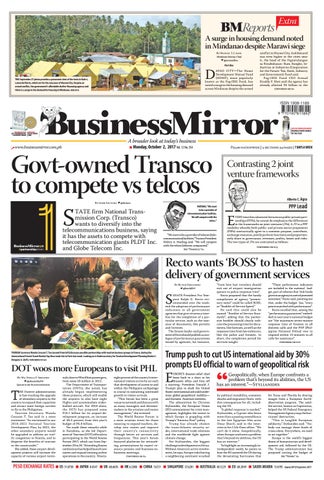
Govt-owned Transco to compete vs telcos S
By Lenie Lectura
@llectura
TATE firm National Transmission Corp. (Transco) wants to diversify into the telecommunications business, saying it has the assets to compete with telecommunication giants PLDT Inc. and Globe Telecom Inc.
See “Transco,” A2
business news source of the year
P25.00 nationwide | 5 sections 34 pages | 7 days a week
Contrasting 2 joint venture frameworks Alberto C. Agra
MATIBAG: “We want to be a provider of telecommunication facilities. We will compete with the telcos.”
“We want to be a provider of telecom [telecommunication] facilities,” Transco President Melvin A. Matibag said. “We will compete with the telcos [telecom companies].”
2016 ejap journalism awards
ead
PPPC.LAgra Alberto
E
very time this columnist lectures on public-private partnerships (PPPs), he cannot de-emphasize the differences in the frameworks on joint ventures (JVs). A JV is a PPP modality whereby both public- and private-sector proponents (PSPs) contractually agree to a common purpose, contribute, exchange resources, jointly perform functions and proportionately share in governance, revenues, profits, losses and risks. The two types of JVs are contrasted as follows: Continued on A15
Recto wants ‘BOSS’ to hasten delivery of government services By Butch Fernandez
S
@butchfBM
enate President Pro Tempore Ralph G. Recto recommended over the weekend the adoption of performance indicators in a l l gover nment agencies that give citizens a timeline for the completion of a particular service, such as the issuance of documents, like permits and licenses. The Senate leader said government offices should publish a catalogue of performance guarantees issued by agencies, for instance,
“from how fast travelers should exit out of airport immigration queues to police response time”. Recto proposed that the handy compilation of agency “promissory notes” could be called BOSS, or “Booklet of Service Speed.” He said this could also be named “Booklet of Service Standards”, adding that the pocketsize booklet should clearly indicate the processing time for documents, like licenses, as well as the response time from law enforcers, like the police and firemen. In short, the completion period for services sought.
“These performance indicators are included in the national budget, part of reforms that link funds given to an agency to a set of promised outcomes,” Recto said, pointing out that, under the budget law, “every peso is matched with performance”. Recto recalled that, among the “performance guarantees” embedded in next year’s national budget are “the maximum seven-minute response time of firemen to all distress calls and the PNP [Philippine National Police] vow to respond within 15 minutes to all calls for assistance”. Continued on A16
Trump push to cut US international aid by 30% DOT woos more Europeans to visit PHL prompts EU official to warn of geopolitical risk Geopolitically, when Europe confronts a
Tourism Secretary Wanda Corazon T. Teo (second from left) discusses possible partnerships with tourism business groups in France, during the International French Travel Market Top Resa trade fair in Paris last week. Looking on is Undersecretary for Tourism Development Planning Benito C. Bengzon Jr. (left). photo courtesy of D.O.T.
By Ma. Stella F. Arnaldo
@akosistellaBM Special to the BusinessMirror
T
HE Duterte administration is fast-tracking the upgrade of secondary airports in the country to expand their capacities and attract more foreign carriers to fly to the Philippines. Tou r i sm Sec ret a r y Wa nd a Corazon T. Teo said in a news statement: “As envisioned in our 2016 -2022 Nationa l Tour ism Development Plan, by 2022, the other secondary airports would be upgraded to address air traffic congestion in Manila, and to disperse the benefits of tourism to the countryside.” She added, these airport-development projects will increase the capacity of various airport termi-
nals close to 90 million passengers, from some 43 million in 2015. The Department of Transportation (DOTr), she noted, has a l ready beg u n implement ing these projects, which will enable the airports to also have night flights and accommodate widerbodied aircraft. For 2018 alone, the DOTr has proposed some P10.1 billion for its airport-development program, an increase of 48.5 percent from this year’s budget of P6.8 billion. Teo made these remarks while in Barcelona, as she led Department of Tourism (DOT) officials in participating in the World Routes Forum 2017, which ran from September 23 to 26. “Attending Routes conferences has helped launch new routes and expand existing airline operations in the country. Ninety-
PESO exchange rates n US 51.0730
eight percent of the country’s international visitors arrive by air such that development of access to and within the Philippine archipelago is crucial in sustaining continued growth in visitor arrivals. “This forum has been a great venue to network and discuss with as many managers and decisionmakers in the aviation and routes management,” she stressed. The World Routes Forum is a must aviation event for those meaning to expand markets, develop new routes and improve t hei r cou nt r y ’s con nec t iv it y through better air services and frequencies. This year’s forum featured platforms for networking, presentations by expert resource persons and business-tobusiness meetings. Continued on A2
E
urope’s disaster-relief chief leans back in a chair in his Brussels office and fires off a warning: President Donald J. Trump’s plan to slash the United States international aid could undermine global geopolitical stability— and threaten America’s interests. The admonition by Christos Stylianides, the European Union (EU) commissioner for crisis management, highlights the extent to which Europe is grappling with Trump’s “America First” policy. Trump has already shaken the trans-Atlantic security order, international trade relations and the worldwide fight against climate change. For Stylianides, the biggest challenge is development in Africa. Without America’s active involvement, he says, Europe risks having a neighboring continent wracked
problem that’s beyond its abilities, the US has an interest.”—Stylianides by political instability, economic shocks and migratory flows, with dire consequences for all, including the US. “A global response is needed,” Stylianides, a Cypriot who bears more than a passing resemblance to the late Egyptian film actor Omar Sharif, said in the interview in his 11th-floor office. “We can’t do it alone. Geopolitically, when Europe confronts a problem that’s beyond its abilities, the US has an interest.” To highlight an increasingly interdependent world, he points to how the EU assisted the US during the devastating hurricanes that
hit Texas and Florida by sharing images from a European Earthobservation program. The satellite service, known as Copernicus, helped the US Federal Emergency Management Agency map the hurricanes’ destruction. “ This is tangible European solidarity,” Stylianides said. “Nobody can manage these kinds of crises alone. Everywhere, we need to act together.” Europe is the world’s biggest donor of humanitarian and development aid, followed by the US. The Trump administration has proposed cutting the budget of See “Trump,” A2
n japan 0.4547 n UK 68.6676 n HK 6.5380 n CHINA 7.6721 n singapore 37.6201 n australia 40.1229 n EU 60.2049 n SAUDI arabia 13.6195
Source: BSP (29 September 2017 )
A2 Monday, October 2, 2017
BMReports BusinessMirror
www.businessmirror.com.ph
A surge in housing demand noted in Mindanao despite Marawi siege Continued from A1
rehabilitation of the housing units of its clients in Marawi City, where the military operation to retake it and the fierce resistance put up by the remaining fighters of the terror organization, the Maute Group, has turned this city of 200,000 into rubble. Mot i, h imsel f a nat ive of Marawi City, said the siege “fortunately, did not affect the interest of our members across Mindanao to apply for housing loans”. On the contrary, “there is a huge spike in the takeout of housing loans in Iligan City and Cagayan de Oro City”. Moti also announced in a news briefing here the HDMF is not revising its target of reaching P8.6 billion-worth of the takeout of loans at the end of the year. “The demand is partly fueled by the moneyed Maranaos who prefer to stay in a safer area, or areas that they feel [are] more safe,” he said.
Talks
ILIGAN City is 37.9 kilometers north of Marawi City and the next
bigger evacuation centers outside Lanao del Sur are located in this capital city of Lanao del Norte. Cagayan de Oro is farther to the northeast of Marawi City and is noted to have the best collection efficiency among the Pag-IBIG Fund areas in Mindanao. Moti said buying of even fiveyear-old to 10-year-old houses in Iligan City was brisk, indicating actual demand he described as “frantic”. Moti added that a housing project by the construction firm of former Sen. Manuel B. Villar was already opened for takeout in Iligan City. The Pag-IBIG Fund expects more projects to come in these two northern Mindanao cities, he said. “We would be talking to developers in these areas,” Moti told reporters after a forum among Pag-IBIG Fund clients, developers and other interested parties in the housing sector over HDMF’s first-semester performance on the takeout of housing loans in the Davao Region and the rest of Mindanao.
Reservation
CURRENTLY turned into a ghost town while the city remained a battleground, the rebuilding of Marawi, at least to resettle its residents, has become primordial for the government housing sector. Trade Secretary Ramon M. Lopez has earlier hinted of gathering all construction and hardware suppliers to aid the reconstruction of Marawi City once the government military declares the city safe for the return of normal trade and commerce. Moti said he notes one particular difficulty in the resettlement program for displaced residents: they obviously have no house to return to. He disclosed of the plan to request the administration of the Mindanao State University (MSU) and the Armed Forces of the Philippines (AFP) to free up portions of their unused land to settle the evacuees from Marawi City. Moti said the rehabilitation in Marawi City was likely to post another surge in the takeout of housing loans. However, he
said the problem is land ownership, which kept away housing developers from undertaking any projects. “Even before the fighting in Marawi City, the problem with the area is that many residents are occupying government lands,” he said. About half of Marawi City’s land area of 8.755 hectares sits on the reservation lands allocated to the MSU and the AFP, according to Moti. The MSU has 1,000 hectares of rolling and flat lands west of Marawi City.
Proposal
MOTI said he would propose to the MSU administration “to give portion of its reservation to the housing settlement for the evacuees”. This he would do in a scheduled meeting with members of the Malacañang-formed rehabilitation Task Force Bangon Marawi. As of August 29 the government said there were 104,220 evacueefamilies, or about 466,000 individuals, said lawyer Jhan Ganda, who was among the evacuees and has worked with a Davao City-based
Trump. . .
Lopez said the visit to the EU body, aside from showing the significance of the scheme to the country, was to assure the Philippines’s adherence to the conventions amid reports of extrajudicial killings supposedly perpetrated by rogue policemen. “They want to check if the Philippines is still complying with the conventions, and part of those involve labor and human rights. That’s why we had to go there—to give them facts and more correct information rather than sensationalized news of international media”, he said. Lopez added the country’s utilization rate of the EU-GSP+ has shown “significant improvement” since 2014. The Philippines was granted GSP+ on December 25, 2014—providing zero-tariff treatment for two-thirds of export products (tariff lines) to the EU. Total exports to the EU that were eligible under GSP in 2014 amounted to €1.7 billion, or some 30 percent of total exports to the EU. Actual utilization rate was around 68.3 percent, or €1.15 billion. The EU generally accounts for 14.9 percent of the Philippines’s total exports. More than losing the trade perks that have aided the country buck the global trade slowdown, Lopez said delisting the Philippines from the GSP+ scheme would put at risk its efforts to secure a free-trade agreement (FTA) with the EU. “The EU-GSP+ and the FTA are interlinked. We made a presentation to show the GSP is able to meet its objective of helping the beneficiary country. If the GSP is working well, there’s a better discussion of an FTA”, Lopez added. said at the dinner celebration of the Taiwan Expo 2017 held in Pasay City. Lin, the host of the event, said, “Taiwan will be waiving more than P400 million in fees once they start implementing the visa-free entry of Filipinos.” “The total [collection] last year is P420 million. But that is not our real concern. What is important is how we strengthen our friendship and mutual understanding, which is the core value of our new southbound policy. Taiwan is one of the Philippines closest neighbors. We are naturally good friends,” he added.
According to Lin, the Philippines is one of Taiwan’s top trading partners. Bilateral trade between the Philippines and Taiwan amounted to $10.8 billion. “Last year 182,000 Filipinos visited Taiwan, which is an increase of 75 percent over 2016, and we have 200 flights a month between us,” he said. “This is the best time to strengthen our relations. Taiwan is supporting President Duterte’s 10-point agenda and its national development plans. Our Southbound policy coincides with the Philippines’s National Development Plans,” Lin added.
private-donation campaign for the evacuees. Marawi City is one of the few urban centers in the Autonomous Region in Muslim Mindanao with active Pag-IBIG Fund presence. But this ownership problem remained unresolved. “Developers would not venture into the areas without titles,” Ganda added. In the meantime, part of the rehabilitation of its clients would focus on the nonresident workers of MSU, notably the school’s faculty members. “We would propose to the MSU Iligan Institute of Technology [MSU IIT] to take in these MSU teachers as members of their housing project in Iligan City,” Ganda said. The MSU IIT is among the network of colleges of the MSU system. Ganda added he and other leaders of Task Force BM would try to persuade San Miguel Corp. President Ramon S. Ang to donate a thousand housing units. “He [Ang] has done it already, and we hope he would do it again for the Marawi City settlement,” he said. To be continued
Continued from A1
the State Department and the US Agency for International Development by about 30 percent while boosting military spending. The plan has run into resistance in Congress, including among members of Trump’s Republican Party. The proposal “worries us”, said Stylianides, 59. “Fortunately, even on the Republican side, there have been voices opposing this.” Europe’s anxiety over the matter has been heightened by the tide of refugees landing on its shores.
Refugee crisis
A b o ut 2 . 2 m i l l i o n p e o p l e
Continued from a1
tourists in 2016, a 33-percent rise from 2015. With cooperation projects, such as the annual Madrid Fusion Manila, the DOT hopes to see more significant increases in visitor arrivals from Spain, Teo said. The DOT chief has been working the European tourism circuit to encourage more visitor arrivals from the region. From Barcelona, Teo and other DOT officials proceeded to Paris to attend the International French
Travel Market Top Resa tourism trade fair at the Parc des Expositions Porte de Versailles from September 26 to 29. The trade fair is an annual gathering of tourismindustry professionals. To entice visitors, the Philippine booth offered tour packages to premier destinations in the countr y. T he DOT continues to promote the brand “It’s More Fun in the Philippines”, through advertising, brochures
and media placements in internationa l publications. Visitor arrivals from Western, Northern and Southern Europe account for about 10 percent of total tourism arrivals in the Philippines. In 2016 there were 557,219 visitor arrivals from the EU, up 14.23 percent from 2015. Of the total, the Philippines received a 22-percent bump in visitors from France in 2016 at 55,384, which DOT officials have said is a growth market that should
be nurtured. Teo also attended the TourMaGEvent where the Philippines was nominated as Tour Manager of the Year. “We are the only country from Southeast Asia to be nominated for this award,” the DOT chief said. TourMag is a major publication for tourism professionals in France. The DOT secretar y will be proceeding to the London for further meetings with trade and tourism professionals.
sought refuge in Europe during 2015 and 2016 in the continent’s biggest wave of asylum seekers since World War II, according to the Pew Research Center in Washington. Over the same period, almost 9,000 people died in the Mediterranean Sea trying to reach Europe’s shores, according to the United Nations’ refugee agency. As Europe clings to a hardfought agreement with Turkey last year that halted a politically explosive influx of Syrian and other Middle Eastern refugees, the region is scrambling to strike similar deals with African countries of origin and transit for migrants. These include Ethiopia, Mali, Niger and Nigeria.
No hoax
phenomenon seriously. “Climate change isn’t fake news,” he said. “Climate change is here.”
EU. . .
The push, which St ylianides said faces “difficulties” because the EU deal with Turkish Preside nt R e ce p Tay y ip Erdo g a n can’t simply be replicated with African counterparts, follows electoral gains across Europe— i n c lu d i n g i n G e r m a n y l a s t week—by far-right parties with anti-immigration platforms. “It’s a strategic effort,” Stylianides added. Climate change risks contributing to a massive African exodus in the years ahead, he said, adding that the dangerous effects of global warming are already evident on the continent. Stylianides urged Trump, who has called climate change a Chinese hoax, to take the
Soft power
Africa now tops Syria as the main origin of new sea arrivals to the EU, UN data show. With the Middle East and North Africa together accounting for more than a quarter of the world ’s d i s pl ace d p e o ple, Eu ro p e i s stressing the importance of “soft power” tools, including African development aid. The issue has played a role in trans-Atlantic tensions over defense policy, with German Chancellor Angela Merkel responding to Trump’s vocal campaign for European allies to boost their military budgets by ins isting that collective security also depends on development aid. The policy challenges facing the EU on this front are symbolized in a photograph hanging in the hallway outside the office of Stylianides, who spends much of his time in far-flung parts of the developing world. The picture, which shows him hugging an African boy, was taken not in Africa but in Athens after European governments decided for the first time to let EU humanitarian assistance be used within the bloc. Bloomberg News
Manila. . .
Continued from A16
However, Teco’s spokesman, Peter C.Y. Pan, told the B u s i n e s s M i r ro r last Saturday night they are still waiting for Mofa to announce the exact date of the implementation of the new policy. “Mofa kept announcing that Taiwan will allow visa-free entry into the Philippines, but they have yet to decide the exact date,” Pan
Continued from A1
Transco, owner of the country’s transmission assets, was created under Republic Act (RA) 9136, otherwise known as the Electric Power Industry Reform Act (Epira) of 2001. Since March 1, 2003, Transco operated and managed the power-transmission system that links power plants to the electric-distribution utilities nationwide. The same law mandated the privatization of Transco through an outright sale or managementconcession agreement. Following a public bidding conducted in December 2007, the Transco concession was awarded to the National Grid Corp. of the Philippines (NGCP), which eventually secured a congressional franchise to operate the transmission network through RA 9511. Transco turned over the management and operation of its nationwide transmission system to the NGCP in January 2009. Ownership of all transmission assets, however, remained with Transco. Matibag said “it makes sense” to venture into the telco business, since “we are the owner of the facilities”, he said, referring to the fiberoptic cables that could be tapped to bring Internet connection all over the country. Besides, he added, the trend now is diversification. “I want Transco to diversify, just like telcos and other private companies are doing.” What needs to be done first, according to Matibag, is to ask Congress to amend Transco’s charter so it could legally offer telco services. “Recalibrate the law” that created Transco, which is the Epira, he said. “Congress has the power to do that. I want Transco to not only be a transmission company but also a telco,” Matibag added. “This is a long process, but we have to start now.” If his proposal pushes through, Matibag said Transco would be renamed as the National Transmission and Telecommunications Co. “Funding will be the least of concern when we would have the franchise and power to do that. After all, we are the owner of the facilities. Globe and Smart [Communications Inc., a PLDT subsidiary] are using our towers for telecommunications.” Matibag said he would formally submit his proposal to Congress before the end of the year. He is confident that the majority of the lawmakers will sponsor his proposal. Currently, as owner of the transmission assets, Transco is mandated with five key responsibilities. One of these is to protect national government’s interests by ensuring NGCP’s compliance with the terms and conditions of the Concession Agreement and the policies of the Department of Energy. Another responsibility is the handling of all existing cases, including right-of-way, and claims that accrued prior to the turnover date. O t he r re s p on s i bi l it ie s of Transco include: ■ To divest remaining subtransmission assets to technically and financially qualified electric distributors nationwide; ■ To undertake the operation, maintenance, consultancy and other technical services for the Philippine Economic Zone Authority; and ■ To administer the Feed-inTariff Allowance Fund for renewable energy generators.
DOT woos more Europeans to visit PHL
DOT Undersecretary for Tourism Development Planning Benito C. Bengzon Jr. participated as a panelist in the discussion on “Will 2020 be a tipping point for tourism? Is it possible to increase air services and to be sustainable?” No further details were released by the DOT, however, on Bengzon’s remarks at said forum. Spain is considered a growth market, w ith the Philippines having received 32,097 Spanish
Transco. . .
Continued from A16
The Nation BusinessMirror
news@businessmirror.com.ph
Editor: Vittorio V. Vitug • Monday, October 2, 2017 A3
Trump’s visit in November to strengthen PHL-US ties
T
By Elijah Felice E. Rosales @alyasjah and Recto Mercene @rectomercene
ies between the Philippines and the United States are expected to grow stronger following President Duterte’s vow to go easy on the US, which he relentlessly criticized in the past even before winning the presidency.
In a recent speech, the President said he was advised by Foreign Secretary Alan Peter S. Cayetano to be friendlier: “I was under advice by the Department of Foreign Affairs [DFA] that I would just temper my language and I should avoid cursing, which I am prone to do if I get emotional.” “There are so many factors involved, but I’d rather be friendly to them [US]. Now, aside from these episodes of, I said, sad incidents, overall, I think the Americans also redeemed themselves a lot,” the President added. Although it was the American’s occupation of the Philippines that prompted the Japanese to attack Manila, Duterte said the US redeemed itself when it never left the Philippines behind during World War II. He added he has no illusion of the US as a savior, but said he views the superpower as a crucial ally, most especially in defense cooperation. “And even today, they have provided the crucial equipment to our soldiers in Marawi to fight the terrorists,” the Chief Executive said. Building on the momentum of the President in renewing ties with the US, Malacañang last Saturday confirmed the attendance of US President Donald J. Trump in the Asean and East Asian Summits. The Philippines will host in November the Asean and East Asian Summits, where meetings will be simultaneously held in Manila and Pampanga. “President Trump’s visit underscores the improving [Philippines-
US] ties, and President Duterte is looking forward to welcoming the US President in Manila. President Trump will join other world leaders who will attend the Asean and East Asian Summits in the Philippines,” Presidential Spokesman Ernesto C. Abella said in a statement. “As host country, we hope to make the event productive and pleasant to our foreign guests. We will let them experience our worldfamous Filipino hospitality to make sure they would have good memories of their stay in the Philippines,” Abella added. Duterte is seen in the international limelight as a demagogue who frequently throws expletives at superpowers and their leaders. Meanwhile, the Philippines is ready to roll the red carpet to welcome President Trump in November. “ The Philippines welcomed the White House announcement on the visit of President Donald Trump to Manila in November,” the DFA said, adding this affirms the strong partnership between the two longtime allies. “President Trump will definitely receive a very warm welcome in Manila,” Cayetano said after the White House confirmed last Friday the US chief executive’s participation in the East Asian Summit. Cayetano added Duterte is looking forward to welcoming Trump in Manila. ”Our people are excited to see the first face-to-face meeting between our two leaders,” Cayetano said. The
TRUMP
White House said President Trump’s visit to the Philippines will be part of a 12-day trip that will also take him to Japan, South Korea, China, and Vietnam. “President Trump’s visit underscores the improving relations between the Philippines and the United States, which no less than Secretary of State Rex Tillerson told me is on an upward vector,” he added, saying Tillerson also described relations between the Philippines and the US to be strong and irreversible in his interview by National Public Radio in Washington last Thursday. “The American-Filipino relationship is so resilient that it bounces back right always regardless of personalities and issues,” Tillerson said. The White House said Trump’s November trip is the longest overseas journey of his presidency to date “as he seeks to build a common front against North Korea’s development of nuclear weapons and ballistic missiles. His stop in the Philippines, the White House said, would show Trump’s embracing of Duterte’s war on drugs, which has received harsh criticisms from human-rights advocates. “President Trump will discuss the
More NPA rebels to surrender in coming months–AFP
M
ANILA—The Armed Forces of the Philippines (AFP) last Sunday said it expects more New People’s Army (NPA) members to give up and lay down their arms in the coming months. The AFP made the statement following the surrender of 52 NPA rebels to government forces in September. “The surge of NPA surrenders over the past month is a positive result of the AFP’s robust and incessant combined intelligence, combat and civil-military operations. It is also a product of the active cooperation of our stakeholders, particularly of the support given by the communities and local government units [LGUs] within our areas of operation,” AFP Public Affairs Office Chief Col. Edgard Arevalo said in a statement.
“It is apparent through the statement of those who surrendered that their comrades are now experiencing hardships within their organization, and they are willing to avail themselves of the opportunities being offered by the government to former NPA rebels,” he added. Some seven communist rebels voluntarily surrendered and turned over two AK47 rifles and a caliber .45 Remington to the Joint Task Force ZamPeLan in Zamboanga Sibugay on September 20. Meanwhile, the surrender of nine other NPA rebels to troops of the 33rd Infantry Battalion in Sultan Kudarat on September 23 yielded six improvised explosive devices. At present, the government offers financial and livelihood aid to rebel
returnees under the Comprehensive Local Integration Program. Meanwhile, a corresponding amount of assistance with additional capital will be given to former rebels who surrender firearms for their livelihood to help them go back to the fold of the law. Arevalo added the operations against communist insurgents continue, noting that “the AFP has already neutralized 566 communist terrorists since the termination of peace talks on February 4, 2017.” Of this number, 378 voluntarily surrendered to military units or to the LGUs within northeastern Mindanao, according to Arevalo. Ongoing combat operations led to the death of 118 NPA fighters, arrest 70 members and recovery of 159 firearms. PNA
PDEA: Medical marijuana bill needs amendments
M
ANILA—The Philippine Drug Enforcement Agency (PDEA) said it has no objection to the proposed bill allowing the use of marijuana for medical purposes, provided that applicable safeguards under the law are followed. “[The] PDEA supports the intention and purpose behind the proposed bill. The agency recognizes the need of patients to have access to safe, affordable, available medical cannabis prescribed by registered physicians in cases where cannabis has been found to be effective in the prevention, treatment and management of chronic or debilitating health conditions,” PDEA Director General Aaron N. Aquino said in a statement. Aquino, however, said the PDEA
has made the following specific recommendations to help improve the bill: Inclusion of definition of the terms marijuana and cannabis: Marijuana is a term used to describe all plant parts of Cannabis Sativa, Cannabis sativa forma indica and Cannabis ruderalis namely, leaves, fruiting tops, stems, flowers and roots. Cannabis, also known as marijuana among several other names, is a preparation of the cannabis plant (scientific name: Cannabis Sativa) intended for use as psychoactive drug or medicine; The proposed bill must be very specific and shall only legalize the use of tablet or capsule preparations of the alleged medicinal component of cannabis and not cannabis per se;
DUTERTE
AP
Amendments to Section 6 Paragraph b of the bill, which must read as ‘proof of bonafide relationship with the patient’. PDEA said in order for a physician to be competent to certify a patient’s medical need to use cannabis, he or she must show proof that he or she has a bonafide relationship with the patient; and Inclusion of the statement “cul tivation, possession, use, sale, administration, dispensation, delivery, distribution and transportation of cannabis not in accordance with the provisions of the Act shall be deemed a violation of Republic Act 9165, otherwise known as the Comprehensive Dangerous Drugs Act of 2002” in Section 26 of the bill. PNA
importance of a free and open IndoPacific region to America’s prosperity and security,” the White House said in a statement. “He will also emphasize the importance of fair and reciprocal economic ties with America’s trade partners. The president’s engagements will strengthen the international resolve to confront the North Korean threat and ensure the complete, verifiable and irreversible denuclearization of the Korean Peninsula.” American Presidents typically
AP
travel to the Pacific region in the late fall because of two international summit meetings held by the AsiaPacific Economic Cooperation forum and the Asean, both of which Trump will attend. Trump is engaged in a tit for tat with North Korean leader Kim Jung Un following testing of several intercontinental ballistic missiles that could potentially reach the US. North Korea has conducted six nuclear tests, the latest of which Pyongyang said would be exploded
in the Pacific. “W hile rattling sabers, Mr. Trump for the moment has stuck to a strategy of increasing economic pressure and strengthening regional solidarity. He hosted the leaders of Japan and South Korea at the United Nations and spoke by phone with the leader of China earlier this month even as he ordered a sweeping new set of sanctions intended to cut North Korea off from the international banking system,” the White House said.
Economy
A4 Monday, October 2, 2017 • Editors: Vittorio V. Vitug and Max V. de Leon
BusinessMirror
news@businessmirror.com.ph
Solon seeks abolition of GOCC commission By Jovee Marie N. dela Cruz
A
@joveemarie
LEADER of the House of Representatives last Sunday urged the Palace and the leadership of the 17th Congress to abolish the Governance Commission for the government-owned and -controlled corporations (GOCCs).
In line with the call of President Duterte to eliminate redundant, duplicative and overlapping functions and organizations of the Executive Branch, at least 20 lawmakers have
authored House Bill (HB) 3014 repealing of Republic Act (RA) 10149, or GOCC Governance Act of 2011, and abolishing the Governance Commission for GOCCs (GCG).
House Committee on Public Information Chairman Party-list Rep. Bernadette Herrera-Dy of Bagong Henerasyon, one of authors of the HB 3014, said instead of piloting the development and growth of GOCCs, the GCG “became another bureaucratic layer in the already-confounded structure of checks and balances and has been taking up valuable time and resources of the GOCCs”. “We deem this abolition as necessary and we embodied our sentiments in House Bill 3014. The GCG is too slow. There are still too many GOCCs or state corporations,” she said. “Functions and duties of the abolished GCG will be transferred to different departments with similar functions and duties. My prime can-
didate to take over GCG functions is the Presidential Management Staff,” Herrera-Dy added. According to Herrera-Dy, prior to the passage of RA 10149, all the GOCCs were under the control and supervision of the Office of the President. She added the GOCCs are also answerable to Congress, the Commission on Audit, the National Economic and Development Authority, Government Procurement Board and Office of Government Corporate Counsel. In April Herrera-Dy said the GCG counted 212 GOCCs and only two of these were listed as dissolved or abolished while 24 are “under abolition”, while there are 23 nonoperational/inactive GOCCs.
Only three are undergoing privatization which include GSIS Family Bank, Intercontinental Broadcasting Corp. and Southern Utility Management and Services Inc., the lawmaker added. She said there are four GOCCs involved in mining. If the GCG is to be consistent with the stance of Duterte against mining, she said these four GOCCs should be abolished: Batong Buhay Gold Mines Inc.; Natural Resources Development Corp.; North Davao Mining Corp.; and Philippine Mining Development Corp. Herrera-Dy added there are also several GOCCs into food, agriculture and fisheries that should be privatized or merged, including Food Terminal Inc. (should be pri-
vatized); National Sugar Development Co. (merge with Philippine Sugar Corp.); Northern Foods Corp. (merge with Phividec); Phividec Panay Agro-Industrial Corp.; and Philippine Sugar Corp. S he s a id t he go ve r n me nt should get out of the realty business by abolishing or privatizing five realty holding companies, such as Batangas Land Company, First Cavite Industrial Estate Inc., G.Y. Real Estate Inc., kamayan Realty Corp. and Pinagkaisa Realty Corp. “We have provided in HB 3014 that all officers and employees of the abolished GCG will be given two-and-a-half months’ salary for each year of service as separation pay,” Herrera-Dy added.
No need to create new housing department—Atienza Govt subsidies to electricity, gas firms reached ₧10.9B in 2015
I
nstead of creating new Department of Housing and Urban Development (DHUD), a deputy minority leader last Sunday asked the national government to decentralize housing programs to local government units. Deputy Minority Leader Partylist Rep. Lito Atienza of Buhay said in a statement that the national government should decentralize housing programs with the help of provincial, city and municipal governments and not “overcentralizing projects with an excessive new department”. “The proposed DHUD is absolutely redundant. It will not serve any real purpose. On the contrary, it will only install another bureaucratic wall that is guaranteed to further hold up housing projects,” said Atienza, a former National Housing Authority (NHA) general manager. “We will have several new DHUD undersecretaries and assistant secretaries meddling in every program or project, and creating bottlenecks,” he added. According to Atienza, the government could have simply focused on acquiring the lands for the new communities, putting in the new roads and sewer systems and providing ready access to electricity and water. “People need shelter next only to food. We’ve seen and done this before in Manila. If families suddenly become homeless, and we give them what they need to rebuild their houses in sites where they can live suitably, they will quickly put up their new abodes on their own, or with the help of relatives, neighbors and volunteers in the bayanihan spirit,” Atienza said. The party-list lawmaker said the issues affecting public-housing programs could be best addressed by highly effective chief executive officers in existing agencies, plus ample funding. The creation of DHUD is in-
By Cai U. Ordinario @cuo_bm
F
A government housing project in Naic, Cavite. Deputy Minority Leader Party-list Rep. Lito Atienza of Buhay said the creation of a new housing department is not needed, as this will only “overcentralize” housing projects. Nonie Reyes
cluded to the top priorities of the Legislative-Executive Development Advisory Council. The House Committee on Housing and Urban Development has already approved a measure creating the Department of Human Settlements and Urban Development that would make sure the availability and affordability of decent housing and basic services in the country. However, the bill is still pending before the House Committee on Appropriations. Under the bill, functions of the Housing and Land Use Regulatory Board (HLURB) shall be transferred to the Human Settlements Adjudication Commission (HSAC) that will be created under this act. It also NHA Home Guaranty Corp. (HGC); National Home Mort-
gage Finance Corp. (NHMFC); Home Development Mutual Fund (Pag-IBIG), Social Housing Finance Corp. (SHFC) and HSAC are hereby attached to the housing department for policy and program coordination, monitoring and evaluation. All these agencies shall continue to function according to existing laws and their respective Charters. Earlier, House Committee on Housing and Urban Development Chairman Alfredo B. Benitez of Negros Occidental said housing needs of Filipinos could balloon to 6.8 million before President Duterte’s term ends in 2022. T he l aw m a ker, c it i ng t he HUDCC, said 2 million of these 6.8 million housing backlogs were recorded in 2016. Benitez also said the 760,400
housings needs for this year are also part of these 6.8 housing backlogs. He added there will be an estimated 774,441 housing needs in 2018; 788,773 in 2019; 803,405 in 2020; 818,363 in 2021; and 833,619 in 2022. Benitez said at least 1 million units should be constructed every year to address these backlogs. In the Senate, Sen. Joseph Victor Ejercito, chairman of the Senate Committee on Urban Planning and Housing, earlier said the Upper House is expected to soon pass the bill creating the DHUD. Under Senate Bill 1578, all existing agencies dealing with housing will be grouped under the DHUD. These agencies include the NHA, HLURB, Pag-IBIG, HGC, SHFC and the NHMFC. Jovee Marie N. dela Cruz
ilipinos extended P10.9 billion in tax perks to electricity, gas, steam and airconditioning supply firms in 2015, according to the Philippine Statistics Authority (PSA). Data from the 2015 Annual Survey of Philippine Business and Industr y (ASPBI) showed all the subsidies were extended to firms engaged in the distribution of electricity and electric power generation. Subsidies included all special grants in the form of financial assistance or tax exemption or tax privilege given by the government to aid and develop an industry. “Of the three industries included in the sector, only distribution of electricity and electric power generation received subsidies in 2015. Transmission of electricity did not report any subsidy received in 2015,” the PSA said. Data showed most of the firms that received the highest subsidies were based in the Caraga region. The PSA said subsidies to these firms amounted to P2.6 billion, or 23.9 percent of the total. Other firms received subsidies were from the National Capital Region, or Metro Manila, with P2 billion, or 18.4 percent of the total. Around P1 billion was given to electricity distribution and power-generation firms in Western Visayas. The PSA added there were 224 firms engaged in electricity, gas, steam and air-conditioning supply establishments with total employment of 20 and over in the formal sector in 2015. Among the three industries of
the sector, distribution of electricity recorded as the highest with 146 establishments, or 65.2 percent of the total. Electric power generation followed with 75 establishments, or 33.5 percent of the total, while transmission of electricity reported only a total of three establishments. The top 3 regions—Central Luzon, Calabarzon and Central Visayas—together accounted for 32.6 percent of the total number of establishments. There were around 32 firms, or 14.3 percent of the total, engaged in electricity, gas, steam and air-conditioning supply in Central Luzon. This was followed by Calabarzon and Central Visayas, where 21 establishments, or 9.4 percent, and 20 establishments, or 8.9 percent of the total were located, respectively. The PSA said the Autonomous Region in Muslim Mindanao recorded the least number of electricity, gas, steam and air-conditioning supply firms with only five establishments, or 2.2 percent of the total. The 2015 ASPBI is one of the designated statistical activities of the PSA. Data collected from the survey provide information on the levels, structure, performance and trends of economic activities of the formal sector in the entire country for the year 2015. The survey was conducted nationwide in 2016 with the year 2015 as the reference period of data, except for employment which was as of November 15, 2015. The 2015 ASPBI covered establishments engaged in 18 economic sectors, including electricity, gas, steam and air-conditioning supply firms.
Opportunities for Pinoy exporters expand with Apec MSME trading hub
M
icro, small and medium enterprises (MSMEs) in the Philippines are encouraged to join and explore the newly launched Asia-Pacific Economic Cooperation (Apec) MSME Marketplace. The Apec MSME Marketplace is an interactive web site that aims to support the growth of entrepreneurs by promoting cooperation and linkages among MSMEs and stakeholders interested in MSME development. It also seeks to maximize the use of the digital economy in order for MSMEs to expand businesses in the region. “There are a huge range of market opportunities for microenterprises all around the Asia Pacific, particularly with advances in mobile technology and e-commerce,” said Philippine Trade Secretary Ramon M. Lopez, who announced the opening of the platform recently. The site contains information and functionalities that facilitate
business networking and matching involving MSMEs and large enter pr ises; enhance MSMEs awareness of trade regulations and encourage participation in policy development; and improve knowledge sharing and capacity building for MSMEs. The Apec MSME Marketplace also showcases small firms from Apec member-economies and helps to connect them with compatible production and supply chain partners. It also details tariffs and trade regulations, as well as provides a portal to support services to help small businesses in the region build their trading operations. The marketplace is being implemented in three phases. In the first phase (2016-2017), it created linkages to key information by member-economies and other available resources, particularly on trade regulations and businesssupport services.
There are a huge range of market opportunities for microenterprises all around the Asia Pacific, particularly with advances in mobile technology and e-commerce.”—Lopez
In its current and second phase (2017-2018), more site functionalities are being developed. This includes, among others, the provision for MSMEs to join the directory of exporters. For the third phase (2018-2019), the Apec is working on increasing the trade-facilitation capability of the marketplace through more business-matching activities. An assessment of the marketplace will be performed in 2020. The marketplace may be accessed using any device that can
connect to the Internet. Joining the marketplace involves filling in all the necessary fields and clicking “Register”. The “Apec MSME Marketplace Guidebook: Helping MSMEs Do More Business in Asia-Pacific”, found on the web site, contains all the information MSMEs need to navigate the portal and maximize its benefits. The portal features the “Export and SME Agencies” section, which provides the user a list of export and SME agencies found in the member
economy he is interested in. The “Trade Regulations” section enables visitors to navigate the complex rules of international trade. “Use this page to be aware of complex legal, regulatory and technical requirements of crossborder trading. Links can point you to Web resources of your target-market economy to find pertinent policies or regulations on duties, tariffs and nontariff measures, such as sanitary and phytosanitary requirements,” the guidebook said. The “Marketplaces” page facilitates the gathering of MSMEs seeking to network, find business opportunities across borders and harness the power of electronic commerce. The “MSME Directory” enables registered MSMEs across the region to participate in this page. “Currently, the publication of MSME profiles is limited to Philippine
companies. The country’s Philippine Exporters Confederation and Export Marketing Bureau validate the list of exporter-MSMEs,” the guidebook added. Meanwhile, the directory of companies and exporters can be accessed through the existing government sites of the member-economies. The “Member Economy” section makes readily available a membereconomy’s trade-related information, including its export and SME agencies, trade-regulation sites, marketplaces, events and other relevant information supplied by the member economy. Under “Resources”, meanwhile, entrepreneurs can find opportunities to learn from other businesses across the region. This site has links to best practices, training and resources and the Apec Business Travel Card. Finally, “Events” features the latest activities of member-economies. Philexport News & Features
Agriculture/Commodities BusinessMirror
news@businessmirror.com.ph
Sugar consumption seen rising next year
P
hilippine sugar consumption would increase by 50,000 metric tons (MT) to 2.25 million metric tons (MMT) next year, as prices remain soft due to ample supply, according to the latest Global Agricultural Information Network report. The report, prepared by the United States Department of Agriculture’s (USDA) Foreign Agricultural Service (FAS) in Manila, said the increasing demand of a growing population for food and beverages would also boost sugar consumption in marketing year (MY) 2017/2018. “Consumption of cane sugar should approach 2.2 MMT in MY 2016/2017, from 2.14 MMT in the previous marketing year, as restrictions on the importation of highfructose corn syrup are implemented and industrial consumers react to the drop in domestic prices,” the report read. The anticipated surge in carryover stocks would also increase Philippine raw-sugar exports in MY 2017/2018, according to FAS. It revised upwards the projected ship-
ments of raw sugar to 250,000 MT, from the USDA’s initial forecast of 100,000 MT. The Philippines received an additional tariff rate quota (TRQ) allocation of 63,830 MT raw value (MTRV) in fiscal year (FY) 2017, bringing its total allocation to 205,990 MTRV. “FY 2018 TRQ to the United States is set at 142,160 MTRV [136,201 MT commercial weight]. About 10 percent of the estimated 2.38 MMT of sugar produced has been initially earmarked for the world market,” the report read. FAS said total raw sugar production in MY 2017/2018, which would begin in December, would increase to 2.38 MMT on projected expansion in sugarcane areas. “ The Sugar Regulator y Administration [SRA] is forecasting
2.25 MMT
The projected sugar consumption of the Philippines for MY 2017/2018, according to FAS raw-sugar production at 2.38 MMT in crop year [CY] 2017/2018, although industry projects this figure to be higher based on anecdotal evidence that sugarcane areas planted will reach 424,000 hectares,” the report read. Total raw-sugar production in MY 2016/2017, which would end in November, was also revised upward by FAS to 2.5 MMT, from 2.25 MMT, on better-than-expected cane yields resulted from favorable weather conditions during the first half of 2017. On August 31 the SRA issued Sugar Order 1, which projected sugar production for CY 2017/2018 at 2.38 MMT and withdrawals at 2.17 MMT. About 80 percent of sugar production has been classified as “B”, or for the domestic market, while 10 percent has been classified as “A” for the US market and another 10 percent as “D” for the world market.
Editor: Jennifer A. Ng • Monday, October 2, 2017
Solar energy vs agriculture
L
ooking at food security in the Philippines and the need to revive agriculture, the question comes up whether it makes economic sense to cover thousands of hectares of agricultural land with solar panels, given the fact that the land cannot be used for agriculture any longer and jobs in agriculture are eliminated. Last week I raised this point in a discussion with Hubert d’Aboville, CEO of Pamatec and recognized eco-farm advocate, and Jean Ballandras, CEO Asia Pacific of Akuo Energy Pacific, a French energy company. And, much to my surprise, they had solutions. Akuo Energy is offering two major innovations: Agrinergie and energy storage. The development and deployment of the Agrinergie concept meets the challenge of land scarcity by allowing the combination of energy production and agriculture on the same site. The most advanced form of this concept comes in the construction of photovoltaic, cyclone-proof greenhouses. Let me be more specific about these innovations, which have been implemented already in various parts of the world, especially in countries and island nations that have the same issues like the Philippines: the need for the preservation of agricultural land, the need for solar power and the need to create high-value crops to raise the income of farmers. Here are some convincing examples:
First, solar energy and agriculture:
With installed capacity of 9 MW, the Les Cèdres solar farm is the second facility in Réunion with integrated storage. It has storage capacity of 9 MWh. This storage helps support the grid, thanks to stable and continuous electricity supply, thus cancelling out the effects of intermittence caused by weather conditions. The stored power at the Les Cèdres solar farm alone is
Henry J. Schumacher
europe Beat sufficient to cover the energy needs of the entire town, making Etang Salé the first green-energy town on Réunion. The solar farm spans two sites. The first is an Aquanergie solar farm, consisting of photovoltaic sun screens above 12 fish rearing pools, with capacity of 1.5 MWp. The operator of this site is Max Dyckerhoff, a pioneer in fish farming on the island, who, for more than 25 years, has supplied the local market, particularly with tilapia. The second site is an Agrinergie farm, where the photovoltaic screens have been raised to allow mechanized farming of the whole of the 7.5-hectare site. The agricultural partner for this site is Agriterra, an agricultural company partnered with Akuo Energy, which is developing a major permaculture project, mixing livestock, forestry and market gardening. Produce from these organic farms is destined for the local market, and several agricultural jobs have been created.
Second, the combination of photovoltaic and greenhouses that can resist typhoons:
The Agrinergie V solar farm is the third second-generation Agrinergie solar farm to be installed on Réunion. It consists of 12 cyclone-proof photovoltaic greenhouses, covering a total area of 2.82 hectares. The agricultural partner for this project, Jean Bernard Gonthier, current chairman of the local Chamber of Agriculture, uses this land for environmentally friendly production of fruit and vegetables for the local market. Thanks
A5
to the Agrinergie greenhouses, the farm has been able to revitalize some of reunion’s heritage vegetables. The structure of the solar greenhouses provides solid supports to the creepers that produce very heavy fruit and vegetables, one of the characteristics of the ancient varieties known as “lantana” in the local creole. These plants, which had all but disappeared, are thus given an ideal climate in which to grow, perpetuating a Réunion tradition.
Third, adding advanced storage to the project, tackling the issue of intermittent supply industrialized battery storage: The Olmo I project, located on the northern edge of Olmo II, was the first industrial solar-power plant with combined storage in Corsica when it came into operation in the summer of 2014. With installed capacity of 4 MWp and lithium ion battery-storage capacity of 4 MWh, the plant provides a solution to the problem of integrating renewableenergy solutions into non-interconnected areas: besides the ability to overcome the intermittent nature of this type of electricity production, by providing stable, controlled current, it also guarantees support to the grid thanks to intelligent systems for monitoring and controlling voltage and power output. Given the availability of these tested advanced technologies, combining solar-energy generation and keeping agriculture going and providing high-value crop options, I am firmly of the opinion that the Department of Energy, the Department of Agriculture and the Department of Environment and Natural Resources should no longer allow agricultural land to be converted into the usual solar fields that we are seeing in Negros and other parts of the Philippines. For comments and information requests, contact Schumacher@mcasia.org.
A6
Banking&Finance
Monday, October 2, 2017 • Editor: Jun B. Vallecera
BusinessMirror
news@businessmirror.com.ph
Businessmen advise against hybrid PPP
W
ITH the government allotting some P9 trillion for infrastructure development in the next six years, a key executive of one of the country’s biggest water concessionaires has expressed confidence the local banking industry has enough liquidity to finance the lined-up infrastructure undertakings.
In a for um, t it led “Bu i ld, Bu i ld, Build—Achieving Sustainable & Inclusive Growth”, held recently by BDO Private Bank (BDOPB) for select high networth clients, Maynilad President and CEO Ramoncito S. Fernandez said as long as the government can maintain a stable economy and the sanctity of contracts are guaranteed and honored, private companies will be motivated to invest in these
infrastructure projects. At the same time, he urged local businesses to keep their investments within the confines of the domestic economy to boost the Philippine banking industry and also positively impact the infrastructure initiatives of the government. “Continue believing in the Philippine banking industry. Don’t bring your money outside. Our banks have enough liquidity
to support these projects,” he told the forum’s attendees. BDOPB is a wholly owned subsidiary of BDO Unibank serving the affluent market. As of end-June 2017, its assets under management reached P371.28 billion. BDOPB has built an onshore model that serves the market’s emerging wealthy to the ultra-high net-worth segment, comparable to that of its bigger global counterparts. While private banking is still a developing market in the Philippines, BDOPB has already developed a niche segment to meet key objectives, such as growing personal investments, establishing a stable family wealth plan and estate planning. Aside from Fernandez, other invited panelists in the event include former Finance Secretary Margarito Teves, International Finance Corp. Senior Investment Officer Lulu Baclagon and Marie Christine Tang, an economist and local partner in the Philippines of New York-based think tank Global Source. Meanwhile, CNN Philippines President and Emmy Awards winner Armie
Ledac lists bill speeding up biz permit processes as urgent
A
bill mandating the automatic approval of business-permit applications after 30 days of inaction has been certified urgent by the executive committee of the Legislative-Executive Development Advisory Council (Ledac-ExCom), along with other 13 other priority measures. The Ease of Doing Business Act or Fast Business Permit Act aimed to reduce wait times for businesses for their permits. Socioeconomic Planning Secretary Ernesto M. Pernia said improving the ease of doing business is highlighted as a development priority of Duterte administration by simplifying government transactions. This, through the reduction of documentary requirements, steps, processing time and number of signatories for registration documents, he said. As the country targets full implementation of the Philippine Business Registry (PBR) by 2020, Pernia said 20 local government units (LGUs) are being prepared this year for connection to the PBR “for them to facilitate start-ups and help reduce transaction costs”.
A call to action on the need for HR transformation–be a disruptor
W
hile digital disruption and rapid ly changing business models and markets are clearly creating uncertainty for CEOs and businesses everywhere, those organizations we contacted for this report that are the forefront of HR transformation say they are embracing uncertainty as a valuable new opportunity. They are pursuing innovative technology, skills and capabilities that promise to deliver crucial new competitive advantages in an increasingly interconnected world. “We see this era as an opportunity for our organization to achieve its full potential—getting everyone completely focused on our strategy, what the opportunity is, and what we expect from our leaders and our people to deliver this strategy,” says Paul Tarlinton, director, People Services & Business Partnering for AMP, a specialist wealthmanagement company in Australia and New Zealand. Businesses like AMP, AXA, PotashCorp and others interviewed are well down the HR transformation trail and believe they are closing in on success. They recognize and understand the huge trends that are emerging very rapidly and working hard to respond strategically every step of the way. These forwardlooking businesses also acknowledge that being highly proactive on change is closely correlated to stronger returns on investments. But many have yet to grasp that uncertainty amid unprecedented change is today’s new normal—and that they face significant risk in ignoring the forces of change or merely following the path of least resistance by plugging into cloud
technology and hoping for the best. Being positioned for future success demands action today and there’s no room for delay, according to Jackie Tischler, senior vice president HR Operations, Performance Excellence and Business Intelligence for Baylor Scott & White Health, one of the largest notfor-profit health-care organizations in the US. “We are in a time of great uncertainty in health care. The debate around the future of health care continues in Washington, while costs to consumers keep rising at a pace that’s unsustainable,” says Tischler, whose organization operates 48 hospitals and more than 1,000 patient-care sites with more than 5,500 active physicians and 44,000 employees. “Considering it all, we at Baylor Scott & White know our success in the years to come is dependent on our ability to provide higher-value health care to our patients and members. And that’s exactly where we are headed.”
The article “A call to action on the need for HR transformation—be a disruptor” by Mark Spears and Robert Bolton, KPMG in the UK and Mike DiClaudio, KPMG in the US was taken from KPMG’s publication, entitled “HR Transformation: Which lens are you using?” © 2017 R.G. Manabat & Co., a Philippine partnership and a member-firm of the KPMG network of independent member-f irms aff iliated with K PMG International Cooperative (KPMG International), a Swiss entity. All rights re s e r ve d . Fo r m o re i nfo r m a t i o n o n KPMG in the Philippines, you may visit www.kpmg.com.ph.
the subway project. We’ve always been piecemeal with our planning and project implementation. Metro Manila would need 700 kilometers in mass-transport system to sufficiently address the needs of people living and working in Metro Manila,” she said. One of the highlights of the government’s ambitious infrastructure initiative is the P227-billion Mega Manila Subway project, a 25-km underground transportation system connecting major business districts and government centers. In its first year, it is expected to serve 370,000 passengers per day. It will be funded through Official Development Assistance. Meanwhile, Tang said the government should be clear on how projects would be funded, whether through taxes or user fees. The government plans to appropriate P847.2 billion in the 2017 national budget for infrastructure projects, or approximately 5.3 percent of the country’s GDP, the highest allotment of a portion of GDP for infrastructure spending in 30 years.
More liberal ownership code seen in 12 months
Meanwhile, measures identified as “urgent” emphasized the necessity of having them passed into law within the year. The other bills identified as urgent were the National Transport Act, Security of Tenure Bill, Unified National Identification System Act, Utilization of the Coconut Levy Fund, Budget Reform Act, amendments to the Anti-Cybercrime Act and amendments to the Agricultural Tariffication Act of 1996 and amendment to Public Service Act and Government Procurement Reform Act Amendments. Others urgent priority measures were the Comprehensive Tax Reform, the National Land Use Act, Rightsizing of the National Government and amendments to the National Irrigation Administration Charter RE: Free Irrigation Act. These four measures, along with the Ease of Doing Business Act or Fast Business Permit Act, were already in advanced stages of legislation. The National Economic and Development Authority said the 14 bills were part of the 28 measures in the approved Common Legislative Agenda for the 17th Congress.
Perspectives
Jarin-Bennett served as the forum’s moderator. Teves, for his part, said the government should encourage more private-sector participation in projects that are commercially viable other than just relying on a hybrid public-private partnerships (PPP). Under a hybrid PPP, the government will build the infrastructure projects and later bid out the operations and maintenance to the private sector. “I would not advise the setup wherein it’s the government first that spends for the project and then the private sector comes in later on for the maintenance. The private sector should be fully involved with the project implementation at the onset,” he said. “Another problem with big-ticket mass-transport projects is they will surely entail huge user fees to recover the costs. The government needs to subsidize it if the rates have to be kept manageable.” Baclagon, on one hand, said there should be long-term planning in the development of projects. “We can’t stop with
T
he government should have put in place a more liberal investment policy allowing greater foreign ownership in particular sectors over the next 12 months, the Department of Finance said last Friday. Finance Secretary Carlos G. Dominguez III himself made this assurance before potential investors while in Japan recently, consistent with an earlier commitment by President Duterte to open up the economy to more longterm, job-generating foreign direct investments (FDI). While in Japan, Dominguez said the government is reviewing its foreign investment negative list (FINL) with the goal of lifting foreign-ownership limits in the area of construction, among other sectors. There are two ways the Philippines will open up our economy to more foreign investments.
According to Dominguez, the first is the review of the FINL that began in May this year and the second is through an amendment of the Constitution with the help of Congress. “A window opened for us to review that list. We are currently reviewing it with the idea of removing areas, such as construction and other areas to foreign investments,” he said. “The President has called for a revision of our constitution, which we believe will start probably next year or in about 12 months,” he added. Except for land, Dominguez earlier said he favors lifting the foreign ownership limits for certain sectors to generate more foreign investments. Based on data from the 2016 Asean Investment Report, the Philippines continue to lag behind most in the Asean in FDI inflows. The report shows the Philippines
Case clippings
By Justice S J Ranada Jr.
TRADEMARKS–holistic test The holistic test entails a consideration of the entirety of the marks as applied to the products, including the labels and packaging, in determining confusing similarity. The discerning eye of the observer must focus not only on the predominant words but also on the other features appearing on both marks in order that the observer may draw his conclusion whether one is confusingly similar to the other. Nestlé v. Puregold GR 217194 06 Sept 2017 Carpio, J
with net FDI inflows of $5.724 billion in 2015, representing only 4.7 percent of total net FDI inflows of $120.818 billion in the region. Singapore accounted for half of the net inflows in the same year with $61.284 billion, followed by Indonesia with $16.916 billion, or 14 percent of the total net inflow; Vietnam with $11.8 billion, or 9.8 percent; Malaysia with $11.289 billion, or 9.3 percent; and Thailand with $8.027, or 6.6 percent of the total. In September Socioeconomic Planning Secretary Ernesto M. Pernia said the government would adopt a more aggressive stance when streamlining the country’s regular foreign investment negative list. Pernia added the Philippines may allow 100-percent foreign ownership in certain sectors, such as public utilities, the media and the practice of professions, such as teaching. As for concerns about the Philippine peso, Dominguez said the unique characteristics of the economy fueled by remittances from its overseas workers and a strong business-process outsourcing (BPO) industry and exports sector, make a slightly depreciated local currency beneficial for the country. “The peso exchange rate is a tool; if it helps the economy, it performs. Now, when the peso is slightly weak, it certainly helps our economy,” Dominguez said. According to Dominguez a slightly depreciated peso makes the country’s exports more competitive, pulls down costs for the BPO sector and benefits the families of overseas Filipino workers. Rea Cu
Revenue unaffected even if indirect exports are levied VAT–study
C
hanging the value-added tax (VAT) status of indirect exporters from the current zero rating to VAT-able as proposed under three pending legislative bills will not have any effect on government revenues, according to new research from the Philippine Institute for Development Studies (PIDS). The study, entitled “Assessment of the 2017 Tax Reform for Acceleration and Inclusion”, analyzes the tax-reform provisions in House Bills (HB) 4774, and 5636, and Senate Bill 1408, including those pertaining to the VAT regime. The study, authored by Rosario G. Manasan, PIDS senior fellow II, noted the bills seek to reform the Philippine VAT system to “eliminate numerous exemptions that have significantly narrowed the VAT base [and] resulted in numerous breaks in the VAT chain, thereby making it more difficult to collect the VAT efficiently and [resulting] in a substantial tax gap [i.e., the difference between actual and potential tax revenues].” All three bills propose to change the VAT treatment of indirect exports from zero rated to VAT-able. Zero-rated firms pay zero VAT on their sales and can claim credit, refund or rebate for the VAT on their input purchases. In effect, zero-rated companies are entitled to a refund of the VAT they paid on input mate-
rials bought. On the other hand, VAT-able firms are covered by the 12-percent VAT that is applied to all goods and services. Under the existing tax environment, direct and indirect exporters are zero rated, which means both can receive credit for VAT paid on their inputs even as they pay zero-output VAT. The report finds that, if indirect exporters become VAT-able, it “will likely have a perverse effect in promoting backward linkage of export activity but will have no impact on revenues”. The proposed change, said the author, appeared to be driven by concern that the zero rating of indirect exports results in tax leakage, particularly in the case of indirect exporters registered with the Board of Investments (BOI) and indirect exporters serving direct exporters registered with the BOI. Manasan pointed out, however, that this view may be unfounded. “Note that this concern might be misplaced in the case of indirect exporters which are Peza [Philippine Economic Zone Authority] locators, given controls exercised by Peza when goods are moved out of Peza-controlled ‘customs territory”. As for BOI-affiliated indirect exporters, the report said it is “clearly a case where policy-makers have to carefully consider the trade-off between the enhancing backward
linkage of exports and the use of tax policy to correct what is apparently a tax administration problem.” Using computations to illustrate the revenue impact from imposing VAT on indirect exports, the study concluded that “the difference between total government revenues under reform regime, on the one hand, and total government [revenues] under the existing regime, on the other hand, is, thus, equal to zero.” The Philippine Exporters Confederation Inc. (Philexport), the umbrella group of local exporters, earlier this year expressed opposition to the plan to subject indirect exports to VAT. Philexport in its position statement called for “status quo, that is, zero VAT exemption to remain for indirect exporters who supply materials or services to direct exporters”. It pointed out that taking away the zero VAT rating for indirect exporters would hurt the entire export community and would not solve the issue of leakage. It will also promote imports of raw materials, instead of using indigenous inputs for export production. The organization suggested instead the setting up of “a track-and-trace system to identify legitimate transactions that qualify as zero-rated VAT”.
news@businessmirror.com.ph
The World BusinessMirror
Editor: Lyn Resurreccion • Monday, October 2, 2017 A7
US reaching out to N. Korea on nuke tests
B
EIJING—The Trump administration acknowledged last Saturday for the first time that it was in direct communication with the government of North Korea over its missile and nuclear tests, seeking a possible way forward beyond the escalating threats of a military confrontation from both sides.
“We are probing, so stay tuned,” Secretary of State Rex Tillerson said, when pressed about how he might begin a conversation with Kim Jong Un, the North Korean leader, that could avert what many government officials fear is a significant chance of open conflict between the two countries. “We ask, ‘Would you like to talk?’ We have lines of communications to Pyongyang—we’re not in a dark situation, a blackout,” he added. “We have a couple, three channels open to Pyongyang,” a reference to North Korea’s capital. The two countries have been trading public threats over North Korea’s nuclear program, with the North declaring that its missiles have the capacity to strike the United States and President Donald J. Trump vowing to “totally destroy” North Korea. So far, the North Koreans have shown no interest in a serious negotiation. For his part, Tillerson gave no indication of what the administration might be willing to give up if talks began, and Trump has made clear he would make no concessions. But many inside and outside government have noted there were no major military exercises between the United States and South Korea scheduled until the spring, so the promise of scaling them back could be dangled. But Kim would be unlikely to see that as much of a victory and he has rejected any talks that would ultimately require him to disarm. Speaking at the residence of the US ambassador to Beijing after a meeting with China’s top leadership, Tillerson, the former chief executive of Exxon Mobil and a newcomer to diplomacy, was cagey
about whether the inquiries yielded anything, or seem likely to. But hours after he left China, his spokesman, Heather Nauert, responding to news reports of Tillerson’s comments, said in a statement that “despite assurances that the United States is not interested in promoting the collapse of the current regime” or sending US forces into the country, “North Korean officials have shown no indication that they are interested in or ready for talks regarding denuclearization.” In fact, while the Americans’ outreach was under way, the exchange of public threats between the two countries accelerated. They have included declarations that the North might conduct an atmospheric nuclear test and that it had the right to shoot down US warplanes in international waters. “We can talk to them,” Tillerson said at the end of a long day of engaging China’s leadership. “We do talk to them.” When asked whether those channels ran through China, he shook his head. “Directly,” he said. “We have our own channels.” During the 2016 presidential campaign, Trump said that, if elected, he would sit down and negotiate directly with Kim, perhaps over a hamburger. He seemed confident that his deal-making skills could extend to nuclear disarmament, but at times talked about getting other powers—chiefly China and Iran—to deal with North Korea for him, because they would have more leverage. But Tillerson seemed to suggest that the urgency of the problem, with Kim “launching 84 missiles” in his brief few years as the country’s leader, and its efforts to de-
Secretary of State Rex Tillerson (center) arrives for a meeting with the Chinese foreign minister in Beijing, on September 30. Andy Wong/Pool via The New York Times
velop a hydrogen bomb, called for direct talks. And while he said the ultimate goal of those talks had to be denuclearization of the Korean Peninsula—something the two Koreas agreed on in 1992— progress toward that goal would be “incremental.” His comments marked the first sign that the Trump administration has been trying its own version of what the Obama administration did with Iran: using a series of backchannel, largely secret communications that, after years of negotiation, resulted in a nuclear accord. But Tillerson was quick to distinguish the very different circumstances of North Korea and Iran— Pyongyang has nuclear weapons, Tehran just a program that could have led to them—and then added: “We are not going to put together a nuclear deal in North Korea that is as flimsy as the one in Iran.” Tillerson’s comments came as the administration was nearing major decision points about North Korea. While he argued that economic sanctions were finally beginning to bite—“the Chinese are saying it is having an effect,” he argued—he did not claim they would change the North’s behavior. His visit to China came as the Pentagon was considering a variety of far more aggressive military
Trump lashes out at Puerto Rico mayor who hits storm response
W
ASHINGTON—President Donald J. Trump lashed out at the mayor of San Juan last Saturday for criticizing his administration’s efforts to help Puerto Rico after Hurricane Maria, accusing her of “poor leadership” and implying that the people of the devastated island were not doing enough to help themselves. As emergency workers and troops struggled to restore basic services in a commonwealth with no electricity and limited fuel and water, Trump spent the day at his New Jersey golf club, blasting out Twitter messages defending his response to the storm and repeatedly assailing the capital’s mayor, Carmen Yulín Cruz, and the news media. “The Mayor of San Juan, who was very complimentary only a few days ago, has now been told by the Democrats that you must be nasty to Trump,” the president wrote on Twitter. “Such poor leadership ability by the Mayor of San Juan, and others in Puerto Rico, who are not able to get their workers to help.” Trump said the people of Puerto Rico should not depend entirely on the federal government. “They want everything to be done for them when it should be a community effort,” he wrote. “10,000 Federal workers now on Island doing a fantastic job. The military and first responders, despite no electric, roads, phones etc., have done an amazing job. Puerto Rico was totally destroyed.” The president’s stream of Twitter bolts ap-
peared repeatedly over the course of 12 hours and touched off a furious day of recriminations that fueled questions about his leadership during the crisis. Although Trump earned generally high marks for his handling of hurricanes that struck Texas and Florida recently, he has been sharply criticized for being slow to sense the magnitude of the damage in Puerto Rico, a US commonwealth, and project urgency about helping. He has explained the challenges are different because Puerto Rico is “an island surrounded by water—big water, ocean water,” as he put it last Friday, but in recent days he has stepped up his public statements and dispatched a three-star general to take over the response. Trump’s aggressive Twitter messages last Saturday were in keeping with how he has acted during other moments of crisis, notably when he assailed the mayor of London, who is Muslim, after a terrorist attack, asserting that he did not take the threat seriously enough. In the case of Cruz, Trump took her outcry as a personal assault on him. While other presidents generally ignore most of the criticism they invariably attract, Trump is not one to let anything go unanswered. In one of his books, he titled a chapter “Revenge,” writing that “when someone crosses you, my advice is ‘Get even!’ If you do not get even, you are just a schmuck!” His attack on Cruz last Saturday was amplified by a top aide, who retweeted a mes-
sage she had written during last year’s campaign endorsing Hillary Clinton over Trump. “@realDonaldTrump hater, the Mayor of San Juan—is the perfect example of an opportunistic politician,” wrote Dan Scavino Jr., the president’s social-media director. Responding to Trump’s tweets last Saturday, Cruz said she would not be distracted by “small comments” and denied that she was attacking the president at the behest of the Democrats. “Actually, I was asking for help,” she told MSNBC. “I wasn’t saying anything nasty about the president.” She pointed to comments made last Friday by Lt. Gen. Jeffrey Buchanan, who is leading the response effort and who said he did not have enough troops and equipment. “So who am I?” Cruz asked. “I’m just a little mayor from the capital city of San Juan. This is a three-star general telling the world that, right now, he does not have the appropriate means and tools to take care of the situation.” The attacks on the mayor generated a backlash from celebrities and others who noted that the president was spending the weekend in the comfort of his golf club while Cruz was struggling to help her constituents on an island with no power. “She has been working 24/7,” Lin-Manuel Miranda, creator of Hamilton, the hit Broadway musical, wrote on Twitter. “You have been GOLFING. You’re going straight to hell. Fastest golf cart you ever took.” New York Times News Service
moves, including whether to strike at North Korea’s missile launching sites if it sees preparations for an atmospheric test—which would spew radioactivity into the skies—or use missile defenses to try to shoot down missiles. But all those approaches risk public failure, and if they did not stop Kim he would appear able to absorb, and ignore, a US effort to strip North
Korea of its nuclear arms. US intelligence agencies are looking for ways to step up sabotage of the program, beyond the intensification of cyber attacks launched against some of its missile sites, secretly ordered by former President Barack Obama in 2014. Speaking less than an hour after he left a meeting with President Xi Jinping of China, Tillerson said the
most important thing was to lower the temperature of the threats being exchanged in recent days between Kim and Trump. “The whole situation is a bit overheated right now,” he said. “If North Korea would stop firing its missiles, that would calm things down a lot.” When asked whether that caution applied, as well, to Trump, who tweeted last weekend that if the North were to keep issuing threats, “they won’t be around much longer,” he skirted any direct criticism of the president. “I think everyone would like for it to calm down,” he said. A st udy conducted by t he Center for Strategic and International Studies, a Washington think tank, and released in recent days, suggests that at times of diplomatic engagement with the US, North Korean provocations usually decline. But it is unclear that the trend applies to Kim, who, at 33, has invested dramatically in the nuclear capability, seeing it as critical to his hold on power. There is a long history of negotiations, both secret and public, between the US and the North, most ending in disappointment. The biggest success came in 1994, when former President Jimmy Carter intervened in a crisis that seemed to threaten the resumption of the Korean War. New York Times News Service
A8 Monday, October 2, 2017
The World BusinessMirror
www.businessmirror.com.ph
S. Korea’s exports surge to record in Sept
S
outh Korean exports surged to a record last month in the latest sign that stronger global trade is helping to underpin growing momentum for the global economy.
The nation’s shipments abroad rose for an 11th month in September, driven by overseas demand for steel, semiconductors and petrochemical products. Exports jumped 35 percent from a year earlier, the trade ministry said last Sunday. The median estimate of economists was for a surge of 25 percent. Imports gained 21.7 percent, versus expectations for them to advance 20.6 percent. The trade surplus was $13.8 billion, also a record. Monthon-month growth in exports was the most since January 2011. There were 2.5 more working days in September compared with a year earlier and some companies pushed out shipment of products before 10day Chuseok holidays starting on October 1, the trade ministry said. The better-than-expected data came after China announced its factory gauge hit a five-year high. The results also show that South Korea’s economy is demonstrating resilience even as the war of words between US President Donald J. Trump and North Korean leader Kim
Jong Un heightens tensions on the peninsular. Exports surged across most of 13 major categories, the trade ministry said. South Korea’s economy improved slightly in some regions in the third quarter, with domestic consumption driven by positive sentiment and the government’s job-creation policy, the Bank of Korea said last week. Geopolitical concerns surrounding North Korea and household debt remain as risks to the outlook, the central bank said. Export growth is projected to slow from October, the trade ministry said, as the US Federal Reserve takes steps to reduce its balance sheet and other central banks are expected to reduce monetary stimulus. There will also be six-and-a-half fewer working days in South Korea in the fourth quarter of 2017 than there were in the yearearlier period, the ministry said. “Shipment of some vessels seemed to affect total exports value,” said Stephen Lee, economist at Meritz Securities. “Export growth is expected to slow to single digit in the fourth quarter.”
Saudi GDP shrinks for Q2 in a row amid Opec oil cuts
S Top view of containers in South Korea’s port. Bloomberg
“Although exports are at a record high, this was mostly expected amid high demand for semiconductors and also because of the base effects from low oil prices a year earlier,” Jeong Wonil, economist at Yuanta Securities Korea, said by phone. “South Korea’s exports will probably be good until the end of this year, but it seems to be uncertain whether the strong cycle for the semiconductor industry will continue into 2018.” Shipments to the US rose 28.9 percent, while those to China increased 23.4 percent; those to Asean nations grew 44.8 percent. Exports to India surged 22.3 percent as South Korean products gained price competitiveness after the implementation of a goods and services tax in India started on July 1. By industry, exports of semiconductors rose 70 percent amid soaring Dynamic random access
memory chip prices. Shipments of steel jumped 107.2 percent, helped by rising steel prices and some shipments for large-scale projects, such as an offshore plant in Norway; petrochemicals gained 41.5 percent and petroleum products increased 49.5 percent, as prices climbed amid the disruptions to US refineries following Hurricane Harvey. Exports of automobiles advanced 57.6 percent, aided by base effects from a 19-day strike a year earlier and early shipments of automobiles before the Chuseok holidays. Exports of vessels rose 38.7 percent, with two value-added vessels shipped out in September. Exports of auto parts fell 6.4 percent amid slowing growth in US motor-vehicle industry; shipments of telecommunications devices and home appliances declined 15.9 percent and 15.6 percent, respectively. Bloomberg News
audi Arabia’s economy contracted for the second quarter in a row as the kingdom grapples with low oil prices and its businesses struggle to cope with economic reforms. The kingdom’s GDP shrank 1 percent from the same period a year earlier, when it expanded 0.9 percent, according to official data released last Saturday. The economy had contracted 0.5 percent in the first three months of 2017. Crown Prince Mohammed bin Salman is leading the push to transform the biggest Arab economy at a time when crude prices are at about half their 2014 peak. But as authorities seek to reduce the kingdom’s reliance on oil, they’re also leading efforts among Organization of Petroleum Exporting Countries (Opec) members and some other major producers to bolster prices by cutting output. The kingdom’s oil GDP shrank 1.8 percent in the second quarter, weighing on overall activity. The data also showed how nonoil industries are still struggling with efforts to overhaul the economy and shore up public finances. The nonoil GDP, the main engine of job creation, expanded below 1 percent, driven mainly by the government sector, the data show. “What we’re seeing is stagnation in nonoil activity,” said Monica Malik, chief economist at Abu Dhabi Commercial Bank. “Second-quarter data show still very lackluster demand” even after the government reversed a decision to cut or freeze bonuses and allowances for state employees, she added. Figures released by the government’s statistics agency also show: Within nonoil GDP, private-sector activity grew 0.4 percent after expanding 0.9 percent in the previous three months. The government sector expanded almost 1 percent. The construction industry shrank 1.6 percent after contracting 3 percent in the first quarter. Petroleum refining expanded 5.8 percent A Bloomberg survey conducted before last Saturday’s release show economists expect growth to grind to a halt this year, compared with a growth forecast of 0.5 percent in the previous poll. Bloomberg News
The World BusinessMirror
www.businessmirror.com.ph
Monday, October 2, 2017
A9
Trump’s flip-flop puts $1-T building plan in limbo
D
onald J. Trump’s infrastructure guru spent part of September 26 at a conference in Washington promoting the president’s $1-trillion plan to rebuild the nation’s crumbling roads, bridges and airports relying in part on publicprivate partnerships (P3s). The same day, across town, Trump was telling lawmakers that those kinds of deals don’t work. The president’s apparent change of heart on what’s been a key pillar of his economic plan left key constituents of the infrastructure initiative reeling. Trump’s remarks, relayed by three lawmakers after a closed-door meeting with Republicans and Democrats on the House Ways and Means Committee, raised new questions about how the plan would be financed, and whether the president was instead considering increasing federal funding for building projects—a prospect made harder by the large tax cut the administration proposed last Wednesday. Democratic lawmakers welcomed the potential opening for more federal spending, while deficit hawks bristled. Both sides, though, are still struggling to interpret Trump’s
apparent turnaround. “It’s hard to say whether he’s doing this to try to open some doors for more bipartisan discussion, or whether it’s really a fundamental policy change,” said Robert Poole, director of transportation policy at the Reason Foundation, a free-market research group. “If it’s fundamental policy change, I imagine there’ll be some people looking for new jobs in the White House because you hired them to do P3 infrastructure,” he said.
Legitimate questions
Following Trump’s comments to the lawmakers, the White House said there are legitimate questions about how P3 can be incorporated into the infrastructure plan, but that all viable options are still being considered. Before this week private, investment had been at the core of Trump’s ambitious infrastructure
plan. It was a feature of his campaign material and promoted in the early months of the administration. Trump built his infrastructure team around DJ Gribbin, an expert on P3 who’s worked on such deals for Macquarie Capital USA Inc. and Koch Industries. Trump also enlisted other private-sector leaders to advise on the subject. Gribbin, special assistant to the president for infrastructure policy, spoke at the P3 Hub Americas conference at the Mayflower Hotel on September 26—the same day that Trump, back at the White House, seemed to reverse course. Gribbin urged supporters of P3s to overcome the opposition to such deals, according to the P3 Bulletin, an infrastructure news publication, which hosted the event.
‘Knee-jerk reaction’
“There has been a knee-jerk reaction to P3s from a liberal perspective in a negative way, and a knee-jerk reaction from conservatives that think P3s are free money,” Gribbin said, according to a P3 Bulletin report. “Both of those are wrong, and it would be really helpful for this community to get out there and educate about the reality of P3s.” In an initial framework released in May, the administration said it would commit at least $200 billion of federal funds over 10 years to generate $800 billion in spending by states, localities and the private sector.
Trump’s latest remarks raised questions about whether that plan will change or be delayed. The administration had said it would deliver a proposal to Congress by the end of September, before saying the plan would come after the tax overhaul. Gary Cohn, Trump’s top economic adviser, told reporters in August that an infrastructure bill could start in the House as soon as a tax measure moves from the House to the Senate. Business groups and companies hoping for a boost in spending are getting impatient.
‘Partisan divides’
“Unfortunately, competing agendas and partisan divides continue to distance us from a national infrastructure package, which should be at the top of the nation’s agenda,” Michael Burke, chairman and chief executive of Aecom, the world’s biggest engineering firm, said in a statement. White House Spokesman Natalie Strom said the administration is making progress. It’s already taken steps to streamline infrastructure permitting and “continues to work every day on solutions, whether they are as small as shifts in practice within agency offices, or as large as the upcoming legislative package,” she said in an e-mail. “All of these solutions will contribute to the trillion-dollar infrastructure investment the president has promised the American people,” Strom added.
Infrastructure stocks
After Trump’s election, the promise of a major initiative initially buoyed stocks of construction and materials firms, such as Aecom, Chicago Bridge and Iron Co., Fluor Corp., Jacobs Engineering Group Inc., Martin Marietta Materials Inc., Vulcan Materials Co. and US Steel Corp. The potential opportunity for more investment opportunities also helped unlisted infrastructure funds secure $20 billion this year in North America alone as of August, according to data provider Preqin. But the infrastructure stocks fell off after Trump took office, relative to the overall Standard and Poor’s Index of 500 companies, and the economy could suffer if Trump sides with Democrats to shift the burden of infrastructure spending to the federal coffers using deficit spending, particularly in light of the tax cuts proposed last Wednesday, said Patrick Newton, a spokesman for the Committee for a Responsible Federal Budget. “Both lower tax rates and expanded infrastructure can help grow the economy, but if we borrow to finance either we’ll probably end up dragging the economy down instead,” Newton said. Republican lawmakers and some business groups downplayed Trump’s comments, saying the private sector would still play a major role in any initiative. Sen. Jim Inhofe of Oklahoma,
chairman of the Subcommittee on Transportation and Infrastructure, said Trump’s remarks showed that there are certain places—like rural areas—where P3 don’t work and the government needs to step up.
No golden egg
“I think he’s doing it to make sure that people know that that isn’t the golden egg, that isn’t going to solve the problem,” Inhofe said in a telephone interview. The US Chamber of Commerce, which made infrastructure a 2017 policy priority, remains confident that the private sector will be part of the solution, said Ed Mortimer, executive director of transportation infrastructure. “We can argue about how much part of the solution, but you don’t address a $2.5-trillion deficit in infrastructure with just traditional funding sources,” Mortimer said. Rep. John Delaney of Maryland and other Democratic lawmakers have advocated linking a tax bill with infrastructure, including using a proposed tax on overseas profits to pay for public works. The White House has said the two efforts are separate for now, and not all Democrats are onboard anyway. Rep. Peter DeFazio of Oregon, the top Democrat on the House Transportation and Infrastructure Committee, rejected combining the two issues if it would be in exchange for tax cuts for the wealthy. Bloomberg News
A10 Monday, October 2, 2017 • Editor: Lyn Resurreccion
The World BusinessMirror
www.businessmirror.com.ph
Spain riot police smash way into Catalan voting center
S
ANT JULIA DE RAMIS, Spain— Spanish riot police smashed their way into the polling station where Catalonia’s regional leader was due to vote in the disputed independence referendum last Sunday. Scuffles erupted outside between the police and people waiting to vote.
Civil Guard officers, wearing helmets and carrying shields, used a hammer to break the glass of the front door and a lock cutter to break into the Sant Julia de Ramis sports center near the city of Girona. At least one woman was injured outside the building and wheeled away on a stretcher by paramedics. Clashes broke out less than an hour after polls opened, and not long before Catalonia regional president Carles Puigdemont was expected to turn up to vote. Pollingstation workers inside the building reacted peacefully and broke out into songs and chants challenging the officers’ presence. National Police and Civil Guard officers also showed up in other polling centers where Catalan officials were expected. Catalans defied rain and police orders to leave designated polling stations for the banned referendum on the region’s secession that has challenged Spain’s political and institutional order. The country’s Constitutional Court has suspended the vote and the Spanish central government says it’s illegal. Regional separatist leaders have pledged to hold it anyway, promising to declare independence if the “yes” side wins, and have called on 5.3 million eligible voters to cast ballots. Reporters with The Associated Press saw ballot boxes wrapped in plastic bags being carried into some of the polling stations in Barcelona occupied by parents, children and
5.3M The number of voters eligible to cast ballots in Catalonia
activists before some polling stations could open at 9 a.m. (0700 GMT) as scheduled. The plastic ballot boxes, bearing the seal of the Catalan regional government, were placed on tables, prompting the cheering of hopeful voters that had gathered in schools before dawn. Some 2,300 facilities had been designated as polling stations, but it was unclear how many were able to open. The Ministry of Interior didn’t provide a number late last Saturday when it said that “most” of them had been sealed off and that only “some” remained occupied. The police have received orders to avoid the use of force and only have been warning people to vacate the facilities. They are also supposed to confiscate ballots and ballot boxes. In an effort to overcome myriad obstacles, Catalan officials announced that voters would be allowed to cast ballots in any location and using ballots printed at home, rather than in designated polling stations as previously announced.
Spanish National Police prevent voters from reaching a voting site at a school assigned to be a polling station by the Catalan government in Barcelona, Spain, last Sunday. Catalan proreferendum supporters vowed last Saturday to ignore a police ultimatum to leave the schools they are occupying to use in a vote seeking independence from Spain. AP/Emilio Morenatti
Regional government Spokesman Jordi Turull also said that a group of “academics and professionals” would serve as election observers. The official electoral board appointed by the regional parliament was disbanded last week to avoid hefty fines by Spain’s Constitutional Court. “We are under conditions to be able to celebrate a self-determination referendum with guarantees,” Turull said in a news conference. “Our goal is that all Catalans can vote.” Tension has been on the rise since the vote was called in earlySeptember, crystalizing years of defiance by separatists in the affluent region, which contributes a fifth of Spain’s €1.1-trillion econ-
omy ($1.32 trillion.) Spain’s 2008-2013 financial crisis and harsh austerity measures fueled frustration in Catalonia for setbacks in efforts to gain greater autonomy, with many Catalans feeling they could do better on their own. Courts and the police have been cracking down for days to halt the vote, confiscating 10 million paper ballots and arresting key officials involved in the preparations. Last Saturday Civil Guard agents dismantled the technology to connect voting stations, count the votes and vote online, leading the Spanish government to announce that holding the referendum would be “impossible.” Joaquim Bosch, a 73-year-old
retiree at Princep de Viana high school, where a crowd of 20 people was growing last Sunday morning, said he was uneasy about a possible police response to the crowds. “I have come to vote to defend the rights of my country, which is Catalonia,” Bosch said. “I vote because of the mistreatment of Catalonia by Spain for many years.” Last Saturday Spain’s foreign minister dismissed the planned vote as antidemocratic, saying it runs “counter to the goals and ideals” of the European Union. “What they are pushing is not democracy. It is a mockery of democracy, a travesty of democracy,” Alfonso Dastis told The Associated Press in an interview. Dozens of protests have been
taking place in Catalonia and across Spain, some to condemn the crackdown on the vote and others supporting the nation’s unity against the independence bid. No minimum turnout has been set for the validity of the vote by Catalan authorities. Regional government officials initially hoped for a turnout greater than the 2.3 million people who voted in a mock referendum in 2014, in which 80 percent favored independence but have recently signaled that they would consider the vote valid with a lower number given the challenges to hold it. Separatist Catalan leaders have pledged to declare independence from Spain within 48 hours of Sunday’s vote if the “yes” side wins. AP
Air strikes on IS-held areas May’s Tories told to prepare for snap election at any time in Syria kill, wound dozens T
B
EIRUT—Air strikes on villages and towns held by the Islamic State (IS) group in eastern Syria have killed and wounded dozens a day after an attack by the extremists killed more than 120 pro-government fighters and briefly cut off the highway linking the capital Damascus with eastern Syria, opposition activists said last Saturday. It was not immediately clear if the air strikes on areas, including Mayadeen, Boukamal, Bouleil, Bouomar and Mushassan, were carried out by the Russians or the US-led coalition. Syrian troops have been advancing in the eastern province of Deir el-Zour against IS under the cover of Russian air strikes, while the Kurdish-led Syrian Democratic Forces are marching against the extremists under the cover of air strikes by the US-led coalition. The air strikes came after two days of clashes between Syrian government forces and their allies against IS fighters in central and eastern Syria that left nearly 200 dead on both sides. Syrian troops and their allies have regained most of the areas they had lost earlier. The Britain-based Syrian Observatory for Human Rights said last Saturday’s air strikes and those the night before killed 18 people, including two children and five women. “They burnt Bouleil overnight,” said Omar Abou Leila of the monitoring group DeirEzzor 24, adding that 13 people were killed in Bouleil and nine others in Boukamal alone. Activist said air strikes on rebel-held parts of northern Syria have stopped after more than a week of bombing that left
hundreds of people dead or wounded, according to opposition activists. The attacks on Idlib and Aleppo came after militants launched an attack against government forces on September 19, capturing some areas before losing them. Russian Defense Ministry spokesman Maj. Gen. Igor Konashenkov said that all attempts by IS and al-Qaeda-linked militants to launch offensives in the provinces of Deir el-Zour and Idlib in the northwest were repelled. Konashenkov said the militants suffered “the most serious losses in months” and their capability has been significantly diminished. He added Russian air strikes killed 2,359 militants and wounded about 2,700 others over 10 days starting September 19. He said the dead and wounded included 16 field commanders. More than 400 militants from Russia and other ex-Soviet nations were among those killed, he added. Russian warplanes also destroyed 27 tanks, 21 rocket launchers and over 150 other vehicles, Konashenkov said. He added the Syrian army under Russian air cover is now completing an operation in the east of Deir el-Zour province to encircle and destroy a group of around 1,500 IS militants who arrived from Iraq. Russia joined Syria’s war on September 30, 2015, tipping the balance of power in favor of President Bashar Assad’s forces. The Observatory, which tracks Syria’s war now in its seventh year, said that over the past two years the Russian military has killed more than 5,700 civilians, 4,258 IS fighters and 3,893 others from insurgent groups. AP
he next UK general election could happen at any time and Theresa May’s Conservative Party must be ready when it does. That is the key finding from an official review into why the Tories lost their governing majority in the snap election in June. While it’s too expensive to put the Conservatives’ campaign headquarters on a permanent war footing, “we must make sure that we are better prepared for sudden elections going forward,” former minister Eric
Pickles found in the report. The instability of a hung Parliament makes this especially important, Pickles added. He also proposed a major overhaul of the way the party manifesto is written next time. Instead of a tightly controlled process led by the prime minister’s chief of staff, senior Cabinet ministers should form a committee to agree on policies, and the system should be as “public” as possible so voters understand the party’s aims. Work on the next manifesto must begin
by June 2018, the report said. With speculation swirling over May’s future as party leader, this deadline suggests the question ought to be settled by then. The next election is scheduled for 2022. May promised again in a Sunday Telegraph interview that she will lead the party into the next general election, though allies of foreign secretary—and potential leadership rival—Boris Johnson believe she will be gone within a year, according to The Sunday Times. Bloomberg News
Trump’s choice for secretary may offer clue on move on health care
W
ASHINGTON—President Donald J. Trump’s selection of a secretary of Health and Human Services (HHS) could be a turning point in a health-care debate that has polarized Washington, as he faces a choice of working with Democrats to fix the current system or continuing his so far failed efforts to dismantle his predecessor’s program. The resignation of Tom Price as secretary last Friday over his use of costly chartered jets capped a week of setbacks on health care for a president who made the issue a centerpiece of his campaign and his first eight months in office. Trump’s decision on a successor could be a chance to shift the debate, but he faces the prospect of an arduous confirmation battle. The president has sent mixed signals since the latest effort to repeal and replace President Barack Obama’s Affordable Care Act collapsed in the Senate. He asserted that he had the votes to pass the repeal legislation in early-2018, while offering to negotiate with Democrats who are adamantly against it. One adviser said last Saturday that Trump was serious about compromising with Democrats and would pick a secretary who would help make that happen. Democrats urged him to pursue such a course. “Let’s get a new HHS secretary who’s finally devoted
to improving health care, move past these debates and come to bipartisan agreement on how to stabilize markets and make health care cheaper,” Sen. Christopher Murphy of Connecticut said. Sen. Ron Wyden of Oregon, the senior Democrat on the Finance Committee, said Price’s departure could begin “a new chapter for the Trump administration’s health care agenda.” The White House had no comment last Saturday, but two advisers, who asked not to be identified discussing internal matters, said two top candidates were Scott Gottlieb, commissioner of the Food and Drug Administration; and Seema Verma, administrator of the Centers for Medicare and Medicaid Services. Both have been vetted by the White House, nominated by the president and confirmed by the Senate to their current jobs within recent months, a significant selling point. Other names have been floated, as well, including David Shulkin, secretary of Veterans Affairs and a favorite of the president’s. But he has been criticized for a European trip with his wife that mixed business and sightseeing and was partially financed by taxpayers, and Trump may be reluctant to move him because he has been critical to fixing veterans’ care. Some reports have floated former Gov. Bobby Jindal of Louisiana, an assistant secretary of HHS under President George W. Bush. But he was a caus-
tic critic of Trump during his own brief campaign for the White House that ended in late-2015 after he called the future president a “narcissist” and “egomaniacal madman.” Trump may not necessarily fill the post quickly. He has left the Department of Homeland Security in the hands of an acting secretary since John Kelly left in July to become White House chief of staff. The president appears to be in no rush to fill that post, despite a series of hurricanes and a roiling immigration debate, issues managed by the department. He said last Friday that he would make a decision on that nomination “probably within a month.” If Trump picks Verma to succeed Price at the Department of HHS, it would be taken as a sign among many that he wants to continue vigorous opposition to the Affordable Care Act, with the government doing the minimum required by the law to implement its provisions. Verma, an ally of Vice President Mike Pence, worked closely this year with Republicans in Congress on their proposals to undo the law and to cut Medicaid, the program for more than 70 million low-income people. Still, some progressives have interpreted her work under the health-care law in Indiana, where Pence was governor, to mean that while she opposed the Affordable Care Act, she was committed to finding ways to enforce it if it remained on the books. New York Times News Service
news@businessmirror.com.ph
AseanMonday BusinessMirror
Editor: Max V. de Leon • Monday, October 2, 2017 A11
Myanmar refugee exodus tops 0.5 million Thai PM: Fugitive former leader Yingluck in Dubai
B
ANGKOK—Former Thai Prime Minister Yingluck Shinawatra appears to be staying in the Mideast commercial hub of Dubai after fleeing a criminal conviction, Thailand’s prime minister said last Thursday, in the first official word on her whereabouts since she missed a court date last month. “We have received preliminary unofficial reports from the Foreign Ministry indicating that she is in Dubai,” said Prime Minister Prayuth Chan-ocha, who expressed annoyance over being asked about it by reporters. It had been generally assumed that Yingluck was in Dubai or London, since her brother, ousted former Prime Minister Thaksin Shinawatra, maintains residences in both locations. Yingluck was sentenced in absentia to five years in prison last Wednesday after being convicted of negligence in overseeing a money-losing ricesubsidy program. Her government was ousted in a 2014 coup, and the military government that remains in control of the country has pursued Yingluck through the courts. She fled Thailand shortly before the court had initially been scheduled to rule last month. Deputy Prime Minister Prawit Wongsuwan said last Thursday that the Foreign Ministry received assurances from the United Arab Emirates that Yingluck would not interfere with Thai politics from abroad. Officials in Dubai did not respond to questions last Thursday about Yingluck’s whereabouts. Yingluck and her supporters have said she is innocent, and she has called the charges against her politically motivated. Her lawyers said last Wednesday they do not know where she is. Police searched Yingluck’s Bangkok home on Thursday to collect evidence against a deputy police commander
who is accused of aiding her escape by using false documents. Police Gen. Srivara Ransibrahmanakul said the police search was not an attack on Yingluck but that police were “investigating a criminal case against a deputy commander who has been formally charged”. Yingluck’s prospects of returning without facing arrest seemed to dim last Thursday as a new law was published applying to political office holders who have been convicted of a crime. The law stipulates that the statute of limitations does not expire in cases where the defendant flees. Appeals are allowed within 30 days, but the defendant must provide new evidence and submit the appeal in person. The law as written appears to apply to Yingluck’s case. Yingluck ‘s brother Thaksin, a telecommunications tycoon, was prime minister from 2001 to 2006. He was ousted in a military coup amid charges of corruption and alleged disrespect for the monarchy, which he long has denied. He fled to Dubai and has since maintained a home there while also regularly traveling to London, even though hisThai passports were revoked by authorities in 2015. Thailand’s Foreign Ministry said last Thursday it would also revoke Yingluck’s passport once it is told to do so by the courts, police or involved security officials. Dubai, home to the world’s tallest building and a luxury nightlife scene, has attracted other leaders facing political or legal challenges back home. Pakistani Gen. Pervez Musharraf, who seized control of his country in a 1999 coup and later sided with the US in its war in Afghanistan, fled to Dubai in 2016 while facing treason and murder charges. It was his second time in Dubai exile, having earlier lived there and London for four-and-half years after stepping down as president in 2008. AP
Bali authorities urge many who fled volcano to return
K
LUNGKUNG, Indonesia— Authorities were trying to convince more than half of the 144,000 people who fled a menacing volcano on the Indonesian island of Bali to return home last Saturday, saying they left areas that are safe. The Mount Agung volcano on Bali, a tourist hot spot known for its lush interior, Hindu culture and beguiling beaches, has been at its highest alert level for more than a week, sparking an exodus from an official danger zone and areas farther away. Authorities say the no-go zone, which in places extends 12 kilometers from the crater, is the area at risk of lava, lahars and searing hot clouds of ash, gases and rock fragments if there’s a powerful eruption. “Those who live outside the danger zone, we urge them to go back home and carry on with their daily lives,” said Putu Widiada, head of the disaster mitigation agency in Klungkung district south of the volcano where some 22,000 people have fled. “We are trying to identify those who lived outside the danger zone.” Bali’s governor has warned that people leaving what the government classifies as safe villages have become a “burden” on genuine evacuees and the temporary shelters set up to receive them. Agung’s last eruptions in 1963 produced deadly clouds of searing hot ash, gases and rock fragments that traveled down its slopes at great speed. Lava spread for several km and people were also killed by lahars— rivers of water and volcanic debris. About 1,100 people died in total. Archive footage of the 1963 eruption shows buildings with roofs
shredded by falling debris, a massive plume of ash gushing sideways from the crater and children in a row of hospital beds with their arms and legs bandaged. Government volcanologists last week warned Agung could erupt at any time following a dramatic increase in tremors from the mountain. Despite the government warning of temporary camps being overburdened, three visited by Associated Press reporters last Saturday were calm and orderly. “I will stay here for as long as it takes,” said Suryani, a mother of two living with extended family in a tent on the grounds of a public sports center that’s the main camp in Klungkung district. Inside the center, families whiled away the time on mattresses, watching a giant TV screen, while cheerful music blared in the background. “They are treating us well. I don’t want to go home if the mountain hasn’t exploded yet,” added Suryani, who goes by one name and is from a village inside the danger zone. She said she sympathized with people who’d fled from areas designated as safe by officials. “If it’s not safe yet, they should allow them to stay,” she said. “We can stay here together so they’re not in danger.” At another smaller temporary camp, officials said a dozen people had left of their own accord after the Bali governor’s statement, and they were in the process of identifying others who can go home but wouldn’t compel them to. Widiada, the disaster official, said longer-term plans for evacuees from the so-called red zone are still being worked out. AP
A newly arrived Rohingya Muslim boy from Myanmar walks toward a camp for refugees in Teknaf, Bangladesh, on September 29. More than a month after Myanmar’s refugees began spilling across the border, the United Nations says more than half a million have arrived. AP
T
EKNAF, Bangladesh—He trekked to Bangladesh as part of an exodus of a half million people from Myanmar, the largest refugee crisis to hit Asia in decades. But after climbing out of a boat on a creek last Friday, Mohamed Rafiq could go no further.
He collapsed onto a muddy spit of land cradling his wife in his lap— a limp figure so exhausted and so hungry she could no longer walk or even raise her wrists. The couple had no food, no money, no idea what to do next. Their two traumatized children huddled close beside them, unsure what to make of the country they had arrived in just hours earlier, in the middle of the night. Rafiq said their third child, an 8-month-old boy, had been left behind. Buddhist mobs in Myanmar burned the child to death, he said, after setting their village ablaze while security forces stood idly by— part of a systematic purge of ethnic Rohingya Muslims from Buddhistmajority Myanmar that the United Nations has condemned as “a textbook example of ethnic cleansing”. Five weeks after the mass exodus began on August 25, the UN says the total number of arrivals in Bangladesh has now topped 501,000. And still, they keep coming. “We don’t ever want to go back,” a stunned Rafiq said, describing his family’s ordeal as Bangladeshi volunteers stuffed a small wad of cash into his hand and gave their children biscuits. Another man offered a bottle of water, and Rafiq poured some into his wife’s mouth as she lay in his arms, staring blankly at the sky. “This is not our home. It is not our country,” Rafiq said. “But, at least, we feel safe here.” Not all those who have fled over the last few desperate weeks have survived. The International Organization for Migration said more than 60 refugees were confirmed dead or missing, and presumed dead after one vessel capsized on rough seas in the area last Thursday. The crisis began when a Rohingya insurgent group launched attacks with rifles and machetes on a series of security posts in Myanmar on August 25, prompting the military to launch a brutal round of “clearance operations” in response. Those fleeing have described indiscriminate attacks by security forces and Buddhist mobs, including monks, as well as killings and rapes. While the international community has condemned the violence and called on Myanmar to protect the Rohingya, Sufi Ullah, a police officer in Teknaf, said nothing has changed.
“We’re seeing them come across whenever they get the chance,” Ullah said. “They’re hiding themselves in the forests and hills (inside Myanmar) in the daytime. And, when they get the chance, they run. The Myanmar army is putting pressure on them. These people are afraid.” Ullah said several thousand new refugees arrived by boat in Bangladesh last Friday, and authorities were not expecting the flow to let up any time soon. Last Friday dramatic scenes played out over and over as hordes of Rohingya who had crossed into Bangladesh overnight tried to make their way further inland. They trudged out of boats and through mud that, in some places, was knee deep. Men carried babies and old
women on their backs. Everyone was exhausted. Sonabanu Chemmon was among those too weak to walk. Her son-inlaw had carried her to one of Bangladeshi’s inland creeks, near Shah Porir Dip. But he then abandoned her along with several of her adult daughters. Asked why, Chemmon covered her eyes as tears fell down her cheeks. “He said he had carried me far enough, that he couldn’t carry me anymore,” she said. “He told me, ‘You can make it from here. I have to look after my own children.’” Chemmon was finally helped by several Bangladeshis who are among a small army of local citizenry collecting donations, food and clothing, and handing it out to desperate new arrivals. “Some of these people haven’t eaten or slept in days. They’re so weak, they can’t even walk,” said Mohamed Ismail, a Bangladeshi volunteer who traveled here from the city of Chittagong. “I’ve never seen anything like it. They have nothing. It’s painful to watch,” he added, turning away, overcome with emotion. “Bangladesh is not rich, but we have to help.” Karim Elguindi, who heads the UN World Food Program office in Cox’s Bazar, described the scene last Friday as “distressing”.
“There’s more and more people coming, and there’s not enough space in the existing camps” to accommodate them, said Elguindi, who was touring the area after hearing a new influx was underway. “I don’t know how many Rohingya are left in Myanmar...but there’s more on the way.” Elguindi added many of the refugees had been traveling for five days or more, and many were not carrying food during the journey. “These people are very vulnerable, very hungry.... They need shelter, they need water.” Myanmar’s government, led by Nobel Peace Prize winner Aung San Suu Kyi, and its still-powerful military do not allow independent media free access to northern Rakhine state, from where the Rohingya are fleeing. While fires are no longer visible from the Bangladeshi border, some refugees told The Associated Press that their homes had been burned as recently as two days ago. Rafiq said he and his wife, Noor Khatum, fled their home in the Maungdaw village in Khai Dar Para in the first week of September, after police and soldiers moved in and Buddhist mobs, including monks, set fire to homes there in the middle of the night. Rafiq managed to get his 5-yearold daughter out, while his wife carried their 2-year-old son. But their house, made of wood and sticks, burned quickly, collapsing on their baby boy before they could save him. After fleeing, they took shelter with relatives in another village, but, several days later, that village, too, was torched by Buddhist mobs. Rafiq and his family then hid with others in an abandoned house near the border for two weeks, but had no money to pay boatmen to take them across the Naf River to Bangladesh. So, for two days, Rafiq helped other families escape, carrying them and their goods in exchange for amounts of cash. Last Friday at 3 a.m., his own family finally made it out. Now, in Bangladesh, a far more uncertain chapter of their lives has begun. “We don’t know where we will go,” Rafiq said forlornly, as a long line of families trudged single file toward the town of Teknaf, where authorities were assessing the new arrivals and trucking them to camps further north. “We have nothing. We don’t know what we will do.” AP
Green Monday BusinessMirror
A12 Monday, October 2, 2017
www.businessmirror.com.ph • Editor: Lyn Resurreccion
Ocean plastic waste knocks on corporate doorsteps
‘I
Story & photo by Jonathan L. Mayuga @jonlmayuga
In developed countries, manufacturers have deposit-return schemes for single-use plastics wherein the consumers are paid for the packaging they return. “The extended producer responsibility states that the companies should be responsible for the products they are producing. Since they know that consumers discard single-use plastic that contributes to ocean plastic pollution, they should look for an alternative to single-use plastic. They should have the initiative,” he said.
t’s fun. I’ve learned a lot from this,” shared Janine Rose Ruado, 21, of Aroma, Tondo, Manila, about the coastal cleanup organized by Greenpeace Philippines on Freedom Island in Parañaque City.
Back home, she said, garbage is a common sight and their community is exposed to the ills of garbage pollution. “I will tell my neighbors of what I’ve learned…about the importance of keeping our community and our ocean clean,” she told the BusinessMirror in an interview on September 20, the last day of the 10-day cleanup. Janine was the youngest of close to 100 volunteers who joined the activity as part of the International Coastal Cleanup Day. Ironically, Janine’s community, called “Aroma”, which means a distinctively, typically pleasant smell, is anything but pleasant. A housing project in Tondo, Aroma stinks of garbage as it is near a dumpsite called Happyland. It is just one of many in Metro Manila, some of which are along Manila Bay, which is often the subject of coastal cleanup conducted every year. The Freedom Island, which forms part of the Las PinasParañaque Critical Habitat and Ecotourism Area (LPPCHEA), is a known staging ground of hundreds of migratory waterfowl and other migratory bird species that visit the Philippines. A protected area, LPPCHEA has been declared as a wetland of international importance under the Ramsar Convention, an international treaty of which the Philippines is a signatory. Incidentally, the Philippines will play host to the 12th United Nations’s Conference of Parties on the Convention on Conservation of Migratory Species of Wild Animals (CMS) this October. An international treaty, CMS also called the Bonn Convention, highlights the threat to migratory wild animals, including marine mammals that are threatened with extinction because of factors that include ocean plastic pollution.
Plastic pollution
This year environmental groups have decided to level up the campaign against ocean plastic pollution and came knocking at the doorsteps of the corporate world. Together with other groups under the Break Free from Plastic Pollution Movement, Greenpeace conducted a brand audit to name the companies that contribute the
most to plastic pollution of oceans in the Philippines. At a news conference in Quezon City on September 22, Greenpeace and other members of the Break Free from Plastic Pollution said plastic containers of products produced by Nestlé, Unilever and Indonesian company PT Torabika Mayora are the top 3 contributors of plastic waste hauled by volunteers from Freedom Islands, contributing to the estimated 1.88 million metric tons of mismanaged-plastic wastes in the Philippines per year. The Philippines is the thirdbiggest source of plastic pollution as corporations lock the Philippines into cheap, disposable plastics, Greenpeace said. The coastal cleanup gathered all sorts of garbage—ranging from styrofoam to footwear along with single-use plastics, such as bags, bottles and straws. A total of 54,260 pieces of plastic waste was collected during the audit, topped by product sachets.
Level up campaign
Von Hernandez, global coordinator of Break Free from Plastic Pollution, said the coastal cleanup was conducted on several zones on Freedom Island. At the same time, an audit of the brands of the plastics gathered by volunteers was also conducted. About 70 sacks were collected on the first day. While the cleanup targets not only plastics, most of those collected were single-use plastics. “[Coastal] cleanups [are held] on a regular basis. It is a yearly event yet the problem keeps recurring and [is] actually getting worse. In fact, one day after the cleanup, we came back to find more [garbage] than [when] we started,” Hernandez said. “The reason for the brand audit is to really surface the brands. Whether they like or not, these corporations or manufacturing companies are part of the problem,” Hernandez said. He said the narrative being pushed by industries is that the problem of ocean pollution is due to inadequate waste management and blaming it to the public or consumer behavior. “We want to look at the responsibility of these corporations,” he said.
Global problem
Greenpeace volunteers comb the coastal area of Freedom Island in Parañaque City during the coastal-cleanup activity at the boundary of Las Piñas and Parañaque City.
‘Sachet economy’
According to Greenpeace, developing countries, such as the Philippines, run on a “sachet economy,” which encourages the practice of buying Fast Moving Consumer Goods in small quantities. It drives market and profit share for most companies by making it more accessible to people with limited incomes. Unfor tunately, Greenpeace lamented that low-value singleuse sachets are not collected by waste pickers and usually end up in landfills or scattered indiscriminately as litter in the streets or in waterways.
Third-worst polluter of oceans
Currently, Greenpeace said the Philippines ranks as the thirdworst polluter of the world ’s oceans, with China as No. 1. In a study, China, Indonesia, the Philippines, Thailand, Vietnam and Malaysia are on the list of top 10 countries with mismanaged plastic waste. According to Greenpeace, Asean countries, due to their lengthy coastlines and high plastic usage, are among the primary sources of plastic waste that adversely affect the so-called blue economy, or economic activity in the maritime sector. T he A sia-Pacif ic Economic Cooperation estimates its cost to the tourism, fishing and shipping industries was $1.2 billion in the region alone, according to Greenpeace.
Food and personal health-care packaging
Ephraim Batungbacal, Regional Oceans research coordinator of Greenpeace, said a brand audit revealed that food packaging, personal-care products and household products comprised the bulk of the garbage collected by the volunteers during the coasta l cleanup. Batungbaca l represents Greenpeace Southeast
Toyota’s Green Wave Project
T
oyota Motor Philippines Cor p. ( T MP) he ld a se r ies of t ree - pl a nt i ng act iv it ies u nder t he A l l Toyot a Green Wave P rojec t, a g loba l e nv i ron me nt a l i n it i at i v e of To yot a , wh ic h a i m s to he lp preser ve a nd su st a i n Mot her Ea r t h ’s ecos ystems for f ut u re generat ions t h rough va r iou s env i ron ment a l ac t iv it ies. As part of the program, Toyota affiliates worldwide aim to plant 11 million trees. In t he Ph i l ippi nes T MP re c e nt l y e n g a ge d me m b e r s of it s va lue c h a i n to pa r t ic ipate i n t h i s endeavor. Inside t he 82-hectare Toyota Specia l Econom ic Z one, t he Green Wave P rojec t wa s l au nc hed w it h a t ree pl a nt i ng w it h T MP tea m
members, suppl ier re present at i v e s a n d G r a d e 6 p u p i l s f rom it s adopted sc hool , P ulong Sa nt a C r u z Element a r y School where 150 saplings were pl a nted. At T MP ’s 10 -hect a re adopted forest inside t he Universit y of t he Ph i l ippi nes L os Ba ños Ma k i ling Botanic Gardens, members of its dea ler net work pl a nted 150 s apl i ngs, wh i le sc hol a rs f rom T MP Sc hool of Tec h nolog y pl a nted 20 0 more on a not her occ a sion. Toyot a sa id it wou ld continue to streng t hen t he Green Wave Project in the Philippines by proactively engag ing more members of its va lue chain and it s adopte d com mu n it ies to ta ke par t in t he project.
Scholars from Toyota Motor Philippines School of Technology planted 200 tree saplings.
Asia, particularly in Thailand, Indonesia and the Philippines. “Every year we conduct cleanup but nobody seems to tell who is doing it,” he said.
Corporate accountability
Through t he br a nd aud it , Greenpeace hopes that the manufacturers and producers will initiate action, starting with a dia log ue w ith env ironmenta l groups to develop a solution to the problem, he said. “We are hoping that the officials of these companies will respond and initiate a dialogue. If it doesn’t happen, we will write them. We are not here to pick a fight. We are here to develop solutions. We believe that corporations are part of the solution. We are just putting in the figures in a visually obvious problem,” he added. Most of those collected,he sa id, are single-use plastics, many of which are plastic sachets used for the packaging of coffee, milk, shampoo and other personal-care product.
Nestlé, Unilever response
The companies identified as major contributors to plastic pollution welcomed the criticism and vowed to address the concerns raised against their use of singleuse plastics for packaging. Nestlé and Unilever responded to the report through press statements issued to a select media institutions. The statements said they are looking for alternative solutions to improve their packaging, recognizing the environmental impact of single-use plastics. Greenpeace had sent letters to the three top contributors to the plastic pollution on Freedom Islands before making the public announcement of the result of the brand audit on September 22. Greenpeace communication officer Angelica Pago told the BusinessMirror through the social
media that none of the three made a formal reply to their invitation. Nestlé, instead, sent a representative to meet with Greenpeace campaigners on the same day. “All their answers were coursed through the media. Last Friday Nestlé met with our campaigner, but they only presented their 2020 sustainability targets,” she said. Abigail Aguilar, Greenpeace campaig ner in charge of the brand-audit campaign, said: “We w ill continue to engage w ith t hem [compa n ies], st ressi ng that our stand is in reduction at source. And that we expect a concrete action plan from them detailing how they plan to reduce their plastic packaging.”
Different 3Rs
According to Batungbacal, leveling up the campaign shifts from the 3Rs (reduce, reuse and recycle) to another 3Rs—refuse, return then reduce. “3Rs, which is reduce, reuse and recycle, is a thing of the past. It should now be refuse—as much as possible, don’t accept plastic. It is our responsibility as consumers. We should refuse single-use plastic and pick products in containers that are recyclable.” Reduce, he said, simply means reduce the waste being produced. In the Philippines, he said, companies do not have a deposit-return scheme unlike in Europe.
Extended producer responsibility
According to Batungbaca l, manufacturers should bear in mind the so-called extended producer responsibility, which, unfortunately, is not available in the Philippines for single-use plastics. Bottling companies encourage consumers to pay a deposit for the bottles and they will get it back upon return. Bottles, however, are recyclable, unlike plastic sachet and other single-use plastics that are causing the problem.
Michael Meyer-Krotz, a campaigner of Greenpeace based in Hamburg, Germany, who joined the coastal cleanup on Freedom Island, said ocean plastic pollution is a global problem. Plastic pollution, he said, can be seen even in the Arctic and smaller islands in the North Sea. “In Germany lots of effort is exerted to deal with single-use plastics and only 40 percent are recycled and 60 percent is burned. Even in countries that call themselves economically developed, we have problems dealing with single-use plastic,” he said.
Extraordinary
I n t he Ph i l ippi nes, he s a id , t he g loba l problem of pl a st ic i s e x t raord i n a r y v i sible. “Here, all the plastic is polluting the paradise. This is a wonderful area. And you can see it. Every morning we come here and do the cleanup and come back the following morning and the garbage is still there,” he lamented. This, he said, is a realization that the problem of ocean plastic pollution cannot be solved by cleanups. “ We h ave to stop it at t he s ou rc e. T h i s i s c r u c i a l ,” he sa id. “ You produce sm a l l pl a s t ic a nd t h row t hem away. T h is i s rea l ly st upid .” Gre e np e ace, he s a id , w i l l campaign for companies to develop alternatives to single-use plastics as packaging materials, and for the government to phase-out single-use plastics once and for all. “We want to contradict the myth of singleuse plastic is cheap. Because you have to do cleanups and pay for all the cleanups,” he said. He lamented that manufact u r i ng i ndu st r ies a re acc u s tomed to producing single-use plastics for packaging materials and bringing it to countries like the Philippines that cannot deal with the problem they create. He said it is high time that pac k ag i ng i ndu st r ies shou ld do it the other way around by taking back the problem and be more responsible in doing the business and, hopefully, help end the global problem of ocean plastic pollution.
Biodiversity Monday BusinessMirror
Asean Champions of Biodiversity Media Category 2014
Monday, October 2, 2017 A13
Editor: Lyn Resurreccion • www.businessmirror.com.ph
Migratory species and sustainable ecotourism Story & photos by Jonathan L. Mayuga
W
@jonlmayuga
HEN whale shark is mentioned, two places immediately come to mind: Donsol in the province of Sorsogon and Oslob in the province of Cebu. Both places are famous in promoting whale shark—a globally endangered species under the International Union for the Conservation of Nature (IUCN) Red List of Threatened Species—as their prime tourist attraction. Popularly called in the Philippines as butanding, the whale shark is the largest fish species in the world. It can grow up to 30 feet to 40 feet from head to tail. Being a filter feeder, it feeds almost exclusively on plankton, and does not pose a threat to humans. A docile creature, this gentle giant is found in countries where the ocean is relatively calm and warmer. In the Philippines it is often sighted between the months of April to November. A host to a huge number of butanding, the Philippines is batting for stronger global protection measures through their inclusion in Appendix I while maintaining their status under Appendix II of the Convention on the Conservation of Migratory Species of Wild Animals (CMS), also known as the Bonn Convention, to which the Philippines is a party along with over 120 range countries.
CMS meeting
THE 12th Meeting of the Conference of the Parties (COP12) to the CMS will be hosted by the Philippines from October 23 to 28 in Manila, with the Department of Environment and Natural ResourcesBiodiversity Management Bureau (DENR-BMB) playing a lead role. Over 900 delegates, including environment ministers or their officials from 124 parties, international organizations, scientists and private sector, and local observers are expected to attend the event. This will be the first time the meeting will be held in Asia, with the Philippines being the host and focal point in the next three years. The CMS-COP11 was held in Ecuador in 2014. The CMS-COP12 is chaired by Env ironment Undersecre tary Ernesto D. Adobo Jr., for Administration, Finance, Human Resource and Information Systems, and cochaired by Environment Undersecretary Jonas R. Leones, for Policy, Planning and International Affairs. With the theme “Their Future is Our Future: Sustainable Development for Wildlife and People,” the event will pave the way for a Leaders’ Dialogue on October 22 to be led by Environment Secretary Roy A. Cimatu. Conference participants will draft at least five resolutions, including the inclusion of 35 migratory species—13 mammals, 16 birds and six fishes—to the
CMS Appendices. The species proposed for listing in the appendices of the CMS are lions, leopards, chimpanzee, giraffe, Gobi bear, Przewalski’s horse, the Indian gazelle, African wild ass, Caspian seal, hoary bat, the eastern red bat, southern red bat and the southern yellow bat; 10 species of vultures, including the whiterumped, Indian, slender-billed, red-headed, white-backed, cape, Rupperll’s hooded, white-headed and the lappet-faced; steppe eagle, Christmas frigatebird, black noddy, yellow bunting and the great grey shrike and lesser grey shrike for birds; and whale shark, dusky shark, blue shark, angel shark, common guitarfish and white-spotted wedgefish. The listing proposals come from all the continents: Africa, the Americas, Asia, Europe and Oceania. Among the proposals being pushed by the Philippines are the listing of the whale shark, whitespotted wedgefish, Christmas Island frigatebird, Worcester’s black noddy and yellow bunting. “The high number of proposals to list species on the Appendices of CMS is a vote of confidence in the convention as the lead forum for protecting migratory wildlife. As countries turn to the CMS to prevent species’s extinction, the convention is well placed to coordinate conservation measures for migratory animals and their habitats across the globe,” Bradnee Chambers, executive secretary of CMS said, in a statement. The high number of species proposed for listing underscores the global threat to biological diversity, Chambers said.
Global protection
DIRECTOR Theresa Mundita S. Lim, chief of the DENR-BMB said global protection of migratory species is important because they do not belong to one country but to range countries, which include all countries along the migratory pathways of the species. Even if they are protected in one country, but are not protected in other countries where they migrate, the conservation effort will fail, said Lim, chief of the DENR-BMB. According to Lim, CMS provides a global platform for the conservation and sustainable use of migratory animals and their habitats. It brings together the states through which migratory animals pass and lays the legal foundation for internationally coordinated conservation measures throughout a migratory range. As parties to the CMS, the range states, or the countries where a particular migratory species reside in or traverse through, are committed to conserve and man-
A TOURIST swims to interact with a whale shark in Oslob, Cebu. MAU VICTA
age terrestrial, aquatic and avian migrator y species throughout their range. They also agree that the range states should take joint conservation action. Appendix I includes all migratory species threatened with extinction. CMS obligates parties to conserve and restore the habitats of the species, prevent or minimize the adverse effects of activities, which may hinder the migration of the species, as well as reduce/ control factors that may further endanger the species. Appendix II includes migratory species, that would significantly benefit from international cooperation. Cooperation for the conservation of Appendix II species includes legally binding treaties or agreements, or less formal instruments or memorandum of understanding.
Tourism attraction
A CERTIFIED tourist magnet, whale shark continues to draw local and foreign tourists, generating more revenues for the local government and providing employment and livelihood oppor tunities for the people through ecotourism. “Like bird-watching, whale shark draws tourists for interaction,” Lim told the BusinessMirror in a telephone interview on September 22, citing the tourism attraction offered by Donsol in Bohol and Oslob in Cebu. “Birds and whale sharks help generate jobs and livelihood for the people through ecotourism,” Lim added. However, she added the DENRBMB discourages feeding the
whale shark because it changes the behavior of the butanding. Citing the practice in Oslob, she said tourism officials allow tourists to feed the whale sharks for them to stay in the area. The practice, she said, prevents the butanding from migrating to other places, thus, depriving other areas along their migration path the ecosystem services extended by the presence of whale sharks. Lim said feeding the butanding makes them dependent on humans, discouraging them to look for food elsewhere. In the process, this disrupts their natural way of life, which includes reproduction. “We need to make these tourism activities more sustainable by allowing the natural force of migration. That is the only way to keep the genetic composition of the animals intact. They [butanding] have to participate and perform important roles in the ecosystem,” Lim added. However, while the butanding ’s con ser v at ion st at u s i s “endangered,”there is no specific law that prevents the Department of Tourism (DOT) or the local tourism office of Oslob from feeding the butanding, Lim added.
Serious threats
A A YAPTINCHAY of the Marine Wildlife Watch of the Philippines (MWWP) said that, besides direct harvesting, the biggest threat to the existence of all marine wildlife “ is anything that affects the health of the ocean.” This include overfishing, pollution, ocean acidification and climate change. The MW WP has been a conservation partner of the DENR
since 2012 and crafted guidelines on how to effectively rescue trapped marine wildlife, including turtles, whales, sharks and rays, dolphins and the sea cow, or locally called dugong. “Whale sharks or most organisms cannot exist in an unhealthy ecosystem,” he said in an interview via social media. According to Yaptinchay, very little is known about the butanding’s biology and ecology, thus, there is a need for more research about the species. Moreover, he said there is a need to enhance the management and conservation schemes of the species. “We still lack knowledge in the biology and ecology of whale sharks, and not enough cooperative management and conservation schemes to address these threats and dearth in information,” he added. According to Yaptinchay, there’s a need to regulate ecotourism in the Philippines, especially if the tourist attraction is an endangered species like the butanding. Comparing the tourism practice in Sorsogon and Oslob, Cebu, Yaptinchay said: “[There is] no comparison. Donsol is a conservation program that has been protecting the whale sharks successfully for almost 20 years. Oslob is a business that exploits the whale shark without much care on their welfare or the ecological repercussions of their practices.” Yaptinchay is instrumental in the drafting of a Joint Administrative Order (JAO) for the DENR, departments of Tourism (DOT), the Interior and Local Government and Agriculture on tourism involving marine wild-
life as an attraction. The JAO, he said, does not only deal with issues of feeding whale sharks but of marine wildlife, in general, including dolphins and marine turtles and sharks and ray species, as well as guidelines on proper interactions, whether on a boat, in water or in the air. Environmental and wildlife conservation advocates through an online petition launched two years ago urged concerned national government agencies to adopt and sign the JAO.
Conservation versus exploitation YAPTINCHAY said most of the species offered as tourist attractions are already threatened and are supposed to be protected. “Tourism must not be another threat. It should help conservation,” he added. The JAO, he said, will boost the management of marine wildlife that are being offered as tourist attraction, adding that feeding or close human contacts with these endangered species are not covered by any of the laws, such as the Wildlife Conservation and Protection Act, or the Fisheries Code, or even the Animal Welfare Act, as cited by Lim. A biodiversity conservation expert, Lim said there are ways to make ecotourism more sustainable without threatening animal wildlife and their habitats not only in the Philippines but by other parties to the Bonn Convention. “With the limited resources, we need alliances to ensure the conservation and protection of these migratory species,” Lim said.
A14 Monday, October 2, 2017 • Editor: Angel R. Calso
Opinion BusinessMirror
editorial
Why China needs Asean and you
D
uring the past decade, China has made studied and steady steps to enlarge its economic influence around the globe. We think of that in terms of issues, such as its military expansion in the South China Sea, but that is a minor factor. A case in point is the massive investment that China has made in Africa. Its investment there has skyrocketed in recent years, from $7 billion in 2008 to $26 billion in 2013. Recently, in December 2015, President Xi Jinping ushered in a new era, backing a long-term proposal with a commitment of $60 billion of new investment in major capital projects. This investment has been made with the stated idea of “developing local economic capacity”. Since much of the past investment in Africa has been in the mineral industry, the headlines read, “Is China exploiting Africa for its natural resources, or is it aiding the continent’s development?” Every time China steps into another nation’s economy, flashing cash and big smiles, the same suspicions arise. In the Philippines, that has manifested in concerns that China will use potential investments to influence foreign policy on one hand and, on the other, to put the Philippines in so much debt that our nation becomes a financial vassal sate to China as it once did to Western banks. And the headline reads, “China’s Southeast Asia investments: A blessing or a curse?” The pinnacle of China’s investment stretch is its “One Belt, One Road” global vision of New Silk Road, linking East and West and all the nations in between. This initiative is all a part of a broader scheme, which includes Africa and Southeast Asia to develop and secure new consumer markets to which China could offload its overproduction. China’s political stability and the future of its government depend on keeping 1.4 billion Chinese fat and happy. Fat in the sense of experiencing increasing wealth, and happy knowing the future is secure and bright. However, for all the talk, this cannot be done selling washing machines and sport shoes to its domestic market. It desperately needs all those consumers from Yiwu in central Zhejiang province to London (the route of the new freight-train service) that runs 12,070 kilometers through France, Belgium, Germany, Poland, Belarus, Russia and Kazakhstan, to name a few nations on the route. While Europe is the final destination with its large market, that is not the long-term objective. If you are exporting goods to another nation or region, you need that area to hold lots of warm bodies that have lots of cash. You need a growing market, and Europe is not the place for the long term. Europe’s population is in decline. When you remove island-nations like Micronesia and Niue, all 20 of the nations experiencing the highest population decline are in Europe, from Italy and Spain to Germany and Russia. Further, a “poorer” migrant population is replacing the “rich” indigenous population of Europe, and China knows this. Then, compare with nations that have healthy population growth combined with healthy economic growth. The names that fit this combined parameter include Lao PDR, Indonesia, the Philippines and Vietnam, along with Turkey, Turkmenistan and India. China is playing both the short and long game, and the immediate aggressive tactics are part of that short game. However, countries like the Philippines must also realize that, in the long term, the Red Dragon may need us more than we need them.
Switzerland’s model economy Atty. Jose Ferdinand M. Rojas II
RISING SUN
S
witzerland, which ranked first in the World Economic Forum’s Global Competitiveness Index released just last week, has been topping the ranking for six years in a row. According to the report, the country scores highly on “nearly every pillar of competitiveness”. It would be wise to look at how they do things there. National Competitiveness is defined as “the set of institutions, policies and factors that determine the level of productivity”. The Index ranks 137 economies according to their ability to sustain inclusive growth—the kind that brings about positive change and benefits not just for the country’s citizens but also for the environment. The survey looks at 12 pillars
of competitiveness, including innovation, infrastructure and the macroeconomic environment. Switzerland’s citizens, for example, enjoy outstanding public health and education programs. Its businesses are innovative and sophisticated, reinforcing a resilient economy and strong labor markets. The Swiss and their industries are very open as well to new
Disbarment 101
Since 2005
BusinessMirror A broader look at today’s business ✝ Ambassador Antonio L. Cabangon Chua Founder Publisher
T. Anthony C. Cabangon
Editor in Chief
Jun B. Vallecera
Managing Editor Associate Editor City & Assignments Editor
Max V. de Leon Jennifer A. Ng Vittorio V. Vitug
Senior Editors
Lorenzo M. Lomibao Jr., Gerard S. Ramos Lyn B. Resurreccion, Efleda P. Campos Dennis D. Estopace
Online Editor Social Media Editor
Ruben M. Cruz Jr. Angel R. Calso
Creative Director Chief Photographer
Eduardo A. Davad Nonilon G. Reyes
Chairman of the Board & Ombudsman President VP-Finance VP Advertising Sales Advertising Sales Manager Group Circulation Manager
Judge Pedro T. Santiago (Ret.) Benjamin V. Ramos Adebelo D. Gasmin Marvin Nisperos Estigoy Aldwin Maralit Tolosa Rolando M. Manangan
BusinessMirror is published daily by the Philippine Business Daily Mirror Publishing, Inc., with offices on the 3rd floor of Dominga Building III 2113 Chino Roces Avenue corner De La Rosa Street, Makati City, Philippines. Tel. Nos. (Editorial) 817-9467; 813-0725. Fax line: 813-7025. (Advertising Sales) 893-2019; 817-1351, 817-2807. (Circulation) 893-1662; 814-0134 to 36. E-mail: news@businessmirror.com.ph.
www.businessmirror.com.ph
Printed by brown madonna Press, Inc.–San Valley Drive KM-15, South Superhighway, Parañaque, Metro Manila MEMBER OF
Atty. Lorna Patajo-Kapunan
legally speaking
‘T
he practice of law is not a right but a privilege bestowed by the State on those who show that they possess, and continue to possess, the qualifications required by law for the conferment of such privilege” (Bongolonta v. Castillo, 240 SCRA 310 [1951]). “Every applicant for admission as a member of the bar must be a citizen of the Philippines, at least 21 years of age, of good moral character and a resident of the Philippines; and must produce before the Supreme Court satisfactory evidence of good moral character, and that no charges against him, involving moral turpitude, have been filed or are pending in any court in the Philippines” (Section 2, Rule 138, Rules of Court). “Proceedings for disbarment, suspension or discipline of attorneys may be taken by the Supreme Court motu proprio, or by Integrated Bar of the Philippines (IBP), upon the verified complaint of any person. The complaint shall state clearly and concisely the facts complained of and shall be supported by affidavits or persons having personal knowledge of the facts therein alleged and/or by such documents as may substantiate said facts. The IBP Board of Governors may, motu proprio or upon referral by the Supreme Court or by a Chapter Board of Officers, or at the instance of any person, initiate and
prosecute proper charges against any erring attorney, including those in the government service”. (Rule 139B, Rules of Court). Disbarment is the extreme measure of discipline of an attorney, which is taking away his/her license to practice law, often for life. The name of the lawyer is stricken out from the Roll of Attorneys, and he does not have the right to put in his name the prefix “Atty.” Neither can he sign pleadings even if he does not personally appear in court. Disbarment only comes after investigation and opportunities for the attorney to explain his improper conduct. The cause of permanent disbarment include 1) conviction of a felony involving moral turpitude, 2) forgery, 3) fraud, 4) a history of dishonesty, 5) consistent lack of attention to clients, 6) abandoning several clients, 7) alcoholism or drug abuse, which affect the attorney’s ability to practice, 8) theft of funds or 9) any pattern of violation of the professional code of ethics. Singular incidents (other than
technologies and innovation, incorporating these as much as they can into their daily lives. I remember having a conversation once with a Filipino friend who is based in Switzerland for half of every year. He was talking about the modern disaster and emergency facilities in Switzerland, which are a far cry from our own relocation centers and disaster-preparedness efforts. In a nutshell, what he told me was that Switzerland would be the best place in the world to be caught in a huge catastrophe. He said with a chuckle, your chances of survival would be much, much higher there. Going back to the Index, the other countries after Switzerland are made up of five European and two Asian nations. Here they are, according to ranking: the United States, Singapore, the Netherlands, Germany, Hong Kong SAR, Sweden, the United Kingdom, Japan and Finland. For those who are curious, the Philippines is at No. 56, right behind such
countries as Vietnam, Turkey, Thailand, Indonesia and India. Generally, the world economy is doing much better now compared to about a decade ago when the economic crisis hit. Economic experts predict slow but steady growth, specifically pegging it at 3.5 percent for 2017. However, there are those who are not that optimistic, mainly due to the uncertainties and huge changes in the fields of technology and politics. In my opinion, it would probably be wise to add climate change and environmental uncertainty to this short list of risky areas. We are at a time when global leaders have to think very hard about their countries’ political and economic policies. This is a time when mistakes can become very costly. Looking at trends in our own policy-making, implementation and sociopolitical realities, I see a huge room for improvement. It is a time for getting our act together, with grim consequences if we don’t.
Disbarment is not meant as a punishment to deprive an attorney of a means of livelihood but is rather intended to protect the courts and the public from the misconduct of the officers of the court and to ensure the proper administration of justice. Disbarment proceedings are sui generis (a class of its own). Not being intended to inflict punishment, it is in no sense a criminal prosecution.
motu proprio by the Supreme Court or the IBP; it can be initiated even without a complaint, it can proceed regardless of lack of interest of the complainants, if the facts proven so warrant. It is, likewise, not a civil case and, thus, monetary claims cannot be granted except restitution and return of monies and properties of the client given in the course of the lawyer-client relationship. An affidavit of withdrawal of the disbarment or suspension case does not, in any way, exonerate the respondent. The case may proceed regardless of interest or lack of interest of the complainant. What matters is whether, on the basis of the facts borne out by the record, the charge of deceit or grossly immoral conduct has been proven (Rayos-Ombac v. Rayos, 285 SCRA 93 [1983]). The burden of proof required in an administrative case for disbarment or suspension is “clearly preponderant evidence”, not “proof beyond reasonable doubt”, which is necessary in criminal cases (Gatchalian Promotions Talents Pool Inc. v. Naldoza, A.C. 4017, September 29, 1999). Proceedings against attorneys shall be private and confidential. However, the final order of the Supreme Court shall be published like its decisions in other cases (Rule 139-B, Section 18, Rules of Court). This is not a restriction on the freedom of the press. If there is a legitimate public interest, media is not prohibited from making a fair, true and accurate news report of a disbarment complaint (Fortun v. Members of the Media, GR 194578, February 13, 2013). There are currently around
felony conviction) will generally result in reprimand, suspension and/ or a requirement that the lawyer correct his conduct, show remorse and/ or pass a test on legal ethics. Disbarment is not meant as a punishment to deprive an attorney of a means of livelihood but is rather intended to protect the courts and the public from the misconduct of the officers of the court and to ensure the proper administration of justice. Disbarment proceedings are sui generis (a class of its own). Not being intended to inflict punishment, it is in no sense a criminal prosecution. (In Re Almacen GR L-27654 [1970]) Accordingly, there is neither a plaintiff nor a prosecutor. (Dinsay v. Cioco, A.C. 2995, November 27, 1966) Double jeopardy cannot be availed of against an attorney, since disbarment does not partake of a criminal proceeding. The In Pari Delicto rule is not applicable. (Samaniego v. Ferrer, A.C. 7022, June 18, 2008) There is no prejudicial question in disbarment proceedings and neither is there prescription. (Calo v. Degamo, A.C. 516, June 27, 1967) It can be initiated
See “Kapunan,” A15
opinion@businessmirror.com.ph
Opinion
Forty
Contrasting 2 joint-venture frameworks
BusinessMirror
By Alberto Agra
Siegfred Bueno Mison, Esq.
PPP Lead
THE PATRIOT
T
here might be something special about the number 40. We’ve all heard the phrase “life begins at 40”. In the Bible, Jesus was tempted for 40 days in the wilderness. He ascended to heaven 40 days after His resurrection. Moses waited for 40 years for an angel to appear in the flames of a burning bush in the desert. Most Filipino Catholics observe 40 days of mourning from the death of a dearly departed under the belief that the souls of the dead still wander on Earth for 40 days before going to their final resting place.
My father, Lt. Gen. Salvador Mison (Ret.), spent a total of 40 years in the government, 36 in the Army and four in the Bureau of Customs. My mother, Ione Bueno, spent 40 years in academe, specifically in the University of the East, University of the Philippines and Philippine Women’s University. I became a licensed lawyer in California when I turned 40 years old, whereas my best buddy at West Point, Jose Rene Jarque (United States Military Academy 1986), died when he was 40 years old. The CFO of Philippine Airlines (PAL), Marianne Raymundo, was among the 40 years in service loyalists in PAL who were recognized with service awards a few weeks ago. According to her, upon graduating from high school, she just wanted to become a secretary or an executive assistant. As her father insisted, Marianne took up and finished an accounting course in Saint Scholastica College. Marianne initially entered PAL as an accounting clerk in 1977 and was promoted many times until she eventually became the senior vice president for Finance. Somehow, the stars aligned for Marianne when she was chosen to be our CFO a few years back. Looking back at her first year in PAL, Marianne is thankful for all the breaks and support given by her superiors, benefactors and, of course, the company owners. Today, she feels like an accidental CFO—she never imagined she’d be a senior-level executive for a prestigious company like PAL. My former professor in Special Penal Laws and now my cofaculty member in Ateneo Law, Judge Oscar Pimentel, spent 40 years in the judiciary. He tried at least four times to be promoted from a judge to a justice. He was shortlisted a few times but was never chosen. There were just some factors beyond his control that prevented him from being promoted. Expressing no regret and no frustration, Judge Pimentel told me that he simply accepted his fate. He just did what he could as a Judge and, if being a Justice is not written in His plan, then no amount of human effort can make it happen. To me, there is nothing magical in the number 40. In the words of a dear friend, she said: “Life begins when you want it to begin.” As she
Kapunan. . .
continued from A14
40,000 lawyers on the rolls of the Integrated Bar of the Philippines as of 2016. For a population of more than 100 million, this does not seem like a large number. There is one lawyer for every 2,500 Filipinos, but even then people complain that there are too many lawyers in the Philippines (https://www.quora.com). According to Supreme Court Bar Confidant lawyer Maria Cristina Layuza, there will be at least 7,000 applicants taking the bar examinations this year. When Congress passed Republic Act (RA) 7662, or the Legal Education Reform Act of 1993, there were only 59 law schools. As of 2016 this has bloated to 125 law schools. RA 7662 is aimed at “uplifting the standards of the education in order to prepare law students for advocacy, counseling, problem solving and decision making, to infuse in them the ethics of the legal
To me, there is nothing magical in the number 40. In the words of a dear friend, she said: “Life begins when you want it to begin.” As she turns 50 before the end of the year, she even countered that 50 is the new 40, since many things have already happened prior to turning 50. turns 50 before the end of the year, she even countered that 50 is the new 40, since many things (good and bad) have already happened prior to turning 50. With greater maturity and discernment, we can decide whether we will “continue living our lives the same way or another way”. Tough decisions come our way regardless of our age. Significant events in our lives can happen before or after 40 or 50 years. While we can fix life goals and targets based on our own timeline, only the Lord knows when or if these targets will be met. The lessons exemplified by the people above show that if it is meant to be, no force on Earth can stop it. I suppose Marianne was meant to be the CFO of PAL; whereas Judge Oscar was not meant to be a Justice. In Ephesians 1:11-12, the Bible tells us that we have been chosen “having been predestined according to the plan of Him who works out everything in conformity with the purpose of His will, in order that we, who were the first to put our hope in Christ, might be for the praise of his glory”. There are just some things in life that are given to us, seemingly easily, while there are other things we have to work hard for. Either way, these were never meant to happen as accidents. All of us were already chosen by Him so that we will enjoy making much of His grace. All of us were predestined, just like Marianne and Judge Oca, so that the source and focus of all our joy is the glory of his grace, whenever things happen in whatever stage in our lives. So, when significant events do happen, regardless of any 40- or 50year milestone, they are not meant to meet our worldly targets but only in accordance to His will and for the greater glory of God. profession; to impress on them the importance, nobility and dignity of the legal profession as an equal and indispensable partner of the Bench in the administration of justice; and to develop social competence”. (Section 2, RA 7662) Perhaps the solution to deceit, malpractice, gross immoral conduct and moral turpitude of lawyers is not disbarment or suspension, but a close monitoring and supervision of law schools to ensure that they are infusing in their law students the importance, nobility and dignity of the legal profession so that when these law students are admitted to the Bar, they subscribe in solemn agreement to dedicate themselves to the pursuit of justice and swear to become guardians of truth and the rule of law, as well as instruments in the fair and impartial dispensation of justice. Otherwise, William Shakespeare’s controversial famous line in Henry VI (Part 2, Act IV, Scene 2), “The first thing we do, let’s kill all the lawyers”, may not actually be a bad idea!
Continued from A1
1
. Classes of public entities. JVs, on the part of government, can be entered into between government corporations and instrumentalities, state universities and colleges and government financing institutions (GFIs) and PSPs; and between local government units (LGUs) and PSPs.
2. Governing frameworks. GFI-PSP JVs are currently governed by the 2013 Guidelines issued by the National Economic and Development Authority (Neda JV Guidelines), while LGU-PSP JVs are anchored on the 1991 Local Government Code and its implementing rules. However, the “how to” or details—definition, requirements,
conditions, form of contributions and procedures—are supplied by LGUs through their respective ordinances. To date, some 90 LGUs already have theirs. The template PPP ordinance annexed to the Department of Interior and Local Government Memorandum Circular 2016-120 (DILG MC) incorporates LGU JVs.
Value of financial metric Filbert Tsai
DEBIT CREDIT
I
often receive queries from start-up founders, presenting me a set of metrics they’ve learned through various financial-literacy programs. Most finance courses for entrepreneurs delve straight into understanding financial statements, then dig right into ratio analysis and financial metrics.
What is the value of a financial metric? The value of a financial metric is only relevant when you have a point of comparison. Other than that, there’s none. Yes, it’s a good indicator of “something” that the metric represents, but you need to have a benchmark. A debt to asset rate won’t tell you that you’re doing well unless you compare yourself to a similar company. A gross profit ratio won’t paint a story
of financial success for your start-up. Your five-year projected growth forecast won’t prove that your business will become successful. What I’m saying is that we need to stop being too engrossed on metrics. We love measurable metrics to determine our success and see how we compare to others and where the business is going. But we shouldn’t rely on these. Start-up founders tend to ask me
Monday, October 2, 2017 A15
3. National government intervention. For GFI JVs, the role of the Neda (Investment Coordination Committee) depends on the value of government’s contribution. If the amount is P150 million or more, the Neda needs to approve the negotiated terms. For JVs by LGUs, the Neda intervention, for purposes of awarding a JV agreement, is not required regardless of the project cost and value of the government contribution. Under the the Neda JV Guidelines, depending on the arrangement, the Office of the President, Governance Commission for GOCCs and Privatization Council may approve or disapprove certain terms. This is not the case for LGU JVs. 4. Rule on exclusion. If there are two or more unsolicited proposals lodged prior to any one being accepted, the proposal earliest filed must be evaluated first. The second or subsequent proposal will only be considered if the first is rejected. This is the “first-in-time approach”. There is no such rule for current JV
ordinances. LGUs may consider all proposals simultaneously and accept the “best” one. 5. Rules on challenge. Under the DILG MC and enacted PPP and JV ordinances, the original proponent (OP) has the right to match the best or superior offer from any eligible challenger, if any. The procedure under the Neda JV Guidelines is different. The OP is given the option to submit a second better financial offer, which should be contained in a sealed envelope. This is opened at the same time the envelopes containing the financial bids of challengers, if any, are opened. The OP only bags the award if it makes the best offer or if its offer ties with the highest offer of a challenger. The OP has no right to match. The former approach is “open-eyed”, while the latter, a “blind” exercise. So, for those who want to do JVs with government, one must appreciate the different rules of engagement. This would lead you to make a knowledge-based decision.
a lot about key performance indicators that they need to look out for. I never tell them to look at financial metrics. It’s not because they’re not helpful, but they are dangerous to untrained eyes. Let me give you an example. Let’s say a company improved its sales by P10 million during the year (say a 10-percent increase from the prior year). But, as a result of the additional sales, additional capacity costs have decreased the gross profit ratio (GPR) from 60 percent to 55 percent. For a metric-oriented entrepreneur, this does not look good at all. Costs could have been slashed to maintain or improve GPR. But, in reality, the business has actually generated roughly an additional P5.5 million of gross profit during that year. Now the situation doesn’t look all that bad, right? Let’s twist the story a bit now. Assume that the P10 million in additional sales actually resulted in an increased GPR (from 60 percent to 65 percent) because excess capacity was used in the production of goods.
That seems to be really good, right? But, beneath the surface, there is an additional advertisement expense of P7 million, which does contribute to future sales. This doesn’t really look great. Your simple ratio analysis might not be able to capture these nuances. Hopefully, from the example above, you get my point. Financial ratios are only as good as how much you understand the underlying numbers and how you get to where you want to go. Be careful with all the shiny dashboards and easy-to-calculate metrics. More often than not, they’re noise rather than signals.
The pillars of quality education By Eden P. Malabag
Q
uality education means quality school. A quality school has the following characteristics. First, the academic methodologies should be designed to encourage independent teaching. It has capable, motivated and welltrained teachers. The curriculum is appropriately designed to encourage pupils to look forward to going to school, attending classes and learning new things from their teachers. A quality school elicits active participation from external and internal stakeholders toward the achievement of a shared vision. The principal in such a school needs to personally observe classes to ensure that the lessons are being taught and assimilated by the learners. The principal also needs to source out funds creatively for the sustainability of the school management. Quality education also means
“satisfied work force” in a conducive climate for teaching. This ensures quality “outputs”, or graduates. Quality education meets and addresses the needs of society. Education must be manifested by a better and improved life among the learners, the community and the nation as a whole. To achieve quality education, there is an urgent need for quality leaders to envision, enable and encourage the teachers toward excellence. To achieve this, the government, local leaders, as well as parents and the educators must work hand in hand to promote the three pillars of quality education: n Quality teaching—which is ensured through the recruitment of high caliber teachers. Teachers are the most important educational resource and critical determinants of quality learning. They must be treated and respected as professionals. Teaching must provide an
attractive career choice, and must remain sufficiently attractive in terms of salaries and conditions of employment. That’s how quality schools can retain the best teachers. n Quality tools for teaching and learning—These include appropriate curricula and inclusive teaching and learning materials and resources. They may be provided through the application of information and communication technology, that is, by harnessing the enormous power of the Internet and the capacity and accessibility of modern technology, which can help educators to shift from conventional to digital learning and teaching. n Quality environment for teaching and learning—Supportive, comfortable, safe and secure, with the appropriate facilities to encourage student learning and to enable teachers to teach effectively. A quality environment also engages
Trump’s trade-bashing hurts US
U
ntil now, the defining feature of the Trump administration’s trade policy has been a worrisome yet vague recklessness. The US Commerce Department’s new ruling on Boeing’s dispute with Bombardier, a Canadian aircraft maker, shows the harm that comes when the administration gets specific. The rules that regulate trade can’t work without restraint and a commitment to a liberal economic order. President Donald J. Trump’s administration lacks both. Boeing’s complaint charges that the Canadian and British governments are subsidizing a new passenger aircraft in
contravention of trade rules and that Bombardier is “dumping” it (selling it below cost) in the US market. This week’s preliminary finding proposes an absurdly high tariff—more than 200 percent—as a remedy for the subsidy complaint. The finding on dumping, with the possibility of additional tariffs, will follow shortly. If the final rulings, expected next year, affirm this judgment, the US is, in effect, banning Bombardier’s plane from its market. Already, the threatened action wounds the company severely, putting many jobs at risk immediately in Canada and the UK and even in the US (where parts for the plane are made).
Retaliation is likely, threatening a mutually destructive spiral of protectionist action. The future of the North American Free Trade Agreement, which the US, Canada and Mexico are working to revise, would be again cast into doubt. The basis for the ruling hasn’t been explained, but it looks questionable at best. Canada’s government does support Bombardier—just as, in one way or another, the US government supports Boeing. But the idea that this support has harmed Boeing is a stretch, bearing in mind that it doesn’t make an aircraft that directly competes with the one in question, and that Boeing’s share of the worldwide passenger-aircraft market is
Filbert Tsai is a Filipino accounting advisor in the UK with global and public-sector experience. His key areas of interests are start-ups and micro, small and medium enterprises (MSMEs). His blog and page, Ask the Accounting Advisor, provide relevant insight for start-ups and MSMEs in the Philippines. This column accepts contributions from accountants, especially articles that are of interest to the accountancy profession, in particular, and to the business community, in general. These can be e-mailed to boa.secretariat.@gmail.com.
parents, students, teachers, school authorities and support staff in a community working together to achieve the goal of providing quality education to all students. In a knowledge-based economy, a good education is vital specially when we are looking for a decent job; building functioning communities; or developing the skills to be dependable citizens. Quality education entails having good teachers who can motivate students, care about their needs and engage parents and the community in all school activities as partners. There should be enough and effective instructional materials to enhance learning, as well as effective evaluation tools. That’s how good schools can nurture world-class teachers who can help impart quality education to all Filipino kids. Malabag is a doctor of philosophy and a Gonzaga District Schools supervisor.
vastly bigger than Bombardier’s. The US company’s complaint looks like the action of a well-connected quasimonopolist intent on killing off a pipsqueak challenger. And the Commerce Department appears to be saying, “We’re here to help.” Smart trade policy puts consumers’ interests above producers’ interests. Competition is good for consumers— but established producers don’t like it, and will try to limit it where they can. If governments forget this, and put themselves at the service of their producers, then competition, innovation and living standards are all in jeopardy.
Bloomberg View
2nd Front Page BusinessMirror
A16 Monday, October 2, 2017
www.businessmirror.com.ph
Manila not yet ready to reciprocate Taipei’s offer of free visa for Pinoys
T
By Recto Mercene
@rectomercene
he Philippines is not yet ready to reciprocate Taipei’s offer of free visa charges for Filipinos going to Taiwan, according to the chief of the Manila Economic and Cultural Office (Meco).
“We are still studying it, we’re planning something but I can’t say it right now,” said Angelito Banayo, head of Meco, at the sidelines of the Taiwan Expo 2017 at the Mall of Asia Arena last Friday. “We have conducted studies,” he said, “but I have to present that to our board of directors on how we can do some reciprocal measures. The idea is to get more frequent
visitors to the Philippines, businessmen, especially.” He said 200,000 Taiwanese visited the country, and almost the same number of Filipinos went to Taiwan last year. Asked how much Meco would lose if the visa-free policy is allowed to take effect, Banayo said: “It’s quite huge.” It was gathered that Meco de-
200,000 The number of Taiwanese who visited the Philippines last year
rived its salary for their employees from the income generated by visa fees because the government has not set aside a separate budget for them. Meco is the Philippines’s representative office in Taiwan. Its counterpart in Manila is the Taiwan Economic Cooperation Office (Teco), headed by Dr. Gary Song-huann Lin. Banayo said those entitled to free visa are Taiwanese holding Schengen, the United States and Australian visas. “But the rest would still have to pay”. Last week Taiwan’s Ministry of
Foreign Affairs (Mofa) announced, for the second time, that Filipinos intending to travel to Taiwan will no longer need a visa as part of Taipei’s efforts to promote its New Southbound policy. Mofa made the same announcement in June but it postponed the implementation of the visa-free scheme for Filipinos. “After we open up the visa-free arrangements, in view of equal mutual benefits, we also hope they will make visa-free arrangements with Taiwan,” Hsu Kong-yung, the spokesman of Taiwan’s Executive Cabinet, said at a news briefing in Taipei on September 28. Taiwan’s plan to grant Filipinos visa-free entry was supposed to take effect in June but was deferred due to the need to “complete relevant administrative procedures and interagency coordination”. Nationals from the Philippines, India, Vietnam, Indonesia,
EU to assess PHL eligibility for GSP+ perks
By Cai U. Ordinario @cuo_bm
T
By Catherine N. Pillas @c_pillas29
T
See “EU,” A2
United Kingdom, or the United States: Valid resident or permanent-resident card; valid entry visa (may be electronic visa, which should be printed out); resident card or visa that has expired less than 10 years prior to the date of arrival in Taiwan. ■ The applicant possesses a visa or resident card issued by Taiwan over the last 10 years and has had no evidence of past immigration irregularities or violations in Taiwan. However, holders of Taiwan visas bearing a remark of “FL” (foreign labor) or “X” (others) and resident cards with the purpose of “Foreign Labor” are not eligible for a Taiwan Travel Authorization Certificate. Under the new edict, the Taiwanese government has relaxed its visa rules for individuals from the 10 member-states of the Asean, including India. See “Manila,” A2
‘ASIAN COUNTRIES MUST BE WARY OF THREATS TO FINANCIAL MARKETS’
LOPEZ: “Philippine exports to the EU increased because of the GSP+.”
he European Union will begin this October a review of the Philippines’s compliance with 27 international treaties and conventions to determine whether the country can continue enjoying trade perks under the EU-Generalized System of Preferences Plus (EU-GSP+). Trade Secretary Ramon M. Lopez, who came from a visit to the EU Commission in Brussels last week, said he presented the benefits that the Philippines and European countries reaped since the EU-GSP+ went into effect in December 2014. “We presented a report, more of a general, macroeconomic picture, that our exports increased to the EU,” Lopez said in an interview with reporters. He also said he is confident that the Philippines will continue to enjoy trade perks under the EU-GSP+ scheme following his visit to Brussels. Pivotal to the EU Commission’s review is the Philippines’s compliance with 27 international treaties and conventions. Every two years, the commission presents to the European Parliament and the Council a report on the status of ratification of the respective conventions, the compliance of beneficiary countries with any reporting obligations under those conventions and the status of the implementation of the conventions in practice. The commission has just wrapped up a midterm consultation of the GSP+, and will forward all relevant documentation to the Parliament and Council by January 1, 2018. Among the treaties and conventions that Manila must adhere to are the International Labour Organisation and United Nations Human Rights conventions.The conventions include the International Covenant on Civil and Political Rights, which has been tagged as early as 2015 by the European Union Commission as being “weak in implementation” in the Philippines.
My a n m a r, C a mb o d i a a nd Lao PDR who wish to visit Taiwan for tourism or a short visit are advised to apply for free travelauthorization certificate, the Teco web site said. Those who will apply for a travel-authorization certificate to Taiwan must meet the three following conditions: the applicant’s passport must have remaining validity of at least six months starting from the date of arrival in Taiwan; the applicant must possess an onward/return air, or ferry ticket; and the applicant has never been employed as a bluecollar worker in Taiwan. As additional requirements, one of the following conditions must also be met: ■ The applicant possesses at least one of the following documents issued by Australia, Canada, Japan, Korea, New Zealand, any of the Schengen countries, the
Promoting science education Science Secretary Fortunato T. de la Peña (center) and Director Josette Biyo (left) of Science Education Institute (SEI) of the Department of Science and Technology give recognition to BusinessMirror Science Editor Lyn Resurreccion during the celebration of SEI’s 30th anniversary, at the Philippine International Convention Center, on September 29. Resurreccion was among those recognized by SEI for “promoting science-education programs in the media, thereby contributing to increased awareness in science and technology among the general public”. Stephanie Tumampos
Recto wants ‘BOSS’ to hasten delivery of government services Continued from A1
Of interest to Metro Manila residents, the senator added, is the guarantee by the Metropolitan Manila Development Authority “that road-traffic obstructions will be cleared within 15 minutes and for flood water to substantially recede within 20 minutes.” Moreover, Recto added, the Bureau of Immigration also promised to lawmakers crafting the budget law the adoption of a “gone-in-40seconds rule” from immigration exit and entry queues. But the senator noted this benchmark “applies to the moment the passport is handed over to the officer when what passengers want is a standard from the moment they queue”. He added that in the case of passports, of which 3.1 million will be issued next year, the Department of Foreign Affairs promised that these will be issued within the prescribed period. Recto said the Department of Transportation (DOTr), likewise, promised a 20-percent reduction in airline travel-time
delays, adding that the DOTr also included in its 2018 performance guarantees an average 40-kilometer-per-hour speed of Metro Rail Transit trains, even as it has yet to determine its maximum processing time for driver’s licenses and car registrations for 2018. “For those registering new vehicles, the DOTr’s standing pledge, based on the 2017 national budget, is that you will get your registration papers, complete with plates and stickers, within seven days,” he added. For motor vehicle-registration renewals, the current deadline, per the 2017 General Approriations Act, is two hours, complete with stickers; while those renewing their driver’s license, the DOTr’s pledge is 90 percent of applications will be renewed within one hour. Accord ing to Recto, other agency targets are outcome based, like the ones the Department of Health (DOH) has attached to its P164.9-billion request. Recalling the DOH said more than 90 percent of TB cases referred to it will be treated and healed. The senator added in the case
of the Department of Public Works and Highways, its budget for 1,592 kilometers of new roads and 1,504 kilometers for repair will be “completed within deadline and according to specifications”. “For the DENR [Department of Environment and Natural Resources], its goal is to plant 197 million seed lings in 201,852 hectares of new tree plantations,” Recto said, noting the DENR should not only guarantee it will achieve this, “but provide proof to senators that billions of trees have been planted in more than 1 million hectares since 2010”. At the same time, the senator said “minimum speed limits” should be imposed in the Department of Education, which Recto described as an agency with the biggest appropriation but also plagued by slow spending. “To avoid backlogs which hurt students, a six-month deadline should be imposed in hiring teachers and a one-year deadline in building classrooms,” Recto said. For 2018 Malacañang has asked Congress for money for 81,100 new teachers and 47,000 additional classrooms.
he Asian Development Bank (ADB) said Asian countries, including the Philippines, should not be complacent with its fiscal reforms two decades after the Asian Financial Crisis (AFC). In an A DB Br ief, A sian countries were told to remain vigilant against threats, such as rising US-denominated debts, private sector debt and nonperforming loans (NPLs), among others. “Asia should not be complacent and remain vigilant against a buildup of financial imbalances. It must be proactive and ready to act if risks materialize—to manage financial imbalances, streng then macroeconomic fundamentals and continue to address structural weaknesses through broad-based reforms,” the ADB said. ADB said that despite the reforms instituted after the AFC of 1997, the region remains vulnerable to threats that could create shocks. The Manila-based multilateral development bank said the rise of US dollar-denominated debt could harm Asian financial markets by ushering in sharp capital flow reversals. It added policy-makers in the region should also be vigilant against sharp exchange-rate movements that could lead to financial outflows in the domestic economy. The ADB also said another threat is the rise in private-sector debt from households and companies. Countries like China have seen sharp increases in corporate debt to 90 percent in March 2017, from 73 percent in March 2010. In Korea,ADB said householddebt-to-GDP ratio increased to nearly 92 percent in the third quarter of 2016, from 74 percent in 2008. The ADB also said Thailand, where the AFC originated in 1997, and Malaysia have also recently seen significant increases
“Asia should not be complacent and remain vigilant against a buildup of financial imbalances.” in household debt. “Although the levels are not yet as alarming as these, the household-debt-to-GDP ratios have increased quickly in other economies; for instance, up from 19 percent in the first quarter of 2009 to 43 percent in the third quarter of 2016 in China and 43 percent to 62 percent in Singapore during the same period,” the ADB said. Apart from these, the ADB said threats include r ising NPLs in some economies in the region like China. The ADB said data from the China Banking Regulatory Commission showed NPL ratios increased to 1.74 percent, from 0.96 percent between March 2013 and December 2016. The bank said there are also new challenges, such as more pronounced financial cycles, and financial globalization which indicated deeper interconnectedness of markets. “Going forward, Asia needs to pursue broad-based reforms to address new and remaining vulnerabilities and safeguard financial stability,” the ADB said. The ADB added the AFC began in Thailand in July 1997 and spread to other countries in the region, including Indonesia and Malaysia. The crisis also affected Korea, which just became a member of the Organisation for Economic Co-operation and Development at the time. T he bank said excessive short-term debt across East Asia, capital inflows slowed or reversed. Banks also saw high levels of NPLs and investment rates plunged.