DEPARTMENT OF SCIENCE & TECHNOLOGY
PHILIPPINE STATISTICS AUTHORITY
2018 BANTOG DATA MEDIA AWARDS CHAMPION
BusinessMirror
www.businessmirror.com.ph
A broader look at today’s business n
Sunday, November 25, 2018 Vol. 14 No. 46
2018 EJAP JOURNALISM AWARDS
BUSINESS NEWS SOURCE OF THE YEAR
P25.00 nationwide | 2 sections 16 pages | 7 DAYS A WEEK
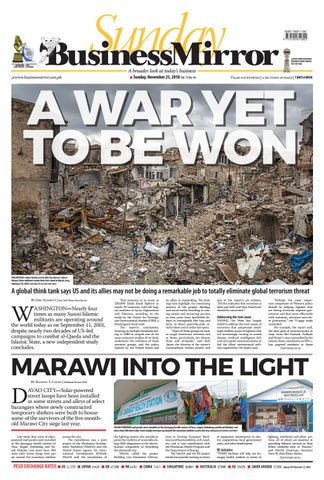
A WAR YET TO BE WON
VOLUNTEERS collect bodies in the Old City district, where Islamic State militants made their last stand in Mosul, Iraq, February 19, 2018. IVOR PRICKETT/THE NEW YORK TIMES
A global think tank says US and its allies may not be doing a remarkable job to totally eliminate global terrorism threat By Eric Schmitt | New York Times News Service
W
ASHINGTON—Nearly four times as many Sunni Islamic militants are operating around the world today as on September 11, 2001, despite nearly two decades of US-led campaigns to combat al-Qaeda and the Islamic State, a new independent study concludes.
That amounts to as many as 230,000 Salafi jihadi fighters in nearly 70 countries, with the largest numbers in Syria, Afghanistan and Pakistan, according to the study by the Center for Strategic and International Studies (CSIS), a Washington think tank. The report’s conclusions, drawing on multiple databases dating to 1980 to compile one of the most extensive studies of its kind, underscore the resiliency of these terrorist groups, and the policy failures by the United States and
its allies in responding. The findings also highlight the continuing potency of the groups’ ideology and social-media branding in raising money and attracting recruits as they pivot from battlefield defeats in strongholds like Iraq and Syria to direct guerrilla-style attacks there and in other hot spots. “Some of these groups do want to target Americans overseas and at home, particularly the Islamic State and al-Qaeda,” said Seth Jones, the director of the center’s transnational threats project and
one of the report’s six authors. “All this indicates that terrorism is alive and well, and that Americans should be concerned.”
Addressing the root cause
INDEED, the West has largely failed to address the root causes of terrorism that perpetuate seemingly endless waves of fighters who are increasingly turning to armed drones, artificial intelligence (AI) and encrypted communications to foil the allies’ conventional military superiority, the report said.
“Perhaps the most important component of Western policy should be helping regimes that are facing terrorism improve governance and deal more effectively with economic, sectarian and other grievances,” the 71-page study concluded. For example, the report said, the slow pace of reconstruction in Iraqi cities like Ramadi, Fallujah and Mosul—once controlled by the Islamic State, also known as ISIS— has angered residents in those Continued on A2
MARAWI INTO THE LIGHT D
By Manuel T. Cayon | Mindanao Bureau Chief
AVAO CITY—Solar-powered street lamps have been installed in some streets and alleys of select barangays where newly constructed temporary shelters were built to house some of the survivors of the five-monthold Marawi City siege last year.
Last week, four units of solarpowered roof panels were installed at the barangay health centers of Tuca, Sugod, Ambolong and Basak Malulut, and more than 200 more solar street lamps were put up around the transitory shelters
across the city. The installation was a joint project of the Mindanao Development Authority (MinDA) and the United States Agency for International Development (USAid). MinDA said the installation of
PESO EXCHANGE RATES n US 52.2770
SOLAR-POWERED roof panels were installed at the barangay health centers of Tuca, Sugod, Ambolong and Basak Malulut, and more than 200 more solar street lamps were put up around the transitory shelters across the city. MINDANAO DEVELOPMENT AUTHORITY
the lighting system also intends to prove the viability of renewable energy (RE) adaptation in the electrification component of rebuilding the shattered city. MinDA called the project Building Low Emissions Alterna-
tives to Develop Economic Resilience and Sustainability, or B-Leaders, and it was coordinated with the Mindanao Health Program and the Department of Energy. The MinDA said the RE project would also provide training in terms
of equipment maintenance to electric cooperatives, local government units, and other beneficiaries.
RE initiative
“THESE facilities will help our barangay health workers in terms of
lighting, ventilation and other services, all of which are essential in providing efficient services to their fellow residents here in Marawi,” said MinDA Chairman, Secretary Datu Hj. Abul Khayr Alonto. Continued on A2
n JAPAN 0.4628 n UK 67.3380 n HK 6.6762 n CHINA 7.5421 n SINGAPORE 38.0861 n AUSTRALIA 37.9008 n EU 59.6376 n SAUDI ARABIA 13.9350
Source: BSP (November 23, 2018 )
NewsSunday BusinessMirror
A2 Sunday, November 25, 2018
www.businessmirror.com.ph
A WAR YET TO BE WON
‘T
HE good news is that there has not been an attack anywhere near the scale of 9/11 in the US since that day, a significant achievement. The bad news is that the ideology that leads someone to fly a plane into a building or drive a car into a crowded sidewalk seems to have metastasized.” —Soufan Center Continued from A1
Sunni-majority areas and made them more susceptible to militant entreaties. The report also warns that withdrawing US forces from Africa and the Middle East—as the Pentagon has started to do—could serve as a boon to these terrorist groups as the Trump administration shifts its national security priorities to confront threats from Russia, China, North Korea and Iran. The report further intensifies the growing scrutiny of the fight against the Islamic State and al-Qaeda, as well as other Sunni groups that are not affiliated with either but sometimes form battlefield alliances or draw inspiration from their ideology and operations.
‘Mixed at best’
EARLIER this week, the Soufan Center, a research organization in New York, called the results of the US-led counterterrorism campaigns “mixed, at best.” “The good news is that there has not been an attack anywhere near the scale of 9/11 in the US since that day, a significant achievement,” the center said. “The bad news is that the ideology that leads someone to fly a plane into a building or drive a car into a crowded sidewalk seems to have metastasized.” “Many of the conflicts that comprise America’s global counterterrorism campaign have a fiercely local component to them, meaning
there is little that a Western country and its military can actually do to impact events on the ground for a sustained period of time,” the center added.
Far from over
GEN. Joseph Dunford, the chairman of the Joint Chiefs of Staff, acknowledged at a security conference in Halifax, Nova Scotia, on Saturday that the fight against the Islamic State and other Salafi jihadi groups was far from over. Dunford said the United States must maintain sufficient forces and political will “to make sure that we’re putting pressure on and disrupting these terrorist networks.” But at what cost? Last week, Brown University’s Watson Institute for International and Public Affairs released its annual report, the Costs of War study, in which it calculated that the United States would have spent $5.9 trillion on activities related to the global counterterrorism campaign by October 2019. Assessing the number of Salafi jihadi fighters worldwide is challenging, the CSIS report noted. But the researchers used multiple sources, including the University of Maryland’s global terrorism database and Jane’s Terrorism and Insurgency Center, to determine a range of high and low estimates. Overall, the report said, the total number of fighters this year— 100,000 to 230,000—is down about 5 percent from a peak in
2016, but still far beyond the ranks in 2001—37,000 to 66,000. The countries with the highest number of fighters this year are Syria (43,650 to 70,550), Afghanistan (27,000 to 64,060), Pakistan (17,900 to 39,540), Iraq (10,000 to 15,000), Nigeria (3,450 to 6,900) and Somalia (3,095 to 7,240), the report said. Of the various Salafi jihadi groups, the Islamic State remains the predominant threat, with about 40,000 members globally this year, up from 30,200 in 2014, when the group’s fighters seized the northern third of Iraq. That figure is even higher than those of other recent studies. Data collected by the Pentagon and the United Nations this year indicated that the Islamic State has as many fighters now as it did in 2014— the peak of the caliphate—with 20,000 to 31,500 members in Iraq and Syria alone, and thousands more spread across the numerous other countries where it has implanted itself. Senior officials at the Pentagon and in the White House, however, say the real number is far lower.
Diminishing attacks
DESPITE these large numbers of fighters, an examination by The New York Times in September found that Islamic State attacks in the West have fallen sharply in 2018 compared with the previous four years, the first time the number has fallen since 2014. But the num-
TROOPS detain a suspected Islamic State member during a late-night raid in Badush, a village outside Mosul, Iraq, May 3, 2018. IVOR PRICKETT/THE NEW YORK TIMES
ber of attempted attacks remained steady, suggesting that the group remains committed to carrying out devastating harm. Tens of thousands of Islamic State members—including senior leaders, veteran field commanders and foreign fighters—have been killed in US airstrikes and partner actions. The extremist group now
holds less than 1 percent of the territory it seized in Iraq and Syria in 2014, or about half the area of Manhattan. But a US-backed military offensive stalled this month against the Islamic State’s last vestige in eastern Syria. The Syrian Democratic Forces, the Kurdish-led militia that is fighting the Islamic
State with US help, suspended operations after Kurdish positions farther north were shelled by Turkey—not far from US advisers. But the militia says it will resume its fight. “Americans should understand that terrorism won’t end,” the report concluded, “even though the terrorism threat may ebb and flow.”
Marawi into the light
MINDA Chairman, Secretary Datu Hj. Abul Khayr Alonto talks to one of the beneficiaries of its renewable-energy project. MINDANAO DEVELOPMENT AUTHORITY Continued from A1
The MinDA has been consistent with its advocacy to harness RE sources despite the swarm of big-ticket power-generation projects using coal in the last decade marred by recurring episodes of electricity crisis. Alonto stressed, “Mindanao investments in RE should be an initiative that the government should look into to complement the ongoing rebuilding efforts in Marawi.” “RE is reliable and sustainable so it will benefit more residents, particularly internally displaced persons (IDPs) who are in need of immediate assistance,” Alonto said during a site visit to a solar electrification project in select barangays in Marawi City on November 14.
Funding commitment
THE installation of the solar-powered lamps and panels was one of the identified projects for assistance under the Mindanao Peace and Devel-
opment Program, or MPAD, that was signed by MinDA and USAid earlier this week in Manila. The USAid has committed $11 million to cover development assistance in infrastructure, livelihood, education and social services for conflict-affected areas in Mindanao. “We hope to leverage this renewed and strengthened partnership to explore more support measures and expand economic opportunities for these areas in Mindanao,” said Undersecretary Janet Lopez, MinDA executive director. MinDA Assistant Secretary Romeo “Yo” Montenegro said, “RE takes an important role in peace and development initiatives in Mindanao, and the call to deploy more of these facilities has become more urgent.” “Currently, our energy mix leans towards coal and fossil, and if this continues, at least 70 percent of our power will come from these sources. Environmental integrity is another angle to look into in this
discourse,” Montenegro told the recent 11th MinDA Board of Directors Meeting in Davao City.
Dam rehab
DURING the meeting, a resolution was approved supporting the agency’s Mindanao Power Development Program (MPDP) and its plan to establish more RE capacities in the island-region to meet the forecast of 3,500-megawatt demand in the region by 2030. Among the key initiatives identified under the MPDP is the immediate rehabilitation of the Agus-Pulangi Hydropower Complex and the implementation of the One-Stop Facilitation and Monitoring Center, or OSFMC. “The OSFMC framework looks at helping potential RE players accomplish… [the] requirements [such as permits] for their facilities faster through an interagency coordination effort of which MinDA will serve as oversight,” Montenegro added.
www.businessmirror.com.ph
The World BusinessMirror
UK panel finds ‘litany of errors’ in response to terrorist attacks
L
ONDON—A damning parliamentary report released on Thursday raised questions about the way Britain tracked terrorism suspects, accusing the authorities of moving too slowly to forestall one of five major jihadi attacks in 2017 and finding a “litany of errors” in the handling of another. The report by the cross-party Intelligence and Security Committee—titled “ The 2017 Attacks: What Needs to Change?”— offered an unusual admission by MI5, the domestic security service, that it had made a mistake in not tracking the suspect in a lethal Manchester bombing. The report also offered a sharp counterpoint overall to the portrait offered by security and policing agencies of their successes in foiling terrorist plots. The conspiracies have proliferated since July 7, 2005, when suicide bombers killed 52 subway and bus travelers in London. The parliamentary report drew some broad conclusions, saying police and the security services were not sharing information as efficiently as they should and criticizing official efforts to persuade big technology companies to remove jihadi material from their platforms. Such is the scale of the challenge to fight terrorism, authorities say, 700 investigations are under way into some 3,000 suspects regarded as a serious threat, along with an
additional 20,000 considered to be causing concern. The police and MI5 say that they have thwarted 13 plots since March 2017, but the parliamentary panel focused on five attacks last year that claimed the lives of 36 victims. The bloodiest of the attacks occurred May 22, 2017, when Sa lman Abed i, a 22-year-old Briton of Libyan descent, blew himself up at a concert by Ariana Grande in the northwestern city of Manchester, killing 22 people, including several children. Abedi had been known to authorities because he had visited a jailed extremist in prison and had traveled to Libya from 2011 onward, the report said. But in 2015, the authorities judged him as posing a low risk. Sajid Javid, the home secretary, who has political authority over MI5, said the security services had updated their counterterrorism strategy and were “ensuring technology companies play their part by stopping terrorists from exploiting their platforms.” But the parliamentary panel said it was “striking how many of the issues, which arose in relation to the 2017 terrorist attacks, have been previously raised by this committee.” “We have previously made recommendations in all these areas and yet the government failed to act on them,” it added. New York Times News Service
Sunday, November 25, 2018
A3
Trump, Xi signal readiness for trade talks ahead of G-20 meet in Argentina
U
nited States President Donald J. Trump and Chinese leader Xi Jinping have indicated they’re both ready for a highly anticipated meeting at the Group of 20 (G-20) summit in Argentina next week.
The world’s biggest economies have been engaged in an escalating trade war that is starting to have a greater impact on financial markets and global growth. On Thursday Trump told reporters that China wants to make a deal “very badly” after his administration placed tariffs on on about $200 billion worth of Chinese goods. China “wants to make a deal and we’re very happy with that,” Trump said. “I’m very prepared, I’ve been preparing for it all my life.” On Friday in Beijing, top Chinese officials briefed on Xi’s upcoming travels, including the November 30 and December 1 G-20 in Buenos Aires where he’ll meet with Trump. Xi’s trip will include stops in Spain, Portugal and Panama. They didn’t name any officials who would accompany Xi. H i g h l i g h t s f r o m C h i n a ’s briefing:
China “ hopes the Xi-Trump meeting goes smoothly,” Vice Minister of Foreign Affairs Wang Chao said. China hopes to meet the US halfway in addressing trade issues, Vice Minister of Commerce Wang Shouwen said on Friday in Beijing, as Chinese officials briefed on Xi’s upcoming travels. “Chinese and US trade teams have been in close touch,” he said, echoing White House economic adviser Larry Kudlow’s comments last week that they have resumed contact “at all levels.” Wang Shouwen appeared to echo Trump’s line: “We noticed that the US wants to reach an agreement to solve trade frictions with China. China hopes to work with the US to contain disputes.” US trade action hurts China, America and the world, he added. The briefing also included remarks from Foreign Ministry Spokesman Qin Gang, Assistant
Minister of Foreign Affairs Zhang Jun, Vice Minister of Finance Zou Jiayi and central bank Deputy Governor Chen Yulu.
Key comments on G-20
Xi will attend a meeting of BRICS (Brazil, Russia, India, China and South Africa) nations and hold bilateral summits with other leaders. China hopes to use the G-20 to reach a practical, open agreement on economic and trade cooperation, pushing all parties to improve policy coordination. China hopes to send a clear signal on supporting a multilateral system of trade and enhance cooperation with its trading partners. China is paying “close attention” to the summit and calls for all parties to uphold equality and mutual respect. The G-20 will agree to a 2020 deal on a digital economy. The bloc agrees the global economy faces downward pressure and rising risks, including a volatile finance market, trade frictions and weak structural growth. The global economy lacks growth driver. China says reforms on the World Trade Organization should be addressed within the global trade body. Trump has repeatedly said the US hasn’t been treated fairly by the organization.
Latin America
China and Spain will chart a new
road map for bilateral relations. China and Portugal will sign unspecified deals. China and Argentina will sign a five-year plan for future cooperation, and Beijing will support the country’s efforts to stabilize its finances. China and Panama will sign agreements in the e-commerce sectors and the service trade, and a pact for infrastructure and energy cooperation. While some Latin American countries see rising challenges in an unstable global environment, cooperation between China and the continent won’t change.
Insights
As Trump scales back America’s involvement in international trade agreements, Xi is using his signature Belt and Road trade and infrastructure program to position himself as a champion of global free trade. The initiative has extended into South America and the Caribbean, as Xi looks to expand China’s influence in the region. Outside of talks with Trump, this trip is a chance for China to bolster ties after its lending practices to poor countries—including Ecuador and Venezuela—fueled concerns that they would become saddled by debt. US Vice President Mike Pence warned countries to avoid becoming indebted to Beijing in a speech last week at Apec in Papua New Guinea. Bloomberg News
Faith A4 Sunday, November 25, 2018
Sunday
www.businessmirror.com.ph • Editor: Lyn Resurreccion
‘Tell everyone we scalped you!’
Caste system still rules in India T
HATI, India—When Sardar Singh Jatav set out walking on a muggy night in early September to talk with the men who employed his son, he found them already waiting for him in the road. But they were not in the mood for discussion. The higher-caste men greeted Sardar with a punch to the face. Then they broke his arm. Then they pinned him down. Sardar shrieked for help. Nobody came. One higher-caste man stuffed a rag in his mouth. Another gleefully pulled out a razor. He grabbed Sardar’s scalp and began to lift and cut, lift and cut, carving off nearly every inch of skin. “Take that!” Sardar remembers them saying. “Tell everyone we scalped you!”
Dalit, formerly called untouchable
Sardar is a Dalit, a class of Indians who are not just considered lower caste, but technically outcaste— what used to be called untouchable. Bound at the bottom of India’s Hindu society for centuries, the Dalit population, now estimated at more than 300 million, has been abused for as long as anyone can remember. And now, according to crime statistics, the violence against them is rising. This might seem surprising against the new narrative India is writing. So much has changed. Millions of people have been lifted out of poverty. The Indian economy is now one of the world’s biggest. Everywhere in the country, there are new roads, new airports, new infrastructure.
Hinduism and caste system
But in many places, especially in poorer rural areas, caste infrastructure is still the one that counts. And those who rebel against it, like Sardar, are often greeted with unchecked brutality. It is violence intended to send a message, pain inflicted to maintain India’s old social order. The crimes are happening across the country and Dalits are not simply killed: They
are humiliated, tortured, disfigured, destroyed. “We have a mental illness,” said Avatthi Ramaiah, a sociology professor in Mumbai. “You may talk about India being a world power, a global power, sending satellites into space,” he said. “But the outside world has an image of India they don’t know. As long as Hinduism is strong, caste will be strong, and as long as there is caste, there will be lower caste,” he added. “The lower castes don’t have the critical numbers to counterattack,” he said. And the result has been violence that he described as “intimate, sadistic and cruel.”
Girl beheaded
In late October, a 14-year-old Dalit girl was beheaded by an upper-caste man whose wife said he hated the girl specifically because of her caste. A Dalit scavenger was tied up and fatally whipped outside a factory in May, in a beating captured on video and broadcast across India. In March a Dalit man was killed by higher-caste men for riding a horse (traditionally, Dalits aren’t supposed to do that). “Such incidents would not have happened in my childhood,” said Chandra Bhan Prasad, a well-known political commentator (and a Dalit). “In my childhood, a Dalit would not ride a horse. Before 1990 most Dalits worked for someone. Now they are paying a price for their freedom.”
Affirmative actions
For decades, India has struggled to deweaponize caste. When the Constitution was being written in the late 1940s, intellectuals knew caste was a sore spot that needed to be urgently addressed. They included specific protections for Dalits, who make up about 15 percent to 20 percent of India’s 1.3 billion people.
34th and Last Sunday in Ordinary Time: ‘John 18:33-37’
Christ the King must reign in us By Rev. Msgr. Josefino S. Ramirez Sunday Gospel in Our Life
T
oday is the feast of Christ the King. The gospel presents Christ to us in a paradoxical situation. There He is, bound and tied, apparently helpless and divested of any power, declaring boldly to the interrogations of the representative of the Roman emperor. “I am a King. This is why I was born, and why I have come into the world, to bear witness to the truth.” (John 18:37) Later on, the executioners, in a sarcastic-move, makes a placard containing His “crime” and pins it to the head of the cross—“Jesus Christ, King of the Jews.” Yet we know that Christ is truly a king, and not just any king, but the king of kings and the Lord of Lords. And this is so because the man Jesus Christ is also God, the creator and master of the whole universe. Christ’s kingship is not a political one; it is not a kingship that poses a threat to earthly kingdoms. An earthly kingdom, after all, even at its apogee, is really insignificant. Like everything else on Earth, it will pass away and wither. Christ said clearly, “My Kingdom is not of this world.” Christ’s kingdom is much more important than any earthly or political kingdom. It is a kingdom involving the eternal destiny of each one of us. It is the Kingdom of Heaven. Christ wishes to reign in our hearts. We can under-
stand this better through an analogy with civil power. Civil power involves three areas: legislative, judicial and executive. If Christ is to be king of our hearts and our lives, it can also involve legislative, judicial and executive aspects. For Christ to reign in our hearts, the law of God must be the guiding rule of all our actions. This legislation of Christ is found in the Ten Commandments and in Christ’s new commandment of love. We should try to do what is morally correct, and do it out of love. We should also judge things in the light of God’s law. Very often, we tend to judge things by standards far from this law. We measure success by money or we seek happiness through sensual pleasure. If Christ is to be the “judge” in our hearts, we should measure things according to the standards and norms set by Christ. Finally, Christ should be our executive. The Church has a beautiful prayer for this: Lord, may you inspire all my actions, And may you aid me in their execution, So that all my words and works May begins from you And find their fulfillment in you. That is how Christ can exercise His kingship in our hearts.
Dalits are not allowed to sit at this temple, but any Gujjar, including a child, can. This is how it goes for many Dalits, their life circumscribed by what they are not allowed to do. When one young Dalit man said he was willing to break the taboo, another quickly grabbed his arm and said: “Don’t! If you do, there will be a fight tomorrow.” While this was happening, a Gujjar farmer happened to walk by. Seeing three journalists talking to the Dalit men, he couldn’t resist joining the discussion. He insisted that Thati was a happy place and that Dalits and Gujjars lived “like brothers.” “Brothers?” one Dalit man shot back. “Brothers don’t scalp each other!”
Police against Dalits Upper-caste Gujjar people sit at the village’s temple as Dalit people, a class of Indians who are not just considered lower caste, but technically outcaste, sit on the ground in the village of Thati, India. While India is undergoing tremendous change, caste discrimination is still a force. Those who rebel against it are often met with unchecked brutality. Atul Loke/The New York Times
Affirmative action programs, though they have generated deep resentments among upper castes, have helped some Dalits escape poverty. Today there are Dalit poets, doctors, civil-service officers, engineers and even a Dalit president, though it is mostly a ceremonial post. But 95 percent of Indians still marry within their caste, experts say. And recent studies show income and education levels correlate very closely with caste. Even controlling for education, Dalits still fall behind, indicating that caste discrimination is alive and well in the workplace.
Caste-based crimes increased
Scholars argue that the current political environment has increased the vilification of the other— whether that be along caste, creed or gender lines. According to national crime statistics, the number of caste-based crimes has increased 25 percent since 2010, reaching nearly 41,000 cases in 2016, the last year on record. Many analysts blame the ruling party, the Bharatiya Janata Party, whose Hindu-supremacist roots have emboldened supporters to lash out at minorities, often in the name of Hinduism. One example is the rash of people beaten up or killed for slaughtering cows. The animals are revered in Hinduism, and the vast majority of the
victims of the cow vigilante squads are Muslims or Dalits. Experts say this violence is committed to sow terror. They liken it to the many well-publicized horrors inflicted on women here, intended to dehumanize and put people in their place.
Speaking out more
Another factor may be that Dalits like Sardar are speaking out more, demanding what is theirs. What ignited the confrontation that night in September was Sardar’s insistence that the higher-caste landlords pay his son about $80 in back wages he was owed for working in their rice paddies. “All I asked for was what I was due,” said Sardar, who has a large, rounded forehead, a square jaw and a strong handshake, even while lying on his back in a hospital bed. His village, Thati, is about 200 miles south of India’s capital, New Delhi. It is home to about 300 families, squeezed together in little brick houses that on a recent day wore a fine coat of dust. Women scrubbed pots with handfuls of mud, and older men lay shirtless on rope cots.
Untouchables do dirty work
In traditional Indian society, castes designated occupations. The untouchables were the ones who did the dirty work, such as skinning animals
or cleaning toilets. Today the caste-occupation relationship has broken down a bit; in Thati just about all the families, whatever their caste, are involved in farming. But Thati still observes an old social order that the arrival of electricity, cell phones and more opportunity for the lower castes has not dismantled.
Don’t have even bicycles
The Gujjars, who are hardly at the top of the overall caste ladder, are the most powerful caste here and own most of the land. Gujjars live in bigger homes, and many have tractors and small cars. Most Dalits don’t even have bicycles. Dalits must show Gujjars respect. They are not supposed to look Gujjars in the eye or touch their food or water cups—Gujjars would consider it polluted. The two castes have separate water taps, like in the Jim Crow American south. All of this is illegal. India’s Constitution specifically prohibits the practice of “untouchability,” though recent surveys show many Indians still do it, even in cities.
Life confined to what they are allowed to do
At the edge of Thati village stands a sacred peepal tree. Beneath its nubby branches lies a small Hindu temple.
Police officers have arrested several Gujjar men accused in the attack on Sardar, who is around 55 years old—he’s not exactly sure of his age. But authorities say that caste played “no role” and that the crime was precipitated by a personal dispute between Sardar and a landlord. That claim made Sardar laugh— a dry, bitter laugh. He shook his bandaged head, still recovering from a painful skin graft from his thigh. It’s a common complaint: that police (who are usually from higher castes) always side against the Dalits. One police commander tried to claim that the assailants hadn’t intended to scalp Sardar but that part of his scalp had simply fallen off when they hit him in the head with a stick. Two doctors who treated Sardar at a government hospital disagreed. They said just about all the skin on the top of his head had been forcibly removed with a sharp instrument, leaving his skull undamaged but much of the bone exposed. Sardar said that while he was being scalped, the Gujjars taunted him for wearing a turban, something that Dalits are not supposed to do. He remembers the men saying: “We’re going to take away your crown.” Now, he said, he is going to bear a horrible scar that will remind him, for the rest of his life, what the higher caste men did to him. “I wish I were a different caste,” he sighed. New York Times News Service
Heaven is paradise By Corazon Damo-Santiago
W
hen both mind and body assert that you are dying, rejoice if you are in the state of grace. The time to live forever joyfully is at hand. Heaven is the state of “supreme definitive happiness, the ultimate end and fulfilment of the deepest human longings, (Catechism of the Catholic Church [CCC], 1024). It is the communion of life and love with the Holy Trinity, Mother of God, angels and all the blessed forevermore. The word forever can only be used to describe heaven. Anything labeled forever on earth is a lie.
A place of perfect love
Heaven is called the New Jerusalem in Christian literature. It will radiate like a precious stone, clear as crystal like jasper (Revelations 21:11). A majestic place (Revelations 7:15), the things of the past will not be remembered or come to mind (Isiah 65:17), a place of unimagined blessing, this heavenly Jerusalem, (Hebrews 12:23). The holy people from all nations
will behold God in His throne (Psalm 103, 19), and will always be their God (Revelations 21:3). All will live in rejoicing and happiness (Isiah 65:18), with perfect love governing all relationships (Psalm 103 19-21). Man will be with their angels, and God will change man’s “lowly body to conform with His glorified body by the power that enables Him also to bring all things into subjection to Himself [Philippians 3:21]. In heaven, they are like God forever for they see Him as He is; face to face”(CCC, 1023).
Don’t gamble eternal life
Heaven is all that matters. God the Father even sent His only son, Jesus, on Earth to save men from eternal damnation. Holy Mother Church, like Christ, warns man constantly of the lamented reality of “eternal death—hell.” Pope Francis on Good Friday in 2014 told the faithful: “Convert, there is still time, so that you don’t end up in hell.” To sanctify man, the sacraments of faith, the Ten Commandments, by virtue of the saving work of Christ, was entrusted to the Church so divine life can be dispensed to man. The graces they signify are effica-
Dante and Beatrice gaze upon the highest heavens; from Gustave Doré’s illustrations to the Divine Comedy. Wikimedia Commons
cious because Christ himself is at work (CCC 1127). Know, accept, identify and live the Ten Commandments and teachings of the Church. Every problem on Earth has a solution except death. No barrier to a holy life is too great if we focus our eyes on heaven, the fullness of love, joy
and beauty. Indeed, don’t gamble eternal life. Damo-Santiago is a former regional director of the Department of Education-National Capital Region. She is currently a faculty member of Mater Redemptoris Collegium in Calauan, Laguna, and of Mater Redemptoris College in San Jose City, Nueva Ecija.
Science
A6 Sunday, November 25, 2018
BusinessMirror
Sunday
PHL left behind by neighbors in health diagnostics R&D
D
Story & photos by Stephanie Tumampos
ecrepit, dark and with cranky equipment. This is the image one would have when the name of the Philippine General Hospital (PGH) comes to mind. However, did you know that health diagnostics at the PGH are on a par with the private sector’s stateof-the-art equipment? Dr. Carmencita Padilla, the chancellor of University of the Philippines Manila, said, “We got a huge budget [from the government] a few years ago to upgrade our diagnostics.” She explained that all 28 operating rooms in PGH that serve 600,000 patients a year are “stateof-the-art” and affordable “because the equipment were provided by the government.” But not everyone has the luxury of affordability and accessibility, and not every hospital in the country has high-quality equipment. For Padilla, all government hospitals must be state-of-the-art, “not just PGH.” The status of health diagnostics in other public hospitals need more improvement, the reason Filipinos opt to seek the nearest private diagnostics facility for tests that may not be affordable. The affordable ones are for basic tests, such as urinalysis or blood count, but in more complicated situations, diagnostics can be expensive or inaccessible. In order to address these concerns, research and development, policy and regulation must be formulated for the benefit of the people. But creating these meet a lot of blocks along the way. “One of the things we have to do is bring down the cost of medical devices because it is definitely expensive,” Padilla told the BusinessMirror. This is one of the projects Padilla is working with the Philippine Council for Health Research and Development (PCHRD) of the Department of Science and Technology (DOST).
Innovations on health diagnostics R&D in PHL
In the Philippines, research, development and innovation on health diagnostics are done by only a few institutions. These concerns were discussed during the Joint Policy Workshop on Diagnostics in Southeast Asia held in Tagaytay City last month. It was organized by The Academy of Medical Sciences (AMS) and National Academy of Science and Technology (NAST). Academician Dr. Jaime Montoya, who is also the head of DOST-PCHRD, told the BusinessMirror that there are many problems the health diagnostics research and development (R&D) face in the country. “First, on innovation, we are doing diagnostics R&D in the country but only in few identified institutions, such as the University of the Philippines, University of Santo Tomas, Ateneo de Manila University and De La Salle University.” Montoya added that these universities focus only on priority diseases like dengue, influenza and tuberculosis, because these diseases “cause significant mortality in the country.” The reason behind this is that these institutions could not access government funding unless topics for R&D are aligned with the National Unified Health Research Agenda set by the Philippine National Health Research System. The workshop’s goal was for health diagnostics to be used to look at the patients holistically and not just at a certain condition. It also aims to build AMS’s report on multimorbidity, or the “the
coexistence of two or more chronic conditions in the same individual that has a specific impact on safety issues in primary care,” as defined by the World Health Organization. In terms of investments in R&D for diagnostics, Montoya said the country is left behind. “Actually, [the Philippines is] just better off than Cambodia, Laos and Myanmar [in Southeast Asia], while Vietnam is almost the same level as us depending on what reference you look.” Even though PCHRD has allotted NAST a budget of P70 million for 2018, P72 million for 2019 and P200 million for 2020 through its Grants-in-Aid program for R&D on health diagnostics, among the Asean nations and in terms of innovation, the Philippines still tails behind its neighbors, such as Malaysia, Thailand and Indonesia.
The lack of researchers, scientists and data
What are reasons R&D for health diagnostics in the country has not improved? “[The reason] is not just about support and money but also human resource,” Montoya said. “We have a lot of doctors, but most doctors do not go into research, they go into clinical practice.” Montoya added he wants to encourage doctors to do research because they are the ones who know both worlds. For him, they are the perfect people to be involved. “They know the practice of medicine, and they know what’s going to be used, and they also know about science and medicine.” Currently, most of the researchers who work in the health sciences are not medical doctors. According to Montoya, they are either people in laboratory or public health. Padilla, on the other hand, said that she needs more interested clinicians and researchers. She added she needs clinicians to do research because they can provide questions. “They may not be the one who will develop it but they are keen to develop the data that will be used for policy.” Besides the human resources, another problem is on data. Padilla said the Philippines has more health statistics than data. Data is a direct result of a research and can be used to create new information. Statistics, on the other hand, is the result of data gathering. “PGH is putting a lot of attention now on producing more research from our patients so we can produce data for our government,” Padilla explained. “Our problem is we don’t have much data, and we have more statistics. I’m really glad that the DOH [Department of Health] is looking at their data [now], because our data can feed into DOH for them to come up with policies.” She noted that without data, “we could not make policies.”
The real problem: ‘Valleys of death’
For Montoya, the real problem is the translational gaps, or what he called “valleys of death,” and he cited two of them. The first concern for Montoya is that most researches done by institutions “either just get published or never gets published or ends in the laboratory and doesn’t
Academician Dr. Jaime Montoya, also the head of DOST-PCHRD
Chancellor of University of the Philippines Manila Dr. Carmencita Padilla
A clinical laboratory of a hospital in Bohol with health professionals busy doing health diagnostics for the public, can obtain results in a short time.
go beyond that.” Montoya emphasized that the reason is lack of adoptor. He explained that for a research or technology done inside the laboratory to work for the public, clinical trials are needed, and these are very expensive. “Clinical trials are done by multinational companies so, the government, for example, rarely invest in clinical trials because they’re very expensive.” Montoya explained that clinical trials involve thousands of patients and are followed up across time, therefore making it resource-intensive, and this is where the valley of death comes in. “This is the point of proof of concept and commercialization to the market, and scientists don’t know how to bridge this,” he noted. The academician said industries know more about these steps. He is hoping that more partnerships be made between scientists or institutions with companies, and these companies must be involved early. “Not when the technology is almost there, and then you present it to the market or industry. They will say, ‘we don’t see it to be useful,’ and then you lose everything you have done in the past.” All initial development must be done in partnership with possible adoptors even if the government is funding these researches. The other valley of death is the incentives for companies who invest in diagnostics because “there are more risks than benefits.” He said there must be “something” for these companies, because they invest in money and they face the uncertainty of return of investment, because these companies want the test to be available on a wide scale, at the very least. “This is something that is very hard to do with the current setup that we have [in the country],” Montoya lamented. “That is why, through the Asean network, we can get expertise across the region, exchange, collaborate so that we can improve the systems we have.” Montoya believes that the country has the know-how, the scientists and research institutes. “What we lack are [the means on] how to bridge the valleys of death, how to bring it [R&D] to the market, because this will include the knowledge of the market and information, which scientists are not experts on.”
Asean DxD Initiative
In the 75th Meeting of Asean
Committee on Science and Technology in Cebu City last month, the Philippines and Singapore jointly chaired the Asean Diagnostics (Dx) Development Initiative where it addressed the clinical needs of the member-states and to accelerate solutions to the market. “Through this initiative, we are partnering with DxD Singapore because they have the connections with industry partners, the big and small companies in the Asean region, and they will actually match our technologies, our scientists to the right channels and maybe also guide us to the valleys of death,” Montoya said. According to Dr. Sidney Yee, CEO of the Dx Development Hub (DxD Hub) and executive vice president of the Incubation and Startup Management Division, “This is actually a public-private platform that is able to bring the industry and the public sector, regulators, experts and policymakers together as early as possible to ask questions, consider the issues needed to be considered very early on at the point of developing a solution.” Yee meant that they will open up a call for proposals on January 2019 on an Asean-wide search and use these proposals to accelerate innovations of health diagnostics into the market for adoption. “It will take away the sequential workflow, and we can accelerate the time [to reach the] market.” According to Yee, at present it takes eight to 10 years to develop and market health device and technology to the Asean nations. But with the proposed DxD Hub, it will now take only two to three years to complete the process. Yee also told the BusinessMirror that this initiative is “something that makes sense to our Asean community.” For Yee, it’s not just for the test or certain health diagnostic or medical device to work, it must meet the three As: accuracy, affordability and accessibility. “We’ll use first the projects chosen from the call as pilot cases to take to this public-private partnership, and we will still talk with different companies,” Yee said. She hopes that with more corporate investors, nongovernment organizations and some charitable foundations, they can see if they can do very specific funding for building these solutions for health diagnostics.
www.businessmirror.com.ph • Editor: Lyn Resurreccion
DOH intensifies drive to boost antimicrobial resistance awareness
T
he Department of Health (DOH) on Wednesday intensif ied its c a mpa ig n to increase public awareness on antimicrobial resistance (AMR), which is now becoming a serious health concern among Filipinos, especially for those being treated with infectious diseases. During the second Philippine AMR Summit in Manila, Health Secretary Franscisco T. Duque III said AMR compromises the ability of medical advancements, both in animal and human health, to treat infectious ailments worldwide. “AMR occurs when microbial resistance changes after exposure to antimicrobial drugs, such as antibiotics. Both the causes and consequences of this problem cut across several disciplines, not just health, affecting health security, trade, economy and the environment,” Duque told reporters. Together with the Department of Agriculture and United Nations agencies, the DOH held a series of dialogues and symposia to synthesize the input of various sectors in addressing the AMR issue properly. “The Philippines is committed to lead the fight against AMR in the region globally. We recognize that AMR is a national priority, let’s work together for a better healthcare system for our countrymen,” Duque said. This action is in line with the mandate of Administrative Order 42, issued in 2014, which created the Inter-Agency Committee on Antimicrobial Resistance to formulate and implement the National Action Plan against AMR. World Health Organization Country Representative Gundo Weiler, meanwhile, said there is an increase
in the number of people dying every year due to AMR. “We estimate that, every year around the world, 700,000 people die in connection with antimicrobial resistance. There is an upward trend. We estimate that probably 10 million people will die related to antimicrobial resistance by 2050. This has huge consequences not only on health but also the economy, and the expenditures associated to this computed between now and 2050, loss to economy would be a staggering $100 trillion,” he said. Weiler added that the major causes of AMR include misuse and overuse of antibiotics, incorrect treatment practices and infectioncausing habits. “Antiobiotics are very powrful drugs, which must be used carefully. It is important to use antibiotics wisely and only if prescribed by a medical doctor,” he said, adding that it is also important to complete the intake of prescribed antibiotics even after the patient’s condition has improved. Stressing that prevention is key in fighting AMR, Weiler urged Filipinos to commit to good practices like handwashing, hygienic food handling and avoiding unnecessary contact to sick people. In connection with this, Duque urged the public to avoid “self-medication,” which is common among Filipinos who want to avoid medical consultation costs. “Go to public hospitals and get doctor’s prescriptions and follow the prescription completely if the duration of medication clearly says seven days. If not, your next medication would be costly. Second, third-line antibiotics are expensive,” he said. Ma. Teresa Montemayor/PNA
Science films get recognized in Indie-Siyensya award
Organizers, judges and workshop facilitators of the third Indie-Siyensya Filmmaking Competition Workshop (from left) Prof. Garry Montemayor, Prof. Seymour Sanchez, Department of Science and Technology-Science Education Institute (DOST-SEI) Deputy Director Albert Mariño, Film Development Council of the Philippines CEO Mary Liza Diño, DOST-SEI Division Chief Dr. Ruby Cristobal, Hillary Diane Andales, University of the Philippines Film Institute Director Patrick F. Campos and Neil Andoque. S&T Media Service
I
ndie-Siyensya, the first and only science filmmaking competition in the Philippines, will bestow awards to top science films for the third consecutive year. The awarding ceremony, to be held on November 28 at the Philippine International Convention Center in Pasay City, will feature the best works selected from more than 40 film entries submitted in the Youth and Open categories. Indie-Siyensya’s board of judges, composed of filmmakers and educators Patrick F. Campos, Garry Jay Montemayor and Seymour Barros Sanchez, and scientists Mudjie Santos and Reinabelle Reyes, screened over 300 concept proposals since the competition’s launch on July 6 at the Cinematheque Centre Manila. “We were surprised by the number of individuals and groups interested in joining this year’s Indie-Siyensya. We’re hopeful that projects like this will encourage
more students to choose science courses,” said Josette Biyo, director of the Department of Science and Technology-Science Education Institute (DOST-SEI), the competition’s main organizer. DOST-SEI conducts teacher trainings and science-promotion programs for the youth on top of spearheading the country’s premier science scholarship programs. Cash prizes and trophies await filmmakers of winning entries. Three winners per category will receive P100,000 (Best Film), P50,000 (second place) and P25,000 (third place). A special Viewer’s Choice Award will also be given to the film with the most number of votes from the audience of Indie-Siyensya film screenings from November 21 to 27. The third Indie-Siyensya is presented in partnership with the Film Development Council of the Philippines. S&T Media Service
Tourism&Entertainment BusinessMirror
Editor: Carla Mortel-Baricaua
Sunday, November 25, 2018
A7
This may be the break you need from the daily bustle
That extra special staycation in Makati
The Firefly Roofdeck offers sumptuous dining and the amazing Makati city skyline.
At the 32nd floor, make sure to catch the sunset at the view deck.
City Garden GRAND Hotel lobby welcomes business travelers, families and staycationeers.
W
By Carla Mortel-Baricaua
ith 311 well-appointed rooms and luxurious amenities, the City Garden GRAND Hotel has always been the popular choice of business and leisure travelers. The four-star hotel is currently at top 5 out of 89 hotels in Makati City, according to TripAdvisor Philippines, and recently it opened its doors wider to families and staycationeers.
“For those who are looking forward for a leisure type hotel, we welcome them with services and amenities that comes with plenty of enjoyment options,” shares Angela Denilla, City Garden GRAND Hotel’s assistant public relations manager. For a staycation, family members and staycationeers should make it a point to enjoy and have a relaxing dip at the 4-foot-deep swimming pool on its 32nd floor. While hotel swimming pools are nothing new, this one comes with a Jacuzzi and that unique city vibe courtesy of the amazing view of the Makati skyline. The city landscape is quite an interesting scene viewed from such height that later turns lovely and romantic come at night. The pool is conveniently open from 6 a.m. to 10 p.m. Sharing the same floor is the Firefly Roofdeck bar and restaurant, where guests can find their
drink of your choice is best partnered with appetizing barbecue or bar chow. The Firefly Roofdeck menu selection also includes Filipino and Spanish dishes, pizza and pasta, sandwiches and desserts. Open from Fridays to Saturdays, diners usually hang around at the Firefly Roofdeck to chill and listen to an acoustic band perform retro hits. For hotel guests who want to stretch their legs, they can swing by the Poblacion area and explore the trendy food and arts hub that’s teeming with hip bars and pubs. For indoor dining, there’s the all-day dining restaurant Spice Café on the seventh floor where they serve appetizers, salads, soups, sandwiches, pizza and pasta, Filipino and Japanese dishes, as well. While breakfast meals are always available, staycationeers should look forward to the breakfast buffet, promptly ready at 6 a.m., that
Spacious and well-kept rooms are always ready for a relaxing stay.
Spice Café’s Salmon Steak
Spice Café’s Taco Octopus Nigiri
Find the best dining options at the Spice Café.
offers varied food choices and quality meals. Dinner time at Spice Café is also something special, since good food is paired with good music from a retro band that plays every Saturday. Executive chef Dennis Peralta heads both kitchens with one goal in mind: to bring time-tested techniques and taste of traditional cuisine to each dish that was refined and developed according to hotel guests’ dining preference and experience. And that garnered great reviews from satisfied clients of both restaurants. To make most of the hotel stay, staycationeers should visit the La Famosa Spa at the ninth floor for body treatments, hand and foot spa services, and hair treatments.
Spa services are available from La Famosa spa.
The spa is open from 8 a.m. to 10 p.m., while in-room services are available 24/7. For those who opt to burn some calories, the gym area is equipped with treadmills and bikes fitted with individual TV screens and cable network. There are also aerobic and dance sessions, exercise machines and sets of dumbbells for the weekend fitness warriors. It’s a good thing that Century City Mall is right around the corner, conveniently and literally three minutes away from the hotel. Kids can spend some fun time at Kidzoona while older ones can try out Mystery Manila. It also houses several cinemas. For some gift shopping this holiday, that mall has a
good collection of high-end shops and restaurants. Shopping trips can also be extended at The Rockwell Powerplant and Greenbelt malls. A staycation at the City Garden GRAND Hotel can surely deliver more than what is expected. The experience provides hotel guests the opportunity to rest and relax, walk and explore the city, and enjoy its charms sans the usual hassle of metropolitan living: driving through traffic, keeping busy schedules, and beating deadlines. More importantly, staycationeers can reconnect and enjoy each other’s company without having to worry about practical concerns, for at least a day or so. Above it all, there’s always something extra hotel guests can rely on:
The gym has a full suite of exercise machines.
Firefly Roofdeck’s Sisig
Firefly Roofdeck’s Paella
the staff’s warm service and ready smiles. Their sincere effort to pay extra attention to the guests’ needs and pleasure is the sweetest topping that can be highly anticipated in every staycation at the City Garden GRAND Hotel.
Sports DIVIDED BY BREXIT
A8 Sunday, November 25, 2018
L
By Bob Harris
The Associated Press
ONDON—Just like the politicians, English soccer is divided by Brexit. With four months until Britain withdraws from the European Union and no consensus over the terms of the split from the bloc, there is also uncertainty about the players Premier League clubs will be able to recruit. With free movement of people from the European single market to work in Britain set to end, players from the continent could become subject to the same soccer-specific immigration requirements as counterparts from the rest of the world.
After a quarter-century of growth, the Premier League sees maintaining the freeflowing pipeline of talent from Europe into its clubs as essential for maintaining the appeal of the competition worldwide. “It’s working,” West Ham co-owner David Gold said. “Why would you change it?” But the English Football Association is seizing on Brexit to try to ensure players eligible for its national team gain more playing time in the Premier League and build on the semifinal run at this year’s World Cup in Russia. Currently, the FA runs the visa system for non-European players in conjunction with the government’s Home Office. Unless a deal is reached between the FA and the Premier League, those
eligibility requirements could apply to any foreign player after Brexit in March. Players from the top 50 Fifa nations are considered for work permits, with a sliding scale of appearances required—from 30 percent of games over two years for the 1-10 teams to 75 percent for 31-50 teams. According to FA research seen by The Associated Press, 65 percent of Europeans currently
BusinessMirror
playing in the Premier League would have failed if the criteria were applied to them. But for players who don’t meet the threshold, clubs can seek an exemption by arguing the case for a work permit in front of a panel. The FA hopes to persuade the Premier League to scrap that system, known as the governing body eligibility endorsement.
Editor: Jun Lomibao | mirror_sports@yahoo.com.ph
Under the FA’s post-Brexit proposals, Premier League clubs would be allowed to sign whoever they want from abroad but only be allowed 13 non-homegrown players in the squad. That number is an average based on the 262 nonhomegrown players currently in the 20 teams. “Brexit should not be used to weaken playing squads in British football, nor to harm clubs’ ability
to sign international players,” the Premier League said in a statement. Most of the 20 teams do not currently use their full quota of 17 non-homegrown players, a status which means they have not been affiliated to an English or Welsh club for three complete seasons or 36 months before their 21st birthday.
DEXTER BAÑO, cofounder and head for business at Titanium Blend, at the Quezon City Polytechnic University. OLIVER SAMSON
Young entrepreneur pilots a start-up’s development of food for outer space By Oliver Samson Correspondent
A
S plans to send a crew to Mars in the 2030s stay and climate change is increasingly becoming a global issue, a 21-yearold Filipino steers development and production of food products that could be taken, stored and consumed in extremely isolated places like the outer space and on Mars. The company is eyeing to large-scale produce its products; it may later ship abroad, especially to Third World countries, according to Dexter Baño, cofounder and head for business at Titanium Blend. “We will try to secure help from the Unicef [United Nations International Children’s Fund], through assistance from our investors, so we can distribute the product globally,” Baño said. He said the start-up is constantly refining the product made of scientifically tested nutritious raw materials to achieve excellence and is working on a project to develop a radiation-proof food packaging. “We are continuously improving the product, and are looking for measures to enable us to lengthen the shelf life and to ensure its protection from pathogens,” Baño added. Pathogens could affect food nutrient contents, Baño explained, adding that radiation would be another concern when the foods are taken into space. The company is also working with the Department of Science and Technology-Industrial Technology Development Institute (DOST-ITDI) to refine the product, he said. “We are now looking into different possibilities to develop a radiation-proof food packaging.” The company has already identified some materials that could be harnessed in producing radiation-proof food containers, he pointed out. One is Demron, which has been used to tailor astronaut suits.
Climate
ONLINE data show that freeze-dried foods have sustained mankind in its trips into space in the past decades. Foods that could not be freeze-dried were thermos-stabilized and placed in the spacecraft’s sterile chamber. And tortillas have been mankind’s staple in space exploration.
DEXTER BAÑO, cofounder and head for business at Titanium Blend In a post in WIRED magazine on March 26, 2018, Grace Douglas said that, in general, no food has a five-year shelf life, and that a three-year mission to Mars in the 2030s would require foods that could be stored for a period of at least five years. Man’s abuse of nature could eventually lead to a multiplanetary society, according to Baño. Climate change could trigger unprecedented impact on local habitat and food source and could force man to colonize potential habitats outside Earth, he added. The ultraviolet rays that the sun emits influence the global climate, he explained. Climate change initiates the melting of the ice caps. When the ice caps start to evaporate around as steam, they bring about the development of more devastating natural calamities. Third World countries contribute a large share to human waste that converts itself into pollution and in time instigates climate change, the young entrepreneur explained. Reckless urbanizations across the world could compromise the environment and consequently global climate, he added.
Food chain LIKEWISE, the flow in a particular food chain could be seriously disrupted when one of the organisms in the bind would be severely exploited, Baño said. Exploiting a particular organism in a food chain would trigger a domino effect that would eventually disrupt and threaten the food web, he added. Citing cats as examples, when felines are brought to near extinction, rodents would dramatically and massively multi-
2 BusinessMirror
OLIVER SAMSON
ply, putting crops and food supply at risk, he explained. The impact of climate change and environmental pollution are being vaguely understood by most of the young, Baño observed. But both issues could seriously threaten food supply and man’s survival. Artificial intelligence (AI) could be utilized in managing the impact of climate change, Baño said. AI has been reported as a useful tool in formulating models for mitigating global warming, according to some pundits. Their company was founded to join stakeholders in addressing and mitigating the impact of global warming, Baño noted. “We should closely watch out for what we have in the present while we figure out and work for potential needs in the future,” he said. “Entrepreneurs should start creating future-oriented businesses.”
SDGs BAÑO believes entrepreneurs should espouse sustainable development goals and a futuristic vision for mankind’s survival and possible expansion outside the planet. “Our business is aligned to the UN SDGs [sustainable development goals],” Baño said. Technology and social media should be exploited to educate the public on the impact of global warming, Baño reiterated. “Our vision is to democratize nature through technology,” he said. “There are technologies that we can utilize to produce products efficiently.” Baño and his fellow graduating BS in Entrepreneurship students at the Quezon City Polytechnic University (QCPU) cofounded the food company as a school requirement.
NOVEMBER 25, 2018
The university requires entrepreneurial students to establish, run and manage their own business instead of dispatching them to existing companies for on-the-job training, he said. He holds the post of the president of the school’s entrepreneurial society. The QCPU is one of the universities that take SDG initiatives, Baño said. Their startup company was the first ever to enter into a deal with an investor since the school was founded.
Advocacy “THE goal of our company is not only to help stakeholders achieve good health and well-being, but also to create the food of the future,” Baño said. “We are making and refining products ready for the future.” The company would always try to develop functional food products that could compensate for lost nutrients when one missed a meal, he noted. Young people who advocate the protection of ecological balance and mitigation of the impact of global warming, the young entrepreneur said, should not stop from communicating their point to other people, even when most seem to not care. A person might look weird to other people at present for unconventional ideas; if his ideas are ahead of his age; but, in time, people would eventually realize he was correct, according to Baño. “Nobody can ever write your story, but your own hand, mind and heart,” he said. “Never allow other people to hold your pencil. Once you let others do so, they will write other things about you.” Baño lost his father at a tender age. His mother, a teacher, raised him and serves as one of his biggest influences.
BusinessMirror
MUSIC
PHOTO FROM WWW.SKIPPYS-BAR.COM.
OPM’S ‘NEWFOUND HOME’ by John Aaron Mark Macaraeg
N
AMING itself as a “new home” for local bands and musicians, Skippy’s Gastropub will now be making “noise”—the positive kind—in the streets of Bonifacio Global City (BGC). STEPHEN BIRD. PHOTO BY JOHN AARON MARK MACARAEG
Just after the “bewitching” days of Halloween, Skippy’s Rockwave spearheaded the restaurant’s initiative on November 3 to help local musicians be known more by providing them a stage to perform on. Skippy’s effort is not only to showcase the artists’ talents, but also to provide them funds to help build their careers, as the audience’s entrance fees all go to the musicians’ pockets. Every Saturday nights from then on in Skippy’s Gastropub will be as lively and music-filled as it can be, as different musicians hailing from
various genres are tabbed to play.
Good food, good music
SKIPPY’S Gastropub is a restaurant that serves Australian-Filipino food and drinks. Stephen Bird, the Australian owner of the restaurant, together with his Filipina wife Cristina, welcome customers who not only enjoy the greatness of their food, but also let their ears be filled by the richness in the artistry of Filipino music performed by local bands. Even though the stage and
audience area in his restaurant are not as grand and spacious like those other places, with a maximum capacity of only 70 seats, Bird assures everyone that every single performance staged there will be original. “You don’t have to play loud to sound good in here. If you do, [you] will only make the audiences’ ears bleed,” he joked. He indeed is right! Cramped as the place may seem, it only just [brings] the listeners and musicians closer to each other, as the former could savor the melodies while they sip the
sweetness of every margarita, or rock it out with a bottle of cold beer.
Fan by heart
BIRD’S effort to help local musicians is deeply rooted in a fondness of his all-time favorite bluesman Eric Clapton and heavy-powered rockers AC/DC. “I am a bit of an oldie. I like old music,” Bird confessed. Although Bird doesn’t understand the lyrics behind OPM songs, the rawness of the Filipino Continued on page 4
4
Sound BusinessMirror
NOVEMBER 25, 2018 | soundstrip.businessmirror@gmail.com
MUS
OPM’s ‘newfound...
from page 3
PHOTO BY JOHN ISAAC LUCINADA
ED GEROLIN. PHOTO BY ALYSA SALEN
PHOTO BY ALYSA SALEN
PHOTO BY ALYSA SALEN
talent is what makes him fall in love with it. Most of his OPM favorites are the songs of Juan de la Cruz, because of his good friend Pepe Smith, who also occasionally plays in his place. “I don’t understand the lyrics, but when they’re here and sing [a certain] song and that, I just like [them],” the owner of Skippy’s shared. Bird is even proud to say that Filipino bands are “one of the best” in the world, after watching different live performances from many countries. “I mean, I do think I am right when I say it. I’ve worked in 13 countries, traveled all over Asia, and that’s the one thing constant wherever you go: There are really good Filipino musicians, be it in Hong Kong, Singapore, and literally everywhere,” Bird said proudly.
A new home
IT’s a heartwarming feeling to know that Filipino musicians will now have a place to constantly share their talents with their fans: a stage to rock on, jam, and serenade. Skippy’s Gastropub is now a dwelling place that will always welcome those who need their talents and art to be displayed. As for those who want to enjoy good music and good food, be it an Aussie delicacy or sisig that you want to bite and crunch on while jamming, catch the acoustic serenades every Friday night, then some heavy rocking on Saturday evenings from 10 pm onward. Skippy’s Gastropub is ready to fill your stomachs and provide weekly live band performances at The Forum, 7th Avenue corner Federacion Drive, BGC, Taguig City. Head on to their events page at http://www.skippys-bar.com/and get to know who’s playing next.
d trip
soundstrip.businessmirror@gmail.com | NOVEMBER 25, 2018
5
SIC ON PRINT
An ‘Irie time’ in Manila with Steve Vibronics result in something fruitful. “Collaborations are at the heart of what I do,” explained Gibbs. “After all, I cannot do everything. I collaborate with a lot of musicians and singers.”
The Internet as instrumental
EVEN if this is his second time in
by Rick Olivares
I
WAS supposed to watch Vibronics, the British reggae/dub collective at Irie Sunday on November 18, but I was bone tired to take another step after a heavy weekend of covering sports and attending the November Komikon. Luckily for me, I still got to sit down with Steve Gibbs (aka Steve Vibronics) in Bonifacio Global City in Taguig last Tuesday, November 20, to talk about his Manila gig, reggae and dub, our mutual love for punk rock, and his records. I had heard of Vibronics from Eric Hinton of Thievery Corporation during a chitchat years ago. How that came about was my following of Hinton’s previous band, the Exodus Quartet, during the acid-jazz years, until the formation of Thievery
Corporation. (Writer’s note: I love “Thievery” for their unique meld of reggae, dub, bossa nova, jazz, and world music into an incredible synthesis. I have all their records and list them as one of my all-time favorite recording acts. So, if they recommend anyone, who am I not to check them out? They obviously know their stuff.) Gibbs’s set during Irie Sunday wasn’t his first gig in Manila. He did one in 2011, and now he’s on another Asian tour, having just finished a show and a dub workshop in China. In Manila for a few days, he’s off to Japan on Wednesday, November 21. That Tuesday afternoon, he had a recording session with Filipino reggae/dub artist Red I. The Briton is excited and optimistic that the collaboration might
this part of the world, Gibbs is still amazed that people know of him and the music he makes. “Until I started traveling, I thought that my music was heard of only in the UK and Europe,” admitted Gibbs after a sip from his coffee. “I guess it is because of the Continued on page 6
6
NOVEMBER 25, 2018 | soundstrip.businessmirror@gmail.com
Sound trip BusinessMirror
MUSIC ON PRINT
SoundSampler | by Tony M. Maghirang
This week’s specials c/o Joe Strummer, Maude, A Shadow’s Promise, Smashing Pumpkins, Tim Äwä
TIM ÄWÄ (Self-Titled)
A
RESIDENT of Lucena City, Quezon, Tim Äwä is 28-yearold Zephra Theodosha Lagos, who said via private message that she got the math rock bug by way of Toe and Enemies three years ago. She eventually went the post-rock/djent route because of a desire to write materials for film scores. She’s really a solo performer and recruits sessionistas for her live performances. Her five-song self-titled EP on Bandcamp is suffused with the tonal peaks and valleys of guitardriven post-rock. Devoid of words, its instrumental music designed to convey emotions, which with song titles like LBRT, Tad-Am and Tu Is, the individual listener has to figure out for himself. Or, in accordance with the wishes of the composer, the interpretation can be tied to the image onscreen in its filmic adaptation. In the simplest terms, LBRT has touches of shoegaze, Tad-Am moves from sludge to poprock. Enin starts with light tones, then dives to a powerful 3-minute ending. Your take is as good as mine. Tim Awa’s album is available on cassette via Genjitsu Stargazing Society. Visit its Bandcamp page for more eclectic sounds.
JOE STRUMMER Joe Strummer 001
S
IXTEEN YEARS after his untimely demise, the cofounder and lead vocalist of The Clash gets a
An ‘Irie...
from page 5
Internet that people get to hear all these underground acts.” “There is this vibrant network of underground bands and artists. Everyone knows everyone, and everyone supports one another. I just put the word out and the guys in China, Manila and Japan said, ‘Let’s make this happen.’” Irie Sunday saw a couple of hundred people pack the venue for a night of reggae music and Jamaican food. “My idea of fun, until some of the neighboring establishments started to complain about the loudness of the music. We had to reach a compromise about what was acceptable
definitive 32-track compilation of remastered rarities and previously unreleased materials, providing a snapshot of Strummer’s musical trajectory: from seminal UK punk, to reggae, funk, world music and every strain in between. On this two-CD essential, his connection with the new generation of music fans is anchored on Keys To Your Heart and London’s Burning. Still, even diehard fans will swoon to the wistful AfroCuban Be-Bop, Yalla Yalla’s futuristic dub-electro pop, the thumping ‘60s ska in Ride Your Donkey and an acoustic duet with the phenomenal Johnny Cash on Marley’s Redemption Song. Most of these songs happened almost two decades ago. In listening to them now, they glimmer like heavenly stars, as fresh as yesterday, or a decade from now, or even in the year 2277. Rock on, you mighty diamond…
Sometimes (Ghost) is their best attempt at unabashed pop rock. Opener Knights of Malta and the subsequent new-wave tinted Travels might lead fans to believe the Pumpkins have gone soft, but by the time Solara arrives—with it, The Cars on overdrive—Billy and crew pump up the volume, or rather, the soft-thunder-soft swing, of amped up grunge. Similar fireballs are issued Marchin’ On and the punk-alluding Seek and You Shall Destroy. The newness from a veteran band may jar at first, but give it a “back-from-the-dead” hindsight and you’ll fall in love again with The Smashing Pumpkins before the deluge of 10-CD retrospectives and comeback tours.
MAUDE Aurora
L A SHADOW’S PROMISE Wuthering Symphony
THE SMASHING PUMPKINS Shiny And Oh So Bright, Volume 1
N
O PAST. No Future. No Sun is the subtext of the latest album by the recently reunited “Pumpkins,” composed of the original line-up who produced some of the classic alt-rock hits of the ‘90s. It suggests both a contrast to the dazzle of the main subtitle and a subtle look back at the times that spawned the Billy Corgan-fronted band. Not quite grunge, not quite hair metal—the earliest incarnation of the Smashing Pumpkins scaled some serious heights with “Siamese Dream,” then returned to their strongest and defining rocking form with “Mellon Collie and the Infinite Sadness.” The new album doesn’t get anywhere near the swagger of “Cherub Rock” or the bombast of “Today.” In their place is the stylistic variation that made “Mellon Collie…” their most important recording. On “Shiny and Oh So Bright,” Silvery
and listenable.” Growing up in Leicester City in England, Gibbs knew right away that he wanted to make music for a living. “Some people want to be professional football players, civil servants, doctors, or even astronauts. Me? I wanted to make music.” During his formative years, he was weaned on punk and new wave. And then came reggae and dub. “Since Jamaica was a British colony, we have always had Jamaican expatriates in the UK. And they brought their music along, so we were exposed to a wide variety of their music: reggae, dub, ska, and rock steady. And I fell in love with it. And when I got to make my
A lot of bottled-up emotions pour out in “Wuthering Symphony.” Be guided accordingly. Slam dance with tears in your eyes.
P
OST-HARDCORE is the default operating mode of this five-piece from Iloilo City. But instead of harsh screamo, it’s the accomplished singing of the male and female leads that rises above the mathy/ prog-rock tempest. As such, A Shadow’s Promise’s new album is a cavalcade of textures: from the bittersweet yet meticulous voices to the blistering take on power metal, which bring the band’s strengths to the fore. All their influences are on show on this triumphant debut: Bring Me The Horizon, Urbandub and Trivium. Melodic, upbeat and aggressive, tracks like Building Walls Burning Bridges and Left At Home succinctly navigate the hard core of the album. Opener A Liar’s Promise induces heart-on-yoursleeve romanticism coated in emocore caramel, while Nobody’s Hero tends toward the mawkish chamber of emo’s resuscitated heart. That’s all right, because by the second part of the song, A Shadow’s Promise reshapes it into a metallic-guided missile.
music, I always wanted to take it as far as I could.” ‘Color me amazed…’ IN his 20 years as an artist, Vibronics has released 14 albums, 73 singles and extended play albums. Talk about being prolific. “It helps that I have my own studio,” explained Gibbs. “Some people get up in the morning and pick up the paper to read or surf the ‹Net. Me? I make music.” And Vibronics’ music has seen Gibbs travel all over the world. “I used to think that we had a great dub scene in England and in France, but there are great [ones] as well in Peru and Mexico. I think it is pretty cool as well here in Manila. Color me
ET’S get something out of the way first: The album title does not live up to the gems collected in the sophomore release from Pinoy indie trio Maude, another eclectic band from the Terno Recordings stable. Well, there may be a symbolic reference to the dawn of a new sound, although by the fourth track, Maude displays instead an alchemist’s power in transforming ordinary things into gold. In the present case, they conjure the primal essences of pop, rock and lounge and crossing them over with a bang—a series of severe pop bangs, in fact—that can keep you high as a kite for hours after the final track has been played. Try Potion on for size. If its mesh of jangly guitars, shimmering melodies and spot-on rhythmic flow does not move you, there’s something wrong with you. Please also see a doctor pronto if you remain unmoved by the cascade of rock-and-roll hooks in Fools, or the sublime sense behind Baso in tricking up the E-heads by way of True Faith. Maude songwriter/vocalist/guitarist Luis Azcona sings heartfelt reflections and observations on youth and its follies—probably the usual stuff in pop music—but he brings a poignancy and on a few times, a literary wordplay that’s difficult to ignore. Consider his ode to great beauty:“You’re so beautiful, it hurts… All I can do is take the pain/ And I keep coming back for the pain...” On second thought, “Aurora” is just the right title for this record. Think of it as a herald of bright, wonderful things that Maude fully captures in their words and music.
amazed,” he enthused. With his collective experiences and travels, Gibbs stated that one of the biggest thrills of his life was having the famous (and late) British DJ John Peel play one of his records on his show. “It did tell me that I have ‘arrived,’” gushed Gibbs. “That’s John Peel!” Sipping the last of his coffee, Gibbs pronounced, “I have released records, and that’s a great thing for someone weaned on [them]. I have collaborated with a lot of artists and performed in many places. And now, to be sipping in a coffee house in Manila with you, and to be recording later with Red I… have the best job in the world.”
Abby Johnson prepares Fidelity for $22-trillion shift to women
I
N an era of lowcost index funds, it’s tough to be best known for your stockpickers. Fidelity Investments, the 72-year-old family-controlled company, made a splash in August with the industry’s first zero-fee index funds. Abigail Johnson, who succeeded her father as chief executive officer in 2014, gave a rare interview to Bloomberg Markets and brought along Kathleen Murphy, who leads the personal investing unit responsible for the new funds. Fidelity earned a record $5.3 billion in operating income in 2017, but investors continue to pull money from its active equity funds. The company also grappled with sexual misconduct allegations last year. At their Boston headquarters, Johnson and Murphy, who turn 57 and 56 in December and January, respectively, discussed the challenges of their changing industry. “We need to find other ways to get people to give us a try,” Johnson says. One of the biggest investing stories this summer was the launch of the first two zero-fee index funds, by Fidelity. For a lot of people, it was a surprise that it was Fidelity. Why the free funds? Kathleen Murphy: We wanted to have more people give Fidelity a try by offering these funds, but it wasn’t just the funds. There were three components of that announcement: the zero-fee funds themselves; being the first in the industry to eliminate all [investment] minimums and account fees; then the third thing, which is probably the most influential on the market, is the reduction [in the number of share classes] of all of our index funds. As we’ve grown our index funds, we’ve doubled the assets in our index funds. We’re the No. 2 provider of index funds in the country. Abigail Johnson: I felt strongly about getting rid of the minimums. I just felt like they had outlived their purpose. When you get as big as we are, and we’re trying to reach so many different people, to have a barrier like that just felt wrong. I’m very down on conventional advertising. Kathy still spends a lot of money doing it, and her team members make a very cogent pitch that it’s actually money well spent, but I think that conventional advertising will be less and less the way of the world. We need to find other ways to get people to give us a try. Having a no-minimum, nofee offering seemed like a pretty good way
itable business. I think that would be true if you looked at outside companies. Asset managers are generally more profitable than broker-dealers and certainly more than workplace administration providers. Over five years out, it’s very market-dependent, because in asset management you charge basis points. If the market goes up, then you get more revenue. You can usually get the benefit of some economies of scale. When the market goes the other way, you get that leverage on the downside as well. I try not to have an opinion about the market. I often feel like people expect that I’m going to have some strong view on the market. I think as a leader of the organization that has to find a way to keep going no matter what the market environment is, that’s actually not a good headset to be putting yourself in. One of the things that’s fun, that I really like about our business, is that we’re not just in that asset management box. We’re doing a bunch of other things, too. So much market share has shifted to index funds, and we were late to that game. I like to think that we’ve caught up now. “Let’s prove we can do something new”
ABIGAIL JOHNSON, chairman and chief executive officer of Fidelity Investments ANDREW HARRER/BLOOMBERG to get people to consider us with the minimal amount of friction possible. Were you surprised at how much it instantly affected some of the stocks of your competitors? AJ: Yeah. KM: Yes. Why do you think that happened? AJ: Well, as a former stockpicker myself, when you’re an analyst or a fund manager, people react to short-term news. There’s often a knee-jerk reaction amongst investors when something that seems less-than-positive comes out. Most of our competitors are strong, smart operators, and they will figure out how to stay in the game. Maybe we caught them a little bit by surprise. KM: Maybe. It was also a slow summer news day. People said, “Free? What’s the gimmick?” People said you were going to make money on securities lending and all of these things that turned out not to be the case. Why does it make sense? AJ: It’s very challenging to make money on small accounts. The benefit seemed worth it. KM: Index funds are essentially commodities. They’re very low cost to start with. So taking the leap and going from 0.03 [percentage-point fees] to zero is not that big a leap, right? That’s No. 1. The second thing is, we have given a lot of things for free. We don’t say, “Free financial plan-
7 BusinessMirror
ning,” but it is. It’s part of our overall value proposition. AJ: I think there’s a fundamental challenge in our industry. Our core mission centers around trying to bring this complicated world [of investing] to people who are not experts in a way that they can figure out and navigate and ultimately make a plan for themselves. One of the many things that is complicated then is to figure out how to charge for it. You can’t charge for every individual thing, because then people would never be able to understand what they were paying for or how much. Part of what you’re trying to balance here is—and the regulators certainly push us in this direction, too—is to have some kind of a fee regime that’s understandable for people. If you’re going to develop a relationship with someone, what do you hope to sell them or to offer them that they’ll eventually pay for? AJ: I’d like to think that people will continue to pay for active management. That’s the core value proposition that we’ve been known for forever. If you look in the brokerage world, we charge very low commissions, but we give the best execution. Of the four main business lines— workplace benefits, personal investing, asset management, institutional—which is the most profitable, and which do you think will be the most profitable five years from now? AJ: Asset management is the most prof-
NOVEMBER 25, 2018
The name change to Fidelity Index Funds in 2016 helped, getting rid of the Spartan brand used since the 1990s. KM: That was a bit of a self-inflicted wound. AJ: That was definitely a self-inflicted wound. KM: Once we called it Fidelity, we got a lot more assets. Was the original thinking that they didn’t want the new funds to be confused with Fidelity? AJ: I don’t really know. I think the idea was that somebody thought it was like this New England Yankee thing and that people would say, “Spartan, it’s spare.” I’m speculating a little here, but I’ve got some insight. I think there was a little bit [of thinking] that it would be more Vanguard-esque to have that really explicit commitment to being bare-bones. Fidelity was late to the index-fund game, but it’s come on strong. Do you think there’s any challenge to saying, “We’re somebody who will sell you both active and passive funds”? AJ: Over the last however-many decades, we’ve learned a lot about what it takes to be really good in active management. What it takes to be great in index investing is really two things. It’s low or, now, no fees and really great service, and so that’s what we’re doing. From a customer perspective, I can understand they’re looking at index investing and active investing as two Continued on Page 8
Abby Johnson prepares Fidelity for $22-trillion shift to women Continued from Page 7
things on the same shelf. From the point of view of running the business, they’re very different in terms of what you have to do. I don’t have any problem with that at all. If we decide to do something, I want to be really good at it, so that’s what we’re going to go do. Fidelity about a year ago had some sexual-harassment issues internally. Abby, you actually spoke about it. You’re certainly the top woman leader in asset management. What is one of the things you’ve learned in all of the discussions and meetings that you’ve had about this over the past year? AJ: It’s so complicated. It’s hard to know where to begin. It was pleasantly surprising to see the amount of positive energy. People really felt concerned and had a desire to create some change. KM: For me, both personally and professionally over the course of the last year, the discussion about unconscious bias has been very helpful and productive. For example, we’ve had an effort over the last three years or so or longer to increase the diversity in our branches. This year half of the new hires in our branches are women, and that’s in an industry where less than 25 percent of licensed professionals are women. That required a talk with a lot of male managers about how we hire and how you interview and who you gravitate towards.
It’s not conscious, it’s just that you’re comfortable with what you know. We’ve also done it in what we call our Leap program, which is for younger technologists, and so half of the new technologists in this Leap program are women as well.What will attract more women? Flexibility. We really don’t care when someone comes to work and when they leave, as long as they’re doing their job. Give them the laptop so they can work at home, that kind of stuff. That doesn’t just benefit women—these policies benefit everybody. Men want to go to their kid’s soccer game as much as the woman does, right? AJ: When I started in the industry, it was just expected: You want to be in this business, you’ve got to be around when the markets open. Technology has helped us to change that a lot. Back on your original question: We had some outside help come in to help us facilitate some conversations. Men and women see the facts the same way. But how they feel about the facts is often very different. On the executive side you have quite a few women in prominent positions. There are clearly a lot of female money managers. When I look at Fidelity, Capital Group, T. Rowe Price, whatever, it’s pretty unusual still to see women running significant funds, especially on the equity side. It’s a little less true, I think, in fixed income. Is that just history, or is there something more to it?
AJ: For us, it’s gone in waves. You would remember the likes of Beth Terrana and Bettina Doulton, who were some of our most successful fund managers. Right now there isn’t a woman who’s in that top group of people with tremendous assets and performance, but there’s pretty good representation in the investment organization. You have spoken a little bit about blockchain and crypto. What excites you in that area? AJ: One of the things we do to try to get people in the organization thinking about the future and get past just thinking about the next incremental thing is scenario-planning exercises. We get different people from different parts of the organization together in a team to tackle some crazy scenario. We did a series of these a while ago, and one of them was what would happen to our business if capital markets became completely frictionless. Right after that, about 2010 I think, Bitcoin started getting a little bit of visibility. A few of us were like, “Oh, this is kind of actually what we were just talking about in our crazy scenario plan. Maybe we were onto something.” So a few of us were reading about it and started meeting to get the benefit of our collective thinking. Then that morphed into: How could we apply this in our business? Then we rallied some people around the organization to work on those use cases, and the response rate was actually surprisingly positive.
The one thing fairly early that I think gave us some visibility in that realm was being able to contribute Bitcoin to your charitable gift fund. That got us connected with a bunch of very successful Bitcoin entrepreneurs who loved the fact that we were a legacy financial services company but still open to doing this and trying to help them the way we would help any investor. A lot of these people were geeky tech entrepreneurs who had come upon all this money, and they wanted to be philanthropic but it actually wasn’t very easy to do, and we made it easy for them. Then a bunch of our adviser clients started calling and asking us if we could help them with their clients who were Bitcoin holders. A lot of that was stimulated by having become part of the ecosystem. Are millennial customers different, or are they just young? AJ: It’s probably some of both. They expect a digital experience. They expect it to be really easy. We designed our robo-offering, Fidelity Go, to have six questions, because we decided that was the maximum that they would be willing to tolerate. I think there is more pressure on millennials to think about saving. KM: That’s pushing the entire industry to make the whole investment experience easier. They’re the first users and then the rest of the world catches up. We design things for millennials and then calibrate to older people. Bloomberg News
Addressing dead spot in the office: Local telco ETPI gives its 2 cents
S
OME parts of an office have great access to Wi-Fi, while other areas have a weak connection or no connection at all—dead spots, these are called. Eastern Telecommunications Philippines Inc. (ETPI) believes this could be explained and there’s a solution.
To solve the mystery of dead spots in the workplace, ETPI said it all boils down to harnessing Wi-Fi itself. “Wi-Fi is a technology that uses radio waves to provide network connectivity, which is why why we’re now capable of connecting our laptops, phones and other devices to the Internet wirelessly in an area,” ETPI explained. “While Wi-Fi allows us to connect to the Internet with more convenience, its reach is geographically limited
EASTERN Telecommunications Philippines Inc. claims its Managed Wi-Fi Mesh could eliminate dead spots in a workplace. ETPI depending on how far or near you are from the router—but that was yesterday.” According to ETPI, Wi-Fi technology could be further maximized through an emerging technology named “wireless mesh network,” or simply Wi-Fi Mesh. “Wi-Fi Mesh lets you connect to the Internet whether you are in the reception area, basement or garage with the same signal strength as in other areas,” according to ETPI.
8 BusinessMirror
The company explained that Wi-Fi Mesh works by spreading a network connection among several or wireless mesh “nodes” that share the network connection across a large area. “Basically, it eliminates dead spots and every corner of a particular space gets network connection,” ETPI said. “Mesh networks have been utilized in larges spaces such as multistory buildings where poor NOVEMBER 25, 2018
signal usually occurs or no signal at all.” The telecommunications company said it is now offering Managed Wi-Fi Mesh for small to medium spaces to help provide strong connectivity in all areas of the business premises. “Wi-Fi Mesh provides a strong connection in every corner of your office without the need to switch networks and use different security keys,” ETPI said. It added its product “provides rich interconnection among devices connected and provide seamless wireless experience to all users beyond concrete walls and multistories of schools, three-star hotels, mediumsized offices, or coworking spaces.” ETPI believes that unlike the traditional Wi-Fi extenders, which repeats a Wi-Fi signal for long-distance use and requires having separate networks, its product does not require reconnecting to a certain network as one moves around the place. “Since it is a wireless network, it also saves businesses from the hassle of cabling and setting it up and there’s minimal configuration required between remote units,” ETPI said. “Most importantly, there will be zero dead spots as the Wi-Fi Mesh completely covers the client premises.” Rizal Raoul Reyes