media partner of the year
United nations
2015 environmental Media Award leadership award 2008
BusinessMirror A broader look at today’s business
www.businessmirror.com.ph
n
Friday, November 24, 2017 Vol. 13 No. 44
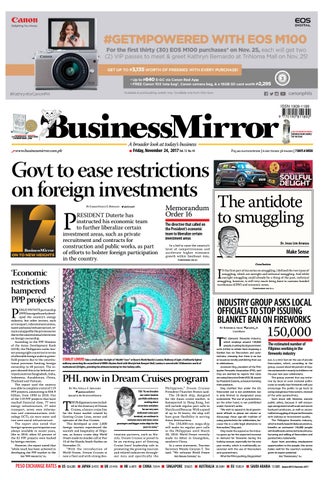
Govt to ease restrictions on foreign investments
P
By Elijah Felice E. Rosales
@alyasjah
resident Duterte has instructed his economic team to further liberalize certain investment areas, such as private recruitment and contracts for construction and public works, as part of efforts to bolster foreign participation in the country.
Memorandum Order 16
The directive that called on the President’s economic team to liberalize certain investment areas
P25.00 nationwide | 6 sections 38 pages | 7 days a week
The antidote to smuggling Dr. Jesus Lim Arranza
Make Sense
Continued on A2
Conclusion
I
n the first part of my series on smuggling, I defined the two types of smuggling, which are outright and technical smuggling. And while outright smuggling could already be a thing of the past, technical smuggling, however, is still very much being done in customs bonded warehouses (CBW) and economic zones. Continued on A11
INDUSTRY GROUP ASKS LOCAL OFFICIALS TO STOP ISSUING BLANKET BAN ON FIREWORKS
P
See “PPP projects,” A2
business news source of the year
In a bid to raise the country’s level of competitiveness and a c ce le r at e h i g he r e conom ic growth within Southeast Asia,
‘Economic restrictions hampered PPP projects’ ublic-private partnership (PPP) has significantly developed the country’s energy industry, but other sectors, such as transport, telecommunications, water and social infrastructure, remain untapped by the private sector due to the constitutional restriction on foreign ownership. According to the PPP Monitor of the Asian Development Bank (ADB), the Philippines ranks lowest among eight countries in terms of allowable foreign stake in greenfield projects due to the constitutional provision limiting foreign ownership to 40 percent. The report showed this is far behind surveyed countries Bangladesh, India, Indonesia, Kazakhstan, China, Thailand and Vietnam. The report said the country was able to complete a total of 119 PPP projects, amounting to $56.9 billion, from 1990 to 2016. Out of the 119 PPP projects that have reached financial close, 77 were energy infrastructure, 27 were transport, seven were information and communications technology (ICT), six were water and two were social infrastructure. The report also noted that foreign-sponsor participation was always available in recent years, like in 2016, when 52 percent of the 62 PPP projects were backed by foreign entities. However, the report noted that “while much has been achieved in developing the PPP market in the
2016 ejap journalism awards
By Roderick Abad
Contributor
T
Starlit lovers Take a stroll under the light of 100,000 “stars” at Resorts World Manila’s Lumina: Walkway of Light. A brilliantly lighted walkway connecting the second level of RWM’s Maxims Hotel with lifestyle hub Newport Mall, Lumina is covered with 10 kilometers worth of multicolored LED lights, providing the ultimate backdrop for that holiday selfie.
PHL now in Dream Cruises program By Ma. Stella F. Arnaldo
@akosistellaBM Special to the BusinessMirror
T
HE Philippines is now included in the itinerary of Dream Cruises, a luxury cruise line for the Asian market created by Genting Cruise Lines, owner and operator of the Star Cruises. This developed as over 2,600 foreign tourists experienced the warmth and hospitality of Filipinos, as luxury cruise ship World Dream made its maiden call at Pier 15 of the Manila South Harbor on November 21. “ Wit h t he introduction of World Dream, Dream Cruises is now a f leet and with strong des-
PESO exchange rates n US 50.6280
TEO: “As we broaden our cruise-tourism portfolio with more exciting shore excursions and plans for our very own dedicated cruise port terminal, we continue to welcome more and more cruise passengers and bigger cruise ships for the years to come.”
tination partners, such as Manila. Dream Cruises is proud to be an exciting part of Genting Cruise lines’ leadership role in promoting the growing tourism and related industries throughout Asia and specifically the
Ph i l ippi nes,” Drea m C r u i ses President Thatcher Brown said. The 18-deck ship, designed for the Asian cruise market, is homeported in Hong Kong, but will include regular port calls to Manila and Boracay. With a speed of up to 24 knots, the ship will have great flexibility in serving Asian destinations. The 150,000-ton mega-ship will make its regular port calls in the Philippines until March 28, 2018. World Dream recently made its debut in Guangzhou, southern China. In a news statement, Tourism Secretary Wanda Corazon T. Teo said: “We welcome World Dream See Dream Cruises,” A2
@rodrik_28
he domestic fireworks industry, which employs around 150,000 people, is asking local government units (LGUs) to refrain from imposing a blanket ban on firecrackers and pyrotechnics, stressing that there is no law or issuances totally prohibiting their use in celebrations. Jovenson Ong, president of the Philippine Fireworks Association (PFA), said they are alarmed by reports that LGUs are using Executive Order (EO) 28, issued by President Duterte, as basis in banning their products. Ong clarified that under the EO, firecracker use is not prohibited, but is only limited to designated areas nationwide. The use of pyrotechnics, on the other hand, is not prohibited under Duterte’s order. “We wish to appeal to local government officials to please not restrict or discourage these age-old tradition of using pyrotechnics for celebrations, because this is a safer legal alternative to firecrackers,” Ong said. Ong made the appeal as the industry gears up for the expected increase in demand for fireworks during the holiday season, especially for the new year revelry, which is traditionally associated with the use of firecrackers and pyrotechnics. What the PFA is pushing, Ong pointed
150,000 The estimated number of Filipinos working in the fireworks industry
out, is a strict ban on the use of piccolo firecrackers, which, according to the group, caused about 60 percent of injuries nationwide—mostly to children—in the past new year celebrations. The group warned that any initiative by local or even national politicians to totally ban fireworks will just encourage the public to go back to using dangerous firecrackers, instead of the safer pyrotechnics. Such move will, likewise, worsen public safety, because it will encourage unregulated small-scale and secret backyard producers, as well as uncontrolled smuggling of imported fireworks with dubious or inconsistent quality. The Philippine fireworks industry, which is mainly based in Bulacan province, benefits an estimated 150,000 people with livelihoods connected to local manufacturing and selling of firecrackers and pyrotechnics nationwide. Apart from providing employment opportunities to the people, this sector bodes well for the country’s economy, given its export potential. See “Fireworks,” A2
n japan 0.4553 n UK 67.4416 n HK 6.4819 n CHINA 7.6544 n singapore 37.6025 n australia 38.5684 n EU 59.8524 n SAUDI arabia 13.5005
Source: BSP (23 November 2017 )
A2 Friday, November 24, 2017
BMReports BusinessMirror
Govt to ease restrictions on foreign investments Continued from A1
the President has directed the National Economic and Development Authority (Neda) Board and its member-agencies to “take immediate steps to lift or ease existing restrictions on foreign participation” in certain investment areas. As the Chief Executive, Duterte chairs the Neda Board, and is assisted by the socioeconomic planning chief. Under Memorandum Order 16, the President wants to eliminate, if not relax, restrictions in private recruitment for both local and overseas employment; practice of specific professions, where the entry of foreign players will affect public benefit; contracts for the construction and repair of locally funded public works; and public services, except for public utilities, such as power transmission and distribution, water-pipeline distribution system and sewerage-pipeline system. Under Executive Order (EO) 184, Series of 2015, or the 10th Regular Foreign Investment Negative List (RFINL), private recruitment and contracts for construction
Dream Cruises. . . Continued from A1
to the Philippine shores, the largest cruise ship for the year, as we continue to position the country as one of the major cruise hubs in Asia. This milestone is another sign of the confidence and trust from cruise lines, especially Genting-Star Cruises.” She added: “As we broaden our cruise-tourism portfolio with more exciting shore excursions
PPP projects. . . Continued from A1
and public works are open to foreign investors to up to 25-percent ownership. Practices of pharmacy, radiologic and xray technology, criminology, forestry and law have no foreign equity. The presidential memorandum also mandates the Neda Board to ease foreign participation in culture, production, milling, processing and trading, except retailing, of rice and corn; retail-trade enterprises; teaching at higher education levels; and domestic market enterprises. Under the 10th RFINL, culture, production, milling, processing and trading, except retailing, of rice and corn is listed under 40-percent foreign equity, while retail-trade enterprises with paid-up capital of less than $2.5 million are not allowed for foreign investors. Domestic market enterprises with paidin capital of less than $200,000 are open to up to 40-percent foreign ownership. The same restriction applies to domestic market enterprises that make use of advanced technologies or employ at least 50 direct employees with paid-in capital of less than $100,000. “The members of the Neda Board are
hereby directed to earnestly support, in a coordinated manner, such legislative efforts as may be necessary to eliminate or rela x the aforesaid restr ictions, including pending legislation seeking to clarify the definition of public utilities,” the memorandum read. Socioeconomic Planning Secretary Ernesto M. Pernia in July said Duterte is determined to permit foreign investors to own up to 70 percent in telecommunication companies and public utilities in fulfillment of his campaign promise to attract more foreign investors to establish business in the country. Under the 10th RFINL, foreign investors are allowed to own to up to 40 percent in operation of public utilities, with respect to Article 12, Section 11 of the 1987 Constitution. The highest law of the land, however, does not define what public utilities are. On top of this, the President is asking the Neda Board to immediately advise him on restrictions on foreign ownership that may already be lifted or eased through an executive order. Once advised, Duterte intends to repeal EO 184, Series of 2015, and issue a new RFINL.
country, there remain challenges,” one of which is the constitutional restriction on foreign ownership that has apparently discouraged entry of foreign players in public utilities. “One challenge is the current limit of 40-percent foreign ownership in the PPP project company in infrastructure projects, where the operation requires a public-utility franchise. This may restrict competition and, in some ways, can inhibit Philippine infrastructure development,” the PPP Monitor said. According to the report, the country has posted modest number of shares of PPP projects that have reached financial close in transportation (23 percent), ICT (6 percent), water (5 percent) and social infrastructure (2 percent). Among the
and plans for our very own dedicated cruise-port terminal, we continue to welcome more and more cruise passengers and bigger cruise ships for the years to come.” World Dream was the second cruise ship to call on Manila this week. On November 20, the international cruise ship MS Celebrity Millennium also made a port call in Manila as part of its 14-day Asian Tour Program. According to Czarina Loyola, officer in charge of the National Capital Region, the cruise ship carried 1,800
passengers, about 700 of whom went on a day tour of either Manila, Tagaytay, Hidden Valley and Villa Escudero. The ship departed for Boracay at 6 p.m. on the same day. The DOT projects about 122,000 cruise passengers from 140 cruise calls this year, up some 70 percent, from 72,350 passengers from 72 cruise calls in 2016. In a separate news statement, Dream Cruises said World Dream provides guests with the highest levels of service and
spacious comfort that the cruise line has become known, with over 70 percent of staterooms featuring private balconies and a selection of connecting rooms catering to extended families and groups. The well-received Dream Palace “ship within a ship” concept on board World Dream offers more suites and all-inclusive options and privileges. Several new restaurant concepts, along with new entertainment options that combine both high-tech and high-touch experiences,
NORTHEAST MONSOON AFFECTING NORTHERN AND CENTRAL LUZON TAIL-END OF A COLD FRONT AFFECTING EASTERN SECTION OF SOUTHERN LUZON (As of 4:00 PM - November 23, 2017)
Fireworks. . .
Continued from A1
“The association wishes to thank President Duterte for his fairness toward our Philippinemade pyrotechnics and fireworks industry,” Ong said, while citing the need for more public and private institutions backing this sector.
www.businessmirror.com.ph surveyed countries, excluding Papua New Guinea, the Philippines ranked fourth in number of PPP projects completed in transportation and ICT, fifth in water and third in social infrastructure. The country ranked fourth in number of PPP projects that have reached financial close in the energy industry. Aside from the constitutional restriction on foreign ownership, the country has a “notorious” record on dispute resolution and enforcement mechanism. “Although the dispute-resolution mechanism is transparent, it is still considered not efficient and time-consuming, aside from costly court processes. Typically, the resolution of disputes is left to the discretion of parties, including the use of alternative dispute resolution with agreements citing international arbitration as a mechanism of choice,” the report read. Elijah Felice E. Rosales
“The PFA appeals to politicians in LGUs and the media for fairness, for support for this domestic fireworks-manufacturing industry, which provides livelihood, generates taxes, supports the Philippine economy and has huge export potentials,” he stressed. Fireworks are comprised of firecrackers and pyrotechnics, with sounds and lights as main effects, respectively.
will be announced shortly. The recognized Crystal Life Spa brand operates both the Western Spa and Asian Spa on World Dream. Complimenting World Dream’s onboard attractions are diverse itineraries featuring new, authentic destination experiences that will take guests on tropical and cultural journeys in Asia. Especially designed voyages taking in sun-drenched, popular destinations for the winter feature six-day/five-night cruises to Manila and Boracay in the Philippines, alternating with six-day/five-night journeys to Ho Chi Minh and Nha Trang in Vietnam. Early this year, World Dream’s sister ship, the SuperStar Virgo, homeported in Manila and cruised to Laoag, Kaoshiung in Taiwan, Hong Kong and back to Manila. SuperStar Virgo is also currently sailing between Shanghai, Laoag, Manila, Naha, then back to Shanghai. SuperStar Virgo will be returning again in March 2018, and will set sail between the Philippines, Japan and Taiwan. Heralded as the third-largest cruise line in the world, the Hong Kongbased Star Cruises has started offering a five-night cruise from Manila to Naha in Japan, Keelung in Taiwan and back to Manila. Another cruise offering is five nights from Manila to Ishigaki in Japan, Keelung, then back to Manila. (See, Star Cruises returns to Manila homeport in March next year, in the BusinessMirror, October 31, 2017.) The Duterte administration hopes to attract more cruise companies to include the Philippines in their Asian itineraries. Under the National Tourism Development Plan (NTDP) for 20162022, about P6.1 billion is needed to develop cruise ports in key destinations in the countr y. This includes a cruise port and terminal in Manila, the site of which is still being finalized but will most likely be at reclaimed area of the CCP complex, beside the current Senate building. The Department of Tourism, through its government corporate arm, Tourism Infrastructure and Enterprise Zone Authority, is trying to get the private sector to invest in constructing the Manila port. Under the NTDP, the Duterte administration also hopes to develop the so-called Turquoise and North Triangles as cruise destinations: These include Manila-Boracay-Puerto Princesa and Currimao/Salomague-Cagayan-Batanes. It also targets the number of cruise visitors to reach 456,164 via 402 ship calls by 2022, from a projected 117,000 visitors via 105 port calls in 2017.
www.businessmirror.com.ph
The Nation BusinessMirror
House eyes ‘coercive’ shift vs Sereno By Jovee Marie N. dela Cruz @joveemarie
T
O compel Chief Justice Maria Lourdes A. Sereno to attend hearings on the impeachment complaint against her, the House Committee on Justice is eyeing to issue a subpoena against the chief magistrate. Rep. Reynaldo V. Umali of the Second District of Oriental Mindoro, the panel chairman, said his committee is now considering to issue a subpoena against Sereno. “To subpoena the Chief Justice is our option being considered as of the moment,” Umali said. “We have the constitutional mandate to perform and she [Sereno] as a constitutional officer should honor and comply with that. Remember, that is [issuing a subpoena] our coercive power to compel her presence,” Umali added. Umali also said Sereno could possibly face contempt if the Chief Justice will snub the impeachment hearings again. “[However] the issue of constitutional crisis may arise, of course, here. But in the spirit of fairness, we want her to answer the allegations in the impeachment complaint,” the justice committee chairman said. Earlier, Speaker Pantaleon D. Alvarez allayed concerns of a possible constitutional crisis if Sereno decides to question the impeachment case against her before the High Court. Alvarez said the Constitution is clear on its mandate giving the House
exclusive jurisdiction to accept and to hear cases of impeachment. The camp of Sereno earlier said they are considering asking the Supreme Court (SC) to stop the proceedings of the House Committee on Justice on the impeachment case against her. Alvarez said he is confident that majority of the justices of the SC will uphold the letter of the Constitution which vests on Congress the power to impeach erring officials from the Executive department and the Judiciary. The complaint filed by lawyer Larry Gadon contains four grounds, including corruption, culpable violation of the Constitution, betrayal of public trust and other high crimes. The complaint also alleged 27 acts constituting the offenses charged against the Chief Justice. The committee will call on the complainant and the respondent to present their case before voting on the determination of probable cause. After the determination of probable cause, the articles of impeachment will be created and will be transmitted to the plenary for approval. The lower chamber needs 196 votes or two-thirds of all of its members before the articles be sent to the Senate that will act as an impeachment court. On Wednesday the justice committee denied the motion of Sereno asking the panel to allow her lawyers to cross-examine witnesses during the impeachment proceedings
Editor: Vittorio V. Vitug • Friday, November 24, 2017 A3
MGB exec seeks security for mine sites to deter communist ‘extortion’ By Jonathan L. Mayuga
M
@jonlmayuga
ining companies operating in remote areas with zero military presence are forced to pay revolutionary tax or risk attacks by communist-led New People’s Army (NPA) rebels in insurgent-infested hinterland areas.
Interviewed at the sidelines of the ongoing 64th Annual National Mine Safety and Environment Conference (ANMSEC) in Baguio City, Wilfredo G. Moncano, director of the Mines and Geosciences Bureau (MGB), said mining companies paying revolutionary taxes as claimed by President Duterte is “a reality.” On Tuesday President Duterte called on the mining sector to stop paying “revolutionary tax” to the communist insurgents or face closure. Duterte issued the warning in his speech during an event in Taguig City, saying mining companies should stop giving in to the demands of the Communist Party of the Philippines-New People’s Army (CPP-NPA) “in the interest of the
security of the state.” He said, without exception, all mining companies are paying taxes to the NPA, and added the rebel movement would not thrive if the companies shun paying revolutionary tax to the rebels. Duterte has recently called off peace talks with the National Democratic Front of the Philippines and threatened to declare the CPP-NPA as “terrorists,” highlighting its “extortion” activities. According to Moncano, mining companies are being asked to pay revolutionary taxes by NPA rebels. In some instances, NPA rebels burn heavy equipment of mining companies as punishment for refusing to pay revolutionary taxes. Some mining companies hire
and deploy heavily armed security guards who are sometimes backed by paramilitary forces to deter NPA attacks. “This is one of the issues raised by President Duterte. It is a reality. I was once working with a private mining company. In the remote area, tagilid ka talaga doon [you are left to fend for yourself], unless you establish your own security force. Sa bundok naman [in the hinterlands], it is either you decide whether you establish your own Cafgu [Citizens Armed Forces Geographical Unit] or hire a privatesecurity force,” he added. Moncano said companies are allowed to ask the government to provide them with security forces. “I was the MGB regional director of Region 11, and the commander in the area advised the mining companies there that if they intend to secure their areas, they are allowed to set up like military force [under] special Capcom [Capital Region Command] because it is supervised by the government. It will be a business decision. It will be very expensive because it will require them to hire people to secure their operations,” Moncano said. According to Moncano, hiring and deploying heavily armed security guards backed by military or paramilitary forces is also a common practice among mining companies
to protect its mine investment from NPA rebels. Asked whether he would consider recommending the deployment of more troops to protect mining operations in remote areas, Moncano said, “It is not really up to the MGB. It is up to the Department of National Defense to make such recommendations to the President how to secure mining companies.” Rep. Jesse C. Mangaoang of the Lone District of Kalinga, in his brief speech during the 64TH ANMSEC Minerals Industry Symposium, said as long as mining companies are giving their fair share to the government and the communities, mining operations will continue in the Philippines. He said the House of Representatives is tackling six mining-related issues, including a new fiscal regime, open-pit mining ban, the ban on mineral export and Speaker Pantaleon D. Alvarez’s proposal to require legislative franchise for the government. Sought for comment on the issue of revolutionary taxes imposed by the NPA, the official said he is unaware of any mining company having to pay revolutionary taxes to do business. Mangaoang said even politicians in Kalinga do not succumb to such pressures exerted by NPA rebels.
Economy
A4 Friday, November 24, 2017 • Editors: Vittorio V. Vitug and Max V. de Leon
BusinessMirror
Swedish trade exec: It’s still hard to do business in PHL
T
By Recto Mercene
@rectomercene
he head of a Swedish business delegation said the Philippines had remained a “complicated” nation to engage in trade with, notwithstanding its robust economic growth. This observation was aired by Oscar Stenström, state secretary to the minister for European Union (EU) affairs and trade, in an exclusive interview with the BusinessMirror on Wednesday. He is in the country for two days, accompanying “Swedish Business,” offering transportation and air traffic control and management solutions. These are only two among dozens of Sweden’s business expertise. Stenström is making the rounds of top government offices not only to market their products, but also to express concern about the way the Philippines conducts business internationally. “My discussion tomorrow [November 23] with government officials is also about the obstacles and the hurdles to trade. The Philippines is still seen as a rather complicated nation to do trade with,” he said. “The transparency index, ease of doing business, level of problems of corruptions and also the question of human rights are the concerns of Swedish Business, putting economic and political risks by being engaged in the Philippines,” Stenström said. The official noted that, while human-rights violations have existed in
previous administrations, the situation in the Philippines has “considerably worsened” in the second half of 2016, as a consequence of President Duterte’s violent war on drugs. “The second half of the year was marked by a serious deterioration in respect for the right to life, due process and the rule of law,” the EU stated in its annual report, entitled “Annual Report on Human Rights and Democracy in the World in 2016,” published on October 16. The government, however, consistently denies the existence of extrajudicial killings in the Philippines, even rejecting calls made by United Nations member-states for in-depth and impartial probes. For the EU, however, the Duterte rhetoric against individuals involved in illegal drugs contributed to the killings in the country. The Swedish trade minister said the country’s 60-40 sharing scheme with foreign business is also one of the issues Swedish businessmen are also concerned about. He said he hopes that this can be addressed when the Philippines and the European Union has finalized a free-trade agreement. “We hope that we achieve [a] free
trade agreement with the Philippines and the EU and, hopefully, that issue could be solved, for the future,” he added. Stenström said there have been two rounds of talks so far, but its realization, he noted, depends on the political developments in the Philippines. Told that the Duterte administration has a different version of what is being peddled outside of the country, Stenström disagrees, saying, “The political uncertainly on where the Philippine government is going, if you read about the Philippines in the European press, it’s the uncertainly of the political forecast [that is alarming].” He added everyone is aware that the Philippine economy is growing as a sign of confidence to the Duterte administration, but “the main risks regarding political human rights is the most sensitive.” According to the minister, he will bring up with the Department of Transportation Sweden’s offer of buses and related infrastructure “because we have many Swedish companies that are well placed in the market.” “We offer our BRT [bus-rapid transportation system], because I have seen with my own eyes the great need where I see the congestion in Manila. The ability to commute in big cities is crucial for safety and sustainability, but also for the long-term economic performance,” Stenström said. “If you’re stuck in the queue, you don’t contribute to the economy,” he added. “The Swedish government also provide credit lines for our companies [where] you can [also] access the export credit guarantees and that’s important to finance this system solutions.” He added: “You can alleviate 95 percent of the substance value of the
contract through the export credit system, you have to take a 5-percent risk yourself but you are guaranteed 95 percent, if you wish. That’s already used by many Swedish companies, already up and running [as a] kind of security.” Stenström said that when the current Swedish government took the helm in 2014, it adopted a new export strateg y: “ T hat Sweden should be more active in growth nations and countries where the growth is high.” He added they pinpointed the Philippines as one of the 26 markets where Sweden would like to be more active and to promote sustainable solutions.
The transparency index, ease of doing business, level of problems of corruption and also the question of human rights, are the concerns of Swedish Business, putting economic and political risks by being engaged in the Philippines.” —Stenström
By Jonathan L. Mayuga @jonlmayuga
M
ining companies continue to pour substantial investment to make the country’s mineral sector a much safer industry, the Philippine Mine Safety and Environment Association (PMSEA) said on Thursday. PMSEA, which is holding the 64th Annual National Mine Safety and Environment Conference (ANMSEC) in Baguio City, vowed to further intensify the campaign on responsible mining by highlighting the efforts being done to ensure safety within the industry. “The general message is in spite of the challenges of the industry, and we are not a perfect industry, we are focused and committed to not only advocate responsible mining but to practice it on the ground,” PMSEA President Louie Sarmiento said. Over the years miners have transformed themselves, investing billions for technology and worldclass designs that could help them mitigate the risks in their operations, he added. “Because of the technology, experience, and how mine sites are now being designed, companies now know how to mitigate the risks, such as landslide and flooding, in their operations. They are really spending a lot. Right now miners are very much capable of ensuring the safety of the industry,” Sarmiento said. Moving forward, he expects more miners in the country to step up their operations by tapping the right technology and improving their designs to beyond complying even with global mining standards and guidelines. “I know Filipinos can do it,” he said.
T
@ReaCuBM
T
he Department of Budget and Management (DBM) on Thursday said the government has a 50 percent chance of falling behind its full-year target deficit of 3 percent of GDP, or P482 billion for the year. For the first 10 months of the year, the government’s expenditures totaled P2.241 trillion, which expanded by 10 percent from the P2.037 trillion recorded in 2016, according to the Bureau of the Treasury (BTr) data. Budget Secretary Benjamin E. Diokno said the government had programmed a P482.1-billion deficit for this year, equivalent to 3 percent of the country’s GDP. “It could be because disbursements are lower than programmed, or actual revenues are higher than programmed, or both. With two months to go before the end of the fiscal year, we are hoping that actual deficit would be closer to target deficit,” Diokno told financial reporters. From January to October, revenues totaled P2.007 trillion, expanding by 10.2 percent from the P1.821 trillion recorded in the same period for 2016. “We may or may not fall behind the deficit target in 2017. Year-to-date, deficit is about 50 percent of [the] target deficit. It’s 50-50 because there are a lot of surprises...,” he added. For the same period, the government’s budget deficit reached P234.9 billion, which showed a growth of 9 percent from the P216 billion in 2016. According to Finance Secretary Carlos G. Dominguez III, if the budget deficit for this year falls short of the target or programmed deficit, it may turn out to be very minimal.
PMSEA highlights efforts to make mining sector a ‘safer’ industry Meanwhile, Sarmiento assured that mining firms in the Philippines had already gained the expertise of dealing with potential risks of openpit mining as a method to extract minerals in the country. This came a day after President Duterte was quoted in news reports saying he is rejecting a Mining Industry Coordinating Council (MICC) recommendation to lift Department Administrative Order 2017-10, which imposes a prospective ban on open-pit mining on gold, copper and silver and complex ores. According to Sarmiento, “selfregulation” or “self-policing” among miners is something that is already being practiced for a long time now. “The companies that are responsible, they know when to stop their operations when an incident happens. They sit down with their safety committee together with representatives from the local government unit and the community. For a responsible mining company, when you say selfregulation, even before the regulator comes in they already know what to do,” Sarmiento said. “I think a number of mining companies in the Philippines are already doing it the right way. Based on my experience, I saw that more companies are now being qualified in the government’s Presidential Mineral Industry Environmental Awards [PMIEA]. It used to be very few,” he added. Hosted by PMSEA, ANMSEC is now being held at Camp John Hay Trade and Cultural Center in Baguio City. The culminating activity in the celebration of ANMSEC is the Testimonial Dinner and Annual Awards Night where winners of this year’s PMIEA will be named. The theme for this year’s ANMSEC is “Responsible Mining... In the Hearts and Minds of Filipinos.”
Uber data breach to undergo privacy commission scrutiny
Budget dept seeks to narrow year-end actual and target deficit figure gap By Rea Cu
www.businessmirror.com.ph
Head turner
A foreign lady shopper walks past an exhibit of locally made products ranging from Palawan wood carvings, bags, shoes, to house ornaments that all highlight Filipino creativity and craftsmanship at the Greenbelt 5 in Makati City. NONIE REYES
he National Privacy Commission (NPC) on Thursday said it will undertake an assessment of the impact of the reported massive data breach of transportation network company Uber Technologies Inc. and the possible effect on local drivers and users. In a news statement, the privacy agency said it has invited Uber Philippines to a meeting next week to get a full scope of the incident and to comply with the formal breach notification mandated by the Data Privacy Act of 2012. On Wednesday night Uber Chief Executive Offer Dave Khosrowshahi released a statement owning up to a global data breach affecting 50 million Uber users with international news citing personal information such as names, e-mail addresses and phone numbers of passengers were stolen by hackers as far back as October 2016. Uber Technologies Inc. concealed the incident for more than a year, and paid off hackers $100,000 to “settle” the issue. “The NPC is concerned about the possible impact of the breach on our citizens. By virtue of its operations and processing of Filipino end-user data, Uber is considered a personal information controller and must comply with Philippine data privacy
and protection laws,” the commission said in the statement. The agency added the meeting aims to gather detailed information on the nature of the breach, the personal data of Filipinos possibly involved and the measures taken by Uber to address the breach. In the Data Privacy Act, a personal information controller refers to a person or organization who controls the collection, holding, processing or use of personal information, including a person or organization who instructs another person or organization to collect, hold, process, use, transfer or disclose personal information on his or her behalf. Under this Philippine legislation, concealment of security breaches involving sensitive personal information entails a prison term ranging from 18 months to five years and a fine of not less than P500,000. The maximum penalty will be imposed for offenses that involve the personal data of at least 100 people. The Data Privacy Act enforces a data breach notification procedure, among the provisions of which is notification to the commission within 72 hours of knowledge of, or, when there is reasonable belief by the personal information controller or processor that a personal data breach has occurred. Catherine N. Pillas
Poe doubts MRT 3 woes only reason for Chavez’s resignation By Azer Parrocha
Philippines News Agency
S
en. Grace Poe on Thursday expressed doubts that the only reason Department of Transportation (DOTr) Undersecretary Cesar B. Chavez decided to quit his post is because of his failure to address problems hounding
the Metro Rail Transit 3 (MRT 3). “I respect Usec. Cesar Chavez for tendering his resignation in the light of the MRT problems. I admire his sense of delicadeza, although I doubt that that is the only reason that prompted him to resign,” Poe said in a news statement, but did not mention what other reason she had in mind.
Poe, chairman of the Senate Committee on Public Services, said it seemed like Chavez is one of the transport officials who was “determined to fully address all the issues plaguing the MRT 3.” She also recalled that it was Chavez who was instrumental in revealing the persons involved in the MRT 3 anomalies.
The senator, however, said it was also time to evaluate the leadership of the DOTr as a whole in connection with how MRT 3 issues have been addressed. She said the issues should be “properly and expeditiously resolved” despite Chavez’s resignation. Meanwhile, she expressed hope that President Duterte would imme-
diately be able to find a replacement for Chavez. In a separate statement, Sen. Joseph Victor Ejercito said he felt “sad” about Chavez’s resignation. “That is sad because Undersecretary Cesar Chavez is one of the most passionate DOTr officials, especially on railway projects,” Ejercito said.
Agriculture/Commodities BusinessMirror
www.businessmirror.com.ph
Editor: Jennifer A. Ng • Friday, November 24, 2017
A5
NFA palay purchases down 72.64%
U
By Jasper Emmanuel Y. Arcalas @jearcalas
nmilled rice purchased by state-run National Food Authority (NFA) in the January-to-October period fell by 72.64 percent to 21,684.45 metric tons (MT), from 79,244 MT a year ago.
NFA Spokesman Rebecca Olarte said the food agency’s purchases from rice farmers recorded a steep decline as the farm-gate price of rice exceeded the P17 per kilogram (kg) being offered by the government during the period. Data obtained by the BusinessMirror showed that as of November 17, the NFA has procured a total of 501,835.50 kg bags (25,091.75 MT). The figure is only 16 percent of the food agency’s total target procurement volume of 3.069 million bags (153,482.5 MT), for this year. The NFA’s procurement target this year is 42.27 percent higher than the 107,877 MT of palay it bought last year.
Data showed the NFA stepped up its procurement activities in October, when it bought 125,050 bags of rice from farmers. However, the volume was only 36 percent of the 347,800 bags the food agency had wanted to buy in October. As of November, the NFA has already bought 67,145 bags of palay from farmers, or 13 percent of its target of 503,500 bags for the month. NFA data pegged the agency’s average daily procurement at 5,796 bags. Olarte told the BusinessMirror the NFA remains optimistic that it will be able to hit its palay-procurement target this year. “Our procurement has been
increasing on a monthly basis and we expect it to increase more as harvest peaks when farm-gate price declines further.” N FA A d m i n i st rator Ja son Laureano Y. Aquino recently directed NFA managers to integrate in their plans a restructuring of standard operating procedures on procurement so they can buy storm-damaged palay during the wet season. “While we support the buying public in times of calamities through food security, we also support the farmers by buying even storm-damaged palay, to ensure that they still get a fair return on investment even in times of calamities, especially when they can no longer sell to private traders,” Aquino said. As of the first week of November, data from the Philippine Statistics Authority showed farm-gate price of unmilled rice declined by 0.78 percent, from t he pre v iou s we e k ’s P18 . 55 per kg. Harvesting of wet-season rice crop usually kicks off in October. The NFA buys clean and dry palay at P17.00 per kg. The food agency gives an additional incentive of P0.20-0.50 per kg for delivery, P0.20 per kg for drying and P0.30 for cooperative development incentive fund for farmers’ organizations.
Govt pressed to allow farmers to export corn
T
he National Corn Competitiveness Board (NCCB) said removing the restrictions on exporting corn would give farmers enough elbow room to ensure their profitability, particularly when farm-gate prices are too low. NCCB Executive Vice Chairman Roderico R. Bioco said opening up the global market for local corn serves as “a viable option” for the sector and could insulate them from the decline in the farm-gate price of corn. “Like the sugar sector they sacrifice, say 5 percent of their production to export for the benefit of the remaining 95 percent which will be for the domestic market,” Bioco told the BusinessMirror at the sidelines of the 13th Philippine National Corn Congress which kicked off on November 22 in Pasay City. “There are times in our industry that we would need to
export a little bit as a reprieve and to stabilize local prices,” Bioco added. Allowing farmers to export corn, he said, would prevent them from shifting to other high-value crops due to profitability concerns. “Price is always a big signal to influence the planting intentions of farmers. [Exports] will really help a lot of farmers to go back to corn,” he said. “In Bukidnon for instance, because of the low prices of sugar, this will prompt a lot of sugar farmers to plant corn.” The NCCB official noted that the Philippines has a big opportunity to export corn within the Association of Southeast Asian Nations region. Bioco explained that the country could capitalize on the differences in cornplanting seasons among Southeast Asian countries. “In Indonesia t heir lean season for corn is usually the
peak har vest season in the Philippines. We can export to Indonesia at this time,” Bioco said. “Asean is something that would make our work easier because of the economic integration.” The House Committee on Agriculture and Food has recently approved a substitute bill which would amend Republic Act 8178, and convert the rice import caps into tariffs. The substitute bill included a provision which would remove the export restriction on grains, including corn. At present, the National Food Authority (NFA) Council must certify that there is a surplus in corn production before farmers could export. Under the substitute bill, the need for certification has been scrapped. The NFA would just have to craft the guidelines for exporting rice and corn. Jasper
Emmanuel Y. Arcalas
A6
Friday, November 24, 2017
The World BusinessMirror
www.businessmirror.com.ph
Singapore sees solid 2018 growth as GDP beats forecasts
S
More than 600,000 minority Muslim Rohingya refugees flee to neighboring Bangladesh. Bloomberg
US condemns Rohingya crisis as ethnic cleansing
T
he United States condemned Myanmar’s treatment of its Rohingya Muslim population as “ethnic cleansing,” a designation that Secretary of State Rex Tillerson said could lead to “possible targeted sanctions.” While Tillerson suggested any new sanctions would be narrowly focused, the US denunciation undercuts Myanmar’s international standing as it is beginning to recover from decades of economic isolation under its former military junta and could stem the flow of foreign investment into the country. “After a careful and thorough analysis of available facts, it is clear that the situation in northern Rakhine state constitutes ethnic cleansing against the Rohingya,” Tillerson said in a statement on Wednesday. He said the US would work through the United Nations and also “pursue accountability through US law, including possible targeted sanctions.” Tensions in US relations with Myanmar may provide an opening to China, which is also seeking to resolve the crisis but seldom injects human-rights concerns into its foreign-policy dealings. China, which backed Myanmar’s military junta for over two decades as the West put sanctions on the regime, is now seeking to build an economic corridor stretching from landlocked Yunnan province to the Bay of Bengal. At a joint news conference last Sunday with Myanmar leader Aung San Suu Kyi, Chinese Foreign Minister Wang Yi outlined a
three-point solution that would allow Myanmar and Bangladesh to resolve the situation. The steps included a cease-fire, repatriation of refugees and talks on a longterm solution. A s e n ior C h i ne s e ge ne r a l told Myanmar’s army chief on Wednesday that China was willing to enhance military ties with its neighbor and jointly safeguard regional stability. China would like to boost exchanges to ensure peace and stability along their common border, according to a statement on the official web site of China’s defense ministry. “In the face of a complex and changeable reg iona l secur it y situation, China is willing to maintain strategic communication between the two countries’ militaries,” Li Zuocheng, chief of the People Liberation Army’s
Joint Staff Department and a member of the Central Military Commission, told Senior General Min Aung Hlaing in Beijing. On a visit to Myanmar this month, Tillerson said events in Rakhine state had the “characteristics of crimes against humanity,” but he stopped short then of describing the situation as ethnic cleansing. T he decision to adopt the term “ethnic cleansing” as official US policy followed a recommendation made by senior State Department officials. “My bosses have said it appears to be ethnic cleansing. I’m of that view as well,” Patrick Murphy, a senior US diplomat for Southeast Asia, was reported as saying last month.
Suu Kyi
Sanctions under consideration would target individuals for specif ic acts of v iolence, a St ate De pa r t ment of f ic i a l told re p or t e r s. Bro ad - b a s e d economic sanctions aren’t being considered because the US doesn’t want to undercut the f ledgling civilian government, according to the official, who briefed reporters on condition of anonymity. Ti l lerson added he d id n’t believe broad-based economic
After a careful and thorough analysis of available facts, it is clear that the situation in northern Rakhine state constitutes ethnic cleansing against the Rohingya.” —Tillerson
sanctions against mostly Buddhist Myanmar would help resolve a crisis that has seen more than 600,000 minority Muslim Rohingya refugees f lee to neighboring Bangladesh. The current crisis was sparked in August when militants from the Arakan Rohingya Salvation Army attacked 25 police and army posts, killing a dozen security officials in Rakhine state. The military responded with what it calls “clearance operations.” Multiple reports have since accused security forces and Buddhist vigilantes of indiscriminately attacking Muslims in the state and burning their villages, with UN Secretary-General Antonio Guterres already describing the campaign as “ethnic cleansing.” Suu Kyi, a Nobel laureate and former political prisoner, has seen her reputation tarnished by the Rakhine crisis. She has come under fire for not speaking out more forcefully against the violence and for questioning repor ts t hat government security forces and Buddhist vigilantes indiscriminately attacked Rohingya and burned their villages. She initially scoffed that reports of human-rights violations were “a huge iceberg of misinformation” intended to promote the interests of terrorism. The State Department defended Suu Kyi on Wednesday, with an official telling reporters she has begun speaking out about the situation and has been working to reach a solution, which the US will continue to encourage. The military maintains control over security forces and the country’s borders, limiting the civilian government’s power, the official said. Bloomberg News
Trump group to exit its Soho hotel in New York
N
E W YORK—The announcement came on his television show, The Apprentice. Donald J. Trump would open his second luxury hotel in New York, a “work of art” in the SoHo neighborhood of Manhattan that would become “an awe-inspiring masterpiece.” That was 11 years ago. The 46-story skyscraper, it turned out, was actually an albatross for Trump—drawing local opposition soon after its unveiling, partisan protests when he became a candidate for president and political scrutiny because of its early ties to a dubious Russian dealmaker.
Now, in the latest sign of strain in the president’s family business, the Trumps want no more. The Trump Organization has reached a deal that will allow the company to exit from the property by the end of next month, the company said on Wednesday. It is the second time this year the Trump name was erased from a hotel development, after a June announcement in Toronto. Located in an upscale neighborhood in a deeply Democratic city, the SoHo hotel has struggled to attract guests at five-star prices and has dropped its rates to keep rooms occupied.
The property also includes condominiums that have been slow to sell. And when the building’s main restaurant decided to close in April, a lawyer for the restaurant attributed it to a decline in business “since the election.” Under the exit deal, the Trump Organization will sever its contract with the building’s owner, an investment firm in California that focuses primarily on real estate. As with many of their properties, the Trumps do not own the SoHo hotel, but instead manage the day-to-day operations. The Trump Organization is entitled to a cut
of the hotel’s revenue, although the contract also requires the Trumps to pay the owner, CIM Group, if the property fails to meet certain financial-performance standards. With years remaining on the contract, CIM will pay the Trumps to end the arrangement early, according to people briefed on the matter, who described the negotiations as amicable. A buyout e n a b l e s C I M to e i t h e r re b ra n d t h e property, or to buy more condo units and expand the hotel before eventually selling it. The company did not disclose the proposed price of a buyout. New York Times News Service
ingapore raised its economic growth forecast for this year and sees global growth under pinning that momentum into 2018, with some moderation. Highlights of GDP Report said the gross domestic product rose 5.2 percent from a year earlier, the fastest pace in more than three years, versus a median estimate of 5 percent. Compared to the previous quarter, GDP rose a seasonally adjusted and annualized 8.8 percent, higher than an earlier estimate of 6.3 percent. Growth forecast range for 2017 raised to 3-3.5 percent from 2 percent to 3 percent; economy is seen expanding 1.5 percent to 3.5 percent next year. A healing in global trade this year has helped boost export-reliant economies like Singapore’s, with manufacturing buoyed by demand for electronics goods. Growth has started to broaden out to other industries, such as services, giving economists and the government reason to upgrade their full-year projections. Pr ime Minister L ee Hsien Loong said earlier this week that growth could exceed 3 percent in 2017. The trade ministry said on Thursday global growth is expected to improve next year, on the back of faster expansion in the US and some emerging markets. The US economy will probably “pick up slightly” due to a resilient labor market and modest business investment, while growth in the euro-zone area and in China is set to moderate, the officials said. “ T he s y nc h ron i z ed g loba l recover y has legs,” said Chua Hak Bin, a Singapore-based senior economist with Maybank Kim Eng Research. A rebound in corporate spending in many economies, including in Southeast Asia, portends that “this investment revival will be the theme that will emerge in 2018.” Export growth is set to taper off next year, with International Enterprise Singapore saying in a separate report on Thursday that expansion will probably be zero to 2 percent in 2018, compared with an estimated 6.5 percent to 7 percent for this year.
Recovery broadening
Downside risks for next year include US policy uncertainty, lingering protectionist sentiments and tensions around North Korea, according to the ministry. At the same time, Singapore should continue to fare quite well, with domestic-focused industries and the labor market improving. “We also see signs that the recovery is broadening,” with business services and retail looking better, even though third-quarter growth was “primarily supported by manufacturing,” Loh Khum Yean, permanent secretary at the trade ministry, told reporters. Manufacturing surged almost 35 percent in the third quarter from the previous three months, while the services industry, which makes up about two-thirds of the economy, grew an annualized 3.2 percent. Construction continued to suffer, contracting for a third quarter by 5.3 percent. Economist Tamara Henderson said that, on a GDP-expenditure basis, net exports were a slightly stronger drag on growth. But this was offset by much stronger household spending. Public spending was also much stronger, and the contraction in investment was not as large. If this is sustained in fourth quarter in 2017 and first quarter in 2018, the Monetary Authority of Singapore is likely to dial back its monetary stimulus. Growth has been surprisingly strong across Southeast Asia, with third-quarter data from the Philippines and Malaysia last week and Thailand this week exceeding forecasts, providing a more upbeat tone to the region as the US Federal Reserve tightens monetary policy. Singapore’s central bank left its policy stance unchanged last month, but gave itself room to tighten if necessary. Jacqueline Loh, deput y managing director at the Monetar y Authority of Si ngapore, told repor ters on Thursday that the October stance remains appropriate and the regulator will continue to monitor developments. Bloomberg News
Clash and little progress at Nafta talks
W
ASHINGTON—United States officials have tried in recent weeks to cool tensions over the North American Free Trade Agreement (Nafta) by extending the timetable for renegotiating the pact and asking top officials to sit out the current round of talks in Mexico City. But as the fifth round of talks concluded in the Mexican capital on Tuesday, tensions were still simmering, with Canada and Mexico telling the US that it would make little headway with its current approach, and Mexico firing its first warning shot with a tough counterproposal. Rober t Lighthizer, the US trade representative, took aim at his Canadian and Mexican counterparts on Tuesday, saying “Thus far, we have seen no evidence that Canada or Mexico are willing to seriously engage on provisions that will lead to a rebalanced agreement. Absent rebalancing, we will not reach a satisfactory result.” Lighthizer said while some progress has been made to modernize the Nafta, “I remain concerned about the lack of headway. Our teams will be meeting again next month in Washington. I hope our partners will come to the table in a serious way so we can see meaningful progress before the end of the year.” In an indication of how far the talks have to go, Lighthizer will not meet again with his Canadian and Mexican counterparts until late-January in Montreal, while lower-level negotiators will continue to hash out details in Washington next month. During a week of meetings in Mexico City, negotiators hammered out more technical
details of the sweeping trade agreement, including those that govern digital trade, telecommunications, anti-corruption, customs procedures and health and safety standards for food. But the parties continued to clash on the most contentious issues, including mechanisms to resolve trade disputes and award government contracts, as well as rules of origin, which govern the amount of a good that needs to be manufactured in North America to qualify for zero tariffs under the Nafta. The US has called for raising that threshold for the automobile industry to 85 percent, up from 62.5 percent previously. And it has asked for a new requirement that half a car be manufactured solely in the US—a provision at odds with the wishes of American automakers, who fear it will drive up their costs and make them less competitive globally. Canadian and Mexican officials did not make specific counterproposals to these requests. Instead, they presented data showing the harm the proposition would inflict on the auto sector and pressed the US to explain its reasoning. That response frustrated the US. A senior US official pushed back against the idea that the US proposals were unworkable, saying the failure of Canada and Mexico to offer counterproposals had halted progress. On the topic of government procurement, Mexico answered a tough US proposal with one of its own—the first tit-for-tat exchange in the talks so far. New York Times News Service
www.businessmirror.com.ph
The World BusinessMirror
Retailers expect big sales, fewer seasonal workers for the holidays
A
fter 14 years of staying home to raise her family, Melanie Colon landed a job for the holidays at a Target store in Queens, New York, selling toys, bedsheets and linens. She hopes it will lead to a full-time position. “For me, it’s about getting back into the work force,” she said. Colon, 36, is part of an army of temporary retail workers who are hired every year to help with the holiday shopping crush. Holiday hiring gives the economy an annual jolt, raising the incomes of hundreds of thousands of families at Christmastime and offering people like Colon a chance to make some income, even if only for a few months. But, like so much about the retail industry, holiday hiring is in flux, even as stores are poised for a big shopping season. While some large retailers like Target are making a big push, others are hiring fewer temporary workers—or almost none at all. Wal-Mart, the nation’s largest retailer and private employer, for instance, has no plans for a hiring spree this holiday season. Instead, the company said it was giving “millions more” hours to its thousands of part-time employees,
many of whom rely on Wal-Mart as their only job. Across the country, retailers are expected to hire from 500,000 to 550,000 seasonal workers this holiday, down from the roughly 575,000 who were hired last year, according to the National Retail Federation. The decline reflects the forces buffeting the retail industry and the broader economy. With more sales moving to the Internet, many brick-and-mortar stores are seeing less foot traffic, which means they need fewer workers manning the aisles. Retailers are also on pace to close thousands of stores this year. “The industry is going through a transformation,” said Jack Kleinhenz, chief economist at the National Retail Federation. The sharp decline in the unemployment rate in recent years has created a tight job market. With profits under pressure, the last thing that retailers want to do is to get into a bidding war for workers by substantially raising wages. The shifts are evident at Macy’s. The retailer is synonymous with the holiday season, but there is little to cheer about on 34th Street this year. Macy’s plans to close about 100 stores, and its sales have declined for 11 consecutive quarters. This year the
company said it would hire around 80,000 seasonal workers, about 4 percent fewer than last year. Nearly a quarter of those temporary workers, about 18,000, will be working in fulfillment centers across the country, in places like Goodyear, Arizona, and Martinsburg, West Virginia. Macy’s is trying to stem the flow of sales to Amazon by pushing an “omnichannel” strategy meant to be all things to all shoppers: a helpful and engaging shopping experience in stores, an alluring web site and quick home delivery. It is a tall order that requires big investments. And, as if sensing weakness, Amazon is ratcheting up the pressure. The online retail giant is hiring 120,000 seasonal workers, many of whom pick, pack and ship boxes this Christmas. That is on top of the roughly 50,000 permanent workers it added at its fulfillment centers this fall. Conditions suggest that this will be a robust shopping season. Unemployment is low, consumer confidence is high and the stock market has been booming. As a result, holiday sales are projected to increase by as much as 4 percent from a year ago, to $682 billion, according to the National Retail Federation. New York Times News Service
Friday, November 24, 2017
A7
A8
Friday, November 24, 2017
The World BusinessMirror
Unrepentant Mladic of Bosnia gets life for genocide and other crimes
T
HE HAGUE, Netherlands—An unrepentant Ratko Mladic, the bullish Bosnian Serb general whose forces rained shells and snipers’ bullets on Sarajevo and carried out the worst massacre in Europe since World War II, was convicted on Wednesday of genocide and other crimes and sentenced to spend the rest of his life behind bars. Defiant to the last, Mladic was ejected from a courtroom at the United Nations’s Yugoslav war crimes tribunal after yelling at judges: “Everything you said is pure lies. Shame on you!” He was dispatched to a neighboring room to watch on a TV screen as Presiding Judge Alphons Or ie pronou nced h i m guilty of 10 counts that also included war crimes and crimes against humanity. Human-rights organizations hailed the convictions as proof that even top military brass long considered untouchable could not evade justice forever. Mladic spent years on the run before his arrest in 2011. “This landmark verdict marks a significant moment for international justice and sends out a powerful message around the world that impunity cannot and will not be tolerated,” said John Dalhuisen, Amnesty International’s Europe director. For prosecutors, it was a fitting end to a 23-year effort to mete out justice at the UN tribunal for atrocities committed during the Balkan wars of the early-1990s. Mladic’s conviction signaled the end of the final trial before the
100K The number of Bosnian people who died, and millions lost their homes before a peace agreement was signed in 1995
tribunal closes its doors by the end of the year. But legal battles will continue. Mladic’s attorneys vowed to appeal his convictions on 10 charges related to a string of atrocities from the beginning of the 1992-1995 Bosnian war to its bitter end. “The defense team considers this judgment to be erroneous, and there will be an appeal, and we believe that the appeal will correct the errors of the trial chamber,” Mladic lawyer Dragan Ivetic said. M l ad ic’s son , Da rko, s a id h is fat her told h im a f ter t he verd ict t hat t he t r ibu na l was a “Nato [Nor t h At lantic Treat y O rga n i z at ion] com m i ssion... t r y ing to cr im ina l i ze a lega l endeavor of Serbi a n people in
Bosnian Serb military chief Ratko Mladic waves as he enters the Yugoslav War Crimes Tribunal in The Hague, Netherlands, on Wednesday to hear the verdict in his genocide trial. He was convicted and sentenced to life imprisonment. AP/Peter Dejong
t imes of c iv i l wa r to protect itsel f f rom t he ag g ression.” Presiding Judge Alphons Orie started the hearing by reading out a litany of horrors perpetrated by forces under Mladic’s control. “Detainees were forced to rape and engage in other degrading sexual acts with one another. Many Bosnian Muslim women who were unlawfully detained were raped,” Orie said. The judge recounted the story of a mother who ventured into the streets during the deadly siege of Sarajevo with her son as Serb snipers and artillery targeted the Bosnian capital. She was shot. The bullet passed through her abdomen and struck her 7-year-old son’s head, killing him. In Srebrenica, the war reached its bloody clima x as Bosnian Serb forces overran what was supposed to be a UN-protected safe haven. After busing away women and children, Serb forces
systematically murdered some 8,000 Muslim males. “Many of these men and boys were cursed, insulted, threatened, forced to sing Serb songs and beaten while awaiting their execution,” Orie said. Mladic looked relaxed as the hearing started, greeting lawyers, crossing himself and giving a thumbs-up to photographers in court. But midway through the hearing Mladic’s lawyer, Dragan Ivetic, asked for a delay because the general was suffering from high blood pressure. The judge refused, Mladic started yelling and was tossed out of court. When he started speaking, “it was not about his health but much more I think trying to insult the judges,” Chief Prosecutor Serge Brammertz said. The conflict in the former Yugoslavia erupted after the country’s breakup in the early-1990s, with the worst crimes taking place in Bosnia. More than 100,000 people
died, and millions lost their homes before a peace agreement was signed in 1995. Mladic went into hiding for around 10 years before his arrest in Serbia in May 2011. Mladic’s political master during the war, former Bosnian Serb President Radovan Karadzic, was also convicted last year for genocide and sentenced to 40 years. He has appealed the ruling. The man widely blamed for fomenting wars across the Balkans, former Yugoslav President Slobodan Milosevic, died in his UN cell in 2006 before tribunal judges could reach verdicts in his trial. The ethnic tensions that Milosevic stoked from Belgrade simmer to this day. Top Bosnian Serb political leader Milorad Dodik said the tribunal only underscored its anti-Serb bias by convicting Mladic. Dodik said the court was established with the “single purpose” of demonizing Serbs. “This opinion is shared by all the Serbs,” Dodik added, describing Mladic as “a hero and a patriot.” Serbian President Alksandar Vucic, a former ultranationalist who supported Mladic’s war campaigns but now casts himself as a pro-EU reformer, agreed that the court has been biased against Serbs but added that “we should not justify the crimes committed” by the Serbs. “We are ready to accept our responsibility” for war crimes “while the others are not,” he said. For a former prisoner of Serbrun camps in northwestern Bosnia who was in The Hague, the verdict was sweet relief. Fikret Alic became a symbol of the horrors in Bosnia after his skeletal frame was photographed by Time magazine behind barbed wire in 1992 in a Bosnian Serb camp. “Justice has won,” he said. “And the war criminal has been convicted.” AP
Zimbabwe’s incoming leader Mnangagwa returns home
H
A R A R E, Zimbabwe— Poised to become Zimbabwe’s next president, a former confidant of ousted leader Robert Mugabe on Wednesday promised “a new, unfolding democracy” and reached out to the world, saying international help is needed to rebuild the shattered economy. Emmerson Mnangagwa, who f led Zimbabwe upon being fired from his job as v ice president on November 6, made a tr iumphant retur n to the countr y a d ay a f te r t he 93 -ye a r - old Mugabe resig ned. His departure after 37 years in power followed a week of intense pressure—from the military that staged a government takeover, from members of parliament who started impeachment proceedings and from citizens who protested in the streets. While Mnangagwa talked in his speech about democracy and “working together,” he also recited slogans from the ruling Zanu-PF party, such as “Forward with ZanuPF, down with enemies” that are unlikely to attract Zimbabweans in the opposition. He ser ved for dec ades a s Mugabe’s enforcer, a role that earned him the nickname “Crocodile.” Many opposition supporters believe he was instrumental in the army killings of thousands of people when Mugabe moved against a political rival in the 1980s. Mnangag wa was in hiding during the political drama that led to Mugabe’s resignation. His
Zimbabwe’s President-in-waiting Emmerson Mnangagwa greets supporters gathered outside the Zanu-PF party headquarters in Harare, Zimbabwe, on Wednesday. AP/Ben Curtis
appearance at the headquarters of the party electrified a crowd that waited for hours. Flanked by bodyguards, and dressed in a blue suit, he raised his fists and danced a little on a podium, delighting supporters who hope he can guide Zimbabwe out of political and economic turmoil that has exacted a heavy toll on the southern African nation of 16 million. “ Today we are witnessing the beginning of a new, unfolding democracy,” said the 75-yearold , who added t h at he h ad
a lready received messages of support from other countries. “We need the cooperation of the continent of Africa,” he said. “We need the cooperation of our friends outside the continent.” After meeting with South African President Jacob Zuma, Mnangagwa flew in a private jet from South Africa to Zimbabwe. He indicated that his inauguration as president would be on Friday. That is “when we finish this job to legally install a new president,” he said. Mnangagwa will serve Mugabe’s
remaining term until elections next year. Opposition lawmakers who have alleged vote rigging in the past say that balloting must be free and fair. T he pa r t y ’s Cent ra l Comm it tee h ad voted to remove Mugabe f rom h is pa r t y leadersh ip post a nd repl ace h im w it h M n a n g a g w a , a f o r m e r just ice a nd defense m inister w it h c lose t ies to t he m i l it a r y. Mugabe fired his longtime deputy as the former president’s wife, Grace Mugabe, positioned herself to replace him and succeed
her husband. That led the military to step into the party’s factional battle a week ago by sending tanks into the streets and putting the president under house arrest—a move that opened the door for the party and the people to turn against the leader who took power after the end of white minority rule in 1980. The resignation was met with wild celebrations across the Zimbabwean capital of Harare. People were thrilled to be rid of a leader whose early promise, including an emphasis on education, was overtaken by economic collapse, government dysfunction and human rights violations. Mnangagwa “faces high expectations but will have a short honeymoon while he starts the process of moving Zimbabwe forward,” the state-run Zimbabwe Herald newspaper said in a commentary. “He has the best wishes of most Zimbabweans, at least today,” the newspaper said. One unemployed man, who heard that Mnangagwa was arriving at an air force base on the outskirts of Harare, waited in vain at its entrance in hopes of seeing him. Godwin Nyarugwa said he was “very ecstatic” about Mugabe’s resignation and that “we need change in this country, change in everything” after years of economic crisis. But he added Mnangagwa would have to produce results. “We have to try him and see,” he said of Mnangagwa. “If he doesn’t come up with something, we need to change him as well.” AP
www.businessmirror.com.ph
Russia, Turkey, Iran propose a meeting on postwar Syria’s future
M
OSCOW—L eaders of Russia, Turkey and Iran announced an agreement on Wednesday to sponsor a conference aimed at achieving a peaceful settlement of the Syria war. T he announcement by the three leaders, who were meeting in the Russian Black Sea resort of Sochi, underscored Russia’s increasingly influential role in determining the outcome of the war, which appears to be winding down after nearly seven years. T he con fere nce t he y pro posed, also to be held in Sochi, was announced just days before a new round of peace talks was planned in Geneva, convened by a special United Nations envoy, Staffan de Mistura. It was another sign that de Mistura’s efforts, frustrated for years, have now been overshadowed by Russia’s actions. The Sochi announcement also came a few days after President V ladimir Putin of Russia held a meeting in Moscow with President Bashar Assad of Syria, an indication that Assad had agreed to the idea. Putin also called President Donald J. Trump and other regional leaders, reflecting what appeared to be a coordinated effort that highlighted Russia’s role. Putin sought to use the Sochi announcement to portray Russia as a flexible diplomatic intermediary in the Syria conflict, despite Russia’s military backing for Assad, widely regarded by opponents as a war criminal. “ The Syrian people are to decide their f uture themselves,” Putin said. “Obv iously, the refor m process w il l not be easy and w il l require compromise a nd concessions f rom a l l of its par ticipants, including the Sy r ian gover nment.” The war has displaced half the Syrian population and created a protracted humanitarian crisis, with millions of Syrian refugees in neighboring countries. Precisely who among Assad’s adversaries would be invited to the Sochi conference, and when it will be convened, have not been made clear yet. Russia, A ssad ’s c hief a l ly, helped turn the tide of the conflict in his favor with a major military intervention two years ago. Assad ’s forces have since reclaimed most of the countr y from Islamic militants and insurgents who had sought to topple him, including rebel groups backed by the United States and some of its allies. In their joint statement, the Russian, Iranian and Turkish leaders called on representatives of the Syrian opposition “that are committed to the sovereignty, independence, unity, territorial integrity and nonfractional character of the Syrian state” to take part in the Sochi conference. P ut i n, sit t i ng w it h P resident Hassan Rouhani of Iran a nd P resident R ece p Tay y ip Erdoga n of Tu rkey, sa id t he most important pur pose of the conference wou ld be to frame “the f uture str ucture” of the Sy r ian state. Their announcement coincided with a meeting of Syrian opposition factions in Saudi Arabia, who were trying to form a unified position before the Geneva talks on November 28. For many members of the Syrian opposition, peace in Syria is unattainable before Assad is held accountable for humanrights abuses, including what UN investigators have said was the use of chemical weapons by Syria’s military. There were signs on Wednesd ay t h at t he opposit ion re mained challenged in finding a common position on Assad. New York Times News Service
www.businessmirror.com.ph
Banking&Finance BusinessMirror
Editor: Jun B. Vallecera • Friday, November 24, 2017
A9
Foreign fund managers opted out in October By Bianca Cuaresma
M
@BcuaresmaBM
ore lucrative investment opportunities outside the country’s borders compelled foreign fund managers to take their portfolios elsewhere in October.
Data from the Bangko Sentral ng Pilipinas (BSP) on Thursday show foreign portfolio investments (FPI) reverting to a net outflow totaling $563.42 million in October. This was the largest such outflow of FPI, also known as “hot” or speculative money, in 11 months or since November 2016, when outbound foreign funds totaled $607.31. This developed on the heels of a surge in inbound foreign funds totaling $112.63 million on net basis in September and to another $59.87 million net inflow in October last year. FPI take to the exit at the merest hint of trouble in the host countries where they are invested. They also up and go at the promise of more lucrative returns elsewhere. Their volatile nature earn for the portfolio fund managers the hot or speculative tag that make them unpopular among policy-makers. Profit-taking dominated the mood among foreign fund managers minding the Philippines in October, according to the BSP. The more upset among them had their mood ruined further by developments surrounding the proposed tax-reform
Sector legislator crafts virtually no-cost loans for Marawi residents
A
lawmaker proposes for the Development Bank of the Philippines (DBP) and the Al-Amanah Islamic Investment Bank to undertake the rebuilding and repair of the residential and commercial buildings of Marawi City at virtually no cost to their owners. In House Bill 6700, or the Marawi City Rebuilding Act, Assistant Majority Leader Ron Salo of the Kabayan Partylist said his proposal seeks to address the unprecedented housing and business crises that arose from the destruction of homes and businesses in Marawi City. “There is precedent for the spending of government funds to rebuild private buildings destroyed during armed conflict. This happened in Zamboanga City, where P2.566 billion in funds were released to the National Housing Authority (NHA) for shelter construction and other rehabilitation efforts for the internally displaced persons affected by the Zamboanga siege in September 2013,” he said. In Zamboanga City, Salo added, P49.83 million was allocated for home materials assistance (HOMA) for 1,661 families who chose to build their homes on their own. Another P800 million was given to the Department of Public Works and Highways (DPWH) for the construction and repair of road networks, drainage systems and other infrastructure projects. “The ‘Build Back Better Zamboanga’ program covered 7,248 homes and some of the housing designs the two agencies approved include two-story buildings with eight units per building to generate 1,160 units; 1,180 one-story duplex loftable units at P175,000 per unit, and 3,241 houses on stilts,” the lawmaker said, citing the NHA. “What we propose through this bill is that the residential and commercial buildings to be built in Marawi will be at virtually zero cost to the residents and business owners in Marawi,” he said. The bill also covers repairs of houses and commercial structures not damaged during the Battle of Marawi. According to the proponent, not the government but the major private developers of residential subdivisions and commercial centers will undertake the construction. The DBP is then mandated to formulate and implement a loan and grants program to finance the building of residences, commercial buildings, integrated communities and business centers in Marawi City. The DBP, in cooperation with the district engineer, determine the amount to be loaned based on the proposed project of the borrower, provided the amount does not exceed P3 million for each borrower. He proposes there shall be no collection of interest and that the principal must be returned. Also, a management fee of 2 percent was to be collected by the DBP. “The DBP has 10 years to complete the main phase of its Marawi City rebuilding mandates in this [proposal],” the bill said. The Al-Amanah Islamic Investment Bank is tasked with formulating and implementing a Marawi City Housing Concessional Loans and Grants program that verified Marawi City residents can avail themselves of to finance the building and/or repair of their homes and small businesses. It added the Islamic bank determines the amount to be loaned based on the proposed project of the borrower, provided the amount does not exceed P2 million for each borrower. Jovee Marie N. dela Cruz
package now slowly taking form in the hall of Congress and likely passed as law in a few more weeks. Various economists have said the business community is watching with keen anticipation on how the tax-reform program is shaping up. The BSP also said the United States continue to be the destination of choice for the outbound fund f lows, its markets the happy recipients to more than three-fourths of to-
tal investments f lowing out of the countr y during the month. But still the US remain one of the top 5 investment destination by foreign fund managers opting out of the Philippines during the month, along with the United Kingdom, Norway, British Virgin Islands and Luxembourg. The five countries made up for 81 percent of total inflows for the month. Bulk of the net outflows was noted in the
f irst week s of October, based on prel im inary data. Subsequent and partial data also showed a net outf low in the opening days of November. Broken down, 89.8 percent of portfolio investments during the month were invested in listed securities, while the remaining 10.1 percent went to peso government securities. The other 0.1 percent was invested in so-called other instruments and peso time deposits.
A10 Friday, November 24, 2017 • Editor: Angel R. Calso
Opinion BusinessMirror
www.businessmirror.com.ph
editorial
PHL cryptocurrency: Is the time now?
T
he Philippines has the opportunity to be on the cutting edge of the future of money. The expertise for this is not going to be found lecturing on our university campuses. It will not be found sitting in the boardrooms of our largest corporations. It certainly will not be found in the hallowed halls of Congress or in Malacañang.
It is found as the brainchild of a young man in Parañaque, whose 300 computers are running 24/7. You can find it on Philippine social media, where hungry entrepreneurs are discussing how to take advantage of new technologies. Members of the financial market communities are trying to build their expertise and rapidly as possible. Last month Bangko Sentral ng Pilipinas (BSP) Governor Nestor A. Espenilla Jr. said the Philippines is not yet ready to come up with its own virtual currency. We should be and as quickly as possible. According to news reports, Espenilla said cryptocurrencies were “actively” discussed by finance officials and regulators during a recent meeting in Washington, D.C. The BSP released its first set of guidelines on cyber currencies earlier this year. Those guidelines first provided approval for the registration of two companies who want to engage in the operation of bitcoins. Espenilla: “We see the benefit of cryptocurrency in promoting efficient money-transfer services, for example. But we also realize that cryptocurrency can be used for such schemes like money laundering and other criminal activities.” Fair enough. That is one of the tasks of the BSP. However, the private sector—as usually happens—is ahead of the government learning curve. A private company is currently engaged in bringing to realization what it is calling the “PHLDevCoin” which may be the next step in the use of cryptocurrency. While many companies are now involved in various aspects of ‘mining’ Bitcoin and the like, others are trying to provide avenues for people to be able to spend and use these ‘cryptos’ as everyday money. But for the time being, people are buying these currencies as a speculative and profitable trading instrument. If you are one of the fortunate ones who has made a few million—literally—buying and holding Bitcoin—where can you directly spend your cryptocurrency? The United States government regulatory agencies have made it very clear you will be taxed and taxed heavily when and if your crypto profits are revealed. On March 25, 2014, the US Internal Revenue Service ruled that Bitcoin will be treated as property for tax purposes as opposed to currency. However, recognizing that fact, some companies are figuring out how to have the advantages of the inherent “secretive” world of the cryptocurrencies while being mainstream at the same time. PHLDevCoin intends to provide an investment vehicle for global investors to legally come in to the Philippines using cryptos and invest in both public and private infrastructure and other money-making projects without the limitations and disadvantages of the stock market or establishing a local company. The BSP and other government financial agencies may soon find themselves faced with the age-old dilemma. “Lead, follow or get out of the way.” While still in its infancy, cryptocurrencies are going to play an increasingly more important part of our financial future. Since 2005
BusinessMirror A broader look at today’s business
Sit up, take notice James Jimenez
spox
E
ver notice how in schools, girls are usually better represented in extracurriculars than boys are? There are typically more girl student officers, for one thing; and during events, it’s the girls who step up and keep things running smoothly. One would think that, with all this training, it’ll still be the girls running the world outside the walls of the university. But then again, they don’t. There are more men elected to government office than women; men occupy more positions of authority than women; and women are largely relegated to clerical work or, worse, used as decoration. Sit up, take notice. It’s happening right now. With the disclaimer that I am not schooled in gender studies and all that, and that I am approaching this simply as a reasonably observant person, I have a theory. The difference between academe (where girls typically outshine boys) and the real world (where men dominate) is that in
school, both boys and girls tend to be thought of simply as students, with no distinction between the sexes. This way of looking at them operates to defuse the gender-role biases most people have, even with regard to their own sex. Boys see nothing wrong with girls becoming student-council president; girls see nothing wrong with being
Founder
Jun B. Vallecera
Managing Editor Associate Editor City & Assignments Editor
Max V. de Leon Jennifer A. Ng Vittorio V. Vitug
Senior Editors
Lorenzo M. Lomibao Jr., Gerard S. Ramos Lyn B. Resurreccion, Efleda P. Campos Dennis D. Estopace
Online Editor Social Media Editor
Ruben M. Cruz Jr. Angel R. Calso
Creative Director Chief Photographer
Eduardo A. Davad Nonilon G. Reyes
Chairman of the Board & Ombudsman President VP-Finance VP Advertising Sales Advertising Sales Manager Group Circulation Manager
Judge Pedro T. Santiago (Ret.) Benjamin V. Ramos Adebelo D. Gasmin Marvin Nisperos Estigoy Aldwin Maralit Tolosa Rolando M. Manangan
BusinessMirror is published daily by the Philippine Business Daily Mirror Publishing, Inc., with offices on the 3rd floor of Dominga Building III 2113 Chino Roces Avenue corner De La Rosa Street, Makati City, Philippines. Tel. Nos. (Editorial) 817-9467; 813-0725. Fax line: 813-7025. (Advertising Sales) 893-2019; 817-1351, 817-2807. (Circulation) 893-1662; 814-0134 to 36. E-mail: news@businessmirror.com.ph.
www.businessmirror.com.ph
Printed by brown madonna Press, Inc.–San Valley Drive KM-15, South Superhighway, Parañaque, Metro Manila MEMBER OF
Ser Percival K. Peña-Reyes
T. Anthony C. Cabangon
Editor in Chief
she’s still single, isn’t she? Sad.” “She’s so intimidating, but that biological clock must be ticking so loudly now.” Far from being free to pursue their own dreams, girls—women now—suddenly have to conform to the expectations of society. There are those who embrace these expectations, of course. And that’s perfectly fine. But for some, this effectively shuts down the goal of rendering public service via elective office; and for many, it means having to settle for dreams less magnificent than the ones they had when they were younger. Sit up, take notice. It’s happening right now. Whether you agree with my conclusions or not, it is important to sit up and take notice, because this constriction of women’s freedom to dream and pursue their goals thrives in the shadows of our inattention. When we don’t acknowledge that this process exists, it is much easier to ignore; and how can you justify working to solve a problem that, for you, isn’t even is. So sit up, take notice. It’s happening right now.
Insights on financial markets and economic performance from PES 55
✝ Ambassador Antonio L. Cabangon Chua Publisher
aggressive in the pursuit of their goals. Both boys and girls are expected to excel, and nothing more; all pathways to excellence are wide open to both, and so everyone is able to give free rein to their ambition. Once they graduate and leave the confines of academe, however, the environment changes drastically. Boys are still only expected to succeed, and so continue to enjoy a great deal of freedom in charting their own course, basically the way they see fit. Girls, on the other hand, are suddenly not just themselves as they were in school—free to seize the day— but are now mothers, daughters, girlfriends; the fairer sex, inheritors of the burden of gender-role expectations and imperatives. Where in school, a girl would probably be encouraged to run for council president, a woman in the real world would be given backhanded moral support at best. “Yes, definitely run for elective office, but make sure you’re home in time to cook dinner for your husband and kids.” “Oh, she’s so upwardly mobile, but
O
EAGLE WATCH
ver the next five years, the Philippine Development Plan will aim to build a solid foundation for more inclusive growth, a high-trust and resilient society and a globally competitive knowledge economy. Posing a threat to achieving these goals, however, are domestic and international risks, such as delays in the much-awaited “Build, Build, Build” program and comprehensive tax reform, peace and security issues, American protectionist policy and Brexit. With “Growing Amidst Risk and Uncertainty” as its chosen overall theme, the Philippine Economic Society (PES) held its 55th Annual Meeting at Novotel Manila, Araneta Center, on November 8 to discuss how the Philippine economy would be able to cope with internal and external risks. One of the breakout sessions linked the overall theme with financial markets and economic performance. Bank of the Philippine Islands (BPI) sponsored the panel, and its very own Emilio S. Neri Jr. shared his economic and financial-markets outlook for 2018. Indeed, the BPI economic briefing gave some thought-provoking insights, which could be organized as follows: 1) where the Philippine economy has been, 2) where it is right now, 3) where it must go in the future, and 4) how it can get there.
Where has the Philippine economy been? The briefing began with a review of the historical relationship between the external position of the Philippines and its overall economic performance. The data suggest that balance-ofpayments performance has had a considerable impact on economic growth, employment, credit conditions and financial-market performance. In the past, there were episodes of economic slowdown and contraction that occurred because the economy was pushed beyond its capacity limits. Major
factors determining the vulnerability to a downturn were external leverage, credit boom, asset inflation and supply-side shocks. Where is the Philippine economy right now? It should be examined whether the current economic performance shows any sign of overheating based on historical trends. Compared with previous episodes, the economy appears to be in a relatively stable condition; however, risks could likely come from lofty assetmarket prices and rapid-credit growth, which the Bangko Sentral ng Pilipinas (BSP) has been monitoring closely. Much concern has also been expressed over the underperformance of the Philippine peso versus other regional currencies over the past year. Analysts note, however, that over a 15-year period, the exchange rate has fluctuated over a wide range, and recent fluctuations have not been as sharp as in 2004, when the exchange rate hit 56 pesos to a dollar. So, the peso may have been weak over the past year, but over the longer term, it appears to have merely reverted to its long-term average. In fact, the recent depreciation is modest, with a pickup in capital goods imports being the main driver. Peso depreciation could also be viewed as more beneficial than
harmful. While some think that a weaker peso might be harmful because it makes imported production inputs—and, ultimately, final goods and services—more expensive, in the current environment, a weaker peso could even imply greater consumption power for beneficiaries of overseas Filipino workers, whose cash remittances have grown to $20.781 billion by September this year, up by 3.8 percent, from the $20.025 billion that flowed into the country in the comparable nine months of 2016. This growth is still close to the BSP forecast of 4 percent for 2017; thus, consumption-spending-led growth will likely continue in the medium term. W here must the Philippine economy go? To continue its expansion, the country should focus on two critical items: “Build, Build, Build” and comprehensive tax reform. Although estimates point to current account deficits, such deficits would be driven by greater importation of capital equipment for building more infrastructures. This importation will expand the domestic capacity to produce goods and services, which could mean greater exports and competitiveness of Philippine industries. See “Eagle Watch,” A11
Opinion BusinessMirror
www.businessmirror.com.ph
The uncertain future of bitcoin futures
Friday, November 24, 2017 A11
This cane is made for seeing
By Matt Levine | Bloomberg View
T
his post originally appeared in money stuff. I want you to imagine a time, in the not-too-distant future, where the following things have happened (in this order):
Bitcoin futures have started trading on the CME Group Inc.’s futures exchange, which they are scheduled to do by next month. JPMorgan Chase & Co. has offered its institutional trading customers access to the bitcoin-futures contract through its futures brokerage, as it is contemplating doing. Everyone has decided that bitcoin is dumb and its price has collapsed, as JPMorgan CEO Jamie Dimon has said it will. I do not want to speculate on the likelihood of these events. (Well, No. 1 seems pretty much inevitable, and I would bet on No. 2 myself, but you’re on your own on No. 3). But you will concede that, they are all, at least, possible. My questions are: Will the customers who lose money on Bitcoin futures sue JPMorgan for letting them buy them? Will their legal briefs say “JPMorgan knew Bitcoin was a fraud, and in fact its CEO said so, but JPMorgan nonetheless pushed Bitcoin futures on customers?” Will there be congressional hearings? Will Dimon be called to testify? Will senators ask him why he sold bitcoins to clients after saying that people who buy bitcoins are “stupid?” Will he say: What clients are buying...is they are buying an exposure. The thing that we are selling to them is supposed to give them the risk they want. They are not coming to us to represent what our views are. They probably, the institutional clients we have, wouldn’t care what our views are, they shouldn’t care. That did not go over especially well in the Senate in 2010, when Goldman Sachs Group Inc. CEO Lloyd Blankfein actually said it about the mortgage bonds that his bank sold in the lead-up to the financial crisis. Nonetheless it was true then, and it is true now, and it will be true in my imagined future. If you are buying bitcoin futures from JPMorgan, it is because you want exposure to bitcoin. The fact that Jamie Dimon doesn’t want exposure to bitcoin may or may not be an interesting data point for you, but it is surely not dispositive. He has no inside information about bitcoin. Since Jamie Dimon announced that Bitcoin was a fraud and will collapse, its price has almost doubled. He might still be right, but even if he is, you could have had a nice profit on a tactical trade since his announcement. There is a notion, popular in some circles, that the point of an investment bank is to sell people securities that will go up: that it has a duty to its customers to carefully curate its product offerings and sell them only the stuff that it personally believes in. This is not the point of an investment bank. JPMorgan sits between people who want to
Eagle Watch. . .
continued from A10 The passage of tax reform before the end of Congress (probably before the last week of December) would be a welcome Christmas gift, as it would boost investor confidence and invite much-needed foreign funds into the system. How can the Philippine economy get to where it must go? If the immediate (myopic) concern is inflation, the textbook response is to raise interest rates via moneysupply contraction. This, however, would be a blunt instrument to use, as it could inflict more harm by hampering consumption and investment activities. The lowinterest-rate environment is still here, and inflation remains be-
buy a thing and people who want to sell the thing, and it intermediates their trades. Diversity of opinion—some people think the thing will go up, others think it will go down—is what makes a market. If JPMorgan could only trade with clients after satisfying itself that they are right, it would never do any trades. Elsewhere in bitcoin futures, a reader e-mails: Can you answer something puzzling me? Just saw the bitcoin-futures spec come out. And it is cash-settled. That is, against an index. Not physically settled. Now, isn’t this the one commodity that absolutely should be physically settled? It isn’t thousands of barrels of oil you have to move to Oklahoma. And isn’t the whole hype on blockchain that it is going to revolutionize settlements infrastructure because it is so much easier and cheaper than, oh, just for example, clearinghouses...like the one that will be handling the settlement of BTC futures? Ha, it’s true. If you buy an oilfutures contract on the CME, and you hold it when it expires, then someone hands you 1,000 barrels of oil, and you have to find a place to put them. If you buy a bitcoinfutures contract, and you hold it when it expires, nobody hands you the 5 bitcoins underlying the contract. Instead, CME computes a daily “Bitcoin Reference Rate,” “which aggregates the trade flow of major bitcoin-spot exchanges during a calculation window into the US dollar price of one Bitcoin as of 4 p.m. London time,” and if the Bitcoin Reference Rate at the expiry of your futures contract is higher than the Bitcoin Reference Rate when you opened the contract, you get paid the difference (times 5), and vice versa. In dollars. You get exposure to Bitcoin without ever actually handling Bitcoins. Of course this makes sense, because handling Bitcoins is mostly terrible. The fate of every Bitcoin exchange, I often say around here, is to have its Bitcoins stolen, so CME is quite sensibly launching a Bitcoin exchange without any Bitcoins to be stolen. Individuals and institutions who handle Bitcoins, meanwhile, have been reduced to writing their private keys on scraps of paper and putting those scraps of paper in safedeposit boxes. That is how securities markets worked, like, 50 years ago, but since then people have figured out ways to track stock certificates electronically, and have mostly gotten rid of the safe-deposit boxes. If you’re an institutional investor who wants exposure to Bitcoin, a futures contract that trades on an exchange that you already use is very helpful. A scrap of paper in a safe is hard to manage. nign. Macroeconomic conditions remain conducive for business, so the market-friendly solution is to simply let the exchange rate adjust accordingly. In conclusion, the Philippine economy could be likened to a tightrope artist who is trying to walk while winds are constantly blowing from all directions. Balance is a key theme that emerges out of all the discussions. Now more than ever, the countr y needs to prove that it can walk its talk. Ser Percival K. Peña-Reyes is a faculty member of the Ateneo de Manila University Economics Department. He thanks Mr. Emilio S. Neri Jr. (ADMU AB Economics, Batch 1989), vice president and lead economist of BPI, for valuable comments to this article.
Tito Genova Valiente
I
annotations
walk with a cane at present. I call it a vestigial organ from my evolution in a hospital confinement. My doctor said I should take care of my leg. The cane is my part of the deal.
There is something else about the cane: I can walk without it even as it gives me a certain kind of balance. The truth is I see with my cane. A n on set of c at a r ac t h a s blurred my vision, most especially in the glare of sunlight and in the dark of night. That is not a metaphor and throughout be prepared for metaphor disclaimers. My vision presently has no depth. Now, if that is the admission of a writer, it is the end of his career. Again, that is not a metaphor. When I walk on a flight of stairs, I cannot tell easily when the flight has stopped (not a metaphor). The cane, therefore, helps me track the depth of a ground. If that sounds metaphysical, it should not be taken so: the cane picks up the depth and height of the ground I am treading. You can say, the cane keeps me grounded. Now, isn’t that a lovely metaphor? One eye specialist, Dr. Abet Guballa, two years ago kept me in the dark. This was literal. He
turned off the light upon seeing I was also seated comfortably. Good he was a friend of my brother from their elementary days. He asked me to close my eyes, in double darkness. For close to an hour, we talked about the city and the school we shared, of those interestingly eccentric, intelligent and disciplinarian priests who asked us to memorize Thomas Gray’s Elegy Written in a Country Churchyard and many other memories. At the end of the session, the good doctor assured me I still could read. I just have to look for the light (not a metaphor.) He meant my eyesight would depend heavily on the kind of lighting around me. I should be sensitive about the combination of fluorescent and bulbs emitting warm yellow light. He also informed me that my cataract could have been there since I was a young child, That medical pronouncement, for some reason, was flattering I felt, for the first time, an affinity with this cataract. The feeling was akin
to finding out one’s high IQ. All at once, there was no nature to be blamed but just this organic pedigree—a cataract that had always been there. Walking with a cane has also opened new vistas for me. A universe of multitudinous personalities has been revealed by my cane. There is no need to wave it above my head for the sea to part. I walked into a room, a fast food, or a hotel lobby and people reveal themselves to me and my cane. A gallery of individuals, ranging from the sublimely considerate and reverent to those scintillating in their savagery, exhibits itself for rumination. Some are ready to help, to open the doors for you; some do not hide their contempt about you delaying their entrance to or exit from the hall. Many stare at the cane for a long time I feel it is my duty to explain to them its material. In the airport, a toddler was
attracted to the Prussian blue color of the cane. Before I could offer the cane to him, the mother grabbed the boy away from it. I wanted to tell the mother my cane was antiseptic. I wanted to tell her my cane was more expensive than her fake Coach handbag. But when you walk with a cane, kindness becomes your high-end brand. I, therefore, smiled at the young mother and, to paraphrase Thomas, flashed the unfrozen genial current of my soul. This week I finally mustered enough courage to see Dr. Glenn Abundo, the same doctor who operated on my mother many years ago. He has scheduled the surgery. He assures me of a “sharp” vision. When that time comes I may have no need for a cane. Will I miss my cane? More than missing the blues of my cane, I am anxious seeing the new light. That, trust me, is no metaphor.
Laugh wins for Caritas Manila scholars Rev. Fr. Antonio Cecilio T. Pascual
C
SERVANT LEADER
aritas Manila, the social services ministry of the Archdiocese of Manila, invites the public to watch the upcoming “Laugh wins” with the funny-man of many faces Mr. Jon Santos. The performance will be at the Ceremonial Hall, Marriott Grand Ballroom, Resorts World Manila, at three in the afternoon on December 2, with special guests, seasoned comic singer-actress Mitch Valdes and IsprikitikImprov. The show promises an unforgettable 100 to 120 minutes of
music and laughter that will make problems and worries vanish if only for a while. Laugh wins is for the benefit of Caritas Manila’s Youth Servant Leadership Program (YSLEP) scholars and Saint John Paul II Home For Priests Foundation Inc. Laughter is the best medicine.
The antidote to smuggling Dr. Jesus Lim Arranza Continued from A1
H
ow is smuggling done in CBWs then? As defined, a bonded warehouse is a building or other secured area in which dutiable goods maybe stored, manipulated or undergo manufacturing operations without payment of duty. It may be managed by the state or by private enterprise, of which, in the latter case, a customs bond must be posted with the government.
As such, smuggling in CBWs is being done by some manufacturers through its manipulation of the formula of manufacture. Manfacturers and some government officials connive to overstate or increase the manufacturer’s wastage factor so that a large portion of what are supposed to be wastages, would eventually find its way into the local market and sold practically untaxed, depriving the government of its muchneeded revenues, and at the same time adversely affecting the local
manufacturing industry.
Tin-can smuggling
A classic e x a mple of t h i s scheme was the “modus” used by a manufacturer of tin cans for reexport, which we uncovered after getting suspicious of the declared wastage in its formula of manufacture. The company declared a 30 percent wastage when average industry wastage was only about 3 percent. Hence, the tincan manufacturer would only be accountable to reexport finished
As the Christmas season is fastapproaching, share your laughter and happiness in many different ways. Let us all be entertained as we help our scholars. Let your joy and entertainment be instruments of God to support the education of our less-fortunate brothers and sisters. YSLEP is one of the Church’s responses to poverty reduction. It is the f lagship program of Caritas Manila, which extends financial assistance to poor but deserving youth, trains and hones them not only for academic excellence, but also to become servant leaders and good members of the community. To date, Caritas Manila has produced over 10,000 graduates and continues to provide educational a ssist a nce, va lues-for m at ion workshops and leadership train-
tin cans that would be equivalent to 70 percent of its total duty-free importation of tin plates. The remaining 27 percent of its bloated wastage factor were being sold as finished tin cans locally, even if the duties and taxes of its tinplate importations were not paid. To curb this smuggling scheme, CBW operators and manufacturers importing through the warehousing entry should be required to submit to the Bureau of Customs (BOC) and the Department of Trade and Industry (DTI) their quarterly performance report, including the list of machinery that they have and their corresponding rated production capacity. A periodic audit by BOC on the CBW should also be conducted. And most important, the process of certifying the formula of manufacture by concerned government agencies must be revisited. An actual process should be undertaken to determine the wastage factor in the presence of representatives from both the government and private sectors.
‘Ukay-ukay’ smuggling at economic zones
A nother c l a ssic- smug gl i ng scheme at economic zones that we uncovered, was our discovery
ings to almost 5,000 students nationwide, with an average of 300 college and technical/vocational graduates yearly. Caritas Manila is the Archdiocese of Manila’s lead social services and development ministry. Apart from YSLEP, Caritas Manila runs diverse projects that help the poor fulfill their human potential, such as Restorative Justice Ministry, Caritas Damayan and Segunda Mana. You can avail yourself of tickets through Caritas Manila at Jesus Street Pandacan, or dial 562-0020 to 25.
To learn more about and to donate and support Caritas Manila’s programs for the poor, visit www.caritasmanila.org.ph or call DonorCare lines (+632) 563-9311, 564-0205, (+63) 999-7943455, (+63) 9054285001, and (+63)929-8343857
of the smuggling activities of a manufacturer of industrial rugs for reexport at the Subic Freeport Zone. In particular, this Subic locator underdeclared the volume of one of its importations of used clothing at only 10 metric tons (MT), when its actual volume was 20 MT. The imported used clothing would be used in the production of industrial rugs. The underdeclaration made the Subic locator only accountable to reexport finished industrial rugs that would be equivalent to 10 MT of its 20-MT importation of used clothing. The other 10 MTcould eventually get into the local “ukay-ukay” market and sold to consumers, circumventing the law against the importation of used clothing and putting the health of countless Filipinos at risk. Fighting smuggling is a tedious and continuous process. And as we continuously figure out measures to prevent smuggling, smugglers for their part, are also continuously developing new schemes to circumvent the country’s anti-smuggling laws. Government law enforcers and the private sector should, therefore, be vigilant and always be on the lookout for these types of illegal activities.
ING, FINEX cap successful search
for the country’s most outstanding CFO
A
fter a nearly half-a-year search, Dutch financial giant ING Bank and the Financial Executives Institute of the Philippines (FINEX) bestowed the coveted title “11th ING FINEX CFO of the Year” to Jose Teodoro K. Limcaoco, chief finance officer (CFO), Finance Group Head, Chief Risk Officer and Chief Sustainability Officer of Ayala Corporation (AC).
The CFO of the Year awardee with colleagues in the Ayala Group
The 11th ING FINEX CFO of the Year award went to Jose Teodoro K. Limcaoco of Ayala Corporation.
As CFO, Mr. Limcaoco safeguards over P900 billion worth of assets of the country’s oldest, as well as one of the largest, conglomerates that has diverse interests in real estate, financial ser vices, telecommunications, water infrastructure, electronics manufacturing, power generation, transport, automotive, healthcare, and education. Prior to joining AC as managing director in 1998, Mr. Limcaoco held various posts within the Ayala Group, including being president of BPI Family Savings Bank, the investment banking arm BPI Capital Corporation, and online shopping site myAyala.com. He also served as president of the Chamber of Thrift Banks from 2013 to 2015. In his acceptance speech, Mr. Limcaoco said: “The role of a CFO is constantly changing, for finance is the lifeblood and tangible measure of corporate success. As corporations and businesses evolve to be more responsible to all their stakeholders, so too will the responsibility of a CFO evolve to address and ensure the long-term sustainability of his or her business. This is the challenge we all face and must prepare our successors to address.” He also advised aspiring CFOs to focus on character building than honing their technical skills. “The reality is this: The success of good governance is not because of rules but because of character. We need to spend more time with our potential successors and with our young professionals to let them realize that character is more important than technical skills,” he added. For his part, Hans B. Sicat, country manager of ING Bank, N.V., Manila Branch which has been sponsoring the search with FINEX since 2007, said: “We need CFOs who go beyond their traditional role as number cruncher, who are not afraid of market volatility and take a long-term view of their organization and the economy. We need CFOs who demonstrate ethical leadership and business integrity. We need CFOs who care enough about the next generation. And we are glad we have found these admirable traits in our 11th CFO of the Year awardee.” For winning the title, Mr. Limcaoco received a glass trophy made by renowned glass sculptor Ramon
Orlina. The award ceremony held last November 20 at the New World Hotel was attended by AC chairman and CEO Jaime Augusto Zobel de Ayala, president and chief operating officer Fernando Zobel de Ayala, and the heads of the Ayala subsidiaries. Bangko Sentral ng Pilipinas (BSP) Governor Nestor Espenilla Jr., who was guest of honor, paid tribute to the CFOs’ evolving roles and the need for agility, particularly in these more volatile, global and interconnected world. “As CFOs and industries thrive in the changing business environment, the BSP faces the same challenges. Hence, we have implemented strategic policy reforms to protect the financial system and provide a conducive and more agile macroeconomic environment,” he said. Mr. Limcaoco now joins the league of past CFO awardees: Delfin Gonzalez Jr., who was CFO of Globe Telecom when he became the first-ever CFO of the Year awardee, and now Chairman and President of AC Infrastructure Holdings Corp., a subsidiary of conglomerate Ayala Corporation; Sherisa Nuesa, who was CFO of Manila Water Corporation when she won in 2018 and is now President and Director of ALFM Mutual Funds, the country’s biggest mutual funds group; Jose Sio, who was CFO of SM Investments Corporation when he won in 2019 and now chairman of the company; Jaime Ysmael, who won as CFO of Ayala Land, Inc. in 2011 and is now president and CEO of property developer Ortigas & Co.; Jeffrey Lim, who was CFO of SM Prime Holdings, Inc. when he was recognized in 2012 and now president of the company; and Felipe Yalong, who was CFO when he won in 2013 and is now concurrently Executive Vice President of GMA Network, Inc. Comprising this year’s panel of judges were Edmundo Soriano, executive vice-president of BDO Unibank, who served as chairman; Atty. Teresita Herbosa, chairperson of the Securities and Exchange Commission; Rodolfo Ang, dean of the Ateneo Graduate School of Business; Ramon Monzon, president and CEO of the Philippine Stock Exchange; and Consuelo D. Garcia, former country manager and managing director of ING
Hans Sicat, country manager of ING Bank in Manila, pays tribute to the 10 past CFO awardees of the Search.
The CFO of the Year awardee with his wife, Helen Castro Limcaoco, The Little Gym’s master franchisee for the Philippines
(L-R) Hans Sicat, country manager of ING Bank in Manila; Dick Du-Baladad, president of FINEX; Jaime Augusto Zobel de Ayala, chairman and CEO of Ayala Corp.; Bangko Sentral ng Pilipinas Governor Nestor Espenilla Jr.; CFO of the Year Jose Teodoro K. Limcaoco of Ayala Corporation; Fernando Zobel de Ayala, president of Ayala Corp.; Edmundo Soriano, chairman of the 2017 Board of Judges; Consuelo Garcia, former managing director and country manager of ING Bank in Manila; Paul Sanpedro, liaison director of FINEX and president of Sterling Bank; and Judith Lopez, chairperson of the 2017 Awards Committee and independent director of Philippine Veterans Bank
Consuelo Garcia, former managing director and country manager of ING Bank in Manila, in a huddle with Jaime Augusto Zobel de Ayala, chairman and CEO of Ayala Corp.
Bank Manila Branch. The annual search is open to companies operating in the Philippines and registered under Philippine laws. The nomination period usually starts in June and end in
August, leading up to the award ceremony in November. For more inquiries, go to the Search website, www.ingfinexcfooftheyear. com, or call the FINEX Secretariat at: (632) 811-4189 and 811-4052.
(L-R) Paul Sanpedro, liaison director of FINEX and president of Sterling Bank; Consuelo Garcia, former managing director and country manager of ING Bank in Manila; Bangko Sentral ng Pilipinas Governor Nestor Espenilla Jr.; CFO of the Year Jose Teodoro K. Limcaoco of Ayala Corporation; Edmundo Soriano, chairman of the 2017 Board of Judges; Dick Du-Baladad, president of FINEX; Hans Sicat, country manager of ING Bank in Manila; and Judith Lopez, chairperson of the 2017 Awards Committee and independent director of Philippine Veterans Bank