BusinessMirror IS THE PARTY OVER? DEPARTMENT OF SCIENCE & TECHNOLOGY
PHILIPPINE STATISTICS AUTHORITY
2018 BANTOG DATA MEDIA AWARDS CHAMPION
A broader look at today’s business
www.businessmirror.com.ph
n
Sunday, November 11, 2018 Vol. 14 No. 31
2018 EJAP JOURNALISM AWARDS
BUSINESS NEWS SOURCE OF THE YEAR
P25.00 nationwide | 2 sections 18 pages | 7 DAYS A WEEK
Brexit still keeps Brits at home, away from the Philippines
U
By Ma. Stella F. Arnaldo | Special to the BusinessMirror
NCERTAINTIES over “Brexit” are still keeping British citizens from traveling overseas, especially to the Philippines.
This was the assessment of Marie Venus Q. Tan, chief operating officer of the Tourism Promotions Board (TPB), the marketing arm of the Department of Tourism (DOT). In an interview via Viber, the veteran tourism official told the BusinessMirror: “Brexit remains a sword dangling on [the UK citizens’ heads]. Travels are curtailed momentarily until a more reassuring, stable policy is brought about by their government.” Tan attended the three-day World Travel Market (WTM) in London, the big-
gest travel and tourism exhibition in Europe, which opened on November 5. Arrivals from the UK grew by some 9.2 percent to 148,301 from January to September 2018, accounting for a 2.8-percent market share of the 5.36 million foreign tourists that visited the Philippines. This was virtually unchanged from the 2.7-percent market share in the same nine-month period in 2017. The UK is ranked eighth in the Philippines’s top source markets for tourists. Continued on A2
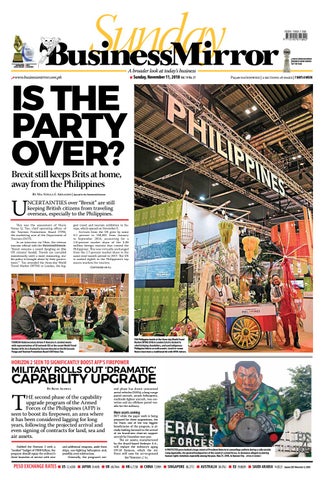
THE Philippine booth at the three-day World Travel Market (WTM) 2018 in London ExCel is decked in colorful kiping chandeliers, and used indigenous Philippine fabrics as wall accents. Local ice-cream flavors have been a traditional hit with WTM visitors.
TOURISM Undersecretary Arturo P. Boncato Jr. (center) meets with representatives of US network CBS at the recent World Travel Market 2018. He is flanked by Tourism Attaché to the UK Gerardo Panga and Tourism Promotions Board COO Venus Tan.
HORIZON 2 SEEN TO SIGNIFICANTLY BOOST AFP’S FIREPOWER
MILITARY ROLLS OUT ‘DRAMATIC’
CAPABILITY UPGRADE
T
By Rene Acosta
HE second phase of the capability upgrade program of the Armed Forces of the Philippines (AFP) is seen to boost its firepower, an area where it has been considered lagging for long years, following the projected arrival and even signing of contracts for land, sea and air assets.
Dubbed the Horizon 2 with a “modest” budget of P300 billion, the program should equip the military’s three branches of service with new
and additional weapons, aside from ships, war-fighting helicopters and, possibly, even submarines. Generally, the program’s sec-
PESO EXCHANGE RATES n US 52.6350
ond phase has drawn unmanned aerial vehicles (UAVs), a long-range patrol aircraft, attack helicopters, multirole fighter aircraft, two corvettes and six offshore patrol vessels for the military.
More assets coming
BUT while the paper work is being prepared for these acquisitions, the Air Force, one of the two biggest beneficiaries of the program, is already looking forward to the arrival of six brand-new close-air support aircraft by December next year. The air assets, manufactured by the Brazil-based Embraer S.A., will replace the military’s aging OV-10 Broncos, which the Air Force still uses for air-to-ground See “Horizon 2,” A2
A PROTESTER peers behind a huge cutout of President Duterte in camouflage uniform during a rally outside Camp Aguinaldo, the general headquarters of the country's armed forces, to denounce alleged escalating human-rights violations especially among the poor, May 21, 2018, in Quezon City. AP/BULLIT MARQUEZ
n JAPAN O.4618 n UK 68.7466 n HK 6.7258 n CHINA 7.5909 n SINGAPORE 38.2772 n AUSTRALIA 38.1762 n EU 59.8039 n SAUDI ARABIA 14.0323
Source: BSP (November 9, 2018 )
NewsSunday BusinessMirror
A2 Sunday, November 11, 2018
www.businessmirror.com.ph
IS THE PARTY OVER? Continued from A1
The UK is set to leave the European Union in March 2019, but the terms of its departure have yet to be hammered out between officials of both groups. The Cabinet of UK Prime Minister Theresa May has promised an agreement by the end of November, even as the pound sterling was recording two-week highs against the euro recently on rumors of a secret Brexit deal.
Scenario
ACCORDING to Euromonitor International “a ‘no-deal’ Brexit scenario next March would lead to a fall in outbound demand in 2019 and cause a ripple effect across many destinations, dependent on UK demand.” The research paper was presented on the first day of the WTM. “With the UK economy in a state of flux and a decline in the value of sterling,” said Caroline Bremner, head of Travel at Euromonitor, “departures would stagnate over 2018-2020.” But Tan said the upside is that niche market travel among the UK citizens and Europeans remains strong. “Niche travel remains bullish,” she stressed, with focus on diving, surfing and cultural travel. As such, the destinations being strongly promoted at the WTM include “Siquijor, Bohol, the Cordilleras remain high on the list for experiential and cultural travel. Niche for diving in Dumaguete, Cebu and Palawan, as well as surfing in La Union and Siargao.”
Tan said there is “no heavy push” for Boracay just as yet, considering the remaining rehabilitation works that need to be done by the government. But, “Europeans are more sympathetic to our cause to balance business and the protection of our natural endowments. This touches their hearts!”
Fiesta atmosphere
THE TPB chief said the Philippines at the WTM is carrying a “refreshed ‘It’s More Fun in the Philippines’ message. Our booth is decked in a fiesta atmosphere complemented by huge destination photos and screens. There is live cultural dancing at scheduled performances, while Philippine ice cream and local food are being served.” She added that “sustainability and responsible tourism is the framework of our plans and marketing programs, underpinned by experiential and guests’ satisfaction. Next year, we will push on high-spending, long-staying and optimal experiences as strategies to attract more tourists to come to the Philippines.” The government tourism agencies are currently working with travels search engines like Expedia, Travel Zoo and EDreams “to drive interest in the Philippines. There are joint promotions as well with Qatar Airlines, Singapore Airlines and Cathay Pacific,” said Tan.
Low turnout
THERE were only 17 Philippine
sellers that participated in this year’s WTM, probably the smallest number in recent history, according to TPB sources. Originally, there were 34 companies that expressed interest in joining the Philippine delegation to the WTM, but many dropped out due to conflicting schedules and other trade events. Four regional governments that had also wanted to participate could no longer do so due budgetary constraints, the same sources said. Among the private-sector participants were Ansset Holidays Inc., Crimson Hotels and Resorts, Bohol Beach Club, Intas Destination Management Inc., Discovery Shores Boracay, Baron Travel Corp., El Nido Resorts and Rajah Tours Philippines. The Philippine booth this year was inspired by colorful kiping chandeliers of the Pahiyas festival in Lucban, with intricate designs of Philippine traditional fabrics. One of the visitors to the booth included CNN International’s Richard Quest, host of the network’s Business Traveler, and CBS Network representatives. The latter produces The Royal Tour, a travel show that features heads of state, acting as personal tour guides to their countries. With some 5,000 booths representing countries across the globe, private tour operators and travel companies, the WTM attracts over 51,000 visitors annually.
FOREIGN buyers inquire about visiting the Philippines.
Horizon 2 Continued from A1
bombing and other missions. A squadron of FA-50 from South Korea is also set to get their individual air-to-air missiles by July 2019 from Deihl Raytheon of Germany. The aborted deal that would have seen the delivery of 16 combat utility helicopters from Bell Canada under the first phase of the capability upgrade program has also been moved to Horizon 2, where the Department of National Defense (DND) is already out on a market. DND Spokesman Arsenio Andolong said the agency is looking at some countries, including South Korea, the United States, Russia, Italy and Turkey, where the helicopters could be sourced. Andolong said the DND is also studying whether it should revert the procurement of submarines, with Russia originally eyed as the supplier, to Horizon 3, under which it was originally drawn, although the plan sticks for now that it remains under Horizon 2.
Initial procurement stage
BASED on documents obtained by the BusinessMirror, several projects under Horizon 2 have already been budgeted and are already in the initial stage of acquisition.
These are the 24 units or two squadrons of attack helicopters, 16 units of combat utility helicopters, six sets of alternative mission equipment for FA-50, one unit of command and control fixed-wing aircraft, a unit of C-295 helicopter, UAVs with support system and ILS and upgrades for the Army’s light armor system and the Navy’s multipurpose attack craft MK III combat system. The project also included jammers and anti-drone system for the Presidential Security Group, the unit tasked to secure the Commander in Chief.
Awaiting delivery
COMBINING the procurements under the Horizon 1 and 2, the military is still waiting for the deliveries of several other projects the contracts for which have already been awarded to defense contractors. Some of these projects include Indian-made force protection equipment, US-manufactured 60mm mortars and sniper rifles, 9mm pistols and the upgrade for the M-113 armored personnel carriers by Israeli Elbit, all for the Army. For the Air Force, it included air surveillance radars by Elta Systems of Israel; full-motion flight simulators by the US-based Environmental Tectonics, Search and Rescue; base hangars, long- range
DEFENSE Secretary Voltaire Gazmin pours champagne on a Bell412EP, one of eight brand-new helicopters that were procured by the Philippine Air Force from Bell Helicopter Textron of Canada, as part of its modernization program during a ceremony on August 17, 2015, at Villamor Air Base in Pasay City. At right is Philippine Air Force Commanding Gen. Lt. Gen. Jeffrey Delgado. AP/BULLIT MARQUEZ
patrol aircraft basing and radar basing support system. Likewise, the Air Force, which was originally described by former Defense Secretary Voltaire Gazmin as an “all air with no force” before he moved for its modernization, is awaiting the delivery of air-to-surface missiles from Raytheon USA and 20mm ammunition. Gazmin has been described as the “Granddaddy” of Philippine military modernization.
Sea territory monitoring
FOR the Navy, it is waiting for the completion of its Coast Watch System project that would give the military the capability to monitor Philippine territory. It is awaiting as well the deliveries of the Marine forces imagery and targeting support system by the UK and US joint venture Triton Communication System; and the two anti-submarine helicopters by UK-based Leonardo Helicopter Ltd. It is also looking forward to its C4ISTAR equipment from the US and the delivery of eight amphibious assault vehicles from South Korea’s Hanwha Techwin. Hanwha was the same company whose controversial combat management systems would be installed with the two frigates ordered from Hyundai Heavy Industries, also a Korean firm.
www.businessmirror.com.ph | Editor: Angel R. Calso
The World BusinessMirror
Sunday, November 11, 2018
A3
Letter shows a fearful Einstein long before Nazis’ rise
J
ERUSALEM—More than a decade before the Nazis seized power in Germany, Albert Einstein was on the run and already fearful for his country’s future, according to a newly revealed handwritten letter. His longtime friend and fellow Jew, German Foreign Minister Walther Rathenau, had just been assassinated by right-wing extremists and police had warned the noted physicist that his life could be in danger too. So Einstein fled Berlin and went into hiding in northern Germany. It was during this hiatus that he penned a handwritten letter to his beloved younger sister, Maja, warning of the dangers of growing nationalism and anti-Semitism years before the Nazis ultimately rose to power, forcing Einstein to flee his native Germany for good. “Out here, nobody knows where I am, and I’m believed to be missing,” he wrote in August 1922. “Here are brewing economically and politically dark times, so I’m happy to be able to get away from everything.”
The previously unknown letter, brought forward by an anonymous collector, is set to go on auction next week in Jerusalem with an opening asking price of $12,000. As the most influential scientist of the 20th century, Einstein’s life and writings have been thoroughly researched. The Hebrew University in Jerusalem, of which Einstein was a founder, houses the world’s largest collection of Einstein material. Together with the California Institute of Technology it runs the Einstein Papers Project. Individual auctions of his personal letters have brought in substantial sums in recent years. The 1922 letter shows he was concerned about Germany’s future a full year before the Nazis even attempted their first coup—the failed Munich Beer Hall Putsch to seize power in Bavaria.
THIS undated photo released by the Kedem Auction House shows a copy of a 1922 letter Albert Einstein wrote to his beloved younger sister, Maja. The previously unknown letter, brought forward by an anonymous collector, is set to go on auction next week in Jerusalem with an opening asking price of $12,000. In the handwritten letter, Einstein expressed fears of antiSemitism long before Nazis’ rise. KEDEM AUCTION HOUSE VIA AP
“ T h is let ter revea l s to u s the thoughts that were r unning through Einstein’s mind and heart at a very preliminary stage of Nazi terror,” said Meron Eren, coowner of the Kedem Auction House in Jerusalem, which obtained the letter and offered The Associated Press a glimpse before the public sale. “The relationship between Albert and Maja was very special and close, which adds another dimension to Einstein the man and greater authenticity to his writings.” The letter, which bears no return address, is presumed to have been written while he was staying in the port city of Kiel before embarking on a lengthy speaking tour across Asia. “I’m doing pretty well, despite all the anti-Semites among the German colleagues. I’m very reclusive here, without noise and without unpleasant feelings, and am earning my money mainly independent of the state, so that I’m really a free man,” he wrote. “You see, I am about to become some kind of itinerant preacher. That is, firstly, pleasant and, secondly, necessary.” Addressing his sister’s concerns, Einstein writes: “Don’t worry about me, I myself don’t worry
either, even if it’s not quite kosher, people are very upset. In Italy, it seems to be at least as bad.” Later in 1922, Einstein was awarded the Nobel Prize in physics. Ze’ev Rosenkrantz, the assistant director of the Einstein Papers Project at Caltech, said the letter wasn’t the first time Einstein warned about German anti-Semitism, but it captured his state of mind at this important junction after Rathenau’s killing and the “internal exile” he imposed on himself shortly after it. “Einstein’s initia l reaction was one of panic and a desire to leave Germany for good. Within a week, he had changed his mind,” he said. “The letter reveals a mindset rather typical of Einstein in which he claims to be imper vious to external pressures. One reason may be to assuage his sister’s concerns. Another is that he didn’t like to admit that he was stressed about external factors.” W he n t he Na z i s c a me t o power and began enacting legislation against Jews, they also aimed to purge Jewish scientists. The Nazis dismissed Einstein’s groundbreak ing work, including his Law of Relativity, as “Jewish Physics.” AP
A4
Sunday, November 11, 2018
The World BusinessMirror
The Internet is splitting in two amid US dispute with China
W
ESTERN bigwigs were a no-show at China’s biggest web conference. But in their absence, the local overseers of the nation’s technology industry were only too happy to plug their unique vision for the global Internet. Unlike 2017, when Tim Cook and Sundar Pichai graced the World Internet Conference in Wuzhen, this year’s gathering was a decidedly domestic affair, presided over by the likes of Tencent Holdings Ltd. Chairman Ma Huateng. Given the floor, they again pushed the concept of a rigidly policed medium that— nonetheless—is a wel lspr ing of innovation to revolutionize businesses and modernize the Chinese economy. T hat first part f lies in the face of the familiar US-led model, yet has produced two of the world ’s 10 most valuable companies: A libaba Group Holding Ltd. and Tencent. T hat rapid ascendanc y prompted for mer Google honcho Eric Schmidt to declare the Internet w ill split dow n the midd le w ithin the next decade, as authoritarian governments adopt China’s allencompassing controls. On one side is a cyberspace arena that espouses open communication, while the other is a
walled-off, thoroughly scrubbed world where many are eager to sign away their data in exchange for ser vices. At China’s most important tech industry confab this week, Ma and a clutch of government officials stressed it’s the country’s destiny to become an Internet power, and called for more balanced governance of cyberspace. China’s regulators have trumpeted its concept of “cyber-sovereignty” since the inaugural conference in 2014. But the dichotomy between the American and Chinese tech industries has never attracted as much scrutiny as today, when the world ’s two richest countries are butting heads in a conf lict that may shape a new world order. As US icons like Google and Facebook come under fire for privacy violations and enabling hate speech, their Chinese counterparts are touting theirs as the superior model: one geared toward the interests of the state. “The Chinese economy is a vast
ocean. Storms cannot disrupt it,” Ma, who is also known as Pony, told delegates. “This ocean holds massive market potential and also great room for innovation. I believe, this isn’t just a development opportunity for the Internet industry, but for all sectors. It’s not just an opportunity for China, but for the entire world.” Remarks from Chinese President Xi Jinping read out at the start of the conference called for “mutual respect” in cyberspace between the two nations. The current rift in their approaches however has profound implications and may bar the likes of Facebook Inc. and Alphabet Inc. from any meaningful presence in the world ’s largest Internet and mobile arena. It’s another manifestation of what former US Treasur y Secretar y Han k Paulson called an “economic iron curtain” dividing the world if the two nations fail to resolve their strategic differences. Unlike the relatively handsoff American model, the Chinese approach is geared toward one overarching imperative—propelling and safeguarding the ruling Communist Party. Anything deemed to undermine that object ive, f rom por nog raphy and addictive games to pockets of dissent, is ruthlessly rooted out when discovered. To wit, China has the lowest level of Internet freedom among 65 countries polled by Freedom House. Critics of the model say players like A libaba and Tencent thrive because Beijing dampens competition by making it
nigh impossible for global players such as Facebook to operate. They say the government’s heavy hand and unpredictability is counter productive. Exhibit A : a months-long crackdow n on gaming that helped wipe out more than $200 billion of Tencent’s market value this year. That cultivates a pervasive climate of fear, said Gary Rieschel, fou nd i ng pa r t ner at Qi m i ng Venture Partners. “Every time you see one of these vast losses, you can see the Chinese government,” he said. “We’ve never seen a country solve the issues that China is trying to solve, when your best and brightest people aren’t fully committed to being there. This is new territory, we’ve not seen this before.” The walled-garden argument fails to take into account a level of competition that puts the American industr y to shame. Despite per vasive censorship, the Chinese Internet has evolved into one of the most vibrant town halls the world ’s ever seen—it’s tough to truly rein in a billion people—as an army of millennials livestream in the millions and super apps thrive with more users than there are Americans. From Tencent’s WeChat to Bytedance Ltd.’s short-video repository Douyin, the global industry is starting to realize the richness of the Chinese Internet. “Why couldn’t the US and China both invest in the same company?” Sinovation Ventures’s Kai-fu Lee said at the Bloomberg New Economy Forum this week. “This is definitely not a war. But again it doesn’t look like we’re on the path to be able to do that dream team investment.” Hillhouse Capital Chairman Zhang Lei argues the industry’s dynamism counters the specter of Beijing. Even the prospect of losing one’s shirt in highly volatile markets can motivate serious entrepreneurs. “You can walk away without your wallet and I think that actually inspires a completely different set of companies born in that digital, savvy and mobilenative environment.” Central to the idea of a Chinese-centric Internet is data sovereignty and that information of citizens must be stored in-countr y and accessible on demand, a concept enshrined in Chinese law since 2017. That philosophy has since been embraced by governments from India to Southeast Asia. American multinationals who operate in China have complied: Apple Inc. decided last year to set up a venture with a local government to store iOS user data on local servers. Alphabet’s Google explored a censored search engine to help it get back into the country. And Facebook ’s Mark Zuckerberg has been courting Beijing for years. And as China plays the long game selling its concept of a closely controlled Internet to the developing world—alongside the technology needed to pull it off the Communist Party’s vision of a web where governments pull the strings could wind up the model for the next billion users. “Every country is sovereign a n d u n d e r s t a n d s it s s it u a tion better than outsiders. We should never come and tell a country ‘this is good for you, this is bad for you’,” said former Pakistan Prime Minister Shaukat Aziz. “A sovereign country has to decide what’s good for it. I don’t think there’s one model that works for everything for any product around the world.” Bloomberg News
Editor: Angel R. Calso | www.businessmirror.com.ph
Saudi think tank studying hypothetical world without Opec
A
SAUDI think tank is studying what happens to oil markets in a world without the Organization of the Petroleum Exporting Countries. “We’re looking at what happens if there’s no spare capacity,” said Adam Sieminski, who heads up the King Abdullah Petroleum Studies and Research Center in Riyadh. “One scenario to that is Opec doesn’t exist.” The study is the second in a series, after an earlier report found that Opec’s spare capacity reduces oil-price volatility and generates as much as $200 billion of annual economic benefits for the world economy. It comes at a fraught time for Saudi Arabia, the de facto leader of the Opec, given the widespread outrage over the death last month of the Saudi journalist Jamal Khashoggi. US President Donald
Trump also has repeatedly attacked the oil cartel for keeping oil prices too high. Sieminsk i, who prev iously served as the head of the US Energy Information Administration, said he couldn’t say whether the study reflects Saudi government thinking. He said the report was “internally generated” at the research center. “We’re looking at this because we think it’s important. I would be incredibly surprised if there aren’t 10 other analysts or institutions trying to understand the same question,” Sieminski said. The center is based in Riyadh as an independent not-for-profit think tank. The Saudi government endowed the organization 15 years ago, providing funding in perpetuity. It’s overseen by a board trustees chaired by the country’s energy minister. Bloomberg News
Michelle Obama rips Trump in new book
W
A S H I N G T O N — Fo r mer first lady Michelle Obama blasts President Donald J. Trump in her new book, writing how she reacted in shock the night she learned he would replace her husband in the Oval Office and tried to “block it all out.” She also denounces Trump’s “birther” campaign questioning her husband’s citizenship, calling it bigoted and dangerous, “deliberately meant to stir up the wingnuts and kooks.” In her memoir Becoming, set to come out Tuesday, Obama writes openly about everything from growing up in Chicago to confronting racism in public life to her amazement at becoming the country’s first black first lady. She also reflects on early struggles in her marriage to Barack Obama as he began his political career and was often away. She writes that they met with a counselor “a handful of times,” and she came to realize that she was more “in charge” of her happiness than she had realized. “This was my pivot point,” Obama explains. “My moment of self-arrest.” Obama writes that she assumed Trump was “grandstanding” when he announced his presidential run in 2015. She expresses disbelief over how so many women would choose a “misogynist” over Hillary Clinton, “an exceptionally qualified female candidate.” She remembers how her body “buzzed with fury” after seeing the infamous Access Hollywood tape, in which Trump brags about sexually assaulting women. She also accuses Trump of using body language to “stalk” Clinton during an election debate. She writes of Trump following Clinton around the stage, standing nearby and “trying to diminish her presence.” Trump’s message, according to Obama, in words that appear in the book in darkened print: “I can hurt you and get away with it.” The Associated Press purchased an early copy of Becoming, one of the most anticipated political books in recent memory. Obama is admired worldwide and has offered few extensive comments on her White House years. And memoirs by former first ladies, including Clinton and Laura Bush, are usually best-sellers. Obama launches her promotional tour Tuesday not at a bookstore, but at Chicago’s United Center, where tens of thousands of people have purchased tickets—from just under $30 to thousands of dollars—to attend the event moderated by Oprah Winfrey. Other stops
on a tour scaled to rock star dimensions are planned at large arenas from New York City’s Barclays Center to the Los Angeles Forum, with guests including Reese Witherspoon and Sarah Jessica Parker. While some fans have criticized the price as too high, 10 percent of tickets at each event are being donated to local charities, schools and community groups. In Becoming, Obama shares both pain and joy. She writes lovingly of her family and gives a detailed account of her courtship with her future husband, whom she met when both were at the Chicago law firm Sidley Austin Llp.; she was initially his adviser. Secretaries claimed he was both brilliant and “cute,” although Michelle Obama was skeptical, writing that white people went “bonkers” any time you “put a suit” on a “half-intelligent black man.” She also thought his picture had a “whiff of geekiness.” But she was more than impressed after meeting him, by his “rich, even sexy baritone” and by his “strange, stirring combination” of serenity and power. “This strange mix-of-everything-man,” when she finally let him kiss her, set off a “toppling blast of lust, gratitude, fulfillment, wonder.” But throughout her husband’s life in politics, she fought to balance public and private needs, and to maintain her self-esteem. She agonized over what she feared was a cartoonish, racist image. She remembered being labeled “angry” and, by the Fox network, “Obama’s Baby Mama.” At times, she feared she was damaging her husband’s 2008 presidential campaign, especially after conservatives seized on a line from one of her speeches— taken out of context, she notes— that for the first time as an adult she was “really proud” of her country. The remarks faded from the news, but she sensed lasting damage, a “pernicious seed,” a “perception” that she was “disgruntled and vaguely hostile.” As the first black first lady, she knew she would be labeled “other” and would have to earn the aura of “grace” given freely to her white predecessors. She found confidence in repeating to herself a favorite chant: “Am I good enough? Yes I am.” Becoming is part of a joint book deal with former President Barack Obama, whose memoir is expected next year, that is believed worth tens of millions of dollars. The Obamas have said they will donate a “significant portion” of their author proceeds to charity, including the Obama Foundation. AP
Editor: Jun Lomibao | mirror_sports@yahoo.com.ph
H
ANOI, Vietnam—A Grand Prix in Hanoi will be added to the Formula One calendar in 2020 as part of the sport’s expansion in Asia. F1 Chairman Chase Carey and Nguyen Duc Chung, the mayor of Hanoi, made the announcement early this week. A 5.556-kilometer circuit will be constructed near the national stadium using a combination of existing infrastructure and roads to be built in a new residential area on the edge of the city center. “The race track in Hanoi is unique in the world with half of it being on existing streets and the other half to be built,” Chung said. “The length and turns of this track will bring a lot of excitement. According to designers, it will be the most exciting track in the world.” Chung said the GP would be funded by private enterprise headed by Vingroup, the country’s largest private conglomerate. “Hosting F1 races in Hanoi will open us many opportunities for business, tourist development [and] advertise the image of Vietnam and image of Hanoi to the world,” Chung said. “And at the same time create new a playing ground and experiences for people of all walks of life.” Formula One has 21 races listed on a tentative calendar for 2019. The 2018 season has two races to go, in São Paulo and Abu Dhabi. Carey came into F1 intent on expansion and another event in Asia is a major part of the strategy. “The energy of this country is incredible. The city of Hanoi I think is increasingly one that’s capturing the world’s imagination,” he said. “Asia is clearly very important overall to our future. “It’s really the driving engine of the world’s future, so as we look to grow this sport in Asia, we want to be in a country we really think it’s going to be the engine of growth, the engine of excitement, so we think Vietnam really captures people’s interests.” The race in Vietnam will join other stops in the AsiaPacific region that include Japan, China, Singapore and Australia. F1 had a regular stop in Malaysia from 1999-2017 and also had brief forays into India and South Korea. Five-time Formula One champion Lewis Hamilton, meanwhile, has a two-step plan for keeping the new generation of talented drivers behind him next season: match their youthful hunger and outwit them with the experience that comes with age. The 33-year-old Hamilton wrapped up this year’s title at the Mexican Grand Prix two weeks ago and is already looking forward to the renewed challenge he will face in
Sports
BusinessMirror
Sunday, November 11, 2018
A5
HANOI GP SET TO JOIN F1 CIRCUIT IN 2020 2019 from a crop of young drivers who will only get better. Hamilton, who became the youngest F1 champion when he won his first title at the age of 23 in 2008, says he sees a bit of himself in 21-year-old Ferrari driver Charles Leclerc and Red Bull’s 22-year-old Pierre Gasly. “These are two young rising stars that are already showing incredible potential,” Hamilton said after he arrived in São Paulo for this weekend’s Brazilian Grand Prix. He later added 21-year-old Red Bull driver Max Verstappen to the shortlist, as well. “I welcome the competition,” he said. “Naturally, I do see a little bit of myself in them. At their age I had the same kind of eye of the tiger. Now it is a little different for me, I am one of the older drivers. But I feel like I still have that hunger they are coming in with.” Hamilton also has the experience of spending a decade at the pinnacle of the sport, and he thinks that could help him stay at the top for a bit longer. “Perhaps there are things that I will be able to bring to the table and that they won’t,” he said. Interlagos will host the penultimate race of the F1 season this weekend. Hamilton called the Brazilian track “one of the trickiest of the season” and “an Achilles heel.” Hamilton won the Brazilian race in 2016 and lifted his first F1 title in São Paulo 10 years ago, finishing fourth after a dramatic overtake on the last lap. “The first year here was quite difficult, but it has been improving over time,” he said. While Hamilton has already clinched the individual title, his Mercedes team is still fighting with Ferrari for the constructor’s championship—meaning the Briton will not be able to relax just yet. “We still have two races to go and a championship at stake,” he said. AP
FORMULA ONE President and CEO Chase Carey (left), Hanoi Mayor Nguyen Duc Chung (second from left) and two other officials watch the Hanoi F1 circuit design on the screen. AP
A6
Science
Sunday, November 11, 2018
BusinessMirror
Sunday
Editor: Lyn Resurreccion • www.businessmirror.com.ph
The commonality of AI and diversity
H
OW to create more diverse workplaces and how to use artificial intelligence (AI) ethically are among the more challenging quandaries facing business and the government. While the issues may appear to have little in common besides their complexity, they do overlap. Recently, for example, according to news reports Amazon abandoned a hiring tool that used AI because it favored men. These topics were the subject of two separate task forces that met at last week’s DealBook conference. Each task force, composed of about a dozen experts and industry leaders, met for an hour, emerging with some specific guidelines and focus areas that were shared with the conference and could be taken back to companies and other organizations for discussion.
Artificial intelligence
IT is far too easy to assume that technology has an objectivity that humans don’t. But the reality is that “artificial intelligence and machine learning and algorithms in general are designed by none other than us—people,” said Dipayan Ghosh, a fellow at the Shorenstein Center on Media, Politics and Public Policy at the Harvard Kennedy School. “AI takes input data and races off to make inference and decision making about the world at lightning pace,” he said, and those inferences w ill include unacknowledged biases unless people are willing to recognize them and invest the time and money to weed them out. Frida Polli, co-founder and chief executive of Pymetrics, which uses
AI to recruit employees for companies, showed how biases could arise and how they could be diminished. Algorithms used in AI are created using training data sets. If a training data has an overrepresentation of any gender or ethnicity, the features that distinguish that group may be overweighed. To confront the problem, she said her company tested an algorithm on a reference group of people of different genders and ethnicities to check for bias. If there’s an imbalance in the test run—far more men, for example, or whites are predicted to be good hires rather than women or other races—then “we can look at deweighting features,” she said, that alter the algorithm.
Use of AI must be done thoughtfully, carefully
ONE of the first issues to arise in the task force was Microsoft’s decision announced last month to bid on a $10-billion cloud-computing contract for the Pentagon. This was after Google dropped out of the bid and told the militar y it would not provide A I products to build more accurate drones or compete with China in creating weaponry. “The debate is ongoing about when and how to share technology with the government and specifically should companies share digital technology with the military,” said Peggy Johnson, executive vice president of business
EMMA WIMBERLEY from Ink Factory working on an illustration at a workplace diversity task force meeting at the annual DealBook conference in New York, on November 1. SEAN SMITH/THE NEW YORK TIMES
development at Microsoft. Most of the task force agreed that partnerships between technology companies and the government on AI could be beneficial, but Serkan Piantino, founder and chief executive of Spell, a company that builds tools for those building AI technology, said there should be limits. “Automating the process to use letha l force is something I wou ldn’t be comfor table doing, g iven how litt le we know w ith what is going on w ith A I a lgor ithms,” he said.
AI requires transparency within companies
HAVING company employees debate and speak out on potentially controversial issues involving AI—such as at Microsoft—is one form of transparency. Dennis Crowley, cofounder and executive chairman of Foursquare, said his company had internal discussions when making business decisions that might have ethical implications. “Sometimes we have the opportunity to create more evil than good, and we need to talk about that,” he said.
One example, he said, was whether his company would work with fast-food chains that wanted to target those using cannabis dispensaries where it was legal. It hadn’t been done before. “This was right on the edge, so we went to the ethics committee,” Crowley said. In the end, “we decided to do the campaign. It was legal and clever and a good use of technology around a category where we don’t see a lot of advertising.” Cordell Schachter, the chief technology officer for the New York City Transportation Department, noted that transparency would be crucial with those creating the city’s future transportation technology, which would be driven by AI. “We want to see the data—and not cherry-picked data—before it goes on the streets,” he said.
Diversity and inclusion
“ASPIRATIONAL goals are important, but “it’s just not enough,” said Stephanie Cohen, chief strategy officer for Goldman Sachs. “It’s not enough to say you want to get the world or your company to 50-50—there needs to be transparency around that.”
Myanmar hosts talks on Asia-Pacific strategy to control drug-making chemicals
N
AY PYI TAW, Myanmar—High-level delegations from East, South and Southeast Asia are in the capital of Myanmar, Nay Pyi Taw, to consider the deteriorating synthetic drug situation in the region and negotiate a new strategy to address the diversion and trafficking of precursor chemicals used in production. “We are very pleased these discussions are under way,” remarked Myanmar Vice Minister of Home Affairs Major General Aung Thu. He continued, “we put ourselves forward to cohost at the last Mekong MOU [memorandum of understanding] negotiations, and we reminded the region that precursors are required for synthetic-drug production to continue to go up. While we are a significant source of illicit drugs, we are not a source of the chemicals.” Methamphetamine production and trafficking in the region has reached alarming levels in recent years, with seizures to date in 2018 already exceeding records set in 2017. Supply from the Golden Triangle vastly exceeds market demand in the surrounding Mekong region and Southeast Asia, and it is a
primary source of supply for Australia, Japan, South Korea and New Zealand. The oversupply of methamphetamine has led to declining street prices across the region, with yaba tablets now available for $1 to $5 down from $5 to $15 in 2014. A similar decline in the price of crystal methamphetamine has taken place across region, making both forms of the drug more affordable and accessible. At the same time, powerful synthetic opioids like fentanyl are being produced, diverted and trafficked in and from the region to North America and recently Australia, where they are being mixed into the opiate and heroin markets to maximise profits. Significant illicit production of ketamine has also been found in the Golden Triangle, primarily for export to China and Thailand, and it is increasingly being trafficked across the region in mixed shipments with methamphetamine. “The surge in synthetic drugs, particularly meth, that can be traced back to Shan in Myanmar is like nothing we have ever seen before, and it has required a matching surge in precursor chemicals. At this point the trade is worth billions of dollars to the larger
transnational organized crime groups as they have consolidated production into safe havens and started trafficking to increasingly distant markets,” warned United Nations Office on Drugs and Crime (UNODC) Regional Representative Jeremy Douglas. He added, “The levels of production we’re now seeing would simply not be possible without a steady and rising supply of precursor chemicals of one type or another. But at the same time governments are reporting little if any seizure of chemicals and pharmaceuticals that can be used to make synthetics drugs, indicating traffickers source them easily and move them freely across borders. It is important that countries with large industries in the region are here, but they also need to participate in a coordinated regional strategy and program. Thankfully we’ve had good engagement leading up to this week, and we expect it to continue as it is in everyone’s interests to agree a way forward.” “We’ve been building toward this for nearly two years now, and the need to coordinate on a strategy and program with UNODC has become obvious,” explained Deputy Secretary-General
Min Tianshi of the National Narcotics Control Commission of China. “The issue has come up again and again at regional forums, and we agreed to move forward during Mekong MOU negotiations here in May, and then announced it with UNODC at the Asean Senior Officials on Drug Matters in August. There is growing momentum to address cross-border precursor diversion and trafficking, and we see the talks here this week as a step forward. We also hope progress on a new strategy can be reported at the Mekong MOU Ministerial in Thailand next year.” One of the challenges being considered is the lack of information being generated by governments to understand and respond, and the need for early warning of substances in the market. “The synthetic drug situation is changing quickly, and yet the speed information is being developed and exchanged is not keeping pace. Governments should be able to look for and identify new substances and chemicals and share this information with each other through our SMART early warning system,” said UNODC Synthetic Drug Analyst Inshik Sim.
SEARCA, WORLDVEG PARTNER FOR JOINT RESEARCH TO ADDRESS NUTRITION SECURITY
T
HE Southeast Asian Regional Center for Graduate Study and Research in Agriculture (Searca) and Taiwan-based World Vegetable Center (WorldVeg) formalized ties for institutional cooperation through the signing of a memorandum of understanding (MOU) this past week at the Development Academy of the Philippines in Tagaytay City. The signatories were Dr. Fernando C. Sanchez Jr. on behalf of Searca as chairman of its governing board and Dr. Marco Wopereis, director general of WorldVeg. The signing ceremony was held on the sidelines of the International Conference on NutritionSensitive Agriculture and Food Systems, which was cosponsored by Searca. The Philippine government-hosted and Los Baños-based Searca is mandated to promote
inclusive and sustainable agricultural and rural development through its core programs on graduate education and institutional development, research and development, and knowledge management. It serves the 10 Asean countries, including the Philippines, and Timor-Leste. Meanwhile, WorldVeg, formerly known as Asian Vegetable Research and Development Center (AVRDC), is an international nonprofit R&D institute established in 1971 by seven countries, including the Philippines. Today, WorldVeg has regional bases in Africa, Asia and Oceania with 44 international scientists and 300 national scientists and support staff “dedicated to the mission of alleviating poverty and malnutrition through the increased production and consumption of nutritious,
health-promoting vegetables.” Sanchez said, “The thread that binds us in this MOU is our common objective to push for a more nutrition-sensitive approach to agriculture and sustainable and diversified cropping systems.” For his par t, Wopereis said, “ The WorldVeg is determined to contribute to realizing the nutritional and economic potential of vegetables but we can’t do it on our own, so we’re always looking for strategic partners. And I’m so thrilled that we have found Searca. Searca is a very, very strong strategic partner for us.” Wopereis added that WorldVeg hosts Asean-AVRDC Regional Network on Vegetable Research and Development, a network of research institutes in Asean, including the Philippines. Searca has been the secretariat of
the Southeast Asian University Consortium for Graduate Education in Agriculture and Natural Resources, which it established in 1989. Searca is also an associate partner of the Food Security Center, a global project of Germany’s University of Hohenheim since 2009; the European Union program called Exchange by Promoting Quality Education, Research and Training in South and Southeast; and Asia: Life Sciences, Food, Agriculture, Biology, Economics, Technology funded by the EU Erasmus Mundus program. Moreover, SEARCA is a partner of Agreenium, a consortium of French research organizations and higher-education institutions in life, agricultural, environmental and veterinary sciences whose members altogether boast of more than 300 research labs.
That means what specifically is the goal, and what is the company doing to achieve that goal—“both good and bad,” she said. “There is a growing body of evidence that suggests cognitive diversity contributes to better decision making at the board level,” said Cyrus Taraporevala, president and chief executive of State Street Global Advisors. “Studies show that diverse boards pay more attention to risk management and are less susceptible to cronyism and group think.” But there’s a danger that goals become items to be checked rather than real change. Damien HooperCampbell, chief diversity officer at eBay, said that while setting goals and targets for diversity was important—and backing it up with real costs, such as bonus deductions, if the goals aren’t met—you also have to “meet a company where it is.” If a company has just begun to focus on diversifying its work force, it needs to be educated on how to do it over time, he said. “People talk about how businesses measure widgets and productivity, so they can measure this, too. But there’s a big difference between widgets and human beings.” Developing laws and policy to create diversity is not always a popular idea, but some say they believe that there are areas where government can help. John Hope Bryant, founder and chairman of Operation HOPE, a community organization, said there was a need for a federal policy to give credit to companies that offer internships and apprenticeships. When the effort is aimed at women and people of color, “you should get double credit for that double reach.” A federal policy to encourage paid family leave would also play a crucial role in promoting diversity, said Sallie Krawcheck, chief executive and cofounder
of Ellevest, a digital financial adviser for women. Federal policy could also help ensure that the information companies report on the makeup of their work forces and the compensation are truly transparent. For example, in Britain, many public-, private- and voluntary-sector companies are required to disclose average pay for men and women, including bonuses. In the United States, said Lauren Taylor Wolfe, managing partner of Impactive Capital, “a lot of companies decide what they disclose and what not to disclose. If it’s not done by level, it’s not real transparency.” “You can have policy and tactics, but if the culture is not ready to receive it, it will be an organ reject,” said Thasunda Duckett, the chief executive of consumer banking at JPMorgan Chase. Or as Taylor Wolfe noted, “companies get what they celebrate, and if they celebrate diversity, they’ ll get it.” No one expects cultural change to happen quickly, but one of the important elements, Duckett said, is that bosses need to “manage to the difference.” Don’t manage everyone the same and expect the same results. After all, parents don’t expect each child to be the same—they parent differently depending on a child’s personality, strengths and weaknesses, she said. Managers have to do the same. She also noted that diversity was not the same as inclusion and companies must be aware of that. “Diversity,” she said, “is being invited to the party. Inclusion is being asked to dance.” Finally, change may seem glacially slow, but Hooper-Campbell said people shouldn’t be surprised. “It wasn’t but 100 years ago that I couldn’t go to school with some of the people in this room.” New York Times News Service
TINIEST APE EVER DISCOVERED HINTS AT THE RISE OF THE MONKEYS
A
TINY fossilized molar found nestled in the sweltering shrub land of Kenya’s Tugen Hills belonged to what may be the smallest species of ape yet discovered, according to a new study. The newly identified extinct species, Simiolus minutus, weighed only about 8 pounds, or slightly less than an average house cat. Dwarfed by today’s gorillas, chimpanzees and orangutans, the miniature ape was possibly a casualty of natural selection, unable to compete with colobine monkeys that dined on the same leaves in trees some 12.5 million years ago. “They were trying to do what colobines were doing, which was foolish because no one had that same equipment,” said James Rossie, a paleoprimatologist at Stonybrook University in New York, referring to the monkeys’ digestive abilities. “They brought a knife to a gunfight and then found out the knife was a plastic picnic knife.” Rossie found the tooth in 2004 with a colleague, Andrew Hill from Yale University. Their finding, which was published online recently in the Journal of Human Evolution, provides insight into one aspect of an arms race between ancient apes and monkeys during the mid-to-late Miocene epoch some 6 million to 14 million years ago. Before then, ape species dominated the landscape, easily outnumbering monkey species. For some reason, that flipped during this window, as ape diversity crashed and the number of monkey species exploded. Today there are more than 60 colobine monkey species munching on leaves across Asia and Africa, including the lutungs, the bulbous-nosed proboscis monkey and the snub-nosed monkey. If this were a movie, it would have to be renamed The Rise of the Planet of the Monkeys. The reason so many apes, including the small-body apes like Simiolus, disappeared is not clear. The prevailing hypotheses are that they died out because of competition from monkeys and environmental changes.
Echoes from whatever happened during that period are still felt today as there are only about 20 species of apes, in contrast with more than 130 species of Old World monkeys in Africa and Asia. Habitat destruction by humans, though, is now the primary threat to species from both primate groups and the main reason their numbers have declined in recent times. When Rossie found the molar, he and Hill realized that it looked similar to two teeth in a museum that had been collected in the 1970s and 1980s. Though they only had three teeth, Rossie said the teeth were different enough from anything else described that the pair knew they had a new species. “It’s a bit like finding a single crashed Martian spacecraft out in the Arizona desert,” Rossie said. “You don’t need to find 12 to know what that means.” The molar measured about 0.15 inches across. From the teeth, Rossie was able to extrapolate the size of the new ape’s jaw and body size, which were smaller than any living or known extinct species. The smallest living ape is the gibbon, which weighs between 10 and 30 pounds. By analyzing the shearing crests on the molar, they determined the species was at least a part-time folivore, or leaf-eater. Previously they had identified fossils of an early colobine monkey at the same site, which led them to suggest that the ape and monkeys competed against each other for food, providing a window into the larger fall of apes and rise of monkeys. “Now we have a clear piece of the puzzle,” Rossie said. Rossie said the finding, which took 14 years to publish, was a bittersweet tribute to his coauthor and PhD adviser, Hill, who had developed leukemia and died in September 2015.
“To be honest, there was a sense in which we didn’t try very hard to finish it because working on it was a recurring reason to get together,” Rossie said. New York Times News Service
Faith
Sunday
www.businessmirror.com.ph • Editor: Lyn Resurreccion
Sunday, November 11, 2018
A7
CATHOLIC MASS MEDIA AWARDS @40
Cardinal Sin’s spirit leads media workers toward values formation By Lizzie Radam Lazo | Special to the BusinessMirror
O A STATUE of Our Lady of Mount Carmel with Infant Jesus at Saint Leonard of Port Maurice Church in the North End of Boston. One of the souls (left corner) in the purgatory begging the Virgin for intercession appears to be wearing a scapular of Our Lady of Mount Carmel. JOHN STEPHEN DWYER/WIKIMEDIA COMMONS
Purgatory for purification By Corazon Damo-Santiago
‘E
TERNAL Father, I offer Thee, the Most Precious Blood of Thy Divine Son, Jesus in union with the masses said throughout the world today for all the Holy Souls in purgatory, for sinners everywhere, for sinners in the universal church, those in my home and within my family. Amen.” Jesus told Saint Gertrude the Great that every time this prayer is said fervently, 1,000 souls are released in purgatory.
Poor and holy
IMMEDIATELY after death, the soul is internally illuminated where it should go. It decides its “punitive reparation.” “Not even the slightest shadow of sin or evil can enter heaven,” explained Fr. Adolf Faroni, SDB, in Mysteries of Purgatory. Mother Church in Catechism of the Catholic Church underscored: “Those who die in God’s grace and friendship and imperfectly purified, although they are assured of their eternal salvation, undergo a purification after death so as to achieve the holiness necessary to enter the joy of God” (CCC, 1054). The gravity of offenses against God’s majestic goodness is compounded when sinners are unaware if the sins they committed are mortal or venial. Too, when sinners are not sincerely sorry for their sins and do superficial penance or none at all. The Doctrine of Purgator y was approved in the Council of Trent and Florence in reference to scriptural texts, which refer to cleansing fire (CCC, 1031). The soul’s yearning for God is their greatest suffering. But every soul suffers joyfully, aware of the beatific vision of God that awaits them in heaven. T he fires of purgator y are “equal in intensity to the fires of hell and contact with it is more dreadful than all sufferings of this earth,” according to Saint Thomas of Aquinas. Saint Catherine of Genoa, a mystic who experienced the sufferings in purgatory on earth, said that the torment of suffering stemming from a “cont i nu a l ly con su m i ng i nter ior fire kindled by separation from God for whom the soul is af lame with love,” is so intense that it “transforms each instant into a martyrdom of pain.” Christ told Saint Faustina that in His mercy He does not want anyone to go to purgatory but His justice demands it. Fr. Domie G. Guzman, SSP, adds that “God intends that the moral order He created be protected, thus, purgatory is a way to restore God ’s Divine glory to full majesty.” Souls in purgatory are called poor and holy. Poor, because they cannot see God and can-
not pray for themselves; holy because they can no longer commit sin and are fully aware they are bound for heaven. Saint Frances of Rome saw three levels of purgatory where souls undergo different sufferings related to the sins they committed. The highest level is populated by souls closest to being released.
Place of joyful suffering
MARIA SIMMA, a mystic from Austria, also attest that there are indeed, three main levels, but within each level are more levels since every soul is very different in their needed purification. Since 1954 until her death in 2004 she received visits from souls in purgatory to explain to her their sufferings and their need for prayers. The souls appeared to her exactly as they are “in the prime of their life” when on earth. For 50 years, they complained about how their families and loved ones have “almost completely forgotten them.” The souls who come every night begged her for prayers and she offered her spiritual and mystical experiences to shorten their stay in purgatory. Her encounters with souls in purgatory are narrated in the book Get Us Out of Here. Maria Simma united her sufferings with Jesus and placed them in the hands of the Blessed Mother, who she said “knows best who needs our prayers and offerings of sufferings.” A woman of self-denial, sacrifice and poverty, she experienced her limbs pulled violently, with stabs inflicted on her body or laid in blocks of ice for the atonement of souls in purgatory. Souls in purgatory cannot pray for themselves but they can pray for people on earth who ask for their intercession. “ They can obtain for us the liv ing astounding favors, del i v e r t he l i v i n g f rom e v i l s , sic k ness and d angers of any kind, through the providence of God,” Saint A lphonsus Ligouri has said. The church of the Sacred Heart of the Suffering is a popular place for pilgrims who pray for the holy souls and visit the Museum of Holy Souls in Rome. Susan Tassone endorsed the Purgatory Movement to intercede for the suffering church, enjoined others to ref lect on the reality of purgatory and the need of souls for prayers from the living. Sa i nt John Pau l emph asi zeed t hat pray ing for t hese holy sou ls is t he “ h ighest act of super nat u ra l c ha r it y.” Damo-Santiago is a former regional director of the Department of Education National Capital Region. She is currently a faculty member of Mater Redemptoris Collegium in Calauan, Laguna, and of Mater Redemptoris College in San Jose City, Nueva Ecija.
N its 40th founding anniversary this year, the Catholic Mass Media Awards (CMMA) keeps faith with the vision of its founder, Jaime L. Cardinal Sin, when he established the awards organization in 1978. “This is a tribute to those who are serving God through the media,” the Cardinal had said when he launched it as a project of the Archdiocese of Manila. Then only on his fifth year as Archbishop of Manila, he explained that with the recognition, he hoped to inspire and encourage communicators to dedicate their works to the promotion of Christian values. The CMMA has kept faith with the Cardinal’s vision. Over the past four decades, thousands of mass media workers have been submitting entries to the CMMA Secretariat. Hundreds have received the distinctive rock trophy of the CMMA as award for promoting basic human values in the most outstanding way: love of God, love for truth, respect for the environment, promotion of positive Filipino values and love for life. The CMMA stands today as the most prestigious awards-giving body for the media sector, thanks to the spirit and influence of the Cardinal, who firmly believed in the power of the sector to bring about social and spiritual renewal and transformation. It had very austere beginnings. The Cardinal launched the CMMA in simple unassuming rites at the Pius XII Catholic Center on UN Avenue in Malate, Manila. He gathered a number of men and women of the media who had made outstanding contributions through their respective fields of communications to country and Church. Lingayen-Dagupan Archbishop Socrates Villegas, who had served as private secretary to Cardinal Sin in those years, reminisced in a published article: “That was an exciting beginning, not so much for the media at large then because it was still the height of martial law and initiatives that came from the intrepid, young Archbishop were viewed by them with suspicion, but more for the media struggling to
break free from control through various creative means.” Villegas added: “At that time, the CMMA represented an objective scrutiny of the products of communications and were a much welcome encouragement and affirmation for those preserving the purity of their craft and profession.” The CMMA, he continued, became a venue for the coming together of those media practitioners, “kindred spirits who longed for a more democratic environment for the appreciation of their skills and professional expertise.” While the media honorees cherished the rock trophy handed to them, Villegas said, “What was more prized by the entertainment artists and media practitioners whom the CMMA honored was the opportunity to be with the ebul-
Our duty to support the Church MSGR. JOSEFINO S. RAMIREZ SUNDAY GOSPEL IN OUR LIFE
T
of the judges, who were handpicked by the Cardinal. “Before the start of the judging season, Cardinal Sin would host a dinner or lunch for all the members of the board of judges. Always he will tell them that he trusted their judgment and would stand by their decisions.” On the 40th year of the CMMA, it looks back with love and inspiration to the primary role Cardinal Sin played in encouraging the media to exercise its responsibility in promoting the full development of man and the uplifting of society’s values and norms. Luis Antonio G. Tagle, archbishop of Manila and current honorary CMMA chairman, has the full support of D. Edgard A. Cabangon, present chairman of the board of trustees, and Fr. Rufino C. Sescon Jr., executive director, in seeing to it that the organization fulfills the mandate of promoting the highest human values set on the CMMA by its founder Cardinal Sin. Cabangon, chairman of the ALC Group of Companies that now supports the CMMA as part of its corporate social responsibility, took over the leadership of the CMMA from his late father, Ambassador Antonio L. Cabangon Chua. In 1999, Cardinal Sin appointed the ambassador as chairman and president of CMMA. He held the post since then until he passed away in 2016, completing a total of 17 years at the helm of the CMMA.
even better in contributing out of her need. The external gift is important. But the internal one is even more so. And in the final analysis, God looks more into the internal dispositions. That widow reflected a number of important internal attitudes that we would all do well to emulate. In the first place, she was not thinking of her own self, but of God. She could easily have rationalized and thought that she needed her little mite more than the temple did; that, after all, there were many rich people putting in much more than she was. Yet, she put in her little bit, and she was correct in doing so. We owe everything to God—whether it be little or much. Is it surprising that we somehow “return” them to God? In the second place, that widow had a lot of trust and confidence in God. Although the gospel tells us nothing more about her, I am sure that she did not die nor neglect her obligations. God is like a doting father, who
asks his child for the little candy the child may be keeping in his pocket. The father is not really after that piece of candy. He just wants to see if the child loves him and trusts him enough, to part with his “little treasure.” A person who is generous with God will soon realize that God is even more generous than he is. God repays him a hundredfold, sometimes in the same currency; at other times, with a better one. Thus, when we help in an undertaking or project that is related to God, we come out winning in the end. Rather than seeing ourselves as doing a favor to God or the Church, when we help the Church, we should think that it is God doing us a favor. He is giving us the opportunity and the honor of doing something of real value, with these perishable goods that we have. Because, after all, we cannot take these goods along with us to the grave. But the good works of generosity are like a treasure that we are laying up in heaven.
JAIME L. CARDINAL SIN (left) and Ambassador Antonio L. Cabangon Chua, who shared a longlasting friendship, enjoy a light moment. FILE
32ND SUNDAY IN ORDINARY TIME: ‘MK 12:28-34’
ODAY’S gospel reading is both moving and instructive. Jesus was observing how people were contributing money for the temple of God. Suddenly he noticed a poor widow putting in her little bit. Christ, being God, saw something more. He could read the widow’s heart. And what Christ saw delighted Him. He was so pleased that He called in His followers to teach them a lesson. “This poor widow has put in more than all those who are contributing to the treasury. For they all contributed out of their abundance; but she out of her poverty has put in everything she had, her whole living” (Mark 12:43-44).
lient Cardinal Sin who generously opened the door of his residence to them.” The early operations of the awards were more family-type affairs. Unlike today’s CMMA that has a full-time Secretariat to attend to operations, the early CMMA was handled by the Archdiocese of Manila’s Metropolitan Department of Institutional Affairs, the precursor of what is now known as the Archdiocesan Office of communications. The office provided the secretariat and the coordinators for the awards. Peachy E. Yamsuan, spouse of Noli Yamsuan, the official photographer of Sin, was a staff in that Communications office. Cardinal Sin, Peachy Yamsuan recalled in an e-mail interview, formed a CMMA committee composed of him as chairman; Fr. James B. Reuter; Felix Bautista, the Cardinal’s communications of f icer; prominent businesswoman Fe Panlilio; and Michaela Montemayor, general manager of the Pius XII Catholic Center at that time. Like Villegas, Yamsuan believes that the CMMA’s prestige arises from Sin’s commitment and belief in the media and the friendship he forged with people from all the categories of the media. “The CMMA was fiercely independent then and the winners knew that the choices of the judges could not be questioned,” she said
To contribute to the support of the Church is a duty incumbent on ever y Christian. It is but logical that we, who benefit from the Church, should tr y to do our part. In today’s reading, Christ is not discouraging us from fulfilling our duty. In order to maintain its purpose for worship, for being a place of prayer, a temple of God needs to be in good condition. For your pastors to be able to serve their f lock, they cannot be encumbered with the need to look for a living outside of their pastoral ministry. We can say that the rich people did well in contributing out of their abundance. But the poor widow did
Tourism&Entertainment A8 Sunday, November 11, 2018
BusinessMirror
Editor: Carla Mortel-Baricaua
The highland city of Bandung is a.k.a. the ‘Paris of Java’
Tracking the prints of volcanoes and heritage trails
‘I
Story & photos by Marky Ramone Go
lake that gleams in a blinding white color under the sun. With an acidity level of 0.5–1.3, it is so unsafe that you cannot even dip your toes into the crater’s lake. Unaware of this fact, the smell of billowing sulphur warned me to keep my distance from the water, no matter how mystifying it appears. What made Kawah Putih look more spectacular was the way it contrasted peculiarly with the black, naked tree branches protruding from the soil. The forestcovered cliffs surrounding the lake and the bubbling steam of sulfurous gas created a setting torn from the pages of a Stephen King novel. If you cancel out the sight of selfie-stick wielding tourists, you’d feel its unearthly ambiance chill your bones.
come with the rain,” I muttered to myself while I watched the last sheen of daylight give way to dark clouds, casting over the countryside and heading to Bandung.
A heritage walk along Braga Street
THE caldera of Kawah Ratu is the biggest among the volcano’s craters.
THE Art Deco Concordia Cinema, design by Charles Prosper Wolff Schoemaker
I spent the three-hour train ride from Jakarta uneventfully fighting off sleep, and I opted to stare at the passing lush scenery as much as I can. Worn out from my daylong journey from Manila, the thought of feasting over Sambal-spiced Indonesian cuisine left me salivating heavily. A downpour greeted
me as I alighted out of the train. Fortunately, I stepped right out of the station into an empty taxi cab that took me to my hotel, where I quickly crashed into my bed. Like a corpse coming back to life, I awoke the next morning nary a dream and at the exact position I slept with; right cheek down and
arms outstretched on the bed. A luster of morning light peeking from the sides of my room’s curtain revealed a bright, sunny weather, a stark contrast from yesterday’s glumness. Jolted to full awareness, I hurriedly prepared and penciled out the Caldera of Kawah Ratu as my first destination to visit in Bandung.
Caldera of Kawah Ratu
Situated an hour and a half from the city center of Bandung, Mount Tangkuban Perahu is an active volcano that erupted
KAWAH Putih Crater Lake or White Crater is enchanting to look at a distance.
in 2013. Its main caldera is referred to as the “Queen’s crater” or Kawah Ratu, the biggest among the volcano’s three craters. A fenced viewpoint stretching a few hundred meters edges the other side of Kawah Ratu. Walking to find a better angle to view the caldera, I noticed steam billowing from various holes on the ground. Overheard from a tour guide, the rising steam actually emits poisonous sulfurous gases, which can render you unconscious if you happen to stand within its 30 meter radius. I spent a couple of hours just staring at this beautiful anomaly of nature: A hodgepodge of boiling underground streams, along with the peculiar sludge of soil and boulders resulting into a desolate yet stunning landscape. Feeling chilly from the February wind, I started walking down toward the beat up van I rented that was parked at the gate of the national park. The driver said,
“You [sic] more than one hour” the moment he saw me. I got worried that he would charge me more, but then he added “I know, you enjoy [ed] it. Really beautiful, huh?” before giving me a thumbs up. “Yes, indeed, it is pretty,” I said.
Kawah Putih Crater Lake
The next day, I visited the village of Ciwidey. Situated almost 40 kilometers from Bandung, it is known for the Kawah Putihor, the white Crater Lake. After coming from a cramped angkot, a van converted to public transport, I hired a motorbike rider to take me to the Kawah Putih Park. For half an hour, we snaked our way through the zigzag roads passing by strawberry and tea plantations, rice terraces and a mossy forest. Similar to our own Mount Pinatubo, Kawah Putih Crater Lake was formed after a series of volcanic eruptions. Here you can find a beautiful trick of nature that shaped another bright turquoise
After back-to-back days of tracking eruption points of volcanoes, I spent the next day indulging in awe of the architecture of heritage buildings along Braga Street in downtown Bandung. A popular promenade street during the 1920’s, the modernday Braga Street still carries the character of postwar architecture, influenced heavily by the art deco movement. A prominent architect of that period, Charles Prosper Wolff Schoemaker, known as the Frank Lloyd Wright of Indonesia, designed numerous buildings in Bandung, including my favorite building—the Concordia Cinema—that still stands and beautifully preserved. I started my stroll at the imposing 1920’s Gedung Merdeka, also in art deco style, and continued my way toward the corners of several streets parallel to Braga. Bandung’s prewar buildings do not only exist along Braga Street, as they stretch beyond other alleys and roads. I must have taken more than 15,000 steps that afternoon as I stayed hot on the trail of Bandung’s heritage architecture. It was after sunset when I realized I was already driving my feet to soreness that I decided to drop by a small café housed inside an old building. Surrounded by paint-peeled walls and seated on an antique wooden chair, I sipped my hot cup of coffee and regaled at the whole experience. As my toes throbbed in paid, I also felt my spirit and quest for wonder filling to the cusp quickly, thanks to my pursuit of Bandung’s volcano prints and heritage trails.
South Korea secures World Congress on Ultrasound in Obstetrics and Gynecology
South Korea will host the 31st World Congress on Ultrasound in Obstetrics and Gynecology in 2021.
S
outh Korea has once again successfully won a bid to host a large-scale conference—the 31st World Congress on Ultrasound in Obstetrics and Gynecology. The event will take place in Seoul for five days, sometime in late-September to early-October of 2021, welcoming approximately 2,000 clinicians, academics and industry experts from 75 countries. The decision was unveiled during the culmination of the 2018 World Congress on Ultrasound in Obstetrics and Gynecology held on October 24, at Singapore, following a competitive bid process against
other Asian cities, including Japan and India. Korea Tourism Organization (KTO), Seoul Tourism Organization and other Korean representatives supported the bid led by Korea MICE Ambassadors: Dr. Moon Young Kim, MD, president of the Korean Society of Ultrasound in Obstetrics and Gynecology, and Dr. Jay Kwon, MD, KSUOG chairman of International Affairs. Commenting on the win, Dr. Moon Young Kim said, “Hosting the World Congress on Ultrasound in Obstetrics and Gynecology presents an opportunity to showcase Korea’s advanced developments in
the ultrasound sector to a worldwide audience. More so, it is a step forward for KSUOG, as it will promote active academic exchanges with overseas medical practitioners and academics, and strengthen the knowledge expertise in the domestic region.” KTO Convention Marketing Team Director In Sook Lee added, “The successful bid of the 2021 International Society of Ultrasound in Obstetrics and Gynecology (ISUOG) in Korea is a result from the excellent hosting of the 2018 Pyeongchang Winter Olympics and the relaxation of tensions on the Korean peninsula, along with Korea’s excellent meeting infrastructure and tourism activities.” Founded in 1991, the ISUOG aims to improve women’s health through scientific research and technological advancement focusing on ultrasound. Its growing community has reached over 13,000 members in 127 countries. Previous congresses were held in Singapore (2018), Austria (2017), Italy (2016), Canada (2015) and Spain (2014).
BLOOMBERG NEWS
ARTIST Andy Orencio (left) guides visitors in a gallery at Pinto Art Museum. OLIVER SAMSON
Pinto Museum’s new gallery to feature more socially relevant artworks
By Oliver Samson Correspondent
‘W
E are the kids that your parents warned you about,” greets visitors at a gallery at Pinto Art Museum in Antipolo, Rizal. I think artists want this as a constant reminder to the young of something new to visually relish, pensively digest and learn from, according to museum guide Andy Orencio. Artworks bearing social, cultural and political undertones would likely embellish the seventh gallery at the Pinto Art Museum, Orencio, who is also an artist, added. The same genres in the past years would provide the new gallery with the artworks, Orencio said. He gestured to the massive artwork titled Karnabal, a 144 inches by 480 inches depiction of Philippine society, which portrays the interwoven oddities of
PINTO Art Museum’s guide Andy Orencio (right) tours visitors at a gallery featuring artworks of social realism. OLIVER SAMSON Philippine beliefs, practices and politics, among others. Pinto museum opened in 2010 with four galleries. Another two galleries were opened two years later. One could spend half of his day exploring the museum, said Joey Te, a retired medical sales representative. “It was worth spending a few hours of what would have been a lazy afternoon time,” he posted on social media the following day.
2 BusinessMirror
The empty white vintage beds and seats in the garden, as well as the long benches topped with white cushions, remain suggestive of the invitation to relax. The rugged buildings painted in white gave Te and Alex Santos, also retired from the medical sales, a sense of being trapped in a tourist attraction abroad. The rugged looks of the structures gave Te and Santos the impression that the museum is inspired by Mexican and Mediterranean cultures.
NOVEMBER 11, 2018
Orencio confirmed the museum mixes Mexican and Mediterranean architectures. “I think Dr. Joven R. Cuanang set up this museum as a therapy through artworks,” Santos said in Filipino and referring to Pinto’s owner. The museum opened the Pinto Academy: Arts and Science for Healing and Wholeness in 2016. Inside the 1.2-hectare uphill compound, a café offers pasta, bread, coffee, tea and other gastronomic offerings. The museum accommodates over a thousand visitors during weekends and an average of 100 visitors on weekdays, Orencio said. Pinto Art Museum is introducing its artists and works abroad, he added. In 2017, it staged the Pinto Manhattan Manila exhibit in New York. On October 4 this year it mounted the ongoing Pinto Manhattan Manila II in Tribeca, New York. Cuanang, a retired neurologist and an art collector, opened the museum from just a gallery in 2000. The seventh gallery, which is currently being constructed, would be open to the public possibly by next year, Orencio said. Visitors could expect more socially relevant artworks, he said, adding young people should await more visually refreshing messages through art.
BusinessMirror
MUSIC
PHOTO BY JOHN AARON MARK MACARAEG
GIN RUM AND TRUTH
‘WALANG IWANAN’ by Darwin Fernandez
‘M
ABOTENG Usapan” is a play on words, meaning a storysharing between friends sitting around a bottle of alcohol. Whatever the occasion or none at all, one such session will commonly be present around those we wish to share our hearts with. For Gin Rum, and Truth (GRT), music is the “alcohol” that brings us together, as camaraderie sounds better blasted through speakers. The ensemble started in 2009, but the friendship of Yok Tano (vocals), Snide (guitars), Mey Reyes (bass), Alquin Eledana (guitar), Iñigo Mortel (drums), and Ron Murillo (guitars) goes way back prior, before they were legally allowed to
drink gin or rum. When asked how they got together to make music, Tano said that it was the other way around: it was the music that brought them together. “We were from the same batch, but we weren’t all in the same circle,” the vocalist shared in Filipino. “But because of the music, we got along because of our jamming sessions,” he added. “We sort of are different from one another, but it is [music] that unites us.” A lot of their work sprung from their adventures as a group and
experiences as a collective. True to this, their music hopes to reach out to those who share their belief on the concept of “walang iwanan.” Though commonly branded simply as rock and roll by the their public, each band member is influenced by a variety of genres. From classic rock, modern, metal, and grunge, the band fuses a sound that pays homage to the old school, and at the same time, welcomes the modern era as heard in their 2014 self-titled album, and in their EP “Wag Tularan” issued in 2016.
I’m happy, I prefer being with friends and family. When I’m down, when I’m angry—that’s when music comes out.” Snide draws his music from the style of Slash of Guns n’ Roses, and his work is heavily dependent on his mood: often bouncing from fast and heavy, to slow and groovy. For the band, a song in general often starts with a beat or a riff from one of the band members before heading to Tano, who finds the words and melody that would complete its birth.
OTHER than the music it plays, the life and heart of a band are in the songs it creates. For GRT, the art of creating a song starts from individual contributions. Tano, with his deeply personal lyrics, looks back to bad experiences for inspiration. For him, music starts with negativity. “When I’m happy, I express it—but not through music” Tano narrated. “I can’t write when I’m happy. When
NOW under the label of Warner Music Philippines, GRT is ready to push the music-making envelope further as they unveil the video for their 2017 hit Goddamn Man. The song takes focus on the individual and the difficulties of fighting one’s own thoughts. Tano explained, “It’s a struggle inside. Someone’s telling you, ‘You’re
Making music
New music video
Continued on page 4
4
Sound BusinessMirror
NOVEMBER 11, 2018 | soundstrip.businessmirror@gmail.com
MUS
IN THE ‘SPIRIT’ OF GIN RUM AND TRUTH this, you’re that,’ like he thinks there’s a demon whispering those thoughts. But at the end of the song, or while I was writing it, or while I was experiencing it, it’s not actually a demon, but it’s me.” In the video’s release on November 17, the band hopes that it would emphasize the song’s message of one’s ability to overcome personal burdens.
Unique identity
MADE by friends for the sake of friends, the group shared Murillo’s sentiments when asked why he joined the band. “The learning experience, the adventures on- and off-stage, and the camaraderie, especially,” he said, “It’s like we’re one family.” Truth in the name refers to the honesty that comes out between friends after a pint of booze takes effect. Reyes described, “Before we became a band, we were drinking,” he chuckled.
“We were always happy, music just came in second. When we finally got together, our friendship became more tight.” Tano added, “To me, it means that, as long as you’ve got beer in there and real friends, your life’s complete.” In their interview with SoundStrip, their fondness of each other could easily be felt, including their guffaws with each other’s answers as they goofed around so casually. Mortel, silent for a while, whispered his answers at the recorder when we asked what GRT means to him. He jokingly said that he didn’t believe in the “Truth” part, and that “T” in the band’s name should have referred to an explicit word. (He actually whispered to this writer another vulgar joke when asked why he joined the band.) The group represents those potbellied, longhaired friends singing cover songs at the yard in slippers and sandos. Far from the glitz and glam of pop music,
GRT symbolizes what made music awesome in the first place: sharing it with those that make life easy.
To support and stay updated on true Pinoy rock, follow the band’s Facebook page: GRT-Gin Rum and Truth.
Gaming for a cause G
ame Detective and Project 4 Productions, in cooperation with Hungry Meeples Boardgame Cafe, is proud to announce a mini board-game convention and marathon for the benefit of Celia Salazar’s ongoing medical treatment. Put away your gadgets and get ready for some human social interaction! From 11 a.m. on November 24 straight until 2 a.m. on November 25, Game Detective and Project 4 Productions brings you a day of nonstop gaming where you can test your presence of mind and speed, and sit down to have some seriously fun table time! Get to meet members of the Philippine board-gaming community and learn more about the local
board-game scene. Try out new and exciting games well past your regular Monopoly and Scrabble, and prepare yourself for a headfirst dive into the unforgettable experience of modern board gaming. Exciting events also await during the hourlong gaming marathon. What are you waiting for? The gaming event of the season is here for only a P250 donation for a minimum of 200 people (16 to 35 years old). Tickets are available through TheGameDetective. com or through Facebook.com/ GameDetective.
d trip
soundstrip.businessmirror@gmail.com | NOVEMBER 11, 2018
5
SIC ON PRINT
SOUL MAN: Shane Cosgrove
stokes Northern Soul flames in Manila by Rick Olivares
T
HE music was jumping at the Dr. Wine bar just outside Rockwell in Makati City. The way the music was playing, it sounded like it was a packed house. Except, it wasn’t—at least not at three in the afternoon of a lazy Sunday. There were six men and a couple of female friends inside (aside from the wait staff) having a drink. A few danced some and snapped to the delicious grooves. To the tall Welshman behind the disc jockey’s booth, it was all serious business. He dug into his two boxes of 7” singles and pulled out priceless vinyl from a bygone era. He knew exactly where each particular single was: the right song for the moment, and for on cue. “Good stuff, Shane,” applauded one Briton who raised his glass to
PHOTO BY RICK OLIVARES
toast the disc jockey. The DJ was Shane Cosgrove. To those who lived the local music scene in the 1990s, Cosgrove managed for a spell the late and groundbreaking ska band Put3ska. To those who frequented the music and dance clubs, you’d find his name as one of the DJs. As for those who enjoy the “beautiful game,” Cosgrove coaches football at an international school and for Nomads Girls football club previously based in Merville, Paranaque City. His girls team at Nomads won the Alaska Cup three years on the run (2014 to 2016) and the UFL/YFL Youth Division three years consecutively (2016 to 2018). Now some of his wards will be playing for Ateneo and La Salle universities in the near future. The proud father beamed. The music, however, burns
fiercely in his heart. When Cosgrove was a 15year old lad growing up in Wales, Northern Soul grafted itself into every fiber of his being. “In the United Kingdom back in the day, there was an underground Northern Soul scene and the records were unbelievable,” recalled Cosgrove in between spinning records during his set. “There was no promotion from record companies. It wasn’t forced upon you. You were allowed to think about what you like. There was the challenge of traveling 70 to 80 miles to a club where a DJ would play music.” Northern Soul music is essentially black American soul music characterized with a heavy beat and fast tempo. It eschews the commercially successful Motown or Motown-influenced sound for lesser-known artists.
One of the genre’s early proponents was Englishman Dave Godin, who coined the term “Northern Soul” to differentiate it from the Motown and more commercial R&B music. Chris Rogers, who curates the Facebook page of Godin who was a huge factor in the spread of the music said, “[Godin’s] legacy transcends boundaries or borders of any sort. He brought soul music to millions of people, and still does to this day. That is his legacy and one that he would be proud of. That you are asking me to write this proves that his vision survives today and is stronger than ever worldwide. As [he] would say: ‘Keep the faith.’” “As a music fan, hunting down those records was a huge part of the challenge,” added Cosgrove. “Some of the records the DJs played, they kept a secret. There was no Internet at that time, so you try to find them and go digging in the US, or asked a friend to find them for you. And it was quite a hunt.” As he got older and real life beckoned, Cosgrove applied for a job in Indonesia, but eventually landed in Manila. “I applied for a job in Jakarta and it ended up being [here]. I was going to stay for 2 to 3 years, but it turned into 5. [That] turned to 10, then 20. Now I have a family here,” summed up the Welshman of how he found his way to the Philippines that has been his home for the past 26 years. Regarding his involvement in the local ska scene, Cosgrove reminisced: “We all love the two-tone era, and someone told me that there was this local ska band called Put3ska. I ended up managing them for a yearand-a-half. Before they played their sets, I’d play my songs. The example they set was fantastic. Now they have Todo Pasa now. They look great and sound great. It was just all the old faces to have a good night out.” “Eventually, we helped create Continued on page 6
6
NOVEMBER 11, 2018 | soundstrip.businessmirror@gmail.com
Sound trip BusinessMirror
MUSIC ON PRINT
SoundSampler | by Tony M. Maghirang
Rockin’ and a-poppin’ with Bullet Dumas, Lenses, Rivers & Robots, and The Buzz Eaters seems to get projected as general apathy to communal compacts and by extension, those that bind a nation. Both the music and lyrics conspire to burrow deep into your memory. “Usisa” could have been a batch of tender love songs, but Dumas and his electric compadres chose to put them into overdrive and the resulting psychic turmoil leaves a lasting impression.
guitar playing and piano textures to prevent the album from falling into the “sameness” trap. Quiet storm is a new term used to describe post-smooth jazz-soft rock, and Lenses’ music may be a reflection of this trend though from the sounds of Sequence, they’re too laidback to rock any premillennial boat.
BULLET DUMAS Usisa
RIVERS & ROBOTS Discovery
I
S it possible to shake, rattle and roll with an acoustic guitar? In Bullet Dumas’s hands, his strums alone induce a variety of emotional responses. He can start a tune quietly, then with soaring vocals and surging chords, displace the initial quietude into agitated zones of disquiet. Aided by electric guitars and a versatile drummer, his songs easily move from ethereal and light, to dark and heavy within the same track. Plug-in lyrics that that seem personal on first hearing… But over the course of the song, it reveals a biting commentary on the state of things around us. Dumas shows himself to be more than capable of shaking, rattling and rolling as your favorite indie rocker. Bullet ushers the listener to familiar territories: falling in love, living in difficult times, etc., and somehow his way with words render these terrains new again, alien even, so we can view previously recognizable situations with fresh quizzical eyes. The title track begins in a serene mode, referencing: “Makuntento sa huni ng ibon…” then by the fifth minute, Bullet scats, “Ayaw mong labanan yang kapangyarihan at kalapastanganan, ayaw mong makita ang nabigong panata…/ Ang bansa maging mausisa, ang panggahasa ay lumalala.” In “Umpisa,” he asks, “Kung nanatiling walang pakialam kahit na pilitin ang nakaraan/ Pinanghahawakang pinagkasunduan, anong kahihinatnan?” Indifference as a personal disposition
Soul Man...
T LENSES Sequence
S
OME people label the music of this four-piece Pinoy act as “indie jazz.” Well, it’s indie only because their new album “Sequence” is a “DIY” project and not produced by a mainstream record label. The band plays jazz only as a belated local tribute to smooth jazz once uncharitably described as “fuzak.” Some professional aesthetic is actually at work on the album with regard to high fidelity and refined production values. As such, the songs come out cool, crisp, luscious and totally entertaining even on crappy speakers capable of recreating images of a casual jam in an elite bar with a view of Manila’s fabled sunset. That’s not to say the band cuts their music from the same cloth as the spineless side of ‘70s fusion jazz. Opening track “Nasanay” is as soft as smooth jazz can get and there’s a hint of the venerable Michael Franks in the vocal delivery. The next tracks kind of repeat the easy and mellow mood with enough varying elements mostly in the
THE BUZZ BEATERS Something to Look Forward
S
KA from Laguna! The 16-legged rhythm machine that’s The Buzz Beaters are up to the same trusty tricks and manners that have powered similar groups from Jamaica to London town, and the look-back doesn’t hurt because the Pinoy band is in full control from start to finish. Their debut EP cobbles together six original compositions and a remake. Despite its legacy influences, there a few notable things happening on this short set. “Pag-asa” shows off its punk undertones and its main challenge, “Subukan mo lang ako,” can hardly be interpreted as a love cry. Pop punk gives “Ingay Ng Mundo” its edgy moments and its sing-along lyrics carry a whiff of either loser mindset or suicidal tendency. Beat-happy What I Really Need revives ‘60s garage rock in riffage and light-headed lyricism. Last track “Kahit Maputi Na Ang Buhok Ko” is simply an unfortunate choice for a ska makeover. Sharon Cuneta’s major hit song seems too stuffy to give in to the wiles of fun-loving indie lads.
SIDEBAR
from page 5
Club Ska in Mayrics from 1998 to 2003. The idea behind that was we’d have live ska, and I’d play soul music.” Cut back today to Cosgrove’s gig at Dr. Wine. He dug into his 45s and picked out a single to cue for play. “I used to have this massive collection of Northern Soul singles,” he said. He winces right before the next sentence. “But I had to sell the lot in 2005. It was for the right reasons at the right time and it provided me a decent deposit for a house. Then in 2010 I started collecting again. A guy called Keb Darge came over here. He is a legendary DJ, and he played [in] Cubao Expo. He had his records, I saw them, and I got back into it.” Now, he has about a thousand singles of the genre. Cosgrove plays sets everywhere, with every chance he has: from 20:20 in Makati, 70s Bistro in Quezon City, to
HE previous recording from this UK worship band is an instrumental marvel of post-rock restraint. The trio loosens up a bit on their latest release and in openly giving the highest praise to God, the band from Manchester, England puts out a well-crafted album with variety, chops and conviction in pop-rocking for the Almighty. Their name comes from combining the acoustic (e.g. river as a natural element) and electronic (i.e. robot). Within that electro-acoustic setting, lead vocalist Jonathan Ogden adapts singer-songwriter empathy to his husky muscular voice while his instrumental companions bring new levels of excitement in connecting mind, body and spirit. Collectively, they deliver an addictive rocking concoction without beating your head. Best of the lot is Call Your Name, whose warm positive vibe can very well be an ode to anyone’s lifeline other than God: mother, father, wife, husband. Satisfy is a pop ballad whose cadence and lyrical motifs can be transposed to a personal communication of gratification. A funky undertow lifts up Provider from generic lounge music with snatches of electric guitar counterflow added to the mix. In Brighter Than The Sun, a woman’s warble helps Ogden send the song to a joyful consummation. Worship music is a well-trodden tradition, and Rivers & Robots provides an inventive concept that aligns hymns of hope and salvation with contemporary musical climes. Rivers & Robots will bless the faithful in a one-night engagement at Green Sun, Makati City on November 23.
Shane Cosgrove’s 10 favorite Northern Soul songs (as of today, and in no particular order): Chubby and the Turnpikes*:I Didn’t Try The Exits: You’ve Got To Have Money Lorraine Randolph: Keep Coming Back for More Bunny Sigler: Comparatively Speaking Black Eyed Peas: Smallest Man Alive Barbara Banks: River of Tears Garland Green: Ain’t That Good Enough The Van Dykes: Save My Love for a Rainy Day Little John: Heart Breakin’ Time Soul Patrol: Save Your Love *They eventually changed their name to Tavares for Saturday Night Fever fans.
Treskul Records and Café in Mandaluyong City, among many others. “It is great to see Bing Austria and the Flipping Soul Stompers,” said Cosgrove. “[Austria] also DJs, so I like to go just to listen to what he is playing. There are soul
music scenes in Japan, Indonesia and Thailand. The Philippines had a go at it from 2010 to 2015 at B-Side. We had it once a month, and it was really good. But it hasn’t fully taken off. You do have DJs like Arbie of Treskul and Bing playing soul music, so
it is good.” With Todo Pasa (Austria’s new ska band with some old bandmates from Put3ska) hitting the club circuit, Cosgrove managed to sneak in his sets every now and then. “Once you’re into it, you’re into it,” summed up Cosgrove. “You say you’re going to stop, but years later, the music is still here. And so am I.”
Millennial men leave perplexing hole in hot US job market
N
ATHAN BUTCHER is 25 and, like many men his age, he isn’t working.
Weary of long days earning minimum wage, he quit his job in a pizzeria in June. He wants new employment but won’t take a gig he’ll hate. So for now, the Pittsburgh native and father to young children is living with his mother and training to become an emergency medical technician, hoping to get on the ladder toward a better life. Ten years after the Great Recession, 25to 34-year-old men are lagging in the work force more than any other age and gender demographic. About 500,000 more would be punching the clock today had their employment rate returned to pre-downturn levels. Many, like Butcher, say they’re in training. Others report disability. All are missing out on a hot labor market and crucial years on the job, ones traditionally filled with the promotions and raises that build the foundation for a career. “At some point, you can have a bit of an effect of a lost generation,” according to David Dorn, an economist at the University of Zurich. “If you get to the point where you’re turning 30, you’ve never held a real job and you don’t have a college education, then it is very hard to recover at that point.”
Dogged in decades MEN—long America’s economically privileged gender—have been dogged in recent decades by high incarceration and swollen disability rates. They hemorrhaged highpaying jobs after technology and globalization hit manufacturing and mining. The young ones have fared particularly badly. Many of them exited high school into
JOB seekers arrive for a Shades of Commerce Career Fair in the Brooklyn borough of New York. GABBY JONES/BLOOMBERG a world short on middle-skill job opportunities, only to be broadsided by the worst downturn since the Great Depression. Employment plummeted across the board during the 2007 to 2009 recession, and 25- to 34-year-old men fell far behind their slightly older counterparts. Though employment rates have been climbing back from the abyss, young men never caught up again. Millennial males remain less likely to hold down a job than the generation before them, even as women their age work at higher rates. Their absence from the working world has wider economic consequences. It
7 BusinessMirror
marks a loss of human talent that dents potential growth. Young people who get a rocky start in the job market face a lasting pay penalty. And economists partly blame the decline in employed, marriageable men for the recent slide in nuptials and increase in out-of-wedlock births. Those trends foster economic insecurity among families, which could worsen outcomes for the next generation.
Changing template
BUTCHER has a high-school diploma and a résumé filled with low-wage jobs from Target and Walmart to a local grocery store. He’s being selective as he searches for new work because he doesn’t want to grind out unhappy hours for unsatisfying compensation. “I’m very quick to get frustrated when people refuse to pay me what I’m worth,” he said. His choosiness could be a generational trait, he allows. His mother worked to support her three kids, whether she liked her job or not. “That was the template for that generation: you were either working and unhappy, or you were a mooch,” he said. “People feel that they have choice nowadays, and they do.” There is no one explanation for what’s sidelining men—data suggest overlapping trends—but Butcher sits at a revealing vantage point. His demographic has seen the single biggest jump in nonparticipation among prime-age men over the past two decades: About 14 percent of 25- to 34-year-olds with just a high-school degree weren’t in the labor force in 2016, up from 6.4 percent in 1996, according to Federal Reserve Bank of Kansas City analysis by
NOVEMBER 11, 2018
economist Didem Tuzemen.
Attractive options IT’S difficult to pin down whether the demographic wants to remain on the sidelines or is kept there by a dearth of attractive options. They could be choosing to stay home or enroll in school because well-paying, nondegree jobs in industries like manufacturing are fewer and further between. But it isn’t clear why lost opportunity would hit young men hardest. Other social changes could be exacerbating the trend. Better video games might make leisure time more attractive, some economists hypothesize, and opioid use might make many less employable. Young adults increasingly live with their parents, and cohabitation might be providing a “different form of insurance,” said Erik Hurst, an economist at the University of Chicago. So the question looms: Is the group’s employment decline permanent? Survey data may offer clues.
Mind the gap YOUNG men have been reporting higher rates of school and training as a reason for their nonemployment in a Labor Department survey, and a large share say that disability and illness are keeping them from work. Those factors explain much of the wider post-2007 participation gap between 25- and 34-year-olds and their older counterparts, according to an analysis by Evercore ISI economist Ernie Tedeschi. Disability insurance overall has begun to fall amid economic gains, so young men offering that explanation might start working again, Tedeschi said. Bloomberg News
P.A. ALVAREZ PROPERTIES AND DEVELOPMENT CORP.
Developer shares property advice for today’s ‘Fillennials’
L
when appliances are purchased and installed so you’ll have a better idea of when they’ll need to be replaced. Also, keep in mind that the cost of repairs and maintenance can represent 10 percent to 20 percent of the price of the home each year. The expenses don’t end at closing. You should also budget for moving costs, which vary but can set you back a couple thousand pesos.
AGUNA-BASED P.A. Alvarez Properties and Development Corp. (PA Properties) believes the “Fillennials,” the Filipino millennials, are one of today’s largest group of property hunters. “Like any other person searching for a house, purchasing a new home for the first time is exciting, but can also be daunting,” the 24-year-old developer said in a statement. Here are some tips from PA Properties for first-time Fillennial home buyers:
1
Assess your cash flow.
The first step is to know how much you’re earning, how much you’re saving, or, if you’re not saving, how much you’re actually spending every month. You need to know where your money is going to put together any kind of plan to achieve your home ownership goal. Financial advisors suggest spending no more than 28 percent of your gross income on housing in any given month. Keep in mind that monthly payments encompass more than just the mortgage; they also include interest, property taxes and insurance on the house.
your location wisely. 6Choose
2
Get pre-approved for a housing loan. Most
realtors and sellers are not willing to provide you with assistance if you do not have some type of proof that you have qualified. The beautiful part of purchasing a real-estate property while young is that most financial institutions and companies are willing to give more leeway. This is because it is assumed that young people still have many years ahead of them to pay off their debt. Fillennials should consider whether their current (and not their expected) income is capable of sustaining the monthly payments.
an emergency fund. 3Create
Financially speaking, there are many costs involved in purchasing a new home. Down payments, furnishings and unexpected costs can add up quickly.
8 BusinessMirror
Take the initiative before investing in your new home by setting up an emergency fund. Determine how much you are able to set aside every month and continue saving up until you cover the costs of home ownership completely.
4
Build your credit. If you
are planning to purchase a new home for the first time, a good credit rating shows banks and financial advisors that you are prepared to commit financially to purchasing a new home. Start and maintain your credit by using your credit card for small purchases, and ensuring your payments are on time.
5Plan for surprises.
Buying a new home comes with expenses, such as down payments, property taxes, insurance, moving costs and maintenance. In terms of maintenance and repairs, keep tab on NOVEMBER 11, 2018
Regardless of whether you are purchasing a starter home or a permanent home, choosing the right location is an important factor to consider. The location of a home directly affects the resale value, and influences the potential for your investment to grow. Ensure your location reflects your lifestyle, but also take into consideration the potential for resale.
to know the neighborhood. 7Get
While location is an important factor to consider in home purchase, exploring the area before making the purchase is equally crucial. It is advisable to walk around the neighborhood, both during the day and at night. Make sure you feel safe and good about it. PA Properties said one of the most important factors to consider when buying a house is the actual location of the property. You can buy a brand-new condo in a great building, but if it’s in a terrible neighborhood with no amenities and you can’t have the lifestyle you want, you’re in the wrong place. Ultimately, you can always change the finishing of your home, but you can’t change the location.