media partner of the year
United nations
2015 environmental Media Award leadership award 2008
BusinessMirror
www.businessmirror.com.ph
A broader look at today’s business n
Friday, November 3, 2017 Vol. 13 No. 23
Automation to make PHL business-friendly T
By Jovee Marie N. dela Cruz @joveemarie & Catherine N. Pillas @c_pillas29
HE country’s plunge to near-bottom in the World Bank’s Ease of Doing Business (EODB) ranking prompted a readjustment of target and the enactment of a law as panacea to the fetters of doing business in the Philippines. Likewise, officials of the National Competitiveness Council (NCC) is looking at speeding up the automation of processes to make doing business in the country easier. Unfazed by the recent drop in
rankings in the World Bank’s EODB Report, the NCC has readjusted its target to getting into the top 20 percent of economies. The NCC, cochaired by the Department of Trade and Industry (DTI), previously aimed to have
LOPEZ: “We have to look at automation now if we want to move from the incremental mindset to leapfrogging.”
the Philippines land on the list of top-20 economies. “That’s still the target, at least top 20 percent,” Trade Secretary Ramon M. Lopez told reporters on Thursday. “What we see is that we should be hitting that number at least before the present administration finishes. Hopefully by 2020, but the latest is 2022.” Continued on A2
Hog raisers thumb down higher meat inspection fees
H
P25.00 nationwide | 5 sections 30 pages | 7 days a week
Not all deficits are created equal BSP Deputy Governor Diwa C. Guinigundo
Agree to disagree
A
celebrated playwright and coincidentally one of the founders of London School of Economics and Political Science (LSE), George Bernard Shaw once famously quipped, “If all economists were laid end to end, they would not reach a conclusion.” Economics as a field has been characterized by a number of disagreements. One only has to look at the epic debate between Friedrich Hayek and John Maynard Keynes to realize this. Even expressions associated with the field, such as “two sides of the same coin” and “there are many ways to skin a cat,” connote a certain sense of ambivalence. Indeed, economists often “agree to disagree.” Speaking of disagreements, one concept that has been a frequent subject of passionate debate among economists is the implications of current-account imbalances. This is a very timely issue for the Philippines as the country’s current-account balance reversed to a deficit, after 13 years of consecutive surpluses1. Naturally, this triggered concerns among policy-makers and economists alike. But what does this really mean and should we really be worried? 2
Too many ways to skin a cat
Just as there are many ways to skin a cat, the concept of current account can also be interpreted in several ways. First, the simplest interpretation of current account is the difference between a country’s value of exports and the value of its imports. A deficit then means that a country is importing more goods than it is exporting. This naturally points to issues of competitiveness. Are the country’s exports less competitive than other countries’ exports? The concept of competitiveness is very elusive and multifaceted, and deserving a more extensive discussion in another article. But if the deficit is not an issue of competitiveness, is it therefore just a simple case of a country importing more because its economy
Bring back the old glory days of CIIF
@jearcalas
See “Hog raisers,” A12
business news source of the year
Continued on A12
By Jasper Emmanuel Y. Arcalas
og raisers belonging to the Pork Producers Federation of the Philippines (ProPork) are opposing the government’s plan to increase meatinspection fees, as this could result in higher pork prices. ProPork President Edwin G. Chen told the BusinessMirror that the proposal of the National Meat Inspection Service (NMIS) to increase its antemortem and postmortem fees will only burden consumers. “There is no reason for this rate hike. They cannot use inflation as a reason for it,” Chen said in an interview. “They will only burden the consuming public and accelerate inflation. There is no justification for
2016 ejap journalism awards
Dr. Jesus Lim Arranza
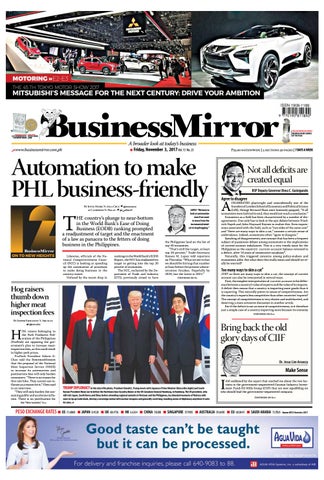
Make Sense TRUMP DIPLOMACY In this July 6 file photo, President Donald J. Trump meets with Japanese Prime Minister Shinzo Abe (right) and South Korean President Moon Jae-in before the Northeast Asia Security dinner at the US Consulate General Hamburg, in Hamburg. The US president, who will visit Japan, South Korea and China before attending regional summits in Vietnam and the Philippines, has blended moments of flattery with vows to rip up trade deals, destroy a sovereign nation with nuclear weapons and generally crash long-standing norms of diplomacy anywhere it suits his aims. AP
PESO exchange rates n US 51.6860
I
am saddened by the report that reached me about the two factions in the government-sequestered Coconut Industry Investment Fund-Oil Mills Group (CIIF) that are now squabbling on who should lead the government-sequestered company. Continued on A11
n japan 0.4528 n UK 68.4736 n HK 6.6264 n CHINA 7.8288 n singapore 37.9905 n australia 39.6690 n EU 60.0643 n SAUDI arabia 13.7826
Source: BSP (2 November 2017 )
BMReports BusinessMirror
A2 Friday, November 3, 2017
www.businessmirror.com.ph
Automation to make PHL business-friendly Continued from A1
“Asean is one of the most competitive regions, and our competitors are already there in the top 20 percent,” added NCC Private Sector Cochairman Guillermo Luz. “We want to be on a par with them.”
Target shift
ACCORDING to the NCC chairmen, the readjustment of targets signals a shift in mind-set from incremental improvement to a “leapfrog” improvement. The Philippines plunged by 14 spots in the World Bank’s EODB report for 2018, from the 99th spot last year to 113th spot among 190 economies polled. In its EODB report, the World Bank looks at 10 indicators involved in setting up an enterprise in a country, such as starting a business, dealing with construction permits, getting electricity and so forth. Luz explained the Philippines dropped several rungs because the World Bank rejected the majority of 17 government reforms for the related indicator that the country submitted for the report. Only three government reforms under the “Getting Electricity” indicator were accepted by the World Bank. Other government initiatives under “Registering Property,” “Getting
Govt. . .
Continued from A12
The shift to the second phase, characterized by a bigger proportion of the working-age population vis-à-vis dependents, will depend on how the country manages population growth. “It’s going to be bad for the economy because it will lower further our falling population-growth rate. The magnitude of the demographic dividend could be jeopardized by a falling population-growth
Credit” and “Dealing with Construction Permits” were rejected. Luz also blamed the Philippines’s lackluster ranking to the combination of change in methodologies used by the World Bank and improvements by other economies.
Automation aims
ACCORDING to Lopez and Luz, automation holds the key for the country’s getting into the top 20 percent. “We have to look [at] automation now if we want to move from the incremental mind-set to leapfrogging,” Lopez said. In securing permits to set up a business, there has to be a move on migrating these online or managed via mobile devices, he added. In December Lopez said the government would be able to link all agencies involved in setting up a business, such as the DTI, Securities and Exchange Commission, Bureau of Internal Revenue, Social Security System, PhilHealth, etc. The DTI chief added the requirements of these agencies would be placed in a single online portal. “Moving forward, in the medium term, like in two to three years, we can look at goals, such as a one business-number system or a oneform system,” Luz added. This year the Philippines improved in one indicator—“Paying rate,” Terosa said. On Thursday Perez said the Department of Health (DOH) has crafted the draft implementing rules and regulations (IRR) of the RPRH. The crafting of the IRR was led by former Health Secretary Paulyn Jean B. Rosell-Ubial, which was signed on October 6 at the DOH central office in Manila. “The twin actions of the FDA and DOH have put the RPRH law back on track to full implementation,” Perez said. Apart from achieving the demographic dividend, increasing
Taxes”—but lagged in nine others. The country lagged in the “Starting a Business,” “Dealing with Construction Permits,” “Getting Electricity,” “Registering Property,” “Getting Credit,” “Protecting Minority Investors,” “Trading across Borders,” “Enforcing Contracts” and “Resolving Insolvency” indicators. The report surveys businesses in a single city per economy across the world, with Quezon City as the Philippines’s representative city. The findings are a result of a survey of roughly 150 consultants, lawyers and businessmen.
HB 6579
THE drop in the ranking in the EODB prompted Rep. Henry C. Ong of the Second District of Leyte to urge for the passage of the proposed EODB Act when session resumes this month. “I am deeply concerned about the significant slippage in the Philippines’s ranking in the latest [EODB] report of the World Bank,” Ong, also the vice chairman of the House Committee on Banks and Financial Intermediaries, said on Thursday. “The Philippines’s latest results are disappointing.” The lower chamber has already approved House Bill (HB) 6579 on second reading last month. The Senate already passed its version t he cou nt r y ’s cont racept ive prevalence rate will also meet the Sustainable Development Goals (SDGs), particularly SDG 5 on Gender Equality and Empower All Women and Girls. One of the targets of SDG 5 is to ensure universal access to sexual and reproductive health (RH) and reproductive rights as agreed in accordance with the Programme of Action of the International Conference on Population and Development and the Beijing Platform for Action and the outcome documents of their review conferences.
of the bill (“Expanded Anti-Red Tape Act of 2017”) on third and final reading. The leadership of the lower chamber said it expects HB 6579 to be approved on third reading when Congress resumes on November 20. “Good news first: The Philippines ranks 31st among 190 countries evaluated mainly because it takes only four procedures [to put up a business],” Ong said. “Now the bad news: The glaring effects of our legendary bureaucratic red tape are revolting!” The Philippines ranked 173 on starting a business, 101 on dealing with construction permits, 114 on registering property, 105 on paying taxes and 149 on enforcing contracts, according to the lawmaker. With this, Ong said local governments and national agencies “must do much, much more than they are doing now.”
BASED on the EODB report, the Philippines garnered a score of 68.88, which was lower than the East Asia and Pacific regional average score of 82.32. Data from the World Bank showed it takes an average of 28 days to complete 16 procedures in starting a business. This process is estimated to cost a businessman at
least P21,923. The cost depends on variable amounts that will depend on a business’ authorized capital stock, paid-up capital, the assessed value of the company’s property and the local government where the business is being set up. The Philippines also ranked low in terms of enforcing contracts (149th), protecting minority investors (146th), getting credit (142nd) paying taxes (105th) and dealing with construction permits (101st). The World Bank said the data was obtained between June 2016 and June 2017. It measures 190 economies worldwide and documented 264 business reforms. The Philippines is the 12th-largest population and the 43rd-largest economy in the world. The country ranks as the second-most favored destination for foreign direct investments in Southeast Asia. However, Rep. Luis Raymund F. Villafuerte Jr. of the Second District of Camarines Sur lamented that it still takes 24 procedures to build a basic physical establishment in the country compared to East Asia and the Pacific’s average of 15 procedures. “Worse, it takes 16 procedures and 28 days to start a business compared to the region’s average of seven procedures and 23 days,” said Villafuerte, who is also the vice
In March the Popcom said the expiration of permits issued for modern contraceptives could lead to at least a thousand mothers dying every year by 2022. Perez said that, with the lapse in the CPR of Implanon, a popular implant that is being distributed for free by the government, there would have already been 500,000 unintended births and 1,100 maternal deaths between June 2016 and March 2017. Due to the absence of more modern contraceptives, the Popcom expects that there would be an
average of 800 to 1,000 maternal deaths every year. A comprehensive RH program makes available to women, couples, their adolescent children and their families—especially those who have less in life—a full range of contraceptive methods, free of charge if not low cost, and where family planning information and services are responsive to the needs of the clients across the nation. The RPRH Act of 2012 guarantees universal access to contraceptive methods, sexuality education and maternal and child care.
Costs cited
chairman of trade and industry committee and one of the authors of HB 6579.
New Commission
HB 6579 coauthor and Rep. Ferjenel Biron of the Fourth District ofIloilo, said the proposed bill is needed to simplify issuances of licenses, clearances or permits to business entities. “The purpose of this bill is to provide an easy, simple, straightforward and trouble-free avenue for entrepreneurs, micro, small and medium businesses and ordinary citizens who would like to venture into business in the country,” said Biron, who is also chairman of the House Committee on Trade and Industry. The substitute bill calls for the creation of an EODB Commission. This body is expected to continue the review and repeal of existing executive issuances and recommend the repeal of existing laws and local ordinances that are outdated, redundant and add undue regulatory burdens to business entities. The commission shall be composed of a chairman, the secretaries of finance and trade as exofficio members and one privatesector representative each for the micro-, small- and medium-enterprise and large-industry sectors.
Hog raisers. . . Continued from A12
“There is a need to increase the rates of fees and charges for rendered services by the government to update the agency’s schedule of fees and charges prescribed under Department of Agriculture Administrative Order (AO) 13 in order to keep pace with the changes in economic conditions,” the draft AC read. “Equity requires that persons receiving or benefitting from rendered services of the government share the cost of providing such services,” the draft AC added. The draft AC noted that, under the Agreement on the Implementation of sanitary and phytosanitary measures of the World Trade Organization, the government “can charge fees for control, inspection and approval procedures as long as these are not higher than the actual costs of the service.” The draft AC also justified that the NMIS is allowed to hike its fees and charges under the Office of the President AO 31, series of 2012. Under the proposed rate hikes, antemortem fees for the following animals shall increase accordingly: P50 per head, from P5 for cattle, carabao, buffalo and horse; P30 per head, from P3 for sow, boar and finishers with 31 kilograms and above live weight; fees for goat, sheep and deer will go up to P15 per head, from P1.50; and for poultry, P1.50 per head, from P0.15. The draft AC also stipulated that the NMIS will charge antemortem fees for crocodile and ostrich at P30 per head, while P1.50 per head shall be charged for rabbit, duck, geese, turkey, pigeon and quail. The fee for weanlings and sucklings (lechon) with live weight of 30 kg and below will be at P15 per head. Under the proposed hike, Chen said the industry will have to pay a total of P485 million every month for antemortem and postmortem fees, which is significantly higher than the P48.5 million hog raisers are currently paying. Sought for comment, NMIS Executive Director Ernesto S. Gonzales told the BusinessMirror that he was not aware of the proposal and that he would look into it. “I will still have to study it,” Gonzales said, adding that he is open to having a dialogue with local hog raisers and poultry growers.
The Nation BusinessMirror
www.businessmirror.com.ph
Indon IS-Maute supporter faces rebellion, other raps
R
EBELLION and other criminal charges were filed on Thursday against an Indonesian national believed to be one of the remaining Islamic State (IS) Maute Group supporter. Muhammad Ilham Syahputra, who was earlier arrested in Marawi City, was subjected to inquest proceedings before the Quezon City prosecutors for violation of Republic Acts 134 (Rebellion), 10591 (Comprehensive Firearms and Ammunition Regulatory Act), 9516 (Explosive Act), and Republic Act 9581 (International Humanitarian Law). A ssistant State Prosecutor Ethel Rhea Suril conducted the inquest proceeding based on the complaint filed by the Philippine National Police (PNP). Syahputra was arrested on Wednesday by operatives of the Marawi City police at Barangay Luksa Datu. Police authorities recovered from his possession a caliber-.45 pistol, a fragmentation grenade and a backpack, containing a pink tablet, 10 pieces of P1,000 bills, 15 P500 bills and two P100 bills. Upon interrogation, the Indonesian admitted to being a member of the IS terror group who came to the Philippines and took part in various terror operations. He also told government troops the location of his 20 other companions in Marawi City. The suspect is currently detained at the PNP-Criminal Investigation and Detection Group headquarters. Meanwhile, two remnants of the IS-Maute Group were killed on Wednesday, while two soldiers were wounded after a clash erupted at the main battle area in Marawi City, eight days after the government has
declared the end of its operations against terrorists in the city. Col. Romeo Brawner, deputy commander of the military’s Joint Task Force Ranao, confirmed that the encounter happened at around 8:40 p.m. inside the main battle area, while Army forces were on patrol. “Both stragglers were killed, while two soldiers were wounded in action,” Brawner said. Brawner identified one of the slain terrorists as Abu Talja, tagged as the right-hand man of Isnilon Hapilon, the designated emir of the IS in Southeast Asia who was killed during the final phase of the military assault last month. “The cadavers of both terroriststragglers are now being processed by the Scene of the Crime Operatives of the PNP,” Brawner said. Brawner stressed that the neutralization of the two terrorists further reduced the capability of the remaining terrorist-stragglers in Marawi. “The deaths of these two significantly reduced the ability of the remaining members of the IS-Maute Group to cause further harm and derail the ongoing return of the internally displaced persons to the controlled barangays in the city,” Brawner said. “Normalization and rehabilitation efforts in Marawi City continue despite the ongoing clearing operations in the main battle area,” he added. Defense Secretary Delfin N. Lorenzana officially declared the war in Marawi City as over on October 23, exactly five months after the terrorists occupied the city on May 23. The military claimed to have killed 920 terrorists during the entire combat operations. Joel R. San Juan and Rene Acosta
PHL’s Asia Pacific WEF Global Gender Index ranking slides 3 notches in 2017
L
By Cai U. Ordinario
@cuo_bm
ower salaries of women and worsening health condition had cost the Philippines its top ranking in the Asia and the Pacific World Economic Forum’s (WEF) Global Gender Index (GGI). The Philippines dropped three notches in global rankings to 10th out of 144 economies worldwide in 2017, from seventh in 2016. This only made the country the second highest performer in the East Asia and the Pacific after New Zealand, which ranked ninth overall. Both the Philippines and New Zealand have closed 79 percent of their overall gender gap. The Philippines is also the only Asian country in the top 10 of the rankings. “A worsening performance on the wage equality for similar work indicator, dropping from seventh to 21st, partly accounts for this fall,” the WEF said. “The country also reopens a health and survival gender gap for the first time since 2006, although the educational attainment gender gap remains fully closed,” it added. WEF data showed the country’s ranking declined to 25th in economic participation and opportunity in 2017, from 21st in 2016. While there was an improvement in the country’s labor-force participation to 106th in 2017, from
107th in 2016, there was a 14-notch decline in the country’s ranking in wage equality for similar work to 21st in 2017, from seventh in 2016. In terms of estimated earned income in United States dollar purchasing power parity (PPP), WEF data showed the gap between men and women in the Philippines widened, which caused a seven-point drop in the country’s ranking in this indicator to 38th in 2017, from 31st in 2016. In 2017 women earned $6,290 on average, while men earned an average of $9,302. In the previous year women earned on average $5,691, while men earned $8,223. “The remuneration gap is captured through a hard-data indicator [ratio of estimated female-to-male earned income] and a qualitative indicator gathered through the World Economic Forum’s annual Executive Opinion Survey [wage equality for similar work],” the WEF said. The WEF added that apart from income, there was a 35-notch drop in the country’s health and survival rankings. The country now ranked
A ‘separate’ office, Cabinet rank for Roque as Palace mouthpiece By Elijah Felice E. Rosales
P
@alyasjah
resident Duterte is expected to revive soon the Office of the Presidential Spokesman (OPS) as part of efforts to bolster Malacañang’s communications team, according to incoming Presidential Spokesman Harry L. Roque Jr. In his first news briefing as the President’s official mouthpiece, Roque said he will be given a separate office independent of the Presidential Communications Operations Office (PCOO). Although no appointment papers were yet to be issued by Malacañang, Roque was given a Cabinet rank position by Duterte, unlike outgoing Presidential Spokesman Ernesto C. Abella, who only maintained an undersecretary rank in the PCOO. “I believe it will be an independent office. I was given a Cabinet rank,” Roque said in response to a query if he is to work under the PCOO. “Of course, needless to say, I will be working very closely with [Presidential Communications] Secretary [Martin M.] Andanar and the PCOO,” the incoming Palace official added. Aside from being the presidential spokes-
Editor: Vittorio V. Vitug • Friday, November 3, 2017 A3
ROQUE: “But please understand that as a Cabinet post, I also need to bring in people whom I can completely trust. And that’s the only reason I’m bringing in new personalities.”
man, Roque revealed he will also hold an advisory post in Malacañang, most likely related to legal affairs. “It’s just an advisory position that would not be incompatible with the Cabinet appointment,” Roque said. In spite of his appointment as presidential spokesman and impending designation as presidential adviser, Roque has yet to resign as representative of Kabayan Party-list in Congress. With the Cabinet rank, Roque is expected to head the OPS, which has ceased to exist under the Duterte administration since Abella served as undersecretary of the PCOO. Previous presidential spokesmen held Cabinet
rank position as secretary of the OPS, except for Abella. On the other hand, Roque vowed he will maintain everyone in Abella’s team until December so they will receive their Christmas bonuses. “I’m not going to reinvent the wheel because most of them have been there already for quite a time,” the incoming Palace official explained. “I will repeat what I have said: No one will lose their jobs because it’s Christmas. If there will be individuals that will be let go, we will wait until after Christmas and, as I said, I would want to take advantage of the experience of people who are already here,” Roque said. “But please understand that as a Cabinet post, I also need to bring in people whom I can completely trust. And that’s the only reason I’m bringing in new personalities,” Roque added. This will include a deputy presidential spokesman, who, according to Roque, will come from the so-called millennials in order to connect the President to the younger generation.
10th
The Philippines’s 2017 ranking in the Asia and the Pacific WEF GGI, from 7th in 2016 36th overall from first in 2016. This was primarily due to the sex ratio at birth, where there was a 109-notch drop to a rank of 110th in 2017, from 1 in 2016. “The sex ratio at birth aims specifically to capture the phenomenon of ‘missing women,’ prevalent in many countries with a strong son preference,” the WEF said. However, the Philippines is not alone in the decline of its performance, according to the WEF. Overall, some 68 percent of the global gender gap has been closed. This is a slight deterioration in 2016 and 2015, when the gap was 68.3 percent and 68.1 percent, respectively. The WEF said the decline was largely due to the widening of the gender gap across all four of the report’s pillars—educational attainment, health and survival, economic opportunity and political empowerment. The latter two are of particular concern because they already carried the largest gaps and, until this year, were registering the fastest progress. “At the current rate of progress, the global gender gap will take 100 years to close, compared to 83 last year. The workplace gender gap will
now not be closed for 217 years, the report estimates,” the WEF said. At the top of the Global Gender Gap Index is Iceland. Having closed nearly 88 percent of its gap, it has been the world’s most gender-equal country for nine years. The WEF added the gap between Iceland and the second-placed country, Norway, actually widens as both Norway and third-placed Finland saw their gaps widen this year. The top 5 is completed by Rwanda (4) and Sweden (5). The next two countries in the index, Nicaragua (6) and Slovenia (7), also achieved symbolic milestones this year, closing 80 percent of their gaps for the first time. Ireland (8), New Zealand (9) and the Philippines (10) make up the top 10. Looking at the individual pillars of the index, the report finds that in 2017, the 27 countries have now closed the gender gap in educational attainment, three more countries than last year. A total of 34 countries—four less than last year—have closed their health and survival gender gaps. Only six countries have closed the gap in both of these pillars. In economic participation and opportunity, no country has fully closed the gender gap, but 13 countries (two more than last year) have closed more than 80 percent of their gap. Political empowerment has the widest gender gap with only Iceland having closed more than 70 percent of the gap. Four countries have crossed the 50-percent threshold, and 34 countries have closed less than 10 percent of the gap (five less than last year).
Solon tells DFA: Stop collecting allegiance fee from ‘dual citizens’ By Butch Fernandez
T
@butchfBM
he Department of Foreign Affairs (DFA) was told to stop collecting “allegiance fee” from Filipinos residing abroad who want to reacquire their Philippine citizenship. Senate Minority Leader Franklin M. Drilon aired the appeal after meeting with the Filipino community in Spain, where he explained the benefits of the Dual Citizenship Law that he authored way back in 2003. “The DFA is not an income-generating institution,” Drilon said. “It exists for the service of Filipino citizens abroad.” He prodded the DFA to heed the plea of the Filipino community in Spain and Andora, who informed the senator about the requirement to pay so-called allegiance fee, amounting to €45, before they are allowed take their Oath of Allegiance to the Philippines. T h e l aw m a k e r a s k e d t h e DFA to “ i m me d i ate ly sto p t he col le c -
tion of the allegiance fee from Filipinos in various parts of the world, who are applying to reacquire their Philippine citizenship” under the Citizenship Retention and Reacquisition Act of 2003, also known as Republic Act (RA) 9225. “It would not help us to convince our fellow Filipinos, who have lost their Filipino citizenship, if we continue to burden them with heavy fees,” Drilon added. He pointed out that under RA 9225, natural-born Filipinos who lost their Filipino citizenship through naturalization in a foreign country may reacquire Philippine citizenship by taking the Philippine Oath of Allegiance before a duly authorized Philippine official. At the same time, Drilon clarified that the oath “does not require a person to renounce his allegiance to any other country.” Drilon lamented that “bureaucratic requirements have discouraged a greater number of Filipinos from availing [themselves] of the benefits under the law.”
Economy
A4 Friday, November 3, 2017 • Editors: Vittorio V. Vitug and Max V. de Leon
BusinessMirror
Monster.com: Jobs remain at risk from AI, automation
W
By Cai U. Ordinario
@cuo_bm
hile online hiring in the Philippines picked up in September, Monster.com warned Filipinos that jobs are still at risk from the effects of artificial intelligence (AI) and automation.
The Philippines recorded a 4-percent annual growth in online hiring in September 2017 on the back of a 21-percent increase in Internet hiring in the retail industry. Monster.com added that the Nikkei Philippines Manufacturing Purchasing Managers’ Index (PMI) inched up to 50.8 in September reflecting, “continued subdued” growth of the manufacturing economy, which can increase jobs growth in the country. “While the economy and the job market are showing signs of recovery, professionals and fresh graduates must not discount the effects of AI and automation, reforming all aspects of the work force and must constantly ‘upskill’ to remain rel-
evant in a highly competitive market,” said Sanjay Modi, managing director, Monster.com Asia Pacific and Middle East. Apart from the retail industry, other industries that posted double-digit growth in online hiring in September were logistic, courier/ freight/transportation, import/export, shipping with 18 percent; IT, telecom/ISP, 15 percent; and banking, financial services and insurance sector, 13 percent. Meanwhile, the health-care and engineering, construction and realestate sectors performed the worst, with a 5-percent year-on-year contraction each in September. Further, online hiring for the country’s business-process outsourc-
ing industry posted a contraction of 2 percent. The consumer goods/fast-moving consumer goods, food and packaged food, home appliance, garments/ textiles/ leather, gems and jewellery and education industries posted a contraction of 1 percent. In terms of occupational groups, Monster.com said software, hardware and telecom talent was most in demand with 12-percent yearon-year growth in online hiring in September. This was also the steepest annual growth witnessed since April. However, demand for professionals in the health-care sector continued to plunge to occupy the lowest position among all occupational groups, at a 6-percent yearon-year decline. This is according to the latest Monster Employment Index (MEI), a monthly gauge of online job-posting activity in the Philippines, recording the industries and occupations that show the highest and lowest growth in recruitment activity. The data is based on a real-time review of millions of employer job opportunities culled from a large representative selection of career web sites and online job listings across the Philippines.
While the economy and the job market are showing signs of recovery, professionals and fresh graduates must not discount the effects of AI and automation, reforming all aspects of the work force and must constantly ‘upskill’ to remain relevant in a highly competitive market.”—Modi
PHL production PMI rose to 53.7 in October
A
nticipating increase in demand for the last quarter of the year, the country’s manufacturing purchasing managers’ index (PMI) regained its strength in October after two months of almost flat growth. IHS Markit Manufacturing PMI for the Philippines in October rose to 53.7, from 50.8 in September. “After two months of marginal growth, there was a flurry of activity in the Philippines manufacturing sector at the start of the fourth quarter. Demand for Filipino manufactured goods strengthened noticeably, with order book growth picking up to a five-month high,” IHS Markit Principal Economist Bernard Aw said. This also made the Philippines to top other Association of Southeast Asian Nations (Asean) member-states in the survey as Vietnam posted a production PMI of 51.6; Singapore at 51.3; Myanmar at 51.1; Indonesia at 50.1; Thailand at 49.8; and Malaysia at 48.6. The Philippines’s manufacturing score last month was also higher than the Asean average of 50.4. The monthly report has also attributed the growth in manufacturing PMI to the availability of capital equipment, which boosted production capacity of Philippine factories. Moreover, higher employment was also recorded last month. “Greater demand lifted production volumes, which, in turn, prompted firms to hire more workers,” Aw added. The IHS Markit report added that business confidence in the Philippines remained elevated, despite optimism fell to its lowest since the survey started in January 2016. Among the concerns of companies include shortage of raw materials and the inflationary pressures due to peso depreciation. “Further weakening of the peso poses a problem for manufacturers, especially those that rely on imported inputs for production. Input-cost inf lation picked up sharply, which led firms to raise prices in order to preserve profit margins,” Aw said. PNA
www.businessmirror.com.ph
DOE awaits result of Rosatom study on what to do with Bataan nuke plant By Lenie Lectura
@llectura
T
HE Department of Energy (DOE) eagerly awaits the result of a two-month assessment conducted by foreign experts on the mothballed Bataan Nuclear Power Plant (BNPP). Energy Secretary Alfonso G. Cusi said experts, mostly composed of representatives of the Rosatom State Atomic Energy Corp., the regulatory body of the Russian nuclear complex, and Slovania’s Gen Energija, are expected to conclude by end-October their preliminary assessment of the possibility and viability of rehabilitating the BNPP. There is no update yet on their assessment, Cusi said last week. On August 30 the DOE’s Nuclear Energy Program Implementing Organization headed by Energy Undersecretary Donato D. Marcos, together with representatives from the Philippine Nuclear Research Institute and National Power Corp. (NPC) met with representatives from Russia’s Rosatom, Slovenia’s Gen Enerjia and internationally known nuclear firm Worley Parsons at the NPC Nuclear Village in Bagac, Bataan. Seven working groups have been established to undertake the study, which started in September. The conduct of a study would take two months. The activity will define the scope of work for the prefeasibility study for the possible rehabilitation of the BNPP. According to the DOE, the study is being provided by Rosatom for free as part of the cooperation between the Philippines and Russia. “ There are no options presented yet, no recommendations either. We will just have to wait,” Cusi added. If revival and rehabilitation are no longer options for the BNPP complex, then the next step that needs to be undertaken is to determine what to do with the property. “As the authority, we have to find a closure to it. If we can’t use it anymore, then what are the options? Can it be transformed into a bomb shelter? Library? Hotel? Data center? If we are not going to operate it as a nuclear power plant, then what are we going to do with the structure? What are we going to do with the property?” he said. The 620-megawatt (MW) BNPP
is the country’s first and only attempt at nuclear-power development. It was supposed to be the first of two nuclear plants to be built in the northern province of Bataan. It was also the first nuclear power plant in Southeast Asia, and was identified as a solution to the 1973 oil crisis that had adversely affected the global economy, including the Philippines. T he project, however, was mothballed in the wake of the Chernobyl disaster in 1986. But clamor for the reopening of the BNPP was revived during the power crisis in the 1990s and the skyrocketing oil prices in 2007. During these periods, the DOE actually came close to reconsidering nuclear power as a potential energy source for the country. But then, the Fukushima nuclearplant incident happened in 2011, creating global panic and concerns about the safety and integrity of nuclear plants. In March the DOE identified Sulu as among the areas being eyed for a modular nuclear power plant, with a capacity of 100 MW at most. “We understand that there’s a lot of people already favoring nuclear. So, the DOE, as a policy-making body, is looking at what to do with it. There could be modular nuclear power source of 30 MW to 60 MW. We are also looking at other provinces where to put up a nuclear plant,” Cusi added. Energy Undersecretary Jess P. Posadas earlier said the Philippines will need a kind of energy that will power the economic development resulting from the P8.9 trillion worth of investments in infrastructure in the next five years. Nuclear power has the potential of meeting such huge energy demand, according to Posadas, as he noted that 1 gram of uranium is equivalent to 1.8 million cubic meters of oil and 3 million grams of coal. “Nuclear energy would last longer than other fuels,” Posadas said. “The Philippines has always viewed nuclear energy as a long-term option for power generation that will provide supply security, stability and reliability. Should this be the path that the country will take, nuclear further diversifies our existing generation mix comprised of coal, natural gas, geothermal, hydropower, oil, wind, biomass and solar,” he said.
Energy dept issues draft rules on PHL natural-gas Expressway traffic to jump 10K vehicles more by Dec industry development Alphabet soup Workers put finishing touches to man-sized letters at the Cultural Center of the Philippines compound that will be installed in
various places in Manila, where the Asean summit will be held by the middle of the month. This is part of the preparation being made by the government a few days before the major event. ALYSA SALEN
By Lorenz S. Marasigan @lorenzmarasigan
M
etro Pacific Investments Corp. expects traffic volume in its expressways to grow in varying rates by year-end, thanks to the economic developments in the northern and central parts of Luzon, and the increasing sales of vehicles this year. Metro Pacific Tollways Corp. President Rodrigo E. Franco said the group forecasts that daily vehicle entry in the North Luzon Expressway (Nlex), the Subic-ClarkTarlac Expressway (SCTEx) and the Manila-Cavite Toll Expressway (Cavitex) to increase by 10,000 vehicles each this year. “For Cavitex, we expect volume to increase to 140,000 vehicles, from 130,000; for Nlex, around 240,000 vehicles, from 230,000; and for SCTEx, around 50,000 vehicles, from 40,000,” he said in an interview. Franco explained that growth will be fueled by the growing vehicle sales this year, and the continued developments in the Northern and Central Luzon. “The drivers would be good
economic developments in Central and North Luzon. There are new businesses being set up there like warehouses. Also, vehicle sales are still growing by double digits,” he said. The Chamber of Automotive Manufacturers of the Philippines Inc. and Truck Manufacturers Association reported that, during the first half of 2017, vehicle sales reached 196,164 units, representing a 17.1-percent increase from 167,480 units the year prior. As this developed, Metro Pacific Chairman Manuel V. Pangilinan said he is optimistic that his group will score two toll-road investment deals in the Asean region through 2018, paving way for the company's vision of building a Pan-Asean tollways group. He listed the two countries as Indonesia and Malaysia. “I’m quite optimistic that we will have an investment in both countries. One is imminent than the other. This year for one, the other one should be next year,” he said in a chance interview. He did not disclose specifics of the deals, and refused to say
which one is more imminent that the other. Pangilinan also refused to divulge further details on the deals such as the location of the toll roads and the amount of investment needed, as negotiations are still on going. “The potential is always there. There’s an initial investment and in the future we will have to put in more investment,” he said. Franco noted, however, that his group is looking at closing a deal with an “Indonesian company within the year.” He added that the most likely way that the company will enter a new market is through the acquisition of a “significant minority stake” in a tollways company that currently operates in a country. “We are discussing about investing in an existing operator,” he said in an interview. “The discussions are very fluid.” Pangilinan added the company aims to secure more deals in Asean nations to create a “Pan-Asean tollways group.” Currently, the company has significant interests in toll-road operators in Thailand and Indonesia.
T
he Department of Energy (DOE) released on Thursday a draft of the rules on the country’s natural-gas industry. The draft circular, which shall be known as the Philippine Natural Gas Regulation (PNGR), establishes the rules governing the supply, location, design, construction, expansion, rehabilitation, modification, operation, maintenance, safety and commercial arrangement of the value chain of the Philippine Natural Gas Industry (PNGI). “The state shall ensure that the PNGI, from its emerging state, will be developed into a matured market, enabling the country to achieve greater energy security and sustainability,” the draft circular stated. Among others, the PNGR involves the development and implementation of policies on the promotion, exploration, development, production of indigenous natural gas deposits and importation of liquefied natural gas (LNG) for local and foreign demand, including third-party access to LNG-related facilities and pipeline for the development of the Philippines as LNG trading and transshipment hub of the Asia-Pacific region.
The draft circular also involves the policies on the transportation of natural gas and its related facilities. These include indigenous gas from production platform to gas- processing plant; imported LNG from the connection point of the loading arm to the LNG-related facilities; natural gas received from the last connection point of gas-processing plant to the transmission; distribution and spur line-metering equipment; an LNG from the filling connection of the storage up to the satellite LNGrelated facilities. The structure of the value chain shall be divided into upstream and downstream operations. Upstream constitute the promotion, exploration, development, production and sale of indigenous gas. Downstream consists of importation storage, regasification, transportation, trading and other related activities of natural gas from load port to customers. The DOE shall have the overall responsibility on the promotion and supervision of the development and operation of the PNGI. It will also issue permits and utilize different methods of accepting project proposals. Lenie Lectura
Agriculture/Commodities BusinessMirror
www.businessmirror.com.ph
Editor: Jennifer A. Ng • Friday, November 3, 2017
A5
Red-tide alert still up in several areas
T
he Bureau of Fisheries and Aquatic Resources (Bfar) said several coastal waters in Western Samar, Eastern Samar, Leyte and Palawan are still positive for the red tide toxin. In Shellfish Bulletin 35 dated October 30, the Bfar said shellfish collected at Irong-Irong Bay, Maqueda Bay, Villareal Bay and the coastal waters of Daram Island in Western Samar; Matarinao Bay in Eastern Samar; Carigara Bay in Leyte; Inner Malampaya Sound, Taytay and Puerto Princesa Bay, Puerto Princesa, Palawan; and the coastal waters of Mandaon in Masbate are still positive for red tide. “All types of shellfish and Acetes sp., or alamang, gathered from [these] areas are not safe for human consumpton,” the bulletin read. The Bfar said fish, squids, shrimps and crabs are safe for human consumption provided that they are fresh and washed thoroughly, and internal organs, such as gills and intestines, are removed before cooking. The attached agency of the Department of Agriculture also revealed that the coastal waters of Milagros in Masbate are now free
of the toxic red tide. The Bfar said these areas continue to be free from the toxic red tide: coastal waters of Cavite, Las Piñas, Parañaque, Navotas, Bulacan and Bataan (Mariveles, Limay, Orion, Pilar, Balanga, Orani, Abucay and Samal) in Manila Bay; and the coastal waters of Bolinao, Anda, Alaminos, Sual and Wawa, Bani in Pangasinan. Also free from red tide are Masinloc Bay in Zambales; coastal waters of Placer in Masbate; Juag Lagoon in Matnog and Sorsogon Bay in Sorsogon; Honda Bay in Puerto Princesa City, Palawan; coastal waters of Gigantes Islands in Carles, Iloilo; coastal waters of Pilar, Panay, President Roxas in Roxas City in Capiz and Sapian Bay (Ivisan and Sapian in Capiz; Mambuquiao and Camanci in Batan, Aklan). The Bfar added Altavas, Batan and New Washington in Aklan; coastal waters of E.B. Magalona, Talisay City, Silay City, Bacolod City,
Hinigaran and Victorias City in Negros Occidental; Tambobo Bay in Siaton, Negros Oriental; coastal waters of Dauis and Tagbilaran City in Bohol; Cambatutay Bay in Western Samar; San Pedro, Cancabato Bay in Tacloban City and coastal waters of Calubian and Leyte in Leyte; coastal waters of Biliran; Dumanquillas Bay in Zamboanga del Sur; Tantanang Bay in Zamboanga Sibugay; Murcielagos Bay in Zamboanga del Norte and Misamis Occidental; Taguines Lagoon in Benoni, Mahinog, Camiguin Island; Balite Bay in Mati, Davao Oriental; and Hinatuan, Bislig and Lianga Bays in Surigao del Sur remain free from red tide. Eating shellfish products with red tide can cause paralytic shellfish poisoning (PSP), an illness that can cause death. Early symptoms of PSP include tingling of the lips and tongue, which may begin within minutes of eating poisonous shellfish or may take an hour or two to develop. Depending upon the amount of toxin a person has ingested, symptoms may progress to tingling of fingers and toes and then loss of control of arms and legs, followed by difficulty in breathing. If a person consumes enough poison, the muscles of the chest and abdomen become paralyzed. Death can result in as little as two hours, as muscles used for breathing become paralyzed.
Hawaii group wants to defend licenses for foreign fishermen
In this February 2 file photo, a catch of fish is unloaded from a commercial fishing boat at Pier 38 in Honolulu. AP Photo/Caleb Jones, File
H
ONOLULU—A group representing Hawaii commercial fishermen has filed a court motion to defend the state’s practice of giving fishing licenses to foreign workers. The Hawaii Longline Association sought court permission last week to argue its side after a Maui resident asked a judge to declare that only those lawfully admitted to the United States should receive commercial fishing licenses. Resident Malama Chun went to court after an Associated Press investigation found hundreds of foreign workers in the Hawaii fleet were confined to boats and some were living in subpar conditions. Hawaii grants fishing licenses to men from impoverished Southeast Asian and Pacific nations who are not allowed to enter the country. The foreign fishermen are paid a fraction of what an American worker would get, with some making as little as 70 cents an hour. The Hawaii Longline Association said in court filings that a number of its members employ foreign fishermen, but it didn’t provide a figure. About 80 percent of the crews managed by those mem-
bers are not US citizens, the group said, with many of the fishermen working on a seasonal basis and returning each year. Under federal law, US citizens must make up 75 percent of the crew on most American commercial fishing boats. But in Hawaii, a loophole carved out to support one of the state’s biggest industries exempts commercial fishing boat owners from federal rules enforced almost everywhere else. The Hawaii attorney general’s office said it supported the association’s motion to intervene in the case. Arguments have been scheduled for December 13. Chun appealed his case to the Second Circuit Court in Wailuku after the state Board of Land and Natural Resources, which regulates fishing licenses, denied his petition to change its policy. Chun, who fishes as a cultural practice, said his family has seen a massive decline in fish stocks over generations. He blamed overfishing and said giving licenses to people who are not in the US legally contributes to the problem. The state land board said Chun didn’t show how putting an end to licenses for foreign crews would
address his concerns about overfishing and cultural practices. The men hired from abroad for the Hawaii fleet aren’t allowed to arrive at Honolulu’s airport because they lack visas. They’re instead flown to other countries and put on US-owned fishing boats for long sails back to Hawaii. Before the men start working, they need a state commercial fishing license. In order to get it, Hawaii requires that they must be “lawfully admitted” to the US. When they arrive, they are met at the dock by US Customs and Border Protection agents who ban them from entering the country by stamping “refused” on their landing permits, which voids them. So instead of being “lawfully admitted,” they are now barred by law from setting foot on US soil. T he st ate Depa r t ment of Land and Natural Resources accepts the landing permits as proof the fishermen are “lawfully admitted.” US Customs, however, says the stamp means the fishermen can’t even enter the US temporarily. In rare cases, including medical emergencies, Customs can parole the men to go ashore. AP
Govt steps up awareness drive to combat biodiversity loss By Jonathan L. Mayuga @jonlmayuga
T
he government is intensifying its ongoing awareness campaigns in communities to stop biodiversity loss in select communities, an official of the Biodiversity Management Bureau (BMB) of the Department of Environment and Natural Resources (DENR) said. Through the five-year, P1.2billion United States Agency for International Development Protect Wildlife Project, BMB Director Theresa Mundita S. Lim said the DENR is able to reach more communities to play an active role in protecting and conserving the country’s rich biodiversity. To stop illegal-wildlife trade and wildlife trafficking, the government needs the support of local government units (LGUs) and the communities. The project, launched in March, is currently operational in two pilot sites—Palawan, considered as the country’s last ecological fron-
tier, and the Sulu Archipelago, including Zamboanga City and Tawi-Tawi province. The project is now expanding its reach in General Santos City, Sarangani, South Cotabato provinces, Lim said. All these areas are rich in biodiversity but are experiencing a rapid rate of biodiversity loss because of numerous factors, like wildlife trafficking, irresponsible mining, illegal fishing, conversion of forests to settlements and agricultural lands, limited resources and capacities for conservation at the local level and indifference of various stakeholders. According to the USAID Protect Wildlife, the continuing deterioration of biodiversity assets in the Philippines poses negative impacts on ecological processes. Since it was launched in March, Lim said training in the enforcement of various environmental laws in these communities is on-going. With the nationa l gover nment’s limited resources, Lim
said a partnership with local government units (LGUs) and enhanced awareness at the community level are expected to boost the effort to protect and conserve biodiversity, particularly in the aspect of combating wildlife trafficking. “With their enhanced appreciation of biodiversity, we hope to expand our network of support to strengthen enforcement of environmental laws,” Lim said. Through the project, she said community-partners are encouraged to report to the BMB the various threats to biodiversity in their areas. The limited capacities of and resources for on-site management and regulation of wildlife habitats and species have been identified as key challenges in protecting biodiversity in the Philippines, according to the USAID Protect Wildlife. Moreover, conservation and development agendas are not being communicated effectively at the local level.
A6
Friday, November 3, 2017 • Editor: Lyn Resurreccion
The World BusinessMirror
www.businessmirror.com.ph
China blinks on S. Korea, making nice after a year of hostilities
F
In this November 1 photo, a South Korean protester against North Korea stands to welcome a planned visit by the United States President Donald J. Trump near the US Embassy in Seoul, South Korea. AP/Ahn Young-joon
Worry, doubt and indignation as Asia awaits President Trump
B
EIJING—Donald J. Trump vowed a more “unpredictable” foreign policy when he campaigned for president. Mission accomplished, if the mood in Asia ahead of his first presidential trip to the region is any indication.
Much like the prelude to a bruising typhoon, Trump’s upcoming visit has inspired fear, resignation, indignation, morbid curiosity—even, according to one South Korean politician, feelings of national disgrace. During his first months as president, Trump, who will visit Japan, South Korea and China before attending regional summits in Vietnam and the Philippines, has blended moments of flattery with vows to rip up trade deals, destroy a sovereign nation with nuclear weapon and generally crash long-standing norms of diplomacy anywhere it suits his aims. He has wined and dined the leaders of China and Japan, and been fawned over in return, and his shaky ties with South Korea’s leader have led to worries that Washington could take military action against North Korea without Seoul’s approval. Looming over his entire trip is one of the strangest relationships in the world—an often surreal exchange of threats of annihilation between North Korean dictator Kim Jong Un and Trump, who has also occasionally offered praise and dialogue. It’s something of a marvel then that despite Trump’s unpredictability and the torpedoing of an Obamaera trade deal, there may actually be more continuity than change in Washington’s Asia policy. “People joke that Wagner’s music is better than it sounds. The same can be said for Trump’s Asia policy and relationships,” longtime Asia analyst Ralph Cossa said, referring to the notoriously complex German composer. “This will be put to the test when he goes to Asia, but I think the visit
is likely to be more successful than many fear or predict.” A look at some of the issues and leaders Trump will face during his trip, which begins when he arrives in Japan on Sunday:
‘Smart cookie’ in North Korea
Unlike most of his recent predecessors, Trump will not visit the South Korean side of the Demilitarized Zone that looks out over North Korea. Still, his quarrel with the North’s ruler will dominate the trip. Amid North Korean nuclear and missile tests and a standard barrage of belligerent rhetoric, Trump has veered from threats to unleash “fire and fury” on the North to calling Kim a “pretty smart cookie” and saying he’d be “ honored ” to talk, under the right circumstances. Trump’s comments have caused both confusion and fears of war, especially in Japan and South Korea, but it is unclear how seriously to take declarations that don’t appear to be policy pronouncements. Trump likes to say that a soft policy by his predecessor, Barack Obama, has allowed North Korea to stand on the brink of a viable arsenal of nuclear-armed missiles that can hit United States mainland cities. Despite his criticism, Trump has yet to distinguish his own approach from Obama’s, Bruce Klingner, a North Korea specialist at the conservative Heritage Foundation think tank in Washington, told US lawmakers in July. “Trump’s policy of ‘maximum pressure’ to date has been anything but,” Klingner said, and sends mixed messages about whether Washington will pursue diplomacy or war to deal with Pyongyang.
‘Disgrace’ in South Korea
Trump’s ties with South Korea’s liberal president, Moon Jae-in, are causing some serious angst in the country. Moon took office in May with hopes of reaching out to Pyongyang. But a parade of North Korean missile and nuclear tests has forced him to take a harder line. While he has gone out of his way to emphasize coordination with Trump, a strain between the allies is evident. Tr ump has sug gested that Seoul should pay the entire cost of a US missile-defense system in the South that many there don’t even want. He also threatened to end a hard-won US-South Korean free trade agreement that past American presidents had portrayed as an alliance bulwark. Amid dueling threats by Trump and Kim Jong Un, Moon has issued pointed reminders that there can be no US-military action without Seoul’s consent. South Koreans have long fretted about being pushed out of efforts to deal with the North—a fear so prevalent it has a name: “Korea Passing.” The headline on a recent editorial in the daily Dong-A Ilbo is telling: “If Moon becomes Trump’s ‘friend,’ Korea Passing will disappear.” There has also been anxiety that Trump will spend more time in both China and Japan than in South Korea on his trip. Ahn Cheol-soo, a South Korean opposition politician, said recently that it’s disappointing that Trump “stays just briefly in South Korea, the country directly involved in the Korean Peninsula problem that has the rapt attention of the world. This feels really bad—our country has been disgraced.”
‘The king of China’
Trump won cheers during the presidential campaign by attacking China for allegedly stealing American jobs and failing to use its inf luence to stop ally North Korea’s nuc lear dr ive. But as president, Trump has cozied up to Chinese leader Xi Jinping. “People say we have the best relationship of any president-president,” Trump recently told Fox Business Network, referring to Xi, whom he called “a very good person.”
“Now, some people might call him the king of China. But he’s called president,” Trump said. Trump has, in some ways, been good for the ruling Chinese Communist Party, according to Robert Dujarric, an Asia expert at Temple University Japan, because he has raised global doubts about Washington by undermining institutions that serve US interests and impede those of China. Trump, for instance, pulled the US out of the Trans-Pacific Partnership, a trade deal Obama negotiated with 11 Pacific Rim countries that was pitched, in part, as a way to counter China. During his trip, Trump may push China on trade barriers and to better implement UN sanctions on North Korea. But he can expect a royal reception in Beijing, including fawning press coverage and grand ceremonies aimed at boosting his impressions of Chinese power.
‘Influence’ in Japan
J apan e s e P r i m e M i n i s t e r Shinzo Abe may be the Asian leader most confident in his relationship with Trump. He was one of the first to pay court to President-elect Trump, eager to forge a bond with Tokyo’s crucial ally. Trump, in turn, has raised an issue important to Abe: North Korea’s past abductions of Japanese citizens. There’s worry in Tokyo about Trump’s tough talk on trade, and the possibility that US military action against North Korea could endanger Japan. But Abe has generally avoided confronting Trump, at least in public. From golf to private dinners to an audience with the emperor, Trump’s Japan “visit is designed to not only offer visual evidence of the close partnership, but also to avoid any uncomfortable issues, such as trade,” Daniel Sneider, an East Asia specialist at Stanford University, wrote recently. Abe’s “senior advisers claim to wield an influence over Trump that is the envy of other US allies,” Sneider said. “But that relationship depends on Abe consciously avoiding any challenge to Trump’s policies. Does his influence disappear the moment he crosses Trump?” AP
or more than a year, China has railed against South Korea, calling for boycotts of its products over Seoul’s decision to let the United States deploy an anti-missile system, which Beijing fears threatens its own security. On Tuesday, however, China abruptly changed course, essentially saying “never mind,” as the two countries agreed to end their dispute even though South Korea is keeping the system in place. China’s unexpected move to settle the rancorous dispute could scramble President Donald J. Trump’s calculations about how to deal with allies and North Korea on the eve of his first trip to Asia. The decision, by the newly empowered Chinese president, Xi Jinping, appeared to reflect a judgment that China’s continued opposition to the deployment of the US missile-defense system was not succeeding in fraying the South Korean government’s alliance with Washington. But it could also pose a fresh challenge to Trump, as he attempts to build support in the region to put greater pressure on North Korea to curb its nuclear and missile programs. South Korea’s liberal president, Moon Jae-in, is more receptive to diplomacy with the North Koreans than either Trump or Japan’s prime minister, Shinzo Abe. Drawing Moon closer to Beijing, analysts said, could create a new alignment on how to deal with the North, with China and South Korea facing off against Japan and the US. “It’s going to undermine the Trump administration’s effort to build solidarity among the US, Japan and Korea to put pressure not only on North Korea, but on China to do more on North Korea,” said Michael J. Green, an Asia expert at the Center for Strategic and International Studies. Much about the rapprochement is not known, Green cautioned, and the Chinese could be exaggerating the implications of the agreement. But it adds yet another volatile element to Trump’s 12-day, five-nation tour of Asia, which begins this weekend. Formally, the Trump administration welcomed news of the thaw. The State Department spokeswoman, Heather Nauert, told reporters on Tuesday, “We see that as providing better stability, greater stability for a region that desperately needs it because of North Korea.” Nauert, however, said she did not know whether China’s move indicated it no longer had objections to the deployment of the anti-missile system, the Terminal High Altitude Area Defense (THA AD). The White House has not publicly addressed the rapprochement. A senior administration official, who asked for anonymity to discuss a sensitive diplomatic issue, acknowledged it could complicate matters, but said there should be no inherent conflict in South Korea restoring its relations with China while, at the same time, pushing to keep maximum pressure on North Korea.
In restoring better relations with South Korea, Xi appeared to have decided that he could afford to blink. But he also does not face a vigorous political opposition or press, which could accuse him of flip-flopping on the issue. Even under Moon, whose outlook toward China had been more favorable than his predecessor’s, and who has called for a more balanced diplomacy between Beijing and Washington, Xi made no headway in achieving his stated goal of stopping the deployment of the THAAD. A second phase of the missile defense system, intended to defend South Korea from the escalating nuclear and missile threats from North Korea, was installed despite China’s protests in September, just four months after Moon took office. China had insisted it would not tolerate THAAD’s powerful radar so close to its own missile systems. Xi’s tough stance against South Korea also included the informal, though punishing, economic boycott that helped reinforce the US relationship with Seoul, undermining China’s long-term goal of replacing the United States as the preeminent power in Asia. “This is the reversal of an ineffective and costly policy on the part of China,” said Shi Yinhong, professor of international relations at Renmin University of China. In agreeing to restore cordial relations, South Korea pledged not to accept additional THAAD launchers, and agreed not to join a regional missile defense system with the United States and Japan. The agreement not to accept any more THAAD deployments had been a long-standing policy stance of Moon anyway, a South Korean government official said on Wednesday. South Korea also promised not to join a trilateral military alliance with the US and Japan. Moon, like his predecessors, had shown no interest in expanding military relations with Japan, its former colonial master. With the increased threat from North Korea, Moon had aligned himself more closely with Trump and Abe. The three leaders met on the sidelines of the Group of 20 summit meeting in Germany in July, and agreed to enhance their defense capabilities against the North Korean threat. In warming up to South Korea, Xi probably recognized that Moon would be more malleable to favoring dialogue with North Korea than was his conservative predecessor, Park Geun-hye. At the recent party congress in which he was elevated to a second five-year term as president, Xi showed himself determined to project China’s power in a “new era.” Resolving the North Korea crisis dovetails with that theme, and any move toward talking with the North would be easier with Moon by his side. South Korea and China announced their decision to restore relations just before Trump’s visit. New York Times News Service
Euro region‘s fastest inflation is starting to bite
T
he quickest inflation in the euro region is beginning to exact its toll on growth. The economic expansion in Lithuania is being held back by rocketing consumer prices, according to the central bank and finance minister. Inflation shot up to 4.8 percent in September, three times the currency area’s average. Meanwhile, data released this week showed GDP rose an annual 3.1 percent last quarter, slowing for the first time in more than a year. “It’s clear inflation has had an impact on domestic demand—its growth is already slipping,” Finance Minister Vilius Sapoka said in an interview with a local radio station this week. “Looking ahead,
economic growth will be slower but more balanced.” Surging prices and GDP in the three Baltic countries, which all use the euro, have brought back memories of the boombust-cycle that sank their economies back in 2008. It’s also prompted questions over whether the European Central Bank’s super-loose monetary policy is appropriate for all of the nations subjected to it. There are also some local factors at work in Lithuania. Labor shortages drove wages up an annual 8.7 percent in the second quarter, while the government’s crackdown on alcohol consumption— the world’s highest—has pushed the cost of a beer up by almost a third in the past year. Bloomberg News
The World BusinessMirror
www.businessmirror.com.ph
Friday, November 3, 2017
A7
Bahrain asks allies for aid to stave off crisis
B
ahrain has asked Gulf A rab allies for financial assistance as it seeks to replenish its foreign-exchange reser ves and avert a currency devaluation that could reverberate across the region, according to people with knowledge of the talks. The request was made to Saudi Arabia and the United Arab Emirates (UAE), two of the people said. A third person said Kuwait was also asked. The countries responded by requesting the island kingdom do more to bring its finances under control in return for the money, the people said on condition of anonymity because the discussions were private. The talks are at an early stage, one person said. The slump in oil prices has battered the six-member Gulf Cooperation Council (GCC), at times raising questions over whether a dollar peg seen as a bedrock for economic stability for more than three decades was sustainable. And while bets against the region’s currencies have subsided this year, a devaluation of a GCC member would risk shifting the attention to others. Gulf central banks, including Bahrain’s, have repeatedly brushed aside talk of abandoning their exchange-rate regimes. “Most people are fully expecting the other Gulf countries to come to Bahrain’s aid,” said Jason Tuvey, a London-based economist at Capital Economics. “If Bahrain was forced to devalue its currency it would probably start to raise questions about other currency pegs.” Bahrain, the Gulf ’s smallest economy and a close Saudi ally, has been more vulnerable to slumping oil prices and regional political instability than richer GCC states, several of whom have cut spending and curtailed handouts to their citizens. And while Bahrain’s budget deficit is set to narrow this year, the International Monetary Fund (IMF) expects the shortfall to be the highest in the GCC.
The central bank’s foreign reserves, including gold, have tumbled about 75 percent since 2014 to just above 522 million dinars ($1.39 billion) in August, according to the most recent official data. Without aid or a recovery in oil revenue, authorities may struggle to keep the currency’s peg to the US dollar—maintained at 0.376 Bahraini dinars.
Devaluation risk
Expectations among investors and credit-rating companies that rich Gulf states would prevent Bahrain’s difficulties from morphing into a full-blown financial crisis have cushioned its assets and allowed it to tap global bond markets as recently as September, when it raised $3 billion. Ba h ra i n’s debt r isk , measured by five-year credit default swaps, has dropped more than 60 basis points to 241 as of Tuesday, according to data compiled by Bloomberg. Saudi Arabia led a military intervention to support Bahrain’s gover nment du r i ng protests that broke out in 2011. Authorities have repeatedly blamed the instability on Shiite-ruled Iran. Bahrain is also a member of a Saudi-led coalition boycotting neighboring Qatar. A bond prospectus in September included a warning from authorities that falling reserves carried the risk of a currency depreciation. The central bank, being a “significant” lender to the government, may not be able to maintain the peg, according to the document seen by Bloomberg News. Bahrain didn’t cite that risk in its prospectus in 2013. Officials in Bahrain, the UAE and Kuwait didn’t immediately respond to requests for comment on the aid talks. Saudi officials couldn’t immediately be reached.
Bond sale proceeds
Before the September bond sale, Bahrain’s reserves were equivalent to just one month of imports and barely covered currency in
circulation, according to Bank of America (BofA) Merrill Lynch economist Jean-Michel Saliba. A nd even if t he k ingdom doesn’t spend any of the $3 billion to finance its 2017 needs, the proceeds are only enough to cover part of next year’s deficit, which is expected to reach $4.2 billion, said Ziad Daoud, an economist at Bloomberg Economics. The rest will have to be financed through additional borrowing or “using the government’s reserves,” he said. Bahrain is rated “BB-” at S&P Global Ratings, three levels below investment grade. The rating company changed Bahrain’s credit outlook in June from stable to negative. “We continue to factor the potential for external support, particularly from Saudi Arabia, into our ratings,” it said. Bahrain’s $1.5-billion eurobonds due 2022 fell on Wednesday. The yield rose seven basis points, the most in two months, to 4.7 percent, according to data compiled by Bloomberg. The IMF estimates that Bahrain needs oil prices at $99 a barrel to balance its budget this year, compared with $73.1 a barrel for Saudi Arabia, which is overhauling its economy. W hile Brent crude is trading at the highest level in more than two years, it’s still almost $40 below Bahrain’s breakeven price. In May Saliba of BofA wrote after an eight-day visit to the GCC that Bahrain’s allies are likely to “nudge” the kingdom toward “greater fiscal reforms.” On Wednesday he reiterated his view that a bailout will be less costly than cleaning up the mess of a devaluation or a debt restructuring. “Forcing Bahrain into a debt restructuring is unlikely as it would raise GCC financing costs at a time when regional gross financing needs remain substantial,” he said. “GCC support allows market access to Bahrain, which in turn minimizes Bahrain’s need to access GCC resources.” Bloomberg News
Trump slams ‘joke’ justice and targets visa program
W
ASHINGTON— President Donald J. Trump touched off a partisan debate over some of the most divisive issues in American life on Wednesday as he cited this week ’s terrorist attack in New York to advance his agenda on immigration and national security while assailing Democrats for endangering the country. A day after an immigrant from Uzbekistan was arrested on suspicion of plowing a pickup truck along a crowded bicycle path in Manhattan, killing eight people, Trump denounced the US criminal justice system as “a joke” and “a laughingstock,” adding that he was open to sending “this animal” instead to the US military prison at Guantánamo Bay, Cuba. Shortly before midnight, the president took it a step further, posting a message on Twitter declaring that the suspect, Sayfullo Saipov, should be executed. “NYC [New York City] terrorist was happy as he asked to hang ISIS [Islamic State in Iraq and Syria] flag in his hospital room,” he wrote, referring to the driver’s reported interest in the Islamic State (IS) extremist group. “He killed 8 people, badly injured 12. SHOULD GET DEATH PENALTY!” Presidents are typically advised never to weigh in on pending criminal cases because such comments can be used by defense attorneys to argue that their clients cannot get a fair trial—especially when the head of the executive branch that will prosecute the charges advocates the ultimate punishment before a judge has heard a shred of evidence at trial. But Trump has disregarded such advice in other instances, as well.
The president’s vocal response to the attack framed the emerging politics of the case. While the White House deemed it unseemly to have a policy debate on gun control immediately after the massacre in Las Vegas last month, Trump was eager on Wednesday to have a policy debate on immigration. He pressed Congress to cancel a visa lottery program that allowed the driver into the country, attributing it to Sen. Chuck Schumer of New York, the Senate Democratic leader, and called Democrats “obstructionists” who “don’t want to do what’s right for our country.” “We have to get much tougher,” the president told reporters. “We have to get much smarter. And we have to get much less politically correct. We’re so politically correct that we’re afraid to do anything.” A moment like this was almost inevitable since Trump took office and sought to ban visitors from select countries with Muslim majorities. The terrorist attack in New York on Tuesday was the first by a foreign-born assailant on US soil since Trump’s inauguration, and few were surprised that he saw it as vindication for his tough-onimmigration approach. It also provided fodder for him to shift the public focus away from the special counsel investigation that unveiled criminal charges against three former campaign aides this week. But in an interview with The New York Times on Wednesday, Trump denied being concerned about the indictments. “I’m not under investigation, as you know,” he said in a brief telephone call. Pointing to the indictment of
50K The estimated number of diversity visas distributed annually; nearly 14.7 million people applied last year
his former campaign chief, Paul Manafort, the president said, “And even if you look at that, there’s not even a mention of Trump in there.” Noting that Manafort was charged with financial crimes stemming from his lobbying business, the president added: “It has nothing to do with us.” Trump, a lifelong New Yorker, wasted little time on Wednesday morning assigning fault for the attack along the bicycle path. “The terrorist came into our country through what is called the ‘Diversity Visa Lottery Program,’ a Chuck Schumer beauty,” he wrote on Tw itter. Schumer responded from the floor of the Senate, noting that after the attacks of September 11, 2001, President George W. Bush brought Schumer and Hillary Clinton, then the other Democratic senator from New York, to the White House to demonstrate national unity. “President Trump, where is your leadership?” Schumer asked. “President Trump, instead of politicizing and dividing America, which he always seems to do at times of national tragedy, should be bringing us together and focusing on the real solution—antiterrorism
funding—which he proposed to cut in his most recent budget.” At a news conference updating the public about the attack, Gov. Andrew Cuomo of New York chided Trump for his Twitter posts, saying they “were not helpful,” were not “even accurate” and “tended to point fingers and politicize the situation.” “You play into the hands of the terrorists to the extent that you disrupt and divide and frighten people in this society,” said Cuomo, a Democrat. “And the tone now should be the exact opposite by all officials on all levels. This is about unification, this is about solidarity.” At his own public appearance later in the day, Trump took aim again at the diversity lottery visa program. “Diversity lottery—sounds nice,” he added. “It’s not nice. It’s not good. It hasn’t been good. We’ve been against it.” Responding to questions by reporters, he said he was open to transferring Saipov from civilian courts into the military system set up for foreign terrorists. “I would certainly consider that,” he said at the beginning of a Cabinet meeting. “Send him to Gitmo [Guantánamo], I would certainly consider that, yes.” Likewise, he vowed to toughen prosecution and punishment of terrorists without specifying how. “We need quick justice and we need strong justice, much quicker and much stronger than we have right now,” Trump said. “Because what we have right now is a joke and it’s a laughingstock.” No one arrested on US soil has ever been sent to Guantánamo Bay, and no one captured on foreign soil has
been sent there since 2008. Transferring the suspect from New York would raise a host of thorny constitutional and legal issues, and Trump seemed to be speaking off the top of his head since federal prosecutors later moved to process the suspect in civilian courts. Asked later about his comment on Guantánamo, Sarah Huckabee Sanders, the White House press secretary, dismissed it as notional, saying that “he wasn’t necessarily advocating for it, but he certainly would support it if he felt like that was the best move.” By the end of the day, the president came under criticism from conservative allies for not declaring Saipov an enemy combatant, which would have allowed interrogators more freedom to question him without granting him the rights of a civilian defendant. “ T he Tr ump ad ministrat ion missed an important opportunity to send a strong message to terrorists and make America safer,” said Sen. Lindsey Graham, RepublicanSouth Carolina. “This is a huge mistake. Very sad.” The diversity visa program cited by Trump was created in 1990 by a bill supported by Schumer, passed by bipartisan votes and signed into law by a Republican president, George H.W. Bush. Schumer supported getting rid of the program as part of a comprehensive immigration plan crafted by eight lawmakers and passed by the Senate in 2013. But the plan was blocked in the House by Republicans who objected to other elements they considered amnesty for immigrants in the country illegally. Sen. Jeff Flake, Republican-Arizona, who has broken with Trump, came
to Schumer’s defense on Wednesday. “Actually, the Gang of 8, including @SenSchumer, did away with the Diversity Visa Program as part of broader reforms,” Flake wrote on Twitter. “I know, I was there.” The program creates a class of immigrants called “diversity immigrants” from countries with historically low rates of immigration to the United States. About 50,000 diversity visas are distributed annually, or roughly 5 percent of the total green cards issued by the US. Nearly 14.7 million people applied last year, meaning less than 1 percent of those who seek such visas receive them. The program has been a target of conservatives, who proposed eliminating it in legislation endorsed in August by Trump that would crack down on legal immigration. The legislation would slash legal immigration in half within a decade by curtailing the ability of US citizens and legal residents to bring family members into the country. In his remarks, Trump stressed that he wanted “merit-based” immigration, suggesting that Saipov was admitted without consideration about whether he had skills that could benefit the United States. In fact, the program requires applicants to have a high-school education or be employed for at least two years in jobs approved by the State Department. Trump, who during last year’s campaign called for a complete ban on all Muslims entering the United States, has long sought to tighten the borders. He has signed several versions of the travel ban aimed mainly at predominantly Muslim countries even as courts repeatedly intervened. New York Times News Service
A8
Friday, November 3, 2017 • Editor: Lyn Resurreccion
The World
Fed: Truck attack suspect said ‘he felt good’ about rampage
N
EW YORK—The suspect in a deadly truck rampage was inspired by the Islamic State (IS) group’s online videos and plotted his New York City attack for two months, renting a truck ahead of time to practice turning it, federal authorities said in a criminal complaint bringing terrorism charges against the Uzbek immigrant. Sayfullo Saipov chose the attack date to target Halloween crowds, according to the criminal complaint. And after his trail of terror was halted by a police bullet, he asked to display the IS group’s flag in his hospital room, saying “he felt good about what he had done,” authorities said. Brought to court in a wheelchair, Saipov was held without bail on charges that could bring the death penalty. Separately, the FBI was questioning people who might have information about his actions before the attack, including a second Uzbek man. The charges against Saipov, 29, came just a day after the attack near the World Trade Center killed eight people. Investigators in multiple states raced to retrace Saipov’s steps and understand his motivations, which they said were illuminated by a note he left by the truck: “Islamic Supplication. It will endure.” The phrase “it will endure” commonly refers to the IS group, and Saipov had a cell phone loaded with the group’s propaganda, an FBI agent said in the criminal complaint. Handcuffed and with his legs shackled, Saipov nodded his head as he was read his rights in a brief court proceeding that he followed through a Russian interpreter. Outside court, his appointed lawyer, David Patton, said he hoped “everyone lets the judicial process play out.” “I promise you that how we treat Mr. Saipov in this judicial process will say a lot more about us than it will say about him,” Patton said. T he FBI released a poster, saying it was looking for one of Saipov’s associates, Mukhammadzoir K adirov, only to announce less than 90 minutes later that it had found him. A l aw - e n forceme nt of f ic i a l said K adirov was a fr iend of Saipov’s and may not have any role in the case. T he officia l wasn’t aut hor i zed to spea k publicly and spoke to T he A ssociated Press on condition of anony mit y. A mar r ied father of three and former commercial tr uck and r ide-hailing dr iver, Saipov began planning an attack a year ago and sett led on a tr uck assau lt a couple of months ago, according to the cr imina l complaint.
During the last few weeks, Saipov searched the Internet for information on Halloween in New York City and rented a truck to practice turns. He chose a route along a lower Manhattan highway and initially hoped to continue to hit more pedestrians on the Brooklyn Bridge, the complaint said. Ultimately, Saipov sped down a bike path on a riverfront esplanade in a rented truck for nearly a mile on Tuesday, running down cyclists and pedestrians, before crashing into a school bus, authorities said. He was shot after he jumped out of the vehicle brandishing two air guns and yelling “God is great!” in Arabic, they said. Knives were found in a bag he was carrying. In the past few years, the IS group has exhorted followers online to use vehicles, knives or other close-at-hand means of killing people in their home countries. England, France and Germany have all seen deadly vehicle attacks since mid-2016. Saipov’s court appearance came just hours after President Donald J. Trump said he would consider sending Saipov to the Guantanamo Bay detention center in Cuba—an idea the W hite House reinforced by saying it considered Saipov to be an “enemy combatant.” Detainees at Guantanamo accused of supporting militants have faced military tribunals, rather than trials in the United States legal system. By afternoon, though, Saipov was in federa l cour t facing charges that include providing material support to a terrorist group. Trump’s administration could, at least in theory, still send the suspect to the US base in Cuba later, though such a step would be unprecedented. Late Wednesday night the president took to Twitter to say that Saipov should get the death penalty. Trump also has called for eliminating the 1990s visa lottery program that Saipov used to come to the US in 2010. Joh n M i l ler, de put y Ne w Yo r k p o l i c e c o m m i s s i o n e r for cou nt e r t e r ror i s m , s a id Sa ipov h ad ne ver been t he subjec t of a c r i m i n a l i nves t igat ion b y t he FBI or Ne w York pol ice, but appea rs to have links to people who h ave been i nvest igated . He wou ld n’t e l aborate. The attack killed five people from Argentina, one from Belgium and two Americans, authorities said. Twelve people were injured. C it y le a d e r s v o w e d Ne w York would not be intimidated and said Sunday’s New York Cit y Marathon wou ld go on as schedu led, w ith increased secur it y. AP
BusinessMirror
www.businessmirror.com.ph
Catalan politicians to be quizzed in Spain rebellion, sedition cases
M
ADRID—Ousted Catalan government members and lawmakers began arriving at two Spanish courts in Madrid on Thursday to face possible charges of rebellion for having declared the region’s independence. Twenty regional politicians, including sacked regional government president Carles Puigdemont, were called to appear after the chief prosecutor demanded charges of rebellion, sedition and embezzlement be pressed against them, following the Catalan parliament’s declaration of secession on October 27. Spain took the unprecedented step of seizing control of Catalonia following the declaration and later sacked the Cabinet, dissolved the regional Parliament and called fresh regional elections for December 21. Puigdemont, who fled to Belgium with
some of his ex-Cabinet members, will not appear, according to his lawyer, which could trigger a warrant for his arrest and an extradition petition. The group summoned includes Puigdemont’s 13-member former Cabinet and six parliamentary board members. Puigdemont’s No. 2, Oriol Junqueras, was the first to arrive at the national court. He went in accompanied by lawyers, passing by dozens of journalists, declining to answer questions. The crimes being probed are punishable by up to 30 years in prison under Spanish law.
Fired Catalan Vice President Oriol Junqueras arrives at the national court in Madrid, Spain, on Thursday. Some of the 14-member ousted Catalan Cabinet were expected to appear before a judge in Madrid for questioning as part of a rebellion probe for pushing ahead with a declaration of independence from Spain. AP/Paul White
Puigdemont said he and six exministers went to Brussels some days ago for “freedom and safety.” Two of the ex-ministers returned to Spain and were scheduled to be among an estimated 15 lawmakers expected to appear. Four ex-ministers were to stay with Puigdemont.
Besides the ex-Cabinet members, si x regional parliament members are to appear before the Supreme Court in a parallel probe. They include former Catalan Parliament Speaker Carme Forcadell, one of the leading figures of the pro-independence movement in Catalonia for many years. AP
Austin Boutain, a suspect on Monday night’s fatal shooting of University of Utah student ChenWei Guo, is led out of the University of Utah Department of Public Safety in Salt Lake City, on Tuesday. Boutain surrendered to the police in Salt Lake City after a manhunt in the foothills near the University of Utah campus. Golden police say he’s a person of interest in 63-year-old Mitchell Bradford Ingle’s death. Spenser Heaps/The Deseret News via AP
Utah slaying suspect to also face Colorado murder charges S ALT LAKE CITY—The police in Colorado plan to seek murder charges against an exconvict suspected of killing a man, stealing guns from his trailer, then heading to Utah and fatally shooting a student during an attempted carjacking. Austin Boutain and his wife, Kathleen Boutain, were both named as suspects on Wednesday in the death of 63-year-old Mitchell Ingle, whose body was found in his trailer on Tuesday, in Golden, in Colorado, police spokesman Karlyn Tilley said in a statement. Investigators believe the Boutains met Ingle only a few days before his death, describing their encounters as “chance meetings” at a creek near Ingle’s trailer home. Authorities also plan to recommend a murder charge against Kathleen Boutain. The police in Utah describe the couple as drifters who drove Ingle’s pickup truck from Colorado to Utah, then gave it to another transient couple after they arrived last Saturday.
They’re also suspected of taking three guns from Ingle’s trailer. Austin Boutain used one of those handguns in the slaying of 23-year-old Chinese computer-science student ChenWei Guo in a canyon near the University of Utah campus, the police said. Austin Boutain, 24, told investigators he killed Guo and then fired two rounds at Guo’s friend so there would be no witnesses, according to jail booking documents. The friend, a female University of Utah student, told the police she escaped after the gunman tried to drag her up a canyon. He narrowly missed her and she called the police to report the killing, University of Utah police said. The killing sparked a massive manhunt. The police say Boutain evaded it by crawling over hillsides north of campus, making his way through neighborhoods and into Salt Lake City, where he was spotted by an alert librarian about 15 hours later and arrested.
Boutain was booked on Tuesday into the Salt Lake County jail on suspicion of aggravated murder, robbery and other charges. He will likely face charges in Utah first, and then be extradited to Colorado, Golden Police Capt. Joe Harvey said. No lawyer has been listed for him or his wife. Colorado authorities said they also plan to recommend robbery and motor-vehicle theft charges against the couple. Boutain admitted to Utah police that he stole guns from Ingle. He said he hid a .44-caliber Ruger handgun used to shoot Guo in a crevice of a brick wall near the Salt Lake City homeless shelter, but when he returned it was gone. He traded a second gun, a .38-caliber Smith and Wesson, for an ounce of marijuana, the jail documents state. The third, a rifle, was found by the police at a makeshift camp in the canyon were he’d been living near the university. Investigators from Colorado have also interviewed the husband and wife and say they are
the only suspects in Ingle’s death. Austin Boutain has a rap sheet that includes drug, car theft and weapons charges in Minnesota and Alabama dating back to his days as a juvenile. He was paroled in May after serving a year and a half in an Alabama prison for being a convicted sex offender and failing to report his whereabouts to the police. His parole was transferred this spring to Wisconsin, where he has family, but he skipped and a warrant for his arrest was issued on August 31, about a week after he last checked in with his parole agent, according to authorities. The police say Guo, a devout Mormon from Beijing, was in the area popular with hikers with his friend when they encountered Boutain, who’d been staying in the makeshift camp with his wife in the canyon. Kathleen Boutain went to campus on Monday to report an assault by her husband, touching off the chain of events that led to Guo’s death, the police said. AP
Banking& Finance BusinessMirror
Editor: Jun B. Vallecera
Friday, November 3, 2017 A9
GDP expansion seen as high as 7% in Q3
T
By Rea Cu
@ReaCuBM
here is optimism in the government that while the multiyear infrastructure buildup program has yet to prove its worth, there are many other growth drivers that could be counted on to push local output or the GDP as high as 7 percent in the third quarter. National Economic and Development Authority (Neda) Director General and Socioeconomic Planning Secretary Ernesto M. Pernia told financial reporters that sustained push could come from such other sectors as agriculture, exports, investments and remittance. “Well that’s the hope, [for third-quarter GDP to be faster than first quarter and second quarter],” Pernia told reporters at the sidelines of the Department of Trade and Industry’s Ease of Doing Business 2017 Report news conference on Thursday in Makati City. The Philippines reported GDP averaging 6.4 percent in the first quarter, which was slower than the 6.8 percent posted in the same quarter last year, according to data from the Philippine Statistics Authority (PSA). The slowdown was attributed to the slow implementation of infrastructure projects in the country. The second-quarter GDP this year averaged 6.5 percent, still slower compared to the 7 percent posted in the same quarter last year. This was also an increase from growth of just 6.4 percent in the first quarter and attributed to growth in the agriculture sector and a pickup in government spending. “But there are many drivers likely to boost the growth [for the quarter],” he reiterated. Among the drivers seen pushing GDP expansion to a higher plane in-
clude exports, investments, remittances from overseas Filipino workers and the growth in the agriculture sector. “Well exports have been very good... agriculture also. I think investments are also looking good. And then overseas worker remittances have also been very strong. This will boost consumption spending,” he said. Earlier, the Bangko Sentral ng Pilipinas reported a 7.8-percent rise in remittances by overseas Filipinos in August, with cash remittances hitting $2.5 billion during the month, higher compared to the $2.3 billion in August 2016. The agriculture sector, likewise, posted growth of 6.18 percent in the second quarter even as investments pledges fell by 55 percent in the April-to-June period, according to the PSA. Total foreign investments amounted to only P18.2 billion in the second quarter, from P40.4 billion in the same period last year. In October the Neda chief also said high government spending and export growth were expected to boost GDP expansion in the third quarter. In August export earnings rose by 9.3 percent to $5.51 billion, from $5.04 billion in the same month last year. Government spending in June increased by 22.6 percent to P270.7 billion, from the P220.8 billion in the same period in 2016.
Legislators going after insider traders at SSS
T
he chairman of the House Committee on Banks and Financial Intermediaries on Thursday filed a resolution investigating the reported improper and allegedly illegal stock trading of top Social Security System (SSS) officials leading “to investments opportunity losses of the SSS to the prejudice of the corporation and its members.” In his resolution, Rep. Ben P. Evardone of the Lone District of Eastern Samar, panel chairman, called for the probe after reports revealed that key SSS officials who have access to SSS funds have resigned and/or been placed on “floating” status for their alleged involvement in profiteering. “There have been reports that these officials withheld stockbrokers’ information from the SSS, used the same information [obtained in their official capacity] and consequently cornered the benefits of five companies’ initial public offerings [IPDs] for themselves. Thus, they personally made profit out of such information, instead of the SSS [making the profit], which thus suffered loss of profitable investment opportunities,” Evardone said. Earlier, SSS Commissioner Jose Gabriel La Viña filed a complaint against SSS Executive Vice President for Investments Rizaldy Capulong and three other officers whom he accused of “serious dishonesty and grave misconduct.” Capulong allegedly profited from his position by trading his own stocks using
the very same stockbrokers who manage the portfolio of the state-administered pension fund. Apart from Capulong, included in the complaint were Equities Investment Division Chief Reginald Candelaria, Equities Product Development Head Ernesto Francisco Jr. and Chief Actuary George Ongkeko Jr. The complaint alleged that Candelaria and Francisco used information obtained from an accredited SSS broker to “profit” from the IPOs of five companies, instead of recommending them to the Social Security Commission. Companies use IPOs to list at the Philippine Stock Exchange (PSE) for the first time so that their shares may be freely bought and sold in the open market. Moreover, Evardone said the Securities Regulation Code, or Republic Act 8799, has been enacted, among others, to “minimize, if not totally eliminate, insider trading and other fraudulent or manipulative devices and practices which create distortions in the free market.” “There have been calls to conduct investigation on the conduct of these SSS officials perceived to be in violation of the Anti-Graft and Corrupt Practices Act and/or the Code of Ethics for Public Officials and Employees,” he said. “There [also] have been calls for the deferment of the increase in SSS members’ contributions pending the investigation of such ‘profiteering’ activities of these SSS officials,” he added.
A10 Friday, November 3, 2017 • Editor: Angel R. Calso
Opinion BusinessMirror
www.businessmirror.com.ph
editorial
PHL: Dealing with the bullies
S
ometimes lost in the fuzzy memory of history is the fact that the Japanese attacked the Philippines several hours after the attack on Hawaii. Other American territories in the Pacific—Wake Island and Guam—were also attacked and subsequently invaded just like the Philippines. The question then arises, would Japan have needed to take over the Philippines to secure any particular strategic military advantage if United States forces had not been based here? While the Japanese army and navy marched through Southeast Asia, Malaya, Singapore and Hong Kong were all part of the British Empire. Assuming that the Philippines had been a sovereign nation—as it should have been—on December 7, 1941, is it possible that the Philippines would have remained neutral? Thailand officially adopted a position of neutrality until the Japanese Empire pressured the Thai government to allow the passage of Japanese troops to invade Britishheld Malaya and Burma. There was the strategic military advantage. Yet, even after being forced to declare war on the US and Great Britain, Thailand retained control of its armed forces and internal affairs. If you happened to grow up being the smallest kid in the class, you might have learned from an early age how to deal with all the bullies in school. The first lesson is not to make enemies of any faction by taking sides. The moment you express clear loyalties to one bully or another, you may have made a “friend” but you definitely have an enemy. And unless you have something important to offer to your new-found friend, you do not have much leverage to secure your protection. The friend of my enemy is my enemy. The three major bullies—or players—in Asia are China, Japan and the US. America has trade problems with both China and Japan. In fact, all three have trade disputes with each other. All three are in competition for political strength in Asia, and all of them are also part of regional territorial disputes. The Big Three may not want North Korea to be completely nuclear-weapons capable, but each has its own vested interest in how that should be accomplished. Throw into the Asian “classroom” northern neighbor Russia and its self-interests and the small kid is faced with some interesting choices and changing dynamics. However, the “small kid” called the Philippines does carry some strategic and political importance. Perhaps, none of these four nations really cares about the Philippines, but they each see how a strong and pleasant relationship with the Philippines can be used to help stick it to the other guy. None of these countries can afford to ignore and dismiss the Philippines because someone else will just step in. China cannot allow either the US or Japan to become best friends forever with the Philippines. Japan and the US cannot accept China being the Philippines’s favorite. As Japan moves to increasing its military presence in Asia, the last thing China or the US wants is Japan to have a greater military role in supporting Philippine interests. President Duterte has come under intense criticism for his foreignpolicy initiatives. However, with Xi Jinping, Shinzō Abe and Donald J. Trump all acting like the Philippines is on top of their Christmas gift-giving list, this new foreign-policy strategy may be exactly the right path to pursue. Since 2005
BusinessMirror A broader look at today’s business ✝ Ambassador Antonio L. Cabangon Chua Founder Publisher
Fact-checking manual vote counts James Jimenez
spox
W
hile the resumption of voter registration on Monday, next week, will be viewed by most in the context of the May 2018 barangay and Sangguniang Kabataan elections, it is worth noting that we are already well within the period during which the Commission on Elections should be preparing for the midterm polls of 2019. In other words, now is the perfect time to reflect on just how vulnerable elections were to fraud, prior to 2010. The tendency today is to idealize the concept of manual vote counting as some sort of optimal scenario. For many young voters today, particularly those who were never exposed to real manual elections, much less have any comprehensive knowledge of how elections worked at the nuts and bolts level, this pitch can be very attractive. Never having known anything but automated elections, it is easy for these millennial voters to believe in narratives that tend to view the past only through a softfocus lens. The reality, however, was far from rosy. Manual counting, or the process of opening up every ballot and reading out the written votes, was a mess
on so many levels. First, the ballots could be pre-filled up and stuffed inside the ballot box. At the end of voting, a sham “count” of these bogus ballots would then be conducted with practically no way to prove that each ballot was placed in the box by individual voters. Second, assuming that the ballots being counted were legitimately filled up by voters and actually cast on election day, unscrupulous politicians could bring incredible pressure to bear on the Boards of Election Inspectors (BEI)—publicschool teachers— to “read” the votes in their favor. This could be done in any number of ways, but for the most part, it was
Economics of happiness in public policy
T. Anthony C. Cabangon
Editor in Chief
Jun B. Vallecera
Abigail P. Dumalus
Managing Editor Associate Editor City & Assignments Editor
Max V. de Leon Jennifer A. Ng Vittorio V. Vitug
EAGLE WATCH
Senior Editors
Lorenzo M. Lomibao Jr., Gerard S. Ramos Lyn B. Resurreccion, Efleda P. Campos Dennis D. Estopace
Online Editor Social Media Editor
Ruben M. Cruz Jr. Angel R. Calso
Creative Director Chief Photographer
Eduardo A. Davad Nonilon G. Reyes
Chairman of the Board & Ombudsman President VP-Finance VP Advertising Sales Advertising Sales Manager Group Circulation Manager
Judge Pedro T. Santiago (Ret.) Benjamin V. Ramos Adebelo D. Gasmin Marvin Nisperos Estigoy Aldwin Maralit Tolosa Rolando M. Manangan
BusinessMirror is published daily by the Philippine Business Daily Mirror Publishing, Inc., with offices on the 3rd floor of Dominga Building III 2113 Chino Roces Avenue corner De La Rosa Street, Makati City, Philippines. Tel. Nos. (Editorial) 817-9467; 813-0725. Fax line: 813-7025. (Advertising Sales) 893-2019; 817-1351, 817-2807. (Circulation) 893-1662; 814-0134 to 36. E-mail: news@businessmirror.com.ph.
www.businessmirror.com.ph
Printed by brown madonna Press, Inc.–San Valley Drive KM-15, South Superhighway, Parañaque, Metro Manila MEMBER OF
facilitated by the fact that having the voter write down the names of her choices resulted in a great deal of uncertainty as to the intent of the voter, ranging from incomprehensible penmanship, to candidate names being misspelled, to unheard of nicknames being used, among other things. Long story short, the teachers on the BEI had wide discretionary powers when it came to interpreting what was actually written on the ballot, often leading to votes being tallied on a best-guess basis. And since no voter could actually confirm that his ballot was being read correctly, there was almost no guarantee that the will of the voter was being faithfully recorded. Because so much depended on how the BEI interpreted the ballot, the reality was that a gun or a well-placed bribe could easily swing all the questionable ballots in favor of the one who held the gun or the gold. And, of course, there was always the threat of postelection lawsuits that could, at best, suck these public- school teachers—who receive only a pittance for their election services—into expensive and long-drawn out legal battles with losing candidates, putting their liberty at considerable jeopardy. The need to puzzle out voter intent from each of the ballots also inevitably meant that the process was subject to numerous interruptions,
N
ot many would argue against the universal view that maximizing happiness is the essential objective of human existence—everyone wants to be happy. Economics has been concerned with individual welfare (utility) maximization, which is linked with the ultimate pursuit of human happiness. Economics of happiness is slowly becoming embedded in its influence in academic circles. Economists have mainly examined how economic determinants, including income, inequality, inflation and unemployment shape happiness. These figure quite prominently in the realm of public policy. Before all this rising attention on happiness, conventional discussions about economic and social development have placed more significance on measures of material-living standards: GDP, or individual and household income levels. Economist Simon Kuznets first developed the contemporary concept of GDP in a report for the United States Congress back in 1934 during the Great Depression. As the Second World War ended, GDP was espoused as an instrument for economic restoration and advance-
ment of world peace. Viewed as an adequate and strong indicator for progress, GDP has captured information on economic development to reflect both private and public material requirements, in conjunction with employment/unemployment and inflation statistics. While GDP has been considered to be a suitable starting point, along with other economic proxies for welfare, social scientists are still highlighting shortcomings of these measures. Since individuals and entire economies tend to contrast
their levels of development to others, these recognized indicators fall short in wholly reflecting welfare, and explaining progress across societies. GDP neglects to embody issues of health, pollution, social interactions, economic and individual protection, etc. In short, since GDP does not give an explanation for the vital aspect of psychological well-being, or utility, it is observed to be a deficient metric for welfare. In the United Kingdom the Beveridge Report had described what to undertake in public policy after World War II: “The object of government in peace and in war is not the glory of rulers or of races, but the happiness of the common man.” In the US, Kuznets had warned Congress in 1962: “Growth for more growth should specify more growth of what and for what.” The 2012 World Happiness Report had mentioned that it is expected that innovative statistics for public progress are being explored, provided that one “can well envisage a parallel system of evaluation taking shape over time where policies are judged by the changes in happiness that they produce per unit of net public expenditure.” These underscore the need for examining aspects of the link between happiness and public policy, with a focus
as representatives of the candidates would invariably pose challenges to how a ballot was read, every chance they got. Even under the best of circumstances, this meant that counting could last well into the night, often into the wee hours of the next day. And third, after a ballot was read out, another teacher marked the tally board—usually a large sheet of paper with the printed names of the candidates—and its smaller sibling, the election returns. Marking was done with stick marks—we call them taras—noted down in little boxes next to the candidates’ names; each box holding four vertical marks, crossed diagonally by a fifth. Even assuming guns and gold were not at issue, a number of factors predispose to this system failing, fatigue being the most common. By the time counting and tallying starts, the teachers doing the job will have been up more than 13 hours; as the counting draws on, many will have to stay awake for more than 24 hours. Under such conditions, errors are made. Even without deliberate intent, the results could be skewed, ultimately defeating the purpose of holding elections in the first place. Let all of that sink in for a while, knowing that we’ve only just skimmed the surface of how truly vulnerable to error, fraud and manipulation manual counting truly is.
on how public policy interventions may enhance welfare. As policy-makers aim to implement effective programs, individual citizens aspire to be “happier” and ensure better and more satisfaction. Various governments, international organizations and think tanks have become inclined in doing their “homework” on alternative measures of public progress and their policy implications. There have been specific efforts to make sense of the conundrum on measuring the “good life” and to appreciate whether societies are headed toward better or worse routes. In 2008 French president Nicolas Sarkozy established a commission (led by Nobel Prize laureates), thus, resulting in the 2009 Sarkozy Report that proposed a shift to evaluating people’s well-being from gauging economic production. Following the lead of Bhutan’s Gross National Happiness, Britain started measuring general well-being in 2010 by asking people about their levels of happiness, anxiety, life satisfaction and perceived task worthwhileness. In the same year, the French Council of Economic Advisers and the German Council of Economic Experts have produced a joint study that See “Eagle Watch,” A11
www.businessmirror.com.ph
Opinion
A terrorist attack in real America
Caritas Manila to launch Damay Kapanalig Telethon for the recovery of Marawi
N
BusinessMirror
By Bret Stephens | New York Times News Service
EW YORK—We heard what sounded like a crash and what might have been a gunshot, but it didn’t register at first. Lower Manhattan is loud at every hour with traffic and construction, and my wife and I have grown used to ignoring the ambient noise. Even when one police siren follows another. Even when it is followed by dozens more.
Two of our three children had been out shopping for Halloween. Then, our 12-year-old son came home. He told us he had seen a truck smashed on our corner; that there had been a shooting; that he’d seen what looked like blood on the windshield. He said police were swarming the neighborhood, and helicopters were flying overhead, and our building was locked down. He was composed as he told us all of this. He must have missed the attack by a few minutes at most. Where was our teenager? We experienced a moment of parental panic until she answered her phone and came home. I checked the news and saw something about bodies strewn along the bike path along the Hudson. I must have said “terrorism.” Our 8-year-old started to cry. “We’re safe up here,” my wife assured her. “No, we’re not,” she replied, not unreasonably. I went downstairs to try to see things for myself, just as I had when I lived in Jerusalem during the second intifada and similar events were an almost weekly occurrence. The day was clear and crisp. There were fire trucks and gurneys outside Stuyvesant High School, the elite public school that anchors the northern end of our neighborhood. I tried to get to the bike path, but sternlooking police officers waved me off at every corner. A woman pushing an infant in a stroller was sobbing; I heard her say that she had been outside when the crash took place. I stopped a paramedic to ask what he knew about the number of casualties. “A lot,” he said. It was clear that terrorism had returned to Manhattan, barely a year after a bomb went off on 23rd Street and injured more than 30 people. Within an hour, it became clear that it was the act of another jihadi, most likely a self-starter inspired by what he had seen on TV of similar attacks in Barcelona and Nice. Sen. Ted Cruz and other right-wing populists sometimes deride Manhattan as a liberal La-La Land of privileged people living far from the real world. But on Tuesday there was only the stark reality of multiple homicides outside our home and grim-faced emergency medical workers racing to the scene. Disasters that strike close to home inevitably affect us differently from those we observe at a distance. I cross the bike path near the spot where the terrorist crashed his truck every day. My kids learned to ride their bikes on the same path that became Tuesday’s scene of carnage. We celebrated our older daughter’s bat mitzvah at a restaurant just off that path. My son went to soccer camp at Pier 40, where the rampage began. “There but for the grace of God go I” may be the world’s most shopworn phrase, but it’s one you
Eagle Watch. . . continued from A10
highlights the need for quality-oflife (QOL) measures and indicators of economic and environmental sustainability to be included in usual statistical reports. In 2015 AmBisyon Natin 2040 marked the beginning of a “long-term collective visioning process” into the kind of life that Filipinos desire to have 25 years later. Contemporary research into social indicators for the scrutiny of societal progress has stressed the significance of happiness and wellbeing criteria at a national level to accompany more long-established economic measures like GDP. Empirical studies have uncovered the significant function of direct democratic decision-making in individuals’ well-being, the effect of compulsory retirement on happiness, the link
feel keenly after an event like this. Disasters at close range also have a way of making ideological pronouncements seem remote, feckless and wretched. President Donald J. Trump promised in a tweet to “step up our already Extreme Vetting Program.” Then he blasted Chuck Schumer, New York’s Democratic senior senator, for the diversity visa lottery under which the suspect, Sayfullo Saipov, supposedly arrived in the United States from Uzbekistan. Yet, the notable fact is that, even if the administration’s signature multination travel ban had been in place for decades, it would not have kept Saipov from entering the country legally and obtaining a green card before going on his killing spree. And getting a visa through a “diversity program” does not mean that he wasn’t vetted by the US before his arrival or that he couldn’t have been denied entry on security grounds. Determined fanatics will usually outwit the Department of Homeland Security’s games of whack-a-mole. A heavy-handed immigration policy will never be an effective counterterrorism strategy. In the meantime, the responses that are meaningful, and for which one feels actual gratitude, are all local: Ryan Nash, the officer who shot the suspect as he waved what seemed to be two guns (toys, as it turned out) in the middle of West Street; the parents and teachers at Public School 89 for sheltering the kids just as they were being let out for the day; the police and fire departments and emergency medical services for turning the world’s most vulnerable city into one of the safest and most welcoming. This is real America. Most of the people who live or work nearby, from the Goldman bankers to the Stuyvesant whiz kids, are strivers who came from other places and started with a lot less. We feel intense pride in our city and country, though we don’t feel the compulsion constantly to profess that pride as proof of our patriotism or as an expression of a cultural resentment. Few of us may go to church or own a gun, and hardly any of us voted for the president. But we are good friends to our neighbors, look out for their children and feel nothing but gratitude for the people who protect us. And we choose to live in a place that we know is a target for fanatics because fanatics will always target the things we prize most: openness, diversity, sky-high ambition and the belief that we are more than simply our racial or religious identities. Something unreal, as people say, happened in my neighborhood on Tuesday. But we stayed real, and trick-or-treating proceeded on schedule. between work-duration regulation and people’s subjective well-being, the consequences of social work norms on women’s well-being, the influence of mandatory education on happiness and the implications of birth-control rights on women’s well-being. Results from happiness research ought to aid the public in getting deeper insights on the institutions that are most agreeable to their own well-being. Those factors having real-world impact on happiness could all be nominees for policy intervention. Policy must nurture determinants if these have positive relevance on happiness. Otherwise, if determinants have negative bearing on happiness, then policy should discourage these, correspondingly. Abigail P. Dumalus is a former faculty member of the Economics Department of Ateneo de Manila University. Ms. Dumalus is studying at the University of Aberdeen in Scotland.
Rev. Fr. Antonio Cecilio T. Pascual
SERVANT LEADER
C
aritas Manila, in partnership with Radio Veritas 846, will hold Damay Kapanalig Marawi Telethon on Wednesday, November 8, from 6 a.m. to 6 p.m. to help in the recovery of families in Mindanao affected by the recent crisis in Marawi. As of September 30, according to the Marawi crisis report of Caritas Manila, through the Damayan Program, it was able to send P1,000,000 in cash, 100 cavans of rice worth P275,000 and assorted relief assistance worth P735,082.50 as help to the residents affected by the crisis in Marawi City. During the first three months of the war, relief assistance is being mobilized by all civil-society organizations, private sectors, nongover nmenta l organizat ions, Church institutions and local government units inside and outside the evacuation centers. The Archdiocese of Cagayan de Oro and the Diocese of Iligan helped to address the immediate needs of the families from food, shelter, hygiene, water and clothing. Based on the data by the Diocese of Iligan, Caritas Damayan also
distributed school bags filled with eight notebooks, one pad paper according to grade, one ballpen, one pencil, one box of crayons, one plastic envelope, one ruler and one pair of scissors. This was given to 73 schools in Iligan, which housed 5,132 displaced learners (DLs) and 117 schools in Lanao del Norte, which held 5,747 DLs. Currently, Caritas Manila, together with the Missionaries of Jesus, is mainstreaming psychosocial and relief support through its “Damay Marawi” program. Damay Marawi aims to develop communities toward wellness and livelihood. This project provides psychosocial support through trainings and materials development for peace education, which will be integrated in the Catechetical Ministry for Iligan and in the school curriculum for the municipalities of Lanao del Sur. Multilevel interventions will also
Friday, November 3, 2017 A11
be provided for more than 300 families in Lanao del Sur. Relief aid, such as food and nonfood items, psychosocial support-capacity building, training and materials development are designated for pastoral workers, including the faculty of the Catholic schools wherein almost 90 percent of their students are Muslims, with focus on peace education. Livelihood, child-friendly spaces, temporary shelters and wash (water, sanitation and hygiene) facilities are also to be addressed together with the community. Medical missions are also being continuously sponsored by Caritas, as well as livelihood programs. There are still areas that need our support for their full recovery. As Christmas is approaching, let us all spend this season in charity and volunteerism. Let us all not forget how the Holy Family sought help. Let us all be instruments of God’s mercy as shepherds to our brothers and sisters who are in need. As of this writing, Internally Displaced Persons in Malabang, Marawi, are in need of food relief, hygiene kits—to include anti-itch ointment for skin rashes of children, solar lamps to address the electricity shortage in the entire town, water filters for potable source of drinking water, diapers for infants, napkins for women, uniforms and school supplies for children, wooden makeshift beds (may be made of bamboo or thin plywood) and tarpaulin or galvanized iron sheets to fix the leaks on the roof of
Bring back the old glory days of CIIF My life at CIIF
Dr. Jesus Lim Arranza Continued from A1
C
IIF has a special place in my heart. After having been part of the CIIF family during its glory days when the company was performing very well under Ambassador Eduardo Conjuangco prior to its sequestration by the government, to its going under water and on the brink of collapse after its sequestration, and to my being involved in its rehabilitation, the news about the squabbles between the two factions now happening at CIIF somehow pricked my heart. Like a father who nurtured CIIF back to life when banks were no longer extending loans to the beleaguered company, and when it was saddled with losses of over P1.5 billion, turning its balance sheet out of the red and bringing back CIIF to life entailed so much sacrifices on my part and the members of the CIIF community. As the former president of CIIF, it worries me that the squabbles
between the two factions would adversely affect CIIF, and eventually its viability. And it worries me even more that, unless the two factions at CIIF, who I understand are both trusted by President Duterte, could come to a reasonable settlement of their issues, the gains of the Duterte administration in the areas of job generation and industrialization could be adversely affected.
My involvement with CIIF started in July 2009, when I was tapped by then-President Gloria MacapagalArroyo to help resuscitate CIIF. The company was then at the brink of collapse. But by the end of the same year, with God’s guidance and the support of the CIIF family, we were able to turn-around the company’s balance sheet from negative to positive. By 2010 we had the comfort of running a fully recovered company. During the same year, however, I would learn about my having cancer. But even during that year, after undergoing eight cycles of chemotherapy, I would go back to the office after every cycle, to ensure that all measures to facilitate the full recovery of CIIF were being religiously done. But again, with God’s grace and in answer to our prayers, I was later declared cancer-free. But nevertheless, in 2013, after making CIIF afloat again, I left the company for my long awaited rest.
Consider the interest of the company and the coconut farmers
CIIF will forever have a place in my heart. Indeed, those years were most trying. But the support of the offi-
the evacuation centers. Caritas Damayan is one of the programs of Caritas Manila. Through its Disaster Risk Reduction and Management Program, Caritas Manila has put in place a disaster-management program that allows for quick response-relief operation and effective crisis intervention. Listeners can participate and donate in the telethon by calling 925-7931 to 39, 563-9311 or 5620020 to 25. Phone lines will be open throughout the live broadcast on Radio Veritas 846 and also via live streaming at www.veritas846.ph. Donations can be made online via http://ushare.unionbankph.com/ caritas/ or by bank deposit: n Banco De Oro—Savings Account No.: 5600-45905 n Bank of the Philippine Islands—Savings Account No.: 30635357-01 n Metrobank - Savings Account No.: 175-3-17506954-3 For dollar accounts: n Bank of the Philippine Islands—Savings Account No. 30640033-55 n Swift Code - BOPIPHMM n Philippine National Bank— Savings Account No. 10 -856660002-5 n Swift Code—PNBMPHMM To know more about Caritas Manila, visit www. caritasmanila.org.ph or call our DonorCare lines at 563-9311, 564-0205, 0999-7943455, 0905-4285001 or 0929-8343857.
cers and employees of CIIF for me during my watch was inspiring. And it is for this reason that I would like to give this piece of advice to the squabbling factions at CIIF. Talk your differences reasonably. Think of the welfare of the country’s coconut farmers. And most important, think of the bigger agenda of President Duterte for the nation. The squabbling at CIIF will only distract the president from his other more important concerns. As once the father of CIIF, take the wisdom of a 75-year-old man who spent meaningful years with CIIF during its most trying times. Should my advice be needed, I will just be a phone call away, if only to help CIIF again in its current woes. After all, as the Tibetan leader Lobsang Tenzin once said, “Communication will bring understanding and understanding will cause harmonious relationships which can establish peace and stability.” Dr. Arranza is the chairman of the Federation of Philippine Industries and Fight Illicit Trade, a broad-based, multisectoral movement intended to protect consumers, safeguard government revenues and shield legitimate industries from the ill effects of smuggling.
Trump rolls out a misguided attack on skilled immigration By Noah Smith Bloomberg View
I
n his campaign and since winning the presidency, Donald J. Trump has promised to adopt a system that gives preference to skilled immigrants. He’s doing the exact opposite. This represents not just a breach of a campaign promise and a trampling of long-standing American ideals, but a threat to a key engine of prosperity. So far, most of Trump’s attacks have come against the H-1B program. The H-1B work visa allows skilled foreigners to work in the United States when sponsored by an employer. Although the visa is nominally about temporary work, in practice, H-1B holders often end up applying for green cards and staying in the US permanently. Thus, H-1B is the country’s most important engine of skilled immigration. Trump’s administration has been attacking this program vigorously. Reason, a conservative web site, has reported on the various ways Trump is shutting out smart foreigners. The administration is making it harder for
H-1B holders to renew their visas—even if they were approved once, getting the visa reapproved will be just as onerous. Through this and several other measures, US Citizenship and Immigration Services is placing an increasing burden on businesses that seek to employ the best and the brightest from overseas. These aren’t just cosmetic changes either. Reuters reports that the government has issued 45 percent more challenges to H-1B visa requests this year than in 2016. Even worse, the administration is preparing to eliminate part of the Optional Practical Training (OPT) program, which lets foreign students work in the US while they complete their degrees. That program, implemented by the George W. Bush administration, has allowed US universities to maintain their global dominance by recruiting top students from around the world. Since foreign students tend to pay full tuition, it also helps subsidize the educations of low-income, native-born Americans. Ending the OPT program would be a heavy blow to US universities, eroding the country’s technological dominance and making it harder for the native-born
to get a reasonably priced high-quality education. But the biggest blow against skilled immigration would come if the administration succeeds in passing the so-called Raise Act, short for Reforming American Immigration for a Strong Economy. Although the bill establishes a system that would award points and give preference to skilled immigrants— a positive step—what’s being proposed is so restrictive that in practice, few applicants would pass muster. Much more important, the Raise Act would end most family-reunification immigration—the main way by which legal immigrants make it to the US. In the past decade, an increasingly large percent of legal immigration has been of the skilled variety. By cutting off what the Trump administration calls “chain migration,” the US would be choking off its biggest source of skilled legal immigrants. Trump’s moves will fall hardest on Asian immigrants, who tend to be of the high-skilled variety, and who now represent the largest group of new immigrants entering the US. The curbs on H-1B visas, the possible end of the OPT program, the ominous Raise Act and the administration’s general
anti-immigrant attitude have many Indian-Americans rethinking whether they want to stay in the country, and many Indians reconsidering whether it’s worth it to come in the first place. This is bad news. Indian-Americans are generally recognized as the highestskilled group in the US. The median income of Indian-American households is higher than that of any other group, and Indian-Americans may also be the most educated. Stopping the inflow of smart, high-earning Indians into the US would be a gut punch to the high-technology industries that power the US economy. Without skilled immigrants, the biggest US economic advantages—top universities, concentrations of smart workers and high-value industries— would all be undermined. Nor would cutting off skilled immigration benefit American workers—studies generally show that these immigrants actually raise the wages of the native born, by complementing their skills. In other words, the Trump administration’s attack on skilled foreigners doesn’t just represent a reversal of the president’s campaign promises—it poses a danger to the country as a whole.
2nd Front Page BusinessMirror
A12 Friday, November 3, 2017
Arrivals from South Korea exceed 1M in Jan-August By Ma. Stella F. Arnaldo
V
@akosistellaBM Special to the BusinessMirror
ISITOR arrivals to the Philippines grew by 10.6 percent to 4.47 million in the first eight months of the year.
A report from the Department of Tourism (DOT) showed that our Asian neighbors delivered the bulk of arrivals at 62.2 percent of total, or some 2.78 million. Of the total arrivals, visitors from East Asia accounted for 53 percent with 2.36 million, while the rest came from the Association of Southeast Asean Nations with 319,584 arrivals (7.15 percent of total) and South Asia with 87,369 arrivals. In a text message, DOT Spokesman Assistant Secretary Frederick M. Alegre said: “Despite the many challenges, we are very happy with the report on arrivals. Secretary Wanda [Corazon T.] Teo and the entire DOT team are working collectively to achieve the 7 million
Hog raisers. . . Continued from A1
the rate hikes. For what they will use the money?” he said. ProPork made the statement a few days after the October 30 deadline for comments and suggestions for
4.47M
The total visitor arrivals to the Philippines in the Januaryto-August period
arrivals target.” Tourists from the Americas amounted to 806,094, representing just 18.03 percent of total inbound visitors; those from Europe numbered 465,616 (10.41 percent of total); and from those AustralasiaPacific reached 214,778 (4.8 percent). The DOT, however, failed to release its cumulative arrivals data, preferring not to show which specific markets increased or decreased during the period in review. But based on research by the BusinessMirror, South Korea remained the top inbound market for the Philippines, reaching some 1.07 million arrivals in January to August 2017, but was just 9.6 percent higher than the same period
last year. The United States was still in second place with 660,875 arrivals, and was 13.13 percent higher than last year’s arrivals. China again edged out Japan for third place with 641,412 arrivals, and increased by 32.4 percent from January to August 2016. Japan ranked fourth with 405,571 arrivals (+10.5 percent). In fifth spot was Taiwan with 167,461 arrivals (+6.3 percent), surpassing Australia’s 166,993 arrivals (+3.7 percent). Completing the top 10 markets for the first eight months of August 2017 were Canada with 134,459 arrivals (+17.9 percent); the United Kingdom 125,008 (+6.4 percent); Singapore 111,468, which decreased by 7.3 percent; and Malaysia 95,179, up slightly from last year’s 95,129. Beijing has committed to send
the proposed rate hikes, as indicated in the NMIS web site, had lapsed. Chen said they were not notified by the NMIS of a proposal to increase the agency’s fees and charges. He added that they only learn about it from other industry players on November 1. “We are asking for a public
consultation so we can have a dialogue,” he said. “The increase should be justified; it should not be arbitrary. That is why there is a need for consultation.” Chen said his group will submit their formal position paper about the matter to the NMIS “as soon as possible.”
1 million Chinese tourists to the Philippines this year. This means an average of some 90,000 Chinese tourists a month have to come to the Philippines from September to December for the 1-million commitment to be attained. The DOT report noted that, in August alone, visitors from China surged by 55 percent to 95,687. July to September is often considered a low season for visitor arrivals in the Philippines, but often picks up toward the end of the year until January. For August, total inbound traffic reached 545,254, up by 8.5 percent from August 2016. Manila continued to be the main gateway for inbound traffic with 332,147, accounting for some 61 percent of total; followed by Cebu at 121,170 (22.22 percent); Kalibo 65,271 (11.97 percent); Clark 16,335 (3 percent); Davao 1,045 (0.19 percent); Palawan 774 (0.14 percent); Laoag 625 (0.11 percent); and Iloilo 221 (0.04 percent). Arrivals via cruise ships in August reached 3,775, via Boracay, Aklan. The DOT is targeting cruise arrivals to reach 117,000 via 105 port calls in 2017.
A draft administrative circular was published recently on the NMIS web site which seeks to update and adjust the agency’s and the local government units’ 1993 rates for ante- and postmortem fees “at par with the country’s current economic status.”
‘GOVT FAMILY-PLANNING PROGRAM TO CUT POVERTY, HASTEN ECONOMIC GROWTH’ By Cai U. Ordinario @cuo_bm
G
overnment efforts to accelerate the country’s entry into the so-called demographic dividend may soon get a boost once the Food and Drug Administration (FDA) grants certificates of product registrations (CPR) to 51 contraceptives. Population Commission (Popcom) Executive Director Juan A. Perez III said in a statement that the FDA is set to issue a resolution that will declare 51 contraceptives as nonabortifacient next week. Doing so, Perez said, will effectively lift a temporary restraining order (TRO) on the full implementation of the responsible parenthood and reproductive health (RPRH) law. Access to the 51 contraceptives are restricted because of the TRO imposed by the Supreme Court on these products in June 2015. “This development is good for the economy. With women, especially poor ones, able to access modern and effective family-planning service, poverty reduction will be faster and women, unburdened of unwanted pregnancies, will be able to get training and/or immediately join the work force,” Socioeconomic Planning Secretary Ernesto M. Pernia told the BusinessMirror. Pernia noted that in East and Southeast Asian countries, where women were able to have uninterrupted access to modern contraception since the early-1970s, poverty reduction had been faster. The availability of modern contraceptives expands the government’s
CA dynamics in the Philippines
In the Philippines the current-account balance swung to almost $1-billion deficit in the 2016 revised balance-of-payments (BOP) data 3 . This was a reversal from the $7.3-billion surplus in 2015. This resulted primarily from the widening of the tradein-goods deficit as imports growth significantly outpaced exports growth. One should recall that the country’s trade-in-goods position has always been in deficit even when the current account has been recording surpluses annually since 2003. However, in the past two years, the trade-in-goods deficit widened by 34.5 percent in 2015 and 52.5 percent in 2016, making it large enough to cause a significant decline in the current-account balance. This followed from the combined effects of goods exports declining sharply (Q3 2014 and Q3 2015)—on account of weak global demand compounded by falling commodity prices—and imports increasing markedly (Chart 1) on account of robust output growth. There has been quite a strong demand for imports since Q1 2016 (minimal growth recorded in Q4 2015 after three quarters of contraction). Double-digit increases were particularly noted for capital goods, raw materials and intermediate goods, a trend which is actually positive for the economy.
CHART 1
t h a t t h e c u r r e nt r i s e i n i m p o r t s relative to exports is not indicative of compet it iveness issues. In fac t, despite the decline in the terms of trade, the quality of Philippine exports has recovered from its levels before the crisis 4 .
Chart 4
Notes: BPM6 Source: PSA and BSP
In terms of savings and investment, for the Philippines, the savings-investment gap has stayed positive since 2003 (hence the current-account surpluses since this period) but has started to converge in 2015 due mainly to the rise in investments and increase in infrastructure spending (Chart 2).
The narrative of the country’s growth is also consistent when the deficit is viewed in terms of the savings-investment gap. High growth leads to residents investing abroad and prepaying their external debt. In the first quarter of 2017, residents’ direct investments and business activities abroad grew by 45.1 percent compared to last year. Moreover, resident’s debt prepayments also rose by 54.3 percent (year-on-year) in the first semester of 2017. Portfolio investments by residents also increased by 15.5 percent (YoY) in the first quarter of 2017. All these trends appear to suggest that the Philippine economy’s CA and balanceof-payments deficits are indeed driven by the country’s solid growth dynamics. In particular, the increase in imports point to the continued expansion in the domestic economy’s capital formation and production—one has to spend in order to make money, so to speak. This broad-based growth in imports reflects the sustained rise in business and production activities in the economy. Hence, the peso’s depreciation can be viewed as necessary to support the country’s expansion. Our data show that imports accelerated in the last two years, indicating some front-loading of imported durable goods. Such may now be moderating and helping reduce the depreciation pressures on the peso. On top of that, we have also seen exports recovering starting in 2017 in a big way so that the outlook on the trade-in-goods is more promising. As history would attest, peso’s value has always moved along with the “demand for” (by those who need foreign currency) and “supply of ” ( by those
There is no such thing as free lunch
So what are the underlying trends that are driving the recent current-account deficit of the Philippine economy? In terms of the difference between exports and imports, the premise is that the Philippine economy is growing. Thus, one should expect that this will be accompanied by stronger demand for imports, ref lecting the sustained rise in business and production activities to support economic growth. Since economic growth entails rising incomes, and consequently stronger demand for goods, including those for imported capital used for business expansion, the country’s terms of trade (the ratio between a country’s price of exports to its imports’ prices) has been declining (Chart 3). Moreover, data appear to suggest
Source: IMF, PSA, and BSP Staff C alculations
Li kew ise, our impor t-mi x ref lects not only the sustained but a lso broadbased ex pansion in the domestic economy’s capita l for mat ion, product ion a nd consumpt ion. Impor ts of goods in t he f irst ha lf of 2017 a mounted to $43.4 bi l l ion, post ing a 15.2-percent increment rel at ive to $37.7 bi l l ion in t he sa me per iod l ast yea r. T he yea ron-yea r e x pa nsion was boosted pr ima r i ly by increased impor ts of raw m ate r i a l s a nd i nte r me d i ate go o d s ( by 16.8 percent), ma in ly suppor ted b y m ater i a l s a nd accessor ies u sed for m a nu fac t u re of non- con sig ned electronics. Impor ts of minera l f uels a nd lubr ica nts g rew by 30.7 percent, buoyed by t he hi ke in globa l oi l pr ices t hat averaged about $51. 32 per ba rrel in t he f irst ha lf of 2017, f rom a n average of $36.75 per ba r rel in t he compa rable per iod i n 2016. T hese economic act iv it ies, in t ur n, shou ld help e x pa nd t he economy’s potent ia l capacit y a nd suppor t t he needed inf rastr uct ure development (C ha r t 4) in t he succeed ing yea rs. This development is consistent with empirical studies, as well as the results of the BSP’s own assessment that shows that the Philippine current account is driven primarily by domestic demand and terms-of-trade shocks.
who have foreign currencies) foreign exchange in the economy.
Not all deficits are created equal
Notes: BPM6 Concept Source: BSP
Source: IMF WEO Database and BSP
See “Govt,” A2
Continued from a1
Chart 3
CHART 2
tools to achieve the demographic dividend, according to National Economid and Development Authority Undersecretary for Policy and Planning Rosemarie G. Edillon. Edillon noted that the Duterte administration aims to increase the country’s contraceptive prevalence rate to 65 percent from 37.5 percent. She also said the government aims to reduce the proportion of adolescents who have begun childbearing to 6 percent from 13.6 percent. “A business-as-usual scenario means that the country needs to wait until at least 2050 to benefit from the demographic dividend, or possibly even miss it altogether,” the country’s Philippine Development Plan (PDP) 2016 to 2022 read. “Full implementation of the RPRH law, coupled with adequate investment in the youth’s human capital, on the other hand, will enable the country to reap the dividend starting possibly in the 2030s through the 2040s,” it added. The so-called demographic dividend refers to the accelerated economic growth that may result from a rapid decline in a country’s fertility and the subsequent change in the population age structure. However, University of Asia and the Pacific School of Economics Dean Cid Terosa said allowing these 51 contraceptives will also “jeopardize” the country’s chances of meeting its demographic dividend. Based on the PDP, the Philippines is in the first phase of the demographic transition given that a high proportion of the population is under-15 years old.
See “Hog raisers,” A2
Not all deficits are created equal is growing? Are we forgetting that the main reason to export is to be able to import what we need? Another interpretation of the current account is the difference between the country’s savings and investment. A current account deficit, therefore, could mean that a country has low national savings relative to investment or it could equally mean that an economy is highly productive and is robustly growing with many opportunities for productive investments. Clearly, there is no straightforward answer. We need to know the underlying causes of such a deficit to allow for an appropriate assessment of whether a deficit is favorable or unfavorable for an economy at any given time.
www.businessmirror.com.ph
Running a current-account deficit may not necessarily be a cause of concern depending on the underlying economic trends. It all depends on how the deficit came about and how it is to be financed. In the case of the Philippines, the deficits are mostly driven by increasing import demands that are consistent with robust domestic economic activity. In addition, the national government’s commitment to boost infrastructure spending suggests that these deficits would be used to finance productive investments. Last, other factors offer support to this narrative of growth, such as the large overseas Filipino remittances, robust receipts from both busines-process outsourcing and tourism, and strong inflows of foreign direct investments. At the same time, there is a steady decline in Philippine external debt as a percent of GDP, while the level of gross international reserves remains ample. Context is therefore critical in understanding economic developments, including the emerging current-account shortfall. The truth of the matter is, not all deficits are created equal.
1The CA registered deficit $0.2 billion in Q2
2017. 2Gosh and Ramakrishan (2017) “Current Account Deficit: Is There A Problem.” Finance and Development: A Quarterly Magazine of the IMF December 2006. Vol. 43. No. 4. Updated on 29 July 2017. 3The 2016 BOP data have been revised to reflect updates from various data sources and post-audit adjustments. The revised 2016 BOP data with accompanying technical notes are posted in the BSP web site. 4 IMF estimates export quality using a modified Hallak (2006) methodology, where trade price is assumed to be determined by quality (unobservable), exporter income per capita, great circle distance between exporter and importer. (See Henn et.al, 2013 for details).