media partner of the year
United nations
2015 environmental Media Award leadership award 2008
BusinessMirror A broader look at today’s business
www.businessmirror.com.ph
n
Thursday, May 31, 2018 Vol. 13 No. 229
Delay in shift to rice tariff to hurt farmers, consumers
T
By Cai U. Ordinario
@cuo_bm
HE National Economic and Development Authority (Neda) has warned that delaying the conversion of the quantitative restriction (QR) on rice into tariffs will be costly for the local livestock sector and for consumers.
There’s another reason for the urgency: conversion of the rice QR into tariff, along with the unconditional cash transfers
(UCTs) and fuel vouchers, would help ease the impact of inflation on the country’s vulnerable sectors, an official of the Department
“By October, if we still cannot report any substantial progress on the action we have taken, then it will be difficult for us. Our trading partners might ask for further concessions. ”—Edillon
G
@ReaCuBM
OVERNMENT spending on infrastructure rose by 95.9 percent for the month of April to P65.6 billion, driven by road-construction projects being done by the Department of Public Works and Highways (DPWH) in line with the government’s “Build, Build, Build” (BBB) infrastructure program, the budget chief said. That April 2018 spending represented a near doubling of the P33.5 billion recorded in the same month for 2017. “Disbursements rose by 43 percent in April 2018, with the huge jump attributed to strong spending on infrastructure in line with the BBB. Infrastructure spending almost doubled, from P33.5 billion to P65.6 billion, in April 2018. Total government spending is at P1.03 trillion for the first four months of the year, posting a 29-percent increase yearon-year,” Budget Secretary Benjamin E. Diokno told reporters on Wednesday. The government has disbursed a total of P261.2 billion for the month of April, surging by 42.7 percent from the P183.1 billion recorded in April 2017. “We are more than on track, we are actually overspending in a sense. The limit of our spending is the annual spending, but in terms of quarterly target we are spending more,” he added. From January to April, the government spent P222.7 billion on infrastructure and capital outlays, posting a growth of 47.5 percent from the P151 billion recorded in the same period for 2017. “We cannot exceed what Congress has allowed us to spend; it’s good we are spending more than we have programmed,” he said. The road projects undertaken by the DPWH include improvement, upgrad-
Can PHL get out of the low-wage, low-skilled, low value-adding economic trap? Rene E. Ofreneo
laborem exercens
of Finance (DOF) said. Finance Assistant Secretary Ma. Teresa S. Habitan said scrapping the rice QR would help stabilize rice supply and prices. This, Habitan added, will help the poor as rice accounts for 20 percent of their consumption.
ne of the root causes of the endo problem is the poor structural character of the economy that has developed in the last four decades. Unlike our neighboring Asian countries, which have successfully transitioned into a high-value and modern industrial setup, our economy has been trapped in a low-wage, lowskilled, low value-adding economic structure.
See “Rice tariff,” A8
Continued on A7
O
CA confirms DOT, DOJ, DAR chiefs, Comelec exec, 5 AFP officers
₧33.5B
T
The April 2017 infra spend by the government, or just about half of this April’s figure
ing and widening of roads and bridges; construction and improvement of access roads to leading to declared tourism destinations under the Program Convergence Budgeting; construction of flood control and mitigation structures and drainage systems; preventive maintenance projects; and payment of right-of-way claims. The government plans to spend around P8 trillion to P9 trillion on infrastructure projects under the Duterte administration or until 2022, with the government eyeing to spend P1.1 trillion on big-ticket infrastructure projects this year. The government has listed 75 big-ticket infrastructure projects under its BBB program, that will help usher in the “Golden Age of Infrastructure” in the country. The budget chief added that the Department of Budget and Management plans to submit the 2019 budget proposal to the President for his signature during his State of the Nation Address (Sona) in July. “The plan is to submit the budget on the day of the Sona. Next week [there will be] the executive review of the proposals, so we are still on time with our schedule. It’s possible that the figure for 2019 is just equal to 2018,” he added. The national budget for 2018 amounts to P3.8 trillion, while that for 2017 was P3.3 trillion.
PESO exchange rates n US 52.6020
business news source of the year
P25.00 nationwide | 6 sections 40 pages | 7 days a week
April infra spending nearly doubles on road projects, momentum of ‘Build, Build, Build’ By Rea Cu
2016 ejap journalism awards
Workers start putting signages for motorists during last month’s start of work for the MRT 7 project along North Avenue in Quezon City in this file photo. The momentum from the government’s ambitious infrastructure program is cited as a factor behind the 95-percent rise in infra spending for April. NONOY LACZA
HOR okays BBL; Drilon pitches revisions By Butch Fernandez @butchfBM
& Jovee Marie N. dela Cruz
T
@joveemarie
HE proposed Bangsamoro basic law (BBL) should not suffer the same fate as the memorandum of agreement on ancestral domain (MOA-AD) that the Supreme Court threw out as “unconstitutional,” Senate Minority Leader Franklin M. Drilon warned on Wednesday. To avert a similar disaster, Drilon, a former justice secretary, is pressing for the adoption of several amendments to the bill to help ensure it can withstand judicial scrutiny.
“The wording of the MOAAD...led the Supreme Court to declare it as unconstitutional, since its provisions vested the proposed Bangsamoro entity the status of an associated state, which is not recognized by the present Constitution.” —Drilon
This, as the House of Representatives on Wednesday approved on second and third reading the proposed BBL. President Duterte on Tuesday certified as urgent the bill seeking to abolish the Autonomous Region in Muslim Mindanao (ARMM) and creating the Autonomous Region
of Bangsamoro. A bill certified as urgent need not undergo the three-day rule between the second and third reading, with approval on both levels within the same day. The proposed BBL was approved through viva voce on second reading, with lawmakers voting 227 in favor, 11 against and two abstention to approve the bill on third and final reading. The bill will be immediately trasmitted to the bicameral conference committee to reconcile the differences between versions of the Senate and the House of Representatives. Continued on A8
HE Commission on Appointments (C A) unanimously confirmed on Wednesday Malacañang’s Cabinet nominees, led by Justice Secretary Menardo I. Guevarra, Agrarian Reform Secretary John Rualo Castriciones and Tourism Secretary Bernadette Fatima Romulo Puyat. In the same plenary session of the commission, senators and congressmen sitting in the bicameral appointments body also confirmed the nomination of Socorro Balinghasay Inting as new commissioner of the Commission on Elections for a term expiring on February 2, 2025, replacing Comelec Commissioner Arthur Lim. Likewise confirmed were the nom i n at ions of A mba ssador Sulpicio Miguel Confiado to the Republic of Egypt, with concurrent jurisdiction over the Republic of Djibouti, the Federal Democratic Republic of Ethiopia, the State of Eritrea and the Republic of Sudan; and Ambassador Akmad Atlah Sakkam to the Hashemite Kingdom of Jordan, with concurrent jurisdiction over the State of Palestine. The members of the Commission also unanimously affirmed the promotions of Armed Forces of the Philippines’s Gen. Carlos Galvez Jr., Brig. Gen. Rolando Rodil, Brig. Gen. Joselito F. Maclan, Brig. Gen. Nelson Collantes (Reserve), and Philippine Air Force Col. Emmanuel Mahipus (Reserve). Butch Fernandez
n japan 0.4837 n UK 69.7272 n HK 6.7048 n CHINA 8.1999 n singapore 39.0890 n australia 39.4725 n EU 60.7132 n SAUDI arabia 14.0261
Source: BSP (30 May 2018 )
A4 Thursday, May 31, 2018 • Editor: Vittorio V. Vitug A2
The Nation BusinessMirror
DENR prepares charges against owners of hidden pipes in Boracay
T
By Jonathan L. Mayuga
@jonlmayuga
HE Department of Environment and Natural Resources (DENR) has identified the business establishments that are illegally discharging untreated wastewater in Boracay through hidden pipes. The DENR is now preparing charges against the owners of the illegal pipes in violation of Republic Act (R A) 9275, or the Philippine Clean Water Act of 2004. In a statement, Environment Secretary Roy A. Cimatu said owners of these erring establishments will be penalized accordingly. The DENR is in the process of tracing and verifying the owners of the hidden pipes, whom Cimatu said will face severe penalties under the law. “We will not hesitate to file appropriate charges against these erring establishments and base these charges on all the violations we can possibly identify against them, with the maximum penalty, for contributing to the deterioration of Boracay,” Cimatu said. Under the law, any person who commits any of the “prohibited acts” or violates the provisions of RA 9275 could be fined by the secretary of the DENR upon the recommendation of the Pollution Adjudication Board, in the amount
of not more than P200,000 for every day of violation. Depending on the gravity of the offense, the DENR secretary could issue a closure order against the owner of the establishment. The blatant disregard of such orders and penalties could lead to the filing of criminal charges against violators. On May 25 the DENR—together with representatives from the Aklan provincial government and 100 soldier trainees from the 3rd Infantry Division of the Philippine Army— excavated illegal pipes along Boracay’s white-sand beach. The statement said 26 hidden pipes were unearthed, although DENR Undersecretary Jonas R. Leones said more than 40 pipes were discovered, and 28 were unearthed. Of the 28, he said water from 21 pipes tested positive for coliform bacteria. According to the DENR, the pipes were situated near the vicinity of 16 establishments along the beach.
A WORKER signals a backhoe operator during a pipeline laying project along the Boracay beachfront as the government implements the temporary closure of the country’s most famous beach resort island in Aklan province on April 26. AP/AARON FAVILA
Some of the source-establishments have been confirmed, the DENR said. Meanwhile, two establishments have been issued notices of violation after water sampling by the Environmental Management Bureau confirmed they were discharging untreated wastewater. These are the Dive Gurus (two pipes) and Sand Bar (two pipes). Some pipes were traced to Water Colors (one pipe), Hoy Panga (three pipes), La Fiesta (one pipe) and Manana Mexican Cuisine (one pipe). Other pipes were discovered at the following locations: two pipes in front
of Dive Gurus; one before the sewer manhole at Ocean Club/Jungco Corp.; one pipe at Bamboo Bungalow; one pipe leading to the beach in between Blue Waves Beach House and Discovery Shores; two at Ambassador in Paradise; and one pipe at the boundary of Hennan Prime and La Brisas de Boracay. The sources of some of the pipes are still to be traced. These include one pipe in front of the tiangge area; one downspout connected to the culvert and two pipes leading to the beach near Hennan Regency; three pipes in front of Li Shui Chinese Restaurant; and one pipe in front of The Lindt.
www.businessmirror.com.ph
Task Force Boracay needs P1.36B to rehabilitate island paradise–DBM By Rea Cu
T
HE Department of Budget and Management (DBM) on Wednesday said the Task Force Boracay (TFB) needs a budget of P1.36 billion for its six-month rehabilitation work. Budget Secretary Benjamin E. Diokno said the funds will be sourced from the government agencies involved in the rehabilitation, or from the government’s contingency and calamity fund. During its interagency meeting on May 18, TFB presented a P1.36- billion budgetary requirement for the sixmonth rehabilitation of Boracay Island. This will cover the cost of providing social safety nets, health and sanitation requirements, decongesting the island, enforcing rule of law, engaging stakeholders and implementing a mediumterm rehabilitation and recovery program. The DBM has already disbursed P490 million to the Department of Public Works and Highways (DPWH) for the implementation of the Boracay Circumferential Road augmentation project in Aklan, in addition to the P50-million allocation from the 2018 General Appropriations Act. The department said the Tourism Infrastructure and Enterprise Zone Authority is also spending P8 million to P10 million from its own budget to rehabilitate the island’s wastewater management system. Charged against savings generated by the DPWH in fiscal year 2018, the fund release will be used to accelerate the construction progress of the 5.2-kilometer road that will strictly follow the 6.10-meter carriageway standard on both sides. Earlier, the DBM reported that the Department of Labor and Employment got an allocation of P448 million for its assistance program for the 17,735 affected residents and workers. In April the National Economic and Development Authority said the Philippine economy may lose around P1.96 billion during the six-month closure of Boracay for its rehabilitation. Socioeconomic Planning Secretary Ernesto M. Pernia told financial reporters that the closure of Boracay Island for six months will result to a reduction on the country’s GDP amounting to P980 million per three months, resulting to a total of P1.96 billion for two quarters. The closure of the island started on April 26 this year.
BIFF weapons factory in Sultan Kudarat captured By Rene Acosta
C
@reneacostaBM
OMBINED Army and police commandos on Wednesday attacked a hideout of the breakaway Bangsamoro Islamic Freedom Fighters (BIFF) in Sultan Kudarat and captured the group’s weapons factory. Lt. Col. Harold Cabunoc, commander of the Army’s 33rd Infantry Battalion, said the target of the earlymorning operation was the firearms factory of the BIFF, as the government
moved to weaken the capability of the terrorist group in carrying out atrocities in Central Mindanao. The assaulting teams seized a gunsmithing machine, two rocket propelled grenade launchers, a .45 caliber pistol, a 12-gauge shotgun, rifle grenades, unfinished homemade guns and assorted ammunitions. Cabunoc said the operating teams also took in 15 people for questioning, but they were promptly released to local government officials. “We specifically targeted the firearms manufacturing capability of the BIFF. It is part of our ongoing efforts in degrading their firepower as we pressure them to surrender,” Cabunoc said. Different units of the Army, such as the 1st Mechanized Infantry Battalion and the
7th Field Artillery Battalion, participated in the operation. “ To keep our winning edge against a highly adaptive enemy in a complex environment, we employed different capabilities to ma ximize combined arms effects. The synergized effort enabled the police commandos to ser ve the warrants against the suspects,” Cabunoc said. Lt. Col. Lauro Oliveros, commander of the 1st Mechanized Battalion, said his unit is harnessing its ability to provide maximum support to the maneuvering troops. “Our armored vehicles provide protection to the infantry during the assault on the houses, which are in a civilian community. The sight of the roaring heavily armed armored vehicles
@ReaCuBM
served as deterrence against the terrorists who mingled with civilians,” Oliveros said. Protected by the artillery assets, police commandos executed the raid on the specific houses that were identified by informants. The suspects fled, leaving behind some weapons and war materiel. “With artillery support behind us, we gained the confidence to execute the mission alongside our Army counterparts. The artillery served as warning against those who dare to join the fray,” said Supt. Darwin Padla, chief of the Philippine Nation Police’s 4th Special Action Battalion who joined the operations. Brig. Gen. Cirilito E. Sobejana, commander of the 6th Infantry Division, commended the troops for the successful
4 killed, 14 injured in Bulacan car accident
C
ITY OF MALOLOS—Two fast-driving L300 vehicles sideswiped a stalled truck at the Bypass Road in San Rafael town on Tuesday, killing four people and leaving 14 others injured. Senior Supt. Chito Bersaluna, acting police director of Bulacan, said the two L300, one with license plate ATA 8702 driven by Danny Magdayao, resident of Barangay Calumpang, San Miguel, Bulacan; and the other with license plate TGI 294 driven by Emiliano Mendoza Jr., sideswiped a stalled Isuzu forward truck with license plate TMT 766 driven by Fernando Velasco Jr. of Aritao, Nueva Ecija. Initial investigation said the two L300 vehicles were traveling fast at the southbound portion of the Bypass Road in Barangay San Roque in San Rafael town when one of them hit the rear portion of the stalled forward truck. The other L300 was not able to evade and bumped the car in front. Reports reaching the Provincial Disaster Risk Reduction Management Office (PDRRMO) of Bulacan said 14 of the victims were from Cavite and four from San Miguel, Bulacan. The PDRRMO report identified the fatalities as Ilang-Ilang Mendoza, 50 years old; Cathlyn May Mendoza, 30; Asea Cruz, 2; and Gyver Cruz, 30, all from Cavite. Eight of the injured victims were brought for medical treatment at the ACE Allied Care Experts Medical Center in Baliwag town. They were identified as Emiliano Mendoza, 51 years old and driver of one of the vehicles involved in the accident; Arnaldo Mendoza, 83; Feliza Gaboy, 38; Danica Gaboy, 17; and Syrone Mendoza, 21, who are all from Cavite; Jomar Suprago, 26 years old; Vohance Eunice Yucoquiat, 4; and Heinzwin Lagamon, 16, who are all from San Miguel, Bulacan. Kristen Roz Mateo
Economy BusinessMirror
www.businessmirror.com.ph
World Bank to govt: Spend more for social programs
T
By Cai U. Ordinario
@cuo_bm
he Philippine government must hike its spending for social programs if it wants to cut poverty faster and ensure that economic growth would trickle down to the poor, the World Bank said on Wednesday. In a report released on Wednesday, the World Bank said more than half of the nation’s wealth is concentrated in the top 1 percent of the population. The Philippines is one of the countries in the world where income inequality remains wide, as its Gini coefficient—which measures inequality—has hovered around 45 percent over the past decade. The Washington-based lender said this is evident from the earliest days of life since poorer children have limited access to good-quality health care and early childhood education. “It’s clear that breaking this vicious cycle, as we just mentioned, is really the most important part moving forward,” Xubei Lou, World Bank Poverty and Equity Global Practice senior economist, said in a briefing. “Breaking this inequitable human capital investment at the very beginning of life and offer the opportunity for people to fulfill their potential is crucial.”
In 2015 some 22 million Filipinos—more than one-fifth of the population—still live below the national poverty line. Constraints to achieving faster poverty reduction, according to the World Bank report, include the less “pro-poor pattern” of growth, high inequality of income and opportunities, and the adverse impacts of natural disasters and conflict. Moreover, the Washington-based lender noted that 1 in 10 Filipinos remain vulnerable to falling back into poverty. The Washington-based lender said most poor Filipinos have low levels of education and live in large households headed by individuals who are self-employed or work in agriculture as laborers or smallholder producers. The poorest households are those dependent on agriculture as their main source of income and most of them live in the countryside, in areas
prone to disasters or in the conflictaffected areas of Mindanao. “Making a difference in Mindanao makes a big difference to the Philippines. Increasing public investment in Mindanao to boost development there would expand opportunities for conflict-affected communities, broaden access to services and create more and better jobs,” Luo said. To achieve its target of reducing poverty to 13 percent by 2022, the World Bank urged the Philippine government to create more and better jobs, improve productivity in all sectors and equip Filipinos with skills needed for the 21st-century economy. The Washington-based lender also said there is a need to invest in health and nutrition, focus povertyreduction efforts on Mindanao, and manage disaster risks and protect the vulnerable. Socioeconomic Planning Secretary Ernesto M. Pernia said the findings of the World Bank report affirmed the economic and development thrust of the current administration. Pernia also agreed with the World Bank’s recommendations, particularly in creating gainful and stable employment, as well as efforts to control inflation. “These two are top concerns invariably cited by the general public in regular surveys of social research institutions. If we do something about these two, we will have done much of the work of bringing people out of poverty, at
least in the short run,” he added. To make growth work for the poor, Pernia said recommendations and strategies in both the World Bank’s assessment and the Philippine Development Plan must be pushed. These include the sustained implementation of the Responsible Parenthood and Reproductive Health law that will unburden women of unwanted pregnancies and give them the chance to participate in the labor force. He added revitalizing agriculture is “crucial and long overdue,” and harnessing the potential of the seas, our blue economy, will help local fishermen. “This administration’s “Build, Build, Build” [BBB] program is also a way of spatially targeting the poor in different parts of the country, given that the thrust of the program is building infrastructure in the regions,” he said. Earlier, the National Economic and Development Authority (Neda) and local economists still believe the country’s high GDP growth is already trickling down to the poor. This is why the Neda and economists do not see the country’s poverty incidence increasing this year and that they remain optimistic that the government’s poverty target remains within reach. The Philippine Statistics Authority will conduct the Family Income and Expenditure Survey this year. The first round of the survey will be done in July and the second will be done in January 2019.
Editor: Vittorio V. Vitug • Thursday, May 31, 2018
A3
DOLE to help workers prepare for automation By Samuel P. Medenilla @sam_medenilla
T
he government is now readying measures to cushion the impact of automation, which could cause some 18 million workers to lose their jobs, according to the Department of Labor and Employment (DOLE). Citing the report of the International Labor and Organization (ILO), titled “Asean in Transformation,” the DOLE disclosed that the figure comprise 49 percent of the country’s 41.7 million work force. In its report, the ILO stressed that its methodology does not predict the precise number of displacement, but merely the number of jobs that will be automated. “The high-risk occupations/sectors in the Philippines to be affected by automation based on the ILO’s [report] are agriculture [fishery], construction [carpenter], and services [retail trade specifically in sales and administrative positions],” the DOLE’s Bureau of Local Employment (BLE) Director Dominique Tutay told the BusinessMirror via SMS. The DOLE said artificial intelligence, 3D and 4D printing, quantum computing and autonomous vehicles are some of the technologies that could reshape the manpower needs of a number of industries. The government called this recent introduction of these production and operation implements as “Industry 4.0,” or the Fourth Industrial Revolution. To prepare the country’s labor force for this, the DOLE said during its fourth National Career Advocacy Congress in Legazpi City, which was held during the weekend, that it is now in the process of beefing up its delivery of updated labor market information
(LMI) to students and trainees. “Access to information and guidance about the future careers available to young people is also an important factor in ensuring they are able to make the most of the opportunities that are available in the labor market today,” DOLE Bicol Regional Director Ezequiel R. Sarcauga said in his speech during the event. Tutay said the DOLE has already released its Career Guidance Advocacy Plan 2018-2022 that would provide education and training institutions nationwide with “timely knowledge on the realities of the labor market.” However, she said there is still a need to review existing development framework polices on career guidance to make sure the LMI will be effectively disseminated to its intended clients—students, teachers, job seekers, out-of-school youth, parents, training institutions, academe and Public Employment Service. The BLE earlier said technical skills in courses related to Science, Technology, Engineering, Mathematics (STEM) will be more in demand during the socalled Fourth Industrial Revolution. “Technologically adaptive skills refers to STEM coupled with critical thinking, problem solving and adaptability skills,” Tutay said. Tutay added the BLE will support the drafting of a new bill that will create the National Career Development Center and Career Development Divisions in the government, academic and training institutions that will oversee career-related issues. The proposed legislation will also calls for the recruitment of career specialists teachers and setting a career/ job world “where children can be exposed to various types of career and appreciate the value of work.”
A4
TheBroa
Business
Thursday, May 31, 2018
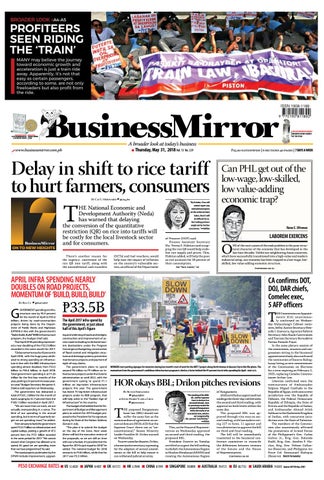
PROFITEERS SEEN R By Cai U. Ordinario, Elijah Felice Rosales, Recto Mercene, Jovee Marie dela Cruz & Jasper Y. Arcalas
M
ANY may believe the ride toward economic growth and acceleration is just a train ride away. Apparently, it’s not that easy as some passengers, according to some, are not only freeloaders but also profit from the ride. Since taking off in January, the government’s Orient Express for its ambitious fiscal road map called Tax Reform for Acceleration and Inclusion (TRAIN) has barreled ahead and added steam to inflation. Inflation—the rate of increase in commodity prices—crept from 3.4 percent in January to 3.8 percent in February and to 4.3 percent in March. As of end-April, inflation figures released by the Philippine Statistical Authority (PSA) recorded a three-year-high increase in prices by 4.5 percent, the Freedom from Debt Coalition said. The PSA further reported that inflation disproportionately affected the poor, with low-income households carrying the burden of a record-high 5.3-percent price hike. The latest inflation data for May will be made available next week but is also expected to breach 4 percent. This has led to critics of the TRAIN law loudly whistling that the policy is adversely impacting consumers, especially poor consumers. As of Wednesday (May 30), three resolutions have in fact been filed in the House of Representatives, seeking the suspension of the fuel excise taxes that are being blamed for the domino-effect spike in prices of most basic goods. The latest resolution, filed Wednesday by 1 Pacman party-list Rep. and House Assistant Majority Leader Michael L. Romero, asked the government to suspend the excise tax on fuel from June to August 2018. The two earlier resolutions were filed by Magdalo Party-List Rep. Gary Alejano and the Makabayan bloc, reiterating their call for the immediate review of Republic Act 10963 or the TRAIN Act. Alejano filed House Resolution 1838 calling for a review of TRAIN’s inflationary impact, noting how the 4-percent prediction of Duterte’s economic managers has been exceeded. Earlier, Rep. Dakila Carlo Cua of Quirino, the chairman of the House Committee on Ways and Means, said the lower chamber is now open to suspending the imposition of certain taxes to address the increasing prices of basic commodities.
Profiteers to blame?
FOR economists like Cid Terosa of the University of Asia and the Pacific, the culprit may not be the TRAIN law, but those profiteering from what is envisioned to be just the first major package of the Duterte administration’s Comprehensive Tax Reform Program (CTRP). And as it is, unless the government can compellingly prove that TRAIN is simply being hijacked, its successor Package 2, next for Congress’s agenda, may be derailed as well. Package 2’s most significant features are the reduction in corporate income taxes and the rationalization of decades-long fiscal incentives for various businesses. The UA&P School of Economics Dean told the BusinessMirror it is very easy to use the TRAIN as an excuse to cover up unwarranted increases in commodity prices.
“Yes, profiteering is possible. In my experience, trade and transportation margins account for a substantial portion of the rise in prices,” Terosa said. “Unscrupulous traders and sellers can take advantage of the situation.”
SRP, penalties
CONSUMER group leader and former trade official Victorio A. Dimagiba cited his personal experience to show there’s evidence the tax law has opened the door to profiteering. He said he bought bottled water at P30 in a stall inside a shopping mall near SM North in Quezon City but the suggested retail price of that brand was only P11. “The SRP [suggested retail price] list [of the Department of Trade and Industry] has been overtaken by events susceptible as the TRAIN law,” Dimagiba told the BusinessMirror. “If you check the list, the items listed are those called patronized by poor consumers, but there are many sizes and brands that are not on the list.” Dimagiba is referring to a list that DTI personnel refer to when inspecting retail shops. According to Trade Undersecretary Ruth B. Castelo, such list deters unscrupulous retailers. They know they will be penalized should they take advantage of the TRAIN law, she told the BusinessMirror. Castelo said the DTI has yet to record an incident of overpricing in groceries or retail stores under the TRAIN law regime. “On basic necessities and prime commodities, there is none. Either because the retailers know the DTI’s presence in the market, or that they are also doing their bit of goodwill for our people,” Castelo said. The trade official, who heads the DTI’s Consumer Protection Group, said stiff penalties await those who will make use of the TRAIN as a reason to overprice merchandise items. Penalty ranges from P5,000 to P1 million, she said. Castelo believes profiteering couldn’t occur since government price monitoring teams are dispersed in different areas.
Oil pressure
RATHER than TRAIN, there are other factors adding pressure on prices, according to the National Economic and Development Authority (Neda). NEDA Undersecretary for Planning and Policy Rosemarie G. Edillon said most notable are the rapid increase in oil prices and the increase in food prices. Both are caused by supply issues, she explained. For oil prices, the strained supply in the international market has caused speculation to run high and drive prices recently to $80 per barrel. However, the assurance by Russian oil players they will increase oil supply has tempered oil prices in the past few days. Nonetheless, oil prices, which can be seen from transport costs, accounted for 0.4 percentage points of the 4.5-percent inflation rate recorded in April. This essentially represented 10 percent of inflation. And rather than the TRAIN
PROTESTERS display placards as they picket the Department of Trade and Industry to coincide with the latest round of oil-price increases on Tuesday in Makati City. The protesters slammed President Duterte’s “triple whammy” issues—oil-price hikes, the new tax-reform law and labor contractualization—which allegedly have triggered soaring prices of basic goods and services. AP/BULLIT MARQUEZ
law, the pressure of higher oil prices in the world market prompted airlines to seek approval of fare hike petitions. For one, Cebu Air Inc. (PSE: CEB) spokesman Charo Lagamon-Logarta told the BusinessMirror “so far, the increase that we have to implement was due to the increase in fuel and the corresponding increase of the peso against the dollar.”
Airline petitions
LOGARTA said the TRAIN law has not been considered as a pressure point for the company. “I think it’s [the rise in prices] really more in the overall increase of fuel per se in the world market,” she added. “That has more of a big impact.” The BusinessMirror sought to clarify whether CEB combined the high cost of fuel and the TRAIN law’s effect on the fuel surcharge. “I’m not sure if that was the pricing scheme,” Logarta said.
PRICES of bottled water—as a former ranking DTI official himself found out—were among those that showed irrational spikes in some areas, causing concern that profiteers could be derailing the TRAIN law by hurting poor consumers. ALYSA SALEN
aderLook RIDING THE ‘TRAIN’
sMirror
www.businessmirror.com.ph | Thursday, May 31, 2018
by more expensive feeds which are corn-based. Corn prices have been on the rise due to lower production. Edillon suspects that corn-growing areas in Region 2 have not yet been able to fully recover from the typhoons that battered the region. “Our sense is that it’s really supply pressure; there really is a shortage of supply. The price of meat and fish, you have seen this rising, including rice,” Edillon said. “We have seen this increasing since last year. We still did not have [the] TRAIN [law] then.” She said that as a percentage of the 4.5-percent inflation recorded in April, food accounted for 2.2 percentage points or around half of inflation. This 2.2 percentage points is accounted for by fish (1.8 percentage points); rice (1.1 percentage points) and meat (0.8 percentage points).
Rice prices
THE latest report from the PSA reveals that the average farm-gate price of palay in the first quarter expanded by 8.2 percent to P19.76per-kilogram price level from the P18.27/kg recorded quotation during the same period of last year. Furthermore, PSA data compiled by the BusinessMirror showed that this is the highest first-quarter average farm-gate price of palay since 2014, when rice output was slashed due to El Niño. During the January-to-March period of 2014, the average quotation of palay breached the P19.03/ kg price level, the first time since recent memory. The increments observed at the farm level were translated into the wholesale and retail prices of rice in the domestic market. The average wholesale price of rice in the January-to-March period grew by 4.5 percent to P40.11/ kg from P38.39 average quotation in the first quarter of 2017.
First time
LIKEWISE, historical data from the PSA shows this is the first time that the average first-quarter wholesale price of rice breached the P40.11/kg level since 2010. Industry groups like the Confederation of Grains Retailers Association of the Philippines Inc. (Grecon) said the price of commercial rice in the local market could go up due to the absence of NFA rice. “There are around 10 million Filipinos who are depending on NFA rice, which is needed in nonpalay-producing areas like the NCR. The consuming public will not have the option to buy cheaper rice in the market now. They will be forced to buy commercial [variants], which is naturally more expensive,” Grecon National President Jaime O. Magbanua told the BusinessMirror.
Kernel costs “So far, we’ve mitigated the cost; first by not increasing the fares and, second, we filed a petition for fuel surcharge. That’s being heard now at the CAB [Civil Aeronautics Board].” CEB is one of two major air carriers that have filed petition with the CAB. Both it and Philippine Airlines Inc. (PAL: PSE) have pending petitions to make a corresponding increase in fares “to mitigate the continued fuel-price increase in the world market.” Air Asia Philippines did not file any petition for fuel surcharge. PAL spokesman Cielo Villaluna declined to comment. “All I can say is that both petitions are subject to intense deliberations,” CAB Executive Director Carmelo Arcilla said.
After 20 years, transparency
THE government, meanwhile, is apparently on to the possibility that some oil players have also
been hiding behind the TRAIN law to deflect public anger over possibly irrational price hikes. As continuing price surges have shifted public anger mostly to the TRAIN law that mandated higher fuel excise taxes, the government last week moved to require a more transparent, unbundled system for informing people of the breakdown of petroleum product prices. The Department of Energy (DOE) released the draft rules on petroleum price monitoring, meant to guide the consumers in making informed decisions in the management of their fuel oil requirements. It also fulfills a 20-year-old mandate of the oil-deregulation law requiring such unbundled price reporting. The agency wants oil companies or bulk suppliers to submit a report on the computation and the corresponding explanation of the unbundled items comprising the price of all petroleum products.
On May 8, the DOE said in a press release the new policy is targeted “to be issued by the end of June this year,” and will enable “the unbundling of the base prices of petroleum products—gasoline, automotive and industrial fuel, kerosene, jet fuel, bunker fuel oil and household and automotive liquefied petroleum gas.” The released draft rules said, “Oil companies shall strictly comply with the submission of the formal notice of price adjustments on a per-liter basis, containing the computation and the corresponding explanation of the unbundled cost items of all products.” The report should indicate the product cost; refining cost; import terminal/depot operation cost; transshipment cost; taxes; biofuels cost; hauler’s fee; unbundled other fixed cost; unbundled other variable cost; and oil company/bulk suppliers’ profit. At present, there is no breakdown of the base price of petro-
leum products sold at various service stations. “Identification of the costing for the major components of these petroleum products that may affect the pump prices would provide a higher level of transparency for our consumers, particularly the motorists,” said DOE secretary Alfonso Cusi.
Food prices
EDILLON said more than profiteers riding on the TRAIN law, in the case of food prices, there are three primary culprits: more expensive fish, rice and meat. Apart from the regular closure of fishing grounds, Edillon said fish prices are increasing because of a general decline in fish supply. Higher rice prices, meanwhile, owed mainly to the pronouncement of the National Food Authority (NFA) that it only had three days’ worth of rice in its warehouses as early as January 2018. In terms of more expensive meat products, this was affected
AS for corn prices, PSA data compiled by the BusinessMirror showed that average farm-gate price of yellow corn in the first quarter reached P13.34/kg, 17.32 percent higher than the P11.37 average quotation during the same period of 2017. This was the highest firstquarter average farm-gate price of corn since 2012 when quotation reached P13.29/kg. The double-digit hike in the farm-gate price of yellow corn translated to higher prices at the wholesale and retail market levels. The average wholesale price of yellow corn in the first quarter rose by 11.23 percent to P19.30/kg, from P17.35/kg average quotation in the same period of 2017. This was the first time that the average wholesale quotation for yellow corn breached the P19/kg level. At the retail level, prices of yellow corn grew 1.9 percent to P23.19/kg from P22.77 from a year ago level.
A5
Yellow corn
INDUSTRY sources told the BusinessMirror that there has been erratic production of yellow corn in some parts of country, like in Mindanao, resulting in higher prices for the commodity. Meanwhile, the PSA characterized the increase in the prices of yellow corn “as a result of better quality of kernels and higher demand from feed millers and processors.” Double-digit growth was also observed on the farm-gate, wholesale and retail level prices of white corn during the first quarter. In the January-to-March period, average farm-gate quotation for white corn expanded by 38.1 percent to P16.92/kg from P12.25/ kg price level in 2017. Likewise, the wholesale and retail prices of white corn during the reference period rose by 30.2 percent and 12.4 percent year-onyear, respectively. Wholesale quotation of white corn in the first quarter reached P20.24/kg, while retail price reached nearly P30/kg.
91 centavos
THE fiercest defender of the TRAIN law is the Department of Finance (DOF), which has said that for every additional peso spent for various commodities, only nine centavos can be attributable directly to the TRAIN. Among the provisions in the TRAIN that affected commodity prices were the tax on Sugar Sweetened Beverages (SSB) and higher excise taxes for fuel and automobiles, among others. However, this begs the question where the remaining additional 91 centavos is coming from. If the NEDA follows the DOF estimate that for every additional peso spent for inflation and only nine centavos is attributable to TRAIN, the rest of the missing 91 centavos can be attributed to oil, food prices and conditions that are consistent with a growing economy. Edillon said of the 91 centavos, around 50 centavos will go to food and 10 centavos will go to oil or transportation. This leaves 31 centavos for the impact on prices by economic growth, as well as higher incomes and population.
Consumer activism
WHILE she can’t rule out profiteering, Edillon said what is needed to prevent this from happening is a dedicated consumer group that can help the government monitor unusual price movements. She said this group can be similar to the Consumer and Oil Price Watch (COPW), which was headed by Raul T. Concepcion until the early 2000s. “We need an active consumer group,” Edillon said. “It helps a lot if you have somebody on the consumer side. Before, that was really a service; it was public service. He [Concepcion] was not getting anything from the government.” She believes the COPW “should be revived.” “If you can have many more of the business groups banding together and then supporting consumer sentiment, that would be a big help,” Edillon said. While Dimagiba doesn’t consider his group as a COPW copy, Laban Konsyumer Inc. has been addressing the TRAIN Law.
Petition in SC
HIS group is currently petitioning the Supreme Court to intervene and halt the implementation of the tax-reform measure. Dimagiba also wants the DTI to rethink its statement that there has been no record of profiteering under the TRAIN law regime. The DTI must also look into retail outlets, not only supermarkets, he added. “Now everybody rides on the wagon of the TRAIN,” Dimagiba said. With a report by Lenie Lectura
A6 Thursday, May 31, 2018 • Editor: Angel R. Calso
Opinion BusinessMirror
www.businessmirror.com.ph
editorial
Help the poor recover their purchasing power
I
n January the Filipino people decided to give the Tax Reform for Acceleration and Inclusion (TRAIN) law a chance to demonstrate its worth as an excellent legislation. Who would object to the idea of a tax reform that would give employed Filipinos more purchasing power by reducing their personal-income tax? What more, TRAIN would generate revenues for the Duterte administration’s “Build, Build, Build” program. As it were, the TRAIN law’s benefits were promising.
After five months, however, the people targeted as the beneficiaries of the TRAIN law can’t help but weep. The rising prices of commodities negated its supposedly positive impact on income. Inflation rate accelerated to its highest level in five years, impeded by the increase in global oil prices, a weakening peso and the tightening of United States monetary policy. While the government has allocated P24 billion under its unconditional-cash transfer program to help the poor cope with price increases, such subsidies may not be enough to cover these beneficiaries’ most basic needs. The UCT program gives 10 million families nationwide a P200 per month stipend. The subsidy program was supposed to be implemented shortly after the TRAIN law took effect in January. Currently, however, only 4 million families have benefited from the UCT program. Sen. Panfilo M. Lacson Sr., who opposed the measure, recently urged the government to do something to arrest price increases, which are being blamed on the TRAIN law. He also issued a stern warning: “When the stomach protests, prepare for revolution.” Meanwhile, the trade unions are demanding for higher minimum wages. The Associated Labor Unions-Trade Union Congress of the Philippines has called on all regional wage boards to hold emergency meetings and adjust prevailing wage rates, citing the increase in the prices of goods and commodities. ALU-TUCP also asked President Duterte to approve their proposed P500 cash voucher subsidy for employees as a form of government safety net for workers affected by the weak buying power of their daily minimum wage. Manila Auxiliary Bishop Broderick Pabillo recently said he supports the workers calling for a minimum-wage increase. “If this government wants inclusive growth, it should increase the pay of the workers,” he said, adding that if the government cannot grant a salary increase, it should provide other benefits to workers, such as scrapping the contractualization of workers for them to be secure in their tenure. At a time when millions of poor Filipinos are trying to make both ends meet because of inflationary pressures, the government must look for immediate solutions. As Senator Lacson warned, it should not wait for the stomachs to protest. National leaders must now mitigate the worsening plight of workers and their families by providing needed safety net while employers, on the other hand, must also help provide a substantial wage increase and save workers from falling into hopelessness and destitution. These interventions are needed in these desperate times to help workers live above the poverty threshold. The Department of Labor and Employment must also act fast and order the Regional Tripartite Wages and Productivity Board to convene and assess the impact of rising costs of goods on workers’ income. Minimum-wage earners are desperate, and the government alone has the capability to help them recover the lost value of their income and purchasing power. Since 2005
BusinessMirror A broader look at today’s business
The gathering storm John Mangun
OUTSIDE THE BOX
T
he first book of Sir Winston Churchill’s six-volume history of the Second World War is titled The Gathering Storm. Divided into two parts, the first is his observations on the settlement of World War I and its place in the causes of the war. The second part tells of his nation thrust unprepared into war. During the summer of 2015, I wrote that the world would be entering a time of political chaos, at least by the standards of recent decades. Perhaps the best illustration of this is in the vote by Britain to leave the European Union, the election in the Philippines of Rodrigo Duterte, and in the United States of Donald J. Trump. Not only did these elections have great domestic implications, but all created global reverberations. Duterte’s move away from focusing Philippine foreign policy almost solely on the United States was never anticipated by all the experts. Until the final vote count, “Brexit” was
unimaginable. Even as the first votes came in, The New York Times had Hillary Clinton’s odds to win the presidency at 95 percent. While the flames of the political changes of 2016 are lower, the embers still burn white hot. France elected its president from outside the two major political parties that has governed the nation for decades. Canada’s Justin Trudeau would lose an election by a wide margin if held today. Mahathir Mohamad in Malaysia just returned to power, beating the political party that has ruled since independence. Political chaos is always followed by economic chaos and I said the
A guide to ascertain the truth
✝ Ambassador Antonio L. Cabangon Chua
Cecilio T. Arillo
Founder Publisher
Jun B. Vallecera
Associate Editor News Editor
Jennifer A. Ng Vittorio V. Vitug
Senior Editors
Lorenzo M. Lomibao Jr., Gerard S. Ramos Lyn B. Resurreccion, Efleda P. Campos Dennis D. Estopace
Online Editor Social Media Editor
Ruben M. Cruz Jr. Angel R. Calso
Creative Director Chief Photographer
Eduardo A. Davad Nonilon G. Reyes
Chairman of the Board & Ombudsman President VP-Finance VP Advertising Sales Advertising Sales Manager Group Circulation Manager
Judge Pedro T. Santiago (Ret.) Benjamin V. Ramos Adebelo D. Gasmin Marvin Nisperos Estigoy Aldwin Maralit Tolosa Rolando M. Manangan
BusinessMirror is published daily by the Philippine Business Daily Mirror Publishing, Inc., with offices on the 3rd floor of Dominga Building III 2113 Chino Roces Avenue corner De La Rosa Street, Makati City, Philippines. Tel. Nos. (Editorial) 817-9467; 813-0725. Fax line: 813-7025. (Advertising Sales) 893-2019; 817-1351, 817-2807. (Circulation) 893-1662; 814-0134 to 36. E-mail: news@businessmirror.com.ph.
www.businessmirror.com.ph
Printed by brown madonna Press, Inc.–San Valley Drive KM-15, South Superhighway, Parañaque, Metro Manila MEMBER OF
database
T. Anthony C. Cabangon
Editor in Chief
second phase would begin in 2018. The gathering storm continues. The cycle has been the same since ancient Greece and Rome. Political leaders stay in power by promising the sun, the moon, and the stars. But over time the people eventually realize that what they are now receiving is dirt, grass and tree bark. Then through the ballot box or revolution, it is out with the old and in with the new. However, the political change is never soon enough to avoid the economic problems growing worse. All of the economic policies—especially the central banks’ historically low interest rates—from 2009 were not enough to save the jobs of the political establishment and the negative effects of those polices are increasing daily. You can blame high oil prices on the looming slowdown of global economic growth and higher inflation from the Philippines to Brazil. And that is a fact. Nonetheless, the “free money” regime of a decade created a misallocation of financial resources that makes the effect of $80 per barrel oil much worse than $128 crude oil in 2012. Italy has been in political chaos since the end of 2016 when reformist
Conclusion
M
ajority decision. The practice of allowing the majority of the members of a social group to make decisions is an important feature of a democratic way of life. By “majority” we mean the greater part or more than half, even if the difference between the two parts is a matter of one point. The majority’s decision is used in determining many issues, e.g., what form of government a society should have, who should manage the state, the province and other political units, what laws to pass, which regions and which agencies will get this much support from the government, etc.? Past experiences will tell us that in many instances the majority opinion, as well as the unanimous decision, was wrong. For instance, governments encounter serious budgetary deficits because of a majority decision on wrong revenue collection estimates. A majority decision, therefore, is not a good test of truth. Authority. The jurisdiction of political authority, the location of
sovereignty, the balancing of freedom and authority, and the requirements of political obligations have been core questions for political philosophers from Plato and Aristotle to the present. Relying on authority in resolving issues is a widespread practice by individuals or groups in every society. For instance, religious persons cite the Bible as the authority of their lives; confronted with a legal problem, they get the services of lawyers; and to solve their medical problems, they depend on doctors. It is a fact, however, that authorities often contradict each other or one another. Medical doctors are known to have differed in their diagnosis of certain illnesses such as dengue. Sociologists have disagreed
Past experiences will tell us that in many instances the majority opinion, as well as the unanimous decision, was wrong. For instance, governments encounter serious budgetary deficits because of a majority decision on wrong revenue collection estimates. A majority decision, therefore, is not a good test of truth. on the major motivation for the runaway population growth in Third World countries. Judges confuse people with their different opinions as to whether abortion is a crime or not. Whose word then, should they trust? Another consideration that weakens authority as tests of truth is the fact that there are persons who masquerade as authorities, and there are writings that later on are discovered to be spurious. Pragmatism as a way to test for truth is to refer to accounts, definitions and theories that are workable, practical and satisfactory. As a test of truth, it has deficiencies, the more prominent being the difficulty to determine what is meant by workable, practical and satisfactory. And from whose viewpoint should the results be judged as satisfactorily workable and useful?
Prime Minister Matteo Renzi resigned. But the economic problems continue to increase. One in three Italian millennials are unemployed. The GDP per capita is lower today than it was 20 years ago. While rising oil prices is the headline reason for the trucking strike that has crippled the Brazilian economy, the root cause is government economic policies that for a decade kept prices artificially low to win votes. Some Brazilian groups from various sectors are calling for a military take-over of the government, seeking a savior from its economic chaos. This is just the beginning. As governments globally are forced to unwind from the catastrophic policies of the past, there will be more pain and suffering followed by more economic chaos. A rising dollar will add fuel to the fire. A major sovereign debt default is coming. As Churchill’s England was unprepared for war, most nations are unprepared for the future. E-mail me at mangun@gmail.com. Visit my web site at www.mangunonmarkets.com. Follow me on Twitter @mangunonmarkets. PSE stockmarket information and technical analysis tools provided by the COL Financial Group Inc.
Correspondence. The correspondence theory is often traced back to Aristotle’s well-known definition of truth (in Metaphysics): “To say of what is that it is not, or of what is not that it is, is false, while to say of what is that it is, and of what is not that it is not, is true”—but virtually identical formulations can be found in correspondence. It is noteworthy that this definition does not highlight the basic correspondence intuition. It is defined as that which conforms to fact, which agrees with reality and which corresponds to the actual situation (Bertrand Russell). On the basis of this definition the correspondence theory of truth was formulated: an idea or description is true if it agrees with the object described or referred to. As a definition of truth, correspondence is no doubt beyond question. But as a test of truth, correspondence is, in many instances, not useful. Its user will be faced with the difficulty of comparing ideas with reality since, unlike the former; the latter may not be immediately available to him. One immediate idea of the object and your idea of it when you experienced it may be compared to a correspondence check. For instance, is the object still the same as when you experienced it? It is wise then to take correspondence for what it See “arillo,” A7
Opinion BusinessMirror
www.businessmirror.com.ph
Can PHL get out of the low-wage, low-skilled, low value-adding economic trap?
For many Msgr. Sabino A. Vengco Jr.
Alálaong Bagá
W
LABOREM EXERCENS
ith the solemnity of Corpus Christi, the Most Holy Body and Blood of Christ, we round off the initial part of the post-Easter season before the ordinary time of the year begins again. Saint Mark’s account of the Lord’s Supper (Mark 14:12-16, 22-26) emphasizes the new community that the sacrifice of Jesus creates nourished by the bread He breaks with them and the cup they drink.
Continued from A1
In the company of His disciples
Dr. Rene E. Ofreneo
W
hile unemployment is going down, underemployment remains high. Most of the jobs available are in the lowwage and low value-adding services sector, informal economy and low-tech manufacturing. Workers hired in these sectors are simply called by some employers and human resource managers as “replaceable labor.” These are workers who can easily be recruited and can easily be disposed of under various short-term endo hiring arrangements. It is doubtful if the proposed security-oftenure (SOT) legislative remedies can cure or abolish the endo problem without a miraculous transformation of the economy. Now what is the evidence for the foregoing observations? The World Bank, in its “Philippine Economic Updates” (April 2018), concluded that the “Philippines has transitioned from an agricultural economy to a [low-end] services economy without developing a manufacturing sector.” Of course, this observation is not new. What is new is that it is coming from the World Bank, one of the authors of the “structural adjustment program” (SAP) of the 1980s to 1990s. The SAP program, it will be recalled, was supposed to transform the Philippine economy into a modern industrialized one. This has not happened. But some of the findings of the World Bank, using their own words, are worth citing here. First, GDP growth and employment increase do not translate into higher incomes for the workers. “Although employment increased by 20 percent between 2006 and 2015 when the country’s GDP increased by about 60 percent, real wages remained stagnant, with only a 4-percent increase in real terms over the period,” the World Bank wrote. Further, it warned that “the low growth of real wages is likely to have a negative effect on the competitiveness of the country’s economy in the long run, as the most educated Filipinos leave the country for better job opportunities.” The truth is that this talent exodus has been happening and has given rise to the twin problems of talent shortage and “talent poaching” in critical industries, such as those reliant on skilled/experienced engineers and ICT programmers. Second, the “structural change” in employment, from the 1970s to the present, did not follow the East Asian pattern. Instead of surplus agricultural labor moving to laborintensive manufacturing, the “majority of workers in the Philippines who transited out of agriculture were employed in the services sector.” And worse, many of “the unskilled labor that transitioned to nonagriculture employment ended up in low-wage and low-skilled jobs in the informal services sector.” It cited another World Bank report, “Philippine Development Report” (2013), which concluded that more than threequarters (3/4) of the services sector are “composed of low-paid and lowskilled jobs in areas, such as petty retail trade and public transportation.” Third, real wages for private establishment workers grew by only 1.5 percent compared to 11 percent for those in the government and the 9 percent for those working in private households. These are figures for 2006 to 2015. With the recent surge in commodity prices under the TRAIN 1 economic policy regime, real wages must have been eroded further. This explains the loud demands of trade unions for new higher minimum wages. As to the higher rates of real wage increases in the public sector, the explanation was
The solution of the World Bank is for more investments on human capital development, which simply means more spending on education and skills development. Naturally, the higher the skills a person has, the more marketable he or she becomes. the round of salary standardization wage increases under the Arroyo administration. In the case of the rise of private household compensation, the reason cited is the Domestic Workers Act (Kasambahay law) of 2013. Additionally, one may add the continuous upward demand for Filipina domestics in East Asia and Middle East countries, a labor market reality that forces household employers to pay higher in order to get quality household helps. So what then is the solution? The solution of the World Bank is for more investments on human capital development, which simply means more spending on education and skills development. Naturally, the higher the skills a person has, the more marketable he or she becomes. With the right skills and educational background, a person’s negotiating power in demanding higher wages and better benefits is strengthened. The other solution given by the World Bank is to encourage more investors to invest by further opening up the economy. The problem, however, is that this is precisely what the Philippines has already been doing since the 1980s, and yet the results have been poor as reflected in the relatively low rates of investments in industry and agriculture compared to investments in consumption-oriented distribution industries. Think of the malls and service industries being put up by the Sys, Ayalas, Gokongweis, Tans, Gaisanos and so on. What is clearly needed is a more decisive and integrated program of industrial development, agricultural modernization, all-out education upgrading, science and technology development and business and people participation in an honest-togoodness industrial and agricultural policy. The Philippines has already tried the program of opening up of the economy through trade and investment liberalization, deregulation of key sectors of the economy and privatization of government corporations, assets, services and infrastructure development. Somehow, the gains are limited. SAP as a program has not worked. It is time to change gears and be more proactive. It is also time for the trade unions to look beyond their call or demand for laws restricting or banning endotype hiring arrangements. The big development challenge is how to transform a low-wage, low-skilled, low value-adding economy into a high-skilled, high value-adding and, eventually, high-wage one.
The opening line “On the first day of the Feast of the Unleavened Bread, when they sacrificed the Passover lamb” (i.e., in the afternoon of the previous day, 14th of Nisan) is not a chronological lapse but a theological statement (as also in 14:1) that closely associates the sacrifice of the Paschal Lamb, Jesus Christ, with the eating of the Christian Unleavened Bread, the Eucharist. The narration of the preparation for the Passover meal did not include the details about the necessary procurement of the blessed lamb, the herbs, sauces, salt water, apple and nuts, etc. As an excerpt from the passion narrative, the principal concern here was the Passover of Jesus in His
passion and death. Pointedly, Jesus was asked where He would want to eat the Passover meal. And as the end-time prophet with messianic authority and abilities, Jesus (as in 11:1-7) gave the unusual directive that a man with a jar of water would meet the two disciples He was sending for the purpose. The jar of water seemed to be a prearranged signal. They were to follow the man inside the house he would enter, and they were to ask the master of the house that “the teacher” is asking “where is my guest room where I may eat the Passover with my disciples?” It must be the house of a follower because “the teacher” is enough identification. There is an upper room the disciples prepared for the Passover, and there Jesus would
Thursday, May 31, 2018 A7
The cup Jesus identified as His blood was probably the third cup of wine of the Passover meal following the main course and before the singing of the Hallel psalms. He interpreted the cup as “My blood of the covenant which will be shed for many.” Jesus, therefore, explained His own coming suffering and death in terms of the suffering servant’s passion and death for many. eat the sacred meal in the company of His disciples.
‘Take...My body’
The second part of the gospel reading is not a play-by-play description of the Passover meal but the institution of the Eucharist. In character highly liturgical, this Eucharistic tradition of Saint Mark’s community of the 60s shows that the Eucharist, both bread and wine, was celebrated near the end of the meal. The discernible set pattern of the liturgical action: taking of the bread/ cup, blessing/thanking, breaking the bread and distribution, establishes intended similarity with the multiplication sequences in Mark 6:41 and 8:6-7. In all these, the writer obviously wanted a liturgical and Eucharistic understanding to surface. The cup Jesus identified as His blood was probably the third cup of wine of the Passover meal
Philippines on cryptocurrency
W
In a 2017 Securities and Exchange Commission Advisory on Initial Coin Offerings and the 2018 SEC Advisory warning the public on Bitcoin-related Ponzi Schemes, the SEC said that investment schemes with the use of cryptocurrencies or digital currencies are considered securities transactions subject to its regulatory authority.
On March 6, 2014, alarmed by the Bitcoin exchanges in the Philippines, the Bangko Sentral ng Pilipinas (BSP) issued a Warning Advisory for the public that exchanges of virtual currency, such as the Bitcoin, are not regulated by the BSP or any other regulatory authority, and thus, there are no regulations that would specifically protect consumers and businesses for financial losses from transacting with the use of virtual currencies. On February 6, 2017, realizing that virtual currency (VC) system can revolutionize the delivery of financial services, the BSP issued Circular 944, or the Guidelines for Virtual Currency Exchanges, requiring VC exchanges to obtain certificate of registration to operate as remittance and transfer company. As such, all VC Exchanges shall adhere to the guidelines issued by the BSP. However, the BSP emphasized that this issuance is not to endorse VCs as currencies but merely to regulate the use of VCs in financial or business transactions. Thus, the BSP reminds the public to be cautious in entering into VC transactions as
it is a risky investment. In a 2017 Securities and Exchange Commission Advisory on Initial Coin Offerings and the 2018 SEC Advisory warning the public on Bitcoin-related Ponzi Schemes, the SEC warned the public that investment schemes with the use of cryptocurrencies or digital currencies are considered securities transactions subject to its regulatory authority. Thus, such entities engaged in VC transactions should secure prior registration and/or license to solicit investment or sell securities as required under the Securities Regulation Code. Further, the SRC requires that cryptocurrencies or digital currencies, which are treated as securities, should be registered with the SEC prior to its offer to the public. In a resolution issued by the SEC on March 2, 2018, in the case of In re: Black Cell Technology Inc., Black Sands Capital Inc., BlackCell Technology Limited and Krops v. Enforcement and Investor Protection Department, SEC CDO Case 01-18-046, using the Howey Test and Section 3.1 of the SRC, the SEC ruled that Kropcoins,
a cryptocurrency, are considered unregistered securities that are being offered and/or sold within the Philippines; and though the offer was initiated by a Hong Kong company, it is accessible via the Internet to buyers in the Philippines. Based on the foregoing, the Philippines treats cryptocurrencies as securities, which may be subjected to taxes under the National Internal Revenue Code (NIRC), as amended by the Tax Reform for Acceleration and Inclusion law. The Bureau of Internal Revenue (BIR), on the other hand, has not yet issued its guidelines on the tax treatments of cryptocurrency transactions, despite the emerging interest on the VC exchanges in the Philippine market. Nonetheless, since the SEC treated it as securities, the BIR may also tax them as securities. Further, the NIRC, as amended, provides that any income of an individual or corporation, in whatever form, sourced from the Philippines, is taxable in general. Thus, depending on the transaction involved using cryptocurrencies, income, percentage and other business taxes provided under the NIRC may be imposed by the BIR. The use of cryptocurrencies is, indeed, helpful to the fast-growing global industry since cashless
this is the principle underlying the Aristotelian logic as the following classic in syllogism exemplifies: All men are mortal; Socrates is a man; therefore Socrates is mortal. While the rigorous form of consistency is effective for the static or closed system, it rests on certain assumptions, such as that all men are mortals, which need to be verified. Moreover, consistency could be easily disrupted by the mere introduction of new and unrelated data. On this basis even rigorous consistency is not an adequate test of truth. Coherence. The coherence of
truth originated with G.W.F. Hegel (1770-1831) and is associated with rationalistic philosophers like Rene Descartes. It is a view that an idea, opinion or belief is true if it has intelligible, systematic and consistent connection with the body of knowledge that we possess. It is not enough that a statement is consistent; it must have a clear and logical link with all other facts of our experience. Since coherence takes into account all facts of human experiences and provides us with a more complete view of life, it is more adequate and,
Atty. Septfonette Fe D. Balusdan
Tax Law for Business ith the current pace of global industrial development, cryptocurrency is becoming a global phenomenon as several countries now recognize its importance. Cryptocurrency is a digital currency in which encryption techniques are used to regulate the generation of units of currency and verify the transfer of funds. It is a variety of virtual currency that uses cryptography for security and is neither issued nor guaranteed by a Central Bank nor backed by any commodity. The most common type of cryptocurrency is the Bitcoin.
Arillo . . .
continued from A6
is—a definition of truth, but not as a test of truth as other people would insist. That consistency helps detect falsehood has contradictions. It does not tell us if statements are in themselves true, are related to or connected with each other or one another. In rigorous consistency, all statements in an argument must necessarily follow one another. Basically,
following the main course and before the singing of the Hallel psalms. He interpreted the cup as “my blood of the covenant which will be shed for many.” Jesus, therefore, explained His own coming suffering and death in terms of the suffering servant’s passion and death for many (Isaiah 53:10-11). By his sacrifice on the cross, He forged a new covenantal bond with God “for many,” a Semitism for all. The early Christians already recognized that in celebrating the Eucharist, the Lord’s Supper, they are commemorating Jesus’ cross and remembering the new covenant by Him, and waiting in anticipation for the fullness of the feast “in the Kingdom of God” in eternity. Alálaong bagá, those who today eat of the bread and drink of the cup given by Jesus become participants and beneficiaries of the reconciliation and salvation the bread and the cup signify. Then as now, this covenant participation entails the assumption of responsibility for the standards and ideals of the communion and fellowship. The cross and the bread and cup are not to be separated; they are parts of the same mystery of God’s saving love. Covenant fidelity and Eucharistic bond are integral facets of the gift of the cross.
Join me in meditating on the Word of God every Sunday, from 5 to 6 a.m. on DWIZ 882, or by audio streaming on www.dwiz882.com.
transactions bring convenience to business dealings and promote faster operations, especially on international engagements. However, it comes with a great risk of financial losses due to the volatility of cryptocurrency market. Further, due to its cryptographic feature, cryptocurrencies can be easily used in money laundering or in funding terrorist activities. Thus, vigilance on both users and the government authorities is the key to the effective use of cryptocurrency. At present, the Philippine government is yet to stabilize its laws and regulations on VC exchanges. Despite the fact that the BSP and the SEC recognized VC exchanges, it is still unregulated as most cryptocurrencies are unregistered; and thus, it would be a challenge on the part of the BIR to track and impose the necessary taxes on cryptocurrency transactions. One can even mine a crypto coin worth millions of dollars and sell it to a foreign buyer without the knowledge of the tax authorities. At this current state, our government has very limited means in monitoring the cryptocurrency market and cannot fully protect the financial interest of its citizen users. Therefore, one who enters the cryptocurrency market should always be on guard because “Cashless is good, but you may lose your goods.” The author is a junior associate of Du-Baladad and Associates Law Offices (BDB Law), a memberfirm of WTS Global. The article is for general information only and is not intended, nor should be construed as a substitute for tax, legal or financial advice on any specific matter. Applicability of this article to any actual or particular tax or legal issue should be supported therefore by a professional study or advice. If you have any comments or questions concerning the article, you may e-mail the author at septfonettefe.balusdan@bdblaw.com.ph or call 403-2001 local 170.
therefore, superior to any of the tests that have been examined. Dr. Patrick A. Azanza, a noted academician, said in his book Human Behavior and Society: “Truth is the reality of the matter, situation or existence. This is also the accepted state of a person, object or environment based on coincidence or agreement of what is said and what is real. Consistency, coherence and preponderance of evidence support the truth of an idea.” To reach the writer, e-mail cecilio.arillo@ gmail.com.
2nd Front Page BusinessMirror
A8 Thursday, May 31, 2018
www.businessmirror.com.ph
House panels’ report: ERC execs should face Con-com eyes single raps for allowing no-bid power-supply deals electoral tribunal
T
By Jovee Marie N. dela Cruz
@joveemarie
HE House Committee on Good Government and Public Accountability and House Committee on Energy said Energy Regulatory Commission (ERC) officials may face possible violations of the antigraft law for allowing electric companies, including Manila Electric Co. (Meralco), to forgo the bidding of power-supply agreements (PSAs).
In a committee report, the two panels said they will refer the findings and conclusions of possible commission of malfeasance, misfeasance and nonfeasance to proper government bodies. The panels also recommended to the quasijudicial bodies the filing of appropriate charges against ERC officials while the regulatory commission is resolving Meralco’s seven questioned PSAs. “The ERC commissioners have committed malfeasance, misfeasance and nonfeasance, rendering illegal ERC’s issuance of Resolution 1 series of 2016 that delayed the effectivity of the competitive selection process,” the report said. According to the report, ERC officials committed acts prohibited under the Anti Graft and Corrupt Practices Act. Party-list Rep. Carlos Isagani T. Zarate of Bayan Muna said the possible violations that the ERC committed in the handling of the Meralco-linked PSAs would not have come to light if the matter had not been taken up in the lower chamber. Zarate is the author of House Resolution 566 urging the lower chamber to look into the filing of seven “questionable” PSAs before the ERC.
“In a way, I think we achieved one of our main objectives in raising this issue. The consumers didn’t know about this then. Meralco appears untouchable, ‘Let’s not look into that.’ But because of the committee hearings, everything came out,” Zarate said. The controversial PSAs include the Redondo Peninsula Energy Inc. (which is applying for a 225-megawatt [MW] plant), Atimonan One Energy Inc. (1,200 MW), the Saint Raphael Power Generation Corp. (400 MW), Central Luzon Premiere Power Corp. (528 MW), the Mariveles Power Generation Corp. (528 MW), the Panay Energy Development Corp.(70 MW), and the Global Luzon Energy Development Corp. (600 MW). Zarate has claimed that the ERC bent its own rules to accommodate these alleged “sweetheart deals,” which he described as onerous and disadvantageous to consumers. The lawmaker called out the ERC for choosing not to have the PSAs undergo bidding or the required competitive selection process. According to Zarate, consumers will shoulder P930 billion in additional power rate expenses within the 20- to 21-year duration of the power-supply deals if the ERC approves the PSAs.
By Bernadette D. Nicolas
Solon files third resolution suspending fuel excise tax
T
O ease inflation pressures and slow down the decline in the purchasing power of the peso, another lawmaker has filed a third resolution urging President Duterte to suspend for three months the imposition of the excise tax rates on fuel and other petroleum products under the Tax Reform for Acceleration and Inclusion law. In House Resolution 1919, House Assistant Majority Leader Michael L. Romero of 1 Pacman asked the government to suspend the excise tax on fuel from June to August 2018. Romero said that from January 2017 to May 2018 the Philippine peso lost about 6 percent of its purchasing power and he noted how the inflation rate in January 2018 hit 4.0 percent, and rose to 5.1 percent in April 2018. “The Philippine economy grew by 6.8 percent in the First quarter of 2018 and is en route to becoming a new middle-income national economy, graduating from developing-country status,” Romero said. “The country must preserve and sustain its economic gains,” he added. Meanwhile, Romero wants the House Committee on Ways and Means, Committee on Economic Affairs, and Committee on Banks and Financial Intermediaries to conduct public hearings and consultations, in aid of legislation, for the purpose of crafting new legislative measures on sourcing of funds to make up for the lost revenue due to the suspension of the excise tax. He also asked these committees to look into possible additional authority for the Bangko Sentral ng Pilipinas to meet its inflation targets; and additional social safety nets for Filipinos adversely affected by the erosion of the purchasing power of the peso. Earlier, Rep. Dakila Carlo E. Cua of the Lone District of Quirino, the chairman of the House Committee on Ways and Means, said the lower chamber is now open to suspending the imposition of certain taxes to address the increasing prices of basic commodities. According to Cua, his committee is also studying the power of the Bureau of Internal Revenue to recommend to the President the suspension of the imposition of taxes, particularly the excise taxes, as well as the value-added tax on fuel. Jovee Marie N. dela Cruz
HOR okays BBL; Drilon pitches revisions
Continued from A1
Deputy Speaker Bai Sandra A. Sema said the measure would be the “epitome of real autonomy” in the country, and would serve as the “precursor” of the regional autonomy or federal states within a federal system of government in the future. “In this holy month of Ramadan, the Bangsamoro people await the dawning of peace in the Moroland.... As we humble ourselves by abstaining from food and water during daylight for 30 days during this holy month of Ramadan, may our brothers and sisters pray with us for peace in our country,” Sema said. Rep. Ruby M. Sahali of the Lone District of Tawi-Tawi, chairman of the Special Committee on Peace, Reconciliation and Unity, said the passage of the bill would be an affirmative action to correct centuries of neglect and injustice against the people in Mindanao. Rep. Mauyag B. Papandayan Jr. of the Lone District of Lanao del Sur, chairman of the Committee on Muslim Affairs, said the approval of the BBL will resolve the national and cultural divide in the country for over four centuries. Speaker Pantaleon D. Alvarez said he would not stop anyone from questioning the constitutionality of BBL before the Supreme Court. Several lawmakers said the proposed BBL is unconstitutional as the measure will abolish the ARMM, which was provided for by the Constitution, by only passing a legislation. Meanwhile, House Majority Leader Rodolfo C. Fariñas Sr. of the First District of Ilocos Norte said Congress will hold the bicameral meetings, together with the Bangsamoro Transition Commission (BTC) and the executive department, during the congressional break to resolve conflicting provisions in both versions. Congress is expected to take a sine die adjourment starting on May 31 until July 22. The measure seeks to establish a political entity, provide for its basic structure of government in recognition of the justness and legitimacy of the cause of the Bangsamoro people and their aspiration to chart their political future through a democratic process that will secure their identity and posterity and allow for a meaningful self-governance. Under the bill, the Bangsamoro territory shall remain a part of the Philippines. The measure delineates the core territory of the Bangsamoro to be composed of: 1) the present geographical area of the ARMM; 2) the municipalities of Baloi, Munai, Nunungan, Pantar, Tagolan and Tangkal in the province of Lanao del Norte and all other barangays in the municipalities of Kabacan, Carmen, Aleosan, Pigkawayan, Pikit and Midsayap that voted for inclusion in the ARMM during the 2001 plebiscite; and 3) the cities of Cotabatao and Isabela. The bill retains the central government’s power and control over defense and external security. It provides that the defense of the Bangsamoro shall be the responsibility of the central government. The central government shall create a Bangsamoro Military Command of the Armed Forces of the Philippines for the Bangsamoro, which shall be organized, maintained and utilized in accordance with national laws. The measure also calls for the creation of a Bangsamoro Police for law enforcement and maintenance of peace and order in the Bangsamoro but it shall be part of the Philippine National Police. Meanwhile, some of the major amendments to the BBL
Muslim women in Marawi are seen at a temporary shelther in this file photo. Lawmakers, taking a cue from the President, are rushing the BBL. NONIE REYES
include: only one plebiscite will be held between 90 and 120 days (from original proposal of every five years for 25 years) upon the effectivity of the BBL and the block grant to the region will be decreased to 5 percent (from original 6 percent) of the national revenue.
Drilon’s amendments
While affirming his support for the BBL, Drilon asserted the need to “avoid the constitutional issues that led to the downfall of the previous Memorandum of Agreement on Ancestral Domain [MOAAD] in 2008.” He, thus, pitched certain key changes. Anticipating a case will be elevated to the High Tribunal, Drilon said he wants to “make sure that the BBL that we will pass in Congress is 100 percent in conformity with the 1987 Constitution.” This, even as he added that “all our amendments are designed to cleanse it of unconstitutional provisions so it can withstand judicial scrutiny. We cannot afford a repeat of what happened in the MOA-AD.” Drilon recalled that the MOA-AD, signed by the administration of President Gloria Macapagal-Arroyo and the Moro Islamic Liberation Front in 2008, was struck down by the Supreme Court. He cited the landmark case Province of North Cotabato v. the Government of the Republic of Philippines (GR. 183591), where the High Tribunal ruled the agreement was unconstitutional and illegal, and the process through which it was commenced “whimsical, capricious, oppressive, arbitrary and despotic.”
Delete ‘reserved powers’
To avert a repeat of the MOA-AD debacle, Drilon submitted several amendments in Senate Bill 1717, including a motion to delete the provision on“reserved powers”for the new Bangsamoro Autonomous Region, given that the Constitution already provides for the
residual powers of the national government vis-à-vis autonomous regions. “We reiterate the Section 17, Article X of the Constitution in this section,” he added. Section 17 Article X provides that, “All powers, functions and responsibilities not granted by this Constitution or by law to the autonomous regions shall be vested in the national government.” Drilon cited this among the contentious provisions likely to arise when the Senate and the House of Representatives pass their own versions and eventually meet in the bicameral conference committee. “We did away with nomenclatures, used no specific name and simply mirrored the wording of the Constitution, and gave powers to the Bangsamoro government in keeping with the constitutional provisions on local autonomy,” he said. The senator recalled “it was particularly the wording of the MOA-AD which led the Supreme Court to declare it as unconstitutional, since its provisions vested the proposed Bangsamoro entity the status of an associated state which is not recognized by the present Constitution.”
No ‘Bangsamoro citizenship’
Moreover, Drilon moved for adoption of a provision reiterating “that the Bangsamoro people are citizens of the Republic of the Philippines.” He noted that the BTC opposed the said amendment, which puzzled the senator, saying his amendment only reiterates wordings of the Constitution on Philippine citizenship. “This was introduced to prevent any misinterpretation that there is a ‘Bangsamoro citizenship,’ because we are all Filipinos and we are all citizens of the Philippines,” the senator stressed. At the same time, the Senate adopted a motion by Drilon proposing to remove the province of Palawan from the list of areas considered as historically part of Bangsamoro territory.
T
@BNicolasBM
O ensure the speedy resolution of electoral cases, the consultative committee (Con-com) reviewing the 1987 Constitution wants to abolish all three separate electoral tribunals to replace them with one court called the Federal Electoral Tribunal (FET), composed of 15 justices, all election experts. The proposed FET setup by Concom closely resembles the Presidential Electoral Tribunal (PET) composition. At present, it is the Supreme Court (SC) with 15 justices who sit at the PET. However, the Con-com is considering imposing stricter qualifications for a FET member: He or she must be a recognized election expert, has been for 15 years or more a judge of a lower court or engaged in the practice of law, and at the time of appointment is at least 50 years old. The Philippines currently has two other electoral tribunals, which differ from the PET setup. Both the Senate Electoral Tribunal (SET) and the House of Representatives Electoral Tribunal (HRET) have members of their chambers sitting in their respective tribunals on the basis of proportional representation of political parties. The SC, sitting as the PET, is currently manually recounting the votes for the election protest of former Sen. Ferdinand R. “Bongbong” Marcos Jr. against Vice President Maria Leonor G. Robredo.
Rice tariff. . . Continued from A1
Neda Undersecretary Rosemarie G. Edillon told the BusinessMirror in an interview that the bill amending Republic Act (RA) 8178, or the Agricultural Tariffication Act of 1996, is still pending in Congress. Congress will go on sine die adjournment starting on May 31. This means that a new rice-tariff law will not be passed next month, or nearly a year after the World Trade Organization’s (WTO) special waiver on rice expired on June 30, 2017. The Neda hopes that the bill amending RA 82178 will be passed by October, before talks are held at the WTO. “By October, if we still cannot report any substantial progress on the action we have taken, then it will be difficult for us. Our trading partners might ask for further concessions. Worse, we might be sanctioned, but that’s the worst-case scenario,” Edillon said. She disclosed that the Economic Development Cluster, led by Finance Secretary Carlos G. Dominguez III and Socioeconomic Planning Secretary Ernesto M. Pernia, will issue a memorandum to the President to certify as urgent the rice-tariff bill. But the memorandum would need to be accompanied by a committee report from the House and the Senate. However, only the House of Representatives has completed a committee report, which is required to prove that only deliberations are needed to pass a certain bill. Edillon disclosed that the amendment of RA 8178 was not certified as urgent last year because the memo did not include a committee report that will provide evidence of the discussions at the House and the Senate. “We’re writing to the President. We’re actually updating a memo to the President about why we need to have a rice-tariff law and our request is that its passage will be certified as urgent. It will be endorsed by [Dominguez and Pernia],” she said. The Neda official added it is “crucial” that substantial progress be made by the Philippines on amending RA 8178. Trading partners, such as Australia, Thailand and the United States, have recently raised questions regarding the country’s efforts to scrap the rice QR.
The FET under Con-com’s proposal will be composed of one presiding justice and 14 associate justices. It has original and exclusive jurisdiction over all contests relating to the election returns and qualifications of the President, Vice President, members of Congress, including senators and representatives, regional governors and regional deputy governors. Con-com member and former Supreme Court Associate Justice Eduardo B. Nachura said they proposed this setup with the aim of having an “honest, down-to-earth discussion of an election case.” “Let’s have the judges and justices do that for us,” said Nachura, who is also the chairman of the Subcommittee on the Structure of Federal Government. Nachura, who has sat on all three electoral tribunals, said there is a tendency, especially in the HRET and SET, for a member of the electoral tribunal who belongs to a political party to decide in favor of the party if the electoral case involves a member of his political party. “It does not happen all the time and this is not a judgment of the members of the House of Representatives or the Senate but it is human nature,” he said. “This time, we are saying no such bias or discrimination may exist.” With this proposal, he added, the load of deciding on the electoral cases will be relieved from the Supreme Court and at the same time ensure that there is an election law expert who will decide on these cases. These countries may ask for more concessions if the Philippines fails to make substantial progress on converting the rice QR into tariff. Australia and the US may seek expanded market access for their livestock products, while Thailand may request for a higher minimum access volume for its rice. “In the meantime, we extended our concessionary agreements. The EO [executive order] extending the concessions was good for three years or until a law is passed,” Edillon said. “But I reckon that we will be required to provide updates from time to time and I think if there is no substantial progress, then that will be a red flag for them,” she added. Party-list Rep. Jose T. Panganiban Jr. of Anac-IP, chairman of the House Committee on Food and Agriculture, said members of his panel will sponsor the measure when session resumes in July. “We may start tackling the tariffication bill in July as our focus is on the passage of the Bangsamoro basic law,” Panganiban said in a text message. The substitute measure amending RA 8178 is now pending before the House plenary.
Cushion against TRAIN Meanwhile, Habitan said, referring to the conversion of the rice QR into tariff, said the unconditional-cash transfers and fuel vouchers, “The impending passage of the national ID system law will complement these programs given the ambitious target of delivering social-welfare benefits to 10 million poorest family beneficiaries.”She made the remarks ahead of the resumption of the House Ways and Means Committee hearing on the second tax-reform package of the Comprehensive Tax Reform Package (CTRP). Based on estimates made by the Bangko Sentral ng Pilipinas (BSP), scrapping the rice QR alone will immediately lower inflation rate by 0.4 percentage point, according to Habitan. Pernia also said removing rice import caps will give consumers a reprieve from high rice prices. He added converting the QR would cut inflation by 1 percentage point. This is possible since food accounts for over 30 percent of the consumption of households and the bulk of this is accounted for by rice, the country’s staple. With Rea Cu