P40B LOST TO SMUGGLING OF FUEL; ‘FIGHT IT’ REVS UP By Rea Cu
@ReaCuBM
T Yogi Filemon Ruiz (from left), director of the Bureau of Customs Enforcement Group; National Police chief Director General Oscar D. Albayalde; former Senate President Juan Ponce Enrile; Federation of Philippine Industries Chairman Dr. Jesus Lim Aranza; Bureau of Corrections Director Ronald M. dela Rosa; and Meneleo Carlos, chairman emeritus of the Federation of Philippine Industries Inc., pose for a photo opportunity at the launch of the Anti-Crime Council of the Philippines, a public-private partnership to fight all forms of criminality, with special focus on smuggling. NONIE REYES
media partner of the year
United nations
2015 environmental Media Award leadership award 2008
HE Fight Illicit Trade (Fight IT) movement has created the Anti-Crime Council of the Philippines (ACCP) in a bid to fight all forms of criminality, especially the smuggling of various goods in the country. Smuggling of fuel is a priority concern, the anticrime group said, as the government loses P40 billion annually in terms of excise-tax collections that should have been collected from smuggled fuel products. At the first Anti-Illicit Trade Summit of the Fight IT at a Makati City hotel on Tuesday, Fight IT Chairman Jesus L. Arranza described
A broader look at today’s business Wednesday, May 30, 2018 Vol. 13 No. 228
n
Traders to boost supply with more rice imports NGCP puts Luzon on E yellow alert By Jasper Emmanuel Y. Arcalas
‘RFINL lacks info on curbs to investment decisions’
The National Food Authority (NFA) released last Friday a copy of the general guidelines for the importation of 805,200 MT under MAV by the private sector.
business news source of the year
P25.00 nationwide | 5 sections 28 pages | 7 days a week
The seeming authority to steal that is corruption Teddy Locsin Jr.
Under the guidelines, the NFA has divided anew the arrival of the whole volume into two phases: The first tranche will come in starting
free fire
By Lenie Lectura
Intervention of the Philippine Permanent Representative to the United Nations at the Interactive multistakeholder panel discussion on “Achieving peaceful and inclusive societies through preventing and combating corruption,” on May 23, at the Trusteeship Council Chamber, UN Headquarters, New York, delivered by Ms. Maria Roseny B. Fangco, Second Secretary.
HE National Grid Corp. of the Philippines (NGCP) placed the Luzon grid on yellow alert on Tuesday because of thin power reserves brought about by the unexpected shutdown of some power plants. A yellow alert notice means
o one in this room will disagree that corruption is a scourge that strikes at the life and soul of nations. It hinders, or worse, derails progress; increases its cost; impoverishes and keeps people poor; distorts values; and scoffs at morality. Thus the force of law and the power of government should be harnessed to fight it. Instead, law and power enable and perpetuate other crimes of equal or greater severity because of the force of seeming authority behind it. Corruption unravels societies by destroying the trust that holds them together.
@llectura
T
‘N
See “NGCP,” A2
Continued on A10
Continued on A2
‘TRAIN’ PUT P32B IN PEOPLE’S POCKETS–D.O.F. TO CRITICS
By Cai U. Ordinario @cuo_bm
HE country’s Regular Foreign Investment Negative List (R FINL) remained silent on other restrictions that prevent foreign investors from making better investment decisions, according to a consultant of the state-owned think tank Philippine Institute for Development Studies (PIDS). In a policy note, PIDS consultant Glenda T. Reyes said that if the Philippines wants to attract more foreign direct investments (FDI), it should have a more comprehensive negative list. Reyes said the RFINL does not include information on limitations on the number of suppliers or divestment requirements, as well as exceptions to the general rule (e.g., where foreign participation may be allowed in specific cases or circumstances), among others.
2016 ejap journalism awards
@jearcalas
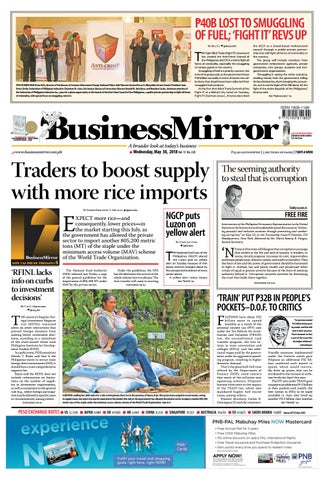
XPECT more rice—and consequently, lower prices—in the market starting this July, as the government has allowed the private sector to import another 805,200 metric tons (MT) of the staple under the minimum access volume (MAV) scheme of the World Trade Organization.
Continued on A2
See “Smuggling,” A2
BusinessMirror
www.businessmirror.com.ph
T
the ACCP as a broad-based multisectoral council through a public-private partnership that will fight all forms of criminality in the country. The group will include members from government enforcement agencies, private companies, civic groups, academe and nongovernment organizations. “Smuggling is raping the entire economy, stealing money from the government, killing the local industries, shortchanging the consumers, so it is not the fight of the NBI alone, it’s the fight of the entire Republic of the Philippines,” Arranza said.
F
A mother cradling her child waits for a ride to bring home their rice in the province of Nueva Ecija. Rice prices have surged in recent weeks, owing to supply issues, but more rice may be expected in the market this July as the government has allowed the private sector to import another 805,200 metric tons of the staple under the minimum access volume scheme of the World Trade Organization. NONIE REYES
PESO exchange rates n US 52.5310
ILIPINOS have about P32 b i l l io n mo re t o s p e nd monthly as a result of the personal income tax (PIT) cuts under the Tax Reform for Acceleration and Inclusion (TR AIN) l aw, t he u ncond it ion a l c a sh transfer program, the free tuition in state universities and colleges (SUCs), and the additional wages paid by the government under its aggressive spending program, resulting in higher domestic demand. That’s the glass half-full view offered by the Department of Finance (DOF), amid concern that much of the inf lation now squeezing ordinar y Filipinos’ bottom lines owes to the impact of the TR AIN law, which also mand ated higher f uel e xcise taxes, among others. Finance Secretary Carlos G. Dominguez III said the consumer-
“So you have around P32 billion being spent by people, and that will tend to drive up prices. That is demand. So that is part of the reason [for the higher inflation].“ —Dominguez
friendly measures implemented under the Duterte watch gave Filipinos an additional P32 billion combined each month to spend, which wou ld inev itably drive up prices, that can be attributed to the increase in inflation levels for April this year. The PIT cuts under TRAIN gave taxpayers an additional P12 billion in their pockets each month; the free tuition in SUCs to be made available in June also freed up another P3.5 billion that families See “TRAIN,” A2
n japan 0.4801 n UK 69.9503 n HK 6.6961 n CHINA 8.2120 n singapore 39.1321 n australia 39.6294 n EU 61.0673 n SAUDI arabia 14.0075
Source: BSP (29 May 2018 )
News
BusinessMirror
A2 Wednesday, May 30, 2018
Duterte certifies BBL bill as urgent By Bernadette D. Nicolas @BNicolasBM
P
RESIDENT Duterte certified as urgent on Tuesday the Bangsamoro basic law (BBL), after meeting with congressional leaders on the contentious provisions of the bill. Presidential Spokesman Harry L. Roque Jr. said the President decided to certify the BBL versions of both houses as urgent after much deliberation. Differences in both versions are expected to be threshed out before the President signs it into law. “Once both chambers have reconciled and finalized the version, the President will sign the Bangsamoro basic law,” he said. In the separate letters he s i gn e d a d d re s s e d to H o u s e Speaker Pantaleon D. Alvarez and Senate President Vicente Sotto III, Duterte said he certified House Bill 6475 and Senate Bill 1717 as urgent in order to advance the creation of a new autonomous region in Muslim Mindanao. “The passage of this measure is a manifestation of the government’s commitment to address the diverse needs of the people in Bangsamoro, and all communities and constituents of Mindanao, toward a just and lasting peace in Mindanao and in the Philippines as a whole,” the President said. House Majority Leader Rodolfo Fariñas of Ilocos Norte said Duterte is expected to sign the proposed BBL on July 23 or during his third State of the Nation Address. “The Bicam [bicameral] Conference Committee Report shall be submitted for ratification by the HOR [House of Representatives] and the Senate in their Plenary sessions in the morning of Monday, July 23, 2018, with the President signing it into law in time for his State of the Nation Address at 4 p.m. of that same day,” Fariñas said. Congress is set to adjourn sine die on June 2 and resume session on July 23.
Smuggling. . . Continued from A1
Fight IT, bearing an antismuggling advocacy, has passed a resolution to expand its cause to include the fight against all forms of criminality. Data from the Bureau of Customs (BOC) showed the government loses around P200 billion annually from smuggling alone. According to Rolando T. Dy, executive
NGCP. . .
Continued from A1
operating reserves have dropped below the required 647 megawatts
Traders to boost supply with more rice imports Continued from A1
For this year’s round of MAV importation, which will run until the early part of 2019, the NFA would be implementing an electronic-based auction for the import volume allo-
cation among interested and eligible parties. “There is a big difference from last year’s MAV guidelines. This year the [interested parties] would be bidding for the allocation [of volume] through service fees,” Dansal explained. “They will be bidding for the service fee. Therefore, [the private sector] will be competing in terms of service fee wherein the highest [bidder wins],” Dansal added. The NFAC will create an auction committee to oversee the whole process, with representatives from the National Economic and Development Authority, Bureau of the Treasury, Bangko Sentral ng Pilipinas, Office of the President and the Department of Agriculture. The NFAC has scheduled the auction on June 14. “[Compared to last year’s MAV procedures] we feel that the [two] procedures are only the same in terms of transparency. But here, you will see the improvement of the procedure and that is what the NFA Council is looking at,” Dansal said. “We have improved the system and made it easier and convenient for the participants of the importation program. Because this is electronic already, we are avoiding the physical contact [between importers and government agencies],” she added. Dansal disclosed that the NFAC will meet on May 30 to finalize the system for the auction. All interested private traders and importers will be screened by a MAV prequalification team to be constituted by NFA Administrator Jason L.Y. Aquino in order to become eligible to participate in the auction. One of the eligibility requirements is that the “total net worth of the applicant shall be at least 10 percent of the total cost of the quantity intended to be imported.” “If the total net worth of the applicant is less than 10 percent but not lower than 5 percent of the total cost of the quantity to be imported, the applicant may secure Bank Guarantee or Credit Line from a reputable Universal/Commercial Bank equivalent to the total value of the volume intended to be imported,” the guidelines read. All the qualified applicants
would be issued with an Eligibility to Bid status once they have been approved by Aquino, according to the guidelines. “Applicants issued with Eligibility to Bid shall open an account with LBP and deposit an amount equivalent to the volume indicated in the Eligibility to Bid multiplied by the minimum service fee prescribed in Section VII.3,” the guidelines read. Eligible participants are given three working days to post their payment. The NFAC has set the minimum service fee or bid price for the auction at P250 per MT, with bid offer increments of P250 per MT. “The bid offer shall be for at least the minimum volume and shall not exceed thee maximum volume prescribed in item I.2,” according to the guidelines. “The volume for each bid offer shall be in multiples of 500 MT.” Under the guidelines, the NFAC divided the 805,200 MT volume among farmer organizations (FOs) and non-FOs, which include corporations, partnerships, single proprietorship and joint ventures. The FOs would have an available volume to import of about 161,040 MT, or 20 percent of the total MAV volume, while the remaining 80 percent, or about 644,160 MT, will be allocated to non-FOs. An FO would only be allowed to import a minimum of 500 MT and not more than 5,000 MT, while non-FOs could apply to import at least 1,000 MT up to 50,000 MT. Dansal explained that they came up with the 20-80 volume allocation for FOs and non-FOs “based on the history of previous availments” by the respective groups under the MAV importation scheme. Furthermore, the NFAC also allocated the 805,200 MT volume among Luzon, the Visayas and Mindanao, “in proportion to the 2018 national daily food consumption requirements” of the three main islands. This, Dansal noted, is to ensure that private traders will supply the rice requirement of the respective areas. The NFAC has created 48 lots with a corresponding maximum importation volume together with its source country and designated island of delivery.
director of the University of Asia and the Pacific’s Center for Food and Agri-business, the largest smuggled item in most countries is petroleum products, and that the fuel marking system to be implemented by the government will address the issue on oil smuggling. “One of the things that is very important is the fuel marking, which I think the DOF [Department of Finance] is trying to institute,” Dy said. Yogi Filemon L. Ruiz, BOC director for Enforcement and Security Services (ESS),
said the bureau is gearing up for the implementation of the fuel marking system, eyed for implementation in July this year. “Around P40 billion is the tax leakage due to the smuggling of fuel. [The fuel marking system] is one of the priority programs of the [BOC] commissioner as part of the enforcement efforts of the bureau. The fuel marking will really help because [smugglers] will have a hard time smuggling it once the marker is in place,” Ruiz told financial reporters at the
sidelines of the summit. BOC data showed the countr y loses around P40 billion annually in terms of excise-tax collections that should have been collec ted from smuggled fuel products. “The drafting of the IRR [implementing rules and regulations] is still ongoing, but for sure [within] two months it will be implemented based on the pronouncements of the commissioner [Isidro S. Lapeña], he wants it done before July,” he added.
contingency in Luzon or equivalent to the largest unit in Luzon, which is the 647-MW coal-fired power plant in Sual, Pangasinan. The grid operator said Luzon was placed on yellow alert notice from 1
to 2 p.m. of May 29 when electricity peak demand was recorded at 10,794 MW against a capacity of 11,637 MW. “Luzon was placed on yellow alert due to the unexpected shutdown and limited generation of some power plants, and high power demand,” it said. The yellow alert notice was lifted at 2:56 pm. “There is already sufficient generating capacity,” the NGCP noted in its latest advisory. The grid is now under normal operations. The power plants that went on forced outage are Calaca 2 (300 MW ), Malaya 2 (320 MW ), Makban 4 (55 MW ), SLPGC 1 (150 MW ). The total capacity shaved from the Luzon grid stood at 525 MW. The derated plants noted in the system are Calaca 1 (230 MW ) and SCPC 2 (75 MW ). E n e rg y s t a k e h o l d e r s e a r l i e r warned high demand in the summer months could affect supply and result in a spike in power rates. Earlier, the Department of Energy (DOE) said Luzon is assured of an addi-
tional 570 M W of additional powergenerating capacity, enough to thwart the issuance of red alert notice within the grid. Depar tment of Energy Assistant Secretary Redentor Delola had said that two new power plants are already on line. These are the coal power projects of SMC Consolidated Power Corp. in Limay, Bataan and Pagbilao Energy Corp. in Quezon. He said then that peak demand in Luzon is expected to hit 10,500 MW between the second and third weeks of May, with reserve expected at 1,500 MW during the period. However, the NGCP said the forecast has been exceeded. It said peak demand hit 10,688 MW on May 17. Delola said the agency does not expect the issuance of a red alert by the grid operator. A red alert notice is issued by the grid operator when the power reserve left on the grid is regulating reserve or equivalent to 4 percent of the current demand. Power interruption may occur.
July until August 31, 2018, while the remaining volume should be imported from December 20 to February 28, 2019. The NFA Council decided on this timeline so as not to affect the farm-gate price of palay during the harvest season, according to NFA Deputy Administrator Judy Carol Dansal. “It’s always like that. Because during those periods there [is] no harvest anymore, so it also serves as a protection for our farmers,” she told the BusinessMirror. “That is good because we will have a lot of rice supply in the market, and it may bring down the prices. It has been programmed that the arrival of the [MAV] rice imports would not be during the harvest time,” she added. The Philippine Statistics Authority said the retail price of regular-milled rice as of second week of May reached P40.19 per kg, which was 7.52 percent higher than the P37.38 recorded quotation a year ago. Dansa l ex plained that the NFAC decided to open another round of MAV as part of the Philippines’s commitment to WTO member-countries to retain its concessions as stipulated under Executive Order 23 (EO 23) of the President while the country is undertaking the tariffication of its rice imports. “The NFAC implemented the MAV as we are still in the transition period toward tariffication,” she said. “The EO 23, which the President issued, still allows us to import the [805,200 MT via MAV] until such time a tariffication law is passed.” The NFA official added this MAV importation will not be covered by a rice-tariffication law, should one be passed in the middle of the scheme’s implementation. The NFA is still implementing its 2017 MAV rice importation program with its second phase of delivery starting on June 1 until August 31.
Auction
www.businessmirror.com.ph
‘RFINL lacks info on curbs to investment decisions’ Continued from A1
“Although the FINL already provides some level of transparency, it still falls short of rendering a full picture of the country’s investment regime. In fact, it does not capture other regulatory measures that restrict engagement in an investment activity,” Reyes said. “As such, potential foreign investors still have to do further work to search for these information, which entails additional costs on their part and adds to the risks of doing business in the Philippines,” she added. Reyes, citing a report from the Organisation for Economic Co-operation and Development (OECD), said investment and transparency are linked such that greater transparency leads to higher investment flows and quality investments.
Transparency curbs abuse
She said that based on the report, transparency serves as an instrument to prevent abuse of authority by demanding accountability on the part of the government and business. “The OECD added that a transparent policy environment can significantly reduce the cost of doing business and minimize investors’ risk perception,” Reyes added. In order to reap the benefits of transparency in foreign restrictions, other countries have listed nonconforming measures annexed trade agreements they have signed. The list enumerates all the regulatory measures they have adopted and maintained that are discriminatory against foreign investors and service suppliers. Based on her compilation, Reyes said countries imposed discriminatory treatment against foreign nationals in terms of sectors, subsectors, industry or activity through ownership, type of legal entity, natural or juridical person and forms of entry, among others. She sa id cou nt r ies a l so
restricted foreigners in engagement in private- or public-sector activities through exchange control, economic need, distribution channel, residency and legal presence, among others. Further, there are restrictions sur round ing l a nd ow nership through land leases, land rights, nationalization, divestment of ownership/equity, and approval for mergers, expansion and relocation, among others. “The executive department can call upon its departments and agencies to come up with a transparency list to supplement and address the deficiencies of the FINL. The Philippines can refer to the general template on the negative list as used in trade agreements for guidance and basis,”
Two parts
The regular FINL consists of two parts. The first section, List A, enumerates the activities where foreign equity participation is restricted as prescribed under the 1987 Philippine Constitution and other existing laws. The second section, List B, specifies the activities where foreign participation is limited up to 40 percent for reasons of public health, public morals, national security, national defense, and the protection of small and medium enterprises. The first regular FINL was issued in 1994, three years after the Foreign Investment Act (FIA) was enacted in 1991. Given the policy goals of the FIA to attract and promote foreign investment in the country, the law mandates the National Economic and Development Authority (Neda) to formulate and recommend the FINL to the president every two years. As the last FINL was issued in 2015, the Neda has already prepared and submitted the 11th FINL to the Office of the President, where it is awaiting approval.
‘TRAIN’ PUT P32B IN PEOPLE’S POCKETS–D.O.F. TO CRITICS Continued from A1
would otherwise have had to save up for in order to shoulder school fees in May; and the unconditional cash transfer contributes some P2.5 billion per month. The government’s increased spending of P167 billion for the first quarter falling under its “Build, Build, Build” infrastructure program also included wages paid to laborers, which amounted to around P15 billion a month, the DOF noted. “So you have around P32 billion being spent by people, and that will tend to drive up prices. That is demand. So that is part of the reason [for the higher inflation],” Dominguez said during a hearing of the House ways and means committee on the Duterte administration’s second tax reform package. The government has also released P4.3 billion worth of unconditional cash transfers (UCTs) to low-income households as part of TRAIN’s social mitigation measures, which have so far reached 1.8 million Pantawid Pamilyang Pilipino Program (4Ps) beneficiaries in the first quarter. Another 2.6 million household beneficiaries are in the process of getting their cash subsidies in May and June. For 2018, some P24 billion will be released to cover the poorest 10 million households. The finance chief, likewise, pointed out that despite the elevated inflation rate, self-rated poverty and hunger have gone down as shown by the first-quarter survey done by the Social Weather Stations (SWS). “It’s very strange that, while inflation increased, hunger and self-rated povert y decreased.
These are not government figures, these are figures from the private sector. So I guess to some extent, the program of President Duterte in his Build, Build, Build and in his tax reform program are working. The average Filipino has more money in his pocket and, in a sense, is better off,” he added. The SWS’s First Quarter 2018 Social Weather Report showed that from 32 percent in December 2017, the number of self-rated poor families dropped to 29 percent in March 2018. The number of families experiencing involuntary hunger declined from 15.9 percent in December 2017 to 9.9 percent in March 2018, as shown by the same survey. The discussions at the hearing on Tuesday at the House of Representatives focused mostly on Package 2 of the Comprehensive Tax Reform Program (CTRP), but several lawmakers asked about the impact of TRAIN—which took effect January 1—on inflation, which reached 4.5 percent in April. During the hearing, Dominguez asked lawmakers to approve Package 2 as he allayed fears about the impact on prices of TRAIN, which contributed less than a half-percentage point to last month’s inflation rate. The TRAIN accounted for only four-tenths of a percent of April’s inflation rate of 4.5 percent, which means that for every peso increase in prices, only 9 centavos can be attributed to TRAIN, the DOF said. Package 2 of the DOF’s proposed CTRP has been adopted under House Bill 7458, which aims to lower the corporate income tax and reform the investment incentives system in the country. Rea Cu
The Nation BusinessMirror
www.businessmirror.com.ph
Editor: Vittorio V. Vitug • Wednesday, May 30, 2018 A3
Water from Boracay hidden pipes found positive for coliform bacteria
T
By Jonathan L. Mayuga
@jonlmayuga
he Department of Environment and Natural Resources (DENR) is currently crafting a stringent policy that will require all establishments on Boracay Island, whether connected or not to the sewer line, to secure discharge permits from the DENR’s Environmental Management Bureau (EMB). T his came about after the DENR-led interagency Task Force Boracay (TFB) reported that 21 of the 28 illegal pipes discovered and subsequently unearthed in Boracay’s beaches tested positive of coliform bacteria. DENR Undersecretary Jonas R. Leones, the designated spokesman of Secretary Roy A. Cimatu, told the BusinessMirror they have conducted laboratory tests of effluents coming from all the unearthed pipes, proving their theory that some establishments and residents living near the shores of Boracay are directly discharging untreated wastewater that polluted the beach. Leones, the DENR’s undersecretary for policy, planning, in-
ternational affairs and foreignassisted projects, said the TFB will examine the remaining hidden pipes that were discovered by the DENR’s Mines and Geosciences Bureau (MGB) using ground-penetrating radar. “We discovered more than 40 pipes, and so far, we have unearthed and dismantled 28 of these pipes. Out of these 28, at least 21 pipes were discharging water that tested positive of coliform bacteria,” Leones said.
New policy needed
Leones said this development affirmed his suspicion that there is a need to require all business establishments on the island to secure discharge permits from
the DENR’s EMB. Under the current implementing rules and regulations of Republic Act (RA) 7925, or the Clean Water Act of 2004, those connected to sewer lines in Boracay are exempted from securing discharge permits. “During our meeting, there were discussions, and I said the discharge permit should be a requirement even to those already connected to sewer lines because we need to know the volume of water an establishment uses and what kind of wastewater are being discharged,” he said. “We need to make discharge permit a requirement because some businesses and residential establishments are maintaining hidden pipes to discharge untreated wastewater illegally,” Leones added. The undersecretary said other officials, particularly those from the DENR-EMB, agreed to craft revised guidelines amending the implementing rules and regulation of RA 9275 canceling the discharge permit exemption granted to establishments that are already connected to the sewer networks. He added the volume of water being used and discharged by an establishment should also mean the same volume of water must be treated before being released to the environment. That way, the quality of the water being discharged will not contaminate other water bodies, especially Boracay’s beaches.
“Wastewater treatment should be 1-to-1. This means that the volume of wastewater discharged should be equal to the volume of wastewater being treated,” he said. Without discharge permits from the DENR, he said there is no way of knowing the volume of water consumed or being discharged by an establishment or individual household. “Some establishments and residents are really keeping their pipes secret. When they learned that we are unearthing the hidden pipes, we learned that some of the residents have cut their connection pipes to avoid being traced,” he said. Leones added the DENR will not hesitate to file appropriate charges against those illegally discharging untreated wastewater. The department is now requiring all establishments along the beaches of Boracay to have their own sewagetreatment plants (STPs). All hotels, resorts, dormitories that maintain at least 50 rooms should also construct their own STPs. Cimatu earlier said all pipes along the beaches will be condemned and dismantled, saying sewer lines should not be allowed within 50 meters of the mean shoreline. This way, in case of a leak, contamination of the water in Boracay’s beaches will be avoided. The DENR has a list of 195 business establishments not con-
nected to Boracay Water’s sewer lines. These establishments were issued notices of violation and are now facing stiffer penalty and fines for violation of the Clean Water Act. In an e-mailed response to the BusinessMirror’s inquiry, Boracay Water said it started its aggressive campaign to encourage connection to the company’s sewer network in March.
Boracay Water’s capacity
Since then, including the time of closure, around 50 establishments and residences have been connected to the network, it said. “To date, there are more than 1,200 establishments and residences directly connected to Boracay Water’s sewer network. For unsewered areas, regular desludging services are being done through the company’s desludging trucks to collect wastewater from establishments and bring it to the company’s sewage-treatment plants in Manocmanoc and Balabag,” the company said, through its Communication Planning and Tactical Development Manager Faye Alexis D. Marcelino. Marcelino said there are 56 other establishments currently applying for connection to the company’s sewer network. “In areas already covered by Boracay Water’s sewer network, we are expecting 529 establishments or commercial customers
to connect,” Marcelino said. She added that the company is also prepared to offer its services to non-Boracay Water customers, noting that it can accommodate more customers because of the company’s huge capacity to treat wastewater. With a network spanning over 22 kilometers of sewer lines serving more than 1,000 commercial and residential establishments and a f leet of seven desludging trucks to haul wastewater from unsewered areas, Boracay Water ensures that wastewater discharges are treated in its two STPs that are compliant with the DENR-mandated Class SB water quality, or water that is fit for recreational activities. Boracay Water operates and manages the Balabag Sewage Treatment Plant (STP), with an expanded wastewater-treatment capacity of 6.5 million liters per day (MLD). This is more than double the original capacity of 2.5 MLD when it was still under the operation of then Boracay Waterworks and Sewerage System back in 2008, the statement said. The Balabag STP was completed in March 2011, four years ahead of the regulatory completion target and fully environmentally compliant. A second STP, at Barangay Manocmanoc, was also constructed by Boracay Water to cater to the increasing demand for wastewater treatment, with a capacity of 5 MLD.
A4 Wednesday, May 30, 2018 • Editor: Vittorio V. Vitug
Economy BusinessMirror
www.businessmirror.com.ph
‘Wage hike to drive away investors’
B
By Elijah Felice E. Rosales @alyasjah & Samuel P. Medenilla @sam_medenilla
usiness groups are urging the government to think twice about giving in to workers’ demand to raise the minimum wage rate, as granting this might make the country’s investment climate unattractive.
The Philippine Chamber of Commerce and Industry (PCCI) said it will be ill-advised to approve petitions to hike salaries after the Philippines performed poorly in a global survey on competitiveness. PCCI Chairman George T. Barcelon said increasing pay will only pull the country down and widen the gap between the Philippines and its rival economies in Southeast Asia. “The proposed minimum salary increase to P800 would be counterproductive for our country, as competitiveness and foreign investments would be negatively affected. Every year we add almost a million young people—from K to 12 and college graduates—to the work force, and both business and government sectors have difficulty absorbing them,” he told the BusinessMirror. Barcelon’s sentiment comes in the face of left and right calls— from labor groups to legislators—
to increase the nationwide minimum wage, as prices of goods and services continue to surge due to the inflationary effects of the Tax Reform for Acceleration and Inclusion (TRAIN) law and the rising international price of oil. President Duterte has already ordered the wage boards to convene and discuss if it is necessary to give minimumwage earners an increase. The Associated Labor UnionsTrade Union Congress of the Philippines (ALU-TUCP) is pushing for a standard national minimum wage of P800. Also, lawmakers belonging to the Makabayan bloc in the House of Representatives filed a measure that will peg the wages across regions at P750. For Barcelon, this is unnecessary and will only burden employers, which, he said, might result in the unemployment of future graduates. “The unemployed, both young and middle-aged, have no
IN this October 5, 2017, file photo, workers in a Laguna factory assemble microchips. Business groups, such as the Philippine Chamber of Commerce and Industry, warned the government against increasing the minimum wage to P800, as this could discourage investors from setting up shop in the Philippines. NONIE REYES
choice but to seek work as OFWs [overseas Filipino workers].” “It’s imperative that the wage matter be done through the set process of tripartite discussion and not arbitrary. Otherwise, it results in entitlement only for a limited number, while the majority is greatly affected due to the lack of job opportunities,” he added. The PCCI chairman said the gover nment must “ta ke note that our unemployment rate and double-digit unemployment rate are still the highest in Southeast Asia.” He added the “ bigger picture” must be considered by the tripartite mechanism—government, capital and labor—and
that is to have a favorable investment climate. Sergio R. Ortiz-Luis, president of the Philippine Exporters Confederation Inc., said it is “illogical” for the government to standardize all minimum wages nationwide. He noted this will worsen the poverty incidence in the regions, as investors will pull out their operations there and move it to Metro Manila and other major urban centers, where infrastructure is better. Ortiz-Luis reminded the government that the lower wage rates in the provinces are “an advantage” for workers and make the areas more attractive to businesses. He added that standardizing wages might make rural areas less enticing to investors.
Labor groups’ appeal
Labor groups on Tuesday called on Duterte to certify as urgent House Bill (HB) 7787, which mandates a national minimum wage of P750. “We urge the President to certify to Congress HB 7787 filed by the Makabayan bloc as an urgent measure, which will pave the way for the realization of his commitment to labor groups in their dialogues to abolish what he termed as ‘provincial rates’ of wages,” Partido Manggagawa National Chairman Renato Magtubo said in a statement. Once enacted, HB 7787, or the national minimum wage law, will institute a national minimum wage of P750 and lead to the abolition of the National Wages and Productivity Commission (NWPC) and the Regional Tripartite Wages and Productivity Boards (RTWPB). The bill will then transfer the
minimum wage-setting function of the NWPC and RTWPBs to the Office of the President. Magtubo said they support the measure, citing the failure of regional wage boards—comprised by representatives from the government, employers and labor groups—to grant “decent” wage hikes. “The most that regional wages board can provide as increase in the minimum wage is less than P1,000 per month,” he said. Magtubo also appealed to employers to support HB 7787. “A wage increase raises the capacity of workers to uplift their well-being and, at the same time, raises the demand for the production of goods and services.” “Simply put, increasing wages affects profit in the short term, but sustains the economy that employers profit from in the long term,” he added. In a separate statement, ALUTUCP also threw its support behind HB 7787. ALU-TUCP Spokesman Alan Tanjusay said the initiative will allow workers to cope with the increase in the prices of basic goods and services.
‘Suspend fuel excise tax hike’
The Senate Public Services Committee is poised to endorse the suspension of the imposition of higher excise tax on fuel provided under the TRAIN. This was disclosed by Sen. Grace Poe, committee chairman, as she confirmed that she has set another public hearing on the effects of the TRAIN law on public service and utilities on Friday. In a statement issued in advance of Friday’s Senate hearing at the Albay Provincial Capitol in Legazpi City, Poe cited what she deemed to be the “urgency of suspending the collection of additional excise tax on fuel so as to help the public cope with the rising prices of goods and services.” The senator initially suggested that the Department of Finance consider the option to “suspend the excise tax on fuel contained in the TRAIN law” after conducting a public hearing on the tax imposition in Iloilo on May 25. Poe aired the appeal after inflation rate hit 4 percent, followed by projections that this will rise to “6 percent in early-July.” She noted estimates that this would mean “almost P3,000” in additional expenses for workers every month due to the effects of the TRAIN law impositions and the oilprice hike.” With Butch Fernandez
Piñol thumbs down proposal to import sugar By Jasper Emmanuel Y. Arcalas @jearcalas
T
he Philippines will not import sugar any time soon, as local supply remains ample to meet the demand of industrial users, according to the chief of the Department of Agriculture (DA). “Based on our discussions, there will be no importation [of sugar],” Agriculture Secretary Emmanuel F. Piñol told the BusinessMirror on Monday. Piñol met with members of the Sugar Regulatory Administration (SRA) board, along with sugar industry stakeholders, on Monday to discuss the “tightness” in the country’s sugar supply. “It was established today that there is enough sugar in the market. Although the supply just became tight because of the inaccurate projection [of supply by the industry],” he said in a separate interview with reporters. “But I was assured by industry stakeholders that there will be enough sugar for the market,” he added. The DA chief dismissed reports that there is a sugar shortage. He attributed talks of a shortage to speculators who wanted to jack up the price of the sweetener. Piñol said sugar industry stakeholders, particularly millers, have yet to make good on their commitment to supply sugar to industrial users, including beverage manufacturers. “I wanted to get the assurance from them [that] the commitment they made to Coca-Cola [Femsa Philippines Inc.], among others, will be met and fulfilled,” he said. “So I received the assurance from the major players of the industry that, as promised, Coca-Cola will have its sugar.” Piñol added the DA wants to come up with “more accurate” projections concerning the supply of sugar and the demand of industries. “We will employ the same method of validation we use in the rice sector, which is satellite mapping and satellite validation.” He said the DA, Sugar Regulatory Administration and the Philippine Coconut Authority could tap a company that will conduct an aerial validation of actual standing crops. Last week the Philippine Sugar Millers Association Inc. said the Philippine Sugar Refiners Institute had recommended the importation of 100,000 metric tons of refined sugar to immediately fill up the demand of industrial users for the sweetener and halt the surge in local sugar prices.
Weak peso partly to blame for hike in prices of school supplies–DTI
P
arents and students should prepare to spend more before the opening of classes, as the Department of Trade and Industry (DTI) reported price hikes in a number of school supplies. In a statement on Tuesday, the DTI said several brands of notebooks and pad papers are priced higher this year, as the cost of raw materials imported from China continue to rise due to peso depreciation. As for other school needs, the DTI claimed prices remain stable. “The SRPs [suggested retail prices] of some brands of composition, writing and spiral notebooks—Advance, Topline, Best Buy, Pandayan, Papelikha, Orions and Veco—increased by P1 to P4. Merit, on the other hand, did not increase its prices,” the DTI said. Composition and writing notebooks are still at P12.75 for those without plastic cover and P34 for those with plastic cover. Meanwhile, spiral notebooks without plastic cover are priced at P19.
“Similarly, some brands of writing pad papers [for Grades 1 to 4]—Easywrite, Best Buy, Sakura, Pandayan, Papelikha and Orions—increased by P.50 to P6. [As for] intermediate paper, some brands—Easywrite, Best, Best Buy, Pandayan, Papelikha and Orions—raised their prices by P1.75 to P5,” the trade department added. In spite of these hikes, Merit’s writing and intermediate pads remain at P12 and P25, respectively. Likewise, Best Buy’s intermediate pad paper can still be purchased at P18. However, two brands of pencils, Best Buy and Pandayan, recorded an increase of P4 and P1, respectively, while other brands retained their prices from last year, according to the DTI. Some brands—Marvy, Avanti and Pentel—are also selling their ball pens at higher prices by P1 to P6. “For crayons, HBW Jumbo No. 8 decreased its price by P11, while other brands— Crayola,
Li’l Hands, Faber Castell, HBW, Best Buy and Pandayan—did not change their prices since last year. However, brands such as Sterling and Colleen increased their prices by P2 to P10 for boxes of Regular 8, Regular 16, Regular 24 and Jumbo 8,” the DTI reported. Rulers also saw its SRP higher by P2 to P3, while there was zero movement in the prices of sharpeners, except for Orions, which went up by P2. “There have been increases in some staples, but consumers can check for school items sold in bundle or promo packs, which can help them save [up to] P30.75 depending on the brand,” DTI Undersecretary Ruth B. Castelo said. Weeks ahead of the opening of classes, the DTI publishes a price guide for consumers that they can use when purchasing school supplies. The price guide covers the SRP of specific brands of notebook, pad paper, pencil, ball pen, crayon, eraser, sharpener and ruler. Elijah Felice E. Rosales
Banking&Finance BusinessMirror
www.businessmirror.com.ph
Legislative approval seen for reinforced BSP charter
T
By Jovee Marie N. dela Cruz @joveemarie
he House of Representatives on Monday approved on second reading a measure boosting the capital base of the Bangko Sentral ng Pilipinas (BSP), from P50 billion at the moment to P200 billion. Rep. Ben P.Evardone of the Lone District of Eastern Samar, chairman of the House Committee on Banks and Financial Intermediaries, said House Bill 7742 will likely be approved on third and final reading when regular session resumes in July. The bill amending Republic Act 7653, or the New Central Bank Act, aims to reinforce the BSP’s corporate and financial viability and strengthen its monetary stability functions. “In the last 25 years, the scale and complexity of the responsibilities of the Bangko Sentral was magnified by the growth
of the Philippine economy and t he e x pa nsion of it s f i n a ncial system. The capitalization of the Bangko Sentral, which has stayed fixed at P50 billion, is clearly inadequate to meet the requirements of a central bank in the midst of a growing economy and increasing complexity of the financial system,” Evardone said. “In the last two decades since the enactment of its charter, the Bangko Sentral has witnessed significant changes to the banking and financial environment that necessitated, likewise, significant changes to its own operating landscape. These changes
necessarily call for parallel changes in the Bangko Sentral charter,” Evardone added. Apart from the additiona l capital, the measure seeks to restore the tax-exempt status of the central bank. “Restoration of the Bangko Sentral ’s tax-exempt status is also proposed, especially on its activities geared toward the performance of its mandate of maintaining price and financial stability,” Evardone said. The amendments also include the authority to establish adequate loss allowances and reserve buffers for the BSP to better manage its operational risks. “We take cognizance of the unique functions and responsibilities of the Bangko Sentral in safeguarding price and monetary stability as the first layer of defense against unstable conditions prevailing in international
markets,” he added. The bill similarly authorizes the BSP to issue its own securities and obtain information from the nonbank private sector, expand the entities under its supervision to include other categories of financial institutions, and authority to impose sanctions on transfers and acquisitions of substantial shares of banks and quasi banks acquired without BSP approval. The bill also seeks to remove so-called thresholds in the growth of monetary aggregates and credit as guiding principles in monetary administration, as well as extend legal protection for BSP officials and staff when performing official duties similar to that provided to officers and employees of the Philippine Deposit Insurance Corp. The measure aims to enhance credit operations by granting tax exemption from court processes relating to collateral obtained from banks similar to that enjoyed by the Land Bank of the Philippines, and authority to deputize legal staff in extrajudicial foreclosure of mortgaged properties. Evardone said the proposals will “help transform the Bangko Sentral into a more effective and dynamic central monetary authority that can keep pace with the demands of its mandate.”
Editor: Jun B. Vallecera • Wednesday, May 30, 2018 A5
Sun Life Grepa launches new riders for Pinoy clients
A
Consumer Confidence Survey done by Nielsen and published in 2017 ranked health-care coverage the secondbiggest concern of consumers globally, with an increasing share of people actively seeking affordable and quality health care. Keeping this in mind for the Philippine market, Sun Life Grepa Financial Inc. (Sun Life Grepa), one of the country’s top life-insurance companies, introduced two new supplemental benefits or “health riders” to help prepare Filipinos for such emergencies. These health riders are lowcost solutions that enhance one’s health-protection coverage, giving clients more comprehensive health-care coverage at a fraction of the cost. New and existing Sun Life Grepa clients can stay ahead of the
health curve by customizing their basic insurance policy to include a critical illness benefit rider or a hospital income benefit rider. CIB pays a guaranteed benefit in case the client insured is diagnosed for the first time with any of the 36 covered conditions, while HIB pays a fixed and guaranteed cash benefit for each day of hospital confinement. “These new health riders were developed to meet the growing health-care concerns of the market today,” says Sun Life Grepa President Richard Lim. “We want to continue our commitment to empower our clients to face their future with confidence, knowing that they are financially prepared, and with a reliable partner who helps provide peace of mind when it comes to helping address their health-care needs.”
Maybank PHL reports accelerated Q1 revenues
T
he Kuala Lumpur-based lender, Maybank, the region’s fourth largest by assets, reported gross profits 13.7 percent higher in the first three months this year to 2.56 billion ringgit, from only 2.25 billion last year. Executives traced the improvement to higher fund and fee-based income, as well as on the continued decline of so-called impairments. Net profit rose 9.9 percent to 1.87 billion ringgit, from 1.70 billion ringgit last year. In the Philippines, Maybank Philippines saw its revenue increase by 2.3 percent to P1.39 billion year-on-year on the back of higher
net interest income. Gross loans expanded 13.6 percent year to date annualized to P74.2 billion, driven by growth in term loans, while deposits also rose 6.1 percent from year to date annualized to P77.3 billion, fuelled mainly by growth in fixed deposits. Profit before tax, however, declined to P250.8 million, from P356.1 million previously, as a result of higher overhead costs due to a higher tax regime in 2018, as well as higher provisioning due to adoption of the FRS9 accounting standards and lower recoveries compared to the same period last year.
A BusinessMirror Special Feature
MEDICAL
INNOVATIONS www.businessmirror.com.ph
A6 Wednesday, May 30, 2018
Why International Patients Flock to the Philippines for Medical Treatments
I
By Marane A. Plaza
T is no surprise that the Filipino brand of hospitality easily translates to worldclass medical nurturing. Aside from the innate warm caretaking of Filipinos, those who pursue medical careers work or train abroad to obtain international medical diplomas.
Because of this, Filipinos constitute the second largest group of foreign students who graduated in the medical field from USA institutions in recent years. Several of these professionals return home to practice their profession, bringing back their international practice with the latest in technologies, techniques and expertise. Also, they are all English-speaking practitioners who can cater to patients from different parts of the world. Aside from our medical manpower that’s on a par with global standards, the Philippines takes pride in its equally world-class medical tourism destinations and facilities. When our country was launched in 2006 as a medical tourism hub, the government reported
that 250,000 foreign patients visited the country, generating US$350 million in revenues until 2010. Years later, the Philippine medical tourism was able to generate US$66 million in 2013 alone, and US$145 in 2014. In 2015, the International Healthcare Research Center and the Medical Tourism Association ranked the Philippines as the eighth country in the world with the best medical tourism offerings, after Canada, the United Kingdom, Israel, Singapore, Costa Rica, Italy and Germany. Foreign medical tourists opt to travel to our country due to international healthcare priced at lower costs-- ranging upward of 50 to 80 percent cheaper compared to its American and European counterparts. The internet also made it
possible for international patients to see the quality of healthcare that the Philippines can offer by comparison. The Philippines is poised to take advantage of the $72-billion global medical tourism market,with its excellent and affordable hospital care and medical treatments. The tropical backdrop of our topnotch medical facilities also make for an attractive factor for non-resident tourists, as they can always do a side-trip to our pristine beaches while addressing health issues. As more Philippine hospitals become internationally accredited, the number of medical tourists is expected to grow in the next years. The first hospital that was internationally accredited in the Philippines was St. Luke’s Medical Center in Quezon City in 2003. It was accredited by the Joint Commission International (JCI), the world’s most prestigious accrediting body of healthcare organizations. It was also one of the first accredited hospitals in the whole of Asia that year. In 2012, its thennew Global City health facility was also accredited by JCI. Due to this, St. Luke's Medical Center has been one of the leading medical institutions in the country that attracts global medical tourists year after year. Each international patient receives end-to-end service from the moment medical appointments are booked, upon arrival in the Philippines, treatment and departure to the country of origin.
State-of-the-Art Medical Concierge
IN 2017, The Concierge at St. Luke’s is dedicated to private, international and HMO patients. Its Medical Concierge Officers guide patients through every step of their medical journey in the country. Services include seamless planning from the beginning, coordination of inpatient and outpatient medical requirements, setting doctor’s appointments, scheduling tests and procedures, facilitation of Letters of Authorizations(LOA) and Guarantee of Payment (GOP), computing medical cost estimates down to assistance in facilitation of patient’s admission and discharge. The Concierge also addresses non-medical concerns such as transportation service, hotel accommodations, visa extensions, and other travel arrangements. An added convenience is the eHealth Hub where patients can conveniently access St. Luke’s online for test results, room reservations, executive checkup reservations, online payment during admission, and order and pay of tests and procedures.
Medical Experts Armed with Advanced, Cutting-Edge Technology
ST. Luke's doctors practice their specializations based on international standards. Its highly-skilled physicians and medical staff have received world-class trainings on
the latest medical procedures and equipment to ensure excellent patient care patient safety. Also, this healthcare facility has always boasted of its pioneering efforts and advancement in medical procedures and technology. One of these advanced procedures is the "Mismatch Stem Cell Transplantation", pioneered by the St. Luke’s Medical Center Global City (SLMC-GC) Stem Cell Center, and led by Dr. Francisco Lopez, Head of the Bone and Marrow Transplant Unit. Two of the major problems Stem Cell transplant patients face involve the availability of a donor and the fiscal estimate of the treatment. The Mismatch Stem Cell Transplantation, also known as Haploidentical Stem Cell Transplant (HSCT), was introduced in the country by SLMC for the benefit of patients without a complete matched sibling donor. Thus, allowing a parent, child, or a mismatch sibling to become a donor. The results of this treatment are as effective as the other kinds of Blood and Marrow Transplant. Add to that, there is the supplementary benefit of expediting the beginning of the whole process, given that time is a great factor in treating a patient. Through the mismatch program of SLMC, the procedure is made more accessible and cost-effective to Filipinos. “We pioneered this program us-
ing any donor in the family whether it’s a [parent] or a child,” Dr. Lopez describes. "This therefore gives a greater chance for patients to proceed with the treatment." He also shared that he had patients in the past who underwent complicationfree procedures, resulting in a lower or average overall hospital bill.
Unified Health System for Better Service
RECENTLY, St. Luke’s Medical Center (SLMC) also announced that a unified health system is geared to streamline the organization’s world-class medical services in both of its modern facilities in Quezon City (SLMC-QC) and Global City, Taguig (SLMC-GC) this 2018. The modernized organizational structure will also allow SLMC to further standardize and share best practices between its Quezon City and Global City branches. It will also seamlessly align and cascade strategic plans throughout the entire SLMC system. St. Luke’s is also set to bring world-class health care and medical expertise to the “King City of the South” with the forthcoming opening of St. Luke’s Medical Center Davao City. Scheduled to open its doors in 2021 at Azuela Cove in Lanang, the facility promises to continue the SLMC institute’s commitment to topnotch medical services and patient care. For more info, visit its official website.
TWO WORLD-CLASS HOSPITALS, ONE HEALTH SYSTEM SLMC’s unified organization ensures better service for all St. Luke’s Medical Center (SLMC), the country’s premier healthcare institution, has collaborated with Isla Lipana & Co., a member firm of the globally-recognized international service network PwC Global Network, in creating an updated corporate and management structure that is better equipped to keep up with the constantly-evolving medical and healthcare service ecosystems
The unified health system is geared to streamline the organization’s world-class medical services in both of its modern facilities, located in Quezon City (SLMC-QC) and Global City, Taguig (SLMC-GC), easily managing the needs of SLMC’s doctors, associates, partners, students, and patients, whether in the Philippines or in other countries. The modernized organizational structure will also allow SLMC to further standardize and share best practices between its two branches, as well as seamlessly align and cascade strategic plans throughout the entire SLMC system. The new management structure of SLMC allows the institution to pursue excellence, while
pioneering unique innovations that will bolster its reputation as the country’s forerunner in health and medical care. The unified health system will also ensures the SLMC organization will further improve training programs in all medical specialties by adopting an improved digital learning framework, which will push SLMC to greater research and educational excellence. SLMC’s updated system takes into consideration the institute’s interdisciplinary nature, and will serve to boost the productivity of SLMC’s compassionate nurses, highly competent allied health professionals, internationally trained doctors, and strategic support groups.
A8
Wednesday, May 30, 2018
The World BusinessMirror
Editor: Lyn Ressureccion | www.businessmirror.com.ph
Mahathir to scrap high-speed rail project to Singapore to cut costs
M
alaysia’s Prime Minister Mahathir Mohamad said he would cancel a proposed multibillion-dollar high-speed railway (HSR) link to Singapore, scrapping a signature project of his predecessor Najib Razak in what he called a move to cut costs. Mahathir, who returned to power in a sur pr ise election win this month, said on Monday that ending the project will take time, as it requires negotiation w ith Singapore. T he c it y- st ate’s t ra nspor t ministry said later on Monday that it hadn’t received any off ic i a l not i f ic at ion f rom Malaysia, adding that both sides had agreed to proceed with the high-speed rail link “ based on mutual benefits.” The decision would deal a setback to construction and rail com-
more than 300 km an hour, was targeted to begin operating in 2026. It would’ve trimmed the land journey between Kuala Lumpur and Singapore to 90 minutes, from about five hours now. “It’s going to cost us a huge sum of money—we’ll make no money at all from this operation,” Mahathir told reporters in Kuala Lumpur. “It’s only a short track. It is going to save you only one hour by taking the HSR.” The move also signals a return to rocky ties between Malaysia and Singapore that characterized Mahathir’s first stint in power from 1981 to 2003. Relations had improved under Najib, who in 2013 had agreed with his Singaporean counterpart Lee Hsien Loong to build the rail link. “I think the people of Singapore, like the people in Malaysia,
must be tired of having the same gover nment, t he same par t y since independence,” Mahathir told the Financial Times (FT ). In that interview, Mahathir said the decision to scrap the rail link was to “avoid being declared bankrupt.” Construction would have cost Malaysia 110 billion ringgit ($28 billion), Mahathir told FT. The project has attracted interest from many companies in Asia and Europe. While Korea Rail Network Authority and a group of South Korean companies won the reference design consultant contract, Chinese firms led by China Railway Signal and Communication Corp. and CRRC Corp., Siemens AG, Alstom SA and some Japanese conglomerates are among those in the race for the project.
It’s going to cost us a huge sum of money—we’ll make no money at all from this operation.” —Mahathir
The prime minister also said Malaysia would talk to the Chinese government about renegotiating what he called “unequal treaties,” including a Chinese company-led $14 billion East Coast rail project in peninsular Malaysia, according to the FT. Ma h at h i r ’s gover n ment i s faced with liabilities that exceed
panies in Asia, including those from China and Japan that are keen to gain a slice of orders. The 350-kilometer line, with trains moving at a top speed of
Chinese project
1 trillion ringgit due to state guarantees on borrowing by 1 Malaysia Development Berhad (1MDB), an investment company that’s at the center of a multibillion-dollar corruption scandal. That’s nearly double the 687 billion ringgit federal government debt number disclosed by the former administration. Malaysian police last week seized about $29 million in cash, hundreds of handbags, as well as jewelry and watches in raids on premises linked to Najib and the investigation into 1MDB. Najib has denied wrongdoing in the 1MDB case and taken to social media to defend his economic record, saying his government complied with public debt reporting guidelines as defined by the International Monetary Fund and World Bank. Malaysia has also decided to end the search for the missing MH370 jet by United States exploration company Ocean Infinity. The firm had won many extensions after the original threemonth contract signed in January. No further time will be granted after May 29, Transport Minister Anthony Loke Siew Fook told repor ters sepa rately on Monday. Bloomberg News
Kim Jong Un sends right-hand man to US for presummit talks
N
orth K o r e a n l e a d e r K im Jong Un has dispatched one of his top aides to the United States for talks ahead of his planned summit w ith Donald J. Trump next month, according to a person fa m i l i a r w it h t he issue who asked not to be named because the trip isn’t public. K im Yong Chol, North Korea’s former spy chief, would become the highest ranked official from the isolated nation to visit the US since 2000, when Pyong yang sent Vice Marshal Jo Myong Rok to meet thenPresident Bill Clinton. Yonhap News Agency reported Kim Yong Chol will meet US Secretary of State Mike Pompeo, with whom he dined with in Pyongyang earlier this month. Kim Yong Chol accompanied Kim Jong Un at all of his recent meet ings w it h bot h C h inese President Xi Jinping and South Korean President Moon Jaein, according to North Korean state-media reports. South Korea said on Tuesday that it wasn’t aware of the trip by Kim Yong Chol, who is is vice chairman of North Korea’s ruling Workers’ Party Central Committee. He is set to land in New York on Wednesday on a f light from Beijing, Yonhap said. The veteran official ’s trip is another sign that preparations for the on-again, off-again June 12 meeting in Singapore are moving forward. Just three days after Trump abruptly called off the unprecedented meeting in a letter to the North Korean leader, the president appeared to confirm the talks were back on.
‘Brilliant potential’
“I truly believe Nor t h Korea has brilliant potential and w ill be a g reat economic and f inancia l Nation one d ay,” Tr ump
w rote on Tw itter. “K im Jong Un ag rees w it h me on t his. It w i l l happen!” A delegation led by Sung Kim, US a mba ssador to t he Ph i lippines, is cur rent ly holding meetings w ith North Korean officials at the border village of Panmunjom. Another set of talks between the countries is set to take place in Singapore to sort out logistics. The US and North Korea are seeking common ground on the steps it would take for Kim Jong Un to give up his nuclear weapons. The Trump administration has pushed for a quick timeline, while North Korea favors a phased approach.
Surprise meeting
The US has decided to hold off on implementing major new sanctions on North Korea while attempts to revive the summit are underway, the Wall Street Journal reported on Monday. The White House was preparing to announce a ramped-up sanctions regime as soon as Tuesday, but decided on Monday to indefinitely delay the measures while talks are ongoing, according to a US official the newspaper didn’t name. South Korea’s Moon held a surprise two-hour meeting last Saturday with Kim Jong Un on the border in a bid to keep the Trump summit on track. Moon said last Sunday that Kim requested the meeting, only the fourth ever by leaders of the two countries since the Korean War. Moon could travel to Singapore for a three-way summit with Kim and Trump next month, Yonhap reported on Monday. T he Sout h Korea n president i a l of f ice s a id l ate r i n a te x t me s s a ge t h at S e ou l i s “ ju st con s ide r i n g t he p os s ibi l it y ” of s uc h a me e t i n g a nd “at a work i n g le ve l .” Bloomberg News
briefs Push for Nafta deal forges on as Congress, tariff deadlines loom
Canada’s foreign minister is headed to Washington as the clock ticks down to reach a deal on updating the North American Free Trade Agreement (Nafta) that could pass Congress this year and skirt metals tariffs. Chrystia Freeland will hold Nafta meetings in the US capital on Tuesday and Wednesday, according to a statement from her office. Time is running out. The US has exempted Canada and Mexico so far from tariffs on steel and aluminum, but tied that to Nafta talks. Those exemptions are set to expire on Friday morning, at the end of what the White House has called a “final” extension. US House Speaker Paul Ryan has also suggested a Nafta deal is needed around then to pass the current Congress. Adding to pressure is a Mexican election on July 1 that could usher in populist Andres Manuel Lopez Obrador as president, and the new threat of auto tariffs, which would hurt Canada and Mexico. Bloomberg News
‘Dawn’ of Asia offshore wind boom lures Japan trading houses
Untapped offshore wind is luring Japan’s biggest commodity houses to invest in projects in Taiwan and at home, buoyed by favorable government policies that support development of the clean power. Mitsui and Co. this month bought a stake in the Taiwanese wind developer Yushan Energy Co. that gives the Tokyobased company a 20-percent stake in a 300-megawatt offshore project that may cost $1.8 billion to develop. Mitsubishi Corp. is working with partners to build a separate windmill venture off Taiwan’s coast and Marubeni Corp. is developing two offshore projects in the northern Japanese prefecture of Akita. “Asia is at the dawn of development of its offshore wind market,” Yoshio Kometani, COO of Mitsui’s infrastructure projects business unit, said in an e-mail. “Taiwan is especially promising, as it has favorable natural conditions, and the government is taking initiative to improve investment and development opportunities.”
Bloomberg News
Afghan forces mistakenly kill 9, mostly civilians
KABUL, Afghanistan—Afghan forces mistakenly killed nine people, most of them civilians, during raid on a house in eastern Nangarhar province which has been a base for the Islamic State group and other militants, officials said on Tuesday. The raid, which took place late on Monday night in Chaparhar district, also wounded eight other civilians, said Provincial Gov. Hayatullah Hayat. A local police commander was among the dead, he added. According to the governor, gunfire had been coming from the house that was raided, but the casualties were identified as mostly civilians once the operation ended. An investigation was underway to determine how the operation resulted in civilian casualties. AP
Falling tree kills 2 journalists reporting on severe weather
TRYON, North Carolina—North Carolina’s governor is urging his state’s residents to exercise caution as rains from a subtropical depression spread into his and other Southern states, noting the deaths of two broadcast journalists killed by a falling tree as they reported on the severe weather associated with Alberto. The television news anchor and a photojournalist colleague were killed on Monday in North Carolina while covering the very fringes of the large system whose core made landfall hundreds of kilometers away on the northern Gulf Coast. Authorities said a tree became uprooted from rain-soaked soil and toppled on the news team’s sport-utility vehicle, killing the two instantly. The dead were identified as working for a station based in Greenville, South Carolina. WYFF-TV Anchor Mike McCormick and photojournalist Aaron Smeltzer both had worked in the Greenville market for more than a decade, anchor Carol Goldsmith said on air, breaking the news of their deaths on Monday. AP
UITF A BusinessMirror Special Feature
www.businessmirror.com.ph
UNIT INVESTMENT TRUST FUND
Wednesday, May 30, 2018
A9
CREATING WEALTH THROUGH THE
UNIT INVESTMENT TRUST FUND
G
By Leony R. Garcia
ROWING your money and eventually building wealth have always been an important part of household financial stability. But with the typical family’s wage income growing slowly and capital’s role in the economy growing larger, owning productive assets and minimizing debt have never been more important for families’ financial success. There are at least six legal ways to earn and grow money in the Philippines. These are: Invest in Stocks, Franchise in the Philippines, Invest in Mutual Funds, Invest in Unit Investment Trust Funds (UITF), Increase Savings and Manage Finances, Build your PERA Retirement Fund, Buy Property and Real Estate and Avail of Credit Card Discount
What is Unit Investment Trust Fund (UITF)
UNIT Investment Trust Funds or UITF are investment options for investors who may not have the time or expertise to do the investing themselves but are interested to place their money in incomegenerating assets, such as stocks, bonds, money market instruments and other similar products.
Financial institutions, such as banks, typically offer UITFs in the Philippines. What they do is pool funds from investors and manage these funds collectively, with the income being distributed to all investors of the fund. UITFs are very similar to Mutual Funds, but they still have various differences. Unit Investment Trust Fund (UITF) is an open-ended pooled trust fund that is invested collectively in a diversified portfolio approved by the Bangko Sentral ng Pilipinas. It is an affordable and the best vehicle to participate in the financial markets. UITF offers a simple, more convenient, and less time-consuming method of investing in a diversified portfolio.
The LANDBANK of the Philippines has six (6) UITFs as of to date, namely: nMoney Market Fund nMoney Market Plus Fund nBond Fund (previously GS-FI Fund) nGrowth Fund nEquity Index Fund nGlobal $ Fund UITF is not a deposit and not insured by the Philippine Deposit Insurance Corporation (PDIC). Due to the nature of investment, yields and potential yield cannot be guaranteed. Historical yields are purely for reference purposes and do not guarantee similar future results. Any income and loss arising from market fluctuations and price volatility of the securities held by the UITF, even if invested in government securities, is for the account of the trustor/investor. PinoyMoneyTalk.com gathered the Best Bank UITF
Guide for Pinoy Investors for UITFs
U
ITF or Unit Investment Trust Fund is a collective investment scheme offered by banks. “Collective investment” means money from various investors are pooled together into one fund to achieve a specific investment objective.
UITFs seem to be similar with Mutual Funds but there are some differences though. Still the two seem to have comparable returns. Most financial advisors cannot say which one is better.The main difference between these two is that UITFs are offered by banks, while mutual funds are their own companies. By buying into a UITF, you own units of this fund. By buying into a mutual fund, you own shares and become a shareholder in the mutual fund company.
What are the benefits of investing in UITFs?
INVESTORS of UITF benefit from professional fund management and asset diversification. Professional management means an investor need not have expertise or experience since professional fund managers are the ones making investment decisions. An investor also does not have to track the market daily — which, in that sense, makes UITFs a form of passive investment. As for asset diversification, by investing in pooled funds such as UITFs, investors get to invest in assets that may normally not be accessible to them, for example, expensive stocks or high-yielding corporate bonds typically offered only to institutional investors.
What are the risks associated with investing in UITF?
OF course like any typical investment product, UITFs are subject to market risks and other investment-related risks. Returns are not guaranteed and loss of capital is a possibility.
What are the types of UITFs?
THERE are four types of unit investment trust funds in the Philippines: Equity or stock funds, which invest in the shares of publicly-listed companies. Bond funds, which invest in fixed-income securities issued by the government and large corporations. Balanced funds, which invest in a mixture of equities and fixed-income securities. Money Market Funds, which invest
in short-term securities that mature in one year or less.
What is the appropriate UITF for an investor?
THIS should depend on an investor’s investment objective and risk tolerance. If an investor wants capital appreciation (therefore high returns), he can invest in Equity Funds but he must be willing to part with his money for several years and must be ready to absorb losses in the short run. If, on the other hand, a person is not ready to take some losses or might have a need to get his money back in 2 or 3 years, he is better off investing in Money Market or Bond funds. Balanced funds are a middle choice for people torn between Equity funds and Bond funds.
How do I start investing in UITFs?
POTENTIAL investors need only drop by branches of local banks. Bank staff would assist you by introducing various investment offerings of the bank. You would most likely also be asked to fill out a Client Suitability Assessment form. Once the appropriate fund is chosen, you can now start investing. In the Philippines, one can invest in UITFs for as low as P5,000.
How about withdrawing my UITF investment?
BUYING and withdrawing units of UITF is easy. Just go to the bank and request for a withdrawal and your funds will be credited to your settlement account. Overall, your choice of fund to invest in should depend on your own risk profile and investment objective.
in the Philippines in during the 1st Quarter of 2017. The banks were ranked from the best-performing, in terms of gains generated, to the worst
performing funds. Result shows that both private and government banks either lead or perform worst based on the following factors:
Funds invested in Philippine stocks were meant to mirror the performance of the Philippine Stock Exchange index or PSEi. Funds primarily invested in Philippine equities are actively being managed. Funds are primarily invested in stocks with high dividend yields. Balanced Funds are invested in a mixed portfolio of bonds and stocks, where investment in stocks may comprise up to a maximum of 40%-60% of the fund. Money Market Funds are invested primarily in shortterm, fixed-income deposits, and securities with portfolio duration of one year or less. According to the blogsite, the rate of return is a good measure of performance but other factors such as consistency of returns generated by the fund and degree of exposure to risks must also be considered. Further, a fund’s past performance is not and cannot be a guarantee of future returns. Readers are encouraged to Conduct due diligence before making the decision to invest.
A10 Wednesday, May 30, 2018 • Editor: Angel R. Calso
Opinion BusinessMirror
www.businessmirror.com.ph
editorial
Farmers need govt help to compete
A
griculture Secretary Emmanuel F. Piñol’s call to convert the P70-billion Pantawid Pamilyang Pilipino Program into a livelihood-funding assistance instead of a cash dole-out has been frowned upon by experts and program beneficiaries. Some netizens also bashed the chief of the Department of Agriculture (DA) on social media for suggesting the establishment of livelihood assistance in place of the 4Ps. What is lost in all the noise created by Piñol’s suggestion is that the Philippine farm sector remains unable to compete with neighboring Southeast Asian countries like Thailand and Vietnam, which enjoy a good dose of assistance from their respective governments. Bangkok, for instance, provided some $2.2 billion in loans and handouts to Thai rice farmers last year to help stabilize prices. In a report, Thailand’s Ministry of Commerce provided $1.57 billion in handouts to farmers and $633 million in loans for 3.7 million households. Bangkok introduced similar short-term loans for rice farmers in 2017 that cost $2.3 billion to cover 4 million households. In another report, an official of the USA Rice Federation claimed that Vietnam extended rice-support subsidies of $236 per ton. These figures pale in comparison to the assistance given by the European Union and the United States to their respective farmers. The EU has its common agricultural policy, which is a system of subsidies paid to farmers in the economic bloc. One of its goals is to guarantee minimum levels of production. The CAP costs around £30 billion a year and has encouraged farmers to produce more agricultural goods. In the US, taxpayers shoulder some $20 billion annually in subsidies and insurance extended to American farmers. In the Philippines, farmers can hardly secure loans from commercial banks. Many of them have to rely on loan sharks, or usurers, who can readily provide farmers with the money they need, complete with onerous interest rates. It does not help that farmers seeking loans do not have the documents and collateral required by banks. What makes it more difficult for farmers to access formal lending channels is that lenders are not that keen on the sector because they view farming as a risky venture. The inability of farmers to access the funds they need from banks is probably what prompted Piñol to call for a revamp in the government’s conditional-cash transfer program. In a way, it could be viewed as Piñol’s cry for help because he knows the difficulties confronting farmers who are in dire need of production capital. Last year the DA chief had proposed a budget of P50 billion for an “easy access” financing program. The DA’s plan was to provide a maximum loan of P50,000 for a million farmers and fishermen qualified under the scheme. The amount is miniscule compared to subsidies provided by the governments of other Southeast Asian countries. We call on lawmakers to study how they can include this in the 2019 budget of the DA. We also urge Congress to appropriate more funds for research and development activities that could finally improve farmers’ productivity. Since 2005
BusinessMirror A broader look at today’s business ✝ Ambassador Antonio L. Cabangon Chua Founder Publisher
T. Anthony C. Cabangon
Editor in Chief
Jun B. Vallecera
Associate Editor News Editor
Jennifer A. Ng Vittorio V. Vitug
Senior Editors
Ruben M. Cruz Jr. Angel R. Calso
Creative Director Chief Photographer
Eduardo A. Davad Nonilon G. Reyes Judge Pedro T. Santiago (Ret.) Benjamin V. Ramos Adebelo D. Gasmin Marvin Nisperos Estigoy Aldwin Maralit Tolosa Rolando M. Manangan
BusinessMirror is published daily by the Philippine Business Daily Mirror Publishing, Inc., with offices on the 3rd floor of Dominga Building III 2113 Chino Roces Avenue corner De La Rosa Street, Makati City, Philippines. Tel. Nos. (Editorial) 817-9467; 813-0725. Fax line: 813-7025. (Advertising Sales) 893-2019; 817-1351, 817-2807. (Circulation) 893-1662; 814-0134 to 36. E-mail: news@businessmirror.com.ph.
www.businessmirror.com.ph
Printed by brown madonna Press, Inc.–San Valley Drive KM-15, South Superhighway, Parañaque, Metro Manila MEMBER OF
Teddy Locsin Jr.
Free fire Continued from A1
‘P
reventing and addressing corruption has been a key priority of every Philippine government. But experience shows that the greater the protestation of honesty, and the more severe the condemnation of corruption, the greater the corruption it fails to stop and the bigger the corruption underlying these avowals.
“The Philippines has been fortunate in its presidents since Independence; they were all exceptionally honest—almost to a fault. Then came a US-backed dictatorship that treated the national treasury as its wallet. It left us with one of the biggest debts in global financial history; and shackled a newly liberated people to the bondsman’s fate of paying back every stolen dollar of it by the sweat of his brow. But paid it back fully we did, preferring honor to self-pity. “After a six-year honeymoon of honesty following the toppling of the most corrupt dictatorship in history, corruption returned with a vengeance. The country’s liberator, Corazon Aquino, had scorned to use public funds for any but the most honest and conservative purpose— convinced that by her personal example the corrupt would be shamed into honesty. But the first feature of corruption is shamelessness.
“President Rodrigo Duterte has resolved instead to make an example of the corrupt if they will not follow his example of personal austerity and honesty. He has started with those within easiest reach: his circle of officials and friends, his ardent supporters in the election. Unlike his immediate predecessor, his campaign against corruption is not limited to political rivals. “Since the start of this month, more than a dozen officials have been named by the President as involved in shenanigans. Pending investigation, they have been suspended from office. He passed a law extending the prescriptive period for prosecuting crooks and grafters because truth is the daughter of time. Nothing stays secret for long. The Philippines is wary about doing business with countries that do not have legislation against foreign corrupt practices. “As part of its total commitment
to the United Nations Convention Against Corruption [UNCAC], the Philippines has been hosting an annual conference since 2013, an event cited by the UNODC as best practice. This event serves as a venue to take stock of the progress, if any, against corruption, and to set the policy direction for the coming year. “Because there are no bribed without bribers, and because corruption taints every aspect of society touched by government, solutions must partake of a whole of society approach. Which is to say, everyone is encouraged to disdain corruption and report it when they see or sense it. And when there is ground to suspect it, every obstacle thrown in the path of prosecution must be cast away. The government must be restructured not to encourage corruption and conceal it by arcane regulations—but to show all government transactions in the clear light of day. There can be no secrets from the public. The old reasons of state for secrecy must yield to total transparency. We have no secrets because we mean no harm. The government must not only work but be seen to work honestly. “To that end, civil society’s nosiness is encouraged; there is a hot line to the Palace for suspicions; and a vivacious media only too eager to publicize every suspicion every hour on the hour. This is sometimes unfair but, for the most part, it is good. “The Philippine Government Procurement and Reform Act requires the presence of civil-society organizations as observers in local and national government bidding procedures. There is mechanism to
engage CSOs in drawing up budgets and spending appropriations at the agency level. It is not only reactive: bottom-up budgeting enables CSOs to be involved in the national budget process through local governments to address community concerns. Annoyed by congressional stalling on a freedom of information act, the President issued an executive order of freedom of information self-subjecting the Executive branch to total transparency. “The Philippines values highly the work of the UNCAC because corruption is enabled by international complicity in hiding its gains and preventing its successful prosecution and prevention. Money stolen in one place must hide in another; stolen in one country and hidden in another. When the Philippines adopted its anti-money laundering law, it was congratulated, not least by the US Treasury, for having the strictest and most probing such law on statute books anywhere. “We need international cooperation, and the active involvement of the United Nations to get anti-money laundering off the statute book, and running after dirty money, as well, as it is set down in the text of the law. Corruption is the one issue that no government, no state, will dare assert its sovereignty to stop investigation and avoid accountability. There may be excuse for harsh if necessary police operations to fight crime; but there is no excuse for stealing. The sun will not rise on the day when a state party stands here to say with refreshing candor, “We invoke the sovereign right to steal from our people. Thank you.”
No daily ‘120 quota’ at PCSO-Lung Center
Lorenzo M. Lomibao Jr., Gerard S. Ramos Lyn B. Resurreccion, Efleda P. Campos Dennis D. Estopace
Online Editor Social Media Editor
Chairman of the Board & Ombudsman President VP-Finance VP Advertising Sales Advertising Sales Manager Group Circulation Manager
The seeming authority to steal that is corruption
Florante S. Solmerin
FACT IS MIGHT!
T
here’s no truth to the rumor that the Philippine Charity Sweepstakes Office at the Lung Center of the Philippines (PCSO-LCP) in Quezon Avenue, Quezon City, only processes “120” patient requests per day. The truth is, the PCSO-LCP processes about 400 requests per day. That’s because patients start lining up as early as 1 a.m. despite the fact that the office opens early at 6 a.m. When I asked the PCSO-LCP management about the alleged “120 quota per day,” they clarified that the 120 requests include those that didn’t make it to the cut-off time. So they prioritize them the following day or when they issue a Guarantee Letter (GL). And that’s how the “rumor” started. As of this writing, the PCSO-LCP
management has already removed the signage to avoid misconception or misinformation. Upon closer scrutiny, however, I discovered that there are only 10 social workers assigned there—three of them are supervisors and three are computer encoders. Clearly, they are undermanned. As early as 6 a.m., the social
workers at PCSO-LCP are already in “At Your Service” mode. Meanwhile, the supervisors start at 7 a.m. and call it a day at 6 p.m. Each employee has only an hour to eat lunch, do their personal necessities or stretch, and they work six days a week. Every day, PCSO General Manager A lexander Balutan signs cheques worth up to P20 million for thousands of patients requesting assistance for their hospitalization, operation, dialysis, chemotherapy, and even for wheelchairs, hearing aids and other medical needs that could be accommodated by the PCSO. In Metro Manila, patients automatically go to PCSO-LCP for their financial/medical assistance requests. The bulk of requests go to the PCSO-LCP, and one can only imagine the situation of patients waiting in line there. The PCSO-LCP is still having a hard time managing and accommodating all patients who come to the office, despite the presence of ASAP
(At Source Ang Processing) Desks in 61 partner-hospitals (the majority of which are located in Metro Manila). The full list of ASAP Desks can be viewed at www.pcso.gov.ph, or you can Like the official Facebook page of the Office of the General Manager: “Mandirigma Kawanggawa” or its community page, “Mandirigma sa Kawanggawa” (http://facebook.com/ mandirigma83) for more information and updates. If you come from the provinces, you don’t need to go to PCSO-LCP to submit your request, as we have 63 PCSO branches nationwide. The full list of branch offices is also posted at the PCSO web site and social-media pages with complete address, contact numbers and e-mail addresses. Each PCSO branch has its own daily allocated funds for the Individual Medical Assistance Program, or IMAP, where the financial support in the form of a GL for our countrymen in need comes from every day. E-mail: fetad@yahoo.com.
Opinion BusinessMirror
www.businessmirror.com.ph
Wednesday, May 30, 2018 A11
Sexual violence is holding back the rise of India’s economy
Businesses can do better than rip off consumers
T
any local businesses are effectively ripping off consumers surreptitiously or even blatantly, which is a manifestation of weak consumerism and poor regulation. These businesses do not realize that building goodwill can actually generate more market patronage and bigger returns.
By Archana Chaudhary, Saritha Rai & Dhwani Pandya | Bloomberg
here are two things New Delhi marketing executive Khyati Malhotra never leaves home without: her taser and a pepper spray.
It’s just part of the investment she makes to stay safe in a country where crimes reported against women have surged over 80 percent in a decade and deadly cases of sexual violence often roil cities and villages. So a chunk of Malhotra’s salary goes into a car and driver to avoid the dangers of public transport, where women are cat-called, groped and assaulted. In Bangalore Vidya Laxman, an executive at a multinational in India, pays for a battalion of household help and security cameras to keep her children safe. Sajna Nair of Delhi figures she’s lost almost $200,000 in earnings after quitting a bank job because she couldn’t find safe childcare for her daughter. In recent months, the rape, torture and murder of an 8-year-
at Delhi University found female students willing to pay almost $300 more than men for a safer travel route because most faced some form of street harassment. “With the rapid urbanization, India needs better policies for women’s safety,” Borker said. In India preference for male children has skewed the gender balance, leading to a whopping 37 million more men than women. Two-thirds of the country live in villages that follow feudal, caste and gender hierarchies. That means many women never make formal complaints when they are harassed, and perpetrators often go unpunished. It also makes it hard to draw international comparisons. Crimes against women surged 83 percent from 2007 to 2016,
India could increase its GDP by $770 billion by 2025 by getting more women to work and increasing equality, according to McKinsey Global Institute. Yet, only 27 percent of Indian women are in employment. That’s the lowest among the major emerging nations and G-20 countries, and better only than Saudi Arabia, according to the publication IndiaSpend. old girl in the state of Jammu, an 11-year-old in Gujarat and the rape of 16-year-old in Uttar Pradesh have laid bare how India treats its women and children. Lawmakers have said they will push for more stringent punishments to deter such crimes. Meanwhile, dozens of interviews reveal a less acknowledged economic effect: Increasingly afraid for their own and their children’s safety, many women are simply leaving the work force or taking lower-paying jobs. In the eight years from 2004, about 20 million women (the size of the combined populations of New York, London and Paris) vanished from India’s work force, the World Bank estimates. “There’s no place where I could leave my child without worrying about safety,” said Indu Bhandari, who quit a lucrative corporate career to teach because of those worries. “Having been a target of sexual abuse as a child, I knew firsthand what I could be exposing my child to.” Decisions like hers are a blow to foreign and local companies looking to hire more women in Asia’s third-largest economy. They also threaten Prime Minister Narendra Modi’s agenda as he pushes to attract foreign investment and boost India’s economic heft globally. India shows just how much violence and sexual assault against women can hold back communities—and an entire nation. India could increase its GDP by $770 billion by 2025 by getting more women to work and increasing equality, according to McKinsey Global Institute. Yet, only 27 percent of Indian women are in employment. That’s the lowest among the major emerging nations and G-20 countries, and better only than Saudi Arabia, according to the publication IndiaSpend. “If we are able to establish a safer environment, definitely more women will step out for jobs, adding to the work force,” said Anjali Verma, an economist at PhillipCapital in Mumbai. “In a decade this may contribute to higher overall consumption, savings and economic growth.” Girija Borker, a PhD candidate in economics at Brown University, in a study of more than 4,000 women
government data show, resulting in 39 crimes every hour. Public pressure forced lawmakers to recommend the death penalty for child rapists and they are debating a similar punishment for the rape of women. Many businesses are spending more on transport and other benefits to women. Yet filling all the gaps is hard. “In most advanced economies there are social structures, better travel infrastructure, better creches,” said Nanda Majumdar, who heads intellectual capital and professional development at law firm Nishith Desai Associates. Nair said she could have invested earnings from her more lucrative financial career in the property or stock markets. She now runs a public relations business. In New Delhi Zeba, 25, is heartbroken after male family members refused to let her go to nursing school after a rape nearby. “Things would have been so different if I was a man,” Zeba said. “I would certainly have been richer.” Below are excerpts from the women Bloomberg interviewed. In their own voices they show the price India’s women—and its economy— are paying.
The school teacher
Indu Bhandari, 39, lives in Noida, a suburb east of Delhi. Worked for corporations for more than a decade and was in the US before returning to India. I was first abused as a 3-year-old by a man who worked at our home. One of my father’s colleagues abused me when I was 6 years old. On giving up a well-paid freelance gig: I had to use public transport for part of my travel. There was no separate compartment for women. I remember how one man rubbed himself against me. I punched him. But such an incident shakes you up, disgusts you. I tried to brave it for three months or so. But then decided I’d had enough. How could I work when I know these things happen to kids in our homes? I had no safe options. So I gave up a lucrative career. I now teach at a school. There are thousands of mothers, who, like me, are working in schools in spite of being qualified to do so many other things.
Michael Makabenta Alunan
on the contrary
M
n When a wrong refund turns right? A US retail chain once had a customer complaining about a defective product and wanting a refund. After the customer had an argument with a sales clerk, the manager approved without question the product return and refund. The clerk, however, protested: “Boss, why refund something which is not even ours.” The manager replied, “I know, but this is our chance to sell thousands of times more.” True enough, the customer realized later he bought the defective item elsewhere, and since then became a loyal customer. This incident became a powerful marketing tool, but the company did not use it aggressively in its ad-marketing, lest it be accused as capitalizing on shortcomings of customers and profiting from it. Nonetheless, it created the goodwill and word of mouth. Since then, many marketing gimmicks of companies were tried, many firms were giving freebies as marketing tools. Service providers offer 30-day free trials, which are easier to do without cash-outs and inventory movement. n Weak consumer power? Locally, some industries are dominated by monopolies, duopolies and oligopolies, whereby consumers are at their mercy with fewer choices. The only power the consumer has is his decision to buy or not to buy, but this power is weak when you have low income. Sadly, this weak purchasing power has been further eroded by three factors:
One, inflation erodes it fast as consumers buy less goods and services for the same peso of income. Second, consumers are bombarded with advertisements influencing their decisions to buy unnecessary stuff, leaving them with less savings for investments. Last, producer-sellers under oligopolies make more choices than consumers. They dictate when to produce, where to produce, what volume to produce and at what price they sell their products. n Greed over grid? At the national level, oligopolies are more decent and sophisticated, but more effective and deceiving as they influence policies and have the resources for PR, advertising and marketing. One case is Meralco’s “Bill Deposit,” or the average monthly value in power consumption per household that is slapped on the electric bills affecting 5.5 million household consumers. Meralco argues this is “allowed by law,” claiming it’s similar to rental advances/deposits charged on rented property. However, what is “legal” is not necessarily moral. This “legality” is also debatable. As tenants are protected by law from abrupt unilateral evictions, landowners have secured themselves ahead with rental advances and deposits. Meralco does not need advanced deposits as they cut off power on delinquent payers, who immediately settle and reconnect as they need power. Thus, the bill deposit is unnecessary. United Filipino Consumers and
Theft happens when somebody steals from you without your knowledge; qualified theft when the thief is the one entrusted with the same asset stolen; while robbery is forcible stealing. Can we consider the abrupt forcible cancellation of e-loads a form of robbery with consent, an oxymoron of sorts? Consumers are helpless owing to the clout of the telco duopoly, thus the need for government regulation.
Commuters (UFCC), headed by RJ Javellana, called on President Duterte to stop “Meralco’s deposit” and refund consumers, claiming Meralco is profiting illegally and exploiting hapless and helpless consumers. It claims the deposit is an unnecessary “double billing” on consumers. It added that Meralco already charged consumers returns on their working capital and bad debts on delinquent customers. Penalties and other charges were already collected. In 2013 alone, Meralco charged P693 million for bad debts and P1.156 billion for working capital, it added. UFCC estimates that although the deposits are eventually returned, they earn meager interests of 0.250 percent per annum or P650 million for consumers, while Meralco earns 10.8 percent to 13 percent, or P2.6 billion to P3.3 billion from deposits at P26 billion. Whether the data are accurate or not, is it a case of greed over the power grid? n Disadvantage card? Another case is one giant mall chain’s “Advantage Card” sold at P150 each and promoted to generate reward point benefits. For every P400 of purchases, one earns a point equivalent to P1. This means, one needs to purchase a total of P60,000 to recover one’s investments of P150 for the card. The Pareto Principle states 80 percent of ordinary cardholding customers will find difficulty purchasing P60,000 in one year. Even if the card expires in two years, the retail chain makes use of his money from day one, while the customer neither
gets interest earnings. If I’m not mistaken the sister company operating the card spent initially P50 million on a PR-advertising campaign, but generated P350 million in one year, or a 600-percent return on investment. Although the retail chain conveniently argues its “caveat emptor” excuse, which means “let the consumer beware,” perhaps the government must regulate excesses to reverse consumer disadvantages. n “Robbery” on the air waves. Another form of institutionalized robbery are the telco e-loads that are abruptly cut off even if not fully consumed depending on programmed periods (daily, weekly, monthly). Theft happens when somebody steals from you without your knowledge; qualified theft is when the thief is the one entrusted with the same asset stolen; while robbery is forcible stealing. Can we consider the abrupt forcible cancellation of e-loads a form of robbery with consent, an oxymoron of sorts? Consumers are helpless owing to the clout of the telco duopoly, thus the need for government regulation. n Why you can’t bank on banks. Banks are no exception as they, too, practice an institutionalized form of “inside bank robbery.” They forcibly deduct as much as P350 per month for bank accounts below “maintaining balances,” a policy affecting 80 percent of depositors. A P350 monthly deduction for a minimum P2,000 maintaining balance is about 17.5 percent of P2,000, or 210 percent if annualized for 12 months. Another P350 is deducted every month thereafter until the balance hits P250 on the sixth month, and closed on the seventh month. The next P350 deduction on the second month is a penalty equivalent to 21.21 percent, or 254.54 percent per annum. Subsequently, penalties are equivalent to 323.07 percent on the third month, 442.1 percent on the fourth, 700 percent on the fifth, and 1,689 percent on the sixth, thus making the banks more usurious than informal lenders.
E-mail: mikealunan@yahoo.com
Competition authorities and regulators: Twinning or tweening? Stella Luz Quimbo, PhD
Competition Matters
T
he Philippine Competition Commission (PCC) is the country’s competition authority. It is not a sector-specific regulator like the Bangko Sentral ng Pilipinas which regulates all types of banks, or the Securities and Exchange Commission which is the regulator and registrar of the corporate sector. The Land Transportation Franchising and Regulatory Board, which regulates all types of public land-based transportation, is also a sector regulator. Often, there is confusion on what the PCC’s mandate is, vis-à-vis that of sector regulators. For high-profile cases that involve, for example, mergers of firms that operate in a highly regulated sector, we are often asked: what can and should the PCC do in this situation? Is the PCC stepping into the jurisdiction of the sectorspecific regulator? The PCC and sector-specific regulators differ in two ways. First, their mandates differ. Sector regulators are primarily tasked to address “market failures” in a sector. For example, sector regulators regulate natural monopolies. These use technologies that require huge amounts of capital and in order to minimize fixed costs, have to operate at a very large scale relative to total market size. This is the reason it makes sense for only one firm to operate. Water and power distribution companies are examples of natural monopolies. These companies operate under the guidance of sector regulators, which would typically have a say on the most important business decision: pricing. Another important reason for
why markets fail and thus, require regulation, is “information asymmetry.” When consumers do not have perfect information on the quality or safety of a product or service while suppliers do, regulators step in to ensure that quality or safety is assured. On the other hand, the PCC’s mandate is not sector specific. Its mandate is economy-wide. The PCC can enforce Section 3 of the Philippine Competition Act (PCA) against “any person or entity engaged in any trade, industry and commerce in the Republic of the Philippines.” Section 4 of the PCA defines an entity as “any person, natural or juridical, sole proprietorship, partnership, combination or association in any form, whether incorporated or not, domestic or foreign, including those owned or controlled by the government, engaged directly or indirectly in any economic activity.” The purpose of a possible PCC intervention, however, is specific to competition. The PCC is mandated to prohibit anticompetitive agreements and conduct, abuse of dominant position, and anticompetitive
So, are competition authorities and regulators twinning or, rather, tweening? In the field of animation, tweening is the process of generating intermediate frames between images so that one image evolves smoothly into the next image, thus creating the illusion of motion. Tweening is precisely what PCC and sector regulators need to do. That is to work together so that decisions are coordinated, and sectors remain dynamic. mergers or acquisitions. The PCC’s task is to identify situations where a firm’s market power is increased or is already excessive in a way that consumers are adversely affected by way of high prices, poor quality or limited choices. According to Section 32 of the PCA, the PCC has “primary and original jurisdiction in the enforcement and regulation of competitionrelated issues.” Hence, when firms in a highly regulated sector merge, such merger clearly falls under the jurisdiction of the PCC. It has the power to review the merger, and if the review points to possible harms to consumers because of the merger, the PCC is vested with the power to prohibit the said merger. Second, competition authorities and sector regulators have varying “comparative advantages”: each one can do something better than the other. The technical knowledge and expertise of competition authorities differ from that of sector regulators. Sector regulators will develop a deep knowledge of the kind of technology used by the regulated firms. Sector regulators typically know the amount and type of capital expenditures. As such, they can regulate prices based on average costs, if such is allowed by their mandate. On the
other hand, a competition authority such as the PCC has expertise in identifying market power and situations where such market power is exercised by firms in a way that is detrimental to consumers. Hence, it is futile to have disagreements over jurisdiction. Rather, the best approach for the competition authority and sector regulators is to coordinate. A conversation between the PCC and sector regulators on how to share each other’s expertise and information would be for the benefit of the public. In fact, Section 32 of the PCA urges the PCC and sector regulators to “work together to issue rules and regulations to promote competition, protect consumers and prevent abuse of market power by dominant players within their respective sectors.” The framers of the law must have foreseen that best sector outcomes are achieved through a genuine cooperation. So, are competition authorities and regulators twinning or, rather, tweening? In the field of animation, tweening is the process of generating intermediate frames between images so that one image evolves smoothly into the next image, thus creating the illusion of motion. Tweening is precisely what PCC and sector regulators need to do. That is to work together so that decisions are coordinated, and sectors remain dynamic. Commissioner Stella Luz Quimbo is an academician who served as a professor and the department chairman of the University of the Philippines School of Economics prior to her appointment in the Philippine Competition Commission. She was also Prince Claus professorial chair holder at Erasmus University of Rotterdam in the Netherlands from 2011 to 2013. Commissioner Quimbo has an extensive research portfolio in the field of health economics, industrial organization, microeconomics, education, poverty, and public policy and regulation.