DEPARTMENT OF SCIENCE & TECHNOLOGY
PHILIPPINE STATISTICS AUTHORITY
2018 BANTOG DATA MEDIA AWARDS CHAMPION
BusinessMirror
www.businessmirror.com.ph
A broader look at today’s business n
Sunday, May 26, 2019 Vol. 14 No. 228
2018 EJAP JOURNALISM AWARDS
BUSINESS NEWS SOURCE OF THE YEAR
P25.00 nationwide | 2 sections 16 pages | 7 DAYS A WEEK
RELATIVES of soldiers who were killed in the siege of Marawi City in southern Philippines by the Islamic State group-aligned fighters prepare to lay white roses at the Marawi Memorial pylon to commemorate its second anniversary on May 23, 2019, at the Libingan ng mga Bayani in Taguig City. The May 23 siege that troops crushed in October 2017 killed more than 1,100 mostly militants and displaced hundreds of thousands of Muslim Filipinos. AP/BULLIT MARQUEZ
UNSEEN SCARS ICRC reports ‘frustration’ of displaced residents two years after Marawi siege
D
By Manuel T. Cayon
AVAO CITY—The government’s failure to hasten rehabilitation work in the war-damaged Marawi two years after terrorists laid siege to the once-majestic city has continued to fuel frustration among the survivors, made worse by the promise of President Duterte that they will be on the priority list of his administration, a neutral aid organization has said.
The International Committee of the Red Cross (ICRC) said more than 100,000 former residents “still have no homes to return to.” “The deep scars left by the 2017 conflict in Marawi City, Lanao del Sur, in southern Philippines, continue to haunt over 100,000 people who still do not have a home to return to,” it said. “Despite the numerous aid efforts that have truly helped those in need over the two years, the people of Marawi have grown tired and frustrated. They
want to stand on their own feet again and stop depending on assistance,” said Martin Thalmann, head of the ICRC delegation in the Philippines. The complications—whether they have been living with relatives, or are in evacuation centers and transition sites—would include the daily struggle for access to potable water, viable livelihood opportunities and most important, permanent shelters, the ICRC said. Thalmann noted, though, that authorities “were trying to address complex issues so that the rehabilita-
tion of the most affected area (MAA) could begin ”although organizations of evacuees and Maranao leaders have pointed out the visible inaction by the government to show that they were indeed combing the battle area for unexploded ordnances.” The tall grasses alone in the MAA are proof enough that the area has not been checked or visited by any human, Maranao leaders said. Housing czar Eduardo del Rosario has cited the unexploded bombs as the main reason Continued on A2
As new Cold War looms, China struggles to grasp Trump’s end game
W
‘Hard to tell’
HEN Donald Trump first took office in 2017, officials in Beijing saw a pragmatic businessman: All that tough campaign talk, they argued, was merely Art-of-the-Deal negotiating tactics rather than deeply held beliefs. Yet, more than two years later, President Xi Jinping finds himself on the verge of a new Cold War his government sees fanned by Washington’s most ideological China hawks. What’s worse, the view that China is a strategic competitor that must be thwarted at all costs is picking up supporters across the US political spectrum by the day. As Trump continues to raise the stakes with threats to kneecap Huawei Technologies Co. and other companies over what the US says are rising national security risks, officials in Beijing are weigh-
ing their options to respond. They are stoking up anti-US sentiment and drawing up contingency plans to bail out Huawei, while also still calling for dialogue to resolve the dispute. “I don’t think there is a clear strategy that’s being conveyed through the system,” said Ether Yin, a partner at Trivium China, a Beijing-based consultancy. “On the one side, party media is stoking nationalism, but when you talk to officials they are still quite restrained in their criticisms of the US.”
PESO EXCHANGE RATES n US 52.5220
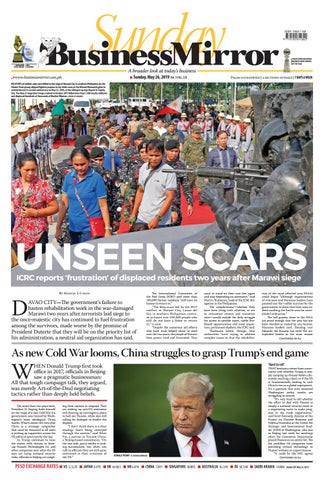
DONALD TRUMP
AL DRAGO/BLOOMBERG
THAT hesitancy stems from uncertainty over whether Trump is simply ramping up threats before ultimately reaching a deal, or if the US is fundamentally looking to curb China’s rise as a global superpower. It’s a question that even seasoned Washington policy wonks are struggling to answer. “It’s very hard to tell whether the effort to deal with Huawei is simply a national security issue or a negotiating tactic to make progress in the trade negotiations,” said Scott Kennedy, director of the Project on Chinese Business and Political Economy at the Center for Strategic and International Studies (CSIS) in Washington, who was in Beijing last week for meetings when the Commerce Department placed Huawei on an entity list. The list prohibits US companies from providing critical technology to Huawei without an export license. “It could be the NSC agrees Continued on A2
n JAPAN 0.4793 n UK 66.4823 n HK 6.6916 n CHINA 7.5991 n SINGAPORE 38.0815 n AUSTRALIA 36.2349 n EU 58.7248 n SAUDI ARABIA 14.0066
Source: BSP (May 24, 2019 )
NewsSunday BusinessMirror
A2 Sunday, May 26, 2019
www.businessmirror.com.ph
UNSEEN SCARS RELATIVES and friends of fallen soldiers who saw action during the terrorist siege in Marawi two years ago offer flowers and candles at a wreath-laying ceremony at the Libingan ng mga Bayani led by Commander Joint Task Force Marawi Rolando Bautista and Lt.Gen. Macairog Alberto AFP (both not in photo). NONIE REYES
HIJAB-CLAD female soldiers prepare to lay flowers at the Marawi Memorial pylon at the Libingan ng mga Bayani in Taguig City on May 23, 2019. AP/BULLIT MARQUEZ Continued from A1
preventing former residents from returning to the MAA to rebuild homes.
Invisible scars
THE conflict has left more vulnerable groups, such as families of missing people and victims of violence, with “invisible” scars, the ICRC said. “The wounds that do not bleed
are the wounds that become scars. And these are the most painful because they will always leave something to look at. Something that will always bring back memories of what happened. Nevertheless, it is still important because it is still a lesson,” recalled “Mel” (not his real name), a 34-year-old resident who was severely traumatized by the Marawi conflict. The ICRC said it launched in October last year the mental
health and psychosocial support (MHPSS) program and disclosed that it has reached close to 700 people. “Among them, 47 people were severely traumatized in the Marawi conflict, including Mel, who reported feeling relieved, comfortable, safe and understood after undergoing individual MHPSS sessions.” “They need sustained support to recover mentally from the trauma caused by the conflict that has
affected their overall well-being,” Thalmann said. Thalmann said the ICRC would work on “strengthening the capacity of the public health system in the area of psychosocial support to victims of violence.” The ICRC said its partnership with the Philippine Red Cross has supported displaced residents, with 63,000 of them from Marawi City and 11 other towns of Lanao del Sur provided with food and
other essential household items. Some 13,000 evacuees were given cash grants to start their livelihood and to cover basic family needs, and 3,000 evacuees were also provided with starter vegetable seed kits. The ICRC said it also covered the cost of medical treatment of persons who were injured during the fighting, and those with physical disabilities as a result of injuries received prosthesis and phys-
iotherapy. It has also been working with families whose loved ones went missing due to the conflict. “We have been filling the gaps in the recovery response in coordination with the authorities and other aid organizations. But we can only do so much. The authorities still have the primary responsibility of providing sustainable solutions to help the people of Marawi,” Thalmann said.
Trump’s end game Continued from A1
with the conclusions that the only safe Huawei is a dead Huawei, but they’re also interested in resolving the trade dispute,” Kennedy added, referring to the US National Security Council, which is led by longtime China hawk John Bolton. Since trade talks broke down earlier this month, the Trump administration has unleashed a slew of measures that would amount to containing China. In addition to the moves against Huawei, which could potentially curtail its ability to help nations around the globe roll out critical 5G mobile networks, the US is also considering cutting off vital American technology to five Chinese companies leading the world in video surveillance. China’s response so far has been largely rhetorical. Diplomats have blasted the US for “ bullying,” and state media has called the trade dispute a “ people’s war.” Anti-Americanism is rising on social media, with a viral song declaring: “If the perpetrator wants to fight, we will beat him out of his wits.” Speaking in the southeast province of Jiangxi this week, Xi readied Chinese officials for a lengthy fight. He warned cadres of the “complicated and long-term effects” of external influences and called for a “ new Long March”— recalling the party’s revolutionary struggles in the 1930s. Xi said China should become self-reliant in core technologies and even issued a veiled threat when he visited a rare earths processing plant, signaling to Trump that China may restrict sales of the elements used in everything from smartphones to electric vehicles. China’s government is drawing up plans to potentially bail out Huawei if necessary, according to a person familiar with discussions on how to respond to the threats to the company. One possible option includes offering financial assistance to Huawei, according to the
person, who added that nothing had been decided yet. “The Chinese government will probably wait to see if other provocations come from the Trump administration, but certainly they’re sending some signals,” said Wang Dong, secretary general of the Pangoal Institution, a Beijing-based think tank, who has served as a Chinese delegate at international security conferences. “The whole concept that the Trump administration can do things like harming Huawei without being hurt is completely inaccurate.” Trump’s moves against Huawei are part of an emerging greatpower competition with China that the administration spelled out in its 2017 National Security Strategy. The approach essentially equates economic security with national security.
Obama-era concerns
DESPITE some initial reluctance, more and more European nations are now coming around to the US view that they should avoid incorporating Huawei equipment into 5G networks because of the security risks the Chinese technology poses, according to an administration official who asked not to be identified. US security concerns about Huawei and Chinese trade practices aren’t new. The Obama administration began raising alarms about the potential threats posed by the Shenzhen-based company at least as far back as 2010. A report released in 2012 by the House Intelligence Committee tagged Huawei and ZTE Corp. as potential security threats, saying their hardware could be tweaked to enable widespread surveillance. The company has long denied that it helps Beijing spy on other governments or companies. The Communist Party’s flagship People’s Daily newspaper on Thursday accused US politicians of waging a “technology cold war” and warned that targets in other countries
could also suffer from the US’s “zero-sum mentality.”
G-20 meeting
INITIALLY, international resistance to Trump was mainly due to his “cack-handed” style rather than disagreements over China’s trade practices, said Chris Patten, who was the last British colonial governor of Hong Kong. “What he should have done is to talk to what used to be America’s allies, Japan and Europe and so on, because we have a common set of worries,” he said. One possible route to get USChina talks back on track is the Group of 20 summit in Japan at the end of June. Trump and Xi managed to work out a temporary truce at the last meeting of the group in Argentina late last year, and the leaders are expected to meet again. The US business community sees that meeting as one of the last chances to reach an agreement before the 2020 election campaign makes doing so unfeasible. Trump has already hit out at potential re-election challenger Joe Biden, saying at a campaign rally Monday that Beijing wants the former vice president to replace him so it “can continue to make $500 billion a year and more ripping off the United States.” About a fifth of US companies in China are considering moving some or all of their production out of the country to deal with the trade tensions, and a third are delaying or canceling investment decisions, according to a survey of 239 firms in the market by American business groups in China. “There’s going to have to be blinking on both sides,” Myron Brilliant, executive vice president of the US Chamber of Commerce, told Bloomberg Television on Wednesday. “They’ve boxed themselves in with the escalation of tensions, but at the end of the day this is too big a relationship to fail.” Bloomberg News
www.businessmirror.com.ph
The World BusinessMirror
Sunday, May 26, 2019 A3
Trump: Huawei could become part of trade deal with China
P
resident Donald J. Trump said on Thursday that China’s Huawei Technologies Co., which was put on a US blacklist earlier this month, could be part of a trade pact with the country.
“It’s possible that Huawei even would be included in some kind of a trade deal,” Trump told reporters at the White House, without providing details. “Huawei is something
that’s very dangerous. You look at what they’ve done from a security standpoint, from a military standpoint, it’s very dangerous.” The Trump administration is
seeking to choke off Beijing’s access to key technologies by limiting the sale of vital US components to the Chinese telecommunications equipment maker over security concerns. The US had held off on blacklisting Huawei out of concern the move could disrupt trade negotiations with China and only took action after the last round of trade talks hit an impasse, according to people familiar with the matter. The decision to curtail the Shenzhen-based company’s access to American suppliers unfolded quickly once trade talks broke down, the people said.
The Commerce Department action last week requires American suppliers of Huawei, a crown jewel of Chinese manufacturing, to seek US government permission to do business with the company. The decision touched off a massive disruption in technology supply chains, hitting some of the biggest component-makers. Intel Corp., Qualcomm Inc. and Broadcom Inc. told their employees they won’t provide products to Huawei until further notice. Trade talks between Beijing and Washington deadlocked this month as Trump accused China of backing out of a deal that was
Facebook removes record 2.2 billion ‘fake’ accounts
F
acebook Inc. said it removed 2.2 billion fake accounts in the first quarter, a record that shows how the company is battling an avalanche of bad actors trying to undermine the authenticity of the world’s largest social network. In the final quarter of 2018, Facebook disabled just over 1 billion fake accounts and 583 million in the first quarter of last year. The vast majority are removed within minutes of being created, the company said, so they’re not counted in
Facebook’s closely watched monthly and daily active user metrics. Facebook also shared a new metric in Thursday’s report: The number of posts removed that were promoting or engaging in drug and firearm sales. Facebook pulled more than 1.5 million posts from these categories in the first three months of this year. Tuesday’s report is a striking reminder of the scale at which Facebook operates— and the size of its problems. The company has been under constant criticism about its
content policies and efforts to detect fake accounts since the 2016 US presidential election, when Russia used the social network to try to sway voters. Facebook has promised repeatedly to be better at detecting and removing posts that violate its policies, and has pledged that artificial-intelligence programs would be at the center of those efforts. Facebook says it is simply too big to monitor everything on its service with humans alone. The social-media giant released its
third-ever content-transparency report on Thursday, a biannual document that outlines Facebook’s efforts to remove posts and accounts that violate its policies. The company said it’s getting better at finding and removing other troubling content like hate speech in the process. Facebook’s AI algorithms work well for some issues, like graphic and violent content. Facebook detects almost 99 percent of all graphic and violent posts it removes before a user reports them to the company.
taking shape with US officials, saying China reneged on an agreement to enshrine a wide range of reforms in law. Trump increased levies on $200 billion in Chinese imports to 25 percent from 10 percent, prompting retaliation from Beijing. The US has said it’s prepared to hit China with new tariffs even as Trump said he’ll meet his Chinese counterpart, Xi Jinping, at next month’s G-20 summit in Japan, an encounter that could prove pivotal. The Trump administration has offered a reprieve before to a Chinese telecommunications company, ZTE Corp., in a similar
situation as Huawei. The Trump administration last year announced a seven-year ban on US exports to ZTE after it said the company violated sanctions agreements by selling American technology to Iran and North Korea. The ban forced ZTE to announce it was shutting down. Trump then reversed course, saying he was reconsidering penalties on ZTE as a personal favor to Xi. Shortly after, his administration announced it would allow the company to stay in business after paying a fine, changing its management and providing security guarantees. Bloomberg News
But they are far from perfect. Facebook still can’t consistently detect graphic or violent content in live videos, for example, a blind spot that allowed a shooter to live broadcast his killing spree at a New Zealand Mosque earlier this year. The software also hasn’t worked as well for more nuanced categories, like hate speech, where context around user relationships and language can be a big factor. Still, Facebook says it’s getting better. Over the past six months, 65 percent of the posts Facebook removed for pushing hate speech were automatically detected. A year ago, that number was just 38 percent. Bloomberg News
A4
The World BusinessMirror
Sunday, May 26, 2019
www.businessmirror.com.ph
‘Dirty fuel’ clampdown risks nosedive for Middle East crude
T
he global push for cleanerburning ship fuel is threatening to drive the value of Middle East crude to a record low even as supplies are squeezed.
The discount of the Middle East’s Dubai crude to London’s Brent could widen beyond $8 a barrel from current levels around $4, according to Citigroup Inc. That would be the largest discount on record in data back to 2006, according to PVM Oil Associates. The spread is growing even as physical demand for Gulf grades rises as buyers try to replace barrels lost to Iranian sanctions. The plunging prices underscore the effect on oil markets from a maritime regulation that will force vessels ranging from leisure yachts to 300,000-ton supertankers to burn less-polluting fuel from January. The shift will hurt countries like Saudi Arabia and Iraq that produce high-sulfur, known as sour in industry parlance, while boosting the value of cleaner oils produced
across Africa and Europe. But it will also create opportunities for fatter profit margins for the world’s most powerful refineries, like those in India and the US Gulf Coast. “We expect Middle East oil to trade at larger discount to sweet crude as it tends to yield more highsulfur fuel oil, a grade that’ll be hit by steeply falling demand in the fourth quarter of this year,” says Nevyn Nah, an analyst with Energy Aspects. “We see the Brent versus Dubai price widening in that quarter.”
Sulfuric acid
Crude grades from the Middle East tend to have higher levels of harmful sulfuric acid than oil from the North Sea, Africa or West Texas. Regulators for decades have required refineries strip out sulfur
Short vs long term
from highway fuel, making it more difficult to process Middle East crude and forcing sellers to discount its prices. The International Maritime Organization will add to that pressure on January 1, putting into effect regulations approved in 2016 that require the use of marine fuel with 0.5-percent sulfur content or less, a change from current levels of more
than 3 percent. In the months leading up to 2020, the relative value of Dubai oil is set to dip as it’s “virtually impossible” to obtain ship fuel with under 0.5-percent sulfur from processing high-sulfur crude, according to Francesco Martoccia, senior analyst for commodities research team at Citigroup. Processors looking to make
IMO 2020-compliant fuel need to invest in more sulfur-stripping units known as hydrotreaters, or increase purchases of sweet crude, lifting the price of North Sea and African grades. Highly complex refineries that can produce compliant fuel from pollutant-rich crudes, such as Reliance Industries Ltd.’s Jamnagar plant and many US Gulf Coast refiners, stand to benefit.
The dire outlook for Middle East grades stands in contrast to a current supply squeeze, as output curbs by Opec and its allies are compounded by tougher US sanctions on Iran and Venezuela and an unexpected contamination in Russia. Prompt deliveries of Dubai are more than $1 a barrel more expensive than cargoes for next month, the steepest backwardation in at least 22 months, which signals the strength of the near-term market. Tougher ship-fuel standards are set to have a longer-lasting effect on the quality of oil that’s in demand, the type of fuel that refiners will seek to produce as well as the volume of crude that will be refined, analysts say. Producers in Saudi Arabia, Iraq, Iran and Kuwait currently sell their crude on monthly released official prices that are set against Dubai and Oman crude prices. “The potential for a further tightening of sour crudes supply in the short term due to Iranian waivers is coming to an end,” said Citigroup’s Martoccia. “Subsequently, the global refining system will shift its crude intakes towards lighter slates as we approach the IMO 2020 start date.” Bloomberg News
Science
Editor: Lyn Resurreccion • www.businessmirror.com.ph
BusinessMirror
Sunday
Sunday, May 26, 2019
A5
Space agency within PHL’s reach
‘I
By Stephanie Tumampos | Special to the BusinessMirror
nvite me during the first rocket launch.” These were the first words of Sen. Bam Aquino to astrophysicist Dr. Rogel Mari Sese immediately after the Senate passed with an 18-0-0 vote for third and final reading Senate Bill 1983, or the Philippine Space Act, on May 20.
Sese, a Filipino astrophysicist who helped write the bill, was delighted that finally it was approved after his almost three years of lobbying in the Senate. The bill, known as an “Act Establishing the Philippine Space Development and Utilization Policy and Creating the Philippine Space Agency [PhilSA],” will be merged at the bicameral committee with its House of Representatives’ counterpart. Both the Senate and the House has until June 17 to merge their respective space bills and ratify it before they adjourn. After which, it has to be submitted to the President to sign into law. The Senate bill was sponsored by Aquino, the chairman of the committee on science. His coauthors are Senate President Vicente Sotto III, and Sens. Loren Legarda and Sonny Angara. The counterpart bill at the House of Representatives, House Bill 8541, was introduced by Reps. Erico Aristotle Aumentado and Seth Frederick Jalosjos in 2016 and was approved in December 2018. “Just a few more steps and we can finally proceed in creating a national space agency that would benefit Filipinos through policies and applications that will address pressing national issues,” Sese told the BusinessMirror. He added that the country is now poised to take its place in the
international space community “and become the newest emerging space nation in the world.”
De la Peña: It ensures the continuity of the space program
With the 18-0-0 vote for the bill, Sese was grateful for the full support of the Senate of the 17th Congress. On a personal note, he told the BusinessMirror the legislation of the creation of the Philippine space agency was one of the reasons he came back from Japan in 2011 after finishing his PhD there. And it is now a reality. “I am thankful to all who have supported [the passage of the bill]—the government institutions, academe and industry stakeholders, to what I consider my life’s work.” Science Secretary Fortunato de la Peña, who witnessed the Senate voting on the bill together with Undersecretary Rowena Guevara, was very happy with the news on
Sen. Bam Aquino (from left), astrophysicist Dr. Rogel Mari Sese and Senate President Vicente Sotto III share a light moment. Roy Domingo
the approval of the space bill. In a text message, de la Peña told the BusinessMirror: “[The passage of the bill] will ensure the continuity of the space technology development programs we [at DOST] have started.” These programs include the Philippine Scientific Earth Observation Microsatellite Program that launched Diwata-1 and 2 microsatellites in orbit and was succeeded by the Space Technology and Applications Mastery, Innovation and Advancement, most popularly known as STAMINA4Space Program.
Aquino: Continue to dream big
Aquino, on social media, urged the people to continue to dream big for the country. “Let’s never tire of finding better solutions to improve the lives of Filipinos.” In a Senate news release, he said the launching of a space program in the Philippines would give Filipi-
Just a few more steps and we can finally proceed in creating a national space agency that would benefit Filipinos through policies and applications that will address pressing national issues.”—Sese
‘Science put at the forefront with PHL Senate recognition’
The Senate recognizes nine Filipino scientists. With Sen. Bam Aquino (left) are some of the scientists with (from left) Matnelli Alviola (wife of Philip Alviola); Dr. Philip Alviola, wildlife scientist; Dr. Rogel Mari Sese, astrophysicist; Dr. Nathaniel Hermosa II, physicist; Senate President Vicente Sotto III; Sen. Juan Miguel Zubiri; Dr.Gay Jane Perez, first placer, 2018 AsianUS Science Prize for Woman; and Lita Suerte Felipe, DOST Legislative Liason Office during the recognition at the plenary hall of the Senate. Roy Domingo
N
i n e F i l i p i n o s c i e n t i s t s we re recognized by the Senate on May 22 for their achievements in their chosen fields through the two resolutions introduced last year by Sen. Bam Aquino, chairman of the Senate Committee for Science and Technology. Senate Resolution 882 commended Dr. Rogel Mari Sese, Jeffrey S. Perez, Dr. Mario Antonio L. Jiz II, Dr. Philip A. Alviola, Dr. Nathaniel P. Hermosa II, Dr. Lanndon A. Ocampo, Dr. Lucille V. Abad and Dr. Aletta Conception T. Yñiguez, who were included in the Asian Scientist 100 list 2018 Edition released by the Asian Scientist Magazine. On the other hand, Senate Resolution 923 recognized and congratulated Dr. Gay Jane Perez for being awarded first place at the 2018 Asean-US Science Prize for Women. Alviola, who was present at the Senate
together with his wife, told the BusinessMirror that the recognition given by the Senate is an instrument to promote their scientific research and applications to the Filipinos. “In more ways than one, the Philippine government, especially the legislators have put science at the forefront, and in my case, in nature conservation, because of this award,” Alviola said. “This particular award does not just recognize me but recognizes the need to do conservation and push for legislation for the protection of our dwindling biodiversity here in the Philippines,” he added. Sese, one of those pushing for the approval of the space bills in Congress that will create the the Philippine Space Agency, echoed the same statement. He said, “I believe that if we continue to recognize scientists in this country through different organizations, institutions or
government bodies, such as the Senate, our research and field of expertise will be given a proper boost and be known to Filipinos especially the youth.” In previous years, Sese has been promoting astronomy and space science all over the country and has worked hand in hand with the Department of Science and Technology. Hermosa, a physicist who focused his research on light and light-matter interactions, shared his happiness on the recognition given by the Senate. “The external support by the government only shows that it is now promoting science. Hopefully it will encourage more students to take science-related courses in the coming years and help grow the number of Filipino scientists in the country,” he said. Hermosa also added that he fully knew the government has continuously supported scientists but more internally through funding for research “but that is not visible to the public.” Perez saw the recognition as both an opportunity and a challenge. She told the B usiness M irror that expectations will be heightened now that they are recognized. “People are now looking up to us and personally, I become more conscious to be a good role model. This is also a perfect time to work harder and continue to do our job better.” Perez also added that the recognition is a good initiative of the government. She said that most of the time, athletes and beauty queens were the ones recognized. This was the first time a group of scientists were recognized by the Senate. “This is a good example that this profession [scientist] is recognized and can give honor to the country,” Perez said. Stephanie Tumampos
nos a new perspective and valuable insights that could help solve some of the country’s biggest problem. “Satellites can improve disaster management from providing accurate information that allow early warnings and predicting of disasters to reliable and quick communication during relief and recovery operations,” Aquino said in his sponsorship speech. Space technology, he pointed out, could also enhance production and profitability of agribusinesses due to soil and weather monitoring and assessment. It could help conserve and preserve the environment, improve urban planning, transportation and communication networks.
PCIEERD is ‘optimistic’
For its part, the Philippine Council for Industry, Energy and Emerging Technology Research and Development (PCIEERD) of the DOST thanked the Philippine Senate for its unanimous vote in passing the space bill “that will bring the country onward and upward into the realm of space technology and applications.” DOST-PCIEERD Executive Director Dr. Enrico C. Paringit said in a statement: “As the bills move into the bicameral conference committee, we are optimistic that our legislators will see the benefits that the Filipino people stands to gain once the Philippine Space
Agency is created and takes the lead in implementing the Philippine Space Development and Utilization Policy.” He said the government, particularly the DOST, has been laying the groundwork needed for a strong space science program through various human capacity building and technology researches that it has funded. “The [DOST-PCIEERD] shall remain at the forefront of enabling innovations, like the Philippine Space Act, that will sustain the economic gains and improve the lives of our fellow Filipinos,” Paringit added.
Philippine Space Act
Once established, the PhilSA will be an attached agency to the Office of the President. Sese explained this is because of the “cross-cutting applications of space” in many different areas, such as defense, disaster risk and assessment, science, agriculture and environment to name a few. In the bill, the PhilSA “shall be the primary policy, planning, coordinating, implementing, and administrative entity of the Executive branch of the government that will plan, develop and promote the national space program in the Philippine Space Policy.” Its framework will cover six key areas: national security and development, hazard management and climate studies, space research and development, space industry capacity building, space education and awareness, and international cooperation. The approved bill does not only establish an agency but also legislates the Philippine Space Development and Utilization Policy—the country’s road map for space development aiming at making the country a space-capable nation. Under the bill, initial funding for the space program amounting to P1 billion will come from the current fiscal year’s appropriation of the Office of the President. The amount for the subsequent operation and maintenance of the PhilSA will be included in the General
Appropriations Act. Additional funding amounting to P10 billion will come from the gross income of the Philippine Amusement and Gaming Corp. and the Bases Conversion and Development Authority for five years after the effectivity of the Act, with P2 billion to be released to PhilSA yearly. PhilSA may also derive income on its specialized products, services and royalties as well as accept funding from loans, contributions, grants, bequests, gifts, donations provided that such grants, bequests, contribution and donations from foreign governments will be approved by the President upon the recommendation of the PhilSA director general. According to the bill, the PhilSA office and its research facilities will be housed in at least 30 hectare of land under the administration of the BCDA within the Clark Special Economic Zone in Pampanga and Tarlac. Additional areas for research and launch sites will also be developed in the future.
PHL space tech since 1960s
The Philippines has been involved in space technology since the 1960s when the government built a satellite receiving station during the Marcos era. In the 1970s, the country also ventured on its first rocket development program. In 1996, a Filipino private firm, Mabuhay Satellite Corp., acquired the country’s first in-orbit satellite, Agila-1, which was formerly owned by an Indonesian company. In 1997, the company had its own telecommunications satellites, Agila-2, which was launched to space from China. (Agila-2 was developed by a US company but was launched from China). In 2014, the Philippine government partnered with universities in Japan to launch the first microsatellite developed by Filipinos, Diwata-1. The government was able to develop and send two more satellites, Diwata-2 microsatellite and Maya-1 cube satellite in 2018.
‘Filipinos could compete with foreign counterparts’
F
By Rizal Raoul S. Reyes
ilipino engineers and scientists can be on a par with their foreign counterparts, Engr. Vicente DyReyes, a Department of Science and Technology (DOST) Balik-Scientist and the program director of the Finite Element Technology of Feati University, believes. The National University civil engineering graduate pointed out that Filipinos could compete head-to-head on with their foreign counterparts given the right opportunity, facilities, resources and equipment. DyReyes spoke at the recent launching of the partnership of Feati University and MSC Software with the signing of a memorandum of agreement early this month. A US-based engineering firm, MSC Software appointed Feati as its “center of excellence” in the Philippines. Feati University President Dr. Adolfor Jesus Gopez welcomed the partnership. “[This is] the new resolution in engineering technology,” he said. By introducing the MSC Software, the Philippines can now test and certify its products through virtual simulation prior to manufacturing. Through its partnership with MSC, Feati expects this to help prepare future engineers from various fields to meet the new challenges in product design or product innovation, as well as industry requirements. “We need to upgrade the local industries. We need to make a globally competitive product. With little knowledge, we have to acquire tools, such as the MSC,” DyReyes said in an interview with reporters. He expects the country can be more competitive in three to five years and export high-value products to the world market. “Once I get to teach in Feati, I will produce the teachers that will mentor the students,” he said. Feati was founded in 1946 as an aeronautics school to train and develop aircraft mechanics and engineers. After gaining valuable and relevant
knowledge in aerospace engineering overseas, mainly in the United States, DyReyes is doing a pay back—through the Balik Scientist program from 2019 to 2020—by sharing his expertise to his fellow Filipinos so they can make an impact in the engineering field in the global market. “Our goal’s here is to be commercially competitive not only locally but globally, as well. I encourage academe to acquire the MSC software and later produce products for the world market. That is the way to increase it. That is why I am telling the scientists here to focus on developing products needed out there. Once we have it, we can now compete in the global market,” he explained. The Philippines can produce products that are very affordable to the global market. “All we need is to develop the talent in the country to make them competitive in the international market,” he added. DyReyes said foreign scientists have lots of resources, which can harness their talents and potentials to the fullest. Nevertheless, Filipino scientists can be on a par with their foreign counterparts if they are given the right sources, opportunities and facilities. “All we have to do is to have the tool to improve the product and simulate it,” he said. The Finite Element Analysis Simulation software was first developed in the 1960s for the National Aeronautics and Space Administration (Nasa) program in aerospace, which pioneered in simulation of space vehicle design, which was commercialized by MSC Corp. With the stringent product quality standard requirements of the international market, Philippine products tested and certified through virtual simulation prior to manufacturing can be generated at a faster rate, much lower costs, and at levels of quality possible exceeding worldwide standards. DyReyes pointed out MSC is using cuttingedge software technology in validating engineering designs not only in aerospace industry but in other engineering fields, such as civil engineering, transportation and medical field.
“My background in using this software for more than four decades has afforded me a ringside seat in witnessing how the finite element analysis and virtual simulation tools of MSC Software is bridging the gap between designs, manufacturing and implementation, not just in aerospace but in every application that requires design, verification and production for commercial use” he said. In the last 40 years, DyReyes was involved in research and development on aerospace with NorthropGrumman Corp., such as in buckling analysis of the wing structure of Nasa space shuttle. With the entry of MSC in the Philippines, he said Filipino engineers, technical professionals, academe and almost everyone involved in design, verification and applications can now pursue in developing world-class products. Moreover, with par tnership formed between Feati University and MSC software the Philippines can now pursue design verification through the Finite Element Analysis and virtual simulation at an affordable rate. He said Feati’s engineering curriculum would now include courses in Finite Element Analysis Methods and train students on how to use it in virtual design simulation. Feati will also offer and certify training on the use of MSC software’s tools in design verification and virtual simulation. He said the trainings will be open to all professionals, academe and also government institutions involved in research and development, design, construction and the like. When the use of MSC Software gains more recognition and acceptance in the country, DyReyes said Philippine engineering schools are be expected to integrate and use the technology in their respective engineering curricula. He recommended that training on MSC start at high-school level, pointing out that it is the right stage for students to be innovative, creative and take risks. “Creativity is the most important thing here in using MSC software,” he said.
Faith A6 Sunday, May 26, 2019
Sunday
www.businessmirror.com.ph • Editor: Lyn Resurreccion
Pope: Throwing away food is like throwing away people
V
ATICAN—Pope Francis condemned food waste, saying throwing away food is like throwing away people. “Waste reveals an indifference toward things and toward those who go without,” he said last week. “To throw food away means to throw people away,” he told members and volunteers of the European Federation of Food Banks, including the Food Bank of Italy, which was marking its 30th anniversary. He thanked the organizations for all they do in providing food to those who are hungry while fighting against food waste. “You take what is thrown into the vicious cycle of waste and insert it into the ‘virtuous circle’ of good use,” he said, saying their work is like what trees do—taking in pollution to give back oxygen to those in need. “It is scandalous today not to notice how precious food is” and how much of it ends up wasted, he said. “Wasting what is good is a nasty habit” that can creep in any where, even in charitable works, for example, when good intentions are blocked by bureaucracy or excessive administrative costs or when they “ become forms of welfare that do not lead to authentic development.” Charity today “requires intelligence, the capacity for planning and continuity,” and for people to care about each other, seeking to restore human dignity, the pope said. He told those involved in food banks that their work shows— with action and not words—that progress “advances each time we walk with those who are left behind.”
“The economy has a profound need of this,” he said, lamenting how “the frenetic scramble for money is accompanied by an interior frailty,” disorientation and a loss of meaning.
It is scandalous today not to notice how precious food is [and how much of it ends up wasted].”—Pope Francis
Pope Francis greets the crowd during his general audience in Saint Peter’s Square at the Vatican on May 15. Paul Haring/CNS
Msgr. Josefino S. Ramirez SUNDAY GOSPEL IN OUR LIFE
Who is the Holy Spirit and how does He act? We believe that there are three persons in the one divine nature. The Father is God, the Son is God, the Holy Spirit of God, yet these are not three Gods, but only one. It is a mystery we cannot fully grasp, but must accept it, humbly acknowledging the limits of our intelligence. We also attribute different roles to each of these divine persons—the Father creates, the
Son redeems and the Holy Spirit sanctifies. They are like three stages that take place one by one. That is why in another passage, Jesus said, “If I do not go, the Advocate [Holy Spirit] will not come to you; but if I go, I will send Him to you” (John 16:7). Now that Jesus is “seated at the right hand of the Father,” the Holy Spirit has been sent, and He is now carrying out His role of sanctifying Christ’s followers. God is constantly acting. But He acts especially in the hearts of each of us through the Holy Spirit. It is true that God uses external instruments to make his message reach us. That is why Christ commanded the apostles to preach and to administer the saving sacraments. But that is not enough. Many
people hear, but not all will listen. Many people are baptized, but not everyone lives up to the commitments of being a Christian. God also acts in the intimacy of each person, helping him to listen and to correspond. That is the action attributed to the Holy Spirit. If we are more aware of the activity of the Holy Spirit, we would perhaps be more receptive to the saving word of God. God sends “inspirations” to each of us. It could be a sudden realization of our need for conversion, or the desire to make a generous act of dedication to God. That is the Holy Spirit acting in us. We still have to correspond to it because we are free. The Holy Spirit blows gently, almost imperceptibly. But His breath is effective if it meets a heart that is docile and receptive.
Italy’s Catholic establishment faults Salvini for rosary
R
OM E — It a l i a n I nt e r io r Minister Matteo Salvini on Monday defended his invocation of God at a political rally, after Italy’s Catholic establishment criticized it as a cynical exploitation of faith ahead of European Parliament elections this weekend. Salvini brandished a rosary and entrusted Italy to the Virgin Mary at a rally last week, which featured a host of far-right European leaders. He spoke glowingly of Saint John Paul II and retired Pope Benedict XVI for having tried to remind Europe of its Christian roots.
Statue of Saint Madeleine Sophie Barat at Saint Peter’s Basilica in the Vatican Wikimedia Commons
Saint Madeleine Sophie Barat: Foundress By Corazon Damo-Santiago
S
o stressed and terrified because the next-door neighbor’s house was on fire, Madam Madeleine Barat gave birth to her third child. The baby girl, born on December 12, 1779, looked so fragile that the following morning, at 5 a.m., she was baptized at Saint Thibault Church, a few yards from the Barat residence. She was named Madeleine Sophie Barat. Her brother, Louis, aged 11, was the godfather, while Louise Sophie Cedar, a neighbor on her way to Mass, was her godmother.
Premature, but clever, baby
The spirit acts within us
T
cause they go to work when the children are still asleep and get home when they are a lready in bed. “This is inhuman: This vertigo of inhuman work.” “Instead of serving humanity,” he said, the economy “enslaves us, subjugates us to monetary mechanisms” that are increasingly difficult to control. “We need to encourage models of growth based on social equality, on the dignity of human persons, on families, on the future of young people, on respect for the environment,” he said. “Even if evil is at large in the world, with God’s help and the good will of so many like yourselves, the world can be a better place,” he said. Carol Glatz/Catholic News
Service via CBCPNews
6th Sunday of Easter: ‘John 14:23-29’
he Gospel of today is like a preparation for the approaching celebration of Pentecost. Just as Jesus Christ gradually prepared His followers for the coming of the Holy Spirit, so the Church prepares her children for the commemoration of that crucial event. In the gospel today, Jesus said “the Holy Spirit, whom the Father will send in my name, will teach you all things and remind you of all I have said to you” (John 14:26).
“What I care about is an economy that is more humane, that has a soul, and not a reckless machine that crushes human beings,” Pope Francis said. Too many people are left without work, dignity or hope “and still others are oppressed by inhuman demands of production” that have a negative impact on the family and personal relationships. T he pope said it pains him when he hears parents say they have little time in the day to pl ay w it h t heir c hi ld ren be -
Asked to comment, the Vatican’s secretary of state, Cardinal Pietro Parolin, said God was for everyone, and “invoking Him for yourself is always very dangerous.” An Italian Jesuit close to Pope Francis, the Rev. Antonio Spadaro denounced the use of the rosary and the invocation of God for political campaigning. Spadaro, who has criticized the influence of right-wing evangelicals in US politics, tweeted a photo of a commemorative coin of US President Donald Trump being promoted by US evangelicals as a “point of contact” with God.
“There are those who in electoral campaigns use God and saints, and those who even sell coins to pray for the reelection of their candidate,” he said. “The exploitation of religion seems to know no decency.” Salvini has increasingly sought to portray his anti-migrant policies as driven by a desire to save lives, by discouraging migrant crossings from Libya—and entirely consistent with the Christian message. At least one Italian bishop has warned voters that anyone who votes for Salvini’s League isn’t Christian.
In a tweet, Salvini refused to comment directly. “I’ll continue to give witness to my faith with my work for a more beautiful and secure Italy. Gossip I’ll leave to others. Amen.” The Italian Catholic magazine Famiglia Cristiana said Salvini’s performance “was the latest example of the exploitation of religion to justify the systematic violation of human rights in our country.” It was a reference to recent criticism by UN human-rights investigators that Salvini’s migrant policies violate international humanrights conventions. AP
The Barat family was a respected, well-off family in Joigny, Burgundy, in France. Jacques Barat was a vinedresser—an agriculturalist involved in the daily pruning and cultivation of grapevines—and a respected craftsman who made wine barrels. Louis, who studied for priesthood, was too young and was sent home while waiting for his ordination. At an early age, Sophie manifested love for learning. Louis became her teacher in history, natural science, mathematics, Spanish, Latin and Greek. The start of the French Revolution affected the Barat family. Louis, who refused to profess loyalty to the state, was imprisoned and evaded death with a friend’s intervention. He went to Paris secretly in 1795 where he was ordained and did his priestly work in secret. Sophie went with him to Paris, where she learned about the fathers of the church, Latin and the scriptures. At 15, she acquired an education rarely available to young women at that time. It was noted by Aleteia.org that it was an education “that far surpassed anything she might have obtained anywhere else.” Sophie and her brother lived in a safe house where she did the household chores. She learned and became an excellent seamstress and embroidery expert. She wanted to be a Carmelite nun, but the Catholic monarchy was abolished as early as 1790. T he 16 Discalced Carmelites of Compieg ne, who were hiding, were condemned as traitors and were sentenced to die by g uil lotine. A life of prayer and study characterized Sophie’s life in Paris. She taught catechism to children secretly in the “Marais Quarter,” a swamp on the riverbank of Siene.
Women of faith
In Paris, Sophie met Joseph Varin, who desired to start an order for women devoted to the Sacred Heart of Jesus to complement the work of a priest. On November 21, 1800, with three women living in safe houses in Paris, she became one of the first four members of the Sacred Heart Congregation. But French authorities then prohibited the devotion to the Sacred Heart. As a camouflage, they were
known as Women of Faith (Damas de la Foi) or Christian Instructors (De L’Instruction Chretienne). She was 21 and has abandoned her dream of being a Carmelite nun. Sophie had to travel to Amiens, a city in northern France, for the first school the congregation opened in September 1801. On June 7, 1802, she made her final vows. In 1803, at the age of 23, she became the mother superior of the order. In 1804, she met Rose Philippine Duchesne, a Visitation nun of the Community in Sainte Marie-d’en-Haut in southeastern France. The congregation joined the Sacred Heart. Their second school was established in Grenoble and the third in Poitiers in western France. Duchesne, who was canonized on July 3, 1988, helped Sophie establish Sacred Heart Schools in North and South America. Sophie, after her election as superior general of the congregation, called all the superiors in a council. The urgency to design a uniform curriculum for the Sacred Heart Schools was conceived. To foster unity in vision and mission, the constitution and rules of the order were drafted in 1815, and were granted ecclesiastical approval in 1826. In 1832 the Congregation of the Children of Mary, composed of former students and ladies, was organized in Lyons, France.
Superior par excellence
As a superior, Sophie opted for “moderation seeking the middle ground, accepting the possible as more realistic option rather than the impossible ideal,” declared the Religious of the Society of the Sacred Heart of the United States and Canada. A s administrator, she was gifted with the intuition of who to appoint in positions of responsibilities. She likewise believed that all who are committed in the task of education ought to be learners, too, and exemplars of virtuous life. In every school that was established, there were also classes for the poor who could not afford to pay the fees. All Sacred Heart Schools earned excellent reputation in their respective communities. Web reports cited Sophie as one who averted the schism between the Vatican and the Archbishop of Paris. When she died, 3,359 women deeply committed to the task of inculcating love for the Sacred Heart in North and South America, Italy, Switzerland, Belgium, England, Ireland, Holland, Germany, Austria and Poland. Saint Madeleine Sophie Barat died on May 25, 1865, in Paris, France, and was canonized on May 24, 1925, by Pope Pius XI. Damo-Santiago is a former regional director of the Department of Education National Capital Region. She is currently a faculty member of Mater Redemptoris Collegium in Calauan, Laguna, and of Mater Redemptoris College in San Jose City, Nueva Ecija.
Tourism&Entertainment BusinessMirror
Editor: Carla Mortel-Baricaua
Sunday, May 26, 2019
A7
From Sunset to Sunrise:
Climbing the Yellow Mountains
The climb up is worth it because of stunning vistas along the way.
M
Huangshan is full of majestic rock formations that will grab your attention.
Story & photos by Joshua Berida
y friend and I stayed in the concrete jungle of Shanghai for a couple of days.
The city was beautiful; towering skyscrapers that lit up the night sky, entertainment and shopping districts, modern buildings mixing with old ones and a sense of history wherein I felt the confluence of the ancient and the new. After experiencing the hustle and bustle of the city, we decided it was time to see the great outdoors. We boarded our overnight train from the bustling metropolis en route to Huangshan, or the Yellow Mountains.
From sunset to sunrise
We got to the sleepy town of Huangshan uneventfully. We left our bags at the hostel and had breakfast before heading out. I was on again and off again about taking the cable car all the way to one of the viewing decks of the mountain. This is the thing about China: They have molded nature in their image. You’ll see stairs, pathways, electricity, hotels, transportation, roads and the like in mountains and parks. I haven’t been to Europe or North America, but I see similar developments after a quick online search. After contemplating the mysteries of the pros and cons of taking the cable
car (the deciding factor was mostly cost), we decided to just walk/climb up. (Take note: entrance fee is already CNY230 [roughly P1,800] and the cable car is already from CNY80-100 [roughly up to P800] one way. The steps greeted us as we made our way up Huangshan. This was the perfect time to think about the meaning of life, since there were very few people walking (the Chinese prefer taking the comfortable way up) and there was so much beauty around. Giant rock formations, jagged peaks, diffused sunlight slipping through branches and different kinds of flora replaced the electric wires, skyscrapers, neon sights and blur of faces. I was thinking about life’s bigger questions as I began to feel my muscles aching after a couple of hundred steps up. “Why am I here?” “Why do people do the things they do?” But I left these hanging and let the philosophers ponder these things. I settled on “how far is it till we reach the top?” “How many more steps till we get
Its enchanting rock formations offer a reprieve from the chaos of urban living. to the next flat walkway?” “Do I really look Chinese that locals talk to me all the time?” We went step by step up the mountain in silence and in casual conversation, until we reached a viewing walkway near our accommodation. It was almost sunset when we checked in and left our bags before leaving to watch nature do what it has done for eons, but still leave it to humans wanting more. Blue hour was upon us, and we followed the trickle of people making their way to the viewing platform near the sea of clouds. There were large groups of people already, but we managed to get a good view of the stunning sunset. The surrounding rock formations that reached for the sky
The viewing deck may be crowded, but the sunset view is a sight to behold. changed colors from a faint yellow to a deep orange. The sun’s last rays engulfed the clouds in its red splendor. We woke up early to see the sunrise, cliché I know, but we spent a lot of money to get here and spend the night, so might as well make the most of it. It was dark and freezing, but we weren’t the only ones who wanted to see the sun rise over the Yellow Mountains. We found a decent spot, but more and more people came. We waited for the perfect moment in the cold. I thought about the names of the scenic spots, Cloud Valley Temple, Bright Peak Summit, Flying Stone, Legendary Turtle Peak, Guest-Greeting Pine and Merciful Light Pavilion to name a few. By the way, they sound
just as cool in Chinese. The sun began to rise; the feeling of excitement and awe was palpable. The people standing were either taking photos or simply admiring nature’s everyday practice. I shifted between the two while the first rays of the sun dissipated the mist and turned the surrounding landscape into a mix of orange and yellow hues. After the excitement and moment of wonder ended, we made our way down the mountain. My friend decided to take the cable car down, but I decided to take on the challenge of walking the hundreds of steps for the descent. If you thought that walking up a mountain even with wooden and concrete steps is difficult, try going down.
My legs were still aching and sore from the previous day’s climb. It’s difficult to enjoy the beauty around you if your camera’s dead and you have to walk backwards just to alleviate some of the knee- and thigh-muscle pain. After a grueling three hours, I made it to the base. I gingerly walked to the bus station back to the town. I pondered if all that trouble to see nature’s mundane everyday act of sunset and sunrise was worth the trouble, maybe the challenge of the climb and descent will make me a better person or something, like many clichés of suffering and reward. Maybe everything will stay the same like the mountain; it’s only the people that see it change, though.
‘Naturally Vibrant’ Nueva Vizcaya By Bernard Supetran Photos by Nueva Vizcaya Provincial Tourism Office
E Balete Pass in Santa Fe now has a two-way zip line.
The ‘Lion Entrance’ leads you to the Capisaan Cave in Kasibu.
mbraced by the mighty mountain ranges of the Cordillera, Caraballo and Sierra Madre, Nueva Vizcaya is among the country’s culturally diverse, yet unheralded provinces. It might not possess powdery beaches and luxe hotels which are the usual come-ons, but this frontier destination of sort is a merry mix of nature, adventure and culture—the perfect blend the new generation of travelers look for. The gateway to the Cagayan Valley region, it prides itself with the “Naturally Vibrant” tag, owing to its God-given lush allure tucked in the bosom and the sprawling land between the mountains. Visitors are welcomed at Balete Pass, Santa Fe, at 914 meters above sea level, the provincial and regional boundary which is the usual pit stop for motorists because of its stunning panorama worthy of Instagrammable snapshots. A new attraction in the area is the zip line that goes two ways: the 150-meter glide over for a breath taking view of the zigzag, and 200-meter ride going back. It is commonly known as Dalton Pass, where some 17,000 Japanese and US-Filipino Allied troops were killed during World War II and that includes Gen. James Dalton to whom the place was used to be named after. For a refreshing dip, bask in the icy waters of Imugan Fall in Santa Fe, a two-level fall with
Lower Magat Eco-Tourism Park in Diadi.
shallow catch basin where you can enjoy trekking, swimming, fishing and immersion with the community, including the Imugan Mountain Fresh Factory, which produces spreads and jams from wild berries and other fruits. A must-try adventure is Capisaan Cave in Kasibu, the Philippines’s fifth-longest cave system and considered as a geologist’s paradise with its rare calcite formations, sharp, pointed stalagmites, stalactites and speleothems arranged in amazing sequences. From the lion-shaped opening called Lion Entrance, spelunkers will be treated with otherworldly surprises, starting with its 4.2-km subterranean river where explorers have to wade for most parts. The provincial capital of Bayombong is the proverbial big surprise in small packages. This compact town is home to the majestic Saint Dominic Cathedral, seat of the Catholic diocese and the People’s Museum and Library, the repository of Novo Vizcayano heritage, which
was declared by the National Museum as an Important Cultural Property. Its Provincial Capitol Complex has earned the moniker “Luneta of the North” because of its tree-lined park ideal for a promenade and public recreation, man-made lagoon with rowboats and the newly opened convention center which aims to make it a vital hub for conferences and exhibitions in Region 2. The town is also an alternative entry point to Mount Pulag, the country’s second-highest peak, via the equally exciting Ambaguio trail. Not to be missed is the Lower Magat Eco-Tourism Park in Diadi, the provincial government’s flagship attraction within the 24,000-hectare portion of the Lower Magat Forest Reserve, which provides watershed protection to Magat Dam in nearby Isabela province. Comanaged with the Department of Environment and Natural Resources, this sprawling hideaway has a fishing lagoon, camping grounds, swimming pools, ethnic-themed cottages, recreational facilities, and trails for hiking and biking for an interlude with nature. The province is also being groomed as a regional site for paragliding with the series of test flights by Korean paragliders in the uplands of Aritao town. Once fully established, tourism and allied services are expected to flourish with the arrival of high-end adventure for domestic and foreign tourists looking to take travel to new heights, quite literally. But perhaps Nueva Vizcaya’s most exotic trait is its being the domain of 18 indigenous
people’s groups who have settled here—the Ifugaos, Gaddangs, Isinais, Dumagats, Kalanguyas and Bugkalots, to name a few. This cultural diversity was put to the fore once more as the province recently held the 11th Grand Ammungan Festival to mark its 180th founding anniversary when it was created as an independent province from Cagayan in 1839 by a Spanish royal decree. The five-day festivity is coined from the words ammungan of the Gaddang tribe and ummungan from the Ilocanos, which both mean “gathering,” and showcased the strides made by the province in terms of economy, tourism, governance and indigenous people’s rights. Festivities covered an agri-trade fair, Gawang Vizcayano exhibit, landscaping contest, family day, Laro ng Lahi, a three-day Arts & Music Festival, the Saniata ti Vizcaya pageant, community medical services, evening musical shows and a bevy of special events.The local way of life wasalso recreated at the municipal booths, which displayedthe agricultural produce, processed food, and ethnic souvenirs and crafts. The locus of the cultural extravaganza was the parade of floats and the street-dance competition on May 24, which featured municipal contingents with their contemporary interpretations of ethnic dances, as well as visiting troupes that represented award-winning festivals from all over the archipelago. With nature, adventure and culture coming into play, this Naturally Vibrant province may yet be your next playground.
A8 Sunday, May 26, 2019
Sports BusinessMirror
Editor: Jun Lomibao | mirror_sports@yahoo.com.ph
A LOT TOUGHER THAN IT LOOKS I
By Dave Skretta The Associated Press
NDIANAPOLIS—Alexander Rossi had no idea what he was getting into when he moved from Formula One (F1) to IndyCar. Turning left the whole race? Looks easy. But as Rossi soon found out—and as two-time world champion Fernando Alonso and his McLaren team learned in failing to qualify for the Indianapolis 500 last weekend— getting around Indianapolis Motor Speedway at speeds eclipsing 230 mph is a lot tougher than it looks. “I didn’t understand what oval racing was. I didn’t understand what IndyCar racing was, because there is no exposure to it in Europe,” said Rossi, an American who moved to Europe as a teenager and made his F1 dreams come true with seven starts during the 2014 and ‘15 seasons. “So when guys haven’t been a part of it,” Rossi said, “they don’t understand how difficult it is, how unique it is to everything they’ve done. On TV, let’s be honest, it doesn’t look that challenging, so being a European driver, in your mind you’re at the pinnacle of the sport. You think, ‘Of course I can go over there and do that and it wouldn’t be a problem.’” That inherent arrogance was underscored two years ago, when Alonso showed up at the Indy 500 for the first time. He ran near the front all race, only for his Honda engine to let him down. Naturally, many F1 drivers were quick to pounce on their rival open-wheel series, claiming it must not be too difficult to win in IndyCar if Alonso could be competitive right out of the gate. “I looked at the times and, frankly, for his first-ever qualifying for Fernando to be fifth— what does that say about Indy?” five-time F1 champion Lewis Hamilton mused to L’Equipe shortly afterward. “A great driver,” he said, “if he cannot win in Formula One, will look for other races to win.” In other words, Hamilton was calling IndyCar second-rate. That’s part of why so many eyebrows jumped at McLaren’s spectacular disappointment. “Fernando may have done well in 2017, so there may have been a feeling like all he has to do is show up and take it over,” said Mark
Miles, the chairman of Hulman & Co., which owns Indianapolis Motor Speedway. “I think this causes that sense of, ‘Hey, this is harder than we thought.’” The team that bumped the well-funded, England-based team with the rich racing heritage from this year’s field? None other than Juncos Racing, the tiny team founded by Argentina-born Ricardo Juncos and to this day run on such a shoestring budget that it was still signing up sponsors on Wednesday. The moment Kyle Kaiser put their car in the field last Sunday was the moment McLaren’s world collapsed, leading to the firing of Bob Fernley, who headed its IndyCar operation. “We got it wrong,” the team’s boss, Zak Brown, said on Thursday ahead of this weekend’s Monaco Grand Prix, the showcase race on the F1 calendar. “There are little stories behind each of those individual issues and how they transpired, but you know, we didn’t execute and therefore we didn’t qualify for the Indy 500.” In doing so, they showed just how difficult it is to win the “Greatest Spectacle in Racing,” and perhaps earned IndyCar drivers a certain measure of respect from their F1 counterparts. “You’ve got to be a good driver, but setup and all those things at those margins is so important,” said F1 driver Daniel Ricciardo, who has never driven an Indy car or raced on an oval. “I don’t know the ins and outs, but everything needs to work right and that’s the thing with race cars. It’s a love-hate relationship. Obviously, this year for [Alonso] was more of a hate one. “It’s sad to see,” Ricciardo added. “Obviously as part of the F1 family, we want him to do well.” One of the reasons the Indy 500 is so difficult is it tests the machine—and how they are tuned— just as much as the drivers. Manufacturers such as Mercedes and Ferrari can pump $300 million into their teams and essentially buy the crucial tenths of a second they need to win races, but IndyCar teams work with a relatively stock setup that puts the onus on crew and driver. “A big team like McLaren, and you see a small team like Juncos, it just shows this competition, it’s not easy no matter who you are,” three-time Indy 500 winner Helio Castroneves said. “It is one of the toughest places on Earth to get in, and you’ve seen big teams like Penske have failed.”
Alexander Rossi listens to the teams’ radio during a break practice while Fernando Alonso prepares for his final qualification attempt at the Indianapolis 500 IndyCar. AP
Rossi has so far bucked the trend, winning the 100th running of the Indy 500 in his 2016 debut. He was second the following year and fourth last year, each time benefiting from the experience, equipment and resources that his Andretti Autosport team has poured into its efforts over the years. “Fernando is a world champion. You expect him to do a good job,” Rossi said. “But at Indianapolis, to find speed, it’s experience, kind of the tricks of the trade that money can’t buy, and I think that gets lost on a lot of people, and I think that was on full display this past week.”
40 YEARS OF ‘NEVER SAY DIE’ A
SK any Barangay Ginebra San Miguel player what keeps them going on the court even when the odds are against them. Their answer? The fans. Win or lose, the legions of die-hard Barangay Ginebra San Miguel fans have shown their commitment to the team. For 40 years, chants of “Gi-neb-ra!” have rocked stadiums where the team played. In this age of social media, every Barangay Ginebra game is sure to be a top trending topic on Twitter. Their games are able to draw SRO crowds even in the 55,000-seat Philippine Arena in Bulacan, the world’s largest indoor arena. No other fandom has shown such devotion to a basketball team. Where Barangay Ginebra goes, they follow. Indeed, Barangay Ginebra San Miguel has the best fans in the world.
THE BIRTH OF NSD (NEVER SAY DIE)
THE passion of Barangay Ginebra San Miguel fans mirrors the fervor of the players once they get on the court. After all, this is the team that lives and breathes the words, “never say die.” It all began in 1985. Although the team was formed in 1979, the year 1985 went down in Philippine basketball history as the year Ginebra San Miguel’s never-say-die spirit was born. The protagonist in this historical moment is no other than Robert Jaworksi Sr. After being hit by a wayward elbow in the second quarter, Jaworski had to leave the game to go to the hospital. To everyone’s shock, he returned in the third quarter with seven stitches on his lip. The Gins were behind by 15 points going into the final seven minutes of the game when Jaworski reentered the court and led the team to victory, sparking a frenzy that to date, is unmatched. This was the beginning of Ginebra’s neversay-die mantra.
THE LEGEND LIVES ON
YEAR after year, Barangay Ginebra San Miguel players continued the team’s neversay-die legacy. “The Fast and The Furious” duo of Mark Caguioa and Jayjay Helterbrand showed resilience and determination when they fought hard to end the team’s seven-year drought in the 2004-2005 season to win the Philippine Basketball Association Fiesta Conference. Moreover, they turned this victory into a back-to-back win as they also claimed victory in the following conference—the Philippine Cup. Helterbrand has since retired but believes that the team’s NSD spirit is alive in the current players, like Scottie Thompson who is making history himself. He recorded his third triple double and bagged the 2018 PBA Commissioner’s Cup Finals MVP. He brings his best in every game, fighting for every rebound, taking the shots and giving tough defense. Another current player giving his all in every match is Justin Brownlee. His buzzerbeating 3-pointer clinched the 2016 Governor’s Cup for the Gin Kings, their first after eight years. The game exemplified the NSD spirit with the team coming back from a 15-point deficit at half time. Brownlee returned the following season and helped Barangay Ginebra defend the Governor’s Cup, this time in front a new PBA
record crowd attendance of 54,068 at the Philippine Arena in Bocaue, Bulacan.
40TH ANNIVERSARY JERSEY COLLECTION
TO thank Barangay Ginebra San Miguel fans for their four decades of support, Ginebra San Miguel has launched the 2019 Never Say Die Jersey Collection featuring the Living Legend and father of never-say-die spirit, Jaworski (7); the unforgettable “The Fast and the Furious” duo, Helterbrand (13) and Caguioa (47), fastrising basketball superstar Scottie Thompson (6) and the most beloved PBA import who has won the hearts of Pinoy basketball fans Justin Brownlee (32). The limited-edition jerseys will be worn by the team in the Commissioner’s Cup. “This is the first time in the 40-year history of Barangay Ginebra San Miguel that never say die is featured in the team jersey,” says Ginebra San Miguel Brand Manager Paolo Tupaz said. “Barangay Ginebra San Miguel has become synonymous to the never-say-die spirit that has been the mantra not only of the Gin Kings but also of every kabarangay.” “Our tribute to never say die, which began with Coach Robert ‘Sonny’ Jaworski Sr., is also a tribute to the team’s legions of fans who have not only embraced and loved the team but also embodied the never-saydie attitude,” Tupaz added.
ROBERT JAWORSKI (center) poses with his immortal No. 7 Ginebra jersey alongside (from left) Justin Brownlee, Jayjay Helterbrand, Mark Caguioa and Scottie Thompson.
NHL fights epidemic head on
H
OMER GLEN, Illinois—Wearing a black shirt with “Fight for your happiness” on the front and “Sick not weak” on the back, Daniel Carcillo eats an apple as his wife makes a cappuccino nearby and their oldest daughter scampers around the kitchen. This is the family he always wanted, just not the life he expected. Carcillo is hurting inside and out after seven documented concussions in the National Hockey League (NHL) and what he believes could be literally hundreds of traumatic brain injuries. Once his wife Ela, son Austin, daughters Laila and Scarlett, and dog Bubba left the house, Carcillo
explained where his head is at. It has been nearly a year since his last round of neurological treatment, and right now the bad days outnumber the good. Darkness has returned. This is a bad day. “I’m going to choose when I’m going to go,” Carcillo said. “I’ll make that decision of how much pain I’m going to put my loved ones through that are around me.” He is just 34, hung up his skates in 2015 and wants to be known as Daniel Carcillo who used to play hockey, not Daniel Carcillo the hockey player. He spends his days now trying to manage the damage the sport did to him while
also crusading against the concussions crisis that has hit the NHL over the past decade-plus. The league has taken steps to address the topic, but it has not faded from view by any means as the Stanley Cup Final opens on Monday. The league last fall settled a lawsuit for $18.9 million with more than 300 retired players after winning a key victory against class-action status. It included $22,000 for each player and provisions for testing but no acknowledgement of liability for the players’ claims the NHL failed to protect them from head injuries or warn them of the risks involved with playing. Commissioner Gary Bettman has consistently denied there is a conclusive link between repeated blows to the head and the degenerative brain disease chronic traumatic encephalopathy. AP
Kin of the Court: Gomez De Liaño brothers seal kinship in basketball
JUAN (left) and Javier Gomez De Liaño By Rizal Raoul Reyes
T
HE popularity of basketball has inspired Filipinos, young and old alike, to pursue the sport invented by James Naismith with passion. Through the years, the country has witnessed the emergence of basketball players who carried a “brothers’ act” in the hard court. In the current generation, brothers Javier and Juan Gomez De Liaño are showing the way to how basketball continues to be a unifying force for the family. Javi, 20, and Juan, 29, are both shooting for a Bachelor of Science degree in Physical Education at the University of the Philippines in Diliman. They shared with the BusinessMirror their thoughts and plans. How do you assess your basketball career? Javi: It’s going as planned. Since Day One, I have been steadily working hard
with the coaching staff to achieve the ultimate goal for the team and bring a championship trophy to my alma mater. I know these are baby steps but one day it will be achieved. Rewards will follow after good performance: endorsements and going professional will be the logical progression. Moreover, I am also grateful that I have not had any major injuries so far. Juan: I have been so blessed in having the support of the [UP] community. Without it, I think I won’t have this wonderful basketball run ever since my high-school days at the UP Integrated School. Obstacles are normal but the mission is not quite complete without the ultimate prize, which is to give UP its championship, something that has not been achieved for several decades now. I think the career will eventually follow if I keep working very hard with my teammates as we are the ones who need to help each other both in the collegiate level and eventually be together professionally. How do you balance your dual roles as student-athlete? Javi: It is all about time management. It is not easy showing up for practice every day, even skipping personal interests just to meet the demands of both academics and sports combined. But I see this role both as a blessing and an opportunity. In a recent journal study, the UP is ranked fourth among universities in Southeast Asia as well as 95th in Asia. Being privileged to be in this university has to be reciprocated by showing that I am worth it.
2 BusinessMirror
Juan: Time and again a lot of misconceptions have been downplayed by being a student-athlete. In UP, academics rule supreme. Studying in the country’s premier educational institution is no joke. If studying takes me away from playing the sports I love, without a doubt, [the] first supersedes the latter. That is the life of an Iskolar ng Bayan [people’s scholar]. Just like [what] my brother Javi said, it is all about having a sense of time management. And I am cool with that. Are you required to put extra efforts in your studies considering the demands of playing basketball? Javi: Without a doubt, I put extra effort in my studies considering the demands of playing basketball. It’s not easy but, as Ernest Hemingway, would put it: “A man can be destroyed but not defeated.” Juan: Imagine this: workout in the morning then go to class after. In the afternoon, another round of classes then basketball scrimmage after. I get home in the evening mentally, physically and spiritually drained with roughly six hours to sleep. Repeat the following day and so on. I challenge whoever says that life as a studentathlete is a stroll in the park. Do you think athletes should be given extra privileges such as makeup exams, etc.? Javi: I believe it’s only right to be considerate. For example, the academic calendar for this semester in UP will end this
MAY 26, 2019
month but our preseason tournaments have already begun with some dates coinciding with one another. Luckily, the UP professors are very understanding of our situation and we map out [our schedule] to maximize [our] allowance. Are you already developing a road map for the professional league? Javi: Every baller’s dream is to go professional. I have a mental road map of what to do to reach these goals. I see it possible with good working habits, sound spiritual guidance and a strong loyal fan base. With these, good things will follow. Juan: I believe, skills wise, I have what it takes to go professional. I have been competing internationally for the country since the age of 16. Some of my foreign contemporaries I came across are already playing in the European league and even in the National Basketball League. Describe your playing style. Juan: I am unpredictable. You wouldn’t know what move I’m going to pull off. I play the point guard so I’ve been a pass-first guard ever since. My job is to create first for my teammates and give them a good look on the court before I try to score. I bring a lot of spark and energy to the team: someone who goes all out as soon as I step on the court. Javi: My playing style is more like [how] Europeans [play]. I like hitting three pointers and creating [a play] for my teammates. I try my best to have a little bit of everything in the game.
BusinessMirror
MUSIC
SUBSONIC EYE
ALBUM PICKS AT ‘SUMMER NOISE’
T
by Rick Olivares
HE sweltering heat was hung heavy on “Summer Noise 2019,” but it did not derail featured artists from putting on an awesome show (technical problems aside). Raymund Marasigan asked what act was I looking most forward to watch, and I replied: “Everyone.” In a festival like Summer Noise, there are a lot of people watching more than the usual gigs. While I get to see a lot of the local acts, I was looking forward to watch the foreign bands too that one doesn’t get to experience live on just any day of the week. Here are the albums that I picked up from Summer Noise 2019, and how I relate them to their respective performances (I already
have Japanese Breakfast’s LP that I had Michelle Zauner sign during an interview).
Sheila and the Insects’ “Love or Limbo”
I HAVE been a fan of Sheila and the Insects since I first heard their song Everyday Drive. I subsequently picked up the album “Plastic Eyes Static Minds” (during the same time as Cynthia Alexander’s wonderful “Rippingyarns” from N/A Records). I have not been able to pick up their succeeding releases, and
never saw them again until Summer Noise. It was great. They released their new album “Love or Limbo” at the festival and I thought the live performance was solid. And they sounded very much like Interpol (circa their Antics album) that I just had to pick up the album on CD (great music, but I am not happy with the printing of the case as it is so difficult to read anything). This is the band in full flight. I’ll say, this is their strongest release to date. And I’ll be hunting down the albums that I missed. I hope it doesn’t take me a long time to watch them again.
Manic Sheep’s “Brooklyn”
I WAS looking forward to the performance of Manic Sheep. This Taiwanese shoegaze and noise rock band with a dash of twee has been invited to perform in the SXSW (South by SouthWest) Festival in the United States as well as the Canadian Music Fest, a fivenight festival that showcases a lot of bands. They’ve also been a part of the Fuji Rock Fest in Japan. Incredibly, Manic Sheep (drummer White Wu, vocalist Chris Lo, guitarist Howard Yang, and
bassist Joy Chang who was replaced for Summer Noise by session player James) has a bigger following in Japan, more than their hometown of Taipei! “It is nice to get around, especially in Asia,” said Lo. “It is expensive to go to the US or even to Europe, and it puts a strain on our resources. But we are very pleased to know we have fans there. So performing in Manila for Summer Noise is good, and we were surprised by the reception we got from Filipino fans.” “Brooklyn,” their second album, is solid on CD with its jangly warmth and the bounce in the music.
Sen (Self-titled)
THE name of their band means “immortal” in Mandarin. They came on stage right after Sheila and the Insects and right before Alexander. They took the cue from the former, with a heavier performance making Alexander, who is always a great act to watch, like a palette cleanser for the lighter—but no less deeper— songs. That is not to take anything Continued on page 6
4
Sound BusinessMirror
MAY 26, 2019 | soundstrip.businessmirror@gmail.com
MUS
‘SARBAY’ FESTIVAL: SA
T
by Bernard L Supetran
HE Philippines has some of the world’s best powdery sand beaches, crystalclear water, and most stunning panoramas—making them the perfect venues to stage musical productions and all-night partying.
GOVERNOR STEVE SOLON AT SARBAY FESTIVAL
Gumasa White Beach, famous as the “Boracay of Mindanao,” sizzles once more in the Sarangani Bay Festival, the country’s biggest beach party, which will feature top rock bands, DJs, as well as an assortment of water sports and fitness activities on May 30 to June 1. Located in Glan, Sarangani province, Gumasa landed at 45th in Flight Network’s “Asia’s Top 50 Beaches in 2018.” Nicknamed “SarBay Fest,” it draws some 150,000 guests from all over the archipelago with its powerhouse lineup of musical artists. Themed “Neon Summer,” the three-day extravaganza kicks off with the San Miguel Night featuring sought-after band Rocksteddy as well as DJ Kouta Kutsuma and DJ Cupcakes. The fun continues on the second night with the Bay Bodies ’19 pageant, DJ Battle, and the Talk N Text party featuring 6Cyclemind, DJ Marc Marasigan and DJ Kat. Merrymaking draws to a close on June 1 with the Globe party series featuring Ben & Ben, as well as DJ Tom Taus and DJ Carlo Atendido.
GUMASA BEACH
d trip
soundstrip.businessmirror@gmail.com | MAY 26, 2019
5
SIC ON PRINT
AND, SEA, AND SOUNDS
BEN & BEN
ROCKSTEDDY
6CYCLEMIND
Sarangani governor Steve Chiongbian Solon said that this year’s edition will celebrate the innovations the beach event has undergone through the years, most notably its advocacy for sustainable tourism and familyoriented recreation. “The provincial government of Sarangani and with the Department of Tourism (DOT) are committed to inculcate the importance of continuous awareness to protect and preserve the resources of Sarangani Bay,” he said. As in previous years, SarBay will emphasize environmental awareness among partygoers with round-the-clock beach cleanups, mangrove tree planting, “scubasurero” underwater cleanups, ban on plastics and segments on educational activities. Solon said that with the veritable mix of pulsating music and the tropical environment, Sarangani is the most ideal escapade for sounds, sand and sea. Now on its 12th edition, the festivity will also showcase the tourism gems of the Soccsksargen Region, where Sarangani has been the top tourist destination for 2018, with 1,689,348 foreign and local visitors. Sporting events include the 15-kilometer Swim Across the Bay relay, Asia’s most extreme swimming event; SarBay Strongman; beach volleyball and football; skim boarding; jetski race; “bancathon,” mountain bike, skim boarding and Frisbee tournaments. Adding sizzle are fringe events such as Zumba sessions with the Legendz, drum-beating competition, fire dancing exhibitions, body painting and family sand sculpture contests. SarBay Fest is organized by the Sarangani Provincial Tourism Council and supported by the Province of Sarangani, DOTRegion 12, and the Municipality of Glan. It is a consistent recipient of the Best Tourism Event Award from the Association of Tourism Officers in the Philippines.
6
MAY 26, 2019 | soundstrip.businessmirror@gmail.com
Sound trip BusinessMirror
MUSIC ON PRINT
Most discovered artists in PHL revealed T
OP music-streaming service Spotify recently launched a new playlist, “The Philippines Discovers” which is based on the listening trends of music fans across the country. Tracks featured in this playlist reflect the most discovered artists of the Philippines. ALLMO$T, This Band and JM De Guzman are just a few of the fresh names in local music that young people are discovering. Spotify powers an average of 11 billion artist discoveries each month. Its listeners are beyond curious and vastly open to expanding their taste in music and on Spotify, fans can discover their next favorite in a world full of new artists, songs and genres to explore— just ask any 18- to 24-yearold user. It recently uncovered that listeners in this age group have a unique and somewhat unexpected taste for discovery. “Any time, any place, any mood—Spotify offers so much more than instant access to all the world’s music. As the world’s most popular music streaming subscription service with more than 50 million tracks, both free listeners and subscribers are discovering more—thanks to a truly personalized experience.
Customized and curated playlists such as Discover Weekly and ‘Tatak Pinoy’ help fans find the music they love as well as the ability to discover new favorites along the way,” Spotify Southeast Asia Head of Marketing Jan-Paul Jeffrey said. In Asia, Gen Z fans are bopping away to the hottest K-Pop music and some of its latest rookie bands Itzy and Spotify’s Early Noise 2019 feature, TOMORROW X TOGETHER, can be found within the most discovered artist list across Singapore, Malaysia, the Philippines, Indonesia, Taiwan, Hong Kong and Thailand. In the Philippines, more than 85 percent of artists being discovered on Spotify in this list are OPM artists, particularly local favorites such as ALLMO$T, This Band, I Belong to the Zoo and Ben&Ben. JM De Guzman and Armi Millare also make the Top 10, with their respective songs famously featured from the hit 2019 film Alone/Together. In fact, a lot of classic bands from the late ‘90s, such as Eraserheads and Parokya Ni Edgar to the early 2000s such as Silent Sanctuary, Hale and Callalily, are still being discovered on Spotify. Here are the Top 20 most
discovered artists in the Philippines who have been discovered (played for the first time) by 18- to 24-year-olds in the past 60 days: (1) ALLMO$T, (2) This Band, (3) JM De Guzman, (4) Armi Millare, (5) I Belong to the Zoo, (6) December Avenue, (7) ITZY, (8) juan karlos, (9) Ben&Ben, (10) Silent Sanctuary. (11) CHVRCHES, (12) Because, (13) Hale, (14) Callalily, (15) TOMORROW X TOGETHER, (16) PDL, (17) IV of Spades, (18) Khel Pangilinan, (19) Eraserheads, and (20) Parokya Ni Edgar. Spotify’s most discovered
Summer...
MANIC SHEEP
away from Sen, which is a band from Taiwan. I’d say there aren’t many bands like them. If you like Joy Division, Bauhaus, Nine Inch Nails, and Machines of Loving Grace, then Sen will resonate with you. It’s a mix of goth, industrial, and post-punk— and pretty powerful. Picked up their selftitled debut album released in August 2018. And even if sung in Mandarin, it did not diminish my listening pleasure.
Subsonic Eye’s Singapore
SEN
from page 3
WATCHING this shoegaze/ dream pop band from Singapore, I was surprised that people in the audience knew their songs and were dancing along. Turns out that they previously performed in Manila at Mow’s. More than that, this band really isn’t into shoegaze and dream pop, except for their
artist list also supports its latest global brand campaign and in the Philippines, as it leans into the concept of “What’s Next.” The eccentric creatives tailored just for Pinoy music fans underscores that Spotify is the best way to discover your next favourite sound anywhere and anytime, for free. Infused into the campaign video is also “Pauwi Nako” by PDL, a song we know our youth enjoy. To see more of the artists our Gen Z listeners are getting to know, stream “The Philippines Discovers” playlist. guitarist-founder Daniel Castro Borces, who is halfFilipino (and is already serving in the military) who is into shoegaze. “I’ve been trying to influence the rest of my band, so they’d all get into [the genre],” he laughed as he confessed. For example, drummer Lucas is into hiphop, while vocalist Nur Wahidah listens to other music. “It’s great, alright,” smiled Borces, who has gotten his way with Subsonic Eye’s sound that is a raw brand of dream pop, with a bounce that gets people dancing and jumping. “We like to play happy music for sad people which is why people get rowdy during our shows,” quipped Lucas. “That’s the hip-hop guy in me throwing in that element.” They sold their cassette “Dive Into (released in September of 2018)” during Summer Noise, and I thought it was a prized find.
LADMAN | DREAMSTIME.COM
Millennials, Gen Z pessimistic on life, Deloitte survey shows
U
NEASINESS and pessimism abound among the majority of the world’s population.
Deloitte has released its Global Millennial Survey of 13,416 millennials (born between 1983 and 1994) spread across 42 countries and 3,009 Gen Z respondents (born between 1995 and 2002) from 10 countries. The firm has conducted the survey for the past eight years. The percentage of respondents who think that businesses are making a positive impact dropped six points from 61 percent in 2018 to 55 percent. “I would say that for businesses, the most important takeaway is the continuously diminishing trust of millennials and Gen Zs,” Deloitte Global Chief Talent Offi-
cer Michele Parmelee said. While the two generations have strikingly similar views of the world, Parmelee said survey data shows that their points of view differ in a few significant areas, such as life priorities and their perception of society and work. Generally, only about half of both groups aspire to purchase a home, and even fewer desire to start a family. “Instead, travel and seeing the world was at the top of the list (57 percent) of aspirations,” the report said. Only 52 percent of the millennials surveyed responded that earning a high salary was a top priority while 56 percent of their Gen Z peers did so. And 39 percent of the millennials saw starting a family as very important, while 45 percent of the younger cohort agreed. Because some among the Gen Z age group are still studying, they are generally more likely to expect educators to provide
7 BusinessMirror
them with the skills they’ll need in the labor market. Millennials, on the other hand, expect businesses to give them access to more skills. Gen Zs are less likely to be dissatisfied with their work situation than millennials. Climate change, protecting the environment and natural disasters topped the list of most respondents on a personal level, but less than three in ten of both the millennial and Gen Z cohorts cited it as a worry. The next-highest concern for millennials is income inequality or distribution of wealth. Terrorism, crime and concerns about personal safety were also high on the list. The 2020 US election will be the first in which nearly all members of Generation Z will be able to cast their vote for president. The difference between Gen Zs and millennials is, according to the survey, much more visible when making a comparison
MAY 26, 2019
across countries. In China and India, Gen Zs were more optimistic about the future. Meanwhile, youth in major economic powers were pessimistic about the world and whether their place in it will improve. Only about one in four respondents said they expect the economic situations in their countries to improve in the year ahead. This low level of positive economic sentiment among millennials is at its lowest in the six years Deloitte has been asking this question. The decline has been sharp— this reading has never been lower than 40 percent in previous surveys. In another survey record, 49 percent of millennials would, if they had a choice, quit their current jobs within the next two years. Dissatisfaction with pay and the lack of advancement opportunities are the top reasons for potential near-term exits. Less than three in ten millennials expect to stay at their current job for the next five years. Bloomberg News
MILLENNIALS UNIVERSE
Stranger things: Dating like it’s the end of the world
I
By Vernon Velasco
N a themed dinner recently, I watched a lady sitting alone across the table where I sat gingerly cut a steak. Judging from the way her eyebrow was raised slightly higher than the other and how she sliced the meat against the grain, she was probably thinking by now—and we hadn’t had the chance to talk yet!—that I was the kind of man who sleeps with half of the number of women he sees. I cleared my throat, then ventured: “Are you letting the world end just like that?” She looked up from her plate, her face tinged in day-glow orange, lifted her glass to her lips, sipped and said: “I’m sorry?” “What if the world were to end tomorrow” was the theme of the dinner event; and the host obviously wanted to create a moment. More than an assembly of bright minds to talk about the legacies they’d leave at their wake, the hypothetical final meal was a gathering of strangers, randomly seated in tables for two, to induce meaningful conversations upon them. Here’s what I learned:
1. The hardest thing about
My first thought was that I might have seen my random dinner date, Wendy, from a TV show when I was briefed earlier that she was, well, a TV show host and a model—with a movement. It must be a show slated in the dead of night, when one’s either asleep or still counting sheep. While food is a universal experience and might be common ground, as the late American chef James Andrew Beard said, I latched on to what’s readily obvious and familiar: “Are you letting the world end just like that?” As it turned out, the question, to Wendy, didn’t fall on the supposed thematically hypothetical context. She revealed that she was dumped by her boyfriend the night before. I thought maybe because of that, she sees every guy, including me, as a dick and the effort I made to talk to her a standard dick move. While others in that room talked about changing the world, flying to Mars in banana space suits and waxing poetic about what could they have been in a parallel universe, Wendy and I talked about her boyfriend. At least now she’s talking.
“You ever had sex?” I asked. Wendy said yes but only at the outset of the relationship. “Toward the end we barely did it. How could we; we hardly even ‘talked,’ or, if we did, we only talked over the phone,” she said. “And in the off-chance you got together? “He’s on his phone a lot. What’s the point of being together if you’d rather talk to someone else?” I forked salami into my mouth. “We broke up because there’s nothing to talk about anymore.” “Ouch.” “Yeah.” I didn’t know what to say. Then she asked if I had regrets. My thoughts turned to the time I was once smitten by a lovely lady to whom I offered a seat beside me on a bus. All the time I wanted to start a conversation, she was grinning. Maybe she knew I was stumped for words; maybe she wanted to talk, too. “I wish I had asked for her name,” I told Wendy. “I wish I told her how hard it is to be a man. I wish that maybe, just maybe, she felt how equally hard it was on her part as a woman that I kept her waiting.”
2. Ask questions of a stranger like you’re old friends catching up.
3. If you can’t get her number, dance or do something memorable
talking to a stranger is that there’s nothing to talk about. But that’s the beauty of it.
“Looks aren’t everything,” Wendy said. “Believe me, I’m a celebrity.” “So that’s what you take up the cudgels for?” “And women’s rights.” “Edify me,” I leaned toward her. “What’s your idea of a gentleman?” “Why don’t you tell me?” I told Wendy that my idea of a gentleman, if I were a she, would not be someone who goes ahead to open the door or feels the need to spoon-feed me on our dinner date. I may not be as strong as he is, but it’s not as if he is someone to whom any feminazi taking up the cudgels for woman empowerment can play damsel in distress when she cannot open a bottle of ketchup. “A gentleman makes his woman feel she’s a lady, not a person with disability,” I said. “So let me teeter-totter in my Louboutin down a flight of stairs, not asking him to hold anything for me, except my hand.” She laughed. I took Wendy’s hand and asked her for a dance as Postmodern Jukebox crooned that there’s neither time nor place for us. It was ironic: Tomorrow the world would end; but the songstress was mooning about forever. Editor’s note: Vernon Velasco, a former staff of the BusinessMirror, is a regular contributor to the newspaper’s Y2Z section. The views expressed by Velasco do not reflect those of the BusinessMirror’s.
Young factory worker calls on fellow youth to value saving
R
CBC raffle winner Antessa Paraon said young workers should know the value of saving for their future.
“Ako kasi nakita ko ’yung hirap ng buhay namin doon sa probinsya kaya noong may opportunity na magtrabaho dito sa Maynila kinuha ko na agad [I saw how difficult my life was in the province; so when I had the opportunity to work here in Manila I took it immediately],” she said. According to Paraon, many young Filipinos are now earning more than she does. So if they know the value of savings, the drive to save would be there. “Maging masinop pagdating sa pera, kahit gaano man kalaki or kaliit ang sahod mo,” said Paraon, one of the four lucky winners of a Honda Civic sedan under RCBC and RCBC Savings Bank’s (RSB) Deposit and Drive promo. “Kapag may goal ka, makakapagipon ka [Be wise when it comes to money,
no matter how big or small your salary is. When you have a goal you can save].” Paraon has been an RCBC depositor for five years under payroll and is an advocate of saving for the future. She said whenever her pay gets credited, she withdraws enough to sustain her for the week and the rest is left in her savings account. She also deposits to her bank account every time she gets her share from the company’s “employee fund.” An employee fund is a pooling system that she and her fellow workers have put together to help one another save some of their hard-earned money. “Gusto ko po mabigyan ng magandang buhay yung pamilya ko. Itong kotse po, makakatulong po ito sa hanapbuhay namin” [I want to give a good life to my family. This car, it will help us in our business],” she said. Born and raised in Surigao City, Paraon had a tough life growing up. She went to Manila when she was 20 years old to look for a job. It was not until 2013 when Paraon found a company that gave her tenure and regularized her employment. She was a machine operator in one of the facilities in Laguna Technopark for
8 BusinessMirror
ANTESSA PARAON three years and was promoted to technician two years ago. According to Paraon, this was when she started saving funds for herself, her future, and her family. “Nag-iipon po ako kasi naniniwala ako na dun ako pwede magsimula na maghanda para sa kinabukasan ko at ng pamilya ko [I’m saving because I believe that I can start getting ready for my future and my family],” Paraon added.
MAY 26, 2019
This year, RCBC and RCBC Savings Bank’s Deposit and Drive promo will give away eight more brand-new cars to lucky corporate and personal account holders. This promo encourages accountholders to deposit on their RCBC and RSB accounts for a chance to win a brand-new Honda Civic sedan or an Isuzu mu-X SUV. New and existing accountholders can still join until May 31. Rizal Raoul Reyes