media partner of the year
United nations
2015 environmental Media Award leadership award 2008
BusinessMirror A broader look at today’s business
www.businessmirror.com.ph
n Monday, May 14, 2018 Vol. 13 No. 212
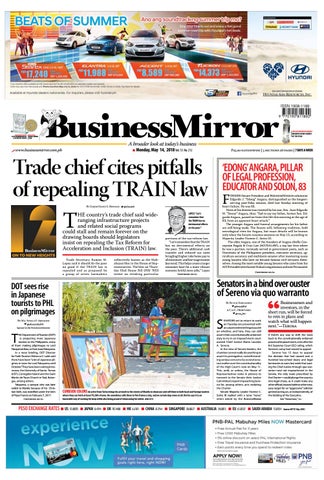
Trade chief cites pitfalls of repealing TRAIN law T By Elijah Felice E. Rosales
@alyasjah
he country’s trade chief said wideranging infrastructure projects and related social programs could stall and remain forever on the drawing boards should legislators insist on repealing the Tax Reform for Acceleration and Inclusion (TRAIN) law.
Trade Secretar y R amon M. Lopez said it should do the poor no good if the TR AIN law is repea led and as proposed by a g roup of seven l aw ma kers
collectively known as the Makabayan bloc in the House of Representatives. The bloc on Thursday filed House Bill (HB) 7653 intent on revoking particular
LOPEZ: “Let’s remember that the TRAIN has no detrimental effects on the poor.”
portions of the tax-reform law. “Let’s remember that the TRAIN has no detrimental effects on the poor. There’s additional cash transfer and reduced tax rates bring[ing] higher take home pay to all minimum- and low-wage income [earners]. This helps create a larger consumer base for a more vibrant economy [with] more jobs,” Lopez
‘EDONG’ ANGARA, No losses, but a lotPILLAR of gain OF LEGAL PROFESSION, EDUCATOR AND SOLON, 83
F
ORMER Senate President and BusinessMirror columnist Edgardo J. “Edong” Angara, distinguished as the longestserving post-Edsa senator, died last Sunday morning of heart failure. He was 83. News of his demise was tweeted by his son, Sen. Juan Edgardo M. “Sonny” Angara, thus: “Sad to say my father, former Sen. Edgardo Angara, passed on from this life this morning at the age of 83, from an apparent heart attack.” The younger Angara said funeral arrangements for his father are still being made. The Senate will, following tradition, hold necrological rites for Angara, but exact details will be known only when the Senate resumes sessions on May 15, according to Majority Leader Vicente C. Sotto III. The elder Angara, one of the founders of Angara Abello Concepcion Regala & Cruz Law (ACCRALAW), a top law firm where he was a partner, variously served in government posts, such as University of the Philippines president, executive secretary, agriculture secretary and multiterm senator after mentoring many young lawyers who later on became famous civil servants themselves. Among the most notable young lawyers who came from his Accra stable were former Makati congressman and now Permanent Continued on A2
Senators in a bind over ouster of Sereno via quo warranto By Butch Fernandez @butchfBM
& Cai U. Ordinario @cuo_bm
S
By Ma. Stella F. Arnaldo
@akosistellaBM Special to the BusinessMirror
T
Continued on A2
business news source of the year
P25.00 nationwide | 5 sections 28 pages | 7 days a week
Continued on A2
DOT sees rise in Japanese tourists to PHL on pilgrimages HE Department of Tourism (DOT) is projecting more Japanese tourists to the Philippines, many of them making pilgrimages to Lord Takayama Ukon, or Dom JustoTakayama. In a news briefing, DOT Director for Faith Tourism Rebecca V. Labit said there have been “a lot of Japanese pilgrims in town for Lord Takayama until October.”They have been visiting Intramuros, the University of Santo Tomas (UST), Corregidor Island and the Saint Martin de Tours Church in Taal, Batangas, among others. Takayama, a samurai who was later exiled to Manila because of his Christian faith, was beatified under the term of Pope Francis on February 7, 2017.
2016 ejap journalism awards
curbside colors An artist from Tarlac brings his artwork to the streets of Manila to showcase and sell them to both local and foreign tourists where they can fetch at least P3,500 a frame. He sometimes sells three to five frames a day, and on certain days none at all. But he says it is an honorable way of earning his keep while also being proud of showcasing his talent. NONIE REYES
PESO exchange rates n US 51.8870
ENATORS set to return to work on Tuesday are presented with an unprecedented legal puzzle on whether, and how, they can still assert their constitutionally ordained duty to try in an impeachment court ousted Chief Justice Maria Lourdes A. Sereno. In the view of Senate leaders, the chamber cannot really do anything to assert its prerogative, notwithstanding serious concerns by several senators earlier over the constitutionality of the High Court’s vote on May 11. This, until, or unless, the House of Representatives votes in plenary to transmit to the Senate their Justice Committee’s report impeaching Sereno for, among others, acts violating the Charter. Senate Majority Leader Vicente C. Sotto III replied with a terse “none,” when asked by the B usiness M irror
Businessmen and investors, in the short run, will be forced to rein in plans and watch what will happen next.”—Terosa if there’s any way to shift the track back to the constitutionally ordained process of impeachment, even after the 8-6 Supreme Court (SC) ruling, which Sereno’s camp had vowed to appeal. Sereno has 15 days to appeal the decision that had caused over a hundred law-school deans and legal luminaries to warn last week that ousting the Chief Justice through quo warranto—and not impeachment in the Senate, the only route prescribed by the Charter—could plunge the country into legal chaos, as it could make any other official, impeachable or otherwise, easy target for an “aggressive” solicitor general acting on, or independently, of the bidding of the Executive. See “Senators,” A2
n japan 0.4744 n UK 70.1408 n HK 6.6101 n CHINA 8.1764 n singapore 38.8027 n australia 39.0813 n EU 61.8337 n SAUDI arabia 13.8354
Source: BSP (11 May 2018 )
A2 Monday, May 14, 2018
BMReports BusinessMirror
Trade chief cites pitfalls of repealing TRAIN law Continued from A1
told the BusinessMirror. He cautioned against amending portions of the tax law designed to generate more revenue for the government to bankroll its flagship programs. The TRAIN was seen to boost the Treasury by P121.2 billion, or 0.7 percent of the country’s total output measured as the GDP. A hefty 70 percent of the revenue stream were to underwrite big-ticket public infrastructures under the “Build, Build, Build” program, while the other 30 percent was allocated for social services. “Repealing the TRAIN is not advisable as it will derail several funding for special programs also for the poor, such as the free tertiary education, greater health ser vices, vital infrastructure, higher pay for law enforcers and the military, and many more,” Lopez said. Steps to either junk the TRAIN law or suspend its implementation are gaining ground in both the Senate and House of Representatives, as inflation in April ballooned to 4.5 percent, the fastest in five years. This also put the year-todate inflation to 4.1 percent, marginally higher than the Central Bank’s target of just 2 percent to 4 percent. Sen. Paolo Benigno A. Aquino IV last Wednesday vowed to file a bill suspending the excise tax on oil under the TRAIN law and urged his colleagues to support the bid to stop the rising price of goods and services. Under the TRAIN, oil and petroleum products were levied an excise tax of up to P6 until 2020: P1 in 2018, P2 in 2019 and P3 in 2020. Lopez said the up-trending inflation was “expected and temporary,” adding quickly that the consuming public should fully adjust to prices under the TRAIN by the second half of the year. “The inflation being experi-
enced is expected and temporary. [It has proven] a little higher because of movements in world prices of oil and other commodities,” the trade chief said. I n stead of protest i ng t he TRAIN law, Lopez said it should serve the country better if Filipinos focus instead on the gains and opportunities presented by the reform program. “Better for [the] public to focus on the positive gains and ride on the opportunities of all these growth, to get a job and acquire more skills and know-how, to move up in life, or get into business,” he said. Trade Undersecretary Ruth B. Castelo said the effect of the TRAIN law on both the basic necessities and prime commodities should also be “very minimal, if not negligible that most [can] manufacturers absorb” instead of passing on to consumers. She added the domestic price hikes on food and fuel are the result of the movement of prices in the global market. “A lot of other factors caused the recent increase in the price of basic necessities and prime commodities, like the increase of prices of raw materials in the global market, the increase of crude oil price in the global market and the fluctuation of the peso against the [US] dollar,” Castelo told the BusinessMirror. Simply said, the TR AIN law should not be blamed as the main factor for the rising price of goods and services, she said. However, it appears the government’s justification for the impact of the TR AIN on the poor was rejected in some secotrs. Consumer group Laban Konsyumer Inc., for one, is determined to stop the TR AIN via appeals for executive action, legislation or judicial intervention. Laban Konsyumer President and former Trade Undersecretary Victorio A. Dimagiba also said they stand
behind HB 7653, and urged the government to repeal the TRAIN law. The group is petitioning the Supreme Court (SC) calling for the same action. “Laban Konsyumer Inc. will pursue the Supreme Court case to its completion. At the moment, the Office of the Solicitor General had filed their comment [to our petition]. [We are now] waiting for the SC’s next action. If need be, we support the repeal, as [you may] have read in our position paper at the Senate Committee on Economic Affairs hearing last week,” Dimagiba told the BusinessMirror. In that paper, Laban Konsyumer called on the government to suspend the excise tax on oil and petroleum products either by amending the TRAIN law or through executive action. “The consumers are feeling the pangs of high prices despite assistance to poor households in terms of social welfare and benefits programs, which are not adequate and, at times, delayed,” the position paper read. The think tank IBON Foundation claimed price increases ostensibly induced by the TRAIN are permanent, contrary to claims by the economic managers that it was only temporary. In a statement issued last Thursday, IBON said the inflationary effects of the law have just started to be felt and worse were to come in the next two years when the additional levies on fuel products take effect. IBON claimed the price of food, vegetable and fuel are significantly higher compared to last year. According to the think tank, regularmilled rice now costs P40 per kilo, from P35; mackerel scad, locally known as galunggong, now costs P160 per kilo, from P140; pork liempo now P240 per kilo, from P225; and sitaw at P100 per bundle , from P60. IBON also said diesel in Metro Manila is now at P44.35 per liter,
‘EDONG’ ANGARA, PILLAR OF LEGAL PROFESSION, EDUCATOR AND SOLON, 83 Continued from A1
Representative to the United Nations Teodoro “Teddyboy” Locsin (also a BusinessMirror columnist) and Sen. Richard J. Gordon. It was as senator that Angara became best known as he authored and/or championed landmark laws with far-reaching impact on broad sectors, notably the law granting senior citizens, or Filipinos 60 years old and above, substantial discounts on food, medicine and a wide range of services; the law mandating hospitals to provide for nursing mothers; and sweeping reforms
in academe. The elder Angara was elected to the Philippine Senate for four six-year terms, serving as a legislator for 23 years. He also served as president of the University of the Philippines (1981-1987); delegate to the 1971 constitutional convention (1970-1972); secretary of agriculture (1999-2000) and Executive secretary (2001). Besides being a Founding Partner at ACCR ALAW, he was also founding President of the ASEA Law Association; past president of the Integrated Bar of the Philippines and the Philippine
Bar Association. When he retired from government service, Angara engaged in various professional and charitable pursuits, serving as patron of sports, culture and the arts. He oversaw the projects and programs of the Angara Centre for Law and Economics, a think tank founded in his honor by the Faculties of Law and Economics of the University of the Philippines. Angara chaired the PinoySport Foundation, which successfully brought the world-famous soccer club, Real Madrid, to train select Filipino coaches and students, even as he had also been busy helping promote the development of his home province in Baler, Quezon. An avid student of history, especially on the Philippines’s relations with its former colonizer Spain, he spearheaded the construction of the Manila-Acapulco Galleon Museum as chairman of the Museo Del Galleon foundation, proudly presiding at its soft launch at the sidelines of the Philippines’s hosting of the Asean Summit and Related Meetings in late-2017. As chairman of the Laban ng Demokraktikong Pilipino, Angara sat as a member of the Executive Board of the Centrist Democratic International, the biggest political alliance. Butch Fernandez
up by over P7, while gasoline is at P55.37 per liter, up by some P6.80. An 11-kilo LPG tank is now more expensive at P650 to P750, the think tank reported. “The price increases from the TRAIN are very permanent, and even if inflation moderates, this does not mean the prices will be lower. It is grossly deceitful for economic managers to give the impression or claim otherwise,” IBON Executive Director Jose Enrique A. Africa said. He added if the government wants to prevent the poor from starving, it must immediately repeal the TRAIN law. “If the government wants to, it can immediately lower inflation and prices for the people by suspending the implementation and then repealing the grossly regressive TRAIN law,” Africa said. President Duterte signed Republic Act 10963, or the TRAIN law, in December of last year. One of its most crucial provisions include the exemption of workers with gross annual income up to P250,000 from paying personalincome tax. In exchange, however, excise tax is imposed on oil and petroleum products. The tax law also placed automobile excise tax at 4 percent for vehicles up to P600,000; 10 percent for over P600,000 to P1 million; 20 percent for over P1 million to P4 million; and 50 percent for hybrid vehicles. The TRAIN also levied a P6-perliter duty on drinks containing caloric and noncaloric sweetener and a P12-per-liter tax on beverages with high-fructose corn syrup. Essential sugar-sweetened beverages (SSBs), such as 3-in-1 coffee and milk, are exempted. HB 7653, on the other hand, seeks to repeal the sections of the tax law on fuel products and SSBs, among others. The Makabayan bloc is hoping discussions on the measure begin the soonest possible.
Senators. . .
Continued from A1
Opposition Sen. Francis N. Pangilinan, head of the Liberal Party, told the BusinessMirror in a text message over the weekend they expect the Senate leadership to convene a caucus upon resumption of plenary session to tackle the matter. “We ought to discuss this among senators in an all-senators’ caucus when session resumes,” referring to the query of whether it was still possible to bring back the Sereno case to the impeachment track. Pangilinan said, however, it is not likely to readily get support for an early caucus on the issue, except for his peers in the minority. The Senate’s two top leaders are of the view that the upper chamber’s hands are tied for as long as the House does not act to transmit the articles of impeachment against Sereno. “The House has not transmitted anything,” Senate President Aquilino L. Pimentel III said, adding all they can do is await House action on their Justice Committee report impeaching Sereno before the Senate can consider discussing their next steps, much less convening as an impeachment court. Sotto stressed, “There is no one to impeach. In fact, there is nothing to talk about if the House does not impeach anymore.” The majority leader earlier said in a statement: “The Supreme Court is the highest interpreter of the Constitution and the laws. We respect its decision. To do otherwise is to make our personal opinion higher than what we regard as supreme.” Even Senate Minority Leader Franklin M. Drilon acknowledged that senators meeting on the matter—as Pangilinan hopes for— could be premature without any House action. Drilon told the B usiness M irror : “The Senate can assert [its] authority once the impeachment complaint is transmitted by the House of Representatives.”
www.businessmirror.com.ph
DOT sees rise in Japanese tourists to PHL on pilgrimages Continued from A1
The petition for his sainthood was actually started by the Archdiocese of Manila in 1630, or some 15 years after Takayama’s death, whose statues have been erected in Binondo and UST. Labit said, based on information supplied by the Philippines DOT office in Osaka, there are approximately 400,000 Japanese Christians. “In February 2018 around 80 Japanese pilgrims, led by six bishops from Tokyo, Sapporo, Naha, Kagoshima and Kyoto, arrived in celebration of Lord Takayama’s beatification anniversary. The pilgrims went to Ilocos Norte and visited Cebu and Bohol,” she disclosed to the BusinessMirror in an e-mail. On April 12 she added, 45 pilgrims from the Archdiocese of Osaka, led by Bishop Thomas Aquinas Maeda Manyo, visited the Manila Cathedral, San Agustin Church and other churches in Manila. The pilgrimage was for four days, and the DOT expressed hope that more Japanese pilgrims would come within the year. “Our PDOT in Osaka fully supports our faith-based tourism activities, especially the development of Lord Takayama Ukon tours in Manila and near environs,” Labit said. “It also can spur the interest of Filipino travelers and strengthen existing ‘two-way tourism’ agreement between Japan and the Philippines, where it is being promoted as a symbol of peace and friendship,” she noted, quoting Archbishop of Manila Luis Antonio Cardinal Tagle, who presided over the Blessed Takayama’s first feast day anniversary on February 3. “This faith-based tourism activity, as envisioned, can establish and expand the development of a new niche market in Japan, specifically with Manila as a faith tourism destination for the Japanese market, and cultivate secondary and related industries in other regions, with strong faith activities,” Labit stressed. In 2017, there were 584,180 visitors from Japan, an increase of 9.14 percent from 2016. The Japanese market accounted for 8.82 percent of the some 6.6 million foreign tourists in the Philippines last year. The market’s ranking dropped to fourth place, however, after being edged out by China and the United States. In the first quarter of 2018 tourists from Japan grew by some 9 percent to 181,178, accounting for 8.84 percent
of the 2.05 million foreign visitors for the period. According to the United Nations World Tourism Organization report, Religious Tourism in Asia and the Pacific: “It is estimated that there are approximately 600 million national and international religious and spiritual voyages in the world, of which 40 percent take place in Europe and around half in Asia.” Meanwhile, over 7,000 Filipino Catholics joined the 4-kilometer procession from the Quirino Grandstand in Rizal Park, to the San Sebastian Basilica in Quiapo, Manila, to celebrate the 400th anniversary of the Our Lady of Mount Carmel de Sebastian arrival to the Philippines. This was, however, less than the 1 million pilgrims the DOT had initially projected for the activity. In a statement, the DOT said the translación started at 8:30 a.m. at the Quirino Grandstand and passed through Quiapo Church, before it was greeted with fireworks as it arrived at San Sebastian at 11:00 a.m. The image was a gift from the Discalced Carmelite Nuns from the San Jose Monastery in Mexico City and was brought to the Philippines by the third group of Augustinian Recollect Missionaries on May 4, 1618. The image was first enshrined at the Recollect Church of San Juan de Bagumbayan. Later, in 1621, it was enshrined at the San Sebastian Basilica. Lolei Omongos, a devotee from Iligan City, said she traveled 36 hours by sea to get to Manila to witness the celebration. “It’s a different feeling to see the image of our Holy Mother; I can feel the peace in my heart. I didn’t mind the long trip and expense of getting here,” she said in Filipino. Rev. Fr. Robin Plata, one of the event organizers, said the “Our Lady of Mount Carmel” always keeps Filipinos under her maternal protection. “As a mother, she intercedes for her children and even gave a promise that whoever wears the brown scapular will not suffer hell at the hour of death,” he said. Plata expressed gratitude to the DOT for promoting the faith-based tourism in the country. “It is a good avenue to promote our rich religious culture. Our faith as Christians really gave us the iconic places and memorials that we have that will attract pilgrims and tourists,” he added.
Noting that House Justice Committee Secretary Reynaldo V. Umali of the Second District of Oriental Mindoro said earlier the House will not transmit if Sereno is removed by the SC, Drilon added: “If the House will not transmit, the Senate will have no basis to constitute itself as an impeachment court, and will not have that opportunity to assert that mandated process of impeachment to remove Sereno.”
institutions further and is causing political unrest, which will disrupt our current growth trend. It will certainly have a dampening effect on investments and overall economic growth, not just in the short run but also possibly in the long run as it sets a dangerous precedent for the country,” the AER said. However, University of Asia and the Pacific School of Economics Dean Cid Terosa said the strong macroeconomic fundamentals of the Philippine economy can weather political risks, such as the ouster of the Chief Justice. Nonetheless, Terosa admitted that businessmen and potential investors may become more cautious with their expansion and investment plans. He said the trust and confidence of the Filipino people on the Judiciary will be put to the test with the ouster of the Chief Justice. “Businessmen and investors, in the short run, will be forced to rein in plans and watch what will happen next. There was overwhelming support for the ouster of Corona, but the same sentiment cannot be said of the ouster of Sereno,” Terosa said. “But our economic fortune has started to be inextricably intertwined with economic fundamentals and not with sociopolitical contingencies,”he added. Labor groups, such as the Associated Labor Union-Trade Union Congress of the Philippines (ALU-TUCP), said they do not expect the ouster of Sereno to erode investors’ confidence in the country’s economy. “Many might consider [Sereno’s] removal to be harsh, but due process was observed so we don’t see it turning off investors,” ALU-TUCP Spokesman Alan Tanjusay told the BusinessMirror via SMS. But the Federation of Free Workers and the Partido Manggagawa (PM) expressed alarm over the SC’s decision, saying it “weakened” the institution. “Sereno was clearly ousted not because of her missing SALN [Statement of Assets and Liabilities and Net worth] but mainly because of her missing loyalty to the Chief Executive,” PM said. With Samuel P. Medenilla
‘Bad for the economy’
Experts said the ouster of Sereno would have an adverse impact on the economy as perceptions of political instability would make the Philippines unattractive to investors. “[Sereno’s ouster] is very bad for investments and the rule of law,” economist Calixto V. Chikiamco told the BusinessMirror. “It will mean that the economy can’t reach its full potential.” The removal of Sereno via quo warranto happened at a time when Philippine economy is on a winning streak and is posting a GDP growth of above 6 percent in the past nine quarters. The country’s full-year GDP growth has also been growing by an average of above 6 percent since 2012. Between 2010 and 2016, the country’s average GDP reached 6.3 percent, the highest in over 30 years. Chikiamco also said Sereno’s ouster will “weaken institutions” and opens the door to political changes that could also affect the President and Vice President and create “greater instability.” “It can’t compare to the ouster of [Renato C.] Corona because he was removed constitutionally. This will weaken the Judiciary and all other institutions of the government. Now, all impeachable officials, including the President and VP, may be removed through a quo warranto case,” he said. The Action for Economic Reform (AER) echoed the sentiments of Chikiamco. As Sereno’s ouster was “unconstitutional,”the AER said this could lead to a drop in investments in the near and long term. “The ouster of Sereno weakens our
www.businessmirror.com.ph
The Nation BusinessMirror
It’s lawmaker vs lawmaker over airport project in Naga
R
ep. Luis Raymund F. Villafuerte Jr. of the Second District of Camarines Sur has maintained that the provincial government had acted legally based on the instructions of the Department of Transportation (DOTr), and within the purview of what the court has stated in its directive to fast-track the implementation of the Naga Airport Modernization Project. Villafuerte said it was Rep. Rolando S. Andaya Jr. of the First District of Camarines Sur who allegedly violated the law when the latter allegedly resorted to violence and harassment last month to protest the implementation of the airport modernization project in Pili, Camarines Sur. “It’s Andaya who chose not to follow the court’s order on the writ of possession,” Villafuerte said, referring to the directive of the Regional Trial Court (RTC) in Pili, ordering the evacuation of the occupants in the land that forms part of the project. “It was [also] Andaya who exercised threats and intimidation through violent means, instead of letting the legal process take its due course,” Villafuerte added. “Nowhere in the decision of the RTC does it state that the Camarines Sur provincial government should obey the law or that it violated the law.” Almost a dozen members of Camarines Sur’s Sagip Kalikasan Task Force (SKTF) trooped to the Pili Municipal Police Station in the province on April 18 to report the “acts of physical and verbal abuse” that they suffered that same day in the hands of Andaya, who wanted them to abandon clearing operations for the Naga Airport Modernization Project that
is part of the “Build, Build, Build” program of President Duterte. Eleven SKTF members complained to the police about the violent acts allegedly committed against them by a knife-wielding Andaya who was accompanied by his bodyguards and Pili Mayor Tomas Bongalonta Jr. at the start of the clearing operations for this airport expansion project in Barangay San Agustin in the town of Pili. Based on the official police blotter entries, among those who complained to the police on April 18 were Lito Sumpay, Ryan Herrera, Saetiel Pielago and Angelo Refran, all of whom reported that Andaya had allegedly terrorized them with a knife and threatened them with harm if they did not leave Camarines Sur right away. As for the writ of possession, Villafuerte said the motion of the lot owners involved in the case for the court to dismiss and recall the writ was denied by the RTC. “Wherefore, premises considered, the defendants’ motions to dismiss and to recall the writ of possession are denied for lack of merit,” the ruling issued by Presiding Judge Vivencio Gregorio Atutubo III of the Pili RTC stated. In the ruling, Atutubo said that Camarines Sur Gov. Miguel Luis “Migz” Villafuerte, as plaintiff, should in the meantime “desist from further causing the implementation of the writ of possession issued in these cases” because the solicitor general should be the proper entity to represent the DOTr in this issue because it is a national government project. The incumbent governor is the son of Rep. Villafuerte.
“That [referring to the Judge Atutubo’s order] is a big victory for the people of C amarines Sur because it affirms that the Naga airport project will continue and,more important, be put on the fast track. The court order just affirmed that the Naga airport project will proceed,” Villafuerte said. “In addition, the memorandum of agreement between the DOTr and the provincial government is still in effect and in force.” “Also, we expect that after the complaint is amended under the Office of the Solicitor General, the writ will be reinstated and it will fast-track the airport project,” the congressman added. Villafuerte said that “Andaya, being a lawyer, should understand the processes more and should just let the court decide on the matter rather than put the matter in his own hands by violently intimidating and harassing employees of the provincial government, who were only doing their job of securing the airport project site.” The provincial government of Camarines Sur has been overseeing the implementation of the Naga Airport Development Project on the strength of the province’s MOA with the DOTr in November 2016. Under the agreement, the DOTr has committed to set aside P402 million for airport project to be taken from the DOTr’s budget in the General Appropriations Act of 2015 for the acquisition of lots for the affected residents and for their resettlement, as well. The provincial government, in turn, has been tasked under the MOA to identify the affected residents and to supervise the purchase of their lots, based on the principle of just compensation, and their relocation elsewhere.
Editor: Vittorio V. Vitug • Monday, May 14, 2018 A3
PHL-Kuwait ties ‘back to normal’
D
iplomatic ties between the Philippines and Kuwait have gone “back to normal,” following the signing of an agreement on the protection of Filipino workers in the Gulf state last Friday.
Presidential Spokesman Harry L. Roque Jr. made this statement upon his arrival in Manila, along with other Philippine officials and 89 undocumented Filipino workers, over the weekend. These 89 undocumented Filipino workers are only the first batch out of around 600 workers set to return to the Philippines at the expense of the Kuwaiti government. “Philippine and Kuwait ties are back to normal. What we were waiting for was the signing of the memorandum of agreement (MOA) and the signing is a sign that we have both agreed to move on with our relationship,” Roque said at a briefing at the Ninoy Aquino International Airport (Naia). “We have both learned from the experience and the experience will make our friendship and ties with Kuwait even stronger as in the past,” he added. Roque, likewise, assured Filipinos that Kuwait is a progressive, modern country, and noted that the abuse of a number of Filipino domestic workers should not paint a dangerous picture of the Arab country. He pointed out that although “one Joanna Demafelis is too much,” he urged Filipinos to be more open-minded to the fact that not all Kuwaitis are abusive, but only a select few. Labor Secretary Silvestre H. Bello III described
the agreement as a document that will provide “optimum and maximum protection” for Filipino workers in Kuwait. The document will be in force for four years and renewed automatically, unless either party informs the other, through diplomatic channels of its desire to terminate it six months prior to the end of its validity. It also requires the creation of a joint committee, composed of officials from both governments to meet regularly to address Filipino workers’ problems. Moreover, the Kuwait government will be required to ensure that workers are provided with decent meals, hosing, clothing, communication lines, eight to 12 hours of sleep and an eight-hour work schedule, among others. The Kuwaiti government will also pursue legal action against employers who have records of contract violations or abuse of workers. The diplomatic spat between the Philippines and Kuwait started after the murder of Demafelis, along with a series of abuses of other Filipino domestic workers. The Kuwaiti government has slammed the action taken by the staff of the Philippine embassy, who conducted rescue operations for distressed Filipino workers in the said country. PNA
Economy
A4 Monday, May 14, 2018 • Editors: Vittorio V. Vitug and Max V. de Leon
BusinessMirror
DICT slashes telco interconnection rates
E
By Lorenz S. Marasigan
@lorenzmarasigan
MPHASIZING on its positive effect on the boarding of a third major player in the telecommunications industry, the chief of the Department of Information and Communications Technology (DICT) ordered last week the reduction of interconnection costs among telecommunications operators. Acting Information Secretary Eliseo M. Rio Jr. said cutting interconnection rates further between public carriers can help the potential third player to compete better against incumbent telcos. Having standard interconnection fees will eliminate the factor of choosing an operator on the basis of the current subscriptions of friends and families, he added. In his first department order, Rio called on the National Telecommunications Commission (NTC) to implement such a plan. The last time that interconnection fees were lowered was early last year. “Affordable interconnection rates would encourage competition and would attract new major telecommunications players by creating a healthy environment conducive for competition and fair level playing field,” Rio’s order read.
An interconnection rate is a fee collected by a telco whenever a subscriber calls or texts another person from a different operator. Currently, the interconnection fee for voice calls is at P2.50 per minute, while that of text messaging is at 15 centavos per text. Revenues from these services have been dropping for half a decade now, thanks and no thanks to the digital shift in globally. But for Rio, reducing interconnection costs can help drive these revenue streams upward, as the imitative could encourage subscribers to use the services due to lower rates. “Surely, the subscribers will send more text messages that will really make up for the interconnection cost,” Rio said. Aside from making it easier for a new major player to compete, the order, Rio added, is a necessity given that
rates are “among the highest in Asia.”
Ookla speedtest report
The recent Speedtest Global Index Report of Ookla for April 2018, meanwhile, has reported that the Philippines’s average download speed for mobile broadband improved by 88.31 percent from 7.44 megabyte per second (Mbps) to 14.01Mbps from July 2016 to April 2018, while its average for fixed broadband also improved by 122.76 percent from 7.91 Mbps, within the same given period. For mobile broadband, the country’s monthly averages grew steadily from 7.44 Mbps (July 2016), 7.7 Mbps (August 2016), 8.18 Mbps (September 2016), 8.56 Mbps (October 2016), 8.59 Mbps (November 2016), 9.53 Mbps (December 2016), 9.34 Mbps (January 2017), 10.07 Mbps (February 2017), 9.73 Mbps (March 2017), 9.71 Mbps (April 2017), 9.93 Mbps (May 2017), 10.32 Mbps (June 2017), 10.29 Mbps (July 2017), 10.47 Mbps (August 2017), 11.95 Mbps (September 2017), 12.31Mbps (October 2017), 12.35 Mbps (November 2017), 13.45 Mbps (December 2017), 12.55 Mbps (January 2018), 12.67 Mbps (February 2018), 13.52 Mbps (March 2018) and 14.01 Mbps (April 2018). For fixed broadband, the country’s monthly averages also continued to trend upward from 7.91 Mbps (July 2016), 8.54 Mbps (August 2016), 8.76 Mbps (September 2016), 8.60 Mbps (October 2016), 9.35 Mbps (November 2016), 9.71 Mbps (December 2016), 10.16 Mbps
(January 2017), 10.68 Mbps (February 2017), 10.81 Mbps (March 2017), 10.84 Mbps (April 2017), 10.96 Mbps (May 2017), 11.66 Mbps (June 2017), 12.43 Mbps (July 2017), 13.29 Mbps (August 2017), 13.41 Mbps (September 2017), 13.13 Mbps (October 2017), 14.42 Mbps (November 2017), 15.19 Mbps (December 2017), 15.67 Mbps (January 2018), 16.09 Mbps (February 2018), 17.32 Mbps (March 2018) and 17.62 Mbps (April 2018). Speedtest by Ookla is reputed to be the global leader in Internet performance testing and consumer-initiated network diagnostics with over 10.2 billion speedtests clocked worldwide. Speedtest Intelligence is a trusted and vital research and analysis tool used by businesses, industry associations and government agencies. In a recent report called Digital in 2018, it showed that Filipinos spent the most time globally using socialmedia sites with an average of four hours per day on sites such as Facebook, Snapchat and Twitter. In the same report, the country’s Internet users grew by 7 million over the last year to 67 million users with Internet penetration growing from 58 percent in 2017 to 63 percent in 2018. Internet speed and availability are on a steady upswing due to President Duterte’s repeated calls for telecommunications companies to improve their service, which is expected to further improve with the National Broadband Plan of the DICT and the impending entry of a third major telco player into the market.
www.businessmirror.com.ph
Dalian train, MRT 3 ‘compatibility’ report to be released in May, at last
T
he transportation department may determine whether the 48 trains from Dalian, China—costing a whopping P3.8 billion—are “compatible” with the Metro Rail Transit (MRT) Line 3 within the month, after an independent auditor finishes its evaluation of the lightrail vehicles that have been left idle and unutilized for more than a year now. Aly V. Narvaez, a spokesman for the railway system’s operator, said the Department of Transportation (DOTr) hopes to receive the report from TUV Rheinland toward the end of May. “We expect to receive the audit report in the next few weeks, perhaps within this month,” she said in a text message. “Once submitted, the complete and final audit report from TUV Rheinland will still be read and reviewed by DOTr.” The government tapped TUV Rheinland to conduct a thorough review of the trains that were procured from Dalian, as issues ranging from weight to safety arose before, during, and after their complete delivery in February last year. To recall, the Aquino administration jump-started the acquisition of 48 new train cars for the Edsa MRT 3 line. It faced several years of delay due to a legal tussle with the owner of the train facility, MRT Corp.’s parent company,
MRT Holdings Inc. Despite having received the first set of trains in early-2016, the deployment of the new coaches was deferred because all 48 lightrail vehicles had to be “optimized and tested.” Onboard signaling was amiss from the train, and was only procured midway through the construction of the 48 train units. The onboard signaling system was only installed in the trains in November 2016. The initial batch of trains should have been deployed in March of the same year, based on original targets. Due to these obstacles, the transportation department wanted to deploy the 48 trains in March 2017, but failed to do so after groups raised issues on the train’s weight. “We’ll release the results accordingly, including TUV’s recommendations on the Dalian trains,” Narvaez said. The whole expansion project, amounting to P3.8 billion, will increase the capacity of the line to 880,000 daily passengers, or 66 percent more than the current capacity of 350,000 commuters per day. Currently, the train line is working at about two-thirds of its capacity. There are about 15 train sets running during revenue hours, serving roughly 350,000 passengers daily. Lorenz S. Marasigan
Año to PNP: Be impartial, nonpartisan during polls
A policeman overseas the loading of ballot boxes at the Manuel Araullo High School. The ballot boxes will be distributed to different polling precinct schools in Metro Manila for the barangay and Sangguniang Kabataang elections scheduled on Monday. Roy Domingo
By Nelson S. Badilla
T
Correspondent
HE single most important role of the Philippine National Police (PNP) during elections is to become “impartial and nonpartisan…deputies of the Commission on Elections [Comelec],” Undersecretary Eduardo M. Año, officer in charge of the Department of the Interior and Local Government (DILG), said last Sunday, on the eve of the barangay and Sangguniang Kabataan (BSKE) elections. He also exhorted PNP officials and members to “focus all efforts in ensuring the peaceful and orderly conduct of the BSKE, [the policemen] being the country’s principal law-enforcement agency,” a news statement issued by the DILG’s Public Information Office read. As such, Año told PNP chief Director General Oscar D. Albayalde to ensure that “all PNP units to work closely with Comelec field offices as directed by President Rodrigo Roa Duterte through Memorandum Order No. 21, which deputized the PNP and other law-enforcement
agencies and instrumentalities of the government for the conduct of BSKE 2018.” Año has specified the PNP’s job, saying “the PNP should coordinate with Comelec Elections Officers and Provincial Elections Supervisors [in] all activities and operations in relation to the village [and youth] polls and [also] follow all instructions from the commission.” The DILG chief cited Republic Act 6713, RA 3019 and also the PNP Ethical Doctrine in order to justify the correctness and validity of his assertions that all “members of the PNP, as personnel working for the government and law-enforcement entity, shall provide services to everyone without discrimination regardless of party affiliation in accordance with existing laws and regulations.” On their impartial and nonpartisan role in the elections, the DILG chief also instructed Albayalde to also make a decisive move to stop vote-buying directly or indirectly during the polls itself. Albayalde should order all his cops to “take proactive steps in pre-
venting vote-buying in the face of reports that alleged vote-buying has been occurring in some parts of the country,” Año said. “All PNP units must intensify foot patrols in the barangays and increase police presence in order to deter incidents of vote-buying. And if there’s a report of alleged vote-buying, we must investigate immediately, since that is an election offense,” Año said. He argued that all policemen should be on the lookout at all times to prevent vote buying. The cops must “ensure that culpable parties are arrested and charged,” for intentionally violating the election law, he added. Año admitted that he issued such marching order on vote-buying problem because the DILG has already received reports that there are several places where early buying of votes have been committed by those who are directly involved in this year’s political exercise. The official campaign period has ended on May 12, and the synchronized elections will end by 5 p.m. on May 14.
Agriculture/Commodities BusinessMirror
www.businessmirror.com.ph
PHL rice imports to hit 1.1 MMT in 2019–report
Photo shows farmers harvesting rice in La Union. The United States Department of Agriculture said in a report that the Philippines would slash its rice imports in 2019 by more than 20 percent. LAILA AUSTRIA
By Jasper Emmanuel Y. Arcalas
T
@jearcalas
he country’s rice imports in 2019 could decline by 21.42 percent to 1.1 million metric tons (MMT), as the increase in palay output would allow the Philippines to end 2018 with more stocks. T he United States Department of Agriculture (USDA) said in a report that the country’s total rice imports next year would decline by 300,000 metric tons
(MT), from the projected 1.4 MMT this year. “ T he Ph i l ippi nes i s dow n 300,000 tons to 1.1 million tons on more abu nd a nt domest ic
supplies,” the USDA report read. However, the USDA said its forecast is “subject to change, particularly in light of ongoing government decisions related to quantitative restrictions on imports.” This is the first grains production and supply forecast made by the USDA for 2019. The USDA said the country’s total milled-rice output in 2019 would remain relatively flat at 12.35 MMT. Philippine milledrice output this year would rise by 5.25 percent to 12.3 MMT, from 11.686 MMT in 2017, according to the USDA. The USDA estimates that the
DA probes sale of Indian buffalo meat in wet markets
T
he Department of Agriculture (DA) said it is currently looking into reports that Indian buffalo meat, which is unfit for human consumption if it is unprocessed, is being sold in local wet markets. Agriculture Secretar y Emmanuel F. Piñol made the statement af ter t he DA received reports that some vendors in Mar ik ina are sel ling Indian buffalo meat, more commonly known as carabeef. Manila allows traders to import carabeef but only for meat processing purposes. “We are currently investigating reports that some Indian buffalo meat are being sold in wet markets. That is illegal,” Piñol told reporters in a recent interview. He said he instructed his staff to conduct an investigation after the DA was informed three weeks ago that Indian buffalo
meat is being sold in Marikina’s wet markets. Piñol urged the public not to purchase imported carabeef as it is unfit for human consumption. “The imported carabeef cannot be eaten and should be processed first. We assure the public that we are investigating this already,” he said. T he sa le of “ fresh frozen Indian buffalo meat [IBM]” in the domestic market is prohibited under DA Administrative Circular 12 Series of 2015 (AC 12-2005), or the Update Rules and Regulations Governing the Allocation, Importation, and Utilization of Fresh Frozen Buffalo Meat from India. “The presence of IBM in domestic markets manifest unauthorized distribution and trade in violation of existing DA rules and regulations,” it read. “The IBM shall be solely used for meat processing, using the
standards provided for in the Chapter 8.7, Article 8.7.34 of OIE-TAHC [2014] for the inaction of viruses present in the meat,” it added. AC 12-2005 stipulated that the government w ill confiscate and dispose IBM found in the possession of unauthorized persons. The government has also prescribed the penalties for importers and meat processors who would violate the circular. Piñol said agriculture officials are currently reviewing the DA’s rules on Indian buffalo meat importation in light of the recent developments. The country’s buffalo meat imports in the January-to-February period rose by 84.54 percent to 6,974.402 metric tons (MT) from 3,779.36 MT recorded in the same period last year, data from the Bureau of Animal Industry showed. Jasper Emmanuel Y. Arcalas
country’s total rice consumption next year would increase slightly by 1.51 percent to 13.4 MMT, from 13.2 MMT this year. In terms of ending stocks, the USDA expects the Philippines to end 2018 with a carry-over volume of nearly 2.5 MMT for next year. The USDA said the country’s total area harvested with rice in 2019 would remain flat at 4.86 million hectares, but yield per hectare is seen to increase slightly to 4.04 MT per hectare from 4.02 MT per hectare. The Department of Agriculture has earlier projected that total palay output this year would rise by nearly 3.11 percent to a record high of nearly 20 MMT on the back of higher yield and better farm-gate prices. “ This year, rice production is expected to grow by about 600,000 metric tons [MT], stimulated mainly by good palay-buying prices, favorable climate and the increase in the adoption of goodquality and hybrid seeds by farmers,” Agriculture Secretary Emmanuel F. Piñol said. The Philippines produced a record-high 19.3 MMT of palay in 2017, 9.3 percent higher than the 17.3 MMT recorded in 2016, according to data from the Philippine Statistics Authority. The 9.3-percent increase in palay output last year allowed the country to achieve a 96-percent self-sufficiency in rice. “Last year the country posted its highest rice harvest in history at 19.28 MMT, which reduced the country’s dependence on imported rice. Imports this year would reach only about 600,000 to 800,000 MT this year, from over 2 MMT in 2010,” Piñol said.
Editor: Jennifer A. Ng • Monday, May 14, 2018
A5
Young Pinoys seen drinking more imported wine
P
hilippine wine imports could rise by at least 16 percent to 16 million liters this year due to the country’s economic expansion, as well as the increasing demand of young Filipinos for the alcoholic beverage. A recent Global Agricultural Information Network (Gain) report noted that the total volume of imported wine this year will increase by 2.2 million liters, from 13.8 million liters recorded in 2017. “Traders forecast 15-percent to 20-percent growth in 2018,” the report prepared by the United States Department of Agriculture-Foreign Agricultural Service (USDA-FAS) in Manila read. “[The] country’s robust economy, wine’s increasing popularity, a young and growing population and low relative consumption create an extraordinary profile that makes the Philippines one of the most exciting wine markets in the world,” it added. The Gain report noted wine “comprises less than 1 percent of the estimated 2.5 billion liters of alcoholic beverages consumed annually” in the Philippines. The USDA-FAS in Manila expects wine imports to record a double-digit growth despite a number of challenges that could prevent its entry, such as high tariffs and taxes, as well as the weakening of the peso. “Challenges include tariffs and taxes that inflate the final price by 75 percent, the strong US dollar, distribution setbacks and intense competition due to regional freetrade agreements,” the report read. In terms of value, the country’s wine-import bill this year would reach a record high of $58 million, 16.46 percent higher than the $49.8 million recorded in 2017, according to the Gain report. “From 2000 to 2017, the volume of wine exports to the Philippines tripled to 13.8 million liters [1.5 million cases], while
the value nearly quintupled to $49.8 million,” the report read. “Continued growth in wine consumption is presaged by the country’s young, fast-growing and highly urbanized population with increasingly sophisticated tastes and evergrowing access to supermarkets,” it added. The Gain report estimated that, at present, there at least 20 million Filipinos who “have sufficient income to purchase wine occasionally.” The report also noted that the US would remain as the top source of imported wine for the Philippines this year. The volume and value of United States exports to the Philippines are expected to reach record-high levels. The country’s wine import volume from the US this year would rise by 10.25 percent to 4.3 million liters, while the import bill is expected to expand by 12.06 percent to $13 million. “The US has long been the leading supplier of wines to the Philippines, surpassing France in 2000. While the volume of exports doubled from 2000 to 2017, the value quintupled,” the Gain report read. “In 2017 the US held a 29-percent market share by volume, and a 23-percent market share by value.” The Gain report also said it also expects to remain as the largest market for US wine in the Southeast Asian region in the “foreseeable future.” “The Philippines has been the largest market for US wines in Southeast Asia by volume since 2009, surpassing even major transshipment destinations in the region, such as Vietnam and Singapore,” it read. The Gain report noted that 55 percent of the wine sold in the domestic market is red. “Aside from its perceived health benefits, importers report that consumers who have shifted from hard liquor prefer red wine because of its robust and oaky taste profile.” Jasper Emmanuel Y. Arcalas
Report: US winter wheat forecast down amid drought, surplus
W
ICHITA, Kansas—United States farmers are expected to harvest their smallest winter wheat crop in more than a decade amid an ongoing drought that has devastated fields across the nation’s breadbasket and a global surplus of the grain that has depressed prices, according to government report released last Thursday. The National Agricultural Statistics Service forecast the size of the nation’s 2018 wheat crop at 1.19 billion bushels. If realized, that would be down 6 percent from the previous year. The last time the nation’s farmers harvested such a small wheat crop was in 2002, when US production fell to 1.137 billion bushels, said Marsha Boswell, spokesman for the industry group Kansas Wheat. “It is not a surprise that production is down, the market is not really telling people to plant wheat. There is a surplus of wheat in the world,” Boswell said. Not only are projected US wheat yields down to an average 48 bushels per acre, but the agency is also
forecasting that just 24.8 million acres of wheat will be harvested—a record low harvested acreage for the US, according to the report. Kansas remained the nation’s top winter wheat producer even in a dry year like this one, with the government estimating that the state’s growers will bring in 270.1 million bushels. That’s compared to the 333.6 million bushels harvested last year in Kansas. The government’s estimate for Kansas is a bit more optimistic than the 243.3 million bushels that participants in the Wheat Quality Council’s winter wheat tour had predicted earlier this month, although both had estimated average statewide yields of 37 bushels per acre. The difference is because tour participants anticipate Kansas farmers will abandon more acres before harvest. Lane County grower Vance Ehmke said his farm in west central Kansas—where he grows about 2,500 acres of certified wheat seed—has gotten less than 2 inches of rain since October, far less than the 7
inches that would be normal for that period. His neighbor this week plowed up a half section of wheat that was so poor it would not be worth cutting. “It is just incredibly dry out there,” Ehmke said. “Farmers have a well-deserved reputation for whining, but this time we are not kidding.” Winter wheat is planted in the fall and typically harvested beginning in June in Kansas. Drought conditions have plagued this year’s crop, and it remains to be seen whether the state will get enough moisture in the coming weeks to fill out the heads of wheat. Much of the wheat across Kansas is just ankle-high, and crop development is two to three weeks late. “I have no idea what to expect, but we continue daily to reduce our expectations so whatever we get we wouldn’t be disappointed,” Ehmke said. The report noted drought conditions were prevalent across most of Colorado, Kansas, Oklahoma and Texas. AP
The World
A6 Monday, May 14, 2018 • Editor: Lyn Resurreccion
BusinessMirror
www.businessmirror.com.ph
Mahathir forms advisory council for econ plan
M
alaysian Prime Minister Mahathir Mohamad named Lim Guan Eng as finance minister and set up an advisory board that includes a billionaire and a former central bank governor to carry out his economic plan. Mahathir, 92, is forming a council of five elders, including palm oil tycoon Robert Kuok, former Finance Minister Daim Zainuddin and Zeti Akhtar Aziz, who led Bank Negara Malaysia for 16 years. The people will be tasked with advising the Cabinet and probing government personnel. “We need to do investigations on a lot of things,” Mahathir said last Saturday in Kuala Lumpur. “Some of these things may involve the ministries and the personnel themselves, so we need people who are not involved to be getting and studying reports made either by ministries or by certain bodies which we will consult.”
Mahathir plans to have a small Cabinet of up to 25 members, with at least 10 of the posts filled by next week. He has asked leaders of the four parties in his coalition to submit three names each, with him reserving the right to decide on ministerial appointments. The setting up of the advisory council underlines Mahathir’s preference for old hands and his focus on 1Malaysia Development Berhad (1MDB), on which he said there was enough evidence to reopen a probe. Meanwhile, the Cabinet lineup shows his need to satisfy leaders in his coalition. Lim hails from the mostly ethnic Chinese Democratic Action Party, while his pick for
We need to do investigations on a lot of things.”—Mahathir
defense minister Mohamad Sabu is from a group that broke away from the Islamic party known as PAS. Already, rifts are beginning to show. Deputy Prime Minister Wan Azizah Wan Ismail, who is also president of the People’s Justice Party known as PKR, was notably absent from the briefing. PKR sees the ministerial appointments as not final as they should be agreed upon by all four parties, Rafizi Ramli, the party’s vice president, said in a statement. Mahathir is expected to serve as interim prime minister and hand over power to de facto opposition leader Anwar Ibrahim once he is eligible to take the post.
Singapore-KL rail
Mahathir’s coalition won a shock victory in Wednesday’s election, partly by winning over voters unhappy with rising living costs, which they blamed on a 6-percent goods and services tax (GST). The prime minister has pledged to scrap the tax within 100 days, reintroduce fuel subsidies and raise minimum wages, as well as review large-scale projects, including the high-speed rail to connect the capital Kuala Lumpur with Singapore. “We want to review all contracts that are not in favor or do not benefit Malaysia,” Lim said in a briefing in Kuala Lumpur, referring to big-ticket projects conceived by the previous government. “We are all Malaysians here.
Our focus is to help Malaysians.” Those spending plans will undermine efforts to curb the budget deficit. The former administration under Najib Razak had narrowed the deficit over time to 3 percent of gross domestic product, while pledging to keep debt under 55 percent of GDP. Lim was chief minister of the northern Penang state before the latest election. Penang, the country’s second-smallest state, is one of the country’s largest contributors to GDP and home to foreign electronics companies, including Intel Corp.
Investor confidence
Lim pledged to form an economic policy that will restore investor confidence in Malaysia following the 1MDB scandal, while adding that he will defer to the expertise of the council of elders. In a briefing in Penang’s capital of George Town last Sunday, he declined to give details on the policy, and repeatedly cautioned that he can’t make promises, including on scrapping the GST within 100 days, until after he’s sworn in as finance minister. Mahathir has sought to reassure investors he’ll run a business-friendly administration, focusing on growing the economy and reducing debt. Financial markets had been betting on Najib remaining in power, and the currency and stocks are set for more volatility when markets reopen on Monday. Mahathir will monitor the market and take necessary action to address volatility, he said at the briefing. Moody’s Investors Service said some of the spending pledges would be “credit negative” for Malaysia, such as the GST move.
Fitch Ratings also flagged risks to the budget if the tax is abolished.
Familiar faces
The council of elders bring back familiar names to investors. Zeti, 70, became the first female Bank Negara Malaysia governor when Mahathir picked her in 2000, after she served a two-year stint as acting governor amid a controversial move to peg the ringgit to stem capital outflows. The central bank under her had urged criminal proceedings at least twice against the troubled state fund, before slapping a fine of an undisclosed amount on 1MDB, days before she left the position. Meanwhile, Daim served as finance minister under Mahathir twice already. He completed his first term from 1984 to 1992 early into Mahathir’s tenure, before being called back in the middle of the financial crisis in 1997 to helm a council tasked with spearheading Malaysia’s economic recovery. He then became finance minister for a few months in 1999. Daim spends part of his time in Africa “engaging African governments on economy and planning,” according to his web site. Economist Jomo Kwame Sundaram and Hassan Marican, former president at state oil company Petroliam Nasional Bhd., will serve on the council of elders along with Robert Kuok, whose fortune is valued at $19.9 billion, according to Bloomberg calculations. Mahathir named Muhyiddin Yassin as home affairs minister. Muhyiddin was Najib’s deputy prime minister until 2015, when he was fired after calling for better transparency on the probe into 1MDB. Bloomberg News
North Korean state media assails Japan on abductees
N
orth Korea’s state news agency slammed Japan for insisting on the return of abductees as a condition of normalizing ties, accusing its neighbor of going “against the trend” toward the “building of a bright future” in the run-up to an unprecedented summit between US President Donald J. Trump and Kim Jong Un. “The reactionaries of Japan are hyping the ‘issue of abduction’ which had already been settled,” KCNA said in a commentary published last Saturday. “This is just a mean and foolish behavior to stem the trend of peace on the Korean peninsula,” it added. Japanese Prime Minister Shinzo Abe has repeatedly insisted the return of Japanese citizens abducted by North Korea decades ago must be achieved alongside the abandonment of nuclear weapons and ballistic missiles before a settlement can be reached. He has pressed Trump to raise the issue at his summit with Kim. The Japanese government says at least 17 of its citizens were abducted by North Korea
in the 1970s and 1980s. Five were returned in 2002 and Japan says it is not satisfied with North Korea’s explanations about the fate of the others. KCNA said Japan was in the “wretched plight” of being alienated from developments surrounding the Korean Peninsula, something the Abe government denies. Abe has sought to strengthen ties with Trump in a bid to ensure that his concerns about the abductees and about mid- and short-range missiles that threaten Japan and not the US are addressed. Trump may visit Japan immediately after his summit with Kim in Singapore on June 12 to draw attention to the strength of the alliance, the Nikkei newspaper reported last Sunday. At Abe’s summit with Chinese Premier Li Keqiang and South Korean President Moon Jae-in in Tokyo last week, the three agreed on the need to denuclearize North Korea, but there was no mention of the policy of “maximum pressure” that Japan had sought to maintain. Bloomberg News
Trump grumbles about Nafta’s ‘disaster’ as deal deadline looms
U
NITED States House Speaker Paul Ryan says he needs notice of a North American Free Trade Agreement (Nafta) deal by May 17 if the current Congress is going to be able to vote on it, suggesting talks are pushing up against the constraints of US trade law, even as President Donald J. Trump continues to deride the existing pact. Trump repeated his disdain for the Nafta last Friday, telling auto executives that he’d “never been a Nafta fan” and calling it “one of the worst trade deals in history” during a meeting at the White House. “Nafta has been a horrible, horrible disaster for this country,” Trump said, recycling rhetoric he’s used since he started his presidential campaign in 2015. “We’ll see if we can make it reasonable.” Ryan, the House Speaker, said on May 9 that US Trade Promotion Authority (TPA) regulations mean next week is a deadline for the Trump administration if it wants to pass a new agreement before the next Congress is sworn in. “As the author of TPA, I can tell you, we have to have the paper—not just an agreement, we have to have the paper—from USTR [US Trade Representative] by May 17 for us to vote on it this year, in December, in the lame duck,” Ryan said at an event hosted by the Ripon Society, a Republican policy group, according to video posted online last Thursday.
Next steps
“So it is May 9th,” Ryan said, checking his watch, shrugging his shoulders and saying with a chuckle that he would let others draw conclusions about the feasibility of meeting that deadline. Ryan was referring to the next step of Nafta talks, spokesman Ashlee Strong said. If a deal is reached, the Trump administration would send a letter to Congress giving 90 days notice of its intent to sign a deal, and text of a deal must be published 30 days after that. “This is not a statutory deadline, but a timeline and calendar deadline,” Strong said by email. Negotiators are working to meet that goal, but they won’t sacrifice quality for timing, Mexican Economy Minister Ildefonso Guajardo told reporters last Friday outside the USTR office in Washington. The comments put the firmest deadline yet on Nafta talks—but it may not actually be that firm. Many trade observers have said US deadlines are murky, and that a deal reached later in May or even in June could theoretically get passed. USTR Robert Lighthizer has indicated he needs a deal this month but hasn’t publicly identified a particular date. Congressional staff on committees responsible for trade, speaking on condition of anonymity, said last Thursday they weren’t aware of a hard deadline for the administration to give Congress text of the agreement. Bloomberg News
www.businessmirror.com.ph
Banking&Finance BusinessMirror
Editor: Jun B. Vallecera • Monday, May 14, 2018
A7
Dominguez disputes ‘tied’ loans from China
T
By Rea Cu
@ReaCuBM
he Department of Finance (DOF) last Sunday refuted claims that loans obtained from China are a trap, requiring, for instance, a collateral in the form of natural resources. Finance Secretary Carlos G. Dominguez III told financial reporters China has not asked for collateral from the Philippines for the loans and assistance it has extended to the country. “ There’s no collateral here. It’s a sovereign debt,” Dominguez said. Earlier reports claimed the Philippines may be heading into a debt trap as it seeks for more Chinese loans to boost President Duterte’s infrastructure buildup program under its “Build, Build, Build” (BBB) initiative, with territories of the Philippines in the South China Sea ostensibly as collateral. “We are upholding Philippine rights. We have a very good credit standing. We don’t owe anybody any collateral and we are borrowing very prudently,” he said. It was also pointed out that interest rates for the loans provided for projects in the country were at higher rates compared to loans from such countries as Japan. Dominguez explained the Philippines borrows funds for projects sorely needed by its people, pointing out the funds are not wasted
as the loans underwrite projects that are necessary for continued economic expansion. In March the DOF said a total $7.34 billion in loans and grants had a lready been committed by China to fund the country’s ambitious BBB program and for the rehabilitation of war-torn Marawi City. In April Dominguez and Chinese officials signed in China a $62-million loan agreement to help fund the construction of the Chico River Pump Irrigation project and a separate accord on economic and technical cooperation providing for a $79 million grant for at least four other projects undertaken by the Philippine government in cooperation with China. On behalf of the government, Dominguez signed a Preferential Buyer’s Credit Loan Agreement for the Chico River Pump Irrigation project with the Chinese Ambassador to the Philippines, Zhao Jinhua, representing the Export-Import Bank of China, and an Agreement on Economic and Technical Cooperation with China Commerce, Minister Zhong Shan, at the sidelines of the four-
day Boao Forum for Asia held in Hainan. The DOF said the $62.09-million or P3.135-billion loan agreement for the Chico River Irrigation project, which will be implemented by the National Irrigation Administration (NI A), covers 85 percent of the total contract amount of $73.04 million or approximately P3.689 billion. The total project cost is $86.57 million or P4.372 billion. The interest rate on the United States-dollar denominated loan is 2 percent per annum with a maturity period of 20 years, inclusive of a seven-year grace period. The agreement on economic and technical cooperation involves a 500 million renminbi (RMB) grant or approximately $79 million to finance the following projects and activities: overnment supporters in the Senate said partial funding for the Binondothe economy has started reaping the fruits Intramuros and Estrella Pantalof its reform initiatives, namely the “Build, eon bridges in Metro Manila of the Build, Build” (BBB) program and the Tax Reform for Department of Public Works and Acceleration and Inclusion (TRAIN) Act, as indicated Highways (DPWH) at RMB 264.8 by the latest long-term credit rating upgrade obtained million; the feasibility study for by the country from Standard & Poor’s (S&P). the Davao City Expressway ProjSen. Loren B. Legarda, who chairs the Senate Fiect of the DPWH at RMB 25.83 nance Committee, said that with S&P’s positive credit million; the provision of radio outlook for the Philippines, it can expect a further and broadcasting equipment to credit upgrade in the future, which means increased the Presidential Communications investment inflows and lower borrowing costs. Operations Office at RMB 17.82 “Now that we have reached this far in terms of our million; and the Philippine-Sino credit rating and outlook, I hope that inclusive, resilient Center for Agricultural Technoland sustainable growth will be the way forward. We ogy-Technical Cooperation Proshould maintain and even improve our strong macrogram Phase III of the Departeconomic performance, solid domestic demand, inflow ment of Agriculture at RMB 27.52 of foreign direct investments [FDI] and consistent fiscal million. policies geared toward a sustained decline in the gross The total grant for the four general government debt ratio to invite a more robust projects amounts to RMB 335.97 trade relations with other countries,” Legarda said. million, with the remaining amount of RMB 164.03 million under the RMB 500 million grant will be used By Justice S J Ranada Jr. to finance other projects, according EVIDENCE–proof of motive to the DOF.
ING Bank projects better growth rates next year By Bianca Cuaresma @BcuaresmaBM
T
he economy having performed well in the first quarter, should do even better in the months ahead and in the coming year, according to ING Bank Manila economist Joey Cuyegkeng. He said expectations of a more moderate inflation in 2019, for instance, as well as the impact of spending related to next year’s midterm elections, should help spur greater household spending. The price of goods and commodities have risen above target in recent months, although the Bangko Sentral ng Pilipinas (BSP) said this was likely transitory and should normalize again next year. In particular, for this year, the BSP projects inflation averaging no more than 4.6 percent. They also expect price pressures to go down to 3.4 percent by next year. The target average inflation rate for both ranges from 2 percent to 4 percent. The Philippines is also expected to hold its midterm senatorial elections next year to fill in 12 of the 24 seats at the Senate. In 2016, a presidential election year, the economy grew by 6.8 percent, but slowed to 6.7 percent the following year. For this year, Cuyegkeng projects growth averaging 6.8 percent and even better growth of 6.9 percent in 2019. These forecasts, however, are below the government’s 7-percent to 8-percent expansion range for this year and next. The economic managers at the recent economic briefing in Subic said the 7-percent to 8-percent growth target remain “doable” and “achievable” for this year and next. The Philippine Statistics Authority (PSA)
Legarda puts in a good word for Dominguez G
The senator issued the statement following the latest assessment of S&P, which affirmed the Philippines’s long-term credit rating of “BBB” and shortterm credit rating of “A-2” with outlook revised from stable to positive. Finance Secretary Carlos G. Dominguez III said this “affirmation of the effectiveness of the government’s economic agenda was a result of teamwork with the administration and the legislature for the benefit of the entire nation.” “These positive developments reflect the increasing confidence of the international business community in the sustainability of the Duterte administration’s program for high growth and financial inclusion,” Dominguez said in response to the country’s rating upgrade by S&P. S&P had said the improvement in the Philippines’s credit rating may be attributed to the its resilient external position and strong policy-making framework that resulted in sustainable public finances and solid economic growth. “Credit raters have seen the wisdom of the government’s growth strategy anchored on aggressive spending on infrastructure and human capital development, combined with its pursuit of bold initiatives, such as tax reform, to help ensure a steady revenue flow for such massive investments over the medium term,” Dominguez said. As a general rule, proof of motive for the commission of the S&P said they may raise the counoffense charged does not show guilt, and the absence of proof of try’s credit standing further should the such motive does not establish the innocence of the accused for fiscal reform program leads to further achievements over the course of the the crime charged. To emphasize, motive is irrelevant when the next 24 months. accused has been positively identified by an eyewitness. Intent is S&P, however, added they may “renot synonymous with motive. Motive alone is not a proof and is vise the outlook to stable if the reform hardly ever an essential element of a crime. agenda stalls, if the recalibrated fiscal program leads to higher-than-expected net general government debt levels, or People v. Manzano GR 217974 if we deem that policy-making settings 05 Mar. 2017 Martires, J have otherwise regressed against our expectations.” Rea Cu
Case clippings
Perspectives Chip security demands attention
C
Cuyegkeng
last Thursday released growth data showing a 6.8-percent expansion in local output or the GDP in the first three months. With project continued economic expansion, Cuyegkeng said this provides the BSP room to manipulate its policy rates this year and next year. Just last week the BSP raised the main policy lever by 25 basis points from 3 percent to 3.25 percent. BSP Governor Nestor A. Espenilla Jr. explained the rate hike should help temper the accelerated rate of inflation in the coming months. Some analysts argue the BSP should be more aggressive and do another rate hike, instead of adopting the wait-and-see stance for now when the price of commodities and goods have clearly elevated. The policy-making Monetary Board is scheduled to reconvene in another six weeks or on June 21 to decide if another interestrate recalibration is warranted.
yber threats shift as fast as the winds and strike as hard as a thunderbolt. Never was this clearer than the early weeks of 2018, when the semiconductor industry was bombarded with news of major security problems in certain hardware. In early-2018 it became public that researchers last year discovered a major security flaw in certain chips, the processors inside almost all PCs, tablets, smartphones and servers— components generally thought to be secure. Analysts soon showed that the bug existed in processors built by more than one company. The vulnerabilities could allow cyber attackers to bypass current security protocols and read data stored in memory, including sensitive personal and business information. Programmers quickly demonstrated how such a cyberattack could work, succeeding at accessing machine memory to steal protected passwords. As tech giants scrambled to apply software patches to their data center infrastructure, a new issue arose: the
planned fix slowed down the performance of impacted computing devices.
How should the industry respond?
Fortunately, cybersecurity was a strategic priority for semiconductor executives even before the latest firestorm of chip security holes were discovered. “Minimizing cybersecurity risk” rose eight spots between KPMG’s 2016 and 2017 surveys, from No. 17 up to No. 9. Since the latest survey was conducted in October 2017—before the recent chip vulnerabilities became public—the increasing priority placed on cybersecurity initiatives was likely as a response to the proliferation of chip-using, connected IoT devices, automobiles and data centers. Of course, should we resurvey our audience today, we expect cybersecurity to rank significantly higher on semiconductor executives’ agendas. We urge semiconductor companies to confront the reality that chips are vulnerable. Hardware can be breached, and will have a waterfall impact as it spreads outward to devices in the technology ecosystem.
Hardware-based security starts by integrating security at the transistor level. As such, semiconductor companies will need to build cybersecurity in from the beginning by including it as a core element of the chip product design stage. Finally, semiconductor companies will need to constantly reassess both security vulnerabilities and defenses, as cyber threats are always evolving and becoming more sophisticated. January 2018 proved that. The article “Chip security demands attention” by Tim Zanni, Chris Gentle, Lincoln Clark and Scott Jones, KPMG in the United States, was taken from the publication entitled Semiconductors: Can the surge continue? © 2018 R.G. Manabat & Co., a Philippine partnership and a member-firm of the KPMG network of independent member-firms affiliated with KPMG International Cooperative (KPMG International), a Swiss entity. All rights reserved. Printed in the Philippines. For more information on KPMG in the Philippines, you may visit www.kpmg.com.ph.
Green Monday BusinessMirror
A8
Monday, May 14, 2018
www.businessmirror.com.ph • Editor: Lyn Resurreccion
Greenpeace: Our protected areas are not for sale
E
nvironmentalists expressed concern over the Department of Environment and Natural Resources’s (DENR) recent announcement that protected areas are now open to special private use, expressing fear that this will open protected areas to exploitation.
“Greenpeace is very concerned over this development, and we fear that this move will do nothing but open the protected areas to exploitation,” Vince Cinches, Greenpeace Southeast Asia-Philippines political campaigner, said in a news release on May 8. “Lifting the moratorium on issuance of special permits will not protect nor lift people from
poverty, but rather expose our indigenous peoples to further abuse and oppression,” he added. Environment Secretary Roy A. Cimatu announced on May 4 that protected areas are open to special private use once interested parties apply for a Special-Use Agreement in Protected Areas (Sapa). Cimatu was quoted in news re por t s a s say i ng t h at Sapa
will “provide access and economic opportunities to indigenous peoples, tenured migrant communities and other stakeholders of protected areas.” “We would like to remind the Philippine government that our environment is not for sale,” Greenpeace said. It added that the environment “does not belong to businesses that only seek to suck it dry with profit, but rather it belongs to the future generations, according to the Oposa v. Factoran Supreme Court decision on intergenerational responsibility to a healthy and balanced ecology.” “Let us not allow greed to lord over our constitutional right to a balanced and healthful environment. Our protected areas belong to the Filipino people, and we are but just stewards of this beautiful place that is our country. It belongs to the future generations that they would still
have natural places to appreciate and enjoy. We owe it to our children, and we sincerely hope the DENR will remember that,” Cinches said. Cinches cited that the utilization of some of the country’s protected areas do not have a General
The revival of Sapa [SpecialUse Agreement in Protected Areas] is in violation of the spirit or general objectives of the Nipas [National Integrated Protected Areas System Act], and will only enrich a few, worsen the current environmental problems and poverty situation in the Philippines.”—Cinches
As Trump unpicks Paris climate deal
Investors prod climate polluters to come up with green strategies
D
onald J. Trump may think climate change is a hoax, but investors managing some $30 trillion of assets are increasingly prodding the world’s biggest polluters to come up with stronger green strategies. HSBC Global Asset Management and Legal and General Group Plc. are among the 250 wealth managers in a group known as the Climate Action 100+ that are asking the companies they own to bring their investment programs in step with the Paris agreement on limiting global warming. “Companies with business models that are robust within the Paris framework are going to find it easier to access capital than those who aren’t,” said Stephanie Maier, a director of responsible investment at HSBC Global Asset Management, which helped develop Climate Action 100+. T he Stox x Globa l C l imate Change Leaders Index outperformed during the past two years. Action by investors contrasts with Trump’s vow to remove the United States from the Paris deal, which was agreed with more than 190 nations in the French capital in 2015. Envoys from those nations including the US are in Bonn, Germany, to discuss ways to take the deal forward, with the fund managers playing a supporting role. Investors will favor companies that recognize the world needs to shift toward cleaner forms of energy, according to Nick Stansbury, a fund manager and energy specialist at Legal and General’s investment unit, which manages
Black smoke rises in the sky during a nonemergency flaring operation at the ConocoPhillips refinery in the Wilmington district of Los Angeles, California. Jonathan Alcorn/Bloomberg
about £983 billion ($1.3 trillion). The fossil-fuel industry could “completely screw itself up” by fighting for market share with each other once oil demand starts to fall, Stansbury said. Investors may favor fossilfuel companies prepared to buy back shares instead of competing fiercely against renewables, he added. He expects oil demand to peak within two decades, “upending oil markets in a dramatic way.” The Climate Action 100+ group formed last September is asking companies to outline in greater detail how they will cope with tightening environmental rules suggested by the Paris deal. It’s using a range of tools to apply pressure, including: meetings with directors and management to prod companies to align their business plan with the emissionreduction targets; resolutions at
annual shareholder meetings to encourage cleaner business; and votes against directors unwilling to embrace the energy transition, cleaner operation. Some of the investors are divesting from fossil fuel-related stocks and voting against directors who resist change. The talks in Bonn may set out additional signals that governments are making an effort to clean up the environment. Stansbury said he’d like to see wider adoption of carbon markets and a price of about $60 a ton by 2030—four times the current cost of emissions certificates in Europe. Higher carbon prices would help renewables at the expense of coal, oil and natural gas. The envoys in Bonn will work on specific rules to apply the Paris deal, which would help give investors certainty which industries
will prosper as governments tighten environmental protections. Here’s how Paris will help investors make choices: It requ i res n at ions to set emissions targets and gradually tighten them. It asks countries to justify why their targets are adequate. It makes countries measure their emissions. It’s seeking to install rigorous standards to prove compliance with targets, including rules for countries wanting to collaborate or trade emission credits. Maier said the priority for companies and governments is to back the UN’s overreaching goal of limiting temperature increases “to ensure that we stay within the 2 degrees, because that’s what ultimately what we want to see,” she said. Investors are pushing because they can’t diversify portfolios to deal with climate risks because those risks are attached to the whole economy. W h i le e a rly - t r a n s it ion i n g countries and companies may suffer some higher costs, the economic benefits from selling clean technolog y and related services will probably more than offset them, said Bruce Duguid, who leads engagements with environmentally exposed companies at Hermes Fund Managers Ltd. in London. “If you move earlier on climate policy, you’ll be in the vanguard of technological development and capital deployment and you’ll see greater inward investment,” he said. Bloomberg News
German glaciers shrinking rapidly due to climate change
B
ERLIN—Alpine glaciers in Germany are shrinking rapidly as a consequence of rising global temperatures, said a study published by the ministry for transport and digital infrastructure last week. According to the study conducted by the Bavarian Academy of Sciences, the mass of the five German glaciers along the southern border with Austria had decreased by the fastest rate measured since the 1949/1950 in 2015. The data was originally compiled for the internal consumption of the ministry for transport and digital infrastructure but was shared with the public following a parliamentary inquiry by The Green party (Gruene). In the case of the “Blaueis” and “Suedlicher Schneeferner” glaciers, the acreage covered by ice more than halved in the past 50 years. The Bavarian ministry for the environment has warned that four out of the five glaciers could disappear entirely within the next 20
years, leaving the “Hoellentalferner” field on the Zugspitze, Germany’s highest mountain as the only remaining glacier in the country. Alpine temperatures have risen above
the global average by about 2 percent throughout the past 150 years. The development places the economic survival of popular skiing destinations, such
Management Planning Strategy (GMPS), as subscribed by Rule 10 of DENR Administrative Order 2008-26 (2). He said this is the reason “even current protected areas are still being ravaged by destructive human activities, such as mining,
as Garmisch-Partenkirchen, at risk, as a lack of natural snow forces growing numbers of winter tourism operators in lower-lying skiing resorts to shut down. Commenting on the study findings, the Green party said the “grand coalition,” established by the Christian Democratic Union (CDU), Christian Social Union (CSU) and German Social Democrats (SPD), had chosen to hold a special Cabinet meeting on the peak of the Zugspitze on Monday while failing to tackle climate change. Green party parliamentary faction leader Anton Hofreiter argued that the “depressing retreat of the glaciers” only underscores the “urgent need” for Berlin to take a more effective action on climate change. According to Hofreiter, it is high time the CDU, CSU and SPD “assume their responsibility” and start to take the transition to an economy based on renewable energy sources seriously. Xinhua/PNA
quarrying, fishing, farming and general disregard for environmental protection laws.” He added it was the reason Sapa was suspended in the first place, because this violates the National Integrated Protected Areas System (Nipas) law. “It is important to note that human activities are still allowed in the identified buffer zones of protected areas, as long as these would not impair the integrity of the strict protection zone,” Cinches said. In some protected areas with GMPS, allowable human activities are not enumerated, because all activities are subjected to clear impact assessment. “The revival of Sapa is in violation of the spirit or general objectives of the Nipas, and will only enrich a few, worsen the current environmental problems and poverty situation in the Philippines,” he noted.
Filipino environment advocate, 6 others receive Goldman Prize By Jonathan L. Mayuga
@jonlmayuga
A
F ilipino e n v i r o n mental advocate was recently chosen, along with six other grassroots activists, for this year’s Goldm a n Env i ron ment a l P r i ze organized by the US-based Goldman Foundation. Manny Calonzo, 54, spearheaded the campaign against toxic chemicals in the Philippines when he was the president of the EcoWaste Coalition, a local waste-and-pollution watchdog. T he recognition made him the third Filipino to win t he prest ig iou s aw a rd for grassroots activists engaged in environmental conservation and protection. Calonzo was selected by an international jur y from confidential nominations for his spearheading an advocacy campaign banning the production, sale and use of paints containing lead, a cumulative toxicant targeting the brain and the central nervous system and other body systems. He was credited with spearheading the campaign that persuaded the Philippine government to enact a national ban on the production, use and sale of lead paint. His efforts have protected millions of Filipino children from lead poisoning. Calonzo is currently an adviser of the Global Lead Paint Elimination Campaign of International POPs Elimination Net work, an inter nationa l non-governmental organization network for a toxics-free future. POPs stands for Persistent Organic Pollutants. Calonzo is the third Filipino to receive the prestigious award. In 2003 Von Hernandez was awarded the Goldman Environmental Prize for his work, which led to the first national ban on waste incineration. The second Goldman Environmental Prize awardee, Edwin Gariguez, a religious leader and environmentalist, received the award in 2012 for taking the cudgels on behalf of indigenous communities to protest large-scale mining projects in the Philippines. Awarded annually to environmental heroes from each of the six inhabited continental regions, the Goldman Environmental Prize recognizes grass-
roots activists for significant achievements to protect the environment. Calonzo’s group’s advocacy prompted the Philippine government to push for the elimination of lead in paints. Currently, 85 percent of the paint market in the Philippines is free of lead, a harmful toxic heavy metal, exposure to which causes a number of health problems, especially to children. Calonzo’s group also focused on making schools use lead-free paints to protect schoolchildren. The awarding was held at the San Francisco Opera House in San Francisco, California, on April 24. This year’s other awardees include Colombia’s Francia Marquez, a leader of the Afro-Colombian community, who pressured the Colombian government and organized the women of La Toma, in the Cauca region, to stop illegal gold mining on their ancestral land. Claire Nouvian from France, a defender of the oceans and marine life, led a focused datadriven campaign against the destructive-fishing practice of deep-sea bottom trawling. Makoma Lekalakala and Liz Mcdaid from South Africa were recognized for building a broad coalition to stop South Africa’s massive nuclear deal with Russia. Their work resulted in a landmark legal v ictor y aga inst t he secret $76-billion deal, protecting South Africa from lifetimes of nuclear waste. For leading a citizens’ movement that tested the tap water in Flint, Michigan, and exposed the Flint water crisis, Leeanne Wa lters from the United States, joined this year’s awardees. The exposé compelled the local state and federal governments to take action to ensure access to clean drinking water. Vietnam’s Khanh Nguy Thi, who used scientific research and engaged Vietnamese state agencies to advocate for sustainable long-term energy projections and reduction in coal power dependency in Vietnam, helped eliminate 115 million tons of annual carbon-dioxide emissions from Vietnam. The Goldman Environmental Prize was established in 1989 by the late San Francisco civic leaders and philanthropists Richard and Rhoda Goldman.
Biodiversity Monday BusinessMirror
Asean Champions of Biodiversity Media Category 2014
Monday, May 14, 2018 A9
Editor: Lyn Resurreccion • www.businessmirror.com.ph
Establishing strict protection zones for threatened wildlife E
By Jonathan L. Mayuga
@jonlmayuga
nvironment Secretary Roy A. Cimatu announced last month that a 750-hectare portion of Boracay Island would be declared as a “critical habitat.” He cited the threat of tourism activities to the already dwindling population of several species of tree-dwelling fruit bats, cave-dwelling insect bats and to several nesting marine turtles on the island as the reason for the conservation measure. He said these species need to be protected against unsustainable tourism activities on the island that caused their population to dwindle over the decades. “We shall establish the Boracay Island Critical Habitat [BICH] to protect and conserve the forests and coastal marine areas in barangays Balabag and Yapak, which serve as habitat of colonies of the flying foxes, the nesting grounds of marine turtles and the nascent corals sprouting in the reef,” he told reporters during a news conference in Quezon City on April 10.
Legal instrument
The Department of Environment and Natural Resources’s (DENR) Biodiversity Management Bureau (BMB) is still ironing out the kinks in the draft administrative order to be signed by Cimatu in order establish a strict protection zone on the island. It would limit destructive activities and the disruption of specific species’s natural way of life and existence. A DENR Administrative Order (DAO) is the legal instrument that will make the management measure stick under the law, specifically to Republic Act (RA) 9147, or the Wildlife Resources Protection and Conservation Act, that was signed on July 30, 2001, by former President Gloria Macapagal-Arroyo, and its implementing rules and regulation. The DAO will determine the area covered by the measure, identify the species that need to be protected, create a management council that will act as the policymaking body and create a fund for its operation. Crucial to this is the establishment of a baseline data for the species being protected within the specific habitat. The declaration or designation of a critical habitat will compel all stakeholders, led by the DENR, local government units (LGUs), private companies and community-based groups to come together, craft and implement an effective management plan, to ensure the survival of threatened species.
What is a critical habitat?
C ritical h abit at s a re por t ion s of l a nd or w ater out side protected areas that have known habitats of threatened or endemic species. It is one of several management measures for the protection of animal or plant species that are seriously threatened with extinction. A r t ic le II, Sect ion 25 of R A
9147, prov ides for t he est ab l ishment of cr it ica l habit ats in t he Ph i l ippines. It said: “The secretary shall designate critical habitats outside protected areas under Republic Act 7586, where threatened species are found. Such designation shall be made on the basis of the best scientific data taking into consideration species’s endemicity and/or richness, the presence of man-made pressures/threats to the survival of wildlife living in the area, among others.” It added: “All designated, critical habitats shall be protected, in coordination with the [LGUs] and other concerned groups, from any form of exploitation or destruction which may be detrimental to the survival of the threatened species dependent therein. For such purpose, the secretary may acquire, by purchase, donation or expropriation, lands, or interests therein, including the acquisition of usufruct, establishment of easements or other undertakings appropriate in protecting the critical habitat.”
Conservation measure
DENR officials are confident that the declaration of the BICH will create a conservation measure and a management regime crucial for the survival of the island’s threatened species, just like in other areas that were declared critical habitats. The question is: how? DENR-BMB Director Crisanta Marlene Rodriguez, in an interview with the BusinessMirror on April 24, said the effectiveness of a critical habitat depends on the management plan. “It depends on the management plan or regime that will be put in place,” she added. Rodr ig uez, a forester, said conser vation measures for areas like Boracay need assessment, say ing ‘there is no onesize fits a l l ” when it comes to protection and conser vation of threatened ecosystems. Nevertheless, the official was elated that the DENR-BMB’s proposal is receiving a positive response from various stakeholders, with the local government of Malay even promising to pass an ordinance in support of the proposed BICH.
Strict protection zone
A critical habitat is designed for the protection of specific species that is threatened with extinction. It is giving a sanctuary for threatened species, where exploitation or destructive activities are prohibited.
The designation of CCH complements the declaration of the Magsaysay Critical Habitat, enhancing the protection of nesting hawksbill and other marine turtles in the territory.
Malasi Critical Habitat
The Malasi Tree Park and Wildlife Sanctuary Critical Habitat, established by virtue of DAO 2012-01 on February 7, 2012, is in Barangay San Antonio, in the municipality of Cabagan in Isabela province. The tree park and wildlife sanctuary cover a total land area of 178 hectares Philippine wild duck (Anas luzonica) and other waterbird species also thrive in the area. Malasi is a popular destination for bird watchers because it hosts a good number of waterbirds, including ducks, herons and other migratory birds.
A flock of migratory birds flying over the Cabusao Wetland Critical Habitat. DENR Region 5 Office
DENR Region 10 employees scout for hawksbill sea turtle nests at the Magsaysay Critical Habitat. DENR Region 10 Office
“A critical habitat is designed for a particular species. It is like you are [providing] a sanctuary for threatened species. It is like a strict protection zone,” said Josefina de Leon, chief of the Wildlife Resources Division of the DENR-BMB. Interviewed on May 8 at the DENR-BMB office, de Leon added it just so happens that the species being protected under the critical habitat conservation measures are iconic species. She cited the critical habitat for Raff lesia schadenberg iana, which was established to protect the unique flower species. De Leon said the dec laration of cr itica l habitats have succeeded in prov iding protection to some of the countr y’s threatened species. “ The LPPCHEA [Las PiñasParañaque Critical Habitat and Ecotourism Area] and the Cabusao [in Camarines Sur] are now ecotourism areas. The management regime that we put in place triggered interest not only in the DENR and LGUs but among all the stakeholders,” she told the BusinessMirror.
LGUs at the frontline
Anson Tagtag, chief of the Wildlife Section of the DENR-BMB Wildlife Resources Division, said the declaration of critical habitat is an effective conservation measure, citing the experience of the DENR-BMB. The primary objective of de-
claring a critical habitat is to involve the LGU to manage the area, with the DENR playing an oversight role. “It becomes a communit ybased, community-driven conservation measure,” he added. A lthough Tagtag said a critical habitat is just one of the m a ny m a n agement opt ions available under the law which the DENR can use, it is the best option because the protection measure will be focused for the particular species. He added the creation of a management council and team dedicated to the conservation of the habitat and specific species of interest make it more targetspecific and effective. On the proposed BICH, he said a specific management measure would be drawn by various stakeholders after identifying the threats, the cause and effect, with the hope of achieving the best or desired output once a management plan is executed.
Boracay Island Critical Habitat
The proposed BICH will be the country’s eighth critical habitat by virtue of a DAO. It covers a total area of 750.96 hectares composed of 119.85 hectares of land and 631.107 hectares of marine areas in barangays Yapak and Balabag. The proposed area encompasses the largest concentration of forestover-limestone, where trees and a large population of fruit bats
These [migratory bird] sites are important for food security, for biodiversity and for protection against natural calamities.”—Leones
dwell, and several caves and wetlands are found. Also to be protected with the declaration of the BICH are unique beaches like the Puka Shell Beach, several nesting marine turtles (hawksbill and green turtles) species, and several puka shells like spider shell, lambis and dupella snail. Other marine fauna found on what DENR officials describe as “relatively pristine waters of Puka Shell Beach” are sea stars, sea urchins, butterflyfish, moon wrasses, zigzag wrasses, damselfishes and coral colonies. The other critical habitats in the Philippines are the following:
Magsaysay Critical Habitat
The Magsaysay Critical Habitat for hawksbill turtle in Magsaysay, Misamis Oriental, in Mindanao was established by virtue of DAO 2016 - 02 on Januar y 22, 2016. It is in barangays Kandiis, Damayuhan and San Isidro, in Magsaysay town, that covers a total area of 612.87 hectares. Among the threats to hawksbill turtle that were identified by the DENR and other stakeholders in the management plan are quarrying, mineral exploration and extraction, as well as logging.
Adams Wildlife Critical Habitat
Considered as Ilocos Norte’s l a st f ront ier of d iptero c a r p forest, the vast forest in the municipality of Adams is the habitat of threatened species, such as the Philippine falconet, Philippine hanging parakeet, Philippine brown deer, Philippine warty pig, as well as jade vines, giant tree ferns and other dipterocar p trees. On December 9, 2013 recognizing the need to protect and conserve these species and their habitats, the DENR established the Adams Wildlife Critical Habitat (AWCH) through DAO 2013-23. The AWCH sits in barangays Magnas, San Miguel and Linao, in the municipality of Adams and covers a total land area of 3, 253.26 hectares.
Carmen Critical Habitat
Another known nesting site of marine turtles, the Carmen Critical Habitat (CCH) in five coastal barangays in the municipality of Carmen in the province of Agusan del Norte in Mindanao became a haven for marine turtles on October 8, 2012, with the signing of DAO 2012-08. The CCH covers a total of 5,756.20 hectares.
Cabusao Wetland Critical Habitat
Similarly, the Cabusao Wetland Critical Habitat was established to protect the Philippine duck. Established by virtue of DAO 2011 to 2010 on August 23, 2011, the 26.93-hectare wetland in barangays Pandan and Biong, in the town of Cabusao, Camarines Sur, was identified as a host to a good number of migratory birds, including the Philippine wild duck. The wetland of Cabusao, a fifthclass municipality, has been identified as an ideal roosting site of the Philippine wild duck, hence, its declaration as a critical habitat.
‘Rafflesia schadenbergiana’ Critical Habitat
The Raff lesia schadenbergiana Critical Habitat, meanwhile, is a first and perhaps one-of-a-kind critical habitat in the Philippines. It was established through the mandate of DAO 2011- 02 on Februar y 23, 2011, for the protection of one of the world ’s largest known species of f lower that was discovered in Sitio K a l a ng a n a n , B a r a n a g ay S a n Vicente, Baungon, Bukidnon. The Rafflesia, known as bo-o to the Bagobo and Higaonon tribes of Bukidnon, is considered “critically endangered” under DAO 200701. The species was thought to have gone extinct for a long time. The critical habitat for its protection covers a total land area of only 2 hectares.
Las Piñas-Parañaque Critical Habitat and Ecotourism Area
The most popular among declared critical habitats sits at the heart of the country’s National Capital Region. The Las PiñasParañaque Critical Habitat and Ecotour ism A rea (LPPCHE A) was established by v ir tue of Presidential Proclamation 1412 on April 22, 2007. Thousands of migratory birds flock the LPPCHEA every year during the migration season. In the Philippines, migratory birds start arriving in September and end in April. It is the first critical habitat ever to be established under the Wildlife Act, for the protection of migratory birds that found safe haven during migration season along Manila Bay, particularly near two small islands in the boundary of Las Piñas and Parañaque. The critical habitat covers a total of 175,307 hectares. Because of its importance, the LPPCHEA was also listed as a Ramsar Site or a Wetland of International Importance under the Ramsar Convention.
A10 Monday, May 14, 2018 • Editor: Angel R. Calso
Opinion BusinessMirror
www.businessmirror.com.ph
editorial
‘Strongmen’: Get used to it
I
N the May 14, 2018, issue of TIME magazine appeared an article titled “The ‘Strongmen Era’ Is Here. Here’s What It Means for You” by journalist and author Ian Bremmer.
Bremmer has a well-deserved reputation as a credible and objective journalist. It is unfortunate but typical that many of the negative comments about what he wrote were probably from people who did not bother to read the article. Those who support President Duterte were quick to slam the piece as a “hit job.” Those against the current administration cited the article as “proof” that their worst fears have been vindicated. Both of these views are wrong. Bremmer highlights the leadership of Hungarian Prime Minister Viktor Orban, Philippines’s President Rodrigo Duterte, President of Turkey Recep Tayyip Erdogan and Russian President Vladimir Putin. Bremmer writes: “In every region of the world, changing times have boosted public demand for more muscular, assertive leadership. These tough-talking populists promise to protect ‘us’ from ‘them.’ Depending on who’s talking, ‘them’ can mean the corrupt elite. Or disloyal politicians, bureaucrats, bankers or judges. Or lying reporters. Out of this divide, a new archetype of leader has emerged. We’re now in the strongman era.” Further, “Perhaps the most worrying element of the strongman’s rise is the message it sends. The systems that powered the Cold War’s winners now look much less appealing than they did a generation ago.” What Bremmer lays down is the reality that the people have become disillusioned with the results of what they were told was the dawning of a new and glorious age. But that dawning brought with it both the Asian and the global financial crises. While global poverty is down and the overall standard of living is up, far too many people justifiably believe that the future they see for their children is not as bright as they once hoped it would be. Therefore they have turned to “The Strongmen” for leadership. Bremmer’s fear—also justified—is that this path could lead from the “Strongmen” to the “Authoritarians.” The election this past week in Malaysia returning Mahathir Mohamad to power puts another “Strongman” in place. For 22 years—like his contemporary Lee Kuan Yew in Singapore—he ruled the country with an iron fist, arresting political enemies, stifling free press and undermining the judiciary. Mahathir once said, “We detain people as they are still thinking of committing a crime and even before they commit a crime.” As to his views on foreign criticism, “Why is the West angry that we cut down our trees? They have already cut down all their trees and they have no forest left. So they want us to preserve our forest for their sake.” If there was a subtitle to Bremmer’s article it might be “Your decades of policies failed the people and now here is the result.” During the past five years, the people have clearly voiced their strongly held opinions by electing these men, among others, like Donald J. Trump, and accepting no-term limits for China’s Xi Jinping. The traditional political parties are being marginalized as in France. Germany’s Prime Minister Angela Merkel’s approval is at the lowest in her 12 years of office. Certainly, there is a warranted fear of too much power being given to and taken by The Strongmen. However, the people are willing to take that chance. Otherwise, none of these men would have been elected to office. Since 2005
What vitamins can do for you Atty. Jose Ferdinand M. Rojas II
RISING SUN
T
here was a recent international conference on aging and integrative medicine at Pan Pacific Manila attended by experts from the international medical community, including Prof. Andrew Saul, touted by Psychology Today as one of the seven natural health pioneers and is popular as The Mega Vitamin Man.
Dr. Thomas Levy, cardiologist and attorney, also delivered a talk on the orthomolecular application of vitamin C and antioxidants in general. Dr. Levy and Prof. Saul were only two of about eight conference speakers invited by the International Anti-Aging and Integrative Medical Society (iAIMs), a “Hongkong-registered nonprofit medical organization founded to integrate the art and science of medicine.”
Campaign finances
BusinessMirror A broader look at today’s business
Atty. Lorna Patajo-Kapunan
legally speaking
✝ Ambassador Antonio L. Cabangon Chua Founder Publisher
T. Anthony C. Cabangon
Editor in Chief
Jun B. Vallecera
Managing Editor Associate Editor News Editor
Max V. de Leon Jennifer A. Ng Vittorio V. Vitug
Senior Editors
Lorenzo M. Lomibao Jr., Gerard S. Ramos Lyn B. Resurreccion, Efleda P. Campos Dennis D. Estopace
Online Editor Social Media Editor
Ruben M. Cruz Jr. Angel R. Calso
Creative Director Chief Photographer
Eduardo A. Davad Nonilon G. Reyes
Chairman of the Board & Ombudsman President VP-Finance VP Advertising Sales Advertising Sales Manager Group Circulation Manager
Judge Pedro T. Santiago (Ret.) Benjamin V. Ramos Adebelo D. Gasmin Marvin Nisperos Estigoy Aldwin Maralit Tolosa Rolando M. Manangan
BusinessMirror is published daily by the Philippine Business Daily Mirror Publishing, Inc., with offices on the 3rd floor of Dominga Building III 2113 Chino Roces Avenue corner De La Rosa Street, Makati City, Philippines. Tel. Nos. (Editorial) 817-9467; 813-0725. Fax line: 813-7025. (Advertising Sales) 893-2019; 817-1351, 817-2807. (Circulation) 893-1662; 814-0134 to 36. E-mail: news@businessmirror.com.ph.
www.businessmirror.com.ph
Printed by brown madonna Press, Inc.–San Valley Drive KM-15, South Superhighway, Parañaque, Metro Manila MEMBER OF
I am writing about this conference because the universally relevant findings presented by these nutrition and medical experts during the two-day event are worth sharing. It mostly has to do with the importance of taking vitamins to reverse the aging process, speed up healing, maintain good health and to prolong life. We are all concerned about these things, for sure. During the conference, there were various myths that were shattered,
I
came across an excellent article explaining the rationale behind allowing campaign finance in the United States written by an American Journalist, Tony Mauro (cited in “The Supreme Court, 20 cases that changed America, Landmark Decisions,” 2016 Ed, at pp. 173-178). The following are interesting excerpts from Mauro’s article:
“Making it easier for corporations and unions to influence political campaigns, the Supreme Court, on First Amendment grounds, struck down the law that prohibited such organizations from making independent expenditures advocating the election or defeat of a candidate. Rooting out corruption in American political campaigns has been a goal for reforms for more than a century. In 1907 Congress passed the Tillman Act, which prohibited contributions from corporations to candidates for federal office. That law set a baseline that lasted for decades. The 1972 Watergate break-in and scandal exposed secret illegal contributions to President Richard Nixon’s reelection campaign and led to more reform measures. In the 1976 Buckley v. Valeo decision, the Supreme Court upheld one of those measures that limited contributions for candidates in federal elections. But it struck
down a limit on how much money candidates themselves could spend on their campaign, finding that it violated their freedom of expression. The ruling did little to stem the flow of money into political campaigns through other pathways, such as political action committees. At the same time, however, an increasingly conservative Supreme Court began to take a different view of campaign reform laws as violations of the First Amendment because of the restrictions they placed on core political speech during campaigns. In 2002 Congress passed the Bipartisan Campaign Reform Act, which, among other things, barred corporations and unions from directly financing, within 60 days of an election, so-called electioneering communications that mention specific candidates. The electioneering provision was challenged in 2008 by a conservative nonprofit corporation called Citi-
one of which was the belief that we can get all the vitamins that our body needs from the food that we eat, provided that we consume a balanced diet. Not so, said Prof. Saul, who advocates for vitamin supplementation to heal illnesses and address aging problems. Vitamin supplementation is a crucial part in living a healthy lifestyle. Prevention is always better than cure, so if you are not sick yet, it’s the perfect opportunity to take care of your body so that it doesn’t break down. The experts recommend getting a “diet of unprocessed, all-natural, fresh food; avoiding synthetic, processed food [including excessive meat and alcohol]; getting enough sunshine and exercise; drinking clean, mineral spring water; breathing in fresh, clean air; and supplementing all these with vitamins and minerals.” The lectures were all backed all throughout by scientific evidence published in reputable medical journals. So, for those who doubt the authenticity of the facts, it would be
best to visit PubMed or the web site of Prof. Saul at www.doctoryourself. com and read for yourself the medical evidence from the publications themselves. Another myth: Vitamin supplementation as a waste of money. The studies reveal otherwise, and there is a wealth of resources that prove the efficiency of vitamins and minerals like vitamins C and E, magnesium, vitamin B-complex, niacin, etc. in addressing various health concerns. We must note, however, that vitamin supplementation comes as a significant part of a whole treatment plan, which means that doctors may have given their patients in the studies other forms of vitamins and placed them on specific diets. I could share some of the highlights in my next column, like the specific ailments and the vitamins that could help relieve them, as well as features from some of the research or studies that were done on the matter. In the meantime, let’s all take our vitamins every day.
zens United that wanted to disseminate a documentary that was highly critical of then-presidential candidate Hillary Clinton. A lower court rejected the challenge and the case went before the Supreme Court. “Before the high court, supporters of the law cited a 1990 precedent, Austin v. Michigan Chamber of Commerce, which upheld a state law banning corporations from directly supporting or opposing candidates. But conservative justices were clearly disturbed by the idea of banning the broadcast of a film that criticized a presidential candidate, no matter who funded it. The federal government did not help its own case when its lawyer acknowledged during arguments in March 2009 that under the law, even a book could be banned. “That’s pretty incredible,” Justice Samuel Alito Jr. said. “When the case was reargued in September 2009, the government said that book-burning would not be allowed, but the damage was done. In January 2010, a 5-4 majority ruled that under the First Amendment, Congress may not bar corporations and unions from using their own money to make independent expenditures to support or oppose candidates for office.” Justice Anthony Kennedy said of the law, “its purpose and effect are to silence entities whose voices the government deems to be suspect.” The majority overturned the Austin precedent. “By a separate 8-1 vote, however, the court upheld another provision
of the law, requiring those backing electioneering communications to disclose their names to the public. Only Justice Clarence Thomas argued that even that provision was unconstitutional. Dissenting Justice John Paul Stevens attacked the majority, stating that “a democracy cannot function effectively when its constituent members believe laws are being bought and sold.” Three liberal justices—Ruth Bader Ginsburg, Stephen Breyer and Sonia Sotomayor— joined Stevens. In an unusual move, President Barack Obama criticized the ruling during his State of the Union address a few days after the decision was issued. “Last week the Supreme Court reversed a century of law to open the floodgates for special interests—including foreign corporations—to spend without limit in our elections.” Justice Alito, who was attending the address, conspicuously shook his head and mouthed the words “not true.” “The impact of Citizens United is still a matter of debate, though it is undeniable that the amount of money that pours into campaigns from corporations and unions has only gotten bigger, including unlimited independent expenditures to support or oppose candidates for office.” Justice Anthony Kennedy, in the Majority Decision of the court in the Citizens United case ruled: “The censorship we now confirm is vast in its reach. The government
To be continued
See “Kapunan,” A11
Opinion BusinessMirror
www.businessmirror.com.ph
A guide to working capital A Sonny disposition management for start-ups Siegfred Bueno Mison, Esq.
THE PATRIOT
Filbert Tsai
DEBIT CREDIT
I
n its simplest sense, working capital means a company’s ability to pay for its dues when it comes due. This sounds super easy, but it’s actually one of the main reasons a lot of companies end up bankrupt. For start-ups, especially, working capital concerns are key pain points for those that deal with corporates, large businesses and government entities, as it means dealing with their extended payment terms. Managing working capital well can be helpful in at least two ways: it creates transparency in liquidity positions and it helps minimize the cost of short-term borrowings to fill the liquidity gap. Liquidity means being able to pay for obligations as they come due. Managing a company’s liquidity position for a start-up generally means the following: n Quickly collecting cash from sales (receivable cycle); n Delaying payment periods for the longest possible time (payable cycle); and n Facilitating the turnover of inventories (inventory cycle). The above items are what finance guys would call the “cash conversion cycle.” The idea is simple, but the execution is complex. Being able to collect cash faster is good. If you sell your products on cash or credit card bases, the cash collection cycle is already fast enough. But for others, the cash collection period can be a lot longer than the agreed term due to poor leverage, followthrough or record keeping. To make cash collection faster, you could either shorten the payment period, follow-up more stringently or offer discounts for cash payments. Whatever the choice, there will be a cost. Shortening payment terms and intensifying collection follow-ups may alienate customers, as they are used to their current payment plans. New customers will also compare your terms against your competitors. And, of course, large corporate customers would require much-longer payment terms as they need to manage their own working capital. Good thing for start-ups, innovative business models can tilt the cash collection process in their favor. An example is subscription models, where customers pay in advance at the start of each month. Delaying payments is another option for working capital management. This is doable if you are in a position to leverage. But most companies, especially start-ups, aren’t. In most cases, their customers may
Kapunan. . .
continued from A10
has ‘muffle[d] the voices that best represent the most significant segments of the economy.’ And ‘the electorate [has been] deprived of information, knowledge and opinion vital to is function.’ By suppressing the speech of manifold corporations, both for-profit and nonprofit, the government prevents their voices and viewpoints from reaching the public and advising voters and which persons or entities are hostile to their interests. Factions will necessarily form in our Republic, but the remedy of ‘destroying the liberty’ of some factions is ‘worse than the disease.’ Factions should be checked by permitting them all to speak, and by entrusting the people to judge what is true and what is false. ‘When the government seeks to use its full power, including the criminal law, to command where a person may get his or her information or what
even implement payment in advance or upon delivery of goods or services. But it’s not all that gloomy. For some start-ups that are good at doing “X” deals or are non-tech related, they can easily prolong payment terms if they have good negotiation skills (and a bit of charm). From an operational perspective, managing working capital is the epitome of good financial management. Poor working capital management can result in multiple cash flow shocks, especially for bootstrapping start-ups. While some might struggle to pay off salaries or obligations because of poor working capital management, the worst thing that may happen is going into a debt spiral. This usually results from a systemic failure to manage working capital properly, where you pay off your upcoming debt obligations by borrowing more money. Here are a few ideas of working capital that you can do right now: n Assess the current state of your working capital management policies. Are you maximizing your current credit terms? Are you optimizing the timing of your collections? These are some simple questions to get you started. n Think about what can be improved in the company. It can mean accelerating the collection cycle or extending the payment schedule. There’s a lot of creative ways to improve your working capital policy— it’s not as complex as it sounds. n Finally, plot your cash flows for your sales and purchases based on your collection and payment cycle information. This information will provide insights on when money will be flowing in and out of the company. Effectively, you’ll know when you need additional working capital and when you won’t. Through this, you can save tons through discounts and avoid interest payments. Filbert Tsai is the chief strategy officer of continu. ee, a membership-based e-learning platform for professionals that provides quality continuing professional education courses. He is also the chief strategist at UpSmart Strategy Consulting Inc., a corporate troubleshooting firm focusing on helping struggling companies get back to its normal operations. This column accepts contributions from accountants, especially articles that are of interest to the accountancy profession, in particular, and to the business community, in general. These can be e-mailed to boa.secretariat.@gmail.com.
distrusted source he or she may not hear, it uses censorship to control thought. This is unlawful. The First Amendment confirms the freedom to think for ourselves.” Whether Philippine Election Laws on campaign finances from corporations, factions, political interests groups or lobby groups will follow the precedent set by the United States Supreme Court is a concern that cannot be trivialized. Already our candidates rely on campaign contributions from corporations, lobby groups and vested political interests to fund their expensive campaigns. These monies they pay back by selling their souls to the devils that finance them. If we were to amend our election laws, it should be to make stricter the prohibition on contributions by corporations, factions, political interests and lobby groups to finance candidates. Otherwise, only the rich and powerful, supported by the rich and powerful, will get elected every election.
D
uring my winter months in Chicago spent several years ago, my mood reflected what I usually see outside my window—gloomy, somber and kind of depressing. As we expect warmer summer months in the Philippines this May and June, tempers will likely flare up as our disposition will be somehow affected by the hot weather. Regardless of weather conditions or challenging situations at work and at home, I wish we can all keep a happy outlook or, what others would say, a sunny disposition. A person with a sunny disposition is someone with a joyful attitude in life and exudes cheerfulness even if things around are causing him pain and irritation. Meliton “Sonny” Pascual is one such person. In his capacity as vice president of Airport Operations of Philippine Airlines (PAL), Sonny faces all kinds of stressful situations considering the current state of our airport infrastructure nationwide, particularly in the Ninoy Aquino International Airport. Whenever there are flight delays, cancellations, disruptions, Sonny and his team bear the brunt of frustration of passengers. Whenever customers encounter some
inconvenience at any touch points at the airport, such as those in the check-in counters, lounges, boarding gates and baggage claim areas, among others, Sonny and his team absorb the bulk of complaints. While these irregular operations are few and far between, Sonny manages to keep everyone at even keel, knowing that how he reacts will dictate how his team will respond to these stressful conditions. But despite all these problematic situations, Sonny remains gentle in his words and actions. Others might say that his diminutive tone of voice and overly courteous gestures are signs of weakness. I disagree.
Monday, May 14, 2018 A11
Inspirational author Rick Warren says that gentleness is “strength under control.” He says that being gentle diffuses conflicts and serves as an antidote for anger. In the Bible, Proverbs 15:1 says, “A gentle answer turns away wrath, but a harsh word stirs up anger.” Normally, we all tend to mirror the emotions of the people we interact with. A person usually shouts back whenever he is being shouted at. But if the other person does not shout back, anger subsides on the part of the other. Conflict is diffused. And the problem, while not necessarily solved, is at least checked and hopefully diminished. Adding that gentleness is persuasive, Warren believes that gentle speak is far more effective than a hard sell, saying, “a gentle tongue can break a bone.” Amid all the conflicts on a dayto-day basis, Sonny responds with much gentleness. His colleagues at the airport have yet to see Sonny raise his voice in anger at work. As he pursues projects with dedication and exceeding his working hours to meet deadlines in the process, Sonny is sensitive to other people’s needs. In the words of another colleague, Sonny pushes “people to work on a project by providing guidance and direction with his trademark smile.” Most of his coworkers in PAL, myself included, consider Sonny as a calm, cool and collected speaker,
especially whenever the lingering issues of long queues at the airport come up. He even interjects some subtle humor and witty remarks in some serious discussions. Sonny simply stays faithful to one of the favorite maxims of American writer William Arthur Ward, which is, “A cloudy day is no match for a sunny disposition.” Due to his cool demeanor, Sonny is one wealthy man. After all, Andrew Carnegie said, “A sunny disposition is worth more than a fortune.” Sonny is also one of the most powerful persons in PAL, not by rank, salary grade or by position, but by his display of one of the most important Biblical elements of leadership—gentleness, also known as strength under control. Finally, with his gracious and judicious speech, plus his platinum blonde hair with a matching well-kept mustache, resembling royalty, Sonny is perhaps one of the wisest executives in PAL. In the Bible, Colossians 4:5-6 tells us, “Be wise in the way you act toward outsiders; make the most of every opportunity. Let your conversation be always full of grace, seasoned with salt, so that you may know how to answer everyone.” Sonny is, and will always be, sunny. For questions and comments, please e-mail me at sbmison@gmail.com.
For new graduates, an honor code for life By Michael R. Bloomberg | Bloomberg View Part One The following is an adaptation of an address to Rice University’s class of 2018.
W
hen I was deciding what I wanted to say today, I kept thinking about a Rice tradition that’s an incredibly important part of student life here: I’m talking about the honor code. When you first arrived on campus, you attended a presentation on the honor code. And your very first quiz tested your knowledge of the code. And so today, I thought it would be fitting for you as graduates to end your time here the same way you began it: by hearing a few words about the meaning of honor. Don’t worry: There won’t be a quiz. But there will be a test when you leave this campus—one that will last for the rest of your life. And that’s what I want to explain today—and it actually starts with the opposite of honor. As a New Yorker, I was surprised to learn that an act of dishonor in my hometown almost blocked Rice from coming into existence. William Marsh Rice was murdered at his home in Manhattan by two schemers who tried to rewrite his will. They were caught. His money went where he wanted it to go. The university was built. And fittingly, an honor code was created that has been central to student life here from the beginning. Ever since you arrived here on campus, on nearly every test and paper you submitted, you signed a statement that began, “On my honor.” But have you ever stopped to think about what that phrase really means? The concept of honor has taken on different meanings through the ages: chivalry, chastity, courage, strength. And when divorced from morality, or attached to prejudice, honor has been used to justify murder, and repression, and deceit. But the essence of honor has always been found in the word itself. As those of you who majored in linguistics probably know, the words “honor” and “honest” are two sides of the same coin. In fact, the Latin word honestus can mean both “honest” and “honorable.” To be honorable, you must be honest. And that means speaking honestly, and acting honestly even when it requires you to admit wrongdoing, and suffer the consequences. That commitment to honesty is, I believe, a patriotic responsibility. As young children, one of the first things we learn about American history is the story of George Washington and the fallen cherry tree.
“I cannot tell a lie,” young George tells his father. “I cut it down.” That story is a legend, of course. But legends are passed down from generation to generation because they carry some larger truth. The cherry tree legend has endured because it’s not really about Washington. It’s about us, as a nation. It’s about what we want from our children—and what we value in our leaders: honesty. We have always lionized our two greatest presidents—Washington and Lincoln—not only for their accomplishments, but also for their honesty. We see their integrity and morals as a reflection of our honor as a nation. However, today when we look at the city that bears Washington’s name, it’s hard not to wonder: What the hell happened? In 2016 the Oxford English Dictionary’s word of the year was “posttruth.” And last year brought us the phrase “alternative facts.” In essence, they both mean: Up can be down. Black can be white. True can be false. Feelings can be facts. A New York senator known for working across the aisle, my old friend Pat Moynihan, once said: “People are entitled to their own opinions, but not their own facts.” That wasn’t always a controversial statement. Today, those in politics routinely dismiss inconvenient information, no matter how factual, as fake—and they routinely say things that are demonstrably false. When authoritarian regimes around the world did this, we scoffed at them. We thought: The American people would never stand for that. For my generation, the plain truth about America—the freedom, opportunity and prosperity we enjoyed—was our most powerful advantage in the Cold War. The more communists had access to real news, the more they would demand freedom. We believed that, and we were right. Today, though, many of those at the highest levels of power see the plain truth as a threat. They fear it, deny it, attack it—just as the communists once did. And so here we are, in the midst of an epidemic of dishonesty, and an endless barrage of lies.
The concept of honor has taken on different meanings through the ages: chivalry, chastity, courage, strength. And when divorced from morality, or attached to prejudice, honor has been used to justify murder, and repression, and deceit. But the essence of honor has always been found in the word itself.
The trend toward elected officials propagating alternate realities—or winking at those who do—is one of the most serious dangers facing democracies. Free societies depend on citizens who recognize that deceit in government isn’t something to shrug your shoulders at. When elected officials speak as though they are above the truth, they will act as though they are above the law. And when we tolerate dishonesty, we will get criminality. Sometimes, it’s in the form of corruption. Sometimes, it’s abuse of power. And sometimes, it’s both. If left unchecked, these abuses can erode the institutions that preserve and protect our rights and freedoms and open the door to tyranny and fascism. Now, you might say: There have always been dishonest politicians —in both parties. And that’s true. But there is now more tolerance for dishonesty in politics than I have seen in my lifetime. And I’ve been alive for one-third of the time the United States has existed. And as my generation can tell you: The only thing more dangerous than dishonest politicians with no respect for the law, is a chorus of enablers who defend their every lie. Remember: The honor code here didn’t just require you to be honest. It required you to say something if you saw others acting dishonestly. That might be the most difficult part of an honor code, but it may also be the most important, because violations affect the whole community. The same is true in our country. If we want elected officials to be honest, we have to hold them accountable when they are not or else suffer the consequences. Don’t get me wrong. Honest people can disagree. But productive debate requires an acceptance of basic reality. For example: If 99 percent of scientists whose research has been peer-reviewed reach the same general conclusion about a theory, then we ought to accept it as the best available information—even if it’s not a 100 percent certainty. Of course, it’s always good to be skeptical and ask questions. But we must be willing to place a certain
amount of trust in the integrity of scientists. If you aren’t willing to do that, don’t get on an airplane, don’t use a cell phone or microwave, don’t get treated in a hospital and don’t even think about binge-watching Netflix. The dishonesty in Washington isn’t just about science. We aren’t tackling so many of the biggest problems that affect your future—from the lack of good jobs in many communities, to the prevalence of gun violence, to the threats to the environment—because too many political leaders are being dishonest about facts and data, and too many people are letting them get away with it. So how did we get here? How did we go from a president who could not tell a lie to politicians who cannot tell the truth? From a George Washington who embodied honesty to a Washington, D.C., defined by deceit? It’s popular to blame social media for spreading false information. I, for one, am totally convinced that Selena Gomez and Justin Bieber are still dating. But the problem isn’t just unreliable stories. It’s also the public’s willingness to believe anything that paints the other side in a bad light. That’s extreme partisanship, and it’s what’s fueling and excusing all this dishonesty. Extreme partisanship is like an infectious disease. But instead of crippling the body, it cripples the mind. It blocks us from understanding the other side. It blinds us from seeing the strengths in their ideas and the weaknesses in our own. And it leads us to defend or excuse lies and unethical actions when our own side commits them. For example: In the 1990s leading Democrats spent the decade defending the occupant of the Oval Office against charges of lying and personal immorality, and attempting to silence and discredit the women who spoke out. At the same time, leading Republicans spent that decade attacking the lack of ethics and honesty in the White House. Today, the roles are exactly reversed—not because the parties have changed their beliefs—but because the party occupying the Oval Office has changed. When someone’s judgment about an action depends on the party affiliation of the person who committed it, they’re being dishonest with themselves and with the public. And yet, those kinds of judgments have become so second nature that many people in both parties don’t even realize they are making them.
To be continued on Tuesday.