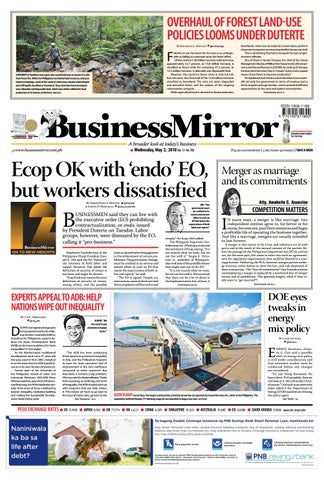
OVERHAUL OF FOREST LAND-USE POLICIES LOOMS UNDER DUTERTE By Jonathan L. Mayuga
@jonlmayuga
F
AILING to see the forest for the trees is as unforgivable as failing to maximize what the forest offers. Of the country’s 30 million hectares total land area, approximately 52.7 percent, or 15.8 million hectares, is classified as forest while the remaining 47.3 percent, or 14.2 million hectares, is alienable and disposable land. However, the country’s forest cover is only 6.8 million hectares, less than half of the 15.8 million hectares classified as forestland. The rests are open, degraded and denuded forest, and the subject of the ongoing reforestation program. While agricultural land is devoted to food production,
A resident of Southern Leyte goes into a protected area to ensure it is safe from forest fire. While the Philippines has limited land resources, being an island-archipelago, much of the country’s land mass remains undeveloped and still legally classified as forestland. Those that have been developed were alienable and disposable land, which were either utilized for food production or for human settlement. NONIE REYES
media partner of the year
United nations
2015 environmental Media Award leadership award 2008
forestlands, which are set aside for conservation, perform important ecosystem services essential for human survival. This is something that hasn’t escaped the eyes of government officials. One of them is Nonito Tamayo, the chief of the Forest Management Bureau (FMB) of the Department of Environment and Natural Resources (DENR). According to Tamayo, Environment Secretary Roy A. Cimatu “wants every square meter of our forest to become productive.” He explained that Cimatu wants forestland use to benefit not only the government in terms of revenue, but in terms of green-jobs generation, and to provide livelihood opportunities to the rural and upland communities. Continued on A12
BusinessMirror
www.businessmirror.com.ph
A broader look at today’s business n
Wednesday, May 2, 2018 Vol. 13 No. 200
Ecop OK with ‘endo’ EO, but workers dissatisfied B By Elijah Felice E. Rosales @alyasjah & Samuel P. Medenilla @sam_medenilla
usinessmen said they can live with the executive order (EO) prohibiting contractualization, or endo, issued by President Duterte on Tuesday. Labor groups, however, were dismayed by the EO, calling it “pro-business.” Employers Confederaton of the Philippines (Ecop) President Donald G. Dee said the EO “balances” the interests of both labor and capital. However, Dee added the definition of security of tenure is too loose and might be abused. “Ecop finds worrisome the exact definition of security of tenure, among others, and the possible
loose or abused rules of engagement in the enforcement of certain prohibitions. The government, though, must be credited in its serious and sincere effort to craft an EO that meets the expectations of both labor and capital,” he said. “The EO is signed. Despite our reservations, some of which are cited above, employers will live with it and
DEE: “The government must be credited in its serious and sincere effort to craft an EO that meets the expectations of both labor and capital.”
comply,” the Ecop chief added. The Philippine Exporters Confederation Inc. (Philexport) shared the sentiment of Ecop, saying, “It is not exactly what we want, but we can live with it.” Sergio R. OrtizLuis Jr., president of Philexport, also took note of the possible abuses that might root out of the EO. “It is not exactly what we want, but we can live with it. We are afraid that there can be a lot of abuse in the implementation, but, at least, it Continued on A2
Merger as marriage and its commitments Atty. Amabelle C. Asuncion
I
Competition Matters
n many ways, a merger is like marriage: two independent entities agree to, for better or for worse, become one, pool their resources and begin a profitable life of operating the business together. Just like a marriage, mergers are usually intended to last forever. A merger is also meant to be a free and voluntary act of each party and is the result of the mutual consent of the parties. Before the passage of the Philippine Competition Act (PCA), parties are, for the most part, left alone to enter into such an agreement, save for regulatory requirements that could be likened to a marriage license. Following the PCA, however, merger parties undergo scrutiny, either before or after the fact, and risk disavowal of their transaction. The “fear of commitment” that hounds entities contemplating a merger is replaced by a newfound fear of merger review and of prohibition. The question lingers, what if they really want to “get married”? Continued on A11
DOE eyes tweaks in energy mix policy
ALBERT: “We also need to pay attention to human issues.”
@cuo_bm
D
espite the high level of growth being experienced by developing member-countries (DMCs), including the Philippines, experts believe the Asian Development Bank (ADB) can do more to address the “stark inequalities” in the region. As the Manila-based multilateral development bank turns 51 years old this year, experts from DMCs weighed in on the areas that the ADB should focus on in its next 50 years of existence. Former dean of the University of the Philippines School of Labor and Industrial Relations (SOLAIR) Rene Ofreneo said that, apart from infrastructure financing, the ADB should also consider three areas of focus—addressing income inequality, institution building and making the Sustainable Development Goals (SDGs) work.
business news source of the year
P25.00 nationwide | 5 sections 30 pages | 7 days a week
EXPERTS APPEAL TO ADB: HELP NATIONS WIPE OUT INEQUALITY By Cai U. Ordinario
2016 ejap journalism awards
By Lenie Lectura
“The ADB has been producing these reports on persistent inequality in Asia, and the Philippines happens to have the most consistent lack of improvement in the Gini coefficient compared to other countries. But Asia-wide, it remains a big problem,” Ofreneo told the BusinessMirror. “Aside from exposing, or outlining, that level of inequality, the ADB should come up with programs that can help reduce it. This means we have to go back to the issue of trade rules, go back to the See “Experts,” A12
PESO exchange rates n US 51.9650
E
SLEEK FLIGHT Crystal Skye, the largest and luxurious privately owned tour jet operated by Crystal Aircruises Inc., lands in the Philippines. The exquisitely outfitted Boeing 777-200 long-range jet was launched in August last year. ALYSA SALEN
@llectura
NERGY Secretary Alfonso G. Cusi said a possible shift in energy mix policy is still under consideration and that extensive studies must be conducted before any changes are introduced. “It’s just being discussed. No harm there. If it’s possible, then we will look at it. We will study it first, of course,” Cusi said in an interview when asked if the Department of Energy (DOE) was bent on revising the policy again.
n japan 0.4765 n UK 71.5714 n HK 6.6221 n CHINA 8.2074 n singapore 39.2633 n australia 39.3687 n EU 63.0180 n SAUDI arabia 13.8566
See “DOE,” A2
Source: BSP ( 30 April 2018 )
BMReports BusinessMirror
A2 Wednesday, May 2, 2018
www.businessmirror.com.ph
Ecop OK with ‘endo’ EO, but workers dissatisfied Continued from A1
recognizes that there are legitimate subcontractors and it is not possible to completely prohibit them,” Ortiz-Luis said via SMS. Trade Secretary Ramon M. Lopez said he is confident investors will continue to flock the country in spite of the EO. He branded the new presidential order as a “balanced EO.” “We are happy with the EO signed by the President and support the call for banning endo and illegal contracting. The Department of Trade and Industry is for the improvement of welfare and security of tenure of workers and, at the same time, ensuring we have stable policy environment that will create jobs,” Lopez said.
‘Taken for a ride’
Labor coalition Nagkaisa said in a statement that it felt betrayed after Duterte signed the EO supported by the DTI and business groups during the Labor Day celebration of the Department of Labor and Employment (DOLE) in Cebu. The move was condemned by thousands of laborers, who joined the nationwide indignation rally on Tuesday. Except for traffic and some sections of major thoroughfares that were shut down, especially in Manila, the rallies and protests staged by members of different labor groups around the country on Tuesday were generally peaceful. The Philippine National Police, which monitored the whole-day rallies held in key cities and areas around the country, reported that it has yet to receive a single case of “untoward” incident relating to the protests as of 2 p.m. The rallies and protests, which were even joined by other mass-based organizations, were spearheaded by different labor groups, most especially by the militant K ilusang Mayo Uno
(KMU) and the Trade Union Congress of the Philippines. “We felt, we were taken for a ride. There was no consultation on our fifth draft submitted to the Office of the President on April 13. The EO that was signed definitely is an EO for the employers not for workers,” Nagkaisa said. In a phone interview, Renato Magtubo, Nagkaisa spokesman and Partido Manggagawa chairman, told the BusinessMirror the EO signed by Duterte was the version being opposed by labor groups. “What he signed was the EO drafted last November, which used the definition of security of tenure in the Labor Code. It does not have teeth. It is just similar to Department Order (DO) 174. That is why we rejected it and we created a new version,” Magtubo said. DO 174 was issued by the DOLE last year to further restrict the practice of contractualization. The issuance was unanimously rejected by labor groups since it failed to prohibit contractualization Nagkaisa and KMU have proposed to define security of tenure (SOT) as the direct relationship between principal and a worker. If applied to Section 2 of the signed EO, it would have virtually barred contractualization in general. Under Section 2 of the signed EO, contracting or subcontracting when undertaken to circumvent the worker’s right to security of tenure, self organization and collective bargaining agreement and peaceful concerted activities pursuant to the 1987 Philippine Constitution is hereby strictly prohibited. Magtubo lamented that without their SOT definition, a contractual arrangement will still be considered legal if workers are regularized by his or her contractor, instead of their principal employer. “This [EO] will have no impact on
Overhaul. . .
Continued from A12
The PSNA does not accurately account for the total goods and services the forestry sector provides, and its share to the GDP is lumped with other sectors, like agriculture and fisheries or manufacturing. Forestry goods include logs and lumber. Log production in 2016 reached 841,880 cubic meters, while total lumber production reached 322,126 cubic meters. Total veneer production reached 58,881 cubic meters, while plywood production reached a total of 145,710 cubic meters. In 2017 the DENR-FMB generated an income of P77,663,452. The amount includes revenue collection from administrative fees, forest charges and production-sharing agreements. Since the introduction of various forest land-use agreements, revenue collection never breached the mark of P100 million, indicative of the failure of many of its development partners to make productive the land that the government assigned to them.
Deforestation and bans
LOGGING became a major economic activity in the Philippines in the 1960s and 1970s, according to the Food and Agriculture Office (FAO) of the United Nations. During the period, described by FAO as “the peak period of exploitation of the Philippine forests” starting in the early 1960s, harvest from the forest rose rapidly—with large multinational logging companies making enormous profits from the continued growth of harvesting volumes. “By 1969 forest products constituted 33 percent of total export revenues, while at the same time local and international foresters were warning of the inevitability of the harvest diminishing if there was not a significant change in policy,”FAO said in its country profile of the Philippines, specifically forestry. During the period, logs are exported, with Japan being the major consumer. Aside from harvesting of trees by companies with Timber Licensing Agreements (TLA), illegal-logging activities, timber poaching and slash-and-burn farming became even more rampant, hence contributing to the massive deforestation and depletion of the country’s forest.
minimizing contractualization. In fact, it even legitimizes contractualization in the agencies. We are against this because not all jobs should be contracted out,” Magtubo said. Magtubo added that once the EO takes effect 15 days after being published, he said labor groups would hold more protests against it. Sonny Matula, Federation of Free Worker president and Nagkaisa member, said he was also dismayed by the new EO. However, he added, they would be able to use it to push for the passage of the pending SOT bill in the Senate. “The president could have done more, but we will use the Presidential ordinance to advance our advocacy in the Senate and to strictly implement existing labor standards in inspection and monitoring in the workplace,” Matula said. He hopes the EO will serve as a signal to senators supporting Duterte to fast-track the passage of the pending bill.
Battle shifts to Congress
The chairman of the House Committee on Labor and Employment said Congress is still committed to pass into law a pending measure addressing the problems of labor-only contracting and end of contract or endo in the country, despite the issuance of the EO to stop the practice. Rep. Randolph S. Ting of Third District of Cagayan, the labor committee chairman, said the lower chamber is now awaiting the Senate’s version of the anti-endo bill. The Lower House approved on third and final reading House Bill 6908 on January. “Yes, of course, we are still committed to pass the anti-endo bill or the security of tenure bill into law this 17th Congress,” Ting said. “We already approved our own version of the anti-endo bill, and now we are waiting
By the mid-1980s logging bans were declared in several regions to arrest the environmental degradation. Almost simultaneously, the Philippines saw the rise of the woodprocessing industry with the ban on the exports of logs. From a net exporter of logs and wood, the Philippines became a net importer since then.
Stroke of a pen
In 2011 the government of then-President Benigno S. Aquino III attempted to address the environmental problems caused by massive deforestation. Aquino signed two executive orders (EO) imposing a ban on the cutting and harvesting of trees in natural and residual forests and implementing a nationwide reforestation program. Signed on February 1, 2011, EO 23 declared the total log ban on the natural and residual forest. At the same time, it ordered the creation of the anti-illegal logging task force. EO 26 signed on February 24, 2011, ordered the implementation of the National Greening Program (NGP) from 2011 to 2016. It has set an ambitious target of reforesting 1.5 million hectares of open, degraded and denuded forest. The NGP is described as a program that rolls into one climate-change mitigation and adaptation, food security and selfsufficiency and poverty-alleviation projects. The implementation of the twin forestry policies under the Aquino administration is considered a resounding success by the DENR-FMB. EO 23 was credited with reducing the number of illegal-logging hot spots by 88.3 percent, or from 197 identified illegal-logging hot spots in 2011 to 23 by the end of 2015. A total of 34,565,307 board feet of forest products were confiscated and donations of confiscated products to the Department of Education was able to produce 146,471 school chairs and furniture and made the repair of 396 school buildings possible. Donations to other government institutions resulted in the production of 1,820 chairs, 105 double-deck beds, 110 hospital beds, 102 core shelters and the repair of 18 government buildings.
Expanded NGP
Under the NGP, the DENR-FMB claims forest cover expanded by as much as 1.66 million hectares. During the course of its six-year implementation, wherein a total of P25 billion was allocated, around 4.02 million jobs in upland communities were generated. And with the successful implementation of NGP, the Aquino administration saw it fit to further extend its implementation to the year 2028 through EO 193, series of 2015, titled “Expanding the Coverage of the National Greening Program” (ENGP). It aims to cover the remaining 7.1 million hectares of the remaining open, degraded and denuded forest in the Philippines. Under the ENGP, the Duterte administration now targets to reforest some 1.2 million hectares between 2017 to 2022 in accordance with the updated “2016-2028 Master Plan for Forestry Development.” As a strategy, the Duterte administration seeks to attract
for the Senate, which committed to finish its version by the first quarter of this third regular session of the 17th Congress or by July. On the part of the House, we are ready to immediately conduct a bicameral conference committee meeting to reconcile the differences of our version and for us submit our final version to the President for his signature,” he added. Party-list Rep. Tom S. Villarin of Akbayan said the abusive practice of labor-only contracting will be addressed through the passage of the proposed security of tenure law. Villarin also asked President Duterte to certify as urgent the security of tenure bill filed at the Senate. “Without the [urgent certification] to indicate to the senators which of the many pending bills to approve, [the new EO] will also not stop endo,” he said. “The next battleground is in the Senate. We expect a tough and uphill battle in the Upper House.” The chairman of the Senate Committee on Labor last Thursday hailed President Duterte’s EO banning endo even as senators were already poised to pass remedial legislation penalizing illegal contractualization. “We welcome the President’s issuance of the executive order prohibiting illegal contracting and subcontracting,” Sen. Emmanuel Joel J. Villanueva, labor committee chairman, said on hearing the President’s directive. Villanueva noted that Duterte’s EO should serve as “a guide for everyone on where the Executive stands on the issue of endo, although it did not depart from the existing policy on contracting. “But it should be noted that the President reiterated his call to end endo and illegal contractualization,” the Senator pointed out. Having said that, Villanueva assured that the Senate is committed to “push through with enacting a law that will [effectively]
private-sector investment in forestry-related undertakings like tree plantation and forest projects.
Policy reviews
DENR Undersecretary Jonas R. Leones said existing policies are being reviewed, which include the various forestry-related programs. Leones, the undersecretar y for policy, planning, international affairs and foreign-assisted projects of the DENR, said Cimatu has directed them to study and assess Integrated Forest Management Agreements (Ifmas) to ensure that the concession areas are being developed in a way that the forest land is made productive. He said policies and programs for forestland use, including forest land, grazing areas, timberlands, foreshore lands and areas set aside for conservation under the National Integrated Protected Areas System (Nipas) Act under the mandate and jurisdiction of the DENR are being reviewed. “We expect to have a new policy addressing land-tenure issues and we can maximize benefits we can derive from it, and generate additional funds. Of course, this is with due consideration of an area’s carrying capacity,” Leones said. “The environment should always be given priority.” The policy reviews, he said, is being done one at a time. However, the comprehensive audit of all Ifmas exclude those in the Autonomous Region in Muslim Mindanao. According to Leones, the audit aims to determine which development partners have complied with the terms and conditions of their contract, which is a forest production-sharing agreement entered into by the DENR with agricultural companies. Before the signing of EO 23, Ifma holders are allowed to harvest in natural and residual forests.
Further scrutiny
WITH the imposition of the logging ban, the IFMA holders are expected to establish tree and forest plantations. However, Tamayo said less than half of 89 Ifma holders have developed their concession areas. Leones added that forests under current policies are meant for sustainability, noting of its importance, in combatting climate change and ensuring the provision of various ecosystem services. Nevertheless, he said the change in policy can be done to maximize revenues, such as in the case of Special-Use Agreement in Protected Areas (Sapa). “Just recently the DENR secretary signed an administrative order on Sapa. It has the potential of I think, increasing revenues by as much as P500 billion,” Leones said. Leones was referring to the new guideline, DENR Administrative Order 2018-05 dated March 15, 2018, and titled “Addendum to DENR Administrative Order 2017-17 on the Rules and Regulations Governing Special uses within Protected Areas.” It provides the guidelines and principles in determining development fees for access to, and sustainable use of resources within PAs. There are 240 PAs all over the country, covering over more than 5 million hectares of forest and terrestrial territories. Leones said even the Nipas-covered PA will be scrutinized, saying the law allows the establishment and disestablishment of a PA. “Remember that PAs are established for protection and conservation of threatened species. But if some of these areas no longer have species to protect, we might, as well disestablish them and convert them into production forests,” he said. All other forestland lease and land-use agreements will be reviewed by the DENR to ensure maximum benefit, Leones added.
end labor abuses and promote workers’ right to security of tenure.” Responding to criticisms that the EO serves no purpose as what is needed is a policy to prohibit all forms of labor contracting, Presidential Spokesman Harry L. Roque Jr. defended the President, saying that is the same reason there is a need for legislation. “Policy-making is Legislative. Executive is implementation,” Roque said in a statement. Roque previously said that the contentious provision on the EO was Section 2, which, in one version, indicates that workers must be recognized as regular employees of the hiring company; and the other one says they should be recognized as regular employees of the service contractor. Former DOLE Undersecretary and Dean of University of the Philippines- School of Labor and Industrial Relations Rene E. Ofreneo told the BusinessMirror that the final version of EO would not make trade unions happy, adding that this means that the government is not yet prepared to totally put in place the provisions that the trade unions want. But to be fair to the President, Ofreneo noted that there is an effort from the President to reduce the abuses and i l lega l for ms of contractua lization, referring to a part of the EO which stated that the DOLE shall conduct inspection of establishment so as to ensure compliance with all labor laws. Asked on his assessment of the EO, he said: “In terms of labor, it’s not enough to pacify the trade unions’ movement. But in terms of industry relations, ordering the compliance to the obligation with regards to abuses will not really be fully accepted by the employers, but they will be reminded.” With Butch Fernandez, Rene Acosta and Bernadette D. Nicolas
DOE. . .
Continued from A1
This after DOE Undersecretary Felix William B. Fuentebella announced earlier that the agency was looking at a shift of the energy mix to 50 percent baseload and 50 percent flexible plants. Baseload plants are power facilities that operate on a 24/7 basis, while flexible plants are those that that are easy to start up and are able to ramp up their generating capacities immediately such as natural gas, geothermal and hydro. The current mix now is 70-20-10 mix in favor of baseload, followed by mid-merit then peaking. Mid-merit plants run on long hours but not 24/7. Peaking plants, meanwhile, are easy to start-up and can be used during peak hours. The current mix under the Duterte administration is already a revision of the Aquino administration’s energy-mix policy which used to be 30 (coal)-30 (natural gas)-30 (renewable energy or RE)-10 (oil-fired plants). In 2017 data showed that the country’s total installed capacity stood at 22,728 MW. Of this capacity, coal still remained the dominant energy source with a share of 35.4 percent. Coal-fired power plants had a total installed capacity of 8,049 MW, followed by RE at 7,079 MW, or 31.1 percent of the total. Oil-based energy sources made up 18.3 percent of the dependable capacity at 4,153 MW. Natural gas had a share of 15.2 percent or 3,447 MW as of end-2017. The proposed change in energy-mix policy was mainly on account of the current trends as far as demand is concerned also based on the technologies that are coming in. “We are telling the gencos [generating companies] and the industry players that this is what we see from the system point of view. From the system point of view, what we are looking at is the demand behavior plus the coming in of intermittent, variable REs,” said Fuentebella during the recent “Powering the Philippines” conference hosted by General Electric Philippines Inc. and the American Chamber of Commerce of the Philippines. Fuentebella added that the possible shift to a 50-50 energy mix is brought about by the entry of more RE sources, “We’re anticipating the entry of more RE and to integrate RE into the system. We would need more flexible plants. So we’re looking at the role of naturalgas plants and how these will affect coal and how the mix will be affected.” He said power producers would be guided accordingly. “We’ll give them the data, that’s
what we need. If they do not look at the entire system approach, it will be more costly for them. They need a portfolio approach because we’re looking at the entire system.” Also, RE policies such as Renewable Portfolio Standards (RPS) and Green Energy Option (GEO) will entice the development of RE in the country. RPS is a policy mechanism requiring electric-power industry participants such as generators, distribution utilities and suppliers to source or produce a specified fraction of the electricity they generate from eligible RE resources. GEO, meanwhile, empowers end-users to choose renewable-energy resources for their energy requirements. The DOE’s National Renewable Energy Program (NREP) seeks to increase the REbased capacity of the country to an estimated 15,304 MW by 2030, and to at least 20,0000 MW by 2040, almost quadruple its 2010 level. As of June 30, 2017 the DOE has awarded 831 RE projects under the RE bill, a huge increase from 22 projects since the RE bill’s passing in 2008. “The increased generation from geothermal, hydro, and solar resources has reduced the country’s dependence on fossil fuels,” GE Philippines CEO Jose Emmanuel de Dios said. “Now, more than ever, the country is open to new ideas and solutions to produce more reliable, sustainable and affordable electricity.” The forum organized by GE and the chamber is aimed at assessing the future of RE in the country. “With the looming threat of climate change, sustainability needs to be at the forefront of our concerns when it comes to servicing the country’s power needs,” de Dios added. GE is a global solutions provider of solar, wind, hydro, biogas, among others. “Through our combined onshore and offshore wind and hydro solutions, we are able to generate power in a more sustainable way. Innovative technologies such as concentrated solar power and photovoltaic solar systems can also make significant power contributions in the more rural areas of the country,” GE Asia Pacific President Wouter van Wersch said. With solutions for wind, hydro, biogas and solar, van Wersch added GE is “fully equipped” to support the Philippines’s RE targets. “GE is fully committed to be the government’s technology partner as we increase power generation from RE sources in the Philippines, and we will be sure to do our part as the whole country works together toward cleaner and more sustainable energy.”
www.businessmirror.com.ph
The Nation BusinessMirror
Group wants Pagcor stripped of powers over online gaming
A
cause-oriented group is urging the Supreme Court (SC) to issue an order restoring the right to grant online gaming franchises to economic zones and, at the same time, hold the state-run Philippine Amusement and Gaming Corp. (Pagcor) in contempt for usurpation of judicial powers. The Anti-Trapo Movement of the Philippines Inc., in a 14page petition filed before the SC, asserted that Pagcor erred in arrogating upon itself the authority to “interpret and implement the law,” hence, giving itself the exclusive privilege to “centralize and integrate all games of chance” as defined by Presidential Decree (PD) 1869. The group asked the High Tribunal to issue a status quo ante order (literally meaning the way things were before) “restoring the regulation of Internet/online gaming to the economic zones that were created by special law for that purpose.” The petitioner also claimed that in issuing the questioned regulations, “Pagcor has interpreted the law to include Internet/online gambling” within its authority. Anti-Trapo Movement Founder and Chairman Leon Peralta, who filed the petition, brushed aside Pagcor’s argument as “an affront” to the SC.
Peralta filed his plea in response to Pagcor’s comment to his earlier petition for prohibition seeking to disallow Pagcor from extending Internet gaming franchises to private operators. Peralta, who is a nonlawyer, stated that the SC, not a mere GOCC, or government-owned and -controlled corporation, is the “true agency of the government with the authority to interpret the law.” He cited as precedent the SC ruling on a case initiated by then-Sen. Robert Jaworski rejecting Pagcor’s erroneous assertion that it can regulate Internet/online gambling. In its comment filed by the Office of Government Cor porate Counsel, Pagcor argued that Section 10 of PD 1869 cited jai alai as the only gaming activity expressly excluded from Pagcor’s coverage. “If it were really the intention of Congress to exclude Internet gaming, then it would have expressly included the latter in the exclusion,” the Pagcor comment stated. The Anti-Trapo Movement leader countered, however, that Pagcor was apparently using a “bogus” document purporting to be PD 1869, saying the phrase “except jai alai” does not appear in the genuine version of PD 1869 as published in the Official Gazette on December 26, 1983.
Editor: Vittorio V. Vitug • Wednesday, May 2, 2018 A3
Gordon affirms Noynoy, Cabinet men’s accountability in dengue-vaccine mess T
DFA hails Kuwait gesture to end spat
T
By Butch Fernandez
@butchfBM
he chairman of the Senate Committee on Public Accountability stood firm on the Blue Ribbon panel report finding former President Benigno S. Aquino III and other Aquino Cabinet officials indictable for endangering the lives of over 830,000 children injected with Dengvaxia vaccine.
Sen. Richard J. Gordon on Tuesday affirmed the Blue Ribbon report, citing the liability and possible indictments of ex-President Aquino, his Health Secretary Janette L. Garin, former Budget Secretary Florencio Abad, Philippine Children’s Medical Center Executive Director Julius Lecciones and other officials of the Department of Health (DOH) and the Food and Drug Administration found liable for violating Republic Act 3019, or the Anti-Graft and Corrupt Practices Act, and RA 6713, or the Code of Conduct and Ethical Standards for Public Officials and Employees, as well as other relevant laws involving procurement and distribution of the Dengvaxia vaccine. In a news statement issued on Tuesday, Gordon confirmed that the majority of the members of
the Blue Ribbon panel have signed Senate Committee Report 368, paving the way for the report’s findings and recommendations to be submitted for plenary action when senators reconvene regular sessions on May 15. “More than the majority had signed the recommendations and we can debate it,” Gordon said, adding, “I am happy that we can now take up the report in plenary session as this is where it should be debated on, not outside. We should debate within the chamber and within the rules,” the senator added. At the same time, he assured there was “nothing political in the investigation or in the report submitted by the Blue Ribbon.” Gordon stated that “the aim of our investigation has always been the protection of the children. We
GORDON: “More than the majority had signed the recommendations and we can debate it.”
conducted the inquiry to protect the children and to insulate the DOH from politics which harms the health of our nation.” Moreover, the senator sought to clarity that “what we are doing here is not political. It is precisely to prevent the DOH from being co-opted again. We do not want to pin down anyone, but there is no doubt that the people who did this are liable because they are causing harm to children…that they were risking the lives of about one million children,” Gordon said. At the same time, the senator confirmed the panel’s recommendation to provide sufficient budget for monitoring—in particular serotesting to determine who were previously seronegative—diagnosis, treatment and rehabilitation of all children injected with Dengvaxia. To do this, the committee report also suggested that concerned authorities “authorize allocation of a portion of the P1.2billion refunded by Sanofi Pasteur for unused vaccines for monitoring activities.”
he Department of Foreign Affairs (DFA) on Tuesday welcomed Kuwait’s willingness to work with Manila in ironing out the diplomatic row over embassy-led rescues of overseas Filipino workers (OFWs) in the Gulf state. Last Sunday Kuwait Deputy Foreign Minister Khaled Al-Jarallah conveyed Kuwait’s readiness to work with the Philippines in addressing the concerns of OFWs. Citing the “historic friendship” between the two states after Manila sent Kuwait assistance during the Gulf war, Al-Jarallah believed both will be able to mend strained ties. “This gesture on the part of Kuwait, a country with which we have a shared history and strong people-to-people ties, will allow us to move forward and hurdle the challenges we face,” Foreign Secretary Alan S. Peter Cayetano said in a news statement. “We acknowledge with heartfelt thanks the assurances of Kuwait to work with us in protecting the rights and promoting the welfare of Filipinos working there,” he added. Tension between the two nations escalated following Kuwait’s protests against the Philippine Embassy in Kuwait’s rescue operations, which later led to the expulsion of Ambassador Renato Villa. At present, four drivers of a van for hire are detained by the Kuwaiti authorities for “participation” in the rescues. Meanwhile, three diplomats are facing warrants of arrest. The DFA has yet to give an update on their appeal for the release of the four drivers and the status of the three diplomats. PNA
Economy
A4 Wednesday, May 2, 2018 • Editors: Vittorio V. Vitug and Max V. de Leon
DOLE’s JobStart program benefits 14K youths 4 years after inception
F
our years after its implementation, the JobStart program (JSP) of the Department of Labor and Employment (DOLE) has already benefited 14,000 youths nationwide. Launched in 2014 through a $5.6-million technical assistance funding from the Canadian government and the Asian Development Bank (ADB), JSP is now one of the flagship program of the DOLE to address youth unemployment. The DOLE’s Bureau of Local Employment (BLE) said the program was able to successfully reduce the school-to-work transition for most of its beneficiaries. Under JSP, select marginalized youths are given a full cycle of employment assistance, which includes life-skills (social skills and attitude relevant to work) training and an internship component. The program benefited marginalized youths with the following qualifications: aged 18 to 24; at least a high-school graduate; not employed, studying, or undergoing training at the time of registration; and with less than one year, or no work, experience. During its pilot, JSP only covered the Public Employment Service Offices (Peso), the job-facilitating arm of local government units, in General Trias; San Fernando, Pampanga; Quezon City; and Taguig City. JSP was well received by the employers and youth, who participated in it.
The Canadian government and the ADB lauded the initial outcome of JSP and have committed to extend $14.4 million worth of technical aid to the DOLE until 2021, and regulatory impact assessment of their other programs. The growing interest on the program prompted the government to institutionalize JSP through the passage of Republic Act 10869 in 2016. The new law allowed the government to augment JSP’s funding from the Canadian government and the ADB. It allocated over P106 million for JSP in 2016 and P168 million in 2017. As of April, JSP already covered 32 cities nationwide through the funding from the government, Canada and the ADB. BLE Director Dominique Tutay admitted, however they are still selective in the enforcement of JSP since some Peso still lack the capability to accommodate the program. She said they are now laying the groundwork to address this through their capacity-building initiatives and hiring of additional personnel for the Pesos and the DOLE’s regional offices. In preparation for the complete turnover of JSP to the government, the DOLE availed of a $300-million loan from the ADB. “By 2021 or 2022 the technical assistance for the JobStart program will stop. By then, we envision a strong facility and institution that would fully implement the program,” Tutay said. Samuel P. Medenilla
BusinessMirror
www.businessmirror.com.ph
DOF warns of rise in cigarette smuggling after TRAIN law
T
he Department of Finance (DOF) has warned of a possible increase in cigarette smuggling following the imposition of higher excise tax rates for tobacco products under the Tax Reform for Acceleration and Inclusion (TRAIN) law. “We anticipate…the increase in smuggling of counterfeit cigarettes because we took out one of the big [market] players. Of course, nature abhors a vacuum, so if there is an opportunity [smuggling could rise], and Filipinos have a lot of misplaced [sense of] entrepreneurship,” Finance Secretary Carlos G. Dominguez III said. The TRAIN law mandates a graduated increase in cigarette excise taxes from the current P30 per pack to P32.5 in the first half of 2018, and to P35 starting from July 2018 to December 2019. Dominguez, however, assured that that the Bureau of Internal Revenue (BIR), and especially the Bureau of Customs (BOC), have increased efforts in terms of fighting instances of smuggling in the country. “We are cracking down. The BIR and BOC are working very closely together. It’s something that you have
to anticipate when you increase the cost...,” the finance chief added. In April this year the Strike Force of the BIR, the lead force in the fight against cigarette smuggling, spearheaded the raid of several warehouses in Malabon and Manila City that yielded millions of pesos worth of smuggled and counterfeit cigarettes. At least 43 master cases of Winston brand, 91 master cases of Mighty cigarettes, 82 master cases of Marvel brand, 11 master cases of Chunghua cigarettes, 71 master cases of Two Moon brand, 37 master cases of Fortune brand, and eight master cases of Marlboro brand were seized from two Malabon warehouses by the BIR’s special anti-illicit trade team late last week. Initial estimate placed the market value of the confiscated items to P8 million. Earlier, Revenue Commissioner Caesar R. Dulay, aware of the proliferation of counterfeit cigarettes in
the country, formed the Strike Force in cooperation with the BOC. This is also in response to the call of private tobacco firms operating in the Philippines to address the issue of cigarette smuggling in the country. Dulay said the head of the strike team is BIR Regional Investigation Division Chief Remedios C. Advincula Jr., who is closely working with the BOC Deputy Commissioner for the Assessment and Operations Coordinating Group. In a related development, the government, through the Office of the Solicitor General, has sought the dismissal of the petitions seeking to stop the implementation of the TRAIN law. In a 74-page comment filed on April 19, Solicitor General Jose C. Calida told the Court that the arguments in the two petitions filed in January by party-list lawmakers, led by Party-list Rep. Carlos Zarate of Bayan Muna and consumer group Laban Konsyumer Inc. (LKI) have no basis. Calida belittled the main argument of the petitioners that President Duterte signed the TRAIN law, otherwise known as RA 10963, with grave abuse of discretion simply because the House of Representatives did not have a quorum when it earlier passed the controversial tax measure. The petitioners claimed that only around 10 lawmakers, including the lawmaker petitioners, were pres-
Lawmaker petitions SC to stop sale of P61-B reclaimed Manila property
A
veteran lawmaker has filed a supplemental motion reiterating his plea to the Supreme Court (SC) for the immediate issuance of an injunction order enjoining the Philippine Reclamation Authority (PRA) and the Register of Deeds of Parañaque City from completing the “questionable” sale of 41 hectares of reclaimed land now worth around P61 billion to Manila Bay Development Corp. (MBDC). The “urgent ex parte motion” filed by Party-list Rep. Rodante Marcoleta of 1-Sagip also sought to expand the coverage of the petition for prohibition and mandamus he filed before the SC on April 20. “All told, the immediate issuance of a temporary restraining order [TRO] and/or writ of preliminary injunction prayed for will surely maintain and preserve the status quo and avoid the conveyance of transfer, whether by sale, conveyance, mortgage or otherwise, of the subject reclaimed lands, or portions thereof to third parties, and thus prevent the instance case from becoming moot and academic pending the resolution o this case,” the supplemental petition said. It added: “On the practical side, maintaining the status quo will likewise prevent billions in losses on the part of the state, as theoretically the respondents may, at any time, cause or allow the alienation or conveyance of the subject reclaimed lands, or that an encumbrance be made thereon.” In the supplemental petition, Marcoleta already cited the 15 land titles that emerged from the Original Certificate of Title 2 and Transfer Certificate of Title 19346 after the 1988 transaction. The registered owners are either the MBDC, Light Railway Transit Authority (LRTA) and the Public Estates Authority (now PRA). Marcoleta, thus, asked the SC that the TRO/injunction to be issued should also enjoin MBDC, LRTA and PRA “from selling or otherwise alienating, transferring and conveying the subject reclaimed property.” In the first petition filed through his counsel Patrick M. Velez, Marcoleta said the sale of 410,467 square
meters of reclaimed land in Manila Bay to MBDC—a private entity—in 1988 was unconstitutional, particularly violating Sections 2 and 3 of Article 12 of the 1987 Charter. He noted that the “reclaimed property is an alienable land of the public domain and, thus, beyond the commerce of man, and considering further that respondent MBDC, being a private corporation, is disqualified to own land of the public domain.” “There is an urgent and paramount need for the issuance of injunctive relief in order to forestall irreparable damage and injury not only to the petitioner but, more important, to the Republic of the Philippines. To be sure, the unconstitutional and illegal diminution of national patrimony for public use and enjoyment is an irreparable public injury, which must be rectified,” Marcoleta stated. He, thus, asked the SC to issue a TRO and/or writ of preliminary injunction restraining and enjoining the PRA “from selling or otherwise alienating, transferring and conveying the subject reclaimed property in favor of any buyer, purchaser or third party and/or from mortgaging or otherwise causing the encumbrance of the same to any creditor or third party.” Marcoleta also wants the SC to bar the Register of Deeds of Parañaque City from “allowing the registration of any deed or instrument selling or otherwise alienating, transferring or conveying the subject reclaimed property to any buyer, purchaser or third party, causing the cancellation of the certificates of title or issuance of new certificates of title, covering the same, annotating a mortgage or encumbrance on the said certificates of title in favor of any creditor or third party.” The sale in question was implemented by the PRA, then known as the Public Estates Authority, to MBDC, a company controlled by the family of banker Jack Ng. Marcoleta said that the sale was void because the lands supposed to be subject matter of the sale, being reclaimed lands, have not been reclassified by the government as alienable and disposable.
ent during the ratification of the law in the House, supposedly in violation of Section 16 (2), Article VI of the 1987 Constitution and Section 75 of Rule XI of the House Rules that require a quorum of the representatives before they can do any legislative business. But Calida denied the claim as he cited the official journals of the House during deliberations on the TRAIN law on December 13 last year, where 232 out of a total of 295 members were present. He stated that the journals are “conclusive evidence of what transpired during the session.” Calida also insisted that the Supreme Court would be violating the principle of separation of powers if it would inquire or review the existence of quorum in the House for the approval of the TRAIN bill without violating the constitutional doctrine of separation of powers. “Under the separation of powers, courts may not intervene in the internal affairs of the legislature; it is not within the province of courts to direct Congress how to do its work,” Calida said. He also belied petitioners’ allegations that the TRAIN law violated the equal protection clause and right to due process in the Constitution. The petitioners added the new excise taxes on petroleum products and sugarsweetened beverages, and its broader value-added tax, will hit poor and lowincome earners.Rea Cu and Joel R. San Juan
Occupational sickness in real estate up 189.6% in 2015–PSA By Cai U. Ordinario
O
@cuo_bm
ccupational diseases more than doubled in the real-estate sector, according to the Philippine Statistics Authority (PSA). PSA data from the 2015 and 2016 Integrated Survey on Labor and Employment (ISLE) showed occupational diseases in real estate increased 189.6 percent in 2015. The ISLE showed occupational disease cases increased to 695 in 2015 from 240 cases in 2013. “An occupational disease is defined as an abnormal condition or disorder other than one resulting from an occupational injury caused by exposure over a period of time to risk factors associated with work activity, such as contact with certain chemicals, inhaling coal dust, carrying out repetitive movements, etc.,” the PSA said. However, in terms of actual numbers, data showed that occupational diseases across industries in 2015 showed that administrative and support service activities accounted for the largest share. Diseases in this sector account for a third, or 34.3 percent, or 43,183 cases of the total in 2015. There was a total of 125,973 occupational disease cases in 2015. The PSA said call-center activities, considered to be part of administrative and support service activities, exceeded all other subsectors in the administrative and support services industry on the number of cases of occupational diseases at 31,270 in 2015. Data showed that this is equivalent to almost one-fourth, or 24.8 percent of the total cases, which meant that 1 out of every 4 cases of total occupational diseases in the industry originated from call centers. The PSA said back pain was the most common occupational disease/injury in call centers, with 7,428 cases, followed by occupational lung disease with 5,266 cases, and occupational asthma, 4,305 cases.
A6
Wednesday, May 2, 2018 • Editor: Lyn Resurreccion
The World BusinessMirror
www.businessmirror.com.ph
C. Americans in caravan start seeking asylum
T
IJUANA, Mexico—United States border inspectors allowed in the first wave of Central American asylum seekers to enter the country for processing on Monday after a temporary impasse over lack of space to accommodate them.
Mueller’s team gives Trump lawyers a list of questions
W
ASHINGTON—Special counsel Robert Mueller has given a list of almost four dozen questions to lawyers for President Donald J. Trump as part of his investigation into Russian meddling in the 2016 election and whether Trump obstructed justice, according to a report published in The New York Times. The Times obtained a list of the questions, which range from Trump’s motivations for firing Federal Bureau of Investigation (FBI) Director James Comey a year ago to contacts Trump’s campaign had with Russians. Although Mueller’s team has indicated to Trump’s lawyers that he’s not considered a target, investigators remain interested in whether the president’s actions constitute obstruction of justice and want to interview him about several episodes in office. The lawyers want to resolve the investigation as quickly as possible, but there’s no agreement on how to do that. Many of the questions obtained by the Times center on the obstruction issue, including his reaction to Attorney General Jeff Sessions’s recusal from the Russia investigation, a decision Trump has angrily criticized. Trump lawyer Jay Sekulow declined to comment to The Associated Press on Monday night, as did White House lawyer Ty Cobb. The questions also touch on the Russian meddling and whether the Trump campaign coordinated with the Kremlin in any way. In one question obtained by the Times, Mueller asks what Trump knew about campaign staff, including his former campaign chairman Paul Manafort, reaching out to Moscow. Mueller has brought several charges against Manafort, but none are for any crimes related to Russian election interference during the 2016 campaign. And he has denied having anything to do with such an effort. The queries also touch on Trump’s businesses and his discussions with his personal lawyer, Michael Cohen, about a possible Moscow real-estate deal. Cohen’s business dealings are part of a separate FBI investigation. One question asks what discussions Trump may have had regarding “any meeting with Mr. Putin,” referring to Russian President Vladimir Putin. Another question asks what the president may have known about a possible attempt by his son-in-law, Jared Kushner, to set up a back channel with Russia before Trump’s inauguration. Additional questions center on Michael Flynn, Trump’s former national security adviser, who has pleaded guilty to lying to the FBI about his discussions on sanctions against Russia with Russian Ambassador Sergey Kislyak during the presidential transition. Flynn is now cooperating with Mueller’s investigators. “What did you know about phone calls that Mr. Flynn made with the Russian ambassador, Sergey I. Kislyak, in late December 2016?” one question reads. Another asks if there were any efforts to reach out to Flynn “about seeking immunity or possible pardon.” Flynn was fired on February 13, 2017, after White House officials said he had misled them about his Russian contacts during the transition period by saying that he had not discussed sanctions. The following day, according to memos written by Comey, Trump cleared the Oval Office of other officials and encouraged Comey to drop the investigation into Flynn. AP
US Customs and Border Protection (CBP) said it processed hundreds of asylum seekers in the previous week, many of them Mexican, which contributed to a bottleneck that led inspectors to turn away caravan members when they arrived late last Sunday afternoon. The agency didn’t say how many caravan members were allowed in, but organizers said there were eight. About 140 others were still waiting in Mexico to turn themselves in at San Diego’s San Ysidro border crossing, the nation’s busiest, said Alex Mensing, project organizer for Pueblo Sin Fronteras, which is leading the caravan. “The spirits are high, there was good news for everybody,” Mensing said on the Mexican side of the crossing, moments after learning that some were allowed in. The Central Americans allowed in after the monthlong journey across Mexico may face a longer journey ahead. Some parents may be separated from their children and be detained for many months while their asylum cases are pending. Asylum seekers are typically held up to three days at the border and turned over to US Immigration and Customs Enforcement. If they pass an asylum officer’s initial screening, they may be detained or released with ankle monitors while their cases wind through immigration court, which can take years. Nearly 80 percent of asylum seekers passed the initial screening from October through December, but few
are likely to win asylum. The denial rate for El Salvadorans seeking asylum was 79 percent from 2012 to 2017, according to Syracuse University’s Transactional Records Action Clearinghouse. Hondurans were close behind with a 78-percent denial rate, followed by Guatemalans at 75 percent. Trump administration officials have railed against what they call “legal loopholes” and “catch-andrelease” policies that allow people seeking asylum to be freed while their cases are adjudicated. Vice President Mike Pence, on a California border tour on Monday, said the caravan was “a direct result of our weak immigration laws and our porous border” and a “deliberate attempt to undermine the laws of this country and the sovereignty of the United States.” Attorney General Jeff Sessions has pledged to send more immigration judges to the border if needed and threatened criminal prosecution. On Monday the Justice Department said it filed illegal-entry charges against 11 people identified as caravan members.
Asylum seekers didn’t appear to be thrown off the by the delay. Elin Orrellana, a 23-year-old pregnant woman from El Salvador, said she is fleeing the violent MS-13 street gang, a favorite target of both Sessions and Trump because of their brutal killings in communities in the United States. She added her older sister had been killed by the gang in El Salvador, so she is attempting to join other family members in the Kansas City area. “Fighting on is worth it,” she said as she camped out last Sunday for chilly night outside the border crossing. The CBP has room for about 300 people at the San Diego border crossing. “As in the past when we’ve had to limit the number of people we can bring in for processing at a given time, we expect that this will be a temporary situation,” the agency said. During a surge of Haitian arrivals at the San Diego crossing in 2016, Customs and Border Protection required people to wait more than five weeks in Mexico. Since then, smaller upticks of Mexican asylum seekers have caused delays of several hours. AP
As in the past when we’ve had to limit the number of people we can bring in for processing at a given time, we expect that this will be a temporary situation.”—CBP
Israel claims proof of secret Iran plans for nuke weapons
I
sraeli Prime Minister Benjamin Netanyahu said his country has half a ton of Iranian documents that prove Tehran had a secret program to build nuclear bombs, potentially giving President Donald J. Trump ammunition to pull the US out of the Iran nuclear accord. “Iran lied about never having a nuclearweapons program,” Netanyahu said in a news conference in his government’s defense compound in Tel Aviv. “After signing the nuclear deal in 2015, Iran intensified its efforts to hide its nuclear files.” A person familiar with the matter said the US had seen the documents
and considered them authentic. The documents were consistent with evidence that the American government had compiled, and showed that Tehran had concealed some of its weapons activities from international inspectors, according to the person, who asked for anonymity to discuss sensitive information. Israel uncovered 55,000 pages of material on a weapons program that operated between 1999 and 2003 code-named Project Amad, Netanyahu said, pulling back a curtain to reveal shelves filled with what appeared to be binders and compact discs of information.
He said the nuclear program continued after it was subsumed under a different guise, and that Iran took steps as recently as last year to move its files to a concealed location so it could revive the program down the line. Iran’s foreign minister, Mohammad Javad Zarif, called Netanyahu’s allegations lies “already dealt with” by the International Atomic Energy Agency. His deputy, Abbas Araghchi, said the presentation used an “old, worn-out scenario” to manufacture a case against Tehran, which denies ever having sought to build a bomb. Bloomberg News
The World BusinessMirror
www.businessmirror.com.ph
Trump to extend relief from steel tariffs amid negotiations
P
resident Donald J. Trump will delay imposing steel and aluminum tariffs on the European Union (EU), Mexico and Canada until June 1 as he finalizes deals with them, the White House said in a statement. The administration has reached agreements-in-principle with Argentina, Australia and Brazil, according to the statement, which the White House released late on Monday night. The details “will be finalized shortly,” the statement added. The US will also extend exemptions for the EU, Canada and Mexico for 30 days to allow for further talks. “In all of these negotiations, the administration is focused on quotas that will restrain imports, prevent transshipment and protect the national security,” the White House said. “These agreements underscore the Trump administration’s successful strategy to reach fair
outcomes with allies to protect our national security and address global challenges to the steel and aluminum industries.” Trump in March imposed a 25-percent tariff on steel imports and a 10-percent duty on aluminum after a government report found that foreign shipments of the metals imperil national-security interests.
He directed US Trade Representative Robert Lighthizer to negotiate with countries seeking to turn their temporary tariff exemptions into permanent ones. Exemptions for the EU and the five other nations were due to expire on May 1. The president’s decision to delay the tariffs gives breathing room—but also a new deadline— for allies who have been scrambling to secure permanent refuge from the metals duties. It could be seen as a gesture of goodwill for Canadian and Mexican negotiators who are in talks with the US to revise the North American Free Trade Agreement (Nafta). Trump dangled a permanent exemption as incentive to reach a tentative Nafta deal, though talks continue with no immediate agreement in sight.
In all of these negotiations, the administration is focused on quotas that will restrain imports, prevent transshipment and protect the national security.”—White House
Canada is the biggest steel exporter to the US.
European retaliation
At the same time the extension on Monday prolongs the standoff with the EU, the world’s largest trading bloc. European officials have said the US tariffs violate international trading rules, and they have threatened to retaliate with levies on iconic American brands, such as Harley Davidson motorcycles and Kentucky bourbon. The Trump administration has been pushing countries to accept quotas on the amount of steel and aluminum they export to the US. The White House in March spared South Korea from the duties after Seoul accepted a quota of 70 percent of the average of its steel exports to the US between 2015 and 2017. The US confirmed that South Korea was granted a permanent exemption on Monday in a presidential proclamation. Trump’s embrace of trade barriers this year has sparked fears of tit-for-tat retaliation that could undermine consumer confidence and stymie
the strongest global economic expansion in years. The UK government on Tuesday called the exemption extension “positive,” but added: “We remain concerned about the impact of these tariffs on global trade and will continue to work with the EU on a multilateral solution to the global problem of overcapacity, as well as to manage the impact on domestic markets.”
China trip
The decision comes days before Treasury Secretary Steven Mnuchin and other senior members of Trump’s Cabinet travel to China in search of a deal that would head off a brewing trade dispute between the world’s two biggest economies. The president has threatened to slap tariffs on as much as $150 billion in Chinese imports in retaliation for alleged violations of intellectual property, while Beijing has vowed to retaliate. Steel and aluminum exporters from China, along with other steel-exporting nations, such as Japan and India, have been paying the US tariffs since late-March. The US and EU have complained for years that Chinese steel producers unfairly benefit from state subsidies, and dump their products on the world market. Bloomberg News
Wednesday, May 2, 2018
A7
Trump-Kim meeting may be held in Demilitarized Zone or Singapore
P
resident Donald J. Trump said on Monday his administration is considering holding a potential meeting with North Korea’s Kim Jong Un at the Demilitarized Zone (DMZ) marking the North’s border with South Korea, or in other countries, including Singapore. Trump, speaking at a joint White House news conference with Nigerian President Muhammadu Buhari, also expressed optimism that the summit would take place and reiterated that he would leave if it wasn’t a success. After tweeting earlier in the day about the possibility of holding the talks at the Demilitarized Zone, Trump returned to the idea, calling the venue an “intriguing” location. “Some people maybe don’t like the look of that and some people like it very much,” Trump said. The president added that it was appealing because “you’re there, you’re actually there.” CNN reported, citing an unidentified official, that South Korean President Moon Jae-in last week convinced Kim to hold his meeting with Trump at the DMZ. “If things work out, there is a great celebration to be had on the site, not in a third-party country,” Trump said. He added that his administration is also looking at Singapore and other countries as potential hosts. “The good news is everybody wants us. It has a chance to be a big event.” Trump previously said potential locations for the historic meeting had been whittled down to two or three locations. The president has said he hopes to meet with Kim by early-June to try to resolve a standoff between Washington and Pyongyang over North Korea’s nuclear weapons and ballistic-missile programs. Trump has praised Kim’s rapid steps toward resolving the standoff and expressed optimism about the possibility of reaching an agreement when the two leaders meet. Trump reaffirmed that view on Monday, saying Kim has been “very open and straightforward so far,” and that he was confident the summit would take place.
‘Pretty calm’
At the Pentagon, Defense Secretary Jim Mattis told reporters on Monday that “right now I would just tell you we see no indicators or warnings of an increased military readiness or anything like that. On both sides, it’s pretty calm.” In his latest gesture, Kim reportedly told Moon last Sunday that he would relinquish his nuclear weapons if the US agreed to formally end the Korean War and pledge not to invade his country. Kim had already promised to close his main nuclear weapons test site in May and said he will invite South Korean and US media to witness the shutdown. Kim and Moon already met in the Peace House in Panmunjom last week after Kim walked across the military demarcation line. The village of Panmunjom sits on the 38th parallel, a line drawn by the former Soviet Union and the US after World War II to separate the countries. But it has served as ground zero for much of the turmoil since 1953 , including bloody clashes, defections—and fruitless hopes for peace. Peace House is a three-story building built in 1989 for the specific purpose of hosting talks between the countries. It is controlled by the United Nations. Bloomberg News
Banking&Finance BusinessMirror
A8 Wednesday, May 2, 2018 • Editor: Jun B. Vallecera
www.businessmirror.com.ph
Govt eyes Samurai bond issuance in 2nd half of 2018
T
By Rea Cu
@ReaCuBM
he government is seen issuing yen-denominated debt or Samurai bonds in the second half of the year in line with plans to diversify the country’s bond portfolio, according to the Department of Finance (DOF).
Finance Secretary Carlos G. Dominguez III told financial reporters the issuance of Samurai bonds will likely push in September or October.
The DOF earlier instructed the Bureau of the Treasury (BTr) to study the economics of selling Samurai bonds to allow the government to access Japa-
nese capital. Samurai bonds provide the issuer access to Japanese capital, which can be used for domestic investments or for financing operations outside Japan. The Philippines last sold Samurai bonds in 2010 worth $2.5 billion, which allowed the government to complete its commercial funding exercise that year. The IOUs had partial backing from the Japan Bank for International Cooperation, which helped explain the excess in demand from Japanese investors who submitted far more subscriptions than what was available. The Samurai exercise was done by private placement in which insurance companies, cooperatives and others partook of the offer. Meanwhile, the BTr also said it is
looking at the Chinese market again for another Panda bond issuance, following the success of the country’s maiden issuance earlier in the year. “We are looking at the Samurai [issuance] and also we will issue another one in the Panda [bond] market. So those are the things we are looking at,” Deputy Treasurer Erwin D. Sta. Ana said. Panda bonds are renminbi-denominated securities from a non-Chinese issuer but sold in the People’s Republic of China. “We are continuing to study the market and what’s happening there because of the success of the last [Panda bond] issuance when we got the tightest pricing possible. So we could also consider...[but] not within the year,” he added. In March the Philippines became the
Australia’s beleaguered banks face bleak future
I
n another bad day for the industry, a scathing report released on Tuesday into the nation’s largest lender found a “widespread sense of complacency” from the top down blinded it to risks that led to a massive breach of anti-money laundering laws. And in a stark warning the good times are over for some of the world’s most profitable banks, the head of the nation’s No. 4 lender said a two-decade “golden period” is coming to an end. The damning report into Com-
monwealth Bank of Australia piles further woe on an industry that’s lost public and political trust amid revelations of widespread misconduct—ranging from lying to regulators to falsifying documents and taking bribes. The outcry has crimped the banks’ pricing power and emboldened regulators, threatening profit growth. “The litany of issues facing the banks and financial services is extraordinary and dismaying,” said Judith Fox, CEO of the Australian Shareholders’ Association. “This is
the moment for the board to step up to the plate and deliver. Not just at this bank, but across all banks.” The 109-page report found financial success “ dulled the senses” at Commonwealth Bank and engendered complacency. The report, commissioned by the banking regulator in the wake of the money-laundering scandal, called out insular attitudes, a lack of intellectual curiosity and a pay structure that had “little sting” for senior staff if things went wrong.
“A widespread sense of complacency has run through Commonwealth Bank, from the top down,” the report said. “Commonwealth Bank turned a tin ear to external voices and community expectations about fair treatment.” The bank has also been hit by a succession of allegations about mistreating customers, from giving poor financial advice to failing to honor insurance claims. The report was critical of the tardy response to such issues, saying that a “slow, legalistic and reactive, at times dismissive, culture also characterized many of Commonwealth Bank’s dealings with regulators.” In the only financial sanction, the Australian Prudential Regulation Authority has applied a A$1 billion ($753 million) add-on to Commonwealth Bank’s minimum capital requirements. “My job is to fix what is broken and do what is necessary to earn back trust,” Commonwealth Bank CEO Matt Comyn said, as the lender promised to implement all 35 of the report’s recommendations. “It’s certainly a challenging environment in banking at the moment.” Comyn, who replaced Ian Narev last month, is already dealing with the fallout from a separate widespread inquiry into financial system misconduct that has swept up the other banks and seen the CEO and chairman of wealth manager AMP Ltd. resign. “The pressure will not relent until there is demonstrable evidence that Commonwealth Bank has turned the culture around,” said Daniel Smith, Australian head of CGI Glass Lewis, the governance analysis and proxy voting firm. “Whilst the report is targeting Commonwealth Bank, the other major banks will do well to heed the comments and look themselves in the mirror.” The damage from the scandals plaguing the industry was recognized by Australia and New Zealand Banking Group Ltd. CEO Shayne Elliott. “Our sector has had a golden period for 20 plus years and we don’t think that’s going to continue,” Elliott said on Tuesday, after the bank posted a small increase in first-half profit. “I imagine there will be lots of changes that ourselves and other participants will make,” he added. Patience among investors with bad behavior is also running out. “Companies that fail to grasp the impor tance of manag ing nonfinancial risks learn the hard way that these factors lie at the heart of their sustainability,” said Louise Davidson, CEO of the Australian Council of Superannuation Investors, whose members collectively manage A$2.2 trillion in assets. Treasurer Scott Morrison, who had previously opposed setting up the inquiry into the banks, today joined the chorus of criticism, saying the “rap sheet from Apra is very damning.” Bloomberg News
first Association of Southeast Asian Nations member to issue Panda bonds, the Investor Relations Office (IRO) said. The IRO added the three-year Panda bonds fetched a coupon rate of 5 percent, a tight spread of 35 basis points above benchmark. The Panda bonds were worth 1.46 billion renminbi (RMB) and were issued in the onshore Chinese bond market. The Philippine government’s inaugural issue of renminbi-denominated bonds received oversubscription with bids reaching RMB 9.22 billion against the Philippine government’s debt offering of RMB 1.46 billion. The Bank of China served as lead underwriter of the bond issuance, with Standard Chartered Bank as joint lead underwriter.
The audit committee and the CEO
O
n April 24 the Institute of Internal Auditors Philippines (IIAP) and the Institute of Corporate Directors (ICD) sponsored the AuditCom and CEO Forum to discuss the topic “The AC, CEO and IA—PARTNERS In STRENGTHENING CORPOR ATE gOVERNANCE.” The panel of speakers included: Juan Alfonso—president and CEO, LRMC; Jose R. Soberano III—president and CEO, CLI; Marivic Espano—chairman and CEO, P & A Grant Thornton; Roberto Manabat—member, audit committee, ICD and chairman emeritus, KPMG R G Manabat & Co.; and Wilfredo Paras—independent director, Philex Mining. Discussion focused on the relationship between the CEO and the audit committee and how this drives them to implement corporate governance principles, identifying key areas to achieve the company’s vision, making services available to clients, encouraging innovation, and doing things right. Quality means branding, being known in different markets and the business community. A CEO has to challenge himself, recruit the right talents, identify plans and strategic objectives, look at risks such as cyber security and competition from new players and set the tone at the top. On the other hand, the audit committee is the “first among equals”—it is the gatekeeper in the financial reporting chain. The audit committee and the internal auditor provide oversight on financial reporting and over the external auditor, especially with the new standards in financial reporting, such as those for revenue accounting and how revenues are booked. As well, the effects on systems and review of contracts are their concern. Effective January 2018 there are new rules on revenue standards which the audit committee must be aware of. Likewise, effective 2019 leases have to be considered in the balance sheet as leasehold rights have value and should be so recorded. Critical judgments regarding
FINEX free enterprise Mercedes B. Suleik financial statements should be assessed by the AuditCom, which must make clear judgments. Such discussions should be made not just on the regular AuditCom meetings, but perhaps, as well in what may be called “in between” meetings before the AuditCom reports to the Board. The internal auditor is the workhorse of the AuditCom. It is also important that there be collaboration with the external auditor as this would help the AuditCom to make better judgments for its report. One observation that was made is that Board meetings do not give sufficient time for the AuditCom to report—this is critical and is not merely a pro-forma part of the agenda. The CEO, the chief audit executive and the audit committee should significantly collaborate especially when the internal audit plan is formulated. Ask about strategy...ask about risk. Know which has the highest impact on the internal audit plan. The CAE needs to have managerial courage to do the right thing. In the interest of high ratings for cor porate governance, there is the danger of losing focus and concentrating on the idea that “we have to do this so we can get higher governance points” (i.e, which can be splashed in headlines in the papers). Documentation is important. Apropos this, it may be proper to use a third party audit tool when going to the CEO when something has to be done. Indeed, the CEO and the audit committee are partners, meaning that they are peers. Strengthening the relationship is a dynamic process and should always be ongoing. merci.suleik@gmail.com
Case clippings
By Justice S J Ranada Jr. CHAIN OF CUSTODY–A rule of procedure To emphasize, the distinction in criminal law is; substantive law is that which declares what acts are crimes and prescribes the punishment for committing them, as distinguished from the procedural law, which provides or regulates the steps by which one who commits a crime is to be punished. Thus, it may be gleaned that the chain of custody rule is a matter of evidence and a rule procedure; it is not substantive law. People v. Moner 05 Mar. 2018
GR 202206 Leonardo-de Castro, J
ExportUnlimited BusinessMirror
Editor: Efleda P. Campos • Wednesday, May 2, 2018 A9
PHL receives $185.7-M investment PHL exporters urged pledges from Singapore companies to tap iran market
S
By Gina Verdeflor
INGAPORE—The Philippines continues to be an investment destination for Singaporean companies as $185.7 million worth of investment pledges providing 1,920 job opportunities were signed at the sidelines of the 32nd Asean Summit on April 28.
The Department of Trade and Industry (DTI) reported the investment pledges will cover collaborative works on aviation, solutions for sustainable urbanization, as well as development of marine renewable energy, packaging, film manufacturing, information, communications technology, financial technology, water solutions, prefabricated projects, food and blockchain technology. “With our robust bilateral trade and investments ties, we are confident these new business agreements will deepen our relationship further. These will push PhilippineSingapore trade engagement to even
greater heights,” President Duterte said. “With these investments coming in, I am fulfilling a personal commitment to my countrymen to bring them more job opportunities. That’s why I am appreciative of your investment in the Philippines. I promise you that when you invest in the Philippines, we will ensure that your investments will be protected.” The President witnessed the presentation of six memoranda of understanding and four letters of intent (LOI) signed between the Philippine business delegation—composed of Filinvest Development Corp., Everhydro Corp., Cebu Air Inc., ICS ICT Support Service Corp., Ascent
Solutions Philippines Inc., and Jollibee Foods Corp.—and Singaporean companies including Keppel Corp., OceanPixel, SIA Engineering Co. Ltd., Hitachi Asia Ltd., Robin Village International Pte. Ltd., Ascent Solutions Pte. Ltd., and Golden Beeworks Pte. Ltd. Trade Secretary Ramon M. Lopez also signed an LOI with Asean Business Advisory Council Chairman Robert Yap, which involves a feasibility study on a suitable site for the implementation of a free online marketplace, SGConnect™ legacy project. Lopez also signed an LOI with Lepack Packaging Pte. Ltd. Director Lim Seong Nam, which will explore opportunities to help and assist micro, small and medium enterprises by developing innovative packaging. In 2017 Singapore was the Philippines’s sixth-biggest trading partner, fifth export market and seventh import supplier with total bilateral trade valued at $9.34 billion. Exports of semiconductor devices manufactured on consignment basis also boosted Philippine exports to Singapore by 1.16 percent in 2017. Likewise, a significant growth of 378 percent (P2.13 billion in 2017 from P444 million in 2016) approved
investments from Singapore was noted in electricity, gas, steam and air-conditioning supply industry. Lopez encouraged the Singapore business community to join the Philippines’s growth story by locating and expanding their businesses in the country. “There are enormous opportunities for companies partnering with the Philippines as the country is on its economic breakout,” he said. “The 6.7-percent GDP growth, increasing consumer base, and highly skilled and young work force complement the various reforms and infrastructure programs of the government, as well as new policies in enhancing business environment and competitiveness,” Lopez added. The trade chief also highlighted the country’s preferential agreements and market access to Europe, the European Union and the United States. “We are a strategic partner as the Philippines is located at the crossroads of international shipping and airlines, and a natural gateway to East Asian economies. With our preferential agreements to big economies, we can also provide access to the large US and EU markets,” Lopez said.
Seminar on Learn to Use LC in Import and Export scheduled
W
ITH the growing free-trade agreements of the Philippines with other countries, tariff barriers have been lowered, if not removed totally. This development has encouraged more businesses to import and export goods to and from different countries. For trade transactions, buyers and sellers prefer Letters of Credit (LC)—a payment mode that is secure, safe, and acceptable to both parties. To provide you comprehensive knowledge on the use of the LC, the Center for Global Best Practices will hold a two-day program entitled “Mastering the Use of Letters of Credit for Import and Export” on May 24 and 25 at the Manila Marriott Hotel, Pasay City. Master the nine different types of LC and use it for your business’s advantage. Get practical tips on how to prepare and check LC documents to avoid discrepancies, the pitfalls and the traps in using such mode of payment. Find out the secrets on how you can save on LC transactions that bankers will never tell you. Learn from actual cases and samples to your favor. This special program will fly in Singapore-based expert Victor Tan. He is an accredited lecturer of the International Chamber of Commerce and one of the most sought-after lecturers and authority in the field of international trade. With over 15 years of banking experience in Europe, he has worked with various international banks such as Standard Chartered Bank, Amsterdam-Rotterdam Bank, Bangkok Bank, Royal Trust Merchant Bank and Barclays Bank. (He served as Deputy Head of the trade and finance department of Barclays Bank.) He conducts highly specialized training programs for different clients in Jakarta, Bangkok and Singapore. This program is tailored best to entrepreneurs, importers and exporters, traders, CFOs, auditors and anyone who would like to venture into import and export of goods. Interested participants are encouraged to avail themselves of the early registration savings and group discounts. This is a limited-seats only event and preregistration is required. For a complete list of best practices programs, such as “Incoterms, Revised ISBP on LC Transactions,” “Best Practices Guide on How to Import Goods to the Philippines” and many more, you may visit our web site at www.cgbp.org, or call our Manila line (+63 2) 556-8968/ 69, Cebu line (+63 32) 512-3106 to 07 and Legazpi Line (+63 52) 736-0148.
Market Innovation Division, DTI-EMB
I
N an effort to help Philippine ex porters diversif y their markets, the Department of Trade and IndustryExport Marketing Bureau (DTIEMB) urged exporters to tap the emerging Iranian market, the second-largest economy in the Middle East and North Africa after Saudi Arabia. Iran has an estimated GDP of close to $1.5 trillion in 2016. It also has the second-largest population in the region after Egypt, with an estimated 82.8 million people in 2016. Total Philippine exports to Iran increased by 15.59 percent from $47.92 million in 2016 to $55.39 million in 2017. This was mainly due to the increase in the exports of pineapples and personal deodorants and antiperspirants. Bananas comprised about 61.56 percent of Philippine exports to Iran. The other major agricultural exports were pineapples, coconut oil and carrageenan. T he top nonagricultural exports consisted of personal deodorants; coated electrodes of base metal; and tubes, pipes and hoses. Total Philippine imports from Iran increased by 5,768.28 percent from $1.55 million in 2016 to $90.69 million in 2017. Major impor ts f rom Iran comprised of copper ores and concentrates, other waste and scrap containing precious metal or precious metal compounds, bitumen and asphalt, and milk and cream in powder, granules or other solid forms. In 2017 the Philippines recorded a trade deficit with Iran
which amounted to $35.31 million. Philippine exports to Iran grew in the last five years at a rate of 0.32 percent. Other Philippine products that could be exported to Iran are processed tropical fruits, other coconut products, carrageenan, garments, machinery and automotive parts. The prospects for Philippine exports improved following the Iran Nuclear Deal or the Joint Comprehensive Plan of Action when all United Nations sanctions were lifted. However, restrictive measures still remain for nuclear and ballistic missilerelated transfers and activities and arms-related transfers. Nuclear and ballistic-related transfers include dual-item materials that also have civilian use. The transfers of these materials need prior authorization from the Security Council through the procurement channel. Based on a report from Euromonitor International, Iranian consumers, particularly younger consumers, are now robustly embracing online shopping and driving significant growth, even though they are restricted to domestic sites with no official access to international giants such as Amazon. Among the highly sought products by Iranians are makeup, skin care and antiaging products. The Iran Ambassador to the Philippines Mohammad Tanhaei said Filipino enterprises have a large, untapped market for their products in his country and urged businessmen to study Iran as a new frontier for Philippine products, not only as a safe place to visit, but a profitable “virgin” market for establishing business ties.
DTI-EMB conducts digital info session in Cebu, Davao P3 LOANS TO BE ACCESSED THROUGH DIGITAL PLATFORM
The Department of Trade and Industry (DTI) is partnering with FINTQnologies Corp. (Fintq) through Lendr to provide a digital lending platform, where micro, small and medium enterprises (MSMEs) can avail themselves of the Pondo para sa Pagbabago at Pag-asenso (P3) program. Trade Secretary Ramon M. Lopez said the government, through DTI’s attached agency Small Business Corp. (SBCorp.), allocated P1 billion per year to fund the P3 program, which aims to assist MSMEs grow their businesses through low-interest loans. Meanwhile, Fintq will be conducting financial-literacy caravans in three pilot areas of the P3 program, namely, Tacloban, Occidental Mindoro and Sarangani. The caravan will also offer onsite loan-application assistance for MSMEs. In the photo are (from left): SBCorp. President Ma. Luna Cacanando, DTI Undersecretary Zenaida Maglaya, Lopez, P3 loan beneficiaries Edgardo Waniwan, Angelyn Avila and Judith Waniwan, Voyager Innovation President and CEO Orlando Vea and Fintq Managing Director Lito Villanueva.
High-level HK-Shanghai delegation visits Philippines
A
HIGH-LEVEL Hong Kong-Shanghai joint investment mission visited the Philippines from April 22 to 24 to explore cooperation and investment opportunities driven by the growing intraregional cooperation in Asia, notably under the “Belt and Road” initiative. The Belt and Road Initiative promotes connectivity and economic cooperation among countries along the Belt and Road routes to further market integration in the region. The delegation, organized by the Hong Kong Trade Development Council (HKTDC) in association with the Shanghai Federation of Industry and Commerce, consists of some 40 Hong Kong and Shanghai business leaders and service providers coming from a wide range of industries including consultancy, architecture, energy, waste and water treatment, engineering and construction, legal and accounting, transportation and other sectors. During the three-day Manila visit, the delegation met with local government officials, agencies and business leaders to explore and discuss potential collaborations between Hong Kong, Shanghai and the Philippines on investment opportunities. The delegates also participated in project briefings and attended the “Hong Kong and Shanghai: Your Investment Partners” luncheon organized by the HKTDC on April 24. At the luncheon, Hong Kong’s unique advantages as a facilitator for infrastructure development and doing business with the Chinese mainland and the rest of the world were promoted. These advantages include the city’s international network, rich talent pool, sound financial
system, fair legal structure and efficient infrastructure. HKTDC Chairman Vincent HS Lo said the Belt and Road initiative is bringing real opportunities and benefits to the Philippines and around the region. “Our economic, trade and cultural ties are closer than ever with the growing outreach and exchange, such as our mission. Offering a combination of capital, professional expertise and production capability from Hong Kong and Shanghai, we hope to collaborate with partners in the Philippines to turn investment opportunities into bankable ventures.” Speaking at the Hong Kong and Shanghai: Your Investment Partner luncheon, Comission Leader Dr. Jonathan Choi, chairman of the Hong Kong Chinese General Chamber of Commerce and chairman of Sunwah Group, said: “The delegation is impressed by the prospects of upcoming projects in the country. Apart from capital needs, we also see high demand for total solutions for infrastructure development. In our delegation there are representatives of a wide range of services providers, from architectural and engineering, construction, information technology, project management and operation to legal and risk managements. They are ready to contribute their expertise to the planned development projects.” The visit of the delegation is timely as Philippine President Duterte has made infrastructure development a top socio-economic development priority. Under his “Build, Build, Build” initiative, a list of mega infrastructure projects amounting to $160 billion is in the pipeline. Infrastructure spending is ambitiously targeted to expand to 7 percent by 2019.
PARTICIPANTS in the Ripples Plus Information and Consultation Sessions on Digital Marketing Platform in Davao City on April 26 with the team from the Department of Trade and Industry (DTI)-Export Marketing Bureau team, DTI Region 11 representatives and Alibaba team.
A
S part of the efforts of the Department of Trade and Industry-Export Marketing Bureau’s (DTI-EMB) in conducting a series of seminars on digital marketing platform for exporters, two consecutive Information and Consultation Sessions for Digital Marketing Platform were held at the Crown Regency Hotel and Towers, Cebu City, on April 24 and The Pinnacle Hotel and Suites in Davao City on April 26. In Cebu, the whole-day session was attended by 53 part ic ipa nt s f rom 4 0 d i f fe re nt companies in Cebu City, while the Davao leg was joined by 49 business exporters from different provinces in Region 11. DTI-EMB Ser vices Division Chief Teresa Loring gave an overview of the EMB Services and an outline on trade and services, Understanding Trade in Services, the Ripples Plus Program and the Philippine E-Commerce Road map 2016-2020. Also part of the two sessions were Alibaba.com Philippines’s Country Manager Lisa Lee who gave an overview of the Alibaba Group of Cos. and how Alibaba became the biggest digital
marketing platform in China, while A libaba Global Partner Yuncang Philippines’s Country Manager Michael Lee explained the importance and benefits of e-commerce and discussed how the Alibaba.com, being one of the world ’s biggest business to business (B2B) platform, can provide a wide market access for Filipino businesses. DTI Region 7 Provincial Director Ma. Elena C. Arbon encouraged the Cebu attendees to take the risk and urged them to embrace the digital marketing platform. She also compared the equivalent of the five-day trade fair’s participating fee to an annual 24/7 subscription from Alibaba. Mo s t o f t he p a r t i c i p a nt s were interested in know ing expor ting procedures, accreditation and how to market their p r o d u c t s b e t t e r. T h e y a l s o asked on how can they better utilize the platfor m and payment scheme using A libaba for their business ventures. The next leg of the info session will be for the Manila participants which will be held on May 2 at the DTI International Building along Sen. Gil J. Puyat Avenue in Makati City.
A10 Wednesday, May 2, 2018 • Editor: Angel R. Calso
Opinion BusinessMirror
www.businessmirror.com.ph
editorial
Coherent rice policy needed
U
pon his arrival from Singapore where he attended the 32nd Asean Summit, President Duterte again reminded the chief of the National Food Authority (NFA) of his order to fill the food agency’s warehouses with rice. The Chief Executive told NFA Administrator Jason L.Y. Aquino that he can do this by stepping up the agency’s purchase of unmilled rice from farmers and by allowing all private traders to import. These measures are aimed at ensuring that the NFA will never run out of cheap rice and to stabilize domestic rice prices. Unfortunately for the NFA, it still could not compete with traders who have been buying palay from farmers at a higher price. Currently, the government’s support price for palay is at P17 per kilogram (kg) but based on the latest data from the Philippine Statistics Authority (PSA), the average farm-gate price of palay has already breached P20 per kg. Even with the incentives amounting to some P1 per kg, selling palay to the NFA is a losing proposition for farmers. Farmers will soon stop harvesting rice, but from the looks of it, the NFA will not be able to hit its procurement target for the current harvest season. Why the President’s men chose to ignore the warnings of the food agency about its difficulties in beefing up its stockpile is anybody’s guess. They hemmed and hawed about raising the NFA’s buying price. Some had argued against it because it would increase commercial prices, while some wanted to allow the buying price to go up by P3 per kg so the NFA could compete with private traders. After Duterte himself stepped in to solve the rice mess, Presidential Spokesman Harry L. Roque Jr. said the government is considering increasing the NFA’s buying price. The President’s decision to prioritize the purchase of local palay in favor of imports would certainly boost the government’s bid to make the Philippines self-sufficient in rice. With good prices, more farmers would be encouraged to plant more palay. How long will this benefit farmers, however, is another story because economic managers want to remove the commercial and marketing functions of the NFA. If this pushes through and Congress enacts a law removing such functions, then the NFA may no longer buy palay from farmers and sell cheap rice. The mandate of the NFA is to ensure that those who plant rice and corn won’t incur losses. The agency was put up at a time when traders took advantage of rice farmers and bought their crop dirt-cheap. As the Philippines moves toward converting its rice-import caps into tariffs, the government expects retail prices to fall simply because the local market will be flooded with cheap imports. This will cause farm-gate prices to decline drastically, especially if traders find that importing milled rice would be much cheaper than buying local palay. If this happens, farmers would be discouraged from planting palay and traders would hold consumers hostage. We hope that the government’s response to the NFA’s stockpile issues is not a preview of how it intends to handle problems that will arise from the removal of rice-import caps. The President cannot micromanage all the time. His men must step up and help Duterte make crucial decisions that will make the transition of the Philippines to a QR-less rice market less painful. Since 2005
BusinessMirror A broader look at today’s business ✝ Ambassador Antonio L. Cabangon Chua
Labor-only contracting vs labor-plus contracting Art Amansec
All About Social Security
H
ot in the public mind nowadays is the issue on contractualization and the differentiation between labor-only contracting and labor-plus contracting.
A number of Social Security System employees and officials (including friends from the public and private sector) want me to clarify the meaning of contractualization and the basic distinction between labor-only contracting and laborplus contracting. This column is written especially in response to the said timely queries. Labor-only contracting and laborplus contracting are both forms of contractualization. In both forms, two employers are involved, the genuine employer and the fictitious employer. In labor-only contracting, the genuine employer enters into a service contract with a labor contractor to hire employees or laborers in such a number as his business or workplace may need. This kind of labor contractor has no sufficient capital to maintain his own work force or work equipment to be used by the employees and laborers he hires and deploys to work with the genuine employer. He only provides
labor that is the reason for the term “labor-only” contracting. Under the service contract, which the genuine employer and the labor-only contractor sign, the labor-only contractor is the employer of the workers he deploys to the genuine employer. The arrangement is illegal under Article 106 of the Labor Code and the aggrieved or underpaid deployed workers may sue the genuine employer before the National Labor Relations Commission (NLRC) for nonpayment or underpayment of correct wages and labor standard benefits. Labor-plus contractors, unlike labor-only contractors, are required by Article 106 of the Labor Code to be sufficiently capitalized or to possess their own equipment for use by the workers as they work in the premises of the genuine employer. Labor-plus contractors also execute a service contract with the genuine employer stating that the former is the employer of the deployed workers and that the labor-plus con-
Under the service contract, which the genuine employer and the labor-only contractor sign, the labor-only contractor is the employer of the workers he deploys to the genuine employer. The arrangement is illegal under Article 106 of the Labor Code and the aggrieved or underpaid deployed workers may sue the genuine employer before the National Labor Relations Commission for nonpayment or underpayment of correct wages and labor standard benefits.
tractors can pull out any deployed worker anytime for any cause and reassign him to other or vacant positions in the contractors’ other clients. This kind of arrangement is legal and is allowed under Article 106 of the Labor Code. The labor unions all over the archipelago are vehemently against the genuine employer-labor-plus contracting. To the labor unions, this is a worse form of contractualization. The first form, labor-only contracting, is not much of a headache to the labor unions because in the first place, it is already illegal. In the second place, the deployed workers have the effective remedy of suing the genuine employer for correct wages and benefits since the labor-only contracting camouflage has time and again been undressed and trounced by our labor tribunals.
On the other hand, because of its legal cover, the second form of contractualization, the genuine employer-labor-plus contracting has thrived in the labor horizon and there seems to be no stopping its growth, like a kamote plant on fertile soil. This form of contractualization has lessened the members of labor federations and labor centers and has weakened their political power. Deployed workers may form labor unions under the fictitious employer but being penniless, so to speak, how can the deployed workers economically benefit from organizing a labor union as employees of the fictitious employer? Moreover, to save on costs and to avoid labor unions, there exists an undeniable temptation for the genuine employer to create or finance its own fictitious labor-only or laborplus contractor. Article 106 of the Labor Code allows contractualization of the second variety, genuine employer-labor-plus variety. On the other hand, Article 280 of the same Code allows the hiring of contractuals and endos. Palliative department orders have been and will be issued by the Department of Labor and Employment in order to placate the workers and labor unions affected by the endo and contractualization arrangements. However, until and unless Article 106 and 280 of the Labor Code are repealed or amended, endo and contractualization will continue to dominate the Philippine industrial landscape.
Founder Publisher
T. Anthony C. Cabangon
Editor in Chief
Jun B. Vallecera
Managing Editor Associate Editor News Editor
Max V. de Leon Jennifer A. Ng Vittorio V. Vitug
Senior Editors
Lorenzo M. Lomibao Jr., Gerard S. Ramos Lyn B. Resurreccion, Efleda P. Campos Dennis D. Estopace
Online Editor Social Media Editor
Ruben M. Cruz Jr. Angel R. Calso
Creative Director Chief Photographer
Eduardo A. Davad Nonilon G. Reyes
Chairman of the Board & Ombudsman President VP-Finance VP Advertising Sales Advertising Sales Manager Group Circulation Manager
Judge Pedro T. Santiago (Ret.) Benjamin V. Ramos Adebelo D. Gasmin Marvin Nisperos Estigoy Aldwin Maralit Tolosa Rolando M. Manangan
BusinessMirror is published daily by the Philippine Business Daily Mirror Publishing, Inc., with offices on the 3rd floor of Dominga Building III 2113 Chino Roces Avenue corner De La Rosa Street, Makati City, Philippines. Tel. Nos. (Editorial) 817-9467; 813-0725. Fax line: 813-7025. (Advertising Sales) 893-2019; 817-1351, 817-2807. (Circulation) 893-1662; 814-0134 to 36. E-mail: news@businessmirror.com.ph.
www.businessmirror.com.ph
Printed by brown madonna Press, Inc.–San Valley Drive KM-15, South Superhighway, Parañaque, Metro Manila MEMBER OF
Why banking scandals will continue
T
By Satyajit Das | Bloomberg View
he best reality TV show in Australia right now is the televised hearings of the Royal Commission into Australian banks. The formal public inquiry, led by a retired judge with broad coercive powers, has uncovered a litany of wrongdoing including bribery and fraud rings, poor lending practices, and pervasive lying to regulators. The most startling revelations relate to financial planning and wealth management. Banks have provided poor and inappropriate investment advice, charged fees without providing any additional services, siphoned fees from the estates of deceased clients, impersonated clients or forged their signatures on documents, and generally failed to act on legitimate client grievances. At some level, the revelations simply confirm that Australian banks— once among the most profitable and trusted in the world, frequently cited as paragons of sound management —are no better than their US and UK counterparts. Very similar practices came to light after the global financial crisis. Financial advisers, whose remuneration was linked to
sales, ignored their fiduciary duties and failed to put the interests of their clients first. They succumbed to conflicts of interest, giving out “free” advice while being paid by sellers of investment products (including the banks where they were employed). Banks emphasized shareholder returns and profitability over client interests. Regulatory bodies were undermanned and politically constrained. Just as their counterparts did then, Australian banks are resisting greater regulation. They argue that the industry only has to contend with a few rotten apples. Separating financial products and advice, they say, would require major restructuring. They warn that stringent regulation could shrink the supply
Just as their counterparts did then, Australian banks are resisting greater regulation. They argue that the industry only has to contend with a few rotten apples. Separating financial products and advice, they say, would require major restructuring. of essential credit to the economy, not to mention harm the more than 14 million Australians invested in banks by damaging share prices and dividends. On the other hand, light regulation hasn’t exactly worked elsewhere. Wells Fargo recently paid a $1-billion fine to settle allegations of mis-selling financial products. Nothing will change unless authorities recognize three fundamental facts about the way the system is set up now. First, the privatization of retirement savings has put too much power in the hands of unprepared citizens. In Australia as elsewhere, state and corporate pensions have been replaced, in full or part depending on the jurisdiction, by self-funded arrangements, usually
encouraged by sometimes generous tax incentives. The shift places the responsibility for planning, saving and investing on individuals. This assumes a level of financial knowledge and acumen, if only to be able to distinguish between good and bad advice. It’s unlikely that most people, whatever their other expertise, possess these skills. A lack of information creates moral hazard, placing savers who are managing significant sums of money at the mercy of financial advisers. The problem is compounded by the increasing complexity of investment choices, risks and rewards, and tax- and estate-planning considerations. Relying on the banks’ fear of reputational damage to enforce good behavior has historically been a bad bet. Second, ordinary investors are unwilling to pay for advice—or at least, to pay enough for the kind of service and expertise they require. Financial advisers are, thus, reluctant to move to a fee-for-advice model, as it may reduce earnings. Instead they rely on sellers of financial products to pay See “Banking,” A11
Opinion BusinessMirror
www.businessmirror.com.ph
The Fed should opt for a boring statement
Joblessness is the problem, not wages or job security Michael Makabenta Alunan
on the contrary
Mohamed A. El-Erian
BLOOMBERG VIEW
T
he Federal Reserve (the Fed) has successfully led financial markets to price in its baseline interest-rate signals for 2018. In concluding the Federal Open Market Committee (FOMC) meeting on Wednesday, policy-makers will face the important question of how far to go in moderating expectations of rate rises beyond the baseline, and whether to counter the growing conviction among investors that the central bank is no longer in the business of providing a tight backstop for volatile stock markets. The Fed shouldn’t go much beyond welcoming recent inflation data and reiterating its prior policy guidance. It can do so by issuing an appropriately boring statement. On Monday Fed policy-makers received welcome news that their favorite inflation gauge, the personal consumption expenditure rate, rose in March. The overall index reached 2 percent, up from 1.7 percent for February, and the core measure climbed to 1.9 percent, from 1.6 percent. That means annual inflation is again hovering at the 2-percent Fed target last touched briefly in February 2017. This coincides with mediumterm market expectations reflected in the breakeven rates for Treasury Inflation-Protected Securities that are consistent with the central bank’s inflation goal. If the 2-percent level is sustained this time—and it isn’t certain to be given relatively anemic wage growth —the Fed would have a solid case to declare “mission accomplished” on its dual mandate of maximum sustainable employment and stable prices. That realization has pushed markets to fully price in the previously signaled path of rate hikes for 2018 as a baseline, and to tilt the balance of risks markedly in favor of a fourth rate increase. There is also the question of stock market volatility. Unlike during many previous bouts of unsettled prices, the central bank now is more comfortable about living with larger two-way price movements, and policy-makers have shown no appetite to return to the practice of making soothing statements to calm markets. Yet the Fed’s success in convincing markets of a more rapid return to “normal” monetary conditions also carries risks: A tightening in financial conditions that is too fast and too sharp could constitute a damaging headwind. The economy still has elements of structural slack (a labor-participation rate just below 63 percent) and faces possible operating-regime shifts (including on account of trade negotiations, eroding growth momentum in Europe and the overpromising of liquidity in certain market segments). In addition, it operates in a fluid landscape created by the impact of technology and shifting debt dynamics,
Banking. . .
continued from A10
them upfront or through a trailing commission, in return for promoting their products. Third, too many clients are unwilling to accept good advice. Many investors have an unrealistic expectation of returns and frequently underestimate risks, making investment choices which are inappropriate to their circumstances. This reflects not just their lack of financial sophistication but peer pressure, where neighbor Jones always seems to have higher returns. Stagnant incomes and rising living costs mean that higher returns are sought to compensate for inadequate savings rates. Ultimately, nothing can save an investor seeking to get rich quickly. These issues are embedded in the design of the retirement saving systems increasingly mandated by
The Fed shouldn’t go much beyond welcoming recent inflation data and reiterating its prior policy guidance. It can do so by issuing an appropriately boring statement. Fed policymakers received welcome news that their favorite inflation gauge, the personal consumption expenditure rate, rose in March. along with political and geopolitical uncertainty. In welcoming the gradual and continued dissipation of “lowflation” concerns, the Fed’s challenge after so many years of excessive reliance on unconventional measures remains to maintain a steady hand to complete a highly successful “beautiful normalization” of monetary policy. This requires a delicate balance between inadvertently amplifying the markets’ tendency to price in an extra rate hike for 2018 and prematurely suggesting that some moderation of the tightening policy bias may be needed. Given these policy circumstances, less is more. That is why the Fed should err on the side of an uneventful outcome to this week’s policy meeting by: n Holding off on a rate hike until June. n Making only minor changes to the statement when it comes to the economy’s overall prospects, while slightly upgrading the language on inflation. n Refraining for now from signaling anything new on the so-called neutral rate. n Continuing to maintain the same policy optionality it has signaled in the past. n Minimizing—or even better, keeping to zero—any dissenting votes among FOMC members. n Leaving alone the previously communicated plan for balance sheet reduction. Since the 2013 “Taper Tantrum,” the Fed has gotten much better at striking inherently delicate policy balances. The payoff has been the ability to normalize policy without derailing economic growth or causing major disruptions to financial markets. governments around the world. Reverting back to a system of state or company pensions is impossible at this point. Imposing strict regulations would create a negative feedback loop, with banks facing higher costs then looking to recoup those costs surreptitiously from clients. Regulators could think about treating financial institutions more like utilities, with an agreed rate of return on capital. Banks would only charge set fees and wouldn’t be entitled to compensation from the manufacturers of financial products. This would reduce their ability to use linked advisers to sell profitable investment products, which has become central to increasing market share in the investment management business. But, of course, banks would resist. They may even stop offering financial-planning services and move into other, less-regulated areas. This is one problem without a neat, ratings-ready conclusion.
Wednesday, May 2, 2018 A11
A
S we joined the world in celebrating May 1 or International Labor Day, it is worth discussing the poor’s bigger problem, which is not low wages or security of tenure but widespread joblessness, and underemployment, resulting in widespread poverty.
n More “labor pains” in joblessness. Organized labor enjoys the voice to push for its rights and bargain for more benefits, but with widespread labor contracting, the unorganized labor shares maybe 95 percent of total labor force. Rightfully, organized labor groups can assert their rights and demand what is due them by law, but sadly the unorganized are silenced by the fear of losing employment with the institutionalized labor contract’s automatic firing before reaching six months, beyond which employers are forced to hire them as regulars. By itself, labor contracting, popularly known locally as endo (a colloquial term for end of contract) must be reformed or modified as it is restricting indirectly the growth of investments and capital expenditures like housing and consumer durables, which are dependent on longer-term financing. A young couple, without stable long-term jobs, cannot qualify for financing and will never risk getting a house on financing. Labor contracting must, therefore, be modified to bring back regular employment, without the “unconditional security of tenure” to allow employers to fire incompetents. But the bigger problem that must be addressed is joblessness, which breeds the ranks of the lumpen proletariat, or the dregs of society, many of whom end up in crimes, drugs, prostitution and in various odd jobs to survive like street hawking, watch-your-car boys, sidewalk vendors, transport barkers, etc.
n Truth on jobs and what “lies” ahead? Employment rate as of January 2018 was at 94.7 percent, a notch higher than January 2017’s 93.4 percent, the Philippine Statistics Authority (PSA) says. So, conversely, unemployment rate was at 5.3 percent, down from 6.6 percent for the same period. However, lower unemployment is not something to rejoice for many reasons. For one, underemployment increased from 16.3 percent to 18 percent, which means more people are looking for jobs and feeling the pinch of poverty. Second, statistics may be misleading, to quote Sir Robert Giffen (1837-1910), who said there are “three kinds of liars—ordinary liars, outrageous liars and scientific experts, and therefore three types of lies—1) usual lies, 2) outrageous lies and 3) statistics.” Imagine, if one worked even for just one hour in the past week, when the survey was done, one is already counted by the government as employed. n Not quite over Kuwait. The recent diplomatic faux pas over the video publicity of our embassy’s rescue efforts on exploited Filipina workers makes us reflect on the root causes of the overseas Filipino workers (OFWs) phenomenon, or why there are now 11 million to 12 million Filipinos abroad as migrants or contract workers. While we can’t provide jobs yet for our OFWs, we need to be firm yet cautious in dealing with host countries like Kuwait. For political reasons, Foreign Secretary Alan Peter S. Cayetano may have wanted to play hero by allowing the posting
on social media of the rescue effort, which embarrassed Kuwait, putting at stake our 252,000 OFWs, mostly maids, in Kuwait. It is quite naïve for us to be too arrogantly belligerent when we do not really have the leverage as virtual beggars for employment with our open policy exporting manpower. What if Middle East countries unite behind Kuwait and ban all Filipino workers, that would mean displacing close to 2.5 million Filipino workers. n Key to poverty alleviation. The reason 10 percent of Filipinos are permanent migrant citizens and workers abroad is because of the lack of jobs and widespread poverty in the Philippines. Poverty we see in the urban poor is nothing to rural poverty, which shares 76 percent of those living below the poverty line. Poverty incidence among the urban poor is only about 11.5 percent in 2015, while poverty among farmers is 34.3 percent and among fisherfolks
processing to wipe out rural poverty. n Learn from FDR in creating jobs. We can learn a lot from great leaders like Franklin Delano Roosevelt (FDR), who created 4 million jobs in a month’s time as discussed in Nick Taylor’s book When FDR Put the Nation to Work. Taylor estimates that the 4 million targeted jobs are equivalent to 9.6 million jobs by 2010 alone. FDR got maverick Harry Hopkins, who allegedly started work on his first day even without an office, but just grabbed a chair and a desk in the hallway, and within two hours issued over $5 million “grants” to eight states. He approved 100 projects a day, and the Bureau of Printing had to go three shifts to print more checks. FDR’s “New Deal” had many programs, one of which was Civilian Conservation Corps, which herded thousands of jobless people from the cities into training camps, where they learned literacy and skills like carpentry, plumbing, etc. and made
Employment rate as of January 2018 was at 94.7 percent, a notch higher than January 2017’s 93.4 percent, the Philippine Statistics Authority says. So, conversely, unemployment rate was at 5.3 percent, down from 6.6 percent for the same period. However, lower unemployment is not something to rejoice for many reasons. For one, underemployment increased from 16.3 percent to 18 percent, which means more people are looking for jobs and feeling the pinch of poverty. at 34 percent. Thus, their children have been pushed into the massive rural-to-urban migration as they try to escape from rural misery only to end up shackled in urban poverty. Many of them eventually try their luck abroad. Meanwhile, left behind are the farmer parents, who now average about 59 years old, increasingly no longer strong enough to toil the farms. And to keep the youth in the farms, farming must become more lucrative, modernized and exciting. Industrial manufacturing jobs are ideal, but because they are lacking and only based in few industrial zones, the better alternative is to develop agriculture and agro-
to build roads, sewers, dams, piers, airports, farms, schools, bridges, hospitals, etc. Moreover, 80 percent of projects went to pockets of workers, 18 percent on equipment and materials, and a meager 2 percent on administration, a far cry from the 20 percent administrative costs of local bureaucracies, not to mention corruption that can go 30 percent to 40 percent or more just like in ghost projects. The true test of good governance is when the government can provide jobs and cheap food for its people because this truly wipes out poverty.
E-mail: mikealunan@yahoo.com
Merger as marriage and its commitments Atty. Amabelle C. Asuncion
Competition Matters Continued from A1
A
merger is also meant to be a free and voluntary act of each party and is the result of the mutual consent of the parties. Before the passage of the Philippine Competition Act (PCA), parties are, for the most part, left alone to enter into such an agreement, save for regulatory requirements, which could be likened to a marriage license. Following the PCA, however, merger parties undergo scrutiny, either before or after the fact, and risk disavowal of their transaction. The “fear of commitment” that hounds entities contemplating a merger is replaced by a newfound fear of merger review and of prohibition. The question lingers, what if they really want to “get married”? This fear, however, tends to be overstated. While it is true that mergers are subject of review, this is not aimed at prohibiting a merger. The purpose of the review is to evaluate whether the merger could substantially lessen, restrict or prevent competition (SLC); the ultimate objective is to preserve competition in that market even after the merger. If the merger does not result in SLC, then it will be allowed. Still, even where it could potentially do so, the merger will not be prohibited altogether. It may still be allowed under certain situations: first, it may be allowed provided the merger parties comply with specific conditions or remedies; second, it may be allowed if the merger parties agree to make changes to the transaction or offer
undertakings that would address the potential SLC. In either situation, the merger may proceed, subject to conditions or remedies. The difference, however, is that in the first situation, these conditions or remedies are a result of a full merger review that finds the transaction would result in SLC and so the PCC imposes conditions. In the second situation, the conditions are a result of the merger parties’ own undertaking and commitments to address potential harms to the market, even before the review is completed and a definitive finding of SLC is made. In the marriage analogy, this is where the groom, upon sensing any concern, already addresses these early on so that the wedding can push through on the chosen date and he can secure a happy ending.
Parties to a merger may offer commitments at any time during the review. This is true for both notified mergers as well as mergers subject of a motu proprio review. Commitments can come in the form of behavioral or structural remedies. Parties can offer either or a mixture; there is no fixed formula.
Offering commitments is usually optimal for the merging parties and the competition authority. Where a transaction raises concerns of potential SLC, offering commitments bears advantages for the parties as it makes the review faster and cheaper, avoids a determination of SLC or worse, a prohibition, and affords parties the opportunity to propose tailored solutions proportionate to the harm being addressed. On the part of the competition authority, commitments save on resources, solve the harm to the market faster and timelier, and presumably ensure compliance since the commitments are made by the merger parties themselves rather than imposed upon them. Parties to a merger may offer commitments at any time during the review. This is true for both notified mergers as well as mergers subject of a motu proprio review. Commitments can come in the form of behavioral or structural remedies. Parties can offer either or a mixture; there is no fixed formula. For instance, in the Asahi Flat Glass merger, the acquiring party committed to set prices and provide services to customers on fair, reasonable and nondiscriminatory terms (FRAND), as well as sell products and services to glass
distributors on terms no less favorable than those extended to similarly situated customers. The Philippine Competition Commission assessed the entire commitment package and found it to be an effective solution to the identified competition concerns. This resulted in a commitment decision, which is akin to a compromise judgment. It is based on the commitments offered by merger parties and makes such commitments legally binding without issuing a definitive finding of SLC. The introduction of commitment decisions in competition practice is an attempt at a win-win solution wherein the merger parties can proceed with the transaction but at the same time address the potential harm/s to the market through the parties’ own undertakings. It is a solution accepted by competition authorities around the world and a track willingly taken by entities that only wish to merge but not to diminish or eliminate competition. Although commitments are, narrowly viewed, made by parties to enable them to proceed with the merger, commitments are actually, in a broader context, a commitment to a culture of competition. It is thus the kind of commitment that should not be feared but rather welcomed.
Commissioner Asuncion was engaged in corporate and commercial practice and served as chief legal counsel of a top company and a corporate partner of a law firm. She was also previously involved in legislative, law and policy reform, advocacy and adjudication work. She has a Master of Laws degree (with distinction) in International Legal Studies from Georgetown University Law Center in Washington, D.C., and is admitted to the New York bar.
2nd Front Page BusinessMirror
A12 Wednesday, May 2, 2018
Individuals, private groups step up to help Boracay jobless By Ma. Stella F. Arnaldo
P
@akosistellaBM Special to the BusinessMirror
RIVATE groups and individuals have stepped up to offer work and conduct job fairs for the 36,000 workers on Boracay Island who have lost their livelihood due to the island’s closure. Ana Treñas, who once worked as a digital marketing professional on the island, has set up a Facebook page called “Jobs Beyond Boracay” to help alert jobless island workers to vacancies in hotels and resorts in other destinations. She told the BusinessMirror, “I’ve lived in Boracay for five years, so I know these people—the hotel staff, the waitstaff, etc. And it’s sad; these are 36,000 workers who are losing, or have lost their jobs. I felt so bad for these people. So I put up this site and through the help of a philanthropist friend, she connected me to people [who have job vacancies].” So far, she said, there have been about 1,000 available jobs that have been posted on her site from hotels in Cebu, Clark and Subic, for all types of hotel workers, such as those in housekeeping, plumbing, bookkeeping, etc. “Bai Hotel, a five-star hotel in Cebu, said they needed hundreds and hundreds of employees,” having just newly opened, Treñas noted. She has also been reposting the job openings on the Boracay community pages, to help connect the displaced workers with prospective employers. “I’m not making money from this,” she stressed, although Treñas admitted she has been approached by manpower agencies that wanted to make money by offering jobs to people on the island. “I don’t want that; as long as there is a need, we will keep this site open for people to post jobs to those who need them.” President Duterte ordered the closure of Boracay Island for six months starting on April 26, to give way to the government’s rehabilitation efforts, which include an environmental cleanup, clearing of easement violators and construction of vital infrastructure.
Experts. . .
Continued from A1
issue of social and economic reforms, taxation, which are issues not only of opportunity but access and also dealing with the marginalized, the poor,” he added. This also means financing projects that boost institutional building, particularly in light of disruptive technologies, as well as turning the SDGs into reality. Ofreneo said the ADB should assist in bringing in more lessons from Japan, particularly when it comes to institutional reforms and partnerships. This includes capacity building efforts. Philippine Institute for Development Studies Senior Research Fellow Jose Ramon Albert agreed that capac-
36,000 The number of workers in Boracay who lost their job due to the island’s closure
The Department of Labor and Employment has said it can only provide emergency employment aid to 5,000 of the 36,000 workers who have lost their jobs. The cash-for-work program of the Department of Social Welfare and Development, on the other hand, pays less than P300 per day to the island’s informal sector, many of whom had earned more than Metro Manila’s minimum wage from tourism activities. Meanwhile, representatives of several hotels and resorts, travel agencies, and tourism associations in and off-island under the loose aggrupation called “#OneBoracay,” also conducted a job fair on the island on April 16 at Paradise Garden Resort, where 4,000 jobs in several tourism-related companies were offered. Mia Mancio, a hotel sales manager and a prime mover of #OneBoracay, said there were some 30 people who attended the job fair, while another 50 “registered for online job matching in cooperation with Jobstreet.com,” a popular online job-recruitment portal. #OneBoracay also printed shirts with the group’s name to help raise funds for those in the informal sector now disenfranchised because of the island’s closure. She added about P30,000 had been initially raised from the sales of the P500 shirts, and already sent to six families in Boracay. “The group started out informally, via group chat, before Boraity building is one important area in institution building. Albert said capacity building is for individuals who run institutions. This means financing projects that are geared toward improving educational systems and helping them cope with the demands of the work place, including changes introduced by disruptive technologies. “Look at the whole ODA [official development assistance], how much of it is about capacity development? Much is always given to infrastructure. While that’s important, we also need to pay attention to human issues,” he said. Financing skills training and education are also among the priority areas that University of Asia and the Pacific School of Economics Dean Cid Terosa recommended that ADB also focus on.
MEMBERS of the Hotel Sales and Marketing Association International Inc. support the #OneBoracay initiative during its recent general membership meeting. Proceeds from the purchase of these t-shirts will aid workers in Boracay displaced by the island’s six-month closure. MA. STELLA F. ARNALDO
cay was closed,” Mancio narrated. “Most of us were directors of sales and marketing of hotels, and we just wanted our voices to be heard regarding the closure.” Sales and marketing professionals are usually the frontliners when promoting their hotels and accommodations to tourists, and are the ones who carry the burden of cancellations, rebookings and approving refunds for those who cancel bookings. One of the first activities, she noted, was a news conference in March, to propose a delay in the closure of the island, bring the concerns of the informal workers to national attention, and mitigate the negative impact of the government’s rehabilitation effort, among others (See, “Boracay closure could lead to government loss of P6.7 billion in taxes,” in the BusinessMirror, March 22, 2018.) The group tapped the Hotel Sales and Marketing Association International Inc. (HSMA) to help formally represent them at the news conference and other events. “We wanted to show our love for Boracay and for the thousands of workers that will be displaced due to the closure,” HSMA President Christine U. Ibarreta said.
“We then had a beach cleanup on April 16, which was supported by a number of hotels and other tourism industry representatives, and at the same time, the job fair,” Mancio said. “These are 30,000 plus workers who are going to lose their jobs; we just wanted to help our fellow workers in the industry,” she added. She said while many sales and marketing colleagues have not formally come out to join the group due to company restrictions, they have expressed support for its aims. “They’ve helped, for instance, by selling the t-shirts,” Mancio said. Several celebrities and politicians have also backed the group by buying the shirts, like Piolo Pascual, Nadine Lustre, James Reid, Sen. Joel J. Villanueva, Giselle Sanchez, Diana Meneses, Ogie Alcaside and Regine Velasquez, to name a few. Mancio said the group’s advocacy to help the families of displaced workers will continue. The group will also look at helping those workers in the formal sector who may need assistance to tide their families over while the island is closed. #OneBoracay t-shirts are available at 0917-855-1163 and 0917714-5084.
Terosa said ADB should contribute to reforms that can improve “formal and informal education,”with particular focus on family participation and civic consciousness. He added there is a need to help DMCs like the Philippines develop “inclusive businesses and productive entrepreneurship” that will not only address inequality but also address sustainability concerns. Ofreneo said sustainability focuses on three areas— environment, economy and social— and these are threshed out in the SDGs. Local experts agree that the SDGs are very ambitious compared to the Millennium Development Goals (MDGs) not only because it has more goals but also because aims to end centuries old issues, such as poverty and hunger by 2030. “In the Asia-Pacific context, how
does the ADB plan to translate the SDGs and how do you scale up from MDGs to SDGs?” Ofreneo said. “The issue is how to get there.” Terosa said ADB’s SDG financing should focus on food, energy and water concerns since these are very basic needs but gaps continue. In terms of SDG monitoring, Albert said there is a need for the ADB to help countries address data gaps not only for SDG monitoring and achievement, but also for general development concerns. However, Ateneo Center for Economic Research and Development Director Alvin P. Ang said there is no infrastructure bias in terms of the financing extended by the ADB to DMCs. One possible reason for the seeming infrastructure bias of ADB, Ang said, was because infrastructure projects
www.businessmirror.com.ph
‘RISING TRADE TENSIONS, U.S. FED RATE HIKE COULD DAMPEN PHL GROWTH’ By Bianca Cuaresma @BcuaresmaBM
T
he Bangko Sentral ng Pilipinas (BSP) said it is “cautiously optimistic” about the country’s economic prospects in the near term, as several global developments could dampen growth. In a recent speaking engagement, BSP Governor Nestor A. Espenilla Jr. said that while the economy is firing on all engines, there are still risks that should be monitored to prevent the economic growth from being dragged downward. Most of these risks emanate from external developments. “We at the BSP remain optimistic about the Philippine economy’s prospects, especially as economic activity continues to gain traction across the globe. However, we continue to monitor developments that could dampen this growth momentum,” Espenilla said. “These include increased trade protectionism, rising geopolitical tensions and the possibility of heightened financial stresses owing to the onset of monetary policy tightening in a number of economies, especially in the United States,” he added. The governor said it is crucial for the BSP to maintain careful watch over these developments and act accordingly, as economic conditions “could shift at a moment’s notice.” “We stand firm on our intent to
ESPENILLA: “The BSP remains optimistic about the Philippine economy’s prospects, especially as economic activity continues to gain traction across the globe. However, we continue to monitor developments that could dampen this growth momentum.”
take immediate and appropriate measures to ensure that our monetary-policy stance supports our price and financial stability objectives,” Espenilla said. The BSP will have its next monetary-policy meeting on May 10. Local economic managers target an average growth rate of 7 percent to 8 percent for this year. Officials in the recently concluded Philippine Economic Briefing said this target remains “doable and achievable.”The International Monetary Fund, meanwhile, is a little less optimistic, as it projects the Philippine economy to grow by 6.7 percent for 2018. “Even with these downside risks, we remain confident about our own prospects. The Philippine economy is coming off another banner year,” Espenilla said. The Philippines recorded a GDP expansion of 6.7 percent last year, one of the highest rates in the region. The government will release the official first-quarter GDP data this month.
OVERHAUL OF FOREST LAND-USE POLICIES LOOMS UNDER DUTERTE Continued from A1
“The DENR will be opening investment opportunities to utilize forest land for plantation forests and other economic activities like power generation—mostly renewableenergy generation,” Tamayo said.
A forest is a forest
THE DENR-FMB defines a forest as “land with an area of more than 0.5 hectares and tree crown cover [or equivalent stocking level] of more than 10 percent.” This definition is consistent with how the Food and Agriculture Office (FAO) of the United Nations also defines a forest. According to the DENR’s Biodiversity Management Bureau (BMB), the ecosystem of a forest plays a crucial role in soil and water conservation and major ecological services and directly supports approximately 30 percent of the population, including some 12 to 15 million indigenous peoples who depend on forests for their survival and whose cultures revolve around their interactions with their natural environment. However, the economic contribution of the forestry sector remained insignificant as far as its share in GDP. In 2016 the forestry sector’s contribution to the annual GDP at current prices is .02 percent, require more funding and, therefore, more resources are allocated to these. As such, ADB’s assistance is balanced and that there is only one way to go for ADB financing and that is to stay the course. The ADB Board of Governors will hold its 51st annual meeting in its headquarters in Manila from May 3 to 6. “Linking people and economies for inclusive development” is the theme of this year’s ADB meeting. The Philippines’s total debts to the Asian Development Bank increased by 9 percent last year, according to the annual report of the Manila-based multilateral development bank. In the report, the Philippines’s total debts for projects it financed through loans from ADB’s Ordinary Capital Resources increased to $7.75 billion in
the 2016 Philippine Forestry Statistics reveals. This is a far cry from the 0.10-percentage share of forestry to the GDP in 1996. The forestry sector’s economic contribution as measured by the GDP has been on a downward trend since the country’s forest cover started to shrink because of massive logging activities, timber poaching, charcoalmaking and slash-and-burn agriculture and the conversion of forest land for food production and human settlement. From 17 million hectares in 1934, the country’s forest cover has gone down to 7.168 million hectares in 2011, according to a publication titled “Analysis of Key Drivers of Deforestation and Forest Degradation in the Philippines” published by the Deutsche Gesellschaft für Internationale Zusammenarbeit (GIZ) GmbH in April 2013. This means that during the 77-year period covered, an annual decline of approximately 138,000 hectares in the country’s forest cover was observed.
Undervalued, understated
OFFICIALS of the DENR, in separate interviews, however, believe that the actual contribution of forestry to the economy is grossly undervalued and understated, because of the current Philippine Systems of National Accounts (PSNA). See “Overhaul,” A2
2017, from $7.11 billion in 2016. The Philippines is now considered ADB’s seventh-largest borrower out of the 40 countries that obtained loans from the Manila-based multilateral in 2017. Annual operations of the ADB rose by 26 percent to a record $32.2 billion in 2017, according to the Annual Report. ADB’s total operations of $32.2 billion last year consisted of $20.1 billion in loans, grants and investments from its own resources, which was 51 percent higher and nonsovereign operations of $2.3 billion, a 31-percent increase from 2016. Total operations also included $11.9 billion in cofinancing from bilateral and multilateral agencies and other financing partners and $201 million in technical assistance, an 11-percent increase from 2016.