media partner of the year
United nations
2015 environmental Media Award leadership award 2008
BusinessMirror
www.businessmirror.com.ph
A broader look at today’s business n
Monday, March 19, 2018 Vol. 13 No. 159
T
Neda checkpoints in PPPs
@BNicolasBM
he word “exclusively” in the 1987 Charter’s provision on national patrimony could be excluded in the proposed federal constitution, in the process removing obstacles to deals like the joint Manila-Beijing exploration in the West Philippine Sea (WPS) currently being hatched by the two countries.
Alberto C. Agra
AGUILAR: “It says ‘exclusively,’ so any president who does that [joint exploration] could be violating the Constitution, if interpreted strictly.”
F
Continued on A2
Continued on A15
Want to get the picture of China controlling sea routes, see what’s already happening in the sky By Recto Mercene
By Joel R. San Juan @jrsanjuan1573
127
The number of cyber-libel cases filed in 2017, up almost 300 percent
See “Cyber libel,” A2
@rectomercene
COMENDADOR: “There is grave congestion and sometimes flights are held on the ground one to two hours, because we can’t pass through gate.”
C
ITH the proliferation of online platforms, the Department of Justice (DOJ) has to deal with the increasing number of cyber-libel cases being filed with the agency, often with people familiar with each other as opposing parties.
Records obtained by the Businessmiror from the DOJ-Office of Cybercrime showed that there are a total of 127 cyber-libel cases filed before the agency last year.
ead
PPPC.LAgra Alberto
or public-private partnerships (PPPs) or arrangements between government/ implementing agencies (IAs)—national government agencies, government-owned and -controlled corporations (GOCCs), government instrumentalities (GIs) and local government units (LGUs)—and private-sector proponents (PSPs), the role of the National Economic and Development Authority (Neda) depends on the modality, and governing law and regulation.
Arthur N. Aguilar, chairman of the Subcommittee on Economic Reforms of President Duterte’s consultative committee (Concom), told the BusinessMirror they are studying “very carefully” various options for possible
Cyber-libel cases rising, as friends turn into foes via online platforms
W
business news source of the year
P25.00 nationwide | 5 sections 32 pages | 7 days a week
New Charter could pave way for joint exploration in WPS By Bernadette D. Nicolas
2016 ejap journalism awards
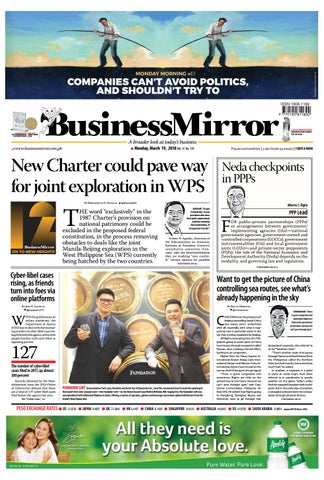
fundador café Tycoon Andrew Tan’s sons, Kendrick and Kevin Tan of Emperador Inc., lead the ceremonial toast to mark the opening of the brand’s first-ever concept store—the Fundador Cafe—at the Venice Grand Canal Mall in McKinley Hill, Taguig City. The Fundador Café was conceptualized with millennial Filipinos in mind, offering a variety of cupcakes, gelatos and beverage concoctions spiked with flavors from the brand’s finest liquor line.
PESO exchange rates n US 52.0730
oncerns over the prospects of Beijing controlling South China Sea routes aren’t unfounded after all, especially with what is happening now in particular paths in the sky that is being regulated by Beijing. All flights emanating from the Philippines going to some parts of China have to pass through a waypoint called Noman, thus, creating a funnel effect, leading to air congestion. Flights from the Ninoy Aquino International Airport (Naia), Clark International Airport and Mactan-Cebu International Airport have to wait on the tarmac until China gives the go signal. “There is grave congestion and sometimes flights are held on the ground one to two hours, because we can’t pass through gate,” said Capt. Dexter Comendador, Philippine Air Asia CEO. He added that flights going to Hongkong, Shanghai, Macau and Shenzhen have to go through that
designated waypoint, also referred to as the “Southern Gate.” “There’s another route that passes through Taiwan and South Korea [from the Philippines] called the Northern Gate, but that’s too far; [consumes] too much fuel,” he added. In aviation, a waypoint is a point or place on aerial maps, most often referred to in coordinates to specify position on the globe. Today’s pilots find the waypoint’s location with a computer. But in the early days of aviation, a navigator onboard does the computation through physical devices. Continued on A2
n japan 0.4897 n UK 72.5846 n HK 6.6407 n CHINA 8.2400 n singapore 39.6535 n australia 40.6065 n EU 64.0758 n SAUDI arabia 13.8854
Source: BSP (16 March 2018 )
A2 Monday, March 19, 2018
BMReports BusinessMirror
New Charter could pave way for joint exploration in WPS Continued from A1
amendment of the current provision, as it “binds the hands of the government to come up with a compromise to peacefully settle the overlapping claims in the West Philippine Sea.” “If you say ‘exclusively,’ if you interpret it strictly, there is no commercial compromise with China on the West Philippine Sea,” Aguilar said. “It says ‘exclusively,’ so any president who does that could be violating the Constitution, if interpreted strictly.” Article XII Section 2 on National Economy and Patrimony states that: “the State shall protect the nation’s marine wealth in its archipelagic waters, territorial sea, and exclusive economic zone, and reserve its use and enjoyment exclusively to Filipino citizens.” Aguilar noted that they are open to all options, including retaining the provision, removing the word exclusive or removing the whole sentence. Removing the word exclusive would make the provision general, since there is another constitutional provision that allows the president to go into production sharing with the concurrence of Congress. “Either we keep it as is, or we revise the language, or give the leeway to government, or to the president with the concurrence of Congress to enter into various agreements with various countries,” he said. Asked if the removal of the word exclusive would soften the country’s stance on its ownership of the WPS, Aguilar said: “It will. That’s why we need to be very, very careful. That’s why we need to listen to experts, aside from the fact
Cyber libel. . . Continued from A1
Of the 127 cyber-libel cases, 38 have been dismissed for lack of evidence. The number is almost 274 percent higher compared to the 34 cyber-libel cases filed in 2016. In 2015 80 cyber-libel cases were lodged with the DOJ, 31 of these cases already dismissed. Libel is one of the cybercrime offenses punishable under Republic Act (RA) 10175, or the Cybercrime Prevention Act of 2012 . Section 4 (c) (4) of RA 10175 renders unlawful or prohibited acts of libel those mentioned under Article 355 of the Revised Penal Code (RPC), as amended, if such acts are committed through a computer system or any other similar means that may be devised.
that we have legal luminaries in the committee. We need to get as many opinions as possible.” Foreign Undersecretary Manuel Antonio J. Teehankee also reported to the subcommittee last week the research and recommendations of the 1999 Preparatory Commission on Constitutional Reforms, which was mandated to focus on economic provisions. Teehankee said in an interview that the recommendation is to encourage general direction and leave details to the legislature to craft good governance principles by sector. “Based on the research of the constitutions across the region, that is how economic policy-making is done through legislation because it must address specific circumstances from time to time,” he said. Maritime law expert Jay L. Batongbacal, director of the University of the Philippines Institute for Maritime Affairs and Law of the Sea, stressed that the exclusive reservation and use of the nation’s marine wealth to Filipinos and the restrictions on equity and ownership of natural resources development “make it difficult for another country to control any activity concerning natural resources.” Batongbacal said he is also open to a joint exploration as a recommended way to address maritime disputes, provided that “there should be safeguards to protect our own national interest.” “Now with the current system, my view is it is actually possible to work out some kind of agreement and arrangement that will allow joint exploration and joint development, but that arrangement, of course, will necessarily incorporate the minimum protections
that are present in the Constitution,” he said. However, Batongbacal noted that the assumption worldwide is that joint exploration and development should only be conducted by countries that are in a legitimate dispute. But because of the arbitral ruling on the WPS, China’s claim on Philippine resources should be considered illegitimate. “This joint-development agreement, joint exploration really, should be clearly seen as a political accommodation—not a legal arrangement—because if it’s a legal arrangement, then that has a series of implication on our sovereignty and jurisdiction over the area. We are basically giving up something,” he said. Batongbacal pointed out that the current Constitution allows for foreign partners, but under the sole and direct control of the state, which is the essence of entering into service contracts. But it is a different case with China since it also wants to control basically the exploration and development of natural resources in the WPS. “No, it’s not that we’re discriminating against China, it’s that China is the one laying a claim—sovereignty rights—over our resources. The [other] countries, they do not,” he said. He also doubted that Beijing would agree with joint exploration and development, as this would mean that it is basically accepting that the Philippines owns these resources, and that it is going to do this activity under Philippine sovereignty and control, which is like conceding its claim. Critics, such as Supreme Court Senior Associate Justice Anto-
nio Carpio, also said that China will have to recognize the Philippines’s exclusive economic rights to exploit resources in its exclusive economic zone if it wants to enter into a joint deal. O n M a rc h 6 P re s ide nt i a l Spokesman Harry L. Roque Jr. said China and the Philippines are far from reaching a deal on joint exploration in the disputed South China Sea. “I had lunch with the Chinese ambassador and [he said], ‘We hope the Philippines will not do that because right now the status quo is serving us very well. We want bilateral talks ahead of unilateral action on the part of the Philippines,’” Roque said in an interview with CNN Philippines’s The Source. “So I don’t know where we are.” Previously, Malacañang announced a possible joint exploration deal with China in two areas under Service Contracts 57 and 72. SC 57 covers undisputed waters in offshore Northwest Palawan, while SC 72 covers the Reed Bank located within the country’s exclusive economic zone, but also claimed by China. However, the Palace clarified that there will be no coownership in the proposed joint exploration following Duterte’s statement that that the best option to handle the issue was through the joint-exploration deal. China refuses to recognize a 2016 international arbitral ruling recognizing the Philippines’s rights over contested areas in the South China Sea. Despite the ruling, Duterte chose to instead repair diplomatic and economic ties with China, in line with his foreign policy to deviate from the Philippines’s traditional ally, the United States.
Under Article 355 of the RPC, the crime of libel is committed when a person makes, against another, a public and malicious imputation of a crime, or of a vice or defect, real or imaginary, or any act, omission, condition, status or circumstance tending to cause the dishonor, discredit or contempt of a natural or juridical person, or to blacken the memory of one who is dead. In an interview, Office of Cybercrime-OIC Director Jed Sherwin Uy acknowledged that prior to the enactment of RA 10175, the DOJ is getting only few libel complaints. “But with the enactment of the Cybercrime Law with specific provision on cyber libel, the number of complaints being filed either with the National Bureau of Investigation and the Philippine National Police [PNP] increased,” Uy said. While the DOJ does not entertain
cyber-libel cases, Uy noted that the government prosecutors are still the ones tasked to conduct preliminary investigation and prosecute such cases. He pointed out that complainants of cyberlibel belong to different social status in life, with no age group in particular. However, usual suspects in cyber-libel cases are those known to the complainant. “Usually complainants suspect that authors of these libelous posts are people they somehow know because the information is so nonpublic, in a sense that only people close to them or known to them would have such information,” Uy noted. Uy said one of the challenges that the investigators encounter pertains to the identification or attribution and authentication of the online account that is the subject of the complaint.
“If there is specific denial, it requires authentication. So either we request the platform concerned like Facebook or Twitter, we request for information with respect to the subscriber who uploaded the supposed article, or we apply for search warrants depending on the IP address of the uploader,” Uy explained. But it the offense is committed through online platform based in the United States, Uy admitted this would make the investigation more difficult owing the First Amendment under the US Constitution, which prohibits Congress “from making any law respecting an establishment of religion, prohibiting the free exercise of religion or abridging the freedom of speech, the freedom of the press, the right to peaceably assemble, or to petition for a governmental redress or grievances.” In this case, Uy said prosecutors would rely on other forms of evidence, such as testimony from witnesses attesting or authenticating that the respondent is the real owner of the account. When asked whether the cyber-libel provision is still relevant considering calls from various sectors to decriminalize libel, Uy said it has been the position of the DOJ Cybercrime Office that the said provision should have not been included anymore in the Cybercrime law. “We want the cybercrime law to focus on heinous crimes, such as online child abuse, to be part of cyber offenses under the law,” he said. “With respect to libel being a crime, there have been different schools of thought and different positions wherein it would be better to decriminalize libel, either because it is easier to prosecute the civil action or it is somehow better in a sense it would declog the dockets of the courts,” he added. But, Uy advised netizens to be responsible in posting anything online even if libel will be eventually decriminalized in the future. “Whether it is considered a crime or be decriminalized, it is the social responsibility of every individual to respect the right of the people. We need to strike the balance between the freedom of expression and the right of individuals. So if you think the context would be harmful and not true, we should not be writing such thing even if we may not be liable civilly or criminally,” Uy said.
www.businessmirror.com.ph
Want to get the picture of China controlling sea routes, see what’s already happening in the sky Continued from A1
Comendador said Noman was the agreed name for the aerial boundary between the Philippines and China. “The flight information region, or FIR, between the Philippines and China has been designated Noman during air talks with Hong Kong. It specifies that all traffic from the Philippines will only pass through that gate, for security reason.” He noted that Noman is near Hong Kong and Taiwan, which used to be airways “Amber 61.” The name on the aerial map on Philippine FIR before is called “Abalone.” Civil Aviation Authority of the Philippines (Caap) air controllers said the change was suggested by China sometime in 2004 or 2005. Taiwan remains an independent country, but China considers it a renegade province. China decided to screen all incoming flights to China from the southern backdoor “in order to screen possible military attacks from Taiwan directed at China,” he noted. Naming of waypoints is a random process. The boundary between the Philippines and Hong Kong include names, such as Grupa, [grouper or lapu-lapu]; whale, Sabno, Conga and Monta. While some Philippine names include Mumot, Mikin and Souse. At other times, names are adopted from geography or familiar names in specific countries, such as dalag [snakehed] and lapu-lapu for the Philippines. Technically, the aerial boundary between two adjacent countries is called FIR. Specifically, Noman is between the Philippines and Hong Kong FIR at latitude 20000 North, longitude 1164018 East. According to the AirAsia top executive, the bilateral agreement was between the Civil Aviation Authority of China [Caac] and their counterpart, the Caap. The BusinessMirror asked if pilots from Philippine carriers complain to the Caap about the excessive delays. “Yes, we do,” he said, “but I think China and the Philippines have to agree on a redesign of the highway to create more gates to enter China, maybe thorough the southeastern door.” At this point of the interview, Comendador whipped out his smartphone and showed what appears to be a map showing the Philippines, Hong Kong, Taiwan and part of mainland China, like someone looking down from the sky. The map was crawling with hundreds of airplanes. “There, look at how many airplanes are flying near Hong Kong and Taiwan through that single gate on peak hours, it is very full.” Asked if the Caap has forwarded the Philippine air carriers’ complaint to its Chinese counterpart, Comendador said “probably not.” “Hindi pa yata,” he hedged, “I’m glad you mentioned that because the airlines should push the Caap to talk to China and designate additional door or official waypoint.” He explained how flights from the country suffer as China will say, through the air-traffic controllers of the Caap: “Don’t start your engines, because you [naming specific flights] should pass Noman later on.” And because passengers are actually the ones who suffer, waiting inside an airplane, ready to take off but sitting on the tarmac for hours, Comendador cited incidents where Chinese tourists have started to complain to their embassy.
PCCI. . .
Continued from A16
of the Philippines in a recent interview with the BusinessMirror. (See, “Groups cry foul over planned closure of Boracay,” in the BusinessMirror, March 17, 2018.) The closure, the PCCI pointed out, “will negatively impact on the country’s economy. As of 2017, the tourism industry has been the third-biggest contributor to the country’s GDP, and 20 percent of the total income generated by the industry comes from Boracay.” Citing DOT statistics, the largest aggregation of businesses across all industries, noted that over 2 million local and international tourists visited Boracay last year, up 16 percent from arrivals in 2016. Tourism jobs on the island also accounted for 66 percent of the employment in the Western Visayas region, it further quoted the DOT. PCCI President Ma. Alegria Sibal-Limjoco said she would meet
“We were called by the Chinese Embassy because a lot of Chinese passengers were complaining about the delays,”he said,“because apparently, the Chinese envoy is not aware that it was their superiors who were the source of discomfort.” “We explain to them the delays were caused by their own country. We told them the gate is full, that it’s beyond our control.” The captain said the envoy would reply: “Okay, well talk to our authorities in China, and yet so far, nothing has come out of it.” Comendador provided the answer. He said: “the Caac is independent of the political government and the Communist party.” “So it’s like talking to co-equals,” he laughs, “that’s where the problem lies. Their embassy is politically part of government, talking to the technical part of government. The result depends on whether they will work on the suggestion or not.” Furthermore, the military plays a significant role in the arrangement of airspace in China. “In fact, any change in the civil airspace requires the approval of the military,”according to a research paper called “An Investigation of Airspace Congestion & Possible Air Traffic Management Integration in the Pearl River Delta Region of Southern China.” The authors do not specifically refer to Noman as the source of traffic, but the Aviation Policy and Research Center, University of Hong Kong, Shatin, New Territories, were studying solutions to solve the air-traffic congestion at the Pearl River Delta (PRD) region. PRD has one of the busiest air-traffic environments in Asia. The region consists of a multi-airports system, which includes five major airports: Guangzhou New Baiyun International Airport, Hong Kong Chek Lap Kok International Airport, Macau International Airport, Shenzhen Baoan International Airport and Zhuhai Airport. “These airports vary in sizes and business models. All of them [especially Guangzhou, Hong Kong and Shenzhen] have been facing serious capacity constraint and congestion in recent years,” the study said. Their proximity (Guangzhou Airport is about 140 km from Hong Kong, while the other three are less than 60 km from Hong Kong) and respective airspace arrangements create tremendous operational complexities. In this connection, Comendador said Philippine carriers have no choice but to suffer and obey the current edict. “It would have been good if they added another door, but if not, we’ll follow the official pronouncement and just try to manage the delay, even if it’s two hours. Air Asia gives passengers water while waiting.” Philippine Airlines First Officer Capt. Giancarlo Villanueva said: “We have to wait for the clearance even before we could start our engines at the Naia,” he said. “Sometimes the wait last from one to two hours,” he added, which is reminiscent of the slotting process the Naia adopts to lessen the congestion at the premier airport. The supervisor on duty at the Caap area control center said specially affected are flights going to Shanghai via Pudong Airport and those headed toward Xiamen. “Somestimes Xiamen Air has to wait three hours before they are allowed to start engine,” the supervisor said. with Cimatu, Tourism Secretary Wanda Corazon T. Teo and DILG Officer in Charge Eduardo M. Año, to discuss the planned rehabilitation of the island because it will affect a lot of local livelihoods and jobs. “PCCI believes that the situation in Boracay is a wake-up call for the government and private sector on the need to work together to ensure that our islands and tourist destinations are protected and sustained through comprehensive master planning that enables the right balance between economic growth and environmental preservation.” She stressed, “PCCI is willing to spearhead and facilitate a dialogue between the local government of Malay, national government agencies, private sector and civil to support our agenda for inclusive business.” The Malay local government has already started cracking down on easement violators on the island and closed down a resort, which didn’t have the necessary government permits to operate.
www.businessmirror.com.ph
The Nation BusinessMirror
PCOO bats for effective ‘national branding’ to promote the country
T
he Presidential Communications Operations Office (PCOO) has started working with all government departments to come up with an efficient and allencompassing national branding to promote the Philippines globally, not only as a tourist destination, but as an education, culture and investment hub. “The national branding of the Philippines will serve as center for the entire nation and it is time that the country will be branded,” PCOO Secretary Martin M. Andanar said in Radyo Pilipinas interview last Saturday. Andanar added that the proposed national branding got approval from President Duterte when it was presented during the last Cabinet meeting. He explained that the new cam-
paign to promote the Philippines abroad is different from the “It’s More Fun in the Philippines” campaign of the Department of Tourism (DOT). “Meaning, this [proposed national branding] will not only promote tourism but we will promote our investment, education, our people and everything that we have here in the Philippines,” he said in a separate interview with dzBB. Andanar added that all state departments would be part of the big project to come up with a national branding similar to Australia’s “Australia Unlimited” and Africa’s “It’s Time for Africa.” “This is good for our country if it will be pushed through. It is all encompassing because all departments are members, parts of this national branding project,” he said. PNA
Editor: Vittorio V. Vitug • Monday, March 19, 2018 A3
Esperon: Economic devt, security are linked
A
By Rene Acosta
@reneacostaBM
chieving and sustaining economic development may be an uphill battle unless the country’s security problem is addressed, National Security Adviser Hermogenes C. Esperon Jr. said, noting that economic growth and national security are closely linked. “Economic development and security are inextricably linked and are mutually reinforcing concept. Therefore, armed conflict is undoubtedly a development issue,” Esperon said last week during a security forum.
“Armed conflict remains a deepseated problem in the country and poses a detrimental effect on the socioeconomic realities confronting the Filipino people,” he added. Esperon said the problems of terror-
ism and insurgency posed by lawless Moro groups in Mindanao and the New People’s Army (NPA) were undermining the efforts of the Duterte administration to build a strong economy that is capable of sustaining “Filipino livelihood and national endeavors.” He added the “communist rebellion” being waged by the NPA and the Communist Party of the Philippines has taken an “estimated 30,000 lives since the 1960s.” Esperon said that the rebel group is also undermining business in Mindanao through its forced collection of so-called revolutionary taxes. “Our intelligence sources show that the NPA is earning up to P1 billion from money extorted through revolutionary taxes from agricultural and mining companies in Eastern Mindanao alone,” he said. On the other hand, extremist
groups, such as the Abu Sayyaf Group, the Ansar-Khilafah Philippines, Maute Group and the Bangsamoro Islamic Freedom Fighters “have the capacity” to inflict violent attacks, such as the Marawi City rebellion. “As a result, social, political and economic institutions can be destabilized,” the national security adviser said. He added that as shown by the Marawi rebellion, the threat of violent extremism and radicalization affects political and economic stability. President Duterte’s chief security adviser said that while inclusive growth necessitates that the government builds and capacitates national and local political institutions to “better implement the rule of law” and to provide a conducive environment for investors to do business in the country, this effort is being stymied by security concerns.
Economy
A4 Monday, March 19, 2018 • Editors: Vittorio V. Vitug and Max V. de Leon
BusinessMirror
Con-com still considering proposals on how much foreigners could own By Bernadette D. Nicolas
T
@BNicolasBM
HE Subcommittee on Economic Reforms (SER) of the consultative committee (Concom) is deliberating on whether to put a specific number, especially on the limitation of foreign ownership and foreign enterprises, in its proposed economic provisions of a new Charter. SER Chairman Arthur N. Aguilar told the BusinessMirror they have not decided yet but are considering proposals. Either we craft general guidelines and leave the prerogative of placing the numbers to Congress or to put a number and let Congress amend that figure by law, Aguilar said. He explained that placing a fixed number would tie the hands of Congress and that the economy might have different wants and needs through time. “[I]f you handcuff Congress right from the start with a fixed number, you can’t do anything unless you amend the constitution so but then constitutions don’t place a number, they just have general guidelines and leave the rest to Congress, from time to time [Congress] respond[s],” Aguilar said. Sans a specific number, Congress would have the key to unlock the handcuff because they can amend it by simply passing a law instead of going back to change the Constitution and undergo charter change, he added. According to the Constitution, ownership of public utilities is restricted to at least 60 percent Filipino capital. Exploration, devel-
opment and utilization of natural resources through co-production, joint venture or production-sharing agreements with Filipino citizens or corporations or associations limit foreign ownership to 40 percent. Under Article XII, Section 10 of the 1987 Constitution, “Congress shall, upon recommendation of the economic and planning agency, when the national interest dictates, reserve to citizens of the Philippines or to corporations or associations at least sixty per centum of whose capital is owned by such citizens, or such higher percentage as Congress may prescribe, certain areas of investments. Aguilar also believes that limitation on foreign ownership is not the sole determining factor affecting foreign direct investments. “In our discussion on the limitations of foreign ownership, it was brought out to us by our experts that ownership is not the only determinant for the attractiveness of a country,” Aguilar told reporters in a separate interview. “It has to do with consistent policies; it has to do with labor, energy, peace and order, and incentives of course. And ownership is just one of the factors.” Foreign Affairs Undersecretary
Manuel Antonio J. Teehankee also said in an interview other constitutions don’t contain specific regulations with regards to limitation of foreign ownership. “These restrictions can be more appropriately dealt with by [a] sector, specific to each sector, specific to the needs of economic policy makers,” Teehankee said. “Based on the survey of constitutions across the region, the general practice is to regulate through specific laws of various sectors not addressed in the specific regulations in the Constitution,” he added. Aguilar said that they also took up some principles during the subcommittee’s session, especially on liberalization of economic policies. “When we are liberalizing especially the economy to foreign enterprises, we have to really; one, it has to be on the basis of what is best for the people in general. Two, we have to ensure that Filipino enterprises don’t also get wiped out especially the SMEs, the small and media scale businesses,” he said. “[SMEs] have to have some element of protection otherwise they’d get wiped out.” Aguilar explained the Con-com members’ discussion sessions on liberalization of trade and the economy were marked by an awareness of its elements. “We were conscious of trying to balance liberalization on one side and the interest to make sure that it [liberalization] is for the welfare of the people and to balance it out for some sectoral interests of our economy especially small- and medium-scale enterprises.” On liberalization of ownership of land and enterprises, Aguilar said they will also try to see if they can use a constitutional language that will make it a constitutional imperative for government to be efficient and speedy in processing of business permits and enterprises so
that the growth of businesses will be enhanced and not hindered. There were also discussions that there might be some point in time that the either the president or congress might see the need to form a state-owned corporation to handle a certain type of business or sector. “[I]f that will be so, the corporation or the state-owned enterprise that is envisioned would act like a private corporation and be governed by corporate governance rules and not necessarily by all the other government restrictions,” he said. Foreign ownership of land was also discussed during the meeting. On residential land, Aguilar is also proposing that foreigners who are permanent residents and who need a home will be allowed to own land subject to size limitation prescribed by law. “So if you’re really a legitimate foreigner and a permanent resident not just a tourist, then you really a need a home so you can own the land that you live in but subject to size limitation so it’s not abused and there’s no land-banking, there’s no land speculation,” he said. Under the current rules, no foreigner can own land as an individual and if you are a corporation and you want to own land, you have to be at least 60-percent Filipino-owned. For commercial and industrial and agricultural lands, he said they are still discussing whether they free ownership aside from the 50-percent limitation or just liberalize the term ‘horizon.” “There’s discussion that from now it’s 50-50; we can stay with 25-25, the lease period, or 50 plus another 25. That’s where the discussion is but we have not finalized it.” A comprehensive land-use code is also being proposed to the subcommittee. This code is expected to flesh out the federal policy on the use of land applicable to all regions.
www.businessmirror.com.ph
DOF sticks with move to rationalize tax perks
T
HE Department of Finance (DOF) has dismissed critics’ claims reforming government provision of incentives will drive away businesses that are already operating, or planning to operate, in the Philippines. Businesses have other concerns than tax perks, according to Finance Undersecretary Karl Kendrick T. Chua. Chua said investors cited four more important and pressing concerns than tax perks that they want the Philippines to address for them to bring in more investments. These concerns are infrastructure gap, inefficiency in delivery of government services, corruption and the high cost of doing business in the country. Chua cited the results of the 2017 World Economic Forum (WEF) survey as bases for his view. He added that tax rates and incentives only ranked fifth among the concerns raised by investors based on the survey. “That the government will put ‘a stop to current incentives’ is a misconception of the proposed modernization of fiscal incentives. This is simply not true,” Chua said. “Incentives will remain to be granted, but more judiciously this time so that there is a better balance between the investment and fiscal sustainability goals. The DOF recognizes the role of incentives to encourage investments.” The DOF earlier announced the Duterte administration is pushing for income tax reforms in the corporate sector to level the playing field of business and make it more equitable, transparent and accountable. This, the DOF has said, could be achieved by removing perpetual tax holidays the department said is only enjoyed by only a select group of investors. The DOF has said such practice is unfair to smaller enterprises that pay regular tax rates. Chua made it clear that far from removing all fiscal incentives for businesses, the Duterte administration merely wants to harmonize and modernize such perks under Package 2 of the Comprehensive Tax Reform Program (CTRP) to ensure these are
“targeted, time bound, transparent and performance-based.” The paramount objective of the Tax Reform for Acceleration and Inclusion (Train) plus the other CTRP reform packages, alongside making taxation simpler and more equitable, is to raise sufficient revenues for the Duterte administration’s ambitious “Build Build Build” infrastructure buildup and other priority programs for inclusive growth, according to Chua. On top of modernizing tax incentives, he said the government must tackle the “real issues” raised by investors in the WEF survey, along with improving human capital, investing in infrastructure and relaxing foreign ownership restrictions to attract more investments. Chua said “a proper cost benefit analysis is now being done to determine the fiscal incentives that should be given to certain businesses.” “Rather than provide incentives in perpetuity to only a select set of industries without any accountability, the government must address the more urgent concerns of modernizing infrastructure and investing in education and health to give all businesses, whether local or foreign, and whether large or small, a level playing field,” he added. Chua said that given the consultative approach of the DOF in pushing for tax reform, it looks forward to the inputs of the various sectors on the department’s proposal to reduce the corporate income tax complemented by modernization of fiscal incentives. The latter two comprises Package 2 of the CTRP. “Incentives should not be used as a band-aid solution,” Chua said. “This is what the country has been doing for 50 years so it is high time to change this misguided policy.” Chua said incentives will still be provided to business activities so long as they qualify in the 3-year Strategic Investment Priorities Plan (SIPP) and adhere to the key principles of being performance-based, time-bound, targeted and transparent. Rea Cu
Neda exec: Daunting data monitoring task crimps PHL ability to meet SDGs
T
HE Philippine Statistics Authority (PSA) needs to increase the frequency of release and develop data for over half of the Sustainable Development Goal (SDG) indicators that are applicable to the local setting. In a recent forum, National Economic and Development Authority (Neda) Agriculture, Natural Resources and Environment Staff Director Nieva T. Natural said this makes meeting the SDGs a daunting task. Natural said of the 233 indicators that are applicable to the Philippines, only 103 indicators can easily be monitored since these will be drawn from regularly conducted surveys. “The challenge extends beyond these indicators as many of these data require further disaggregation; that is by income, by sex, age, race, ethnicity, migratory status, disability, and geographic location as basis in establishing baselines, developing and implementing targeted policies to address the wellbeing of the most vulnerable and marginalized population across sectors,” Natural added. The United Nations Statistics Division (UNSD) has set a Tier Classification for Global SDG Indicators. The 103 indicators for the Philippines are considered Tier 1 indicators, which are conceptually clear and have internationally established methodology and standards. The UNSD said these data are also regularly produced by countries for at least 50 percent of countries and of the population in every region where the indicator is relevant. However, Natural said around 130 more indicators are considered
Tier 2 and Tier 3 for the Philippines. Monitoring these indicators can be difficult since not all the data are produced regularly, if they are available at all. There are 59 indicators that are considered Tier 2 for the Philippines. These can be monitored using existing data but the frequency of the data collection is not regular. Natural said the Philippines classifies 71 indicators as Tier 3. According to the UNSD, “no internationally established methodology or standards are yet available for the indicator[s], but methodology/standards are being (or will be) developed or tested.” “To ensure that our resources are maximized and all sectors will be accounted for, we suggest to emphasize the data, strengthen the data collection availability and accessibility (especially) the social, economic, and environmental dimensions of the SDGs,” Natural said. Natural said among the most important SDG indicators that need to be prioritized are the environment and natural resources (ENR) statistics. She said four goals in the 17 SDGs are related to the environment and natural resources. Most of the indicators in these goals are not generated by the Philippine Statistical System (PSS). Based on the preliminary baseline data submitted by the Philippines, data gaps exist in Goal 12 on ensuring sustainable consumption and production patters, particularly the indicator on hazardous waste generated per capita and proportion of hazardous waste treated. Data gaps also exist in Goal 15
particularly on the Progress towards sustainable forest management; Forest Cover Change (from close to open forest); Red List Index; proportion of traded wildlife that was poached or illicitly trafficked; and progress towards national targets established in accordance with Aichi Biodiversity Target 2 of the Strategic Plan for Biodiversity 2011 to 2020, among others. Apart from addressing data gaps, Natural added that there is a need to harmonize the data generated and released by line agencies to “ensure data consistency.” “Having standardized metrics of measuring achievements of our goals and targets will ensure data consistency that we can use for informed policymaking. This is to facilitate a more effective and coherent process of analyzing historical trends and projecting future scenarios that will aid us in development planning,” Natural said. Based on PSA’s latest information on the SDGs, of the Tier 1 indicators, the bulk of the data or 67 percent will be sourced from the surveys and administrative data of other government agencies. The PSA said some 32 percent will be sourced from PSA surveys, census and administrative data and one percent will be sourced from the data of International Agencies. The SDGs or Global Goals is a set of 17 socioeconomic goals that 193 UN-member countries like the Philippines committed to meet by 2030. The goals are composed of around 169 targets and over 300 global indicators. The SDGs were adopted in September 2015. Cai U. Ordinario
PACE OF GROWTH
This March 18 photo shows people at a store selling footwear in Quiapo, Manila, a centuries-old district known for inexpensive products frequented by rich and poor buyers alike. The country’s gross domestic product is expected to continue on its steady growth pace on stable rate of consumption. ALYSA SALEN
Schools asked to cut entrance-exam fees
C
OLLEGE and university administrators were asked over the weekend to lower expensive entrance examination fees, currently ranging from P500 to P1,000, for students seeking to enroll in major universities. Senate President Aquilino Pimentel III aired his appeal after “concerned parents aired complaints bewailing prohibitive” rates currently being charged to allow college-level students to take the tests. Pimentel said these high school graduates would understandably seek options in going to college and their parents would want them to be given opportunities.
“But if applying at one school requires a P500 fee, then applying to four, five schools can be quite expensive,” he said. In a statement released on Sunday, the Senate President notes even large state universities like the University of the Philippines (UP) and the Polytechnic University of the Philippines (PUP) charge rates similar to private schools—but have thousands more applicants. For instance, Pimentel, who studied law in UP, cited estimates that some 80,000 students apply to UP annually, while about 60,000 take the PUP college entrance exam every school year.
“Even assuming these schools only charge half of the applicants the full rate, this means that, conservatively, UP and PUP earn something like P20million and P15-million, respectively, on entrance fees each year. Does it really cost that much to administer these exams?” he wondered. Pimentel said he is proposing that Philippine educators should work together with the Department of Education (DepEd) to “come up with a standardized test for K-12 graduates acceptable to all tertiary education institutions—a single test that will eliminate the need for schools to administer their own entrance exams.”
Butch Fernandez
Agriculture/Commodities BusinessMirror
www.businessmirror.com.ph
Editor: Jennifer A. Ng • Monday, March 19, 2018
A5
Q1 palay output expected to remain above 4.5MMT
T
By Jasper Emmanuel Y. Arcalas @jearcalas
HE country’s palay production in the first quarter could still remain above the 4.5-million metric ton (MMT) level and higher than the previous year’s output, despite the detrimental effects of pests and typhoons, the Philippine Statistics Authority (PSA) said.
In its report, titled “Updates on January-March 2018 Palay and Corn Estimates,” the PSA revised downward its production forecast for the first quarter to 4.59 MMT, from 4.67 MMT it projected in January. “This may be higher by 3.8 percent from the previous year’s output of 4.42 MMT,” the PSA said in the report published recently. The PSA said it reduced its projection following reports of typhoon damages and pest infestations in some rice-producing provinces of the country. “The possible factors contributing to the decrease of palay output may be due to effects of typhoons Urduja in Capiz and Vinta in Zamboanga Norte and Zamboanga Sibugay last December 2017,” it said. “Lower y ield in Mindoro Oriental and Leyte resulting from occurrence of rains during the reproductive and maturing stages of palay and rice-bug infestation in Tarlac and Iloilo,” it added.
Due to these reasons, the PSA now projects that total palay area harvested in the Januaryto-March period “may contract by 547 hectares from the 1.0192 million hectares.” Meanwhile, average palay yield in the first quarter would settle at 3.85 MT per hectare, slightly lower than the 3.92 MT per hectare projected yield in January, the PSA said. The report noted that about 223,780 hectares, or 18.77 percent, of the updated standing crop for the January-to-March period have been harvested. The PSA added that around 619,520 hectares, or 68.1 percent, of the farmers’ planting intentions for the second quarter have materialized. “Of the [1.587 million] hectares standing palay crop, 46.9 percent were at vegetative stage; 31.7 percent, at reproductive stage; and 21.4 percent, at maturing stagem,” the report read. In the same report, the PSA also reduced its corn-output forecast in the first quarter
Greenpeace: Illegal fishing remains a big challenge By Jonathan L. Mayuga @jonlmayuga
I
LLEGAL-fishing activities continue to pose a big challenge to Philippine authorities. Environmental group Greenpeace Southeast Asia-Philippines said illegal-fishing activities threaten the country’s food security, citing a new report from the Bureau of Fisheries and Aquatic Resources-Fisheries Protection and Law Enforcement Group (BFAR-FPLEG). The law-enforcement arm of BFAR reported that over the last two years, it has recorded a total of 649 apprehensions related to the unabated illegal and unregulated fishing in various parts of the country. During the two-year period between 2016 and 2017, the highest recorded violations were unauthorized fishing, the intrusion of commercial fishing vessels in municipal fishing grounds, dynamite fishing and the use of illegal and active fishing gears, such as hulbot-hulbot and bottom trawling. Worse, Greenpeace Southeast Asia-Philippines said employment of unlicensed fishers remains rampant. “Even years after the amended fisheries law was enacted, destructive and illegal commercial fishers continue to rob poor Filipinos of livelihood and cheap sources of protein. Data coming from the BFAR is very disturbing and shows that illegal fishing is a continuing threat to the country’s overall food security, and may defeat the efforts of
various stakeholders to pursue sustainable seafood and fisheries,” Vince Cinches, oceans campa ig ner for Greenpeace Sout heast A sia-Phi l ippines, said in a statement. “What is worse is commercial fishers are not just profiteering from unsustainable fishing practices, but also making hefty profits through unfair labor practices by employing unlicensed fishermen,” Cinches added. Cinches urged the Duterte administration to prioritize the full enforcement of the Philippine fisheries law and take out identified threats to the people and the Philippine seas. Cinches said the Duterte administration must be able to “tilt the balance in favor of small, decentralized and sustainable production of our food, and prevent fish from disappearing from our table or, at the very least, from the plates of the majority of people who depend on the sea for sustenance.” The BFAR-FPLEG report was presented at the recently conc luded Sustainable Seafood Week organized by Greenpeace, together with Meliomar, RARE and other civil-society organizations, as part of the effort toward developing a National Food Policy and part of a global movement “to allow our oceans to recover for a climate-resilient, green and peaceful future.” “It is our fervent hope to make sustainable seafood a norm, instead of a niche; not just an event, but a movement. That’s what we are working on, to make it accessible to everybody,” Cinches said.
to 2.46 MMT, from the 2.49-MMT projection in January. “This may be higher by 4.1 percent from the previous year’s output of 2.37 MMT,” it said. “Harvest area may decline by 0.1 percent from the 720,210-hectare
level. Likewise, yield per hectare may drop to 3.42 MT per hectare, from 3.45 MT per hectare,” it added. The PSA said it cut its cornproduction projection following the effects of typhoons Urduja
a nd V i nt a i n cor n- produc i ng provinces, such as Cebu, Zamboanga del Sur and Zamboanga del Norte. The PSA said planthopper infestation in Ifugao and continuous rains in Isabela, Negros Oriental
and South Cotabato reduced the total possible corn output in the said areas. “About 150,810 hectares, or 20.9 percent, of the updated standing crop, have been harvested,” it said.
Banking&Finance
A6 Monday, March 19, 2018 • Editor: Jun B. Vallecera
BusinessMirror
www.businessmirror.com.ph
Crypto-powered PHL as next fintech hub
T
OKYO—Global experts in the field of cryptocurrency, blockchain technology and financial technology (fintech) believe that the Philippines is at the cusp of being crypto-powered and could soon be the next fintech hub in Southeast Asia. The first-ever Philippines-Japan Forum on Investments and Cryptocurrency held here recently and organized by the NOAH Foundation, gathered together thought leaders in these new technologies from the Philippines, Australia, the United States and Japan in an effort to make more people understand cryptocurrency, blockchain technology and fintech. NOAH Foundation Director Josef Werker said the forum has become necessary in the light of heightened excitement on these new technologies and the need to educate the public about them. “We felt that this is the perfect opportunity to bring together experts to become our knowledge partners so they could best share how cryptocurrency, blockchain technology and fintech impact the way people live right now, and more important, how they could affect the way we do things in the future,” Werker said. Cryptocurrency and blockchain, technology expert Miguel Antonio Cuneta, cofounder and chief community officer of Satoshi Citadel Industries ( SCI ), said that Bitcoin and blockhain technology is the Internet of money, citing it is going to do for finance and governance and banking what the Internet did for telecommunications, media and publishing. “Bitcoin is a technology platform and more than just a currency. It is not an investment scheme and definitely not a get rich quick scheme. It’s a new kind of technology and when technology becomes successful it becomes a utility you just use it. So, technology happens when people have a problem and they want to solve it,” he said.
Explaining further, Cuneta cited the problems that Bitcoins address. “The double spending problem is a very long standing computer science problem, which arose when we started using the digital world and we wanted to transact with each other. So, when you send something digitally, you can copy this digital thing in unlimited number of times identically and no one would know copy A from copy B. [The] problem is when you send digital money, how will you know it’s not fake? So the solution was a centralized third party to verify transactions,” he said. He added that SCI has development remittance platforms, mobile money, exchange platforms and payment platforms using the technology which is not limited to making money, trading or regulating. Ron Hose, founder and CEO of Coins.ph said that banks can take advantage of this new technology simply by innovating. “The future of banking is really moving toward connecting consumers directly with financial services. We are not displacing the existing financial institutions, we are working with them to increase their reach into more consumers. We have done quite well, we have over 3 million registered customers. We partner with many other prominent players,” he added. Hose said that the essence is driving convenience and inclusion and the idea that every person deserves to have the same quality of services. On the banking front, Justo A. Ortiz, chairman of digital banking leader UnionBank explained that right now there is still a huge 99 percent non-digital transactions in the Philippines and the goal is to get to 20 percent by 2020. He admitted that there is still a huge gap between over the counter and digital mainstream of e-commerce, but he sees the shift to happen faster than expected. Ortiz said the Bangko Sentral ng Pilipinas has been very proactive such that while they have the regulatory mandate, they
also came up with agency banking. He added that they are working on a threeyear timeline with regards to blockchain technology, saying there is a lot of development, a lot of evolution that is happening very quickly. “I think it is important for people and organizations that are in mainstream activities like ourselves to get onboard even if it is just a learning experience because if you don’t do so, and quoting our [UnionBank] president Edwin Bautista, if you wait for the perfect environment to appear, you are going to meet perfect competition and so we can’t wait, we need to keep going,” Ortiz said. Ramon Vicente V. de Vera, head of Fintech Business Group at UnionBank, said the issue is that the legacy systems of banking have kept a lot of companies siloed saying it has precisely been designed for financial exclusion which is the great injustice. He added that this is financial exclusion at the highest order. “We are building a blockchain based network, we are going to onboard the rural bank into a blockchain network and there we will be able to send funds to each other real time. With that network, rural banks and their customers can now have access to universal banking products and services. At the same time, rural banks who are in those far-flung areas can now offer their counters their connected networks to banks and nonbanks. That is the vision we are trying to build,” de Vera said. More important, he said, blockchain would not only connect rural banks but would also make their processes more efficient. De Vera added that blockchain technology may be the answer to the survival of the rural banks, the number of which has gone down to 480 from 3,000. “It is good to know that blockchain technology is moving toward Asia, so now we are at the heart of innovation and opportunity,” he said. Lito Villanueva, managing director of Fintq and chairman of FinTechAlliance.ph, recalled that there were several instances in the past when he met with bank officials to discuss about fintech and he was told that fintech is a disruptor to the banking system. Fortunately, he was able to explain the system well and to date, from one bank partner three years ago, they now have more than 100 bank and nonbank partners. Fintq stressed that the story of financial inclusion would not be complete without considering our Muslim brothers in it. “This is the reason we are advocating a Shariah-compliant digital microfinance framework too, for our unbanked Muslim brothers,” he said. The problem of being unbanked, Villanueva added, is not just faced by the poor but even the low medium income class Filipinos and even 36 percent of the local government units in the country which do not have bank presence. Blockchain technology and cryptocurrency is now also being used in compensation and benefits, as explained by Judah Hirsch, founder and CEO of the start-up Salarium. “Blockchain technology gives us a way to
really engage our employees that very few companies have. It enables companies to compensate the employees the way they want to. So this is whether through traditional cash payments, we have also reimbursement for all of their expenses, we also have some rewards programs to enable companies to give them digital gift certificates, digital rewards programs. We also have Sal-Pay tokens. We have actually just completed the ICO ourselves and enabled some of our companies to now pay their employees through the blockchain and pay them in cryptocurrency,” Hirsch said. He added that they now focus on Sal-Pay, making the employees’ pay go further through e-banking services that would allow employees to digitally organize their finances. On the wellness front, Ildar Fazulyanov, founder and CEO of WELL, said that blockchain technology can actually save lives. “In the US alone, there are 250,000 deaths caused by medical error. If you extrapolate globally, that is 5 million deaths every year. If you add to that misdiagnosis or nontreatment arguably 40 percent to 50 percent of the population of the world is not treated,” he lamented. Blockchain technology could help the health-care industry significantly, he said, first by scaling trust. “Blockchain is based on trust and health care is one of those. In health care, one of the biggest problem is doctors hide their mistakes, and so it leads
to worst things. And with blockchain you can start working and solving these things,” Fazulyanov said. Rep. Seth Frederick P. Jalosjos of the First District of Zamboanga del Norte welcomed blockchain technology, cryptocurrency and NOAH Foundation’s interest in Mindanao. “Mindanao is the perfect platform for this. We are like a sponge, we are so open for ideas, so open for new technology, new ideas, new projects and development. Any talk for the progress of Mindanao is very much taken in,” Jalosjos said. This, he added, is the reason, instead of Mindanao pushing themselves in Imperial Manila, they want to start on a clean slate. “We are very hungry and very thirsty for something like this to come out of the most neglected islands of the Philippines. This will be a game changer in our country,” Jalosjos said. NOAH Foundation’s Werker said that the Crypto Token NOAH COIN, can be used when they travel to Dakak, as an initial resort in the NOAH pipeline. “When tourists visit Dakak, they need not worry about yen, peso or any fiat currency. They can use NOAH Coin to pay for everything, get discounts, freebies and special experiences that you can’t get if you paid in cash,” Werker said. Werker added that the NOAH COIN is inspired by the Hong Kong octopus card that allows tourists to many points of access to shop, transportation and entertainment. Jun Vallecera
Perspectives Smart travel: Can blockchain keep customers happy?
T
he start of a new year is always a busy time for booking holidays. As the excitement of the Christmas season draws to a close, consumers quickly turn their attention toward the next big event they can add to their calendars. With an influx of promotions from travel operators splashed across social networks and e-mail marketing campaigns, it’s clear that airlines and tour operators are hoping to cash in on the January sales by tempting consumers to travel abroad. Yet, even when they’re planned far in advance, unexpected occurrences can happen on the day consumers are booked to depart. In fact, in 2016 there were almost 450,000 flights delayed coming in and out of the United Kingdom alone. Flight delays and cancellations can quickly bring holidays to a grinding halt before travelers have even left the airport. The knock-on effects are costly, causing some passengers to miss their connecting flights to other destinations, having to pay late check-in fees for hotels, or even arriving to find that they’ve lost their room reservation altogether. This could significantly impact net promoter scores (NPS) and raise the level of complaints. So what can be done?
Transform the customer experience
More than ever, consumers are choosing to spend their disposable income on experiences rather than physical products, leaving airline companies and other tour operators a chance to gain a lucrative chunk of the consumer’s wallet. However, when a flight is cancelled, customers who are forced to undergo lengthy and complicated claims procedures and shown a lack of empathy throughout the process, may switch to competing airlines for future bookings. As a result, the airline company misses out on repeated revenue and also sacrifices its market share and positive online reviews. What’s more, almost a quarter of holidaymakers don’t purchase travel insurance. The same hassle of making a claim often deters their buying decision. This means there’s a sizeable portion of the travel market—25 percent—that no insurer is making money from at all. To meet consumers’ expectations when things go wrong, and ensure future profitability for the airline, tour operator and insurer, there needs to be greater synergy, a smoother claims process, and transparency across the board. Emerging technologies such as blockchain could be revolutionary and rise to the challenge.
Leveraging new technologies
Blockchain can facilitate rapid and automatic reimbursement to consumers in the event of flight delays and cancellations. When consumers purchase travel insurance, a record of this transaction, a “block,” is saved on a network—a “ledger.” The insurance policy is also added to the
ledger. It states the terms everyone has agreed with, for example, that the consumer is entitled to compensation if a flight is delayed by more than three hours. In the context of blockchain, this agreement is known as a “smart contract.” As soon as the flight delay occurs, the pre-agreed smart contract can be autoexecuted by the airline and the insurance company so the consumer receives their compensation without the need to manually apply for a claim. Blockchain technology, therefore, holds the power to reduce prolonged disputes between travelers and insurers to something of the past. But how?
Sharing a single source of truth
Blockchain technology can enable all parties to access a shared, single source of truth. The records on the ledger—the transaction and the smart contract—are encrypted. This means they cannot be altered, tampered with, or deleted. They are also timestamped and “distributed.” In a private enterprise blockchain, this means the record is distributed to only the relevant involved parties to see: the consumer, the insurer, the airline company, tour operator and global air traffic databases. More transparency between ecosystem participants should mean less disagreements, and eliminates the need for the customer to go to great lengths to prove that they’re right when making a claim.
Enhanced operational efficiency
But blockchain’s benefits don’t end with the customer—it can also be good for business. It has the potential to leave travel companies with fuller pockets and more cash to invest elsewhere. The digital verification of claims renders intermediation redundant. This is because claims no longer have to be handled manually by a middleman sifting through endless amounts of paper. This adds value, because insurers can reduce the amount of manual labor required, and ensure that the work force is being used appropriately and productively. Reports can also be run directly from the ledger for compliance and regulatory purposes. The introduction of a real-time, immutable audit trail could facilitate proper disclosures and compliance checks, reducing regulatory burdens, and administrative overheads even further. The article “Smart travel: Can blockchain keep customers happy?” by Wei Keat Ng, KPMG Global, was taken from the publication entitled Leisure Perspectives. © 2018 R.G. Manabat & Co., a Philippine partnership and a member firm of the KPMG network of independent member firms affiliated with KPMG International Cooperative (“KPMG International”), a Swiss entity. All rights reserved. Printed in the Philippines For more information on KPMG in the Philippines, you may visit www.kpmg.com.ph.
www.businessmirror.com.ph
The World BusinessMirror
Editor: Lyn Resurreccion • Monday, March 19, 2018 A7
Xi gets 100% of votes for new term; ally is new VP
C
hina’s parliament unanimously reappointed Xi Jinping as president while installing one of his most trusted allies as vice president, highlighting how little public opposition remains to his rule.
The rubber-stamp National People’s Congress voted 2,970 to 0 to give Xi a second five-year term last Saturday, days after repealing a constitutional provision that would have barred him from a third. Although legislative dissent is rare—only four lawmakers withheld support for Xi’s first term in 2013—no president has received a unanimous vote in at least a quarter-century. The legislature also confirmed Wang Qishan—a well-known economic reformer who oversaw Xi’s signature anticorruption campaign—as vice president. Wang’s appointment was opposed by one lawmaker, who wasn’t identified. Last Sunday Li Keqiang was
appointed to a second term as premier. The votes cap months of Communist Party conclaves and pageantry that confirmed Xi’s status as arguably the world’s most powerful leader. Xi, 64, got his name written into the Constitution and party charter—putting him on a status equal to Mao Zedong—and laid the groundwork for breaking the precedent of handing over power after two complete terms. Moments after the vote, the party’s People’s Daily newspaper proclaimed Xi as China’s “great helmsman” in an alert to mobile phones. The history-laden honorific had previously been reserved for Mao,
although some official media and party members have used variations of the term in recent months in reference to Xi. “Xi will be chairman of everything,” said Ether Yin, a partner at advisory firm Trivium China in Beijing. “He has effectively put himself at the center of the whole country.” While most of Xi’s power flows from his roles as party chief and supreme military commander, being president—or “chairman” in Chinese—gives him legal standing as head of state. The largely ceremonial role of vice president is second in succession and can carry out duties delegated by the chief executive. Wang’s appointment to the vice presidency allows Xi to retain a trusted surrogate with connections to the US diplomatic and financial communities. He helped set up China’s first investment bank with Morgan Stanley in the 1990s and also established enduring ties with prominent Wall Street figures, such as Hank Paulson. Wang, 69, and Xi have known each other since their days as “sent-down youths” in China’s
countryside during Mao’s Cultural Revolution. After Xi came to power in 2012, Wang was charged with overseeing Xi’s campaign against corruption, disciplining more than 1.5 million party cadres, including the country’s retired security chief and another official once seen as a presidential contender. Yanmei Xie, a China policy analyst for Gavekal Dragonomics in Beijing, said appointing Wang could extend decision-making beyond the seven-member Politburo Standing Committee, the party’s top body and a key component of the collective leadership system set up after Mao’s tumultuous rule. “Basically, it’s him minimizing collective leadership withzout abolishing the institution altogether,” Xie said. “Xi will be relying on a collection of personal advisers to run the country and make decisions.”
Lawmakers last Sunday also named Yang Xiaodu as National Supervision Commission chief, Zhou Qiang as Supreme People’s Court president and Zhang Jun to become procurator-general of the Supreme People’s Procuratorate. Several minister-level appointments were scheduled for Monday, including a replacement for retiring central bank chief Zhou Xiaochuan and possibly the head of a new agency to regulate the country’s $43-trillion financeand-insurance sector. Beside appointing Xi, the legislature also passed a plan last Saturday to create, eliminate or consolidate dozens of state agencies under a sweeping government overhaul aimed at solidifying party control. Lawmakers created a powerful new law enforcement and ethics commission to police millions of
Xi will be chairman of everything. He has effectively put himself at the center of the whole country.”—Yin
public servants, party officials, academics, journalists and state company managers. The changes leave Xi with sole responsibility for China’s $12-trillion economy, mounting debt pile, more aspirational middle class and growing overseas interests. He’s attempting to build a developed economy without loosening political control, staking the party’s legitimacy on its ability to make China rich and strong. Xi’s new power might provide reassurance to investors who believe that bureaucratic resistance has slowed his reform agenda. Still, centralized control by one man could become a problem should his health fail or subordinates fail to question bad decisions from the top. “X i ’s dominance has been achieved through top-down measures, such as tightened discipline and the anti-graft drive, as well as skillful politics, rather than the winning of hearts and minds,” said Tom Rafferty, the Economist Intelligence Unit regional manager for China “That points to a potential fragility, but we do not expect any challenge to his position to emerge in the coming years.” Bloomberg News
The World BusinessMirror
A8 Monday, March 19, 2018
Asean leaders back sanctions vs N. Korea
S
YDNEY—Southeast Asian leaders and Australia’s prime minister last Sunday called on North Korea to end its nuclear program and urged United Nations countries to fully implement sanctions. Leaders at the first summit of the Association of Southeast Asian Nations to be held in Australia issued a joint statement with Australia that also called for nonmilitarization and a code of conduct in the contested waters of the South China Sea, where China has become increasingly assertive. “We reiterate our support for the complete, verifiable and irreversible denuclearization of the Korean Peninsula in a peaceful manner, as well as initiatives toward establishing peace in the Korean Peninsula,” the joint statement said at the end of the weekend summit in Sydney. On territorial conflicts with China, which like Australia is not a member of Asean, the statement said: “We reaffirm the importance of maintaining and promoting peace, stability, maritime safety and security, freedom of navigation and overflight in the region.”
“We emphasize the importance of nonmilitarization and the need to enhance mutual trust and confidence, exercise self-restraint in the conduct of activities and avoid actions that may complicate the situation,” the statement said. China and the five countries that have conflicting territorial claims over the South China Sea—which include four Asean countries— plan to negotiate a code of conduct in one of the world’s busiest waterways aimed at reducing the risks of armed confrontations in the contested territories. President Donald J. Trump and South Korean President Moon Jaein, who are both planning to meet North Korea’s leader Kim Jong Un this spring, last week pledged to maintain “maximum pressure” on his authoritarian regime and seek action on giving up his nukes. Moon is due to meet Kim in April,
Leaders of the Association of Southeast Asian Nations in a special summit in Sydney pose for a group photo with the Australian Prime Minister last Saturday. They are (from left) Lao PDR Prime Minister Thongloun Sisoulith, Indonesian President Joko Widodo, Cambodian Prime Minister Hun Sen, Brunei Darussalam’s Sultan Hassanal Bolkiah, Thailand Prime Minister Prayuth Chan-ocha, Australian Prime Minister Malcolm Turnbull, Singapore Prime Minister Lee Hsien Loong, Vietnam Prime Minister Nguyen Xuan Phuc, Philippines Foreign Secretary Alan Peter S. Cayetano, Myanmar’s leader Aung San Suu Kyi and Malaysian Prime Minister Najib Razak. Australia is hosting the three-day Asean special summit. AP/Rick Rycroft
a prelude to what would be first US-North Korean summit during seven decades of hostility since the 1950-1953 Korean War. The TrumpKim summit was announced two weeks ago. The Asean nations are Brunei Darussalam, Cambodia, Indonesia, Lao PDR, Malaysia, Myanmar, the Philippines, Singapore, Thailand and Vietnam. AP
We reiterate our support for the complete, verifiable and irreversible denuclearization of the Korean Peninsula in a peaceful manner, as well as initiatives toward establishing peace in the Korean Peninsula.”—Asean
P
Firestorm possible
Any move to fire Mueller is expected to ignite a political firestorm in Washington. Democrats have warned of a constitutional crisis, and even most Senate Republicans have cautioned Trump against doing anything to curtail the special counsel’s investigation. Republicans were noticeably silent, though, in the immediate aftermath of the new calls from Trump and his lawyers to end the probe. It’s unclear whether they would take steps to rein the president in if he took drastic action. McCabe’s firing also adds fresh fuel to Mueller’s probe. Michael Bromwich, a former Justice Department attorney now serving as one of McCabe’s lawyers, said that the veteran FBI agent was fired after the disclosure that he’s a cooperating witness against Trump. McCabe documented his interactions with Trump in a series of memos, according to a person familiar with the matter, and those memos could play into Mueller’s investigation. The memos have been provided to the special counsel’s office, according to the Associated Press. Now that McCabe has lost his job and possibly a substantial portion of the pension accrued in more than two decades with the FBI, he has little reason not to speak out—starting with the lengthy statement last Friday night
the attorney general, but Sessions recused himself from the inquiry because he advised and supported Trump’s 2016 campaign. But Trump still has options. A series of potentially pivotal events are on the horizon for the investigation. Beyond a possible interview of the president, Mueller still hasn’t had wide-ranging interviews with members of Trump’s family who were witnesses to some of the issues he’s investigating. While Mueller is believed to be nearing the end of his investigation into whether Trump obstructed justice, he may hold off on releasing any conclusion until other parts of his probe are settled, current and former officials said. Mueller also appears to be looking into Trump’s business, including asking witnesses about a proposed Trump Tower Moscow. The New York Times reported Mueller issued a subpoena for documents to the Trump Organization several weeks ago. Dowd had previously said it would be outside Mueller’s mandate to probe into Trump’s business dealings. He declined to comment on the subpoena.
Obstruction case
FBI Deputy Director Andrew McCabe AP/Alex Brandon
where he noted that he could “corroborate former Director Comey’s accounts of his discussions with the president.” McCabe is “a loose cannon right now. Talk about a guy who has nothing to lose—literally, nothing to lose,” said Jeffrey Cramer, a former federal prosecutor who’s now the managing director of the international investigation firm Berkeley Research Group Llc. “If he was holding anything back out of loyalty to the FBI or a sense of duty, well that just walked out the door. If he has any information he hasn’t revealed out of a sense of loyalty, that might be told now.” Comey, meanwhile, is about to embark on a high-profile publicity tour and series of television interviews to promote his memoir, A Higher Loyalty: Truth, Lies and Leadership, which is being released on April 17. “Mr. President, the American people will hear my story very soon,” Comey said last Saturday in a tweet. “And they can judge for themselves who is honorable and who is not.”
‘No collusion’
May warns Russia of new sanctions
P
Trump-Mueller showdown looms as lawyer urges end to probe
resident Donald J. Trump and his lawyer fired what may be the first shots in a showdown with Special Counsel Robert Mueller over the future of his investigation into Russian election meddling and Trump’s campaign. The firing of Andrew McCabe, until recently the Federal Bureau of Investigation’s (FBI) deputy director, prompted Trump’s lawyer, John Dowd, to call last Saturday for Mueller to shut down his collusion probe. Trump, meanwhile, unleashed a pair of tweets attacking the FBI and James Comey, the FBI director he fired in May. The comments were the latest sign that Trump has lost patience with the months-long investigation that’s cast a dark shadow over his presidency. Trump’s lawyers, who’ve been negotiating terms for Mueller to interview the president, had assured their client for most of last year that the investigation would wrap up by the end of 2017, a person familiar with the matter said. Trump was talked out of firing Mueller back in June, but there are strong signals that the special counsel and his team of 17 prosecutors have at least several months more work ahead of them. “The Mueller probe should never have been started in that there was no collusion and there was no crime,” Trump said last Saturday on Twitter. “It was based on fraudulent activities and a Fake Dossier paid for by Crooked Hillary and the DNC [Democratic National Committee], and improperly used in FISA [Foreign Intelligence Surveillance Act] COURT for surveillance of my campaign. WITCH HUNT!”
www.businessmirror.com.ph
The White House last Saturday did nothing to clear up the confusion about Trump’s stance toward Mueller’s probe. “I pray that Acting Attorney General Rosenstein will follow the brilliant and courageous example of the FBI Office of Professional Responsibility and Attorney General Jeff Sessions and bring an end to alleged Russia Collusion investigation manufactured by McCabe’s boss James Comey based upon a fraudulent and corrupt Dossier,” Dowd said in an e-mailed statement early in the day. Dowd quickly clarified that he was speaking for himself, not for the president. Even so,
Trump cheered the firing of McCabe, calling the FBI corrupt, and claiming the House Intelligence Committee found “there was no collusion between Russia and the Trump campaign.” The full committee released no such finding, although Republicans on the panel said they found no evidence of collusion.
Sekulow’s show
The White House didn’t respond to multiple requests for comment. White House lawyers have said in the past they plan to cooperate fully with Mueller’s probe, but Trump’s other personal lawyer, Jay Sekulow, has used his daily radio show to chip away at Mueller’s investigation for months. The show, which Sekulow has broadcast for more than two decades to an audience of more than 1.5 million daily listeners, has become a key venue for challenging the basis for Mueller’s investigation. Sekulow has regularly attacked the credibility of McCabe and other FBI officials looking into Russian election meddling, as well as the use of a surveillance warrant against a Trump campaign adviser. Democrats said they were alarmed by the latest attacks on the investigation. “Any attempt by the president to obstruct or remove the special counsel would create a constitutional crisis and represent an attack on the core American principle that nobody, including the president of the United States, is above the law,” warned Democratic Senator Chris Coons of Delaware. The president can’t fire Mueller directly, since he answers to the Justice Department official who appointed him, Deputy Attorney General Rod Rosenstein. Usually a special counsel would report to
Given McCabe’s role as an important witness with details about the firing of Comey, his termination could add to—but not derail—an obstruction of justice case, said William Yeomans, a 26-year Justice Department veteran who’s served as an acting assistant attorney general. “If anybody had any doubts about the integrity of this process, they were put to rest by the president’s tweet, which basically announced he had forced this, and it was a good thing that this long-serving FBI employee, who had done some wonderful things during his career, was going to be forced out two days before he qualified for his retirement,” Yeomans said in an interview. Sessions fired McCabe ahead of his planned retirement last Sunday at age 50, a move that Trump celebrated on Twitter as a “a great day for Democracy.” Sessions said he was responding to a report by the Justice Department’s inspector general and finding by the FBI’s Office of Professional Responsibility. Those offices found that McCabe hadn’t been fully forthcoming with investigators in discussing his contacts with a reporter, according to a person familiar with the matter. McCabe, who joined the FBI in 1996, became a Republican target partly because he helped oversee the investigation into Democrat Hillary Clinton’s e-mail practices in 2016, even though his wife had accepted donations from Democratic political organizations during a losing campaign for the Virginia state Senate the previous year. “How many hundreds of thousands of dollars was given to wife’s campaign by Crooked H friend, Terry M, who was also under investigation?” Trump said in an earlier tweet. Twitter. “How many lies? How many leaks? Comey knew it all, and much more!” Bloomberg News
rime Minister Theresa May said the United Kingdom might take further action against Russia over the nerve-agent poisoning of a former spy and his daughter after Moscow ordered 23 British diplomats to leave the country in a tit-for-tat retaliation. “We anticipated a response of this kind and we will consider our next steps in the coming days, alongside our allies and partners,” May said at a Conservative Party forum in London last Saturday. Russia also ordered the British consulate in Saint Petersburg to close and told the British Council to end its work in the country. The Foreign Ministry in Moscow summoned UK Ambassador Laurie Bristow last Saturday to tell him of the retaliation for May’s expulsion of 23 Russian diplomats from London. The measures were in response to “the provocative actions of the British side and the unsubstantiated accusations” against Russia, the ministry said. The confrontation escalated after May accused Moscow last Wednesday of an “unlawful use of force” involving a weapons-grade nerve agent and ordered out the largest number of Russian diplomats from London in 30 years. She also broke off all high-level contacts over the chemical attack that poisoned former Kremlin double-agent Sergei Skripal and his daughter Yulia in the city of Salisbury on March 4. The pair remain in critical condition.
‘Appalling attack’
The first use of a nerve agent on European soil since World War II is a direct challenge to the Western alliance, days before elections are almost certain to give Vladimir Putin a fourth term as Russia’s president. Tensions heightened further when UK Foreign Secretary Boris Johnson said last Friday that it was “overwhelmingly likely” that Putin personally ordered the operation, a comment described as “unpardonable diplomatic misconduct” by the Kremlin. Johnson added to his Putin criticism last Saturday, writing in the Washington Post that the nerve-agent incident is “part of a pattern of reckless behavior” by the leader, citing Russia’s annexation of Crimea, cyberattacks in Ukraine, the hacking of Germany’s parliament and Russia’s interference in foreign elections. “This crisis has arisen as a result of an appalling attack” in the UK involving “a chemical weapon developed in Russia and not declared by Russia at the Organisation for the Prohibition of Chemical Weapons, as Russia was and is obliged to do,” Bristow told reporters in televised comments as he left the ministry. Russia gave the British diplomats one week to leave. “If further actions of an unfriendly nature are taken against Russia, the Russian side reserves the right to take other retaliatory measures,” the ministry said.
Backing May
The UK National Security Council will meet early next week to “consider next steps,” the Foreign and Commonwealth Office in London said in a statement last Saturday. “We continue to believe it is not in our national interest to break off all dialogue between our countries but the onus remains on the Russian state to account for their actions.” US President Donald J. Trump, German Chancellor Angela Merkel and French President Emmanuel Macron backed the UK in a joint statement with May last Thursday and said there’s “no plausible alternative explanation” to Russian responsibility. Russia denies involvement and warned for days that it would reply to the UK’s expulsion of 40 percent of its diplomats in London. Foreign Minister Sergei Lavrov has denounced the British accusations as “absolutely rude, unsubstantiated and baseless.” Russia’s response is “moderate, expected and appropriate,” said Oleg Morozov, a former senior Kremlin official who now sits on the foreign affairs committee of the upper house of parliament. “It’s impossible not to respond in this situation. Britain is acting too defiantly.” Bloomberg News
The World BusinessMirror
A9
Monday, March 19, 2018
www.businessmirror.com.ph
Commons: UK should extend Brexit talks
T
he United Kingdom is running short of time to reach a full deal with the European Union (EU) and should consider seeking an extension of next year’s withdrawal deadline in order to complete the work, the UK Parliament’s cross-party Brexit committee said. The UK-EU talks are due to end by October, the deadline set by both sides, with Britain leaving the bloc at the end of next March. The committee said that if substantial aspects of the future partnership remain unresolved at that time, the government should seek more time to ensure an agreement “sufficiently detailed and comprehensive” can be reached. “In the short time that remains, it is difficult to see how it will be possible to negotiate a full, bespoke trade and market-access agreement, along with a range of other agreements,” including on the Irish border, the committee said in a report released last Sunday. The proposed transition period
set to start after the mandatory March 29, 2019, exit should also be capable of being extended, if necessary, the committee recommended. Under EU rules, countries seeking to exit the bloc have two years to work out details after formal notification. The UK is the first government to invoke the so-called Article 50 process.
‘Critical stage’
“We are now at a critical stage in the negotiations, with just seven months left to reach agreement on a whole host of highly complex issues,” said Hilary Benn, a Labour party member and panel chairman. “While the committee welcomes the progress that has been made in some areas,
the government faces a huge task” when the next phase of talks begin. The committee also said “little progress” has been made on a solution to maintain an open border between Ireland in the EU and Northern Ireland in the United Kingdom, without instituting checks or adding physical infrastructure if the UK leaves the customs union and single market. “The government must now come forward with credible, detailed proposals as to how it can operate a ‘frictionless border’ between Northern Ireland and the Republic of Ireland because at the moment, the committee is not persuaded that this can be done at the same time as the UK is leaving the single market and the customs union,” Benn said. UK Brexit Secretary David Davis will meet the European Union’s chief Brexit negotiator Michel Barnier in Brussels on Monday. A summit of EU leaders starts on Thursday. Davis has predicted a deal on a transition period will be finalized next week.
Brexit starting to strain Europe’s united front
National interests are starting to test the united front that the 27 remaining European Union members
have shown so far during the Brexit talks, according to three people with knowledge of the process. Less than a week before EU leaders meet to consider a transition deal for the UK, their officials have aired their differences over the way forward, the people said, asking not to be named discussing private talks. At issue is whether to add language on specific industries— and addressing the concerns of specific countries—to their mandate for Barnier. At a meeting in Brussels last week, Spain—whose national airline Iberia is owned by the same company as British Airways—signaled it would like specific references to aviation, while Luxembourg wants more detail on financial services. Fisheries and agriculture could also be given more detail. But other countries believe the guidelines should remain broad to facilitate unity and give Barnier flexibility as the British government’s position evolves. They also want to avoid accusations of “cherry picking”—a charge the EU-27 have frequently leveled at the UK. British efforts to create divisions between the remaining countries have yielded few returns so far,
despite ministers’ frequent trips to national capitals. Yet, as the negotiations shift toward the two sides’ future partnership, European diplomats acknowledge that national interests will diverge and a common position will be more difficult to maintain. A press officer at the Spanish Foreign Ministry wasn’t immediately able to comment. A spokesman for the Luxembourg government didn’t immediately respond when contacted by Bloomberg News. Draft EU guidelines for the next phase of negotiations were published earlier this month and will form the basis of the statement EU leaders will release after their summit next Friday. A fresh version was circulated to capitals late last Friday to reflect ambassadors’ discussions at their meeting last Thursday. While there were minor alterations, there was no addition of the greater details wanted by some countries, an official said. Representatives from national governments—the so-called sherpas—will cast their eyes over the draft on Monday before EU affairs ministers do the same on Tuesday. Bloomberg News
Taiwan cheers US law encouraging expanded contacts
T
AIPEI, Taiwan—Taiwan last Saturday cheered a new United States law that encourages expanded contacts between officials from Washington and the self-governing island democracy that China claims as its own and has increasingly sought to isolate diplomatically. Taiwan’s Foreign Ministry said in a statement that following the signing of the Taiwan Travel Act, the island’s government would “continue to uphold the principles of mutual trust and mutual benefit to maintain close contact and communication with the US.” President Donald J. Trump last Friday signed the law introduced by Ohio Republican Steve Chabot. China protested the law. It said it violates US commitments not to restore direct official contacts with Taiwan that were severed when Washington switched diplomatic recognition from Taipei to Beijing in 1979. AP
The Regions
A10 Monday, March 19, 2018 • Editor: Efleda P. Campos
BusinessMirror
www.businessmirror.com.ph
Alegria oil field in Cebu can power up a 60-MW gas plant
E
By Lenie Lectura
@llectura
NERGY Secretary Alfonso G. Cusi said the Alegria Oil Field in Southern Cebu has the potential to power up a 60-megawatt (MW) gas plant. “An initial study shows it can support a 60-MW plant. They are working on it, preparing. This will help the power supply in the Visayas, especially Cebu,” Cusi said. The agency formally declared last week the Alegria Oil Field in Southern Cebu has commercial quantities of natural gas and oil resources. Cusi said that for oil resources, the Alegria Oil Field would have two wells “ready to produce 180
barrels each every day, for a total of 360 barrels per day.” “It will help the economy because it will support the local industry using crude oil. That will be a big help even though it’s only 360 barrels because it is still a positive development,” he added. The Department of Energ y (DOE) and China International Mining Petroleum Co. Ltd. (CIMP Co. Ltd.) earlier discovered an es-
timated 27.93 million barrels of oil (MMBO) with a possible production recovery of 3.35 MMBO or a conservative estimate of 12 percent of total oil in place/reserves. CIMP Co. Ltd., holds Petroleum Service Contract 49, which covers the Alegria Oil Field. For natural gas, about 9.42 billion cubic feet (bcf) reserves were found, with the recoverable resource estimated at 6.6 bcf or about 70 percent of total natural gas in place/reserves. Based on the development plan crafted after the initial testing, the natural gas and oil production of the field may last until 2037. In 2016 the DOE and CIMP Co. Ltd., jointly established that the oil field contained commercial quantities of natural gas upon its discovery of oil accumulation in the adjacent hydrocarbon traps within the Alegria underground area.
Pamalakaya: ‘Crackdown’ vs local HOUSE AND LOT AWARD biz to pave way for Macau casino operator’s entry into Boracay Megawide to open Mactan-Cebu airport Terminal 2 in June
President Duterte awards a certificate of ownership of a house and lot in Camella Savana in Iloilo to presidential saber awardee Jaywardene Galilea Hontoria during the graduation rites at the Borromeo Field in the Philippine Military Academy on March 18, 2018. Hontoria was set to marry his college sweetheart after the graduation ceremony, also at the PMA parade grounds. MAU VICTA
By Jonathan L. Mayuga
@jonlmayuga
T
HE militant Pambansang Lakas ng Kilusang Mamamalakaya ng Pilipinas (Pamalakaya) is skeptical of the ongoing campaign of the Duterte administration on Boracay Island. Despite the government move to shut down hotels and resorts on the island, particularly small and locally operated ones, foreign take over of the world-famous island paradise looms, the group said, citing the reported plan of a Macau-based casino-resort operator to construct a $500-million integrated project on the island. Last Friday the Task Force Boracay led by Secretary Roy A. Cimatu of the Department of Environment and Natural Resources (DENR) announced that a recommendation has been made to close Boracay for up to a year to pave the way for the massive rehabilitation of the island paradise that is currently besieged by various environmental problems. Boracay, an island in the municipality of Malay, Aklan province, is known for its white, sandy beaches and pristine waters. It is the country’s top tourist destination and is frequented by both local tourists and visitors from all over the world. While President Duterte will have the final say on the matter, the announcement from the DENR chief triggered howls of protest,
especially among local businessmen with hotels and resorts on the island. In a statement, Pamalakaya National Chairman Fernando Hicap said the Duterte administration may be planning a “lutong Macau” project, which means “fixed” in Filipino parlance, that could eventually displace local businesses. The Filipino expression lutong Macau means a decision has been rigged or prearranged. He lamented that while planning to rehabi l itate Boracay Island, a big Chinese company is actually planning to put up a big Macau-type casino-resort. Based on news reports, Galaxy Entertainment and its local partner Leisure Resorts World Corp. are seeking regulatory approval for the $300-million to $500-million casino project in the country’s top tourist island, Hicap said. Last Friday, the Philippine Amusement and Gaming Corp. (Pagcor) said the plan of the Macau-based casino operator and its local partner to build the integrated casino-resort on the island will proceed despite the impending closure of Boracay. Pamalakaya said even though the Duterte administration has yet to admit the real score behind the Boracay shutdown, they are well aware that some giant developers are already planning a takeover and to monopolize the island beach resort to rake in profit at the expense of local businesses.
“Shutting down small-time beach resorts in Boracay as an entry point for foreign casinos is anti-Filipino, gross puppetry and total sell-out not only of our national patrimony, but even our beautiful tourist destinations,” Hicap said. “Duterte’s posturing to rehabilitate Boracay is absurd as he literally surrendered our marine resources and allowed environmental destruction brought about by his defeatism to reclamation and occupation of China in the West Philippine Sea, as well as the massive reclamation projects in our coastal waters through the National Reclamation Plan,” Hicap added. Granting that the need to clean up the mess on Boracay Island is urgent, Hicap said it should not be used as “a facade to facilitate the entry of foreign monopoly-resort corporations.” Despite the announcement, Pagcor announced it gave the green light for a $500-million resort to be constructed on the island. “Duterte should castigate more government officials who tolerated this predicament while prioritizing the livelihood of poor sectors, such as small cottage owners, resort workers and fishing communities. The administration must outrightly reject the applications of giant developers like Galaxy Entertainment who want to transform our island into a Macau-type casino,” Hicap said.
By Lorenz S. Marasigan @lorenzmarasigan
A
IRPORT operator GMRMegawide Cebu Airport Corp. is close to completing the second terminal of the air hub in Cebu, a ranking official said. Louie B. Ferrer, the company’s president, said the group is just 4-percent shy of completing the Mactan-Cebu International Airport (MCIA), targeting to officially open the facility’s second terminal by June. “As of February, the construction of the new terminal is at 96-percent completion and we are all excited to count the days until we open Terminal 2 to the traveling public,” he said. The Filipino-Indian joint venture started operating the airport in Mactan in November 2014, after winning the deal to modernize the existing facility while building a second terminal to support projected growth. Terminal 2 will increase the airport’s passenger capacity to 12.5 million. The new terminal, spanning 65,500 square meters, will not only lessen congestion, but will offer an exciting and wide-ranging retail en-
an additional full length parallel taxiway that can act as an emergency runway; and develop additional rapid exit taxiways and runway holding positions, all of which will improve the efficiency of aircraft movements. Second is to construct a second parallel and independent runway to significantly increase airside capacity. Third is to build a third terminal in the area. These will allow the airport to accommodate at least 50 million passengers per annum. The rehabilitation of existing airside facilities together with the construction of a new runway will help alleviate congestion that may be experienced by a single runway facility. Once completed, the project will make MCIA the first airport in the Philippines with two parallel independent runways. The project calls for a necessary expansion of airport land in order to accommodate the new facilities. Hence, the group is now looking into options that will minimize the impact on surrounding communities, such as a possible reclamation in Magellan Bay.
Croatian company eyes serving rural banks and the country’s unbanked By Rizal Raoul Reyes Contributor
A
VEGETABLE TRUCKERS Benguet vegetable helpers load highland vegetables on trucks for delivery to lowland markets. LAILA AUSTRIA
vironment. The architectural design is inspired by Cebu’s island heritage. Ferrer said the group decided to bring in a brand-new identity for the Mactan Airport with its new tagline “Experience the Warmth of Cebu.” Anchored on Cebu’s positioning as a resort destination and its vision of becoming the world’s friendliest airport, the airport will showcase to the world the natural gem of Cebu —and that is the warmth and genuine hospitality of its people. The group also submitted a P208-billion unsolicited proposal for the long-term development of the airport. Under the proposal, the company will take in the improvement, operations, and maintenance of the runway and other related facilities, which to date remain with the Mactan-Cebu International Airport Authority. This was not included in the modernization contract it won in December 2013. The proposal—submitted on June 7, 2017 to the transportation department—has three main phases, spread throughout five decades. First is to take over the air-side facilities, and rehabilitate the existing runway and taxiways; construct
Z AGR EB, Croatia-based cloud-based banking software company on March 15 said they see a huge potential for their product specifically in the country’s rural-banking industry. “The Philippines is a big market and we are looking at markets with big populations. On the flipside, it also has one of the largest unbanked populations. Our mission is to service the unbanked by servicing financial institutions at the forefront of that challenge. So, that’s one of the reasons we chose the Philippines,” Oradian CEO and Founder Antonio Separovic told the BusinessMirror on the sidelines of a forum hosted by the company in Makati City and participated in by the country’s rural banks. With only a single rural bank using cloud infrastructure, Separovic said the mission of Oradian is to “serve the unbanked” and the Philippines
is a perfect place for the project. He added Oradian is the first rural-banking software to be preapproved by the Bangko Sentral ng Pilipinas for the country’s rural banks. So far, Surigao del Sur-based Cantilan Bank Inc. (CBI), then known as the Rural Bank of Cantilan Inc., is the only rural bank in the Philippines that has deployed cloud computing in its operations. CBI has an authorized capitalization of P300 million, and a paid-up capital of P 214 million. Its ownership has grown to 271 stockholders. Established in 1980, CBI has grown to 43 branches and offices operating in the Caraga region, Misamis Oriental, Compostela Valley, Davao del Norte, Davao del Sur, Davao Oriental, Leyte, Southern Leyte and Bukidnon, with total resources of P2.4 billion as of December 2016. CBI is now one of the biggest rural banks in the country. By using the Cloud, Separovic said it allows people to use the Internet to tap into hardware, software and other
services, anytime and anywhere, from powerful computers usually found in remote sites. The combination of big data and computing power under the cloud will allow rural banks to develop systems capable of providing better advice to clients. Based on their research, Separovic added customers using Oradian can save as much 30 percent to 50 percent of their current operational cost. “It is obviously a dramatic decline in cost plus reduction in the cost of paper,” he said. Moreover, the Croatian techie said the cloud also enables rural banks to respond quickly to the changing market and the evolving needs of customers and technology. Cloud computing, Separovic said, allows for improved efficiency ratio and operating leverage since it makes it easier to integrate new technologies and applications in the future. “The cloud also provides clients faster banking transactions as buyers and sellers can share applications using the cloud,” Separovic added.
www.businessmirror.com.ph
The Regions BusinessMirror
Stronger protection for more ‘biodiversity areas’ under E-Nipas gets bicam committee approval By Jonathan L. Mayuga @jonlmayuga
S
TRONGER protection measures for more threatened wildlife species and key biodiversity areas in the Philippines has moved a step closer with the recent approval by the bicameral conference committee of the Expanded National Integrated Protected Areas System (E-Nipas) bill. The top biodiversity official of the Department of Environment and Natural Resources (DENR) last Sunday lauded the bicameral conference committee’s approval of the Expanded National Integrated Protected Areas System (Nipas) bill. “We are very happy with this development and look forward to its eventual passage into law and its implementation. We expect that more resources can now be made available to strengthen biodiversity protection in the 94 new protected areas,” Director Theresa Mundita S. Lim of the DENR’s Biodiversity Management Bureau (BMB) told the BusinessMirror in an interview. In a Facebook post last Wednesday, Lim posed and took “groufies” photo with lawmakers to express her appreciation. “Thank you to our Protected area Champions in the Senate, Senators Loren Legarda, Cynthia Villar, Juan Miguel Zubiri, Jayvee Ejercito, and in the House, Reps Josephine Sato, Arnel Ty, Rodel Batocabe, Orestes Salon, for passing the E-Nipas in the bicam today!” she said. Once enacted into law, E-Nipas will increase the number of protected areas (PAs) covered by legislation from 13 to 107, with the additional 94 PAs being covering a total of 3 million hectares being added to the list, Lim said. She added the E-Nipas will define the permanent boundaries of the areas set aside for conservation. “We have high hopes that this legislation will act as a better deterrent against the wanton destruction of our important biodiversity areas and, at the same time, help increase the appreciation of the Filipinos on the tangible and nontangible benefits from the effective management of our national parks,” Lim added. In a statement, one of the principal authors of the bill, Occidental Mindoro Rep. Josephine Y. RamirezSato said the approval by the bicameral conference committee last Wednesday will ensure that a bigger budget will be allocated for the man-
agement of 107 PAs. “Increasing budget allocation for protected areas means stronger protection for our threatened plant and animal wildlife,” Sato said. Sato also said the ENIPAS will make the Philippines an inch closer to narrowing the biodiversity financing gap. Once enacted into law, these PAs will be “off limits” to mining and other destructive development projects. More important, Sato said the ENIPAS increases the budget for PAs from P65 million per year to possibly P535 million, an increase of approximately 823 percent in the annual General Appropriations Act (GAA). “With this, our threatened animal and plant wildlife will have a bigger chance of surviving, and hopefully, thriving in the future,” said Sato, the United Nations Development Program (UNDP) biodiversity finance legislative champion in the House of Representatives. The UNDP, which initiated the Biodiversity Finance Initiative (Biofin), said it is imperative that measures to conserve the country’s rich biodiversity. The Philippine Biodiversity Strategy and Action Plan (PBSAP) 20152028 has been put in place by the Philippine government but to implement the PBSAP, a P24-billion budget is required annually. The current level of spending on biodiversity is only at P5 billion per year, which leaves an 80-percemt financing gap. Other salient features of the bill, Lim said, include expansion of PAMB membership; creation of PA Office and sufficient number of staff with permanent plantilla position; reiterates retention of 75 percent of PA income and clarifies utilization of 25 percent of the collection; renewable energy may be allowed by the PAMB, nonrewenable energy outrightly prohibited in natural parks and strict nature reserves; tax exemptions for grants, bequests, donations, and contributions made to IPAF; wider coverage of Prohibited Acts; imposition of higher fines and penalties; and emphasizes administrative and criminal liabilities of local government units in case of failure to enforce or implement. With the approval of E-Nipas by the bicameral conference committee, the next step is for the new version to be sent back to the Senate and the House and Representatives for ratification. Once ratified, the bill will be up for transmittal to Malacañang for the president’s approval.
Monday, March 19, 2018 A11
US gives P100 million to Marawi food aid; Japan, another P500M for reconstruction By Manuel T. Cayon
D
@awimailbox Mindanao Bureau Chief
AVAO CITY—The US Agency for International Development (USAID) said it would give $2 million (P100 million) in food assistance to Marawi City, while Japan announced it was extending another P500 million for the reconstruction of this central Mindanao City, aside from the 27 heavy equipment machinery it turned over last week.
The United States Embassy announced last Friday it was partnering with the World Food Program to provide 1.8 million kilograms of rice, “enough to feed 45,000
people for four months to families displaced by the conflict.” A ceremonial handover of rice to Philippine government officials was done last Friday. US
Ambassador Sung Kim said the US government assistance would like to “ensure an adequate food supply for families affected by the Marawi conflict.” The new assistance would bring the total contribution to the Marawi humanitarian response to nearly $22.9 million (P1.2 billion). Kim was joined in the ceremonial handover of the rice supply by Undersecretary Emmanuel A. Leyco, officer in charge of the Department of Social Welfare and Development; Assistant Secretary Kristoffer James E. Purisima, spokesman of Task Force Bangon Marawi; and Stephen Gluning, country director of the World Food Program. Earlier last Thursday, the Japanese Embassy reported that Ambassador Koji Haneda attended the ceremonial handover of Japanese construction heavy machineries, as he likewise, signed the Exchange of Notes with the UNHabitat for Marawi Rehabilita-
tion in Marawi City. Haneda turned over the 27 “large, high-quality Japanese heavy machineries provided with Japan’s grant to the Philippine government.” These were seven excavators, three bulldozers, three wheel loaders, two motor graders, and 12 dump trucks. Haneda said the additional P500 million committed in the exchange of notes with Christopher Rollo, country program manager of UNHabitat Philippines would provide the core shelters and livelihood support for those affected by the Marawi incident. Secretary Mark A. Villar of the Department of Public Works and Highways assured Japan “these heavy machineries would be used well and efficiently for the welfare of the people of Marawi and Lanao del Sur.” Vice Gov. Mamintal Alonto Adiong Jr. and Mayor Majul Usman Gandamra expressed their gratitude for Japan’s assistance.
Fujitsu Philippines expands array of cloud solutions, services in VisMin By Charles R. Pepito Correspondent
F
UJITSU Philippines Inc., a leading information-technology (IT) systems integrator and solutions provider, is strengthening its array of cloud offerings in the Visayas and Mindanao amid the growing market demands in the region. Mark Pandy, managed services business unit head, Fujitsu Philippines Inc., in a news briefing held at Radisson Blu last Thursday, discussed Fujitsu Cloud and how will it drive business growth. He was joined by Terry Ybañez, sales director for VisMin of Fujitsu Philippines Inc. and staff. Fujitsu’s data center located in the country in 2015 to make latency better and adhere to the regulations for some industries like banking. Following the unveiling of its latest innovations in cloud technology with its new data center, Pandy said dynamic and talented employees with high technical skills are available in Cebu—thus, the presence of the Fujitsu office in Cebu. Raul Santiago III, president and CEO of Fujitsu Philippines, said the VisMin markets sustained a stellar development, especially since their “next -wave cities” like Cebu, Bacolod, Iloilo and Davao, offer the necessary infrastructure, security, labor pool and government policies, that attract inves-
NATURAL DRYER
Hand-washed clothes are dried on a verdant spot by the river in Santiago City, Isabela. This traditional practice in the countryside provides rural folks free solar power to dry their laundry. LEONARDO PERANTE II
tors to grow their business in the region. “As these markets continue to thrive, organizations of all sizes across all industry sectors realize the importance of moving to new cloud models,” Santiago said in a statement. To support the goals of these organizations this year, Fujitsu Philippines sets to offer a more
comprehensive range of trusted cloud solutions not just for its growing number of customers, but also for potential clients in the area. Santiago said their goal is to bring their cloud expertise closer to organizations in the Visayas and Mindanao, which need a wide array of solutions and services for their IT requirements.
At present, Fujitsu Philippines has two cloud infrastructures present in the country—one in Metro ManilaandtheotherinMetroCebu—makingitmore reliable and compliant with industry standards. Aside from these data centers, the company also has a satellite office in Davao, which opened last year, and in Santa Rosa, Laguna.
Peace groups, Maranaws mark 50th year of Jabidah Massacre in Marawi City
H
UNDREDS of peace advocates composed of civil-society organizations from Mindanao, Luzon and the Visayas, Maranaw civil-society organizations, youth and students, women, evacuees and internally displaced persons (IDPs) conducted a joint solidarity
action dubbed “Kalilintad sa Marawi: Peoples Solidarity for Peace” in Marawi City to commemorate the 50th year of the Jabidah Massacre and other historical antecedents connected to the decades of struggle of the Bangsamoro for self-rule and right to self-determination.
Advocates renewed their demand for the immediate passage of the Bangsamoro basic law (BBL), which, according to them, “is a social justice instrument that would address historical injustices committed against the Bangsamoro and other inhabitants of Mindanao.”
The gathering is a two-day joint solidarity action on March 18 and 19. The program on March 18 started at Km.0.00 beside People’s Park in Marawi City at 8 a.m. Led by the Consortium of Bangsamoro Civil Society, Saving Lives Movement, Institute for
Peace and Development in Mindanao (IPDM-MSU Marawi) in coordination with the Mindanao Peace Weavers and Initiatives for International Dialogue, peace groups also issued what they call a “People’s Declaration,” which affirms their commitment to sustain
their decades of solidarity with the Bangsamoro, for the IDP and other victims in Marawi City following the city’s tragic siege last year, normalization in Marawi, and for the immediate enactment of the proposed BBL now being deliberated in Congress.
Green Monday BusinessMirror
A12 Monday, March 19, 2018
www.businessmirror.com.ph • Editor: Lyn Resurreccion
Ayala Land engages in carbon-emission offsetting
O
By Leony R. Garcia
ne of the country’s leading developers of sustainable mixed-use estates is taking the lead in the global call to abate climatechange impacts. The real-estate arm of Ayala Corp., Ayala Land Inc. (ALI) is engaging in sustainability project called Carbon Neutral by 2022, a carbon emission-offsetting program that targets the carbon neutrality of its commercial properties by 2022. In January the company announced that it is dedicating 450 hectares of land to develop carbonguzzling forests in line with its aggressive targets, alongside its endeavors in renewable energy and green building. “We have been tracking, among other environment, social and governance metrics, our greenhousegas emissions throughout the various stages of our project-development process for the last 10 years,” said Anna Maria Gonzales, ALI Sustainability manager. According to documents provided by the company, ALI produces about 68,000 tons of carbon dioxide a year. The figure is expected to grow as ALI also plans to double its income and
revenue by 2020. “Because we are in expansion mode, our emission also [grew]. So we decided last year to do something about it. We are aiming for carbon neutrality, and one of the ways to achieve this is through our carbon forests,” she added. Through a process called carbon sequestration, the carbonforest sites remove carbon dioxide from the atmosphere through natural processes. A LI col l aborated w it h t he Center for Conser vat ion Innovations Inc. for a study to deter mine the baseline carbon stock in the carbon-forest sites, which consist of five sites in different par ts of the Philippines. Three of the sites are within or adjacent to existing ALI development projects. Forest sites in Lio in El Nido, Palawan, and Sicogon Island in Iloilo province are integrated into the estate’s master plan as part of the project’s “nature-trail areas.” The Alaminos site in La-
Representatives of Center for Conservation Innovations Inc., a partner of Ayala Land Inc. (ALI), conduct an assisted natural-regeneration activity to maximize the carbon-storage potential of a 133-hectare forest in Alaminos, Laguna.
guna lies north of Ayala Land’s BellaVita subdivision. Meanwhile, the Kan-irag and Talomo sites in the cities of Cebu and Davao, respectively, are not part of any ALI’s property development. ALI is spending P42 million for the initiative. “That’s small amount for a project that will give long term, sustainable benefits not only for the company but for the Filipino people,” Gonzales said. The company said it has partnered with community-based,
4 years after declaration
Anna Maria Gonzales, ALI sustainability manager, explains the company’s carbon emission off-setting program. Leony Garcia
nongovernmental organizations like Pusod Inc., Soil and Water Conser vation Foundation and Philippine Eagle Foundation, which specialize in reforestation, native tree nursery management and volunteer mobilization. “ALI’s carbon forests sites are expected to augment ALI’s total carbon-emission reduction by approximately 20 percent year-onyear,” Gonzales added. A LI has ident if ied t he best protect ion a nd en ha ncement approach through assisted
New York Times News Service
O
n March 4, 2014, the Chinese premier, Li Keqiang, told almost 3,000 delegates at the National Pe o p l e’s Co n g re s s a n d m a ny m o re watching live on state television, “We will resolutely declare war against pollution as we declared war against poverty.” The statement broke from the country’s long-standing policy of putting economic growth over environment, and many wondered whether China would really follow through. Four years after that declaration, the data is in: China is winning, at record pace. I n p a r t i c u l a r, c i t i e s h a v e c u t concentrations of fine particulates in the air by 32 percent on average, in just those four years. The speed of the antipollution drive has raised important questions about its human costs. But if China sustains these reductions, recent research by my colleagues and me indicates that residents will see significant improvements to their health, extending their life spans by months or years. How did China get here? In the months before the premier’s speech, the country released a national air quality action plan that required all urban areas to reduce concentrations of fine particulate matter pollution by at least 10 percent, more in some cities. The Beijing area was required to reduce pollution by 25 percent, and the city set aside $120 billion for that purpose. To reach these targets, China prohibited new coal-fired power plants in the country’s most polluted regions, including the Beijing area. Existing plants were told to reduce their emissions. If they didn’t, the coal was replaced with natural gas. Large cities, including Beijing, Shanghai and Guangzhou, restricted the number of cars on the road. The country also reduced its iron- and steel-making capacity and shut down coal mines. S ome of the ac tions went from aggressive to extraordinary. Fo r e x a m p l e , t h e M i n i s t r y o f Environmental Protection released a 143-page “battle plan” last summer that included removing the coal boilers many homes and businesses used for winter
heating—even though replacements were not yet available everywhere. This left some homeowners, businesses and even students without heat this winter. Over the past few months, news began to trickle in that the efforts were working. Using data from almost 250 government monitors throughout the country, which closely matches monitors maintained by the US Embassy in Beijing and consulates around the country, I found major improvements. Although most regions outpaced their targets, the most populated cities had some of the greatest declines. Beijing’s readings on concentrations of fine par ticulates declined by 35 percent; Hebei province’s capital city, Shijiazhuang, cut its concentration by 39 percent; and Baoding, called China’s most polluted city in 2015, reduced its concentration by 38 percent. To investigate the effects on people’s l i ve s i n C h i n a , I u s e d t wo o f m y studies to convert the fine particulate concentrations into their effect on life spans. This is the same method that underlies the Air Quality-Life Index. These studies are based on data from China, so they don’t require extrapolation from the United States or some other country with relatively low concentrations of pollution. The results suggest that China’s fight against pollution has already laid the foundation for gains in life expectancy. Applying this method to the available data from 204 prefectures, residents nationally could expect to live 2.4 years longer on average if the declines in air pollution persisted. The roughly 20 million residents in Beijing would live an estimated 3.3 years longer, while those in Shijiazhuang would add 5.3 years, and those in Baoding 4.5 years. Notably, my research suggests that these improvements in life expectancy would be experienced by people of all ages, not just the young and old. To put the scale and speed of China’s recent progress in context, it’s useful to think back to the severe pollution levels in many American cities in the 1950s and 1960s, especially in the Rust Belt. The US Clean Air Act is widely regarded
RobecoSA M. Mu ltid isciplinar y teams have been for med w it h in t he company to implement targeted eco - ef f ic ienc y approac hes a nd en ha nce g reen house -gas accou nt ing capac it ies. T he comp a ny c l a i me d t h at h a s a l s o u s e d a com b i n at ion of s t r at e g ie s , s u c h a s t he i m pleme nt at ion of pa ssive cooli n g d e s i g n s i n it s d e v e l o p me nt s , e ne r g y e f f ic ie nc y a nd rene w able - energ y sou rc i ng i n o p e r at i n g it s pro p e r t ie s .
Hotter, drier, hungrier: Global warming punishes the poorest
China winning war on pollution K By Michael Greenstone
nat u ra l regenerat ion to ma xim i ze t he ca rbon-storage po tent i a l for eac h site. This method aims to support forest regrowth through protection, and encourage biodiversity through the tending of diverse indigenous plant-life. Aya la Land is the only Philippine company included in the Su stainabilit y Yearbook 2017, the most comprehensive publication on cor porate sustainability produced by Swiss internationa l investment company
as having produced large reductions in air pollution. In the four years after its 1970 enactment, US air pollution declined by 20 percent on average. But it took about a dozen years and the 1981 to 1982 recession for the United States to achieve the 32-percent reduction China has achieved in just four years. Of course, air pollution levels still exceed China’s own standards and far s u r p a s s Wo r l d He a l t h O rg a n i z at i o n (WHO) recommendations for what is considered safe. Bringing all of China into compliance with its own standards would increase average life expectancies by an additional 1.7 years (as measured in the areas where data is available). Complying with the stricter WHO standards instead would yield 4.1 years. Whether Chinese citizens can expect to capture these additional improvements— and even sustain the existing gains—comes back to the balance between economic growth and environmental quality. C h i n a’s e a r l y re d u c t i o n s i n a i r pollution have been achieved through an engineering-style fiat that dictates specific actions, rather than relying on markets to find the least expensive methods to reduce pollution. It is an approach that has come with some real costs—as the many people left without heat this winter could attest. Yet, further improvements will also be much costlier than necessary if they too are pursued by fiat, particularly with many of the easier fixes having already been made. In the decades after enactment of the Clean Air Act, US policy-makers have used many tools to reduce pollution, with market-based regulations having proved the most cost-effective. Although China is experimenting with a cap-and-trade system for carbon dioxide, it has not yet turned to such policies to fight conventional pollution. It would be quite a twist if so-called Communist China ultimately wins the war against pollution by embracing marketbased regulations, while the United States continues to use them only intermittently. G re e n s t o n e r u n s t h e E n e rg y P o l i c y Institute at the University of Chicago and is the Milton Friedman professor of economics at the university.
AKUMA, Kenya—These barren plains of sand and stone have always known lean times: times when the rivers run dry and the cows wither day by day, until their bones are scattered under the acacia trees. However, the lean times have always been followed by normal times, when it rains enough to rebuild herds, repay debts, give milk to the children and eat meat a few times each week. Times are changing, though. Northern Kenya—like its arid neighbors in the Horn of Africa, where former US Secretary of State Rex W. Tillerson paid a visit last week, including a stop in Nairobi—has become measurably drier and hotter, and scientists are finding the fingerprints of global warming. According to recent research, the region has dried faster in the 20th century than at any time during the last 2,000 years. Four severe droughts have walloped the area in the last two decades, a rapid succession that has pushed millions of the world’s poorest to the edge of survival. Amid this new normal, people long hounded by poverty and strife have found themselves on the front line of a new crisis: climate change. More than 650,000 children under age 5 across vast stretches of Kenya, Somalia and Ethiopia are severely malnourished. The risk of famine stalks people in all three countries; at least 12 million people rely on food aid, according to the United Nations. A grandmother named Mariao Tede is among them. Early one recent morning, on the banks of a dry stream, with the air tasting of soot and sand, Tede stood over a pile of dark embers, making charcoal. A reed of a woman who does not keep track of her age, she said she once had 200 goats, enough to sell their offspring at the market and buy cornmeal for her family. Raising livestock is traditionally the main source of income in the region, because not much food will grow here. Many of her goats died in the 2011 drought, then many more in the 2017 drought. How many were left? She held up five fingers. Not enough to sell. Not enough to eat. And now, in the dry season, not even enough to get milk. “Only when it rains I get a cup or two, for the kids,” she said. The most recent drought has prompted some herders to plunder the livestock of rival communities or sneak into nature reserves to graze their hungry droves. Water has become so scarce in this vast county—known as Turkana, in northwestern Kenya—that fetching it, which is women’s
work, means walking an average of almost 7 miles every day. Tede now gathers wood to make charcoal, a process that is stripping the land of its few trees, so that when the rains come—if the rains come—the water will not seep into the earth. On the roadside stood what were once sacks of food aid, now stuffed with charcoal, waiting for customers. Further along that same road, in a village blessed with a water pump, a herder named Mohammed Loshani offered up his ledger of loss. From 150 goats a little over a year ago, he had 30 left. During the 2017 drought, 10 died one month, a dozen the next. “If we get rain I can build back my herd,” he said. “If not, even the few I have will die.” He knew no one who had rebuilt their herds to pre-2011 drought levels. “If these droughts continue,” Loshoni said, “there’s nothing for us to do. We’ll have to think of other jobs.”
Poor rains and you’re ‘done’
When Gideon Galu, a Kenyan meteorologist with the Famine Early Warning Systems Network (FewsNet), looks at 30 years of weather data, he does not see doom for his country’s herders and farmers. He sees a need to radically, urgently adapt to the new normal: grow fodder for the lean times, build reservoirs to store water, switch to crops that do well in Kenya’s soil, and not just maize, the staple. Rainfall is already erratic. Now, he says, it is getting significantly drier and hotter. The forecast for the next rains are not good. “These people live on the edge,” he said. “Any tilt to the poor rains, and they’re done.” His colleague at FewsNet, Chris Funk, a climatologist at the University of California, Santa Barbara, has linked recent drought to the long-term warming of the western Pacific Ocean, as well as higher land temperatures in East Africa, both products of human-induced climate change. Global warming, he concluded, seems to produce more severe weather disruptions known as El Niños and La Niñas, leading to “protracted drought and food insecurity.” Jessica Tierney, a paleoclimatologist at the University of Arizona, took the longer view. By analyzing marine sediments, she and her colleagues came to the conclusion that the region is drying faster now than at any time in two millenniums, and that the trend may be linked to human activity. That rapid drying in the Horn of Africa, she wrote, is “synchronous with recent global and regional warming.”
It falls to James Oduor, the head of Kenya’s National Drought Management Authority, to figure out what to do about the new reality. “In the future,” he said flatly, “we expect that to be normal—a drought every five years.” Oduor keeps a postcard-size, color-coded map of his country to explain the scale of the challenge: dark orange for arid zones, light orange for semiarid zones, and white for the rest. More than three-fourths of the land, he points out, is dark or light orange, which means they are water-stressed in the best of times and during droughts, dangerously so. “The bigger part of my country is affected by climate change and drought,” he said. “They’re frequent. They last long. They affect a big area.” Ethiopia is even worse off. FewsNet, which is funded by the United States government, has warned of continuing “food-security emergency” in the country’s southeast, where rains have failed for the last three years in a row and political conflict has displaced an estimated 200,000 people. In Somalia, after decades of war and displacement, 2.7 million people face what the United Nations calls “severe food insecurity.” During the 2017 drought, international aid efforts averted a famine. In the previous drought, in 2011, nearly 260,000 Somalis died of hunger, half of them are children, the UN reported.
‘Five are dead, then 10’
I traveled across Turkana and neighboring Isiolo County in northern Kenya last month. Off the main highway, sandy paths led through sandy plains. A cluster of round twigand-thatch huts emerged. Dust whipped through the air. Pastoralists have walked these lands for centuries. The older ones among them remember the droughts of the past. Animals died. People died. But then the rains came, and after four or five years of normal rains, people living here could replenish their herds. Now, the droughts are so frequent that rebuilding herds is pretty much impossible. “You wake up one morning and five are dead, then 10,” said David Letmaya, at a clinic in Isiolo County, where his family had come to collect sacks of soy and cornmeal. These days, shepherds like Letmaya range further and further, sometimes clashing with rivals from Turkana over pasture and water, other times risking a confrontation with an elephant or a lion from the national park next door. Somini Sengupta/New York Times News Service
Biodiversity Monday BusinessMirror
Asean Champions of Biodiversity Media Category 2014
Monday, March 19, 2018 A13
Editor: Lyn Resurreccion • www.businessmirror.com.ph
PHL lauded for agreeing A future with more storms would mean trouble to FAO pacts on fishing
G
lobal ocean conservation organization Oceana l auded t he Ph i l ippi ne government for its accession to the United Nations Food and Agriculture Organization (FAO) agreement to promote compliance with International Conservation and Management Measures by Fishing Vessels on the High Seas, known as Compliance Agreement, and to the Agreement on Port State Measures to Combat Illegal, Unreported and Unregulated Fishing (IUUF). The country also agreed to five conventions of the Internationa l Mar itime Organization on marine environmental protection, navigational safety and seafarer safety, Oceana said in a news release. Port State Measures (PSMs) are requirements of port states, which oblige the compliance of all foreign fishing vessels in return for the right to dock and use port facilities. Typical PSMs include notification of port entry, use of designated ports, restrictions on entry, landing and transshipment of seafood catches, restrictions on supplies or services, regular port inspections plus trade sanctions against IUUF. According to FAO, “The growing reliance on port states to combat unsustainable fishing practices stems to a great extent from the failure of f lag states to effectively control fishing operations carried out by vessels f lying their f lags.” The accession has made the country a party to the agreements, the implementation of which helps in the attainment of
the United Nations’ Sustainable Development Goals, specifically SDG 14, which aims to conserve and sustainably use oceans, seas and marine resources for sustainable development. “This is an important step in better protecting our fisheries and our people who depend on a healthy and vibrant ocean for their livelihood and resources. As an organization campaigning for sustainable and scienceba sed i nter vent ion s a nd ef fective fisheries management, amid the grave threats posed by overfishing and illegal fishing, we particularly welcome these measures and reiterate the call for no-nonsense implementation of our fisheries laws and international commitments,” Oceana Philippines Vice President Gloria Estenzo Ramos said. IUUF is a global threat to fisheries, which are in an alarming state of decline, notwithstanding the management and conservation of both fisheries and marine biodiversity. PSMs h ave been proven to de te r I U U F, m a k i n g t he m st ron g i n st r u me nt s to f i g ht i l le g a l f i she r s. Oceana is the largest intern at ion a l advoc ac y orga n i z ation dedicated solely to ocean conservation and works in 17 countries to rebuild abundant and biodiverse oceans by winning science-based policies in countries that control one third of the world ’s wild fish catch. With over 100 victories that stop overfishing, habitat destruction, pollution and killing of threatened species, Oceana’s campaigns are delivering results worldwide.
Needs of birds, wants of drivers collide on unspoiled beach
B
RIGANTINE, New Jersey— New Jersey’s plan to protect threatened shorebirds by taking control of who can drive on a stretch of pristine beach has ruffled some feathers in a town accustomed to motoring across the sand, even as foes acknowledge the need to steer clear of the birds. The state Department of Environmental Protection has begun issuing permits allowing vehicles to drive on the northernmost beaches of Brigantine, a popular coastal town just north of Atlantic City. They took over that function from the local government, which had been regulating beach driving for years. But new rules limiting beach traffic to 75 vehicles a day—there formerly was no limit—and limiting permits only to drivers who use the beach to fish touched off a mini-revolt in this town where people’s attachment to their beach borders on the spiritual. Hundreds of people packed a school auditorium last Tuesday to denounce the plan; only one, a conservationist, spoke in favor of it and he was booed. “They’re taking away our solitude, our peacefulness, our happiness,” said Ricky Palatucci, a Vietnam veteran who bought a home in Brigantine in 1992, and likes to drive on the beach. “It’s like we have no rights anymore. It’s un-American. The freedom we had on this island is being taken away from us.” State environmental officials say all they are trying to do is protect fragile shorebirds that are required by law to be protected. “Balancing recreation with environmental protection is a tough thing to do,” said Mark Texel,
director of the state Division of Parks and Forestry. Several states, including Massachusetts, New York, Florida, Texas, Oregon and California, allow beach driving in some spots. But nearly all of them include restrictions designed to protect wildlife. New Jersey officials say they counted vehicle traffic on the beach last year and never saw 75 at once, saying the new regulations should not result in any noticeable decline in beach traffic. But Brigantine officials say they’ve proved they can manage the beach safely for people and animals on their own. At issue is a 2.5-mile stretch of undeveloped sand home each year to the piping plover that nests in shallow indentations in the sand, and the seabeach amaranth, a plant that was thought to be extinct before it was rediscovered in 2001. The beach is also frequented by least terns and American oystercatchers—two birds whose numbers are of “special concern” to conservationists—and the diamondback terrapin turtle. It’s also a stopover for the red knot, a bird considered threatened in the United States and endangered in Canada. They fly 8,000 miles from Chile to the US east coast each year, stopping in New Jersey before continuing another 2,000 miles to Canada. Researchers counted fewer than 10,000 red knots in January, down from more than 13,000 a year earlier. “We are not seeing the recovery we need to see with these species,” said Christine Davis, a state environmental specialist. Less than two decades ago, there were 17 pairs of piping plovers in the Brigantine area; last year there were four. AP
Forests protect the climate
R
IO GRANDE, Puerto Rico— When Hurricane Maria walloped Puerto Rico in September 2017, it ripped off roofs, flooded neighborhoods and all but destroyed the island’s power grid, leaving a humanitarian catastrophe that Puerto Ricans are still recovering from months later. But Maria took its toll on nature as well. Its winds of up to 155 miles per hour (mph) wrecked thousands of acres of trees, including much of El Yunque National Forest, 28,000 acres of lush tropical rainforest east of the capital, San Juan.
Undermine the ability of forests to aid the climate
To a group of researchers hiking down a steep, slick mountain trail in El Yunque recently, the destruction was readily apparent. Led by María Uriarte, an ecologist at Columbia University, they were here to study the damage and better understand how an expected increase in extreme weather may undermine the ability of forests to aid the climate. Before Maria, the mountainside here would have been in shade, a canopy of sierra palm fronds and leafy branches of yagrumo trees and others blocking much of the sunlight. But the winds knocked down many of the leafy trees, sheared off the branches of others and completely stripped the more flexible palms of their fronds. The slope was now open to the sky, and the outskirts of San Juan, normally blocked from view, were visible far in the distance. Organized quickly after the hurricane, the research—starting with a painstaking, tree by tree damage assessment in representative plots—will analyze how severe storms affect the amount of carbon forests pull out of the atmosphere and store. And because climate change is expected to increase the frequency of extreme weather events in many parts of the world, the work will also help researchers understand how forests could be changed permanently as the world continues to warm. “All the global climate models are predicting we’re going to see more severe hurricanes,” said Uriarte, who has studied the forests of Puerto Rico for a decade and a half. “So what does that mean for the composition of the forest?”
Storehouse of carbon
Trees are a critical part of the carbon cycle, in which carbon moves between the atmosphere, ocean and land. They remove atmospheric carbon dioxide, incorporating the carbon into their tissues as they grow. Worldwide, forests are a net storehouse, or sink, of carbon, removing 1 billion to 2 billion tons from the atmosphere each year. That’s a substantial portion of the roughly 10 billion tons of carbon pumped into the air by fossil-fuel burning and other human activities. When a forest is damaged, the dead vegetation eventually decomposes, returning the carbon to the atmosphere. The amount can be enormous: a study of damage after Hurricane Katrina in 2005 found that the storm killed or severely damaged 320 million trees across the Gulf Coast, containing about 100 million tons of carbon. As forests start to recover,
the mix of species is often different—in a rain forest like El Yunque, for example, species that thrive in full light tend to take over until the canopy regrows. The trees are also younger and smaller, so the recovering forest stores less carbon. “Forests take a while to recover,” said Louis Verchot, a researcher at the International Center for Tropical Agriculture in Palmira, Colombia. “And what initially recovers is not always what was there before.”
Disturbance regime
If this cycle of damage and regrowth—what ecologists call a disturbance regime—occurs more often as extreme storms become more frequent, some forests may never recover completely. Over decades, the reduction in stored carbon would likely become permanent. More carbon from human activity would remain in the atmosphere to contribute to climate change, or would have to be removed in other ways. “If the climate warms, do we expect an increase in disturbance regimes?” said Jeffrey Q. Chambers, a geographer at the University of California, Berkeley, who led the Katrina study. “That could work on the ability of those systems to remove CO 2 [carbon dioxide] from the atmosphere.” Determining how the biomass in damaged forests changes over time is, thus, crucial to understanding the global carbon balance. But the work is not straightforward, as counting damaged trees in even a modest forest is a practical impossibility. Instead, researchers rely on remote sensing: satellite images to determine the presence or absence of trees, for example, or laserbased airborne measurements of a forest canopy. Using remote-sensing data, Chambers has come up with an estimate of the trees that were killed or severely damaged by Hurricane Maria in Puerto Rico: 23 million to 31 million. Estimates like this are necessarily preliminary. For one thing, many trees may be alive now but
will eventually die from storm damage; that was the case after Hurricane Katrina. The analyses also use software to interpret the data, so the results need to be validated by the basic scientific work of assessing the damage on the ground. “You need ground data to make sure that what you’re seeing makes sense,” Uriarte said. That is why she, three of her doctoral students and others were hiking down the mountain trail. Starting at about 3,000feet elevation, near the highest point of El Yunque, their goal was to reach several study plots at intervals below.
Benign research
The plots were established about two decades ago and have been studied over the years by scientists and staff at El Verde Field Station, a research outpost in the national forest that was built during the Cold War for United States government studies on the effects of radiation on vegetation. In recent decades, with the radioactive contamination having been cleaned up, El Verde has been used for more benign research, including studies on the effect of climate change on tropical forests. Now operated by the University of Puerto Rico, the field station is home to one of the few long-term ecological monitoring programs in the tropics. The descent was difficult, as the steep trail had been booby-trapped by downed trees and branches and covered with a thick layer of graying palm fronds. “This is some extreme hiking,” said Andrew Quebbeman, one of the students, who was hauling a high-precision GPS device. The idea on this day was to use the GPS instrument, which is accurate to within 4 inches horizontally and vertically, to match an area on the ground to the same area on a Landsat satellite image of the forest. By the standards of digital imaging, a Landsat image is extremely low resolution. It cannot make out individual trees. Instead, software interprets the color in each small square of the image—each covering an area on the ground of about 100 feet by 100 feet—as intact or damaged forest, or bare ground. By precisely locating one of these squares in the forest, the researchers could assess the actual condition of the trees within it, and relate that to the color in the image. That will help improve the software and, thus, the estimates of damage across the island.
Worse damage
It helps that these plots, like others monitored by the field station,
The El Yunque National Forest in Puerto Rico on January 18, where new fronds have begun to sprout after the devastation wrought by 2017 Hurricane Maria. Researchers are studying the damage done to this 28,000-acre tropical rainforest to better understand how forests could be changed permanently as the world continues to warm. Erika P. Rodriguez/The New York Times
have been studied in the past. Each has been marked by corner stakes, and every tree with a trunk larger than about 4 inches in diameter has been identified and tagged, and its condition before the storm is known. Once Quebbeman located the center of the square with the GPS instrument, the researchers divided the area into quarters and walked each one, stopping at each tree to assess its condition—noting whether each was alive or dead, standing or fallen, and, if a tree was damaged and standing, estimating how much of its canopy remained. Closer to El Verde, a group of eight volunteers—recent college graduates with an interest in natural science (and in living in Puerto Rico for six months)— were doing similar work at the field station’s main study area, 40 acres of forest divided into a grid of 400 plots, each about 65 feet by 65 feet. If anything, the damage was even worse there. Most of the palms were still standing, and in most cases two or three small fronds were already pushing out from their tops. But Maria had simply bowled over some of the other trees, leaving a jumbled mess of uprooted trunks that made it difficult to distinguish one from another. A nd there were so many dead palm fronds littering the ground that at times even finding the stakes marking each plot was a struggle. W hile many areas were almost destroyed, others nearby seemed barely touched, depending on elevation, orientation and other factors, Uriarte and her team found. They will eventually use the collected data, with the remote-sensing images and measurements, to come up with a detailed estimate of the loss from the storm. The work is just getting started. The plan, Uriarte said, is to monitor the plots closely for several years and then less often, depending on funding. While Uriarte does not know what her final conclusions will be, she has some ideas. “One of the things that we are seeing in forests that get more severe hurricanes is that you end up with a shorter, smaller forest, which means less carbon overall,” she said. Whether that will happen here in Puerto Rico is one of the big questions. “Are we going to lose some of the species? Are other species going to become more common?” she said. “We’re trying to understand this variation, and part of that is recognizing how they respond to damage.” New York Times News Service
A14 Monday, March 19, 2018 • Editor: Angel R. Calso
Opinion BusinessMirror
www.businessmirror.com.ph
editorial Get ‘change’ moving forward
C
hange can come quickly like during a boxing match, where the momentum suddenly changes because of an unexpected punch below the belt. It can also be like watching a train roll down the tracks. The election of Donald J. Trump or, perhaps, Rodrigo R. Duterte may be examples.
However, the changes that we do not see coming are usually the most profound, and yet we are unprepared for them. In 1929 Lt. Col. J. L. Schley of the United States Army Corps of Engineers wrote in The Military Engineer: “It has been said critically that there is a tendency in many armies to spend the peace time studying how to fight the last war.” French generals were well prepared in 1939 to fight a war that required long lines of trenches. They were not prepared for Germany’s mobile Blitzkrieg strategy. We fight the “last war” in much of what we do. Investors on both the United States and the Philippine stock markets have been anticipating the coming crash for at least the past five years and have watched from the sidelines as prices and profit opportunities go higher and higher. The Philippines was passing a law to put a telephone landline in every barangay when IBM Corp. was introducing the world’s first “smartphone.” We were still working on that landline initiative when the first full Internet service on mobile phones was introduced by NTT in Japan, in 1999. But, in order to understand the changes around us, we must have an historical perspective. For example, when did the world experience the highest global economic growth? Sixty percent believe that the peak occurred either in the 1990s or the first decade of the year 2000. The reality is that world economic growth as measure by GDP peaked in 1973. It has been downhill ever since. The global average fertility rate is currently slightly just below 2.5 children per woman, and over the last 50 years has decreased by 50 percent. In Thailand, the fertility rate in 1950 was 6.1, in 1985 it was 2.6, and today it is 1.5 children per woman, which means Thailand’s population will be shrinking sooner rather than later. In the period from 1950 to 1955, the Philippines had a fertility rate higher than 7 children per woman. The fertility rate of the Philippines fell from 3.48 children per woman in 2000, to 3.02 children per woman in 2017. That is an enormous decrease of 13.2 percent. Yet, the Responsible Parenthood and Reproductive Health Act was passed in 2012, to in part “ensure the availability of reproductive health-care services, like family planning.” We know that the Philippine economy was, for a variety of reasons, in a coma if not intensive care for decades coming around only in the past 10 years. In a sense, it was like the nation missed having landlines only to catapult into the cellular phone age. That may not be the optimum situation but it is the reality. However, adapting to change late should not continue. Our public transportation, including buses and jeepneys, is using 50-year-old technologies. The showcase Metro Rail Transit System is still stuck in 1999 or worse. Our Metro Manila urban planning is nearly the same as rebuilding from the destruction of the war. Even the Boracay infrastructure assumes the newest resort is a two-story nipa hut. We need to think and plan for the next decade, not the next election. Unfortunately, our political scene now fueled by “ordinary citizens” on social media is fighting the last war. Our economy and our people suffer because of it.
Thinking of investing in virtual money? Atty. Jose Ferdinand M. Rojas II
RISING SUN
A
lot of people think that investing in digital currencies —or virtual money, cryptocurrencies, initial coin offerings (ICOs)—will help them get rich quickly. This may be the trend, following the positive publicity about these products in the media. For example, the world’s biggest virtual currency, Bitcoin, increased in value by 1,878 percent last year. However, it eventually lost nearly half its value a few months later. Bitcoin was launched in 2009, and soon after, many other forms of virtual currencies followed.
Investors may still choose to speculate on the cryptocurrency exchange, but experts warn that many investors may not understand the dangers of investing in these products. In fact, a campaign to educate the public about virtual money is being started in Hong Kong by some
of its policy-makers, while Mainland China and South Korea have already banned cryptocurrencies or ICOs. While cryptocurrencies may be used to pay for actual goods and services from individuals or organizations/establishments that are willing to accept these as payment,
Women’s economic empowerment
Since 2005
BusinessMirror A broader look at today’s business ✝ Ambassador Antonio L. Cabangon Chua Founder Publisher
T. Anthony C. Cabangon
Editor in Chief
Jun B. Vallecera
Managing Editor Associate Editor News Editor
Max V. de Leon Jennifer A. Ng Vittorio V. Vitug
Senior Editors
Lorenzo M. Lomibao Jr., Gerard S. Ramos Lyn B. Resurreccion, Efleda P. Campos Dennis D. Estopace
Online Editor Social Media Editor
Ruben M. Cruz Jr. Angel R. Calso
Creative Director Chief Photographer
Eduardo A. Davad Nonilon G. Reyes
Chairman of the Board & Ombudsman President VP-Finance VP Advertising Sales Advertising Sales Manager Group Circulation Manager VP HR and Admin
Judge Pedro T. Santiago (Ret.) Benjamin V. Ramos Adebelo D. Gasmin Marvin Nisperos Estigoy Aldwin Maralit Tolosa Rolando M. Manangan Loida S. Virtudazo
BusinessMirror is published daily by the Philippine Business Daily Mirror Publishing, Inc., with offices on the 3rd floor of Dominga Building III 2113 Chino Roces Avenue corner De La Rosa Street, Makati City, Philippines. Tel. Nos. (Editorial) 817-9467; 813-0725. Fax line: 813-7025. (Advertising Sales) 893-2019; 817-1351, 817-2807. (Circulation) 893-1662; 814-0134 to 36. E-mail: news@businessmirror.com.ph.
www.businessmirror.com.ph
Printed by brown madonna Press, Inc.–San Valley Drive KM-15, South Superhighway, Parañaque, Metro Manila MEMBER OF
these virtual currencies are not legal tender and are not accepted in many places. What’s the problem with cryptocurrencies? One thing is the proliferation of unregulated ICOs, which is what’s sweeping the global planet these days. This simply means that consumers buying cryptocurrencies don’t enjoy any form of protection associated with regulated financial services. Aside from this, the price of virtual money is also very unstable, or volatile, as can be seen through Bitcoin’s price fluctuation. These currencies are also not backed by any physical commodity from the issuer, and are prone to hacking. Because of the nearly anonymous nature of digital currencies, these monies are highly attractive to criminals, who might be using these to launder money or push their illegal agenda. According to Web reports, “digital currencies are also the popular choice of payment for transactions conducted on the Dark Web.”
Atty. Lorna Patajo-Kapunan
legally speaking
T
he government of Australia and the Philippine government cohosted in Manila on August 29, 2017, the “Asean Forum on Women’s Economic Empowerment: The Next Driver of Asean’s Success.” The forum emphasized the importance of women’s economic empowerment as a major driver of Association of Southeast Asian Nation’s future success. Achieving gender equality is critical to lasting and inclusive economic growth, stability and prosperity in the Asean region. As such, the two governments committed to increasing women’s work force participation, addressing the gender pay gap and removing the impediments and major barriers to women’s empowerment—including legal, educational, cultural, institutional, religious, financial barriers, and the unequal distribution of caring responsibilities and informal work between men and women, boys and girls. In line with the Philippine government’s commitment, Philippine Commission on Women (PCW) Chairman Rhodora Bucoy stated that it is necessary to benchmark strategies to enable us to counter gender discrimination in the workplace among working women and men. These strategies include: “I. Women’s Priority Legislative Agenda for the 17th Congress: Women’s Political Participation and Representation Act n Adoption of gender quotas n Creation of a women’s campaign fund for aspiring women candidates, especially those belonging to marginalized sectors; n Training and support for
women’s gender-responsive and transformational leadership; and n Promoting gender-responsive voter’s education. “II. Compliance of National Government Agencies to the Gender and Development [GAD] Budget Policy n Several measures are needed to be implanted to address concerns of gender stereotyping, multiple burdens and lack of political education and support from political parties so that women’s presence in the field of governance become more apparent and cognizable. n PCW strongly encourages agencies to meet the minimum 5-percent GAD budget allocation and ensure that GAD programs and
activities address relevant gender issues-Philippine Plan for GenderResponsive Development 1995 to 2025 and the Women’s Empowerment, Development and Gender Equality Plan 2013 to 2016. “III. Work-life balance family-friendly policies—supporting women to perform their reproductive roles: changing social norms and encouraging men to participate in care work. A. Family Code of 1987—the spouses are jointly responsible for the support of the family; parental authority and responsibility shall include the caring for and rearing children for civic consciousness and efficiency and the development of their moral, mental and physical character and well-being. B. Women in Development and Nation-Building Act of 1992—voluntary social security at the private or public system and contribution to provident funds for married person devoting full time in household management and family affairs; contributions from working spouse. C. Amendments to the Labor Code Leaves n 60 -days maternity leave —100-120 days (even for unmarried). n Seven-day leave for solo parents in addition to the 60-day leaves. n Seven-day paternity leave (only for married men). Special leaves n Three-day special leave for government workers for major family events. n 10-day paid leave for women victim-survivors of intimate
Looking at what actually transpired in the past, some virtual currency exchanges have also been subject to operational problems. When these happen, consumers are left in the cold, unable to buy or sell cryptocurrencies. This, of course, resulted in losses due to price fluctuations during the period of disruption. Economies have taken precautionary measures and issued warnings to consumers regarding the risks of buying digital currencies. A lot of people are unaware of the risks involved, and the best thing governments can do is to launch information campaigns or, at the extreme, ban the exchange of cryptocurrencies. Consumers trading in digital money should know that they could lose a huge amount of their money, if not all of their investments. It is always better to be safe so if you are thinking of buying cryptocurrencies, study the risks first and be sure that you know all the facts before putting your hard-earned money into the cryptocurrency market.
partner abuse, for when they need to attend to their psychological, medical or legal needs (VAWC Act, 2004). n 60 -day special leave for women who undergo surgery due to gynecological disorder (Magna Carta of Women, 2009). Expanded Breastfeeding Act n Lactation station in public places like offices, markets, shopping malls, airports, bus stations—monitored by labor department. n Nursing breaks Flexible work arrangement n Flexi-time n Flexi-place or work from home n Telecommuting Day-care and child-minding Centers n Day-care centers in all villages n Encouraged in government agencies (use GAD budget) and private offices. D. Domestic Workers Act of 2013 n Health insurance and social security coverage, minimum wages, written contracts, specified working hours and paid leaves among others. E. Education n Gender-fair education, addressing gender stereotypes in textbooks. n Technology and Home Economics for boys and girls. F. Male Involvement n Empowerment and Reaffirmation of Parental Abilities Training by social welfare department and local offices. n Men True to their Responsibility and Obligation to the Family/ Kalalakihang Tapat sa Responsibilidad at Obligasyon sa Pamilya See “Kapunan,” A10
Opinion BusinessMirror
www.businessmirror.com.ph
Competition a game Neda checkpoints in PPPs changer in PHL economy By Alberto Agra
PPP Lead
Arsenio M. Balisacan
Competition Matters
I
t’s high time we address the restrictive economic policies and anticompetitive business practices that have proven too costly for the Philippines and led to the highly unequal distribution of opportunities. Studies have shown how more competition contributes to overall productivity and growth of firms or sectors of the economy. For the ordinary Filipino, greater competition means lower prices, better quality and more choices. Competition also promotes innovation, which improves the economy’s efficiency and potential, especially with the advent of cutting-edge technologies. In recent years, the Philippine economy has enjoyed a surge of growth and stability that has made it one of the fastest growing in the world. The country’s economic growth rate of 6.3 percent from 2010 to 2017 was the highest eight-year average expansion since the late-1970s. Yet, the conversion of this stellar economic performance to poverty reduction has been slower and weaker than expected. Part of the blame lay in the weak state of competition in industries or sectors that matter much to the poor. Weak competition, in turn, arose from several decades of policy distortions, prohibitive regulations and underinvestment. Policies on import substitution, quantitative restrictions and high import duties, as well as restrictions on foreign investments have inoculated domestic industries from the tides of competition and innovation from abroad. This led to the stagnation of local industries, nurturing in their stead monopolies and oligopolies in areas as diverse as manufacturing, utilities, telecommunications and transport—all at the expense of the Filipino consumer who has had to suffer a double whammy of high prices and poor quality of goods and services. True, there was a rare period in the 1990s when some industries were opened up to competition, notably air transport, power and telecommunications. This wave of liberalization ushered in not only a healthy dose of economic growth but also a partial suppression of market power and industry concentration, in turn, leading to affordable services and improved quality (witness here budget airfares and the wider access to telecommunications). Today market power continues to reign over vast areas of the economy. In some sectors or industries earlier opened up to competition, market power has returned with a vengeance. A 2017 study by the World Bank shows that poor competition hampers several industries, including telecommunications, shipping, air and water transport, water, electricity distribution, agriculture, cement, pharmaceutical drugs and downstream oil. Dismantling these remaining concentrations of market power will help spur not just aggregate growth, but also improve consumer welfare. Small and medium enterprises have also found it difficult to thrive in an environment where a level playing field is more of the exception than the norm, thus hindering their growth, and by extension, employment opportunities.
Kapunan. . .
continued from A11
by Population Commission. n Men Opposed to Violence Against Women Everywhere. G. Conditional-cash transfer (4Ps) n Financial assistance: Prenatal and maternal health checkups, three children in school up to age 18, rice subsidy. n Family Development Sessions: gender sensitivity, responsible parenthood and family planning, adolescent reproductive health and sexuality, violence in the family and gender-based violence, child rearing, water, sanitation and
The Philippines has failed to become a significant player in the prospering Asian region, which is worrisome, amid the push for Asean economic integration. There is a need to step up the competitive environment in the Philippines to take advantage of the tectonic economic shifts occurring across the region. That is why the passage of the Philippine Competition Act, and with it, the creation of the Philippine Competition Commission (PCC), are steps in the right direction. To perform its mandate of promoting market competition, the PCC is tasked to prohibit anticompetitive agreements and acts. Certain large firms enjoying dominant market position are barred from abusing their position to limit competition. The PCC is also tasked to prevent mergers and acquisitions that substantially lessen competition. Given these mandates, how can we build trust in the pursuit of a more competitive business environment? As the PCC takes initial steps toward a more level playing field, one of the most important challenges is establishing a broad support not only among industry players and fellow regulators, but also from the public, who, ultimately, will benefit from greater competition in the country. Far from being an additional bureaucratic layer or cost to doing business, the commission should be seen as an exponent of the welfare of both producers and ordinary Filipinos. Rest assured, the PCC adheres to global best practices and listens to the needs and aspirations of the people. It establishes links with competition agencies abroad to gain insights from their rich experience and keep abreast of latest developments in competition law and economics. This spurred the recently organized 2018 Manila Forum on Competition in Developing Countries. In sum, the country has waited for so long to see the establishment of a comprehensive and coherent competition law and policy. Now that we are on our third year of operation, we realize that the challenge before the Commission remains daunting. It may take years before we could iron out long-established anticompetitive behaviors and practices in the country, and we are certainly bound to encounter much opposition along the way. In these, we can assure the public that the PCC is committed to ensuring the highest level of integrity, independence, and fairness in the performance of our duties. The competitive Filipino people deserve no less.
Dr. Arsenio M. Balisacan is the chairman of the Philippine Competition Commission and Professor of Economics (on secondment) at the University of the Philippines Diliman. Prior to his appointment to the Commission, he served as Socioeconomic Planning Secretary and, concurrently, DirectorGeneral of the National Economic and Development Authority.
hygiene, backyard gardening, livelihood and disaster preparedness, among others. The Philippines was cited in the World Economic Forum’s (WEF) 2016 Global Gender Gap as one of the top 10 best-performing countries in promoting gender equality in the workplace. In the WEF report for 2016, the Philippines ranked No. 1 on professional and technical workers indicator and No. 7 in wage equality for similar work indicator. It is hoped that with the “We Make Change Work For Women” agenda of President Duterte, the government will put in place functional mechanisms for these strategic directions. The government must walk its talk.
Continued from A1
T
he relevant laws and rules would be the build-operateTransfer (BOT) law providing nine modalities; the Neda Joint Venture Guidelines (JV Guidelines); and the Department of the Interior and Local Government Memorandum Circular 120-2016 (DILG MC 120) covering 24 modalities. The Neda is not a single-level agency. The Neda can refer to the Neda Board chaired by the President, the Neda-Investment Coordination Committee (Neda-ICC) and the Neda-ICC-Technical Board (Neda-ICC-TB). Neda 4-pass rule. Under the BOT law, for unsolicited proposals (UPs) for national PPP projects, regardless of the project cost, the Neda intercedes at four junctures. After
the IA determines the completeness of and accepts the UP, and prior to negotiations, all relevant documents are forwarded to the Neda-ICC for determination of the reasonable rate of return (second pass). Under Joint Memorandum Circular 2017-01 (MC 2017-01) issued by the Department of Finance and Neda, the Neda-ICC-TB shall first undertake a technical review (first pass) prior to elevation to the
Ides of March Siegfred Bueno Mison, Esq.
THE PATRIOT
I
des literally means middle. In the Roman calendar, ides of some months fall on the 13th or 15th of such month. Several days in the middle of March commemorate milestone events that have impacted me personally and professionally. For instance, this year, on March 18, my godfather and 12th President of the Republic, Fidel V. Ramos (FVR) turned 90 years old. A distinguished graduate of the United States Military Academy, FVR (USMA 1950) never ceases to amaze us with his physical stamina, his endearing sense of humor and, more important, his economic legacy still being felt in most parts of our country. A recent event of the Ramos Peace and Development Foundation (RPDEV) showcased how FVR still manages to serve the country in the form of numerous inspirational publications to touch the lives of past and future leaders of our country. Last Saturday, March 17, members of the West Point Society of the Philippines (WPSP) celebrated our Founder’s Day, where Col. Sonny Busa (USMA 1976), a Filipino-American graduate of USMA delivered an insightful speech on leadership and change in the academy. That day also marked my first day as the president of WPSP, taking over from Dennis
Acop (USMA 1983) who served as WPSP president for several years. Other past presidents of the WPSP include Fajardo (1934), Salientes (1937), Ileto (1943), Ramos, Magsino (1951), Vigilar (1953), Dado (1955), Sanchez Sr. (1954), Mirasol (1958), Cunanan (1961), Syjuco (1969), Sanchez Jr. (1980) and Acop. As one of the longest serving aides of FVR, Dennis Acop once served the Philippine Constabulary, now Philippine National Police (PNP), as a Special Action Force (SAF) officer. He was part of the very first batch of SAF graduates. He was one of the pioneers who led and initiated various operations of SAF, the elite force in the police, envisioned by FVR and Gen. Renato de Villa. Dennis eventually joined and retired from the Army a few years ago, earning several awards in the process, most notable of which is the Distinguished Conduct Star, the AFP’s second-highest decoration. Aside from being a seasoned intelligence officer, Dennis made a name
Monday, March 19, 2018 A15
Neda-ICC. After Stage Two of the UP process, the Neda-ICC must approve the terms of the negotiations (third pass) and subsequently recommend approval to the Neda-Board (fourth and last pass) Neda 3-pass rule. Under the BOT Law, for solicited national projects with a total project cost of more than P300 million, the project must be approved by the Neda Board (third and last pass) upon the recommendation of the Neda-ICC (second pass). Under MC 2017-01, the Neda-ICC-TB shall undertake a technical review (first pass) prior to elevation to the Neda-ICC. Neda 2-pass rule. Under the same law, for solicited national projects with a total project cost of up to P300 million, the Neda-ICC approves the project (second pass) after the technical review by the Neda-ICC-TB (first pass). This is the same procedure for local PPP projects with a total project cost of more than P200 million. This would be the same setup for JVs under the JV Guidelines if the contribution of the governmentowned and-controlled corporation
or GI is P150 million or more. The Neda-ICC-TB-to-Neda-ICC takes place after the terms have been agreed upon during negotiations prior to subjecting the terms to a competitive challenge. Neda 1-pass scenario. This could only happen if the outcome of the technical review by the NedaICC-TB is to reject the PPP project. Neda 0-pass rule. Not all PPP projects are subject to Neda involvement. For: (1) local BOT law projects, where the total project cost is P200 million or less; (2) local JVs, regardless of the project cost under DILG MC 120 and several local ordinances; (3) GOCC/GI JVs, where government contribution is less than P150 million; (4) JVs by the Bases Conversion Development Authority under its own JV regulation; and (5) other PPP modalities not covered by the above laws and regulations, such as concessions, leases, corporatization, disposition, the Neda has no role. These are the Neda checkpoints. Failure to pass these checkpoints are PPP nonstarters.
in the field of security when he served in Wyeth Philippines as its director for Security and Business Continuity. He is an avid reader and runner. While most of his colleagues in the Army knew Dennis as an airborne, ranger, special forces, intel, and counterterrorist qualified, not everyone knows that he is a very prayerful person. He hears mass regularly, serves as a lay minister as often as he can, and participates in several church activities together with his wife, Joji. In all WPSP gatherings, I see calmness and composure in Dennis. In the words of fellow WPSP members, Dennis is a “faithful servant, dedicated soldier, conscientious worker and a devoted husband.” But, March 16 is actually the day when my alma mater in New York turns 216 years old. There are 78 Filipino West Point graduates since the country sent representatives to that school in 1914. Of that number, only 39 are still living. Aside from FVR, notable Filipino graduates of USMA include former AFP Chief of Staff, Gen. Narciso Abaya (1970) and Gen. Vicente Lim (1918), the first Filipino graduate of USMA whose image is memorialized in our P1,000 bill. The most senior graduate still in the active service is PNP Gen. Napoleon Taas (1984), whose PMA classmates include current Chief of Staff General Leonardo Guerrero and Vice Chief of Staff Salvador B. Mison Jr. March 16 also marked my secondyear anniversary of employment in PAL, which coincidentally turns 77 years old on March 15. From being Asia’s first airline, PAL is now headed toward becoming a five-star airline, hopefully by 2020.
Aside from being the anniversary of PAL, March 15 is an interesting date in ancient history as it was the day that became a turning point in Roman history—the assassination of Julius Caesar whose death led to the end of the Roman republic. And, of course, March 14 is the birth anniversary of my favorite NBA player, Stephen Curry; of world-renowned scientist Albert Einstein; and of one person who I ought to pay attention to more often. No one dictated that these anniversaries and milestone events should happen in the middle of March. Yet, I am thankful that they did. And though I am no longer in the government, I pray, especially for those in authority, to have the godliness and honesty in the same way Dennis had displayed throughout his entire career in public service. In the Bible, 1 Timothy 2:1-2 tells us, “I urge, then, first of all, that petitions, prayers, intercession and thanksgiving be made for all people—for kings and all those in authority, that we may live peaceful and quiet lives in all godliness and holiness.” In the case of Dennis, our school motto of “Duty Honor Country” complemented his personal attributes of godliness and honesty. Correct praising to God and good conduct toward our fellowmen must go together. Someone famous once said: “We are not truly honest, if we are not godly…and we are not truly godly, if we are not honest.” Happy birthday to FVR (18th), USMA (16th), PAL (15th) and SBM (14th). Truly thankful for a wonderful ides of March in 2018.
Accountancy then and now Christine Bernette C. David
DEBIT CREDIT
W
hat does it take to be a Certified Public Accountant (CPA)? Being a CPA requires more than just the four to five years stay in college to study accounting, the countless number of quizzes, exams and retention requirements, and the months of review for the board exam.
Yearly, thousands of hopefuls take the CPA board exam, yet only 30 percent to 40 percent pass the exam and qualify to get the certification. Through such tough regulatory measures, those who pass are expected to be competent enough to uphold the values of integrity, objectivity, professional competence and due care, confidentiality, and professional behavior. Such professionals are expected to provide excellent, qualitative service to the country through their knowledge in services, such as audit, taxation and advisory, among others. But when did the accountancy profession start in the Philippines? The Philippine public accounting practices originated in the 1700s, but
it was on March 17, 1923, when the accounting profession was formally recognized by the Philippine government. Such formalization served as an initial move toward the growing accountancy profession in the country, and was written through Republic Act (RA) 3105. Through such Act, the Board of Accountancy was created and vested with the authority to issue certificates to qualified applicants. Such certificate serves as a tangible proof of passing the rigorous process of being a CPA, which includes passing the CPA board exam, among others; it is a symbol of years of hard work and perseverance, and finally, a fruit of one’s labor. Through the years of development in the accounting profession, several
changes have occurred with RA 3105. Some of the many changes in the 1923 law include: (1) the CPA examination scope; (2) the qualification to apply; and (3) the rating required to pass. (1) The CPA examination scope. Back in 1923, the scope of the CPA board exam consisted of only four subjects, namely, Theory of Accounts, Practical Accounting, Auditing and Commercial Law. Today, the theoretical and computational parts are already combined in related subjects. The CPA board exam is now composed of six subjects, namely, Financial Accounting and Reporting, Advanced Financial Accounting and Reporting, Management Advisory Services, Audit, Taxation and Regulatory Framework for Business Transactions. (2) The qualification to apply. Today, in order to qualify as a CPA board examinee, the applicant must be a Filipino citizen; of good moral character; with a Bachelor of Science degree in Accountancy; must not have been convicted of any criminal offense involving moral turpitude; and with no minimum age requirement. Back in 1923, an applicant must be over 21 years of age, and there was nothing explicitly requiring a bachelor’s degree in accountancy. (3) The rating required to pass. Back in 1923, a general average rating of 75
percent or over meant a passing rate. Today, in addition to the general average of 75 percent, the applicant must not have had any grade below 65 percent in any subject. From only having 43 registered accountants in 1923, the number of Certified Public Accountants has increased to hundreds of thousands. With the world’s growing need to understanding the language of business comes the increasing demand, as well, for accountants who are expected to know and give sense of the figures in the financial statements. The Philippine law on accountancy recognizes the importance of accountants in nationbuilding and its development. The revisions in the accountancy law prove how the accounting profession continues to develop and move forward, and more revisions are expected in the future.
Christine Bernette C. David is a cum laude
graduate from the University of the Philippines, Diliman, with a Bachelor of Science degree in Business Administration and Accountancy. She is a Certified Public Accountant currently working as a tax associate in Reyes Tacandong & Co. She is also a member of the International Honor Society of Phi Kappa Phi. This column accepts contributions from accountants, especially articles that are of interest to the accountancy profession, in particular, and to the business community, in general. These can be e-mailed to boa.secretariat.@gmail.com.
2nd Front Page BusinessMirror
A16 Monday, March 19, 2018
www.businessmirror.com.ph
PCCI supports a ‘phased closure’ of Boracay By Ma. Stella F. Arnaldo
T
@akosistellaBM Special to the BusinessMirror
HE Philippine Chamber of Commerce and Industry (PCCI) said it supports the planned rehabilitation of the popular island-resort of Boracay, but called for its “phased closure” so as not to displace its more than 17,000 workers, and disrupt its contribution to the economy amounting to some P56 billion in tourism spend.
In a news statement sent over the weekend, PCCI Director for Tourism Samie Lim said “there should not be a complete shutdown of the island,” but instead “close one station at a time” for rehabilitation. “Phasing is important so we are able to protect the interest of all parties concerned, especially the local residents whose incomes are dependent on Boracay’s economic activity.” This developed as thousands of residents, workers and supportive
tourists congregated at the main white beach of Boracay Island last Saturday evening, as resorts and establishments switched off their lights to show how the “best island in the world” would look when it is closed. Holding up their cell-phone flashlights around a huge sign, saying “Boracay United,” the “symbolic switch off for unity,” which lasted eight minutes from 8 p.m., was to show how many lives would be affected by the island’s closure.
#SaveBoracayDontCloseIt The hashtag being used by groups protesting the proposal to close Boracay
Residents, workers and supportive tourists throng the main white beach of Boracay Island for a “symbolic switch off for unity” for eight minutes last Saturday evening. The lights emanating from cell-phone torches are meant to show the many lives that will be affected with the government’s planned closure of the island for a maximum of one year. Data show over 50,000 residents and more than 17,000 workers on the island depend on tourism for their livelihood. Tourism on Boracay contributed some P56 billion to the Philippine economy in 2017. Image courtesy Mark Santiago/Boracay Drone
Also, “we raise [our lights] as our pledge to do our part in following the law and protecting the environment,” organizers of the protest action said, using the hashtag “SaveBoracayDontCloseIt.” Last Sunday another peaceful mass action was held along the
white beach, where residents and resort employees stood hand in hand, calling for “Yes to Cleanup, No to Closure.” According to the Malay government, there are 56,444 registered residents of the island, and 17,328 registered local and foreign workers.
Environment Secretary Roy A. Cimatu announced on March 15 that the interagency Task Force Boracay would be recommending the declaration of a state of calamity for six months in Boracay, and the island’s closure for a maximum of one year. He said this would allow
the national government to take over the island and fast-track its rehabilitation program. His recommendations are expected to be taken up with President Duterte, during the Cabinet Cluster on Security meeting in Malacañang today, Monday. The Department of Tourism (DOT), also a member of the task force, has recommended the island’s closure starting April 26, 2018, moving up from its earlier proposed schedule of July and August, during the monsoon season. (See, “Cimatu’s decision: Close Boracay for up to 1 year,” in the BusinessMirror, March 16, 2018.) The Department of the Interior and Local Government (DILG) is also a member of the task force. Cimatu added that the task force “has identified 937 illegal structures within forestlands and wetlands and 102 within easement areas. While a few have offered to do voluntary demolition, most are still for removal.” Meanwhile, the PCCI warned that closing the entire island “will also have on impact on the whole Philippine tourism product offering, as the island is the most prominent beach and leisure destination and is included in the majority of tour packages sold overseas.” This was the same view raised by resort owners and the Tourism Congress See “PCCI,” A2